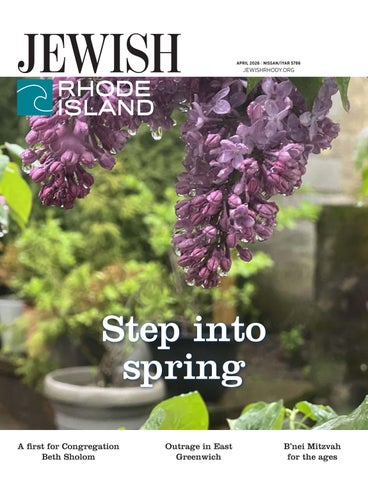
April 2026

Page 1


JEWISH RHODE ISLAND

INTERIM EDITOR Fran Ostendorf

DESIGN & LAYOUT Alex Foster

ADVERTISING DEPARTMENT

Tracy Blake | 401-421-4111, ext. 160 tblake@jewishallianceri.org

CONTRIBUTORS Bob Abelman, Ruth Marris Macaulay, Sarah Greenleaf, Robert Isenberg

COLUMNISTS Michael Fink, George M. Goodwin, Patricia Raskin, Rabbi James Rosenberg, Daniel Stieglitz

VOLUME XXXIII, ISSUE IV

JEWISH RHODE ISLAND (ISSN number 1539-2104, USPS #465-710) is published monthly except twice in May, August and September.

PERIODICALS POSTAGE PAID at Providence, R.I

POSTMASTER Send address changes to: Jewish Rhode Island, 401 Elmgrove Ave., Providence, RI 02906.

PUBLISHER

The Jewish Alliance of Greater Rhode Island, Interim President/CEO Harris Chorney, Chair Marisa Garber, 401 Elmgrove Ave., Providence, RI 02906. 401-421-4111; Fax 401-331-7961

MEMBER of the Rhode Island Press Association.

COPY DEADLINES: All news releases, photographs, etc., must be received on the Wednesday 10 days prior to publication. Submissions may be sent to: editor@jewishallianceri.org.

ADVERTISING: We do not accept advertisements for pork or shellfish. We do not attest to the kashrut of any product or the legitimacy of advertisers’ claims.

We were instant friends. Then came the Israel question.

From the Interim Editor

I read this column in the Forward that I think merits consideration by all our readers. We are all Jews and we all are concerned about our Jewish future. As a Jewish journalist, I’ve written about people’s reactions to conversations both difficult and not-so difficult. This column does put those conversations in perspective.

THERE’S ONE THING these days Jewish publications of all stripes seem to agree about: The Jewish future – geographically, politically, spiritually – is Florida. An article last month in the conservative magazine Tablet pondered whether Miami was “the new Jerusalem,” and left-wing quarterly Jewish Currents made the Sunshine State the theme of an entire 2024 issue.

As a Jewish journalist, inveterate spring breaker and friend of a Florida man with a couch for me to crash on, I wanted to see for myself. So last week, with paid time off burning a hole in my swim trunks, I took my talents to South Beach … and spent essentially no time in the Jewish community at all. (Though I did DoorDash banana bread from Zak The Baker.) But just as Jonah could not outrun his destiny, the Jewish future inevitably found me anyway. This happens when you like talking to random people at bars.

I had spent much of the night getting to know an ebullient pair of strangers, Will and Deanna. (Names changed here.) They are best friends and roommates, two Dallas-born transplants chasing careers in fashion design. Both are gay, and neither is Jewish. But we found common ground when Will told me he is religious. As I told Will, I’ve reported extensively on the experiences of queer Orthodox Jews for the Forward (“a really cool Jewish newspaper”). I spoke of the challenges they face, their resilience and their breakthroughs, and Will spoke about bringing his queerness to his faith.

There was something he needed to ask me, though: Had I been reporting on Jewish people where I’m from, or – he ventured nervously – “Israeli Jews”? I told Will I mostly write about American Jews, but that this Jewish issue transcended borders.

Then the real purpose of the question came out. He volunteered his sense of horror about Gaza and related his shock about the circumstances of Israel’s establishment. What he believed about the history was unclear – it was loud in there, and I couldn’t quite make out his claims – but I could tell: I was being tested.

Yes, this did feel like the Jewish future: one in which any conversation about Judaism will become one about Israel or – and this is how I read the question – your Israeli politics. A future in which Jews everywhere, upon identifying themselves as Jews, are asked (or held) to account for Israel’s actions. And, frankly, a future where it is harder for Jews to make friends with nonJews.

In another context, or a different mood, I might have been put off by the turn our conversation had taken and quit the interaction. But I liked these two old souls. I said to Will that what has happened in Gaza was terrible; as a journalist, I keep my politics close, but this was sticking to facts. And I saved the looming debate over Israeli history for another time. The three of us went back to enjoying the music and yapping about our dreams and nightmares, and when the lights finally came on at the bar, they invited me to meet them for brunch the next day. I said yes.

Part of me wanted to bring Israel up the next day, but at brunch I couldn’t find a place for it. Yet I found there were lots of opportunities to discuss Judaism. I told them about my grandmother’s recent passing, the dignity of Jewish burial rites and the intensity of shiva. We told stories, laughed, got closer: I learned that Deanna had lived in her car when she first moved to Miami, and Will showed pictures of himself in drag. When the food arrived, this fledgling trio held hands and said something like grace.

A couple hours later, we laid down towels on South Beach. Deanna stayed on the shore as Will, and I waded waist-deep into the water. Here was my chance to say something about “Israeli Jews,” or invite him to ask me anything he wanted to know about Israel. But what crossed my mind in the ocean was a mitzvah I often contemplate at the beach. “In Judaism,” I explained, “there’s this practice of ritual immersion…” We never did circle back to Israel.

Florida (particularly South Florida) has come to represent the Jewish future because its Jewish community is ethnically diverse and teeming with young people. (It’s also deeply pro-Israel.) Other features seem predictive of everywhere else: Chabad reigns supreme and religious schools are heavily subsidized. The state is also a kind of extremist incubator – see gubernatorial candidate James Fishback; Florida International University’s antisemitic conservative group chat; or the Miami nightclub that played Kanye West’s “Heil Hitler” for conservative influencers – with Jews a prime subject of obsession.

Meanwhile, American Jews should expect to field uncomfortable questions from strangers about Israel and Gaza for the foreseeable future. It might not be fair, but reality rarely is. All we control – besides the weather, media and global financial system, of course — is our reaction.

LOUIS KEENE is a reporter for the Forward. His work has also been published in The New York Times, New York magazine and Vice. He is based in Los Angeles. keene@ forward.com@thislouiskeene.la This story originally appeared in the Forward and is reprinted with permission.

The views and opinions expressed in this article are the author’s own and do not necessarily reflect those of the Forward. Discover more perspectives in Opinion. To contact Opinion authors, email opinion@forward.com.

MISSION OF JEWISH RHODE ISLAND is to communicate Jewish news, ideas and ideals by connecting and giving voice to the diverse views of the Jewish community in Rhode Island and Southeastern Massachusetts, while adhering to Jewish values and the professional standards of journalism. ALL SUBMITTED CONTENT becomes the property of Jewish Rhode Island. Announcements and opinions contained in these pages are published as a service to the community and do not necessarily represent the views of Jewish Rhode Island or its publisher, the Jewish Alliance of Greater Rhode Island. We reserve the

UP FRONT

They beamed on the bimah

Temple Beth-El’s diverse adult B’nei Mitzvah class was the final one for Cantor Judy Seplowin

When a mayor, former mayor, congressman, architect, real estate expert and some teachers get together every week, you might assume they are a working political group, but you’d be wrong. Instead, they were all learning Hebrew in preparation for their B’nei Mitzvah. The class was the final one for Cantor Judy Seplowin, 76, before her retirement this June. Her adult B’nei Mitzvah classes are typically four to eight students, but this class has 14 students. “This is like the biggest one I’ve had,” Cantor Seplowin said. “I should leave more often.”

“IT USED TO BE that many people could already read Hebrew. So, they would just jump in, and we would have this class for a year,”

Cantor Seplowin explained. “But these days, most people ... do not know how to read Hebrew. And it’s just about [being able to] read the prayer book and chant from Torah and so forth. So, I’ve been making it like a two-year process or a year-

and-a-half process.”

The current class includes a diverse group of people, from those who converted to Judaism, to those who grew up more secular, and women who weren’t encouraged to have a Bat Mitzvah when they were growing up.

“I think people are very intentional about doing it because they understand that chanting from the

Torah is literally awesome,” Cantor Seplowin explained. She chanted from the Torah for the first time when she was in seminary in the early nineties in Israel. “I remember when I went to practice for the first time with it; I don’t think I’d unrolled a Torah since I was 13, and it was really, really powerful,” said Cantor Seplowin. “I love chanting.”

“You have to be able to express the text in a way that your congregants are going to understand what you’re singing about, even if they don’t get the Hebrew,” she said.

Cantor Seplowin found her path through the theater, Kol Nidre and on a cruise ship in the Mediterranean. “I was in theater in New York City ... for six years. I did a lot of stuff, but never on Broadway.”

She was offered a job on a cruise ship and right before she left an old friend invited her to Kol Nidre at her old home synagogue in Sum-

mit, New Jersey. “There were these women on the bimah, and the cantor looked like an angel. She had blond hair and sang beautifully, and I thought, hmmm, and tucked that away.”

She spent the whole time on the cruise ship thinking about becoming a cantor, “singing, and dancing my way through the Mediterranean,” was how she put it.

In addition to the political participants, the class also included an animal vet and an Army vet. They canceled class on Veterans Day and instead “we took our Army vet out to dinner. We got a huge table at Red Stripe and we said, ‘We’re honoring you.’ ”

The other vet in the class, Annie Schwartz, 60 of Providence, got a call during class as a horse was giving birth. An equine veterinarian, she stepped out of class to talk the client through the birth. “I realized this was a once in a lifetime

opportunity to watch a horse give birth,” Schwartz said, “so I went back into class, and everyone gathered around my phone and watched the foal being born. It was exhilarating and exciting to share this with my classmates.”

Not all the events experienced by the class were uplifting. “When the Brown

The B'mitzvah class on the bimah.
PHOTOS GLENN OSMUNDSON
Jay Potter with his son.

Each Passover, we are reminded that freedom begins at home

Every year, as Passover approaches, Jewish homes across the world become laboratories of renewal. We sweep, scrub and search for chametz, not only to fulfill halakhic obligation but to remind ourselves that freedom begins at home. The Exodus story is not confined to the desert, it is lived in our kitchens, dining rooms and gardens, wherever we prepare to welcome guests and retell the story of liberation.

THE TORAH describes the Israelites marking their doorposts with blood before the final plague. That act sanctified the home as the first sanctuary of freedom. Today, our homes remain the stage where redemption is rehearsed. Each crumb removed is a declaration that slavery, whether to habit, excess or neglect—has no place here. The home becomes a vessel of dignity, ready to host the Seder, where generations gather to remember that we were once slaves and are now free.

The garden, too, offers its own Torah. In Shir HaShirim, tradi-

University shooting happened, the first thing we all thought of was Brett, [Smiley, Providence’s Mayor],” said Wendy Joering, 52, of Providence. The class has a group text and “We were texting him and about a day-and-ahalf later we got a message from him saying – you don’t know how much this text chain means to me.” She explained that when the door to the room closed, they were all on an equal playing field. They all became students.

Growing up in Long Island, New York, at a Reform synagogue, Joering was given a choice because her mother had a choice – she could attend Hebrew school and become a Bat Mitzvah or not.

“At the time, Hebrew school was really boring,” Joering recounted, “and I just said, I don’t want to. So, I didn’t have a Bat Mitzvah; then all my friends did it and I regretted it.” Her feelings of guilt led her to being confirmed in 10th grade, which she described as “a great experience.”

After her two daughters were Bat Mitzvah, she once again considered it for herself, but when her father died

tionally read during Passover, the imagery of blossoming vines and fragrant spices evokes renewal and love. Just as the Israelites stepped into springtime freedom, our gardens remind us that liberation is not only about escape from oppression but about cultivation of life.

A tended garden teaches patience, responsibility and hope. Seeds buried in the soil echo the matzah baked in haste: both are acts of faith that tomorrow will bring nourishment.

Passover challenges us to see our homes and gardens as sacred spaces.

unexpectedly, she thought, “forget it, I won’t do it.”

Cantor Seplowin’s upcoming retirement changed everything. “When I heard that Cantor Judy was retiring, I was like, if I’m going to do it, I have to do it now.”

Barbara Schoenfeld, 72, of Newport, was also inspired by her children. “I have wanted to learn Hebrew for many years. The feeling was especially poignant when each of my three sons became Bar Mitzvah at Temple Beth-El. It nagged at me that to say the aliyah, I had to read the transliteration from the laminated card provided for people who don’t know Hebrew.”

Schoenfeld is also working on a novel about her Jewish roots and wanted to delve deeper into her Jewish identity. Her father was born Jewish and her mother converted to marry him. After her parents passed away, she found a box of over 500 letters the two had exchanged during their many-year struggle over whether he could marry her. “Their ambivalence set my own relationship with Judaism as not quite all-in ... but now my Bat Mitzvah is a public commitment to my

Jewish identity.”

The Seder table is not merely furniture; it is an altar of memory. The parsley dipped in salt water is not just a garnish; it is a symbol of tears and growth. Even the act of reclining in comfort is a ritual statement: freedom means the ability to rest without fear. In this way, the domestic sphere becomes a classroom of covenant, where every detail, cleaning, cooking, planting, teaches Torah.

There is also a civic dimension. Just as the Israelites left Egypt together, our homes and gardens remind us that freedom is communal. A garden thrives when tended with care, but it also depends on rain, sun and the wider ecosystem. Likewise, our homes flourish when they are part of a just and com-

Many people in the class knew only the letters on the dreidel when they began. Schoenfeld described the class’s early lessons as “sounds that seemed like grunts and nonsense.” After working hard, stumbling through and correcting mistakes, they were reading a prayer when something shifted, “I recall us laughing with glee as we lumbered through it, really reading it, not reciting from memory,” Schoenfeld said.

Cantor Seplowin’s students described her as an excellent teacher who was fun as well as exacting. “She’s made it as easy as possible, she really has,” Joering said.

Schwartz added, “She will reprimand us like children when we are chatting or being disruptive then suddenly, she will break out into song.”

Each student brought part of themselves to the group and reading from the Torah. Joering, the executive director of the Sandra Bornstein Holocaust Education Center, brought up the idea of honoring a child who didn’t survive the Holocaust. “Everyone was immediately like, absolutely,

passionate society. Preparing for Passover is not only about personal ritual; it is about cultivating a community where all can taste freedom. The open door for Elijah is a symbol of hospitality, a reminder that redemption is incomplete until all are welcomed.

As we open our homes and gardens this year and in future Passover Festivals, let us remember, liberation is not only a story of the past but a practice of the present. Every sweep of the broom, every seed planted, every table set is an act of faith that freedom can be nurtured here and now. May our homes be sanctuaries of memory, our gardens be fields of hope and our lives be testimonies to the enduring promise of redemption.

RABBI RICHARD PERLMAN is the Rabbi Emeritus, Temple Ner Tamid, Peabody, Massachusetts, and Chaplain Peabody and Massachusetts State Police

let’s do it,” she said, “So that’s really special.”

Of the four Torah scrolls taken out for their B’nei Mitzvah, Joering held the Torah rescued from the Holocaust. “That’s really meaningful to me,” she said.

The class plans to stay in touch and even continue their Hebrew studies in a more informal manner now that the class is over.

“When you get to a certain age, you don’t meet people anymore,” said Joering. “This has been such a unique way to really meet people and form a bond.”

Schwartz added, “Adults rarely come together and feel so bonded. Somehow our childlike side comes out each time we see each other in and out of the class.”

“It’s a wonderful group of people, and this is sort of the cherry on top of the sundae for me. ... I’m so fortunate to have this,” Cantor Seplowin said. “To have this career.”

When asked about how her students did in the class, she was as encouraging as they

April 10 7:01pm April 17 7:09pm April 24 7:16pm May 1 7:24pm Greater Rhode Island Candle lighting times April 2026

all had described: “They’ve been very supportive and they’re all doing a very good job. I’m so proud of them.”

The adult B’nei Mitzvah ceremony took place March 14, 2026, at Temple Beth-El in Providence.

SARAH GREENLEAF (sgreenleaf@jewishallianceri. org) is the digital marketing manager for the Jewish Alliance of Greater Rhode Island and writes for Jewish Rhode Island.

RABBI RICHARD PERLMAN

CALENDAR HIGHLIGHTS

FOR COMPLETE MONTHLY LISTINGS, VISIT JEWISHRHODY.ORG

Ongoing

Kosher Senior Café and Programming. 11 a.m.-1 p.m. Monday – Thursday at the Bonnie & Donald Dwares JCC, 401 Elmgrove Ave., Providence; Fridays at Temple Sinai, 30 Hagen Ave., Cranston. In-person (and usually on Zoom Monday –Thursday) programming 11 a.m.-noon followed by lunch and discussion noon-1 p.m. On Wednesdays, programming is chair yoga. For seniors aged 60 and older as well as younger adults with a disability; all faiths and backgrounds are welcome. Suggested donation: $3 per lunch. The Kosher Senior Café is a program of Jewish Collaborative Services and is generously supported by the Jewish Alliance of Greater RI and Blackstone Health. Information and RSVP, Neal at neal@jcsri.org or 401-421-4111, ext. 114.

Temple Sinai Women in Genesis.

Sundays 12:30-2 p.m. 4/19-5/31. 30 Hagen Ave., Cranston. Taught by Cantor emerita Deborah Johnson, the course will focus on the women in Genesis and their importance. Over seven sessions, we will look closely at these women. In the final session, we will create a Genesis heroine through the process of midrash. Information, Templesinairi. org, dottie@templesinairi.org or 401-942-8350.

Temple Emanu-El Mahjong. Tuesdays (with the exception of holidays). 11 a.m.-1 p.m. 99 Taft Ave., Providence. Information, Shoshana Jacob at shosh@teprov.org or 401331-1616.

Hebrew Classes (Winter Semester) at Temple Emanu-El. Tuesdays thru 4/28. Beginner class 5-5:45 p.m. All other levels 6-7 p.m. 99 Taft Ave., Providence. Five levels of in-person classes offered: Beginner, Introduction to Prayerbook Hebrew, Advanced Beginners for Spoken Hebrew, Intermediate and Advanced. Offered jointly with the Jewish Alliance of Greater RI. Upcoming class dates: 4/14, 4/28. Information, Toby Liebowitz at tobyaane@gmail.com.

Temple Beth-El Mahjong. Tuesdays 5:30-8 p.m. 70 Orchard Ave., Providence. This gathering is not instructional; players of all levels are invited. Observers welcome. Sets and cards are not provided. Information and RSVP, Barbara Barry at bebarry@msn. com.

Temple Torat Yisrael Virtual Minyan. Tuesdays 5:30 p.m. Via Zoom. Information, temple@ toratyisrael.org.

Temple Beth-El Teen Night. Most Thursdays 6 p.m. 70 Orchard Ave., Providence. Join us for fun conversation and a delicious dinner. Information, Jude Weinstein at jweinstein@temple-beth-el.org or 401-331-6070.

Temple Sinai Judaism Beyond the Basics. Thursdays thru 5/7. 7-8 p.m. 30 Hagen Ave., Cranston. Topics will include Jewish mysticism, Jewish views on sexuality, responses to antisemitism, our complicated relationship with Israel, Talmud study and more. Open to prospective and recent converts, people in interfaith relationships and anyone who wants to lift their Jewish learning. Information, Templesinairi.org, dottie@ templesinairi.org or 401-942-8350.

Delve Deeper: Second Temple Judaism (Almost) a Thousand Years of Jewish History: Judaism from 600 BCE to 200 CE. Thursdays thru 4/23. 7-9 p.m. Examine the diverse forms of Judaism that emerged in the Second Temple Period. Via Zoom. Taught by Dr. Sara Ronis, Ph.D., associate professor at St. Mary’s University. Presented in cooperation with the Jewish Alliance of Greater RI, area synagogues and JCDSRI. Information, www.delvedeeper.org.

Cape Cod Synagogue Family Shabbat Services and Dinner. Second Friday of the month 5:30 p.m. 145 Winter St., Hyannis, Mass. In-person and livestreamed services on website, Facebook, Cape Media, YouTube and Community Television Comcast channel 99. Followed by Community Shabbat Dinner. Information, 508775-2988 or capecodsynagogue. org.

Temple Torat Yisrael Virtual Kabbalat Shabbat & Torah Services. Fridays 5:45-6:15 p.m. Via Zoom only. Information, temple@toratyisrael.org.

United Brothers Synagogue Shabbat Services. 7 p.m. 205 High St., Bristol. Shabbat services first Friday evening of every month. Information, Bradford Louison at bradlouison@gmail.com or 617-5121978.

Cape Cod Synagogue Shabbat Services. Fridays 7 p.m. 145 Winter St., Hyannis, Mass. With Rabbi David Freelund. In-person and livestreamed on website, Facebook, Cape Media, YouTube and Community Television Comcast channel 99. Information, 508-7752988 or capecodsynagogue.org.

Temple Beth-El Torah Study. Saturdays 9-10:30 a.m. 70 Orchard Ave., Providence. Join us for Torah study in the Library. Information, Jude Weinstein at jweinstein@ temple-beth-el.org or 401-3316070.

Temple Torat Yisrael Shabbat Services. Saturdays 9:30-10:30 a.m. 1251 Middle Road, East Greenwich. In-person service with Zoom available. Information, temple@toratyisrael.org.

Temple Sinai Breakfast and Torah Study. Saturdays 9:30-11 a.m. 30 Hagen Ave., Cranston. Breakfast followed by weekly Torah study (also on Zoom) at 10 a.m. Information, Templesinairi.org, dottie@templesinairi.org or 401942-8350.

Temple Habonim Torah Study. Some Saturdays 10-11 a.m. When Shabbat morning services are not scheduled, Torah Study (currently online) is usually held. Information, Adina Davies at office@ templehabonim.org or 401-2456536.

Cape Cod Synagogue Shabbat Services. Saturdays 10:30 a.m. 145 Winter St., Hyannis, Mass. With Rabbi David Freelund. In-person and livestreamed on website, Facebook and YouTube. Information, Cape Cod Synagogue at 508-7752988 or capecodsynagogue.org.

Temple Sinai Morning Shabbat Service. Saturdays 11 a.m.-noon. 30 Hagen Ave., Cranston. Join us either in the chapel or on Zoom. Information, Templesinairi.org, dottie@templesinairi.org or 401942-8350.

Friday | April 10

Temple Beth-El Quartet Shabbat Celebrating Judy. 5:45-6:45 p.m. 70 Orchard Ave., Providence. Join us in the Sanctuary for a Shabbat Service honoring Cantor Judy Seplowin. Information, Jude Weinstein at jweinstein@templebeth-el.org or 401-331-6070.

Temple Sinai Evening Service. 6-7 p.m. 30 Hagen Ave., Cranston. Join us in the Chapel or on Zoom. Information, Templesinairi.org, dottie@templesinairi.org or 401942-8350.

Saturday | April 11

Kids' Night Out: Jungle Expedition. 5-9 p.m. Bonnie & Donald Dwares JCC, 401 Elmgrove Ave., Providence. Parents enjoy a night out while kids enjoy activities including arts & crafts, games and a movie. Dinner included. For grades

K-5. Information (including cost), Rachel Accetturo at raccetturo@ jewishallianceri.org or 401-4111, ext. 140.

Laugh with Liz! Comedy Night. 8-11 p.m. Bonnie & Donald Dwares JCC, 401 Elmgrove Ave., Providence. Join us for a night of stand-up comedy with THE hilarious Liz Glazer, hot off “The Tonight Show Starring Jimmy Fallon” and her YouTube special. For ages 21+. Tickets only, no walkins. Information, Nicole Kurland at nkurland@jewishallianceri.org.

Sunday | April 12

PJ Library Stories and Scenes: Mitzvah Edition. 1:30-3 p.m. Bonnie & Donald Dwares JCC, 401 Elmgrove Ave., Providence. Join us for an afternoon of play acting and storytelling with a Jewish values twist. Kids will learn the basics about putting on a performance, play movements games and act out a PJ Library book. For ages 5-8 years old. Information, Lyndsey Ursillo at lursillo@jewishallianceri. org.

Monday | April 13

Sandra Bornstein Holocaust Education Center Yom HaShoah Commemoration. 6-7:30 p.m. Temple Beth-El, 70 Orchard Ave., Providence. Survivors, descendants and students will affirm how Holocaust memory lives across generations, shaped by testimony, creativity and the obligation to remember. Featuring original music of remembrance and resilience by Judith Lynn Stillman and guest musicians. Dessert reception following program. Information, Lexi Kutenplon at lexik@hercri.org or 401-453-7860.

Wednesday | April 15

Jewish Book Council Author Event: "The Whisper Sister" by Jennifer Brown. 6 p.m. Bonnie & Donald Dwares JCC, 401 Elmgrove Ave., Providence. Set in Prohibition-era New York, this historical fiction novel follows a young Jewish immigrant who must take over her family's speakeasy, navigating antisemitism, family duty and the world of bootlegging. Free. Information and RSVP, Samantha Kaufman at skaufman@ jewishallianceri.org.

Friday | April 17

Temple Beth-El Shabbat Hallelu. 5:45-7:15 p.m. 70 Orchard Ave., Providence. Join the Hallelu Band in the Sanctuary. Information, Jude Weinstein at jweinstein@templebeth-el.org or 401-331-6070.

Temple Sinai Yom HaShoah Service. 6-7:30 p.m. 30 Hagen Ave., Cranston. Join us in the Sanctuary or on Zoom for our Holocaust Remembrance service. Shireinu will be singing. Service followed by an Oneg reception in the social hall. Information, Templesinairi.org, dottie@ templesinairi.org or 401-942-8350.

Sunday | April 19

“Raise the Roof”: Reconstructing a Lost World of Polish Jewish Life. 2-4 p.m. Bonnie & Donald Dwares JCC, 401 Elmgrove Ave., Providence. Join the Sandra Bornstein Holocaust Education Center and Temple Emanu-El for a screening of a documentary film about the reconstruction of the wooden synagogue of Gwoździec, destroyed during the Holocaust. A carpenter who helped rebuild the synagogue at the POLIN Museum of the History of Polish Jews in Warsaw will offer remarks. Dr. Laura Auketayeva will offer historical context and discuss Jewish life in Gwoździec preHolocaust. Free. Information, info@ hercri.org.

Tuesday | April 21

Yom Ha'Atzmaut Community Celebration. 5:30-8 p.m. Bonnie & Donald Dwares JCC, 401 Elmgrove Ave., Providence. Join us to celebrate Israel's National Day commemorating the Israeli Declaration of Independence in 1948. Enjoy delicious Israeli food from Bonapita Kitchen and Israeli dancing with instructor Rina Wagman. Cost: Ages 17+ $12.00; Ages 3-16 $6; Ages 2 and under free. Information and RSVP (required), Samantha Kaufman at skaufman@jewishallianceri.org.

Friday | April 24

Hadassah Author Event and Book Swap. Noon-2:30 p.m. Tamarisk Senior Living, Warwick. Luncheon, Author Talk and Book Swap with special acknowledgements of our most senior Hadassah members! Author Hester Kaplan, a Providence resident, will present her book, "Twice Born," which is about relationships and the nature of biography writing. Hester's father, Justin Kaplan was honored to write about Mark Twain. There will be a book swap with certificates given to special Hadassah members. Dessert provided by Navad. Hadassah is a women's Zionist organization promoting medical breakthroughs, youth programs, women's empowerment and advocacy in the US and Israel. Register at events.hadassah.org/ ribookluncheon. Luncheon is $22

CALENDAR

with preregistration. No cost for event at 1 p.m.

Temple Beth-El Shabbat Service. 5:45-6:45 p.m. 70 Orchard Ave., Providence. Please join us in the Sanctuary. Information, Jude Weinstein at jweinstein@templebeth-el.org or 401-331-6070.

Temple Sinai Evening Service.

Thursday | April 30

Sandra Bornstein Holocaust Education Center Visit: Tomaquag Museum. 5:15 p.m. departure from Bonnie & Donald Dwares JCC, 401 Elmgrove Ave., Providence. Guided tour and conversation 6-7:15 p.m. at Rhode Island’s only Indigenous museum, located in Exeter. Learn about Indigenous culture,

schmoozing and dinner. Proceeds will support Leadership Institute for Teens; LIFT teaches high school students about the Holocaust and other genocides as well as social justice while building skills. Tickets (includes dinner): $72 | $36 under age 40. Information, info@hercri. org or 401-453-7860.

Temple Beth-El Cantor

Judy Seplowin's Retirement Celebration with Julie Benko. 4-6 p.m. 70 Orchard Ave., Providence. Please join us in the Sanctuary for a performance by Broadway star Julie Benko honoring Cantor Judy Seplowin's tenure at Beth-El. Information, Jude Weinstein at jweinstein@temple-beth-el.org or 401-331-6070.

Committee Members

Francine

Susan Gertsacov

Robyn Goldstein

Jane Jacober

Shanna Trufan

Lisa Davis

FOOD

As Americans drink much less wine, kosher demand stays strong

OXNARD, California – On Friday nights, in Jewish homes around the world, a familiar ritual unfolds: a blessing over wine, poured into a cup and passed around the table.

THAT RITUAL, multiplied during Passover, may help explain why kosher wine is holding steady even as the broader wine industry struggles.

Across the United States and globally, wine consumption is declining. Baby boomers, long the industry’s most reliable customers, are aging out of peak drinking years. Younger consumers are drinking less alcohol overall and are more likely to reach for craft beer, spirits or ready-to-drink cocktails when they do. In California, wineries have begun laying off workers, cutting production and, in some cases, shutting down altogether.

But in the kosher wine market the downturn looks more like a slowdown.

Royal Wine, the largest distributor of kosher wine in the United States, is used to seeing year-over-year growth in the double digits, according to Jay Buchsbaum, a vice president at the New Jersey-based company.

“By that standard, we did not have a great year,” he said in an interview. “But we did have an increase, whereas the industry has declined by as much as 12% so we’re bucking the trend.”

At Herzog Wine Cellars in Oxnard, California, that resilience is apparent on the production floor.

In the weeks before Passover, the busiest season of the year for kosher wine, a forklift is moving pallets across the warehouse and bottling lines are running steadily, workers are preparing shipments destined for holiday tables.

“Passover for us is what October, November and December are for the rest of the industry,” said Herzog’s winemaker David Galzignato, describing a seasonal surge that mirrors the year-end rush in most wineries.

Herzog is the flagship

American winery of Royal Wine, which is owned by the Herzog family, an Orthodox family originally from Slovakia that has been in the business for nine generations and today dominates the kosher wine market in the United States. The scale is unusual for kosher production: Bottles range from $13 table wines to $300 Napa Valley releases, sourced from top vineyards across California.

Galzignato, an Italian Catholic who joined the winery in 2021, was brought in with a specific mandate: to elevate the quality of kosher wine.

“They wanted me to take kosher wine quality … to the same level, or better, than the non-kosher quality,” he said.

But despite overseeing every step of production, Galzignato cannot physically move the wine he makes.

Under kosher law, from the moment grape juice is released until the wine is bottled, only Shabbat-observant Jews may handle it – a requirement that shapes everything from staffing to workflow.

“It just takes a little bit more planning,” he said.

Even with those constraints, the winery has continued investing in its operations in recent years, upgrading equipment at a cost of more than $2 million and expanding production capacity at a time when many wineries are scaling back.

“When there’s a downturn companies typically pull back on investments,” Galzignato said. “But here the commitment to presenting the best kosher wine remains 100%.”

Stability amid the wider downturn is not limited to industry giants like Royal. At Covenant, a boutique kosher winery in Berkeley, California, the trend looks similar.

“We’re actually about 5% up this year,” said Jeff Morgan, the Covenant’s founding winemaker.

Covenant helped popularize high-end kosher wine in recent decades, but Morgan credits a much older force for the staying power of his product.

“The American interest in wine is in what I would call a correction phase,” he said, describing the broader downturn as the fading of a decades-long boom driven largely by baby boomers.

In his view, wine never became fully embedded in American life.

“Americans don’t have what we would call a wine culture,” he said. “We are a nation that follows fads.”

Jewish life, by contrast, has long been structured around wine – not as a lifestyle choice, but as a ritual obligation.

“We Jews have a culture of wine,” he said. “We are pretty much obliged to drink wine.”

That obligation creates a built-in baseline of demand that persists regardless of broader trends.

The same dynamic is visible to those who oversee kosher production.

“We have our regular Shabbos and our regular holidays and life cycle events,” said Rabbi Nahum Rabinowitz, a senior rabbinical coordinator at the Orthodox Union who has worked on wine for more than two decades. “Those activities continue as normal. … It hasn’t really changed that much.”

Dovid Riven, who runs KosherWine.com, the largest

retailer in the United States selling only kosher wines, said he expects to bring in about as much this year as he did last year.

“There’s definitely sluggishness … but not to the extent that the non-kosher industry is seeing,” he said. Instead of abandoning wine, many customers are adjusting what they buy – opting for less expensive bottles or cutting back on collecting. He also noted the widespread perception in the wine industry that young people are replacing alcohol with cannabis.

Still, he said, the ritual role of kosher wine sets a floor under demand. “Nobody’s going to sit down for their seder and smoke four joints,” he said. “You’re going to need four cups.”

The goal of the industry should be to adapt with lighter, more accessible wines and new marketing strategies aimed at younger drinkers, said Ernie Weir, co-owner of Napa Valley’s Hagafen Cellars, which was established in 1979.

“We’re not unaffected by the general trends so we must deal with them,” he said.

The kosher wine business may have been spared some of the worst of the downturn in part because its consumers are still catching up to trends that reshaped the broader market years ago.

For decades, kosher wine in the United States remained associated with sweet, low-

end bottles even as the general market moved toward dry, higher-quality wines. That left room for growth as consumers began trading up.

Buchsbaum argued that the kosher wine business has been spared some of the worst of the downturn in part because its consumers are “behind the general consumer” – a lag that, in this case, has worked to the market’s advantage.

“In the past, an Orthodox or kosher-observant person would only drink a bottle of wine at the table Friday night,” Buchsbaum said. “Now he’s got two or three bottles at the table Friday night. Wow. He could have one or two during the week with his other meals. That consumer specifically has grown.”

At the same time another kind of kosher wine consumer has faded: the less observant American Jew who did not keep strictly kosher day to day but still bought kosher wine, hired kosher caterers and maintained certain communal norms around holidays and life-cycle events.

Buchsbaum described a mid-20th-century American Jewish landscape in which nearly every community had kosher butchers and caterers because even many non-Orthodox families expected bar mitzvahs, weddings and other celebrations to be

RICI launches podcast

RHODE ISLAND COALITION FOR ISRAEL (RICI) launched a new video podcast called “Deep Dive with RICI” which is a bold exploration of the issues shaping Israel, America, Rhode Island and the future of Western civilization.

Hosted by Maria Friedman, executive director of RICI, the podcast hopes to brings clarity to complex topics so that viewers get the knowledge and confidence to engage in informed

discussions about Israel and antisemitism.

For the first episode, go to tinyurl.com/1deepdive to see conversation with Pastor Allen Pangburn; tinyurl. com/deepdivepod2 for our interview with a local Iranian woman about what’s happening in Iran and tinyurl. com/deepdiveepisode3 to see our latest conversation with Dr. Andrew Pessin about the current state of antisemitism and antizionism.

Seeking a way: memories of an encounter in Paris

I DON’T KNOW quite yet where we will convene for Pesach, so I will wonder and wander among my memories.

Among my fond recollections of yore is an encounter that took place in Paris, where I was to meet our first-born and return with her to Providence.  That day I took the metro to a familiar subway where as a student, I would join the subway seekers for onion soup with the truck-driver regulars.

KETCHB OOK

But even in Paris things change, and this time I came across a troupe of Roma. They brought their music and culture in the form of portable instruments, and I eventually joined them in a haunting and reflective song:

CONTINUED FROM PAGE 9

kosher. That world, he said, has sharply contracted.

The result is a smaller but more engaged core market – one that is spending more per household even as casual participation declines.

“The current kosher consumer … has picked up a lot of that slack,” Buchsbaum said.

The shift in who buys kosher wine reflects a broader change in American Jewish life. As assimilation and disaffiliation have transformed the community, more observant populations have taken on a larger role.

Another broader trend is generating optimism among industry insiders: the growing demand for kosher wine outside the Jewish community.

Perhaps the best example is Royal’s Bartenura label, which is the best-selling premium Moscato, a sweet, aromatic white wine, in the United States, selling nearly 10 million bottles a year. Buchsbaum estimates that as little as 15% of Bartenura buyers are Jewish, with the blue-bottled wine developing a particular fan base among Black consumers.

Buchsbaum also said Royal has increasingly found cus -

“Le chemin Gitan is a grove of olive trees: but all the grass has been trampled under the feet of wanderers who have died seeking freedom and its pathways of liberty and have lost their way.”

Somehow these words sank in and affected me deeply. I learned them by heart and soul.  And as the troupe generously accepted me, it dawned on me that they too were seeking their way just as I was.

MIKE FINK (mfink33@aol.com) is a professor emeritus at the Rhode Island School of Design.

tomers in Christian Zionists who are drawn to Israeli wines for religious and cultural reasons. In states like Texas, he said, that audience has become a meaningful and growing segment of the market.

Royal sells to Total Wine, one of the largest wine chains in the country, which has expanded its Israeli wine offerings and actively promotes them to a broad, largely non-Jewish customer base.

“They have a tremendous Israeli wine section,” Buchsbaum said, noting that stores feature maps of Israel’s wine regions and host tastings to introduce the category to new consumers.

It also helps that Israeli producers have been earning high scores and international awards, competing alongside established wine regions in Europe and California. That recognition has helped shift perceptions of kosher wine from a religious product to a quality-driven one.

“They’ve been making wine for over 5,000 years, and they just got recognized for being good at it,” said Josh Greenstein, executive vice president of the Israeli Wine Producers Association.

COMMUNITY VOICES

Tikkun Olam in the Jewish garden

THE CONCEPT OF TIKKUN OLAM (“repairing the world”) can be applied to Jewish gardening. It is the active, spiritual and physical engagement in healing the earth, viewing it as a partnership with God. In biblical terms, it is guardianship of the earth, addressing the biblical duty to work and protect nature. It transforms gardening into a mitzvah (commandment) that fosters environmental stewardship, sustainability, and the restoration of balance in nature, often celebrated during Tu

B’Shevat

H EALTHY LIVING

Here are some Tikkun Olam project ideas for Jewish home gardeners. They focus on caring for creation, reducing waste and supporting life through the garden. In https://jewishlivingdelaware.org, there is an article “Planting with a Purpose: How to Practice Tikkun Olam in Your Own Yard” by Elaine Schmerling where she writes about these practices:

• Plant native species which help to support the local

food web

• Create a pollinator patch which becomes a mitzvah for sustaining life

• Leave some leaves and stalks to help insects and native bees to survive.

• Replace lawn with life adding shrubs or plantings that are eco-friendly.

• Collect rainwater for practical conservation that matches Jewish values of mindfulness and caring for precious resources.

Spiritually, you can make a “peace corner” by adding a bench or birdbath or quiet area of prayer and reflection. Rabbi Dov Lev sums this up well in the article “The Jew-

ish Garden” in Aish.com with subtitles “Appreciating the Plant Kingdom As a Path To Love of God.” and “Appreciating God Through Nature.” Rabbi Dov Lev writes, “The Torah exhorts us to love God. But how does one love an immortal, infinite, non-physical being? Maimonides teaches that one way is to focus on the wonders of Creation. When we observe how a little seed can transform into something so beautiful and alive, we are overcome with awe and appreciation for the Almighty…God first appeared to Moses in a thorn bush, because God wanted to emphasize that even vegetative life is infused with the Divine Presence.” This arti-

Lew, Dad and Anglophilia

During World War II, my Dad, Eugene, had a law school buddy stationed temporarily in Bermuda. Lew met a young lady, Cecily, and her aunt, Miriam, who, as Jewish citizens of the United Kingdom, had sought shelter there.

AS A GOOD STORY GOES, Lew fell in love with Cecily, and he wanted to marry her, but he thought that it would be too difficult to move to London after the war, and she wasn’t eager to move to Los Angeles. Perhaps Lew soon fell in love with another woman, so he encour aged Dad to meet Cecily.

At the end of the war, before returning home, Cecily and Miriam stopped briefly in New York City. Without having relatives there, perhaps they were simply curious to have a look around.

Dad may have already planned to stop in New York on a trip East, but Lew persuaded him to look up Cecily. He too became smit ten, and he too wanted to propose. But then Dad and Cecily also decided that marriage would be far too complicated.

Saturdays. Given their Eastern European ancestry, however, the Bolsoms knew some Yiddish. And of course they loved smoked salmon, a British treat.

Rather than break off their steamy romance, however, my father and his London lass became lifelong friends. And this was not a secret hidden from my mother, Madeline, whom Dad married at the end of 1946. To the contrary, Mom also became friends with Cecily and her husband, David, as well as their extended family.

The Bolsoms belonged to a large congregation near their home in St. John’s Wood but seldom attended services. David’s debonair antique shop in Kensington was surely busiest on

My parents may have visited the Bolsoms a dozen times in London, and we welcomed them a few times to L.A. Indeed, my maternal grandparents, George and Marion, from Cincinnati, also visited the Bolsoms and their clan on several occasions.

Sooner than later, my parents became Anglophiles. Both Dad and Mom loved shopping for British clothes, and Dad enjoyed smoking Dunhill pipes and tobacco. Jaguars became his favorite car. No, Dad never grew so affected as to sport a British accent or wear a derby (bowler hat in Britain) but he always insisted on speaking and writing “proper” English. Did I already mention that he loved Beefeater gin with a twist of lemon?

Around the time that my twin, Theo, and I were 9, and our sister, Betty, was 3, we Goodwins posed in British costumes for our family’s annual “holiday” card. You didn’t recognize those Buckingham Palace guards or the wee one wearing a kilt?

In 1963, when John Bolsom was about 12, he arrived in Los Angeles wearing a three-piece suit. He did bring a bathing suit, but on Santa

Monica beach we were astonished by his pale color.

The next time that my family saw the Bolsoms was in the summer of 1965, when we journeyed to Europe. This trip happened to coincide with one of Dad’s professional responsibilities, for he departed early to escort Rita Hayworth and the Agha Khan’s daughter to Paris.

After seeing the Bolsoms briefly in London, Theo and I, then 16 years of age, departed on our own 12-day railroad tour of the British Isles and Ireland. Based on my love of Dickens and Conan Doyle and films by David Lean, I too had already become something of an Anglophile. Theo was far more aware of British music, however, so in Belfast we went to see the new Beatles movie, “A Hard Day’s Night.”

As a college junior, I stopped in London, partially to see the Bolsoms, on my way to study in Florence. Sadly, David Bolsom had died quite young, but on still another visit to London, I was able to introduce Betsey to Cecily. When Dad passed away in 2010, I telephoned her with the sad news. Alas, Cecily passed away before Mom.

In recent years, Betsey and I have enjoyed London (not New London) nearly as much as Italy. Yes, many Italians work in London’s restaurants and hotels, so we have some opportunities to speak Italian.

But we also visit some Jewish sites. The most obvious is Bevis Marks, Britain’s oldest extant synagogue, which was built in 1701. Of course it influenced Peter Harrison’s 1763 design of Newport’s Touro.

Betsey and I have also been moved by visiting the graves of British and other Commonwealth soldiers from

cle contains a YouTube video where Rabbi Dov Lev talks about the spiritual garden. Now that winter is over, and spring is just beginning, it is time for renewal, to return to the garden and plant new life with a renewed sense of purpose.

PATRICIA RASKIN , owner of Raskin Resources Productions, is an award-winning radio producer, business owner and leader. She has served on the board of directors of Temple Emanu-El, in Providence. Her “Positive Living with Patricia Raskin” podcast can be heard on voiceamerica.com.

World War I atop Mt. Scopus in Jerusalem. For that matter, some fallen British soldiers are memorialized near Concord’s bridge.

London’s art museums are extraordinary. I love many of the largest and smallest, so it’s impossible for me to select a favorite.

Surely its Italian masterpieces are a factor, but I consider the National Gallery the finest “picture gallery” in the world. And this has little to do with the fact that I once struck up a conversation with J. Paul Getty when visiting there. The Wallace Collection may be my second favorite. And beyond the fact that I once met the painter David Hockney, I’m also quite fond of the original Tate Gallery.

Do I sound unpatriotic when I wish that I could be more of an Anglophile while living in New England? Just the other day, when visiting the interior of the First Baptist Church, I was again astonished by its stateliness and beauty. Then again, I’m named after my grandfather, George Washington Rosenthal, not the monarch whom Washington helped overthrow. By the way, Dad’s law school buddy, Lew, eventually settled on Long Island, where he raised his family. Lew predeceased my father, but he left a profound influence on us. Dad, you surely made the right decision by marrying Madeline!

Mom and Queen Elizabeth were born less than a year apart. And Theo I were born the same year as Prince Charles! Nevertheless, I often feel more blessed than His Excellency, the current king.

GEORGE M. GOODWIN, of Providence, is the editor of Rhode Island Jewish Historical Notes.

PATRICIA RASKIN

DO YOU HAVE A FURRY FRIEND you’d like to share with the community? May will be here before you know it, and that means it’s time for Jewish Rhode Island’s annual pet issue where we feature photos of your  dogs, cats, bunnies, horses, birds and reptiles. Fish are welcome, too! Take a picture of your faithful friend and send it to us. We’ll feature your companion in our pet pages. This issue is a community favorite! Deadline for photos is April 20, so send yours in today! Please remember to include your name, your city of residence and your pet’s name. Email to editor@jewishallianceri.org. If you prefer snail mail, Editor, Jewish Rhode Island, 401 Elmgrove Ave., Providence, RI 02906.

Support for the East Greenwich community

TO THE EAST GREENWICH COMMUNITY:

As religious leaders in East Greenwich, we are writing today with a shared sense of grief, profound concern, and absolute solidarity. The recent discovery of antisemitic graffiti at Hanaford Elementary School, Cole Middle School and East Greenwich High School is an assault on us all and a violation of the safe community we work hard to build.

To the Jewish community: Please hear this clearly – you are not alone. We see you, we value you and we stand with you. When any group within our town is targeted, our entire community is diminished. These acts of hate do not represent the values of East Greenwich, and we unequivocally condemn them.

We see these incidents as part of a distressing trend of hateful behavior in our public spaces. We know that removing the graffiti, as school officials have done, does not erase the fear, pain, and discomfort it causes students and families. Such rhetoric has no place in our schools or our town.

We are grateful for the work of East Greenwich Police and East Greenwich Public Schools in investigating these incidents. We look for timely and appropriate communications to the community about outcomes and consequences from these incidents. We know that a meaningful response must not be limited to identifying and disciplining the children who committed these acts. We are committed to fostering a culture of understanding and respect in our entire community. We support educational programming for children and adults with the message that East Greenwich is “No Place for Hate.”

As clergy, we call upon all members of our congregations – and all citizens of East Greenwich – to proactively engage in conversations about empathy, responsibility, and the impact of our words and actions. We must stand together against antisemitism, racism, and all forms of bigotry.

We look forward to a continued partnership with Jewish leaders in our town and across Rhode Island to ensure that East Greenwich remains a place where every individual feels safe, welcomed, and honored. In solidarity and with hope for peace,

Rev. Deborah Bennett, Minister, Westminster Unitarian Church, East Greenwich

Pastor Thom Blackstone, The United Methodist Church in East Greenwich

Rev. John M. Fountain, Rector, St. Luke’s Episcopal Church, East Greenwich

Rabbi Jeffrey Goldwasser, Temple Sinai, Cranston

Rev. Bernard A. Healey, J.C,L, S.T.L., Pastor, Our Lady of Mercy Church, East Greenwich

Rev. Cheryl Lavornia, Christ Church, East Greenwich

Rev. Dr. Jonathan Malone, Pastoral Associate, St. Luke’s Episcopal Church, East Greenwich

Rabbi Ari Y. Saks, Temple Torat Yisrael, East Greenwich

OPINION

“Other Voices” The Whiteness of the Whale

THOSE OF YOU who spent the winter here in Rhode Island do not need to be reminded of how cold it was and how the 18 inches or so of snow that fell statewide on Sunday, Jan. 25, blanketed us for many subsequent weeks; and how the record-breaking blizzard of Feb. 22-23 kept us blanketed until midMarch. On a number of such days, without putting on sunglasses, we would have been snow-blinded within a minute or two by the over-powering glare of sunlight on the everywhere whiteness.

mysterious power of whiteness upon a page.

It was sometime during my undergraduate years, 19621966, at Columbia College, in Manhattan’s Morningside Heights, that I handed 75 cents to the cashier at a neighborhood bookstore to purchase a copy of the Sixth Printing of Lawrence Ferlinghetti’s “PICTURES of the gone world,” (City Lights Books: San Francisco 1955).

times over…poems with opening lines such as “Away above a harborful” and “In Paris in a loud dark winter” and “It was a face which darkness could kill.”

The daytime whiteness of this past winter brought to my consciousness a poem I composed about fourteen years ago, “The Whiteness of the Whale,” echoing the title of chapter 42 of Herman Melville’s 1851 novel, “Moby Dick.” The shining snow of this past winter kindled memory after memory: to begin with, there is the first book of poetry I ever purchased: a series of poems – as I shall try to explain – that has taught me about the

The very fact that I now owned a copy of a well-known beat writer’s poems made me feel “cool” or “hip”– whatever the term used in the 60s happened to be – as I strode across campus in my black leather jacket. A couple of months ago my wife uncovered this heavily scotch-taped paperback with a flimsy yellow and black cover, buried in one of our many bookcases and buried too somewhere in memories of our early marriage. Once found, I have been carrying Ferlinghetti’s poems in one of the pockets of my LL Bean barn jacket, which has been keeping me warm except on winter’s coldest days. I have reread all 26 of the poems in Ferlinghetti’s 1955 collection, some of them many

However, what moves me today, looking back sixty years or more, are not his words, his lines of poetry themselves, but those white spaces through which the poetic lines seem to have chosen to arrange themselves – surprising the reader, surprising Ferlinghetti himself – which tells me that the deepest freedom, the root of all expression, is found not within the words now written, but within the white spaces which contain the infinity of all that has not yet been written.

Ancient Jewish mystics have suggested that there exists a fiery force deep within the white spaces within and around the ink black Hebrew letters unfolding from right to left upon the worn parchment of an open Torah scroll, unfurled to catch the Divine Wind singing a sacred song of intimate and infinite silence…

JAMES B. ROSENBERG is a rabbi emeritus at Temple Habonim is Barrington. Contact him at rabbiemeritus@templehabonim.org.

An Orthodox woman advocates for Orthodoxy

MY GUESS is that when this opinion piece goes to print, it will be placed in the Opinion section of the newspaper, where it rightfully belongs. This is in contrast to the interview of Adina Miles-Sash that appeared in last month’s issue; such a highly opinionated article, unsubstantiated by fact, should surely have been placed in the Opinion section. Instead, it was promoted in the “Up Front” section as the first feature of the paper.

The article veils its true agenda by hiding behind an introduction that pulls on everyone’s heartstrings: the plight of agunot. The article introduces Adina Miles-Sash as a “Brooklyn-based advocate for Orthodox

women and agunot focused on cases of get-refusal, coercive control and religiously sanctioned abuse.” Curiously enough, the rest of the article makes zero mention of agunot, nor on the specifics of her advocacy. Instead, the interview spends its time denouncing Orthodoxy with over-generalizations and dubious extrapolation. Below are some (of the many) examples: She expresses her dismay with the slow erasure of women’s faces and names from the general public. I’m sorry that her exposure has been so limited: the following nationwide Orthodox publications: Hamodia, Mishpacha, Bina , and Ami all have women contributing either as their main editors or as authors. While it is true that

women’s faces are absent in these publications, the conclusion that this is eroticizing and objectifying women is silly. We eroticize and objectify women when we photograph them in sensually attracting poses, like in People magazine. You want to argue that it’s discriminatory, belittling – I get that, though I don’t agree. But to say that herein lies the underpinnings for what she later terms misogyny? Please.

She expresses how the betrothal process leads to women being unwittingly led into a coercively controlled marriage. She is quoted as saying, “The ketubbah is an acquisition document in which women are acquired as property.” Actually, CONTINUED ON PAGE 15

Jewish Rhode Island publishes thoughtful and informative contributors’ columns (op-eds of 500 – 800 words) and letters to the editor (300 words, maximum) on issues of interest to our Jewish community. At our discretion, we may edit pieces for publication or refuse publication. Letters and columns, whether from our regular contributors or from guest columnists, represent the views of the authors; they do not represent the views of Jewish Rhode Island or the Alliance.

RABBI

OPINION

East Greenwich faith leaders condemn antisemitic graffiti

Temple Torat Yisrael in East Greenwich, RI held a press conference on Sunday, March 22, 2026, to publicly voice its outrage against antisemitic graffiti that was written inside three East Greenwich public schools. Rabbi Ari Saks issued a statement on behalf of Temple Torat Yisrael. Other speakers at the press conference were RI House of Representative Justine Caldwell, Rabbi Jeffrey Goldwasser of Temple Sinai and Vice President of the RI Board of Rabbis, and Dr. Mark Schwager, member of Temple Torat Yisrael and President of East Greenwich Town Council. All spoke in opposition to the antisemitism that occurred in the East Greenwich public schools and the need for solidarity and education to combat the issue.

ACCORDING TO A press release from the Temple Torat Yisrael, which included the remarks delivered at the press conference, Rabbi Saks stated that “this past week there were acts of antisemitism at three East Greenwich public schools, that occurred in the Hannaford Elementary School, Cole Middle School and East Greenwich High School. These acts were preceded in the previous week by a racial incident at another elementary school and another prior incident at Cole Middle School. I stand before you today as one who carries the weight of Jewish history in my heart every single day, and with a deep sense of responsibility. What was discovered in our local public schools — the presence of antisemitic graffiti — is not merely vandalism. It is a wound to our children, to our educators, and to the moral fabric of our entire community. We condemn this violence and, as a community, we

the ketubbah includes the following parts: a) the date and place of the wedding, b) the names of the bride and groom, c) the monetary obligations of the husband to his wife, d) other broader obligations of the husband to his wife, and e) signatures of the witnesses. Maybe we can kvetch that we wish the document that people like hanging on their walls in calligraphy would have a more romantic bend to it, but I’m not really seeing the “acquisition of property” part. But maybe the men should request more

are outraged that it occurred. What we are responding to is not simply graffiti on a wall. It is a signal — one that echoes far beyond the hallways of a school. It shows that there is an undercurrent of antisemitism that is raising its ugly head in our community.

Let me be clear: Hatred, in any form, has no place in our schools. Our schools are meant to be sanctuaries of learning, curiosity, and growth. They should be places where every child — regardless of their religion, background, or identity — feels safe, respected, and valued. We need to work to enhance safety and foster unity in our community and especially in the East Greenwich public schools.

The disturbing recent rise in antisemitic hateful acts in the East Greenwich Public Schools has caused significant anxiety among the Jewish families and Jewish students in the area. For Jewish

equal treatment, since there is no mention of any obligation of the wife toward her husband!

What Adina Miles-Sash is frustrated with is the fact that, like in every group of people, there are bad apples, and there are men who mistreat their wives. There is even a minority of women who have had real challenges with obtaining a get. This has nothing to do with the ketubbah. To state as a fact that the ketubbah initiates a one-sided relationship that is disadvantageous to the wife, and is the crux behind later marital problems, contradicts

students, families, and faculty, this incident is especially painful. Antisemitic symbols and language are not abstract or harmless. They carry with them centuries of persecution, violence, and trauma. When such imagery appears on the walls of a school, it sends a chilling message: that Jewish students are not welcome. We must not allow that message to stand. When antisemitic words or symbols appear in a place of learning, we have to ask ourselves difficult questions. Not just “Who did this?” but “What made this possible?” What ideas, what silences, what gaps in understanding allowed hatred to take root in the mind of someone young enough to still be in elementary school, middle school, or high school?

Antisemitism is often misunderstood as just another form of prejudice. But it is more insidious than that. It is a conspiracy — a latent hatred that has adapted itself across centuries — from ancient expulsions to medieval blood libels, from the horrors of the Holocaust to modern-day distortions and denial. It mutates. It disguises itself as humor, as politics, as ignorance. And when left unchallenged, it grows.

That is why this moment demands more than outrage. Outrage is appropriate but is not sufficient. We need a communal response, grounded in truth, responsibility, and moral courage.

First, Truth:

Our children must be taught — not shielded from — the realities of antisemitism. Education must include understanding Jewish identity, culture, and contributions, as well as how antisemitism operates today. When young people understand the weight behind a symbol or a phrase, it becomes far less likely

most Orthodox people’s reality.

Adina goes on to state that the segregation of women and men exacerbates societal problems. It’s hard for me to reprint this quote without laughing at its absurdity: “So, in that segregation, the men are kind of left to their own devices. It becomes a ‘Lord of the Flies’ testosterone jungle where they’re not able to synergize and learn from more of the feminine strengths including their own.” I can’t believe someone in the progressive society that we live in would make such a prejudiced statement

they will use it carelessly or maliciously.

Second, Responsibility:

This is not just a “Jewish issue.” When hate targets one group, it threatens the integrity of the entire community. School administrators, educators, parents, faith leaders — we all share responsibility. We must examine our policies, our curricula, and our responses. Are we creating environments where students feel safe speaking up? Are we addressing bias consistently, or only when it becomes visible and public?

Third, Moral Courage:

The most powerful antidote to hate is not silence — it is action. It is the student who says, “That is NOT okay.” It is the teacher who takes an extra moment to have a hard conversation. It is the parents who choose to educate rather than dismiss. And it is the community that refuses to normalize even the smallest expression of bigotry.

For many Jewish families, this incident does not exist in isolation. It connects to a rising unease — a question that has followed Jews throughout history: “Are we safe here?” That question is painful. It is not one we want our children to carry. And yet, moments like this bring it to the surface.

Our answer as a community must be unequivocal: Yes, our children will be safe here — because we will make it so. Not through words alone, but through visible, sustained commitment.

That means increased vigilance, yes — but also increased connection. It means interfaith partnerships, shared community events, and spaces where people can learn from one another in everyday life.

about the male race. Is it only the menfolk who spawn evil when they are, “left to their own devices”? Should I consider switching out of the Women’s Medicine Collaborative in Providence – a medical facility that prides itself on providing care, “by women, for women,” because maybe the pools of estrogen will cause a dearth of assertiveness that can inhibit their medical prowess? Or do we have no problem spewing sexist tropes, as long as it’s regarding the male population? Here’s her flow chart: Some bad husbands are caused by too much testos -

CONTINUED ON PAGE 20

terone which is caused by all male-only interactions which is caused by Orthodox laws of gender separation. That’s a LOT of ridiculous conjecture. Any case of marital mistreatment needs proper support and advocacy. But to use these sad cases as an excuse to publicly lambast Orthodox law and people is inappropriate, and to present these opinions as fact is insulting to our intelligence.

Jennifer Weissmann, MS. Ed, lives in Providence.

HOME & GARDEN

Home design trends bringing warmth into 2026

Gone are the days of posed, perfect and staged spaces, and “in” are lived-in, soulful homes that emanate authentic warmth. 2026 is about embracing warm, inviting spaces that reflect your personal tastes and are grounded in memorabilia and mementos. Modern Flames predicts the 2026 home trends that will rekindle the need for human emotion and connection.

1 Wood craftsmanship with mixed light and dark wooden hues and carvings, reflecting the demand for biophilic design.

Biophilic design is expected to resonate deeply in 2026, reflecting the desire to get back to nature. It is no surprise that the demand for wood has exponentially increased, ranging from shape to softness to style. “Google searches for ‘burl wood furniture’ are up by over 5,0000% in the last month,” Vogue reports.

2

Tactile/textile art layers a space and resonates in an increasingly digital world.Connected to the need for warmth, tactile/ textile art helps achieve just

that – ultimately bringing a coziness to indoor spaces and keeping the “cold” world out. Many textiles are filled with rich history and artistry by a variety of different cultures, providing beautiful pieces that tell stories within the household.

3

Outdoor spaces (outdoor living rooms and outdoor garden rooms) serve as additional communal spaces.Outdoor spaces have not only become an extension of the home but also rooms that exist independently from their interior sibling, the living room. Investing in an outdoor space means finessing the details like including plush rugs, plump pillows, electric fireplaces,

luxury grills, and smart lighting.

4

Electric fireplaces take center stage, bringing warmth and luxury to homes. Brilliant color-changing flames, the diverse sounds of crackling, and the warmth that emanates from electric fireplaces make it an ideal centerpiece for bringing loved ones together. From the living room to even the bedroom, cozy vibes and energy-efficient sustainability are achieved with electric fireplaces.

5

Warm neutrals and earthy tones are

taking over. The shift from cool, gray tones is over, with warm neutral and earthy tones replacing them. Think terracotta, chocolate brown, rust, moss green, and artichoke green. “These colors feel soothing, grounded, and a bit nostalgic,” designer Kathy Kuo told Homes and Gardens. “And best of all, they look classic and inviting in pretty much any home.”

Livable luxury is the key to longevity. Choosing home pieces that value quality, craftsmanship, and timelessness over sterile pieces that are easily swapped is the

key to the type of “lived-in” longevity expected to reign supreme in 2026. “Clients are craving homes that feel timeless but still personal… performance fabrics that don’t look performance, natural materials that age gracefully, and lighting that feels both functional and artistic,” Diana Wagenbach, principal and founder at Studio W Interiors, told Architectural Digest.

This story was produced by Modern Flames and reviewed and distributed by Stacker.

Chaos gardening – wild beauty, or just a mess? A sustainable landscape specialist explains the trend

DERYN DAVIDSON, COLORADO STATE UNIVERSITY, THE CONVERSATION

IF YOU’VE SPENT any time in the gardening corners of social media lately, you’ve likely come across a trend called “chaos gardening.”

The name alone is eye-catching – equal parts fun, rebellious and slightly alarming. Picture someone tossing random seeds into bare soil, watering once or twice, and ending up with a backyard jungle of blooms. No rows, no color coordination, no spacing charts. Just sprinkle and hope for the best.

As a sustainable landscape specialist at Colorado State University Extension, I think a lot about how to help people make designed landscapes more sustainable. Occasion-

ally, a new trend like this one crops up claiming to be the silver bullet of gardening – supposedly it saves water, saves the bees and requires no maintenance.

But what is chaos gardening, really? And does it work? As with most viral trends, the answer is: sometimes.

What chaos gardening is and isn’t

At its core, chaos gardening is the practice of mixing a wide variety of seeds, often including leftover packets, wildflower mixes, or cut flower favorites, and scattering them over a planting area with minimal planning.

The goal is to create a dense, color-

ful garden that surprises you with its variety. For many, it’s a low-pressure, joyful way to experiment.

But chaos gardening isn’t the same as ecological restoration, pollinator
PHOTO | DERYN DAVIDSON

HOME & GARDEN

Timeline Tips: Planning Your Home Remodel Around the Jewish Calendar

Ahome remodel rarely happens at a “perfect” moment, but certain times of the year can make the process far more manageable. For many Jewish households, the calendar plays an important role in that decision. Some seasons are filled with gathering, hosting, and tradition, while others offer a slower pace that’s better suited for taking on a remodeling project.

UNDERSTANDING THAT rhythm can make the difference between a remodel that feels overwhelming and one that feels thoughtfully planned.

Certain seasons on the Jewish calendar are better for construction, while others make even minor disruptions seem overwhelming. Between Rosh Hashanah, Yom Kippur, and Sukkot, autumn naturally falls into a steady cadence of meals, hosting, and gatherings. Even if you're not hosting every meal, the house tends to revolve around these moments, so having contractors moving through busy areas or blocking access to key spaces can quickly turn what should feel meaningful into something stressful.

Spring brings its own set of considerations. Passover isn’t the time for a mid-kitchen demo or for cabinets to be half-installed. Even if you plan to be away or simplify, you'll still want a basic level of organization and access. Trying to layer construction on top of that doesn’t always align as smoothly as you’d hope. For this reason, many homeowners find the most comfortable time for renovation is during quieter parts of the year, especially late fall into winter or early summer after the spring holidays. These periods usually offer more flexibility, fewer disruptions, and a smoother overall process.

One of the most crucial decisions occurs earlier than most people realize. Before choosing materials or finalizing designs, it's helpful to identify your ideal finish date. Do you want to be completely settled before Passover? Are you aiming to host for the High Holidays without the noise of construction in the background? Starting with the end goal in mind lets you work backward to determine when planning, design,

and construction should realistically begin.

One of the most helpful things you can do early on is to share the moments that matter most in your home. Hosting holidays, visiting family, or even quieter personal traditions all influence how you use your space. Sharing important dates with your design-build team or contractor early will help shape the schedule to match your lifestyle. When your team understands these priorities, they can help plan accordingly and build in pauses as needed, even while the project is underway.

Project scope also significantly influences timing. A kitchen remodel alone will follow a different schedule than a remodel that includes both the kitchen and the bathroom, completed at the same time. Sometimes, working on multiple spaces simultaneously can reduce the total duration if several lead carpenters or crews work in parallel. Other times, focusing on one space at a time may cause less disruption to daily life. There’s no one-size-fits-all answer, but understanding how scope affects timing helps you make informed decisions based on your priorities.

For example, if your kitchen is central to your celebrations, whether it is hosting a Seder, preparing meals for the High Holidays, or simply having family over, you should plan backward from those moments. Finishing just in time is rarely enough. A few extra weeks to

settle in, organize, and truly enjoy the space before guests arrive can make all the difference.

There is also the weekly routine to consider. For households that observe Shabbat, construction schedules might need slight adjustments. Most contractors are used to standard weekday hours, but clearly communicating expectations for Fridays and ensuring the home is comfortable and livable before the weekend can help maintain a calm atmosphere during the project.

There is also the aspect no one discusses enough: the emotional timing of a remodel. Even in the best-case scenario, renovations are a period of transition. They shift routines, bring energy and activity into the home, and temporarily change how you move through your space. When that transition overlaps with times centered on tradition and connection, it can feel especially meaningful to plan thoughtfully.

Planning around the Jewish calendar helps ensure your home supports your most important moments. It’s about ensuring you can still have a place for gathering, reflection, and celebration, even amid change.

Of course, flexibility is part of the process. Schedules may shift, and materials can arrive on a different timeline. When your project is carefully planned with your year in mind, it allows you to adjust with confidence and keep everything progressing smoothly.

Ultimately, a remodel is about

creating a home that reflects your lifestyle. For many Jewish families, life is closely connected to a calendar filled with meaning, memory, and connection. When those two things are aligned, the vision for your space and the rhythm of your year, the result is not just a beautiful space, but one that truly works for how you live.

For homeowners managing both construction schedules and the cycles of the Jewish calendar, working with an experienced design-build team can make all the difference. A thoughtful partner will help plan around real life, not just construction schedules, ensuring you are ready for everyday living and the moments that matter most.

KINGSLEY CATALUCCI is the Director of Sales and a Design Consultant at RIKB Design Build, specializing in functional and beautifully tailored living spaces.

An AKBD and Universal Design Certified Professional, she adopts a collaborative, detail-focused approach from concept to construction.

Kingsley was named to NKBA’s 30 Under 30 and Pro Remodeler’s 40 Under 40, and she holds a Bachelor of Interior Design from Wentworth Institute of Technology.

RIKB Design Build is a Jewish Rhode Island advertiser. This editorial content was produced independently of advertising.

COMMUNITY

BUSINESS 27 | OBITUARIES 28

Jewish actor Sam Linda is the pride of ‘Disney’s The Lion King’ at PPAC

PROVIDENCE – The touring production of “Disney’s

The Lion King,” which is returning to the Providence Performing Arts Center stage in May after first visiting in 2011, is a mega-hit musical that sits atop the food chain of an impressive franchise.

IT ALL BEGAN with a 1994 animated musical film, which has since become the highest-grossing traditionally animated film of all time. It inspired two photo-realistically computer-animated films – a 2019 remake of the original and a massive box office success, grossing over $1.6 billion worldwide , and a 2024 prequel/sequel titled “Mufasa: The Lion King.”

This latest state-of-the-art film and its $260 million production budget left audiences in awe. But the live-action stage production – which opened in

1997 and has become Broadway’s third longest-running show in history, behind “The Phantom of the Opera” and “Chicago” – generates prolonged, heartfelt and well-earned “awws.”

This is due to its wildly imaginative puppetry and staging by director Julie Taymor, gorgeous choreography by Garth Fagan and hummable, award-winning tunes by Elton John and Tim Rice, including “Can You Feel the Love Tonight.”

The story revolves around the lion cub Simba. He is cast out of Pride

Rock after his uncle Scar kills his father Mufasa, the King, and takes over his reign. Simba returns as an adult to take back his homeland with the help of his childhood friend Nala, the meerkat Timon and the warthog Pumbaa.

Amid the show’s largescale pageantry and multicultural storytelling is Sam Linda. All five feet and five inches of him.

The young, Chicago-based actor and Northwestern University alum grew up in the large Jewish community of Houston and was a Bar Mitzvah at Congregation Emanu El, officiated by the same Rabbi who married his parents. He first saw “Disney’s The Lion King” on tour as a child in 2012, which left a lasting impression. He has been with

the touring production for a year-anda-half.

Jewish Rhode Island caught up with Sam between performances in Detroit, Michigan, to discuss his life on tour and in the savanna as Ed, the most manic of Scar’s three henchmen hyenas.

JRI: How did this touring opportunity come about?

Sam Linda: I was performing in “Million Dollar Quartet” at a theater in Wisconsin when my agent let me know that the actor playing Ed was leaving the tour after 17 years. I submitted a tape, received a callback, and flew to New York. Of course, my flight was canceled and rescheduled, I went

CONTINUED ON PAGE 19

RSVP requested, not required. Scan, email, or call the Center. Info below.

Sam Linda COURTESY OF DISNEY THEATRICAL GROUP

to the wrong audition location and ran 10 blocks in the summer heat to the correct one. The lack of sleep and my frazzled, sweaty self apparently worked really well for the Ed character.

What was the rehearsal process like prior to being put into the tour and on what stage was your very first performance?

I rehearsed for five weeks with the resident director and was put into the show when it was performing in Greenville, South Carolina. It was at the time of a huge hurricane, and the theater lost power during “Circle of Life.” And my tongue fell out of my costume. It was an interesting start. This is your first touring experience, but the show had already toured through most cities numerous times since 2002. Your production will be the musical’s fourth time in Providence. What surprised you most about how today’s audiences react to the show?

The first thing I do in the show, before I put on the Ed costume, is perform as the first leg that goes down the aisle in the Elephant puppet [which is 13 feet long, 12 feet high and 9 feet wide] at the very opening of the show. She is part of the ensemble of animals that gather at Pride Rock to witness the presentation of baby

Simba. Once you hear the adults applaud and the children scream with excitement, it’s clear that this production has immediately connected with the audience no matter how many times it’s been seen before. Ed does not speak in the show, but he sings.

He’s in “Chow Down,” sung when Simba and Nala enter the Elephant Graveyard, “The Madness of King Scar, a second-act number where the hyenas complain to Scar about food and water shortages; and as part of the hyena army during “Be Prepared.”

This is what actor Peter Hargrave, who plays Scar on tour, has to say about you: “Sam is a true triple threat. He’s a fabulous actor and a genuinely wonderful person, foremost, but he also has a beautiful voice and is an amazing tap dancer. It’s all of these things that make his Ed so memorable. Thanks to Sam’s storytelling, he comes out of every show a crowd favorite.”

Well, Peter’s an incredible and a very giving performer. He’s my parents’ second-favorite when they have come to see the show.

You also understudy for the actor playing Timon, the wisecracking meerkat who embraces the “Hakuna Matata” mantra alongside his best

friend Pumbaa. And you also cover Zazu, the persnickety hornbill and advisor to the King. What are your favorite moments on stage in this production, in any of these roles, so our readers can be looking for them when they attend?

My favorite moments as Ed are when I am in perfect lockstep with my fellow hyenas, played by Forest VanDyke and Martina Sykes. It doesn’t happen all the time, but to feel their energy and be completely synced up with them is an incredible feeling.

And I love all the comic relief that Ed has to offer. When Timon and Pumbaa first enter at the end of Act I, Mufasa has just died, there is an intense moment between Simba and Scar, and the air is filled with devastating energy. Then these two idiots run on and go bowling for buzzards. The audience is allowed a huge exhale. It feels really good to be a part of that.

BOB ABELMAN is an award-winning theater critic who also writes for The Boston Globe. Connect with him on Facebook.

MATTHEW MURPHY
The cast of “Disney’s The Lion King.”

A legacy that runs deep.

Every gift tells a story. Yours can tell one of hope, connection, and community — a story that continues long after today.

A planned gift or bequest to the Jewish Alliance ensures that future generations inherit not only our traditions but a strong commitment to one another.

Because when we invest in the future, we honor the past — and we keep our community anchored in what truly matters. For

COMMUNITY

JCC plant sale is back for a 4th year!

AS WENDELL BERRY has written, the health of the soil and the health of a community are not separate things – and the Dwares JCC Plant Sale is a small, joyful expression of that truth. Join us in the JCC parking lot on Sunday, May 3, from 10 a.m. to 1 p.m. We are still confirming our full vendor lineup, but we’re excited to welcome back familiar faces alongside new ones. Confirmed so far: Pothos PVD, Mama T’s Seed to Table and The Lazy “K” Ranch – who will be bringing alpaca fur items and, weather permitting, some of their alpacas in person – with more vendors on the way.

The URI Master Gardeners will once again be at the event, offering free organic seed packets and answering your gardening questions. They’ll also conduct free

CONTINUED FROM PAGE 15

Because the opposite of hate is not simply the absence of hate — it is the presence of relationship.

These incidents in the community emphasize that antisemitism is not merely a Jewish issue, but a societal ill that requires a united response from civic leaders, law enforcement, and neighbors of all faiths. These acts are not isolated incidents. We cannot mistake that these acts affect the true safety of our Jewish students. To the students who may feel afraid or targeted: you are not alone. Temple Torat Yisrael supports you, and we will work tirelessly to ensure your safety and dignity.

To the broader community: now is the time to come together. Speak out. Show up. Make it unmistakably clear that antisemitism and all forms of hate will be met with unity and moral clarity. And to whoever is responsible for these acts: know that while graffiti can be erased from a wall and the sound of words may fade, the impact of your actions has sparked something stronger — a renewed commitment to kindness, justice, and truth. The words written on the wall attempted to create a world of exclusion and fear. Our task

on-site soil pH testing. To prepare, bring a soil sample from home: collect about a cup of dry soil from the root zone of the area you’d like tested (lawn, garden bed, etc.), let it air dry completely, and bring it in a clean bag. Bring separate bags for different areas –just don’t mix them together. Indie Cycle will be on hand to help you responsibly dispose of e-waste, including TVs, monitors, printers and small household appliances. Visit their website for a full list of accepted items; most carry no drop-off fee.

As always, the Rehoboth Sunday Night Jammers will provide live music – a joyful mix of klezmer, waltzes and more.

Submitted by JCC

now is to build something stronger — a world of dignity, understanding, and shared humanity. Temple Torat Yisrael, in partnership with the Jewish Alliance of Greater Rhode Island and the Sandra Bornstein Holocaust Education Center, will be conducting its own investigation into how pervasive antisemitism is in the East Greenwich public schools.

Together with the East Greenwich School administration, we will develop an education plan to address this issue.

We are witnessing a disturbing rise in antisemitic hate that has moved from rhetoric to action. We need to address this issue through communication and education. Solidarity is our greatest weapon, and we call on the broader community to stand in solidarity with Temple Torat Yisrael in saying that antisemitism has no place in our town.

Temple Torat Yisrael will be a continuing voice to advocate for and support all Jewish students attending East Greenwich public schools. This is not just a response to an incident. This is a test of who we are. Let us meet that test with clarity, with compassion, and unwavering resolve.”

An opportunity to celebrate Israel’s 78th Independence Day

A NIGHT OF REFLECTION, resilience and celebration is set to bring the community together this spring in a meaningful and spirited way.

Israel is turning 78! Community members are invited to gather on April 21, 2026, from 5:30 to 8:00p.m. for our Yom Ha’atzmaut program, a special celebration of Israel’s Independence Day. The evening is designed to honor the past while embracing the

present and future. The Jewish Alliance is excited to offer this opportunity for connection, especially during a time when coming together feels more important than ever.

The program will begin with a short but meaningful Yom Hazikaron program, giving our community a moment to honor and remember those who gave their lives in defense of the State of Israel. From that solemn reflection,

the program will transition into a vibrant celebration of Israel—its resilience, culture and people.

Festivities will include authentic Israeli cuisine from BONAPITA and lively Israeli dancing led by instructor Rina Wagman, offering our community a chance to celebrate through food, music and movement.

This year’s Yom Ha’atzmaut program car-

ries added significance. In challenging times, it is vital for our community to stand together, draw strength from one another and remain connected to each other.

Celebrating Yom Ha’atzmaut serves as a powerful expression of shared pride, unity and hope.

Advance registration is required, and no tickets will be sold at the door. Those interested in attending are

encouraged to secure their tickets online using this link: https://www.jewishallianceri.org/events/celebrating-israel-at-78

We hope to see you all there at this special event, and remember to wear blue and white in honor of Israel.

Submitted by the Jewish Alliance of Greater Rhode Island

meadow planting or native prairie establishment. Unlike chaos gardening, all of these techniques rely on careful species selection, site prep and long-term management.

Chaos gardening is a bit like making soup from everything in your pantry – it might be delicious, but there are no guarantees.

Chaos gardening’s appeal

One reason chaos gardening may be catching on is because it sidesteps the rules of garden design. A traditional landscape design approach is effective and appropriate for many settings, but it is a time investment and can feel intimidating. Design elements and principles, and matching color schemes, don’t fit everyone’s style or skill set.

Organized and manicured home gardens such as this can be stressful to maintain. Even the apparently relaxed layers of blooms and informal charm of an English cottage garden actually result from careful planning. Chaos gardening, by contrast, lets go of control. It offers a playful, forgiving entry point into growing things. In a way, chaos gardening is an antidote to the pressure of perfection, especially the kind found in highly curated, formal landscapes.

There’s also the allure of ease. People want gardening to be simple. If chaos gardening brings more people into the joy and mess of growing things, I consider that a win in itself. Broader research has found that emotional connection and accessibil-

ity are major motivators for gardening, often more than environmental impact.

When does chaos gardening work?

The best outcomes from chaos gardening happen when the chaos has a few guardrails:

Choose plants with similar needs. Most successful chaos gardens rely on sun-loving annuals that grow quickly and bloom prolifically, like zinnias, cosmos, marigolds, snapdragons and sunflowers. These are also excellent cut flowers to use in bouquets, which makes them doubly rewarding.

Consider your region. A chaos garden that thrives in Colorado might flop in North Carolina. It is beneficial to select seed mixes or individual varieties suited to your area since factors like soil type and growing season length matter. Different plants have unique needs beyond just sun and water; soil pH, cold hardiness and other conditions can make a big difference.

Think about pollinators. Mixing in nectar- and pollen-rich flowers native to North America, such as black-eyed Susans, bee balm or coneflowers, provides valuable resources for native bees, butterflies, moths and other local pollinators. These species benefit even more if you plan your garden with phenology – that is, nature’s calendar – in mind. By maintaining blooms from early spring through late fall, you ensure a steady food supply throughout the growing season. Plus, a diverse plant palette supports greater pollinator abundance and diversity.

Prep your site. Even “chaos” needs a little order. Removing weeds, loosening the top layer of soil and watering regularly, especially during germination when seeds are sprouting, will dramatically

improve your results. Successful seed germination requires direct seed-to-soil contact and consistent moisture; if seeds begin to grow and then dry out, many species will not survive.

When does chaos gardening not work?

There are a few key pitfalls to chaos gardening that often get left out of the online hype:

Wrong plant, wrong place. If your mix includes shade-loving plants and your garden is in full sun, or drought-tolerant plants whose seeds end up in a soggy low spot, they’ll struggle to grow.

Invasive species and misidentified natives. Some wildflower mixes, especially inexpensive or mass-market ones, claim to be native but actually contain non-native species that can spread beyond your garden and become invasive. While many non-natives are harmless, some spread quickly and disrupt natural ecosystems. Check seed labels carefully and choose regionally appropriate native or adapted species whenever possible. Soil, sun and water still matter. Gardening is always a dialogue with place. Even if you’re embracing chaos, taking notes, observing how light moves through your space, and understanding your soil type will help you know your site better, and choose appropriate plants. Maintenance is still a thing. Despite the “toss and walk away” aesthetic, chaos gardens still require care. Watering, weeding and eventually cutting back or removing spent annuals are all part of the cycle.

“German Motors has maintained my cars for several years and always great service, expert maintenance and prompt work and parts. HIGHLY recommend.”

–Richard G., Foxboro, Porsche 911 Carrera

gardening. And that’s worth paying attention to.

Once someone has success with a zinnia or cosmos, they may be inspired to try more gardening. They might start noticing which flowers the bees are visiting in their garden. They may discover native plants and pay attention to the soil they are tending, seeing how both are part of a larger, living system. A chaotic beginning can become something deeper.

Choosing nectar-rich flowers such as milkweed for your seed mix can help local pollinators.

Chaos gardening might not replace the structured borders of a manicured garden or a carefully curated pollinator patch, but it might get someone new into the garden. It might lower the stakes, invite experimentation and help people see beauty in abundance rather than control.

If that’s the entry point someone needs, then let the chaos begin.

This article is republished from The Conversation, a nonprofit, independent news organization

bringing you facts and trustworthy analysis to help you make sense of our complex world. It was written by: Deryn Davidson, Colorado State University

DERYN DAVIDSON , a sustainable landscape specialist at Colorado State University Extension, does not work for, consult, own shares in or receive funding from any company or organization that would benefit from this article, and has disclosed no relevant affiliations beyond their academic appointment.

Beyond the hashtag

Beneath the chaos gardening memes, there’s something real happening: a growing interest in a freer, more intuitive way of

COMMUNITY

More than a game: how Team Israel’s WBC crowd reflected the power of community connection

When I took my seat to watch Team Israel face the Dominican Republic in the World Baseball Classic, I expected an underdog story. What I didn’t expect was how powerfully the crowd would echo the work I do every day.

FROM THE OPENING pitch, the stands told a story of presence. Blue-andwhite jerseys dotted the stadium, Israeli flags waved and chants rose from fans who gathered not because Israel was favored, but because the team represented something deeply personal. The energy never matched the Dominican Republic’s pedigree, but it didn’t need to – the turnout was meaningful precisely because it was intentional.

Team Israel’s presence in the World Baseball Classic is about more than baseball. Its roster, formed largely through Jewish heritage eligibility, creates a platform for global Jewish identification beyond tradi-

tional communal spaces. For many, the stadium became a temporary community center built on pride and visibility.

Facing a powerhouse, Team Israel played with grit, without expectation of dominance. Fans understood. Cheers came not just for runs, but for defensive stops and hard-fought at-bats. Support wasn’t conditional on success – it was rooted in belonging.

One of the most meaningful parts of the experience was interacting with opposing fans and ballpark staff. In today’s tense climate, wearing a Team Israel jersey could have felt risky. It didn’t. I heard no negativity – only “good luck” and “good game.” Conversations with people from across the country and around the world reminded me that, for a day, it was simply about love of the game.

That distinction matters in community work. Strong communities are built not just on victories, but on consistency, participation and shared experience. The willingness of fans to show up and stay proud reflects the same values we cultivate in Rhode Island: engagement that is values-driven, not outcome-dependent.

Sports uniquely lower barriers. In the stands, identity wasn’t debated – it was expressed. The game created a space where Jewish connection felt accessible, joyful and communal, especially for younger generations seeking authentic connection.

Two upcoming sporting events offer similar opportunities for our community to come together. The Boston Red Sox will host Jewish Heritage Night on May 27, with discounted tickets and a commemorative jersey. The New England Revolution will host theirs on May 13, featuring a co-branded scarf. To learn more, contact bswartz@ jewishallianceri.org.

The Alliance’s priorities – education, community engagement and social and human services—guide its grants and allocations processes. Support for community partners is made possible through the Community Campaign, which aims to raise $4 million this year. Every gift helps expand impact and strengthen Jewish life locally

and globally. To contribute to the Jewish Alliance’s Community Campaign and learn more about ways to get involved, visit jewishallianceri.org/ support-us/featured/donate-now or contact Brad Swartz, Fundraising and Partnerships Manager at bswartz@jewishallianceri.org.

Where Jewish values meet public policy

THE JEWISH ALLIANCE of Greater Rhode Island seeks not only to serve as a central hub for Jewish life in the state, but also to strengthen and improve the lives of the more than 20,000 Jews who call Rhode Island home, along with the broader community. Grounded in core Jewish values such as Tikkun Olam (repairing the world), Hineni (showing up for one another so no one stands alone), and m’dor l’dor (from generation to generation), the Alliance is committed to helping build a safe, stable and thriving future for all.

One of the key ways in which the Alliance fulfills this mission is through statelevel advocacy and coalition work. By partnering with

other direct service and advocacy organizations, the Alliance supports efforts to protect immigrant rights, reduce child poverty and advance fair labor practices. Through participation in these coalitions, the Alliance helps amplify collective impact and ensure that Jewish values are reflected in public policy.

Currently, the Alliance is supporting several pieces of legislation aimed at strengthening Rhode Island communities.

Among them is the proposed “364-day misdemeanor” bill, which would redefine how offenses are classified to better protect immigrants from severe consequences tied to minor infractions. In 2025, this legislation passed the Senate and was held for further

study in the House.

Another priority is legislation to remove the five-year waiting period for legal permanent residents to access Rhode Island’s cash assistance program. Eliminating this barrier would provide more immediate support to families working to establish stability.

The Alliance is also advocating for policies that promote economic equity. One such proposal would eliminate the automatic reduction in RI Works (our states cash and workforce development program) benefits for individuals who receive housing subsidies. Currently, families living in subsidized housing see a reduction in their cash assistance; this change would allow them to retain more of the support they need.

Additional proposed improvements to the RI Works program include increasing the child support pass-through. At present, families receive only $50 of the child support paid to them. The proposed change would increase that amount to $100 for one child and $200 for families with two or more children, helping to better meet basic needs.

Labor rights are another area of focus. The Alliance is supporting legislation that would grant in-home care aides for people with disabilities the right to organize. By recognizing these workers as independent contractors and designating the state as their employer for collective bargaining purposes, the bill would provide a pathway to improved working conditions

and protections.

Through this advocacy work, the Jewish Alliance of Greater Rhode Island continues to live out its values in meaningful and tangible ways. Standing in solidarity with partner organizations and the communities they serve, the Alliance remains committed to advancing policies that benefit both the Jewish community and the broader Rhode Island population.

Community members interested in getting involved in state-level advocacy are encouraged to reach out to Emily Gaudreau, director of community advocacy and engagement at the Alliance, at egaudreau@jewishallianceri.org.

COMMUNITY

Model community seder at Temple Sinai

A Century of Compassion: The Miriam Hospital celebrates 100 years

PROVIDENCE — Doctors, nurses, administrators and elected officials gathered at The Miriam Hospital this week to celebrate a milestone most institutions never reach: a full century of continuous service to Rhode Island communities.

The centennial celebration honored a century of excellence in patient care, innovation and deep community roots.

Providence Mayor Brett Smiley and Pawtucket Mayor Donald Grebien attended the centennial event, each presenting official citations to hospital president Maria Ducharme in recognition of the institution’s lasting contributions to public health across the state.

“This milestone belongs to our staff, past, present and future whose dedication, compassion and expertise have defined The Miriam Hospital for 100 years,” said Maria Ducharme, DNP, RN, president of The Miriam Hospital and chief quality executive of Brown University Health. “Every day, our teams demonstrate what it means to provide exceptional, patient-centered care. Because of them, we have earned the trust of our community and built a legacy we are incredibly proud of. As we look ahead, their commitment will carry us into the next century of excellence.”

Founded in 1926 as Rhode Island’s first Jewish hospital, The Miriam has grown from a community institution rooted in principles of equity and access into a nationally

recognized academic medical center affiliated with Brown University Health. The founding vision — championed by a group of women committed to serving underserved populations — still shapes the hospital’s mission today.

The centennial event featured historical displays, staff celebrations and opportunities to reflect on the hospital’s evolution over the past century while looking ahead

to the future of health care.

PHOTOS | GLENN OSMUNDSON
Doctors, nurses, administrators celebrate The Miriam Hospital’s centennial celebration
PHOTO THE MIRIAM HOSPITAL (left to right) Providence Mayor Brett Smiley, Maria Ducharme, DNP, RN, president of The Miriam Hospital and chief quality executive of Brown University Health, and Pawtucket Mayor Donald Grebien celebrate The Miriam Hospital’s centennial celebration
Model community seder led by Rabbi Jeffery Goldwasser at Temple Sinai, March 27, 2026.
Phyllis B. Solod, of Warwick, raises a cup of juice used as a wine substitute.
Matzo ball soup is served as parts of the Kosher Senior Cafe's community seder.
Rabbi Jeffrey Goldwasser leads the seder.
Kathy Blessing , of East Providence, lifts a bone off the seder plate as Rabbi Goldwasser explains what each item represents.

We provide a diverse and welcoming environment for all our campers with a new theme and corresponding activities every week. J-Camp is built on four pillars of JAMS: Judaism, Arts, Movement (athletics), and STEM

In addition to our on-site programs, we have weekly field trips and specials guests! In the past, field trips included the zoo, local parks, museums and more. We’ve created the best Summer J-Camp experience at the Bonnie & Donald Dwares JCC!

or

rijha.org/events.

R’ Emily Goldberg Winer is installed at Congregation Beth Sholom

OVER THE WEEKEND of March 6-8, Congregation Beth Sholom (CBS) had the distinct honor to install R’ Emily Goldberg Winer as our Director of Spiritual Engagement. The weekend was a community celebration of R’ Emily, who has already been filling the greater Rhode Island community with her deep sense of purpose and beautiful spirit. It also marked an important moment in our congregation’s history, as R’ Emily became the first female religious leader installed in our synagogue.

R’ Emily Goldberg Winer has worked at several different Jewish and secular institutions as an educator, chaplain and community

worker. She is a Wexner Graduate and an Atra Fellow and received ordination from Yeshivat Maharat in New York City. She and her husband, R’ Jonah Winer, live in Providence with their daughters Selah and Emunah and their extroverted golden retriever named Barley.

The installation weekend began with a musical Kabbalat Shabbat service in the round, followed by a communal Shabbat dinner. On Saturday evening, we gathered again for a community Seudah Shlishit (Shabbat afternoon meal) with a teaching by R’ Vanessa Ochs (who staffed R’ Emily’s Bronfman fellowship trip to Israel long ago!) followed by Havdalah.   By this point, the energy had built toward R’ Emily’s installation. Her twin sister

Carly emceed and poked some good-natured fun - for example, R’ Emily chose to spend her 16th birthday at a biblethemed amusement park, and on to meeting Jonah, who at 20 years old told Carly: “Your sister is very holy.” Indeed!

Among the speakers were R’ Sara Hurwitz, President and Co-Founder of Yeshivat Maharat, and R’ Jeffrey Fox, Rosh HaYeshiva, both teachers of R’ Emily. Our congregation was honored to have them with us for the weekend. They spoke passionately about the wisdom, depth of learning and character that R’ Emily is bringing with her.

Among other speakers, Brauna Doidge, former president of CBS, summed up what the moment means for CBS as an evolving synagogue: “I can say this with pride: this

community has shown courage; it has wrestled seriously with change; and it has remained steadfast in its commitment to the machaneh, the camp of Orthodox Judaism, while balancing the distinct values and commitments to women’s leadership that define this community. That balance is not simple. It requires thoughtfulness; it requires humility; and it requires leadership… Tonight is not just about installing R’ Emily. It is about recognizing who we have become as a community. A community strong enough to engage hard questions; confident enough in its commitment to Torah to grow and now blessed to honor R’ Emily Goldberg

Winer as a religious leader in our synagogue.”

For more information about Congregation Beth Sholom, please visit https://www. bethsholom-ri.org/

Laughing the night away at Temple Torat Yisrael

More than 175 guests gathered at Temple Torat Yisrael on Feb. 28 for the synagogue’s annual “Laugh the Night Away” Comedy Night, an evening filled with laughter, community spirit and successful fundraising.

GUESTS ENJOYED a festive reception featuring a variety of hors d’oeuvres and dinner before the evening’s comedians took the stage. The performers kept the audience laughing throughout the show, creating a lively and memorable atmosphere. All the food for the evening was prepared in-house by Elaine Shapiro and a dedicated kitchen crew, adding a special

personal touch to the event.

The event also featured silent and live auctions, with a wide range of generously donated items and experiences. Popular auction offerings included local tours, restaurant gift certificates and other unique prizes donated by members of the community and local businesses.

The evening was co-chaired by

Elaine Shapiro and Joanne Antin, along with a dedicated committee of volunteers who worked for months to bring the event together.

“Laugh the Night Away” has become one of Temple Torat Yisrael’s most anticipated social events, bringing the community together while supporting the synagogue’s religious, educational and cultural programs.

Temple leaders expressed their gratitude to everyone who attended, donated and volunteered, helping make the evening a tremendous success. Plans are already underway for next

year’s event, “Laugh the Night Away 5,” scheduled for March 13, 2027.

R’ Emily Winer with her husband R’ Jonah Winer.
PHOTO | CBS
A full hall enjoyed the night.

Building our future; honoring our past

Jewish Rhode Island is the only source for Jewish community news in Rhode Island and southeastern Massachusetts. To continue to provide a vibrant window to everything Jewish in our area, we need your help. Our annual Patron Campaign is now underway. Your donation, large or small, helps us bring you our monthly publication, newsletter and our website.

To keep your data secure, we no longer accept credit card information by mail. To make a gift by credit card, visit JewishRhody.com and click the DONATE box at the top of the page, or you can call 401.421.4111 ext. 165. To make a gift by check, fill out the information below and return it, with an enclosed check, to:

names will be published in an

issue unless you previously indicated otherwise or do so here:

Business & Professional Direc tory

COMMUNITY

Collective responsibility at the heart of the Community Campaign

In every generation, the strength of the Jewish community has rested on a simple but powerful idea: we are responsible for one another. The rabbinic teaching Kol Yisrael areivim zeh bazeh (All of Israel is responsible for one another) appears in the Talmud and has guided us for centuries. It is more than a slogan; it is a blueprint for the ways we care for one another, build our institutions and ensure our Jewish continuity. This value of collective responsibility is at the heart of the Jewish Alliance Community Campaign, which has set a goal of $4M.

IN JEWISH TRADITION, tzedakah is not merely charity. It is justice –doing what is right to guarantee that every member of the community can live with dignity. Through our annual campaign, we transform individual generosity into coordinated communal impact. By contributing to the Jewish Alliance Community Campaign, every donor helps:

• Provide food, critical care services, and ongoing advocacy to our most vulnerable community members

• Support local Jewish day schools, early childhood programs, and youth and family engagement initiatives

OBITUARIES

Nathan Chernov, 92

Nathan Tsadik Chernov passed away on March 12, 2026. He was the husband of Susan Chernov; the father of Sarah, John, Dan and Julie Chernov; and the grandfather of Leila and Maia Chernov and Sophia Hwang.

He was born on March 3, 1934, in Providence to Paul and Rose Chernov. He was younger brother to Paissy, David and Brina.

Nathan went to college at the University of Rhode Island and then served in the military in Great Britain. He served with distinction and at the time of separation, he had been awarded a purple heart and a silver star. He went on to become a math teacher, a Sunday school teacher at Temple Emanu-El, and later a respected and cherished marriage and family therapist.

Nathan had the spirit of an activist. He was active in the civil rights movement as part of CORE and protested against the Vietnam war. He was active in the movement to integrate the Pawtucket school system . He was a mensch in the

• Sustain senior services and Holocaust survivor assistance

• Strengthen cultural and informal education programming

• Enhance community security in a time of rising antisemitism

• Respond to urgent needs in Israel and around the world

Like the network of the Jewish Federations of North America, our local Jewish Alliance pools resources to ensure funds are distributed strategically – where the need is greatest and the impact

truest sense of the word, a counselor, a repairer of wounds, an optimist, a competitor, a fighter, a dreamer and a comfort. He had a deep belief that everything would work out. There are no words sufficient to say how much he will be missed. Should anyone want to make a donation in his honor, please contact the Southern Poverty Law Center (SPLC) or Hospice.

Raisa Ferro, 86 LARGO, FLA – Raisa Ferro, of Largo, Florida, passed away on Feb. 27, 2026, at Morton Plant Hospital in Clearwater, Florida. She was the wife of the late Joaquim J. Ferro Jr.

Born in Kiev, Ukraine, she was the daughter of the late Naum and Lubov (Skotkina) Zhits. Raisa left Ukraine with her mother, Lubov, and her son, Arnold, in 1974, arriving in New York in 1975 after traveling through Austria and Italy.

is strongest. The $4M goal reflects both growing needs and growing determination. Economic pressures, global instability, and increasing security concerns have created new demands on Jewish communal institutions. Families are facing higher costs. Seniors are living longer and requiring more support. Young adults are searching for meaningful Jewish connection. Meeting this goal means no Jewish child turned away from education due to finances; no senior is left isolated; no family faces crisis alone; and a safer, more resilient Jewish community is possible for all of us. Every dollar raised represents not

Raisa devoted many years of her life to caring for others as a nurse practitioner before retiring from her profession. In Kiev, she worked as the only nurse at a local elementary school. She also did house calls for sick children, adults and the elderly. While in Rhode Island, she worked at The Miriam Hospital. After the birth of her daughter, Rose, she chose to step away from her medical career and embrace the role of a fulltime homemaker.

Beyond work and family, Raisa was known as a savvy businesswoman and a formidable negotiator who approached challenges with intelligence, confidence and determination. She possessed a sharp mind and an independent spirit that left a lasting impression on everyone who knew her.

An avid and passionate reader, Raisa had a lifelong love of books. While living in Ukraine, she read her way through every book available to her at the local library. Her appetite for literature was remarkable; she could finish even the longest novels in just

just funding, but faith – faith in our shared future and in one another. And it takes a community effort.  Collective responsibility extends beyond writing a check. Volunteers, campaign ambassadors, lay leaders, and professional staff all contribute time, energy, and expertise. Yet financial participation remains a cornerstone of communal strength. When every household gives at a level most meaningful to them, we demonstrate unity of purpose. The campaign is not about a single program or institution. It is about sustaining the entire ecosystem of Jewish life – today and for generations to come. In a world that often feels fragmented, our community chooses connection. In a time of uncertainty, we choose responsibility. And in pursuit of a $4M goal, we choose to stand together. Because we always have. And because we always must.

JENNIFER ZWIRN (jzwirn@jewishallianceri.org) is the chief development officer at the Jewish Alliance of Greater Rhode Island.

a couple of days. Raisa will be remembered for her strength, intellect and deep devotion to her family. Her legacy lives on through those who loved her and the many lives she touched.

Survivors include her son, Arnold Khomenko; her daughter, Rose Ferro; and grandchildren, Natasha Botke, Lana Wolf and Dmitri Khomenko.

Rosalie Feinberg, 88 CRANSTON, R.I. - Rosalie R. Feinberg, 88, died Sunday, March 15, 2026, at HopeHealth Hulitar Hospice. She was the beloved wife of the late Joel Feinberg. Born in Providence, a daughter of the late Isadore and Dorothy (Tetelbaum) Zusman, she was a lifelong Cranston resident. Rosalie was a graduate of Boston University, earning an associates degree. She loved her family very much and doted on them all.

Cherished aunt of Jonathan Kaplan and his wife, Melissa,

and Andrew Kaplan. Adored cousin of Ruth Weinreich and her daughters, Audrey and Deb, and their families. In lieu of flowers, contributions in her memory may be made to HopeHealth Hulitar Hospice, 1085 North Main St., Providence, RI 02904.

Pelageya

Gammer, 89 PAWTUCKET, R.I. - Pelageya “Polina” Gammer, 89, of Pawtucket, passed away peacefully Thursday, March 12, 2026, at Oak Hill Nursing and Rehabilitation in Pawtucket after a long battle with dementia. She was the loving wife of the late Yakov Gammer.

Born in Birobidzham, Russia, she was the daughter of Nicolay Ivancmenko and Nina Dekhterman and sister of the late Ada Borulya-Petrik.

Polina was a caretaker to her siblings, and they truly loved her like a mother. She was a wonderful cook, and she enjoyed spending time

OBITUARIES

with her family.

Survivors include her sister, Rita Borulya-Sinelnikova; her brother, Vladimir Borulya; her two beloved sons, Eduard and Grigoriy Gammer; her four treasured grandchildren, Alexander Gammer, Nina Tarasula, Nellie Barros and Suzanne Gammer; her six great grandchildren, Yakov Tarasula, Gabby Tarasula, Dominic DaSilva, Jasmine Barros, Alice Gammer and Naomi Tarasula; and many nieces, nephews, great nieces and great nephews.

Harriet Halsband, 88 EAST GREENWICH, R.I. – Harriet Saltzman Halsband died on March 9, 2026, at West Shore Health Center. She was the beloved wife of the late Alan Halsband and the late Norman Saltzman. Born in Providence, a daughter of the late Abraham and Ruth (Fish) Kriss, she had lived in East Greenwich, previously living in Warwick and Providence.

Harriet was a teacher assistant for 30 years, worked for Cranston ARC and served as office manager at Camp JORI for 13 years, where she was affectionately known as “Grammi” to the campers and staff. Harriet was a member of Temple Emanu-El, a former member of Temple Torat Yisrael and a member of the former Temple Am David.

She was the devoted mother of Ronni Saltzman Guttin, of North Scituate, and her late husband, William, and Marci Karp and her husband, Ron, of East Greenwich. She was the dear sister of the late Sonya Rathbun. She was the loving grandmother of Ilana (Gabriel), Sari (Leo), Aaron (Hillary), Deena, Andrew (Kara) and Lauren (Matthew). Cherished great grandmother of Noa, Ruby, Cecilia, Saffron, William, Lily, Joshua, Thomas, Max and Josephine.

Harriet’s family expresses gratitude for the kind and attentive care given to her in the last months by the team at West Shore Health Center and HopeHospice. Contributions in her memory may be made to Rhode Island Food Bank https:// rifoodbank.org/donate/  200 Niantic Ave., Providence, RI 02907 or Camp Avoda https:// campavoda.org/donate/ 23 Gibbs Road, Middleboro, MA.

Roslyn Lipsey, 90 NEW YORK, N.Y. – Roslyn Blanche Lipsey (née Glatky) who lived the majority of her life in Providence, died on March 27, 2026. She was the proud mother of Lewis and Bruce, dear mother-in-law to Marcie, and loving Bubbi to Adam and Jared. She held Hervé, Gerri, Carmen and Nidia close to her heart.

Roslyn had a strong commitment to civil, political and religious causes, including running fundraisers for RI candidates competing for office, holding leadership positions with B’nai Brith Women, Women’s ORT and Temple Emanu-El sisterhood, and volunteering many years for the Miriam Hospital. She held a strong commitment to her family even putting her own college education on hold to take care of her parents. She was particularly appreciative of her caregivers who provided comfort and attention to her while she was convalescing in New York. She could not have enjoyed the high quality of life she did in the last few years without them.

As she was an ardent supporter of Israel and Jewish causes, donations may be made in her memory to American Friends of Magen David Adom or to Shalva. May her memory be a blessing.

Morton Marks, 99 PROVIDENCE , R.I. – Morton J. Marks, of Providence, passed away on March 10, 2026. He was the husband of the late Lucienne Brunschwig Marks and the life partner and best friend of Zelda Goldman. A native of Warren, he was the son of the late Charles and Elizabeth (Marder) Marks and the brother of the late Dr. Alan Marks.

Mr. Marks was a graduate of the former Warren High School, Brown University (BA degree in 1948) and Harvard Law School (JD degree in 1951). He was admitted to the Rhode Island Bar in 1951 and to the District of Columbia Bar in 1954. Mr. Marks was also admitted to practice and presented numerous cases before many United States District Courts, includ ing those in Rhode Island,

Puerto Rico, the United States Virgin Islands and the former Panama Canal Zone. As a United States government attorney, he also presented cases in many federal appellate courts throughout the United States. After retiring from the federal government, Mr. Marks continued to practice in the Superior Court of Rhode Island, the Rhode Island Supreme Court and the US District Court for Rhode Island.

Mr. Marks enlisted in the US Army upon graduating from high school during World War II where he was trained to be, and later served as, a Japanese language instructor. Mr. Marks served for many years in legal positions in the United States Department of Labor, first in Washington, D.C., and later in Puerto Rico as the Department’s Regional Attorney and Chief Representative for Puerto Rico, the U.S. Virgin Islands and the former Panama Canal Zone. Mr. Marks was a past president of the Federal Bar Association of Puerto Rico. Also, he was the recipient of numerous awards, including the Department of Labor’s Career Distinguished Service Award and the first Regional Director’s Award for Outstanding Service.

In addition to Zelda Goldman, he is survived by his daughter, Andrea Berkowitz (Gary); daughter-in-law, Simcha Marks; 10 grandchildren and many great-grandchildren. His son, Chaim Shimon (a.k.a., Peter) o.b.m., predeceased him. Morton was a very popular grandfather and great-grandfather.

Morton (Mordechai Yakkov) is remembered by his grandchildren as a passionate and proud Jew and supporter of Israel who loved Hashem (God). He supported many Jewish causes and was very kind, generous and caring – mentoring and constantly encouraging us to be our best selves. He is missed by all.

Contributions in his honor may be made to Chabad of West Bay, Chai Center, 3871 Post Road, Warwick RI 02886 or Friends of the Israel Defense Forces, P.O. Box 4224, NY, NY 10163.

Janis

McKernan-Markoff, 76 MILFORD, MASS. - Janis McKernanMarkoff died on March 8, 2026, in Milford. She was

the beloved wife of the late Henry Markoff. Born in New London, Connecticut, a daughter of the late Joyce Louise (Davis) McKernan, the late Joseph McKernan Sr. and adoptive mother, the late Shirley McKernan, she had lived in Blackstone, Massachusetts, for about 10 years, previously living in Cranston.

Janis received a undergraduate degree from Salve Regina College and a graduate degree from the University of Massachusetts Dartmouth.  She was a nurse with a remarkable 47-year nursing career who devoted her life to caring for others and improving the healthcare system for patients and caregivers alike. After discovering her passion while working in a nursing home, she attended the Hartford Hospital School of Nursing in 1969 and went on to serve in hospitals, long-term care, hospice and home care across New England. She held leadership roles including President of the Nurses Union in Cranston, where she helped raise professional standards, advocate for patient rights and secure educational opportunities for nurses. A lieutenant in the U.S. Army Reserve for more than 18 years, she helped establish field hospital operations and maintained her clinical skills while serving her country. She was also a pioneer in dementia care, founding an Alzheimer’s Demonstration Project and helping to initiate

the Alzheimer’s Association of Rhode Island. She held board positions for the Narragansett Bay Chapter of the Alzheimer’s Association and at the Healthcare Association for Research and Training in Cranston. Throughout her career—as a nurse, educator, union leader, consultant and executive—she championed compassionate care, patient dignity and professional excellence, leaving a lasting legacy of service to patients, families and the nursing profession.

Janis was also an active community member with membership in the Red Hat Society and member of the Franklin Lions Club since 2017, where she served multiple years as secretary and membership chair. She had a love for photography and often would take photos of local authors for their books. Janis is survived by her brother, Jeff McKernan, and his wife, Donna, of Concord, North Carolina; her brother, Jay McKernan, and his partner, Gail, of Groton, Connecticut; her sister, Jody Roby, of Westerly, widow of the late David Roby; and her sister, Jill LaPiana, and her husband, Fred, of Myrtle Beach, South Carolina. She was predeceased by her brothers Michael McKernan and Joseph McKernan Jr. and is also survived by Joseph’s wife, Irene McKernan, of Pawcatuck, Connecticut. Janis was a cherished aunt to many nieces, nephews, greatnieces and great-nephews,

OBITUARIES

and she leaves behind a wide circle of dear friends whose lives were enriched by her kindness and friendship.

In lieu of flowers, contributions in her memory may be made to:

Mass Lions Eye Research Fund, Inc. Debbie Hayes, Treasurer, 37 Island Road, Millis, MA 02054www.mlerfi. com

Ellie Fund, 200 Reservoir Street, Suite 300, Needham, MA 02494, Elliefund.org

Lions Club LCIF https:// www.lionsclubs.org/en/ donate.

Sanford Miller, 93

Sanford Miller “Stan” died on March 3, 2026. He was born in Providence in 1933 to Alice (Tillis) and Ralph W. Miller. Sanford was a loving, kind, and patient husband for 65 years to Joyce (Mayberg) Miller and father to sons Lawrence and late Kenneth Miller. Sanford was the brother of the late Milton, Barbara Rose and Howard Miller.

Sanford was a veteran of the Korean War where he served in the Army. He graduated from Hope High School and Bryant College with a degree in accounting.

He lived in Providence and Warwick before moving to Tamarisk Senior Living.

Sanford was a parent-officer of Parent Council of Deaf Children and sat on the Governors Developmental Disabilities Council for handicapped children for two and a half years. He was the former membership chairman of Operation Clean Government and Clean Sweep (for nonpolitical, clean government in Rhode Island). He was a board member of Temple Beth Sholom, a member of Temple Beth Am, and coached little league for two years.

His kindness and gentleness will be missed by all who knew him.

Ruth Oppenheim, 98 PROVIDENCE, R.I. – Ruth Oppenheim (née Heimann) died on March 12, 2026. She will be missed by her family, who will remember her as a devoted wife, mother, grandmother and great-grandmother, and a model for strength and perseverance in the face of life’s challenges.

Ruth immigrated to this country from Hitler’s Germany in 1940. Her childhood

years there had a profound impact on her life and left her with deep compassion for the underprivileged and victims of persecution. She served as a Holocaust spokesperson for the Sandra Bornstein Holocaust Education Center and shared her Holocaust experience through many interviews, invited lectures and a published personal memoir.

Having been denied an education as a Jew, she strove in her new country to take advantage of every educational opportunity. She took pride in obtaining a degree from Harvard, which she attended while raising her family. In 2023, she received an Honorary Doctorate of Humane Letters from Brown University, an award that recognized her dedication to Holocaust education, driven by a mission to inspire others to confront injustice.

Ruth had a strong commitment to her Jewish faith and a deep love and appreciation for her adopted country, which she instilled in her children.

She was married to Walter Oppenheim, who shared a birthplace and early childhood in Germany.  They met in New York and were married for 48 years; Walter passed in 1995.

Ruth is survived by her children, Claudia and Jeffrey; daughter-in-law, Valerie; sonin-law, Duke; grandchildren, Danielle (Charles), Nicole (Zac), Jay (Claire) and Caryn (Amy); and great-grandchildren, Adair, Hattie, Wallis and Zev.

Donations may be made to Temple Habonim; the Rhode Island Foundation/Walter M. Oppenheim Fund; the Sandra Bornstein Holocaust Education Center, 401 Elmgrove Ave., Providence, RI; Dorcas International Institute of Rhode Island, 220 Elmwood Ave., Providence, RI; or any other charities of your choice.

Donald Presel, 95

DELRAY BEACH, FLA.

- Donald S. Presel, born September 3, 1930 in Providence, Rhode Island, to Morris and Rose Presel, passed away on March 5, 2026.   He is survived by Arlene Presel, his wife of 57 ½ years; daughter, Ronna Haynes (Lawrence); son, Alan Presel; grandsons, Jared and Mitchell Haynes; and sister, Marilyn Factor.  He was predeceased by his sisters Ruth Presel, Helen Presel and Sarah Greenfield. Donald was a graduate of Hope High School, Brown

University and Northeastern University, obtaining master’s degrees in education and physics.  He taught physics at the University of Massachusetts for 40 years until he retired in 1996 and moved with his wife to enjoy the warm and sunny weather in Delray Beach, Florida, for the next 30 years. He enjoyed watching golf and basketball and playing occasional games of poker.

In lieu of flowers, donations may be made to VITAS Healthcare Inpatient Hospice Care or the organization of your choice.

Jay Rosenthal, 83 LANCASTER, PA. – Jacob

“Jay” Charles Rosenthal passed away peacefully on March 1, 2026, at The Glen in Willow Valley Communities in Lancaster. He joined his beloved wife and daughter, Maxine (Macktez) Rosenthal and Fae Elise Rosenthal, who both preceded him in death in 2023.

Jay was born in Providence, the son of the late Dr. Ellis and Sarah (Kelman) Rosenthal. He spent his youth in Cranston and Narragansett. He achieved the rank of Eagle Scout in 1957 in Cranston’s Troop 5 and spent several summers as a counselor and assistant director at the Camp Yawgoog Scout Reservation.

Jay matriculated to the Brown University class of 1964, then transferred to and graduated from Babson College. While there, he was a member of the Blue Key Honor Society and Delta Sigma Pi and president of the Theater Club. He played the organ in the college band The Ascots and later the washboard in the Red Lion Jazz Band.

After graduation, he obtained a master’s degree at the University of Rhode Island. He and Max married and settled in Wilmington, Delaware, where they embarked on successful careers at Dupont. Before he retired from Dupont in 1991, Jay held positions in IT, Finance and Executive Compensation.

After retirement, Jay devoted himself to supporting performing and visual arts. He studied jazz piano intensively, became an oldies DJ and served on boards of the Delaware State Arts Council, Grand Opera House, Wilm-

ington Music School and Delaware Theater Company and was president of the First Stage Theater and City Company. He was also an enthusiastic supporter of local visual artists and held positions from board member to docent at the Delaware Art Museum and the Delaware Center for the Contemporary Arts. In his spare time, he loved to travel, cycle, read and keep up with many beloved friends in multiple places. In the years before moving to Lancaster, he and Max split their time between Rhode Island, Delaware and Arizona.

Jay is survived by his brother, Mark Rosenthal (partner Cathy Fraser), of Arroyo Grande, California; nephew, Noah Macktez Landow (wife, CJ Brody), of New York City; and niece, Shoshana Macktez Landow (husband, Ethan Stein) and sons, Philip and Malcolm, of Barrington. Contributions can be made to the Docent Fund at the Delaware Art Museum in Wilmington, Delaware.

Iris Yanow, 82 WARWICK, R.I. – Iris Michelle Yanow, 82, died on March 8, 2026, at Respiratory and Rehabilitation of Rhode Island in Coventry after bravely battling medical challenges. She was the beloved partner of Harold Hurlich.

Born in Providence, she was the daughter of the late Saul and Martha (Kaufman) Sonion. Iris lived in Warwick for 55 years, having previously resided in Providence. She worked as the Housing Coordinator for the Rhode Island School of Design (RISD), where she was known for her dedication, warmth and kindness to the many students and colleagues she helped over the years. She retired in 2009.

Iris lived life with energy and enthusiasm. She loved to stay active and enjoyed exercising, something that always remained an important part of her life. She especially treasured traveling with Harold and sharing adventures together. Above all, Iris loved being surrounded by the people who meant the most to her: her family and her many friends – spending time together, laughing and creating memories that will be cherished forever.

She will be remembered

Certified by the Board of Rabbis of Greater Rhode Island Jacquelyn Aubuchon, Funeral Director

OBITUARIES

for being a great listener, her strength, her resilience and the love she gave so freely to those around her.

She was the devoted mother of Alisa Berrio, of Warwick; dear sister of Judi Roth (Bruce), of Westport, Massachusetts; the loving grandmother of Madison and Emily, who brought her immense pride and joy; as well as the loving aunt and great aunt of her nieces, grandnieces and grandnephews.

Contributions in her memory may be made to the International Myeloma Foundation, 4400 Coldwater Canyon Ave., Suite 300, Studio City, CA 91604, or online at https:// fundraise.myeloma.org/campaign/760883/donate.

Michael Zarum, 71 WARWICK, R.I. – Michael David Zarum, a cherished brother and beloved member of the Warwick community, tragically passed away on March 3, 2026, after being struck by a car in the aftermath of a recent blizzard.

Michael lived a life marked by service, compassion and an unwavering dedication to the well-being of others. A passionate protector of the environment, he will be remembered for his kindness, integrity and deep love of life. He devotedly cared for his mother, Marjorie Zarum, in her later years and was a loving and devoted son. Michael was predeceased by his father, Joel Zarum, and mother, Marjorie Zarum. Friends and family remember him for his empathy, loyalty and steadfast presence — always showing up for those he loved in times of need.

Michael was educated at the University of Rhode Island, Northeastern University, MIT and Harvard, studying business and civil engineering. A lifelong student, researcher and advocate, he also loved travel, photography, music and nature, and was a scholar whose interests and talents spanned many fields.

He was widely known for his passionate civic involvement in Rhode Island, particularly in environmental advocacy and public participation in city governance. Michael was a familiar and respected voice in public meetings and on local committees, known as a gentle yet

fiercely committed advocate for environmental protection, responsible land use and community well-being.

Michael was a founding member and later President and Chair of the Buckeye Brook Coalition, a RI Rivers Council affiliate, working to protect the Buckeye Brook watershed and surrounding lands while advocating for environmental standards that safeguard wildlife, water quality and public health. His work reflected a lifelong commitment to conservation and thoughtful community planning.

He served as Vice Chair of the Warwick Land Trust Commission, helping to preserve open space, wetlands and natural resources for future generations. Michael was also an active participant in Warwick City Council meetings, frequently speaking on issues of land use, zoning and environmental stewardship.

In addition, he was deeply engaged in civic issues related to aviation and community health. Michael served on T. F. Green Airport’s Air Quality Committee and participated in the City of Warwick’s Legal Selection Committee for Aviation Counsel. He often spoke publicly about airport development, advocating for transparency and for careful consideration of the impacts on the health and quality of life of surrounding neighborhoods.

Michael approached life with curiosity and enthusiasm. He loved adventure, learning and exploring new ideas. Remarkably, he learned to fly an airplane before he even had his driver’s license. Those who knew him remember his energy, intelligence, good heart and passion for understanding the world around him.

Michael remained active and engaged in life until his untimely and tragic passing. His life stands as an inspiration to those who value civic responsibility, environmental stewardship and service to others.

He is survived by his sister, Ellen Zarum, of Olema, California, along with extended family and many dear friends who are grieving his loss. Michael was a loyal and kind friend to many, and his presence and impact on those around him will be deeply and forever missed.

In honoring Michael’s life, we remember a man whose compassion, courage and

dedication to protecting both people and the natural world will continue to inspire all who knew him.

Contributions in his memory may be made to the Rhode Island Chapter of the American Parkinson’s Disease Association.

Joseph Zwetchkenbaum, 92

PROVIDENCE, R.I. – Joseph “Joe” Allen Zwetchkenbaum died peacefully on March 5, 2026, at HopeHealth Hulitar Hospice Center. He lived in Providence for more than 50 years, most recently at Wingate Residences. He was born in Providence on June 12, 1933 to the late Edward and Matilda (Chudnovsky) Zwetchkenbaum.

Joe grew up in Taunton, Massachusetts, and had fond childhood memories of sailing at his family’s summer home in Barrington. A spirited youth with a fondness for playing pranks on his two younger sisters, Joe’s parents sent him to Valley Forge Military Academy, in Pennsylvania, where he developed leadership qualities that lasted a lifetime.

After graduating high school there, he enrolled at Boston University, where he received a business degree in 1955. In his sophomore year, while attending a play at nearby Wheaton College, he met the student actress playing the part of a rooster. That “little bird” was the love of his life, Rissy (Morrisa Basseches) Zwetchkenbaum, to whom he was happily married for 70 years until her death in October 2025.

After graduation, Joe joined and later led his family’s business, the New York Lace Store, in Pawtucket, founded by his grandparents, Pincus and Rebecca Zwetchkenbaum, and later headed by his father, Edward. Joe’s long and successful career in retail management included being president of Warwick and Coats Field Shoppers Worlds in Rhode Island and eastern Massachusetts in the 1960s and early 1970s, and developing Wampanoag Mall in East Providence, along with other shopping centers. Always prescient about business trends, in the 1970s Joe recognized that big box retailers would eventually overtake smaller family chains and sold Warwick Shoppers World to Zayre Corp. He went on to co-found

Retail Recruiters and Spectra Professional Search, which, under his leadership, became one of the largest retail recruiting businesses in the country with a base of 25 franchisees. Perhaps the most special part of Joe’s notable career was his last chapter, where he partnered with his son, Marc, in the legal placement business, with offices in Boston and Providence. Post-retirement, Joe continued to provide Marc with invaluable business advice and guidance.

Joe and Rissy had an unshakable bond and were “couple goals” before the phrase existed. Some of his favorite activities with Rissy were traveling, golfing at Ledgemont Country Club and enjoying delicious homecooked meals and dinners at Rhode Island’s superb restaurants. Joe and Rissy enjoyed spending winters in Palm Beach, Florida, where they would eagerly await back-toback visits from their children and grandchildren, and enjoy time with dear friends.

Joe’s beloved family was the core of his life. He enjoyed cheering on his New England sports teams with his children and grandchildren, an event made all the better when his favorite chicken wings were served. He imparted to his children and grandchildren straightforward wisdom, an impeccable work ethic, a cheeky sense of humor and a genuine gratitude for an opportunity-rich life.

He was the devoted father of Rebecca Z. Segal (Valerie Shulock), of Newton, Massachusetts; Marc Zwetchkenbaum (Linne Kimball), of Newton, Massachusetts;

Dr. John Zwetchkenbaum (Kimberly Chazan Zwetchkenbaum), of Providence; and Dr. Samuel Zwetchkenbaum (Deborah Carr), of Providence. He was the proud grandfather of Sara Cote (Eddie), Eddy Segal (Corie), Nathan Shulock (Sarah Harney), Michaela Berla-Shulock (Cate Streissguth), Jill K. Malpiede (Ted), Charlie Zwetchkenbaum, Alex Zwetchkenbaum (Kathryn), Abby Z. Gibson (Ben) and Drew Zwetchkenbaum (Sydney Silver). He is great-grandfather to Leo, Joey, Quinn and Jesse, who was born the day after Joe’s passing. He also cherished his dear sisters, Barbara Z. Poplack (the late Dr. William Poplack) and Susan Z. Levy (Judd Levy), extended family and friends. Joe will also miss the wonderful team of caregivers and assistants who kept him safe and happy in his final months, especially Gabby, Patricia, Craig and Delfy. His family is grateful for their kindness and support. Joe will be missed by those who loved him. He will be remembered for his generosity, warmth, humility, sense of humor, deep capacity to express his love and appreciation for his family, and ever-youthful twinkle in his eye.

Donations in Joe’s memory can be made to The Miriam Hospital Foundation, PO Box H, Providence, RI 02901 or Temple Beth-El, 70 Orchard Ave., Providence, RI 02906.

Turn static files into dynamic content formats.

Create a flipbook