the
Justice www.thejustice.org
T h e I n d e p e n d e n t S t u d e n t N e w s p a p e r o f B r a n d e is U n i v e r sit y S i n c e 1 9 4 9 Volume LXXVIII, Number 5
Tuesday, October 28, 2025
ATTORNEY GENERAL
Waltham, Mass.
ALUM IN ATTENDANCE
In conversation with Yoni Appelbaum: how laws can create immobility
■ The Deputy Executive Editor of
The Atlantic discussed housing, social mobility and equality in America.
By BRIANNA EARLE AND ARIANA AGARWAL JUSTICE FEATURES EDITOR AND STAFF WRITER
Photo courtesy of the OFFICE OF THE MASSACHUSETTS ATTORNEY GENERAL, PUBLIC DOMAIN.
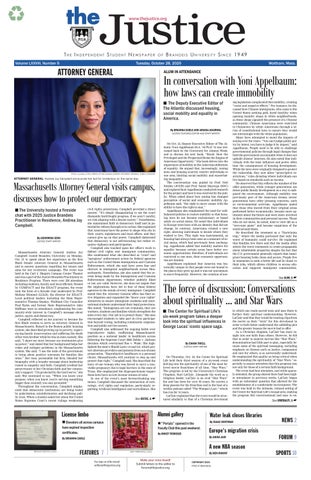
ATTORNEY GENERAL: Andrea Joy Campbell announced her bid for re-election on the same day.
Massachusetts Attorney General visits campus, discusses how to protect our democracy ■ The University hosted a fireside
chat with 2025 Justice Brandeis Practitioner in Residence, Andrea Joy Campbell. By ASHHWIKA SONI
JUSTICE STAFF WRITER
Massachusetts Attorney General Andrea Joy Campbell visited Brandeis University on Monday, Oct. 21 to speak about her experience as the first Black female Attorney General in Massachusetts and to answer questions regarding her tenure and aims for her re-election campaign. The event was held at the Carl J. Shapiro Campus Center Theater and was a part of the Justice Brandeis Practitioner in Residence Program. There were over 250 attendees including students, faculty and local officials. Hosted by COMPACT and the ENACT program, the event took the form of a fireside chat moderated by Prof. Melissa Stimmel (LGLS), the director for ENACT. Local political leaders including the State Representative Thomas Stanley, Waltham City Councilor Paul Kates and former State Representative Jake Hoffman were in attendance, emphasizing the community-wide interest in Campbell’s message about justice, equity and democracy. Campbell reflected on her journey to become the first Black woman to serve as Attorney General in Massachusetts. Raised in the Boston public housing system, she described growing up in poverty, experiencing family incarceration and suffering the death of her twin brother while he was in state custody. She said, “I share my story because our testimonies give us power,” and stated that her background helps her relate and mitigate problems in the Massachusetts system. She said, “I use the tools of the government to bring about positive outcomes for families like mine.” Her tone, personable but firm, blended her biography with a broader message about leadership rooted in empathy and faith. Campbell credited her perseverance to her Christian faith and her community’s support. “I’m protected by the God I serve,” she said. She continued to say, “When you know your purpose, when you know you’re serving something bigger than yourself, you stay grounded.” Throughout the conversation, Campbell emphasized that democratic institutions are being tested by polarization, misinformation and declining public trust. When a student asked her about the United States Supreme Court’s recent rulings weakening
civil rights protections, Campbell provided a direct answer, “It’s deeply disappointing to see the court dismantle hard-fought progress, if we aren’t careful, we risk aligning with a fascist society.” Nonetheless, she maintained faith in democracy itself and in potential for reform through civic action. She explained that Americans have the power to shape who sits in their courts, legislatures and local offices, and they cannot give up on that power. Campbell elaborated that democracy is not self-executing but rather requires vigilance and participation. Campbell also touched upon her office’s work to defend civil rights and immigrant communities. She condemned what she described as "cruel" and "egregious" enforcement action by federal agencies such as the United States Immigration and Customs Enforcement, which she said have sown fear and distrust in immigrant neighborhoods across Massachusetts. Nonetheless, she also stated that the arrests being made by the Immigration and Customs Enforcement department, whether publicly liked or not, are valid. However, she does not negate that the implications have led to fear of these federal agencies in the minds of every immigrant. Campbell stated that the Attorney General office has filed active litigation and expanded the "know your rights" initiatives to ensure immigrant residents and international students understand their legal protections. She stated, “Immigrants are not criminals, they are workers, students and families which strengthen the state every day. Our job is to protect them.” She also encouraged students to take part in civic participation beyond voting, including community organization and public service careers. Campbell also addressed the ongoing battle over reproductive rights, reaffirming Massachusetts' position as a national leader in healthcare access following the Supreme Court 2022 Dobbs v. Jackson decision which overturned Roe v. Wade. She highlighted the state’s Shield Laws 1.0 and 2.0, which protect abortion providers and patients from out-of-state prosecution. “Reproductive healthcare is a personal choice, Massachusetts will continue to step up and protect that right,” Campbell said. She described the story of one woman who was forced to carry a nonviable pregnancy due to legal barriers in the state of Texas. She emphasized the disproportionate impact these laws have on low-income women of color. In one of the event’s most forward-looking segments, Campbell discussed the intersection of technology, civil rights and regulation, particularly regarding Artificial Intelligence and surveillance. She
See JUSTICE, 5 ☛
On Oct. 24, Deputy Executive Editor of The Atlantic Yoni Applebaum M.A. ’10 Ph.D ’14 was welcomed back by the University for Alumni Weekend to discuss his new book, “Stuck: How the Privileged and the Propertied Broke the Engine of American Opportunity.” His book delves into the importance of mobility in the American definition of equality. He argued that, increasingly, zoning laws and housing scarcity restrict individuals to one area, limiting social mobility and exacerbating inequality. The conversation was guided by Prof. Neil Swidey (JOUR) and Prof. Sarah Mayorga (SOC) and explored how Appelbaum conducted research for the project and how it was received by the public. When asked about how zoning has changed perception of social and economic mobility Appelbaum said, “the right to move comes with the ability to have the right to stay.” Appelbaum also emphasized the need for wellbalanced policies to restore mobility so that housing laws do not become exclusionary or based solely on social status. He noted that individuals in Europe were born with an identity that did not change. In contrast, Americans created a new right, allowing individuals to decide where they wished to live. This right was instrumental, as housing had always been seen as a measure of social status, which had previously been unchanging. Appelbaum added that mobility matters for equality because certain areas have better economic opportunities; therefore, if individuals are restricted to one area, their economic opportunities are limited. Appelbaum explained that America was historically unique in that people were not bound to the places they grew up and it was not uncommon to move frequently. However, the creation of zon-
See ALUM, 5 ☛
The force of discussion: Conversations about spirituality ... and Star Wars ■ The Center for Spiritual Life’s
six-week program takes a deeper look into the spiritual influences in George Lucas’ iconic space saga.
By CHAVA THIELL
JUSTICE STAFF WRITER
On Thursday, Oct. 23, the Center for Spiritual Life held their third session of a six-week event delving into the spirituality of one of the most beloved movie franchises of all time, “Star Wars.” The program is led by the University's Christian Chaplain, Karl LaClair. Alongside his work as a religious leader, LaClair is an avid “Star Wars” fan and has been for over 30 years. He carries a deep passion for the franchise and is the host of a weekly podcast called “The Wampa’s Lair,” which has run for 14 years. LaClair explained that the event would be structured similarly to that of a Christian devotional
in which one reads sacred texts and uses them to further their spiritual understanding. However, LaClair said that they would be treating clips from the movie as their “texts” for this devotional in order to both better understand the unfolding plot and the greater lessons the movie had to offer. As a Christian chaplain, LaClair has more insight into one faith than others. However, he felt that in order to analyze movies like “Star Wars,” denomination had little part to play, especially because some of the spiritual messaging, including emphasis on themes such as justice, compassion and care for others, is so universally understood. He emphasized this quality as being critical when understanding the spirituality of “Star Wars,” especially to assure attendees that this program was not only for those of a certain faith background. The event had four attendees, and while sparsely attended, the group shared there had been higher attendance in previous weeks. LaClair began with an icebreaker question that allowed for the establishment of a comfortable environment. The event was held in the intimate, relaxed setting of the Center for Spiritual Life’s lounge area, making the program feel conversational and easy to en-
License limbo
Alumni gallery
Water leak closes libraries
Elevators all across campus
"Portals" opened in the Faculty Club this past weekend.
By ISAAC HOFFMAN
have expired inspection certificates.
By MIKEY TERRENZI
By BRIANNA EARLE
BRIANNA EARLE/The Justice.
ing legislation complicated that mobility, creating “racist and negative effects.” For instance, he discussed how Chinese immigrants, who came to the United States seeking gold, faced hostility when opening laundry shops in white neighborhoods, as these shops signaled the presence of a Chinese community. Chinese Americans were restricted to Chinatown by white Americans through a series of constitutional laws to ensure they would not intermingle with the white population. Many have attempted to mend the impacts of zoning over the years. “You can't judge public policy by intent, you have to judge it by impact,” said Appelbaum. People need to be able to challenge governmental policies through legal changes that hold the government accountable when it does not uphold citizens’ interests. He also noted that individuals with the least influence and power often bear the consequences of housing development. While the laws were originally designed to protect the vulnerable, they now allow “prescriptive restrictions,” rules dictating where individuals can live based on standards such as income. He observed that this reflects the mindset of the older generation, while younger generations see dense public family development as a way to safeguard the environment. Although mobility was previously part of the American dream, newer generations have other pressing concerns, such as environmental activism. Appelbaum stated that those who moved from their original areas performed better economically, became more optimistic about the future and were more involved in their communities and personal success. Those who do not move, he noted, tend to view life as a “zero-sum game” and become suspicious of the world around them. He described the tenement as a “Darwinian trap,” where the media portrayed that only the worst of humanity could survive. He explained that families live there and that the media often selects the worst tenements to create propaganda about inhabitable properties despite the fact that the U.S. government generally reports that immigrant housing looks clean and secure. People live in tenements to seek a better life and be closer to their jobs, which allows children to access education and supports immigrant communities.
FEATURES 7 For tips or info email editor@thejustice.org
Europe's migration crisis By ANIKA JAIN
A new NBA season MIKEY TERRENZI/The Justice.
Make your voice heard! Submit letters to the editor to forum@thejustice.org
By BEN KHAYAT COPYRIGHT 2025 FREE AT BRANDEIS.
See SPIRITUALITY, 5 ☛
NEWS 2 FORUM 9 SPORTS 10