the
Justice www.thejustice.org
T h e I n d e p e n d e n t S t u d e n t N e w s p a p e r o f B r a n d e is U n i v e r sit y S i n c e 1 9 4 9 Volume LXXVIII, Number 7
Tuesday, November 11, 2025
VANDALISM ON CAMPUS
Waltham, Mass.
LEGAL STUDIES DISCUSSION
Making Israel’s legal space: discussions about international law
■ Rephael Stern, ‘11 shared his
original research on how Israeli leaders went about determining the country’s boundaries and legal status at its founding. By CHAVA THIELL
JUSTICE NEWS EDITORIAL ASSISTANT
BRIAN LUCY/The Justice.
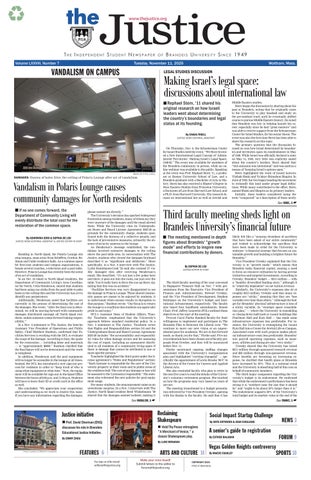
DAMAGES: Dozens of holes litter the ceiling of Polaris Lounge after act of vandalism.
Vandalism in Polaris Lounge causes community damages for North residents ■ If no one comes forward, the Department of Community Living will evenly distribute the total cost for the restoration of the common space. By ASHHWIKA SONI & SOPHIA DE LISI
JUSTICE NEWS EDITORIAL ASSISTANT & JUSTICE EDITOR IN CHEIF
Residing in North Quad, the Polaris Lounge sits atop campus, steps away from Scheffres, Gordon, Reitman and Cable residence halls. As a common space for first-year students and campus organizations, it boasts several couches, a television and a pool table. However, Polaris Lounge has recently been the scene of an act of vandalism. In an Oct. 24 email to North Quad residents, the Department of Community Living’s Area Coordinator for North, Celia Henderson, shared that students had been using cue sticks from the pool table to poke holes in the ceiling tiles and the University has yet to identify any perpetrators. Additionally, Henderson noted that facilities are currently in the process of determining the cost of the damages. She wrote, “After the final cost is determined, we will be moving forward with community damages distributed amongst all North Quad residents, unless someone comes forward taking responsibility.” In a Nov. 6 statement to The Justice, the Interim Assistant Vice President of Operations and Public Safety, Chief Matthew Rushton, confirmed that Facilities Services is working with the DCL to evaluate the scope of the damage. According to him, the quote for the restoration — including labor and materials — is “approximately $6000.” Rushton clarified that the final figure will not be determined until the work is completed. In addition, Henderson said the pool equipment will no longer be accessible in the lounge at all times. Instead, the DCL has introduced a new sign-out process for residents in order to “keep track of who is using what equipment at what time.” Now, the equipment will be available for sign-out in the Quad Office between the hours of 8:00 p.m. and 11:00 p.m. Students will have to leave their ID or credit card in the office as well. She concluded, “We appreciate your cooperation and understanding as we work to resolve this issue. If you have any information regarding the damages,
please contact me directly.” The University’s decision has sparked widespread frustration among residents, many of whom say they were unaware of the damages until the email alerted them. While the University cites its Undergraduate Room and Board License Agreement 2025-26 as grounds for the community charge, students questioned both the fairness of a collective penalty and the lack of preventative measures, primarily the absence of security cameras in the lounge. As Henderson’s message established, the vandalism involved extensive damages to the ceiling above the pool table area. In conversation with The Justice, students who viewed the damages firsthand described it as “significant and deliberate.” More specifically, in a Nov. 6 interview with The Justice, Lydia Kestnbaum-Cook ’29 said she counted 57 visibly damaged tiles after receiving Henderson’s email. She described, “it’s not just a few pokes here and there, it goes out into the room, not just over the table. You’d really have to force the cue up there, signaling that this was no accident.” “Facilities Services was very disappointed to see the damage in Polaris Lounge. These shared community spaces are meant to be enjoyed by students, it is unfortunate when misuse results in disruption to that purpose,” Rushton wrote. “Our focus is to return the lounge to a condition that students can again take pride in and enjoy.” DCL’s Assistant Dean of Student Affairs, Timothy Touchette, emphasized that the University’s approach follows standard residential policy. In a Nov. 5 statement to The Justice, Touchette wrote that Rights and Responsibilities section 9.6 and the Undergraduate Room and Board License Agreement 2025-26 includes “the accountability and responsibility rules for when damage occurs and for assessing the cost of repair, including an assessment distributed to all residents of a community living space if there is damage that cannot be attributed to one or more specific persons.” Touchette highlighted the third point under the license agreement’s “Rules and Regulations” section: “Each licensee is responsible for the care of the University property in their room and in public areas of the residence hall. The cost of any damage or loss will be assessed to the Licensee(s) responsible.” His statement also reiterated the new policies for pool equipment usage. For many students, the announcement came as an unwelcome surprise. In a Nov. 5 interview with The Justice, North Quad resident Reed Winkelmann ’29 shared that the damages seemed isolated, making it
On Thursday, Nov. 6, the Schusterman Center for Israel Studies held the event, “We Have Invented a New International Legal Concept of ‘Administered Territories’: Making Israel’s Legal Space, 1948-50.” The event was available for members of the Brandeis community in person, while an online webinar was available to the public. Speaking at the event was Prof. Rephael Stern ’11, a professor at Boston University School of Law, and a Brandeis graduate with a Bachelor of Arts in History. Stern has also received a Master’s Degree in Near Eastern Studies from Princeton University, a Doctorate of Law from Harvard Law School, and a Ph.D. from Harvard University. His research focuses on international law as well as Jewish and
Middle Eastern studies. Stern began the discussion by sharing about his past at Brandeis, noting that he originally came to the University to play baseball and study on the pre-medical track until he eventually shifted course to pursue Middle Eastern history. He noted that Brandeis was key in helping launch his career, especially since he had “great mentors” and was able to receive support from the Schusterman Center for Israel Studies, for his senior thesis. The event was also the first time Stern has been able to share his research on this topic. The primary question that the discussion focused on was how Israel determined its boundaries and territories upon its establishment in May of 1948. While Israel was officially declared a state on May 14, 1948, very little was explicitly stated about the country’s borders. Stern shared that “this omission was intentional” and was used as a means of “keeping Israel’s options open.” Stern highlighted the work of Israeli lawyers Yitzhak Shaki and Ya’akov Shimshon Shapira. In June of 1948, the two began heading the movement to reclassify this land under proper legal definitions. While many contributed to the effort, Stern named Shaki and Shapira as its primary leaders. Initially, these leaders considered using the term “conquered” as a description of these newly
See ISRAEL, 5 ☛
Third faculty meeting sheds light on Brandeis University’s financial future
■ The meeting mentioned in depth
figures about Brandeis’ “growth mode” and efforts to inspire new financial contributions by donors. By SOPHIA DE LISI
JUSTICE EDITOR IN CHIEF
The third faculty meeting of the year convened in Rapaporte Treasure Hall on Nov. 7 with presentations from the Executive Vice President of Finance and Administration, Stewart Uretsky, and the Vice President of Development, Stephen Rodriguez on the University’s budget and Institutional Advancement, respectively. The faculty also heard four handbook amendments. Senate Chair, Prof. Jeffrey Lenowitz (POL) outlined these objectives at the start of the meeting. Provost Carol Fierke thanked faculty for their willingness to implement and participate in The Brandeis Plan to Reinvent the Liberal Arts. “We continue to move our new vision at an unprecedented pace for academia. We are in fast forward mode, so thank you for that,” Fierke said. Five microcredentials have been chosen out of faculty proposals from October, and they will be announced before Nov. 11. Fierke mentioned ongoing staffing changes associated with the University’s reorganization plan and highlighted “exciting change[s]” — specifically the appointment of Lewis Brooks ’80 P.’16 the director of the Center for Careers and Applied Liberal Arts. She also reminded faculty who plan to retire in the next five years to read the details of the University’s voluntary retirement program. She touched on how the programs may vary based on years of service. The meeting transitioned to a budget presentation delivered by Vice President Uretsky, opening with his thanks to the faculty. He said that it has
likely felt like a “nonstop drumbeat of sacrifices that have been asked of our entire community” and wished to acknowledge the sacrifices that have been made in order for the University to embrace “a financial strategy that focuses on sustainable growth and building a brighter future for Brandeis.” Vice President Uretsky explained that the University is in “growth mode,” which means that Brandeis lacks financial capital, causing a need to focus on resource utilization by having precise initiatives and targeted investments. According to Uretsky, Brandeis’ budget — $415 million — tells a “healthy diversified funding story,” although it is “relatively dependent” on net tuition revenue. Similarly, the University’s expenses also sit at roughly $415 million. Uretsky said that many expenses are “sticky,” meaning that they are “less variable over time than others.” Although the budget for Brandeis’ physical infrastructure is less of a sticky variable, its “strategic space consolidation plan,” — where the University is remodeling or closing down half-used or vacant buildings like Pearlman Hall and Kutz Hall — has made some infrastructure expenses less predictable. For instance, the University is reimagining the vacant Kutz Hall into a Center for Jewish Life on Campus. Associated costs with such projects makes physical infrastructure costs less predictable. Brandeis’ non payroll operating expenses, such as insurance, utilities and dining are also “very sticky.” Uretsky shared that the University has raised $211 million through sponsored research revenue and $39 million through non-sponsored revenue. Since benefits are becoming an increasing expense, he clarified that health plans at Brandeis have increased by 20%. This is a national trend and the University is absorbing half of this cost on behalf of community members. The third major component regarding the University’s budget is its endowment. He confirmed that while the endowment’s performance has been strong it is “nowhere near the size that it should be” and “ought to be about 50% larger than it is.” The endowment supports 20% of the University’s total budget and its market value at the end of the
See FINANCE, 5 ☛
See VANDALISM, 5 ☛
Justice initiative Prof. David Sherman (ENG) discusses his role in Brandeis Educational Justice Initiative. By EMMY ZHOU
Photo Courtesy of CREATIVE COMMONS.
Reclaiming Shakespeare
Social Impact Startup Challenge
Hold Thy Peace reimagines "A Merchant of Venice," a classic Shakespeare play.
A senior's guide to registration
By SKYE ENTWOOD & JOAN COGLIANO
By LUKE BENANAV
FEATURES 6 For tips or info email editor@thejustice.org
COLE HAMNER/The Justice.
ARTS AND CULTURE 14
Make your voice heard! Submit letters to the editor to forum@thejustice.org
By ESTHER BALABAN
Vegas Golden Knights controversy By MAEVE COAKLEY
COPYRIGHT 2025 FREE AT BRANDEIS.
NEWS 3 FORUM 9 SPORTS 10