the
Justice www.thejustice.org
T h e I n d e p e n d e n t S t u d e n t N e w s p a p e r o f B r a n d e is U n i v e r sit y S i n c e 1 9 4 9 Volume LXXVIII, Number 12
Tuesday, March 3, 2026
Waltham, Mass.
MEETING
CLOSURE
Faculty discusses revisions to Brandeis Core and debates reducing foreign language requirements By ZOE ZACHARY
JUSTICE DEPUTY EDITOR
The meeting, which took place on Feb. 13, revolved around present and future academic standards for undergraduate students. At 2:00 p.m. on Friday, Feb. 13, the Faculty Senate convened in Rapaporte Treasure Hall for their monthly meeting. Senate Chair Prof. Jeffrey Lenowitz (POL) noted during his opening remarks that the meeting was unusually populated. His opening remarks included other orders of business, such as reminders for faculty to order commencement regalia and an announcement that teaching award nominations are currently underway. He then asked for corrections to the minutes of the Dec. 5, 2025 meeting, of which there were none. President Arthur Levine ’77 was invited to give remarks to start the meeting. He began by lauding the faculty’s support of the administration, as when he assumed his position as president, he was warned that faculty-administration relations were tenuous. Levine then spoke about the results of Brandeis’ early retirement program, sharing that it had been offered to 261 people, with 23% (61 people) taking advantage of the program. According to Levine, it could save the University as much as four million dollars per year. However, he added, it will lead to unequal vacancies, leaving a question about what to do in terms of staffing in the time ahead. Levine then recounted the events of the most recent Board of Trustees meeting. He shared that Brandeis received more applications this year than any other year in the institution's history, which placed the number of applications up 40% from last year. He commended how the University has implemented Early Action to bolster applications, but that the program was only meant to account for a 20% increase in applications. Precisely which factor accounted for the other 20% remains unclear. Levine also announced, however, that Master’s program admissions are down by 50%, noting that this decrease is currently a
widespread problem. Looking ahead, Levine hopes to focus on revitalizing graduate programs over the next 18 months. In his words, he wants to “look at what they [students] are, what they should be [and] what we would like them to become.” Before transitioning, he alluded to a study that is currently underway to help determine the future of graduate education at Brandeis. The rest of Levine’s remarks were dedicated to Brandeis’ financial situation. According to him, the capital campaign is ahead of last year’s number, and things are “looking good” in terms of fundraising. Additionally, since the start of 2026, Brandeis has received four gifts totaling $48 million dollars. He also shared that, in an effort to counter the effects of smaller class sizes in recent years, the University will borrow $20 million dollars and has sold Brandeis property in New York City. With this plan, Levine claimed, enough revenue will be generated to prevent staffing cuts. He ended his remarks with a hopeful statement, saying that there is a lot of interest in what Brandeis is doing among other university presidents, and he hopes this will translate to fundraising and more student enrollment. Levine then took questions about his remarks. One faculty member who did not introduce themself asked, “Given that the stock market did so well last year, did we have to draw from the endowment or did we do better than expected and are drawing less from the endowment?” Levine responded that the University is currently taking 8% per year from the endowment and wants to reduce that number to 5%, though he believes that goal will be left to his successor. Prof. Dan Pearlman (ENVS) expressed concerns that changes to the general curriculum were being rushed. As he sees it, Brandeis could be bolder in creating an environment that will attract students. Levine explained that attitudes toward general education are volatile and “change every 20 years with the predictability of a metronome.” He continued, “I think it would be terrific if we could create the dream general ed[ucation] program, but that will take a lot of time.” There were no more questions for Levine, so Lenowitz pushed ahead with the next order of business, which was about debating each of the meeting’s mo-
See FACULTY, 5
JAMES LI/The Justice.
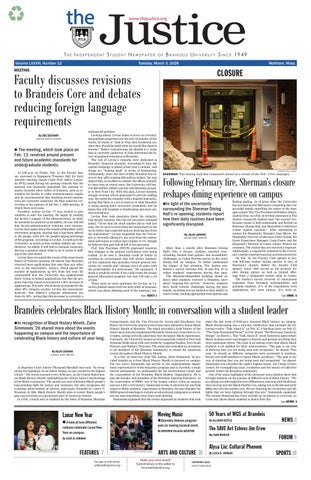
SHERMAN: The dining hall has remained closed as a result of the Feb. 2 fire damages.
Following February fire, Sherman’s closure reshapes dining experience on campus In light of the uncertainty
surrounding the Sherman Dining Hall’s re-opening, students report how their daily routines have been significantly disrupted. By ALLIE LADJEVA
JUSTICE STAFF WRITER
More than a month after Sherman Dining Hall’s Feb. 2 closure, students reported overcrowding, limited food options and accessibility challenges, as Usdan Kitchen serves as the main dining hall on campus. To better understand the impact of this situation, The Justice conducted a survey between Feb. 18 and Feb. 27 to reflect students’ experiences during this time. The Sherman-Hassenfeld building closed its doors after students received a Brandeis Alert about “ongoing fire activity.” However, students have faced various challenges during the past month, including but not limited to their ability to reach Usdan, finding appropriate food options and
finding seating. As of press time, the University has not announced Sherman’s reopening date nor provided details regarding the extent of the damages caused. The Vice President of Student Affairs, Andrea Dine, in a Feb. 24 written statement to The Justice, reassured students that “the current twolocation model is both sustainable and flexible as Sherman Dining Hall and Hassenfeld Conference Center repairs continue.” After attempting to contact the Hospitality Manager Alan Meyer, the Hospitality Director of Sherman Omar Zouak, the Guest Experience Manager Craig Foster and the Hospitality Director of Usdan Ashley Weaver for comment, The Justice has not received a response. Additionally, a request for comment to the University’s media relations team has not been answered. On Feb. 22, the Faculty Club opened to provide full-time kosher dining options in lieu of Sherman’s closure. Before the Faculty Club opened, Louis’ Deli served as the primary kosher dining option, as well as limited offerings from a designated kosher table in Usdan. The Justice’s survey received 117 anonymous responses from Brandeis undergraduate and graduate students. 31% of the respondents were sophomores, 23% were juniors, 21% were se-
See DINING, 5
Brandeis celebrates Black History Month: in conversation with a student leader In recognition of Black History Month, Zaire
Simmonds ’26 shared more about the events happening on campus and the importance of celebrating Black history and culture all year long. By ALLIE LADJEVA
JUSTICE STAFF WRITER
As Supreme Court Justice Thurgood Marshall once said, “In recognizing the humanity of our fellow beings, we pay ourselves the highest tribute.” His words resonate every February, as the United States honors Black History Month, highlighting the culture, history and heritage of the Black community. The month not only celebrates Black people’s long-standing fight for justice and inclusion, but also recognizes the countless achievements of African Americans. Founded by Carter G. Woodson in 1926, Black History Month aims to center Black people’s past and successes as a permanent part of American history. In a Feb. 2 email sent to students by the Dean of Students, Monique
Gnanaratnam, and the Vice Provost for Access and Excellence, Lee Bitsóí, the University shared several ways they planned to honor Black History Month at Brandeis. The email provided a brief history of the observance and also emphasized Brandeis’ historical connection to civil rights, noting archival collections that document Black experiences. Currently, the University houses several materials related to Ford and Sydeman Halls along with rare works by Langston Hughes, Zora Neale Hurston and Wallace Thurman. The email also extended an invitation to all members of the Brandeis community to attend the numerous events throughout Black History Month. In a Feb. 20 interview with The Justice, Zaire Simmonds ’26 provided insights as to how Black History Month is honored on campus. For two years, Simmonds has served as the undergraduate department representative of the education program and is currently a study abroad ambassador, an ambassador for the Intercultural Center and the co-president of the Brandeis Black Student Organization. He is also the founder and president of the Brandeis Aspiring Educators. As the co-president of BBSO, one of the largest culture clubs on campus and one with a rich history, Simmonds works to advocate for and help improve Black students’ experiences at Brandeis. He also changed the BBSO general meetings to include an educational component so attendees can take something away from each meeting. Simmonds explained that the events organized by students that took
Lunar New Year A look at how different cultures celebrate Lunar New Year on campus.
FEATURES 7
50 Years of WGS at Brandeis
Brandeis Hebrew program puts on moving musical event.
By ALLISON KETTLE
By ROGERIO VILLACA SZUSTER
For tips or info email editor@thejustice.org
JULIA FAN/The Justice.
See HISTORY, 5
Moving Music
By LUCA D. JORDAN
JUSTIN GAO/The Justice.
place the last week of February honored Black history on campus. Black Homecoming was a four-day celebration that included the following events: “Talk About It” on Feb. 25, a blackout party on Feb. 27, “The Gala: Enchanted Forest” on Feb. 28 and “The Showcase: Dandy by Design” on March 1. The “Talk About It” event fostered a space where Black students were encouraged to discuss and present anything they were passionate about. The Gala is an annual event that allows Black students to be uplifted for their achievements. “The gala is our way of showing that you are being seen and recognized,” he shared. This year, 10 awards in different categories were presented to students, faculty and staff members to honor Black excellence. “The gala is our way of showing that you are being seen and recognized,” he shared. Simmonds was awarded the night's highest honor, the Umoja (Unity) Award, for exemplifying unity, excellence and the beauty of collective growth within the Brandeis community. One of the main highlights of the showcase was a fashion show that brought students on the journey of different eras of Black history. “We are taking you [through] the eras of Blackness, starting with dandyism, then moving into the Black Panther era, taking you to the 90s and early 2000s and into the modern era. We are showing the revolution and the fights that we were fighting through this era,” Simmonds explained. The annual Homecoming event extends an invitation to everyone, as it not only allows Black students to honor their his-
ARTS AND CULTURE 15
Make your voice heard! Submit letters to the editor to forum@thejustice.org
NEWS 3
The SAVE Act Echoes Jim Crow By SAM WEXLER
Alysa Liu: Cultural Phenom By LUCA D. JORDAN
COPYRIGHT 2026 FREE AT BRANDEIS.
FORUM 9 SPORTS 10