The Justice, February 10, 2026

Page 1


The use of AI at Brandeis: trends, ethics and the future of teaching and learning

 As AI becomes an unavoidable consideration in academia, Brandeis students, faculty and staff members learn to navigate its challenges and opportunities.

Has the use of Artificial Intelligence in academia become inevitable? How is Brandeis University dealing with ethical and trust concerns among students and faculty members regarding the use of AI? A small-scale survey and interviews with various members of the Brandeis community provide insights into these questions.

A 2025 Global Student Survey found that four in five students worldwide use generative AI tools for their higher studies, with ChatGPT being the most popular. Generative AI tools are defined as “tools that generate words, images, or sounds in response to prompts with human-like efficiency.” A survey released by the Johns Hopkins University Press shows that 54% of college students use AI tools for writing, 53% for academic assistance and 10% for cheating.

Academic institutions cannot prevent AI use, but they can find ways to integrate it in a way that promotes responsible and ethical use. Colleges and universities in the United States have had different approaches to monitoring AI use in academic settings. At Harvard University, all faculty members are required to have a clear policy regarding the use of generative AI in class. Some example policies include “a maximally restrictive draft policy,” meaning that the use of generative AI tools is forbidden, or the “fully-encouraging draft policy,” which encourages students to explore AI tools in assignments and assessments, as long as their use is communicated.

Northeastern University also acknowledges the use of AI by providing clear policies that students and faculty members should follow. The use of AI tools in research is permitted, but researchers must undergo a review process when dealing with confidential information to address ethical concerns, such as the handling of personal data.

To inform this article, a small-scale survey conducted in January 2026 provides insights into how Brandeis students perceive artificial intelligence. As of press time the survey received 28 responses from Brandeis undergraduate and graduate students, giving a snapshot of how they use AI and interpret the school’s AI policies. The majority of the respondents were undergraduate students from the classes of 2026–2028, while 14% were graduate students. 82% of the respondents reported using AI for their academic-related work at Brandeis, suggesting widespread use of AI on campus. The most frequently used tool was ChatGPT, used by 96% of these students, followed by Grammarly at 57%.

When it came to specific uses of AI tools, students

had various responses. Responses indicated moderate to high use of AI tools for research, debugging or generating code and brainstorming for assignments. When asked whether the benefits of AI outweigh the harms, most respondents said “it depends,” suggesting that AI is neither an ally nor an adversary, but rather a resource whose benefit depends on the context. The survey also showed mixed opinions on the clarity of professors’ AI policies, with scores ranging from 3 to 10 (1 meaning very unclear and 10 meaning very clear). This wide range suggests that professors follow individual AI policies rather than a university-wide policy (Figure 1).

The survey’s section on receiving guidance about the responsible use of AI showcased diverse results (Figure 2). 44% of respondents reported receiving advice on the responsible use of AI in class, 30% through the course’s syllabus and only 4% from workshops. Furthermore, 22% of respondents received no guidance at all. These results suggest that AI literacy workshops may be limited and that students’ guidance varies by course.

Concurrently, 18% of respondents reported not using AI. Some raised concerns that AI threatens entire career fields, such as writing and theater arts, while others reported that learning loses value when a student becomes reliant upon AI. The responses suggest that some Brandeis students have significant concerns about the responsible use of AI and its ethical implications, emphasizing the need for AI literacy on campus.

As part of Brandeis’ efforts to integrate AI into the school curriculum, staff and faculty members worked hard to create a variety of resources for the Brandeis community. Two years ago, the Artificial Intelligence Steering Council was created to promote the responsible and ethical use of AI on campus. The council serves as the University’s central advisory and information-sharing body, and among its responsibilities are reviewing AI policies and monitoring the use of AI in academics and administration.

On Brandeis’ website, students and faculty can access a variety of resources on AI literacy, the ethical considerations of AI and effective prompting for generative AI platforms.

Since not everyone may have equal access to technology, prioritizing equity is crucial in academic settings. Matthew Sheehy, one of the co-chairs of the Artificial Intelligence Steering Council and a University librarian, shares that the council works with Student Accessibility Services to ensure equitable access to AI and related technology campus-wide. Sheehy underscored this sentiment, saying, “[i]f you are using technology that you are going to get graded on, every student has to have the same access and the same chance.”

As many students and faculty members are currently skeptical of AI and its implications, Sheehy points out that there is a clear distinction between machine learning and generative AI: “AI has been around since the '80s. What we are talking about now that is really disruptive is generative AI. A lot of our scientists on campus have been using machine learning for decades to do their research. It’s the new form of AI that we are trying to wrap our heads around.”

BUILDING CLOSURE

Propylene glycol and water leak in Heller building temporarily moves classes online

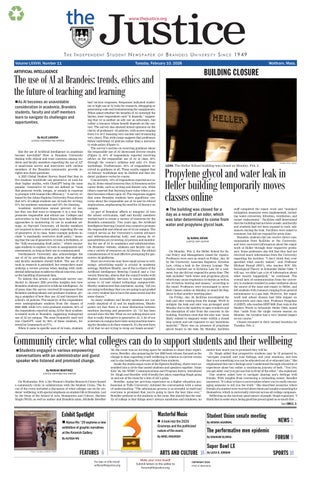
 The building was closed for a day as a result of an odor, which was later determined to come from water and propylene glycol leak.

On Monday, Feb. 2, the Heller School for Social Policy and Management closed for repairs. Professors were sent an email on Friday, Jan. 30 by the University Associate Registrar, Kristina Law, citing a leak in the Alumni Lounge. The Justice reached out to Kristina Law for a comment, but she did not respond for press time. The leak included “both water and propylene glycol, which may cause respiratory irritation as well as eye irritation/tearing and nausea,” according to the email. Professors were encouraged to move their classes online on Monday or email the Registrar to find another meeting place.

On Friday, Jan. 30, facilities investigated the leak and odor coming from the lounge. Work to mitigate the leak and odor was prolonged until Monday due to the inability to open windows and the absorption of odor from the concrete in the building. Facilities cited that the odor was “most likely related to stagnant water within a closed loop system and not exposure to any hazardous material.” There was no presence of propylene glycol found in the leak. By Monday, facilities

staff completed the repair work and “standard mitigation measures were implemented, including water extraction, filtration, ventilation, and carpet replacement.” Facilities staff determined that the building had not been unsafe, and faculty and students had not been exposed to toxic substances during the leak. Facilities were asked to comment, but did not respond for press time. Brandeis students did not receive direct communication from facilities or the University, and were conveyed information about the repair work at Heller through their respective professors. Some professors also felt that they had not received much information from the University regarding the incident. “I don’t think they ever specified what exactly leaked,” said Professor Michael Strand (SOC), who teaches SOC 10b: Sociological Theory in Schneider Heller G004. “I will say, we didn’t get a lot of information about what exactly happen[ed],” he continued. The overall lack of communication from the university to students resulted in some confusion about the source of the issue and repair in Heller, and left students with rumours ranging from general maintenance to a gas leak. However, the repair work and school closure had little impact on coursework and class time. Professor Fangchao Ji (HIST), who teaches HIST 80B: East Asia in the Modern World in Schneider Heller G004, stated that “aside from the single remote session on Monday, the incident had a very limited impact on my course.”

Classes resumed in their normal locations by Tuesday, Feb. 3.

Community circle: what colleges can do to support students and their wellbeing

 Students engaged in various empowering conversations with an administrator and guest speaker who listened and promised change.

On Wednesday, Feb. 4, the Women’s Studies Research Center hosted a community circle in collaboration with the Student Union. The focus of the event included a discussion of what colleges can do for students’ wellbeing, with special emphasis on student life at Brandeis. Led by the Dean of the School of Arts, Humanities and Culture, Harleen Singh (WGS), as well as author and Brandeis alum, Michelle Bowdler

Exhibit Spotlight

 Alyssa Wu '29 explores a new exhibition of graphic narratives at the Kniznick Gallery.

WU

’86, the event was an inviting space for students to share their experiences. Bowdler, also preparing for her 2026 book release, focused on the change in data regarding youth wellbeing in relation to current events and is also looking for relevant insight from students.

Inside the studio-esque room of the Epstein Building, chairs were assembled into a circle that seated students and speakers together. Naim Kim ’26, the WSRC Communications and Program Intern, introduced Dr. Singh and Bowdler with friendly-fire jokes regarding Singh going in and out of the room for a bite of AK’s pizza.

Bowdler, using her previous experience as a higher education professional at Tufts University, initiated the conversation with a sense of understanding. “The admissions process is so stressful in itself and everyone is promised that you’re going to have the best time ever,” Bowdler prefaced to the students in the room. She shared that the reality of college is that things aren’t always sunshines and rainbows, no

Masterful Music

 A look into the 2026 Grammys

matter how much you’re promised they will be.

Dr. Singh added that prospective students may be ill prepared to, “navigate yourself, and your feelings, and your emotions, and how that is not something you can be educated out of or educated into.” She emphasized that one’s feelings aren’t understood through education or experience alone but rather a continuous journey of both. “You live, you get older, and you put one foot in front of the other,” she explained. One student asked how to navigate sharing one’s feelings with friends. With insights from overseeing a counseling center, Bowdler answered, “It’s okay to have a conversation where you’re really encouraging someone to tell you the truth.” She described scenarios where friends of a student were worried about them and sought counseling for themselves, which is universally relevant across all college campuses. Reflecting on the intrinsic good nature of people, Singh explained, “I think that in some ways, being good has preoccupied us so much that …

LEAK : The Heller School building was closed on Monday, Feb. 2.
Photo Courtesy of SHELBY TERRY.
JUSTICE CONTRIBUTING WRITER
Photo Courtesy of Creative Commons.
JAMES LI/The Justice.

POLICE LOG

MEDICAL EMERGENCY

Jan. 31—There was a medical emergency for a party who had difficulty breathing. The patient refused medical treatment.

Jan. 31—There was a medical emergency for a party who fainted. The patient refused medical treatment.

Jan. 31—There was a medical emergency for a party who overdosed on medication. The patient was transported.

Feb. 2—There was a medical emergency for a party who fainted. The patient refused medical treatment.

Feb. 2—There was a medical emergency for a party who fainted. The patient refused medical treatment.

Feb. 3—There was a medical emergency for a party who cut their hand and felt faint. The patient refused medical treatment.

Feb. 4—There was a medical emergency for a party who fainted. The patient refused medical treatment.

Feb. 4—There was a medical emergency for a party who fainted. The patient refused medical treatment.

Feb. 5—There was a medical emergency for a party who got their fingers caught in a door jamb. The patient refused medical treatment.

SENATE LOG

On Sunday, Feb. 8, the Student Union Senate hosted its weekly meeting. They discussed chartering the Brandeis Mountain Club, changing the Guitar and Bass Club’s name to JAM Club, and passing Senate Resolution One, which calls for the Brandeis University Administration to publicly oppose the Compact for Academic Excellence and Higher Education.

The meeting started with the Union Senate hosting the Brandeis Mountain Club, which was founded in 1987. In order for a club to be chartered, it must have good standing for at least five years and has to prove that it is a significant benefit to the community as a whole. Once chartered, the club receives a few benefits, such as potentially having office space, dedicated budget money and receiving a purchasing card to make purchases related to the club’s missions and activities. Isaac Lambert ’26, Brandeis Mountain Club President, Logan Miller ’26, Communications Coordinator and Elizabeth Josiah ’28, Gear Room Manager, presented on the benefits it brings to the community.

They began by discussing their history of offering free outdoor trips to the Brandeis undergraduate community. Mountain Club organizes over 20 trips a semester and offers a wide variety of trips, such as day hikes, professor hikes and snowboarding. Their largest event, the bonfire, occurs toward the beginning of the semester and allows students to gain invaluable social connections. In addition, its 1,353 members and high demand for trips demonstrate the club’s large-scale resonance with the greater Brandeis community. Due to the expensive nature of outdoor trips, the club provides BranVans for transportation, extensive free gear such as sleeping bags, designs trips for students of various experience levels and uses a random lottery system to try to ensure that everyone who wishes can participate in activities at least once a semester.

Furthermore, the club emphasized outdoor education and safety training. Board members receive first aid training and provide safety mentorship during the trips. In addition to this, they run professor hikes, which al -

CORRECTIONS AND CLARIFICATIONS

■ A News article cut off the writer credits for the article. It should have read “Compiled by Chava Thiell.” (February 3, Page 2).

■ A News photostory incorrectly wrote “ANT-ICE.” It should have read “ANTI-ICE.” (February 3, Page 5).

■ The Forum masthead incorrectly listed Brianna Earle as an Associate Editor and Features Editor. It should have listed her as the Features Editor. (February 3, Page 8).

■ An Arts photo caption incorrectly spelled a Photos editor’s name as “REUBANGARTENBACH.” It should have read, “REUBEN GARTENBACH.” (February 3, Page 16).

■ A News caption was incorrectly cut off mid-sentence. It should have read, “A new sustainable transportation option will be available for the Brandeis community starting April 2026.” (February 3, Page 1).

■ The copyright year incorrectly read 2025. it should be 2026. (February 3, Page 1).

The Justice welcomes submissions for errors that warrant correction or clarification. Send an email to editor@thejustice.org

The Justice is the independent student newspaper of Brandeis University. The Justice is published every Tuesday of the academic year with the exception of examination and vacation periods.

NOISE COMPLAINT

Jan. 31—There was a report of a party playing loud music and screaming. The Department of Community living was notified to respond.

MISCELLANEOUS

Jan. 30—The Waltham police received a call regarding a Spanish-speaking party. Services were rendered.

Jan. 30—An ambulance was called for a party in Shapiro Campus Center. The patient was transported to a nearby hospital for further treatment.

Feb. 2—A party reported a suspicious person trying to get into Scheffres Hall.

Feb. 2—A party reported receiving a threatening email. There will be an investigation to follow.

Feb. 2—Dispatch received a harassing phone call for a party. The Officer in charge was notified.

Feb. 3—A party received an email they would like an officer to look at. There will be an investigation to follow.

Feb. 3—An ambulance was called for a party at the Mailman House. The patient was transported to a nearby hospital for

low students to network and connect with professors on a more personal level.

Moreover, leadership from Mountain Club argued that due to the number of trips they host per semester, they wish to become chartered because they coordinate frequently with administrators such as Morgan Gill, Program Specialist for Student Engagement and Leadership, need Department of Student Engagement travel approval and effectively use their large budget without requiring supplementary funding. The group argued that this efficiency and attention to detail shows reliability and conscientiousness as club leaders. Once their presentation concluded, the Union Senate took a vote and the resolution passed, allowing the club to be chartered. Soon, they will open the club’s prospect for chartering to the student body at large for a vote. If the resolution passes with a two-thirds majority, the club will officially become chartered.

The Guitar and Bass Club also met with the Union Senate to appeal for a name change. After explaining that they have regular meetings and jam sessions, they invited the Union Senate to join in for an improvisation session to demonstrate the value of the name change. The Union Senate was encouraged to sing and hum to see the value of the name change to better reflect the club’s activities. The name change was approved by the Senate. After the club discusses the issue with DSE, it can officially update its constitution and submit changes.

Finally, Luke Farberman ’27, a Senator-at-Large, discussed passing Senate Resolution One, which calls for the Brandeis University Administration to publicly oppose the Compact for Academic Excellence and Higher Education. This Trump administration proposal offers universities access to federal funds and benefits only if they adhere to specific ideological and policy conditions such as defining gender as one’s sex assigned at birth and restricting political protests. Farberman discussed how Union Senators, as representatives, have been granted a special platform to elevate pressing and dire concerns. Section Four discusses abstaining from speech or action

further treatment.

Feb. 4—A party reported stairs at the rear entrance to the station in Stoneman have iced up. Notified DFM maintenance to respond.

Feb. 4—A party reported items stolen from the Gosman Sports and Convocation Center. There will be an investigation to follow.

Feb. 5—Waltham Police called, requesting a female officer to assist with booking. Service Rendered.

Feb. 5—A party reported a burning odor in Heller School and smoke from the chimney. All appeared in order.

Feb. 5—A party reported an unattended package in the Abraham Shapiro Academic Center hallway. All appeared in order.

Feb. 5—Waltham Police Department called, requesting a female officer to assist with booking. Service was rendered.

related to political or societal events.

Section Six discusses interpreting the titles of female, male, woman and man according to biological categories. Section Eight mentions that international students must support American and Western values and includes a cap of 15% on international students. Currently, 15.8% of Brandeis students are international.

Farberman argued that these demands are so outrageous that seven out of the nine universities who were invited to discuss this compact abstained from speaking. On Oct. 14, the compact moved to include all universities in the United States. He called on the University’s administration to stand in opposition to the compact. Farberman also argued that Brandeis will not and should not engage in an undemocratic form of negotiation, which he described as authoritarianism. After this, the Union Senate entered an executive session to discuss confidential matters about the student body and Union Senate. After the Union Senate reconvened, they called for a secret ballot due to the sensitive nature of the issue. They voted on Slack, which is a communications platform the student leaders use to ask questions, debate and express their opinions, to approve, not approve or abstain. The vote passed 8–6, and the resolution went into effect. They will coordinate with the University to discuss logistics. The meeting adjourned after this resolution passed.

Ariana Agarwal

— Editor’s Note: The Justice News Editorial Assistant Ashhwika Soni ’29 is a Student Union Senator and did not contribute to or edit this article.

Editor’s Note: The Justice News Editor Lucia Thomas ’26 is an executive board member of the Brandeis Mountain Club and did not contribute to or edit this article.

Snow envelops the East Coast

Compiled by Ashhwika Soni
Photos: SKYE ENTWOOD/The Justice.

100 DAYS TILL GRADUATION

On Feb. 7, the class of 2026 gathered in the Faculty Club to celebrate 100 days until their graduation. The lively event featured catered food, a bar at which the seniors could get three free drinks and a live disc jockey.

SURVEY: provides insight on student AI use and the future of higher education

As AI tools continue to evolve, Brandeis faces the challenge of adapting efficient, university-wide policies given the complex nature of AI. As Sheehy sees it, the goal on campus is not to restrict or limit the use of AI, but to ensure it’s used in a thoughtful and ethical way. Since last year, the Brandeis Library has hosted a supercomputer that can run one’s AI instances for experimentation and exploration.

Faculty members and students at Brandeis also have access to another quality resource for AI literacy, The Center for Teaching and Learning. The CTL’s purpose is to support students and instructors in creating the best possible experience at Brandeis. Adam Beaver, the director of the CTL, shares that some of his roles include supporting faculty members, training Teaching Assistants and Community Advisors and providing professional development.

Beaver noted a different perspective on the use of AI, explaining why many students today tend to turn to AI for assistance. “Helping students develop a comfort with discomfort and a comfort with not knowing what the end result of their learning is going to be, but to be intrinsically motivated, rather than motivated just by success or the grade at the end, I think, is probably one of the most important things we can do to keep people using AI,” said Beaver. Even though AI tools provide stability and confidence to students, Beaver emphasized that uncertainty and risk-taking in the learning process matter more than the final result.

Additionally, Beaver said that Brandeis’ lack of a university-wide policy is intentional, allowing professors to determine the right approach to AI based on context. As AI might be extremely beneficial for some classes, such as Computer Science courses, and less relevant to others, individual AI policies can be seen as a strength. On the other hand, there are some pitfalls, such as confusion among students about when and how AI use is allowed in classes. Beaver discussed an important distinction between “learning to write and writing to learn.” Resources such as the Writing Center aim to help students write to learn rather than learn to write. In doing so, students experience the value of learning beyond AI tools that sometimes do the thinking for them. As part of integrating AI into academia, it is vital to consider its ethical implications. Ezra Tefera, Program Director of the Racial Justice x Technology Policy program at the Heller School for Social Policy and Management, has extensive experience researching social injustice in AI and technology policy. Dr. Tefera shared that RJxTP supports the responsible and ethical use of AI among different community members through courses, workshops and mentoring that teach critical thinking skills. The learning evaluation of the program for 2022-2025 showed that 92% reported “increased subject-matter confidence in post-session surveys.”

Dr. Tefera also serves on Brandeis’ AI Task Force, which aims to “build shared expectations and guardrails around AI across teaching, research, and administration, with real attention to academic integrity, intellectual property and data security, and with an equity lens that doesn’t treat harms as an afterthought,” he shared. He also identifies five ethical challenges that Brandeis community members face with

the increased use of AI: academic integrity, privacy and data security, research integrity, intellectual property and ownership and equity. The University addresses these challenges through established general guidance on the responsible use of AI, and faculty members are actively encouraged to make their AI policies clear in their syllabi. To address confusion about professors’ AI policies, there is ongoing work to align AI best practices among community members so that responsible AI use can be promoted everywhere, regardless of instructor or employer. Different community members have varying opinions about the use of AI based on how confident they feel about their AI literacy. “Across all of these groups, the strongest dividing line isn’t 'pro' versus 'anti.’ It’s whether someone feels they have clear guidance, enough literacy to use AI without guesswork, and confidence that the university is building norms that protect learning, privacy, and equity at the same time,” Dr Tefera noted.

Since 2022, the University has offered a total of three courses that explicitly mention artificial intelligence in their title. One such course, “Generative AI Foundations for Business,” is taught by Shubhranshu Shekhar (BUS). One of Shekhar’s interests is the applications of machine learning to real-world decision-making. His course encourages students to use current AI tools to learn, brainstorm, and research.

As most courses currently discourage students from using AI, fearing they might use it to cheat, Shekhar’s course aims to teach best practices for using AI, including its ethical implications. His advice for students is to make sure they have strong AI literacy today. Shekhar shared that “[e]veryone should build an AI literacy akin to computer literacy, or internet literacy. Awareness will help each one see how to best utilize AI for their own benefit.” Another relevant course at Brandeis is Prof. Adriana Lacy’s (JOUR) AI in Journalism class. Outside of the classroom, Professor Lacy is also the CEO and Founder of Field Nine Group, and her research interests focus on how newsrooms and media organizations can adopt new technologies responsibly. Her course allows students to use AI tools during the semester to learn about AI-assisted research, audience analytics and ethical considerations, such as bias in training data.

Professor Lacy said that many people fear that AI can replace humans entirely, but in many fields, such as journalism, the human role remains crucial. “AI is a tool that can accelerate workflows, but it still requires a human with expertise to verify, contextualize and make ethical decisions about what gets published,” said Lacy. Moreover, she emphasized the need for AI literacy today. She believes it is important that people understand how AI tools work so they can use them efficiently and ethically when they have to. Even though AI can help save time for specific tasks, critical thinking and ethical reasoning should always come from the individual. As technology continues to evolve, she notes, adaptability is a crucial skill for students to have in order to use new tools responsibly.

Some students at Brandeis use AI tools consistently, while others refuse to use them or try to limit their use as much as possible. Alyssa Golden ’26 is one of two students serving on the Artificial Intelligence

Steering Committee and is also the student representative to the Board of Trustees. She noted that some professors seem to have moved from assigning take-home papers to in-class writing exams and more oral presentations. As AI-detection tools are still new and flawed, professors fear they might not be able to detect the use of generative AI on their own.

Therefore, the need for students to be AI-literate and to adhere to clear university-wide AI policies has become more crucial than ever.

Golden said she has long refused to use ChatGPT as she wants to go to law school and is concerned about intellectual property issues when using AI tools. However, a conversation with her twin brother, who is minoring in Artificial Intelligence at Emory University, changed her perspective.

Golden explained, “He said to me, ‘Well, you can sit and have your concerns, Alyssa, or you can sit and learn how to use AI, like the rest of the world is doing. Because if you sit and say to yourself you are not going to use it ever, eventually you will be way behind, and everyone will be using it.’”

While some students at Brandeis still have concerns regarding the use of AI, other students have learned to use AI regularly in a responsible and effective way. Rezhan Fatah ’27, one of the Undergraduate Department Representatives in the Computer Science department, has learned to integrate AI into his everyday life. Recently, he participated in the Remark X Google DeepMind hackathon, where his team won third place for their project, whi ch used Google’s newest Image AI models to create a better online shopping experience.

Fatah shared that he is an advocate for the responsible and ethical use of AI. “I love using AI to manage my inbox, calendar, and even my notes. One of my favorite AI tools is ChatGPT’s study mode, where I instruct it to never give me answers to problems, but rather point me in the right direction, and help me understand critical concepts.” When AI tools are used thoughtfully and task-specifically to support the learning process, they can be powerful assistants to students. Fatah said that AI tools are meant to make the learning process easier, not to replace one’s work entirely. He emphasized the importance of AI literacy among the Brandeis community, as he believes AI is part of our lives now, and it is in our own best interest to learn to use it responsibly.

As artificial intelligence becomes a permanent part of academic life, all members of the Brandeis community will have to engage with AI tools in one way or another. The University has committed to promoting responsible and ethical use of AI through the creation of the Artificial Intelligence Steering Committee and AI literacy initiatives, led by the CTL. A university-wide AI policy is not in place, which is why professors’ expectations regarding AI vary from class to class.

The small-scale survey and interviews show that AI tools are widely used for a variety of purposes. Instead of fully excluding AI from classes, Brandeis is challenged to expand AI literacy opportunities and promote the ethical use of AI through initiatives such as AI literacy workshops. Ultimately, the benefits and harms of AI depend entirely on how it is used: either as a tool for academic dishonesty or academic success.

DISCUSSION: circle focuses on strengthening student-administrator relationships

fect grades.

From these cultural commonalities, the room became more relaxed. The conversation shifted from navigating friendships to communicating with family within cultural contexts seamlessly. Singh suggested that sentiments of acknowledgement, gratitude, humility and growth are vital to create and develop boundaries. Additionally, Bowdler shared her liberating transition from high school to college after she came to terms with not always getting per-

we’re hesitant always about how to live … You learn sometimes by making a mistake.” She emphasized that our individual moral compasses should not become a burden that paralyzes us from living, but rather a reminder that making mistakes is normal. Another student asked a question about creating boundaries and building healthy communication with family. Singh introduced a running South Asian joke that Indian comedians like Zarna Garg often reference: the idea of trouble deriving from feelings. Underneath this layer of “poking fun,” Singh mentioned, “It’s important to realize what that kind of cultural practice, that kind of understanding of emotions or relationships has meant for you, but also meant for the generations before you.” As a mother herself, she reflected on how parents sometimes pass on what they learned to their children without thinking about how it impacts certain feelings.

As the conversation proceeded, laughs and experiences were shared. However, the conversation wasn’t solely limited to student wellbeing and relationships, but also actions administration can take to better support these issues. People started unpacking the student perspective one after another: the institutional facade of resilience that is overcome by institutional liability, the lack of awareness and access to our administration, inconvenient facility hours, the costly expenses for tuition and housing, as well as false promises from other administrators.

One student pointed out the previous town halls that didn’t amount to much because of the inconve-

nient times or indifferent attitudes. This was not the case for this event that embraced compassion and promised action.

Dr. Singh reassured students that their concerns were not just words but also affirmations of change: “It’s a privilege for me to be in your world … because it helps me shape what I would like to say to Jeffrey [Shoulson] or Arthur [Levine ’70] and to other people in the administration who have a more direct impact on your lives.” Not only did both women share intimate advice and explanations, but also a humble sentiment. The event served as inspiration for a more positive student-administrator relationship in the future.

COMMUNITY : Dean Singh addresses concerns during a community circle. JAMES LI/The Justice.
FIGURE 1
FIGURE 2
FIGURE 3
ALLIE LADJEVA/The Justice.

A good half of the art of living is resilience.

ON THIS DAY…

The first “Tom and Jerry” cartoon is released in theaters by MGM.

FUN FACT

Art used to be an Olympic sport from 1912 to 1948.

Surviving Through ART

Graphic narratives at the Kniznick Gallery show how Holocaust survivors documented their experiences through art.

On the edge of Brandeis University’s campus, sits the Kniznick Gallery, located within the Women’s Studies Research Center. Each year, the gallery hosts an exhibition organized by the Hadassah-Brandeis Institute, a research institute dedicated to promoting scholarship at the intersection of Jewish studies and women’s and gender studies.

This semester, the gallery is hosting “Who Will Draw Our History? Women’s Graphic Narratives of the Holocaust, 1944-1949,” an exhibition featuring graphic narratives created by women during and immediately after the Holocaust. The exhibition highlights the work of 10 Jewish women who survived to tell their stories through art. The exhibit opened Jan. 27, International Holocaust Remembrance Day.

Rachel Perry, a scholar in residence at the Hadassah-Brandeis Institute and guest curator of the exhibit, led the research and curatorial work behind the exhibition. She hopes the exhibition encourages students to reflect on the range of experiences represented in the artwork. “What I want students to take away from it is how diverse their experiences were, and then their ar-

tistic responses to it,” Perry said in a Feb. 5 interview with The Justice. “They’re describing some of the same things, but in very different ways, with different means and different approaches.”

Amy Powell is Senior Assistant Director for Communications and Engagement at the Hadassah-Brandeis Institute. Powell believes the exhibition reflects the core mission of the Hadassah-Brandeis Institute.

“All of this is important in terms of HBI’s mission, which is that we promote and create scholarship at the intersection of Jewish studies and gender studies,” Powell said in a Feb. 5 interview with The Justice. “Often, women’s narratives get lost. So part of our mission is that we want these stories known, and that’s why this exhibition is so important to our mission.”

The centerpiece of the exhibition is the “Auschwitz Death Camp” album created by Zofia Rozenstrauch, later Naomi Judkowski (1920–1996). “Rozenstrauch is kind of the backbone of the exhibition,” Perry said. The album is created in an accordion-fold format that unfolds laterally to span 30 feet. It is displayed at the center of the exhibition, spread out so viewers can see each panel in

sequence. The accordion-fold structure guides viewers through the testimony step by step.

Furthermore, this piece was used as forensic evidence. A monitor behind the work shows the 1961 trial of Adolf Eichmann, a convicted war criminal and one of the major organizers of the Holocaust.

“You can see he [the prosecution] is carrying the same album into the courtroom and asking her to describe her experiences in Auschwitz,” Perry said. “Using the album as evidence, asking ‘is this how it was?’ And each time she says, ‘yes,’ it was exactly like this.”

Beyond its artistic value, this piece was especially significant because it provided one of the only ways prisoners could document their experiences. “Prisoners, victims did not have cameras in the camps. They couldn’t record anything,” Perry said. “I think people will be really interested in how art is being used in this function that we usually think of as photography serving.”

Rozenstrauch herself never knew her paintings were used in the trial. She left her work in Warsaw after the war. She married and changed her name, meaning it wasn’t until 2005 that Rozenstrauch was

identified as the author of the works.

Unlike many other postwar documentation efforts, many of the creators of these pieces were amateurs or artists in training, with some only beginning to make art in the ghettos and camps. Some of the artists, including Rozenstrauch, Lichter and Liebermann-Shiber, even attributed their survival to their artistic skills.

Perry refers to these women as “first responders,” documenting their experiences before there was even language to describe them. “This predates the creation or use of the term Holocaust,” Perry said. “The word Holocaust can’t be found in any of these works.”

The exhibition required a significant amount of work and collaboration to bring together. “There was a huge amount of collaboration for this exhibition,” Powell explained. “We gathered an enormous number of University partners, and partners from outside the University, like local partners. Additionally, we created a host committee of collaborators from the community who helped us identify funders and make donations to support the exhibition. And we also applied for and successfully received a grant from the Delmas Foundation.”

Design: ALYSSA WU/The Justice. Photos courtesy of SASHA PEDRO.
RECEPTION: Visitors explore the works during the opening reception.
CENTERPIECE: Rozenstrauch’s album sits at the center of the exhibit.

Students were also involved in the curation process. Elizabeth Cross ’27 is a student docent at the gallery. “As docents, we are responsible for showing people around the gallery, answering any questions they have and making sure they have an informative experience at the gallery,” Cross said in a Feb. 5 interview with The Justice.

Cross believes Brandeis students have a responsibility to pay attention to issues like this. “We are inheritors of Brandeis’ legacy, which is to support minority communities, including Jewish communities,” Cross said. “That is part of why the work we do at HBI is so important and why this exhibit is so important.”

The exhibition also places students in conversation with Brandeis’ founding and its historical context. “Brandeis was founded in 1948, at a time when antisemitism was extremely high, and World War II was only very recent history,” Cross said. “These works talk about the postwar period and the efforts that these women made to preserve their memories and the memories of others in the form of graphic narratives. I think it’s important for Brandeis students to come see it and understand that we are contributing to the legacy of

“Even though none of these women knew each other, and they didn’t all have the same experience, there’s many frames from different artists that show the exact same thing,” Powell said. “Maybe in a different artistic style, but you can see that it must have happened. To be told something happened, and then to see a picture of somebody throwing rocks, or frozen water on a person, or a pile of bodies, it makes it real.”

Powell added that the graphic format makes the exhibition especially accessible to viewers. “It’s also really accessible,” she said. “It’s almost this weird juxtaposition of a cartoon, or comic strip, but with such a serious and gruesome subject matter.”

The impact of the exhibition comes not just from the stories it tells, but from the experience of seeing the works in person. “The tangibility of these works is extremely important,” Cross said. “Even while in captivity, or while just recently having escaped captivity, these women were working with whatever they had, with poor materials, very few materials, to try and tell a story with a great deal of urgency. It’s important to come see that in person and understand that part of it.”

Powell said the exhibition was also designed to allow visitors to

preserving these stories.”

Tal Pemstein ’26 is the Weinberg Arts Intern for the Kniznick Gallery. “I work with both the WSRC and HBI to do basically all of the arts-related programming and work,” Pemstein said in a Feb. 5 interview with The Justice. “For this particular exhibit, my responsibilities have ranged from editing interpretive materials like labels and wall text to physically hanging the work on the walls.”

Pemstein believes this exhibit is like no other. “It’s been a really powerful experience to get to see these particular works in this exhibit,” Pemstein said. “As a Jewish person who has been in a lot of spaces of learning about the Holocaust and engaging with topics around the Holocaust, I actually don’t think I’ve ever seen something quite like this, where the content has all been, or for the most part, been created after the fact, but so soon after the fact that there’s this sense of continued processing and this immediate response to incredibly traumatic events, both for the individuals and for the community.”

Powell said she hopes the exhibition will help personalize the Holocaust for viewers and make its history more immediate and tangible.

engage directly with the work and experience it as a whole. “We have a lot of original work, but we also have copies of that work so that people can touch it and look at it sequentially and really get involved with it tactically,” Powell said. “I think that’s important, to take some time to really dig into the work, and also to see the way the room is set up, to see it together, to see how it’s kind of in conversation with each other. It is the first and only time that all this work’s been displayed together, anywhere.”

Pemstein said the exhibition offers an experience that cannot be replicated through books or online images. “It’s easy to process if you’re just looking at it in a book, or if you’re just looking at it in the online images,” Pemstein said. “And there’s something about standing in the gallery and seeing it in person.”

Additionally, the exhibition focuses specifically on women’s perspectives, bringing attention to experiences that were not always preserved in traditional accounts. “Often history has been written by

men,” Powell said. “They favored their own narratives, and in this particular case, where things were released immediately after, a lot of the narratives that existed were those of the perpetrators or those of the liberators, but not necessarily the victims.”

Powell said the exhibition also highlights the circumstances under which these works were created.

“I think it shows that, in the midst of incredible hardship, displacement, grief, poor health and no resources, people managed to create something, which is remarkable,” Powell said.

Powell hopes visitors will reflect on the exhibition in their own way.

“I just hope when people experience it, they experience it fully, in its historical context, and then make any connections they want to make about whether it resonates with them or connects to events they’re seeing around the world now,” Powell said.

Perry said she hopes the exhibition will challenge common assumptions about how and when survivors began documenting their experiences. “My big intervention here is that, first of all, people created right after the war,” Perry said. “It’s not true that there was

a silence, and that survivors only started doing this later. No, they did it almost the day that they were freed. This compulsion, this mandate to record what they had seen, what they had endured and also witnessed.”

The structure of the works is also essential to understanding their purpose. “All of these works are not single works, like a single image, but they’re meant to be read as a narrative, as a sequential narrative, taking you from a beginning to a middle to an end, and to pull you along on this journey,” Perry said.

The Kniznick Gallery is open Monday through Thursday from 10:00 a.m. to 4:00 p.m. and Friday and Sunday from noon to 4 p.m. The exhibition will remain on view through April 30, 2026.

— Editor’s Note:

The Justice Features Editor Alyssa Wu ’29 is employed by the Kniznick Gallery, and wrote this article.
IMMERSION: Attendees can experience the works themselves.
TACTILITY: Visitors can interact with and experience works for themselves.
STRUCTURE: Many of the works take viewers through a sequential narrative.

Sophia De Lisi, Editor in Chief

Julia Hardy, Managing Editor

Eliza Bier, Anna Martin, Senior Editors

Grace Doh, Nemma Kalra, Zoe Zachary, Deputy Editors

Lily Chafe, Xilei Ceci Chen, Brianna Earle, Anika Jain, Sara Samuel, Bryan Wolfe, Associate Editors

Lucia Thomas, News Editors

Alyssa Wu, Features Editor

Esther Balaban, Forum Editor

Luca D. Jordan, Ben Khayat, Sports Editors

Sophia Garcia, Arts & Culture Editor

Skye Entwood, Reuben Gartenbach, Photography Editors

Nawal Irfani, Rivka Resnick, Copy Editors

Joan Cogliano, Layout Editor

Keira Shear, Advertising Editor

Ellie Harris, Online Editor

EDITORIAL

The race to move in and the fees one incurs

In the first two weeks of this semester, many Brandeis students received an email from the Department of Community Living notifying them of winter housing fees costing between $200 and $300. This email was a notice to any students living in housing without kitchens who moved in before 9:00 a.m. on Jan. 11 about the money they owed the school for moving back to campus early. Of these fees, $220 was for using the Brandeis dining services, such as Sherman Dining Hall, before they reopened for the spring semester. DCL only allowed Brandeis students to avoid these fees by returning to their residence halls on Sunday, Jan. 11; the first day of classes was Monday, Jan. 12. Additionally, many students received this dining fine despite there being no record of them swiping into any campus dining hall facilities before they reopened for the spring semester.

This editorial board questions DCL’s decision to only allow students to move back onto campus less than 24 hours before classes the following day. At the start of every academic year in August, students are allowed to move in days before the semester begins. During those days, they are given the opportunity to settle themselves into their new housing, catch up with friends or meet new ones and prepare calmly for the semester.

Why are Brandeis students not afforded this same privilege at the beginning of the spring semester? In the 2024-25 school year, students were able to move back into their dorms on Jan. 12 to begin classes on Jan. 14. It’s not the same amount of time students are afforded in the fall, but it is more than students were allowed this spring. This lack of time in between the move-in date and start of classes does not have to do with the midyear program or absence of the midyear program, nor do the dates of the beginning of the semester or the week preceding it interfere with any holidays.

The majority of Brandeis students do not live close to the school — many are out of state and have long commutes back to campus after every break. Meanwhile international students were allowed a bit more time, meaning the University understands that for those with long travel times, flexibility is a must. Some students may not be able to afford to come back on Jan. 11 and many families are having their time with their child end on a highly stressful note to avoid these fines. These fines are not defined on the DCL’s website; instead the website states that students may be subject to fines if they move in early on the “Move-In” and “MoveOut” tab, which is found under the “Current Students” tab, which is found under the “On-Campus Housing” tab on their website. Many Brandeis families were forced to risk paying fines to get their children back to school safely if the one day possible for their children to move in without fines or missing classes did not work.

Only giving one day to the entire Brandeis student population to move back to campus for the spring semester is unfair to thousands of students and their families. It actively works against student-wellness and preys on families who are forced to ensure their children safely return to campus within a one-day window or they risk undetermined fines or valuable class time. This editorial board would like to suggest that in future semesters, DCL allow students to move back into their dorms at least three days before the start of classes and keep their dining records better organized to ensure they are not sending mass emails to students with fines that do not apply to them, causing financial stress to thousands.

—Editor’s Note: Justice Copy Editor Nawal Irfani ’28 is a Community Advisor for the Department of Community Living and edited this editorial.

Forum, Unfiltered

The Rabb Steps aren’t that bad Every day hundreds of Brandeis students trek up the hill our campus is built on and pause before reaching their final challenge. Brandeis students despise the Rabb Steps, the giant staircase standing between them and the humanities quad. Brandeis students hate the Rabb Steps, but that hatred is unwarranted. Brandeisians tend to be pessimistic, they find reasons to dread aspects about the University that are not worth the mental energy. The Rabb steps are not that big of a deal. The steps can be difficult, but they are not the enemy that Brandeis students have made them out

to be. There are other options of reaching the humanities quad if need be, such as the elevator in the Mandel Center for Humanities, and the triumphant feeling of “conquering” the Rabb Steps outweighs the feelings of trepidation. As a humanities student living in the Village Residence Hall who has early morning classes up the Rabb Steps almost everyday, the walk to my classes and up the Rabb Steps wakes me in time for my classes to begin. There are more advantages to going up the Rabb Steps than disadvantages. The Rabb Steps are not the enemy, they aren’t even that bad.

LETTER TO THE EDITOR

Support the PROTEIN Act

I was excited to learn Democratic Senator Adam Schiff has introduced a bill, the Producing Real Opportunities for Technology and Entrepreneurs Investing in Nutrition (PROTEIN) Act, which would allocate more than $500 million toward the research and development of alternative proteins, including cultivated meat. For those who don’t know, cultivated meat is grown from livestock cells, without killing. It offers a number of potential animal welfare, public health and environmental benefits over slaughtered options.

“Right now in America, it seems all anyone can talk about is protein, but the exploding demand for it is not something our current food system will be able to meet,” Schiff said. “Investing in protein innovation, which is already supporting thousands of jobs in California and across the U.S., will help us meet those needs while investing in a climate-friendly food system and positioning the U.S. as a global leader in a growing market that will create new revenue opportunities for American producers.”

Among other things, the act would establish three research centers of excellence for alternative protein innovation, launch a new United States Department of Agriculture research program on protein security, create a food biomanufacturing grant program, set up a bioworkforce development grant program, and direct the aforementioned department to form a national strategy on protein diversification. Democratic Representative Julia Brownley introduced a companion bill in the House.

“Protein innovation is an emerging but essential pillar of the U.S. bioeconomy that is critical to strengthening food security and addressing the climate crisis,” Brownley said. “While the United States has driven important breakthroughs in this field, countries like China and Canada are outpacing our investments in this cutting-edge technology. As global demand for

meat continues to grow, we must diversify our protein sources to strengthen domestic supply chains and expand choices for American consumers.”

I am particularly enthusiastic about the money being invested in cultivated-meat research. Even low adoption rates of the protein amongst existing omnivores would save countless animals from brief, hellish lives on factory farms. In my view, there is no greater, preventable suffering and mass death than that we inflict on our fellow creatures in the name of food production. While some technological hurdles still block the commercialization of cultivated meat, these can be overcome with further study.

David Block, director of the Integrative Center for Alternative Meat and Protein at the University of California, Davis, made this point. “This bill will help close the gap between promising breakthroughs and real-world deployment in U.S. communities,” he said. “Growth and commercialization will be dependent on establishing a vibrant research ecosystem solving the industry’s commercialization hurdles, a highly trained workforce, and a network of infrastructure-rich centers for scale up.” Unfortunately, I’m not optimistic the PROTEIN Act will pass under a Republican-controlled legislature and executive branch. On the whole, the party has proven itself to be opposed to cellular agriculture, banning cultivated meat at the state level before the product even reaches supermarket shelves. My more realistic hope is Schiff’s and Brownley’s bill will pass when Democrats next retake Congress and the White House. If opinion polls are to believed, this could be sooner rather than later.

Jon Hochschartner lives in Connecticut. He is the author of a number of books, including The Animals’ Freedom Fighter: A Biography of Ronnie Lee, Founder of the Animal Liberation Front. Visit his blog at SlaughterFreeAmerica.Substack.com.

LETTER TO THE EDITOR

To the editor: In 1948, Brandeis University was founded by the American Jewish community at a time when Jews and other minorities faced widespread discrimination in higher education. The goal was not to create a university for Jewish students, but one in which Jewish students were fully included and where Jewish values helped shape the institution’s culture. One of the clearest expressions of this commitment was the academic calendar.

Just as winter break is centered around the Christian holiday of Christmas, Brandeis historically chose not to hold classes on major Jewish holidays in the fall or on Passover in the spring. This is especially important because many Jewish holidays include work restrictions that prohibit writing and electronic usage. Brandeis is one of the few universities where Jewish students have this level of institutional inclusion.

At Brandeis, Jewish holidays are not an accommodation layered onto a secular calendar; they are part of the calendar itself. A recent Justice editorial suggested replacing these days off with excused ab-

sences. While this may sound equitable in theory, it fails in practice. Excused absences place the burden on students to negotiate makeup work and independently learn material from missed classes. When multiple Jewish holidays fall on weekdays in the fall, this leaves Jewish students consistently behind. This is not hypothetical. When Brandeis does not give a Jewish holiday off, many students—including myself— are left scrambling to catch up, while others forgo observance to avoid falling behind. Brandeis is a safe haven for Jewish students where their identity isn’t just “excused” but included. Replacing days off with excused absences would shift Jewish observance from a shared institutional value to a private inconvenience.

Calls to reduce Jewish holidays misunderstand Brandeis’ identity—not just as a diverse university, but as a Jewish-founded institution that continues to integrate Jewish values into its public life.

’27

TOILET BIRD: A Carolina wren has politely potty trained itself in a Brandeis bathroom.
JAMES LI/The Justice.

The performative male epidemic

A few months ago, I was transported to the frontlines of the performative male epidemic when I attended a Geese concert, a band that has become synonymous with tote-bag-wearing men in their twenties. Having become a fan after being entranced by their sound upon the release of their 2023 album “3D Country,” and having loved frontman Cameron Winter’s solo album “Heavy Metal,” I was anxiously waiting for their next album. By the time the concert came, I had seen them go from a lesser-known band, with iffy ratings on music-rating websites, to being seen as the successor to the Isaac Wood era “Black Country, New Road.” Both bands, in fact, had a beloved lead singer with a unique voice and unique lyrical styles, which, combined with their art rock fusions, proved popular among a certain sect of people. With this rise in popularity came the flooding of what has been termed “performative males” into their fanbase.

For those uninitiated, who are living in a much better world than I and don’t know what a performative male is, they are the guys you see wearing baggy clothes, drinking matcha, listening to Clairo or Phoebe Bridgers with their wired earbuds while donning a tote bag with books by Patti Smith, Joan Didion, Sylvia Plath or bell hooks (although they probably wouldn’t know to keep her name uncapitalized). Every generation has had a type of this man: in the 1950s it was the Beatniks living mostly in the Bay Area and/or Greenwich Village who smoked pot while reading Ginsberg and Kerouac; in the 2010s, looking back to the 40s and 50s, they called themselves hipsters who, disenchanted by the financial crisis, moved to the Pacific Northwest and drank craft beer while riding fixie bicycles.

The ground zero for this most recent iteration of the performative male is in Brooklyn. With this new generation, they’ve eschewed craft beer for matcha, heavily styled handlebar mustaches for a more disheveled mustache and mullet and cutting edge literature (like Ginsberg or Kerouac) for literature that is either classics or looking back to another period’s style (such as Sally Rooney’s “Intermezzo,” which is, in Rooney’s words, inspired by James Joyce). While the Beatniks were known for their diverse array of sexualities, the modern performative male often co-opts queer style and culture while not actually being a part of the community. But why is this? Why are they so copy and paste? While there was certainly homogeneity within the previously mentioned groups, there seems to be a particular emphasis on homogeneity for the performative male. If you throw a stone in Brooklyn you would hit at least a dozen men who look and think the same; with the Beatniks, however, while you might conjure an image of a turtlenecked person in a coffee shop at a poetry reading, their whole thinking was countercultural. In opposition to this, the performative male is trying to create a new culture, one that would’ve been counter-cultural at one point but is now the mainstream. This really boils down to a lack of seeing the world critically. While the new generation of hipsters (as opposed to the hipsters of the 1940s and 1950s) were putting on just as much of a performance as the performative male, shrouding everything they did in layers upon layers of postmodern irony and eventually getting to the point of post-irony, they were still

able to think for themselves. Where hipster performance was meant to veil feelings through irony, it seems like the performative male is performing feelings, performing opinions. Their feelings are vulnerable yet calculated, giving just enough to seem in touch with their emotions but not actually expressing them in a genuine manner. On top of that, by being able to have a prescribed list of characteristics, wardrobe and media diet that they can fall back on, they evade having to actually put in the work to cultivate a personality.

It seems to me that we are closer and closer to reverting back to a secular version of Puritanism. The performative male is a symptom of a world in which there is a black and a white, a right and a wrong, where you’re either with us or you’re damned. While I support the underlying political ideology of cancel culture, that being fighting for social justice, it has led to a world where discourse is discouraged because “they’re” wrong and “we’re” right. In a world where one deviation from the accepted norm could lead to ostracism, there are two routes: either believing nothing until you’re told what to believe, which is the underlying driving force of the performative male, or believing in what you believe wholeheartedly, this is the route of the groypers, far-right fans of political commentator Nick Fuentes.

I would be remiss to not mention the inherent misogyny surrounding the categorization of men as performative. Many of the stereotypes of performative males are typically associated with femininity, such as reading fiction or carrying around a tote bag. So, by insulting men for displaying these traits, are we not enforcing toxic masculinity? There has been very little room for distinction between the performative male and men who are just in touch with their feelings. Am I saying that everyone who drinks matcha or who is reading Sylvia Plath is vacuous or shallow? No, obviously not. For one thing, even if they are reading Plath, for instance, in order to impress a woman, what’s the problem? This has always been a phenomenon; I once read “Anna Karenina” to impress a woman. We are living in a world in which it’s reported that not even Columbia University students can be bothered to read a whole novel, so at the end of the day, reading anything is better than reading nothing.

And so, even if they are reading “The Bell Jar” or “The White Album” to impress someone else, they may fall in love with reading and start forming their own opinions. This applies to music and other forms of media as well, ultimately helping the performative male build his own sense of taste. The performative male should not be the final stage for us 20-something men. The schtick can only last for so long, and what fun is it truly to not think critically about the world? If reading Plath and listening to Cameron Winter excites you, don’t just stop there: Pick up an Iris Murdoch novel, listen to a Scott Walker or Will Oldham album, dig deeper, or else we’re going to all end up worse for it. The surface exists as an entry point, not a resting place. We live in a world where the whole history of knowledge is in our pockets, however cliché it is to say that: Use it to go beyond the surface and see what you can discover.

Artificial Intelligence wants to be your friend, for a price

More and more often, we see the term “Artificial Intelligence Induced Psychosis,” or AIIP, being used by journalists and psychologists to describe the reports of individuals experiencing breaks from reality after interacting with AI chatbots. Despite the popularity of the term, there have been no clinical or longitudinal studies that definitively prove that chatbots are causing psychosis in their users. There were, however, several reports of chatbots actively encouraging their users’ delusions of grandeur, paranoia, as well as acts of bodily harm towards themselves and others, with evidence being found on the site’s chat logs during criminal investigations. More often than not, users of all ages engage with AI socially, as one would engage with a friend or romantic partner. How could these chatbots be getting so close to users in the first place?

One scholar offers an explanation for why some users trust these chatbots so willingly.

Krista K. Thomason, Ph.D., is a professor and department chair of philosophy at Swarthmore College, focusing on the history of philosophy and the philosophy of emotions.

In 2018 she wrote a book on the philosophy of shame, titled “Naked: The Dark Side of Shame and Moral Life,” which argues that the emotion of shame occurs when our personal sense of self conflicts with the labels of ourselves that we can’t control. In 2023 she wrote another book on the philosophy of negative emotions, titled “Dancing With The Devil: Why Bad Feelings Make Life Good,” which argues that we need to experience our negative emotions because they reveal what we truly value, rather than viewing them as maladaptive and suppressing them. From Dr. Thomason’s work, I’m confident that she can help us understand the current AI landscape from an emotional standpoint.

In June 2025, Thompson wrote an article in “Psychology Today” arguing that AIIP is caused by the user’s search for emotional connection. She compares the chatbot to a manipulative fortune teller that offers relief by only appearing to understand the user’s unique problem. Then in August 2025, she wrote another article that delved even further into the issue. She argued that any relationship with an AI chatbot wouldn’t be real because they’re programmed not to disagree with their users and are always available, unlike humans with a variety of priorities and obligations that complicate relationships.

Although extreme cases appear to happen by chance due to programers’ oversight, AI companies have been capitalizing on people’s desire for connection. The most blatant example is found in friend.com, which sells AI amulets called “friends.” These devices respond to their users’ speech via text message. Unlike other worn AI products that promise to make users more productive, “friends” are made purely to conversate with. The company gained significant media attention in September 2025 after spending nearly $1 million on advertisements plastered throughout the New York City subway system. Statements on the advertisements included “Someone who won’t leave dirty dishes in the sink,” “Someone who won’t cancel dinner plans” and “Someone who listens, responds, and supports you.” The implication is that human friends are too inconvenient and that

some sort of product is needed to rescue us. Other companies are directly targeting even less developed clientele — namely, young children. In June 2025, Mattel, the children’s toy company known for making Barbie dolls and other products, announced that they would be working in collaboration with OpenAI to “bring the magic of AI to ageappropriate play experiences.” In November, several toy companies suspended sales for their stuffed animals that had interactive Large-Language-Models after privacy concerns about the toys actively listening into conversations, as well as concerns for children’s safety due to lax guardrails for the toys’ speech. Such flaws were reported by CBS and ABC, where these cute and cuddly toys can be seen teaching children how to light matches, claiming that Taiwan belongs to China and explaining explicitly sexual processes. If we can agree that it’s dangerous for toddlers to have access to the internet then it’s just as dangerous for them to be playing with toys whose software is built on it. Unfortunately, it’s not just AI companies that are exploiting users’ needs for social connection — the users themselves advocate for their own exploitation. GPT-4o was OpenAI’s most controversial version of ChatGPT because of its sycophancy, acting as a yes-man to the users and engaging in excessive flattery. It was precisely with version 4o that a sudden increase of AIIP occurred, since that version would not correct their users and only offer them support, regardless of whether or not their requests were rational. This had a positive feedback loop for users’ delusions, which spiraled out of control. When OpenAI released GPT-5o, which was less sycophantic and more direct with its responses, there was immediate backlash from users who preferred the old “personality.” In August 2025, OpenAI announced they added a feature to their system that allows users to access previous versions of ChatGPT. This allowed users to reunite with their wire-crossed lovers (behind a paywall, of course). However, OpenAI recently announced that it will remove all previous versions of ChatGPT for the newest version 5.2. This modification is scheduled to take place in February, but with another wave of user backlash, who knows how OpenAI will respond? Perhaps this is the modern-day equivalent to the “old cat lady” archetype: someone alone in an empty apartment filled with screens. Over the past few months, tech companies have been producing easy fixes for the loneliness epidemic. While scholars like Dr. Thompson are just starting to teach people the importance of negative emotions, these chatbots are designed to eliminate them completely. In the long run, human beings will only weaken their ability to tolerate each other by relying on these products for connection. Without another to confront an individual, how will anyone know what they truly stand for? Without one to acknowledge the pain of another, how will we learn to heal? The pleasures these products promise will only keep their users isolated as human interactions only get harder. Yet in the most dire straits, the strongest bonds are forged. To quote the Book of Genesis from the Bible: “It is not good for man to be alone.”

Graphics courtesy of CANVA and KEIRA SHEAR/The Justice.

Sports just BRANDEIS TENNIS

Julia Hardy '26 reviews the Judges commanding win over Holy Cross last Sunday.

Seahawks stomp out competition

the Los Angeles Rams in an impressive show by their offense, led by quarterback Sam Darnold.

There is no greater standing American tradition than the NFL’s Super Bowl. Between the game, the halftime show and the advertisements, millions across the country tune in at some point to see the latest and greatest in pop culture. Super Bowl LX brought together two teams from opposite ends of the nation — the Seattle Seahawks and the New England Patriots. The Seahawks were coming off of a historic regular season, finishing with a 14-3 record at the top of the National Football Conference. They defeated their first playoff matchup — the San Francisco 49ers — in a confident fashion: 41-6. The Seahawks then clinched the NFC championship against

For the Patriots, who were still recovering from the end of the decade-long Tom Brady dynasty, expectations were low coming into the 2025-26 season. Rookie quarterback Drake Maye looked promising, but no one would’ve expected an MVP caliber season with a tied-for-best record in the American Football Conference. It’s possible to look at their season as a fluke, since 11 of the 17 games they played were against teams who had just fired their head coach, and five of their other six games were against teams with losing records. Their route to the Super Bowl was also unusually lax, starting with a faceoff against Justin Herbert and the Los Angeles Chargers, notorious playoff droppers, moving to the Houston Texans and C.J. Stroud, who threw four interceptions, and ending with a match against the Denver Broncos,

whose starting quarterback Bo Nix was out for the game with a broken ankle.

Understandably, the Seahawks were easy favorites for the final. Assumptions were that the game would be an absolute shutout and that is exactly what happened. The first half was relatively quiet, with Darnold and running back Kenneth Walker slowly making their way through New England’s defense for a total of 12 points, all from field goals. On the other side, Maye was completely shut down by Seattle’s defense, with the Patriots not able to score a single point in the entire first half. The term “war of attrition” comes to mind, but that would imply an even game, and the Patriots were unable to find any sort of positive output on the field other than from cornerback Christian Gonzalez, who recorded four tackles and three blocked passes.

The second half saw a pickup in pace, but the result remained the same. Seahawks’ wide receiver

and Offensive Player of the Year Jaxon “Emerald City Route Artist” Smith-Njigba suffered a rough tackle and had to leave the field, giving a glimmer of hope to New England fans. Darnold and Maye traded touchdown passes in quick succession at the start of the fourth quarter, but a pick six from Seattle’s Uchenna Nwosu shut down the Patriots’ hopes. Maye threw one more touchdown, but it was too little, too late as the twopoint conversion on the next play failed. The final score rested 29-13 Seahawks. For Patriots fans this was a devastating loss, but for those in the stands cheering for Seattle, it was an inevitability. Walker received Super Bowl MVP for his consistent yards during handoffs and Seahawks Coach Mike Macdonald was showered in yellow Gatorade, much to the chagrin of those betting on light blue, the most favored color on sports betting sites.

Recently dealt players face former teams following NBA trade deadline

■ Multiple players are already taking on the teams they were just traded from just days after joining.

The NBA trade deadline passed on Thursday afternoon, with several former All-Stars and future Hall of Fame players being dealt. Amidst all of the chaos, a pattern emerged: On multiple occasions, players who were traded at the deadline subsequently faced the team they were traded from.

The first incident of facing former teams came when the Sacramento Kings sent guards Dennis Schroeder and Keon Ellis to the Cleveland Cavaliers. After a win against the Los Angeles Clippers in their Cavaliers debuts, Schroeder and Ellis went back to Sacramento, this time as the visitors. Both players came off the bench and played 17 minutes each, with Ellis recording a team-high three steals in the win against the team that had traded them just days before. Ellis, a career-long Sacramento King before being traded, received a round of applause when he checked into the game. After the game, Ellis described Kings supporters as being “[the] best fans in the world, for sure.”

Strangely, the win in Ellis and Schroeder’s debuts also featured an opposing player who was traded to the Cavaliers at the deadline. After losing to the Cavaliers, guard James Harden was sent to the team who had beaten him in the game that would prove to be his last as a Clipper. Harden’s debut came in the game against Sacramento, scoring 23 points and a team-high eight assists. The first blockbuster move of the deadline came when the Memphis Grizzlies dealt former All-Star and Defensive Player of the Year Jaren Jackson Jr. to the Utah Jazz for a package including four players and three firstround picks. Alongside the star

forward, the Grizzlies sent Vince Williams Jr., John Konchar and Jock Landale. 24 hours later, the players were waiting on the plane that would take the recently traded Grizzlies to Salt Lake City when veteran Aussie center Jock Landale got a call from his agent. “I was actually sitting on a plane waiting to go to Utah and I [got] the call saying, ‘get off the damn plane,’” Landale recalled. Just 27 hours after being traded to the Utah Jazz, Landale had been dealt again, this time from Utah to the Atlanta Hawks for cash considerations. However, a new decision had to be made; the Hawks had a home game at 7:30 the next night, and Landale wanted to be there as soon as he could. He could either wait to get on a new flight from Memphis to Atlanta and potentially miss his first game as a Hawk or make the five-and-a-half hour drive from Memphis to Atlanta. Landale chose the latter. “I thought I’d come [to Atlanta], get a good night’s sleep, get up, see the boys, work out … and just kind of get acclimatized.” Landale loaded his truck and drove the 400 miles from his home in Memphis to Atlanta. He arrived with plenty of time to spare and was cleared to play, coincidentally, against the Utah Jazz. With injuries to Hawks centers Onyeka Okongwu and N’Faly Dante, Landale was expected to be a starter fresh off of his drive without knowing any of his team’s plays. Despite the quick turnaround, Landale had a phenomenal Hawks debut. He tied his career high with 26 points, plus grabbing 11 rebounds and blocking four shots en route to a narrow 121-119 victory.

This pattern is not anomalous; with only so many players and teams in the NBA, instances where players go against familiar faces while debuting for their new team are bound to happen at each trade deadline. Despite none of the players in the aforementioned Grizzlies-Jazz trade ever having played anywhere other than Memphis, their debut game was against a former teammate in Desmond Bane. Jackson Jr. and Bane had been

teammates for five seasons before Memphis sent Bane to the Orlando Magic last offseason.

In some instances, the quick turnaround from teammate to opponent leads to special moments for the players. Darius Garland, the player the Clippers received in exchange for James Harden, was able to say goodbye to all of his teammates individually before starting his new chapter in Los Angeles. Since the Clippers were already in town to play their game against the Cavaliers, Garland simply went from the home locker room to the visiting one. As heartbreaking as it can be for someone to have to say goodbye without warning to the people they had grown so accustomed to playing alongside, players tend to accept it as part of the job. “[The trade] felt a little weird just because you’re about to meet new people [and] a new situation,” Keon Ellis said after his trade. “Once I got in, I don’t think it was a matter of what they could do for me. It was a matter of me fitting in and doing what I do.”

With the last chance for teams to trade their players during the 2025-26 season now having passed, teams looking to make changes to their rosters are limited to signing players in free agency or from their G-League affiliate teams. This limit on roster construction makes it difficult for teams to make moves to improve their rosters ahead of the NBA playoffs. Historically, the trade deadline has brought some of the most consequential trades in NBA history. While trades that involve the league's most talented players are still what truly captivates the fans, instances where fan favorites like Ellis get to play for their home crowds one last time or where team veterans like Garland get the chance to say their goodbyes to their nowformer teammates are rare. No matter what happens at the trade deadline, it always brings plenty of emotions out of fans and players alike every season. The next event NBA fans can look forward to is the 2026

■ Seattle is a City of Champions once again.
THROW: Seattle Seahawks quarterback Sam Darnold gets ready for a game.
Photo courtesy of CREATIVE COMMONS.
SHOT: Cleveland Cavaliers guard Darius Garland takes a fadeaway jumper against the Brooklyn Nets.
Photo courtesy of CREATIVE COMMONS.
PRACTICE: James Harden getting ready to represent the United States in the 2012 Olympics.

Men's tennis

Brandeis men's tennis faced Holy Cross on Sunday, Feb. 8. Read more about the matches on page 12.

Photos: ELIJAH ROTH/The Justice. Design: JOAN COGLIANO/The Justice.

JUDGES BY THE NUMBERS

Brandeis’ men’s tennis team

overpowers opponents to clinch

a 4-1 victory

■ Judges compete against Holy Cross Crusaders in their first home match of the season.

On Feb. 8, the Judges took the court to face off against Holy Cross’ men’s tennis team at the Gosman Sports and Convocation Center. In just their second match of the season, the Judges hit the ground running with their three doubles tennis teams. At number one doubles, Daniel Shemesh ’28 and Oliver Lorenz ’29 represented Brandeis. They faced Holy Cross players Teddy Callery and Ezequiel De la Plaza. Shemesh and Lorenz dominated for an easy 6-1 victory.

Brandeis’ Muaz Malik ’29 and Huasen Dong ’27 took on Holy Cross’ Colton Parker and Aayush Jhaveri at number three doubles. The Judges were broken once and lost 4-6. In order to earn the doubles point for the over-

all match, a team must win two out of the three of the individual doubles matches. Therefore, the coveted final doubles point was left up to number two doubles.

At number two doubles, Brandeis’ Pierce Garbett ’27 and Aidan WangFan ’28 played a close match against Holy Cross’ Matthew Carlson and Patrick Ling, ultimately winning in a tiebreaker 12-10. With this second doubles victory, Brandeis secured the first point of the overall match.

Up a point entering into singles matches, Brandeis’ top three singles players took the court and all battled through three sets. At number three singles, Brandeis’ Malik played Callery. Malik took the first set handedly 6-2 and broke during the first game of the second set. However, after falling down a break, Malik couldn’t salvage the set and lost 4-6, forcing the match into a third set. Ultimately, Malik was overpowered by Callery and lost the match 6-2, 4-6, 2-6, leaving the overall match score at 1-1.

Brandeis earned a win at number two singles with Garbett defeating Carlson in three sets. Despite dropping the first set after losing his serve early, he battled back in the second set

winning it 6-3. In the third set, Garbett broke Carlson’s serve for a 3-2 lead and ultimately won the match 4-6, 6-3, 7-5. At number one singles, Shemesh went up 5-2 in the first set but ultimately lost it in a tiebreaker against De la Plaza. In the second set, Shemesh again earned a 5-2 scoreline and closed out the set 6-2, bringing the match to a third-set decider. In a nail-biter of a final set the players battled to a 5-5 score, but Shemesh won the next two games, securing the win in three sets. As the next three singles matches started, the overall match score was 3-1, meaning that the Judges needed one more victory to win the entire match. The final win came from Lorenz at number five singles. Facing off against Holy Cross’ Camilo Illanes, Lorenz lost his serve early, falling down in the set 0-3. However, he came back to win the set 7-5. He then took the second set 6-1. With this win, Brandeis won the overall match with a score of 4-1. After their victory against Holy Cross, the Judges’ record is now 1-1. Next, the team travels to California to face off against the Claremont-MuddScripps on Sunday, Feb. 15.

Thanks for sending in this week's hot take, Alyssa. Draymond Green has been the starting power forward for the Golden State Warriors for the last 14 years. During this time with the Warriors he was a major contributor to four championships and the best win record in NBA history, the 2015-16 season, where the Warriors went 73-9. He is a Defensive Player of the Year and recorded the only ever triple-double without points. He has revolutionized the way power forwards and centers play, often being the most ball dominant player on his team which allows his point guard, Steph Curry, to play off the ball. The archetype of a passing big, a model of player seen often in the modern NBA, is heavily influenced by Green’s playstyle and the role he plays in the Warriors offense. He is also heavily criticized for being one of the most unstable and violent players in the NBA, being sixth all time in technical fouls and second all time in flagrant fouls. I could spend all day listing distasteful things Draymond has done on the court, so I will stick to the highlights. He punched Jordan Poole in the face during a practice, leading Golden State to trade Poole and likely dashing their chances for a back-to-back championship. He stepped on Domantas Sabonis’ chest during a game, a potentially career-ending injury. He kicked Australian player Stephen Addams in his down under after getting blocked by him. He went on his podcast and called Karl Anthony-Towns “soft” for missing a game, then doubled down on his statements after learning Towns missed the game for his family friend’s funeral. I think Jusuf Nurkic got it right when asked about Draymond — he said “That brotha needs help,” a quote that quickly went viral. It goes without saying that basketball is competitive sport and Draymond is not the only player to have gotten carried away during a game. Historically, he’s not even the worst player, but he’s definitely criticized the most. Dennis Rodman and the bad boy Detroit Pistons acted of the same in the ’80s and ’90s, but they receive praise for their efforts. It’s true, the game has changed since then, but that doesn’t excuse the demonization of Draymond as opposed to other players in the NBA. He himself has been outspoken about people's perception of him. Green in 2023 apologized for his behavior and agreed that changes are necessary. In 2025 he again commented saying that when people criticize his overly-physical playstyle, they are forcing him into the stereotype of “an angry Black man.” While he has certainly gone too far in some instances, his contributions to NBA culture have been enormous, and he has made efforts to be better. I agree with Alyssa that Green might deserve some criticism, but the hate goes too far.

Alyssa Wu ’29 says: Draymond Green doesn’t deserve the hate he receives.
Reply from LUCA D. JORDAN JUSTICE SPORTS EDITOR
LAYUP: Draymond Green rises for bucket.
LUCA D. JORDAN/The Justice.
Photo courtesy of CREATIVE COMMONS.

Chinesenew year yearsocial

justARTS & CULTURE

Photos: JULIA FAN/The Justice. Design: REUBEN GARTENBACH/The

Psychology , subtle storytelling, and allegorical interP retation : here ’s What you Missed in Zooto P ia 2

As a dear friend and I walked into the movie theater, the anticipation of the new Disney movie, “Zootopia 2,” made us wonder about the quality of the movie we were about to see. Was this going to be another hit from the company that carried on the legacy that movies like “Snow White” (1937), “The Lion King” (1994) and “Encanto” (2021) left behind? Or — and this option we feared the most — would this follow the company’s recent unfortunate streak of movies like “Wish” (2023) and “Snow White” (2025) that, though not as bad as people make it out to be, look subpar by Disney standards?

Well, I am pleased to say that our experience was perfectly aligned with all the buzz on social media and we immediately understood it once it was announced that this movie had become Hollywood’s highest-grossing animated film of all time. “Zootopia 2” has picked up Disney’s tradition of making movies aimed at children but with an extra layer woven exclusively for the entertainment of its older clientele. At its surface level, the movie ultimately threads together the morals of empathy and non-discrimination, principles that we all hope children learn. That said, as well-founded as those basic morals aimed at children can be, no child will ever voluntarily read The Justice, so here are the most prominent features and analyses that adults might have missed on their first watch.

One striking point — though often conveyed as comedic relief — was the use of psychological language in otherwise common settings. After being in the headlines after wreaking havoc on the city, Judy Hopps and Nick Wilde, the movie’s main characters, are instructed to attend a group-therapy session led by Dr. Fuzzby. There she’s labels Nick’s disconnected affection as a coping mechanism for emotional insecurity and Judy’s constant foot tapping as a sign of her denial that is suppressing her discomfort. This language speech would return during the movie’s climax, when both had undergone their own character-development journeys. In an oversharing session, Nick confesses to being afraid of being open because his childhood trauma has always left him without a pack and Judy admits to having a “bunny-hero complex.” Although this moment was wholesome overall, ending with a vulnerable admission that they are each other’s pack and fluffle, I can’t help but wonder if using tools from psychology turns out to be a positive concept at the end of the day.

Depiction of anxiety struggles is not exclusive to “Zootopia 2,” as Disney personified — though not anthropomorphised — anxiety in “Inside Out 2.” However, in “Inside Out 2,” Anxiety is addressed through the patient’s perspective: Riley is never met with language ; once dealing with her issues, she is instead shown to have a panic attack and to self-regulate through mindful breathing thereafter. This portrayal of mental illness is extremely effective, teaching children important tools of self-regulation through a character’s natural plot. However, I worry that this portrayal of psychology through the therapist’s lens and jargon that Disney has threaded in “Zootopia 2” trivializes this kind of speech. To continuously repeat therapy-like speech in media makes it be treated less and less seriously, so instead of teaching audiences tools of wellness through individualized narratives, this method only comes to make patients who might truly need therapy more averse to it and more likely to turn off their hearts when sitting in their chairs because they feel as though they have heard all this “psychology terminology” before.

However, as far as storytelling devices go, this movie was a master class on foreshadowing. The very first true action in the movie — Judy and Nick’s chase of Antony, the anteater — ends up with Judy having to make a life-threatening decision to steer her car away from the parade and out of the bridge. As the car falls, it destroys The statue of Ebenezer Lynxley, whom we later find to have been a cunning murderer, a territorial animal willing to do anything to expand his town. Although Judy and the audience were only going to find this out almost an hour later, this reveal shows Disney’s true return to excellence and attention to detail. Another foreshadowing moment — this one being the most subtle characterization scene that I have seen in any Disney movie — is when Judy meets Pawbert Lynxley and asks about his family, Pawbert confirming his lineage and saying, “Yeah, I am a Lynxley. Or, you know, I’m trying to be.” Good heavens! How clueless were we to how charged that statement deceitfully read as a throwaway line truly was. We had already learned his primary motivation from the get-go. Pawbert wasn’t this kind man trying to fight his family and help the reptiles; he was a descendant of the Lynxleys, doing the best he could to honor his family’s name. Much like his great-grandfather, he attempts to kill our heroic crew and frame the snake. The plot-twist was driven by this characterization: He was doing all he could to destroy what threatened his family’s status to be loved and accepted by them.

What’s more, what kind of English major would I be were I not to praise the writers’ skills regarding the “Chekhov’s gun” principle: If something is mentioned in the storytelling, it must be relevant and come back further in the narrative. The movie showed the podcaster Judy was listening to during her research, and that podcaster surely does

become an essential part of the plot as a key character for the protagonists finding the reptile hide-out, busting Nick out of prison and fighting against the Lynxleys. These instances are well accompanied by the myriad of animated, subtle storytelling. Nick now wears a pink Hawaiian-print button-up, demonstrating how our fox is changing due to his relationship with Judy. The way that the “Zebroes,” a police officer duo, were drawn was of great interest too. One had striking stripes whilst the other’s looked blurry, almost as if they had been painted on. Also, while the first rocked a short and strong mane, the latter’s hair looked nothing like the typical zebra’s, being long and flowy, almost as if… Oh, enough with this already! Wake up, sheeple, he’s a horse! The Zebros were not both zebras, it was one zebra and one horse doing the most he could to appear within conformity. As subtle as this might have been, we can promptly sympathize and understand the horse’s motivation. When every other successful partnership we see is built from the same-species mammals and every relationship deemed dysfunctional is made out of different species partners, we cannot help but comprehend the pressure that the horse felt to conform, how thoroughly Zootopia’s unwritten rules reverberated through their society’s fabric. Subtlety was this movie’s marvel, and this subtle animated storytelling was matched with subtle character development. While in the beginning of the movie Nick accurately complains that Judy was overpowering him, giving him orders with no regard for his opinion and always taking the driver’s seat — both figuratively and literally — the film ends with Judy correcting Nick’s enthusiastic “Hopps and Wilde?” with a “Wilde and Hopps!” showing her acceptance of true partnership; and though Nick is a terrible driver, he’s the one driving the truck that is chasing Pawbert through the field.

Finally, although this was intended to be a narrative where the morals are well-translated to reality, I cannot help but read this movie through a more thorough allegorical lens. For one, Chief Bogo’s statement that Hopps’ failure reflected poorly on the precinct and also affected how every bunny is perceived resonated too deeply within me. How could this not remind me of every instance where my Jewish school took us on a field trip and gave us the speech in which we should behave properly because we represented every Jew, alive and dead? And, as unfortunate as that may be, both Chief Bogo and these Jewish teachers were right — communities like ours are often judged by the actions of one individual rather than the group as a whole. Hopps allegorically stands for all of us who are met with this double standard, where there is no boundary between individuality and group representation, and thus must be cognizant of that fact and act accordingly; if one of us goes off the beaten path and engages in impropriety, we all face the consequence.

This movie’s thorough focus on hatred takes a surprisingly nuanced turn into explaining how hatred can be a useful tool for some. The Lynxleys don’t truly hate the reptilian outcasts, they simply recognize that reptilians are deemed to be different from other ani

mals and if they frame one for a heinous crime, then mammals will turn against every reptile and banish them from society. The allegory deepens when Nick gets caught trying to help De’Snake and Milton Lynxley delivers a hurtfully accurate line: “Water folk, like foxes, are lesser animals. If I say they helped a dangerous snake, no one will care what we do.” This is why resilience must be built amongst outcast groups, because just as much as the masses may turn against one, they can turn against the other. Allyship is crucial, and as Martin Luther King Jr. has said on Black and Jewish allyship: “My people were brought to America in chains. Your people were driven here to escape the chains fashioned for them in Europe. Our unity is born of our common struggle for centuries, not only to rid ourselves of bondage, but to make oppression of any people by others an impossibility.” It is only by standing together that we can survive.

Nonetheless, we must caution ourselves from those who pretend to have struggles similar to ours, those who try to win our allyship through distorted versions of reality: after all, Pawbert Lynxley did strike some parallels between him and Judy, claiming they both were underdogs, and thus she should understand why he must tread this bloody path. Yet again this drives striking comparisons to Black and Jewish unity, with Father Michal Fisher, a vocal advocate for Black rights, warning organizations like Hamas only pretend to be the oppressed, and that modern Black and Jewish Americans should wake up once more to similarities of our issues and stay away from the Pawberts of real-life, the heinous murderers who pretend to be similar to us. Thus, there is much of “Zootopia 2” (e.g. psychology themes, foreshadowing and subtle storytelling and personal allegorical connections) that is aimed to resonate with the adult audience in the theater, much like the past honorable movies in Disney’s legacy. It is just how thoroughly rich this movie was that made it a true symbol of the House of the Mouse.

Beauitful Bird: Carolina wren takes peek in the bathroom to see what’s going on.
Creature Carolina wren chilling on the sink in bathroom.
Chilling Bird: Carolina wren stares into the abyss, and contemplates the day.

“Iron Lung” revIew: BLood, voIces and More BLood

A new independent horror film has landed on the big screen with a bloody splash. “Iron Lung,” based on the 2022 video game of the same name, is the most recent passion project from Mark “Markiplier” Fischbach, who wrote, directed, produced and acted in the feature film. For those who are unfamiliar with Fischbach, he is a YouTuber who has been posting gaming content primarily for the past 13 years. At the time of writing “Iron Lung,” he had over 38 million subscribers. Although Fischbach is known for his “let’s plays” videos — especially of the “Five Nights at Freddy’s” games — he has experimented with filmmaking and storytelling on his channel many times over the years. However, “Iron Lung” is his first foray onto the big screen.

When I first heard that Markiplier was turning “Iron Lung” into a movie a couple of years ago, I must admit I was skeptical. The game that the film is based on is a short independent title by David Szymanski. Szymanski helped Fischbach produce the film, with the player as a convict in a windowless iron submersible — the “iron lung” in question — and sent onto a moon that is made of a blood ocean to take pictures of the ocean floor and report back to the mothership. After about an hour of exploring, using the minimal controls of the ship — forward, back, side to side-and the camera of the ship, the game ends with the player taking their last picture of a creature. This is done in the depths before a gigantic angler fish-esque monster breaks through the steel cage and ends the game. On the surface, the game did not offer much content for a feature film; the single setting and the repetitiveness of the tasks were complaints some people had after actively playing the game for an hour. The concept of an hour-and-a-half-long movie of someone silently moving in a dark submarine seemed, to me, uninteresting. Thankfully, I was wrong.

The film adaptation of “Iron Lung” is set in the unique interior of the submarine from the game; however, Fischbach, Szymanski and the rest of the production team who worked on the movie took the lore Szymanski had in the game and built a deeply interesting but convoluted story from it. Having seen playthroughs of the game before walking into the theater, I knew the basic worldbuilding that would be brought up in the movie: An event called “the quiet rapture” has extinguished all the stars and most life in the universe. The main character, Simon — played by Fischbach — is a convict who is being sent down in the iron lung to make up for his crimes. If he finds information about the literal blood moon that he is exploring, there is a chance that he will be forgiven and freed. That’s what he is told, anyway. Having this base information made watching the film

and taking in some of the more nuanced details — some of which are discoverable in the game, some of which are new in the adaptation — much easier than if I went in completely blind. I heard some people after the movie asking what they had just watched and trying to understand the plot, because some parts of the film were vague, particularly during the ending. The last third of the film is shot in a way that the viewer can not tell what is real and what is happening in Simon’s mind as he loses oxygen. Although I personally think that this is an very interesting way to show the last arc of the film, the finale loses a little impact because there is a chance that everything being shown isn’t actually happening.

There are spoilers for the ending until the next paragraph, so if you want to avoid spoilers, skip ahead now. The ending of the game is gory, but the jump scare that solidified the game’s horror is not recreated in the film, which I found disappointing. Instead, the blood that has been occasionally dripping into the submersible throughout the movie is corrosive — why it’s taken this long to get through the ship is unclear. The blood then becomes living tendrils, which is not explained other than the overlapping voices of previous submersible operators telling Simon not to help the organization that imprisoned him because they have now seen that the quiet rapture was, in fact, a good thing. Are the blood tendrils real? Are they being operated by the souls of the people taken by the quiet rapture? What is their argument for stopping Simon? Not one of these questions was answered clearly. I will forgive the movie for not answering most questions about the quiet rapture, since the plot of the movie is about trying to figure out what happened and if this blood ocean has anything to do with it; however, not explaining to the viewer why the blood tendrils want to stop Simon seemed odd to me. It didn’t help that with both the music and the overlapping voices, the final sequence of the film had some hard-to-hear moments, although that may have just been the theater I was in.

A really nice addition to the movie that keeps the audience engaged is Captain Ava, played by Caroline Kaplan. Ava is the main voice that Simon speaks to when he is in range of the command ship and it is through her conversations with Simon that the audience gets most of its information about what they are watching. It is important to note, however, that these conversations are not boring exposition for the audience’s sake, which I think should be commended. I was also pleasantly surprised to find that I didn’t spend most of the movie watching Simon and thinking that it was clearly Markiplier — Fischbach’s acting was strong, and it was not challenging to see Simon as an entirely different person.

Kaplan and Fischbach have good, realistic chemistry that is elevated by dialogue that feels just real enough at most points for the viewer to believe this would be how the two characters would interact. Overall, both actors do a great job of bringing up the tension and creating a world that is running out of hope. The script also successfully avoids common horror movie tropes; for example, Simon responds to the creepy occurrences in the submarine in believable ways, always grabbing whatever is close at hand to defend himself instead of walking into a dangerous situation completely undefended — something more horror movie protagonists should consider doing.

There is no denying that “Iron Lung” is a great piece of filmmaking. Every camera angle, set piece and editing choice is very clearly purposeful and there are so many fantastic moments in the script that make the movie and Simon specifically, captivating. If I didn’t know in advance that the film was entirely independent from a big studio, I would never have guessed it, due to its high production quality. The amount of practical set pieces and effects in the movie is incredible, and it elevates the entire experience. The care and love that have been put into the film are apparent, and I hope that this is not the last we see of a Markiplier production on the big screen.

While the production quality for this film is incredibl — from the set to the camera work to the acting, especially for an independent film — the story can be hard to follow for people who know nothing about the film and the beginning feels a little slow.

Bad Bunny’s america: The america we all deserve

In times of political instability, art has been a refuge for many time and time again — which you could argue is supremely unsurprising. Art is a fundamentally political sphere, but also one where ideas of progress and liberalism have almost always dominated. The Grammy Awards are meant to recognize the best of the best in musicianship and recording prowess and span more than three hours of scripted speeches, jokes, wins and losses. With this in mind, one would think that the Grammys would be a similarly political event — one where common values of community, compassion and activism are mutually agreed upon. This hasn’t been the case, however. Up until now, the Grammys producers have carefully distanced the event and its place in the cultural zeitgeist from any sort of unequivocal political stance, which seems antithetical to its purpose to begin with. Recognizing art means to recognize the values that come with it — but to the Grammys, high viewership, overly scripted jokes and luxury have been the main priorities, so it seems. That being said, we as a nation are in a time of great stress. Our current president is toeing the line between elderly semi-lucidity and complete insanity, large swaths of communities across the country are being targeted, injured and killed and millions of voices have risen in an outcry. If there was a time to get political, it would be now, and the Recording Academy seems to have come to the same conclusion. The question is: Is it enough?

This year, the Recording Academy chose to announce the majority of the Grammys during their Premiere Ceremony. Considering the ever-falling viewership of the Grammys, this decision feels a bit nonsensical; part of the appeal of the Grammys is the celebrities themselves, regardless of whether or not they go home with an award. Seeing Sabrina Carpenter in the audience — at least in my opinion — makes us want to keep watching. Seeing Justin and Hailey Bieber in the audience is exciting because they’re iconic figures in pop culture, not because of the award Bieber is nominated for. Watching Cher present an award is exciting because it’s Cher, not wholly because of the award she’s presenting. With visibility in mind, essentially no one attended the Premiere Ceremony, due to the fact that it is not televised. This in turn led to the Grammys taking two hours to begin in earnest. For all the Grammys did right this year, that mistake does count for something.

One could blame this on the awkwardness of the Premiere Ceremony, but the Grammys (as well as other awards shows) felt a bit self-

indulgent this year, especially in the context of everything happening around the country. This awkwardness was remedied by the willingness of award recipients to use their podiums to speak on pertinent issues today, as well as Trevor Noah’s excitement at the prospect of writing jokes where the current state of American politics is the punchline — after all, the jokes practically write themselves. Tyler the Creator’s performance was a standout, with its incredibly potent and strong finish as the cherry on top: Tyler gets gunned down by an invisible attacker, collapsing on the stage’s stairs. Though this was the only politically motivated performance of the night, its message was powerful and buoyed by the acceptance speeches by the likes of Billie Eilish and Bad Bunny.

Speaking of Bad Bunny, his latest release “DeBí TiRAR Más FOToS” won Album of the Year, and the album certainly deserved it. The record sees Bad Bunny calling on traditional Puerto Rican rhythms and traditions to supplement his album and give it an unequivocally authentic identity that fits with his discography but is all the same something fresh. For the short film that accompanied the album, Bad Bunny brought on the Puerto Rican Oscar-nominated film director Jacobo Morales. All of this to say, “DeBí TiRAR FOToS” is a release focused on community, authenticity and on melding history with the present, working to make an informed, happier future. The emotional scope of this album feels more American than anything going on in America right now, which makes the Recording Academy’s decision for Album of the Year even more appropriate. Though Bad Bunny deserved the award from a purely musical and creative standpoint, choosing a Puerto Rican singer’s album for the most prestigious award of the Grammys is a decision that firmly places the Recording Academy in direct opposition to the current presidential administration and on the right side of history and music making. It has come to light recently that pro-MAGA activists are making an “anti-woke Super Bowl” in a direct response to the decision to have Bad Bunny perform the halftime show. Part of this decision might come from the fact that Kendrick Lamar’s performance last year was deeply entrenched in and defined by political messaging, a brave feat considering that Donald Trump was in attendance. Whether or not Bad Bunny’s performance will be intentionally political is besides the point; the Super Bowl is a celebration of American football, and Bad Bunny’s performance will undoubtedly serve as a cel-

ebration of America as the melting pot it was meant to be. The Grammys celebrate art. Art celebrates human life. Anything that impedes our ability to live freely and happily is anti-human, and any administration that thrives using dehumanizing rhetoric and violence is similarly anti-human and, one could argue, anti-art. By this logic, the Grammys are not only meant to celebrate art, but human life in general. Various artists’ decisions to speak out about Immigration and Customs Enforcement and the current administration, Tyler the Creator’s decision to politicize his performance and, of course, the Grammys’ decision to award Bad Bunny with Album of the Year, speak to this sentiment as well as to a global desire to inspire change and activism. The NFL’s decision to have Bad Bunny perform directly supports this idea. While Bad Bunny couldn’t perform at the Grammys, the Super Bowl is coming. A better America is coming too — the question is how long we have to wait.

MOVING MUSIC

Top 10 Pickle Flavors

SUDOKU

Spicy
Dill
Cornichon
Half Sour
Garlic 6. Jalapeno 7. Spicy Sour 8. Kosher Dill
Full Sour
Honey
REUBENGARTENBACH/The Justice
Design:Sophia Garcia/The Justice.

Turn static files into dynamic content formats.

Create a flipbook