the
Justice www.thejustice.org
T h e I n d e p e n d e n t S t u d e n t N e w s p a p e r o f B r a n d e is U n i v e r sit y S i n c e 1 9 4 9 Volume LXXVIII, Number 9
Tuesday, Decmber 9, 2025
Waltham, Mass.
Berlin Chapel is damaged in electrical fire sending students into action
FACULTY MEETING
■ Students rush to ensure the
safety of seven Torah scrolls after smoke fills the space. By ASHHWIKA SONI
JUSTICE NEWS EDITORIAL ASSISTANT
SKYE ENTWOOD/The Justice.
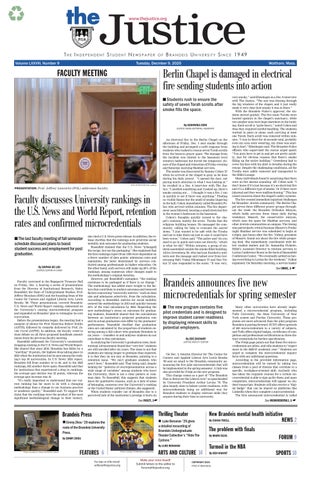
PRESENTATION: Prof. Jeffrey Lenowitz (POL) addresses faculty.
Faculty discusses University rankings in the U.S. News and World Report, retention rates and confirmed microcredentials ■ The last faculty meeting of fall semester
schedule discussed plans to boost student success and employment for post graduation. By SOPHIA DE LISI
JUSTICE EDITOR IN CHIEF
Faculty convened in the Rapaporte Treasure Hall on Friday, Dec. 5, hearing a series of presentations from the Director of Institutional Research, Haley Rosenfeld; the Dean of Undergraduate Studies, Prof. Jeffrey Shoulson (ENG) and the founding Dean of the Center for Careers and Applied Liberal Arts, Lewis Brooks ’80. These presentations covered Brandeis’ U.S. News and World Report ranking, elaborated on the University’s coming microcredential program and expanded on Brandeis’ plan to reimagine its core curriculum. Before the presentations began, the meeting had a moment of silence for Prof. Emeritus Robert Zeitlin (ANTH), followed by remarks delivered by Prof. Javier Ucrid (ANTH). In addition, the faculty voted to close debate on all three proposed handbook amendments from the previous faculty meeting. Rosenfeld addressed the University’s consistently dropping ranking in the U.S. News and World Report. She shared that since 2018, Brandeis has fallen by a “startling” 35 points, the highest drop taking place in 2024 when the institution lost its spot among the ranking’s top 50 universities. In U.S. News’ 2024 report, Brandeis fell from number 44 to 60, and in the 2025 rankings, fell another three spots. Rosenfeld said that for institutions that experienced a drop in rankings, the average spot decline was 22 points, whereas the average spot increase was 18. “It’s really important to understand that our current ranking has far more to do with a changing methodology than a change in our business practice or academic quality,” Rosenfeld said. To support the claim that the rankings were the product of the most significant methodological change in their history,
she cited a U.S. News press release. In addition, the release clarifies that the rankings now prioritize social mobility and outcomes for graduating students. Rosenfeld claimed that the U.S. News “[changed] the recipe, but not the packaging.” She explained that the first rankings report from 1983 were dependent on a fewer number of data points: admission rates and reputation, the latter determined by surveys conducted among professionals in higher education. On the other hand, such surveys still make up 20% of the rankings, among numerous other changes made to the methodology’s original iteration. However, per Rosenfeld’s metaphor, “the ranking continues to be packaged as if there is no change.” The methodology has added more weight to the factors that contribute to student outcomes and removed factors concerning “university metrics,” such as class size and admission selectivity, from the calculation. According to Rosenfeld, metrics for social mobility entered the methodology in 2019 and quickly became 50% of the total calculation by 2024. Regarding the new methodology’s stress on outcomes for graduating students, Rosenfeld shared that the calculations between an institution’s projected graduation rate and its actual graduation rate differ by the graduates’ performance. Rosenfeld clarified that graduation rates are calculated by the proportion of students entering among a fall cohort who graduate Brandeis in six years — transfers in and midyear students do not contribute to this calculation. In studying the University’s graduation rates, Institutional Advancement found that “very few” students are still enrolled after six years. The issue is not that students are taking longer to graduate than expected, it is that they do not stay at Brandeis, pointing to a retention issue. “We can’t graduate students who aren’t here,” Rosenfeld said. That being said, despite looking for “patterns of overrepresentation across a wide range of variables” among students who leave the University, there is not a clear pattern or common data. To Rosenfeld, this suggests that students leave for qualitative reasons, such as a lack of sense of belonging, concerns over the University’s ranking or the United States’ political climate, she suggested. When students transfer out of Brandeis due to a perceived lack of the institution’s prestige it hurts its
See FACULTY, 5☛
An electrical fire in the Berlin Chapel on the afternoon of Friday, Dec. 5 sent smoke through the building and prompted a swift response from students who rushed to rescue seven Torah scrolls from the historic prayer space. The damage from the incident was limited to the basement level women's bathroom but forced the temporary closure of the chapel and relocation of Friday evening and Saturday morning Shabbat services. The smoke was discovered by Sammy Cohen '27 when he arrived at the chapel to pray as he does during his daily prayer. “I opened the door, not paying much attention to what I was looking at,” he recalled in a Dec. 8 interview with The Justice, “I smelled something and I looked up, there’s smoke coming out … I thought it was a fire. I ran in quickly to see if there was anything.” Finding no visible flames but the smell of smoke lingering in the hall, Cohen immediately called Brandeis Police who arrived within minutes. The fire department soon followed, locating a small electrical fire in the women’s bathroom in the basement. Cohen’s thoughts quickly turned to the chapel’s contents, mainly the seven Torahs that the religious building houses. He messaged the community, calling for help to evacuate the sacred items. “I just wanted to be safe with the Torahs and not to take them out just in case it could have been worse,” Cohen said. “The police said ‘oh you need to go in quick and come out directly,’ which is what we did.” Within minutes, a group of students assembled outside the smoke-filled building. Akiva Greenberg '28, who had just finished a midterm saw the message and rushed over from Gerstenzang Hall. Yishai Ellenbogen '27 and Noa Yolkut '27 also responded to the scene. “It was very,
See SMOKE, 5 ☛
Brandeis announces five new microcredentials for spring semester ■ The new program contains five
pilot credentials and is designed to improve student career readiness by displaying relevant skills to potential employers. By ZOE ZACHARY
JUSTICE DEPUTY EDITOR
On Dec. 3, Interim Director for The Center for Careers and Applied Liberal Arts Lewis Brooks ’80 sent an email to the Brandeis community announcing the five pilot microcredentials that will be implemented in the spring semester. A link was also provided for FAQs on the new program. This change comes as a part of “The Brandeis Plan to Reinvent the Liberal Arts” as spearheaded by University President Arthur Levine ’70. The plan largely aims to bolster career readiness, with microcredentials being an additional way for Brandeis students to display relevant skills they acquire during their time in university.
Brandeis Press
Thrilling Theater
Emmy Zhou '29 explores the
Luke Benanav '29 gives a detailed recounting of Brandeis Undergraduate Theater Collective's "Ride The Cyclone."
roots of the Brandeis University Press. By EMMY ZHOU
By LUKE BENANAV Photo courtesy of EMMY ZHOU/The Justice.
FEATURES 6
Photo courtesy of CREATIVE COMMONS.
For tips or info email editor@thejustice.org
very smoky,” said Ellenbogen in a Dec. 8 interview with The Justice, “The sun was shining through the big windows of the chapel, and it just really made it very clear how smoky it was in there.” With the Brandeis Police’s approval, the students moved quickly. The five main Torahs were located upstairs in the chapel’s sanctuary, while two smaller ones were kept elsewhere in the building. Each scroll is “quite heavy,” noted Cohen and thus they required careful handling. The students worked in pairs or alone, each carrying at least one Torah. Each scroll was removed within minutes. “I was in there for 45 seconds total, probably even my eyes were watering, my chest was starting to hurt,” Ellenbogen said. The Brandeis Police officers who supervised the rescue urged speed: “You guys have to get in and get out pretty quickly, just for obvious reasons that there’s smoke filling up the entire building.” Greenberg had to cover his face with his shirt to breathe during the rescue. Despite the challenging conditions, all the Torahs were safely removed and transported to the Hillel Lounge. Many individuals found it surprising that there were no fire alarms sounding off. Cohen said, “I don’t know if it’s just because it’s an electrical fire and it’s a different type of smoke. Or if there were [alarms] and they were malfunctioning.” This has raised concerns about the chapel’s safety systems. The fire created immediate logistical challenges for Brandeis’ Jewish community. The Berlin Chapel serves three different prayer groups throughout the week: the Brandeis Orthodox Minyan, which holds services three times daily during weekdays; Masorti, the conservative minyan, which uses the space for Shabbat services, and other Jewish communities on campus. The timing was particularly critical because Masorti’s Friday night Shabbat service was scheduled to begin at 4:45pm, just hours after the fire. Yolkut, president of Masorti, found out about the fire while preparing food. She immediately coordinated with fellow student leaders and Dr. Samantha Pickette, Hillel’s Assistant Director to relocate services to Lurias Conference Room in the back of Hassenfeld Conference Center. “We eventually settled on having everything in Lurias for the weekend,” Yolkut explained. On Saturday morning, a service leader
ARTS AND CULTURE 14
Make your voice heard! Submit letters to the editor to forum@thejustice.org
Many other universities have already implemented a microcredential program, including Tufts University, the State University of New York system and Purdue University. These programs are more advanced than the pilot program Brandeis is putting forward. SUNY offers upwards of 400 microcredentials in a variety of subjects, and Tufts offers digital badges, certificates of completion and professional certifications as three distinct credentials for further specification. The FAQs page points out that these five microcredentials are pilots, and tells students to “expect more in the 2026-27 academic year.” Students are urged to complete the microcredential inquiry form with any additional questions. According to the provided information page, microcredentials will be earned by taking two classes from a pool of choices that correlate to a specific, workplace-oriented skill. Anybody who has taken the requisite courses for a certain microcredential is able to sign up for them, and upon completion, microcredentials will appear on student transcripts. Students will also receive a “digital badge” that can be shared on platforms like LinkedIn when they complete a microcredential. The first announced microcredential is called
See MICROCREDENTIALS, 5 ☛
New Brandeis mental health initiative By CHAVA THIELL NEWS 2 The problem with finals By MARK SILVA FORUM 9 Turmoil in the NBA By BEN KHAYAT SPORTS 10
COPYRIGHT 2025 FREE AT BRANDEIS.