
![]()


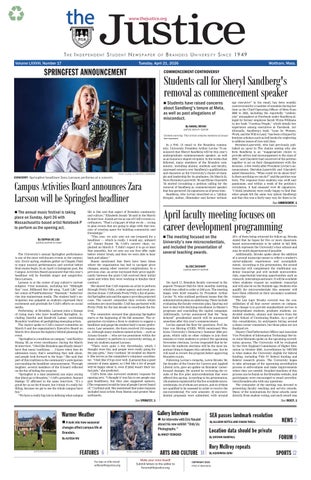
The annual music festival is taking place on Sunday, April 26 with Massachusetts-based artist Notebook P to perform as the opening act.
By SOPHIA DE LISI JUSTICE EDITOR IN CHIEF
The University’s annual Springfest performance is one of the most well-known events in the community. Every spring, students gather on Chapels Field to enjoy musical performances and unwind before final exams begin. In an April 14 Instagram post, the Campus Activities Board announced that this year’s headliner will be Swedish singer and songwriter, Zara Larsson.
Larsson is at the center of pop culture’s current zeitgeist. Viral moments, including her “Midnight Sun” tour, Billboard Hot 100 song, “Lush Life” and her remix of PinkPantheress’ “Stateside,” fueled her rise into mainstream media. The student body’s anticipation was palpable as students expressed their excitement and gratitude for CAB’s efforts on social media.
Performing at Brandeis, Larsson joins a lineage of rising stars who have headlined Springfest, including Doechii and Kendrick Lamar, continuing Brandeis’ tradition of spotlighting emerging artists.
The Justice spoke to CAB’s concert committee on March 9 and the organization’s Executive Board on March 30 to discuss the logistics behind planning the event.
“Springfest is a tradition on campus,” said Kaitlyn Huang ’28, an event coordinator, during the March 30 interview. “I feel like Brandeis specifically doesn’t have that many traditions. … I know when they do admission tours, that’s something they talk about, and people look forward to the hype.” She said that part of this tradition is the community’s anticipation surrounding the headliner announcement. Through laughter, several members of the E-board reflected on the fun of hiding the surprise.
“Springfest is a time [students] can enjoy saying that [they] go to Brandeis,” CAB’s president, Samuel Hadego ’27 affirmed in the same interview. “It’s a grind for us on the E-board, but I think it’s really fulfilling, because we get to see the whole campus have fun.”
“We have a really big role in defining what campus

life is like and that aspect of Brandeis community and culture,” Elizabeth Josiah ’28 said in the March 30 interview. Josiah serves as one of CAB’s events coordinators. “That’s a big part of what we do — trying to plan events that are going to align with that mission of creating space for building community and friendships.”
“This year, we only sent out one [request] for a headliner — which is really, I would say, unheard of,” Naomi Ihueze ’28, CAB’s concert chair, explained on March 9. “I didn’t expect it to go at least that smoothly, but we sent out our first offer right before winter break, and then we were able to hear back and adjust.”
Ihueze mentioned that there have been times where the organization has had to navigate price changes, among other contract complications. In a previous year, an artist increased their price significantly between the point CAB received their initial quote and when they were working to finalize their contract.
She shared that CAB requests an artist to perform through Pretty Polly, a talent agency and event production house. CAB sends Pretty Polly a list of potential Springfest acts and the agency provides projected costs. The concert committee then reviews which estimates are most feasible. CAB has partnered with Pretty Polly for the last decade to coordinate the festival.
The committee stressed that planning Springfest starts at the beginning of the fall semester. The organization circulates a form to students to suggest a headliner and gauge the student body’s music preferences. Last semester, the form received 132 responses. Although many students named artists — such as Ariana Grande — who are too prominent within the music industry to perform in a university setting, at least six students named Larsson.
“There were quite a few throwbacks, which I thought were fun, and people were really going for the pop girls,” Zoey Cardinal ’28 recalled on March 9. She serves as the committee’s volunteer coordinator. “I feel like it’ll go over well. [Larsson] has a good amount of mass appeal, so I feel like a lot of people will be happy about it, even if [she] wasn't their initial pick,” she predicted.
CAB’s form also surveyed students' requests for opening acts. “I thought it was fun to see people suggest headliners, but they also suggested openers. [The responses] would be tons of people I never heard of,” Cardinal said. She mentioned that some requests included local artists from Boston and greater Massachusetts.
A look into how seasonal changes affect campus life at Brandeis.

Students have raised concerns about Sandberg's tenure at Meta, as well as past allegations of misconduct.
By NAWAL IRFANI JUSTICE DEPUTY EDITOR
Content warning: This article contains mentions of sexual harrassment.
In a Feb. 12 email to the Brandeis community, University President Arthur Levine ’70 announced that Sheryl Sandberg will be this year’s undergraduate commencement speaker, as well as an honorary degree recipient. In the weeks that followed, many members of the Brandeis community, including alumni, students and faculty, expressed concern over Sandberg’s qualifications and character as the University’s choice of example and leadership for its graduates. On March 23, Nora Herndon-Lazerwith ’26 and Elena Giacoletti ’26 started circulating a petition calling for the removal of Sandberg as commencement speaker that has garnered 116 signatures as of press time. Sandberg, who Levine described as a “philanthropist, author, filmmaker and former technol-
ogy executive” in his email, has been notably controversial for a number of scandals during her time as the Chief Operating Officer of Meta from 2008 to 2022, including the reportedly “unfeminist” atmosphere at Facebook under Sandberg alleged by former employee Sarah Wynn-Williams in her book “Careless People,” which details her experience among executives at Facebook. Additionally, Sandberg’s book “Lean In: Women, Work, and the Will to Lead,” has been critiqued by feminist scholars such as bell hooks for neglecting to address issues of race and class.
Herndon-Lazerwith, who had previously published an op-ed in The Justice stating why she feels Sandberg is an “inappropriate choice to provide advice and encouragement to the class of 2026,” and Giacoletti had conceived of the petition together to act on their disappointment with the decision. A few weeks after President Levine’s announcement, Herndon-Lazerwith and Giacoletti asked themselves, “What could we do about this? Is there anything we can do?” and the petition was born. The response from students was swift and passionate, and within a week of the petition’s circulation, it had amassed over 80 signatures. “I think [students] were really happy to find that other people felt the same way [about Sandberg] and that this was a fairly easy way for them to be
The meeting focused on the University's new microcredentials, and included the presentation of several teaching awards.
By ZOE ZACHARY JUSTICE DEPUTY EDITOR
On April 17, Brandeis faculty convened in Rapaporte Treasure Hall for their monthly meeting, which was called to order at 2:00 p.m. The meeting began with brief remarks by President Arthur Levine ’70, who outlined pertinent issues that the administration plans on addressing. These include evaluating the faculty retention plan, figuring out how to deal with declining enrollment in Master’s programs and concluding the capital campaign. Additionally, Levine announced that the “longdelayed” presidential search will be announced sometime after this year’s commencement.
Levine opened the floor for questions. Prof. Sabine von Mering (CGES, WGS) mentioned Wesleyan University’s Democracy Summer 2026 program, which calls on other colleges to join their mission to train students to protect the upcoming November elections. Levine responded that he believes the midterm elections will be the most important thing to happen this calendar year, but he will need to review the program before approving Brandeis to join.
Following Levine’s remarks, Lewis Brooks ’80, the founder of the Center for Careers and Applied Liberal Arts, gave an update on Brandeis’ careerfocused changes. He started by reviewing the results of the five pilot microcredentials that were offered this spring. According to his presentation, 156 students registered for the five available microcredentials. 64 of whom are seniors, and 44 of them are qualified to be assessed in order to receive the microcredential. For next semester, 25 microcredential proposals were submitted, with around
Gallery Interview An interveiw with Eric Neudel about his new exhibit "Only Us: Photographs."
By MIKEY TERRENZI
25% of them being returned for follow-up. Brooks stated that he hopes for five or more classroombased microcredentials to be added in fall 2026, which represent the University’s four schools and may be multi-departmental if possible.
Additionally, Brooks spoke about the addition of a second transcript meant to reflect a student’s career-adjacent experiences and accomplishments. According to his presentation, the second transcript will complement the traditional academic transcript and will include microcredentials, experiential learning opportunities such as research, internships and more. It will be available when students request an academic transcript and will also be on the Suitable app. Students who qualify for microcredentials this semester will have them reflected on their secondary academic transcript.
The last topic Brooks covered was the consolidation of all four career centers on campus. This change is to provide standardized service to undergraduate students, graduate students, undecided students, alumni and learners from the Rabb School of Continuing Studies. As a part of this consolidation, he anticipates hiring around a dozen career counselors, but those plans are not finalized yet.
Deputy Chief Information Officer and Associate Vice President of Information Technology Services Anne Marando spoke on the upcoming accreditation process. The University will be evaluated by the New England Commission of Higher Education in October 2026. Accreditation by NECHE is what makes the University eligible for federal funding, including Title IV federal funding and federal research grants. The University hopes to take advantage of the upcoming accreditation process to self-evaluate and make improvements where they are needed. Detailed timelines of this process can be found on the Brandeis website, and participants were encouraged to email accreditation@brandeis.edu with any questions.
The remainder of the meeting was devoted to presenting faculty teaching and service awards. Many of the nominations for these awards came directly from student voting, and each award was
MEDICAL EMERGENCY
April 6—There was a medical emergency for a party with an infection. The patient was transported to a local hospital. April 8—There was a medical emergency for a potential cardiac arrest. The patient was transported to a local hospital.
NOISE COMPLAINT
April 4—There was a noise complaint about a large group playing music and shouting. The situation was cleared.
MISCELLANEOUS
April 3—An officer completed a patrol by the chapels. All appeared in order.
April 3—An officer completed a patrol. All appeared in order.
April 3—An officer completed a patrol in North Quad. All appeared in order.
April 4—An officer completed a patrol by the Rose Art Mu -
seum. All appeared in order.
April 5—An officer completed a patrol by the chapels. An alarm was reset.
April 5—There was a report of suspicious posters in a building. There will be an investigation to follow.
April 6—An officer completed a patrol of the Rose Art Museum. All appeared in order.
April 6—A party made a phone call making verbal comments about a staff member and hung up the phone. There will be an investigation to follow.
April 6—An officer completed a patrol of the Kutz Lot. All appeared in order.
April 7—An officer completed a patrol of the Tower Lot. All appeared in order.
April 7—An officer completed a patrol of the Athletics Lot. All appeared in order.
April 7—An officer completed a patrol of the Sachar Road Lot.
All appeared in order.
April 7—There was a report of graffiti on a building. There will be an investigation to follow.
April 8—An officer completed a boiler plant check. All appeared in order.
April 8—An officer completed a patrol of the Foster Mods Apartments. All appeared in order.
April 8—An officer completed a patrol of Chapels Field. All appeared in order.
April 8—A suspicious phone call was reported. There will be an investigation to follow.
April 9—An officer completed a patrol of Charles River Road. All appeared in order.
The group held a die-in protest on April 19 in addition at the Shapiro Campus Center Atrium in collaboration with the Leonard Bernstein Festival of the Arts.
By ALLISON KETTLE AND CHAVA THIELL JUSTICE STAFF WRITER AND JUSTICE NEWS EDITOR
On March 2, Students for Environmental Action formally passed the Stop Private Jet Expansion resolution, marking a significant escalation in student-led activism regarding pressing environmental concerns. The resolution targets a proposed private jet hangar expansion at Laurence G. Hanscom Field (BED) in Bedford, MA. Hanscom Field, owned and operated by the Massachusetts Port Authority, is New England’s largest general aviation airport and serves as a major hub for private jets, charter flights and corporate aviation. The proposed project would add 17 new hangars for private luxury jets, doubling its current private jet hangar capacity. Supporters of the expansion argue it would meet growing demand in the region’s corporate aviation sector. However, critics, including SEA and a growing statewide coalition, say the environmental costs far outweigh the benefits.
SEA, in collaboration with the Statewide Coalition to Stop Private Jet Expansion at Hanscom or Anywhere, sent their petition to Massachusetts Governor Maura Healey, urging the state to reject Hanscom’s proposal. The petition draws details from the Draft Environmental Impact Report to explain how the expansion would drastically increase
Massachusetts’ carbon footprint as the new facility would emit an estimated 150,000 tons of greenhouse gas pollution annually. Additionally, the facility would require the removal of 17.85 acres of trees, resulting in significant carbon sequestration and habitat losses. Environmental advocates argue that such an increase would greatly deter Massachusetts’ legally mandated climate goals.
SEA concluded the petition to Governor Healey by stating “we have a responsibility to fight for a just and livable climate.” The group urges that “[jet hangar expansion is] a luxury our climate can’t afford” as the expansion of a private jet facility conveniences an elite few at the expense of the greater population vulnerable to the effects of the climate crisis. The resolution also represents a greater shift in youth activism. While multiple student organizations and community groups across Massachusetts have participated in protests, rallies and letter-writing campaigns opposing the expansion, SEA at Brandeis is the first youth-led group in the state to adopt an official petition against private jet corporation growth.
If Governor Healey acts on the petition and moves to halt Hanscom’s project, it would be a major victory for environmental activism. Such a decision would not only influence the future of Hanscom Field but could also set a precedent for how similar projects are evaluated in the context of climate policy. For student activists, it would reinforce the growing role of youth voices in shaping environmental decision-making at the state level.
Additionally, the group began a petition during October 2024 demanding that the University reopen its Office of Sustainability. The Office was quietly closed during the summer of 2024. The petition, which has garnered nearly 1,000 signatures, states that “without [the Office of Sustainability], we are directionless, lacking sustainability policies, and lagging behind other universities in an issue where Brandeis, as a social justice institution, should be a leader.”
Both of these initiatives coincided with
A features article incorrectly called “Re/Chic” a consignment store. It was corrected to “thrift store.” (March 31, 7).
The Justice masthead incorrectly spelled “Chava Thiel.” It was corrected to “Chava Thiell.” (March 31, 8).
An arts photo caption incorrectly spelled “dimonds.” It should’ve read “diamonds.” (March 31, 14).
An arts photo caption incorrectly spelled “frineds.” It should’ve read “friends.” (March 31, 14).
A Staff Top 10 incorrectly spelled “Kiera.” It should’ve read “Keira.” (March 31, 16).
The Justice welcomes submissions for errors that warrant correction or clarification. Send an email to editor@thejustice.org
The Justice is the independent student newspaper of Brandeis University. The Justice is published every Tuesday of the academic year with the exception of examination and vacation periods. Editor
Media editor@thejustice.org managing@thejustice.org news@thejustice.org features@thejustice.org forum@thejustice.org sports@thejustice.org arts@thejustice.org photos@thejustice.org copy@thejustice.org layout@thejustice.org ads@thejustice.org online@thejustice.org
SEA’s second annual die-in, held in the Shapiro Campus Center Atrium on Sunday, April 19, in collaboration with the Leonard Bernstein Festival of the Arts. In an April 19 interview with The Justice, Spike King ’27, vice president of activism for SEA and Justin Koizumi ’27, president of SEA, spoke regarding the group’s demands and initiatives. In a speech delivered by King, they described die-ins as “a form of street theatre which have been historically used to protest complicity with systems of normalized harm,” and pointed to the use of die-ins during the 1980s AIDS crisis. “We wanted to host a diein to get a very visual representation of the harm that Brandeis is doing to its students [and] the larger community,” King said. The die-in was held in conjunction with the Leonard Bernstein Festival of the Arts. King and Koizumi mentioned that Natalie Sciallo, a Creative Arts events administrator for the School of Arts, Humanities and Culture, was instrumental in helping the collaboration come to fruition. Koizumi shared that last year, the organization reached out to the Festival of the Arts to collaborate.
“This year was a little different because we wanted to make it more interactive as part of being performative art,” Koizumi said, touching on how both organizations share similar missions.
When asked about their demands of the University, King spoke about other issues that have concerned the student body in recent years, including the University’s policies regarding Immigration and Customs Enforcement on campus, protections for international students and stronger free speech policies. As such, King’s speech also included reforms to Brandeis’ free speech policy, greater accessibility of the Board of Trustees, stronger protections for international students and students of color and protection from federal overreach, including cuts to diversity, equity and inclusion programs.
Koizumi shared that approximately 20 people engaged with the die-in throughout the day. “It’s also about community build -
ing,” Koizumi shared. “As environmentalists we forget that it’s not just about individual actions but about community.” He also shared that he believes the effort will be “generational” and will continue in coming years.
To prepare for the event, the group “went through copious amounts of meetings,” and collaborated with specific individuals like Sciallo. When asked about the University’s reception to such demonstrations, King shared they “think there’s a lot of improvements that could be made to the policies that we have.” One of the organization’s demands includes that the Brandeis Board of Trustees make themselves more available for public comment. “We haven’t really heard anything from them,” King said. Koizumi also shared that several students of color have not been able to support SEA’s work because they feel unsafe in light of the current political moment. On a national level, the Trump administration has been restricting free speech on college campuses, and have specifically targeted international students and students of color. Both King and Koizumi noted that several students had spoken to them personally about their hesitance to engage with SEA’s activism. “We can’t necessarily include them in what we’re doing because they just don’t feel safe,” Koizumi said, adding this was a result of both the federal administration and the University’s actions. As such, both stated they felt it was important to advocate for the inclusion of diverse student voices within the scope of environmental activism. “Ensuring that everyone has their voice heard within environmentalism is really important to us,” King said. Ultimately, the group sees their environmental advocacy as heavily intertwined with other social justice efforts. As the group engages with both the University administration, local and statewide governments, they advocate for greater environmental protections in addition to pressing social justice issues, striving to make Brandeis a more inclusive, safe campus for all.”
On April 10, the Classical and Early Mediterranean Studies department hosted a mini-conference titled “Monks as Craftsmen in Byzantine Egypt: Exploring Monastic Life with Augmented Reality,” with additional support from the Mandel Center for the Humanities, the Near Eastern and Judaic Studies department and Brandeis Design and Innovation. The conference hosted four speakers from universities and museums.
The first speaker, Dr. Elizabeth Dospěl Williams, came from the Boston Museum of Fine Arts as the Penny Vinik Chair of Fashion, Textiles and Jewelry. Williams presented on several curatorial projects she has worked on relating to the textiles of Egyptian monks. The second presenter, Dr. Agnieszka E. Szymanska, came from the Art and Art History department of the University of Richmond. She brought with her a 3D scan of the Red Monastery located in Sohag, Egypt, which conference attendees were able to view using virtual reality technology after the conclusion of the panel. The third speaker, Dr. Kim Haines-Ei -
tzen from Cornell University’s Near Eastern Studies Program, presented her research on the soundscapes of ancient monastic life. During her presentation, she played the audience an audio recording that she collected from a desert in Egypt and juxtaposed the implications of natural and manmade sounds.
The final presenter, Dr. Darlene Brooks-Hedstrom (CEMS, NEJS), presented her use of augmented reality to experiment with the materiality of ancient monastic life. As a beta tester of Case Western University’s CrewXR program — originally meant as a biomedical teaching tool — Brooks-Hedstrom helped repurpose this technology to be used in humanities research and has taught two classes, in both the spring 2025 and 2026 semesters, which utilize the program. In these classes, students created immersive digital displays populated with a combination of 2D and 3D assets, both their own and those existing in museums and collections. These displays are meant to allow viewers to envision what monastic living spaces and the lives of
monks would have been like.
Building on her spring 2025 semester class, the course associated with this ongoing experiment this semester is “Holy Christian Threads! The History and Craft of Making Early Christian Clothing.” In this six-credit course, students learned how to process wool, spin it and weave textiles from that, in a similar fashion to how monks did. In addition, students conducted research on undisplayed textiles at the MFA, facilitated by Dr. Williams. Through a combination of processing wool, weaving and research at the MFA, students 3D scanned the textiles and drop spindles they created to be displayed in CrewXR. Following the conclusion of the panel, attendees were invited to experience the monastic cell populated by Brandeis students and interact with the digital assets in these AR rooms.
— Written by Eliza Bier — Editor’s note: acute accent over n cannot be added in Szymanska.
In an interview with The Justice, the founding director explained how the Center for Careers and Applied Liberal Arts will enrich students’ academic journeys.
By SOPHIA DE LISI JUSTICE EDITOR IN CHIEF
As Brandeis implements its Plan to Reinvent the Liberal Arts, the administration is making numerous organizational and structural changes to the institution’s operations, emphasizing a focus on career readiness. A significant aspect of this plan is to open a new Center for Careers and Applied Liberal Arts in the fall of 2026. The center will serve as a hub that integrates academic and career advising, experiential learning, emerging technologies and much more.
Brandeis currently has four career centers on campus, including The Hiatt Career Center, the International Business School, The Heller School’s Career and Development Center and the Graduate School of Arts and Sciences. The new center aims to merge the purposes of each career center with a focus on preserving their best attributes — some focus on connecting students to possible employers and alumni relevant to their disciplines, while some focus on mentoring programs.
“We can combine the best of all of them — it’s sharing the wealth,” Lewis Brooks ’80, Ph.D. ’16, explained in a March 30 interview with The Justice. In August 2025, President Arthur Levine ’70 asked Brooks to become the center’s founding director, citing his extensive history with Brandeis as an alum and his experience on the Alumni Association’s board of directors. Brooks also brings his relevant career experiences as a former Chief Information Officer for a global advertising agency, managing thousands of employees in offices across the world. He continued, “I’ve been using the expression that this career center will be consolidated, but distributed.” Brooks stressed that the center’s resources will not live under one building. Instead, there will be administrators associated with the center around campus. This organization will ensure that the resources are as accessible to students as possible.
Furthermore, distributing the center across campus will help employ career counselors across all disciplines and serve the new schools founded under the Brandeis Plan, which include The School of Arts, Humanities and Culture, The School of Business and Economics, The School of Science, Engineering and Technology and The School of Social Sciences and Social Policy. Merging these career centers will help the University determine how many more counselors it needs to hire this summer, considering that the center plans to offer each incoming student an advisor, regardless of being declared or undeclared. Currently, Brandeis is in the process of refining how the center will pair students with their counselors. Additionally, it will offer career guidance classes, which counselors will teach.
“Things are changing,” Brooks said. He stressed the impor-
tance of preserving and encouraging the “agility” that comes with a Brandeis education through the center’s programming and advising opportunities. Through this approach, he hopes that students will have the skills to adapt to new circumstances and technology that they might encounter later in their careers. “What artificial intelligence [is] today is going to be something else tomorrow. It may be some flavor of AI, but we have to make sure that we are ready to pivot to whatever’s next,” he continued. As the president of the Alumni Association during the beginning of the COVID-19 pandemic, Brooks recalled how quickly the University shut down and adapted to online learning.
Another foundational aspect of Brandeis’ plan is its implementation of the microcredential program, which consists of certifications for employable skills attained outside the classroom. The center will manage the version of microcredentials geared towards undergraduates, while the Rabb School of Continuing Studies manages the microcredentials associated with its online classes for professionals.
On March 24, the registrar announced that registration for Brandeis’ five pilot microcredentials will remain open for graduating seniors until April 30. These undergraduate microcredentials include Applied Statistical Analysis, Foundations of Data Analysis, Person-Centered Research and Analysis, Policy Analysis and Implementation and lastly, Sound and Video Media. Five days after this announcement, 130 students registered, which Brooks described as “phenomenal.” He shared that the second round of microcredentials is currently under review by a designated committee, as many faculty members have submitted proposals. At present, Brooks does not know how many more microcredentials there will be in total, but he assured that the center aims to have a diverse group of offerings across all schools.
The center’s undergraduate microcredentials will also feature certifications from experiential learning, which students can earn through their extracurricular activities. For example, Brooks said that three of the microcredentials in development are Leadership in Emergency Medicine, Foundations of Financial Operations and Procurement Management and Foundations of Strategic Budget Analysis and Allocation. These microcredentials are closely associated with students involved in the Brandeis Emergency Medical Corps and the Student Union’s Allocations Board. However, he specified that involvement in these organizations will not be the only means to attain these certifications.
The center’s next steps will be to further clarify the assessment process for these microcredentials. Given the diversity of skills the microcredentials encompass, there is no standardized approach that would be relevant to each one. Instead, there will be a variety of assessment techniques that depend on the discipline, such as an oral presentation or portfolio review. The center is currently finalizing the assessments for the first five certifications to ensure graduating seniors can attain them before commencement.
“The second transcript is that piece of paper — literally or
figuratively — that you can take on an interview,” Brooks shared. “It’s a speaking tool, and our goal is to have students be able to … have a conversation about their accomplishments.” These microcredentials will appear on students’ second transcripts, alongside their completed internships, fellowships, study abroad and research experiences as part of the center’s emphasis on experiential learning. Brooks highlighted that this additional transcript is “unique” within higher education. Moreover, these opportunities are vital for students’ career preparedness — the center will be prepared to connect students with both these opportunities as well as alumni working in relevant fields. One such resource is Be Connect, a database that Hiatt offers to students. Brooks said that the center intends to expand its functionality, allowing students to connect with alumni based on geographical location and career. The University is also partnering with ETS, an educational assessment firm, to help the organization refine Futurenav Compass, a tool that aids students in personalized career planning.
The center is also partnering with the Innovation Lab, the MakerLab, the Center for Teaching and Learning and the Center for Entrepreneurship to keep Brandeis’ curriculum up to date on the latest technologies.
“These first pilot cycles are teaching us how we can do this better,” Brooks said. He stressed the importance of student feedback as the University refines the center’s procedures. He continued, “There are many more elements that have to come together as the process goes along.” The University is prepared to adjust elements as needed and encourage student input by holding focus groups.
Along with highlighting Brandeis’ agility, Brooks also emphasized that closeness within the community is also unique to the institution, particularly among alumni. He said, “The Brandeis experience is something that’s tangible, that alumni can all relate to, and there’s a sense of camaraderie.” Brooks shared that Levine recognized his interconnectedness within many of the community’s subgroups as a graduate, a parent of a graduate, a former Board of Trustees member and Alumni Association president. As an alum, he expressed that he “couldn’t be happier” with the plans for the center and the speed at which the University is implementing them.
Brooks also shared that he experiences this sense of supportiveness within the center’s leadership, which has guided administration through complications with technology like Workday and consolidating resources for students. “That’s all been challenging, but there’s no one against what we’re trying to do here. I love the fact that I’m working with supportive colleagues, and it’s great.”
In the process of introducing the novel aspects of its Plan to Reinvent the Liberal Arts, Brandeis considers the needs of its students to prepare them for the working world. In doing so, the University is catching the attention of other institutions and influential figures in higher education, setting a new precedent in combining career readiness alongside traditional education.
Push 92 is a leadership program for ICC members that helps Brandeis first-years and sophomores build skills, confidence and community.
By ALLIE LADJEVA JUSTICE COPY EDITORIAL ASSISTANT
On April 17, a group of first-years and sophomores presented to mentors and peers on issues ranging from misogyny to code-switching as part of the Intercultural Center’s new leadership program. Push 92 helps students develop leadership skills and confidence. The program’s inaugural cohort launched this academic year with 25 fellows completing it. Throughout the program, fellows develop interpersonal skills to contribute to their own leadership paths at Brandeis. Peter Rojas, director of the Intercultural Center, came up with the idea for Push 92 to inspire students to become future leaders on campus.
The program’s name was inspired by the Push Committee — a group of individuals in the late 1980s and early 1990s who petitioned to create a space for students of color. As a result of the committee’s efforts, in 1992, the University administration approved the Swig building, which formerly housed the Athletics facilities, as the ICC. Rojas shared that he wants Push 92 to commemorate the Push Committee’s efforts to advocate for an on-campus initiative.
“My goal is to make sure that [the fellows] continue the legacy of the ICC. Not just the building, but the idea behind creating change on campus. At the end of the day, what I hope is that they continue that legacy for them, then to create their own legacy here on campus for the next four years,” Rojas shared in an April 17 interview with The Justice.
Rojas explained that he came up with the idea for Push 92 in the fall of 2025. He hoped the program would help students develop valuable skills that would motivate them to become leaders in their ICC clubs and even extend this learning beyond this space on campus.
“The principle of the program was to create a space for our ICC club to develop [first-years] and sophomores in leadership skills, emotional IQ, team management [and] team conflict, in hopes that it would create an essence of confidence for the stu -
dents, but also create a catalyst for change on campus,” Rojas said.
One of the projects that Push 92 fellows worked on was their capstone presentation, which took place on April 17. Monica Claros ’26, an ICC ambassador and a Push 92 mentor, told The Justice that the presentations highlighted everything the fellows have learned so far. They had to translate that knowledge to address a problem of their choosing, related to their careers, academics or general problems they face in the world.
Some of the topics that fellows presented included the fetishization of Asian American women in professional and academic spaces, combating misogyny, gender roles in healthcare occupations and code-switching. In addition to presenting the problem, fellows offered solutions and ideas to address it. They also spoke about learning how to advocate for themselves in leadership positions and navigating different fields as members of minority groups.
Zaire Simmonds ’26, an ambassador for the ICC and a Push 92 mentor, helped develop the curriculum for the program’s fellows. In an April 17 interview with The Justice, Simmonds shared that the leadership program would inspire the next generation of leaders at Brandeis and help fellows build confidence and skills for jobs and internships.
“So [first-years] and sophomores have an opportunity to be a part of this cohort program, where they are learning ins and outs about themselves, about what it means to be a leader [and] how to be a leader. We have things such as building your own brand … We are giving them a lot of skills early on so that in their sophomore, junior [and] senior years, they feel like they are more qualified and that they are able to go off and lead,” Simmonds explained.
Two current fellows shared their experiences in Push 92 with The Justice on April 17. Both students spoke about their journey in the leadership program and the skills they have gained thanks to it. Elizabeth Adjovu ’28 shared that the program has taught her the importance of empathy and believing in yourself.
“One thing I have learned is being humble, being confident, knowing that you deserve any good things that you get. Also understanding that you are working with people, and you need to have a sense of understanding and empathy and emotional intelligence that people nowadays kind of lack. So especially now, that’s very important,” Adjovu shared.
Destinee Ponder ’29 said that Push 92 helped her embrace
her authentic identity with confidence. She mentioned that one of her favorite things about the leadership program is having people from different cultures in one place.
“I feel like a lot of times people tell you to kind of like wash yourself over, tone yourself down and just completely fit the script of who you are just to fit some type of job description you should be in. Push 92 has really taught me that I can still embrace myself and be who I am without having to wash myself over to fit a job description,” Ponder shared.
Claros encouraged students to be part of Push 92. She said the leadership program focuses on community building and community-based learning, which is what makes it unique.
“Students should be part of Push 92 because I think it teaches a really good value of relationship building, just because it is a community cohort-based program. So I know a lot of the students have come to me and the other ambassadors as upperclassmen for academic advice, career advice, club advice, and I think that they are learning how to build their network from really early on, which I think is really great, especially here in the ICC,” Claros explained.
Push 92 is set to continue on for the following semesters. Rojas aims to incorporate peer-to-peer curriculum development, allowing fellows from cohort one to mentor those from cohort two. His future goals also include increasing Push 92’s participation by opening it to everyone on campus who might be interested. However, the primary focus would remain on developing ICC clubs and student leaders.
Additionally, rumors that the ICC building will be torn down next year have been circulating within the student community. Simmonds shared that the rumors have been “spreading like wildfire” and have yet to be addressed by the administration.
“I think it’s the University’s responsibility to step in and give some kind of clearance because the rumor hasn’t been addressed. Therefore, the rumor is still living, and people are making assumptions off of this rumor,” Simmonds said.
Rojas also addressed the rumors and reassured students that the ICC building will not be closed anytime soon, “Right now, the ICC is here to stay, so there’s nothing to worry about at that essence, and we have that from our senior leadership,” he shared.
Despite these rumors, programs like Push 92 continue to foster leadership, community and identity among students on campus.

This year’s professional opener, Notebook P, is also a songwriter and vocalist based in Randolph, Massachusetts. New England Mic Check’s artist spotlight described that his music centers primarily around R&B, and “ranges from upbeat, hip-hop influenced melodies to soft, sensual sounds over remarkably articulate lyricism.” Some of Notebook P’s most popular songs on SoundCloud include “layover,” “dusk” and “porkchops.”
CAB also began its search for Springfest’s student openers during the fall semester, holding open auditions for the performance slots. For a consecutive year, Benjamin Jolluck ’26, a disc jockey who performs under stage name JAGA, and singer-songwriter Hazel Drew ’28 will perform on the Springfest stage. Drew will be accompanied by JonAaron Arnell ’28, Cam Steinberg ’26 and Joey Kane on stage. Additionally, student groups “1 Night Only” and “Marakosa” are the other two opening acts. 1 Night Only is composed of Emily Confino ’26, Isidora Bustos ’28, Ben Selip ’28, Dan Zeidan ’26 and Kian Wignaendts
Van Resandt ’28, while Marakosa’s duo, Divina Ashley ’27 and Iyegbekosa Ohan ’27, will be joined by Selip, Reed Gao ’25, Ananya Dalal ’26, Stephen Dixon ’26 and Godson Ademola-Thomas ’27.
There’s more to Springfest than the music. Preparations also include arranging the food vendors and necessary safety measures. Cardinal said, “It’s a really fun challenge to be able to manage all of the logistical elements to make sure that everyone on campus can have the best day possible.”
To mitigate concerns about Springfest’s notoriously long check-in line, CAB will be distributing wristbands in the Shapiro Campus Center’s atrium the week leading up to Sunday. Between April 21 and April 24, CAB members will table between 11:00 a.m. to 4:00 p.m., including a second shift between 6:00 p.m and 9:00 p.m, on Wednesday, April 22. Students will also be able to pick up their food truck vouchers in advance. Ihueze clarified that each attendee will receive one meal ticket and one for the dessert food truck.

able to express that,” Giacoletti shared in an April 16 interview with The Justice. “Obviously, we're all students and we're all really busy, and it's difficult to find the time or the energy when you're frustrated and tired,” so the petition was an easy way for people to make themselves heard, Giacoletti continued. The petition has been signed by a combination of Brandeis students, faculty and alumni.
Some members of the Brandeis community see the University’s invitation to Sandberg as a plea for donations from the billionaire. “I understand that part of their job is to cater towards new students and potential donees, but there are students here too, and we're already paying and living here, and I think that the time that I've been here, I've really felt that the students who are currently here have mattered the least to the administration,” Giacoletti said. Alumna Laura Limonic ’97, who previously wrote a Letter to the Editor describing her concerns with Sandberg, remembered a different Brandeis in a Feb. 24 interview with The Justice: “There was a lot of emphasis on being on the right side of history. Brandeis didn't play the numbers game.”
Herndon-Lazerwith was already familiar with Sandberg and her career before she was introduced as commencement speaker. “Her various moral failings come up rather quickly when you Google her. They're not hard to find, hidden or disputed — most of them — and it was pretty clear to me … what this was, which was a pick by the administration in service of their attempt to change Brandeis from a liberal arts institution into like a white collar vocational school, as I said in my op-ed,” said Herndon-Lazerwith in an April 16 interview with The Justice. Herndon-Lazerwith sees the University’s emphasis on Sandberg’s success as a businesswoman and her career in the technology sector as a draw away from its core in the humanities and liberal arts. The petition statement indicates this sentiment reading, “In the last few months Brandeis has begun unveiling its new marketing campaign which heavily focuses on technology, business, and career-readiness. Sandberg is clearly a commencement speaker chosen to reflect this new Brandeis. But the Class of 2026 did not come to Brandeis for its micro-credential program or new mottos. We came here to receive a well rounded and interdisciplinary education from a school that valued all of its departments, from the humanities to STEM.” Facebook’s involvement in numerous controversies in the past few years, many of which occurred during Sandberg’s tenure, bolstered the idea that the University is focused on donations as opposed to the commencement speaker’s career and relevance to the graduating class. Facebook has been implicated in the genocide of the Rohingya people in 2017, according to a report from Amnesty International. The report states that “Facebook owner Meta’s dangerous algorithms and reckless pursuit of profit substantially contributed to the atrocities perpetrated by the Myanmar military against the Rohingya people.” The company’s algorithms, which created an echo chamber where hate against the Rohingya people spread online, made profit for Facebook. “The display of inflammatory content — including that which advocates hatred, constituting incitement to violence, hostility and discrimination — is an effective way of keeping people on the platform longer,” reported Amnesty International.
In 2018, Facebook faced another significant scandal when it was revealed that 50 million Facebook profiles were harvested by Cambridge Analytica in order to predict voter choices and send people targeted political advertisements. Cambridge Analytica, owned by billionaire Robert Mercer and led at the time by President Donald Trump’s advisor Steve Bannon, took this information from Facebook without authorization. According to The Guardian, Facebook knew about this data breach in 2015 but failed to alert its users and took “limited steps to
This year’s food truck vendors include, but are not limited to, Cookie Monstah, Kona Ice and Moyzilla, an Asian street food truck. Additional options will also include Indian cuisine, hamburgers and tacos.
“It’s kind of like an all hands on deck situation between the majority of groups on campus,” explained Ihueze. In addition to being the concerts chair, she also serves as the concert committee’s safety and logistics coordinator. CAB works in conjunction with the Department of Student Engagement, the Department of Public Safety and Brandeis Emergency Medical Corps. She added that student volunteers have a protocol to follow should they observe any “unsafe behavior” taking place.
“I hope that people really enjoy their time,” Jia Zheng ’26, CAB’s vice president, shared on March 30. “I hope they have one day before finals to relax and enjoy one of the last events on campus this year.”
As Springfest approaches, students and organizers alike prepare for one of campus’ most anticipated events of the academic year.

recover and secure the private information of more than 50 million individuals.” Sandberg presided as a key figurehead of Facebook during both of these scandals. “I cannot imagine how Brandeis could consider honoring a leader in what some would call crimes against humanity overseas and election interference in our country,” said Prof. John Plotz (ENG) in an April 18 statement to The Justice.
Sarah Wynn-Williams, Facebook’s former director of global public policy, published her memoir, “Careless People: A Cautionary Tale of Power, Greed, and Lost Idealism” in 2025. The memoir discussed Wynn-Williams’ time at Facebook and is “an insider account of a company that she says was run by status-hungry and self-absorbed leaders, who chafed at the burdens of responsibility and became ever more feckless, even as Facebook became a vector for disinformation campaigns and cozied up to authoritarian regimes,” according to The New York Times. Wynn-Williams also described how her initial awe of Sandberg dissipated after she realized her “lean in” philosophy was a cover for the obedience she demanded in the workplace and described a particular moment when, on a 12-hour private jet together, “Sandberg claim[ed] the only bed on the plane and repeatedly demand[ed] that Wynn-Williams ‘come to bed.’” The memoir also implies that WynnWilliams was fired after reporting instances of sexual harassment from her boss, Joel Kaplan, who at the time was a vice president for global public policy.
Sandberg has also been critiqued for her book “Lean In: Women, Work, and the Will to Lead,” which advises women on how to succeed in the workplace and encourages them to “lean in” to their careers, make space for themselves and “sit at the table.” bell hooks critiqued the book as having reinforced structural norms that especially impact women of color. “It almost seems as if Sandberg sees women’s lack of perseverance as more the problem than systemic inequality. Sandberg effectively uses her race and class power and privilege to promote a narrow definition of feminism that obscures and undermines visionary feminist concerns,” bell hooks wrote in an article published by The Feminist Wire.
“My mom was definitely in the corporate world in that era where [Sandberg] was promoting ‘Lean In’ really heavily. … It's not helping women in the workplace. … [It’s] frustrating to me, for the school to pick her and represent her as this sort of corporate girlboss [feminist],” Giacoletti shared.
According to a March 5 statement to The Justice from the administration, Sandberg is a choice “who reflect[s] the values of our community and will inspire our graduates and their families.” The statement continued, “our undergraduate speaker is widely known as a trailblazer for women in business and a brilliant economist. The degree she will receive honors the total body of her work and contribution to society.” So far, the administration has not made any additional statement to the student body despite concerns raised by students. Herndon-Lazerwith sees some hesitation to speak out against the University from peers as, in part, related to the administration’s response to pro-Palestine protests on campus in fall 2023. “When I wrote my op-ed, I did feel that I was kind of sticking my neck out to show my fellow seniors that the Brandeis administration was not about to start revoking degrees or threatening disciplinary action over this,” she said. “My class had such a terrible experience with the way that the Brandeis administration repressed free speech on this campus in 202[3] [so] a lot of my class is very hesitant to take any action or speak up.”
Herndon-Lazerwith referenced the fall 2023 pro-Palestine campus protests. During one protest on Nov. 10, 2023 students gathered to protest the administration’s support of Israel and the derecognition of the
Students for Justice in Palestine chapter at Brandeis. The demonstration resulted in seven arrests, three of whom were Brandeis students and four of which were unaffiliated with the University. “I know from talking to [students] how many … still are shaped by that day [Nov. 10] and even believe as a result that speaking out on campus is impermissible. That breaks my heart,” stated Prof. Plotz. These protests and the endorsement of commencement speakers more broadly have been the subject of many conversations about free speech on campus.
This year’s commencement ceremony isn’t the first to have students protest an honorary degree recipient. In 2014, the University announced Ayaan Hirsi Ali, “a campaigner for women’s rights and a fierce critic of Islam,” according to The New York Times, among its honorary degree recipients for that year. Among a litany of other statements about Islam, Hirsi Ali has described the religion as “a destructive, nihilistic cult of death.” Eight days after the announcement, the University rescinded their offer to Hirsi Ali, stating that “We cannot overlook that certain of her past statements are inconsistent with Brandeis University’s core values.” The University said they regretted being unaware of Hirsi Ali’s past statements, despite many of these being widely publicized.
Universities are responsible for distinguishing between promoting free speech on campus and directly endorsing someone via awarding them an honorary degree. According to Brandeis’ Principles of Free Speech and Free Expression — and the statement from the administration — “the granting of honorary degrees, in which an invitation issued by the university does constitute an endorsement of some major aspect of their life or work.” Thus, the University establishes that “A protest against the university for making a disfavored choice for a prestigious honor is not, in itself, an attack on free speech.”
Herndon-Lazerwith implores students, “I understand that this is scary, and I understand that many people who might otherwise have strong feelings about Sheryl Sandberg have … already checked out. But I think this really matters.” She continued, “this should be a moment where we can feel good [about our time at Brandeis] and inviting Sheryl Sandberg is just totally … antithetical to the things that many of us came to Brandeis for, and feel that we have been able to take away from Brandeis. And I think that people should be upset that this is what we're getting upon our departure from this institution.”
On Sunday, April 19, the Student Union passed Senate Resolution 4 which calls “on the administration to rescind the offer of an honorary degree to the 2026 commencement speaker, Sheryl Sandberg.” Senator At-Large, Luke Farberman ’27, wrote in an April 20 statement to The Justice that “Despite not being a Senior, I chose to sponsor this resolution because I believe it is unconscionable to allow Sheryl Sandberg to represent not just this year’s graduating class, who deserve far better, but the entire institution as a whole. The message sent by the administration in turning a blind eye to Sandberg’s controversies is demeaning to the student body and harmful to our institution’s reputation.”
To the Brandeis community, Giacoletti says, “we don't have to sit here and be silently unhappy with the choices that [Brandeis is] making. We are the school. We make the school. Brandeis wouldn't exist without us and we deserve to have a voice and a say in these things.”
—Editor's Note: Justice Associate Editor Joan Cogliano ’26, Deputy Editor Grace Doh ’26, Forum Editor Esther Balaban ’26 and Associate Editor Elizabeth Liu ’26 signed the petition mentioned in this article. They did not contribute to or edit this article.
CONTINUED FROM 1
followed by student-submitted accounts detailing the strengths of the awardee.
The first account was the Nahum Glatzer Teaching Scholar Award, which was presented by Prof. John Plotz (ENG). The award, which consists of a $10,000 reward and a commemorative medal, was split between Prof. Stephen Dowden (CGES) and Prof. Elizabeth Ferry (ANTH).
Next, Vice Provost Shoulson presented the Undergraduate Teaching and Service Awards. The Louis Dembitz Brandeis Prize for Excellence in Teaching went to Prof. Chandler Rosenberger (IGS). The Michael L. Walzer ’56 Award for Teaching went to Prof. Katherine Shulenberger (CHEM). Angela Guthcess (PSYC) was awarded the Lerman-Neubauer Prize
for Excellence in Teaching and Mentoring. The Professor Mark A. Ratner Distinguished Teaching Awards went to Prof. Cameron Anderson (THA) and Prof. Darlene Brooks Hedstrom (NEJS) and the Faculty Service Award was given to Prof. Rosalind E.W. Kabrhel (LGLS). The graduate awards were then presented. Prof. Brian Horton (ANTH) and Prof. Umrao Sethi (PHIL) were awarded the 2026 Graduate Mentoring Award. Prof. Gizem Nemutlu (BUS) and Prof. Ahmad Namini (BUS) were awarded Brandeis Business Awards and it was noted that all of their nominations came from students. Dean of Sciences and Social Policy Sarah Shostack presented the next teaching awards, the
first of which was Prof. Michael Doonan (HELLER), who won the Heller Teaching Award. Prof. Joseph Caldwell (HELLER) was awarded the Heller Mentoring Award and Prof. Jennifer Wicks was awarded the Early Career Research Award. Assistant Dean Stanley then presented the Rabb Outstanding Teaching Award, which was given to Prof. Anna Shebanow, who teaches data analysis classes within the Rabb School of Continuing Studies. The remainder of the awards, which included recipients of endowed chairs and distinguished professorships, were presented by Provost Carol Fierke. Prof. Elizabeth Derderian (ANTH) was awarded the title of Renee and Lester Crown Assistant Professor of Modern Middle East Studies. Prof. Peter Petri (BUS) was made the Carl Shapiro Professor of International Finance and the Sol Chick and Rosalind B. Chaikin Endowed Fellowship was awarded to Prof. Rajesh Sampath (PHIL). The Samuel F. and Rose B. Gingold Chair in Human Development was awarded to Prof. David Weil (ECON). The Richmond Family Foundation Assistant Professor in Politics title was awarded to Prof. Alejandro Trelles (POL). Finally, Prof. Dmitri Troyanovsky (THA) was named the Blance Barbara and Irving Laura Professor of Performing Arts, with the most recent chair being the late Prof. Arthur Holmberg (THA). The meeting was adjourned at 3:15 p.m.
Wherever you go, no matter what the weather, always bring your own sunshine.
John Adams was sworn in as the first U.S. Vice President.
Studies have found that vitamin D and exposure to UV light both have a protective effect against some bacteria and viruses.
By ALYSSA WU JUSTICE FEATURES EDITOR
After months of cold weather, a short stretch of warm, sunny days brought Brandeis students outside in large numbers. People gathered on the grass, studied on benches and lingered in places that had sat empty during the winter. Campus immediately felt happier and more alive.
This contrast shows how much Boston’s weather influences the college experience at Brandeis. From social life and mental health to transportation and dining, the transition between winter and spring months can have a noticeable effect on students’ daily lives.
“I think I have a higher motivation when the weather is better since I get serotonin from the sunlight. I feel happier when it’s bright outside compared to when it’s gloomy with clouds,” Danwoo Song ’28 said in a April 19 interview with The Justice.
Students described a shift in productivity and energy depending on the weather. “On cold days, I just want to sleep, so the warm weather is a big change for me,” Jason Lam ’29 said in a April 17 interview with The Justice. He continued, “When it’s colder, I tend to be more sleepy so that means my productivity is very, very low. But when there’s sun, everything is just so nice, and I actually get motivated.”
That change is visible across campus. During warmer days, outdoor spaces that are often empty in the winter become active again. “A lot of [spaces are] usually empty when it’s snowing, because you cannot sit on the bench outside if there’s snow,” said Lam.
Daphne Lin ’29 pointed to an increase in student activity during better weather. “There’s fun sports and outdoor activities you can do,” Lin said in a April 17 interview with The Justice. She added that during a recent sunny day, more students participated in outdoor events. “A lot of people were able to join in, when it was raining, a lot of people chose to just head inside.”
Faculty members also notice the effects of weather on campus routines. “Attendance drops off, but only in really bad
weather, storms just short of severity that calls for Brandeis closing,” Prof. Bernard Yack (POL) said in a April 20 interview with The Justice. During cold weather, routines can become more difficult for many students. For off-campus students, transportation can be a challenge.
“The shuttle can be unreliable, which is pretty annoying, especially if I have a test,” said Song. “I’m [usually] relying on the shuttle to appear at a certain time and if it doesn’t, I have to sprint to class.”
Commuting during storms can be difficult for faculty as
of a new environment. “It’s my first year in a cold place. I’m originally from Hong Kong, so the weather there is very different,” explained Lam. “I slip all the time.”
Dining access is another area affected by the weather, with many on-campus dining options shutting down in the snow. “I live in North Quad, so having to walk all the way to Sherman [Dining Hall] when other dining [halls] are closed can be hard in the snow,” said Lin. “I have to walk through all of the snow, and I remember it was literally piled up to my knees. My roommate and
linked to changes in seasons, typically beginning in late fall and continuing through the winter months when daylight is limited. Reduced sunlight can affect levels of serotonin, a chemical that influences mood and disrupt the body’s internal clock, both of which can contribute to depressive symptoms.
Studies have also found that increased exposure to natural light is associated with improved mood and lower rates of depression. These effects can be especially pronounced in regions like Massachusetts, where winter days are shorter
impact on people’s mood and mental health,” said Berkenwald in a post-interview statement.
Berkenwald explained that while cold temperatures and snow can disrupt daily routines, the underlying issue is often the reduction in sunlight and vitamin D exposure. “Weather like snow and ice can also just create a lot of stress in people’s day-to-day life, [making] it harder to get to school, get to work,” she said. “But it’s the lack of daylight that’s been studied in connection to depression,” said Berkenwald.

well. “I commute to Brandeis on the train from Cambridge and in really bad storms trains get cancelled,” explained Yack. “Twice this term I’ve had to get an Uber to make it to Brandeis for class. But the worst is waiting two hours in the cold for a late train home. [The] commuter rail is normally very reliable, except in snowy weather, when delays and cancellations are common.”
Getting around campus on foot can also prove to be difficult. Lam said adjusting to winter conditions has been especially challenging in light
I had to trek through snow for 10 minutes to get food.”
Beyond logistical challenges, students also described the emotional toll prolonged cloudy weather can have. Lin said the lack of sunlight has had a noticeable impact on her mood and productivity. “It really just makes me a little bit depressed. It affects my mood and my motivation to work,” said Lin.
Lin’s experience is supported by wider research. Seasonal affective disorder, often referred to as seasonal depression, is a form of depression
and often overcast.
To support students through these challenges, Brandeis offers several mental health and wellness resources.
Leah Berkenwald, director of Health Promotion and Wellness Initiatives, said seasonal changes can have a substantial impact on student well-being.
“I’m sure you’ve heard of seasonal affective disorder, which is sometimes just called seasonal depression. Sometimes people abbreviate it to SAD,” Berkenwald said in a April 20 interview with The Justice. “That can definitely have an
One resource available to students is light therapy boxes, which can be borrowed from the library. These devices imitate natural sunlight and are designed to help regulate mood and energy levels. “They are really bright lights that mimic the natural sun,” Berkenwald said. “There is some evidence that suggests if you spend some time with those, it can help kind of boost your vitamin D the same way having more sunlight time would.”
She explained that students experiencing these changes are not alone. “If you start to feel a little down in the darkest winter months, just know that you’re not alone and it’s situational,” Berkenwald said. “It is something temporary.”
Outside of campus resources, students can also build small habits to manage the effects of seasonal changes.
Keeping a consistent sleep schedule, spending time near windows during daylight hours, staying physically active and maintaining social connections can all help support mental well-being during the winter months.
While many students experience challenges with the weather, some see it as an important part of college life.
“When it’s snowing, it’s kind of nice, and you get to experience it with your roommates,” Song said.
Lam expressed a similar perspective. “It’s part of the experience, because I never [saw] snow in my life before I [came] here,” she said. “I wanted to experience something I’ve never experienced before. Overall, it’s been a good experience.”
The weather remains a defining part of campus life, especially for students coming from warmer climates. While the cold and gray months can be difficult, they can also bring new experiences and opportunities for Brandeis students.
In addition to light therapy, Berkenwald emphasized the importance of maintaining daily routines. “Reach out to your loved ones, friends who care to connect, and have real conversations,” she said. “Make sure you’re getting rest. Make sure you’re eating food that nourishes you.” She also noted that mindfulness practices and counseling can be helpful for some students. Berkenwald encouraged students to find ways to engage with the season, even when the weather is not ideal. “If you can find a way to embrace winter and the outdoors during the winter, that’s going to get you more sunlight,” she said. She also suggested creating a sense of comfort indoors, such as spending time with friends or enjoying a more relaxed environment during the cold months.
Saaya Daya’s personal experience during her study abroad in Jordan amid regional conflict.
When I woke at my homestay before dawn on Saturday, Feb. 28, everything felt in place. My heater sat tucked beneath my vanity, sunlight filtered through gauzy off-white curtains, and my Arabic homework lay haphazardly scattered across my desk, the vestiges of a late-night study session with my homestay sister. With bleary eyes, I reached toward my bedside table and fumbled for my phone, reading something around 4:00 a.m. as I pulled an earplug from one ear with the other hand.
Since arriving in Amman, Jordan, exactly one month earlier for my semester abroad, this had become something of a ritual. I would wake up to the steady and sure call of morning prayer and then catch three more blissful hours of sleep until my far less melodious alarm compelled me into the day. Despite my sleep-loving self, I had come to love that call. It gave my morning shape.
That fateful morning, however, there was no call to be heard. Instead, the silence was broken by a boom loud enough to shake the building, followed a few moments later by another. Tossing aside my blankets, I ran to the window and watched anxiously as military planes flew in pairs across an otherwise spotless sky, low enough that it felt as though they were skimming the tops of the buildings. Again, the building trembled. With my phone in hand, I scrolled through news alerts all blaring the same thing: Overnight, the United States and Israel had attacked Iran. What I was hearing now, I soon learned, was the beginning of a war that continues to reverberate across the region.
The next two hours disappeared into frantic scrolling with the fruitless hope that if I read enough, I could make sense of some of it.
Wrapped in my blanket, I wandered into the living room where my host mother sat with the television tuned to Al Jazeera. I watched as the screen split into six, each
By SAAYA DAYA JUSTICE STAFF WRITER
panel showing scenes of chaos, fear, confusion and destruction unfolding across Jordan, Iran, Lebanon and the United Arab Emirates. That image of one screen divided into six different places across the Middle East, burning simultaneously, has remained stuck in my mind.
My host mother, by contrast, seemed almost unfazed. Jordan is safe, she assured me, as she headed out the door to her dentist appointment. We are used to this. I could only nod mutely as footage flashed of a house in Amman buried beneath debris from an intercepted missile strike less than 20 minutes away from where I sat. How could anyone get used to this?
Not long after, my phone buzzed with a message from the US embassy instructing all Americans to shelter in place for the day, and so, pulling my blanket tighter around my shoulders, I turned back to the television.
When the images felt too overwhelming, I found myself standing at the window, watching school buses come and go, birds flying overhead and the man from whom I bought pomegranate juice set up his cart in time for iftar. From the fourth floor in that apartment building, I watched the city move with the same rhythm it always had, as if it had already absorbed the crisis and still decided to continue on.
As an American born and raised in Massachusetts, I had never experienced anything like this. I had assumed that living in a place touched by war meant that fear, despair and sorrow were the only emotions available to its people. From my experience in Amman, though, I learned that life, with all its small rituals and stubborn routines, continues to insist on itself no matter what.
By evening, my host mother and I found ourselves laughing in the kitchen as we made a TikTok recipe for iftar. The following night, my homestay sister and I went out for frozen
yogurt, even as the news broke that the US embassy had evacuated without warning. That next day, as missiles passed overhead and air sirens wailed, I went to the market with friends.
Those next few days became defined by a strange and impossible-to-navigate dichotomy: Above and around us were fighter jets, missile interceptions and the steady drumbeat of dire predictions. On the ground, I continued to experience the startling normalcy of everyday life in Amman, where taxi drivers eagerly rolled down their windows to point out the planes overhead as though they were simple spectacles rather than instruments of war. Almost every hour, this familiar rhythm was interrupted by frantic phone calls from friends, family and my university back home, all of whom could only see the horror of what was unfolding in the skies above me and across borders nearby. From where they stood, the danger appeared all-consuming. From where I stood, life continued in all its mundane ways.
Four days after the strikes began, I woke to a plane ticket back to America sitting in my inbox, and that was the first morning I cried. I am not naive; I knew that Amman was no longer safe, as it was just days earlier, and understood that the situation could worsen before it ever improved. But what made me cry was not fear or relief but rather the realization that I was being asked to leave behind people who, in the span of only a month, had made this city feel truly like a second home.
I cried for my host mother, sisters and little brother, and for the asymmetry of being able to leave a crisis my own country had created while they remained suspended within it. The guilt of that mobility, of being protected by the same passport implicated in the violence, is something I think I will carry for a very long time.
On my last night, we ordered Syrian ice cream, crossing one item off the long bucket list I had created for Jordan. I cannot tell you what the ice cream tasted like, but I remember with clarity the feeling that I sat with at the table: gratitude for my experience, but also grief for all the things that would now remain unfinished. The following week, my friends and I were meant to go to see Petra and Wadi Rum. It was my homestay sister’s birthday the weekend after, and my parents were arriving for a visit. These are small losses in the scale of things, but they are also the losses through which my grief felt legible.
What I miss now is not simply the version of the semester I thought I would have, but the life in Amman that had provided me with a sense of home. I miss the cacophony of honks that filled the streets, each one carrying a different meaning. I miss meals at Hamada, where lunch was a falafel sandwich for less than a dollar, and the taxi drivers who treated me like a daughter and delighted in teaching me new Arabic words. I miss the Friday markets that, for some reason, always began on Thursday nights, my host mother’s hugs and yes, even that morning call to prayer.
If there was a silver lining to this experience, it is not just that it gave me a better understanding of this conflict or an appreciation of life’s ability to persist, though all that is true. It is also in the language I began to grasp and, most importantly, for the gratitude it engendered within me for people who made such room for me in their lives.
Maybe one day I will look back and get some larger lesson out of this whole experience, but for now, I am thankful for both the love that forced that ticket into my inbox and the love that I know will be waiting for me when I return to Jordan. I can’t imagine anything being more worthwhile.

Established 1949
Sophia De Lisi, Editor in Chief
Julia Hardy, Managing Editor
Eliza Bier, Anna Martin, Senior Editors
Grace Doh, Nemma Kalra, Skye Entwood, Nawal Irfani, Zoe Zachary, Deputy Editors
Lily Chafe, Xilei Ceci Chen, Joan Cogliano, Brianna Earle, Anika Jain, Sara Samuel, Lucia Thomas, Bryan Wolfe, Associate Editors
Ashhwika Soni, Chava Thiell, News Editor
Alyssa Wu, Features Editor
Esther Balaban, Forum Editor
Luca D. Jordan, Ben Khayat, Sports Editors
Sophia Garcia, Arts & Culture Editor
Reuben Gartenbach, Photography Editor
Rivka Resnick, Copy Editors
Ellie Ji, Layout Editor
Keira Shear, Advertising Editor
Ellie Harris, Online Editor
Class registration can be a tumultuous if not frightening time for the Brandeis student body. Deciding on a semester schedule while balancing major and minor requirements can be a challenge for anyone interacting with the registrar, prepared or not. Given the mounting stress prior to class registration day, The Justice’s Editorial Board wishes to recommend some classes we have taken that may fly under the radar come fall registration.
STEM Classes
One of the biggest stressors can be satisfying core requirements that reach outside the bounds of a chosen major. For those in the arts and humanities fields who are having trouble choosing how to satisfy a math or science requirement, we recommend “BIO16A: Evolution and Biodiversity.” Your grades in the class are based on your completion of five projects, all of which allow ample creativity and flexibility for students to interpret and apply the readings as they see fit. We also recommend “NPSY 11B: Introduction to Behavioral Neuroscience.” Prof. Donald Katz (PSYC) is supportive and engaging, and tests are more spaced out than other STEM courses, providing opportunities for students to grasp the content fully before exams.
Humanities Classes
On the other hand, we know there are some STEM majors that are apprehensive about venturing into the humanities. “ANTH 110B: Discipline, Rules, and Power” taught by Prof. Brian Horton (ANTH/WGS) is an excellent
introduction to the systems of power that dominate the world today and makes students versed in knowledge that is transferable to other classes, disciplines and majors. Also, “AAPI/WGS 137B: Performing Asian/ American Women on Screen and Scene” is a culturally relevant class that encourages indepth conversation during class.
Journalism Classes
For readers who may have an emerging interest in journalism, we recommend either “AMST/JOUR 137B: Journalism in Modern America” or “JOUR 45A: Sports Journalism and Innovation.” Journalism in Modern America is rich in both content and subject matter, giving an in-depth look at how our current society has been shaped through the consequences of the modern news circuit. Sports Journalism and Innovation provides a more casual entry point into the subject, exploring the media circuit across all platforms including social media.
For Fun!
Lastly, we want to recommend a fine arts class that can give an opportunity to destress, “FA 16B: Sculpture: Object in Clay.” The class meets participants at any skill level and pottery is a hobby that everyone can enjoy.
Above all else, when class registration arrives and the classes you wanted are already full and it seems like everything is entirely out of your control, just take a deep breath and remember: You’ve got this.
The National Basketball Association playoffs officially kicked off this year on April 18 marking the most exciting time to be a basketball fan. Given Brandeis’ proximity to Boston, it’s hard not to get swept up in the excitement of the NBA postseason, especially when it’s with a historic franchise like the Boston Celtics. It’s not often that the whirlwind of Boston sports culture makes its way to our university, which is why The Justice Editorial Board would like to thank Brandeis University for bringing Celtics star and reigning Sixth Man of the Year, Payton Pritchard, to campus. Students might not know that the Celtics and Brandeis have a storied history together — the team used Gosman Athletics Center as a practice gym from 1991-98. The Celtics would practice in the Red Auerbach Arena which was previously inscribed with Auerbach’s signature before it was renovated. Players were also at home among student life, with some using the weight rooms or tennis courts and Larry Bird
notably being fond of the batting cages. In the offseason, the Celtics would scrimmage against the Brandeis men’s basketball team and offer advice to the younger players. Gosman was also the location that Celtics’ Defensive Player of the Year, Marcus Smart, chose for his youth training camp in 2014. Smart reportedly stayed for the entire tenure of the camp and took hundreds of photos. Brandeis faculty also has access to Celtics tickets every year and has a reserved section diagonal to one of the baskets. Payton Pritchard came to Gosman last Thursday, April 16 to shoot promotional footage and work out with the men’s basketball team, who he gave shoes and other merchandise to. He also stayed briefly to talk to other students and take pictures before departing. Pleasant surprises like a Celtics star at Gosman, Zara Larsson performing for Springfest or even just a few food trucks on campus are greatly appreciated by the student body and help to remind us why we chose Brandeis.

The rising costs of law school coupled with the One Big Beautiful Bill’s limits on graduate student loans borrowing have caused massive anxiety among students. According to a recent survey of aspiring pre-law students, a staggering 97% of them say they are concerned about the cost of law school to some degree. Nearly 43% of them said that they expect to graduate with $100,000 or more in debt.
The question then isn’t only whether students can afford law school since it is becoming a luxury good. But also if it is worth it. This shift can have repercussions that go beyond just career ambition. It can drive students away from meaningful but lesser-paying legal roles such as public interest law, legal aid, and advocacy work because they need to pay off their debts. This can alter how the profession functions altogether. We need to protect not only the ecosystem within which law operates but more importantly, our students’ well-being and their ability to pursue a profession they are passionate about.
So what can law schools actually do?
First, law schools must recalibrate the duration of a legal education. The threeyear model piles up costs and keeps students from experiential learning. According to the same survey by Juris Education, a national law school admissions consulting firm, 65% of prospective students said they would consider attending a two-year law program, if given a choice. offered. Accelerated J.D. programs or even hybrid pathways can reduce the cost of a degree. Such programs would also pose challenges such as time needed for BAR exam preparation, academic rigor, and the quality of legal training, however, since not many such programs exist, universities can innovate and design them to address these concerns.
Second, law schools must increase both merit-based and need-based financial aid. They can begin with exercising more transparency around how aid is distributed among students, remove unnecessary
conditions from scholarships to expand their gamut, and offer more grants to financially assist students. Students who work in public service law, legal clinics, or advocacy can also be offered extra financial assistance or incentives to pursue their work without having to worry about the insurmountable costs associated with securing such an education.
Third, law schools should assist students in understanding the financial consequences of their career path. This is where law advising and career counseling departments must play an active role. If students are going to graduate with six-figure and higher debt after law school, they must understand their financial priorities before they enter the legal profession. This can translate into more customized help choosing a law specialty that helps students meet their financial obligations or at least, being cognizant of career growth patterns, financial projections as well as best- and worst-case scenarios for each student. Many students, even beyond law school, enter graduate education without a clear understanding of financial costs and its various components. This lack of practical knowledge only adds to their uncertainty and anxiety around their future.
The increasing cost of getting a law degree isn’t only an indicator of whether it’s worth it, it also sheds light on the issues of access, affordability, and fairness. If cost becomes the only factor that deters a highly talented and motivated student from pursuing a profession of their choice, we’re doing a disservice to these students and to the future of law. Higher education institutions must rethink traditional law school templates, find innovative ways to financially support students based on both need and merit, and educate students on the financial realities of studying law.
Arush Chandna is a co-founder of Juris Education, a leading law school admissions consulting firm.
Dear Editor,
Most afternoons, three neighborhood kids—ages 10, 11, and 13—practice volleyball in front of my house after school. They usually play with one eye on my door, hoping for a treat. One day, I decided to make a game of it. I had a spread of snacks ready and told them to pick a number between 1 and 100; whoever got closest to my secret number would pick first. The winning number was 11. Before handing the 10-year-old winner her prize, I shared why I chose that specific number: I was only 11 years old when my father died from smoking-related causes. I asked them to make me a promise—that they would never pick up a cigarette. They all solemnly agreed. For the winner, the message hit home;
she had lost both of her grandparents to smoking-related illnesses in just the last seven months. This brief moment of mentorship made me reflect on the bigger picture. While individual efforts are important, I began to wonder: what has the Trump administration actually done to protect the next generation from the dangers of tobacco?
With compassion, Mike Sawyer, Master of Divinity, fomer Mayor of Midland City, AL (1984-88) 2024 Humanitarian of the Year award at my favorite “high needs” middle school Youth advocate & activist since 1983 Denver, CO Text: 205-515-1560 Email: msawyer911@gmail.com X: @FitToGive
By SHYANN RAMPAUL JUSTICE CONTRIBUTING WRITER
Your location data is being sold, and most people have no idea. Carrying your phone means apps can track where you sleep, work, worship and seek healthcare. That information can then be packaged and sold to third parties. Massachusetts has a chance to stop this practice through the Location Shield Act, and lawmakers should act now.
The Location Shield Act, part of the Massachusetts Data Privacy Act (H.4746, S.2619), would limit how companies collect, use and sell precise geolocation data. It would also restrict companies from transferring that data to outside parties without meaningful consent. In simple terms, it stops businesses from turning your daily movements into a product.
This matters because location data reveals far more than people realize. It can expose visits to domestic violence shelters, immigration attorneys, addiction treatment centers or reproductive health clinics. That is not harmless data. It is a map of someone’s most vulnerable moments. Once that information is sold, there is no way to take it back. This danger is not theoretical. Data brokers have reportedly sold location information that has been used by law enforcement agencies, including immigration and customs enforcement, to track people. In another case, location data was used to identify and expose gay clergy members through patterns of movement. When private data is for sale, it does not stay in safe hands for long.
Supporters of the current system — which includes the Federal Bureau of Investigation as well as the Department of Housing and
Security — often claim that users “consent” to this tracking, but no one meaningfully agrees to a 40-page privacy policy just to download an app. Clicking “accept” is not informed consent — it is a requirement for participating in modern life. Opponents of the act may also argue that data sharing helps businesses operate efficiently or improve services, but companies do not need to sell your exact movements to function. Many businesses already operate responsibly without trafficking in sensitive data. The bill also includes practical protections for smaller businesses, showing that privacy rules and economic growth can exist together.
While this issue affects everyone, some people face greater consequences. Survivors of abuse, undocumented immigrants and patients seeking care all depend on the ability to move through the world without being tracked. Privacy is not about hiding wrongdoing. It is about safety, dignity and control over your own life.
Massachusetts is at a critical moment in time. The Location Shield Act is now in the House Committee on Ways and Means, where it can either move forward or quietly stall. Legislators should vote favorably and send this bill to the floor without delay. But lawmakers rarely act without pressure. Constituents should be calling, emailing and urging their representatives to support the Location Shield Act. Privacy will not protect itself — we have to demand it. Your location data should not be for sale. Not to the highest bidder and not to anyone. Massachusetts legislators must act now, and the public must make sure they do.

By KATHERINE BULTHUIS JUSTICE CONTRIBUTING WRITER
In the final days of 2025, the internet was flooded with nostalgia for the final years before the 2020s. Among the end-of-year recaps and New Year’s resolutions, people posted montages soundtracked by the pop-EDM hits of 10 years ago, declaring 2026 to be “the new 2016.”
The posts felt optimistic, reminiscent of simpler times and hopeful for the year to come. Shockingly, this trend has remained relevant in the early months of 2026. Wired headphones have made a comeback. Film cameras face competition as young consumers buy older iPhone models for the reduced camera quality. Sororities have launched 2016-themed rush campaigns. Artists whose heydays were in the 2010s are making a comeback — the chief of which is Zara Larsson, this year’s Springfest headliner, who has returned to the Billboard Top 100 since debuting in the 2010s.
Nostalgia is hardly a new phenomenon, and has been studied by psychologists for its influence on consumer behavior and feelings of social cohesion. Even 2016 itself was not immune: Instant photography and Polaroid pictures spiked in popularity that year. One could easily chalk up the 2016 obsession to fashion cycles and novelty. As Brandeis Prof. Kate Moran (PHIL) writes in her book “A Philosopher Looks at Clothes,” “since there are only so many visible colors on the spectrum, so many places a waistline can sit, or only so many ways a trouser leg can taper, old fashions inevitably become new again.” The jean rise “en mode” offers insight into our cultural cravings — for instance, “mom jeans” and high-waisted pants made a comeback in the late 2010s, when the television show “Stranger Things” gained popularity and the public yearned for the 1980s.
However, 2025 was not deemed to be the new 2015, and a subdivision of 2016-oriented content, “millennial optimism,” suggests that the 2016 craze isn’t rooted in aesthetics alone. Millennial optimism glamorizes young adulthood in the first half of the 2010s. The trend cites media such as rock band Neon Trees or Lena Dunham’s sitcom “Girls” to imagine a quirky, hipster post-grad fantasy set in Brooklyn or Los Angeles. Though the photo carousels themselves are aesthetically gratifying, they also evoke the comparatively analog experience and feelings of economic and political optimism in the mid-2010s.
I wager that most of the people participating in this trend — and perhaps even reading this article — were in middle school in 2016, so it makes sense that the era would feel hopeful or uncomplicated 10 years later. In 2016 we enjoyed festival pop, niche cupcake shops, the rise of Vine, matte makeup and, inexplicably, cartoon owls. We also enjoyed a brief respite between two periods of social and political instability.
In a conversation with Prof. Brian Horton (ANTH), he wisely pointed out 2016’s placement between 2008 and 2020: “In 2016, we were rebounding from the threshold of disaster after the 2008 financial crisis, and we had yet to experience the coronavirus pandemic in 2020.” In 2016, unemployment rates fell and job growth looked optimistic. Buzzfeed published articles now categorized as “girlboss feminism.” Even
in my conservative hometown, a handful of cars sported giant “H” bumper stickers in support of presidential candidate Hillary Clinton. It seemed that progress was in the air, and everyone could contribute to better the world. Of course, 2016 also marked significant social change. The Brexit referendum took place in June. Donald Trump was elected for his first term as President in November. Americans would later experience Brett Kavanaugh’s confirmation, multiple presidential impeachments, the January 6th Insurrection, the coronavirus pandemic and the quotidian use of Artificial Intelligence.
The nostalgia for 2016 seems to lie in dissatisfaction with our current political climate. It is unclear whether the longing for a different time crosses party lines, though even the far-right, white supremacist and former Trump supporter Nick Fuentes recently commented that he misses former President Barack Obama. “I miss the adults in the room,” he stated in March in an online livestream.
In a 2007 essay, cultural theorist Svetlana Boym astutely offered that “nostalgic love can only survive in a long-distance relationship.” Of course, nostalgia risks inaccuracy and distortion. Some millennials online have taken to the comment sections to correct perceptions around 2016, offering a rosy picture of the trends being referenced. Furthermore, Americans elected Trump in 2016, suggesting existing cultural and political instability in voters’ reception to, ironically enough, Trump’s own appeal to nostalgia with “Make America Great Again.”
Even so, nostalgia invokes “memory and desire,” as George Eliot writes in “The Waste Land.” The posts’ yearning for 2016 aren’t negative in nature. Users express the desire to recreate an experience like 2016 in the coming year, and the trend is hopeful in tone.
Zara Larsson’s aforementioned career resurgence can be traced back to 2024, when her song “Symphony,” a collaboration with Clean Bandit, exploded online. Users paired the songs with slideshows of dolphins and sunsets, overlaid with confessions ranging from the transgressive to the mildly depressing. Larsson has acknowledged the bizarre nature of the trend, using the format herself and dancing with inflatable dolphins at her concerts. The posts imitated a trend known online as “hopecore”: meme-ified optimism utilizing inspirational quotes and, in its early days, highly saturated images of animals or the beach. Hopecore has since assumed an ironic edge, and the Zara Larsson dolphin meme was no exception. One could make the argument that the Zara Larsson meme is representative of the greater conversation surrounding 2016. Where the slideshows of dolphins stand in sharp contrast to user commentary, collective memories of 2016 feel rose-tinted — or, perhaps more historically accurate, rose-gold-tinted — in comparison to our present. In acknowledging our dissatisfaction and our desire for different circumstances, we empower ourselves to imagine a new reality. Perhaps our nostalgia can be understood as hope repackaged.

Page 10
Justice Contributing Writer Isaiah Lyon '28 explains why Padres pitcher Mason Miller may be in the midst of the best pitching stretch ever.
Tuesday, April 21, 2026
■ History was made today at the Augusta National golf course as Rory McIlroy sank the winning putt on the 18th
By ASHHWIKA SONI JUSTICE NEWS EDITOR
The Masters, golf’s most prestigious event, is a seven-day long tournament that spans across four rounds, a Par 3 contest prior to round one and playoffs on the last day in case players are tied for first after Round 4 concludes.
Last Sunday, April 12, Rory McIlroy joined Jack Nicklaus in 1965-66, Nick Faldo in 198990 and Tiger Woods in 2001-02 as only the fourth golfer in history to win back-to-back Masters titles. After completing his grand slam in 2025, McIlroy stated that he was much more “relaxed” coming into this round. Held annually at Augusta National Golf Club in Georgia, the Masters is an event unlike any other. Augusta National enforces a strict no-phones policy for its patrons to preserve the atmosphere as a true celebration of the game. It is, as the tagline for Augusta National states, “a tradition unlike any other.”
The 2026 field began with 91 players ranked through major championships in the PGA Tour or past Masters victories. After 36 holes, the field is cut to the top 50 players, ensuring that only the best compete through the weekend. This year, among those who did not survive the cut were Bryson DeChambeau, Akshay Bhatia and Robert MacIntyre, notable names whose exits added to the unpredictability of this year’s tournament. Before the competitive rounds commenced, the Par 3 contest delivered some of the week’s most memorable moments. The tournament welcomed celebrity caddies, expanding their viewer base to individuals beyond just golf fans.
Comedian Kevin Hart wore the iconic white caddie uniform to accompany Bryson DeChambeau. DeChambeau also let Hart take a swing on the ninth hole which he shot straight into the water. DeChambeau reportedly brought a 3D-printed club of his own design to the contest, a nod to his reputation as sport’s most unconventional thinker. Alongside Hart, NFL star Jason Kelce served as a celebrity caddie for Akshay Bhatia. While non-competitive, the Par 3 contest set the tone for the rest of the week.
One notable absence from the week was Woods, who was unable to compete following the release of an official statement citing his driving under the influence charge before the start of the Masters. His absence was heavily discussed among patrons.
McIlroy’s opening round set the stage for what would become the extreme moments of this tournament. His front nine was inconsistent as he was struggling to find fairways. Nonetheless, he steadied himself on the back nine finishing the day at -5 — still not in the lead. Burns led in Round 1 after getting a 67 on the par-72 course. Round 2 was where McIlroy made a comeback. He shot a brilliant 65 to reach -12, establishing the largest 36-hole lead in Masters history and a six shot advantage over Patrick Reed and Sam Burns. However, golf, especially at Augusta National, has a way of humbling even the most commanding players. Round 3 was a painful watch with McIlroy struggling during tee-offs and finishing with a +1 with a 73. He finished the day in a tie for first position with Cameron Young with the cumulative 54 hole score being -11 for both players. On the other hand, Young’s game
for round 3 was noteworthy with him going from -4 after 36 holes to -11 when Round 3 concluded. The commentators were not kind in their assessment of McIlroy’s game on Saturday, and the narrative shifted to whether this would be the greatest fumble in Masters’ history.
The final round delivered everything Augusta is known for. Young briefly threatened to deny McIlroy his place in history, taking the lead in the round, on his way to completing his grand slam. Justin Rose also advanced to the top with a two-shot lead that evaporated around “Amen Corner” where the bogeys on 11, 12 and 17 caused him to fall down the leaderboard. Meanwhile Young closed with nine straight pars but was unable to play the birdie opportunities he needed. McIlroy birdied the seventh and eighth holes arriving at “Amen Corner” with a one-stroke lead, taking away Young’s chance at completing his grand slam this year. Unlike last year, McIlroy kept his calm, finishing at 12-under for the tournament, one shot clear of Scottie Scheffler who played bogeyfree over the final two rounds.
McIlroy won $4.5 million in prize money, and the opportunity to keep the green jack-
■ After a season of injuries, trading stars and tanking, one team will have to stand above the rest.
By BEN KHAYAT JUSTICE SPORTS EDITOR
With a wild regular season behind us, the NBA playoffs are finally here. This season has already felt like a major turning point in what the league will look like in the future. The rookie class, led by Dallas’ Cooper Flagg and Charlotte’s Kon Knueppel, already looks like one for the ages. Two new teams will be coming to Las Vegas and Seattle in the coming years. Victor Wembanyama has officially entered the conversation for the Most Valuable Player award in his third season at age 22, having won his first Defensive Player of the Year award in a unanimous vote this season. However, the playoffs are where history truly gets decided, and NBA fans are going to be spoiled with some exciting matchups this year. The Justice’s Luca D. Jordan, Elijah Roth and I went through the bracket and picked the teams we thought would make it out of each matchup. We wrote out the bracket on a whiteboard and broke the playoff down matchup-bymatchup. Luca, a Dallas Mavericks fan, and I, a Memphis Grizzlies fan, have no dogs in the fight this year, so there are no teams we are forcing into deep runs just because we want them to. We focused mostly on roster composition, playoff experience and thought about the matchups in terms of how each team could win. If a team needed too many things to go right to win a series, they would be eliminated.
First Round With the play-in games behind us, we now know the whole bracket. The Orlando Magic, Phoenix Suns, Philadelphia 76ers and Portland Trailblazers earned their positions in the playoffs with wins in the play-in, but none of them drew a good matchup against their top-seeded opponents. Dillon Brooks and the Suns are matched up with the reigning champion Oklahoma City Thunder, led by reigning MVP Shai Gilgeous-Alexander. While the Suns making the playoffs exceeded their preseason expectations, considering they dealt Kevin Durant in the offseason, the Suns simply aren’t in a position that can win them this series. Oklahoma City simply has an answer for everything. On the other side of the bracket, the Trail Blazers drew the two-seed San Antonio Spurs as their matchup. Portland can answer Victor Wembanyama slightly better than most teams with 7’2” Donovan Clingan, but the Spurs are deeper than that. Despite it being most of the team’s first playoff experience, Wemby and the Spurs are still solidly the favorites in this series, and we think they will advance. The other first-round matchups in the Western Conference are very polarizing. Despite the Los Angeles Lakers missing Austin Reaves and Luka Doncic, the team was able to win the opening game of their series against the Houston Rockets off of a 27-point shooting clinic from Luke Kennard. The Lakers’ bench has been suffering all season, and having performances like this happen four times in a seven-game series isn’t worth expecting. The Rockets lost Kevin Durant to a calf injury for the first game, but it seems like he will
return before the series is over. For these reasons, we faded the LakeShow and picked the Rockets to continue on. The other series is the Minnesota Timberwolves against the Denver Nuggets, a matchup that always brings a lot of buzz. The Nuggets took the first game with Nikola Jokic notching a very pedestrian triple-double with Jamal Murray scoring 30. Still, the T-Wolves have the fight necessary to make this series scary for Denver. Anthony Edwards had an unusually bad shooting night in game one, and Minnesota has one of the best answers to Nikola Jokic in the form of Rudy Gobert, but it’s hard to know if this will bring them across the finish line. There are more factors at play in this series, but it’s hard to bet against the duo of Jokic and Murray in the playoffs. It’ll be a long, hard-fought series, but we have the Nuggets moving on to face the Spurs in round two.
For the East, the Detroit Pistons will be facing the Orlando Magic. The Magic seem to be the odd ones out this playoffs, having an embarrassing performance against Philly in the play-in and could very well fire head coach Jamahl Mosley at the end of the season. Former first overall pick Paolo Banchero locked in for their do-ordie game against the Charlotte Hornets and scored 25 in the big win, but now they’re right in the path of the best Detroit Pistons team of the last 20 years. Banchero had a very solid performance in the first game, but it’s hard to trust him to replicate that performance, let alone a whole series against a healthy Cade Cunningham. The Pistons move on, and will face the winner of the Cleveland Cavaliers vs. Toronto Raptors series. The Raptors
are justifiably a fan-favorite team with Scottie Barnes and Brandon Ingram bringing a lot of fun basketball to the North, but the Cavs are simply more prepared. While we don’t entirely trust Cleveland to play a consistently good series, their bench is too good to expect them to falter four times. The Cavs move on to face Detroit. In a poetic twist of fate, the New York Knicks are facing the now Trae Young-less Atlanta Hawks. Without facing New York’s most hated man, they’ll need to get their strength from elsewhere. The Hawks can make this a really interesting game; they have the perfect answer to Jalen Brunson in Dyson Daniels and some solid big man depth to handle lineups containing both Mitchell Robinson and Karl-Anthony Towns. Still, the Hawks have too many exploitable weaknesses to keep the games close. Daniels is a terrible shooter and, aside from Jalen Johnson, they don’t have a consistent source of volume scoring. The Knicks take this one, much to Elijah’s chagrin as a Hawks fan. They’ll go on to face the winner of the Boston Celtics vs. Philadelphia 76ers series, which the Celtics took a one game lead in on Sunday. The Sixers are missing former MVP Joel Embiid at center thanks to a poorly timed case of appendicitis, losing them their best win condition in the process. The Celtics’ frontcourt is likely their Achilles heel, although Neemias Queta is still no slouch. Without Embiid, it’s hard to think that Philly can find a way to win this one. The Celtics move on. Conference Semifinals In the West, we think the two matchups will be ThunderRockets and Nuggets-Spurs. The Thunder have a particu-

et with him for another year.
During the green jacket ceremony, chairman Fred Ridley did the honor of placing the jacket upon the champion’s shoulders for the first time
ning such a prestigious event.

larly advantageous matchup against the Rockets since Houston’s backcourt can be exploited very easily; Reed Sheppard is one of the shortest rotational players in the NBA and Amen Thompson can’t shoot from anywhere besides right underneath the hoop. Oklahoma City’s smothering defense can just as easily clog up their other good scoring options too, and relying entirely on Kevin Durant midrange jumpers to win a series against the Thunder seems unlikely to work. The Thunder make easy work of the Rockets and advance to the conference finals. The other matchup, NuggetsSpurs, is the more interesting series in our opinion. The Nuggets don’t have an answer for Victor Wembanyama at all, but they match up pretty well with the rest of the Spurs team. The Nuggets will need some better production from outside of their starting five to keep this series from getting out of hand,
but San Antonio’s bench mob has been incredibly consistent so far this season. Out of all the matchups, this is the one we spent the most time debating over. In the end, the Spurs are able to exploit the non-Jokic minutes, bringing them to the Western Conference Finals. The matchups we predicted for the East are Cavs vs. Pistons and Celtics vs. Knicks. Both series are set up to be bareknuckle brawls between teams who cannot stand each other, which we think will make for some unexpected outcomes. First, the Celtics against the Knicks. Despite Neemias Queta’s big improvement this year, the Knicks still hold a massive advantage in the frontcourt for the second series in a row. However, Joe Mazzulla is totally capable of finding an unorthodox solution that can keep Towns and Robinson in check. This combined with a long history of the Knicks


On April 18, Brandeis Baseball celebrated their senior player on the home baseball field. Brandeis hosted Washington University at St. Louis for a doubleheader as part of their University Athletic Association Conference games. Cooper Gavin '26 pitched to commemorate his final season.


MATCHES:
from the Sean Collier Invitational at Massachusetts Institute of Technology on April 18.
■ The Padres’ flamethrower and his path to dominance are worth a deeper look.
By ISAIAH LYON JUSTICE CONTRIBUTING WRITER
San Diego Padres closer Mason Miller is having an inconceivable start to the 2026 season. Through 10 games, he’s allowed two hits and zero runs, with a whopping 25 strikeouts in just 10.1 innings. With his historic start to the season, some have asked if this is the best start to a season by a reliever ever. However, the better question may be whether this is the most dominant run by a reliever ever. With his previous team, the Athletics, he was dominant. With the Padres, he kicked into a second gear. Since joining San Diego after the trade deadline last season, Miller has allowed two runs, which came on a home run by the Arizona Diamondbacks’ Lourdes Gurriel Jr. off a 104 mph fastball. In the Statcast era, and likely MLB history, this was the fastest pitch ever hit for a home run.
Miller has one of the scariest pitch arsenals to face as a batter. He throws a fastball that tops
out at 104 mph, which he couples with a devastating wipeout slider that’s 15 mph slower than his fastball. Also loaded in his repertoire is a 96 mph changeout that he will whip out from time to time. However, Miller was not always the dominant flamethrower that he is today. As a first-year at DivisionIII Waynesburg University, Miller had a putrid 7.03 earned run average. His dreams of playing baseball past college looked slim. Amazingly, a diabetes diagnosis helped him understand his body better. After this diagnosis, he began to bulk more successfully, allowing him to top out at higher velocities. Thanks to a glucose monitor, he tracks his health at a meticulous level. “Every year since my diagnosis I’ve added weight, muscle and velocity to get into the best shape of my life,” said Miller. His adjustment turned his upward trajectory into a launch. Now, he might be the most dominant reliever we’ve ever seen. His 71% strikeout rate is on pace to be the highest ever recorded — and it isn’t close. The current record holder is Aroldis Chapman’s 2014 season with the Cincinnati Reds, where strikeouts constituted 52% of his recorded outs. Miller is relying on the quality of his pitches and his pinpoint precision to dominate
batters. As of publishing, Miller has thrown just 31 balls while facing 30 batters. Paired with his 71% strikeout rate, hitters so far have been more likely to strikeout than see two balls in a count. Miller has deepened his bag since coming to the Padres, thanks to a higher usage of his slider. During his time with the A’s, the pitch served as a secondary option. It made sense. He has the fastest fastball in the league. Even this season, despite the declined usage, his fastball accounts for 71% of all pitches above 102 mph. Logically, this pitch should be his primary weapon to attack with. However, his reworked slider is even more devastating. Since last year, the late-breaking slider has added 1.6 inches of vertical drop. This new shape has helped maintain an 80% whiff rate on that pitch. He has increased the usage of the slider in general, but specifically against lefties. Against lefties, his slider rate has jumped to 56%, solidifying it as his weapon of choice. Miller has also integrated a changeup, which he uses 7% of the time, forcing hitters to adjust their approach for a complicated array of pitches. With Miller’s historic start to the season, he has the potential to produce the most dominant reliever season in MLB history if he continues at this pace.

never making anything happen in the playoffs makes us more confident in the Celtics to move on to the Eastern Conference Finals. The other series, Cleveland vs. Detroit has a lot more variability. The Pistons have one of the best all-around defenders left in the playoffs in Ausar Thompson, but he can’t guard both James Harden and Donovan Mitchell at the same time. The Pistons have also been pretty underwhelming offensively — outside of Cade Cunningham — in their ongoing series against the Magic. For these reasons, we think the Cavaliers will move on to face Boston. Conference Finals
In the West, we picked the Spurs and the Thunder to move on and bring the fans the most hate-fueled series of the playoffs so far. As much as he denies it, Victor Wembanyama cannot stand Chet Holmgren, and facing him in the conference finals might bring us a version of “The Alien” that we have never seen before. One very underrated part of the Spurs’ core is the amount of capable ball handlers they have, even outside of their backcourt. They have plenty of reliable bench players who are capable of getting an
offense moving in the non-Wemby minutes. Even more than that, the Spurs have seemingly had Oklahoma City’s number all season long. San Antonio went 4-1 against the Thunder this season, better than any other team in the league. At this point, there is no better candidate to end the Thunder’s bid for back-to-back championships than the Spurs. San Antonio will return to the NBA Finals for the first time since 2014.
In the East, we selected the Celtics and the Cavaliers to make their way to the conference finals. The matchup isn’t nearly as fiery as the other side of the bracket, but it’s still the Eastern Conference Finals, and both teams will treat it as such. The Celtics have already outperformed what was expected of them this season, given Jayson Tatum’s major injury in the playoffs last year, but there’s nothing the Cavaliers can reliably do to stop them. The Cavaliers have been knocking on the door of a great playoff run for years now, but the Celtics will spoil their deepest playoff run in a decade.
Finals
Our finals matchup is the San Antonio Spurs vs. the Boston Celtics. These


teams are two of the most balanced in the NBA; neither of them have a weak link to take advantage of. At this point in the playoffs, injuries and fatigue are much more of a factor than in earlier rounds. There’s no good way to predict which players will have caught the injury bug, but there’s no reason to expect that one team will be more affected than the other. However, there is one thing that the Spurs have that the Celtics — and for that matter, no team in the history of basketball — could match in gravity. Victor Wembanyama is smart enough to recognize that getting to the Finals is never a given, good enough to throw the entire series by himself and has more drive than arguably any star in the NBA. He would give everything to win a championship right here and right now. An alien has taken over the NBA, and there are no escape pods left. The San Antonio Spurs win the NBA Championship.
— Editors' Note: Due to technological restraints, Nikola Jokic and Luka Doncic are missing secial accents in their names.
Thank you for sending in this week’s take, Elijah. There’s been some discourse about Sacramento Kings’ small forward DeMar DeRozan that started in the same place all NBA discourse does: X. One user posted that he found it deeply concerning that DeRozan was on course to enter the top ten of all-time NBA scorers, surpassing Shaquille O’Neal on the way. DeRozan quickly snapped back, saying, “Fuck that mean? Who the hell is you to have an opinion on someone’s career. Clown!” The user responded, “I think it’s weird that your teams have been better with you off the court and you are probably going to end up with more career points than Shaq. That’s what I mean.” And they also provided a photo showing that multiple of DeRozan’s seasons had a negative plus-minus with him on the court. On paper, DeRozan would be a great addition to any team. He’s a career 20 points per game scorer and a five-time all-star, as well as an elite shooter from midrange. However, stats don’t tell the whole story. The fact of the matter is that DeRozan is a ball-dominant player who is only capable of midrange scoring. The midrange is not a dominant option in today’s game. especially as the only weapon in a player’s arsenal. While it’s true that players like Shai Gilgeous-Alexander perform well in the midrange, he is also an effective three-point shooter and finisher, something DeRozan is not. DeRozan being so ball-dominant also prevents him from fitting into a lot of potential championship teams. There are ball-dominant players that can’t find success off the ball like Nikola Jokic, but he empowers his team through his passing ability. DeRozan simply doesn’t fit in today’s NBA.

just Arts & Culture
By LUKE BENANAV JUSTICE STAFF WRITER
To wrap up the 2025-26 season, Brandeis’ Theater Department took audiences on a calming nature retreat in the world of “Small Mouth Sounds,” a play about six people who engage in a week-long silent retreat. As the week progresses, the flaws of six retreatants are revealed, from extreme anxiety to selfishness and lust. I had the wonderful opportunity to attend a dress rehearsal for the show and saw it a couple of days before the first performance. Although it was a rehearsal, the show was impressively smooth, with minor hiccups that could easily be corrected by opening night. Seeing “Small Mouth Sounds” with a smaller audience elevated the experience, as the few people watching the retreatants felt even more connected with the characters and the experience of witnessing the silent retreat. There were even moments when I paused before laughing at some of the jokes in the show because they felt like they would break the immersion. Thankfully, the director Samantha Richert Boehm broke the tension by laughing as well, reminding the reduced audience that, although some moments were distinctly serious, the show’s comedy is just as prominent.
One comedic bit that lasts for the whole show is the voice of Teacher, performed by Andie Cohen ’28. The Teacher is the retreatants’ guide through the show, gathering the group between scenes and giving (somewhat) helpful life advice. Cohen did an impressive job with Teacher’s voice, conveying an impressive range of emotion without being seen by the audience. The Teacher’s accent had the other audience members and me consistently laughing, and it was always exciting to see what new, strange advice The teacher would give next. Near the end of the show, however, is Teacher’s most impressive moment. After spending the retreat giving advice and attempting to “walk the walk” as she puts it, Teacher finally breaks down. She calls out the retreatants for simply taking the retreat so they can go home and say they tried to heal themselves without actually doing anything. This monologue feels directed not only toward the actors on stage, but also toward the audience, begging everyone to put in the work to change themselves instead of simply assuming change will happen to them. The fourth wall felt effectively broken, in part because of how small the audience was at my performance — it was easier to believe that the retreat was actually a 12-person retreat, with six of us in the dark, watching. Since Teacher is just an overhead voice, there was more time for the audience to see the actors’ reactions. Each character was played to perfection and I wish I could have gone six times to focus on a different character each time.
However, Teacher was not the only “guru” in the show. Ruben Seaman ’29 played Rodney, a fairly quiet man who, at first glance, seems to be buried deep in spiritual soul-searching. As soon as he stepped on stage, he sat in a criss-cross-applesauce position and started meditating, showing how invested he was in the retreat. While the other attendees were trying to get settled in the woods, Seaman seemed perfectly content with his surroundings, adding clear contrast to the other characters in the show. This contrast was best showcased when, seeing the lake, Seaman proceeded to dramatically rip off his pants and shirt and run off to “dive” into the lake, much to the shock of Judy, portrayed by Rimas Youssef ’29, and Joan, portrayed by Eden Kates ’29.
Youssef and Kates have a great dynamic in this show, playing a couple that is facing problems in their relationship. Kates starts the retreat by looking extremely excited and invested in what Teacher is talking about — self-fulfillment, enlightenment, etc. — while Youssef appears to have been dragged along. She is on her computer sending work emails even though there is supposed to be no technology at the retreat, and the couple silently fights about directions while walking around the forest. It all comes to a head when Youssef reveals she found Kates’ “intention,” a slip of paper each person on the retreat had to write on the first day. Kates brilliantly switches from enthralled with the retreat to frustrated and upset, trying to explain why her “intention” was
INSIGHTFUL INTERVEIW
On April 18, the Brandeis Alumni Art Gallery opened the show, “Only Us: Photographs by Eric Neudel ‘69,” a unique exhibition that highlights the profound life of Eric Neudel: teacher, filmmaker and photographer. As a teacher at the Brimmer and May School in Newton, Neudel’s work continues through his students, and his return to Brandeis with this show further integrates him into academic life. I had the opportunity to speak to Neudel about his work in the show before the opening, and I wanted to share some insights from the conversation before the opening next week.
While this selection of work undoubtedly shows how talented Neudel is, his work as a documentarian for Western Great Blue Hill is what he is most renowned for. This photo show is a collection of Neudel’s private work, as he said to me that photography was a private act for him, a passion of his since his youth. He excitedly described the suaveness he felt among his colleagues at WGBH, “There was a swagger about photography, Leica in our hands, being a part of the film world.” “Only Us” brings together unique moments from the 29 years depicted, each one a “snap” by Neudel’s camera.
It is this “snap” that Neudel privileges as the moment in question. While almost every photograph is a still image of a moment in time, this photographer transposes his philosophies of street photography into diverse settings that are not limited to urban centers. Where street photography is known for the spontaneity and unpredictability of their art, Neudel is capable of replicating those ideas in his scenes from all over the world. He talks about the people he was able to photograph in these moments as if the photo takes a part of the person with it, a part he carries in print.
Neudel’s work is so geographically diverse that it may be difficult to position yourself amongst the photographs he has chosen to exhibit, and yet the continuity of the subjects grounds you as you walk through the gallery. From Leon, Nicaragua, to Kigali, Rwanda and Tacloban, Philippines, Neudel’s work espouses the camera to humanity and the shared interconnectedness of people across borders. While he documents the aftermath and the consequences of major global issues such as colonialism, ecological disasters and genocide, Neudel’s lens transmutes the subject into a moment shared between photographer and image. Each image the photographer has taken contains within it the moment captured and frozen in time, and Neudel takes quotidian scenes of life across the world and personalize them. He shared with me a story about a photo in the show, “Ntagaluka Hat Man.”
to “be free.” Youssef also switches, becoming more invested in following the rules of the retreat in her frustration with Kates, not responding to anything Kates is saying. Their fight in the tent was captivating, and it was challenging to decide whose side of the argument to be on.
Paul Weir ’26 brought another invested character to life through Ned, like Rodney is invested in the retreat, nervously trying to follow every rule and still making mistakes, such as saying “good morning” on the second day of the silent retreat. Weir’s performance hits new heights during his monologue, asking Teacher a question. From the start of the play, we are instructed not to tell Teacher our life stories. In attempting to avoid telling his life story, Ned inadvertently talks about every terrible accident and coincidental mistake that has happened to him throughout his life. Weir performed the monologue brilliantly, at first making the audience laugh because he’s breaking the rules. Then, as it continues, the audience gets sucked in, at some points laughing simply because of how absurdly tragic Ned’s life story is. Weir was so serious while giving this monologue that it helped ground the ridiculous series of events that brought Ned to the retreat.
Kieran Van Hooser ’29 played the extremely quiet and nervous Jan. Since Jan is the one character who almost never speaks, he had many small physical gags throughout the show that were entertaining, including the never-ending pain of mosquitoes, falling asleep during one of Teacher’s presentations and attempting to stealthily eat some nuts outside of the dining area. When Van Hooser finally speaks at the end of the show, it is revealed that Jan does not speak English, but was able to communicate because everyone was forced to be silent. As everyone leaves at the end of the show, Van Hooser is left standing on stage trying to figure out how to get to the ocean. It was a somewhat sad moment, watching as the people with whom Jan had made connections simply walked back to their lives, leaving Jan unsure where to go next.
The show’s most confident character, Alicia, was played by Katherine Bulthuis ’27. As Bulthuis comes on stage in a bright pink costume reminiscent of “Mean Girls,” she feels particularly out of place compared to the rest of the characters. It takes a long time for Alicia to feel comfortable in the environment, carrying her giant pink bag around and trying at every moment to connect to cell service. On the first night, as Bulthuis is eating chips from a bag, the sound was so loud that the audience could not help but laugh. Bulthuis and Seaman share a tender moment after Alicia has a panic attack in the woods, which is one of the few moments that Alicia’s character lets down her guard during the retreat, and Bulthuis was able to capture the difference in Alicia’s energy subtly yet clearly.
“Small Mouth Sounds” was a wonderful way to end the theater season. Given that the play has so little dialogue, I was hooked by every action on stage and was able to see the effort each actor put into pantomiming and communicating without words. The care from everyone on the team was on full display during the dress rehearsal, with clear communication between the director and stage manager Eliana Lippman ’27 and everyone in the cast. The set and costumes for “Small Mouth Sounds” were also incredibly unique, with a huge number of costume changes made possible only by the relaxed pace of the scene transitions. It was great to see some behind-the-scenes action as the show began, emphasizing the teamwork and camaraderie that went into building such a beautiful show. Congratulations to everyone involved in this final performance.
By MIKEY TERRENZI JUSTICE STAFF WRITER
The work depicts a man who sells hats in his community in Malawi. He described the interaction with reverence and appreciation for the shared moment that oozes from the photograph. A classic portrait of a salesman occupies nearly the entire frame, with a vibrant, flat-brimmed hat sitting atop

the man’s head. His borderless and international work has allowed his art to take on a personal touch: “If you travel, like I did and live with the people and know them, you’re not the same anymore. You’re not a tourist, you know something that is essential about life. We’re all one thing, we’re all just
humanity.”
Ultimately, Neudel’s work seeks to portray the expanses of human experiences, across borders, sharing the inalienability of ourselves. “Only Us” seeks to portray the human experiences that travel and life offer you. The photographs represent the shared experiences we all have as humans, such as the social interactions between friends and the beauty of spontaneous moments. On the divisions in the world, he says, “People are people. When you start looking at life through that lens, the literal lens, you realize that everything else is artifice. People feel they need to be superior, but no one is superior.” In this time of deep division, Neudel’s work reminds us as Brandeis students that the world after university is filled with boundless possibilities.

By SOPHIA GARCIA JUSTICE ARTS AND CULTURE EDITORIAL ASSISTANT
On the night of April 18, Brandeis kicked off its “Art Never Sleeps” event. This showcase was a 24-hour span where different forms of art were displayed, performed and experienced all around campus. During the live music portion of this event, Brandeis was lucky enough to have a performance by the indie pop-rock band “My Mom Is Here,” a New York City-based group founded by Columbia University graduates, Sam Seiff and Nick Sare. The band consists of lead singer Samantha (Sam) Seiff, her boyfriend Nick Sare, who plays the keys, their guitarist Stephen Park, drummer Aidan Speckhard and Ryan Darr, who plays the bass. Before their performance, I had the pleasure to interview lead singer Seiff about the band and how the five of them have started to navigate the music industry.
We began the interview with Seiff, retelling the story of how “My Mom Is Here” got its name. She directly credits her boyfriend Nick for being the catalyst in naming the band, stating, “In undergrad, Nick was in a band called The Melt. He always used to joke and say his mom was there. Because of this, they joked about getting Nick a shirt that said ‘my mom is here,’ and honestly, it just kind of stuck.”
I then went on to ask her about the band’s new song “Lucky Dudes” and how they came up with the concept for it. Sam stated, “This song started when Nick and I were trying to find a place to park in Westchester. I remember saying to him, ‘Maybe we’ll be the lucky dudes and get a parking spot.’ We then found a spot, and I started to hum a melody that became this song. This song, though, is also about being lucky in life and how many people are very cynical of young love, but I could see Nick and I marrying each other, so maybe we are the lucky ones.”
Sam and Nick then explained their individual songwriting processes and how they take a concept and make it into a reality. Sam stated, “Most of my songs I come up with in moments of anger. I always think the best songs you don’t have to put as much work into — they just kind of show up. But after I get lyrics and a melody, I complete chords and pitch them to the band. My process is generating ideas and fleshing out chords.”
I then asked Sam about the band’s impact on her life thus far, to which she responded, “I am an actor, and sometimes just running lines and being another number in auditions can make you feel disenfranchised. The band just fell into place and gave me a sense of agency in art and in life, also being able to do it with my boyfriend has been such a cool experience.”
Lastly, Sam discussed the upcoming releases “My Mom Is Here” had, including the recording of their first studio album. Sam stated, “Yeah so the extended version of “Lucky Dudes” comes out on April 24, we also just recorded “Can’t Find My Way Home” by Steve Windwood, and we have our first full album coming out in June, the process of recording the first album was such a fun and unique experience, and we can’t wait for people to hear it.”
“My Mom Is Here” is rooted, at its core, as a tightly-knit collective of musicians involved in NYC’s ever-growing music scene. They have this artful blend of jazz, pop and indie rock that is ever-present in all of their songs. “My Mom Is Here” is able to capture emotional in-between moments — late-night thoughts, unfinished conversations and the quiet weight of growing up. Their music feels immediate and unfiltered, yet carefully shaped, striking a balance between raw honesty and layered sound. This group of musicians thrives on collaboration, with each member contributing to a dynamic style that shifts effortlessly between soft, introspective melodies and louder, more chaotic bursts of energy. Their lyrics explore identity, relationships and the tension between comfort and independence, giving their work a deeply relatable edge without feeling overproduced or forced. Sam, Nick and the other members of “My Mom Is Here” have created something so beautiful in such a short amount of time. While small in nature, “My Mom Is Here” is able to fully elicit the kind of experience one may have listening to a more mainstream artist. With this being said, it is us the listeners, who truly are the lucky dudes.
By ELIZA BIER JUSTICE SENIOR EDITOR
On April 10, the Classical and Early Mediterranean Studies department in collaboration with the Mandel Center for the Humanities, the Near Eastern and Judaic Studies department and Brandeis Design and Innovation hosted a conference titled “Monks as Craftsmen in Byzantine Egypt: Exploring Monastic Life with Augmented Reality” in the Mandel Atrium. The conference hosted four speakers — Dr. Elizabeth Dosp ĕ l Williams,

Dr. Agnieszka E. Szymanska, Dr. Kim Haines-Eitzen and Dr. Darlene Brooks-Hedstrom (CEMS, NEJS) — who presented their research on different facets of monastic life, artwork and sounds. Following the conclusion of the panel, attendees had the opportunity to view what a monastic cell looked like and interacted with 2D and 3D assets via the augmented reality software, CrewXR.


TUESDAY,

Top 10 Songs from the album ‘‘Spice”
By ELLIE HARRIS JUSTICE ONLINE EDITOR
1. “Love Thing”
2. “Something Kinda Funny”
3. “Last Time Lover”
4. “Say You’ll Be There”
5. “Wannabe”
6. “2 Become 1”
7. “Who Do You Think You Are”
8.” If U Can’t Dance”
9. “Mama”
10. “Naked”


By NEMMA KALRA JUSTICE DEPUTY EDITOR
