the
Justice www.thejustice.org
T h e I n d e p e n d e n t S t u d e n t N e w s p a p e r o f B r a n d e is U n i v e r sit y S i n c e 1 9 4 9 Volume LXXVIII, Number 2
Tuesday, September 16, 2025
LEVINE FOR HIGHER EDUCATION
Waltham, Mass.
DISCUSSION
Forking Paths: Students and faculty discuss chance encounters that affected their lives ■ At the annual History of Ideas
symposium, a panel of faculty and students discussed how unlikely moments had enormous impacts on their fields. By ZOE ZACHARY
JUSTICE DEPUTY EDITOR
Photo courtesy of CREATIVE COMMONS
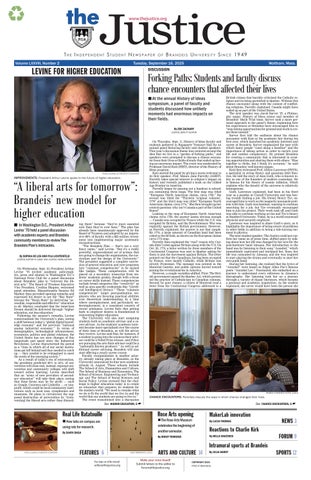
IMPROVEMENTS: President Arthur Levine spoke to the future of higher education.
“A liberal arts for tomorrow”: Brandeis’ new model for higher education ■ In Washington D.C., President Arthur Levine ’70 held a panel discussion with academic experts and Brandeis community members to review The Brandeis Plan’s intricacies. By SOPHIA DE LISI AND IYLA LICHTENFELD
JUSTICE EDITOR IN CHIEF AND JUSTICE NEWS EDITOR
On Wednesday, Sept. 10, President Arthur Levine ’70 invited academic policymakers, press and alumni to Washington D.C’s National Press Club for a panel discussion about Brandeis’ plan to “reinvent the liberal arts.” The Board of Trustees Executive Vice President, Cynthia Shapira, welcomed panel attendees. Massachusetts Senator Ed Markey then provided opening remarks and expressed his desire to see the “Bay State” become the “Brain State” by delivering “accessible, responsible and effective” education to all. Markey concluded that the American Dream should be delivered through “higher education, not less education.” Following the senator’s remarks, Levine contextualized the University’s plan, noting a shift between today’s “global digital knowledge economy” and the previous “national analog industrial economy.” In terms of demographics, technological advancement, economics, politics and global relations, the United States has not seen changes of this magnitude and speed since the Industrial Revolution. Levine characterized the period as a “time in which all of our social institutions got left behind and they needed to catch up — they needed to be reimagined to meet the needs of the emerging society.” As a result of today’s era of reinvention, the president predicted 20% to 25% of universities will close and, instead, regional universities and community colleges will shift toward online learning. Levine described that an “army of new providers of secondary education” will take their place, noting that these forms may be for profit — such as Google, Coursera and Linkedin — or nonprofit, which could be local community institutions such as local zoos, symphonies and museums. He plans to circumvent the supposed destruction of universities by “[reinventing] the liberal arts rather than discard-
ing them” because “they’re more essential now than they’ve ever been.” The plan has already been unanimously approved by the Board of Trustees and adopted by an impressive 88% of faculty with a $25 million investment into implementing major systematic reconstructions. “The Brandeis Plan — that’s not a very fancy name,” said Levine. “But it’s a really powerful, unprecedented set of actions that are going to change the organization, the curriculum and the design of the University.” The president suggested a complete conversion of general education and core programs into “common competencies” to be earned like badges. These competencies will be placed on a secondary transcript from students’ academic grades, though with a focus on career skills instead. These competencies include broad categories like “creativity” as well as area specific credentials like “[Artificial Intelligence] literacy.” These “common competencies” target post-graduation employers who are favoring practical abilities over theoretical understanding. In a time where unemployment, and particularly underemployment, is a consistent concern of recent graduates, Levine feels that getting back to employer desires is foundational to reinventing higher education. The University will also start assigning students both an academic advisor and a career advisor. As the students’ academic interests become more specialized over the course of their time at Brandeis, as will the advice they receive. Levine said that, for instance, if a student is going into the sciences their advisor could be a Nobel Prize winner, and if they are pursuing the arts their advisor could be a “nationally-known producer.” As well as additional career advising, Brandeis will also start offering a yearly career course. Faculty reorganization is another priority already taking place at Brandeis, as the University announced its four new academic schools in August. These schools include The School of Arts, Humanities and Culture; The School of Business and Economics; The School of Science, Engineering and Technology and The School of Social Sciences and Social Policy. Levine stressed that the challenge to higher education today is to create an education that prepares its students for the modern world: “We need to remake what we do to fit the world that we live in and the world that our students are going to live in.” The event transitioned into a discussion
On Thursday, Sept. 11, History of Ideas faculty and students gathered in Rapaporte Treasure Hall for an annual panel featuring faculty and student speakers. This year’s discussion theme was centered around the idea that we live in a “garden of forking paths,” and speakers were prompted to discuss a chance encounter from their lives or fields of study that ended up having an enormous impact. The event was moderated by Professor David Katz (HIST), director of the History of Ideas program. Katz started the panel by giving a warm welcome to its first speaker, Prof. Maura Jane Farrelly (AMST). Farrelly takes special interest in religion’s impact on history and recently published a book on the Gilded Age frontier in America. Farrelly began by passing out a handout to attendees containing three maps. The first map was titled “European North American claims, circa 1750,” the second was titled the “Thirteen ‘original colonies’, 1776” and the third map was titled “European North American claims, circa 1774.” She then brought up her central question: why isn’t Canada a part of the United States? Looking at the map of European North American claims circa 1750, the answer seems obvious enough — Canada was occupied by France while the U.S. was occupied by Britain, and the Revolutionary War was explicitly against the British government. However, as Farrelly explained, the answer is not that simple. By 1774, a large amount of Canadian land had been ceded to the British, as shown on the European claims circa 1774 map. Farrelly then explained the “real” reason why Canada didn’t rebel against Britain along with the U.S. On Oct. 26, 1774, a letter written by three members of the Continental Congress was sent to Quebec asking for them to join the movement against Britain. The letter pointed out that the Canadians, having been occupied by France, were mostly Catholic, while Britain was strictly Protestant. The message was printed in the Montreal Gazette, and public opinion moved toward joining the revolutionaries in America. However, a couple variables shifted. First: The British government passed the Quebec Act, which permitted the practice of Catholicism in Canadian colonies. Second, by pure chance, a citizen of Montreal read a letter from the Continental Congress addressed to a
British citizen that harshly criticized the Catholic religion and its being permitted in Quebec. Without this chance encounter along with the context of conflicting religions, Farrelly explained, Canada might have ended up as part of the United States. The next speaker was Jacob Sarver ’27, a Philosophy major, History of Ideas minor and member of Brandeis’ Mock Trial team. Sarver took a more personal approach to the panel’s theme, explaining how his experiences at Brandeis have encouraged him to “stop taking opportunities for granted and work to create them instead.” Sarver first told the audience about his chance encounter with Katz at the academic fair during his first year, which launched his academic interests and career at Brandeis. Sarver emphasized the ease with which many people “coast along a baseline” and the importance of taking action in order to enrich your life and combat complacency. He praised Brandeis for creating a community that is interested in creating opportunities and sharing them with others. “Rise together is cliche, but I think it’s accurate,” he said about Brandeis’ well-known slogan. Katz then welcomed Prof. Albion Lawrence (PHYS), a specialist in string theory and quantum field theories. He told the story of Alan Guth, who is known today as one of the founders of modern cosmology. He is famous for his theory of cosmic inflation, which explains why the density of the universe is relatively homogenous. Guth, Lawrence explained, had been in his third year as a postdoc at Cornell University and was having trouble finding a job. His friend, Henry Tye, encouraged him to work on the magnetic monopole problem with him. Guth was hesitant, wanting to continue searching for a job, but Tye eventually encouraged him to join his project. Their work took off, and Guth was able to continue working on his and Tye’s theory at Stanford University. Today, he is a world-renowned physicist and securely employed. Lawrence was inspired to share Guth’s story, as it highlights the importance of being aware of problems in other fields in addition to being a tide-turning moment in physics. The next student speaker, The Justice could not confirm her name as of press time, shifted gears by talking about how her life was changed by her love for the post-hardcore band Alesana. Her introduction to the band was by listening to their song “Annabel,” which immediately captivated and intrigued her. Soon, her life was consumed by Alesana, and she was inspired to start playing the drums and eventually to start her own punk band. During her listening, she realized that the lyrics of “Annabel” were based on Edgar Allan Poe’s famous poem “Annabel Lee.” Fascinated, she embarked on a journey to understand every reference in Alesana’s discography. Her listening took her on a journey through a variety of classic literature, which became a personal and academic inspiration. As the student explained, she never would have been the person she
REUBEN GARTENBACH//The Justice
CHANCE ENCOUNTERS: Panelists discuss the ways in which chance changed their lives.
See HIGHER EDUCATION, 5 ☛
Real Life Ratatouille
See CHANCE ENCOUNTERS, 5 ☛
Rose Arts opening
How labs on campus are using rats for research. By SAAYA DAGA
MakerLab innovation
The Rose Arts Museum celebrates the beginning of another semester.
Reactions to Charlie Kirk
By MIKEY TERRENZI
By BELLE SHATZKES
By LUCIA THOMAS
NEWS 3 FORUM 9
Intramural sports at Brandeis Photo courtesy of CREATIVE COMMONS
FEATURES 6 For tips or info email editor@thejustice.org
MIKEY TERRENZI/The Justice
ARTS AND CULTURE 14
Make your voice heard! Submit letters to the editor to forum@thejustice.org
By JULIA HARDY
COPYRIGHT 2025 FREE AT BRANDEIS.
SPORTS 12