(eBook PDF) The Narcissistic and Borderline Disorders: An Integrated Developmental Approach install download
https://ebookluna.com/product/ebook-pdf-the-narcissistic-andborderline-disorders-an-integrated-developmental-approach/
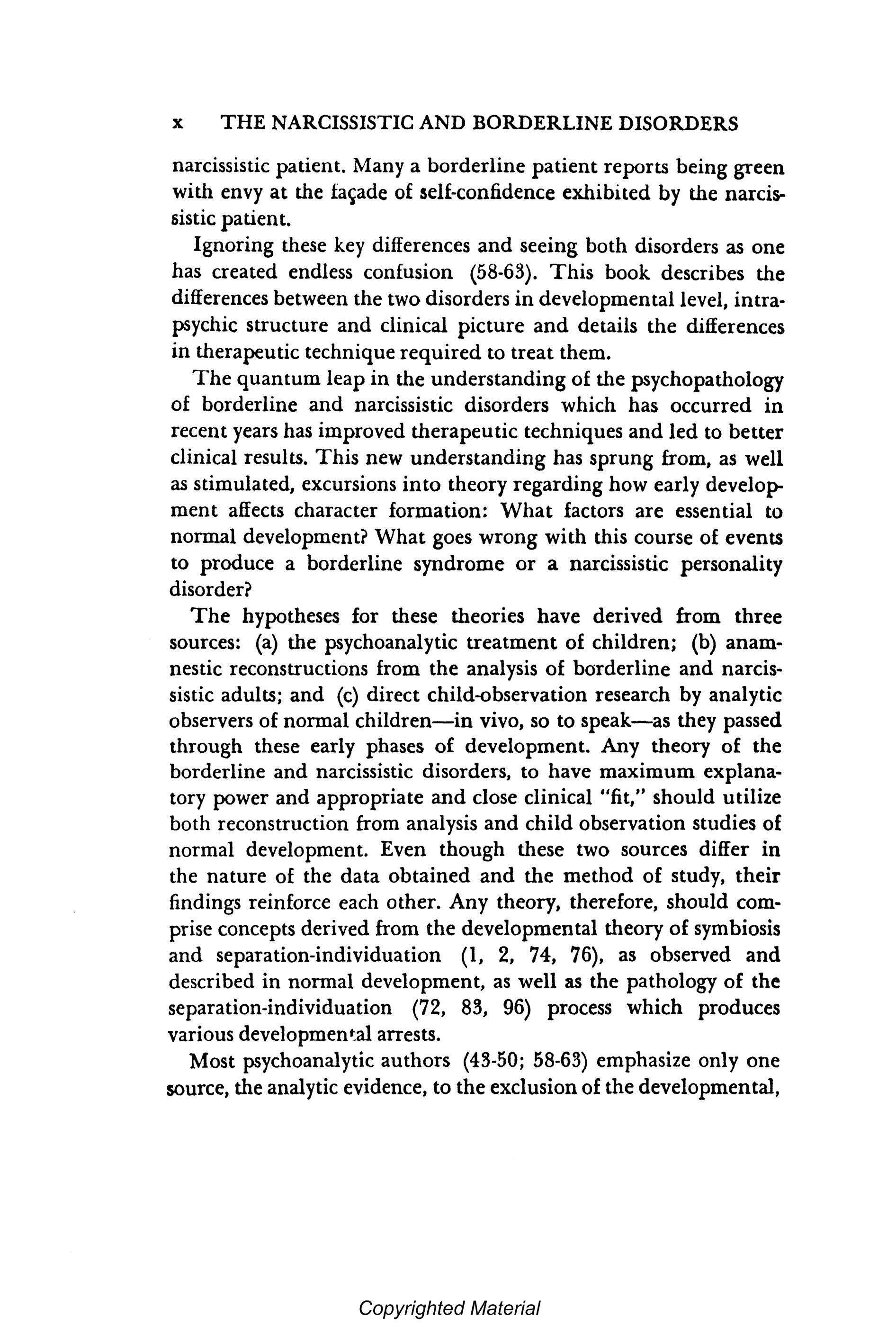
x THE NARCISSISTIC AND BORDERLINE DISORDERS
narcissistic patient. Many a borderline patient reports being green with envy at the of self-confidence exhibited by the narcissistic patient.
Ignoring these key differences and seeing both disorders as one has created endless confusion (58-63). This book describes the differences between the two disorders in developmental level, intrapsychic structure and clinical picture and details the differences in therapeutic technique required to treat them.
The quantum leap in the understanding of the psychopathology of borderline and narcissistic disorders which has occurred in recent years has improved therapeutic techniques and led to better clinical results. This new understanding has sprung from, as well as stimulated, excursions into theory regarding how early development affects character formation: What factors are essential to normal development? What goes wrong with this course of events to produce a borderline syndrome or a narcissistic personality disorder?
The hypotheses for these theories have derived from three sources: (a) the psychoanalytic treatment of children; (b) anamnestic reconstructions from the analysis of borderline and narcissistic adults; and (c) direct child-observation research by analytic observers of normal children-in vivo, so to speak-as they passed through these early phases of development. Any theory of the borderline and narcissistic disorders, to have maximum explanatory power and appropriate and close clinical "fit," should utilize both reconstruction from analysis and child observation studies of normal development. Even though these two sources differ in the nature of the data obtained and the method of study, their findings reinforce each other. Any theory, therefore, should comprise concepts derived from the developmental theory of symbiosis and separation-individuation (1, 2, 74, 76), as observed and described in normal development, as well as the pathology of the separation-individuation (72, 83, 96) process which produces various arrests.
Most psychoanalytic authors (43-50; 58-63) emphasize only one source, the analytic evidence, to the exclusion of the developmental,
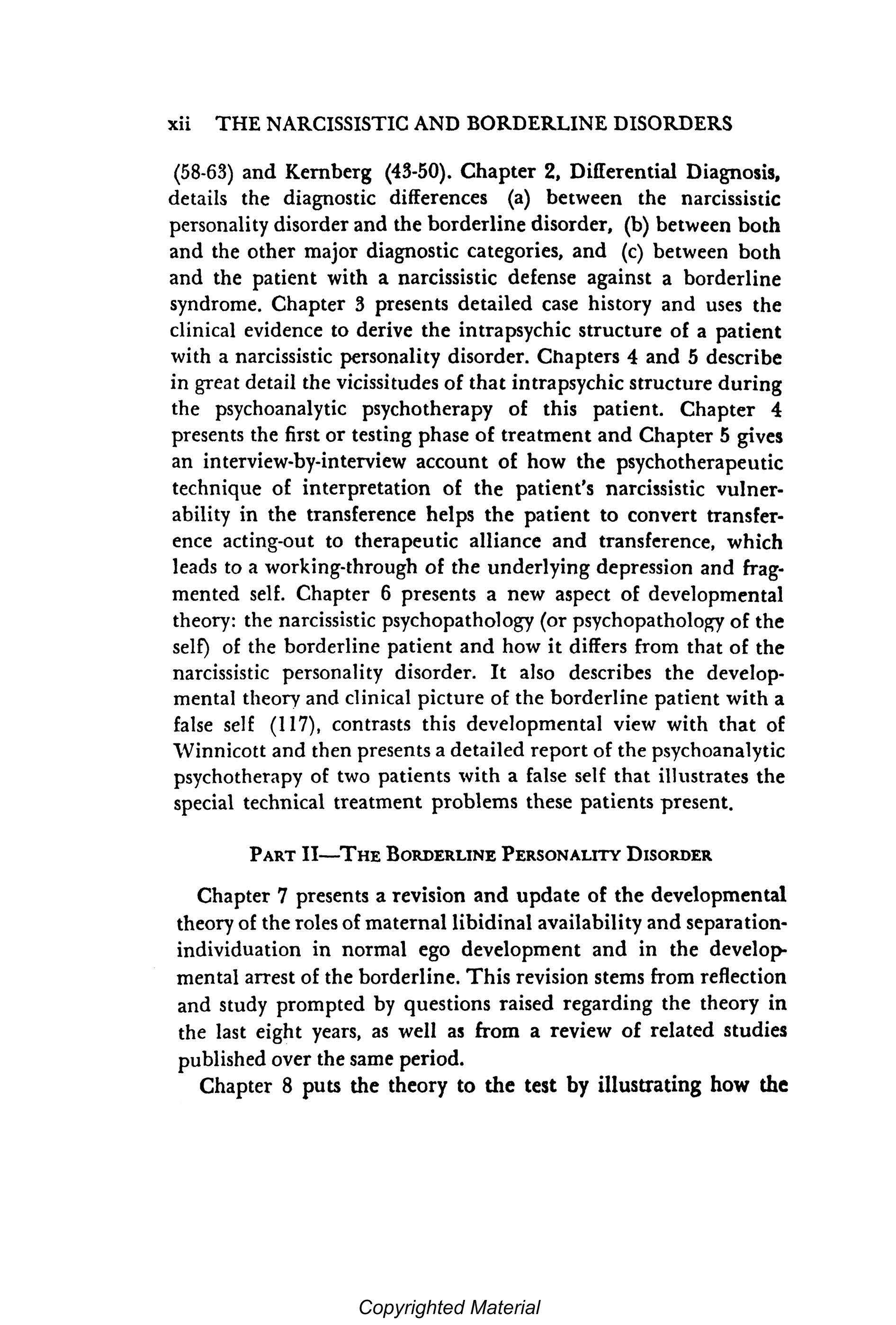
xii THE NARCISSISTIC AND BORDERLINE DISORDERS
(58-63) and Kemberg (43-50). Chapter 2. Differential Diagnosis, details the diagnostic differences (a) between the narcissistic personality disorder and the borderline disorder. (b) between both and the other major diagnostic categories. and (c) between both and the patient with a narcissistic defense against a borderline syndrome. Chapter 3 presents detailed case history and uses the clinical evidence to derive the intrapsychic structure of a patient with a narcissistic personality disorder. Chapters 4 and 5 describe in great detail the vicissitudes of that intrapsychic structure during the psychoanalytic psychotherapy of this patient. Chapter 4 presents the first or testing phase of treatment and Chapter 5 gives an interview-by-interview account of how the psychotherapeutic technique of interpretation of the patient•s narcissistic vulnerability in the transference helps the patient to convert transference acting-out to therapeutic alliance and transference. which leads to a working-through of the underlying depression and fragmented self. Chapter 6 presents a new aspect of developmental theory: the narcissistic psychopathology (or psychopathology of the self) of the borderline patient and how it differs from that of the narcissistic personality disorder. It also describes the developmental theory and clinical picture of the borderline patient with a false self (ll7), contrasts this developmental view with that of Winnicott and then presents a detailed report of the psychoanalytic psychotherapy of two patients with a false self that illustrates the special technical treatment problems these patients present.
PART II-THE BoRDERLINE PERSONALITY DISORDER
Chapter 7 presents a revision and update of the developmental theory of the roles of maternal libidinal availability and separationindividuation in normal ego development and in the developmental arrest of the borderline. This revision stems from reflection and study prompted by questions raised regarding the theory in the last eight years, as well as from a review of related studies published over the same period.
Chapter 8 puts the theory to the test by illustrating how the
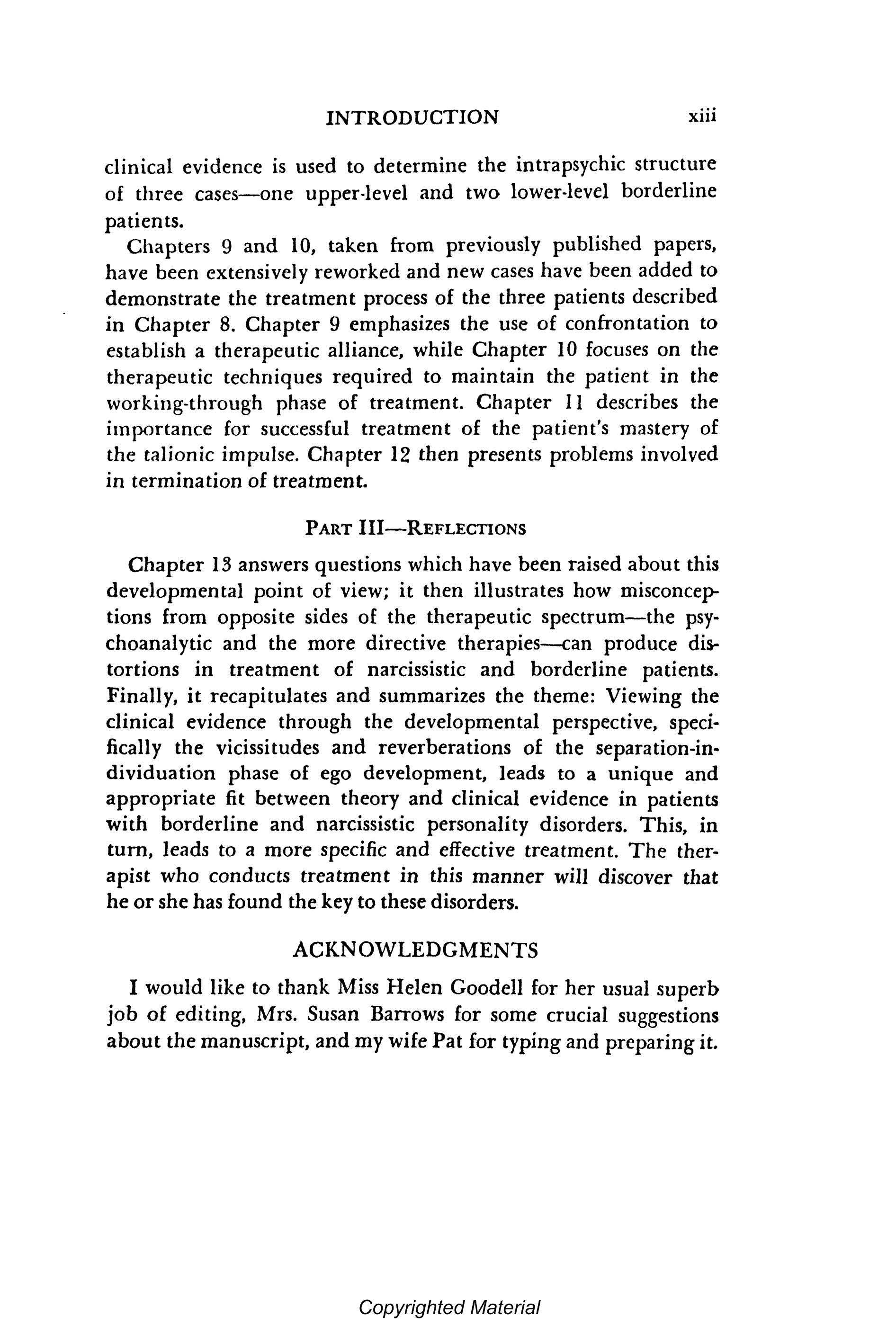
INTRODUCTION
clinical evidence is used to determine the intrapsychic structure of three cases-one upper-level and two lower-level borderline patients.
Chapters 9 and 10, taken from previously published papers, have been extensively reworked and new cases have been added to demonstrate the treatment process of the three patients described in Chapter 8. Chapter 9 emphasizes the use of confrontation to establish a therapeutic alliance, while Chapter I 0 focuses on the therapeutic techniques required to maintain the patient in the working-through phase of treatment. Chapter 11 describes the importance for successful treatment of the patient's mastery of the talionic impulse . Chapter 12 then presents problems involved in termination of treatment.
PART III-REFLECTIONS
Chapter 13 answers questions which have been raised about this developmental point of view; it then illustrates how misconceptions from opposite sides of the therapeutic spectrum-the psychoanalytic and the more directive therapies--can produce distortions in treatment of narcissistic and borderline patients. Finally, it recapitulates and summarizes the theme: Viewing the clinical evidence through the developmental perspective, specifically the vicissitudes and reverberations of the separation-individuation phase of ego development, leads to a unique and appropriate fit between theory and clinical evidence in patients with borderline and narcissistic personality disorders. This, in tum, leads to a more specific and effective treatment. The therapist who conducts treatment in this manner will discover that he or she has found the key to these disorders.
ACKNOWLEDGMENTS
I would like to thank Miss Helen Goodell for her usual superb job of editing, Mrs. Susan Barrows for some crucial suggestions about the manuscript, and my wife Pat for typing and preparing it.
THE NARCISSISTIC AND BORDERLINE DISORDERS
sonality disorder and the narcissistic psychopathology of the borderline.
My interest in the narcissistic personality disorder has stemmed from and followed my work on the borderline syndrome (83, 86). From a superficial clinical point of view, these two disorders can be seen as opposite sides of the coin, with the borderline syndrome showing a deficient libidinal investment of the self, and the narcissistic personality disorder, on the surface at least, showing a grandiose and pathologically excessive libidinal investment of the self. This section makes clear how the psychopathology of narcissism differs in the two disorders. Kohut's failure to make this distinction has dramatized and greatly exaggerated the prevalence of the narcissistic personality disorder as a clinical problem. In my own clinical experience and that of many of my colleagues, as well as in the experience of hundreds of therapists across the country whom I have questioned, borderline patients far outnumber those with a narcissistic personality disorder in clinical practice.
Chapter 1 describes the clinical picture of the narcissistic personality disorder and then turns to developmental theory to account for that clinical picture. It thereby integrates the theoretical understanding of the narcissistic personality disorder with that of the borderline presented in prior publications and updated and elaborated in Chapters 7 to 12. These theoretical views are then contrasted with those of Kern berg (43-50) and Kohut (58-63).
Chapter 2 on Differential Diagnosis furthers this integrated approach by emphasizing the same developmental theory to differentiate between the narcissistic personality disorder and the borderline personality disorder. It then devotes a special section to the presentation of a case illustrating a narcissistic defense against a borderline personality disorder; finally, it differentiates the two (narcissistic and borderline personality disorders) from other diagnostic categories such as psychosis, neurosis affective disorder, etc. Chapter 3 presents the case history of a narcissistic personality disorder and demonstrates how the clinical evidence is used to determine the intrapsychic structure. Chapters 4 and 5, presenting the psychoanalytic psychotherapy of this patient, demonstrate the
THE NARCISSISTIC PERSONALITY DISORDER 9
co-workers was so poor, that it made him ill-equipped to run the company.
Depressed and distraught, he returned home to seek support from his wife. To the contrary, she reinforced the observation of the board, saying he had the same problems with her and with their two children, with whom they had had considerable conflict; she added that he was for the most part quite self-involved and, although he could be quite stimulating and charming when he chose to be, usually he pursued his own interests and seemed quite unaware of either his wife's or his children's needs.
In the initial interview, as he carne close to pointing out to me, the therapist, that obviously all of these people were mistaken, he checked himself and then reflected that there really must be something wrong with his perception, although he really couldn't see what it was. He had many complaints about his wife, her emotional inconsistency, coldness, needs and clinging. In the course of their 20 years of marriage, he had had a number of superficial affairs which rarely went beyond sexual liaisons.
He reported that both at work and with his family he felt he knew better how to manage situations and was quite devaluing and intolerant of their opinions. He smoked and drank heavily.
He complained further that he was not getting enough feedback from his wife, that "he was a sucker for women whom he admired and respected, who flattered him, and he expected such flattery and responded very positively to it. However, in his various affairs, after the early phase of sexual attraction and romance had run its course, he tended to lose interest and end one affair only to start another shortly afterwards.
He strove for perfection in his work and was intolerant of subordinates' failures to meet his standards, because it would reflect poorly on his own image. He was intolerant of any criticism and tended to lash out with anger without adequate thought or restraint. He had many outside interests: music, art, golf. The only neurotic symptom he reported was tension headaches; however, he reported an obsessive fear of and preoccupation with loneliness and death.
Other documents randomly have different content
Acuabeimae, Sweet.
Amaberaba, Lightning.
Amacuminga, Thunder.
Amandiba, Hail.
Anama, a near Relation.
Anga, the Soul.
Angabara, Lean.
Angaipata, Angry, or Wicked.
Angaturama, Thankful, or Acceptable.
Apara, a Crown.
Apecum, the Tongue.
Apicaba, a Stool.
Ara, the Time, Skye, or Day.
Ara-ibi coquime, Noon.
Araya, Grandmother.
Atapuana, Light.
Atapuatia, Swift.
Atucupe, the Back.
Atyba, the Shoulder.
Ay cig, a Mother.
Ayura, the Neck.
B.
Boya, a Slave.
C.
Cama, a Sucking-Breast.
Canga, a Leg.
Caraibebe, apiabebe, an Angle.
Caruca, the Evening.
Capii, Grass.
Capii goacu, Straw.
Catu, Dainty.
Cay, an Ape.
Ceba, a Loaf.
Cibera, the Buttocks.
Cemiracoaobae, a Widower.
Ceo, a Breast.
Ceteeimibae, a Ghost.
Cig cygra, an Aunt.
Coaraci, a Son.
Cobra, a Serpent.
Coemitanga, the Dawn.
Coriba, Rejoyce.
Coya, Twins.
Cunha, a Wife.
Cunhaiba, a Bride.
Cunumigoacu, a Youth.
Cunumi, a Boy.
E.
Ecatuaba, the right Hand.
Eyruba, a Bee.
G.
Giba, an Arm.
Guaibino, an old Woman.
Guirarupia, an Egg.
I.
Jaci, the Moon, or Month.
Jacitata, a Star.
Iba, a Tree.
Ibiaia, the Heavens.
Ibatinga and Ibitinga, a Witch.
Ibateba, High.
Ibi, the Earth.
Ibitira, a Mountain.
Ibitu, the Wind.
Icapi, the Dew.
Ig, Water.
Iguaba, a Cap.
Ipeca, a Goose.
Igue, the Side.
Ita, Iron, or a Stone.
Itacira, a Spade.
Itapigua, a Nail.
Juba, Yellow.
M.
Maupiara, the Gall.
Mbabeaubora, Sick.
Mbiu, Meat.
Mbo, a Hand.
Membeca, Softly.
Menearaa, a Wedding.
Micu, a Toe.
Mita, the Heel.
Mocu, an Eel.
Mormotara, Angry.
Muapendaba, a Joint.
N. Nbia, the Heart.
O.
Opacatumba, the World.
P.
Potia, the Breast.
Paranga, Fair.
Porerobiara, Faithful.
Porucuicobora, Poor.
Potivi, a Duck.
Poxi, Ugly.
Pi, a Foot.
Pia, the Liver.
Pira, Fish, or a Skin.
Piquiira, Younger in years.
Pitanga, a Child.
Pua, a Finger.
Pua-guacu, a Thumb.
Purva, the Navel.
Puou, Long.
Putuma, the Night.
R.
Roig, Cold.
Apition, Binding.
Aroca, a Lesson.
Ayaima, Feigning.
B.
Beraba, Shining.
C.
Coanga, Measuring, Proving, or Speaking.
Cacaba, Passing by.
Cae, Curing.
Capucaya, Calling, or To be vex’d.
Carom, Hoping.
Caruca, Pissing.
Cauccuba, Loving.
Cecaraya, Forgetting.
Cema, Going out.
Cenduba, Hearing.
Cenoya, Naming.
Cepiaca, Seeing, Punishment.
Cerura, Carrying.
Cetuna, Smelling.
Ceyara, Relating.
Cica, Ploughing.
Cipya, Making wet.
Ciquye, Fearing.
Co, Going.
Cobaitim, Meeting.
Coquendaboya, Opening.
Cuaba, Knowing.
Cupira, Performing.
Cuu, Defending.
E.
Ecatu, To be able.
G.
Genonheca, Praying.
Goameenga, Biting.
Guapua, Sitting.
Guata, Walking.
Gueena, Vomiting.
I.
Jababa, To run away.
Jecoacuba, To remember.
Jenumuna, Spitting.
Jerure, Demanding.
Igtaba, Swimming.
Igu, Drinking.
M.
Maenduara, Thinking.
Mano, Dying.
Maramonbanga, Warring.
Mayaoca, Dividing.
Mba-eraca, Buying.
Mbacu, Eating.
Meenga, Delivering.
Menbirara, Barring.
Moaibaba, Bewitching, or Preventing.
Mongueba, Putting out.
Moanga, Thinking.
Moaquima, Making wet.
Mobibua, Sowing.
Moete, Praising, or Honoring.
Moendi, Setting on fire.
Mogiba, Boyling.
Mogyco, Polishing.
Momiya, Moving.
Momita, Lodging.
Monberaba, Bruising.
Monbeu, Delivering of a Message.
Monbuca, To bore through.
Monbuja, Boring.
Mondoca, To cut, take away, or cleave asunder.
Mondoroca, Breaking.
Monguy, Grinding.
Monguya, Making loose.
Monhanga, Doing.
Moperua, Being cold.
Mopotaya, Buttoning.
Moriba, Consenting.
Moropiana, Changing.
Moeyeceara, Mixing.
N.
Nheangeru, Sighing.
The Tobaras and Potigi-iguaras.
The Tobaras are accounted the best Horsemen; but in Singing and Discourse, the Potigi-iguaras exceed all the other Brasilians: They place twenty or thirty Singers in a Row, which observing Time, Sing the Transactions of their Predecessors with good Voices.
The Waimoores.
The Waimoores are a strong People that inhabit the large Tract of Land between Bahia and Isleos, and having well timber’d Bodies, can keep pace with a Horse running full speed. Five or six of them often set upon a Sugar-Mill, though a hundred Men be at work in the same: They are all over bedaub’d with Dirt, because they lie like Beasts on the Ground: They wear long Hair, and have no certain Abodes.
The Tomonimenos.
The Tomonimenos, living about Spirito Santo, are more civilis’d; they make Walls of Stone about their Huts; and these Walls are full of Holes, through which they shoot Arrows at those that Invade them; their Bodies are Painted red and black, and cover’d with Feathers. The Portuguese taking sixteen thousand of them Prisoners at once, kill’d most of them, and destroy’d the Countrey all along the River Paraiva.
The Waitaquazes.
At the South and North Point of Cape Frio dwell the Waitaquazes, bigger and stronger than the Waimoores; and they also sleep like Hogs on the Ground about a Fire, hold all People for their Enemies, and their Flesh for the greatest Dainty. The Women Arm’d with Bowes and Arrows stand by their Husbands in Battel.
The Wainasses. The Description of the Plant Vruca.
On Isla Grande reside the Wainasses, a little People, which have very long Bellies, go stark naked, shave the Crown of their Heads, and let the other part of their Hair hang down long on their Shoulders. The Women, which are of gross Bodies, colour themselves Red with Vruca, which is a wild Plant, but much us’d amongst them: the Kernels are inclos’d in Husks full of red Fibres. These Kernels are not onely mix’d with the other Ingredients of the Chocaletta Drink, but also us’d to Dye of a red Colour: The Wood of this Plant is very white, and the Bark grey, like the Hazle; the Leaves being of a deep Green, resemble a Heart; at the end of the Boughs grow several Blossoms, each as big as a Rose, consisting of five Leaves, partly red and partly white, in the middle
whereof are yellowish Threds with purple Points, which give little or no smell: after the Flower follows the Fruit, two Fingers long; when it begins to be ripe it grows still redder and redder, each Cod containing thirty or forty round Kernels, which being touch’d leave a red tincture upon the Fingers; the Cod when ripe opens of it self, and shews the Kernels speckled white, which dry’d, pounded, and mix’d with Piss, Dye so strong a Red, that Linnen dipt into the same will never receive any other Colour. This Root also boyl’d in Broth, makes it not onely red, but gives it a pleasant taste.
The Topinaques.
The Topinaques, which dwell about St. Vincent, are a strong and gross People, go stark naked both Men and Women: when they kill any of their Enemies they Paint themselves with the Fruit Janipano, put a great Plume of Feathers on their Head, and two Sticks in their Mouths, Dancing with strange motions of the Body, inclining sometimes towards the right, and sometimes towards the left side, for three day together; during which time they drink a filthy kind of Liquor. The Women, who have well proportion’d Bodies, onely covering their Heads with a Cap, about which they tie a bread of Hair, to which a square Basket being fastned, hangs below their Backs when they travel.
The Pories.
The Mountains along the Ocean, which inclose much Gold, are inhabited by the Pories, a peaceable People, molesting none of their Neighbors; they sleep in Nets of Flags, and have no other Houses than three Poles plac’d triangular, and cover’d with Palm-Leaves; they feed on PineNuts and Eyrires, Apples that have Shells like a Walnut, and have also the precious Balsam-Oyl in great abundance.
The Molopaques.
Along the River Paradiva inhabit the Molopaques; the Men strong and well timber’d, have Beards long enough to cover their Privities. The Women also fair, modest, prudent, and never laughing, tie their Hair, painted with several colours, round about their Middle with a Cord, so that it serves in stead of an Apron. They observe a set-hour for Dinner and Supper, which is not us’d by any other Brasilians. The Mountains in these Parts consisting of a black Mold, have plenty of Gold, but it is of no esteem or regard amongst them, onely that
they all fall to work, cutting down Trees, breaking off the Boughs, sticking them in the Ground, and tying them together on the top for Tents, which are built in rows one against another, leaving a broad Path between. Mean while the Women and Children coming with their Baggage, the Men run to Fish and Hunt, or to seek Honey. The old Women dig up Roots, which stamp’d serve them for Bread, whilest the young Women help one another to prepare the Meat in the Huts. Moreover the Men spend their time in several Exercises, as Wrestling and Running, of which two Women, appointed for that purpose, are the Judges. When the Evening draws on upon them, then the Youths dividing themselves into Companies, go Singing from one Tent to another, and are follow’d by the Maids Dancing and Leaping, every one standing behind him whom she loves best; and this is look’d upon as a singular sign of affection. When a young Man is inclin’d to Marry, he carries Honey and Venison to his Mistresses Father, who if he hath more than one Daughter acquaints the Soothsayers with it, who inform the King concerning it; he then causes all the young Men and Maids to be call’d together out of the Camp, sends them into the Woods to Hunt out a wild Beast, which they no sooner see, but they return and acquaint the Multitude therewith, who immediately surrounding the Place, soon catch the Beast, whose Entrails they pull out and throw to the Dogs, and give the Flesh to the Women to roast, which when ready they make merry with, Singing and Dancing after they have eaten; then if the Youth hath behav’d himself well in pursuing of the wild Beast, the King grants him the Maid which he desires for his Wife: Four days before the Wedding they bore a Hole through each of the Bridegrooms Cheeks with a sharp piece of Wood, which done they solemnize the Marriage; at which the King himself distributes the Meat to every Guest as he thinks fit; after Dinner they extol the Mothers Care, in preserving her Daughters Virginity for the Bridegroom in strange Songs. If a Maid be Marriageable, and no Suitor comes to her, then the Mother draws red Strokes under her Eyes, and conducts her to the King, who sets the Maid down by him on a Mat, warms his Hands against the Fire, then stroaks himself and the Maid, and also blows Tobacco-Smoak on her and himself, which done, he performs the part of a Husband with her. But their making Holes through their Ears and Lips is done whilest they are Children, after this manner: The Boys who undergo this Ceremony, come to the Place appointed,