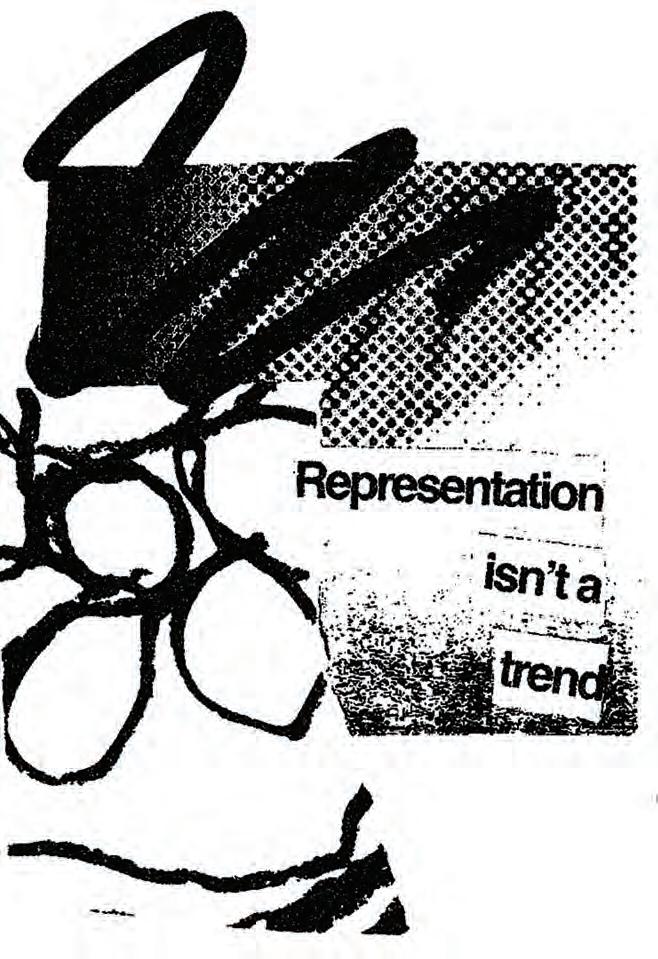
Collage by Julia Morgan
January 2026
Founder, Editor-In-Chief, Art Direction, Graphic Design
Julia Morgan
Contributors
Aleah Ann Nugent, Amber Lauder, Genre Z, Kate Murphy, Katie Chai, Lauren Gerrish, Laurence Guenoun, Mattie Drucker, Nancy Duer, Rikki Horvatic, Naydeline Mejia, Noelle Dillman, Sorina Condon, Tabitha Carver
With The Support Of
Mason Douglass, Renate Stauss, Roberto Sierra, Sarah Morgan, and Kate Darsey
Special Thank You's
The American University of Paris
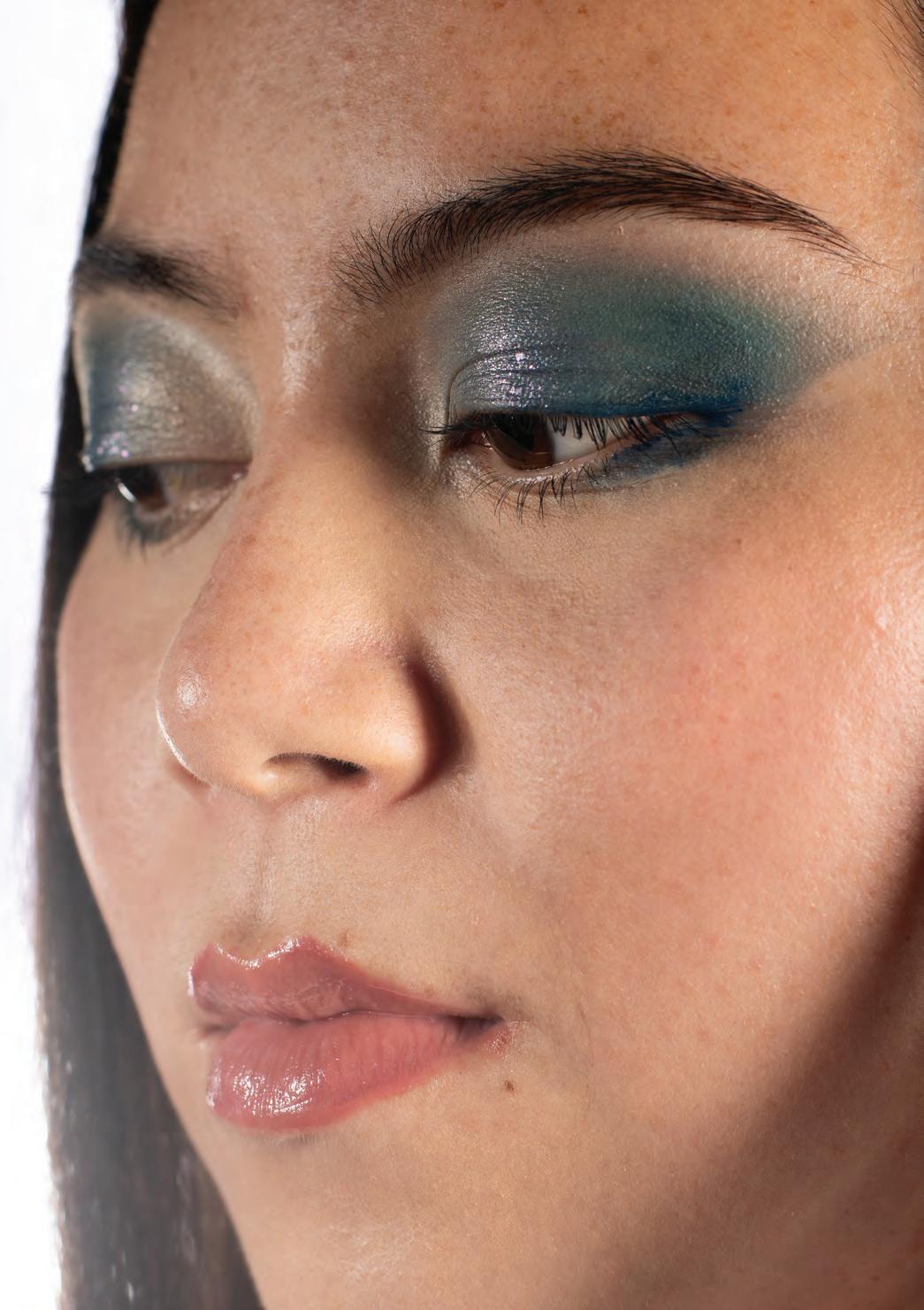
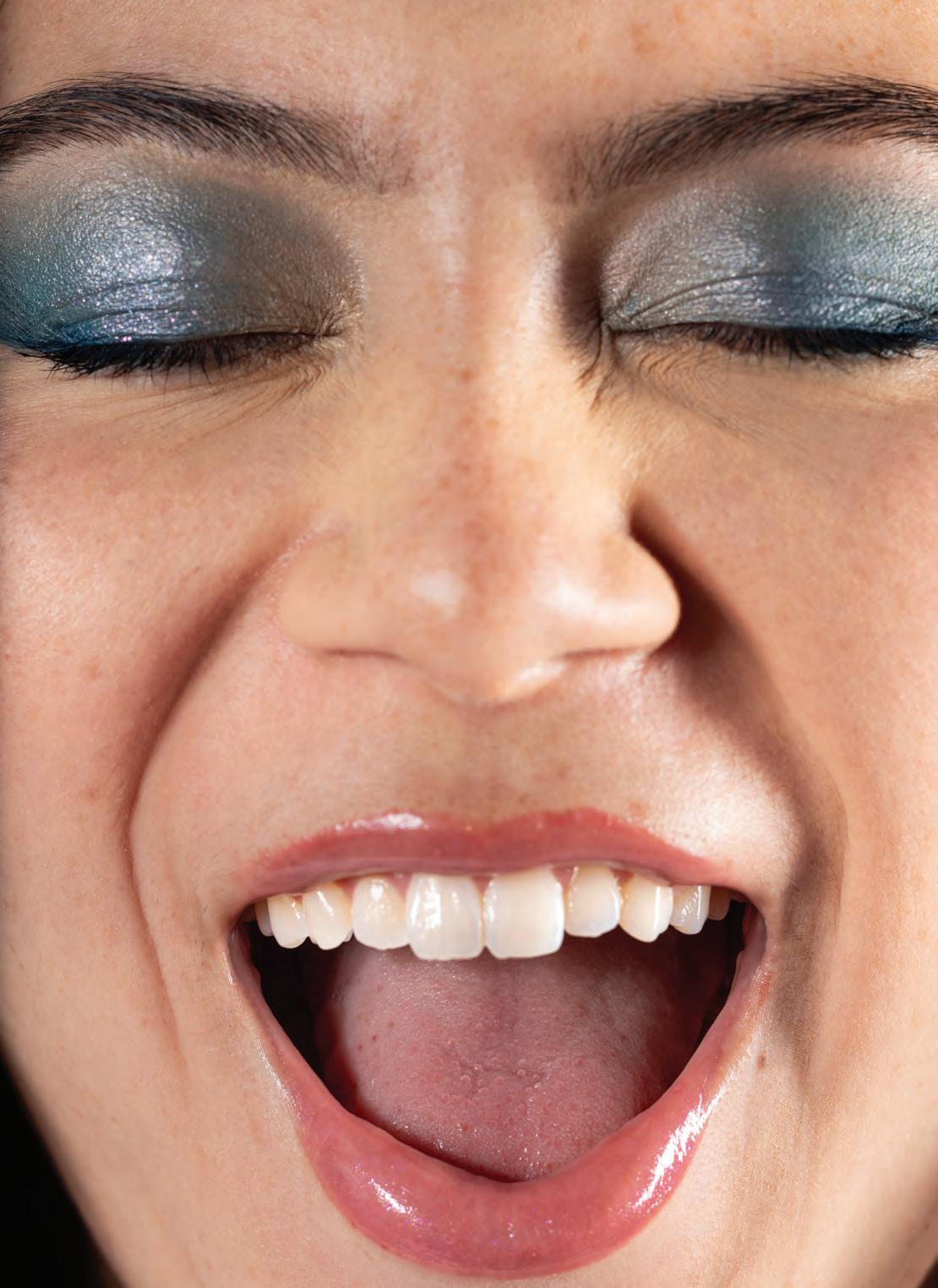
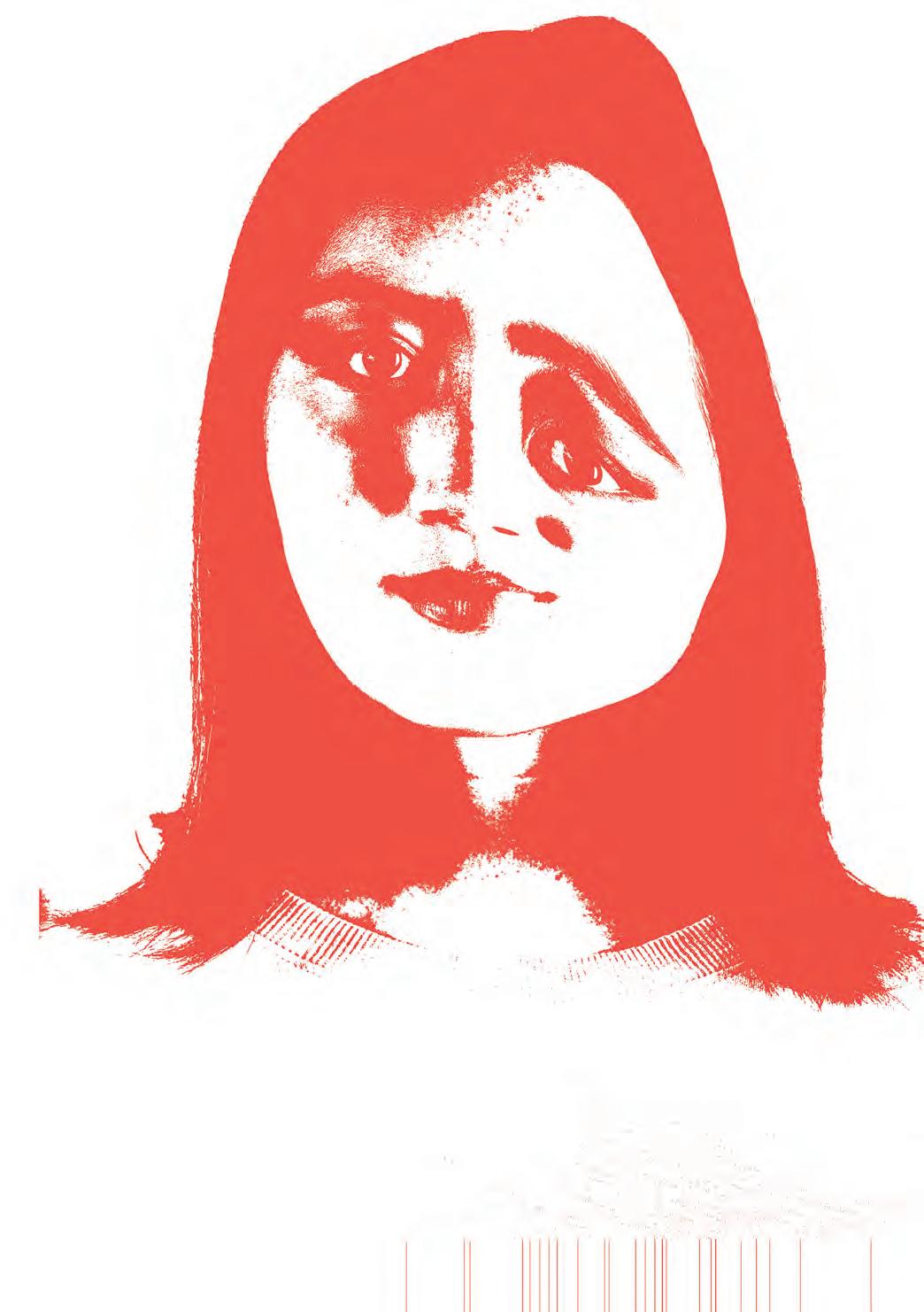
Front and Back Cover
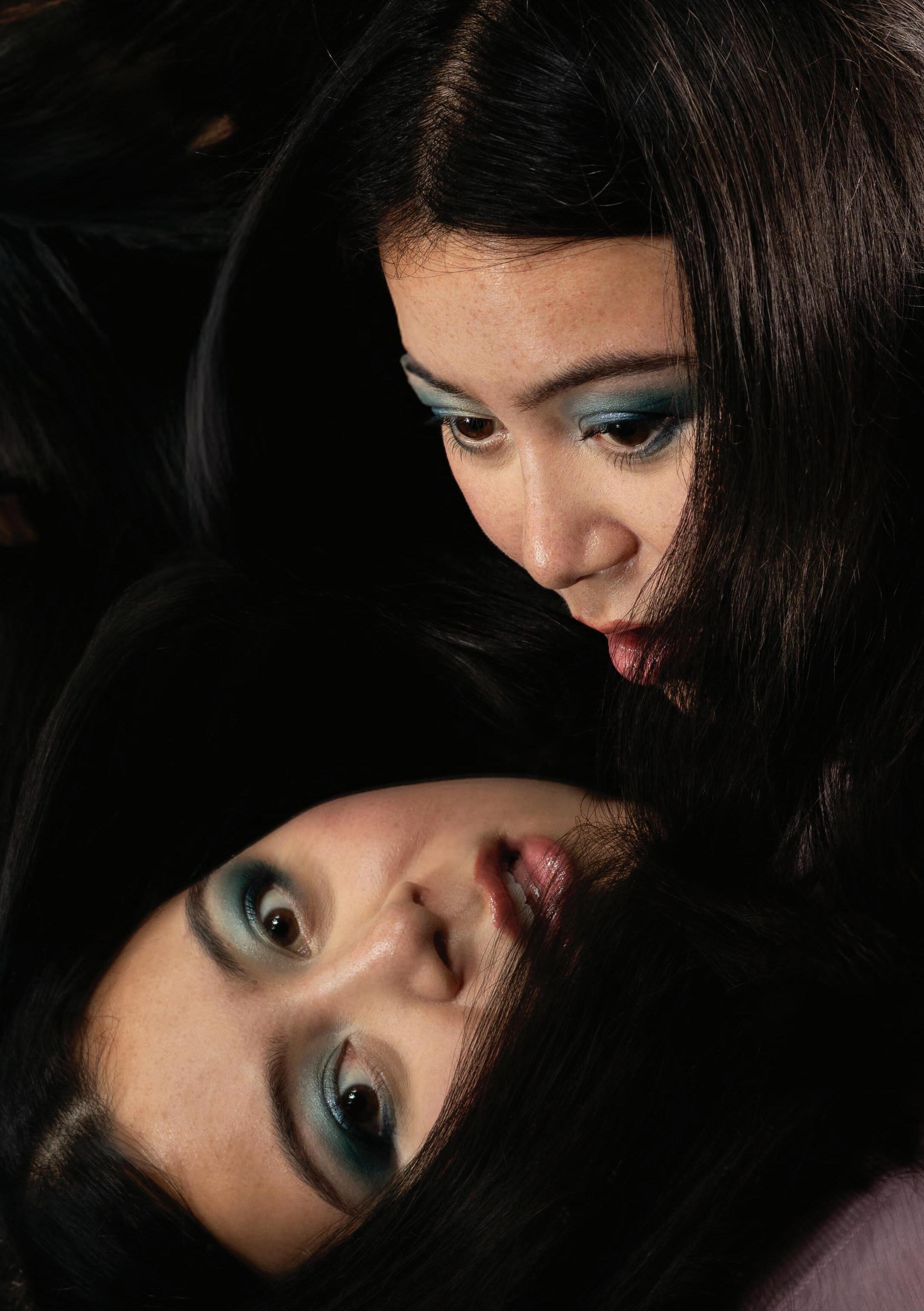
Photos by Noelle Dillman
Graphic Design by Julia Morgan
Modeling by Katie Chai
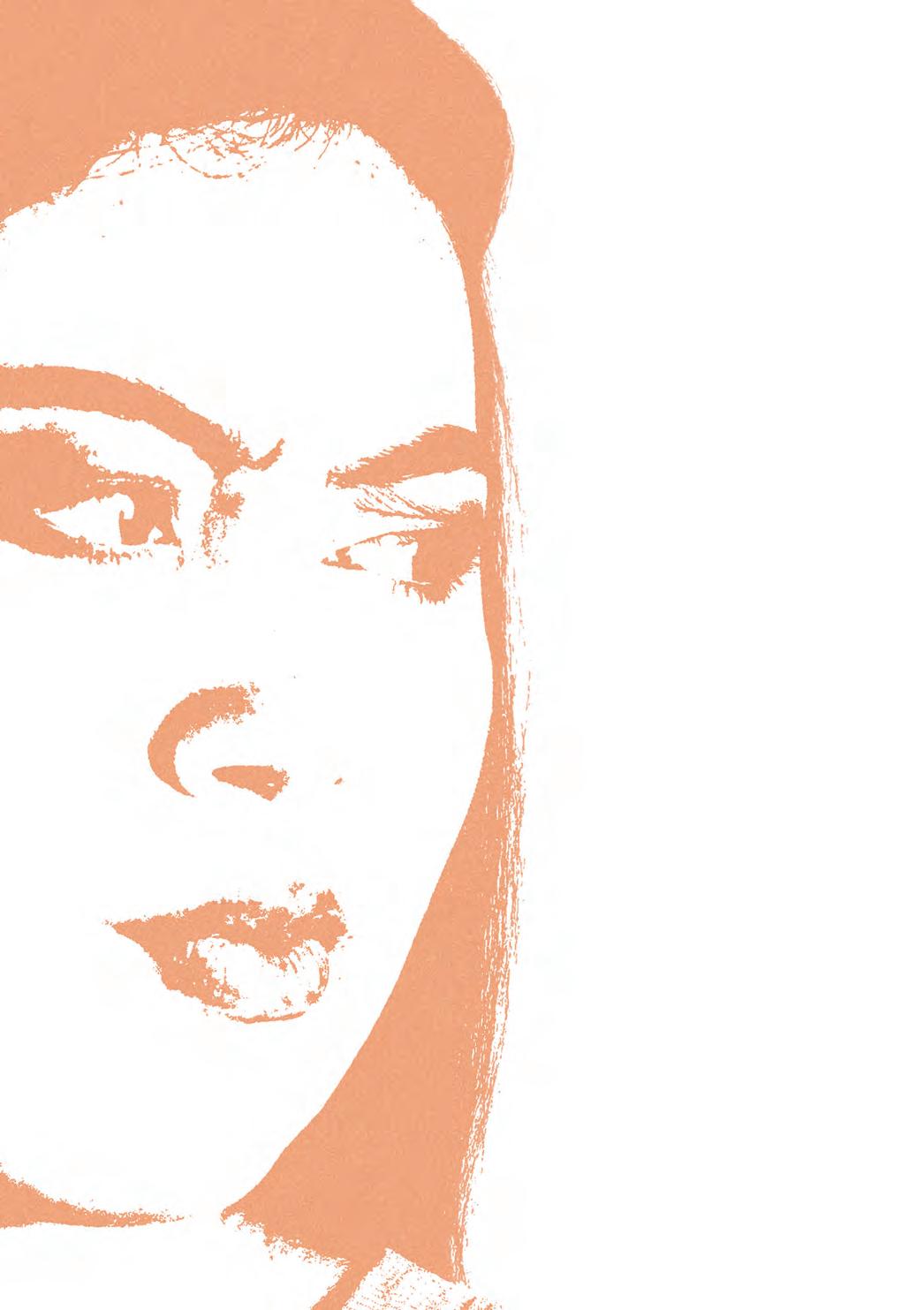
Inside Front and Back Cover
Photos by Amber Lauder
Published independently by Lava Zine. Reproduction without permission is prohibited.
For more information, please email contact.lavazine@gmail.com
Instagram & Substack @lavazine

Aleah Ann Nugent
Aleah Ann Nugent—who writes under the alias L.N.G.—is a writer, wanderer, and professional overthinker living in Paris, where she insists she’s been a local in spirit far longer than her residency suggests. Her work blends humor, heart, and a little cultural chaos—because life is always better with a plot twist. She’s been writing for as long as she’s been watching reality TV, which is to say: long enough to know that the drama is always in the details. When she’s not drafting essays, she’s people-watching, romanticizing the mundane, or convincing herself that the right body lotion can fix an existential crisis.
FEATURED ON PAGES 34-37
Genre Z (or Z) is a Nigerian graphic designer based in ATL. Their style reflects their chaotic energy, with each design shaped by a specific mood or genre. Through their work, they encourage people to explore themselves and all their weird, creative interests and imaginations. They aim to build a more community-focused practice in the future. Bubbly, mystical, introspective, and explorative describes most of their designs, all topped with a sprinkle of pop culture.
FEATURED ON PAGES 76-77
Originally from Southern California, Kate Murphy is a multidisciplinary designer working in the realms of art direction, design, and video. Her personal style centers around collage, a medium that allows her to pull from diverse sources of inspiration and merge them into surrealist imagery that conveys deeper narratives about society and its relationship to fashion and the environment.
FEATURED ON PAGES 78-79
Originally from the San Francisco Bay Area, Katie is a master’s student in international management with a deep appreciation for the ways culture, style, and community shape human connection. Her personal style embraces color, comfort, and the individuality that comes from expressing oneself with confidence. She’s deeply influenced by the people around her, especially her mother, whom she considers the most effortlessly chic person she knows.Guided by a desire to put good energy into the world, she values small, meaningful actions and the communities they help create. In her free time, she enjoys cooking, reading, and listening to music.
FEATURED ON PAGES 16-23; 90-95; COVER
Lauren Gerrish is model and musician from Los Angeles, California. She is a vocalist and songwriter for the indie electronic trio thxbby, and often gathers inspiration for her writing from her experiences as a woman in the very fickle, demanding, and often patriarchal entertainment industry. In her free time she loves vintage shopping, playing volleyball and working with rescue animals in the LA area.
FEATURED ON PG. 44-45
Laurence Guenoun is a Paris-based photographer whose work spans portraiture, fashion, and reportage. She is drawn to the quiet moment of encounter between photographer and subject, capturing the intimacy, solitude, and unspoken connections that unfold in front of the lens. Her practice ranges from institutional and luxury clients to NGO fieldwork and travel stories, yet the same attentive gaze carries through each project. Her documentary work has earned several awards, including seven for O Jardim da Esperança and one for Let Me Tell You a Story.
FEATURED ON PAGES 46-55
Mattie Drucker is an American illustrator and creative producer living in Paris. Originally an English school teacher, she now works in public media. She is guided by her strong creative talents and her desire to build female community both personally and professionally. In her free time, she creates animations and crafts with her friends.
FEATURED ON PAGES 26-31; 58-61;82-85
Nancy Duer
Nancy Duer is a french bilingual student of architecture and fine-art studying at Vassar College and Sciences Po Paris. She is a multimedia artist based out of New York, self-taught in oil painting, collage, gouache, and print-making, to name a few. As a student of architecture, she is fluent in AutoCAD, Rhino 3D, Revit, model building, in addition to the disciplines of political science and sociology in the urban sphere.
FEATURED ON PAGES 62-65
Naydeline Mejia is an American journalist and editor based in Paris. Originally from New York, she takes inspiration from the roughness, creativity, and resilience of the city that raised her in her writing. Her creative writing and poetry often pull from themes of feminism, sexuality, race, mental health, and how social media shapes our self-perception. When she’s not writing, she enjoys thrift shopping, exploring art exhibits, and trying out new restaurants around the city of light.
FEATURED ON PAGES 74-75
Noelle Dillman
Noelle Dillman is a masters student in Global Communications living in Paris. She is a photographer with a Professional Certificate of Images and Techniques obtained from University of California San Diego. Driven by a desire to inspire others through visual art and media, she is currently working on a project that utilizes digital storytelling to explore the link between surfing and ocean sustainability.
FEATURED ON PAGES 16-23; 90-95; COVER
Sorina Condon
Sorina Condon is a visual artist whose work explores the impact of the modern digital age on self-esteem, body image, and mental health. Originally from the coastal area of Boston, she now calls Paris, France her home where she studies communications and psychology at the American University of Paris. With a background in mental health advocacy, she aims to explore how art can serve as a healing tool for individuals with mental illness.
FEATURED ON PAGES 70-73
Tabitha Carver
Tabitha Carver works in digital media and has published work about (internet) culture, art and Japan for outlets such as Polyester Zine, Tokyothèque and The Japan Society. She is particularly interested in how digital media can foster new forms of cross-cultural exchange and representation.
FEATURED ON PAGES 66-67
IN A DORM ROOM WITH FLUORESCENT LIGHTING in 2015, I spent countless hours in front of my light-up makeup mirror, perfecting my eyeshadow. I was nineteen, going to class with fuchsia liquid lipstick, graphic liner, and smoky eyes. When I graduated from college in 2018, I entered the beauty industry as a graphic designer, a dream I had carried for nearly a decade. Beauty in my world was ruled by vivid color and creativity, long before I fully understood the larger forces shaping it.
This is an industry built on beauty standards that privilege thinness, whiteness, and Eurocentric features. Online, digital beauty culture is an endless abyss of idealized images, routines, hacks, advice, and “inspo.” This perpetuates Western ideals of beauty and tells women how they should exist in the world. Social media glorifies overconsumption while generative AI and filters amplify the preference for a narrow ideal of beauty. To put it simply: The digital world continues to reproduce the same biases feminists have challenged for decades. I talk about this as a broader feminist concern, and also from my personal experience as a woman, while recognizing that I am white, healthy, and able-bodied. Women of color, working-class women, disabled women, and trans or masculine-presenting women encounter even greater challenges.
Women, girls, and marginalized genders are at risk from the pressures of modern beauty culture, mentally and physically. The CDC reported in 2023 that nearly three in five teen girls reported persistent sadness, and one in three considered suicide. Young women are already in a mental-health crisis, and the pressures of beauty culture make them even more susceptible to this risk. With girls internalizing beauty ideals in early childhood and experiencing measurable body dissatisfaction by age six, the psychological groundwork is laid for the growing interest in cosmetic procedures among increasingly younger adolescents.
Since I entered the beauty industry, it has become a $450 billion beast that hardly resembles the place that inspired me. Politically, the past few years have been detrimental to women’s rights and bodily autonomy, from the historic overturning of Roe v. Wade, the rise of anti-trans laws, and
the surge of deepfake nude technology targeting women and girls. The fight of feminism to dismantle toxic beauty culture is more critical than ever. Here in Paris, one of the ‘beauty’ capitals of the world, this is the social and political landscape that drove the first issue of Lava.
Lava is a product of my desire to find “a new way to do beauty,” a term I borrow from Irish-Nigerian Author Emma Dabiri’s Disobedient Bodies: Reclaim your Unruly Beauty. In the final chapter of the book, she urges to embrace ritual, create community, and connect with something bigger. Her framework helps me reconcile that beauty is not something we should abandon; In fact, she notes “that adornment, beautification and desire are not inherently problematic, rather it is the result of the commodification of human emotion, experience and the patriarchal oppression of women that makes them so.” Beauty needs a radically new definition that is more sustainable and more inclusive. My goal with Lava is to keep the parts of beauty that spark creativity—expert artistry, indulgent magazine spreads— but bring forward what beauty desperately lacks: deeper community, feminist critique, and a challenge to normative ideals. Beauty without substance becomes wallpaper. In Lava , beauty is always deeper, richer, and more honest.
The moments and conversations that I’ve exchanged with other women have been the best part of creating Lava. Connecting with every contributor—whether through the artist collective or the anonymous collective—has renewed my excitement for beauty by creating together. I’m ready to turn a new leaf in this beauty community, with you (yes, you, reading this right now).
These pages are like lava: hot with ideas, ready to seep into the dark, uncomfortable cracks of beauty culture and solidify into something worth keeping.
I hope you enjoy it.
–Julia Morgan, Founder & Editor-in-Chief Of
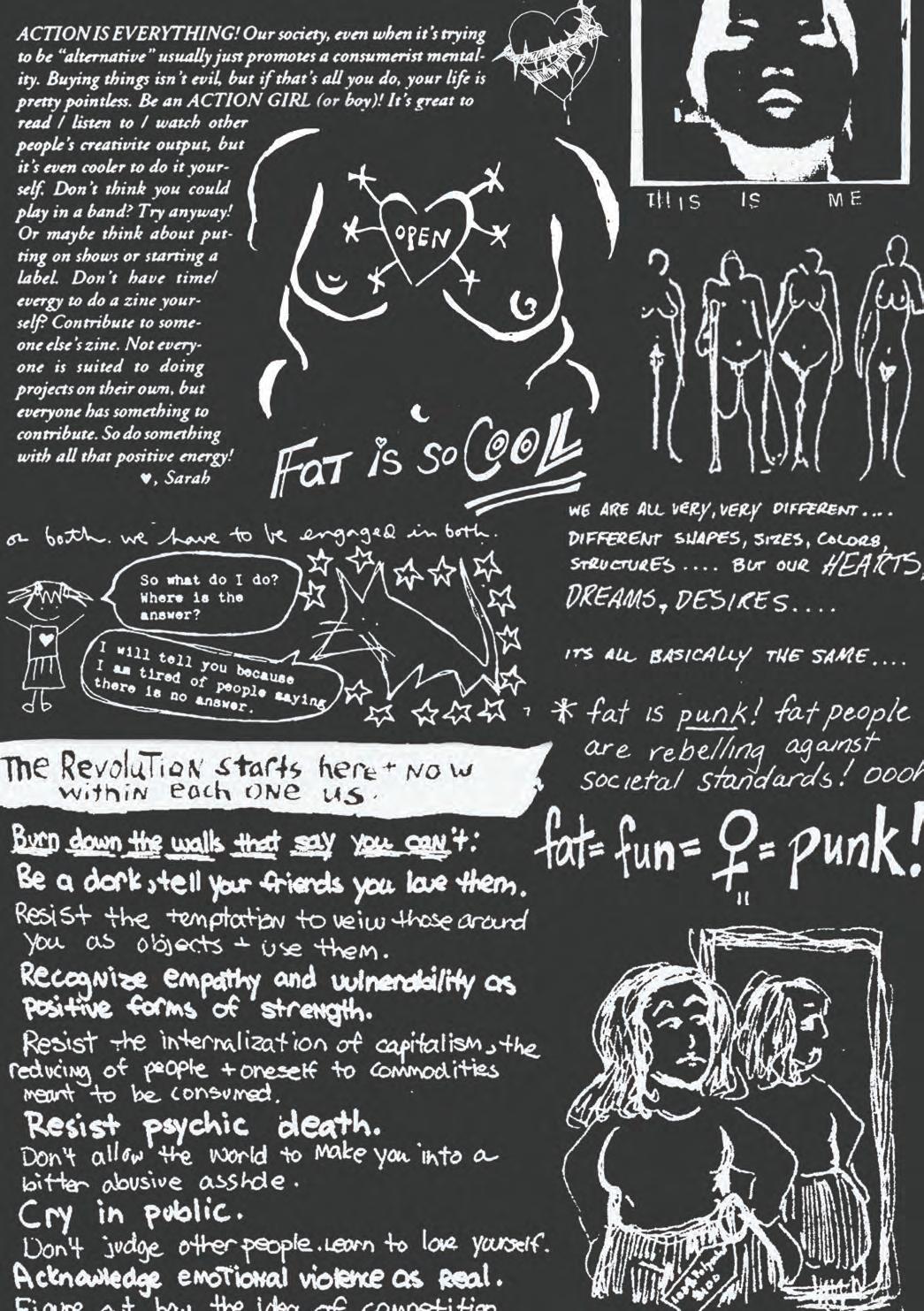

Beauty has been taken from us by capitalism and the patriarchy. We have been taught to use it as a weapon for comparison. At Lava, we reclaim beauty as a source of joy. We center unruly, Black, brown, non-Eurocentric, queer, trans, fat, and disabled beauty and question the systems and the people that teach us to doubt ourselves.
Beauty
We can always be honest about our bodies and celebrate the way they change. Change is natural and beautiful. Bodies, moods, and minds are allowed to shift. We always speak from experience, not perfection, and never capitalize on someone’s insecurity.
Rewriting Beauty Together
We empower women and marginalized genders by helping them recognize their strengths and inspiring them to use these powers to challenge oppression. We channel lived experiences into art and media. This community is building a new future for beauty.
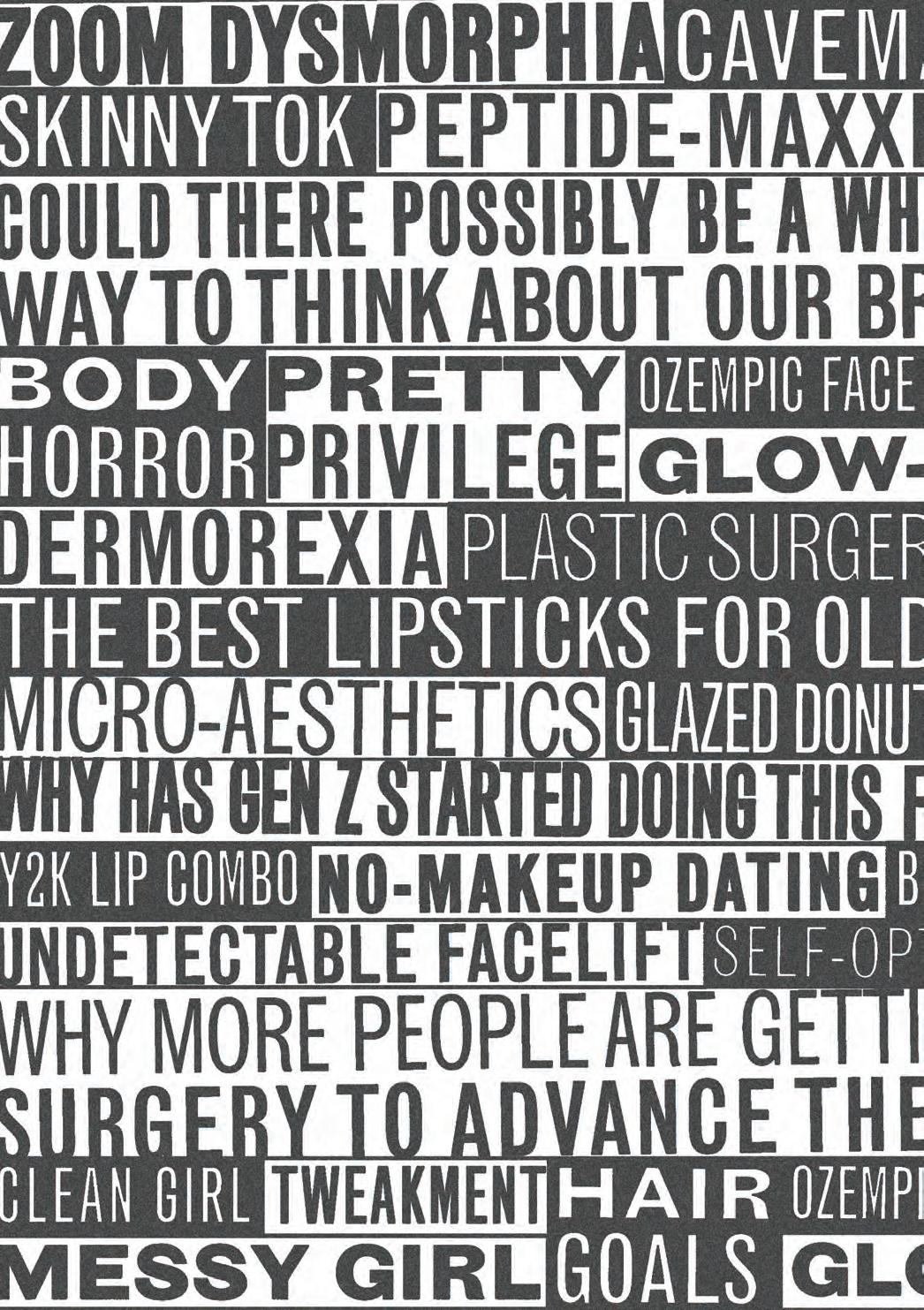
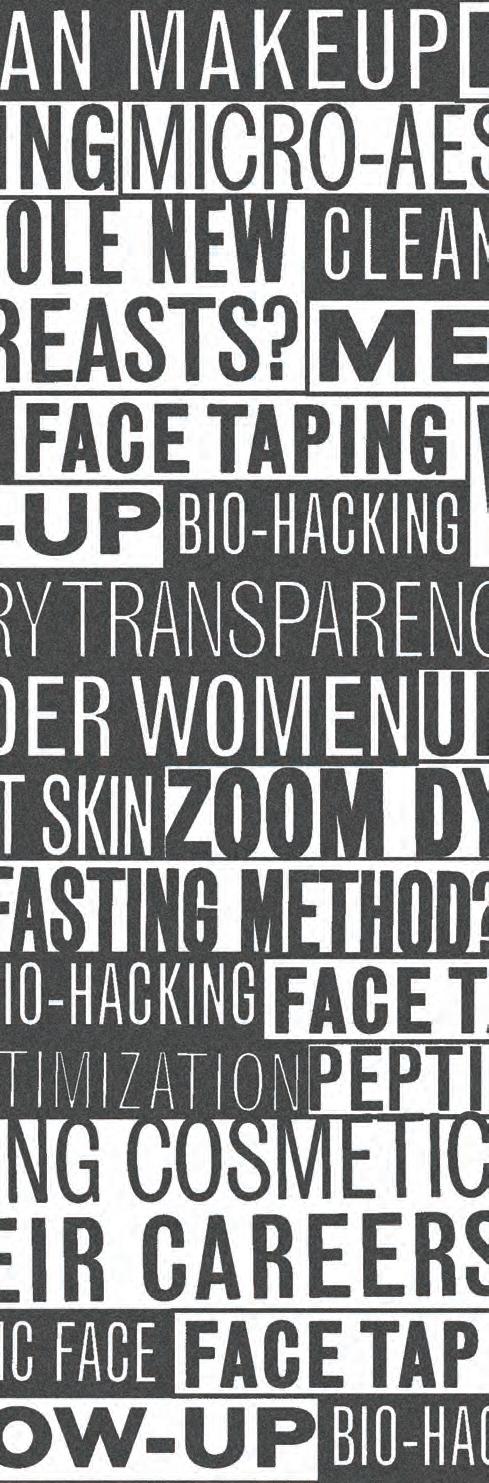
Words & Collage by Julia Morgan
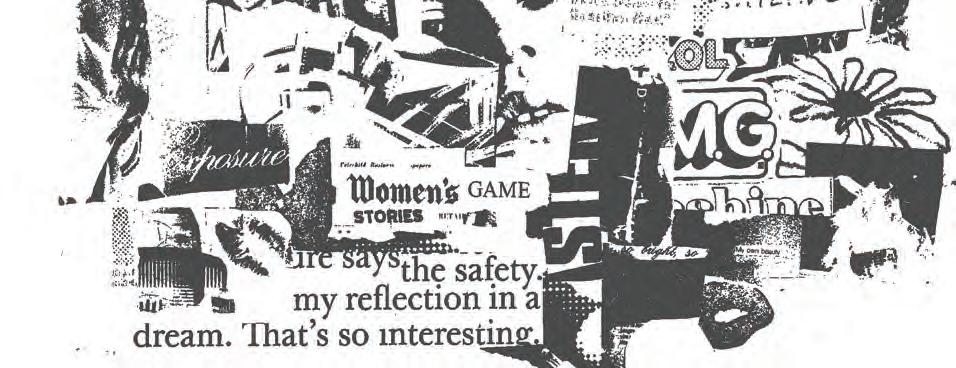
A collage of headlines from Vogue, Dazed Beauty, and trending TikTok hashtags from 2025 showcases a small sample of what digital beauty culture is like. Conflicting messages, a fixation on thinness, and the normalization of cosmetic surgery are just a few problems that it illustrates. The underlying problem isn’t as obvious, but it is much more harmful: our digital world has intensified toxic beauty culture, creating a psychologically dangerous place for women, girls, and marginalized genders.
The millions of beauty images seen each day online shape how women perceive their own value and self-worth. In 2003, feminist philosopher Susan Bordo author of Unbearable Weight: Feminism, Western Culture, and the Body argued that we live in an “empire of images,” a culture so saturated with visual messaging that it becomes a constant force shaping how women understand their bodies and their value. This visual excess of images not only normalizes unrealistic ideals but also blurs the line between representation and reality. Digital beauty culture has fostered an ideal intended solely to appeal to screens. These images are not only perpetuated by brands, celebrities, and influencers, but also by the average woman. Ellen Atlanta, author of Pixel Flesh: How Toxic Beauty Culture Harms Women , writes that women are “stuck in their Stockholm syndrome, they obsess over more beauty than they were ever meant to see and replicate the images that hurt them the most”.
In the 1990s, Feminist author Naomi Wolf wrote The Beauty Myth, where she argues beauty is a belief system that sustains male dominance. The Beauty Myth is disseminated via the countless images of the current beauty ideal, which serves to maintain control over women. She argues that the invention of photography was a crucial turning point for female beauty. Photography, advertising, magazines, and eventually the internet cemented the shift to a highly visual culture. This makes beauty something that women must recreate from an image. Paradoxically, the more images of beautiful women exist, the more identical they look. In today’s world, where social media, filters, and generative AI create idealized images, women encounter millions of representations of beauty each day.
Words by Julia Morgan
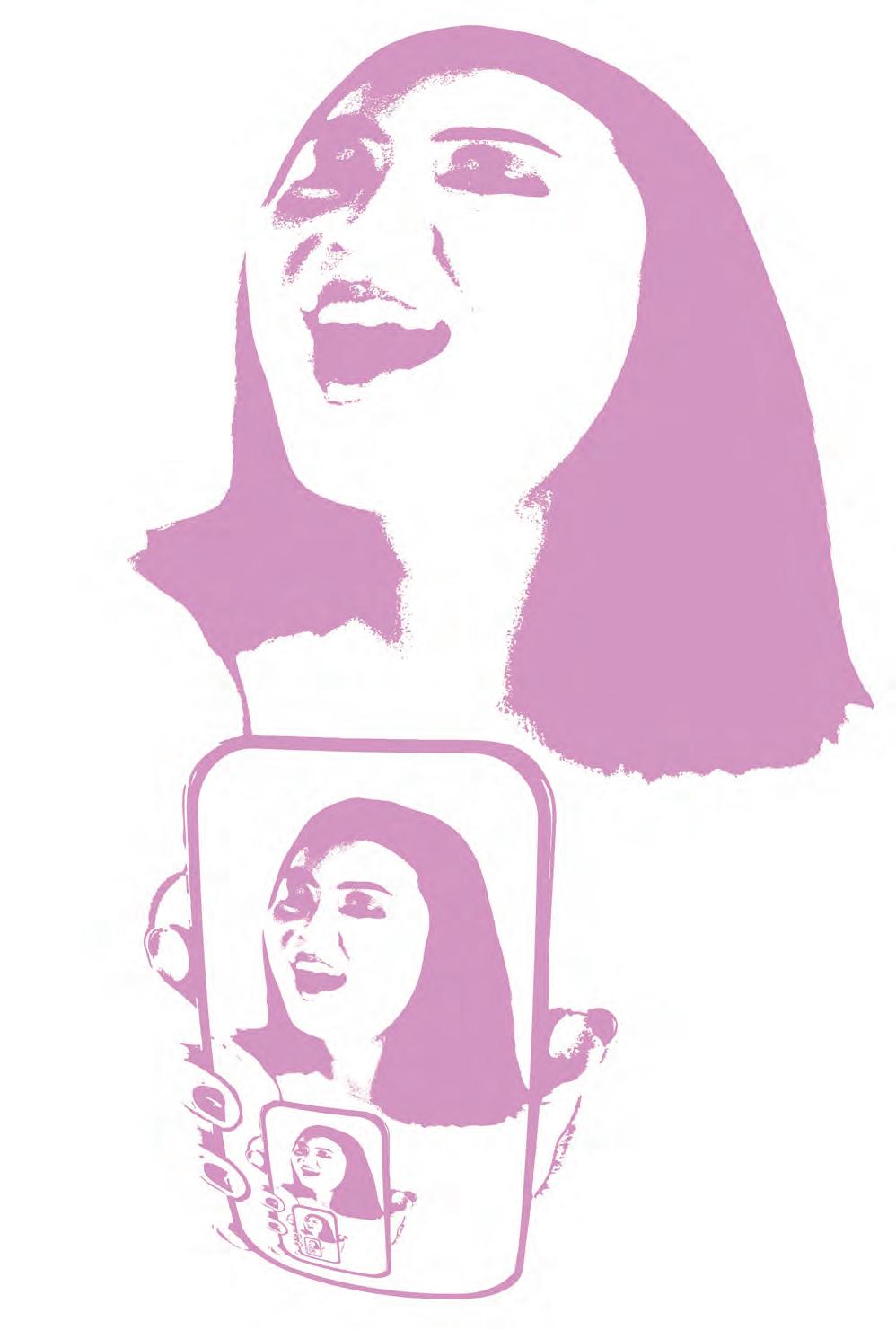
Are we supposed to look at our own faces all the time? Should we stop looking in the mirror? The mirror is so ingrained in beauty rituals, literally and metaphorically. It’s a tool we use to decorate our bodies to align with how we want to be seen, to communicate our values, and to perform our gender. At the same time, it flattens us into two dimensions, reducing us to something to measure, critique, and control. We use it to check whether we’re following the social codes that help us fit the standards of our cultures. And now that the mirror has gone digital and lives in our pockets, we look at ourselves more than ever. Thanks to social media, we are constantly self-optimizing and trying to capture a version of ourselves that feels most like “us,” but in the process, we trade our multi-dimensionality for a flat image.
Welcome to the ‘The Mirror Issue,’ the first edition of Lava. In ‘Part 1: Looking,’ the works featured focus on the experience of looking in the mirror, while ‘Part 2: Looking Away’ explores the possibility of looking away from the mirror. But it’s not quite as simple as that. Throughout this issue, Lava draws a parallel between physical mirrors and digital mirrors, like cell phones, Zoom, social media, and cameras. When we are ‘Looking,’ this can mean literally looking at ourselves in the mirror, but it can also mean curating our social media profiles, comparing our current selves to old photos, or staring at our tiny thumbnail in the corner of the screen on FaceTime. With these scenarios in mind, The Mirror serves as a unique lens to explore beauty rituals, self-perception, distortions, and the impact of
social media use and hyper-visual culture. Expect a diverse collection of art, writing, thoughts, and campaigns from all the contributors that are directly related to this complex act of looking, comparing, critiquing, measuring, controlling…
In ‘Part 2,’ we explore the idea of looking away from the mirror as a pathway towards empowerment. ‘Looking away’ takes a new form, as well, when considering the mirror’s digital counterpart. Reducing social media usage is a quick way to improve your mental health and self-confidence (Florals? For spring? Groundbreaking…). As liberating as it may be to look away from the mirror, is this a realistic path forward for everyone, or only accessible to a privileged group?
by
Words by Julia Morgan
If we go back far enough, to age twelve, with blue eyeshadow smeared across our lids and a drugstore kohl pencil wobbling along our waterline, the mirror was a portal to possibility. A place to imagine who we could become. Mirrors have heard the clamor of girls getting ready with stolen lipstick, watched tweezers overpluck brows into oblivion, and witnessed all fifteen outfit changes before leaving the house wearing the first one we tried on. They have always been there on the other end of this rite of passage, the silent observer as we try different styles and phases to feel more at home in our bodies.
Sociologist Anthony Giddens describes identity as something that is always in motion, a constant becoming. Beauty writer Sable Yong talks about the people who lean into this
becoming as the “decorating committee,” the ones who dye their hair on a whim, test new liner shapes, and treat their bodies like collaborative art projects instead of fixed objects. These small moments, beautiful and messy and formative, shape how we understand ourselves. Our beauty rituals and the mirror become tools for that exploration.
Michel Foucault would call this a technology of the self, a way we learn to understand and stylize who we are. These technologies help us transform ourselves through our own choices, habits, and forms of care. They also remind us that appearance has become one of the main ways we are read in the world thanks to modern society and capitalist culture.
(continued on page 20)
Chasing Reflections: Part 1
Photos by Noelle Dillman
Creative Direction by Julia Morgan
Modeling by Katie Chai
The photos in this series aim to depict the cycle of hyper-self-surveillance in the digital age. Distortions can easily occur the more we look at ourselves, making it challenging to connect with the person who looks back at us. In the first part of this series, the photos take the viewer on a journey that may feel familiar, where every glance in the mirror seems to show a more distorted version of ourselves. Increased awareness of our faces and bodies through technology makes us more critical of what we see, eventually to the point where we no longer recognize ourselves.
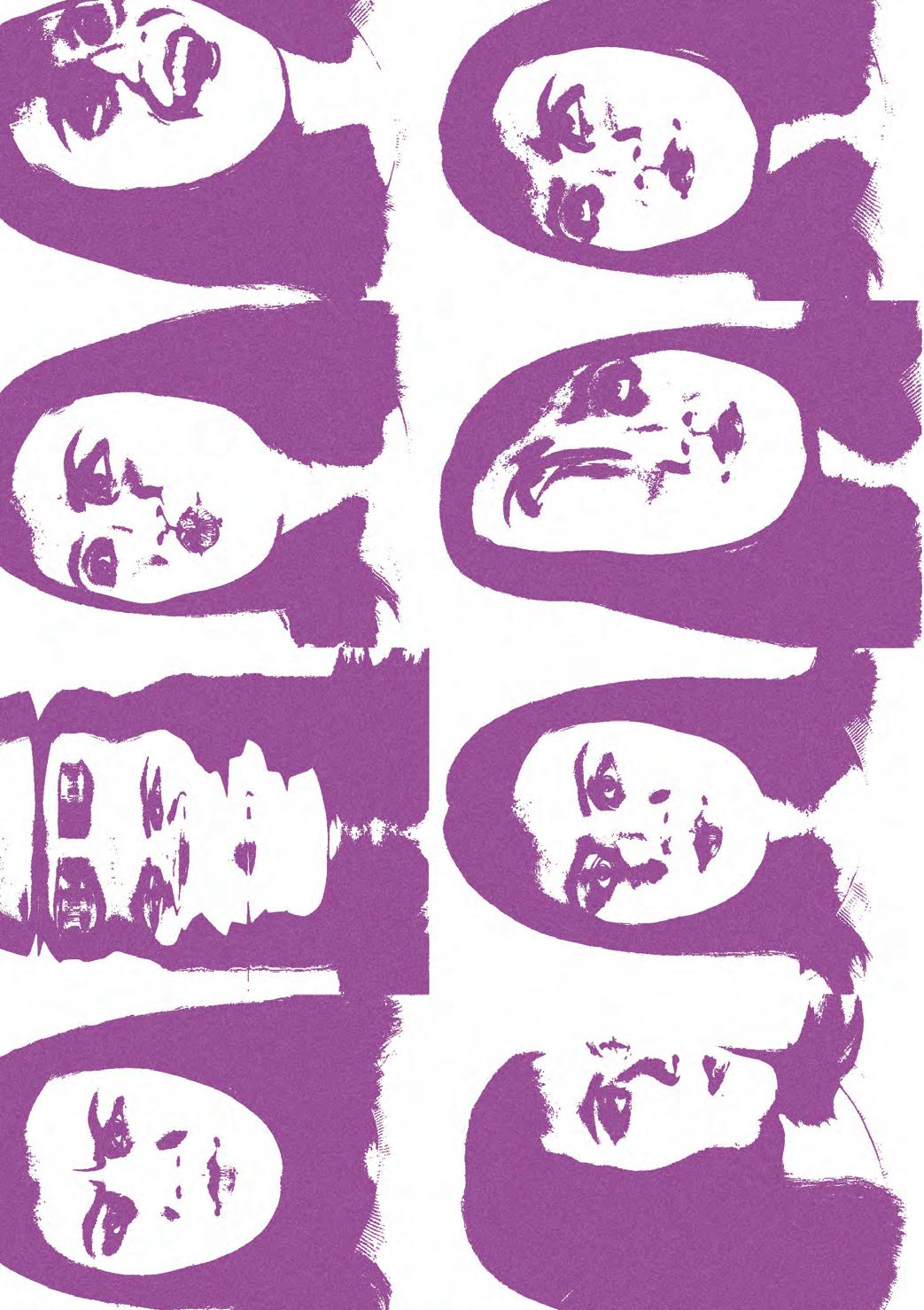
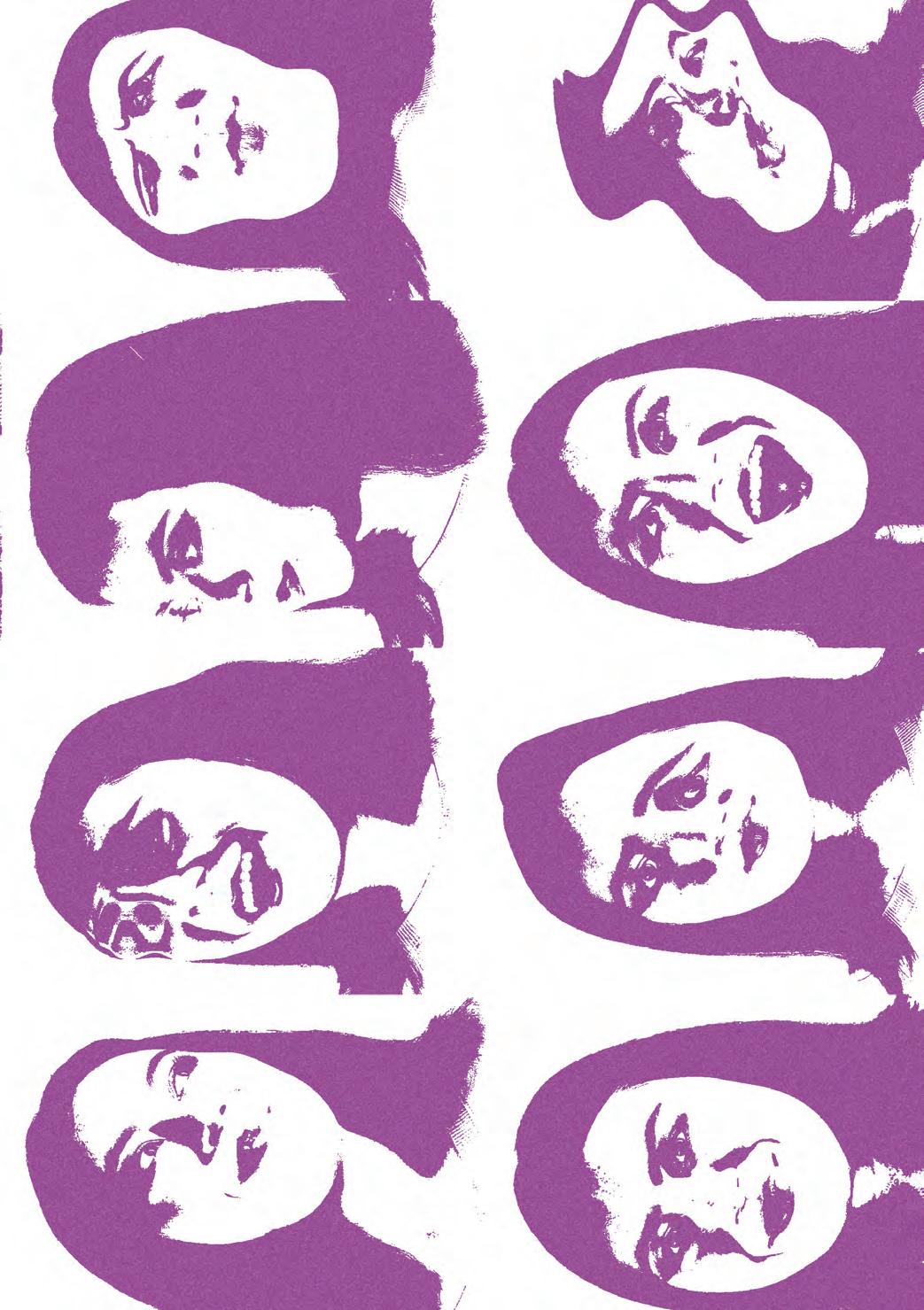
The twist is that the mirror never shows us the truth to begin with. It only offers a reversed version of reality, a little like a fun house mirror that gently warps things you didn’t know could change shape. Cameras flatten us into two dimensions. Pixels sharpen and erase. After a while, the image we see on screens starts to feel more familiar than the face we wake up with.
Researchers who study perception explain that mirror reflection is not something the brain naturally understands. It requires a translation every time we look. Mirrors also compress and exaggerate features depending on how far we stand or how we tilt our heads. Even tiny shifts in angle create subtle changes, which means the version of ourselves we see is never completely stable. It changes with distance, lighting, and mood.
Digital mirrors add another layer. Dove’s 2024 report notes that a majority of women and girls feel pressure to look perfect online, and many worry that their online selves no longer match the person in the mirror. It becomes a widening gap between two versions of the same face, and the one that lives on the screen starts to win. The pandemic intensified this, trapping us inside, our own faces in tiny boxes, during endless calls. “Zoom dysmorphia” became a household phrase because the constant self-view made so many people more critical of how they looked.
Selfies add their own distortions. The front-facing camera sits too close to the face, so wide lenses enlarge whatever is nearest. A study showed that selfies taken at close range make the nose look much larger than it actually is. It helps explain why so many people feel surprised or disappointed when they see themselves after spending so much time taking selfies and on FaceTime.
Then come the filters and editing apps. These tools smooth skin, enlarge eyes, narrow jaws, and subtly redraw the proportions of a face. They create hyperreal versions of the self, versions that drift further and further from what is physically possible. The more time someone spends with these edited images, the stranger the unfiltered reflection can feel.
All these distortions, both physical and digital, shape how we relate to our own faces. Studies on body dysmorphia show that constantly checking mirrors or comparing ourselves to edited images increases dissatisfaction and makes it harder to trust what we see. Recent work in psychiatry links heavy selfie-editing habits to more anxiety and a growing disconnect between the edited self and the real one.
Maybe the real work is noticing when the mirror helps us understand ourselves and when it pulls us away. We have lived so long between glass and screens that it is easy to forget there is a person behind every reflection. What version of yourself feels most honest to you, and how do you want to meet that person the next time you look?
Body dissatisfaction is so pervasive among women that it was coined ‘normative discontent’. In the USA, 69%–84% of women exhibit body dissatisfaction, typically preferring a smaller figure than their present frame. Once body dissatisfaction develops in youth, it rarely improves with age, becoming a fixed part of self-perception. 24–46% of adolescent girls and 12–26% of boys already report marked body dissatisfaction by their teens. Body dissatisfaction in adolescence predicts depression, low self-esteem, eating disorders, and suicidality years later. Researchers concluded that there may be a “critical period for body image development during childhood or early adolescence.”
If you’re struggling with body image or want to support youth mental health, visit the National Eating Disorders Association (nationaleatingdisorders.org), BEAT Eating Disorders (beateatingdisorders.org.uk), or the JED Foundation (jedfoundation.org) for resources and ways to take action.

The Lava Anonymous Collective is an anonymous forum launched in October 2025 alongside ‘The Mirror Issue’. It is a column where members of the Lava community can respond to questions posed by the editorial team with complete anonymity. We invited anyone to join the dialogue about beauty, self-perception, and identity.
This approach brings together as many voices as possible across ages, backgrounds, and cultures. By opening up these conversations beyond the editorial team, Lava becomes a living, collective reflection on the topics it addresses. Responses were collected both digitally via an online survey distributed through
Lava's social channels and friends, and physically through a small pamphlet shared by word of mouth in Paris, France. The results span a spectrum of responses that animate ‘The Mirror Issue’. A special thank you to all the participants who make up these sections.

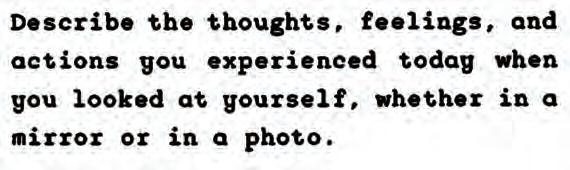
Digital Responses
I liked my new haircut and decided I'm going to keep it this way for a while.
I’m getting old :/
Some days I love what I see and other days I look and see all of the things I wish I could change.
My skin looks pretty clear. I look tired and I need to shower.
Trying to resist the urge to pick at my skin, which is still hard but getting easier.
Today I didn’t look too hard at myself. I didn’t put on make up, but the spot that was lingering on my jaw had simmered down.
Physical Responses
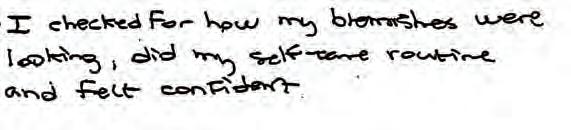
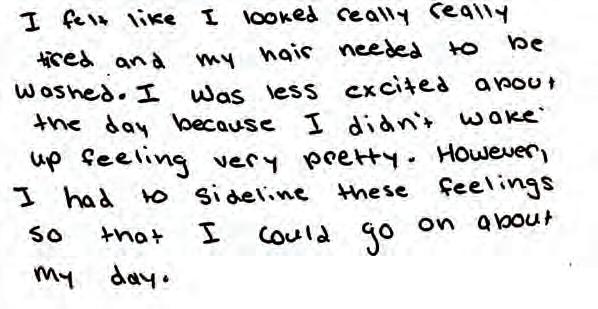
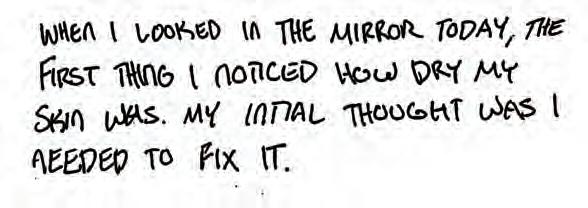
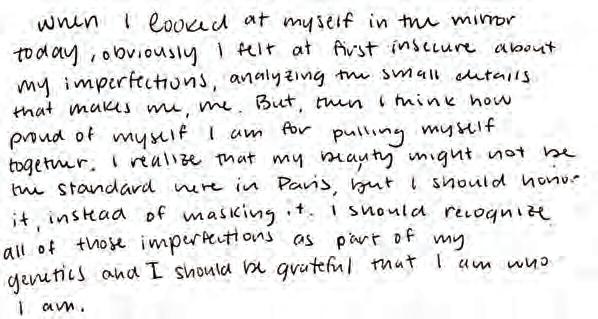
Today I didn’t look too hard at myself. I didn’t put on make up, but the spot that was lingering on my jaw had simmered down. I wore a long coat and a baseball cap because I wanted to hide from others, so it makes sense I didn’t spend too long looking at myself either. I like how the coat and cap make me look mysterious in shop windows. Am I recovering from cosmetic surgery or recovering from a late, wild night? Either or neither. I chose to look at myself less today to be a bit kinder.
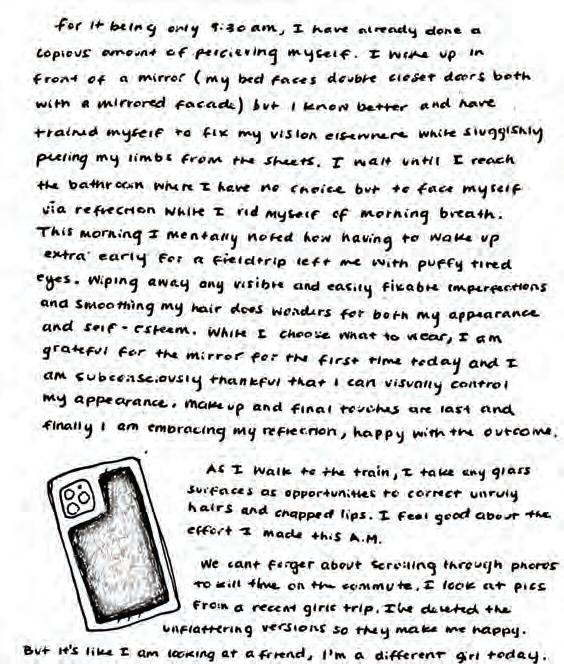
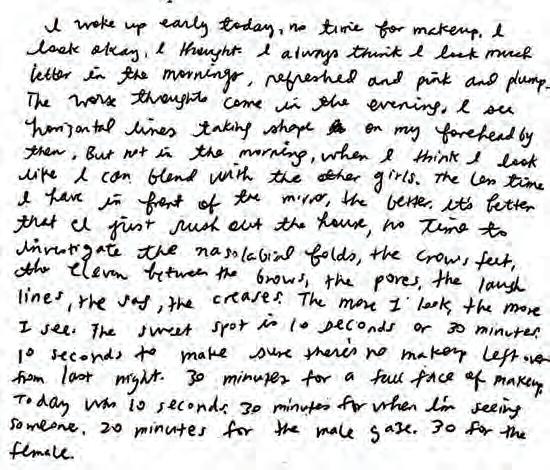
I felt gross, disgusting, and ugly. Then had to remind myself that I’m sick so obviously I’m not going to look good.
“Look good = feel good” also means “feel bad= look bad”. Despite knowing this though, I stared at myself longer than need be.
Today I felt fine, neither happy nor sad. I didn’t avoid looking at the mirror as I sometimes do, I didn’t feel apprehension about looking in the mirror.
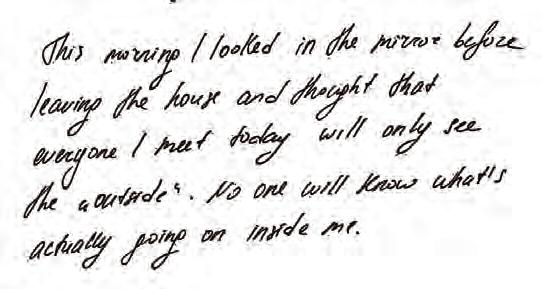
I think I thought to myself how tired I look. It was not a hair washing day so I looked pretty dissheveled but I only had one Zoom so it’s not too bad. I feel like I felt pretty neutral today when I stumbled across reflections of myself, but that’s also probably because I didn’t look that much.
Happy, content. How I never imagined I could feel comfortable with my reflection and joy thinking about how I felt about myself would annoy the fatphobes who think all fat people hate themselves
I actually thought my eyes looked pretty today in my car mirror. I’m typically pretty judgmental of my face and profile, but I had positive thoughts!
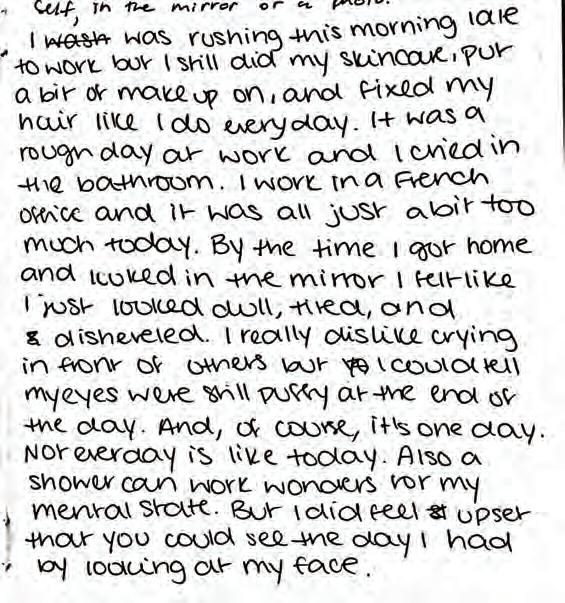
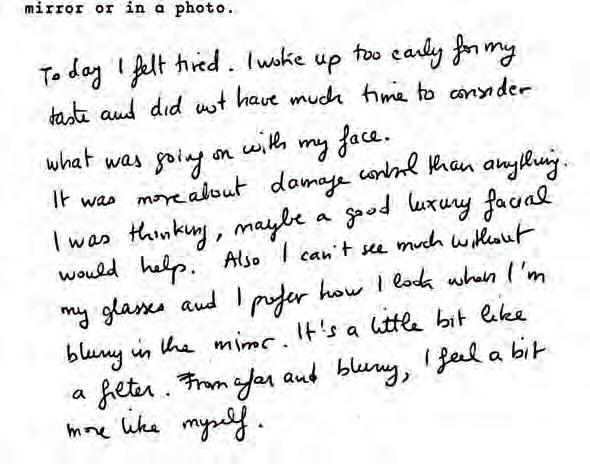
I notice the paleness of winter creeping into my face, the bronzed glow of August giving way to deep purple under eye circles. I worry about what comes next, which is worse than any complexion changes: the seasonal depression and the seasonal depression-based psoriasis. Here we go again, I say, while deciding how much UV treatment is affordable or responsible.
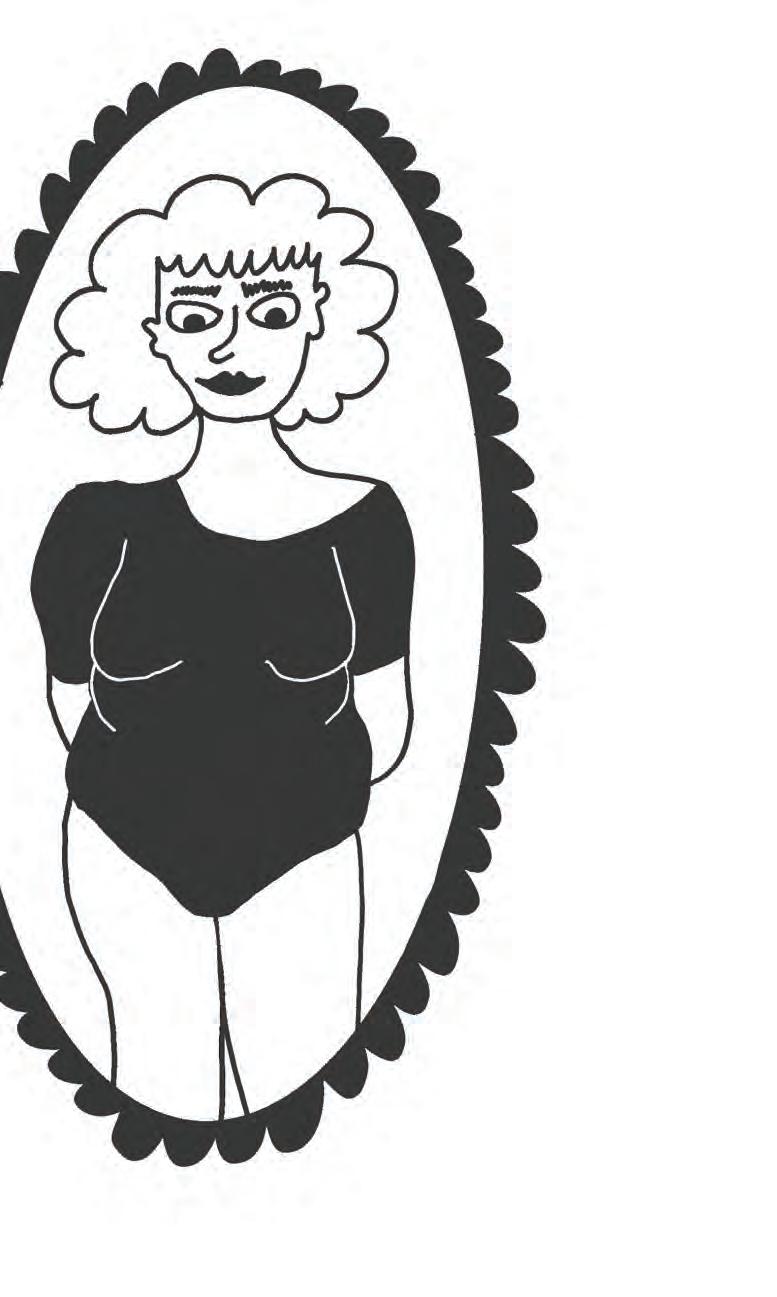
Yesterday I looked at a picture of myself and didn't feel uneasy. It was a professional picture I took for my Linkedin profile. I liked the way my curls frame my face, I liked my fierce smile contrasting my gentle eyes. It was surprising, really, because I always hated being photographed, never knowing what to do, never liking the result. But this picture showed a witty young woman ready to enter the job market without fear. It gave me a lot of confidence.
i first felt beautiful and then immediately critiqued my hair and booked a haircut
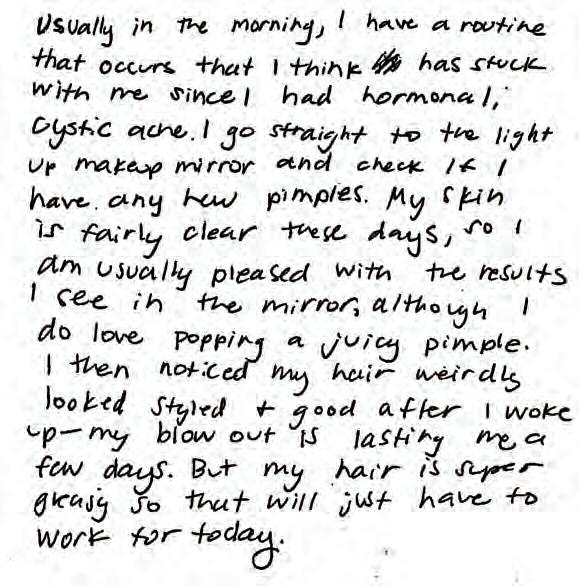
The initial thoughts of picking everything apart followed by the feeling of reminding myself I’m human
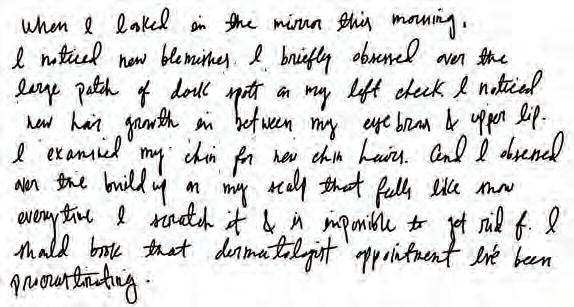
I felt annoyed because I couldn't get my eyebrows straight for 15 minutes and realised I need to buy moisturiser again because my skin is dry.
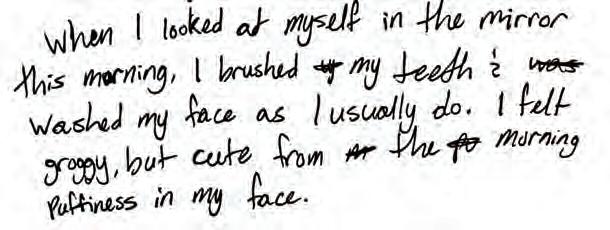
I can see all the bits and bobs that I would change. Because I can’t see my own face, sometimes I forget I have one. Who I think I am is represented in other ways like clothing, creativity, actions. Then I look in the mirror and think "who is that?”
Words by Aleah Ann Nugent
In a world of filters, front cameras, and curated vulnerability, writer LNG wonders what’s left of the woman behind the glass.

Morning light hits the bathroom mirror first—sharp, honest, and a little unforgiving. Mirror, Mirror,

by
Most mornings, I wake up fine. Not glowing, not tragic… just fine. I brush my teeth, catch my reflection, and think, yeah, she’s still got it. Inside, I feel balanced. I’ve done the journaling, the skincare, the eight hours of sleep I pretended to get. I light a candle, cue a playlist, and think maybe, just maybe, I’ve got this self-acceptance thing figured out.
Then I step outside, and daylight ruins everything.
The city becomes a runway I never auditioned for, and every reflective surface – shop windows, train doors, café spoons – turns into a silent evaluation. My body changes with the light; my confidence flickers under scrutiny. Some days, I feel like I’m walking through a hall of mirrors, each one showing a slightly different version of myself… some familiar, some unrecognizable.
I wonder when reflections become performance. When did the mirror stop being honest and start acting like PR?
My reflection and I have always had a complicated relationship. She’s both my biggest fan and my toughest critic. She’s the woman who hypes me up before a presentation and the one who glares when I eat dinner at midnight. She’s seen every version of me: the teenager who overplucked her eyebrows, the twenty-something who tried to contour confidence, the woman who whispered “you’re okay” to herself through tears after a long day of pretending to be fine.
But somewhere along the way, another presence joined our relationship: the algorithm.
Mirror, mirror, when did you move online?
The internet tells me to “be myself,” then hands me forty filters and an inferiority complex. Authenticity has a brand aesthetic now: clean lines, glossy vulnerability, and the kind of sadness that still photographs well. Even “no makeup” looks require ten steps and ring-light repentance.
Once, I spent twenty minutes erasing a pimple from a selfie, only to realize I didn’t even like the picture at all. It wasn’t the blemish that ruined it – it was the effort.
Sometimes I wonder if self-love has been rebranded as a subscription model. We buy serums for our self-esteem, crystals for our confidence, and call it healing. All this “self-care” talk is just capitalism in a silk robe.
THE DIGITAL DOPPELGÄNGER
Mirror, mirror, my reflection has better Wi-Fi than I do.
Sometimes, my digital self feels more real than my physical one. She has perfect lighting, a curated morning routine, and a habit of appearing effortlessly put-together. She’s who I wish I was at brunch, at work, in love. Composed, clever, thriving.
Meanwhile, the real me is late, smudged, overthinking everything, and Googling “is two lattes too many?”
It’s strange how our online selves start to outgrow us. They live in better lighting, with better timing, and always seem one step ahead. She’s the PR version of my life, a curated character managing my reputation in real time.
But she’s exhausted.
She’s the kind of friend who insists she’s “fine” while quietly unraveling.
The older I get, the less I trust her. She’s not dishonest, tu voir, she’s just incomplete.
There’s a line somewhere between identity and image, but most days I can’t tell which side I’m standing on.
Mirror, mirror, how do I love both versions of myself without feeling like I’m living in a split-screen?
When I was thirteen, I watched 13 Going on 30 and decided adulthood would be my redemption arc. Power suits, confidence, a Manhattan apartment. Jennifer Garner made thirty look like freedom.
Now I’m closer to thirty than thirteen, and I understand the punchline. Adulthood isn’t transformation, it’s translation. You don’t become someone new, you just learn to live inside your contradictions.
I can feel radiant in my bathroom mirror and unravel under fluorescent light. I can write essays about confidence while secretly Googling “how to stop comparing yourself online.” The difference now is that I let myself feel both.
Growing up isn’t about arriving – it’s about enduring.
It’s realizing that no one feels “ready” for their own reflection.
Mirror, mirror, tell me this is what growth looks like… messy, slow, and halfway between laughter and panic.
A woman once told me in Nordstrom, “Don’t let them see you sweat.” She was spritzing perfume at the counter, half talking to me, half to her own reflection. She wore the kind of lipstick that only women who’ve lived know how to wear, and she wore it confidently.
I laughed, but I understood. The department store is its own hall of mirrors, hundreds of glossy surfaces reflecting versions of who we could be.
Later that night, I thought about her. How she said it so casually, like it was part advice, part spell. But the older I get, the more I think, maybe I do want them to see me sweat.
I want to be visibly alive. To sweat, to cry, to laugh so loudly it startles the room. The world demands polish; I crave friction. I want the shimmer of being too much and the calm of not caring.
Mirror, mirror, look at me! Shining, sweating, surviving!
There’s something luxurious about being a little undone. I’ve started wearing red lipstick on lazy mornings, eating dessert before dinner, and posting photos where my extra tummy is slightly protruding. Sometimes self-love is just refusing to edit the evidence of being human.
Some days, I wear myself boldly, like jewelry. Other days, I stay quiet inside my skin, reminding myself that confidence doesn’t have to be loud to be real.
...She’s both my biggest fan and my toughest critic.
My mirror and I are still figuring each other out.
She catches my light and my lies, and I’ve stopped asking her to choose between them.
Sometimes I catch her smirking, like she knows I’ve finally started to understand. The reflection I used to fear has become my witness, my reminder, my accountability partner.
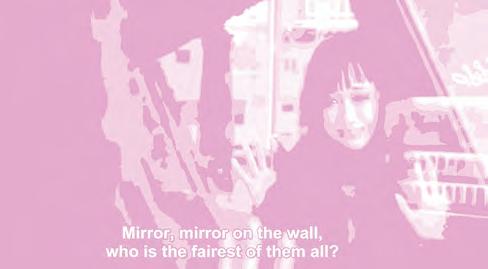
I used to look at her and ask, “Who’s the fairest of them all?”
Now I look and ask, “Who’s the truest?”
Because maybe the body was never built for perfection.
It was built for persistence, for presence, for the audacity to keep showing up even when the lighting is bad.
Mirror, mirror, thank you for waiting while I learned how to look back.
When I look in the mirror now, I try not to fix the image.
I remind myself that this body has carried me through heartbreaks, and self-doubt.
That “fine” isn’t mediocrity. It’s resilience.
It’s the steady pulse under the highlight and the disappointment.
“Fine” is showing up.
“Fine” is enough.
“Fine” is mine.
So I look again.
Still fine.
Still here.
There’s something luxurious about being a little undone.
Sometimes self-love is just refusing to edit the evidence of being human.
I’ve started wearing red lipstick on lazy mornings, eating dessert before dinner, and posting photos where my extra tummy is slightly protruding.
Still me.
Unfiltered, un-airbrushed, and finally learning to lean on my own reflection.
Mirror, mirror, who’s the realest of them all?
For Julia Morgan, creator of Lava Zine
It all started with a nail color.
I was sitting in our Global Communications class, half-listening, when I noticed Julia’s nails, a shade so effortlessly chic, I wished I could scan it for its Pantone code. I started doing my nails, following her nail color choices, and somewhere in between, we became friends.
What a beautiful beginning for a friendship built on observation, laughter, and womanhood.
In the year we’ve known each other, Julia has become more than a friend, she’s a reminder that getting older is something to look forward to. That turning thirty isn’t a cliff; it’s a crown. She’s proof that every year, you don’t just age, you expand. You get sharper, softer, and somehow more yourself.
Julia Morgan, you are the epitome of modern grace. You are equal parts creative visionary and chaos confidante. Thank you for teaching me that beauty isn’t always glossy, that growth can be funny, and that sometimes the best conversations start over nail polish.
So here’s to you : the woman who built Lava Zine, who turns thirty this December, and who will one day make me cry in the corner at her wedding.
With love, admiration, and perfectly manicured fingers, Aleah Ann
Words by Julia Morgan
Edited by Mason Douglass
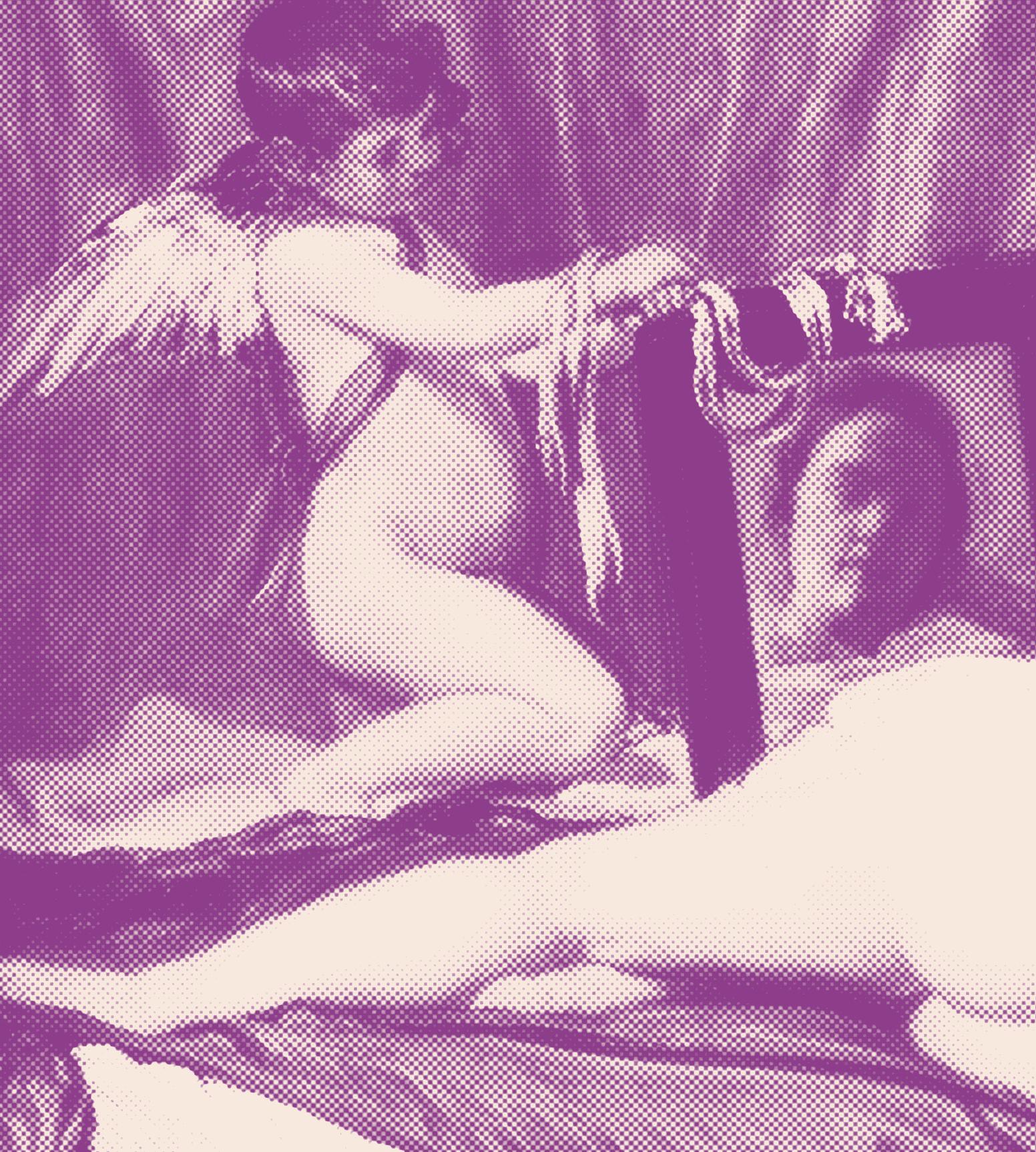
Venus, the goddess of beauty, is perpetually depicted as sitting at her vanity (imagine that), gazing into her mirror. She’s reduced to beauty and self-obsession, eternally locked in a passive pose. As the viewer, we typically only ever
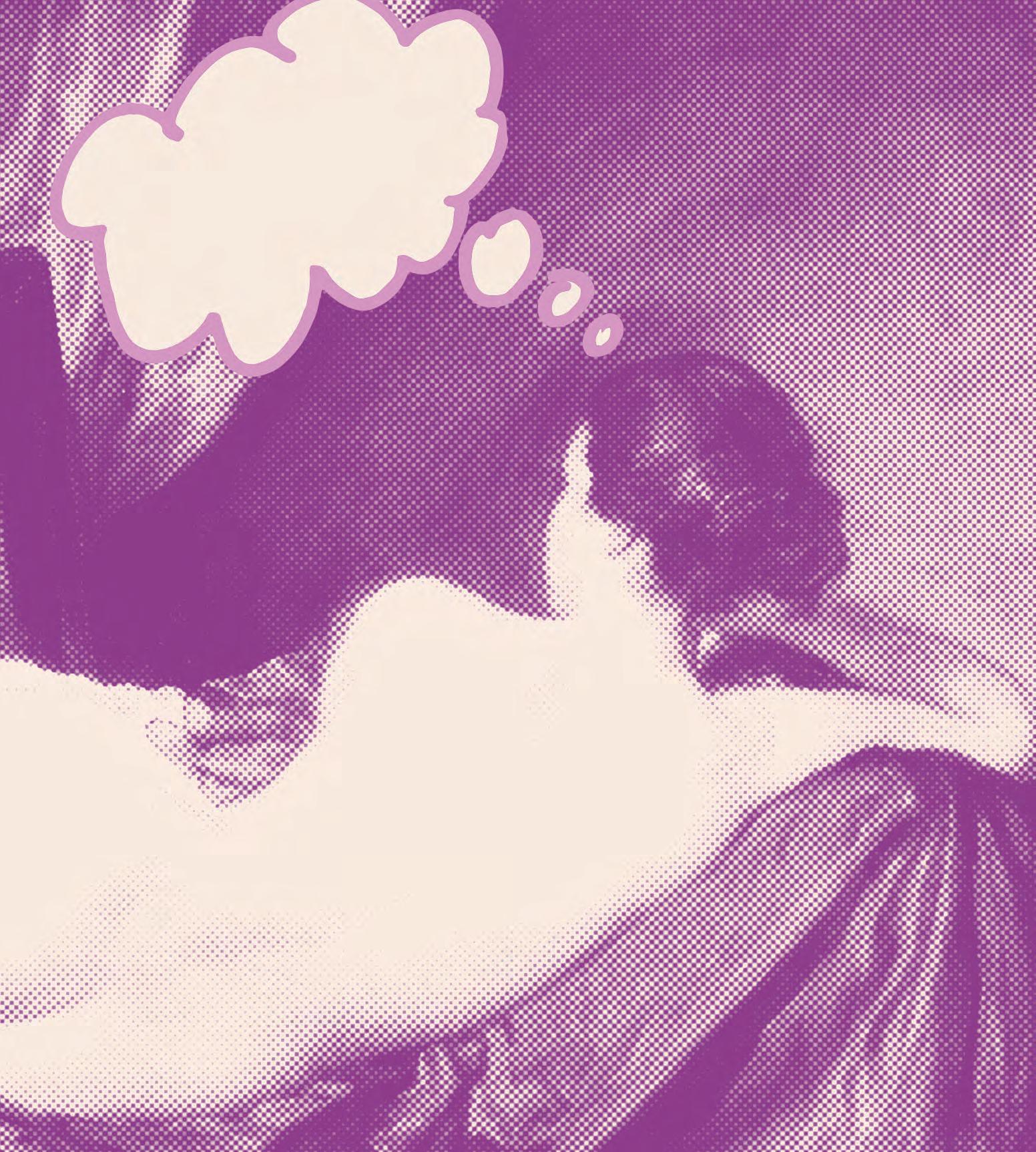
Psssst...Fill in the thought bubble with what YOU think Venus was thinking...
see her from the back, her body posed for our ogling, never for her own pleasure, and one thing is almost always true: she was painted by a man with a very narrow (yet widely circulated) idea of what beauty should look like. Art history loves this trope. Men inspired by their muse-women, women confined to private interiors, granted visibility only when a man decides she’s beautiful enough to depict. Men have the audacity to sit Venus in front of her mirror, call her vain, then act like they aren’t the ones who put her there in the first place. White, pale, and perfectly proportioned, Venus has become beauty standardized into a template.
In mythology, Narcissus was a man known for his unflinching beauty, but with that beauty came arrogance. He saw all possible female suitors as unfit and, because of his inflated sense of self, was cursed by the gods to fall in love with his own reflection in a pool of water. Unable to look away, Narcissus wasted away to nothing, destroyed by his own male gaze. This tale is the origin of what we know today as narcissism, which is often conflated with vanity.
Some versions of the myth even say that Venus herself brought the curse upon Narcissus. Could you blame her? After eons of men reducing her to a lustful reflection–even though she is the goddess of the most important force in the world: love–Narcissus comes along freely weaponizing his own beauty to reject women as not beautiful enough. Venus and Narcissus are like two sides of the same mythological mirror: he sees too much beauty in himself, while she’s blamed for seeing any at all. He gazes and is consumed; she gazes and is condemned. When looked at from this angle, the curse she places on Narcissus is the ultimate reversal of fortune.
When women look in the mirror, no mythological curses are playing out, but something even spookier. John Berger famously argued that "men act and women appear. Men look at women. Women watch themselves being looked at ... the surveyor of woman in herself is male: the surveyed female.” Not only does the destructive male gaze run rampant through art history and our visual culture, it also slips into the room when we look at ourselves in the mirror (sigh).
For women of color and trans women, the pressure that the mirror holds is multiplied tenfold. According to depictions of Venus, the “ideal” body was never designed with them in mind. Their worth is entangled with visibility in ways that demand constant self-monitoring.
No matter what kind of woman you are, I’m sure we can all agree that standing in front of our mirror is not exactly
spiritually transcendent. Mostly because we’ve been trained to be hypercritical of whatever looks back. What was Venus thinking when she stared into her reflection? It’s almost impossible to imagine the goddess of beauty doubting herself, but if being a woman has taught me anything, she was probably reenacting the Mean Girls mirror scene, pointing out her “worst” features that no one else would ever notice. Why are we hardwired to hate parts of ourselves?
In premodern times, for Christians, especially, to “find oneself pretty” was historically linked to the sin of pride. Women were not supposed to find themselves beautiful or know that they were beautiful at all. Pride, superbia, was considered a deadly sin and was often illustrated with women looking at themselves in mirrors. There was a widespread belief that someone who spent too much time and attention on their appearance risked punishment or divine retribution–the never-ending cycle of Venus and Narcissus.
Today, the homogenized ideal of Venus still exists, and her name starts with a K (I won’t say which one, it could really be any of them). Thanks to phones and visual culture, everyone is a photographer, and we’ve become the subjects and directors of our own self-portraits. Ellen Atlanta explains how women sexualize themselves, online and offline, because they know people are watching (remind you of somebody?). She writes, “the more we anticipate feedback on our appearance, the more we adhere to beauty ideals of the male gaze”. We start to prioritize the visual pleasure of others over our own bodily needs, and sometimes that visual pleasure is for the eyes of followers online. When met with her own reflection, “K” still chooses the ideal sculpted by men centuries ago. If Venus has taught us anything, however, no matter what she chooses, she’d be condemned for it by society. So, the question remains, if becoming Venus in the mirror is a sinful pursuit–yet society demands it of us–aren’t women damned from the moment we’re awoken to our reflections?
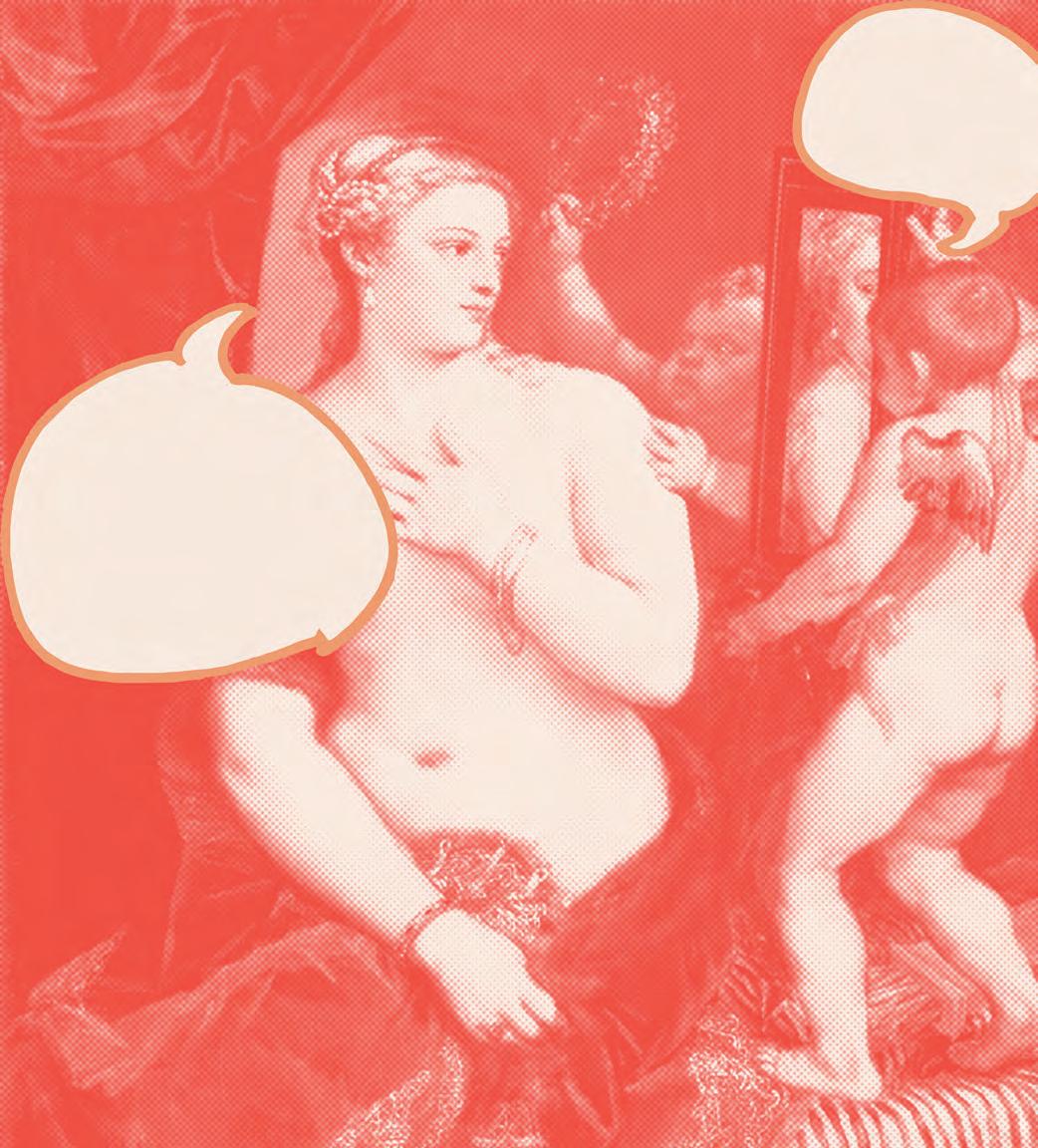
WHAT WAS VENUS THINKING WHEN SHE STARED INTO HER REFLECTION?
I know what that face means, I know your assumption. That I’m only here Your eyes graze, and stop, Over the bits that are not Twist me like Venus, Of someone
But all of the muses are And every bit was
So unless you’re a God and I’ve no obligation to meet
means, assumption. here for your consumption. stop, and glaze not as sumptuous. Venus, a clear reproduction else’s idea of seduction. a product of man. was produced by a hand. and
meet
I’m under command
your demands. Lauren Gerrish, consumption. 2022
Photos by Laurence Guenoun
Interview by Julia Morgan
“HONESTLY, BEING PERFECT IS SO FUCKING BORING,”photographer Laurence Guenoun tells me from the terrace of a Parisian café in the dull gray of November. There were three of us at the table—Laurence, myself, and her dog Mia, who happened to be on her period, free-bleeding onto the sidewalk. It felt strangely poetic, an act of rebellion that foreshadowed the conversation we were about to have on reclaiming the shifting female body.
For nearly two decades, Guenoun has been documenting her body through mirror self-portraits—intimate, living images taken not for exhibition or Instagram, but for herself. During our conversation, she spoke candidly about aging, desire, and the tension between feminist ideals and the visual culture that shapes us. She began by telling me about the archive she shared with Lava.
Guenoun, Rio de Janeiro, 2020. Photograph.
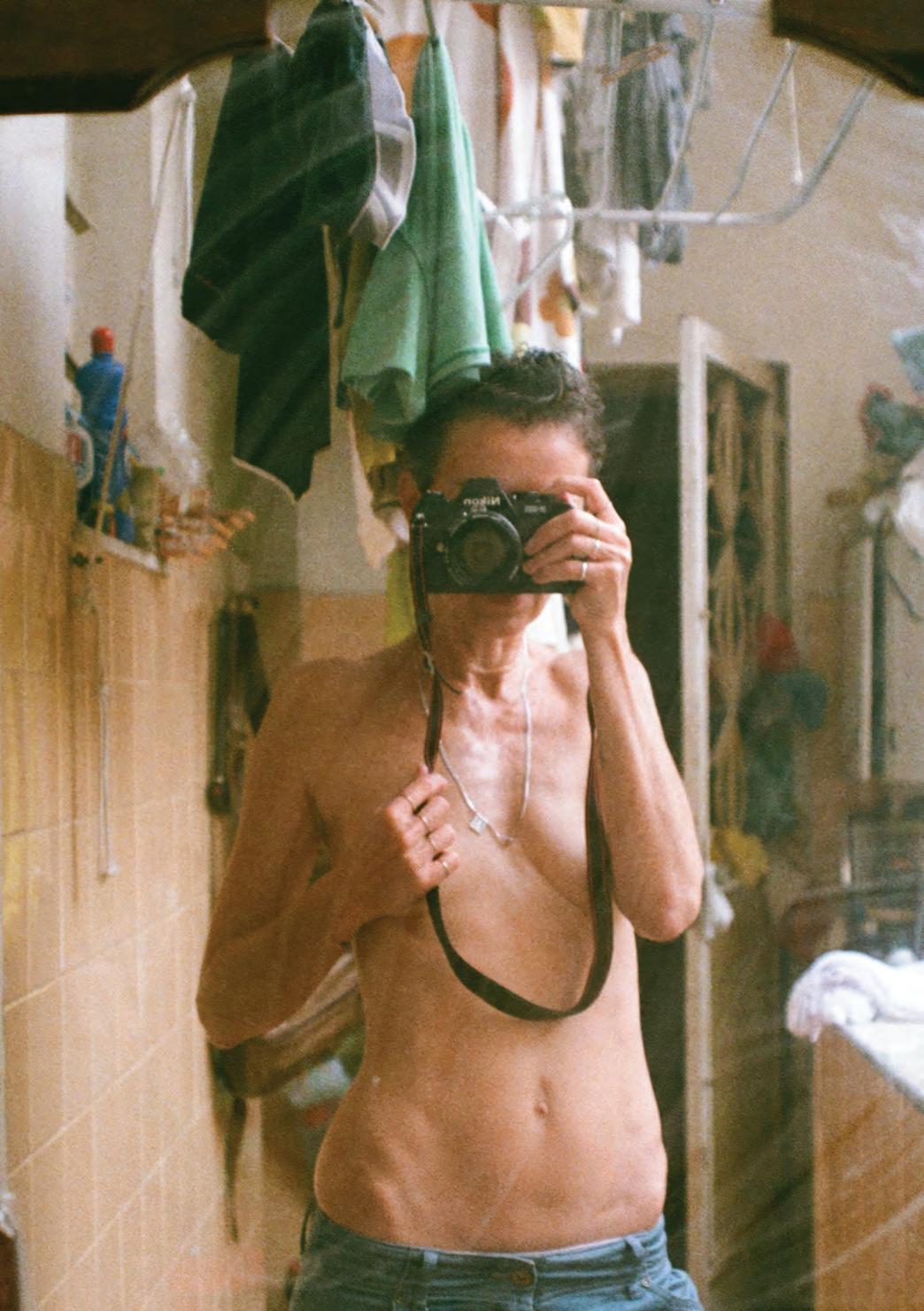
“IT’S ALMOST 20 YEARS OF ARCHIVES. I started it after I had my third child. I saw my body changing in a way it hadn’t after my first two pregnancies. With the first two, I was under 30 and recovered very quickly. For the third one, I was around 37, and you don’t bounce back the same way. Sometimes I would catch my reflection in the mirror and think, ‘Who is that woman?’ The mental image you have of your face and body often stays frozen at a younger version of yourself. It didn’t feel like the same body, the same shape. I think that’s one of the main reasons I started photographing myself—to reappropriate my body. There was nothing self-erotic in it; it was about the image.
“When I photograph myself in a mirror and share that image, the reflection I choose is the version of myself I offer to the viewer. What I capture is the image of myself that I want them to see. It’s a whole mirroring game that I find fascinating. You know your angles; you know your light; you know how to frame. Even if the shot feels spontaneous, at some point you’re still framing and adjusting your camera settings. It’s always some form of manipulation.”
In this series, Guenoun often obscures or covers her face. When I ask about that choice, she doesn’t hesitate. “Probably because the marks of aging are more visible on my face than on my body, and that’s harder for me. I see all my flaws so clearly. I could tell myself exactly what I tell other people—‘People see an image, not your flaws'—but when I look at my own face in a photo, I don’t like it. And that’s okay; I’ve accepted it. But I still have a very hard time looking at my face in pictures. There’s definitely a difference between how I look at my body and how I look at my face. I’m critical of them in different ways.”
Photography, for her, is an archive. “Growing up, I was constantly surrounded by pictures, and there was a strong culture of taking photos in my family. I bought my first camera when I was 18, in 1988. I realized early on that photos help you keep memories—and rebuild them, too. You know how the brain functions: you’re constantly rewriting your memories, and you forget a lot because it’s not a computer. Photography, for me, has anchored certain things: the places I’ve been, the people I’ve been with.”
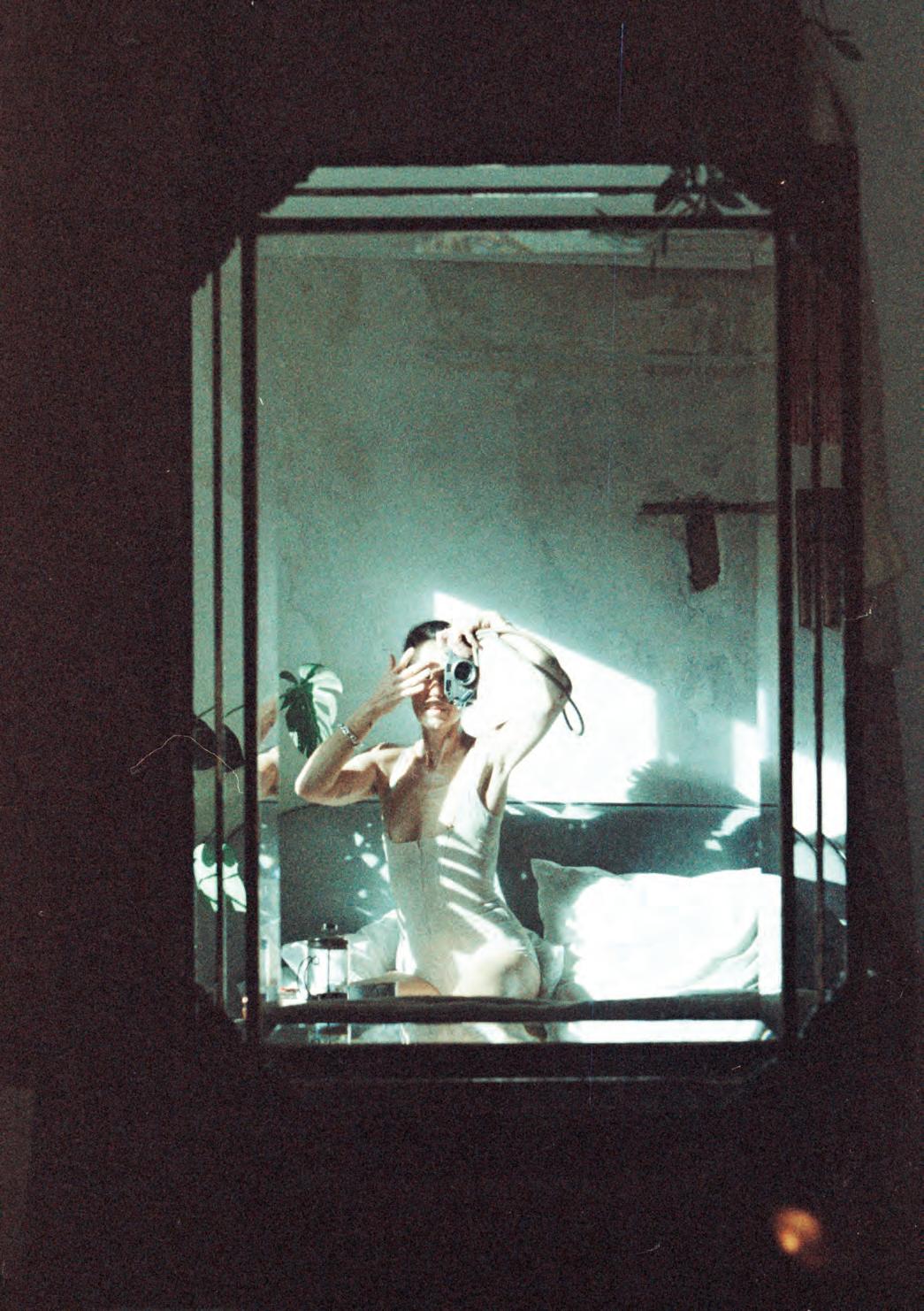
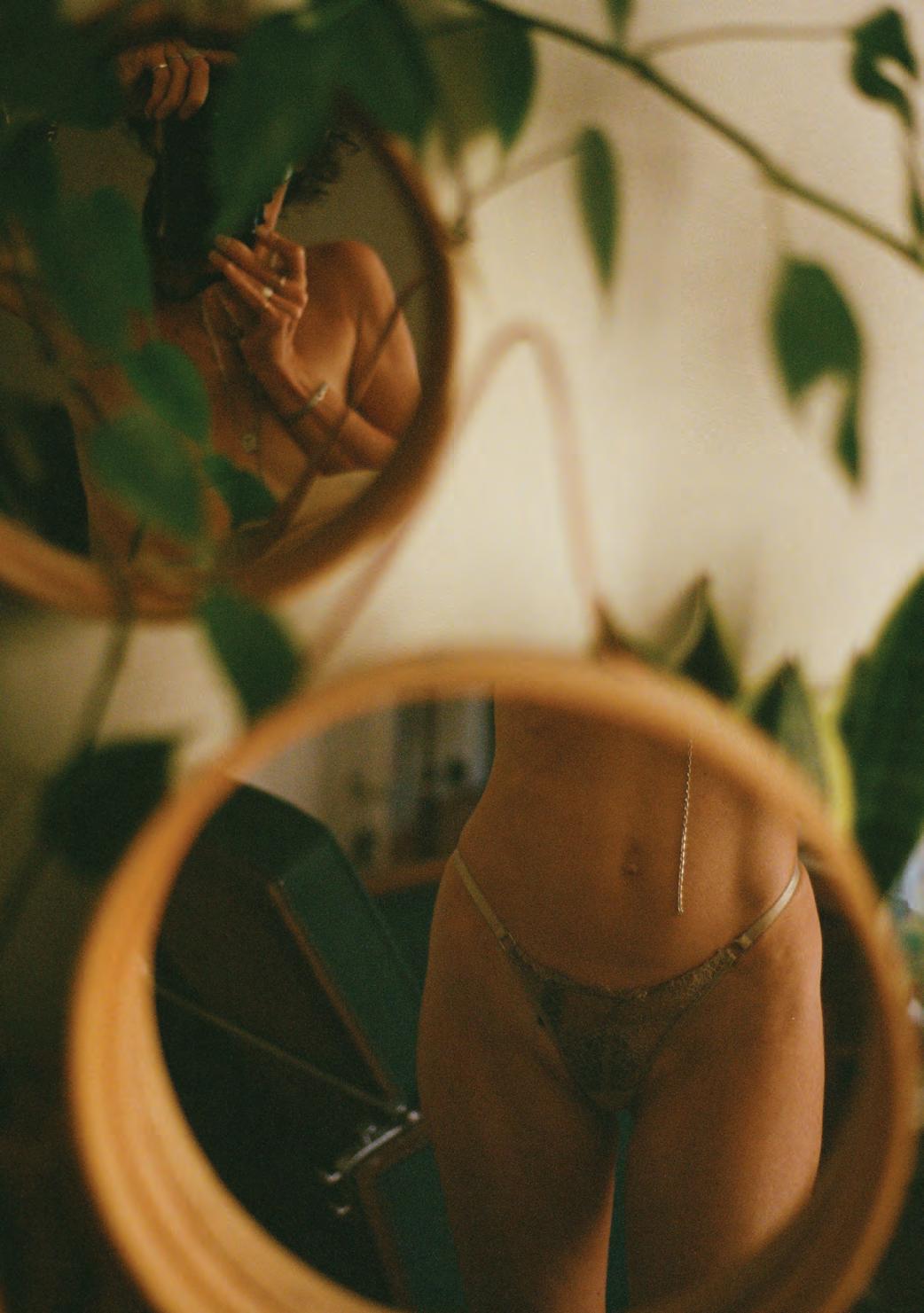
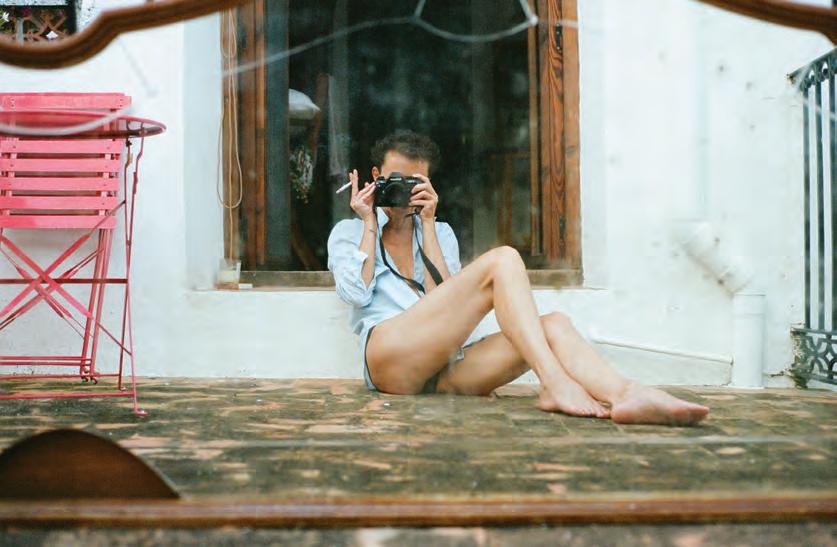
Although she often adds to this series during her travels to remember where she’s been, these photographs are more than souvenirs. They are living records of her body and its changes, its strength, its vulnerability. We talk about the politics of nudity, especially for women sharing images of themselves. “I don’t have an issue with nudity at all,” she says. “I was raised in the ’70s—we didn’t give a fuck. I can be naked or half-naked in an image, and I don’t see it as particularly sexual. But I’m aware not everyone feels that way, and I do feel a responsibility in what I share. I have zero desire to create images so guys can wank to them—that’s not the purpose.”
She’s equally clear about the guilt some women feel when photographing themselves. “First of all, you don’t have to share them. That’s important. You do it for yourself.
You only share when it feels right, if you even want to at all. While you’re doing it, the way you shoot yourself will evolve. Your perception of yourself will change, and your approach to your body will change with it. Maybe you’ll like the experience, maybe you won’t, and maybe you’ll stop. And that’s fine. There’s no obligation.
“No one needs to know about these photos but you. So don’t feel guilty about doing it. A lot of the difficulty comes from guilt. It’s not about being an influencer and posting your body everywhere, like, ‘Look how beautiful I am.’ It’s not about marketing your body. I’m not selling my body; I’m selling my work, which is photography. The self-portraits are just one part of what I do. So yes, do it for yourself. Think about why you want to do it. Sometimes the purpose is just to feel good, and that’s okay.”

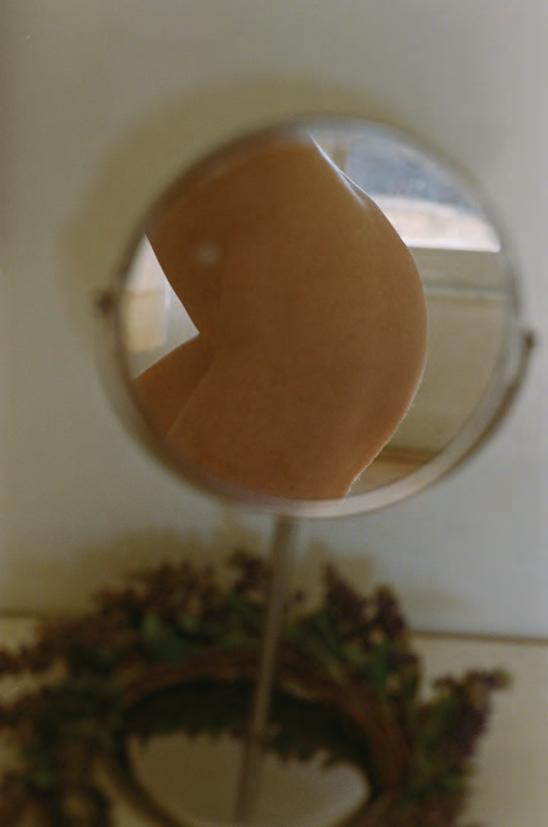
She laughs when she tells me that photographer friends have urged her to exhibit the series. “And I’m like, ‘Why the fuck would I exhibit myself and have strangers buying prints of my body to hang who-knows-where?’
I’m not comfortable with that. I did make a small book—maybe 10 or 20 copies—and kept it mostly under the radar. That felt like the right scale.”
Eventually, our conversation drifts toward beauty culture, and here Guenoun grows visibly sharper. “I have a big problem with the whole Instagram body culture. It leads to body shaming and constant comparison. It’s everything but self-acceptance. Before, we had magazines with supermodels, and that was already a comparison trap—you’d think, ‘She’s beautiful, I’m not.’ Or, ‘She looks like this, and I don’t.’ Today it’s everywhere, all the time, and it feeds on itself.
“I see very young women doing surgeries or injections, hiding things that don’t need to be hidden at 25. Lip fillers, butt implants, whatever. And I think, ‘What will you do at 55, at my age?’ I have no problem with cosmetic procedures if they help you feel more confident. Do it at 45 or 55 if you want. But wait. You’re young. You’re beautiful. Start by smiling—that alone changes how people perceive you.”

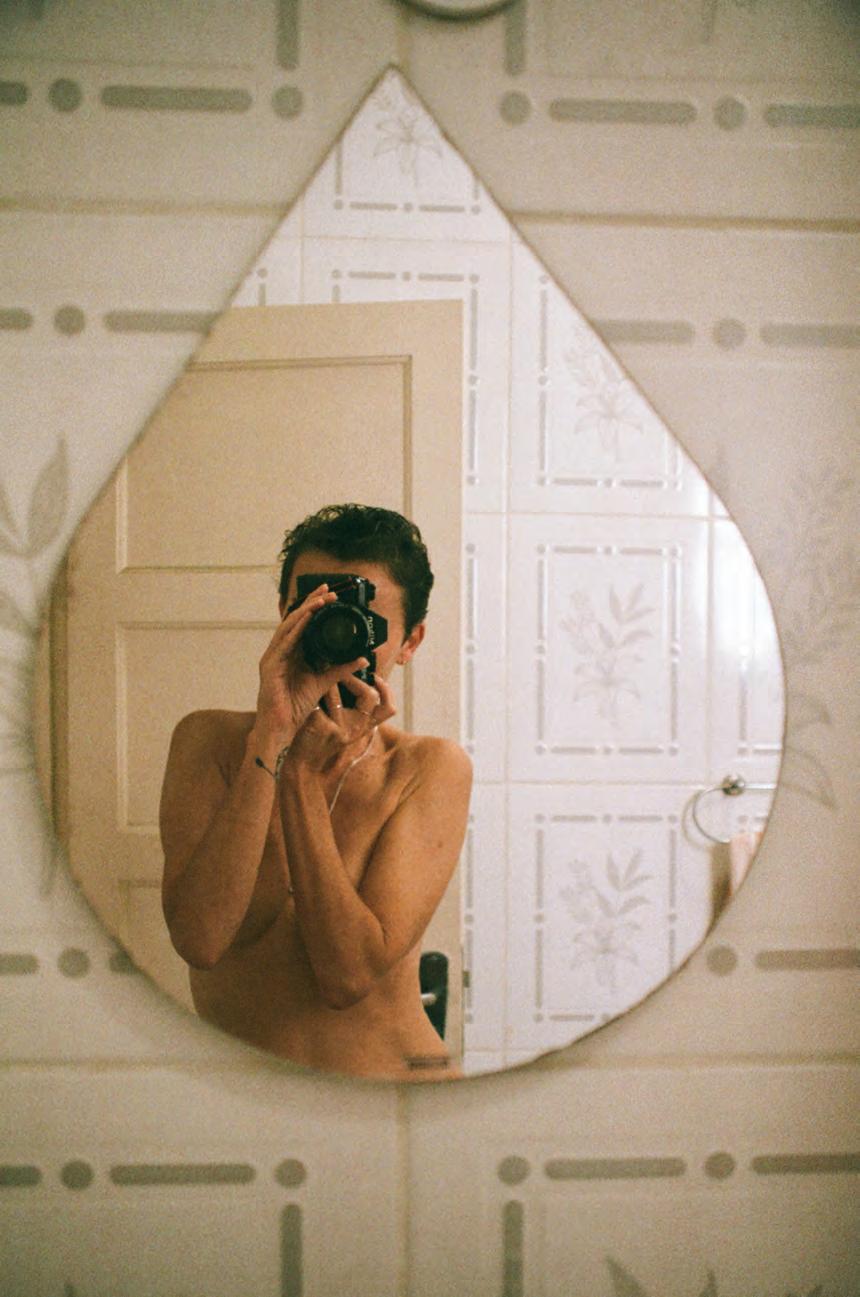
We talk, too, about contemporary feminism. “When I hear feminist discourse today, I agree with the idea of fighting for your rights and raising your voice. You also have to set your own boundaries. People will treat you the way you allow them to. It starts with education, and with how you see your own body. You can’t say, ‘I don’t want to be objectified,’ while constantly objectifying yourself. There’s something very contradictory in that.
“At the same time, it’s totally okay to want to be desired. We all need desire. The question is: how, and to what extent, do you want to be desired? If you decide to use your body as a tool—as we all do—just be conscious of how and why you’re doing it. Your body is a tool for moving, feeling, enjoying, suffering even. But the rest is in your brain. Be aware of what you’re reflecting back to the world.”
Near the end, I ask how it feels to look back over two decades of images. She sighs, amused. “I feel like I’m aging, honey. It’s part of a process. It can be hard, but it’s also just life. I know I’m going to shoot more at some point. This year has been very difficult for me, so my mind wasn’t in that place. But it’s still a way of reappropriating yourself. I think I’ll need it again at some point: ‘Okay, let’s do this. Let’s crystallize something else.’ I usually take these self-portraits when I’m feeling good—mentally and physically. I need to feel strong and empowered to do it. But the photograph is definitely a way for me to look at myself with more sympathy, more softness, more compassion.”
As we wrap up, the rain that had been threatening all afternoon finally begins to fall, gently speckling the pavement.
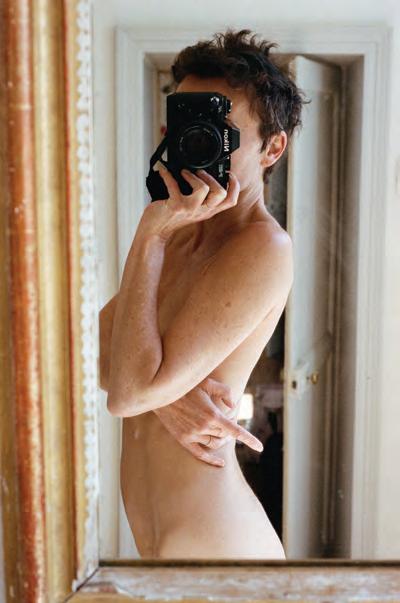
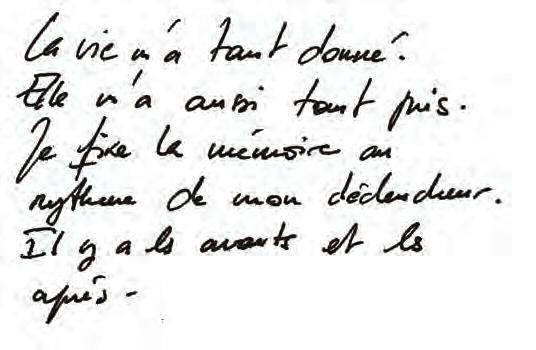
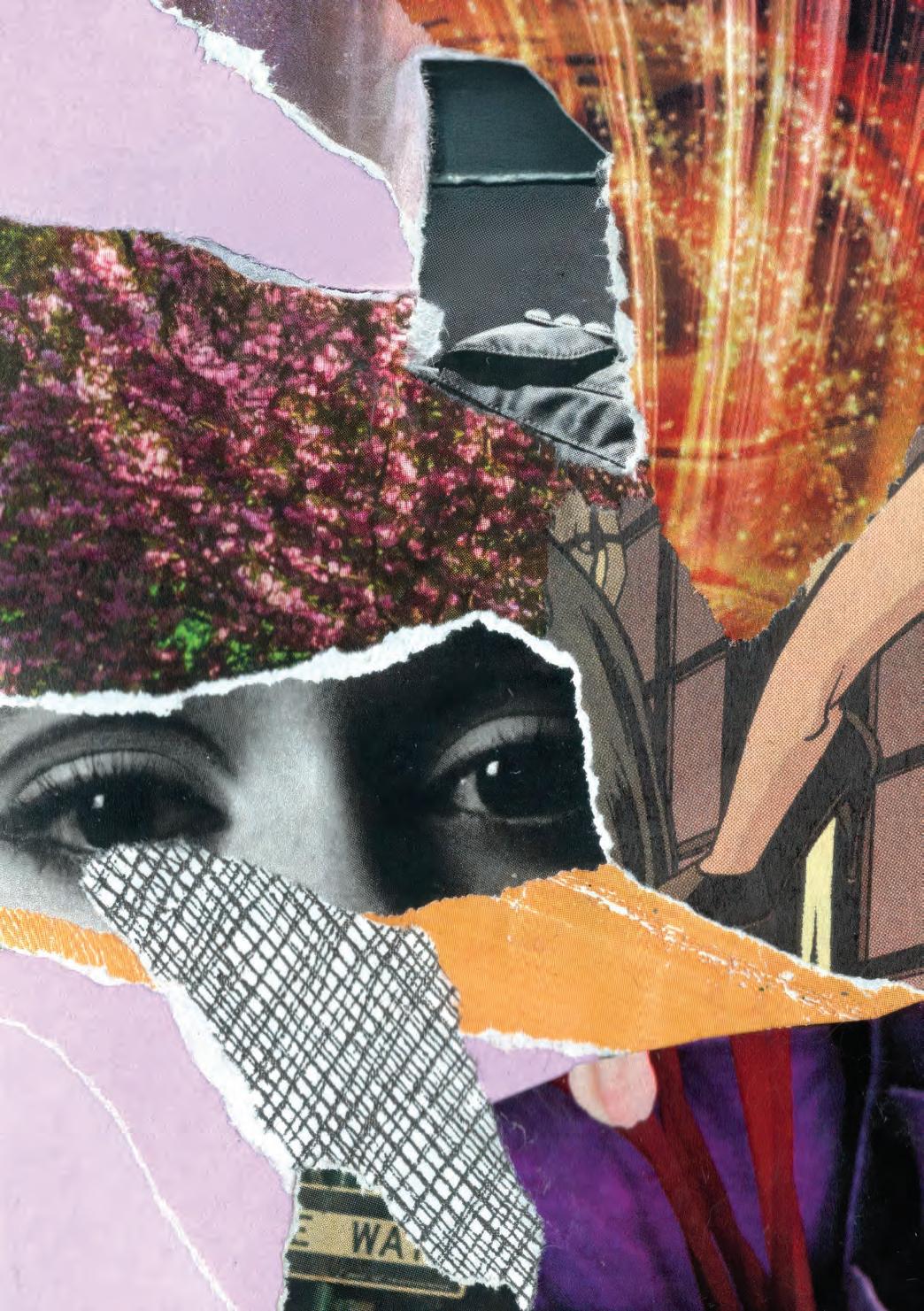
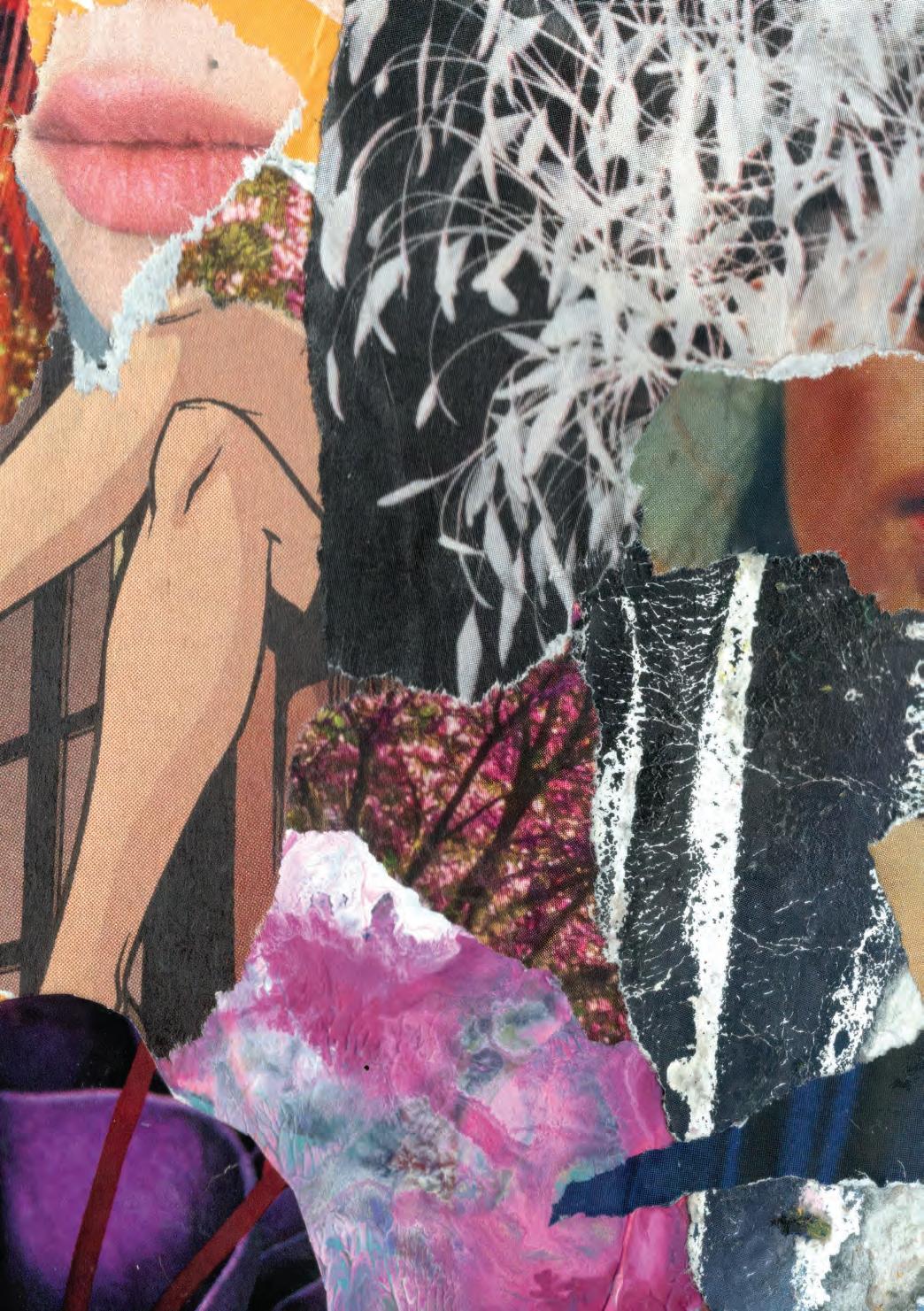

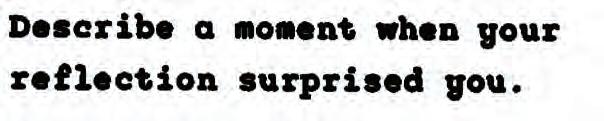
I always had long, curly hair, especially in high school. After my first breakup, I decided to cut them, in a bob style. It was so refreshing. When I looked at myself in the mirror, I thought I became someone else.
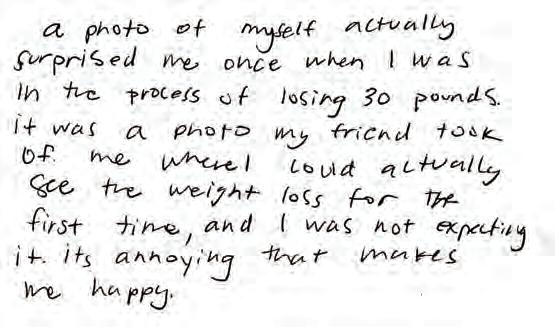
Seeing progress after working out.
I looked in the mirror and didn't realise my hair was all matted on one side, not for any nefarious reason just had a clip in weirdly for a few hours.
Last night. I was at a burlesque Halloween show, covered in fake blood and wearing white contacts. It’s jarring to feel so beautiful while looking so gruesome, and I wish we’d make it more normal for people’s standard of their own beauty to be subjective.
by
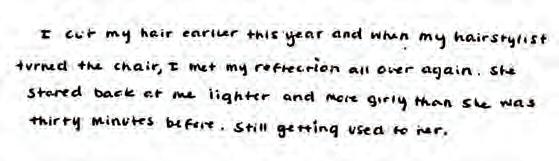
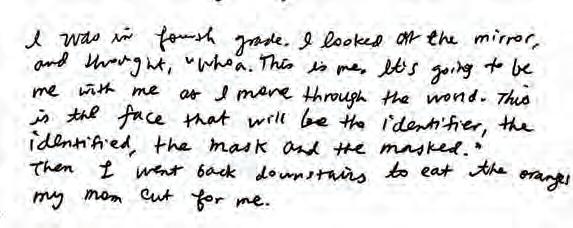
Living with bipolar disorder, I am often surprised to see a face in the mirror that contrasts dramatically with the face I saw in a different mindset. I remember that beauty is in the eye of the beholder, and sometimes the eyes with which I behold the world send signals to a brain that is being a huge bitch for the time being.
My skin looked glowy
Sometimes I go to look in the mirror and I think I look another way, or I forget what I look like. Sometimes I thought I looked thinner and then I look in the mirror and I’m bigger than I remembered and it can be a shock to ot fully remember what you look like.
After crying. Seeing how emotion impacts the body is always surprising
When I was on shrooms. I feel like this is a universal thing, to look at yourself in the mirror when you are on a psychedelic, it’s very bizarre. I don’t even know how to describe it.
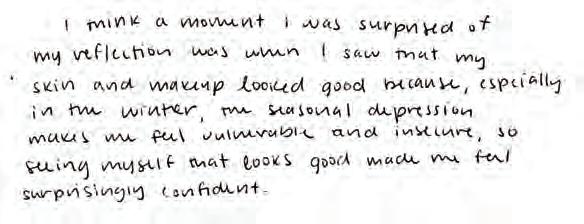
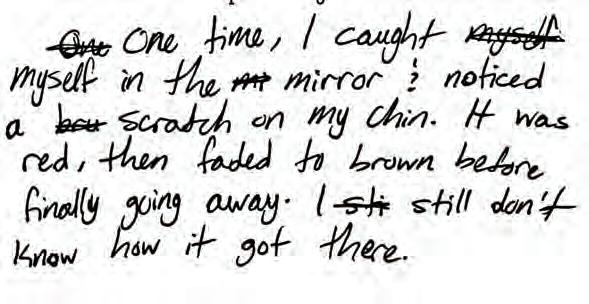
Often when I have felt terrible and ugly (spotty, make up sweated off, depressed) I look at myself and see someone completely normal. It helps for a moment.
Sometimes when I look in the mirror, it doesn’t feel like myself. That doesn’t surprise me anymore. It surprises me when my reflection actually feels like ME.
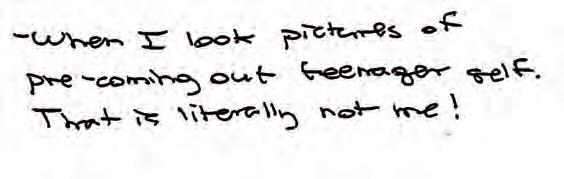
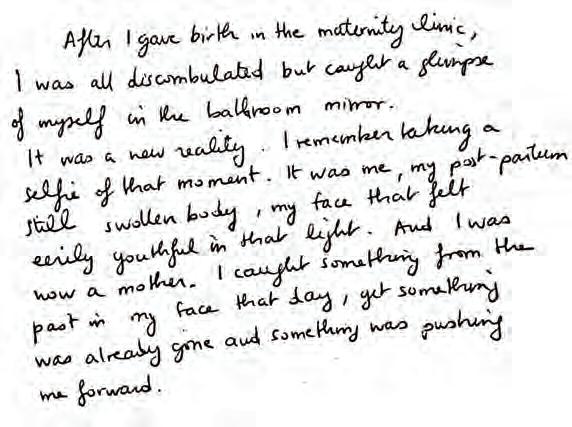
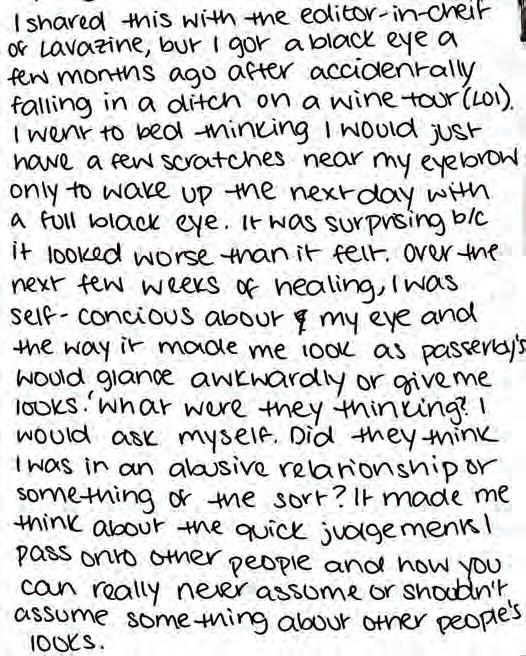
I don’t smoke weed really anymore, but when I would and I’d look at myself in the mirror I always felt really attractive. That I liked what I saw and it was almost as if seeing with new eyes. That always surprised me.
After I got my new haircut, I was surprised by how it completely reshaped how I saw my body in a positive way.
Again on the eyes, but I noticed that above my eyes looked a bit droopy, and it was the first time I actually noticed that I’m aging.

when i’m about to get into the shower i feel my most beautiful and this surprises me every time i look into the mirror before getting in. it’s a lovely surprise and makes me feel almost sad to be washing the feeling away.
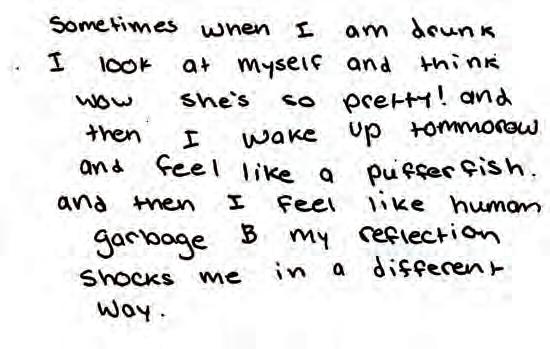
Have you ever had one of those moments when you’re pretty drunk and then you go to the bathroom and you see yourself in the mirror and you’re like ah! Jump scare
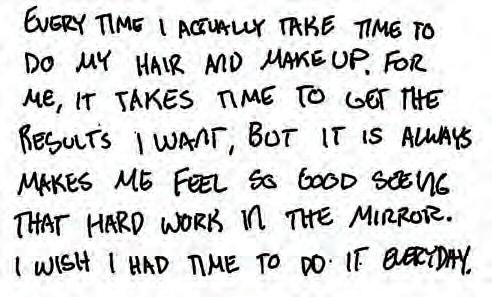
I’m always on top of the world when I put my makeup on and dress up. It surprises me that I feel good.
I’m always on top of the world when I put my makeup on and dress up. It surprises me that I feel good.

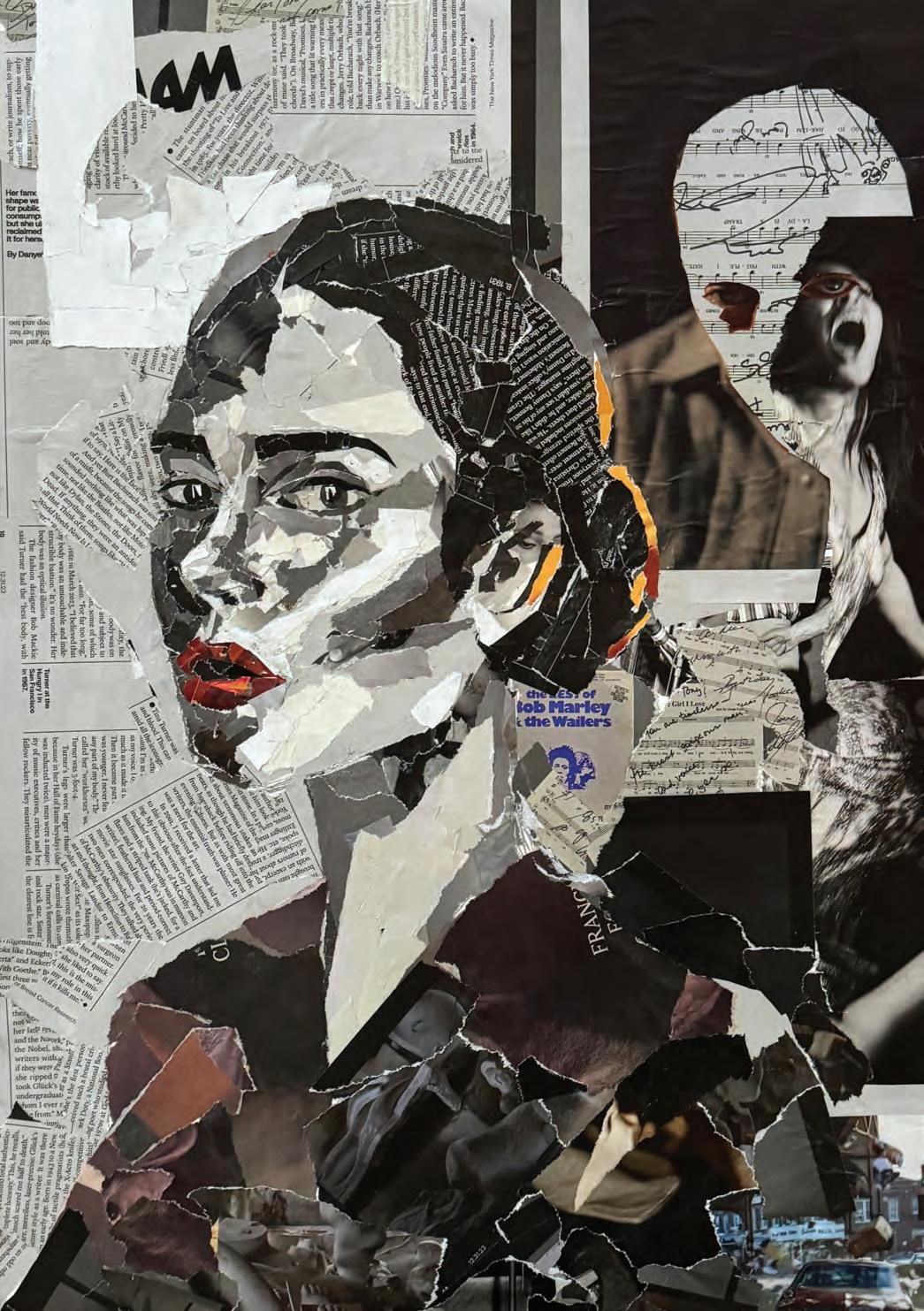
Words and Artwork by Nancy Duer
Nancy Duer, The Shapes I’m Taking, 2024. Collage, 18 × 24 in. (Opposite)
This self portrait represents a splintered and abstracted evolution in womanhood, blurring the lines between subconscious desires and society’s expectations. Using one New York Times magazine, this piece demonstrates the clash between wild and manicured femininity.
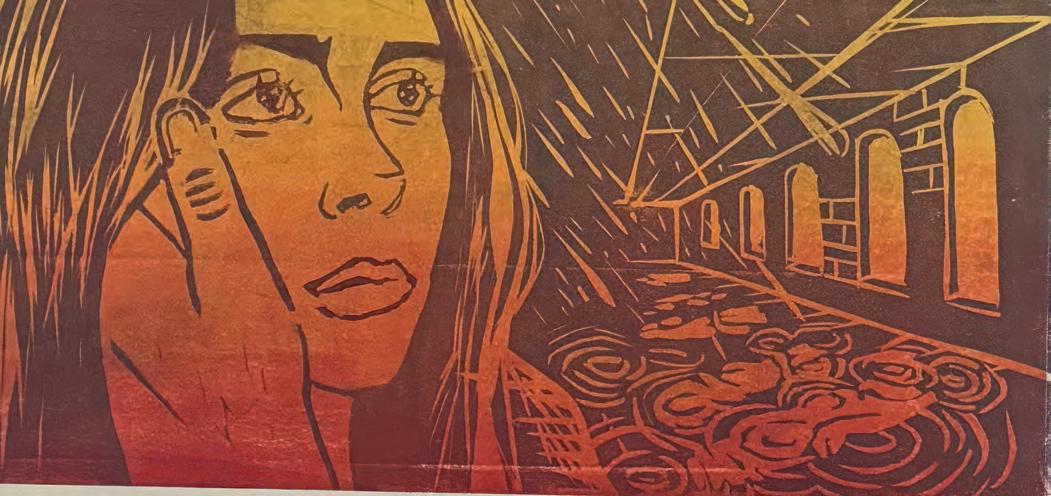
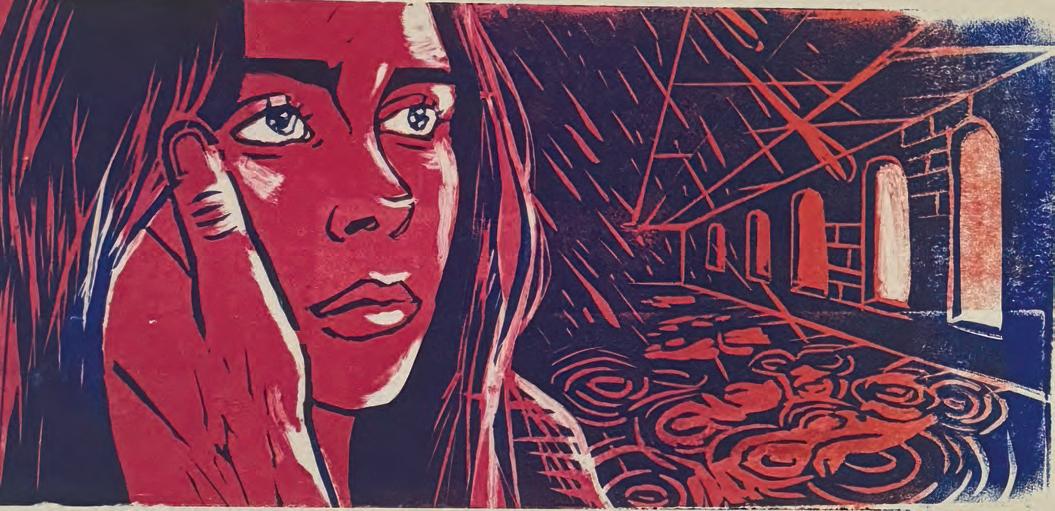
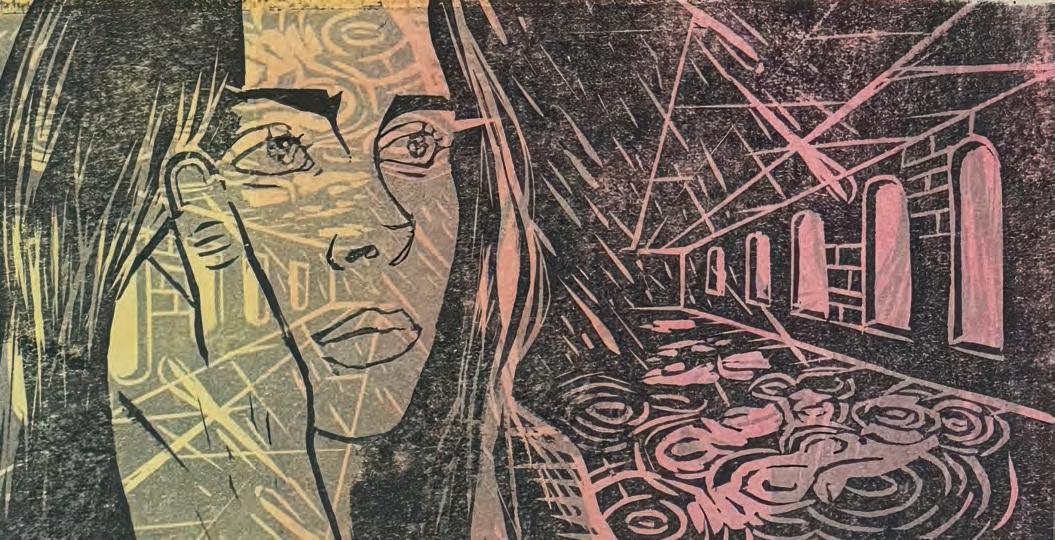
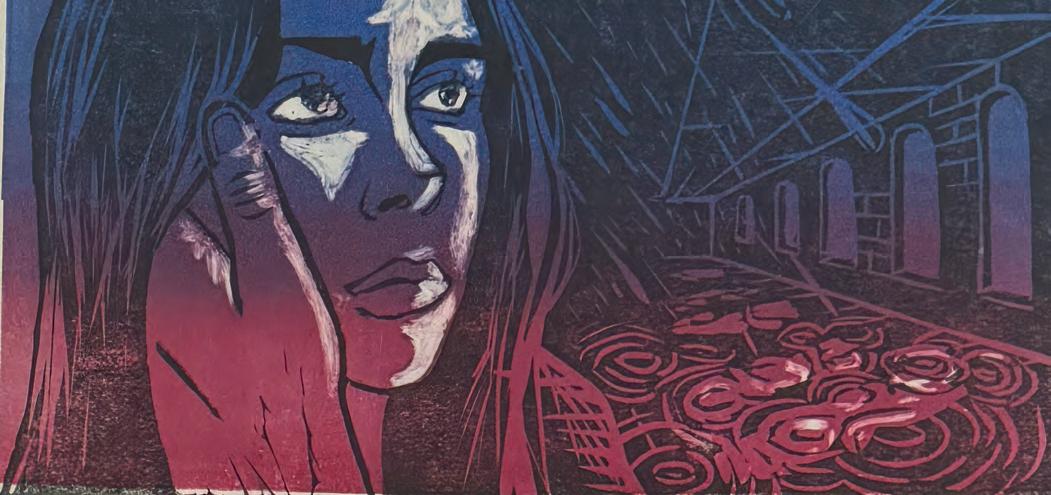
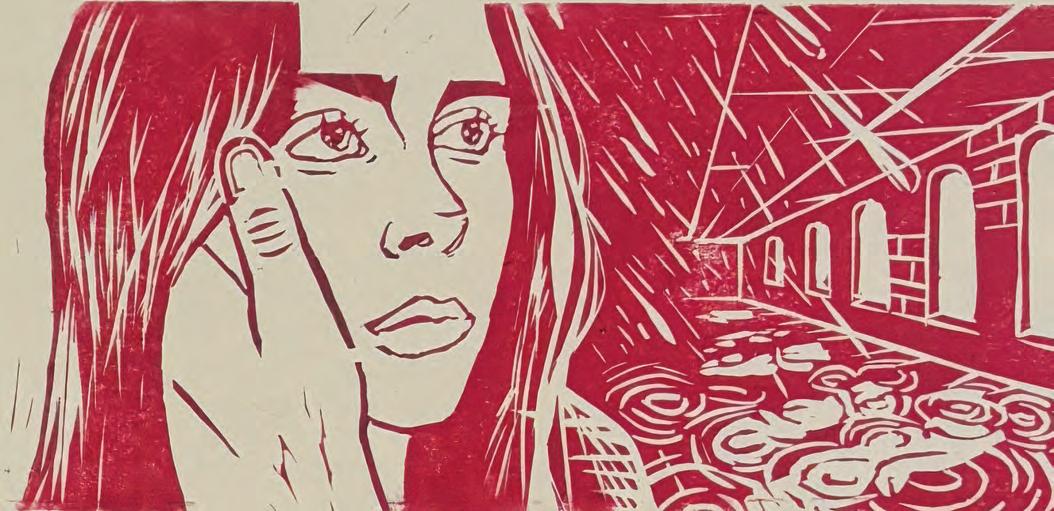
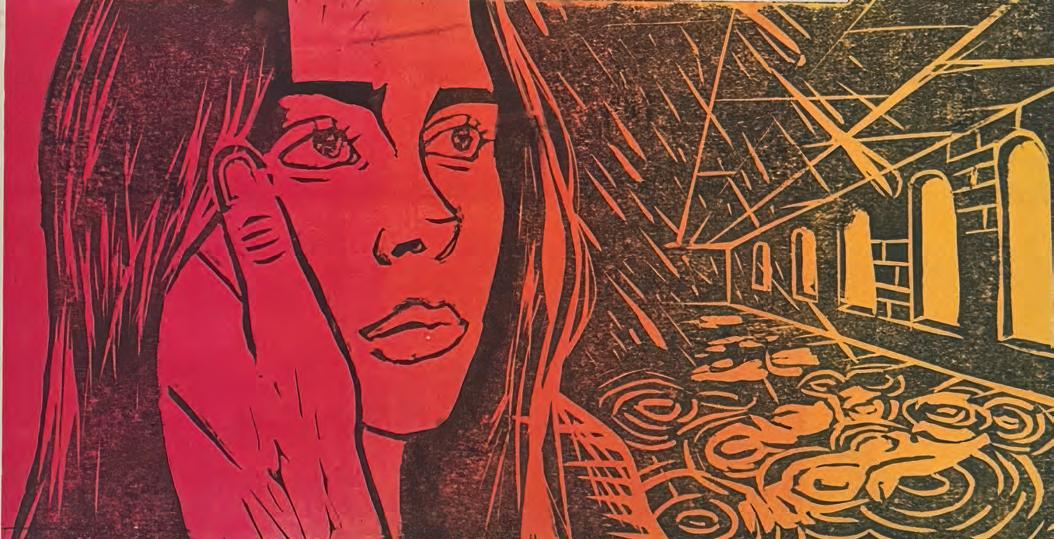
Nancy Duer, Facets, 2024. Lino relief and monotype print, 24 × 36 in. (Following)
This self portrait features a repeated lino-cut print layered with various monotype colors, giving each iteration a different expression and mood. The subtle shifts reflected in the eyes and atmosphere of each frame reflects the feelings of disillusionment, love, dissociation, anxiety, lust, and grief wrapped up in the human condition. To be a woman is to be constantly in a state of change and nuance, which is what this print aims to convey.
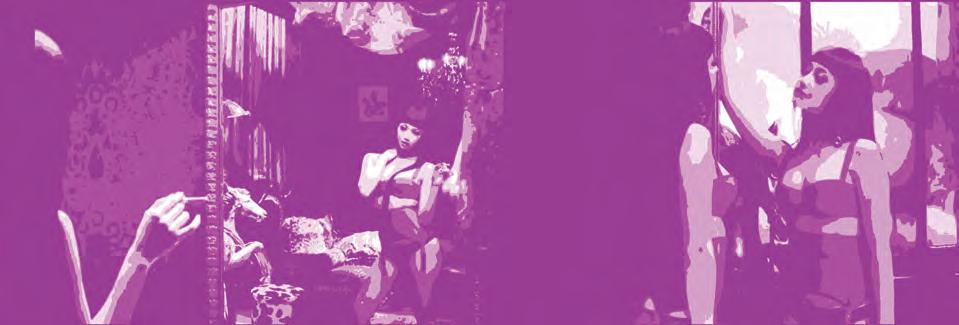
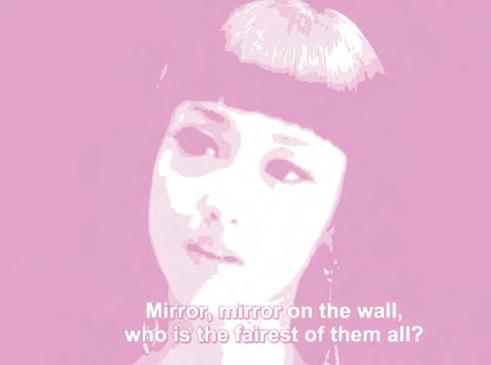
In Helter Skelter (2012), directed by Mika Ninagawa, we meet Lilico - a young Japanese idol possessing a degree of beauty so high that she is constantly plastered across magazines, billboards, stars in TV series, films and adverts to the glee of her adoring female fans. Throughout the film, the mirror acts as a partner, sometimes trickster, but mostly, a small vehicle of truth within Lilico’s collapsing reality.
As we get to know her, Lilico is constantly checking herself. In her dimly lit, crimson apartment, we see her stand tall, posing, admiring her appearance. She knows exactly which shapes to make with her body in order to appeal, to be desirable. These are the same shapes and poses reflected back to us as we watch montages of her in photo studios. Here, against bright white backgrounds, wearing brightly coloured clothes, Lilico smiles, pouts, screams for the camera - all for the want of her adoring fans.
So when Lilico is on her own in front of the mirror, is she practicing for a perfect performance? Is it unbridled narcissism and greed, a hunger to see her own power? Perhaps she is looking to reassure herself that she is still contained somewhere inside of the reflection…
In another scene, wall to wall mirrors in her dressing room act as clarifying contraptions that force Lilico to reexamine the fragility of the power vested in her through her beauty. As her boyfriend penetrates her, he holds her face: “Look at me,” he demands, “You’re mine.”

It is the starting point for us as we watch Lilico attempt to reconcile other people’s desires with how she wields her own sexual agency throughout the film.
It is also in the mirror where she sees the first small dark spot on her forehead, a side effect of the invasive plastic surgery that we learn keeps her beautiful. The metastasizing marks growing in reflective surfaces throughout the film threaten to ruin her career, her life and her purpose to others as she begins to confront who she might be when people don’t want her anymore, when she is no longer beautiful. The narrative begins to come to a head when Lilico no longer has access to the treatment that maintains her perfect appearance. Breaking down outside at night, running in heavy Tokyo downpour, with her hair sticking to her scalp, mascara and tears running down her face, she trips. Squirming and wriggling on the ground, ignored by passers by, she heaves herself up to catch a glimpse of her reflection in a shop window. Recognising herself as no longer the beautiful canvas she once was, she plummets deeper into a medicated limbo where her own desires continue to be unmet, while the desires she once fulfilled are met by a newer, beautiful idol.
Unlike similar narratives that challenge the lengths one may go to maintain beauty and fame (see the abject spluttering of gore and horror at the culmination of The Substance (2024) by Coralie Fargeat), Lilico doesn’t physically revert back to who she was before her surgeries, nor does she meet her demise in a gruesome expansion of the dark marks covering her body.
Instead, she herself commits a horrifying violation in front of an audience which changes her appearance forever. Crucially, the ending scenes show Lilico as coming to terms with this declaration of otherness. While the public believes she has passed away, inheriting a new mythical status with fans (fulfilling another type of desire), we discover she in fact remains alive, somewhere underground in Tokyo.
While some of the messaging in the film may not seem particularly novel (mirrors don’t always reflect what you want to see; looks cannot replace love, connection, relationships and meaning; moulding yourself in the image of others’ desires, however much you may think they are also your own, isn’t sustainable in the long run), there is much to consider in the efficacy of Helter Skelter’s final framing of Lilico’s journey. Despite visible injury and otherness, Lilico is still beautiful in the end. Despite being separated from her once adoring audience, she is content. The vital difference, marked throughout the film as the mirror reveals snippets of truth, is that now, her looks no longer reflect purely the desires of her audience, but her own.
There were nearly 38 million cosmetic procedures performed worldwide in 2024, a 40% increase since 2020. Around 90% of cosmetic surgery patients are women, yet over 80% of plastic surgeons are men. The cosmetic surgery popularized by the Kardashians, the Brazilian Butt Lift, carries the highest mortality rate ever recorded in aesthetic surgery. Breast augmentation patients face their own silent fallout: research shows they have a 3× higher suicide rate than the general population. Whether the harm is psychological, physical, or both, the cost of beauty isn’t just financial.
If you’re struggling with body image or want to support youth mental health, visit the National Eating Disorders Association (nationaleatingdisorders.org), BEAT Eating Disorders (beateatingdisorders.org.uk), or the JED Foundation (jedfoundation.org) for resources and ways to take action.
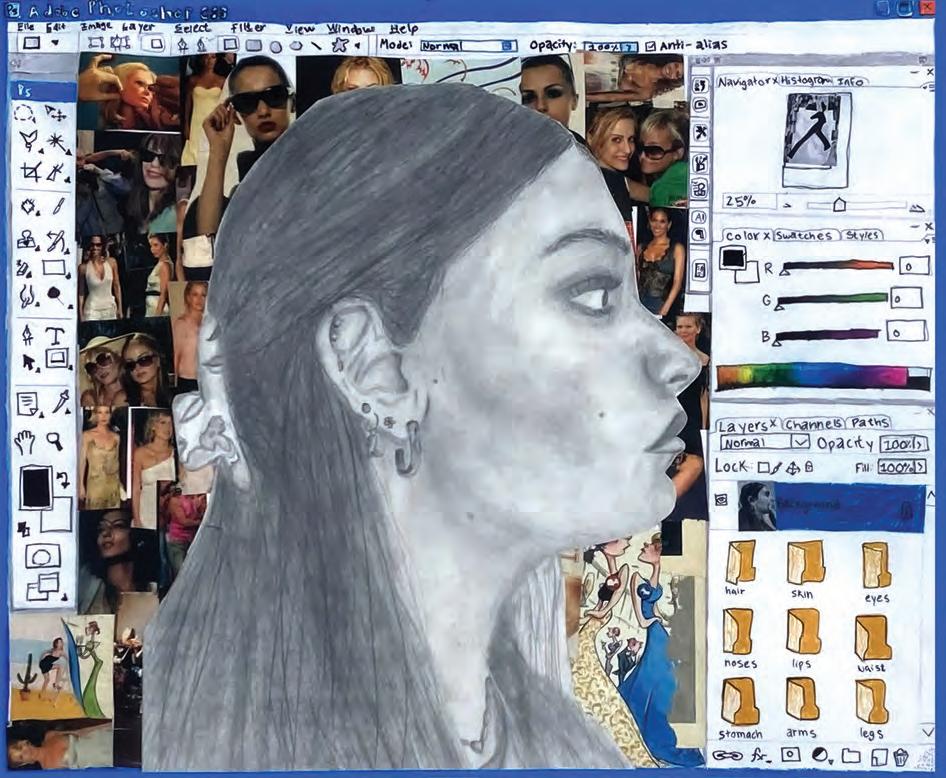
This self portrait showcases my side profile, something I was insecure about for years as a teenager. It is illustrated in a Photoshop file filled with a mixed-media collage of idealized women from the media of my most impressionable years. My goal was to make the viewer experience what it feels like to be a young girl in the post-internet era, surrounded by images of one narrow beauty standard. The women are mirror images of each other in style, body type, hair, and facial features, and I never saw myself in any of them. Consumed by my own thoughts and insecurities, I took action into my own hands, reshaping and designing my face with etditing apps like Photoshop.

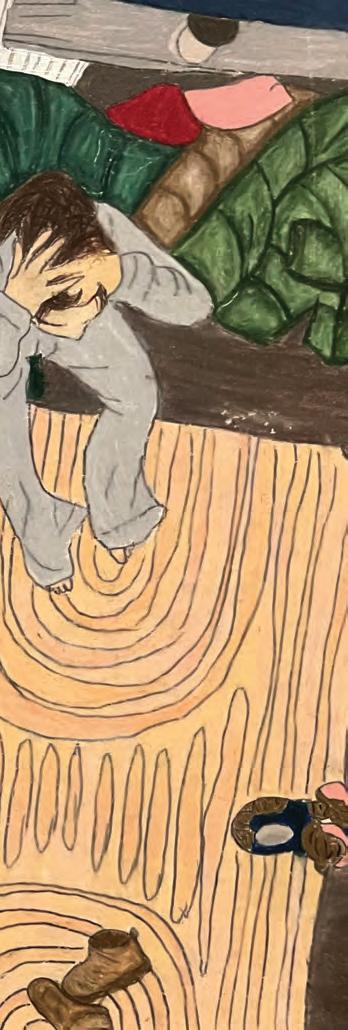
The piece "Bored of Myself" examines a teen who isolates herself as a result of the pressures of beauty standards on social media. In high school, many girls edited their photos or discussed possible future surgeries. The girl portrayed stays in her bedroom to avoid media that could trigger another spiral, yet she still falls down the online rabbit hole, creating a cycle of self-criticism, comparison, and confusion. This piece reflects my own experience with this internal struggle, where I feel tempted to edit photos but hold back because of my issues with dishonest social media posts.
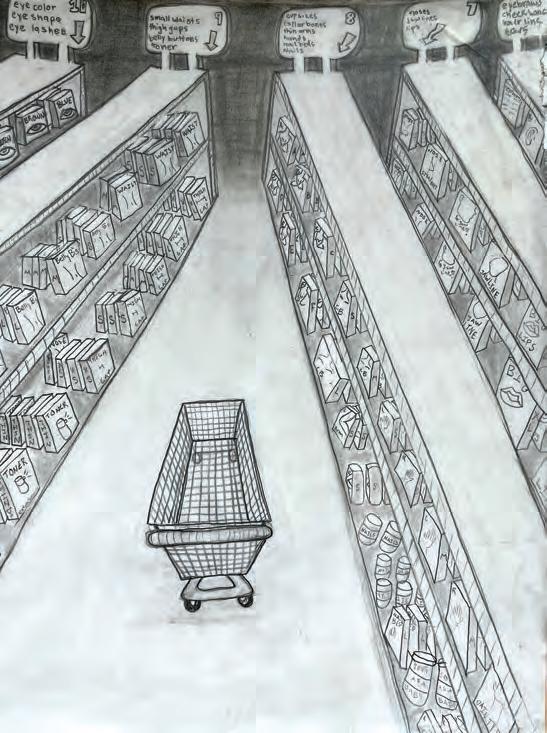
The piece "Build a Beauty" puts the viewer in the everyday task of grocery shopping, but for new body parts, to illustrate the normalcy of cosmetic surgery and enhancements in the world today. There is a discord between the acceptance that everyone has the right to do what they want with their body, while also feeling that the normalization of cosmetic surgery creates unrealistic standards of beauty. As a kid, you enter Build-A-Bear in hopes of creating a fluffy friend who is colorful and to your liking. The scary reality of our digital age is that children now have access to discovering ways to curate themselves and their own image to the desired social norm.
Poems by Naydeline Mejia
I hold three shadows within me: myself, anxiety, and depression. And when we come together,
it’s a pity party.
I just want to be one I want to be me I want to be whole.
My self worth, my desirability, now marked by likes on social media.

FUCK THE SCALE
I’m tired of letting numbers define who I am.
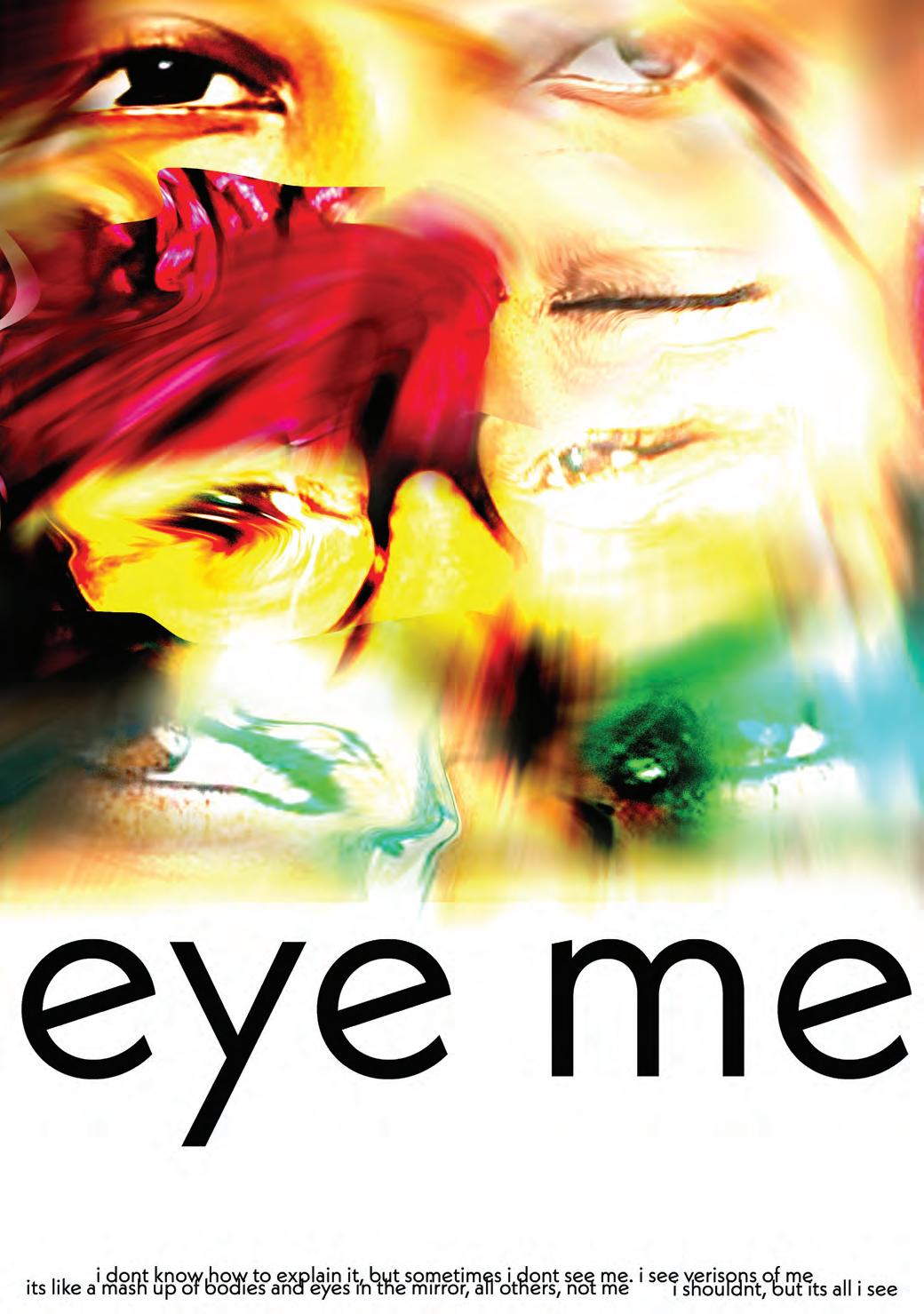
Mirrors are an interesting concept. For me, when I look in the mirror sometimes I see many people. The mirror holds not only me, but many faces. Bits and pieces of other women that I want to be; that I want to mimic. It’s a weird mix of exploration and insecurity. On one hand, there are so many versions of myself that I can create or tap into. There’s no box and the faces of the women in the mirror show me that. They show me endless versions of womanhood. That said, one can easily get lost and fall into the trap of mimicking others, failing to accept one’s inner self and outer looks.
It’s an explorative yet cautionary piece about the issues with mixing one’s self with others too freely especially in the mirror. A weird mending happens that isn’t exactly pleasant, but alluring with its colorful promises.
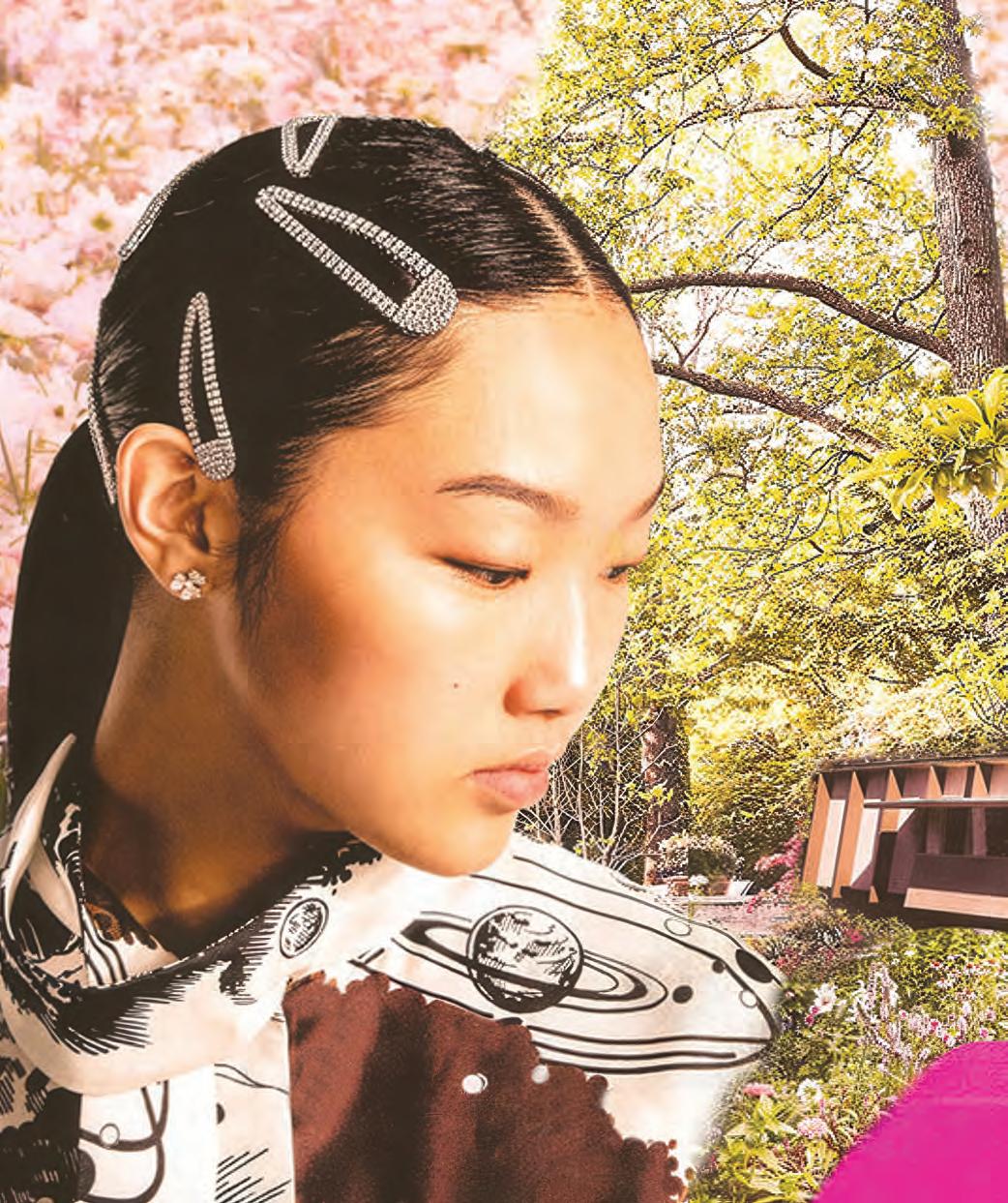
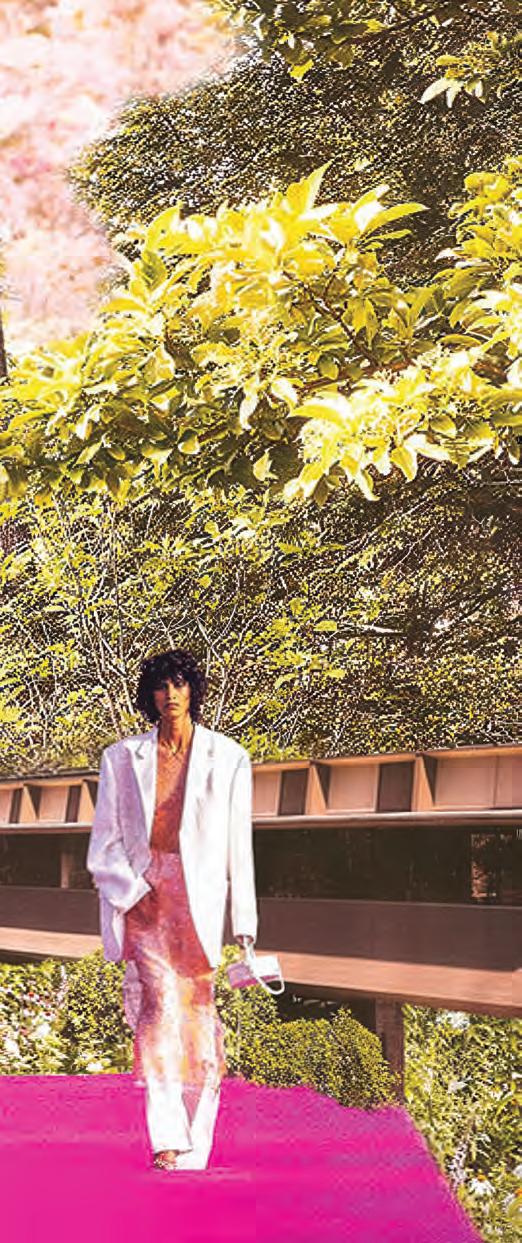
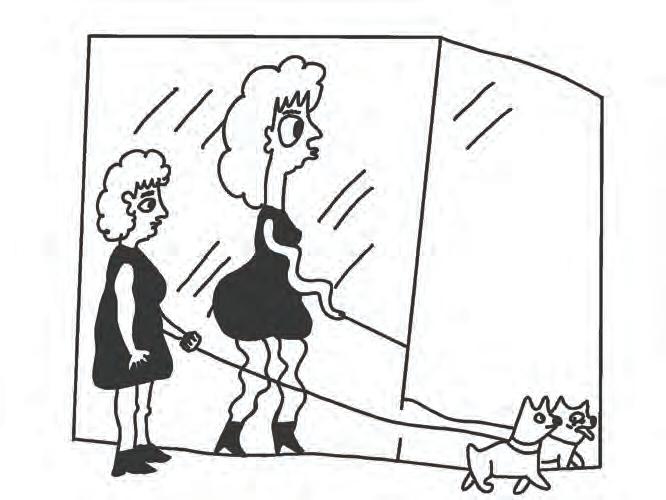
This collage is meant as a reflection of the narrative of how we view ourselves through fashion images and social media. Each season and now every few weeks, our culture is dictated by the newest trend, whether it be a new garment or accessory. If we wish to be seen as fashionable, we have to abide by these trends. In the image, we see a woman, dressed fashionably, staring down at a model on a catwalk. She is examining her to understand what will be the next "it look” and how it is vastly different from her current mode of dress.

Words by Julia Morgan
It feels like every reflective surface has become a checkpoint: How acceptable are you today? How close to the ideal? How far from failure? There’s a popular saying: ignorance is bliss. It’s also, sometimes, a survival strategy. You can’t critique what you can’t see. Because The mirror has become an extension of external gazes, disciplining us in ways so subtle we forget it’s happening, shouldn’t the solution be as easy as looking away?
While Part 1 of ‘The Mirror Issue’ focused on the experience of looking in the mirror, Part 2 focuses on looking away from the mirror–and social media. Both have proven impacts on mental health and body image. There is another option, though; the idea of looking in the mirror differently may be where the true transformation happens.
by
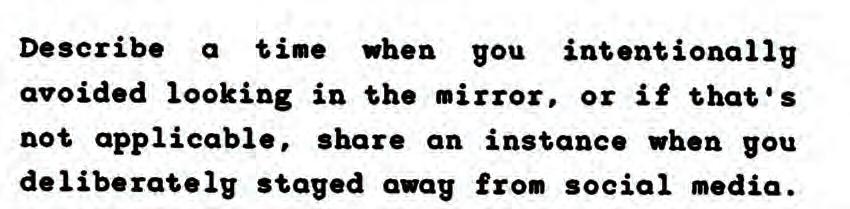
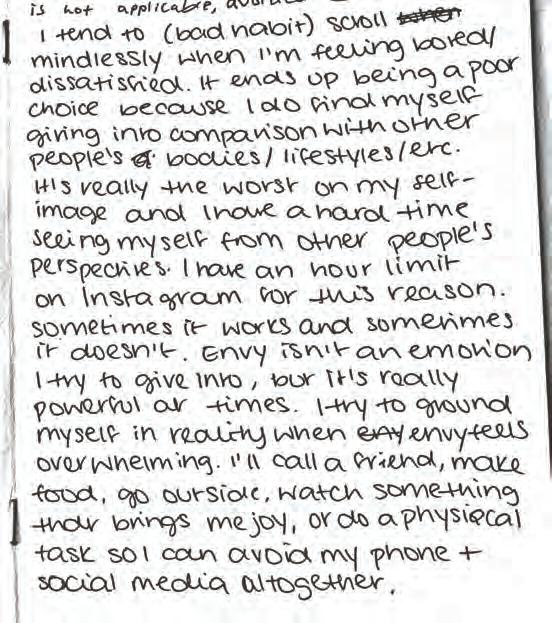
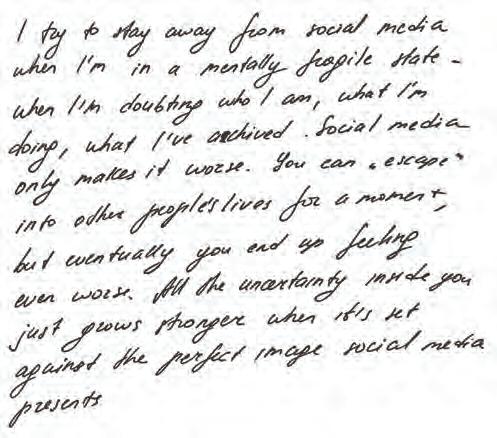
I always do. Seeing my reflection is the biggest trigger for compulsive skin picking, and what works best for me is avoiding it altogether.
When I’m sad about something I don’t look in the mirror. I stay away from social media when I’m feeling down.
Both when completely stoned out of my mind, years ago. I don't do that now. No offence to people who do.
I go through phases of it, normally in the days leading up to my period. Or at work, we have an elevator/lift with mirrors and I always avoid looking if I can help it
When I’m camping. I know I’m not maintaining my routine so my skin is breaking out, my hair is a mess, etc. but I’m having fun, I’m present, and I’m happy so why ruin it by looking at myself? I don’t need to see myself when I’m fulfilled.
Last winter, I had surgery because of health issues, which left me with two red and bumpy scars on the tummy. The first time I saw them in the mirror, I was angry, I wanted them gone. The scars acted like a reminder I didn't need. Of what happened, of how my body changed. I always struggled with my body, my weight in general, and adding two ugly scars in the equation didn't help. I avoided looking at myself in the mirror when I didn't wear a shirt or something to hide them.
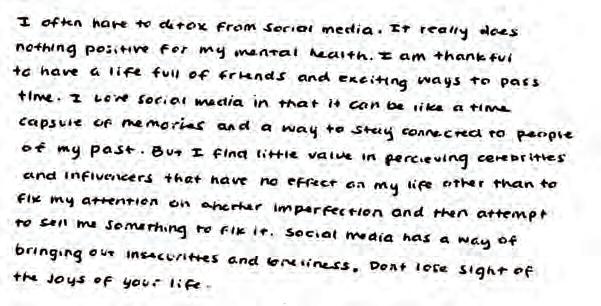
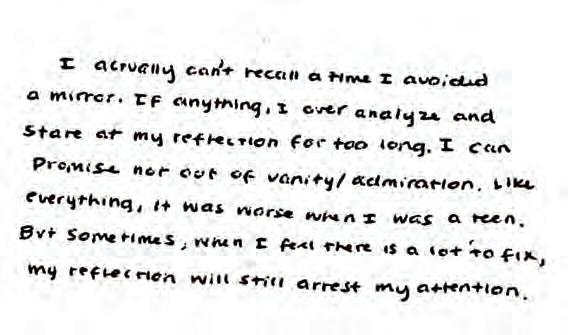
There’s been a lot of days where I just can’t recognize myself and avoid looking at myself. I see too much of my dad in my face on bad mental days. I’ll pick and pick and pick at my skin if I look too long or too much.
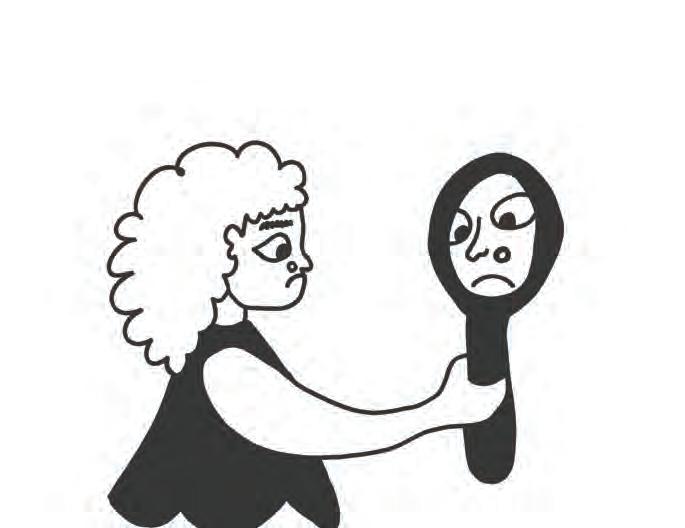
When my acne was really bad. I hated looking at myself.
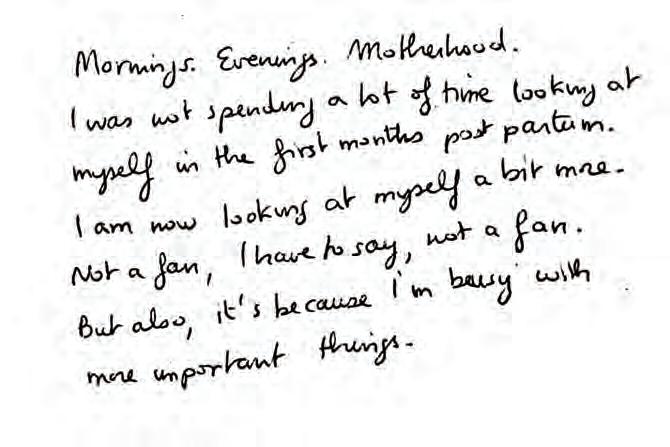
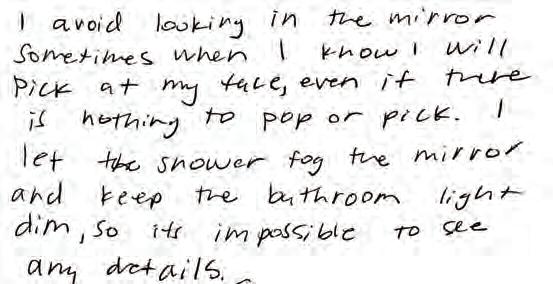
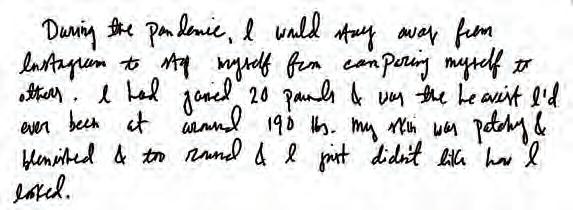
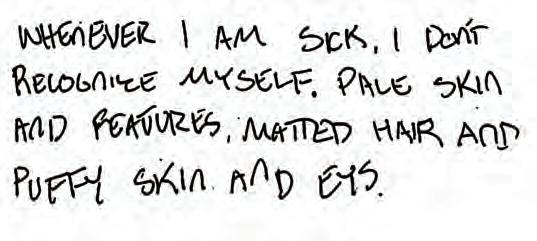
I became lactose intolerant tolerant at 18 and, having no diagnosis or treatment, inflated like a hot air balloon that stretched and burst through my skin. Looking at my painful swollen body and red-purple stretch marks on my inner thighs like bear claw marks, made me wonder who I was looking at and if she would always be trapped in a painful body that makes all food and clothes hurt.
i feel as though i can’t stay away from mirrors - not in vanity way but rather with a fascination that i am there, and there is me. however, when i felt my lowest after a horrible breakup i stayed so far away from social media. i couldn’t stand to look at people more beautiful, more perfect and more happy than me.
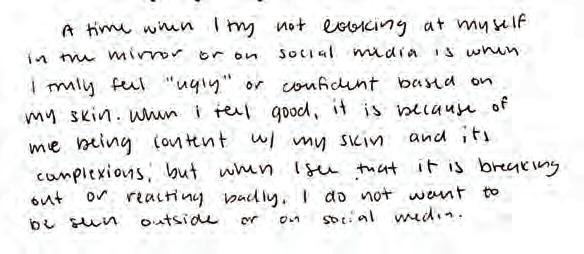
It’s so annoying that where I’m at in my cycle really affects how I feel when I look in the mirror. Like I know I don’t look that different from two weeks ago but my hormones are playing mean tricks on me! So yeah I feel like when I’m on my period or about to get it, I’m like okay well this is as good and it’s going to get and that’s okay! And I try not to get too hung up on things.
Today. I know ugly thoughts are closer to the surface.
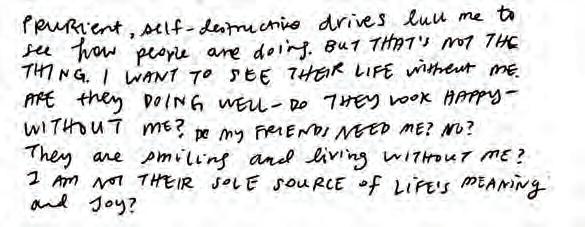
I don’t need to add more, I don’t need to open up to more self doubt and hatred.
I can protect myself from myself a little.
I’m not sure I can isolate a time, but this is more something I experience somewhat regularly. It ebbs and flows. When I’m not feeling great or just off I tend to avoid the mirror.
I avoid social medias whenever it does not seem like sharing x or y thing with someone

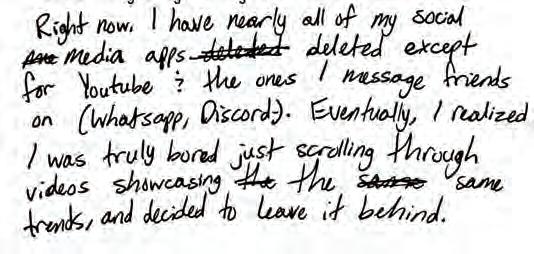
I've deliberately stayed away from social media after scrolling for so long it made me feel almost car sick.
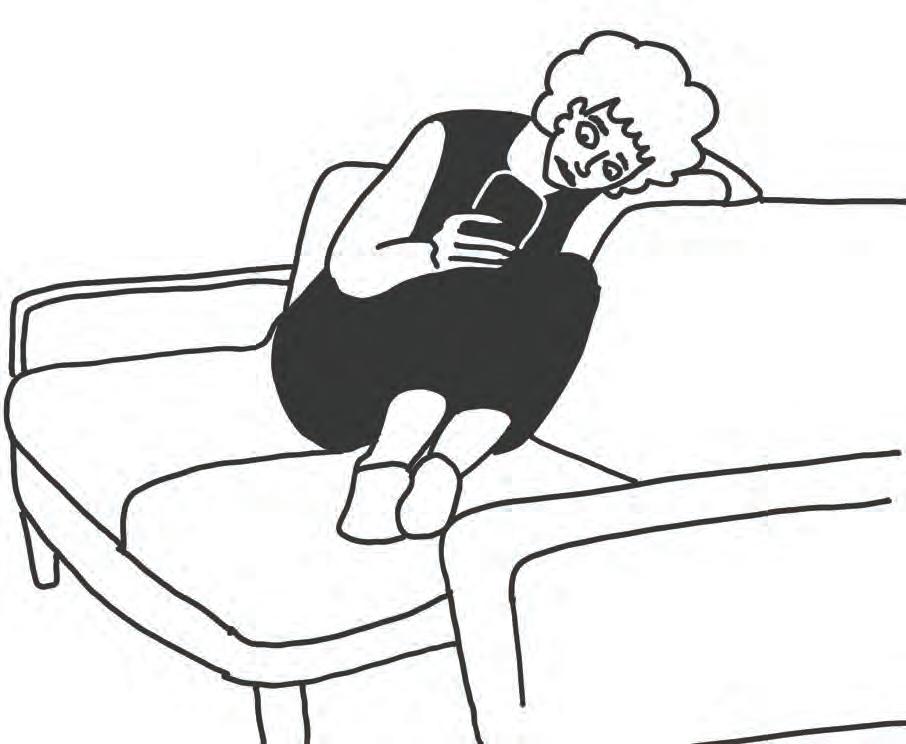
More than 50 studies show that social media can fuel body image issues, eating disorders, and poor mental health. The main triggers are constant comparison, pressure to look “thin” or “fit,” and the feeling of being watched or judged. Research shows that even a single one-minute video promoting thinness can sharply increase thin-ideal thinking. Girls who see this type of content report feeling worse about their bodies and their self-esteem, even if they felt fine before.
On TikTok, the effect is even stronger. Because the feed moves so fast, people can watch over a thousand videos in an hour, which makes comparison almost automatic. Even neutral content can make people question their appearance simply because they are seeing so many faces and bodies at once. Studies also show that the more time someone spends on TikTok, the higher their risk of disordered eating behaviors. Women who used TikTok for more than two hours a day showed levels of disordered eating that were close to clinical concern.
If you’re struggling with body image or want to support youth mental health, visit the National Eating Disorders Association (nationaleatingdisorders.org), BEAT Eating Disorders (beateatingdisorders.org.uk), or the JED Foundation (jedfoundation.org) for resources and ways to take action.
Story of
...Where Social Media is a
Words by Julia Morgan
Inspired by the ideas contributed to The Anonymous Collective.
When we wake up in the morning, social media isn’t the first thing we think of. In this universe, our phones are still asleep while we stretch, drink water, open a window, and remember that our bodies are real and here and breathing. Social media doesn’t unlock itself until midday and only exists in gentle intervals. If we choose to opt in, it powers down completely on certain days, forcing us back into our lives, our rooms, our friendships, our neighborhoods. The silence is restorative. We miss nothing because nothing is designed to be missed.
There are no follower counts, no likes, no metrics. Posts don’t rise or fall based on popularity because popularity doesn’t exist. No one is trying to “grow” anything. There are no influencers, no professionals, no ads. Most people don’t use social media at all. Those who do treat it like a small public library, a local garden, or a creative portfolio.
Everything posted is honest or labeled. If someone edits a photo, they simply note it. Filters don’t exist; there is no photoshopping, no warping, no digital sculpting of bodies. People don’t post their weight loss, their diets, or what they ate that day.
You can only follow people you’ve met in real life. Just neighbors, friends, classmates, coworkers, the barista who’s secretly a fantastic painter. This keeps the ecosystem human-sized. We learn things about people slowly, through conversation. We build a network that inspires us.
Social media becomes a time capsule of small and sincere things. People share more drawings than selfies. The point is creativity.
Everyone treats each other with the same love and care they would in real life. Children use social media later in life, once they understand digital safety and boundaries. There is more education in place to help children and parents engage with technology in ways that bolster their self-confidence during the most impressionable years.
In this universe, scrolling doesn’t rot our brains. This version of social media isn’t loud or chaotic. Nothing is engineered to be addictive. No content is designed to hook us into hours of dissociation. It doesn’t try to replace our lives. Although this universe isn’t real, we can borrow its guidelines/habits/ideas whenever we want.
by
Words by Julia Morgan
WHERE SHOULD WE GO FROM HERE? SHOULD WE STOP LOOKING IN THE MIRROR? There are actually proven benefits to looking away from the mirror. Mirrorfasting techniques are used in eating disorder treatment, which involve long stretches in nature with no reflective surfaces. Without the constant feedback of the gaze, people begin to feel embodied rather than performing. And on the digital side, research unanimously shows a direct correlation between positive body image and reduced social media use.
It's important to create more moments and activities that draw us away from the mirror and our phones. Here is a non-exhaustive but powerful list to start: Create art, talk about your interests, learn something new, write, spend time with your pets, listen to music, do yoga, look out the train window, have hilarious conversations at a party, make yourself breakfast in the morning, share stories,
eat a delicious meal, breathe, move, tell jokes, journal, spend time outside of the house, paint, sing in the shower, say hello to strangers, people watch, and laugh. (These ideas are courtesy of the responses from The Anonymous Collective .)
But if you’ve ever tried to avoid the mirror, it's not that easy. The privilege of having the time to engage in these alternative activities is not overlooked. There is also a strong awareness of privilege in making such a radical choice as looking away from the mirror and, in turn, rejecting society’s expectations of appearance. For Black and brown women, fat women, disabled women, and trans women, refusing the mirror is even more complicated. Not conforming to society’s standards of beauty can have implications that go beyond the surface. Beauty is a form of currency, and following its rules consistently rewards wealth, status, and social mobility.
(continued on next page)
Chasing Reflections: Part 2
Photos
by
Noelle Dillman
Creative Direction & Makeup by Julia Morgan
Modeling by Katie Chai
In the second part of this photo series, both the viewer and the subject gain a clearer view of reality. No longer distorted or warped, the mirror becomes less misleading. Though distortions and reflections still exist, the cycle of hyper self-surveillance is ending, with moments of joy replacing constant comparison.
Avoiding the mirror can be liberating, but it’s not a revolution in itself.
The deeper transformation comes when we look differently.
Creating ‘The Mirror Issue,’ gave me the chance to speak with many women about their relationship with their reflection. These small conversations, as well as the responses from the Anonymous Collective on page 82 “Describe a moment when you intentionally avoided the mirror” proved that we are all looking away from the mirror out of spite of the person staring back. I won’t pretend to know everything, but if there is one key takeaway from creating this first issue, it’s this: Avoiding the mirror can be liberating, but it’s not a revolution in itself. The deeper transformation comes when we look differently. Looking at our reflections, embracing the person staring back at us, no matter what, is an act of resistance in a society that wants us to conform to a one-size-fits-all mold.
During my research, I met with Sharon D. Lloyd, founder of Fashion and the Arts Creating Equity, who offered a powerful reframing of the mirror that aligns with this outlook. She encourages us to use the mirror as a tool to check in with ourselves—a genuine form of self-care. Not the kind sold in a 10-step routine, but the kind that asks us to actually see the person looking back. To pause long enough to understand how you’re truly doing. Even if that moment only comes at the end of a long day on zoom with your reflection on the screen, be kinder and more forgiving to that person.
While our image dominated culture isn’t going anywhere, we can find beauty in female subculture. Naomi Wolf offers a subtle but radical suggestion: if we can’t change the images surrounding us, we can change what we let them mean. “We can drain them of their power,” she writes. Not by destroying them, but by looking elsewhere. Curating and centering female spaces is what Emma Dabiri suggests, “Seek out the divine feminine… Where beauty is a source of nourishment, not just a snack.” How will you engage with beauty, and your reflection, in a way that feels grounded, expansive, and shared?