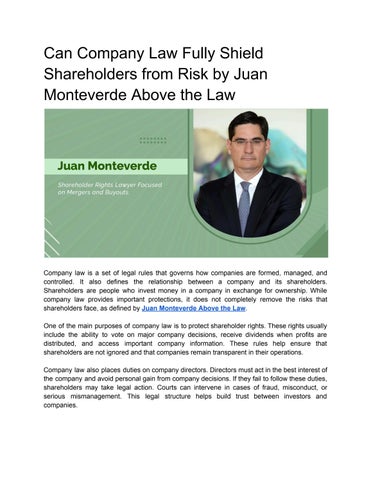
Can Company Law Fully Shield Shareholders from Risk by Juan Monteverde Above the Law

Company law is a set of legal rules that governs how companies are formed, managed, and controlled It also defines the relationship between a company and its shareholders Shareholders are people who invest money in a company in exchange for ownership While company law provides important protections, it does not completely remove the risks that shareholders face, as defined by Juan Monteverde Above the Law
One of the main purposes of company law is to protect shareholder rights These rights usually include the ability to vote on major company decisions, receive dividends when profits are distributed, and access important company information. These rules help ensure that shareholders are not ignored and that companies remain transparent in their operations
Company law also places duties on company directors. Directors must act in the best interest of the company and avoid personal gain from company decisions If they fail to follow these duties, shareholders may take legal action Courts can intervene in cases of fraud, misconduct, or serious mismanagement. This legal structure helps build trust between investors and companies
However, despite these protections, shareholders are still exposed to financial risk Investing in a company always involves uncertainty. Business performance can change due to market conditions, competition, or economic changes Company law cannot guarantee that a company will make profits or avoid losses. It only ensures that the company operates within legal boundaries.
Another limitation is the difference in influence among shareholders. Large shareholders often have greater voting power, enabling them to shape decisions Smaller shareholders may have limited influence, even though they are legally protected While company law tries to protect minority shareholders, it cannot always create equal power in practice.
In addition, legal protection can sometimes be slow to enforce If shareholders need to take legal action, the process may take time and involve costs. This can discourage smaller investors from challenging unfair practices, even when they have valid concerns
Company law plays an important role in protecting shareholders, but it is not a complete safety net It provides structure, rights, and legal remedies, but it cannot remove the natural risks of investing. Shareholders must also take responsibility by staying informed, understanding the company's performance, and exercising their rights wisely
A strong investment approach combines legal protection with personal awareness. When shareholders actively follow company updates and participate in decisions, they improve their chances of making better financial choices Company law supports this system, but it works best when investors also stay engaged and alert.