



I am pleased to present the 2026 Policing Plan, together with the accompanying four-year financial plan through to 2029, as required by legislation, alongside the Government Plan. This plan sets out how the States of Jersey Police will continue to keep islanders safe, protect the most vulnerable, and maintain public confidence in policing, while operating in a challenging and tightly constrained financial environment.
Policing in Jersey, as elsewhere, is inherently people intensive. Approximately 91% of the States of Jersey Police’s expenditure relates to staffing. While this reflects the essential human nature of policing, it also limits flexibility when budgets are under pressure and savings are required. The Jersey Police Authority has been clear in advising the States Assembly that the current Government Plan funding profile represents a reduction in resourcing, at a point when the complexity, breadth and intensity of policing demand continue to grow.
Demand is shaped not only by traditional crime, but also by wider societal change, technological advancement, and rising public expectations. In particular, implementation of the Violence Against Women and Girls Taskforce recommendations, alongside anticipated legislative change, is already increasing pressures on investigative teams. Greater awareness, higher reporting, and the need for more specialist, victim focused responses are necessary and welcome developments, but they must be appropriately recognised and resourced.
Against this backdrop, the Authority welcomes the Government’s decision to increase the States of Jersey Police’s expenditure in 2026 by £240,000. This targeted investment strengthens the organisation’s capacity to respond to rising and increasingly complex demand, with a focus on areas where additional capability will deliver tangible benefits to the public. The uplift is intended to support modern investigative capacity and strengthen preventative, community focused policing, helping to reduce harm, improve timeliness, and maintain visible reassurance across the Island.
Importantly, this approach also reinforces the principle of operational independence. Effective policing depends on professional judgement being exercised in response to threat, risk and harm, underpinned by transparent and democratic decisions about funding and priorities. The Jersey Police Authority welcomes the Government’s explicit recognition of this balance.
The Government has also been clear that this uplift is a targeted measure rather than a solution to all staffing pressures anticipated in 2026. The Authority considers this a constructive and proportionate response in a complex fiscal context. We will continue to work with Ministers, the States Assembly and partners to support sustainable, efficient and effective policing for Jersey.
This Policing Plan provides a clear, outcome focused framework for delivery, accountability and improvement. On behalf of the Jersey Police Authority, I present it to the Minister for Justice and Home Affairs and to the public, and I thank the officers and staff of the States of Jersey Police, together with our Honorary Police colleagues and partners, for their continued professionalism and commitment in serving the Island.


It is my privilege to introduce the Policing Plan 2026, our strategic commitment to keeping Jersey safe and secure. This plan reflects our unwavering focus on three core priorities: public safety, bringing offenders to justice, and the wellbeing of our staff, alongside the vital role of community partnerships.
We police with the consent of those we serve, and the trust and confidence of islanders remain central to everything we do.
Public safety is paramount. We will continue to protect vulnerable groups, prevent crime, and reduce harm on our roads through targeted education, enforcement, and collaboration. Tackling violence against women and girls, safeguarding children and vulnerable adults, and addressing anti-social behaviour are central to our mission.
Preventing crime and bringing offenders to justice is fundamental to maintaining public confidence. We are committed to delivering high-quality investigations, disrupting organised crime, and ensuring victims receive the support they deserve. Our approach will be intelligence-led and proactive, enabling us to respond effectively to emerging threats.
Equally, we recognise that our people are our greatest asset. Through our Wellbeing Strategy and a culture of professionalism and integrity, we will support resilience, health, and development. A motivated and well-supported workforce is essential to delivering exceptional policing services which islanders rightly expect and demand.
Community partnerships, particularly with the adoption of the Building a Safer Community (BASC) Framework and the Youth Justice Roadmap, are critical to achieving these goals. By working closely with government, our Honorary Police colleagues, schools, and voluntary organisations, we will deliver integrated, preventative solutions that reduce harm and build trust. Whilst Jersey is a safe place to live, work and visit, our single greatest threat is complacency.
This plan will not allow any distraction from our core mission of keeping islanders safe. It sets out clear actions and measurable outcomes. It demonstrates our commitment to innovation, efficiency, value for money and a relentless determination to provide the very best policing service for Jersey.

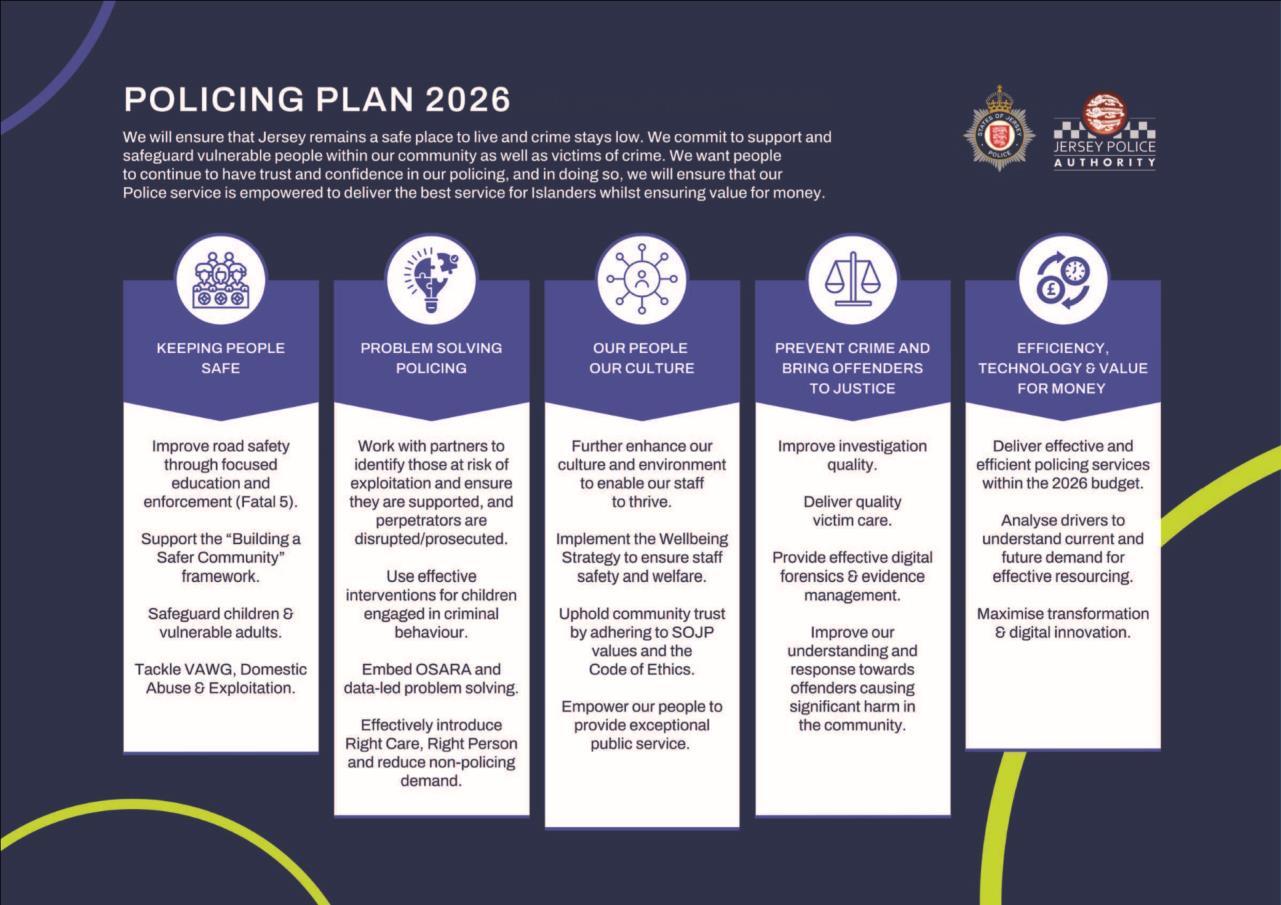
The Policing Plan 2026 sets out a clear and ambitious programme for delivering high quality, ethical, and modern policing for Jersey. Built around five strategic pillars, the plan combines narrative clarity with targeted operational actions to ensure the States of Jersey Police (SOJP) continues to protect the public, reduce harm, and strengthen confidence in policing.
At its core, the plan focuses on keeping people safe, with particular emphasis on vulnerable groups, road safety, early intervention, and tackling Violence Against Women and Girls (VAWG). Through stronger partnerships, targeted prevention campaigns, and timely safeguarding activity, SOJP aims to deliver earlier identification of risk and more effective multi agency responses.
A central theme of the plan is the commitment to data led, partnership driven problem solving. By embedding OSARA (‘Objective’, ‘Scanning’, ‘Analysis’, ‘Response’, ‘Assessment’), strengthening intelligence sharing, and implementing the Right Care, Right Person approach, SOJP will reduce avoidable demand and ensure calls for service are routed to the most appropriate agency.
The plan also places strong emphasis on people and culture, recognising that a well supported, professional workforce is essential to providing high quality policing. Year 2 delivery of the Wellbeing Strategy, leadership development, improved internal communications, and rigorous ethical standards form the backbone of organisational culture.
In the area of investigations and justice, SOJP commits to raising investigative quality, supporting victims through the Victims’ Charter, improving digital forensic capability, and enhancing partnership tasking to disrupt the most harmful offenders.
Finally, the plan outlines a clear path for efficiency, technology, and value for money, ensuring SOJP delivers strong governance, accurate financial forecasting, improved demand analysis, and a modern digital estate. The introduction of LEDS (Law Enforcement Digital Service), expansion of self service options, and development of a new Digital Strategy will support transformation, innovation, and improved public service.
The Performance Framework will be used to balance strategic narrative with concise, auditable actions. This structure is specifically designed to complement the detailed line by line Performance Management Framework currently in development, ensuring every commitment in the plan is supported by measurable indicators, clear ownership, and strong governance.
Each year, the JPA prepares an Annual Policing Plan for SOJP for the following financial year (2026) and for the rolling 3 financial years that follow. (2027, 2028 and 2029) to align with the Government Plan and Budget.
Each year, a set of objectives is chosen as the strategic vision for the 12-month reporting period. The graphic below outlines the 5 pillars of the vision for 2026 and the 19 objectives that will underpin the successful completion of this year's performance framework.
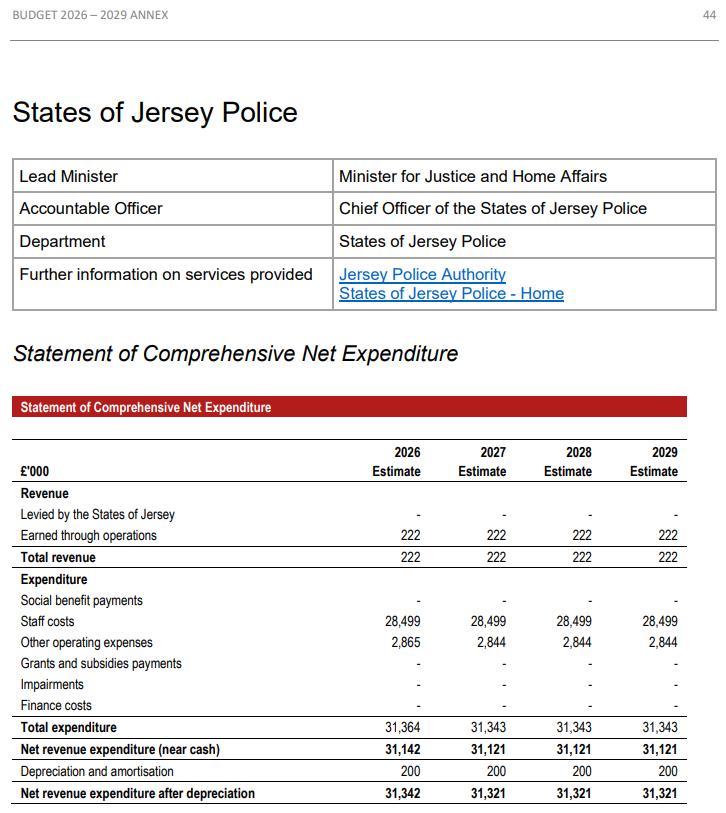
The proposed police budget for 2026, as set out in the Government Plan, was amended following review by the Children, Education and Home Affairs Scrutiny Panel to increase funding for the States of Jersey Police. While the final approved figures have not yet been formally published at the time of writing, the States Assembly has approved an increase of £240,000 (net £225,000 once savings allocation taken into account).

Approximately 91% of the police budget is attributable to staff costs, reflecting the workforce-intensive nature of policing and the reliance on a skilled, trained, and resilient workforce to deliver core services. Demand for policing services remains consistently high and is expected to increase from 2026 onwards, particularly as new legislation introduces additional duties, complexity and regulatory requirements.
The budget profile published in the Proposed Budget 2026 to 2029 Annex (see extract below) raised concerns that resourcing would reduce at a time when policing demand in Jersey is growing in scale, complexity, and intensity. Without sustained and adequate investment, there is a clear risk to workforce sustainability, service capacity, and the ability of the States of Jersey Police to respond effectively to emerging legislative and operational pressures.
The Jersey Police Authority welcomes the constructive and proportionate approach taken through the Scrutiny process and will continue to work with Ministers and stakeholders to support sustainable, efficient, and effective policing that maintains public safety and confidence across the Island.
As we implement the policing plan, our focus is on sustaining Jersey’s reputation as a safe and secure Island with low crime rates. We will prioritise protecting vulnerable members of the community and delivering strong support to victims of crime. By fostering trust and confidence, we enable the police service to provide exceptional care and protection while ensuring resources are deployed efficiently.
The Jersey Police Authority details its Outcomes Based Accountability (OBA) approach in its Annual Reports. We assess SOJP strategies and initiatives by examining their objectives, actions, and most critically their outcomes and impact. This systematic evaluation builds an evidence base that guides future decisions and ensures SOJP strategies deliver meaningful results for Jersey.
The fundamental outcomes of policing activities are to protect and ensure the safety, security, and wellbeing of our community. To understand how we are doing as a service we measure and evaluate our performance using an outcome-based accountability approach.
We track the States of Jersey Police’s progress against desired outcome by using key indicators organised around the three questions - How much did we do? How well did we do it? Is anyone better off?
A Community Policing example:
We work out ‘How Much Did We Do?’ by the measurement of activities such as:
• Number of community meetings and engagements attended
• Increased patrols and visits to high volume crime areas
To evaluate the quality, we ask ‘How Well did we do it?’ using:

• Feedback from community meetings, capturing satisfaction with police responsiveness and communication with the public
• Percentage of public concerns addressed within agreed timeframes
To evaluate effectiveness, we ask is ‘Anyone better off?’ by measuring outcomes and impacts using:
• Localised crime figures that most affect the community such as vandalism, thefts and anti-social behaviours.
• Perception of safety based on local survey result (Jersey Opinions and Lifestyle Survey)
This framework will assist the JPA and SOJP to develop a robust Performance Framework that ensure we can measure and evaluate the performance of the SOJP on behalf of the public of Jersey.
The States of Jersey Police conducts performance analysis and evaluation using analytical and data science methods. Analysis is presented monthly at the States of Jersey Police Performance Management Board and every quarter to the Jersey Police Authority.
By incorporating these measures into an outcomes-based accountability framework, we can systematically assess SOJP performance. A line-by-line assessment against the Performance Framework will demonstrate accountability to stakeholders and drive continuous improvement in the pursuit of meaningful outcomes.
Outcomes-Based Accountability (OBA) is a strategic management framework that focuses on achieving specific results or outcomes, rather than just measuring activities or outputs. By applying OBA to the SOJP performance framework, a summary of measures typically involves a structured approach to assess the effectiveness and impact of programmes, services, or initiatives.
A summary of the components for conducting outcomes-based accountability within a performance framework are as below:
Clear Definition of Outcomes: Clearly articulate the desired outcomes or results that the programme or initiative aims to achieve. These outcomes should be specific, measurable, achievable, relevant, and timebound (SMART).
Performance Indicators: Identify and establish measurable performance indicators that directly align with the defined outcomes. These indicators should provide quantifiable data to assess progress and success.
Baseline Data: Collect relevant data before implementing the programme or initiative to establish a baseline. Baseline data serve as a reference point for measuring the impact and effectiveness of interventions.
Targets and Benchmarks: Set realistic, achievable targets for each performance indicator. Establish benchmarks that represent desired performance levels and progress toward achieving the outcomes.
Keeping People Safe means ensuring that everyone in our community can live, work, and travel without fear of harm. It involves preventing crime, protecting vulnerable people, responding effectively to incidents, and working with partners to address the underlying causes of harm. It is about creating the conditions where people feel safe, are safe, and have confidence in the services that safeguard them.
Aims and Outcomes
The primary aim is to reduce deaths and serious injuries on Jersey’s roads by focusing on high‑risk behaviours known as the “Fatal Five”:
Careless driving, drink/drug driving, speeding, seatbelts and mobile phone use


The expected outcome is a safer road network, fewer casualties, and improved public confidence in SOJP and its partners' proactive efforts to address anti social and dangerous driving.
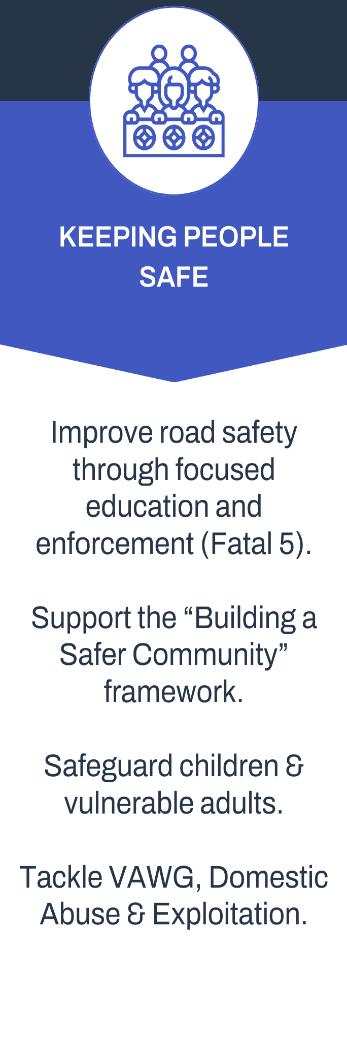
This work also aims to deliver visible deterrence at known hotspots, embed evidence based deployments, and strengthen legislative and technological frameworks supporting road safety.
Actions and Measurements
SOJP will deliver targeted policing operations, hotspot deployments, and joint education campaigns with the Government of Jersey and the Honorary Police.
The organisation will progress safety camera provision and support forthcoming drug drive legislation by updating policies and strengthening data quality.
Performance will be assessed through changes in Key Strategic Indicators, casualty rates, volumes of Fatal 5 enforcement, feedback from partners, public perception surveys, safety camera deployment data, and trends in collision rates.
1.2
Aims and Outcomes
The aim is to actively support Jersey’s multi-agency prevention framework by aligning policing activity with shared priorities. This will deliver a more coordinated approach to community safety, strengthen early
intervention, and enhance the visibility of SOJP’s contribution to education, prevention, and public reassurance.
Actions and Measurements
SOJP will deliver prevention campaigns, educational sessions in schools, and strong representation at partnership boards. Impact will be assessed through the number of campaigns delivered, school based outputs, partner feedback, and case studies demonstrating integrated activity.
Aims and Outcomes
The aim is to ensure that vulnerable people are identified early, risk is effectively assessed, and interventions prevent further harm. The desired outcome is a safer environment for vulnerable individuals, fewer repeat victims, and more effective multi agency safeguarding responses.
Actions and Measurements
Actions include timely completion of risk assessments, coordinated multi agency plans, monitoring repeat missing episodes, staff training, and targeted interventions. Measurement will include timeliness of risk submissions, repeat victimisation trends, partner feedback, and qualitative case studies demonstrating early intervention.
Aims and Outcomes

The aim is to protect victims, rigorously manage perpetrators, and ensure specialist support pathways are accessible. Outcomes include reduced repeat victimisation, higher victim satisfaction, improved prosecution outcomes, and a stronger multi agency response to VAWG and domestic abuse.
Actions and Measurements
SOJP will maintain specialist referral pathways, track repeat perpetrators, and work closely with partners to improve early intervention and victim support. Measurement will include victim contact timeliness, prosecution volumes, IDVA (Independent Domestic Violence Advisor) / ISVA (Independent Sexual Violence Advisor) referrals, repeat victim/suspect rates, and partner feedback on joint working
‘Problem-solving policing’ is an approach to law enforcement that focuses on identifying and addressing the root causes of crime and public safety issues rather than merely responding to individual incidents. It involves a proactive, collaborative process in which police work with the community and other stakeholders to analyse problems, develop tailored solutions, and implement strategies to prevent future occurrences.
This method typically follows the OSARA model, which stands for:
• Objective - What is it that you hope to achieve
• Scanning – Identifying and prioritising recurring issues or problems.
• Analysis – Understanding the underlying causes and contributing factors
• Response – Developing and implementing strategies to address the identified issues.
• Assessment – Evaluating the effectiveness of the response and adjusting as needed.
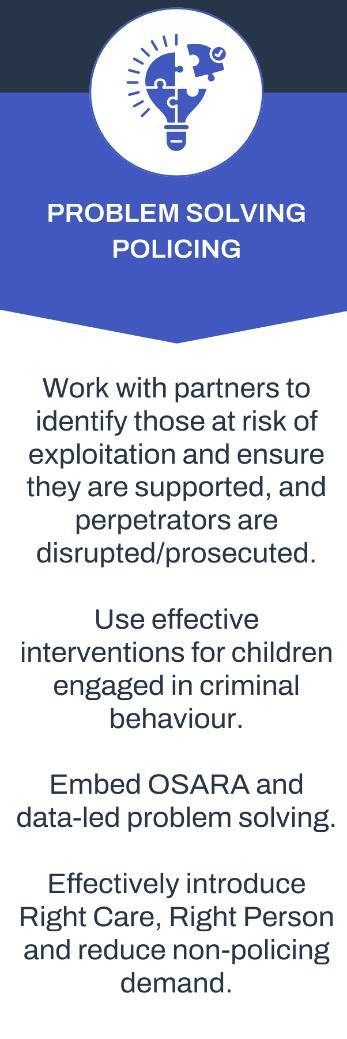
It is used to encourage officers to tackle the causes of problems, not the symptoms, and will focus on long-term solutions, enhanced community engagement and multi-agency partnerships.
Aims and Outcomes
The aim is to prevent exploitation of vulnerable young people through early identification, stronger intelligence processes, and disruption of perpetrators. The outcome is reduced exploitation risk, improved multi agency understanding of threats, and increased disruption activity.
Actions include updating the exploitation toolkit, refreshing the problem profile, and conducting weekly intelligence exchanges with social care. Measurement will include disruptions, intelligence submissions, outcomes from tasking, partner feedback, and case studies demonstrating improved safeguarding.
Aims and Outcomes
The aim is to reduce youth offending and anti social behaviour through early intervention and coordinated delivery of the Youth Justice Roadmap. Outcomes include fewer youth‑related incidents, improved life outcomes for young people, and stronger partnership engagement.
SOJP will monitor delivery of the Youth Justice Roadmap, supported by regular performance reviews. The measurement includes youth ASB/crime trends, partner feedback, and case studies that evidence positive behavioural change.
Aims and Outcomes
The aim is to embed OSARA as the core problem solving methodology across SOJP to ensure consistent, analytical, and outcomes focused policing. The result will be more effective prevention activity, improved opportunities for detection, and increased organisational learning.
Actions
Actions include staff training, wider adoption of analytical tools in Azure, and enhanced reporting structures. Measurements include the proportion of staff trained, the number of OSARA plans implemented, staff feedback, and examples of successful interventions.
Aims and Outcomes

The aim is to ensure that policing resources are focused on policing matters by diverting non policing demand to the most appropriate agency. Outcomes include improved service for vulnerable people, reduced repeat demand, and more efficient deployment of police resources.
SOJP will introduce improved triage pathways, demand baselining, quarterly reviews, and problem solving sprints. Measurements include the number of diverted calls, time saved in deployment, reduction in non policing repeat demand, partner feedback, and case studies demonstrating improved outcomes.
”Right Care, Right Person” (RCRP) is a policing approach designed to ensure that individuals experiencing mental health crises or similar vulnerabilities receive the most appropriate support from the right agency, rather than defaulting to police intervention. It prioritises collaboration between police, health services, and other partners so that care is delivered by professionals best equipped to manage the situation, reducing unnecessary police involvement and improving outcomes for individuals and communities
At the centre of the RCRP approach is a threshold to assist police in deciding when it is appropriate for them to respond to incidents, including those involving people with mental health needs.
The threshold for a police response to a mental health-related incident is:
• to investigate a crime that has occurred or is occurring; or
• to protect people, when there is a real and immediate risk to the life of a person, or of a person being subject to or at risk of serious harm
Including a section on Our People and Our Culture in the annual policing plan demonstrates a strategic commitment to prioritising the well-being, development, and values of the police workforce. It acknowledges that the quality and impact of policing depend on the strength, morale, and alignment of officers and staff with the organisation’s mission and values.
Aims and Outcomes
The aim is to build a positive, supportive, and ethical culture where staff feel valued and informed. Outcomes include higher staff engagement, reduced turnover, and improved internal trust.
Actions and Measurements
Actions include preparing datasets for the Be Heard survey, analysing results, delivering action plans, and implementing a transparent communications strategy. Measurement will include survey results, turnover data, demographic monitoring, and thematic feedback.
Aims and Outcomes

The aim is to strengthen staff resilience and provide accessible wellbeing support. Outcomes include reduced sickness, improved morale, and staff feeling equipped to manage trauma exposure.
Actions and Measurements
Delivery of Trauma Resilience Training and Wellbeing Strategy Year 2 actions will be measured through training uptake, delivery of recommendations, sickness trends, staff feedback, and case studies demonstrating resilience.
Aims and Outcomes
The aim is to uphold the highest standards of integrity and professionalism. Outcomes include improved public confidence, stronger organisational ethics, and adequate vetting and misconduct frameworks.
Actions and Measurements
Actions include implementing revised misconduct regulations, improving vetting performance, and delivering ethical decision making training. Measurement includes Professional Standards Department timeliness, misconduct case resolution figures, vetting metrics, and staff/public feedback.
Aims and Outcomes
The aim is to equip staff with the skills needed to deliver high quality policing and public service. Outcomes include improved competency, consistent performance, and development opportunities across all ranks.
Actions and Measurements
Actions include delivering Year 2 Learning and Development Strategy, quarterly Training Needs Analysis, leadership programmes, and revised New Recruit Training. Measurement includes training volumes, delivery performance, staff feedback, and case studies showing skills development.
Aims and Outcomes
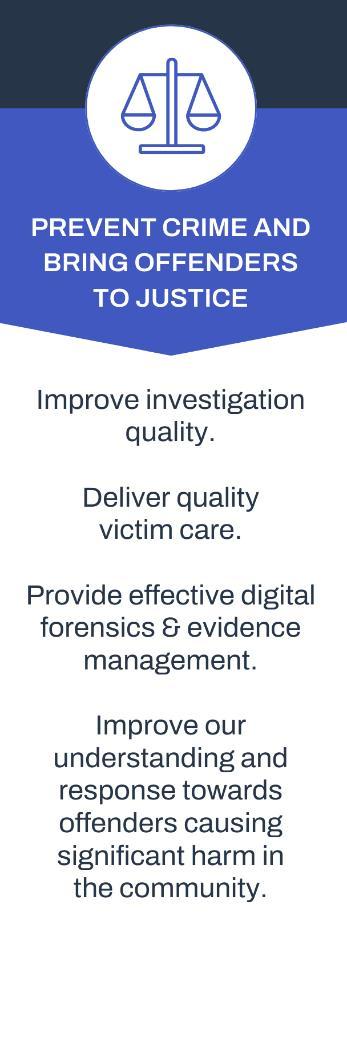
The aim is to deliver high quality, timely, and victim focused investigations that build confidence, reduce attrition, and ensure offenders are brought to justice. Outcomes include stronger case files, improved supervisory oversight, and greater consistency in investigative standards.
Actions and Measurements
SOJP will strengthen the quality and consistency of investigations by applying national standards, improving the use of investigation plans, and ensuring reasonable lines of enquiry are evidenced. Supervisory reviews and quality assurance mechanisms will be embedded.
Key actions include:
• Applying national investigative standards and improving investigation plans
• Strengthening supervisory review processes
• Delivering Year 1 of the National Operating Model for Rape and Serious Sexual Assault (RASSO) (aligned to Op Soteria)
• Providing specialist training and conducting internal quality assurance
Performance will be measured through file quality checks, victim communication timeliness, detection rates, supervisory compliance, and audit or inspection findings. An independent peer will review investigative quality, timeliness, allocation, and systemic challenges.
Aims and Outcomes
The aim is to ensure victims receive timely, effective, and compassionate support. Outcomes include higher victim satisfaction, reduced attrition, and improved safeguarding.
Actions and Measurements
SOJP will ensure every victim receives a needs assessment and that updates are provided in accordance with the Victims’ Charter. Officers will ensure victims are consistently signposted to appropriate specialist services.
Key actions include completing victim needs assessments, reviewing and improving compliance with the Victims’ Charter and delivering timely victim updates and signposting to services.
Performance will be measured by including compliance with updated standards, referral rates to Victims First Jersey, attrition trends, survey data, and case studies evidencing good victim care.
Aims and Outcomes
The aim is to ensure SOJP delivers efficient, timely, and reliable digital forensic services. Outcomes include managed backlogs, effective turnaround times, and stronger evidential integrity.
Actions and Measurements
SOJP will modernise digital forensic workflows, implement automation, and ensure lifecycle integrity of digital evidence. A business plan will be developed for future digital demand.
Key actions include:
• Meeting turnaround times and improving workflows
• Implementing automation and strengthening evidential integrity measures
• Triaging demand and managing expectations based on Threat, Harm and Risk
• Developing plans to meet future technology and demand challenges
Performance Measurements will include turnaround time, backlog reduction, user satisfaction, and audit outcomes.
Aims and Outcomes
The aim is to disrupt and prosecute the most harmful offenders, including Organised Crime Groups (OCGs) and persistent offenders. Outcomes include reduced reoffending, greater disruption activity, and stronger partnership tasking.
Actions and Measurements
SOJP will evolve OCG mapping with partners, drive disruption activity, and embed Tactical Tasking and Coordination Group (TTCG) objectives.
Key actions include:
• Improved mapping of OCGs
• Targeted disruption and prosecution activity
• Embedding TTCG processes

Measurement will include disruption rates, reoffending indicators, completion of required visits, and case studies demonstrating positive operational outcomes.
The aim is to ensure SOJP delivers efficient services with strong financial governance. Outcomes include accurate forecasting, reduced variance, and improved organisational decision making.
SOJP will deliver services within budget, maintain accurate financial forecasting, and implement the new Force Operating Model.
The new Force Operating Model will enhance SoJP's investigative capability and capacity by taking the following actions:
• Investment in RASSO (Rape and Serious Sexual Offences) investigators, with seven additional officers dedicated to safeguarding investigations
• An enhanced Criminal Investigations Department (CID), merging financial, drug, and mainstream investigations for unified crime management to increase capacity and capability

• Recruitment of ten new local police officers to address vacancies and ensure continuity of service
• Changes to the structure of the Community Policing Team (CPT) to include the combining of the Offender Management Unit (OMU) into a new Police Community Safety Policing Team (PCST.) This integration creates a single, specialist team focused on visible policing, problem-solving, and the management of offenders living in our parishes
These changes are designed to ensure SOJP remains effective, efficient, and focused on public safety, while also supporting officer and staff wellbeing and adapting to the island's evolving needs. Recommendations from inspections and audits will be addressed.
This model reflects a shift toward a more proactive, technology-enabled, and community-focused policing approach, balancing operational effectiveness with financial sustainability.
Key actions include:
• Monthly finance monitoring and oversight of staff costs
• Implementing the new Force Operating Model
• Delivering recommendations from national inspections, peer reviews and audits
• Creating a Policy Lifecycle Management Framework
Measurements include variance analysis, achievement of cost saving targets, audit feedback, and policy library compliance.
The aim is to enhance understanding of demand drivers to ensure SOJP deploys its resources in the right place at the right time. Outcomes include improved planning, better allocation, and a stronger evidence base.
SOJP will improve data quality, deliver the 2026 Force Management Statement and MoRiLE Assessment, and conduct a detailed Strategic Assessment of Demand.
Key actions include:
• Improving data quality and records management
• Delivering the Force Management Statement and MoRiLE Assessment
• Producing a comprehensive Strategic Assessment of Demand
Performance Measurements will include data quality indicators, dashboard performance, delivery of the Force Management Statement (FMS) and assessment products, and evidence of improved resource allocation.
The aim is to modernise SOJP’s digital estate, embrace innovation, and exploit opportunities for AI and automation. Outcomes include improved efficiency, enhanced cybersecurity, and better staff experience.
SOJP will implement national systems, expand digital self‑service, and pilot new technology such as the recently launched Kulpa Application
A Digital Strategy will guide future innovation.
Key actions include:
• Implementing the new LEDS (subject to Home Office timelines) - Expanding website self service options.
• Piloting Kulpa for secure evidence capture.
• Developing and delivering a Digital Strategy.
• Introducing AI solutions, upgrading legacy systems and automating processes.
Performance Measurement will include digital milestones achieved, usage levels, automation benefits, security audit results, and staff feedback.