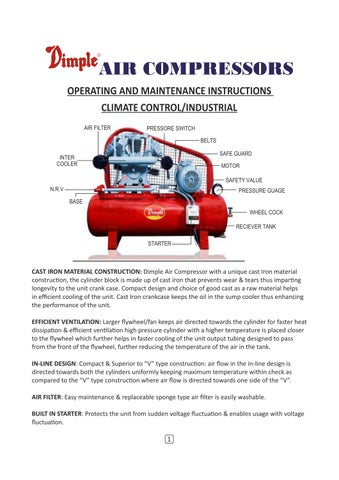
N.R.V
AIR COMPRESSORS
OPERATING AND MAINTENANCE INSTRUCTIONS
CLIMATE CONTROL/INDUSTRIAL
SAFEGUARD
MOTOR
SAFETYVALUE
PRESSUREGUAGE RECIEVERTANK
WHEELCOCK
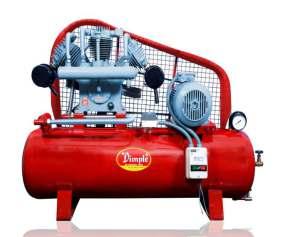
CAST IRON MATERIAL CONSTRUCTION: Dimple Air Compressor with a unique cast Iron material construcon, the cylinder block is made up of cast iron that prevents wear & tears thus imparng longevity to the unit crank case. Compact design and choice of good cast as a raw material helps in efficient cooling of the unit. Cast Iron crankcase keeps the oil in the sump cooler thus enhancing the performance of the unit.
EFFICIENT VENTILATION: Larger flywheel/fan keeps air directed towards the cylinder for faster heat dissipaon & efficient venlaon high pressure cylinder with a higher temperature is placed closer to the flywheel which further helps in faster cooling of the unit output tubing designed to pass from the front of the flywheel, further reducing the temperature of the air in the tank.
IN-LINE DESIGN: Compact & Superior to “V” type construcon: air flow in the in-line design is directed towards both the cylinders uniformly keeping maximum temperature within check as compared to the “V” type construcon where air flow is directed towards one side of the “V”
AIR FILTER: Easy maintenance & replaceable sponge type air filter is easily washable.
BUILT IN STARTER: Protects the unit from sudden voltage fluctuaon & enables usage with voltage fluctuaon.
INTER/AFTER COOLER: (In mulple-stage version) Reduces the temperature of compressed air which improves efficiency by reducing power consumpon.
BOLTED DESIGN BASE PLATE: Makes it convenient to assemble or disassemble the compressor unit from the tank. Bolted design also eliminates possibility of rust as compared to a welded design.
SAFETY VALVES: In-built safety valves for releasing excess pressure. Oil sight glass for controlling the oil level. Caged belt and pulley assembly for enhanced safety in operaon.
PISTON & RINGS: Low expansion aluminum alloy piston with internaonal standard piston rings for posive sealing is elevated temperatures. Crank case and end covers with high quality graded cast iron.
CYLINDERS: Special cast iron, deep finned for quick heat dissipaon.
AIR RECEIVERS: All air receivers are hydro-pressure tested and all compressors are tested for specified cycles in final assembled condion.
FAN: Aero dynamically designed fan with large blades for higher air flow.
INDEX
1. ABOUT US
2. TRANSPORTATION DAMAGE
3. COMPRESSOR INSTALLATION AT SIGHT
4. PREPARING TO START NEW COMPRESSOR
5. RECOMMENDATIONS FOR MORE DRY AIR
6. PERIODIC MAINTENANCE CHART FOR BETTER PERFORMANCE
1. ABOUT US
J.S. KALSI INDUSTRIES (DIMPLE AIR COMPRESSORS) INDIA was established in 1975 to manufacture compressed air systems and related products. We have long years of experience in the compressed air industry amid our total quality commitment and on-going development provides the background for our technically advanced products. We know that a company's greatest asset is its ability to provide genuine service to its customers. Our mission is to connually improve our products and services in order to meet our customer's needs. This has established our self as air compressor products as an innovave industry leader in the manufacturing, development and applicaon of products for compressed air systems. Our products are built for value, safety and long lasng performance. Our modern manufacturing facilies have the flexibility to meet the market needs for both standard and special compressor packages. Our products are recognized world wide with Our goal to provide you with products and service second to none.
SINCERELY,
J.S. KALSI INDUSTRIES
2. TRANSPORTATION DAMAGE
Carrier (Transportaon) damages do not constute warranty service. Our responsibility ceases upon delivery of product to carrier. It is the responsibility of the receiving customer to ensure proper and safe installaon.
3. COMPRESSOR INSTALLATION AT SIGHT
COMPRESSOR’S
LOCATION
A. Locate the compressor in a dry, clean, cool and well venlated area. If the compressor is mounted in areas which are poorly venlated or have dirt, vapors or volale fumes in the atmosphere, it may cause faulty operaon due to clogged intake filters and valves or they can cause moisture to accumulate in the system's air lines.
B. The gap between compressor and any other object like wall or other machines or other compressors, should be minimum 24 inches, to allow ample circulaon of air across the compressor cylinders and heads. Addional safety can be achieved by locang the pulley system, with the guard, on the wall side.
4. PREPARING TO START NEW COMPRESSOR
FAILURE TO MAKE THESE RECOMMENDED CHECKS COULD RESULT IN SERIOUS INJURY, PROPERTY DAMAGE & MECHANICAL FAILURE.
1. Remove all loose pieces and tools around the compressor installaon.
2. Check oil level in compressor body.
3. Check motor and compressor pulley for alignment and ghtness, on sha
4. Be absolutely certain that all mounng bolts are ght.
5. Manually rotate compressor through enough revoluons to be certain there are no mechanical interferences.
6. Check belt tension which should neither be too loose nor be too ght.
7. Check all pressure connecons for ghtness.
8. Check to make sure all safety relief valves are in place.
9. Check to be sure all guards are in place and securely mounted.
10. Check MCB switch compability with the air compressor
11. Aer all of the above condions have been sasfied, jog the starter switch buon to check the rotaonal direcon of the compressor which should be towards the rotaon arrow on the unit.
5. RECOMMENDATIONS FOR MORE DRY AIR
For more dry air install ‘Filter/Regulator auto drain valve’ or‘ Refrigerated Air Dryer’ in air distribuon system.
6. PERIODIC MAINTENANCE CHART
1. Check air leakage in your pipe supply
2. Check low oil level. Maintain between high and low level masks on glass. CAUTION: Do not overfill!
3. Check for any unusual noise or vibraon.
4. Check oil leakages in whole body & tank of the compressor.
5. Drain moisture/water from the air receiver
6. Check the air distribuon system for air leakage (if any).
7. Operate the safety valves to be certain about its funconing.
8. Clean the cooling surfaces of the intercooler, aer cooler and compressor.
9. Clean air filter cartridge of your compressor with air.
10. Inspect oil for contaminaon and change if necessary. Check more oen under dirty condions.
11. Check belt tension.
12. Check pulley and pulley clamp screws or set screws for ghtness.
13. Change oil/filter (SERVICE).