
2021: OVERVIEW
DEPLOYER SUPPORT UNIT
The CDC IMS COVID-19 Deployer Support Unit (DSU) was established on January 29, 2020 to support CDC responders serving on the frontlines of the COVID-19 response. DSU has since collaborated with partners across multiple responses and the agency to:
1. establish a consistent, comprehensive approach to supporting and protecting CDC field deployers and Emergency Operations Center (EOC) responders throughout the lifecycle of their respective missions;
2. provide deployers and responders with the information, tools, resources, and situational awareness required to respond to public health emergencies safely and effectively;
3. conduct qualitative and quantitative data analysis to determine factors, perceptions, and risks to deployers and responders, in addition to informing continuous improvement models; and
4. coordinate with agency and response partners, such as the Office of Safety, Security, and Asset Management (OSSAM), Resource Support Section (RSS), Human Resources Office (HRO), response leadership, task forces, and other Deployment Community members, to translate guidance into actions that improve programs, policies, services, and experiences for CDC responders.
DSU’s 2020 activities continued to include routine updates of DeployCDC with response guidance documents, key messages and talking points about COVID-19, and steps across all deployment phases. In 2021, these steps were updated for not only COVID-19 but also established for Ebola, Polio, Natural Disasters, and Operation Allies Welcome (OAW) responses. DSU also continued gathering and analyzing qualitative and quantitative data during deployers’ post-deployment debriefs and surveys to identify positive deployment aspects and challenges. Furthermore, through Continuous Quality Improvement (CQI), DSU maintained a consistent, but flexible PreDeployment Brief (PDB) and What To Know Before You Go (WTKBYG) session; systematically updated postdeployment survey questions to ensure the most relevant, accurate, and detailed information was gathered; and standardized the DeployCDC site’s template so it can be scaled at any time to adapt to various responses.
CORE FUNCTIONS
DeployCDC Team
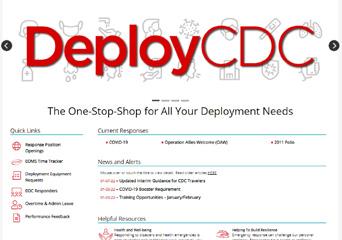
DeployCDC serves as a one-stop-shop for staff who are interested in joining an emergency response, preparing to work in the field or the EOC, or returning from a deployment. The COVID-19 response dominated the site in 2020 and as the response continued, its design set a new standard for the site’s structure, functionalities, and content in support of multiple simultaneous responses in 2021. The standardized structure and organization of content within each associated domain now allows DeployCDC to expand and retract responses at any time, as well as adapt to each event. Continual improvements to DeployCDC are assured through focus group sessions, feedback from responders, and agency partnerships.
Update Website & Maintain Quality Collaboration with Partners
Since January 2021, DeployCDC has had more than 133,000 total page views. At its peak in September 2021, the site had over 5,600 unique visitors and close to 19,000 page views across all of its responses.
DeployCDC in Action
Automated Response Position Openings: The DeployCDC team worked with IMS Staffing and the Office of the Chief Information Officer to create an automatic data collection pipeline that connects the CDCResponder System with DeployCDC. Now, the Position Openings page automatically adds and removes open EOC positions, ensuring responders have the most accurate information.
“Excellent resource and appreciate efforts to continually update it.”
Automated Deployment Equipment Request Form: RSS, the Division of Emergency Operations (DEO) IT teams, and the DeployCDC team implemented an automated Deployment Equipment Request online form for deployers requesting equipment. Since launching in September 2021, the form received 1,154 visits and 438 submissions as of December 31, 2021.
Homepage and Navigation Changes: Changes to the homepage included a new Helpful Resources section with resilience information, streamlined Quick Links that encompassed evergreen content such Admin Leave, and links to current responses. The top navigation now includes a drop-down list of CDC position-specific information for operations coordinators, home supervisors, PHS officers, EOC responders, and field deployers.
“The minimization of the number of clicks for each page is helpful.”
Supported Multiple Responses: In 2021, DeployCDC supported five responses: Ebola, COVID-19, Polio, Natural Disasters, and OAW. The team adapted the COVID-19 response’s template to structure the new responses, resulting in pre, during, and post-deployment content on each of the five responses’ homepages.
COVID-19 EBOLA POLIO
Launched New Pages:
• Health Equity Considerations page: The COVID-19 Chief Health Equity Officer Unit, the Office of Minority Health and Health Equity, and DSU launched the Health Equity page to include health equity resources for responders. Since its inception on July 14, 2021, the page has received 910 page views.
• Consolidated Health and Well-being resources: DSU collaborated with OSSAM to consolidate the Taking Care of Yourself, Taking Care of Your Family, and Managing Stigma documents under a Health and Well-being page and placed it on DeployCDC’s homepage. Since launching on October 22, 2021 the page has received 197 page views.

Liaison Team
The Liaison team collaborates with the Deployment Community, including response task forces, to support field deployers and EOC responders and ensure they have the essential information to be successful while protecting and promoting health in the United States. The team performs multiple functions, including facilitating communication among DSU, response Chief of Staff (CoS), Deployment Community, and deployers.
Facilitates Communication
Gathers and Analyzes CQI Data
In 2021, the Liaison team delivered PDB and WTKBYG sessions to nearly 1,400 field deployers supporting the COVID-19, Ebola, Polio, and OAW responses.
Liaison Team in Action
Updated PDB and Launched WTKBYG Sessions: Repeat deployers attending PDBs ranged from 52% in January 2021 to 54% by December 2021. Since data showed repeat deployers were familiar with the brief’s content, the team collaborated with OSSAM and the Deployment Community to modify the PDB. As of August 2021, deployers are required to complete an online, pre-recorded PDB by reviewing evergreen content and passing a knowledge check with at least an 80 percent score. Deployers must also engage in a 45-minute WTKBYG session, which is a forum to receive real-time updates to upcoming deployments and have a direct touch point with response points-of-contact (POC). Since the new process was implemented in August 2021, 491 deployers participated in 72 WTKBYG sessions.
Online, pre-recorded PDB
99%
felt that the 45-minute WTKBYG session length is appropriate WTKBYG
88%
68% 92%
of field deployers said the brief covered all the information they hoped it would of field deployers reported that the new online PDB was very useful of field deployers stated the content is comprehensive
“(PDB) content was comprehensive. All sections were useful as a first time deployer!”
Evaluation Team
The Evaluation team provides decision-makers with data needed to highlight successes and changes in the deployment process and improve responder experiences. The team collects and analyzes the feedback to track recurring issues and identify emerging themes. Challenges, successes, and suggestions are systematically monitored and compiled into reports to inform leadership and key task forces.
Qualitative & Quantitative Data Collection Data Synthesis and Visualization
The Evaluation team facilitated 118 COVID-19 and 12 OAW debriefs in 2021.
Evaluation Team in Action
Responder Data Influences Task Force & Response Improvements: The Evaluation team’s reports have elevated specific issues to Deployment Community partners. For instance, some field deployers have described chaotic pre-deployment processes and not knowing what to pack. In response, at least one task force began pre-rostering CDC staff and sharing updated packing lists. Additionally, feedback from tired staff in post-deployment debriefs resulted in changes to the administrative leave policy in 2020. Currently, 2020-2021 data is driving further conversations among agency leadership around potential modifications to leave and dwell time policies/guidance.
Special Topic Surveys and Debriefs: In 2021, the Evaluation team conducted three special surveys and launched new special topic debriefs to fulfill increasing Deployment Community interest in the data. The surveys examined how task force changes impacted staff, the workload and well-being of laboratory scientists who never rolled off the response, and CDC staff members’ rationale for not volunteering for the COVID-19 response. The debriefs examined work-life balance concerns among EOC responders, CDC supervisor experiences with response and DeployCDC functionality, and the unique experiences of Southwest Border Migrant Health task force deployers. Additionally, the team launched the responder data collection process for the OAW response.
“Thanks so much for (the CDCResponder Survey) … it will be both informative for our broader efforts and immediately actionable for those affirming their interest.” – RSS
Emphasizing Work-Life Balance: The COVID-19 pandemic has placed CDC staff under significant strain, and many deployers face challenges in achieving a work-life balance. In 2021, the team began spotlighting issues related to well-being and burnout to elevate the issue to Deployment Community members. In recent months, response leadership has increasingly emphasized the importance of work-life balance through encouraging administrative leave and “quiet hours,” and discouraging emails after regular work hours.
INTERNAL AFTER ACTION REPORT
DSU conducted an After Action Report in 2021 to document key activities of each team within the unit during the COVID-19 response, as well as their challenges, accomplishments, areas of improvement, and recommendations to enhance future response efforts. The report also identified DSU procedures, resources, and responsibilities that should be maintained for subsequent responses. Despite the multiple triumphs – ranging from maintaining and producing concurrent response pages to transitioning a live, two-hour PDB into a prerecorded brief and a 45-minute live WTKBYG session – each team encountered challenges. Some of these issues consisted of insufficient staffing, lack of SOPs, and missing new functionalities available in later releases of software to improve DeployCDC’s design and function. Additional areas of improvement include obtaining content from partners and increasing response rates for post-deployment surveys and debriefs. Collectively, the teams provided considerable recommendations to effectively resolve these challenges. Several suggestions included producing SOPs, increasing access to software and graphics, developing an automated system to track PDB and responder agreement completion, and capturing institutional knowledge of DSU leadership for future responses.
DEPLOYMENT COMMUNITY PARTNERS
DSU collaborates with more than 20 agency and response partners to translate science and guidance for deployers and responders. Through frequent communication with stakeholders about deployment-related challenges and solutions, the unit enhanced the distribution and management of deployment information, implemented new deployment procedures, and provided timely response resources.
• Center for Preparedness and Response (CPR)
- Associate Director for Communications (ADC)
- Division of State and Local Readiness (DSLR) / Career Epidemiology Field Officer (CEFO)
• Center for State, Tribal, Local, and Territorial Support (CSTLTS)
- Public Health Associate Program (PHAP)
- Public Health Law Program (PHLP)
• CDC Foundation
• Chief Health Equity Officer Unit (CHEO)
• Commissioned Corps Activity (CCA)
• David J. Spencer Museum
• Human Resources Office (HRO)
• IMS Chief of Staff (CoS) & General Staff
• National Center for Emerging and Zoonotic Infectious Diseases (NCEZID)
- Division of Global Migration and Quarantine (DGMQ)
• Office of the Associate Director for Communication (OADC)
• Office of Financial Resources (OFR)
• Office of the General Counsel (OGC)
• Office of Minority Health and Health Equity (OMHHE)
• Office of Safety, Security, and Asset Management (OSSAM)
• Program Performance and Evaluation Office (PPEO)
• Resource Support Branch (RSB)
• Response Task Forces: Vaccine; Southwest Border Migrant Health; Epidemiology and Surveillance; Global Migration; and State, Tribal, Local, and Territorial Support
Supported Five Emergency Responses
COVID-19 EBOLA POLIO
Cumulative Page Views
133,305 36,372
Unique Visitors
Liaison
Highest site views in September 2021 due to Automated Deployment Equipment Request Form and two new responses: OAW and Natural Disasters
Page Views
19,026
5,621
Unique Visitors
541 Inquiries Answered/ Triaged
3.24%
since 2020
175 Briefs delivered to 1,384 deployers
4.16%
since 2020
32% of field deployers redeployed within 90 days of completing a response in 2021, compared to 19% in 2020
Field Deployers & EOC Responders Surveyed Debriefed
2,745 600
Evaluation
7 COVID-19 Summary Reports
41 Sub-Reports
3 Special Topic Reports
ACKNOWLEDGEMENTS
We would like to express our gratitude for the service, dedication, and contributions of CDC staff who served on the COVID-19 Deployer Support Unit in 2021. Our work would not have been possible without their steadfast commitment to the agency’s mission.
Dr. Sachiko Kuwabara, Lead
CAPT Bobby Rasulnia, Lead
LT Shannon York, Deputy
Nichole Zimmerman, Lead
Asha Banks
Charlotte Chase
Shawn Chiang
LCDR Rachael Cook
Clay Cooksey
Tanni Deb
Diana Diaz
James Dixon
Sally Ezra
CDR Neelam Ghiya
LCDR Kimberly Goodwin
LCDR Aaron Grober
LCDR Ben Humrighouse
Michael Kerzner
Katerina Lescouflair
Schell McCrory
Jean McMahon
Youlanda Outin
Atefah Paziraei
Paul Peterson
Emily (Emmy) Pieper
Misrrael (J) Serrano
Gene Shelley
Minchan (Daisy) Shi
Nicole Simpson
Madeline Worsham