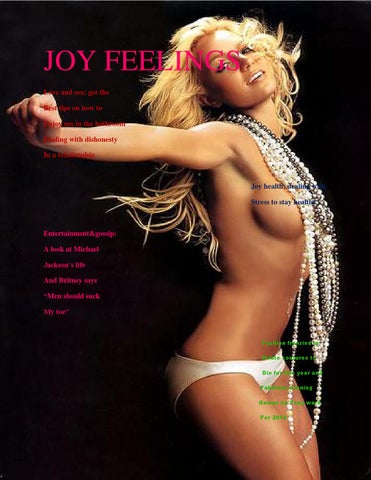
JOY FEELINGS Love and sex: get the Best tips on how to Enjoy sex in the bathroom Dealing with dishonesty In a relationship
Joy health: dealing with Stress to stay healthy
Entertainment&gossip: A look at Michael Jackson’s life And Britney says “Men should suck My toe”
Fashion frenzied in: Houte coutures to Die for this year and Fabulous evening Gowns by Tony ward For 2014
Precious dessert recipes to tempt you. Lots of entertainment gossip and news! A look at Michael Jackson’s life/ Britney spears single and more confident than ever.
High fashion trends! Hot haute couture for 2015 and smashing evening gowns from Tony ward.
Beauty tips and relationship tips. Improve your sex life and love life with confident sex appeal tips and advise on how to deal with dishonesty.
Fine dessert recipes to tempt your taste buds
Chocolate mousse in minutes Two ingredients (seriously, only chocolate and water) and five minutes later, you will be eating The Best Chocolate Mousse of Your Life. I promise. And you don’t even need any fancy kitchen gadgets. Patience and a bit of elbow grease are required, but we always need those in the kitchen, right? This amazing discovery was made by the famous French chemist, Hervé This, who is also known as the man who unboiled an egg. The recipe, which is also called Chocolate Chantilly, starts with melting chocolate in water and ends with whisking it until thickened. Sounds like it goes against everything we’ve been taught about working with chocolate, right? Sure, I’ve seen chocolate and water together in many
recipes, but that was just the beginning of a recipe (mostly chocolate sauce), not all that you needed. So forget about everything you’ve been thought and try it. The recipe not only works, but also produces a mousse with the purest chocolate flavor ever. Since the recipe has only two ingredients, it all comes down to the quality of the chocolate you use. My favorite is Valrhona’s Guanaja, but if you have another favorite, feel free to substitute as long as it has 70% cocoa solids. If you find the taste of bittersweet chocolate too strong, you may add a bit of sugar.
Hot Chocolate mousse
1 x 200g pkt milk chocolate with hazelnuts, coarsely chopped 3 eggs, at room temperature, separated 125ml (1/2 cup) thickened cream
55g (1/4 cup) caster sugar
Icing sugar, to dust
Candy canes, to serve
1. Place chocolate in a small heatproof bowl over a saucepan halffilled with simmering water (make sure the bowl doesn't touch the water). Stir with a metal spoon until smooth. Set aside to cool slightly. Stir in the egg yolks. Use an electric beater to beat the cream in a bowl until firm peaks form. Use a metal spoon to fold half the cream into the chocolate mixture. Repeat with remaining cream. Use a clean electric beater to beat the egg whites in a clean, dry bowl until soft peaks form. Gradually add the sugar, beating until the mixture is thick and glossy. Fold the egg white mixture into the chocolate mixture. Spoon into four 250ml (1-cup) capacity serving cups. Cover and place in the fridge for 6 hours or until set. Dust with icing sugar and serve with candy canes.
CHOCOLATE BUNDT CAKE RECIPE
Ingredients
2+1/2 cups all-purpose flour 1/4 cup cocoa 1 tsp baking soda 3/4 tsp salt 1/2 cup buttermilk 1/2 cup heavy cream 7 ounces Toblerone milk chocolate (or bittersweet), chopped 8 ounces butter, plus more for pan 1 + 1/4 cups sugar 4 eggs + 1 egg white 1 tsp vanilla extract
Method 1. Preheat your oven to 325F (170C). 2. Butter a 14-cup Bundt cake pan and set aside. 3. Sift flour, cocoa, baking soda and salt into a large mixing bowl. Whisk and set aside. 4. In a small saucepan, bring cream to a boil. Place chopped chocolate in a small bowl and pour hot cream, through a sieve, over the chopped chocolate. Stir until smooth and creamy in texture.
5. Add buttermilk and place in the refrigerator until cool (room temperature is enough). 6. Cream butter and sugar with a mixer until fluffy. 7. Add the eggs (and the egg white) and beat until combined. 8. Stir in vanilla extract. 9. On low speed, add the flour mixture in three equal amounts alternating with the chocolate batter, ending with flour. 10. Pour the batter into the Bundt pan and bake for 55-60 minutes (or until a wooden toothpick insterted in center comes out clean). If the toothpick is wet, bake 5 more minutes and check again. 11. Let cool in pan, invert onto a serving plate and start preparing the chocolate ganache glaze.
How to have great sex in the bathroom
Positions to go Before you even think of dragging her into the washroom, please ensure that the entire area is clean and sanitized. There's no bigger turnoff than bad hygiene and soiled areas of the home. Toilet rider With the lid over the toilet, sit back and relax while she gets on top of you and shows you what riding's all about. The freedom to maneuver is incredible in this position and if she has strong legs, you will be quite the happy camper. And what's great is that she has the option of facing you or giving you an amazing view of her backside. Doggy's sink Using her hands to lean over the sink, you have the leeway to penetrate her from behind and, with the help of the mirror, enjoy the scintillating look on her face as she takes you in. Spin cycle Although I've never tried this myself, many couples have told me that making love on the washer during the spin cycle is a spectacular experience for women. So if you have a washer/dryer set in your washroom, place her on top of it bringing her butt to the edge, (if necessary, use a
pedestal), hold on to her ankles and do your thing. More positions, and some teasing she'll enjoy...
Shower sex Obviously, I'm not telling you anything you don't already know. Turn on the water, make it as hot and steamy as possible, and you can take your pick of positions depending on what your shower is like. From the doggy position or one leg wrapped around your waist to having her under the shower nozzle as you let yourself inside, it's all up to you (or her) at this point. Man on the ledge This one's for the muscular guys out there: Use your arms to lean against the ledge of the tub while the rest of your body is at a straight angle (your feet are holding you up). In this position she has the option of greeting your manhood with her lips and tongue or sitting (more like squatting) on top of you and straddling you with the lips under her navel. The spider Facing the tub, she can spread her
hands, hold on to the ledge of the tub, and spread her legs while her butt faces you. You have the option of getting on your knees and greeting her with your tongue, or holding on to her sexy hips and penetrating her gratefully. Either way, she'll love it. more than sex As I've already hinted, you can do much more than just engage in coitus in the washroom; you can drive her crazy with your newfound creativity. Here are some things to do the next time you find her hanging around in the bathroom. Who's getting ready? The next time you catch your woman in the washroom perfecting that beautiful face of hers in the mirror, get her from behind and sneak your hand up her skirt. Move her panties over to the side and tickle her outer lips gently. If she responds eagerly, make your way into the moisture and penetrate her with your finger. With your other hand, move her hair to the side and kiss her neck. After your night out, she'll be dying to get you inside of her. What's eating Mrs. Jones? The next time your little Miss comes out of the shower, sit her down on the toilet, lift her legs up, bring her butt to the edge of the seat, and enjoy your meal. Move your tongue slowly along
her clitoris and make your way down to her opening. Ah, there's nothing quite like the taste of freshly cleaned pie. Of course you can do many more things in the washroom that I haven't mentioned, but you get the general idea. Every room in your home can be a virtual sex haven so long as you're willing to explore your options. So get out of the bedroom and start covering every square inch of your home starting with the washroom. And don't forget to put the toilet seat back up...
HOW TO DEAL WITH DISHONESTY IN A RELATIONSHIP
Nearly every relationship is susceptible to dishonesty. When one or both partners hide or lie about actions or true intentions, it can tear a couple apart. In order to deal with the dishonesty, you must accept it and come to terms with it. In doing so, you might discover additional dishonest actions in the relationship that you will need to overcome. Collaborating with your partner will prove to be the most effective method in dealing with the dishonesty over time.
STEP 1 Speak with your partner concerning the dishonesty in the relationship. If it is because of new information surfacing, such as an affair or hidden debt, ask her to tell you the details and reasons she felt she must hide it. In return, if you were the one with the dishonest action, come clean about the details yourself. STEP 2 Ask your partner about his intentions or motives of the dishonest act and allow him to tell you the reasons he did it. In return, tell him how his dishonesty has made you feel and any trust issues that might have arisen because of it. STEP 3 Explain to your partner how the dishonesty is coming between the two of you and affecting your relationship. Point out specific occasions when the dishonesty bothers you most, such as occasions she does not answer her phone and you wonder if she is she is somewhere she shouldn't be. STEP 4 Ask your partner to create an oath with you to eliminate dishonesty from the relationship. Promise to keep the oath with your partner yourself, and that you will approach each other when dishonesty occurs. STEP 5 Educate your partner on the consequences of further dishonesty in
the relationship. Let him know how it will affect the relationship and lead to a breaking point or potential parting of ways. STEP 6 Allow yourself to open up to the idea of trusting your partner once more. While it can take time, dedication and patience, you cannot deal with the previously dishonesty until you can move past it. STEP 7 Spend quality time together to nurture your relationship. Seek out activities that both of you will enjoy and that will allow you to grow closer together. You might join a gym, take dance classes or attend a beginning painters' class together. STEP 8 Continue to work with each other to create an honest and health environment in the relationship. Over time, you might begin to build trust with your partner by her words and actions as she learns to avoid her previous dishonest words or actions. STEP 9 Attend a couple's meeting with a counselor if you cannot come to terms with your partner on your own. The counselor will try to help the two of you work through your feeling of distrust and dishonesty in order to continue the relationship without negativity and feelings of dishonesty.
Fall Haute couture 2015 They look professional, dazzling and totally awesome
Dazzling evening dresses for the year 2016 because we are already there byTony Ward Fall Winter 2015- 2016 Couture Collection.
How to naturally cause your skin to lighten and feel more beautiful.


Dark and dull skin can be caused by overexposure to the sun, environmental pollution, a medical condition, dry skin, stress, poor lifestyle choices, and prolonged use of chemical-based cosmetic products.
You can save yourself some time and money by using natural remedies that will effectively brighten and lighten your skin complexion.
Many people work hard to achieve fair and flawless skin. The market is flooded with skin-lightening creams and lotions. But such products have harmful chemicals that can ultimately damage your skin. Oftentimes the products are expensive, too.
Yogurt, a by-product of milk, has many nutrients that are good for the skin. It also contains lactic acid that has bleaching properties. The following remedies are suitable for all skin types.
Gently rub plain yogurt onto your skin. Leave it on for a few minutes and then wash it off with lukewarm water. Do this once daily for several weeks to notice a significant change in your complexion. Alternatively, mix one tablespoon of fresh yogurt with one-half tablespoon
of honey. Apply the mixture on your face and neck. Leave it on for 10 to 15 minutes and then wash it off with water. Do this daily to improve your skin tone and complexion. You can also add a little lemon juice and some oatmeal to yogurt to make a thick paste, and apply it as a face
. Yogurt

mask. This remedy will also help keep your skin supple and moisturized. 2. Oranges The most important ingredient in skin care is vitamin C, which you can get in abundance from oranges. Plus,


Combine two tablespoons of orange juice and a pinch of powdered turmeric. Apply this mixture on your face and neck before going to bed. You can also apply it on your hands and legs. Wash it off after 20 to 30 minutes. Do this daily. Grind dried orange peels into powder. Mix one tablespoon of the powdered peels with one tablespoon of plain yogurt to make a paste. Apply the paste on your skin and leave it on for 15 to 20 minutes. Rinse it off with water. This will help lighten spots and other marks on your face. Do this once or twice a week, but no more than that. 3. Gram Flour Gram flour is one of the best ingredients for people who wish to lighten their skin complexion. It
oranges have bleaching properties that can lighten your skin tone. It has been found that regular consumption of fresh orange juice can greatly improve the overall texture of your skin as well as its suppleness. To lighten your skin, oranges can be used in two different ways.
contains various nutrients that help keep your skin very healthy. Using the remedy below every other day will help remove excess oil from your skin while retaining your skin’s natural moisture. 1. Mix some gram flour with a small amount of water or rose water to make a thick paste. 2. Apply it on your face, hands, and legs. 3. Leave it on until the paste dries. Then wash it off with water. 4. Honey Honey helps bleach skin while also acting as a moisturizing agent. Dry skin is a common factor that contributes to an uneven skin tone. Honey also has antibacterial
properties that can help fade age spots and acne scars. Apply pure honey to your face, leave it on for a few minutes and then wash it off with lukewarm water. This simple remedy will help remove dead skin cells, making your skin appear brighter and fresher than before. Do this once daily. To make a skin-lightening mask, combine one teaspoon each of honey and lemon juice, one tablespoon of powdered milk, and one-half teaspoon of almond oil. Mix them well and apply it gently on the skin. Leave it on for 10 to15 minutes and then wash it off with cold water. Do this every other day. 5. Lemons
Mix three teaspoons of lemon juice and one teaspoon of turmeric powder. Apply this mixture on the skin and leave it on for half an hour. Wash it off with water. Do this once daily. Alternatively, mix together one teaspoon each of lemon juice, powdered milk and honey. Apply it on your skin and leave it on for 15 to 20 minutes before rinsing it off. Do this daily or every other day. Note: When using these remedies, be sure there are no open wounds on your skin. The acidic nature of lemon juice can cause pain in open wounds. Also, lemon juice may not be suitable for sensitive skin or if you are allergic to lemons. 6. Aloe Vera Gel
The acidic property in lemons works as a natural bleaching agent for the skin and the high amount of vitamin C in them encourages new cell growth. Also, lemons have antioxidants that are very good for skin complexion.
Aloe vera can alleviate hyperpigmentation and restore your skin’s original color. Hyperpigmentation is one of the main causes of uneven skin tone.
Dip a cotton ball in freshly squeezed lemon juice and apply it directly on your face. You can even rub a cut lemon directly over the affected skin and allow the juice to stick to the skin. Leave it on for at least an hour and then wash your face with water. Do this once daily. This simple remedy will surely lighten your skin complexion and can also prevent the development of scars on your face.
Also, the cooling effect of aloe vera helps regenerate new cells and rebuild damaged tissue, which is important for healthy skin. This simple remedy using aloe vera gel can lighten dark spots and improve your overall skin complexion. 1. Cut the outer layers of an aloe vera leaf. Squeeze out the thick, jelly-like substance. 2. Apply the gel thoroughly on your skin.
3. Leave it on for about 30 minutes, and then wash it off with water. 4. Do this at least twice daily for two weeks.
If you do not have an aloe vera plant, you can buy aloe vera gel in the market.
How to deal with stress Feeling stressed? Of course you are. You have too much on your plate, deadlines are looming, and people are counting on you. You are under a lot of pressure—so much that at times, you suspect the quality of your work suffers for it. This is life in the modern workplace. The difference between those who are successful and those who aren't is not whether or not you suffer from stress, but how you deal with it when you do. In the spirit of Nine Things Successful People Do Differently, here are nine scientifically-proven strategies for defeating stress whenever it strikes.
defensiveness. Studies show that people who are self-compassionate are happier, more optimistic, and less anxious and depressed. That's probably not surprising. But here's the kicker: they are more successful, too. Most of us believe that we need to be hard on ourselves to perform at our best, but it turns out that's 100 percent wrong. A dose of self-compassion when things are at their most difficult can reduce your stress and improve your performance, by making it easier to learn from your mistakes. So remember that to err is human, and give yourself a break.
Have Self-Compassion Remember the "Big Picture" Self-compassion is, in essence, cutting yourself some slack. It's being willing to look at your mistakes or failures with kindness and understanding—without harsh criticism or
Anything you need or want to do can be thought of in more than one way. For instance, "exercising" can be described in Big Picture terms, like "getting healthier"—the why of
exercising—or it can be described in more concrete terms, like "running two miles"—the how of exercising. Thinking Big Picture about the work you do can be very energizing in the face of stress and challenge, because you are linking one particular, often small action to a greater meaning or purpose.
Something that may not seem important or valuable on its own gets cast in a whole new light. So when staying that extra hour at work at the end of an exhausting day is thought of as "helping my career" rather than "answering emails for 60 more minutes," you'll be much more likely to want to stay put and work hard.
Rely on Routines
sandwich—you create a state of mental tension that is, in fact, stressful. (This is why shopping is so exhausting—it's not the horrible concrete floors, it's all that deciding.)
If I ask you to name the major causes of stress in your work life, you would probably say things like deadlines, a heavy workload, bureaucracy, or your terrible boss. You probably wouldn't say "having to make so many decisions," because most people aren't aware that this is a powerful and pervasive cause of stress in their lives. Every time you make a decision—whether it's about hiring a new employee, about when to schedule a meeting with your supervisor, or about choosing rye or whole wheat for your egg salad
The solution is to reduce the number of decisions you need to make by using routines. If there's something you need to do every day, do it at the same time every day. Have a routine for preparing for your day in the morning, and packing up to go home at night. Simple routines can dramatically reduce your experience of stress. In fact, President Obama, who assuredly knows a great deal
about stress, mentioned using this strategy himself in a recent interview: You need to remove from your life the day-to-day problems that absorb most people for meaningful parts of their day... You'll see I wear only gray or blue suits. I'm trying to pare down decisions. I don't want to make decisions about what I'm eating or wearing. Because I have too many other decisions to make. You need to focus your decision-making energy. You need to routinize yourself. You can't be going through the day distracted by trivia. –President Obama, Vanity Fair Take Five (or Ten) Minutes to Do Something You Find Interesting If there were something you could add to your car's engine, so that after driving it a hundred miles, you'd end up with more gas in the tank than you started with, wouldn't you use it? Even if nothing like that exists for your car just yet, there is something you can do for yourself that will have the same effect... doing something interesting. It doesn't matter what it is, so long as it interests you. Recent research shows that interest doesn't just keep you going despite fatigue, it actually replenishes your energy. And then that replenished energy flows into whatever you do next. Keep these two very important points in mind: First, interesting is not the
same thing as pleasant, fun, or relaxing (though they are certainly not mutually exclusive.) Taking a lunch break might be relaxing, and if the food is good it will probably be pleasant. But unless you are eating at the hot new molecular gastronomy restaurant, it probably won't be interesting. So it won't replenish your energy. Second, interesting does not have to mean effortless. The same studies that showed that interest replenished energy showed that it did so even when the interesting task was difficult and required effort. So you actually don't have to "take it easy" to refill your tank. Add Where and When to Your ToDo List Do you have a to-do list? (If you have a "Task" bar on the side of your calendar, and you use it, then the answer is "yes.") And do you find that a day or a week (or sometimes longer) will frequently pass by without a single item getting checked off? Stressful, isn't it? What you need is a way to get the things done that you set out to do in a timely manner. What you need is if-then planning (or what psychologists call "implementation intentions"). This particular form of planning is a really powerful way to help you achieve any goal. Nearly200 studies,
on everything from diet and exercise to negotiation and time management, have shown that deciding in advance when and where you will complete a task (e.g., "If it is 4pm, then I will return any phone calls I should return today") can double or triple your chances of actually doing it. So take the tasks on your to-do list, and add a specific when and where to each. For example, "Remember to call Bob" becomes "If it is Tuesday after lunch, then I'll call Bob." Now that you've created an if-then plan for calling Bob, your unconscious brain will start scanning the environment, searching for the situation in the "if" part of your plan. This enables you to seize the critical moment and make the call, even when you are busy doing other things. And what better way is there to cut down on your I will keep a cool head."
stress than crossing things off your todo list? Use If-Thens for Positive Self-Talk Another way to combat stress using if-then plans is to direct them at the experience of stress itself, rather than at its causes. Recent studies show that if-then plans can help us to control our emotional responses to situations in which we feel fear, sadness, fatigue, self-doubt, or even disgust. Simply decide what kind of response you would like to have instead of feeling stress, and make a plan that links your desired response to the situations that tend to raise your blood pressure. For instance, "If I see lots of emails in my inbox, then I will stay calm and relaxed," or, "If a deadline is approaching, then
See Your Work in Terms of Progress, Not Perfection We all approach the goals we pursue with one of two mindsets: what I call the Be-Good mindset, where the focus is on proving that you have a lot of ability and that you already know what you're doing, and the Get-Better mindset, where the focus is on developing your ability and learning new skills. You can think of it as the difference between wanting to show that you are smart versus wanting to get smarter. When you have a Be-Good mindset, you expect to be able to do everything perfectly right out of the gate, and you constantly (often unconsciously) compare yourself to other people, to see how you "size up." You quickly
start to doubt your ability when things don't go smoothly, and this creates a lot of stress and anxiety. Ironically, worrying about your ability makes you much more likely to ultimately fail. A Get-Better mindset, on the other hand, leads instead to self-comparison and a concern with making progress—how well are you doing today, compared with how you did yesterday, last month, or last year? When you think about what you are doing in terms of learning and improving, accepting that you may make some mistakes along the way, you experience far less stress, and you stay motivated despite the setbacks that might occur.
Think About the Progress That You've Already Made "Of all the things that can boost emotions, motivation, and perceptions during a workday, the single most important is making progress in meaningful work." This is what Teresa Amabile and Steven Kramer refer to as the Progress Principle— the idea is that it's the "small wins" that keep us going, particularly in the face of stressors.
Know Whether Optimism or Defensive Pessimism Works for You For many of us, it's hard to stay positive when we've got assignments up to our eyeballs. For others, it isn't just hard—it feels wrong. And as it turns out, they are perfectly correct—
Psychologically, it's often not whether we've reached our goal, but the rate at which we are closing the gap between where we are now and where we want to end up that determines how we feel. It can be enormously helpful to take a moment and reflect on what you've accomplished so far before turning your attention to the challenges that remain ahead.
optimism doesn't work for them. It is stressful enough to try to juggle as many projects and goals as we do, but we add a layer of stress without realizing it when we try to reach them using strategies that don't feel right— that don't mesh with our own motivational style. So what's your
motivational style, and is "staying positive" right for you?
Some people think of their jobs as opportunities for achievement and accomplishment—they have what psychologists call a promotion focus. In the language of economics, promotion focus is all about maximizing gains and avoiding missed opportunities. For others, doing a job well is about security, about not losing the positions they've worked so hard for. This prevention focus places the emphasis on avoiding danger, fulfilling responsibilities, and doing what feel you ought to do. In economic terms, it's about minimizing losses, trying to hang on to what you've got. Understanding promotion and prevention motivation helps us understand why people can work so differently to reach the same goal. Promotion motivation feels like
eagerness—the desire to really go for it—and this eagerness is sustained and enhanced by optimism. Believing that everything is going to work out great is essential for promotion-focused performance. Prevention motivation, on the other hand, feels like vigilance—the need to keep danger at bay—and it is sustained not by optimism, but by a kind of defensive pessimism. In other words, the prevention-minded actually work best when they think about what might go wrong, and what they can do to keep that from happening. So, do you spend your life pursuing accomplishments and accolades, reaching for the stars? Or are you busy fulfilling your duties and responsibilities—being the person everyone can count on? Start by identifying your focus, and then embrace either the sunny outlook or the hearty skepticism that will reduce your stress and keep you performing at your best.
Over the weekend, the 33-year-old pop star was performing her Las Vegas show when she made a very public declaration about her dating history as of late. After performing "I'm a Slave 4 U," Britney said to all the screaming fans in the audience, "Being single for a year has been very, very, very profound and I feel like all men should suck my toe!" The only problem is Britney and Charlie only broke up back in June after eights months of dating. Oops!
Michael Joseph Jackson (August 29, 1958 – June 25, 2009) was an American singer, songwriter, record producer, dancer, and actor. Called theKing of Pop, his contributions to music and dance, along with his publicized personal life, made him a
global figure in popular culture for over four decades. The eighth child of the Jackson family, he debuted on the professional music scene along with his elder brothers Jackie, Tito, Jermaine, and Marlon as a member of the
Jackson 5 in 1964, and began his solo career in 1971. In the early 1980s, Jackson became a dominant figure in popular music. The music videos for his songs, including those of "Beat It", "Billie Jean", and "Thriller", were credited with breaking down racial barriers and with transforming the medium into an art form and promotional tool. The popularity of these videos helped to bring the thenrelatively-new television channel MTV to fame. With videos such as "Black or White" and "Scream", he continued to innovate the medium throughout the 1990s, as well as forging a reputation as a touring solo artist. Through stage and video performances, Jackson popularized a number of complicated dance techniques, such as the robot and the moonwalk, to which he gave the name. His distinctive sound and style has influenced numerous artists of various music genres. Jackson's 1982 album Thriller is the best-selling album of all time. His other albums, including Off the Wall (1979), Bad (1987), Dangerous ( 1991), andHIStory (1995), also rank among the world's best-selling albums. Jackson is one of the few artists to have been inducted into the Rock and Roll Hall of Fame twice. He was also inducted into the Songwriters Hall of Fame and the Dance Hall of Fame as the first and only dancer from pop and rock
music. His other achievements include multiple Guinness World Records, 13 Grammy Awards, the Grammy Legend Award, the Grammy Lifetime Achievement Award, 26 American Music Awards—more than any other artist—including the "Artist of the Century" and "Artist of the 1980s", 13 number-one singles in the United States during his solo career,—more than any other male artist in theHot 100 era—and estimated sales of over 400 million records worldwide. Jackson has won hundreds of awards, making him the most awarded recording artist in the history of popular music. He became the first artist in history to have a top ten single in the Billboard Hot 100 in five different decades when "Love Never Felt So Good" reached number nine on May 21, 2014. Jackson traveled the world attending events honoring his humanitarianism, and, in 2000, the Guinness World Records recognized him for supporting 39 charities, more than any other entertainer. Aspects of Michael Jackson's personal life, including his changing appearance, personal, and behavior, generated controversy. In the mid-1990s, he was accused of child sexual abuse, but the civil case was settled out of court for an undisclosed amount and no formal charges were brought. In 2005, he was tried and acquitted of further
child sexual abuse allegations and several other charges after the jury found him not guilty on all counts. While preparing for his comeback concert series titled This Is It, Jackson died of acute propofol and benzodiazepine int oxication on June 25, 2009, after suffering from cardiac arrest. The Los Angeles County Coroner ruled his death a homicide, and his personal physician, Conrad Murray, was convicted ofinvoluntary manslaughter. Jackson's death triggered a global outpouring of grief, and a live broadcast of his public memorial service was viewed around the world. Forbes currently ranks Jackson as the top-earning dead celebrity, a title held for a fifth consecutive year, with $140 million in earnings.
Jackson's childhood home in Gary, Indiana, showing floral tributes after his death. Michael Joseph Jackson was born on August 29, 1958. He was the eighth of ten children in an African-American
working-class family who lived in a two-bedroom house in Gary, Indiana, an industrial city and a part of the Chicago metropolitan area. His mother, Katherine Esther Scruse, was a devout Jehovah's Witness. She once aspired to be a country and western performer who played clarinet and piano, but worked part-time at Sears to help support the family. His father, Joseph, a former boxer, was a steelworker at U.S. Steel. Joe also performed on guitar with a local rhythm and blues band called the Falcons to supplement the family's household income. Michael grew up with three sisters (Rebbie, La Toya, and Janet) and five brothers (Jackie, Tito, Jermaine, Marlon, andRandy). A sixth brother, Marlon's elder twin Brandon, died shortly after birth. Jackson had a troubled relationship with his father, Joe. In 2003, Joe acknowledged that he regularly whipped Jackson as a boy. Joe was also said to have verbally abused his son, often saying that he had a "fat nose". Jackson stated that he was physically and emotionally abused during incessant rehearsals, though he credited his father's strict discipline with playing a large role in his success. Speaking openly about his childhood in an interview with Oprah Winfrey, broadcast in February 1993, Jackson acknowledged that his youth had been lonely and isolating. Jackson's deep
dissatisfaction with his appearance, his nightmares and chronic sleep problems, his tendency to remain hyper-compliant, especially with his father, and to remain childlike throughout his adult life, are consistent with the effects of the maltreatment he endured as a young child. In an interview with Martin Bashir, later included in the 2003 broadcast of Living with Michael Jackson, Jackson acknowledged that his father hurt him when he was a child, recalling that Joseph often sat in a chair with a belt in his hand as he and his siblings rehearsed, and that "if you didn't do it the right way, he would tear you up, really get you." Both of Jackson's parents have disagreed with the longstanding allegations of abuse, with Katherine stating that while the whippings are considered abuse today, such action was a common way to discipline children back then. Jackie, Tito, Jermaine and Marlon have also said that their father is not abusive, but rather misunderstood.
Jackson (center) as a member of the Jackson 5 in 1972.
In 1965, Michael and Marlon joined the Jackson Brothers—a band formed by their father and which included brothers Jackie, Tito, and Jermaine— as backup musicians playing congas and tambourine. In 1966, Jackson began sharing lead vocals with his older brother Jermaine, and the group's name was changed to the Jackson 5. That following year, the group won a major local talent show with Jackson performing the dance to Robert Parker's 1965 hit "Barefootin'". From 1966 to 1968 the band toured the Midwest, frequently performing at a string of black clubs known as the "chitlin' circuit" as the opening act for artists such as Sam & Dave, the O'Jays, Gladys Knight, and Etta James. The Jackson 5 also performed at clubs and cocktail lounges, where striptease shows and other adult acts were featured, and at local auditoriums and high school dances. In August 1967, while touring the East coast, the group won a weekly amateur night concert at theApollo Theater in Harlem. The Jackson 5 recorded several songs, including "Big Boy" (1968), their first single, for Steeltown Records, a Gary, Indiana, record label, before signing with Motown in 1969. The Jackson 5 left Gary in 1969 and relocated to the Los Angeles area, where they continued to record music for Motown. The magazine Rolling Stone later described the young Michael as "a prodigy" with
"overwhelming musical gifts," writing that he "quickly emerged as the main draw and lead singer." The group set a chart record when its first four singles—"I Want You Back" (1969), "ABC" (1970), "The Love You Save" (1970), and "I'll Be There" (1970)— peaked at number one on the Billboard Hot 100. In May 1971, the Jackson family moved into a large home on two-acre estate in Encino, California, where Michael evolved from child performer into a teen idol. As Jackson began to emerge as a solo performer in the early 1970s, he continued to maintain ties to the Jackson 5 and Motown. Between 1972, when his solo career began, and 1975, Michael released four solo studio albums with Motown: Got to Be There (1972), Ben (1972), Music & Me (1973), and Forever, Michael (1975). "Got to Be There" and "Ben", the title tracks from his first two solo albums, both became successful singles, as did a remake of Bobby Day's "Rockin' Robin". The Jackson 5 were later described as "a cutting-edge example of black crossover artists." Although the group's sales began declining in 1973, and the band members chafed under Motown's refusal to allow them creative control or input, they continued to score several top 40 hits, including the top five single "Dancing Machine" (1974), before the group left Motown in 1975.
1975–81: Move to Epic and Off the Wall In June 1975, the Jackson 5 signed with Epic Records, a subsidiary of CBS Records, and renamed themselves the Jacksons. Younger brother Randy formally joined the band around this time, while Jermaine chose to stay with Motown and pursue a solo career. The Jacksons continued to tour internationally, and released six more albums between 1976 and 1984. Michael, the group's lead songwriter during this time, wrote hits such as "Shake Your Body (Down to the Ground)" (1979), "This Place Hotel" (1980), and "Can You Feel It" (1980). Jackson's work in film began in 1978, when he starred as the Scarecrow in The Wiz, a musical directed by Sidney Lumet that also starred Diana Ross, Nipsey Russell, and Ted Ross. The film was a boxoffice disaster. While working on the film Jackson met Quincy Jones, who was arranging the film's musical score, and Jones agreed to produce Jackson's next solo album, Off the Wall. In 1979, Jackson broke his nose during a complex dance routine. His subsequent rhinoplasty was not a complete success; he complained of breathing difficulties that would affect his career. He was referred to Dr. Steven Hoefflin, who performed Jackson's second rhinoplasty and subsequent operations. Off the Wall (1979), which Jones and Jackson co-produced, established
Jackson as a solo performer. The album helped Jackson transition from the "bubblegum pop" of his youth to the more complex sounds he would create as an adult. Songwriters for the album included Jackson, Rod Temperton, Stevie Wonder, and Paul McCartney. Off the Wall was the first solo album to generate four top 10 hits in the United States: "Off the Wall", "She’s Out of My Life", and the chart-topping singles "Don't Stop 'Til You Get Enough" and "Rock with You". The album reached number three on the Billboard 200and eventually sold over 20 million copies worldwide. In 1980, Jackson won three awards at the American Music Awardsfor his solo efforts: Favorite Soul/R&B Album, Favorite Soul/R&B Male Artist, and Favorite Soul/R&B Single for "Don't Stop 'Til You Get Enough". He also won Billboard Year-End awards for Top Black Artist and Top Black Album, and a Grammy Award for Best Male R&B Vocal Performance for 1979 with "Don't Stop 'Til You Get Enough". In 1981 Jackson was the American Music Awards winner for Favorite Soul/R&B Album and Favorite Soul/R&B Male Artist. Despite its commercial success, Jackson felt Off the Wall should have made a much bigger impact, and was determined to exceed expectations with his next release. In 1980, he secured the highest royalty rate in the music industry: 37 percent of wholesale album profit.
1982–83: Thriller and Motown 25: Yesterday, Today, Forever In 1982, Jackson combined his interests in songwriting and film when he contributed the song "Someone in the Dark" to thestorybook for the film E.T. the Extra-Terrestrial. The song, with Quincy Jones as its producer, won a Grammy for Best Recording for Children for 1983. Even more success came after the release of Thriller in late 1982. The album earned Jackson seven more Grammys[59] and eight American Music Awards, including the Award of Merit, the youngest artist to win it. "Thriller" was the bestselling album worldwide in 1983. It became the best-selling album of all time in the United States, and the best-selling album of all time worldwide, selling an estimated 65 million copies. The album topped theBillboard 200 chart for 37 weeks and was in the top 10 of the 200 for 80 consecutive weeks. It was the first album to have seven Billboard Hot 100 top 10 singles, including "Billie Jean", "Beat It", and "Wanna Be Startin' Somethin'". In March 2009 Thriller was certified for 29 million shipments by the RIAA, giving it Double Diamond status in the United States.Thriller won Jackson and Quincy Jones the Grammy award for Producer of the Year (Non-Classical) for 1983. It also won Album of the Year, with Jackson as the album's
artist and Jones as its co-producer, and a Best Pop Vocal Performance, Male, award for Jackson. "Beat It" won Record of the Year, with Jackson as artist and Jones as co-producer, and a Best Rock Vocal Performance, Male, award for Jackson. "Billie Jean" won Jackson two Grammy awards, Best R&B Song, with Jackson as its songwriter, and Best R&B Vocal Performance, Male, as its artist. Thriller also won another Grammy for Best Engineered Recording – Non Classical in 1984, awarding Bruce Swedien for his work on the album. The AMA Awards for 1984 provided Jackson with an Award of Merit and AMAs for Favorite Male Artist, Soul/R&B, and Favorite Male Artist, Pop/Rock. "Beat It" won Jackson AMAs for Favorite Video, Soul/R&B, Favorite Video, Pop/Rock, and Favorite Single, Pop/Rock. Thriller won him AMAs for Favorite Album, Soul/R&B, and Favorite Album, Pop/Rock. In addition to the award-winning album, Jackson released "Thriller", a fourteen-minute music video short directed by John Landis, in 1983. It "defined music videos and broke racial barriers" on the Music Television Channel (MTV), a fledgling entertainment television channel at the time. In December 2009, the Library of Congress selected the music video for "Thriller" for inclusion in the National Film Registry. It was one of twenty-
five films named that year as "works of enduring importance to American culture" that would be "preserved for all time." The zombie-themed "Thriller" is the first and, as of 2009, the only music video to be inducted into the registry. Jackson's attorney John Branca noted that Jackson had the highest royalty rate in the music industry at that point: approximately $2 for every album sold. He was also making record-breaking profits from sales of his recordings. The videocassette of the documentary The Making of Michael Jackson's Thriller sold over 350,000 copies in a few months. The era saw the arrival of novelties like dolls modeled after Michael Jackson, which appeared in stores in May 1984 at a price of $12. Biographer J. Randy Taraborrelli writes that, "Thriller stopped selling like a leisure item—like a magazine, a toy, tickets to a hit movie—and started selling like a household staple." In 1985, The Making of Michael Jackson's Thrillerwon a Grammy for Best Music Video, Longform. Time described Jackson's influence at that point as "Star of records, radio, rock video. A one-man rescue team for the music business. A songwriter who sets the beat for a decade. A dancer with the fanciest feet on the street. A singer who cuts across all boundaries of taste and style and color too".The New York Times wrote that, "in the world of pop music, there is
Michael Jackson and there is everybody else". A defining point in Jackson's career took place on March 25, 1983, when he reunited with his brothers for a legendary live performance, which was taped at the Pasadena Civic Auditorium, for Motown 25: Yesterday, Today, Forever, an NBC television special. The show aired on May 16, 1983, to an estimated audience of 47 million viewers, and featured the Jacksons and other Motown stars. The show is best remembered for Jackson's solo performance of "Billie Jean", which earned Jackson his first Emmy nomination. Wearing a distinctive black-sequined jacket and a golf glove decorated with rhinestones, he debuted his signature dance move, the moonwalk, which former Soul Train dancer and Shalamar memberJeffrey Daniel had taught him three years earlier. Jackson originally turned down the invitation to perform at the show, believing he had been doing too much television at the time; however at the request of Berry Gordy, Jackson relented and agreed to perform at the show in exchange for time to do a solo performance. According to Rolling Stone reporter Mikal Gilmore, "There are times when you know you are hearing or seeing something extraordinary...that came that night." Jackson's performance drew comparisons to Elvis Presley's
and the Beatles' appearances on The Ed Sullivan Show. Anna Kisselgoff of The New York Times later wrote, "The moonwalk that he made famous is an apt metaphor for his dance style. How does he do it? As a technician, he is a great illusionist, a genuine mime. His ability to keep one leg straight as he glides while the other bends and seems to walk requires perfect timing." Berry Gordy said of the performance, "from the first beat of Billie Jean, I was mesmerized, and when he did his iconic moonwalk, I was shocked, it was magic, Michael Jackson went into orbit, and never came down." 1984–85: Pepsi, "We Are the World", and business career By the mid-1980s, Jackson's awardwinning musical career contributed to his commercial appeal, which proved to be substantial. In November 1983 he, along with his brothers, partnered with PepsiCo in a $5 million promotional deal that broke advertising industry records for a celebrity endorsement. The first Pepsi campaign, which ran in the United States from 1983 to 1984 and launched its "New Generation" theme, included advertising, tour sponsorship, public relations events, and in-store displays. Jackson, who was actively involved in creating the iconic Pepsi advertisement, suggested using his song, "Billie Jean", as its musical jingle with a revised chorus. According a Billboard report
in 2009, Brian J. Murphy, executive VP of branded management at TBA Global, commented, "You couldn't separate the tour from the endorsement from the licensing of the music, and then the integration of the music into the Pepsi fabric." On January 27, 1984, Michael and other members of the Jacksons filmed a Pepsi Cola commercial that was overseen by executive Phil Dusenberry, a BBDO ad agency executive, and Alan Pottasch, Pepsi's Worldwide Creative Director, at theShrine Auditorium in Los Angeles. In front of a full house of fans during a simulated concert, pyrotechnics accidentally set Jackson's hair on fire, causing second-degree burns to his scalp. Jackson underwent treatment to hide the scars on his scalp, and had his third rhinoplasty shortly thereafter. Pepsi settled out of court, and Jackson donated his $1.5 million settlement to the Brotman Medical Center in Culver City, California. Its Michael Jackson Burn Center is named in his honor. Dusenberry later recounted the episode in his memoir, Then We Set His Hair on Fire: Insights and Accidents from a Hall of Fame Career in Advertising. Jackson signed a second agreement with Pepsi in the late 1980s for a reported $10 million. The second campaign had a global reach to more than twenty countries and provided financial support for Jackson's Badalbum and his world
tour in 1987–88. Although Jackson had endorsements and advertising deals with other companies, such as LA Gear, Suzuki, and Sony, none were as significant as his deals with Pepsi, which later signed other music stars such as Britney Spears and BeyoncÊ to promote its products.
Jackson at the White House being presented with an award by PresidentRonald Reagan and first lady Nancy Reagan, 1984. Jackson's humanitarian work was recognized on May 14, 1984, when he was invited to the White House to receive an award from President Ronald Reagan for his support of charities that helped people overcome alcohol and drug abuse, and in recognition of his support for the Ad Council's and the National Highway Traffic Safety Administration's Drunk Driving Prevention campaign. Jackson donated the use of "Beat It" for the campaign's public service announcements. Unlike later albums, Thriller did not have an official tour to promote it, but the Victory Tour of 1984 headlined the Jacksons and showcased much of
Jackson's new solo material to more than two million Americans. It was the last tour he would do with his brothers. Following a controversy over the concert's ticket sales, Jackson held a press conference and announced that he would donate his share of the proceeds from the Victory Tour, an estimated $3 to 5 million, to charity. Jackson's charitable work and humanitarian awards continued with the release of "We Are the World" (1985), which he co-wrote with Lionel Richie. The song was recorded on January 28, 1985 and was released worldwide in March 1985 to aid the poor in the United States and Africa. The song earned $63 million for famine relief, and became one of thebestselling singles of all time, with 20 million copies sold. "We Are the World" won four Grammys for 1985, including Song of the Year going to Jackson and Richie as its cosongwriters. Although the American Music Award directors removed the charity song from the competition because they felt it would be inappropriate, the AMA show in 1986 concluded with a tribute to the song in honor of its first anniversary. The project's creators received two special AMA honors: one for the creation of the song and another for the USA for Africa idea. Jackson, Quincy Jones, and entertainment promoter Ken Kragan received special awards for their roles in creation of the song.
Jackson's financial interests in the music publishing business expanded after Jackson collaborated with Paul McCartney in the early 1980s. He subsequently learned that McCartney was making approximately $40 million a year from other people's songs. By 1983, Jackson had begun investing in publishing rights to songs that others had written, but he was careful with his acquisitions, only bidding on a few of the dozens that were offered to him. Jackson's early acquisitions of music catalogs and song copyrights such as the Sly Stone collection included "Everyday People" (1968), Len Barry's "1-2-3" (1965), and Dion DiMucci's "The Wanderer" (1961) and "Runaround Sue" (1961); however, Jackson's most significant purchase came in 1985, when he acquired the publishing rights to ATV Music Publishing after months of negotiation. ATV had acquired the publishing rights to nearly 4000 songs, including the Northern Songs catalog that contained the majority of the Lennon– McCartney compositions recorded by the Beatles.[98] In 1984 Robert Holmes à Court, the wealthy Australian investor who owned ATV Music Publishing, announced he was putting the ATV catalog up for sale. In 1981, McCartney was offered the ATV music catalog for £20 million ($40 million). According to McCartney, he contacted Yoko Ono about making a
joint purchase by splitting the cost at £10 million each, but Ono thought they could buy it for £5 million each. When they were unable to make a joint purchase, McCartney, who did not want to be the sole owner of the Beatles' songs, did not pursue an offer on his own. According to a negotiator for Holmes à Court in the 1984 sale, "We had given Paul McCartney first right of refusal but Paul didn't want it at that time." Jackson was first informed about the sale by his attorney, John Branca, in September 1984. An attorney for McCartney also assured Branca that McCartney was not interested in bidding. McCartney reportedly said "It's too pricey", but several other companies and investors were interested in bidding. Jackson submitted a bid of $46 million on November 20, 1984. His agents thought they had a deal several times, but encountered new bidders or new areas of debate. In May 1985, Jackson's team walked away from talks after having spent more than $1 million and four months of due diligencework on the negotiations. In June 1985, Jackson and Branca learned that Charles Koppelman's and Marty Bandier's The Entertainment Company had made a tentative agreement with Holmes à Court to buy ATV Music for $50 million; however, in early August, Holmes à Court's team contacted Jackson and talks resumed. Jackson
raised his bid to $47.5 million, which was accepted because he could close the deal more quickly, having already completed due diligence of ATV Music. Jackson also agreed to visit Holmes à Court in Australia, where he would appear on the Channel Seven Perth Telethon. Jackson's purchase of ATV Music was finalized on August 10, 1985. 1986–90: Appearance, tabloids, Bad, films, autobiography, and Neverland See also: Michael Jackson's health and appearance Jackson's skin had been a mediumbrown color for the duration of his youth, but starting in the mid-1980s it gradually grew paler. The change gained widespread media coverage, including rumors that he might be bleaching his skin. According to J. Randy Taraborrelli's biography, in 1986 Jackson was diagnosed with vitiligo, which Taraborrelli noted may be a consequence of skin bleaching. He claimed Jackson was diagnosed with lupus. The vitiligo partially lightened his skin, and the lupus was in remission. Both illnesses made his skin sensitive to sunlight. The treatments Jackson used for his condition further lightened his skin tone, and with the application of pancake makeup to even out blotches he could appear very pale. Jackson was also diagnosed with vitiligo in his autopsy though not lupus.
Jackson claimed he had only two rhinoplasties and no other surgery on his face, although at one point he mentioned having a dimple created in his chin. He lost weight in the early 1980s because of a change in diet and a desire for "a dancer's body".Witnesses reported that he was often dizzy, and speculated he was suffering from anorexia nervosa. Periods of weight loss would become a recurring problem later in life.
initially saw these stories as opportunities for publicity, he stopped leaking untruths to the press as they became more sensational. Consequently, the media began making up their own stories. These reports became embedded in the public consciousness, inspiring the nickname "Wacko Jacko", which Jackson came to despise. Responding to the gossip, Jackson remarked to Taraborrelli:
During the course of his treatment, Jackson made two close friends: his dermatologist, Dr. Arnold Klein, and Klein's nurseDebbie Rowe. Rowe eventually became Jackson's second wife and the mother of his two eldest children. He also relied heavily on Klein for medical and business advice. Jackson became the subject of increasingly sensational reports. In 1986, the tabloids ran a story claiming that Jackson slept in a hyperbaric oxygen chamber to slow the aging process; he was pictured lying down in a glass box. Although the claim was untrue, according to tabloid reports that are widely cited, Jackson had disseminated the fabricated story himself. When Jackson bought a chimpanzee called Bubbles from a laboratory, he was reported to be increasingly detached from reality.[109] It was reported that Jackson had offered to buy the bones of Joseph Merrick (the "Elephant Man") and, although untrue, Jackson did not deny the story. Although he
Why not just tell people I'm an alien from Mars? Tell them I eat live chickens and do a voodoo dance at midnight. They'll believe anything you say, because you're a reporter. But if I, Michael Jackson, were to say, "I'm an alien from Mars and I eat live chickens and do a voodoo dance at midnight," people would say, "Oh, man, that Michael Jackson is nuts. He's cracked up. You can't believe a single word that comes out of his mouth."
Jackson wore a gold-plated military style jacket with belt during the Bad era.
Jackson collaborated with George Lucas and Francis Ford Coppola on the 17-minute 3D film Captain EO, which debuted in September 1986 at both the original Disneyland and atEpcot in Florida, and in March 1987 at Tokyo Disneyland. The $30 million movie was a popular attraction at all three parks. A Captain EO attraction was later featured at Euro Disneyland after that park opened in 1992. All four parks' Captain EO installations stayed open well into the 1990s: the Paris installation was the last one to close, in 1998. The attraction would later return to Disneyland in 2010 after Jackson's death. In 1987, Jackson disassociated himself from the Jehovah's Witnesses, in response to their disapproval of the Thriller video. With the industry expecting another major hit, Jackson's first album in five years, Bad (1987), was highly anticipated.
Jackson performing in 1988. The album spawned seven hit singles in the U.S., five of which ("I Just Can't Stop Loving You", "Bad", "The Way You Make Me Feel", "Man in the Mirror" and "Dirty Diana") reached number one on the Billboard Hot 100. This was a record for most number one Hot 100 singles from any one album, including Thriller. As of 2012, the album sold between 30 to 45 million copies worldwide. Thanks to the Bad album, Bruce Swedien and Humberto Gatica won one Grammy in 1988 for Best Engineered Recording – Non Classical and Michael Jackson won one Grammy for Best Music Video, Short Form for "Leave Me Alone" in 1989. In the same year, Jackson won an Award of Achievement at the American Music Awards because Bad is the first album
ever to generate five number one singles in the U.S., the first album to top in 25 countries, and the bestselling album worldwide in 1987 and 1988. In 1988, "Bad" won an American Music Award for Favorite Soul/R&B Single. The Bad World Tour began on September 12 that year, finishing on January 14, 1989. In Japan alone, the tour had 14 sellouts and drew 570,000 people, nearly tripling the previous record of 200,000 in a single tour. Jackson broke a Guinness World Recordwhen 504,000 people attended seven sold-out shows at Wembley Stadium. He performed a total of 123 concerts to an audience of 4.4 million people. In 1988, Jackson released his only autobiography, Moonwalk, which took four years to complete and sold 200,000 copies. Jackson wrote about his childhood, the Jackson 5, and the abuse he had suffered. He also wrote about his facial appearance. He attributed much of the change in the structure of his face to puberty, weight loss, a strict vegetarian diet, a change in hair style, and stage lighting. Moonwalk reached the top position onThe New York Times best sellers' list. The musician then released a film called Moonwalker, which featured live footage and short films that starred Jackson and Joe Pesci. The film was originally intended to be released to theaters, but due to financial issues, the film was released direct-to-video. It saw a
theatrical release in Germany, though. It debuted atop theBillboard Top Music Video Cassette chart, staying there for 22 weeks. It was eventually knocked off the top spot by Michael Jackson: The Legend Continues. In March 1988, Jackson purchased land near Santa Ynez, California, to build Neverland Ranch at a cost of $17 million. He installed several carnival rides on the 2,700-acre (11 km2) property, including a Ferris wheel, a carousel, and amenagerie, as well as a movie theater and a zoo. A security staff of 40 patrolled the grounds. In 2003, it was valued at approximately $100 million. In 1989, his annual earnings from album sales, endorsements, and concerts were estimated at $125 million for that year alone. Shortly afterwards, he became the first Westerner to appear in a television ad in the Soviet Union. His success resulted in him being dubbed the "King of Pop". The nickname was popularized by Elizabeth Taylor when she presented him with the Soul Train Heritage Award in 1989, proclaiming him "the true king of pop, rock and soul." President George H. W. Bush designated him the White House's "Artist of the Decade". From 1985 to 1990, he donated $455,000 to the United Negro College Fund, and all of the profits from his single "Man in the Mirror" went to charity. Jackson's live rendition of "You Were There" at Sammy Davis Jr.'s 60th
birthday celebration allowed Jackson to receive his second Emmy nomination. 1991–93: Dangerous, Heal the World Foundation, and Super Bowl XXVII In March 1991, Jackson renewed his contract with Sony for $65 million, a record-breaking deal at the time, displacingNeil Diamond's renewal contract with Columbia Records.[148] In 1991, he released his eighth album, Dangerous, coproduced with Teddy Riley. Dangerous was certified seven times platinum in the U.S., and, as of 2008, has approximately sold 30 million copies worldwide. In the United States, the album's first single "Black or White" was its biggest hit, reaching number one on the Billboard Hot 100 and remaining there for seven weeks, with similar chart performances worldwide. The album's second single "Remember the Time" spent eight weeks in the top five in the United States, peaking at number three on the Billboard Hot 100 singles chart. At the end of 1992, Dangerous was awarded the best-selling album of the year worldwide and "Black or White" was awarded best-selling single of the year worldwide at the Billboard Music Awards. Additionally, he won an award as best-selling artist of the 1980s. In 1993, Jackson performed the song at the Soul Train Music Awards in a chair, saying he had
suffered an injury in rehearsals.[155]In the UK and other parts of Europe, "Heal the World" was the biggest hit from the album; it sold 450,000 copies in the UK and spent five weeks at number two in 1992. Jackson founded the Heal the World Foundation in 1992. The charity organization brought underprivileged children to Jackson's ranch to enjoy theme park rides that Jackson had built on the property. The foundation also sent millions of dollars around the globe to help children threatened by war, poverty, and disease. In the same year, Jackson published his second book, the bestselling collection of poetry, Dancing the Dream. While it was a commercial success, and revealed a more intimate side to Jackson's nature, the collection was mostly critically unacclaimed at the time of its release. In 2009, the book was republished by Doubleday and was more positively received by some critics in the wake of Jackson's untimely death. The Dangerous World Tour grossed $100 million. The tour began on June 27, 1992, and finished on November 11, 1993. Jackson performed to 3.5 million people in 70 concerts. He sold the broadcast rights to his Dangerous world tour to HBO for $20 million, a recordbreaking deal that still stands. Following the illness and death of Ryan White, Jackson helped draw public attention to HIV/AIDS, something that was still controversial
at the time. He publicly pleaded with the Clinton Administration at Bill Clinton's Inaugural Gala to give more money to HIV/AIDS charities and research. In a high-profile visit to Africa, Jackson visited several countries, among them Gabon and Egypt. His first stop to Gabon was greeted with a sizable and enthusiastic reception of more than 100,000 people, some of them carrying signs that read, "Welcome Home Michael." In his trip to Ivory Coast, Jackson was crowned "King Sani" by a tribal chief. He then thanked the dignitaries in French and English, signed official documents formalizing his kingship, and sat on a golden throne while presiding over ceremonial dances. In January 1993, Jackson made an appearance at the Super Bowl XXVII halftime show in Pasadena, California. Because of dwindling interest during halftime in the years before, the NFL decided to seek bigname talent that would keep viewers and ratings high, with Jackson being selected because of his popularity and universal appeal. It was the first Super Bowl where the audience figures increased during the half-time show to more than the game itself. The performance began with Jackson catapulting onto the stage as fireworks went off behind him. As he landed on the canvas, he maintained a motionless "clenched fist, standing statue stance", dressed in a gold and
black military outfit and sunglasses; he remained completely motionless for a minute and a half while the crowd cheered. He then slowly removed his sunglasses, threw them away and sang four songs: "Jam", "Billie Jean", "Black or White", and "Heal the World". Jackson's Dangerous album rose 90 places up the album chart soon after. Jackson gave a 90-minute interview to Oprah Winfrey on February 10, 1993, his second television interview since 1979. He grimaced when speaking of his childhood abuse at the hands of his father; he believed he had missed out on much of his childhood years, admitting that he often cried from loneliness. He denied tabloid rumors that he had bought the bones of the Elephant Man, slept in a hyperbaric oxygen chamber, or bleached his skin, stating for the first time that he had vitiligo.Dangerous re-entered the album chart in the top 10, more than a year after its original release. In February 1993, Jackson was given the "Living Legend Award" at the 35th Annual Grammy Awards in Los Angeles. "Black or White" was Grammy-nominated for best vocal performance. "Jam" gained two nominations: Best R&B Vocal Performance and Best R&B Song. The Dangerous album won a Grammy for Best Engineered – Non Classical, awarding the work of Bruce Swedien and Teddy Riley. In the
same year, Michael Jackson won three American Music Awards for Favorite Pop/Rock Album (Dangerous), Favorite Soul/R&B Single ("Remember the Time"), and was the first to win the International Artist Award, for his global performances and humanitarian concerns. This award will bear his name in the future. 1993–94: First child sexual abuse allegations and first marriage Main article: 1993 child sexual abuse accusations against Michael Jackson In the summer of 1993, Jackson was accused of child sexual abuse by a 13year-old boy named Jordan Chandler and his father, Evan Chandler, a dentist. The Chandler family demanded payment from Jackson, and the singer initially refused. Jordan Chandler eventually told the police that Jackson had sexually abused him. Evan Chandler was taperecorded discussing his intention to pursue charges, saying, "If I go through with this, I win big-time. There's no way I lose. I will get everything I want and they will be destroyed forever..... Michael's career will be over". Jordan's mother was, however, adamant at the time that there had been no wrongdoing on Jackson's part. Jackson later used the recording to argue that he was the victim of a jealous father whose only goal was to extort money from the singer. In January 1994, however, after investigation on allegations of
extortion against the singer by Chandler, deputy Los Angeles County district attorney Michael J. Montagna stated that Chandler would not be charged due to lack of cooperation from Jackson's camp and its willingness to negotiate with Chandler for several weeks among other reasons. In August 1993, Jackson's home was raided by the police who, according to court documents, found books and photographs in his bedroom featuring young boys with little or no clothing. Since the books were legal to purchase and own, the jury decided not to indict Jackson. In December 1993, Jackson was strip searched. Jordan Chandler had reportedly given police a description of Jackson's intimate parts, and the strip search revealed that Jordan had correctly claimed Jackson had patchycolored buttocks, short pubic hair, and pink and brown marked testicles. Reportedly, Jordan had also previously drawn accurate pictures of a dark spot on Jackson's penis only visible when his penis was lifted. Despite differing initial internal reports from prosecutors and investigators and later, with reports of jurors feeling otherwise that the photos did not match the description, the DA stated his belief in a sworn that the description was accurate, along with the sheriff's photographer stating the description was accurate. A 2004 motion filed by
Jackson's defense asserted that Jackson was never criminally indicted by any grand jury and that his settlement admitted no wrongdoing and contained no evidence of criminal misconduct. The investigation was inconclusive and no charges were ever filed. Jackson described the search in an emotional public statement, and proclaimed his innocence. On January 1, 1994, Jackson settled with the Chandlers out of court for $22 million. A Santa Barbara County grand jury and a Los Angeles County grand jury disbanded on May 2, 1994, without indicting Jackson, and the Chandlers stopped co-operating with the criminal investigation around July 6, 1994. The out-of-court settlement's documentation specifically stated Jackson admitted no wrongdoing and no liability; the Chandlers and their family lawyer Larry Feldman signed it without contest. Feldman also explicitly stated "nobody bought anybody's silence". A decade after the fact, during the second round of child abuse allegations, Jackson's lawyers would file a memo stating that the 1994 settlement was done without his consent. A later disclosure by the FBI of investigation documents compiled over nearly 20 years led Jackson's attorney to suggest that no evidence of molestation or sexual impropriety from Jackson toward minors existed. According to reports the DCFS had investigated Jackson beginning in 1993 with the Chandler
allegation and again in 2003. Reports show the LAPD and DCFS did not find credible evidence of abuse or sexual misconduct. In May 1994, Jackson married Lisa Marie Presley, the daughter of Elvis and Priscilla Presley. They had first met in 1975, when a sevenyear-old Presley attended one of Jackson's family engagements at the MGM Grand Hotel and Casino, and were reconnected through a mutual friend. According to a friend of Presley's, "their adult friendship began in November 1992 in L.A." They stayed in contact every day over the telephone. As the child molestation accusations became public, Jackson became dependent on Presley for emotional support; she was concerned about his faltering health and addiction to drugs. Presley explained, "I believed he didn't do anything wrong and that he was wrongly accused and yes I started falling for him. I wanted to save him. I felt that I could do it." She eventually persuaded him to settle the civil case out of court and go into rehabilitation to recover. Jackson proposed to Presley over the telephone towards the fall of 1993, saying, "If I asked you to marry me, would you do it?" They married in the Dominican Republic in secrecy, denying it for nearly two months afterwards. The marriage was, in her words, "a married couple's life..... that was sexually active". At the time, the
tabloid media speculated that the wedding was a ploy to prop up Jackson's public image. The marriage lasted less than two years and ended with an amicable divorce settlement. In a 2010 interview with Oprah, Presley admitted that they had spent four more years after the divorce "getting back together and breaking up", until she decided to stop.