JI_JINGMING_Portfolio_25 pages

Page 1


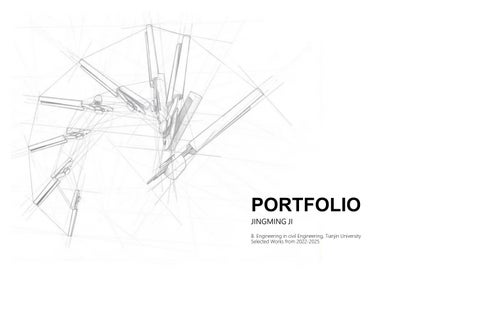
PORTFOLIO

JINGMING JI

B. Engineering in civil Engineering, Tianjin University Selected Works from 2022-2025

01 02 03 04 05 06 07

There, Being

Taoist Cosmology and Structural Logic: Toward a Contemporary Language of Embodied Healing Space

Morden Cliché: The Trajectory of the Can Opener

Spatial Politics - Capital, Exploitation, and the Architect's Instrumentalization

Buddha Meditation Pavilion

Full-scale construction on site

Cultivar Commons

Vertical Farm and Community Center Building (Young Architects Competition Finalist)

Kinetic Skin

A human-computer interactive installation driven by motion capture and real-time mapping

Living Matter, Living Heritage

Mycelium in Sustainable Architectural Renewal

Other works

01 There, Being

Taoist Cosmology and Structural Logic: Toward a Contemporary Language of Embodied Healing Space

Period: 2025.07- 2025.10

Type: Individual Work

Tutor: Xuechen Kang

China's agrarian civilization was structured around Tian Shi (heavenly timing), the observation of planetary motion and stellar change. Agricultural cycles, warfare, rituals, and calendrical systems were coordinated through celestial phenomena, with the Northern Dipper cult emerging by the Zhou dynasty as a central ritual framework. Daoism inherited and systematized this cosmology, constructing a metaphysics in which the Dipper Palace governs the cycle of souls and the Seven Stars embody the pivot of mortality and renewal. Their correspondence with bodily apertures and organs exemplifies the Daoist principle of Tian Ren Xiang Ying (cosmos–human resonance), where in the body is conceived as a microcosm. Life and death are understood not as opposites but as phases within Yin–Yang transformation. Architectural expression of this cosmology appears in cemetery design, where trigram orientations and axial systems articulate the passage from Water Realm to Celestial Realm. Such spaces function as miniature cosmoi, mediating ritual transition and providing the living with a channel for grief and emotional release.

SITE'S USABLE POTENTIALS

Being close to the river allows water to be brought into the building.

Building surrounding the mountain creates the desired circular and natural roaming experience Height difference of the sloped terrain create two spaces that have its own independent entrance

20000 ㎡ TOTAL PROGRAM AREA

8000 ㎡ LOT COVERAGE

Within the ritual space, the dome is incised with apertures in the con guration of the Big Dipper, signifying the correspondence between the seven stars and the human viscera, and thereby a rming the cosmological notion of the ‘universe within the body.

Partition the spherical volume into two complementary halves in accordance with the Daoist principle of yin–yang mutual generation, and con gure the building’s entrances and exits through the spatial logic of Qimen Dunjia

Articulate the division of programmatic

Along the circular walls, niches are installed to house cremated remains, providing a locus for remembrance.

Through this gesture, the cemetery’s overall atmosphere is established as one of solemnity and reverence

zones: the grave, the funerary chamber, and the Daoist ritual space.

Selected passages from Daoist mourning ritual music

A dome with a special opening that symbolizes the immortals in Daoism
exterior floor plates and skeletons
PLAN-GROUND FLOOR
PLAN-B1 FLOOR
PLAN-GROUND FLOOR

Morden Cliché: The Trajectory of the Can Opener

Spatial Politics - Capital, Exploitation, and the Architect's Instrumentalization

Period: 2024.09- 2024.12

Type: Individual work

This project begins with the Tool Paradox, revealing how capital manufactures demand to shape social logic and spatial order. The can opener, invented later than the can yet often more expensive, serves as a metaphor for technology as a construct of capital rather than a response to necessity. Extending into spatial politics, capital employs urban planning and architectural ideology to commodify public space, re-encoding it as a node of value circulation. In this process, exploitation mechanisms partition human activity and sustain power structures. The architect, positioned as a Can Opener, becomes implicated in opening new arenas of consumption. Ultimately, space emerges as a stage of power, exposing the unavoidable political and critical dimension of architectural practice.

Equally important, this project emphasizes the translation of 2D drawings into 3D space as a key design exercise, demonstrating the author’s imagination and spatial perception in constructing three-dimensional form.

The camera records the entire process of the can opener being used, and freezes every 0.1 seconds to record the position and orientation of the can opener, and finally draws it on paper with a pencil

mountain, it is difficult to find a flat ground for people getting together and doing some community activities. It is alway raining there, people need a roof. And that is why there is

Pencil drawing

Divide the picture according to the movement trajectory of the object and give the difference in color depth

aso;rgh;aaeeghew

Diagram1-the process of transition from 2D to3D

Diagram2-the process of transition from 2D to3D

Diagram3-the process of transition from 2D to3D

2D to 3D jhhddaoghaolghae;oghaoeepgh
phyiscal model
phyiscal model
phyiscal model
Elvation-A
Elvation-B
phyiscal model

03 Buddha Meditation Pavilion

Period: 2025.06- 2025.07

Type: Group Work

Tutor: Xuechen Kang

Group member: Xiangwen Huo, Qiwei Jiang, Daiqing Lin, Jingming Ji, Xiaoyu Zhang, Hans Yang, Siyu Liu

Role: Participated in Conceptual Design, Construction and Drawings production

Medium: woods and fabraction

Size: 2400mm*2400mm*3500mm

All products except as otherwise indicated were made by myself

Prize: IDA 2025, Bronze in Landscape architecture

Description: In the rolling fields of rural Lucheng, Shanxi, stands a humble temple where monks adhere to the ancient principle of “neither neglecting farming nor neglecting Zen.” Every day, they descend the mountain to work the land, embracing the discipline of “no work, no food.” To provide these devoted laborers with a place of rest, an octagonal pavilion was erected at the heart of the farmland. More than a mere shelter from sun and rain, it serves as a spiritual sanctuary—a space where monks transition from the motion of ploughing to the stillness of meditation. Between bending to sow and pausing in reflection, they embody the Chan belief that “drawing water and chopping wood are themselves the practice of the Way.”

Beyond its functional role, the pavilion is a profound cultural structure—a fusion of architecture, philosophy, and lived aesthetics. It speaks softly to all who encounter it of the Eastern wisdom that “the Way is found in everyday life.” Truth does not reside only in distant temples and sacred mountains; it is present in the very soil underfoot and the pavilion overhead. As it continues to support the daily rhythm of monastic life, this structure also promises to become a cultural window into “Living Chan,” inviting modern visitors to seek tranquility amid busyness and discover profundity within the ordinary.

TRADITIONAL

CULTIVAR COMMONS

A Living Spine for Community, Food, and Traditions

In the Latino and Hispanic neighborhood of South Los Angeles, Cultivar Commons redefines the vertical farm as more than an infrastructure-it is a public corridor for education, culture, and wellness. The community lacks healthy food, activity spaces, and a sense of cultural belonging, but is rich in festivals, music, dance, crafts, and other arts and culture. By setting up a loop around the crop production space, visitors can watch crop cultivation up close inside and outside the building, and at the same time experience organic food purchasing, dining, socializing, and workshops. Vertical becomes a cascading space designed for rest, exchange and learning, and rather than destroying the original fabric, Cultivar Commons grows out of it, integrating it into the community and planting the seeds of a resilient and regenerative future - where farming goes beyond the crop to nourish culture, memory and shared life.

The vertical farm consists of three parts - cultivation area, processing area and multipurpose block. cultivation area is an organic form formed by the staggered east and west façade of the building and the continuous sloped roof, which connects with the community. processing area and cultivation area are the two main components of the vertical farm. The processing area is connected to the cultivation area in the most efficient way, while ensuring the most efficient flow of staff and vehicles. The multi-purpose area follows a square dynamic line from the public market on the first floor, up to the second floor through the green atrium that surrounds the vertical farm, through the exhibition spaces and internal courtyards, and back down to the lower level, overlooking the crops and the public spaces. The Vertical Farm is no longer just a backdrop, but “a breathing core” that intertwines with daily life over and over again. By removing the disconnect between the buildings, Cultivar Commons is experienced as an interconnected whole - an organism that nurtures food, community, and endless possibilities all at the same time.

04 Cultivar Commons

CULTIVAR COMMONS

A Living Spine for Community, Food, and Traditions

Vertical Farm and Community Center Building (Young Architects Competition Finalist)

Period: 2025.03- 2025.06

Type: Individual work in Design Development, Group work in Concept with Lan ChengChu

In the Latino and Hispanic neighborhood of South Los Angeles, Cultivar Commons redefines the vertical farm as more than an infrastructure-it is a public corridor for education, culture, and wellness. The community lacks healthy food, activity spaces, and a sense of cultural belonging, but is rich in festivals, mu-sic, dance, crafts, and other arts and culture. By setting up a loop around the crop production space, visitors can watch crop cultivation up close inside and outside the building, and at the same time experience organic food purchasing, dining, socializing, and workshops. Vertical becomes a cascading space designed for rest, exchange and learning, and rather than destroying the original fabric, Cultivar Commons grows out of it, integrating it into the community and planting the seeds of a resilient and regenerative future - where farming goes beyond the crop to nourish culture, memory and shared life.

In the Latino and Hispanic neighborhood of South Los Angeles, Cultivar Commons redefines the vertical farm as more than an infrastructure-it is a public corridor for education, culture, and wellness. The community lacks healthy food, activity spaces, and a sense of cultural belonging, but is rich in festivals, music, dance, crafts, and other arts and culture. By setting up a loop around the crop production space, visitors can watch crop cultivation up close inside and outside the building, and at the same time experience organic food purchasing, dining, socializing, and workshops. Vertical becomes a cascading space designed for rest, exchange and learning, and rather than destroying the original fabric, Cultivar Commons grows out of it, integrating it into the community and planting the seeds of a resilient and regenerative future - where farming goes beyond the crop to nourish culture, memory and shared life.

The vertical farm consists of three parts - cultivation area, pro-

Building 2: Harvest processing
Building 3: Spark room and cafe Cold storage Office Labs
Building 1: Vertical Farm

socializing, and workshops. Vertical becomes a cascading space designed for rest, exchange and learning, and rather than destroying the original fabric, Cultivar Commons grows out of it, integrating it into the community and planting the seeds of a resilient and regenerative future where farming goes beyond the crop to nourish culture, memory and shared life. The vertical farm consists of three parts - cultivation area, pro cessing area and multipurpose block. cultivation area is an or ganic form formed by the staggered east and west façade of the building and the continuous sloped roof, which connects with the community. processing area and cultivation area are the two main components of the vertical farm. The processing area is connected to the cultivation area in the most efficient way, while ensuring the most efficient flow of staff and vehi cles. The multi-purpose area follows a square dynamic line from the public market on the first floor, up to the second floor through the green atrium that surrounds the vertical farm, through the exhibition spaces and internal courtyards, and back down to the lower level, overlooking the crops and the public spaces. The Vertical Farm is no longer just a backdrop, but “a breathing core” that intertwines with daily life over and over again. By removing the disconnect between the build ings, Cultivar Commons is experienced as an interconnected whole - an organism that nurtures food, community, and end less possibilities all at the same time.

CULTIVAR COMMONS

A Living Spine for Community, Food, and Traditions

In the Latino and Hispanic neighborhood of South Los Angeles, Cultivar Commons redefines the vertical farm as more than an infrastructure-it is a public corridor for education, culture, and wellness. The community lacks healthy food, activity spaces, and a sense of cultural belonging, but is rich in festivals, music, dance, crafts, and other arts and culture. By setting up a loop around the crop production space, visitors can watch crop cultivation up close inside and outside the building, and at the same time experience organic food purchasing, dining, socializing, and workshops. Vertical becomes a cascading space designed for rest, exchange and learning, and rather than destroying the original fabric, Cultivar Commons grows out of it, integrating it into the community and planting the seeds of a resilient and regenerative future - where farming goes beyond the crop to nourish culture, memory and shared life.

The vertical farm consists of three parts - cultivation area, processing area and multipurpose block. cultivation area is an organic form formed by the staggered east and west façade of the building and the continuous sloped roof, which connects with the community. processing area and cultivation area are the two main components of the vertical farm. The processing area is connected to the cultivation area in the most efficient way, while ensuring the most efficient flow of staff and vehicles. The multi-purpose area follows a square dynamic line from the public market on the first floor, up to the second floor through the green atrium that surrounds the vertical farm, through the exhibition spaces and internal courtyards, and back down to the lower level, overlooking the crops and the public spaces. The Vertical Farm is no longer just a backdrop, but “a breathing core” that intertwines with daily life over and over again. By removing the disconnect between the buildings, Cultivar Commons is experienced as an interconnected whole - an organism that nurtures food, community, and endless possibilities all at the same time.

05 Kinetic Skin

A human-computer interactive installation driven by motion capture and real-time mapping

Period: 2025.07- 2025.08

Type: Group work

Instructor: Tianyao Liu

Group member: Jingming Ji, Yiyuan Gao, Chenchen Hsieh, Jingyi Bi, Zhiyuan Liu, Yifei Xia

Role: Participated in Conceptual Design, Arduino Programing, assembly and construction

Human–machine interaction encompasses many modes of communication between humans and computers. As the initiator and trigger of interaction, the human body can output information through various channels—such as visual signals captured by cameras, sound signals recorded by microphones, or pressure signals detected by sensors. In this project, we focus specifically on how human motion, as a form of visual output, interacts with the computer.

The movements of the human body are captured by a camera, transmitted in real time, and translated into digital data. Through computational algorithms, the system drives more than 200 servomotors, enabling instant mechanical responses. These servomotors actuate a field of metallic plates, forming a kinetic metal skin that behaves almost like a breathing surface. Depending on the user’s movement, the metal skin performs localized openings or full-surface inversions, creating a dynamic and embodied interaction between human and machine.

The project integrates Arduino programming, interactive systems developed in TouchDesigner, and 3D modeling, construction, and simulation workflows in Rhino and Grasshopper. The physical construction involves designing wooden structural joints, conducting force analysis, installing servomotors, managing data wiring, and resolving power and current requirements. This project represents a fully realized integration of software and hardware, translating digital interaction into a tangible kinetic installation.

Single Unit
200+ Units assemble
Grasshopper coding
Metal Panels
Location and size of Notch

This page illustrates the mechanical coupling between servo motors and aluminum flaps. Each kinetic module translates rotational motion into surface deformation within a 0-75 degree range, constrained by a mechanical stop. The bracket-bearing system ensures stability, precision, and modular maintenance.

Each vertical strip contains 10 servo-driven aluminum panels, each panel independently controlled to form a responsive array surface.

We connected the servos on the frame to the circuit control boards one by one using connection wires. Then, twenty control boards were connected in series and linked to the Arduino R3 Controller.
Diagram:

Living Matter, Living Heritage

Mycelium in Sustainable Architectural Renewal

Period: 2024.09- 2024.12

Type: Individual work

Deep in the heart of Egypt lies Siwa, an ancient oasis settlement shaped by centuries of environmental and cultural resilience. Based on a close study of the Shali Fortress, this project explores the restoration of Siwa not as static preservation, but as an ecological process of renewal.

By integrating mycelium-based biotechnology into the repair of aging structures, the project positions living matter as both material and metaphor—where repair becomes regeneration. Traditional construction logics are reactivated through contemporary techniques, allowing architecture to evolve as a living ecology. Heritage is sustained through symbiosis with nature, aligning design with cycles of growth, decay, and renewal rather than resisting them.

looked like before its destruction.

the A relief mural carved into an earthen wall reveals to us what the city
Existing Site Plan Building on Ruins Before
Bio-brick sample in expriment Now

To explore the integration of mycelium with architecture, material diversity, and concepts of restoration and sustainability, I conducted a series of comparative growth experiments. Oyster mushroom spawn was mixed with pine bark, corn cobs, cotton hulls, and wheat bran, with varying additions of flour, vinegar, sugar, and water.

All experiments were carried out under sterile conditions, with materials added gradually and samples kept in a dark environment. Based on growth performance, the mixture using only flour and water was selected for further cultivation and used to produce mycelium bio-bricks and physical models.

Experiment Round 1 Failed
Experiment Round 2 , Inconclusive
Experiment Round 3 , Partial
Experiment Round 4 , Achieved
Experiment Round 5 , Achieved
Multi-Brick Layering
Baked bio-bricks
Ashlar Masonry
Mixed Tiles Layering
Teracotta Roof Tiles
Horizontal Bio-Bricks
Existing
Combination of biological materials with other materials
Detailed rendering

Other works

REGENT&INDIGO HOTELS RESORT

PROFESSIONAL PROJECT

JUNIOR DESIGNER

IN BURO OLE SCHEEREN

LOCATION: SANYA, HAINAN, CN

Interior Lobby and Exhibition Design

In this project, I learned to use SubD tools for modeling and to integrate complex fluid lines with exhibition spaces.

It also explored the diversity of exhibition formats, such as how to project videos and animations onto a specific part of a building or onto the ceiling.

Diagram: Conceptual Design in a big scale city design Rendering: Wastewater treatment plant converted into a logistics center project

3D Sculpture modeling and Rendering

Drawings

Turn static files into dynamic content formats.
Create a flipbook
Issuu converts static files into: digital portfolios, online yearbooks, online catalogs, digital photo albums and more. Sign up and create your flipbook.