Introduction: Leading Innovation at the Crossroads of AI and Robotics

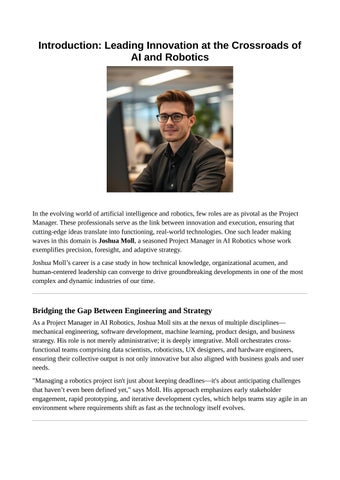
In the evolving world of artificial intelligence and robotics, few roles are as pivotal as the Project Manager. These professionals serve as the link between innovation and execution, ensuring that cutting-edge ideas translate into functioning, real-world technologies. One such leader making waves in this domain is Joshua Moll, a seasoned Project Manager in AI Robotics whose work exemplifies precision, foresight, and adaptive strategy.
Joshua Moll’s career is a case study in how technical knowledge, organizational acumen, and human-centered leadership can converge to drive groundbreaking developments in one of the most complex and dynamic industries of our time.
Bridging the Gap Between Engineering and Strategy
As a Project Manager in AI Robotics, Joshua Moll sits at the nexus of multiple disciplines— mechanical engineering, software development, machine learning, product design, and business strategy. His role is not merely administrative; it is deeply integrative. Moll orchestrates crossfunctional teams comprising data scientists, roboticists, UX designers, and hardware engineers, ensuring their collective output is not only innovative but also aligned with business goals and user needs.
"Managing a robotics project isn't just about keeping deadlines—it's about anticipating challenges that haven’t even been defined yet," says Moll. His approach emphasizes early stakeholder engagement, rapid prototyping, and iterative development cycles, which helps teams stay agile in an environment where requirements shift as fast as the technology itself evolves.
Core Responsibilities and Strategic Impact
At the heart of Joshua Moll’s day-to-day work are several core responsibilities that define success in AI Robotics project management:
• Defining Project Scope and Vision: Working closely with clients and senior leadership to determine the technical and business goals of each project.
• Team Coordination: Leading diverse technical teams while translating complex AI and robotics concepts into actionable tasks and milestones.
• Risk Management: Identifying potential roadblocks early, especially those unique to AI development such as ethical considerations, data bias, or real-world testing failures.
• Budget and Resource Allocation: Balancing high R&D costs with budget constraints to maintain both financial and technological feasibility.
Moll’s strategic foresight often enables companies to deploy AI-powered robotic systems faster and more reliably than competitors, whether for warehouse automation, surgical robotics, or autonomous mobility solutions.
Adapting to a Rapidly Changing Landscape
The field of AI Robotics is notoriously fast-paced. New algorithms, chipsets, frameworks, and regulations emerge constantly. To stay ahead, Joshua Moll prioritizes continuous learning—not just for himself, but for his teams. He has implemented regular "Tech Deep Dive Fridays," a weekly internal knowledge-sharing session where team members present the latest trends in AI architectures or robotic sensor technologies.
Moreover, Moll is an advocate for adaptive project frameworks like Scrum for Hardware and Scaled Agile Framework (SAFe). He adapts these methodologies to suit the hybrid nature of AI Robotics projects, which often combine the unpredictability of software development with the physical constraints of hardware engineering.
Collaboration and Communication: The Human Element
While the robotics and AI sectors are deeply technical, Moll underscores the importance of soft skills. “You can’t build intelligent machines without understanding the humans who design, use, and interact with them,” he notes. His ability to foster open communication across departments is frequently cited as a key factor in his projects’ success.
Joshua Moll is known for his clear communication style—equally comfortable explaining transformer neural networks to an executive board or breaking down budget risks to an engineering team. This fluency in both technical and business languages has made him an invaluable bridge in organizations pursuing high-stakes AI robotics deployments.
Real-World Impact: Projects That Matter
Throughout his career, Moll has led several high-impact projects, including:
• Autonomous Delivery Drones: Managed the end-to-end development of drone fleets equipped with real-time object detection and navigation algorithms.
• AI Surgical Assistant Robot: Oversaw a cross-border team developing a robotic assistant capable of real-time decision support during minimally invasive surgeries.
• Smart Warehouse Systems: Coordinated large-scale deployment of AI-powered robotic arms and conveyor systems for supply chain optimization.
Each of these initiatives was marked by tight timelines, complex stakeholder dynamics, and the need for regulatory navigation—all handled deftly under Moll’s leadership.
Looking Forward: The Future of AI Robotics Project Management
As AI becomes more deeply embedded into society, the need for capable project managers like Joshua Moll will only grow. Emerging frontiers such as human-robot interaction (HRI), AI ethics, and edge computing in robotics will demand even greater coordination, foresight, and technical literacy.
Moll sees the future of his role as less about control and more about orchestration. “You’re not the conductor of a classical symphony,” he explains. “You’re more like a jazz bandleader—setting the tone, keeping the rhythm, and making room for solos from brilliant contributors.”
Conclusion: A Model for Modern Leadership
Joshua Moll represents a new breed of project manager—technically adept, strategically grounded, and deeply human-centered. In an industry driven by code and machinery, his leadership reminds us that behind every intelligent system is a team of people, and behind every successful team is a project manager who knows how to guide, challenge, and inspire.
As AI and robotics redefine our world, professionals like Moll are not just managing projects— they’re shaping the future.