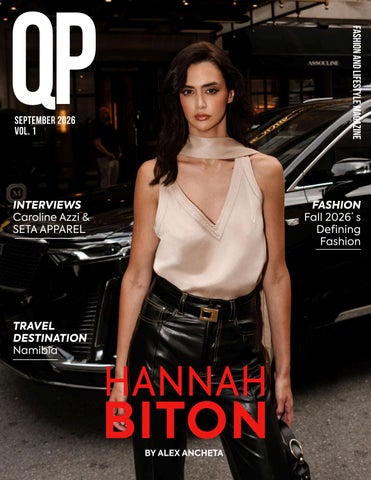
FASHION and lifestyle MAGAZINE
QP SEPTEMBER 2026 VOL. 1
INTERVIEWS Caroline Azzi & SETA APPAREL
TRAVEL DESTINATION Namibia
FASHION Fall 2026´s Defining Fashion
HANNAH
BITON BY ALEX ANCHETA
www.astrid-agnes.com
WWW.SETAAPPAREL.COM
TEAM FOUNDER/EDITOR-IN-CHIEF JOSE-MARIA JIMENEZ EXECUTIVE EDITOR JENNIFER CARTER FASHION PHHOTOGRAPHERS ADASAT BARROSO ALEX LLOBET ALEX ANCHETA ANTOINE VERGLAS JULIO CESAR STEVE LIMONES
BRAND AMBASSADOR AITANA LOPEZ CONTENT CREATORS CLAUDIA LOMBARDO SHARON JANE retoucher MARK SAPRYKIN FASHION STYLIST CHELSEA FRANK HAIR AND MAKEUP ARTIST TEAL DRUDA
LETTER FROM THE EDITOR Dear Readers, September arrives with that unmistakable feeling of transition—the moment when summer begins to give way to a new season, and fashion turns its attention toward what comes next. For our September 2026 issue, we celebrate the people, ideas and destinations that make this moment in fashion so compelling, beginning with our cover star, Hannah Biton, represented by Genetics Model Management. Hannah embodies a new generation of models whose presence extends beyond the image: confident, individual and ready to define her own place within a rapidly evolving industry. Inside this issue, we meet Caroline Azzi, the French-Italian entrepreneur whose international perspective and entrepreneurial spirit offer a fascinating insight into contemporary fashion and business. We also speak with Andrea Salazar, co-founder and designer of SETA Apparel, about creativity, identity and building a fashion brand with a distinctive point of view. Both conversations remind us that fashion is not simply about what we wear—it is about the vision, determination and personality behind every creation. Our September fashion pages look firmly toward the season ahead with “Fall 2026’s Defining Fashion Trends,” exploring the silhouettes, materials and accessories that will shape the coming months. In our fashion editorials, we spotlight two remarkable young women at very different stages of their journeys: Jenna Dykstra, Miss New York 2026, who will compete to win the Miss USA 2026 crown in a few days and Lorena Ruiz, Miss Teen International 2025, who is beginning to build her career in fashion and modeling after an extraordinary year. And for those already dreaming beyond the runway, our luxury travel destination takes us to Namibia—a land of immense landscapes, extraordinary wildlife and increasingly sophisticated luxury experiences. It is a destination that proves that true luxury is not always about excess; sometimes, it is about space, silence, nature and the feeling of being somewhere truly extraordinary. As always, thank you for joining us for another issue of QP. We hope these pages inspire you to look at fashion—and the world around it—with fresh eyes.
JOSE-MARIA JIMENEZ
QP
Founder/Editor-in-Chief - QPmag 4
www.dianakassabov.com
IN THIS ISSUE 8-21| EDITORIAL: THE CITY ´S CROWN 22-33| EDITORIAL: CONTRAST & CONTOUR 34-49| COVER: HANNAH BITON 50-55| FASHION: FALL 2026’S DEFINING FASHION TRENDS
56-65| EDITORIAL: UNAPOLOGETIC 66-81| INTERVIEW: CAROLINE AZZI 82-85| TRAVEL: NAMIBIA 86-93| EDITORIAL: LORENA RUIZ 94-103| INTERVIEW: SETA APPAREL 104-113| EDITORIAL: EAST SIDE - AMANDA
QP FASHION MAGAZINE BELLO MEDIA GROUP @BELLOmediaGroup 8285 Sunset Blvd, Suite 01 WEST HOLLYWOOD, CA 90046 IMAGE NATION STUDIO L.L.C. California, USA
www.qpmag.com hello@QPMAG.com
QP
6
COVER
7
MODEL: HANNAH BITON @hannahhan13 AGENCY: GENETICS MODEL MANAGEMENT @geneticsmgmt PHOTOGRAPHER: ALEX ANCHETA @aanchetany Hair & makeup artist: ANASTASIA EISENBERG ENRIQUEZ @makeupbyanastasia
QP
QP
Slip dress DOLCE & GABBANA
8
THE CITY’S CROWN
Slip dress DOLCE & GABBANA
PHOTOGRAPHER: ALEX ANCHETA @aanchetany
MODEL: JENNA DYKSTRA @jennadystraa (MISS NEW YORK 2026) AGENCY: FENTON MODEL MANAGEMENT @fentonmodels HMUA: ANNETTE BRAGAS @annettebragasmua
9
QP
Tweed set REVOLVE Bag HERMES Shoes DOLCE & GABBANA
QP
10
Tweed set REVOLVE Bag HERMES Shoes DOLCE & GABBANA
11
QP
QP
Dress REVOLVE 12
Dress REVOLVE
13
QP
Tweed set REVOLVE Bag HERMES Shoes DOLCE & GABBANA
QP
14
Tweed set REVOLVE Bag HERMES Shoes DOLCE & GABBANA
15
QP
QP
Dress MESHKI
16
Dress MESHKI
17
QP
QP
18
Slip dress DOLCE & GABBANA 19
QP
QP
Dress MESHKI 20
Dress MESHKI
21
QP
CONTRAST & CONTOUR PHOTOGRAPHER/CREATIVE DIRECTOR: JULIO CARLOS @juliocarlosphoto MODEL: ARIANA @arianarainn AGENCY: THE SOURCE MODELS @thesourcemodels HAIR AND MAKEUP ARTIST: SAGE @sagemakeup SPECIAL THANKS TO THE CONFESSIONAL SHOWROOM MIAMI @confessional_showroom_miami
QP
22
Black futuristic scuba jacket SOLYLESS
23
QP
Black lace bodysuit ER SUITS Burgundy faux fur vest BARZAGA Lace black leggings THE CONFESSIONAL SHOWROOM MIAMI
QP
24
Shell neck lace jacket BARZAGA Silver open back blazer MOLATO Silent bow long sleeve shirt BARZAGA
25
QP
Burgundy faux fur vest BARZAGA Black lace bodysuit ER SUITS
QP
26
27
QP
Fringe 2 pieces NATALIA FERRO ARTE Y DISEÑO Black stoned-silver tie bracelet (used as choker) HARDCORE ELEGANCE
QP
28
Black futuristic scuba jacket SOLYLESS Fringe pants NATALIA FERRO ARTE Y DISEÑO Purse ZADIG & VOLTAIRE Suede boots THE CONFESSIONAL SHOWROOM MIAMI
29
QP
Shell neck wool jacket BARZAGA Open wound dress jacket BARZAGA Black stoned-silver tie bracelet (used as choker) HARDCORE ELEGANCE
QP
30
31
QP
Black draped necklong body dress THE CONFESSIONAL SHOWROOM MIAMI
QP
32
Fringe 2 pieces NATALIA FERRO ARTE Y DISEÑO Jacket BABATON
33
QP
COVER
HANNAH BITON
THE ART OF BECOMING Interview by JOSE-MARIA JIMENEZ
From international modeling to fashion design and interior styling, Hannah Biton has built a career defined by curiosity, reinvention, and an instinctive eye for aesthetics. Her journey began while she was still in college, with major campaigns for Make Up For Ever and CoverGirl, before taking her from New York to Hong Kong and Milan. Along the way, she discovered that modeling was about more than transformation in front of the camera—it was a passport to new cultures, new perspectives, and increasingly confident versions of herself. Today, Hannah approaches creativity without boundaries. After stepping away from modeling to build her own clothing business, she expanded her vision into interior design and styling, learning to see fashion, spaces, textures, proportions, and personal image as interconnected forms of expression. A self-described fashion “chameleon,” she adapts her style to the energy of every city while remaining committed to quality, individuality, and more intentional consumption. In this conversation with QP, Hannah reflects on her international career, entrepreneurship, design philosophy, sustainable style, and the exciting possibility of bringing all of her creative worlds together.
QP
MODEL: HANNAH BITON @hannahhan13 AGENCY: GENETICS MODEL MANAGEMENT @geneticsmgmt PHOTOGRAPHER: ALEX ANCHETA @aanchetany Hair & makeup artist: ANASTASIA EISENBERG ENRIQUEZ @makeupbyanastasia
34
Top EQUIPMENT Pants V PROJECT Belt YSL Bag CHLOE Shoes YSL
35
QP
QP
Top EQUIPMENT
36
Y
ou began modeling while you were still in college, and your first major campaigns were with Make Up For Ever and CoverGirl. What was it about those early experiences that made you realize modeling could become more than just a chapter in your life? I realized it during those early campaigns because I fell in love with the transformation. Getting the full glam—hair and makeup done to perfection—felt like magic. I could walk into a set as this awkward, nerdy college girl and walk out looking like a completely different, elevated version of myself. That shift wasn’t just surfacelevel; it showed me modeling wasn’t a temporary side thing. It was a way to step into a more confident, intentional version of who I wanted to be, and once I felt that, I knew I wanted to keep chasing it.
me to adjust my look, my walk, and how I presented myself for each market instead of just defaulting to one style. Personally, it made me less narrow. You’re not just learning fashion; you’re learning how other cultures operate day-to-day. It makes you more flexible and less stuck in one way of seeing things. Hong Kong appears to have been a particularly important chapter in your career. What did that experience teach you about independence, adaptability, and finding your place in a completely different culture? Hong Kong was the first place I ever went completely alone. No family, no friends, and honestly almost no idea what I was walking into. I didn’t know much about the culture or Asia in general — I just got on the plane excited and a little blind. Up until then, every trip had been with my family. Even when I went to Milan, my mom came with me to help me settle. Hong Kong was different. It was the first time I had to figure everything out myself. Living in model housing threw me in with girls from all over the world, and that forced me to adapt fast. I learned a lot about Chinese culture, the city’s history as a former British colony, and how to navigate a completely different way of life. The culture shock was real, but I loved it — the food, the density of the city, the beaches, the mountains, the hiking. Everything felt new and I was fully in it. That chapter taught me I could land somewhere foreign, know almost nothing, and still make it work. Your image eventually appeared on billboards around the world. Was there a particular moment when you stopped and thought, “This is actually happening”? Yes. I was just walking through a mall in Hong Kong and suddenly saw myself on a billboard. It stopped me. In everyday life I still felt like this small, skinny girl no one really noticed. Then there I was, larger than life in the middle of a busy mall, completely transformed. It was the first time it
“I was just walking Your career quickly became through a international, taking you from New York to Hong Kong and eventually to Italy. How did mall in Hong living and working in such Kong and different fashion cultures change you, both professionally suddenly saw and personally? Before going international, I myself on a had mostly only been around people who were similar to me — billboard.” growing up in America and then
living and working in New York. Once my career took me abroad, that changed fast. Living in model housing forced me to share space with girls from Russia, Ukraine, Australia, Oklahoma… places and backgrounds I never would’ve crossed paths with otherwise. That exposure alone was valuable. You learn how different people live, what they value, how they handle the industry, and it makes you more adaptable. Professionally, the fashion cultures were completely different. New York is more grunge and street — raw, editorial, a bit chaotic. Hong Kong was the opposite: very minimal, clean, precise. Then Milan was classic European — polished, structured, Versace-level glamour and heritage. Working in those markets forced
37
QP
QP
Dress MARHESA NOTTE
38
Dress MARHESA NOTTE Belt YSL Bag CHLOE Shoes STUART WEITZMAN
39
QP
really hit me that I could be so many different versions of myself After Hong Kong, you made the unusual decision to step away from modeling and devote yourself to building your own clothing business. What motivated you to make that transition, and what did entrepreneurship teach you that modeling never could? To be honest, I was struggling to make a steady living from modeling. The paychecks were inconsistent, I was tired of living in model apartments with bunk beds, and I just wanted more financial stability and control. So during the pandemic I decided to start my own clothing business. I built it from the ground up and ran it successfully for several years. Entrepreneurship forced me to learn things modeling never required — how to actually create and sell a product, manage money, handle every side of a business, and create my own security instead of waiting for the next booking. You have always had a strong connection to design and styling. When did you first realize that your creativity extended beyond being in front of the camera? I always got compliments on my outfits. Even on tight budgets, I was good at putting things together so they didn’t look cheap — I’d focus on high-quality fabrics and timeless pieces that actually lasted. I also had a natural eye for making spaces feel more put-together. At some point I realized that creativity wasn’t limited to being in front of the camera. So I got a certificate in design, started my own clothing brand, and built from there. You later joined an interior design firm in New York. How has working behind the scenes in interior design influenced the way you approach fashion, styling, and even your own personal image? Working in interior design completely changed how I see composition. In modeling and
fashion, you’re focused on the body and the clothes. In interiors, you’re thinking about space, proportion, texture, light, and how every element works together as a whole. That mindset transferred directly to styling. I started looking at outfits the same way I’d look at a room — balancing volume, color, and texture so nothing feels accidental. I became more intentional about creating a complete atmosphere instead of just putting on clothes that looked good in isolation. It also affected my personal image. I stopped treating how I dress as separate from how I want a space to feel. Everything became more deliberate — cleaner lines, better quality, fewer pieces that don’t serve a purpose. The goal is the same in both: create something that feels considered and complete. You cite Nate Berkus and Joanna Gaines among your biggest interior design inspirations. What do you admire most about their approach to creating spaces, and how do those principles translate into your own creative vision? What I admire most about both Nate Berkus and Joanna Gaines is that they create spaces that feel personal and lived-in, not staged. Nate is especially good at mixing high and low, layering pieces that actually mean something, and making a room feel collected over time instead of decorated overnight. Joanna has this ability to make things feel warm, functional, and approachable while still looking intentional. Those principles translate directly into how I approach fashion and styling. I don’t want things that look precious or overly trendy. I want pieces that feel considered, comfortable, and real — high-quality fabrics, timeless shapes, and a mix that doesn’t feel forced. Whether I’m styling an outfit or thinking about a space, the goal is the same: create something that feels put-together without looking like it tried too hard.
“Entrepreneurship forced me to learn things modeling never required.”
QP
40
41
Dress SAU LEE Earrings NADRI
QP
Dress VALENTINO GARAVANI Sunglasses VERSACE Bag CHLOE Shoes STUART WEITZMAN
QP
42
Dress VALENTINO GARAVANI Bag CHLOE Shoes STUART WEITZMAN
43
QP
Top MICHAEL LAUREN Skirt MICHELLE MASON Sunglasses VERSACE Shoes STUART WEITZMAN
QP
44
You describe yourself as a fashion “chameleon,” adapting your style according to the city you are in. What does Miami represent to you stylistically, and how would you describe your New York, Los Angeles, and other city personas? Miami is body-conscious, a little more glamorous, and less inhibited. It’s the version of me that leans into clean lines, strong silhouettes, and a bit of sexiness — swim, lingerie energy, things that feel confident and warm-weather ready without trying too hard. New York is cooler and more editorial. Sharper tailoring, darker tones, more structure. It’s the version that feels a little tougher and more intentional — less skin, more attitude. Los Angeles is the most relaxed. Easier fabrics, denim, layers that feel lived-in but still puttogether. It’s the version that prioritizes comfort without losing the overall look. I’ve always adapted to the city I’m in. It’s less about changing who I am and more about reading the energy of the place and responding to it. New York is known for its ability to turn individuality into a form of style. How has living in NYC influenced the way you dress and express yourself today compared with when you first arrived as a model? When I first arrived in New York as a model, my style was a lot less refined. I was going out a lot, dressing for the clubs, and not thinking much beyond that. As I got older and moved into more mature work, I started taking better care of myself and becoming more intentional about how I presented every day. Now my weekday style is more tailored and considered. On weekends and holidays I still lean casual and a little grunge — just more polished than when I first got here. New York taught me that individuality doesn’t have to be chaotic. It can be deliberate. You are also passionate about sustainable fashion, with an appreciation for the kind of
elevated basics and cool accessories associated with Kendall Jenner’s style. What does “sustainable style” mean to you personally? To me, sustainable style means building a wardrobe of elevated basics and pieces I actually wear — high-quality items that last, instead of fast fashion that sits in my closet unused and takes up space. I’m intentional about only buying what I need, and if something no longer serves me, I sell it rather than letting it collect dust. It’s less about trends and more about having a smaller rotation of well-made clothes and accessories that feel current and elevated, the kind of clean, cool staples associated with someone like Kendall Jenner. The goal is a wardrobe that works hard, looks intentional, and doesn’t create unnecessary waste. After experiencing the fashion industry from both in front of and behind the camera, what do you think makes someone genuinely stylish today? Is it clothing, confidence, individuality—or something else entirely? I think it starts with the clothing itself — knowing how to choose the right fabrics, textures, and fit for your body. It’s not about having a lot of clothes. It’s about having the right ones. Someone who understands quality and how pieces actually work on them will always look more stylish than someone with a closet full of things that don’t fit or feel intentional. The rest — confidence, individuality — builds on that foundation, but it begins with knowing how to buy and wear good clothes. Your creative interests span fashion, clothing design, interior design, and styling. Do you see these as separate disciplines, or are they ultimately different expressions of the same creative identity? I see them as different expressions of the same creative identity. Whether I’m choosing fabric for a garment, styling an outfit, or designing a room, I’m
“New York taught me that individuality doesn’t have to be chaotic. It can be deliberate.” 45
QP
basically doing the same thing — balancing proportion, texture, color, and atmosphere so everything feels intentional and complete. The medium changes, but the eye doesn’t. Fashion sits on the body. Interiors shape the space around it. Styling connects the two. They’re not separate skills so much as different ways of creating the same feeling: something considered, elevated, and put-together without trying too hard Beyond fashion and design, animal welfare is an important part of your life, and you actively volunteer with and support animal care centers in New York City. Where does that passion come from, and what have animals taught you about compassion and responsibility? Animals are innocent. They can’t speak for themselves or tell you when something is wrong, and yet they still give unconditional love if you’re simply kind to them. That vulnerability is what draws me in. It makes me want to treat them with the care and respect
they deserve. Volunteering with animal care centers in New York has only reinforced that — it’s a direct way to show up for something that can’t advocate for itself. What they’ve taught me is that real compassion is consistent, not just when it’s convenient. Responsibility means paying attention, being patient, and giving without expecting anything back. Animals make that lesson very clear. Looking at the next chapter of your career, do you see yourself returning more deeply to modeling, expanding your design work, building another fashion business—or creating something that combines all of these worlds? I see myself doing all three. I’ll keep dabbling in modeling when the right opportunities come up, continue expanding my design work, and eventually build another business. Ideally it becomes something that naturally combines all of those worlds instead of keeping them separate.
“Responsibility means paying attention, being patient, and giving without expecting anything back.”
QP
46
Dress VALENTINO GARAVANI Bag CHLOE
47
QP
Top MICHAEL LAUREN Skirt MICHELLE MASON Bag CHLOE Shoes STUART WEITZMAN
QP
48
Dress MARHESA NOTTE Belt YSL
49
QP
FASHION
THE NEW SEASON FALL 2026’S DEFINING FASHION TRENDS
This September, fashion returns with a renewed sense of confidence. Tailoring becomes more expressive, outerwear takes center stage, proportions move in unexpected directions, and color steps decisively beyond the traditional autumn palette. There is a particular energy that arrives with a new fashion season. September has always represented a reset—a moment when wardrobes become sharper, layers return and the industry collectively turns its attention toward what comes next. For Fall 2026, however, the message from the runways is not simply about buying something new. It is about reimagining familiar pieces through proportion, texture, contrast and attitude. Across New York, London, Milan and Paris, designers found new possibilities in the wardrobe classics: the blazer, the coat, the knit, the shirt and the evening dress. Vogue's Fall 2026 runway overview identifies a season built around contrast—minimal silhouettes meeting rich textures, traditional staples acquiring unexpected details, and volume being deliberately manipulated.
QP
50
THE NEW POWER SUIT
Tailoring is back—but it has left the boardroom behind. The Fall 2026 suit is more fluid, more sculptural and considerably more sensual. Strong shoulders coexist with relaxed trousers; precise jackets are softened with knitwear; traditional menswear is reinterpreted through feminine proportions. Vogue's runway editors singled out tailoring as one of the season's dominant ideas, with designers exploring how to twist and modernize the classic suit rather than simply reproduce it. Look for single-button blazers, elongated jackets, defined shoulders and trousers with generous volume. The most modern approach is to avoid making the suit look too perfect. Wear tailoring with a fine knit, a bare neckline, a feminine skirt or unexpected footwear.
THE STATEMENT COAT
If there is one piece to invest in this season, make it the coat.
Fall 2026 offers outerwear in almost every imaginable interpretation: oversized wool coats, belted silhouettes, leather trenches, shearling, capes and dramatically collared designs. Vogue's Fall 2026 analysis noted the abundance of highly considered coats, particularly shearling styles and face-framing collars. The key is presence. The coat should not simply complete the outfit—it should define it.
51
QP
BURGUNDY, PURPLE & THE NEW AUTUMN PALETTE
Autumn has traditionally belonged to camel, brown, olive and black. In 2026, those classics are joined by considerably more expressive shades. Burgundy remains essential, while royal purple, electric blue, vibrant red, butter yellow, juicy peach and turquoise inject unexpected energy into the season. The most sophisticated way to approach the trend is not necessarily through head-to-toe color. Instead, introduce one saturated shade into an otherwise restrained look: a purple coat over black tailoring, burgundy leather with gray knitwear or electric blue accessories against chocolate brown. For those who prefer neutrals, chocolate, charcoal, ecru and black remain essential foundations.
VOLUME, BUT WITH PURPOSE
Fall 2026 is playing with proportion.
Some designers expanded the silhouette dramatically, while others explored deliberately smaller, closerto-the-body shapes. The important point is that proportion itself becomes the styling tool. Think enormous coats over narrow skirts, oversized jackets with slim trousers, wide-leg pants with fitted tops, or sculptural outerwear balanced by delicate layers underneath.
QP
Issey Miyake's Fall collection offered an especially striking interpretation, using exaggerated shapes and architectural volumes to transform the relationship between clothing and the body. The secret is balance. If one element is oversized, allow another to remain controlled. That contrast creates the sophistication. 52
THE ROMANTIC COUNTERPOINT For all the tailoring and architectural outerwear, Fall 2026 has another, much softer side.
Lace, sheer fabrics, floral details, delicate embroidery and romantic silhouettes appeared throughout the collections. At Simone Rocha, lace and embellishment were placed against sturdier materials, creating exactly the kind of tension that defines the season: fragile versus practical, romantic versus utilitarian. Christian Dior also explored lighter, more fluid interpretations of tailoring, incorporating lace, pleats, flowers and flowing silhouettes into its Fall collection. The modern way to wear romance is through contrast. A transparent lace dress becomes more contemporary beneath a structured coat. A feminine blouse looks sharper with masculine trousers. A delicate skirt can be grounded with leather boots.
THE ART OF LAYERING
This season, dressing is less about finding one perfect outfit and more about discovering what happens when several pieces are combined. Prada made layering central to its Fall 2026 collection, showing a small cast of models in multiple combinations to demonstrate how individual garments could be repeatedly reconfigured. A shirt beneath a knit. A scarf over a blazer. A coat over a dress. A skirt layered with trousers. The possibilities are intentionally personal. This is perhaps one of Fall 2026's most appealing messages: fashion doesn't need to be disposable to feel new.
53
QP
THE RETURN OF THE PEPLUM
The peplum is back, but forget its overly polished reputation. For Fall 2026, designers are using the silhouette to create new proportions around the waist and hips. Vogue highlights peplum proportions as one of the season's defining trends, alongside sculptural and unexpected shapes. The contemporary version is more architectural than traditionally feminine: a sculpted jacket over trousers, a peplum knit with denim or a structured top paired with a long, narrow skirt. Christian Dior's Fall collection offered a particularly elegant interpretation, transforming its iconic Bar jacket into a softer, knitted cardigan with a scrolling peplum.
LEATHER GETS SOFTER
Leather continues its reign, but Fall 2026 moves away from the aggressively biker aesthetic toward something more refined. Long leather coats, fluid leather skirts, belted jackets and polished leather tailoring are emerging as sophisticated alternatives to traditional wool outerwear. Carven, for example, combined precise tailoring with fluid layers of leather, organza, lace and satin. The most desirable versions feel almost like tailoring: clean, minimal and beautifully cut.
QP
54
ACCESSORIES BECOME ARCHITECTURE
After seasons dominated by oversized soft bags, Fall 2026 brings structure back to accessories. Boxy handbags, sculptural belts, statement boots and bold eyewear provide definition to increasingly expressive silhouettes. Street-style observers are already pointing toward structured handbags and statement accessories as important elements of the autumn wardrobe. Boots, in particular, deserve attention. Rather than functioning simply as practical footwear, they become an essential part of the silhouette—especially when paired with coats, skirts and wide trousers.
THE NEW WAY TO WEAR IT ALL
Ultimately, Fall 2026 is less about individual trends than about how those trends interact. Pair the oversized coat with something delicate. Wear the powerful suit with a romantic blouse. Introduce burgundy into an otherwise monochrome wardrobe. Layer a sheer dress beneath a masculine jacket. Combine leather with lace. Mix volume with precision. The most compelling looks of the season are built on contradiction. And perhaps that is what makes Fall 2026 feel particularly relevant. After seasons of minimalism and quiet luxury, fashion is rediscovering the pleasure of experimentation—but without abandoning sophistication. The wardrobe remains grounded in investment pieces and recognizable classics; what changes is the way we put them together. This September, the message is clear: don't simply dress for the new season. Reinterpret it. 55
QP
QP
Skirt PAT EQUILUX 56
Skirt PAT EQUILUX
UNAPOLOGETIC PHOTOGRAPHER: ADASAT BARROSO @adasat MODEL: AITANA LOPEZ @aitanalopezsan FASHION STYLIST: AARON GIL LLACER @aarongilllacer MAKEUP ARTIST: JUANJO GRAGERA @juanjogfont
57
QP
Skirt TAMARA PRESS
QP
58
Skirt TAMARA PRESS 59
QP
QP
60
Skirt PAT EQUILUX
61
QP
QP
62
63
QP
QP
Skirt TAMARA PRESS 64
Skirt TAMARA PRESS
65
QP
INTERVIEW
CAROLINE AZZI
THE ART OF CREATIVE FREEDOM Interview by JOSE-MARIA JIMENEZ
For Carolina Azzi, creativity has never belonged to a single discipline. Moving effortlessly between fashion, interior architecture, jewellery, luxury real estate, travel and visual storytelling, she sees each of these worlds as different expressions of the same creative mindset. At the heart of her approach is a fascination with transforming ideas into tangible experiences—whether through a garment, an interior, an image, a destination or an entirely new venture. Her philosophy is rooted in balance, emotion and the belief that true luxury should enrich the way we live, rather than simply surround us with beautiful things. Based in Marbella, an increasingly international hub for luxury, design and entrepreneurship, Carolina has built a career defined by curiosity, reinvention and an instinct for connecting seemingly different worlds. From her work as a Creative Director and designer to her experience in front of the camera and her passion for travel, she approaches every project as a story waiting to be experienced. Now exploring the intersection of Creative Direction and Artificial Intelligence while consolidating her personal brand, she is entering a new chapter in which fashion, interiors, luxury experiences, technology and visual culture converge. In this exclusive conversation, Carolina Azzi reflects on creativity, modern luxury, the power of travel and the freedom to keep evolving.
QP
TALENT: CAROLINE AZZI @carolina_azzi
PHOTOGRAPHY: MUNCKY PRODUCTIONS @muncky_productions
66
CAROLINE AZZI
67
QP
QP
68
Y
our career seamlessly connects architecture, fashion, luxury, travel and entrepreneurship. Was there a defining moment when you realized these disciplines were all part of the same creative vision rather than separate careers? I never really saw them as separate careers. They were different expressions of the same creative mindset. I believe that once you master your creative skills, you can adapt them to any discipline. Techniques can be learned, but creativity is about the way you think, observe and connect ideas. Whether I am designing an interior, creating a fashion piece, directing an editorial or developing a new project, the process begins in the same place: with a vision, an emotion and the desire to transform an idea into something tangible. You often compare luxury to the Japanese art of Ikebana, where harmony and negative space are just as important as the individual elements. How has this philosophy influenced the way you approach both design and everyday life?
“The first thing fashion taught me is that almost anything is possible.”
Ikebana taught me that beauty is not only about what you add, but about finding the perfect balance between elements — and also knowing what to leave out. In design, I believe negative space is essential. A beautiful object needs room to breathe; otherwise, even something exceptional can lose its impact. It is about proportion, light, balance, feeling and composition. I think I have applied the same philosophy to life. There is you, the people around you, your work, your passions, your skills, your talents, your emotions and your knowledge — and somehow, everything needs to find its place in harmony and balance. For me, luxury is not about filling a space or a life. It is about creating a life that feels right for you: choosing what makes you happy, finding balance between all the different elements, and never forgetting to leave enough space to breathe, reconnect, regenerate and take care
69
of your body and soul. Just as a beautiful object needs space to vibrate, so do we. With your background in both technical interior architecture and artistic design, how do you balance logic and intuition when developing a new creative project? For me, logic and intuition are not opposites; they complement each other. Intuition usually comes first. I can walk into a space or begin a creative project and almost immediately feel its potential — the proportions, the light, the emotion, what should change and what should remain. The technical side is knowledge, logic and practicality; the artistic side is instinct, emotion, vision and dreams. Both are essential. You need creativity to imagine something, but you also need the technical knowledge to make it possible and ultimately produce it. Interior architecture taught me to think about structure, circulation, dimensions, materials, feasibility and execution. A beautiful idea still has to work in the real world. With experience, however, the line between the two becomes less defined. What we call intuition is often years of knowledge, practice and observation working almost instantly in the background. Once you master both the technical and the artistic sides, your brain instinctively begins to work with them together. You no longer consciously separate the two — you simply create. Intuition gives me the vision; technique gives me the tools to bring it to life. Having designed your own fashion and jewellery collections, what lessons from the fashion industry continue to shape your work as a Creative Director today? The first thing fashion taught me is that almost anything is possible. When you have a strong vision, you can find a way to bring it to life. But it also taught me that creativity alone is not enough. Fashion works through many interconnected layers — design, craftsmanship, production, image, storytelling, marketing and, ultimately, selling. As a Creative Director, you need to understand how all of those elements
QP
come together to create one coherent universe. Fashion also taught me discipline, adaptability and attention to detail. You may begin with a dream, but then you have to translate that dream into something tangible, coordinate different talents and make hundreds of decisions without losing the original idea. What fascinates me most is that fashion is a living art. A painting remains on a wall; a garment or a piece of jewellery becomes part of someone’s life. It moves with them, expresses something about their identity and can even transform the way they feel. I have always seen my pieces almost as amulets. When a woman wears one of my designs and suddenly feels more beautiful, more confident or more herself, her energy changes. She carries the creation into the world and gives it another life. That idea still influences everything I do as a Creative Director today: I don’t simply want to create something beautiful; I want to create a universe people can feel, experience and make their own. You have worked behind the scenes as a Creative Director and in front of the camera as both a model and content creator. How does experiencing both perspectives change the way you tell visual stories? Being both behind and in front of the camera has taught me that visual storytelling is not simply about creating a beautiful image — it is about embodying an idea. Being the image of my own brand was particularly important to me because it allowed me to transmit its essence from the inside. I wasn’t simply wearing my designs; I was embodying them. In many ways, I became part of my own storytelling, translating the universe I had imagined into an attitude, a movement, an expression and an emotion. As a model, I also learned that you have to make the object your own. Whether it is a garment, a piece of jewellery or a product, it should never feel like something you are simply presenting to the camera. You have to connect with it until it becomes an extension of yourself.
That experience has strongly influenced me as a Creative Director. A model needs to understand what the Artistic Director is trying to express — the emotion, the character and the story behind the image. My role is therefore not only to direct how someone stands or looks, but to communicate the vision clearly enough for them to feel it and interpret it in their own way. In front of the camera, you learn to feel the image. Behind it, you learn to construct it. Having experienced both allows me to connect those two worlds and create images that are not simply seen, but felt. Throughout your career, you’ve collaborated with luxury brands, celebrities and international publications. What do you believe truly distinguishes a luxury brand in today’s increasingly digital world? For me, a true luxury brand has to bring something meaningful to a person’s life. Luxury should not only be something beautiful to look at; it should improve the way you live, feel or experience a moment. The most beautifully designed objects often become almost invisible in our lives. They are light, ergonomic, intuitive, made from noble materials and so perfectly considered that they integrate naturally into your everyday experience. You don’t feel their weight or complexity — they simply belong, almost as if they had always been there. That is what exceptional design does for me. It doesn’t impose itself on you; it becomes an extension of you. It makes life more fluid, more pleasurable and allows you to experience something at another level. In today’s digital world, where image can sometimes become more important than substance, I think this distinction is even more essential. A luxury brand can create desire through beautiful storytelling, but the product and the experience ultimately have to fulfil that promise. For me, true luxury brings together experience, emotion, style and wellbeing. It is not simply about owning something exceptional — it is
“I don’t simply want to create something beautiful; I want to create a universe people can feel, experience and make their own.”
QP
70
71
QP
QP
72
about how that something makes you feel and how effortlessly it becomes part of your life. Marbella has become synonymous with your professional journey. What makes the city such a compelling environment for creativity, luxury design and entrepreneurship? Marbella may be small geographically, but creatively and culturally it feels incredibly international. People come here from all over the world, bringing different cultures, aesthetics, expectations and ways of living. That diversity creates a stimulating environment for creativity, luxury design and entrepreneurship. The city has also evolved enormously. There is an increasingly sophisticated international clientele looking not only for luxury, but for exceptional design, quality, wellbeing and experiences. For a creative person, that opens up so many possibilities, because architecture, interiors, fashion, gastronomy, hospitality, real estate and lifestyle naturally interact here. I see this particularly in real estate. In Marbella, you are never simply designing or selling square metres; you are creating a lifestyle. Light, views, terraces, the relationship between indoor and outdoor spaces, the sea, the mountains and the climate all become part of the design — and ultimately part of the value. And of course, I am a lover of both luxury and nature — so what better place could there be for me? Marbella allows me to experience every day the things I genuinely love: beauty, nature, design, the sea, an international luxury lifestyle and a certain art of living. It is much easier to create authentically when you are surrounded by the world you naturally connect with. As someone deeply involved in luxury real estate and interior transformation, what are the first elements you notice when you walk into a property with untapped potential? When I walk into a property, I rarely see it exactly as it is. I instinctively start imagining what it could become. The first things I notice are the elements you cannot easily change: location, orientation,
natural light, views and the fundamental proportions of the space. You can redesign almost everything inside a property, but you cannot redesign its location, change its orientation, or create a view that isn’t there. Then my technical instinct takes over. I look at the architecture itself — the structure, volumes, circulation and the relationship between indoor and outdoor spaces. I literally touch and tap the walls to understand how they are built and which ones might potentially be removed. I want to understand what is structural and what can be transformed. At the same time, I am already mentally removing walls, opening perspectives, redistributing rooms and imagining how light could travel differently through the property. Very often, what initially looks like a difficult or outdated space simply has a beautiful structure hidden underneath it. That is the part I find exciting: understanding technically what is possible and then using creativity to completely reinterpret the space. But because I approach real estate as both a designer and an investor, I also look beyond aesthetics. The question is not only, “Can I make this beautiful?” but “Can this transformation create real value?” I think about the purchase price, the potential of the area, the renovation required, the profile of the future buyer and ultimately whether the numbers make sense. For me, the most exciting properties are not necessarily the most beautiful when I first walk in. They are the ones where I can see something that perhaps isn’t obvious yet — and where technical knowledge, creative vision and investment instinct come together to reveal that potential and turn it into value. Travel plays a central role in your creative process. Is there a destination that has profoundly influenced your aesthetic or completely changed your perspective on design and luxury? Travel is one of my greatest sources of inspiration. I find ideas everywhere — in colours, landscapes, wildlife, architecture, different cultures and, above all, in the emotion
“When I walk into a property, I rarely see it exactly as it is. I instinctively start imagining what it could become.” 73
QP
of discovery. There is something incredibly stimulating about waking up somewhere unfamiliar and knowing that you are going to see, taste or experience something new that day. I am particularly drawn to exotic destinations, but I also love experiencing exceptional fivestar resorts where hospitality and luxury are expressed at their highest level. I observe everything: the architecture, interiors, materials, gastronomy, service, scents, wellness rituals, the relationship with nature and all the small details that create an emotion. For me, travelling is a way of experiencing the art of living first-hand, in real time. It becomes a living library of sensations, images and ideas that I carry back into my creative work. Some journeys have marked me more profoundly than others. Kenya and Tanzania were among them. Being on safari, surrounded by wildlife and immense landscapes, gave me an extraordinary feeling of freedom and connection with nature. The colours, textures, light and raw beauty of Africa have stayed deeply imprinted in my visual memory, as have the extraordinary safari lodges, where architecture opens completely onto the landscape and the boundary between indoors and nature almost disappears.
Perhaps that is what travel continues to teach me: luxury can be the thrill of discovering something extraordinary, the privilege of experiencing beauty at its highest level, or simply the ability to disconnect from the noise and find your way back to yourself. Social media has transformed the relationship between creators and audiences. As a successful content creator, how do you remain authentic while working with luxury brands and maintaining a strong visual identity? For me, authenticity begins with understanding the essence of the brand. Before creating anything, I immerse myself in its world. I study the product, its identity, its story and its sensory universe — what it looks like, how it feels, sometimes even how it smells. I need to understand what emotion the brand is trying to create before I can translate it into my own storytelling. I am also very selective about the brands I work with. I choose products, places and experiences that genuinely inspire me and create an emotion in me, because those are the things I naturally want to recommend. If I don’t feel something myself, it is very difficult to make someone else feel it. I select brands that represent my own vision of luxury — brands that, for me, have all the qualities to become an essential rather than simply another product. From there, I recreate the experience through my own visual language. It might be a day immersed in a beautiful hotel, discovering the universe of a boutique, experiencing a destination, or translating the invisible, olfactory world of a perfume into images, movement and atmosphere. I don’t simply want to show the product — I want people to feel the world around it. That is where my work as a content creator and Creative Director really come together.
“Luxury is not only what surrounds you; it is also how you feel within yourself.”
Cambodia was another revelation. Experiencing the temples of Angkor, with their history, mystery and extraordinary architecture, while also discovering intimate, exotic five-star boutique hotels, showed me how beautifully the ancient and contemporary can coexist. I love that contrast — authenticity and refinement, history and modern comfort, adventure and exceptional hospitality. Bali, however, has probably influenced me most on a spiritual level. It made me understand that luxury is deeply connected to both physical and mental wellbeing. Luxury is not only what surrounds you; it is also how you feel within yourself.
QP
We live in an increasingly fast and noisy world, constantly surrounded by information and stimulation. To have the time and space to find peace, reconnect with yourself and experience genuine serenity has become a form of luxury in itself.
74
75
QP
QP
76
I absorb the essence of the brand and then create a story where its universe and mine can naturally meet. For me, authenticity is exactly that: you have to feel the product, understand its essence and experience the emotion yourself before you can genuinely transmit it to someone else. Your work often feels cinematic, with every editorial and campaign telling a complete story. Where do your ideas usually begin — with a location, an emotion, a colour palette, or something entirely different? For me, it always begins with emotion. When I connect with a place, a product or an experience, I instinctively make it my own and interpret it through my personal vision. Very quickly, the story begins to construct itself in my mind almost like a film — I can see the sequence, the atmosphere, the movement and the way I want the experience to unfold. From there, I translate that vision into a visual language. Every element has a role: the framing, the light, the movement of the camera, the colours, the details, the rhythm, the music and the transitions. They are not simply there to make something look beautiful; they are tools to communicate a feeling and tell the story. My production team is also an essential part of that process. I choose the people I work with very carefully for their talent, technical abilities and creative sensitivity, and because of that, I trust them completely. For me, Creative Direction is not about controlling every detail or telling talented people exactly how to do their jobs. It is about communicating the vision clearly, giving everyone a common direction and then allowing each person to bring their own expertise and creativity to it. Very often, that collaboration takes the original idea somewhere even better than I imagined. So I would say my work doesn’t really begin with a location or a colour palette. It begins with what something makes me feel. I absorb the experience, interpret it personally, and then almost instinctively, the film starts playing in
my head. Together with my team, we turn that invisible film into something everyone else can see — and hopefully feel too. You’ve received recognition as Marbella’s Best Fashion Designer and have continually evolved your career. Looking back, which achievement has brought you the greatest sense of personal fulfilment, and why? I don’t think I could choose one particular achievement. Of course, receiving recognition is wonderful, and I am grateful for every award and opportunity I have received, but my deepest sense of fulfilment has never really come from a title or a trophy. Nothing in my career was simply handed to me. With every new project, I have had to learn, understand, develop new skills, overcome challenges, find technical or creative solutions and sometimes push myself beyond what I thought I could do. That process is what gives me satisfaction. For me, the size or prestige of a project doesn’t necessarily determine its value. Every project begins in the same fragile way: as an idea, sometimes almost as a dream. Then you have to give it structure, solve the problems, bring the right people together and gradually make something that existed only in your imagination become real. That transformation still gives me an enormous sense of accomplishment, whether the project is large or small. Perhaps one of the achievements I value most, however, is something less visible. Through all these different experiences, and sometimes through adversity, I have tried to remain a good person, because I believe that the highest form of creativity comes from the heart.I never wanted ambition to destroy the human part of me. I have always tried to treat people with respect, whatever their role, and when I create a project, I naturally think about what it can bring to other people as well — an emotion, an opportunity, beauty, confidence, wellbeing or simply a positive experience.
“For me, the size or prestige of a project doesn’t necessarily determine its value.”
77
QP
So when I look back, perhaps my greatest fulfilment is not one achievement. It is being able to keep dreaming, accepting reality, learning from it, and transforming ideas into something real, while remaining true to the person I want to be. For me, success without humanity would never really feel like success. Luxury today is increasingly associated with experience rather than excess. How do you define modern luxury, and do you believe that definition has changed over the past decade? I think the definition of luxury has evolved enormously. There was a time when luxury was much more associated with possession, status and excess — what you owned, what you wore, what you could display. Today, I believe it has become far more personal. For me, modern luxury is ultimately about freedom and experience: the freedom to choose how you live, where you live, how you spend your time and who you share it with. It is also about having access to experiences that enrich your life — travelling, discovering the world, taking care of your physical and mental wellbeing, being surrounded by nature, creating a beautiful home and, perhaps most importantly, having enough space in your life to actually enjoy all of it. Of course, I still love beautiful objects, exceptional craftsmanship, noble materials and extraordinary places. I don’t think experiential luxury replaces material luxury — the two can coexist beautifully. But an object becomes truly luxurious to me when it adds something to your life: beauty, comfort, emotion, pleasure or wellbeing. And perhaps the greatest change is that some of the most valuable luxuries today are things we cannot really buy as objects. In a world that is increasingly fast, connected and noisy, time, privacy, silence, nature and genuine human connection have become incredibly precious. So for me, modern luxury is not necessarily having more. It is having more of what truly
matters to you — and above all, having the freedom to choose what that means. Many aspiring creatives struggle with choosing a single path. Your career proves that multidisciplinary creativity can become a strength. What advice would you give to young designers and entrepreneurs who want to build a career without limiting themselves to one industry? I believe you should master your field before rushing into the next one. Being multidisciplinary doesn’t mean doing many things superficially. You need strong foundations, real knowledge and, most importantly, practice. I like to see a career as a succession of projects rather than one fixed path. Every project teaches you something, and very often knowledge you acquire in one field becomes unexpectedly valuable in another. You may learn technical construction, then new technologies, and later discover that those technological skills are exactly what you need to communicate or market your own company. Knowledge accumulates, connects and evolves with you. For me, the important thing is to understand the fundamentals — the techniques, the mechanisms, the language and the way a discipline communicates — and then to practise until that knowledge becomes instinctive. Once you have developed both creativity and enough technical ability to produce your ideas, you can begin adapting that knowledge to completely different fields. So I would never tell a young creative to limit themselves to one industry. I would tell them to be curious, but also disciplined. Learn properly. Practise. Finish projects. Understand how things are made and how ideas become reality. Then keep building on that foundation. Creativity allows you to imagine beyond one discipline; knowledge gives you the freedom to
“I don’t think experiential luxury replaces material luxury — the two can coexist beautifully.”
QP
78
79
QP
QP
80
move between them. And perhaps that is the real strength of being multidisciplinary: you don’t start again every time you enter a new field — you bring everything you have already learned with you. Finally, looking ahead, what new creative directions, collaborations or ambitions are inspiring you most, and what can we expect next from Caroline Azzi? I think this is probably the most difficult question to answer, because I genuinely don’t know exactly what I will be doing four years from now — and I find that incredibly exciting. We are living through an extraordinary turning point. Artificial intelligence and new technologies are evolving so quickly that the boundaries of what we can imagine and produce are changing almost every day. Ideas that once required enormous resources, teams or time can now begin to take shape in completely new ways. For a creative person, that opens an extraordinary world of possibilities. That is also why I have enrolled in a Master’s programme focused on Creative Direction and Artificial Intelligence. I want to understand these new tools properly and combine them with everything I have accumulated throughout my career — art, interior architecture, fashion, photography, visual storytelling, luxury, travel, real estate and entrepreneurship — and see what new projects can emerge from that combination.
I don’t see AI as replacing creativity. For me, it is another language to learn and another tool that can expand what we are capable of creating. The vision, emotion, taste and intention still have to come from somewhere. One of my main ambitions now is also to consolidate my personal brand. After working across so many different disciplines, I want Caroline Azzi to become the natural thread connecting them all — Creative Direction, luxury experiences and travel, editorial storytelling, collaborations with brands, interiors, real estate investment and the new possibilities offered by technology. Rather than separating these worlds, I want to bring them together under one strong and recognisable creative identity, while continuing to design exceptional fashion and jewellery pieces. That is how my career has always evolved: one idea leads to another, one project gives me knowledge for the next, and sometimes an unexpected opportunity opens an entirely new direction. So perhaps what comes next is not one clearly defined chapter. It is the moment when all the previous chapters begin to come together, with completely new tools at our disposal. I am still learning, experimenting and reinventing myself every day — and I think that freedom to keep evolving is exactly what excites me most about the future.
“Artificial intelligence and new technologies are evolving so quickly that the boundaries of what we can imagine and produce are changing almost every day.”
81
QP
TRAVEL
NAMIBIA
LUXURY AT THE EDGE OF THE EARTH
There are places in the world where luxury is measured in thread counts, Michelin stars and private butlers. And then there is Namibia, where luxury is something far more elemental: space, silence, light and the extraordinary privilege of being alone with nature. Stretching between the Atlantic Ocean and the vast interior of southern Africa, Namibia is a country of extremes. The world's oldest desert meets one of the planet's most dramatic coastlines; enormous dunes rise from an almost lunar landscape; wildlife survives in conditions that appear impossible; and the night sky unfolds with a clarity that makes the stars feel almost within reach. Namibia does not simply offer a safari. It offers a journey into a landscape that seems to belong to another planet.
QP
BY JOSE-MARIA JIMENEZ
82
THE DESERT AS A MASTERPIECE
The journey begins in the Namib, one of the world's oldest deserts and arguably one of its most beautiful. Here, the landscape is stripped back to its most dramatic elements: sand, stone, sky and light. At Sossusvlei, immense orange and red dunes rise from the desert like monumental sculptures. At nearby Deadvlei, ancient camel-thorn trees stand starkly against a white clay pan, their dark silhouettes creating one of Africa's most instantly recognisable landscapes. Namibia's tourism authorities recommend visiting Sossusvlei in the early morning, when the changing light transforms the dunes and creates extraordinary photographic conditions. For the luxury traveller, the experience begins long before reaching the dunes. Rather than treating Sossusvlei as a conventional sightseeing stop, consider arriving by private charter, travelling across the desert in a 4x4 or experiencing the landscape from above. Scenic flights over Sossusvlei reveal the immense scale of the Namib in a way that is impossible to appreciate from the ground. And then there is the ultimate desert ritual: waking before sunrise, dressing against the morning chill and watching the first golden light move slowly across the dunes.
SLEEPING UNDER THE SOUTHERN STARS Namibia's luxury hospitality is particularly compelling because it does not attempt to overpower its surroundings.
At Zannier Sonop, for example, ten tented suites sit within a vast private desert reserve, combining the atmosphere of a 1920s expedition with contemporary comfort. Vintage-inspired interiors, private terraces and dramatic views create an experience that feels less like staying in a hotel and more like inhabiting an elegant explorer's fantasy. Here, luxury is deliberately theatrical but never disconnected from the environment. Days can unfold around horseback riding, hiking, e-biking and desert excursions, while evenings bring open-air cinema, wellness rituals and stargazing. For QP's luxury traveller, this is perhaps the most interesting aspect of Namibia: the five-star experience does not compete with nature; it frames it.wellness rituals and stargazing. 83
QP
THE WILDERNESS OF DAMARALAND
From the dunes, the journey continues north towards Damaraland, a region of immense geological drama. Rugged mountains, ancient riverbeds and enormous granite formations create a landscape that feels simultaneously prehistoric and contemporary. This is also where Namibia's definition of safari begins to diverge from the classic African model. There are no guarantees of seeing animals gathered around a river. Instead, wildlife must be discovered. Desert-adapted elephants move through dry riverbeds; black rhino traverse ancient plains; and other species have evolved remarkable strategies for surviving in an environment where water is precious.
THE SKELETON COAST
Then comes the landscape that gives Namibia its most mysterious identity.
The Skeleton Coast is where the desert meets the Atlantic in an extraordinary collision of sand, fog and ocean. Dense coastal mists generated by the cold Benguela Current create an atmosphere unlike almost anywhere else in Africa. Shipwrecks, windswept beaches, dunes and rugged geological formations extend along a coastline that feels almost untouched by time. The northern Skeleton Coast is particularly suited to travellers seeking genuine isolation. Remote camps and fly-in journeys transform the coastline into an exclusive wilderness experience, with opportunities to encounter desertadapted elephants, lions and black rhino as well as remarkable birdlife. One of the most evocative places to stay is Shipwreck Lodge, whose architecture echoes the wrecks scattered along the coast.
QP
Arriving here by light aircraft is part of the experience. From above, the desert seems to roll endlessly towards the Atlantic, while abandoned shipwrecks become tiny fragments against the coastline. 84
SEPTEMBER: THE PERFECT MOMENT
For a September issue, Namibia has another advantage: timing.
The period between July and October is generally considered one of the best times for big-game viewing because the dry season concentrates wildlife around available water sources. By September, vegetation has largely faded and the landscape becomes particularly stark, making animals easier to spot against the country's dramatic terrain. September also brings an extraordinary clarity to the Namibian landscape. The intense colours of the dunes, the pale desert plains, deep blue skies and cooler mornings create ideal conditions for photography.
LUXURY, STRIPPED BACK
Perhaps the greatest lesson Namibia offers is that luxury does not always have to announce itself. Sometimes it is a private aircraft disappearing over an empty horizon. Sometimes it is breakfast served beside an ancient desert landscape. Sometimes it is a tent with no neighbouring room for kilometres. Sometimes it is the sound of an elephant moving through a dry riverbed at dusk. And sometimes it is simply standing alone beneath a sky filled with stars. Namibia reminds us that the most valuable things in travel cannot be manufactured, replicated or purchased outright. Space cannot be upgraded. Silence cannot be bottled. And a landscape this extraordinary cannot be recreated. At the edge of the earth, luxury becomes something wonderfully simple: the privilege of being there.
For travellers seeking an itinerary that combines Namibia's essential landscapes, a sophisticated journey could link Sossusvlei and the Namib Desert with Damaraland, Etosha and the Skeleton Coast. The country's specialist luxury operators offer fly-in journeys that make it possible to experience these remote regions without sacrificing comfort or precious travel time. Namibia's official tourism board also provides dedicated planning resources covering destinations, accommodation, timing and specialist operators. 85
QP
LORENA RUIZ
BEYOND THE CROWN
On August 22nd, 2026 in India, Lorena Ruiz will take her final walk as Miss Teen International 2025, closing one remarkable chapter and beginning an exciting new one: her career as a fashion model. For Lorena, the crown has been a journey of growth, confidence and unforgettable experiences. Now, she celebrates this transition through a fashion editorial that reveals a more sophisticated and fashion-forward side of her, photographed in Madrid by Adasat Barroso, with hair and makeup by Juanjo Gragera and designs by Madrid-based fashion designer Christian Pater. As she prepares to leave her title behind, Lorena is especially grateful to everyone who has helped make her dream possible. She thanks the Miss Teen International organization, as well as Adasat, Juanjo and Christian for their trust, creativity and support. And above all, she dedicates this moment to her mother, Lorena Sanchez, fashion model and television professional, whose career and guidance have been an inspiration from the very beginning.
QP
MODEL: LORENA RUIZ @lorenaruiiz_esp PHOTOGRAPHER: ADASAT BARROSO @adasat FASHION DESIGNER: CHRISTIAN PATER @christianpater HAIR AND MAKEUP ARTIST: JUANJO GRAGERA @juanjogfont 86
87
QP
QP
88
89
QP
LORENA RUIZ poses with fashion designer CHRISTIAN PATER.
QP
90
91
QP
QP
92
93
QP
INTERVIEW
SETA APPAREL
DRESSING THE POWER WITHIN Interview by JOSE-MARIA JIMENEZ
Shaped by a life lived across continents, Andrea Salazar has transformed a multicultural journey into a distinctive fashion vision. The Colombian-born entrepreneur and designer, who later lived in England and Brazil before expanding her professional path to Miami, draws inspiration from every chapter of her story. Those experiences have informed not only her creative sensibility but also her understanding of the modern woman: confident, resilient, sophisticated and unafraid to stand out. Founded alongside her sister Eliana, SETA has evolved into a sophisticated, timeless and unapologetically expressive brand, celebrating women who refuse to choose between strength and femininity. In this conversation, Andrea reflects on the cultural influences behind her work, the emotional power of a great garment, the growing international ambitions of SETA and the significance of establishing a new presence in Miami. At the heart of it all is her vision of fashion as a form of empowerment—and of the SETA woman as someone ready to take up space and be remembered.
QP
BRAND: SETA APPAREL @seta_apparel 94
ANDREA SALAZAR
95
QP
QP
96
Y
ou were born and raised in Colombia, later lived in England and Brazil, and eventually made Miami part of your professional journey. How have these different cultures shaped the woman, entrepreneur, and designer you are today?. Each place has given me a different layer of who I am. Colombia gave me my roots, my resilience, my warmth and my instinct for beauty. England introduced me to fashion as a language and taught me independence at a very young age. Brazil brought freedom, energy and a more expressive way of experiencing life. Miami has connected all those worlds, it is Latin, international, ambitious and constantly evolving. Living in different countries taught me to adapt without losing my identity. As a woman, it made me more open-minded and courageous; as an entrepreneur, more resourceful; and as a designer, it taught me that the most powerful creative voice is one that feels deeply personal but can still connect universally. You describe yourself as a “citizen of the world,” yet your Colombian and Latin American roots remain an important part of your identity. How does that cultural heritage find its way into the DNA of SETA?
“Living in different countries taught me to adapt without losing my identity. ”
My Latin American heritage is present in SETA through emotion, strength, craftsmanship and confidence. Latin women understand how to embrace femininity without diminishing their power. There is intensity in the way we dress, celebrate and express ourselves, and that energy lives in every SETA collection. At the same time, I do not want our heritage to be interpreted literally or reduced to a particular print or color. It appears in the passion behind the work, in the details made by skilled hands, in the way we accentuate the body and in our desire to create pieces that make a woman feel unforgettable. SETA is Colombian at its core, but its language is global. You discovered your passion for fashion after
97
moving to England at just 17. What was it about fashion that captivated you at that stage of your life, and when did you realize it could become your career? Moving to England at 17 opened an entirely new world for me. I was fascinated by how people used clothing to communicate identity, individuality and even rebellion. Fashion felt like a language that did not require translation. It allowed people to reveal something about themselves before saying a word. What began as curiosity quickly became a deep sense of purpose. I realized I did not simply want to wear beautiful clothes. I wanted to understand how they were created and how they could transform the way someone felt. That was when fashion stopped being only an interest and became the path I wanted to pursue professionally. SETA was founded together with your sister, Eliana. What inspired the two of you to build a fashion brand together, and how has your relationship as sisters influenced the way the company has evolved? SETA began with a shared dream and the belief that we could create something distinctive from Colombia for the world. As sisters, we had a natural understanding of each other’s strengths and a shared emotional connection to the vision. Building a company together made the experience deeply personal from the beginning. Like any relationship, working together required communication, trust and the ability to grow through differences. Those differences also enriched the brand. SETA has evolved through our shared history, our complementary perspectives and the courage to keep believing in the project through every stage. The foundation was never only business—it was family, identity and a dream we chose to build together. SETA is described as sophisticated, timeless and edgy, with pieces designed to transcend seasons and generations. What does “timeless” mean to you in an industry that is constantly driven by trends? Timeless does not mean conventional or predictable. To me, it means creating a piece with
QP
such a strong identity that it remains relevant beyond a particular season. A timeless garment continues to make you feel powerful years after you first wore it. I am aware of trends, but I do not want SETA to be controlled by them. We focus on distinctive silhouettes, strong tailoring, quality and details that carry emotion. I love the idea that a woman can rediscover a SETA jacket in her wardrobe years later or eventually pass it on to her daughter and it still feels special, current and full of character. Your designs celebrate a woman who is powerful, feminine, aware of her own masculinity and unafraid to make an entrance. What does the modern SETA woman represent to you? The modern SETA woman does not need to choose between strength and femininity. She can be sensual, disciplined, vulnerable, ambitious and bold at the same time. She understands that these qualities do not contradict one another, they make her complete. She enters a room with presence, not because she needs approval, but because she knows who she is. Her confidence is not aggressive; it is grounded. SETA dresses the woman who leads her own life, embraces every dimension of herself and is not afraid to be remembered. You often speak about fashion as an attitude and a movement of empowerment rather than simply clothing. Can you remember a particular moment when you saw a woman wearing SETA and realized the emotional power a garment can have? There have been many moments, but the most meaningful ones are often when a woman puts on one of our jackets and immediately changes her posture. She looks at herself differently, her shoulders lift, her expression changes and she occupies the space with greater confidence. Women have told me that they wore SETA for important moments: a celebration, a professional achievement, a difficult transition or a moment when they needed to feel strong
QP
again. That is when I understood that a garment can become emotional armor. It does not create a woman’s power, because that power already belongs to her, but it can help her reconnect with it. Your background combines International Business with formal studies in Pattern Making, Fashion Design and Fashion Business. How has this combination influenced the way you approach design and build SETA as a global brand? My education allows me to approach fashion from both intuition and structure. Pattern making and design taught me to understand construction, proportion and the discipline required to transform an idea into a garment. International Business taught me to think about strategy, markets, operations and longterm growth. Creativity gives a brand its soul, but business knowledge gives it the ability to survive and expand. I constantly move between those two worlds. I can dream about a collection while also considering how it will be produced, positioned and introduced to an international customer. That balance has been essential in building SETA. SETA has developed in Latin America while increasingly looking toward an international audience. What do you believe Latin American designers can bring to the global fashion conversation that is still underappreciated? Latin American designers bring an extraordinary combination of craftsmanship, storytelling, cultural richness and resourcefulness. We know how to create with emotion, and we often work closely with the hands and communities that bring our ideas to life. There is a human connection behind the product that deserves greater recognition. We also bring a different interpretation of luxury, one that is expressive, sensual and deeply personal. Latin American design is not one aesthetic; it is incredibly diverse and sophisticated. I believe the world is only beginning to understand the depth of our
“Creativity gives a brand its soul, but business knowledge gives it the ability to survive and expand.” 98
99
QP
QP
100
creative talent and our potential to influence the global industry. You are now opening a new office in Miami. What does this new chapter represent for SETA, and why is Miami the right place from which to take the brand to its next level? This new chapter represents expansion, maturity and a stronger bridge between our Latin American origins and our international future. Miami gives SETA proximity to customers, creatives, retailers and collaborators from many different parts of the world. The city reflects the identity of the brand: it is bold, multicultural, sophisticated and unapologetically expressive. It also offers a natural connection between North America, Latin America and the Caribbean. Establishing a stronger presence here is not about leaving our roots behind, it is about giving those roots a larger stage. Miami has become an increasingly influential meeting point for fashion, luxury, art, design and international culture. How do you see SETA fitting into—and contributing to—Miami’s evolving fashion landscape? SETA can contribute a distinctive point of view: Latin American craftsmanship expressed through a global, contemporary luxury language. Miami is becoming much more than a commercial destination. It is a creative meeting place where fashion interacts with art, architecture, music and design. I want SETA to be part of that conversation through experiences, collaborations and a strong community of women. We can bring depth, storytelling and pieces that feel as dynamic and multicultural as the city itself. I see Miami not only as a market, but as a creative platform. SETA pieces are designed to work both for special occasions and everyday life. How do you balance creating a statement with creating
something a woman genuinely wants to live in? A statement piece should never feel like a costume. It must still belong to the woman wearing it. I begin with impact, an interesting silhouette, embroidery, hardware or a strong shoulder, but I also think about movement, proportion and how the garment will fit into a real wardrobe. Our jackets, for example, can transform a simple pair of jeans, but they can also complete a special evening look. That versatility is central to SETA. I want a woman to feel extraordinary without feeling disconnected from herself. The best statement is one she can make in her own way, again and again. You have described the women who wear SETA as an “army” of self-dependent women ready to conquer the world. Who are the women who inspire you personally, and what qualities do you want to communicate through your collections? I am inspired by women who reinvent themselves, who continue moving forward even when life demands more from them than they expected. I admire mothers, entrepreneurs, artists and women who quietly lead their families and communities. My greatest inspiration often comes from real women whose strength may not always be visible to the outside world. Through my collections, I want to communicate courage, independence, elegance and resilience. When I describe SETA women as an army, I am speaking about unity rather than uniformity, a community of women with different stories who recognize and support one another’s power. Beyond fashion, SETA aims to work closely with nonprofit organizations and give back to the community. How important is it for you to build a successful luxury brand that also has a meaningful social purpose? Success has greater meaning when it creates
“I am inspired by women who reinvent themselves, who continue moving forward even when life demands more from them than they expected.” 101
QP
opportunities for others. Building a luxury brand is not only about producing beautiful objects; it is also about deciding what values the company will represent and what impact it can have. For SETA, social purpose should be genuine and connected to action. That means supporting women, valuing the people behind our garments and collaborating with organizations whose work can create meaningful change. I want the growth of the brand to expand our ability to give back. Luxury can be aspirational while still being conscious, compassionate and human. Looking ahead, where do you want SETA to be in the next five years? What would you like people around the world to feel—and think— when they hear the name SETA?
In five years, I envision SETA as an internationally recognized Latin American luxury brand with a strong presence in key global markets, meaningful retail partnerships and a community that extends far beyond geography. I want us to grow while protecting the distinctive identity, craftsmanship and emotional connection that made the brand special in the first place. When people hear the name SETA, I want them to think of strength, sophistication and unforgettable design. More importantly, I want women to feel something: confidence, desire, connection and the freedom to take up space. I want SETA to be more than a label inside a garment. I want it to represent a woman’s decision to show the world exactly who she is.
“When people hear the name SETA, I want them to think of strength, sophistication and unforgettable design.”
QP
102
103
QP
NEW YORK STORIES
AMANDA
- EAST SIDE PHOTOGRAPHER: ALEX ANCHETA @aanchetany MODEL: AMANDA HAFFNER @amanda.haffner AGENCY: CRAWFORD NEW YORK @crawfordmodels MOTHER AGENCY: GENETICS MODEL MANAGEMENT @geneticsmgmt
QP
104
105
QP
QP
106
107
QP
QP
Slip dress GIORGIO ARMANI
108
Slip dress GIORGIO ARMANI
109
QP
QP
110
111
QP
Slip dress GIORGIO ARMANI
QP
112
Slip dress GIORGIO ARMANI 113
QP
PHOTOGRAPHER: MIKAEL KENTA
www.astrid-agnes.com
FASHION and lifestyle MAGAZINE
QP SEPTEMBER 2026 VOL. 1
DIANA KASSABOV BY ALBERTO GONZALEZ