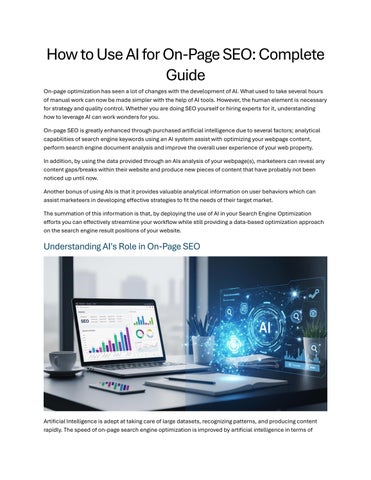
Understanding AI's Role in On-Page SEO
Artificial Intelligence is adept at taking care of large datasets, recognizing patterns, and producing content rapidly. The speed of on-page search engine optimization is improved by artificial intelligence in terms of
faster keyword research, better content optimization, and improved technical auditing. As a result, several on-page SEO service providers have begun Fkeyto utilize AI solutions to provide their clients with more robust audits and faster results than ever before.
However, the best way for AI to work is when it is led by a person who has a basic understanding of SEO and their audience. The best on-page SEO service will be one that combines the analytical Skills of AI with the Skills of humans in strategy and content quality.
Keyword Research and Intent Analysis
AI technology can also help you analyze your search terms to find opportunities for keywords that you may not have thought of on your own. In addition to the number of searches for a keyword, AI technology can also help you identify the type of search (informational, navigational, or commercial) and provide you with variations that can help you rank for related searches rather than just one keyword.
For example, rather than just targeting "running shoes," AI technology can help you identify related searches such as "best running shoes for flat feet" or "advantages of minimalist running shoes."
Content Optimization
AI can also examine the top-ranking pages for your desired keywords and give you Recommendations on how to optimize your content. This includes title tag optimization, meta description optimization, header tag optimization, and ensuring that you have the right keyword density without Overloading. Some AI tools can even examine the readability of your content and give you Recommendations on how to optimize it to increase user engagement. AI for on-page SEO optimization turns tedious SEO optimization into data-driven results.
But never publish content that has been generated by AI without human oversight. Search engines are now placing more emphasis on experience, expertise, Influence, and Trustworthiness. Although AI can give you frameworks and Recommendations, human oversight ensures accuracy, provides unique perspectives, and helps you develop your voice.
How to Use Screaming Frog to Improve On-Page SEO
Screaming Frog SEO Spider is a powerful desktop crawler that works well with AI tools for thorough on-page optimization. Here’s how to use it effectively:
Setting Up Your Crawl
Download and install Screaming Frog. Put your URL into the tool and click 'Start'. It will crawl your website by collecting data from each of the accessible pages on your site. The tool is free; however, if you have a larger website, you will need to pay for the Screaming Frog version in order to crawl more than 500 pages.
Identifying Title Tag Issues
To identify missing, duplicate, or sub-optimized title tags, move to the “Page Titles” tab. Screaming Frog SEO Toolbar will point out titles that are either too long (over 60 characters) or too short (less than 30 characters). This data can be exported and used to generate optimized title variations using AI software based on target keywords and page content.
Optimizing Meta Descriptions
Pages without meta descriptions or those that exceed 155-160 characters need checking in the "Meta Description" tab. Although meta descriptions won't influence ranking positions directly, they influence user click through rates. You can also use AI to generate interesting content that will naturally incorporate your keyword-dense phrases into your meta descriptions.
Finding Duplicate Content
The "Duplicate" filter can help you identify duplicate content from various tabs that share the same title and/or description, as well as the same H1 tag. All duplicate pages will hinder both your efforts to rank in search engines and will confuse the search engines. AI tools can help you rewrite these elements so that each page is still unique, but also reflects your business.
Analyzing Header Structure
The "H1" and "H2" tabs display your heading structure. Each page should have one clear H1 tag that conveys the topic. AI can review your content and suggest logical header structures that improve both SEO and readability.
Checking Internal Linking
Screaming Frog's "Internal" tab outlines your site’s link structure. Look for orphaned pages that is, pages without any internal links pointing to them and pages with too many links. AI tools can provide contextually relevant internal linking opportunities that you might miss manually.
Identifying Broken Links and Redirects
The 'Response Codes' tab contains information regarding redirects, 404 Errors and various other technical concerns. By resolving these problems, your visitors will have a much better experience when using your site and it will be easier for search engines to crawl your website's content. Most professional on-page SEO Service typically includes an analysis of response codes and then fixing any technical problems that could be inhibiting the efficiency of the crawling process.
Analyzing Page Speed Elements
Although Screaming Frog is primarily a crawling tool, it is also capable of detecting large images, too much CSS or JavaScript files, and other factors that contribute to slow loading times. Use this information in conjunction with artificial intelligence-based image optimization software to compress images without losing quality.
Exporting and Prioritizing
Export your Screaming Frog data to spreadsheets. Use AI tools to identify patterns and prioritize fixes based on their potential impact. For example, address issues on high-traffic pages or those targeting your most valuable keywords first.
Technical SEO Enhancements
In addition to Screaming Frog, you can use AI to crawl your site, diagnose and prioritize the repairs of any Technical SEO issues on your site (i.e., identify the most important). You can also use AI to help you implement schema markup on your site; it will analyze your content, and tell you what kind of structured data will help enhance your pages' click-throughs from search results; further, it can also crawl your site to find Technical SEO problems such as unacceptable broken links, slow loading speeds, duplicate content, and poor mobile optimization, and then also assist you in using schema markup by analyzing your content and suggesting related structured data elements that would improve your pages' ranking in search results.
Content Gap Analysis
By analyzing your competitors’ content, AI can point out topics and questions that you have not covered. This information will enable you to create valuable content that will meet the needs of your users and make you an authority in your niche. This competitive intelligence is a crucial part of professional on-page SEO.
Choosing Between DIY and Professional On-Page SEO Services
Although Screaming Frog is primarily a crawling tool, it is also able to point out large images, too many CSS or JavaScript files, and other factors that contribute to slow page loading. By using this information in conjunction with artificial intelligence-based image optimization software, images can be compressed without losing quality.
You may want to think about hiring professional on-page SEO help if you don’t have the time to learn how to use tools such as Screaming Frog, if you require industry-specific knowledge, if you have a large or complicated site, or if you want faster results with better quality. A good balance of in-house AI-assisted SEO
and occasional professional SEO audits can provide the best ROI.
Best Practices for AI-Assisted On-Page SEO
First, leverage AI as research and writing assistant, not a replacement for your own judgment. AI may recommend changes that improve search engine optimization but degrade user experience. Never compromise on what’s best for your actual audience.
Second, fact-check any statistics or facts that AI gives you. AI algorithms can produce data that looks believable but is actually false, damaging your credibility and potentially violating search engine policies.
Third, preserve your brand voice and authority. AI content tends to be very generic. Your distinct point of view, examples, and industry knowledge set you apart from the competition and establish trust with your audience.
Fourth, keep current with search engine policies. Google and other search engines have clarified that content generated with AI is not automatically penalized, but content optimized for search engines rather than humans violates their policies, regardless of whether it’s AI-generated.
Measuring Results
The use of AI analytics tools can help you track the impact of your on-page optimization efforts on rankings, organic traffic, and engagement metrics. Machine learning algorithms can also help you track correlations between changes and improvements in performance, which can further aid you in optimizing your approach.
You can use the regular crawls of Screaming Frog and AI analytics tools to track your progress. You can track metrics such as the increase in organic traffic, improvement in rankings for target keywords, decrease in bounce rates, and increase in time on page to measure the effectiveness of your optimization efforts.
Conclusion
The Strategy that works best combines the analytical powers of AI with tools such as Screaming Frog for technical analysis, and human creativity for strategy and quality checks. Whether you are doing SEO yourself or working with an SEO service, this approach will give you results that are good for search engines as well as actual users. AI takes care of the data-intensive part, and you provide the strategy and quality checks.