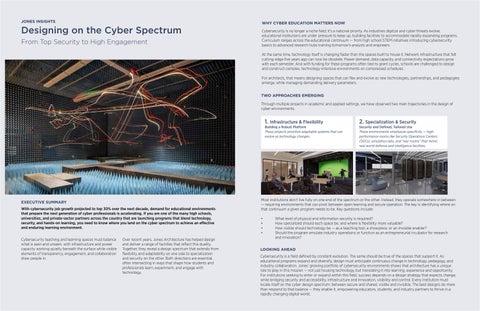
Designing on the Cyber Spectrum
From Top Security to High Engagement
With cybersecurity job growth projected to top 30% over the next decade, demand for educational environments that prepare the next generation of cyber professionals is accelerating. If you are one of the many high schools, universities, and private-sector partners across the country that are launching programs that blend technology, security, and hands-on learning, you need to know where you land on the cyber spectrum to achieve an effective and enduring learning environment.
Cybersecurity teaching and learning spaces must balance what is seen and unseen, with infrastructure and power capacity working quietly beneath the surface while visible elements of transparency, engagement, and collaboration draw people in.
Over recent years, Jones Architecture has helped design and deliver a range of facilities that reflect this duality. Together, they reveal a design spectrum that extends from flexibility and adaptability on one side to specialization and security on the other. Both directions are essential, often intersecting in ways that shape how students and professionals learn, experiment, and engage with technology.
WHY CYBER EDUCATION MATTERS NOW
Cybersecurity is no longer a niche field; it’s a national priority. As industries digitize and cyber threats evolve, educational institutions are under pressure to keep up, building facilities to accommodate rapidly expanding programs. Curriculum ranges across the educational continuum — from high school STEM initiatives introducing cybersecurity basics to advanced research hubs training tomorrow’s analysts and engineers.
At the same time, technology itself is changing faster than the spaces built to house it. Network infrastructure that felt cutting-edge five years ago can now be obsolete. Power demand, data capacity, and connectivity expectations grow with each semester. And with funding for these programs often tied to grant cycles, schools are challenged to design and construct complex, technology-intensive environments on compressed schedules.
For architects, that means designing spaces that can flex and evolve as new technologies, partnerships, and pedagogies emerge, while managing demanding delivery parameters.
TWO APPROACHES EMERGING
Through multiple projects in academic and applied settings, we have observed two main trajectories in the design of cyber environments.
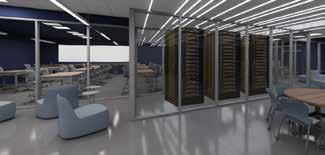
1. Infrastructure & Flexibility
Building a Robust Platform
These projects prioritize adaptable systems that can evolve as technology changes.
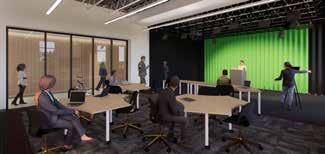
2. Specialization & Security
Security and Defined, Tailored Use
These environments emphasize specificity — highperformance rooms like Security Operations Centers (SOCs), simulation labs, and “war rooms” that mimic real-world defense and intelligence facilities.
Most institutions don’t live fully on one end of the spectrum or the other. Instead, they operate somewhere in between — requiring environments that can pivot between open learning and secure operation. The key is identifying where on that continuum a given program needs to be. Key questions include:
• What level of physical and information security is required?
• How specialized should each space be, and where is flexibility more valuable?
• How visible should technology be — as a teaching tool, a showpiece, or an invisible enabler?
• Should the program emulate industry operations or function as an entrepreneurial incubator for research and innovation?
LOOKING AHEAD
Cybersecurity is a field defined by constant evolution. The same should be true of the spaces that support it. As educational programs expand and diversify, design must anticipate continuous change in technology, pedagogy, and industry collaboration. Jones’ growing portfolio of cybersecurity environments shows that architecture has a unique role to play in this mission — not just housing technology, but translating it into learning, experience and opportunity. For institutions seeking to enter or expand within this field, success depends on a design strategy that expects change, while bridging security and accessibility, infrastructure and innovation, visibility and control. Every institution must locate itself on the cyber design spectrum: between secure and shared, visible and invisible. The best designs do more than respond to that balance — they enable it, empowering educators, students, and industry partners to thrive in a rapidly changing digital world.