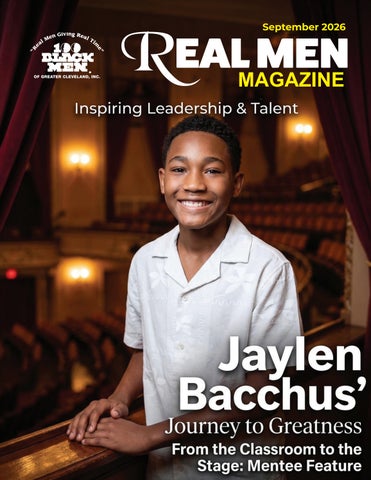
September 2026
REAL MEN MAGAZINE
September 2026 Issue | 1
2 | Real Men Magazine
September 2026 Issue | 3
4 | Real Men Magazine
MESSAGE from THE CHAIRMAN Back to School — A New Year of Possibilities As summer winds down and a new school year approaches, it is special to see young people prepare to return to the classroom. New backpacks, fresh school supplies, new teachers, classmates, and goals all represent something greater: a new opportunity to learn, grow, and improve from yesterday. As Chairman of the 100 Black Men of Greater Cleveland, Inc., I believe going back to school is about far more than academics. It is about preparing our young people for life. Each school year gives our youth another chance to discover their talents, overcome challenges, build confidence, and shape the future they envision for themselves. To our young men, walk into your classrooms with confidence. Ask questions. Do not be discouraged when something is difficult. Some subjects will challenge you, and there will be moments when you may feel like giving up. Remember, challenges are not signs that you cannot succeed—they are opportunities to learn, grow, and become stronger. Education is one of the most powerful tools you can possess. Your teachers, parents, mentors, coaches, and community leaders are there to help you along the way. Use those resources. Listen, learn, ask for help, and keep moving forward. As mentors, we have a responsibility to make sure our young people understand that their future is filled with possibilities. Our motto, “What They See Is What They’ll Be,” reminds us that our presence matters. When young people see men committed to education, leadership, service, and success, they begin to understand what is possible for their own lives. Parents and guardians, stay involved. Ask about homework, attend school events, communicate with teachers, and encourage your children every step of the way. Your support makes a difference. This school year, challenge our young people to dream bigger, work harder, and believe in themselves. Support them with purpose. A new school year means a fresh beginning and another chance to succeed. Welcome back to school. Make this year count. Take action now and make your future great! James W. Wade III Chairman 100 Black Men of Greater Cleveland, Inc. September 2026 Issue | 5
REAL MEN GIVING RE 6 | Real Men Magazine
EAL TIME
WHO WE ARE The 100 Black Men of America, Inc., is not just a leading African-American-led mentoring organization, but a beacon of hope for the African American community. We believe that every African American should have the ability to create the life they’ve always wanted, and that’s what The 100 Black Men of America, Inc. is making possible. Our commitment is unwavering. We strive to personify the type of people our children will look up to and emulate, embracing our immense responsibility to our mentees and our communities. We provide these children another choice by being around like-minded individuals with similar aspirations and goals, ensuring a brighter future for African American youth. As The Network of 100 Black Men of America, Inc. has expanded, we have welcomed more companies and developed new programs to better serve our mission. Our focus areas, known as the 100’s Four For The Future, include mentoring, education, health and wellness, and economic empowerment. These areas guide our efforts to provide the education and empowerment necessary to transform the lives of the children we serve. Through the expansion, we’ve created 100 Black Men Chapters that deliver unique programs that address specific needs in local communities. Through 57 years of testing, we’ve created the 100’s successful model—a proven blueprint for mentoring and developing young people into future leaders by surrounding them with a positive network and giving them the opportunity that they may not have thought was possible.
September 2026 Issue | 7
2026 - 2028 Executive Board
James W. Wade III Chairman
Terry McWhorter Treasurer
8 | Real Men Magazine
Mayor Michael Booker Vice - Chairman
Lloyd Totty Secretary
Larry Jewett Programs Director
2026- 2028 Board of Directors
Chris Howse
Robert Solomon
Steven H. Robertson
David Taylor
Gregory Lockhart Immediate Past Chairman September 2026 Issue | 9
100 Black Men of Greater Cleveland Leadership Team EXECUTIVE BOARD
BOARD OF DIRECTORS
COMMITTEE CHAIRS
James W. Wade III Chairman Retired Journalist
Christopher Howse IT
Director of Communications James W. Wade III
Steven H. Robertson Financial Advisor
Economic Empowerment David Taylor - Chair Steven Sims - Co Chair
Mayor Michael Booker Vice - Chairman Mayor of Highland Hills Lloyd Totty Secretary Terry McWhorter Director of Finance Larry Jewett Director of Programs Retired, Dept of Public Health
Robert Solomon Vice President Campus Enrichment & Engagement CWRU David Taylor Federal Reserve Bank Gregory Lockhart Immediate Past Chairman
National Chairman Milton H. Jones Jr. Midwest District Rep Andre Givens
10 | Real Men Magazine
Education Dr. Terry Echols Rev. Randy Reed Health & Wellness Dr. Ken Griffin - Chair Lloyd Totty - Co Chair Mentoring Darian Johnson - Chair Dr. Ernest Smoot - Co Chair Membership Dr. Cameron Redden - Chair James W. Wade III - Co Chair Scholarship Tyson Mitchell
What They See Is What They’ll Be® September 2026 Issue | 11
The History of the 100 Black Men of Greater Cleveland, Inc. The history of the 100 Black Men of Greater Cleveland, Inc. demonstrates the strength of vision, teamwork, leadership, and service. What started as a meeting of influential Cleveland leaders and community advocates has evolved into an organization dedicated to mentoring, educating, and empowering youth for generations to come. The journey began when visionary leader Michael Nelson organized a landmark meeting to unite individuals from various political and community backgrounds. Among the attendees were Congressman Louis Stokes, former Cleveland City Council President George Forbes, and Mayor Michael R. White, who had defeated Forbes in the mayoral race. The meeting’s location was kept confidential until the day of the event, adding to its significance. Nelson invited several community figures, including Larry Hines, Gregory Clifford, Curtis Griggs, Tony Smith, Luther Towers, and Julius Singleton. Political representatives included Ron Adrine for Congressman Stokes, Daryl Fields for George Forbes, and Nate Gray for Mayor White. They gathered with Chairman Dortch and Roosevelt Adams at the now-closed Eloise’s Restaurant, situated at East 79th Street and Carnegie Avenue. The vision became a reality when the National Headquarters approved Cleveland as an official chapter in 1997. The chapter quickly showed great enthusiasm for uniting Black men around a shared goal: creating opportunities and enhancing the lives of young people. One of the chapter’s initial major events was its launch at the Cleveland Clinic, where over 90 men pledged to join the organization, and approximately 70 paid their membership fees. Mayor Michael R. White showed his support by committing to buy 100 copies of motivational speaker George Fraser’s book, Success Runs in Our Race, for the members. Fraser attended the event and personally signed the books, creating a memorable experience for the chapter’s early members. The chapter soon hosted a significant fundraising gala featuring the late Phyllis Hyman, a nationally acclaimed recording artist. Richard Johnson organized the event, held at the Marriott Hotel in Cleveland. Its success helped establish the 100 Black Men of Greater Cleveland as a growing force for positive community change.
12 | Real Men Magazine
As the organization expanded, mentoring became central to its mission. Members launched programs in schools across Greater Cleveland, including Daniel E. Morgan Elementary School, Cleveland East Senior High School, John F. Kennedy Senior High School, East Cleveland Shaw Senior High School, Mound School, and Warrensville Heights Senior High School. The organization also ran a Saturday morning mentoring program from its offices at Cleveland’s Shaker Square complex. Programs included reading initiatives, academic assistance, leadership development, and financial literacy. A major accomplishment came through the East High School Stock Market Challenge. The team traveled to Atlanta to compete against schools nationwide and earned an impressive third place, demonstrating what young people can achieve with guidance, preparation, and opportunity. The chapter continued to grow and widen its influence. In 2022, 22 new members joined the organization, showing ongoing interest in its mission. As the chapter celebrated its 25th anniversary in 2023, it reflected on decades of mentoring, community service, successful fundraising events, and partnerships that created opportunities for youth. In 2024, under the leadership of Chairman Gregory Lockhart and Vice Chairman James W. Wade III, the chapter proudly reinstated its Saturday Academy at Cuyahoga Community College’s Eastern Campus. The refreshed program became a cornerstone of the chapter’s mentoring efforts, offering young men a safe, structured, and inspiring environment to learn, grow, and develop leadership skills. The momentum carried on in 2025, as members deepened their commitment to youth service. Saturday Academy expanded with programming centered on the organization’s Four for the Future pillars: Mentoring, Education, Health & Wellness, and Economic Empowerment. The chapter also introduced Well Connected Wednesday, bringing families and mentees together for fitness, wellness, and fellowship. The chapter hosted signature community events including the Drive Cleveland Golf Outing, Family Picnic, and Walk a Mile with a Child. Partnerships broadened opportunities in sports, STEM, financial literacy, and college readiness. The chapter’s STEM students earned an outstanding second-place finish at the 100 Black Men National Conference in New Orleans, bringing national recognition to Cleveland’s youth. The organization also continued to share its story through the community with the Real Men Magazine, showcasing the achievements of members, mentees, partners, and community leaders while reinforcing its powerful motto: “What They See Is What They’ll Be.” Since January 2026, under the leadership of Chairman James W. Wade III, the 100 Black Men of Greater Cleveland, Inc. has continued to build on its proud legacy. Program participation has risen, and member involvement has increased as more members actively engage in mentoring, Saturday Academy, community events, health and wellness initiatives, economic empowerment, and educational programs. This renewed dedication shows what is possible when members unite around a common mission. Looking ahead, the chapter remains committed to mentoring, educating, and empowering young people while preparing the next generation of leaders. The history of the 100 Black Men of Greater Cleveland is not just a story of the past—it is the foundation for the future.
September 2026 Issue | 13
FOUNDING MEMBERS Judge Ronald Adrine Chief Magistrate Gregory Clifford,Retired * Darrell A. Fields Nate Gray Curtis (Griggs) Larry Hines*
Judge Michael Nelson Julius Singleton Anthony (Tony) Smith* Luther Towers * means deceased
MEMBERS Robert L. Bankston Dr. Michael Baston Joseph Billups Curtis Bloxson Mayor Michael Booker Anthony Brown Grady Burrows Lonnie Coleman Raphael Collins Dr. Michael Copeland Pastor Robert Dix Lamont Dodson Dr. Ronnie Dunn Clayton Eason Dr. Terry Echols Gregory Ensley Darrell Fields Anthony Franklin Duane Griffin 14 | Real Men Magazine
Curtis (Griggs) Jeevon Harris Judge Brett Horton Councilman Michael J. Houser Chris Howse Chief Wayne Hudson Larry Jewett Darian Johnson Roz Kennon Gregory Lockhart Terry Maynard Terry McWhorter Tyson Mitchell Aubrey Morgan Judge Michael Nelson - Retired Edwin (Tony) Nicholas Judge Charles Patton Anthony Peebles LaRese Purnell
Dr. Cameron Redden Rev. Randy Reed Jayson Richardson Steven H. Robertson Aqeel Seals Glen Shumate Steve Sims Jermaine Smith Ernest Smoot Robert Solomon Antwan Steele David L. Taylor Andre Thompson Lloyd Totty James W.Wade III
September 2026 Issue | 15
Putting Our Young Mentees in the Room: 100 Black Men Mentees Hear a Powerful Message from Dr. Michael Eric Dyson
On Saturday, August 8, 2026, two young men from the 100 Black Men of Greater Cleveland, Inc. had an experience that will remain with them long after the evening ended. They had the opportunity to attend the Cleveland Black Equity and Humanity Fund gala at the Cleveland Museum of Art and hear a dynamic, thought-provoking message from nationally recognized scholar, author, ordained minister, and commentator Dr. Michael Eric Dyson. The event, titled “Race for Peace: Equity & Enduring Humanity,” was more than an elegant evening. It celebrated history, courage, achievement, and the ongoing 16 | Real Men Magazine
responsibility to build a more equitable future. The gala commemorated the 90th anniversary of Cleveland’s own Jesse Owens’ historic Olympic victories in Berlin, Germany, in 1936, while also recognizing the 250th anniversary of the United States and the 230th anniversary of the City of Cleveland. For the young men attending, however, the evening represented something even more personal: an opportunity to sit in a room with some of the most influential voices addressing issues of history, race, leadership, equity, and humanity.
Dr. Michael Eric Dyson delivered the keynote address to a captivated audience. Known for combining history, scholarship, faith, culture, and current events, Dyson challenged attendees to think deeply about the meaning of Jesse Owens’ accomplishments. Dyson explained that Owens was doing his job as an athlete, but his performance carried enormous political and social implications. Owens stepped onto the world stage in Nazi Germany and competed at the highest level, winning four gold medals in the 1936 Olympic Games. His accomplishments challenged racist ideology and demonstrated the power of excellence in the face of oppression. For the young mentees of the 100 Black Men of Greater Cleveland, hearing this history directly from someone like Dr. Dyson provided a lesson that cannot always be replicated inside a classroom.
Following the event, Shalimar Lewis offered a heartfelt message of appreciation to Wade and the organization. “Deep Salute to Mr. James Wade & 100 Black Men of Greater Cleveland,” she shared, expressing her appreciation for the organization’s commitment to opening doors and creating opportunities for young men in the community. Lewis described the experience as an opportunity for two young “Kings” to sit at the feet of Dr. Michael Eric Dyson and receive a message filled with education, realism, facts, knowledge, and faith. She emphasized that experiences like this can leave a lasting mark on a young man’s journey. Her words capture the heart of mentoring.
It was history coming alive.
Sometimes, mentoring is about sitting down with a young person and offering advice. Other times, it is about creating an opportunity that allows that young person to see what is possible. It is about opening doors that might otherwise remain closed.
It was a chance to see that excellence can impact far more than the individual.
That is what the 100 Black Men of Greater Cleveland strives to do.
The evening also underscored the importance of mentorship. The mission of the 100 Black Men of Greater Cleveland is not simply to tell young men that they can become leaders—it is to create opportunities for them to see leadership, excellence, and success firsthand.
Through its mentoring, education, health and wellness, and economic empowerment initiatives, the organization continues to invest in the next generation. Its motto, “What They See Is What They’ll Be,” speaks directly to the importance of exposure and positive examples.
As Chairman of the 100 Black Men of Greater Cleveland, James W. Wade III understands the importance of putting young people in rooms where they can learn from individuals who have achieved greatness. Exposure matters. Experiences matter. Relationships matter.
The gala was also significant because it marked the start of a year of activities centered on the inaugural event’s theme. The Cleveland Black Equity and Humanity Fund is powered by The Soul of Philanthropy Cleveland (TSOPCLE), a civic collaboration and multimedia exhibition
It was a masterclass.
September 2026 Issue | 17
highlighting the rich and often untold history of African-American charitable giving and community care in Greater Cleveland. The Soul of Philanthropy Cleveland includes Kevin Johnson, Connie HillJohnson, Cecil Lipcomb, and Teleange Thomas, whose collective efforts help bring greater attention to the history of generosity, service, and community investment throughout Greater Cleveland. For the two 100 Black Men mentees, August 8 was more than another Saturday night. It was an educational, cultural, and leadership experience. 18 | Real Men Magazine
They witnessed firsthand what happens when history, scholarship, faith, and community come together. They heard about Jesse Owens and the courage required to perform on the world’s biggest stage. They heard Dr. Dyson challenge the audience to think beyond the moment. And most importantly, they experienced what happens when caring adults intentionally place young men in rooms filled with knowledge, excellence, and possibility.
Chairman James W. Wade III and the 100 Black Men of Greater Cleveland continue to demonstrate that mentorship is about more than words. It is about opening doors, creating experiences, exposing young people to greatness, and helping them understand that they, too, have a place at the table. When our young men see greatness, they can begin to believe greatness is possible for them. And when we invest in them today, we help prepare the leaders who will shape our community tomorrow.
September 2026 Issue | 19
Congratulations
20 | Real Men Magazine
What you do empowers us all. We are proud to support 100 Black Men of Greater Cleveland.
Dollar.Bank
Equal Housing Lender. Member FDIC. Copyright © 2025, Dollar Bank, Federal Savings Bank. CMD597_25
September 2026 Issue | 21
TAKING FLIGHT: OUR MENTEES REACH NEW From the classroom to the skies, the 100 Black Men of Greater Cleveland continues to expose young men to opportunities, technology, and careers they may have never imagined. The sky was the classroom on Saturday, August 15, as the 100 Black Men of Greater Cleveland, Inc. brought an exciting and innovative learning experience to its Saturday Academy at Cuyahoga Community College’s Eastern Campus. This month’s academy introduced mentees, parents, and members to the world of drone technology, giving participants a chance to learn about an industry that continues to grow and 22 | Real Men Magazine
create new career, educational, and entrepreneurial possibilities. The experience featured Cleveland Drones, a Cleveland-area company that brought the world of unmanned aircraft systems directly to the young men participating in Saturday Academy. Before the hands-on experience began, 100 Black Men member Christian Hunter provided an informative presentation
W HEIGHTS THROUGH DRONE TECHNOLOGY about the importance of understanding drone technology and the responsibility that comes with flying a drone. Hunter explained that flying a drone is more than simply putting a machine into the air. It requires knowledge, preparation, awareness, skill, and an understanding of safety and responsible operation. The presentation captured the attention of the mentees and adults in attendance and prepared everyone for the next challenge— the test. Mentees, parents, and members participated together, demonstrating what they had learned during the
presentation. At the end of the session, attendees completed the testing process and received a Trust Certificate, marking another milestone in their educational journey. AND THEN CAME THE SURPRISE! Just when the mentees thought the day couldn’t get any better, Cleveland Drones added another exciting surprise—a drone raffle! The company generously raffled off two drones to the mentees, creating an unforgettable moment for the young men who had spent the morning learning about drone technology. September 2026 Issue | 23
The excitement filled the room as the names were selected. Mentees cheered, smiled and anxiously waited to see who would walk away with their very own drone. For the two lucky winners, the experience became even more special. They not only learned about drone technology, earned their Trust Certificates and had the opportunity to fly a drone themselves— they now had the chance to continue exploring the technology at home. The raffle was a wonderful way for Cleveland Drones to reinforce the lessons of the day and encourage the young men to continue learning, experimenting and exploring the possibilities of STEM and technology. FROM THE CLASSROOM TO THE SKY But the learning didn’t stop after the test. After completing the classroom portion, the mentees headed outside for the most 24 | Real Men Magazine
exciting part of the day—the hands-on drone experience. The young men were divided into three groups, giving each mentee the chance to get behind the controls and fly a drone. Under the guidance and supervision of the Cleveland Drones team, the mentees learned how to take off, maneuver, and control their drones. They were then challenged to demonstrate their skill, concentration, and accuracy by flying the drones through designated areas and successfully landing them inside various hoops. For many of the young men, this was their first opportunity actually to operate a drone. The excitement was evident as each mentee took a turn at the controls. Some quickly gained confidence, while others took their time learning how to make precise movements. Each flight became a lesson in patience, coordination, focus, and problem-solving.
The hoop challenge transformed the activity into a friendly competition while reinforcing the importance of accuracy and control. The mentees quickly discovered that successfully flying a drone requires more than simply moving a joystick—it requires the ability to think ahead, make adjustments, and remain focused on the objective. The hands-on experience brought the lesson to life. EXPOSURE CREATES OPPORTUNITY For the young men of the 100 Black Men of Greater Cleveland, the experience represented much more than receiving a certificate or learning how to operate a drone. It represented exposure. The organization understands that many
young people will never encounter certain careers, technologies, or professional environments unless someone intentionally opens the door. Saturday Academy was created to do exactly that. Through Saturday Academy, the 100 Black Men of Greater Cleveland strives to expose its mentees to experiences they might never otherwise encounter, while providing the guidance, mentorship, and support needed to turn those experiences into future opportunities. The program is built around the organization’s Four for the Future pillars: Mentoring, Education, Health & Wellness, and Economic Empowerment. Each Saturday Academy experience provides an opportunity to connect one or more of these pillars to real-life experiences. The drone presentation connected education and technology with economic empowerment, while mentors and parents reinforced the importance of mentoring and community support. A MESSAGE FROM THE CHAIRMAN James W. Wade III, Chairman of the 100 Black Men of Greater Cleveland, Inc., believes exposing young men to new possibilities is one of the organization’s most important responsibilities. “Our Saturday Academy is about exposure, opportunity, and preparation. We want our young men to understand that there are no limits to what they can accomplish when they have the opportunity to learn, explore, and develop new skills. Today, they learned about drones, but more importantly, they learned that there are careers, businesses, and opportunities waiting for them in areas they may have never considered.” September 2026 Issue | 25
That philosophy is at the heart of the organization’s nationally recognized motto: “WHAT THEY SEE IS WHAT THEY’LL BE.” On August 15, the mentees didn’t simply see a drone flying through the air. They flew it themselves. They saw technology. They saw innovation. They saw entrepreneurship. They saw education. They experienced teamwork and competition. And they saw another possible pathway toward their future. Saturday Academy also demonstrates the importance of bringing adults and young people together in the same learning environment. Parents and members participated alongside the mentees, creating an atmosphere where everyone could learn, ask questions, and discover something new. The goal is not simply to teach young men what is happening today. The goal is to prepare them for what will happen tomorrow. The 100 Black Men of Greater Cleveland recognizes that leadership development begins with exposure. When young men are introduced to new ideas, professionals, technologies, and career paths, their vision of what is possible grows. The August Saturday Academy was another example of the organization investing in the future—one young man, one experience, and one opportunity at a time.
26 | Real Men Magazine
September 2026 Issue | 27
28 | Real Men Magazine
September 2026 Issue | 29
30 | Real Men Magazine
one open door can open doors across a community. Our most important work happens outside the four walls of our bank. KeyBank gets involved, supporting people who make a difference and working with communityfocused organizations through investments, philanthropy, and volunteering. We believe that together we can keep our communities full of hope, compassion, and opportunity, one open door at a time. KeyBank thanks 100 Black Men of Greater Cleveland, Inc. for making a difference.
©2025 KeyCorp®. All rights reserved. KeyBank Member FDIC. 250113-2950330-1296626560
September 2026 Issue | 31
Meet our Mentee: Jaylen Germaine Bacchus: A Young Man Ready to Take Center Stage
At just 13 years old, Jaylen Germaine Bacchus, an eighth-grade student and mentee of the 100 Black Men of Greater Cleveland, Inc., is already learning one of life’s most important lessons: dreams become reality when you are willing to work for them.
ambitions do not stop there. Jaylen also hopes to become a fashion designer and comedian. His wide range of interests reflects a young man unafraid to explore his talents and discover the possibilities his future holds.
Growing up, Jaylen has always loved singing, dancing, and acting, often sharing those passions with his mother and older sister, Geriah. Their influence helped nurture the creative spirit Jaylen carries today. From an early age, he was fascinated by different fashion styles and designers, sparking another dream: to become a fashion designer someday.
His passion for the performing arts has already given him opportunities to develop his skills. Jaylen has participated in two musical productions at Karamu, gaining valuable experience performing for audiences. He has also participated in several school talent shows, giving him additional opportunities to showcase his personality, creativity, and confidence.
Jaylen is a young man with a big personality, a creative spirit, and an even bigger vision for his future. His greatest passion is acting, and he dreams of becoming a famous actor. But his
For the past two years, Jaylen has also participated in the Karamu summer camp acting program, where he has worked intensely to develop his acting abilities. This experience has helped him learn
32 | Real Men Magazine
to perform, prepare for roles, work with others, and feel comfortable in front of an audience. For Jaylen, acting is more than simply getting on stage. It lets him express himself, use his imagination, and become different characters. It also teaches him important life lessons about discipline, preparation, teamwork, communication, and confidence—qualities that will serve him well long after the curtain closes. Jaylen’s talents extend beyond acting. He enjoys singing and has also joined the children’s choir at his church. Whether he is acting, singing, dancing, or participating in a talent show, Jaylen has found creative outlets that allow him to express who he is. As a mentee, Jaylen has demonstrated many of the qualities that make him a
great representative of the 100 Black Men of Greater Cleveland. He is energetic, engaging, curious, and willing to learn. Most importantly, Jaylen is beginning to understand that becoming the young man he wants to be requires discipline, perseverance, hard work, and the courage to overcome challenges. One of the most influential people in Jaylen’s life is his mother. She has been a constant source of love and support and has instilled positive lessons that continue to guide him. Her encouragement has helped Jaylen understand the importance of believing in himself, staying focused, and moving forward when things get difficult. Another important influence in Jaylen’s life is his teacher, Mrs. Nana. Jaylen has faced challenges with reading, comprehension, and writing, but Mrs. Nana refused to allow those challenges to define him. She took the time to work with him individually, pulling him aside at school to strengthen his reading, comprehension, and writing skills. Her dedication has helped Jaylen understand the value of having people in your corner who believe in your potential and are willing to invest their time in helping you succeed. Like many young people, Jaylen has also faced personal challenges. He recognizes that anger and frustration have sometimes been difficult for him to manage. Through therapy and learning healthy coping skills, Jaylen has made progress in understanding his emotions and finding more positive ways to respond in difficult situations. That growth is an important
September 2026 Issue | 33
part of his journey toward becoming a responsible, confident, and well-rounded young man. Jaylen’s story reminds us that success is not simply about talent. Talent opens the door, but commitment, preparation, and hard work keep you moving forward. His experiences at Karamu, in school, at church, and through the 100 Black Men mentoring program are helping him build the tools he needs to pursue his dreams. The 100 Black Men of Greater Cleveland, Inc. is proud to have Jaylen as part of its mentoring family. The organization’s motto, “What They See Is What They’ll Be,” reminds us that young people need positive examples, encouragement, guidance, and opportunities to discover their potential.
Jaylen’s journey shows the importance of giving young people spaces where they can discover their gifts and build their confidence. When a young man has the opportunity to perform, create, learn, and grow, he begins to see possibilities for himself that may have once seemed out of reach. Jaylen has a message for other young people: “Always accomplish your goals, never give up, always be yourself, and work hard.” Those words reflect the mindset Jaylen is developing as he continues his journey. At 13, Jaylen is still at the beginning of his story, but his determination, creativity, personality, and passion are already shining through. Whether he is standing on a stage acting, singing in his church choir, dancing, participating in a talent show, or dreaming up his next fashion creation, Jaylen is learning to embrace the many talents that make him unique. With continued support from his family, teachers, mentors, and community, the stage is set for Jaylen to pursue his dreams. The 100 Black Men of Greater Cleveland, Inc. believes Jaylen has what it takes to become a successful actor, fashion designer, comedian, and, most importantly, a successful young man who understands the value of hard work, character, and perseverance. Jaylen’s story is just beginning—and his future is waiting for him to take center stage.
34 | Real Men Magazine
September 2026 Issue | 35
Health & Wellness By
Dr. Ken J.A. Griffin, DHA, MA, RMC
Healthy Beginnings: Back to School Means Back to Health By Dr. Ken Griffin Health & Wellness Chair Back to School Is a Family Health Moment September brings a familiar rhythm. School buses return to our streets, backpacks are packed, practices and afterschool activities begin, and families adjust to earlier mornings and fuller calendars. We spend a great deal of time making sure our children have school supplies, uniforms, new shoes, transportation, and everything else they need to succeed. Yet one of the most important back-toschool preparations cannot be purchased in a store: making sure our children are healthy and ready to learn. A healthy school year begins long before a child sits down at a desk. It begins at home, with families making intentional choices about preventive care, vaccinations, nutrition, sleep, physical activity, mental wellness, and the routines that help children thrive. The connection between health and education is powerful. Healthy students are better positioned to learn, participate, develop relationships, and reach their potential. Vaccines Are an Important Part of Prevention Back-to-school season is an ideal time for parents and caregivers to review their 36 | Real Men Magazine
children’s immunization records with a healthcare provider. Vaccines have helped protect generations of children from serious illnesses, and staying current with recommended immunizations remains an important part of preventive healthcare. Depending on a child’s age, health history, and individual circumstances, that conversation may include routine childhood vaccines as well as vaccines recommended during adolescence. The goal is not simply to complete paperwork for school. Vaccination is about protecting the individual child while also helping protect classmates, teachers, family members, and people in our communities who may be particularly vulnerable to illness. Parents should feel comfortable asking questions and discussing the benefits, risks, timing, and recommendations for their child with a trusted healthcare professional. Informed families are empowered families, and preventive care works best when parents and healthcare providers work together. Do Not Stop at the Immunization Record A child’s health is much bigger than whether a form has been signed. Backto-school season is also an opportunity to schedule a wellness visit and make sure children are growing and developing appropriately. Preventive visits can provide opportunities for recommended screenings, counseling, immunizations,
and conversations about a young person’s overall health. Parents should also pay attention to vision, hearing, oral health, asthma, allergies, medications, and other conditions that could affect a child’s experience at school. A student struggling to see the board, hear the teacher, manage asthma, or cope with untreated dental pain may have difficulty concentrating even when that student is bright and eager to learn. We cannot separate academic success from health. When we prepare children for the classroom, we should prepare the whole child.
Fruits, vegetables, whole grains, healthy sources of protein, and water can become regular parts of the family routine. September can also be an opportunity to involve children in choosing healthier foods, preparing lunches, and learning why nutrition matters. We should teach children that food is not only about weight or appearance. Food provides the energy they need to think, move, grow, play, and learn. Those lessons can follow them long after they leave our homes.
Sleep Is Part of the School Supply List
Returning to school should not mean returning to inactivity. Children need opportunities to move, play, exercise, and simply be children. Physical activity supports physical health, but its benefits extend into the classroom as well. Regular activity can support attention, memory, heart and lung health, stronger muscles and bones, and emotional well-being. Families can make movement something they enjoy together. Take an evening walk. Ride bicycles. Visit a neighborhood park. Play basketball. Dance in the living room. Encourage participation in sports or afterschool activities when possible. Healthy habits do not always have to feel like work. Some of the best forms of wellness are built around laughter, family, friendship, and fun.
One of the hardest transitions from summer to school is getting everyone back on a consistent sleep schedule. Late summer nights can quickly become difficult school mornings, and insufficient sleep can affect concentration, behavior, emotional well-being, and academic performance. School-age children ages 6 through 12 generally need 9 to 12 hours of sleep, while teenagers need about 8 to 10 hours. Establishing a regular bedtime, limiting late-night electronics, and creating a calmer nighttime routine can help children transition back into the school year. Adults should model these habits as well. Our children pay attention to what we practice, not simply what we tell them. When the entire household begins treating rest as an important part of health, we teach young people that taking care of themselves includes knowing when it is time to recharge. Fueling Bodies and Minds Busy mornings can make breakfast an afterthought, and packed schedules can make convenience foods tempting, but nutrition remains an important part of children’s growth and well-being. Families do not need perfect meals or expensive ingredients to make healthier choices. The goal should be balance and consistency.
Keep Our Children Moving
Ask About More Than Grades As we focus on physical health, we cannot overlook the emotional transition that comes with returning to school. A new school year can bring excitement, but it can also bring anxiety, social pressure, bullying, academic stress, and uncertainty. This is particularly important as children grow older and become more independent. Parents and mentors should ask questions that go beyond,
September 2026 Issue | 37
38 | Real Men Magazine
September 2026 Issue | 39
Dr. Terry Echols Our Children Are Going Back to School. Cleveland Must Make Sure They Don’t Go Back to the Same Limits Every year around this time, Cleveland families prepare for another school year. Parents buy clothes and backpacks are filled as school supplies are purchased. Then teachers prepare their classrooms while students receive their schedules and begin another journey through the academic year. But as a community, we should be asking a bigger question: What are we truly sending our children back to school to receive? If the answer is simply grades, test scores, and a report card, then we are thinking far too small. Education must be about more than sitting in a classroom and completing assignments. Education should be about access, opportunity, exposure, relationships, resources, and possibilities. It should help our children see a future beyond what they currently know and, in some cases, beyond what they can currently see in their own neighborhoods. That is especially important for children growing up in urban communities like Cleveland. Our young people have talent, intelligence, creativity, and more importantly, they have dreams. What they do not always have is equal access to relationships, experiences, resources, and opportunities that can help turn those dreams into reality. And that is where our schools, families, mentors, community organizations, and institutions must step up. We cannot continue telling young people to “work hard” without also helping them understand what opportunities are available and how to access them. We cannot tell a child to dream bigger if we have never taken the time to show that child 40 | Real Men Magazine
what “bigger” looks like. A young person may never imagine attending college if no one has ever taken him to a college campus. He may never consider becoming an entrepreneur if he has never met a successful business owner. He may never see himself traveling the world if he has never traveled beyond his neighborhood. He may never believe that leadership is possible if no one has ever placed him in a position to lead. That is why education must extend beyond the classroom. Opportunity is also education. At Wade Park School, programs like the multifaceted mentoring model provide an important reminder of what education can and should look like. Our mentoring program is not designed simply to give young people another activity during the school day. It is designed to create opportunities for conversation, growth, exposure, and connection. It gives young people access to caring men and mentors who are willing to invest their time, experiences, wisdom, and encouragement into the next generation. And let me be clear, relationships matter. Sometimes a child does not need another lecture, instead he needs someone to listen to. Sometimes he does not need someone to tell him what he cannot do. He needs someone who can help him recognize what he can do. Sometimes the difference between a young person giving up and continuing forward is one adult saying, “I believe in you.” That is the power of mentoring. But mentoring is only one piece of a larger conversation about education. Our children
should be encouraged to take advantage of everything available to them. Things like academic support, tutoring, leadership programs, college visits, career exploration, scholarships, athletics, arts, conferences, mentoring, internships as well as civic engagement opportunities are vital to their development. Too many opportunities go unused simply because students and families do not know they exist. That must change. Cleveland must become a city of exposure. We often talk about preparing children for the future. But preparation requires exposure, thus how can we expect young people to compete in a world they have never been introduced to? Many of our children have never been past Akron, OH., which makes the world that much larger. How can we expect them to pursue careers they have never heard of? There are only so many content
creators or social media influencers. How can we expect them to believe in possibilities they have never seen? Cleveland is filled with resources. We have nationally acclaimed colleges and universities, worldclass hospitals and healthcare systems, major corporations, small businesses, renown cultural institutions and professional organizations along with a litany of talented driven community leaders, entrepreneurs, skilled tradespeople, artisans, professional athletes, decorated and courageous veterans, and brilliant educators. The question is not whether resources exist, but rather the question becomes whether our young people have access to them. We need to do a better job connecting our children to the people, places, and experiences that can expand their understanding of what is possible. That means schools cannot do it alone, parents cannot do it alone, and mentors cannot do it alone. This must be a community
September 2026 Issue | 41
effort. We must stop measuring education too narrowly particularly in communities of color as well as underserved neighborhoods. Yes, grades matter as does attendance and certainly reading and mathematics matter. We can no longer leave the ideal of prison expansion to the Departments of Corrections based on 3rd grade state tested proficiency. Education is also about learning how to make decisions. It is about learning how to communicate, how to manage money, how to lead, how to resolve conflicts, how to take care of your health, how to advocate for yourself, and how to navigate the world. These are lessons that can determine whether a young person simply survives adulthood or truly thrives in it. That is why programs that address financial literacy, leadership, decision-making, wellness, civic engagement, academic success, and personal responsibility are so important. We must prepare the whole child. And for young men growing up in communities where they may face unique challenges, it is especially important that they have positive relationships with men who can provide guidance, accountability, encouragement, and perspective. Our children should not have to figure everything out alone. This school year let’s challenge our young people. As our children return to school, we should challenge them to do more than simply attend class. They need to ask questions, join something like a club or organization, apply for something, ask for help, find a mentor, visit a college, explore a career, participate in a leadership program, take advantage of tutoring, meet people outside your normal circle, and just try something new. Because one opportunity can introduce a young person to an entirely different future. One mentor can change a perspective. One college visit can create a goal. One conversation can inspire a career. One experience can expand a dream. Our responsibility is bigger than sending them to school because Cleveland’s children are full of potential. But potential alone is not enough. Potential needs opportunity and opportunity needs access. Access often 42 | Real Men Magazine
requires someone willing to open a door. That is the responsibility we share as a community. As our children head back to school this year, let us not simply ask them, “What grade did you get?” Let us also ask, “What did you learn about yourself, what opportunity did you pursue, who did you meet, what new experience did you have, what do you now believe is possible for your future?” Because that is how we should begin measuring the true value of education. Our children are going back to school. But Cleveland must make sure they are not going back to the same limited opportunities, the same limited exposure, and the same limited expectations. We owe them more than that. We owe them access. We owe them relationships. We owe them opportunities. And most importantly, we owe them a community that is willing to help them see a bigger future than the circumstances they may see today. Education is not just about preparing our children to pass a test. It is about preparing them to recognize, pursue, and take advantage of every opportunity that can help them build a better life. That should be our commitment not just at the beginning of the school year, but every day afterward.
September 2026 Issue | 43
Legacy in Action: Dennis Harris’ Unwavering Commitment to the Next Generation By Jayson Richardson Leveraging Legacy: Dennis Harris’ biggest accomplishment isn’t that he played at Ohio State, coached championship teams, taught generations of students, or even took his work around the world. It’s that for more than four decades, Harris has refused to allow opportunities for young people to disappear simply because funding did. Dennis Harris has kept his receipts. They are in old photographs, newspaper clippings, scrapbooks and programs collected across more than four decades. There is Harris in an Ohio State football uniform. Harris coaching. Harris standing beside former Cleveland Mayor Frank Jackson. Harris surrounded by children at Case Western Reserve University. Harris in Australia, where his work with young people helped inspire programming thousands of miles from Cleveland. As he flips through the memories, one story leads to another. A former athlete who became a doctor. A student who came back years later. A trip to Capitol Hill to fight for funding. A child who stepped onto a college campus for the first time because of the National Youth Sports Program.
“The fight,” Harris says. For nearly half a century, that fight has been centered on giving young people opportunities he believes can change the direction of their lives. And perhaps nowhere is that more evident than at Case Western Reserve University, where Harris has spent more than four decades as a coach, educator and youth advocate — and where he has helped keep alive a program that once existed on college campuses across the country. The National Youth Sports Program was created during a turbulent period in American history to bring young people onto college campuses during the summer and provide sports, education, health programming and mentorship. At its height, Harris said roughly 200 universities operated NYSP programs. Today, he says, Case Western Reserve is the last one standing. For Harris, that is both a source of pride and a responsibility. “I’ve been on the battlefield a long time fighting,” he said.
At 68, Harris accumulated enough stories to fill a book.
That willingness to fight was developed long before Harris arrived at Case.
But ask him what he wants people to remember, and he quickly moves the conversation away from himself.
Growing up in Cleveland, Harris attended John F. Kennedy High School. Athletics were already part of his life, but his path to college football was anything but conventional.
44 | Real Men Magazine
He did not play varsity football at Kennedy. In fact, Harris said he was cut from the team. He instead competed in track and played trombone in the school band.
University in 1976, he had no football scholarship waiting for him and no celebrated high school career behind him. But after playing recreationally with friends, his roommates encouraged him to try out for the Buckeyes.
Still, he knew he was an athlete.
He did.
When Harris enrolled at Ohio State
And he made the team. September 2026 Issue | 45
Harris played three seasons at Ohio State during one of the program’s most recognizable eras, spanning the final years of legendary coach Woody Hayes and the beginning of the Earle Bruce era. For Harris, however, Ohio State was about much more than football. He earned his degree in history and said the experience prepared him for life, including how to navigate environments in which he sometimes felt race affected how people were treated. Harris had grown up watching the Civil Rights Movement unfold. He remembers being a child and questioning why police dogs and violence were being used against people fighting for equal rights. He also remembers hearing Dr. Martin Luther King Jr. speak in Cleveland. Those experiences stayed with him. “I think God has a calling for everybody,” Harris said. “And my calling has just been working with people, man. And kids and children.” That calling eventually brought Harris back to the same Cleveland school where he had once been cut from the football team. After college, he returned to Kennedy as a coach and teacher. In 1981, Harris was part of a staff that helped the school win a city championship and reach the state playoffs. For Harris, there was a certain poetry to it. The young man who had once been told, in effect, that there was no place for him on the team had returned to help lead it.
46 | Real Men Magazine
His career in education continued through Cleveland schools before Case Western Reserve offered him a full-time opportunity. Harris had already been coaching football and track at Case. When he joined the university full time, his responsibilities kept growing. He coached football. He coached men’s and women’s track. He taught physical education courses. He worked with students. And eventually, he became one of the driving forces behind Case’s National Youth Sports Program. Harris said that when he first arrived at Case in 1982, the football program had not won a game in two years. The turnaround came quickly. Within several seasons, the Spartans produced an undefeated team. But when Harris talks about coaching, wins and losses rarely remain the focus for long. He remembers something longtime Case coach Bill Sudeck once told him. According to Harris, Sudeck said Harris had accomplished something he had never been able to do. “You made the track team a family.” Harris still considers it one of the greatest compliments of his career. “The family is the root of everything,” Harris said. That philosophy became central to NYSP. The five-week summer program serves children ages 8 to 16 and exposes them to far more than athletics. Participants take part in sports, academic activities, health education and other programming while spending their summer on a university campus.
To Harris, the campus itself matters. When his father dropped him off at Ohio State in January 1976, Harris said he knew almost nothing about college life. His parents valued education deeply, but neither had attended college.
And he kept fighting. At one point, Harris said he personally raised nearly a quarter-million dollars to help sustain the program. That persistence is part of why recognition means something different to Harris.
His mother came from Greenwood, Mississippi, and had only a few years of formal schooling. His father, from Arkansas, served in World War II and earned three Bronze Stars.
As he receives lifetime achievement honors for decades of work, he says the award itself is not the point.
They could not explain college to him because they had never experienced it.
If people outside Case recognize the value of the work, Harris believes that recognition can create pressure and momentum to protect the program internally.
That memory helps explain why Harris becomes animated when he talks about an 8-year-old walking onto Case Western Reserve’s campus. Instead of seeing a university for the first time at 18, confused and uncertain as he once was, a child can begin imagining themself there a decade earlier. Harris calls it giving children “the right start.” The importance of that mission became even clearer when federal funding for NYSP disappeared.
He calls recognition “leverage for legacy.”
Because at 68, his biggest concern is no longer what Dennis Harris can accomplish. It is what happens when Dennis Harris is no longer there. He believes replacing everything he currently does may require two or three people. He raises money, builds partnerships, oversees programming, and carries decades of institutional knowledge.
One by one, programs across the country closed. Chicago’s programs disappeared. Los Angeles’ disappeared. Other Ohio universities ended theirs. Case remained. Harris refused to accept that losing federal funding meant losing the program. He raised money. He built relationships. He traveled to Washington. He worked with elected officials and university leaders. He kept asking. September 2026 Issue | 47
His goal before retirement is to see NYSP fully institutionalized at Case Western Reserve — embedded deeply enough into the university that its future does not depend on one person continuing to fight for it.
Then teaching. Then coaching. Then the young people.
Harris knows he will not be there forever.
Taken together, they form a record of a career spent creating access, opening doors and refusing to let opportunities disappear quietly.
The program, he hopes, will be. After more than four decades of teaching, coaching and mentoring, Harris can point to victories on football fields and tracks, former students who became doctors and professionals, and youth programs influenced by his work as far away as Australia. But when asked what he is most proud of, he starts with family.
48 | Real Men Magazine
The pictures around him tell the same story.
And even now, Harris is still fighting. Not for another trophy. Not for another title. For what comes next to make life better for the next generation.
September 2026 Issue | 49
50 | Real Men Magazine
September 2026 Issue | 51
52 | Real Men Magazine