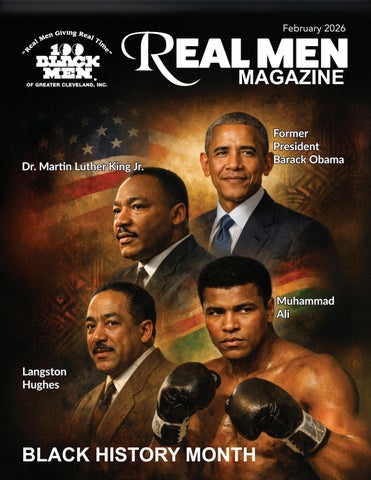
Real Men Magazine February 2026 Issue

Page 1


REAL MEN MAGAZINE

BLACK HISTORY MONTH

Former President

Barack Obama
Dr. Martin Luther King Jr.
Langston Hughes
Muhammad Ali

MESSAGE from THE EDITOR

Black History Month: A Living Legacy

Black History Month is not simply a reflection on the past— it is a living, breathing reminder of who we are, where we come from, and the responsibility we carry forward. Each February, we pause to honor the giants on whose shoulders we stand, but we also recommit ourselves to the work still unfinished.

For me, Black history begins at home. It lives in the lessons passed down from elders, in the discipline of hard work, and in the belief that our presence matters in every room we enter. Our history is filled with stories of resilience— men and women who were denied access yet created opportunity, who were silenced yet found powerful voices, who were told “no” but pressed forward anyway.

Black History Month challenges us to look beyond names in textbooks and see the human spirit behind the achievements. It reminds us that progress has never been accidental. Every gain was earned through courage, sacrifice, and unity. From education and economic empowerment to health, wellness, and civic leadership, our history shows that change happens when we stand together with purpose.

As Managing Editor, I see storytelling as both a privilege and a duty. Our stories shape perception. They inspire young people to dream bigger and remind adults of the impact they can still make. When we share narratives of mentorship, leadership, and community service, we are preserving history in real time. We are documenting excellence that too often goes unnoticed.

Black History Month also calls us to action. Celebration without commitment is incomplete. Honoring the past means investing in the future—supporting our youth, strengthening our communities, and holding ourselves accountable to be examples worth following.

This month, and every month, let us remember that Black history is American history. It is a story of perseverance, innovation, and faith. Most importantly, it is a story still being written—by each of us, every single day.

With gratitude, James W. Wade III

Letter from the Past Chairman

Over the past few years, the 100 Black Men of Greater Cleveland, Inc., has grown in just about every metric, including impact. We have strengthened our programs, expanded opportunities for the young men we serve, deepened relationships with community partners, increased our funding and rebuilt our brand. None of this happened by accident. It happened because sponsors invested, partners collaborated, leaders led, parents participated, volunteers pitched in and members committed themselves to helping young men reach their full potential.

Progress happens through shared vision, steady work, honest conversations, and a collective belief that what we are building truly matters. When I look back on our journey together, I am incredibly proud of how far this organization has come and deeply optimistic about where it is headed.

My term as chairman of the board has come to an end, however my commitment to this organization, its mission, and the young men we serve has not. I will continue to serve proudly as a member of the board of and as an advocate wherever I am needed.

Serving as chairman has been an honor and as we navigated challenges, celebrated milestones, and most importantly, transformed the trajectory of young lives, I am thankful we were able to do so together.

To our sponsors and partners, thank you for trusting us with your resources. Your investment has opened doors for our mentees and families who appreciate your kindness and passion for the community. To our members, your commitment is the engine that drives this organization forward. Continue to be engaged, involved and hold each other accountable.

I step away from the chairmanship confident that this organization is in excellent hands. Congratulations to our new Chairman James Wade, Vice Chairman Mayor Michael Booker, and all newly elected board members. I know their commitment to the community and dedication to service will bode well for this next chapter.

While my role may look different going forward, my purpose remains the same; to serve, to support, and to ensure this organization continues to grow and thrive. I look forward to continuing the work, just from a different seat at the table.

With gratitude to each and everyone of you,

100 Black Men of Greater Cleveland, Inc.

REAL MEN GIVING REAL

REAL TIME

WHO WE ARE

The 100 Black Men of America, Inc., is not just a leading African-American-led mentoring organization, but a beacon of hope for the African American community. We believe that every African American should have the ability to create the life they’ve always wanted, and that’s what The 100 Black Men of America, Inc. is making possible.

Our commitment is unwavering. We strive to personify the type of people our children will look up to and emulate, embracing our immense responsibility to our mentees and our communities. We provide these children another choice by being around like-minded individuals with similar aspirations and goals, ensuring a brighter future for African American youth.

As The Network of 100 Black Men of America, Inc. has expanded, we have welcomed more companies and developed new programs to better serve our mission. Our focus areas, known as the 100’s Four For The Future, include mentoring, education, health and wellness, and economic empowerment. These areas guide our efforts to provide the education and empowerment necessary to transform the lives of the children we serve.

Through the expansion, we’ve created 100 Black Men Chapters that deliver unique programs that address specific needs in local communities. Through 57 years of testing, we’ve created the 100’s successful model—a proven blueprint for mentoring and developing young people into future leaders by surrounding them with a positive network and giving them the opportunity that they may not have thought was possible.

2026 - 2028 Executive Board

James W. Wade III Chairman Mayor Michael Booker Vice - Chairman

Llyod Totty Secretary

Steven Robertson
Chris Howse
Robert Solomon
David Taylor
Gregory Lockhart Immediate Past Chairman

100 Black Men of Greater Cleveland Leadership Team

EXECUTIVE BOARD

BOARD OF DIRECTORS COMMITTEE

CHAIRS

James W. Wade III Chairman

Mayor Michael Booker Vice - Chairman

Llyod Totty Secretary

Terrence McWhorter Director of Finance

Larry Jewett Director of Programs

Christopher Howse

Steven Robertson

Robert Solomon

David Taylor

Gregory Lockhart Immediate Past Chairman

Director of Communications

James W. Wade III

Economic Empowerment

David Taylor - Chair

Steven Sims - Co Chair

Education

Dr. Terry Echols

Antwan Steele

Health & Wellness

Robert Bankston - Chair

Lloyd Totty - Co Chair

Mentoring

Darian Johnson - Chair

Dr. Ernest Smoot - Co Chair

National Chairman Milton H. Jones Jr.

Midwest District Rep Andre Givens

Membership

Chair - Dr. Cameron Redden

James W. Wade III - Co Chair

Scholarship

Tyson Mitchell

The History of the 100 Black Men of Greater Cleveland, Inc.

The history of the 100 Black Men of Greater Cleveland is a testament to the power of vision and collaboration. It all began with a pivotal moment when Michael Nelson, a visionary leader, convened a historic meeting. This gathering brought together individuals who represented powerful political factions, including Congressman Louis Stokes, former City Council President George Forbes, and the man who defeated George for Mayor, Michael R. White. The location of this momentous meeting was kept a secret until the day of the event, adding to its intrigue and significance. This history is not just a story, but a legacy that has shaped the community and inspired generations to come.

A date was set, and Nelson invited a number of his friends, including Larry Hines, Gregory Clifford, Curtis Griggs, Tony Smith, Luther Towers, and Julius Singleton, along with Stokes’ rep, Ron Adrine, Forbes’ rep, Daryl Fields, and White rep, Nate Gray, to meet with Chairman Dortch and Roosevelt Adams. The meeting was held at the now-closed Eloise’s Restaurant, located on East 79th Street and Carnegie. The National Headquarters approved Cleveland to be established in 1997 and recognized as an entirely fledged chapter.

These guys were familiar with the 100 through business, political, or family connections. After listening to the very impressive Thomas Dortch and engaging in approximately an hour of discussion, the decision was made to incorporate formally, establish a dues structure of $250 annually, and begin recruiting members. In 1997, the 100 Black Men of Cleveland was established.

The first significant event was a rollout at the Cleveland Clinic, where over 90 men committed to join the cause, with about 70 of them paying their dues. Mayor Michael R. White, a staunch supporter, pledged to purchase 100 copies of the renowned motivational speaker George Fraser’s book, ‘Success Runs in Our Race,’ for each member. George Frazer, who graced the opening event with his presence, generously autographed each member’s copy, symbolizing the dedication and support of the early members.

The next major event was a fundraising gala featuring the late Phylis Hyman, a nationally known recording artist. The event was orchestrated by the dynamic Richard Johnson, a significant internet influencer in today’s social media world. Held at the prestigious Marriott Hotel in Cleveland, the gala was not just a success but a resounding triumph, underscoring the impact of the 100 Black Men of Greater Cleveland in the community.

The funds raised by that first gala supported the Cleveland chapter’s version of the National 100’s Four For The Future programs: Health/Wellness, Economic Development, Education, and Mentoring. Larry Hines was our first Program Director, assisted by Curtis (Griggs). The parentheses are intentional; that’s how Curtis spelled his last name.

The 100 would continue to grow its brand in Cleveland. The group coordinated mentoring programs in numerous schools, including Daniel E. Morgan Elementary School, Cleveland East Senior High School, John F. Kennedy Senior High School, East Cleveland Shaw Senior High School, Mound, and Warrensville Heights Senior High School. The 100 also held a Saturday morning mentoring program at its offices in Cleveland’s Shaker Square complex. The numerous programs included a reading program at Daniel E Morgan and a stock market competition at East High School. One of the highlights of our plan was the success of our East High Stock Market Challenge team, which traveled to Atlanta and took on some of the nation’s most prominent schools, finishing a highly respectable 3rd out of the scores of schools that competed.

In 2022, a class of 22 new members joined, a testament to the organization’s continued growth and influence. As we look forward to 2023, we celebrate twenty-five years of impactful service. After seven chairpersons and numerous galas, the chapter continues to thrive, mentoring men in schools such as Wade Park and the Kenneth Clement Boys Leadership Academy, among others. Our journey is marked by numerous achievements, from successful galas to impactful mentoring programs, all of which contribute to the betterment of our community.

2024 under the dynamic new leadership of Chairman Gregory Lockhart and Vice Chairman James W. Wade III, the 100 Black Men of Greater Cleveland proudly re-instated the impactful Saturday Academy at Cuyahoga Community College’s Eastern Campus. This revitalized program has become a cornerstone of our mission, offering young men a safe, structured, and inspiring environment to learn, grow, and lead. Alongside its return, we also introduced a variety of innovative new programs and engaging activities designed to broaden opportunities, strengthen mentorship, and further empower the next generation of leaders.

2025 as we look to the future, we are excited about the opportunities that lie ahead. With new Leadership and a renewed commitment to our mission, we are ready to take on the challenges of the next decade. We look forward to continuing to make a powerful impact, helping us live out our mission of mentoring, educating, and empowering the next generation. This year, we accomplishedso much with the membership giving so much of their time to make the chapter great: We expanded and enriched our Saturday Academy, offering transformative sessions in mentoring, health & wellness, economic empowerment, and Education. This growth is a testament to our commitment to providing comprehensive support and guidance to our mentees, and we are excited about the positive impact this will have on their lives.

Launched Well Connected on Wednesday, bringing families and mentees together monthly for fitness, wellness, and fellowship. Hosted signature community events, including the Drive Cleveland Golf Outing, Family Picnic, and Walk a Mile with a Child. Honored outstanding leaders and partners at our Sponsor & Honoree Reception and prepared for our 2025 Scholarship & Awards Gala: Champions of Change. Strengthened collaborations with various community partners, expanding opportunities for and to our youth in sports, STEM, financial literacy, and college readiness. Our STEM students won second place at the 100 Black Men National Conference in New Orleans. We continued to uplift the voices and celebrate the achievements of our community through Real Men Magazine, expanding our platform as a powerful tool for storytelling and inspiration. Throughout 2025, we demonstrated the very essence of true brotherhood, leadership, and service. This year stands as a testament to what can be accomplished when we come together, united by purpose and driven by progress.

Judge Ronald Adrine

CLEVELAND CHAPTER MEMBERSHIP

FOUNDING MEMBERS

Chief Magistrate Gregory Clifford,Retired

Darrell A. Fields

Nate Gray

Curtis (Griggs)

Larry Hines*

Robert L. Bankston

Dr. Michael Baston

Joseph Billups

Curtis Bloxson

Mayor Michael Booker

Anthony Brown

Grady Burrows

Honorable Gregory Clifford

Lonnie Coleman

Raphael Collins

Dr. Michael Copeland

Brandon Curry

Pastor Robert Dix

Lamont Dodson

Dr. Ronnie Dunn

Clayton Eason

Dr. Terry Echols

Gregory Ensley

Judge Michael Nelson

Julius Singleton

Anthony (Tony) Smith*

Luther Towers

MEMBERS

James Ferguson

Darrell Fields

Anthony Franklin

Duane Griffin

Curtis (Griggs)

Jeevon Harris

Judge Brett Horton

Councilman Michael J.

Houser

Chris Howse

Chief Wayne Hudson

Larry Jewett

Darian Johnson

Roz Kennon

Gregory Lockhart

Terry Maynard

Terry McWhorter

Tyson Mitchell

Aubrey Morgan

Judge Michael Nelson - Retired

Judge Charles Patton

Anthony Peebles

LaRese Purnell

Dr. Cameron Redden

Rev. Randy Reed

Jayson Richardson

Steven Robertson

Aqeel Seals

Glen Shumate

Steve Sims

Jermaine Smith

Ernest Smoot

Robert Solomon

Antwan Steele

David L. Taylor

Andre Thompson

Lloyd Totty

James W.Wade III

one open door can open doors across a community.

Our most important work happens outside the four walls of our bank. KeyBank gets involved, supporting people who make a difference and working with communityfocused organizations through investments, philanthropy, and volunteering. We believe that together we can keep our communities full of hope, compassion, and opportunity, one open door at a time.

KeyBank thanks 100 Black Men of Greater Cleveland, Inc. for making a difference.

Black History: A Living Legacy of Leadership, Voice, and Responsibility

In moments when history is challenged, minimized, or deliberately obscured, the response must be clarity, conviction, and commitment. Black history is not an accessory to the American story—it is central to it. It is the record of perseverance under pressure, creativity born from constraint, and leadership forged in the face of injustice. When that history is threatened, standing strong becomes both a moral obligation and a generational responsibility.

The story of Black America is one of endurance and vision. From the earliest days of this nation, Black people have labored, dreamed, organized, and built—often without recognition, and frequently in the face of laws and systems designed to exclude them. Yet families established institutions, communities nurtured leaders, and culture flourished even when opportunity was denied. This collective journey shaped not only Black communities but the very framework of American democracy, labor, art, and innovation.

Understanding this history is essential because it anchors identity. When young people learn where they come from, they gain more than facts—they gain confidence. They discover that their lineage includes strategists, creators, freedom fighters, and change agents. History becomes a mirror reflecting strength rather than limitation, possibility rather than doubt. That knowledge equips them to navigate the present with awareness and to approach the future with intention.

Throughout generations, individuals have emerged whose leadership helped define what courage and conviction look like in practice. Dr. Martin Luther King Jr. stands as a moral compass in American history, not because his work was easy, but because it was principled. His vision of justice, rooted in nonviolence, challenged a nation to confront its contradictions. Dr. King understood that lasting change required both pressure and purpose, and his leadership continues to influence how movements are built and sustained.

Culture has always played a powerful role in preserving truth, and few captured the Black experience as vividly as Langston Hughes. Through poetry and prose, Hughes illuminated everyday Black life—its frustrations, humor, dreams, and resilience. His work affirmed that Black voices mattered, that ordinary stories carried extraordinary meaning. By placing Black humanity at the center of American literature, Hughes ensured that culture itself became a form of preservation and resistance.

Leadership also took shape in arenas beyond politics and art. Muhammad Ali redefined what it meant to be a champion. His greatness was not limited to the boxing ring; it was amplified by his willingness to stand by his beliefs, even when it cost him titles and time. Ali demonstrated that integrity and courage are inseparable from true leadership, and that speaking truth to power can resonate far beyond a single generation.

The arc of Black history reached a symbolic milestone with the election of Barack Obama, whose presidency reflected decades of struggle, sacrifice, and progress. His rise did not erase the

past, but it affirmed the possibilities it created. For millions, especially young people, his leadership expanded the boundaries of what they believed was achievable. It was a reminder that history moves forward when imagination meets opportunity.

Yet history is not sustained by icons alone. It lives most vibrantly at the community level, where commitment is personal, and impact is immediate. Organizations like 100 Black Men of Greater Cleveland, Inc., carry Black history forward through action. Guided by the principle that “What They See Is What They’ll Be,” the organization invests in mentoring, education, health and wellness, and economic empowerment—areas deeply connected to historical inequities and future success.

The men of the 100 Black Men of Greater Cleveland do more than teach lessons; they model possibility. By showing up consistently for young people, they transform history from something learned into something lived. Their work reflects a timeless truth: progress endures

when each generation accepts responsibility for the next. In classrooms, community spaces, and one-on-one relationships, legacy becomes visible and measurable.

Black history is not confined to textbooks, holidays, or commemorative moments. It is a living continuum shaped daily by choices, values, and service. Standing strong means protecting truth, honoring those who came before, and ensuring that those who follow inherit clarity rather than confusion. It means understanding that remembering is not passive—it is active, intentional, and necessary.

Ultimately, preserving Black history is about stewardship. It is about carrying forward stories of struggle and triumph, not as relics, but as guides. When history is respected and taught honestly, it empowers individuals and strengthens communities. Black history tells us who we are, how far we have come, and why the work must continue—together, informed, and unafraid.

From Legacy to Living History: Celebrating the Lucas Family and The Lucas Funeral Home

A Cleveland story of service, strength, and unshakable faith

We celebrate Black History Month in February, but Black history is made every day. The 100 Black Men of Greater Cleveland, Inc., believes it is important to honor Black history right here in our own hometown of Cleveland. Each year, we proudly recognize iconic figures such as Madam C. J. Walker and Garrett Morgan, whose legacies continue to inspire generations. However, we also recognize that history lives among us through everyday leaders who serve our community with purpose and pride. This year, we are honored to highlight a local Black family business—Lucas Funeral Home—whose

commitment, service, and legacy represent living Black history. By celebrating businesses like Lucas Funeral Home, we honor the past while uplifting those who continue to shape our future.

Journey of Lucas Funeral Home/Lucas Legacy

The Lucas Family has long been associated with the Ohio business community. Mr. Jason Lucas (President of Lucas Funeral Home), paternal great-grandfather, had the courage to open a business in 1925 on the main street of Cadiz,

Ohio. The historic effort of an African American in the business community has continued through the next four generations. Also, Jason’s Great-Great Grandfather, William H. Lucas, was the first African American elected county official in the state of Ohio. Jason Lucas’s grandfather, Charles P. Lucas Sr., was a pioneering businessman in the greater Cleveland Community for many years and was the first paid executive director of the Cleveland BranchN.A.A.C.P. Jason’s Father, Rev. Charles P. Lucas Jr., was a vital member of the business and Christian Communities. He was a pastor, civil rights leader, and Community Servant.

The Lucas Legacy continues on with Jason and Yolanda Lucas. Lucas Memorial Chapel-Funeral Home was established on December 8, 1999. The first funeral was held on December 10, 1999, for Fred Carpenter. Family and friends assisted at the first funeral. On January 22, 2000, a grand opening and dedication ceremony was held, attended by hundreds of people. Jason Lucas was so thankful that his dream came true. In Mortuary school, he had a sign on his desk that he read every day, “Lucas Memorial Chapel.” Countless hours of prayer were spent before the big opening arrived.

The first location was in Bedford Heights on Rockside Road. Many community outreach events happened during the first years. Many people have fond memories of attending holiday parties, seminars, and clothing/food drives. It was always something happening! We also started our Hazel Lucas Scholarship for High School Seniors heading to College. During our annual picnic, we announced the scholarship winner. Our first recipient was Rhondalynn Solomon. A graduate from Shaker Heights High School who later continued to excel and graduated from Eastern Michigan University. One of the most fond memories at Rockside Rd. was being blessed with our son, Jason Harper Lucas II, after 10 years of disappointments and losses. He was born on July 31, 2007. The miracle baby! Harper took his first steps at the funeral home in 2008.

In 2009, Lucas Funeral Home moved to Garfield Heights, Ohio. Our first big event was honoring Michael Jackson, who passed away on June 25, 2009. Hundreds of people signed the blown-up Wall Card and expressed their condolences and memories of Michael. We also displayed Michael Jackson photos and memorabilia, while listening and dancing to Michael’s greatest hits. Due to popular demand, we extended the memorial hours for the entire weekend. The celebration ended with the release of balloons in honor of Michael Jackson. It was featured on the local news.

After the renovation was completed, the grand opening of the new location was held on

August 15, 2009. Mayor Thomas Longo of Garfield Heights and Mary Stamler of the Chamber of Commerce assisted with the ribbon-cutting. An overflow crowd expanded into the parking lot. Rev. Charles P. Lucas Jr. was the Master of Ceremonies. Many family and friends traveled from out of state to celebrate the new location. In the next few years, there was tremendous growth. Jason was able to mentor a few young men from local high schools to assist with funeral home operations.

All of them decided to pursue careers in Funeral service. William Pope graduated from college and is currently a licensed funeral director, and has become Jason’s protégé. He calls him son.

Many new items have become annual events and activities. A major focus has been on mental health, with counseling events and services offered. In addition, Yolanda Lucas has become involved with the Pregnancy and Infant Loss Society and helps families navigate their grief with support services. She also promotes and participates in the Wave of Light candlelight memorial service honoring babies lost before their first birthday. Jason and Yolanda Lucas began sharing their story of baby losses and infertility in 2018. In 2019, Jason discussed his perspective as a father, detailing his internal struggle with grief. In 2020, their story appeared

in National Geographic Magazine. Both have advocated to help decrease infant mortality and healthcare disparities for African Americans.

The annual Black History Program has become a tradition and a special time of recognizing local History Makers in Garfield Heights, Ohio. Also, the Lucas Family celebrates their rich history. From 1852 to the present, six generations of the Lucas family have achieved their dreams. Harper Lucas, a descendant of this family, is in the 7th generation and is starting to see his dream become reality. He is a sports broadcaster at St. Edward High School and recently interviewed Cavs NBA 6th-time All-Star Donovan Mitchell. Harper will be attending Elon University in North Carolina, Fall 2026. His goal is to become a sports broadcaster for a network and work for NASCAR. A short Lucas Family documentary was released in February 2023. The Lucas family also shares their story in the community with exhibits and presentations.

Lucas Funeral Home loves to support its community by assisting and sponsoring groups and organizations. One of the greatest joys is

sponsoring the Garfield Heights High School Basketball team with Coach Sonny Johnson. He has also been a recipient of the Lucas History Maker Awards.

The Lucas Funeral Home’s mission statement states that it will serve before, during, and after a person’s time of grief. We honor families with special memorial ornaments, acknowledge holidays, and hold special celebrations. Our Motto is “Where Families Come First.” We want all of our families to feel like they’re a part of our family. Our staff is our

family. Many Lucas staff members have been there for the entire 25 years, or they’ve retired from the funeral home. Jason Lucas does his best to support staff and provide a variety of outings and new experiences, especially during the holidays.

Another of the biggest moments was partnering with St. James A.M.E. to sponsor a night of worship and a benefit concert featuring Grammy Award-winning gospel artist CeCe Winans. The staff and community at large

enjoyed that night of praise and celebration. In 2025, the Lucas Funeral home celebrated its 2025 with a private party for staff and a larger celebration at Karamu theater. Yolanda and her son, Harper Lucas, presided over the event. It was a night filled with laughter and tears of Joy. Rev. Charles P. Lucas Jr. gave out special gifts and became overjoyed with praise in his wheelchair when soloist Kim Reaves sang his favorite hymn, “Peace like a River.” Little did anyone know that it would be Rev. Lucas’s last time celebrating a funeral home anniversary.

In September 2025, Jason Lucas had an opportunity that he couldn’t refuse. A funeral home became available to purchase. One of the suggestions he kept hearing from families is the need for more space in the funeral home chapel. This seemed like a gift and answered prayer. He closed on the Turney Road location in October 2025. The family celebrated with Jason when the new sign was installed. His Dad, Rev. Charles P. Lucas Jr., rolled his wheelchair proudly. He was able to see the second location and the vision and plans for the new 300-seat chapel.

On November 1st, Rev. Charles Payne Lucas Jr. passed away.

Jason Lucas has decided, in the midst of a renovation project, to name the chapel in memory of his Dad.

The grand opening will take place in the spring of 2026, and they will celebrate the History Makers at the dedication ceremony of the Rev. Charles Payne Lucas Jr. Chapel.

The year 2025 was filled with milestones and celebrations for the Lucas Family.

Celebrated 100 years of the first Lucas business in Cadiz, Ohio

80 years of Charles Payne Lucas Sr.-Arriving in Cleveland and working for the Cleveland Branch of the N.A.A.C.P

Jason and Yolanda celebrated 30 years of marriage.

Lucas Funeral Home celebrated its 25th Anniversary.

Jason “Harper” Lucas celebrated his 18th birthday and started senior year at St. Edward High School. He developed a sports show, “Eagle Winners,” in September 2025.

Unfortunately, they lost their GIANT in the ministry and patriarch of the family, but Papa Lucas witnessed all the monumental events.

A beautiful Celebration of Life Service was held on November 10, 2025. Hundreds of people came out to celebrate a life well lived at his beloved St. James A.M.E. Church.

The Lucas Legacy and Funeral Home continues to provide compassionate service, comfort, and hope.

The Lucas Legacy Lives On with continuous belief in the POWER of Prayer and Unshakeable Faith.

Health & Wellness

The Legacy of Learning: How Education Shaped African American History

When I was a younger man growing up, one of my favorite shows on television was ‘The Golden Girls.’ Sure Bea Arthur, Rue McClanahan, and Betty White all bought their own unique version of togetherness and sisterhood to a loving yet complicated roommate arrangement. And although they provided laughter episode after episode, there was one character that stood tall, albeit diminutive in stature.

That character was Estelle Getty and while she may have reminded you of your Grandma, Granny, G-Ma, Nana, Madea or Big Momma with her sharp tongue and quick witticisms, what made her standout further was her unforgettable trips down memory lane back to the ‘ole country.’ In this vein, she would simply say, “picture this, Sicily, 1943….” It is here that I want you to close your eyes for a moment and then ‘picture this.” Over 5,000 years ago, man began to think outside the box and learn. As one begins to learn, they can also begin to teach. If one can teach, they are able to embrace and further knowledge through education.

A unique group of people were on the brink of said education. This group produced early types of paper, devised a written script and developed a calendar. They also made important contributions in various branches of mathematics, such as geometry and algebra, and it seems likely that they understood and perhaps invented the use of zero. They also

made important contributions to mechanics, philosophy and agriculture, especially irrigation. In medicine, they understood the body’s dependence on the brain more than 1,000 years before the Greek scholars came up with the same idea. Some historians now believe that they had an important influence on ancient Greece, pointing to the fact that Greek scholars such as Pythagoras and Archimedes studied there and that the work of Aristotle and Plato was largely based on earlier their scholarship. For example, what is commonly known as Pythagoras’ theorem was well known to these ancient scholars hundreds of years before Pythagoras’ birth. These early scholars hailed from Kemet or what we commonly refer to today as Egypt.

By now you have your eyes opened because despite what you may have been told, the presence of education among our ancestors began thousands of years ago. To hammer this point home, I found amusement but also sorrow for those that have embraced such nonsense as those expressed by Scottish philosopher David Hume who chimed, ‘I am apt to suspect the Negroes to be naturally inferior to the Whites. There scarcely ever was a civilized nation of that complexion, nor even any individual, eminent either in action or in speculation. No ingenious manufacture among them, no arts, no sciences.’ Further, in the 19th century, the German philosopher Hegel simply declared, ‘Africa is no historical part of the world.’ And finally, later,

Hugh Trevor-Roper, Regius Professor of History at Oxford University, expressed openly the racist view that Africa has no history, as recently as 1963. As a free thinker, you are now tasked with unearthing history that is buried or in some cases eliminated if you are a purveyor of truth.

My experience in the way in which education shaped African American history may be vicariously associated with my own education. As a proud Clevelander, not only were the feats and achievements of African Americans embraced in my home with local talents such as Jesse Owens, 4-gold medal winner at the 1936 Olympics, Garrett Morgan, the inventor of the protective ‘smoke hood’ aka gas mask, a type of three-way traffic light and even a hair-straightening crème or Nobel-prize winner Toni Morrison but I felt the souls of politicians Carl and Louis Stokes and those of Harlem Renaissance giant Langston Hughes walking down the same hallways that I always seemed to try to find a way to cut class. Maybe their presence told me to stay and further my education just as they had done before at Central Jr. High and later East Technical High School. And although I am considered a member of Gen X, I identify with Baby Boomers while trying to dissect a way in which Millennials, Gen Z, Gen Alpha, and futuristic Gen Beta attempt to understand ways in which education for African Americans has impacted our country.

Consider this, without education could political giants such as Barack Obama, Kamala Harris, John Lewis, Shirley Chisholm, Barbara Jordan, Thurgood Marshall, Clarence Thomas, Hiram Revels, Andrew Young, and Douglas Wilder even remotely be possible? In STEM, how do you explain the contributions of Katherine Johnson, George Washington Carver, Charles Drew, Mae Jemison, Benjamin Banneker, Granville T. Woods, and Neil deGrasse? What about powerful thinkers outside the box such as Cornel West, W.E.B. DuBois, Frederick Douglas, Angela Davis, Martin Luther King, Jr., Malcolm X? Without contributions from Madam CJ Walker, Robert Johnson, John Johnson, Oprah Winfrey, Tyler Perry and Byron Allen, try to

make sense of their business successes without education. Musicians like Duke Ellington, Billie Holiday, W.C. Handy, Miles Davis, Louis Armstrong, and others have left an indelible mark on the world of music by educating themselves while their work continues to inspire new generations of musicians.

In the end the contributions made by African Americans based on the educational acumen can go on for miles and miles as our contributions are more than just NIL deals, 3-point shooting, 4-round knockouts, 100yard dashes, and game winning touchdowns. The impact of our educational strides goes much farther and will continue to leave an indelible mark on this country no matter the ‘disappearing act’s tactics. If you are unfamiliar with many of the contributors I mentioned, Google them and broaden your horizons and then explore ways in which you become an agent of change utilizing education.

African Americans have overcome countless struggles and obstacles to achieve remarkable feats in all areas of life. From cultural contributions to political leadership and economic empowerment to academic pursuits, the African American community has left an indelible mark on the world based on their education. It continues to inspire new generations of individuals to fight for social justice and equality.

By reflecting on the education, achievements and contributions of African Americans, we gain a deeper appreciation for our resilience, determination, and unwavering spirit in the face of adversity. We must continue to honor their legacy and work towards creating a more just and equitable society for all.

“Leading With Purpose: Michael J. Houser’s Commitment to Mentorship, Economic Empowerment, and Community”

Each month, we take pride in featuring and highlighting members of our organization, giving you the opportunity to learn more about the men who dedicate their time, talent, and leadership to making a difference in our community. This month, we are honored to spotlight County Councilman Michael J. Houser, whose commitment to public service and community advocacy continues to positively impact the lives of Cleveland residents.

What inspired you to join the 100 Black Men of Greater Cleveland, Inc., and what does this organization mean to you personally?

I have been interested in the 100 for years because of its consistency, credibility, and commitment to service. I am not Greek, but I have always valued brotherhood rooted in accountability, shared purpose, and giving back. The 100 represents that kind of brotherhood for me. It is a space where Black men lead by example, show up for one another, and pour intentionally into the next generation. Personally, it means belonging to a circle of men who believe that success carries responsibility.

How do you believe your life experiences and skills will help you contribute to mentoring and uplifting young people in our community?

I mentor youth often through my public service, community programming, and everyday presence. I created the Your Voice Matters Youth Summit to give young people a platform to be heard, to see themselves as leaders, and to understand that their experiences matter. My life experiences in leadership, policy, housing, and community development allow me to meet young people where they are and help them connect ambition to opportunity. I believe in practical mentorship that combines encouragement with real tools.

Which of the Four for the Future pillars resonates most with you, and why?

Economic Empowerment resonates most with me because it creates lasting stability for individuals, families, and neighborhoods. When young people understand money, ownership, and opportunity, they gain agency over their future. That said, economic empowerment works best when paired with mentoring and education, so my approach naturally blends these pillars together.

What impact do you hope to make through your involvement with the 100, both for the youth we serve and the broader Cleveland community?

I hope to help build a pipeline of confident, prepared young leaders who see Cleveland as a place of possibility. Through the 100, I want to strengthen mentorship pathways, expand exposure to careers and leadership, and help young men envision futures that include ownership, service, and impact. For the broader community, I want our work to reinforce a culture where Black men are visible leaders, trusted mentors, and active stewards of progress.

What message would you like to share with young men who may one day benefit from the guidance and example of the 100 Black Men?

You matter. Your story matters. Do not rush the process, and do not let anyone define your ceiling. Seek out mentors, stay curious, and understand that discipline and consistency will take you further than talent alone. The goal is not just personal success but lifting others as you climb.

Building Futures at Wade Park School

While it is clearly understood that a mentor is a seasoned or more experienced individual providing advice, guidance or leadership to another individual, the need for mentorship could not be greater.

Whether in high school, college, or professionals in the workplace, mentorship can prove to be a key determinant of one’s outcome and even success. However, the foundation for mentorship has been empirically researched to yield that for best results, mentorship must start early and remain consistent. No other example of this can be seen within the 100 Black Men of Greater Cleveland. Moreover, the Education Committee has begun to lay a trailblazing path for a new and cutting-edge model.

This model is known as ‘A Multifaceted Approach to Mentorship.’ Within this model, members of the Education Committee have implemented mentoring models for 6th, 7th, and 8th grade males at Wade Park School in Cleveland. As such these cohorts are exposed to informational and interactive discussions around pertinent topics such as Conflict Resolution, Financial Literacy, Career Pathways, Civic Engagement, Health and Wellness, and Team Building.

On January 21, 2026, the 6th grade cohort participated in the Financial Literacy session where they discussed in depth the facets of budgeting. Areas like what is a budget, who needs a budget, and why is budgeting important were discussed. Then they were placed in ‘break-out’ sessions where they actually worked through simulated household

budgeting. It is in this vein that the students had to get out a pencil and paper and use a calculator to work through the scenario in which they were provided.

They had to determine what areas of a monthly budget might need to be adjusted or in some instances removed altogether to make the monthly allotment balance. Some of the scholars showed tremendous restraint in cancelling streaming services while instead relying on free services like YouTube instead.

Others cut back on entertainment opting to stay home and play board games with family while others cut back on eating out at fast-food restaurants instead cooking at home which was ultimately cheaper. The young men not only made their budgets work but they competed against one another to determine how much they could deposit into their savings account after paying their bills.

They demonstrated so much curiosity about their own experiences while helping their fellow classmate when they seemed stuck. They were commended for their collaborative efforts as well as their participation while also being treated to sugar-free snacks and juices.

This program is proving to be very beneficial to their growth and development as they were curious about not only the next session but surprisingly how can they join 100 BMOGC! This brought a smile to my face as I want to thank Brother Rev. Randy Reed for his tireless support with the scholars from Wade Park School.

The Weight They Carried: Black History, Leadership, and Mental Health

Black History Month is a time of intentional acknowledgment. It’s a time where we affirm our identity, celebrate our contributions, highlight our culture, educate our communities, and commemorate our heroes. During this important time, we hear stories about trailblazers and the ways they advanced Black liberation. Typically, we highlight how Dr. Martin Luther King Jr. had a dream, Malcolm X fought for self-determination, or Frederick Douglass led abolition efforts. These messages are powerful and necessary, and they should continue to inspire generations.

However, the mental health of the men behind the movements often gets overlooked or undervalued. We talk a great deal about the outcomes our leaders created. Sometimes, we discuss how their commitment cost them their lives. We rarely discuss the mental and emotional weight they carried while living. We honor the results of their work without fully acknowledging the internal toll of leadership, resistance, and responsibility.

We speak about Dr. King’s leadership, but not often about the immense psychological strain of carrying an entire movement on his shoulders while facing constant threats and scrutiny. We honor Malcolm X’s fearlessness, yet seldom reflect on the internal battles that come with surveillance, exile, and betrayal. We applaud Frederick Douglass’ resilience, but often overlook the lifelong trauma of a man who endured slavery and repeatedly revisited that pain through advocacy. These men did not only battle systems of oppression. They battled internal burdens that history often does not name.

Our heroes were strong, but they were also human. They experienced stress, fear, grief, isolation, and emotional strain. They carried not only the hopes of a people, but also the invisible burden of expectation. Their mental health was rarely protected, acknowledged, or prioritized. This matters because the same pattern exists today.

Black men are still leading, just in different spaces: as husbands, fathers, mentors, pastors, coaches, executives, and community leaders. We provide, protect, support, and solve problems—but too often, our internal struggles are overshadowed by external achievements.

Many Black men suffer in silence, conditioned to believe productivity requires emotional suppression. Taught to push through at any cost, this mindset leads to chronic stress, anxiety, depression, numbness, and burnout. Our pain is often misread as strength simply because we keep moving forward.

But functioning is not the same as flourishing. Being productive does not mean being healthy. A man who is emotionally exhausted cannot lead consistently. A father who is mentally overwhelmed cannot pour endlessly. A husband who suppresses his inner world will eventually feel disconnected from himself and from others.

Mental health is not a sign of weakness. It is a measure of sustainability. If we are going to honor Black history honestly, we must expand the narrative. True strength is not just sacrifice. It is self-awareness. True leadership is not just endurance. It is care. Legacy is not only about what we build for others. It is also about how well we preserve ourselves in the process.

So what can Black men do to protect their mental well-being? First, we must give ourselves permission to be human. Feeling overwhelmed does not mean you are failing. It means you are responding to real pressure. Second, we must learn to name what we feel. Stress, grief, anger, fear, and exhaustion do not disappear when ignored. They compound. Third, we must build intentional support systems. Brotherhood is not just about accountability and achievement. It must also be about emotional safety. Every man needs at least one place where he does not have to perform.

Fourth, we must normalize professional support. Therapy is not fragile. Counseling is not a failure. Mental health care is maintenance, no different than physical health or financial planning. Fifth, we must practice self-regulation and rest. Constant productivity without recovery leads to breakdown. Rest is not laziness. It is leadership stewardship.

As members and supporters of 100 Black Men, we are committed to mentoring, empowering, and developing future leaders. That mission requires us to model not only success, but wholeness. The next generation is not only watching what we achieve; it is also watching what we do. They are watching how we take care of ourselves.

Black history is not just about what we survived. It is about how we choose to live. Protecting the mental health of Black men is essential to the future of our families, our communities, and our society. Let us commit to prioritizing mental health—by seeking support, fostering conversations, and holding each other accountable. The time to act is now. Our legacy depends on it.

Is Technology Making Us Dumber?

We’ve always been obsessed with shortcuts. From the moment the first merchant realized an abacus could save him from counting on his fingers, the human race has been on a relentless quest to hand off the "boring stuff."

By the 1600s, we had the slide rule a cool, oldschool piece of engineering that helped build everything from the bridges we cross to the rockets that hit the moon. Then the 70s gave us pocket calculators, and suddenly, long division felt like a chore from a harder, slower time. By the time Google arrived, we didn't just have tools; we had every answer in the world sitting in our pockets, waiting for us to ask.

Every leap forward felt like a victory. And in many ways, it was.

But lately, I’ve been haunted by a question that feels almost wrong to ask in my line of work: Are these tools actually expanding our minds, or are they just hollowing them out?

I’m not against technology. I don't want to go back to the Stone Age. I live and breathe tech; I rely on it every single hour. But there’s a massive difference between "getting things done faster" and "thinking better." I’m starting to worry that in our race to be efficient, we’re accidentally giving up the very thing that makes us smart: the effort.

It didn't hit me in a lab or at some big tech meeting. It hit me on a Tuesday, driving a route I’ve known my entire life.

When GPS first became a thing, I loved it. I’d plug in the address to my mother’s house a drive I could do in my sleep just to see if the "magic box" could find a way to save me two minutes. Sometimes it did. I’d find myself weaving through side streets I’d never seen before, feeling like I’d hacked the system.

But then, the habit turned into a crutch.

Months later, I realized I was turning the GPS on before I even pulled out of the driveway. Not to find a shortcut. Not to check for traffic. Just... because. I had stopped looking at the landmarks. I stopped reading the street signs. I was just a passenger in the driver's seat, following a robot voice. I wasn't finding my way anymore; I was just following orders.

The tech didn't fail me. I failed myself. I had trained my brain to wait for instructions instead of making a choice.

"The real danger is not that computers will begin to think like men, but that men will begin to think like computers." — Sydney J. Harris

SPORTS

Jayon Tyson Becoming More Than Expected

Cleveland Ohio- The Cavs second year forward, Jaylon Tyson came to Cleveland with minimal expectations. He had an up and down rookie season, one that saw him not get much playing time, and spend some time in the G League. Tyson appeared in 47 games and averaged 10 minutes per game. This is not uncommon for rookies to have trouble breaking into a line up. It also was difficult because the Cavs were the number one team in the league and didn’t have many injuries. On a team with Donovan Mitchell, Darius Garland, Max Strus, Evan Mobley and Jarrett Allen, it was difficult to find a lot of minutes for a forward who was averaging about four points per game and shooting 43% from the field.

But this year has been completely different. Now in his second year, Tyson has leaped into a role that is making it impossible not to play him. Defense has been his calling card, but he has improved his shooting as well. This year Tyson is averaging 14 points per game while shooting 51%. That kind of improvement has not gone unnoticed. Tyson was selected to the rising stars game for All Star Weekend. He will represent the Cavs (alongside Mitchell who will certainly make the team).

I know the numbers may seem modest. But the jump Tyson has made is not. Tyson has started 29 of the 44 games he has appeared in. He has become a regular in the rotation. And quite frankly, has made some of the Cavs expendable. Tyson may never become a superstar player. But he is a guy that is needed to win championships. He is a guy that will be a winner in this league simply because of his effort level. Cavs front office and some of the players are marveling

at the growth of Tyson. Speaking with a scout, he said “Tysons growth has elevated what the Cavs can do, and how quickly they can move forward” There was more that he said but lets look at that. The Cavs when healthy have proven they are a contender. That was without Tyson playing and bringing his energy on both ends of the court. With that, this Cavs team, once healthy, can actually compete with the best of the best. The fact that Tyson, a big wing player who can play on the perimeter and play down low is extremely valuable. The league is always looking for young perimeter defenders and Tyson is becoming just that. The Cavs thought they drafted a young rotation player. In the end, Tyson may be a foundational piece to a championship team!

Program Highlights:

Sessions on: Mentoring • Education

• Health & Wellness • Economic Empowerment

•Provide mentoring for personalized guidance and support

•We promote leadership and opportunity through expert speakers and exposure to field trips

•Interactive workshops to enhance skills and explore career pathways

Scan QR Code to Sign Up

Turn static files into dynamic content formats.

Create a flipbook