








by Paul Bass
A record number of Rosa DeLauro’s colleagues are fleeing Congress. They say the system has grown too dysfunctional. DeLauro, by contrast, is running hard for a 19th two-year term representing New Haven’s Third U.S. Congressional District. She said it’s still possible to strike compromises with people on the other side to advance meaningful legislation. Even now. In the midst of what she considers a “Wag the Dog” war and the shutdown of the Department of Homeland Security (DHS).
DeLauro is at the center of trying to move Congress out of impasses through old-fashioned negotiation as a member of the “Four Corners.” That’s the group of top-ranking House and Senate appropriations Democrats and Republicans who take the lead in crafting funding bills by working out terms everyone can agree on — an endangered art in the view of many of the record 63 federal lawmakers rushing for the exits rather than running for reeleciton.
“Leaders who are willing to embrace bipartisanship, compromise, and demonstrate independent thinking are becoming an endangered species,” one of those Capitol emigrants, Sen. Thom Thillis, said in announcing his retirement.
DeLauro said the opposite in an interview Thursday on WNHH FM’s “Dateline New Haven.”
“Of course we can” reach compromises and legislate, she said.
DeLauro said she works well with fellow “Four Corners” members Republican

Susan Collins.
It’s true that they and their parties are logjammed on restoring funding for DHS.
DeLauro has pushed for a bill to fund all parts of DHS (transportation security, disaster relief, cybersecurity, the Coast Guard) except for the Immigration and Customs Enforcement (ICE) agency.
DeLauro and fellow Democrats are demanding changes to ICE before agreeing to fund that agency, such as requiring body cameras and judicial warrants while banning masks or arrests in churches or schools. Republicans reject the changes or separating ICE and border-policing
funding from the rest of DHS.
That said, DeLauro repeatedly pointed out the group did succeed in crafting 11 out of 12 government funding bills that became law.
“We came together, we sat down, and we hammered out the bills, and we did very well,” DeLauro said. “On a bipartisan basis, we increased the money for the National Institutes of Health. The president called for $163 billion in cuts for domestic spending. The Appropriations Committee reversed all of that, Democrats and Republicans: 47 programs from labor, education, health and human services were [originally] eliminated, job training, Job Corps. We reversed that.
Same with transportation and housing — 24 programs on a bipartisan basis.”
The flip side of striking bipartisan compromises: facing voters in the modern instant-viral era of political discourse and increasing calls to stand on principle on all votes rather than support compromises.
DeLauro received pushback with some constituents (in this meeting, for instance) for not calling for abolishing ICE on the argument that the more realistic goal would be to seek the reforms. She was asked in the “Dateline” interview whether it’s still possible for a legislator to run for reelection as a negotiator willing to support packages that include provisions unpopular in their home district.
“I do,” she said, citing the influence of her late mother and life mentor, former Alder Luisa DeLauro. “She taught me … Don’t take no for an answer. And never give up.”
DeLauro faces a potential Democratic primary challenge from Andrew Rice.
Another potential challenger, Damjan DeNoble, who has since dropped out, argued that DeLauro is too old at 83 to serve in Congress, that it’s time for generational change.
DeLauro argued on “Dateline” that ability to serve well in Congress isn’t about a person’s age.
“It’s about whether or not you’re meeting the needs of the people who put you in … Am I being responsive to the American people? Am I dealing today with the issue that is uppermost on their mind — the
cost of living? They’re looking at grocery prices that go up, utilities, housing, all of those healthcare issues. Am I addressing those issues? And am I trying to look at public policy that helps to put money in their pocket?” (South Carolina U.S. Rep. James E. Clyburn, 85, made a similar argument Thursday in announcing his candidacy for an 18th term.)
Meanwhile, DeLauro and her Democratic colleagues are seeking to reassert Congress’s war powers in decisions about the war in Iran.
DeLauro argued that the Trump administration has failed to offer a consistent rationale for the war, whether regime change or eliminating Iran’s nuclear threat or the possibility America could be attacked. She said the administration has offered no evidence for any of those shifting rationales that would convince her at this point to vote in support of additional funding for the war.
Why did Trump really start the war?
DeLauro said she doesn’t know. She said she’s open to the idea that the motivation could mirror that of the fictional Clintonesque president in the 1997 film Wag the Dog, who manufactures a reason to start a war to deflect attention from a sex scandal.
“In my view, it is Wag the Dog. That’s what my view is,” DeLauro argued. “I think Epstein is part of it. … [What] we are looking at is increasing unpopularity. … But there is no plan for the day after. There is no off ramp.”
by Karla Ciaglo
MIDDLETOWN, CT — Connecticut has automatically erased more than 150,000 criminal records under the state’s Clean Slate law, but many of the people whose convictions were wiped away may not know it.
The state currently has no system to notify residents when their records are cleared, meaning thousands may still be telling employers, landlords and lenders about criminal convictions that legally no longer exist.
Advocates note that the gap in awareness could delay or even prevent people from benefiting from Clean Slate, one of the state’s most significant criminal justice reforms intended to expand access to jobs and housing for people with older convictions.
“The benefits of Clean Slate will be delayed, if not totally denied, for people who just don’t understand that their record may have been cleared,” said Phil Kent, an attorney and co-chair of the criminal legal reform team at Congrega-
tions Organized for a New Connecticut. State officials say they are working to develop a notification system and expect it to be operational later this year, though they refused to commit to a specific timeline.
Connecticut’s Clean Slate law, signed by Gov. Ned Lamont in 2021, was originally set to take effect in 2022. The bill passed in 2021 after the original proposal faced pushback from house democrats and was narrowed in scope through a separate bill.
Implementation was further delayed after the legislature’s Judiciary Committee requested clarification on how records would be purged in 2022.
In 2024, the state hired iLab Consultants, an outside software quality assurance company, to help fix the data issues after outdated computer systems and data issues contributed to further delays in implementation. In October 2025, the state resumed the automatic erasures.
The law automatically erases most misdemeanor convictions after seven years and certain low-level felony convictions
after 10 years if the person has completed their sentence and remained conviction-free.
Serious crimes — including family violence offenses, sex crimes, weapons offenses and certain assaults — are ex-
empt from erasure under the act. The law applies to convictions on or after Jan. 1, 2000. People with older qualifying offenses must petition the court separately to have their records erased.
Department of Emergency Services and Public Protection Commissioner Ronnell Higgins described the effort as one of the most complex technology projects the state has attempted.
“We’ve become somewhat of a national model,” he said. “Eliminating low-level convictions and opening the door to real second chances at better housing and better opportunities in education is something that we’re proud of.”
DESPP spent about $5.8 million implementing the system in 2024 and is budgeted to spend an additional $10.8 million through 2026.
Advocates say the impact of the law extends far beyond legal records.
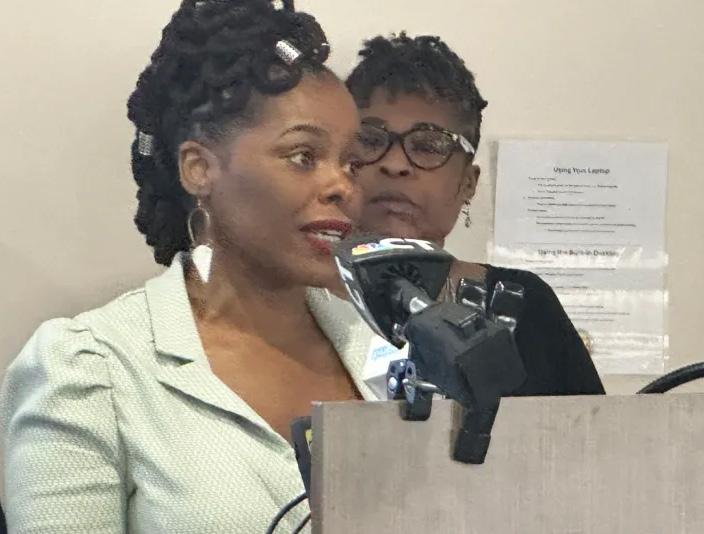
A Bristol resident and community leader who identified herself as Miss. Smith said
By Lucy Gellman
Aunt Esther looks out toward something in the distance, beyond the man standing still beside her. Her hands flutter upwards, slicing the air around them. Her eyes are the eyes of someone who has seen empires rise and fall. Behind her, the house stretches out, full of stories, and beyond that, the blue-black water of the Long Island Sound.
“I dreamed you had a ship full of men and you was coming across the water,” she starts, her voice steady. She is ancient and regal. “Had that stick and you was standing up in this boat full of men.” Her voice deepens. “You come and asked me what I was doing standing there. I told you I wanted to go back across the ocean.” Drums roll and her voice echoes through the theater, as big and broad as the water itself.
That collapsing of space and time, and the knowledge that a body can hold centuries, is at the core of August Wilson’s Gem of the Ocean, produced by Long Wharf Theatre and running at the Canal Dock Boathouse through March 15. Directed by Cheyenne Barboza with a powerhouse cast and crew, the work is a powerful meditation on race, racism, and the people we carry with us, a weight that is sometimes too heavy to bear.
In using the Boathouse for a second time—and working with New Haven artists like Terrence Riggins, Dr. Hanan Hameen Diagne, Assistant Director Steve Driffin, musician Eric Rey and Barboza—Long Wharf has found a powerful and propulsive artistic voice, fusing form and function for a piece of theater that takes the viewer on a journey that is otherworldly, and still rooted in New Haven. Tickets and more information are available here. Almost all of the productions are completely sold out, thanks in part to close to a dozen community partnerships and a celebration of Wilson’s life and work that is still ongoing. While seven of Wilson’s 10 American Century plays have run at the Yale Repertory Theatre, this is the first time Gem of the Ocean has come to New Haven.
“My biggest takeaway as someone who walks with my ancestors every day is the feeling of connection to the spirit,” said Barboza shortly before a tech rehearsal. “What is so mystical about 1839 Wylie Avenue? We hear, over and over again, ‘This is a peaceful house.’ What does it look like to bring the house to life?”
Written in the early 2000s but set in 1904, Gem of the Ocean tells the story of Citizen Barlow (Matthew Elam), who has left his home in Alabama in search of opportunity in the North. In Pittsburgh, he arrives at 1839 Wylie Avenue in search of peace, although from what the audience must wait to find out. There is a hunger in his eyes and hollowed-out cheeks, a frenetic energy that radiates through him. As he begs for his soul to be cleansed, a viewer can tell that he is desperate to put down the load that he is carrying.
Inside, 285-year-old Aunt Esther (De-
nise Burse) has created a sanctuary, in and out of which her caretaker Eli (Thomas Silcott) and Solly Two Kings (Terrence Riggins) enter and exit, sometimes accompanied by friendly itinerant salesman Rutherford Selig (Mike Boland). It is, as multiple characters note, “a peaceful house”—made more so by the care that Black Mary (Grace Porter) takes as she tends the stove, cleans the rooms, and weighs how much of Esther’s history she can carry in the years ahead.
Outside, Pittsburgh is still very much a tale of two (or three, or four) cities, cast into sharp relief when characters speak about the steel mill where many of the city’s Black residents—overexploited, underpaid—must work to make ends meet. Nowhere is that clearer than in the character Caesar Wilks (Bjorn DuPaty) , who sees the law as a guidebook from which he can get ahead, including at the expense of other Black city residents. What makes him so dangerous is that we all know him in the real world, and often don’t realize he’s both a viper and a pawn until it may be entirely too late.
Dates and numbers are important to this show: 1839, the address in which the show unfolds, is the same year that enslaved Africans aboard the Amistad rebelled, and that the ship docked at New Haven’s Long Wharf, the prelude to a trial that made global history. The year 1904 is still within a period many historians refer to as the Nadir, a time of deadly race relations and immense social and economic disenfranchisement of Black Americans that followed the American Civil War and Reconstruction.
There’s also 1619, which is the year that 285-year old Aunt Esther was ostensibly “born,” and the year that the first ship carrying enslaved Africans arrived in Point Comfort, Virginia. In that way that is so Wilsonian, it’s a reference (one of many) to enslavement, racism, and the stain of white supremacy on this country, delivered in a way that is both crushing and nuanced enough to be a pain point that throbs throughout the show.
In a play in which stories of waterways, forced migration, and journeying are all central, both the Boathouse and the set that it contains are unspoken characters, part of the magic and the memory (and certainly, the sorrow too) baked into this show.
From the jump, Long Wharf’s artistic vision brings the show to life in ways that a viewer can’t imagine when they walk into the theater, itself a space that has been completely transformed. On the stage, every square inch of 1839 Wylie Avenue is deliberate: the plush, well-loved armchair at stage left, the always-warm stove at stage right, the door to the house, which swings open and shut with an arrhythmic heartbeat. There’s a wood table that is a de facto meeting space, and a flight of stairs that leads to a second story. The audience never sees the rooms up there, but they never have to either: Wilson’s language, a mix of deep lyricism and fast conversation, conjures them in their entirety.




To suggest that this space has good bones feels inadequate: it holds centuries of memory, with nooks and crannies meant to ensure characters’ survival (a nod to set designer Omid Akbari, and assistant scenic designer Anthony Robles) and conceal the secrets they need to shed. When, halfway through the show, it comes to life before the audience’s eyes, its walls dissolving into the ocean as its floors rotate into sharp, heaving hulls, it feels like a revelation and a natural transition all at once, the history alive in the people who call it home.
As they make it their own, actors give a performance that carries an audience back to 1904, but also through centuries that preceded it, and arguably centuries that will follow. In one moment, early in the second act, Solly Two Kings is turning back the clock, reimagining what Emancipation could have been. He stands, and his presence fills the room, chest broad, shoulders squared. His voice is full, gravelly; it catches every few sentences, as if the breath has left and then reentered his body. As he sees it, freedom is a slippery thing, clear as he announces “I say I got it, but what is it? I’m still trying to find out.” In another, Caesar strides into 1839 Wylie like he owns the place, his hunger for power there in his puffed-out chest and his jangling pockets. He tries to size up Citizen, describing his own rise to economic success in the process. He declares “I got to play the hand that was dealt to me,” and all a person has to do is look at Elam’s face to know it's an incomplete truth.
DuPaty commits to the role, showing the audience how vastly white supremacy (and the systems of capitalism and patriarchy with which it is intimate bedfellows) hurts all people, including those who pretzel themselves to fit its confines. In the process, he also raises valuable questions for his audience, particularly around his own internalized anti-Blackness, and the way his rise to power relies on the myth of self-sufficiency and the economic exploitation of people who look like him. But nowhere is this clearer than in Aunt Esther’s journey to the City of Bones, a nod to history that is at once completely surreal, and painfully rooted in the past. As percussion floats over the stage, heartbeat-like and grounding (a nod to Rey, who also worked with Barboza and Riggins on Unbecoming Tragedy last year), characters begin to move, suspended between this world and one an ocean away. Their bodies loosen, pulled in by the call and response of the drum. They step forward, and the house is suddenly all breath and footfalls, a whisper of what is to come. A paper boat rests in one of Citizen’s hands, so delicate that at one point, it looks as if it could be a bird.
In the audience, a person can feel their heart squeeze in their chest, aware of the weight and power of this moment. The house, transforming, is suddenly not a house at all, but a ship that Citizen must survive. This is 1904, and 1619, and
By Alice Childress
“I mind,” Wiletta declares at a turning point in Alice Childress’ play Trouble in Mind, which debuted off-Broadway in 1955.
I watched a preview of a new staging of the play Thursday evening at Bregamos Community Theater in Erector Square in Fair Haven. The show is run by local theater company Collective Consciousness Theatre, which has been ruffling feathers and promoting social change for over a decade.
The actors played on each others’ tensions with precision, every movement and facial expression rippling across the ensemble in flow.
Wiletta, played by Tamika Pettway, is at a rehearsal for a play she’s in. Castmate Sheldon, played by Joshua Eaddy, is trying to say that seasoned Black professionals like them, as opposed to the younger crowd, don’t mind playing along with white people to keep the peace. This aligns with advice Wiletta herself gives to young castmate John, played by Justin Villard, at the play’s first rehearsal.
Laugh at everything they say, she tells him. John calls her a Uncle Tom.
When Wiletta finally says, “I mind” later in the play, she cuts through the confusion, acknowledges the very existence of her mind, and reminds the audience of the (larger) play’s title, all at the same time.
The play doesn’t put us through a rote back and forth between Wiletta and Sheldon. Sheldon understands, as he always has, though his strategies now seem to clash with Wiletta’s. It may appear like the two are fighting (as they continue to “fight” with Black castmates Millie, played by Raissa Karim, and John), but what they disagree on are methods, not knowledge.
The white writer and white director of the play within the play are still struggling with the basic knowledge, resulting in a failure to depict realistic Black characters. Wiletta’s character, according to the script, sends her son to the county jail to keep him “safe” from lynch mobs angered by his intent to vote.
Wiletta explains to Manners that a mother simply wouldn’t do that. She would never send her son straight into the arms of untrustworthy white authorities.
When white liberals look back into the past (or to their counterparts in areas they deem “backwards,” like the American South), they often conclude that they themselves are smarter, better, more “aware.” Sometimes this seems to bear out. But, as Trouble in Mind shows, that arc can’t just be copied and pasted to Black people’s appraisals of their own humanity, whatever era or region they might

be in.
Wiletta’s director, and then her castmates, echoing him to varying degrees, urge her to see — or at least pretend to agree — that her character simply doesn’t know better. She’s not enlightened, like Wiletta is. She’s probably never even seen a movie! Or a play!
But the white liberal myth of enlightenment might not even do what it’s supposed to do for white people. White director Al Manners, played by Griffin Kulp, who has propped himself up throughout the whole play as a champion for racial justice (as the director of an anti-lynching play), reaches in a desperate struggle of power and emotion for the white superiority tropes he claims to be against.
Childress’ play, and its life on stage all these years after its debut, showed that certain works of art made by Black American visionaries of the ’50s were destined for a strategic long haul. Some works had to skip a generation to arrive here whole. I talked to Jenny Nelson, Trouble in Mind‘s director, about the lore behind the play. It was blocked from Broadway a couple years after its off-Broadway debut, a hurdle Childress was urged to clear by softening the play’s edges, making it more digestible for a broad audience. I guess I mean a white audience. Maybe “the people were’t ready,” as they say, but Childress clearly was. The characters she created were, too.
“What aggravates me always runs for a long time,” Wiletta says to John. White actor Judy, played by Elizabeth Finn, feels like the message of the play within the play is still fresh. She hopes people “learn something” from it.

Like what? her fellow c astmates ask her.
“That people are the same,” she says. Her castmates erupt in thinly veiled mock praise. How insightful, for her to see that Black people are human too.

John P. Thomas Publisher / CEO
Babz Rawls Ivy Editor-in-Chief Liaison, Corporate Affairs Babz@penfieldcomm.com
Advertising/Sales
Keith Jackson Delores Alleyne John Thomas, III
Editorial Team
Staff Writers
Christian Lewis/Current Affairs
Anthony Scott/Sports Arlene Davis-Rudd/Politics
David Asbery / Tanisha Asbery
Jerry Craft / Cartoons / Barbara Fair Dr. Tamiko Jackson-McArthur
Michelle Turner / Smita Shrestha William Spivey / Kam Williams Rev. Samuel T. Ross-Lee
At the time Childress was writing this play, she knew she was a real human being. The white industry that stopped her, evidently, did not quite know. (Don’t worry, they are listening and learning and trying very hard to get closer to knowing.)
Childress refused to edit her play in the end. If she had modified it, it might have gained more eyes when she was alive, but the version we have now would in all likelihood have been lost forever. And how many works have indeed been lost like that? I had to give it up to Childress’ methods.
Trouble in Mind is an anthropological marvel. From the levels of anxious hierarchy in white dynamics to the declaration that it’s scary to say anything (read: anything racist) these days, the play has its varieties of white culture under an exquisite microscope.
The story offers quick, incisive analyses before, after, and while examples play out on stage.
“They want us to be…naturals,” Wiletta tells John about white hostility toward Black schooling. Later, her director indulges in a spree of self-congratulation for bringing out Wiletta’s “natural” talent. He constantly teases, shames, and criticizes her for overthinking.
The truth, as Wiletta keeps trying to explain, is that she is a good actor because she thinks about it. She has a brain, with real intention flowing through it. And she will use it. She does mind.
Wiletta, played by Pettway, observes Al Manners, played by Griffin Kulp. Credit: Joel Callaway
Contributors At-Large
Christine Stuart www.CTNewsJunkie.com
Paul Bass www.newhavenindependent.org
National Association of Black Journalist
National Newspapers Publishers Association
Greater New Haven Chamber of Commerce
Greater New Haven Business & Professional Greater New England Minority Supplier Development Council, Inc.
The Inner-City Newspaper is published weekly by Penfield Communications, Inc. from offices located at 50 Fitch Street, 2nd Floor, New Haven, CT 06515. 203-3870354 phone; 203-387-2684 fax. Subscriptions:$260 per year (does not include sales tax for the in State subscriptions). Send name, address, zip code with payment. Postmaster, send address changes to 50 Fitch Street, New Haven, CT 06515. Display ad deadline Friday prior to insertion date at 5:00pm Advertisers are responsible for checking ads for error in publication. Penfield Communications, Inc d.b.a., “The Inner-City Newspaper” , shall not be liable for failure to publish an ad or for typographical errors or errors in publication, except to the extent of the cost of the space in which actual error appeared in the first insertion. The Publisher reserves the right to refuse advertising for any reason and to alter advertising copy or graphics deemed unacceptable for publication. The entire contents of The Inner-City Newspaper are copyright 2012, Penfield Communications, Inc. and no portion may be reproduced by any means without the written permission of the publisher.
by Lary Bloom Rhinoceros
By Eugene Ionesco
Directed by Liz Diamond Yale Repertory Theatre
New Haven
Through March 28
There was a gap of more than six decades since I last saw Eugene Ionesco’s play, Rhinoceros. That long stretch, as I think about what I just witnessed in Yale Rep’s imaginative and startling production, could be connected by an insular journey.
In 1964, I had a ticket for a campus staging this Theater of the Absurd work, with a cast of undergrads. I had caught the theater bug by then, going to everything that my Midwestern university produced, and occasionally even finding myself on stage. As gripping as these productions were, only two stuck with me since, and both in the last few months have had their revivals at Yale Rep.
Hedda Gabler, by Henrik Ibsen, still flashes at times in consciousness. I was struck by the principal character’s desperation and skills at manipulation, though I didn’t quite get it. I would have been too impatient then to accept the argument that understanding comes with aging, and with our own familial struggles and losses.
The early 1960s, after all, were a buttoned-up era, a time, Ionesco would have pointed out, of conformity. A time before the urban riots, and before the war in Southeast Asia that tore America apart and in which I served, and where I began my boots-on-the-ground education.
When I saw Rhinoceros back then, I had never heard of Eugene Ionesco. I had no idea about his life story, that he had grown up in Romania. He watched dumbfounded as his friends, one by one, embrace that country’s new and deadly authoritarian movement, or that later he had survived Nazism in Vichy France. But I remembered many lines from “Rhinoceros,” which I’ve been quoting since, such as “I will not capitulate,” the last thing the hero Berenger says on stage. And the false syllogism as two primary characters argue logic as everyone around them seems to be growing horns and other perissodactyl features.
In the original version, the logician gives the example, translated from the French thusly: “The cat has four paws. Isadore and Fricot have four paws. Therefore, Isadore and Fricot are cats.” In the campus version I saw, this had been changed to the simpler, “Socrates is a cat. All cats die. Therefore, Socrates is dead.” But back then I didn’t really know what the play was meant to do, even in that era before everything broke apart on campuses and in society in the late ’60s. The play was some sort of metaphor, I knew. But I didn’t get it.
I remember overhearing two women, both professors I presumed, as they walked out of the theater, agreeing that


the play “had something to do with Communism.” Confused, I scoffed at the idea.
In the present-day production, and given 60 more years of learning about the world outside of a protective university campus, I finally understood the play’s intent, as well as felt its power.
For one thing, the cast in New Haven is composed of Actors’ Equity members (and a few Yale drama students in minor roles). Soo it is more proficient than the show I saw a long time ago.
This version is quick, whittled down to one act of several scenes requiring only 90 minutes of a theater-goers’ time, not counting the standing ovation. As such, the false cat syllogisms didn’t make the cut. Still, the show in New Haven is a reminder that in the arts perfect timing is as big an asset at great dialogue, characterization, and plot.
For who can see the play now without thinking about MAGA and its chief carnival barker luring huge crowds into his tent of depravity with blatant lies? The joining of the crowd, the need to be acknowledged, welcomed, part of an “enlightened transition,” without any independent research make no sense, say logicians and people who care about human rights and the truth worth telling.
I should offer a word about the craft of Yale Rep’s work here. It is magical. The acting, the lighting, the design, the sound, the balletic staging. In the lead role of Berenger, the well-intended but fervent-
By Brian Slattery
Shooting Fast and Slow
Photos By William Frucht
City Gallery
New Haven
Through March 29
It's a jumble of faces on a street corner in what could be lower Manhattan. The first points of interest lie in the people's faces, the dynamism and multiplicity of their expressions, senses of weariness and alertness. They're the looks of people on the go. But the camera's lens captures something else, too, an interesting shadow that obscures some to all of some of the faces, setting off those in full sun in greater contrast. It's not just the people and their feelings that this picture has caught in its butterfly net of a shot; it's the quality of the air, which perhaps lasted no more than a second, and was gone.
we're looking at an artifact of an industrial past, but for all we know, we could be looking at the innards of a crashed alien spacecraft, 10,000 years from now. Meanwhile, Frucht explains, "the second path is street photography using a small digital camera. I decide my settings beforehand and let the camera make its own adjustments. I immerse myself in the moment, trying not to think but simply flow, reacting to fleeting gestures, expressions, and chance arrangements of light and shadow that flicker into existence like virtual particles and then as quickly vanish. Yet even when the world is an infinite mad dance I try to work slowly, as if slowing time itself, to wait for the moment when forms, colors, expressions fall into place just so."
ly intoxicated hero, Reg Rogers shows off his comedy chops — he even has hilarious hair — as he falls into despair as everyone around him develops horns and rhino skin, and learn to speak in a malevolent roar.
Phillip Taratula, as Berenger’s buddy Jean, who actually turns into a rhinoceros on stage, shows extraordinary range in voice and movement. Other cast members excel as well.
After the matinee performance on March 14 ended and we filed out, I cornered a few witnesses to the production to see what the play meant to them.
The man in the row just in front of me said, “Yale Rep sure knew what it was doing a year ago when it scheduled this. What an example of timing genius.”
I asked two women lingering outside if the play’s intent registered and is relevant today. They could not answer quickly enough.
“Oh, yes,” said one.
“Unfortunately. That’s why I hated it.” The other said, “I loved everything about it.”
So, at the very least, I had stumbled upon an example of non-conformity. A sign of hope? Evidence that at long last, we won’t capitulate?
Rhinoceros runs through March 28. For tickets, see yalerep.org, or call (203) 4321234.
The image is part of Shooting Fast and Slow, a show by photographer William Frucht on view now at City Gallery through March 29. It turns out the approach in that street corner image is only a third of the story. "My photography follows two distinct paths: fast and slow," Frucht writes in an accompanying statement. "One path — the slow path — is photographing abandoned or distressed places with a big medium-format film camera and a tripod. This calls for careful, contemplative work, taking several minutes to choose the camera placement, to meter and focus, and occasionally to wait for the right light. The images that emerge are meditations on the slow evolution of the world: I am in dialogue with the past, photographing events that unfold not over seconds and minutes but over years and decades. Yet even when working in this deliberate, unhurried way, I feel a sense of spontaneity: when the moment is just right I am ready to seize it."
All that Frucht describes comes into acute focus in Connecticut Yankee Mill 24, in which the shadows the metalworks create on the wall behind them are as important to the composition as the metalworks themselves. The eerie light beaming in through the broken roof only adds to the allure. There are people around here who know what they're looking at when they see a room full of machinery like this, but most of us don't. Frucht's sense of slow time works in both directions:
The photographs from the beach perhaps best show the spark Frucht is after. In Untitled, July 2025, we might look first at the faces, of people in transition, from water to air and land, coolness to heat. Are they talking to one another? Are they in their own worlds? The image doesn't let us decide. But it takes in more than the people, too. The wave behind them, for example, is frozen into a complex, compelling shape, all curls and textures, wafts of water and streaks of foam. We almost never get to see it this way. Frucht's snapshot gives us the chance.
Finally, Frucht states that "recently a third path has emerged, in which I try to capture fast moments with slow processes, like an excursion into an imaginary universe that crosses reality sat an angle." The window shot of Caffe Roma (in which your correspondent has dawdled away many, many hours with a cappuccino and a cannoli) gives a sense of what Frucht means. The people in the picture — both the folks passing by in the street and the customers idling at their tables in the window — will never be there again in that combination. But the window itself has been there for a long time, reflecting the crosswalk and the buildings. The sun has cast the shadows of the painted letters into the cafe for years. Each moment on that corner may be unique, but the picture reminds us that there is something almost eternal about it, too. Until the cafe closes, people will mill in front of it while others sit in the window, and the coffee and pastry will be just as warm and sweet.

by Mona Mahadevan
The Fair Rent Commission (FRC) has turned down both tenants unions that had been vying to represent a 312-unit, low-income apartment complex in Quinnipiac Meadows after finding that neither has yet secured the support of a majority of the property’s renters.
Over the course of its nearly four-month investigation, the city agency found that 11 renters whose names appeared on one union’s membership list claimed they had never signed that group’s petition.
The FRC also spoke with 15 renters whose names appeared on the other union’s membership list who claimed they had signed up to indicate their support for that union, not to join it. Overall, the FRC wound up disqualifying hundreds of signatures across the two separate petitions on the grounds that they were illegible or did not include all requested tenant information, like lease start dates.
FRC Executive Director Wildaliz Bermúdez provided the Independent with reports documenting those Sunset Ridge tenants-union-petition rejections on Friday afternoon.
The reports, dated Thursday, represent the culmination of a FRC investigation that dates back to November.
According to a city law first passed in 2022 and amended in 2024, tenants unions looking for official recognition from City Hall must be created by a majority of lease-holding renters at a complex that has at least five units of housing. The city has officially recognized eight such tenants unions at complexes across New Haven — thereby allowing those unions to participate in Fair Rent Commission investigations and hearings.
The two competing Sunset Ridge unions, meanwhile, both failed to secure enough valid signatures to qualify for city recognition.
One union — led by a resident named Sebastian Gomez — initially submitted a membership list of 202 names. The FRC found that only two of those named renters had submitted all required information to qualify for membership in a city-recognized union.
The other union — led by residents named Tawana Galberth and Cynthia Vega-Vieyra, and backed by a statewide group called the Connecticut Tenants Union (CTTU) — initially submitted a membership list of 168 names. The FRC was able to verify a total of 97 of those union’s constituents.
The upshot of all of this: The FRC found that neither union submitted legible names and lease information from the majority of households at Sunset Ridge, and so neither union was granted formal status. Even without city recognition, tenants unions can still push for a collective bargaining process and coordinate calls for maintenance improvements.
In an email comment sent to the Independent on Friday, Bermúdez said the investigation into Sunset Ridge’s compet-

ing unions has pushed the commission to tighten its union-verification process.
“In the past, the FRC had no reason to question the integrity of tenant union applications,” Bermúdez said. “Moving forward, the FRC will require the tenant union president and/or tenant union representative(s) to affirm to the FRC that the application is valid, and that all signatories have willingly and knowingly signed the registration form.”
The lease start date section was left blank for several entries on both membership lists, an omission that disqualified many names. Moving forward, Bermúdez said the FRC will scrutinize that section as closely as the others.
At Sunset Ridge, the conflict over the city’s union-recognition process has raged for more than three months.
According to the FRC’s reports, the tenants union represented by Gomez was certified by the city on Oct. 30, 2025, the same day Gomez submitted a membership list of 202 names.
Two weeks later, a tenant entered the property manager’s office and saw her name on Gomez’s union’s roster. She reached out to the FRC to request an investigation.
“This is the first time in New Haven’s FRC history, that an investigation was requested by a tenant whose name appeared on a tenants’ union list, where the tenant called into question their name being provided as a tenant union member,” reads one of the FRC reports obtained by the Independent on Friday. “This initial investigation request and the unique circumstances in which there have been two submissions to the FRC by proposed tenants’ unions, led the FRC staff to review and investigate the submittal of both proposed unions.”
On Nov. 24, the FRC began calling names on Gomez’s list. According to the report, the agency successfully contacted 55 people, 11 of whom “clearly denied being part of this tenants’ union.”
In January, the FRC mailed letters requesting verification to 196 names on the list. The report indicates that 170 letters were returned to sender.
The agency received 41 responses to their letters, though 12 respondents were not listed on the original roster.
Of the remaining 29 responses, the report indicates that one person denied signing Gomez’s list, and eight others did not want to join the union. The rest of the respondents confirmed their membership, but they failed to provide the start dates of their leases, disqualifying them by FRC rules.
“That means that, of the 202 [] names received, only two (2) tenants provided the FRC with all required fields. Therefore, there are only two (2) tenants who qualify as [] members” of Gomez’s union, the report concludes.
Gomez did not respond to requests for comment by the publication time of this article.
The other tenants union — the one represented by Galberth and Vega-Vieyra and backed by CTTU — is currently suing Sunset Ridge’s landlord, an affiliate of the New York-based Capital Realty Group, for alleged retaliatory tactics against renters and organizers looking to form a union. They also claim that Gomez’s union is affiliated with management.
One of the FRC reports states that Galberth and Vega-Vieyra submitted a membership list on Nov. 14, the same day that a tenant requested an investigation into Gomez’s union. The list from Galberth and Vega-Vieyra contained 168 names,
“The FRC is missing an additional 62 tenant union members with full requirements to meet the threshold for recognition,” reads the report. While the commission declined to certify the union, the letter invites the group to submit a supplemental membership list.
On Friday, Melonakos told the Independent that the union is still deciding how to proceed.
including two duplicates.
Through the month of December, the FRC successfully contacted 67 people on the union’s membership list. According to the report, 15 people said they had only signed to support the union, not to join.
Eight people requested that their names be removed, and one person, who is deaf, denied ever signing the list.
Luke Melonakos, the vice president of CTTU, offered two theories to explain the discrepancies.
“We never expected the FRC to call anyone in this way, because that’s never happened before,” Melonakos told the Independent. “People might have been confused about why they were being called by the city about it.”
His other theory is about fear of retaliation from the landlord. “I have had a number of people tell me personally, ‘I support what you’re doing, but I can’t get personally involved, because I’m afraid of what will happen if I do.'”
Melonakos also quibbled with the distinction between “joining” and “supporting” the union.
In January, the report indicates that FRC began mailing letters to request verification from all 168 names on the list; 68 letters were returned as undeliverable.
The FRC received 25 responses to their letters, including one person who was not listed on the original roster. All respondents confirmed their membership in the union.
Even so, the union fell short of recognition, as many entries were disqualified for being illegible or omitting a lease start date.
150,000 Criminal Records
“I do think that everyone is coming away from this whole process and feeling tired,” he said. “It’s unfortunate. I’m not necessarily blaming the FRC. I’m blaming Capital Realty, and their efforts to union bust in this way by creating a management propped-up union.” she spent years applying for jobs while carrying a criminal conviction that followed her long after she had rebuilt her life.
Smith said she originally began pursuing a pardon before learning that the Clean Slate process could clear her record automatically.
“I’ve been carrying this record for years — like a weight on your chest that never lets up,” Smith said.
When she learned the conviction had been erased, the change was difficult to process.
“I carried it for so long it had started to feel like me,” she said. “Like that’s just who I was. A woman with a record.”
Smith said she recently attended a job interview without the burden of explaining her past conviction for the first time in years.
“Clean Slate didn’t just clear my record,” she said. “It gave me back my dignity. It gave me back my future.”
Dr. Sheena Meade, chief executive officer of the national Clean Slate Initiative, said 13 states across the country have adopted similar policies, with Illinois the most recent.
She said the movement has been driven by years of organizing and persistence from advocates who believe second chances are worth fighting for.
“My real goal is to make sure those laws are actually implemented as they were intended,” she said. “Even today, too many people are still living as opportunities pass them by simply because they don’t know freedom is possible.”
Nationally, more than 18 million people are expected to have records fully or partially cleared through similar policies. Supporters say the reform is particularly important in addressing longstanding disparities in the criminal justice system. Those with records in Connecticut can find information regarding eligibility by visiting the Clean Slate Connecticut Website.

By Lucy Gellman
In a classroom at Mauro-Sheridan Interdistrict Magnet School, sixth graders William Garzon and Joseph Redmond lifted their instruments to their mouths, feet tapping the floor as a voice counted them in. Bright, wintery light bounced off the snow and streamed through the windows. The growl of a trumpet came from an office nearby. Seated beside each other, William and Joseph didn’t take their eyes off the music in front of them. Clarinet and baritone lifted off, and began to take flight.
Across town at John C. Daniels School of International Communication, Olivia Kristina Leigh Diaz unpacked her clarinet, and warmed up with a scale. On the stage, band teacher Bryan Carrera looked on, beaming.
All three are young musicians in the New Haven Public Schools, which for the first time this year sent students to the Connecticut Music Educators Association’s (CMEA) all-state Elementary Honors Festival, where they participated in a full day of ensemble workshops and band performances with students from across the state. Nominated by their teachers, all three spent last Friday at the University of Bridgeport, learning alongside students and educators from across Connecticut.
This year, those teachers include Marissa Iezzi, who directs the band at Mauro-Sheridan, and Carrera, who teaches music at John C. Daniels. Both are products of Connecticut public schools: Iezzi grew up studying music in Wallingford, and Carrera learned the tuba at Worthington Hooker, then graduated from Cooperative Arts & Humanities High School. Both now play enough instruments to comprise a small orchestra.
“It’s exciting! I’m very proud of them,” said Iezzi in an interview last Thursday morning, as students returned to school for the first time in five days. “They’re learning how to be independent on their instrument,” and also learning teamwork at the same time. “It’s a mix of both.”
This year, both she and Carrera nominated students as a way to recognize their talents, and push them beyond their comfort zones. When CMEA let them know that the three had been selected, it felt like a big deal: Iezzi can’t remember a time in recent history when kids at the city’s elementary schools have been able to attend a statewide event like this (prior to her time at Mauro-Sheridan, she taught at Truman School and James Hillhouse High School). It allows the district, where arts educators have had to fight to keep their jobs, to see the impact that music education is having in real time.
While all three students are also part of programs like Music In The Schools, AllCity Ensembles and the Morse Summer Music Academy, all initiatives with the Yale School of Music, CMEA’s all-state band is different: it gives them a chance to meet other kids from districts around Connecticut, including those that fund the arts more robustly, or teach music
education in different ways. When they have the chance to play with new people, they may see or hear something that they wouldn’t otherwise get to experience, and bring it back into their classrooms.
As they jumped into their final practice sessions last Thursday, all three students shook off some serious pre-performance jitters, and said that they were feeling more or less ready to jump in. Between snow days in January and February, they lost four days of rehearsal at school, where Iezzi and Carrera have been working with them both in and outside of class (both said the additional hours are worth it: it’s a chance to show the district some of the talent flourishing right in its own backyard). And yet, they seemed as prepared as they’d ever be, with neat collections of sheet music and a final day to go over any problem areas.
“It’s nice!” said Carrera, who fell in love with the tuba in New Haven, studied performance and music education at the University of Connecticut, and then chose to return to the district that raised him. “For me, I just do it because some students need to step out of their comfort zones.”
“I think music is the best example of how to show off your work,” he added a few minutes later. “It’s like I tell students, ‘There’s no cheat code. You just have to put in the work, and put in the hours.’”
It’s also a reminder that young artists exist in every school. Mauro-Sheridan and John C. Daniels aren’t known for their arts programming, like some of the magnet middle and high schools in the district. And yet, maybe they should be: Iezzi and Carrera respectively have both been rebuilding their bands since the Covid-19 pandemic, which made ensemble work temporarily impossible.
Last year, Mauro-Sheridan sent a student soloist to play with the New Haven Chamber Orchestra. Friday, John C. Daniels showed out with a student jazz ensemble and New Orleans-style second line as part of its Black History Month showcase.
Olivia, who started studying the clarinet at the end of fourth grade, has been putting in those hours that Carrera asks of his students. Since learning about the all-state band, she’s had to carve out extra time for rehearsal at home and at school, with four pieces she wasn’t expecting to learn. Each night, she makes time to practice on top of cleaning, homework, and the pieces she’s already learning for the school’s band.
“It shows the bravery in each person going and the skill that all of us have to work hard for,” she said. “We’re working really hard. I did it because I could.”
As she chatted, she assembled her clarinet, rifling through an overstuffed folder until she found a copy of Greg Hillis’



“Alpha Squadron” arranged for concert band. On the sheet music, she had transcribed the first four bars of notes, as a way to help herself learn the piece. C and D notes danced alongside E and F notations on the page.
“I kept getting confused, so I wrote them out,” she said confidently before warming up with a scale. She later added that she sees herself staying with the instrument for as long as she can: she likes that it lets her express herself.
Back in Iezzi’s band classroom, William and Joseph were running through details for Friday one last time, copies of Carol Brittin Chambers’ “Rock Attack” and John Higgins’ “Latin Magic” still tucked safely away beside their instrument cases. William, who picked up the clarinet in a nod to his two older sisters, sat against the stage, ready for the event. At home and at school, he said, playing helps him fight boredom and regain focus, so much so that sometimes he plays just for fun.
“I feel excited that I was nominated and accepted,” he said. “I haven’t done anything like this before.”
“I’m happy!” Joseph chimed in. “I’m kind of nervous about it, but I like it. My family cheers me on.”
When he joined the band last year, he hoped to play the trombone, just like his older brother. But the embouchure— that’s a fancy way of saying the mouthpiece—was too big. Then he thought about the tuba, but that wasn’t an option either. When Iezzi paired him with a baritone, something clicked. Joseph, who is from a musical family, had found his own instrumental home.
As he sat down next to William to practice, Iezzi counting them in, a person could see and hear that in real time. Iezzi tapped her foot, singing out the notes with a patient, low “Bah-bah-buh!” that somehow still managed to be crisp and sunny. Beside her, Joseph stopped playing, and whispered something, the baritone still propped upright in his hands.
“I’m sorry?” Iezzi nodded her head as he motioned to his mouth, and then back to the instrument, the words so quiet they were inaudible from just a few feet away. “Your voice?” She stood, lifted a trombone that seemed to materialize from thin air, and sat back down beside them. Then they started the piece again, their three feet tapping the floor in unison. Two sneakers bobbed brightly beside Iezzi’s dress shoe.
This time, the brass burst forward, confident and clear. Baritone hummed as William played out a string of notes that made it sound like “Frère Jacques” had entered the chat. Then the two instruments were in step with each other, marching forward with a precision that filled the room. They swooped, climbing upwards, and then dipped back down. They paused, then delivered the finale without a single squeak. They were ready.
By Lucy Gellman
The little boy crouches down on the sidewalk, his eyes bright, brown skin luminous. Beneath a prefect, full head of hair, teased out into a halo, his smile is radiant. Beneath his hands, even the pavement seems to take note. The grass glows in the sunlight. Around him, words like Enough, Courageous, Bold and Wise float through the air, all completing the phrase I Am. In his pint-sized orange and purple sneakers, he’s ready to take on the world, one measured footstep at a time.
The work, titled The Child I AM, is the exquisite brainchild of New Haven painter Jasmine Nikole, who with fellow Elm City artist Rashana Miller presented her work at the Harlem Fine Arts Show (HFAS) at the end of February. For both artists, as well as Hartford’s Andre Rochester, it closed out Black History Month in a cultural and historical epicenter of Black artmaking, creating a chance to celebrate their work—and forge new connections—on an international stage.
It’s a win for New Haven: the thousands of artists, art-lovers and patrons who attended the show now have another cultural touchpoint for the city. In part, that’s also thanks to publicist Stacy Graham-Hunt, a West Havener who runs her own PR Firm, and has long championed artists in and across the region.
“I think it shows proof of concept that New Haven is a world class place with world class artists,” said City Cultural Affairs Director Shamain McAllister, who Nikole credited as extremely supportive in the lead-up to the event. “New Haven does have it all, and it shows how rich we are with talent. For Jasmine to represent New Haven in such a way, we were honored to wrap our arms around her.”
For both Nikole and Miller, it was a transformative weekend months in the making. When Nikole first thought about exhibiting her work, she was aware that "it is definitely an investment," including a $6,000 booth fee that HFAS artists are expected to pay. As a rising star in the New Haven art world—in the past five years alone, Nikole’s work has entered collections including CT Innovations, the Cornell Scott Hill Health Center, and the Center for Inclusive Growth among many others—she also knew that attending meant creating new work, which translates to extra time and labor.
She credits a creative village with getting her there. McAllister, who promised to champion artists and uphold New Haven’s Cultural Equity Plan when she began the job last year, did exactly that, rallying members of the cultural community to support one of their own. Filmmaker Isaiah Providence, a teacher at Cooperative Arts & Humanities High School who also does work for the Department of Arts, Culture & Tourism, shot a promotional video. Artist Shaunda Holloway, in the midst of curating her own show at Creative Arts Workshop, kept Nikole company over the phone while she painted, making the process feel less isolating.

Then, in the whirlwind of days before the show, Nikole’s partner William took over the lion’s share of the housework and care for their two young children (“He was my quality control,” she said with a laugh). Her parents travelled to Harlem, her mom making the trip all the way from Georgia to be there. Members of New Haven’s Cultural Affairs Commission also showed up in force, with enough social media content by the end of the weekend to start a small firm.
“As a Black artist, to be showing at this was the most validating experience,” said Nikole, a self-taught artist who has shown her work in New Haven, across the Northeast, and in San Francisco, and found the HFAS scene completely unique
and supportive. “It went so well. People really truly saw a reflection of their own story through my art.”
Miller, a metalsmith and sharp-eyed thrifter who runs Free Maiden Studio, could also feel that sense of celebration—and of collectors, viewers, and artists witnessing other artists—humming through the weekend. Several years ago, she picked up metalsmithing on a whim, after a move to Richmond, Virginia left her looking for work. For a decade before that, she had been an educator and administrator in West Philadelphia, where she grew up.
The metalsmithing class seemed like a fun, community-oriented thing she could do while on the job hunt. She wasn’t ex-
hers. When she got a call from the Harlem Fine Arts Show, it was an easy yes.
“This was reinforcement that I’m on the path that I need to be on,” Miller said. Like Nikole, she’d never experienced anything quite like HFAS before. “Just being around other Black artists” of all media, and many nationalities, moved her profoundly. She was grateful not just for the network she was able to tap into, but the deep sense of cultural community that came out of the event.
“Creating is an act of resistance,” she added. “ Staying in this keeps me going.” Kulturally LIT Fest Founder IfeMichelle Gardin, who sits on the city’s Cultural Affairs Commission, said that she is incredibly proud of the New Haven representation, and was excited to cheer both Miller and Nikole on. As a lifelong lover of the arts, Gardin started attending HFAS years ago, when it was still at a church on Harlem’s Riverside Drive.
“Oh my gosh, it was like a super exhibit,” she said. “ You know, it was just an overwhelmingly beautiful exhibition showing the talent of artists and creatives of color from all over. It has just evolved so much, and it's a great opportunity for the artists.”
As a commissioner and a literary luminary herself, Gardin also sees HFAS as a valuable and necessary opportunity for artists to break out of their silos. In New Haven, she sees firsthand how small the city can become for artists, despite a number of both formal and informal gallery spaces, and chances to network like the Black Wall Street Festival and neighborhood pop-ups from the International Festival of Arts & Ideas. Getting out of New Haven means remembering how big the outside world can be.
“It’s a nice opportunity for them to know that there are collectors outside of us. We kind of go through the same circles of folks and see the same people in these spaces,” she said, praising how collaborative this year’s atmosphere seemed. She noted how many artists she saw who were speaking other languages, part of the show’s work to invite artists from across the Black diaspora. “You get another perspective when you see what’s really out there.”
pecting it to move her in the way it did.
“And like 20 minutes into it, I was like, ‘I want to do this for the rest of my life,’” she remembered in a phone call earlier this month. From that moment, it would never just be a hobby. “I loved doing it.” It turned out she was good at it, too. When Miller’s husband got a job at Yale, the two moved from Richmond to New Haven, where they are now raising their two young children. While Miller works for Hartford Promise during the day, Free Maiden has become much more than a passion project: she is a frequent face at pop-ups and artist markets (and Possible Futures, where bookspace founder Lauren Anderson often rocks her hoops), with designs that are instantly recognizable as
That artistic footprint goes beyond the single HFAS weekend, McAllister added: there are six additional New Haven and Hamden artists featured in HFAS’ virtual extension show, called the Virtual Arts District. They include Linda Vauters Mickens, Shaunda Holloway, Marquis Brantley, Kim Weston, Amber Cohens, and Candyce “Marsh” John.
In a phone call Monday, McAllister pointed to the way artists are helping each other: artist Gio Roper photographed their work, making their participation in the virtual exhibition that much more possible.
“It’s all the artists who helped make that push,” she said.
by Mona Mahadevan
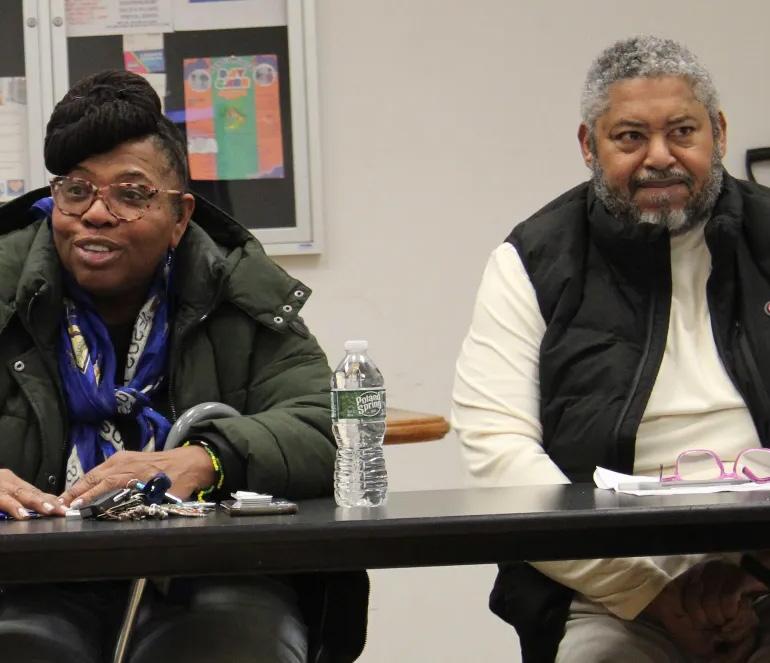
The city is working with a clean energy company to install a solar canopy on the Bowen Field parking lot — a project that has renewed neighbors’ calls to address noise, litter, and partying in the area. Plans for a solar carport were discussed during Tuesday’s meeting of the Whalley, Edgewood, and Beaver Hills Community Management Team (WEBCMT) at 332 Whalley Ave., the location of a local police substation.
In the last year, the city has seen new solar arrays pop up on a public landfill and two schools. Both were installed by solar developer Greenskies Clean Energy, which the city also chose for the Bowen Field project.
A canopy at 175 Crescent St. would generate an estimated 852,900 kilowatt-hours of electricity, powering more than 80 homes for a year, according to Greenskies’ site plan.
In addition to the Bowen Field project, Ryan Linares, a vice president at Greenskies, said the company is working to install new solar canopies on the parking lots at the Alling Memorial Golf Course, East Shore Park, Clemente Leadership Academy, and Hill Regional Career High School.
All of these solar developments have been led by Steve Winter, executive director of the city’s Office of Climate and Sustainability and a state representative for parts of New Haven and Hamden.
On Tuesday, Winter presented the Bowen Field project to attendees of the evening’s WEBCMT meeting.
For this project, Winter said the city is leasing the Bowen Field parking lot to
Greenskies. The company will pay around $34,000 to the city annually, though rent will vary depending on the ultimate size of the solar array.
In exchange, Greenskies can sell the power they generate to United Illuminating (UI), which may then deploy the electricity on their grid. Greenskies would own all of the solar equipment and be responsible for maintaining it. The company would also fund the planting of new trees to replace the 11 that will be cut down for the installation of a solar canopy.
Greenskies and the city have already agreed to a lease for Bowen Field, said Linares. The company’s next step is soliciting approvals from the city’s planning and zoning departments. He estimates that it will take another eight months before installation can begin.
Amid the excitement for a new solar canopy, neighbors raised their existing concerns with the Bowen Field parking lot.
“There is ongoing partying at the parking lot near from Hillhouse [High School],” said Nan Bartow, a lead volunteer for Friends of Beaver Pond Park. “Some people that are partying are responsible, but others are not. They leave litter.”
“A lot of [the partying] happens during
the daytime,” said Rebecca Cramer, chair of the WEBCMT. Addressing the issue is critical because children play on Bowen Field, she said.
Beaver Hills Alder Gary Hogan, whose ward stops a few feet short of Bowen Field, agreed that the parking lot attracts revelers. While one neighbor suggested locking the gates to keep people out, Hogan said the field hosts events through the late evening, so the parking lots needs to be accessible at night.
Cramer suggested a meeting with community leaders and city staff, including officers from the New Haven Police Department, to find solutions to the lot’s noise and litter problems.
In the end, concerns about the parking lot did not lead neighbors to oppose the solar array.
“I don’t think the parking canopy will have a big impact on whether people decide to go and hang out there,” Winter told the Independent. One reason is because lights will be installed on the underside of the panels, preserving brightness and visibility in the area.
Even so, Winter said he and Linares are committed to being good stewards of the property and are eager to work with the city on addressing the lot’s ongoing issues.
by Mona Mahadevan
The vice president of the Connecticut Tenants Union (CTTU) went to court on Thursday to testify before a judge about his experience fighting a landlord’s alleged retaliatory tactics against organizers and renters looking to form a union at a Quinnipiac Meadows apartment complex. Luke Melonakos presented that testimony in New Haven’s third-floor housing court at 121 Elm St. Thursday afternoon.
The hearing marked the first court appearance for a trial set to consider whether management of Sunset Ridge — a 312-unit, low-income apartment complex — violated the laws protecting tenants’ right to organize.
Sunset Ridge is owned by the Capital Realty Group, a New York-based landlord facing unionization efforts at properties across the country.
Due to time constraints, Paul Small — the attorney representing Sunset Ridge and two property managers — did not cross-examine Melonakos on Thursday. Small also did not respond to requests for comment by the publication time of this article.
The case before the court on Thursday began on Feb. 18, when members of the Sunset Ridge Tenants Union filed for an injunction to stop the landlord’s alleged retaliation against union members. In addition to seeking damages, the complaint
asks the court to have management rescind a pre-eviction notice against Cynthia Vega-Vieyra, a union leader and Sunset Ridge resident.
On Thursday, the two-hour hearing focused on alleged retaliation against tenants-union organizers.
“Pretty central to a tenant’s right to organize is the ability to invite tenants union organizers to visit them,” said Amy Eppler-Epstein, a New Haven Legal Assistance Association (NHLAA) attorney representing the plaintiffs.
A 20-person crowd, marked by the bright blue of their CTTU shirts, filled the courtroom. Eppler-Epstein invited Melonakos to the witness stand and asked him to tell state Superior Court Judge Alayna Stone about his encounters with management.
He recalled his car being towed from visitor parking, a property manager serving him a “No Trespass Notice,” and pictures of his face being posted throughout the complex.
Those incidents represent a clear message that “management is going to make your life very difficult if you dare to organize,” said Melonakos. The landlord, in turn, evoked “fear and hesitation from tenants at Sunset Ridge,” who might have otherwise spoken with organizers and joined the union.
He also described alleged efforts to

intimidate and harass tenants.
On three separate occasions, groups of people interrupted CTTU press conferences with megaphones, sirens, and signs, said Melonakos. Some people acted aggressively, even hitting one union member, he said.
“They were trying to drown out the voic-
es of the tenants there,” said Melonakos. Eppler-Epstein asked him if they had succeeded. “I would say yes,” he replied.
“The sirens were unbearable,” blaring for hours and leaving his ears ringing.
Melonakos said a Sunset Ridge property manager, Yoana Avila, helped disrupt CTTU’s event in Spring Valley, New York, outside of Capital Realty’s offices. He
saw her act “chatty and friendly” with the people interrupting a CTTU press conference in November, he said.
Melonakos also noted that Sebastian Gomez — the president of a different tenants union at Sunset Ridge — and Fair Haven landlord Alejandro De Frutos participated in all three of the disruptions. (While not the subject of Thursday’s proceedings, the Fair Rent Commission has still not formally recognized either Gomez’s union or the union associated with CTTU, even after more than three months of review.)
Throughout Thursday’s hearing, Small rarely spoke, only objecting to Melonakos saying that tenants had grown fearful of unionizing due to management’s actions against CTTU organizers. Small argued that such testimony was either hearsay or speculative.
Small also said that he plans to file a motion to dismiss the case.
At the end of his testimony, Melonakos described the broader implications of the case on tenant-organizing in Connecticut. The decision will “send[] a message to any tenants that are experiencing the same issues as the Sunset Ridge tenants,” said Melonakos. If the right to organize is not upheld, “that sets a very dangerous precedent for tenants across Connecticut.”



Yale New Haven Hospital is pleased to offer patients and their families financial counseling regarding their hospital bills or the availability of financial assistance, including free care funds.
By appointment, patients can speak one-on-one with a financial counselor during regular business hours. For your convenience, extended hours are available in-person at Yale New Haven Hospital the third Monday of every month.
Time: 5 - 7 pm
Location: Children’s Hospital, 35 Park St., 1st floor, Admitting Parking available (handicapped accessible)
An appointment is necessary. Please call 855-547-4584. Spanish-speaking counselors available.
• Burial Lots (infant, single, two-grave, or four-grave)
• Monuments & Markers (black, gray, or pink granite)
• Flower placement (single or multiple placement)
• Cremation (Choose to be cremated at Evergreen.)
• Columbarium in the Most Beautiful Cremation Garden

• All orders can be placed at the Evergreen office or the website.





Born in 1930, Justice Sandra Day O’Connor’s early life was spent on her family cattle ranch in Texas. She attended Stanford University, earning her B.A. in economics followed by a law degree from the same in 1952. Prior to her Supreme Court appointment, she worked as a deputy county attorney, Attorney General of Arizona, a member of the Arizona State Senate, and as a Justice in the Maricopa County Superior Court.
In 1981, President Reagan nominated Sandra for the Court. Justice O’Connor was the first woman ever to be nominated and confirmed to the court. Although her nomination was originally opposed by pro-life and religious groups, who worried she should not rule in favor of overturning Roe vs. Wade (1973), she was eventually confirmed by a 99-0 vote in the Senate. While she was a conservative jurist, siding with the conservative justices in the majority of cases before her, many of her decisions were praised for being both narrow and moderate.
Justice Ginsburg grew up in Brooklyn. She was originally known by her first name Joan, until her mother discovered that there were several other students in her class were also named Joan and suggested to her teacher that they call her by her second name, Ruth, to avoid confusion. Justice Ginsberg went on to receive her B.A. in government and went to Law School at Harvard and Columbia, earning her law degree from Columbia tied for first in her class. After university, she clerked in the US District Court for the Southern District of New York, worked in Academia as a professor at Rutgers Law School and Columbia Law School, and co-founded the Women’s Rights Project at the ACLU and litigated or was otherwise involved in several important cases related to equal rights and gender discrimination, and served as a judge on the Second Circuit Court of Appeals.
President Bill Clinton nominated Ruth Bader Ginsburg for the Supreme Court in 1993. In her 27 years on the Supreme Court, Ginsburg established herself as a champion of women's rights and gender equality. Although thought of as a moderate when confirmed, Justice Ginsburg consistently voted with the liberal bloc of the court. She served until her passing in 2020.
Justice Sotomayor was born in the Bronx, New York City and decided early on in life that she wanted to pursue a legal career after being inspired by watching Perry Mason on television. Justice Sotomayor received her undergraduate degree from Princeton and her Law degree from Yale Law School.
The U.S. Senate confirmed Sonia Sotomayor as a Supreme Court Justice in 2009 to replace retiring Justice David Souter. Previously, Sotomayor worked as an assistant district attorney and in private practice before later serving as a district court judge in New York and on the U.S. Court of Appeals for the Second Circuit. She was the third woman to serve on the Supreme Court. Justice Sotomayor has made waves by standing up for civil rights and rights of defendants, including a scathing dissent in Utah v. Edward Joseph Strieff, Jr. in 2016.


Justice Kagan was born and raised in New York City where she was considered an outstanding student. She received her undergraduate degree in history from Princeton and her Law degree from Harvard.
Elena Kagan was confirmed as a Supreme Court justice in 2010, replacing John Paul Stevens. Before her confirmation, Kagan clerked in the U.S. Court of Appeals for the District of Columbia circuit and then for U.S. Supreme Court Justice, Thurgood Marshall. She also worked in private practice for a time, taught at the University of Chicago Law School and Harvard Law School (where she also served as dean) and served in a variety of political appointments including White House associate counsel and U.S. Solicitor General, and Deputy Assistant to the President for Domestic Policy and then Deputy Director of the Domestic Policy Council. She is the only current Supreme Court justice with no prior judicial experience.
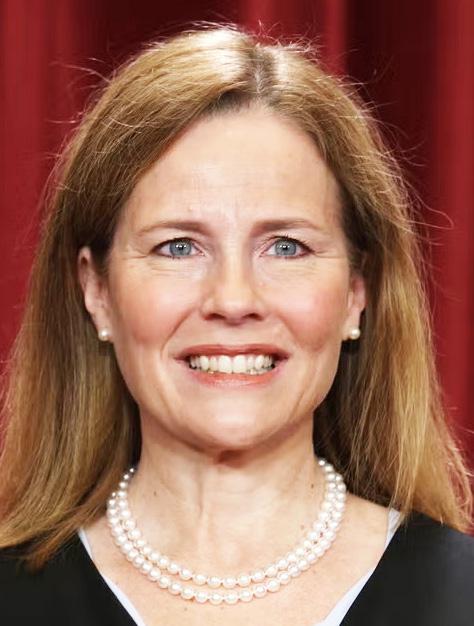
Born in and raised in New Orleans, Justice Barrett received her undergraduate degree in English literature from Rhodes College and her J.D. from Notre Dame Law School where she ranked first in her class. After graduation she clerked in the U.S. Court of Appeals for the District of Columbia and then for Supreme Court Justice, Antonin Scalia. She then went on to private practice for a short time before transitioning to teaching for her alma mater, Notre Dame Law School for several years. In 2017, Barrett was appointed to the United States Court of Appeals for the Seventh Circuit by President Trump. During her tenure, she ruled consistently in favor of conservative policies. In 2020, Barrett was nominated for Justice Ginsburg’s vacant seat and was confirmed as a Supreme Court Justice in that same year.
Born in Washington D.C. and raised in the Miami, Florida area. In her high-school yearbook she was quoted as saying “I want to go into law and eventually have a judicial appointment." Justice Jackson received her undergraduate degree from Harvard in government and received her J.D. from Harvard Law School. After Law School, she clerked in the U.S. District Court for the District of Massachusetts and the First Circuit Court of Appeals before clerking for Justice Breyer of the Supreme Court. She went on to work in private practice, as an assistance special counsel to the U.S. Sentencing Commission, and as a public defender. In 2013 she was appointed as a District Court judge for the District of Columbia, and was elevated to the United States Court of Appeals for the District of Columbia Circuit in 2021.
Ketanji Brown Jackson was nominated to the Supreme Court by President Biden and was confirmed in 2022, replacing Justice Stephen Breyer. As a judge, Jackson has been known for her detailed and methodical work. Judge Jackson is also the first former public defender to be confirmed to the Supreme Court.
By Atlanta Daily World
Atlanta Daily World stands as the first Black daily publication in America. Started in 1927 by Morehouse College graduate W.A. Scott. Currently owned by Real Times Media, ADW is one of the most influential Black newspapers in the nation.
On Monday, March 16, Rep. Jamie Raskin, Ranking Member of the House Judiciary Committee, and U.S. Senate Democratic Whip Dick Durbin, Ranking Member of the Senate Judiciary Committee, referred embattled Department of Homeland Security (DHS) Secretary Kristi Noem to the Department of Justice (DOJ) for investigation into potential perjury charges and for knowingly making false statements under oath following her appearances before the Committees on March 3 and 4, 2026.
In a letter to Attorney General Bondi, the Ranking Members write: “We write to refer evidence showing Secretary of Home-

land Security Kristi Noem repeatedly misled the Senate Committee on the Judiciary during her testimony on March 3, 2026, and the House Committee on the Judiciary during her testimony on March 4, 2026.
A number of her statements appear to violate criminal statutes prohibiting perjury and knowingly making false statements to Congress.”
The Ranking Members continued, after citing 18 U.S.C. §1001 and 18 U.S.C. §1621: “After months of evading our Committees’ requests to testify in routine oversight hearings, Secretary Noem made a series of demonstrably false statements in a brazen attempt to undermine critical congressional oversight of the Department of Homeland Security.”
The Ranking Members then cite four categories of statements from the hearings that amply support an investigation into whether Noem knowingly and willfully made false statements to Congress, includ-
ing statements regarding DHS’s failure to comply with court orders, contracting, detaining U.S. citizens, and detention conditions.
The Ranking Members concluded: “Making false statements to Congress, and making false statements under oath, are federal crimes. The examples above highlight Secretary Noem’s false and misleading testimony before the Senate Judiciary Committee on March 3, 2026, and the House Judiciary Committee on March 4, 2026. We accordingly refer this matter to the Department of Justice to determine if her testimony warrants investigation under 18 U.S.C. §§1001 and §1621. While we have low expectations that you will pursue this matter given your partisan weaponization of the Department of Justice, we note that the statute of limitations for perjury and for knowingly and willfully making false statements to Congress is five years.”
OKLAHOMA EAGLE — “You come to church to worship. You leave church to serve,” said Rodney Goss, pastor of Morning Star Baptist Church in north Tulsa. “My job is to inform you so that you can make educated decisions and know what direction to walk in on your own.”
By Kimberly Marsh | Oklahoma Eagle
On Easter morning in 1970, 4-yearold Rodney Goss sat on the stoop of his Trenton, New Jersey home waiting for a father he never knew. Goss was outside for hours, dressed in his thick-heeled platform shoes and green plaid jacket. When his mom told him to go inside, she uttered a phrase he hasn’t forgotten: “He ain’t comin’.”
“That was the greatest disappointment of my life, and that was the beginning of my journey for happiness,” he said. That journey has taken him to the streets, jail, seminary, and, for the past 10 years, the pulpit.
The 59-year-old serves as pastor of Morning Star Baptist Church in north Tulsa. Even though he’s older now, he says he’s still in the pursuit of happiness. “I got seashells and pockets of gratifica-
tion, but that happiness is so fleeting,”
Goss told The Eagle. “It wasn’t until I found the joy of God that I realized that I don’t have to be happy every day.”
It took time for him to get there. Growing up in his neighborhood, Goss remembers being different.
He said the other boys on his block idolized flashy drug dealers and new cars, but he was more interested in books and school.
In the fourth grade, he and his mom moved to the suburbs, where life was completely different. Goss walked along picket fences in Lawrence Township, where he met white people for the first time and enjoyed Little League baseball.
“I knew what dreaming looked like,” he said. “I knew what getting good grades looked like. I knew what talking about college was like and having friends that didn’t look like me.”
But it was short-lived as he eventually returned to his old stomping grounds. He got mixed up with drugs and crime, but, knowing more about life’s possibilities, he turned himself in on Thanksgiving 1988.

Goss said the judge told him “because of the sincereness of your heart” he would only sentence him to six months in jail. “Everybody else was getting 25 years,” he said. “I did 47 days.”
During that short period, he found God



on the inside and began using his words on the outside to help others dream big-



ger.
That moment affects his ministry even to this day. Part of his time as a pastor is focused on helping kids expand their horizons beyond their day-to-day circumstances.
“That’s what changed my life, just being able to see life more than what that street or what that block was,” Goss said. Now he’s on a mission to connect faith with real life and equip his congregation with the spiritual resources they need to serve the community.
“You come to church to worship. You leave church to serve,” he said. “My job is to inform you so that you can make educated decisions and know what direction to walk in on your own.”
Through it all, he says, the most important lesson he’s learned is the difference between happiness and joy.
“Happiness is a personal journey. Happiness always comes with a condition. But joy is my contentment with the world as it is,” Goss said. “I’m joyful when I love God for who he is and just loving him for who he is in spite of what he does. That’s the joy that the world didn’t give and the world can’t take away.”




A T R I S K O F F O R E C L O S U R E ? W E C A N H E L P Y O U R E B U I L D .
G e t n o c o s t t r a i n i n g , n e w s k i l l s , a n


L E A R N M O R E

by Corynne Corbett, BlackHealthMatters.com
One of the most dynamic moments of the 2026 Oscars was the performance of “I Lied to You,” featuring the cast of the film Sinners and special guests. One standout moment was ballerina Misty Copeland effortlessly commanding the stage 12 weeks after undergoing hip replacement surgery. She was pirouette-perfection in the Dance Theatre of Harlem “Firebird” costume, designed by Geoffrey Holder.
Copeland Retired Last Fall
Copeland danced with the American Ballet Theatre (ABT) for 25 years. She made history when she became the First Black Female Lead Dancer dancer with the prestigious company in 2015. The 43-year-old dancer was originally set to perform Giselle for the last time with ABT in 2019. But a stress fracture in her back resulted in her having to pull out the day of the show. She told Dance Magazine, “I had to pull out the day of the show, and I wasn’t sad. I thought, This is the sign I

should not be doing this. Because every other time [getting injured], it’s devastating. Then the pandemic hit, and I needed that time to reassess what I wanted to do.”
In 2025, it did feel right for Copeland to take her last bow with ABT. In June, the
author, wife, and mom made her official announcement that she would take her final bow on October 22, 2025, and retire.
Weeks after her retirement, Copeland underwent hip replacement surgery. As she was leading up to her final perfor-
by Mildred Europa Taylor, Face2FaceAfrica.com
Former NBA star Jalen Rose believes there is a “residue of slavery” in Blackled sports like basketball and football, largely due to how players are handled.
During a recent appearance on a live recording of the “Joe and Jada Unfiltered” podcast, the 53-year-old said leagues like the National Basketball Association and the National Football League, which have more Black players, impose restrictions on these players, adding that such restrictions are not seen in other sports that are not Black-centric.
“The only sports that have salary caps are Black-led first off. So that’s basketball
and football,” Rose noted. “Those are the only sports with salary caps. Baseball, golf, NASCAR, tennis, you can keep naming. They do not have a salary cap. That’s the first thing. The second thing is they have no after-high school restriction.
“And so that’s a residue of slavery, because we’re gonna get money off of you for multiple years for free.”
His comments come on the back of concerns that while the NBA has earned applause for diversity in its workforce and coaching staff, ownership remains primarily white. Black players make up 70% of the players, but non-white owners make up around 13%, figures show.
By Face2FaceAfrica.com
Sinners’ director of photography Autumn Durald Arkapaw became the first woman to win the Oscar for best cinematography at the 98th Academy Awards on Sunday.
Arkapaw, who worked with Sinners director Ryan Coogler on the superhero sequel Black Panther: Wakanda Forever, is only the fourth woman nominated for the award, and the first woman of color. Before her were Rachel Morrison for Mudbound, Ari Wegner for The Power of the Dog, and Mandy Walker for Elvis.
In her acceptance speech, Arkapaw thanked the cast and crew of Sinners and asked all the women in the room to rise to their feet.
“I’m so honored to be here and I really want all the women in the room to stand up because I feel like I don’t get here without you guys,” Arkapaw told the audience.
“I have felt so much love from all the women on this whole campaign. I feel like
moments like this happen because of people like you guys,” she added.
Arkapaw beat Darius Khondji (Marty Supreme), Michael Bauman (One Battle After Another) and Adolpho Veloso (Train Dreams) to make history.
Arkapaw is also the first Black person to win the category. She told reporters: “A lot of little girls that look like me will sleep really well tonight.”
Before the Oscars, Sinners had already made history for women cinematographers. The supernatural thriller was shot in both IMAX and Ultra Panavision 70. Arkapaw became the first woman to shoot a feature in large-format IMAX, usually operating the 65-pound camera herself, Complex reported.
“I heard a phrase that said you need to see you to be you,” she told The Associated Press in 2025. “I think for us females in business, the more women are able to shoot on large format, it will inspire the younger girls who maybe don’t think that
mance, her doctors actually advised her against dancing.
“I found out in preparation for the performance that I have bone spurs in my left hip and labral tear and loss of cartilage,”
Copeland said in a NPR interview.
“And my doctors, they were just like, “I don’t think this is a good idea for you to push for this performance.” And I said, well, “I’ve already agreed to it.”
According to the Mayo Clinic, hip replacement surgery is a procedure to replace your natural hip joint with an artificial implant. Copeland had. total hip replacement, which means, “A surgeon will replace your entire hip with a prosthetic joint. They’ll replace the top of your thigh bone and the socket it fits into. Almost all hip replacement surgeries are total hip replacements.”
The dancer revealed her journey on Instagram last month.
It can take 6 to 12 weeks to recover from total hip replacement surgery for
most people. But it could take up to six months for those in recovery to walk without a limp. Copeland, however, is a dancer and an elite athlete. For her to perform at the Academy Awards was resilience in motion.
Cameron Goodson, a kinesiologist whose page is dedicated to explaining the biomechanics of athletes’ performances, broke hers down.
“Just 12 weeks ago, Misty Copeland’s natural joint was removed and replaced with titanium, and now she’s performing at the Oscars. First, she performs a deep external rotation that’s not just a foot turn. That is her central nervous system forcing surgically traumatized glutes to rotate a ball inside a metal socket,” he explains.
“Then she shifts her entire center of mass onto a single leg. She is forcing a three-month-old to absorb and stabilize 100% of kinetic load.”
Copeland’s appearance was transcendent, but the strength and resilience of her body elevated it to another level. Brava!
‘residue of slavery’ in the NBA, Black-led sports

What is also worrying for many people is the fact that the NBA also has a salary cap and does not allow players to enter the league right after high school. Per the rules, players must be at least 19 years old and at least 12 months removed from their high school graduation. Many players are therefore compelled to spend a gap year in college, where, previously, players received no financial compensation beyond scholarships despite bringing in billions of dollars for the National Collegiate Athletic Association. Recent NIL reforms changed that, allowing college players to be paid.
Rose argued that the changes occurred only after the rise of social media. “What happened in the game is that it became

they can get there.”
Arkapaw is a native of Northern California raised by a Filipino mother and a father of Black Creole heritage. She studied art
history at Loyola Marymount University but later attended graduate school at the American Film Institute, where she pursued cinematography.
so obvious because of social media and because of information, it’s like ‘we’re making billions of dollars, we gotta pay ’em something,’” Rose explained.
The NBA great said he is, however, excited that college players now receive compensation through NIL deals, “but if you notice, the NBA still got a salary cap. The National Football League still got a salary cap.”
Rose, a sports analyst and former professional basketball player, was a member of the University of Michigan Wolverines’ “Fab Five” that reached the 1992 and 1993 NCAA Men’s Division I Basketball Championship games as both freshmen and sophomores. From college, Rose went on to have a 13-year NBA ca-
It wasn’t all rosy for Arkapaw as she faced rejections from film schools and agents while still building a portfolio that ultimately included independent films, music videos and big projects like Loki, Complex reported.
Her family background influenced how she approached Sinners. She said she has family members from the American South, where the thriller was filmed. Thus, everything she did or witnessed on set carried personal meaning for her.
“You think about your ancestors and what they felt like on that land,” she said to the New York Times.
Sinners won four Oscars at the 98th Academy Awards after receiving a record-breaking 16 nominations. Besides winning for Best Cinematography, the film won awards for Best Actor (Michael B. Jordan), Best Original Screenplay (Ryan Coogler), and Best Original Score (Ludwig Göransson).















LOS ANGELES (AP) — Michael B. Jordan has been building toward a performance like “Sinners” for over 20 years. Now he has the best actor Oscar as his reward in what proved to be a hugely popular win.
Jordan got one trophy for playing identical twins Smoke and Stack in the blues-seeped supernatural horror film set in 1930s Mississippi that earned a record 16 Academy Award nominations and won four.
Last year’s winner, Adrien Brody, announced Jordan’s name Sunday night, setting off a wild celebration inside the Dolby Theatre. Teyana Taylor, a supporting actress nominee for “One Battle After Another,” joined the standing ovation, mouthing, “Yes!”
Jordan was cheered loudly as he made his way through the backstage photo and interview rooms. The win is Jordan’s first Oscar.
“I’ve been doing this for 25 years and there’s a lot of people who have seen me grow up in this industry,” he said backstage, “and they looked out for me when they didn’t have to.”
Jordan is eager to pass on that support.
“I’m really big on the next generation, so, try to be an example,” he said. “I’m not a big talker, I’m about action. I like to lead by example.”
Jordan is the sixth Black man to win the best actor trophy. He joins Will Smith (“King Richard,” 2020), Forest Whitaker (“The Last King of Scotland,” 2006),

Jamie Foxx (“Ray,” 2004), Denzel Washington (“Training Day,” 2001) and Sidney Poitier (“Lillies of the Field”), who was the first in 1963.
“I stand here because of the people that came before me — Sidney Poitier, Denzel Washington, Halle Berry, Jamie Foxx, Forest Whitaker, Will Smith,” he said on stage, “and to be up amongst those giants, amongst those greats, amongst my ancestors, amongst my guys, thank you everybody in this room and everybody at home
supporting me over my career.”
Jordan added, “I know you guys wanted me to do well and I want to do that because you guys bet on me, so thank you for keep betting on me. I’m going to keep stepping up, and I’m going to keep being the best version of myself I can be.”
The other nominees were Timothée Chalamet in “Marty Supreme,” Leonardo DiCaprio for “One Battle After Another,” Ethan Hawke of “Blue Moon” and Wagner Moura in “The Secret Agent.”
Chalamet had been the early Oscar favorite after wins at the Golden Globes and Critics Choice Awards. But Jordan surprised himself by winning at the Actor Awards, giving him momentum in the final days of Oscar voting.
“Sinners” reunited Jordan and writer-producer-director Ryan Coogler. They go back to their first collaboration in 2013.
“You’re an amazing person,” Jordan told Coogler from the stage. “You gave
me the opportunity and space to be seen.” Jordan’s breakthrough film role came in Coogler’s “Fruitvale Station” for which he received critical praise playing a real-life man who was killed by police. It was Coogler’s directorial debut, and they followed with “Creed,” “Black Panther” and now “Sinners.”
Jordan’s initial acting success came in television. He had a small yet pivotal role in “The Wire” in 2002, followed by the daytime drama “All My Children,” in which he replaced Chadwick Boseman, and “Friday Night Lights.”
He and Boseman later acted together in “Black Panther” and were close friends until Boseman’s death from colon cancer in 2020. Jordan dedicated his acting award from this year’s NAACP Image Awards to Boseman.
Jordan, a 39-year-old who also produces and directs, was named People magazine’s “Sexiest Man Alive” in 2020.
Jordan shared Oscar night with his mother, Donna, who hugged her son upon hearing his name, and his father Michael A. Jordan, as well as his two siblings. He espoused the values that he was taught growing up in Newark, New Jersey.
“I’m just walking my path, just trying to be locked in,” he said backstage. “Dream big, man, and be kind and be honest. That’s how I try to live.”
For more coverage of the 2026 Oscars, visit https://apnews.com/hub/academy-awards
by Karen Juanita Carrillo
Trenton, N.J., high school students recently created a project that honors the role African Americans played in the founding of the United States. As members of Foundation Academies’ Black Student Union (BSU), they developed “Men W/O Shoes,” a multimedia exhibit that recognizes 14 African American Revolutionary War soldiers who fought in the Battles of Trenton and Princeton.
The “Men W/O Shoes” project started when Mark Herr, a Princeton Battlefield Society board member, asked if Foundation Academies students wanted to research 14 African American Revolutionary War soldiers who had been identified as having participated in the Trenton-Princeton campaign.
When they got the names of the soldiers, BSU advisors Casey Scott and Earl Wallace had to plan how to make the project appealing to students.
“Earl and I, we are a tag team, and we were just thinking about, like, how do we make this a phenomenal project?” said Scott. “So, he was the main person doing the research; he literally sat in these classes, teaching these students the basics of research from Google Scholar, not using ChatGPT, not using Wikipedia. We went to the archives; we got library cards. Scott explained they got in contact with John Mills, another researcher, who connected
them to a living descendant of a soldier. “It was really this research project, which has multiple parts to it, that allowed us to step into a different hat than we had: teaching youth how to be researchers and teaching them skills, not just in the classroom, but the skills that they’re going to use in life,” said Scott.
Wallace, a doctoral student, and Scott, a school social worker, spent a year working with 30 BSU students in grades 9 through 12, and teaching them the fundamentals of academic research. They had the students pore through pension testimonies, military records, genealogical databases, and even visit the New Jersey State Archives to view microfilm reels and historical documents.
The soldiers the students researched included Charles and James Ailstock, brothers from New Jersey’s free Black community who fought in several major battles, including Harlem Heights and Brandywine; Robert “Prince” Green, who was born into slavery but enlisted in regiments that promised freedom in exchange for his service; Oliver Cromwell, whose service earned him a Badge of Merit signed by George Washington, and who went on to become a landowner and community leader after the war; and Cato Smith, who had been kidnapped from Africa and enslaved before enlisting, but died while serving in the military.
Historians estimate that Black soldiers made up between 5% and 20% of the
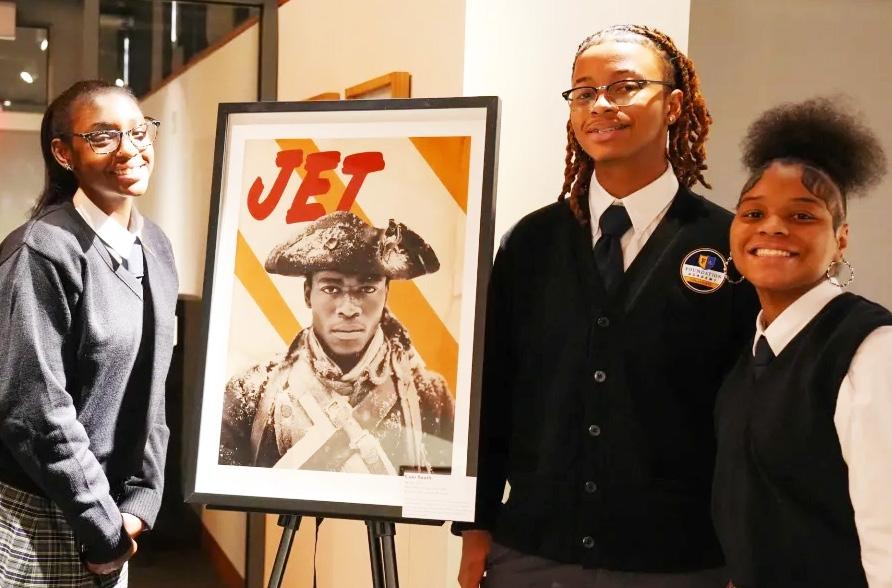
Continental Army. Many had to march barefoot through brutal Northeast winters. They fought in place of their enslavers who promised them freedom in exchange for their military service. So, for many of these men, the Revolutionary War fight was personal.
Scott said that the students realized these soldiers were essentially placing their hopes for Black freedom on the establishment of the new nation. “During that time the only reason why they were fighting was they were fighting for freedom,” Scott told
the AmNews. “That’s it. Black men weren’t seen as anything during this time. And even after they fought, some people were put back into slavery. Some were free men, but they ended up fighting for pensions; their families ended up fighting for pensions for years for the work they did.
“What a lot of people have to understand is that these 14 men are the reason we have a Declaration of Independence, the reason we can celebrate the [United States’] 250th anniversary is because they fought. They fought with nothing. And to see what has
come of this exhibition to bring a face and a name to the forefront of history, not just during the 100-year anniversary of Black History [Month], but during the 250th, it makes it land very differently when you say that there is no American history without Black history.”
BSU students used technology to turn their research about 18th-century veterans into a platform 21st-century audiences could relate to. They created AI-generated monologues to imagine the soldiers’ voices and used the program Midjourney to develop portraits of the soldiers. They collaborated with Philadelphia visual artist Shaheed Rucker to display these portraits on stylized JET magazine covers.
The “Men W/O Shoes” exhibition opened in February at the Morven Museum & Garden and featured a documentary about the students’ work in creating it. The research findings made by Foundation Academies’ Black Student Union will now be permanently preserved and included in the Princeton Battlefield Society’s digital encyclopedia. For the students of Foundation Academies, Scott said, the project’s impact goes far beyond the gallery walls. “They are historians now. They are authors of Black history, not just consumers of it. This isn’t about interpretation, it’s about truth. Putting names to faces. And making sure Black history is where it has always belonged — at the center of American history.”

Construction Equipment Mechanic
(preferably experienced in Reclaiming and Road Milling Equipment) We offer factory training on equipment we operate. Job is in Bloomfield, CT.
Contact: Tom Dunay Phone: 860-243-2300 Ext. 122
Email: tom.dunay@garrityasphalt.com
Reclaimer Operators and Milling Operators
(must have current licensing and a clean driving record; be willing to travel throughout the Northeast & NY)
Contact: Rick Tousignant Phone: 860-243-2300 Ext. 133 Email: rick.tousignant@garrityasphalt.com
Tractor Trailer Driver for Heavy & Highway Construction Equipment
(must have a class A CDL license with Tank Endorsement and a clean driving record; be capable of operating heavy equipment and willing to travel throughout the Northeast and NY)
Contact: Brian McKee Phone: 860-558-6189 Email: bmckee@garrityasphalt.com
• We offer Excellent hourly rates and benefits.
• Women and Minority Applicants are encouraged to apply.
• Affirmative Action / Equal Opportunity Employer
The Town of Wallingford is accepting applications for Collections Maintainer I (Trainee). Wages: $27.17 to $29.84 hourly. For additional information and to apply online by the March 24, 2026 closing date please visit: www.wallingfordct.gov/government/departments/human-resources/. Applications are also available at the Department of Human Resources located in Room #301 of the Town Hall, 45 South Main Street, Wallingford, CT 06492. Phone: (203) 294-2080; Fax: (203) 294-2084. EOE

The State of Connecticut, Office of Policy and Management is recruiting for a Rural Health Transformation Policy Development Coordinator

Location: Galasso Materials LLC, East Granby, CT
Employment Type: Full-Time
Industry: Asphalt Paving & Aggregate Materials

ECC is currently seeking bids from qualified contractors to perform Youth Services. A complete copy of the requirement may be obtained from Elm City’s Vendor Collaboration Portal https://newhavenhousing.cobblestonesystems.com/ gateway beginning on

We are seeking an experienced and motivated Construction Sales Manager to lead and grow our asphalt paving and aggregate materials sales operations. This role requires a strong blend of construction knowledge, sales expertise, estimating skills, and project coordination. The ideal candidate will understand paving operations, build strong customer relationships, and work collaboratively with internal teams to deliver successful projects from bid through completion.
• Develop and manage sales for asphalt, aggregate, and paving services across commercial, municipal, and private-sector clients
• Build and maintain long-term relationships with customers, contractors, municipalities, and developers
• Prepare and review job estimates, bids, and proposals, including quantity take-offs and pricing
• Collaborate closely with operations, plant staff, and project managers to ensure accurate scope, scheduling, and execution
• Provide outstanding customer service throughout the sales and project lifecycle
• Support project management efforts, including job start-up coordination, scope clarification, job cost tracking, billing and change management
• Track market conditions, competitor pricing, and sales opportunities
• Meet or exceed established sales and revenue goals
• Communicate with Accounts Receivable staff to ensure invoices are paid to Galasso
• Proven management experience in asphalt paving, aggregate materials, or heavy civil construction
• Strong background in construction sales, estimating, or project management
• Solid understanding of paving methods, materials, and construction sequencing
• Ability to read plans, perform quantity take-offs, and develop competitive bids
• Excellent communication, negotiation, and relationship-building skills
• Strong teamwork mindset with the ability to collaborate across departments
• Highly organized with the ability to manage multiple projects and deadlines
• Proficiency with estimating software, spreadsheets, and CRM tools preferred
• Competitive salary with performance-based incentives
• Company vehicle or vehicle allowance (if applicable)
• Health, dental, and retirement benefits
• Stable, well-established company with growth opportunities
• Collaborative team environment with hands-on leadership
Please submit your resume and a brief cover letter outlining your experience in construction sales, paving, or materials supply. To Apply: Please send your resume and a brief cover letter to KLamontagne@galassomaterials.com
Galasso Materials LLC is committed to creating an inclusive environment for all employees and encourages applications from all qualified individuals. We are an affirmative action equal-opportunity employer.
The Housing Authority City of Bristol (BHA) is seeking proposals for HVAC services from qualified contractors for work at multiple locations throughout the Agency.
A copy of the RFP documents can be obtained at www.bristolhousing.org or by contacting Luis Velazquez, Director of Capital Funds at 860-585-2028 or lvelazquez@ bristolhousing.org beginning March 13, 2026. A non-mandatory pre-bid meeting will be held on March 20, 2026, at 10:00 AM starting at 164 Jerome Avenue, Bristol, CT.
All proposals should be clearly marked “RFP #26-187 – HVAC Contractor Services” and submitted to Mitzy Rowe, CEO, Housing Authority City of Bristol, 164 Jerome Ave., Bristol, CT 06010. Proposals are due no later than 2:00 PM on April 7, 2026, at the office of BHA in a sealed envelope with one (1) original and one (1) copy, each clearly identified.
The Housing Authority of the City of Bristol is an Equal Opportunity/Affirmative Action Employer. SBE, MBE, W/DBE, and Section 3 businesses are encouraged to respond.

The Housing Authority City of Bristol (BHA) is seeking proposals for Pest Control services from qualified contractors for work at multiple locations throughout the Agency.
A copy of the RFP documents can be obtained at www.bristolhousing.org or by contacting Luis Velazquez, Director of Capital Funds at 860-585-2028 or lvelazquez@ bristolhousing.org beginning March 13, 2026. A non-mandatory pre-bid meeting will be held on March 20, 2026, at 12:00 Noon starting at 164 Jerome Avenue, Bristol, CT.
All proposals should be clearly marked “RFP #26-189 – Pest Control Services” and submitted to Mitzy Rowe, CEO, Housing Authority City of Bristol, 164 Jerome Ave., Bristol, CT 06010. Proposals are due no later than 3:00 PM on April 7, 2026, at the office of BHA in a sealed envelope with one (1) original and one (1) copy, each clearly identified.
The Housing Authority of the City of Bristol is an Equal Opportunity/Affirmative Action Employer. SBE, MBE, W/DBE, and Section 3 businesses are encouraged to respond.
The Town of Wallingford is accepting applications for Maintainer II (Watershed). Wages: $28.65 to $34.43 hourly. For additional information and to apply online by the March 10, 2026 closing date, please visit: www.wallingfordct.gov/government/departments/human-resources/. Applications are also available at the Department of Human Resources located in Room #301 of the Town Hall, 45 South Main Street, Wallingford, CT 06492. Phone: (203) 294-2080; Fax: (203) 294-2084. EOE

The Town of Wallingford is accepting applications for Water Treatment Pumping Operator II. Wages: $32.58 to $39.20 hourly. For additional information and to apply online by the March 24, 2026 closing date, please visit: www.wallingfordct.gov/government/departments/human-resources/.Applications are also available at the Department of Human Resources located in Room #301 of the Town Hall, 45 South Main Street, Wallingford, CT 06492. Phone: (203) 2942080; Fax: (203) 294-2084. EOE
The Housing Authority of the City of New Haven d/b/a Elm City Communities is currently seeking Proposals for Executive Management Services. A complete copy of the requirements may be obtained from Elm City’s Vendor Collaboration Portal https://newhavenhousing.cobblestonesystems.com/gateway beginning on
Monday, March 9, 2026 at 3:00PM
The Glendower Group, Inc is seeking bids from qualified contractors for General Contractor at The Heights at Westrock. A complete copy of the requirement may be obtained from Elm City’s Vendor Collaboration Portal https://newhavenhousing.cobblestonesystems.com/gateway beginning on
Wednesday, March 11, 2026, at 3:00PM.
360 Management is currently seeking bids from qualified contractors to perform Elevator Service . A complete copy of the requirement may be obtained from Elm City’s Vendor Collaboration Portal https://newhavenhousing.cobblestonesystems.com/gateway beginning on
Monday, March 3, 2026, at 3:00PM.
HVAC department in a Petroleum Company has an opening for a full time Licensed HVAC/Oil/Heating Technician. Candidate must possess a technical school certificate in heating, ventilation, air conditioning, oil, propane and natural gas. Send resume to: HR Manager, P. O. Box 388, Guilford, CT 06437 or emailHRDept@eastriverenergy.com
Location: Galasso Materials LLC, East Granby, CT
Employment Type: Full-Time
Industry: Asphalt Paving & Trucking Operations
Position Summary
We are seeking a detail-oriented and experienced Paving / Trucking Project Manager to oversee paving operations and trucking logistics. This role is critical to maximizing production eficiency, managing trucking resources, controlling job costs, and maintaining a strong safety culture. The ideal candidate has hands-on paving and trucking experience and thrives in a fast-paced, team-driven construction environment.
Paving & Production Management
• Track and analyze paving eficiencies, including crew production rates, equipment utilization, and daily output
• Work closely with paving superintendents and foremen to identify opportunities for improved productivity
• Support planning and execution of paving operations to meet schedule and quality goals
Trucking & Logistics Management
• Track and analyze trucking eficiencies, including cycle times, haul distances, and truck utilization
• Schedule and manage subcontracted trucking, ensuring adequate coverage and compliance with project needs
• Coordinate daily trucking plans with plants, paving crews, and project stakeholders
Permits & Compliance
• Obtain and manage overweight and special haul permits as required for trucking operations
• Ensure compliance with state and local transportation regulations
• Maintain proper documentation related to trucking operations and permits
Job Cost & Financial Management
• Monitor job costs related to paving and trucking operations
• Compare production and trucking performance against budgets and estimates
• Identify cost overruns early and work with management to implement corrective actions
Safety Management
• Promote and enforce trucking safety policies and procedures
• Coordinate with drivers and subcontractors to ensure compliance with company and DOT safety requirements
• Support safety meetings, incident investigations, and corrective action implementation
Qualifications
• Experience in asphalt paving operations and/or construction trucking management
• Strong understanding of paving production, trucking logistics, and haul operations
• Familiarity with DOT regulations, overweight permitting, and trucking safety standards
• Proven ability to track eficiencies and manage production data
• Strong organizational, communication, and problem-solving skills
• Ability to work collaboratively with operations, dispatch, and management teams
• Proficiency with spreadsheets, production tracking tools, and construction management software preferred
• Competitive salary based on experience
• Company vehicle for work use and travel to/from home
• Health, dental, and retirement benefits
• Stable, well-established company with long-term growth opportunities
• Hands-on role with direct impact on operational performance
Please submit your resume and a brief cover letter outlining your experience in paving, trucking operations, or construction project management
To Apply: Please send your resume and a brief cover letter to KLamontagne@galassomaterials.com
Galasso Materials LLC is committed to creating an inclusive environment for all employees and encourages applications from all qualified individuals We are an afirmative action equal-opportunity employer.

The State of Connecticut, Office of Policy and Management is recruiting for an Open Data Analyst (Research Analyst) in the Data and Policy Analytics division. Further information regarding the duties, eligibility requirements and application instructions are available at: https://www.jobapscloud.com/CT/ sup/bulpreview.asp?b=&R1= 251222&R2=6855AR&R3=001
The State of Connecticut is an equal opportunity/ affirmative action employer and strongly encourages the applications of women, minorities & persons with disabilities.

Sales Pay: $100,000.00 per year
Job description:
Atlas Companies is looking for an estimator/ design and installation sales person for the residential market place. Premiere northeast regional fence and outdoor structure company is looking for energetic, self-motivated Sales associate. Salary, commission, 401 k match and vehicle allowances for qualified personal. 1 00k plus income to qualified applicants. Previous home improvement design / sales preferred.
About Us Our services range from custom fences, gates, guardrail, pergolas, arbors and outdoor structures to providing industrial and commercial security solutions to building luxury residential multi-use and commercial projects. Job Type: Fulltime Benefits: 401 (k), Health Insurance, Dental Insurance, Life Insurance, Vision Insurance, Paid time off.
Work Location: In person
We are an Equal Opportunity/Affirmative Action Employer. Email resume to mpicard@atlasoutdoor.com
Large CT Fence & Guardrail Contractor is looking for Fence Installation helpers. Must have at least 2 years of experience installing chain link, wood, PVC and ornamental iron fencing. Work available 10-12 months per year. All necessary equipment provided. Medical, holiday, 401K, vacation & other benefits included. Must be able to pass required physical and drug test. An OSHA 10 Certification is required. A valid CT driver's license is required and must get DOT Medical Card. We are an AA/ EOE company. Send resumes/inquiries to: rhauer@atlasoutdoor.com.
Help Wanted – Lg CT fence company looking for an experienced fence installation foreman in CT and surrounding states who will work as a leader of small crews. Individual will be responsible for all types of fencing installation. Specific tasks include but are not limited to: May be responsible for crew(s) of two or more individuals, manage and troubleshoot problems that arise on site and notify superintendent when needed, ensures employees adhere to all safety and company policies and practices. Job requirements include the following: must have 5 years’ of fence installation experience , must have commercial chain link experience, be able to read blueprints, have basic power tool & skid steers experience, have a valid CT driver’s license and have reliable transportation, must be able to get a DOT medical card, OSHA safety training required prior to start of employment, pass drug screening and a physical test. Medical, vacation, 401K and other benefits included, all necessary equipment provided. We are an Affirmative Action/Equal Opportunity employer. Send resume to gforshee@atlasoutdoor.com
Job Title: Welder/Fabricator
Reports to: Operations Manager
Salary Range: TBD, Commensurate with experience, Duties: Atlas Outdoor is looking for a full-time Shop Welder/Fabricator. The ideal candidates should possess skills to weld, cut and fabricate steel and aluminum products. Must be able to read basic drawings and fill out daily reports. All necessary equipment provided. Required to pass a physical and drug test. A valid CT driver's license, OSHA 10 card and DOT Medical Card are also required.Comprehensive benefits package included with a competitive salary, including vacation/personal time off, paid holidays, Health/Dental/Vision insurance, 401K with match. We are an Equal Opportunity/Affirmative Action Employer and offer a competitive salary to qualified candidates. Email resume to rhauer@atlasoutdoor.com
Yard Worker: Large CT Fence Company is looking for individuals for our stock yard. We are looking for individuals with previous warehouse shipping, receiving and forklift experience. Must have a minimum of 3 years of material handling experience. Duties include: Loading & unloading trucks, Fulfilling orders for installation & retail counter sales, Maintaining a clean & organized environment, Managing inventory control & delivering fence panels & products. Qualifications: High School diploma or equivalent, Must be able to read/write English, demonstrate good time management skills, able to read a tape measure, have the ability to lift 70 pounds and have forklift experience. Must have a valid CT Driver’s License, Obtain DOT Medical Card, and pass company physical and drug test. Class A CDL & Class B CDL license a plus. We are an AA/EOE company. Send resumes/ inquiries to: pboucher@atlasoutdoor.com
$78,813/yr.
Required testing, general info, and apply online: www.bristolct.gov
DEADLINE: 12-07-25
Large CT Fence Company looking for a full-time individual for our Wood/PVC Fence Production Shop. Duties include measuring & interpreting blueprints, schematics and project plans, cut, shape, assemble and install fence panels using hand and power tools, install related fixtures including gates, hardware and other accessories.. Must have a valid CT driver’s license and be able to obtain a Drivers Medical Card. Must be able to pass a physical and drug test. Please email resume to pboucher@atlasoutdoor.com. AA/EOE-MF
Bycourtesy of HBCUNEWS.com
The first female head drum major of the Florida A&M University (FAMU) Marching “100” recently appeared on the stage of the 98th Academy Awards in Los Angeles, California. To say that Oluwamodupe “Dupe” Oloyede is having a remarkable year would be an understatement.
While audiences around the world waited to see how the film Sinners would perform after earning a record-setting 16 Academy Award nominations, Oloyede quietly made her own mark on Hollywood’s biggest night. During a performance of one of the most popular soundtrack songs of 2025, Miles Caton delivered a stirring rendition of “I Lied to You.” Positioned stage left with her drum major’s baton, Oloyede added a dynamic presence to the production. As famed ballerina Misty Copeland danced center stage, Oloyede executed precise baton choreography amid a dramatic, multi-character performance celebrating the record-breaking film.
Oloyede’s Oscars appearance is just the latest highlight in a year that has already propelled her into the national spotlight. Her viral run began earlier this year when she led the Marching “100” in a tribute video for the upcoming Michael Jackson biopic Michael. In the opening scene,

Oloyede dramatically caught her baton before leading the band, and in the closing moment tossed it into the air where it was caught by a drum major from Jackson State University’s Sonic Boom of the South—symbolizing the connection between two of the nation’s premier HBCU marching bands.
From Prime To The Oscars
Just a week later, the Marching “100”
was featured in a special performance of the NBA on Prime theme “Victory.” The song, produced in part by FAMU alumnus Common, was performed on Ken Riley Field at Bragg Memorial Stadium. Prime Video aired the segment ahead of the Orlando Magic’s matchup against the Minnesota Timberwolves, serving as a tribute to Common’s admiration for the Marching “100” and its influence during his time at the university.
Oloyede’s momentum continued last week when she became a member of the Beta Alpha Chapter of Delta Sigma Theta Sorority, Inc. During the sorority’s initiate show at Gaither Gymnasium, she delivered what quickly became one of the most talked-about moments of the evening. With a line of 65 new members each presenting themselves to the crowd, Oloyede’s introduction electrified the packed gym. Her sorority sister, Cori
Bostic—the first female drum major of the Marching “100”—handed her the iconic baton. The crowd erupted as Oloyede stepped to center stage in classic drum major fashion. After introducing herself, she blew her whistle to signal the signature start of a Marching “100” performance. Moments later, a bass drum appeared from the back of the gym and began the band’s familiar cadence. Oloyede then performed a weaving routine known as the “Rattler,” finishing with a dramatic split that sent the Gaither Gym crowd into a frenzy.
The moment quickly went viral. Within 24 hours of being posted online, the video surpassed one million views. As of now, it has been viewed more than 10 million times, with major outlets—including Ebony Magazine—sharing the performance. Interestingly, Oloyede’s trip to the Oscars unfolded quietly. Rumors had circulated that she might be involved in a special appearance, but few people knew exactly what was happening. The details remained under wraps until the moment she appeared on stage.
With graduation just a month away, Oloyede has already built a résumé filled with historic milestones, viral moments, and national recognition. The only question now is what she will accomplish after walking across the Oscars stage and before walking to get her degree.
By Face2FaceAfrica.com
Dr. Iris Stevenson-McCullough, affectionately known as “Mama Mac,” is the woman whose life’s work inspired the beloved film Sister Act 2. While many fans recall Whoopi Goldberg transforming a struggling high school choir into a powerhouse with Lauryn Hill and Tonya Blunt, they may not realize that the story was based on a real Black woman who did the same work in South Los Angeles.
As the choir director at Crenshaw High School, Dr. Stevenson-McCullough first caught the attention of producer Dawn Steel in 1991. During a period when hundreds of L.A. public school teachers were at risk of losing their jobs in a mass layoff, she refused to go quietly and fought back publicly against the school board. This spirit of resistance served as the inspiration for the 1993 musical comedy that has since become a cultural classic. However, the real-life accomplishments of Dr. Stevenson-McCullough extend far beyond the silver screen. After being recruited by the Los Angeles Unified School District in 1985, she built the Crenshaw Elite Choir into an internationally recognized program, according to BOTWC.
She has provided students who had never left their neighborhoods the opportunity to perform across Europe, the West Indies, Asia, and Africa. Under her direction, the choir has graced stages at the Playboy Jazz Festival alongside the Los

Angeles Philharmonic and performed at a world premiere at the Hollywood Bowl.
Significantly, she is the one who taught the actors in Sister Act 2 her specific arrangement of “Joyful, Joyful,” the song that became the film’s most iconic moment.

Beyond her Hollywood influence, Dr. Stevenson-McCullough is a titan of the gospel music industry. An inductee into the International Gospel Music Hall of Fame alongside artists like Kurt Carr and Take 6, she has been a mainstay in the Church of God in Christ (COGIC) com-
munity for decades.
Her reach even extended to the global K-pop group BTS, whom she coached on gospel music during their 2014 reality show American Hustle Life.
Her career has also been marked by
fierce community support. In 2014, after taking the Crenshaw Choir to the White House to perform for President Obama and First Lady Michelle Obama, she was suspended for 120 days for an unsanctioned trip.
Dr. Stevenson-McCullough, who had led the school’s award-winning music program for almost thirty years, was removed from her teaching position in December 2013.
She was reassigned to district offices—a temporary assignment for educators under LA Unified investigation, often referred to as “teacher jail”. After eight months of protests by former students and civil rights leaders, she was reinstated. District officials shared little information about why Dr. Stevenson-McCullough was allowed to return to her teaching duties at the time, saying only, “[H]er case, which is a confidential, personnel matter, remains under investigation.”
Citing privacy laws, the district never publicly disclosed the nature of the allegations against Dr. Stevenson-McCullough. Despite every challenge, Dr. Stevenson-McCullough has continued to pour into the lives of young people through music. Her legacy is so profound that France honored her by renaming a fine arts building after her, and Crenshaw High School dedicated its music wing in her name.