



DECEMBER 13, 2025–JUNE 21, 2026
Photo by Boynayel Mota
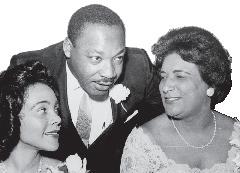
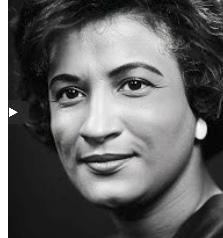
Constance Baker Motley

DECEMBER 13, 2025–JUNE 21, 2026
by Mona Mahadevan
A new daycare, mental health clinic, and workforce training center are slated to open in less than three months at the site of the former Dixwell Plaza, as a $200 million redevelopment project nears the end of its first phase.
On Wednesday, developers unveiled the project’s name, First Haven in Dixwell, and said it was chosen to reflect their goal of building something beautiful and best-in-class for one of New Haven’s historic Black neighborhoods.
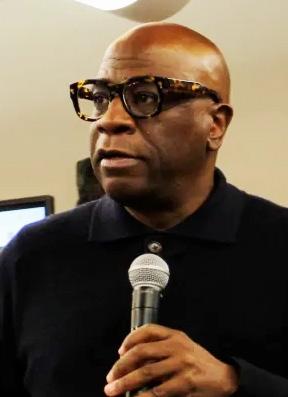
Those updates were presented by Connecticut Community Outreach and Revitalization Program (ConnCORP) leaders during a packed community meeting in the Stetson Library, located at 197 Dixwell Ave.
The new building near Dixwell Aveue and Webster Street is around 65,000 square feet, according to Erik Clemons, the founder of ConnCORP and the related job-training nonprofit ConnCAT. Inside, the Cornell ScottHill Health Center will offer mental health counseling services, Friends Center for Children will operate its fourth daycare location, and ConnCAT will provide vocational training in fields like phlebotomy, construction, and culinary arts.
The new building will be filled with “all the things we can bring to bear to bring service, beauty, and dignity to this community,” said Clemons. It will officially open in May.
The building represents the first step in a much larger plan to redevelop the heart of Dixwell. The $200 million project calls for building a 184-unit apartment complex, grocery store, office space, plaza, performing arts center, and townhomes. ConnCORP proposed the development in January 2020 and broke ground in October 2024.
So far, development costs have tracked with the team’s initial estimates, ConnCORP President Philip Rigeuer told the Independent. He said the first building itself cost roughly $65 million to construct.
On Wednesday, Anna Blanding, the Chief Investment Officer of ConnCORP, said the development team set the lofty goal on First Haven of bringing a billion dollars of economic activity to Dixwell. She later unveiled the development’s name and shared the reasoning for each word.
“First”: To subvert the fact that Dixwell has often received “the leftovers.” The development will boast “first-rate architecture,” “a first-rate ConnCORP team,” “first-rate brain
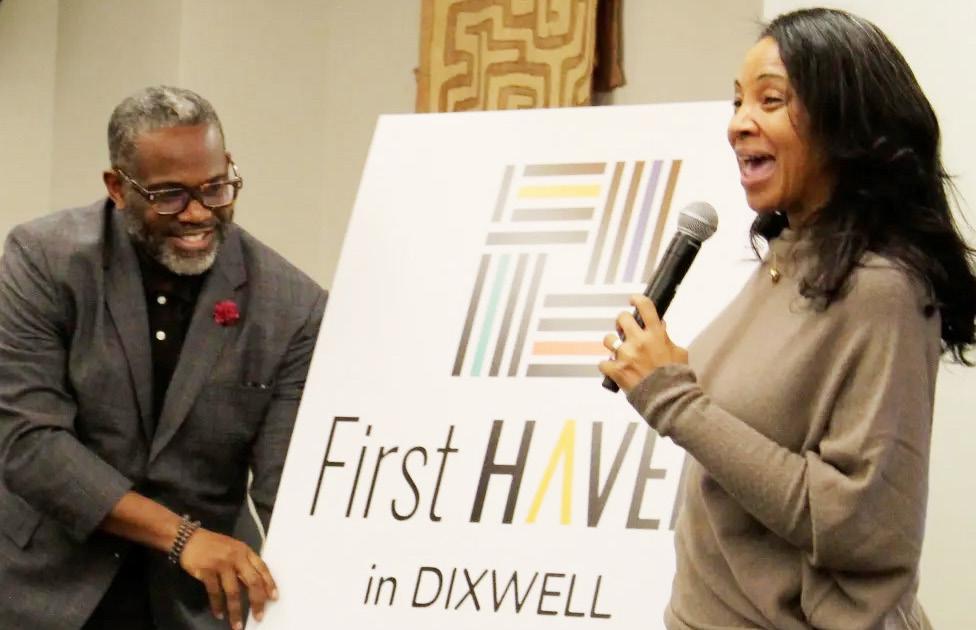
power,” and even “first-rate countertops,” said Blanding. “
This will be first, as in, the best.”
“Haven”: To reflect how Dixwell “became a haven” for Black families that migrated from the South. For those new residents, the neighborhood was “a haven for jazz, cultural arts, business, wealth generation, family, and community,” said Blanding.
“In”: To emphasize that the building is part of the Dixwell community. The development team opted against the names First Haven At Dixwell and First Haven on Dixwell, said Blanding. “It’s all the work that we’re doing in the Dixwell community — the housing, the food, the construction academy — we are very much in the community, and want to continue to be in community with you.”
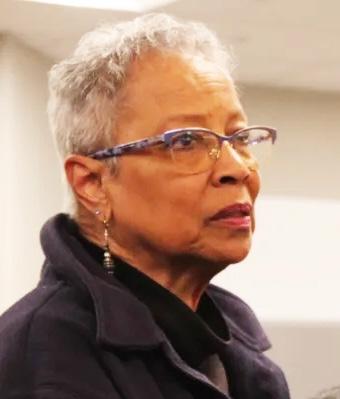
“Dixwell”: To appease long-time Dixwell resident Crystal Gooding. According to Clemons, Gooding urged ConnCORP to keep Dixwell in the name of all its developments in the neighborhood. “We kept our promise to you. That’s why Dixwell is in the name,” Clemons told Gooding, with a smile. Snaps, claps, and “yes ma’ams” echoed through the room.
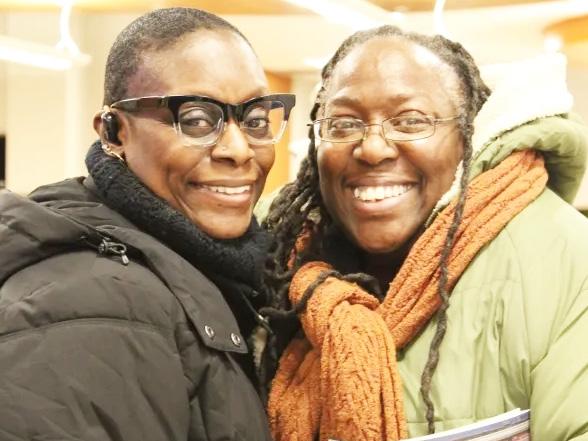
Melissa Singleton and Lillie Chambers.
In the next phase of development, ConnCORP’s construction partners will build a 184-unit apartment complex and grocery store.
According to Paul McCraven, the Chief Operating Officer of ConnCORP, 37 units will be designated
as affordable. Half will be set aside for residents earning 80 percent of the area median income (AMI), or $90,950 for a family of four. The rest will be reserved for residents earning 60 percent of AMI, or $68,220.
In an hour-long Q&A, a few residents questioned the proposed building’s affordability requirements.
“I do like what I’m hearing, but I’m concerned,” said Lillie Chambers, a Dixwell resident. “As far as housing, the 20 percent is not enough.” While she sympathized with ConnCORP’s financial constraints, she said she worries about the community being “gentrified,” especially with luxury complexes like Axis201 rising around the neighborhood.
“A lot of people need housing — have jobs, just can’t afford it — so my concern right now is that it’s not enough,” she said.
Another resident questioned the AMI figures, pointing out that Dixwell’s median income is much lower than the area average, which captures all of New Haven County.
Clemons responded that the social services at First Haven generate no profit. As a result, he said, “There’s no way we could deliver the amenities that the community said they wanted with anything higher than 20 percent.” “Is it high enough? Maybe not, given the circumstances,” he continued. “Is it the best we could do? Absolutely.”
Outside of First Haven, ConnCORP is creating more affordable homes in Dixwell, Ian Williams, Senior Vice President of Real Estate at ConnCORP, told the Independent. He said ConnCORP has provided 17 affordable units to the Dixwell and Newhallville neighborhoods. The group is making no money on the houses, and any future profits would be reinvested into First Haven, added Williams.
After hearing that residents were worried about First Haven pricing them out of their homes, ConnCORP looked into creating affordable housing outside of the planned development, said Rigeuer. ConnCORP’s real estate portfolio is around 80 percent affordable, he added.
In the longer term, Blanding hopes First Haven’s community services will help people find jobs and build wealth.
“Sometimes when you have the affordable housing conversation, [there’s] an assumption that we’re always going to always be poor,” said Blanding. But, in addition to creating below-market-rate units, one of the key goals of First Haven is to “help people move up the economic ladder,” so they no longer need affordable housing in the first place.
By Abiba Biao
Inside Wilbur Cross High School, class had been out for hours, but the cafeteria was buzzing with activity. Students talked over plates filled to the brim with hummus, fattoush, naan, and fried rice. As Maher Zain’s song “Ramadan” floated through the air, laughter and cheers rolled over the crowd. Friends old and new took their seats and broke bread together— learning more about their Muslim peers and colleagues in the process.
Friday night, over 100 students, staff and family members ended the day’s Ramadan fast together with Wilbur Cross’ first annual Community Iftar, held in the school’s cafeteria. Organized by Arabic teacher Hanan Elkamah, who helms the school’s World Languages Department, the evening marked an opportunity for both celebration and education, with lessons about Ramadan woven into the evening.
It doubled as a chance to recognize students from Wilbur Cross and Hill Regional Career High Schools who met weekly for over a month to discuss and document their lived experiences as Arabic-speaking newcomers to the U.S.. That work is part of the Study of Adolescent Lives after Migration to America (SALaMA), a photovoice project from Washington University in St. Louis with support from Qatar Foundation International.
“Tonight’s Iftar is not only about food. It is about bringing people together from different backgrounds to learn from one another and to share a moment of gratitude and unity,” Elkamah said.
Iftar, which is observed nightly during the holy month of Ramadan, refers to the evening meal with which Muslims break their fast. Starting last Tuesday, some two billion Muslims across the globe began the month of Ramadan, the ninth month of the Islamic lunar calendar..While the placement of Ramadan differs annually, the period lasts for a month. During this time, Muslims fast from sunrise to sunset. Before starting their fast, Muslims wake up before dawn to eat suhoor, the early morning meal. The meal is eaten before the start of the Fajr prayer, the first of the five daily prayers Muslims do throughout the day. At sunset, Muslims break their fast with their evening meal called Iftar. The timing coincides with Maghrib prayer, the fourth daily prayer which happens at sunset.
Before praying Maghrib, Muslims break their fast first with a date and some water, following the sunnah or advice of Muhammad, a key figure in the religion. After praying, they proceed to have their full Iftar meal.
Just like any evening during Ramadan, Elkamah prayed Maghrib, this time as a group prayer for Muslims and non-Muslims alike. As peers lined up to pray, the moment felt fitting: Elkamah has worked to share Arabic culture at the school and in the district over the past several years, including with the school’s annual Arabic Festival. The festival will enter its sixth year in May.

“They were lined up with us in the prayer. I was getting goosebumps,” she said of her colleagues. “I received emails from teachers asking like, ‘How do I dress?’ and some teachers asked for hijab to wear for the night.”
As laughter filled the air, principal Matthew Brown stopped by each table to hand out Ramadan goodie bags, stuffed with small infographics about the holy month and Ramadan-themed school supplies: pencil, pen, eraser, a silicone wristband, candy, and a lantern keychain. Assisting him with dispersing the bags was Elkamah’s son, Mohamed Elsankary.
“Ms. Hanan is just the epitome of a wonderful teacher in that she both gets a lot of kids to learn a lot of Arabic,” Brown said. “But more importantly, they build community around the context of what the language represents and the range of cultures that it represents.”
Brown added that many of the students are a part of Cross’ International Academy, a cohort that focuses on encouraging language learning, using multilingual skills in different contexts, and highlighting cultural diversity. Evenings like this one are deeply meaningful: while New Haven Public Schools’ students have a day off at the end of Ramadan, during the celebration of Eid al-Fitr, most non-Muslim students don’t know what the day signifies. This marked a chance for them to learn.
“It’s never been a more important time to demonstrate as a school our belief that diversity is our strength,” Brown said. For Elsankary, the night fostered a sense of community, during which he got to know the colleagues and place his mom “speaks so highly of.” A neuroscience graduate of Trinity College who is currently in the midst of applying to dental school, Elsankary may be a world away from high school, but was excited to help


with the festivities. He described the upbeat atmosphere as “contagious.”
“Ramadan just started a few days ago. We had Iftar at home with just the family, but it's nice to have something with a whole community,” he said. “My mom was really excited to host this so I’m very happy to be here.”
And indeed, these good spirits were felt by staff and students alike. Alaa Alagami, a sophomore at Cross, said that he enjoyed the vibes and felt a sense of belonging.
“I’m feeling happy because I [can] see my friends,” Alagami said, adding that it’s been a while since students have been able to come together.
When asked if he had a particular favorite food in mind, Alagami said he didn’t have a preference and appreciated the variety of options.
“I like all the food because I tried all the food,” he said.
While people continued to enjoy their meals, Elkamah was in teaching mode, making even the smallest of moments a learning opportunity. She continued the theme of blending cultural education through food, taking a moment to address the audience.
“I hope you’re enjoying the dinner and the Iftar night. I’m actually enjoying this Iftar the most than any other night,” she said. “For Ramadan, when we eat, we say Ramadan Kareem, [which] means generous Ramadan.”
Elkamah has set her sights on hosting another Iftar night next year, she said. In the meantime, she is also using other avenues to combat xenophobia and uplift Arab culture at the school. This January and February, a cohort of students from Cross and Hill Regional Career High School participated in a photovoice project around belonging, part of the larger SALaMA study.
Photovoice is a participatory, qualitative research method where individuals document their lived experiences through photography. Over six weeks, students shared photos that illustrated their sense of belonging and discussed their experiences, highlights, difficulties, and feelings migrating to the US.
The goal of SALaMA is “to assess the mental health and psychosocial wellbeing of high school students who have been –or whose parents have been – resettled to the US from the Middle East and North Africa It,” according to the study itself. “It also aims to identify the sources of daily stress in these students’ lives, as well as the corresponding support mechanisms available to them.”
While a Community Iftar is just one community initiative, the event is part of the school’s broader mission to prioritize student health, culture, and wellbeing “It's just a joyful night,” Elkamah said. “I'm so, like, I can't express my feeling, — the happiness — seeing everybody makes me happy, showing respect and unity together.”
History teaches us that unity is strength, and cautions us to submerge and overcome our differences in the quest for common goals, to strive, with all our combined strength, for the path to true African brotherhood and unity.
With her appointment to the United States District Court for the Southern District of New York on January 25, 1966, Constance Baker Motley (1921–2005; Columbia Law School 1946, 2003) became the first African American woman appointed to the federal judiciary. She was appointed by President Lyndon B. Johnson. When Judge Motley became Chief Judge on June 1, 1982, she was the first woman and the first African American woman to serve as such for the Southern District of New York, the largest federal trial bench in the country. She so served until October 1, 1986, when she assumed senior status.
Constance Baker was born on September 14, 1921, in New Haven, Connecticut. She graduated from New York University in 1943. In 1946, she received her law degree from Columbia University, and married real estate and insurance broker, Joel Wilson Motley. Motley joined the legal staff of the NAACP Legal Defense and Educational Fund, Inc. when she was a senior at Columbia University School of Law. Subsequently, as associate counsel, she became its principal trial attorney.
From 1945 to 1964, Judge Motley worked on all of the major school segregation cases supported by the NAACP Legal Defense Fund. She wrote the legal brief for the landmark Brown vs. Board of Education case and helped strategize on other important legal precedents. Among the cases in which she played a prominent role were desegregation cases involving universities of Mississippi, Alabama, Florida, Oklahoma, and Georgia, and Clemson College in South Carolina. In the area of housing, Judge Motley represented African American plaintiffs in public housing cases in Detroit and Benton Harbor, Mich.; St. Louis. Mo.; Columbus, Ohio; Evansville, Ind.; Schenectady, New York; and Savannah, Georgia. Judge Motley was also counsel for African American plaintiffs in the Jackson, Mississippi transportation facilities case which resulted in desegregating railroad and bus terminals and local buses in Jackson, Mississippi.
On October 16, 1961, Judge Motley argued Hamilton v. Alabama, involving the right to counsel in a capital case before the United States Supreme Court. Judge Motley also argued Swain v. Alabama before the Supreme Court in which the Court refused to proscribe race-based pre-emptory challenges in cases involving African American defendants. Swain was overruled by Batson v. Kentucky.
On February 27, 1962, Judge Motley argued Turner v. City of Memphis before the United States Supreme Court, a case which resulted in desegregating the Dobbs Houses Restaurant in the Memphis Municipal Airport Terminal. On May 27, 1963, Judge Motley won the Supreme Court case of Watson v. City of Memphis,



which required immediate desegregation of all recreational facilities in Memphis, thus defeating Memphis' plan to desegregate these facilities over a 12-year period. In this case, the Court also warned that the period of transition from segregated to desegregated schools as ordered in Brown must be accelerated.
On May 20, 1963, the Supreme Court handed down decisions in several sit-in cases reversing the convictions of many African American students. One of these cases, Gober v. City of Birmingham, involving 10 African American students who had sat in at dime store lunch counters in Birmingham, was argued by Judge Motley. She also argued the case of Shuttlesworth v. City of Birmingham, involving the arrest and conviction of Reverend Fred L. Shuttlesworth and Reverend Charles L. Billups for urging the students to engage in civil disobedience. Those convictions were also reversed. On June 22, 1962, Judge Motley also prevailed in another sit-in case, Bouie v. City of Columbia, S.C. Lupper v. Arkansas, which she argued in the Supreme Court following enactment of the Civil Rights Act of 1964, was one of the cases which resulted in a Supreme Court ruling abating all pending state court prosecutions for peacefully seeking service in places of public accommodation covered by the new law. In total, Judge Motley won nine out of the ten cases she argued before the Supreme Court.
After nearly 20 years with the NAACP, Judge Motley chose to serve on the New York State Senate. On her election to the New York State Senate in February of 1964, she became the first African-American woman to serve in that branch of the Legislature. She immediately began a campaign for the extension of civil rights legislation and for additional low and middle income housing.
In February of 1965, Judge Motley was elected by the Manhattan members of the New York City Council to fill a one-year vacancy in the office of President of the Borough of Manhattan, and thus became the first woman to serve in that office, and as a member of New York City's Board of Estimate. She was elected to a full fouryear term in November 1965, when she became the first candidate for the Manhattan Presidency to win endorsement of the Republican, Democratic, and Liberal Parties. Judge Motley, as borough president, drew up a seven-point program for the revitalization of Harlem and East Harlem, and won a pioneering fight for $700,000 to plan for those and other underprivileged areas of the city.
With her appointment in 1966, Judge Motley became the first African American woman appointed to the federal judiciary. She became the chief judge in 1982, and assumed senior status in 1986.

John P. Thomas Publisher / CEO
Babz Rawls Ivy Editor-in-Chief Liaison, Corporate Affairs Babz@penfieldcomm.com
Advertising/Sales Team
Keith Jackson Delores Alleyne John Thomas, III
Editorial Team
Staff Writers
Christian Lewis/Current Affairs
Anthony Scott/Sports Arlene Davis-Rudd/Politics
David Asbery / Tanisha Asbery
Jerry Craft / Cartoons / Barbara Fair Dr. Tamiko Jackson-McArthur
Michelle Turner / Smita Shrestha William Spivey / Kam Williams Rev. Samuel T. Ross-Lee
Contributors At-Large
Christine Stuart www.CTNewsJunkie.com
Paul Bass www.newhavenindependent.org
National Association of Black Journalist
National Newspapers Publishers Association
Greater New Haven Chamber of Commerce
Greater New Haven Business & Professional Greater New England Minority Supplier Development Council, Inc.
The Inner-City Newspaper is published weekly by Penfield Communications, Inc. from offices located at 50 Fitch Street, 2nd Floor, New Haven, CT 06515. 203-3870354 phone; 203-387-2684 fax. Subscriptions:$260 per year (does not include sales tax for the in State subscriptions). Send name, address, zip code with payment. Postmaster, send address changes to 50 Fitch Street, New Haven, CT 06515. Display ad deadline Friday prior to insertion date at 5:00pm Advertisers are responsible for checking ads for error in publication. Penfield Communications, Inc d.b.a., “The Inner-City Newspaper” , shall not be liable for failure to publish an ad or for typographical errors or errors in publication, except to the extent of the cost of the space in which actual error appeared in the first insertion. The Publisher reserves the right to refuse advertising for any reason and to alter advertising copy or graphics deemed unacceptable for publication. The entire contents of The Inner-City Newspaper are copyright 2012, Penfield Communications, Inc. and no portion may be reproduced by any means without the written permission of the publisher.
by Chris Randall
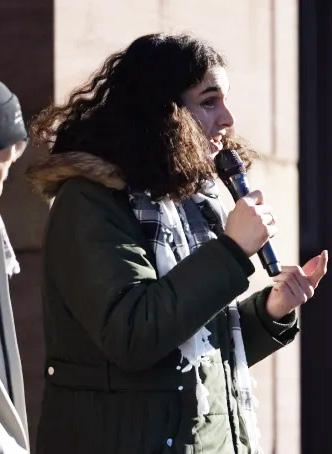
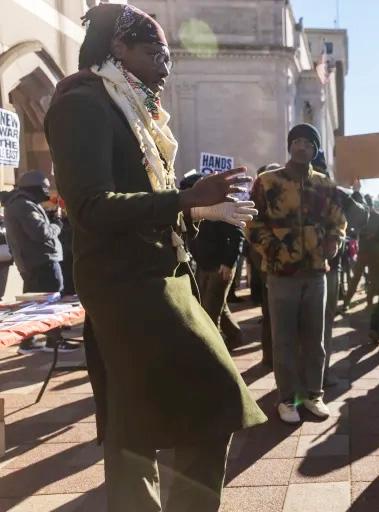
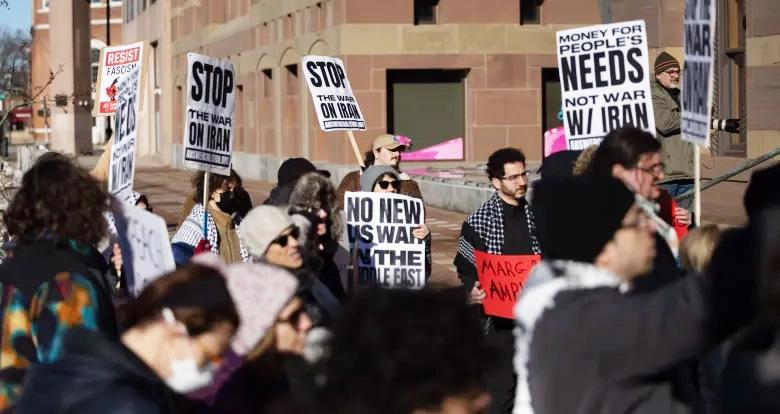
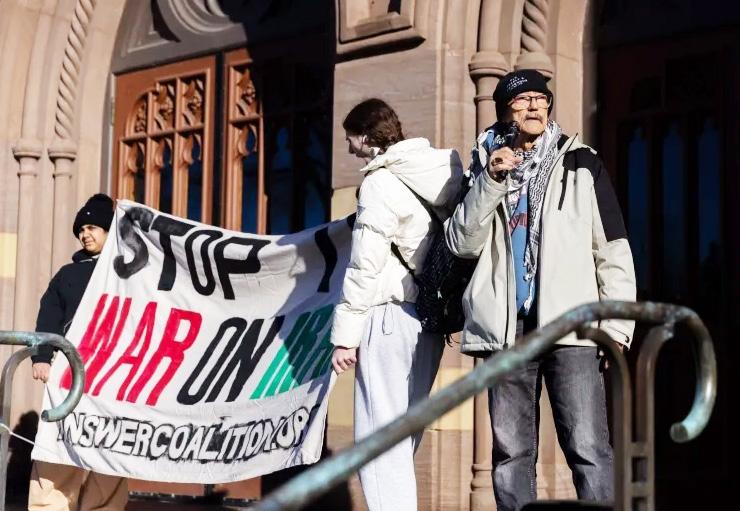
Holding signs reading “Stop The War On Iran!”, several dozen protesters rallied outside City Hall Sunday afternoon as part of a nationwide day of demonstrations against the Trump administration’s ongoing military intervention in the Middle East.
Roughly 60 people turned out to the New Haven protest, which was organized by the Act Now to Stop War and End Racism (ANSWER) Coalition and the Party for Socialism and Liberation. New Haven Independent photographer Chris Randall was on the scene. See above and below for his photographs and video from the event.




by Thomas Breen
Mayor Justin Elicker unveiled a budget proposal Friday afternoon that would see the city’s general fund increase by 4.4 percent — and the local tax rate jump by 4.01 percent — thanks in part to the rising costs of debt service, employee healthcare, and teacher and police salaries, as well as $5 million more for city schools.
The mayor also said that he is “optimistic” that more money could be on the way from Yale — potentially reducing the final tax rate — as the city and the university continue to negotiate over a new voluntary annual payment.
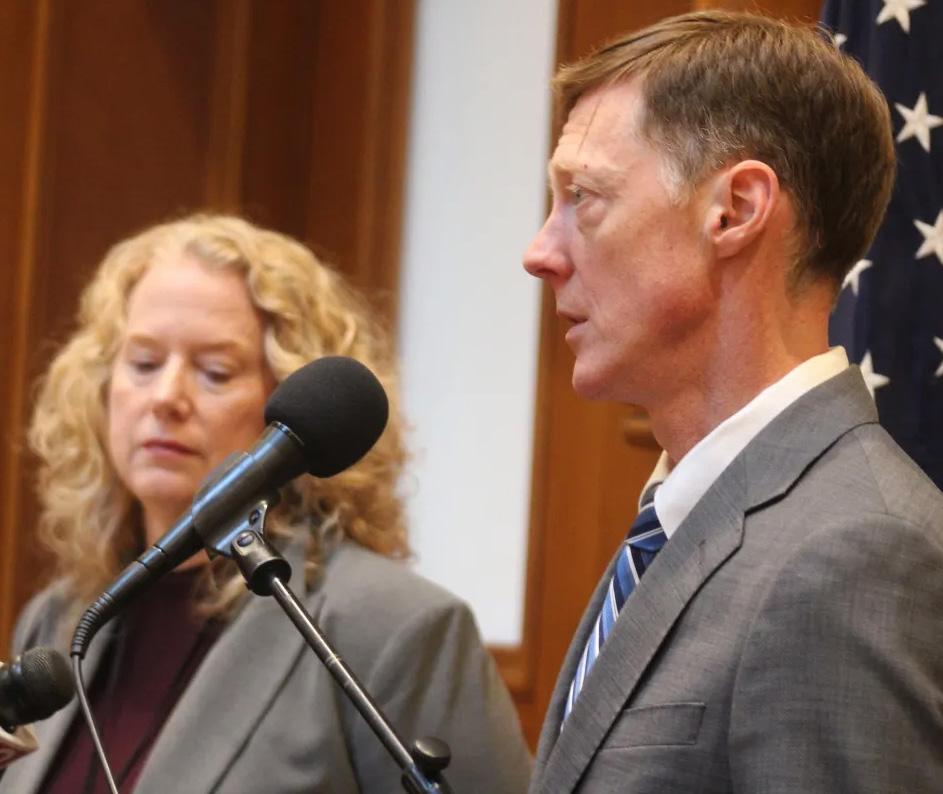
Elicker made those announcements during his latest budget-proposal press conference on the second floor of City Hall.
Standing alongside City Budget Director Shannon McCue and city Finance Department Project Coordinator Ron Gizzi, Elicker said that he has proposed a $733.3 million general fund budget for the fiscal year that starts July 1. That would mark a roughly $31 million increase, or 4.4 percent, above the current fiscal year’s $702.3 million general fund budget.
Elicker also proposed increasing the city’s mill rate from 39.4 to 40.98 — a jump of 1.58 mills, or 4.01 percent. (One mill translates to $1 owed in local property taxes for every $1,000 in assessed value.)
The mayor is required by city law to submit a new budget to the alders by March 1 each year. His proposed Fiscal Year 2026-27 (FY27) budget now heads to the Board of Alders for three months of public hearings and review before being taken up for proposed amendments and a final vote in late May or early June. Elicker’s FY27 budget proposal is his seventh since taking office in 2020, and the first of his fourth two-year term. McCue and Elicker described a number of “fixed” city costs that continue to go up and up and that make up a sizeable portion of the city’s budget. Those include city healthcare and debt service costs, each of which is expected to rise by $10 million next fiscal year.
Elicker said that the city recently adopted long-in-the-works and much-needed new contracts for the police and teachers unions. Both of those contracts go a long way towards better compensating critical city workers and thereby improving re-
tention, he said. But higher salaries and other provisions also come at a cost that the city is bound to cover. “Things cost money,” he said.
The mayor also described a number of programs that had previously been funded by federal American Rescue Plan Act (ARPA) monies — like the city’s two-person climate and sustainability office, the city-owned hotel-turned-homeless shelter on Foxon Boulevard, the readingand-math-focused New Haven Tutoring Initiative, and the non-cop emergency response crew COMPASS — that he has proposed transitioning onto the general fund, as all ARPA dollars have to be spent by the end of 2026.
Elicker said that his proposed budget includes a net increase of 13 full-time, general-fund positions, including two new
parks caretakers to help with the planned Long Wharf Park buildout, a field tech to help maintain the city’s sports facilities, a new Elderly Services program manager for a planned new senior center at the old Barbell Club, a new deputy controller, and a new internal auditor “to ensure city funds are used” appropriately. Elicker said that that latter position comes in part in response to the scandals around hackers stealing $6 million in city funds by impersonating the school district’s bus contractor in 2023 as well as the ex-police chief’s more recent alleged theft of $85,000 in confidential-informant and youth-activity funds.
In regards to schools funding, Elicker said his proposed budget would increase the city’s contribution to New Haven Public Schools (NHPS) by another $5
million. “Our education system desperately needs funds.” The new teachers union contract — while “the right thing to do” — contributes to a higher schools budget. He said that the city has increased local contributions to NHPS by 63 percent since 2020. He also repeated calls for the state to significantly step up its funding of municipal education. (NHPS leaders, meanwhile, are considering requesting a budget increase of between $20 million and $40 million.)
On the revenue side, Elicker said that the state’s Payment in Lieu of Taxes (PILOT) to New Haven is now over $105 million.
He also said that Yale has agreed to maintain its current level of voluntary payments to the city — roughly $24 million — instead of following through
on an $8 million drop that the city and the university had agreed to for the final year of a six-year deal struck at the end of 2021. That means no cliff this year for the roughly $10 million annual increase Yale committed to as part of the soon-toexpire deal.
Elicker said the city is in “active conversations with Yale” about its contribution to the city. “The conversation has been very productive” and he’s “optimistic” Yale may wind up agreeing to an even larger amount, thereby allowing for a lower city tax rate.
“The Mayor announced today that Yale University’s funding will not decline in the next Fiscal Year as was originally imagined by the 2021 voluntary payment arrangement,” Yale Associate Vice President for New Haven Affairs and University Properties Alexandra Daum told the Independent. “Yale is glad to be able to make that commitment as a precursor to a renewed multi-year commitment. As the Mayor said today, both sides are confident that we will be in a position very soon to announce a multi-year contribution. In addition to our financial commitment, Yale is also looking forward to sharing the details of the full suite of programs and partnerships between Yale and New Haven that will commence or continue in the coming years.”
While this is not a citywide revaluation year — the next one is scheduled for next year — McCue said that the city’s net taxable grand list increased by 2.5 percent, in part due to newly built buildings phasing out of the city’s tax assessment deferral program.
The mayor’s proposed budget states that the city’s net taxable grand list rose from $9,034,084,421 last year to $9,258,290,680 this year. That growth was driven in large part by a $7.8 billion jump in the real estate portion of the list. And what about the city’s proposed acquisition of the old English Station power plant site and plan to turn it into a new public park and outdoor pool?
City spokesperson Lenny Speiller said that there is $5 million in the city’s special fund budget that is designated for the so-called Mill River Park plan. That money comes from the state’s Urban Act grant program, and is available to be used for the site’s acquisition, if the alders approve.


by Donald Eng
“Totally unnecessary,” “a disaster in the making” and “dangerously illegal” were among the reactions from Connecticut’s elected officials to news this morning that American and Israeli forces had carried out a series of strikes against Iran.
Iran later retaliated with ballistic missile attacks against targets in Israel, Bahrain, UAE, Qatar and Saudi Arabia, according to reports.
U.S. Rep. Rosa DeLauro, D-3rd, said President Donald Trump was risking the lives of American personnel and the stability of the region without Congressional approval and without any articulated plan.
“President Trump’s decision, along with Israel, to launch direct military action against Iran to achieve regime change is a disaster in the making,” she said. “This is yet another unilateral decision from President Trump, which risks a wider war in the Middle East that the American people do not support. Americans are demanding help with the cost-of-living crisis, but President Trump would rather start another war, potentially driving up energy prices, than listen to them.”
U.S. Rep. Jim Himes Credit: Contributed Fellow U.S. Rep. Jim Himes, D-4th, reiterated that there did not seem to be any long-term objective to the strikes.

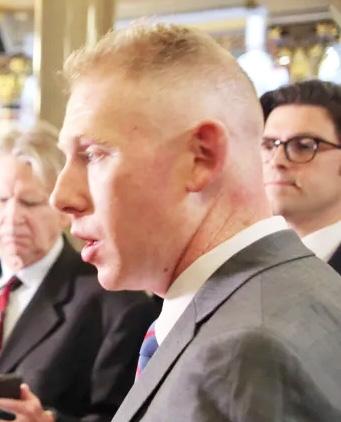
“Everything I have heard from the administration before and after these strikes on Iran confirms this is a war of choice with no strategic endgame,” he said. “Military action in this region almost never ends well for the United States, and conflict with Iran can easily spiral and escalate in ways we cannot anticipate.”
He said Trump had failed to learn from history, but indicated that when the war powers resolution came before Congress next week, he would support it.
“In the meantime, I will be praying for the safety of our servicemembers and all civilians who are in harm’s way,” he said.
Locally, Senate Minority Leader Stephen Harding, R-Brookfield, also said the nation would be praying for service members and their families. He went on to say “we pray for the innocent people of Iran, we pray for Israel, and we pray for a swift and decisive victory which will lead to a safer and more secure world.”
Connecticut’s U.S. senators, both Dem-

his objectives, end game, or exit strategy – risking another forever war.”
Blumenthal said the attack fit a pattern of unilateral action without accountability.
I believe that Congress should come back into session, demand answers on behalf of Americans, and act on the Iran War Powers Resolution,” he said. “My foremost concern is the safety and wellbeing of the men and women in our armed forces and their families who are in harm’s way.”
Blumenthal’s fellow Connecticut senator, Chris Murphy, had the most pointed criticism of Trump’s actions, and of Trump himself, calling the strikes dangerously illegal and a mistake of staggering scale.
ocrats, also cited the Constitutional process of Congress voting on a war powers act, though neither joined Himes in stating their support for such an act.
“The Trump Administration seems to be engaging in a war of choice that rejects opportunities for diplomacy,” said Sen. Richard Blumenthal. “A nuclear-armed Iran is unacceptable and Iran’s malign activities throughout the region pose a severe danger, but President Trump has failed to explain to the American people
“Has he learned nothing from decades of U.S. military disaster in the Middle East?” Murphy wrote in a statement on social media. He added the military action had been totally unnecessary, saying the U.S. had a diplomatic deal with Iran to limit its nuclear program that Trump had canceled in 2018 despite U.S. certification that Iran was complying with it.
“Trump willfully precipitated this crisis,” he said, adding that he also would be praying for the safety of U.S. service personnel.
“They are being led into war by a leader who is out of control,” he said.
by Thomas Breen
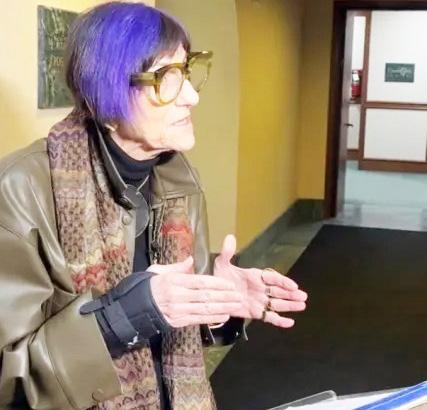
U.S. Rep. Rosa DeLauro criticized President Donald Trump Saturday for launching a war against Iran without first seeking Congressional approval — and warned that pursuing regime change in the Middle Eastern country could prove to be a long, costly, and bloody affair.
“I worry about a prolonged war,” she said. DeLauro,
New Haven’s longtime Congresswoman and the top Democrat on the House Appropriations Committee, offered that response during a press briefing Saturday at 10:45 a.m. in the hallway outside her office at 59 Elm St.
She spoke up hours after the U.S. and Israeli militaries launched wide-ranging attacks on cities across Iran with the goal of topping the government of Ayatollah Ali Khamenei and the Islamic Revolutionary Guard Corps. By Saturday afternoon, the Israeli military announced that it had killed several top Iranian military officials, including, potentially, Khamenei. The attacks prompted swift backlash from Congressional Democrats, including in Connecticut.
“War must always be a last resort and never a first choice,” U.S. Sen. Richard Blumenthal said in an email statement sent out at 9:56 a.m. “The Trump Administration seems to be engaging in a war of
choice that rejects opportunities for diplomacy. A nuclear-armed Iran is unacceptable and Iran’s malign activities throughout the region pose a severe danger, but President Trump has failed to explain to the American people his objectives, end
game, or exit strategy – risking another forever war.”
Blumenthal called for Congress to come back into session, “demand answers on behalf of Americans,” and then vote on a war powers resolution.
During her remarks on Elm Street Saturday, DeLauro also repeated calls for Congress to take up a war powers resolution regarding the U.S. government’s attack on Iran.
She focused her criticism on the Trump administration acting without Congressional approval. “The Constitution gives Congress the sole power to declare war,” she said.
DeLauro slammed the president for providing “no justification for this action,” “no description of this action,” and no indication of “what the imminent threat was.” In the months, weeks, and days before Saturday, the Trump administration appeared to be acting in pursuit of “nuclear deterrence.” With Saturday’s attack, “all of a sudden, that [goal] has shifted to regime change.”
DeLauro said that Saturday’s attack opens up a world of uncertainty for the future of the U.S. military’s involvement in this region. “There is no indication of what comes next. What is the day after?”
There’s no question that the Iranian regime is a “leading supporter of terrorism,” DeLauro continued, “but I don’t believe that this action diminishes that risk in any way.”
Instead, she said, it will likely “raise energy prices.” The president, she said, “should be focused at home on [the] cost of living.”
In a three-minute video posted to the social media site X at 11:16 a.m., U.S. Sen.
Chris Murphy offered a similar critique — albeit in a sharper register. “Trump’s attacks on Iran are just wildly illegal” and “a mistake of epic scale,” he said.
“In America,” Murphy wrote in a post accompanying the video, “we don’t allow one doddering, self obsessed old man to waste our money on a dangerous, disastrous overseas war.”
Murphy said that Trump has learned nothing from “decades of U.S. military disaster in the Middle East,” and appears to have spent “not a single minute” studying all the lives lost during U.S. military interventions in Iraq and Afghanistan. He also said that, even if the U.S. and Israeli militaries are successful in achieving regime change, “what is likely to emerge from the rubble is not an Iranian inclusive democracy,” but instead a government that is “more repressive,” more anti-Israel, more anti-U.S., and composed of the remnants of the Islamic Revolutionary Guard Corps.
Trump is a “would-be dictator who doesn’t care what we think,” Murphy said.
Nevertheless, he said, the American public has been “crystal clear. They don’t want to be drafted into a totally unnecessary war of choice.”
Murphy said that Congress needs to be called back into session right away so that they can debate legislation to approve or deny the president’s war in Iran.
by Laura Glesby
HARTFORD — The widow of a New Haven detective came forward Friday to back up allegations that her husband repeatedly threatened and pressured witnesses, leading to multiple wrongful convictions.
She testified about that misconduct in support of Alder Troy Streater’s pursuit of wrongful-conviction compensation from the state.
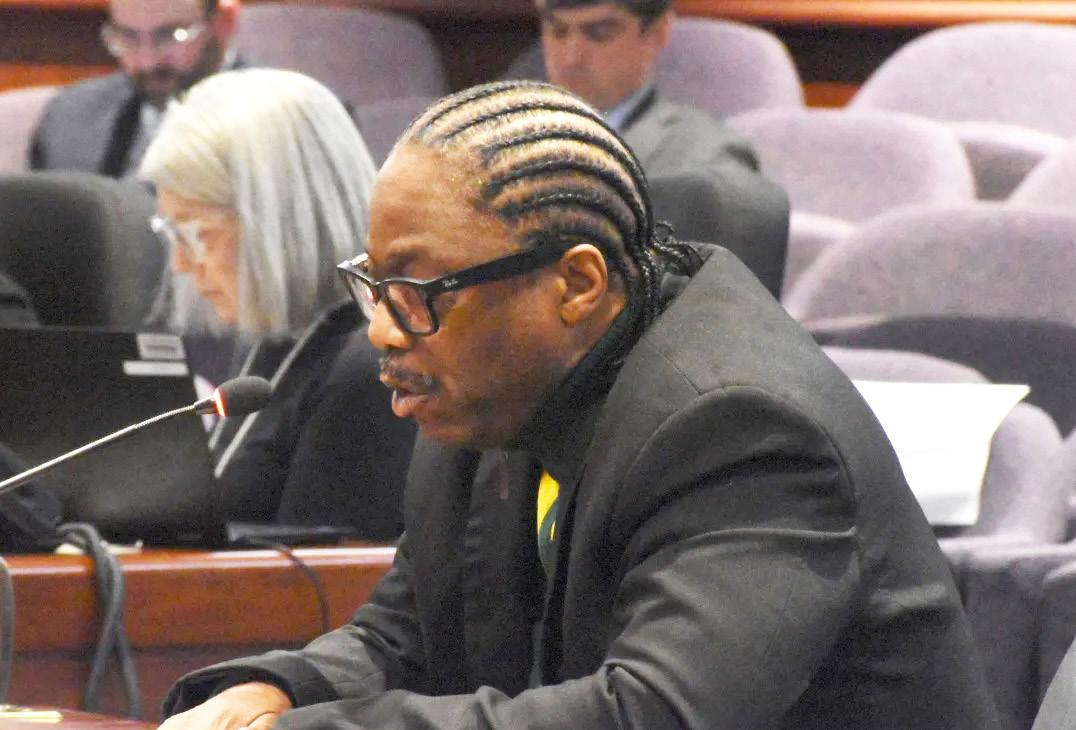
Lisa DiLullo, who was married to the late Detective Anthony DiLullo, appeared before the state legislature’s Judiciary Committee on Friday.
The committee was reviewing a decision by Claims Commissioner Robert Shea recommending that the state award Streater $5.75 million as compensation for a wrongful conviction.
Streater — who is currently the alder of Dixwell, Newhallville, and Prospect Hill’s Ward 21 — spent 23 years incarcerated for the 1990 murder of Terrance Gamble, a crime he’s always maintained he did not commit.
By the end of the hearing, the Judiciary Committee did not make a decision about whether or not to approve, although several members suggested that they may recommend sending the matter back to Commissioner Shea for an additional fact-finding hearing.
Much of the back-and-forth at the hearing revolved around the question of whether the pardon that Streater received constitutes a substantiation of innocence. Streater received a pardon for that crime in 2022 from the Board of Pardons and Paroles. At his hearing before that board, he stated that he was innocent of the crime.
Commissioner Shea interpreted the lack of any communication from the board contesting Streater’s innocence claim as evidence that the pardon they granted rested on “grounds consistent with innocence.”
The board’s chair at the time, Carleton Giles, wrote in an affidavit submitted by Streater’s lawyer, Alex Taubes, that “I believe that his claim of innocence was a ground for the Board’s decision to grant the pardon.”
Current board chair Jennifer Zaccagnini, however, testified on Friday the exact opposite: that “to my knowledge, the board has not granted pardons based on actual innocence.”
Amid this debate about the rationale behind Streater’s pardon, Lisa DiLullo’s testimony offered new context casting doubt on Streater’s conviction.
Her testimony corroborated the recantations of all of the witnesses who originally testified against Streater, including claims that her husband and other detectives coerced their initial statements.
“If you take away the perjured testimony, there is nothing tying me to this case,” Streater told the committee.
According to Lisa, the DiLullos were married from 1995 until Anthony’s death in 2000. They previously worked together on a joint task force of both federal and
“No
New Haven law enforcement officials starting in 1991.
“After reading about Mr. Streater’s case and other wrongful convictions connected to Detective DiLullo and others,” she said, “I recognized that things I had personally witnessed, without context at the time, during my time with Detective DiLullo, seemed to be part of a larger pattern of misconduct. The same misconduct that put Mr. Streater in prison for 23 years for a crime he did not commit.”
She continued, “The misconduct that led to Mr. Streater’s wrongful conviction was not an isolated incident. I was not surprised when I learned the details of what they allegedly did to the witnesses in Mr. Streater’s case — threatening them, pressuring them, following them — because it was consistent with what I personally observed during my time working alongside and married to Det. DiLullo.”
According to Lisa DiLullo, “Based on my experience, he developed tunnel vision in his investigations. He withheld information that did not support the result he wanted, and he would say whatever suited him.”
Lisa DiLullo’s testimony also raises questions about the integrity of other convictions which her husband had helped secure.
He was also implicated in the convictions of Stefon Morant and Adam Carmon, both of whom have received compensation through the same state claims process.
And he was involved in convicting Daryl Valentine, who has always maintained he was wrongfully convicted and whose case has been mired with allegations that police bribed, harassed, and threatened witnesses.
The detectives most involved in Valen-
tine’s case were the same detectives most involved in Streater’s: DiLullo and Det. Joseph Greene.
Greene was involved in the wrongful arrest of Eric Ham, whom a 1996 jury awarded $1.4 million as compensation. As the Ham case came to light, an undated memo from then-prosecutor David Gold to his colleague Michael Dearington raised questions about Greene’s trustworthiness as a detective.
Lisa DiLullo told the committee Friday that she appeared before them “voluntarily” and that she has detailed potential evidence of misconduct by her late husband in a deposition for Morant’s lawsuit against the city.
Testimony over the course of the hearing revealed the irreparable pain that rippled from Gamble’s murder and from Streater’s conviction for that murder.
Three of Terrance Gamble’s relatives — his nephew, his sister, and his mother — testified virtually against Streater’s claim. They expressed faith in the legal process that led to Streater’s conviction, and each argued that a pardon should not be taken as an official finding of innocence.
Terrance’s mother, Joyce Gamble, had testified at Streater’s pardon hearing, stating that she had forgiven him. “I forgave Troy Streater because I didn’t want no hatred in my heart,” she said on Friday. She did not want her forgiveness to be misinterpreted as a belief in Streater’s innocence.
“We just want closure in the matter. With all this going on, we had to read about it on social media, and it opened up a wound,” said Nicole Gamble, Terrance’s sister. “I was only in the third grade when my brother was took away from me.” “It is painful that my grandmother must relive this tragedy nearly four decades later,” said Terrance Gamble II, Terrance’s nephew.
“Who failed my brother?” asked Nicole. After Joyce Gamble’s testimony, New Haven State Sen. and Judiciary Committee Co-Chair Gary Winfield, a Democrat, told her that the committee members “take very seriously” her family’s perspective, as well as Streater’s.
“We do know that there are folks who have been in our system who are actually innocent, who are accused of very heinous things,” Winfield said.
That meant that numerous “family members who survived thought they had gotten justice,” Winfield said. But due to police corruption that led to false convictions, “they didn’t actually have justice.” Wallingford State Rep. Craig Fishbein, a Republican, followed Winfield’s remarks by addressing Joyce Gamble. “You’re speaking for your son who can’t speak, because he’s gone,” Fishbein said.
Meanwhile, from Streater’s perspective, “no amount of money will give me back the 23 years,” as he told the committee. “But this award is the State of Connecticut saying we got this wrong… That means something.”
by Abiba Biao
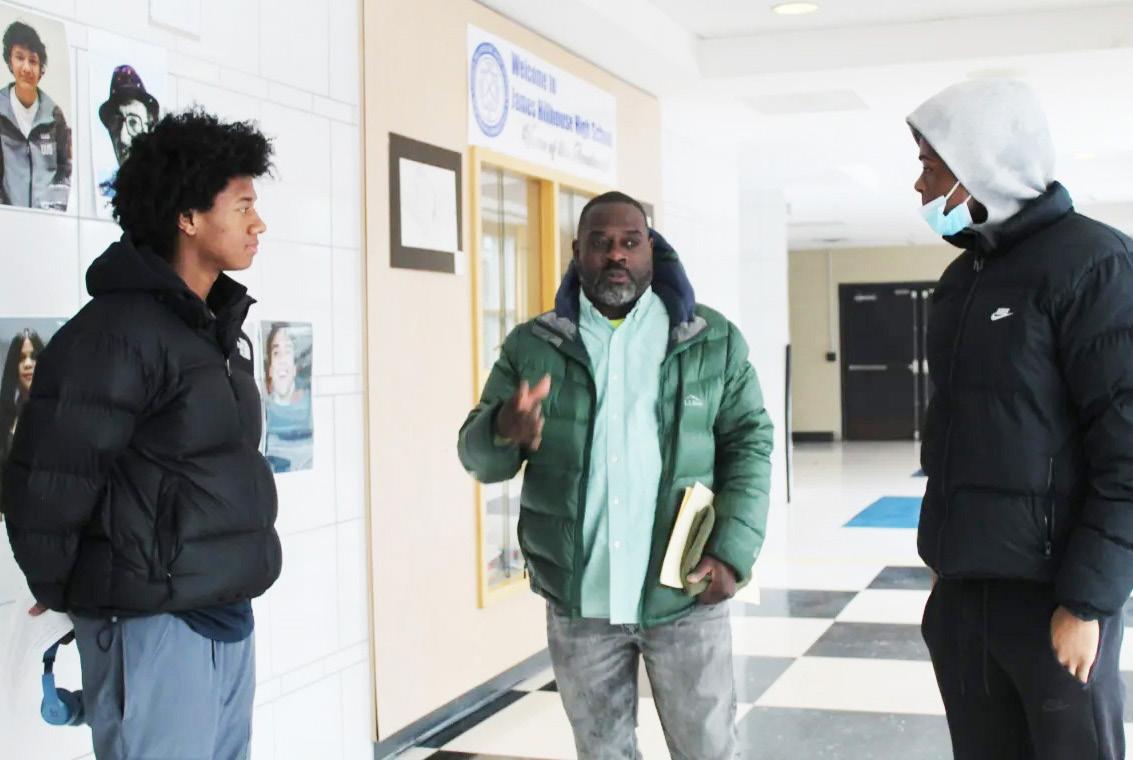
Rodney “Rock” Williams paid a visit to his alma mater — with the goal of inspiring the next generation of Hillhouse High School students “to be bosses,” by teaching them about alternative occupational pathways not taught in school.
Current Hillhouse students Trey Ten Stafford and Mamady Kourouma left the meetup inspired to think about potential future careers as, say, an electrician or in construction.
Kourama praised Williams for helping young New Haveners think about work after school, “’cause not a lot of people have jobs and they are looking for jobs and trying to get a better understanding of what they want to do in life.”
Williams — a Newhallville native, local construction contractor, landscaper, and community activist — paid that visit to Hillhouse last Wednesday. Williams is no stranger to the halls of Hillhouse, having graduated among the class of 1984.
Williams’ visit was part of the larger work of his nonprofit Rescuing Our Community Kids (ROCK), which aims to provide mentorship and professional opportunities for New Haven teens and high schoolers. Recently, Williams said his nonprofit received a $70,000 grant from the gun-violence-prevention program Project Longevity to run auto body workshops.
Williams stressed last Wednesday that his school visits aren’t exclusively for recruiting students for these autobody workshops. He’s also gauging students’ overall interest in his nonprofit. Whether they’re interested in becoming a firefighter, entrepreneur, or barber, Williams plans to connect them to mentorship resources across the city that best serve their interests.
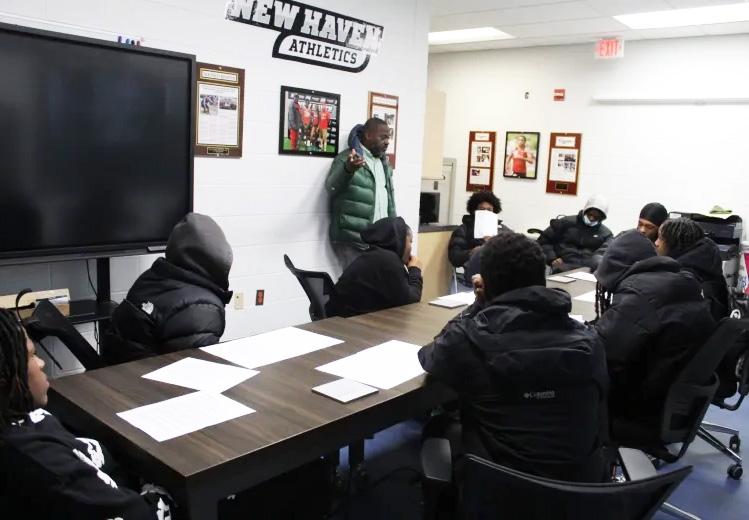
Williams popped into a class led by student-retention specialist Darrell Brown. The class of nine met in an office room in the Floyd Little Athletic Center next to Hillhouse on Sherman Parkway.
One by one, each person received a copy of Williams’ speech, with his email and phone number, urging students to keep in touch.
When asked about their pathways after graduation, many students around the room cited going to college, with sports management being the most popular major. Many of the students were involved in sports like basketball and football.
At first, the group was hesitant and slightly distant, listening to Williams, but not really understanding where the conversation was going. It wasn’t until Williams started recounting the multiple construction projects he completed around the city and job as the owner of Green Elm Construction that their attention became rapt. It didn’t take long for the atmosphere to warm up, opening up the floor for candid conversations and questions. There was a sense of relatability and rapport established through sharing his journey, even knowing some of the kids’ family members due to his work in the community.
“A lot of y’all, even if you don’t go to college, I would hope that — especially
since I graduated here — my goal is try to help you… you guys want to be bosses, y’all want to own businesses. My goal is [to] create bosses,” he said.
For Williams, being a “boss” is a mindset, gaining control of your life by taking up opportunities and defining your own limits.
“I’ve been a boss since I was around 21 years old,” Williams said, detailing his first jobs of setting drywall and sheet rock, and beginnings in construction.
The group also talked about gun violence — with Williams reflecting on the rivalry between the Tre and the Ville during his time at Hillhouse, its current evolution, and impact on youth development and community health.
“In life, there will always be beef. I think that what we need to figure out is how do we solve beef,” he said. Williams brought up his experience as a father and grandfather to show the importance of family and guidance from elders in the community. “When you guys go out here and you kill each other, what happens is you end the cycle, like their whole generation.”
Kourouma, 17, is a senior at Hillhouse and is interested in being an electrician. He’s also considering the army if his initial plan doesn’t work out. While he’s still reflecting on his next steps after gradua-

By
Rev. Hiram L. Brett
“Faith Matters” is a column that features pieces written by local religious figures.
“If a man has not discovered something he will die for, he isn’t fit to live.” —
Rev. Dr. Martin Luther King, Jr. “I have often been threatened with death. If they kill me, I shall arise in the Salvadoran people.” — Archbishop (Saint) Oscar Romero
Throughout my children’s K-12 educational journey, spring break was always a space for some relaxing quality family time in a warm weather climate, preferably the Caribbean, enjoying its vibrant culture, beaches and golf. Spring break 2015 was quite a bit different. I spent that spring break from Yale Divinity School in El Salvador as part of an IEP (Immersion Experience Program) with the International Partners in Mission (IPM) as a component of a Latin American Liberation Theology class.
This immersive experience was transformative in my formation. Liberation theology grew out of a Latin American context.
Latin American theologians, such as Gustavo Gutiérrez, Ignacio Ellacuria, and Jon Sobrino posit that it is through the poor that the reality of God irrupts into history. According to liberation theologians, Jesus’ ministry was focused on serving the poor and oppressed and alleviating their suffering.
ferent constituents and communities. One place was El Mozote, where on Dec. 11, 1981, in what is now known as the El Mozote Massacre, the Salvadoran army killed more than 900 people. Estimates are that 70 to 80 percent of the victims were children, women, and old people. Beyond the rape, maiming and killing that took place, there were decapitations and fire was set to the buildings in the village. The site was almost sacred in its serenity. I was so moved by the space and place that I made sure to purchase the symbol of the massacre: a carving of a family consisting of a mother, father, son, and daughter with the caption, El Mozote –Nunca Mas. To this day, the carving resides in my office with a small picture of Archbishop Romero.
tion, one thing was for certain: his passion for entrepreneurship and inquisitive nature. Throughout Williams’ speech and after, Kourouma came ready with questions.
“I don’t really know what I want to do,” he said to Williams in a conversation after his presentation. “Electrician, that’s like a big thing I looked into, and I thought that was really cool. I see you have your own businesses and stuff like that. That’s what I want to do when I grow up…. I want to have electric companies around New Haven.”
While Williams said that becoming an energy provider will have a high barrier of entry, he assured Kourouma that there were other opportunities and skills to generate revenue and build self sufficiency.
As a sophomore, Stafford has a long way ahead before considering career path. He said that Williams’ lecture gave him the tools to think about his trajectory more clearly. Now, the 16-year-old is considering the trades as an alternative career path if sports don’t work out. He’s even enrolled in construction classes at Hillhouse to get a better scope of the work.
“It’s very inspiring that he took his time out just to come here,” Stafford said about Williams. He said it shows his invested interest in helping New Haven youth.
Amidst the rise of liberation theology, a 12-year civil war raged in El Salvador from 1980 through 1992 with the repressive El Salvadoran government openly hostile to the Jesuit priests because they thought they were sympathetic to the poor and to the guerilla fighters. Archbishop Romero was assassinated in that environment.
Our travels took us throughout El Salvador. We visited around the time of Archbishop Romero’s beatification service in San Salvador. I was struck by the love of the people for Archbishop Romero, who was slain with a single shot to the heart on March 24,1980, while he prepared the Eucharist/Communion for a memorial in a small chapel. This was one day after he had urged the Salvadoran soldiers to disobey their superiors with these words, “In the name of God, in the names of the suffering people whose cries rise to heaven more loudly each day, I implore you, I beg you, I order you in the name of God to stop the repression.”
We visited the chapel where Archbishop Romero was slain. Though archbishop, he had chosen to live in a small cottage across from the chapel. We explored the small space where his bed, desk, and bookcase were retained. I was struck by the ordinary and the extraordinary that mingled in that space. A car manual was included amidst his varied scholarly readings. Perhaps the most touching sight was the display of the clerical garb that he was wearing when assassinated, the sight of the small bullet hole and the blood-stained vestment from that awful, fateful day.
We visited many other places in El Salvador and were able to engage with many dif-
Archbishop Romero said that if he was to die, he would arise in the spirit of the people. Indeed there was a palpable sense that that was the case. Many of the people we met were inspired by Romero’s example. Luis and Gustav, two artists and theologians emphasized the communal nature in the people and how people share because poor people are used to sharing. They shared a deep abiding theology centered on justice, liberty, and equality. In their art space, they had created a beautiful and striking mural depicting Archbishop Romero, Martin Luther King, Jr., Ghandi, and John Lennon. One of our most touching encounters was with a women’s cooperative that was located in the remote village of Armenia. This coalition had advocated for water for their small hamlet of poor people. They described how families had to travel far to obtain water and how often their choice came down between water and food. Finding strength from Romero, the women were able to lobby and politic to get a well built in their community so that they could now deliver water three days a week to the houses in the hamlet. When we asked how they chose where to build the well, these women of faith, hope and love responded, “we put a shovel in the ground in the name of God and prayed to God.’” O, what faith!! From that success, the cooperative purchased a grinding machine and went on to make meals for households in the hamlet. Later, they branched out to develop a sewing business as well as a bakery.
Recently, I attended a Meshell Ndegeocello jazz concert. I was particularly captivated by her song “Trouble” and this verse: What’s another word for trouble? Cause that’s what we’re in. Everyone down for the struggle until it begins.
Everyone down for the struggle until it begins! When trouble confronted Archbishop Romero, he spoke out and brought a renewed spirit to the Salvadoran people. When trouble struck, the women of the women’s cooperative put a shovel in the ground in the name of God and prayed and water flowed and businesses proliferated. When trouble strikes in your life, will you be down for the struggle and where will you place your shovel and who will you call upon? Namaste, Shalom, Salam, Paz, Amani, Peace
Reverend Hiram L. Brett is spiritual care coordinator and chaplain at Connecticut Mental Health Center (CMHC) and serves as chairman of the Gateway Community College Foundation Board. His ministry encompasses providing chaplaincy services to marginalized and vulnerable patients and families



Cemetery & Crematory We’re Here When You Need Us!
• Cremation (Choose to be cremated at Evergreen.)
• Columbarium in the Most Beautiful Cremation Garden
• Reserve your Niche in a secure location pre-need.

• Reserve a Niche for family and friends or purchase at-need to safely place your Loved One in the Columbarium.
• Burial Lots (infant, single, two-grave, or four-grave)
• Monuments & Markers (black, gray, or pink granite)
• Flower placement (single or multiple placement)
• All orders can be placed at the Evergreen office or the website.







by Jamil Ragland
HARTFORD, CT — The day began as an uncharacteristically warm one, but by the time nearly 250 volunteers stepped out to begin their charity walk through Hartford Saturday, the temperatures had plunged. But that was really the point.
The volunteers gathered at Community Renewal Team’s (CRT) Windsor Street offices in Hartford as part of the second annual Coldest Night of the Year 2K and 5K walk, an annual fundraiser coordinated by CRT and the Connecticut Coalition to End Homelessness that tasks teams and organizations to raise money to support people in Connecticut experiencing homelessness and hunger.
“There are over 1,700 people that are in between the hotels and being outside at any point in time right now,” said Sarah Fox, CEO of the coalition. “This number is real, and people are dying. We had a person die just yesterday. And so the reality is, every voice, every partnership, every pathway that we build together, and it can only be together, is the way to prevent homelessness.”
Fox said nearly 200 people died in the state last year while experiencing homelessness. Initiatives like the walk are critical to bringing that number down, she said.
The fundraiser originated in Canada with two locations and three charitable organizations providing support. As of 2023, the list of locations had grown to

more than 180, and this year more than 40 cities across Canada and the United States are hosting walking events, with hundreds of organizations offering support.
As of 5 p.m. on Saturday, Connecticut’s fundraiser had generated $44,100.
Cindy Dubuque-Gallo, a member of the First Congregational Church of Vernon,
this year’s top fundraising team at over $6,500, said the fundraiser was important because while housing unaffordability and homelessness has increased, there hasn’t been an increase in resources to meet the need.
“We must be sure that we take care of our neighbors,” she said. “Housing is a human right.”
Connecticut has seen steady growth in the number of people experiencing home-
lessness over the past few years. A recent report from Data Haven examined pointin-time (PIT) counts for the number of people experiencing homelessness in the state on a given night, and found that the number has increased 183% from 2021 through 2025, from 294 people to 833 people.
Christopher McCluskey, CRT’s senior vice president, told the walkers that CRT had served more than 40,000 people in
2025 alone.
“The Coldest Night in the Year walk doesn’t just raise money and support those experiencing homelessness,” he said. “It’s one night in the year where collectively, thousands of people across the country step outside of their comfort zone and show solidarity with those struggling out in the cold, who are hungry and have no place to go.”
Nancy Navarretta, commissioner of the Department of Mental Health and Addiction Services, said housing was especially important for people who are in recovery, calling it the “foundation” upon which healing takes place.
“Your presence here tonight sends a powerful message,” she said at the event. “It says that in Connecticut, we do not look away. It says that we recognize the humanity and dignity of every person. It says that we believe homelessness is not a personal failing, but a societal challenge that requires collective action.”
Hartford is the first city in Connecticut to host a walk. Mayor Arunan Arulampalam said he was inspired by the event. He said Hartford had increased the number of cold weather beds by 70% in the past year, but more work remained to be done.
“We can do better, in this capitol city, and around this state, and in this country, we have a choice to make,” he said. “We as a society have failed so many of our neighbors and friends, but we as people can choose a different path.”
By Black Information Network
Black Information Network is the first and only 24/7 national and local all-news audio service dedicated to providing an objective, accurate and trusted source of continual news coverage with a Black voice and perspective. BIN is enabled by the resources, assets and financial support of iHeartMedia and the support of its Founding Partners: Bank of America, CVS Health, GEICO, Lowe’s, McDonald’s USA, Sony, 23andMe and Verizon. BIN is focused on service to the Black community and providing an information window for those outside the community to help foster communication, accountability and deeper understanding. Black Information Network is distributed nationally through the iHeartRadio app and accessible via mobile, smart speakers, smart TVs and other connected platforms, and on dedicated all-news local broadcast AM/FM radio stations. BIN also provides the news service for iHeartMedia’s 106 Hip Hop, R&B and Gospel stations across the country. Please visit www.BINNews. com for more information.
More than 70 years after Henrietta Lacks’ cells were taken without her knowledge, one of the world’s largest pharmaceutical companies has agreed to settle with her family.
Novartis has resolved a lawsuit filed

by the estate of Lacks in federal court in Maryland, according to HuffPost. Financial terms of the agreement were not disclosed.
The lawsuit accused Novartis of unjustly profiting from products developed using HeLa cells — the immortal cell line created from tissue doctors removed from Lacks during treatment for cervical cancer at Johns Hopkins Hospital in 1951.

She was never told her cells would be used for research, and her family was not informed for decades.
As noted by HuffPost, the lawsuit sought “the full amount of its net profits obtained by commercializing the HeLa cell line,” which the complaint said had been cultivated from “stolen cells.”
HeLa cells became one of the most important tools in modern medicine. Re-
searchers have used them in work tied to the polio vaccine, cancer therapies, gene mapping, IVF advancements, and, more recently, COVID-19 vaccine research. Johns Hopkins has previously stated it did not sell or directly profit from the cell line, but private companies have built commercial products around its use.
In a joint statement, Novartis and the Lacks family said they were “pleased
they were able to find a way to resolve this matter outside of court,” declining additional comment.
This is not the first time the Lacks estate has pursued legal action. In 2023, the family reached an undisclosed settlement with Thermo Fisher Scientific after filing similar claims. Additional lawsuits remain pending against other pharmaceutical companies, according to federal court records.
Henrietta Lacks, a mother of five from Virginia who later lived in Baltimore, died at age 31. She was buried in an unmarked grave. Her story — and the ethical failures surrounding the unauthorized use of her cells — gained national attention following Rebecca Skloot’s 2010 book The Immortal Life of Henrietta Lacks, which was later adapted into an HBO film. The settlement with Novartis represents another step in the family’s effort to hold biomedical companies accountable for profits tied to cells taken from a Black woman without consent during an era when medical ethics routinely excluded Black patients from informed decision-making.
The Black Information Network is your source for Black News! Get the latest news 24/7 on The Black Information Network.

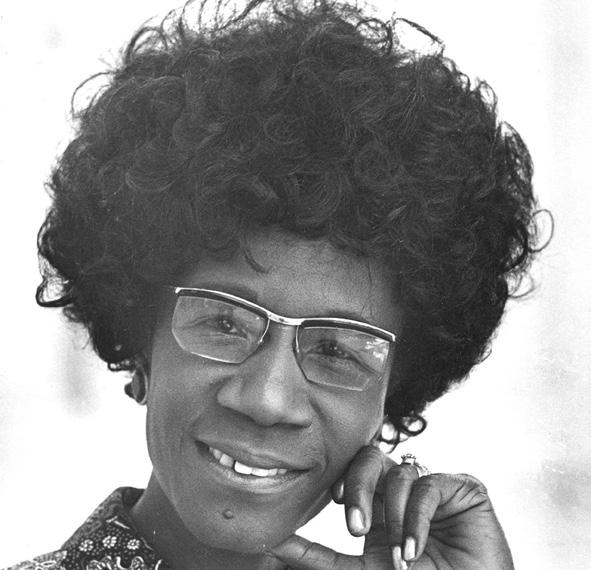
Shirley Anita St. Hill Chisholm was the first African American woman in Congress (1968) and the first woman and African American to seek the nomination for president of the United States from one of the two major political parties (1972). Her motto and title of her autobiography—Unbought and Unbossed—illustrates her outspoken advocacy for women and minorities during her seven terms in the U.S. House of Representatives.
Born in Brooklyn, New York, on November 30, 1924, Chisholm was the oldest of four daughters to immigrant parents Charles St. Hill, a factory worker from Guyana, and Ruby Seale St. Hill, a seamstress from Barbados. She graduated from Brooklyn Girls’ High in 1942 and from Brooklyn College cum laude in 1946, where she won prizes on the debate team. Although professors encouraged her to consider a political career, she replied that she faced a “double handicap” as both Black and female.
Initially, Chisholm worked as a nursery school teacher. In 1949, she married Conrad Q. Chisholm, a private investigator (they divorced in 1977). She earned a master’s degree from Columbia University in early childhood education in 1951. By 1960, she was a consultant to the New York City Division of Day Care. Ever aware of racial and gender inequality, she joined local chapters of the League of Women Voters, the National Association for the Advancement of Colored People (NAACP), the Urban League, as well as the Democratic Party club in Bedford-Stuyvesant, Brooklyn.
In 1964, Chisholm ran for and became the second African American in the New York State Legislature. After court-ordered redistricting created a new, heavily Democratic, district in her neighborhood, in 1968 Chisholm sought—and won—a seat in Congress. There, “Fighting Shirley” introduced more than 50 pieces of legislation and championed racial and gender equality, the plight of the poor, and ending the Vietnam War. She was a co-founder of the National Women’s Political Caucus in 1971, and in 1977 became the first Black woman and second woman ever to serve on the powerful House Rules Committee. That year she married Arthur Hardwick Jr., a New York State legislator.
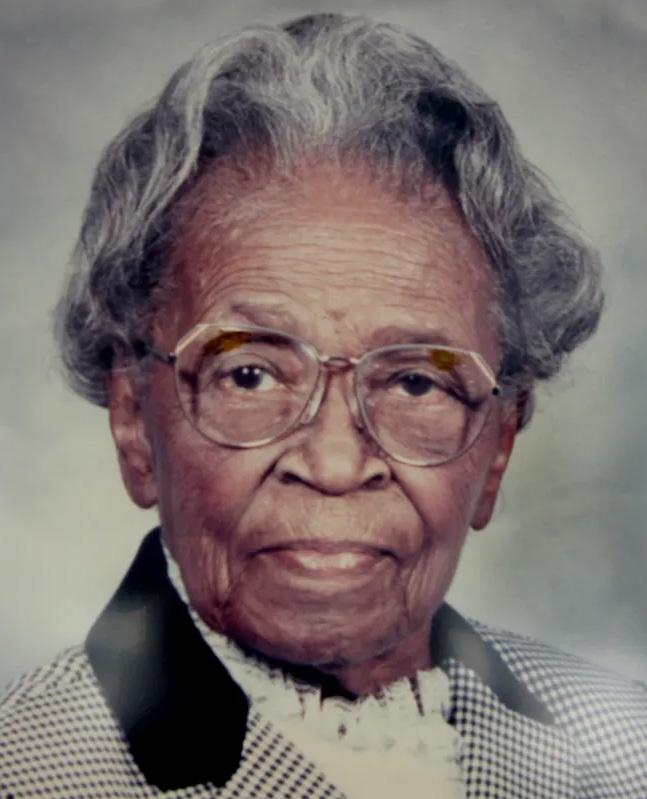
Not too long ago off highway 45 in Pineville South Carolina, a rural place tucked into the lower part of the state, stood a small weathered structure. Had the landscape been lusher, the building might have slipped by as another forsaken place among the thousands lining America’s roads.
But, on this rural stretch of road, where civilization seems far away, the structure had asserted itself: the white concrete slabs stood out from the trees and the varying shades of browns and greens that colored the open land. Its façade once crawled with moss and decay, hid the roofless interior. Inside walls had collapsed and door-less doorways led to small rooms where the earth had swallowed the floor and turned the tile to mud.
But, under the brightness of a southern sky among the decay, one could see small remnants of what used to be: the clinic of nurse-midwife Maude Evelyn Callen.
Born in Quincy, Florida in 1898, Callen was one of thirteen girls. Just six years into her life, she was orphaned and taken in by her uncle, Dr. William Gunn, Tallahasee’s first black doctor. From a young age, Callen often helped her uncle, who encouraged his young niece, eventually inspiring her to pursue a medical career. After high school, she graduated from Florida A & M University and continued her education at Tuskegee Institute in Alabama where she earned a nursing degree.
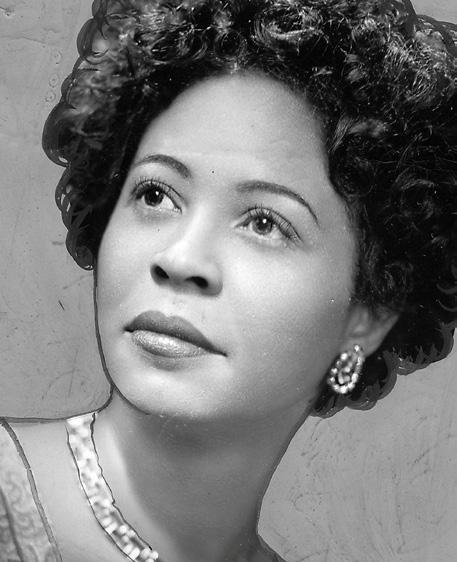
Daisy Gatson Bates (1914-1999). Born in Huttig, Arkansas. She married journalist Lucious Christopher Bates and they operated a weekly African-American newspaper, the Arkansas State Press. Bates became president of the Arkansas chapter of the NAACP and played a crucial role in the fight against segregation, which she documented in her book The Long Shadow of Little Rock. Civil rights activist, writer, publisher. Born Daisy Lee Gatson on November 11, 1914, in Huttig, Arkansas. Bates’s childhood was marked by tragedy. Her mother was sexually assaulted and murdered by three white men and her father left her. She was raised by friends of the family.
As a teenager, Bates met Lucious Christopher “L.C.” Bates, an insurance agent and an experienced journalist. The couple married in the early 1940s and moved to Little Rock, Arkansas. Together they operated the Arkansas State Press, a weekly African-American newspaper. The paper championed civil rights, and Bates joined in the civil rights movement. She became the president of Arkansas chapter of the National Association for Advancement of Colored People (NAACP) in 1952. As the head of the NAACP’s Arkansas branch, Bates played a crucial role in the fight against segregation. In 1954, the United States Supreme Court declared that school segregation was unconstitutional in the landmark case known as Brown v. Board of Education. Even after that ruling, African American students who tried to enroll in white schools were turned away in Arkansas. Bates and her husband chronicled this battle in their newspaper.

Being handpicked to be one of three black students to integrate West Virginia’s graduate schools is something that many people would consider one of their life’s most notable moments, but it’s just one of several breakthroughs that have marked Katherine Johnson’s long and remarkable life. Born in White Sulphur Springs, West Virginia, in 1918, her intense curiosity and brilliance with numbers vaulted her ahead several grades in school. By 13, she was attending the high school on the campus of historically black West Virginia State College. At 18, she enrolled in the college itself, where she made quick work of the school’s math curriculum and found a mentor in math professor W. W. Schieffelin Claytor, the third African American to earn a PhD in mathematics. She graduated with highest honors in 1937 and took a job teaching at a black public school in Virginia.
When West Virginia decided to quietly integrate its graduate schools in 1939, West Virginia State’s president, Dr. John W. Davis, selected her and two men to be the first black students offered spots at the state’s flagship school, West Virginia University. She left her teaching job and enrolled in the graduate math program. At the end of the first session, however, she decided to leave school to start a family with her first husband, James Goble.
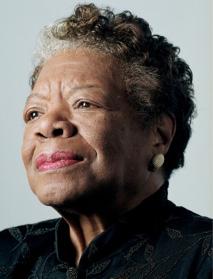
We received the sad news this morning that Maya Angelou, Reynolds Professor of American Studies, has passed away at the age of 86. There is a very nice remembrance website and guestbook, which I commend to you.
Much will be written about this remarkable woman in the coming days, and we’ll let the experts reflect on her life, her contributions to literature and civil rights and public life. I will share a couple of recollections here.
She taught a poetry class here at Wake. It was taught in her home. I did not take the class, but for the students I knew who did, they said it was one of the most amazing experiences of their lives. Can you even imagine being 18 or 20, an earnest student of literature, having an author of that stature teaching you, reading poetry, discussing? It would have been amazing. My Wake friends on Facebook and Twitter have been posting their pictures of class and their remembrances of Dr. Angelou. They are all quite moving reflections.
by Jisu Sheen
By Nedra Glover Tawwab Tarcher Penguin Random House
Feb. 10, 2026
In 2021, givers of the world took a stand. Therapist and social media video creator Nedra Glover Tawwab had just published Set Boundaries, Find Peace: A Guide to Reclaiming Yourself. It rose to the top of bestseller lists as her readers learned how to do just that. They learned how to identify when they were stretched too thin, and how to say that fundamental word: No.
Two years later, Tawwab published Drama Free: A Guide to Managing Unhealthy Family Relationships, tightening her focus on the family.
Now Tawwab seems to be looking toward the other side of the path she’s made so much headway on. She’s refocusing on the value of relationships and interdependence. At the same time, she’s not saying “never mind” to all the boundary skills. She’s simply asking readers to strike a balance.
Her new book The Balancing Act: Creating Healthy Dependency and Connection Without Losing Yourself takes readers through the dangers of being too independent (even if that danger is as ordinary as living a harder life) and the psychological myths that might contribute to that state of mind. Tawwab tells harsh truths in her straightfoward, compassionate style and provides a multitude of examples for readers to ponder.
The first few words of the book’s subtitle, “Creating Healthy Dependency,” are a phrase that might have frightened readers, if not for Tawwab’s five-plus years establishing a standing as someone firmly committed to self-determination.
For those who just started establishing

boundaries when Tawwab published Set Boundaries, Find Peace in 2021, the time may be ripe for a re-evaluation of what it means to depend on others. It’s actually all right to request help, it turns out. And it’s an art.
Is that person actually available?
Will you be all right if they say no, or have you waited so long your alternatives have grown thin?
Will they appreciate the chance to hold you in a vulnerable moment?
These are some of the thoughts Tawwab asks the reader to consider.
The Balancing Act hits all the likely themes in the therapeutic zeitgeist: attachment theory, codependency, even Internal Family Systems, or IFS (a therapy technique that came under controversy
in October for allegations of inappropriate conduct at the IFS-based Castlewood Treatment Center, which prompted a response from the IFS Institute emphasizing, among other details, that IFS founder Richard Schwartz and Castlewood director Mark Schwartz are not the same person).
Throughout it all, Tawwab keeps it relevant. Even people who’ve seen a thousand infographics on, say, enmeshment—a type of relationship with a high level of coordination and low tolerance for autonomy—might find something new in Tawwab’s take on these topics. She tells stories of how these patterns look in the world and offers concrete examples of how to address them.
I approached Tawwab’s chapter “The Hyper-Independent Person and Relationships” like a kid white-knuckling the big
rollercoaster at the theme park. I knew it wouldn’t be the smoothest ride, but I was already buckled in for the ride.
Over the past several years, I slowly learned how to say no to others. I came to feel like a semi-pro, at least compared to before. Little did I know my comfortwith-No journey was only half complete. When I sidestep help from others and try to do everything in my own secret ways, part of that, I realize now, is because it’s hard to open myself up to a possible No. Love yourself and know this, Tawwab writes at the end of the chapter. Then she breaks it down to three bullet points:
• Self-love is not a kind of armor for avoiding problematic situations with others.
• Compromise is necessary and is a valuable part of loving both yourself and others.
-
• You need love from others in addition to self-love.
Ouch.
Even while reading Tawwab’s words, I felt myself resisting. What about things that are just easier to do alone? What if there are things no one can properly hold you through? What if, with enough determination, you really can do it all?
Now, after some time has passed, I’m ready to admit the protests were a bit hasty. Acknowledge That You’ve Been Hurt and Try Again, Tawwab titles one of her sections. She writes that by calmly addressing situations of disappointment (rather than letting them pass), you can leave them in the past and not “carry that hurt into other dynamics.”
For people who aren’t used to asking for help, Tawwab offers a couple key pointers. First, she says, make sure your request is clear and direct, even if it feels obvious to you. Second, try to choose the “right person to do the right task.” Consider their skills, limitations, willingness, and previous actions.
I’m trying! In one month, after 11 years in New Haven, I’m moving to Gwangju, South Korea and will continue arts reporting there. At exactly the least convenient time, I’m producing a limited series zero-budget kids’ public access TV show here in New Haven that requires a multi-person crew to film. These days, I’m asking for things all the time.
Tawwab’s book has been helping me. I ask my friend who likes camera work to operate one of the camera angles. I ask another friend who works in audio to run sound. When someone on crew can’t make the shoot, that’s OK. I can ask someone else. And when someone offers a hand, even if I don’t know them well, I’m able to separate out what is the actual task they are proposing and how feasible that is. My comfort with No opens me up to the possibility of Yes.
By Courtesy of HBCUNEWS.com
The Chicago Cubs announced Tuesday that the first-ever Chicago HBCU Baseball Classic will be hosted at Wrigley Field later this spring.
The game will feature Historically Black Colleges and Universities (HBCU’s) Prairie View A&M University and Alabama A&M University, who will play after a Cubs game in early May, according to organizers.
“Our mission is to elevate the next generation of talent and expand opportunity in Black baseball. With the support of the Chicago Cubs, bringing this Clas-
sic to Wrigley Field allows us to build a baseball tradition that mirrors the decades-long impact of the Chicago Football Classic — ensuring HBCUs remain a vibrant part of Chicago’s sports DNA,” said Earnest Horton, CEO of Black Baseball Media and organizer of the Classic, in a statement.
According to officials, the game will feature marching band performances and other celebrations of HBCU traditions, as well as other fan activations.
Chicago Mayor Brandon Johnson was among the dignitaries to celebrate the announcement of the game.
“The first-ever HBCU game at Wrigley

Field is a historic milestone for Chicago and for the future of baseball,” he said in a statement. “Wrigley Field is the only ballpark where Jackie Robinson played that still stands today, making it a powerful place to write the next chapter of Black baseball history. This event honors the legacy of African Americans in the sport while inspiring young people across our city to see themselves in baseball, in higher education, and in leadership.”
The game will be played on the evening of Saturday, May 2, following the conclusion of an earlier game between the Cubs and Arizona Diamondbacks at the Friendly Confines.






By Atlanta Daily World
Atlanta Daily World stands as the first Black daily publication in America. Started in 1927 by Morehouse College graduate W.A. Scott. Currently owned by Real Times Media, ADW is one of the most influential Black newspapers in the nation. As the Trump Administration reamins heavily focused on military action in Iran, following reports of a massive U.S.-Israeli strike and the death of Iran’s supreme leader, Ayatollah Ali Khamenei, Trump is gearing up for more major combat operations in Iran.
On February 28, U.S. and Israeli forces launched coordinated strikes described by Israeli officials aimed at forcing a regime hange in the Middle Eastern nation. Explosions have been reported in vast parts of the country since Saturday morning, with 24 of Iran’s 31 provinces being hit, according to a spokesman for the Iranian Red Crescent who was quoted by local media.

On Saturday, Sen. Raphael Warnock said in a statement on Facebook: No president has the right to drag the nation into war like this alone. The American people deserve a voice.
Congress must return immediately to vote on this war.
God bless our troops as they keep their oath. We, the people’s elected representatives, must keep ours.
Americans have long been weary of forever wars in the Middle East and the painful lessons that should have already been learned.
The Trump administration’s dramatic and deadly escalation in Iran risks yet another sad chapter of decades-long entanglements. Given the lack of a clear plan, it risks increased instability in the region while endangering American troops and harming America’s national security.
A wider regional conflict would not make us safer, it would increase instabili-
ty and uncertainty at a moment when our focus should be on the pressing problems we face at home.
Let’s be clear: the Iranian regime is brutal and destabilizing. It cannot be allowed to obtain a nuclear weapon. But the President has not explained why diplomatic talks that were underway this week are no longer viable and diplomacy no longer available. Instead, he has said in word and deed that this is war, a power that the constitution reserves for Congress alone. The United States of America is a democracy and no President has the right to declare war or to drag the nation into war. Congress should return to session immediately to debate the use of force as is our solemn duty. The American people deserve answers and a voice through their elected representatives.
God bless our troops as they keep their oath. We, the people’s elected representatives must keep ours. I pray for peace.
… history provides a framework for understanding what happened
By Fred Redmond, Secretary Treasurer AFL-CIO
In 1917, A. Philip Randolph and Chandler Owen launched The Messenger, a pro-labor, anti-war magazine that connected racism to exploitation and demanded justice for Black workers. Two years later, the federal government responded with tactics of targeted censorship—surveillance, harassment and threats of prosecution—and branded a small Black labor magazine “the most dangerous” publication in the country simply for encouraging Black workers to organize.
ering a protest inside a church opposing U.S. Immigration and Customs Enforcement activity in the area. The message was unmistakable: documenting dissent can itself be treated as a crim apparatus built to monitor and suppress Black labor dissent. The same government that denied Black people their history also treated them as a threat when they spoke collectively as workers. When Black workers asserted their right to organize and be heard, they faced not just employer retaliation, but state repression. Randolph went on to organize the Brotherhood of Sleeping Car Porters, the first major Black-led union, and was under constant federal surveillance. As Black workers organized in factories, on farms and in service jobs across the country, local police and FBI “Red Squads” and federal counterintelligence programs infiltrated meetings, built massive files, and worked to neutralize leaders who linked racial justice to workplace democracy.
More than a century later, two highly respected Black journalists—Don Lemon and Georgia Fort—are handcuffed and indicted for filming a protest inside a church. The tools have changed, but the oppressive government playbook has not. That continuity matters as we mark 100 years since the launch of Negro History Week, founded in February 1926 by Carter G. Woodson. Negro History Week rejected the lie that Black people had no history worth teaching and no role worth remembering. It challenged an education system that erased Black achievement and a public narrative that treated Black people as a problem, not a people. What later became Black History Month grew from that project of memory and resistance. From its earliest days, Black history celebrations were about more than remembrance. They also were acts of resistance, challenging the ongoing use of law, fear and surveillance to silence Black workers and suppress the truth about power in this country.
That pairing matters: The birth of Negro History Week alongside the rise of an
That history provides a framework for understanding what happened in Minnesota this January, when Black journalists Don Lemon and Georgia Fort were arrested after covering a protest inside a church opposing U.S. Immigration and Customs Enforcement activity in the area. The message was unmistakable: documenting dissent can itself be treated as a crime.
At the same time, major media outlets are shrinking their newsrooms and walking away from race coverage. The Washington Post recently laid off some 300 journalists, including race and ethnicity reporters. In late 2025, NBC News shuttered entire teams dedicated to covering Black, Latino and Asian American, Native Hawaiian and Pacific Islander stories. In Pittsburgh, the 240 year old Post Gazette is being shut down by its owners, who responded to a court order requiring them to honor The NewsGuild CWA (TNG-CWA) journalists’ contract after years of striking. When powerful news-

rooms dismantle the very beats created after 2020 to cover racism and inequality, they send a different version of the same message: some truths about power are no longer welcome.
The National Writers Union said the arrests “set a disastrous precedent for press freedom in the United States,” and
the National Association of Black Journalists called on the government to “halt all retaliatory posture toward journalists.”
SAG AFTRA has condemned the arrests of Fort and Lemon, a member, and unions like TNG CWA are warning that union busting, mass layoffs, and criminal charges against journalists are part of
the same effort to make it dangerous for workers to tell the truth.
This Black History Month, the labor movement must be clear: the right to organize and the right to dissent stand or fall together. There is no freedom of association if workers cannot gather, speak and be heard. When Black journalists are criminalized for documenting protest, the real target is the possibility of multiracial worker power. If true worker power and economic dignity are to have a future, it will be because the labor movement continues to refuse that silence.
The AFL-CIO recognizes that the same tactics used to quash Black voices are used to suppress all our voices—on shop floors, in independent media, in the streets, on picket lines and in places of worship. We stand with our union brothers, sisters and siblings in insisting that the First Amendment is a right and a core worker protection, not a luxury.
A century ago, Woodson insisted that Black people had a history worth telling and Randolph told Black workers they deserved more than exploitation. The government tried to silence them. This Black History Month, the question remains the same: Will Black truth tellers be honored or handcuffed?
The labor movement’s answer must be clear. We stand with Black workers and Black journalists in their right to dissent, to document, and to demand a better future.
Fred Redmond, the highest-ranking African American labor official in history, is the secretary-treasurer of the AFL-CIO, the nation’s largest labor federation, representing 64 unions and nearly 15 million workers.















The leadership of Barbara Jordan, Eddie Bernice Johnson, and Sheila Jackson Lee shaped a tradition now poised to reach the U.S. Senate
By Glynda C. Carr
With less than a week to go before the Democratic primary, all eyes are on Texas. Voters have a real chance to make history.
The Texas Senate race is capturing national attention, and momentum is shifting. Congresswoman Jasmine Crockett is now leading in multiple public polls as she seeks the Democratic nomination. A new University of Texas Politics Project poll shows her with a double-digit advantage, 56 percent to 44 percent, over her opponent James Talarico. Earlier polling from the University of Houston showed her leading by eight points. In January, the race was neck and neck. The numbers show movement.
But this final week will determine whether that momentum carries across the finish line.
The stakes are evident in how Republicans are responding. Governor Greg Abbott has spent more than three million dollars on attack ads featuring Representative Crockett, attempting to galvanize Republican turnout and frame her as a general election target. His top strategist summed up the message plainly: vote Republican or get Crockett.
When the governor of Texas spends millions to elevate and attack a Democratic primary candidate, it tells you something. They see her strength. They see her potential. They are preparing for November. Meanwhile, her opponent holds a financial advantage and has outspent her on advertising. We have seen this before. Black women candidates are often told that the math will not work in their favor, that resources will determine the outcome. Yet

through.
Congresswoman Jasmine Crockett’s decision to run for the United States Senate is rooted in a powerful Texas tradition of Black women’s leadership. If elected, she would become Texas’s first Black woman
U.S. Senator and the first Black woman elected to the U. S. Senate from a Southern state. That milestone reflects both the legacy she carries forward and the urgency of this moment. As the saying goes, everything is bigger in Texas, including the stakes for democracy.
Texas has long produced Black wom-
en leaders who shaped national debates and expanded what was possible in public life. Barbara Jordan’s moral clarity and constitutional command during the Watergate era set a national standard for principled leadership. Eddie Bernice Johnson, the predecessor to the seat Representative Crockett now holds, spent decades advancing science, education, and equity while opening doors for generations. Sheila Jackson Lee’s nearly three decades in Congress were defined by relentless advocacy for civil rights, criminal justice reform, and disaster relief, ensuring Houston and communities across Texas were never ignored on the national
stage. Their leadership was substantive, disciplined, and transformative. Jasmine Crockett stands firmly in that lineage. Her candidacy arrives during a defining election cycle. In 2026, as many as five Black women are running for the U.S. Senate, an unprecedented moment in American politics. Only five Black women have ever served in the Senate. Today, Senators Angela Alsobrooks and Lisa Blunt Rochester serve concurrently for the first time in history. Even one additional victory would set a new record. Representation shapes outcomes. Diverse decision-making tables lead to stronger, more inclusive policies. When
Black women lead, economic security, access to health care, quality education, reproductive freedom, and accountable governance rise to the forefront. These are not niche concerns. They are the foundation of thriving communities and a resilient democracy.
Jasmine Crockett’s record reflects that understanding. In Congress, she has built a reputation as a relentless advocate for working families, seniors, labor, and communities too often pushed to the margins. She has served at both the state and federal levels, and as an attorney, she brings discipline and clarity to the work of governing. Her leadership reflects the seriousness that defined Barbara Jordan, the persistence that characterized Eddie Bernice Johnson’s decades of service, and the tenacity that marked Sheila Jackson Lee’s fearless advocacy.
Jasmine Crockett’s Senate run represents more than a campaign. It represents continuity and change. It carries forward the legacy of Barbara Jordan, Eddie Bernice Johnson, and Sheila Jackson Lee, and it signals that Black women’s leadership in Texas is not an exception but a defining force.
With less than a week to go, the momentum is real. The path is clear. And Texas has the chance to make history.
Glynda C. Carr is President & CEO of Higher Heights for America PAC, that endorses and provides strategic support to Black women candidates who advance public policy to improve the lives of Black people and strengthen American democracy.
For additional information visit: www.higherheightsforamericapac.org.
By Vern Anthony, BSN, MPH, Guest Columnist
Black History Month calls us not only to remember the past, but to confront how that past continues to shape the lives of Black mothers and babies today. In maternal health, that history is both painful and powerful.
An important and often overlooked figure in maternal health history is Anarcha Westcott. Enslaved and only 17 years old, Anarcha endured a traumatic childbirth that resulted in the death of her baby and severe injury. She was later subjected to repeated experimental surgeries by J. Marion Sims, without consent or anesthesia. These procedures were used to refine surgical techniques and instruments for white women, including versions of the speculum still used today.
At the time, a dangerous and false belief persisted that Black people did not feel pain the same way white people did. Surgeries performed on white women were done with anesthesia, while Black women were denied it. Though medicine has advanced, research shows bias in pain assessment and treatment persists. The
legacy of that injustice is not distant history; it echoes in today’s maternal health disparities.
Black history in maternal health is not defined solely by exploitation. It is also defined by extraordinary leadership and service. Women like Maude Callen, served rural South Carolina for more than 60 years, delivering thousands of babies and training other midwives; Mary Francis Hill Coley, a Georgia midwife delivered more than 3,000 babies; and Biddy Mason, born into slavery and later a respected nurse and midwife in Los Angeles, provided free care to the poor. These women built systems of care rooted in dignity, trust and community, principles that remainessential today.
In Michigan, progress is measurable. The state recently reported the lowest recorded infant mortality rate in its history.
In 2023, 607 infants under age 1 died, and the rate declined to 6.1 deaths per 1,000 live births, down from 6.3 the year before.
Deaths among Black infants also fell to a record low of 11.9 per 1,000 live births, down from 14.1 in 2022.
Yet the reality remains stark: Black infants in Michigan still die at nearly three

times the rate of white infants. Nationally, according to 2023 data from the CDC’s National Vital Statistics System, Black women had a mortality rate of 50.3 deaths per 100,000 live births — more than three times the rate for white women (14.5).
It is impossible to improve maternal health without acknowledging this history. It is equally impossible to move forward without intentionally dismantling the inequities rooted in it.
This is where the mission of the Southeast Michigan Perinatal Quality Improvement Coalition (SEMPQIC) becomes vital. The coalition works to reduce disparities in adverse maternal, perinataland infant outcomes by building a coordinated, equitable network for perinatal care across southeast Michigan.
SEMPQIC partners to increase access to doulas, a resource shown to improve birth outcomes, particularly for Black mothers. It also works with the Michigan Health and Hospital Association, supporting 23 birthing hospitals in Wayne, Oakland and Macomb counties in efforts to reduce maternal morbidity and mortality. More than 600 participants have completed its health equity and implicit bias trainings, and its outreach has included vaccine education for expectant mothers.
We stand on the shoulders of giants. Honoring them means more than telling their stories. It means dismantling inequities and carrying forward their commitment
This Black History Month, we honor Anarcha, Maude, Mary and Biddy not only with remembrance, but with action. By committing to equity in maternal and infant health, we ensure the next chapter of this history is defined not by disparity, but by dignity, justice and healthy beginnings for all.
Vern Anthony, BSN, MPH, lead consultant with the Southeast Michigan Perinatal Quality Improvement Coalition (SEMPQIC), brings years of executive and board leadership experience and a proven track record in health policy development, collaborative health care solutions, community health impact strategies, access-to-care models and health-related business initiatives. She has received numerous honors for her leadership and community service, including Distinguished Alumni Awards from Wayne State University and the University of Michigan School of Public Health. Most recently, she was recognized as a “Distinguished Warrior” by the Detroit Urban League and inducted into the Michigan Women’s Hall of Fame.

UNION CONTRACTOR SEEKS:
Construction Equipment Mechanic
(preferably experienced in Reclaiming and Road Milling Equipment) We offer factory training on equipment we operate. Job is in Bloomfield, CT.
Contact: Tom Dunay Phone: 860-243-2300 Ext. 122
Email: tom.dunay@garrityasphalt.com
Reclaimer Operators and Milling Operators
(must have current licensing and a clean driving record; be willing to travel throughout the Northeast & NY)
Contact: Rick Tousignant Phone: 860-243-2300 Ext. 133
Email: rick.tousignant@garrityasphalt.com
Tractor Trailer Driver for Heavy & Highway
Construction Equipment
(must have a class A CDL license with Tank Endorsement and a clean driving record; be capable of operating heavy equipment and willing to travel throughout the Northeast and NY)
Contact: Brian McKee Phone: 860-558-6189
Email: bmckee@garrityasphalt.com
• We offer Excellent hourly rates and benefits.
• Women and Minority Applicants are encouraged to apply.
• Affirmative Action / Equal Opportunity Employer
The Town of Wallingford is accepting applications for Firefighter/ Paramedic. Wages: $1,273.03 to $1,627.96 weekly. For additional information and to apply online by the March 17, 2026 closing date please visit: www.wallingfordct.gov/government/departments/human-resources/. Applications are also available at the Department of Human Resources located in Room #301 of the Town Hall, 45 South Main Street, Wallingford, CT 06492. Phone: (203) 294-2080; Fax: (203) 294-2084. EOE

The State of Connecticut, Office of Policy and Management is recruiting for a Rural Health Transformation Policy Development Coordinator

Location: Galasso Materials LLC, East Granby, CT
Employment Type: Full-Time
Industry: Asphalt Paving & Aggregate Materials


We are seeking an experienced and motivated Construction Sales Manager to lead and grow our asphalt paving and aggregate materials sales operations. This role requires a strong blend of construction knowledge, sales expertise, estimating skills, and project coordination. The ideal candidate will understand paving operations, build strong customer relationships, and work collaboratively with internal teams to deliver successful projects from bid through completion.
• Develop and manage sales for asphalt, aggregate, and paving services across commercial, municipal, and private-sector clients
• Build and maintain long-term relationships with customers, contractors, municipalities, and developers
• Prepare and review job estimates, bids, and proposals, including quantity take-offs and pricing
• Collaborate closely with operations, plant staff, and project managers to ensure accurate scope, scheduling, and execution
• Provide outstanding customer service throughout the sales and project lifecycle
• Support project management efforts, including job start-up coordination, scope clarification, job cost tracking, billing and change management
• Track market conditions, competitor pricing, and sales opportunities
• Meet or exceed established sales and revenue goals
• Communicate with Accounts Receivable staff to ensure invoices are paid to Galasso
• Proven management experience in asphalt paving, aggregate materials, or heavy civil construction
• Strong background in construction sales, estimating, or project management
• Solid understanding of paving methods, materials, and construction sequencing
• Ability to read plans, perform quantity take-offs, and develop competitive bids
• Excellent communication, negotiation, and relationship-building skills
• Strong teamwork mindset with the ability to collaborate across departments
• Highly organized with the ability to manage multiple projects and deadlines
• Proficiency with estimating software, spreadsheets, and CRM tools preferred
• Competitive salary with performance-based incentives
• Company vehicle or vehicle allowance (if applicable)
• Health, dental, and retirement benefits
• Stable, well-established company with growth opportunities
• Collaborative team environment with hands-on leadership
Please submit your resume and a brief cover letter outlining your experience in construction sales, paving, or materials supply.
To Apply: Please send your resume and a brief cover letter to KLamontagne@galassomaterials.com
Galasso Materials LLC is committed to creating an inclusive environment for all employees and encourages applications from all qualified individuals. We are an affirmative action equal-opportunity employer.
The Town of Wallingford is accepting applications for Attendant II. Wages: $32.34 to $38.04 hourly. For additional information and to apply online by the February 17, 2026 closing date please visit: www.wallingfordct.gov/government/departments/human-resources/. Applications are also available at the Department of Human Resources located in Room #301 of the Town Hall, 45 South Main Street, Wallingford, CT 06492. Phone: (203) 294-2080; Fax: (203) 294-2084. EOE
360 Management is currently seeking bids from qualified contractors to perform Elevator Service . A complete copy of the requirement may be obtained from Elm City’s Vendor Collaboration Portal https://newhavenhousing.cobblestonesystems.com/gateway beginning on
March 3, 2026, at 3:00PM.

The State of Connecticut, Office of Policy and Management is recruiting for a Planning Analyst and a GIS Analyst (Research Analyst) in the Intergovernmental Policy and Planning and the Data and Policy Analytics divisions. Further information regarding the duties, eligibility requirements and application instructions are available at: https://www.jobapscloud.com/CT/sup/ bulpreview.asp?b=&R1=260108&R2=6297AR&R3=001 and https://www.jobapscloud.com/CT/sup/ bulpreview.asp?b=&R1=260108&R2=6855AR&R3=001
The State of Connecticut is an equal opportunity/affirmative action employer and strongly encourages the applications of women, minorities, and persons with disabilities.


The Town of Wallingford is accepting applications for Attendant II. Wages: $70,852 to $89,755 annually. For additional information and to apply online by the March 22, 2026 closing date please visit: www. wallingfordct.gov/government/departments/human-resources/. Applications are also available at the Department of Human Resources located in Room #301 of the Town Hall, 45 South Main Street, Wallingford, CT 06492. Phone: (203) 294-2080; Fax: (203) 294-2084. EOE
Opening for a Class A full time driver for petroleum/asphalt/like products deliveries for nights and weekends. Previous experience required. Competitive wage, 401 (k) and benefits. Send resume to: HR Manager, P. O. Box 388, Guilford, CT 06437 or email: hrdept@eastriverenergy.com
***An Affirmative Action/Equal Opportunity Employer, Including Disabled & Veterans***
According to (24 CFR 960.253(b) Notice PIH 2022-33 (HA), and Section 6 III (D) - Flat Rent of ECC/HANH’s Admissions & Continued Occupancy Policy (ACOP) ECC/HANH must establish a schedule of flat rents annually and give families a choice of flat rent or income-based rent and provide families with information on how to choose the rent.
The thirty (30) days comment period begins on Sunday, February 1, 2026, and ends on Monday, March 2, 2026.
Copies of the Flat Rent schedule 2026 will be made available on the agency website www.elmcitycommunities.org or via Facebook www.facebook.com/ElmCityCommunities and all LIPH Property Management offices.
You are invited to provide written comments to: ECC/HANH Flat Rent Schedule 2026, Attn: Tim Regan, 360 Orange Street, New Haven, CT 06511 or via email to: tregan@ elmcitycommunities.org.
A public hearing where public comments will also be accepted and recorded is scheduled for Tuesday, February 26, 2026, at 2:00 PM via Teams
Microsoft Teams meeting Join: https://teams.microsoft.com/meet/29279097163113?p=BXcmU1DGnV1Rh6B6JR
Meeting ID: 292 790 971 631 13 Passcode: mz7Fk2Y4
Location: Galasso Materials LLC, East Granby, CT
Employment Type: Full-Time
Industry: Asphalt Paving & Trucking Operations
Position Summary
We are seeking a detail-oriented and experienced Paving / Trucking Project Manager to oversee paving operations and trucking logistics. This role is critical to maximizing production eficiency, managing trucking resources, controlling job costs, and maintaining a strong safety culture. The ideal candidate has hands-on paving and trucking experience and thrives in a fast-paced, team-driven construction environment.
Paving & Production Management
• Track and analyze paving eficiencies, including crew production rates, equipment utilization, and daily output
• Work closely with paving superintendents and foremen to identify opportunities for improved productivity
• Support planning and execution of paving operations to meet schedule and quality goals
Trucking & Logistics Management
• Track and analyze trucking eficiencies, including cycle times, haul distances, and truck utilization
• Schedule and manage subcontracted trucking, ensuring adequate coverage and compliance with project needs
• Coordinate daily trucking plans with plants, paving crews, and project stakeholders
Permits & Compliance
• Obtain and manage overweight and special haul permits as required for trucking operations
• Ensure compliance with state and local transportation regulations
• Maintain proper documentation related to trucking operations and permits
Job Cost & Financial Management
• Monitor job costs related to paving and trucking operations
• Compare production and trucking performance against budgets and estimates
• Identify cost overruns early and work with management to implement corrective actions
Safety Management
• Promote and enforce trucking safety policies and procedures
• Coordinate with drivers and subcontractors to ensure compliance with company and DOT safety requirements
• Support safety meetings, incident investigations, and corrective action implementation
Qualifications
• Experience in asphalt paving operations and/or construction trucking management
• Strong understanding of paving production, trucking logistics, and haul operations
• Familiarity with DOT regulations, overweight permitting, and trucking safety standards
• Proven ability to track eficiencies and manage production data
• Strong organizational, communication, and problem-solving skills
• Ability to work collaboratively with operations, dispatch, and management teams
• Proficiency with spreadsheets, production tracking tools, and construction management software preferred
What We Ofer
• Competitive salary based on experience
• Company vehicle for work use and travel to/from home
• Health, dental, and retirement benefits
• Stable, well-established company with long-term growth opportunities
• Hands-on role with direct impact on operational performance
Please submit your resume and a brief cover letter outlining your experience in paving, trucking operations, or construction project management
To Apply: Please send your resume and a brief cover letter to KLamontagne@galassomaterials.com
creating an

The State of Connecticut, Office of Policy and Management is recruiting for an Open Data Analyst (Research Analyst) in the Data and Policy Analytics division. Further information regarding the duties, eligibility requirements and application instructions are available at: https://www.jobapscloud.com/CT/ sup/bulpreview.asp?b=&R1= 251222&R2=6855AR&R3=001
The State of Connecticut is an equal opportunity/ affirmative action employer and strongly encourages the applications of women, minorities & persons with disabilities.

$78,813/yr. Required testing,

Invitation to Bid: Haynes has been awarded:
129 Whalley Ave
New Haven, CT
Demolition of existing 1-story building New Construction of One 5-Story Mixed Use Bldg | 49 Units
Project Documents include but not limited to: Structural demolition, site-work, asbestos roofing removal, lead abatement, concrete, gypsum cement underlayment, masonry, structural steel, misc. metals, wood trusses, rough & finish carpentry labor and material, EPDM, waterproofing, insulation, composite material wall panels, firestopping, doors, frames and hardware, vinyl windows, glazing, storefronts, gypsum board, acoustical ceilings; flooring, painting, signage, toilet & bath accessories, postal specialties, residential appliances, window blinds, casework and countertops, bicycle racks, entrance floor mats and frames, elevators, facility chutes, fire suppression, plumbing, HVAC, electrical, paving, landscaping, fencing, final cleaning and sanitary facilities
This contract is subject to state set-aside and contract compliance requirements, as well as, LCP Tracker, HUD Section 3 Reporting, City of New Haven Hiring Requirements (CEO/ SBA), CHFA Reporting and Section 3 Self Certification and 12 ½ % & 12 ¼ % City of New Haven Ordinances.
State law requires a minimum of twenty-five (25%) percent of the state-funded portion of the contract awarded to subcontractors holding current certification from the Connecticut Depart of Administrative Services (“DAS”) under the provisions of CONN. GEN. STAT § 4a-60g
(25% of the work with DAS certified Small and Minority owned businesses and 25% of that work with DAS certified Minority, Women and/or Disabled owned businesses) The contractor must demonstrate food faith effort to meet the 25% set aside goals.
We are looking for additional pricing to include MWBE and Section 3 subcontractor participation.
Bid Due Date: 2-20-2026 @ 3pm to Jordan Fredericks jfredericks@haynesct.com 203-888-8111
Tax Exempt Project. Prevailing Wage Rate Project: Compliance with the Higher State Prevailing Wage or Davis Bacon Wages will apply.
If you have not already received the ITB, please contact Taylor Els tels@haynesct.com 203-888-8139 and she will send you the ITB with easy access to plans and specifications.
HCC encourages the participation of all Veteran, S/W/MBE & Section 3 Certified Businesses
Haynes Construction Company, 32 Progress Ave, Seymour, CT 06483 AA/EEO EMPLOYER
a quarry and paving contractor, has positions open for the upcoming construction season. We are seeking candidates for a variety of positions, including: Scalehouse Dispatcher/ Equipment Operators and Laborers. NO PHONE CALLS. Please mail resume and cover letter to “Hiring Manager”, Galasso Materials LLC, PO Box 1776, East Granby CT 06026.
Galasso Materials is an Affirmative Action/Equal Opportunity Employer. All applicants will be considered for employment without attention to race, color, religion, sex, orientation, gender identity, national origin, veteran or disability status.
and
The Town of Wallingford is accepting applications for Attendant III. Wages: $36.32 to $41.08 hourly. For additional information and to apply online by the January 27, 2026 closing date please visit: www.wallingfordct.gov/government/departments/human-resources/. Applications are also available at the Department of Human Resources located in Room #301 of the Town Hall, 45 South Main Street, Wallingford, CT 06492. Phone: (203) 294-2080; Fax: (203) 294-2084. EOE
BLACKPRESSUSA NEWSWIRE — I believe in paying it forward, not just within the walls of my school or community, but across the profession. Over the years, I’ve mentored first-year teachers, student teachers, and National Board Certification candidates nationally
By JoMeka Gray
JoMeka Gray is a self-contained Kindergarten teacher at Kennedy-Powell STEM Elementary School in Temple, TX. She is also one of the five educators who received the 2026 Horace Mann Awards for Teaching Excellence from The NEA Foundation.
Growing up in a rural community, I experienced firsthand the barriers that can limit a child’s potential. The lack of broadband internet, access to high-quality instructional materials, or simply the chance to be truly seen and valued, especially when your name or culture doesn’t fit the mold. That only fueled my drive to be the educator I wish I had, to represent and remove barriers for others like me.
As an educator, my mission has always been clear: to ensure every student, regardless of background, ZIP code, or circumstance, has access to a high-quality education. Over the years, that mission has deepened into a full-scale advocacy effort for underrepresented populations. A movement that champions opportunity for students often left behind: military-connected youth, children living in poverty, students with emotional and behavioral needs, and those students historically underrepresented in STEM fields. I see my work as an act of justice, and I know what it is like to rise anyway.
It Takes a Village
To advance that mission, I founded Kennedy-Powell Elementary Stars-Helping-Stars, a campus-based initiative that unites families, staff, and community

partners to pay it forward by supporting students in need. As a National Board Certifiedteacher, I knew the work had to go beyond my classroom. Through this program, we launched projects that addressed both academic growth and human connection:
• Students used STEM skills to create and sell recycled products, raising funds to donate holiday gift cards to their homeless peers.
• Families volunteered as tutors, stepping in where academic support at home was limited. As a result, our campus saw measurable growth in Texas Accountability scores between 2024 and 2025.
• Currently, I collaborate with other educators and community members to “pay it forward” through a monthly Breakfast Club, where students build relationships with local mentors in a safe, affirming space. These moments are givingstudents a sense of belonging and mentors a way to reflect on their impact. What began as a small act of support has grown into a sustainable, community-driven model that meets students where they are—academically, emotionally, and socially—both in and beyond the classroom.
Mentee to Mentor: Passing
the Torch to Next Generation of Educators
I believe in paying it forward, not just within the walls of my school or community, but across the profession. Over the years, I’ve mentored first-year teachers, student teachers, and National Board Certification candidates nationally. Helping educators navigate their early careers and refine their practice has been one of the most rewarding parts of my journey. I take pride in knowing that these are the teachers who will carry the torch forward. Through structured mentorship, reflective practice, and collaborative planning, I’ve watched them grow from uncertain begin-
ners to confident educators shaping lives. I do this work because I remember what it meant to be mentoredmyself. The encouragement, wisdom, and accountability my mentor teachers offered shaped not only my practice but my belief in what’s possible. Their impact still echoes in my classroom today, in how I reflect, how I lead, and how I support others. By paying it forward, I’m honoring their legacy and helping ensure the cycle of support continues for the next generation of educators.
What I Needed Then, I Advocate for Now
I have faced many barriers, as both a student and a teacher, and made it my mission to pay it forward by opening doors for others. I know what it feels like to be unseen, on both sides of the classroom. Opportunity shouldn’t depend on your zip code, your income, or how others perceive your background. It is why I encourage students to connect beyond their world such as zooming with classrooms in Italy. It is why I have championed access to quality instructional materials for all Texas students that are adapted for our high population of Spanish-speaking students. It is why I have advocated for strong teacher training, so every educator is prepared, no matter their path. Every student deserves a strong education. Every teacher deserves real support. And every school deserves a system built for all. When we pay it forward in education, we don’t just change one life; we ignite a ripple that can transform generations.
NNPA NEWSWIRE — The document that could lead to an executive order proposes using the claim that China interfered with the 2020 elections as grounds to “declare a national emergency.” The move would be an unprecedented step that would grant Trump new authority over the voting systems in the U.S.
By Lauren Victoria Burke, NNPA Newswire Correspondent
A group of MAGA pro-Trump activists, who say they are working in coordination with the White House, are circulating a 17-page draft executive order that would claim without evidence that China interfered with the 2020 presidential election. Donald Trump lost the 2020 presidential to President Joe Biden by over 7 million votes. Since Trump lost to Biden in 2020, he has repeatedly claimed that the election was “stolen” without evidence. The report of a group of “Trump allies” preparing an executive order to give Trump power over elections was first reported by The Washington Post. The lies around the right-wing campaign that pushed falsehoods that the 2020 election was stolen was trafficked through right-wing media, particularly Fox News. Fox News was then sued for defamation for the claims by Dominion Voting Systems. Fox lost the case and had to settle for the largest defamation amount on record of $787.5 million in April 2023.

The document that could lead to an executive order proposes using the claim that China interfered with the 2020 elections as grounds to “declare a national
emergency.” The move would be an unprecedented step that would grant Trump new authority over the voting systems in the U.S.
The story in The Washington Post arrives as Trump increasingly signals that he may take actions that would alter the result of the 2026 midterms. The Republicans are widely expected to lose as their approval ratings plummet as a result of a failing economy under Trump. Over 50 members of Congress have announced they will retire this year and not return in 2027.
The Trump Department of Justice, which now has a large image of Trump on the side of it, “sued five new states Thursday [Feb. 26, 2026] demanding access to their unredacted voter rolls — escalating a campaign that has been rejected by multiple federal courts and faces resistance from Republican-led states as well,” according to Democracy Docket, a group that works to protect voting rights.
Trump claimed back in late 2020, the last year of his first term, that he had the authority to issue an executive order related to mail-in voting for the 2020 elections — which he would then lose. But the Constitution states that control of elections lies with the states. As the GOP
works to place hurdles in front of voting, Democrats worked to make voting easier. In March 2021, President Biden signed an executive order calling on federal agencies to expand voting access as part of the Biden Administration’s effort “to promote and defend the right to vote for all Americans who are legally entitled to participate in elections.”
Trump’s focus is clearly on altering the November 2026 midterm elections. Trump’s polling numbers and the elections and special elections that have taken place around the U.S. over the last year clearly indicate that Republicans are about to be hit by a blue wave of Democratic victories.
Lauren Victoria Burke is an independent investigative journalist and the founder of Black Virginia News. She is a political analyst who appears on #RolandMartinUnfiltered and hosts the show LAUREN LIVE on YouTube @LaurenVictoriaBurke. She can be contacted at LBurke007@gmail.com and on twitter at @LVBurke