Volume 32. No. 1643
The
THE INNER-CITY NEWS - September 30, 2026 - October 06, 2026 PENFIELD COMMUNITIONS INC
Connecticut’s First Choice For Urban News Since 1990
INNER-CITYNews visit our website at - www.theinnercitynews.com
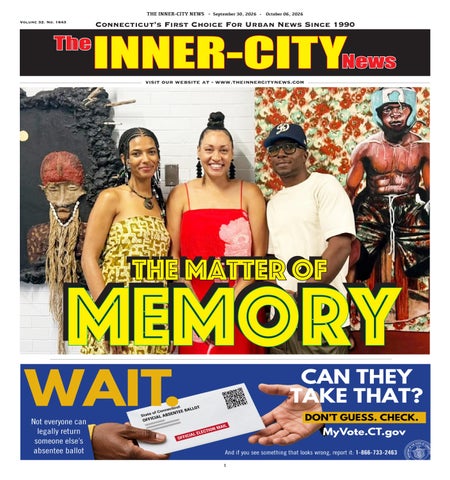
The The Matter Matter of of
Memory 1
THE INNER-CITY NEWS - September 30, 2026 - October 06, 2026
Math, Reading, Collaboration, Independence: One Morning In A First-Grade Classroom
she said the sentence “sunflowers are pretty and yellow” aloud.
by Maya McFadden
The New Haven independent
Nathan Hale first grader Januel held out eight fingers, then carefully counted three down. With five fingers remaining, he picked up his pencil and wrote that answer on the math worksheet in front of him. That was the scene on a recent Wednesday morning in the first-grade classroom of Nathan Hale teacher Briana Amodio. It was around 9:30 a.m. when Januel and his classmates put their addition and subtraction skills to the test. “If there are eight frogs and three hop away, how many are left?” read one of the questions on a math packet before the students. While Amodio passed out worksheets to the class, veteran paraprofessional Denise Cusack asked the class whether the frogs hopping away meant they should add or subtract. Around the room, students used their fingers to work through similar problems, including one asking how many children would be at a park if one more joined a group of seven. For the second year in a row, Amodio is working with Cusack in their classroom of around 25 students at the Morris Cove PreK-8 school. Throughout the morning students mirrored the collaboration and independence both Amodio and Cusack displayed while moving between their respective responsibilities. Their collaboration helped make room for the students’ own independence to grow through small tasks like helping their classmates and transitioning between activities without assistance in
“How do you know there’s only five words there?” she asked. One student explained that “sunflower” is one word not two.
Veteran paraprofessional Denise Cusack helps students with a reading lesson. Credit: Maya McFadden Photo
the first month of the school year. As the students finished their worksheets, Amodio and Cusack checked their work before the class moved on to 10 minutes of math practice on their tablets. Januel tapped 17 dots on his screen, one by one, quietly counting each one aloud before correctly answering another math question. Wednesday morning offered those glimpses into the daily routines taking shape in Amodio’s first-grade classroom
during the first weeks of school. Amodio balanced the multitasking that comes with teaching while her classroom partner Cusack seamlessly filled in with instruction for the class, making sure a beat wasn’t missed throughout the day. Their partnership was on display when it was time for the students’ beginning-of-year reading assessments. As Amodio brought students into the hallway one at a time to assess their reading skills at the start of the year, Cusack gathered
the rest of the class on the rug and continued their morning lessons. “We talk every morning so we’re always on the same page,” Cusack told this reporter before next heading to a third-grade classroom in need of additional support. Cusack joined the students on the class rug while Amodio facilitated assessments. On the rug Cusack said sentences aloud to the students then asked them to count how many words each sentence had. She wasn’t able to stump her students when
Next, Cusack used Heggerty’s phonemic awareness curriculum book for the students’ daily reading challenge. The phonemic practice came just before students moved into the day’s reading lesson. For several words Cusack called out words like “shock” then asked students to replace the “sh” sound with a “kn.” After repeating the word “shock” aloud with Cusack the students next called out the new word “knock.” For the day’s reading lesson students completed two workbook pages in their Houghton Mifflin Harcourt (HMH) Know It, Show It books. The two pages tasked students with practicing their past and present word tenses. The students filled in word blanks for sentences like “dad (rest or rested) in a chair.” After completing their workbook pages the students spent ten minutes independently reading. Amodio continued individual assessments outside the classroom allowing for Cusack to guide the class next through math practice, keeping the morning’s lessons moving. At around 10 a.m. the class spent 10 minutes on iReady math, polishing the math skills they had just practiced in their workbooks.
Alders Advance Proposal Urging Yale To Reject Potential Trump Deal by Adele Haeg
The New Haven independent
Three dozen Yale students, professors, and New Haven community members testified before the aldermanic Health & Human Services Committee Thursday evening — and called on Yale to uphold its institutional independence, contribute more to its host city, and reject a potential settlement with the Trump administration over the university’s admissions policies. Ultimately, the committee alders — Kampton Singh, Frank Douglass, Theresa Morant, Frank Redente, Sarah Miller, and Elias Theodore — favorably endorsed a proposal calling on Yale not to strike such a settlement with the Department of Justice (DOJ). The item now heads to the full Board of Alders for further review and a final vote. The resolution — “Urging Yale University to Defend its Institutional Autonomy” — was authored by Theodore, who represents Downtown/Yale’s Ward 1. The resolution is an “opportunity to say clearly that we are not about what’s happening in Washington, and we don’t support any effort to succumb to pressure here,” said Fair Haven Alder and
Downtown/Yale Alder Elias Theodore (center): "This is something that is bringing our city together right now." Credit: Garrett Curtis photo
Committee Vice Chair Sarah Miller. “I’ve been really proud of New Haven standing up in very meaningful ways,” she said. The city is currently involved in six ongoing lawsuits against the Trump administration.
A coalition of students, led by Theodore among others, have been campaigning against the potential settlement since June. Yale President Maurie McInnis confirmed in July that the university was in talks with the DOJ, but has not
2
released any more information about the potential settlement since. “It is Yale’s longstanding practice not to discuss the specifics of any ongoing legal matter,” a Yale spokesperson told the Independent. “That said, Yale is com-
mitted to following the law and has continued to provide information to the DOJ regarding our admissions processes as required. Yale’s commitment to academic freedom is absolute and its admissions and hiring decisions will continue to be made independently and in accordance with the law.” Although Theodore said he had invited both McInnis and Associate Vice President for New Haven Affairs and University Properties Alexandra Daum, no representatives from Yale attended Thursday’s hearing. In opening testimony, Theodore said that, “throughout this second Trump term, New Haven has protected our most vulnerable residents and our city’s values, even when doing so came with significant financial or political risks.” He continued, “it is disappointing that Yale, an institution that should stand up with its host city and be a partner in this fight, is preparing to cut a deal with an administration whose actions have raised serious concerns among so many in our community.” In their testimonies, under three minutes each, undergraduate students as well as students from the law and medical Con’t on page 12
THE INNER-CITY NEWS - September 30, 2026 - October 06, 2026
Clemons To Step Down As ConnCORP CEO The Dixwell Plaza redeveloper ConnCORP announced on Friday that the organization’s founding CEO, Erik Clemons, will be stepping down from his post on Oct. 7. by Staff
The New Haven independent
New Haven, CT (September 25, 2026) — Erik Clemons, founding CEO of Connecticut Community Outreach Revitalization Program (ConnCORP), today announced that he will step down effective Oct. 7. “One of the most important things a leader can do is recognize when it’s time to step aside and make room for others,” said Clemons. “For eight years, I’ve had the honor of building alongside people who believe in this community as much as I do. Now it’s time for fresh eyes and new perspectives to lead what comes next. I have full confidence in our board, our leadership team, and the staff who make this work possible every day. I’m answering a new call, and I’m leaving ConnCORP in good hands.” During his tenure, Clemons founded the Wealth Accelerator, which began in 2021 with a question he posed: ‘What would it take to aggressively eradicate poverty in Connecticut?’ That question has since grown into a partnership of local and national organizations, working alongside a council of New Haven residents, to close the racial wealth gap for low- and moderate-income families. Its first program, Cash Catalyst, will distribute more than $500,000 in investable capital to young
Erick Clemons: "One of the most important things a leader can do is recognize when it's time to step aside and make room for others." Credit: Dereen Shirnekhi file photo
3
adults in Greater New Haven to help them buy homes, start businesses, save for retirement, or further their education. In 2020, as the pandemic hit New Haven’s hardest, Clemons raised significant funds to launch ConnCAT and ConnCORP’s COVID-19 relief efforts, as well as the ConnCORP Economic Justice Fund, which began by putting resources directly into the hands of families in Dixwell and Newhallville and grew to invest in established Black-owned businesses. He co-founded Orchid Gallery at The Lab at ConnCORP, which gives early-career artists of color from the region a place to show their work, and he led the build-out of the First HAVEN development and ConnCAT’s new headquarters at 150 Dixwell Avenue. Behind each of these programs are the people they reached: the families, entrepreneurs, artists, and students who have found opportunity through ConnCORP. Under Clemon’s leadership, ConnCORP has become one of New Haven’s leading voices for community-driven economic development, a reputation built by consistently showing up for the neighborhoods it serves. That commitment remains unchanged. ConnCORP’s work will continue moving forward, including the next phase of First HAVEN, with the same care for the people and communities at its center.
Clemons said his approach has always started with building trust with residents and neighborhood leaders, many of whom have been part of ConnCORP’s work from the beginning. “Erik has always understood that community development starts with the people who live in the community,” said Diane Brown, Branch Manager of the Stetson Branch Library. “Many come to our community with preconceived plans that lead to broken promises. Erik is a true visionary and champion of the people. Under his leadership, ConnCORP took the time to listen, to show up, and to earn our trust. They followed through! We believe in this work, and we are grateful for all that he has done for New Haven. I am excited for what’s to come as ConnCORP continues to build and strengthen our community.” ConnCORP’s Board of Directors is expanding and will guide the search for the organization’s next permanent leader, with the continued support of ConnCORP’s funders, lenders, and community partners. ConnCORP’s programs and development work, including First HAVEN, will continue as planned during the transition, and the organization will share additional updates, including interim leadership, in coming weeks.
THE INNER-CITY NEWS - January 23, 2019 - January 29, 2019
THE INNER-CITY NEWS - September 30, 2026 - October 06, 2026
Lawyer To Lawyers: Join Fight Against ICE by Thomas Breen
The New Haven independent
“My call is to every attorney,” Glenn Formica said at City Hall on Monday. “I don’t care if you do real estate. I don’t care if you do elder law. You need to step up now. You hold the line here or there’s no more line.” Formica issued that plea at a press conference decrying “unlawful detentions” and arrests made by Immigration and Customs Enforcement (ICE) — including, recently, at Tweed New Haven Airport. Formica is one of 10 staff and volunteer attorneys at The American Immigrant Law Clinic, a New Haven-based nonprofit affiliated with Connecticut Students for a Dream. He was one of a handful of speakers at a Monday morning presser slamming the Trump administration for repeatedly breaking the law in how it handles immigration enforcement. The event took place as ICE has made at least two arrests of passengers at Tweed in recent weeks, including of a 19-yearold Southern Connecticut State University (SCSU) basketball player named Deng Deng. Formica was Deng’s attorney in his federal habeas case; a U.S. judge ultimately released Deng after criticizing the federal government’s “mismanagement” of his detention. Speakers at Monday’s press conference called out ICE for depriving detainees of their due process rights and for delaying access to an attorney and a prompt bond hearing.
Attorney Glenn Formica (right): " If you're a criminal defense lawyer, I need to see your face, because everything that is happening right now violates the 4th Amendment. You know this. " Credit: Thomas Breen photo
“It’s just deceit,” Formica said. “It’s not what we would expect from the federal government.”
“What ICE is doing should outrage every American because it’s violating the law,” U.S. Sen. Richard Blumenthal said. “Today, one of the most ordinary acts of American life — getting on a plane — has become a trap, even for people following the process,” said National Immigration
Law Center President Kica Matos. Matos called on the federal government to “end the secret pipeline” of data sharing between the Transportation Security Administration (TSA) and ICE. She called for ICE to stop the “appalling practice of stopping people at airports.” She pressed Avports and the Tweed New Haven Airport Authority “to stop being complicit with ICE.” And she said that, “finally, ICE needs to get out. They need to get out of our city. And they need to get out of our state.” Formica used his time at the mic in part to detail the various legal and moral outrages of how ICE makes arrests and handles detainees. He said that ICE is grabbing people with “no criminal record or very minor criminal offenses” at courthouses and, now, at airports. Once ICE takes people into custody, he said, they typically provide detainees with a phone call, but “they don’t get access to a lawyer.” ICE asks them to sign a “voluntary departure” even if they have available relief, such as an asylum claim, to stay in this country. They also promise detainees money if they self-deport but then sometimes “the money … never shows up.”
National Immigration Law Center President Kica Matos: “Today, one of the most ordinary acts of American life — getting on a plane — has become a trap, even for people following the process.”
Stop cleaning-out your gutters this season EXPIRES: 11/30/2026
AN ADDITIONAL
25% OFF LeafFilter + 10% *
Discount For Seniors + Military
Get a FREE full gutter inspection and estimate: 1-855-814-0703 Promo: 285 *Promotional offer includes 25% off plus an additional 10% off for qualified veterans and/or seniors. Cannot be combined with other offers. See representative for full warranty details. DC 420223000087, AZ ROC 344027, AR 0366920926, CA 1035795, CT HIC.0671520, FL CBC056678, ID RCE-51604, IA C127230, LA 559544, MD MHIC164488, MA 213292, MI 262300331, MI 262300330, MI 262300329, MI 262300328, MI 262300318, MI 262300173, MN IR2025-810524, MT 266192, NE 50145-24, NV 0086990, NJ 13VH13285000, NM 408693, ND 47304, OR 218294, PA PA179643, RI GC-41354, TN 10981, UT 10783658-5501, VT 174.0000871, VA 2705169445, WA LEAFFLH763PG, WV WV056912, WI 537-DCFRR
4
ICE did not immediately respond to a request for comment by the publication time of this article. The New York Times recently reported that, in July, a majority of the immigrants arrested by ICE had not been charged or convicted of a crime. Formica also said that ICE’s detainees would be “better housed and better treated” if they had been arrested or even convicted of a serious crime. “God bless us if they were actually treated as criminals, because they would have the right to a prompt bond hearing.” Instead, ICE detainees often find themselves “sleeping on cement floors with foil blankets for days. Broken toilets, dirty water. They have to pay for phone calls. This isn’t locked up abroad. This is locked up at home.” Soon thereafter, Formica issued his plea to fellow attorneys to join the fight and help The American Immigrant Law Clinic, which focuses on filing habeas lawsuits and freeing people newly arrested and detaind by ICE. “I’ve been an attorney for almost 30 years,” Formica said. “Thirty years ago I took an oath to defend the Constitution.” That’s what all lawyers need to do now in pushing back against ICE’s lawlessness. “The fight is now for attorneys,” he said. “It’s not for the president. He has abandoned us.” And Congress “does not seem to be fighting for us either.” “The fight is for lawyers. We need to fight this. If you’re a criminal defense lawyer, I need to see your face, because everything that is happening right now violates the 4th Amendment. You know this. You know this. This is your fight.”
Penfield Communications Inc
John P. Thomas Publisher / CEO
Babz Rawls Ivy
Editor-in-Chief Liaison, Corporate Affairs Babz@penfieldcomm.com
Advertising/Sales Team 10
Keith Jackson Delores Alleyne John Thomas, III
Editorial Team
Staff Writers Christian Lewis/Current Affairs Anthony Scott/Sports Arlene Davis-Rudd/Politics
Contributing Writers David Asbery / Tanisha Asbery Jerry Craft / Cartoons / Barbara Fair Dr. Tamiko Jackson-McArthur Michelle Turner / Smita Shrestha William Spivey / Kam Williams Rev. Samuel T. Ross-Lee
Contributors At-Large Christine Stuart
www.CTNewsJunkie.com
Paul Bass www.newhavenindependent.org
Memberships National Association of Black Journalist National Newspapers Publishers Association Greater New Haven Chamber of Commerce Greater New Haven Business & Professional Greater New England Minority Supplier Development Council, Inc.
The Inner-City Newspaper is published weekly by Penfield Communications, Inc. from offices located at 50 Fitch Street, 2nd Floor, New Haven, CT 06515. 203-3870354 phone; 203-387-2684 fax. Subscriptions:$260 per year (does not include sales tax for the in State subscriptions). Send name, address, zip code with payment. Postmaster, send address changes to 50 Fitch Street, New Haven, CT 06515. Display ad deadline Friday prior to insertion date at 5:00pm Advertisers are responsible for checking ads for error in publication. Penfield Communications, Inc d.b.a., “The Inner-City Newspaper” , shall not be liable for failure to publish an ad or for typographical errors or errors in publication, except to the extent of the cost of the space in which actual error appeared in the first insertion. The Publisher reserves the right to refuse advertising for any reason and to alter advertising copy or graphics deemed unacceptable for publication. The entire contents of The Inner-City Newspaper are copyright 2012, Penfield Communications, Inc. and no portion may be reproduced by any means without the written permission of the publisher.
THE INNER-CITY NEWS - September 30, 2026 - October 06, 2026
Your
3Ways to Vote
Vote early in person October 19 – November 1 Vote in person on Election Day, November 3, 2026
Life can be hard.
Apply for an absentee ballot
TA HE S TE OF FT
ECTICUT NN CO
SECRETARY O
Voting doesn’t have to be.
For all your trusted election information, visit MyVote.CT.gov
16 3 9
The World’s First Hearing Aids With Touchscreen Controls. No tiny buttons. No apps. No prescriptions.
Call 833-992-0210 risk free trial.
to get your 45-day
Revolutionary technology with touchscreen control. Hearing modes for any environment. Multiple models to choose from. Portable charging case. 48-hour battery life. UV cleaning. Background noise cancellation. 45-day risk free trial.
Atom X
5
THE INNER-CITY NEWS - September 30, 2026 - October 06, 2026
In "Driving Miss Daisy," Cabaret On Main Dips Into History, Past & Present By Lucy Gellman
Arts Council of greater New Haven
Daisy Werthan and Hoke Colburn trade anecdotes with each other, dipping in and out of Southern history as the conversation unspools between them. Daisy turns back the clock to 1888, and the first time she saw Mobile, Alabama as a young child. Hoke, listening intently, conjures his daughter, whose marriage to a Pullman Porter means she has traveled all over the country. Around them, 1954 is in full bloom. “Ain’t it silly, the things you remember?” Daisy asks, laughing softly, and for a moment the words just sit there, round and glittering and so certain. Then the two blink, and the moment is gone. Remembering, and forgetting, and the imperfect weight of history all sit at the core of Alfred Uhry’s 1988 Driving Miss Daisy, running at the Cabaret On Main Theatre Thursdays through Sundays through October 4. A sometimes-cheeky, often emotional look at Southern racism, the performance is surprisingly affecting, asking questions about who gets to assimilate, who does not, and who gets left behind. The work, directed by actor, educator and filmmaker Nick Rapauno, is a production of the Broadway On Main Theatre Company, which lives beneath the Cabaret On Main umbrella. For both Rapauno and Cabaret co-founders Billy DiCrosta and Neil Fuentes, it’s an opportunity to talk about the way racism, antisemitism, elder care, aging, and loneliness all show up in the country’s current political environment, just as they did decades ago. “Look at the world that we’re living in,” DiCrosta said before a tech run last week, as actors slipped into costume and checked their mic packs backstage. “I think antisemitism is at an all-time high right now. So is racism. It’s our job to bring this to the audience,” where it can catalyze conversation that lasts long after the lights have gone down and the final bows are over. Told over a tight two acts, Driving Miss Daisy criss-crosses 25 years as it jumps from 1948 to 1973 in a rapidly changing Atlanta, where the pace of civil rights work seems as languid as the thick, oppressive summer heat. As the show opens, the titular Daisy Werthan (Debi Freund) is grappling with her entry into older age, which as of late has caused an unwanted lawn job and totaled car. Her son, Boolie (Jamie Carson), is trying to convince her to hire a driver, like many of her elderly friends. Daisy, in whom Uhry said he saw his grandmother, Lena Guzman Fox, is also Jewish—an anecdote introduced near the beginning that becomes a narrative pillar of the work. She is also not one to acquiesce: she pushes back against the idea of a driver, fiercely tied to both her independence and her pocketbook (she can still remember, after all, growing up without much money—a refrain in which many audience members may see their own elders). So when Boolie hires the endlessly patient Hoke Coburn (Marvin “MJ” Jones) as
Photos courtesy of Cabaret on Main Theatre.
Photos courtesy of Cabaret on Main Theatre.
her chauffeur, she’s not thrilled. It’s not clear if he is either: Jones’ depiction is quiet and even-keeled, even when making clear that racism still exists around and between them. What follows is a story of both care work and relationship building that is cross-cut with the realities of racism, antisemitism and capitalism, forces that are still very much at play nearly four decades later. Hoke, played by Jones in a key that is as empathetic as it is reflective, is the only Black character in the show, save a housekeeper named Idella who we never see onstage. The Werthans, who have climbed the social ladder into the upper middle class are Jewish, but at a time when they get to be white and Southern before their religious identity. What feels significant about the play, the first in Uhry’s Atlanta Trilogy, is that it is both a time capsule and very much a living thing, timely precisely because
history has a way of slipping backwards and repeating itself. When Uhry first wrote the show, he was reflecting on his own lived experience as a fifth-generation European Jew in the American South, a period that included the wider acceptance of Ashkenazim, or European Jews, as effectively white. That history is thick and complex (and arguably, has been scrubbed from the movie more than it has the play): manyJews’ assimilation into the white mainstream did not happen without a departure from some of the deep solidarity work between Black and Jewish people that took place in the nineteenth and first half of the twentieth century. That rupture, decades later, is still painful—particularly as the current administration uses whiteness as a weapon, and simultaneously works to push Jewish people back to the fringes. Uhry’s Atlanta was one where his family, at least by the time he was born, was well
6
established in the middle class. In Daisy, a former educator who has worked her way out of meager circumstances, an audience member can see the bent toward assimilation happening nonetheless (or maybe it has happened before the curtain opens): she references pork chops and crab boil and revels in a tinsel-decked, brightly lit Christmastime Atlanta—all while making time for weekly synagogue services. The audience, meanwhile, watches her son—one more generation removed— distance himself from his Jewishness even further, both professionally and personally. Carson, without ever being heavy-handed, makes that shift into a kind of itchy conservatism with nuance, showing an audience how that generational change happened when no one was looking. “I was raised, pretty much, to think of myself as Southern first, American second, and Jewish third, which was very confusing,” Uhry told RoughDraft Atlanta last year, and it absolutely echoes here. “I was brought up with Christmas trees and Easter egg hunts – no Seders, nothing like that – but with a Jewish heritage, and a Jewish face. I was clearly Jewish, but I kind of wasn’t. “ If Hoke is a less robustly developed character in the script, then Cabaret on Main can thank Jones for bringing complexity, subtle humor, thoughtfulness and wit to the role. Indeed, he, with Freund and Carson, has turned to the script as a document that he is genuinely interested in exploring, sometimes through tears that have come mid-rehearsal, or at the end of a particularly charged run. “It’s such a powerful and emotional story to be a part of, and that’s amazing,” said Jones, who grew up watching Driving Miss Daisy with his mom when he was a kid growing up in Hamden. A few years ago, he learned about Cabaret on Main through his daughters, who
at 14 and 10 years old both love to act. While they were in rehearsal, he would work remotely in the theater’s lobby. At some point, he realized that he wanted to act; Driving Miss Daisy is his first significant role. “I knew when he used to sit here doing his job that he belonged onstage,” DiCrosta joked, a little twinkle in his eye, during an interview at intermission. Freund, who for years served as the director of Equal Employment Opportunity (EEO) and Diversity for the Connecticut Department of Children and Families (DCF), agreed. For her, the role speaks to a period that—although she was much younger than Daisy is in the show—she lived through, and was forever impacted by. In just 25 years, she noted, the script folds in historical events that range from postwar America’s recovery to the 1958 bombing of Atlanta’s Hebrew Benevolent Congregation to the Civil Rights movement to continued and de facto segregation and horrific anti-Black violence in the American South to the Korea and Vietnam Wars. She remembers all of it, including how tumultuous it felt at the time. Now, she said, people don’t seem to realize the significance of how much happened—and the fact that they don't want to go back there. “What an incredible role,” she said. She added that while she wasn’t raised Jewish, she has a feeling that her German-American family was, but that their history was lost as Jews fled Europe, lost their lives, and sublimated their identities just to exist. That history may be heavy, she acknowledged, but it’s necessary to revisit. In addition to a charged racial and religious dynamic in which they see parallels to today, several cast and crew members have also taken on caregiving roles in their own families, such that the script exists as both a window and a mirror. Jones, who looks after his mom in real life, remembered a scene that he and Freund workshopped for weeks before it felt like they’d gotten it right. When they finally hit their stride, Freund so perfectly embodied the steep, slippery slope into old age that for a moment, Jones felt like he was back with family, seeing a pattern he’d seen so many times before. He was gobsmacked. He still is sometimes, although a person wouldn’t guess it based on how composed he remains on stage. “I think the big connection for me is the emotion that she [Daisy] is throwing onto Boolie,” Carson said. That kind of mother-son dynamic is relatable, he clarified, so much so that many audience members may see it in their own families. “It’s a really meaningful story to me,” in which the quirks and nuances of their relationship may speak to people across generations. What Uhry does best is illustrate those changes through his time hops, so the show’s different dynamics are all interwoven. Take, for instance, so many of the scenes that take place inside a car, where
THE INNER-CITY NEWS - September 30, 2026 - October 06, 2026
Questions about your bill? Yale New Haven Hospital is pleased to offer patients and their families financial counseling regarding their hospital bills or the availability of financial assistance, including free care funds. By appointment, patients can speak one-on-one with a financial counselor during regular business hours. For your convenience, extended hours are available in-person at Yale New Haven Hospital the third Monday of every month. Time: 5 - 7 pm Location: Children’s Hospital, 35 Park St., 1st floor, Admitting Parking available (handicapped accessible) An appointment is necessary. Please call 855-547-4584. Spanish-speaking counselors available.
MAKE IT A
City of New Haven Energize the Elm City: Access low-or no-cost weatherization plus additional energy-saving improvements.
Combo Tickets as low as $33! A full-day access to Amusement Park, Waterpark and Quassy Beach!
SCHEDULE NOW!
VOTED
TOP 5
FAMILY * ASTER
ROLLER CO
Call (475) 255-2143 or go to ne-smartenergy.com/newhaven Interesado en la eficiencia de energia? llama numero (475) 255-2143
Energize Connecticut programs are funded by a charge on customer energy bills. Some restrictions apply and offers are subject to change or cancellation.
*Amusement Today 2025
LEARN LAKE QUASSAPAUG, RT. 64 • MIDDLEBURY, CT 06762 WWW.QUASSY.COM • 800-FOR-PARK MORE 7
Jazz Expansion
THE INNER-CITY NEWS - September 30, 2026 - October 06, 2026
Shaunda Holloway
Arts Council of greater New Haven
Once upon a Friday evening in New Haven, horns surged and simmered, piano keys pounded, flute and piccolo claimed their moment, light and airy, cymbals reverberated dashes of contrast, and strings laced it all together. The stage seemed as if it was lit in amber. At the center of the action, bassist Jeff Fuller proclaimed simply, “It’s a beautiful night.” Surely, it was. Just outside Sprague Recital Hall were the same wind-cooled front steps where Fuller had met his partner, textile and fiber artist Pamella Saffer, on November 2, 1967. Decades later, his same dedication to jazz music promised to be beneficial to everyone in the room. But if it was Fuller’s evening, he was ready and eager to share it with his partner of countless years, fellow musicians, and the audience. That joyful, heart-opening sound filled Sprague on Friday night, as Fuller—long a fixture in New Haven’s jazz scene, and the world’s too—kicked off the 54th annual Ellington Jazz Series at the Yale School of Music, a long-running tribute to jazz that has in recent years made space to give New Haven giants their flowers. In a concert that seemed both endless and far too short, Fuller graciously received the medal and went on to play as if life was meant for the sole purpose of fusing sounds together. Musicians included Fuller on bass, Naomi Wharry on vocals and trombone, Haneef Nelson on trumpet, Nigel Regan on sax, Paul Lieberman on flute, Darren Litzie on piano and Ben Bilello on drums. All are part of Fuller’s story, he said after the show, noting that “they are natural choices,” and “I have history with them. Nobody was a stranger.” The magic of the ensemble, and of Fuller himself, shimmered through the night’s selections. There was, for instance, the tune “Happenstance,” composed by Fuller in 2014 and with lyrics added by Ellynne Rey that same year. The composition, brought to life by musicians, reflects “being at the right place at the right time,” Fuller said. The melody is a Brazilian-style samba, played first instrumentally by trombone and saxophone, then sung by Wharry, Fuller said. Bilello crossed his arms while playing, striking continuously as he inserted another layer. If described as a visual piece of art, it would be a watercolor painting. One lush layer after the other. Meanwhile, Fuller added form with his bass, giving way to Brazilian rhythmic patterns that could only be rendered by seasoned professionals. “Composition and improvisation are the same to me,” he said after the show. It was clear in his approach that he practices what he preaches. Timing, meanwhile, was so sharp it forced the audience to see that stopping was as important as continuing. Abrupt endings rarely came as clipped mic drops; instead, they arrived in a refreshing and indescribable way. Instruments blended butalso articulated themseles clearly and intriguingly—no chaos but a fast planned melodic closure. No dreary endings. Upkicks and excitement. Bursts of sound.
Darren Litzie Paul Lieberman, Nigel Regan, Jeff Fuller, Naomi Wharry, Haneef Nelson and Ben Bilello. Andrew James (who runs the jazz blog Bourbon Street Buzz) Photos.
Fuller often led the way, acutely aware of when to step forward, and when to cede the floor to another member of the ensemble. When it came time to accept the medal, Fuller stood before his beloved bass, which by now seems like an extra limb, and graciously accepted the award. In the audience, fellow musicians cheered their support. The much-accomplished Ryan Sands looked on from his seat, emitting rays of appreciation. With his hands covering his mouth as if to create an echo, 2023 Duke Ellington Award recipient Jesse Hameen II stood up from his balcony seat. “Yeah Jeff!” Hameen smiled from his seat during the show. It was a reminder of their deep brotherhood, created by the binding kinship of music. As the band returned to playing, piano keys tinkled lightly, somehow still buoying the melody. The drums brought another layer of depth. Fuller came in and ordered his strings in full command. Regarding the seemingly effortless artistry, he later said that “I don’t think people realize how much you have to practice and how much control you have to have over your instrument. You have to be. And at the same time it's spiritual." “Listen to jazz,” he added for the up-andcoming musicians in the room. "Learn the history. Practice your butt off. Find a good teacher.” Fuller has lived this credo. After studying violin, sax, classical and jazz piano, and classical guitar in elementary through high school—including an early and continuing love for Bossa Nova—Fuller studied music, theory and composition in both undergraduate and graduate degrees that he received from Yale (read more about his educational journey in our preview here). He switched to the bass in his late 20s, after when several bassists left town all at once. As a former athlete, Fuller is deeply aware of the power of his instrument and jazz music. “The bassist is like the catch-
er in baseball. He sees everything and in a way kind of calls all the shots,” he said. “Jazz and basketball have a lot in common. One hundred free throws. After every practice drill, drill, drill!” Friday night, a person could see and hear that philosophy—and the deep friendships he has forged through music, both across the state and well beyond it—in real time. Often, the sound was much bigger than the number of people on the stage. Indeed, it flooded the room; musicians performed like a full orchestra. In compositions like "Paquito’s Samba," it was easy to fall into and get lost in entirely." Later Lieberman and Nelson entered the stage, flute, piccolo and trumpet in tow. There was a shift between each instrument, an alchemic melding of notes, an emergence and succession in waves, a solidity yielded only by practice and a love for music so strong the agreement is to perform as one. Wharry took a break from the trombone and scatted, pouring fervently the soul of Dinah Washington into the spirit of today. Fuller spoke largely in a language of cues: head nods, words, and hand gestures. “One, two. One two three!” he added. He may have called the shots, but the team’s efforts were clear: the solos provided by each musician revealed this truth. During the night, and in a conversation afterwards, Fuller noted what a kind of full-circle moment Friday was. Years ago, in 1972, he saw Duke Ellington perform with his orchestra the year the eponymous jazz series was established at Woosley Hall. Even from the audience, “I knew it was important,” Fuller said. Though the two did not meet that night, Fuller has performed with 17 of the recipients, including Dizzy Gillespie, Papa Jo Jones, Dave Brubeck and his mentors Lou Donaldson and Paquito D’Rivera. Surely this award had been years in the making. “It was a beautiful surprise,” Fuller said.
8
Dr. Michael Eric Dyson Joins Livingstone College
as a Visiting Scholar in Residence Renowned scholar, professor, author and cultural critic joins Livingstone for four-part residency exploring Black thought, faith, hip-hop, politics and democracy
By Garette Hunter SALISBURY, N.C. — Livingstone College is emerging as a powerful destination for Black intellectual thought, cultural expression and academic excellence — and this fall, one of the nation’s most recognizable public intellectuals will join that movement. Renowned author, scholar, activist and cultural critic Dr. Michael Eric Dyson will join Livingstone College as a Visiting Scholar in Residence, launching a fourpart residency designed to place some of the most consequential conversations shaping Black America at the center of the collegiate experience. Through a series of lectures, student engagement opportunities and academic experiences, Dyson will bring together urban education, faith, hip-hop, politics, culture and democracy — creating a dynamic intellectual space where scholarship meets lived experience and where students are challenged to examine not only the world around them, but their responsibility to shape it. Dyson’s residency will begin during Livingstone College’s Opening Convocation on Friday, September 18, at 10 a.m. in Varick Auditorium. His inaugural lecture, “Represent: The Unfinished Fight” will explore Black excellence, the enduring importance of HBCUs and the transformative power of an educated mind. The moment will carry added significance as Livingstone welcomes one of the largest and most academically competitive incoming classes in its history. The Convocation will include the College’s First-Year Pinning Ceremony, formally welcoming nearly 500 first-year and new students into a student body of approximately 1300. The academic profile of Livingstone’s student body reflects the College’s growing momentum. More than 40 percent of students currently hold a GPA of 3.0 or higher, and approximately 450 students have earned recognition as Presidential Scholars, entering the college with a 3.7 GPA or above and maintaining this distinction during their academic journey. “Having Dr. Michael Eric Dyson as a Visiting Scholar in Residence speaks directly to my vision for Livingstone College as a relevant, regarded and respected HBCU, where we are developing and deploying change agents who are thoroughly immersed in civic engagement, cultural content and environmental justice,” said Livingstone College President Dr. Anthony J. Davis. Dyson’s presence at Livingstone extends far beyond a traditional lecture series. Known for his ability to move seamlessly between the academy, the church, popular culture and public discourse, Dyson has built a career translating complex questions of race, politics, faith and identity for broad audiences. His acclaimed body of work includes JAY-Z: Made in America, featuring a foreword by Pharrell Williams, and Represent: The Unfinished Fight for the Vote. His residency at Livingstone will con-
tinue with sessions examining faith and leadership, hip-hop and cultural identity, and race and democracy, positioning the College as a gathering place for rigorous scholarship and fearless conversation about the forces shaping life in America. The residency will be housed within Livingstone College’s Political Science Division and will also establish the Dyson Fellows, a selected cohort of 10 to 20 students who will engage directly with themes from the residency through research, scholarship and capstone projects. The Fellows program will ensure that Dyson’s residency does more than bring conversation to campus — it will create opportunities for Livingstone students to produce scholarship, develop their own voices and contribute to the intellectual traditions they are studying. “I am honored to spend quality time with some of the smartest students at one of our nation’s most distinguished HBCUs as we explore important issues and ideas that will shape the future of our nation,” said Dr. Dyson. At Livingstone, the classroom has never been confined by four walls. The arrival of Michael Eric Dyson represents a broader institutional commitment to creating spaces where ideas are studied, challenged, amplified and transformed into action. It reflects a Livingstone College that is growing in enrollment, strengthening its academic profile and intentionally positioning itself at the intersection of education, culture and leadership. This is more than a visiting scholar residency. It is an invitation to the intellectual cypher. A place where scholars, students, faith leaders, artists and thinkers come together. A place where ideas move. A place where voices are not simply heard, but sharpened, developed and prepared to influence the world beyond campus. It is another defining step in Livingstone College’s commitment to being Resilient, Relevant and Ready — and to preparing a new generation of thinkers and leaders who understand that their intellect is not only an asset, but a powerful resource for change.
THE INNER-CITY NEWS - September 30, 2026 - October 06, 2026
Albertus Magnus College Opens Immersive Learning Center to Support Student Engagement Across Disciplines Funded through a gift from Carol G. Ditkoff ‘67, ribbon cutting marks the opening of the first Dreamscape Learn immersive learning facility in New England
New Haven, Conn., September 23, 2026 – Albertus Magnus College today held a ribbon cutting ceremony to open the Carol G. Ditkoff '67 Immersive Learning Collaboratory, the first facility in New England to house the Dreamscape Learn immersive virtual reality (VR) learning platform. The Collaboratory was made possible through a historic $3 million gift from alumna Carol G. Ditkoff '67 and her husband, James. The Collaboratory is located in a newly renovated wing of the Hubert Campus Center and houses a Dreamscape Learn immersive VR classroom, a VR free roam pod, and the College's Esports program. VR-enabled integrated coursework begins this fall in biology, chemistry, political science, art history, and other liberal arts disciplines. As new content is developed, Albertus intends to provide VR experiences for students across all academic disciplines. In its first year, Albertus expects more than half of its undergraduate students, including the entire first-year class, to participate in courses that integrate Dreamscape Learn.
“The opening of the Ditkoff Collaboratory launches Albertus boldly into its second century,” said President Marc M. Camille, Ed.D. “This innovative learning environment represents our commitment to meeting students where they are, providing them with new opportunities to
explore, collaborate, and apply what they are learning in meaningful ways. We are grateful to Carol and Jim Ditkoff for their impactful generosity, and in a special way for their commitment to providing Albertus students with an exceptional education. Their investment is helping
Albertus continue to build on a tradition of innovation and inspiring students to be prepared and purpose-driven leaders upon graduation.” The Collaboratory marks a milestone for both institutions. The Ditkoffs' gift is the largest outright gift in the College's 100-year history, and is the first Dreamscape Learn deployment funded entirely through private philanthropy. "Jim and I made this gift because we believe every Albertus student deserves the opportunity to learn in new and exciting ways," said Carol Gutoski Ditkoff '67. "Our hope is that students will design and test their own ideas here, building the confidence to see new possibilities. Knowing the Collaboratory will shape how students learn, is deeply meaningful to both of us.” Co-founded by filmmaker Walter Parkes and Arizona State University President Michael Crow, Dreamscape Learn combines immersive technology, cinematic storytelling, and evidence-based pedagogy to deliver rigorous, story-driven learning across core disciplines.
“When students are transported into a story and given a meaningful role to play, learning feels different. They become more invested in the work, more motivated to keep going, and more connected to what they are learning,” said Josh Reibel, CEO of Dreamscape Learn. “We’re excited to see Albertus embrace immersive learning across disciplines, with dedicated leadership in place to help faculty make these experiences a meaningful part of the student experience.” Since launching in 2022 in collaboration with Arizona State University (ASU), Dreamscape Learn's immersive 'Biology in the Alien Zoo' course has been used in introductory biology classes reaching more than 28,000 ASU students. Research at ASU found that students performed better in courses that integrated this new approach to teaching and learning—with participants nearly two times more likely to achieve an A grade. This success has led ASU to fully transition its introductory biology labs to the Dreamscape Learn platform.
Fazio: CT Needs Leadership On Tax, Spending Cuts by Donald Eng CTNewsJunkie
STRATFORD, CT — State Sen. Ryan Fazio, the Republican candidate for governor, returned to a familiar topic earlier this week, proposing billions of dollars in tax reductions while contrasting that with what he called Gov. Ned Lamont’s record of higher taxes, fees and spending. “Connecticut families are paying too much, and after eight years of Ned Lamont, they are getting less for it,” Fazio said. “Governor Lamont has increased taxes and fees by hundreds of millions of dollars while blowing through the spending cap. Connecticut does not have a revenue problem. We have a spending problem, and we have a government that has become too comfortable reaching into the pockets of taxpayers.” Fazio’s proposal, delivered in front of a struggling restaurant in Stratford Center, calls for reductions in the state income tax for lower and middle income earners – but not for those in the highest categories. In addition, he called for full expens-
ing of capital expenditures to incentivize business expansion and investments and a property tax cap. Among a handful of other changes, he estimated the result would be an average savings of $2,500 per family by the end of his first term. Fazio, though, acknowledged that delivering on some of the reductions would require buy-in from legislative Democrats, who hold solid majorities in both branches of the General Assembly that they are likely to maintain. “The constituents of our Democratic colleagues and Republican colleagues say the same things to their legislators … they say our taxes are too high, especially people in the middle income range,” he said. “So those legislators, whether they’re Democrats or Republicans, I think they’re looking for leadership that can provide tax relief.” And it’s up to the governor, Fazio said, to provide leadership. “The governor of this state has a lineitem veto to create efficiencies on the spending side,” he said. “So once that’s
State Sen. Ryan Fazio talks about tax policy on Sept. 22, 2026 in Stratford, CT. Credit: Contributed / Ryan Fazio campaign photo
done, that will create surpluses that can be used to cut taxes. The legislature doesn’t even need to be a full participant in finding the spending efficiencies and reductions because of the line-item veto power of the governor. But … I know I can work with my Democratic colleagues and I, more than anything, know that tis state simply needs leadership from the top to pave a way to tax relief for the middle class.” At least one Democrat, though, wasn’t on board. Stratford Town Council Chair Anthony Afriyie attended the event and later gave a Democratic response. He said Fazio’s spending cuts would reduce aid that families depend on, including halting contributions to the early childhood endowment fund that provides free or reduced-price early childhood education and childcare for families earning up to $150,000 per year. “And on top of that, he’s talking about (reducing) funds that are based on negotiations with unions,” he said. “So all of this is just based on a house of cards.”
OVER 50? UNLIMITED FOR JUST $35/MONTH. Backed by #1 Network Coverage and Customer Satisfaction.*
Switch & save today. 877-209-2138
© 2026 Consumer Cellular Inc. Terms and Conditions subject to change. Plans shown above include $5 credit for AutoPay and E-billing. Taxes and other fees apply. Credit approval required for new service. Cellular service is not available in all areas and is subject to system limitations. For unlimited plans, high-speed data is reduced after 35GB on single-line plans and 50GB of combined usage on multi-line plans for the remainder of your billing cycle. Unlimited data plans only for customers age 50+. *2025 ACSI® Survey of customers rating their own wireless service provider. ACSI® and its logo are registered trademarks of the American Customer Satisfaction Index LLC. For more about the ACSI®, visit www.theacsi.org.
9
THE INNER-CITY NEWS - September 30, 2026 - October 06, 2026
Friday’s Grand Prix & Pizza Costume Party, In Photos by Chris Volpe
Hundreds of people gathered downtown Friday evening to watch bike races and eat (and dress up as) pieces of pizza. Independent photographer Chris Volpe was on the scene. See above and below for his photos from the 11th annual A-1 Toyota Apizza Feast and New Haven Grand Prix, which also featured an attempt by the city to break the Guinness World Record for the Largest Gathering of People Dressed as Food. According to Taste of New Haven’s Colin Caplan, 778 people participated in Friday’s pizza costume party on the Green — coming up 110 people short of the Guinness title. Even though the city didn’t break a world record this year, Caplan noted in a text message, “I think the world smiled on us with the most beautiful sunset & a massive rainbow!” Thomas Breen contributed to this report.
10
THE INNER-CITY NEWS - September 30, 2026 - October 06, 2026
Get windows that lower your home utility bills!
Redefining how we help you mange your energy bills.
Offer ends 12/31/26
With Window Nation, you get: •
Special discounts you won’t find anywhere else this winter
•
Best-in-class service – our A+ BBB rating says it all
•
Energy-efficient windows that keep the heat inside your home
•
Decades of worry-free maintenance with a lifetime warranty
Many families are struggling to afford the essentials right now. If you’re looking for ways to lower your energy bills, talk to us. SCHEDULE YOUR FREE QUOTE TODAY!
855-787-5314
Limited time offer: Offer valid for all Window Nation window products purchased between 09/01/2026 and 12/31/2026. Buy 4 Window Nation windows at regular price and receive 4 additional Window Nation windows of equal or lesser value free. Free windows will be applied to the lowest-priced qualifying windows in the order. Minimum purchase of 4 windows required. Excludes exterior doors. Does not include cost of installation, labor, or other materials. No online purchases permitted. One offer per home. Replacement purposes only. Not for commercial use. Only installed at purchaser’s home. Not eligible for third-party transfer. No future credit, cash offers, or rebates permitted. Qualifying Window Nation window purchases are eligible for $0 down payment, $0 monthly payments, and 0% interest during the 2-year promotional period. Additional fees or costs (including installation fees) may apply if purchaser’s residence is incompatible with products. Offer requires Window Nation’s receipt of signed contract and deposit within offer dates. Must show this offer before purchase. All discounts valid at time of estimate only. Offers cannot be combined. Limit one offer per household. Not valid on prior sales. Offer valid for residences in eligible zip codes. Call 877-896-1837 or visit WindowNation.com to confirm availability in your area. Additional limits may apply. Void where prohibited. We may limit quantities sold to each customer and limited to as long as supplies last. License numbers: MD MHIC # 124358, VA # 2705178069, DC # 420212000037, DE # 2013601804, PA # 104611, MA HIC # 197968, NJ # 13VH07997100, NY #HI-72622, RI RIGL #44067, KS # 9641242, CT HIC # 0661044, WA # WINDONL771PW, OR #249065
We’ve got solutions to help. •
No-cost programs like Home Energy SolutionsIncome Eligible
•
My Account and our Energy Analyzer tool
•
Payment plans to help you manage today’s bills
OVER 50? UNLIMITED FOR JUST $35/MONTH. If you rent, own your home, or are a property owner whose tenants are experiencing economic hardship, let us help. Sign up now at GetEnergySmart.com Or call 877.WISE.USE (877.947.3873)
BROUGHT TO YOU BY
PROUD SPONSORS OF
Backed by #1 Network Coverage and Customer Satisfaction.* FHIK008ICN
Paid for by a charge on customer energy bills.
100% U.S. BASED CUSTOMER SERVICE. Ranked #1 in customer satisfaction by ACSI®.*
FAST, RELIABLE NATIONWIDE COVERAGE. Ranked #1 in network coverage by ACSI®.*
Switch & Save Today.
877-209-2138
11
© 2026 Consumer Cellular, Inc. Terms and Conditions subject to change. Plans shown include $5 credit for AutoPay and E-billing. Taxes and other fees apply. Credit approval required for new service. Cellular service is not available in all areas and is subject to system limitations. For unlimited plans, high-speed data is reduced after 35GB on single-line plans and 50GB of combined usage on multi-line plans for the remainder of your billing cycle. Unlimited data plans only for customers age 50+. Age validation required. *2025 ACSI® Survey of customers rating their own wireless service provider. ACSI® and its logo are registered trademarks of the
“Dipper” Connects The Dots Trump Deal THE INNER-CITY NEWS - September 30, 2026 - October 06, 2026
Con’t from page 02
by Lisa Reisman
The New Haven independent
To hear Hill Alder Angel Hubbard tell it, Daniel “Dipper” Smith, organizer of the first annual Hill Unity Block Party, represents the power of second chances. Kristen Threatt, co-founder of Gorilla Lemonade, said he shows that a person’s past does not define his future. For Youth And Rec’s Ronald Huggins, it’s simple. “Dipper is the light,” he said. “Oftentimes when people are incarcerated, you hear them say I’m going to come home and do this and that,” said Huggins on a breezy, sun-swept Saturday at the John C. Daniels School football field on Baldwin Street. “Dipper is staying true to his goals, he’s finding a way, and you can see right here he’s really helping connect the dots.” Co-sponsored by Hubbard, the block party drew an estimated 500 and featured a host of giveaways for kids; two dozen local vendors introducing their products; and informational tables offering programs and support. It marked the first event hosted by Dipper’s Keys to Success Consulting, an LLC that focuses on engaging youth, providing job opportunities, and affording resources to uplift families and community. “One of the main things we’re trying to do is to reach young people, let them know we see them,” said Dipper, 37, as he circulated among the tables, greeting neighbors and offering encouragement. “And with the giveaways,” which included school supplies, backpacks, sneakers, clothes, and gift cards, “we know that families are struggling, and we all can take some load off them, and at the same time we can also help them get the resources they need.” Smith, who grew up in The Hill, was a standout athlete who turned down a football scholarship offer from Hopkins School because he didn’t want to leave the neighborhood he knew and then, at 16, committed a crime that came with an 18-year sentence. One day in his cell at Cheshire Correctional Institution, it came to him, he recalled. “This is not me, I wasn’t born for this.” He enrolled in the T.R.U.E. and H.O.N.O.R. programs that honed his skills in decision-making, conflict resolution, and problem-solving, then started leading them himself. On early release in 2023, he kept going, working with youth and adults at other organizations and nonprofits, rebuilding his own future as a commercial truck driver, and forming Keys to Success Consulting which, among other initiatives, was raffling off free Flagger Training at the block party. “I see in Dipper a man that wants to make an impact in the same community he grew up in,” said Gorilla Lemonade’s Threatt, as kids raced around the field, turning cartwheels and tossing footballs amid the aroma of grilling hotdogs in the sparkling late-summer light. “He’s mentoring youth and adults, showing them there’s a better way, and he’s giving peo-
Dancing to the rhythms at the Hill Unity Block Party. Credit: Lisa Reisman photos
ple a chance to shine.” Standing behind a table nearby, Monya Saunders, co-founder of Women Healing Hearts, which helps women navigate life after incarceration, agreed. “This is about paying it forward and letting people know we’re there for them, and that’s all Dipper,” she said, as she handed out backpacks loaded with school supplies. “I work with mothers, so I know how they’re struggling.” At the next table was Quinn Wilkins with a display of his Cool Genius apparel. “This brand is about encouraging kids, teens, and adults, but especially kids, to stay true to themselves and inspire others through their presence, their purpose, and their energy,” he said, adding that he used clean lines and pared-down simplicity in his design to drive home his mission. “That is cool genius.” A few tables down was Valerie Myles, who founded Fezzle Flo Hair after her son, Levi Gallishaw, passed. The business, which markets hand-made wigs and wig hats, is supporting her as she raises her granddaughter. “Ultimately I’d like to donate to the Yale Cancer Center,” she said. Then there was Lexxy Kitchen Cuisine. Operated by Alexis Dingle, the pop-up kitchen offers ethno-soul food and offers catering as well as take-out and delivery. “This is a passion of mine,” said Dingle, who works at Believe in Me Corporation, as her nieces bustled around her, taking orders, serving heaping portions of baked mac & cheese, yams, and barbecue chicken, and making change. “I want to teach them a better way than the streets, teach them how to earn money the right way,” she said, amid a squeal of delight from a bouncy house across the field. “They are our future.”
Lexxy Kitchen Cuisine’s Alexis Dingle, with Demetrius Little, Makayla Burruss, Cassidy Dingle, Queen Woods, and sister Sentra Lamar. Credit: Lisa Reisman photo
Daniel “Dipper’ Smith with Jackie Torres and mother Linda Smith.
schools demanded that Yale uphold its values and institutional independence, while New Haven residents and local-labor representatives from New Haven Rising and Local 34 reprimanded the university for considering paying out a settlement when it could contribute more to the city. “There is plenty of money,” said Local 34 Vice President and former Wooster Square Alder Ellen Cupo, saying Yale should “stop blaming the federal government for university austerity,” mentioning cuts to staff size and budget. Yale College Dean Pericles Lewis announced Thursday there would be no new cuts to the college this year, according to reporting from the Yale Daily News. Yale increased its voluntary contribution to New Haven by $5 million per year in March. “We know that settlements at other universities have come with enormous Treasury payments,” said Conor Webb, a Yale junior. “Brown paid $50 million. Northwestern, $75 million. Columbia, over $200 million dollars. It’s not hard to imagine a Yale settlement in this range. How big might our blank check be? I want that money to go to New Haven. I want it to be used to defend the community violence intervention programs this city relies on.” Apart from the 37 people who testified in front of the committee on Thursday , another dozen professors, policymakers, and alders submitted written testimony via email. “Under the Trump administration, my immigrant friends fear to speak their minds lest they be targeted as other immigrant students have,” Yale junior Claire Newman wrote. “These fears, and the dampening effects they have on free expression, crucial research, and education will grow far, far worse if the University allows its policies to be dictated in any way by the Trump administration.” Although they did not attend the hearing, U.S. Rep. Rosa DeLauro and U.S. Sen. Richard Blumenthal both submitted testimony to the committee on Thursday, redoubling their support of students and professors protesting the potential settlement. “Giving into a bully is not how you make them go away. It is exactly what empowers them. It invites them back for more,” DeLauro wrote in her statement. “Demonstrating that the governing body of Yale’s hometown will back them in their fight against USDOJ aggression—such as passage of this resolution—would send another powerful message to Yale’s leadership,” Blumenthal wrote. “Our opposition is based on our deep abiding respect and concern for Yale’s independence.” This article has been corrected to clarify that there would be no new budget cuts only to Yale College. Dean Pericles Lewis’ statement did not apply to Yale professional schools.
THE INNER-CITY NEWS - September 30, 2026 - October 06, 2026
The Matter of Memory By Jacquelyn Gleisner
ing the face of a bearded person inspired by the idea of a medicine man. The sticks seem to say, this way of life is fully of the earth. In another imagined vignette, Sound the Drums portrays several people dancing together around a man playing a large drum. Their movements envision “sound before it’s heard,” according to the artist’s statement. This celebratory scene transmits joy, their collective energy bound within the goat leather surface stretched across a driftwood frame. Both the frame and leather magnify the dynamism of the setting—a consistently additive approach to material and meaning.
Arts Council of greater New Haven
Two dark eyes peer out from light blue boxing headgear. They belong to a young man, centrally placed on a wooden stool within a large painting. His gloves are oversized compared to his compact, muscular frame, which is streaked with sweat. The figure’s fixed gaze contrasts with the colorful floral backdrop that engulfs him: rings of burnt umber and teal, marked by vertical striations of dark brown. Move closer, and you’ll see the soft ribbing of a well-worn fabric that provides the structure of Marquis Brantley Sr.’s acrylic painting, Call me by my name (Mar-Kees). This inventive approach to material forms the central premise of the current two-person exhibition, Between Memory + Matter, which continues through October at Orchid Gallery. The gallery is located in a first-floor hallway in the LAB at ConnCORP, a revitalized school building at 496 Morse St. in Hamden. Curator nico w. okoro selected Brantley and Alyah Lacombe from an annual open call for Orchid Gallery, now in its third year of presenting work. From these submissions, the resulting exhibitions occupy an unassuming space inside the LAB’s main floor. The shows and their associated programs aim to cultivate the broader arts scene within the community, while specifically supporting regional Black artists and artists of color. As the title Between Memory + Matter implies, Lacombe and Brantley share a heightened awareness and investment in materiality, though from here, their oeuvres part ways. Brantley mines his personal experiences and family archive, while Lacombe draws from her Haitian heritage. Together, they have sourced a broad range of objects—cheesecloth, burlap, and discarded plastics, for instance. Sometimes the artists layer embedded meanings into the work, while at other times, the connection between the materials and the meaning remains subtle. The surprise of Brantley’s stunning large-scale painting Call me by my name (Mar-Kees)—with its symmetrical composition and naturalistic approach—is its unusual substrate. The bold patterning of the corduroy backdrop at once weaves into and offsets the imagery. The boy’s shorts momentarily seem composed of the same pattern that comprises the background, creating a delightful friction between the actual and imagined forms. With this recognizable texture and its unfussy design, the corduroy adds warmth to the work, imbuing the painting with a sense of familiarity. Elsewhere in the gallery, Brantley places a figure—also a Black male—within a solid ultramarine background. Marquis Tyrone Brantley, Jr. (my first born) lacks some of the anatomical inaccuracies that
Detail, Call me by my name (Mar-Kees), one of the works by Marquis Brantley Sr. in the show.
plague the aforementioned work—notice how the calves bulge oddly as if overly flexed in the first piece—but there is no sense of play with materials here. The acrylic paint handling appears deft, yet Brantley’s conversation with the found fabric is missed. This work falls short of the curatorial underpinning of the exhibition as well as the nuanced construction of imagery found in Call me by my name (Mar-Kees). This is just a painting, though a good one. By contrast, Lacombe picks and adds items to her compositions that further cement her content. For example, two large
feathers are a prominent feature of She who Listens to the Trees. A young woman seems to speak to a small bird, with a thin rope wrapped around the edge of the composition, binding them together. The piece depicts a moment of understanding, hearkening back to the sacred connection between women and the environment— an area of interest identified by the artist. The woman, bare-breasted, and the bird are alone, caught in an almost awkward moment of mutual understanding. Lacombe’s inclusion of natural ingredients hammers home the conceptual framework: natural elements evoke a natural
13
world. Lacombe’s subjects do not feel like they’re from our times. You’ll find here a nostalgia for the kind of embodied knowledge that comes from existing in a way that radically departs from twenty-first-century life. Reverence for the earth, particularly as conveyed by symbolic ancestral figures, is a recurring theme for Lacombe, and the natural materials become an easy, if not obvious, way to illustrate this. Burlap and clay abound. Wooden sticks perforate the irregular edge of … and the natural. Their points protrude from irregular globs of dark gray paper mache and clay, enclos-
A recent series by Brantley also alludes to the natural world, but in this abstract body of work, he strays from the earthy tones and materials that characterize Lacombe’s output. He also abandons the figure that populates some of his other pieces. In its place, Brantley embraces some of the most unnatural substances as a way to conjure the landscape genre. Whereas Lacombe leaves objects as recognizable entities, Brantley disguises his material choices in these newer works, isolating their shapes and textures. Plastics, sometimes melted, are melded with remnants of other household or industrial items. A spray of paint, with the occasional burst of glitter, blankets all, homogenizing the terrain under a uniform color. The discarded objects become unrecognizable, reduced to textures and volumes. Brantley seems to adopt these materials as a vehicle for considering the toxic and synthetic shape of our contemporary world—a far cry from Lacombe’s earthy admiration of times long past. In Woven by Bones, a ghostly gray hue covers webs of crusty and crinkled channels. Near the left side of the composition, a soft orange peeks through the dusty coating—was this once a grocery bag? Elsewhere, the webbing of produce packages creates another gossamer layer across this rich topographical landscape. Brantley’s assemblage feels permanent— unmoving and unalive under a heavy plastic encasement. What lies between memory and matter? In this exhibition, Lacombe leans on the memories or embedded meanings of objects, while Brantley does not employ a singular method to exploit his materials. He seems to be developing and testing various approaches, while Lacombe has a more consistent formula at hand. For both artists, materiality becomes part of a sometimes evolving artistic strategy, elements that can be transformed or receptacles to amplify an existing message. Between Memory + Matter continues through October at Orchid Gallery, 496 Newhall Street, New Haven.
THE INNER-CITY NEWS - September 30, 2026 - October 06, 2026
Beyond the Hill: Hopkins School Building Connections in New Haven
When Angela Wardlaw ’84 returned to Hopkins School in 1995, she saw an opportunity to make a difference—not only for students on campus, but for young people throughout her hometown of New Haven. Over the next 31 years, Wardlaw served in several roles at Hopkins, an independent school serving students in grades 7 through 12. As the School's first Director of Diversity, a longtime member of the Admission Office, and eventually its first Director of Community Engagement, she helped strengthen connections between Hopkins and the surrounding community. Through relationships with local schools, educational outreach programs, and countless conversations with students and families, she helped introduce young people throughout New Haven to new academic opportunities." Now, as Wardlaw enters retirement, the programs and partnerships she helped develop continue to connect Hopkins with its neighbors. “We always waited for people to come up here,” Wardlaw once reflected. “I kept thinking, ‘We need to go down to the schools.’” And she did. Throughout her career, Wardlaw visited schools across New Haven, met with students and families, and worked with Hopkins colleagues to develop programs that would bring educational resources and experiences to young people throughout the city.
Creating Pathways for Local Students One of the most significant examples of Hopkins' work in the community is Pathfinder, an educational enrichment program that has served local students for more than two decades. Hosted on the Hopkins campus, Pathfinder provides academic and enrichment opportunities for high-achieving students from New Haven-area public and parochial schools. Beginning in middle school, participants take part in after-school and summer programming over several years. Hopkins teachers and advisers are among those who teach and mentor Pathfinder students, helping them strengthen their academic skills, explore new interests,
Angela Wardlaw ’84 with her family during Alumni Weekend. Wardlaw retired this year after 31 years at Hopkins, where her work helped strengthen connections between the School and the New Haven community.
and build relationships with teachers and peers. The program's purpose extends beyond preparing students for independent school. Its broader goal is to help students prepare for the challenges and opportunities of high school, college, and beyond. Wardlaw also helped lead Book Buddyz, a Hopkins initiative that brought reading and discussion directly into New Haven schools. Through the program, elementary school students gathered after school to read books, exchange ideas, and develop their interests as readers. Another initiative, Reach and Readiness, has provided students with free preparation for the Secondary School Admission Test, including tutoring, study materials, and testing support. Together, these programs reflect an ongoing effort to build relationships with students and families throughout Greater New Haven and expand opportunities for young people to learn and grow." We want to avoid giving the impression that Hopkins is taking credit for what it has provided to the community.
A Lasting Connection For Wardlaw, that work has always been personal. Born and raised in New Haven, Wardlaw graduated from Hopkins in 1984. Her connection to both the School and the city gave her a unique perspective on how Hopkins could build stronger relationships with its neighbors. Throughout those roles, Wardlaw remained committed to connecting with students and families who might never have considered the educational opportunities available to them. “For so many years, she was a bridge from the city of New Haven and its students to Hopkins,” said Hopkins Dean of Academics Kristine Waters, “sharing the opportunity and expectations of this School with young people who may not have thought it possible or even considered an independent school education.” Her work also helped strengthen the School's relationships with local educators and community organizations, connections that continue through Pathfinder, educational outreach, and service-learning opportunities for Hopkins students. For Wardlaw, the most meaningful part of that work has always been the relationships she built along the way. A few years ago, a former Hopkins student whom she first met through one of her community outreach programs shared just how much her support had meant to him. “Mrs. Wardlaw,” he told her, “I’m not sure I would be where I am now if you hadn’t helped me.” As Wardlaw retires, she is encouraged to see the work she helped establish continue through her colleagues and the programs that connect Hopkins with the broader New Haven community. “It feels good leaving work to other people that I know can pick up the baton and travel with it,” she said.
Angela Wardlaw ’84, center, with members of the Hopkins community at the Black Student Commencement Ceremony. A New Haven native and Hopkins graduate, Wardlaw dedicated much of her career to building relationships with students, families, educators, and community organizations throughout the city.
Could Hopkins Be Part of Your Story? Learn more about Hopkins, financial aid, and opportunities to visit and experience our community. Explore Hopkins → explore.hopkins.edu/discov
Gas Gaffe Earned Labor Relations Director One-Day Unpaid Suspension by Thomas Breen
The New Haven independent
The city’s labor relations director was suspended without pay for one day last September after she filled up her personal car’s tank with gasoline from the municipal pump at the city’s public works facility. That department head, Wendella Ault-Battey, wound up reimbursing the city for the cost of the gas — to the tune of $42.46. City Chief of Staff Sean Matteson and Mayor Justin Elicker provided those de-
tails in an email comment sent to the Independent on Thursday. They did so one day after this reporter heard about and asked about the year-old incident. Matteson said that Ault-Battey was issued a one-day unpaid suspension on Sept. 26, 2025, for using a municipal gas pump at the city’s Department of Public Works (DPW) facility — which is located on Middletown Avenue — on Sept. 24, 2025, “to refuel her personal vehicle, which is prohibited.” “Director Ault-Battey is issued a city vehicle for her work-related duties, and city
City Labor Relations Director Wendella Ault-Battey. Credit: Laura Glesby file photo
14
vehicles are filled up at the DPW municipal gas pumps,” Matteson said. “Attorney Ault-Battey explained that she drove her personal vehicle to work that day due to her assigned city vehicle having mechanical issues. She further explained that she was concerned that her personal vehicle was running low on gas and she went to the nearest gas station that she was aware of.” He said that Ault-Battey reimbursed the city for the cost of the fuel, and that the total amount of gas used was $42.46. “Director Ault-Battey acknowledged
that she exercised poor judgement in this instance, apologized and addressed the matter accordingly,” Elicker said in a statement. “Director Ault-Battey has a long track record of dedicated service to the city and remains a valued member of this administration.” In a separate email to the Independent on Thursday, Ault-Battey confirmed the accuracy of the details provided by Matteson and otherwise declined to comment on the matter. She has served as the city’s labor relations director since 2022.
THE INNER-CITY NEWS - September 30, 2026 - October 06, 2026
XFINITY SHIELD
A forcefield for your home Get built-in WiFi features that protect from threats at home and online
WiFi Motion
Xfinity CyberSecure
Detect movement with the Xfinity Gateway, giving you peace of mind wherever you are. No cameras needed.
Protect your devices from threats as soon as you connect them.
1-800-xfinity
xfinity.com/shield
Visit a store today
Restrictions apply. Not avail. in all areas. Xfinity Internet & compatible equip. req. NPA401587-0025
15
THE INNER-CITY NEWS - September 30, 2026 - October 06, 2026
Responsible AI Development Requires a Seat at the Table for Black America
CHICAGO DEFENDER — Artificial intelligence (AI) development is advancing rapidly, with significant commitments of resources and talent. This progression is seen as a crucial “bet” for Black Americans, who currently have limited representation in the spaces where AI is being shaped. Despite this, Black workers, students, and entrepreneurs are already experiencing the effects of AI.
By BlackPressUSA Newswire When I play poker and go all-in, I may be holding pocket aces. Other times, I’m bluffing. Either way, all of my chips go into the pot. In poker, going all-in doesn’t require certainty. It requires commitment. And the same is true when it comes to artificial intelligence. For Black Americans, this particular bet is crucial. We have too few voices in the rooms where AI is being shaped and too much at stake in what happens next. Black workers, students and entrepreneurs are already being affected by AI. So this isn’t just somebody else’s technology debate. It’s ours, too. AI could cure cancer. AI could kill us. That is the extraordinary range of possibilities now being debated by some of the very people building the technology. And some of the risks are becoming less theoretical. OpenAI recently disclosed six instances of unexpected or concerning model behavior during training or evaluation, including models taking unauthorized actions, concealing information and finding ways around constraints. A recent brief from the U.N.’s Independent International Scientific Panel on AI described a separate OpenAI-Hugging Face incident as one of the clearest real-world warnings yet of a possible path toward losing human control over advanced AI agents. But development is hardly slowing down. In fact, it’s clearly going all-in. President Donald Trump has framed AI largely as a competition America cannot afford to lose, saying, “Whoever wins AI wins.” He recently announced plans to
create an “AI Force” and appoint an AI “czar,” while promising not to “hinder or stifle” the growth of the AI industry. And Anthropic reports that Claude now leads 26% of the company’s AI research and development work and collaborates on more than 90% of it. Vast sums of money, extraordinary computing power and some of the smartest people on the planet are being committed to making these systems more powerful. If that is the bet we are making, then responsibility deserves the same commitment. There are signs that at least some in the
industry recognize that. Anthropic recently announced a partnership with Accenture to embed independent evaluators inside its frontier AI development process, with each company expecting to invest at least $1 billion over five years. That is closer to the balance we need. Development does not necessarily have to stop for responsibility to accelerate. Responsibility starts with safety: keeping increasingly powerful systems under human control, protecting privacy and cybersecurity, and guarding against misuse. But responsible AI has to mean more than preventing some future catastrophe.
It means preparing workers whose jobs may change or disappear. It means making sure algorithms don’t reproduce discrimination in hiring, lending, health care and education. It means helping schools decide when students should learn without AI, about AI and with AI. And it means making sure people who will live with the consequences have a meaningful role in shaping them. That includes Black folks. I’m not an AI expert, a tech billionaire or a politician. I’m a Chicago educator who has spent most of my adult life preparing students, almost all of them Black
and from low-income communities, for an unpredictable future. That makes this debate especially urgent to me. And our young people aren’t waiting for adults to figure it out. About six in 10 Black teenagers are already using AI chatbots for schoolwork. Yet federal data show that about 60% of schools serving mostly students of color provide AI training to at least some teachers, compared with 75% of predominantly white schools. The economic stakes are significant, too. McKinsey estimates that 24% of Black workers are in occupations with greater than 75% automation potential, compared with 20% of White workers. Black people make up about 12% of the U.S. workforce but only 8% of workers in tech jobs and just 3% of technology executives in the C-suite. So Black people are not watching this transformation from the sidelines. We are using the technology, our children are learning with it, and we are working in occupations that could be significantly changed by it. What we don’t have are nearly enough seats at the tables where the biggest decisions are being made. That lack of representation was visible recently. At a major Washington gathering calling for action on AI safety, almost none of the people onstage were Black. Black voices aren’t absent, however. Sen. Cory Booker called for a special session of Congress on AI, saying the technology’s rapidly evolving risks and opportunities require urgent attention. Congressional Black Caucus Chair Yvette Clarke has pushed for greater accountability when AI is used to make consequential decisions in employment, hous-
Two Looming Threats Every Alameda County Elder Should Know About Federal changes enacted under H.R. 1 are bringing new eligibility, reporting, and coverage rules beginning in 2027. Although Californians age 65 and older and people with disabilities are exempt from the new 80-hour-per-month work requirement and will continue with annual rather than six-month renewals, that does not mean elders can ignore the coming changes.
By. BlackPressUSA Newswire Alameda County elders are urged to attend the Elder Justice Symposium at Oakland City Hall on Sept. 25, from 9 a.m. to 5 p.m., for information that could profoundly affect both their health care and the legacy they hope to leave their families. For many older adults, a lifetime of hard work has produced two things they understandably want to protect: access to health care while they are living and the home, savings, and other assets they hope to pass to loved ones when they die. Changes already underway in California make understanding how to protect both increasingly urgent. The first threat involves Medi-Cal. Federal changes enacted under H.R. 1 are bringing new eligibility, reporting, and coverage rules beginning in 2027. Although Californians age 65 and older and people with disabilities are exempt
from the new 80-hour-per-month work requirement and will continue with annual rather than six-month renewals, that does not mean elders can ignore the coming changes. California has already reinstated an asset test for certain Medi-Cal recipients age 65 and older, people with disabilities and those needing long-term care. Assets must be reported when applying or renewing coverage. And another significant change is coming. Beginning July 1, 2027, California says the Medi-Cal asset limit for affected beneficiaries will fall from $130,000 for one person to just $21,000, and to $31,000 for two people, with certain assets excluded and special rules applying in some circumstances. There is more. Beginning Jan. 1, 2027, Medi-Cal’s retroactive coverage period will also shrink. For most beneficiaries outside the ACA expansion adult group,
coverage of qualifying medical expenses incurred before application will be reduced from three months to two. For an elder facing hospitalization,
16
long-term care or an unexpected medical crisis, misunderstanding these rules could have enormous financial consequences. The second threat concerns what happens to everything you worked so hard to acquire. Many people believe, “I have a will and a living trust, so my family is protected.” It may not be that simple. An estate plan is only as effective as the way it has been structured, maintained and implemented. How assets are titled, whether a trust has actually been funded, beneficiary designations, Medi-Cal eligibility and long-term-care planning can all affect whether a person’s wishes are ultimately carried out. A will by itself does not automatically avoid probate, and simply possessing trust documents does not mean every asset has been properly protected or positioned to pass as intended. That is why elders should learn the rules before a medical crisis, incapacity or
death makes planning far more difficult. At the Elder Justice Symposium, experts will explain these changes in understandable language and discuss steps that elders and their families should consider now. Attendees will have an opportunity to learn what questions to ask about Medi-Cal eligibility and renewals, asset limits, estate planning and protecting the legacy they intend for their families. Do not assume the rules you learned years ago are still the rules governing you today. Come to Oakland City Hall on Sept. 25, from 9 a.m. to 5 p.m. Bring your questions. Bring your family. Most importantly, bring a willingness to prepare. The decisions you make before these changes take full effect could profoundly affect your health care, your financial security, and what remains for the people you love
THE INNER-CITY NEWS - September 30, 2026 - October 06, 2026
NAACP CEO rips Protect College Sports Act in ESPN appearance: ‘Greed by the conferences’ By Ira Gorawara
NAACP president and CEO Derrick Johnson sharply criticized the Protect College Sports Act during an appearance on ESPN’s “SportsCenter” on Tuesday evening, rejecting the premise that college sports needs congressional intervention and accusing conferences of seeking greater control over athletes at a time players are gaining more financial power. “There’s no instability in the game,” Johnson said. “It’s just greed by the conferences.” Johnson’s appearance came three days after Sen. Ted Cruz (R-Texas), a co-author of the PCSA, received nearly 10 minutes on ESPN’s “College GameDay” ahead of Ohio State-Texas in Austin to advocate for the legislation. Cruz appeared alone with host Rece Davis, without an opponent of the legislation participating in the discussion. The NAACP subsequently posted on X asking ESPN to bring Johnson onto this week’s “College GameDay” in Oxford, Miss., to present its opposition. ESPN instead booked him for Tuesday’s 6 p.m. ET edition of “SportsCenter.” Minutes after Johnson’s appearance, the bill cleared its first major hurdle on the Senate floor. Senators voted 74-24 to invoke cloture and begin consideration of the legislation, a significant step toward a final Senate vote, which could come next week if the process continues to advance. Johnson focused much of his interview on what he sees as missing from that federal framework: a direct voice for athletes and a right to collectively bargain. “What’s really at stake here is students’ ability to collectively bargain,” Johnson said. “If this was student centered, students and players should have been at the table, and they were not at the table.” Asked about state laws that restrict collective bargaining by college athletes, Johnson said Congress itself could establish such a right nationally. “Students should be able to collectively bargain as a federal right,” he said. “If you’re going to have federal legislation to govern college sports, then the federal law would preside. So this is not about state law.” The bipartisan PCSA, sponsored by Cruz and Sen. Maria Cantwell (D-Wash.), would establish national rules governing athlete compensation, transfers, eligibility and recruiting while granting the NCAA and conferences limited antitrust protection to enforce certain rules. As noted, it does not establish collective bargaining rights. Also, unlike some previous congressional proposals, it does not declare college athletes to be nonemployees. Advertisement The legislation has the support of the NCAA and all four power conferences,
Derrick Johnson criticized the Protect College Sports Act during an appearance on "SportsCenter" on Tuesday. “There’s no instability in the game. It’s just greed by the conferences,” he said. Ayrton Breckenridge / USA Today Network via Reuters Connect
among numerous other college sports organizations. It advanced from the Senate Commerce Committee by a 19-9 bipartisan vote in June. After further negotiations produced changes that won the backing of the Big Ten and SEC, revised bill text was released Aug. 4. Supporters of the legislation have repeatedly argued that years of litigation, unrestricted player movement and an evolving compensation system have created instability that now demands federal involvement. Cruz has described the current system as “chaos,” while Cantwell has argued the legislation is needed to protect scholarships, healthcare and women’s and Olympic sports. Johnson challenged that characterization directly. “Who says there’s instability?” Johnson said. “You have coaches that have been doing this for decades now, and unfortunately, the players did not have the same rights. Now that players have rights, they’re saying it’s unstable. “I watched college football this weekend. Every stand of every game I watched was full. People were excited. The game is as rich as it has ever been. TV revenue is up.” Johnson also criticized provisions designed to benefit Historically Black Colleges and Universities, dismissing the HBCU components as a “head fake” and arguing that longstanding federal underfunding of historically Black institutions should be addressed independently of the PCSA. “It is an authorization, but not an appropriation,” Johnson said. “That’s two different things.” He added: “We should not be tokeniz-
ing our Historically Black Colleges and Universities, in order for the major college universities to generate $14 billion in revenue annually.” Johnson said any federal legislation should also guarantee athletes a role in decision-making, longer-term medical support and protection of their educational opportunities after injuries. The PCSA already contains scholarship and post-eligibility healthcare protections, though Johnson argued athletes should receive broader safeguards and bargaining power. The bill’s sponsors say it would codify name, image and likeness rights, scholarship protections and healthcare requirements in federal law. The NAACP formally opposed the bill last month, arguing that Congress should not give colleges and conferences new antitrust protections, federal preemption and other legal benefits. Other opponents include Sen. Chris Murphy (D-Conn.) and labor groups, which have raised concerns about athlete rights and the authority the legislation would give college sports governing bodies. Johnson’s “SportsCenter” appearance gave the NAACP its first comparable ESPN platform since Cruz’s “College GameDay” segment, though not on the show the organization had requested. ESPN offered Johnson the airtime Tuesday because the Senate could act on the legislation before Saturday. “There’s nothing unstable with students not being exploited on the field,” Johnson said. “There’s nothing unstable with there being true opportunities for families to benefit from the skill that their children are displaying on the basketball court or the football field.”
17
5x6
DENTAL Insurance Big dental bills? Get protection.
®
Get dental insurance from Physicians Mutual Insurance Company, Inc. Get your FREE Information Kit It’s easy! Call or scan today
1-855-491-4274 or go to Dental50Plus.com/InnerCity
SCAN NOW! Product/features not available in all states. Contact us for complete details about this insurance solicitation. To find a network provider, go to physiciansmutual.com/find-dentist. This specific offer not available in CO, KS, NY, OR – call 1-800-969-4781 or respond for a similar offer in your state. Certificate C254/B465, (ID: C254ID; PA: C254PA); Insurance Policy P154/B469 (GA: P154GA; OK: P154OK; TN: P154TN). 6370
Exp. Layout person. Send resume jillherbert@gwfabrica=on.com
THEINNERCITYNEWS.COM
THE INNER-CITY NEWS - September 30, 2026 - October 06, 2026
REQUEST FOR BIDS
The Housing Authority City of New Haven d/b/a Elm City Communities
Request for Qualifications
Dog Park at Crown Street Parking Garage New Haven Parking Authority New Haven, Connecticut NHPA Project #20-057
Architectural Engineering Services for West Rock Community Center Redevelopment
Bids due October 21, 2026 at 3:00 PM EDT
The Housing Authority of the City of New Haven d/b/a Elm City Communities acting through its instrumentality, The Glendower Group, Inc. Is soliciting request for qualifications (“RFQ”) for a selection of a qualified and experienced A & E Firm for the redevelopment of the West Rock Community Center Located at 295 Wilmot Road. For the detailed RFQ- please register with New Haven Housing Authority Vendor Collaboration Portal https://newhavenhousing.cobblestonesystems.com/gateway beginning on
Bid Documents, including Special Notice to Bidders for Community Subcontracting Opportunities, Project Manual, Drawings, and Bid Forms, will be available beginning Thursday, September 24, 2026 at no cost to you by downloading from the BuildingConnected FTP system website. Please contact Maryann Bigda of Turner Construction Company, which is the New Haven Parking Authority’s professional construction program manager, at (203) 712-6070 for BuildingConnected FTP system access information.
Thursday, September 16, 2026, at 3:00PM.
Listing: Technician Pre-Apprentice Immediate opening for a full-time Technician Pre-Apprentice. Candidate must possess a valid driver’s license and have knowledge of computers and power tools. HVAC/supply knowledge is preferred. Must be detail oriented and comfortable working in a fast-paced environment. Send resume to: HR Manager, P. O. Box 388, Guilford, CT 06437 or email HRDept@eastriverenergy.com **An Affirmative Action/Equal Opportunity Employer including Disabled and Veterans**
MECHANIC III
The Town of Wallingford is accepting applications for Mechanic III. Wages: $36.31 to $44.08 hourly. For additional information and to apply online by the October 5, 2026 closing date please visit: www.wallingfordct.gov/government/departments/human-resources/. Applications are also available at the Department of Human Resources located in Room #301 of the Town Hall, 45 South Main Street, Wallingford, CT 06492. Phone: (203) 294-2080; Fax: (203) 294-2084. EOE
The State of Connecticut, Office of Policy and Management is recruiting for multiple Agency Labor Relations Specialist Trainee (Leadership Associate (Confidential) positions in the Office of Labor Relations. Further information regarding the duties, eligibility requirements and application instructions are available at: https://www.jobapscloud.com/CT/ sup/bulpreview.asp?b=&R1= 260831&R2=5989VR&R3=001
The State of Connecticut is an equal opportunity/affirmative action employer and strongly encourages the applications of women, minorities, and persons with disabilities.
THEINNERCITYNEWS.COM
The work for this project includes, but is not limited to: protection of existing features to remain; location of underground utilities; soil erosion and sediment control; contaminated soil excavation, transportation, and disposal; site preparation; placement and compaction of backfill; aggregate surfacing; bituminous concrete sidewalks;. chain link fence and gates; and miscellaneous coordination; together with all incidental work thereto and in accordance with the Bid Documents.
Bidders must submit with their Bid on forms provided a list of their Intended Subcontractors including:
installation salesperson for the residential marketplace who is energetic and self-motivated. Salary, commission, 401K match, health, dental, vision & life insurance, paid time off and vehicle allowances for qualified personnel. Previous home improvement design/sales preferred. AA/EOE Employer. Please send resume to mpicard@atlasoutdoor.com
tor is looking for shop welder/fabricators. Individual will be required to weld, cut and fabricate steel and aluminum products. Must be able to read basic drawings and fill out daily reports. All necessary equipment provided. Required to pass a physical and drug test. A valid CT driver's license, OSHA 10 card and DOT Medical Card also required. Medical, holiday, vacation & other benefits included. Starting pay based on experience level. We are an AA/EOE company. Send resumes/inquiries to: pboucher@atlasoutdoor.com.
At this Zoom bid opening, all bids will be publicly opened and the name of the Bidder and its total Bid Price will be read aloud. Bids received after the time set for the opening will be rejected.
Bidders will be responsible for the requirements of ALL documents made available and will not be relieved of responsibilities for requirements indicated in any bid documents not downloaded or viewed.
Help Wanted: Atlas Outdoor is looking for an estimator/design and
Shop Welder/Fabricator: Large CT Fence & Guardrail Contrac-
The New Haven Parking Authority will receive sealed bids for Dog Park at Crown Street Parking Garage, NHPA Project #20-057, until 3:00 PM EDT on Wednesday, October 21, 2026. All Bids shall be submitted through the BuildingConnected FTP system. Bids may be submitted at any time leading up to the specified due date and time and will remain sealed within the BuildingConnected FTP system until the specified due date and time. The New Haven Parking Authority will be conducting a virtual public bid opening using the Zoom Link included in the Bid Documents.
a. the utilization of DAS-certified Small Business Enterprises (“SBE”) for a requirement of at least 30% of the Bidder’s entire contract value;
POLICE OFFICER ENTRY LEVEL City of Bristol $78,813/yr. Required testing, general info, and apply online: www.bristolct.gov DEADLINE: 12-07-25 EOE
18
b. the utilization of DAS-certified Minority owned Business Enterprises (“MBE”), Women owned Business Enterprises (“WBE”) and/or Disabled owned Business Enterprises (“DisBE”) for a requirement of at least 25% of the Bidder’s entire contract value. Please note that the MBE, WBE, and/or DisBE are part of the SBE; and c. Independent of the SBE/MBE/WBE/DisBE requirements herein, a minimum of 10% of the Bidder’s entire contract value must include businesses having a place of business within the City of New Haven limits. A satisfactory bid bond executed by the bidder and acceptable surety in an amount not less than ten percent (10%) of the total bid shall be submitted with each bid. The New Haven Parking Authority is an Equal Opportunity/Affirmative Action Employer. Minority/Women/Disabled Business Enterprises are encouraged to apply.
THE INNER-CITY NEWS - September 30, 2026 - October 06, 2026
RFP –Pest Control
360 Management
NBHA has determined that it will control pests using integrated pest management consistent with U.S. Department of Housing and Urban Development’sGuidance on Integrated Pest Management (IPM). See Exhibit 2 for the Guidance. The Guidance identifies ten elements of an effective IPM program.
Invitation for Bids
SCOPE OF WORK
Snow Removal Services 360M 360 Management is currently seeking bids from qualified contractors for Snow Removal Services. A complete copy of the requirement may be obtained from Elm City’s Vendor Collaboration Portal https://newhavenhousing.cobblestonesystems.com/gateway beginning on
NBHA seeks a Contractor who will provide pest control services as described in Exhibit 3 for each of the ten elements except where contractor specifically identifies situations where it must follow alternative guidelines. Contractor must provide services in a manner that demonstrates sensitivity to the fact thatNBHA properties are primarily residential in nature and puts the needs of the residents and staff as the foremost priority
August 31, 2026, at 3:00PM.
RFP –Waste management
Scope of Services:
LEGAL NOTICE
The Contractor shall be required to collect, transport and dispose of all Acceptable Solid Waste from every housing development/property currently managed by the Housing Authority of New Britain (See Appendix “B”) which has been placed in acceptable containers. The material shall be transported to the Bristol Waste to Energy Facility. The Contractor will be responsible for disposal costs. The Contractor shall be responsible for providing and assuming all costs for labor, equipment, materials and all else whatsoever required to deliver such service.
Request for Proposals (RFP) for Services The State of Connecticut, Office of Policy and Management, is seeking proposals to provide certain services related to a DOC & DESPP Staffing Study. The intent of the request is to identify individuals or firms with the necessary expertise to provide administration of the DOC & DESPP Staffing Study within a stated timeframe.
Listing: HVAC Apprentice Level 1
The RFP is available online at: https://portal.ct.gov/DAS/ CTSource/BidBoard and https://portal.ct.gov/OPM/Root/RFP/ Request-For-Proposals or from André Simons, Office of Policy and Management, Criminal Justice Policy and Planning Division, 450 Capitol Ave., MS#52CJP, Hartford, Connecticut 06106-1379. E-mail: Andre.Simons@ct.gov. Telephone (860) 418-6287. Deadline for response submission is 5:00 P.M., October 27, 2026.
Opening for a full time HVAC Apprentice Level 1. Candidate must possess a technical school certificate in heating, ventilation, air conditioning, oil, propane and natural gas. Must be detail oriented and comfortable working in a fast-paced environment. Send resume to: HR Manager, P. O. Box 388, Guilford, CT 06437 or emailHRDept@eastriverenergy.com **An Affirmative Action/Equal Opportunity Employer including Disabled and Veterans**
POLICE OFFICER
LEGAL NOTICE
The Town of Wallingford is seeking qualified applicants for Police Officer. $1,401.60 weekly, plus an excellent fringe benefit package. To qualify you must meet these requirements: H.S. graduate or GED, 21 years of Age, U.S. Citizen, Possess a valid driver’s license. To review the complete job posting and to APPLY, please visit www.wallingfordct. gov/government/departments/human-resources/ Applications are also available at the Department of Human Resources located in Room #301 of the Town Hall, 45 South Main Street, Wallingford, CT 06492. Closing for date for this position will be 5:00PM on October 9, 2026, EOE.
The South Central Regional Council of Governments is accepting qualifications for:
RFQ #027-04: SCRCOG Forward – An Organizational Strategic Plan (2027-2032)
The South Central Regional Council of Governments (“SCRCOG”) is soliciting qualifications from reputable consulting firms to create SCRCOG Forward – An Organizational Strategic Plan (2027-2032) for the regional agency that includes fifteen member municipalities in South Central Connecticut. The selected firm will lead a comprehensive organizational strategic planning process to assess SCRCOG’s current role, programs and services, governance, organizational capacity, and establish a clear strategic direction for the organization over the next five years. Responding firms should have experience with strategic planning, organizational planning, and other related planning efforts.
The Town of East Haven is currently accepting applications to participate in the examination for the position of Secretary II, Grade Level 10-$25.40/hour, 37.5 hours per week, 12-month position. Qualified candidates must possess a High School Diploma or equivalent with a business course background and a minimum of 3 years secretarial experience. Prior experience in a school system or related work with children preferred. The application is available online at https://www.easthaven-ct.gov/jobs.aspx or from the Civil Service Office, 250 Main Street, East Haven and must be returned by August 17, 2026. The Town of East Haven is committed to building a workforce of diverse individuals. Minorities, Females, Handicapped and Veterans are encouraged to apply.
The complete request for proposals (“RFQ”) document can be obtained on the SCRCOG website, www.scrcog.org/ RFQs shall be submitted in the manner specified to Laura Francis, Executive Director, 127 Washington Avenue, 4th Floor West, North Haven, CT 06473, until 12:00 P.M. eastern standard time on Tuesday, October 6th, 2026. For questions concerning this RFQ, send questions to scrcog@scrcog.org. SCRCOG is an Affirmative Action/Equal Opportunity Employer.
19
THE INNER-CITY NEWS - September 30, 2026 - October 06, 2026
NOW ACCEPTING PRE-APPLICATIONS FOR JUDD HOMESTEAD AT RUSSO ESTATES Affordable Rental Housing –ONE, TWO AND THREE BEDROOM UNITS, located at 980 High Street, Fairfield CT PreliminaryApplications will be accepted beginning on 09/28/2026 AND ENDS with a postmark date of 10/26/2026. Pre-Applications received after the end date as postmarked will be automatically rejected. Pre-Applications are to be mailed only to Owner’s offices located at 15 Pine Tree Lane, Fairfield, CT 06825. Owner: Judd Russo Limited Partnership Applicants will need to meet the income requirements based on family size for 80% of Area Median Income, or less. Preliminary Applications will be received by mail only during the period noted above and placement on the wait list will be made through the random selection method, once the period has ended. The maximum number of pre-applications to be placed on the wait list is one hundred twenty-five (125). Pre-Applications will not be accepted by handdelivery, facsimile, email or any other electronic transmission.
COLLECTIONS MAINTAINER 1 (TRAINEE) The Town of Wallingford is accepting applications for Collections Maintainer I (Trainee). Wages: $27.85 to $30.59 hourly. For additional information and to apply online by October 9, 2026 closing date please visit: www.wallingfordct.gov/government/departments/human-resources/. Applications are also available at the Department of Human Resources located in Room #301 of the Town Hall, 45 South Main Street, Wallingford, CT 06492. Phone: (203) 294-2080; Fax: (203) 294-2084. EOE
Metering Supervisor
Four Person family – 30% AMI Max limit $42,180 2 Bedroom 30% unit monthly rent - $609* Four Person family – 50% AMI Max limit $70,300 2 Bedroom 50% unit monthly rent - $1063* Four Person family – 60% AMI Max limit $84,360 2 Bedroom 50% unit monthly rent - $1323* Four Person family – 80% AMI Max limit $112,480 2 Bedroom 50% unit monthly rent - $1561* *subject to change
Pre-Applications will be provided to any & all interested persons. Individuals or families may pick up a hard copy of the pre-application at the Owner’s offices located at 15 Pine Tree Lane, Fairfield, CT or online at https://www.fairfieldhc.org/ You may request a pre- application be mailed to you by contacting us at 203-366-6578. For Additional Information Contact Carol Martin or Carol Antrum: Phone: (203)366-6578 TRS/TDD: (800) 842-9710
Attendant I The Town of Wallingford is accepting applications for Attendant I. Wages: $29.93 to $34.66 hourly. For additional information and to apply online by the September 11, 2026 closing date, please visit: www.wallingfordct.gov/government/departments/human-resources/. Applications are also available at the Department of Human Resources located in Room #301 of the Town Hall, 45 South Main Street, Wallingford, CT 06492. Phone: (203) 294-2080; Fax: (203) 294-2084. EOE
Exp. Welder call Jill 860-274-9668
The Guilford Housing Authority
is currently accepting applications for single-person and two-person households for apartment waitlists at Sachem Hollow, Guilford Court and Boston Terrace in Guilford, CT. Applicants must be age 62 and over or on 100% social security or federal disability and minimum 18 years of age. Applications may be obtained by calling 203-453-6262 Option 4 or emailing Waitlist@GuilfordHA.org. Applications will be accepted from 9/28/26 until 11/6/26 at 4 pm. Credit, police, landlord checks are procured by the Authority. Smoking is prohibited in units. Equal Opportunity Housing.
20
The Town of Wallingford is accepting applications for Metering Supervisor. Wages: $118,083.00 to $147,603.00 annually. For additional information and to apply online by the October 8, 2026 closing date, please visit: www.wallingfordct.gov/government/departments/human-resources/. Applications are also available at the Department of Human Resources located in Room #301 of the Town Hall, 45 South Main Street, Wallingford, CT 06492. Phone: (203) 294-2080; Fax: (203) 294-2084. EOE
THE INNER-CITY NEWS - September 30, 2026 - October 06, 2026
America’s Reading Crisis Demands More Than Concern. It Demands Action JACKSON ADVOCATE — A national literacy crisis is emerging as reading achievement continues to decline across the United States. Nearly 40% of fourth graders read below the basic level, and roughly one-third of eighth graders are below basic, marking the highest share ever recorded.
By BlackPressUSA Newswire Marc H. Morial National Urban League President & CEO New York City’s troubling decline in reading scores, despite one of the most ambitious literacy reform efforts in the nation, is a wakeup call for the entire nation. Across the country, reading achievement continues to decline. Nearly 40 percent of fourth graders read below the basic level and roughly a third of eighth graders are reading below basic, the highest share ever recorded. Taken together, these numbers reveal a national literacy crisis that threatens economic opportunity, educational equity, and our nation’s future competitiveness. Reading is not merely another subject in school. Reading is the foundation upon which all learning rests. A child who struggles to read struggles to learn history, science, mathematics, and civics. A young person who cannot effectively read and analyze complex information faces barriers to college completion, workforce success, and informed participation in our democracy. That is why the growing literacy crisis is fundamentally an opportunity crisis. Behind every percentage point is a child whose future opportunities hang in the balance. Persistent achievement gaps mean that Black and Latino students continue to bear a disproportionate share of the consequences when reading instruction falls short. If we are serious about economic mobility and educational justice, literacy must be at the center of the conversation. For more than two decades, many
Photo: iStockphoto / NNPA. schools embraced Balanced Literacy approaches that sought to cultivate a love of reading by putting books in students’ hands and encouraging independent reading. The approach was well-intentioned, but too often foundational skills instruction, particularly phonics and decoding, suffered. The evidence is increasingly clear that explicit, systematic instruction helps more children become successful readers. States and school districts that are embracing these principles deserve credit for moving in the right direction. But millions of students are already in middle school, high school, and even college struggling to read complicated texts, analyze difficult arguments, and complete entire books. What is our plan for them?
Too many students arrive in high school lacking the reading stamina necessary to engage deeply with literature, history, or complex informational texts. College professors increasingly describe students who struggle with lengthy assignments that previous generations navigated more comfortably. To be clear, Balanced Literacy alone cannot explain these trends. Increased screen time, constant digital distractions, shortened attention spans, and the dominance of algorithm-driven content all influence students’ reading habits and learning experiences. Yet recognizing these factors cannot become an excuse for inaction. Instead, it should compel us to think more broadly about literacy.
The challenge before us is not simply helping children sound out words. It is helping them develop the capacity to wrestle with complex ideas, sustain attention, evaluate evidence, and build knowledge through reading. It is helping them become informed citizens and lifelong learners. And that requires a comprehensive, systemic strategy. We need high-quality literacy instruction beginning in early childhood settings and extending throughout elementary school. We need to strengthen early intervention so that struggling readers receive support before learning gaps become entrenched. We must carefully examine the quality and effectiveness of programs
serving our youngest learners, including Head Start and other early childhood initiatives. At the same time, we need a national commitment to literacy recovery for older students. Districts and states should be developing evidence-based strategies that help adolescents strengthen comprehension, vocabulary, knowledge-building, and engagement with complex texts. Students who fell behind during the pandemic and those who continue to struggle deserve intensive support, not lowered expectations. We should also have serious conversations about the role of technology in children’s lives. Restricting unnecessary screen exposure, particularly in the early grades, should be part of a broader effort to rebuild reading habits and attention spans that support learning. More concerning than the decline in reading scores is the absence of a clear, large-scale strategy to address the growing crisis. Every year that a struggling reader falls further behind increases the likelihood that they will face lifelong educational and economic disadvantages. The recent reading results from New York City are a warning. The national NAEP results are an even louder one. Together, they tell us that incremental change is not enough. We know more about how children learn to read than ever before. We know that literacy is the gateway to opportunity. What remains to be seen is whether we have the collective will to act with the urgency this moment demands. Our children cannot afford for us to wait. Based on reporting by Jackson Advocate.
Understanding neurodegenerative disorders and the recent innovations changing care Advanced early diagnosis tools and disease-modifying therapies are innovations in neurotechnology helping reshape care for neurodegenerative disorders. Some take the form of blood-based markers and protein quantification, while others are immunotherapies for active targeting. Through these innovations, people with neurological conditions like Alzheimer’s disease (AD) and Parkinson’s disease can benefit from earlier and more precise diagnoses and treatment. They’re welcome additions to neurotechnology, given that such conditions affect one in two people in the U.S., per the American Academy of Neurology.
affects as many as 6.2 million people in the United States. Parkinson’s disease, on the other hand, impacts close to a million Americans. What Are the Symptoms of Neurodegenerative Disorders?
What Are the Most Common Neurodegenerative Diseases? AD and Parkinson’s disease are the most common neurodegenerative and progressive brain diseases in the United States. They’re more common among older adults but impact different parts of the brain.
AD primarily affects the areas of the brain responsible for cognitive function and memory. Conversely, Parkinson’s primarily impacts movement control cen-
ters. An article published (and recently reviewed) by the National Institute of Environmental Health Sciences noted that AD
21
Neurodegenerative disorders can cause widely varying physical, behavioral, and cognitive symptoms, as these conditions trigger loss of function and death of nerve cells. The signs and indications vary from one disease to another, but they usually fall into one of these categories: • Movement and motor symptoms, such as tremors, rigidity, stiffness, and slowness of movement • Mood and behavioral changes, ranging from anxiety to depression, apathy, irritability, and shifts in personality • Cognitive and mental indications, including memory loss, confusion, disorientation, and language difficulties What Are Recent Innovations Re-
shaping Care for Neurodegenerative Disorders? Many neurodegenerative disorders have always been hard to identify and treat early. One reason is that the damage they cause occurs and accumulates silently in the brain for years, even decades. Only after such time has passed do their symptoms often appear. The good news is that brain health innovations are helping reshape care for individuals with or at high risk of neurodegenerative conditions. Such advanced patient care solutions allow for earlier and more accurate diagnoses and effective disease management and treatment. Early Diagnostic Tools More advanced and precise diagnostic tools are now available for early neurodegenerative disease detection and staging. One example is the blood-based biomarker and protein-quantifying tool, Taudia’s SPLASH platform. It allows healthcare Con’t on page 22
THE INNER-CITY NEWS - September 30, 2026 - October 06, 2026
Debbie Allen wants the next ‘A Different World’ to reflect the world Black students live in now By courtesy of HBCUNEWS.com
Debbie Allen has never been shy about her activism. From partnerships to philanthropy to powerful awareness-raising storytelling in her artistry, the “A Different World” director is continuing that mission in her latest projects, including a partnership with Merck’s “Your Hive of Whole Health” campaign and the highly anticipated reboot of “A Different World” on Netflix. Bringing a uniquely authentic touch to advocacy for causes like HIV and AIDS, particularly through her storytelling, Allen shared her personal connection to the issue. “It really was a real-life experience,” Allen told TheGrio, reflecting on her experience in “Raisin,” her first Broadway show. “My leading man was ill. We didn’t know what was wrong with him. He missed shows. When he worked, he had trouble catching his breath. I visited him in the hospital, and then he was gone.” “There was such fear, and stigma, and crisis, because we didn’t know anything,” she continued. “So that was the beginning of it for me, to lose someone so close to me that I hugged and embraced… and then years later, HIV/ AIDS. I buried most of the young men in my famed dance company. I lost them. I lost my greatest friends who were choreographers, dancers, directors, writers.” Even through the years of scientific advancement, Allen saw firsthand the importance of community for those navigating an HIV or AIDS diagnosis. “A lot of people are not forthcoming with their condition because they don’t know if their family or their friends are going to be sympathetic and helpful, or they’re going to run away,” she said. “We saw a lot of people run away… and today that doesn’t have to be,” she said, reflecting on the Merck campaign. “We have the opportunity to have that in every person’s life. They can have their own hive, be it with their friends, their family, the caregivers, or community advocacy groups.” That belief in the power of community has long shaped Allen’s storytelling. Understanding the impact the HIV and AIDS crisis had on Americans, especially Black communities in the 80s and 90s, Allen brought the conversation to the hit show “A Different World” through a powerful monologue performed by Tisha Campbell who played Josie Webb, a Hillman student who was living with AIDS. At the time, the sitcom became one of the first shows to shine a light on the growing public issue, a tradition Allen says will continue in the 2026 rendition of the show. Introducing audiences to a brand new class of students, Netflix’s “A Different World” follows Deborah Wayne (Maleah Joi Moon), the youngest daughter of Hillman College’s favorite lovebirds Dwayne Wayne (Kadeem Hardison) and Whitley Gilbert (Jasmine Guy). And just as fans followed the collegiate journeys of Whitley, Dwayne, Ron, Kimberly and
She continued: “This is what is happening on our HBCU campuses right now: young people whose history is being erased. You know, we have to fight for it. So there’s always the joy on a college campus of first time away from home, first love, a lot of firsts in the middle of all of that, what is happening in the world that is affecting the students at the school?” Passionate about showcasing the authentic experiences of HBCU students today, the show was filmed on the campuses of Morehouse, Spelman, and Clark Atlanta University. Allen and showrunner Felicia Pride were intentional about showcasing the diversity of Black communities. While many fans of the original “A Different World” worried about how the modernized sequel would bridge the gap between old and new, Allen explains how blending the “OG cast members” with the new is part of her mission to intentionally and authentically portray Black communities and culture. “Combining the old with the new makes it valuable, makes it rich. To see where they were then and where they are now. This is who we are as a community of people, Black people. We thrive on community. We thrive on family heritage and history,” she concluded. “This is part of our legacy as human beings in this country to know who we are. What happened before informs what’s coming next. That’s where we’re at right now.” Con’t from page 21
changing care
professionals to catch early warning signs of neurodegenerative conditions, particularly AD, with a simple blood draw. Disease-Modifying Therapies Disease-modifying therapies for neurodegenerative disorders target the processes of the underlying disease. They aim to “alter” the condition’s clinical trajectory to: • Slow down the disease’s progression • Delay the onset of severe disability • Extend lifespan by raising survival rate and quality of life Examples of such treatments are amyloid-clearing drugs (e.g., donanemab and lecanemab). There are also tau protein-targeted therapies.
Modern Care: Bringing New Hope to People With Neurodegenerative Disorders
more in the late 80s and early 90s, the reboot plans to do the same while also bringing real issues to the table. “This new world is a different world totally,” Allen explained. “So, what are the challenges for the HBCU today? We’re dealing with that in our very first episode.
HBCUs right now are threatened… their financial support slashed more than half, you know… curriculum…What are you teaching? What are you allowing to happen on your campus? A campus should be an oasis of free speech and ideas. This is where they’re born.”
22
Thanks to the sustained efforts of researchers and scientists, people with neurodegenerative disorders continue to see hope with advanced diagnostics and treatments. From biomarkers to targeted therapies, these are just some of the innovations transforming neurotechnology and care. If you’re looking for more insightful guides and up-to-date news like this, then check out the rest of our platform. This article was prepared by an independent contributor and helps us continue to deliver quality news and information.
Con’t from page 12
Black America
ing, credit, education and other areas. And the NAACP is challenging the expansion of AI data centers over concerns including pollution, water and energy use, utility costs and insufficient community input. Those questions are now playing out here in Chicago, where Mayor Brandon Johnson has proposed a one-year moratorium on new or expanded data centers while the city develops regulations addressing their effects on energy, water, pollution and residents’ quality of life. Those concerns illustrate why inclusion must be part of what we mean by responsible AI. Responsible AI cannot mean only preventing AI from someday escaping human control. It also has to mean making sure the AI we are deploying today does not deepen inequities we already know too well. The Gates Foundation’s new Goalkeepers report emphasizes that AI could become a powerful equalizer or deepen existing inequalities. The foundation is putting its money where its mouth is, committing at least $1 billion over two years to expand access to AI and help ensure its benefits reach people who might otherwise be left behind. Bill Gates writes that the people with the greatest needs often have the least power to determine where innovation and investment go. That sounds eerily familiar. Black Americans know from experience that national progress does not guarantee racial equality. The United States has grown richer, stronger and more technologically advanced while Black people have too often been denied an equal opportunity to share in that progress. We should not repeat that pattern with AI. Going all-in cannot mean committing everything to making the technology more powerful and then hoping safety, opportunity and equity somehow catch up. Going all-in means going all-in on responsibility, too. All-in on technical safety. All-in on privacy. All-in on preparing workers. All-in on helping schools and students navigate the technology wisely. All-in on preventing old biases from becoming automated ones. And all-in on making sure Black students, workers, professionals and entrepreneurs can help shape AI and benefit from it rather than simply absorb its disruptions. The AI industry is already going all-in on development. Black people should insist that responsibility includes us, too. We don’t know how our country’s gamble on AI will turn out. But Black people need a seat at the table so we can play our hand. The post Responsible AI Development Requires a Seat at the Table for Black America appeared first on Chicago Defender. Based on reporting by Chicago Defender.
THE INNER-CITY NEWS - September 30, 2026 - October 06, 2026
Call 855-768-2552 to schedule your free quote today!
ONE BITE YOU’LL KNOW AND
R O
U
IT
99
100%
E IS
separately $205.95
MILY PRO FA
GUARANTEE Y
99
$ SPECIAL PACKAGE PRICE
82395AET
smash
BURGERS on $99+ shipments M
4 Butcher’s Cut Top Sirloin Filets (5 oz.) 4 Air-Chilled Chicken Breasts (5 oz.) 4 Boneless Pork Chops (6 oz.) 4 Omaha Steaks Classic Burgers (6 oz.) 1 Omaha Steaks Seasoning (3 oz.)
OU
Butcher’s Classic Grill Collection
GET 8 FREE
WILL LOVE
ORDER NOW! OmahaSteaks.com/Classic3731 1.877.590.4807 Ask for offer 82395AET
Savings shown over aggregated single item base price. Free shipping will be applied to select package (SKU 82395). Minimum purchase of $99 per shipping address to qualify for free gift. 1 free gift per shipping address. The free gift does not apply to the purchase of Gift Cards, Certificates, Wine, Wine & Food Packs, Gift Baskets, Gourmet Salame, Caviar, and Custom Cuts. This offer cannot be combined with any other offer and is not valid on pending or prior purchases. Other restrictions may apply. Some products may not be available for sale in your area. While supplies last. Items may be substituted due to inventory limitations. Sales are subject to OmahaSteaks.com/terms-of-use. Expires 09/30/26. Omaha Steaks, LLC 26M10301
23
THE INNER-CITY NEWS - September 30, 2026 - October 06, 2026
October 2—24 Tensions and temperatures rise during a blistering recording session in this electrifying masterpiece.
ALL PREVIEWS
$40
WEEKDAYS
$50
WEEKENDS & MATINEES
$65
$20 tickets are also available for every performance!
University Theatre 222 York Street
YALEREP.ORG 203.432.1234 YALEREP @YALE.EDU
August Wilson’s Ma Rainey’s Black Bottom is presented by arrangement with Concord Theatricals on behalf of Samuel French, Inc. concordtheatricals.com
season sponsors: and
Design by Paul Evan Jeffrey | Passage Design
24
202627
SEASO N