




by Allan Appel
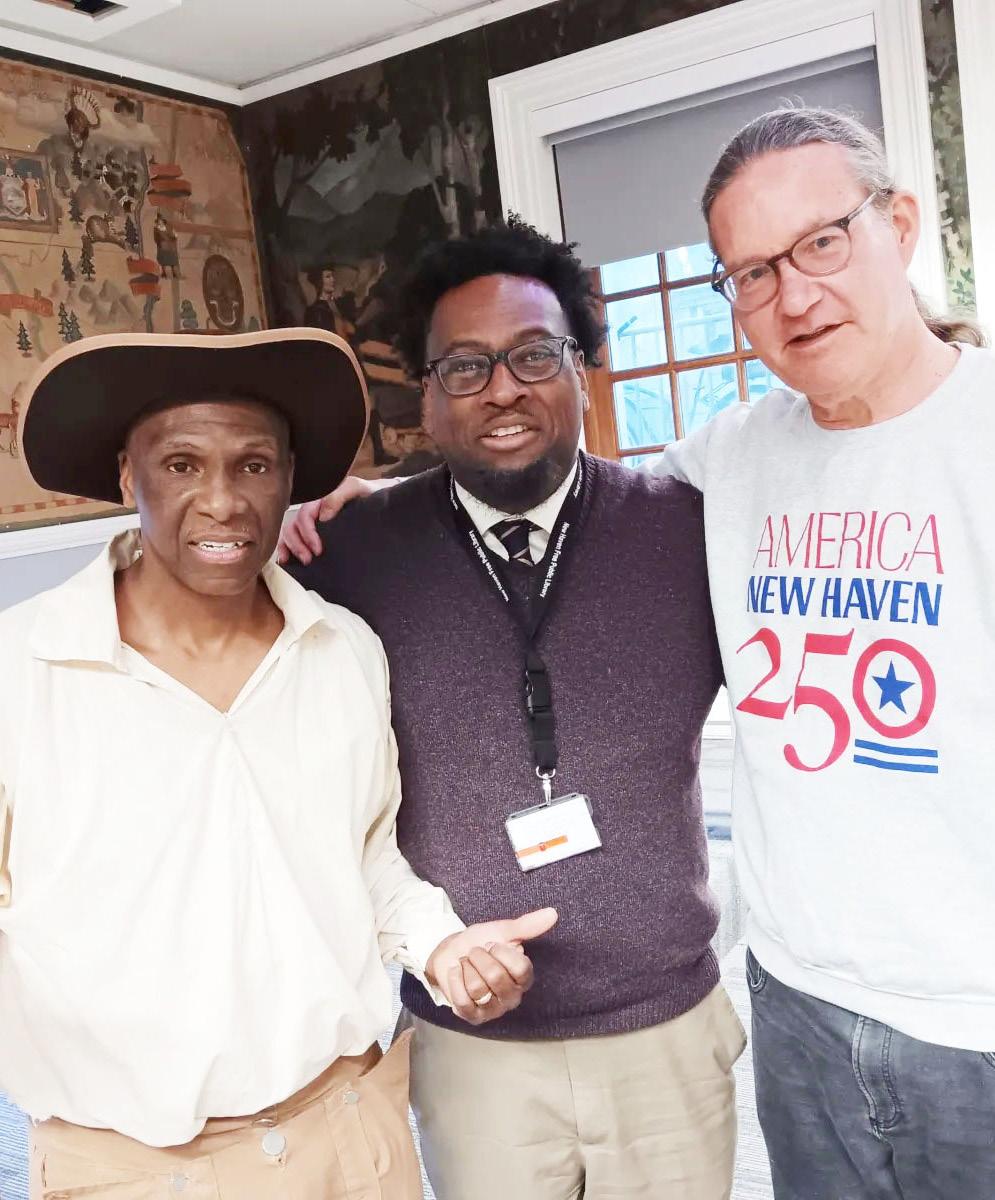
A Revolutionary War soldier named Jordan Freeman emerged from his grave Thursday night to drop by the New Haven Free Public Library’s Ives Main Branch. He was not there to return a book; he was on an even more critical mission.
In his tri-corner hat, light white shirt, beige breeches made of homespun, stockings, and straight shoes without buckles, Freeman — AKA Kevin Johnson, an historian with the Connecticut State Library in Hartford — bore a pike (well, actually, for safety reasons, a tenfoot 1940s transom window-opener).
Johnson was at the downtown library to give his 201st performance reenacting the life of Freeman, who died fighting the British in the grisly battle of Fort Griswold in New London on Sept. 5, 1781.
Although it was the last battle of the war, at least in the northern colonies, before the final victory at Yorktown, it was a brutal one and underscored the real meaning of the final words of the Declaration of Independence in which signers pledged their “lives, fortunes, and sacred honor.”
Facing a large, outnumbering force of British troops led by no less than New Haven’s own Benedict Arnold, the Alamo-like refusal of the Americans under Colonel William Ledyard to give up led to, in effect, a massacre of the American forces even after they surrendered.
And among the dead, who were originally thrown in a mass grave, was Jordan Freeman, who was a body servant to Ledyard.
As Johnson emphasized, as a freeman — that is, not a formally enlisted soldier — he didn’t have to be there at Fort Griswold, and yet there he was, very much like Crispus Attucks, the African American dockworker who was the first of five people killed in the March 5, 1770 face-off with British soldiers, known as the Boston Massacre. Attucks is widely considered the first patriot killed by a British bullet in the Revolutionary War and its run-up. Like Freeman, he chose to be there. When you think of the risky war that resulted in our independence and the role of Black people in it, Johnson urged New Haveners on Thursday to think of the heroic lives of people like Freeman, Attucks, and the enlisted soldiers — more than 5,000 strong who fought on the patriot side for freedom, the national variety and their own.
“We Blacks feel this is the time to seek our freedom,” Johnson/Freeman declared as he dropped into the Revolutionary times, and then he raced through the complex history of the era — from Blacks’ service in the French and Indian War; how many sought and accepted the freedom the British of-
fered if they enlisted into the ranks of the Red Coats; and how, on the patriot side, Blacks as soldiers were also eventually embraced, but not in the beginning trusted to bear arms.
Johnson’s spirited reenactment unfolded in the community room of the Ives Main Branch and was one of the more than 30 (and growing) events the New Haven Free Public Library (NHFPL) has programmed among all the branches this year — it’s called Rooted in Place: 250 Years Through New Haven’s Lens — to celebrate the national semiquincentennial.
Following a chronological scenario from the French and Indian War and with the repeated refrain “ready, aim, fire,” to illustrate the Colonial battle ex-
perience, Johnson’s reenactment didn’t shy away from the complex moral challenge the war posed for African Americans. How, for example, the British campaign to recruit Black people included slogans like “fight against your masters,” and what the consequences would be if you chose not to.
Namely, “those who did not go to the British were told that if they were caught, they would be whipped or hanged.”
Of the 5,000 enlisted formally in the militias and units of the Continental Army, about 500 were from Connecticut and served “as privates, as cooks, and musicians,” he said.
Johnson: “How was my dying? Was
okay? The deaths are emotional moments for me,” he said. “It moves me each time.”
In an animated discussion with audience members afterwards, Johnson explained how in his work at the state library the stories of African American soldiers “gripped me.”
Starting with the work of the first researchers — such as Colored Patriots of the American Revolution by William C. Nell, published in 1855 — Johnson dug deeper, visited locales of battles, studied monuments for clues, and has tried to track down descendants and burial places to uncover more facts and to enrich his presentations.
Freeman was not the first African American soldier whose life he has inhabited. Over the last 20 years Johnson has also portrayed the Civil War Pvt. William Webb of Company F of the storied Twenty-Ninth Connecticut (Colored) Regiment over 600 times, he said.
Local historian Frank Mitchell — whose movie Unsung Heroes, a history of jazz in New Haven and across America that will be screened at the library on April 29 — asked Johnson how a Civil War veteran’s sense of freedom, or the search for it, differed from Freeman’s.
As slavery was abolished in Connecticut (the last of the New England States to do so) in 1848, Webb was technically free. He enlisted, Johnson said, into the Twenty-Ninth to save the Union, without which victory that legal freedom would not have persisted.
In the Revolutionary War period, Johnson speculated Freeman embodied his “master’s” Ledyard’s values, but he didn’t need to enlist as he was the colonel’s servant. “He was already free,” Johnson said. There are records documenting that Freeman was paid for his services, and other records, after the war, where he is involved in law suits.
“They’re both freedom-seekers, but different weights, different magnitudes.”
it okay? The deaths are emotional moments for me.”
“Now it’s September 6, 1781,” Johnson said, dropping again into the character of Freeman, “and Colonel Ledyard commands. But our 150 militia are up against 800 British regulars. Ready, aim, fire! The musket smoke is everywhere.
“And suddenly they’re losing. Colonel Ledyard is killed. I hear the cries of the men. I find a pike,” Freeman/Johnson calls out, and he thrusts and thrusts upward. Then, “I’m hit, I die,” and he falls to the ground.
A dramatic moment later, Johnson rose and engagingly asked the audience, “How was my dying? Was it
And also different complexities. For example, in the case of Freeman, his wife, whom the records call “Miss Lilly,” is the servant of a woman named Mary Prentis. When Prentis died, Johnson explained, “she [that is, Ms. Lilly] is willed to another enslaver of her choice! And after Jordan dies, she escapes.”
Johnson said he is booked to bring Freeman to life for 16 more performances this semquincentennial year at schools, prisons, and other venues. “Don’t let anybody tell you,” he concluded, “other than that Blacks have always been trying to navigate their way to freedom. We’ve been a Navigating People, down to today.”
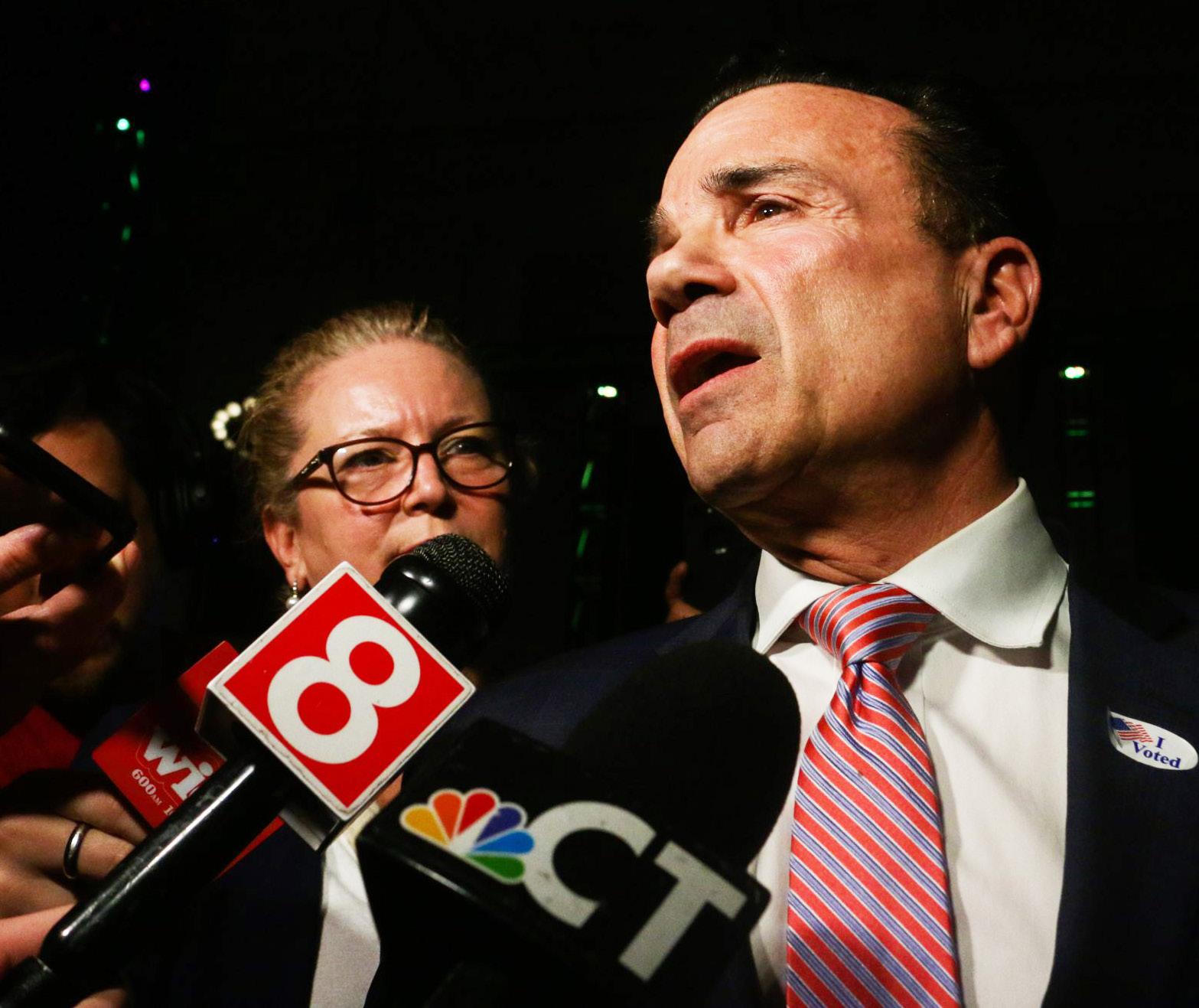
BRIDGEPORT — Mayor Joe Ganim is seeking a fourth consecutive term and, should he win, will become the city’s longest-serving chief executive, beating out record-holder Jasper McLevy’s 24 years.
The 66-year-old Democrat quietly filed his 2027 reelection paperwork with the town clerk last week. He originally served in the 1990s and waged a comeback in 2015.
The fanfare is apparently being saved for his just-advertised kickoff fundraiser with “special guest” Gov. Ned Lamont, scheduled for April 16 at Boca Oyster Bar along the harbor, with suggested contributions of $100, $250, $500 and $1,000.
“Bridgeport has incredible momentum right now,” the incumbent said in a statement Tuesday evening.
Ganim cited his just released 2026-27 municipal budget proposal, which, thanks to a spike in real estate values, allows him to drastically slash the city’s tax rate, though impact on actual residential and commercial bills varies, with some expected to rise. He is also looking to boost education spending and tax relief for seniors and veterans.
The mayor also touted “transformational growth” like the decades-long-in-coming waterfront Steelpointe redevelopment on the East Side, where Boca is located and an apartment complex and hotel are finally being built, as well as the ongoing demolition of the shuttered South End coal-fired power plant.
But there have also been setbacks over the years. Most recently the Bridgeport Islanders minor league hockey team last week announced it is, after 25 years, departing for Canada, potentially leaving the city’s 10,000-seat entertainment arena unoccupied for months as officials look
for a new operator/tenant.
“We’ve built a strong foundation, but the job isn’t finished,” Ganim concluded in Tuesday’s statement. “I’m running to complete the work that we have done on so many fronts to improve the city we love.”
A spokesperson for Lamont’s own 2026 reelection campaign confirmed his attendance at the April 16 fundraiser. Asked if it should be considered a an unusually early formal endorsement of Bridgeport’s incumbent chief executive, the governor’s campaign responded, “Mayor Joe Ganim
has been a partner to Governor Ned Lamont in advancing priorities in Bridgeport. Together, they’ve worked on efforts to expand housing, support economic development, create jobs, and invest in education for the city’s residents.”
If it feels like Bridgeport voters just returned Ganim to office for another four years, that is likely due to the months long, divisive and still-lingering mess that was 2023's mayoral contest between the mayor and then chief-rival, fellow Democrat John Gomes.
An absentee ballot scandal involving two of Ganim’s supporters gained national and international headlines and resulted
in a state Superior Court judge throwing out the mayor’s slim victories in that year’s September primary and November general election. Those matches were then re-held, respectively, in late January and late February 2024.
Ganim himself had at the time called the controversy a “black eye” for Connecticut’s largest, solidly Democratic municipality, which over the years has weathered other political scandals, including a federal corruption conviction that ended Ganim’s first tenure running Bridgeport in 2003.
Meanwhile individuals from Ganim’s and Gomes' campaigns have since been arrested and charged with alleged elections violations. Those cases are pending. And just last month the Connecticut State Elections Enforcement Commission closed an investigation into a Gomes' ally dating back to her circulation of absentee ballot applications ahead of the January 2024 mayoral primary do-over without leveling any penalties.
A Ganim/Gomes 2027 rematch is possible. The latter in a recent interview said “it’s definitely of high consideration” and he is again engaging with “community stakeholders and voters.”
Gomes has seemingly avoided the limelight since his last bid for office ended and late last summer was hired as a key account manager for Connecticut Natural Gas. But earlier this month he was hovering around the Bridgeport Democratic Town Committee’s biennial meeting to elect officers.
“It doesn’t make sense to make noise for the sake of making noise,” Gomes said about having stepped back from the public arena for a bit. “I put two and a half years of my life in this campaign and
there was a physical, emotional, financial drain because that’s how much I believe in Bridgeport.”
Meanwhile South End City Councilman Jorge Cruz, who backed Gomes two years ago, in early January filed paperwork to form a mayoral exploratory committee. Cruz has previously said he had consulted with Gomes and would again support him should Gomes decide to run and Cruz fail to gain traction as a candidate.
In response to Ganim entering the 2027 race, Cruz in a statement Tuesday said “the only fundraising Joe Ganim needs to do” is to help those 2023 supporters charged with election-related crimes pay for their legal representation.
“They are all on their own,” Cruz continued. “It’s time for a new administration to step up and take over for this corrupt administration.”
Whoever the incumbent faces next year, should he win, Ganim will be poised to best McLevy’s record tenure running Bridgeport. The latter served for 24 years from the 1930s into the 1950s.
Ganim was first elected in 1991 and remained in office until a 2003 federal conviction for engaging in a pay-to-play scheme ended his tenure and, seemingly at the time, his political career.
But in 2015, a few years after he completed his prison sentence, Ganim issued a public apology for his crimes, dropped efforts to appeal his conviction and took on and ousted then-Democratic Mayor Bill Finch. Four years later, Ganim survived an aggressive challenge in 2019 from then-state Sen. Marilyn Moore and ultimately fended off Gomes two years ago.
BRIDGEPORT — “They don’t make things like this anymore,” Margaret Judge said as she looked up at the high ceilings in the auditorium at the old Bassick High School.
The city resident and president of Stratford Historic District Association joined several other members of the Bridgeport community for a tour of the now-empty buildings Saturday with the developer who is proposing to build apartments on the site. The school was relocated last summer to its new South End campus. New York City-based Kiumarz Geula, who owns several other prominent properties in Bridgeport, is the developer. People on the tour said they want to see more of the project’s space devoted to community resources. Geula said there is a plan to turn the theater and gymnasium into a community theater and community center, respectively.
The plan, according to Geula, is to demolish the building closest to Clinton Avenue, then turn the building with the entrances lined with columns behind it into apartments. New buildings would be constructed on both ends of that building for housing and include community or

commercial entities on the ground floors, he said.
Vanessa Liles, president of the West Side/West End Neighborhood Revitalization Zone, took part in the tour. She
walked through the empty halls of closed lockers and poked her head into some of the empty classrooms.
Liles said she was more worried about how the auditorium and gym were going
to be used, rather than preserved. She said she wanted more space for people to gather as a community and lamented the fact the neighborhood does not have a community center.
“This needs to be a space where the community, young people and families can feel like there's a safe place for people to be,” Liles said.
She suggested using some of the building for artist spaces or resources for senior citizens.
“The neighborhood right now doesn't have an anchor,” Liles said. “It doesn't have something that is signature."
Liles said she wants the city to “see itself as beyond the brokering of the deal,” and to set specific goals and wants for development.
Tanner Burgdorf, executive director of the nonprofit Groundwork Bridgeport, also took the tour. He said he could imagine the building being home to a “hub of nonprofits.”
“Imagine the good that would bring if small nonprofits had a place where they could get affordable rent for their office space,” Burgdorf said.
This story includes previous reporting by staff writers Brian Lockhart and Jessica Simms.
By Jimmy E. Jones
O ye who believe! Fasting is prescribed to you as it was prescribed to those before you, that ye may (learn) self-restraint.
(Quran 2:183, A Yusuf Ali translation)
A little over a century and a half ago, on March 10, 1876, Alexander Graham Bell uttered these famous words to his assistant electronically: “Mr. Watson, come here, I want to see you.”
With the invention of the telephone, the world has never quite been the same. Indeed, what we call a “telephone” today is in reality a small powerful personal computer with a screen that enables us to see who we are talking to! Unfortunately, according to an August 2025 publication of the National Library of Medicine, “The growing dependence on smartphones has led to the so-called ‘heads down’ generation whose physical and mental well-being can be harmed in several ways.” Sadly, we live in an age of distraction with many of us checking our smartphones multiple times an hour. In such a world, it is often very difficult to find
time and space for the silence and solitude that most world religions encourage as a way to deepen our relationship with the Creator.
For Muslims, the directive presented in the Quranic verse that opened this article provides an annual vehicle for developing self-restraint in a world filled with distractions, electronic and otherwise. For us, we believe that the Islamic month of Ramadan provides the perfect opportunity to recalibrate our priorities. This year, Ramadan coincided with mid-February until mid-March. During this time most of us fasted from food, drink and conjugal relations from dawn to sunset every day. In addition, we were encouraged to pray extra prayers, give extra charity and be on our best behavior when interacting with others.
This particular approach to life is particularly useful in a world that, increasingly, seems to be led politically and religiously by those who are more motivated by self-interest than self-restraint. This is in spite of the fact that such leaders often take oaths or vows to look out for

the common good over and above their personal desires. Hopefully, the fact that approximately two billion Muslims participated in this regimen of self-restraint for 29 or 30 days (Muslims use a lunar calendar — most U.S. Muslims ended Ramadan on Thursday, March 19 with a special prayer and celebrations on Friday, March 20) will provide positive examples for our leaders, Muslim and non-Muslim, to emulate. Regretfully, far too many of them and us seem to have forgotten about God in this world of distraction. One alternative translation of the Quranic verse that we started with is “O believers! Fasting is prescribed for you as it was for those before you, so perhaps you will become mindful of God.” (Quran 2:183, M. Khattab translation) In short, the world would be a much better place if we exercised self-restraint based on God-consciousness. Faith really does matter.
Jimmy E. Jones is Professor, Comparative Religion and Culture at The Islamic Seminary of America and President of New Haven’s Malik Human Services Institute.
by Thomas Breen
Mayor Justin Elicker plans to nominate Acting Police Chief David Zannelli to serve as the city’s next permanent chief, more than two-and-a-half months after Zannelli’s predecessor, Karl Jacobson, abruptly retired — and was later arrested — for allegedly stealing public funds. City spokesperson Lenny Speiller announced Zannelli’s selection in an email media advisory sent out at around 6 a.m. Wednesday.
Elicker, Zannelli, city Chief Administrative Officer Justin McCarthy, and city police commission Chair Evelise Ribeiro plan to hold a press conference about Zannelli’s selection at 1 p.m. Wednesday at City Hall. (Speiller had previously sent out an email media advisory at 8:30 p.m. Tuesday announcing that the mayor would be holding a City Hall press conference about his nominee for police chief; that initial email did not identify Zannelli by name as the appointee).
Zannelli’s nomination must now head to the Board of Alders for review and a final confirmation vote. Per the city’s charter, an acting police chief can serve in that temporary role for no more than six months before the mayor has to submit their name to the Board of Alders for confirmation as permanent chief.
Zannelli — a veteran city cop who became a popular Fair Haven district manager and then head of the Internal Affairs division — previously served as assistant chief of patrol and then as assistant chief of investigations under Jacobson. He stepped into the role of acting chief on Jan. 5. That was the very same day that the city’s three assistant chiefs — Zannelli, Bertram Ettienne, and Manmeet Bhag-

tana — confronted Jacobson in his office about his alleged theft of police funds meant for confidential informants. Jacobson retired that day; he was later arrested, on Feb. 20, for allegedly stealing $81,500 from the CI fund fund as well as $4,000 from the Police Activity League (PAL).
According to a state police affidavit, Jacobson had gambled over $4.4 million on the sports-betting apps DraftKings and
FanDuel over the course of his final year as police chief, reaching a net loss of at least $214,000.
A state police warrant for Jacobson’s arrest showed that Zannelli cooperated with investigators and audio-recorded that confrontation with Jacobson to preserve a record of what was said; state police and the state’s attorney’s office have also said that no other city cops appear to have

John P. Thomas Publisher / CEO
Babz Rawls Ivy Editor-in-Chief Liaison, Corporate Affairs Babz@penfieldcomm.com
Advertising/Sales Team
Keith Jackson Delores Alleyne John Thomas, III
Editorial Team
Staff Writers Christian Lewis/Current Affairs Anthony Scott/Sports Arlene Davis-Rudd/Politics
David Asbery / Tanisha Asbery
Jerry Craft / Cartoons / Barbara Fair Dr. Tamiko Jackson-McArthur Michelle Turner / Smita Shrestha William Spivey / Kam Williams Rev. Samuel T. Ross-Lee
been involved in Jacobson’s alleged theft of city funds.
Zannelli was the assistant chief who was supposed to be in charge of the fund for the year prior to Jacobson’s resignation. He has said that he and his colleagues repeatedly asked Jacobson for control of the CI fund, but that Jacobson consistently declined.
So far during his tenure as acting chief, Zannelli, working with the mayor and the police commission, has overseen the adoption of a new temporary CI policy that, among other changes, means that command staff in charge of managing the CI fund will no longer also have the responsibility of auditing how that money is spent.
He is also working with the New Haven Public Schools (NHPS) district to assign a city police officer to middle schools as soon as this May in an effort to address a spike in crimes committed by, against city youth.
According to the city’s latest CompStat report, through March 15, there have been 0 homicides and six non-fatal shootings so far this year, compared to two homicides and two non-fatal shootings by that same time last year. City police have made arrests or pulled warrants for all six non-fatal shootings so far this year.
The CompStat report also states that there have been 22 confirmed shots fired so far this year, compared to 14 by this time last year.
In an interview on Feb. 5, a month after Jacobson’s retirement, Elicker said he had not yet decided whether or not to do a search to find Jacobson’s replacement as Zannelli continued in the role of acting head of the department.
Contributors At-Large
Christine Stuart www.CTNewsJunkie.com Paul Bass www.newhavenindependent.org
National Association of Black
Inc.
The Inner-City Newspaper is published weekly by Penfield Communications, Inc. from offices located at 50 Fitch Street, 2nd Floor, New Haven, CT 06515. 203-3870354 phone; 203-387-2684 fax. Subscriptions:$260 per year (does not include sales tax for the in State subscriptions). Send name, address, zip code with payment. Postmaster, send address changes to 50 Fitch Street, New Haven, CT 06515. Display ad deadline Friday prior to insertion date at 5:00pm Advertisers are responsible for checking ads for error in publication. Penfield Communications, Inc d.b.a., “The Inner-City Newspaper” , shall not be liable for failure to publish an ad or for typographical errors or errors in publication, except to the extent of the cost of the space in which actual error appeared in the first insertion. The Publisher reserves the right to refuse advertising for any reason and to alter advertising copy or graphics deemed unacceptable for publication. The entire contents of The Inner-City Newspaper are copyright 2012, Penfield Communications, Inc. and no portion may be reproduced by any means without the written permission of the publisher.
by Paul Bass
Connecticut’s taking a second hit at figuring out how best to run a legal cannabis market — and hoping to get it right this time.
Two bills currently before the state legislature would make changes in the rules governing the sale of recreational cannabis, which became legal here in January 2023.
Two New Haveners are reprising key roles in that effort: State Rep. Roland Lemar and Kebra Smith-Bolden, founding owner of Lit New Haven dispensary at 169 East St. Both also played roles in Capitol discussions shaping the original legalization legislation.
They argue that controls placed on the industry have made it hard for legal retailers to compete with dispensaries in neighboring states and smoke shops illegally dealing weed.
“We put them under tight controls. Then we told them to go compete with people” who don’t follow the same rules, Lemar said in an interview Thursday. “We’re putting [dispensaries] in a position to fail.”
The bigger of the two bills, HB 5350,

had a March 4 hearing before the legislature’s General Law Committee, which Lemar co-chairs. Its 24 provisions include allowing retailers to sell cannabis flower with 35 percent (rather than 30 percent) THC levels and removing maximum THC levels from concentrates.
A second bill would create a single 10.5 percent excise tax on THC. Current-
ly Connecticut, unlike other states, has a variable tax that rises with the potency of THC in each product. As a result the same product in Connecticut has an overall 2526 percent effective tax rate as opposed to 20 percent for Massachusetts-sold products.
Customers who might otherwise shop at a legal dispensary often cross the bor-
der into Massachusetts or New York, or buy from smoke shops, in order to pay less or to obtain higher-THC products. The tax bill would bring $150-$160 mil lion in annual sales lost to neighboing states because of the current price differential, estimated Nikole Burnes, executive director of the Connecticut Cannabis Chamber of Commerce. (Yes, that exists.)
“We are in a desperate fight right now against our neighboring states and also against the illicit market,” Burnes said during a conversation Thursday with Smith-Bolden and Chamber President Adam Wood on WNHH FM’s “Dateline New Haven” program.
“You can go to any illicit market and get any unregulated, untested, unsafe product, no matter the potency. And they are winning right now against legal operators who did everything they were supposed to do. They dotted their eyes. They crossed their Ts. They did everything that was asked of them. And right now they are struggling.”
Smith-Bolden’s Lit New Haven, a cozy spot iinside a brick building in the Mill River area fitted out with bright local artworks, couches, and a framed photograph paying tribute to Tulsa’s early-20th century “Black Wall Street,” fits into that category.
In one sense it’s the region’s best example of what the original legalization law hoped to accomplish: offering communities hardest hit by the drug war a chance to share in legalization’s financial bounty. Smith-Bolden, a registered nurse who previously worked in the medical marijuana industry, is the only Black woman
Con’t on page
by Thomas Breen
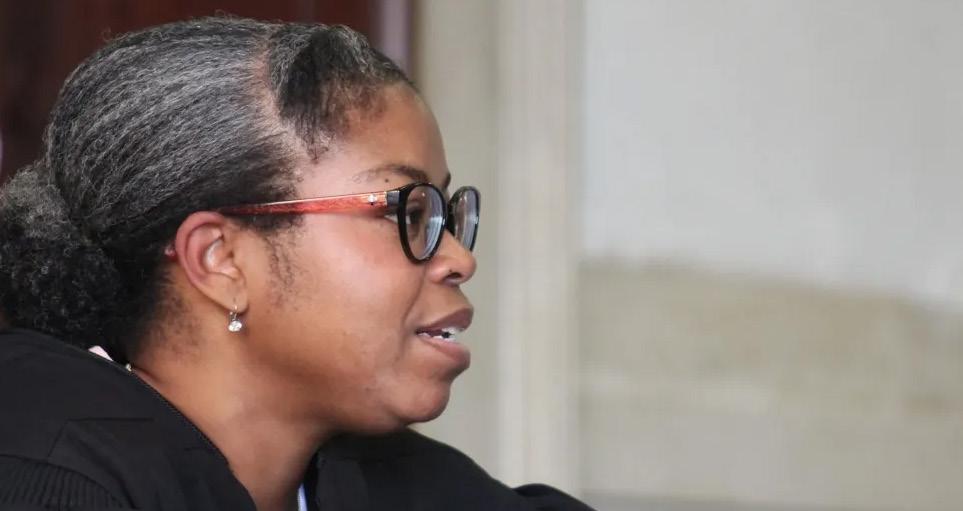
State Judge Alayna Stone, who currently presides over New Haven’s housing court, is one step closer to taking on another title — that of city Youth Commission member — after an aldermanic committee endorsed her appointment to serve on the volunteer local-government board. The Board of Alders Aldermanic Affairs Committee took that unanimous vote Monday during its latest meeting in the Aldermanic Chamber on the second floor of City Hall.
Stone, who lives in New Haven, has been tapped by Mayor Justin Elicker to serve on the city’s Youth Commission, which — per the city’s website — “works to identify the challenges, needs and concerns of youth in the City of New Haven through outreach to young people, parents and families, school administrators, community leaders, academicians and other,” among other responsibilities.
If confirmed by the full Board of Alders, Stone’s appointment to the commission would expire on July 1, 2027.
During her confirmation hearing before the committee alders on Monday, Stone said that she learned about the commission through fellow state Judge Robin Wilson, whose term on the Youth Commission is set to expire in July.
“She knew that I have always had an interest in youth,” Stone said about why
Wilson reached out to her about applying for the volunteer spot.
Stone said she earned a bachelor’s degree in developmental psychology at Yale, and that her undergraduate thesis was about after-school activities for children.
“I decided I wanted to stay in New Haven” after graduating from Yale, she said, and so she spent two years working at the local youth-tutoring-and-sports nonprofit Leadership, Education, and Athletics
in Partnership (LEAP) before going to Washington, D.C. to get a law degree and a master’s degree in public policy. Her thesis for that latter degree, she said, was on “juvenile justice outcomes.”
Upon returning to New Haven after graduate school, she said, “I have maintained a lot of connections” with people she met at LEAP. She said she was on the board for Elm City Montessori for several years, and is just now cycling off of that volunteer responsibility. “I was looking
for new ways to get involved in youth things that were going on in New Haven” when Judge Wilson reached out with this Youth Commission recommendation.
Morris Cove Alder Leland Moore, who works for the state Attorney General’s office, thanked Stone for stepping up for the city commission role. “I know you have a busy, demanding, stressful job,” he said. He thanked her for “staying involved” and for “contributing to our community.
I think it’s very commendable” given her
work as a state judge.
“It sounds like you will be a great fit on that commission,” agreed Newhallville/ Prospect Hill Alder Kimberly Edwards. Annex Alder Sal Punzo, a retired former New Haven Public Schools (NHPS) teacher and principal, asked Stone what she thinks are “the biggest challenges for our youth today.” Opportunity, Stone replied. “Opportunities to demonstrate leadership. Opportunities to build skills.” She spoke of the importance of keeping kids engaged “in their education” as well as in “civic life.”
The rest of Stone’s hearing saw alders continue to praise the state judge for her willingness to serve on the city board.
“As a mother you set an amazing role model,” said Downtown/East Rock Alder Christine Kim. “You lead with compassion, love, firmness, and vision. The Youth Commission of the city is very fortunate to have you.”
Edgewood Alder and committee Chair Evette Hamilton agreed. “With her expertise and background, I think she is a great fit for that commission.”
Moore said that he has had “the great fortune of working with Judge Stone before she was elevated to the bench. We could not ask for a smarter, more capable, more compassionate individual to step up into the role.”
And with that, the commissioners voted unanimously to recommend that the full Board of Alders approve Stone’s appointment.
Julia Sears
Two friends, Berenger (Reg Rogers) and Gene (Phillip Taratula) catch up outside a cafe, blue sky stretching out behind them. They discuss the usual—money, relationships, alcoholism, personal grooming routines. Their banter remains unbroken even as birds flee across the skyscape and a rumble draws closer to the cafe. Only when the rumble turns to a roar, do they leap up and proclaim what they are seeing before them: “It's a rhinoceros!”
Thus begins the simple yet impactful premise of Eugene Ionesco’s Rhinoceros, running at the Yale Repertory Theatre through March 28. Directed by Liz Diamond, translated by Derek Prouse and adapted by Frank Galat, Rhinoceros is a play so prescient that were it written in 2026, it would be criticized for being too on the nose. Instead, its legacy helps this production pack a well-timed punch.
Performances run at the Yale Repertory Theatre at 1120 Chapel St. through March 28. Tickets and more information are available here.
Ionesco's 1959 comedy is a satirical representation of a community’s descent— maddeningly predictable, at that—into ideological submission. The story follows Berenger, an unremarkable man who becomes exceptional by believing what he sees. And what he sees, in this case, is a rhinoceros stampeding through his town.
Not long after the first sighting, Berenger and Gene have returned to more banal topics, as one does when one witnesses an astounding horror but has work in the morning. Just as the first rhinoceros fades from memory, however, another charges the cafe. It feels like an apt metaphor for the familiar barrage of “unprecedented” threats, from foreign conflicts to environmental catastrophe to a federal
government that deals in alternative facts.
The next day, Berenger goes to his office, where his reality—the one where he saw two rhinoceroses—is immediately challenged. His coworker Botard (Richard Ruiz Henry) claims the rhinoceros is a hoax. He blames journalists (“They’re all liars. I don’t need them to tell me what to think. I believe what I see with my own eyes!”), witnesses (“You’ve got too much imagination. It was probably a flea run over by a mouse. People make mountains out of mole hills.”) and his fellow coworkers (“You’ve been producing this propaganda to get rumors started.”)
Botard’s denials ring out like a comment section taking on the most convenient argument for the moment and obscuring both truth and danger. When he finally sees a rhinoceros himself (after literally walking away from it and yelling “I don’t see anything. It's an illusion!”) he ruminates, “How can it be possible in a civilized country?”
The play shows us how. When the characters discover that the rhinoceroses were once people– that they are actually quite strong and free and happy, that they exist above the laws of men– they find themselves sympathetic, even intrigued. Soon they start to ask: Are the rhinoceros so bad? Wouldn’t life be easier if I too were a rhinoceros?
Berenger moves through the story searching for an ally in his truth. He is a man, not a rhinoceros. The herd is growing and soon there may be no humanity left. He is met with ideology, justification, apathy and violence. And yet he resists.
The great success of the production is that its tasteful direction lets the play speak for itself. There is no pandering to the audience to make sure we understand the parallels to our own time. Diamond guides the story with humor and heart,

supported by expert choices in performance and design.
The setting of a provincial French town is captured by scenic designer Jennifer Yuqing Cao through evocative industrial elements— a large clock looming over the office workers, curtains and paneling reminiscent of shipping containers, restrained grays, blues, and whites used throughout. The style feels true to the setting while hinting at the malleability
of when and where this story might take place. Ke Xu’s projections integrate perfectly as their subtle deployment made it look like the walls were shaking or the world distorting.
The late 50s costumes by Tricie Bergmann feel both rich and lived in. Pops of color bring our attention to important characters. Gene in his yellow suit and green pajamas as well as Daisy (Elizabeth Stahlmann), Berenger’s love interest, in
pink shoes stand out in a sea of grey and white.
Reg Rogers as Berenger is devastating, funny, and deeply relatable. He is an “everyman” that you will root for, despite his flaws. He and Phillip Taratula as Gene have a deftness with Ionesco’s language that make their tête-à-têtes feel immediate and familiar.
Tarantula begins the play gliding around the stage commanding attention with delightful arrogance. As he transforms into a rhinoceros, he takes on a striking physicality, throwing his weight around the stage, stomping out the man he was before.
Will Dagger does a frustrating and funny performance as Dudard, the human embodiment of the New York Times. Elizabeth Stahlmann as Daisy plays subtext with glances and physicality to great effect. Meanwhile, Nicole Michelle Haskins’ brief appearance as Mrs. Boeuf lands the biggest laugh of the night by “falling” through the stage and riding away atop her husband.
The townsfolk are not presented as villains: they all have their reasons to submit. Instead they are deeply recognizable. Ionesco’s play is not about bad people joining a bad cause. It's about how hard it is to believe the worst. That the rhinoceroses are here. We’ve seen them. We are them. Unless we tell the truth, unless we do the absurd.
In a final monologue, Berenger stands alone on a darkened stage. He pleads to become a rhinoceros, to give in to the overwhelming tide. A hoard gathers behind him, the cast in sleek papier-mâché rhino masks, backed by a projection of a growing crowd. In a forceful turn he collects himself and with fury stares down the hoard and audience alike and roars “I am not capitulating!”
By Kaitlin Keane, Staff
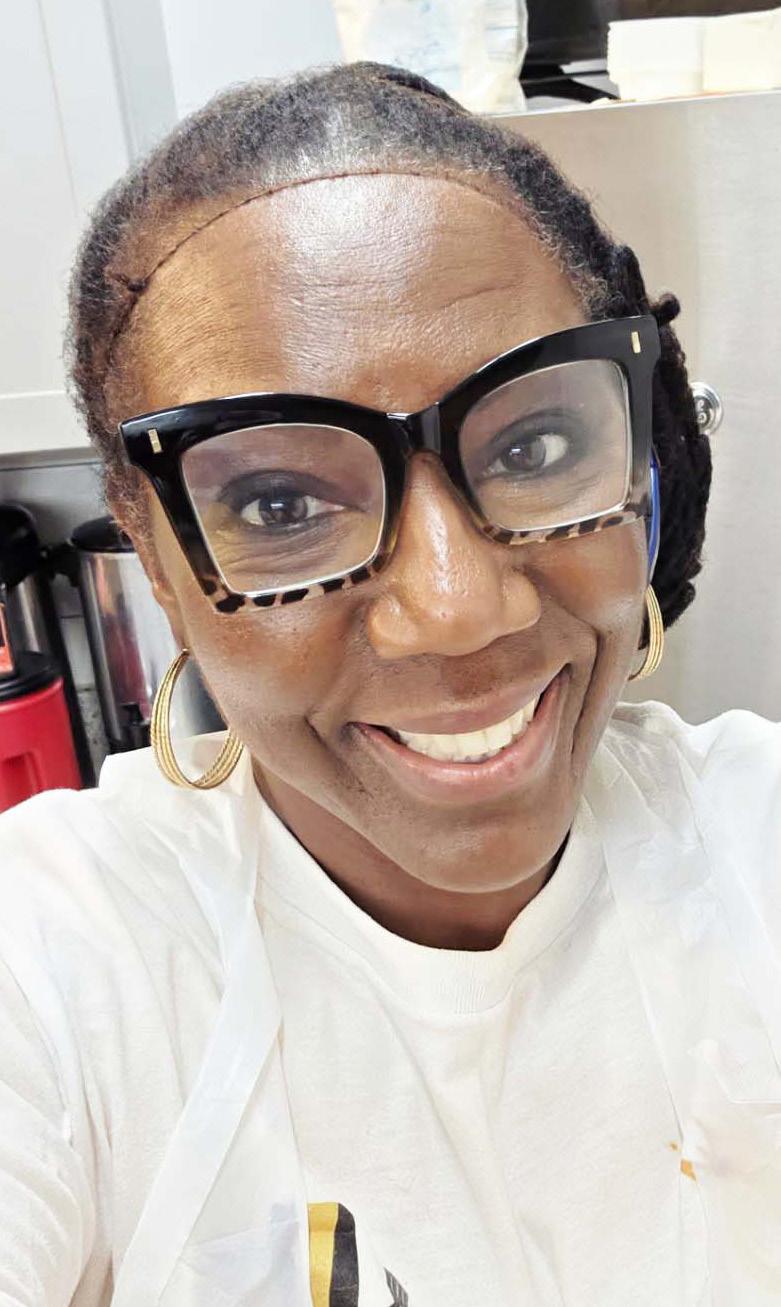
BRIDGEPORT – Whenever she’s following her family’s recipes for collard greens and macaroni and cheese, Sarah Brooks said goes back to when she cooked alongside her grandmother and mother.
“I just remember the times we spent in the kitchen, cutting up greens and the whole process of cooking,” said Brooks, of Bridgeport. “People don’t spend time like that anymore … I just like to have that feeling come out in the food. That’s what I think about, that’s what I remember and that’s what I want people to feel when they eat it.”
Brooks paid homage to her late mother Vivian Tompkins-Brooks through her first eatery, Aunt Viv’s Homestyle Cooking, which she ran as a food truck for a decade, and then as a restaurant on Huntington Turnpike for three years before

closing during COVID-19.
She also feeds the community every other Saturday through her nonprofit Kingdom's Kitchen, which is held in the kitchen of Full Gospel Pentecostal Church in Bridgeport.
Brooks will now serve up her family’s soul food recipes at her new restaurant, Ms. Dot’s Hot Chicken, named after her late grandmother Dorothy Tompkins.
Ms. Dot’s Hot Chicken celebrated its grand opening at 1492 Stratford Ave on Monday. The restaurant is open 11 a.m. to 8 p.m. Tuesdays through Saturdays and closed Sundays and Mondays.
With fried chicken, macaroni and cheese, collard greens and fish and grits on the menu, Brooks said her restaurant is “morphing soul food with fast food” and offers takeout only.
“You still have the good comfort food, but you can have it in the comfort of your own home,” she said.

Lucy Gellman
“Laugh! Laugh at everything they say, makes 'em feel superior,” actress Wiletta Mayer tells newbie John Nevins just minutes after he has walked into the rehearsal room.
It is their first day on the job together, and the two are easing into the space, warm but guarded as conversation floats between them. John, still baby-faced and full of hope, scrunches his eyebrows. He’s skeptical. A narrative door swings open, ever so briefly.
“Why do they have to feel superior?” he asks. In his mind, he’s already working on a portrait of the white director who is due to walk in any minute. Wiletta stares back, and before she even speaks—“You gonna sit there and pretend you don't know why?”—her face says everything he needs to know.
Has she sold out, or done what she needs to do to survive?
Wiletta Mayer (Tamika Pettway) asks all the right questions—and answers many of them, too— in Alice Childress' Trouble In Mind, running Thursdays through Saturdays from Collective Consciousness Theatre (CCT) through March 29. Directed by Jenny Nelson with a cast that is as sharp-tongued and quick-witted as it is dynamic, the show is both funny and sharply prescient, a testament to how little the needle has moved on race relations in this country in the last 71 years. Or in a less passive voice, how little white people are willing to give up in the name of equity.
All productions take place at Bregamos Community Theater, 491 Blatchley Ave. in New Haven. On the final weekend, there is also a Sunday performance; tickets and more information are available here.
“This show is historic because of the life of the play,” Nelson said during a tech run last week, shortly before performances opened. While Trouble In Mind ran Off Broadway in 1955, it did not make it to Broadway until 2021, because Childress refused to tone it down for white producers and audiences.
"It is important to produce this play as much as possible. We owe her [Childress] that—to center her in this way.”
“This play really talks about the relationship between the actor and the director,” Nelson added. “It’s so important to know the power you have in the room and use it for good.”
It’s the way Childress writes the story, and the biting critique that she brings to the script, that makes this show a doorway and a mirror all at once. A play within a play written in the 1950s, Trouble In Mind follows seasoned actress Wlletta


Mayer (Pettway) as she walks into the rehearsal room for Chaos In Bellville, the latest drama in a long resume. From the moment she steps on stage, Pettway makes it clear she owns the place—or deserves to—a dream that is punctured when other actors begin to come in.
Inside the theater, old colleagues (Raissa Karim as Millie Davis, Joshua Eaddy as Sheldon Forrester) and new (Justin Villard as John Nevins) start to gather, words filling the space as they catch up with each other. Soon, the audience meets white actors Judy Sears (Elizabeth Finn) and Bill O’Wray (Josiah Rowe) who pro-
test the presence of their own ingrained racism so strongly that it is an extra character on the stage.
When Judy announces early on, for instance, “and they’re absolutely right!” of Black people—then looks around brighteyed, as if she’d a dog that deserves an extra large milkbone—Finn nails the squirm-worthy nature of performative allyship, not for the last time in the show.
That’s just the tip of this dramatic iceberg. Chaos In Belleville, written by a white man, is a new play that may catapult actors to Broadway fame—if they can stomach it. The script is drenched in
or sign up for an hour of courthouse accompaniment per week.
Directing it all is a glib Al Manners (Griffin Kulp, who is back to do unctuous very well), who eight years ago may have been caught up in #MeToo, but now might just get off with a finger-wagging and pass as an ostensibly visionary and progressive director. His foil is the loveable Henry (Michael Isko), an Irish immigrant who can see the history of colonial oppression in a different light.
From the jump, the parallels to the present abound, often so head-spinningly accurate that one can see why Childress was barred from Broadway for refusing to make herself small or palatable to white patrons. When John enters the room, Wiletta takes him instantly under her wing, taking him through the etiquette of a Broadway rehearsal before Manners arrives on the set. As she speaks, the audience realizes that this has very little to do with theater at all, and much more to do with white comfort.
“White folks can't stand unhappy Negroes … so laugh, laugh when it ain't funny at all,” she says, and a person can see how much she’s carried to make it in a field that treats her as less than human. When John pushes back, insisting that it must be more nuanced, she gives him a second warning, urging him to lie if asked for his opinion on the play. She’s doing what she must to see another day on the stage.
It’s this moment that has clearly, for Wiletta but perhaps also for Pettway and Villard, played out over and over again in rehearsal rooms, where directors assume that having a Black body onstage is synonymous with ending the color line in the American theater. When Wiletta raises a concern with the lack of lived Black experience in the script, it’s almost too on the nose when Manners responds with a curt, yet somehow also breezy, “Wiletta, don't complicate my life.”
a prejudice that is both racial and regional, with a suggestion that Black people in the South are uneducated, unrefined, and largely passive participants in their own oppression.
It’s a kind of writing that seems exhaustingly, timeless, as if this could be New England during the mid 19th Century, when Northerners claimed moral clarity while owning slaves and turning out inventions like the cotton gin, or the present, when New Haveners will haul a bright, hand-painted sign to a Sunday afternoon protest, but can’t be bothered to show up at City Hall for a budget hearing
We know this guy (perhaps we are this guy), because we’ve seen him in our offices, on our panels, in positions of nonprofit leadership he earned on slick vocab, an edgy pair of glasses and the backs of countless female colleagues. What makes him so dangerous is that he can pull off the optics of anti-racism, while continuing to subjugate people in his workplace. Or as Nelson suggested, “his actions are villainous, but he is not a villain,” so much as a product of the systems in which he doesn’t fully know he’s complicit. Pettway is—as she has always been on the CCT stage—a dynamo, and half of the acting here happens in her body language and resonant, rafter-raising voice alone. Already, she knows that the only chaos in Chaos In Bellville is that which is folded into storyline, from broken, chewed-up and splintered language to
by Janday Wilson
As Jesse Hameen II sat at his hi-hatted throne, looking every bit of 58 at the tender age of 85, Neighborhood Music School’s (NMS) teeming recital room hushed.
The legendary drummer, educator and composer began to pour out his life story. Tender drumbeats echoed each spellbinding line. We all felt the presence of a modern-day griot; Hameen was a conduit of ancient wisdom.
“Soon as I came out the womb, I was beating rhythms,” Hameen proclaimed. He chuckled as he reminisced on his first performance at New Haven’s Winchester School where he tapped on pots and pans – even a can of Chock full o’ Nuts. His face was euphoric as he recalled growing up in the Dixwell neighborhood’s thriving jazz community where he saw household names.
Then he broke into song: Hambone, Hambone, where you been? The audience gathered at NMS to pay tribute to him Friday evening gleefully joined in singing the rhythmic body percussion African American folk song that was created by slaves forbidden to use drums. That was a powerful moment of hearkening to the past and acknowledging how far we’ve come.
After our journey through Hameen’s awe-inspiring 60-year career, the rest of the ensemble joined him on stage – friends of decades. mentees and former students. Their ilk was also proudly watching from the audience. It was stirring to be surrounded by the living embodiment of Hameen’s impact.
Pianist/composer Zaccai Curtis and bassist/composer/educator Zwelakhe-Duma Bell Le Pere grew up under Hameen’s guidance when they were students at the Neighborhood Music School. Both have gone on to travel the world to acclaim while spreading their passion. They are amongst Hameen’s many celebrated proteges who frequently return to New Haven to spend time and play with him. Like a proud dad, Hameen announced that Curtis won his first Grammy for Best Latin Jazz Album for his album Cubop Lives! last year. For his part, Bell Le Pere is an icon in South Africa.
Rounding out the group were jazz saxophonist/flutist/composer T.K. Blue, guitarist Rodney Jones and jazz vocalist Joy Brown. Blue and Jones have played alongside Hameen since some folks in the audience were in diapers. Between Blue, Jones and Hameen there’s practically no renowned artist that they haven’t performed with: Lena Horne, Dizzy Gillespie, Mariah Carey, Curtis Mayfield, Herbie Hancock, Pharoah Sanders, to name a very tiny few.
Trust Hameen to not want to be the star



of the show despite it being his birthday.
His boundless generosity and love inspired him to invite musical luminaries for a show to not just honor him, but to celebrate the community. The price was donate-what-you wish and all proceeds went to support Hameen’s Summer Jazz Program at the Neighborhood Music School.
“For Jesse, it’s not just about him playing. It’s about sharing with everybody here and bringing them into the experience with him. It’s a conversation between the audience and the musicians, and that’s what Jesse does best,” shared Shayna Roosevelt, NMS Marketing &
Communications Manager.
The world-class musicians attracted a mob, and the recital hall and corridors overflowed with people (pro-tip: arrive early when you’re seeing legends). Some people had to content themselves with merely listening from outside the hall, but their radiant faces indicated they were transcending through the experience all the same.
The performers opened with Hameen’s whimsical “Sign of the Times.” Blue’s trilling flute led the charge, threading through Curtis’ cascading piano chords and Bell Le Pere’s meaty bass line. The crowd cheered when Blue dexterously
switched from his flute to his saxophone. The sax sang with a poignant melody. All the while, Hameen flexed his sticks with practiced ease, diligently beating his drums with that signature snow-white smile stuck to his face, demonstrating why people call him “Cheese.” Hameen’s song “Sirius B.” came to him after reading a riveting history of primeval Malian people’s ability to draw the orbit of Sirius, the brightest star in the night sky, by hand. The lush tune evoked the sensuality of a balmy evening spent under a starlit sky. Velvet notes streamed from the saxophone. Fluid guitar runs from Jones seamlessly pulled the song together.
Then the best singer Hameen says he’s ever worked with stepped out. Vocalist Brown couldn’t have gotten a better welcome. “No pressure,” she laughed. If you had had your eyes closed when “Love is Here to Stay” began, you may have thought Dinah Washington had risen from the grave. But Brown had her own distinctive tonal inflection that infused coyness into every note.
“Joy is the last of the legends,” Hameen remarked at the song’s end.
Hameen’s tight-knit ensemble carried the audience through a range of emotional landscapes as the night wore on, and we explored both his creative mind and the jazz standards of yore. It was such a privilege to be welcomed into a musical conversation with these virtuosos. Under Curtis’ hands, the ivories shimmered, elastic and alive. Bell Le Pere’s anchoring bass lines pulsed with an understated warmth.
Blue constantly refigured the soundscape with agile transitions between the sultry saxophone and the silvery flute. Jones proved his reputation as the “singer’s guitar player,” his harmonically rich playing always in service of the melody. Brown’s warm, conversational, and quietly commanding performance transported us to a different era of radio programs and “talkies”.
At the center of it all was Hameen’s joyous, dynamically layered playing, the band’s beating heart.
Reflecting on the evening, accomplished drummer and protégé Ryan Sands beamed. “This feels incredible. Hameen and I go back all the way to 1998. I was about 4 years old, and I had just started playing. He was the teacher that took me under his wing,” he shared. “To be here to support him means the world. I remember being a kid and him picking me up in his car. Now today, I’m picked him up for his show.” The two have apparently discussed doing a double drum album for a while. Talk about a full circle moment. Words don’t quite capture the magic of Hameen’s birthday party. The music and immersion in legacy elevated and inspired us all. Even the poor people who had to stand in the back all night with leaden legs likely found themselves floating home.
“The one thing that will never die is joy. So, we can’t let them take it from us. And this event was all about that,” reflected Noah Bloom, NMS Executive Director. When asked what he wanted for his 90th birthday, Hameen didn’t even have to think. “Another concert!”
To donate to the Summer Jazz Program or to support any of Neighborhood Music School’s wonderful programs, click here.
by Lisa Reisman
Over her 18 years of marriage, Monya Saunders was routinely battered, pistol-whipped, and stomped on with Timberlands, she said. When her former husband started beating her in front of their young daughter, she stabbed him multiple times. She didn’t kill him. She was incarcerated.
“I’ve been in the jailhouse, the crazy house, the halfway house, the crack house, everywhere you could think of,” Saunders told the 20 women assembled for the Women’s Healing Hearts support group at the Yale School of Medicine’s SEICHE Center for Health & Justice last week. “I’ve had DCF snatch my kids right from me. And here I am.”
As lead community health worker and critical case manager with the Transitions Clinic since 2017, Saunders connects people recently released from prison with healthcare and social services, and conducts qualitative research with the SEICHE Center used to develop tools for improving the physical and mental well-being of women leaving incarceration. She educates incoming Yale nurses, social workers, and medical students on the stigma faced by the incarcerated population. She accompanies clients to court and to DCF, and visits them at halfway houses.
“We don’t just guide people home,” she said. “We walk beside them.”
For the last six years, she’s been leading the lunchtime bi-weekly support group which she and Lisa Puglisi, a Yale School of Medicine internal medicine doctor and addiction specialist, as well as Transitions Clinic director, founded during the pandemic.
“We were in quarantine and we thought about the women in the clinic who were in active addiction or were in a domestic violence relationship and in lockdown with their abusers,” she said. They created a Zoom group where the members checked in with each other and developed

strategies to protect themselves, creating safe words they could text Saunders and Puglisi in the event they were in danger.
Once the quarantine was lifted, the women of Healing Hearts started meeting in person. Its ongoing purpose, according to Saunders: “To chop it up about things that are going on, to share resources with each other,” — in short, “to encourage, enrich, and empower.”
“What’s going on, beautiful?” Saunders asked a woman, as she went around the table, checking in with each member.
“Not gonna lie, I’m struggling,” the woman said, the lasagna on her paper plate untouched. She was staying at a transitional house and had applied “everywhere,” she said. She couldn’t find work. “I don’t know if they saw my record, or what, but I always had a job, always. Never not worked. Even in jail I worked.”
“Not to cut you off, but are y’all familiar with the MATCH Program?” Tajuana Peoples said from across the table, referring to a training initiative that provides paid manufacturing skills to job seekers, including individuals transitioning from incarceration.
Peoples, a Healing Hearts OG who has fought addiction and done some jail

time, was a recent graduate of the fiveweek training program. She said she had found a job with a business in Branford. “They help people like us, so don’t feel like there’s nothing out there for you, and once you graduate, they help you find a job,” she said. “They are not going to leave you.”
“Honestly, I usually hate group therapy,” said a woman beside her. “But the best thing I got out of shit like this is there are second-chance programs with corporations looking just for people with felonies.”
“That’s right,” Saunders said. “When
Yale said they were interested in me working here, I was like, ‘Wait a minute. You know I’ve been in jail?’” Then, she realized, “we are their degree. Who would you rather hear from? Have you ever been to prison? Have you ever been on drugs? Have you ever been dragged down the street? I’d rather rock with somebody who’s been there.”
She turned to the group. “You all earned a degree. Maybe you don’t have student loans, but you have knowledge, you have experience, you have overcome things that were designed to kill you, these employers see that. They see how motivated you are with a second chance to get things right.”
“They also get tax credits,” someone said.
“That’s right too,” Saunders said.
“Right now I’m just looking for stability in life,” said another woman. She was chronically homeless, she said. She had been in an abusive relationship for years that landed her in the hospital. “I almost lost my life,” she said.She was in a custody battle.
“I’m gonna give you my number, and I’m going to help you,” said Saunders. Along with primary care services, mental health services, and resources like resume building, the Transitions Clinic provides pro bono legal support from Yale Law School students under the direction of a Yale attorney for civil issues.
“I’m here today to encourage all of you because I’ve been there,” said Saunders, who now has custody of her kids and a college degree. “To get your life back on track takes support, it takes pushing. A lot of times we can’t push ourselves ‘cause we think we’re not worth it. That’s what we’ve been told for so long. “Don’t give up on yourself. Everyone else—our families, society—has. We women are so much stronger, so much more, than we realize.”
“Yes we are,” said Peoples, the recent MATCH graduate. “Yes we are.”
In March 2019, at age 50, I went in for a routine mammogram. I was told to wait for the radiologist. She entered the room and proceeded to tell me that I had breast cancer. My husband and I were both in shock. Despite the devastating news, I went to work. At 3 PM, my gynecologist called to confirm the diagnosis. "You do have breast cancer," he said. "I will get the best oncologist on your case.”
Twenty minutes later, I received a call from Renee, who was assisting Dr. Silber at the time. Renee, my angel at Yale, was a guiding light through the darkest days. Her encouragement, kindness, and strength were constant, and she still holds a special place in my heart. She will always be family to me.
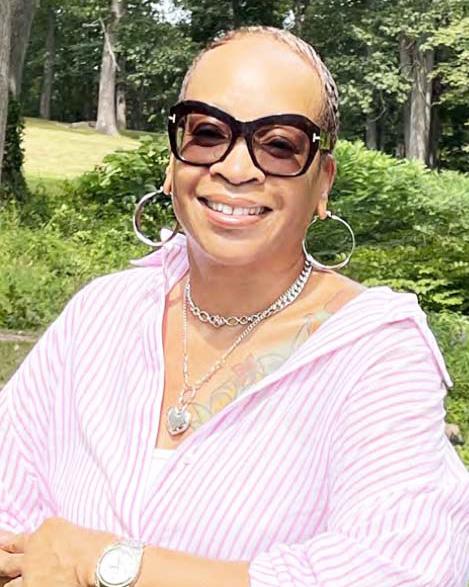
After my diagnosis, I chose to tell very few people. I didn't want sympathy. I didn't want people to feel sorry for me. I just wanted life to go on as if I had never been diagnosed. My plan was simple: have surgery, complete treatment and return to work like nothing ever happened. Even now, I still struggle with speaking openly about it. But I'm working on that. As my sister told me, "You have the opportunity to share your journey with someone who will need to hear it."
There were countless doctor visits. My surgery was in June 2019. I was diagnosed with invasive ductal carcinoma in my left breast and underwent a partial mastectomy with reconstruction. Following surgery, I had 15 rounds of chemotherapy
and 30 days of radiation treatment. I'm now on a 10-year hormone therapy plan.
I'm incredibly grateful for the love and support I've received. My husband, beautiful daughters and sisters were with me every step of the way. Even though my sisters don't live nearby, they never left my side. My sister Mona, who lives in Westchester, came to every doctor's appointment with my husband and me. She said we needed a third ear! I don't think she knows just how much we love and appreciate her for that.
Every Friday for three months, I had chemotherapy. Without fail, my Dance family sent me flowers each week, not to mention at every chemo session. I had countless family members keeping me
company. I've been so fortunate to have my girls, my husband, and my village surrounding me with love and strength. Their support has been nothing short of amazing and I'm grateful from the bottom of my heart. Today, I'm beyond blessed to say I've been cancer-free for seven years. The journey was long and difficult, but through prayer and faith, God covered me–and continues to do so. I discovered strength, patience, and trust I never knew I had. I stayed busy and kept my mind engaged by continuing my daily routines. I am truly blessed and thank God every day!
"Thank you, Sisters’ Journey, for allowing me to revisit and reflect on my path. This has been an emotional experience, but a much needed one."
Yale New Haven Hospital is pleased to offer patients and their families financial counseling regarding their hospital bills or the availability of financial assistance, including free care funds.
By appointment, patients can speak one-on-one with a financial counselor during regular business hours. For your convenience, extended hours are available in-person at Yale New Haven Hospital the third Monday of every month.
Time: 5 - 7 pm
Location: Children’s Hospital, 35 Park St., 1st floor, Admitting Parking available (handicapped accessible)
An appointment is necessary. Please call 855-547-4584. Spanish-speaking counselors available.


Susan L. Taylor
Former Editor-in-Chief of Essence
When her line of cosmetics for women of color caught the eye of editors at Essence magazine, Susan Taylor had no idea that she would one day lead the publication as Editor-in-Chief. Having grown circulation to 1.5 million, she left the business after 37 years to create the National CARES Mentoring Movement, a nonprofit devoted to transforming the lives of underprivileged black children through mentorship and inspiration.
Who most influenced you growing up?
My grandmother. I am a grandmother now, and my granddaughter hopefully feels as much love for me as I did for my grand. As grandmothers, we have more time and greater patience. I am wiser and more balanced today than I was when raising my daughter. I grew up in a one-bedroom Harlem tenement; my father had a ladies’ boutique on the street level in a busy, commercial area. We lived on the second floor of a five-story building, walk-up with maybe 50 families. My grandmother would drive in every summer and take my brother and me to her home in Englewood, New Jersey, which I thought was a mansion. It was a beautiful home. I had my own room. When she asked what we wanted for dinner, we would get on our bikes and ride into town and choose what we wanted her to cook for us. Mother would take us to beaches, to lakes in Upstate New York and to the Hamptons. Not in the glorious Hamptons, where we now have a home, but to the Shinnecock Reservation where she’d rent rooms for the family. She exposed me to a world far beyond what my parents offered. Your family originally came from the Caribbean. Your father was in mercantile.
What about your grandmother?
Grandmother was a businesswoman. Long before I was born, she had a tailor shop and a bar. She also helped my uncle buy a building and open a liquor store. My great grandmother, who I’m named after, had a soda business in Trinidad and a hot pepper sauce business in Harlem. I come from an entrepreneurial family.
Editor-in-Chief of Essence magazine… how did you enter the world of publishing?
Publishing found me. Originally, my career was in cosmetics. I thought I wanted to be an actress. I looked up on a screen one day and saw Dorothy Dandridge playing Carmen Jones. She was the most beautiful woman I’d ever seen. I said, “Oh, I want to do that.” But I’d never even been in a play, and I wasn’t a good actor but still won roles. I was understudying the lead actress in a three-character play at the Booth Theatre on Broadway. I could not get the inane part in my head, and the lead was on stage the entire play. I said, “Lord, if you let me out of this one, I promise I’ll find my métier, because surely this is not it.” I was the
only person who was happy that the play closed on opening night. Twenty years later, I looked down at that Broadway theatre from my office at Essence. From acting to cosmetology school and eventually Editor-in- Chief of Essence magazine. What an interesting journey?
Well, in 1970 when Essence was created, black women who had journalism degrees were not interested in writing about anything as mundane as beauty. I was a cosmetologist at the time and had created a line of custom blended cosmetics for women of color which came to the attention of the Essence editors. When I heard about an opportunity at Essence, I applied for the position with a lot of confidence. Confidence as a 24-year old was easily mustered. At times, I have to work hard at it. At the time, I was married to a man who had two beauty salons, so I didn’t need the job. I came in looking like a beauty editor, even though I didn’t know exactly what that post entailed. I knew the fundamentals of the makeup of our skin and hair and what they needed to be healthy and to thrive, and that impressed the Editor-in-Chief. I had found my passion and did a good job as beauty editor, so they expanded my role to include the fashion editor position. We were building a brand new publication, and I built a high-performance team—so needed because magazine- making is a collaborative effort. I served as fashion and beauty editor for 10 years. Then for one year, we were under the leadership of a chief editor who was super smart but didn’t understood what our readers were looking for. Respectfully, I never mention a name. She missed the boat, and the magazine lost a tremendous amount of circulation. Because I was in charge of images, the covers and fashion and beauty pages, the style aesthetic of the magazine, our publisher believed I could guide the publication from cover to cover. Not just with style, but with all the content. He gave me the chance to be the Editor-in-Chief. At the onset of your tenure with Essence, did you envision that you would one day be the Editor-in-Chief for Essence magazine?
What kind of pressure did you experience serving in that post?
You know, I enjoyed it…life, work and everything. But I always tell young people to not be fooled, that there is no work that’s not difficult. Managing people, deadlines, making decisions every moment of the day is challenging. And leadership is lonely. We have to pursue our passion. I love editing. I loved trying to understand what our audience needed and asking the questions that would keep me informed and the magazine relevant. Like you’re asking me. You seek out people who care deeply about your mission and vision, remain nimble, share the light with the team. You don’t always need to be right and apologize when it’s called for. And primarily you’ve got to find people who write brilliantly. I enjoyed every moment as Editor-in-Chief of the magazine. What is the most potent life challenge you have had to date?
It was the breakup of my first marriage. I was a young mother. I was married three years before my daughter was born. The breakup happened when my baby was six weeks old. It was devastating. I had no man. No money. I had a cosmetics business that was gone. He had a girlfriend. He asked me to “not talk about him” publicly, because he was a hairdresser and it would hurt his business. He wasn’t a great hair designer at all, but the women lined up because he was so handsome.
How long did it take you to rebound from that?
It threw me out on my own. I am the person I am today because of that shake-up. I have come to see that everything in our lives— even the most painful or shameful things—are all in divine order. The truth, I was living with the pain of poverty, more than the pain of a marriage gone. During that first marriage was the only time in my life that I didn’t have to work. But I am a worker. I love it! And in hindsight, I never would have advanced my life if I hadn’t been thrown onto myself. Have you ever wanted to quit publishing work?
Never. Ever.
Did you ever worry about your work not being successful?
Never. You worry less when you are younger. I worry now more than I did then. In our twenties and thirties, we are often naïve, fearless, confident that we can do anything. I got the job by walking into the Editor-in-Chief’s office and saying, “If you give me an opportunity to do your beauty pages, I’ll be the best beauty editor you could possibly find.” She believed me because I believed me. Today, I would never have such confidence.
Was your strength in the publication’s aesthetics content or finance?
Not finance. I absolutely gravitated to the aesthetics because it was my interest from the time I founded a cosmetics company and then at Essence, where I had the responsibility for working with style teams and art directors for my pages, which as fashion and beauty editor, was the majority of the magazine. When I became Editor-in-Chief, I was more representative of the reader than any of the editors because they had all graduated from college. I had not gone to college at that point. Right after high school, I went to acting school. From there, I built my cosmetics company. I went to college after I became the chief editor of Essence magazine. Many of the readers’ lives were very much like my own. Many were single moms, juggling the personal and the professional, trying to hold it all together, balance it all.
How did “In the Spirit” come about?
I stepped into the Editor-in-Chief position not wanting to write a monthly editorial. The person I was succeeding (not the one who lost the job) who really created
the foundation that I built upon, Marcie Ann Gillespie, was brilliant, as were her editorials. She wrote about politics and women’s issues. I said there’s no way, as a fashion and beauty editor (who at the time only had a commercial high school diploma), I could step in and write as brilliantly as she did. I tried to excuse myself from that task, but our publisher said, “Oh, no, you have to write a monthly editorial.” I paused and thought about what was most important to me. Even though I was worried, I decided to write about what I was really pursuing: spiritual knowledge and growth. It was the path that I was on, and the one that I’m still on. My editorial was called “In the Spirit,” and it became, surprisingly, the most popular feature in the magazine.
Susan Taylor, former Editor-in- Chief of Essence, along with Maya Angelou, Oprah



Don't identify yourself with labels and brands and have to buy every cute thing you see. Invest in the things that will grow in equity.
Susan L. Taylor
We don't have time to waste. Our communities are crumbling; our children are under siege. Failing schools and a for-profit prison-industrial complex are sucking the life out of black homes and communities. We are not going down like this!
Susan L. Taylor
I write about spirituality not so we get strong from within and achieve some state of nirvana and then distance ourselves from the real world. I write about it so we can feel empowered to doing the critical work that this generation of black women are charged with doing.
Susan L. Taylor
It's hunger. It's homelessness, often. It's underfunded, under-resourced schools. It's abuse beyond the chilling. It's having overwhelmed parents and caregivers. Those are the things that young people are struggling with beyond our view.
Susan L. Taylor
We women feel we are here to serve. That's the mistake we make. We may have children, husbands, lovers, bills, responsibility. Those things don't own us, but too often we let them.
Susan L. Taylor
We must learn how to live in the space of inner peace in our everyday lives. This takes consistent, conscious effort because I know so many black women are hurting and sad, and we don't easily express our heartache or show our wounds.
Susan L. Taylor
It's hunger. It's homelessness, often. It's underfunded, under-resourced schools. It's abuse beyond the chilling. It's having overwhelmed parents and caregivers. Those are the things that young people are struggling with beyond our view.
Susan L. Taylor
We will never finish everything on our to-do lists. It's not possible, and that is life!
Susan L. Taylor
Stress and worry, they solve nothing. What they do is block creativity. You are not even able to think about the solutions. Every problem has a solution.
Susan L. Taylor
Use missteps as stepping stones to deeper understanding and greater achievement.
Susan L. Taylor
By Black Information Network
Black Information Network is the first and only 24/7 national and local all-news audio service dedicated to providing an objective, accurate and trusted source of continual news coverage with a Black voice and perspective. BIN is enabled by the resources, assets and financial support of iHeartMedia and the support of its Founding Partners: Bank of America, CVS Health, GEICO, Lowe’s, McDonald’s USA, Sony, 23andMe and Verizon. BIN is focused on service to the Black community and providing an information window for those outside the community to help foster communication, accountability and deeper understanding. Black Information Network is distributed nationally through the iHeartRadio app and accessible via mobile, smart speakers, smart TVs and other connected platforms, and on dedicated all-news local broadcast AM/FM radio stations. BIN also provides the news service for iHeartMedia’s 106 Hip Hop, R&B and Gospel stations across the country. Please visit www.BINNews. com for more information.
Justice Ketanji Brown Jackson is warn-
ing that a Republican-backed challenge to late-arriving mail-in ballots could reach far beyond Mississippi.
According to Newsweek, during oral arguments Monday (March 22) in Watson v. Republican National Committee, Jackson pushed back on the idea that federal law locks states into a single, rigid understanding of Election Day. In remarks from the Supreme Court transcript, she said election practices have changed over time and cautioned that the legal theory advanced by the Republican National Committee “imperils a lot of different things, not just post-Election Day ballot deadlines.”
The case centers on a Mississippi law that allows mail-in ballots to be counted if they are postmarked by Election Day and received within five business days. Republicans, Libertarians, and the Trump administration reportedly want the justices to uphold a lower-court ruling striking that law down, arguing that federal election statutes require ballots to be both cast and received by Election Day. The stakes stretch well beyond one state. 14 states and Washington, D.C., currently allow some grace period for mail-in bal-

lots that arrive after Election Day, while another 15 states have extended deadlines for military and overseas voters. A ruling against Mississippi could force major changes just months before the 2026 midterms.
Jackson was not the only justice looking at the broader fallout. Conservative
justices appeared skeptical of Mississippi’s law, while liberal justices argued that states have long had room to manage the details of election administration.
Justice Elena Kagan warned that the logic behind the challenge could also threaten other common practices, including early voting and absentee voting rules.
Some of the sharpest questioning from the conservative wing focused on what they described as voter confidence and the possibility of uncertainty after Election Day. Justice Samuel Alito raised a hypothetical about late-arriving ballots “radically” changing an outcome, even though no evidence was presented that grace-period ballots have produced fraud in Mississippi.
Election officials in states that rely heavily on mail-in voting are already sounding alarms. The Associated Press reported that administrators in places like Alaska and California say ending grace periods would create confusion, force last-minute reprints of election materials and make it harder for voters in rural or hard-to-reach areas to have their ballots counted.
The Supreme Court is expected to rule by late June. If the justices side with the RNC, the decision could reshape how mail-in voting works across the country, just as states are preparing for another high-stakes election year.
The Black Information Network is your source for Black News! Get the latest news 24/7 on The Black Information Network. Listen now on the iHeartRadio app or click HERE to tune in live.
By Atlanta Daily World
Atlanta Daily World stands as the first Black daily publication in America. Started in 1927 by Morehouse College graduate W.A. Scott. Currently owned by Real Times Media, ADW is one of the most influential Black newspapers in the nation. As the partial federal government shutdown approaches 30 days, our concern continues to grow for the thousands of federal employees working tirelessly without pay to keep our country moving—especially the Transportation Security Administration officers serving on the front lines at Hartsfield-Jackson Atlanta International Airport.
These dedicated professionals continue to report for duty every day to ensure the safety of the millions of travelers passing through the world’s busiest and most efficient airport. Their commitment to public service deserves both recognition and support.
“Atlanta is a city that looks after the people who serve our community,” said




Mayor Andre Dickens. “TSA officers at Hartsfield-Jackson Atlanta International Airport continue to show up every day to protect millions of travelers, even as they face uncertainty at home. We are deeply grateful for their professionalism and sacrifice, and we will continue doing everything we can locally to support them while urging a swift resolution to the shutdown.”
The City of Atlanta and the team at Hartsfield-Jackson Atlanta International Airport are doing everything within our authority to support these federal employees during this challenging time. To help ease the burden on TSA officers who continue to serve travelers despite not receiving pay, the airport has implemented the following support measures: Support Measures for TSA Officers at Hartsfield-Jackson Atlanta International Airport
• Meal Vouchers: TSA officers receive two meal vouchers per shift.
• Free Parking: TSA employees have



been provided complimentary parking during their assigned shifts at the airport.
• Free MARTA Breeze passes: TSA personnel receive free Breeze Passes, and the TSA just received an additional 100 passes.
• Concessionaire Support: Airport concessionaires are offering discounted meals and food options.
• Customer Service Assistance: ATL Airport Customer Service Representatives are assisting passengers, when possible, to help ease extended security lines caused by staffing constraints.
We encourage travelers to be patient with and understanding of TSA Agents and their current challenges. The City also encourages the public to contact their Congressional Representatives and the White House and urge them to pay the individuals tasked with helping to keep our airport safe and running efficiently. Continue to use ATL.com for wait times before traveling. We will provide updates when available.




A T R I S K O F F O R E C L O S U R E ? W E C A N H E L P Y O U R E B U I L D .


L E A R N M O R E

by Erin Aubry Kaplan
Last month, on her 38th birthday, Georgia Fort told me that she finally feels like an adult. Not because her three kids are getting older or because she’s reached a landmark level of achievement in her 16year career as an independent journalist in her home state of Minnesota. Her new sense of maturity is not about accolades, but adversity.
Earlier this year she and fellow independent journalist Don Lemon were arrested by federal officials after covering a protest, and overnight, became national symbols of the fight to preserve free speech and a free press in the increasingly repressive age of Trump.
“Federal charges will certainly do that, grow you up,” Fort said.
While the experience has thrust her into a limelight she never expected, she’s embracing the opportunity to be a symbol of resistance — to the attempts to curb press freedom, and to bigger forces of oppression and regression that for her have become impossible to ignore. Fort believes journalists have a particular duty to confront it all. For her, that determination is also informed by her Christian faith.
“Now, spiritually, I feel like I need to stand,” she said. “There’s no more room for uncertainty. You have to hold your head up.”
President Donald Trump’s long-running attack on the press took an ominous turn on Jan. 30, when Fort and Lemon were arrested — she in Minnesota, he in Los Angeles. Both Black journalists had covered a protest against Immigration Customs Enforcement at a Minnesota church pastored by an ICE official. Along with seven activists, Fort and Lemon were charged with conspiracy and interfering with people’s right of worship. Both are awaiting trial.
The arrests seemed like a convergence of Trump’s attacks on the press and on Black people — journalists and others — who routinely speak out against injustice. They also felt like the culmination of the brutal ICE raids in Minnesota that began in January and resulted in the fatal shootings of two American citizens, Renee Good and Alex Pretti, by Department of Homeland Security agents. That so much came to a head during February, Black History Month, made Fort more resolved to step up.
“As we celebrated the centennial of Black History Month, we celebrated so many of my ancestors and who they stood up for,” she said.
The attacks got personal for Fort last June. She was already covering the brutal tactics of ICE, coverage that included the story of Isabel Lopez, a 27-year-old

poet and activist who had been roughed up by agents during a protest June 3.
Fort posted a video of the incident on social media. A week later, Lopez came to Fort’s office for an interview. Minutes after she left, as Fort watched, ICE agents swarmed Lopez, arrested her and charged her with assault. The veteran journalist was rattled.
“It didn’t feel like a coincidence,” she said. “I felt harassed, like they were sending me a message.”
The feeling intensified from there, though Fort continued following protests and press conferences, sometimes for 12 to 16 hours at a stretch. After Good was killed, she held a private session for media to show camera footage of that incident.
Work has become more complicated since her arrest. Fort had frequently worked alone, livestreaming events, but now feels like a target. Security feels essential.
“I received threats, even before the arrest,” she said. “There is a cost to telling the truth.”
Fort and Lemon are not the first Black journalists in Minnesota arrested for doing their jobs. Back in 2020, during the protests in Minneapolis over the murder of George Floyd, CNN anchor Omar Jimenez, who was on the scene with a crew covering the protests, got handcuffed and arrested on live television.
“When I saw that I knew that if they didn’t respect his press credentials they wouldn’t respect mine,” Fort recalled. “I started to be aware of how I showed up in spaces.”
She also began to understand the precariousness of journalism globally, especially for journalists of color, including in far more dangerous places like Gaza, where more than 240 journalists were killed in the last two years, according to the United Nations.
“Omar was arrested, and there was no consequences for it,” Fort said. “Or in Gaza.”
Fort has worked in media since college, starting out as a radio host focused on music and hip-hop before eventually transitioning into news. When she was 19, her 4-month-old daughter — her firstborn child — died of suffocation in the care of a babysitter, a tragedy that informed her later coverage of deaths of young people, some of them the result of police shootings.
“As a mom who lost a child, I was frequently interviewing moms on the day their child had been killed,” she said. “It allowed me to find purpose in my own pain, gave me a much deeper reason to wake up and want to get up and go to work.”
Fort landed her first contract in 2015 as a news reporter at a local television station in Columbus, Georgia, eventually making her way back to Minnesota. Years of doing a mix of breaking news, court reporting and what she called “feel good stories” set the stage for covering the 2021 trial of Derek Chauvin, the Minneapolis police officer who was convicted of murder for the killing of George Floyd.
currently running a dispensary in the area. She hires people with drug war-related arrests in her store. She pays everyone upwards of $21 an hour. She holds regular community events ranging from yoga classes to gospel karaoke to movie nights to a recent BIPOC mental health counselors mixer.
The law was supposed to make it easier for “social equity” entrepreneurs like her to open and run dispensaries: It reduces the original licensing fee to $12,500 from $25,000. But then, to qualify for the social equity status, they face restrictions on partners they can bring in to help finance the operation. (Smith-Bolden raised $1.6 million to start the business.)
About 95 customers come to Lit on a typical day, Smith-Bolden said. She needs 200 to break even. The dispensary opened last May.
The experiences with traditional media and street-level coverage honed her approach to independent journalism. Understanding the role of Black reporters in the history of journalism itself was also key.
Black media’s mission not to ignore or sanitize painful truths is one of the reasons, Fort believes, that it remains one of the most vital institutions in America, despite being chronically underinvested in and undervalued. She secured a contract from Target in 2023 that enabled her to launch a broadcast news show, “Here’s The Truth,” which covered a wide range of topics, was immaculately produced by a well-paid staff, and went on to win three Upper Midwest Emmy awards. In 2023 she also co-established the Center for Broadcast Journalism to mentor young journalists and diversify the media industry in Minnesota. After Trump returned to office last year and began attacking diversity, equity and inclusion via executive orders and federal workforce purges, the Target contract, along with so many others, was eliminated.
Fort said shifts of mind and heart have to happen in the country before things change, or change back. Meanwhile, Black voices in media remain powerful, and impactful. New York Times opinion columnist Jamelle Bouie asserted last month that Trump’s assault on democracy has always been racially motivated, but too little acknowledged, writing, “The question is why so many others have refused to see what he has never bothered to hide.” David Jackson’s photo of Emmett Till in an open casket in
Current rules prevent her and other dispensary owners from doing a lot of the marketing dispensaries can do in other states. Smith-Bolden did win permission to place a sign on her roof visible from I-95. But now she has been ordered to place a second sign informing drivers speeding by that only people 21 years or older can shop there. That’ll cost another $10,000. She also needs to spend $12,500 each year for renewed background checks and licensing for her employees. Plus, she can’t legally call Lit a “dispensary,” but rather a “retailer.” That doesn’t help when people search for “dispensaries” on Google. She and other “retailers” are hoping to see that change in this year’s legislation, along with rules limiting colors and other branding they can use. In the meantime, Smith-Bolden said, she’s pursuing a loan from the state’s Social Equity Council to avoid paring back the business.
In the “Dateline” discussion, Smith-Bolden spoke of efforts beyond legislative reform that can help boost the emerging legal weed business — such as public education. Like letting people know that unlike illegal operations, regulated legal retailers sell cannabis that’s been safety-tested. So it won’t have, say, fentanyl or heavy metals that can make you sick.
Most of all, Smith-Bolden focuses on community connections, in how she hires, in whom she teams up with in town on events.
She spoke of hiring “weed men” who previously worked in the shadows.
“They’re so proud to have their little cannabis worker certificates, to say that they’re part of the legal market,” she said. “Of course, it’s not the volume of money that they’re used to seeing, but they realize that it’s more to it. One of my employees, who was a part of a smoke shop, said, ‘I got sick of having to sell to kids. I don’t want to sell to kids. I’m glad to be here, because I’m able to now do this right.'”
Lemar said he has been inspired watching Smith-Bolden persevere amid all the challenges presented by working within the current rules: “I think the world of her. And she’s having a hard time making it work. Part of the reason I come back to try to fix this thing [this year] is because of the struggles she’s having.”


















By Courtesy of HBCUNEWS.com
NEW YORK — WNBA players unanimously approved the new collective bargaining agreement with more than 90% participating in voting over the weekend.
The seven-year CBA, which will begin this season and run through 2032, represents a landmark labor deal for the WNBA and its players.
“This transformational CBA delivers consequential economic progress and expanded benefits that support players on and off the court,” the union said in a statement. “It builds a stronger foundation for today’s players, the next generation, and those who helped build the WNBA. It affirms the strength of our union and the power of our collective voice.
“Now it is time to get back to the


Moments of public praise — from Hollywood to politics — rarely translate into resources or leadership roles.
By Julienne Louis-Anderson and Adia R. Louden
On Sunday, like millions of others, we watched proudly as Michael B. Jordan took the stage and accepted his Oscar for Best Actor for his remarkable performance in the movie, “Sinners”.
If you’re anything like us, your heart swelled when he thanked his mother and the other Black women in his life for carrying him forward. It was a beautiful thing to witness. Jordan, amongst other Black men like Trevor Noah and Sterling K. Brown, has praised the love and dedication Black women poured into them. But, in the aftermath, after all the pomp and circumstance was over, after the lights dimmed on stage, we found ourselves wondering: what are Black women left with besides proverbial flowers? When Recognition Doesn’t Translate Into Resources
It’s not lost on us that we’re in the middle of Women’s History Month, when as a nation we take a beat to celebrate milestones and accomplishments. But often — and to a greater extent than their white counterparts — Black women receive symbolic praise but are denied material power or protection. We’ve seen it for ourselves in our own lines of work.
One of us worked as a nonprofit leader tackling the impact of parental incarceration on Black girls. One in nine Black children has an incarcerated parent in the U.S. While support for Black boys with incarcerated parents was often treated as a given, funders often seemed unaware, even dumbstruck, that incarcerated parents have daughters, too. That is, when funders even showed up for a face-toface. More often than not, grant applications went unanswered.
This experience is far from unique. Black

women-led nonprofits receive less than 1% of U.S. philanthropic funding. Also, Black women nonprofit CEOs make up a significant share of leaders of organizations with budgets under $50,000, but represent only a small percentage of those with budgets exceeding $10 million. By contrast, white CEOs lead 56% and 74%, respectively. Black women may be celebrated for their leadership in this sector, but the numbers show clearly that these flowers don’t always translate into resources.
The gap between praise and power is apparent in entrepreneurship as well. Access to capital and support remains one of the biggest barriers, especially for Black women business owners. One of us owns a small writing and coaching busi-
ness and has struggled to receive the capital critical to starting a new business. On average, Black women receive less than 0.35% of all venture capital funding. This is not even a full percentage point of what goes into startup companies. And so, pursuing a passion meant digging into personal savings, cold emails, and finding ingenuitive ways to earn more capital. The harsh truth is that these stumbling blocks are far less common for founders with generational wealth or established networks.
We’ve both experienced the double-edged sword that comes with pursuing excellence in academia. Black women make up roughly 6 to 7% of the U.S. population, and among Black students in higher education, they obtain 64.1% of
game and the fans we love, competing at the highest level, and showing exactly what this league can be.”
Once the WNBA Board of Governors approves the CBA it will become official. Then there will be a sprint to the start of the regular season on May 8.
First up is an expansion draft for the two new teams — Toronto and Portland. Rules regarding who the current teams will be able to protect and how the draft will work are still being figured out. The draft is expected to take place right around the Final Four. Next up would be free agency. More than 80% of the league are free agents this year as players had signed deals that were going to expire last year. There are only two veteran players that aren’t under rookie contracts who are signed for this season.
Con’t
bachelor’s degrees, 71.5% of master’s degrees, and 65.9% of doctoral, medical, and dental degrees.
Despite this excellence, Black women face obstacle after obstacle in higher education, shaped by both the racial wealth gap and the gender pay gap. Many juggle multiple responsibilities, forcing heavy reliance on financial aid and significant debt. As of 2022, Black women average a total of $38,800 in federal undergraduate loans and $58,252 for those who also attend graduate school. And so, even as we’re celebrated for our academic achievements, the reward is long-term economic instability and less access to opportunity.
To be sure, Black women deserve flowers. After all, Black women have become vice president of the United States, billionaire media moguls, and history-makers at the Academy Awards. But we deserve more. Flowers are meaningless if we are not in the room where decisions are made. This Women’s History Month, it’s time to go beyond the praise. Fund Black-women-owned businesses. Invest in Black women founders. Provide for Black women in higher education. And put Black women in positions where decisions and dollars are being made.
Julienne Louis-Anderson is a former educator and coach who writes about the intersection of culture and politics with education and human development. She is also a Public Voices Fellow of The OpEd Project in partnership with the National Black Child Development Institute. Adia R. Louden is a fifth-year Ph.D. student in Maternal and Child Health at The University of North Carolina at Chapel Hill and a Public Voices Fellow of The OpEd Project in Partnership with the National Black Child Development Institute.
‘There Is a Cost to Telling the Truth.’
1955 was a graphic image that was seen around the world, exposing the hypocrisy of American democracy. The 14-yearold was lynched and horribly brutalized by a white mob in Money, Mississippi.
“That photo changed American culture,” she said. “It made America look in the mirror and acknowledge how the racial terror and brutality was wrong. Mamie Till [Emmett’s mother] took a stand, and the Black press showed up.”
Standing in the Tradition of Resistance
Fort said there are signs that America is looking in that mirror again. Six prosecutors in Minnesota quit rather than follow the Justice Department’s orders to investigate the widow of Renee Good, and after Alex Pretti was killed, a Republican candidate for governor dropped out of the race. Still, Fort has no illusions.
“I know what it looks like now, but when you look at what our ancestors had to overcome, that should give us hope,” she said. “People need to pay attention to what’s happening and ask themselves, what are you willing to do about it? My answer is to keep documenting, telling stories because it’ll inspire others to hew to truth.”
“It may not be much but it matters,” she added. “I might be under attack, defunded, even afraid. But I will continue to do it.”
This is from Erin Aubry Kaplan’s column, The Arc, which examines the persistent barriers to racial justice and opportunities for progress in an era of receding Black presence in Los Angeles and California.

Construction Equipment Mechanic
(preferably experienced in Reclaiming and Road Milling Equipment) We offer factory training on equipment we operate. Job is in Bloomfield, CT.
Contact: Tom Dunay Phone: 860-243-2300 Ext. 122
Email: tom.dunay@garrityasphalt.com
Reclaimer Operators and Milling Operators
(must have current licensing and a clean driving record; be willing to travel throughout the Northeast & NY)
Contact: Rick Tousignant Phone: 860-243-2300 Ext. 133 Email: rick.tousignant@garrityasphalt.com
Tractor Trailer Driver for Heavy & Highway Construction Equipment
(must have a class A CDL license with Tank Endorsement and a clean driving record; be capable of operating heavy equipment and willing to travel throughout the Northeast and NY)
Contact: Brian McKee Phone: 860-558-6189 Email: bmckee@garrityasphalt.com
• We offer Excellent hourly rates and benefits.
• Women and Minority Applicants are encouraged to apply.
• Affirmative Action / Equal Opportunity Employer
The Town of Wallingford is accepting applications for Collections Maintainer I (Trainee). Wages: $27.17 to $29.84 hourly. For additional information and to apply online by the March 24, 2026 closing date please visit: www.wallingfordct.gov/government/departments/human-resources/. Applications are also available at the Department of Human Resources located in Room #301 of the Town Hall, 45 South Main Street, Wallingford, CT 06492. Phone: (203) 294-2080; Fax: (203) 294-2084. EOE

The State of Connecticut, Office of Policy and Management is recruiting for a Rural Health Transformation Policy Development Coordinator

Location: Galasso Materials LLC, East Granby, CT
Employment Type: Full-Time
Industry: Asphalt Paving & Aggregate Materials

ECC is currently seeking bids from qualified contractors to perform Youth Services. A complete copy of the requirement may be obtained from Elm City’s Vendor Collaboration Portal https://newhavenhousing.cobblestonesystems.com/ gateway beginning on

We are seeking an experienced and motivated Construction Sales Manager to lead and grow our asphalt paving and aggregate materials sales operations. This role requires a strong blend of construction knowledge, sales expertise, estimating skills, and project coordination. The ideal candidate will understand paving operations, build strong customer relationships, and work collaboratively with internal teams to deliver successful projects from bid through completion.
• Develop and manage sales for asphalt, aggregate, and paving services across commercial, municipal, and private-sector clients
• Build and maintain long-term relationships with customers, contractors, municipalities, and developers
• Prepare and review job estimates, bids, and proposals, including quantity take-offs and pricing
• Collaborate closely with operations, plant staff, and project managers to ensure accurate scope, scheduling, and execution
• Provide outstanding customer service throughout the sales and project lifecycle
• Support project management efforts, including job start-up coordination, scope clarification, job cost tracking, billing and change management
• Track market conditions, competitor pricing, and sales opportunities
• Meet or exceed established sales and revenue goals
• Communicate with Accounts Receivable staff to ensure invoices are paid to Galasso
• Proven management experience in asphalt paving, aggregate materials, or heavy civil construction
• Strong background in construction sales, estimating, or project management
• Solid understanding of paving methods, materials, and construction sequencing
• Ability to read plans, perform quantity take-offs, and develop competitive bids
• Excellent communication, negotiation, and relationship-building skills
• Strong teamwork mindset with the ability to collaborate across departments
• Highly organized with the ability to manage multiple projects and deadlines
• Proficiency with estimating software, spreadsheets, and CRM tools preferred
• Competitive salary with performance-based incentives
• Company vehicle or vehicle allowance (if applicable)
• Health, dental, and retirement benefits
• Stable, well-established company with growth opportunities
• Collaborative team environment with hands-on leadership
Please submit your resume and a brief cover letter outlining your experience in construction sales, paving, or materials supply. To Apply: Please send your resume and a brief cover letter to KLamontagne@galassomaterials.com
Galasso Materials LLC is committed to creating an inclusive environment for all employees and encourages applications from all qualified individuals. We are an affirmative action equal-opportunity employer.
The Housing Authority City of Bristol (BHA) is seeking proposals for HVAC services from qualified contractors for work at multiple locations throughout the Agency.
A copy of the RFP documents can be obtained at www.bristolhousing.org or by contacting Luis Velazquez, Director of Capital Funds at 860-585-2028 or lvelazquez@ bristolhousing.org beginning March 13, 2026. A non-mandatory pre-bid meeting will be held on March 20, 2026, at 10:00 AM starting at 164 Jerome Avenue, Bristol, CT.
All proposals should be clearly marked “RFP #26-187 – HVAC Contractor Services” and submitted to Mitzy Rowe, CEO, Housing Authority City of Bristol, 164 Jerome Ave., Bristol, CT 06010. Proposals are due no later than 2:00 PM on April 7, 2026, at the office of BHA in a sealed envelope with one (1) original and one (1) copy, each clearly identified.
The Housing Authority of the City of Bristol is an Equal Opportunity/Affirmative Action Employer. SBE, MBE, W/DBE, and Section 3 businesses are encouraged to respond.

The Housing Authority City of Bristol (BHA) is seeking proposals for Pest Control services from qualified contractors for work at multiple locations throughout the Agency.
A copy of the RFP documents can be obtained at www.bristolhousing.org or by contacting Luis Velazquez, Director of Capital Funds at 860-585-2028 or lvelazquez@ bristolhousing.org beginning March 13, 2026. A non-mandatory pre-bid meeting will be held on March 20, 2026, at 12:00 Noon starting at 164 Jerome Avenue, Bristol, CT.
All proposals should be clearly marked “RFP #26-189 – Pest Control Services” and submitted to Mitzy Rowe, CEO, Housing Authority City of Bristol, 164 Jerome Ave., Bristol, CT 06010. Proposals are due no later than 3:00 PM on April 7, 2026, at the office of BHA in a sealed envelope with one (1) original and one (1) copy, each clearly identified.
The Housing Authority of the City of Bristol is an Equal Opportunity/Affirmative Action Employer. SBE, MBE, W/DBE, and Section 3 businesses are encouraged to respond.
The Town of Wallingford is accepting applications for Maintainer II (Watershed). Wages: $28.65 to $34.43 hourly. For additional information and to apply online by the March 10, 2026 closing date, please visit: www.wallingfordct.gov/government/departments/human-resources/. Applications are also available at the Department of Human Resources located in Room #301 of the Town Hall, 45 South Main Street, Wallingford, CT 06492. Phone: (203) 294-2080; Fax: (203) 294-2084. EOE

The Town of Wallingford is accepting applications for Water Treatment Pumping Operator II. Wages: $32.58 to $39.20 hourly. For additional information and to apply online by the March 24, 2026 closing date, please visit: www.wallingfordct.gov/government/departments/human-resources/.Applications are also available at the Department of Human Resources located in Room #301 of the Town Hall, 45 South Main Street, Wallingford, CT 06492. Phone: (203) 2942080; Fax: (203) 294-2084. EOE
The Housing Authority of the City of New Haven d/b/a Elm City Communities is currently seeking Proposals for Executive Management Services. A complete copy of the requirements may be obtained from Elm City’s Vendor Collaboration Portal https://newhavenhousing.cobblestonesystems.com/gateway beginning on
Monday, March 9, 2026 at 3:00PM
The Glendower Group, Inc is seeking bids from qualified contractors for General Contractor at The Heights at Westrock. A complete copy of the requirement may be obtained from Elm City’s Vendor Collaboration Portal https://newhavenhousing.cobblestonesystems.com/gateway beginning on
Wednesday, March 11, 2026, at 3:00PM.
360 Management is currently seeking bids from qualified contractors to perform Elevator Service . A complete copy of the requirement may be obtained from Elm City’s Vendor Collaboration Portal https://newhavenhousing.cobblestonesystems.com/gateway beginning on
Monday, March 3, 2026, at 3:00PM.
The Town of Wallingford is accepting applications for Attendant I. Wages: $29.20 to $33.81 hourly. For additional information and to apply online by the April 9, 2026 closing date please visit: www.wallingfordct.gov/government/departments/human-resources/. Applications are also available at the Department of Human Resources located in Room #301 of the Town Hall, 45 South Main Street, Wallingford, CT 06492. Phone: (203) 2942080; Fax: (203) 294-2084. EOE
We are a leading supplier of construction materials and paving services, operating rock quarries, asphalt plants, and roadway paving crews throughout the region. Our team is committed to safety, environmental responsibility, and operational excellence. We are seeking a motivated Safety Associate to support and strengthen our safety culture across multiple operations.
The Safety Associate will assist in implementing and maintaining company safety programs across our quarry operations, asphalt plants, roadway paving crews, and environmental testing activities. This role works closely with operations managers, plant supervisors, and field personnel to ensure compliance with MSHA, OSHA, DOT, and environmental regulations while promoting safe work practices.
• Assist with implementation and enforcement of company safety policies and procedures
• Conduct site safety inspections at quarries, asphalt plants, construction sites, and material testing locations
• Perform job hazard analyses (JHA) and assist with development of safe work plans
• Support compliance with MSHA, OSHA, DOT, and environmental regulations including scheduling of employee drug testing
• Investigate accidents, incidents, and near-misses and assist in developing corrective actions
• Assist with safety training and toolbox talks for plant and field personnel
• Maintain safety records, reports, and documentation required for regulatory compliance
• Coordinate safety audits and assist with regulatory inspections
• Work with operations teams to identify opportunities for continuous improvement in safety performance
• Support environmental compliance efforts including material handling, dust control, and environmental testing protocols
• Travel between company facilities, job sites, and testing locations as needed
• Bachelor’s degree in Occupational Safety, Environmental Science, Construction Management, or related field preferred
• Experience in construction materials, quarry operations, asphalt production, roadway construction, or heavy civil construction is a strong plus
• Working knowledge of MSHA, OSHA, DOT, and environmental regulations preferred
• Strong communication and organizational skills
• Ability to work both independently and as part of a team
• Proficiency with Microsoft Office and safety documentation systems
• Valid driver’s license and ability to travel between facilities and job sites Preferred Skills
• MSHA Part 46/48 training experience
• OSHA 30 certification
• Experience conducting safety audits and incident investigations
• Knowledge of environmental compliance and materials testing operations What We Offer
• Competitive salary
• Health, dental, and vision insurance
• Retirement plan
• Paid time off and holidays
• Opportunities for professional growth and training
Please submit your resume and a brief cover letter outlining your experience in construction sales, paving, or materials supply.
To Apply: Please send your resume and a brief cover letter to KLamontagne@galassomaterials.com
Galasso Materials LLC is committed to creating an inclusive environment for all employees and encourages applications from all qualified individuals. We are an affirmative action equal-opportunity employer.

The State of Connecticut, Office of Policy and Management is recruiting for a Policy Development Coordinator in the Criminal Justice Policy and Planning Division. Further information regarding the duties, eligibility requirements and application instructions are available at: https://www.jobapscloud.com/CT/ sup/bulpreview.asp?b=&R1= 260316&R2=1581MP&R3=001
The State of Connecticut is an equal opportunity/affirmative action employer and strongly encourages the applications of women, minorities and persons with disabilities.

City of Bristol
$78,813/yr.
Required testing, general info, and apply online: www.bristolct.gov
DEADLINE: 12-07-25 EOE
Sales Pay: $100,000.00 per year
Job description:
Atlas Companies is looking for an estimator/ design and installation sales person for the residential market place. Premiere northeast regional fence and outdoor structure company is looking for energetic, self-motivated Sales associate. Salary, commission, 401 k match and vehicle allowances for qualified personal. 1 00k plus income to qualified applicants. Previous home improvement design / sales preferred.
About Us Our services range from custom fences, gates, guardrail, pergolas, arbors and outdoor structures to providing industrial and commercial security solutions to building luxury residential multi-use and commercial projects. Job Type: Fulltime Benefits: 401 (k), Health Insurance, Dental Insurance, Life Insurance, Vision Insurance, Paid time off.
Work Location: In person
We are an Equal Opportunity/Affirmative Action Employer. Email resume to mpicard@atlasoutdoor.com
Fence Installers: Large CT Fence & Guardrail Contractor is looking for Fence Installation helpers. Must have at least 2 years of experience installing chain link, wood, PVC and ornamental iron fencing. Work available 10-12 months per year. All necessary equipment provided. Medical, holiday, 401K, vacation & other benefits included. Must be able to pass required physical and drug test. An OSHA 10 Certification is required. A valid CT driver's license is required and must get DOT Medical Card. We are an AA/ EOE company. Send resumes/inquiries to: rhauer@atlasoutdoor.com.
Help Wanted – Lg CT fence company looking for an experienced fence installation foreman in CT and surrounding states who will work as a leader of small crews. Individual will be responsible for all types of fencing installation. Specific tasks include but are not limited to: May be responsible for crew(s) of two or more individuals, manage and troubleshoot problems that arise on site and notify superintendent when needed, ensures employees adhere to all safety and company policies and practices. Job requirements include the following: must have 5 years’ of fence installation experience , must have commercial chain link experience, be able to read blueprints, have basic power tool & skid steers experience, have a valid CT driver’s license and have reliable transportation, must be able to get a DOT medical card, OSHA safety training required prior to start of employment, pass drug screening and a physical test. Medical, vacation, 401K and other benefits included, all necessary equipment provided. We are an Affirmative Action/Equal Opportunity employer. Send resume to gforshee@atlasoutdoor.com
Job Title: Welder/Fabricator Reports to: Operations Manager
Salary Range: TBD, Commensurate with experience, Duties: Atlas Outdoor is looking for a full-time Shop Welder/Fabricator. The ideal candidates should possess skills to weld, cut and fabricate steel and aluminum products. Must be able to read basic drawings and fill out daily reports. All necessary equipment provided. Required to pass a physical and drug test. A valid CT driver's license, OSHA 10 card and DOT Medical Card are also required.Comprehensive benefits package included with a competitive salary, including vacation/personal time off, paid holidays, Health/Dental/Vision insurance, 401K with match. We are an Equal Opportunity/Affirmative Action Employer and offer a competitive salary to qualified candidates. Email resume to rhauer@atlasoutdoor.com
Yard Worker: Large CT Fence Company is looking for individuals for our stock yard. We are looking for individuals with previous warehouse shipping, receiving and forklift experience. Must have a minimum of 3 years of material handling experience. Duties include: Loading & unloading trucks, Fulfilling orders for installation & retail counter sales, Maintaining a clean & organized environment, Managing inventory control & delivering fence panels & products. Qualifications: High School diploma or equivalent, Must be able to read/write English, demonstrate good time management skills, able to read a tape measure, have the ability to lift 70 pounds and have forklift experience. Must have a valid CT Driver’s License, Obtain DOT Medical Card, and pass company physical and drug test. Class A CDL & Class B CDL license a plus. We are an AA/EOE company. Send resumes/ inquiries to: pboucher@atlasoutdoor.com
Large CT Fence Company looking for a full-time individual for our Wood/PVC Fence Production Shop. Duties include measuring & interpreting blueprints, schematics and project plans, cut, shape, assemble and install fence panels using hand and power tools, install related fixtures including gates, hardware and other accessories.. Must have a valid CT driver’s license and be able to obtain a Drivers Medical Card. Must be able to pass a physical and drug test. Please email resume to pboucher@atlasoutdoor.com. AA/EOE-MF
Meet the two women educators who taught a Black history marathon for 33 hours to break a world record
by Dollita Okine, Face2FaceAfrica.com
Anita Lewis and Gwendolyn Ebron, two dedicated Black women educators, are making Black history of their own after completing an astounding 33-hour teaching marathon focused entirely on Black history.
The two longtime educators first crossed paths through “Urban Intellectuals”, an organization focused on educating people about Black history, according to 6ABC News.
Lewis, who lives in Friendswood, Texas, reached out to Ebron, a Philadelphia teacher and part of Urban Intellectuals, to discuss her next major project following her doctorate. They quickly decided to collaborate on a demanding new effort to emphasize the essential place of Black history in education.
“I realized she’s who I wanted as my partner for this journey,” Lewis told the Chestnut Hill Local. “I’m of the mindset it’s always more fun with a friend and it wasn’t something I wanted to do alone and have it all on my back.”
She decided to set her sights on breaking a specific world record: the Guinness World Record for the “Longest History Lesson.” The existing record stands at 26 hours and 34 minutes, a feat accomplished by Andrew Torget in Denton, Texas, back in 2018. Notably, Torget’s record-setting lesson was exclusively centered on the history of Texas.
“As an educator, I believe in employing the past — history, your experiences — to educate the present — today’s students, regardless of age — to empower the future,” Lewis recounted.
After joining forces, Ebron and Lewis dedicated several months to meticulously planning a continuous, 33-hour educational marathon focusing entirely on Black history. Despite the extensive duration, they both agreed that the time allotted was still insufficient to thoroughly cover the depth and breadth of the topic. The two-day teaching marathon, an extraordinary feat of education, commenced on February 27 and concluded on February 28, 2026. The historic event was hosted at the Enon Tabernacle Baptist Church, conveniently located on Cheltenham Avenue. The turnout was strong, with community members attending in person, and the reach was extended globally thanks to a live stream broadcast by Urban Intellectuals.
The educators’ efforts now proceed to the verification stage, where all collected evidence must be submitted to Guinness World Records for thorough review and confirmation. So, at this time, their remarkable 33-hour effort stands as a significant attempt at securing a new world record.
For Ebron and Lewis, the true reward was sparking students’ potential of all ages and encouraging them to share those lessons. More than just a test of endurance, their prolonged endeavor was a deeply personal dedication to inspiring a passion for history and nurturing self-assurance in the generations to come.
“This is more than a record attempt
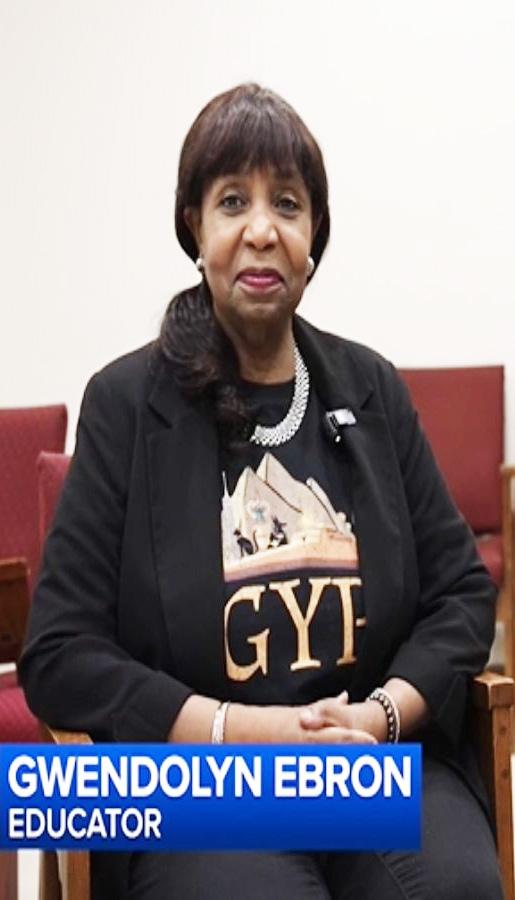
— it is a reclamation,” Ebron told the Chestnut Hill Local in a press release.
“We are teaching the history that shaped the world, honoring the brilliance, resilience, and global impact of African people across millennia.”
Lewis agreed that cultural understanding and appreciation are vital, stating, “If there’s one thing you can’t take away, you can’t take away a person’s education.”
She expressed concern about the lack of
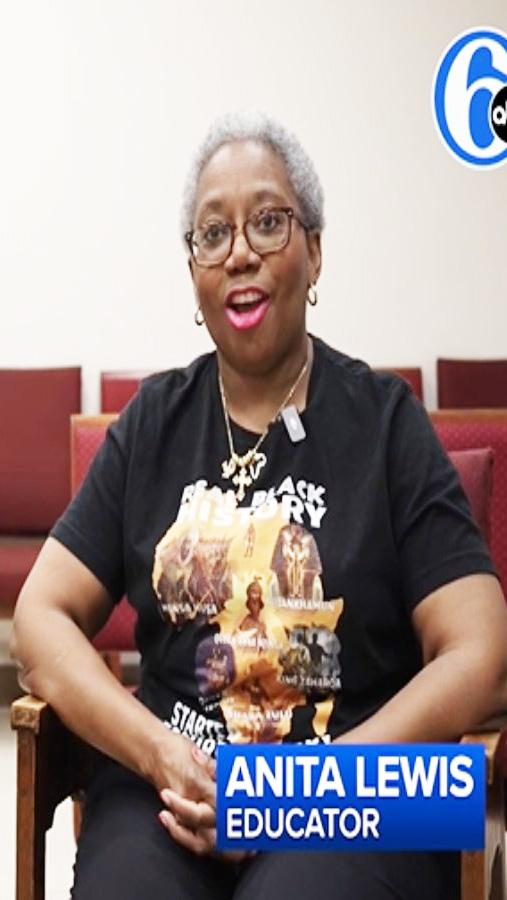
inclusive history education in schools.
“When I look around in the schools and I see classrooms with lots of Black and brown students, and you’re telling them that their history doesn’t matter in America… to me, that is an error.” Lewis believes that denying students the “fullness and the richness of their heritage” is raising a generation “who are not taught” important aspects of history, which “leads to dysfunction that could jeopardize the future of our very society.”
By courtesy of HBCUNEWS.com
Three historically Black college and university marching bands are honoring Michael Jackson in celebration of Black History Month and the upcoming release of the biopic Michael, which Lionsgate will distribute domestically on April 24.
As part of the “MICHAEL CELEBRATES: Legacy, Artistry, Culture” campaign, elite HBCU bands from Florida A&M University, Jackson State University, and Southern University shared performances of Jackson’s hit song Don’t Stop ’Til You Get Enough across social media platforms, including YouTube, Instagram, TikTok, X, and Facebook.
The participating bands, known respectively as The Marching 100, The Sonic Boom of the South, and The Human Jukebox, each delivered their own interpretation of the classic track, highlighting the deep cultural connection between HBCU marching bands and Jackson’s musical legacy.
“For Michael’s fans everywhere, his legacy of performance and artistry is enduring. That legacy lives powerfully within HBCU communities, where music, movement, and excellence have long been expressions of culture, pride, and identity,” said Briana McElroy, head of digital marketing for Lionsgate Motion Picture Group. “This initiative is deeply

personal to me — I grew up listening to these bands, who represent Black excellence, community, and creativity. Partnering with these HBCUs is about honoring that legacy while creating space for the next generation to lead, perform, and inspire.”
Fans worldwide are encouraged to participate by sharing their own tribute performances using #MichaelLegacy and #MichaelMovie.
By courtesy of
HBCUNEWS.com and NBCNEWS.com
More than 400 Transportation Security Administration workers have quit since a partial government shutdown that began on Feb. 14 left them working without pay, the Department of Homeland Security said.
Funding was shut off to DHS over demands by Democrats for reforms at Immigration and Customs Enforcement and Customs and Border Protection following alleged abuses and the fatal shootings of two U.S. citizens by federal agents in Minneapolis earlier this year.
There has also been a national callout rate of 10% at TSA on more than half the days of the last week, Lauren Bis, acting assistant secretary for public affairs at DHS, said Saturday in response to questions.
TSA, which is under DHS, has around 65,000 employees. Of that number, 50,000 are front-line officers who are is responsible for security at the nation’s airports.
Of the TSA officers who quit during the shutdown, almost half have over three years of experience and a third have over five years, the agency said.
Some TSA workers have expressed fears about unpaid bills and worse because they aren’t being paid. Anthony Riley, a 58-year-old married father of three who has been working without pay for weeks, told NBC News earlier this month that he faces possible eviction and the specter of being homeless.

There have been increased wait times — and frustration — at airports due to the shutdown.The highest nationwide callout rate during the shutdown came on Friday, at 10.22%, a DHS spokesperson said.
John F. Kennedy International Airport in New York City had a callout rate of 29.5% on Friday, and Houston Intercontinental Airport had a rate of 36.6% the same day, the spokesperson said.
Houston Hobby Airport had a callout rate of 51.5% on Friday, according to DHS.
In the U.S. Senate on Saturday, a Democratic bill to fund just TSA workers but not the rest of DHS failed to get the 60 votes needed to advance. The 41-49 vote was along party lines.
On Friday, Senate Democrats voted
down Republicans’ efforts to pass a bill to fully fund DHS.
Senate Minority Leader Chuck Schumer and House Minority Leader Hakeem Jeffries, both Democrats from New York, have called for reforms at ICE.
In February they outlined the reforms they want to see, which include an end to what they called indiscriminate arrests, a prohibition on ICE officers wearing masks, and an end to what they said was racial profiling by the agency.
The administration has blamed Democrats for the shutdown, calling it the “Democrat DHS shutdown.”
President Donald Trump in a post on Truth Social threatened to send ICE to airports.
Funding for ICE, which is part of DHS, has not been cut off during the shutdown. That agency received $75 billion in additional funds from the “big, beautiful bill,” the president’s major legislative package that was passed and signed into law last year.
Joe Smollen, who was flying out of Newark Liberty International Airport to San Diego on Saturday, said he went to the airport a couple of hours early just in case. He said he hopes Congress reaches a deal.
“I think it’s unfair to citizens to have to put up with it,” Smollen said. “And these poor people who work here, they’re very, very diligent in what they do, we need them,” Smollen said. “And it’s unfair that they would be singled out like that.”