Angela Davis
has had plenty to say -- and write -- about Black feminism

“We should seek out all the doors which still remain ajar, however slight the opening might be.”


has had plenty to say -- and write -- about Black feminism
“We should seek out all the doors which still remain ajar, however slight the opening might be.”
by Tristin Reeder
Leadership, Education, and Athletics in Partnership (LEAP) celebrated a major milestone on February 26, 2026, marking the 31st anniversary of its signature “LEAP Year Event.”
Held at the Dixwell Community Q House, the fundraiser was an astounding success, raising more than $600,000 to support free programming for the city’s children, teens, and young adults participating in LEAP Programs.
The evening opened with a vibrant reception featuring live music and refreshments. Guests were served by student volunteers from the Hopkins School Black Student Union alongside a dedicated group of LEAP Junior and Senior Counselors.
LEAP Executive Director Henry Fernandez welcomed the reception attendees, emphasizing that local support for New Haven’s youth is more critical now than ever because of severe federal funding cuts amounting to 20 percent of LEAP’s $7 million budget.
LEAP’s Alumni speaker was University of Wisconsin – Milwaukee Chancellor Thomas Gibson, who shared about how LEAP put him on his path to leadership. LEAP Board Chair and LEAP alumni Tai Richardson introduced Christina Parrales, who spoke about the program’s life-changing experience as a current

counselor.
The reception culminated in the presentation of the LEAP Community Leadership Awards to Senator Martin Looney and New Haven Public Schools Superintendent Madeline Negrón. The awards, presented by Board Member Deborah Stanley-McAuley and VP of Leadership and Learning Summer Choate Lewis, rec-
ognized the honorees’ dedication to the New Haven community.
Following the reception, the event transitioned into its dinners, with attendees fanning out to 28 locations across the city for intimate meals hosted by prominent Guests of Honor. This year’s dinner lineup included a guided tour through the Yale Art Gallery with Art Director Steph-
anie Wiles and Curator Michèl Wije, Documentarian Rachel Dretzin and how she navigates award-winning documentaries, Doctor-Chef Nate Woods, Director of Culinary Medicine at Yale; Jonathan Fanton, former President of the MacArthur Foundation and President Emeritus of the American Academy of Arts and Sciences, Emmy Nominated film maker
Peter J. Scalettar as he discussed his documentary Starting Five, James Forman Jr., Ariane Lewis, and Ray Boyd of Yale Law School’s Law and Racial Justice Center as they envisioned projects that advance racial justice right here in New Haven, Yale astrophysicist Chiara Mingarelli who explored the universe’s giants: supermassive black holes.
“I really felt a part of the conversation, and the guests were equally engaged,” said one attendee. “The hosts were incredibly kind and welcoming and provided a delicious dinner and dessert.”
The $600,000+ raised will have a profound impact on LEAP’s ability to serve over 2,000 youth annually. These resources fund a wide range of essential services, from phonics and literacy development to college tours and swimming lessons for our youth programs.
The success of the 31st anniversary was made possible through the support of key sponsors, including Noble Wealth Advisors of Janney Montgomery Scott LLC, Roger Ibbotson, The George Ellis Company with David Moulton, Joann Thompson & Robert Alvine, Roz & Jerry Meyer, Julie Wilson, and many more. Their contributions, alongside the generosity of hosts, guests of honor, and ticket holders, ensure that LEAP remains a safe, transformative space for New Haven’s next generation.
by Viktoria Sundqvist
HARTFORD, CT — Connecticut lawmakers are considering an accountability bill that would hold federal immigration agents liable for constitutional violations committed here. It would also ban federal agents from wearing face coverings when interacting with the public and would require all officers to be clearly identifiable with a visible name and badge.
Senate Bill 39, “An Act Concerning Democracy and Government Accountability,” would also allow for the attorney general to bring action against any law enforcement officer violating constitutional rights and create a database tracking Immigration and Customs Enforcement conduct in Connecticut. The bill would also require the governor’s permission before any armed military force could enter Connecticut for military purposes.
More than 150 were signed up to testify at the Judiciary Committee’s public hearing Monday, and dozens spoke in favor of S.B. 397 as well as Senate Bill 91, which would give Connecticut’s inspector general the authority to investigate and prosecute federal officers who violate state laws. S.B. 91 would also establish protected areas where federal officers could not go without a war-
rant, such as schools, health care facilities, homeless shelters and houses of worship.
State Rep. Patrick Callahan, R-New Fairfield, said it seems parts of the bill were prepared “in haste” in order to fit a mold and cater to public pressure.
“This is legislation borne out of public perception,” said state Rep. Greg Howard, R-Stonington.
Public perception and optics were the reasons the inspector general’s office was created in the first place, said state Rep. Steve Stafstrom, D-Bridgeport, noting that it brought transparency and built public trust to have an independent office handle investigations of police wrongdoing.
“Senate Bill 397 is a necessary safeguard to protect all residents from federal overreach,” said Peter Benner of West Hartford.
Michele Greenburg, of Greenwich, said Connecticut should be a model “to establish protected areas and limit surveillance and access to immigrant communities.”
“We need to make sure that basic protections remain in place,” said Robert Janis, a minister at Unitarian Society of Hartford.
“The Declaration of Independence does not read ‘all men are created equal – except for immigrants.’”
Current law already prevents ICE agents

from entering schools in Connecticut, said state Sen. John Kissel, R-Enfield, questioning the need for more legislation in that regard. And after the legislature strengthened the state’s Trust Act last year, federal agents can no longer make immigration arrests inside state courthouses without a warrant, he said.
Another speaker, however, reminded Kissel that despite this new law, a masked and armed agent made an arrest as recently as January inside a courthouse in New Haven, without prior notification to state judicial officials.
“We’d like to think that when we pass laws in this state, they are followed,” Kissel said. “So that’s disconcerting.”
Senate Majority leader Bob Duff, D-Norwalk, who is one of the main proponents of S.B. 397, said the bill would ensure that all law enforcement officials — local, state, and federal — are “equally held accountable for violating the rights of our citizens.”
“We are living through an unprecedented time with the head of our executive branch having pushed our legal system to its breaking point,” Duff said in his testimony. “I urge a favorable vote and look forward to working with you on this bill as it moves through the legislative process.”
by Maya McFadden
In Hillhouse High School’s cafeteria, freshman Naomi Kidane huddled over a drone and adjusted its propellers while junior Luis Baez fine-tuned the code—a crucial step as the “Bulldog Brainiacs” prepare for their next robotics leap: a national competition in Tennessee.
Naomi and Luis are two of a dozen students that make up Hillhouse’s newly established U.S. Army Junior Reserve Officers’ Training Corps (JROTC) robotics team.
They worked with their teammates for an hour after school Thursday to get in as much practice and preparation as possible before their second-ever competition.
Luis adjusted the team’s autonomous flight code so the drone would rotate 40 degrees counterclockwise instead of 41— a single-degree tweak meant to help the machine line up more precisely with its next task.
The group of four students in the cafeteria Thursday worked on programming two drones to fly autonomously in a rectangular shape. They used blue painter’s tape to measure and mark out a roughly three-foot rectangle, which in turn helped with their coding for the device.
Zelena Sanchez, the team’s junior captain, and freshman Adrianeysha Carrasco offered suggestions along the way as they worked through trial-and-error attempts. One suggested changing the battery while the next pointed out that the air drafts in the room were impacting the drone’s highly sensitive sensors.
The team made the physical adjustments to the drone while Luis again adjusted the code after his teammates noticed the drone’s earlier rotation angle left it slightly misaligned from the mapped-out rectangle.
Hillhouse’s Bulldog Brainiacs robotics team kicked off on Sept. 24, 2025. JROTC Sergeant First Class (SFC) Lisa Rodriguez facilitates the STEM-focused addition, along with the school’s JROTC drill, color guard, and physical fitness teams.
In another room on Thursday, the other half of the Bulldog Brainiacs worked on more coding, learning about a brand new drone, and practicing obstacles to prepare for their next competition.
Thursday’s after-school practice came just weeks after the team returned from its first-ever robotics competition in Boston, where students tested their drone programming and piloting skills against teams from across the region.
Four days a week, the team’s prac-

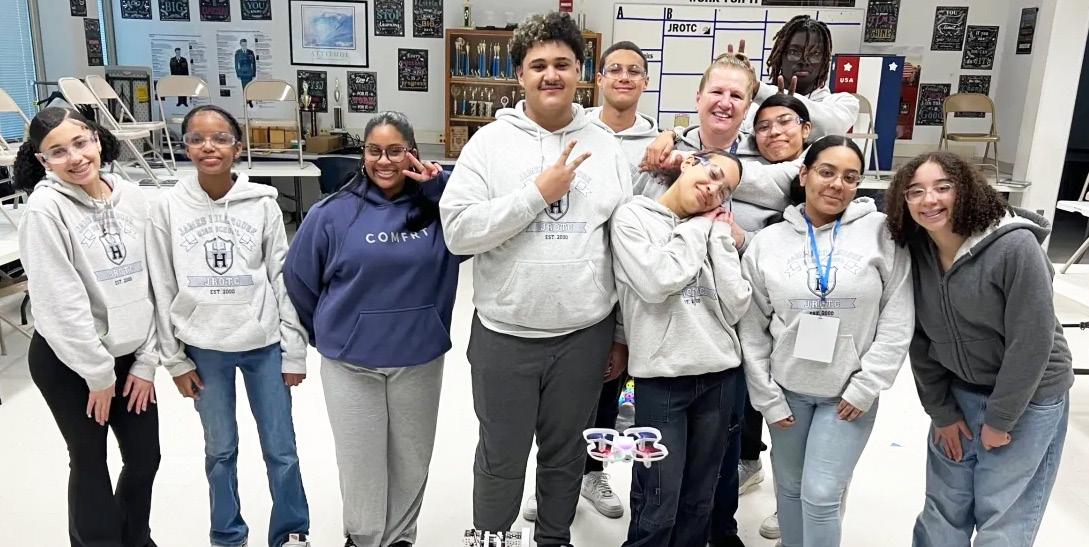
tices transform Rodriguez’s classroom into a small engineering lab where one group works on coding and refining commands while another group rotates through the roles of pilot, mechanic, navigator, and driver.
Freshmen Max Tomlin and Ellery took turns practicing with the robot’s controller as senior team captain Giovanny Mejia coached them through the controls. Their Thursday task consisted of getting more rhyth-
as fun and said that the program has introduced her to new friends. Before joining, Max would wait at Hillhouse until 3 p.m. each day to be picked up to go home. Rodriguez then invited her to join the team to make better use of her time after school. “It feels really good when I can actually see that I’m helping my team. I feel really accomplished every time I’m here,” she said. In another corner of the room, senior Harmonee Matheney and freshman Jarolin Caminero worked on sketching out the exact mechanics of the team’s two robots, helping the team out at competitions especially when parts of the robot or wires become disconnected or detached. Their blueprint in the team’s notebooks showed exactly what should be connected to what, allowing the team to work quickly to make repairs when needed.
The practice reflects a growing focus on STEM and career pathways throughout the district, and particularly at Hillhouse, as it’s spent recent years expanding its programs tied to technical careers and hands-on learning like manufacturing.
During Thursday’s practice, Giovanny looked closely at two 3D-printed figures as he worked with junior Julius Sinclair on how to program the team’s robots to autonomously pick up a ball and deliver it to the center of the room as many times as possible within one minute. This task, if accomplished, would score the team extra points at the upcoming competition.
Julius worked on a computer to create the code for the autonomous robot task. While he got down the basic moments and correct directions for the robots, he said the next task would require more space. He plans to work with the team to measure out the specific obstacle course layout to allow the team to practice with the robots in an accurately scaled space.
Julius has been pursuing his interest in robotics and coding since elementary school. Still, he said, the Hillhouse team has helped introduce him to skills like teamwork and communication. His passion started as a child when he would borrow his father’s tools to take apart his own toys. He recalled a $200 toy police car his father had gotten him that he enjoyed taking apart then putting back together.
“Working with your hands is the best to me,” he said.
mic in their movements of the robot as they directed it to lower its crane, pick up a plastic ball, then drive to a box across the room to drop the ball in. Max joined the robotics team recently. She described the hands-on works
Since September, Rodriguez has been teaching the team how to blend programming, mechanical troubleshooting, piloting, and teamwork. “It’s a lot of hours but a lot of fun,” she concluded.
by Jake Halpern
Last year I wrote a short piece in the New Haven Independent about a new idea we were trying at Wilbur Cross: an all-classes reunion. In the article, I promised: Everyone who ever went to Wilbur Cross will be there.
It was a joke. Or at least mostly a joke.
It was the first time we had ever tried something like this, and I was skeptical it would work.
Then about 750 people showed up. Graduates from the last 50 years. Teachers. Students. Administrators. They streamed into the atrium while the Wilbur Cross percussion band played and Chef Bradshaw and his award-winning culinary team prepared breakfast. The building filled with the easy, slightly disbelieving energy of a place rediscovering itself. People ate. They hugged. They tried to remember names.
One of the most remarkable scenes unfolded in the cafeteria. We had laid out a big table covered with hundreds of old photographs: sports teams, theater productions, clubs, graduating classes stretching back decades. People leaned over the tables and began flipping through them. Every few seconds someone would shout out a name. A classmate. A teammate. An ex-boyfriend. A favorite teacher. The space became a time machine. Memories flooded back. Laughter echoed. Tears streamed.

It was pure magic. The reunion was a success. So we’re doing it again.
On Saturday, March 28, from 10 a.m. to noon, Wilbur Cross will host its second annual all-classes reunion. Several hundred people have already signed up. Chef Bradshaw is preparing another massive breakfast. The firstfloor halls will be open so alumni can wander through the building, revisit old classrooms and hangouts, and reconnect with teachers they may never have had the chance to properly thank. We’ll also have tables filled with old
yearbooks and copies of the Wilbur Cross Proclamation. There will be school merchandise, sweatshirts, hats, and T-shirts. There will be opportunities to support the school. And there will be something new this year that I’m especially excited about: an oral history booth. Think of it as a small version of NPR’s StoryCorps. Alumni will be able to sit down and record a short memory from their time at Wilbur Cross. Those stories will become part of a growing audio archive that captures what this place has meant to generations of students.
For years people asked the same question: why do all the fancy private schools and suburban high schools have reunion traditions, while Wilbur Cross doesn’t? Now it does.
We’re building a reunion culture here, and it’s off to a pretty strong start. Last year 750 people came. This year we’d love to break that record. If you went to Wilbur Cross, consider this your invitation. Bring a friend. Bring a classmate. Bring a story. Sign up on the link below.
The following writeup was submitted by Hillhouse JROTC Sgt. Lisa Rodriguez, who facilitates the school’s robotics team. James Hillhouse High School’s JROTC Robotics and Drone team, the “Bulldog Brainiacs,” competed in the first Robot Drone League (RDL) New England Regional Competition at Revere High School on Feb. 7, 2026.
The RDL did an astonishing job creating a safe, fun and challenging experience for all who participated.
There were a total of six teams who competed in the Moonbase Challenge. This consisted of 10-minute rounds against other teams in a round-robin competition. Each team’s robot and drone were required to drive or fly autonomously for 1 minute, executing specific tasks that the cadets had previously coded them to perform. The next nine minutes were the teleoperation portion where the cadets controlled their robot or drone to either place or retrieve various items on the Moonbase Challenge course. Robotics and drone competitions are the ultimate “hands-on” lab. They turn ab-

stract concepts into tangible, high-stake problems that require real-time solutions. Cadets used engineering design and com-
puter-aided design (CAD) to build the robots, and learned through the process of building, testing, failing and redesigning.

John P. Thomas Publisher / CEO
Babz Rawls Ivy Editor-in-Chief Liaison, Corporate Affairs Babz@penfieldcomm.com
Advertising/Sales Team
Keith Jackson Delores Alleyne John Thomas, III
Editorial Team
Staff Writers
Christian Lewis/Current Affairs
Anthony Scott/Sports Arlene Davis-Rudd/Politics
David Asbery / Tanisha Asbery
Jerry Craft / Cartoons / Barbara Fair
Dr. Tamiko Jackson-McArthur
Michelle Turner / Smita Shrestha William Spivey / Kam Williams Rev. Samuel T. Ross-Lee
Contributors At-Large
Christine Stuart www.CTNewsJunkie.com
Paul Bass www.newhavenindependent.org
National Association of Black Journalist
Cadets were required to learn how to code their robot and drone so it could drive or fly autonomously. Robotics and drone assembly also teaches collaborative engineering, which further solidifies some of the things cadets have already learned as a part of the JROTC curriculum such as team building, communication, decision making and project management.
LET 1 Freshman Max Tomlin stated, “As someone who has only been involved with robotics for a short amount of time compared to the rest of my team, I’ve learned a lot about science, technology, engineering and math (STEM). The skills that I’ve acquired will not only help me with robotics in the future, but also with school. I was able to drive our robot through the course and score points. I felt like a true part of the team. My teammates and I all had an amazing time, we were able to socialize with other teams, create new bonds, learn more information about technology and win awards!”
LET 2 Junior Mali’Ann Johnson described her experience as “fun and a little stressful.” She also stated “as the competition went on, it became less stressful and a lot of fun!”
The Inner-City Newspaper is published weekly by Penfield Communications, Inc. from offices located at 50 Fitch Street, 2nd Floor, New Haven, CT 06515. 203-3870354 phone; 203-387-2684 fax. Subscriptions:$260 per year (does not include sales tax for the in State subscriptions). Send name, address, zip code with payment. Postmaster, send address changes to 50 Fitch Street, New Haven, CT 06515. Display ad deadline Friday prior to insertion date at 5:00pm Advertisers are responsible for checking ads for error in publication. Penfield Communications, Inc d.b.a., “The Inner-City Newspaper” , shall not be liable for failure to publish an ad or for typographical errors or errors in publication, except to the extent of the cost of the space in which actual error appeared in the first insertion. The Publisher reserves the right to refuse advertising for any reason and to alter advertising copy or graphics deemed unacceptable for publication. The entire contents of The Inner-City Newspaper are copyright 2012, Penfield Communications, Inc. and no portion may be reproduced by any means without the written permission of the publisher.
by Dereen Shirnekhi
At Sylvan Avenue’s Superstar Market, customer Anthony Lowery had a suggestion for the state representative candidate vying for his vote: Let members of the community clean up blighted properties — and get paid to do it.
Lowery was talking to Eli Sabin, a former Downtown/East Rock alder who is seeking the Democratic nomination to represent the 92nd General Assembly District, which covers Westville, West River, Edgewood, and parts of the Hill.
The seat is currently held by 21-term incumbent Democratic State Rep. Pat Dillon. Fellow Democrat Justin Farmer, a former Hamden town council member, is seeking the nomination as well.
Sabin was door-knocking along Sylvan and Davenport Avenue with a handful of supporters and local community leaders on Wednesday, speaking to residents and business owners about their neighborhood concerns. Many called for more youth programming, improved safety in the community, and neighborhood revitalization.
Sabin’s walking tour took place at the same time that Dillon hosted a campaign fundraiser in Westville’s Kehler Liddell Gallery, and on the same day that Farmer announced he has raised enough money to qualify for public financing.
Standing in the aisles of Superstar Market on Wednesday, Sabin asked what Lowery thought about housing.
“It’s a little bit slow right now,” Lowery said.
“We gotta get more affordable housing and make sure the landlords are taking care of their properties,” Sabin said.
Sabin pointed to his work supporting legislation to increase housing-code violation fines to $2,000 per day from $250 per violation, at both the state level and the local level.
“It costs more to actually fix the problem than pay the fine,” Sabin said about the previous $250 amount.
“They still won’t get it done,” Lowery agreed.
Sabin is also currently advocating at the state level, in his role as a legislative coordinator for CT Voices for Children, for the passage of two bills that would require accurate identifying information for landlords in order to better enforce maintenance fines.
“If you can, you should have a pool [of funds] for people that will volunteer,” Lowery said, to clean up blighted properties. Of landlords, he said they could put money into the pool for work to be done on their properties and create work opportunities for neighbors. “That would make it all the better.”
“I mean, it’s our community,” Lowery said.
A resident of the neighborhood for about six years, he said he’s also a supporter of

programs for kids, to get them “off the streets.”
“He has my vote,” he said of Sabin.
Sabin was joined on Wednesday’s walking tour by Mauro-Sheridan School educator and longtime neighborhood resident Sean Hardy, newly elected Ward 3 Democratic co-chair Lisa Velazquez Torres and her daughter Liz Valentan, Christian Community Action’s Hannah Croasmun, former Board of Education student representative Anthony Fiore, and Hill resident Hector Miranda.
“He’s always there for me,” Hardy said about Sabin and why he was there supporting him.
Velazquez Torres said she believes Sabin would make a good state rep. She said she appreciates the way he treats the community. “He wants to make changes,” she said.
Miranda, a resident of the neighborhood for 45 years, said he had met Sabin the day before at a Community Management Team meeting. “I like what he thinks,” he said. “I want people to know him.”
So Sabin walked along Davenport and Sylvan avenues, his supporters in tow.
Gary Hamilton was standing outside his Davenport Avenue home with friends, enjoying the day’s warm weather. Sabin introduced himself and asked Hamilton about any challenges he had experienced in the neighborhood.
“I’d have to give that some thought,” Hamilton said.
Maybe the cost of rent? Sabin suggest-


ed. Hamilton said he owns his home. “One of the issues I wanna work on is bringing more funding to our schools,” Sabin said. If the state increased the money it sends to the city for schools — like by increasing the Education Cost Sharing foundation grant — it would put less pressure on local property taxes, he said.
“You have a good point,” Hamilton said. He took a flyer and said Sabin would “definitely” get his vote.
At Eddie’s Market on Sylvan Avenue, Eddie Fontanez, Jr. sat behind the register. His father, Eddie Sr., had owned the corner store for decades before him. “To be honest we do need help,” Fontanez said. “Business is OK, it’s not great.”
Fontanez said he doesn’t live in the district and won’t be able to vote for Sabin. Still, “I’m all for what you’re saying,” he said, like boosting funding for schools. Sabin said that there are city programs and state funding that has come in as part of “Main Streets programs” to support businesses in commercial corridors improve their façades and signage. He thinks there are opportunities to bring that funding to Davenport and Sylvan avenues.
“If that’s true, I would love that,” Fontanez said. He offered to put up signs or flyers at his store in support of Sabin.
After door-knocking for close to two hours, Sabin and his crew parted ways with plans to reconvene for a future event, possibly a neighborhood cleanup.
Sabin said felt the day had been a success. He said a goal of his campaign is to make sure “everyone feels involved and has a stake in the future.”
In addition to his priorities of increased education funding, youth programming, and small business support, Sabin also said he would work to bring down the cost of electricity. He said he supports splitting up the responsibility of construction of new transmission lines and the maintenance of them, requiring that utilities companies make the necessary investments in maintenance that could bring down costs rather than in big capital projects.
Sabin said he also supports the building of more affordable housing, and providing eviction protections “so people don’t fall into homelessness.” He pointed to his support of just-cause eviction legislation, which would prohibit some landlords from kicking out tenants without “just cause” when their leases are up.
“I think a lot of the challenges that we saw today would be addressed with more funding coming in from the state to our schools and to small business support programs and youth programs,” Sabin said. “People want to come together and work together to clean up the neighborhood and fix up blighted properties themselves, clean up trash, work at community gardens.”
He believes the state can support that.
by Laura Glesby
“Experience counts,” said DiDi Strode, summing up a sentiment heard again and again inside Westville’s Kehler Liddell Gallery on Wednesday evening.
Strode was explaining her support for incumbent State Rep. Pat Dillon, who is running to continue representing the 92nd General Assembly District, having served for over four decades in the role.
Around 50 people, ranging from political stalwarts to artists to environmental activists, had gathered for a campaign event to show support for Dillon.
Attendees were asked to provide a $5 donation to the campaign, as Dillon works on amassing enough small donations to qualify for the state’s Citizens’ Election Program.
Dillon has represented the district since 1984. At 77, she is facing challenges from two fellow Democrats — former New Haven alder Eli Sabin, 26, and former Hamden council member Justin Farmer, 31, whose campaigns have been interpreted as bids for generational change.
Dillon’s campaign fundraiser Wednesday took place at the same time that Sabin and several supporters walked the Hill to talk with business owners and residents. It also occurred on the same day that Farmer announced he had raised enough money to qualify for public financing.
Inside the gallery on Wednesday, attendees made the case that Dillon’s decades of experience in her role are a vital asset for New Haven, far from a drawback. Over and over again, they echoed versions of the same sentence: “I’ve known Pat for a long time,” or “I’ve worked with Pat for years.”
Many attested that those years have been marked by hard work and trustworthy leadership on Dillon’s part.
“We are living in very uncertain times,” said Richard Furlow, who represents parts of Westville, Amity, and Beaver Hills on the Board of Alders while serving as the Democratic Majority Leader.
“We need stability,” Furlow told the room. “We need someone with focus. We need someone with established relationships.”
“What this is about is making sure we have steady leadership” in Hartford, he added.
In remarks to her supporters, Dillon spoke to how much the job landscape has changed for young people just now entering the workforce.
“I can remember, actually, working at Macy’s,” she said, describing one of her first jobs. “Where do young people get their experience now?”
She noted that several local systems of support for young people, including the Solar Youth jobs and after-school program and the homelessness services organization Youth Continuum, have recently shut down.
One way she envisions working to retain and create opportunities for young people is by supporting the sciences, which she called a “growth area” for the city.
As the federal government withholds


funding for scientific research, Dillon promised to advocate for state support for the sciences. “I would like to see the state provide some bridge funding,” she said.
Several attendees cited Dillon’s support in fostering the work of the Greater Dwight Development Corporation and the Montessori School on Edgewood.
Others pointed to her successful fight for assistance for residents of Amity and Upper Westville whose houses had begun to crack and sink into a water table.
Environmental advocate Laura Cahn touted Dillon’s record on the Connecticut General Assembly’s Environment Committee.
For instance, Dillon is currently working on legislation to ramp up enforcement against illegal tire dumping, which can result in toxic chemicals infiltrating water sources and harming wildlife. Cahn recently sent Dillon a photo of 20 illegally discarded tires in the neighborhood.
“I need Pat’s great work,” said Cahn. “I tell Pat about issues. I give her the facts. She does something about it.”
Former Mayor and former State Sen. Toni Harp recalled legislating alongside Dillon, and later working with her from the helm of City Hall. “I don’t know of a stronger advocate,” she said, describing Dillon’s role in fighting for more funding for the city.
“Pat Dillon is probably one of the best,”

HARTFORD, CT — Connecticut’s restrictions on carrying guns and pistol purchases remain intact after Judge Janet C. Hall dismissed a legal challenge to the state’s open carry ban and its limit of three handgun purchases per month.
“Another lawsuit, another win. Today’s ruling tells us what we already know – Connecticut’s commonsense gun safety laws are lawful, necessary and lifesaving,” said Attorney General William Tong. “Extremists in the gun lobby will stop at nothing to eviscerate our protections and flood our communities with ever more dangerous weapons. We are fighting back and we are holding the line. I will continue to vigorously defend our laws and public safety against any and every one of these baseless challenges.”

said political strategist Christine Bartlett-Josie. “She’s the person young people go to for mentorship.”
“We’re in such a political world, versus a civic world,” said Dorthula “Dottie” Green. “She is a civic servant.”
Thea Buxbaum, one of the event’s organizers, described Dillon as “extremely competent.”
“Her life experience lets her really appreciate the stories of her constituents,” Buxbaum said.
Hall granted the state’s motion for summary judgment, as she ruled that We the Patriots USA, an Idaho-based conservative advocacy and legal organization, and the two individual plaintiffs lacked standing to challenge the laws as they are constitutional. Neither individual plaintiff was a mem-
ber of We The Patriots USA, Tong said. The individual plaintiffs had declared to the state in depositions that they never attempted to purchase more than three firearms in a month and either had no financial means or intention to do so, and they had never openly carried in Connecticut and had no intention to do so, according to Tong’s office. The court also ruled We the Patriots USA had no organizational standing in this matter because the group’s core activities were unaffected and no one was hurt organizationally. Representatives for We the Patriots USA did not return an emailed request for comment.
The court also ruled Connecticut’s open carry ban was well within historical and recent precedent, Tong said.
This lawsuit is one of several gun-related challenges Tong has defended in recent years, including Nastri v. Dykes, which challenged the state’s prohibition on firearms in state parks last October, and an August 2025 challenge to Connecticut’s large-capacity magazine ban brought by the National Association for Gun Rights and the Connecticut Citizens Defense League.
by Mona Mahadevan
Cynthia Chamberlain, a 59-year-old woman from New Haven, was found dead Monday afternoon by children playing in a park in the Hill.
City police spokesperson Officer Christian Bruckhart said in a press release that officers were dispatched to the 100 block of Hallock Avenue at around 5:43 p.m. Monday for the report of a sudden death.
“Children playing in the park located an unresponsive female under the tree line next to the fence. Emergency services were dispatched and pronounced the unknown
female deceased.” The woman was later identified as Chamberlain.
An autopsy report did not find any evident trauma, but the department is still waiting for results of a toxicology screen, according to the police department’s press release.
Chamberlain was reported missing on Feb. 10.
Police ask that anyone who may have witnessed this incident or who may have information valuable to investigators to call detectives at 203-946-6304 or through the department’s anonymous tip-line at 866888-TIPS (8477).


by Mona Mahadevan
Faith Martin has spent the last four weeks and five days in a fourth-floor hotel room, waiting for the city’s public housing authority to repair a broken elevator in the Annex building she has called home for 25 years.
She misses trading home-cooked meals and hosting movie nights with her neighbors. Now, she spends her days in a single room with two tiny dogs, relying on her godsister for help when her spinal pain flares up.
Martin, 55, is one of five mobility-impaired tenants living in La Quinta Inn on Sargent Drive after being displaced from Fairmont Heights, a low-income complex for the elderly and people with disabilities.
The three-story building’s elevator broke on Jan. 25, according to Martin’s email records. After spending six days trapped in her apartment, Martin said she was relocated to La Quinta Inn.
Fairmont Heights, a 98-unit complex located at 70 Fairmont Ave., is managed by a subsidiary of the Housing Authority of New Haven (HANH).
The Independent spoke with three of the displaced tenants at La Quinta Inn, all of whom said the Housing Authority has not told them when they will be relocated or where they will live next.
In an email to the Independent on Thursday, HANH President Shenae Draughn said repairs to the elevator should be completed within four weeks. In the meantime, she said, the affected tenants will be prioritized if HANH units comes online.
Part of the challenge has been sourcing a vendor for new parts, said Draughn. While the maintenance company said the elevator could have been fixed, the repairs would not have produced “a longterm solution,” she said.
“The Housing Authority is committed to prioritizing the well-being of our residents at Fairmont Apartments, especially during the current elevator outage,” Draughn wrote in an email statement.
“We understand that accessibility is crucial, particularly for those navigating our three-story building. To address this, we have relocated families facing challenges with navigating stairs to a hotel, ensuring their comfort and safety.”
On Wednesday, a manager at Fairmont Heights rejected the Independent’s request to take pictures of the broken elevator, saying photographs require approval from an executive office.
“Nobody [from the Housing Authority] communicates to us,” Shelley White, a New Haven Legal Assistance Association (NHLAA) attorney working with Martin, said on Wednesday. While the tenants had been told at one point that they would be relocated to a complex in West Rock, “Now, no one seems to be sure, they don’t know where the units are, [and] they don’t know what’s going on there.”
On Wednesday, Martin welcomed the Independent into her hotel room, where her godsister, Shartarra Penn, was study-

ing for her real estate exam. The desk was crowded with medications and pantry staples, including canned vegetables, tea, and protein powder. Colorful dog toys sat next to a rickety nightstand.
“They’re not listening to me,” said Martin. “I don’t know from day to day what’s going on with my apartment.”
She most misses her neighbors, who knocked on her door daily and helped when she was in pain. But she also longs for simple things, like walking into her kitchen and boiling a cup of tea.
Even before the elevator broke down, Martin, a professional caretaker, struggled to secure disability accommodations at Fairmont Heights. During a renovation in 2023, contractors removed the three grab bars that Martin needs to safely shower. She said management denied her request to install new bars, claiming the wall could not hold them.
Penn said Martin now calls her through Facebook when she showers, just in case she slips and falls.
“So when she’s done, she says, ‘Tara, I’m all finished,'” and hangs up the call, said Penn.
Martin feels frustrated by the loss of her grab bars, especially given her $874 monthly rent — which she still pays, even while living at La Quinta Inn.
“I’m giving [the Housing Authority] a good chunk of my money every month, not knowing if my home will be safe,” said Martin. “I’ve been asking for relief for something simple…but I can’t fix structural issues in the building.”
On Thursday, Draughn told the Independent that she was not aware of Martin’s


issue with grab bars at Fairmont Heights. An NHLAA attorney representing Martin submitted a request for grab bars on Oct. 2, according to emails acquired by the Independent. The Housing Authority responded two months later, saying Martin would be added to a transfer list because Fairmont cannot accommodate grab bars. In the lobby of La Quinta Inn, Shirley Grice, 71, told the Independent that she shares Martin’s frustrations.
Every Friday, a manager knocks on her door and tells her to check out of her room, said Grice. She then calls the Housing Authority and asks them to pay for another week at the hotel. Often, said Grice, they tell her that they already approved the extension, but there was a miscommunication with La Quinta Inn.
If she lost her hotel room, “there would be nowhere for me to go,” said Grice. Her apartment at Fairmont Heights is located on the second floor, and with a walker, she struggles to climb the stairs.
Her mobility issues also limit her activities at La Quinta Inn, which is located in a car-centric neighborhood with few restaurants and stores nearby. Without work or neighbors, Grice spends most of her time watching TV in the lobby.
All the while, she still pays the Housing Authority $286 per month.
HANH has been sending checks of $175 to the displaced tenants weekly, according to Martin and Grice. But neither received a check for the week of Feb. 23.
“Unfortunately, we were made aware of the food voucher issue yesterday. As such, we will issue a doubled check to the affected residents on March 6,” Draughn told the Independent.
Another displaced resident, an 81-yearold woman, invited the Independent into her seventh-floor hotel suite.
After opening the door, she crashed on the couch, took a sip of water, and wiped sweat from her brow. Her room’s thermostat had been set to 81 degrees, but she couldn’t turn down the temperature with her walker.
“I’m sick of [being] over here,” she said. “I want to be with my friends over at [Fairmont].”
She said she has lived in Fairmont for 25 years. Since she moved to La Quinta Inn, the Housing Authority has been sending weekly checks for food. But without a car, she struggles to get groceries and purchase meals that meet her diabetes-related dietary restrictions.
To make it through, “you need someone you know real well who will cook for you and bring you food,” she said. Luckily, one of her neighbors has been buying her groceries and helping her run errands, like going to the bank. She also has a hospital aide that sometimes visits.
“It’s OK being in here as long as you have a TV,” she said. “But I want to go home.”
by Dereen Shirnekhi
HARTFORD — Metropolitan Business Academy senior Bayan Albakkour
took the bus Wednesday morning not to school, but to the state’s capital city, where she delivered a message to the Connecticut legislature alongside more than 100 of her peers: New Haven Public Schools needs more money.
“I have personally experienced how low funding impacts students,” Albakkour said before the Connecticut General Assembly’s Education Committee during a public hearing. Her school’s book club wanted to attend an educational, literary event in New York but was told there wasn’t enough money for it.
Rather than give up, Albakkour took the lead in raising the money they needed.
“Students should not always have to find funding on their own just to access educational opportunities,” she said. Proper funding for extracurricular groups should be a priority: “They’re part of what makes school meaningful.” They build confidence, leadership, and community.
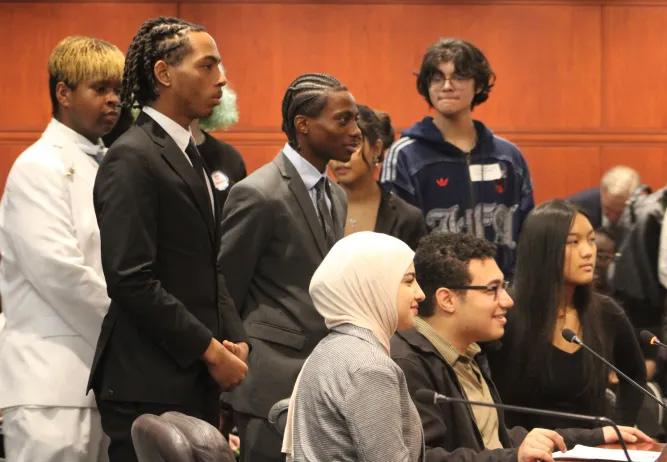
Albakkour was one of ten New Haven Public Schools (NHPS) students to jointly testify during the Education Committee’s public hearing on Wednesday in support of Senate Bill No. 7, a bill that proposes raising the Education Cost Sharing (ECS) formula’s foundation grant incrementally.
The ECS foundation grant, the per-pupil funding each local school district receives from the state before other adjustments, has been $11,525 per pupil since 2013.
The ECS formula began as a method of leveling the playing field, created after a Connecticut Supreme Court decision found solely using property taxes to fund schools to be inequitable. Now, students and educators argue that the formula hasn’t kept up with rising costs.
If passed, the bill would increase the foundation grant to $12,500 in fiscal year 2027, $13,500 in fiscal year 2028, $14,500 in fiscal year 2029, and $15,500 in fiscal year 2030. After the 2030 increase, the grant would be indexed to economic indicators, allowing the funding to keep pace with economic conditions.
NHPS students — alongside Supt. Madeline Negrón, Mayor Justin Elicker, NHPS Chief Financial Officer Amilcar Hernandez, and teachers union leadership — bussed to the Legislative Office Building to urge legislators to support the bill, alongside students and officials from other urban districts. It wasn’t the first time this legislative session that the city and its students have advocated for more funding the state. (Read about last year’s push for an improved ECS formula, which saw ten public education advocates arrested at a related protest.)
“It is important now more than ever for legislators to hear from our students,” said New Haven teachers union vice
is among the most important investments we can make as a state.
“At the same time, the Governor understands that local leaders face the difficult task of managing rising costs while ensuring classrooms have the teachers, tools, and support services students need, all without placing additional strain on property taxpayers. Although he has presented his biennium budget proposal, he looks forward to continuing the conversation on ways we can reduce pressure on local property taxpayers and promote greater equity.”
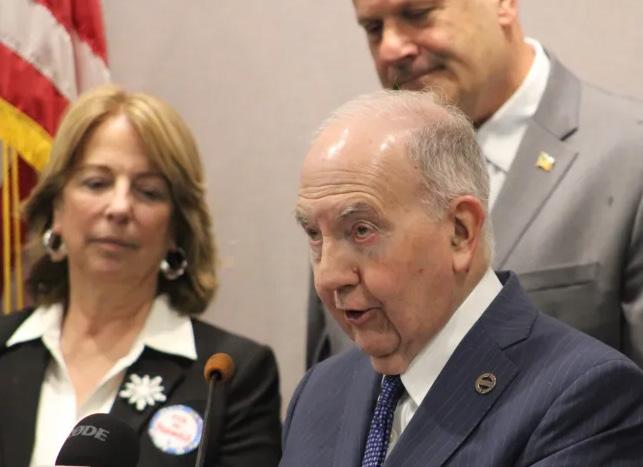
At still another press conference in Hartford ahead of Wednesday’s public hearing, state-wide leaders joined legislators in supporting the bill. New Haven State Sen. and President Pro Tempore Martin Looney, a Democrat, described S.B. 7 as “one of the most important votes in the state to municipalities and children.”
Looney introduced and co-sponsored the bill alongside a host of lawmakers, including Senate Majority Leader Bob Duff of Norwalk, a fellow Democrat.
At that same press conference, Elicker said that NHPS has one counselor for every 396 students, one social worker for every 343 students, and one school psychologist for every 661 students.
president Jenny Graves, as public education faces federal funding cuts from the Trump administration. Graves estimated that around 140 New Haven students were in attendance on Wednesday, compared to around 80 students last year.
“We’re not asking for extra, we’re asking for what we deserved all along,” said High School in the Community senior Diana Robles at a morning press conference to kick off the day.
When funding is insufficient, Robles said, “students feel it immediately.” She described schools’ leaky roofs, broken heating systems, and broken laptops.
“When you fund our schools fairly, you’re telling us our education matters,” Robles said. “Local action alone cannot solve a state-wide problem.”
Robles’ history teacher, Ben Scudder, asked, “Will we continue to let them cry poor while building up record surpluses?”
FaithActs for Education CEO Jamilah Prince-Stewart, standing with other faith leaders, quoted the Bible: “‘Train up a child in the way he should go, and when he is old he will not depart from it,'” she said. “This is not merely a soundbite. It is a call to action.”
Reached for comment about Wednesday’s push for increased state funding of public education, Gov. Ned Lamont’s spokesperson, Rob Blanchard, said, “Governor Lamont has made strengthening education funding and classroom resources a cornerstone of his administration, so that every child has the opportunity to succeed. It’s one of the reasons Connecticut continues to be home to some of the best public schools in the nation, because we recognize that education
“Our communities are desperate,” Elicker said.
In a packed hearing room on the first floor of the Legislative Office Building, where over 300 people were signed up to speak, Albakkour joined Robles, Board of Education student representative Abdellah Aly, and seven other NHPS students in collectively standing before the Education Committee and testifying in support of S.B. 7.
“If we look at the inflation between 2013 and today,” when the foundation grant was last set, Aly said, “it has roughly increased about 39 percent. If we adjust the ECS foundation amount with that rate … that would be approximately $16,000 per student.”
“The difference is extremely significant if and when applied across large school districts,” Aly continued, and operating costs continue to increase. “Those costs don’t just disappear, but instead districts are forced to make difficult decisions,” like increase class sizes, forgo infrastructure improvements, and put pressure on local property taxes.
“Thank you, young people,” said committee co-chair Doug McCrory, a Democratic state senator from Hartford.
“The more that we have support as students, the more powerful we can be,” said Albakkour, after leaving the hearing. “We’re tomorrow’s leaders. I feel like that’s really important to say.”
Right now, Albakkour said her book club is reading Lunar New Year Love Story by Gene Luen Yang.
“I’m also a big fan of Maya Angelou’s poetry,” Albakkour said. This week, she said she read “And Still I Rise.”
by Maya McFadden
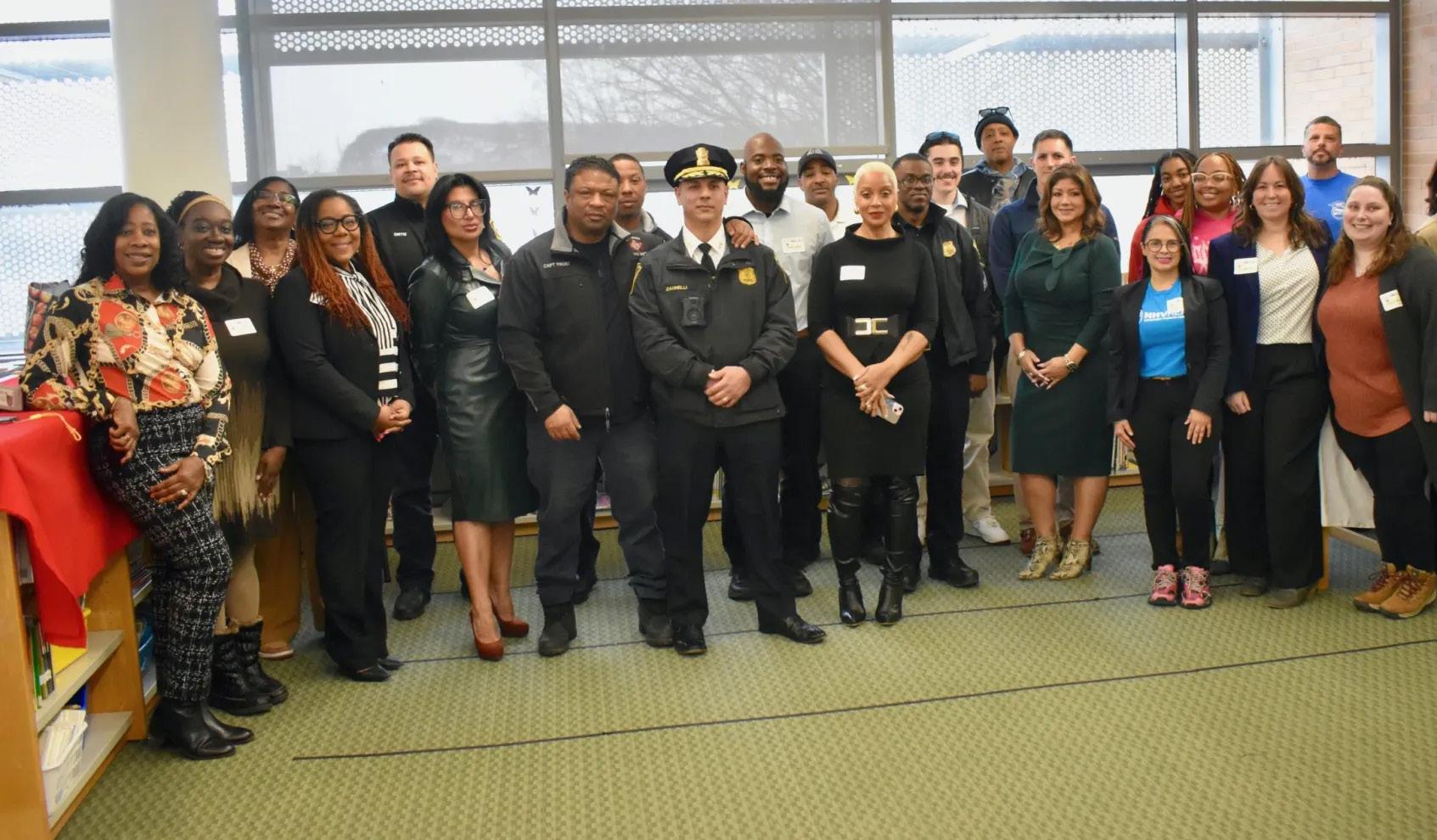
King/Robinson School students came to class to hear from police, firefighters, business owners, and judges about their career journeys — while those same community members were reminded that all of their work is ultimately about investing in today’s youth.
That was the scene Tuesday morning as King/Robinson hosted a school-wide Career Day celebration for the first time in years. The celebration, arranged during national career week, aimed to build off New Haven Public Schools’ (NHPS) focus for the past two years on building its career pathways, Assistant Principal Cara Campo said.
This year’s celebration scaled up from previous King/Robinson career exposure offerings to students which typically were smaller coordinated classroom-by-classroom visits. Former Roberto Clemente Principal Mia Duff helps King/Robinson staff to connect with organizations like the New Haven Chamber of Commerce to build a network of visitors.
Tuesday’s building-wide effort to expand elementary and middle school students’ knowledge of career opportunities introduced around 20 different careers to King/Robinson students through community speakers.
At around 9:30 a.m., speakers gathered in the school’s library to enjoy bagels and coffee before being assigned to students’ classrooms. From PreK through eighth grade, classes rotated through speakers like Acting Police Chief David Zannelli, fire Lt. Neftali Ortiz, state Superior Court Judge Angelica Papastavros, and Yale doctor Jennifer Afranie-Sakyi.
While welcoming visors to the school’s library Tuesday, Campo said the goal was simple: start early.
“We need to get students exposed to career options at earlier ages,” she said. That exposure, she said, isn’t just about jobs. It was about community — neighbors, public servants, business owners, former students ultimately showing students what’s possible inside their own city.
Before the guests dispersed, Principal Tessa Gumbs-Johnson thanked Tuesday’s guests for “providing a wealth of knowledge” to King/Robinson students while also showing up and making them a priority. The format was intentional: instead of a gym assembly or expo-style event as has happened in the past, Gumbs-Johnson said, this time speakers rotated into classrooms for students and adults to engage in a “day of learning.”
“It’s just as important for the guests to see what it’s like in a New Haven classroom,” Campo added. 911, Not 913
Outside in King/Robinson’s front lot, fire and police vehicles were on display
for the schools PreK through first graders. Crowded around one New Haven police cruiser were a dozen students with Officer Jennifer Giovanni, who pointed out her car’s radio controls and dashboard buttons she uses when responding to emergencies.
When first-grader Maysun spotted the radio attachment connected to other cars’ PA system, he asked Giovanni for permission to use it. She agreed and Maysun leaned in toward the speaker to announce, “It’s the police.”
Just a few feet away other students climbed into a bulletproof SWAT truck reserved for “really, really bad guys,” officers explained. Members of the police department’s bomb squad displayed a large robot controlled by an Xbox controller. Another officer compared the department’s portable X-ray machine to X-rays at the dentist. They explained that one allows them to see inside a suspicious package without opening them.
Nearby, local firefighters and police officers quizzed students on when to call 911 — and when not to. A small cut? No. A broken TV? Definitely not. A fire? Yes. They also practiced memorizing the emergency line 911 after some initially guessed that the right number was “913.”
Firefighter Ortiz said giving back is part of the job, just like making connections with and protecting the community. “I never want to stop a child from dreaming big,” he said. “And I don’t want them to think they have to leave their community to be successful.”
Fire Capt. Troy Frost, who helped coordinate the department’s participation at Tuesday’s career day, added: “It’s important for children to see us. We were once them. And we want the to know ‘this can be you.’”
Meanwhile inside the classroom of King/Robinson teacher Kimberly Garcia, fourth graders were puzzling through a different question: What exactly does a mayor do?
Luckily, Garcia’s two-dozen students had city Mayor Justin Elicker there to provide the answer. Before doing so, Elicker stood at the front of the classroom listening to the students’ guesses.
“A mayor helps people with problems,” said fourth-grader Adeline.
“A mayor does speeches,” added Javon. (Elicker confirmed he had, in fact, given one that morning.)
Another student suggested a mayor’s job primarily involved doing multiplication.
Elicker then explained that while police officers chase the “bad guys;” his job is



to ensure city departments like police have the resources to do their work.
After conversations about the role of a mayor, Elicker concluded with a trick of balancing a chair on his chin, earning cheers from all students.
Later in the day, after many speakers had rotated through, a different kind of lesson unfolded for eighth-grade teacher Maxine Phillips’ students.
After meeting a judge and staff from South Central Connecticut Regional Water Authority earlier in the day, Phillips’ eighth-grade girls gathered in the school auditorium for a special presentation on self-love and confidence.
The presentation was led by Gumbs-Johnson’s former Hamden High School student and nonprofit owner Mareshah White.
White gathered with the eighth-grade girls to talk about being a 23-year-old community leader and advocate through pageantry and through her nonprofit She Walks with Ambition. Bullied in middle school and often shy in high school, White helped the girls in front of her say positive affirmations and remind themselves of their strengths. She told the girls that confidence “is like a muscle.”
White then had the students list off three strengths, one unique quality, and a positive affirmation about themselves. Some spoke about being proud of being creative, patient, trustworthy, good at basketball, and good at speaking their minds.
Eighth-grader Janaiyah Bland said White’s presentation resonated and gave her “big sister vibes.” After being bullied herself, she rebuilt her confidence through cheerleading and sisterhood over the last two years.
“If she can do it, I can do it,” Janaiyah said of White.
Gumbs-Johnson watched with pride as her former and current students interacted. She recalled White as a quiet student in her office at Hamden High years ago as she was one of two Black educators in the building at the time. She explained that White was just one of many powerful examples of the many community members that has a story to connect with students and remind them their dreams are possible.
For her, Tuesday’s career day wasn’t just about professions. It was about representation and demonstrating to students “visibile trajectory.”
“Don’t count our children out,” Gumbs-Johnson said. “This is a school named after greats. And our children here are going to become the greats one day.”


Yale New Haven Hospital is pleased to offer patients and their families financial counseling regarding their hospital bills or the availability of financial assistance, including free care funds.
By appointment, patients can speak one-on-one with a financial counselor during regular business hours. For your convenience, extended hours are available in-person at Yale New Haven Hospital the third Monday of every month.
Time: 5 - 7 pm
Location: Children’s Hospital, 35 Park St., 1st floor, Admitting Parking available (handicapped accessible)
An appointment is necessary. Please call 855-547-4584. Spanish-speaking counselors available.
We’re Here When You Need Us!
• Cremation (Choose to be cremated at Evergreen.)
• Columbarium in the Most Beautiful Cremation Garden
• Reserve your Niche in a secure location pre-need.

• Reserve a Niche for family and friends or purchase at-need to safely place your Loved One in the Columbarium.
• Burial Lots (infant, single, two-grave, or four-grave)
• Monuments & Markers (black, gray, or pink granite)
• Flower placement (single or multiple placement)
• All orders can be placed at the Evergreen office or the website.

Revolutionary freedom fighter Angela Davis has had plenty to say -- and write -- about Black feminism and prison abolitionism.
By Courtesy of newsone.com
Iconic Black power activist Angela Davis is known for many things, but being at a loss for words is not one of them.
The celebrated scholar and revolutionary activist preached what she practiced and documented her life as well as her views about women, race, class and politics on the pages of more than 10 books that she has authored. More times than not, the quotes from those books — published between 1971 and 2019 — still resonate in 2022, and likely will continue to do in the years and decades to come.
Not familiar with Davis’ books? Keep reading to find a sampling of quoted excerpts from a selection of Angela Davis’ books that address women, race and class in the context of Black feminism and prison abolitionism.
If They Come in the Morning: Voices Of Resistance (1971)
“The very institutions which condemned Nat Turner and reduced his struggle for freedom to a simple criminal case of murder, owed their existence to the decision, made a half century earlier, to take up arms against the British oppressor.”
“Yes, I am a Communist. And I will not take the fifth amendment against self-incrimination, because my political beliefs do not incriminate me, they incriminate the Nixons, Agnews, and Reagans.”
“There is a distinct and qualitative difference between one breaking a law for one’s own individual self-interest and violating it in the interests of a class or a people whose oppression is expressed either directly or indirectly through that particular law. The former might be called a criminal (though in many instances he is a victim), but the latter, as a reformist or revolutionary, is interested in universal social change. Captured, he or she is a political prisoner.”
“We should seek out all the doors which still remain ajar, however slight the opening might be.”
Angela Davis: An Autobiography (1974)
“Some years back, Black visitors to Birmingham had all of three post cards from which to choose if they wanted a souvenir of the Black section of the city. Sixteenth Street Baptist Church. Parker High School. A. G. Gastons Funeral Home. Perhaps the white people who made the photographs and retouched them in bright reds and yellows had decided that our lives could be summarized by church, school and funerals. Once we were born, we got religion and a sprinkling of learning; then there was nothing left to do but die…”
Work hard and you will be rewarded. A corollary of this principle was that the road would be harder and rockier for Black people than their white counterparts. Our teachers warned us that we would have to steel ourselves for hard labor and more hard labor, sacrifices and more sacrifices. Only this would prove

that we were serious about overcoming all the obstacles before us. It often struck me they were speaking of these obstacles as if they would always be there, part of the natural order of things, rather than the product of a system of racism, which we could eventually overturn.
“Many times before, movement leaders and activists had been felled by the bullets of police, conscious agents or crazy, confused brothers who let themselves be used. We had cried before, we had attended funerals before, and we had felt and expressed rage at seeing the life of a brother, a comrade, so cruelly blown out of him. We knew that for the moment our commitment meant that we were chained to a vicious circle of violence—in this way our enemies were trying to force us to retreat in fear. In a sense, therefore, we always expected the violence, we knew it was coming, though we could never predict the next target. Yet each time it struck, it was equally devastating to us. No matter how many times it was repeated, there was no getting used to it.”
American activist and philosophy professor Angela Davis, Central Committee member of the Communist Party of America, addresses the Soviet International Women’s Seminar in Moscow, September 4, 1972. | Source: Express / Getty
Women, Culture & Politics (1990)
“We must begin to create a revolutionary, multiracial women’s movement that seriously addresses the main issues affecting poor and working-class women.”
“We cannot grasp the true nature of sexual assault without situating it within its larger sociopolitical context. If we wish to comprehend the nature of sexual violence



as it is experienced by women as individuals, we must be cognizant of its social mediations.”
“The roots of sexism and homophobia are found in the same economic and political institutions that serve as the foundation of racism in this country and, more often than not, the same extremist circles that inflict violence on people of color are responsible for the eruptions of violence inspired by sexist and homophobic biases. Our political activism must clearly manifest our understanding of these connections.”
Women, Race and Class (1991)
“If Black people had simply accepted a status of economic and political inferiority, the mob murders would probably have subsided. But because vast numbers of ex-slaves refused to discard their dreams of progress, more than ten thousand lynchings occurred during the three decades following the war.”
“Judged by the evolving nineteenth-century ideology of femininity, which emphasized women’s roles as nurturing mothers and gentle companions and housekeepers for their husbands, Black women were practically anomalies.”
“Expediency governed the slaveholders’ posture toward female slaves: when it was profitable to exploit them as if they were men, they were regarded, in effect, as genderless, but when they could be exploited, punished and repressed in ways suited only for women, they were locked into their exclusively female roles.”
“If Black people had simply accepted a status of economic and political inferiority, the mob murders would probably have subsided. But because vast numbers of ex-slaves refused to discard their dreams of progress, more than ten thousand lynchings occurred during the three decades following the war.”
“Deviant men have been constructed as criminal, while deviant women have been constructed as insane.”
“The lawbreaker is thus no longer an evil-minded man or woman, but simply a debtor, a liable person whose duty is to take responsibility for his or her acts, and to assume the duty of repair.”
“The belief in the permanence of slavery was so widespread that even white abolitionists found it difficult to imagine black people as equals.”
“Mass imprisonment generates profits as it devours social wealth, and thus it tends to reproduce the very conditions that lead people to prison. There are thus real and often quite complicated connections between the deindustrialization of the economy—a process that reached its peak during the 1980s—and the rise of mass imprisonment, which also began to spiral during the Reagan-Bush era.”
“Despite the important of antiracist social movements over the last half century, racism hides from view within institutional structures, and its most reliable refuge
is the prison system.”
“White antislavery abolitionists such as John Brown and William Lloyd Garrison were represented in the dominant media of the period as extremists and fanatics.”
Abolition Democracy: Beyond Empire, Prisons, and Torture (2005)
“Communities are always political projects, political projects that can never solely rely on identity.”
“DuBois pointed out that in order to fully abolish the oppressive conditions produced by slavery, new democratic institutions would have to be created. Because this did not occur; black people encountered new forms of slavery—from debt peonage and the convict lease system to segregated and second-class education. The prison system continues to carry out this terrible legacy. It has become a receptacle for all of those human beings who bear the inheritance of the failure to create abolition democracy in the aftermath of slavery. And this inheritance is not only born by black prisoners, but by poor Latino, Native American, Asians, and white prisoners. Moreover, its use as such a receptacle for people who are deemed the detritus of society is on the rise throughout the world.”
“This movement was something so extraordinary, not only because it saved my life—and that was a major accomplishment—but also because it demonstrated that change was possible as a result of organized, mass pressure.”
“How can we produce a sense of belonging to communities in struggle that is not evaporated by the onslaught of our everyday routines? How do we build movements capable of generating the power to compel governments and corporations to curtail their violence?”
Angela Davis, militant on trial for alleged activities in connection with Marin County Court shootout, attends her first news conference since being released on bail, February 24th. | Source: Bettmann / Getty
Freedom Is A Constant Struggle: Ferguson, Palestine, and the Foundations of a Movement (2015)
“I feel that if we don’t take seriously the ways in which racism is embedded in structures of institutions, if we assume that there must be an identifiable racist who is the perpetrator, then we won’t ever succeed in eradicating racism.”
“Anyway I don’t think we can rely on governments, regardless of who is in power, to do the work that only mass movements can do.”
“It is essential to resist the depiction of history as the work of heroic individuals in order for people today to recognize their potential agency as a part of an ever-expanding community of struggle.”
“When Black women stand up— as they did during the Montgomery Bus Boycott—as they did during the Black liberation era, earth-shaking changes occur.”
“In many ways you can say that the prison serves as an institution that consolidates the state’s inability and refusal to address the most pressing social problems of this era.”

THE AFRO — For years, she wanted to know more about her ancestor John T. Ward, she said, and her curiosity eventually became an obsession, leading her to become the genealogist for her family. And so, for more than a decade, she set out to trace her family’s roots and discovered a story that would change her life and the way she viewed American history.
SHANNA WARD: Shanna Ward has published a history book that delivers a tale of survival and bravery undertaken by her family’s ancestor John T. Ward, who overcame slavery and went on to become a conductor on the Underground Railroad. He also founded one of the nation’s oldest Black-owned businesses in 1881, after leaving Virginia and moving his family to Columbus, Ohio.
By D. Kevin McNeir | Special to The AFRO
Shanna Ward, the owner of a publishing company and insurance agency located in Columbus, Ohio, said the elders in her family often say she inherited her entrepreneurial spirit from one of their ancestors – a formerly enslaved child from Virginia whose freedom came through manumission in 1827.
For years, she wanted to know more about her ancestor John T. Ward, she said, and her curiosity eventually became an obsession, leading her to become the genealogist for her family. And so, for more than a decade, she set out to trace her family’s roots and discovered a story that would change her life and the way she viewed American history.
John T. Ward would help others secure their freedom and justice in his roles as a conductor on the Underground Railroad, an abolitionist, and political activist. But realizing that economic freedom was essential to his and his family’s survival, he
and his son founded the Ward Transfer Line in 1881 (now E.E. Ward Moving) – one of America’s oldest Black-owned businesses. While it has transferred ownership, the business remains in operation today.
Shanna Ward recently published a book about her ancestor, “The Bequest of John T. Ward,” which she hopes can be added to other unheralded tales of Black resistance that occurred during America’s antebellum period.
“Originally, I just wanted to write a 100page story when I first began digging and was encouraged after I found a copy of a will dated 1827 which included him and was a rare example of a mass manumission,” Shanna Ward said. “Three of the slaves, including John’s grandfather, were given about 294 acres of land in the will, but all the former slaves were supposed to remain on the plantation until their 21st birthday. Some refused to remain. That’s how our family got to Ohio.”
Ward said she learned that newly freed Blacks, including her ancestors in Ohio, had to fend for themselves and often did so with amazing results given the obstacles they faced.
“In those days there were no civil rights organizations, and in local communities, Blacks formed and supported Blackowned businesses, took their own census recordings, and became involved in local politics – all without White involvement,” she said.
BOOK COVER: The cover of the book “The Bequest of John T. Ward,” written by Shanna Ward about her ancestor who, as a child, was granted his freedom in 1827 and went on to become a successful business owner in Ohio, a political activist, and a conductor on the historic Underground Railroad.
“There is part of Ohio where, during
the days of slavery, if you successfully crossed the river you were free,” she said. “That was where Black life began –across the river in freedom. When we understand ourselves as more than property and uncover tales of survival which are the foundation of our legacy, then we can better understand who we are and what our ancestors endured. We are stronger than we are often led to believe.”
Efforts among African Americans to learn their family roots have increased over the past several decades, particularly given the success of the PBS documentary, “Finding Your Roots,” hosted and narrated by Harvard University professor Dr. Henry Louis Gates Jr.
On the show’s website, Gates said he developed the show in 2012 in efforts to continue his quest to “get into the DNA of American culture.”
In each episode, celebrities view ancestral histories and share their emotional experience with viewers. Gates attributes the success of the show to a significant surge in interest among Black Americans in tracing their family roots and a desire to reconnect with ancestral history that was severed by slavery.
JOHN T. WARD: John T. Ward, the historic patriarch in a family whose roots can be traced to the days of slavery in Virginia, is the subject of a new book written by a member of his proud family, Shanna Ward, called “The Bequest of John T. Ward.”
“Advancements in DNA testing have increased accessibility of records and led to a cultural push to reclaim identity beyond the ‘brick wall’ of 1870,” said Gates who noted that the 1870 U.S. Census represents the first time former slaves were listed by name and, unfortunately, serves as the point where records of their lives often stop and cannot be traced any ear-
lier.
In a recent paper published in the journal “American Anthropologist,” University of Illinois Urbana-Champaign anthropology professor LaKisha David posits that by using genetic genealogy, African Americans now have the real possibility of restoring family narratives that were disrupted, severed and destroyed by institutional slavery.
“For African Americans who have grown up with a sense of ancestral loss and disconnection, this reclamation of family history is deeply humanizing and healing,” she writes. “It replaces the genealogical unknown with tangible knowledge of ancestral histories and kinship ties.
“Identifying African ancestors and living relatives is an act of restorative justice. It is ultimately about (re)claiming the humanity, dignity, and agency of enslaved Africans and their descendants, which is an essential component of repairing the harms of slavery.”
Ward said by uncovering her family’s truth, she has established a platform for education and empowerment for herself, her children, and today’s youth.
“I realized how important it is to pass down our own stories to the next generation,” Ward said. “There’s so much our children need to know about the Underground Railroad, the quilt codes created by Black women, and other examples of unrecorded heroics and bravery exhibited by Black men and women. Their collective efforts led to the end of Jim Crow laws and the securing of equal rights in the U.S. Constitution for African Americans. If you look hard enough, I believe everyone has someone like Harriet Tubman or Frederick Douglass in their family.”
by Dollita Okine, Face2FaceAfrica.com
Ke’Shawn Alexander, a Product Manager and Builder now residing in Atlanta, GA, and originally from Washington, D.C., has developed an AI-powered trip intelligence tool. This innovation is designed to help travelers determine exactly when to leave for the airport.
Alexander’s roots in STEM sprouted early, inspired by his family; his grandmother was a mathematician, and his uncle worked as a drafter for NASA, as he shared with AfroTech.
This influence led him to attend a STEM middle school. Alexander is a two-time HBCU graduate, holding a bachelor’s degree in general science from Morehouse College and a bachelor’s degree in engineering from North Carolina Agricultural and Technical State University.
His travel experiences inspired him to launch his platform called SkySpot, his first tech startup. As a frequent traveler, he often had to manually calculate parking availability, TSA wait times, and traffic when navigating Hartsfield-Jackson Atlanta International Airport.
Now, he’s applying his skills to build SkySpot, an AI-powered trip intelligence tool. SkySpot addresses this common traveler challenge by determining the single, optimized departure time needed to ensure travelers arrive at their gate on time.
“I’m combining traffic data, TSA variability, some airport data heuristics, and then the different transportation options to actually deliver that recommendation,” Alexander told AfroTech.

SkySpot assists users with trip navigation by calculating whether driving a personal vehicle or using ride-sharing services like Uber or Lyft is preferable. It seamlessly integrates with Google Maps and Apple Maps, automatically using the user’s current location and the airport’s coordinates for accurate planning. Alexander explained that the platform features a risk indicator, a probabilistic signal that helps users determine potential airport busyness. It categorizes airport and traffic conditions as low, medium, or high by utilizing TSA data and real-time
traffic APIs.
SkySpot also includes a confidence score, which indicates the accuracy of the app’s suggested departure time.
“Right now, travelers rely on too many apps. You’re cycling through maybe three to four applications to figure out how to plan a trip, whether it’s going to Delta to get your ticket and look at your flight information, then going to Google apps or the ride share [apps] to get some other information. Then maybe ParkMobile if you’re driving, you’re not parking on site,” he explained.
“For me, it’s just offering people a way of convenience and a certainty that they’ll be able to get from their house to the airport on time.”
SkySpot is currently in beta testing and is focused on domestic travelers with the aim of expanding to all 50 states and then to international travelers. Currently, SkySpot is available at the following airports: Hartsfield-Jackson Atlanta International Airport, Los Angeles International Airport, John F. Kennedy International Airport, Chicago O’Hare International
Airport, Dallas-Fort Worth International Airport, Baltimore/Washington International Thurgood Marshall Airport, and Ronald Reagan Washington National Airport.
“We’re looking to evolve from the rulebased heuristics that we’re using to like actual probabilistic modeling. So over time, we’re building the confidence score that is reflected on the on-time arrival probability. And then also AI will be used to personalize people’s travel experience based on how they want to travel,” Alexander stated.
Alexander noted that feedback has been overwhelmingly positive, with users consistently describing SkySpot’s recommendations as “super accurate.” Also, some users have indicated an intention to use the app repeatedly.
Moving forward, users have expressed hope for future features such as an incentive program, like a credit card partnership, and better accessibility for disabled populations—both of which Alexander acknowledges will be important considerations for the app’s growth.
The beta version of SkySpot is accessible via its free iOS mobile app. While the app itself is free to use, users will have the option at launch to subscribe to SkySpot Pro for access to premium features. Alexander announced plans to introduce a founding members tier. This exclusive group will receive a lifetime discount and immediate access to 2.0 features such as flight number autofill, a personalized buffer setting, and priority updates, including flight delay and cancellation notifications.
by Ariama C. Long
A concern exists about protests and counterprotests near houses of worship and private religious schools based on hate crimes and attacks that have taken place. However, a deep divide arose during the intense, almost 10-hour hearing, especially among Jewish and Palestinian New Yorkers who testified. Many supported the bills in the name of public safety and religious freedom, while just as many were against the bills in the name of protecting constitutional rights, such as the right to peacefully assemble and freedom of speech.
“This package of bills is designed to benefit all communities across New York City,” said Menin. “Our city’s tapestry is woven of many religious spaces, backgrounds, races, creeds, ethnicities, languages, and viewpoints.”
“I have personally experienced the devastating impacts of hate, sentenced for a crime I didn’t commit simply because of the color of my skin. There was even a call for my death,” said Salaam, who chairs the newly formed Committee to Combat Hate in the city council and is a devout Muslim. “Racism is very, very real.”
Salaam added that in the past 10 years,
reports of hate crimes have more than doubled in the U.S., New York state, and in the city. This includes notable rises in anti-Semitism, anti-Black hatred, anti-Muslim hatred, anti-LGBTQ+, and other gender-based violence.
The hearing reviewed and heard testimony on seven bills, building on Menin’s proposed Five-Point Action Plan to Combat Antisemitism.
Some of the components of the plan would require things like “an NYPD response” plan that restricts movement or protests around houses of worship, and “buffer zones” near entrances and exits; information distributed to students about social media and online hate; and another requirement that the NYPD report on the status of hate crimes. These are just a few of the multiple proposals in the plan.
“I don’t feel that we should have to legislate this, but our spiritual well-being is at stake,” said Councilmember Darlene Mealy, who said she identifies as Christian.
“Black churches in this country have been on the receiving end of violent, racist attacks since we’ve been here,” said Councilmember Crystal Hudson.
“Despite this history of violence, Black churches, broadly speaking, are not asking for this legislation. In fact, Black

churches often serve as places of refuge for the communities that have exerted their First Amendment rights in the face of the very racism and anti-Blackness that have killed so many.”
Concerns from Black and Brown New Yorkers centered around potentially fraught interactions with an increased police presence, the proposed bill’s effectiveness in terms of public safety, and
criminalizing protestors within the city. They pushed back against the NYPD response plans around restricting protests around churches, and for the same around schools, in particular. Menin said that the concerns about the two proposals are “misconceptions” and that the bills are pro-First Amendment. Those in direct opposition to the bills were also concerned that the legislation would target anti-ICE organizers and demonstrators.
In 2020, there was a rash of civil disobedience and demonstrations globally following the police-killing of George Floyd in Minnesota. During that time, the city and several NYPD officials, as well as several individual officers, were sued for the “brutalizing of peaceful protesters,” according to the New York Civil Liberties Union (NYCLU) and the Legal Aid Society. They reached a settlement totalling $500,000 in 2024.
“I think there’s a broad consensus in this council, and certainly for myself. We understand and are concerned about rising hate and the fear that people legitimately feel walking into different spaces,” said Councilmember Tiffany Cabán in the hearing. “Some of our concern here is that we want to make sure that we’re doing this effectively and not impeding constitutional rights.”




A T R I S K O F F O R E C L O S U R E ? W E C A N H E L P Y O U R E B U I L D .


L E A R N M O R E

by Keren Heslop, BlackDoctor.org
1. The Laserphoco Probe
Dr. Patricia Bath hit several milestones in her medical career. The ophthalmologist was the first Black female physician to receive a medical patent and was the first Black woman to finish a residency in ophthalmology at New York University. She created the Laserphaco probe, which is a device that uses a small laser to remove cataracts from the eye. This invention revolutionized cataract surgery, and it led to Dr. Bath’s posthumous induction into the National Inventors Hall of Fame in 2021.
Marie Van Brittan Brown
2. The Home Security System
Living in a high-crime neighborhood in 1966, Marie Van Brittan Brown was looking for a way to feel safe. That’s when she invented a security system that would give her a view of her front door. The system had a sliding camera, two-way microphones, television monitors, and four peepholes.
Using the peepholes, the camera would capture images of people outside her door while the microphone allowed her to communicate with them. According to the Massachusetts Institute of Technology, this was the first time that a closed-circuit television system was used in a security system.
Valerie Thomas. Photo NASA
Valerie Thomas was a physicist who was one of only two women in her class at Morgan State University. After leaving

university, she started working at NASA as a data and mathematical analyst. While managing the development of image-processing systems for the ‘Landsat’ satellite, she saw a light illusion in 1976, and that inspired her to invent the illusion transmitter. This transmitter uses concave mirrors to project images onto a display. The technology that went into the illusion transmitter was not only used by NASA, but it paved the way for the 3-D movie technology that’s common today.
4. Fiber Optic Cables
Dr. Shirley Jackson was the first Black
woman to earn a doctorate in particle physics. As such, several of her inventions act as the foundation on which many modern technologies are built.
Starting her career at the Bell Telephone Company, Dr. Jackson helped to invent touch-tone dialing and call waiting. However, her most striking invention is fiber-optic cables, which form the basis for linking global communication systems.
Sarah E. Goode
5. The Fold-Out Bed
Sarah E. Goode was an enslaved wom-
an who gained her freedom at the end of the Civil War. Once free, she opened a furniture store with her carpenter husband.
While building furniture, Goode noticed that some of her neighbors were having trouble fitting beds into their small apartments. That led her to invent foldout beds that were known as cabinet beds at the time. She also became only the second Black woman to receive a U.S. patent for her invention.
Lydia D. Newman. Photo Snowplow
6. Synthetic Bristle Brushes
Lydia D. Newman made significant strides in Black hair care in the 1890s. At that time, most hairbrushes were made with animal hairs and were too soft to effectively manipulate thicker hair. These brushes were also harder to clean. As a result, Newman invented a synthetic bristle brush to use with Black women’s hair and received a patent for it.
Alice H. Parker. Photo Pinterest 7. HVAC Systems
Alice H. Parker was born in New Jersey, but also lived in Washington, D.C. The cold weather in these states led her to wonder if there was a way to efficiently heat an entire home that didn’t involve a wood-burning fireplace. This desire resulted in an invention that became the precursor of modern HVAC systems.
Bessie Blount Griffin, Photo Black Enterprise
8. The Feeding Tube
Bessie Blount Griffin was working as a physical therapist at the end of World War II. When working with soldiers who were amputees, she noted that many of them had challenges with eating.
To help with that, she invented an electric self-feeding tube that released a small portion of food when the patient bit down. This helped with their independence and nutrition.
Ellen F. Englin.
Photo Face Africa
9. The Clothes Wringer
Ellen F. Englin made the process of washing clothes more manageable when she created the clothes wringer in 1888. The device was designed to remove excess water from clothes after they had been washed.
Miriam Elizabeth Benjamin.
Photo Face Africa
10. The Signal Chair
Miriam Elizabeth Benjamin wanted to make it easier for people to get the attention of others while at the doctor’s, at the movie theater, in a meeting with government officials, or at a hotel. This led to the invention of the signal chair that is used most often on airplanes to call flight attendants.
The interesting thing is that this is far from an exhaustive list of the contributions that Black women have made. Black women have made even more contributions to technology, medicine, beauty, and more. They also continue to excel and make their mark in different industries.
Detroit, MI — PMG Agency has launched Cohort 2 of the PMG Journey Fellowship in partnership with Cranbrook Horizons-Upward Bound (HUB), supported by the Flagstar Foundation, which has funded the fellowship since its inception. The Journey Fellowship equips students with tools to understand how narratives shape perception, opportunity, and identity, with post-program evaluation showing measurable growth in media awareness and discernment.
Building on HUB’s college access mission, the program examines how repeated messages influence judgment, reinforce bias, or attach limiting labels. Fellows are challenged to question assumptions and define themselves by their values and aspirations rather than inherited narratives.
Through structured dialogue and creative storytelling exercises, students strengthen critical thinking and confidence. They study how stories are framed in media and culture and learn how story functions not only as expression, but as strategy. Education and youth development professionals

rated the PMG Journey Fellowship five out of five stars, with 100 percent reporting that the intellectual depth of the youth elevated or shifted their perception.
“With this program, I was able to see that my peers were more than the narrative I had given them,” says Alan
Carlisle, 10th-grade student at Cass Technical High School and 2026 Journey Fellow. “I learned the difference between critique and criticism, and I’ve grown as a young man alongside my peers.”
The Journey Fellowship was designed and is led by Ken L. Porter, Ex-
ecutive Producer and Chief Visionary of PMG Agency. “When youth understand how narratives take shape, they move differently,” says Porter. “They become more thoughtful about what they accept, what they repeat, and how they define themselves.”
“It was powerful to partner with PMG
Agency to bring the Journey Fellowship to HUB and introduce students to storytelling in a way that affirmed and strengthened their own narratives,” says Dillon A. Brown, Director of Development at HUB.
Katherine Morgan, President of the Flagstar Foundation, adds a call to action to future funders, “The PMG Journey Fellowship is the right type of program that you should be funding. This is important work.”
Cohort 2 also received support from the Wayne County Sheriff Youth and Senior Education Fund, with additional partnership from Project Boss Up and collaboration with Detroit CARES, an affiliate of The National CARES Mentoring Movement. PMG Agency is a Detroit-based narrative change and experiential storytelling firm focused on elevating aspirational and authentic narratives through its Journey of Stories film series, the Black Excellence Impact Dinner series, and the PMG Journey Fellowship.
For more information, visit pmgjourneyfellows.com.
















To: Tenant of the Authority
From: The Housing Authority of the City of New Haven
The Housing Authority of the City of New Haven is notifying you, a tenant of the Housing Authority of the City of New Haven, that the term of the tenant commissioner of the Authority’s governing Board of Commissioners is expiring on August 1, 2026.
As a tenant of the Authority, you and your fellow tenants may choose to participate in the selection of a new tenant commissioner. To do so, at least seventy-five of the Authority’s tenants must sign a petition requesting a tenant commissioner election. If the Authority’s tenants succeed in petitioning for an election, the Authority will engage an impartial organization to administer a fair election of all tenants of the Authority to select a tenant commissioner appointee. If the Authority’s tenants do not succeed in petitioning for an election, New Haven’s mayor will select the tenant commissioner. Should the Authority’s tenants succeed in petitioning for an election, the voting cut-off date will May 15th, 2026.
How to Petition for an Election:
As a lessee and tenant of the Authority, it is your right to petition the Authority to conduct an election to select a tenant commissioner appointee. If you would like the Authority to conduct such an election, please complete and sign a petition, which are located at the property management office of each ECC/HANH housing development and at the Authority’s Executive Offices located on 360 Orange Street, New Haven, Connecticut. The last day to sign a petition is 5pm on April 7th, 2026.
Eligible Petitioners:
To sign a petition, you must be a lessee of the Authority or a lessee in a unit receiving assistance from the Authority (such as Section 8 assistance). That is, you must have signed a lease with the Authority or have signed a lease with a private owner who is receiving assistance from the Authority on your behalf.
Nomination Instructions:
If you are interested in running for tenant commissioner of the Authority’s governing Board of Commissioners, you may nominate yourself by completing a Nomination Card, which is attached to this notice and are also located at the Authority’s Executive Offices located on 360 Orange Street, New Haven, Connecticut. The last day to complete and sign a Nomination Card is 5pm on April 7th, 2026.
Eligible Nominations:
To qualify as a nominee, you must be the person whose name is on the lease having signed a lease with the Authority or having signed a lease with a private owner who is receiving rental assistance from the Authority on your behalf (such as Section 8 assistance) and in good standing. That is, eligible nominees must have signed a lease with the Authority or have signed a lease with a private owner who is receiving assistance from the Authority on your behalf and in good standing.
The Authority complies with the American with disabilities Act (ADA). If you need reasonable accommodation in accordance with the ADA, please contact the Authority by calling 711 and dialing extension 3170.
The Town of Wallingford is accepting applications for Emergency Medical Technician. Wages: $832.81 to $911.76 weekly. For additional information and to apply online by the April 10, 2026 closing date please visit: www.wallingfordct.gov/government/departments/human-resources/. Applications are also available at the Department of Human Resources located in Room #301 of the Town Hall, 45 South Main Street, Wallingford, CT 06492. Phone: (203) 294-2080; Fax: (203) 294-2084. EOE

Para: Inquilino de la Housing Authority of the City of New Haven
De: Housing Authority of the City of New Haven
Por medio del presente aviso, la Housing Authority of the City of New Haven (HANH, Autoridad de Vivienda de la Ciudad de New Haven) le comunica a usted, inquilino de dicha entidad, que el período de vigencia del puesto de comisionado de inquilinos finaliza el 1 de agosto de 2026.
Como inquilino de la HANH, usted y otros inquilinos pueden elegir participar en la elección de un nuevo comisionado de inquilinos. Para ello, debe haber al menos setenta y cinco inquilinos de la HANH que firmen una petición para la elección de un comisionado de inquilinos. Si se cumple con dicha petición, la HANH organizará un grupo imparcial para gestionar una elección justa en la que todos los inquilinos puedan designar a un comisionado de inquilinos. Si la petición de los inquilinos no tiene éxito, el alcalde de New Haven será quien elija al comisionado de inquilinos. Por el contrario, si la petición en cuestión sí tiene éxito, la fecha límite para que voten los inquilinos será el 15 de mayo de 2026.
Cómo realizar la petición para una elección:
Como arrendatario e inquilino de la HANH, tiene derecho a presentar una petición ante dicha entidad para que se lleve a cabo la elección de un comisionado de inquilinos. Si desea que la HANH lleve a cabo la elección en cuestión, presente una petición, completa y firmada, que podrá encontrar en la oficina de gestión de propiedades dedicada a cada desarrollo de viviendas de Elm City Communities (ECC) / HANH y en las oficinas ejecutivas de la HANH, ubicadas en 360 Orange Street, New Haven, Connecticut. La fecha límite para firmar la petición será el 7 de abril de 2026, hasta las 5 p. m.
Elegibilidad para realizar peticiones:
Para firmar una petición, debe ser arrendatario de la HANH o de alguna unidad que reciba asistencia por parte de dicha entidad (como la asistencia descrita en la Sección 8). Es decir que tiene que haber firmado un contrato de locación con la HANH o con un propietario particular que reciba asistencia de la HANH a nombre suyo.
Instrucciones para la nominación:
Si le interesa postularse como comisionado de inquilinos para la Junta de Comisionados vigente de la HANH, se puede nominar a sí mismo completando una tarjeta de nominación, que viene adjunta al presente aviso y que también puede encontrar en las oficinas ejecutivas de la HANH, ubicadas en 360 Orange Street, New Haven, Connecticut. La fecha límite para completar y firmar la tarjeta de nominación será el 7 de abril de 2026, hasta las 5 p. m.
Elegibilidad para ser nominado:
Para poder ser nominado, su nombre debe aparecer en un contrato de locación firmado con la HANH o con un propietario particular que reciba asistencia para el alquiler por parte de dicha entidad a nombre suyo (como la asistencia descrita en la Sección 8), y el contrato debe estar en regla. Es decir que un nominado elegible deberá haber firmado un contrato de locación con la HANH o con un propietario particular que reciba asistencia de la HANH a nombre suyo, y dicho contrato debe estar en regla.
La HANH cumple con las disposiciones de la Americans with disabilities Act (ADA, Ley de Estadounidenses con Discapacidades). Si requiere adaptaciones razonables conforme a lo dispuesto por la ADA, póngase en contacto con la HANH llamando al 711 y marcando el número interno 3170.
(k) and
Send resume to:
Manager, P. O. Box 388, Guilford, CT 06437 or email: hrdept@eastriverenergy.com

Construction Equipment Mechanic
(preferably experienced in Reclaiming and Road Milling Equipment) We offer factory training on equipment we operate. Job is in Bloomfield, CT.
Contact: Tom Dunay Phone: 860-243-2300 Ext. 122
Email: tom.dunay@garrityasphalt.com
Reclaimer Operators and Milling Operators
(must have current licensing and a clean driving record; be willing to travel throughout the Northeast & NY)
Contact: Rick Tousignant Phone: 860-243-2300 Ext. 133 Email: rick.tousignant@garrityasphalt.com
Tractor Trailer Driver for Heavy & Highway Construction Equipment
(must have a class A CDL license with Tank Endorsement and a clean driving record; be capable of operating heavy equipment and willing to travel throughout the Northeast and NY)
Contact: Brian McKee Phone: 860-558-6189 Email: bmckee@garrityasphalt.com
• We offer Excellent hourly rates and benefits.
• Women and Minority Applicants are encouraged to apply.
• Affirmative Action / Equal Opportunity Employer
The Town of Wallingford is accepting applications for Collections Maintainer I (Trainee). Wages: $27.17 to $29.84 hourly. For additional information and to apply online by the March 24, 2026 closing date please visit: www.wallingfordct.gov/government/departments/human-resources/. Applications are also available at the Department of Human Resources located in Room #301 of the Town Hall, 45 South Main Street, Wallingford, CT 06492. Phone: (203) 294-2080; Fax: (203) 294-2084. EOE

The State of Connecticut, Office of Policy and Management is recruiting for a Rural Health Transformation Policy Development Coordinator

Location: Galasso Materials LLC, East Granby, CT
Employment Type: Full-Time
Industry: Asphalt Paving & Aggregate Materials

ECC is currently seeking bids from qualified contractors to perform Youth Services. A complete copy of the requirement may be obtained from Elm City’s Vendor Collaboration Portal https://newhavenhousing.cobblestonesystems.com/ gateway beginning on

We are seeking an experienced and motivated Construction Sales Manager to lead and grow our asphalt paving and aggregate materials sales operations. This role requires a strong blend of construction knowledge, sales expertise, estimating skills, and project coordination. The ideal candidate will understand paving operations, build strong customer relationships, and work collaboratively with internal teams to deliver successful projects from bid through completion.
• Develop and manage sales for asphalt, aggregate, and paving services across commercial, municipal, and private-sector clients
• Build and maintain long-term relationships with customers, contractors, municipalities, and developers
• Prepare and review job estimates, bids, and proposals, including quantity take-offs and pricing
• Collaborate closely with operations, plant staff, and project managers to ensure accurate scope, scheduling, and execution
• Provide outstanding customer service throughout the sales and project lifecycle
• Support project management efforts, including job start-up coordination, scope clarification, job cost tracking, billing and change management
• Track market conditions, competitor pricing, and sales opportunities
• Meet or exceed established sales and revenue goals
• Communicate with Accounts Receivable staff to ensure invoices are paid to Galasso
• Proven management experience in asphalt paving, aggregate materials, or heavy civil construction
• Strong background in construction sales, estimating, or project management
• Solid understanding of paving methods, materials, and construction sequencing
• Ability to read plans, perform quantity take-offs, and develop competitive bids
• Excellent communication, negotiation, and relationship-building skills
• Strong teamwork mindset with the ability to collaborate across departments
• Highly organized with the ability to manage multiple projects and deadlines
• Proficiency with estimating software, spreadsheets, and CRM tools preferred
• Competitive salary with performance-based incentives
• Company vehicle or vehicle allowance (if applicable)
• Health, dental, and retirement benefits
• Stable, well-established company with growth opportunities
• Collaborative team environment with hands-on leadership
Please submit your resume and a brief cover letter outlining your experience in construction sales, paving, or materials supply. To Apply: Please send your resume and a brief cover letter to KLamontagne@galassomaterials.com
Galasso Materials LLC is committed to creating an inclusive environment for all employees and encourages applications from all qualified individuals. We are an affirmative action equal-opportunity employer.
Ventilation and Air Conditioning (HVAC)
The Housing Authority City of Bristol (BHA) is seeking proposals for HVAC services from qualified contractors for work at multiple locations throughout the Agency.
A copy of the RFP documents can be obtained at www.bristolhousing.org or by contacting Luis Velazquez, Director of Capital Funds at 860-585-2028 or lvelazquez@ bristolhousing.org beginning March 13, 2026. A non-mandatory pre-bid meeting will be held on March 20, 2026, at 10:00 AM starting at 164 Jerome Avenue, Bristol, CT.
All proposals should be clearly marked “RFP #26-187 – HVAC Contractor Services” and submitted to Mitzy Rowe, CEO, Housing Authority City of Bristol, 164 Jerome Ave., Bristol, CT 06010. Proposals are due no later than 2:00 PM on April 7, 2026, at the office of BHA in a sealed envelope with one (1) original and one (1) copy, each clearly identified.
The Housing Authority of the City of Bristol is an Equal Opportunity/Affirmative Action Employer. SBE, MBE, W/DBE, and Section 3 businesses are encouraged to respond.

The Housing Authority City of Bristol (BHA) is seeking proposals for Pest Control services from qualified contractors for work at multiple locations throughout the Agency.
A copy of the RFP documents can be obtained at www.bristolhousing.org or by contacting Luis Velazquez, Director of Capital Funds at 860-585-2028 or lvelazquez@ bristolhousing.org beginning March 13, 2026. A non-mandatory pre-bid meeting will be held on March 20, 2026, at 12:00 Noon starting at 164 Jerome Avenue, Bristol, CT.
All proposals should be clearly marked “RFP #26-189 – Pest Control Services” and submitted to Mitzy Rowe, CEO, Housing Authority City of Bristol, 164 Jerome Ave., Bristol, CT 06010. Proposals are due no later than 3:00 PM on April 7, 2026, at the office of BHA in a sealed envelope with one (1) original and one (1) copy, each clearly identified.
The Housing Authority of the City of Bristol is an Equal Opportunity/Affirmative Action Employer. SBE, MBE, W/DBE, and Section 3 businesses are encouraged to respond.


The Town of Wallingford is accepting applications for Water Treatment Pumping Operator II. Wages: $32.58 to $39.20 hourly. For additional information and to apply online by the March 24, 2026 closing date, please visit: www.wallingfordct.gov/government/departments/human-resources/.Applications are also available at the Department of Human Resources located in Room #301 of the Town Hall, 45 South Main Street, Wallingford, CT 06492. Phone: (203) 2942080; Fax: (203) 294-2084. EOE
The Housing Authority of the City of New Haven d/b/a Elm City Communities is currently seeking Proposals for Executive Management Services. A complete copy of the requirements may be obtained from Elm City’s Vendor Collaboration Portal https://newhavenhousing.cobblestonesystems.com/gateway beginning on
Monday, March 9, 2026 at 3:00PM
The Glendower Group, Inc is seeking bids from qualified contractors for General Contractor at The Heights at Westrock. A complete copy of the requirement may be obtained from Elm City’s Vendor Collaboration Portal https://newhavenhousing.cobblestonesystems.com/gateway beginning on
Wednesday, March 11, 2026, at 3:00PM.
Invitation for Bids Elevator Service and Maintenance
360 Management is currently seeking bids from qualified contractors to perform Elevator Service . A complete copy of the requirement may be obtained from Elm City’s Vendor Collaboration Portal https://newhavenhousing.cobblestonesystems.com/gateway beginning on Monday, March 3, 2026, at 3:00PM.
HVAC department in a Petroleum Company has an opening for a full time Licensed HVAC/Oil/Heating Technician. Candidate must possess a technical school certificate in heating, ventilation, air conditioning, oil, propane and natural gas. Send resume to: HR Manager, P. O. Box 388, Guilford, CT 06437 or emailHRDept@eastriverenergy.com
Location: Galasso Materials LLC, East Granby, CT
Employment Type: Full-Time
Industry: Asphalt Paving & Trucking Operations
Position Summary
We are seeking a detail-oriented and experienced Paving / Trucking Project Manager to oversee paving operations and trucking logistics. This role is critical to maximizing production eficiency, managing trucking resources, controlling job costs, and maintaining a strong safety culture. The ideal candidate has hands-on paving and trucking experience and thrives in a fast-paced, team-driven construction environment.
Paving & Production Management
• Track and analyze paving eficiencies, including crew production rates, equipment utilization, and daily output
• Work closely with paving superintendents and foremen to identify opportunities for improved productivity
• Support planning and execution of paving operations to meet schedule and quality goals
Trucking & Logistics Management
• Track and analyze trucking eficiencies, including cycle times, haul distances, and truck utilization
• Schedule and manage subcontracted trucking, ensuring adequate coverage and compliance with project needs
• Coordinate daily trucking plans with plants, paving crews, and project stakeholders
Permits & Compliance
• Obtain and manage overweight and special haul permits as required for trucking operations
• Ensure compliance with state and local transportation regulations
• Maintain proper documentation related to trucking operations and permits
Job Cost & Financial Management
• Monitor job costs related to paving and trucking operations
• Compare production and trucking performance against budgets and estimates
• Identify cost overruns early and work with management to implement corrective actions
Safety Management
• Promote and enforce trucking safety policies and procedures
• Coordinate with drivers and subcontractors to ensure compliance with company and DOT safety requirements
• Support safety meetings, incident investigations, and corrective action implementation
Qualifications
• Experience in asphalt paving operations and/or construction trucking management
• Strong understanding of paving production, trucking logistics, and haul operations
• Familiarity with DOT regulations, overweight permitting, and trucking safety standards
• Proven ability to track eficiencies and manage production data
• Strong organizational, communication, and problem-solving skills
• Ability to work collaboratively with operations, dispatch, and management teams
• Proficiency with spreadsheets, production tracking tools, and construction management software preferred
• Competitive salary based on experience
• Company vehicle for work use and travel to/from home
• Health, dental, and retirement benefits
• Stable, well-established company with long-term growth opportunities
• Hands-on role with direct impact on operational performance
Please submit your resume and a brief cover letter outlining your experience in paving, trucking operations, or construction project management
To Apply: Please send your resume and a brief cover letter to KLamontagne@galassomaterials.com
Galasso Materials LLC is committed to creating an inclusive environment for all employees and encourages applications from all qualified individuals We are an afirmative action equal-opportunity employer.

The State of Connecticut, Office of Policy and Management is recruiting for an Open Data Analyst (Research Analyst) in the Data and Policy Analytics division. Further information regarding the duties, eligibility requirements and application instructions are available at: https://www.jobapscloud.com/CT/ sup/bulpreview.asp?b=&R1= 251222&R2=6855AR&R3=001
The State of Connecticut is an equal opportunity/ affirmative action employer and strongly encourages the applications of women, minorities & persons with disabilities.

Sales Pay: $100,000.00 per year
Job description:
Atlas Companies is looking for an estimator/ design and installation sales person for the residential market place. Premiere northeast regional fence and outdoor structure company is looking for energetic, self-motivated Sales associate. Salary, commission, 401 k match and vehicle allowances for qualified personal. 1 00k plus income to qualified applicants. Previous home improvement design / sales preferred.
About Us Our services range from custom fences, gates, guardrail, pergolas, arbors and outdoor structures to providing industrial and commercial security solutions to building luxury residential multi-use and commercial projects. Job Type: Fulltime Benefits: 401 (k), Health Insurance, Dental Insurance, Life Insurance, Vision Insurance, Paid time off.
Work Location: In person
We are an Equal Opportunity/Affirmative Action Employer. Email resume to mpicard@atlasoutdoor.com
Large CT Fence & Guardrail Contractor is looking for Fence Installation helpers. Must have at least 2 years of experience installing chain link, wood, PVC and ornamental iron fencing. Work available 10-12 months per year. All necessary equipment provided. Medical, holiday, 401K, vacation & other benefits included. Must be able to pass required physical and drug test. An OSHA 10 Certification is required. A valid CT driver's license is required and must get DOT Medical Card. We are an AA/ EOE company. Send resumes/inquiries to: rhauer@atlasoutdoor.com.
Help Wanted – Lg CT fence company looking for an experienced fence installation foreman in CT and surrounding states who will work as a leader of small crews. Individual will be responsible for all types of fencing installation. Specific tasks include but are not limited to: May be responsible for crew(s) of two or more individuals, manage and troubleshoot problems that arise on site and notify superintendent when needed, ensures employees adhere to all safety and company policies and practices. Job requirements include the following: must have 5 years’ of fence installation experience , must have commercial chain link experience, be able to read blueprints, have basic power tool & skid steers experience, have a valid CT driver’s license and have reliable transportation, must be able to get a DOT medical card, OSHA safety training required prior to start of employment, pass drug screening and a physical test. Medical, vacation, 401K and other benefits included, all necessary equipment provided. We are an Affirmative Action/Equal Opportunity employer. Send resume to gforshee@atlasoutdoor.com
Job Title: Welder/Fabricator
Reports to: Operations Manager
Salary Range: TBD, Commensurate with experience, Duties: Atlas Outdoor is looking for a full-time Shop Welder/Fabricator. The ideal candidates should possess skills to weld, cut and fabricate steel and aluminum products. Must be able to read basic drawings and fill out daily reports. All necessary equipment provided. Required to pass a physical and drug test. A valid CT driver's license, OSHA 10 card and DOT Medical Card are also required.Comprehensive benefits package included with a competitive salary, including vacation/personal time off, paid holidays, Health/Dental/Vision insurance, 401K with match. We are an Equal Opportunity/Affirmative Action Employer and offer a competitive salary to qualified candidates. Email resume to rhauer@atlasoutdoor.com
Yard Worker: Large CT Fence Company is looking for individuals for our stock yard. We are looking for individuals with previous warehouse shipping, receiving and forklift experience. Must have a minimum of 3 years of material handling experience. Duties include: Loading & unloading trucks, Fulfilling orders for installation & retail counter sales, Maintaining a clean & organized environment, Managing inventory control & delivering fence panels & products. Qualifications: High School diploma or equivalent, Must be able to read/write English, demonstrate good time management skills, able to read a tape measure, have the ability to lift 70 pounds and have forklift experience. Must have a valid CT Driver’s License, Obtain DOT Medical Card, and pass company physical and drug test. Class A CDL & Class B CDL license a plus. We are an AA/EOE company. Send resumes/ inquiries to: pboucher@atlasoutdoor.com
$78,813/yr.
Required testing, general info, and apply online: www.bristolct.gov
DEADLINE: 12-07-25
Large CT Fence Company looking for a full-time individual for our Wood/PVC Fence Production Shop. Duties include measuring & interpreting blueprints, schematics and project plans, cut, shape, assemble and install fence panels using hand and power tools, install related fixtures including gates, hardware and other accessories.. Must have a valid CT driver’s license and be able to obtain a Drivers Medical Card. Must be able to pass a physical and drug test. Please email resume to pboucher@atlasoutdoor.com. AA/EOE-MF
By BlackNews.com
Lifetime has announced new partnerships with Queen Latifah and Taraji P. Henson, along with the network’s first microdrama project executive-produced by Taye Diggs. These moves expand Lifetime’s lineup of female-driven movies and digital storytelling.
Queen Latifah will executive-produce three Lifetime originals through her Flavor Unit Entertainment company, working with longtime partner Shakim Compere, and Taraji will produce two Lifetime films via TPH Entertainment, in partnership with Fox Entertainment Studios, with her head of production, Jamila Jordan-Theus, leading development. More details about the projects will be announced later.
Queen Latifah and Taraji P. Henson to Produce Original Films for Lifetime
Lifetime has announced new partnerships with Queen Latifah and Taraji P. Henson, along with the network’s first microdrama project executive-produced by Taye Diggs. These moves expand Lifetime’s lineup of female-driven mov-

ies and digital storytelling.

Queen Latifah will executive-produce three Lifetime originals through her Flavor Unit Entertainment company, working with longtime partner Shakim Compere, and Taraji will produce two Lifetime films via TPH Entertainment, in partnership with Fox Entertainment Studios, with her head of production, Jamila Jordan-Theus, leading development. More details about the projects will be announced later.According to Deadline, these partnerships build on Lifetime’s focus on culturally resonant, female-led
stories, joining other creative collaborators like Mary J. Blige, Toni Braxton, and Robin Roberts. Elaine Frontain Bryant, Lifetime’s Executive VP and Head of Programming, called Latifah and Henson “extraordinary talents and dynamic producers who share Lifetime’s passion for
telling powerful stories about women.”
Lifetime is also stepping into microdramas with Tides of Temptation, a vertical storytelling series tied to the upcoming film Terry McMillan Presents: Paradise with You. Taye Diggs, Autumn Federici, and Shelby Stone executive produce the project, starring Q Stenline (SwagBoyQ), Troy Brookins, Mea Wilkerson, and David John Craig. The series explores love, danger, and ambition on the island of Nevis.
The story centers on Constance, whose life is controlled by her demanding brother and abusive boyfriend. When athlete Jamal enters her life, romance and risk collide, putting everything at stake. Lifetime promises the microdrama will deliver emotional depth and cinematic quality for digital audiences. Tides of Temptation is set to premiere later this year, after the debut of Paradise with You film.
Lifetime’s 2026 slate combines starled films with innovative digital content, showing the network’s commitment to reaching viewers beyond traditional TV while keeping its focus on women’s stories.
first-year teachers, student teachers, and National Board Certification candidates nationally
By JoMeka Gray
JoMeka Gray is a self-contained Kindergarten teacher at Kennedy-Powell STEM Elementary School in Temple, TX. She is also one of the five educators who received the 2026 Horace Mann Awards for Teaching Excellence from The NEA Foundation.
Growing up in a rural community, I experienced firsthand the barriers that can limit a child’s potential. The lack of broadband internet, access to high-quality instructional materials, or simply the chance to be truly seen and valued, especially when your name or culture doesn’t fit the mold. That only fueled my drive to be the educator I wish I had, to represent and remove barriers for others like me.
As an educator, my mission has always been clear: to ensure every student, regardless of background, ZIP code, or circumstance, has access to a high-quality education. Over the years, that mission has deepened into a full-scale advocacy effort for underrepresented populations. A movement that champions opportunity for students often left behind: military-connected youth, children living in poverty, students with emotional and behavioral needs, and those students historically underrepresented in STEM fields. I see my work as an act of justice, and I know what it is like to rise anyway.
It Takes a Village
To advance that mission, I founded Kennedy-Powell Elementary Stars-Helping-Stars, a campus-based initiative that unites families, staff, and community

partners to pay it forward by supporting students in need. As a National Board
Certifiedteacher, I knew the work had to go beyond my classroom. Through this program, we launched projects that addressed both academic growth and human connection:
• Students used STEM skills to create and sell recycled products, raising funds to donate holiday gift cards to their homeless peers.
• Families volunteered as tutors, stepping in where academic support at home was limited. As a result, our campus saw measurable growth in Texas Accountability scores between 2024 and 2025.
• Currently, I collaborate with other educators and community members to “pay it forward” through a monthly Breakfast Club, where students build relationships with local mentors in a safe, affirming space. These moments are givingstudents a sense of belonging and mentors a way to reflect on their impact. What began as a small act of support has grown into a sustainable, community-driven model that meets students where they are—academically, emotionally, and socially—both in and beyond the classroom.
Mentee to Mentor: Passing
I believe in paying it forward, not just within the walls of my school or community, but across the profession. Over the years, I’ve mentored first-year teachers, student teachers, and National Board Certification candidates nationally. Helping educators navigate their early careers and refine their practice has been one of the most rewarding parts of my journey. I take pride in knowing that these are the teachers who will carry the torch forward. Through structured mentorship, reflective practice, and collaborative planning, I’ve watched them grow from uncertain begin-
ners to confident educators shaping lives. I do this work because I remember what it meant to be mentoredmyself. The encouragement, wisdom, and accountability my mentor teachers offered shaped not only my practice but my belief in what’s possible. Their impact still echoes in my classroom today, in how I reflect, how I lead, and how I support others. By paying it forward, I’m honoring their legacy and helping ensure the cycle of support continues for the next generation of educators.
I have faced many barriers, as both a student and a teacher, and made it my mission to pay it forward by opening doors for others. I know what it feels like to be unseen, on both sides of the classroom. Opportunity shouldn’t depend on your zip code, your income, or how others perceive your background. It is why I encourage students to connect beyond their world such as zooming with classrooms in Italy. It is why I have championed access to quality instructional materials for all Texas students that are adapted for our high population of Spanish-speaking students. It is why I have advocated for strong teacher training, so every educator is prepared, no matter their path. Every student deserves a strong education. Every teacher deserves real support. And every school deserves a system built for all. When we pay it forward in education, we don’t just change one life; we ignite a ripple that can transform generations.