It feels especially fitting to open our 2026 program with artworks that evoke the immersive atmospheres of Bunuru – the pull of the water’s edge, from rivers and rockpools to coastal plains; the scent of fresh foliage; and the sounds of stories that have travelled across oceans. As tides, currents and waves animate these waterways, so too languages, stories, practices and traditions are carried across time and place.
We are delighted to partner with Perth Festival to present A call and response across the ocean: a series of interrelated exhibitions featuring artists from South Africa, Indonesia and Australia. JCG Curator Lia McKnight has been instrumental in bringing internationally renowned artist Thania Petersen’s work to Western Australia, pursuing links and connections to nurture this project, and developing the collaborative framework for these exhibitions to emerge. As the dynamic, generative conversations with Perth Festival Artistic Director Anna Reece unfolded, the ambitions to create a new collaborative sound work began to take shape.
Jeiker is a new co-commissioned sound work by Petersen, created in collaboration with senior Yolŋu man Don Wininba Ganambarr, producer Michael Hohnen, and artist and performer Abdi Karya. As a key work within Petersen’s exhibition JAWAP, Jieker extends her deep engagement with the histories of the Indian Ocean and transoceanic memory, incorporating recordings from Makassar and linking her own cultural histories with those of her collaborators and their ancestors.
Dhomala brings together materials of wind, ocean and land, featuring large dhomala (sails) alongside drawings, sound and animations that trace vessels and the cultures of exchange they carried. Works in this exhibition reference the long histories of trade and shared knowledge between Makassar and Arnhem Land, and includes a new sail piece that exemplifies the connections between artists, practices and places within these exhibitions.
The oceanic call and response resonates further in the Artium space, where artworks ground the project firmly on Noongar Country. Among them is a modest yet powerful lino print by Laurel Nannup. Cut with the same quiet confidence that marks her storytelling, this lino print depicts a single bird like figure standing on a boat, arms outstretched over the waves – an image inspired by Noongar people’s first encounters with European arrivals.
As a global university with campuses located around the Indian Ocean region, linking Africa, Asia and Australia, John Curtin Gallery is proud to celebrate and share these regional connections through creative practice. As we launch our Bunuru season, we invite you to immerse yourself in the scent, sounds and materials of these works, and to reflect on the power of art to provoke conversations, illuminate histories and, most importantly, create generative connections.
Professor Susanna Castleden Director, John Curtin Gallery
Mawalan Marika , Crayon Drawing, 1947, lumbar crayon, 61 x 238 cm. Berndt Museum, The University of Western Australia [1947/0572]. Courtesy of Buku-Larrnggay Mulka Art Centre.
Laurel Nannup, First contact, 2016, linocut and ink on paper, 60 x 45 cm, Curtin University Art Collection. Donated through the Australian Government’s Cultural Gifts Program by Brett and Laurel Nannup, 2020.
Photo by Sharon Baker.
THANIA PETERSEN – JAWAP DHOMALA
Sound holds our memory. When you decode these sounds you can hear time, you can hear place, you can hear people from a different land. There was a time when we sang together, otherwise how could we know each other’s songs, each other’s melodies. How would these melodies have transferred from one continent to another?
There is no way we have been separate our whole existence. Because we sing the same songs. We sing the same songs. How?
Thania Petersen.
A call and response across the ocean brings together living histories of the Indian Ocean, reuniting friendships and kin ties that were severed through transglobal acts of colonisation. For Cape Town artist Thania Petersen, the ocean is a site of collective memory, a space through which she can trace the migration of Sufi music. This music is employed as a living archive, “a force that transcends borders, in which time dissolves and community becomes the only compass”.ii
Petersen’s research into Sufi song has produced an archive that traces both the physical passage of her ancestors and broader African creole cultural narratives. This resource underpins her diverse practice, spanning performance, installation, and large-scale film and textile works. The songs – imbued with traces of landscape, people and culture – speak to a divine love. Petersen uses these songs as a means of reclaiming collective identity in the face of histories that enforced displacement and erasure. This understanding is explored in her new film JAWAP (2025), from which her exhibition takes its title. In a Cape Muslim context, ‘jawap’ refers to an invitation to communal prayer through song, deriving from the Indonesian word ‘jawab’, meaning ‘to answer’. Presented as an Australian premiere, JAWAP maps the Indian Ocean as a pathway of return, reconstructing historical routes in an effort to reunite what colonialism severed. With sumptuous, at times psychedelic visuals and a five-channel soundtrack, the film resists notions of linear time, proposing a cyclical landscape shifting between dawn and dusk, where past and future selves nurture their own evolution.
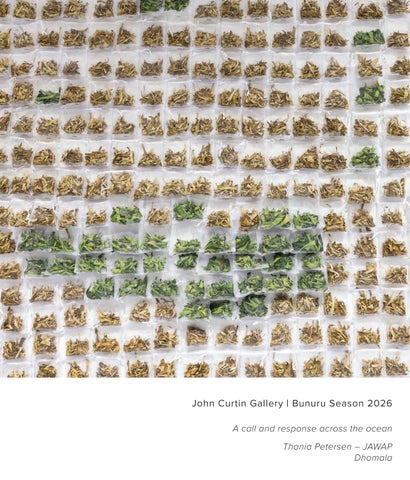
Raised as an active member of the Cape Muslim community, socially engaged collaboration is central to Petersen’s practice. Previously realised in Cape Town and Tunisia, her immersive installation Rampies Sny is created in Perth through engagement with the local community. Offering a visual and olfactory feast that connects cultures across the Indian Ocean, the installation comprises thousands of small organza bags filled with freshly cut citrus leaves and infused with frankincense and essential oils. These aromas permeate the gallery with what Petersen describes as “smells that recall a thousand places.” Traditionally gifted to men during religious rituals, the satchels function here as gestures of love, while evoking the lands from which Petersen’s ancestors were forcibly taken.
When we first invited Petersen to exhibit at the John Curtin Gallery, she expressed a desire to connect with Yolŋu musicians, extending her ongoing sound project that had already taken her to Tunisia, India and Indonesia. She was aware of the centuries-old relationship between Makassan traders from South Sulawesi and the Yolŋu people – a relationship that predates the exile of her ancestor Tuan Guru, an Indonesian prince and key figure in the establishment of Islam in Cape Town, who was banished to South Africa by the Dutch in the late eighteenth century. This ambition was realised in September 2025,

when Petersen spent a week in Makassar collaborating with musicians Nebbie Burarrwanga and David Yunupingu under the direction of Don Wininba Ganambarr, a senior Yolŋu cultural leader from Galiwin’ku (Elcho Island) whose grandmother was taken to Makassar as a young woman; Michael Hohnen, a musician and producer renowned for his work with Geoffrey Gurrumul Yunupingu; and Abdi Karya, a Makassarbased creative and cultural programmer who has collaborated with Yolŋu people for more than a decade.
In Makassar, Petersen made dozens of recordings, searching for a tangible link to a collective past, carried through song.iii Over the course of the trip, she identified a chant performed in Cape Town, Makassar and Arnhem Land – the living connection she had been seeking. These recordings provide an anchor to her new multi-channel sound work which, like earlier iterations, is titled Jieker, a Cape Muslim expression of the Arabic word ‘dhikr’, meaning ‘to remember’.
With significant contributions from Yolŋu and Makassan collaborators, and a rich visual culture to draw from, it felt important in developing this project to represent the historical connections between northern Australia and south-eastern Indonesia. The exhibition, Dhomala iv (meaning sail) explores the dynamic exchange of culture, language, song and story that have informed this relationship since a pre-colonial era.
For centuries, seafarers departed the port of Makassar for Marege – the ‘wild lands’ to the south now known as Arnhem Land. In the coastal island waters, extending as far as the Kimberley, they harvested trepang (sea cucumber) for the lucrative Chinese market. Staying for months at a time, they established camps and smokehouses, living alongside the Yolŋu people, who traded access to land and waters, as well as turtle shell, pearl and ironwood, in exchange for metal tools, rice, calico, tamarind and tobacco. Over generations, cultural and spiritual practices became intertwined, languages were exchanged, and knowledge systems shared. These enduring histories and relationships continue to be proudly maintained by Yolŋu and Makassan communities today.

Sail-making and oceanic travel are celebrated in Dhomala through historic and contemporary works by Yolŋu and Makassan artists. Senior Yolŋu artist Margaret Rarru Garrawurra is one of only a few people who continues the labour-intensive work of making dhomola from twined pandanus and hand spun kurrajong fibres, a technology handed to her by her father. This labour-intensive process reflects a deep interweaving of aesthetic, ecological and cultural knowledge, carrying forward technologies and traditions shared between Yolŋu and Makassans that remain embedded in the lived experience of Rarru and her extended family. Rarru’s video Dhomola Dhäwu (Makassan Sail Story) (2020), shown alongside her etching of a perahu (boat), highlights the contemporary practice of this tradition. Alongside, a striking hand-woven sail, created by Abdi Karya in collaboration with skilled artisans, anchors the gallery installation.
Other works explore the ongoing significance of this history for Yolŋu communities. Milingimbi Art and Culture collaborated with djamarrkuli (children), senior knowledge holder Gupa George Milaypuma, local artists, and Jonathan Daw Animation to create Djambanpuy Dhawu (The Tamarind Story) (2023). The stop-motion film animates a crucial chapter of local history, foregrounding a relationship that continues to shape shared histories, cultural identities and coastal landscapes. Historical connections are further represented through objects and artworks. In the late 1940s on Milingimbi Island, two pandanus dhomala were found on the beach and later acquired by Ronald and Catherine Berndt. These rarely seen sails, created by Yolŋu for dugout canoes using Makassan techniques, are presented with a 1947 crayon drawing by Yirrkala artist Mawalan Marika depicting a Makassan boat and its cargo. The drawing was annotated in detail, noting items such as: 37. Yimbari, an iron bucket. There is hard syrup in it, gwula. 38. Budjung, water. 39. A pot on stilts containing a wari pot. It is made out of an ant-bed termite mound. Many of the terms reflect the Macassan trepang trade, preserving a linguistic and cultural exchange that endures in Yolŋu memory today.
Alongside trade in goods, language, and culture, deep friendships formed between Yolŋu and Makassans, and blood ties made through intermarriage. These connections were abruptly severed with the enactment of legislation that effectively banned trade with Asia. Unaware of the change, Yolŋu people continued to await their Makassan relatives long after the last perahu left Arnhem Land in 1907. It was not until 1988 that a perahu, the Hati Marege, returned to Galiwin’ku in a recreation captained by Mansjur Muhayang, son of the last surviving crewman to sail to Australia in 1906. The voyage significantly contributed to the revival and celebration of this historical connection and in the late 1980s, Don Wininba Ganambarr travelled to Makassar for the first time to meet his relatives and visit the burial site of his grandmother. Ganambarr has been working closely with Michael Hohnen to guide the creation of new songs that imagine a pre-European love story between a Yolngu / Makassan couple. Featuring Yolngu musicians and singers, this powerful soundtrack provides audiences with an immersive sonic experience within the Dhomala exhibition, ensuring that each of the John Curtin Gallery exhibition spaces is framed by collaborative musical exchanges.
Decades after the trepang trade ended, Australia’s segregationist policies would influence the racist legislation of apartheid in South Africa. Thania Petersen was born into a rigid caste system, with her community classified as ‘Coloured’. Cape Creole people were stripped of voting rights, subjected to forced removals, and had their unique identity codified by the apartheid state, despite developing a distinct culture rooted in Southeast Asian heritage. Petersen’s father was forced into exile when she was four, initiating decades of travel, separation, and movement between cultures and landscapes. At age nine, she moved to London to join him, encountering ‘white labour’ for the first time. The concept of menial tasks being assigned to white bodies was completely radical to her apartheid-shaped understanding of the world – as well as a public school system with full racial integration. In her early twenties, while studying at Central Saint Martins College of Art, Petersen was
Thania Petersen, JAWAP (still), 2025, single channel video with five channel sound. Edition of 10. Courtesy of the artist and Ames Yavuz
prompted to create work exploring her cultural identity. This led her to question socially and politically imposed frameworks, redirecting her practice toward an exploration of self-sovereignty.
In recent years, Petersen has turned her attention to emerging ideological threats, drawing on spiritual traditions of song as a source of universal love that resists confinement to colonised spaces. Across Australia, song has long celebrated all facets of human experience and recorded complex knowledge systems. In the southwest, much has been lost to violent oppression, yet many Noongar Elders and creatives are actively working to not only archive their language but return it to everyday use.
Greeting audiences in the Atrium are the lyrics to Maambakoort –the Noongar word for ocean – written by acclaimed soul artist Bumpy. The song, taken from Bumpy’s 2025 album, Kanana, is part of a broader language project that traces the footsteps of her Nan, Rose Whitehurst, who wrote the first Noongar dictionary.
MAAMBAKOORT, MAAMBAKOORT
[OCEAN, OCEAN]
NGANG KATADJIN
[I,MY] [KNOWLEDGE/LEARNING]
KOORA YEYI
[LONG TIME AGO] [PRESENT]
DANDJOO
[COMING TOGETHER]
Inviting audiences to reflect on themes of belonging, identity, and the enduring relationship between people and the ocean, the song is presented as wall-based text alongside ocean-themed works from the Curtin University Art Collection by renowned artists, Kelsey Ashe, Brian Robinson, Susan Flavell and Laurel Nannup. Maambakoort celebrates Bumpy’s profound homecoming to the saltwaters of her ancestral country. Describing her return to Noongar Boodja with her mother, she says “There’s a lot of grief that’s wrapped up with going back and trying to reconnect . . . because you realise just how much more you’ve lost.” On entering the ocean Bumpy says, “It felt powerful. It felt dramatic. The wind swirled around me and the light broke
Artists from Milingimbi Art and Culture in collaboration with Jonathan Daw Animation, Djambanpuy Dhawu (The Tamarind Tale) (still), 2023, single-channel video, 3 min 38 sec. Courtesy of Milingimbi Art and Culture.
through the clouds. It felt like it recognised me. The water connects me to my Ancestors who also swam in those oceans, connecting me to my past, present and future generations.” v
In a contemporary world increasingly marked by disconnection and loneliness, artists are calling us home through the shared celebration of song. Thania Petersen questions how we can restore our old friendships, our old stories, and our old connections. Through her immersive artworks she invites us to “surrender to a rhythm that comes from beyond linear time”, to turn to the liberation of music.
Lia McKnight Curator, John Curtin Gallery
ARTdacity podcast, published 12/2/2025
ii All quotes from Thania Petersen are supplied by the artist unless noted otherwise.
iii The integration of Allah into certain Yolŋu spiritual cosmologies has been documented by a number of anthropologists. https://www.bbc.com/news/ magazine-27260027
iv ’Dhomala’ a Yolŋu word for sail derives from the Makassan word ‘dumala’ v Retrieved 12/12/2025 from: https://themusic.com.au/features/bumpy-acceptscultural-responsibility-kanana-feature/vTcD0dDT0tU/03-10-25
Margaret Rarru Garrawurra, Dhomala, 2024, etching, 33 x 50 cm Curtin University Art Collection. Purchased 2025
This publication supports the exhibitions:
A call and response across the ocean
Thania Petersen – JAWAP
Dhomala
6 February - 3 May 2026
Publication copyright ©2026 John Curtin Gallery
Text copyright © individual authors
All rights reserved.
This catalogue is protected by copyright under the Copyright Act 1968. Apart from any use permitted under the Act, including fair dealing for the purposes of private study, research, criticism or review, no part of this publication may be reproduced, stored in a retrieval system, or transmitted in any form or by any means without prior written permission.
ISBN: 978-1-7640702-2-5
We would like to acknowledge Berndt Museum, The University of Western Australia and Milingimbi Art and Culture for their enthusiastic support of the Dhomala exhibition with the loan of artwork, supply of text, technical support and general advice.
Our sincere gratitude to Don Wininba Ganambarr for his cultural guidance and for the generation of a new sound work in collaboration with Michael Hohnen who has worked tirelessly on multiple aspects of the Perth Festival project. Thank you to Abdi Karya for his dedication and ambition in the realisation of new work. Thank you to Don, Michael, Abdi and musicians Nebbie Burarrwanga and David Yunupingu for travelling to Makassar and collaborating with Thania Petersen in the creation of Jieker. We would most especially like to thank Thania Petersen for lending additional work and for being so generous with her time, travelling to Makassar to facilitate the creation of new iterations of her work.
Thank you to our wonderful community who have volunteered their time to harvest, cut and pack citrus leaves for the creation of the Rampies sny installation. Our gratitude also goes to Stephen Armitstead and Noah Shilkin for technicial support.
Our sincere thanks to Perth Festival Artistic Director Anna Reece, whose commitment to this project and deep connections to the region have enabled us to realise a far more ambitious project than we anticipated.
Thank you to the team at John Curtin Gallery who have worked tirelessly to generate another impeccably produced assembly of experiences for our visitors. Their collective dedication, unwavering commitment, and exceptional teamwork allow us to meet every challenge and continue to deliver exhibitions to the highest standard.
JOHN CURTIN
John Curtin Gallery Building 200A, Curtin University Kent St, Bentley Western Australia 6102
Mon to Fri 10am-5pm Sun 12-4pm Closed Saturdays & Public Holidays Free admission curtin.edu.au/jcg @johncurtingallery gallery@curtin.edu.au 08 9266 4155
Cover: Installation view of Thania Petersen, Rampies Sny (detail) at Zeitz Museum of Contemporary Art Africa (MOCAA), Cape Town, 2022. Courtesy of the artist, Ames Yavuz, and MOCAA, South Africa curtin.edu.au/jcg
GALLERY