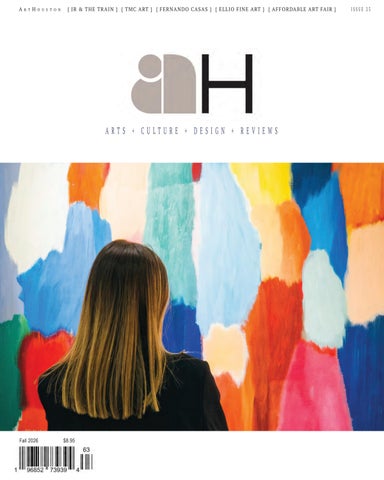
ArtHouston
{ JR & THE TRAIN } { TMC ART } { FERNANDO CASAS } { ELLIO FINE ART } { AFFORDABLE ART FAIR }
ARTS + CULTURE + DESIGN + REVIEWS
Fall 2026
$8.95
ISSUE 23
1
ARTHOUSTON
2
3
ARTHOUSTON
5535 Memorial Dr.
713-457-8800
dessange.com
4
PUBLISHER’S LETTER 5
W
Fernando Casas and John B ernhard, 2020
ith every issue of ArtHouston, I challenge myself to expand the editorial conversation while keeping the visual arts at its heart. Alongside our regular features celebrating the artists, museums, galleries, and cultural institutions that define Houston’s remarkable creative landscape, this edition reaches beyond our city with voices that resonate internationally. Among them is the celebrated French artist JR, who, in his own words, reflects on the vision and meaning behind his most ambitious project to date. Equally moving is our tribute to the late Fernando Casas, whose remarkable legacy continues to inspire. The accompanying memoir by our contributor Fernando Castro is both intimate and deeply affecting. I had the privilege of calling both Fernandos dear friends, making these pages especially meaningful to me. If there is a unifying thread running through this issue, it is the unexpected dialogue between art and medicine. I have long believed that artistic and scientific creativity spring from the same human impulse: imagination, and the desire to understand what lies just beyond our reach. Yet today they are too often treated as separate worlds, divided into isolated disciplines when, in truth, they share far more than we acknowledge. This quiet intersection comes vividly to life in our feature “The Sixth Sign,” where Dr. Marie Deschamps proposes that creativity may reveal dimensions of human health that medicine alone cannot measure. That conversation continues in our interview with Heather Yeung, who discusses how the Texas Medical Center is embracing the arts through its expanding public art program, recognizing creativity as an essential part of healing and human experience. At their finest, art and science transcend the boundaries of their respective disciplines. Though both are products of human ingenuity, they have the rare power to deepen our understanding of ourselves and, on occasion, to lift us beyond ourselves. I hope the stories that follow will inform, inspire, and perhaps encourage you to see these connections with fresh eyes. Yours faithfully, John Bernhard
John
ARTHOUSTON
HILLS SNYDER
Exhibition at the Gallery Sonja Roesch: “Hills Snyder 72 Drawings” September 5 - December 31, 2026 •Reception on Sat. Sept. 5, 6 - 8 pm gallerysonjaroesch.com Exhibition at the Amarillo Museum of Art: “Hills Snyder: Strays” (a selection from 1973-2026) August 29 - December 13, 2026 • Reception on Fri. Sept. 18, 2026 amoa.org
6
FALL 2026 CO NTENTS
ARTHOUSTON 7
20
Liquidity Illusion Magnus Resch
PUBLISHER’S LETTER 5 NEWS BITS 8 BOOK REVIEWS 12 COUPS DE CŒUR 14 GALLERY LISTINGS 68
P E R FO R M I N G A RTS S C H E D U L E 74 REVIEWS 76
BAYO U A RTS’ I N T E RV I E W 88 FRESH ARTS’ INTERVIEW 90 COLOPHON 95 EDITOR’S PICK 96
22
American Light at the MFAH Arthur Demicheli 22
Curator’s Vision at the Menil Sabrina Bernhard 32
JR & L’Observatoire JR 38
The Sixth Sign Sabrina Bernhard 42
Art at TMC John Bernhard 46
Art Within Reach Arthur Demicheli 50
EsperHope Karine Parker 54
Power Twist Arthur Demicheli 58
Artful Diplomacy Annaë Nyhme 62
Ellio Fine Art John Bernhard 78
Jamie Ho B. Sonenreich. 82
Fernando Casas: A Memoir ON THE COVER: A visitor takes in Serie Echoes Scarred Light by Alina Schiau at Affordable Art Fair. Photography by Almicheal Fraay
Fernando Castro R. 90
Unexpected Encounters John Bernhard
news bits
AARRTTHHOOUUSSTTOONN 88
A PRIVATE MOMENT AT THE MENIL The Menil Collection
F r o m l e f t : Rebecca Rabinow, Director of The Menil Collection; John Bernhard, Publisher of ArtHouston and Honorary Consul of Switzerland; and Mrs. Caroline Parmelin, First Lady of Switzerland.
During the July visit of President of the Swiss Confederation Guy Parmelin to Houston, Switzerland’s First Lady, Caroline Parmelin, enjoyed a private tour of The Menil Collection arranged by ArtHouston publisher and Honorary Consul of Switzerland John Bernhard. Bernhard welcomed Mrs. Parmelin to the museum, where Director Rebecca Rabinow personally guided the visit through one of Houston’s most celebrated cultural institutions. Her remarkable knowledge of the collection brought each gallery to life, weaving together history, scholarship, and artistic insight with effortless grace. Equally impressive was her command of the French language, which she slipped into throughout the tour with confidence and unmistakable American charm. Her delightful accent drew more than a few smiles, adding a warm and unexpected note to an already memorable visit. As they moved through the museum’s serene galleries, Mrs. Parmelin discovered a collection renowned for its depth, intimacy, and extraordinary range, while experiencing the contemplative architecture that has made the Menil a destination for art lovers from around the world. The private visit offered an elegant introduction to Houston’s vibrant cultural landscape. Deeply impressed by both the museum’s exceptional collection and the thoughtful hospitality extended throughout the visit, Mrs. Parmelin departed with a lasting appreciation for one of the city’s greatest artistic treasures.
Eamon Ore-Giron, Black Medallion XIV, 2022. Photo by Charles White
RADIANT KNOWLEDGE Moody Center for the Arts Radiant Geometries at the Moody Center for the Arts brings together contemporary Indigenous and Latin American artists whose works explore knowledge as a living technology connecting mathematics, cosmology, science, and artistic practice. Through paintings, sculpture, textiles, video, and new sitespecific commissions, the exhibition reconsiders Indigenous ways of knowing across North, Central, and South America while highlighting relationships between land, waterways, and interspecies care. Featured artists include Sara Flores, Patrick Martinez, Natalia Montoya Lecaros, Caroline Monnet, Patricia Domínguez, Cisco Merel, Melissa Cody, Nanibah Chacon, Jordan Ann Craig, and Eamon Ore-Giron. Together, their works examine abstraction, architecture, astronomy, plant intelligence, and Indigenous design traditions, demonstrating how ancestral knowledge continues to inform contemporary culture, technology, and environmental stewardship. Public programs further extend the exhibition’s interdisciplinary dialogue. On view until Dec. 19th.
N E W S B I T S 99
DRAWN TO TEXAS
On Paper: Drawings from the Renaissance to the Modern Day
This fall, Texas welcomes an exhibition unlike any other when Trois Crayons brings its acclaimed Drawings Hub to the United States for the first time. Following two successful editions in London, the international initiative arrives with On Paper: Drawings from the Renaissance to the Modern Day, transforming galleries in Houston, Dallas–Fort Worth, and Austin into temporary homes for extraordinary works on paper spanning more than five centuries. The exhibition challenges the familiar art fair formula. Instead of rows of gallery booths competing for attention, Trois Crayons presents a single, carefully curated exhibition in which drawings from renowned dealers in Europe, the United Kingdom, and the United States are displayed in conversation with one another. The result is an intimate viewing experience that encourages discovery. Houston hosts the opening chapter from October 9–13 at Josh Pazda Hiram Butler Gallery. Established in 1984, the gallery has earned an international reputation for presenting significant postwar, contemporary, and emerging artists while regularly participating in leading fairs such as the ADAA Art Show and the IFPDA Print Fair in New York. The exhibition then travels to Gallery 19C in the Dallas–Fort Worth area from October 22–29, before concluding in Austin in early November. Beyond the exhibition itself, Trois Crayons is partnering with Museum of Fine Arts, Houston to present a public conversation on collecting drawings, reinforcing the organization’s commitment to education alongside connoisseurship. The collaboration reflects
a growing recognition that works on paper—long appreciated by seasoned collectors—offer one of the most intimate encounters with an artist’s hand, revealing ideas in their earliest and often most spontaneous form. “We are incredibly excited that our third edition of the Drawings Hub will be taking place in the United States for the first time,” says Alesa Boyle, CEO and co-founder of Trois Crayons. “Texas felt an obvious choice because of its central location, its dynamic and expanding art market, and the enthusiasm of its collecting community. We look forward to sharing our mission of expanding the drawings community with audiences from across the United States.” Previous editions featured more than 35 international galleries presenting master drawings, watercolors, and pastels from the Renaissance to the present, attracting over 2,000 visitors and earning praise for their thoughtful presentation and innovative format. For Texas collectors, curators, and drawing enthusiasts, On Paper: Drawings from the Renaissance to the Modern Day offers more than an exhibition, it is a rare opportunity to encounter museum-quality works in an intimate gallery setting, affirming that some of the most powerful artistic statements are still made with nothing more than paper and a few strokes of graphite, ink, or chalk.
Installation view in London of On Paper: Drawings from the Renaissance to Modern Day, Courtesy of Trois Crayons.
ARTHOUSTON 10
AMERICA AT 250 Houston Symphony
The Houston Symphony launches its 2026–27 season with an Opening Night gala at Jones Hall celebrating America at 250 through an evening of music, history, and storytelling. Three-time Grammy Award-winning mezzosoprano Isabel Leonard iconic Lincoln Portrait, narrated by Academy Award-winning actor and Texas native Matthew McConaughey.
joins the orchestra for a program highlighting the richness of the American musical tradition. Audiences will enjoy beloved songs from the Great American Songbook, reflecting the breadth and enduring appeal of American music. A highlight of the evening will be Aaron Copland’s
Combining Copland’s stirring score with words drawn from Abraham Lincoln’s speeches and writings, the work remains one of the nation’s most powerful artistic tributes to democracy, unity, and the American spirit. Blending celebrated artists, timeless music, and patriotic reflection, the Houston Symphony’s Opening Night promises a memorable start to the season while marking the nation’s 250th anniversary with a fitting celebration of America’s cultural legacy.
ENDURING LEGACY University of Houston
The University of Houston’s Kathrine G. McGovern College of the Arts has received two estate gifts totaling $2.8 million, strengthening arts education and expanding opportunities for students and faculty. A $1.8 million gift from the estate of Helen Bloxsom Davis establishes two permanent endowments at the Moores School of Music: the Helen Bloxsom Davis Endowed Professorship, supporting the recruitment of distinguished faculty, and the Helen Bloxsom Davis Distinguished Scholars Endowment, providing scholarships beginning in fall 2027. UH will match annual scholarship funding through 2031. An additional $1 million estate bequest from arts advocate David H. Lake creates the David Lake Fund for Artistry and Innovation in the School of Theatre and Dance, supporting artist residencies, community collaborations and original productions. Both gifts are part of UH’s Can’t Stop Houston: The Centennial Campaign, celebrating the university’s 100th anniversary.
NEW HOME
Houston Center for Photography Houston Center for Photography (HCP) has announced the purchase of 1150 Bissonnet Street, securing the organization’s first permanent home in its 45-year history. Located in the Museum District, the new campus marks a significant milestone for one of the nation’s few independent photography centers and the only one of its kind in Texas. The site includes two historic buildings designed by renowned Houston architect William Ward Watkin, which HCP plans to preserve and
adapt into a contemporary center for photography. The expanded campus will strengthen the organization’s exhibitions, educational programs, artist residencies, and community outreach while protecting an important piece of Houston’s architectural heritage. The acquisition is supported by HCP’s $10 million capital campaign, with more than $1.5 million already raised. Renovation plans and community engagement opportunities will be announced as the project moves forward.
Houston Center for Photography new home, 1150 Bissonet Street. Photography by Natan Dvir
A MATERIAL INHERITANCE
NEWS BITS 11
Houston Center for Contemporary Craft
How a Precious Metal Reflects the Past and Shapes Contemporary Craft Celebrating its 25th anniversary, Houston Center for Contemporary Craft (HCCC) presents A Material Inheritance, a group exhibition exploring silver as both material and metaphor. More than a precious metal, silver has shaped the ways civilizations have seen, documented, and understood the world. Its unique optical and metallurgical properties made possible advances in mirror-making, photography, and scientific instruments, while its durability and malleability established it as a favored medium for currency, ceremonial objects, jewelry, and treasured heirlooms. Presented as part of HCCC’s silver anniversary, the exhibition examines how the metal has influenced systems of knowledge, value, and cultural exchange across centuries. It also reflects on the institution’s own history while looking toward the future of contemporary craft.
Featuring works by Moussa Albaka, Shane R. Hendren, Edward Lane McCartney, Jaydan Moore, Leah Ying Lin, Anjali Srinivasan, and other contemporary artists, A Material Inheritance spans traditional metalsmithing and jewelry alongside experimental practices in glass, ceramics, and kinetic media. Together, the works reveal silver as both a physical substance and a cultural witness, shaped by histories of extraction, trade, migration, labor, and devotion, while continually reimagined through contemporary artistic practice. Co-curated by HCCC Curator and Exhibitions Director Sarah Darro and Windgate Curatorial Fellow Zaynab Hilal, A Material Inheritance offers a compelling look at silver’s enduring ability to preserve history while inspiring new ideas about craft, culture, and materiality. On View September 5, 2026 - January 30, 2027
F r o m l e f t c l o c k w i s e : Jaydan Moore, Weathering, 2025. Found silver-plated platters. 75”x73”x2” in. Photo by Jim Escalante. Leah Ying Lin, “Oumuamua Dream,” 2024. Stainless steel and resin. 14”x14”x23” in. Photo courtesy of the artist. Edward Lane McCartney, Boing!!!, 2026. Sterling and stainless steel. 9”x1”x½” in. Fork It, 2026. Sterling silver. 8 ½”x1 1/8”x½” in. Photo by Kerrisa Treanor.
ARTHOUSTON 12
b o o k REVIEWS
KAWS: THERAPY KAWS
THE TAMARIND PRINTS RUTH ASAWA
This exquisite publication features Ruth Asawa’s vibrant, experimental lithographs of subjects ranging from delicate flowers to members of her family, and is the first to present her complete portfolio made at the renowned Tamarind Lithography Workshop. The Museum of Modern Art, New York
A svelte record of a fresh KAWS project, in which his signature hybrid cartoon characters articulate complex human emotions in a “group therapy” setting. In THERAPY, KAWS’ iconic hybrid cartoon characters populate a series of paintings around one largerthan-life, stainless steel sculpture, SPACE. The sculpture presents an iteration of KAWS’ COMPANION, the original three-dimensional character first created by the artist as a small vinyl toy in 1999. Holzwarth Publications
RAY JOHNSON RAY JOHNSON
A prodigious compilation of works from the late 20th century’s great collage and correspondence artist. This major monograph presents a vast selection of work by Ray Johnson made between 1950, the year after he moved to New York City from his hometown of Detroit, up to just before his death in 1995. In a new essay, artist Matt Connors describes the “blooming off-ness [and] staunch instability” of Johnson’s visual lexicon as “the true harmonics, the real sound of Johnson’s project.” Karma Books, New York
top Investable Artists 2026 Gordon Parks: Diary of a Harlem Family, 1967–68 PETER W. KUNHARDT JR.
The expanded study of one of Gordon Parks’ most enduring series, an unflinching view of poverty, racism, wealth inequality and exploitation all too familiar to 21st-century citizens. Published with The Gordon Parks Foundation. Steidl
ART MARKET EXPERTS
Top Investable Artists of 2026 is a curated hardcover art book by the Art Market Experts team, featuring contemporary artists distinguished by exceptional quality and strong long term market potential. Created for collectors, investors, and art professionals, the publication functions both as a collectible volume and as a concise, strategic guide to informed and forward looking acquisitions. Art Market Experts
Dorothea Tanning: A Surrealist World ALYCE MAHON
This study overhauls canonical accounts of Surrealism, demonstrating how one woman artist expanded its activity and expression in bold new ways for the modern age, and became a figure at the very heart of the avant-garde, Yale University Press
13
ARTHOUSTON 14
c o u p s d e CŒUR
Garzoyan, Frozen Lake, 2024. Acrylic on canvas.
Garzoyan
Damon Thomas & Keith Crane With their collaborative sculpture “Migrations,” Damon Thomas creates rotating casts of beguiling creatures in glazed and fired clay—changing seasonally over the duration of the exhibition: a flock of bright red birds in spring; a parliament of owls through summer; a colony of bats for fall…and Halloween; and a scurry of squirrels during the cold winter months. Keith Crane’s 3-D puzzle-like tree form of welded, oxidized mild steel and stainless steel carriage bolts gives creature comfort to, and a 360-degree view of these multi-changing inhabitants. truenorthheightsblvd.com
Working primarily in acrylics, Garzoyan explores bold colors, abstract forms, textured layers, and dynamic movement. Her paintings are known for their energetic compositions, where contrasts meet harmony. Whether creating expressive abstracts, serene landscapes, or large-scale murals, she approaches every artwork with passion, intuition, and a deep love for color. garzoyan.com
John Perretti, The Plateau of Jars, 2024. Acrylic, house paint, and mayonnaise on paper, 40 x60 in.
ARTHOUSTON 15
John Perretti John Perretti began drawing at age two to become the youngest faculty member of The School of Visual Arts at twenty-four where he taught for ten years. He was considered “the most heroic painter SVA ever produced”. His painting and sculpture remain today unafraid of historical darkness, his adoption of skulls, living dangerously, the underworld, and the lifelong love of brushes and knives. Perretti has moved to Houston from Japan to continue to create images unlike any other. johnperretti.com
Curt Baldwin Curt Baldwin grew up around boats, and painting them evokes fond memories of summers spent on a small lake in Michigan. His focus on boats is both personal and exploratory. He paints them to better understand how water and its reflections distort light, using simple, weathered vessels as subjects to study this phenomenon in its most minimal and essential form. curtbaldwin.com
Curt Baldwin, The Pull, 202, Oil on Canvas 72” x 36”
ARTHOUSTON 16
Terry Winters, Azimuth, 2024. Photo: Two Palms
H a p p e n i n g s IN HOUSTON
VITALIZED GEOMETRY by A R T H U R D E M I C H E L I
The Menil Collection presents Terry Winters: Vitalized Geometry, on view from September 25, 2026, through April 4, 2027. Spanning four decades of the artist’s career, the exhibition brings together approximately forty-four prints and works on paper, offering a compelling survey of one of America’s most influential contemporary printmakers. Organized in close collaboration with Terry Winters, the exhibition celebrates two recent gifts that have transformed the Menil’s holdings of the artist’s work. In 2024, photographer Jack Shear and the estate of his late husband, Ellsworth Kelly, donated fifty-one prints, representing nearly three-quarters of Winters’s print production from the 1980s. The artist further enriched the collection in 2026 with seven additional works, including the recent Azimuth (2024), Round (2022), and Red Stone (2019). The exhibition traces Winters’s exploration of printmaking through woodcut, lithography, silkscreen, and other graphic processes, revealing how each medium informs his parallel practices of drawing and painting. Inspired by mathematical systems, biological forms, and the hidden structures of nature, Winters creates richly layered abstractions that balance
scientific inquiry with poetic imagination. The presentation opens with the Morula prints (1983– 84), named after an early stage of embryonic development, and concludes with Azimuth (2024), a portfolio inspired by celestial navigation and the mathematics of starlight. Together, these works demonstrate the remarkable continuity of Winters’s visual language while reflecting its ongoing evolution. For Winters, each medium functions like a musical instrument, shaping both the appearance and meaning of an image. His prints embody what he describes as “vitalized geometry”— forms energized by process, material, and perception. The exhibition also underscores the longstanding relationship between the artist and the Menil. An inaugural member of the Menil Drawing Institute Committee, Winters has worked closely with the museum on every aspect of the exhibition. With seventy-six works now in its permanent collection, the Menil holds one of the nation’s most significant collections of his art, placing it alongside major institutions including the Museum of Modern Art, the Metropolitan Museum of Art, and the Whitney Museum of American Art.
17
AARRTTHHOOUUSSTTOONN 1 8
Bernhard Schobinger, Lightning Rod Necklace, 1990. Photo by Thomas R. DuBrock
H a p p e n i n g s IN HOUSTON
SWISS SUBVERSION by A R T H U R D E M I C H E L I
This fall, the Museum of Fine Arts, Houston presents Going Underground: The Jewels of Bernhard Schobinger, the first U.S. exhibition devoted to the groundbreaking Swiss artist whose radical vision has transformed contemporary jewelry over the past five decades. On view September 3, 2026, through January 3, 2027, the exhibition features 53 landmark works, including necklaces, bracelets, rings, and select sculptures dating from 1968 to the present. “Over more than five decades, Bernhard Schobinger has articulated a singular vision for contemporary jewelry, positioning the medium within the broader field of postwar art,” said Gary Tinterow, Director and Margaret Alkek Williams Chair of the MFAH. “This exhibition reflects the museum’s commitment to artists who have redefined the boundaries of artistic practice.” Born in Zurich in 1946, Schobinger rejects conventional notions of preciousness, transforming discarded and uncon-
ventional materials into provocative works of art. Fishing lures and wedding rings recovered from the bottom of Lake Zurich, shards of metal and asphalt collected from New York streets, salvaged glass, nails, and saw blades become compelling objects that challenge traditional ideas of value and beauty. Drawing on the legacies of Dada, Concrete Art, and the rebellious spirit of punk, Schobinger creates assemblages where precious and found materials coexist in unexpected harmony. The exhibition explores his work within the cultural landscape of postwar Europe while revealing the influence of his Swiss heritage and longstanding fascination with Japanese aesthetics. Going Underground demonstrates how Schobinger transformed jewelry into a powerful artistic language, inviting viewers to reconsider the histories, meanings, and cultural narratives embedded in even the most ordinary materials.
19
ARTHOUSTON 20
g u e s t INSIGHT
LIQUIDITY by MAGNUS RESCH
Art Basel Miami Beach attracts 80,000 visitors. How many are actually buying? by M A G N U S R E S C H
Transparency → Trust
Price transparency disseminates information. Information creates trust.
Discovery AI → More Buyers
AI-powered advice—a digital art advisor—that matches taste and budget, reducing friction for first-time collectors. Human advisors remain essential to shape taste and provide independent judgment.
Blockchain Infrastructure → Efficient & Fair Transaction
Certificates, provenance, and royalties immediately paid to artists whenever a work is resold - embedded in the system, not hidden in PDFs. I envision a transparent art world where every transaction is public, ownership traceable, and royalties automatically distributed to artists - even in the secondary market. Transparency is not a threat to the traditional art world. Artists benefit when they sell more works and receive royalties long-term. Galleries benefit when the overall market expands. Infrastructure does not replace expertise - it scales it. The goal is not speculation. Most art is a poor financial investment. But it is a powerful investment in yourself and your community. If we reduce opacity and increase access, the market does not just become bigger - it becomes broader, more resilient, and fairer. The future of the art market will not be decided by taste. It will be decided by infrastructure. The answer: Fewer than 1% of Art Basel Miami Beach visitors actually buy.
The art market loves to measure attention, not transactions. Crowds are mistaken for demand. Visibility is mistaken for liquidity. But the data tells a different story. For nearly two decades, the market has effectively been in a recession. Growth is concentrated at the very top—the 0.1%. The rest is struggling. The system is not only opaque - it is structurally narrow. At the same time, we still define “good art” through a small circle of gatekeepers. Careers cluster around institutional prestige. Access compounds. The middle erodes. This is not a taste problem. It is a market design problem. If we want growth, we need infrastructure with one goal: increase the number of buyers. I propose three steps.
21
ARTHOUSTON 22
Winslow Homer, Old Settlers, 1892, watercolor over graphite on paper, the Museum of Fine Arts, Boston, bequest of Nathaniel T. Kidder. Photograph © Museum of Fine Arts, Boston
The MFAH explores the evolution of American art, from Winslow Homer’s luminous watercolors to the bold vision of twentieth-century modernism. by A R T H U R D E M I C H E L I
This fall, the Museum of Fine Arts, Houston offers an exceptional journey through American art with two major exhibitions that together span nearly a century of artistic innovation. Opening one week apart, American Modernism from the Charles Butt Collection (October 25, 2026–January 18, 2027) and Of Light and Air: Winslow Homer in Watercolor from the Museum of Fine Arts, Boston (November 1, 2026–February 7, 2027) present two complementary perspectives on the evolution of American painting, from the poetic realism of Winslow Homer to the bold experimentation of twentieth-century modernism. The pairing is especially fitting as the nation approaches its 250th anniversary, offering visitors an opportunity to
explore how American artists interpreted landscape, identity, industry, and everyday life across generations. The first exhibition marks the public debut of the private collection of Texas philanthropist Charles Butt. Organized by the Amon Carter Museum of American Art, American Modernism from the Charles Butt Collection features more than 80 works by many of the defining artists of the twentieth century, including Georgia O’Keeffe, Stuart Davis, Jacob Lawrence, Thomas Hart Benton, Jackson Pollock, Joan Mitchell, Andrew Wyeth, Mark Rothko, Ellsworth Kelly, Jasper Johns, and Alma Thomas, alongside notable Texas artists Everett Gee Jackson and Mary Bonner. Rather than presenting a traditional survey of American modernism, the exhibition reflects Butt’s personal vision as a
FEATURE 23
ARTHOUSTON 24
25
A R T H O U S T O N 32 86
MUSEUM EXHIBITION 27
collector. Organized into five thematic sections, it explores intimate portraiture, the sea, landscape, industrialization, and the emergence of abstraction. Exclusive to the Houston presentation is a major monoprint and suite of lithographs by Jasper Johns, adding a distinctive conclusion to this statewide touring exhibition. “Charles Butt is widely known in Texas for his philanthropy and enduring commitment to education,” said Gary Tinterow, director and Margaret Alkek Williams Chair of the MFAH. “Less familiar, until now, is his remarkable eye for American art and his thoughtful approach to collecting.” One week later, the museum opens what may be the season’s most anticipated historical exhibition. Of Light and Air: Winslow Homer in Watercolor from the Museum of Fine Arts, Boston brings together nearly 50 watercolors from the world’s largest Homer collection, accompanied by oils, drawings, and prints. Because of the extraordinary sensitivity of the works to light, they have not been displayed together in nearly fifty years, and Houston is the exhibition’s only traveling venue. Organized by the Museum of Fine Arts, Boston, the exhibition follows Homer from his early years as a Civil War illustrator through his celebrated depictions of New England, the Adirondacks, Florida, England, and the Caribbean. Visitors encounter works ranging from childhood drawings to his final oil painting, tracing the remarkable evolution of an artist widely regarded as America’s greatest watercolorist.
Georgia O’Keeffe, My Backyard, 1945, oil on canvas, Charles Butt Collection. © 2026 Georgia O’Keeffe Museum / Artists Rights Society (ARS), New York Previous spread: Andrew Wyeth, Sea Legs, 1984, tempera on panel, Charles Butt Collection. © 2026 Andrew Wyeth / Artists Rights Society (ARS), New York
Highlights include The Blue Boat (1892), Leaping Trout (1889), and the luminous coastal scenes that established Homer as one of the nineteenth century’s most innovative painters. The exhibition concludes with Driftwood (1909), his final oil painting, alongside powerful late studies of the sea inspired by the rugged coastline surrounding his studio at Prouts Neck, Maine. “We are thrilled that our colleagues in Boston have consented to share with us their definitive collection of works by Winslow Homer,” said Gary Tinterow. “Because Homer’s lightsensitive works on paper are normally kept in dark storage, this exhibition provides a once-in-a-generation opportunity to experience his vision of America.” Together, the two exhibitions create a compelling dialogue between generations of American artists. Homer’s luminous observations of nature and everyday life laid the foundation for later artists who expanded the language of American painting into modernism and abstraction. Visitors can move from Homer’s transparent washes of watercolor to the expressive canvases of O’Keeffe, Pollock, Rothko, and Johns, witnessing how American art evolved while remaining deeply connected to landscape, light, and the search for a distinctly national voice. For Houston audiences, it is an extraordinary season. Rarely does one museum present two exhibitions of this caliber simultaneously—one revealing a celebrated private collection for the first time, the other bringing together the world’s finest holdings of Winslow Homer’s watercolors in their only appearance outside Boston. Together, they make the MFAH one of the country’s essential destinations for American art this fall.
ARTHOUSTON 28
29
The
Curator’s Vision The Menil Collection celebrates the pioneering legacy of Jermayne MacAgy by S A B R I N A B E R N H A R D
ARTHOUSTON 30
As The Menil Collection prepares to celebrate its 40th anniversary in 2027, the museum turns its attention to one of the remarkable figures whose vision helped shape its identity. How to Make an Exhibition: The Story of Jermayne MacAgy, pays tribute to the curator, art historian, and museum director whose groundbreaking approach to exhibition making transformed the way audiences experience art. Although her name may not be as familiar as those of the artists she championed, Jermayne MacAgy (1914–1964) stands among the most influential museum professionals of the twentieth century. Her installations challenged conventional display methods, treating exhibitions not simply as presentations of objects but as carefully orchestrated experiences that invited curiosity, dialogue, and discovery. MacAgy’s relationship with Menil Collection founders John and Dominique de Menil began in the mid-1950s and proved
MacAgy’s installations created an “atmospheric miracle...” pivotal to the development of what would eventually become one of America’s most respected museums. Working closely with the couple for nearly a decade, she encouraged them to build a teaching collection and to present works of art in ways that engaged viewers on both intellectual and emotional levels. Dominique de Menil famously described MacAgy’s exhibitions as creating an “atmospheric miracle,” allowing works of art to “shine and talk to anyone who would care to listen.” “The curator Walter Hopps, the first director of the Menil Collection, often spoke of MacAgy’s extraordinary influence,” said Menil Director Rebecca Rabinow. After encountering her exhibitions as a student in late-1940s San Francisco, Hopps recalled that her imaginative installations “knocked my socks off.” Rabinow notes that MacAgy’s close collaboration with the de Menils continues to inform the museum’s exhibition philosophy and methods of display today. Organized chronologically, the exhibition traces MacAgy’s remarkable career from her early years at the California Palace of the Legion of Honor in San Francisco to her influential work in Houston at the University of St. Thomas and the Contem-
porary Arts Association, now the Contemporary Arts Museum Houston. Visitors will encounter works inspired by or featured in several of her landmark exhibitions, including Illusionism and Trompe l’Oeil: A History of Painting That Fools the Eye (1947), Mobiles and Articulated Sculpture (1948), Islands Beyond (1958), Totems Not Taboo (1959), and Art Has Many Facets (1963). The exhibition also brings MacAgy herself into focus through archival photographs, rare documents, artworks she bequeathed to the Menil, and portraits commissioned by the de Menils from Andy Warhol, offering an intimate portrait of the curator whose influence extended far beyond the galleries she created. Senior Curator Michelle White, who organized the exhibition, sees MacAgy as a defining figure in modern American museum practice. “This exhibition illuminates MacAgy’s curatorial practice as essential to modern American art history during a time of enormous transition,” White said. “It examines her intellectual foundations within modernism, her place at the forefront of avant-garde circles, and the innovative methods she developed for creating exhibitions that continue to resonate today.” Coinciding with the exhibition, the Menil will publish Jermayne MacAgy: Lessons from a Curator, an archive-based study edited by White and co-published with Yale University Press. Featuring essays by Paul R. Davis, Donna De Salvo, Claudia Schmuckli, and Jacqueline Siegel, the volume offers the most comprehensive examination to date of MacAgy’s life, exhibitions, and lasting contribution to museum practice. More than a historical retrospective, How to Make an Exhibition: The Story of Jermayne MacAgy reveals the enduring influence of a curator whose ideas continue to shape how museums tell stories, engage audiences, and bring works of art vividly to life. On view December 11, 2026, through July 18, 2027
Opposite: Dominique de Menil with Jermayne MacAgy, ca. 1957. Courtesy of Menil Archives. Photo: Maurice Miller. Previous spread: Installation view of Andy Warhol’s Jermayne MacAgy, 1968, Acrylic and silkscreen ink on linen. 40 × 40 in. © Andy Warhol Foundation for the Visual Arts / ARS, New York.
FEATURE 31
ARTHOUSTON 32
C U LT U R E 3 3
Left and right: Artist JR Photography courtesy of Belmond.
JR on the Making of L’Observatoire Words by J R
The renowned French artist JR challenges traditions and sparks dialogue with his monumental artistic creations. Turning his eye to the iconic Venice Simplon-Orient-Express where he’s designed an entire carriage onboard, the L’Observatoire is an artwork in motion. Transforming every detail into an opportunity for introspection and adventure, read JR in his own words as he explores the deeper meaning behind his most ambitious project yet. This train carriage is more than a mode of travel – it’s a vessel of stories, memories, and dreams. With every panel, photograph and hidden drawer, it invites visitors to embark on a journey, not just through landscapes but through perspectives, emotions and time itself. The evolution of the space was organic. After deciding the layout – the bedroom here, the bathroom there – it became about the feel. Rounded edges replaced sharp corners, creating softness. Leather in the bedroom, wood
in the living room, and a fireplace – because why shouldn’t a train have one? I wanted it to feel like a nest. Cosy, warm, safe. A place where every detail invites you to stay, to linger. There are many hidden details and personal items that might go unnoticed at first but have deep personal meaning to me. I love the idea of discovery – opening a drawer and finding something personal. It makes the space feel alive. I wanted to hide so many things. It’s like when you go some
ARTHOUSTON 34
This page: The train’s onboard library and tearoom display a selection of books by French publisher Gallimard. Opposite pages: L’Observatoire carriage retains the train’s Art Deco design, Each space has its own rhythm, letting your day flow from rest to conversation to stillness. All photography courtesy of Belmond.
to put something from “ Oh,Paris.I want I’d love to take something
from Burma, then something from my early days in Rome, then a bit of New York
”
C U LT U R E 3 5
place, anywhere, and you start opening things, you think, “Oh wow, this is someone’s belongings,” and you can look through them. You can’t necessarily take them – well, you can if you want – but it is more about looking, searching and digging. There are so many things for you to look at. I just like that; it feels way more personal. So that is why I have put so many drawers in. It’s the idea that even if some of them are empty, there is always the possibility of something. It resonates with me, and I have the same thing in all my studios – always, always a lot of drawers. I don’t know what that says about me, but maybe I need to check with a therapist. In the corridor, the walls are filled with photographs that are very dear to me, and I intend to change them over time. It was really an impulse to begin with – I thought, “Oh, I want to put something from Paris. I’d love to take something from Burma, then something from my early days in Rome, then a bit of New York – just something from each
of the places that are important to me, but also so that you can feel like you are in someone’s mind.” It personalises the whole carriage to evoke emotion. Each image embodies a part of my journey and represents my exploration of the world and different stages of life. This sense of curation carries through into the library. There are many books, each with its own meaning. There are books on art, but also many books on literature. I wanted to have the whole collection from Gallimard, not only because they are beautiful and have all the classics, but because it creates the tone I was looking for. It completes the wood and the zinc ceiling inside the tearoom. Yes, it is a very famous collection, but it’s all in the design. I’ve also added art books that sit next to the crayons and blank paper – if you want to sit down and start drawing or writing letters, there is a desk right next to the library. So when you feel inspired in this very cozy moment, there is the possibility to write to your loved ones or write your thoughts.
ARTHOUSTON 36
My favourite installation is hidden in the tearoom – it’s a little train maquette made by the best miniature model makers in the world. It took two years of work to build and design every single piece. They built it in Switzerland, Italy and Korea – it was very ambitious work. Inside the model, you’ll see a lot of my team and people that work with me, as well as friends who have come to visit the train. I filmed them by placing a camera in every window so that you can see the scenes that are happening. A lot of the time, they are just really having fun because they are enjoying their time on the train. But everything was staged so that there are secret messages that occasionally appear. You might catch them, or you might not – the video lasts for hours and hours – but those moments, if you catch them, might reveal something like the title of a book or lead you to another paper that tells you which drawer it corresponds to. That might lead you to my first Leica camera, binoculars or some other hidden treasures on the train. Everything on the train
carries hidden meaning for me. There are a lot of scenes in the marquetry that hold meaning. They are all based on scenes from around the world – from Berlin to the trains in Kenya to the moon in Brazil. But they also connect to ideas in general, such as climbing buildings and exploring a place from another perspective, which has always been the idea behind my work – to look at the world from a different perspective. The marquetry features eyes on a water tower in New York, and you can see buildings and shapes from different cities. One of the pieces features a large tree running through it, symbolising growth and my journey through life. The tree’s path intersects with various scenes representing my work, highlighting the connections I’ve made along the way. Together, these elements create rich symbolism. In the end, when each piece comes together, it forms an incredible visual that evokes a sense of modern creation. Each part is so personal.
FEATURE INTERVIEW 37
WHEN CREATIVIT Y REVEALS WHAT MEDICINE CANNOT MEASURE.
ARTHOUSTON 38
by S A B R I N A B E R N H A R D
Could your creativity be a sixth vital sign in medicine? ICANFEEL founder Dr. Marie Deschamps thinks so. A curious innovator from France and Germany, now pursuing research in Texas, explores why our most overlooked health data may not come from the body alone, but also from our creative spirit. Her work asks a simple yet powerful question: what if creativity could help clinicians understand what no blood test can measure? ArtHouston spoke with her about art, medicine, and artificial intelligence.
FEATURE 39
Marie Deschamps, What I say versus what I express with art therapy, 2020. Watercolor on paper
ARTHOUSTON 40
Marie Deschamps arrived in healthcare by way of art, policy, technology, and travel: medical school, the London School of Economics, London’s start-up scene, a backpacking trip interviewing optimistic people around the world, and finally art therapy, a regulated mental health profession, discovered while living in Spain and Mexico. Rather than seeing these experiences as detours, Deschamps now views them as the foundation of her research. Moving between cultures and disciplines cultivated a curiosity about how people make meaning and communicate suffering. Participating in the MIT-Harvard Medical School Innovation in Healthcare Bootcamp in 2018 crystallized an idea taking shape: while medicine has become remarkably sophisticated at measuring the body, it still struggles to understand the patient’s inner world. That realization became impossible to ignore during an internship in psycho-oncology at one of Mexico City’s largest public hospitals, where patients frequently rated their distress as low on standardized questionnaires, yet revealed profound
anxiety and fear while creating art. Those conversations often held clinically relevant information that never reached the medical record and prompting a question: if patients naturally communicate through images and metaphors, could those expressions become another source of clinical insight? When COVID-19 accelerated digital health, Deschamps chose the slower path of scientific inquiry, developing ICANFEEL as part of her doctoral research. With pain specialist Dr. Carlos Roldan, the project grew from a feasibility study into a clinical pilot at MD Anderson Cancer Center, running from 2023 to 2026. ICANFEEL invites hospitalized oncology patients to represent pain, fatigue, emotional state, sleep, hope, and social support by selecting images from a culturally diverse digital library, arranging them on a virtual canvas, and describing their choices. The result is a richer clinical conversation. A patient who depicts cancer as an unpredictable monster crouched at the foot of the bed communicates something different from one who depicts it as a wave they are learning to
Marie Deschamps, Clinical framework for ICANFEEL, from expression to emotional fingerprint. AI-generated image. ©️ Deschamps, 2026. O p p o s i t e : Marie Deschamps, La fille de Beaulieu (The daughter of Beaulieu, self-portait), 2017, Oil on wood.
FEATURE 41
ride, even when both report an identical pain score. The monster suggests a threat to be fought, calling for reassurance and vigilance; the wave suggests a force to be paced with, calling for coping strategies and rest. Same number on the chart, two different conversations, two different paths of care. Preliminary findings suggest patients find the activity intuitive and meaningful, often saying images helped them express what numbers could not. Creative expression doesn’t replace symptom measures but rather it complements them, revealing concerns, strengths, and coping strategies that might otherwise stay invisible, raising a broader question: what else might creativity help us understand in oncology?
Houston: Where Art Meets Neuroscience This work has taken root fittingly in Houston, one of few cities where world-leading medicine, engineering, AI, neuroscience, entrepreneurship, and a thriving arts community sit in close proximity, letting clinicians, artists, engineers, and computer scientists tackle the same question from different angles. Precision medicine, to understand each patient individually, needs exactly this kind of interdisciplinary thinking.
The next chapter of ICANFEEL reflects the same interdisciplinary philosophy. With Dr. Pepe Contreras, Director of the NSF IUCRC BRAIN Center at the University of Houston, Deschamps will co-lead a Black Horse Health-sponsored study on whether brain imaging and creative expression can offer complementary windows into the biology and lived experience of addiction recovery with the goal of understanding not only what changes during healing, but how people experience those changes from the inside. Artificial intelligence presents a complementary opportunity, if trained on the right data. With Dr. Emma Zohner, an AI researcher at Rice University, Deschamps is exploring whether creative responses (images, metaphors, voice narratives, symbols) might diversify the data behind future clinical algorithms, which otherwise risk learning only from lab values and clinical notes. The question is whether AI can be designed to recognize the complexity of being human, not simply replace human interpretation. Research, however, does not only belong in hospitals and laboratories. Last summer, Voyage au Cœur du Sensible at the Alliance Française de Houston invited the public into the same conversation, using interactive prompts on emotion, illness, resilience, and hope to show how metaphor can reveal what numbers alone cannot. If creativity helps us understand ourselves more deeply, might it also help us imagine a more human future for medicine? Let’s imagine a medicine of the future. Medicine has never known more about the human body. But perhaps the next frontier is learning more about the human experience. As AI and precision medicine evolve, the challenge will not be collecting more data, but richer data which captures not only what is happening to a person, but what it feels like to be that person. Before you turn the page, think in metaphors: If your life became a landscape, what would it look like? If your worries became a sound, what would you hear? If hope became a dance, how would it move? Then create something. It doesn’t have to be art. Bake a meal you’ve never tried. Hum and rhyme something silly. Repair something broken. Take a different route home. Or simply solve an old problem in a new way. Creativity isn’t reserved for artists. It is how we make meaning, adapt to change, connect more deeply with ourselves, with one another, and with the living world around us. The medicine of tomorrow will be invented by people who first dared to imagine it differently.
ARTHOUSTON 42
BEYONDTHE LAB: ARTAT TMC HELIX PARK by J O H N B E R N H A R D
At TMC Helix Park, innovation is typically measured in scientific breakthroughs and technological advancement. Yet within this ecosystem, a quieter force is taking shape. Art. The Helix Park Art Program introduces a human dimension to a landscape defined by research and precision. Through rotating exhibitions and a wide range of JOHN BERNHARD: TMC Helix Park HEATHER YEUNG: At TMC, we have artistic practices, it creates is widely recognized for bringing an Arts in Medicine Council that brings space for reflection, emotion, and dialogue. In this conversation, together leading medical talent, together representatives from across Heather Yeung discusses the advanced research, and world-class our member institutions because we vision behind the program, and academic institutions to drive innovabelieve the arts play an important role how art is becoming an integral tion. Less widely known, however, is in well-being, healing, and the overall part of Helix Park’s identity. your commitment to the arts. Could you human experience. elaborate on the vision and role of the art program within Helix Park?
At Helix Park, that belief is reflected in the physical environment itself.
INTERVIEW 43
ARTHOUSTON 44
We’ve intentionally woven art into the fabric of the campus through collaborations with local artists, including many from within the TMC community. This includes rotating exhibitions and a growing permanent collection. The goal is to create moments of inspiration, reflection, and connection for everyone who visits. We also offer accessible art programming throughout the year, from handson classes to community events, serving not only patients and healthcare workers but the broader public as well. With more than 10 million visitors coming through the Texas Medical Center annually, we see Helix Park as a place where science, culture, and community come together. Innovation isn’t just about advancing medicine. It’s about creating environments that support the whole person, and art is an important part of that vision. JB: Helix Park regularly presents
temporary exhibitions. Could you walk us through the process for artists to submit their work for consideration? Are there specific channels, timelines, or curatorial guidelines they should be aware of? HG: Our goal is to showcase a diverse
range of voices, stories, and perspectives through the artists featured at Helix Park. We encourage artists to connect with us through our website, where they can submit their work for consideration. To allow adequate time for review and installation logistics, we ask artists to submit proposals at least two months prior to their desired installation date. We welcome a variety of artistic mediums.
“At its core,
Helix Park is about collaboration, and the art helps make that visible.” JB: From a curatorial perspective, what
criteria guide your selection of artists and artworks? Do exhibitions tend to follow a central theme, or are they shaped more organically through individual proposals and opportunities? HG: It’s less about a rigid theme and
more about a living, evolving dialogue. The exhibitions come together organically but they’re always filtered through a clear curatorial lens. We look for work that speaks to healing, the connection between mind and body, stories of triumph, and the broader human experience. Everything is considered through its relevance to the community here, from patients and families to physicians, researchers, nurses, and partners. At its core, Helix Park is about collaboration, and the art helps make that visible—reflecting a shared experience across everyone who moves through the space.
JB: What range of media are you open
to exhibiting? For instance, do you actively consider sculpture, installation, painting, photography, or interdisciplinary and experimental practices? HG: We work across both indoor and
outdoor environments with our 37-acre mixed-use park, which allows us to welcome a wide range of media. In particular, we’re excited to continue expanding our use of the outdoor park space for sculptural and large-scale works that interact with the landscape. We’ve had the opportunity to collaborate with partners such as Color Factory and the Houston Botanic Garden on both temporary and permanent installations. JB: Does Helix Park maintain or plan
to develop a permanent art collection? If so, how does it complement the temporary exhibitions and the broader mission of the campus? HG: We’re open to developing a
permanent collection over time, and some long-term installations are already beginning to take shape. That said, our current focus is on temporary exhibitions, which allow us to continually bring in new voices and stories and keep the experience at Helix Park evolving. Within the TMC ecosystem, many member institutions hold significant permanent collections, and spaces like Helix Park and the TMC Innovation Factory create opportunities for both permanent and temporary works, bringing together discovery, startups shaping the future of life sciences, and an evolving cultural program that runs alongside them.
ARTIST PROFILE 45
JB: Looking ahead, what kind of artistic
legacy do you hope Helix Park will leave, not only within Houston but in the broader dialogue between art, science, and human experience?
Previous spread: Radiant Nature, special exhibition by the Houston Botanic Garden, installation view featuring illuminated insect and floral sculptures outside the TMC3 Collaborative Building, 2024. Photo by Meredith Kohut for TMC.
visible, and by showing how creative expression can sit alongside discovery, innovation, and care, Helix Park becomes a place where the environment itself supports how people think, feel, and heal. That sense of healing exists both outdoors in places like the butterfly gardens and within the TMC3 Collaborative Building, where labs and discovery are actively underway, and where each step forward brings us closer to new medicines and cures.
From top: Installation view of Quiet Wonders by the Center for Performing Arts Medicine (CPAM), 2025. Photo by Thomas Valdez for TMC. City of Many Stories from The Spirit of Houston installation by Bogdan Mihai, fine art print, 24x24 in. Heather Yeung with Look at Me. What Do You See? exhibit by Made a Masterpiece, 2026. Photo by Thomas Valdez for TMC.
HG: By making these intersections
ART
ARTHOUSTON 46
WITHIN REACH
For decades, the Affordable Art Fair has helped make collecting art more accessible, connecting
emerging and established artists with audiences eager to discover and acquire original works. This fall, the internationally recognized fair makes its Houston debut, bringing together galleries from across the region and beyond in a celebration of creativity, community, and collecting. ArtHouston spoke with Fair Director Cori Teague about the vision behind the Affordable Art Fair, what visitors can expect from its inaugural Houston edition, and how the event aims to inspire both seasoned collectors and first-time buyers to engage with the art market in a welcoming and approachable environment. by A R T H U R D E M I C H E L I Photography by H A Y L I R U D O L P H
ARTHUR DEMICHELI: Can you share
some background on the Affordable Art Fair brand and its mission? CORI TEAGUE:
Affordable Art Fair was founded in London in 1999 by Will Ramsay with a simple but ambitious goal: to make contemporary art accessible to everyone. By creating a welcoming, approachable environment, he
challenged the perception that buying art was only for seasoned collectors. Today, the Fair is a leading contemporary art fair brand, with 19 editions in 16 international cities. Annually, we welcome more than 200,000 visitors who purchase over $40 million worth of art. Every work at the fair is by a living artist allowing visitors to discover established and emerging talent in an inspiring, pressure-free setting.
AD: What drew you to bring the
Affordable Art Fair to Houston, and what role do you envision it playing within the city’s arts ecosystem? CT: Houston already has one of
the country’s most dynamic arts communities. It has world-class museums, outstanding galleries, passionate collectors, and a city that values culture. What excited me
47
Fair Director Cori Teague. Photo by Hayli Rudolph
wasn’t creating something new—it was creating a platform that connects all of those pieces while welcoming even more people into the conversation. My hope is that Affordable Art Fair becomes an annual celebration of Houston’s creative community. We’re bringing together local galleries alongside exhibitors from across Texas and around the world, creating opportunities for discovery, collaboration, and new
relationships. My goal is to build something that genuinely serves the city’s galleries, artists, collectors, and future collectors for years to come. AD: The term “affordable” can mean different things to different audiences. How do you define affordability? CT: Before we launched, we asked
Houstonites what they spend on art.
You told us your range, we listened, therefore Houston’s Affordable Art Fair will have work from $100-$12,000. And what brings me the most joy is that these price ranges include work from emerging artists to internationally recognized, museum-collected artists. Our exhibitors are made up of professional galleries, networks, organizations. The fair isn’t simply about lower price points; it’s about
Affordable Art Fair. Photography by Hayli Rudolph
ARTHOUSTON 48
INTERVIEW 49
making meaningful collecting possible at the price point the local community wants to invest at. Whether you’re buying your very first piece or adding to an established collection, there’s something here for every budget, style, and stage of the collecting journey. Within the broader market, where museum-quality works regularly sell for hundreds of thousands, or even millions, of dollars, I am beyond proud and excited to represent this accessible entry point without compromising quality. AD: What trends are you seeing
AD: Beyond purchasing art, how does the fair engage both seasoned collectors and newcomers?
AD: Houston is known for its diversity and entrepreneurial spirit. How is that reflected in the fair?
CT: The fair is designed to be
CT: Although we’re welcoming
experienced. Throughout the weekend we’ll offer exclusive experiences, educational panels, artist talks, family programming, and opportunities to meet the galleries and artists behind the work. Whether you’re a longtime collector or walking into an art fair for the first time, we have an environment where everyone feels welcome to ask questions, learn, and explore. Art should feel exciting—not intimidating.
galleries from around the world, this is fundamentally a fair built with Houston, for Houston. Approximately 40% of the exhibitors are Houston galleries, ensuring the city’s creative voice is at the heart of the event. We’re also partnering with local businesses, organizations, and cultural leaders throughout the year because building a strong arts community requires collaboration.
among collectors today? AD: What impact do you hope the fair
will have on Houston’s arts community?
CT: Collectors are becoming
increasingly intentional. Established and first-time buyers alike are showing growing interest in emerging artists and thoughtfully curated works. Rather than viewing art solely as an investment, many people are prioritizing connection—buying pieces that resonate personally while also supporting living artists and galleries.
CT: This fair will strengthen the
AD: Are there any highlights you’re especially excited about this year? CT: I’m particularly excited by the
AD: For someone interested in starting an art collection, what advice would you offer? CT: Buy what you love. Your collection
should reflect your personality, experiences, and inspirations. While it’s natural to ask about investment value, the best collections are built by living with artwork that brings you joy every day. Education comes with time, but curiosity is where every great collection begins.
enthusiasm from Houston’s gallery community. The inaugural edition features an exceptional group of local galleries alongside exhibitors from around the world. Visitors will see everything from museum-caliber artists presented by Sonja Roesch Gallery to a special installation by emerging Houston artist Holly Wong with Ellio Fine Art. That balance of internationally recognized talent and local discovery is exactly what makes this fair special.
connections that already exist while introducing thousands of new people to Houston’s galleries and artists. Supporting local galleries today helps create opportunities for artists tomorrow and ensures Houston continues to grow as one of America’s great cultural cities. My goal is to expand that ecosystem through collaboration by growing the next generation of collectors while shining a spotlight on the incredible work already happening across Houston. AD: If you could encourage visitors to arrive with one particular mindset, what would it be? CT: Come curious; Leave with a
collection. You don’t need an art history degree or collecting experience to enjoy the fair. My hope is that every visitor leaves inspired, and perhaps with a piece they’ll treasure for a lifetime.
ARTHOUSTON 50
EsperHope HOW CREATIVITY AND GAMING CAN INSPIRE REAL-WORLD CHANGE by K A R I N E
P A R K E R
At the heart of EsperHope™ stands a giant tree reflecting the
isolation, uncertainty, and questions about belonging. Yet
values and experiences that shape us, the strengths that help
they also show remarkable creativity, empathy, and a desire
us grow, and the dreams, purpose, and possibilities that draw
to contribute to a better world.
us forward. Around it, a living forest reminds us that no one grows alone. Inspired by more than a decade of work led by Be Peace-Be Hope (BPBH) with children, teenagers, educators, and families, this tree—used as a meaningful tool in social-
EsperHope began with a question: What if the virtual worlds young people already explore could help them understand themselves, build healthier relationships, and imagine the positive contribution they can make? Rather than asking young people to leave digital spaces
emotional workshops—has become the artistic and emotional
behind, EsperHope™,
meets them where they are and
foundation of EsperHope™, a free educational video game and
transforms gaming into an opportunity to play, learn, grow,
multilingual life-skills ecosystem, co-designed with young
connect, and act. The project brings together complementary
people and available in English, French, and Spanish. It is
expertise.
designed to help them understand their emotions, recognize
Be Peace–Be Hope contributes expertise in life-skills
their strengths, build healthier relationships, and discover
education, emotional well-being, creativity, and youth leader-
how they can contribute positively to the world around them.
ship, while co-designing solidarity missions with the Copain
Today’s youth are growing up amid stress, social pressure,
du Monde and Youth Interact youth committees to connect
ESS AY 5 1
learning with real-world community action. Secours populaire
The artistic world of EsperHope has also been shaped
français, Rotary District 5890, and the Rotary USA–France
by student creativity. Students from Gaming Campus have
Inter-Country Committee, as key sponsors and strategic
explored how the project’s values and educational vision
partners of EsperHope™, help shape and expand this
can be translated into a visual universe. Among them, Célia
work through their experience in youth engagement, civic
Biousse contributed artistic reflections and visual concepts
participation, service, and community mobilization. Zeneduc
that helped inspire the game’s world-building and emerging
supports the project in an advisory capacity. Gaming Campus
visual direction, while exploring how EsperHope™ could feel
/ Quest Education Group brings the artistic, narrative, tech-
both meaningful and welcoming to young players.
nical, and game-development expertise needed to create an
“When I first heard of the project and learned that it could
immersive experience through a supervised student project.
help young people, I thought that it could be a great tool for
Jegayo supports the development of the website, connecting
them and that I wanted to be part of this project,” she shared.
the game with solidarity missions, additional educational content, and opportunities for community engagement.
To translate the mission of Be Peace–Be Hope into images, Célia focused on creating a world that feels emotion-
Rooted in a growing French-American collaboration,
ally safe and inviting. She described wanting “a cosy, colorful
EsperHope brings together educators, creators, psychologists,
and stylized look” that could provide a sense of security and
students, community organizations, and young people on
calm. Her hope is that these artistic choices will help make
both sides of the Atlantic around a shared vision of creativity,
the game feel like a safe place young people can return to.
learning, and solidarity.
Her reflection expresses one of EsperHope™’s central
Together, the partners are creating more than a game.
beliefs: art can create spaces where young people feel seen,
They are building an ecosystem that connects digital learning,
supported, and able to explore their experiences. The project
youth participation, creative expression, and real-world
gave Célia an opportunity to put her belief in art’s power to
community action. Through the game, players explore
help people into practice.
how emotions, identity, relationships, creativity, resilience,
Asked what she hopes a teenager will feel upon entering
belonging, and solidarity shape the way they understand
the world she helped inspire, she answered simply and beauti-
themselves and engage with others.
fully: she hopes they feel at ease, enjoy the experience, and
But how can confidence, emotional regulation, hope, or belonging become experiences young people can see, feel,
have fun discovering its secrets. “If it can help them in any way, shape or form, I’ll be very happy,” she said.
and explore? This is where art and gameplay become essential.
These contributions matter because young people
In EsperHope™, art is not decoration layered onto edu-
are not simply EsperHope™’s intended audience. They are
cational content after the fact. It is part of the learning itself.
creators, contributors, testers, ambassadors, and partners in
Colors, landscapes, characters, light, sound, movement, and
shaping it. Experiences developed for youth become stronger
symbols express ideas that can be difficult to communicate
when young people help imagine, question, and improve them.
through words alone. A ray of light may symbolize hope, con-
EsperHope™ is designed not only to support growth within the
nection, or a new perspective. A path through an uncertain
game, but also to carry that learning into the world beyond
landscape may invite players to slow down, make choices,
the screen. Through real-world “Solidarity Missions,” young
overcome internal obstacles, or discover more than one way
people and families will be invited to connect with community
forward.
organizations, participate in meaningful projects, share their
Through visual storytelling, players experience ideas rather than simply receiving information.
stories, and recognize their own capacity to create positive change—including through art.
ARTHOUSTON 52
The journey can be summarized in five words: Play. Learn. Grow. Connect. Act. Like the giant tree at the center of EsperHope, young people need strong roots, opportunities to recognize their strengths, room to imagine their future, and communities in which they can grow. Through gaming, education, creativity, and solidarity, EsperHope™ seeks to nurture these foundations—not by telling young people who they should become, but by helping them discover what already lives within them and how their creativity, talents, and choices can shape the world around them. EsperHope™ is scheduled to launch in October 2026 in Houston, Paris, and La Rochelle. Ahead of the launch, gaming content creators and community members gathered at Game Guys Houston for HOPE:ON, a community activation supported by Cloud9 and ENGIE that brought gaming and social impact together while raising awareness for Be Peace–Be Hope, ECDC–Houston Multicultural Center, and Know Your Neuro. Art allows us to imagine what is possible. Gaming invites us to experience it. Solidarity gives us the opportunity to bring it to life. You can discover the world of EsperHope™ at www.bepeacebehope.org.
EsperHope™ characters and costume concepts created by Célia Biousse, giving young players a variety of avatars and outfits to choose from and personalize their experience. Previous page: The Colibri, created by Célia Biousse, serves as a gentle companion within the world of EsperHope, symbolizing hope, curiosity, resilience, and the power of small actions to create meaningful change.
ESS AY 5 3
POWER ARTHOUSTON 54
twist
Satire in Motion, Authority Unraveled Through the Shitty World Leaders Rubik’s Cube by A R T H U R
D E M I C H E L I
There is something about collapse that sharpens the artist’s eye. After World War I, when Europe found itself staring into the wreckage of its own certainties, Dada emerged not as a style but as a refusal. It mocked reason, dismantled authority, and laughed, often bitterly, at the machinery of power. Its artists were not merely irreverent. They were, in the deepest sense, political. We find ourselves, once again, in a moment that feels uncomfortably familiar. The language of authority has grown louder, less patient, more absolute. Power performs itself with spectacle, and spectacle invites parody. It is no surprise, then, that artists are once again turning to satire as both shield and scalpel.
The thread is picked up with a certain mischievous precision through the work of Enrique “Kike” Congrains, a Peruvian-born, Barcelona-based artist whose practice folds humor into critique with disarming elegance. His now widely recognized Shitty World Leaders Rubik’s Cube is less a game than a quiet provocation. At first glance, it carries the familiar logic of play, the tactile satisfaction of rotation and rearrangement. But look closer, and the faces that slide across its surfaces belong to figures of power, fractured, interchangeable, absurd. Authority becomes something one can scramble. And yet, the gesture is not innocent. The twist and turn is terrifying, a dreadful mix-and-match puzzle, perhaps the
R
55
Enrique “Kiki” Congrains, Shitty World Leaders Rubik’s Cube, 2025, 3x3x3 in. Courtesy of the artist.
ARTHOUSTON 56
most unsettling game ever devised. One swipes left and right, up and down across humanity’s most recognizable faces, encountering not history, but its present tense. Tyrants, demagogues, and strongmen fracture and recombine before our eyes. The cube does not merely reflect power, it mutates it. You can create your own new tyrant. A hybrid, grotesque, disturbingly plausible. The combinations are endless. Even when each fragment is already compromised, their recombination produces something newly monstrous. It invites, almost seductively, the release of an inner darkness, a private theater where power is both ridiculed and reborn. Congrains works in the lineage of Dada without imitation. His materials are humble, almost nostalgic: vintage magazines, discarded books, fragments of a printed past. Yet from these remnants he constructs images that feel urgently present. His collages are dense but legible, layered yet precise. One senses the hand at work, the incision of the blade, what he himself has described as a kind of “paper surgery.” Unlike the seamless illusions of digital manipulation, his compositions retain their seams. The cut is visible. The intervention is declared. This insistence on the handmade lends his satire a particular weight. It is not the quick flicker of a meme, but something slower, more deliberate. In Congrains’s universe, color collides with black and white, past with present, humor with unease. The result is a visual language that invites the viewer in, only to complicate the invitation.
Enrique “Kiki” Congrains, Shitty World Leaders Rubik’s Cube, 2025, 3x3x3 in. Courtesy of the artist.
At the center of his practice lies Canson City, a fictional, ever-expanding territory where Congrains assumes the role of “Sheriff.” It is a world governed by its own internal logic, at once playful and subversive, where narratives unfold through assembled fragments. Within this constructed city, power is never stable. It shifts, fractures, recombines. One begins to understand that the cube is not an isolated object but part of a larger cosmology, a system in which authority is always provisional. Born in Lima and largely self-taught, Congrains has built an international presence through persistence and a clear, singular vision. As founder of CollageWave, he has extended his practice beyond the studio, cultivating a community around collage as both medium and message. His workshops, often offered freely to underserved children, suggest a belief that creativity itself is a form of agency, a way of reordering the world when the given order no longer suffices. Recognition has followed. In 2024, he was named the official artist for the Latin Grammy Awards, creating the visual identity for a global stage. Yet even as his audience expands, the essential gesture of his work remains intimate: the cutting, the assembling, the quiet reconfiguration of meaning. There is, in the end, a subtle defiance in Congrains’s cube. It does not shout. It turns. And in turning, it reminds us that power, however rigid it may appear, is never entirely fixed. Like the images he reclaims and rearranges, it can be taken apart, re-seen, and, perhaps, understood anew.
A R T H O U S T O N 5 07
ARTHOUSTON 58
Artful DIPLOMACY
Cultural Dialogue at the French Consular Residence in Houston by A N N A Ë N Y H M E
Diplomacy is among the oldest forms of government interaction, its origins reaching back to the civilizations of antiquity. Thomas Jefferson exemplified its enduring value through his refined engagement with European nations, fostering mutual respect and international cooperation during the formative years of the United States. Today, diplomacy has evolved beyond political dialogue. Global economics, trade, and corporate governance increasingly shape relationships between nations, expanding the role of diplomacy into new cultural and economic dimensions. Houston is home to one of the largest consular communities in the United States. Its strategic location, proximity to one of the world’s busiest ports, and role as a gateway to Latin America have made the city an international hub for commerce and diplomacy.
Each consulate carries a distinct cultural identity and mission, fostering dialogue and exchange between its home country and the community it serves. Diplomatic assignments typically last between two and four years. During that time, diplomats provide essential services to their citizens, including consular protection, passport issuance, and other administrative support, while also strengthening cultural and economic ties. When art gallery owner and curator Yvonamor Palix left her Paris gallery, Espace D’Art, after two decades of professional activity to join her husband in Houston, she discovered not only a flourishing contemporary art scene but also a city distinguished by its remarkable international diplomatic presence.
FEATURE 59
ARTHOUSTON 60
“As the daughter of a career diplomat, I’m very comfortable in this setting and understand the intricacies and delicate nature of this unique environment. My passion for art is a constant conversation starter, so bringing these two worlds together is a natural fit in a city like Houston.” In 2012, the then French Consul General in Houston, Frédérique Bontemps, and his wife, Armelle Bontemps, invited Palix to curate the French Consular Residence. Since then, she has developed an ambitious exhibition program under successive Consuls General, including Hon. Sujiro Seam, Hon. Alexis Andres, Hon. Valérie Baraban, and today, Hon. Frank Marchetti. Among the exhibitions she has curated are Ailleurs / Elsewhere, Windows, No Passport Necessary, Identity / Identité, Houston: An Art & Architecture Tour, and the current exhibition, Tête-à-Tête. Drawing from both local and international artistic communities, Palix creates thematic and immersive exhibitions that encourage dialogue between French and Houston-based artists, generating meaningful collaborations and cultural exchange. In 2019, Palix curated Flight of the Monarch: Houston International Biennale, an ambitious international exhibition featuring 60 artists representing 21 countries and nearly 380 works of art. Presented over three months, the Biennale welcomed thousands of visitors. Its opening ceremony was attended by eleven Consuls General from around the world, underscoring Houston’s unique position as a global crossroads. The Biennale became an unprecedented platform for reflection and intercultural understanding, demonstrating the power of artistic expression to bring diverse communities together through a shared visual language. Today, Consul General Frank Marchetti is delighted to display his two-ton Cowboy hat alongside a Texas–American flag created by Houston street artist (Mr. D) Sébastien Boileau, emblematic of the exhibition’s dialogue between French and Texan identities. “As Consul General of France in Houston since 2025, I am delighted to present works by French and international artists at the French Consular Residence—artists who share deep connections with Houston and Texas. This economically dynamic, prosperous, and cosmopolitan region of the United States is also an extraordinary source of artistic inspiration through its urban landscapes, natural environments, and mineral beauty.
These qualities are beautifully reflected in the Tête-à-Tête exhibition. I extend my sincere thanks to Curator Yvonamor Palix for this valued partnership.” Artists currently featured in Tête-à-Tête include Lesley Bodzy, Sébastien Boileau (Mr. D), Manolo Chrétien, Keith Cottingham, Olivier Debré, Émilie Duval, Romain Froquet, Ron Gordon, Alejandro Gutierrez, Jean-Marie Haessle, Sylvie Hannah, RERO, Nicolas Sibertin, Lou Vest, and Duncan Wylie.
Above: Installation view of works by Alejandro Gutierrez and Mr.D Frank Marchetti, Consul General of France and Yvonamore Palix in front of the French Consular Residence Right: Installation view of work by Lou Vest Previous spread: Installation view of works by Ron Gordon and Romain Froquet
61
ARTHOUSTON 62
ELLIO
In a city whose cultural landscape continues to evolve, galleries play a vital role in connecting artists, collectors, and the broader community. Among Houston’s dynamic art spaces, ELLIO Fine Art has distinguished itself through a thoughtful curatorial approach and a commitment to making contemporary art both accessible and meaningful. In this conversation with ArtHouston, gallery owner Trish Matute reflects on ELLIO’s mission, the evolving tastes of Houston collectors, and the opportunities and challenges of engaging a new generation that increasingly seeks authenticity, connection, and personal expression through art.
JOHN BERNHARD: ELLIO Fine Art
has quickly established itself as a thoughtful and dynamic presence in Houston’s gallery landscape. What was the original vision behind launching ELLIO? TRISH MATUTE: From the beginning,
our aim has been to champion the work and careers of living artists. We wanted
to create a space where collectors could connect with the art and artists behind it, and where people from all backgrounds could come together to build meaningful relationships through art. Over the last five years, we have come to embrace our role as one of service to the artist we represent, collectors, and art community. Our intention is for
everyone that visits the gallery to feel welcomed, valued, and inspired whether they are seasoned collectors or simply just getting curious about art. Ultimately, we want ELLIO to be more than a place to view and purchase artwork, but also a place where lasting relationships are built, artists feel supported, and art becomes a meaningful part of people’s lives.
GALLERY INTERVIEW 63
Ellio Fine Art, Installation view: Eric Peters, 2023
ARTHOUSTON 64
JB: ELLIO Fine Art is guided by a
united team, with you working closely alongside Harwood Taylor and Brian Freeze. Together, you bring more than ninety years of combined experience in art advising and gallery leadership. How have you seen collectors’ relationships with art evolve over the decades? Have the motivations, tastes, and collecting habits of today’s buyers changed from those of previous generations? TM: I have the good fortune of working
with two of the most seasoned art dealers in Houston. Brian & Harwood have been serving artists and collectors for nearly 40 years. I’ve asked Harwood Taylor, the director of ELLIO, for his insight on this topic.
as John Pavlicek, Joan Steinman, John Christensen and the late Fernando Casas, for more than 3 decades. They came with us to ELLIO and collectors who first acquired their work in the 80s still attend their exhibition openings and champion their work. Today, those relationships extend even further. In addition to meeting artist in the gallery, collectors can follow the artists online for years before and long after acquiring a piece. We’ve had the pleasure of witnessing collectors, art advisors, and interior designers become dear friends of the artists whose work they collect and commission. That sense of connection and shared appreciation is timeless - It is incredible to watch and still one of the most rewarding parts of what we do.
HARWOOD TAYLOR:
Because Brian and I can remember taking out slides of paintings to show clients, we can say with certainty that accessibility through technology has played a role in the way collectors come prepared to look at artwork and how we are share it. Many collectors are exposed to thoughtful content through art related podcasts, blogs, and dedicated art channels (shout out to Moriah Alise, Dear Glory). They are more savvy than ever, and AI has accelerated access to information. In the last decade, one of the most encouraging shifts we’ve seen is many of our clients making value-based decisions about the art they acquire. Intentionally seeking out and supporting the works of historically marginalized groups; women artists, artists of color, and indigenous artists. While the way people discover art has evolved, the most meaningful part of collecting hasn’t changed- the relationships. We have worked with artist such
JB: ELLIO represents over 25 contem-
porary artists working across various media. What qualities do you look for when deciding to work with an artist? TM: We always say the art must be
good, but the relationship has to be better. While the artwork is what typically initiates a relationship, we’re ultimately building partnerships that we hope will last for an artist’s entire career. We look for artists that have experience, a strong body of work, a clear direction, and feel that a gallery partnership will bring value to their practice. Open communication, mutual trust, and shared goals are just as important as artistic ability. There are countless artists whose work I admire, but valuing the interpersonal part greatly, I’ve made a point to only take on artists when we know we can wholeheartedly devote the time, energy and advocacy they deserve. Our artists
trust us with their careers, and we feel that responsibility immensely. Representation isn’t simply about exhibiting and selling artwork, but building lasting relationships that allow artist to focus on their art and collectors to connect deeply with the work. JB: Houston’s arts ecosystem
continues to expand and diversify. What role do you believe commercial galleries play in shaping the city’s cultural identity and supporting its creative community? TM: One of my favorite things about
Houston and truly one of my biggest brags as a proud Houstonian is our thriving arts community. While there is always room for growth, I believe Houston genuinely values creativity and has a sincere desire to support an art scene that reflects the diversity of our city. Commercial galleries together with museums, nonprofit organizations, and art-run spaces all play a vital role. Exposure and visibility are key. Galleries provide artists with visibility, advocate for their work, introduce to new audiences, and help build a sustainable market. We also try to make art more accessible to collectors by creating spaces where people can ask questions and develop personal connections with the artist and artwork. For many collectors, a gallery is where the relationship with art begins and grows through openings, meeting the artists, and acquiring their first piece of art. Thos experiences help cultivate lifelong supports of the arts. Galleries and art institutions have the opportunity to be connectors, bringing people together, and nurturing those relationships, which ultimately uplifts our art community.
GALLERY INTERVIEW 65
Ellio Fine Art team from left: Harwood Taylor, Trish Matute, and Brian Freeze, 2025. Photography by Ken Eke
JB: Younger generations often
gravitate toward affordable, massproduced design and the instant gratification of online shopping. How can galleries help cultivate an appreciation for collecting original art? What advice would you give emerging collectors taking their first steps into the art world? TM: We’ve seen rapid advancement
of technology over the last two decades, and I think for the younger generation, growing up with this digital exposure has created an even deeper yearning for the authentic, unique, and meaningful-objects in which you can see the artist’s hand at work. I am very optimistic about the next generations of collectors as their desire for connection and real-life experiences will drive
their interest in the arts and eventually their patronage. At ELLIO, we regularly have young adults stop into the gallery simply because they are curious about something they saw in the window. They spend time looking, ask thoughtful questions, and want to understand the artist’ intention. That curiosity & willingness to look is the foundation of understanding and tells me there are many future collectors in the making. It’s our job to make the gallery feel welcoming rather than intimidating. You don’t need an art history degree to visit. My advice to emerging collectors would be to attend openings, drop into the gallery, ask questions- we love having visitors and the opportunity to discuss the artwork. I would also say, start by buying the art that made you
pause; you don’t have to understand it all in one look. It can feel like such a big commitment, but you don’t have to start with a major investment or wait till you are in your forever home. As you live with art, confidence in your own taste grows and so does your understanding. Knowing that you’re also supporting the career of living artists also makes it truly meaningful. JB: ELLIO emphasizes the idea that art
has the power to transform spaces and enrich everyday life. Can you share a memorable experience where placing a work of art had a profound impact on a client? TM: If you don’t mind, I’d love to share
two stories- one commercial and one
ARTHOUSTON 66
Ellio Fine Art, Installation view: Susan English, 2025. Photo courtesy of Ellio Fine Art.
residential because they reflect the different ways art works in people’s lives. When we place art in a public space, it is rewarding to know that thousands of people will experience it. At the same time, we rarely have the opportunity to hear from those viewers. In 2022 I worked closely with a development team that made art a central part of their project’s identity. One of the commissioned works was We are Eternal, a large hand-worked copper wall relief by Houston sculptor Tara Conely. Less than a week after it was installed, a tenant told the project manager that seeing the piece each morning genuinely brought her joy and she looked forward to seeing it daily. That sentiment was repeated so frequently that a year later the company invited Tara back to speak about her artwork. More than 100 guests attended, eager to know about the piece that they had come to appre-
ciate. A wonderful example of how art doesn’t simply adorn a space but can shape the way people experience it. The second story is about a painting by LaMonté French that our gallery director, Harwood Taylor, placed in a private home. The collectors have a thoughtfully designed home and art collection; LaMonté’s work is layered, full of subtle symbolism; learning the meaning behind his aesthetic decisions is like unlocking a new chapter in the story. When we visited, the collectors shared how their children responded to the painting, their questions, interpretations, and conversations that unfolded around it. As a parent, I have watch this in my own son’s live as he grows up with art. These experiences speak to what we deeply believe at ELLIO Fine Art. Living with art isn’t just about collecting something beautiful, but creating opportunity for dialog, reflection, and connection. Whether
it’s inspiring someone on their way to work or providing another lens through which children learn to see the world, art enriches life. It is a powerful thing. JB: Looking ahead, what can Houston’s
art audiences anticipate from the gallery in the coming years? TM: This fall we have a full season
scheduled, kicking off with the compelling dialog between Jeff Brosk’s s culpture works & Bruce Brainard’s luminous landscape paintings in a dual exhibition opening September 18. In October, we will be participating in Houston’s Affordable Art Fair, followed by Leslie Parke’s third solo exhibition at ELLIO, opening November 6. As we look ahead, our goal remains: to continue introducing exceptional artists, creating meaningful experiences, and helping more people discover the joy and impact that living with art brings.
67
g a l l e r y LISTINGS
ARCHWAY GALLERY 2305 Dunlavy St. 713 522-2409
ANDREW DURHAM GALLERY 1821 W. Alabama St. 713 522-2336 ARDEST GALLERY 25200 Grogan’s Park Drive The Woodlands 832 296-6723 ART IS BOND 4411 Montrose Blvd, #E 713 834-1156 ART MACHINE GALLERY 1502 Sawyer Street, #215 281 513-1691 ART OF THE WORLD 2201 Westheimer Rd. 713 526-1201
Maksim Koloskov, El Baile 3, Ink Watercolor on Yupo, 20x16 in. Exhibition: October 2026
ASHER GALLERY 4848 Main St. 713 529-4848 AVANT-ART GALLERY 2625 Colquitt St. 713 657-5802 BARBARA DAVIS GALLERY 4411 Montrose Blvd. #D 713 520-9200
ARTHOUSTON 68
COTHREN CONTEMPORARY GALLERY 5016 Allen St. 832 767-8370
GALVESTON ART CENTER 2501 Market St. Galveston 409 763-2403
DAVID SHELTON GALLERY 4411 Montrose Blvd. 713 516-3660
HARAMBEE ART GALLERY 10100 Kleckley Frive harambeeartgalleryhtx.com
DEAN DAY GALLERY By Appointment 713 520-1021
JOSH PAZDA HIRAM BUTLER 4520 Blossom St. 713 863-7097
DEFROG GALLERY By Appointment 713 854-3758 DEVIN BORDEN GALLERY By Appointment 713 529-2700 DIMMITT CONTEMPORARY ART 3637 W Alabama St. #160 281 468-6569 ELLIO FINE ART 3201 Allen Parkway, #180 281 660-1832
HEIDI VAUGHAN FINE ART 3510 Lake St. 832 875-6477 HOOKS-EPSTEIN GALLERIES 2631 Colquitt St. 713 522-0718 HOUSTON CENTER FOR PHOTOGRAPHY 1441 West Alabama Street 713 529-4755
BISONG GALLERY 1305 Sterrett St. 713 498-3015 BOOKER LOWE GALLERY By Appointment 713 880-1541
L’ATELIER 2623 Colquitt St. 281 467-6065
CATHERINE COUTURIER GALLERY 2635 Colquitt St. 713 524-5070
ART LEAGUE BAYTOWN 110 W Texas Ave. Baytown 281 427-2222
ART LEAGUE 1953 Montrose Blvd. 713 523-9530
Hills Snyder, Teacup (sm), Acrylic, 5x4 in. Gallery Sonja Roesch, on view until December 31, 2026
CHANDLER ART GALLERY 2639 Colquitt St. 281 772-5333
GALLERY SONJA ROESCH 2309 Caroline St. 713 659-5424
INMAN GALLERY 1502 Alabama St. 713 526-7800
COMMUNITY ARTISTS 4111 Fannin, Suite 100A. 713 523-1616
THE GITE GALLERY 2024 E. Alabama St. 713 523-3311
JACK MEIER GALLERY 2310 Bissonnet 713 526-2983
69
ARTHOUSTON 70
g a l l e r y LISTINGS
LAURA RATHE FINE ART 4444 Westheimer Rd. F105 + 2707 Colquitt St. 713 527-7700 LA RUCHE HTX + RUBY PROJECTS 1705 Ewing St. 713 304-0362 LAWNDALE ART CENTER 4912 Main St, 713 528-5858 McCLAIN GALLERY 2242 Richmond Ave. 713 520-9988 MONT ART HOUSE 1230 Houston Ave. 713 936-9072 MONTERROSO GALLERY 3911 Main St, 281 682-6628 MOODY GALLERY 2815 Colquitt St. 713 526-9911 NICOLE LONGNECKER 1440 Greengrass Dr. 346 800-2780 O’KANE GALLERY UH-Downtown One Main Street 713 221-8042
Kate Mulholland, Street Seen Vol. III, featuring “La Mer”, a window installation. On view through October 2026.
KOELSCH GALLERY 1020 Peden St. 713 862-5744
OKUSENDŌ GALLERY 3700 Garrott Street 832 819-2153 OPERA GALLERY 4444 Westheimer, A115 970 710-0908 PABLO CARDOZA GALLERY 1320 Nance St. 832 548-0404 REDBUD GALLERY 303 E. 11th St. 713 862-2532 REEVES ART+DESIGN 2415 Taft St. 713 523-5577 REVOLVER GALERIA 2012 Peden St. 713 304-0362
FOLTZ FINE ART 2143 Westheimer Rd. 713 521-7500
SERRANO GALLERY 2000 Edwards St. 713 724-0709 Salvador Dali, Apollinaire, Woman with Guitar, Etching, on view until October 15, 2026
JONATHAN HOPSON GALLERY 9 04 Marshall St. 8 32 819-2918
SEVEN SISTERS GALLERY 805 Rhode Pl. Suite 500 346 618-1011 SHE WORKS FLEXIBLE 1709 Westheimer Rd. 713 522-0369 SICARDI|AYERS| BACINO GALLERY 1506 West Alabama St. 713 529-1313 TEXAS GALLERY 713-826-0294 info@texgal.com THROUGHLINE 3909 Main St. 646 338-3997
OFF THE WALL GALLERY 5015 Westheimer Rd. Galleria II, Level II 713 871-0940
71
Serrano Gallery
Andy Gonzalez
Gretchen Bender Sparks
Clovis Postali
Tania Botelho
Vicki Hessemer
Studio 317 713-724-0709 www.serranogallery.com
Studio 315 832-696-5789 www.clovispostali.com
Studio 202 713-291-7533 www.artistandy.com
Studio 102 281-660-5061 IG-@taniahbotelho
Studio 112 713-444-7562 www.gretchenbendersparks.com
Studio 121 713-504-9118 www.vickihessemer.com
WHERE ART LOVERS AND ARTISTS CONNECT EVERY SECOND AND THIRD SATURDAY OF THE MONTH 12-5PM 2000 EDWARDS ST.
SILVERSTREETHOUSTON.COM
ARTHOUSTON 72
73
n o other time to collect
Robert L. Straight w w w . a r c h w a y g a l l e r y. c o m
A RT H O USTO N 74
P e r f o r m i n g
A r t s SCHEDULE
ALLEY THEATRE 713 220-5700 ROMEO AND JULIET Sept. 25 - Oct. 11 A CHRISTMAS CAROL Nov. 15 - Dec. 27 HOUSTON BALLET 713 227-2787 PECOS BILL Sept. 11 - 20 MANON Sept. 24 - Oct. 4
Pecos Bill
THEATRE UNDER THE STARS 713 558-2600
HOUSTON GRAND OPERA 713-228-6737
THE MUSIC MAN Sept. 15 - 27
FLOYD SUSANNAH Oct. 23 - Nov. 8
MRS. DOUBTFIRE Oct. 13 - 25 DISNEY’S THE LITTLE MERMAID Dec. 8 - 24 THE WHO’S TOMMY Feb. 2 - 14, 2027
GOUNOD FAUST Oct. 30 - Nov.15
Mrs. Doubtfire
VERDI AIDA Jan. 22 - Feb. 7, 2027
PERFORMING ARTS 75
HOUSTON SYMPHONY 713 224-7575 SPOTLIGHT PERFORMANCES OPENING NIGHT: CELEBRATING AMERICA AT 250 Sept. 19
DOLLY PARTON’S THREADS: MY SONGS IN SYMPHONY Oct. 3 - Nov 1
A TRIBUTE TO TINA TURNER Sept. 25 - 26
DVOŘÁK’S SYMPHONY NO. 8 Dec. 4 - 6
RACHMANINOFF FESTIVAL Oct. 2 - 4
JOSÉ HERNÁNDEZ’ MERRY-ACHI CHRISTMAS Dec. 21
MOZART’S JUPITER & JIJI Oct. 16 - 18
Mozart’s Jupiter & JIJI
DA CAMERA 713 524-5050 JOYCE DIDONATO AND TIME FOR THREE: EMILY — NO PRISONER BE Oct. 13 Wortham Theater Center JOSHUA REDMAN QUARTET Oct. 17 Wortham Theater Center ALEXI KENNEY, VIOLIN; JANICE CARISSA, PIANO Oct. 26 The Menil Collection
Chief Adjuah
IGOR LEVIT, PIANO | ALL-BEETHOVEN Nov. 10 Wortham Theater Center MAKAYA MCCRAVEN Nov. 13 Wortham Theater Center CHIEF ADJUAH (FORMERLY CHRISTIAN SCOTT) Dec. 4 Wortham Theater Center
A R T AH ROTUHSOT UO SNT 7O6N 7 6
e x h i b i t i o n REVIEWS
Jasmine Rossi, Caddo I [From Texas / Bayou series] Edition 2/9, 2021. Giclée print on Dibond, 43 5/16 x 61 in. Photo by Francisco Ramos.
William Christenberry, Southern Monument XXII, 1989, steel, wood, paint, mixed media, red soil, monument form, 22” x 12” x 12” in.
SUBLIME
WILLIAM CHRISTENBERRY
SICARDI | AYERS | BACINO by F E R N A N D O C A S T R O R .
Nature photography is a photographic mode that inevitably changes the photographer. At the very least, photographers develop an appreciation for the beauty of the natural world; at the very best, they develop an ethical concern for its integrity. Jasmine Rossi: Sublime, is a series of photographs by Jasmine Rossi that bear an exquisite pictorial quality that only hints at the harsh conditions under which they were realized. Indeed, some of these images were captured under blizzard conditions and freezing temperatures so extreme that they deter all but the most resilient photographers. Yet, they deliver to the viewer placid albeit at times unsettling and even daunting landscapes in which trees stand as what Mircea Eliade called “axis mundi.” Their roots descend towards the underworld, the trunks erect on earth, and their branches grow towards the luminous sky. For believers in religious experiences, trees establish a physical and spiritual axis between the three cosmic zones; for scientists, they are the producers, the starting points of life cycles. As ghostly apparitions on the stage of rugged landscapes in China, Patagonia or East Texas, trees establish themselves as central figures in the photographs of Sublime. They lead the viewer to ask about their almost incredible endurance in the dry desert, in the steep slopes of mountains, or in flooded swamps. It is a survival that defies rational expectations and hence tempts us to experience the phenomenon as sublime, and even “spiritual” — as an experience similar to that of perceiving the world under the influence of mescaline or other psychotropic substance. Our connection with nature and the universe is enhanced and intensified.
MOODY GALLERY
Artist William Christenberry (1936–2016) moved seamlessly between painting, photography, and sculpture, creating a body of work rooted in the landscapes and memories of his native Alabama. Born in Tuscaloosa, Christenberry initially trained as a painter, earning a Master of Arts in Painting. Encouraged by his friend and mentor, Walker Evans, he turned to photography in the early 1960s. Photography, along with found-object sculpture, soon became central to his artistic practice. In 1974, Christenberry began creating his Building Constructions, freestanding sculptures inspired by the weathered churches, homes, and country stores of rural Alabama. Six years later, he expanded this exploration with the Southern Monuments series, reflecting on the history, culture, and enduring memory of the American South. For Christenberry, a monument required neither marble nor bronze, but the ability to evoke remembrance. Southern Monument XXII (1989) embodies that vision. Constructed from rusted steel and set on red Alabama soil collected by the artist, the sculpture incorporates a gourd, ladder, and cannonball—ordinary objects transformed into personal talismans that evoke the landscape, history, and spirit of the South.
R E V I E W S 7777
Jürgen Wolff, Paper cut, 2026
“Love looks not with the eyes, but with the mind: And therefore is wing’d cupid painted blind” Shakespeare “a midsummer night’s dream”
JÜRGEN WOLFF
ALEJANDRO GUTIERREZ
GALLERY SONJA ROESCH Jürgen Wolff approaches paper with the precision of an engineer and the sensibility of a poet. His exquisitely crafted paper cutouts reveal extraordinary technical control, yet their greatest achievement lies beyond craftsmanship. Guided by mathematics and scientific inquiry, Wolff describes his practice as “artistic field research,” investigating the relationships between density, rhythm, and space to uncover hidden structures within seemingly simple forms. The connection between art and science is central to his work. Trained in geodesy—the discipline concerned with measuring and mapping the Earth’s surface, its geometry, and its position in space—Wolff translates analytical thinking into a visual language of remarkable elegance. His compositions balance rigorous order with quiet lyricism, allowing repetition and rhythm to generate unexpected moments of movement and depth. Each intricately cut sheet becomes a study in perception. As light passes through the delicate patterns, shadows become active participants, expanding the works beyond the paper itself. The result is a body of work that is both intellectually rigorous and visually meditative, where scientific precision gives way to poetic contemplation.
L’ATELIER
by M A R K R O S S
Love never demands an object. Love never demands anything really. It is we that demand; definitions, explanations, and understanding. Just as the greatest of wordsmiths absorb the power of blankness, the space between words; Just as the musician incorporates silence, The painter depicting love is often pinioned by the sisyphean folly of actually showing it. Greek offers some useful distinctions; Eros: obsessive and targeted, Philia: “brotherly or platonic, and Agape: willing the good for others. Left to context and subjectivity “Love” has a certain elasticity that blurs, like a late stage Monet. “The Love Series” , a collection of paintings by Artist Alejandro Gutierrez, stretches across the varied and elusive templates of what we think love is and can be. Each painting is a singular expression of the artist’s notions of what encompasses and directs that feeling. The emotional output one can digest from the series is cohesive, all the works feature a hopeful melancholy, A settled yearning, and an acceptance of “what is” that collides with a hopeful charity that offers all and demands little. The figurative dance with the abstractions on the canvases, not in some calculated and clever way, but more as a waterfall of emotions, both metered and untethered. The collection is intensely personal, simultaneously a personal catharsis, and a venture into the universal waters of pain, redemption, and acceptance. The viewing of the works offers a stillness, a resolved surrender to love itself, that is both nostalgic and ever present. Loving the loveable is no virtue, Loving what makes you weep, ache and wallow in despair is to be enlightened and blessed with what is always there.
ARTHOUSTON 78
REVIEWS 79
JAMIE HO by B . S O N E N R E I C H
Jamie Ho leans heavily into the absurd. Humor is the entry point of magic mirrors, her exhibit at Art League Houston — but the campiness is deliberate, even confrontational. Imperfections here are not just noticeable; they are pedestalled.
The title comes from the ancient Han Dynasty: when bright light strikes a polished convex surface, a hidden image is reflected onto a wall. In the Victorian era, the same term was applied to the camera, linking the object to photography’s history as a technology that produces familiarity and estrangement simultaneously. Ho holds both meanings at once. The gallery is nearly a perfect square, partly divided by a wall that cleaves the space into two encounters. On one side, “The Crowning” (2023) receives guests; on the other, “The Lotus Fan” (2023) claims the finale. The left wall is papered with inkjet fabric stills captured from Ho’s GIFs—“Reaching for (Lillies)” (2025), for instance, appears both as a moving image and as the wallpaper beneath it, the same images stilled and stretched across the surface being projected onto. The spaciousness between pieces invites movement; where a person stands changes what they see. Nothing is fixed, and that instability becomes a key theme throughout. Walking through the exhibit, the magic mirror becomes a metaphor for how Euro-American culture has long imagined China, “both technically advanced and shrouded in mystery,”
as Ho writes in her thesis, successfully defended at the University of Nebraska-Lincoln. Asian femme bodies are rendered hypervisible in Western culture while remaining somehow unknowable—seen and unseen at once. Ho’s method for disrupting that distortion is drag, not just as aesthetic but as intellectual framework. Drawing on Judith Butler’s Gender Trouble—specifically Butler’s argument that gender is a performance requiring constant repetition—Ho uses her own body as the site where those repetitions become visible and begin to crack. “As I was growing up, I think I felt… these two different pressures: [my] parent’s side, the traditional culture and on the other side, what is beauty and what is modesty,” Ho told ArtHouston. “I’m using drag to complicate that.” “I think imperfections and failure reveal our ideas of what gender is,” said Ho. “I want you to see the scaffolding that’s upholding these ideas of gender…I want you to see the impossibility of it, too.” “The Crowning”—a three-channel animated loop with sound, projection, acrylic, and brass atop a glass tabletop—is where that methodology announces itself most directly. Ho performs multiple stages of getting ready: applying and removing makeup, drawing on a mustache only to wash it away. The repetition is relentless and deliberate, exposing the labor behind the image rather than concealing it.
ARTHOUSTON 80
This spread: Jamie Ho, Altar for Reaching (‘Oriental Lilies’), 2026 Previous spread: Jamie Ho, Installation Documentation from The Crowning, GIF, Projection Mapping, Acrylic, glass, found objects, 2026
GIFs serve this disruption well. They loop without resolution; they reveal and refuse in the same gesture. The most exciting moments, Ho says, are when something choreographed goes wrong, not as failure, but as the point where play enters. The glitch is not a failure of the image but its most honest moment. This logic extends into the exhibit’s relationship with time. Ho draws on Ellen Samuels’s framework of crip time—the way disabled bodies move through time in loops, fragments, and reversals rather than linear progression. Around the period she was making this work, Ho was navigating her own chronic illness and the bureaucratic weight of insurance systems. That experience is embedded in the GIFs’ structure: the looping without resolution, the fragments of a body never fully seen, the refusal to arrive at a clean ending. Disability here is not subtext. It is formal. Afong Moy moves through magic mirrors as a persistent reference point — the first Chinese woman known to have set foot in the United States, brought over in the 1830s and exhibited as the “Chinese Lady,” a living spectacle for paying
audiences to examine and consume. Ho describes her as having been “paraded around the US as this object” — a figure of fascination whose complexity was flattened into spectacle from the moment of arrival. Ho’s references to Afong Moy aren’t nostalgic, but diagnostic. If a Chinese woman’s first encounter with America required her to become an object—put on display, studied, gawked at rather than met — what does that say about how the Euro-American lens sees Chinese women now? It was in March 2021, while making this work, that the Atlanta spa massacre happened. Ho didn’t set the work aside — she reconsidered it. “It made me reconsider what I was doing, and why this was happening, and it was a general trend,” she said. Reports of anti-Asian hate spiked 35% from March 2020 through the end of 2021, according to PBS News. A May 2026 poll from AAPI Data and the AP-NORC Center found that roughly one in four AAPI adults reported experiencing a hate crime or incident in the past year — down from a peak of 36% in 2023.
REVIEWS 81
magic mirrors doesn’t illustrate this violence. In her theory, Ho locates the logic that enables it: a centuries-long habit of rendering Asian women simultaneously hypervisible and unknowable. In her practice—with joy, and deliberate queering of her corporeality—she refuses to let the onlooker’s gaze land where it expects to. Distributed throughout the gallery are objects that function as both evidence and interruption. A Lucky Cat figurine holds a fan. Plastic stools, the kind found at Asian grocery stores, appear throughout—sometimes supporting sculptures, sometimes offered plainly as seating. “I am using a lot of Chinese objects that are repackaged for the American lens,” Ho explains. “Some of these objects I’m using are a kind of Chinese cosplay.” The stools collapse the distinction between pedestal and perch, display and domesticity. Ho’s parents also kept an altar, originally built for the restaurant they owned, then moved into the family home when it closed. The altar became a fixture of an object that wouldn’t have existed without that
particular chapter of her family’s economic life. The assemblages of the exhibit are not merely an assortment of critical objects, but actual offerings. Ho chose Houston deliberately. She lived here for a year, and knew the city’s larger Asian American diaspora would bring a different kind of attention to the work. “I wanted that work to have a bigger audience,” she said. “I think it was really important for me for it to happen in this space.” A viewer arriving at magic mirrors carries their own expectations. The exhibit asks them to feel that weight and then to question it. The seamlines are always visible, because Ho isn’t asking to be seen clearly—she’s asking the viewer to reckon with why they don’t.
ARTHOUSTON 82
Fer n
and
o R.
Ca s a
s in his
studio, 2020. Photography
hn by J o
Be r n
har
d
I n MEMORIAM
a Memoir by F E R N A N D O CA ST R O R .
Fernando R. Casas (1946-2026) and I met when I arrived at Rice University to study philosophy in 1979. Professor Konstantin Kolenda introduced us right under the arch of Lovett Hall (the oldest building at Rice); just at the vanish-
ing point of a painting Casas would execute thirty-three years later appropriately titled The Mirror of Time (2012). From the moment of my arrival at Rice, people who had not met us would confuse us because he was South American, so was I;
IN MEMORIAM 83
he was tall and thin, so was I; he was a philosopher, so was I; he was an artist, so was I; he was a tennis player; I am a footballer; he was gay, I am not. Who knows, some people reading this text may think that it was the other Fernando who wrote it. At that time, Casas lived with Steve Adams, a young and talented artist, on a second-floor apartment at Bartlett Street in the Museum District. They also had their studio there—which appears in his work Early Morning, Late Afternoon (1979), a visual legerdemain of time, space and light. My former wife Marisol and I lived in the same apartment complex and we often visited each other. At their studio one day, amidst the pungent smell of oil paint and turpentine, I suggested we start an impromptu philosophy reading group —one without prior preparation, so that the person reading aloud the chosen book would surprise the others with the content. The first book the yet-to-be-named group read was Arthur Danto’s The Transfiguration of the Commonplace. Our neighborliness did not last long because Fernando and Steve decided that their apartment did not have enough space to be a studio of two artists who aspired to produce larger works. With their savings they bought a plot of land in a wooded rural area called Magnolia and built a comfortable house with two spacious studios. To be clear, they did not have the house built; they constructed it themselves, from the plans drawn with a computer program, to the wooden frame, the sheetrock walls, the bathrooms, etc. They learned everything on their own: carpentry, masonry, electricity, plumbing, etc. For at least one freezing winter and one scorching summer they lived in a tent next to the construction site. Halfway through, they were forced to stop to raise more funds. At first, they worked as roofers, but they soon realized how dangerous it was and how little money they had raised. Steve then got a job as a USPS mailman, and Fernando as a kindergarten teacher at a Montessori school.
While the construction of the Magnolia’s studio lasted, the philosophy readings were interrupted, but as soon as it was habitable, we resumed them with the book Gödel, Escher Bach: an Eternal Golden Braid by Douglas Hofstadter. The original reading group included Casas, Bruce Leutwyler and me. I dropped out when I went back to Peru (1988-1992), and during the early upbringing of my son Fabián (1992-1999). In my absence, Casas depicted the new group in the painting The Magnolia Circle: Homage to Karl Popper (1988) where Donna Kline, Bruce Leutwyler, Leslie Marenchin and Casas appear in a space each one curves with their presence. The artist’s observing head is missing. The philosophy reading group lasted forty years and its discussions and interests were relevant to some of the ideas that animated Casas’s artistic oeuvre. However, even before it existed, in the mid-seventies, Casas had embarked on a project that bears a resemblance to the metaphysical reconstruction of Descartes in his Meditations on First Philosophy. Although while Descartes’s search was for what one can believe with certainty, Casas’s was for what we can see with our own eyes—an undertaking that perhaps only a philosopher-artist could entertain. Casas studied his own visual perception and showed his conclusions through the medium of painting and drawing. Works such as Spying on Oneself (1974) and Meditation on the Right Eye (1974) expose the fallacious mechanisms of human stereoscopic vision. Similarly to how Cartesian doubt corroded accepted knowledge, Casas dissected the common-sense belief that “we paint what we see” by showing that we are not always aware of what we actually see. Armed with an understanding of the powers and limitations of human vision and the conventionality of pictorial perspective, he proposed systems of visually representing the world that challenged the paradigm of Renaissance perspective. Casas developed a system of visual representation he called “Flat-Sphere Perspective.” It depicts the entire visual field around a headless observer as if he/she was inside a sphere painting its interior surface as a mural of the outside. That imaginary concave spherical mural would then be sliced from any of its poles, flattened and connected. If sliced starting from its north pole, the view would be mostly Earth and the sky would be at its periphery. If sliced from its south pole, the view would be mostly sky and the Earthy horizon would appear at its borders. Three works by Casas with this visual syntax come to mind: The Planet, Early in the Morning (1980),
ARTHOUSTON 84
The Sky, Noon (1980), and Approaching Storm (1983). Of the four, Approaching Storm is the disturbing one because it reflects the apocalyptic Angst of the time resulting from both the outbreak of HIV and a planet on the brink of M.A.D. (mutual assured destruction), a theme that surfaced more explicitly three decades later in Will the planet...? (2016). In the 1980s Casas engaged a new challenge: to represent time in space, and/or space in time. If one moment in time can be depicted with flat-sphere perspective, then a sequence of events (time) can be a series of spheres touching at one point. The problem was how to visually show it. Casas did so in The French Doors (1979), The Polar Eye (1981) and Flora (1981)
IN MEMORIAM 85
A b o v e : Fernando Casas, Waiting, 2010, Mixed Media 64”x112” in. O p p o s i t e c l o c k w i s e : Fernando Casas, Approaching Storm, 1983, Oil on canvas. Fernando Casas, Duality: The Labyrinth of Self-Deception, 1979, Oil on canvas, 76”x42” in. The Magnolia Circle (ca 1985). Leslie Marenchin, Donna Kline, Fernando Casas, Fernando Castro, Bruce Leutwyler. Photo by Fernando Castro. Fernando Casas, Early Morning, Late Afternoon, 1979.
with the new visual syntax of the polar perspective system. He stated, “Using polar perspective, the artist can create images that represent not only the three spatial dimensions but also the dimension of time.” However, it was difficult for the uninitiated viewer to interpret images that appeared merely kaleidoscopic. That kind of difficulty, it turns out, is not unusual in the history of art. What is rare in its current chapter is to find an artist who possesses the visual and technical talents celebrated since the Renaissance, and who also incarnates not only what has come to define “a Renaissance man” as well as the Socratic ideal of the philosopher who led an examined life.
Fernando Casas published three texts in the prestigious magazine Leonardo (MIT Press) about the perspective system he used in his paintings. The first was “Polar Perspective: A Graphical System for Creating Two-Dimensional Images Representing a World of Four Dimensions” (Volume 17. Number 3, July 1984). The second text was “The limit of the visual world” (Volume 26. Number 2, April 1993). Much of his artistic and intellectual legacy may be found at limitsandproximities.com. I have addressed in this text mostly 1970s and 1980s works by Casas. Elsewhere I have written critical essays about Casas’ other works; among them: (1) Fernando Casas, Before Oneself. Literal Magazine. September 2018. (2) Fernando Casas at Gremillion Gallery. ArtNexus #48. Mar-Jun 2003. (3) Spine, a painting in an exhibition by Fernando Casas.” Gremillion & Co, Fine Art, Inc., Houston: 2002. (4) “Fernando Casas, Before Oneself” included in the book Fernando Casas: Limits and Proximities. Gremillion & Co, Fine Art, Inc., Houston: 2018. For his part, Fernando Casas wrote about my work in: Fernando Castro: The Promiscuity of Power. ArtNexus #35. Dec-Mar 2000. You can read the profile of Fernando Casas, originally published in ArtHouston magazine, Issue #10 (Spring 2020), pp. 18–23, online at www.ArtHoustonMagazine.com.
ARTHOUSTON 86
by
J O H N B E R N H A R D
A short walk along Heights Boulevard can tell you much about Houston. Parents push strollers beneath cathedral-like canopies of live oaks, dog walkers exchange neighborhood news, and joggers move steadily along the shaded trails toward something unexpected waiting farther down the path. Perhaps it is a towering steel form catching the morning light, a whimsical assemblage emerging from the trees, or an abstract wooden structure inviting curiosity and conversation. Art appears where one least expects it. This is the quiet magic of True North. Named for the compass bearing of Heights Boulevard, True North has transformed one of Houston’s most beloved thoroughfares into an open-air sculpture gallery since its inaugural exhibition in 2014. Free and accessible to all, the temporary public art project occupies eight carefully selected sites along the winding trails of the boulevard’s historic esplanade, where contemporary sculpture becomes part of everyday life. The idea took root a year earlier when Houston gallerist Gus Kopriva, founder of Redbud Arts Center and a passionate advocate for Texas artists, began imagining how public art might extend beyond museum walls and gallery spaces. He found an enthusiastic partner in artist Chris Silkwood, whose own commitment to community engagement matched Kopriva’s vision. Joined by neighborhood supporters and fellow artists, they set out to create something both ambitious and deceptively simple: an exhibition of contemporary sculpture placed directly in the path of daily experience. It was, in many ways, a distinctly Houston endeavor. Practical yet idealistic. Grassroots yet sophisticated. From the beginning, True North has relied entirely on volunteers. Working in partnership with the Houston Heights Association and in cooperation with the City of Houston’s Parks and Recreation and Public Works departments, the project has flourished through the dedication of individuals who believe art belongs in public spaces. Today, the steering committee includes Gus Kopriva, Chris Silkwood, artists Dean Ruck and Kelly Simmons, and community advocate Donna Bennett. Temporary public sculpture possesses a particular power. Unlike monuments intended to endure unchanged for generations, these installations invite repeated discovery. They arrive, inhabit a landscape for a season, and eventually make way for something new. The experience mirrors the rhythms of a city itself,
dynamic, evolving, always in conversation with its inhabitants. “Temporary public sculpture brings vitality to communities and liberating opportunities to artists amongst us,” observes artist Dean Ruck, himself both a participant and guiding force within the project. Over thirteen installations, True North has exhibited more than one hundred unique sculptures by Texas artists. Large enough to command attention from passing cars and cyclists, yet intimate enough to reward those exploring on foot, the works have become woven into the visual memory of the Heights neighborhood. The setting itself carries historical resonance. Patterned after Boston’s Commonwealth Avenue, Heights Boulevard’s sixty-foot-wide esplanade once hosted Houston’s first electrified streetcar system, transporting residents into downtown Houston. Today, through decades of civic stewardship and volunteer efforts, the boulevard has evolved into one of the city’s most cherished green spaces, distinguished by its gardens, pavilions, mature treescapes, and well-traveled pathways. For 2026, True North presents its thirteenth exhibition season, running from March through December. This year’s featured artists—Robbie Barber, Roger Colombik, Keith Crane and Damon Thomas, Hans Molzberger, Suzette Mouchaty, Mark Nelson, James D. Phillips, and Jim Robertson—offer eight sculptures as varied in material and expression as the city itself. “We hope to inspire wonder, joy and a lasting appreciation for the beauty and importance of the arts,” says Kopriva. Silkwood reflects with equal pride on the project’s legacy: “We are extremely proud of the over 100 vibrant and diverse sculptural works that have been shown by prominent and emerging Texas artists over these years and extremely grateful to this art-centric community which has so solidly and generously supported the project year after year.” Perhaps that gratitude explains why True North endures. It asks very little of its audience. No admission fee. No prescribed route. No specialized knowledge. Only a willingness to look. And in a city often defined by its speed and scale, that invitation may be the most transformative gesture of all. To pause beneath the trees of Heights Boulevard, encounter an unexpected work of art, and remember that beauty sometimes appears precisely where we happen to be looking.
C l o c k w i s e f r o m t o p : Hans Molzberger, Mantis With Saddle, Jim Phillips, Beyond Reach, Jim Robertson, Sanctuary, Robbie Barber, Goddard Nomad V, Suzette Mouchaty, Folly in the Park, Roger Colombik, Bloom, Mark Nelson, Marbelous GFG Bucket Corral, Keith Crane and Damon Thomas, Migrations.
TRUE NORTH 87
ARTHOUSTON 88
i
n
t
e
r
v
i
e
w
FEATURED ARTIST
Aubrey Hogan (A.D. Hogan)
Congratulations on winning Featured Artist at the Bayou City Art Festival. What did receiving this recognition mean to you personally, and do you feel it marks a turning point in your artistic journey? Thank you. It was an incredible honor, especially considering the caliber of artists exhibiting at Bayou City. Awards are never why I paint, but they are meaningful because they remind you that the work is connecting with people beyond your own studio. More than anything, the recognition
gave me confidence to trust the direction my work has been taking. Over the last few years, I’ve become less interested in simply painting beautiful landscapes and more interested in creating worlds that carry meaning. My paintings have become more symbolic, more rooted in storytelling, and more personal. Receiving that award felt like affirmation that people are hungry for artwork that invites them to slow down, ask questions, and find themselves somewhere inside the story. I don’t know if it marks a turning point as much as it confirms I’m walking the right path. Your paintings blend the landscapes of the American West with recurring symbols such as astronauts, bison, and wildflowers, creating narratives that feel both timeless and contemporary. How did this visual language evolve, and what do you hope viewers discover when they step into your world? I think every artist spends years trying to paint what they see before eventually learning to paint what they
believe. My work evolved naturally as I stopped asking, “What would make an interesting painting?” and started asking, “What story needs to be told?” The landscapes are rooted in real places, but the symbols allow them to become something larger than geography. The astronaut represents the human experience of feeling both small and full of possibility. The bison symbolizes resilience, steady strength, and finding a way forward. Wildflowers remind us that beauty rarely appears because conditions are perfect. It often grows in difficult places. I don’t think of these symbols as having one fixed meaning. They’re invitations. I want viewers to bring their own experiences into the painting. If someone walks away seeing hope, healing, courage, grief, or simply a place to breathe, then the painting has done its job. The story isn’t complete until someone else enters it.
89
You have said that you believe art is a form of “sacred storytelling” capable of slowing us down in an increasingly distracted world. In an era dominated by digital images and constant stimulation, what role do you think painting can still play in helping people reconnect with beauty, reflection, and wonder? We’re surrounded by millions of images every day, but very few of them actually ask anything of us. Most are designed to keep us scrolling. A painting asks us to stop. That may be one of the most countercultural things an artist can offer today. Not louder images, but slower ones. Painting has a physical presence that can’t be replicated on a screen. You can stand inches away and see every brushstroke, every layer of paint, every decision. It reminds us that something made by human
hands still has value in a world increasingly shaped by algorithms and artificial intelligence. For me, sacred storytelling isn’t necessarily about religion. It’s about reminding people that their lives carry meaning. Wonder begins when we pay attention, and I hope my paintings create space for that. If
someone lingers in front of one of my pieces a little longer than they planned, remembers a forgotten dream, or leaves with a renewed sense of hope, then the painting has become more than decoration. It has become a quiet conversation. I think we need those conversations now more than ever.
ARTHOUSTON 90
i
n
t
e
r
v
i
e
w
Jatziri Barron Where are you from? Guanajuato, Mexico What was the very first independent creative project you worked on? In 2020, I created my first mural for Cypress Breakfast House, where I had previously worked as a server. It was my first independent creative project and marked the beginning of my journey as a muralist.
Above: Jatziri Barron, photo by Filippo Nenna Opposite from top: Jatziri Barron, The Second Womb, 2024, Oil on canvas Jatziri Barron , Mural for Fifa World Cup 2026, The Art of the Beautiful Game, (2219 Crockett St.) Photo by Paul Carrizales Jatziri Barron, Mural, Love Letters to Magnolia Park (6600 Harrisburg Blvd.) Photo by The L.W. Photography
Thematically, what is your work usually about? Why do you choose to focus onthese issues? Introspection, diversity, identity, human connection and community. I believe these are some of the most essential, and most complex, aspects of being human. Through art, I hope to invite people to look inward, connect with others, and recognize that our shared humanity is often stronger than our differences.
What recent projects are you most proud of? I recently created a FIFA World Cup Mural for Arts District Houston, my favorite district in town. This is the district where I started my career since my art studio is located in Sawyer Yards, so creating a mural for one of the biggest sporting events and inspired in artists and creatives is a dream.
Why do you create art? I create because I can’t imagine not creating. What began as therapy eventually became my career, but my reason for making art has always remained the same. I believe our talents are gifts meant to be nurtured and shared with others. Art has the unique ability to connect people across backgrounds, tell stories, preserve culture, and inspire new ways of seeing the world. Above all, I’m passionate about using art to bring people together and create experiences that foster connection, curiosity, and community.
What types of mediums do you work in? For my fine art, oil is my favorite medium, though I also work with acrylic, dry pastel, charcoal, and, more recently, iron paint that reacts with an oxidizing solution to create natural rust patinas. For my murals, I primarily use latex paint and spray paint, selecting materials based on the scale, surface, and longevity of each project.
Is having a “successful career” as an artist something that is important to you? How do you define success? Success, to me, is creating a sustainable career while making work that truly matters. It’s about earning a living through my art, making a positive impact on my community, and staying grounded in a purpose that extends beyond financial success.
ARTHOUSTON 91
What upcoming projects are you working on? Looking ahead, I’ll be curating Womxn of Tomorrow, an interdisciplinary exhibition that brings together talented women artists working across visual art, dance, music, and leadership to celebrate creativity and community. If you are currently participating in a program Powered by Fresh Arts, please describe how that experience has impacted your creative career. I am a proud member of the 2022 Artist INC cohort through Fresh Arts. It was one of the most valuable experiences in my career, helping me build a sustainable art practice while becoming part of an incredible community of artists.
ARTHOUSTON 92
Get Your Book Published Creation and production of fine art books for authors, artists, photographers, collectors, museums, and gallerists.
©
713-854-3758
W W W. A R T H O U S T O N M A G A Z I N E . C O M / B O O K - P U B L I S H I N G
©2026 ArtPub, a publishing division of ArtHouston, is dedicated to designing, producing and publishing books on contemporary art and photography.
93
ARTHOUSTON 94
P U B L I S H E R , E D I T O R - I N - C H I E F JOHN BERNHARD E D I T O R - A T - L A R G E PIERRE-ANDRE FOLLONIER D E S I G N JOHN BERNHARD / BERNHARDASSOCIATES.COM C O N T R I B U T I N G W R I T E R S KARINE PARKER, MAGNUS RESCH,
SABRINA BERNHARD, JR, ARTHUR DEMICHELI, B. SONENREICH MARK ROSS, ANNAË NYHME, FERNANDO CASTRO R. P H O T O G R A P H E R HALL PUCKETT A D V E R T I S I N G MATT ROSS - 713 417 6857 D I G I T A L E D I T I O N ARTHOUSTONMAGAZINE.COM C O N T A C T U S ARTHOUSTONMAGAZINE@GMAIL.COM FOLLOW @ARTHOUSTONMAGAZINE
ArtHouston is published semi-annually by ArtHouston Magazine, LLC. Printed in Mexico. ©Copyright 2026. All right reserved. The entire contents of ArtHouston may not be reproduced in any matter, either in part or in whole, without written permission from the publisher. In addition, the artists within hold copyrights on their images and essays. Any use of or copying of their works without their written permission is in violation of the copyright law. ArtHouston Magazine, LLC. is not responsible in any way for mispellings, omissions, incorrect phone numbers or addresses. Unsolicited manuscripts, and other materials must be accompanied by postage and a self-addressed return envelope. ArtHouston is not responsible for unsolicited submissions. Address all correspondence to: ArtHouston Magazine, 9114 N. Allegro St. Houston, TX 77080.
C O L O P H O N 9955
o u r CONTRIBUTORS
Arthur Demicheli
JR
Karine Parker
Arthur Demicheli is a freelance copywriter and photographer from New York who has worked in the marketing, advertising, and publishing industries since 1992. Arthur has been a dynamic part of ArtHouston’s team for many years. He holds an MA in Humanities from the University of Geneva. He is an avid fan of art, film, and photography history.
Known for pushing the boundaries of storytelling through art, JR is the creative mind behind several monumental works that take buildings and cities as their canvas, from the Pyramids of Giza to Manhattan’s Times Square. A multimedia artist at his core, he’s incorporated audio, film and dance into his works, which often inspire passersby to ask questions and confront their own perceptions.
Karine Parker is the founder and CEO of Be Peace – Be Hope, a Houston-based nonprofit where creativity, emotional well-being, and service come together to help young people grow. For two decades, she has created spaces where art, reflection, and human connection nurture resilience, confidence, and purpose. She also leads EsperHope, an imaginative educational video game and learning ecosystem.
WRITER, PHOTOGRAPHER
A R T I S T, W R I T E R
SOCIO-EMOTIONAL COACH, WRITER
Mark Ross
Sabrina Bernhard
B. Sonenreich
His former career in Wall Street lead him from currency then commodities broker to land in Houston. Avid art enthusiast and collector his view on the visual arts transformed into his current passion of writer for select publications. Ross draws inspiration from human nature through literary sources ranging from the Bible, and Shakespeare to the era of the enlightenment.
Sabrina Bernhard is a graduate from the University of Texas at Austin, where she received a BA in International Relations and in French. She is working with ArtHouston to fulfill her passion for the arts, while further developing Houston’s admirable cross-cultural reputation. Sabrina is passionate about travelling, la Francophonie, music, and culture.
B. Sonenreich is a multi-media writer and producer. She serves as Media Education Coordinator at VOX ATL, Atlanta’s home for teen publishing and uncensored selfexpression. A contributing writer to Analog Cookbook, Burnaway, the Miami Herald and other publications, her work spans film criticism, cultural analysis, and communitycentered storytelling.
WRITER, PUBLISHED POET
WRITER
WRITER
Fernando Castro R.
Hall Puckett
Magnus Resch
Fernando Castro R. began his career as a critic in 1988 writing for El Comercio (Lima); since then, he has contributed to ArtNexus, Spot, ArtHouston, Literal, Aperture, etc. His curatorial work includes “Modernity in the Southern Andes” “The States of Pedro Meyer,” “The Art of Risk / The Risk of Art,” etc. Castro has delivered lecture-performances at New York University, and University of St. Thomas. His works are part of the permanent collections of many museums.
Hall Puckett is a photographer based in Houston. Early on when friends and family asked him what he was going to do with a major in psychology and a minor in photography his response was “I guess I’ll just have to take pictures of crazy people!” Funny how things work out. He currently lives off the north loop in a “transitional neighborhood” with his wife, two rescue dogs, and a cat.
Magnus Resch, Ph.D., is a serial entrepreneur, art market expert and bestselling book author. He is founder of Magnusclass.com, Larryslist. com and Magnus.net, the Shazam for art. Leonardo DiCaprio is an investor and advisor to the company. Magnus is also a Professor for art economics. He lectures at Yale University. Magnus holds a Ph.D. in economics and studied at Harvard, the London School of Economics and the University of St. Gallen.
Photo by George Krause
WRITER, CRITI C, CURATO R, ARTIST
PHOTOGRAPHER
WRITER, AUTHOR
ARTHOUSTON 96
Tyce Green
Photo by Sammy Hearn
editor’s pick
Tyce Green stars as Quasimodo in Disney’s The Hunchback of Notre Dame, directed by Joe Calarco. Presented at the Wortham Theater last summer, the production featured a 21-piece live orchestra on stage—the first performance of this expanded orchestration in the United States. Based on Victor Hugo’s classic novel, the musical follows Quasimodo, the isolated bell-ringer of Notre Dame, as he ventures beyond the cathedral and finds compassion in the free-spirited Esmeralda. As love, prejudice, and power collide, Quasimodo must summon the courage to confront tyranny and defend those he loves. Featuring music by Alan Menken and lyrics by Stephen Schwartz, this powerful adaptation is a moving story of love, acceptance, redemption, and hope.