(Ebook) The Filipino-American Kitchen: Traditional Recipes, Contemporary Flavors by Jennifer M. Aranas, Brian Briggs, Michael Lande ISBN 9780804838368, 0804838364
(Ebook) Cook it in Cast Iron: Kitchen-Tested Recipes for the One Pan that Does it All by Cook's Country ISBN 9781940352480, 9781940352503, 1940352487, 1940352509
(Ebook) Cambridge IGCSE and O Level History Workbook 2C - Depth Study: the United States, 1919-41 2nd Edition by Benjamin Harrison ISBN 9781398375147, 9781398375048, 1398375144, 1398375047
Cookbooks and their recipes are important and historically revealing, because in addition to techniques of food preparation, they give us an understanding of people's lives. While published cookbooks are important, manuscript recipes are another aspect of foodways. Almost every cook has a collection of recipes, often handwritten or typed, in a file folder or a shoe box. In The Historic Kentucky Kitchen:TraditionalRecipesfor Today'sCook, University of Kentucky archivist Deirdre Scaggs helps us experience the domain of recipes beyond published cookbooks. Deirdre draws on her extensive experience working with historic Kentucky archival materials and her well-developed skills in cooking and recipe testing to compile a unique account of an important, but little-known, aspect of Kentucky foodways, manuscript recipes. She makes Kentucky culinary history clearer by providing a glimpse of some important manuscript recipe collections in archives at the University of Kentucky. To help provide a context for this cookbook, let us look at the history of cookbooks in Kentucky.
In the overall scheme of things, cookbooks are relatively new. The first European settlements in Kentucky date from 1774, yet the earliest Kentucky cookbook was not published until 1839. The KentuckyHousewife, written by Boyle County native Lettice Bryan, is still celebrated as one of the foundation texts of southern cooking. Certainly there were cookbooks in use prior to this classic, but they probably came from either England or New England. The point is that for a long time cooking was done without benefit of published cookbooks or even written recipes. Based on my own excursions in
the kitchen, it is probably true that most cooking still doesn't involve written recipes, in cookbooks or not. After a while we go beyond the recipes, and as Kentucky cookbook author Marion W. Flexner wrote, we “cook by ear.” I recall my astonishment, after sitting down for a Sunday dinner at a couple's home in rural Kentucky, at learning that my hostess had made such delicious biscuits without a recipe. With experience, we come to understand how cooking works and use that knowledge to cook. In between the cookbook and “cooking by ear” is the manuscript recipe.
Cookbooks published from historic manuscript recipe collections are rare. Easily the most celebrated manuscript cookbook in the American culinary tradition is the one that came to be published as Martha Washington's Booke of Cookery, edited by well-known culinary historian Karen Hess. This collection of recipes was in the possession of our first First Lady starting in 1749. Mrs. Washington passed it on to her granddaughter Eleanor Parke Custis. Like most published cookbooks that started as manuscript cookbooks, it is hard to date and just a little mysterious. There are lots of mystery ingredients and novel recipes. The editor and annotator, Karen Hess, appropriately called the recipes beguiling. A more recent cookbook of this type, one far more attuned to Kentucky, is The John Jacob Niles Cook Book. This little volume, published in 1996 by a small Lexington publisher, began as the files and notes of the man who is central Kentucky's contribution to American folk music. It was put together from Niles's notebooks and files by Mary Rannells after his death.
Manuscript recipes have certain characteristics. First, handwritten recipes are fast, while cookbooks are slow. How often have you said, “Can you give me that recipe?” after eating a memorable dish? Similarly fast are clipped recipes. Frequently one can see clipped recipes in community cookbooks. These often have ingredients listed by brand names. Many cookbooks include space for recipes to be written or pasted in. A most interesting sidebar to collecting old cookbooks is the recipes written in them and the clipped recipes on old newsprint found browning among the pages. These clipped-out or handwritten recipes often are the foundation for the writing of
new cookbooks in that they often reflect the new and the novel for the cooks involved.
Manuscript recipe books allow sharing between friends and neighbors. Swapped recipes are something like social media. Including a person's recipe in one's collection is a little like friending someone on Facebook. Giving a recipe a place serves to link us together, solidifies a shared memory, and provides us with an affiliation. Of course, the practice is useful for cooking, too. This works in both social time and social space. The intriguing question is what people are represented in the selection of a recipe. A quick review of community cookbooks shows that people have tended to contribute recipes from loved ones, famous food writers, other famous persons, or famous restaurants. Think Mom's stack cake, Cissy Gregg's dumplings, Beaumont Inn's corn pudding.
Handwritten recipes can have special meanings. I still bake cookies from a recipe card in the handwriting of my mother, who died years ago. It's a recipe for what was always called Dutch pretzels in the family. Lots of family lore is attached to the recipe, which I assume was from my Dutch grandmother. My father in his retirement used to get involved in the preparation. The unbaked cookies are coated with cinnamon and sugar, and he wanted to make sure that the cookies had lots of sugar on them because he liked the crunch. There is something very comfortable about reading my mother's instructions in her clear and reassuring script; placing the index card carefully on top of its oak recipe file while mixing, forming, and baking the cookies; and then, when the job is done, placing the card back in the file under “Cookies,” near the recipe for snickerdoodles that my wife, Jackie, made for our daughters. With the comfort comes tension, though, as I worry about losing the recipe card. The point is that handwritten recipes can be a link with the past.
Manuscript recipes are usually simpler than published recipes, and sometimes they are little more than a list of ingredients and their measures. Perhaps that's because the kind of person who would bother writing down someone else's recipe would know how to cook and would not need to have cooking instructions added to the
Introduction
This book is a collection of nineteenth- and twentieth-century recipes from the University of Kentucky Libraries Special Collections. Archival collections were scoured for clues that would lead us to finding recipes: journals, scrapbooks, and books of “receipts”—an old term for “recipe.” Most of the recipes included in this book are adapted from handwritten recipes in the archives, many are from clippings pasted in scrapbooks, and some are from historic Kentucky cookbooks. We thought it was important to focus on the handwritten recipes; they seemed more cherished, more likely to have been used to prepare food in Kentucky homes, and more traditional or authentic to Kentucky's food history. We hope we are giving these rediscovered historic recipes new life and the chance to be passed down to future generations.
Because the two of us share a passion for food and Kentucky history, there was a natural connection that led to creating a historical cookbook. One thing that sets this cookbook apart from others is that all of the recipes included have been tested, and many of them retested. With few exceptions, the recipes are not modified to alter the taste or core values of the dish. Whenever possible we obtained the ingredients locally. Most recipe modifications were substitutions for a fat or for a rare or extinct ingredient, and these substitutions are indicated throughout the book. The most significant addition is that we supplied notes on preparation, cooking times, and oven temperature, because few of the early originals contained these procedures. Although we want to convey a sense of the original cooking environment, we've done everything possible to make the recipes user-friendly for modern home cooks.
These recipes were hand-selected based on their timelessness and our personal tastes, to represent the culinary diversity of the area and fulfill our desire to preserve Kentucky history through regional recipes. Our Kentucky heritage is unique, and we want to celebrate and preserve
it by sharing recipes from the collective memories of our elders. These recipes carry the aura of a different time and a slower pace of life, in which meals were handmade and shared. It is this ritual, by means of these recipes, that we hope to preserve.
Most of these early American cooks (or collectors) preserved their recipes in handwritten volumes, and few of them have been published. Here you will see a mixture of African, English, French, American, and southern flavors. Perhaps the desire to create this cookbook comes from our inborn southern drive for hospitality—to serve and share good food with family, friends, and even strangers. In any case, this cookbook will help to keep the durable southern tradition alive with recipes from our collective history.
When a person's name appears in a recipe title, it is the individual who compiled or collected the recipe. Some dishes may be credited to another, but like the recipes in your kitchen, they may have been handed down from family or friends, clipped from a newspaper, or shared by neighbors. These are titled only to show who collectedthem, not to indicate who made them distinctive, local, or even southern.
Since many of these handwritten recipes did not use standardized measurements, the following will help if you should decide to try cooking your own dishes from historic texts.
Measurements
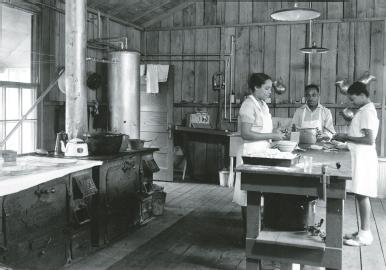
Two women and a man preparing food for a surveying class, circa 1930s–1940s. Louis Edward Nollau F Series Photographic Print Collection, University of Kentucky Libraries.
A pinch or dash roughly ⅛ teaspoon
1 kitchen spoon 1 teaspoon
1 dessert or soup spoon 2 teaspoons
1 spoonful 1 tablespoon
Butter the size of a walnut roughly 2 tablespoons
Butter the size of a hen's egg 3 to 4 tablespoons
1 pound of flour approximately 4 cups
1 pound of sugar approximately 2 cups
1 pound of eggs
8 with their shells, 10 witho
1 gill 4 fluid ounces or ½ cup
1 teacup
1 wine glass
1 tumbler
6 fluid ounces or ¾ cup
2 fluid ounces or ¼ cup
8 fluid ounces or 1 cup
1 coffee cup nearly 8 fluid ounces
Milk Substitutions
Sweet milk milk that has not soured; us whole milk
Sweet cream use heavy cream
Sour milk milk that has soured; while buttermilk is not quite the same, it can be used. Or so whole milk by adding 1 tablespoon of lemon juice p cup of milk.
Milk Whole milk
Oven Temperatures (Fahrenheit)
Slow 300 degrees
Moderate
Quick
Hot
350 degrees
375 to 400 degrees
400 to 425 degrees
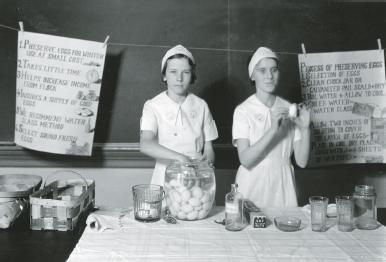
Preserving eggs, circa 1940s. Louis Edward Nollau Nitrate Photographic Print Collection, University of Kentucky Libraries.
Egg and Cheese Dishes
The southern breakfast is symbolic of much that is distinctive and exemplary about food in the South.
John Egerton, Southern Food in History
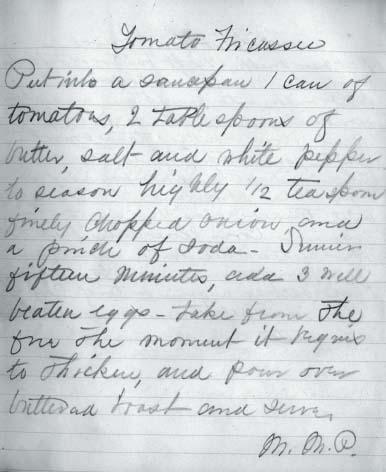
Because cows and chickens were abundant on southern farms, egg, milk, and cheese dishes were enjoyed often at the southern table. Most of the dishes in this chapter are breakfast fare, but the tasty combination also shows up in casseroles, soufflés, and sauces throughout southern contemporary and historical cuisine. No one has ruled that an omelet is good only at breakfast, and most certainly the other dishes can be served as main dishes, sides, or desserts. The tomato fricassee was an absolute delight. Although a
2 servings
4 eggs
½ teaspoon salt or more to taste
Pepper to taste
4 tablespoons milk
½ teaspoon baking soda
4 rounded tablespoons cottage cheese
Mix the eggs, salt, pepper, and milk. Scramble the mixture in a greased skillet over medium heat. Remove from heat, sprinkle the baking soda over the cottage cheese, and stir into the egg mixture. Serve immediately.
Frances Jewell McVey's Tomatoes with Eggs, circa 1920s
Aninteresting recipefrom theearlyto midtwentiethcentury. Fresh summer tomatoes are thekey tomakingthisamoist,flavorfuldish. Don't cook the eggs too long, or they will become hard; they will continue to cook briefly after being removed from the oven. The original recipe calls for moistening the dish with stock, but fresh summertomatoesprovideenoughliquid.4
4 to 6 servings
Bread crumbs
2 to 3 large tomatoes, sliced ⅛ inch thick
Salt and pepper
2 to 3 tablespoons butter
4 to 5 eggs
Preheat the oven to 375 degrees. Pour a layer of bread crumbs into an 11 × 7-inch buttered baking dish, add a layer of sliced tomatoes, salt and pepper the slices, and repeat until the dish is full. Add another layer of bread crumbs and dot the top with butter pieces.
constantly and remove the mixture from the heat the moment it begins to thicken, pour it over buttered toast, and serve.
Seaton Family's Cheese Omelet, circa 1880s
While the title of this recipe suggests a traditional omelet (cooked eggs foldedaroundsome sortoffilling),thatisnotthecase for this dish. This recipe calls for pouring a milk-and-egg mixture over very thinly sliced bread and cheese and thenbaking it in the oven. The result, more akin to a casserole, is delicious no matter what it is called.6
4 to 6 servings
Tomato Fricassee
1 tablespoon butter
8 ounces shredded cheddar cheese
6 to 8 very thin slices of bread, enough to cover the bottom of the baking dish
¼ teaspoon salt
⅛ teaspoon cayenne pepper
⅛ teaspoon dry mustard
1 egg
1 cup milk or cream
Preheat the oven to 350 degrees. Butter an 11 × 7-inch baking dish and put a layer of cheese in it. Cover the cheese with slices of bread and add another layer of cheese. Season with the salt, cayenne pepper, and dry mustard. Mix the egg and milk and pour the mixture evenly over the bread and cheese. Bake 30 minutes or until the top begins to brown.
Louise Ludlow Dudley's Omelet with Fine Herbs, 1876
We halved the 1876 recipe, which called for 10eggs. Honestly, we wereprobablyjustlowoneggs, butitalsoseemeda littleeasierto manage a5-eggomelet.Anotheroptionwouldbetodividetheegg mixture and make individual omelets. The onion and parsley give thisheartyomeletagreatdealofflavor.7
2 to 3 servings
5 eggs
4 ounces cheese, grated (cheddar or mozzarella works well)
4 ounces bread crumbs
¼ cup cream or ½ cup milk
2 tablespoons finely chopped onion
1 tablespoon chopped parsley
1 teaspoon salt
⅛ teaspoon pepper
1 tablespoon butter
Beat the eggs to combine, and mix in the cheese, bread crumbs, cream, onion, parsley, salt, and pepper. Melt the butter in a skillet over medium heat. Pour in the egg mixture and cook until the bottom browns slightly. Flip the omelet and cook the other side. Fold in half and serve.
Lucy Hayes Breckinridge's Creamy Omelet, early 1900s
It seemed unlikely that a “creamy omelet” could be created using water , but this recipe did produce a fluffy and creamy omelet. Additionalingredients,suchascheese,cookedmeat, or vegetables, although not in theoriginal recipe, could be addedright before the omelet is folded. Use a nonstick pan to make it easier to flip the omelet.8
1 to 2 servings
3 eggs
1 teaspoon melted butter
3 tablespoons water
½ teaspoon butter
½ teaspoon salt
⅛ teaspoon pepper
Beat the eggs until they are just mixed. Add the melted butter and the water. Melt the ½ teaspoon of butter in the pan and pour in the eggs. Turn the egg mixture toward the center as it becomes creamy. Season with salt and pepper and cook until it browns on the bottom. Fold the omelet in half and serve.
add the egg mixture. Brown the bottom of the omelet, add the salt and pepper, and bake it until the eggs have set, 5 to 10 minutes. Fold the omelet in half and serve.
To Poach Eggs, 1881
The 1881 recipe does not call for vinegar , but the addition of 1 tablespoon or more to thepoaching liquid willhelp theegg whites coagulate. Use a cup or small bowl to transfer theeggs gently into the water. These instructions are from the original recipe: “Have a panboilingwater;havetheeggscarefullybrokenandsliptheminto the boiling water; let them remain till the whites are set, and take outwithspoon;putinadishandpouronsomedrawnbutter . ”11
Combine roughly 8 cups of water and 1 tablespoon of vinegar in a heavy saucepan and bring it to a simmer. Break 1 egg at a time into a small bowl and slide into the water. Simmer 2 to 3 minutes or until the egg white is firm. Remove the egg with a slotted spoon onto a paper towel to dry. Repeat with other eggs.
Cooper Family's Eggs Somerset, circa 1960s
Thisrecipe,asindicatedonthetypedoriginal,wasafavoriteofJohn Sherman Cooper and his wife, the former Lorraine Arnold Rowan. Cooking the initial egg mixture requires patience to allow it to thicken properly. This dish is comfort food,pure andsimple.Enjoy eggssomersetwithathickpieceoftoastorabiscuit.12
6 servings
2 cups crabmeat or lobster
1 stick butter
½ teaspoon salt
½ cup cream
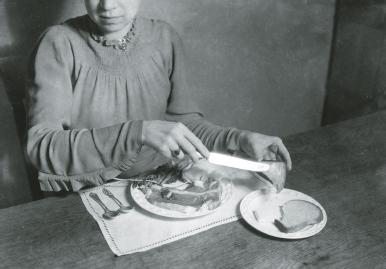
Buttering bread, circa 1940s. Louis Edward Nollau Nitrate Photographic Print Collection, University of Kentucky Libraries.
Biscuits and Breads
Good bread makes the homeliest meal acceptable, and the coarsest fare appetizing, while the most luxurious table is not even tolerable without it.
Esta
Woods Wilcox, Buckeye Cookery
Breads and biscuits were staples in southern cooking and an essential part of all meals. Breads were consumed at breakfast, dinner, and supper. Leftover bread was used for desserts. Bread of all kinds was made in the home, but especially corn bread was part of the rural landscape of Kentucky. As many Americans moved from the farm to cities in the twentieth century, bread increasingly became store-bought. But as these recipes show, bread-baking has a long, diverse, and delicious history. The classic Kentucky beaten
biscuit could not be overlooked, and as Kentucky culinary authority Charles Patteson says, “beaten, ‘doesn't mean whipped together for lightness with an egg beater or whisk; it means placed on a flat surface and pounded with a blunt instrument…. [Even] a tire iron will do…. Granny used to beat ’em with a musket.’”1
Lucy Hayes Breckinridge's Griddle Cakes, early 1900s
These cakes came off thegriddle slightlycrispy on the outside and fluffy on theinside.Theydonot,however, providea lotofflavor on theirown, so atoppingoffreshfruit orsyrup(orboth)wouldbea welcome addition. The griddle cakes would be especially delicious toppedwithfreshstrawberrysyrup(page130).Onegoodfeatureof these griddle cakes is that they can accommodate both sweet toppingsandsavoryones,suchasbarbecue.2
8 griddle cakes
1 egg, separated
¾ cup water
1 tablespoon butter
1 cup flour
¼ teaspoon salt
1 teaspoon baking powder
Preheat the griddle over medium-low heat. Separate the egg white from the yolk. Combine the water and yolk together. Melt the butter and mix in; add the flour and salt and stir. When that mixture is ready, add the baking powder to the egg whites and, using an electric or hand mixer, whip until stiff. Fold the two mixtures together and drop the batter, one-fourth cup at a time, on the griddle. Cook until both sides are slightly brown.
About ¾ cup milk
Preheat the oven to 375 degrees. Sprinkle the cream of tartar in the flour and mix the baking soda in the hot water to dissolve it. Add the butter, salt, and baking soda with water to the flour and mix it with the milk. Drop onto a greased baking sheet and cook for 10 to 15 minutes.
Cooper Family's Beaten Biscuits, circa 1960s
Although dated 1960 in the text from the archives, this recipe probably originated much earlier . The recipe is a labor of love. Beaten biscuits are not light and fluffy; they are closer to the consistency of a thick cracker. They come from the nineteenth century, before baking powder and soda were widely available. Cooks found that ifthey repeatedly folded and beat biscuit dough, air pockets would form. When the biscuits baked, the heat would cause the air pockets to expand, making the biscuits rise. Traditionally,beatenbiscuitsareservedwithcountryham.4
4 dozen small biscuits
3 cups flour
1 teaspoon salt
⅓ cup cold shortening
¾ cup cold milk
Preheat the oven to 400 degrees. Sift the flour with the salt. Cut in the shortening, add the milk, and mix until the dough becomes very stiff. Place the dough on a floured board and beat it with a rolling pin or wooden mallet for 30 minutes, folding the edges after each stroke. Roll to one-third of an inch thick and cut with a biscuit cutter or a small glass. Place the biscuits on a greased baking sheet and prick them with a fork. Bake about 20 minutes.
Frances Jewell McVey's Coffee Cake, circa 1920s
Thiscoffeecakeisnothinglikethetwenty-first-centurystore-bought variety. It is aromatic, full of spice, and moistly dense. We used a well-buttered and floured Bundt cake pan that worked nicely. You couldsubstitutewalnutsorevenchocolatechipsfortheraisins.5
8 to 12 servings
1½ pounds raisins (about 4 cups)
1 pound currants (about 4 cups)
5 cups sifted flour
2⅔ sticks butter
1½ cup sugar
1 cup molasses
1 tablespoon cinnamon
1 tablespoon allspice
1 scant teaspoon cloves
1 teaspoon nutmeg
5 tablespoons bourbon
1 cup strong coffee
3 eggs, beaten
1 teaspoon baking soda
Preheat the oven to 350 degrees. Toss the raisins and currants in 2 teaspoons of the flour. Mash and cream the butter and mix in the sugar, molasses, cinnamon, allspice, cloves, and nutmeg. Add the bourbon and beat this mixture well. Dissolve the baking soda in a little of the coffee. Alternately add the flour and coffee, then the eggs beaten separately, the soda-coffee mixture, and lastly the raisin-and-currant mixture. Fill a large buttered and floured cake mold three-fourths full and bake for 50 minutes or until an inserted knife comes out clean.
used a cast-iron skillet greased with olive oil, and the spoonbread hadagreatcrust.Covertheskilletwithaluminumfoilabouthalfway throughbakingtopreventthetopfromburning.7
6 to 8 servings
2 cups cornmeal
1 teaspoon salt
1 teaspoon baking soda
1 to 1½ cups boiling water
2 eggs, separated
2 cups buttermilk
1 tablespoon melted butter
Preheat the oven to 450 degrees. Grease well a cast-iron skillet and put it in the oven to heat. Sift the cornmeal, salt, and baking soda. Over them, pour enough boiling water to make a soft dough, approximately 1 to 1½ cups. Beat the egg yolks well and combine the buttermilk with them. Add the milk and yolks to the dough and stir to combine. Next, add the butter and mix well. Beat the egg whites and fold them into the batter. Pour the batter into the hot pan and bake for 35 to 40 minutes.
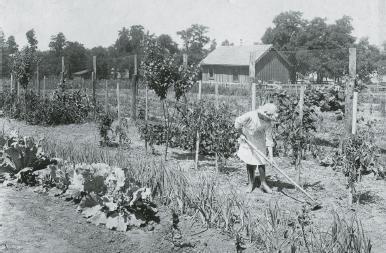
Hoeing the garden, circa 1916. Barker and Faulconer Fayette County Public Education photographs, University of Kentucky Libraries.
Sides
Dining in Kentucky is an art, and as an artistic expression it has been created by and, in turn, it creates the vivacity, ardor, frankness, generosity—yea even courage of the people of the Bluegrass state.
Frances JewellMcVey
Side dishes are the support for the main dishes. In Kentucky they are diverse, as they have been for centuries in the South. They provide contrast and typically include egg and cheese dishes, fruits, salads, vegetables, and grains. Many of the sides in Kentucky's food heritage are the vegetables grown in our gardens: potatoes, corn, carrots, onions, turnips, parsnips, tomatoes, green beans, butter beans, peas, mustard greens, kale, scallions, sweet potatoes, yellow summer squash, zucchini, cauliflower, broccoli, cucumbers, asparagus, bell peppers, cabbage, beets, and eggplant. Kentuckians