Bahrain BD 1.50 Kuwait KD 1.50 Oman OR 1.50, Saudi Arabia SR 12.00 UAE DH 10.00 UK £ 3.00, US $ 3.00
24 YEARS
VOLUME 24 / ISSUE 9 / SEPTEMBER 2026
Rs. 100
EDITORIAL MAGAZINE MAGAZINE
Seasonal www.seasonalmagazine.com
Managing Editor Jason D Pavorattikaran Editor John Antony Director (Finance) Ceena Associate Editor Carl Jaison Senior Editorial Coordinator Jacob Deva Senior Correspondent Bina Menon Creative Visualizer Bijohns Varghese Photographer Anish Aloysious Office Assistant Alby CG Correspondents Bombay: Rashmi Prakash Delhi: Anurag Dixit Director (Technical) John Antony Publisher Jason D Pavorattikaran
India is at a historic economic and demographic pivot. With a target of becoming a USD 30 trillion economy with a per capita income of around USD 18,000 by 2047, the Viksit Bharat @ 2047 ambition is clear. But shifting from a lower-middle-income classification to high-income status - and ensuring that unemployment becomes negligible - requires more than just incremental growth; it demands a comprehensive structural reinvention. Here are 7 actionable steps India can take to reach a higher economic orbit, drawing on global benchmarks and its own innate strengths.
1) THE MANUFACTURING LEAP: MOVING UP THE VALUE CHAIN
Editorial & Business Office Cochin: 36/1924 E, Kaloor-Kadavanthra Road, Near IGNOU, Kaloor, Cochin-17. Ph:0484- 2345876, 2534377, 2340080 Mob. 09947141362 Delhi: H.No: P-108, Uppal Southend, Sector 48, Sohna Road, Gurgaon, Haryana – 122018 Ph: 9891771857|099471 41362 Mumbai: 202, Woodland Heights Building, St. Martins Road, Bandra West, Mumbai 400 050 Mob: 919947141362 Bangalore: House No: 493, Block 3 3rd Main, HBR Layout, Bangalore-4209731984836, Email:skmagazine@gmail.com www.seasonalmagazine.com
Reg No: KERENG/2002/6803 Printed & Published by Jaison D on behalf of PeteCarlson Solutions Pvt. Ltd. at Cochin. Printed at Rathna Offset Printers, Chennai-14. All Rights Reserved by PeteCarlson Solutions Pvt. Ltd. No part of this publication may be reproduced by any means, including electronic, without the prior written permission of the publisher.
SEASONAL MAGAZINE
To absorb millions of workers transitioning out of agriculture, India must solidify its industrial base. While the services sector has been a traditional strength, no large nation has achieved high-income status without a robust manufacturing sector - as demonstrated by South Korea, Germany, and China. India needs to move beyond basic assembly into high-value, deep-tech manufacturing. This involves scaling up semiconductor fabrication, green energy components like solar cells and EV batteries, and aerospace engineering. By simplifying foreign investment regulations and merging complex FDI rules, India can attract massive global supply chains.
2) EMPOWERING MSMES: THE ENGINE OF EMPLOYMENT
UK Office: “CRONAN”, Boundaries Road Feltham, Middlesex, UK TW13 5DR Ph: 020 8890 0045, Mob: 00447947181950 Email: petecarlsons@gmail.com
All health health related related articles articles All are for for first first information information are purposes only. Always purposes only. Always consult your your doctor doctor before before consult taking any any decison decison taking affecting your your health. health. affecting
7 ACTIONABLE STEPS FOR CREATING A DEVELOPED INDIA
MEMBER
Micro, Small, and Medium Enterprises (MSMEs) form the backbone of India’s productive economy. They contribute over 30% to the GDP, account for nearly half of all exports, and generate employment for over 300 million people across 70 million enterprises. If unemployment is to become negligible,
MSMEs must be empowered to scale. The focus should shift toward credit accessibility, integration into global supply chains, and formalization. By removing the friction of economic compliance and expanding digital credit platforms, a small workshop in Coimbatore or Ludhiana can seamlessly supply components to a multinational firm.
3) UNLEASHING AI & ROBOTICS: THE DIGITAL MULTIPLIERS India already boasts one of the world’s most advanced digital public infrastructures (DPI), which seamlessly underpins payments, identity, and service delivery. The next frontier is Artificial Intelligence. According to studies, AI has the potential to unlock more than USD 500 billion in economic value for India by 2030 itself. By developing sovereign cloud capacity, by supporting multilingual AI models built for Indian languages, and a judicious deployment of robotics, India can automate routine processes, increase agricultural yields through precision farming, and boost manufacturing productivity. Rather than displacing jobs, a strategic AI & robotics rollout will create high-value employment in data
engineering, AI governance, manufacturing and tech integration.
4) TAPPING INTO HUMAN CAPITAL: ALIGNING EDUCATION WITH INDUSTRY NEEDS As over 250 million people emerge from multidimensional poverty, their economic aspirations demand a radical upgrade in skills. The current education system often produces graduates who require extensive retraining by employers. India can look to Germany’s dual-track vocational training system, where apprenticeships and classroom learning happen simultaneously. Establishing highpowered Education-to-Employment frameworks will align educational outcomes with evolving labor market needs. By focusing on critical thinking, multidisciplinary learning, and AIreadiness, India can transform its demographic dividend into a highly productive workforce.
5) DEEPENING THE SERVICES SECTOR: LEVERAGING INDIA’S INNATE STRENGTH
While IT services have been India’s golden goose, the sector must evolve. Deepening the services sector means transitioning from back-office support to high-value Global Capability Centers (GCCs), cutting-edge R&D, financial services, and global consulting. Among these, India has already proved to be a destination of choice for GCCs. This transition fulfills the aspirations of the newly upwardly mobile middle class, offering durable jobs where human skills, strategic thinking, and creativity remain central, even in an era of AI disruption.
6) TRANSFORMING TOURISM INTO A MEGA-INDUSTRY: THE HUGELY UNTAPPED POTENTIAL Despite its unparalleled cultural heritage, ancient monuments, and ecological diversity, India’s share of global tourism remains disproportionately small compared to nations like France or Spain. Tourism is a highly labor-intensive sector that generates jobs across the entire skill spectrum - from local artisans and
guides to hospitality management and logistics. Developing world-class tourism circuits, ensuring safety, maintaining immaculate hygiene standards at heritage sites, and leveraging digital marketing can unlock a multi-billion dollar domestic and international tourism boom in the country.
7) NEXT-GENERATION INFRASTRUCTURE AND LOGISTICS: FOR BUILDING WORLD CLASS SUPPLY CHAINS To compete globally, the physical friction of doing business must be eliminated. India must build worldclass physical infrastructure, including smart cities, high-speed freight transport, and seamless port connectivity. By focusing on multimodal transport connectivity (road, rail, air, and waterways), India can reduce its logistics costs from around 14% to the global benchmark of 7-10%. This reduction acts as a direct margin boost for domestic manufacturers, making Indian goods hypercompetitive on the global stage. The transition to a developed, highincome nation is not merely about pulling populations out of poverty; it is about enabling sustainable, upward economic mobility. By executing these seven pillars with precision, India can harness its innate strengths and fundamentally shift its economic orbit long before even 2047 arrives. SEASONAL MAGAZINE
CONTENT
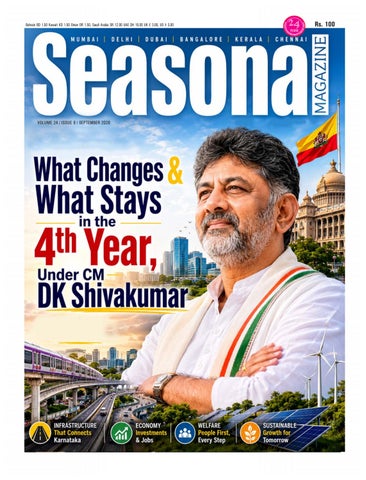
WHAT CHANGES & WHAT STAYS IN THE 4TH YEAR, UNDER CM DK SHIVAKUMAR As Karnataka enters the fourth year of its administration, the leadership baton has officially passed from veteran statesman Siddaramaiah to the dynamic DK Shivakumar. All eyes are now on what changes and what stays the same under its new Chief Minister. The answer lies in a seamless blend of continuity and aggressive
TRYING NOT TO TRY Finding Freedom from Striving in the Ancient Chinese Concept of Wu-Wei “The best way to get approval is not to need it,” Hugh MacLeod memorably counseled. We now know that perfectionism kills creativity and excessive goal-setting limits our success rather than begetting it - all different manifestations of the same deeper paradox of
THE Q1 LEDGER: HOW PUBLIC & PRIVATE BANKS PERFORMED IN THE FIRST QUARTER OF FY27 As India's banking sector kicks off its first-quarter earnings season for FY27, a clear narrative of shifting momentum is emerging between private heavySEASONAL MAGAZINE
6 HABITS ZEN MASTERS PRACTICE TO FIND CALM, FOCUS AND PRESENCE “A monk is simply a traveler, except the journey is inwards.” - Jay Shetty The mind is like water. When it is disturbed, it reflects nothing. But if it is still, it reflects everything. Monks understand the mind naturally wanders. Thich Nhat Hanh, a Vietnamese Zen Buddhist teacher, famously called it a “monkey mind” that
THE RADICAL ACT OF SLOWING DOWN A meditation on how our obsession with speed and productivity undermines our health, relationships, and chances for lasting success.**
PRACTICAL WAYS TO THINK POSITIVELY Positive psychology has become a powerful foundation for wellbeing programmes worldwide. For those seeking better mental health and a more fulfilling life, these programmes encourage simple, intentional practices that can strengthen emotional
HOW FLYNN EFFECT PROVES INTELLIGENCE NEED NOT BE INNATE, BUT CAN BE DEVELOPED You’ve probably heard someone lament the state of “kids today”: that current generations aren’t as smart as the ones that came before them. However, psychologists who study intelligence have found that there isn’t much support
HOW TO BREAK THE PERFECTIONISM-PROCRASTINATION LOOP Stuck in the perfectionismprocrastination loop? Learn why perfectionism drives procrastination and 5 researchbacked strategies to break the cycle for good.
MODERN FRIENDSHIPS ARE ABOUT THE INTENTION
5 CLASSIC STOIC PRINCIPLES TO LIVE BY FOR A HAPPIER LIFE
Over the years, I have come to realise that friendships evolve as we grow. When we are young, friends are always close by. We laugh together, share everything, and see each other almost every day.
THE 3 MOST ENDURING PRODUCTIVITY TIPS, WITH ADVICE FOR ADHD Trying harder is not the answer. You have to be strategic. When someone I love deeply was diagnosed as neurodivergent, I discovered that standard productivity advice, even the heavily researched ideas I
THE SNAKE CHASING EFFECT A man is walking through the woods when he stumbles across a snake in the center of his path. The snake lashes out and bites
Before I discovered Stoic principles, I went through life without a clear purpose. Without any idea of how to live a good life. I simply imitated the actions and behavior of those around me. But the truth is that
HOW TO MOTIVATE YOURSELF TO DO HARD THINGS
WHAT’S TAKING UP YOUR MENTAL BANDWIDTH RIGHT NOW? Your mind is always pointed at something, and it matters what it is.
In an era where generative AI can help write academic papers and solve complex equations, traditional teaching & grading are facing an existential crisis. Dr. Madhukar G. Angur - a David M. French Distinguished Professor with nearly
I spend a lot of time thinking about how motivation works. You can even read my in-depth review of some of the relevant scientific literature on motivation. My rationale for studying motivation is simple: motivation seems to explain a lot of divergent results we see across people’s lives. SEASONAL MAGAZINE
PERSPECTIVE
SEASONAL MAGAZINE
hen life moves on, many things change. We finish school, start working, move to new places, and meet new people. It can feel like old friends are now far away.
W
However, today, being a friend is no longer about who is near you. It is about choosing to connect, even when life is busy or you live far apart. Technology makes it easier. A simple message, a funny picture, or a short “How are you?” shows that we still care. What matters is not how much we talk, but that we reach out with meaning. Even small actions can mean a lot when they come from the heart. As we grow older and enter adulthood, we meet new friends at work or in our daily lives. They see who we are now. We enjoy their company, share new memories, and grow together. But sometimes, when life is hard or when we want to share something special, we think of old friends. These are the people who saw us at our best and worst. Even if we do not talk often, they are still important. Relationships aren’t always lost; sometimes, they’re just quiet. It took me some time to learn this. I used to feel sad when I didn’t talk to old friends often. Now I know friendship does not end just because we are busy. We do not need to talk every day. We only need to choose each other again and again, in small ways— by remembering, by sending a quick note, by holding each other in our thoughts. Or in my case, by sending random meme videos on
Instagram. Distance and time are no longer significant problems. We have many ways to keep in touch. It is what we do with these ways that matters. When I feel tired or need comfort, I often send a joke or an old photo to an old friend. Sometimes there is no reply right away, but that is okay. Nobody has their phone on all the time. New friends arrive, and they help us grow. They see us as we are now. Their presence is a gift. But there’s a difference between meeting someone where you are and being known by someone who’s seen you evolve through each chapter. This is why, no matter when or where, some connections persist. Not because of frequency, but because we care, we show up, over and over, in whatever way we can. Distance means far less than it used to. Time zones, schedules, and years apart can’t erase the feeling of being seen, understood, or remembered. Modern friendship, if anything, is a testament to intention: to be present, even when presence is digital, sporadic, or wordless. So, if this post reminds you of someone —be it a friend, a group of friends, or even family members— send that message. Share the meme. Start the chat. Like the old picture. Let friendship mean what it needs to for this moment in your life. Maybe that’s the lesson: it’s not the space between us that matters, but the intention behind the message we sent. Reach out to that person you think about today. (Brian for The Tiny Wisdom) SEASONAL MAGAZINE
PERFORMANCE
s you know if you read this, the mind can focus on things other than thoughts; you can attend to presentmoment sense phenomena. Even a few seconds of this at a time can break the momentum of thinking.
A
For the most part, though, if you’re a human being living in the modern world, chances are your attentional bandwidth is going to be dominated by thinking. There’s just too much in the environment drawing us into abstract world of thought. Every glimpse of entertainment, advertisement, news, gossip, or content is a seed that can set off an open-ended, self-sustaining weather system of thinking and feeling. Passing a gas station, you see that prices are up, and within one second you’re thinking of your household budget, and other rising costs, then inflation, and politicians, and that person you know who voted for the bad politician instead of the good one, and so on. Depending on how sticky the subject matter is for you – and problems tend to be stickier than anything else – this one glance at a sign can set a mood and theme that colors your whole day. We often inadvertently give these mental weather systems much more energy. When a topic dominates SEASONAL MAGAZINE
your thoughts, you might reinforce it by talking about it and consuming content about it, creating fodder for more rumination, triggering more content consumption, and so on. This pattern isn’t strictly maladaptive – if the topic really serves you. If, instead of becoming preoccupied with political talking points, you became preoccupied with making a career change, that preoccupation might steer your life in a great direction. If you became preoccupied with banjo music instead of “world events,” it might lead you to pull your banjo out of the closet, learn some new licks, download
some banjo podcasts, and join a banjo-focused community. Banjo music might not solve world hunger, but this is still probably a better timeline for you than the one in which you’re arguing with political wrongthink in your head to and from work every day. For each moment of your sixteen waking hours, your mind is pointed at something. If you had the data, you could make a pie chart of attentional subjects, just like one depicting app usage on a mobile phone. You are spending some actual number of minutes and hours ruminating over workplace drama, or “the state of the world,” or your health troubles. The makeup of this hypothetical pie chart has a direct effect not just on how life feels, but on what you do, and therefore where your life goes. The Contents of Your Mind Drives the Contents of Your Life Here’s a personal example. I have a history of serial obsessions. My mind will fixate on an intriguing topic, and I’ll dive into books, films, and podcasts about it, for weeks or months. I’ve engaged in fruitful obsessions with blues guitar, wine, Cold War history, veganism, bodybuilding, chess, 19th-century seafarers, coffee brewing methods, Lovecraftian horrors, Buddhism, Scotch whisky, Stephen King’s bibliography, rock climbing, and countless smaller interests that only held my mind for a week or two. How long a human mind gives a topic serious bandwidth depends on how magnetic it is to one’s sensibilities, but also how strongly you orient your habits towards cultivating that interest, by consuming related content and bringing its paraphernalia, thinking patterns, and communities into your life. A passing fancy for vintage clothing might change how you dress forever. Watching a documentary on vegetarianism might change your diet, and your health, for the long term. On a slow workday in 2008, I read a blog post that began a years-long preoccupation with blogging and online entrepreneurship, which led to the founding of this website, and a complete change of my career and life path. At the time I was constantly reading about those topics, engaging in the relevant communities, building things, and planning future projects. My mind was strongly attuned to the subject, and it drove my habits; I’d get home from work and look forward to spending my evening hours making something. This was great, because it was driving my life in the direction I wanted to go: towards independence, creativity, prosperity, and connection with similar minds.
That was a long time ago. For more than a decade now, my interest in building a business and an online community has been far from the center of my mind. I guess it’s been filled with other things. So what has been dominating my bandwidth the way entrepreneurship once did? Lots of topics, some of which I listed above. But over the past few years at least, without quite noticing it, I’ve become very preoccupied with political philosophy of all things. In hindsight, this interest has been driven by our wild online culture war — the vicious and strangely dichotomous disagreement over COVID policy, speech rights, racism and weaponized accusations thereof, and use of state power. Something has seemed very unhealthy in the way people have been disagreeing over this past decade. It’s become so strongly ideological and partisan. In order to make sense of where this comes from, I’ve jumped headlong into Lasch, Hayek, Marx, Marcuse, Sowell, and a host of contemporary pundits. By now I’ve consumed massive amounts of content on the topic. Between home, the gym, and my vehicle, I’ve been absorbing about three hours of audiobooks alone per day, and ~80% of that is about political ideology. I’ve just been slamming them back in this way for the last three or four years. This phase has been very informative, and it’s helped me understand the mass human craziness that seems to characterize the 2020s. But it’s not good for me. Rather than drive my creative abilities, career, and connection with other humans, this interest has driven me to my phone, into the bottomless ocean of ephemeral political hot takes. Even when I’m not absorbing SEASONAL MAGAZINE
Making a Deliberate Bandwidth Change The mind doesn’t ask your permission before attending to something – it will simply grasp what seems salient. However, you can change what it tends to grasp by curating the inputs. On February 1, I began an experiment. For the months of February and March I’ll be dumping politics from my attentional bandwidth as entirely as possible. I’m cutting off any inputs that draw the mind in that direction. That means no news or political editorials*, no books on the topic, and I’ll avoid any discussions about politics or world events. It certainly means no browsing of social media. Scrolling X or Bluesky or Threads is essentially browsing an endless rolodex of emotionally-driven political stands. Instead of pumping political ideas into my head every day, I’ll mostly be consuming content related to small business marketing and community building, like I did back in the early 2010s. If my mind’s going to be mulling over some problem, I’d rather it be how to get my best work out to a million people, rather than how to express the hubris of socialist planned economies. content, my head is swimming with political arguments, maxims, and talking points, and generating new ones.
The “Civic Duty” Objection
I don’t need that. Unfortunately I find the topic of political ideology fascinating. Thoughts on how societies should be run drive so much of history. There is certainly a place for it.
I need to address the inevitable “civic duty” objection that comes up whenever someone advocates ignoring politics for a while. A responsible adult needs to know what’s going on! You can’t just stick your head in the sand!
But right now I want to invest my bandwidth elsewhere. I’m trying to build something I think the world really needs –- a way for ADHDers and procrastinators to overcome the biggest problem in their lives –- and instead of filling my bandwidth with the ideas and skills needed to do that, I’m filling it with diatribes about economic policy and propaganda methods. I have a chance to make life better for thousands or millions of people, but if that’s my goal I’m misallocating my bandwidth.
I share this moralistic feeling that by tuning out the news I’m abdicating some important role of watchdog and opinion-haver, but I think the moral importance of that role mostly is an illusion. It’s a hobby, or an addiction, dressed up as a duty. While it is technically possible for informed, ordinary people to influence political outcomes, that isn’t really what we’re doing by consuming massive quantities of content. We’re too easily convinced, by those with far more influence over the proceedings, that the amount of attention we invest in what they do is a measurement of our degree of participation. We’re spectators, hooked on the spectacle. Also – any mental bandwidth taken up by politics is unavailable for anything else. While you’re doomscrolling news apps, are you really investing everything you can in human connection, creative work, material prosperity, spiritual realization, or whatever else is “important” to you? In any case, this is a break, not a lifelong renunciation. Believe me, I still have my opinions. (Credit: David Cain for Raptitude)
SEASONAL MAGAZINE
EMOTIONAL INTELLIGENCE
T
he man feels the sharp pain of the bite and the venom coursing through his leg. Fortunately, he’s close to the village, so if he just walks back and gets the wound treated, he’ll be fine.
But he feels the anger and resentment building inside him: “Why did the snake do that to me? That’s not right. I’m going to get revenge.” He starts chasing the snake down the path, but as he pursues the snake, the venom takes hold and he collapses and dies. The story offers a powerful lesson, which you might call the Snake Chasing Effect: In life, you’re going to get bitten by a snake every now and then. Someone betrays you. A partner lies. A family member mistreats you. A friend lets you down. A coworker takes credit for your work. The initial wound hurts - but it’s survivable. If you take care of yourself, walk back to the village and treat the wound, you’ll be fine.
But how often do you do the exact opposite? The internal voice starts a familiar refrain: How could they do this to me? I’m going to get them back. You start chasing the snake down the path, seeking your revenge. You obsess over the betrayal. The unfairness. The injustice. The real damage is not from the bite itself, but from your reaction to it. The real damage comes when you chase the snake. Nelson Mandela is often paraphrased as having said, “Resentment is like drinking poison and then hoping it will kill your enemy.” The Snake Chasing Effect is a reminder that the wisest response to harm isn’t retaliation or obsession, but restoration. Don’t give the snake more power over you than it has. Focus on healing, not hunting. Tend to your wound. Mend your garden. Your rebirth is the greatest revenge. (By Sahil Bloom) SEASONAL MAGAZINE
As Karnataka enters the fourth year of its administration, the leadership baton has officially passed from veteran statesman Siddaramaiah to the dynamic DK Shivakumar. All eyes are now on what changes and what stays the same under its new Chief Minister. The answer lies in a seamless blend of continuity and aggressive modernization. The transformative five guarantees, which have successfully pumped over Rs 1.21 lakh crore into the grassroots economy, are here to stay, maintaining the state’s robust welfare safety net. However, the Shivakumar era signals a decisive pivot toward massive urban and infrastructural renewal. Spearheading this shift is the ambitious Brand Bengaluru initiative, highlighted by the much-debated Bengaluru tunnel road project and vital elevated corridors designed to decongest the tech capital. By fusing compassionate welfare with rapid, high-tech infrastructure development, Chief Minister Shivakumar aims to sustain Karnataka’s 8.1% growth rate and cement its status as India’s premier tech and economic powerhouse.
SEASONAL MAGAZINE
SEASONAL MAGAZINE
K
arnataka stands as a compelling
This momentum is backed by a surge in global
rejoinder to the notion that fiscal
confidence and robust fiscal management. In the
discipline and expansive social welfare
first half of the 2025-26 fiscal year, Karnataka
are mutually exclusive. Under the
secured $9.4 billion in Foreign Direct Investment,
seasoned leadership of Chief Minister DK
accounting for a staggering 26.7 percent of India’s
Shivakumar, who recently took the helm in the
total inflows, even as other major industrial hubs
fourth year of the government, Karnataka has
saw declines. The state’s five landmark guarantee
transitioned into a period of aggressive execution.
schemes have also moved beyond their introductory phase into a mature ecosystem.
By anchoring the state’s progress in an economic
CM Shivakumar has made it clear that while these
model that fuses a guarantee-economy with high-
welfare guarantees remain untouched as a core
tech industrial ambition, the administration has
commitment, there is a renewed focus on tighter
steered the state to a Gross State Domestic
auditing to ensure their long-term sustainability.
Product growth rate of 8.1%, significantly
With over Rs 1.21 lakh crore successfully
outstripping the national average of 7.4%.
disbursed to citizens by early 2026, these programs have effectively stimulated rural
Stepping up from his role as Deputy Chief Minister,
demand and fueled a 9.1 percent growth in the
Shivakumar has brought a distinctively dynamic,
agricultural sector.
execution-focused leadership style. Even as the state navigates the evolving complexities of federal tax
Shivakumar’s expertise in managing urban growth
devolution following the 16th Finance Commission’s
is now being applied across the state through the
recommendations, Karnataka continues to position
accelerated Beyond Bengaluru program. The
itself not merely as India’s tech capital, but as its
initiative has reached a crescendo, accounting for
primary engine of equitable growth.
nearly 46% of the investment commitments made
SEASONAL MAGAZINE
at the 2025 Global Investors’ Meet. High-value projects, ranging from Silfex’s Rs 9,300 crore silicon component facility to Tata Advanced Systems’ aerospace manufacturing in Kolar, are now anchoring a decentralized industrial map. To ensure tier-2 cities like Mysuru, Belagavi, and Mandya attract the same level of global capital, Shivakumar is heavily expediting clearances. In Mandya, there are advanced discussions to establish a massive 500-acre industrial hub alongside a vehicle testing and certification center, aiming to turn standalone facilities into vibrant economic zones. A significant theme of the new Chief Minister is his assertion that massive infrastructure upgrades are the primary engines for future global investment. This is most evident in his Brand Bengaluru vision. Plans are underway for a second airport for the city, a new tunnel road network, and a massive 40-kilometer elevated corridor project to drastically ease traffic congestion.
SEASONAL MAGAZINE
Accompanied by the implementation of the Greater Bengaluru Governance Act, the government is carefully balancing these sweeping structural and physical overhauls without disrupting the everyday livability of the metropolis. Despite the heavy expenditure on social programs and mega-projects, the state’s financial health remains a priority. Recent austerity measures are viewed by the administration as necessary calibrations to maintain fiscal responsibility while funding ambitious infrastructure leaps. By adhering to strict standards, the government aims to show that it can be both a welfare state and a fiscally disciplined entity. This balance directly rebuts critics who suggested the treasury would be emptied by the cost of the guarantees. The state is also looking toward the future of technology, education, and youth empowerment. In a significant move, the government has announced the reinstatement of college student elections, fostering political awareness among the youth. At a recent campus summit, Shivakumar highlighted the urgent need to integrate artificial
SEASONAL MAGAZINE
intelligence into higher education, advising students passionate about software to build futureproof careers right here in Karnataka. Further empowering the youth, the Chief Minister has been a strong advocate for state-level control over medical entrance exams, pushing for radical changes following national testing controversies to reduce the immense pressure on local students. The government is also collaborating with prestigious institutions like the Indian Institute of Science and ISRO to establish a robotics and artificial intelligence innovation zone. On the federal front, funding remains critical for these mega-projects. The leadership is advocating for a more constructive dialogue on the relationship between the center and the states. While the 16th Finance Commission recently nudged the state’s tax share up to 4.13%, Shivakumar continues to lead a national conversation on cooperative federalism. The administration is steadfast in ensuring that Karnataka’s status as the nation’s second-largest GST contributor is met with a fair share of resources to support its dual-track ascent.
Whether it is pushing forward a multi-billion-
Ultimately, the story of Karnataka today is one of
dollar semiconductor plant, implementing the
a dynamic leader driving aggressive
Greater Bengaluru Governance Act, or ensuring
modernization while protecting the vulnerable.
the sustainability of grassroots welfare, the
By refusing to choose between industrial growth
administration is working to prove that rapid
and social justice, Chief Minister DK Shivakumar
execution and equitable development are
is attempting to build a state that is as
essential for the modern era, and achievable
compassionate as it is competitive.
under DKS’ visionary guard.
SEASONAL MAGAZINE
HIGHER EDUCATION
In an era where generative AI can help write academic papers and solve complex equations, traditional teaching & grading are facing an existential crisis. Dr. Madhukar G. Angur - a David M. French Distinguished Professor with nearly two decades of academic prowess at the University of Michigan-Flint, holding a Ph.D. from UT Arlington and a PGDM from India's premier IIM Ahmedabad - argues that educators must radically rethink student assessment. Twice nominated for the Carnegie Foundation Professor of the Year award, Dr. Angur posits that standard take-home assignments are completely obsolete. Instead, this Founder Chancellor of Alliance University proposes that higher education must pivot toward cultivating raw human intellect by abandoning easily automated homework. To survive this paradigm shift, he advocates for rigorous, tech-immune methodologies like real-time oral defenses (Viva Voce), live inclass diagnostic troubleshooting, AI auditing rubrics, and strict Edit-to-Mastery contract grading. Ultimately, the modern classroom must become a heavily protected sanctuary for deep, focused human thought, says Dr. Angur. Dr. Madhukar G. Angur David M. French Distinguished Professor. Founder Chancellor, Alliance University
Standard take-home assignments are completely obsolete. Higher education must pivot toward cultivating raw human intellect by abandoning easily automated homework. hirty years ago, during a faculty interview at a premier R1 research university, a senior scholar asked me a question that felt out of place at such a research-heavy institution: “What is the toughest thing about teaching?” My instinctive answer then was “grading.” Today, as a seasoned professor who has watched generative AI turn traditional assessments into an algorithmic arms race, I realize that thirty-year-old answer was not just right—it was prophetic. But the solution isn’t better AI detection; it is a total, unapologetic rejection of tech-reliant assessments outside the classroom.
T
That question caught me completely off guard — for three reasons. First, the university was a top-tier R1 research institution. Second, the professor asking it was a world-renowned scholar. SEASONAL MAGAZINE
Third, I was a high-achieving student with a strong research agenda. I loved teaching, and my evaluations as a Graduate Teaching Assistant were consistently above average. Yet I had not prepared for it. That moment stayed with me because it revealed a fundamental truth: even at elite research universities, teaching is not peripheral. It is central. It is integral to both faculty excellence and institutional impact — then, and even more so today. Looking back, I find it fascinatingly curious that this thirty-year-old answer holds far more relevance today than it did then. Today, I am a seasoned professional. I have published extensively and served in various administrative and academic
leadership roles at universities worldwide. Yet the rapid evolution of our educational landscape forces me to re-examine that decades-old interaction. We now live in an era of hyper-advanced technology, where generative AI tools are embedded in every academic program, curriculum, and institution globally. If grading was the toughest part of teaching thirty years ago, AI has made it an existential crisis today. When algorithms can generate essays, solve complex equations, and write code in seconds, traditional metrics of evaluation crumble. This reality shifts the paradigm and forces higher education to confront a series of uncomfortable, vital questions: What do educators truly need to teach?
When information is ubiquitous and instantly accessible, the traditional role of the professor as the sole gatekeeper of knowledge is obsolete. What are the new measures of success? If a student can use AI to secure an ‘A’ on a paper, standard grading no longer measures actual learning, critical thinking, or intellectual growth. What is the true relevance of teaching in a distracted world? We are facing a student body characterized by fractured attention spans. Students struggle to focus, assimilate complex information, and think critically. Yet these same students are expected to graduate and become productive organizational leaders, navigating a world tethered to evolving interactive technologies that completely dwarf traditional classroom instruction. The Solution: A Radical Return to Human Intellect To survive this paradigm shift, higher education must implement a radical solution: say goodbye to homework, group projects, and anything that can be easily bypassed or automated by technology. As daunting as it may seem, educators must stay at the absolute forefront of the digital landscape. Teachers must possess a deep, working knowledge of the materials available to students on their own terms—including the vast ocean of paid and unpaid content on YouTube and social media. Whether that content is brilliant or fundamentally flawed, it is part of the student’s ecosystem, and it must be brought into the light of the classroom. The modern classroom must pivot away from information delivery and focus entirely on raw human thought. We must train students to think in the present, think without technology, assess competing points of view, and build knowledge together through structured peer learning. Already, universities worldwide are recognizing this and resorting to strict bans on technological gadgets in the classroom. This is not a regressive step; it is a defensive move to protect the human mind. Students must develop a strong capacity for reading, analyzing, synthesizing, collating, connecting the dots, and extrapolating information to arrive at uniquely thoughtful responses and solutions.
Reimagining Assessment From the Ground Up Consequently, grading must undergo a drastic evolution. We cannot protect old metrics with AI detectors; the tools do not work. Instead, we must replace the transactional, point-scoring model of education with four rigorous, techimmune grading methodologies: The Viva Voce (Oral Defense): Highstakes grading weight must shift to inperson, real-time oral defenses. A student’s grade shouldn’t depend on the paper they turned in, but on their ability to stand before an instructor or peers and verbally defend, dissect, and unpack their arguments under live questioning. “Live Patch” Diagnostic Assessment: Instead of grading completed, static products created at home, instructors must grade live execution. Students are presented with broken code, flawed mathematical proofs, or structurally weak historical arguments and earn marks for their active, unassisted troubleshooting in the room. AI Auditing Rubrics: Students will use these tools; we must therefore grade them on their ability to confront the technology. Assignments should shift toward evaluating AI output, where a student’s mark relies entirely on their ability to factcheck, identify systemic hallucinations, and critique the cognitive limits of the machine.
frameworks, data, or proper citation, I return it with specific feedback and students revise until it meets the bar.
“Edit-to-Mastery” Contract Grading: In an era of grade inflation, we must move beyond partial credit that rewards compliance over competence. In my courses, major assignments operate on a “Complete / Revise” contract. A submission that meets clear, pre-published standards of mastery is marked Complete. If it does not, it is marked Incomplete and the student enters a structured, iterative feedback loop with me.
This mirrors broader efforts to restore meaning to grades. Institutions such as Harvard have implemented informal caps on A grades to signal that top marks should denote true excellence. My approach achieves a similar goal at the assignment level: a final ‘A’ is earned only through demonstrated mastery, not accumulated points. The process is demanding, but equitable. Every student has multiple opportunities to learn and revise, and the grade they receive reflects what they can actually do as future managers and leaders.
For example, in my Strategic Management course, a “Complete” case analysis must apply 2+ frameworks like Porter’s Five Forces or VRIO, propose 3 actionable recommendations supported by data, and follow APA 7th formatting. On the other hand, in my Organizational Behavior course, a “Complete” team report must diagnose an issue using OB theories such as Psychological Safety, support it with survey or interview data, and propose evidence-based interventions. In both cases, if a draft lacks
As educators, our battle is no longer against the red pen or the pile of blue books. Our battle is to redefine the very purpose of the classroom—moving away from automated assessment and toward cultivating deep, focused human intellect in a world designed to distract it.
Thirty years ago, grading was tough because it required discerning a student’s genuine understanding from their mistakes. Today, grading is tough because we are parsing human thought from machine output.
SEASONAL MAGAZINE
PHILOSOPHY adversity. These are the things that truly matter and form the backbone of a fulfilling life. 5 Classic Stoic Principles to Live By for a Happier Life Before I discovered Stoic principles, I went through life without a clear purpose. Without any idea of how to live a good life. I simply imitated the actions and behavior of those around me. But the truth is that most people are unhappy and aimless. I seriously started practicing Stoicism when I was 28. That’s when things started to change in my life. That was in 2015. Since then, I’ve become happier every year. 9 years after I started living as a Stoic, I can wholeheartedly say that happiness is a muscle that gets stronger the more you train it. Let me share 5 of the most useful Stoic principles with you. I hope they will improve your happiness as much as they improved mine. 1. Become fearless “He who fears death will never do anything to help the living. But he who knows that this was decreed the moment he was conceived will live by principle and at the same time will ensure, using the same power of mind, that nothing of what happens to him comes as a surprise.” Seneca Look, we’re all going to die. I guarantee you this. All the things that make you unhappy today will seem meaningless on your deathbed: You got a bad grade. It’s always bad weather in your town. No one likes your social media posts. Someone didn’t invite you to their birthday party. Other people seem happy and you feel alone. Get over it. Go through life fearlessly. Do the things you always wanted to do. 2. Desire nothing outside your control “Our master is anyone who has the power to implement or prevent the things that we want or don’t want.” Epictetus This might hurt, but needs to be said: Too many of us are slaves to external validation. We crave likes on Instagram, promotions at work, and admiration from our peers. But guess what? All these things are beyond your control. You can’t force someone to like your post, promote you, or admire you. So why waste your energy and peace of mind longing for them? Instead, focus on what you can control. Your actions, thoughts, and response to SEASONAL MAGAZINE
Try to avoid chasing after things you don’t control. Do that and you’ll reclaim your freedom. 3. Rely on yourself “Withdraw into yourself as far as you can, and associate with those who will make you better. Invite those whom you can make better. This benefits both sides, and men learn while they are teaching.” - Seneca It’s often easy to lose sight of the fact that the only person you can truly rely on is yourself. Friends come and go, circumstances change, jobs are lost, and even family can let you down. That’s not to say you should isolate yourself or shun relationships. On the contrary, surround yourself with people who enrich your life and whom you, in turn, can uplift. But in the end, you are your own best friend and worst enemy. The choices you make, the habits you cultivate, and the mindset you adopt will determine your happiness and success. 4. Trust nature “Something happens to you. Good. It was meant for you by nature, woven into the pattern from the beginning.” Marcus Aurelius Life is unpredictable. It’s filled with unexpected twists and turns that can either break us or make us stronger. Trusting nature, as the philosopher king Marcus Aurelius said, is about embracing this unpredictability. When you do that, you gain the understanding that every event, good or bad, is part of your journey in life. Got laid off? Maybe it’s an opportunity to pursue a passion project or start your own business. Went through a painful breakup? See it as a chance to rediscover yourself and grow as an individual. The economy is down? Take this opportunity to invest. Instead of resisting change or dwelling on misfortune, embrace the unknown. Trust that every experience, no matter how challenging, is a step forward on your path. 5. Do what you say “Don’t expect to tell others what they should do when they know that you do what you shouldn’t.” - Musonius Rufus
Finally, and perhaps most importantly, practice what you preach. It’s easy to spout wisdom, give advice, and criticize others. But living by your principles? That’s where the real challenge is. Don’t be a hypocrite. Don’t lecture others about honesty if you lie. Don’t preach about hard work if you’re lazy. If you want respect, admiration, or influence, earn it. Show up, do the work, and lead by example. It’s a cliche but it’s true: Actions do speak louder than words. So do what you truly want and believe in. Do what you say not because you want the world to notice you. But because YOU notice it. (By Darius Foroux)
SEASONAL MAGAZINE
STRATEGY
T
he players visibly struggle to relax, closing their eyes, breathing deeply, adopting vaguely yogic postures. The panic they begin to feel as the ball approaches their end of the table is usually balanced out by the overeagerness of their opponent, both players alternately losing their cool as the big metal ball rolls back and forth. You couldn’t wish for a better, more condensed illustration of how difficult it is to try not to try. Our lives, Slingerland argues, are often like “a massive game of Mindball,” when we find ourselves continually caught in this loop of trying so hard that we stymie our own efforts. Like in Mindball, where victory only comes when the player relaxes and stops trying to win, we spend our lives “preoccupied with effort, the importance of working, striving, and trying,” only to find that the more we try to will things into manifesting, the more elusive they become. Slingerland writes: Our excessive focus in the modern world on the power of conscious thought and the benefits of willpower and self-control causes us to overlook the pervasive importance of what might be called “body thinking”: tacit, fast, and semiautomatic behavior that flows from the unconscious with little or no conscious interference. The result is that we too often devote ourselves to pushing harder or moving faster in areas of our life where effort and striving are, in fact, profoundly counterproductive. Some of the most elusive objects of our incessant pursuits are happiness and spontaneity, both of which are strikingly resistant to conscious pursuit. Two ancient Chinese concepts might be our most powerful tools for resolving this paradox — wu-wei (pronounced oooo-way) and de (pronounced duh). Slingerland explains: Wu-wei literally translates as “no trying” or “no doing,” but it’s not at all about dull inaction. In fact, it refers to the dynamic, effortless, and unselfconscious state of mind of a person who is optimally active and
SEASONAL MAGAZINE
effective. People in wu-wei feel as if they are doing nothing, while at the same time they might be creating a brilliant work of art, smoothly negotiating a complex social situation, or even bringing the entire world into harmonious order. For a person in wu-wei, proper and effective conduct follows as automatically as the body gives in to the seductive rhythm of a song. This state of harmony is both complex and holistic, involving as it does the integration of the body, the emotions, and the mind. If we have to translate it, wu-wei is probably best rendered as something like “effortless action” or “spontaneous action.” Being in wu-wei is relaxing and enjoyable, but in a deeply rewarding way that distinguishes it from cruder or more mundane pleasures. This notion is remarkably similar to Mihaly Csikszentmihalyi’s pioneering concept of flow - that precious state of consciousness where we feel a deep and total immersion in life or creative work, forgetting the passage of time and even such physical needs as hunger and thirst - and subsequent psychological theories that emphasize the value of “problem-creating” over problem-solving as a source of creative energy and fulfillment. It is also at the heart of Lewis Hyde’s famous distinction between work and creative labor. But wu-wei is also different its counterparts in Western psychology: People who are in wu-wei have de typically translated as “virtue,” “power,” or “charismatic power.” de is radiance that others can detect, and it serves as an outward signal that one is in wu-wei. de comes in handy in a variety of ways. For rulers and others involved in political life, de has a powerful, seemingly magical effect on those around them, allowing them to spread political order in an instantaneous fashion. They don’t have to issue threats or offer rewards, because people simply want to obey them… If you have de, people like you, trust you, and are relaxed around you. If this too sounds familiar, it might be because it sounds like precisely what David Foster Wallace described in what’s easily the best definition of leadership ever articulated. We’re drawn to people with wu-wei, Slingerland argues, because we inherently trust the automatic, unconscious mind due to a simple fact from the psychology of trust - because spontaneity is hard to fake, we intuit that spontaneous people are authentic and thus trustworthy. But Western thought has suffered from centuries of oppressive dualism, treating intuition and the intellect as separate and often conflicting faculties a toxic myth that limits us as a culture and as individuals.
Fortunately, Slingerland points out, recent decades have brought a more embodied view of cognition acknowledging the inextricable link between thought and feeling and debunking, as Ray Bradbury so eloquently did, the false divide between emotion and rationality. (We’ve seen, too, that metaphorical thinking is central to our cognitive development, and metaphor is itself rooted in emotion.) The Chinese tradition, on the other hand, has a millennia-long history of cultivating a more integrated model of the human experience: For the early Chinese thinkers … the culmination of knowledge is understood, not in terms of grasping a set of abstract principles, but rather as entering a state of wu-wei. The goal is to acquire the ability to move through the physical and social world in a manner that is completely spontaneous and yet fully in harmony with the proper order of the natural and human worlds (the Dao or “Way”). Because of this focus on knowing how rather than knowing this or that, the Chinese tradition has spent a great deal of energy over the past two thousand years exploring the interior, psychological feel of wu-wei, worrying about the paradox at the heart of it, and developing a variety of behavioral techniques to get around it. The ideal person in early China is more like a welltrained athlete or cultivated artist than a dispassionate cost-benefit analyzer. Slingerland poses a pause-giving contrast: The ideal person in Western philosophy is not only disembodied but also radically alone. And yet this ideal runs counter to our biological and social truths: In reality, we are not autonomous, self-sufficient, purely rational individuals but emotional pack animals, intimately dependent on other human beings at every stage of our lives. We get along, not because we’re good at calculating costs and benefits, but because we are emotionally bound to our immediate family and friends and have been trained to adopt a set of values that allows us to cooperate spontaneously with others in our society. These shared values are the glue that holds together largescale human groups, and a key feature of these values is that they need to be embraced sincerely and spontaneously - in an wu-wei fashion - to do their job. This is why the tensions surrounding wu-wei and de are linked to basic puzzles surrounding human cooperation, especially in the anonymous, large communities we tend to inhabit today. What wu-wei gives us, Slingerland argues, is “a sense of being at home in some framework of values, however vague or tenuous,” which allows us “to recover the crucial social dimension of spontaneity” - something else that distinguishes it from Western concepts like “flow.” Because contextual fuzziness is a central feature of human psychology, the barriers to spontaneity tend to vary among people and between situations, but the result is the same: SEASONAL MAGAZINE
We have been taught to believe that the best way to achieve our goals is to reason about them carefully and strive consciously to reach them. Unfortunately, in many areas of life this is terrible advice. Many desirable states - happiness, attractiveness, spontaneity - are best pursued indirectly, and conscious thought and effortful striving can actually interfere with their attainment. One centerpiece of the paradox comes from an important cognitive duality: Our thinking is steered by two distinct systems, each beholden to its own rules and characteristics - the same two systems responsible for the marvels and flaws of our intuition. The first, known as System 1, is dominated by “hot cognition”; fast, automatic, and largely unconscious, it is primitive and significantly older in evolutionary terms, which means that, thanks to eons of practice and repeat use, it tends to be fairly fixed. The second kind, System 2, is characterized by “cold cognition” - slow, deliberate, rational, and conscious reasoning, which evolved more recently and is thus more flexible. The former is what we associate with the body, the latter with the mind. When System 1 takes over, with its impulsive and short-sighted reactivity, we often run into problems in the long run. Slingerland explains: This isn’t because hot cognition doesn’t take future consequences into account. The problem is that this system’s conception of relevant consequences was fixed a long time ago, evolutionarily speaking, and is fairly rigid. “Sugar and fat: good” was for most of our evolutionary history a great principle to live by, since acquiring adequate nutrition was a constant challenge. For those of us fortunate enough to live in the affluent industrialized world, however, sugar and fat are so widely and freely available that they no longer represent unqualified goods - on the contrary, allowing ourselves to indulge in them to excess has a variety of negative consequences. The great advantage of cold cognition is that it is capable of changing its priorities in light of new information. Slingerland points to two key theories that explain how “one (relatively) hairless ape managed the transition from tribe to state” and why the two systems of cognition arose. One holds that the development of external social institutions like laws, punishments, money, and rewards gradually came to keep our pre-wired, internal hot cognition in check as our cognitive control centers perpetually churn to override, repress, or redirecting it. Slingerland sums it up: Civilization is about the triumph of cold cognition over hot. But more recent work in Western philosophy and social science has pulled this theory into question for reasons more aligned with the concept of wu-wei, suggesting that cold cognition simply doesn’t have the strength and stamina to keep hot cognition under control 24/7. Instead, it’s something else that motivates our cooperative behavior - something not based on rewards as punishments but instead bridging the two systems through a deeper mechanism: According to this view, the key to getting lots of strangers to work together is not to create an endless stream of new laws or institutions but to create a set of shared values. Laws are something you merely obey. Values are something you feel. Once internalized, values function just like other forms of hot cognition - fast, automatic, unconscious, wu-wei. Looked at this way, we can begin to see how the paradox of wu-wei emerges as a kind of natural consequence of our transition from hunter-gatherers to farmers and city dwellers. Slingerland cites Cornell psychologist Robert Frank’s pioneering work on why we cooperate, which suggests that the most important lubricant of our social interactions are powerful emotions that keep us honest rather than cognitive evaluations of prospective rewards and
SEASONAL MAGAZINE
punishments. In the long run, the payoffs of cooperation come only when we stop consciously trying to force them - a finding in stark contrast with the basic tenets of contemporary Western culture, which rewards cold cognition to an extreme and invariably pushes us to strive deliberately and systematically for things only attainable once we let go. Slingerland writes: If you’re just using rewards and punishments - the rational, self-interested, cold-cognition strategy - it doesn’t matter what people feel on the inside. You set up the incentives, let people figure them out, and then judge them purely on their behavior. In the values model, on the other hand, what people are really feeling on the inside is crucial: if I can’t trust that you’re committed to the same ideals that I’m committed to, there’s no way we can work together. That’s where “the paradox of wu-wei” arises - the conundrum of trying not to try. To be sure, this isn’t advocacy for passivity and resignation but for the mindful cultivation of those tendencies in ourselves that promise to bear fruit as behaviors and qualities we aspire to in the long run. Slingerland puts it elegantly: You can cultivate your sprouts: try to identify incipient tendencies of desirable behavior within you, and then nurture and expand them until they are strong enough to take over. Or you can just go with the flow: forget about trying, forget about not trying, and just let the values that you want to embrace pick you up and carry you along. There is also an ebb and flow of the two systems over the natural course of life: Cold-cognition strategies like “carving and polishing” tend to be more beneficial earlier in life as well as when we’re acquiring new skills, where deliberate practice is the key to mastery. But after a certain point of expertise, the very strategies that helped us make progress early on now lodge us into the “OK plateau” of autopilot and cold cognition starts hindering rather than powering progress. This, Slingerland notes, might also be true of morality: A deeply ingrained moral disposition could become too rigid as you age, in which case you might need to shift to the sprout or letting-go approach. On a social level, one solution to this paradox is what Slingerland calls “ethical bootstrapping” - the idea that the desirable behaviors and qualities we cultivate within ourselves emanate out to have a small but perceptible positive effect on others, “which causes them to act in an
incrementally more morally positive way, which in turn feeds back on us.” Slingerland brings this back to the reality of our everyday lives, by way of the ancient Chinese: This has immediate, practical implications for how you go about arranging your daily life. The early Confucians put an enormous amount of effort into modifying their immediate aesthetic environment - clothes, colors, layout of living spaces, music - so that it would reflect the values of the Confucian Way. Although most of us no longer embrace the Way, we can use the same techniques to foster our own particular set of values. If you can set up your home and workplace, to the extent you have control over it, to reflect your tastes and values, the things that make you feel good and at home, you’re going to be better off. You’ll have more wu-wei and more de. The basic idea is simple. You choose a desirable model, then reshape your hot cognition to fit by immersing yourself in reminders and environmental cues. How this repetition eventually causes the new internal disposition to become sincere and self-activating is a bit of a mystery intellectually, the paradox remains - but it seems to work in practice. This disposition isn’t rooted in just philosophy. Recent findings in psychology and social science, Slingerland points out, have indicated that this is a central feature of how our minds work: A growing literature in the psychology of perception has demonstrated that, when it comes to certain difficult visual tasks - exercises where subjects are asked to locate a target shape in the midst of a large array - simply relaxing and letting the answer “pop out” works much better than actively trying. Similarly, when one is stymied by a problem, simply leaving it alone and doing something else is often the best way to solve it. Doing nothing allows your unconscious to take over, and, as we’ve seen, the unconscious is often better at solving certain types of particularly complex problems. This, of course, is something nearly every model of the creative process accounts for, acknowledging the importance of an “incubation” phase, or what Lewis Carroll so memorably termed “mental mastication.” To create the conditions for this essential state, Slingerland advises that we do what we tend to intuit is important but rationally resist: “Sleep in, take a walk, go weed your garden.” He encapsulates the essence of this approach: The sort of knowledge that we rely on most heavily is hot, emotionally grounded “knowing how” rather than cold, dispassionate “knowing that.” We’re made for doing, not thinking. This has significant implications for everything from how we educate people to how we conduct public debates, make public policy decisions, and think about our personal relationships. Our modern conception of human excellence is too often impoverished, cold, and bloodless. Success does not always come from thinking more rigorously or striving harder. (By Maria Popova for The Marginalian) SEASONAL MAGAZINE
GRATITUDE
uring the COVID-19 pandemic, my family and I stumbled on a deal too good to ignore - cruise ship prices had plunged, so we happily booked our berths. Well, it turned out to be quite an adventure. During the cruise, one of the ship’s propeller motors died. Luckily, the ship could still move, but at a slower pace. Several ports destinations were canceled. Some of the passengers were livid, and the air buzzed with complaints about ruined vacations. My family and I were disappointed but not angry. Not because we were saints - far from it. A little backstory explains our relatively mild reaction. The thing is, we almost didn’t make it up the ship. On our three-hour drive to the port, we got a flat tire on our rental car and discovered, to our horror, that there wasn’t a spare tire in the car. When we finally found help, I sped to the port, while my wife begged on the phone for the ship to wait for us. We made it - barely - just as the gates were closing. Phew! This near-miss experience changed everything. For the rest of the trip, we were just grateful to be there. Missing a few ports? No big deal compared to missing the ship entirely. As a gratitude researcher, I’ve learned a lot from the scientific literature on how to be grateful. But I’ve also often thought about this cruise ship experience because it taught me an important lesson that reshaped my thinking on gratitude.
D
THE POWER OF BENEFICIAL ABSENCES We often thank people for what they did. And when we experience gratitude, it’s typically for good things that occurred in our lives. But can you be grateful for something that didn’t actually happen? Can you thank others for something they didn’t do? Yes, and yes. Philosophers use the term counterfactuals to refer to imagined alternatives to actual events - scenarios that could have happened but
SEASONAL MAGAZINE
didn’t. Counterfactual reasoning engages our minds in what-if scenarios. What if I had never met my life partner - how would my life be different? What if I had studied harder on an exam would I have obtained a better grade? What if I hadn’t lost my temper during an argument with a close friend? And the list goes on. The ability to engage in what-if thinking may be one of the unique and creative features of the human mind. It gives us the capacity to learn from our mistakes, and as we consider what we could have done differently, it helps us improve. What-if thinking can also harm us if it leads to regretful rumination - constantly replaying in our minds what could have been better and what we could have done differently. But if you’re prone to what-if thinking, I’d like to suggest you likely possess a hidden superpower that gives you the capacity for gratitude. To understand how this works, let me introduce you to what I call beneficial absences - the quiet gifts in our lives that come from restraint, omission, and avoided misfortune. These are things that didn’t actually happen - and you’re glad they didn’t. Let’s unpack three types of beneficial absences and how reflecting on them increases your ability to live gratefully. 1. COULD HAVE BEEN A DISASTER (CBAD)! The first involves downward counterfactuals. When you engage in downward counterfactual thinking, you’re comparing your current situation with a worse-off scenario that didn’t happen. Downward counterfactuals thinking sounds a bit too academic, so I’ve devised a more intuitive term for this idea - could have been a disaster or CBAD. Research backs up the idea that CBAD thinking can be good for you. One study found that participants who engaged in CBAD thinking reported more thankfulness. In another study, my colleagues and I randomly assigned people to write about one of the most intensely happy experience in their entire life, one of the most intensely grateful experiences in their life, or a recent grateful experience. The differences were pretty stark. About 9% of participants in the intense gratitude condition wrote about avoiding a bad outcome (CBAD thinking), while 6% did so in the recent gratitude condition.
But less than 1% of those in the intense happiness condition wrote about this topic. So the ability to engage in CBAD thinking may be linked to gratitude in ways that distinguishes it from other positive emotions. You could experiment with a bit of CBAD thinking everyday - consider the automobile accidents you never experienced, the illness that could have been a lot worse, or the rain that didn’t occur during an important outdoor event, like your wedding. 2. THE GIFT OF GRACE: DISCIPLINE OR CRITICISM WITHHELD We’re wired to thank people for what they do. But are we overlooking what they refrain from doing? Here, I’m referring to the times when others extend grace to you by withholding criticism or discipline you deserved. The parent who held their tongue instead of criticizing. The partner or friend who withheld judgment when you’re not at your best behavior. In one study, employees who acknowledged that their supervisors adopted less punitive discipline for workplace misconduct felt more grateful toward them - but only if they recognized their supervisors’ leniency was due to their kindness and not because of the employees’ special relationship with their supervisors. The takeaway? A healthy dose of humility makes gratitude possible. It means recognizing you deserved that criticism or discipline and that someone was being kind by choosing to withhold it. 3. WHEN NOT HELPING IS THE KINDEST HELP We’re quick to thank others for their help and advice. But, less intuitively, we can also be grateful to others for the help and advice they did not provide. Why? Because sometimes, the kindest thing is to hold back. Philosopher Stefan Ridener proposed the novel idea that gratitude is the response to being shown positive moral regard. In some cases, this could involve omitting an act of paternalism to respect your autonomy. Receiving help and advice is generally a good thing. And, in many situations, it’s healthy to receive help and advice. But there are occasions when providing help and advice compromises someone’s autonomy. Recognizing that can make us grateful for the people in our lives who thoughtfully held back from giving advice and help we didn’t
need. Consider the times your family members trusted you to make important life decisions without jumping in with unsolicited advice. Or perhaps your supervisor once allowed you to take full ownership on a project without offering unnecessary help or advice. These are all opportunities to be grateful to the people around us— especially when we recognize that it’s easy to give advice and help, but it takes wisdom to stay silent. PUTTING IT INTO PRACTICE Want to expand your gratitude muscle? Reflecting on beneficial absences—the invisible good things in your life—is one way to do that. Ask yourself: What’s something you’ve taken for granted that could have easily gone wrong—but didn’t? When did you narrowly miss a very bad outcome? Who showed you grace by withholding judgment and discipline when you deserved it? Who honored your autonomy by not giving you unnecessary help and advice? In the end, gratitude isn’t just about what’s seen and said—it’s also about the criticisms swallowed, the advice people resisted giving, and the disasters we narrowly missed. (By Joel Wong for Greater Good, Berkeley. edu) SEASONAL MAGAZINE
COUNTER CURRENT
A meditation on how our obsession with speed and productivity undermines our health, relationships, and chances for lasting success.** I want to tell you two stories. The first began in 1921, when a traveling salesman named William Barnard, nicknamed “Papa,” walked door to door in Ohio selling a 25-cent can opener. He called it the Polly. He believed, earnestly, that a better can opener could improve the health of the American family — that safer access to canned fruits and vegetables, year-round, would help people eat better. Sixteen years later, in 1937, he met an engineer named Al Bersted. By then, Barnard and his wife had turned vegetarian, cut sugar and caffeine, and watched a sick family member recover on whole foods. Barnard had become a health-food evangelist, selling vitamins out of the back of his car. Bersted introduced him to a new invention: the blender. Barnard realized here was a machine that could make wholefood eating actually taste good. His son Bill named it by splicing the Latin word for “life” onto the word “mix.” That became Vitamix.
Now the other story. You may remember it. In 2016, a San Francisco company called Juicero launched a $700 countertop juicer, designed by Yves Béhar, that could exert four tons of force — “enough to lift two Teslas,” Doug Evans, Juicero’s founder, said, comparing himself to Steve Jobs. Google’s venture arm led the investment. About $120 million flowed in. The machine only worked with the company’s own proprietary juice packs, which shipped weekly by subscription. In April 2017, two Bloomberg reporters discovered that you could squeeze the packs by hand in about ninety seconds and get nearly the same amount of juice. Eighteen months after launch, the company was dead. A quarter of the staff was laid off; the rest were told to find new jobs. The final packs went out in the mail. At the time, plenty of commentators treated Juicero as a morality tale. It was the inevitable collision of Silicon Valley hubris with reality. How stupid, we all thought. But that reading is too easy. It flatters the rest of us and lets us walk away feeling wise. The more honest take is that Juicero wasn’t doing anything wrong by the logic of its environment. Evans and his backers were rational actors inside an irrational system. They raised the money because the money was available to raise. They SEASONAL MAGAZINE
scaled at that pace because that’s how a venture-backed company is supposed to operate. In the order of operations that now governs Silicon Valley — and increasingly the world — speed to success was the only metric that mattered. Velocity has become a virtue unhooked from any destination. Juicero was merely a symptom of the unexamined belief that capital plus tools can become a substitute for time itself. That if a thing can be made faster, it must be. That if we can do more, more must be done. This essay is not an argument against speed. It is an argument that slowness, chosen deliberately, is the most radical
decision available to you. And probably the most important one you will make over a lifetime.
those things, it turns out, are the good ones. So here is the theory (or a provocation) I want to leave you with. The most radical, countercultural, genuinely subversive act in business today is to deliberately go slow.
The Biological Tax of Speed Bruce McEwen, the late American neuroendocrinologist, spent nearly six decades at Rockefeller studying what stress does to the brain. When he began his work in the 1960s, the scientific consensus was that the adult brain was a finished piece of architecture. McEwen proved that wrong. The brain, he showed, is constantly being reshaped by the chemistry of our lives.
Papa Barnard took sixteen years to pivot from can openers to blenders. The company took decades of steady, unhurried improvement. Today, his descendants still own it. Vitamix has no outside investors. It sells in 130 countries. The Barnard family has been at it for over a century.
Most of what we now take for granted about the neuroscience of stress — that it damages memory, predisposes us to depression, accelerates aging itself, etc. — traces back, in some form, to his lab. His most important contribution was a single phrase, coined with his colleague Eliot Stellar in a 1993 paper: allostatic load. The idea is as simple as it is devastating. The human stress response is a brilliant piece of engineering for acute threats, like a lion circling on the savanna. The system is designed to turn on and off. What McEwen demonstrated, across 40 years of experiments, is what happens when the system never turns off. The hippocampus, the seat of memory, shrinks. The amygdala, the seat of fear, enlarges. Neurons in the dentate gyrus die off, and inflammation rises. The immune system degrades. The body, asked to adapt to a threat that never resolves, begins to dismantle itself. McEwen called this the biological tax on a life that is never allowed to slow down. In other words, our brains are constantly in overdrive. We are going too fast.
There is a word for what this feels like from the inside. Hurry. Hurry is the background hum of modern life. It is the unspoken conviction that there is always more to do than there is time to do it. The fear that if you stop, you fall behind, and that falling behind is a kind of failure. It is what you feel when you check your phone at a red light or when you open Slack in bed. Hurry is the texture of being alive in the 2020s. And there is, predictably, now an enormous industry selling us the cure.
Every juice-tech flavor-of-the-month that came up in Papa Barnard’s lifetime is dead. He is still in business.
The productivity economy is a booming, multi-billion-dollar market. It sells everything: apps, books, coaches, courses, AI agents, and second-brain systems. What it sells, underneath everything, is the promise that you can do more, faster. It correctly diagnoses the disease. Then it prescribes a medicine that makes the disease worse. Because the more you get done, the faster the cup fills back up. When life becomes an endless game of whack-amole, the only winning move is to stop playing. The more efficient you become, the more you are asked to do. The reward for clearing the list is a longer list. This is the Juicero logic, applied to a human life. Capital plus tools as a substitute for time itself. And the result, in the body, is exactly what McEwen spent 40 years documenting in the brains of stressed animals.
THE RADICAL ACT OF GOING SLOW All good things take time. Think of your relationships. Think of your kids’ lives. You can’t tell a flower to grow faster. Its beauty depends on time itself. Some things simply cannot be sped up, and
It is okay to not do all the things and to take your time to do things right. I promise you, most of the small things do not matter. The email you did not answer or the Slack thread you did not weigh in on. It’s okay to be late on some things. In one year, you will not remember it. In five years, most of it will not register. In ten years, none of it will. I say this with a specific kind of authority. A few years ago, I almost died. I had emergency brain surgery, and in the hours before they wheeled me in, I thought about what I would say to my daughter if I did not come out. One thing that kind of moment gives you is a clear sense of what actually matters. The Harvard Study of Adult Development has been running for 88 years. It is the longest longitudinal study of human flourishing ever conducted. Its current director, Robert Waldinger, summarizes the headline finding in a single sentence: relationship quality, built slowly over decades, predicts health and cognitive resilience in old age better than cholesterol, wealth, or IQ. The same compound-interest logic that produces a 100-year company produces a 100-year person. Nothing that matters in a human life is built fast. The brain, the body, the marriage, the friendship, the firm — all of it is the slow compounding of small, repeated, boring acts of showing up. It may also be the one thing that fills a life with joy. (Eric Markowitz for Big Think) SEASONAL MAGAZINE
IN-FOCUS LIC OF INDIA: Immensely Promising, Yet to Be Fully Fulfilled Life Insurance Corporation of India continues to dominate the nation’s financial landscape with its unmatched legacy and geographical reach. Following its historic public listing, the behemoth has reinvented itself to match the agility of its private sector peers. Under CEO & MD R Doraiswamy’s strategic leadership, financial results for the fiscal year ending March 2026 highlight a spectacular surge in net profits, a 1:1 bonus share issue, and a deliberate pivot towards higher margin non participating products. However, beneath this resurgent profitability lies a persistent challenge. The state owned giant still wrestles with structural rigidities, heavy reliance on traditional agency networks, and aggressive private insurers who steadily chip away at its retail market share. LIC compensates for this to an extent through profits from its huge investment business. But this competitive pressure is seen in LIC’s share price which continues to languish behind the IPO investment level, despite the bonus issue.
SEASONAL MAGAZINE
SEASONAL MAGAZINE
The journey of the corporation since its initial public offering in May 2022 has been transformative. For decades, the institution operated with a mandate focused on social welfare. The transition to a publicly traded entity demanded a fundamental shift in philosophy. Management was tasked with honoring historical obligations to insured Indians while unlocking value for new investors. Initially, market sentiment was cautious, and the stock languished for long below its issue price. However, leadership initiated strategic realignments to optimize the product mix, rationalize costs, and modernize service delivery, which have now begun to bear substantial financial fruit. Based on this, the share price had risen around 30% above IPO price, but only to fall back again below the IPO price. Financial performance for the fiscal year ending March 2026 serves as powerful proof to LIC’s initiatives. The corporation reported a staggering net profit of Rs 57,419 crore, a robust increase of over 19% compared to Rs 48,151 crore in the previous year. This bottom line growth was supported by premium income expanding to Rs 5,35,984 crore. SEASONAL MAGAZINE
The asset base saw significant expansion, with overall Assets Under Management swelling to Rs 57,29,396 crore. Such monumental figures highlight its ability to generate immense capital in a highly competitive macroeconomic environment. Shareholders who demonstrated patience have been rewarded by these outcomes. Recognizing the need to distribute wealth, the board recently approved a 1:1 bonus share issue, improving stock liquidity and rewarding long term investors. Accompanying this was the recommendation of a final dividend of Rs 10 per equity share. These capital allocation decisions underscore a maturing corporate governance framework that actively prioritizes minority shareholder
interests, bridging the gap between state ownership and modern free market expectations. However, even after accounting for the bonus, the share price is less than the IPO price as of now. A core driver behind this profitability has been a deliberate recalibration of the product portfolio. Historically, the corporation was synonymous with participating life insurance policies, where a vast majority of surplus was distributed back to policyholders as annual bonuses. While excellent for customer retention, this structure suppressed profit margins. Since going public, management has consciously pivoted towards non participating products, which offer fixed guarantees but allow the company to retain a higher share of profits. This pivot is visible as the share of non participating premium equivalent within the individual business surged to over 35% in the recent fiscal year. This shift triggered a remarkable improvement in profitability metrics, most notably the Value of New Business. VNB increased by nearly 42% to reach Rs 14,179 crore. Consequently, net margins associated with new business expanded to 21.2%. By launching non participating plans like Jeevan Utsav and New Jeevan Sathi, the corporation has attracted a younger demographic seeking guaranteed returns amid volatility. This evolution proves the venerable institution possesses the product innovation capabilities required to
improve its margin profile in alignment with industry benchmarks. To support this modernized product suite, the corporation embarked on a comprehensive digital transformation journey, moving rapidly away from paper heavy legacy systems. The recent introduction of the MyLIC application for policyholders and the Super Sales Saathi application for the agency force represents a massive leap in operational efficiency. These digital platforms facilitate seamless customer onboarding, faster premium collections, and expedited claims processing. By digitizing the workflow, the company reduced its operational expense ratio to 11.91% in the latest fiscal year, empowering the sales force with real time data.
buyers, providing a steady baseline of premium income. Despite these overwhelming strengths and the positive trajectory of its recent financial results, the corporation operates in a contested landscape where structural vulnerabilities persist. A critical examination reveals that the state owned giant continues to cede incremental market share to a hungry private sector. Companies like SBI Life, HDFC Life, and ICICI Prudential have
The true engine of this enterprise remains its unparalleled distribution network. With over 1.3 million individual agents, the corporation enjoys a level of geographical penetration that remains the envy of the entire financial sector. This human infrastructure allows the company to reach into the deepest rural hinterlands, regions where private competitors struggle to establish a cost effective physical presence. Furthermore, the brand equity and intrinsic trust associated with the sovereign guarantee make this institution the default choice for millions of first time insurance
SEASONAL MAGAZINE
consistently outpaced the industry growth average in the retail segment. While the overall pie of the Indian insurance market is expanding, the proportion commanded by the public sector behemoth has gradually contracted under intense pressure from agile competitors. A primary contributor to this competitive disadvantage is the corporation’s reliance on its traditional agency model, coupled with a glaring weakness in the bancassurance channel. Bancassurance - selling insurance products through bank branches - has become the dominant growth engine for private insurers who share corporate lineage with massive private & PSU banks. In contrast, the public sector corporation relies on tie ups with a few public sector banks, which historically exhibit lower cross selling efficiencies. Currently, the share of bancassurance in the corporation’s individual new business premium stands at a mere 7.5%, a significant structural flaw. Furthermore, while the improvement in profit margins to 21.2% is commendable, it still lags behind top tier private insurers who frequently report margins in the high twenties. The private sector utilizes digitally native architectures that allow for dynamic product pricing, instant underwriting, and a lucrative suite of unit linked insurance plans. The state owned corporation, burdened by its sheer size, often struggles to match this rapid pace of
SEASONAL MAGAZINE
innovation. Adapting to sudden regulatory changes pushed by the industry watchdog also proves more challenging for a massive legacy organization compared to nimble counterparts. The shifting taxation landscape introduces another layer of complexity. Recent budgets have progressively removed tax exemptions on high ticket traditional insurance policies, forcing the industry to sell insurance purely on the merit of protection and investment returns. Private insurers, with their diversified wealth management offerings, are generally better positioned to navigate these sophisticated customer segments. LIC of India must urgently upskill its massive agency force to transition from simple transactional selling to comprehensive financial advisory if it hopes to retain high net worth individuals increasingly wooed by private wealth managers. In conclusion, the Life Insurance Corporation of India stands at a fascinating crossroads in its corporate evolution. It has successfully silenced early skeptics by delivering phenomenal profit growth, executing a highly effective shift towards profitable products, and efforts to reward its shareholders with dividends and bonus. Its unmatched scale and sprawling agency network ensure it will remain the unquestioned leader of the Indian life insurance market. However, the relentless encroachment by bancassurance driven private competitors demands urgent structural reform. To secure long term dominance, the resurgent giant must aggressively expand alternative distribution channels and shed remaining legacy rigidities.
Q1 RESULTS
SEASONAL MAGAZINE
SEASONAL MAGAZINE
he curtain has officially risen on the first quarter of the financial year 2026-27 (Q1 FY27) for India’s banking sector, and the overarching narrative is one of undeniable strength tempered by a quiet, systemic friction. As lenders begin unsealing their books for the April-June quarter, investors are being treated to a complex financial theater.
T
The headline numbers are undeniably robust: the sector continues to ride the momentum of multi-decade lows in non-performing assets (NPAs) and an insatiable appetite for credit across retail, corporate, and MSME sectors. Yet, beneath these glossy topline figures lies an escalating battle for liquidity, shifting regulatory sands, and the stark reality of shrinking margins. At the heart of this quarter’s earnings story is the great deposit chase. Over the past year, systemic credit growth has consistently outpaced deposit mobilization, creating a funding squeeze that is now forcing banks to make difficult strategic choices. For Q1 FY27, systemic credit growth remained incredibly strong at roughly 18.6% year-on-year, while deposit growth lagged behind at just 13.3%. This fundamental mismatch means that banks are being forced to rely on costlier bulk deposits and certificates of deposit to fund their rapidly expanding loan books. As a result, the overall cost of funds
SEASONAL MAGAZINE
is creeping upward, threatening to compress Net Interest Margins (NIMs) across the board. In this quarter, the most critical metric will not merely be the sheer volume of a bank’s lending, but rather, the efficiency and cost-effectiveness with which it funded those loans. In this high-stakes, liquidity-tight environment, a fascinating divergence is emerging between India’s private sector giants and their public sector counterparts. After a prolonged period where Public Sector Banks (PSBs) captured the market’s imagination with dramatic turnaround stories, record-breaking profits, and aggressive loan book expansion, the pendulum appears to be swinging back toward private lenders. Early forecasts suggest that private banks are poised to outshine their PSU peers in Q1 profit growth. Analysts are projecting an aggregate year-on-year net profit increase of around 10% for the private sector, with PSU banks close behind, with a steady 9% growth rate. The private sector’s anticipated outperformance is heavily anchored by their superior liability franchises and deep market penetration. Large private banks have demonstrated a far more resilient ability to gather deposits in a competitive market, posting stronger deposit growth of over 15% year-on-year in Q1. This robust deposit mobilization provides them with a stable, lower-cost funding base particularly through Current Account Savings Accounts (CASA) - allowing them to protect their margins better than those reliant on wholesale funding. Furthermore, private banks are benefiting from strong fee-based income streams and agile balance sheet management, which helps cushion the blow of any potential margin compression. However, one should not mistake the PSU sector’s slight earnings deceleration for foundational weakness. Public Sector Banks continue to display remarkable resilience, characterized by highly stable, predictable earnings and pristine asset quality. The days of crushing legacy NPA burdens are firmly in the rearview mirror.
A prime example is Indian Bank, an early bird in this earnings season, which reported a solid 10% year-on-year increase in its Q1 standalone net profit to Rs 3,273 crore, accompanied by a near 17% jump in net interest income. Crucially, Indian Bank achieved this while further improving its asset quality, pushing gross NPAs down to a respectable 1.86%. Despite these individual triumphs, PSBs as a collective face a significantly tougher road ahead regarding operating margins. With their deposit growth hovering around 10% year-on-year lagging both the broader system and their private peers - public lenders may experience tighter spreads if their deposit costs rise faster than their lending yields. The regulatory environment is also adding a layer of complexity. The Reserve Bank of India’s continued focus on liquidity management, coupled with stringent new Liquidity Coverage Ratio (LCR) guidelines set to take effect, will heavily scrutinize the balance sheets of these public stalwarts. Furthermore, following the RBI’s earlier crackdown on unsecured lending via higher risk weights, market watchers are keen to see how banks have rebalanced their portfolios toward safer, collateralized assets. Ultimately, the Q1 FY27 earnings season is less about explosive top-line growth and more about operational discipline and strategic foresight. Asset quality across the industry remains a definitive bright spot, though analysts will be keeping a watchful eye on potential seasonal agricultural slippages and the ongoing moderation in the SME segment. The true winners of this quarter will be the institutions that successfully navigated the tightrope: expanding their loan books to capture India’s economic growth while keeping a firm, unwavering grip on their cost of funds. This Compilation Cover Story will go deep into the specific performances of India’s leading lenders. We will explore how institutions like HDFC, ICICI, and Kotak Mahindra leveraged their deposit machinery to defend their margins, and how giants like SBI and Bank of Baroda defended their turf in an increasingly expensive market. SEASONAL MAGAZINE
SEASONAL MAGAZINE
Federal Bank opened the financial year 2026-27 with a structural outperformance that firmly distances it from the broader industry’s margin anxieties. For the AprilJune quarter, the lender reported its highest-ever quarterly net profit, touching Rs 1,176.93 crore. This impressive 36.57% year-on-year bottom-line growth was comprehensively supported by a 26.06% expansion in net interest income, which reached Rs 2,945.89 crore. Such robust core earnings clearly indicate that the bank’s underlying credit engine is firing efficiently, allowing it to comfortably outpace its aggregate advances growth of 14.94%. By driving higher yields on its loan book while keeping a tight leash on deposit pricing, the bank successfully expanded its net interest margin by 39 basis points to a highly commendable 3.33%. Perhaps the most compelling narrative from this quarter’s earnings is the fortress-like quality of the bank’s asset portfolio. Federal Bank pushed its asset quality to decadal bests, a rare feat in an environment where many peers are grappling with seasonal slippages. Gross non-performing assets improved sequentially to 1.52%, while net non-performing assets dropped to an incredibly low 0.18%. Fresh slippages witnessed a sharp 37.79% year-on-year contraction. This pristine asset quality allowed the bank to massively reduce its standalone provisions by over 57% sequentially, freeing up significant capital that directly bolstered the bottom line. The provision coverage ratio, now sitting comfortably above 87%, provides an ironclad buffer against any unforeseen macroeconomic shocks in the near term. However, the quarter was not entirely without its friction points. Like in most of its peers, the broader systemic challenge of mobilizing deposits continues to exert pressure on the balance sheet. While overall advances grew by nearly 15%, total deposit growth lagged at 11.37%. Although the bank managed a respectable 18.26% growth in its low-cost current and savings account deposits, the fundamental mismatch
SEASONAL MAGAZINE
will inevitably test the endurance of its liability franchise, the institution’s disciplined execution and visionary leadership provide a robust framework for sustained profitability. If the first quarter is any indication, Federal Bank is well on its way to redefining its scale and influence within the Indian private banking sector.
between credit demand and deposit accretion remains a persistent headwind. Furthermore, treasury income remained notably subdued during the quarter, hampered by a highly volatile market environment that restricted non-interest revenue upside. This tightening liquidity scenario underscores the delicate balancing act required to fund future credit expansion without significantly diluting the cost of funds. Recognizing these industry-wide liquidity constraints, the strategic leadership under MD & CEO KVS Manian has already started taking aggressive preemptive action. Since taking the helm, CEO Manian has leveraged his extensive corporate and investment banking pedigree to steer the bank toward a more integrated, high-quality franchise model. Rather than engaging in a destructive rate war for retail deposits, the board recently approved a massive Rs 10,000 crore debt-raising program through instruments like additional tier-1 and tier-2 bonds. This pivotal SEASONAL MAGAZINE
non-financial development ensures the bank possesses the necessary structural capital to sustain its credit momentum through the rest of the year without compromising its carefully guarded margins. This forward-looking capital strategy builds perfectly upon the solid operational foundation laid down in FY26. Despite the previous financial year being characterized by fluctuating rate cycles, Federal Bank had maintained a resilient trajectory, culminating in a strong fourth quarter that set the stage for current successes. The seamless transition into FY27 proves that the internal credit monitoring and digital underwriting investments made over the past year are yielding tangible dividends. Looking ahead, the outlook for the entirety of FY27 remains overwhelmingly bullish. Armed with a newly approved debt war chest, a decadal-best asset quality profile, and expanding core margins, Federal Bank is uniquely positioned to capture premium market share. While the systemic deposit chase
Indian Bank has delivered a powerful statement of intent for the financial year with its stellar first-quarter performance for FY27. Posting a robust 10% year-on-year rise in net profit to Rs 3,273 crore, the state-owned lender continues to ride a wave of exceptional asset quality improvements and surging core income. With Gross NPAs tumbling to an impressive 1.86%, the bank is defying broader industry headwinds regarding margin pressures. Steered by the strategic leadership of MD & CEO Binod Kumar, the institution is seamlessly balancing aggressive business expansion with stringent credit discipline, setting a formidable growth trajectory that promises to redefine its standing among public sector peers.
SEASONAL MAGAZINE
The first quarter of the financial year 2026-27 has proven to be a period of structural outperformance for Indian Bank. For the quarter ending June 2026, the lender reported a standalone net profit of Rs 3,273 crore, reflecting a steady double-digit growth trajectory compared to the Rs 2,973 crore posted in the corresponding quarter last year. This bottom-line resilience was primarily driven by a spectacular 17% year-on-year surge in Net Interest Income, which climbed to Rs 7,435 crore. Such robust core earnings clearly indicate that the bank’s underlying lending machinery is firing on all cylinders, effectively neutralizing the rising cost of deposits that continues to plague the broader banking ecosystem. The standout feature of this quarter’s earnings is unequivocally the bank’s pristine asset quality. In an environment where maintaining credit health is a constant challenge, Indian Bank has pushed its gross non-performing assets ratio down by over a hundred basis points to an exemplary 1.86%. Furthermore, net non-performing assets have plummeted to a record low of 0.15%. This ironclad asset quality not only drastically reduces provisioning requirements but also frees up significant capital to directly bolster the bank’s profitability. A healthy domestic net interest margin of 3.41% further validates the management’s ability to drive higher yields on its loan book while carefully navigating a tight liquidity market. Total business grew 13.6% year-onyear to reach a massive Rs 15.28 lakh crore, highlighting sustained momentum across diverse business segments. However, the quarter is not entirely devoid of macroeconomic friction. While the bank SEASONAL MAGAZINE
managed an admirable 13.3% growth in total deposits, elevating its deposit base to Rs 8.43 lakh crore, the persistent systemic challenge of deposit mobilization continues to lurk in the background. With credit growth across the industry consistently outpacing deposit accretion, the resulting competition for funds could eventually exert pressure on borrowing costs. Although Indian Bank is currently wellinsulated by its strong margins, navigating this intense rate war without diluting its low-cost deposit base will require continuous strategic maneuvering in the coming quarters. This operational success is deeply intertwined with the strategic vision of Managing Director and Chief Executive Officer Binod Kumar, who assumed charge in early 2025. Leveraging over three decades of cross-functional banking experience, Kumar has championed a philosophy that prioritizes resilient corporate credit structures and robust risk management. Under his stewardship, the bank has not only maintained its impressive financial trajectory
SEASONAL MAGAZINE
from FY26, a year marked by sustained credit growth and balance sheet fortification, but has also doubled down on modernization. Recent non-financial initiatives include enhanced governance frameworks and a renewed focus on direct market engagement, highlighted by a major upcoming investor meeting scheduled for late August 2026 to foster deeper transparency and institutional trust. Looking ahead, the outlook for the entirety of FY27 is exceptionally promising. The bank is perfectly positioned to leverage its solid capital adequacy ratio of 17.80% and its fortress-like provision coverage to aggressively capture market share. With the strong foundation laid in FY26 seamlessly translating into a dominant first-quarter performance, Indian Bank is charting a course for sustainable, highly profitable growth. If this current momentum is any indicator, the institution is well on its way to cementing its position as a powerhouse within the Indian banking landscape, turning industry-wide liquidity challenges into stepping stones for long-term value creation.
MENTAL HEALTH
whether financial burden was a factor that influenced regular savings and debt behaviors. Financial burden was measured by the cost of utilities like electricity, gas and water, adjusted based on how close someone is to retirement. “The study found that sharp increases in utility prices placed a greater financial burden on younger people, who typically have low savings and high debt. This burden further strains their finances and negatively impacts their savings and debit behaviors and mental health,” Prof Banerjee says.
inance experts at the University of South Australia have found that maintaining consistent savings and paying off credit card debt on time can play a significant role in enhancing mental health.
F
New research from University of South Australia highlights a strong connection between healthy financial practices and better mental wellbeing, which may also contribute to greater productivity and improved employment outcomes. This positive link was observed across all levels of income and social status. The study analyzed data from the Household, Income and Labour Dynamics in Australia (HILDA) survey. This long-term database includes information on the economic status, mental and physical health, job patterns, family life, and personal experiences of more than 17,000 Australians aged 15 and older, collected between 2001 and 2021. Researchers discovered that individuals who followed consistent financial routines, specifically saving money regularly and paying off credit cards promptly, reported not only better mental health, but also higher levels of energy, stronger social connections, and overall life satisfaction.
Professor of Applied Economics and member of UniSA’s Center for Markets, Values and Inclusion Rajabrata Banerjee says while the link between financial behaviors and mental health is already known, research into patterns of consistent behavior and the impact on mental health was lacking. “We already know that having high debt and low savings has a negative impact on mental health, but we wanted to learn more about the positive financial behaviors – such as how regularly someone saves or pay off their debt – that may reduce financial strain and cause less worry about money and better mental health,” he says. “Considering people are already facing cost-of-living pressures, and the ongoing mental health crisis since the COVID-19 pandemic, we wanted to investigate what part positive financial behaviors can play in significantly altering mental health. “We found that people who are saving and regularly putting money aside have the best mental health. Those who don’t save at all had the worst mental health. In terms of paying off credit card debt, the same principle applies.” To examine the effect of cost-of-living pressures, the study also investigated
“The study also found that the positive impact of savings behavior on mental health was stronger for men than women, indicating that, financial management is still dominated by men, therefore resulting in a greater impact for that group. However, the study found that stable financial behaviors led to good mental health irrespective of whether an individual is from a higher or lower socioeconomic background, signifying that even saving a small amount when expenses are high, can lead to better mental health. Prof Banerjee says financial hardship can be a profoundly disheartening experience that can have a detrimental effect on someone’s mental health as well as their long-term economic interests. “When individuals are financially strained, they often can’t save as much or invest, so they miss out on growth and meeting those goals they might have set for the future. People can also become reliant on borrowing to meet their basic needs, and this can lead to high interest payments and continuous debt cycles,” he says. “That’s why healthy financial behavior is important to build stability and longterm security, allowing goal achievement, independence and access to opportunities, as well as reduced stress and good mental health.” (Credit: University of South Australia) SEASONAL MAGAZINE
SEASONAL MAGAZINE
SEASONAL MAGAZINE
Crucially, this aggressive lending has not compromised the balance sheet’s health. Central Bank of India has maintained exceptional asset quality discipline. Gross NPAs improved significantly by 53 basis points year-on-year to a respectable 2.60%, while Net NPAs held remarkably steady at just 0.49%. Further bolstering investor confidence, the bank’s capital adequacy ratio strengthened to a fortress-like 18.28%, providing a massive buffer for future expansion. Despite the overwhelmingly positive momentum, the bank is not immune to the macroeconomic frictions facing the broader industry. The breakneck 28.58% growth in advances severely outpaced its deposit growth, which logged a respectable but comparatively lagging 11.68% year-on-year increase, reaching Rs 4,78,972 crore.
compression represents the negative headwinds in an otherwise stellar quarter. It serves as a gentle reminder that the fierce industry-wide battle for deposits will require careful, strategic maneuvering to prevent further margin erosion in the coming quarters.
This fundamental mismatch has an inevitable cost. To fund its rapidly expanding loan book, the bank is forced to rely on a tighter liquidity pool, leading to a slight contraction in its Net Interest Margin (NIM). For Q1 FY27, the NIM edged down to 3.06% from 3.16% a year ago. While still perfectly aligned with management’s guidance of staying above the 3% threshold, this 10-basis-point
The bank’s current trajectory is heavily influenced by the strategic vision of MD & CEO Kalyan Kumar, who took the helm in September 2025. Kumar has championed a philosophy that moves beyond mere balance sheet expansion, focusing deeply on customer centricity, comprehensive human resources (HR) transformation, and operational modernization. His mandate is clear - to align the workforce and technology with an evolving business
SEASONAL MAGAZINE
environment to drive growth that is both profitable and sustainable. In the previous fiscal year, FY26, the bank had demonstrated a remarkable resilience. Despite taking a substantial one-time hit of Rs 632 crore in the fourth quarter - due to the recognition of deferred tax assets at a revised rate - the bank still delivered a formidable full-year net profit of Rs 4,369 crore. Looking ahead, the outlook for the entirety of FY27 is exceedingly bright. With the legacy deferred tax asset hurdles now cleared and the transition to the new, more favorable tax regime successfully underway, the bank is slated to receive an additional structural benefit of Rs 600-700 crore to its bottom line this fiscal year. Bolstered by this tax advantage and sustained operational momentum, management has confidently projected crossing the historic Rs 5,000 crore annual profit milestone in FY27. By adeptly balancing its explosive credit appetite with stringent asset quality controls and visionary leadership, Central Bank of India is well-positioned to cement its status as one of the banking sector’s most compelling growth stories of the year.
SEASONAL MAGAZINE
he opening quarter of the financial year 2026-27 has delivered a resounding message from Union Bank of India - the era of legacy banking woes is over, and a new phase of highly calibrated, profitable growth has begun. For market observers, the headline numbers read like a victory lap. The public sector heavyweight delivered a stellar 29.6% year-on-year jump in standalone net profit, reaching an impressive Rs 5,332 crore.
T
Union Bank of India’s first-quarter numbers for FY27 presents a compelling performance in profitability and asset quality optimization, juxtaposed against the industry-wide struggle for deposits. Under MD & CEO Asheesh Pandey’s strategic leadership, the state-run lender posted a spectacular 29.6% yearon-year surge in standalone net profit to Rs 5,332 crore, also successfully breaching the Rs 10,000 crore mark in Net Interest Income. While gross non-performing assets plummeted to a record low of 2.65%, demonstrating a cleaner loan book, the bank’s 3.52% deposit growth highlights the industry-wide funding squeeze. Defending margins while aggressively courting retail deposits will define the bank’s trajectory for the remainder of the year.
This robust bottom-line expansion is a direct result of a drastically cleaner balance sheet and significantly reduced provisioning requirements, proving that the bank’s underlying operational machinery is running with exceptional efficiency. Much of this structural triumph is visible at the very top of the earnings statement. Net Interest Income, the core metric of a bank’s lending profitability, expanded by a healthy 10.15% to hit Rs 10,037 crore. Strikingly, in an environment where the cost of funds is creeping upward across the sector, Union Bank managed to improve its Net Interest Margin to 2.80%. This is up 4 basis points from the same period last year and 16 basis points sequentially. This margin expansion, however slight, is proof of the bank’s disciplined pricing power and strategic asset allocation. This momentum builds perfectly upon the bedrock of a phenomenal FY26 performance. Over the previous fiscal year, Union Bank systematically fortified its capital adequacy, aggressively wrote off bad debts, and established a consistent rhythm of value creation for its shareholders. The bank’s Capital Adequacy Ratio currently stands at a healthy 18.46%, providing an immense buffer to absorb potential shocks while supporting future lending sprees. The most resounding victory of the quarter, however, is the pristine nature of the bank’s loan book. Gross NonPerforming Assets plunged by 87 basis points to a remarkable 2.65 percent,
SEASONAL MAGAZINE
while Net NPAs shrank to a mere 0.47%. The ghosts of the past have been thoroughly exorcised, reflecting prudent risk management and better recovery mechanisms across the board. Guiding the bank through this transformative phase is the strategic leadership of Managing Director and Chief Executive Officer Asheesh Pandey, who took the reins in late 2025. Known as a highly tech-savvy leader, Pandey has been instrumental in shifting the bank’s focus toward digital banking transformation. His push for ideation, innovation, and deeper digital customer relationships has modernized the institution’s operational workflows.
stewardship, the primary objective is abundantly clear - defending the hardwon Net Interest Margins. The bank’s leadership has explicitly stated that building the CASA base and courting retail term deposits will be their absolute first preference going forward.
If Union Bank of India can successfully leverage its ongoing digital transformation to attract low-cost deposits, it will seamlessly fund its high-performing credit engine, securing its position as a highly profitable stalwart in the Indian PSU banking landscape.
Beyond the balance sheet, his recent non-financial initiatives focusing on tech-driven customer acquisition, reengineering internal automation, and the harmonization of digital platforms have laid the groundwork for a more agile, future-ready public sector lender. However, a closer reading of the balance sheet reveals slight concerns in this otherwise radiant quarter. The glaring disparity between credit and deposit growth is a mounting issue. While gross advances grew by a solid 12.5%, total deposits expanded by a highly sluggish 3.52%t year-on-year. In fact, deposit growth has even slipped sequentially by 1.8% from the preceding March quarter. This fundamental mismatch has pushed the bank’s credit-to-deposit ratio to a somewhat stretched 86.1%, up significantly from the 79.2% a year ago. This funding friction exposes the bank to the inescapable industry headwind of the great deposit chase. The Current Account to Savings Account ratio, while higher year-on-year, dipped slightly from the previous quarter to 35.09%. This structural friction indicates that to fuel its credit engine, the bank has to work significantly harder, and potentially pay more, to mobilize retail liabilities in a fiercely competitive market. Looking ahead to the remainder of FY27, the outlook is cautiously optimistic but requires tactical finesse. Under MD & CEO Asheesh Pandey’s SEASONAL MAGAZINE
Bank of Baroda’s Q1 FY27 results offer a classic tale of two balance sheets. On the surface, a staggering 72% plunge in net profit to Rs 1,278 crore commands the headlines. Yet, peek beneath this one-off exceptional hit stemming from the NMC Health settlement, and a picture of robust core vitality emerges. Stripped of this anomaly, net profit would have surged 22% to Rs 5,528 crore. With global business crossing the Rs 30.5 lakh crore mark, a 9.5% rise in Net Interest Income, and relentless retail credit growth, India’s second-largest public sector lender is proving that fundamental strength can easily weather a temporary storm, under the dynamic leadership of its MD & CEO Debadatta Chand who has recently obtained a well-deserved 3-year extension in office.
SEASONAL MAGAZINE
The first quarter of FY27 has delivered a highly nuanced earnings print for Bank of Baroda (BOB). For casual observers, the 71.8% yearon-year drop in standalone net profit to Rs 1,278 crore might trigger alarm bells. However, a closer inspection reveals a bank operating with profound structural momentum, temporarily obscured by a legacy shadow. The profit erosion was entirely driven by a massive US$600 million one-time exceptional charge tied to the NMC Health litigation settlement. Excluding this heavy, isolated blow, the bank’s operational engine fired on all cylinders, showcasing an adjusted profit growth of 22%. The true indicator of BOB’s operational health lies in its top-line and credit expansion metrics, which firmly support an 80% positive narrative against a 20% margin-andprovisioning headwind. Net Interest Income (NII) advanced by a healthy
9.5% year-on-year to Rs 12,524 crore. This income generation was fueled by a voracious credit appetite; global advances expanded by a stellar 17.4% year-on-year to reach Rs 14.17 lakh crore. Domestically, the bank’s laser focus on the RAM (Retail, Agriculture, and MSME) sectors paid handsome dividends. Organic Retail Advances soared by 18.4%, with high-yielding segments like auto and mortgage loans clocking growth rates of 25.3% and 27.4%, respectively. Crucially, in an industry currently defined by the great-deposit-chase, BOB demonstrated formidable liability-gathering muscle. Global deposits rose by 13.8% year-onyear to Rs 16.34 lakh crore, while domestic CASA (Current Account Savings Account) deposits grew by a solid 10%. This robust deposit mobilization has been instrumental in funding the bank’s aggressive credit SEASONAL MAGAZINE
push without excessively straining its balance sheet. However, the 20% shadow of the quarter lies in the subtle squeeze on profitability metrics. The bank’s global Net Interest Margin (NIM) contracted to 2.77% from 2.91% a year earlier. While the domestic NIM held steadier at 2.93%, the overall contraction underscores the inescapable industry reality - the cost of funding is putting a ceiling on spreads. Additionally, while asset quality improved remarkably on a year-on-year basis - with Gross NPAs dropping 29 basis points to 1.99% - there was a slight sequential uptick from the March quarter, reminding investors that the credit cycle requires continuous, vigilant management. Navigating this complex quarter required steady hands, and the strategic leadership of MD & CEO Debadatta Chand has been central to BOB’s resilience. Rather than allowing the NMC Health settlement to derail the bank’s momentum, Chand’s management team ripped off the band-aid, absorbing the hit while simultaneously operating comfortably above a monumental Rs 30.5 lakh crore global business milestone. Under his stewardship, the bank has consciously optimized its corporate exposures while aggressively
SEASONAL MAGAZINE
capturing market share in the retail space, ensuring that growth remains both profitable and sustainable. This approach builds perfectly upon the bank’s stellar FY26 performance, a year characterized by aggressive balance sheet fortification, deep digitalization, and the relentless cleanup of legacy bad loans. FY26 proved BOB could deliver consistent, record-breaking profitability, and now Q1 FY27 proves it has the capital buffers and core earnings power to absorb systemic shocks without breaking stride. Looking ahead, the outlook for the remainder of FY27 is cautiously optimistic. Management has laid out a clear credit growth guidance of 12% to 14%, aiming to maintain NIMs in the 2.75% to 2.95% corridor. The primary challenges will be managing the upcoming transition to Expected Credit Loss (ECL) provisioning and sustaining its Return on Assets (RoA) above the coveted 1% mark. However, with the NMC litigation finally in the rearview mirror, and with its strong liability franchise, and uncompromising focus on retail growth, Bank of Baroda is primed to translate its core operational strength back into headlinegrabbing profitability in the quarters to come.
COGNITION
BUILD MUSCLE, KEEP YOUR BRAIN YOUNG RESISTANCE EXERCISE SLOWED BRAIN AGING CLOCKS BY UP TO 2.3 YEARS USING LONGITUDINAL RSFMRI NEUROIMAGING DATA.
FOR CLINICIANS COUNSELING OLDER ADULTS, THE FINDINGS SUPPORT RESISTANCE EXERCISE AS A POTENTIAL PREVENTIVE STRATEGY FOR BRAIN HEALTH, AT LEAST AS INDEXED BY NEUROIMAGING-BASED BRAIN AGING CLOCKS.
R
esistance Exercise and Brain Aging Clocks in a Randomized Trial
Researchers tested whether resistance exercise could shift brain aging clocks, computational models that estimate “brain age” from neuroimaging, then compare it with chronological age. To build their brain aging clock, investigators first trained prediction models using resting state functional magnetic resonance imaging data from 2,433 healthy adults. They then applied these models to 309 participants enrolled in the Live Active Successful Aging randomized trial. Participants were assigned to heavy resistance training, moderate intensity resistance training, or a non-exercise control group. Resting state functional
magnetic resonance imaging and physical fitness assessments were repeated at baseline, then again at 1 and 2 years, enabling a longitudinal comparison of brain aging clocks over time. Whole Brain Effects, Not Just One Network Local connectivity analyses suggested increased prefrontal functional connectivity following heavy training. More notably, both moderate and heavy resistance exercise were associated with significantly reduced brain age, with reported reductions ranging from 1.4 to 2.3 years and meeting false discovery rate adjusted significance thresholds. The pattern appeared to reflect distributed, network level shifts rather
than changes confined to a single system. The authors reported that effects on brain aging clocks emerged at the whole brain level rather than within isolated networks such as the default mode, motor, or cerebellar systems. They interpret this as evidence that brain aging may be hierarchically organized, with global network changes expressed through more focal regional patterns. Clinical Takeaway For clinicians counseling older adults, the findings support resistance exercise as a potential preventive strategy for brain health, at least as indexed by neuroimaging-based brain aging clocks. However, the primary outcome here is a biomarker derived from resting state functional magnetic resonance imaging rather than clinical cognitive endpoints, and the sample was drawn from a trial population of older adults, which may affect generalizability. (Credit: Neurology) SEASONAL MAGAZINE
Although its currently expanding margins provide an excellent cushion, the intensifying competition for retail deposits across the sector will require continuous, calibrated pricing strategies to prevent future margin compression.
SEASONAL MAGAZINE
Indian Overseas Bank has delivered one of its most powerful quarterly performances in recent history for the first quarter of FY27, fundamentally redefining its growth trajectory. Under the visionary leadership of its MD & CEO Ajay Kumar Srivastava, the state-run lender posted a staggering 49.32% year-on-year surge in standalone net profit to Rs 1,659 crore, underpinned by a massive 34.3% jump in net interest income. Demonstrating exceptional credit discipline, the bank slashed its gross nonperforming assets to a mere 1.33%. While the industry-wide challenge of deposit mobilization lagging behind credit growth remains a subtle friction point, the bank’s expanding margins and robust recoveries paint a highly optimistic picture for the financial year ahead. he first quarter of the financial year 2026-27 has firmly established Indian Overseas Bank as a formidable outperformer within the public sector banking landscape. For the quarter ended June 2026, the Chennai-headquartered institution reported a standalone net profit of Rs 1,659 crore, reflecting a massive 49.32% growth compared to the corresponding period last year.
T
On a consolidated basis, the net profit jumped by 45.64% to Rs 1,716 crore. This extraordinary bottom-line expansion was primarily fueled by a 34.3% year-on-year surge in net interest income, which scaled to Rs 3,688 crore. Such aggressive core income growth clearly signals that the bank’s lending strategies are operating at peak efficiency, successfully driving higher yields across its portfolio. The sheer velocity of the bank’s credit expansion is a defining feature of this quarter’s success. Total advances grew by a robust 22.75% year-on-year to reach Rs 3,22,132 crore. Crucially, this aggressive lending push has been accompanied by a superb performance in asset quality management. Indian Overseas Bank showcased a remarkable improvement in its credit health, aggressively pulling down its gross non-performing assets ratio to a highly commendable 1.33%, down from 1.97% a year ago. Furthermore, net non-performing assets fell sharply to an incredibly low 0.18%. With negligible fresh slippages during the quarter, the bank has effectively insulated its balance sheet from legacy credit risks, freeing up substantial capital to drive future profitability. SEASONAL MAGAZINE
Adding another layer of strength to the earnings profile was a nearly 46% surge in non-interest income. This significant boost was actively aided by strategic sales of priority sector lending certificates and highly effective recovery mechanisms. The bank’s global net interest margin expanded to an impressive 3.37%, while its return on equity climbed to a stellar 22.69%. However, amidst these gleaming metrics, the broader macroeconomic friction of liability management persists as a nuanced challenge. While total advances expanded by over 22%, the bank’s deposit growth logged a relatively slower 13.72% year-on-year increase, bringing the total deposit base to Rs 3,76,193 crore. This systemic mismatch between credit demand and deposit accretion means that the bank will have to navigate a tightening liquidity environment carefully. Although its currently expanding margins provide an excellent cushion, the intensifying competition for retail deposits across the sector will require continuous, calibrated pricing strategies to prevent future margin compression.
This triumphant quarter is deeply anchored in the strategic leadership of Managing Director and Chief Executive Officer Ajay Kumar Srivastava. His deep focus on operational efficiency, aggressive recoveries, and targeted credit expansion has successfully transformed the institution’s fundamental architecture. Recently, in a major non-financial positive development, the Government of India extended his tenure until October 2027. This strong vote of confidence reinforces institutional trust and provides the necessary continuity to implement further technological and structural reforms without transitional disruptions. Looking ahead, the outlook for the entirety of FY27 remains overwhelmingly positive. The bank has seamlessly transitioned the robust operational foundation built throughout FY26 into a dominant first-quarter performance. Armed with pristine asset quality, surging core income, and stable, visionary leadership, Indian Overseas Bank is uniquely positioned to capture premium market share. While the systemic deposit chase will test its liability franchise, the institution’s disciplined execution and stellar profitability ratios suggest it is well-equipped to navigate these headwinds and sustain its remarkable growth trajectory.
SEASONAL MAGAZINE
UCO Bank’s first-quarter performance for FY27 reveals an institution operating with immense underlying momentum, even as a one-time tax transition charge artificially muted its bottom line. While net profit ticked up a modest 8% to Rs 656 crore, the true story lies in the spectacular 79.8% surge in operating profit to Rs 2,810 crore and a 17% jump in net interest income. Driven by an aggressive 21.18% credit expansion, soaring retail demand, and pristine asset quality with gross NPAs falling to 2.08%, the state-run lender has successfully balanced high-yield growth with a resilient low-cost deposit base, even under a transitional leadership phase from former MD & CEO Ashwani Kumar to acting MD & CEO Rajendra Kumar Saboo, mid-quarter.
SEASONAL MAGAZINE
The first quarter of the financial year 202627 for UCO Bank reveals the need for reading beyond the headline numbers. At first glance, the state-run lender reported only an 8% year-on-year increase in its standalone net profit, reaching Rs 656 crore for the quarter ended June 2026. However, this modest bottom-line growth severely masks a phenomenal underlying operational outperformance. The reported net profit was heavily dragged down by a one-time deferred tax asset charge of Rs 1,237 crore, which was a necessary accounting adjustment linked to the bank’s strategic transition from the old
tax regime to a more favorable new 25% corporate tax rate. Stripped of this one-off tax hit, the bank’s core credit and earnings engine is firing with an exceptional torque. The true strength of UCO Bank’s quarter is reflected in its staggering operating profit, which skyrocketed by 79.8% year-on-year to hit Rs 2,810 crore. This massive operational surge was primarily fueled by a nearly 17% expansion in net interest income, which scaled to Rs 2,808 crore. The bank achieved a highly commendable net interest margin of 3.05%, easily beating management’s own guidance range. This robust core earnings efficiency proves that
the institution is adeptly navigating the industry-wide challenge of rising funding costs, managing to extract higher yields from its loan book while simultaneously protecting its core spreads. Fueling this margin expansion is an aggressive, yet highly diversified, credit deployment strategy. The bank’s total global advances surged by 21.18% to reach Rs 2,72,768 crore, propelling the total business past the monumental Rs 6,05,000 crore mark. This loan growth was heavily tilted toward high-yield, granular segments, with retail, agriculture, and MSME advances collectively growing by over 25%. SEASONAL MAGAZINE
CROSSING THE 10,000 CRORE MILESTONE: CANARA BANK’S STRATEGIC SURGE IN Q1
Canara Bank’s Q1 FY27 results paint a fascinating picture of a public sector behemoth hitting historic strides while navigating industry-wide headwinds. For the first time, the lender breached the Rs 10,000 crore mark in Net Interest Income, driven by a blistering 17.97% surge in global advances that shattered management’s own guidance. Asset quality reached pristine levels, with Gross NPAs dropping to a mere 1.57%. Yet, a muted 2.19% net profit growth underscores the lingering challenge of the great deposit chase and the resultant margin compression. It’s a quarter of monumental scale, tempered by the stark realities of funding costs.
he first quarter of FY27 has proven to be a watershed moment for Canara Bank. As India’s banking sector grapples with the dual pressures of insatiable credit demand and a tightening liquidity pool, this Bengaluru-headquartered public sector giant has delivered a performance that is equal parts historic and cautionary.
T
Under K. Satyanarayana Raju, then Hardeep Singh Ahluwalia and now Brajesh Kumar Singh, the bank has orchestrated a quiet but profound transformation in its strategy. This is characterized by a laser focus on the RAM (Retail, Agriculture, and MSME) segments, alongside an aggressive push toward digital underwriting.
At the very top of the highlights is a remarkable psychological and financial milestone - Canara Bank’s Net Interest Income (NII) surged by 13.39% year-on-year to hit Rs 10,215 crore. Crossing the five-digit mark in a single quarter is a proof to the bank’s formidable scale and its relentless credit engine. Total advances expanded by an aggressive 17.97% yearon-year, significantly outperforming broader systemic credit growth and comfortably beating the bank’s own internal guidance. Much of this structural triumph can be attributed to the steady, strategic leadership provided by the bank’s ED and then acting MD & CEO Hardeep Singh Ahluwalia, who was managing the corner office in additional charge ever since former MD & CEO K. Satyanarayana Raju retired on December 31st 2025. He was ably assisted by the other Executive Directors Bhavendra Kumar, SK Majumdar & Sunil Kumar Chugh. It was only on June 1st that the new permanent MD & CEO Brajesh Kumar Singh took over his charge. SEASONAL MAGAZINE
Brajesh Kumar Singh MD&CEO
growth, standalone net profit rose by a highly muted 2.19% year-on-year to Rs 4,856 crore. This bottom-line friction reveals the inescapable industry headwind - the great deposit squeeze. With loan growth significantly outpacing deposit accretion, the cost of funds is creeping upward. To fuel its 18% credit surge, Canara Bank - like its peers - has had to navigate a highly competitive deposit market, inevitably compressing its Net Interest Margins (NIMs). The tepid profit growth, weighed down by rising interest expenses and necessary provisioning buffers, serves as a sobering reminder that top-line aggression eventually exacts a toll on profitability.
By decentralizing credit decisions and heavily investing in tech-driven customer acquisition, these stellar CEOs have ensured that Canara Bank doesn’t just grow its loan book, but does so with surgical precision. The most resounding victory of this strategy is visible in the bank’s asset quality. The ghosts of legacy bad loans have been thoroughly exorcised. Gross Non-Performing Assets (GNPA) plummeted by 112 basis points to a remarkable 1.57%, while Net NPAs shrank to an incredibly lean 0.36%. For a bank of this vintage and size, maintaining such a pristine loan book amidst rapid credit expansion is a masterclass in risk management. However, the Q1 narrative is not entirely bathed in sunlight. The 80% glow of top-line milestones and asset quality triumphs is cast against a 20% shadow of margin reality. Despite the historic NII and runaway loan
Looking back, these Q1 numbers build upon the bedrock of a phenomenal FY26. The previous fiscal year was a period of record-breaking profitability for Canara Bank, where it fortified its capital adequacy and cleaned up its balance sheet, rewarding shareholders with consistent value creation. FY26 proved that the bank could operate efficiently at scale, and now Q1 FY27 proves that this scale is still expanding. As the bank sets its sights on the remainder of FY27, the outlook is robust but requires tactical finesse. Management is well-aware that the era of easy liquidity is over. The primary objective for the rest of the year will be heavily skewed toward liability franchising - aggressively courting CASA (Current Account Savings Account) deposits to lower the cost of funds and defend margins. If MD & CEO Brajesh Kumar Singh and team can successfully mobilize low-cost deposits to feed their high-performing credit engine, Canara Bank will not just sustain its historic momentum; it will redefine the ceiling for public sector banking profitability in FY27. SEASONAL MAGAZINE
SEASONAL MAGAZINE
he opening quarter of the financial year 2026-27 has firmly cemented Bank of India’s position as a formidable heavyweight in the public sector banking space. The Mumbaiheadquartered lender delivered an exceptionally strong earnings performance, proving that its ongoing structural transformation is yielding tangible bottom-line results.
T
The headline number that immediately captured market attention was the impressive 36.23% year-on-year leap in standalone net profit, which settled at Rs 3,068 crore. This robust profitability was supported by a healthy 12.61% growth in Net Interest Income, reaching Rs 6,833 crore, and a 19% jump in non-interest income, underscoring a well-rounded and diversified revenue generation engine. Much of this financial triumph stems from the bank’s voracious yet calculated credit appetite. Global advances grew by a staggering 18.64% year-on-year to reach Rs 7.98 lakh crore. The bank’s laser focus on the Retail, Agriculture, and MSME sectors paid handsome dividends, with these highyielding segments accounting for over 58% of total domestic advances. Retail loans alone surged by over 20%, illustrating the lender’s deep penetration into consumer credit markets. Perhaps the most encouraging aspect of the quarter was the remarkable cleanup of the balance sheet. The ghosts of legacy bad loans have been systematically eradicated. Gross NonPerforming Assets dropped sharply by 111 basis points to a highly respectable 1.81%, while Net NPAs fell to an incredibly lean 0.51%.
Coupled with a formidable Provision Coverage Ratio of nearly 94% and a heavily reduced slippage ratio, the bank has effectively insulated itself against near-term credit shocks. Guiding this transformative era is the steady and strategic leadership of Managing Director and Chief Executive Officer Rajneesh Karnatak. Having recently earned a three-year extension to his tenure from the government in April 2026, Karnatak has fostered a culture of aggressive yet disciplined growth. Under his stewardship, the bank has seamlessly blended its massive physical footprint with digital agility. This is evidenced by the bank’s digital transactions, which soared 22% yearon-year to breach the two billion mark in this quarter alone, highlighting a successful migration of customers to its cost-effective tech platforms. Beyond the balance sheet, Karnatak’s leadership has also emphasized deep community engagement and grassroots empowerment. In a significant social initiative recently, the bank celebrated Kisan Diwas to mark its nationalization day in July, executing a dedicated Rs 117 crore loan rollout for the farming community across key zones like Visakhapatnam. This initiative not only strengthens rural ties but perfectly complements their nearly 19% growth in agricultural credit, proving that community welfare and profitable lending can go hand in hand.
However, the stellar top-line and asset quality metrics are accompanied by a subtle, structural friction that requires cautious navigation. While Bank of India managed a solid 14.90% yearon-year growth in global deposits to hit Rs 9.58 lakh crore, this liability generation still fell short of its 18.64% credit growth. This fundamental mismatch exposes the bank to the inescapable industry headwind of the great deposit chase. To continue funding its high-speed credit engine, the bank will inevitably face upward pressure on its cost of funds, which could put a ceiling on spreads and compress margins in a fiercely competitive rate environment. Looking at the broader picture, this Q1 performance builds flawlessly upon the momentum generated in FY26, a year where Bank of India broke multiple profitability milestones and systematically fortified its capital buffers. With a robust Capital Adequacy Ratio standing at 18.69% today, the bank has immense headroom for future expansion. As the institution looks toward the remainder of FY27, the outlook is overwhelmingly positive but hinges on tactical execution. If the leadership team can successfully ramp up low-cost liability mobilization to match its credit velocity, Bank of India is exceptionally well-positioned to turn its current structural recovery into sustained market dominance. SEASONAL MAGAZINE
IN FOCUS
SEASONAL MAGAZINE
SEASONAL MAGAZINE
The Titan of the High Seas: Cochin Shipyard’s Financial and Engineering Renaissance Cochin Shipyard Limited stands as the undisputed crown jewel of the Indian maritime resurgence, flawlessly bridging the gap between sovereign defence needs and global commercial demands. Having successfully delivered the first indigenous aircraft carrier for the nation, this civilian shipyard had proved its unmatched engineering mettle under the visionary leadership of technocrat Madhu S Nair. Now, as the company transitions into a dynamic new era under finance veteran Jose VJ, it is strategically pivoting to execute an enormous Rs 26,300 crore order book. Despite facing cyclical revenue dips in the fourth quarter of fiscal 2026, the shipbuilder showcased stellar operational resilience with surging profit margins and consistent wealth creation for investors. From green export vessels to navy warships, the enterprise is charting an unstoppable course.
SEASONAL MAGAZINE
ochin Shipyard Limited has long stood as a towering symbol of India’s maritime ambitions, carving out a legacy that blends heavy engineering prowess with strategic national interest. Nestled on the south-west coast in Kerala, this state-owned enterprise has evolved from a humble ship repair facility into a formidable shipbuilding giant. In an era where self-reliance is the clarion call for the nation, Cochin Shipyard has emerged as a beacon of the Aatmanirbhar Bharat vision.
C
The shipyard’s journey is a testimony to what Indian engineering can achieve when backed by unwavering vision and dedicated human capital. For a company operating under the civilian purview of the Ministry of Ports, Shipping and Waterways, its most celebrated triumph remains the flawless execution of a complex military mandate. Building India’s first indigenous aircraft carrier, INS Vikrant, was a monumental task that tested the limits of indigenous design, metallurgy, and project execution. When the Indian Navy required a vessel of such staggering complexity, Cochin Shipyard stepped up to the challenge. The shipyard managed millions of data points, thousands of kilometers of cabling, and specialized military grade steel to construct a floating city. The delivery of INS Vikrant not only catapulted India into an elite club of nations capable of building aircraft carriers but also proved that a civilian shipyard could meet the exacting standards of the defence establishment. This achievement laid the foundation
for an enterprise that seamlessly straddles the twin worlds of commercial shipping and sovereign defence requirements. A significant part of this glorious chapter was written under the leadership of Madhu S Nair, who recently retired in January 2026 after an illustrious decade at the helm. With a formidable engineering background, including a master’s degree from Osaka University in Japan, Nair brought a technocrat’s precision to the shipyard. Over his thirty eight year association with the company, he built up an ace engineering team capable of executing world class projects. His tenure witnessed the transformation of Cochin Shipyard from a single unit entity into a multi unit conglomerate with a footprint across the eastern, western, and southern coasts of India. Under his guidance, the shipyard operationalized a massive new 310 meter dry dock and a state of the art International Ship Repair Facility, projects worth nearly Rs 3000 crore that significantly expanded capacity. As the company steps into a new era, the mantle of leadership has passed to Jose VJ, who has been serving as the Director of Finance. This transition from an engineering-led top brass to a finance oriented leadership marks a strategic pivot for Cochin Shipyard. While the engineering capabilities are deeply institutionalized, the current dynamic times demand rigorous financial stewardship. With an order book swelling to a massive Rs 26,300
SEASONAL MAGAZINE
crore, the challenge is no longer just about building great ships, but about managing massive working capital, optimizing supply chains, and maximizing shareholder value. A leader with a finance background is uniquely positioned to ensure that the operational efficiencies translate into robust bottom line growth. Jose VJ’s financial acumen will be crucial in steering the shipyard through the complexities of executing large scale, multi year contracts. In the global shipbuilding market, margins can easily be eroded by fluctuating commodity prices and currency volatilities. A finance driven approach will help the company tighten its procurement strategies, hedge risks effectively, and allocate capital efficiently. This is especially so as CSL now has to steer its expanding subsidiaries like Udupi Cochin Shipyard and Hooghly Cochin Shipyard. This strategic financial oversight is expected to complement the strong technical foundation laid by his predecessor, creating a balanced leadership model that focuses on both engineering excellence and fiscal discipline. The fruits of this operational resilience were evident in the financial performance for the fiscal year 2026. For the full year ended March 2026, Cochin Shipyard reported total sales of Rs 5021.87 crore, reflecting a steady 4.19 percent increase over the previous year. However, the true story of its financial health was told in the fourth quarter. Despite facing a revenue decline of 15.55 percent year on year, bringing the quarterly revenue to Rs 1484.27 crore, the company managed to post a consolidated net profit of Rs 276.48 crore. What caught the attention of market SEASONAL MAGAZINE
watchers was the impressive expansion in operating margins. The EBITDA margin surged to 20.87 percent in the fourth quarter, up significantly from the 15.1 percent in the corresponding quarter of the previous year. This margin expansion, amounting to over 550 basis points, underscores the company’s ability to exert strong cost controls even when the top line faces headwinds. Total expenses for the quarter declined by 19.07 percent to Rs 1238.75 crore, providing a cushion against the lower revenue realization. The contraction in fourth quarter revenue was primarily attributed to the cyclical nature of ship deliveries and the timing of project milestone completions, which naturally vary from quarter to quarter. While the net profit saw a minor dip of 3.72 percent compared to the previous year, the overarching financial picture remains one of a highly efficient enterprise prioritizing value accretive execution over mere volume. Alongside its domestic triumphs, Cochin Shipyard has been making aggressive inroads into the global export market, proving its competitiveness on the world stage. The company has carved out a profitable niche in building specialized, environmentally sustainable vessels for European clients. Recent order wins include significant contracts for green tugs and hybrid service operation vessels designed for the offshore wind industry.
By collaborating with international technology partners, the shipyard is positioning itself at the forefront of the global maritime transition towards zero emission shipping. This dual capability of serving the Indian Navy’s strategic needs while delivering cutting edge commercial vessels to international buyers insulates the company from sector specific downturns. However, the journey is not entirely without its challenges. While the financial results highlight strong margin performance, the absolute decline in full year net profit for FY26, which fell by 13.37 percent to Rs 716.74 crore, points to underlying pressures. The cost of materials consumed increased, and employee benefit expenses rose by over 9 percent in the fourth quarter, indicating that inflationary pressures and rising wage bills remain a concern. Furthermore, the global shipbuilding industry is notoriously cyclical and highly competitive, with deep pocketed Asian rivals constantly threatening to undercut pricing. Cochin Shipyard’s heavy reliance on government defence orders also means that any delays in budgetary allocations or procurement decisions could directly impact its revenue recognition timelines. Despite these hurdles, the wealth creation story of Cochin Shipyard remains a source of immense pride for its investors. Since its highly successful initial public offering in 2017, the stock has been a stellar wealth compounder. From being a moderately priced public sector unit, it has evolved into a multibagger, rewarding long term shareholders with exceptional capital appreciation. The management has also maintained a strong track record of rewarding investors through regular payouts,
most recently recommending a final dividend of Rs 1.5 per share for the fiscal year 2026. This consistent dividend yield, coupled with the massive unexecuted order book, provides a strong margin of safety and visibility of future earnings. Looking ahead, Cochin Shipyard is uniquely positioned to capitalize on the massive infrastructure and defence spending planned under the Maritime India Vision 2030. The operationalization of the new dry dock allows the company to take on the construction of larger vessels, potentially including a second indigenous aircraft carrier if the government gives the green light. Simultaneously, the International Ship Repair Facility is expected to transform Kochi into a global ship repair hub, providing a steady, high margin revenue stream that will smooth out the cyclical bumps of the shipbuilding business. The strategic acquisition and turnaround of Tebma Shipyards, now operating as Udupi Cochin Shipyard, further demonstrates the management’s appetite for inorganic growth and capacity expansion. The integration of advanced technologies like artificial intelligence in design and automated robotic welding in fabrication are further enhancing the yard’s productivity. As global shipping regulations tighten around carbon emissions, Cochin Shipyard’s early investments in green shipping infrastructure, such as India’s first hydrogen fuel cell vessel, place it miles ahead of domestic competitors. The shipyard’s active participation in startup funding programs like USHUS also reflects a forward looking culture that embraces innovation from the grassroots. The synergy between its robust financial framework and its relentless pursuit of engineering innovation creates a formidable moat that competitors will find hard to breach. The transformation of Cochin Shipyard is a remarkable narrative of a public sector enterprise breaking the stereotypes of bureaucratic sluggishness. It stands today as a modern, globally competitive entity that is ready to navigate the turbulent waters of international trade while anchoring India’s maritime security. The thousands of skilled workers, engineers, and financial planners who walk through its gates every day are not just building ships, they are forging the physical manifestations of India’s geopolitical ambitions. Under a new, financially astute leadership, and with a legacy of engineering brilliance backing it, Cochin Shipyard Limited is steering towards a horizon filled with promise, pride, and sustained prosperity. SEASONAL MAGAZINE
EDUCATION
What Is the Flynn effect? The Flynn effect, first described in the 1980s by researcher James Flynn, refers to the finding that scores on IQ tests have increased in the past century. Researchers studying this effect have found wide support for this phenomenon. One research paper, published by psychologist Lisa Trahan and her colleagues, combined the results of other published studies (which included a total of over 14,000 participants) and found that IQ scores have indeed increased since the 1950s. Although researchers have documented some exceptions, IQ scores have generally increased over time. Trahan and her colleagues observed, “The existence of the Flynn effect is rarely disputed.” Why Does the Flynn Effect Happen? Researchers have put forward several theories to explain the Flynn effect. One explanation has to do with improvements in health and nutrition. For example, the past century has seen a decrease in smoking and alcohol use in pregnancy, discontinuation of the use of harmful lead paint, improvements in the prevention and treatment of infectious diseases, and improvements in nutrition. As Scott Barry Kaufman writes for Psychology Today, “The Flynn effect serves as a reminder that when we give people more opportunities SEASONAL MAGAZINE
to prosper, more people do prosper.” In other words, the Flynn effect could be partially due to the fact that, over the twentieth century, we’ve started addressing many of the public health issues that prevented people in earlier generations from reaching their full potential. Another explanation for the Flynn effect has to do with societal changes that have occurred in the past century as a result of the Industrial Revolution. In a TED talk, Flynn explains that the world today is “a world where we’ve had to develop new mental habits, new habits of mind.” Flynn has found that IQ scores have increased the most rapidly on questions that ask us to find similarities between different things, and more abstract types of problem solving — both of which are things that we need to do more of in the modern world. Several ideas have been put forward to explain why modern society might lead to higher scores on IQ tests. For example, today, many more of us have demanding, intellectually rigorous jobs. Schools have also changed: whereas a test at school in the early 1900s might have been more focused on memorization, a recent test might be more likely to focus on explaining the reasons for something.
What Can We Learn From Studying the Flynn Effect? The Flynn effect tells us that the human mind is much more adaptable and malleable than we might have thought. It seems that some of our thinking patterns aren’t necessarily innate, but rather things that we learn from our environment. When exposed to modern industrial society, we think about the world in different ways than our ancestors did. When discussing the Flynn effect in The New Yorker, Malcolm Gladwell writes, “If whatever the thing is that I.Q. tests measure can jump so much in a generation, it can’t be all that immutable and it doesn’t look all that innate.” In other words, the Flynn effect tells us that IQ may not actually be what we think it is: instead of being a measure of natural, unlearned intelligence, it’s something that can be shaped by the education we receive and the society we live in. (By Elizabeth Hopper for ThoughtCo)
Additionally, more people today are likely to finish high school and go on to college. Family sizes tend to be smaller, and it has been suggested that this may allow children to pick up on new vocabulary words while interacting with their parents. It’s even been suggested that the entertainment we consume is more complex today. Trying to understand and anticipate plot points in a favorite book or TV drama may actually be making us smarter.
SEASONAL MAGAZINE
MINDFULLNESS 6 Habits Zen Masters Practice to Find Calm, Focus and Presence “A monk is simply a traveler, except the journey is inwards.” - Jay Shetty
3. Letting go of attachment to things A significant source of our stress is attachment. We cling to desires, possessions, and even outcomes. Attachment breeds anxiety and disappointment.
The mind is like water. When it is disturbed, it reflects nothing. But if it is still, it reflects everything. Monks understand the mind naturally wanders. Thich Nhat Hanh, a Vietnamese Zen Buddhist teacher, famously called it a “monkey mind” that swings from thought to thought.
“Letting go gives us freedom, and freedom is the only condition for happiness. If, in our heart, we still cling to anything — anger, anxiety, or possessions — we cannot be free.” ¯ Thich Nhat Hanh
The constant mental chatter is the enemy of calmness. So, what do the monks do? They train their attention. And each time their mind wanders (because it will!), they patiently guide it back. Over time, the practice strengthens their ability to focus and reduces the background noise of their thoughts, leaving them feeling calmer and more centred.
Monks teach us the power of letting go. Not in a passive, resigned way, but with an active acceptance of what is. The Buddha said, “The secret of happiness lies in the mind’s release from worldly ties.” It doesn’t mean becoming a passive observer of life.
1. Taming the mental chatter Active and uncontrolled thoughts are like mischievous monkeys, forever swinging from branch to branch. Buddhist monk Thich Nhat Hanh says our thoughts jump from one idea to another, often without any clear direction or purpose. The constant mental chatter is the source of our distracting, stressful, and chaotic lives, making it difficult to focus. These thoughts can be worries, plans, judgments, or simply random ideas. To achieve monk focus, we must quiet our minds. To tame their minds and build attention muscle, monks observe their thoughts without judgment and let them pass. To avoid the “swing” they focus on an anchor, like the breath, to gently bring their attention back when it wanders. The repeated training strengthens their ability to observe thoughts without getting swept away, eventually leading to a calmer and more focused mind. 2. Monks are all about presence They emphasize living in the present moment, not dwelling on the past or fretting about the future. As Shunryu Suzuki, a Japanese Zen master, said, “Treat every moment as your last. It is not preparation for something else.” He observed the only truly essential thing is this moment. Simple, right? But how often do we truly experience the richness of the present? We rush through experiences, never genuinely present. Monks teach us to savour the present moment. Put down your phone, listen deeply, appreciate the taste of your food, and feel the sun on your skin. Anchor yourself in the now to cultivate a sense of peace and presence that grounds, even when everything around you screams chaos. SEASONAL MAGAZINE
Pursue your goals, but don’t get hung up on the outcome. Enjoy your possessions, but don’t let them possess you. Letting go is how you free yourself from unnecessary burdens and cultivate inner peace. 4. On being here now “Be where you are; otherwise you will miss your life.” — Buddha You don’t have to retreat to a monastery to benefit from lifechanging monk habits. Start with being present and conscious of wherever you are. Whatever you do, be there with all of yourself: mind, body and soul. As Vietnamese Zen Buddhist monk Thich Nhat Hanh says, “Life is available only in the present moment.” So, breathe, be present, and find your inner wealth — you have the tools within you. Shunryu Suzuki, a Zen Roshi, famously said, “We must exist right here, right now!” How often do we rush through life on autopilot, missing the beauty of a sunrise or the warmth of a loved one’s smile? Pay attention to the details. What you see, feel, taste or touch. Calm and inner peace are not about emptying your mind; they are about filling it with the richness of the present. 5. Finding gratitude in the simple things Monks often live with very little. But what they lack in material possessions, they make up for in inner wealth. They teach us to appreciate the simple things — the warmth of the sun, the taste of clean water, the laughter of loved ones. “Gratitude is the mother of all qualities.” - Jay Shetty
Monks let go of the need for “stuff,” to create space for deeper reflection, spiritual growth, and compassion for others. True wealth is the richness of our inner experience and the depth of our connection to ourselves and our immediate world. Start a gratitude practice. Every day, list three things you’re grateful for, no matter how small. Shifting your focus to what you have rather than what you lack is a powerful tool for cultivating contentment. 6. On Accepting what is Release the need to be in total control. Acceptance is lifechanging. Monks understand that suffering and obstacles are inevitable. But they also teach us that suffering needn’t lead to despair. Acceptance doesn’t mean resignation. It means acknowledging what is and choosing how you respond to it. “The resistance to the unpleasant situation is the root of suffering.” – Ram Dass You can’t control the events of your life, but you can control your reaction to them. Rabbi Hyman Schachtel (1954) observed “happiness is not having what you want, but wanting what you have.” Experiences, especially bitter ones, shall pass. Don’t hold on to them; they will pass like clouds. Picture your mind as a vast, open sky. Thoughts drift by like clouds, some dark and some light. You, the awareness, are the endless blue, observing them come and go without being carried away. With practice, you’ll find the chatter quiets, replaced by a deep well of calmness. Monks teach us that suffering isn’t caused by events themselves but by our attachment to how things “should” be. You are not responsible for the weather, but you are responsible for how you dress for it. We can’t control the world, but we can control our reactions. Detach from the drama to get back your pure nature: peace and calm. (By Thomas Oppong for Postanly Weekly)
SEASONAL MAGAZINE
PRODUCTIVITY
1. Prioritize the Most Important Task If you’ve ever gone on a diet where certain foods were forbidden, you’ve experienced an important reality: Human will is finite. While it can be replenished by things like a good night’s sleep, it’s possible to run out before the day has ended, affecting your decisionmaking and performance. In one experiment, people who forced themselves to eat radishes when chocolate was present subsequently quit faster when asked to solve confusing puzzles. Starting your day with the most important task on your list is a smart way to make the most of your willpower, before procrastination finds a foothold. Advice for Neurodivergence: Mark points out that this advice often gets combined with morning routine literature touting 5 a.m. wake-up times. Research shows adults with ADHD frequently experience delayed sleep-
SEASONAL MAGAZINE
wake phase disorder (DSWD), which causes the body to release melatonin up to 90 minutes later than neurotypical individuals. This makes falling asleep at a conventional time feel biologically impossible, shifting waking times in the process. The point isn’t that you need to start at 5 a.m. Simply prioritize your most important task. Also, it’s sometimes hard for neurodivergent people to be productive amidst the potentially overstimulating clamour of morning hours, especially in office settings. Research shows that taking a break can recharge your willpower, and Mark finds that he does his best work late at night, when there are fewer distractions. If you’re working a “second shift” later in the day after your environment calms down, consider scheduling your most important task for the start of that time period. As Mark puts it, “I do some of my best thinking around midnight.”
2. Time Block Your Calendar Research consistently finds that people are more likely to complete work when they’ve decided both what they’ll do and when they’ll do it. Procrastination finds its foothold in ambiguity, which can be thwarted by more intentional scheduling. When you rely exclusively on a to-do list, you’re faced with the nagging question of which task to engage with next. As we’ve seen, these decisions can drain willpower, right when you need it most. Plus, you’re sacrificing the opportunity to schedule around your energy levels, as Mark does by working late at night. So instead of relying on a to-do list alone, experiment with scheduling your responsibilities into specific blocks of time. For example: 9:30–11:00: Write proposal, 11:00–11:30: Check email, 11:30–12:30: Eat lunch Advice for Neurodivergence: Mark notes that ADHDers will experience more success by starting with smaller commitments of time. To extend these windows, consider experimenting with body doubling, a productivity and focusing strategy for ADHD where you complete a task in the presence of another person. The body double doesn’t need to help or even do the same thing. They simply act as an anchor and a gentle, nonjudgmental source of accountability. ADDA, the Attention Deficit Disorder Association, even offers virtual body doubling sessions for people who work from home or struggle to find support in the office.
generate a visual anchor of the conversation in real time, which can be helpful for people who experience auditory processing difficulties in distracting environments. Experimentation Is Key A study of over 1,000 people instructed them to recall two purchases — one material and one experiential. In the end, 57 percent reported getting more happiness from the experiential purchase. This led to a slew of articles insisting that spending more money on experiences would increase your joy. What these write-ups failed to account for is that 34 percent of participants reported the exact opposite outcome — they got more happiness from the material purchase. What’s the proper takeaway? Start by assuming you’re in the majority, make your decisions accordingly, and pay attention to the results. If they don’t pan out, pivot to the next most reliable approach. As Mark loves to remind me, “If you’ve met one neurodivergent person, you’ve met one neurodivergent person.” I suspect that’s an attitude we all should embrace. (Kyle Austin Young for Psychology Today)
3. Eliminate Distractions During Important Work Given one productivity wish, no doubt many of us would wish for an increased ability to focus. In fact, according to Ahrefs, a leading keyword research tool, 183,000 people Google the words “how to focus” every single month. But for most neurotypical people, this perceived lack of ability is actually an environmental issue. In other words, you don’t need more focus; you need fewer distractions. Research has found that switching back and forth between tasks slows us down, and consistent interruptions have been shown to increase stress and perceived mental workload. A few battle-tested solutions: Silence notifications, Close unnecessary browser tabs, Put your phone in another room. Mark’s thinking goes a step further. Advice for Neurodivergence: Mark emphasizes that finding a quiet space or using noise-cancelling headphones can yield huge rewards for people with neurodivergent brains, who are already working harder than neurotypicals to manage life in a distracting world. For collaborative work, focusing strategies include using a transcription service to SEASONAL MAGAZINE
PSYCHOLOGY
PRACTICAL WAYS TO THINK POSITIVELY POSITIVE PSYCHOLOGY HAS BECOME A POWERFUL FOUNDATION FOR WELLBEING PROGRAMMES WORLDWIDE. FOR THOSE SEEKING BETTER MENTAL HEALTH AND A MORE FULFILLING LIFE, THESE PROGRAMMES ENCOURAGE SIMPLE, INTENTIONAL PRACTICES THAT CAN STRENGTHEN EMOTIONAL WELLBEING, BUILD RESILIENCE, AND PROMOTE A HEALTHIER OUTLOOK ON EVERYDAY LIFE. ut recent research I conducted with colleagues shows that while wellbeing experts often recommend these activities to others, in real life they rarely practice them themselves. This discrepancy may tell us something important about what truly sustains wellbeing over time.
B
I interviewed 22 experts and practitioners in positive psychology – some with more than a decade of experience. All of them regularly recommended wellbeing activities to clients, friends and family members and told me they would tailor each activity according to an individual’s needs. But when I asked them about their own application of positive psychology practices, it became apparent that they didn’t engage in these activities regularly. They only tended to use them during difficult periods, when they felt a need for a wellbeing boost. Positive psychology programmes often recommend patients activities like “gratitude journaling” (writing down the things one is grateful for) daily, or undertaking three acts of kindness each week. The key emphasis with these programmes is to make an intentional, concerted effort to be more positive. But our study showed that experts don’t use wellbeing the way many positive SEASONAL MAGAZINE
psychology programmes teach it. Instead of following a schedule of activities, their wellbeing came from having a flexible, wellbeing-oriented mindset, which we termed a “meliotropic wellbeing mindset”. The term is derived from the Latin “melior” (better) and Greek “tropism” (movement towards). It’s about moving toward what makes life worth living. This way of thinking meant that experts didn’t treat wellbeing as a set of tasks they needed to complete – but rather merely as part of everyday life. It also meant that none of the experts actively “chased” happiness or positivity. When they had a bad day, they just let it be – accepting that life sometimes comes with difficulty. Our participants did not make the kind of drastic, intentional changes in their lives that they’d recommend patients make to improve wellbeing. They already regularly did things in their day to day that made their lives feel more meaningful – for example making time to read a book daily, volunteering for a local charity, cooking a favourite meal or even practising yoga. While these kinds of activities may be recommended as part of a positive psychology programme, the difference here is that the experts did these
activities because they were part of their identity or because it helped them feel balanced, instead of only doing them because they’d been advised to. They were also in tune with their bodies, caring for them as attentively as they cared for their minds by prioritising sleep, nourishing food and regular movement. And because they were highly attuned to how their physical and social environment affected them, they weren’t afraid to take proactive steps to protect their wellbeing. For instance, if their work made them unhappy, or if someone in their social circle was consistently draining, they didn’t hesitate to seek alternatives or to limit contact. In addition, they were open to opportunities that allowed them to embrace life. One participant described
helped them notice these regular opportunities to boost wellbeing. Every year, new wellbeing apps appear, schools incorporate wellbeing into their curricula and organisations invest heavily in workplace wellbeing programmes. Yet the impact of these initiatives remains modest. And, some reports suggest that wellbeing programmes may even have a negative effect. waiting outside the school to pick up her child. The weather was so beautiful that she slipped off her shoes and walked barefoot across a patch of grass – a simple act that boosted her mood. Another one had a really bad day but when she finally got into bed that night, she was struck by a feeling of gratitude for the warmth and safety of her home, compared to all the people who have been displaced by war. Their understanding of positive psychology
Our study’s findings may help explain why the impact of these programmes is so varied – and shows these positive activities may not be as effective for people who have applied wellbeing practices extensively in their lives. The study also highlights an urgent need for positive psychology researchers and experts to rethink their priorities. Rather than creating ever-longer wellbeing programmes or promoting the pursuit of happiness, which evidence
shows is not necessarily beneficial, we should focus on understanding the longer-term impact of wellbeing practices. For anyone trying to improve their wellbeing, our findings are an important reminder that you don’t have to constantly “work on yourself” or pursue happiness. Experts in wellbeing rarely rely on dramatic life changes or wellbeing programmes. Instead, they quietly cultivate a mindset that helps orient themselves toward what really matters. It’s not about chasing happiness or forcing ourselves to think positively on a bad day. It’s about gently moving toward the things that make life feel more worthwhile, in ways that fit who you are. That shift in mindset is something that all of us can adopt. (Jolanta Burke for The Conversation)
SEASONAL MAGAZINE