Link:
https://willempost.substack.com/p/how-ukraine-was-created?r=1n3s it&utm_campaign=post&utm_medium=web&triedRedirect=true
Please see the link above for the source text and subscribe to this Substack.
Also see the email from Jon Boone in Maryland defending this article by Willem Post, starting on page 29.
Message from Willem Post to Jon Boone, shared with John Shanahan
This article will show, there were many events related to East Europe, the Czarist Russian Empire, the USSR, and Ukraine from 1991 onwards
The 1919 Peace Conference in Paris
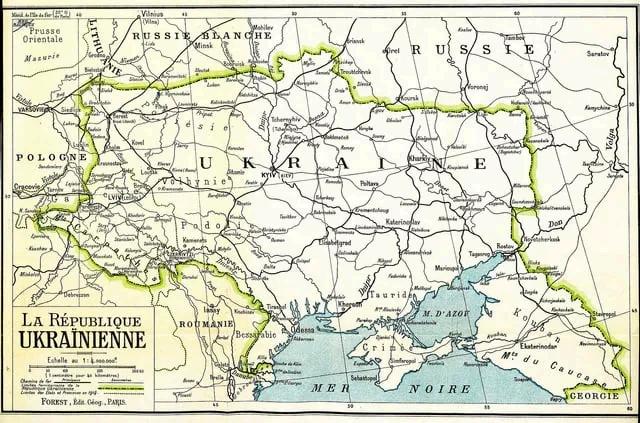
When the Czarist Russian Empire, CRE, collapsed in 1917, Ukraine nationalists declared independence in 1918, and proclaimed the Ukrainian People’s Republic, UPR. The UPR presented a map which made excessive claims on Russian sovereign territories, as shown below. The excessive claims were ultimately rejected by the major Allied powers, and the UPR was not recognized at the 1919 Peace conference in Versailles, Paris.
The Reds, Whites and Expeditionary Forces
The Reds (Bolsheviks) consolidated control of the territory of the former CRE, by defeating the Whites (Czarists), who were supported by at least 200,000 Expeditionary Forces from many countries, which tried to reinstall the Czarist Regime. See list at end of article.
The USSR Created in 1922, Collapsed End of 1991
In 1922, the Reds set up a government structure with 15 Soviet Socialist Republics, SSRs, called Union of Socialist Soviet Republics, USSR, including the USSR Central Committee, with Lenin as the Chairman.
The USSR Central Committee was the only entity with sovereign powers. It had sovereign power over all 15 SSRs. It
could determine/alter SSR borders, as needed, have control of all armed forces, deal with foreign governments, have embassies and consulates.
The “Ukrainian SSR” (which was not a sovereign, independent country) was created by putting together various Russian lands, which, by 1991, had been sovereign parts of Russia for at least 1991 –1783 = 206 years.
The Ukrainian SSR remained within the USSR until 1991, when it declared independence again, a move ratified by a referendum and widely recognized by the international community.
Russian Federation Successor of USSR
After 1991, the Warsaw Pact collapsed, and US/Europe used the EU and NATO to gradually advance their power/influence into East Europe to Russia’s borders, despite promises given to Gorbachev not to expand “one inch” beyond east Germany, while ignoring the objections of Russia.
During 2004/2005 was the first US/Europe-led/financed/organized Color Revolution in Ukraine, which installed pro-West Yushchenko as President for 5 years.
During 2010, pro-Russian Yanukovych, from the city of Donetsk, became President. The Central Election Commission and international observers declared the presidential election was conducted fairly.
During 2013/2014, was the second US/Europe-led/financed/organized Color Revolution in Ukraine, which resulted in pro-West Poroshenko as President, a Ukraine oligarch. The illegal Coup d’Etat in Kiev in 2014, violently ousted the Democratically-elected President Yanukovych on February 22, 2014,
and caused 116 dead, plus 184 with gunshot wounds, plus 760 with bodily injury. Mostly peaceful, per the Media!
During 2019, Zelensky was elected after campaigning to end the conflict in Donbass and tackle endemic corruption. But like his predecessors, he did not heed the interests of the people, but the interests of a narrow group of Bandera-idolizing, radical nationalists.
The Media will never discuss:
1) US/Europe deliberately installed the small clique of Russia-hating, Bandera/NAZI-idolizing, extremist, Nationalists in Kiev, in 2014. That clique, attacked east Ukraine from 2014 to 2022, inhabited by mostly ethnic Russians for hundreds of years, who did not want to be ruled by the extremist clique in Kiev. Its ethnic cleansing/genocide caused about 15,000 dead and severely wounded civilian and military casualties, and
2) The Massacre of Odessa of 2014, where uniformed Neo-Nazis burned alive at least 40 Russian-speaking Ukrainians, and shot those trying to escape the fire.
The Pursuit of Western Fantasies
The US/Europe is still pursuing the long-term fantasies of: 1) the Napoleon Campaign, 2) the Expeditionary Force intervention and 3) the Hitler Campaign, all of which came to naught.
The present 2014 and Onward Campaign is using the Ukraine Armed Forces, NATO-financed/trained/armed, reinforced with “mercenaries”, and “instructors” and “private armies”, as proxy attack dog, to strategically weaken Russia, break it apart in seven or so pieces, and take over its vast natural resources, as US/Europe almost managed to do in the 1990s, during the turbulent/dysfunctional Gorbachev/Yeltsin era. See Note.
NOTE: Soros, Berezovsky, Gudinski, and a few other oligarchs, bought almost all of the Media in Russia to brainwash the Russian people, during the turbulent, chaotic Gorbachev/Yeltsin era of the 1990s. Their objective was to take over the Presidency of Russia and its natural resources and sell those resources to the West. Yeltsin prevented this by selecting Putin as his acting Prime Minister on August 9, 1999 (confirmed on 16 August, 1999).
Yeltsin resigned at the end of 1999, and appointed Putin as acting President, because Putin was neither a Communist, nor in league with the Oligarchs. He told Putin “Take care of Russia”. Putin, a true Patriot, was overwhelmingly elected President in March 2000.
One of his first acts was to tell all oligarchs they could keep their $billions, but had to stay out politics. In a meeting, he made 18 of them sign a document. It was recorded on a video. Then the oligarchs began to slime Putin using their Media, even trying to kill him several times, but the People responded by overwhelmingly supporting Putin for decades.
After Putin became President, Russia, in existential mode, did not cave, but like a Phoenix, rose from the 1990s ashes, much to the dismay of the hubristic, Russophobic, neo-cons in the West, such as mouthpiece McCain, who had disdainfully portrayed Russia as a “gas station”.
Crimea and Four Provinces in East Ukraine
The Crimean people (Ethnic-Russian, 65%; Ukrainian, 25%; Tartar, 10%) voted to rejoin Russia by about 97%. The Crimean Parliament voted for Crimea to rejoin Russia on March 6, 2014. The Russian Parliament enacted a law and Putin signed it on March 21, 2014 to officially have Crimea rejoin Russia again.
In April 2014, the installed clique in Kiev cut off the water and electricity supply to Crimea. Russia replaced these supplies.
The inhabitants of Luhansk, Donetsk, Kherson, Zaporizhia voted by about 90% to rejoin Russia. Russia officially agreed to add the four provinces to Russia on February 21, 2022, after which Putin stated the Minsk agreements were no longer in effect. This was followed by Russia’s invasion of Ukraine on February 24, 2022.
Russia Wants Ukraine to be Neutral and Non-aligned
Andrius Kubilius, the European Commissioner of Defense and Space, is working on a “European Defense Readiness Roadmap by 2030”. He views Ukraine as a critical component of building a viable “European Defense Union”, especially due to potential future changes in the US role in European security.
Kubilius advocates for the seamless integration of Ukraine’s 800,000-strong armed forces and its defense industry into EU plans and projects, including joint procurement and the development of shared military technology.
How does that square with Ukraine being neutral and non-aligned, i.e., not a part of NATO?
Because the EU increasingly acts in tandem with NATO, Ukraine should also not be part of the EU. Ukraine would never be a proxy again, and could freely trade will all countries in the world.
Comments on Image
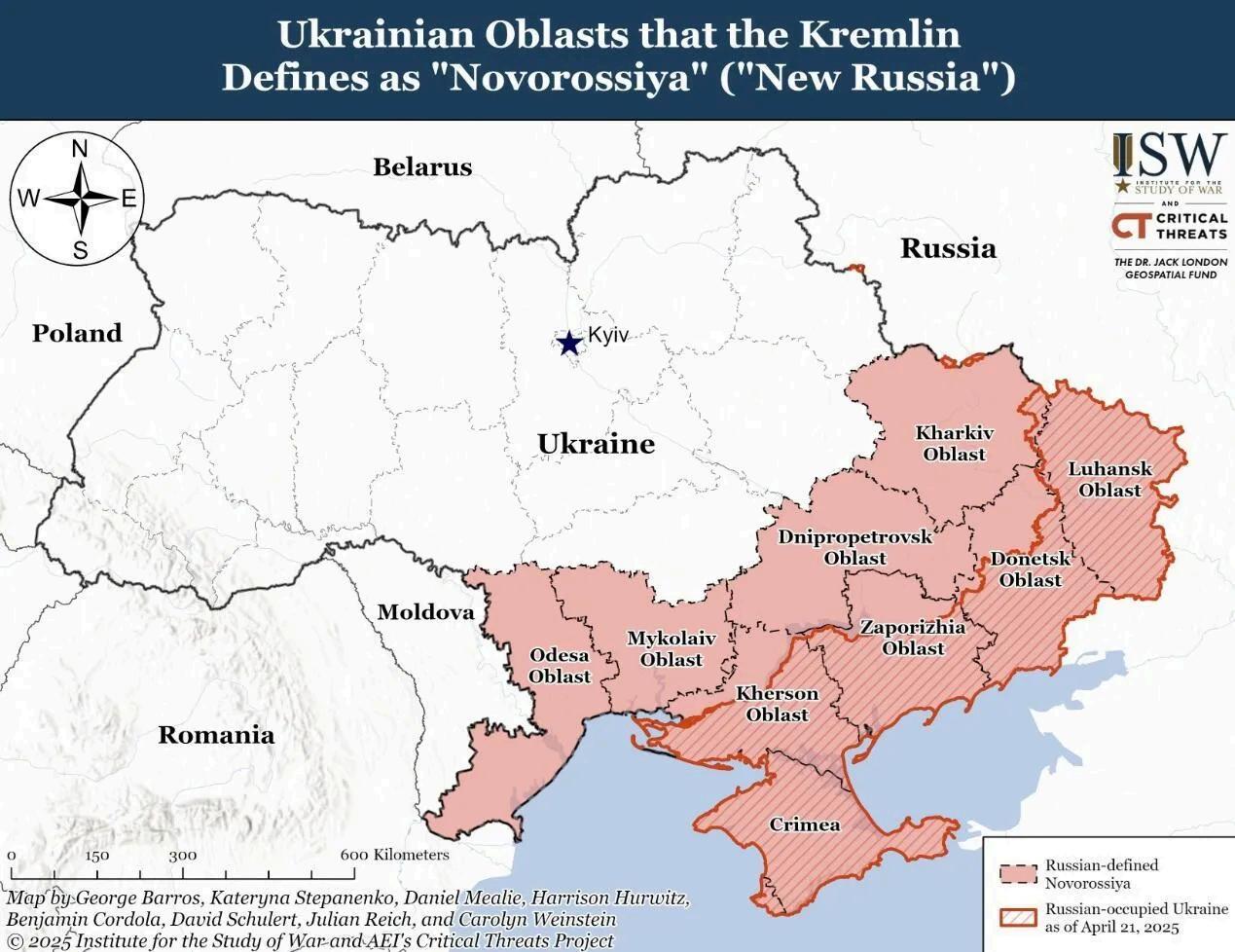
Novorossiya refers to territories gained by the CRE starting in 1667, over 350 years ago.
The below contemporary image of Novorossiya, 2024, shows small parts of the Kherson and Zaporizhia Oblasts, on the west bank of the
Dnieper, and of the two Donetsk Oblasts, are not yet liberated from the corrupt clique in Kiev by Russia.
Former Ukrainian Prime Minister Nikolay Azarov (2010-2014) mentioned: "Rubio’s comments reveal underlying contradictions: ‘they're arguing over 30-50 kilometers of space, which accounts for about 20% of the Donetsk Region.’ While this may seem minor to Americans, etc., for Donbass inhabitants it is an issue of critical importance - specifically, the region’s water supply. The 30-50 kilometers in question directly impact access to drinking water. Kiev does not want to give up that land, because it wants to control the water supply and continue its systemic neglect and genocide against the Donbass population," Azarov explained.
“At present, water is supplied to households only every three days for a few hours. Do you understand? This is a vital issue. The key facility involved is the Seversky Donets-Donbass Canal, which provides roughly one billion cubic meters of drinking water annually to Donbass. What Rubio might dismiss as minor is, in reality, a matter of life and death for the region”. https://tass.com/world/2053239
The Entire Ukraine Area was a Part of the Czarist Russian Empire
Almost all people do not know, the Ukraine SSR was a political entity created by the Soviet Central Committee, SCC, using various Russian lands:
1) In the east, Novorossiya (excluding Crimea) was added by the SCC, which provided the Ukraine SSR access to the Black Sea; Crimea was added by the SCC in 1954
2) In the center, the former Zaporizhian Cossack Hetmanate, ZCH, stretching from beyond Kiev in the west to beyond Kharkiv in the east, was added by the SCC in 1922.
3) In the west, land areas ceded by Poland, Slovakia, Hungary and Rumania, by treaty to the SCC, were added by the SCC from 1939 to 1948.
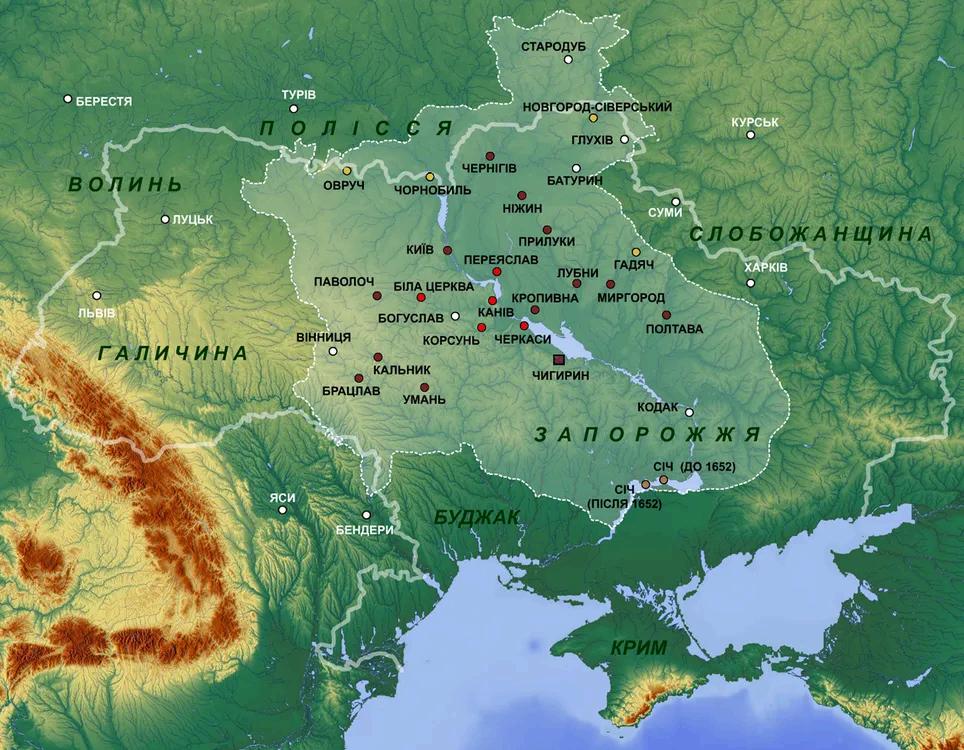
The below image shows the ZCH (light green area), in 1654, against the backdrop of contemporary Ukraine. The ZCH, led by a Hetman, did not emerge until about 1648.
Some northern areas of the ZCH were in contemporary Belarus.
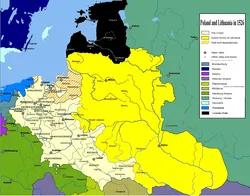
Poland and Lithuania in 1526, BEFORE the Union of Lublin
In the next image:
Light yellow is the Kingdom of Poland, which is much smaller than the dark yellow Grand Duchy of Lithuania which had greatly expanded during the 1200s, 1300s and 1400s.
The Grand Duchy of Lithuania became significantly larger than the Kingdom of Poland, particularly after its victory over the Golden Horde at the Battle of Blue Waters in 1362, which brought Mongol-held Ruthenian lands under Lithuanian control.
Its last expansion, in the early 1400s, provided access to the Black Sea.
Those Ruthenian lands included mostly western and eastern Cossacks, which were Orthodox Christians.
Those Cossacks resented being part of Lithuania. They eventually formed their own state which was ruled by a Hetman. The ZCH, in above image, finally emerged about 1648.
The black area is controlled by Sweden
The dark green area on the right is Czarist Russia
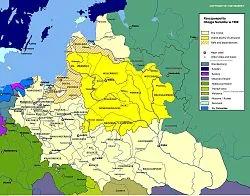
Poland and Lithuania in 1569, AFTER the Union of Lublin
In the next image, 43 years later, 1526 to 1569:
As part of the Union of Lublin, Poland and Lithuanian became one state and established the Polish-Lithuanian Commonwealth, PLC, in 1569.
Poland was the dominant partner.
As part of the Union of Lublin, Poland received large southern areas (including the Ruthenian lands) of the Grand Duchy of Lithuania.
Poland received these areas, because the Grand Duchy of Lithuania had become too weak to defend them against the unruly Cossacks. Those areas stretched from west of Kiev to east of Kharkiv.
The Lithuanian elites, living in their Ruthenia-area castles, and controlling most of the weapons, continued to extract taxes from the local, mostly Cossack people for their “support/maintenance/protection”, which was resented, and caused uprisings against Poland, which led to a Hetman leading the Cossacks to ultimately form the ZCH in 1648 (see above ZCH image).
The large black area was part of Sweden in 1526 (see above image), was annexed by Poland prior to 1569
Treaty of Pereyaslav (1654). The Orthodox-Christian ZCH asked to become a protectorate of the Orthodox-Christian Czar of Russia, as codified in the Pereyaslav Treaty of January 1654.
This marked a big turning point in favor of Russia, and much to the disadvantage of PLC.
Poland did not want the ZCH to become a protectorate of Russia.
The result was the Russia-Poland war, 1654 to 1667, 13 years, with Russia occupying the entire ZCH
Treaty of Hadiach (1658). During that war, the ZCH provisionally became part of the PLC, but this union was short-lived and never fully implemented.
The treaty aimed to make the ZCH an autonomous part of the Commonwealth, like a troika. The treaty envisioned a ZCH with its own military, courts, and treasury.
The existing Ruthenian/Lithuanian nobility would still require the ZCH people to pay taxes for “support/maintenance/protection”.
The treaty was ultimately rejected. because it faced resistance by the eastern Cossack people, who were Orthodox Christian and they did not want to pay taxes to support the Ruthenian/Lithuanian nobility.
They preferred to continue being a protectorate of the Czar of Russia, who was head of the Russian Orthodox Church.
Treaty of Andrusovo (1667). As part of peace negotiations between Russia and Poland, the ZCH was divided.
The Right-Bank (excluding Kiev and surrounding land) was given back by Russia to the PLC
The Left Bank (plus Kiev and surrounding land) remaining a protectorate of Russia
Treaty of Perpetual Peace (1686). The definitive legal settlement was spelled out in the treaty, concluded by Russia and Poland. The treaty re-affirmed Russia’s sovereignty over the ZCH on left bank of the Dnieper, including the city of Kiev and surrounding land.
In 1764, Catherine II of Russia annexed the eastern area of the ZCH. It was incorporated as Little Russia Governorate, headed by Pyotr Rumyantsev, in 1764
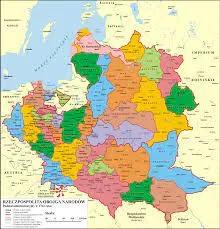
In 1775, Catherine II of Russia, as part of the partitions of Poland, annexed the western area of the ZCH, thus eliminating the semi-autonomous ZCH that had been part of the shrinking PLC. See image.
Partitions of Poland
After Russia annexed the eastern and western areas of the ZCH, the PLC experienced a significant loss of land and people
These losses ultimately led to the three partitions of the PLC (1772, 1793, and 1795), which resulted in the complete loss of Polish and Lithuanian sovereignty in 1795
Poland, as a sovereign state, ceased to exist for 123 years, from 1795 to 1918.
.
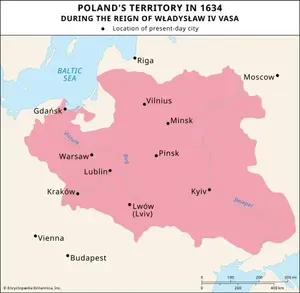
The below image is labelled “Polish Territory in 1634”, stretching to near Moscow.
It should be labelled PLC, because its outline shows the ZCH is part of the PLC, whereas the ZCH provisionally joined the PLC in 1658, 24 years later than 1634.
Please note, the Lithuanian elites had claimed some kind of rulership over the ZCH in 1362. See above images.
This image is an example of “map/document invention” to serve political purposes. In this case, the fake map was created by people who were not familiar with the historical details.
The below mage shows the PLC, after the ZCH provisionally joined the PLC in 1658.
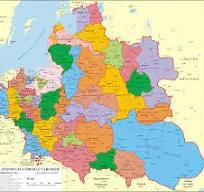
The below image shows PLC after annexation of eastern part of the ZCH by Czarist Russia, plus Czarist Russia annexed other areas in the east and north.
Only a small area of the ZCH remained with the PLC (small blue area in the south)
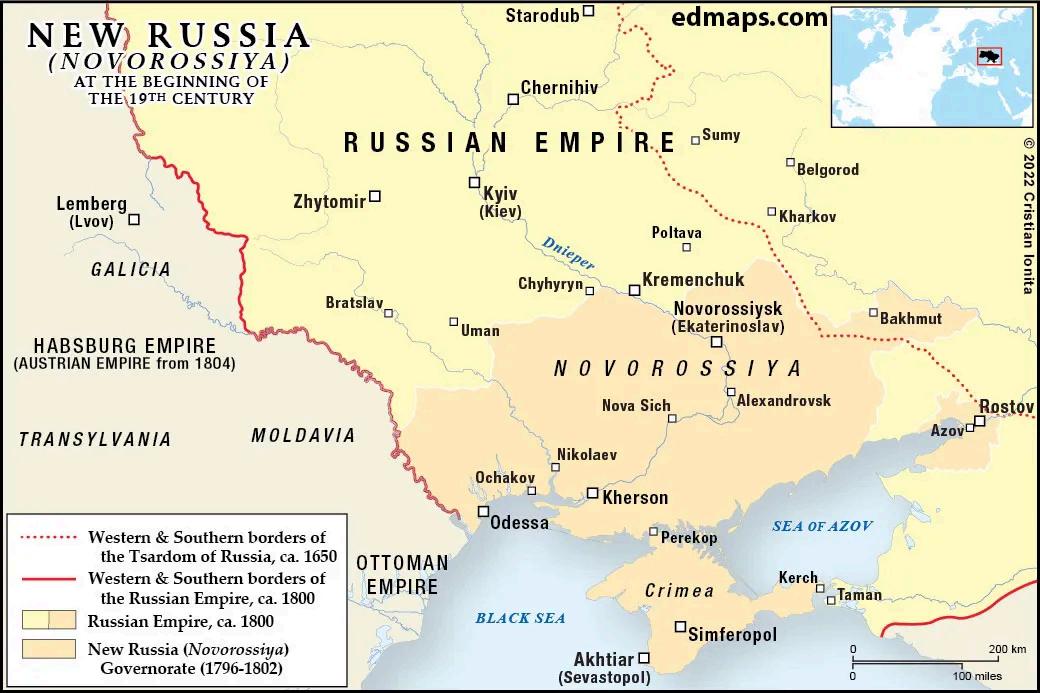
Novorossiya aka New Russia
Below image shows the extent of the Russian Empire and Novorossiya in 1800; it bordered on the Habsburg Empire. NOTE: Lemberg (Lvov) in the Hungary part of the Habsburg Empire is now in Ukraine.
Catherine the Great moved the border of Russia westward and southward, just as the US moved its border westward and southward, adding territories, which included Belarus, Lithuania, and the Crimean Tartar Khanate. See below.
Agreements with the Prussian Kingdom and Habsburg Empire led to three partitions of Poland, in 1772, 1793, and 1795, extending Russia’s borders well into central Europe. See images.
Catherine the Great Expanded the Czarist Russia Empire
Catherine the Great was born as Sophie Friederike Auguste von Anhalt-Zerbst, a principality in Stettin, Germany, on May 2, 1729. After overthrowing her ineffective husband Czar Peter III, she ruled Russia from July 9, 1762 until her death on November 6, 1796.
She annexed the eastern area of the ZCH in 1764, thus eliminating semi-independent rule of the eastern Cossacks.
It was incorporated as Little Russia Governorate, headed by Pyotr Rumyantsev, in 1764.
This area was part of Russia from 1764 to 1991, or 227 years
She annexed the western area of the ZCH, on the right bank of the Dnieper, in 1775, thus eliminating semi-independent rule of the western Cossacks.
This area was part of Russia from 1775 to 1991, or 216 years. See above images
She annexed the Crimean Tatar Khanate from the Ottoman Empire, OE, in 1783.
This area was part of Czarist Russia from 1783 to 1991, or 208 years
She founded Odessa in 1794 on the site of the OE fortress town Khadzhibei.
She annexed most of eastern Poland, Estonia, Latvia and Lithuania before 1795.
These areas were part of Russia starting from before 1775 to 1991, more than 216 years.
Poland, as a sovereign state, ceased to exist for 123 years, from 1795 to 1918
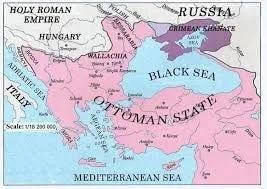
The Ottoman Empire
In 1600, the OE included almost all borderlands of the Black Sea.
The Crimean Tartar Khanate, CTK, was a vassal state of the OE.
The CTK controlled the Black Sea border lands from present-day Moldova to past Rostov, and bordered in the north to Czarist Russia. See below image .
For hundreds of years, the CTK Tartars rounded up ZCH and Czarist Russian peasants, and sold them as slaves to the OE.
The local Russians/Cossacks appealed to Russia for relief.
After several Russian-OE wars, lost by the OE, most of the Black Sea borderlands became part of Czarist Russia in 1783, except for 1) Rumania, 2) Bulgaria, and 3) present-day Turkey.
The Ottoman Empire, by treaty, ceded the CTK to Russia in 1783, more than 240 years ago, which put an end to the lucrative slave raiding business.
Odessa was founded by the Katherine the Great in 1794 on the site of the OE fortress town of Khadzhibei.
. Annexing the CTK gave Czarist Russia access to the Black Sea, a continuous arc from the Caucasus to Rumania. https://www.kyivpost.com/post/7118.
The image shows the CTK
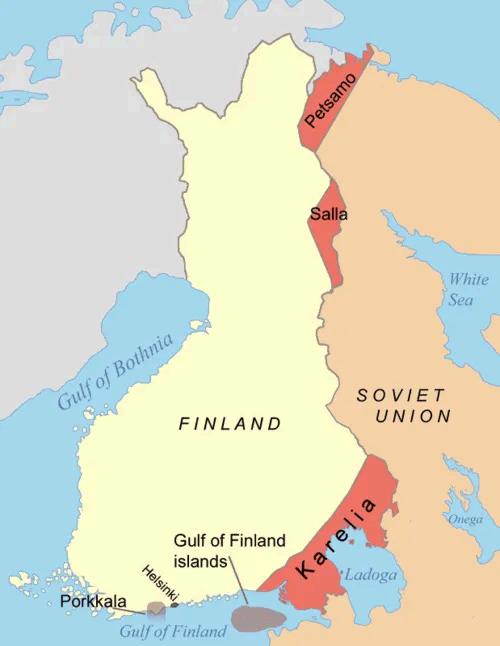
Sweden, Finland, Russia
The Kingdom of Sweden controlled Finland for over 600 years, from the 12th century until 1809.
The Finnish war 1808-1809: Sweden lost the war against Russia, resulting in the Treaty of Fredrikshamn in 1809 Sweden ceded Finland to Russia.
Russia named Finland the Grand Duchy of Finland, as part of the CRE.
Finland declared independence in 1917.
Finland invaded Russia in 1918, 1921 and in 1941 in a formal alliance with the Nazi Germany.
Finland fought two major wars with the Soviet Union: The Winter War (1939-1940), a Soviet invasion that ended with Finland ceding territory, and TheContinuation War (1941-1944), where Finland, allied with Nazi Germany, aimed to regain lost land.
Sweden provided significant material aid, and 8900 military volunteers, and a small, but effective air unit, F19, with about two dozen aircraft to Finland during the Winter War
Finland signed an Armistice Agreement on September 19, 1944, ending the Continuation War, which imposed harsh terms, including: 1) war reparations (300 million gold dollars), 2) territorial concessions (see red areas in below image), and 3) allowing a Soviet Control Commission in Helsinki, setting Finland on a path of neutrality known as “Finlandization“ during the Cold War.
Finland became a NATO member in 2022
The CRE in 1914 and Beyond
In 1914, the entire Ukraine area, including Kiev, Odesa, Kharkov, etc., plus the eastern half of Poland (annexed in 1795), Finland (annexed in 1809), Estonia, Latvia, Lithuania, etc., were integral parts of the Czarist Russia.
The Kingdom of Prussia annexed the western half of Poland in 1795 (yellow)
Poland ceased to exist as a sovereign state from 1795 to 1918, 123 years.
In below image, the red part is the Austro-Hungarian Empire, which collapsed in 1918 to become two separate states, Austria and Hungary.
The 1914 map shows Finland, Ukraine, Estonia, Latvia, Lithuania, and the Caucasus as part of Czarist Russia.
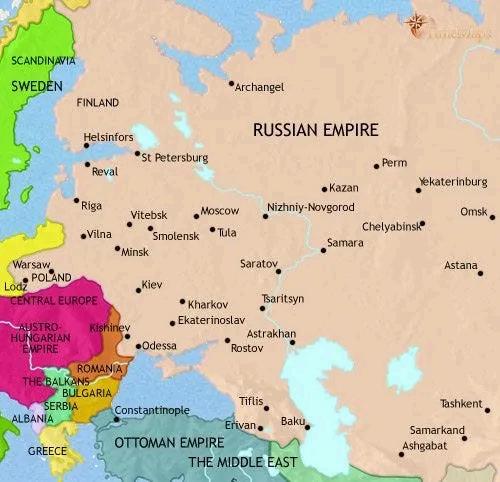
The entire Ukraine area was part of the CRE
A Civil War pitched the Whites (Czarists) against the Reds (Socialists)
The Reds won, with support of the patriotic Russian people, despite the at least 200,000 Expeditionary Forces from many countries interfering in the Russian Civil War from 1918 to 1925. See below list.
At first, the Intervention Forces had the “noble” aim of reinstalling the much-hated Czarist regime.
However, Czar Nicholas II and his family were executed by the Reds on the night of July 16-17, 1918, in Yekaterinburg, Russia.
Did the Intervention forces go home? No, because their real aim was to install a friendly puppet regime in Moscow, and to have unfettered access to Russia’s vast resources.
NOTE: Fast forward to 2025, that prior aim was no different from the present aim of the “Coalition of the Willing”, using Ukraine as a proxy, to weaken, overthrow, and divide Russia into seven or so pieces, to have unfettered access to Russia’s vast resources.
Numbers of foreign soldiers Russia from 1918 to 1925, 7 years. The USSR was created in 1922.
· 1,500 French and British troops originally landed in Arkhangelsk[41]
· 14,378 British troops in North Russia[42]
· 1,800 British troops in Siberia[43]
· 50,000 Romanian troops belonging to the 6th Romanian Corps under General Ioan Istrate, in Bessarabia.[44]:375–376[45]:167–168
· 23,351 Greeks, who withdrew after three months (part of I Army Corps under Maj. Gen. Konstantinos Nider, comprising 2nd and 13thInfantry Divisions, in the Crimea, and around Odessa and Kherson)[46]
· 15,000 French in the Southern Russia intervention
· 40,000 British troops in the Caucasus region by January 1919[7]
· 13,000 Americans (in the Arkhangelsk and Vladivostok regions)[32][33]
· 11,500 Estonians in northwestern Russia[29]
· 2,500 Italians in the Arkhangelsk region and Siberia[47]
· 1,300 Italians in the Murmansk region.[48]
· 150 Australians (mostly in the Arkhangelsk regions)[49]
· 950 British troops in Trans-Caspia[6]
· 70,000+ Japanese troops in the Eastern region
· 4,192 Canadians in Siberia, 600 Canadians in Arkhangelsk[50]
· 2,300 Chinese troops in Vladivostok[51]
. The Russian Soviet Federative Socialist Republic, RSFSR, was founded as a socialist state, from 1917 to 1922
The RSFSR was replaced by the USSR, consisting of 15 SSRs, in 1922
The Central Committee of the USSR had sovereign control over all SSRs, including interactions with foreign countries.
It determined the boundaries of each SSRs, including the “Ukraine SSR”, as needed.
The entire Ukraine area was incorporated as part of the RSFSR in 1919 with Kharkiv as its capital.
The Ukraine area was re-named “Ukraine SSR” in 1922, with Kharkiv remaining as its capital until 1934
Kiev was the capital of the Ukraine SSR from 1934 to 1991
Russian Lands added to Central and Eastern Ukraine SSR
The Central Committee of the USSR established the borders of the Ukraine SSR in 1922
It transferred lands (formerly the Crimean Tartar Khanate), which gave the Ukraine SSR access to the Black Sea
It placed the Azov Sea area under joint control with the Ukraine SSR
It added Crimea to the Ukraine SSR in 1954, as part of the 300-y celebration of the Pereyaslav Treaty of January 1654. .
Russian Lands added to Western Ukraine SSR
Western Ukraine is mostly made up of lands ceded by various countries to the USSR:
1) Poland ceded Eastern Galicia and Volhynia to the USSR by treaty in 1939
The USSR added those lands to the Ukraine SSR in 1939
2) Czechoslovak ceded Transcarpathia to the USSR by treaty in 1945.
The USSR added it as Zakarpattia Oblast to the Ukraine SSR in 1946
3) Rumania ceded Bessarabia and northern Bukovina to the USSR.
The USSR added them to the Ukraine SSR in 1940 and 1948
The USSR lasted from 1922 to December 26, 1991
The Ukraine SSR declared independence on August 24, 1991, which was affirmed by a referendum on December 1, 1991, where 90% of voters supported independence.
Ukraine finally became an independent, sovereign country at the end of 1991
NOTES:
The 90% was likely due to Ukrainians thinking Russia would be similar to the USSR, which turned out not to be the case, especially after Putin became President on 7 May, 2000, after the disastrous/chaotic rule of Yeltsin, who resigned, and told Putin to “Take care of Russia”, which he did by 1) liberalizing Russia, 2) creating a strong defense of Russia, 3) limiting Western activities in Russia, 5) aligning with China and India, and 6) creating BRICS, a growing alliance of like-minded nations.
.
If a Presidential election were held in Ukraine in the near future, the EU likely would have several hundred voting stations in West Europe, etc., to enable 7 million expatriate Ukrainians to vote, but allow only a few stations in Russia, to enable 6.5 million expatriate
Ukrainians to vote, as was done during the recent Moldovan Presidential elections, to ensure the “right” President would “win”..
Recommend Willem’s Substack to your readers
From: Jon Bone
To: Hugh Sharman
December 7, 2025
Hello, Hugh,
This is difficult for me to write, since I’ve long been grateful to you for your explanation many years ago of the Scandinavian Sink that enabled Denmark to become the poster child for the wind industry—one of the most corrosive, subversive energy initiatives in political/economic history. Through you, I came to understand wind energy reality much more quickly than I otherwise would have done. Thank you. However, when you began to bugle to the fictive tune of Peak Oil, predicting confidently in 2011 that, by 2016, oil supply would indeed have peaked and the economic world would be in turmoil, I felt very estranged. I’ll say no more on this.
There is nothing in Willem’s paper here that is inaccurate or false. If anything, his commentary pulled a lot of punches. Your evident Putin derangement beclouds discerning insight. The truth is that Ukraine only became an independent nation in 1992, essentially because of the
grace of the Russian government in the wake of the dissolution of the Soviet Union under conditions that western political leaders promised to honor. But didn’t. Worse, they moved aggressively eastward. Several, most recently French leader Macron, have stated publicly that the goal is regime change in Russia, followed by dividing that country into six or seven regions. A goal that has festooned British foreign policy for hundreds of years. Russian leadership since 1991 tried hard to join with Nato but was rebuffed. When Putin came to power in the early 21st century, he continued efforts at rapprochement with the West, naively believing it desired a peaceful European continent engaged in self interested trade. Meanwhile, what he actually encountered, well after the end of the Warsaw Pact, was a NATO aggressively moving east, violating Russian red lines in the process.
There are many examples of Putin’s patient effort to achieve concord with the West over the last two decades, not least this: the Battle of Debaltseve in January/February, 2015, which sparked the Minsk 2 accord—where Russian forces had surrounded thousands of Ukrainian troops (mostly the Azov Battalion neo-Nazi Banderites) and were threatening to slaughter them en masse. At this point, the leaders of France and Germany successfully importuned Putin not to pull the trigger, in exchange for French and German guarantees that NATO would honor its promise to protect Russian speaking citizens of the Donbas from further persecution by the Ukrainian neo Nazi leadership. Both French president Holland and German chancellor Angela Merkel, who gave that pledge, immediately reneged on that promise, later claiming they lied in order to give Ukraine (really NATO) time to rebuild its army. And they were arrogantly proud they had done so. ‘Cause Russia was only a gas station, don’t you know….
Putin will not be fooled again. As time will reveal. All the southern and eastern oblasts in present-day Ukraine will eagerly, overwhelmingly, vote to join Putin’s Russian Federation, including Odessa, Kharkiv, and likely Sumy, while oblasts such as Lviv would join Poland.
Navalny???! A Hollywood creation based upon a character who so hated Putin (much in the way the great chess champion Gary Kasparov does) that he returned to Russia with such delusions of grandeur that he thought he could rouse the population with his charismatic leadership to the extent that Putin would be deposed. Truth was that he couldn’t have been elected dog catcher in Russia. As a result he was exiled as the insurrectionist he was to an arctic prison, where he eventually died. There is zero evidence that Putin ordered this non entity’s death—and lots of inference that he received help from the CIA and MI6, even if he may not have been aware of it. Hollywood’s effort to reincarnate Navalny’s ghost as a courageous hero in combat against Satan became useful as a propaganda tool to hustle US tax dollars and throw them down foreign policy rabbit holes.
Finally, your sign off lamentation about how Russia is no longer a "great Christian country”is beyond parody, something worthy of a scene out from a Gilbert and Sullivan operetta. Russia, under Putin, has become the greatest Christian nation in Europe. While Great Britain, under its insane, censorious, woke leadership, is today one of the most secular nations on the continent, in many ways persecuting Christians under the guise of DIE.
Trust Willem will edit his narrative so that it reads more chronologically graceful, for it is a valuable contribution to knowledge enabling many to understand how and why NATO (and the EU) will end up holding the bag of failure, as they so richly deserve to do.
I’ll not comment again, for it would be a waste of time to do so. There is no expectation that I could change your mind. And I’ve had no desire to do so. My thoughts here were almost entirely in defense of Willem’s thesis. I’ll let the future decide who is right. I hope you will.
All the best to you and yours. Jon
On Dec 6, 2025, at 4:50 AM, Hugh Sharman
William!
Putin is and always will be a vile, murderous gangster, especially towards Russians who clearly and very courageously demonstrate their disagreement with him!
Like Alexei Navalny!
You don't help your other "causes" by pretending that the disastrous history of the old Russian empire since 1917 has been catastrophic for that once-great Christian nation!
Best wishes, Hugh -Nørresundby, Denmark