
30 COPmeetings without any climate effects
Erik Bye
December 9, 2025
IPCC
The Intergovernmental Panel on Climate Change (IPCC) was established in 1988 due to an extreme fear of uncontrolled global warming. The first main climate report (FAR orAR1) was presented in 1990.At the same time, the first COP meeting, coordinated by the UN, was arranged in 1995, i.e. Conference of the Parties. The organisers probably had a tremendous belief in such an organisation and meeting. The meeting this year, in Belem, Brazil, was the 30th in a row, and some concluding considerations have been put forward to look into details: whether any substantial climate effects could be detected over the last 30 years.
COPmeetings
Delegates from the UN, from Governments and Parliaments of the nearly 200 member countries, climate researchers and members from wildlife and worldwide environmental organizations come together each year for this meeting.
Travelling by private aircraft, from all over the world, they contribute highly to the emissions they fight against.
An increase in delegates and participants from thousands in the beginning, and ending up with 50 – 60,000 participants in Belem this year.
Climate actions
So, what have been the climate actions over the past thirty years to control the climate? First, how is the feared global warming being attacked? Here is a description of the various climate measures being thrown into the “boxing ring”:
2˚C measure
Under the COP15 meeting in Copenhagen 2009, the 2˚C goal was presented by the politicians. This was the temperature increase we should be below by 2100. The most remarkable about this first formal climate goal was the announcement without any scientific documentation. The goal was taken straight out of the air, and the UN expected that this goal should be obeyed, and the world just said: Yes!
Paris agreement - 1.5˚C measure
In 2016, the Paris Agreement was signed:
https://unfccc.int/process-and-meetings/the-paris-agreement
During the COP22 meeting, UN members agreed on a new goal, preferably to be below 1.5˚C. Then, the specific time was not specified in any manner, but the limit was accepted, although the scientific evidence for the goal was still missing.
In addition, there is a peculiar decision in this agreement made during the meeting. Those countries which needed more energy were allowed to increase their emission of fossil fuels until 2030. Each country stated the need, as the increase in percentage, compared to 1990.As an example, China, with the largest emission of fossil CO2 in the world, about 12 billion tonnes/year (~12 GT/year), has seen an increase of 450% since 1990. Thus, ending up with ~14 GT/year in 2030. This increase is mainly based on new coal power plants installed in China. This means that the permitted increase for many UN member countries continues at the same time as the rest of the UN countries are handling a reduction in their CO2 emissions at a high cost.
One might ask: Do all the UN member states remember the admission of this increase?Although the reduction of CO2 emissions is being seriously addressed by many countries, the perspective for next year is an increase in the atmospheric CO2 concentration by 1.2%.
The Green Deal
The complete process for the change from fossil to green energy is called The Green Deal. The change to new renewable energy implies the development and use of: solar energy, watercraft, windmills on land and the oceans, as well as atomic power and developing the use of hydrogen as an energy carrier.
In the beginning, it was almost a holy attitude toward The Green Deal. However, now, after about ten years, the air is leaving the balloon. The development and application of solar panels, the production of wind energy and the hydrogen production have failed, in the sense that the change has slowed down; several industries worldwide have been considered bankrupt.
When and how will the UN and all the nearly 200 member states realize the impossibility of this Green DealAction?
Reduction of CO2 emissions
From the very beginning, in 1988, fossil CO2 has been accused of being the cause of global warming. Thus, it is anticipated that the reduction of fossil CO2 emissions would save all people and the Earth. The acceptance of the 1.5 degrees goal led almost automatically to the need for a worldwide reduction in CO2 emissions.
There are, however, several difficult questions related to the removal of fossil CO2 from the atmosphere:
Henry’s law determines the ratio of CO2 in the atmosphere and the sea. This is an equilibrium equation; the removal of CO2 from the atmosphere will automatically lead to increased emissions from the oceans to compensate for the withdrawal.
What should be the limit for reduction and withdrawal? Now, the level of CO2 in 1990 has been defined as the standard, without any documentation. This seems to be the rule in all climate questions. The set of determinations and decisions is made without any scientific documentation at all.
Acontroversial and slightly delicate question is how to handle the atmospheric mixture of fossil and natural CO2. Neither the photosynthesis nor the CO2-reducing processes can distinguish between natural and manmade CO2.
In a way, IPCC has already solved the problem by introducing the total amount of CO2 into the radiative forcings. This surprising detail is not openly discussed.
When will the world experience a decrease in the CO2 level? This is a real fight if the natural emission is 94.5%. For those who are convinced about the cause of global warming being the fossil part of the CO2 gas, it must be a mental challenge to oppose the continued quadratic increase in the CO2 level, see Figure 1.
Afund for the World
The fund was established because the rich countries were accused of causing the world's problems and thus should pay for the enormous damage. These were caused by mankind using fossil fuels. But this is not documented and is not increasingly understood and accepted.
The history of 30 COPmeetings
The results of the 30 meetings are amusingly reported on WUWT by the editor
Antony Watts:
The farcical COP30 U.N. climate conference ends today. Looking back at 30 of these conferences, one thing is clear: there have been 30 COPs to date after the founding conference in Rio in 1992, and not one has reduced either global temperatures, carbon dioxide emissions, or sea level rise – or even slowed their trajectory.
These COP conferences and the toothless agreements that flow from them are the supposed vehicles for planetary salvation. Based on the data, thus far, they have a perfect record of failure.
I was also going to plot money spent against the COP conferences, but because much of it is not publicly reported, I could not find accurate data. However, one can imagine the results are nearly identical to the three graphs below It’s time to end this COPfarce.
https://wattsupwiththat.com/2025/11/21/friday-funny-cops-1-30-a-perfect-recordof-failure/
Illustrated by the three following brutal, revealing and somewhat ironic pictures:
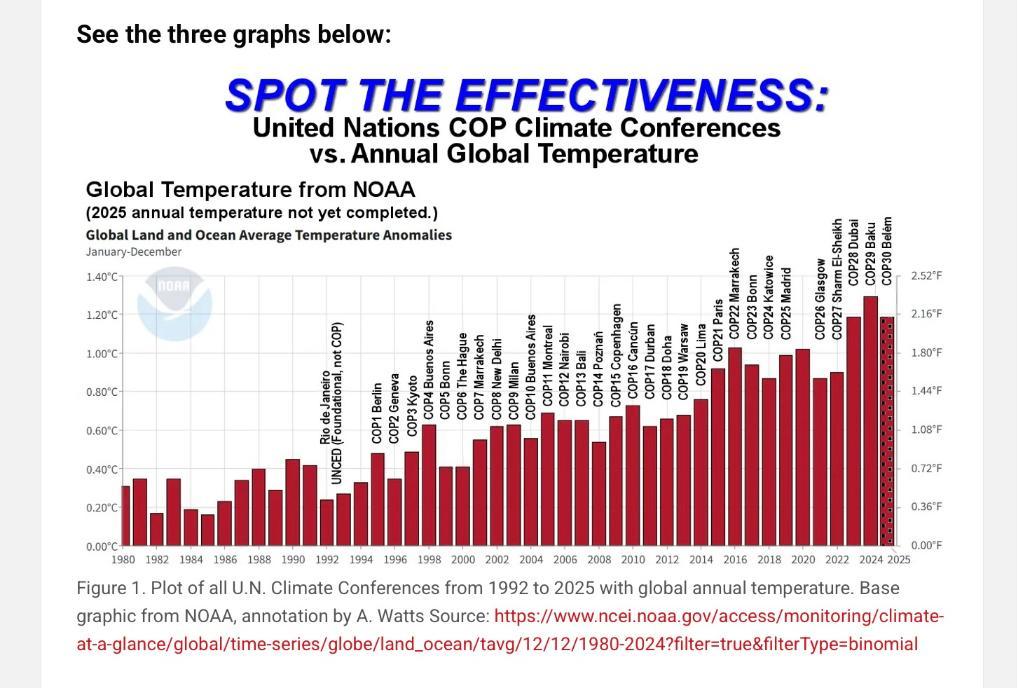
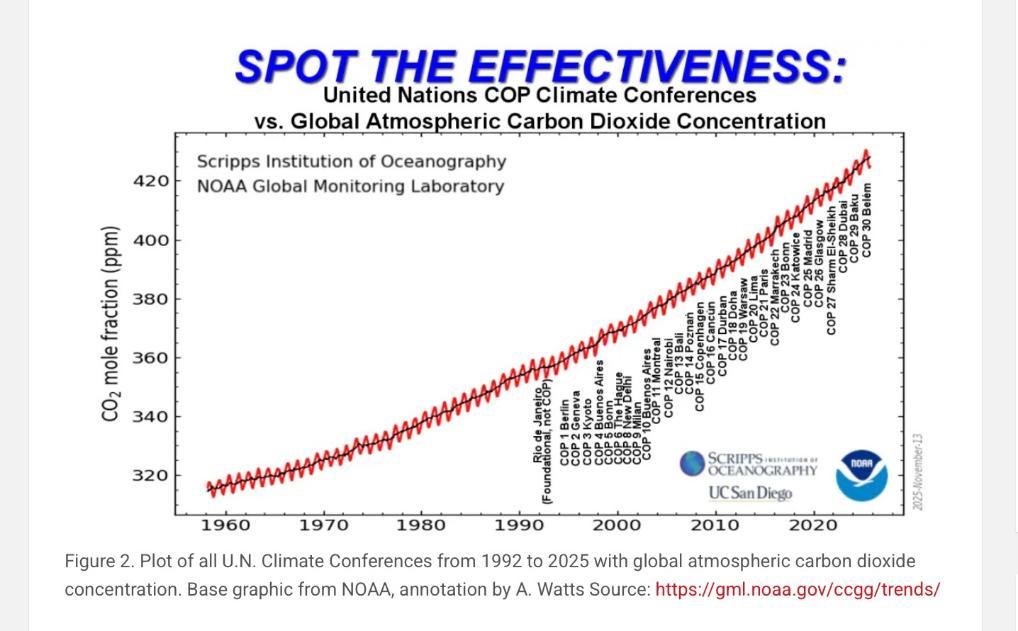
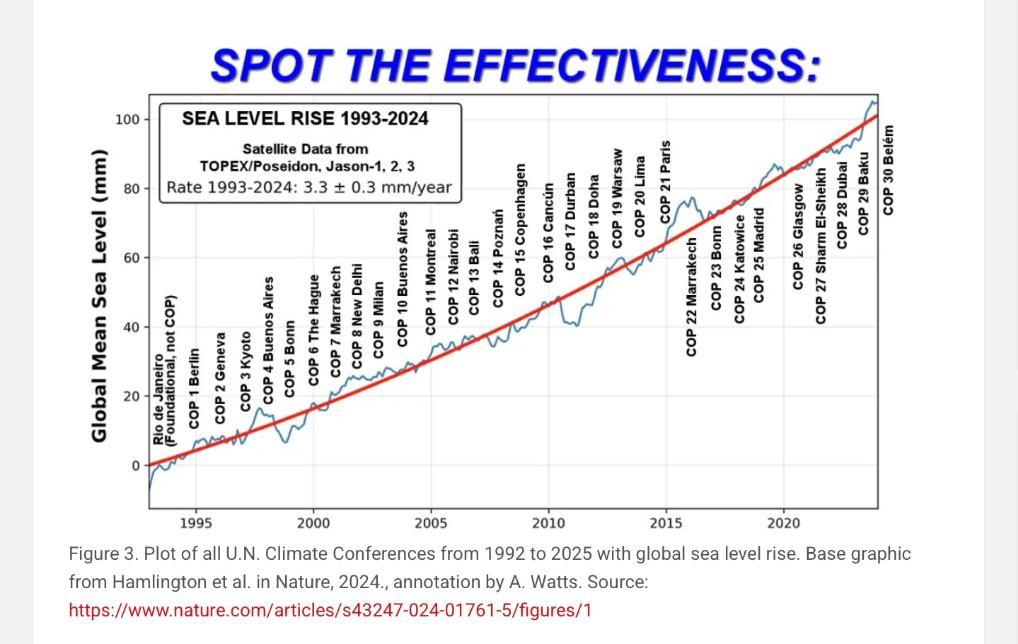
Figure 3. The Sea level rise and the COPdates.
Is it possible to see any effects of the 30 COPmeetings?
The short and brutal answer to this question is: NO!
This is proof positive that the COPmeetings should be terminated!