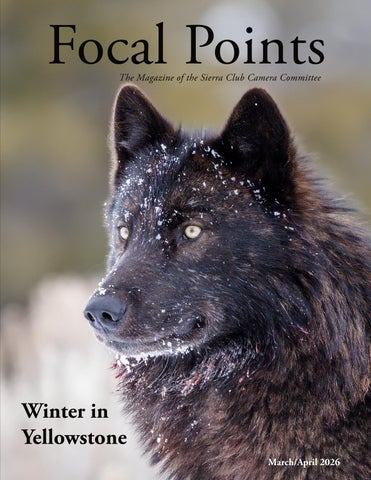
Focal Points March/April 2026

Page 1


Focal Points

Winter in Yellowstone

Chair

Programs

Treasurer

Membership

Editor

Communications

Instagram Outings Outings

SCCC Leadership

Joe Doherty

Susan Manley

Ed Ogawa

Joan Schipper

Joe Doherty

Velda Ruddock

Joan Schipper

Joan Schipper

Alison Boyle

joedohertyphotography@gmail.com

SSNManley@yahoo.com

Ed5ogawa@angeles.sierraclub.org

JoanSchipper@ix.netcom.com

joedohertyphotography@gmail.com

vruddock.sccc@gmail.com

JoanSchipper@ix.netcom.com

JoanSchipper@ix.netcom.com

AlisoniBoyle@icloud.com

Focal Points Magazine is a publication of the Sierra Club Camera Committee, Angeles Chapter. The Camera Committee is an activity group within the Angeles Chapter, which we support through the medium of photography. Our membership is not just from Southern California but is increasingly international.

Our goal is to show the natural beauty of our world, as well as areas of conservation concerns and social justice. We do this through sharing and promoting our photography and by helping and inspiring our members through presentations, demonstration, discussion, and outings.

We have members across the United States and overseas. For information about membership and/or to contribute to the magazine, please contact the editors or the membership chair listed above. Membership dues are $15 per year, and checks (payable to SCCC) can be mailed to: SCCC-Joan Schipper, 6100 Cashio Street, Los Angeles, CA 90035, or Venmo @CashioStreet, and be sure to include your name and contact info so Joan can reach you.

The magazine is published every other month. A call for submissions will be made one-month in advance via email, although submissions and proposals are welcome at any time. Member photographs should be resized to 3300 pixels, at a high export quality. They should also be jpg, in the sRGB color space.

Cover articles and features should be between 1000-2500 words, with 4-10 accompanying photographs. Reviews of shows, workshops, books, etc., should be between 500-1500 words.

Copyright: All photographs and writings in this magazine are owned by the photographers and writers who created them. They hold the copyrights and control all rights of reproduction and use. If you desire to license one, or to have a print made, contact the editor at joedohertyphotography@gmail.com, who will pass on your request, or see the author’s contact information in the Contributors section at the back of this issue.

https://angeles.sierraclub.org/camera_committee

https://www.instagram.com/sccameracommittee/

Focal Points

March/April 2026

2 From the Chair

3 Announcements

38 Member Photos

85 Contributors

88 Parting Shot

COVER STORY

4 Winter in Yellowstone - 2026

Patience pays off as SCCC photographers get close to wolves and a terrified coyote during an unseasonably warm January in the Lamar Valley.

By John Nilsson, John Fisanotti, Basil Katsaros, and Brent Paull

COLUMNS

16 Chasing Fuji: Photographing Japan’s Sacred Mountain from Every Horizon

By Greg Metro

22 How It Was Done: Photograph of the Lunar Eclipse

By John Fisanotti

27 Outings: Malibu Creek State Park by Joe Doherty Downtown LA at Night by John Nilsson

Cover Photo: A Yellowstone

Basil Katsaros, John Nilsson, Brent Paull, John Fisanotti, Richard Watkins, and Mike Caley in the Lamar Valley. Photographer unknown.
wolf in the Lamar Valley © Brent R. Paull

As a teenager I had subscriptions to three monthly photography magazines: Popular, Modern, and Petersen’s. Once a year Popular Photography and Modern Photography had BIG ISSUES that were thick with features and reviews and columns and lots of advertising. In fact they were mostly advertising, but they also had some excellent photography.

This issue of Focal Points is a BIG ISSUE, but without the advertising. It didn’t start that way. We knew in January what the cover would be, a collaborative work of five photographers documenting a winter trip to Yellowstone. We are usually able to recruit someone to write an instructional column or something similar. We also knew that two outings would become trip reports, and of course the Members section would be full of great photographs. That would bring us to about 60-65 pages, the average length of this magazine.

But then the content poured in. The cover story is usually ten pages. This one went to twelve. Greg Metro’s images of Mt. Fuji were an unexpected delight, and another six pages.

John Fisanotti’s instructional article on creating his lunar eclipse image was five pages. Overall

this was a little longer than usual by this point, but no matter.

Then the outings. We had four of them, three to Malibu Creek State Park and one to Downtown LA at night. Multiple members and soon-to-be members contributed images to these reports, and they are both celebrations of their subjects and a testament to the high quality work that our members produce. The magazine is about eight pages longer than usual at this point.

And then the members photos came in. It was an avalanche of great work by Thomas Cloutier, Paul Reinstein, Rebecca Wilks, Will Carlton, John Fisanotti, Velda Ruddock, new member Alen Kirecci, and yours truly. This magazine is a celebration of photography, and we must have celebrated a lot for this issue to reach ninety pages.

I could have cut it down by crunching more images into a page, but this is a collection of photographs that deserved multiple full-page and double-page spreads. I hope you agree. This is a BIG ISSUE because our members made it so.

Chas Glatzer Polar Bears

Thursday April 9, 2026 via Zoom

Charles (Chas) Glatzer M.Photog. is a Canon Explorer of Light, a group comprised of the most influential photographers and cinematographers in the world, each a master of their creative specialty. Since founding Shoot The Light in the mid-nineties, Chas has cemented his place in the world as one of the top wildlife photographers working today. His dynamic and inspirational teaching have also made him one of the most sought after educators and speakers in his field. www.shootthelight.com

Register for the meeting here: https://us02web.zoom.us/meeting/register/32OB0uSXSVaop5V7roxFow

Winter in Yellowstone – 2026: An Outstanding Experience!

Photographs by John Nilsson, John Fisanotti, Basil Katsaros, and Brent Paull

The coyotes were really expressive and I could fill an entire issue of Focal Points with coyote photos. I find this one funny. He thinks he’s being furtive, slinking up to pounce on his prey, but we can all see what he is up to. © John Fisanotti

One of my most memorable photographic trips was a week-long adventure to Yellowstone National Park with Brent Paull, American West Photo Safaris, in the Spring of 2023. Brent has been a licensed Yellowstone National Park Guide for over 30 years and knows the huge park, its animals, and most importantly where to find them. So, when an opportunity arose to visit the park again with Brent in the dead of a January winter, I contacted fellow SCCC members, John Fisanotti, Basil Katsaros, and Michael Caley, who all jumped at the opportunity to enjoy the fruits of Yellowstone in a not-so-comfortable time of year.

In anticipation of the region’s famed northern Wyoming foul winter weather, we all stocked

up on insulated boots, heated gloves, merino wool hats and hooded expedition parkas. But, as the anticipated start date approached, we realized that winter had failed to arrive. Threefoot snow drifts had been replaced by balmy temperatures and resort-like weather. Oh well, we reasoned, Yellowstone’s animals would still be there, winter or not, and maybe wrestling a camera and a long lens would be more enjoyable at 50 degrees above zero than the 10 degrees below zero normally accompanying a trip to the park this time of year.

Yellowstone National Park is, for the most part, closed to vehicular traffic in the winter, allowing access only to snowmobiles and tracked snow carriages. However, Cooke City,

a little burg near the park’s northeast entrance –with 250 people and at least as many snowmobiles – has a school that requires a paved road starting at Gardiner, Montana and running through Yellowstone’s Lamar Valley be kept open the year around. Gardiner became our base of operation and the 50-odd miles of open highway through the upper reaches of YNP became our playground. Fortunately, this stretch of highway bisects the famous Lamar Valley – home of at least six designated wolf packs – and we really wanted to photograph wolves!

Photographers are, almost by definition, up and on the road before sunrise and such was our schedule throughout the seven days of our “safari.” Heartened by a brief encounter with heavy snowfall when we arrived at West Yellowstone, we were filled with anticipation as we trekked north to Livingston, Montana and eventually reached our five-night bivouac in

Gardiner, MT, just north of the park entrance. Gardiner is a nice little town but it totally lacks in the culinary department. On the second night of our stay, we were forced to satisfy our dinner needs in the local grocery store which offered a variety of frozen meals and a few week-old apples. While there, we ran into Steve Gettle who ran our last trip to Alaska and his group of photographers who were also out foraging. We all agreed that if you wanted to start a week-long fast, Gardiner would be the place to do it!

Unfortunately, the teaser snowstorm we encountered in West Yellowstone did not reach this far north. Our first morning was dry and cold. Brent is famous for his sense of where the animals are and we eagerly drove several times up and down the 50-mile stretch of open highway between Mammoth Hot Springs and Cooke City at the far end of the Lamar Valley. While the first day yielded photos of

Bighorn Sheep Ram. Lamar Valley, WY © John Nilsson

uncomfortably cold bison, an otter or two, a sleeping red fox, a lonesome injured coyote, and abundant spectacular landscapes, we saw no sign of the more than 200 wolves making their home in the area. Brent reminded us that “Patience” is always required in these circumstances.

So cautioned, we anticipated more of the same on the morning of the second day. Upon reaching the Lamar Valley, however, it became evident that our “Patience” might be about to pay off. The first indication was a profusion of ravens and birds-of-prey all funneling above us to a hidden area a few hundred yards below the road – a dead giveaway (sorry, pun) that something had or was about to meet its maker. We pulled into the first available turnout and

inquired “what’s up” of a grizzled old photographer (who looked amazingly like the five of us). Evidently, in the early morning, a large bison had picked the wrong time to cross the road and met with the front bumper of some very large vehicle. The results were terminal and the poor animal was only able to walk a few hundred feet off the road before collapsing in the brush. The local wildlife telegraph was obviously working; everything within range with wing and/or tooth was rushing for breakfast.

Wolves are the apex predators of the Lamar Valley and even though we had yet to see one, we knew we wouldn’t need to wait long. Sure enough, we soon witnessed a solitary wolf far out in the hills to the south, head to the skies,

Some rather uncomfortable looking Bison on the only cold morning we experienced in YNP. The next morning was shirtsleeve weather! © Basil Katsaros

and howling the announcement that breakfast was on the table. Everything got very quiet. Suddenly, we were surrounded by howling from numerous unseen wolves – from out in the distance of the valley to the west and east, from the Lamar River below, and directly behind us up the steep hillside on the north side of the road we were standing on. It appeared that the pack was assembling just down the road from us at the next turnout. A mad rush to the cars to get to this point left me standing in the middle of the road while the car I was riding in took off to the new spot – with my camera sitting nicely on the back seat! I was now a spectator – not a photographer! I left for the new spot at a slow jog, grumbling to myself about my misfortune.

Suddenly, I found myself staring eye to eye with a spectacular black wolf standing in the road not ten feet in front of me. His shoulders

seemed to be as high as my own! One glance at me with his beautiful yellow eyes and he was off, tearing across the road and down the hill to where a caterwaul of howling, yelping and flourishing of wings signaled the big guys had arrived and all lesser beings were to leave the scene immediately. As I reached the car with my camera, a terrified coyote with a chunk of bison in its mouth leaped over the hood of the car and hightailed it down the road followed closely by a huge grey wolf obviously defining its territory. Even without photos of the event, I will never forget those moments. It was well worth the travel, expense, and “Patience” necessary to experience them!

We had two more days in the Lamar Valley before we were to leave for Jackson Hole. Realizing that we had witnessed the proverbial “hard act to follow” we continued our daily traverse of the one open highway concentrating

Above: Pack members chasing uninvited guests off the dinner table. Lamar Valley, WY. © John Nilsson

Below: These wolves were probably 400-600 yards distant. Shot at 600mm and then cropped. I didn’t realize the expressions I had captured until processing at home much later. Their expressions are the what gives Little Red Riding Hood nightmares.© John Fisanotti

The Z8 with the 180-600mm really came through here. This wolf made one quick pass by us and at this point, it was running away from me. But it turned to face me, ever so briefly to allow me to freeze the moment. Shot at a shutter speed of 1/8000 second. I like the puffs of snow kicked up by its paws. © John Fisanotti

Shooting at a high frame rate gave me lots of near identical images to choose from in processing. I found that no one frame had both coyotes perfectly sharp. Fortunately, I found I had two identical frames, one where auto focus selected the near and another where auto focus selected the far coyote. So, this is focus stacked. © John Fisanotti

Grey Wolf, heading off to dinner at the Bison carcass. Lamar Valley, WY

© John Nilsson

Tail Buck posed for us several times along the road. Brent exclaimed this was the biggest buck he’d ever seen in Yellowstone. © John Nilsson

on the spectacular scenic opportunities the area offered. Still no snow. We left our heavy coats and gloves in the cars. Along the way we photographed many coyotes, bighorn sheep, and closer to Mammoth Hot Springs, many antelope and cow elk. Of course, there were bison everywhere we turned that offered easy shooting opportunities. One outstanding hour was filled by a spectacular full-rack white-tail buck who delighted in running through a beautifully lit Aspen forest by the road following us as we drove along. (Brent remarked that this guy was the biggest white tail he had ever seen in the park). Whenever we slowed to a stop, the buck also stopped to look at us – almost posing. I counted over 350 shots on my media card of this wonderful animal and many were keepers!

Next stop, Jackson, Wyoming, home of the National Elk Refuge. Here we found little to no winter and no elk where the elk should have been. Instead, we experienced a never-to-beforgotten early morning shoot of Mt. Moran from the famous Snake River Oxbow where overnight hoar frost had turned the willow forests into a fairyland.

Later in the morning we decided to go up to Slide Lake outside the town of Kelly and bordering the Gros Ventre Wilderness. Here we found two massive bull elk strolling along the lake bank. Our visit was punctuated by a fabulous shooting opportunity as the two bulls walked out onto the frozen surface of the lake and proceeded to walk half a mile across the ice to the far bank.

White

I rented a 180-600 Zoom Nikkor to use with a mirrorless Nikon Z8 body. The combination could produce some very sharp images as seen here. Shot from about 40 yards away, in this highly cropped image, one can even see the surrounding landscape reflected in the eye of the bison. © John Fisanotti

Jackson Hole’s Moran Lake on a frosty temperature inverted early morning. © Basil Katsaros

Two fabulous Elk Bulls just hanging out at Slide Lake, Jackson Hole, WY. We would have missed these guys in the trees if Brent, our eagle-eyed guide hadn’t seen them as we drove by! © Basil Katsaros

Two elk bulls at Slide Lake mosey out over the frozen lake headed for the opposite shore. Jackson Hole, WY. © John Nilsson

Moments later, on the way back from the lake we found out what happened to the elk missing from the National Elk Reserve. Literally thousands of elk (it could have easily been 5,000) occupied the valley floor and sunny hillside along-side the road. Evidently, because of the lack of any measurable snow, the elk could still feed in wilderness surroundings and felt no need to seek out the Elk Reserve for hand-outs. As always, the scenery and the food were memorable in the Jackson area. I recommend Bubba’s Bar-B-Q for breakfast, lunch and dinner! And don’t forget to sidle up to the Cowboy Bar!

After leaving Jackson, Brent offered a bonus day of shooting wild horses in the desert outside Salt Lake City. We stopped overnight in Salt Lake City and very early in the morning we found ourselves driving due west from the Great Salt Lake Basin. By sunrise we were in the middle of the Dugway Desert (of Dugway Proving Grounds fame). Our two local guides, who were close friends of Brent’s, easily located a large herd of wild horses – at least 200 or more – the likenesses of which completely filled

my 64mb media card. These horses were of uncommon beauty, and all seemed to be in wonderful health, unlike wild horses I had photographed in Colorado.

This final day was a truly unexpected and highly memorable last day cap to what had turned out to be a world class photo trip. Thanks goes out to Brent Paull and his American West Photography Safaris (https:// amwestphoto.com). He always finds the shots and has logged well over 4,000 miles on his trusty Ford F-150 on this trip. Also many thanks to the easy-going, non-complaining, and eager members of our group. A terrific combination for a successful shoot!

Images of the Dugway Desert horses are in the January-February issue of Focal Points Magazine.

For additional information and images spend some time with Basil’s article, Winter in Yellowstone (January 19, 2026 https://new. express.adobe.com/webpage/opva53NI89Cye. This was written using Adobe Express, a program that produces standalone webpages.

A bighorn ram enjoys cocktail hour and the last warmth of the setting sun. National Elk Refuge, Jackson, WY © Basil Katsaros

Chasing Fuji: Photographing Japan’s Sacred Mountain from Every Horizon

Article and Photos by Greg Metro

My family and I traveled to Japan for holiday over the Christmas and New Year holidays. After getting in some skiing, we headed to the Mount Fuji area. My wife has always been generous in allowing me to pursue my passion for photography while on family trips and sure enough, most mornings and evenings I tried to get out to photograph Mount Fuji when it was clear. The wintertime is the best chance to see Mount Fuji’s summit as it is typically covered in clouds.

Mount Fuji is not merely Japan’s highest mountain—it is one of the most powerful cultural and spiritual symbols in the country.

Rising 12,083 feet above the island of Honshu, Fuji has inspired centuries of pilgrimage, art, poetry, and photography. Its perfectly symmetrical cone has become an icon of Japan itself, immortalized in woodblock prints by artists like Katsushika Hokusai and revered by spiritual practitioners who saw the mountain as a bridge between earth and the divine.

During my travels around central Japan, I set out to photograph Mount Fuji from multiple vantage points across the region. The mountain seemed to loom over the entire landscape and cities around it. Rising from the relatively flat landscape around it, it seemed to be everywhere.

Shizuoka – Fuji towering over the city and coastal plain.Satta Pass – Historic coastal highway curving beneath Mount Fuji.

Hakone offered one of the most symbolic views. From the shores of Lake Ashi, Fuji rises behind the bright vermilion torii gate of Hakone Shrine, one of the most revered Shinto sites in the region. The torii gate represents the threshold between the physical world and the sacred, and seeing Fuji appear beyond it feels almost mythological. The composition reflects a centuries‐old connection between Fuji and Japanese spiritual traditions.

The lakes north of the mountain reveal a quieter personality. At Lake Yamanaka and Lake Tanuki, calm water mirrors the snow‐covered summit with striking symmetry.

Another remarkable phenomenon occurs during “Double Diamond Fuji,” when the rising or setting sun aligns precisely with the summit, causing a sunstar above the mountain and

reflected in a lake. From the south, in Shizuoka Prefecture, Fuji reveals yet another character. Here, the mountain rises above coastal cities and transportation corridors.

From viewpoints such as Satta Pass, modern highways curve beneath Fuji’s ancient volcanic slopes. The juxtaposition of speeding traffic and the iconic silhouette of the mountain creates a powerful visual contrast between Fuji’s scenic beauty and the modern energy around the mountain.

What struck me most while photographing Fuji from so many perspectives was how endlessly its character changes. Sometimes it is serene and reflective; other times it looms dramatically over cities and highways. Yet in every view, Fuji retains its sense of presence. I can see how it has inspired generations of artists.

Hakone – Mount Fuji rising beyond Lake Ashi and the torii gate of Hakone Shrine.

Focal Points Magazine March/April 2026

Fujiyoshida – Urban street framed by the immense presence of Fuji.
Satta Pass – Historic coastal highway curving beneath Mount Fuji.
Lake Tanuki – Still water reflecting Fuji and drifting clouds.
Shizuoka at dusk – City lights beneath the glowing summit.

How It Was Done Photograph of the Lunar Eclipse

Article and Photos by John Fisanotti

For the total lunar eclipse occurring the morning of March 3, 2026, I knew the Moon would be in the southwestern part of the sky so was looking for a composition facing that direction. I decided to photograph it from my driveway, where I could get a picture of the eclipsed Moon over my house.

I used the full frame Nikon Z8 camera body and had to decide on which focal length lens to use. For that, I turned to the astronomy app, SkySafari. I have all my telescopes, eyepieces, camera sensors, and camera lenses entered into

SkySafari’s database, and can create fields of view to match any combination to see how much of the sky will appear, either in the telescope, or in the camera.

I set the app to the start time of the partial (umbral) phase of the eclipse. I wanted to see where in the sky the Moon would be at the start and end of the eclipse. The screen shot from my tablet (Figure 1) shows the scenario at my house at 1:50 a.m. at the start of the eclipse. As you can see, the vertical cyan colored rectangle indicates the field of view

Figure 1. SkySafari App

when the Z8 is paired with a 28mm lens. The green line represents the horizon. From this I knew that I would need at least a 28mm or wider lens to get the entire eclipse in the picture. I would not be tracking on the Moon. Instead, the camera would be stationery and the Earth’s rotation would cause the Moon to drift across the field of view. Therefore, it was important to accurately position the camera at the start and have a wide enough field of view so that the Moon doesn’t drift out of the picture before the eclipse is over. I knew the Moon would appear to move down and to the right as it set towards the western horizon, so needed to frame this by putting the Moon in the upper left corner to start.

The evening before the eclipse, I took the tripod mounted camera out to the driveway to confirm the exact location from which to get the house and the sky, and to take some test shots. I then brought the camera in and went to sleep for three hours.

Returning outside shortly after 1:30 a.m., I set up the camera. It was locked down on a heavyduty tripod and ball head. I used a remote shutter so as to not touch the camera. Focusing was done manually, as were the exposure settings. I was exposing for the moon, which is many, many orders of magnitude brighter than the night sky, or even the brightest stars.

I decided to take an image every 15 minutes, starting at 1:45 a.m., shortly before the start of the partial phase, and continue until 5:30 a.m., shortly after the end of the partial phase for a total of 16 lunar images. Exposures would be

set manually, since they would be changing constantly in response to the changing lunar appearance, as it moved through Earth’s shadow. I considered using the in-camera intervalometer to automatically fire the shutter every 15 minutes, but opted against that since I knew I would be constantly changing the exposure and decided instead to keep it simple by using a timer on my smart phone to remind me when to take a picture. My aperture was f/5.6, and I’d adjust the exposure mainly by changing the shutter speed. When the Moon was brighter – at the beginning and end of the eclipse - the shots were done at 1/6400 second and ISO 200, and when it was darker – during totality - the shots were done at ISO 500 with a shutter speed of ½ second.

Not wanting to over- or under-expose the Moon, I decided that I didn’t have to limit myself to one shot every 15 minutes. I realized that by checking the timestamp in the metadata in of the individual images, I could discern which ones were the “good” images taken at the 15-minute intervals, and which ones were “practice” exposures taken at other times to check on the ever-changing exposure. These “practice” ones would be discarded later. Finally, I wanted to have at least one exposure with decent light on the house, and I took several longer exposures, expecting to layer in the view of the landscape, if needed in post. Also, I turned on two low-level lights inside the living room and dining room to provide some illumination inside the house.

Now it was time to go inside, download the photos to my computer, and make the final composite image.

By checking the timestamp on the metadata, I selected the 16 images spaced 15 minutes apart and put them into a separate folder, for convenience. One could use any number of software programs to review and select which image files to use. I used Nikon’s NX Studio.

I opened Photoshop and chose File>Scripts>Load Files into Stack (Figure 2.) Then I navigated to the folder with the image files to be used (Figure 3) selected them and clicked on “Okay.” Once all were loaded into Photoshop, the 16 individual frames appeared as 16 separate layers in the ”Layers” panel. Next, I selected all 16 layers by highlighting them (Figure 4.) Then I changed the setting in

the box at the top of the “Layers” panel from “Normal” to “Lighten” (Figure 5a.) Now, the lightest parts of all 16 images, (i.e. the Moon) was visible in the main panel (Figure 5b).

For me, this is where the real work of processing began. My exposures weren’t too even, so some Moon images were bright, while others were almost invisible. Layer by layer, I activated one layer at a time by clicking on it in the “Layers” panel list, and then used the Curves function to adjust the brightness until I had all sixteen Moon images visible and looking similar in brightness. Once I was finished with individual adjustments, I flattened the image.

I then opened a new file: one of the longer exposures used to provide better light on the house. In this new picture, I selected

Figure 2. Use scripts to load files
Figure 3. Select files to load

“Select>Sky” and then “Select>Inverse.” After tweaking the boundary between the sky and the landscape, I typed Control “C” (Command “C” on a Mac) and activated the Moon sequence shot and then typed Control/ Command “V.” This copied the house/ landscape portion of the photo onto the sky image. I next positioned it in registration with the underlying image. I now had two layers, one for the sky with the Moons, and one for the house/landscape and could make any global adjustments to the sky, separate from global adjustments to the house/landscape.

Once I was happy with both layers, I flattened the image, did some de-noising and sharpening and saved the final image.

Figure 5b. The lightest part of each image is visible
Figure 4. Files loaded as layers
Figure 5a. Blend layers to Lighten

Malibu Creek State Park

The Santa Monica Mountains stretch east-towest across Southern California, from the Hollywood Hills to Point Mugu. It is a fortymile expanse of ridges and canyons whose rugged profile makes it inhospitable to most forms of agriculture and commercial development. Much of it remains wild. The area to the west that is drained by Malibu Creek is less wild and less rugged, and tucked

within this watershed is Malibu Creek State Park. It was once a very busy movie ranch owned by 20th Century Fox that was used for Westerns, but it also doubled for the Welsh countryside (“How Green Was My Valley”), Connecticut (“Mr. Blandings Build His Dream House”), Korea (“M.A.S.H.”), and Earth (“The Planet of the Apes”). This is all to say, it is a certifiably beautiful and varied landscape.

© John Nilsson
© Beverly Burr
The same scene, seven weeks apart.
© Velda Ruddock

On three mornings in February and March

Joan Schipper and I led small groups of photographers on pre-dawn hikes into the Park. It is a place I have visited since the 1970s, under different weather conditions and in all seasons, and it rarely looks the same on multiple visits. These three visits did not disappoint

During our first outing we were graced by fog heavy enough to obscure the sunrise. Oaks became sentinels against the sky. Roads became tunnels beneath a canopy of trees. Spider webs

dripped with condensation. And then the fog began to break, and the soft light revealed a sycamore-lined creek. By the time we reached the far end of that trail at Rock Pool the sun was too high for good photographs, and we’d had our fill already, so we headed back to the cars.

For the second outing we headed directly to Rock Pool (about a 1.5 mile hike) to arrive before the sun got too high, and worked our way back to the trailhead at a leisurely pace.

The weather was quite different than the

© Joan Schipper
A photograph from Joan’s experimental pinhole camera
© Martha Rasheed
© Sarah Emens
© Carole Scurlock
© Alen Kirecci
© Marisa Ishimatsu

previous visit, a pink and partly cloudy sky with no fog or even mist. We saw quite a few deer on the way in, and one coyote. Most of our photographic time was spent at the creek below Rock Pool in the shade of the nearby hill, shooting the moving water as it bounced between the rocks and branches. We then explored the meadow, talked about how the Woolsey Fire in 2018 changed the landscape, and how invasive plants have taken advantage of the opening. On our way out we spotted a Great Blue Heron in hunting mode near the path. It didn’t seem to mind the paparazzi.

On our third visit, just a few days ago, the sky was clear in every direction except the east, where it obscured the rising sun. In the four weeks since our last visit the wild grasses had grown thigh-high and some wildflowers had started to bloom. A mist swirled above the stillflowing creek that was home to tadpoles, turtles, and waterfowl. After a visit to the Rock Pool we headed again to the meadow, where

we spotted a coyote, deer, parakeets, and a turkey vulture. The grass in the meadow was wet with dew and over a foot tall.

It was a great three outings in a short span of time, highlighting the variety of features in this pocket of the world that makes it a rewarding destination for photographers who like to return to the same place multiple times.

Downtown Los Angeles at Night

On a blustery February 19, eight brave souls showed up at the neon sign in the Grand Central Market on 2nd and Broadway just before sunset for a planned Camera Committee photo outing in Downtown Los Angeles. It had rained all morning and at 3:00pm I wasn’t certain we would even hold the outing. The weather forecast promised clear weather by 4:00 and fortunately the weatherman was right. Co-leader Joan Schipper convinced me to keep my thumb off the cancel button.

Everyone showed up as planned at the Grand Central Market and we walked across Hill Street and jumped on the Angel’s Flight for the quick ride to the top of Bunker Hill. The lights of the city were just then twinkling on, and we all enjoyed a photo walk through the museum district and then down Broadway past The Broad and the Disney Center in the waning light. Our goal was the exciting city lights view from the deck overlooking the water feature at the Department of Water and Power Building

© John Fisanotti

at 111 South Hope. There we found some spectacular scenes over the water to the skyscrapers of Bunker Hill and enjoyed a new view of the Disney Center and the Dorothy Chandler Pavillion – all cast in the beautiful light of a ¼ moon.

It was windy and blustery at the Department of Water and Power Building, so we walked across the street to the Broadway entrance to the Gloria Molina Grand Park for some dramatic architectural shots punctuated by views of the beautifully lit and forever iconic Los Angeles City Hall. At this point it was getting late and the temperature colder by the minute, so we decided to head back to the

Grand Central Market. We’d finish out the second leg of the event – a ½ mile walk to the 6th avenue bridge over the 110 Freeway - on another trip later in the spring. I’m looking forward to putting another outing to this highway overlook - a great place to take some headlight and taillight trails at slow shutter speeds.

Everyone who attended was pleased with their nighttime shots of DTLA and many who had not had much experience photographing after dark said they learned a great deal about the importance of a tripod and a greater understanding of ISO settings on their cameras in low light from the experience!

© John Nilsson
© Velda Ruddock
© John Nilsson
© Velda Ruddock
© Joe Doherty

Thomas Cloutier

Thomas Cloutier

Paul Reinstein

Paul Reinstein

Paul Reinstein

Rebecca Wilks

Detail, Mojave Trails National Monument
Phacelia, desert gold, and Golden Suncup, Saratoga Springs, Death Valley National Park
Brittlebush Super Bloom, Near Highway 89 in Yavapai County Arizona
Desert Gold at Sunrise, Ibex Dunes, Death Valley National Park
Rebecca Wilks
Brown-Eyed Primrose, Ibex
Dunes, Death Valley National Park

Arizona

Owl’s Clover near Highway 71, Congress
Rebecca Wilks
Brown-Eyed Primrose, Ibex Dunes, Death Valley National Park

Larry Miller

Gorman Hills
Larry Miller
Hills northeast of the Antelope Valley California Poppy Reserve

Focal Points Magazine March/April 2026

Desert Sunflower, Anza-Borrego Desert State Park
Larry Miller
Honeybee pollinating Bermuda Buttercup, Malibu

Will Carlton

During the February snowstorm, the clouds momentarily parted, revealing Half Dome above Cook’s Meadowin Yosemite National Park.
Predawn light illuminates El Capitan on the day following the storm, Yosemite National Park.
A crisp and cool morning in Yosemite National Park; Half Dome and the Merced River
HDR Eastern Sierra sunrise reflected in Big Alkali Lake
Sunrise Convict Lake, Eastern Sierra
Opposite page top: Predawn in the Eastern Sierra, Hot Creek Road near Mammoth.
Opposite page bottom: Hot Creek, with the Eastern Sierra Mountains just beginning to be illuminated by the sunrise. Got stuck in the snow on the way back, but it was worth it.

John Fisanotti

The Dorothy Chandler Hall from the Music Center Plaza

John Fisanotti

All of these photos were taken on the Camera Committee evening photo walk in downtown LA, led by John Nilsson and Joan Schipper on February 19, with a Nikon Z8 and a Nikkor 19mm f/4 tilt/shift lens.

The Broad Art Museum
The Walt Disney Concert Hall from Grand Avenue

Fisanotti

The Dorothy Chandler Hall from the Department of Water and Power (DWP) building
John

Joe Doherty

Scenes from the SCCC “Photographing Downtown LA at Night” outing

Joe Doherty
Joe Doherty
Velda at work in the almond orchards near Mettler, CA.
Pollen Nation in an almond grove near Mettler, CA
A Poppy Party near Gorman, CA

Velda Ruddock

Bombshells and Aging Beauties

Velda Ruddock
Velda Ruddock
Velda Ruddock

Alen Kirecci

Will Carlton

Will grew up in a photography family. His family owned a small camera store in Davis, California, during the 1970s and 1980s. During his college years, Will took three semesters of photography, primarily using his Nikormat and 50mm lens. After starting his career and family, he distanced himself from photography until his daughter was born. At that time, he purchased his first digital camera. Digital photography reignited his passion for photography, and he has been actively shooting ever since. Will recently retired after 33 years teaching middle school science. His wife is also a retired educator. Will’s focus in photography is primarily landscapes, wildlife, and travel.https://wcarlton.myportfolio.com/

Thomas Cloutier

Thomas Cloutier has been with SCCC since 2001, and he has been contributing to Focal Points Magazine since that time.

Cloutier’s interest in photography coincides with his interest in travel and giving representation to nature landscapes. His formal education in photography comes from CSU Long Beach. At present Cloutier is a volunteer at CSU, Long Beach where he taught Water Colors and Drawing at the Osher Lifelong Learning Institute (OLLI), designed for Seniors over 45. He also is a docent at Kleefield Contemporary Museum CSU Long Beach. He is Liaison for the Art And Design Departments for a scholarship program for students at CSU Long Beach, Fine Arts Affiliates, FineArtsAffiliates.org. Cloutier at cde45@verizon.net

Joe Doherty

Joe grew up in Los Angeles and developed his first roll of film in 1972. He has been a visual communicator ever since.

He spent his teens and twenties working in photography, most of it behind a camera as a freelance editorial shooter.

Joe switched careers when his son was born, earning a PhD in Political Science from UCLA. This led to an opportunity to run a research center at UCLA Law. After retiring from UCLA in 2016, Joe did some consulting, but now he and his wife, Velda Ruddock, spend much of their time in the field, across the West, capturing the landscape. www.joedohertyphotography. com

John Fisanotti

John was a photography major in his first three years of college. He has used 35mm, 2-1/4 medium format and 4x5 view cameras. He worked briefly in a commercial photo laboratory.

In 1980, John pivoted from photography and began his 32-year career in public service. He worked for Redevelopment Agencies at four different Southern California cities.

After retiring from public service in 2012, John continued his photographic interests. He concentrates on outdoors, landscape, travel and astronomical images. Since 2018, he expanded his repertoire to include architectural and real estate photography.

John lives in La Crescenta and can be contacted at either: jfisanotti@sbcglobal.net or fisanottifotos@gmail.com http://www.johnfisanottiphotography.com http://www.architecturalphotosbyfisanotti.com

Basil Katsaros

A native of Denver, Colorado, I first attended Lewis and Clark College in Portland, Oregon. Not understanding humidity or seeing the sun for 30 days, I transferred to the University of Colorado. During my junior year, a roommate needed money and sold me his Pentax 35mm camera. That moment launched my interest in photography. My interests and knowledge were expanded by the Nikon School of Photography. In the earlier days, subject matter centered around my twin sons with travel photos and Christmas cards. As a real estate appraiser, I used photography in much of my work. I must admit, however, the 70’s primarily utilized a Polaroid as film was too time consuming for client demands. I have since graduated to two Nikon digital cameras and too many lenses. While attempting to downshift in work, I occasionally use my photography skills to testify as an expert witness in real estate. My interests include travel, landscape, and wildlife photography. I’m not smart enough to have a website, maybe someone can show me how. Most images are for personal enjoyment and mainly remain in my computer. My goal at this time is too not only become a better photographer, but to conquer Photoshop!!!

Alan Kirecci

Though he spent his first decade in Istanbul, Alen considers himself a Southern California nativehappiest when outdoors with a camera in hand. For years, a demanding career as a software engineer in the aerospace and defense industry kept his photography relegated to the sidelines. Even then, he was rarely seen traveling without a trusty point-andshoot, moving from a Sony DSC-V1 to a Panasonic DMC-LX5 as he documented his world.

In 2021, seeking a healthier balance, Alen pivoted away from full-time programming, picked up his first full-frame digital camera, and started taking online classes to improve his photography skills. These days, he balances part-time software consulting and mentoring UCLA students with the needs of his extended family, all while capturing the natural beauty of a world that melts, burns, or bleaches away. He believes that photography is a vital conservation tool, capable of inspiring others by revealing what is often in plain sight, but hidden from our busy, modern minds.

Greg Metro

Greg Metro has worked for over 20 years in the finance industry living and working in the Philippines, Australia, Hong Kong, Indonesia, Ethiopia and Dubai. He pursues his passion for photography in his free time. He is a landscape, astro, wildlife and cityscape photographer based in Dubai. He has always been fascinated by the outdoors and nature. “Photography continues to change the way I see the world. I'll never look at clouds, water, stars or buildings the same again.” www.gregmetro.com

Larry Miller

Larry used his first SLR camera in 1985 to document hikes in the local mountains. In fact, his first Sierra Club Camera Committee outing was a wildflower photo shoot in the Santa Monica Mountains led by Steve Cohen in 1991. Since then the SCCC has introduced him to many other scenic destinations, including the Antelope Valley California Poppy Reserve, the Gorman Hills, and Saddleback Butte State Park.

Larry’s own photography trips gradually expanded in scope over the years to include most of the western National Parks and National Monuments, with the

Colorado Plateau becoming a personal favorite. Photography took a backseat to Miller’s career during the 32+ years that he worked as a radar systems engineer at Hughes Aircraft/Raytheon Company. Since retiring in 2013, he has been able to devote more time to developing his photographic skills. Experiencing and sharing the beauty of nature continues to be Larry’s primary motivation. lemiller49@gmail.com

John Nilsson

John has a fond memory of his father dragging him to the Denver Museum of Natural History on a winter Sunday afternoon. His father had just purchased a Bosely 35mm camera and he had decided he desperately wanted to photograph one of the dioramas of several Seal Lions in a beautiful blue half-light of the Arctic winter. The photo required a tricky long exposure and the transparency his father showed him several weeks later was spectacular and mysterious to John’s young eyes. Although the demands of Medical School made this photo one of the first and last John’s Dad shot, at five years old the son was hooked.

The arrival of the digital age brought photography back to John as a conscious endeavor - first as a pastime enjoyed with friends who were also afflicted, and then as a practitioner of real estate and architectural photography during his 40 years as a real estate broker.

Since retiring and moving to Los Angeles, John continued his hobby as a nature and landscape photographer through active membership in the Sierra Club Angeles Chapter Camera Committee, as well as his vocation as a real estate photographer through his company Oz Images LA. The camera is now a tool for adventure!

www.OzImagesLA.com

Paul Reinstein

Paul learned the very basics of photography from his father, with an Olympus half-frame film camera before he went on a backpacking trip around the Yosemite valley with two of his 16 year old friends. He was 14. He loved photography since, but finding himself killing weekends in his darkroom in his 20s, which took a toll on his social life, he took a long hiatus from approximately 30 to 50. Being an engineer, when digital cameras came out, he was curious, and one day, sitting in his back yard,

exploring features of his first DSLR, he took a shot of a hummingbird and thought, ‘Wow! That’s gorgeous’. An Anna’s Hummingbird was his spark bird, and in the years to follow, he has branched out from landscapes into all sorts of wildlife (but still mostly birds). He travels worldwide to see and capture the beauty of Nature. Other than the basics of Aperture, Shutter Speed and ASA (LOL), he is a self-taught photographer.

www.flickr.com/photos/preinstein54/albums

Velda Ruddock

Creativity has always been important to Velda. She received her first Brownie camera for her twelfth birthday and can’t remember a time she’s been without a camera close at hand.

Velda studied social sciences and art, and later earned a Masters degree in Information and Library Sciences from San Jose State University. All of her jobs allowed her to be creative, entrepreneurial, and innovative. For the last 24 years of her research career she was Director of Intelligence for a global advertising and marketing agency. TBWA\Chiat\Day helped clients such as Apple, Nissan, Pepsi, Gatorade, Energizer, and many more, and she was considered a leader in her field.

During their time off, she and her husband, Joe Doherty, would travel, photographing family, events and locations. However, in 2011 they traveled to the Eastern Sierra for the fall colors, and although they didn’t realize it at the time, when the sun came up over Lake Sabrina, it was the start of them changing their careers.

By 2016 Velda and Joe had both left their “day jobs,” and started traveling and shooting nature – big and small – extensively. Their four-wheel-drive popup camper allows them to go to areas a regular car can’t go and they were – and are – always looking for their next adventure.

www.veldaruddock.com

VeldaRuddockPhotography@gmail.com

Joan Schipper

Joan Schipper is a librarian retired from the legal industry since 2015 and a photographer in pursuit of arresting images since about 1979. She has passed through and enjoyed many film and camera formats including the stand-out Widelux. A wide aspect ratio

is the feature that seems to click with her so these days her Samsung Phone is always set for full-frame. Lately, she has been reaching back to the simplest camera format – pinhole – applied to a modern digital camera. She’s still chasing the perfect formula for pinhole exposure, gorgeous light, and Lightroom editing.

Joan would like to thank instructors and influences too numerous to list here so this short list will suffice: Josef Sudek, Janet Schipper, Don Kirby, Joan Gentry, Geir Jordahl and Kate Jordahl.

By the way, Joan is a certified O-2 Sierra Club leader and serves the Camera Committee as Membership Officer and Outings Co-chair (thanks to Alison Boyle for sharing that responsibility).

Joan enjoys a good road trip, hikes as much as possible, and loves to cook as much as to eat. She wishes she could enjoy a dirty gin martini every night.

Rebecca Wilks

Photography has always been some kind of magic for Rebecca, from the alchemy of the darkroom in her teens… to the revelation of her first digital camera (a Sony Mavica, whose maximum file size was about 70KB)… to the new possibilities that come from her “tall tripod” (drone.)

Many years later, the camera still leads Rebecca to unique viewpoints and a meditative way to interact with nature, people, color, and emotion. The magic remains.

The natural world is Rebecca’s favorite subject, but she loves to experiment and to do cultural and portrait photography when she travels. Rebecca volunteers with Through Each Other’s Eyes, a nonprofit which creates cultural exchanges through photography, and enjoys working with other favorite nonprofits, including her local Meals on Wheels program and Cooperative for Education, supporting literacy in Guatemala.

Rebecca’s work has been published in Arizona Highways Magazine, calendars, and books, as well as Budget Travel, Cowboys and Indians, Rotarian Magazines, and even Popular Woodworking.

She’s an MD, retired from the practice of Obstetrics and Gynecology and Medical Acupuncture. She lives in the mountains of central Arizona with my husband and Gypsy, the Wonder Dog.

The Parting Shot

Turn static files into dynamic content formats.

Create a flipbook