
PBO: Refine 4th Sharing Revenue Formula
The Office wants the parameters reviewed and validated to ensure they are grounded in sound scientific methodologies and supported by reliable data.
The Parliamentary Budget Office (PBO) has advised Senators to refine the Fourth Basis of Revenue Sharing for the five the 2025/26 to 2029/30 financial years.
The Office wants the lawmakers to review and validate the new parameters, such as the income distance and stabilisation factor, to ensure they are grounded in sound scientific methodologies and supported by reliable data.
PBO has further challenged Senators to pursue policy changes which include the strengthening of data collection and
monitoring which it says are critical in enhancing the effectiveness and equity of the revenue-sharing framework.
The Formula was formally introduced in the House soon after the lawmakers returned from the recess, kick starting a process that is likely to dominate the business of the Senate in 2025.
The Constitution obligates the Senate to determine the formula of sharing national raised revenues that is annually allocated to county governments after every five years.
To support the Senate in fulfilling this
role, the Constitution mandates the Commission on Revenue Allocation (CRA) to provide recommendations concerning the equitable sharing of revenue raised by the national government, both between national and county governments and among the county governments.
The formula was committed to the Committee on Finance and Budget which will facilitate public debate and table its report to the House.
The formula introduces five critical parameters with specific weights. The Equal Share parameters has been allocat-
ed 22 per cent, Population (42 percent), Geographical Size (9 percent), Poverty (14 percent), and Income Distance (13 per cent).
In its analysis, PBO observes that unresolved constitutional disputes, disagreements about revenue sharing, inconsistent reviews of revenue formulas, the use of different parameters, and the introduction of new factors like the income distance index and stabilisation measures raise concerns over the credibility of data and suggests lack of scientific basis.
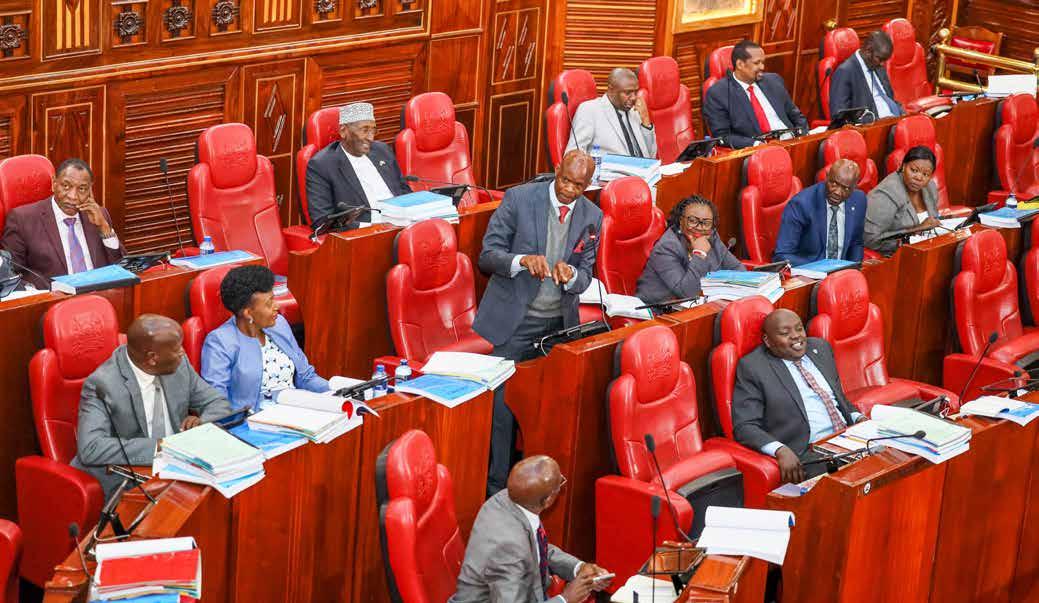
Senate in session during a past sitting.
CRA has integrated in the formula a Stabilisation factor which aims to protect counties from abrupt financial reductions.
PBO describes the introduction of stabilisation factor as “arbitrary” as it lacks a scientific basis. CRA says it introduced the factor to promote harmlessness in the allocation factor to counties.
“Using baseless factors in determining revenue allocation among counties would be detrimental. The future of revenue allocation should point to some stability and predictability but not lean on holding harmless. It would be prudent if the transition effects from one basis to another were fixed by a scientifically generated deviation parameter,” observes PBO in report on the formula.
The Income Distance index is a new parameter that has not been used before, and PBO notes it poses significant data credibility issues. The parameter employs Gross County Products (GCP) as the indicator used to determine the income generation efforts of a County. The parameter has been weighted at 13 per
cent. The GCP is obtained by averaging the county GCP for 2020, 2021 and 2022.
However, PBO argues that there is no explanation for why Nairobi is used as the yardstick for the per capita GCP for all the other counties.
“There is need to invest in updating and improving data systems to ensure that parameters such as poverty levels, infrastructure needs, and economic disparities are accurately captured and kept up to date,” says the PBO in its report on the formula, adding that reliable and current data is essential for enhancing the fairness and reliability of the revenue-sharing formula to ensure it reflects the actual needs of counties.
The report calls for regular reviews of the revenue-sharing formula arguing that it should be integrated into the framework, ensuring that it remains fair, transparent, and adaptable to evolving economic conditions and the diverse needs of counties.
The poverty index has been used in all four bases for revenue sharing. The
index is an equalisation factor across the country. The index in the first three bases was gradually reduced from 20 per cent to 18 per cent and 14 per cent in the first, second, and third bases, respectively.
The proposed fourth basis has further retained the weight to 14 per cent. PBO notes that the factor has been applied in Uganda and South Africa.
“A key observation is that in Kenya, the parameter has predominantly been given a high weight (above 14 per cent) compared to South Africa, which is weighted at 3 per cent,” observes PBO in its analysis. “Significant weight to a negative parameter such as poverty may disincentivise counties from development,” adding that a review of the trends in the weights of poverty in the last formulas shows the weight has been advantageous to less developed counties and a disadvantage to developed /developing counties.
The population index has constantly remained in the last three bases, taking significantly more weight. In the first and second basis, the population param-
eter was weighted at 45 per cent while in the third, the weight dropped to 18 per cent, and in the fourth basis, it appears to be returning to its original weight of above 40 percent with the proposal that it be pegged at 42 per cent.
PBO says the cyclical trend is susceptible to abuse and can trigger manipulation of the population data, especially during the National Censuses.
A further analysis of the population factor indicates that whereas it is seen as a balancing indicator of all community needs in counties, it has several dynamics that have not been considered over time in its application. Populations in counties are made up of different demographics. Old people dominate some countries, while others are made up of the young generations (the GenZs). These groups of people’s needs are considered diverse and require a different approach.
PBO argues that going to the 4th generation basis and in light of the events of the Gen-Z uproar in June 2024, such dynamics should be considered.
House Committees elect their leadership

Senator Mohamed Faki is the new chairman of the Committee on Lands during the election conducted on Monday. He takes over from Senator John Methu.
Last week, the Senate voted to dissolve the composition of all House Committees, a move that has seen some members of the minority included into
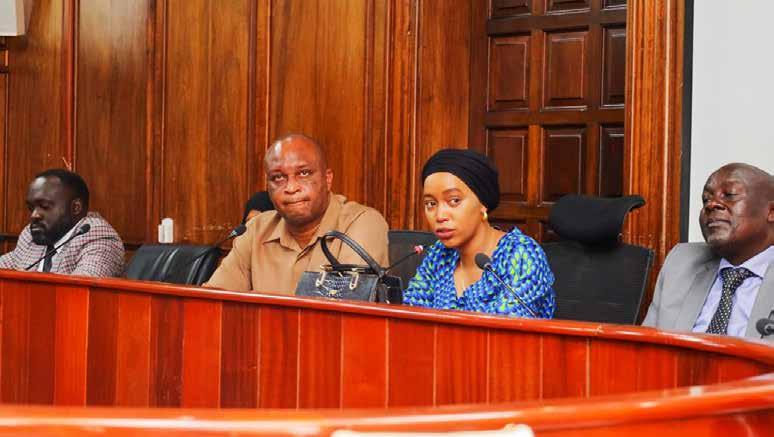
Senator Hezena Lemaletian speaks after the election of the chair of ICT Committee. Others in the picture from left are, Senator Wafula Wakoli (left), Senator Issa Juma and Senator William Kisang.
the leadership of Standing Committees.
Senator Karen Nyamu will deputise Senator Faki.
Senator Mohamed Chute retained the leadership of the Committee on National Commission and Equal Opportunities and will be deputised by Senator James Lomenen.
Senator Allan Chesang also retained
his position as the chairman of the Committee on ICT, so was Senator Miraj Abdulrahman, the vice chair.
In the Committee of Labour Senator Crystal Asige, who sits on the Minority side, is the new vice chair and will deputise Senator Julius Murgor who retained his seat as chair.
During the elections, Senator Wafula
Wakoli is the new chairman of the Committee on Agriculture and Livestock with Senator Alexander Mundigi as the vice chair.
Senator Wakili Sigei retained his position as the chair of the Committee on Justice, Legal Affairs and Human Rights. Senator Veronica Maina is the new vice chair.
Senator Allan Chesang
Senator Julius Murgor
Senators to review health promoters pay model
Senators have vowed they will review the payment model for the Community Health Practitioners (CHPs), saying the current system has created ambiguity and is undermining delivery of health care services to communities.
The lawmakers waded into the matter after reports emerged that CHPs work for as long as six months without pay and most always lack the necessary protective gear and testing kits.
The stipend for CHPs is split 50/50 between the national and county Governments, a situation that has created a regime of blame game on who is at fault whenever there is a delay in the payment.
CHPs are paid Sh5,000 per month and the law allows the national Government to pay CHPs half of this amount while county governments pay the remaining half.
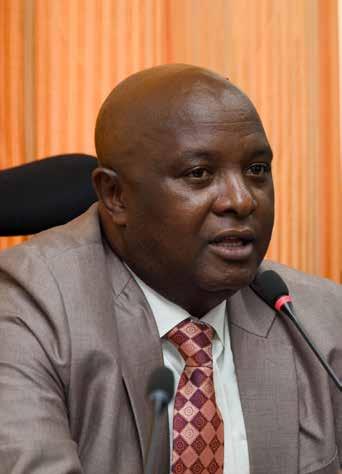
“It is high time that the programme is reviewed, so that we have one particular person to blame for the delay in paying the CHPs their stipend,” said Senator Osotsi during debate on the matter on Wednesday.
The matter was triggered by a Statement requested by Senator Edwin Sifuna.
“When you ask why CHPs have not been paid, counties say that the national Government has not sent their share.

When you ask the national Government, they say the county government has not processed their share. We have a blame game here,” added Senator Osotsi
Senator Osotsi challenged the Committee on Health to look into the matter and report to the House on the best way forward so that CHPs can be assured of their pay and in essence, be motivated to do even greater things.
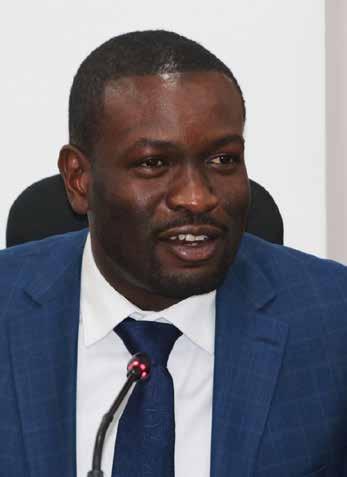
In his request, Senator Sifuna wants the Committee to explain why CHPs, particularly in Nairobi, have not received essential personal protective gear such as gloves, raincoats, gumboots and masks that are necessary for their safety and professional work.
He also wants the committee to outline steps being taken to address the gap in technological support for CHPs, including the provision of adequate or proper smartphones for online reporting and reliable data bundles to facilitate such reporting.
The Senator wants the House to establish an inquiry into the causes of delays in remitting stipends to CHPs who currently face waiting periods of up to six months without payment.
“The committee should clarify why CHPs have been required to conduct Social Health Authority (SHA) registrations for the public without adequate facilitation and support to perform this
duty effectively.”
He added: “The committee should detail efforts to enhance training for CHPs on the use of electronic community health information systems to ensure efficient reporting and awarding of marks which are critical for their timely payment of stipends,” the Senator added.
Senator Ledama ole Kina expressed shock at the delay in CHPs payments and wondered why more money should be given to the Social Health Authority (SHA) yet people working to register members are not getting paid.
SHA has been allocated Sh25 billion in the 2024/25 financial year, according to the Budget Policy Statement (BPS) currently under consideration by the House.
“Nairobi County, which is close to the headquarters where the money is, CHPs wait for about four months. What about in our rural areas? How do you expect these people to register members of SHA, yet you have not even given them their stipend?” asked Senator Olekina.
He proposed the lawmakers record the number of CHPs in their counties and establish whether they are receiving payment for the service they render paid.
“It is important for each one of us here to know how many CHPs you have in your own county. Have they been paid? Even with the bit of cash we are given
for our oversight, we should set up a tollfree number for the CHPs to call and say whether they have not been paid. When they call, you can look at the list and say which ward they are in. They could call and indicate the ward they are in and note down the name.”
Senator Moses Kajwang’ called for a full inquiry into the state of universal health, legislation, and the welfare and plight of CHPs warning that failure to resolve the issue means that the country does not have a proper legal framework for payment of CHPs.
He expressed reservation with the decision of the national Government to pay the stipend directly to CHPs warning that the move is tantamount to killing devolution.
“CHPs employees are agents of county governments. They cannot be converted to be agents of the national Government. We need to deal with this as a matter of urgency.”
Senator Oburu Oginga urged the Committee on Health to investigate the matter thoroughly by getting to the bottom of it and find out the whole process, the whole chain and also the reasons for the poor state the CHPs are operating in.
Senator Godfrey Osotsi.
Senator Moses Kajwang’.
Senator Edwin Sifuna.

Senator Boni Khalwale:
It is a shame that we are talking about a stipend of Sh2,500 from the national Government and Sh2,500 from the county government. What can you buy with Sh5,000? We are laughing at these professionals who are doing a very important job. I suggest that we develop a formal national programme for CHPs that will include training amongst other things. CHPs must be given basic training in areas like First Aid because
Senator Richard Onyonka
There are contradictions in our country. When you evaluate what we are doing, that is significant. We want to support our poor people and make sure that health services improve. However, we do not pay our service providers. The money that is supposed to be given to these service providers goes to something that is now creating a lot of noise and questions. The Auditor General has already pronounced her-
Senator William Kisang
CHPs used volunteer work before the laws were passed. These are people who have done great work for the last 10 or 20 years. Most of them are suffering because many county governors are not paying them Sh2,500 stipend monthly. They only receive the one from the national Government. The county governments share delays for up to four months. I propose that county governments attach the CHPs to a par-
Senator Tabitha Keroche
Sh5,000 to CHPs is so little. The national Government always pays Sh2,500 and the county government pays the other Sh2,500. In Nakuru County, the CHPs have not received their share Sh2,500, from the county Government for the last six months. You can imagine how they are struggling. They are dying because of poverty because the county government is not supporting them. The first question the Committee on
more often than not, they are the first line of defence as far as taking care of our patients is concerned. They should also be trained on interpretation of the various results they get, for example, when they do a blood pressure test or blood sugar test, so as to know how to respond appropriately. It must also be understood that the majority of the pregnant women in Kenya are midwifed by traditional birth attendants. If a stipend is being given to CHPs, all traditional birth attendants in all Kenyan communities must also be given that stipend.
self that they are having Sh46 billion that is buying Treasury Bills and yet, the money for the CHPs which is about Sh6 billion, could easily have come out of that. Can we start looking at the prioritisation of the issues that are affecting our people and begin to spend money there? Right now, our people do not want houses; they want medicines, water and food. Let us concentrate on agriculture. Let us concentrate on the provision of water and health services.
ticular health facility, a dispensary, health centre or even a Level 3 and 4 hospital, so that they be getting trained regularly. They are not exposed to training so that when they get emergencies, they have basic training. The Committee on Health should consider it carefully and even propose some changes because Sh5,000 is not enough because these people are doing very important work. If they get basic knowledge, they can help in preventing some common diseases. We can increase the stipend to Sh10,000.
Health should ask when dealing with this matter is why the County Government of Nakuru has not paid the CHPs for the last six months. That is like killing them. They are demotivated. They are not rendering services to our people. They keep on begging for money to feed their families. I will be asking the Committee to summon Governor Susan Kihika to explain why CHPs in Nakuru have not received their stipend of Sh2,500 for the last six months.
Senator Joe Nyutu
CHPs reach our constituents in the furthest parts of our counties. They are the people that teach our communities about health, check on their nutrition and provide basic health education. These are servants whose welfare needs to be looked into with a lot of seriousness. When you talk about
Sh2,500 paid by the county government and topped up by the national Government, needless to say, this is very little money considering the effect of inflation and the high cost of living that we continue witnessing in this country. It is important that we enhance this stipend both by the county and the national Government.
Kamati kuchunguza makabiliano yaliyoshuhudiwa kwenye ziara
Kamati ya Usalama wa Taifa, Ulinzi na Mashauri ya nchi za Kigeni imeelekezwa kufanya uchunguzi wa kina kuhusiana na makabiliano ya kisiasa yaliyoshuhudiwa kwenye ziara ya Rais William Ruto katika Kaunti ya Isiolo mapema mwezi Februari na kusababisha kusitishwa kwa hotuba za baadhi ya viongozi.
Naibu Spika Kathuri Murungi alitoa agizo hilo kufuatia taarifa ya binasfi iliyowasilishwa na Seneta Fatuma Dullo akikashifu vikali matukio hayo na kutaka hatua muafaka zichukuliwe kulainisha mambo.
Kwenye taarifa, Seneta Dullo aliushutumu uongozi wa Kaunti ya Isiolo kwa madai ya kuandaa machafuko yaliyoshuhudiwa wakati wa ziara ya Rais Ruto katika Kaunti hiyo ya Kaskazini mwa Kenya mnamo Februari 7.
ya Rais Kaunti ya Isiolo
Makundi ya vijana wenye ghasia kutoka kambi pinzani walishindana kuwakashifu wapinzani wao huku Rais
Ruto akihutubia mamia ya wakazi wa Isiolo baada ya kuzindua mradi wa Viwanda wa Isiolo.
Seneta Dullo aliushutumu uongozi wa Kaunti unaoongozwa na Gavana Abdi Guyo kwa kuficha matayarisho ya ziara ya Rais kimakusudi na kupanga kuwatenga baadhi ya washikadau halali.
Alisikitia hatua ya baadhi ya viongozi wa kisiasa kupanga kuitumia ziara yenye umuhimu mkubwa kwa eneo kuwa jukwaa la makabiliano ya kisiasa.
“Gavana alisimamia mpangilio na ratiba ya Rais. Viongozi wa eneo hilo waliwekwa gizani kimakusudi kuhusu maelezo ya ratiba hadi dakika ya mwisho. Hatua hiyo iliunyima uongozi wa eneo na wawakilishi wa jamii haki ya
kuzungumza na Rais kuhusu masuala ya usalama na utawala na hivyo kusababisha ghasia,” alisema Seneta Dullo.
Seneta huyo aidha alielekeza lawama kwa usimamizi wa usalama kwa kuruhusu mianya ya kiusalama ambayo iliitawala ziara hiyo ya Rais akidai hatua hiyo ilionesha uzembe usio na sababu katika kudumisha utulivu na mpangilio.
Alifichua kuwa vyombo vya usalama vilishindwa kuchukua hatua licha ya kuwa na ushahidi uliorekodiwa, ikiwa ni pamoja na video iliyotolewa ikiuonesha uongozi wa juu wa kisiasa wa Kaunti ukiwaleta pamoja watu binafsi na kuwahimiza kusababisha usumbufu.
“Huko Garbatulla, Gavana alitishia waziwazi kuwakusanya watu 5,000 na kuahidi kile alichokiita moto dhidi ya viongozi wanaompinga. Tishio hili lilijiri wakati wa ziara ya Rais ambapo viongozi kadhaa
walikabiliwa na kejeli. Rais hakuepuka pia na machafuko haya yaliyopangwa,” alisema Seneta huyo.
Kadhalika Seneta huyo wa chama cha Jubilee alikashifu mapendeleo katika utekelezaji wa haki kufuatia matukio ambapo vijana wasio na hatia walikamatwa kiholela na kushtakiwa kwa tuhuma zisizo na msingi wowote huku watu wanaojulikana na waliokuwa na uhusiano na uongozi wa Kaunti wakiendelea kuzurura wakiwa huru. Kongozi huyo aliitumia fursa hiyo kutoa wito kwa Tume ya Maadili na Kupambana na Ufisadi nchini Kenya (EACC) kuyachunguza machafuko ya kisiasa na ukosefu wa usalama katika Kaunti ya Isiolo huku akimtaka Inspekta Mkuu wa Polisi kufanya marekebisho kamili kwenye vyombo vya usalama kwenye Kaunti ya Isiolo.
Seneta Keroche alalamikia kudorora kwa usalama na hudumu katika Kaunti ya Nakuru
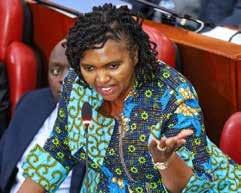
Seneta Tabitha Keroche amekosoa vikali hali ya usalama inayodorora katika Kaunti ya Nakuru akiangazia msururu wa visa vya kutisha ambavyo vimewaacha wakazi katika hofu na kufadhaika. Aliibua wasiwasi kuhusu kile alichokitaja kuwa ukiukaji wa sheria na utaratibu, akitaja visa vya kutisha vya mauaji, kutoweka kwa watu na uzembe mkubwa katika mfumo wa afya wa Kaunti.
Akizungumza Bungeni alipotoa taarifa ya binafsi, Seneta Keroche alitoa picha mbaya ya Kaunti inayokabiliana na ukosefu wa usalama na kufeli katika utoaji wa huduma.
“Wakazi wa Kaunti ya Nakuru wameachwa katika hali ya kutoamini, mshtuko, kufiwa na kukosa msaada,” alilalamika Seneta Keroche.
Seneta huyo alieleza kwa kina msuru-
ru wa matukio ya kuhuzunisha yaliyoanza tarehe 18 Januari 2025 na mauaji ya kikatili ya mwanaharakati wa kisiasa Richard Raymond ambaye aliuawa mita chache kutoka Kituo cha Polisi cha Elburgon mjini Molo. Siku iyo hiyo, Brian Odhiambo, kijana aliyekuwa chini ya ulinzi wa polisi alitoweka kwa njia isiyoeleweka na kuiacha familia yake katika majonzi huku msako ukiendelea.
Katika kisa kingine cha kutisha, mtoto mwenye umri wa miezi saba, Mercy Chepngeno, binti ya wanandoa walio na changamoto ya kusikia alilazwa katika Hospitali ya Rufaa na Mafunzo ya Nakuru kwa matibabu lakini aliaga dunia tarehe 2 Februari. Hata hivyo, babake alisikitika pakubwa aliporudi siku chache baadaye kuuchukua mwili wake kwa ajili ya mazishi na kugundua haupo.
“Mwili unawezaje kupotea kwenye chumba cha kuhifadhia maiti?” Seneta Keroche aliuliza kwa masikitiko.
Seneta huyo aidha alifichua kwamba wakati familia hiyo ilipotaka majibu, wahudumu wa chumba cha kuhifadhia maiti walidaiwa kutishia kuwanyunyizia dawa aina ya formalin, kemikali inayotumika kuhifadhi miili.
Kadhalika Seneta huyo alikashifu utepetevu wa mamlaka husika na kutaka uchunguzi ufanyike kwa hima ili kukomesha uhalifu huo na kuboresha
huduma kwa wananchi.
Huku hayo yakijiri Seneta Mohammed Faki amewasilisha ombi la Kauli kuhusu kuzorota kwa huduma za afya katika kaunti ya Mombasa.
Kwenye ombi hilo Seneta Faki anaitaka Kamati ya Afya kuorodhesha hatua ambazo serikali ya Kaunti ya Mombasa imechukua kusuluhisha tatizo la hali mbaya na inayoendelea kudorora ya utoaji huduma za afya, ikizingatiwa kuwa kuna upungufu wa madaktari, wauguzi, wachunguzi wa Maabara na hata walinzi wa malango na maeneo ya hospitali na zahanati nyingi za Kaunti ya Mombasa.
Anaitaka Kamati hiyo ibaini sababu zilizosababisha serikali hiyo ya Kaunti kupuuza uboreshaji wa huduma kwa kutoshughulikia miundombinu kama vile ukarabati wa majengo ya vituo hivyo, hususan hospitali ya Tudor na zahanati ya Maweni na Ziwa la Ng’ombe ambazo huvuja kila kukinyesha na usambazaji wa maji safi ya mifereji.
Kamati hiyo aidha imetakiwa kueleza hatua zitakazochukuliwa na serikali ya Kaunti kununua na kuboresha vifaa vya kuwahudumia wagonjwa kama vile mashine za X-ray, MRI, ambulensi na kadhalika, ikizingatiwa kuwa mitambo ya MRI ya Kaunti nzima inapatikana Coast General Hospital pekee japo mi-
tambo hiyo hukwama mara kwa mara kwa sababu ya uwezo wake mdogo na wingi wa watu wanaohudumiwa.
Seneta huyo vile vile anaitaka Kamati husika kubaini sababu zilizochangia serikali ya Kaunti kutovipa vituo vya afya mapato yanayokusanywa kwa matumizi yao (FIF) na sababu zilizofanya serikali hiyo kutoa agizo kwamba vituo vya afya havina ruhusa kuwaajiri vibarua licha ya hao vibarua kuhudumu kwenye vituo hivyo kwa muda mrefu.
“Kamati ya Afya ifafanue mantiki ya kulipa mishahara ya wahudumu bila kununua dawa wala kujenga chochote ikiwa ni pamoja na kushindwa kuchukua hatua ya kubadilisha mapaa ya Asbestos yaliyopigwa marufuku humu nchini kwa kuhofiwa kusababisha ugonjwa wa saratani, ilhali kuna pesa zilizotengwa kwa kusudi la kutoa huduma za afya kwa wakazi wa pwani,” aliuliza Seneta Faki.
Seneta Faki aliongeza, “Kamati hiyo ifanye uchunguzi ili kubainisha chanzo cha kudorora huku na ichukue hatua zinazofaa ili kuhakikisha kuwa wananchi wanapata huduma wanazostahili na kuchunguza sababu zilizochangia kutotumika kwa hospitali mpya ya Shonda, iliyoko Likoni na Marimani, huko sehemu za Kisauni, zilizomalizika kujengwa mnamo mwaka wa 2022.”
Seneta Tabitha Keroche
Clerk lauds partnership between Senate, WFD
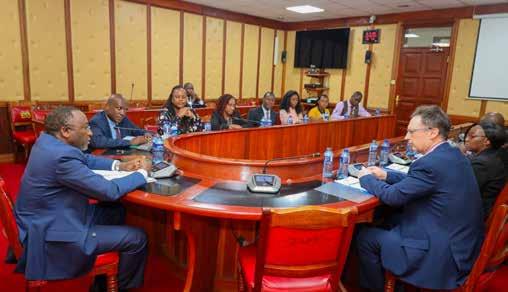
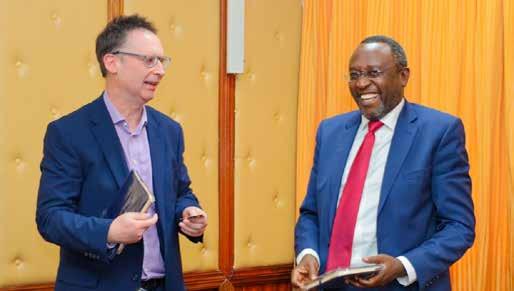

The Clerk of the Senate Jeremiah Nyegenye on Thursday hosted Mr Michael Nevin, the Regional Director for Africa of the Westminster Foundation for Democracy (WFD) who paid him a courtesy call in his office at Parliament Buildings.
The meeting discussed the impact of the Senate’s long-standing partnership with WFD, explored future strategic collaborations based on the Senate’s priorities for support in 2025 and beyond.
Westminster Foundation for Democracy is the United Kingdom’s public body that is dedicated to strengthening democracy and open societies across the world.
During the meeting, Clerk Nyegenye underscored the invaluable collaboration the Senate has had with WFD for the past 12 years and pledged to entrench the collaborate even more.
He particularly singled out the launch of WFD-supported County Legislative Tracker (CLT), a website system that provides a centralised platform for accessing and monitoring consideration of legislations in the 47 counties.
“County assemblies would legislate on the same thing twice in the past. Our collaboration has seen us launch a very successful County Legislation Tracker. This has contributed to the growth of research and jurisprudence,” noted Mr
Nyegenye.
He urged the WFD to sustain the partnership with the Senate as this will enhance engagement through public participation initiatives and real-time information sharing using emerging technology such as artificial intelligence (AI).
“AI is big now. Other legislatures have done considerably more than we have done. This is an area that we need to partner on,” said Mr Nyegenye, who is also the Secretary to the Parliamentary Service Commission (PSC).
Dr Brighton Buchere, the Director of the Senate Liaison Office, reiterated the need for collaboration between the Senate and WFD saying “tangible and
positive effects” have been seen from it.
Mr Nevin expressed his gratitude to the Senate for its willingness to advance itself around the world, for being innovative, and for trying new things.
“The Senate Futures Caucus work is something which Kenya is taking a lead on. The Caucus will provide a clear direction for forward-looking policy discussions and legislative reforms,” he said.
He pledged WFD’s support to the Senate saying while the 13 years that the Senate and WFD have collaborated might be a long time for other development agencies, it is such “a short time for his agency considering where we want to see devolution grow to.”
Clerk Jeremiah Nyegenye leads Senate Liaison staff during the meeting with the Mr Michael Nevin, the Regional Director for Africa of the Westminster Foundation for Democracy (WFD).
Mr Michael Nevin, the Regional Director for Africa of the Westminster Foundation for Democracy (WFD), shares a light moment with Senate Clerk Jeremiah Nyegenye during the courtesy call.
Senate Clerk Jeremiah Nyegenye (centre) and senior staff in the Liaison Office, led by Dr Brighton Buchere, the Director, pose for a group picture with Mr Michael Nevin, the Director for Africa of the Westminster Foundation for Democracy.
House starts debate on Civic Education Bill
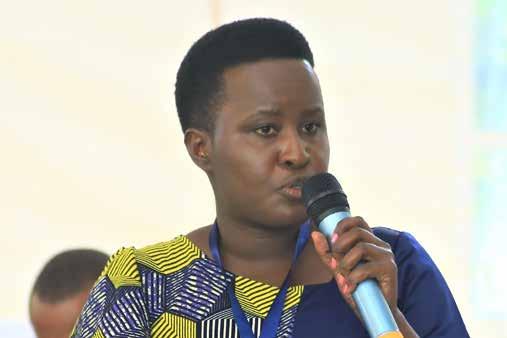
The House has started debate on The County Civic Education Bill, 2024, whose purpose is to establish a legal framework that will promote civic education in Kenya and make it an essential tool for building responsible citizenship.
The Bill is sponsored by Senator Esther Okenyuri who described the proposed law as a transformative tool that seeks to empower Kenyan at the grassroot by equipping them with the knowl-
edge and tools necessary to actively participate in governance.
“An informed citizenry is the foundation of any thriving democracy. When citizens understand their rights and responsibilities, they are better equipped to hold their leaders accountable, demand transparency, and actively contribute to the development of their communities,” said Senator Okenyuri when moving the Bill.
“This Bill is not just about education;
it is also about empowerment. An informed citizenry is able to make decisions on their own and live on a daily basis.”
The Bill seeks to establish a framework for systematic and continuous civic education at the county level. It seeks to promote civic awareness by educating citizens about the rights, responsibilities, and functions of county governments.
The Bill further enhances public participation by empowering citizens to actively engage in decision-making processes such as budget formulation, development, planning, and oversight.
If enacted, the law will strengthen devolution by fostering a deeper understanding of devolution and governance among citizens, ensuring that they can hold their leaders accountable and benefit from services provided by the county.
Clause 5 makes civic education mandatory. It states that public officials, including elected and appointed officials at national and county levels, shall undergo a mandatory civic education and training on their roles, responsibilities, and obligations as public servants.
The Bill mandates regular reporting and evaluation to ensure that these pro-
PETITION
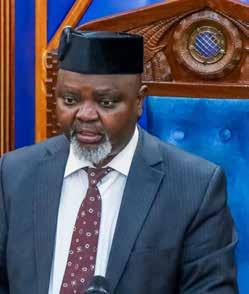
Former employees of Kenya Breweries Ltd are demanding investigations into circumstances under which three law firms have failed to pay them Sh30 million awarded by the high court.
The employees have asked the Senate to investigate the matter and recom-
grammes are effective and responsive to people’s needs. This is not a one-size fitsall approach.
It is a dynamic, inclusive framework that recognises the diversity of our nation.
It proposes that the National Government may issue conditional grants to county governments to build the capacity of county government entities and fund civic education activities in counties with the county executive committee member designated a unit to be known as the county civic education unit.
Among others, the functions of the unit shall be to develop a comprehensive civic education plan for the county, in collaboration with relevant stakeholders and to oversee the implementation of civic education programmes and initiatives within the county.
Clause 11 gives the unit the power to Clause 11 gives the unit the power to register Non-Governmental Organisation and other non-state actors providing civic education in the county as civic education providers.
“An entity that is eligible for registration as a civic education provider shall submit an application for registration and pay the prescribed fee,” says in Clause 12.
House to probe three law firms
mend that their dues are settled and make recommendation on actions of commission or omission on the part of their advocates.
In a Petition to the Senate, the former employees say their employment was terminated by Kenya Breweries in a process they contested arguing that it was illegal. They challenged the process in the high court through three individual law firms–J. Harrison Kinyanjui & Company Advocates, Namada & Company Advocates, and O.P. Ngoge & Company Advocates.
That suit was determined in January, 2018 and the court ruled that the decision by the company to compel them to take early retirement was unlawful and in breach of the constitution and the agreement of employment.
The court directed Kenya Breweries to pay each of the retired employees damages for loss of employment a sum equal to one month’s salary as at the time of termination of employment and that it also refunds them Sh30.2 million being the amount withheld in terms of the sched-
ules filed by the firms of advocates of Namada & Co. Advocates.
Kenya Breweries was also to pay for the cost of the suit and the interest on the sums of money at the court rates from the date of judgment until the date of full payment.
They claim in the Petition that the payment was received by J. Harrison Kinyanjui & Company Advocates after writing to Kaplan & Stratton Advocates in March 2018.
On July 4, 2018 Mr Kinyanjui sent discharge vouchers for his clients through a letter stating that each person named in the form accepted payment of Sh9.1 million as full and final settlement in the matter.
Mr Kinyanjui indicated that each person would later receive payment of damages for loss of employment, a sum of one month’s salary as at the time of termination of employment as ordered by the court.
This promise was not fulfilled.
On December 31, 2023, Kaplan &
Stratton Advocates paid the sum of Sh1 million to J. Harrison Kinyanjui & Company Advocates. On December 20, 2021, Kaplan & Stratton Advocates forwarded a consent to mark the suit was settled with regards to clients of J. Harrison & Company Advocates.
J. Harrison & Company Advocates forwarded a signed consent to Kaplan & Stratton Advocates without the knowledge of the petitioners and on January 21, 2022, Kaplan & Stratton Advocates paid Sh14.8 million to J. Harrison & Company Advocates.
The Petitioners claim that J. Harrison & Company Advocates have declined to pay all their outstanding dues.
Deputy Speaker Kathuri Murungi committed the Petition to the Committee on Labour and Social Welfare.
Under the House rules, the committee is required to table its report to the House within 60 calendar days, from the time of reading the prayer. The House will then consider the report and either adopt or reject it.
Senator Esther Okenyuri.
Deputy Speaker Kathuri Murungi
Lawmaker pushes for wellbeing of medical interns
Senator Hamida Kibwana has urged the Senate to take action and ensure the safety, well-being and dignity of the medical interns in health facilities because they have dedicated their lives to serving the nation’s health.
The Senator noted that there is urgent need to address rising mental health concerns and toxic work conditions the intern face in the line of duty.
In a request for a Statement in the House, the lawmaker expressed anger over the death by suicide of Francis Njuki, a medical intern at Thika Level 5 Hospital in November 2024, two months after the death of Dr Desree Moraa, who until her death by suicide, was a medical intern at Gatundu Level 5 Hospital in Kiambu County.
“The death of these young medical professionals are not only individual tragedies, but also a stark reminder of systemic issues within our health care system,” said Senator Kibwana in a statement read on her behalf by Senator Ledama ole Kina.
Senator Kibwana wants the Committee on Health to investigate the working conditions and schedules of medical
interns in public hospitals, specifically addressing claims of excessive working hours and poor working environment.
She also wants the Committee to examine the existing mental health support programmes available for medical professions, particularly interns and recommend enhancement of the programmes to prevent such tragic outcomes.
“The Committee should assess the role of hospital administrations and the Ministry of Health in safeguarding the welfare of medical interns,” she said, adding that the assessment should include measures taken to address the grievances of the interns and provide mentorship.
The Committee should provide a detailed report on policies governing the development, deployment, supervision and work-life balance of medical interns and propose reforms where necessary.
She wants the Committee to recommend actionable steps to create a safe and supportive working environment for all medical professionals with a particular focus on addressing mental health challenges within the sector.
This Week in History
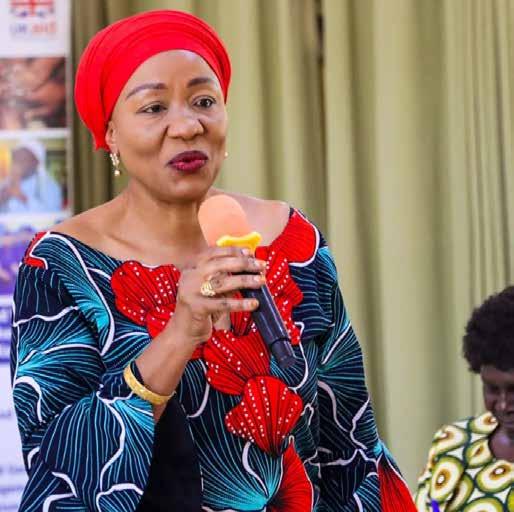
House adjourns to discuss insecurity in Baringo County

On February 28, 2027, Senator John Lonyangapuo moved a motion for the House to discuss the insecurity situation in Baringo County.
News had been rife in the media about the intense insecurity in the County which spilled over to part of West Pokot.
“For nearly six months now, we have been hearing of insecurity along the Kerio Valley which is shared by three counties; West Pokot, Elgeyo-Marakwet and Baringo counties,” said Senator Lonyangapuo when moving the motion.
“When people keep quiet it does not mean that they are not suffering. The national Government enabled the Turkana, Pokot and Samburu to come together and live peacefully through an engagement of two months, and it worked. We have never had any problem with the Marakwet and Tugen community. Even our dialects are almost similar. If the Government engaged leadership from all the communities involved at that time, why are we only seeing a few people being involved? My brother can confirm that we talked as late as Thursday last week. I asked that we should go there together because if either of us goes alone they will be misunderstood
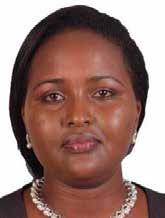
“It is very unfortunate when you read in the newspapers and watch the television and see the suffering on the ground especially of women and children. This is something that we have talked about over and over again as a country among pastoralist communities on what should be done to end this menace once and for all. There are some basic things that we all have to agree. I agree with Sen. Sang, who said that it is not good to generalise communities such as Pokots, Marakwets, Samburus or Turkanas. In every other community and even in this town, there are thugs who kill and rob people every day but we have never called them by their names or accused a whole community to be made of thieves or bandits. So, as a nation, we should call bandits, thugs or criminals as such but not by their communities.”
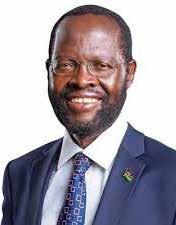
Senator Anyang’-Nyong’o said:
“I rise to second this serious Motion. It reminds me of Shakespeare’s play ‘Julius Caesar,’ when somebody told Brutus: “The fault, dear Brutus, is not in our stars, but in ourselves.” It would have been good contribution if we handled these very serious issues with less emotion and boisterousness, because that does not help. If we are looking for a solution, the method by which we look for that solution is in itself very important. This is a House of debate and records. We should leave emotions to the gladiators rather than the debaters.”
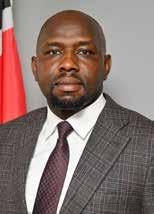
Senator Kipchumba Murkomen said:
When we talk about insecurity and the fact that those bandits are ruthless, we know what we are talking about. I have held more than 30 meetings along Kerio Valley with my constituents, the Pokots, the Chairman of the National Cohesion and Integration Commission, Hon. Francis Ole Kaparo and the Deputy President, His Excellency William Ruto. We have held so many meetings; not just this weekend. We have held so many meetings in the last two years with Hon. Kamama and Hon. Rotino. Sadly, we have not been able to hold the same meetings in my county like in Baringo.”
Senator Hamida Kibwana
Senator Naisula Lesuuda said:
Senator John Lonyangapuo
Senator concern over Pyrethrum Company dissolution
ASenator wants answers over the plan by the national Government to dissolve the Pyrethrum Processing Company of Kenya (PPCK).
Senator Richard Onyonka wants answers on the fate of PPCK assets and workers at the Nakuru-based firm should the promise to dissolve proceed.
In a request for a Statement, the legislator wants the Committee on Agriculture, Livestock and Fisheries to explain the fate of the Company in the wake of reports of it dissolution.
This is coming at a time when there are impending plans to dissolve the firm that was established in 1963 through a partnership with the Commonwealth Development Corporation and Mitchell Cotts.
Earlier on in 1934, the Pyrethrum Board of Kenya (PBK) was established to regulate the production and processing of pyrethrum.
PBK later merged with the Pyrethrum Marketing Board to form one body called the Pyrethrum Board in 1964.
The Agriculture and Food Authority (AFA) however took over the roles that were being run by the then PBK from 2014 to 2016.
AFA then adopted PPCK to be the successor of PBK at a time when Kenya became the major source of pyrethrum since the end of the World War II.
Senator Onyonka says PPCK owns a significant portfolio of assets, including extensive tracts of prime land and valuable properties across various counties in the country.
“These assets represent public wealth accumulated over decades. It is imperative to establish certain facts, including who currently holds the title deeds of the vast properties,” he said.
He wants details on the fate of the assets following the intended dissolution and the impact the intended dissolution will have on stakeholders, especially pyrethrum farmers and company employees.
The Senator expressed concern that PPCK is a government parastatal that
does not have a board of directors and wants the Committee to explain the reasons behind the move to dissolve the company.
He also wants the Committee to conduct a detailed review of all the properties owned by the PPCK with a view to establish their status and to ensure that public resources are safeguarded.
“The committee should provide a report of the PPCK’s financial status, operational challenges, including a full impact assessment with consideration of a potential to restructure this corporation, instead of dissolving it since it has been making a profit in its operations,” he says.
He adds: “The Committee should outline measures that the Ministry of Agriculture and Livestock Development is taking to ensure that farmers, employees and other affected parties are consulted to find an amicable way on how this matter could be sorted out.”
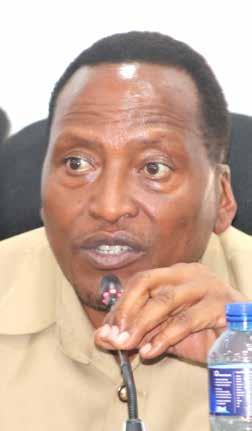
Senator Dullo blames County leadership for chaos
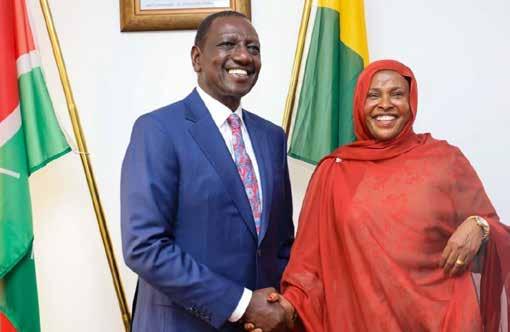
Senator Fatuma Dullo has accused Isiolo County leadership for allegedly orchestrating the chaos and disorder that were witnessed during President William Ruto’s visit to the Nothern Kenya county early in February.
Groups of rowdy youths from rival camps competed to heckle their opponents as President Ruto addressed residents after launching the Isiolo Aggregation and Industrial Park project.
In a personal Statement on the floor of the House, Senator Dullo alleged that the county leadership led by Governor Abdi Guyo deliberately shrouded the preparations of the President’s visit in secrecy and orchestrated to exclude legitimate stakeholder participation, turning what should have been an inclusive engagement into a political platform.
She asserted that the chaos and disorder witnessed during the visit were
not merely spontaneous occurrences but rather the culmination of systematic failures in security, governance, and administration, exacerbated by deliberate actions of a certain county officials.
“The Governor micromanaged the President’s schedule and programming. Local leaders were deliberately kept in the dark about the programme details until the last minute,” she told the House.
The lawmaker explained that the obstruction denied local leadership and community representatives their right to engage the President on pressing security and governance concerns leading to the commotion.
She further traded her guns on the security team for the security lapses that characterised the visit claiming they demonstrated inexcusable negligence in maintaining order, despite there being clear intelligence warnings of the impending chaos.
She claimed that there was documented evidence, including a leaked video, showing top county political leadership actively mobilising individuals to cause disruptions.
“In Garbatulla, the Governor openly
threatened to mobilise 5,000 people and promised what he termed “brimstone fire” against leaders opposing him,” she said.
“This threat materialised during the President’s visit where several leaders faced orchestrated heckling. The President was not spared from this organised disorder,” added Senator Dullo, even as she faulted the selective application of justice following the events.
She claimed that known individuals with documented ties to the county leadership continue to roam freely despite their clear role in the chaos, while innocent youth have been arbitrarily arrested and charged with flimsy accusations of public disorder.
The legislator called on the Ethics and Anti-Corruption Commission (EACC) to investigate the political unrest and insecurity in the County.
She also urged the National Authority for the Campaign Against Alcohol and Drug Abuse (NACADA) to investigate the drug trade in Isiolo County and its links to local political networks and the Inspector General of Police to conduct a complete overhaul of Isiolo County’s security apparatus.
Senator Richard Onyonka
Senator Fatuma Dullo when she hosted President William Ruto in her office during the opening ceremony of Bunge Tower in 2024.
Senator Cherarkey wants answers on KNH killing
Senator Samson Cherarkey is seeking answers on the gruesome murder of Mr Gilbert Kinyua, an inpatient at Kenyatta National Hospital (KNH) in Nairobi City County.
Mr Kinyua was found dead in Ward 7B with his throat slit on February 7, 2025. However, it remains unclear who committed the crime and even when, exactly, the murder occurred.
In a request for a Statement on the killing, Senator Cherarkey wants the Committee on Health to explain the circumstances that led to the murder despite the presence of private security guards, police officers, health workers and other patients within the ward.
He also wants the Committee to ex-
plain why the management of the hospital denied the family the opportunity to have a caretaker from among Mr Kinyua’s family to stay in the ward with the patient and yet his medical, neurological condition and state of being immobile required close care and assistance, including feeding.
“The Committee must state why nurses attending to Mr Kinyua did not discover and report the murder timeously,” said the Senator, noting that the patient required a distinct care due to the nature of his medical condition and provide details of the normal routine followed by nurses and doctors attending to a patient in need of a critical care like Mr Kinyua’s.
The Senator wants to know why the referral facility remains crowded and disorderly in the wards and service areas and wants the Committee to state whether this might have contributed to difficulty in managing crowds and inhibiting the nursing station from noticing suspicious persons and also state any action in place to mitigate the situation.
“The Committee should inform the Senate the current capacity arrangements by KNH with specific focus on the safety of the more than 1,800 patients admitted at the facility and address why the CCTV cameras were switched off during the incident and outline any actions taken to bring any culpable person to book.”
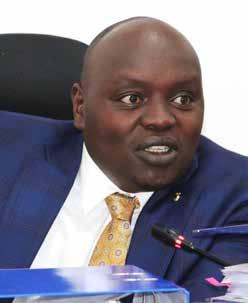
Senator seeks clarity on replacement of academic certs
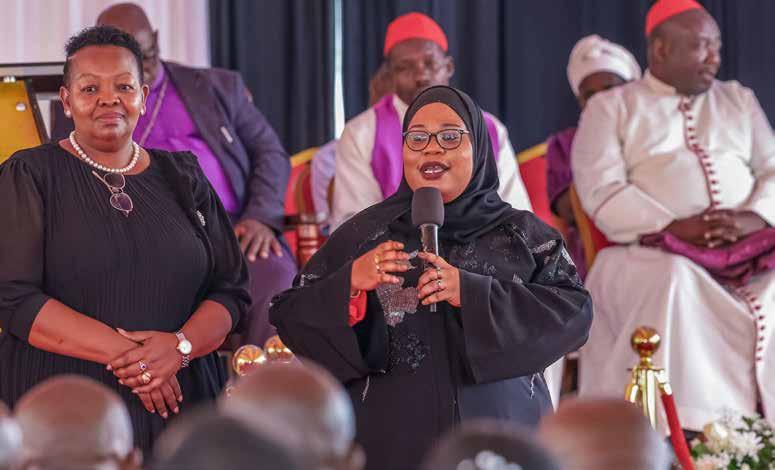
Senator Miraj Abdulahi wants the State to explain the justification for the laborious and overly bureaucratic procedural hurdles employed by the Kenya National Examination Council (KNEC) in their procedures for the replacement and authentication of academic certificates.
In a Statement to the House, the lawmaker in particular wants details of the
requirement that applicants obtain confirmation letters from their former and hopefully still existent academic institutions to ascertain they sat their national examinations before they are issued.
The lawmaker says the requirement is unfair because KNEC is the sole custodian of all national examination-related data and principal archiver of those candidates’ records.
“KNEC is the issuer of all unique candidates’ identification numbers for persons sitting their national examinations and, similarly, the sole issuer of all accredited documentation on every candidate’s results, including the academic certificates,” Senator Miraj told the House.
The lawmaker now wants the Committee on Education to investigate and
report back to the House why KNEC is not leveraging technology to operate an independent digitised mechanism that in real time verifies students’ examinations-related data,
She also wants KNEC to develop and introduce a centralised database that is accessible so that all candidates’ records, including registration details and results, are digitised and stored on secure cloudbased platforms for real-time ease of access whenever the Council needs to verify any applicant’s credentials.
She argues that developing and introducing a centralised database that is accessible to authorised personnel across different Government institutions will be a major boost whenever verification may be needed.
Adopting biometric authentication based on biometric data collection during examination registration and during the acquisition of national identity cards and issuance of digital certificates and developing a digital verification system that can be accessed, verified and shared via secure online platforms by different institutions for real-time verification.
“The Committee should establish clear guidelines for application in cases where schools no longer exist, yet applicants must produce confirmation letters as a requirement to avoid victimising applicants due to circumstances beyond their control.”
Senator Samson Cherarkey
Senator Miraj Abdulahi addresses mourners during the burial of Mr Kingi Mwaruwa, Speaker Amason Kingi’s father as Senator Veronica Maina looks on.
Senator Abass retains Devolution committee leadership
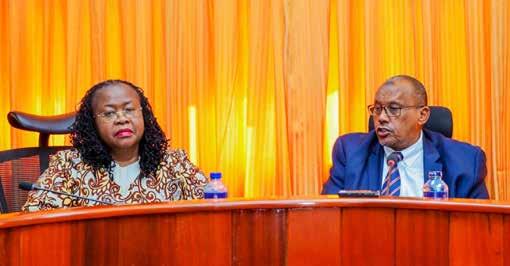
Senator Mohamed Abass and Senator Catherine Mumma have both secured a fresh mandate after they were re-elected as the Chairperson and Vice Chairperson of the Committee on Devolution and Intergovernmental Relations on Thursday, February 20, 2025.
The election comes after the Senate approved a Motion on the reconstitution of its House Committees necessitating the elections of chairpersons and vice chairpersons.
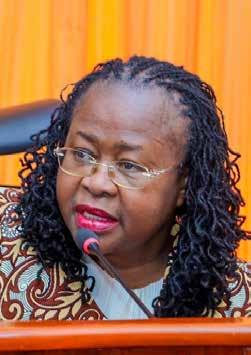
Senator Catherine Mumma has said international trade is key in ensuring developing nations realise Sustainable Development Goals (SDGs).
The lawmaker said Kenya Parliament has taken significant steps to advance its economic growth through legislative and policy measures so as to close the gap in the financing of the SDGs.
“Kenya believes international trade is important in the realisation of SDGs,” said Senator Mumma, noting that diversification of exports and technology transfer are some of strategies for advancing up the value chain through trade and foreign investments.
“Kenya has established Special Economic Zones (SEZs) to attract foreign direct investment (FDI) in technology-intensive sectors,” she said.
The Senator was speaking during the 2025 Inter parliamentary Union (IPU) Hearing on SDGs at the United Nations in New York.
Under the theme “Scaling up action for the Sustainable Development Goals: Finance, Institutions, and Politics”, the Hearing took an in-depth look at ways to
In his acceptance speech after securing the vote, Senator Abass thanked the nine Members of the Committee for showing faith in him and promised to lead the Committee in advocating the devolution agenda.
“Now that we have completed the elections, I urge all of us to work as a team so that we can fulfil our mandate. We have a short time to execute a lot of work,” said Senator Abass.
Senator Mumma urged the lawmak-
ers to commit themselves to being the Senate that clears the backlog of the pre2010 legislation so that they can leave behind a strong legacy.
She said that it was a shame that 15 years since the start of devolution Kenya still had laws that were in contravention of the Constitution on matters of Devolution.
Senator Thang’wa pledged to contribute and play his part in assisting the
Committee to enhance devolution and intergovernmental relations in the country.
“When I was an MCA, I appeared before this Committee to present a Petition. I believe this is the Committee that can change the way things are done in the counties,” he said.
Senator Thangwa is joining the Devolution Committee from the Committee on Roads and Transportation, where he served as the Chairperson.
International trade key in SDGs
reboot the 2030 Agenda for Sustainable Development and the SDGs contained therein as the most important global plan to fight poverty, reduce inequality, and reset the planet on a sustainable course.
The discussions sought for ways to mobilise political will and achieve consensus on key policy prescriptions, strengthen institutions to effectively engage all actors, beginning with Parliaments, and mobilise critical financing from both public and private sources.
The joint UN-IPU hearing sought to advance commitments towards turbocharging the SDGs. The discussions provided an opportunity for a reflection among Parliamentarians on ways to close the financing gap for the SDGs in view of the 4th UN Conference on Financing for Development, in Spain, in June 2025.
Senator Mumma cited the Export Processing Zones Act and Kenya Vision 2030 which focuses on the need for the country to move beyond traditional commodities to include high-value products such as processed foods, textiles, and technology-based goods.
Kenya has established Special Economic Zones (SEZs) to attract foreign di-
rect investment (FDI) in technology-intensive sectors as one of the strategies of encouraging the transfer of technology.
“These zones are seen to incentivise foreign investors to transfer skills and technology to local enterprises hence boosting industrial capacity and encouraging innovation,” she said.
Sessional Paper No. 1 of 2019 provides a framework for educational reforms in Kenya. The reforms emphasise collaborations between the private sector and educational institutions to align training with labour market demands and promote technology acquisition.
Senator Mumma said building human capital is critical to achieving these goals, as it ensures that education and training are responsive to the evolving needs of industries and foster innovation and, therefore, sustainable economic growth.”
Kenya has also enhanced infrastructure via The Public-Private Partnerships Act, 202 which has enabled Kenya to leverage PPPs to finance and expedite the development of trade-supporting infrastructure, such as industrial parks, logistics systems, and ports which are vital
for moving up the value chain.
“Kenya is working to leverage regional and global value chains by participating in agreements such as the African Continental Free Trade Area (AfCFTA) to enhance the value of Kenya’s exports through collaboration with regional and global partners,” said the Senator.
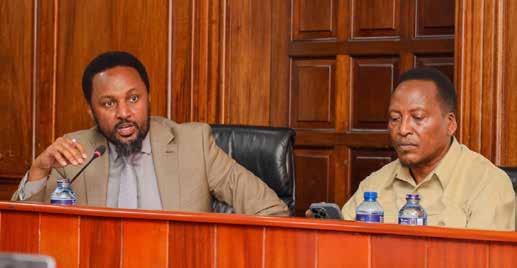
Senator Abass Mohamed delivers his acceptance speech after he was unanimously re-elected to chair the committee. He is flanked by Senator Catherine Mumma, the vice chair
Senator Karungo Thangwa speaks during the election as Senator Richard Onyonka listens.
Senator Catherine Mumma
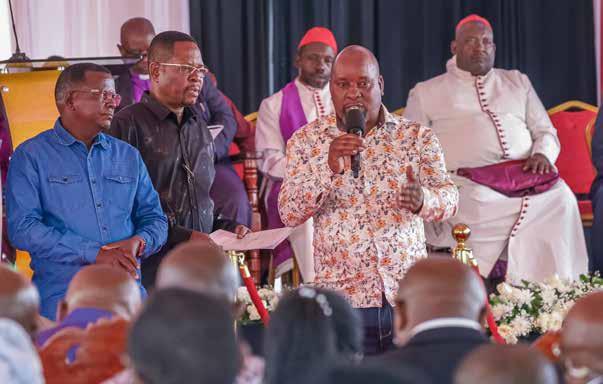
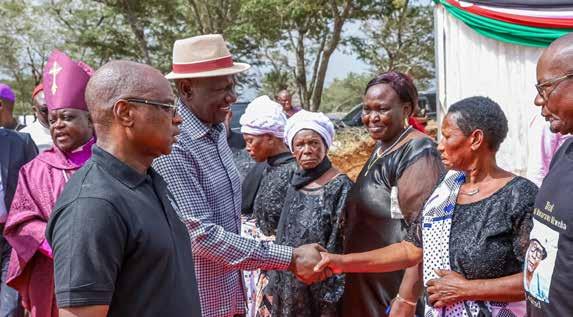
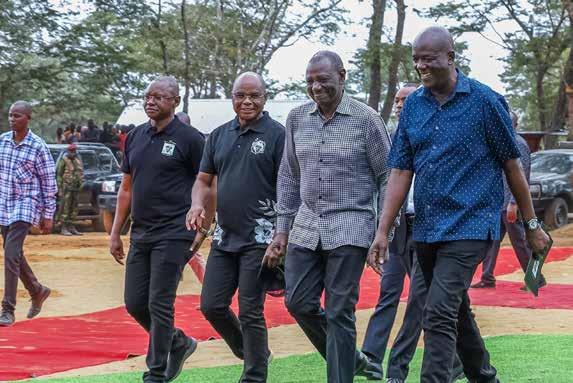
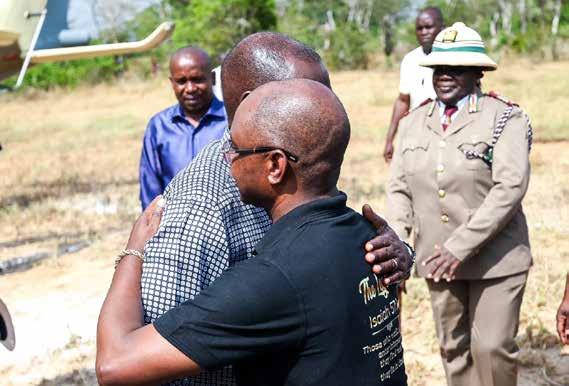

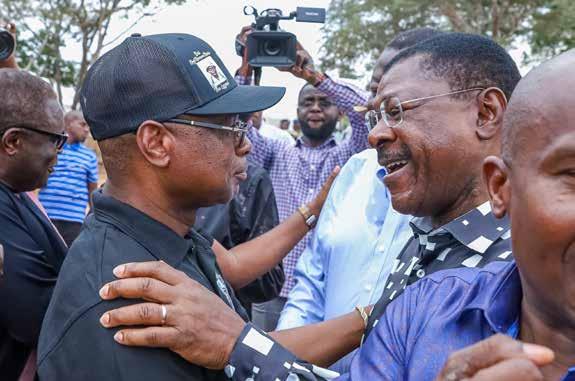
1. Senator Johnes Mwaruma condoles with the family of Speaker Amason Kingi during the burial of his father in Kilifi County. Senator Mwenda Gataya (left) and Minority Leader Stewart Madzayo look on.
2. Speaker Amason Kingi welcomes President William Ruto in Kilifi County when the Head of State joined the family in their father’s burial.
3. Speaker Amason Kingi introduces President William Ruto to Mzee Kingi Mwaruwa’s extended family.
4. Deputy Speaker Kathuri Murungi speaks at the funeral as Senator Moses Kajwang (left) and Munyi Mundigi listen.
5. Speaker Amason Kingi and Kilifi Governor Gideon Mungaro usher President William Ruto to the dais when the head of state arrived for the funeral.
6. National Assembly Speaker Moses Wetangula consoles Speaker Amason Kingi during the burial.
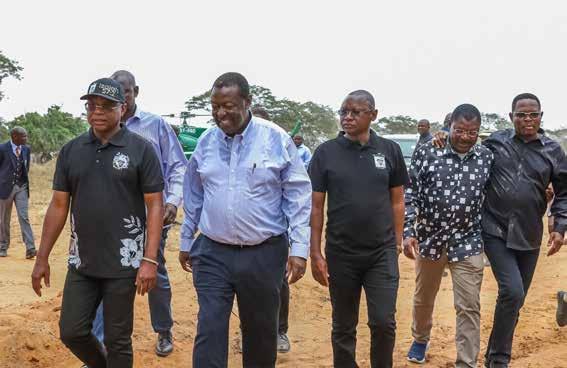
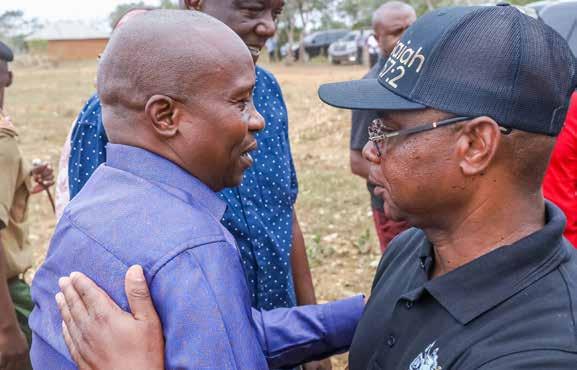


7. Prime Cabinet Secretary Musalia Mudavadi arrives for the burial of Speaker Amason Kingi’s father.
8. Deputy President Kithure Kindiki condoles Speaker Kingi.
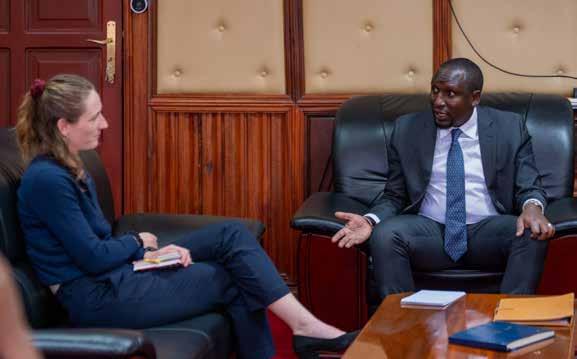
9. Majority Leader Aaron Cheruiyot speaks to Ms Neil Wigan, British High Commissioner to Kenya when she paid him a courtesy call at his office in Parliament Buildings.
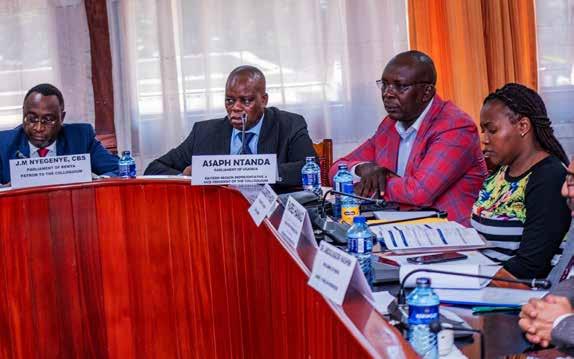
Clerk Jeremiah Nyegenye (left) and Dr Johnson Okello, Director, Senate Legal Services, follow proceedings during the African Colloquium of Legal Counsels meeting at Parliament Buildings.
11. Senate Clerk Jeremiah Nyegenye poses for a picture with some of the participants at the African Colloquium of Legal Counsels meeting.
12. Leader of Majority Aaron Cheruiyot (right) and Senator Godfrey Osotsi with Russian Ambassador to Kenya Vsevolod Tkachenko after his visit to Parliament Buildings.
© Copyright 2023
Email: Senate.weekly@parliament.go.ke
Editor: Ibrahim Oruko
Team Leader: Lucianne Limo
Writers
• Otiato Andayi
• Njeri Manga
• Josphat Ngeno
• Derick Luvega
• Stanley Gikore
• Nandemu Barasa
• Juliet Masinde
• Violet Nalianya
• Lemeteki Lorinyu
Hansard: Erick Kipkoech
Photographers:
James Kimiti Nyambura
Job Owaga
Russells Kipngetich
Designed by:
KENYA LITERATURE BUREAU
Publishers and Printers Belle-Vue Area, KLB Road, Off Popo Road P. O. Box 30022-00100, GPO Nairobi, Telephone: +254 (20) 3541196/7, Mobile: +254 711 318 188/ +254 732 344 599
Email: info@klb.co.ke Website: www.klb.co.ke