A guide to the National Neonatal Audit Programme Summary report on 2025 data
NNAP National Neonatal Audit Programme
Your baby’s care Measuring standards and improving neonatal care October 2026
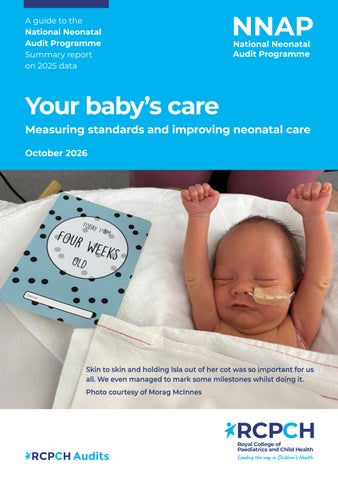
Skin to skin and holding Isla out of her cot was so important for us all. We even managed to mark some milestones whilst doing it. Photo courtesy of Morag McInnes
RCPCH RCPCH Audits
Royal College of Paediatrics and Child Health
Your baby’s care
Keon’s journey has taught us that every baby’s story is unique. As parents, we have faced challenges we never expected, but we have also celebrated every little achievement along the way. Sharing our experience and seeing Keon represented may help other families feel less alone on their own journey. Photo courtesy of Omolabake Olabisi Faith
Daddy reading to me, whilst I receive my budesonide. Photo courtesy of Leighsa Boyd-Roarty
2
The hardest part of NICU was that I couldn’t take away her pain, but being there to soothe her through every cannula, lumbar puncture, eye exam and post op meant she never faced it alone. I knew in my heart this mattered so much in our recovery as a family. Photo courtesy of April Lyon
Your baby’s care
Contents What is neonatal care? What is the National Neonatal Audit Programme? What areas of care does the NNAP focus on?
4 5 7
1: Partnership in care Parental consultation within 24 hours of admission Parent inclusion in consultant ward rounds Breastmilk feeding throughout the neonatal stay Medical follow-up at two years of age Neonatal nursing
8 8 9 10 11 13
2: Care processes Antenatal steroids Antenatal magnesium sulphate Birth in a centre with a NICU Deferred cord clamping Temperature on admission Breastmilk feeding by day 2 Non-invasive breathing suport On time screening for ROP
14 14 14 15 15 16 17 18 19
3: Outcomes of neonatal care Mortality Bronchopulmonary dysplasia Necrotising entercolitis Bloodstream infection Pre-term brain injury (IVH and cPVL)
20 20 20 21 21 22
Equity in neonatal care Your units NNAP results Who is the NNAP supported by? What can you do next? Glossary References
23 25 26 27 28 29
Note on terminology: Throughout this guide the term ‘mother’ is used. However, it is not only people who identify as women who may want to access this leaflet. Your care should be personalised, inclusive and sensitive to your needs whatever your gender identity. 'Your Baby' is used throughout the guide for brevity, but we acknowledge that your family might have multiple babies experiencing neonatal care. 3
Measuring standards and improving neonatal care
Your baby’s care
What is neonatal care? About 1 in 11 babies will need to be admitted to a neonatal unit because they are born early, with a low birth weight, or unwell and need specialist care and treatment. Your baby may need help with breathing or feeding. Sometimes babies might have an infection
or other medical conditions that require treatment. Your baby might stay on a neonatal unit for days, weeks or months, depending on their needs. You will be encouraged and supported to take an active role in their care as soon as you are ready too.
I II in
Neonatal unit admissions About 1 in 11 (or 58,558 out of 631,166) babies born in England, Scotland and Wales each year need specialist neonatal care in hospital.
4
Your baby’s care
What is the National Neonatal Audit Programme? It is important to regularly share information about the quality of care provided by neonatal units to improve outcomes and care for all babies and their families. The Royal College of Paediatrics and Child Health (RCPCH) does this through the National Neonatal Audit Programme (NNAP). The NNAP helps neonatal units give better care to babies who need specialist treatment. We look at: • Whether babies receive consistent, high-quality care. • If babies have had the health checks recommended to reduce the risk of complications. • How well babies are doing following this care.
We use information about your baby’s care to help neonatal units in England, Scotland, Wales and the Isle of Man to improve the care and outcomes for other babies. To help with this, we gather information about babies who receive neonatal care. Neonatal unit staff enter your baby's information onto a secure electronic record system called BadgerNet. All neonatal units share information from these electronic records with the NNAP project team within the RCPCH, via another processor, System C, who manage the BadgerNet system.
Find out more To find out more about the audit, how we use this information, and your rights, you can read our privacy notice:
NNAP National Neonatal Audit Programme
https://www.rcpch.ac.uk/about-us/ privacy-hub/NNAP
or scan the QR code with your phone. 5
Your baby’s care
Aman was born at just 24 weeks. This was one of our many precious skin-to-skin moments, but I didn’t get to hold him like this until more than 20 days after giving birth. He was so poorly, so tiny, and so fragile. Moments like this meant everything Photo courtesy of Zainab Yunus
Myself and my daughter Rosalie born at 34 weeks. On Optiflow breathing support and having our first skin to skin after C-section. Photo courtesy of Bethany Cooper
6
Your baby’s care
Which areas of care does the NNAP focus on? The NNAP data covers three workstreams of care for premature and sick babies, each with questions about how well care is delivered.
These workstreams are: • Partnership in care • Care processes • Outcomes of neonatal care
I got to hold Edie for the first time after 3 days. I was too scared and upset to touch her initially as she was so tiny. The 24 days we spent in the NICU were the hardest of my life. I am so grateful to every single nurse and doctor who kept her safe. Photo courtesy of Kayleigh Russell
These were chosen by a group of experts in neonatal care, which included nurses, doctors and parents with experience of neonatal care. The NNAP consults regularly with parents with experience of neonatal care to reflect on these measures. This guide explains more about these three workstreams of care and shows how well units are doing across England, Scotland, Wales, and the Isle of Man for each of the audit measures. It also explains what you can do next if you have a baby in neonatal care.
Isla’s first milestones were all on the NICU. Her first bath was facilitated by one of the OTs, and was a bonding moment for Isla and her Dad. Wire free for a few precious minutes. Photo courtesy of Morag McInnes
Find out more If you want to find out more about how a particular neonatal unit is doing, you can go to: https://www.rcpch.ac.uk/resources/NNAPdashboards or scan the QR code: 7
Your baby’s care
1. Partnership in care This workstream of the audit focuses on how teams looking after babies can work in partnership with the families of babies born premature or sick.
Parent consultation within 24 hours It is important that families understand and are involved in the care of their baby/babies. Parents being involved in hands on care and decision making can improve outcomes for babies. The NNAP looks at whether a senior member of the neonatal team has talked to parents within the first 24 hours of their baby’s admission. The first consultation is an opportunity for the parents to form a relationship with the senior member of the care team. Parents can ask questions and share concerns. The member of the team can find out about the family and their needs and preferences.
What can you do? If you feel that you haven’t had an early consultation with a member of the neonatal team, you can ask your baby’s nurse to arrange one. At this meeting, you can ask about how you can work in partnership with the neonatal team to look after your baby. Remember, you can ask for a meeting with a senior member of the neonatal team at any time. You can ask for this regardless of whether you had one within 24 hours of your baby being admitted to the neonatal unit. 8
94.5% Consultation within 24 hours 94.5% of parents received a documented consultation by a senior member of the neonatal team within 24 hours of admission.
Your baby’s care
Parent inclusion in consultant ward rounds Neonatal care can be stressful for babies and parents. It is important that families understand and are involved in the care of their baby since this can improve outcomes for babies. Ward rounds occur regularly on neonatal units. Including parents in them can help to develop a partnership in the planning of care between parents and the neonatal team.
38%
Parental inclusion on consultant ward rounds The NNAP looks at whether a parent was involved in the ward round for each day of a baby's stay. Overall, this was reported for 38% of baby care days.
What can you do? Your neonatal team will let you know when the daily ward rounds usually take place. If it would be hard for you to join in, you could ask a member of the neonatal team to introduce or share particular information about your baby during the ward round, and that they update you after this occurs. 9
When your baby is surrounded by wires, machines and medical equipment, it can feel like everyone else knows how to care for them better than you do. But moments like this remind you that underneath it all, they are simply your baby, and you are exactly where you belong. Photo courtesy of David and Hannah Omoyeni
Your baby’s care
Breastmilk feeding throughout the neonatal stay
All babies benefit from their own mother's breastmilk because • it's easier to digest • helps them grow • and protects them from infections. It is important that staff on the neonatal unit • give you or your partner practical support to help you express milk • help support with breastfeeding • help get feeding established ready for going home. The NNAP reports the number of babies born prematurely who receive any of their mother's milk at day 14 of life, and when they are discharged from the neonatal unit.
What can you do? Staff in your neonatal unit should provide you with information about breastmilk, support you with expressing milk and with breastfeeding, and provide advice about other organisations that offer support. If you are struggling with expressing milk or breastfeeding, or have any questions or concerns, ask your baby's nurse who can support you or connect you with additional support. 10
WITHIN
14 DAYS
81.8% Breastmilk feeding at 14 days of life 81.8% of babies born at less than 34 weeks received their mother’s milk at 14 days of life.
AT DISCHARGE
70.7% Breastmilk feeding at discharge 70.7% of babies born at less than 34 weeks received their mother’s milk at discharge.
Your baby’s care
Medical follow up at two years of age There is a national guideline1 that tells neonatal services when and how a paediatrician or neonatologist (specialist doctors trained in the care of children and babies) will check the development of babies after they leave the neonatal unit. This is called the two year check and is for babies who are born at less than 30 weeks.
Babies born prematurely are more likely to have developmental problems than babies born at full term. It is important that those involved in the care of premature babies know how the babies are developing as they get older, so that any additional support required can be put in place.
The NNAP looks at whether there is a documented follow-up consultation at two years of age for babies born at less than 30 weeks gestational age.
In 2025
80.5%
two-year follow-up assessmen t
What can you do? Going to all follow-up appointments means you can get reassurance about how your baby is developing and get any support your baby might need. If you haven't been given information about follow-up appointments, you can check with your neonatal unit. 11
Follow-up at two years of age 80.5% of babies born at less than 30 weeks gestational age received medical follow-up at two years gestationally corrected age (18-30 months gestationally corrected acceptable age range).
Your baby’s care
This is my daughter, Zoe, being held by my eldest daughter, Melissa, who was also a NICU baby after being born early at 35 weeks. She is an incredible big sister.
This is Melissa and Zoe now- they are the best of friends. Melissa is now 7 years old. Zoe is now 22 months. Both girls have their health issues, but they are the most delightful, creative and kind girls.
Photos courtesy of Alicia Hughes
Being held by daddy for the first time on the unit.
Freddie at two years of age looking all grown up.
Photos courtesy of Hannah Jones and Daniel John
12
Your baby’s care
Neonatal nurse staffing Having enough neonatal nurses to care for babies on the neonatal unit is really important to make sure • the quality of care is high, • support is available for parents, • outcomes for babies are good. There are national guidelines2, 3, 4 which set out how many nurses are needed for each shift. This depends on the number of babies they are caring for and how complex the needs of those babies are. The NNAP reports how many shifts have enough nurses to care for the babies in the neonatal unit, based on these guidelines.
82.9%
82.9% of nursing shifts were staffed according to recommended levels.
13
Your baby’s care
2. Care processes This workstream focuses on interventions prior to, during or immediately after birth that can improve outcomes for babies born premature or sick.
50.3%
Antenatal steroids Guidance5 recommends that mothers who give birth to a baby at less than 34 weeks gestational age receive a full course of antenatal steroids for 24 hours in the week before they give birth. This is to support the development of their babies’ lungs. Antenatal steroids help reduce breathing difficulties. This can also reduce the risk of death and other serious problems, such as bleeding into the brain.
Antenatal steroids 50.3% of mothers of babies born at less than 34 weeks were given a full course of antenatal steroids in the week before birth.
Antenatal magnesium sulphate
88.3% MgSO4
14
Antenatal magnesium sulphate 88.3% of mothers of babies born at less than 30 weeks' who were given antenatal magnesium sulphate in the 24 hours before birth.
Giving magnesium sulphate to women who are at risk of giving birth to a baby below 30 weeks reduces the chance that their baby will develop cerebral palsy by 32%. Cerebral palsy is a lifelong condition affecting movement and coordination. Guidance5 recommends that magnesium sulphate should be given to all women who give birth to a baby at less than 30 weeks within the 24 hours before before their baby is born.
Your baby’s care
Birth in a centre with a NICU Babies who are born at less than 27 weeks are at higher risk of serious complications, such as • brain injury • bronchopulmonary dysplasia (BPD) also known as chronic lung disease • necrotising enterocolitis (NEC).
83.4% NICU
Therefore, these babies should be born in a hospital with a neonatal intensive care unit (NICU). NICUs provide the highest level of care and are best equipped to look after these babies. Evidence suggests that babies born at less than 27 weeks have better outcomes if they are cared for in a NICU from birth.
Birth in a centre with a NICU 83.4% of babies born at less than 27 weeks or less than 800 grams or born as a multiple at less than 28 weeks, were born in a maternity service on the same site as a designated NICU.
Deferred cord clamping
76.8%
Deferred cord clamping 76.8% of babies born at less than 34 weeks gestational age had their cord clamped at or after one minute from birth. 15
Deferred cord clamping means waiting at least 60 seconds after birth before clamping the umbilical cord. Research shows that doing this reduces the risk of death in premature babies by nearly a third6. Deferred cord clamping can be done for most babies. It is the best option, even if your baby needs help breathing. In some rare circumstances is not appropriate.
Your baby’s care
Temperature on admission Babies who are born at less than 32 weeks, and have a low temperature on admission to the neonatal unit, are at a higher risk of illness and death. Low temperature (or hypothermia) is a preventable condition in newborn babies. This NNAP measure looks at how successful neonatal units are at making sure babies born at less than 32 weeks have a normal first temperature reading. This should be between 36.5 and 37.5°C within an hour of birth.
80.4% 36.5–3 7.5˚C
Temperature on admission 80.4% of babies born at less than 34 weeks gestational age had a first temperature o n admission which is both between 36.5–37.5°C and measured within one hour of birth.
Born via c section at 33 weeks. First day of life. Photo courtesy of Sasha Hodnett
Leonidas was born at 24 weeks +1 day, and spent 127 days in hospital. This was the first time I got to hold Leonidas. Photo courtesy of Lenuta Papadopol
16
Your baby’s care
Your baby’s care
Breastmilk feeding in the first 2 days of life Breastmilk feeding in the first 2 days of life Early breastmilk, known as colostrum, is beneficial to babies' health and may Early breastmilk, known as colostrum, also help to establish longer term is beneficial to babies' health and may breastfeeding. also help to establish longer term Babies born premature or sick may not be breastfeeding. ready to be fed from their mother’s breast Babies premature or sick may not to be straightborn away. Mothers are encouraged ready to milk be fed breast express forfrom theirtheir babymother’s within the first straight away. arethis encouraged few hours afterMothers birth and milk can be used for mouth to care or given viafor a feeding and supported express milk their tube. is important services baby It within the firstthat few neonatal hours after birth. provide the right families ator the This milk can be support used for to mouth care given via a feeding tube. It is important right time. that neonatal services provide the right As part ofto several measures which look support families at the right time. at the care given to mothers and babies As partduring of several which look before, andmeasures immediately after at the care given to mothers and babies birth, the NNAP reports how many babies before,any during andown immediately receive of their mother's after milk birth, the NNAP reports how within first two days of life.many babies receive any of their own mother's milk within the first two days of life.
Tube feeding using my expressed breast milk. Tube feeding using my expressed Photo courtesy of breast milk. Jessica Haywood and Timothy Robinson Photo courtesy of Jessica Haywood 15
17
2 2
WITHIN
WITHIN DAYS
DAYS
73.5% 73.5% Breastmilk feeding in first 2 days of life
73.5% of babie s born at less than 34 weeks received their mother’s milk in th e first 2 days of life.
73.5% of babies born at less t han 34 weeks received their mother’s milk in the first 2 days of life.
This is me (mum) feeding Matilda for the first time via a syringe. This is me (mum) feeding Matilda for the She was then tube fed, as she first time via a syringe. She was then tube was born at 35 weeks she didn’t fed, as she was born at 35 weeks she have the ability to suck. didn’t have the ability to suck. Photo courtesy of Amelia Gauci and Jacob Dorman Photo courtesy of Amelia Gauci
Your baby’s care
Non-invasive breathing support Bronchopulmonary dysplasia (BPD) is a lung disease that affects babies born prematurely. Mechanical ventilation through an endotracheal tube can increase the risk of a baby developing BPD. Providing non-invasive breathing support, such as Continuous Positive Airway Pressure (CPAP), instead can reduce the risk of BPD. The NNAP looks at how many babies receive only non-invasive breathing support in the first seven days of their life.
Matilda was on CPAP for two days, she was unable to breathe on her own when she was first born. The NICU nurses explained how everything works. Photo courtesy of Amelia Gauci and Jacob Dorman
52.8%
Non-invasive breathing support 52.8% of babies born at less than 32 weeks gestational age received only non-invasive breathing support in the first seven days of life. 18
I can't breathe on my own yet so I am having some help! Photo courtesy of Evie Coleman
Your baby’s care
Retinopathy of prematurity
Retinopathy of prematurity (ROP) is a condition that affects blood vessels in a part of the eye called the retina. If a baby is born very prematurely, these blood vessels can start growing abnormally, which causes ROP. Finding and treating ROP before it becomes severe can reduce the risk of sight loss. There is a national guideline7 that tells neonatal services which babies should be checked for ROP, and when the first screen should be carried out. The NNAP looks at how well neonatal units do at screening these babies at the right time.
84.4%
of babies were screened on time for ROP
Screening for retinopathy of prematurity (ROP) 84.4% of babies born at less than 31 weeks gestational age, or weighing less than 1501g at birth had their first ROP screening according to the guideline.
What can you do? The nurses on the unit are experienced in getting babies ready for the eye examination and supporting them during it. They will be able to explain how they do this and will involve you as much as possible. If you choose to be present, you may be able to comfort your baby before or after the examination. The nurses will be able to guide you on how to best comfort your baby. Being present will also give you another opportunity to ask any questions that you may have. You can find out more by reading the Screening for Prematurity Information for Parents and Carers, available at: www.rcpch.ac.uk/resources/ screening-retinopathy-prematurity-information-parents-carers 19
Your baby’s care
3. Outcomes of neonatal care This workstream focuses on some of the medical outcomes that can happen to babies born premature or sick.
Mortality Even though the numbers are very low, it is important that we monitor the proportion of babies who are admitted for neonatal care and sadly die before they go home. This enables neonatal services to review the number of babies who die and the causes of death with the aim that through shared learning and sometimes changes in practice, mortality numbers will decrease.
5.7%
MortalityMortality
ofborn babies born than 32 weeks 5.7% of5.7% babies at less thanat 32 less weeks gestational agetoand admitted to neonatal gestational age and admitted neonatal care died careordied before discharge 44 weeks before discharge 44 weeks post menstrualor age. post menstrual age.
Bronchopulmonary dysplasia (BPD)
40.5%
Bronchopulmonary dysplasia (BPD) 40.5% of babies born at less than 32 weeks gestational age developed broncopulmonary dysplasia (BPD) or died. 20
Babies born very early often have underdeveloped lungs and may require help with their breathing. Being born prematurely can lead to ongoing breathing challenges. The use of a ventilator is essential to support some babies with their breathing. However, it can potentially harm the lungs and increase the risk of chest infections. This condition is known as bronchopulmonary dysplasia (BPD), which is also called chronic lung disease.
Your baby’s care
Necrotising enterocolitis (NEC) Necrotising enterocolitis (NEC) is a severe condition that can occur after premature birth. It causes inflammation in the bowel, making it difficult for babies to be fed with milk, and sometimes requires surgery. Babies with NEC often have to stay in hospital for an extended period. Sadly, over 20% of babies with NEC do not survive, and those who do may face developmental delays and long-term issues with feeding and bowel function.
4.8%
Necrotising enterocolitis (NEC) 4.8% of babies born at less than 32 weeks gestational age developed NEC.
Bloodstream infection (BSI)
Bloodstream infection (BSI) 5.3% of babies born at less than 32 weeks gestational age had one or more episodes of BSI.
5.3%
Babies who are sick or born prematurely are more at risk of getting infections, even ones that don't usually harm healthy people. These infections can mean that they stay longer in the neonatal unit, increase the risk of death and sometimes affect the babies’ long-term development. To help lower the risk of infection it is essential that all health professionals, parents and visitors follow good infection prevention and control practices on the neonatal unit.
21 21
Your baby’s care
Preterm brain injury (IVH and cPVL)
Babies born at less than 32 weeks may experience brain injury, sometimes caused by bleeding. The consequences of these injuries vary, partly depending on the severity of the injury.
12.8%
The NNAP reports two types of brain injury - more serious forms of intraventricular haemorrhage (IVH) and cystic periventricular leukomalacia (cPVL). By understanding how many babies get brain injuries, neonatal teams can try to reduce the number.
Preterm brain injury – Intraventricular haemorrhage (IVH) 12.8% of babies born at less than 32 weeks experienced IVH grades 3 or 4, or death.
10%
Preterm brain injury – cystic periventricular leukomalacia (cPVL) 10% of babies born at less than 32 weeks experienced cPVL or death.
22
Izzy with her crochet octopus. Photo courtesy of Janie and Niall Byrne
Your baby’s care
Equity of neonatal care The NNAP had looked at whether there are any differences in the way families of different ethnicities are cared for.
For this to happen, changes might need to be made locally by an individual hospital, or nationally, by governments for other organisations.
It is important that we know if care and outcomes are different between ethnic groups so that steps can be taken to make sure that everyone receives the same high quality care.
The NNAP shares this data with neonatal services so that they can see whether they deliver care equitably in their hospitals, or whether they need to make changes to make sure that it is equitable in the future.
At four weeks old, this milestone meant so much to us. Keon had just moved from his incubator into an open cot with heating, which felt like such a huge step forward. Our time in neonatal care showed us the importance of compassionate, skilled care. Every gram gained and milestone reached felt like a huge victory. Photo courtesy of Omolabake Olabisi Faith
23
Celebrating Isla’s achievements, and feeling thrilled to finally take her home. Photo courtesy of Morag McInnes
23
Your baby’s care
Our tiny baby Malcolm. Born at 30 weeks and 3 days receiving CPAP and then high flow oxygen. Big Brother Francis tube feeding enhanced breastmilk. The unit really encouraged family involvement.
Father Christmas visited all the babies in hospital. Malcolm came out of the incubator and into the open cot on Christmas day Malcolm now! 18 months, walking and chatting away. Photos courtesy of Bethany and Joshua Robinson
24
Your baby’s care
Your unit's NNAP results The information given in this guide describes the national results for all units in England, Scotland, Wales and the Isle of Man.
These posters show you the NNAP results for your unit, national results and what your unit is doing in response to their NNAP results. Where there are opportunities for improvement, units are encouraged to put together an action plan.
You can look for your unit’s NNAP posters, which we encourage neonatal teams to display. You can also view these at:
You can view the full National Neonatal Audit Programme report and information about each hospital on NNAP Online at
https://www.rcpch.ac.uk/ resources/NNAP-dashboards Examples of both posters can be found below.
Perin
atal O Measu NNAP ptimis ring st an
Partnership in neonatal care
Measuring standards and improving neonatal
https://www.rcpch.ac.uk/ resources/NNAP-dashboards
care
ation
dards and
National Neonatal Audit Programme
improv ing ne onat
NNAP
al care [xxxxx xxxxxx xxxxxx on as Natio pe nal Ne xx] ta Audi on cts of ca reports hosp t Prog onatal Neonatal Audit Programme (NNAP) which re give kes part in ital ramme [xxxxxxxxxxxxx] takes part in the National the Na n to hospital compared tional babie units. This poster shows 2025 results for this interventio neonatal on wi babies to s given Ne th care of aspects on ne onatal ns that overall neonatal onatal Audit contrib Wales, and the Isle of Man) results for the (En Scotland, (England, overall gla with Pr un compared ute to ogram nd, Sc its. Th the be me (N otland, is po st indicators. ste NA partnership perinat Wales, r show P) wh al care ich re and th s 2025 ports for pr e Isle results eterm of Ma for th infants. n) resu is How ou lts fo r the r unit How our unit did across 8 NNAP measures: di
-• {&
Parent consultation within 24 hours Overall, 94.6% of parents had a documented consultation with a senior member of the neonatal team within 24 hours of their baby's admission
r;;;;:. National Rate:36%
Overall, 36.0% of baby care days had a consultant-led ward round with at least one parent included
Breastmilk feeding in the first two days
Our Unit:
Overall, 66.8% of babies born at less than 34 weeks received their mother's milk in the first
National Rate: 76.1%
N/A
Breastmilk days of life
Screening for retinopathy of prematurity (ROP)
Breastmilk feeding at discharge
Overall, 80.0% of babies born at less than 37 weeks gestational age, or weighing less than 7507g at birth had their first ROP screening according to the guideline. Te
Overall, 65.8% of babies born at less than 34 weeks received their mother's milk at discharge home
••
Anten
atal ste
roids Overa ll, X% of mo babie thers s born of at less weeks than 34 we of anten re given a fullco atal ste urse week roids in before the delive ry.
ff Defer
red co
fe•
mpera ture on
Neonatal nurse staffing Overall, 81.5% of nursing shifts were staffed according to recommended levels
1'RCPCH
Royal College of Paediatrics and Child Health
N/A
National Rate:65.4%
admi
mend ge of ed 36.5 °COverall, 65.4% of babies born 37.5 °C. at less than 30 weeks' had a documented medical follow up at the right time.
Roy
How we use your data
To find out more about how we use your baby's information, please visit www.rcpch.ac.uk/NNAP or scan the QR code with your phone.
N/A
Anten atal ma sulph gnesium ate
Our Uni t:
N/A
Nation al Rate: N/A
Nation al Rate: N/A
Overa ll, X% of mo babie thers s born of at less week than 30 s were given magn anten esium atal sulph ate.
al Colcare Discuss your Paeown dia lege of trics and
Child the speak about like;..9totJ.,...., If you wouldl,u Health ;., please J,...,, H,-1t neonatal care you receive,CJ.;/ i. speak to your doctor or nurse.
Our Uni t:
N/A
Our Uni
Breastm first tw ilk feeding in the o days
t:
N/A
Nation al Rate: N/A
Nation al Rate: N/A
Ov
erall, X% of babie less tha s bo n their mo 34 weeks rec rn at eived ther's 2 days milk in of life the firs t
Our Uni t:
N/A
Nation al Rate: N/A
Our Uni
t:
N/A
Nation al Rate: N/A
How we use yo ur da To find ta out your bab more about how we y's info www.r rmatio use
Born
in a NIC
U
Overa ll, X% of babie less tha s born n at in a cen 27 week's were tre wit born h a NIC U on site Note tha . t this rate name] is for [ne twork
+
11111 11111 11111 II 11111
•••
Discu ss your
own car cpch.a n, please NNAP If you wo uni c.uk/N e the QR visit uld like Measure t posters NAP or code wit com neonat s listed to spe scan l,u;..9 tJ.,...., ;., CJ.;/J,...,, H,-1ti. as "N/A municate h your al care ak abo selecte " are eith phone ut you rec speak d NNA er ma . eive, ple the to you P resu sked to r doctor lts for ase reduce the risk your unit or nurse to of ded be used for accountability reporting. . uctive parents and 2026 unit to parents and families. They should not your October for Published results NNAP selected disclosu fam NNAP unit posters communicate babies in 2025. re or had ilies. The the risk of deductive disclosure or had no eligible y sho Measures listed as "N/A" are either masked to reduce no elig ible bab uld not be used for ies in 2025. accoun (HQIP) Partnership Improvement tab Quality Healthcare 2026 © ility rep orting.
RCPC
H Audit
RCPCH Audits
25
�
ssion
mitte 's were two d with Medical follow up at wit a tem hin the perature years of age recom ran
1'RCPC H
sures:
Our Uni t:
rd
clamp Overa ing ll, X% of babie less tha s bo n cord cla 34 weeks ha rn at d mped at or aft their minute. er one
Overa ll, X% of ba less tha n 34 we bies born at ad ek
our Unit:
ss 6 N NAP m ea
feeding at 14
Overall, 76.1% of babies born at less than 34 weeks received their mother's milk in the first 74 days of life.
2 days of life
t
d acro
tl
Parent inclusion on consultant ward rounds
s
© 2026
Health
care Qu
Publish
ality Im provem ent Par
ed Oct
tnersh
ober 202
ip (HQ
IP)
6
Your baby’s care
Who is the NNAP supported by? We’re pleased to be supported by a range of organisations. Further details can be found below.
Bliss is the UK charity working to ensure that every baby born premature or sick in the UK has the best chance of survival and quality of life. Bliss supports the National Neonatal Audit Programme. For support and information please visit: www.bliss.org.uk
British Association of Perinatal Medicine (BAPM) aims to improve standards of perinatal care by supporting all those involved in perinatal care to optimise their skills and knowledge, deliver and share high quality safe and innovative practice, undertake research, and promote the needs of babies and their families. For further information, visit: www.bapm.org
The Neonatal Nurses’ Association (NNA) is the national organisation representing, supporting and celebrating neonatal nurses, working to promote neonatal nursing for the benefit of newborns and their families throughout the country. For more information, visit: www.nna.org.uk
26
What can you do next? • Find out more about your neonatal unit’s NNAP results by going to the NNAP Online reporting tool at: www.rcpch. ac.uk/resources/nnap-onlinereport-data •
Ask your neonatal nurse for more information about your unit’s NNAP results and their plans for improvement.
• Learn more about what the NNAP does and how your baby’s information is used to support improvement by going to: https://www.rcpch.ac.uk/workwe-do/clinical-audits/nnap • Ask a member of the neonatal unit staff for support.
We would like to thank all parents and carers who shared their journey in neonatal care with the NNAP to publish in our reports. We would also like to extend our gratitude to all units, networks, and partner organisations who supported the development of this guide by encouraging families to share their stories.
Find out more about the NNAP To find out more about the audit, please visit our website below or scan the QR code with your phone. www.rcpch.ac.uk/NNAP To find out how we use your baby's information and your rights, you can read our privacy notice at: https://www.rcpch.ac.uk/about-us/privacy-hub/NNAP
Additional resources avaliable through RCPCH RCPCH &US The RCPCH & Us work to ensure that the voice of children, young people and families is making a difference in child health and healthcare. https://www.rcpch.ac.uk/about-us/ our-team/children-young-peopleengagement-team 27
Medicines for Children - information for parents and carers Our website provides practical and reliable information to parents and carers about giving medicines to their child - with free access to information leaflets on over 200 medicines, videos and news. https://www.rcpch.ac.uk/resources/ medicines-for-children
Your baby’s care
Measuring standards and improving neonatal care
Glossary Antenatal – The period before birth during or related to pregnancy.
before 37 weeks’ gestation, they are premature.
Antenatal magnesium sulphate – A substance naturally found in the body but given as a medicine to women in premature labour, to reduce the risk of cerebral palsy.
Intraventricular haemorrhage (IVH) – See Preterm brain injury.
Antenatal steroids – A medication given to mothers who may give birth early to reduce the baby’s risk of breathing problems, bleeding into the brain and developmental delay. Bronchopulmonary dysplasia (BPD) – A lung condition that mostly affects premature babies. The NNAP defines a baby as having BPD if they need breathing support or extra oxygen when they reach 36 weeks corrected gestational age. BPD is sometimes called ‘chronic lung disease’ (CLD). Continuous positive airway pressure (CPAP) – See Ventilation. Cystic periventricular leukomalacia (cPVL) – See Preterm brain injury. Deferred cord clamping – Waiting at least 60 seconds after delivery before clamping the umbilical cord. Expressing breastmilk – To use a pump, hands or both to get milk from the mother’s breasts. The milk can be stored in a fridge or freezer or given directly to the baby. Gestational age – The number of weeks the baby has been in the womb is known as the gestation. Being born at term means being born after 37 full weeks in the womb. If a baby is born 28
Necrotising enterocolitis (NEC) – A severe condition that can occur after premature birth. It causes inflammation in the bowel, making it difficult for babies to be fed with milk, and sometimes requires surgery. Neonatal – Newborn, or the first 28 days of life. NICU – Neonatal Intensive Care Unit Where babies who need the highest levels of care are looked after. Paediatric – The branch of medicine dealing with children and their health. Perinatal – The period of time between becoming pregnant and up to a year after giving birth. Premature – A baby born before 37 weeks of pregnancy (full term is 40 weeks). Preterm brain injury – Babies born very early may experience brain injury, sometimes caused by bleeding. The consequences of these injuries vary, partly depending on how bad the injury is. The NNAP reports two types of brain injury - more serious forms of intraventricular haemorrhage (IVH) and cystic periventricular leukomalacia (cPVL). Retinopathy of prematurity (ROP) – Damage to the back of the eye (retina) in premature babies and those born
Your baby’s care
with a very low birth weight. ROP is not fully understood but is linked to the amount of oxygen in the blood. At risk babies should be regularly checked for signs of ROP. Ventilation – Mechanical support with breathing, to help the baby to have acceptable levels of oxygen and carbon dioxide in their blood when they are unable to achieve this. There are several different types of ventilation including CPAP. Ward rounds – Regular, planned reviews of all the babies in a ward or area, involving all the team caring for those patients, often in the morning.
References 1. NICE guideline [NG72]. Developmental follow-up of children and young people born preterm. 2017. Available at: www.nice.org.uk/guidance/ng72 2. NHS England. Neonatal Critical Care Service Specification. 2016. Available at: www. england.nhs.uk/commissioning/spec-services/npc-crg/group-e/e08/ 3. Department of Health. Toolkit for high quality neonatal services. 2009. Available at: https://webarchive.nationalarchives.gov.uk/ukgwa/20150518111742/ http://www.nice.org.uk/proxy/?sourceUrl=http%3a%2f%2fwww.nice.org. uk%2fmedia%2f726%2f74%2fDHToolkit2009.pdf 4. British Association of Perinatal Medicine. Service Standards for Hospitals Providing Neonatal Care (3rd edition). 2010. Available at: www.bapm.org/resources/32-servicestandards-for-hospitals-providing-neonatal-care-3rd-edition-2010 5. NICE guideline [NG25]. Preterm labour and birth. Last updated: 10 June 2022. Available at: www.nice.org.uk/guidance/ng25 6. Fogarty, M. et al. Delayed vs early umbilical cord clamping for preterm infants: a systematic review and meta-analysis. Am J Obstet Gynecol. 2018 Jan;218(1):1-18.doi: 10.1016/j. ajog.2017.10.231. Available at: pubmed.ncbi.nlm.nih.gov/29097178/ 7. Screening of retinopathy of prematurity (ROP) – clinical guideline available at: www. rcpch.ac.uk/resources/screening-retinopathy-prematurity-rop-clinical-guideline 29
Measuring standards and improving neonatal care
When Louie first arrived in the world.
One week old, we got our first cuddles. The best way to celebrate Christmas Day!
Physiotherapy in the hospital, getting ready to go home.
Louie now, 6 months old
Photos courtesy of Georgia Blackbourn 30
A guide to the National Neonatal Audit Programme Summary report on 2025 data
The National Neonatal Audit Programme is commissioned by the Healthcare Quality Improvement Partnership (HQIP) and funded by NHS England and the Governments of Wales, Scotland and the Isle of Man as part of the National Clinical Audit and Patient Outcomes Programme. www.hqip.org.uk/national-programmes
RCPCH Royal College of Paediatrics and Child Health
Royal College of Paediatrics and Child Health 5-11 Theobalds Road, London, WC1X 8SH
© 2026 Healthcare Quality Improvement Partnership (HQIP) Royal College of Paediatrics and Child Health. Incorporated by Royal Charter and registered as a Charity in England and Wales: 1057744 and in Scotland: SCO38299. Registered Office 5-11 Theobalds Road, London WC1X 8SH.Patron HRH The Princess Royal.