Epilepsy12 - National Organisational Audit and Clinical Audit 2026
National Clinical Audit of Seizures and Epilepsies for Children and Young People
Epilepsy12 2026 combined organisational and clinical audits:
Report for England, Jersey and Wales
Clinical Cohort 7 – The first year of care for children and young people following a first paediatric assessment undertaken between 1 December 2023 and 30 November 2024.
Royal College of Paediatrics and Child Health
Epilepsy12
Epilepsy12, the National Clinical Audit of Seizures and Epilepsies for Children and Young People, is commissioned by the Healthcare Quality Improvement Partnership (HQIP) and funded by NHS England and the Governments of Wales and Jersey, as part of the National Clinical Audit and Patient Outcomes Programme.
HQIP is led by a consortium of the Academy of Medical Royal Colleges, and the Royal College of Nursing. Its aim is to promote quality improvement in patient outcomes, and in particular, to increase the impact that clinical audit, outcome review programmes and registries have on healthcare quality in England and Wales.
HQIP holds the contract to commission, manage and develop the NCAPOP, comprising around 40 projects covering care provided to people with a wide range of medical, surgical and mental health conditions. The programme is funded by NHS England, the Welsh Government and, with some individual projects, other devolved and crown dependencies. Find out more at www.hqip.org.uk/national-programmes
The Epilepsy12 Project Board would like to thank the administrators, clinical audit department staff, data analysts, doctors, nurses and others within participating Health Boards and Trusts. These teams have put time and effort into collecting information and entering data for the audit and are working to improve paediatric epilepsy services during challenging circumstances.
The Epilepsy12 Audit works collaboratively with stakeholder organisations and within the RCPCH to deliver the audit programme accurately and efficiently.
Information on the governance structure of Epilepsy12 and the membership of the Project Team, Project Board and Methodology and Dataset Group is available online here
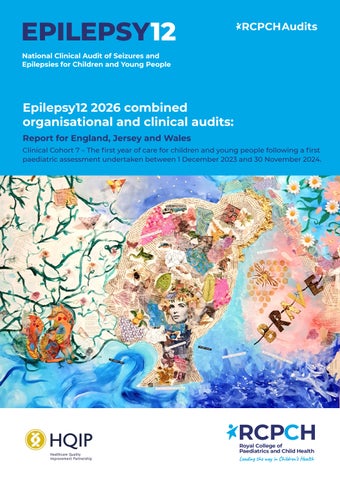
Front Cover – This artwork captures the collective voice of the ‘Young Epilepsy Warriors (YEW)’, a group of young people from University Hospital Southampton who came together, through the Epilepsy12 funded RCPCH Impact and Influence in Epilepsy pilot programme, to be heard and to shape understanding of life with epilepsy. Created through free, shared creativity, it represents their desire for greater awareness, reduced stigma, and recognition of their lived experiences beyond limitations.
Introduction
Epilepsy12 was established in 2009 and has the continuing aim of helping epilepsy services, and those who commission health services, to measure and improve the quality of care for children and young people with epilepsy.
Epilepsy is the most common significant long-term neurological condition of childhood and affects an estimated 112,000 children and young people in the UK. Epilepsy12 seeks to help improve the standard of care for children and young people with epilepsies.
To do this, the audit collects and processes data relating to the delivery of patient care and the organisation of services. This information is used by the audit to highlight areas where services are doing well, and to identify areas for improvement.
There are three main elements within Epilepsy12 which are referred to in this report:
1
Auditing of the clinical care provided to children and young people newly diagnosed with epilepsy in ‘cohort 7’ (2026 publication), and the organisation and structure of epilepsy services as of November 2025. Find out more here
2
Quality improvement activities and projects related to the audit.
3
The Epilepsy12 Youth Advocate programme, RCPCH & Us - a group of epilepsy experienced or interested children, young people and families volunteering to improve epilepsy care. Find out more here
This report and its accompanying appendices, glossary and useful resources can be found here. All current and previous publications from Epilepsy12 are available here. For more information on Epilepsy12 methodology and data collection, please click here
Organisation of Paediatric Epilepsy Networks in the United Kingdom (OPEN UK)
OPEN UK is a clinical network connecting NHS Health Boards and Trusts caring for children and young people with epilepsies to regional epilepsy networks. Guided by the OPEN UK Working Group, it represents 17 regional epilepsy networks in the UK and the British Paediatric Epilepsy Group.
OPEN UK:
Encourages collaboration and sharing of ideas, pilots, and resources.
• Is a national resource and professional UK body for information, support, data, and clinical input.
• Maintains connections with local, regional, and national funding bodies. Click here to find out more
England, Jersey and Wales have representation within the Epilepsy12 Project Board and within the UK Epilepsy Programme Board
NHS England Children and Young People (CYP) Transformation Programme Team
NHS England established an Epilepsy Oversight Group in 2021 to help improve epilepsy care for children and young people, as part of the implementation of the NHS Long Term Plan. A National bundle of care for CYP with epilepsy was published in 2023, consisting of key standards and recommendations around the care and delivery of epilepsy services to support systems with epilepsy quality improvement within four areas:
1. Addressing variation in care between epilepsy services.
2. Supporting the mental health of children and young people with epilepsy.
3. Improving referrals into tertiary services and the Children’s Epilepsy Surgery Service (CESS).
4. Improving the transition from paediatric to adult epilepsy services. To support the identification and tracking of local improvement, key Epilepsy12 audit metrics are included as measures against the recommendations for ICBs within the bundle. Encouragingly, following the publication of the national bundle of care for CYP with epilepsy in October 2023, the Epilepsy12 cohort 7 data findings published in this report identify improvements across some of the key areas targeted for improvement in the bundle, including mental health provision, the proportion of children and young people (CYP) seen by an epilepsy specialist nurse and the proportion of CYP who met the CESS referral criteria and had evidence of a referral.
Results at a glance: Update EPILEPSY 12
Audits RCPCH
Below are results from the Epilepsy12 ‘cohort 6’ (2025 publication) and ‘cohort 7’ (2026 publication) Clinical Audit, focusing on the 10 Key Performance Indicators (KPIs) to describe the first year of care for children and young people with a new diagnosis of epilepsy in England and Wales. For more information, please visit our website (or use the QR code to the right)*.
Involvement of appropriate professionals
KPI 1 Children and young people seen by a consultant paediatrician with expertise in epilepsies within two weeks from first paediatric assessment.
Mental health
KPI 6 Children and young people with documented evidence that they had been asked about mental health.
KPI 2 Children and young people seen by an epilepsy specialist nurse (ESN) within the first year of care.
KPI 3a Children and young people meeting defined criteria for tertiary input, who received input from a paediatric neurologist or a referral to Children’s Epilepsy Surgery Service (CESS) within the first year of care.
KPI 3b Children and young people who met CESS referral criteria who had evidence of a CESS referral.
Appropriate assessment
KPI 4 Children and young people with convulsive seizures who had an ECG within the first year of care.
KPI 7 Children and young people with a mental health problem who had evidence of receiving mental health support within the first year of care.
Care Planning
KPI 8 Females on Valproate treatment and females 12 years and over on Topiramate treatment, with risk acknowledgement forms completed. *new measure
KPI 9a Children and young people who had evidence of care planning agreement within the first year of care.
KPI 9b Children and young people who had documented evidence of communication regarding core components of care planning
KPI 5 Children and young people with defined indications for an MRI who had an MRI within 6 weeks of request.
KPI 10 Children and young people aged 5 years and above who had evidence of a School Individual Health Care Plan within first year of care.
Key Themes
The following section describes key findings and messages from the 2026 analysis, alongside national recommendations based on the evidence.
We have begun to collate results since 2018 to capture longitudinal trends. This is showing improvement in some aspects of care and other areas where progress appears limited. For further information see the 2026 Epilepsy12 Longitudinal Trends Report
Epilepsy12 reports clinical and organisational data at local, regional and national levels. To align with the NHS England Core20PLUS5 approach to reducing health inequalities for children and young people, we are now also exploring variation by demographics. Key Performance Indicators (KPIs) are broken down by ethnicity, deprivation, age, gender and geography, alongside the presence/absence of 1) mental health conditions and 2) neurodevelopmental conditions or learning disabilities.
Cohort 7
Prior to the January 2026 deadline, 3,709 children and young people with an epilepsy diagnosis had a completed first year of care form in cohort 7 and were therefore included in the final analysis for this report. An additional 8 children and young people were registered, and had completed records, from Jersey. To minimise risk of disclosure, these 8 children and young people have not been included in the cohort 7 annual analysis within this report, including the key performance indicator calculations and ‘Results at a Glance’ page. Subject to disclosure risk, data from Jersey may be included in future clinical audit analyses.
Epilepsy12 processes data relating to the first 12 months of care for all children and young people within the cohort. There are 10 ‘Key Performance Indicator’ (KPI) measures for the audit which are derived from national guidelines and quality standards.
Key theme 1: Including all children and young people
Ascertainment of children and young people with a new diagnosis of epilepsy is continuing to improve towards complete ascertainment, with consistent demographic characteristics across successive cohorts.
Participation
• 97.7% (130/133) of eligible Health Boards and Trusts registered into Epilepsy12 participated in the cohort 7 clinical audit by completing data entry and submitting a first year of care record for at least one child or young person who was eligible for inclusion.
Clinical audit participation has increased compared to 80% (120/150) for cohort 6, 78% (108/138) for cohort 5 and 74% (103/140) in cohort 4. Health Board/Trust eligibility was confirmed prior to the annual January submission, resulting in a formally confirmed participation figure this year.
In 2025, 90.2% (120/133) of eligible Health Boards and Trusts submitted organisational data to describe their service as at 1 November 2024, including data from Jersey General Hospital. This is an increase compared to the 75.5% (114/151) and 85% (117/138) of Health Boards and Trusts who participated in the 2024 and 2023 organisational audit reports respectively, and similar to the 91% that participated in 2022. Epilepsy12:
Cohort size
3,709 children and young people with epilepsy were included in the final cohort 7 analysis described in this report. This does not include the 8 children and young people from Jersey.
Clinical cohort sizes continue to increase compared to cohorts 1 to 6 as shown in Figure 1. The demographic make-up of cohorts has remained consistent since cohort 1. Current available data may not yet capture all new epilepsy diagnoses, due to disparate epilepsy care pathways, and the scale and characteristics of any remaining ascertainment gaps are not yet well defined.
Data completeness remains high for cohort 7 at 96.1% (3,709/3,859), compared to 98.5% for cohort 6 and 86% for cohort 5.
Cohort 1 (20 20*)
Cohort 2 (2021*)
Cohort 3 (2022*)
Cohort 4 (2023*)
Cohort 5 (2024*)
Cohort 6 (2025*)
Cohort 7 (2026*)
Number of children and young people
Description of clinical cohort 7:
The median age at first paediatric assessment was 7.9 years.
27.6% (1,025/3,709) of children and young people lived in areas within the most deprived quintile*.
56.1% (2,082/3,709) of children and young people had ‘male’ indicated as their gender.
9.4% (349/3,709) of children and young people had a mental health condition identified.
of
1 – the
and young
66.6% of children and young people were ‘White’. 13.3% did not have their ethnicity indicated.
31% (1,149/3,709) had a neurodevelopmental condition and/or learning disability identified.
*Deprivation quintile was derived by matching home postcodes to the English (IMD, 2019) and Welsh (WIMD, 2019) indices of multiple deprivation data.
Recommendation 1
Work in partnership with Epilepsy12 to establish area specific expected incidence estimates to act as local population denominators.
These metrics should support the development of more robust measures to assure achievement of complete local population ascertainment and improve analysis of workforce and resource requirements and their impact.
Action by: Integrated Care Systems (ICSs) within England, Health Boards in Wales and Health and Care Jersey.
Figure
number
children
people with epilepsy in each each clinical cohort.
Key theme 2: Workforce and pathways for local populations
Epilepsy12 data shows that, since 2009, the epilepsy specialist nurse (ESN) workforce has more than tripled and access to ESN support has doubled. ESN provision is higher in areas with higher proportions of socioeconomic deprivation.
Capacity and consistent access to additional expertise has not progressed at the same rate. Specifically, there remains issues with timely access to paediatricians with expertise in epilepsy and in achieving paediatric neurology input for children and young people (CYP) with complex epilepsies. There appears to be a large group of CYP who meet referral criteria for epilepsy surgery but have progressed only as far as paediatric neurology input.
Care pathway gaps are more pronounced in deprived populations and among CYP with neurodevelopmental conditions.
These findings reinforce recommendations made in previous Epilepsy12 reports, with current data indicating that the underlying workforce, pathway, and equity challenges persist and continue to warrant action.
Paediatrician with expertise in epilepsy
• KPI 1: 31.1% (1,152/3,709) of children and young people with epilepsy were seen by a ‘consultant paediatrician with expertise in epilepsy’ within two weeks of referral. This was a small decrease from 32.4% (1,007/3,105) in cohort 6. 92.6% (3,434/3,709) were seen within the first year of care, similar to cohort 6 (90.2% (2,801/3,105)) and cohort 5 (92% (2,077/2,212)).
• 100% (120/120) of Health Boards and Trusts in England, Jersey and Wales had some (i.e. greater than 0) ‘consultant paediatrician with expertise’ Whole-Time Equivalent (WTE) provision, an increase from 96.5% (110/114) in 2024.
• The mean WTE of ‘consultant paediatrician with expertise’ within Health Boards/Trusts was 2.6 WTE in 2024, an increase from 2.2 WTE in 2024 and 2.5 WTE in 2023. Mean WTE ranged from 2.1 (London) to 5 (Jersey) across NHS England regions, Jersey and Wales.
2 – Direct input by a paediatrician with expertise in epilepsies within 2 weeks by Health Board and Trust in cohort 7 (KPI 1).
Each participating Health Board or Trust is represented by a vertical bar in the order of the percentage score, including those scoring 0% in this graph.
Figure
Epilepsy Specialist Nurse (ESN)
KPI 2: 88.1% (3,268/3,709) of children and young people with epilepsy were seen by an ESN within the first year of care. This was an increase compared to 85.6% (2,659/3,105) in cohort 6 and 80.7% (1,786/2,212) in cohort 5.
• 95.8% (115/120) of Health Boards and Trusts in England, Jersey and Wales had some (i.e. greater than 0) ESN WTE provision.
• The mean WTE for Epilepsy Specialist Nurses (ESN) has increased from 0.5 WTE in 2009 to 1.8 WTE in 2025.
• Across NHS England regions, Jersey and Wales, mean WTE was higher in regions that had more children and young people living in the most deprived areas; 2.6 in North-East & Yorkshire and 2.1 in the North-West compared to 1.4 and 1.5 WTE in East of England and London respectively, and 0.7 in Jersey.
Tertiary involvement and surgery referral
Tertiary involvement and surgery referrals have remained static around 30-40% since cohort 1.
• KPI 3a: 47.8% (437/915) of children and young people with epilepsy meeting defined criteria for tertiary input, received input for tertiary care and/or Children’s Epilepsy Surgical Service (CESS) referral within the first year of care. This measure has shown little improvement from previous cohorts, and was 49.2% (388/788) in cohort 6.
• KPI 3b: Of the 202 children and young people with epilepsy meeting CESS referral criteria; 39.1% (79/202) had evidence of a CESS referral within the first year of care. This measure has shown little improvement from previous cohorts, and was 42.0% (94/193) in cohort 6.
• 48.5% (98/202) of these children and young people received neurology input, without a referral to CESS.
FIND OUT MORE
Visit the Epilepsy12 interactive Frequent Reporting Dashboard to view Key Performance Indicator (KPI) data at monthly intervals.
• 19.2% (23/120) of Health Boards and Trusts in England, Jersey and Wales had some (i.e. greater than 0) paediatric neurologist WTE provision, which is comparable to 2024 (19.3%). This ranged from 8.3% (1/12) (East of England) to 41.2% (7/17) (London) across NHS England regions, Jersey and Wales.
• The total WTE dropped from 134.1 WTE in 2024 to 91.3 WTE in 2025. The mean WTE for paediatric neurologists also decreased from 1.8 in 2024 to 0.8 in 2025. Mean WTE ranged from 0.4 (East of England) to 1.3 (London) across NHS England regions, Jersey and Wales.
*Note, that these results include all Health Boards and Trusts participating in the relevant organisational audit, including those with 0 WTE of the professional.
Recommendation 2
Review variation between services and pathways in achieving timely access to paediatricians with expertise in epilepsy and epilepsy specialist nurses, and develop improved first seizure pathways to include seizure triaging, safety-netting, video review and earlier equitable investigations, diagnosis and initiation of treatment.
Action by: Integrated Care Systems (ICSs) within England, Health Boards in Wales and Health and Care Jersey.
Geographic and demographic variation
• Tertiary involvement (KPI 3a) and surgery referral (KPI 3b) was lower for children and young people living in the most deprived areas, compared to those living in the least deprived areas. This was consistent across cohorts 5-7 (percentage figures below show ‘most deprived’ vs ‘least deprived’).
• KPI 3a: 42.1% vs 60.3% in cohort 5, 44.6% vs 56.1% in cohort 6, and 41.8% vs 56.2% in cohort 7.
• KPI 3b: 13.0% vs 63.3% in cohort 5, 25.0% vs 42.9% in cohort 6, and 23.9% vs 54.5% in cohort 7.
KPI 5: 46.4% (1,337/2,884) of children and young people with epilepsy and defined indications for an MRI had an MRI brain scan within 6 weeks of request. This was a decrease from 49.2% (1,181/2,401) in cohort 6 and 73.8% (535/725) in cohort 5.
Timely MRI achievement was lower in children and young people with an identified neurodevelopmental condition or learning disability compared to those without; 39.5% vs 50.2%. Similar disparities were seen in cohort 6: 43.0% vs 52.1%.
78.3% (94/120) of Health Boards and Trusts had agreed referral pathways for mental health conditions (2024=74.6%). Only 32.5% (39/120) formally screened for mental health disorders (2024=25.4%) and 25% (30/120) facilitated co-located mental health provision within epilepsy clinics, (2024=22.8%).
Figure 3 – The mean Whole-Time Equivalent (WTE) of consultant paediatrician with ‘expertise in epilepsy’ and epilepsy specialist nurse (ESN) in England and Wales between 2009 and 2023 and England, Jersey and Wales in 2024 and 2025.
40.3% (1,040/2,580) of children and young people with epilepsy, aged 5 years and over, had documented evidence of assessment of mental health issues within the first year of care in cohort 7 (KPI 6). This increased from 38.2% (811/2,125) in cohort 6 and 22.4% (330/1,472) in cohort 5.
• Mental health assessment varied from 0% to 100% between Trusts and Health Boards in England and Wales, with 21 services achieving 0% for this measure.
79.1% (276/349) of children and young people with epilepsy that had an identified mental health problem, also had evidence of receiving mental health support within the first year of care in cohort 7 (KPI 7). This increased from 76.6% (213/278) in cohort 6 and 61.5% (83/135) in cohort 5.
Recommendation 3
Address geographical variation in mental health assessment and demographic-based variations in access to tertiary neurology, epilepsy surgery services and key investigations such as MRI.
Action by: Integrated Care Systems (ICSs) within England, Health Boards in Wales and Health and Care Jersey.
Key theme 3: Impactful care planning
Care planning has improved over time. The increasing evidence of School Individual Healthcare Plans in particular represents a positive area of progress which aligns with improved access to ESNs and wider multidisciplinary care planning.
Contributions from the Epilepsy12 Youth Advocates and partner organisations, including Young Epilepsy, are likely to have supported greater awareness and prioritisation of effective care planning for children and young people with epilepsy.
Care planning
HEALTHCARE PLAN
More children and young people are receiving key care planning support within their first year of care, and this is steadily improving over time. Progress aligns with the increase in Epilepsy Specialist Nurse (ESN) workforce and with more children and young people being seen by ESNs (KPI 2) as described above.
9a. Care planning agreement 9b. Care planning components 10. School Individual Health Care Plan
Cohort 1 (2020*)
Cohort 2 (2021*)
Cohort 3 (2022*)
Cohort 4 (2023*)
Cohort 5 (2024*)
Cohort 6 (2025*)
Cohort 7 (2026*)
Figure 4 – Care planning agreement (KPI 9a), care planning components (KPI 9b) and School Individual Health Care Plan (KPI 10) in England and Wales between cohort 1 and 7.
• 88.1% (3,267/3,709) of children and young people with epilepsy had evidence of care planning agreement within the first year of care in cohort 7 (KPI 9a), compared to 85.8% in cohort 6. 71.3% (2,643/3,709) had evidence of achieving all core elements of care planning (KPI 9b), compared to 67.4% in cohort 6. Sudden Unexpected Death in Epilepsy (SUDEP) discussions remain the least-documented care planning component; 73.6% compared to 88.6-9.6% for the other 5 care planning components within KPI 9b.
• KPI 10: 75.3% (1,942/2,580) of children and young people with epilepsy aged over 5 years had evidence of a School Individual Health Care Plan within the first year of care in cohort 7. This was an increase from 67.2% in cohort 6, and a large increase compared to previous cohorts, for example 38.9%, 36.9% and 36.9% in cohorts 5, 4 and 3 respectively.
Transition from paediatric to adult services
In 2025, 90% (108/120) of participating Health Boards and Trusts indicated having an agreed referral pathway to adult services, compared to 88.6% in 2024 and 91% in 2023. 75.8% (91/120) used structured transition resources, 65.8% (79/120) had outpatient clinics specifically for young people with epilepsy and 69.2% (83/120) involved both adult and paediatric professionals in transition services. In 2024, the results were 76.3% (87/114), 61.4% (70/114) and 66.7% (76/114) respectively.
Recommendation 4
Work with third-sector partners, the RCPCH &Us and Epilepsy12 Youth Advocates, and families to capture and share examples of effective care planning, including the impact of high-quality School Individual Healthcare Plans and transition. These insights should inform the development of further practical resources to support services in improving the consistency, quality, ease and impact of care-planning processes.
Action by: Integrated Care Systems (ICSs) within England, Health Boards in Wales and Health and Care Jersey.
Epilepsy12 Youth Advocates
Epilepsy12 Youth Advocates
Epilepsy12 Youth Advocates
We are the Epilepsy12 Youth Advocates, supporting the Epilepsy12 National Audit by sharing our voices, experiences, and ideas through youth led projects and advocacy. Read more about us here.
Epilepsy12 Youth Advocates
We are the Epilepsy12 Youth Advocates, supporting the Epilepsy12 National Audit by sharing our voices, experiences, and ideas through youth led projects and advocacy Read more about us here
We are the Epilepsy12 Youth Advocates, supporting the Epilepsy12 National Audit by sharing our voices, experiences, and ideas through youth led projects and advocacy. Read more about us here.
We are the Epilepsy12 Youth Advocates, supporting the Epilepsy12 National Audit by sharing our voices, experiences, and ideas through youth-led projects and advocacy. Read more about us here.
Looking over the Cohort 7 results, we found a few key points that really stood out to us, along with some areas that could use more conversation and exploration
Looking over the Cohort 7 results, we found a few key points that really stood out to us, along with some areas that could use more conversation and exploration.
Looking over the Cohort 7 results, we found a few key points that really stood out to some areas that could use more conversation and exploration
Key successes
Key successes
There has been an increase in clinical data submission from Health Boards and Trusts in Cohort 7
Areas for exploration
Key successes Areas for explora
There has been an increase in clinical data submission from Health Boards and Trusts in Cohort 7.
More children and young people aged five years and older now have documented evidence of a school individual health care plan within their first year of care
Areas for exploration
There has been an increase in clinical data submission from Health Boards and Trusts in Cohort 7.
More children and young people aged five years and older now have documented evidence of a school individual health care plan within their first year of care.
Children and young people with epilepsy are experiencing improved access to epilepsy specialist nurses during their first year of care.
More children and young people aged five years and older now have documented evidence of a school individual health care plan within their first year of care.
Children and young people with epilepsy are experiencing improved access to epilepsy specialist nurses during their first year of care
There has been greater involvement of mental health ser vices in supporting epilepsy care.
There is still limited formal mental health screening and provision, as well as inconsistent use of structured transition resources. Different areas currently rely on different transition plans. It may be helpful to explore whether the Epilepsy12 audit could support the development of standardised transition pathways and mental health screening tools
There is still limited formal mental health screening and provision, as well as inconsistent use of structured transition resources. Different areas currently rely on different transition plans. It may be helpful to explore whether the Epilepsy12 audit could support the development of standardised transition pathways and mental health screening tools.
Children and young people with epilepsy are experiencing improved access to epilepsy specialist nurses during their first year of care.
There has been greater involvement of mental health ser vices in supporting epilepsy care.
There is still limited formal m screening and provision, as w inconsistent use of structured resources Different areas cur different transition plans. It m to explore whether the Epile could support the developm standardised transition pathw mental health screening tool
We should consider how best to strengthen epilepsy care in more deprived areas, particularly as research highlights poorer outcomes in these communities Factors such as reduced access to ser vices may contribute to this disparity.
There has been greater involvement of mental health ser vices in supporting epilepsy care.
“My transition from paediatrics was hard.”
We should consider how best to strengthen epilepsy care in more deprived areas, particularly as research highlights poorer outcomes in these communities. Factors such as reduced access to ser vices may contribute to this disparity.
It will be important to place greater focus on transition and to consider the potential mental health support needs of young people as they move into adult ser vices.
“My transition from paediatrics was hard.”
“My transition from paediatr
It will be important to place greater focus on transition and to consider the potential mental health support needs of young people as they move into adult ser vices
We should consider how bes strengthen epilepsy care in m areas, particularly as research poorer outcomes in these co Factors such as reduced acce may contribute to this dispar It will be important to place g on transition and to consider mental health support needs people as they move into adu
Being part of the Epilepsy12 Youth Advocates has been incredibly empowering and fulfilling, through being able to make changes to epilepsy care across the UK, particularly through my experience of attending the Epilepsy12 and OPEN UK Conferences and speaking with a wide range of healthcare professionals.
Being pa pilepsy12 Youth Advocates has been incredibly empowering and fulfilli h being able to make changes to epilepsy care across the UK, partic ugh my experience of attending the Epilepsy12 and OPEN UK Conferences and speaking with a wide range of healthcare professionals.
Being able to also meet fellow Epilepsy12 Youth Advocates has been a great learning opportunity for me, and has made me feel part of a passionate community driving real change Seeing these efforts ref lected in the cohort 7 results makes me feel even more motivated to continue advocating for meaningful improvements in epilepsy care!
Being part of the Epilepsy12 Youth Advocates has been incredibly empowerin fulfilling, through being able to make changes to epilepsy care across the particularly through my experience of attending the Epilepsy12 and OPEN Conferences and speaking with a wide range of healthcare professional
Epilepsy12 Youth Advocate
Being able to also meet fellow Epilepsy12 Youth Advocates has been a great learning opportunity for me, and has made me feel part of a passionate community driving r change. Seeing these efforts ref lected in the cohort 7 results makes me feel even mo motivated to continue advocating for meaningful improvements in epilepsy care!
Being able to also meet fellow Epilepsy12 Youth Advocates has been a great le opportunity for me, and has made me feel part of a passionate c driv change Seeing these efforts ref lected in the cohort 7 results ma l eve motivated to continue advocating for meaningful improveme epsy
Published by the RCPCH July 2026
RCPCH
Royal College of Paediatrics and Child Health
National Clinical Audit of Seizures and Epilepsies for Children and Young People