Royal College of Paediatrics and Child Health | September 2026
Quick read Children in crisis: mental health pressures in emergency departments The issue Children and young people are increasingly attending A&E departments in England with mental health concerns. NHS England data obtained by RCPCH in June 2026 through a Freedom of Information request shows rising numbers of attendances, particularly among younger children, alongside increasing numbers experiencing prolonged waits in A&E departments. Together, these findings point to growing pressures across mental health and social care services, and an unmet need for community-based services.
Methodology The Emergency Care Data Set (ECDS) was used to identify Emergency Department attendances among children and young people aged 0-17 in England between 2019 and 2025. Two analyses were undertaken: (1) attendances where a mental health-related SNOMED CT 1 code was recorded, and (2) attendances where a social problem or malnutrition diagnosis was recorded and the patient was streamed or referred to a mental health service. NHS England provided aggregated attendance counts by age group and length of stay for both analyses, with 2025 data marked as provisional.
Headline statistics Based on NHS England ECDS data for 2019-2025, analysed by RCPCH.
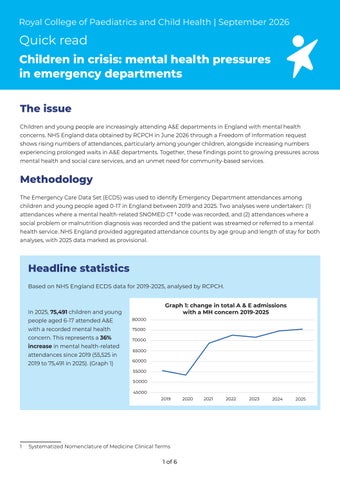
In 2025, 75,491 children and young people aged 6-17 attended A&E with a recorded mental health concern. This represents a 36% increase in mental health-related attendances since 2019 (55,525 in 2019 to 75,491 in 2025). (Graph 1)
Graph 1: change in total A & E admissions with a MH concern 2019-2025 80000 75000 70000 65000 60000 55000 50000 45000 2019
1
Systematized Nomenclature of Medicine Clinical Terms
1 of 6
2020
2021
2022
2023
2024
2025
Graph 2: Percentage increase in Total A&E admissions with mental health by age between 2019- 2025 During this period (2019 to 2025) there was a 62% increase in attendances among 6–9-yearolds (3,870 patients in 2019 increasing to 6,269 in 2025), a faster increase than any other age group. 9–15-year-olds experienced a 41% increase. (Graph 2)
% Increase 2019-2025
70% 60% 50%
62%
40% 41%
30% 20%
28% 19%
10% 0
6-9 years
9-15 years
17 years
16 years
Graph 3: Percentage increase in number of CYP with extreme LOS by time frame between 2019 and 2025 There was also a 217% increase in children staying more than 12 hours in A&E (more than tripling from 1,964 patients in 2019 to 6,235 in 2025). Within this, there was a 514% increase in children staying more than 72 hours, rising from 55 patients in 2019 to 338 patients in 2025. (Graph 3)
600% 500% 514% 400% 406% 300% 320% 200%
217%
100% 0
Over 12 hours
Over 24 hours
Over 48 hours
Over 72 hours
Graph 4: Percentage (proportion) of CYP with extreme LOS of overall CYP MH attendances in 2019 and 2025 The proportion of children and young people experiencing waits of more than 12 hours more than doubled between 2019 and 2025, increasing from 1 in 29 attendances (3.4%) in 2019 to 1 in 13 attendances (7.7%) in 2025. There was an actual increase of 67 to 416 individuals. (Graph 4)
2019
8%
2025
7.7%
7% 6% 5% 4%
3.4%
3%
2.1%
2% 0.7%
1% 0 Over 12 hours
2 of 6
Over 24 hours
0.2%
0.8%
Over 48 hours
0.1%
0.4%
Over 72 hours
What the data tells us •
More children are attending A&E in mental health crisis (Graph 1 and 2) Between 2019 and 2025 there were nearly 20,000 additional attendances by children and young people with recorded mental health concerns. Rising numbers of presentations were seen across every age group. The largest relative increase was among children aged 6-9 years.
•
Extreme waits are becoming more common (Graph 3) The most concerning increase is among children experiencing very long stays. The number remaining in A&E departments for more than: • • • •
•
12 hours increased by 217% 24 hours increased by 320% 48 hours increased by 406% 72 hours increased by 514%
More children are becoming ‘stuck’ in A&E (Graph 4) Not only are more children attending A&E with mental health concerns, but a growing proportion are experiencing very long waits. In 2025, nearly 1 in 13 mental health attendances involved a stay of more than 12 hours, compared with 1 in 29 in 2019. These figures suggest increasing difficulties in accessing onward care, support or safe discharge arrangements for children in mental health crisis.
What is happening in practice?
A paediatrician’s perspective There continues to be an increase in the number of children and young people attending Emergency Departments with mental health crisis. These children are getting younger and their needs are increasingly complex. Some children and young people who present in mental health crisis do not require hospital admission but cannot be safely discharged. Families may need additional support, community services may not be immediately available, and suitable placements can be difficult to secure. As a result, children may remain in Emergency Departments while alternative arrangements are sought. Those experiencing the longest waits are often some of the most vulnerable children in society, frequently known to multiple services and often facing challenges across mental health, education, social care and neurodevelopmental pathways. Dr Sam Jones, RCPCH Officer for Mental Health and Consultant in Paediatric Emergency Medicine
3 of 6
Young person and family perspectives Emergency mental health support is inadequate. Have to wait for 72 hours for a call back from emergency CAMHS. After 72 hours, the record is deleted - Parent I think there needs to be a largely increased focus on mental health, especially youth mental health. It’s basically impossible to get help even in crisis or at incredibly low points. There’s needs to be a lot of work done surrounding waiting lists for CAMHS - Young person Mental health needs to be focused on more, especially with young children. The waiting lists for children with mental health issues are too long and there isn’t much support after a diagnosis. More local services would benefit our community as there are many who can’t get to the hospital or need appointments but can’t get a GP - Young person These quotes were collected as part of the Voice of the Nation Engagement activities (2025) and RCPCH&Us Youth Health Conference (2026).
Why this matters Behind every attendance is a child or young person in distress and a family seeking help and clinicians doing their best to provide care. While A&E departments provide an important safety net, rising attendances and increasing waits suggest growing pressure across the wider system of mental health, community and social care services. Prolonged stays in A&E are becoming more common, indicating that children are not always able to access the onward support they need quickly enough. Strengthening early intervention, crisis services and coordinated care will be essential to ensure children receive timely support and avoid escalating to crisis point now and in future. For example, the Government has evidenced mental health2 as a key driver in young people who are not in education, employment or training (NEET) who become NEET and stay NEET. The failure to meet important patient targets tells a clear story. The four-hour standard states that 95% of patients should be admitted, transferred, or discharged from an ED within four hours. The standard has not been met in England since June 20133. This tells us that the needs of those in need of urgent care are not being met by the government’s own agreed standards. It is welcome to see NHS officials and Mental Health leads4 agree to reduce 12-hour breaches for mental health patients in emergency departments and attempt to improve mental health waiting times for children and young people, with a goal of 50 percent being seen within four weeks.
2 https://www.gov.uk/government/publications/young-people-and-work-interim-report/young-people-and-work-interim-report#chapter-5-health--configured-for-treatment-not-participation 3 https://rcem.ac.uk/nhs-performance-tracker/ 4 https://www.hsj.co.uk/mental-health/ceos-agree-new-targets-to-cut-waits/8123945.article
4 of 6
The clear crisis in children’s mental health, shown by the stark increase in hospital attendance, is a symptom of wider challenges facing children and families. Poor mental health is shaped by a range of factors, including poverty, trauma, inequalities and barriers to accessing support early. Without fully supported primary prevention that addresses these root causes, alongside appropriate immediate action for children already in crisis, the same pressures on children, families and services will only worsen in the years ahead. Investing in prevention reduces demand on crisis services and A&E departments, while also being cost-effective for the system5. The problem cannot be solved with crisis management alone; children need support before they reach crisis point as well as timely care when they do. Children and young people with mental health needs must be in psychologically safe and trauma informed settings. A&E departments are often sought in absence of proper pathways, and they are not designed to meet the needs of acute mental health problems. This also puts strain on the hospital system and affects wider public healthcare. The Children’s Commissioner for England’s recent work on children waiting to leave hospital6 highlights a similar challenge elsewhere in the system: children becoming “stuck” in healthcare settings because appropriate community, social care, education or housing support is unavailable.
Recommendations 1.
Use the upcoming Mental Health Strategy to address the crisis in children’s mental health
• • •
Ensure that improving children and young people’s mental health is threaded throughout the upcoming long-term mental health strategy with clear outcomes, funding and tangible changes to provision. Set clear, measurable targets in the Strategy to benchmark reduction of waiting times and improve referral into appropriate care pathways and settings. Improve transparency and consistency of data reporting on waiting times, delays and outcomes so that progress can be monitored across the system, holding Department of Health and Social Care and local authorities to a high standard.
2. Strengthen crisis pathways for children and young people
• • • • •
Adopt and implement the RCPCH Emergency Care Standards7, including key standards relating to mental health care and reducing Extreme Lengths of Stay. Establish clear escalation arrangements for children who require Tier 3(+)/Tier 4 inpatient care, or who cannot be safely discharged despite not requiring admission. Ensure Emergency Department staff receive appropriate training and support to communicate effectively, assess risk and manage children and young people presenting with mental health needs, while also supporting families and carers. Ensure the forthcoming Babies, Children and Young People’s Modern Service Framework (MSF) is fully implemented and resourced, recognising children and young people attending A&E with mental health needs and waiting over 12 hours as a priority cohort for improvement. Build on recent government announcements on new walk-in mental health centres8 by ensuring services are designed with children, young people, families and the workforce, and are responsive to local need.
5 https://pbe.co.uk/publications/prevention-that-pays-the-economic-case-for-early-support-for-childrens-mental-health-andwellbeing/ 6 https://www.childrenscommissioner.gov.uk/resource/children-waiting-to-leave-hospital/ 7 https://www.rcpch.ac.uk/resources/facing-future-standards-children-young-people-emergency-care-settings 8 https://www.bbc.co.uk/news/articles/cpd76e737ljo
5 of 6
3. Prioritise prevention, early intervention and community support
• • •
Address the wider drivers of poor mental health, including poverty, trauma and adverse childhood experiences, through coordinated action across government and through the upcoming Mental Health Strategy. Ensure the UK Government’s commitment to prevention is matched by sustainable funding and a joined-up approach across health, education and social care. Ensure children, young people and families can access support as early as possible and close to home.
Conclusion The number of children and young people attending A&E departments with mental health concerns continues to rise, with the sharpest increase seen among younger children. At the same time, long and extreme waits are becoming increasingly common. Together, these findings paint a concerning picture of growing pressure across the services that support children and families. Children in mental health crisis need timely access to specialist support, not prolonged waits in A&E departments. Urgent action is needed to ensure they receive the right care, in the right place, at the right time.
Appendix note on data interpretation •
•
• •
The data and associated graphs are drawn from a count of attendances at Accident and Emergency (A&E) wards in England, where there was a chief complaint, co-morbidity, diagnosis, treatment, referral or discharge code indicating that the patient had a mental health issue, for patients aged 0-17, split by patient age group and length of stay, for activity between 01/01/2019 and 31/12/2025. A correlated increase in attendance to EDs for mental health problems may be due to an increase in new mental health problems, or an increase in awareness, reporting and help-seeking of existing mental health problems. Both possibilities require urgent attention, and as such the data is presented as neutral. Although mental health is a spectrum, this data is based on NHS coding for mental health diagnosis, in-keeping with wider policy and research discourse. 0-5 age data was not analysed, as the presentations at such an age require a different approach in the wider context of this paper.
©RCPCH 2026 Incorporated by Royal Charter and registered as a Charity in England and Wales: 1057744 and in Scotland: SCO38299. Registered Office 5-11 Theobalds Road, London WC1X 8SH. Patron HRH The Princess Royal.
6 of 6