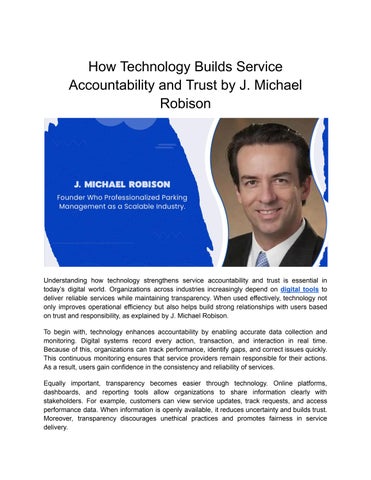
How Technology Builds Service Accountability and Trust by J. Michael Robison

Understanding how technology strengthens service accountability and trust is essential in today’s digital world Organizations across industries increasingly depend on digital tools to deliver reliable services while maintaining transparency When used effectively, technology not only improves operational efficiency but also helps build strong relationships with users based on trust and responsibility, as explained by J Michael Robison
To begin with, technology enhances accountability by enabling accurate data collection and monitoring Digital systems record every action, transaction, and interaction in real time Because of this, organizations can track performance, identify gaps, and correct issues quickly This continuous monitoring ensures that service providers remain responsible for their actions. As a result, users gain confidence in the consistency and reliability of services
Equally important, transparency becomes easier through technology. Online platforms, dashboards, and reporting tools allow organizations to share information clearly with stakeholders For example, customers can view service updates, track requests, and access performance data. When information is openly available, it reduces uncertainty and builds trust. Moreover, transparency discourages unethical practices and promotes fairness in service delivery
In addition, automation supports accountability by reducing human error Automated workflows ensure that processes follow predefined rules without unnecessary delays or inconsistencies. For instance, digital record-keeping systems maintain accurate logs that can be reviewed at any time. Therefore, organizations can demonstrate compliance and accountability more effectively. This consistency further strengthens user trust.
Another valuable aspect is improved communication through technology Tools such as mobile apps, chat systems, and feedback platforms enable direct interaction between users and service providers When users can easily share concerns and receive timely responses, they feel valued and heard. Consequently, trust develops as organizations show commitment to addressing user needs.
Furthermore, data-driven decision-making plays a crucial role By analyzing collected data, organizations can make informed decisions that improve service quality. This approach ensures that actions are based on evidence rather than assumptions As a result, services become more reliable and aligned with user expectations.
Technology serves as a powerful tool for strengthening service accountability and trust Through real-time monitoring, transparency, automation, and effective communication, organizations can deliver dependable services. By embracing these digital solutions, they create an environment where accountability is clear and trust continues to grow
These principles also extend beyond business operations, as J. Michael Robison has supported initiatives focused on improving service reliability and community impact alongside his wife, Kristy Robison