Research Tokyo Logistics Market Dynamics Q2 2026
Tokyo Fundamentals(for this quarter) •
Robust demand from e-commerce and 3PL companies continues
•
Vacancy rate declines for four consecutive quarters to 7.7%
•
Rental growth continues due to rising construction costs and tight supply-demand balance
YTD net absorption YTD completions Vacancy rate Gross rent Rent growth Y-o-Y Stage in rental cycle
106,300 tsubo 73,000 tsubo 7.7% JPY 4,836 per tsubo p.m. +2.8% Rents Rising
Note: Tokyo logistics refers to the Greater Tokyo prime logistics market. Data is on an NLA basis.
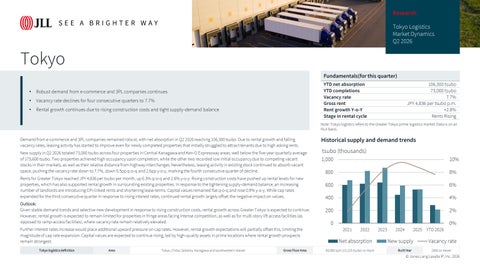
Demand from e-commerce and 3PL companies remained robust, with net absorption in Q2 2026 reaching 106,300 tsubo. Due to rental growth and falling vacancy rates, leasing activity has started to improve even for newly completed properties that initially struggled to attract tenants due to high asking rents. New supply in Q2 2026 totaled 73,000 tsubo across four properties in Central Kanagawa and Ken-O Expressway areas, well below the five-year quarterly average of 175,600 tsubo. Two properties achieved high occupancy upon completion, while the other two recorded low initial occupancy due to competing vacant stocks in their markets, as well as their relative distance from highway interchanges. Nevertheless, leasing activity in existing stock continued to absorb vacant space, pushing the vacancy rate down to 7.7%, down 0.5pp q-o-q and 2.6pp y-o-y, marking the fourth consecutive quarter of decline. Rents for Greater Tokyo reached JPY 4,836 per tsubo per month, up 0.3% q-o-q and 2.6% y-o-y. Rising construction costs have pushed up rental levels for new properties, which has also supported rental growth in surrounding existing properties. In response to the tightening supply-demand balance, an increasing number of landlords are introducing CPI-linked rents and shortening lease terms. Capital values remained flat q-o-q and rose 0.9% y-o-y. While cap rates expanded for the third consecutive quarter in response to rising interest rates, continued rental growth largely offset the negative impact on values. Outlook: Given stable demand trends and selective new development in response to rising construction costs, rental growth across Greater Tokyo is expected to continue. However, rental growth is expected to remain limited for properties in fringe areas facing intense competition, as well as for multi-story lift access facilities (as opposed to ramp-access facilities), where vacancy rate remain relatively elevated. Further interest rates increase would place additional upward pressure on cap rates. However, rental growth expectations will partially offset this, limiting the magnitude of cap rate expansion. Capital values are expected to continue rising, led by high-quality assets in prime locations where rental growth prospects remain strongest. Tokyo logistics definition
Area
Tokyo, Chiba, Saitama, Kanagawa and southwestern Ibaraki
Gross Floor Area
Historical supply and demand trends tsubo (thousands) 1,000
10%
800
8%
600
6%
400
4%
200
2%
0
0% 2021
2022
2023
2024
2025 YTD 2026
Net absorption
New supply
50,000 sqm (15,125 tsubo) or more
Built Year
Vacancy rate 2000 or newer
© Jones Lang Lasalle IP, Inc. 2026