CONDITIONS OF SALE
All items are in good antiquarian condition unless otherwise noted and are offered subject to prior sale, with prices net and subject to change without notice. The costs of shipping and insurance are additional Orders are customarily shipped via USPS Priority Mail or Federal Express. Sales tax will be added to the invoices of NewYork State residents.
Orders may be placed by e-mail (info@lubranomusic.com), telephone (516-922-2192), or on our secure website (www.lubranomusic.com) by entering the ID number of the desired item in the SEARCH box at the upper right of our homepage.We ask that you kindly wait to receive ourinvoice to ensure availability before remitting payment. Libraries may receive deferred billing upon request.
We accept payment by:
-ACH (Automated Clearing House), inclusive of all bank charges
- EFT (Electronic Funds Transfer), inclusive of all bank charges
- PayPal to info@lubranomusic.com
- Checks in U.S. dollars drawn on a U.S. bank
- International money order
- Credit card
We fully guarantee that all items offered for sale by J & J LubranoMusicAntiquarians LLC are absolutely authentic without time limitation to the original purchaser provided that said items conform exactly to our description as supplied at time of purchase.All items remain the property of J & J Lubrano MusicAntiquarians LLC until paid for in full.
Please visit our website at
www.lubranomusic.com
where you will find full descriptions and illustrations of our catalogued inventory
Members
Antiquarian Booksellers’Association ofAmerica
International League ofAntiquarian Booksellers
ProfessionalAutograph Dealers’Association
Music LibraryAssociation
American Musicological Society
Dance StudiesAssociation &c.
Cataloguers
John Lubrano, Jude Lubrano
© J & J Lubrano MusicAntiquarians LLC March 2026
TABLE OF CONTENTS
AUTOGRAPHS & MANUSCRIPTS
Items 1-19
PRINTED MUSIC
Items 20-62
MUSICAL LITERATURE
Items 63-65
ICONOGRAPHY
Items 66-82
❖
SCHOLARLY MUSIC BOOKS FOR SALEASACOLLECTION
A special opportunity for either private or institutional collections to further develop their holdings in musicology.
Approximately 1,100 titles, most by leading international scholars and in various languages including English, German, French, and Italian, with publication dates ranging from the late 19th to the early 21st century, many now out of print.
The collection is being offered at a very reasonable price, with either installment plans or deferred billing available.
Please inquire for further details.
AUTOGRAPHS & MANUSCRIPTS
Items 1-19
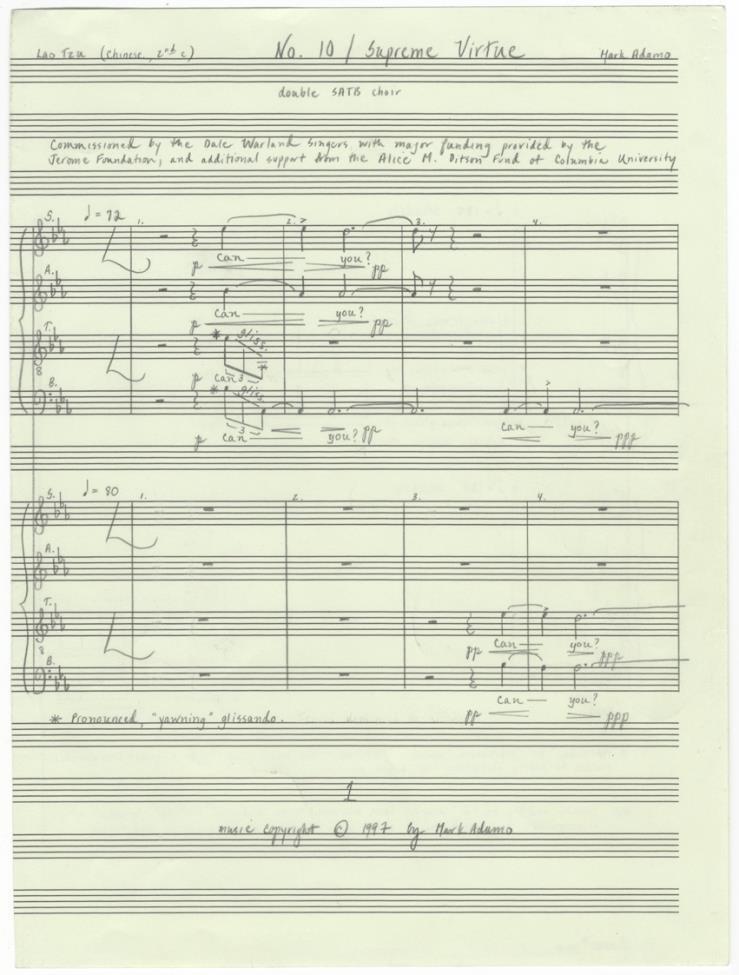
Autograph Musical Manuscript, With Text from the Tao te Ching in the Hand of “One of America’s Most Formidable Lyric Composers”
1. ADAMO, Mark b. 1962
No. 10: Supreme Virtue. Autographmanuscript fullscoreofthe completework. Fordouble mixedchoir(SATB).
29 pp. + 2 pp. of additional manuscript apparently not included in the final version. Oblong quarto (278 x 208 mm). Unbound, folded. Notated in pencil on 16-stave paper. Signed and dated New York, Jan-April 1997.
Supreme Virtue was commissioned by the Dale Warland Singers with the support of the Jerome Foundation and theAliceM. DitsonFund ofColumbiaUniversity.TheDaleWarlandSingers premieredthework inMinneapolis in June 2000. The text consists of an English translation by Stephen Mitchell of verses from the Tao te Ching. It was first recorded by the Seattle-based chamber choir Esoterics on the Terpsichore label in the winter of 2008.
"For a few years I was the tenor section leader of a choir in Washington, and in singing with and composing for them I'd become more and more interested in the quasi-instrumental vocal gesture. Stephen Mitchell's pellucid translation of this verse of the Tao te ching - a series of moral challenges all beginning with the words "Can you?" - spurred me to explore this idea at length. The singers, divided into two SATB choirs, intone the first
question in a dusky C-minor against a sighing backdrop of wind sounds: then, as the first choir utters the text's first challenge, the second choir refracts their words into marimba-like repeated notes, as if the long lines of the first choir were subjected to a kind of aural strobe. As the questions become tougher, so do the sounds: tenors and altos stab into the texture with horn-like interruptions, and the phrase "Can you?" disrupts the unwavering four-four pulse with insistent threes and twos. At a peak of intensity, a looping soprano-alto line spirits us away from pulse and chord, leading first to a melodic meditation based on the vowels of "Can you?" and then to a cadenza, in which chords appear and vanish into a shimmering, ever-present curtain of sound. A vision of equanimity is intoned in the open fifths of (both Western and Eastern) chant: then, as if elated by its discovery ("this is the supreme virtue") the chorus reworks its "Can you?" motive: a nudging half-step expands to a whole step, the harmony brightens to B-flat, and, in rhythms now more jubilant than insistent, the score spins to closure." Adamo website
“Hailed by The New Yorker as ‘one of America’s most formidable lyric composers,’ composer-librettist Mark Adamo made his mark on the opera world in 1998 with the debut of his first work Little Women, which The New York Times described as ‘a bona fide American classic.’ Known for his ‘way of finding a drama’s emotional nerve and projecting it to an audience’ (The Financial Times, London), his four subsequent operas –Lysistrata, The Gospel of Mary Magdalene, Becoming Santa Claus, and The Lord of Cries – have ‘opened yet other pathways on his remarkable exploration of what an opera can be.’ “ American Record Guide, University of Colorado Boulder website (20144) $2,000
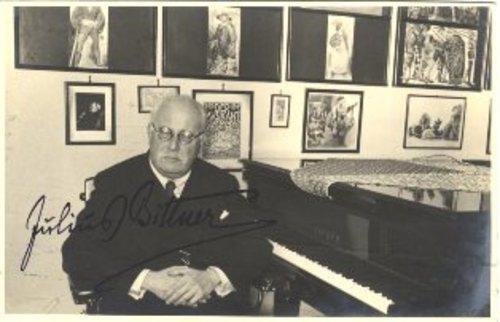
Signed Photograph, With Autograph Note to Musicologist Otto de Greiff
2 BITTNER, Julius 1874-1939
Postcard photograph with the autograph signature of the composer Thecomposer is depicted in a music studio, seated at an Ehrbar piano.
With an autograph note signed to verso dated Vienna, September 24, 1936, addressed to the Colombian musicologist Otto de Greiff. With Bittner's return address stamp in purple ink to upper left corner, "Julius Bittner, Wien IX, Dietrichsteingasse 10."
Very slightly worn. In very good condition overall.
"Although Bittner’s output embraces orchestral and chamber music, a large-scale Mass and several lieder and choruses, he devoted most of his creative energies towards writing for the stage. His passion for opera was fuelled by attending a performance of Lohengrin at the age of 12, and, following the precedent set by Wagner, he wrote the librettos for 15 of his own operas. Although his early attempts at the genre were not performed publicly, his friendship with the conductor Bruno Walter proved decisive in establishing his reputation, primarily with the opera Der Musikant produced in Vienna in 1910. His most successful work was Das höllisch Gold (1916) in which he emulated the example of his older compatriot Wilhelm Kienzl in attempting to merge the principles of German Singspiel with a post-Wagnerian harmonic language." Erik Levi in Grove Music Online (20612) $100
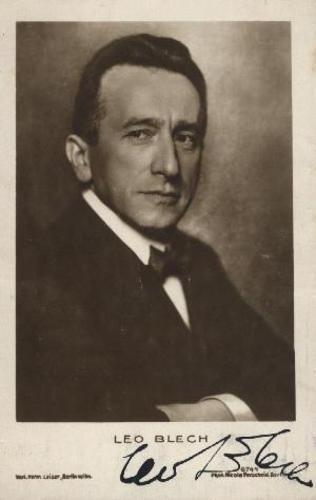
Fine Signed Photograph of the Opera Composer and Conductor
3 BLECH, Leo 1871-1958
Postcard portrait photograph with the autograph signature of the composer Head-and-shoulders. From the studio of Nicola Perscheid, Berlin. Slightly worn and soiled.
Blech held many important posts with opera houses in both Germany and Austria throughout his career, including a four-year stint in Riga when, being Jewish, he found himself unable to return to Berlin as conductor at the Staatsoper from a guest engagement in 1937.
"[His] operatic repertory was wide. He was especially renowned for his performances of Wagner and Verdi ... and was also a fine orchestral conductor, admired for reliability, clarity and elegance, and for his sensitivity as an accompanist ... During his lifetime he achieved considerable success with his own operas." J.A. Fuller Maitland in Grove Music Online. (16221) $100
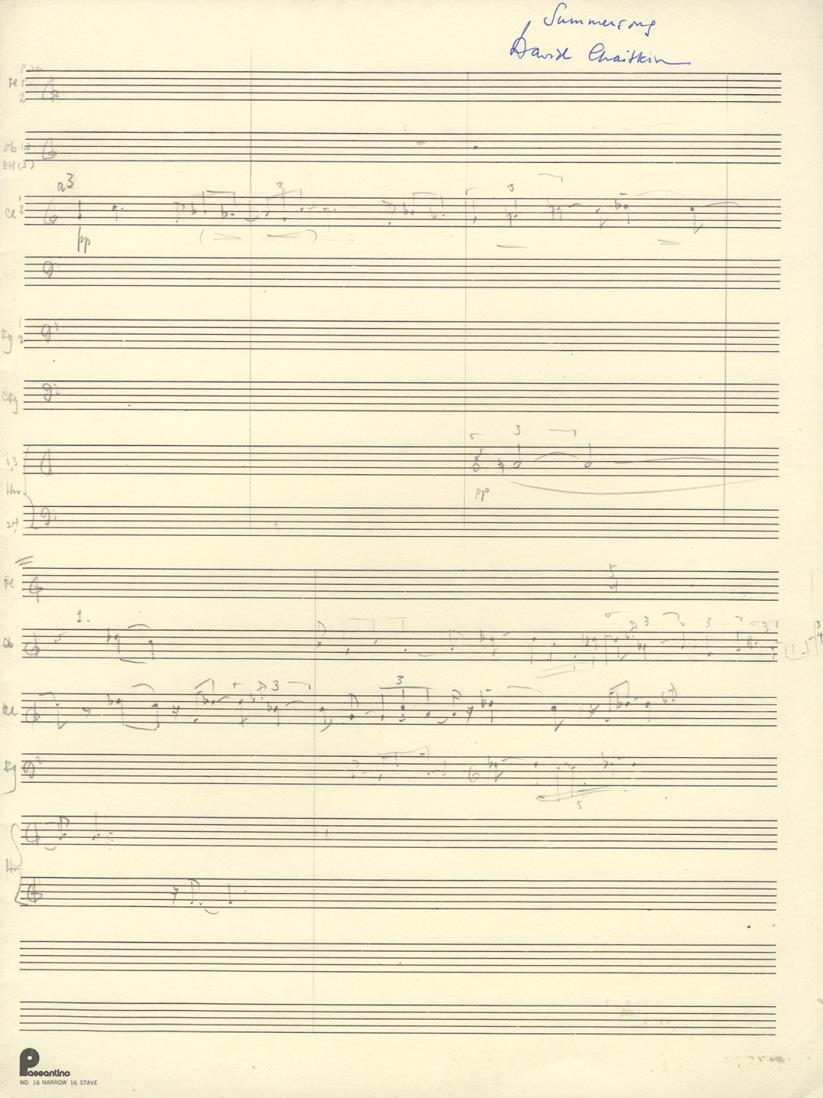
Sketchleaf in Full Score from the Composer’s Summersong
4 CHAITKIN, David 1938-2011 Summersong. Autograph sketchleaf in full score.
1 page. Folio (310 x 232 mm). Notated in pencil on 16-stave paper on one side of a bifolium. Undated, but ca. 1981. Signed in full in blue ink.
Together with:
A typed letter signed from the composer to the prominent American choral conductor Harold Rosenbaum regarding boththe present work andthe composer's "Seasons Such as These," commenting on their significance, and hoping for more performances.
Summersong (1981) for 23 windinstruments, wascommissioned andpremieredbythe Sylvan Winds, conducted by Arthur Weisberg.
“Noted for his lyrical and harmonically adventurous music, David Chaitkin has composed symphonic as well as a variety of chamber and vocal works. His music has been performed by such ensembles as the BBC
Philharmonic Orchestra, the Tanglewood Music Center Orchestra, the DaCapo Chamber Players and the St. Luke’s Chamber Ensemble. He has received awards from the American Academy of Arts and Letters, which described his music as “subtle, powerful works of a knowing musical intelligence,” and “effortlessly original. A lyrical metamorphosis of timbre, rhythm and shape engage the ear. … His music is both intense and sensitive.” Chaitkin website. Chaitkin's teachers included Dallapiccola, Shifrin, and Imbrie. (18927) $125
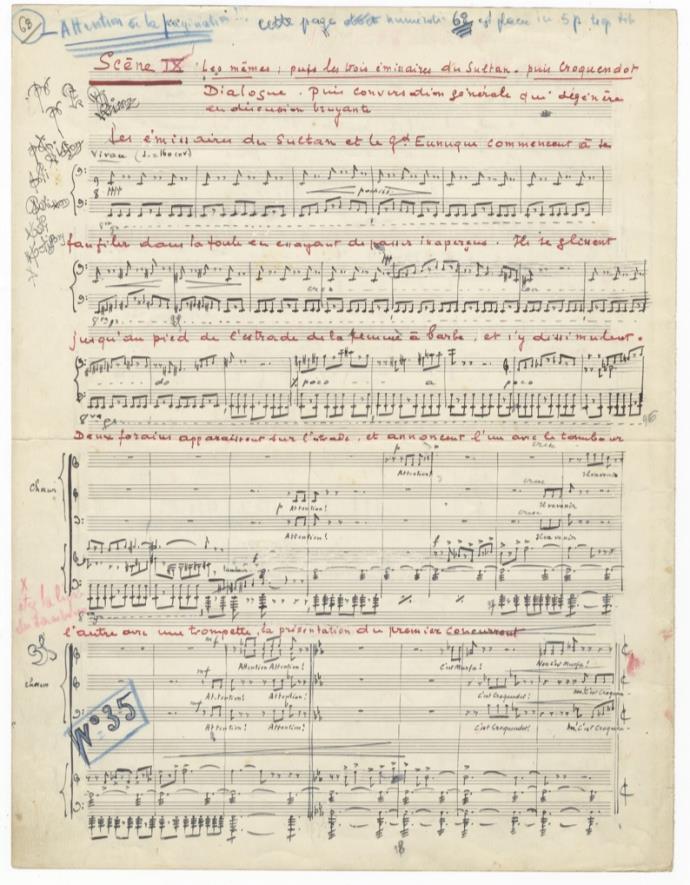
Autograph Manuscript from the Composer’s Comic Opera La Femme à Barbe
5. DELVINCOURT, Claude 1888-1954
Autograph musical manuscript from the composer's opera bouffe La femme à barbe.
2 pp. Folio (ca. 348 x 268 mm). 56 measures scored for both spoken and sung voices, including sections for chorus with instrumental accompaniment. Apparently complete. Marked "Scène IX les mêmes: puis les trois emissaires du Sultan - puis Croquendot " Notated in black and red ink with some markings in blue crayon. Unsigned. Slightly worn; creased at central fold.
La femme à barbe, in two acts to a libretto by A. de la Tourrasse, was first performed at Versailles on 2 June 1938.
Delvincourt, a French composer, was appointed director of the Versailles Conservatory in 1931 and of the Paris Conservatoire in 1941, a position he held until his death in 1954; he received the Prix de Rome in 1913 for his cantata Faust et Helene. "His most important decisions were the founding of the Orchestre des Cadets and a chorus (so avoiding the evacuation of his pupils to Germany), and his invitation to Messiaen, despite much
comment, to teach the philosophy of music ... After Debussy and Ravel, he was one of the most ardent of French composers in trying to recapture the spirit of the Middle Ages and the Renaissance, as in the Danceries " Alain Louvier in Grove Music Online. (20707) $450
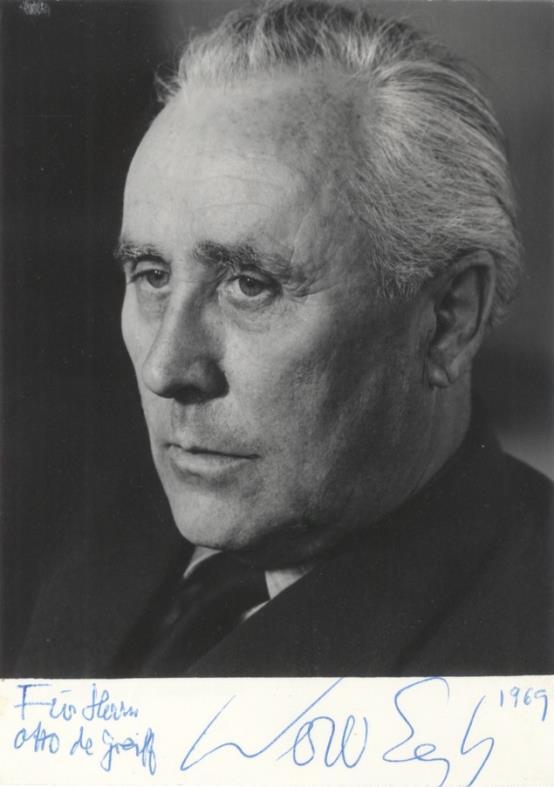
Signed Photograph of a Pupil of Carl Orff, Inscribed to Musicologist Otto de Greiff
6 EGK, Werner 1901-1983
Portrait photograph signed and inscribed to Colombian musicologist Otto de Greiff dated 1969 Printed on photographic paper in postcard format.
A German composer and pupil of Carl Orff, "between 1927 and 1929 Egk established contact with Kurt Weill, Hans Flesch, Bertolt Brecht and Erwin Piscator. The dramatic works that followed, for which Egk often served as his own librettist, embrace a range of genres from marionette theatre ... to radio documentary." Andrew D. McCredie in Grove Music Online. (20685) $75
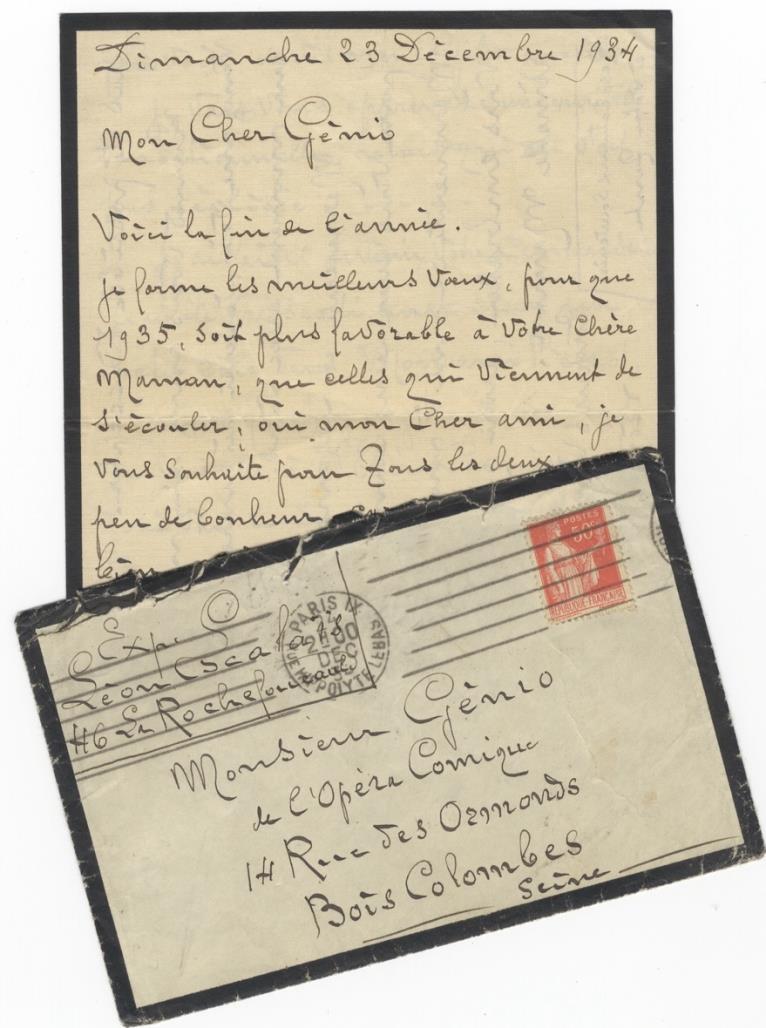
The French Tenor Hopes that His Correspondent Will “Succeed at Last in Getting a Role”
7 ESCALAÏS, Léon 1859-1941
Autograph letter signed to Monsieur Génio at the Opéra Comique in Paris.
3 pp. Small quarto. Dated December 23, 1934. On mourning stationery. In French, with translation. Together with autograph envelope.
Escalaïs sends his best wishes for 1935 to Génio and his mother, mentions a role in Mon Ami Pierrot which "Sacha Guitry very much wanted" him to get, and a meeting with the director of the Opéra Comique and the composer Barlow. Very slightly worn; creased at folds.
"Let us hope ... that you will succeed at last in getting a role which would permit you to make good use of your pretty voice and your many qualities ... I almost became your comrade: I was expected to create a small role in Mon ami Pierrot ... but, for reasons which I will explain to you when I have the pleasure of seeing you, it was not possible for me to accept."
A French tenor, Escalaïs "had a big, heroic voice and was in great demand for such operas as Il trovatore and L’Africaine, and also La Juive, in which he appeared at La Scala. In 1892 he left Paris for Lyons, where he became director, returning to the capital to great acclaim in 1908. He also enjoyed a spectacular success at the French Opera in New Orleans. His powerful voice and ringing high notes are well demonstrated in recordings made in 1905 and 1906, which show a skilled technician " J.B. Steane in Grove Music Online. Marcel Génio (1899-1980) was a French tenor who sang at the Opéra Comique in Paris from 1927-1935. Alexandre-Pierre Georges "Sacha" Guitry (1885-1957) was a noted French stage actor, film actor, director, screenwriter, and playwright of the Boulevard theatre. The composer referred to in the letter is most probablytheFrenchcomposerofEnglish and Alsatian origin Fred Barlow (18811951). (21850) $125
“One
of His Era’s Most Communicative and Representative Composer-Performers”
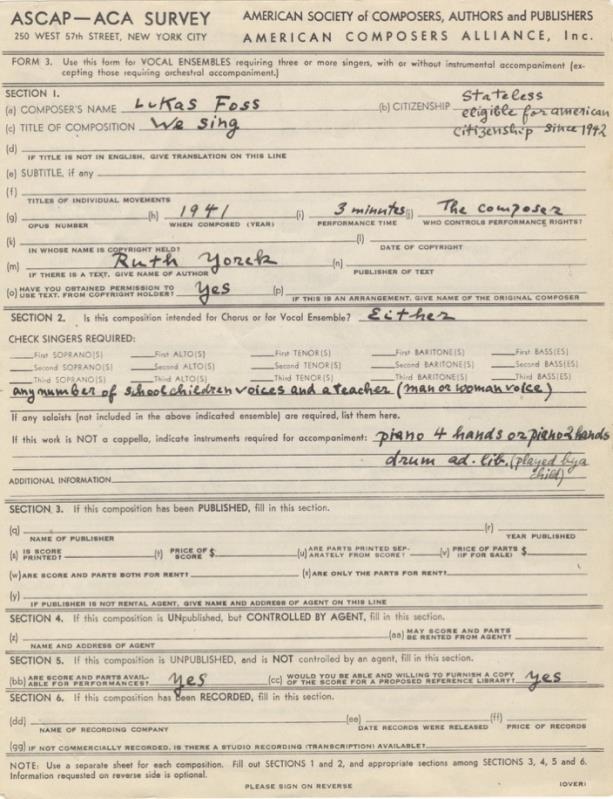
8 FOSS, Lukas 1922-2009
Printed ASCAP form relative to Foss's choral composition We Sing, signed and completed in manuscript by the composer.
2 pp. Quarto.
Foss identifies this work as having beencomposedin 1941 with a performance time of3 minutes, withcopyright held by Ruth Yorek and performance rights being controlled by the composer. Under "singers required," the composerenters "any number of school children voices and a teacher" andtheinstrumentationas "piano 4 hands or piano 2 hands, drum ad. lib. (played by a child)." Foss describes the program as "a bunch of children making a lot of noise. The teacher convinces them after some struggle to turn their noise into music, into singing."
Additionally, under “Citizenship,” Foss writes “Stateless – eligible for American citizenship since 1942.”
"For all their diverse styles, Foss’s works spring from a distinct personality: enthusiastic, curious and receptive to every kind of musical idea. Not coincidentally, these are the same attitudes he instilled in audiences with his performances of the classical repertory and new music. In short, he was one of his era’s most communicative and representative composer-performers." Gilbert Chase and David Wright in Grove Music Online.
An interesting document relative to this noted American composer, conductor and pianist. (20091) $125
“One of the Finest Baritone Voices Heard in the Second Half of the 19th Century"
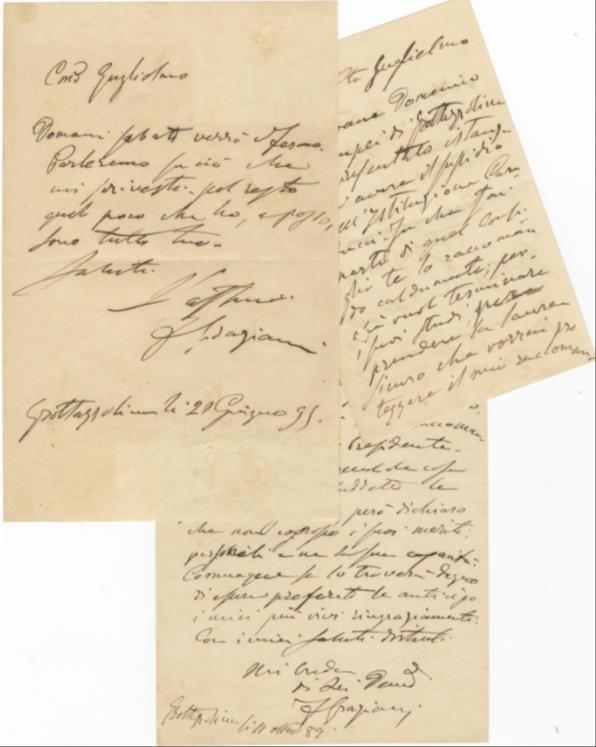
9. GRAZIANI, Francesco 1828-1901
Group of 4 letters consisting of three autograph letters and one secretarial letter signed, all to Count Guglielmo Vinci (1850-1922).d
6 pp. in total dated October 27, 1893; June 20, 1895; October 30, 1895; and October 11, 1889. Regarding business matters, meetings, commissions, etc. In Italian, with translations. Minor browning; one letter with file holes just affecting text; one with file holes not affecting text.
"[Graziani] made his début in 1851 at Ascoli Piceno in Donizetti’s Gemma di Vergy and the following season sang Francesco in Verdi’s I masnadieri at Macerata. He appeared at the Théâtre Italien, Paris, from 1853 to 1861 and made his London début at Covent Garden in 1855 as Carlo in Ernani, continuing to appear there regularly for the next 25 years. Though his repertory was enormous, ranging from Mozart (Don Giovanni and Le nozze di Figaro), Rossini (Otello, La donna del lago and Guillaume Tell), Donizetti (Lucia di Lammermoor, Linda di Chamounix and La favorite), and Bellini (La sonnambula and I puritani) to Flotow’s Martha, Gounod’s Faust, Meyerbeer’s L’Africaine and Thomas’ Hamlet, it was in Verdi roles that his greatest successes were gained. ... [He] was said to possess one of the finest baritone voices heard in the second half of the 19th century." Elizabeth Forbes in Grove Music Online (20686) $150
“Notable Amongst His Early Works”
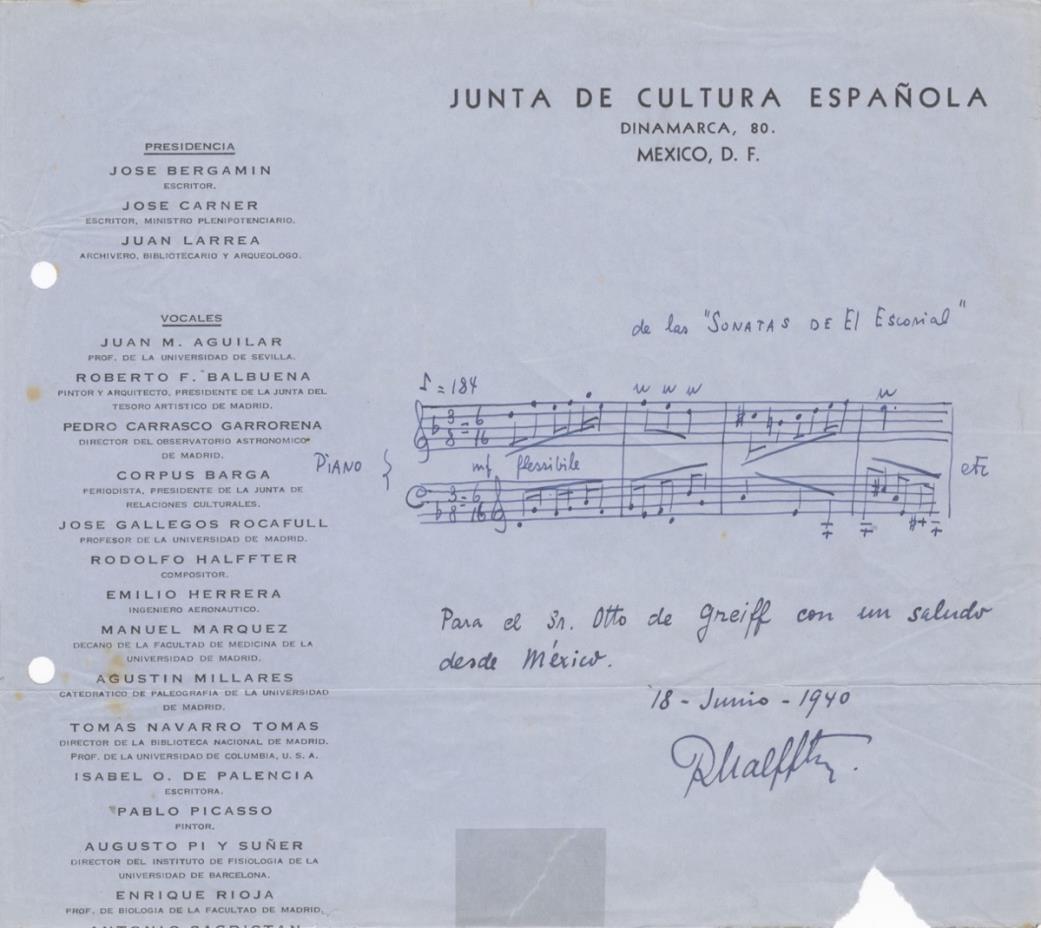
10. HALFFTER, Rodolfo 1900-1987
Autograph musical quotation signed and dated 18 June 1940.
6 measures from the composer’s Sonatas de El Escorial for piano. 189 x 213 mm. On partial letterhead of the Junta de Cultura Española. Creased at folds; minor paper loss to foot; two file holes to left margin.
"Notable amongst his early works are the modernist Naturaleza muerta, Dos sonatas de El Escorial inspired by Soler, and Marinero en tierra, settings of poems by Alberti which contain some of his most accessible music. Halffter's music follows in the tradition of Falla: the basis is tonal, sometimes enriched with bold and witty polytonal inflections; the rhythm is asymmetrical and varied; the style is above all clear and spare. In 1953, in the Tres hojas de album for piano, he began to use 12-note serialism, the first Mexican composer to do so. This, however, did not alter the essentially melodic nature of his work." Antonio Iglesias and Juan Orrego-Salas in Grove Music Online
An attractive example from one of this Mexican composer's most notable works. (20363) $135
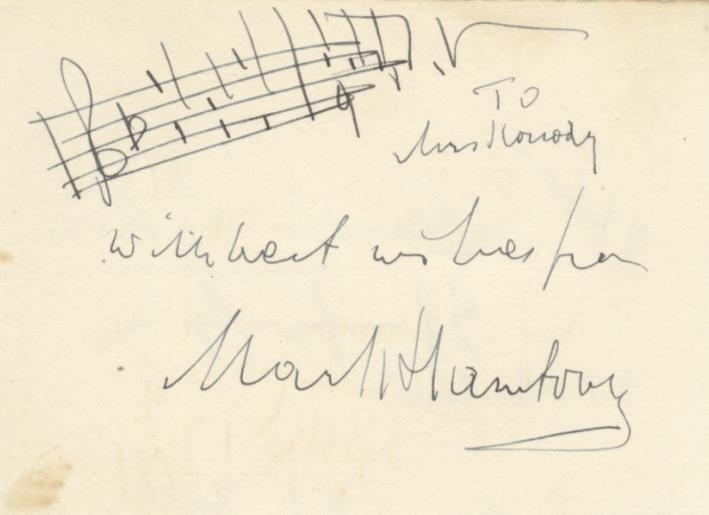
Autograph Musical Quotation in the Hand of a Student of Leschetisky
11 HAMBOURG, Mark 1879-1960
Autograph musical quotation signed in full.
2 measures, inscribed "To Mrs [?]Konody with best wishes," notated in black ink on a portion of an album leaf with additional signatures to verso. Small quarto (89 x 122 mm) Very slightly browned and stained.
A pianist and composer, the Russian-born Hambourg was a student of Leschetisky from 1891-1895, before his first international tour; he became a British citizen in 1896. (22372) $100
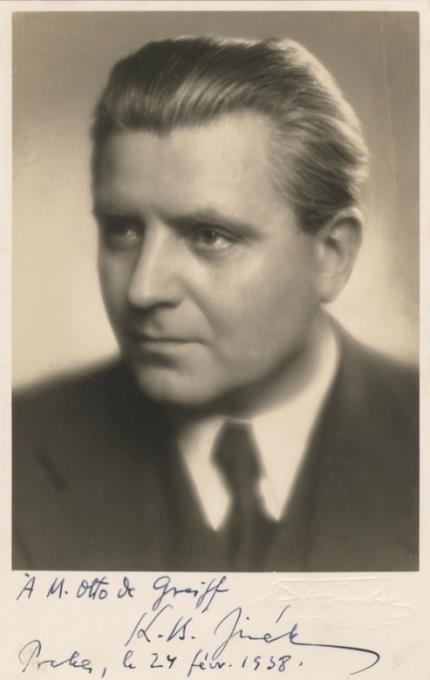
Signed Photograph with Autograph Note
12. JIRÁK, Karel Boleslav 1891-1972
Postcard photograph signed K.B. Jirák, inscribed to the Colombian musicologist Otto de Greiff and dated 24 February 1938
With autograph note signed to verso apologizing for his tardy reply. Slightly worn; two small photographer's stamps in red ink to verso not affecting text.
Jirák, a Czech composer, was actively involved in the International Society for Contemporary Music in the 1920s and 30s. "Although [a] late Romantic disposition dominated his music’s character, his thorough knowledge of prevailing trends in new music enabled him to modify his technique which – though not precisely ground-breaking or pioneering, rationally constructivist or highlighting a single approach – remained neither eclectic nor conservative." Milan Kuna in Grove Music Online
De Greiff (1903-1995) was highly instrumental in the promotion of contemporary music in South America. (21096) $75
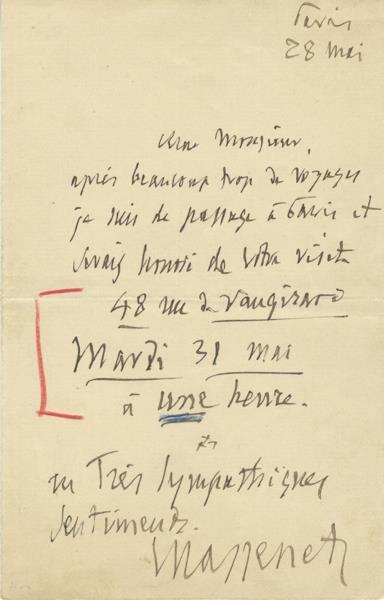
13. MASSENET, Jules 1842-1912
Autograph letter signed "Massenet." Octavo.
1 page of a bifolium. To an unidentified male correspondent. Dated Paris, 28 Mai [after November 1903].
Massenet looks forward to his correspondent's visit. "After too much travelling, I am now in Paris and would be honored by your visit to 48 rue de Vaugirard on Tuesday May 31 at 1 o'clock." Slightly browned; creased at folds; one marking in red and one in blue crayon.
"[Massenet] was the most prolific and successful composer of opera in France at the end of the 19th century and into the beginning of the 20th." Hugh Macdonald et al. in Grove Music Online. He moved to the rue de Vaugirard apartment overlooking the Jardin de Luxembourg in November of 1903 and lived there until his death in 1912; it was here that he worked on his last operas, including Chérubin and Don Quichotte ” Hugh Macdonald, Annegret Fauser, and Patrick Gilles in Grove Music Online. (22364) $150
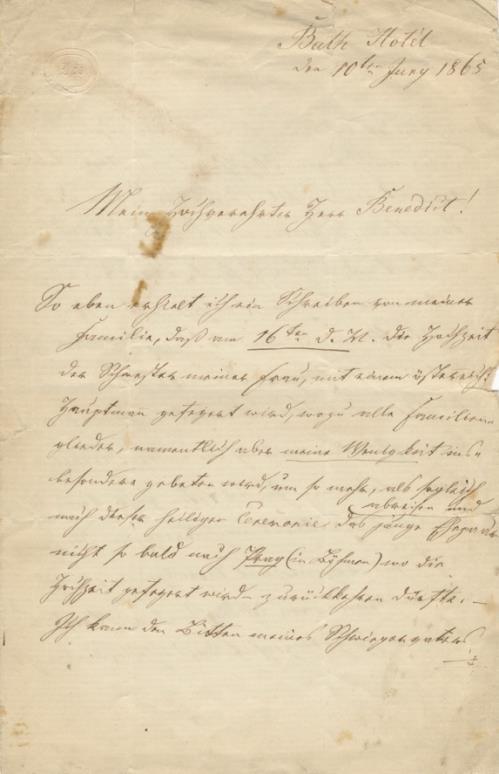
14 PIŠEK, Jan Křtitel 1814-1873
Autograph letter signed to "My esteemed Mr. Benedict" [most likely conductor Julius Benedict].
3 pp. of a bifolium. Octavo. Dated Bath Hotel, 10 June 1863. On letterhead with Pišek's small oval embossed monogram to upper left corner. In German, with translation. Slightly worn and browned; creased at folds with some short splits; small stain not affecting legibility; several small tears.
Pišek has had to cancel several concert engagements due to a family wedding, and send regrets that he will not be able to participate in Benedict's anniversary concertin London. He plans to return in April of 1864 for the season "in order to make up for what I could not fulfill this time." He wishes Benedict "all the best and great success" with his concert, and says "I would like to ask you to compose another scene for me when you feel like it, and to send it to me in Germany, so that next year I can perform it for the English concert goers."
A Bohemian baritone, "Pišek’s voice was rich and expressive over a range of two octaves, and his use of the mezza voce and falsetto was particularly admired. Some critics considered his
singing mannered and his acting artificial and exaggerated. Berlioz (Mémoires), however, had a very high opinion of his talents, and considered him ‘perhaps the greatest dramatic singer of the age’. He was also a talented pianist and a composer of songs." Jennifer Spencer and Elizabeth Forbes in Grove Music Online (20399) $75
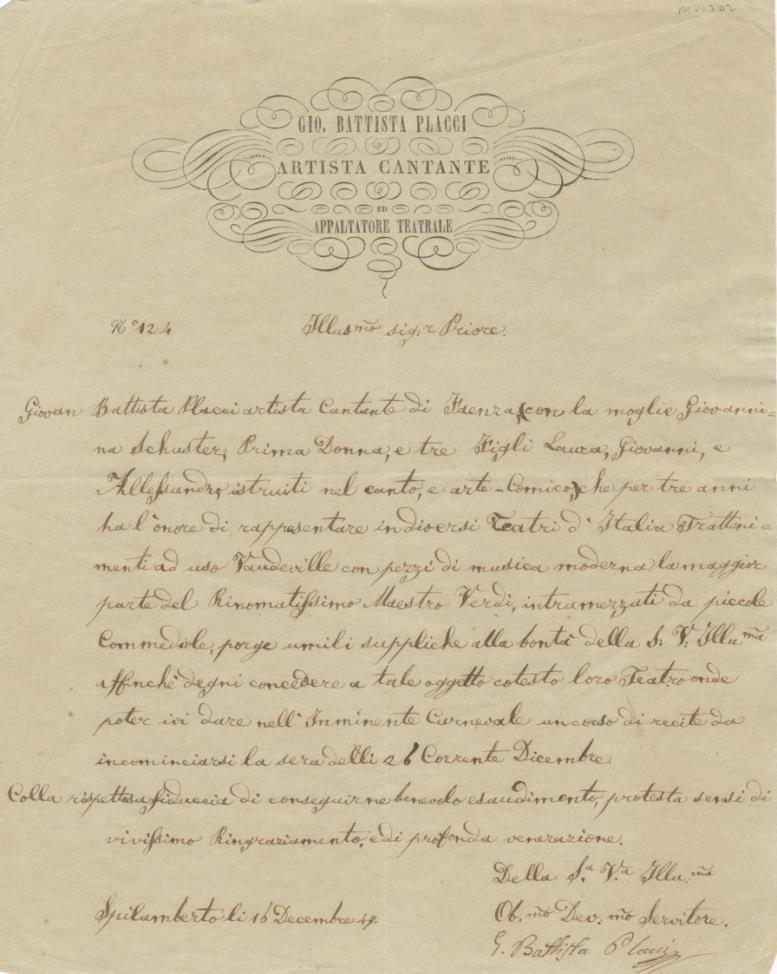
The Singer Requests the Use of the Theatre During Carnival
15 PLACCI, Giovanni Battista 179?-186?
Autograph letter signed to Signor Priore.
1 page. Quarto. On Placci's elaborate letterhead. Dated 16 December 1847. In Italian, with translation.
Placci, an Italian opera singer active in Bologna, requests that Signore Priore grant him the use of the theatre for performances during Carnival, beginning on the evening of 26 December, to include himself, his wife (prima donna Giovannina Schuster), and their three children, "who have had the honour of performing in several Italian theatres vaudeville works with modern music pieces, mostly by renowned maestro Verdi ..."
Creased at folds and slightly overall. (20567) $100
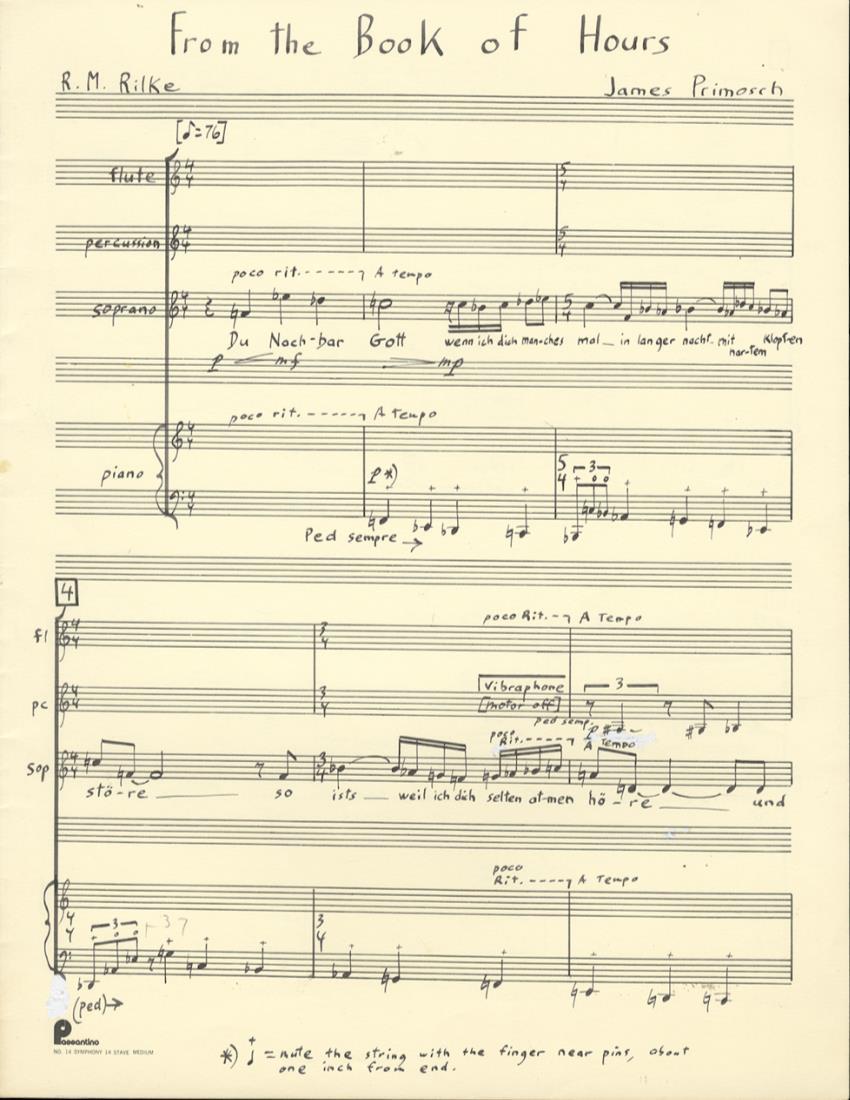
Autograph Manuscript of the First Movement of an Early Version of Primosch’s Orchestral Song Cycle
16. PRIMOSCH, James 1956-2021
From the Book of Hours. Du, nachbar Gott. A song cycle for soprano and orchestra.
Autograph manuscript of the first movement of an early chamber version featuring flute, percussion, soprano, and piano Ca. 1994.
Folio. Unbound. 9 pp. Notated in ink on 14-stave Passantino brand paper. Scored for soprano, flute, percussion and piano. With text by the poet Rainer Maria Rilke (1875-1926). Several corrections in whiteout.
Together with:
A typed letter signed by the composer regarding the manuscript.
"This cycle of orchestral songs sets four poems from an early collection by Rilke entitled "Das Stundenbuch," or in English, "Book of Hours." Although the title refers to a medieval book of prayers for the various times of day and seasons of the liturgical year, Rilke's texts occupy a position some distance from conventional piety. There is a melancholy to the spirituality expressed here, which speaks of an experience of God that is
fragmentary, imperfect, and unattainable. The solitude evoked in the second song (as layers of busy activity are gradually peeled away) offers some solace, but the third song is very dark and fierce, filled with a desperate, even manic desire for God. The last song returns to the mood of the first, but now in a global rather than individual context. This song, like the set as a whole, speaks of our world's brokenness, yet strives to stammer fragments of God's name." Carl Fischer website
Primosch was an American composer and pianist. The present work, with text by Rainer Rilke, was commissioned by the Chicago Symphony Orchestra and first performed on 10 January 2002 by them under Antonio Pappano with Lisa Saffer as soloist. This manuscript version was apparently prepared for a reading session at the Marlboro Music Festival in 1994.
"Primosch's compositional voice encompasses a broad range of expressive types. His music can be intensely lyrical, as in the song cycle Holy the Firm (composed for Dawn Upshaw) or dazzlingly angular as in Secret Geometry for piano and electronic sound. His affection for jazz is reflected in works like the Piano Quintet, while his work as a church musician informs the many pieces in his catalog based on sacred songs or religious texts." Theodore Presser website. (22476) $600
A
Composer
and “One of the Foremost Pianists of His Generation”
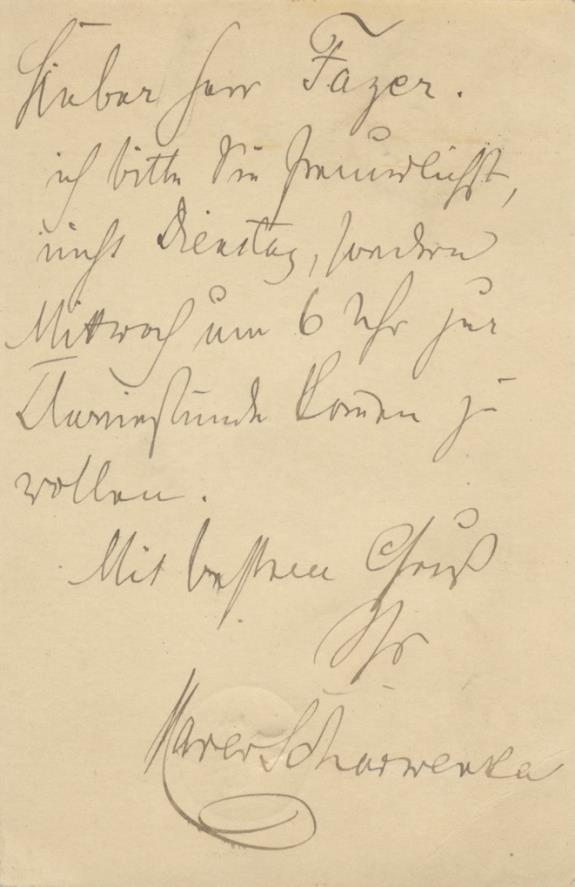
17. SCHARWENKA, Franz Xaver 1850-1924
Autograph letter signed to Fazer.
1 page. On a postcard postmarked Berlin [date illegible].
Scharwenkaasks Fazertocome onWednesday ratherthan on Tuesday. In German, with translation. Slightly browned and creased; remnants of former mount to verso.
Scharwenka was considered "one of the foremost pianists of his generation, renowned for his beautiful, sonorous, singing tone and as an interpreter of Chopin's music. ... His compositions generally have melodic charm and graceful dance-like rhythms." Charles Sutton in Grove Music Online. (21863) $100
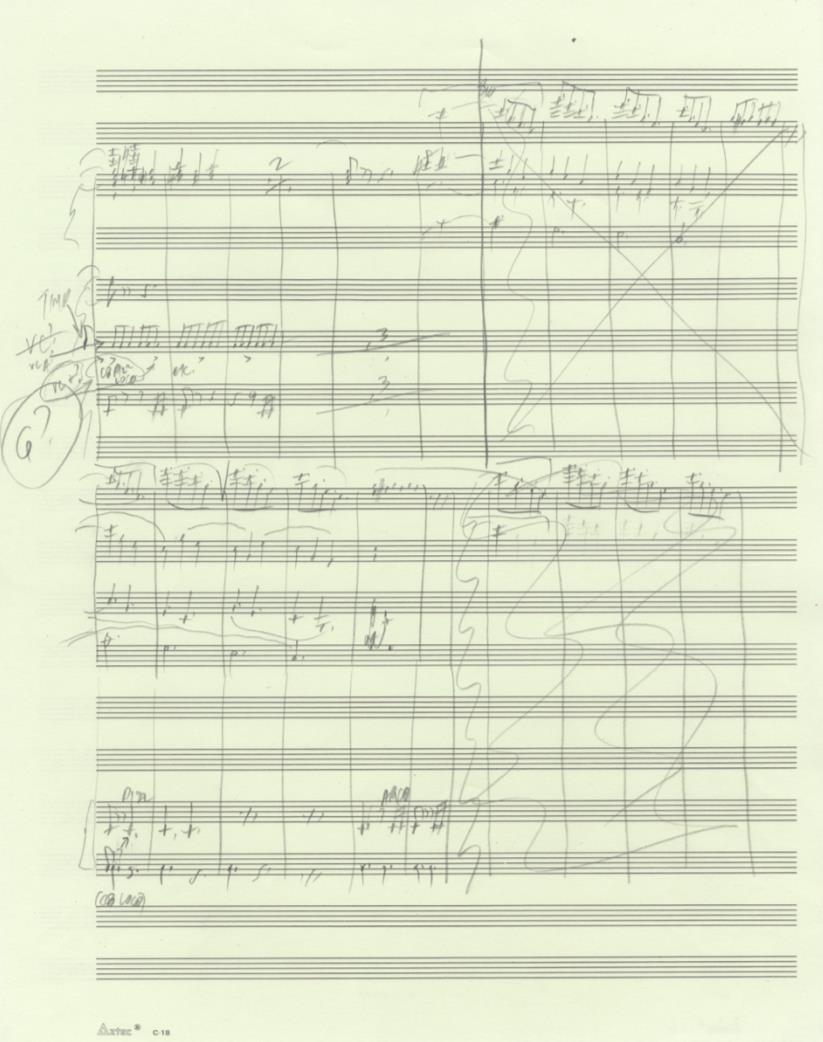
Commissioned to Commemorate Humorist James Thurber’s 100th Birthday Anniversary
18. SCHICKELE, Peter [a.k.a. “P.D.Q. Bach”] 1935-2024
Thurber's Dogs. Suite for Orchestra after Drawings by James Thurber. Movement VI: Hunting Hounds.
Autograph musical manuscript sketches in condensed score of almost the entire final movement of the work, consisting of music for sections B-N, i.e., pp. 111-137 of the published full score.
Folio (ca. 356 x 278 mm.). Unbound. 9 leaves notated in pencil on one side of each leaf of 18stave AZTEC C-18 music manuscript paper. A working manuscript, with erasures, alterations and cancellations.
Together with:
A copy of the published full score of the movement, i.e., pp. 107-138, and a 1-1/2 page printed commentary by the composer discussing the background of the work and briefly describing the music:
"I should say, however, that as I was working on the last movement, I found myself thinking as much about the fox as about the hunting hounds. This, coupled with the fact that I recently acquired a recording of background music from the old movie serials that I used to go to as a kid, probably accounts for the quite ungentlemanly, almost lurid quality of the chase music."
"Thurber's Dogs was commissioned for the ProMusica Chamber Orchestra of Columbus and the Thurber House to commemorate the 100th birthday anniversary of author James Thurber. It was completed on August 13, 1994. The first performances took place on December 2 and 4, 1994; the ProMusica Chamber Orchestra of Columbus was conducted, respectively, by the composer and Timothy Russell, the orchestra's Music Director. The work has been recorded by the ProMusica Chamber Orchestra of Columbus for release in the fall of 1995." Mr. Schickele's commentary accompanying the manuscript
A composition student of Roy Harris, Darius Milhaud, Persichetti and Bergsma, "Schickele has become the leading American musical satirist, giving concerts throughout the USA in which he lectures, sings, conducts and plays as guest soloist with symphony orchestras or with his own ensemble. The humorous compositions range from outrageous parodies, such as the cantata Iphigenia in Brooklyn, to ingenious combinations of antithetical styles, as in Blaues Gras (Bluegrass Cantata), and are full of surprising violations of familiar styles, musical forms and phrase structures, harmonic conventions and orchestration. Schickele’s commentaries and his mockscholarly The Definitive Biography of P.D.Q. Bach ... juxtapose incongruities from contemporary culture with relatively austere academic and classical canons, and are reflective of the eclectic musical menu of the modern American public. One of the most widely performed and published of contemporary composers working in many different styles." Deane L. Root in Grove Music Online
Thurber (1894-1961), one of the foremost American humorists of the 20th century, had a great love of dogs and included them in many of his drawings, calling them "sound creatures in a crazy world.” Thurber House website (22466) $2,000
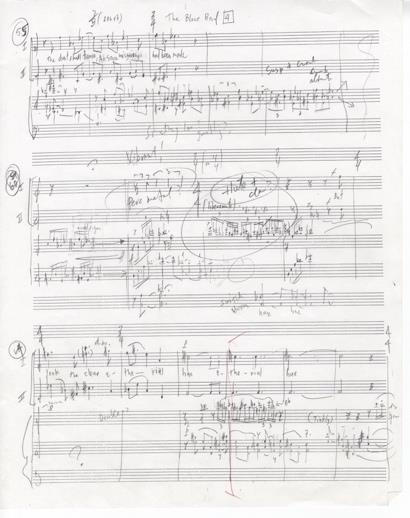
Autograph Musical Manuscript of a Setting of Herman Melville’s Poem Bluebird
19 TSONTAKIS, George b. 1951
Bluebird, a setting of Herman Melville's poem for two female voices with instrumental accompaniment.
Autograph musical manuscript. Signed and dated 2007. A complete working draft. 5 pp. Folio (355 x 280 mm.). Notated in pencil with additional markings in colored ink. Signed and dated 2007.
Tsontakis studied with Hugo Weisgall, Felix Greissle, and Roger Sessions. His honours include the Charles Ives Living Award, the Grawemeyer, two Kennedy Center Friedheim Awards (1989, 1992), a lifetime achievement award from the American Academy of Arts and Letters (1995), a Guggenheim Memorial Fellowship, (1996) and numerous commissions.
"[His] early works are written in a dissonant chromatic idiom not unlike that of Sessions. His musical language soon shifted, however, towards a classically-influenced style characterized by large-scale harmonic prolongations and what he calls 'the timeless gesture', a reference to the past through evocation rather than quotation. With the String Quartet no. 3 'Carragio' (1986) he arrived at an idiosyncratic tonal language propelled by a non-minimalist, Beethovenian use of repetition. Another primary feature of his work, particularly notable in the Byzantium Kanon (1986) and Stabat mater (1990), is the influence of sacred music of the Greek Orthodox church. Secular folk music of the same region figures prominently in the oratorio Erotokritos (1982) and other works." Eric Moe in Grove Music Online. (20047) $750
PRINTED MUSIC
Items 20-62
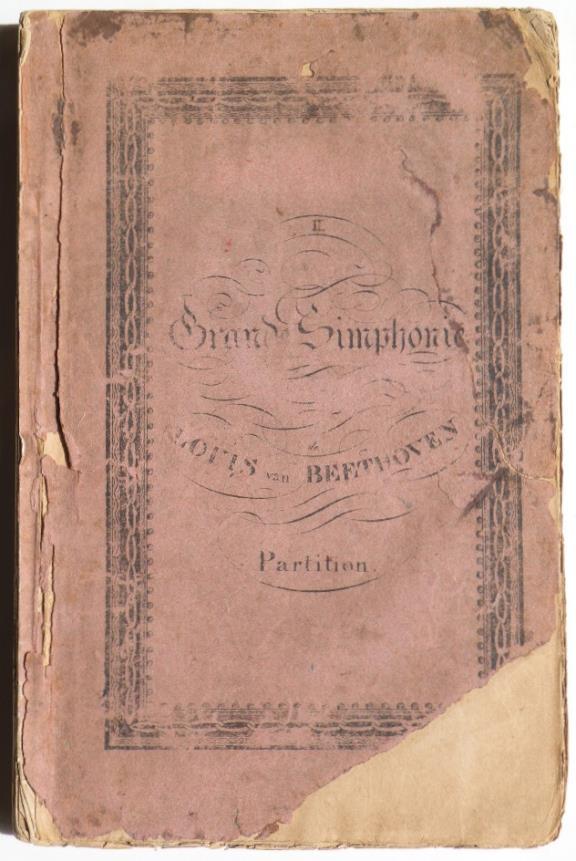
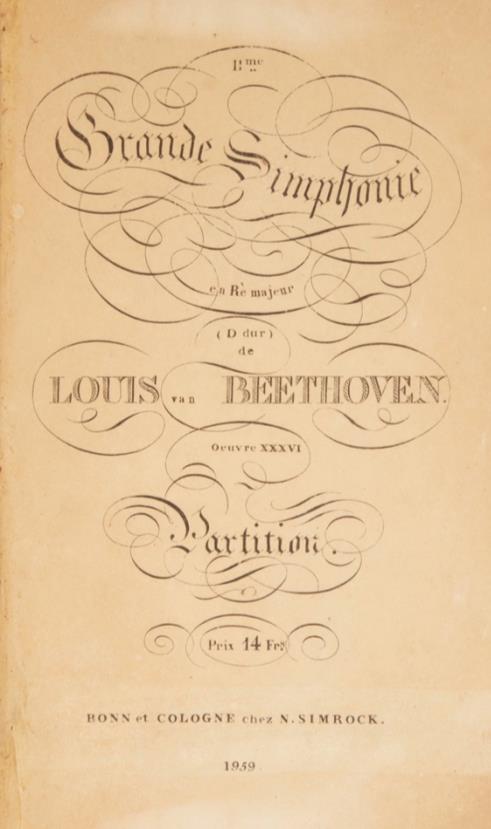
Scarce First German Edition of the Second Symphony, With Metronome Markings
20 BEETHOVEN, Ludwig van 1770-1827
IIme Grande Simphonie en Rè majeur (D-Dur) ... Oeuvre XXXVI Partition. [Full score]. Bonn et Cologne: N. Simrock [PN 1959], [1822].
Octavo. Original publisher's printed pink wrappers. 1f. (title), [ii] (blank), 162 pp. Engraved. Price: "14 Frs." Wrappers slightly defective, spine mostly lacking, upper laid down. Slight offsetting; staining to edges of outer margins; some paper imperfections. Some edges untrimmed. Uniform light browning throughout, more noticeably to title.
First German edition, with metronome indications present. Scarce in original wrappers. LvBWV v. 1, p. 211. Hoboken 2, 195. Del Mar p. 10, Source E. The score was previously published in an unauthorized edition by Cianchettini and Sperati in London in 1808.
One of the last works of Beethoven's so-called "early period," the Second Symphony was premiered at the Theater an der Wien in Vienna on 5 April 1803, conducted by the composer. It was largely composed during Beethoven's stay at Heiligenstadt in 1802, when he began to realize that his deafness might be incurable.
“Completed in 1802, during a turbulent period in Beethoven’s life, the Second Symphony, in D major, op. 36, is already the work of a mature master who is settling accounts – or making peace – with the high-Classic symphonic tradition before embarking on an unprecedented musical voyage. It is a work which has both retrospective and prospective characteristics: it is firmly rooted in Mozart’s and Haydn’s last symphonies while anticipating Beethoven’s later development by its dynamic contrasts, unexpected modulations, and propulsive movement, all of which are controlled by a confident and flowing Classicism.” Solomon: Beethoven, pp. 103104. (22957) $900
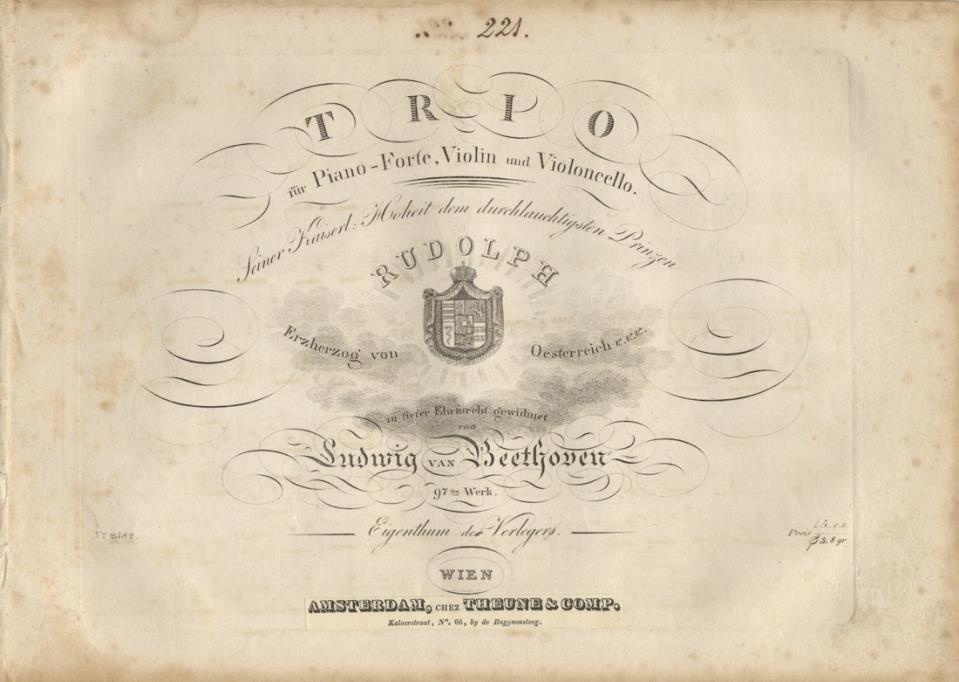
Printed from First Edition Plates
21. BEETHOVEN, Ludwig van 1770-1827
Trio für Piano-Forte, Violin [!Violine] und Violoncello. Seiner Kaiserl: Hoheit dem durchlauchtigsten Prinzen Rudolph Herzog von Oesterreich &c. &c. &c. in tiefer Ehrfurcht gewidmet ... 97tes Werk. [Parts]. Wien: Tobias Haslinger [PN 2582], [after 1826].
Oblong folio and folio. Disbound. Piano: [1] (title), 2-50 pp. Violoncello: 12 pp. Engraved. Price printed in two currencies: "f. 5_C.M." above, "[Reichstthaler sign] 3.8 gr." below. With "Amsterdam: Theune & Comp." overpaste to foot of title Decorative title with coat of arms surrounded by stylized sunrays and clouds. Edges browned and slightly dampstained; slight offsetting and bleeding of imprint; lower outer corner of cello part slightly creased; violin part lacking. With header "221" added in manuscript to all pages.
A later issue printed from plates of the first edition. LvBWV I, p 625. (22986) $275
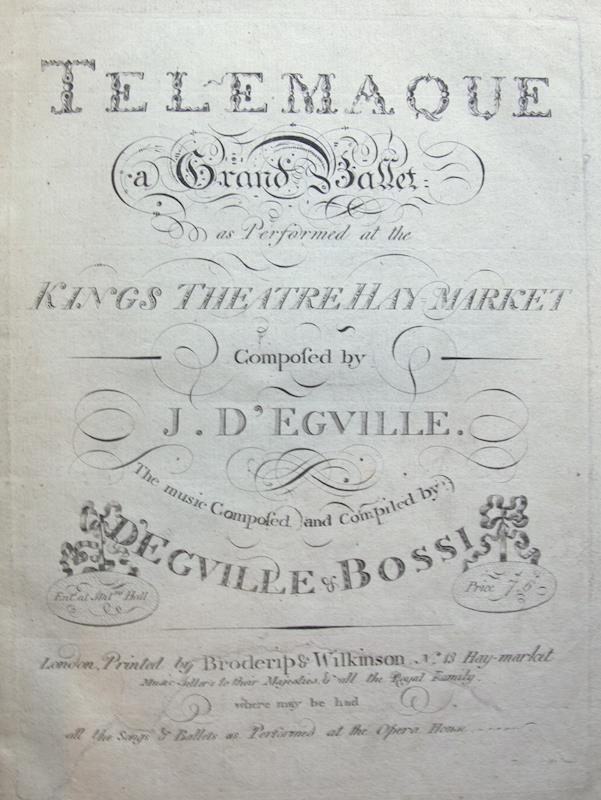
King’s Theatre Ballet
22 EGVILLE, James d' fl. 1782-?1827 and Cesare Bossi ?-1802
Telemaque a Grand Ballet as Performed at the Kings Theatre Hay-Market Composed by J. D'Egville. The music Composed and Compiled by D'Egville & Bossi. [Piano score]. London: Broderip & Wilkinson, [1799].
Folio. Newly bound in full brown linen with printed paper title label to spine. 1f. (title), [1] (blank), 2-39 pp. Engraved.
First Edition. BUC p. 313. RISM E499.
Telemaque was first performed at theKing's Theatreon 27 March 1799, receiving 24 performances. The dancers included D'Egville, Didelot and Hilligsberg. Smith 191. The music draws from Haydn, Pleyel, Sacchini, Gluck, and others. Both D'Egville and Bossi were engaged by the King's Theatre as choreographer and composer/arranger respectively. While D'Egville is credited along with Bossi with the present ballet, it is most likely that Bossi was largely responsible for the music with D'Egville responsible for the choreography. The ballet itself was a reworking of d'Auberval's ballet of the same name. (18864) $300
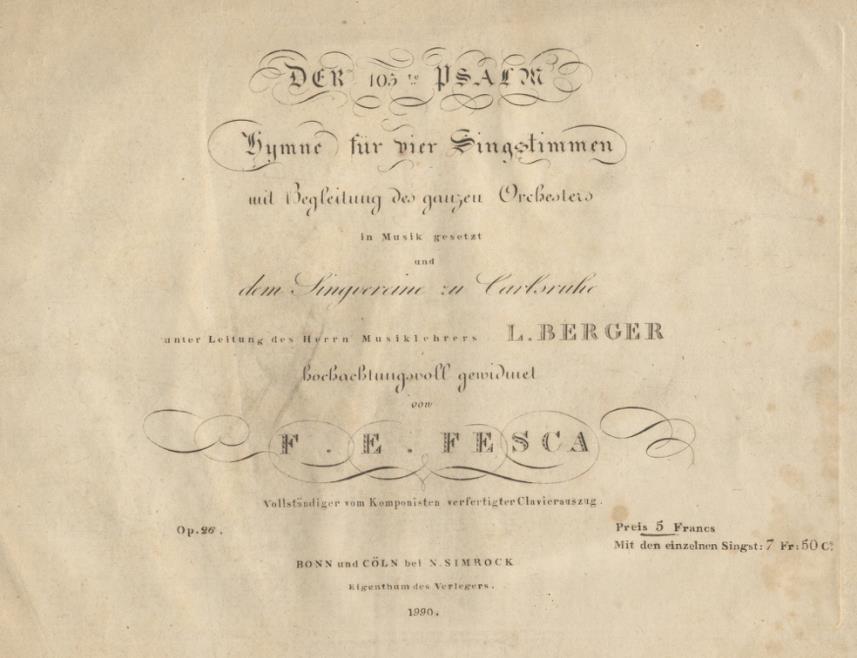
“Ranked ... Alongside Beethoven as a Composer of Distinctly Personal Church Music”
23. FESCA, Friedrich Ernst 1789-1826
Der 103te Psalm Hymne für vier Singstimmen mit Begleitung des Ganzen Orchesters in Musik gesetzt und dem Singvereine zu Carlsruhe unter Leitung des Herrn Musiklehrers L. Berger hochachtungsvoll gewidmet... Vollständiger vom Komponisten verfertigter Clavierauszug. [Op. 26]. [Piano-vocal score]. Bonn und Cöln: N. Simrock [PN] 1990, [ca. 1823].
Oblong folio. Sewn. [1] (title), [2] (blank), 3-30 pp. Title slightly soiled; foxed; minor marginal tears.
Probable First Edition.
"A.B. Marx (1827) ranked Fesca alongside Beethoven as a composer of distinctly personal church music, while Rochlitz (1818) noted that Fesca’s setting of Psalm ix was such as a ‘contemporary Handel’ might have given to his Utrecht Jubilate." Markus Frei-Hauenschild in Grove Music Online. (22018) $185
Early 19th Century Ballet
24. FIORILLO, Federigo 1755-ca. 1823
Le Mariage Secret, ou Les Habitants du Chene, The favorite Ballet Composed by Mr. D'Egville, & performed at the King's Theatre, Haymarket, The Music Composed and arranged for the Piano Forte or Harp, with an Accompaniment for Flute. [Piano score]. London: Rt. Birchall, [ca. 1808].
Folio. Disbound. 1f. (pictorial title), [1] (blank), 2-60 pp. Engraved. Slightly worn and soiled.
Smith 367. Levy & Ward 684.
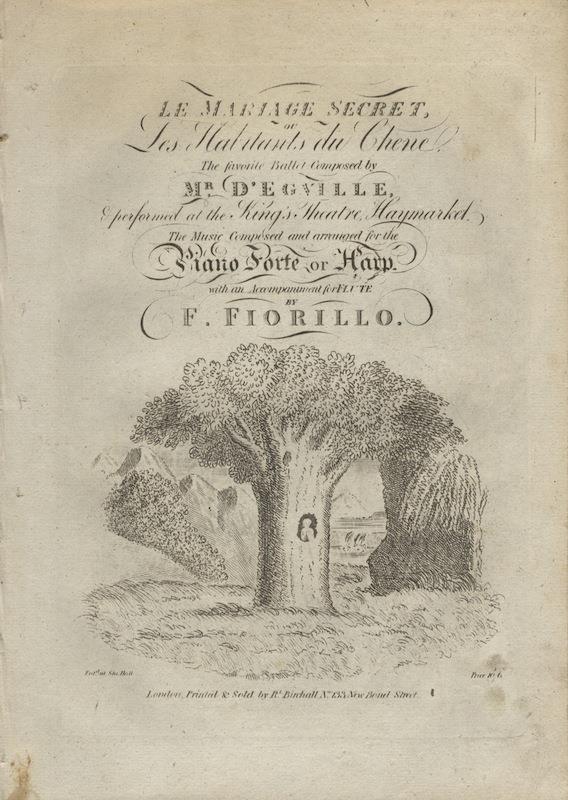
After a career touring in France, Italy, Poland, and Russia as a violinist and violist, Fiorillo arrived in London in 1788. He performed in Salomon's quartet in the Concerts of Ancient Music from 1791 and from 1805 to 1814 composed music for various London ballets. Highfill et al.: A Biographical Dictionary, Vol. 5, p. 274. (22224) $300
Early 19th Century Violin Etudes “Of Good Musical Quality”
25. FIORILLO, Federigo 1755-ca. 1823
Etude pour le Violon, formant Trente-Six Caprices d'une difficulté graduelle ... Seconde et seule édition, Revue & corrigée par l'Auteur [Op. 3]. Paris: Sieber [PN] 896, [1813-1822].
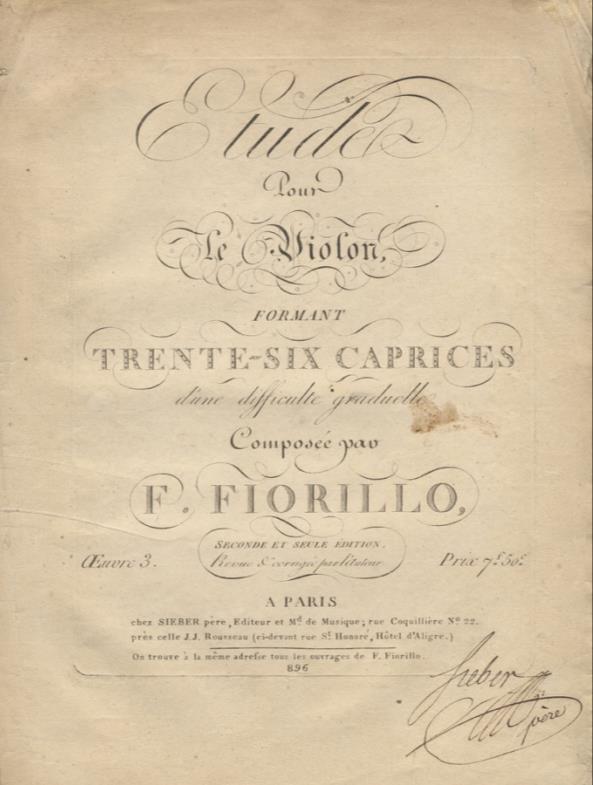
Folio. Sewn. 1f. (title), [1] (blank), 2-32 pp. Engraved. Signed by the publisher at foot of title. With a short introduction by the author. Slightly worn and stained. Untrimmed.
"Such present-day fame as he has rests almost entirely on one work, his 36 caprices for violin. These are études of good musical quality, and they have taken their place in the violinist’s pedagogical repertory beside those of Rode and Kreutzer." Chappell White in Grove Music Online
(22031)
$150
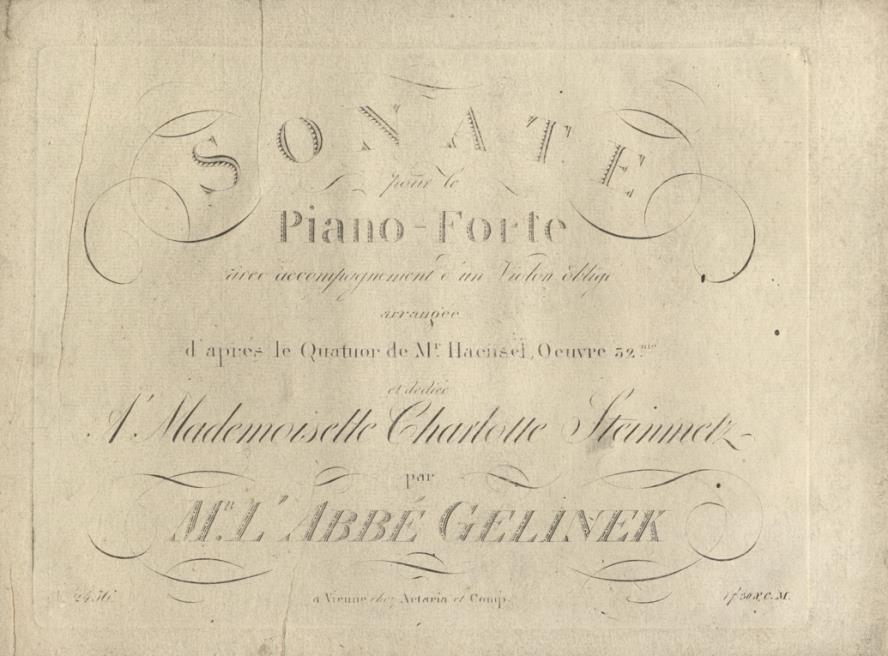
26 GELINEK, Josef 1758-1825
Sonate pour le Piano-Forte avec accompagnement d'un Violon oblige arrangée d'aprés le Quatuor de Mr. Haensel ... et dediée A Mademoiselle Charlottye Steinmetz. [Op. 52]. [Parts]. Vienne: Artaria et Comp. [PN 2456], [1816].
Oblong folio. Unbound, as issued. 1f. (title), 19;7 pp. Engraved. Slightly wornand foxed;titleand edges slightly soiled. A wide-margined copy.
Weinmann: Artaria p. 114.
A Czech composer, pianist and piano teacher, Gelinek met both Mozart and Haydn and was a friend of Beethoven. "According to Dlabač, Gelinek met Mozart during the latter’s visit to Prague in 1787, and after successfully improvising on a theme by Mozart in the composer’s presence at the house of Count Philipp Kinsky, he was recommended by Mozart to the count. ... Gelinek went with Kinsky to Vienna ... where for about 15 years he was a domestic chaplain, piano teacher and tutor for the Kinsky family ...
Most of [his] works are piano variations based on melodies from stage works ..., instrumental compositions (Beethoven’s Seventh Symphony, second movement), Viennese folktunes and his own themes. Their execution demands an advanced performer. They show considerable inventiveness and occasionally employ imitative counterpoint. They were appreciated by contemporaries both as agreeable music and for their pedagogical value." Milan Poštolka in Grove Music Online. (21942)
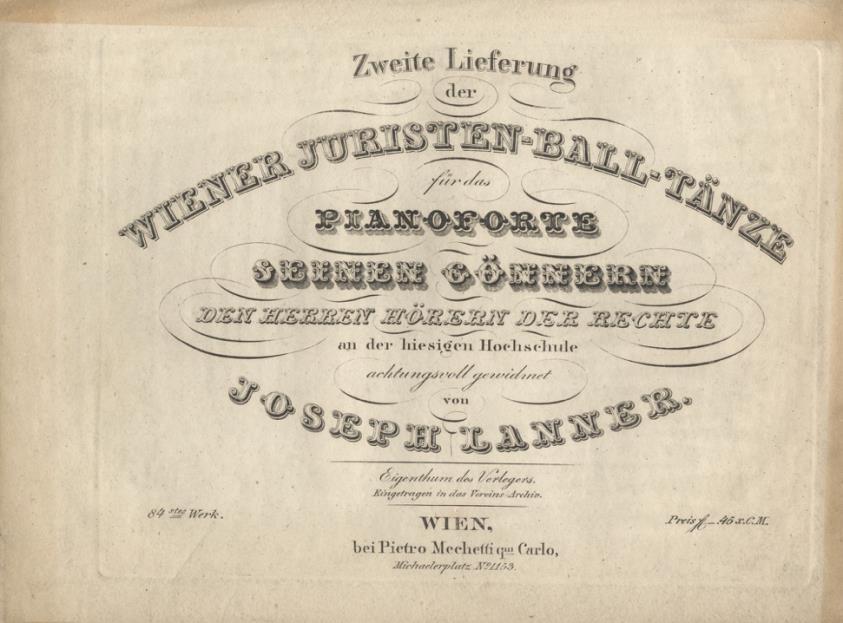
27 LANNER, Joseph 1801-1843
$300
Zweite Lieferung der Wiener Juristen-Ball-Tänze für das Pianoforte. [Op. 84]. Wien: Pietro Mechetti [PN P.M. No. 2443], [1834].
Oblong folio. Unbound as issued. 10 pp. Engraved. With publisher's catalogue to p. [11] listing works by Lanner through Op. 80. Slightly soiled; trimmed.
Weinmann p. 13.
A noted Austrian composer and violinist, “with Johann Stauss (i), Lanner was the most important dance composer of the Biedermeier period, and the two musicians have rightly been called the fathers of the Viennese waltz. Even Lanner’s early work shows further development of the waltz form introduced some years earlier by Joseph Wilde and Michael Pamer. Broad, sweeping melodies, rich harmonies and daring rhythmic subtleties are typical of his compositions. Above all the frequent use of minor keys gives Lanner's works a touch of melancholy, although the composer himself was cheerful and outgoing. After 1833 Lanner took over the classic waltz form developed by Strauss in 1830, with its introduction, five double waltzes and coda, and developed it further. In particular, he often set the introduction in several parts, sometimes achieving a symphonic effect by frequent changes of key and tempo. The coda also acquired larger dimensions, bringing the preceding waltzes together and thereby giving unity to the composition as a whole.” Mosco Carner, revised by Herbert Krenn in Grove Music Online (22054) $75
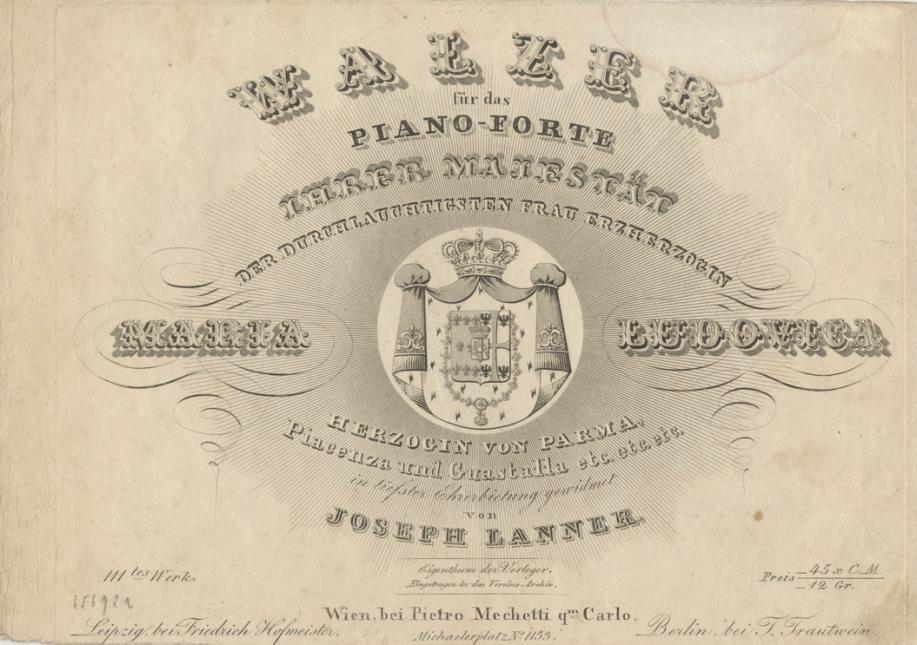
28 LANNER, Joseph 1801-1843
Walzer fur das Piano-Forte ihrer Majestat der Durchlauchtigsten Frau Erzherzogin Maria Ludovica Herzogin von Parma, Piacenza und Guastalla etc. etc. etc [Op. 111]. Wien: Pietro Mechetti qm Carlo [PN P.M. No. 2772], [1836].
Oblong folio. Disbound. 1f. (title), 3-11 pp. Engraved. Decorative title with dedicatee's coat of arms. Trimmed; slightly dampstained.
First Edition. Weinmann Mechetti catalog p. 70. (14240) $100
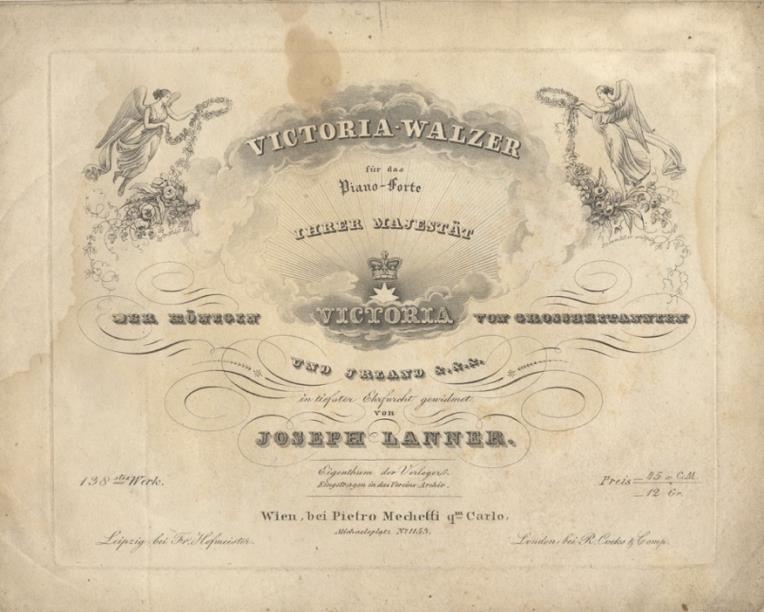
29 LANNER, Joseph 1801-1843
Victoria-Walzer für das Piano-Forte ihrer Majestät der Königen Victoria von Grossbritannien und Irland & & & in tiefsten Ehrfurcht gewidmet. [Op. 138]. Wien: Pietro Mechetti [PN P.M. No. 3117], [1839].
Oblong folio. Unbound. 11pp.Engraved. Withdecorativetitle withcrown ofdedicateeframedbyangels holding floral wreaths. Slightly dampstained, foxed, and creased.
First Edition. Weinmann p. 15. (22055)
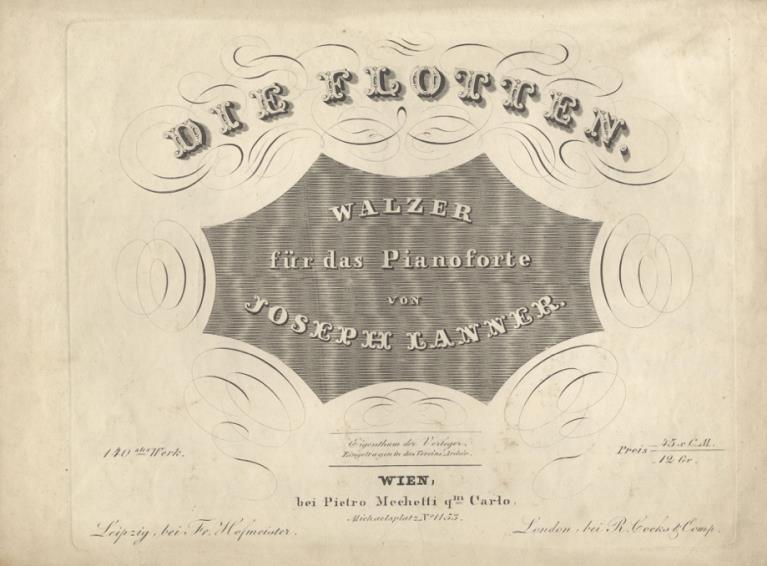
30 LANNER, Joseph 1801-1843
Die Flotten. Walzer für das Pianoforte. [Op. 149]. Wien: Pietro Mechetti [PN P.M. 3457], [1839].
Oblong folio. Unbound. Engraved. With decorative lettering to title. Slightly worn; trimmed. Weinmann p. 15. (22056)
$90
$50
Song Cycle with Text by Rainer Maria Rilke
31. MARTIN, Frank 1890-1974
Die Weise von Liebe und Tod des Cornets Christoph Rilke Nach dem Gedicht von Rainer Maria Rilke für tiefe Stimme und Kammerorchester. Klavierauszug. Wiedergabe der Handschrift des Komponisten – Reproduction du manuscrit de l'auteur [Piano-vocal score] Wien: Universal Edition [PN UE 11491], [1944].
Folio. Dark green cloth-backed green paper boards with original publisher's upper wrapper bound in. 1f. (title), 120 pp. Facsimile of the composer's manuscript. Boards worn and rubbed. Ex-library, with call number to foot of spine and occasional library markings.
A song cyclesettotextbythe notedBohemian-Austrian poetRainerMaria Rilke(1875-1926). (17927) $40
First Edition of the Trois Caprices
32. MILHAUD, Darius 1892-1974
Trois Caprices de Paganini Traités en duos concertants pour Violon et piano. [Op. 97]. [Parts]. Paris: Heugel [PN E.F. 497], ©1927.
Folio. Original publisher's wrappers. 1f. (title), 13 pp. + violin: 5 pp. Publisher's handstamp to foot of upper wrapper. "Hommage de l'Editeur" stamped to title. Delanchy-Dupré imprimatur to last page dated 1927. Wrappers somewhat worn and browned.
First Edition, possible first issue. (22006) $25
“Masterly and Amply Rewarding Study and Performance”
33 MOZART, Wolfgang Amadeus 1756-1791
La Clemenza di Tito. Opera seria ... Ernsthafte Oper in Zwey Akten ... Klavierauszug von A.E. Müller. [KV 621]. [Piano-vocal score]. Leipzig: Breitkopf & Härtel [PN 3610], [1823-1824].
Oblong folio. Contemporary paper boards. 1f. (title), 88 pp. Lithographed. With label of the late 19th century lending library of Fritz Möller of Hamburg, Germany to upper board and advertising to front pastedown.
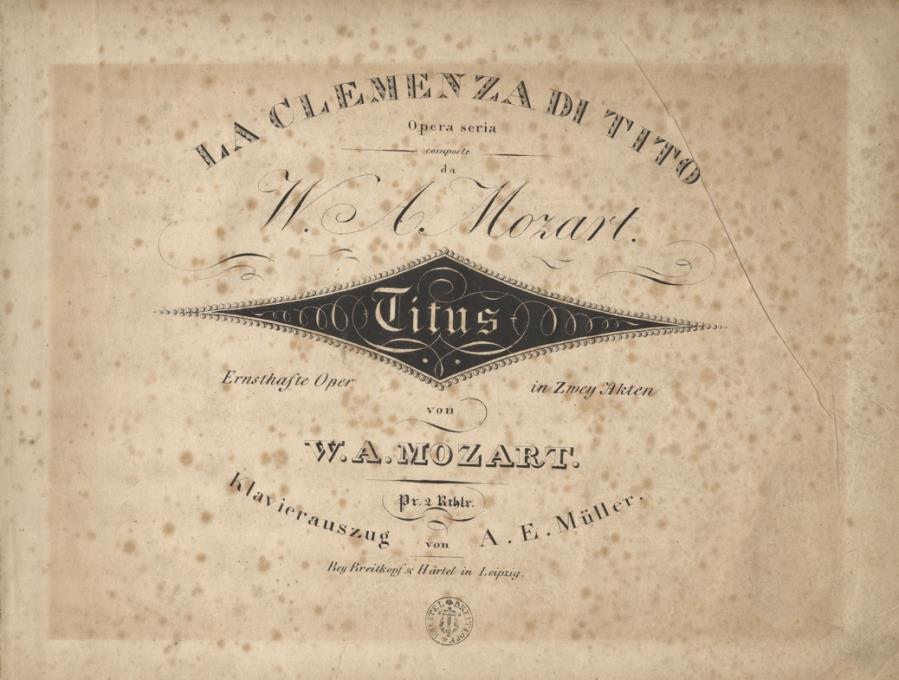
Binding worn and rubbed; partially detached; spine chipped; joints split; endpapers lacking. Moderately foxed throughout; title browned.
Köchel 8, p. 720. Hirsch IV, 1227. RISM M5105.
La Clemenza di Tito, an opera seria in two acts to a libretto by Pietro Metastasio adapted by Caterino Mazzolà, was first performed in Prague at the National Theatre on 6 September 1791, approximately 3 months before Mozart died on 5 December 1791. He had arrived in Prague on August 28 and, despite his illness, finished work on the opera on the eve of the performance.
"Although mostly composed after Die Zauberflöte, La clemenza di Tito was performed first. .. The reception was modest until a triumphant last night was reported to Mozart (who had left Prague on 15 September) on the day of the première of Die Zauberflöte (30 September). ... Had he lived to prepare further performances, Mozart would surely have replaced Süssmayr’s simple recitatives (which do not always end in an appropriate key). He might have increased the orchestrated recitative to a quantity approaching that in Così and, as he had planned for Idomeneo, rearranged the vocal forces, with a tenor Sextus. Now that performances and recordings, and a general revival of 18th-century repertory, encourage reassessment of its virtues, La clemenza di Tito clearly appears a conception not fully realized, but still masterly and amply rewarding study and performance ... Until about 1830 La clemenza di Tito was one of Mozart's most popular operas; it then went into eclipse. It has never fully entered the modern repertory and is often described as unworthy of Mozart, hastily assembled for a commission he could not refuse. Critical estimates have risen since World War II, and it is now seen as a positive step towards further reform of opera seria." Julian Rushton in Grove Music Online. (21172) $120
“A Notable Success”
34 RICCI, Luigi 1805-1859
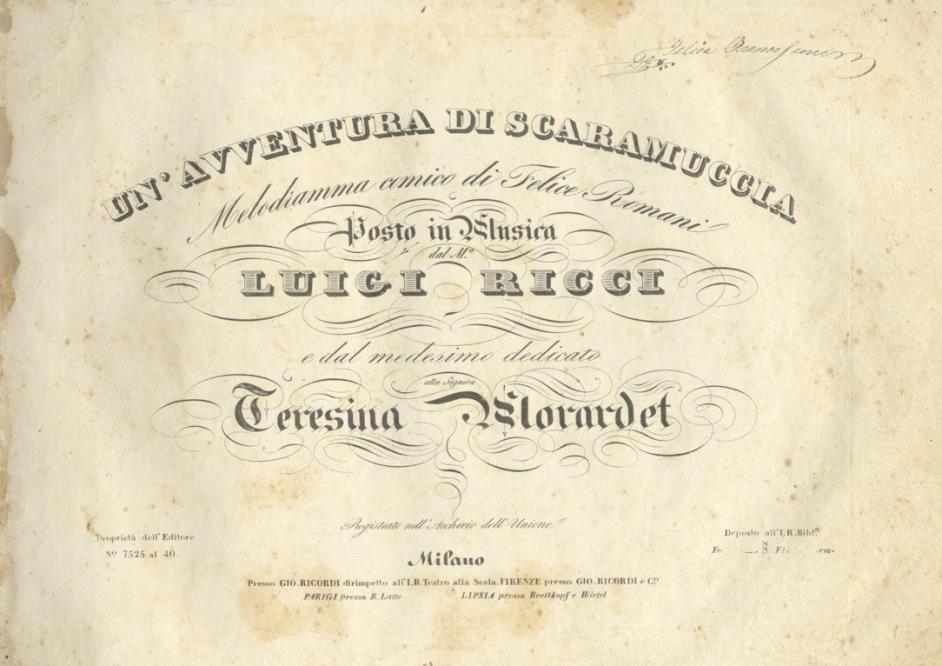
Un'Avventura di Scaramuccia. Melodramma comico di Felice Romani. [Piano-vocal score]. Milan: Ricordi [PN 7475-7493], ca. 1835.
Oblong folio. Leather-backed marbled boards with titling gilt to spine. 1f. (title), 1f. (cast list, contents), 5-264 pp. With contemporary signature to title page. Engraved throughout. Binding worn, rubbed and bumped. Minor foxing and browning; corners thumbed; minor marginal tears, some repairs; remnants of early binding to inner margin of title page.
First Edition. Rare. OCLC 32110020 (1 copy only).
Un'Avventura di Scaramuccia was first performed in Milan at La Scala on 8 March 1834.
The Italian composer Ricci achieved "a notable success with Un'avventura di Scaramuccia, written to a witty libretto, part romance, part theatrical satire, by Felice Romani ... [His] is one of the more individual voices of Italian opera of the period. His chief gift was for comedy, to which he brought not only a complete mastery of the traditional devices but also a new, robust buffo manner characterized by a wealth of bouncing allegretto melodies, mostly in duple time, and a not infrequent use of folktune." Julian Budden in Grove Music Online (12565)
$275
“Received with Enormous Enthusiasm”
35. ROSSINI, Gioachino 1792-1868
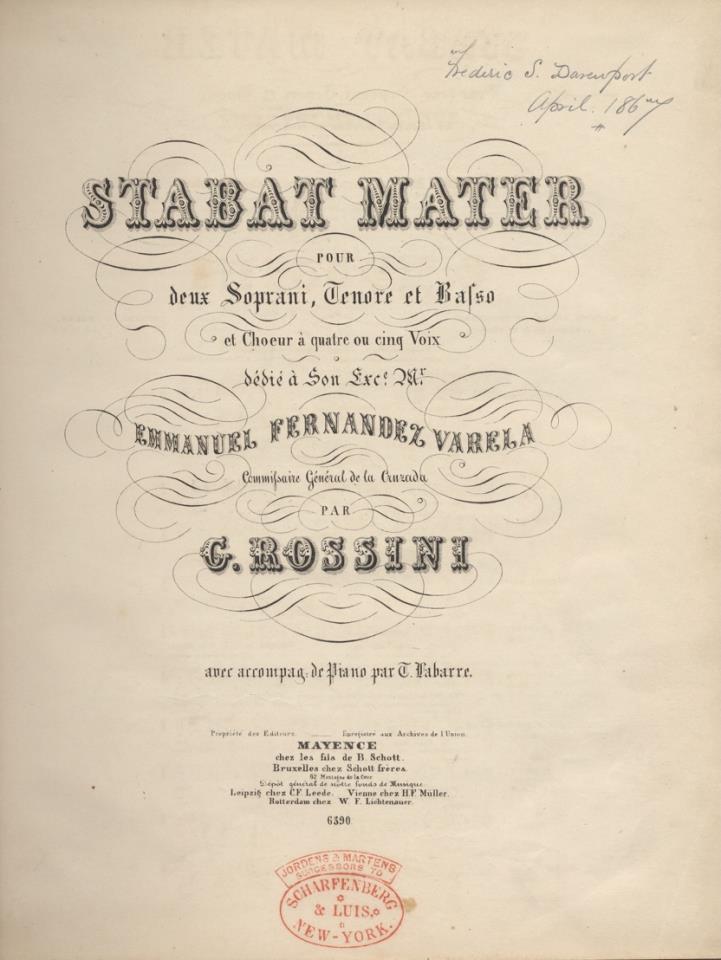
Stabat Mater pour Deux Soprani, Tenore et Basso et Choeur a quatre ou cinq Voix ... avec accompag. de Piano par T. Labarre. [Full score] Mayence: B. Schott [PN 6588], [after 1842].
Folio. 19th century quarter dark brown leather with cloth boards. 2ff., 109 pp. Engraved. With former owner's signature ("Frederic S. Davenport April 1867") to upper outer corner and stamp of the music seller Scharfenberg & Luis of New York tolower margin oftitle-page. Binding worn; upper detached; spine chipped. Minorspotting to final two leaves.
A later issue of the edition published by Troupenas in 1841-42.
"When, after the death of Varela, the original version of the Stabat mater fell into the hands of the Parisian publisher Aulagnier, who printed it and arranged a performance, Rossini, partly at the prompting of Troupenas and partly because the work published by Aulagnier was a composite, disowned this version and decided to complete the work himself. The revised Stabat mater was ready by the end of 1841. The first performance, arranged by the brothers Léon and Marie Escudier, was in Paris at the Théâtre Italien on 7 January 1842. It was received with enormous enthusiasm. The first Italian performance, at Bologna, followed in March under the direction of Donizetti." Philip Gossett in Grove Music Online (15479) $100
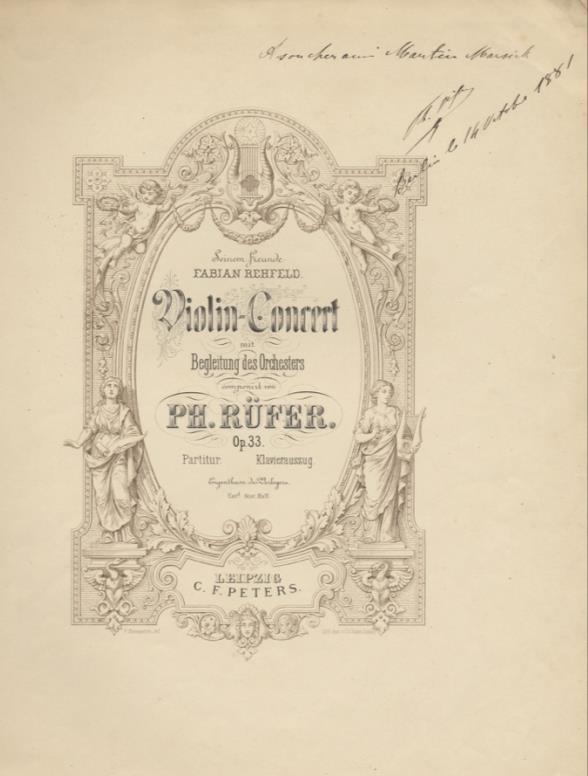
A Signed Presentation Copy from Rüfer to Belgian Violinist Marsick
36. RÜFER, Philippe 1844-1919
Violin-Concert mit Begleitung der Orchesters ... Op. 33. [Full score]. Leipzig: C.F. Peters [PN 6440], [1881].
Folio. Original publisher's lavender wrappers. [1] (title within decorative border), [2] (blank), 3-57 pp. Engraved. With a signed presentation inscription from the composer to his friend, the Belgian violinist Martin Marsick (1847-1924), to title dated Berlin, 14 October 1881. Wrappers somewhat worn, faded and soiled. Slightly worn; edges to several leaves slightly frayed.
First Edition.
Rüfer, a pianist and composer, settled in Berlin in 1871 and taught at the Stern Conservatory, Kullak's Akademie der Tonkust and, later, at the Scharwenka Conservatory. See Baker 8, p. 1560. (22022) $120
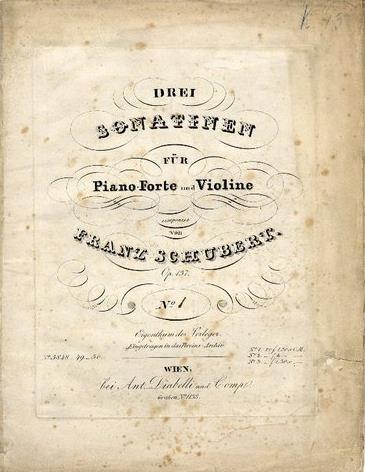
First Edition of Op. 137, No. 1
37 SCHUBERT, Franz 1797-1828
Drei Sonatinen für Piano-Forte und Violine ... Op. 137. No. [1]. [D 384]. [Parts]. Wien: Ant. Diabelli und Comp. [PN D. et C. No. 5848], [1836].
Folio. Unbound. 15; 7 pp. Engraved. Minor to moderate foxing and soiling; marginal tears;title separated at spine and taped.
First Edition. Deutsch384. HirschIV, 615. Hoboken14, 499. (14922) $150
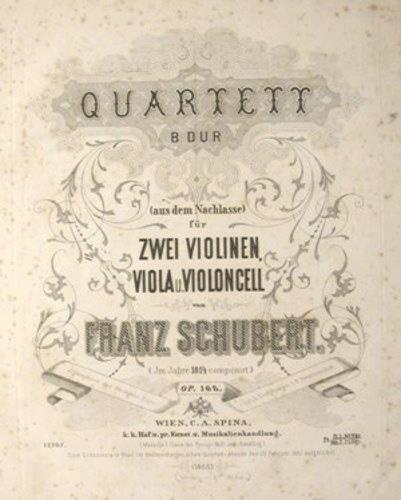
First Edition of the Quartet, Op. 168
38. SCHUBERT, Franz 1797-1828
Quartett B Dur (aus dem Nachlass) für Zwei Violinen, Viola u. Violoncelle ... Op. 168. [D 112]. [Set of parts]. Wien: C.A. Spina [PN 17,707], 1863.
Folio. Stiff wrappers with small green paper label titled in manuscript to upper inner margin. 14; 11; 10; 10 pp. Engraved. Small circular ownership handstamp to upper outer margin of first leaf to each part. Wrappers worn; splitting at spine. Minor to moderate foxing throughout; first leaf of first violin part trimmed with paper reinforcement to lower margin; green paper tape to spines of remaining parts.
First Edition. Deutsch 112. Hirsch IV, 645. Hoboken 14, 547. (18655) $300
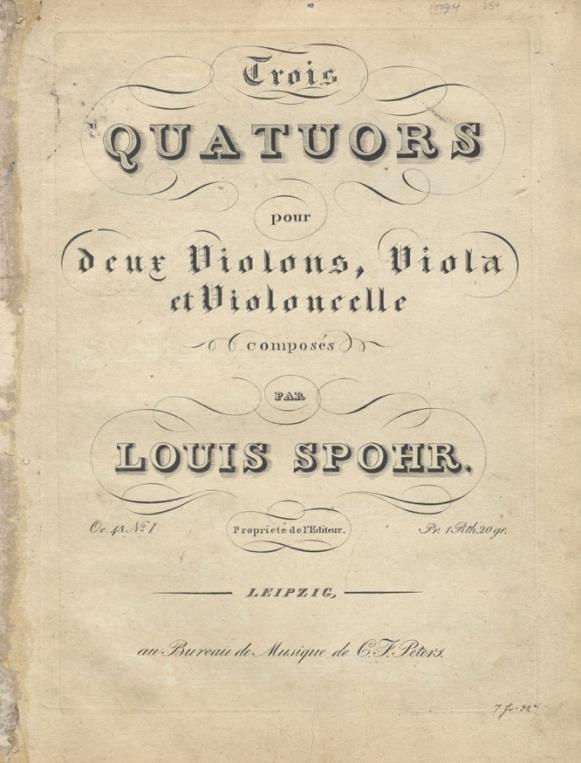
“Worthy of a Place Beside Haydn, Mozart and Beethoven in the Pantheon of the Greatest Composers”
39 SPOHR, Louis 1784-1859
Trois Quatuors pour deux Violons, Viola et Violoncelle. [Op. 45]. [Parts]. Leipzig: C.F. Peters [PNs 1487, 1489, 1490], [1819].
Folio. Disbound. I: 12, 9, 9, 9; II: 13, 11, 11, 8; III: 14, 10, 10, 10 pp. Engraved. Titles to first violin parts only. With Simrock overpaste to title of Quartet no. 3. Slightly worn and browned, more heavily to no. 2; remnants of paper tape to spines; occasional staining and other minor imperfections. Contemporary signaturetoeachpart ofno. 2.
First Editions. Göthel, p. 82.
"Regarded by many contemporaries as worthy of a place beside Haydn, Mozart and Beethoven in the pantheon of the greatest composers, he has, together with Gluck and Cherubini, been allotted a considerably lower status by posterity. Mozart's Figaro and Wagner's Tristan were both composed during Spohr's lifetime; his own work looks, Janus-like, towards both the formalism and clarity of the Classical tradition, and the structural and harmonic experimentation associated with 19th-century Romanticism. ...
From the end of 1817 until 1819 [Spohr] was resident in Frankfurt as director of opera, where he did much to raise standards of performance. ... He also enriched the musical life of Frankfurt by presenting a series of quartet concerts, for which he composed his String Quartets op. 45." Clive Brownin Grove Music Online. (14874) $225
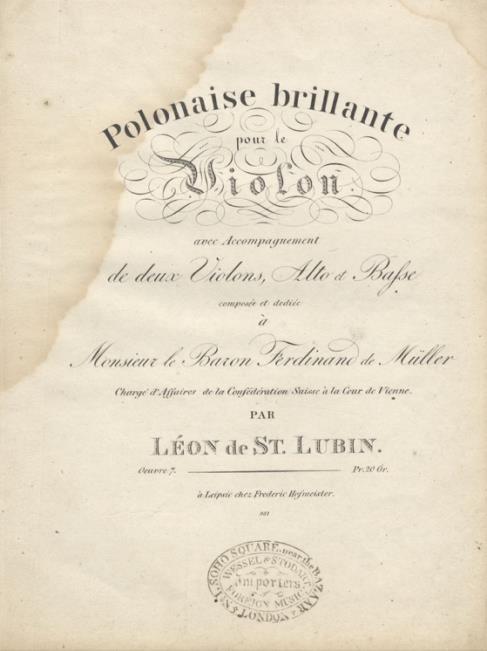
Early 19th Century Polonaise for Violin
40 ST. LUBIN, Léon de 1805-1850
Polonaise brillante pour le Violon, avec Accompagnement de deux Violons, Alto et Basse composée et dediée à Monsieur le Baron Ferdinand de Müller. [Op. 7]. Parts]. Leipzig: Hofmeister [PN] 981, [ca. 1824].
Folio. Disbound. Violin principal: [1] (title), [2] (blank), 3-7; Violin I: 3; Violin II: 3; Viola: 3; Bass: 3 pp. Lithographed throughout. Slightly worn; staining to violin principal part; London musicseller's handstamp to foot of title. (22037) $100
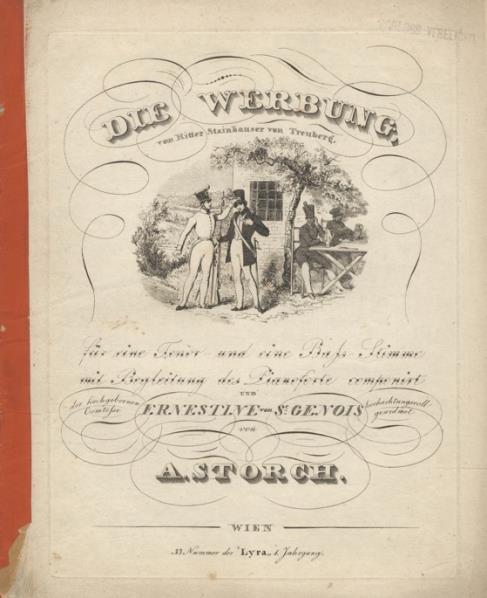
41. STORCH, A. 1813-1887
Die Werbung, von Ritter Stainhauser von Treuberg für eine Tenor und eine Bass-Stimme mit Begleitung des Pianoforte und hochgebornen Comtesse Ernestine von St. Genois hochachtungsvoll gewidmet Wien: 33 Nummer der "Lyra" 1. Jahrgang, [ca. 1830-1840].
Folio. [1] (title incorporating an engraved scene of soldiers in a beer garden), [2] (blank), 3-6 pp. Engraved. Slightly worn and soiled; red paper tape to spine. With small handstamp of "Schloss Veselicko" to upper right corner.
Storch was an important figure in 19th century Viennese musical life. (21938) $50
Johann Strauss, Sr. Items 42-55
"Verve and a fiery spirit lie at the heart of Strauss’s compositions. Of his waltzes, one contemporary writer colourfully observed: ‘In his waltzes a profusion of melodies effervesce and bubble, fizz and froth, dash and sweep like the five hundred thousand devils in the champagne, slipping their bonds and flinging one cork after another into the air’. In retrospect, however, when comparing the elder Strauss’s work with that of his sons, the attraction of his music lay more in the ingenuity of his rhythms than in the originality of his melodies. ... As a pioneer of the waltz, Strauss, along with Lanner, established the foundations upon which more extended and developed melodic line and ambitious harmony and structure could be built by their successors in the field of dance music.” Peter Kemp in Grove Music Online
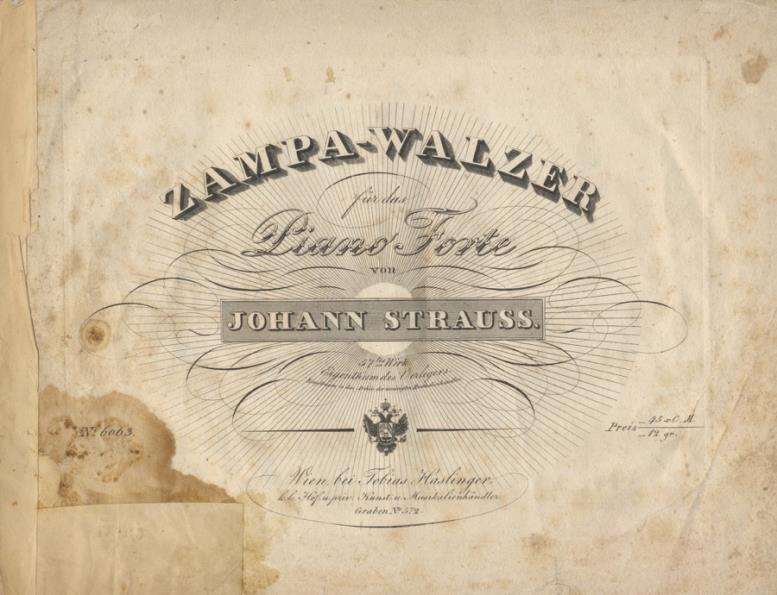
42 STRAUSS, Johann, Sr. 1804-1849
Zampa-Walzer fur das Piano Forte. [Op. 57]. Wien: Tobias Haslinger [PN T.H. 6063], [1832].
Oblong folio. Unbound as issued (spine reinforced). [i] (title), 2-11 pp. Engraved. Spine reinforced. Occasional staining, light foxing and soiling; paper loss to first leaf repaired, with no loss of music.
First Edition. Weinmann p. 14. (14221) $50
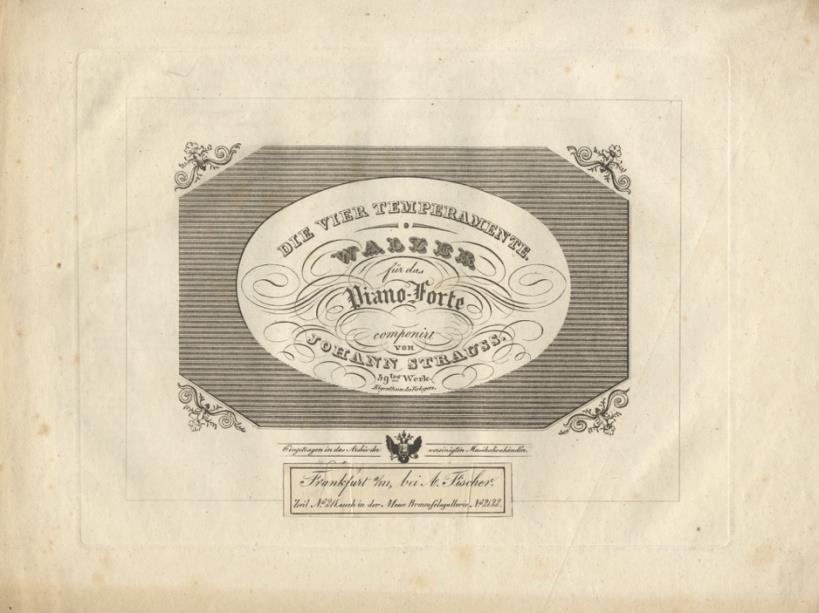
43. STRAUSS, Johann, Sr. 1804-1849
Die vier Temperamente. Walzer für das Piano Forte. [Op. 59]. Wien: Tobias Haslinger [PN T.H. 6079], [1833].
Oblong folio. Unboundas issued. 15 pp. Engraved. With decorative title within ruled border. Includes publisher's catalogue. Contains Der Sanguiniker, Der Melancholiker, Der Choleriker, and Der Phlegmatiker. Slightly browned. With Fischer overpaste.
First Edition. Weinmann p. 12. Schönherr & Reinöhl pp. 89-90. (15081) $120
44. STRAUSS, Johann, Sr. 18041849
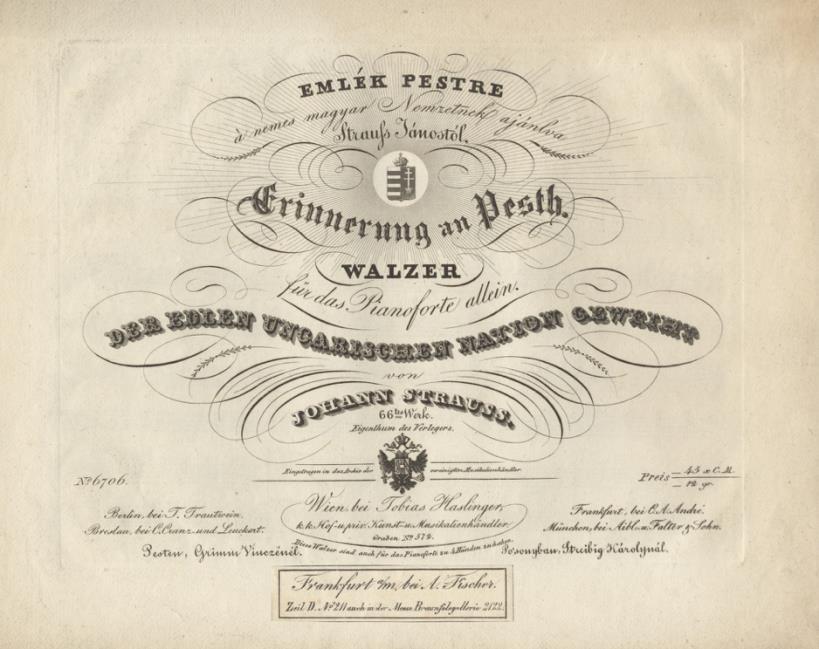
Emlék Pestre – Erinnerungen an Pesth. Walzer für das Pianoforte allein. [Op. 66]. Wien: Tobias Haslinger [PN T.H. 6706], [1834].
Oblong folio. Unbound as issued. 1f. (title), 1-8 pp. Engraved. Decorative title with dedicatee's coat of arms. With Fischer overpaste. Minor dampstaining.
First Edition. Weinmann p. 15. Schönherr & Reinöhl pp. 99-101.
Composed following the composer’s visit to Hungary in 1833. (14131) $120
45. STRAUSS, Johann, Sr. 18041849
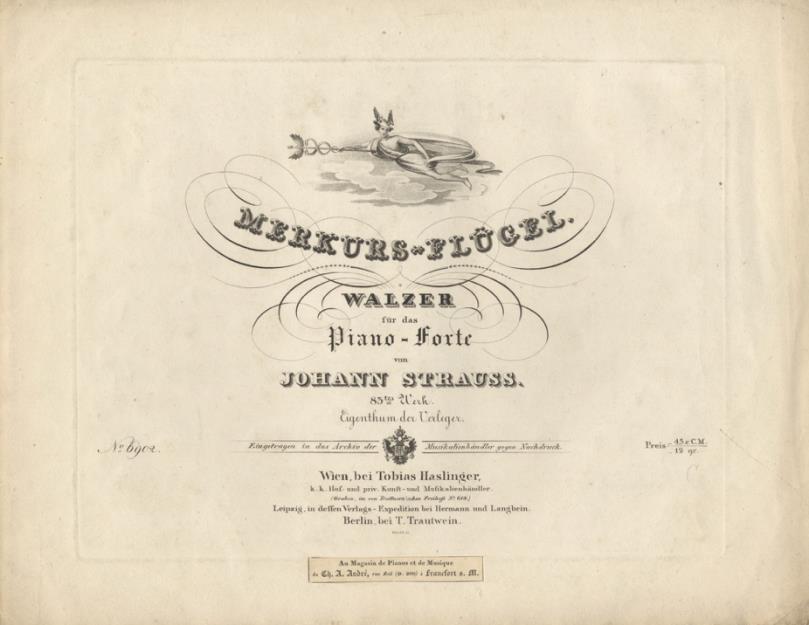
Merkurs-Flügel. Walzer für das Piano-Forte [Op. 83]. Wien: Tobias Haslinger [PN T.H. 6902], [1836].
Oblong folio. Unbound as issued. 10 pp. Engraved. With decorative vignette to title. Edges slightly browned and creased.
First Edition. Weinmann p. 17. Schönherr & Reinöhl p. 128. (22048) $120
46. STRAUSS, Johann, Sr. 18041849
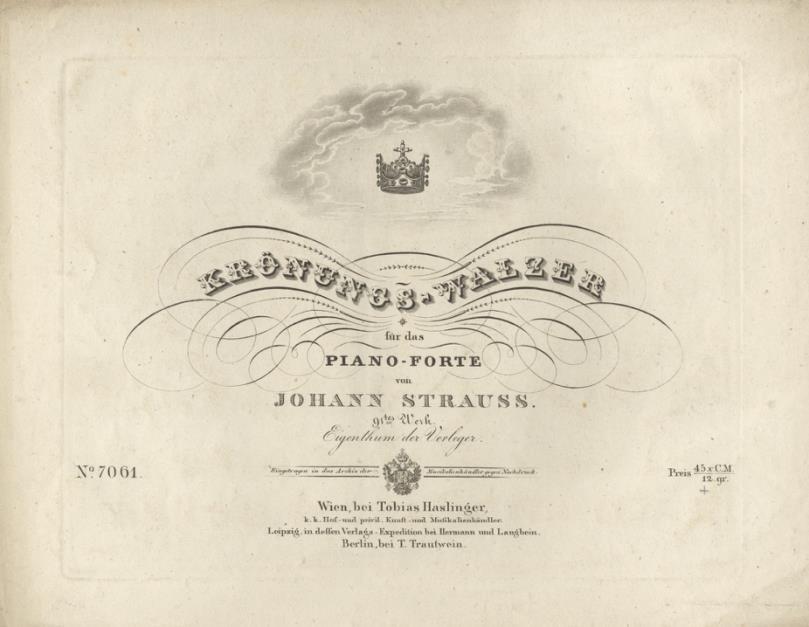
Kronungs-Walzer für das PianoForte. [Op. 91]. Wien: Tobias Haslinger [PN T.H. 7061], [1837].
Oblong folio. Unbound as issued. 10 pp. Engraved. With decorative vignette to title. Slightly soiled.
First Edition. Weinmann p. 18. Schönherr & Reinöhl pp. 140-142. (14134) $120
47. STRAUSS, Johann, Sr. 18041849
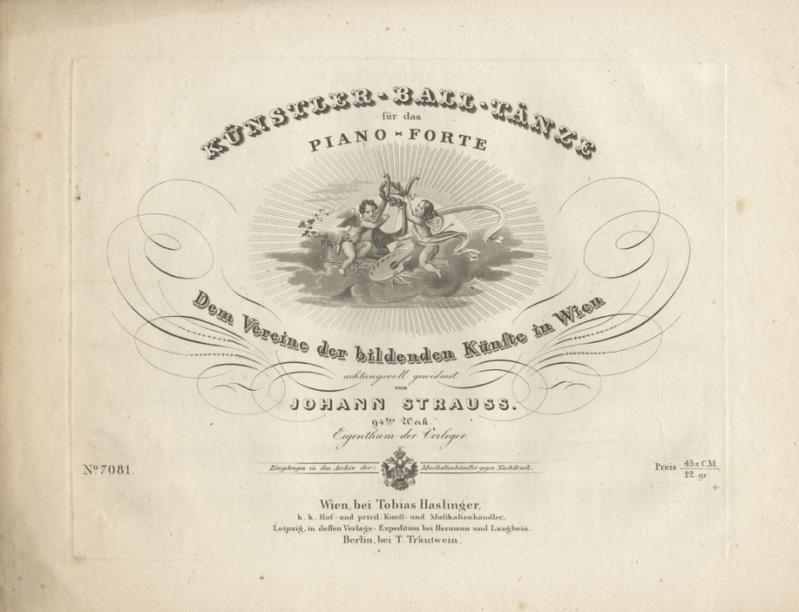
Künstler-Ball-Tänze für das PianoForte dem Vereine der bildenden Künste in Wien. [Op. 94]. Wien: Tobias Haslinger [PN T.H. 7081], [1837].
Oblong folio. Unbound as issued. 11 pp. Engraved. With decorative vignette of two cherubs playing a lyre to title. Slightly worn, browned and soiled.
First Edition. Weinmann p. 19. Schönherr & Reinöhl p. 144. (22240) $120
48. STRAUSS, Johann, Sr. 18041849
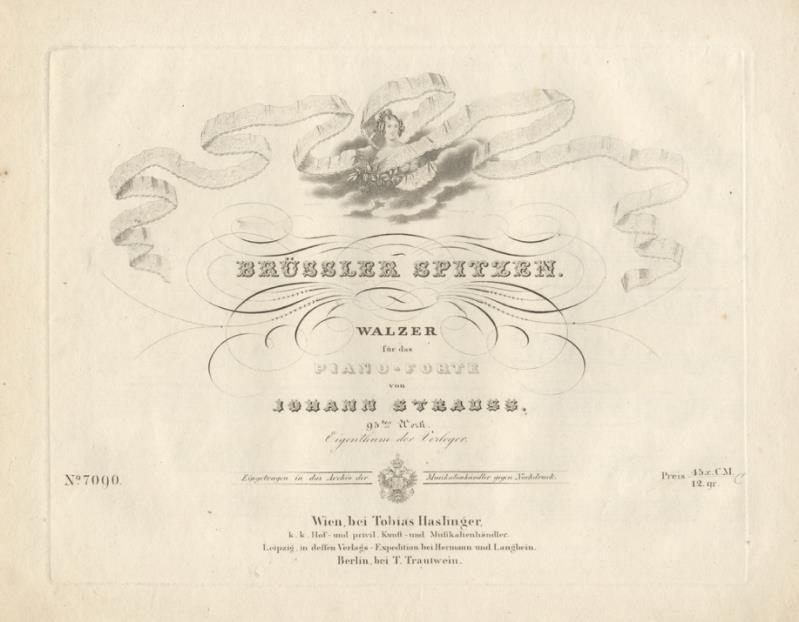
Brüssler-Spitzen. Walzer für das Piano Forte. [Op. 95]. Wien: Tobias Haslinger [PN T.H. 7090], [ca. 1837].
Oblong folio. Unbound as issued. 10 pp. Engraved. With decorative vignette to title. Slightly worn and browned.
First Edition. Weinmann p. 19. Schönherr & Reinöhl pp. 145-146. (22050) $120
49. STRAUSS, Johann, Sr. 18041849
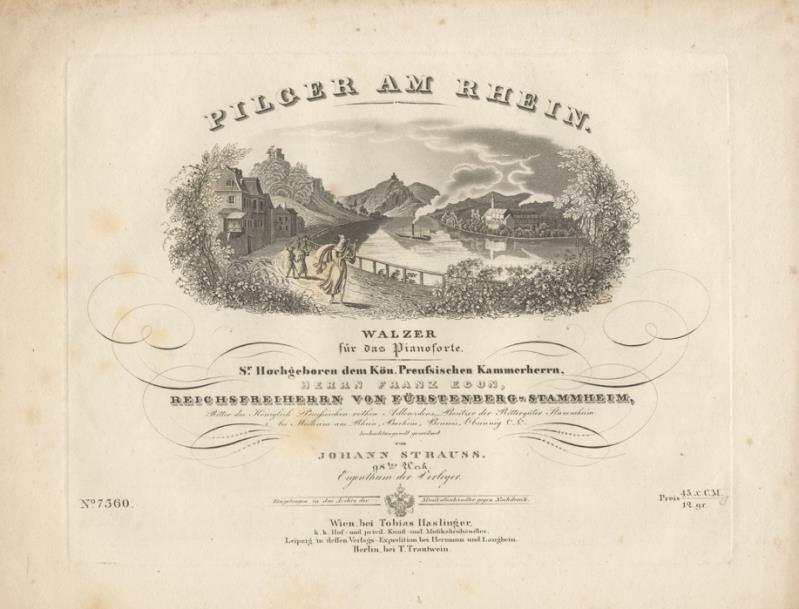
Pilger am Rhein. Walzer für das Pianoforte. [Op. 98]. Wien: Tobias Haslinger [PN T.H. 7360,] [1837].
Oblong folio. Unbound as issued. 1f. (title), pp. 3-10, 1f. (blank). Engraved. With attractive illustration of idealized Rheinish village to title. Slightly worn; edges slightly soiled and browned.
First Edition. Weinmann p. 19. Schönherr & Reinöhl pp. 151-152. (22062) $140
50. STRAUSS, Johann, Sr. 18041849
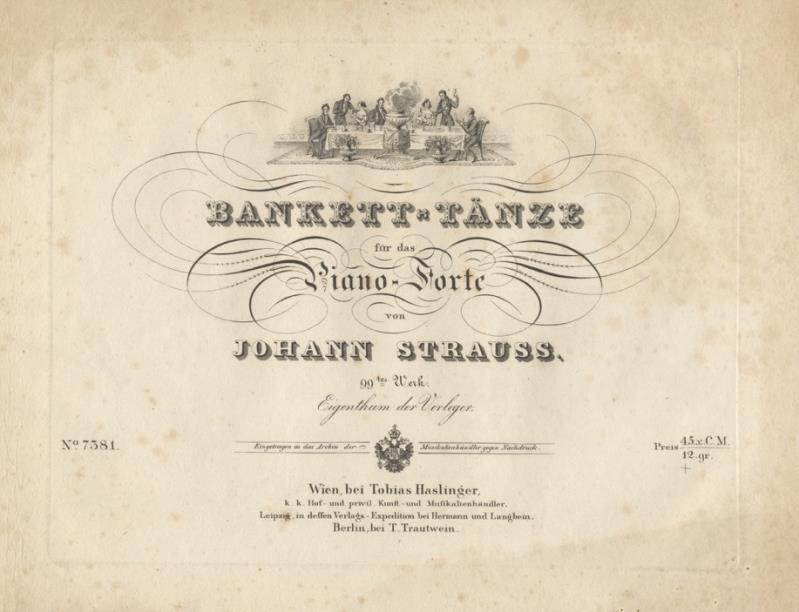
Bankett-Tãnze für das Piano-Forte. [Op. 99]. Wien: Tobias Haslinger [PN T.H. 7381], [1837].
Oblong folio. Unbound as issued. 10 pp. Engraved. With decorative vignette of five gentlemen and two ladies at a banquet to title.
First Edition. Weinmann p. 20. Schönherr & Reinöhl p. 153. (22051) $120
51. STRAUSS, Johann, Sr. 18041849
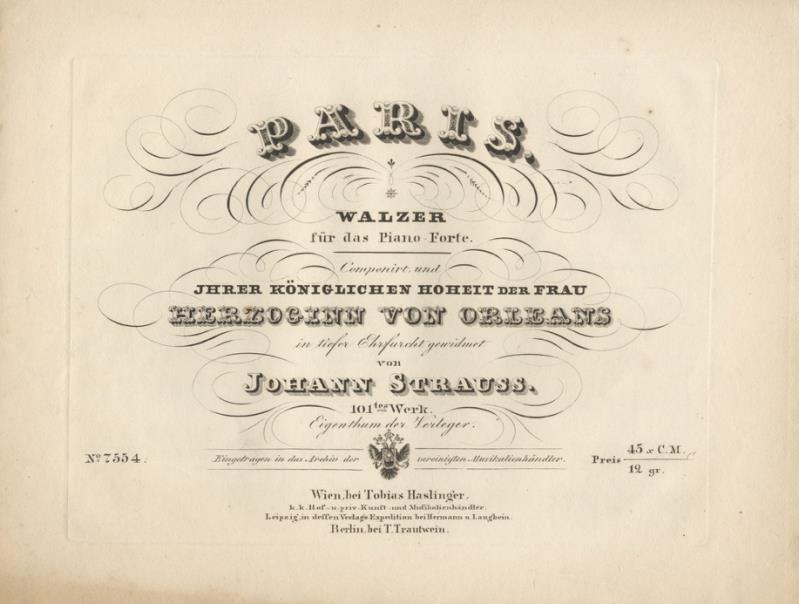
Paris. Walzer fûr das Piano-Forte. [Op. 101]. Wien: Tobias Haslinger [PN T.H. 7554], [1838].
Oblong folio. Unbound as issued. 10 pp. Engraved. Slightly worn and browned.
First Edition. Weinmann p. 20.
Strauss made aconcert tour ofParis in the winter of 1837-38. (22052) $120
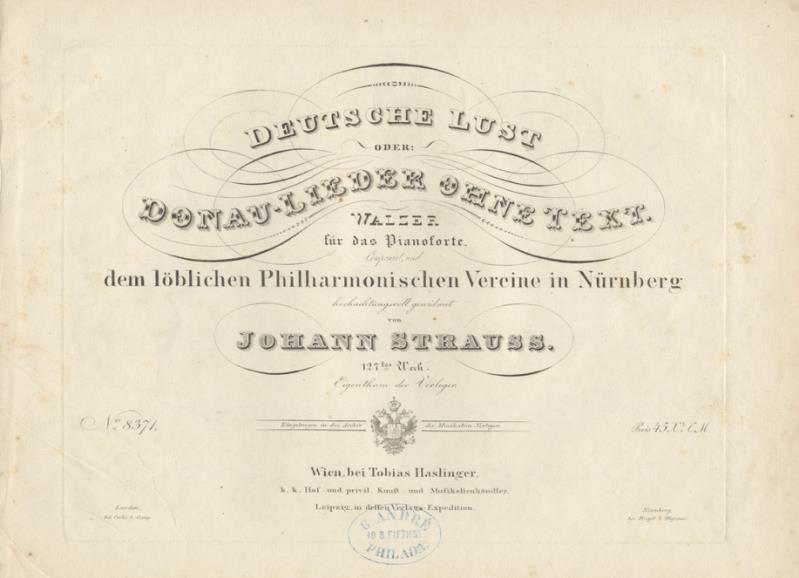
52. STRAUSS, Johann, Sr. 18041849
Deutsche Lust oder Donau-Lieder ohne Text Walzer für das Pianoforte. [Op. 127]. Wien: Tobias Haslinger [PN T.H. 8371], [ca. 1849].
Oblong folio. Disbound. [1] (title), [2] (blank), 3-11 (music), [i] (publisher's catalogue of Strauss's waltzes up to op. 237), [i] (blank) pp. With 19th century Philadelphia musicseller's handstamp to title. Slightly worn and soiled; occasional light foxing.
First Edition, later issue. Weinmann p. 24. (21380) $75
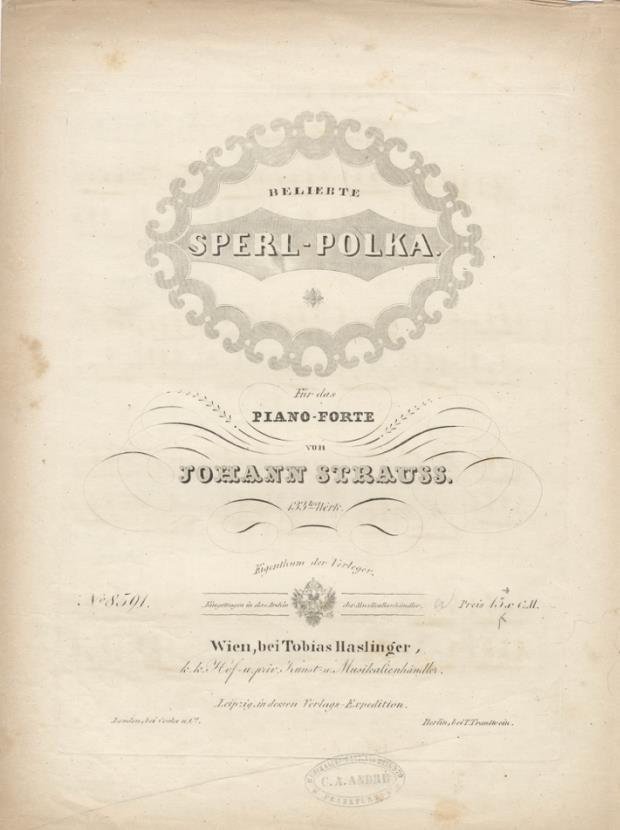
53. STRAUSS, Johann, Sr. 1804-1849
Beliebte Sperl-Polka. Für das Piano-Forte. [Op. 133]. Wien: Tobias Haslinger [PN T.H. 8591], [1842].
Folio. Unbound as issued. [i] (title) 2-3 pp. Engraved. Minor creasing to lower margin; occasional minor staining. Additional publisher's stamp Frankfurt C.A. Andre to title.
First Edition. Weinmann p. 25. (14224) $75
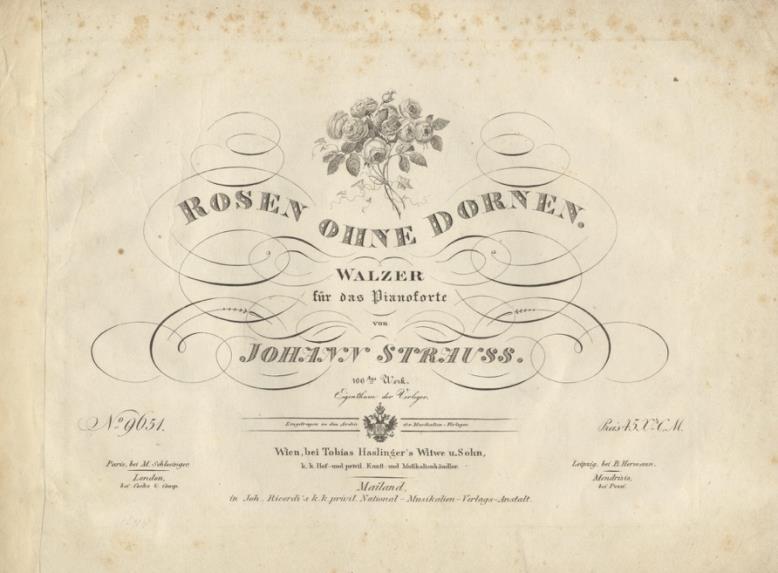
54 STRAUSS, Johann, Sr. 18041849
Rosen ohne Dornen. Walzer fur das Pianoforte. [Op. 166]. Wien: Tobias Haslingers Witwe u. Sohn. [PN T. H. 9651], [1844].
Oblong folio. Unbound as issued. 1f. (title), 3-11 pp. Engraved. With small vignette to title. Spine reinforced. Slightly foxed and dampstained.
First Edition. Weinmann p. 29. (14226) $100
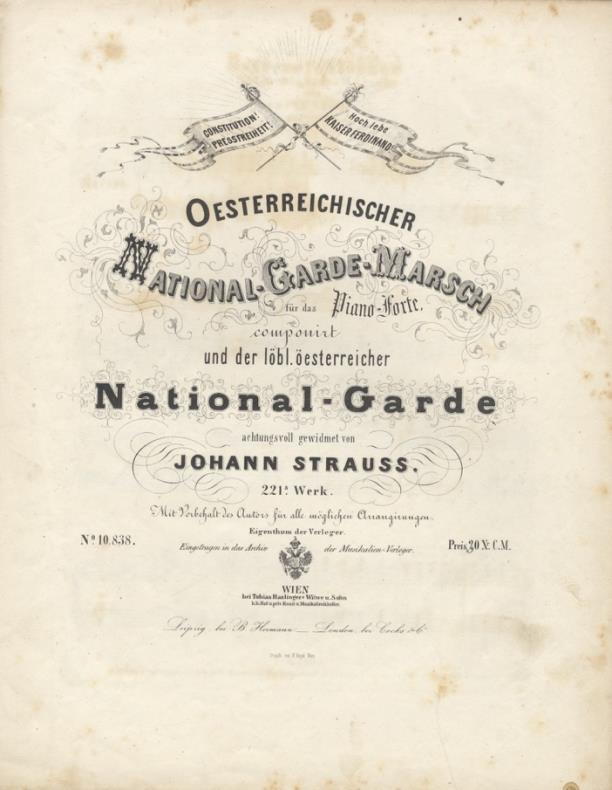
55. STRAUSS, Johann, Sr. 1804-1849
Oesterreichischer National-Garde-Marsch. [Op. 221]. Wien: Tobias Haslingers Witwe u. Sohn [PN 10838], [1848].
Folio. [1] (title), [2] (blank), 3-16 pp. Engraved. Disbound. Minor to moderate foxing throughout.
First Edition. Weinmann p. 40. (21408) $125
“The Beginning of Strauss’s Artistic Association with Hugo von Hofmannsthal”
56. STRAUSS, Richard 1864-1949
Elektra Tragödie in einem Aufzuge von Hugo von Hofmannsthal ... Klavier-Auszug mit Text von Otto Singer. [Op. 58]. [Piano-vocal score]. Berlin: Adolph Fürstner [PN A.5654F.], [ca. 1908].
Folio. Original publisher's full gray cloth. [i] (title), [ii] (blank), [iii] ("Dramatis Personae"), [iv] (blank), [5]-250pp. TextinGerman.WithillustrationbyLovis Corinth to page [5]. Binding worn, rubbed, and shaken; front free endpaper detached.
First Edition, early issue (without the additional plate numbers to foot of page [3] and also without the statement "Auffügrungsrecht vorbehalten" to foot of page [5]). Trenner 223. Mueller von Asow p. 409.
First performed on 25 January 1909 at the Königlichen Opernhaus in Dresden under Ernst von Schuch.
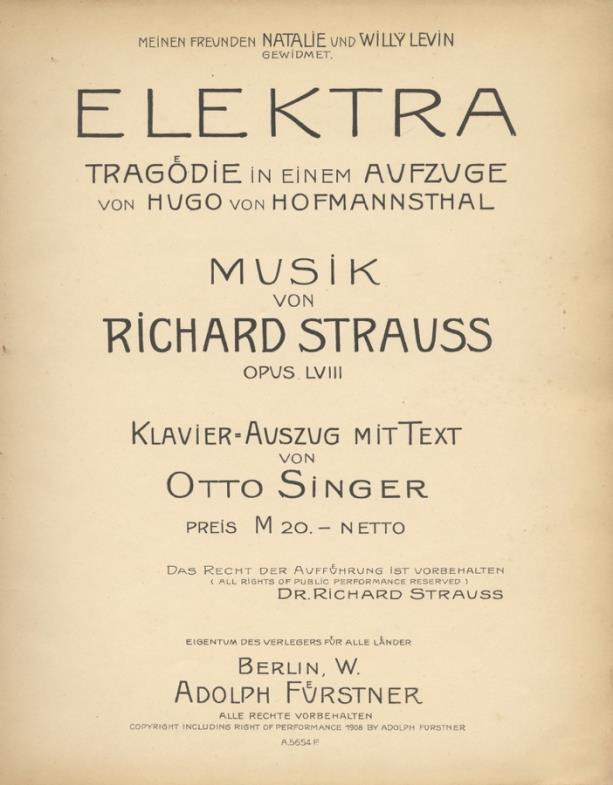
"[Elektra] ... marked the beginning of [Strauss's] artistic association with Hugo von Hofmannsthal, whom he had first met in Berlin in 1899. Having seen Reinhardt's riveting production of Hofmannsthal's Elektra in the autumn of 1905, Strauss was convinced the play would make a compelling opera. Not entirely sure he should compose consecutive tragedies, he nonetheless gave in to Hofmannsthal's pleading and vigorously began composing Elektra in the summer of 1906. As he had with Oscar Wilde's Salome, he set the play to music, which was finished in 1908 and given its première in 1909 as part of a Strauss opera festival in Dresden. .. Elektra failed to outshine her flashier sister, but confirmed Strauss's pre-eminence among German opera composers." Bryan Gilliam in Grove Music Online. (21175) $150
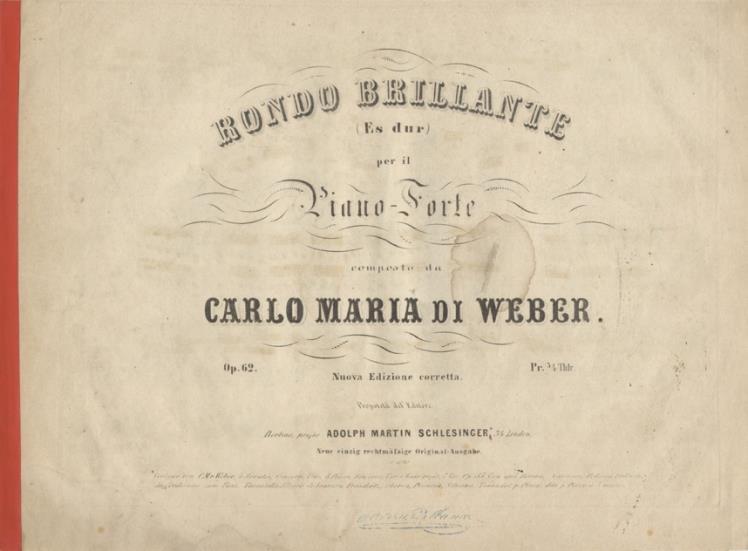
57. WEBER, Carl Maria von 1786-1826
Rondo Brilliante (Es dur) per il Piano-Forte ... Nuova Edizione corretta. [Op. 62]. Berlin: Adolph Martin Schlesinger [PN 1030], [1819-1820].
Oblong folio. Unbound. [1](title), 2-11pp. Engraved. Slightly worn andsoiled;minorstaining;redtapetospine.
Jähns p. 276.
"A prototypical 19th-century musician-critic, [Weber] sought through his works, words and efforts as performer and conductor to promote art and shape emerging middle-class audiences to its appreciation. His contributions to song, choral music and piano music were highly esteemed by his contemporaries, his opera overtures influenced the development of the concert overture and symphonic poem, and his explorations of novel timbres and orchestrations enriched the palette of musical sonorities. With the overwhelming success of his opera Der Freischütz in 1821 he became the leading exponent of German opera in the 1820s and an international celebrity. A seminal figure of the 19th century, he influenced composers as diverse as Marschner, Mendelssohn, Wagner, Meyerbeer, Berlioz and Liszt." Philipp Spitta et al in Grove Music Online (21962) $30
Unrecorded Edition
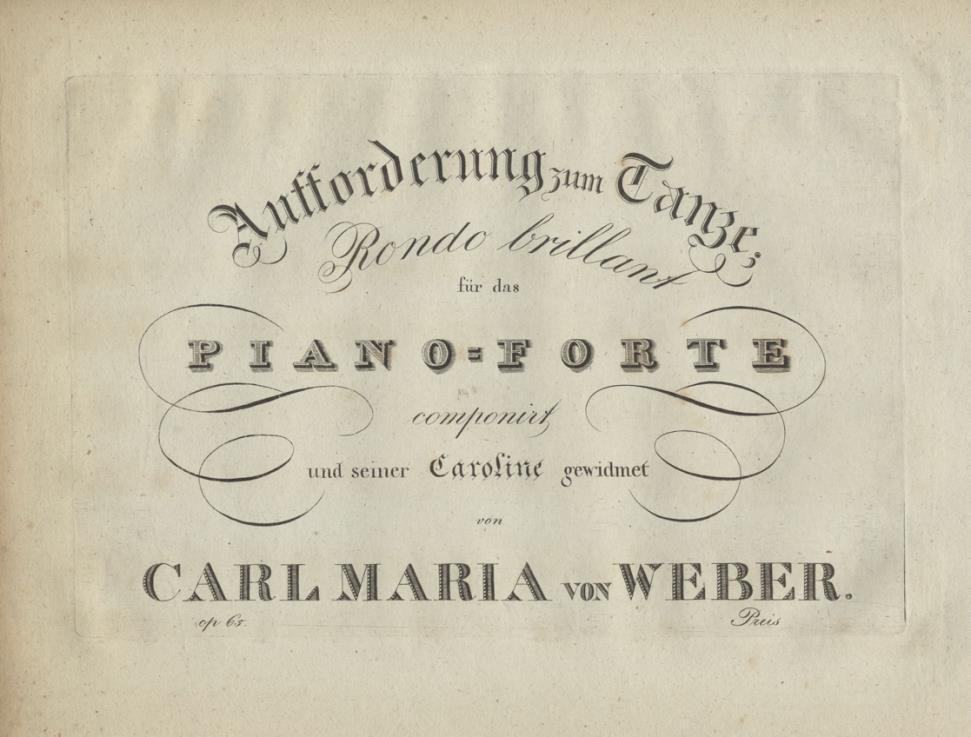
58. WEBER, Carl Maria von 1786-1826
Aufforderung zum Tanze: Rondo brillant für das Piano-Forte componirt und seiner Caroline gewidmet ... Op. 65. [?Berlin]: [?Schlesinger], [?1825].
Oblong folio. Unbound. [1] (title), [2] (blank), 3-14 pp. engraved music + 1f. (blank). Somewhat worn and soiled; edges soiled and slightly stained; minor browning and offsetting.
A curious edition, possibly issued by Schlesinger, howeverwithout imprint, plate number, or price. Unrecorded by Jähns. Not in Hoboken, where a later printing with imprint, ca. 1825, is cited. Fuld records 6 early printings, all published by Schlesinger in Berlin in ca. 1821; precedence has not been firmly established. Not located in BSB or on COPAC. (22743) $125
First Edition of the Concert-Stueck
59. WEBER, Carl Maria von 1786-1826
Concert-Stueck Larghetto affettuoso, allegro passionato Marcia e Rondo giojoso für das Piano-Forte mit Begleitung des Orchesters componirt und ihrer koeniglichen hoheit der Durchlauchtigsten Prinzessin Marie Auguste von Sachsen. [Op 79]. [Parts for piano, violin I and II, viola and violoncello]. Leipzig: C.F. Peters [PNs 1754 and 2817], [1823].
Folio. Unbound. [1] (title), [2] (blank), 3-27; 4; 4; 4; 4 pp. Engraved. Quite worn; title and final leaf separated and torn; first leaf of piano part torn with no loss of music; foxed; paper repairs. lacking wind, brass and timpani parts.
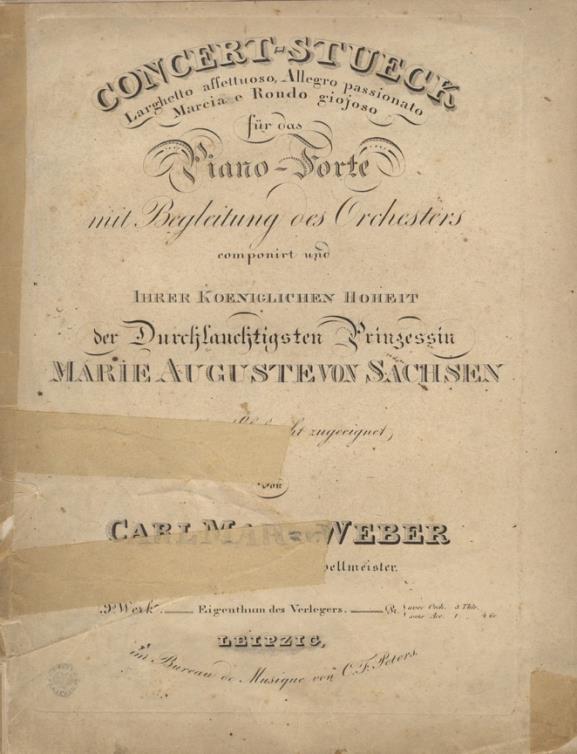
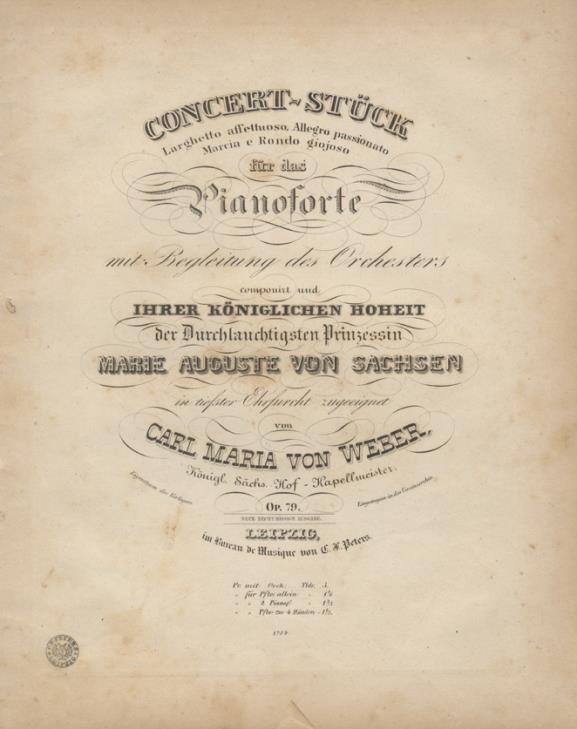
First Edition inthis form. Jähns 282, p. 338. Hoboken 15, 355 (but with priceof"3 Rthl", thepresent copywithprice "avec Orch. 3 Thlr / sans Acc. 1 Thlr 4 Gr.").
(21972)
$85
60 WEBER, Carl Maria von 1786-1826
Concert Stück für das Pianoforte mit Begleitung des Orchesters ... neue rechtmässige Ausgabe. [Piano solo part only]. [Op. 79]. Leipzig: C.F. Peters [PN 1754 2817], [1844].
Folio. Disbound. 27 pp. Engraved.
Moderate browning and foxing; outer leaves separated at spine.
Jãhns p. 338 (18509)
$50
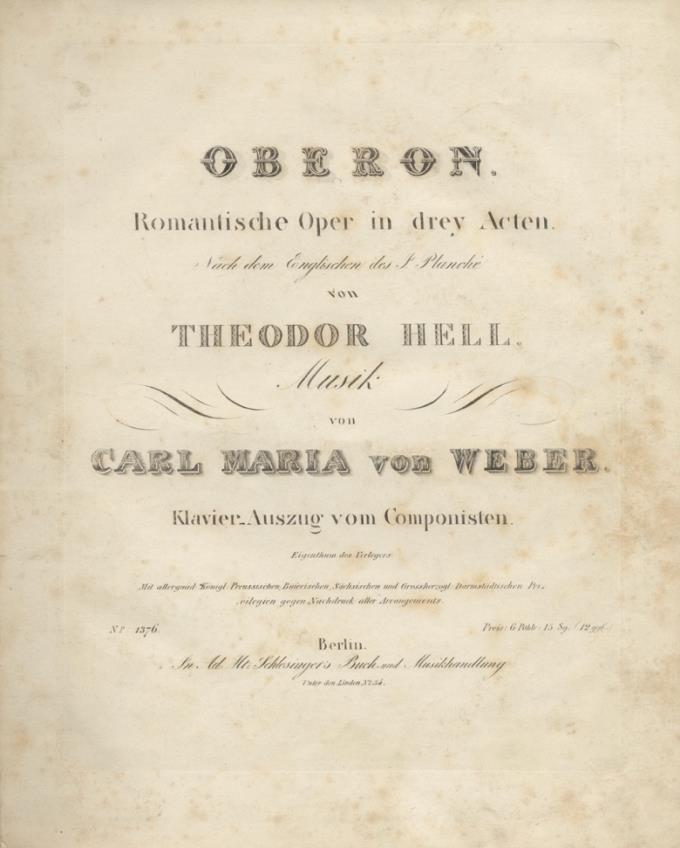
Including the Fifth Aria for the First Time
61. WEBER, Carl Maria von 1786-1826
Oberon Romantische Oper in drey Acten Nach dem Englischen des J. Planche von Theodor Hell ... KlavierAuszug von Componisten. [Op. 306]. Berlin: Schlesinger [PN 1376], [ca. 1826].
Folio. Contemporary black leather-backed boards. [1] (title), [2] (blank), [3] ("Personen"), 4-157 pp. Engraved. With occasional penciled annotations. Binding slightly worn, rubbed and bumped; remnants of label to front pastedown. Several corners creased; occasional spotting. In very good condition overall.
First German edition, which includes the fifth aria for the first time; the first edition was published in 1826. Jahns 306, p. 392. Hirsch IV, 1298. Fuld pp. 395-396. Hoboken 15, 367.
Oberon was first performed on 12 April 1826 at Covent Carden in London. "The whole nature of Oberon, then, both in its subject and in the method of treating it which Weber was led to adopt, is orchestral rather than vocal; yet the freshness and charm of his melodies is if anything at its peak in the disjointed numbers which comprise it." Warrack: Carl Maria von Weber, p. 326. (17141) $350
62 WEYSE, Christoph Ernst Friedrich 1774-1842
Sonate (G moll) for Pianoforte ... Ny Udgave ved Aug. Winding. Kjöbenhavn: Wilhelm Hansens Musik-Forlag [PN 8548], [1882].
Folio. Disbound. [1] (title), 2-17 pp. Slightly worn and soiled.
A Danish composer and pianist, "[Weyse] was esteemed for his artistic taste in music and other matters, and in his later years he was the leading authority in Copenhagen's musical life." Jens Peter Larsen and Gorm Busk in Grove Music Online. (21963) $25
MUSICAL LITERATURE
Items 63-65
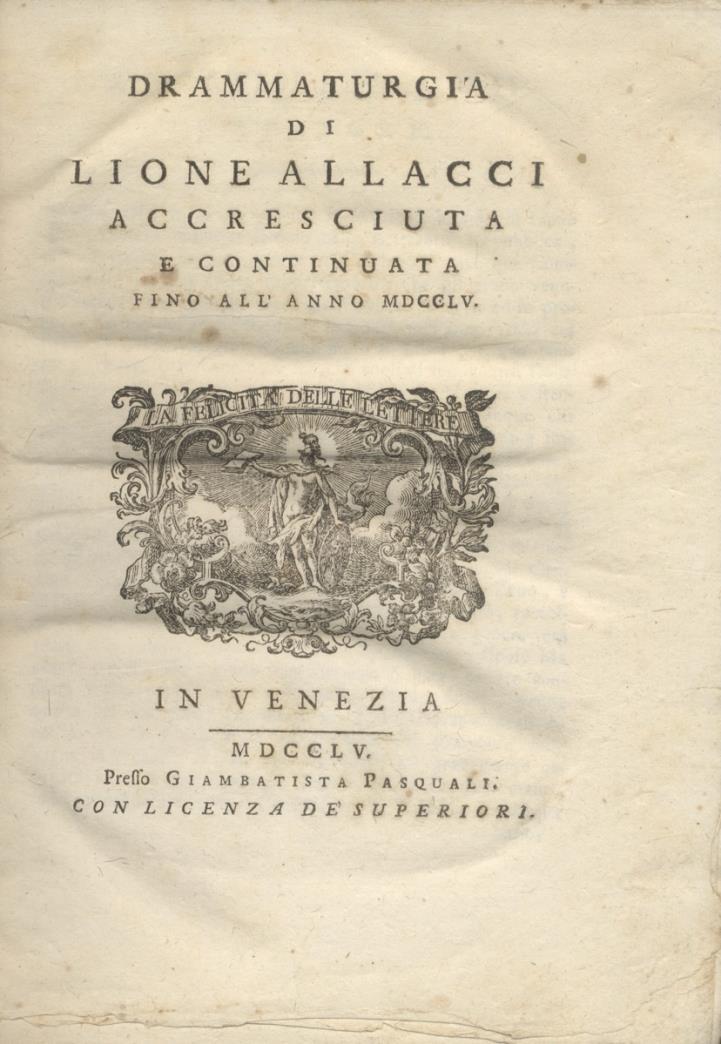
Major Reference Work on Italian 15th -18th Century Libretti
63. ALLACCI, Leone 1586-1669
Drammaturgia di Lione Allaci accresciuta e continuata fino all’ anno MDCCLV. Venezia: Pasquali, 1755.
Small quarto. Quarter vellum with dark orange decorative title label gilt to spine. 4ff., 1,016 columns (= 508 pp.), including the supplement (columns 837-946), additions and corrections (947-950), and an index of authors (951-1016). With a fine woodcut device totitle and occasional woodcut head- andtailpieces. A very good, widemargined, uncut copy, with only occasional minor foxing and staining.
Second edition, substantially revised and expanded. Cortot, p. 4. Hirsch I, Anh. 2. Wolffheim II, 908. Gregory-Bartlett I, 12. RISM BVI, p. 81.
"A compendious and surprisingly accurate list of dramatic works of all kinds, including opera librettos, published in Italy [from the late 15th century to 1755]; it also lists many unpublished works." Thomas Walker in Grove Music Online
Allacci succeeded Luca Holstenio as Chief Curator of the Vatican Library in 1661. His important and still very useful bibliography of plays, operas, and ballets was first published in 1666 and revised by Giovanni Cendoni, Apostolo Zeno, and others for this updated edition of 1755.
A very good copy of “a major work of reference for Italian dramatic studies.” Thomas Walker in Grove Music Online (21115)
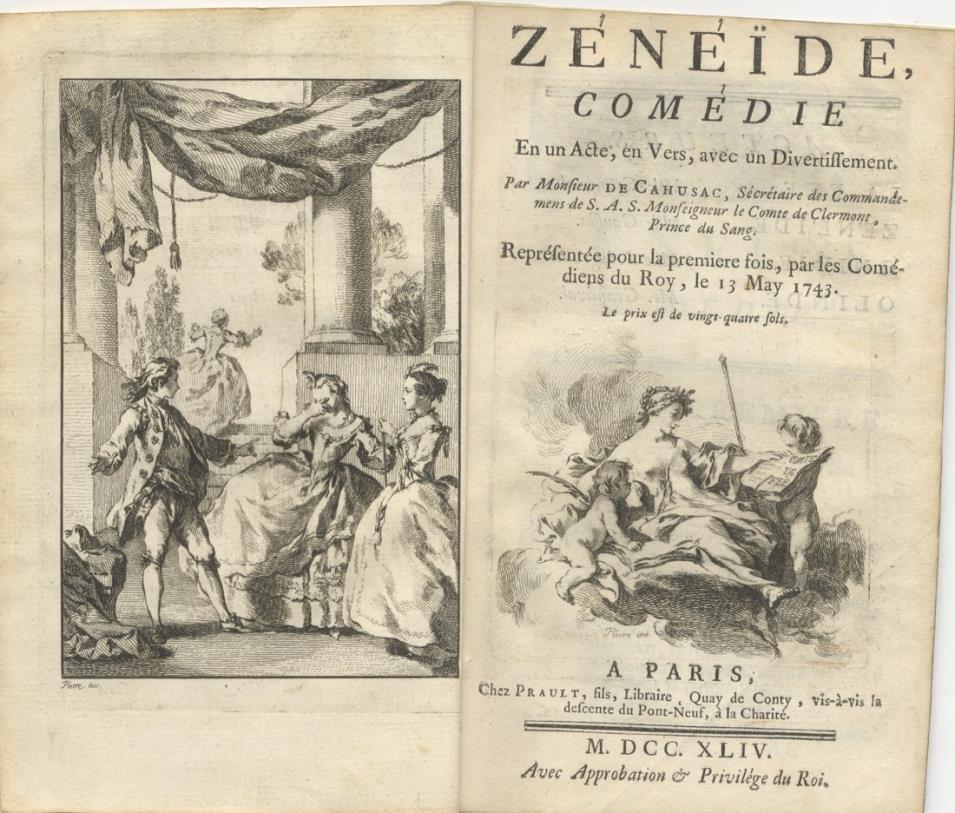
64 GRANDVAL, Nicolas Racot de 1676-1753
$500
Zénéïde comédie en un acte, en vers, avec divertissement. Par Monsieur de Cahusac, Sécrétaire des Commandemens de S.A.S. Monseigneur le Comte de Clermont, Prince du Sang Représentée pour la premiere fois, par les Comédiens du Roy, le 13 May 1743. [Libretto]. Paris: Prault, 1744.
Named cast includes Mlle. Grandval, Mr. Grandval, Mlle. D’Angeville, andMlle. Gaussin. Thetwelfthand final scene consists ofa cantatille followed by dancing;an ariette, also followed by dancing; and a 4-verse vaudeville.
Octavo. Modern marbled wrappers. 1f. (title), [3]-42 pp. Named cast list. With frontispiece of a scene from the opera engraved by Jean Baptiste Marie Pierre (1713-1789) and a pictorial woodcut device totitle, also by Pierre; decorative headpiece to p. 3. Slightly worn and browned.
Probable First Edition. OCLC 456229749.
Grandval was a French composer and author. "Born into a family of actors, the young Grandval joined a travelling theatrical troupe for which he wrote divertissements and incidental music. He relinquished this nomadic life to settle in Paris where he became associated with the Comédie Dancourt and Théâtre Français."
David Tunley in Grove Music Online (22544) $125
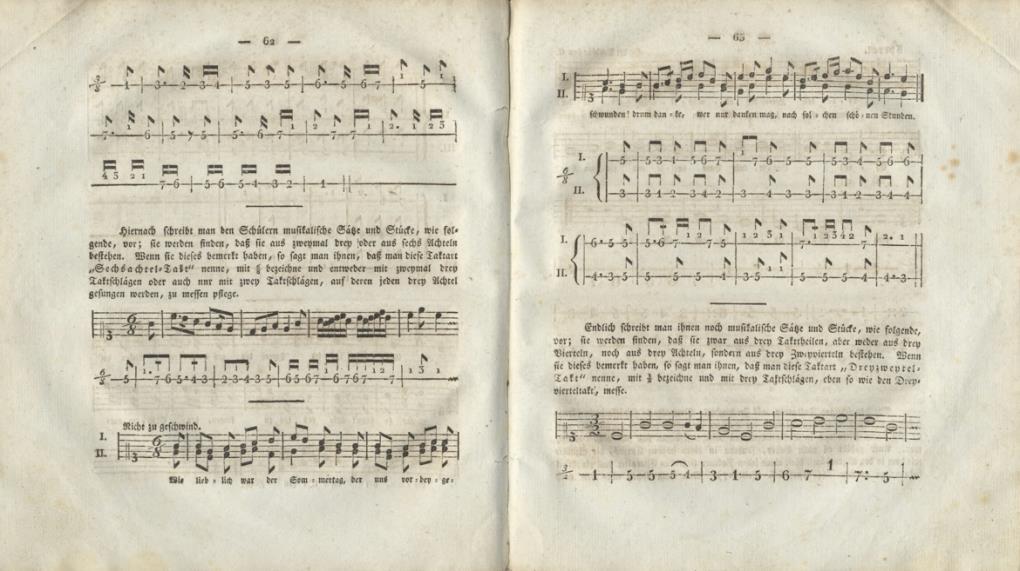
Important to the Development of Music Education in America
65 [VOCAL MUSIC INSTRUCTION]. Natorp, B. C. L. 1774-1846
Anleitung zur Unterweisung im Singen fur Lehrer in Volksschulen ... II. Leitfaden fur den zweiten Cursus. Essen, Duisburg: G.D. Baedeker, 1820.
Quarto. Contemporary marbled boards with portion of original printed wrappers laid down, red paper label to spine with titling in ink. x, 160 pp. Binding quite worn. Some foxing, mostly marginal, throughout; creasing to outer upper corners; occasional staining not affecting text. With contemporary ownership notations to front free endpaper dated 1820; ex-libris handstamps and some ink markings to title leaf.
First Edition of the second part of this early influential work on instruction of singing for children. Scarce. The first part was published in 1813. Eitner v. 8, pp. 149-150. Fétis v. 6, pp. 283-284.
Of interest to the evolution of music education in America, further developed by 19th century theorists Lowell Mason and his contemporaries. (12201) $50
ICONOGRAPHY
Items 66-82
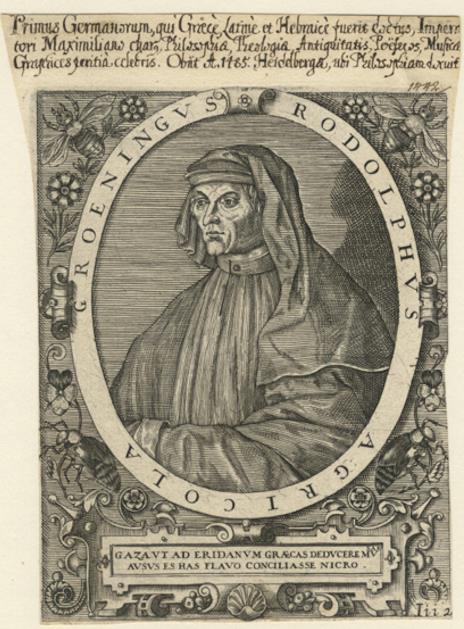
16th Century Portrait of the Important Humanist
66. AGRICOLA, Rudolph 1443-1485
Fine half-length portrait engraving. Excerpted from J.J. Boissard: Icones virorum illustrium, Frankfurt, 1597-1599.
Ca. 155 x 106 mm. Unevenly trimmed; remnants of mounting paper to verso; very small tear to upper margin; early annotations in manuscript to blank upper margin.
A German humanist and philosopher, Agricola was also active as a musician. "[He] is regarded as one of the most important figures in the transmission to northern Europe of Italian humanism. His interest in music and his practical musical ability distinguish him from many of his contemporary humanistic scholars and mark a turning point in the relationship between this broad intellectual movement and music. He was later strongly influential in the development of philosophy and education in Germany, and was greatly admired by Erasmus and Melanchthon." Lewis Lockwood in Grove Music Online (22304)
Distinguished Composer of 18th Century Theatre Music
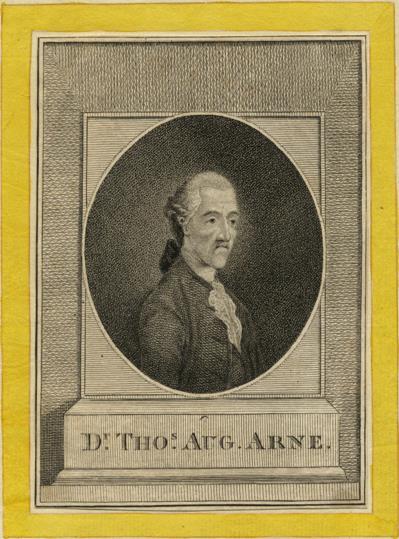
67 ARNE, Thomas Augustine 1710-1778
$100
Half-length oval portrait stipple engraving. [?London], [ca. 1791].
138 x 96 mm. The image within an ornamental border within yellow hand-colored frame and hand-drawn rules. Hinged at upper margin; slightly worn and foxed.
Arne is considered to be the most significant figure in 18th century English theatre music. (22742) $200
19th Century Opera Composer
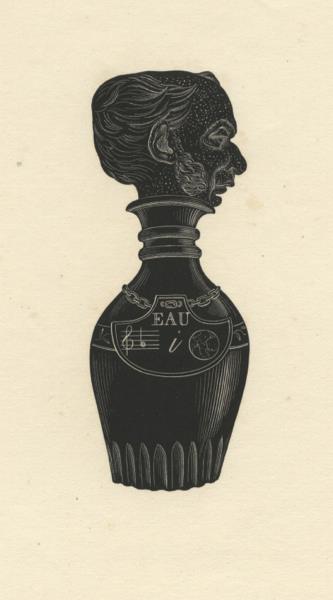
68. CARAFA, Michele 1787-1872
Stone engraving by Théodore Maurisset (fl. 1834-1859) after JeanPierre Dantan (1800-1869). [Paris]: n.p., [1839].
109 x 41 mm. plus wide margins. An interesting and unusual image after Dantan's bronze bust. Carafa's head, in profile, is depicted as the stopper in a bottle of cologne, decorated with a plaque on a chain, withinwhich are the word "eau," amusical note (g), the letter "i" anda circular object (aglobe?), formingarebus which, decoded, reads "Eau Solitaire," an allusion to Carafa's opera Le solitaire of 1822. Very slightly browned at edges.
Sorel 35. Dantan 61.
Carafa was a prolific opera composer and life-long friend of Rossini; Le Solitaire was one of his greatest successes. (22783) $350
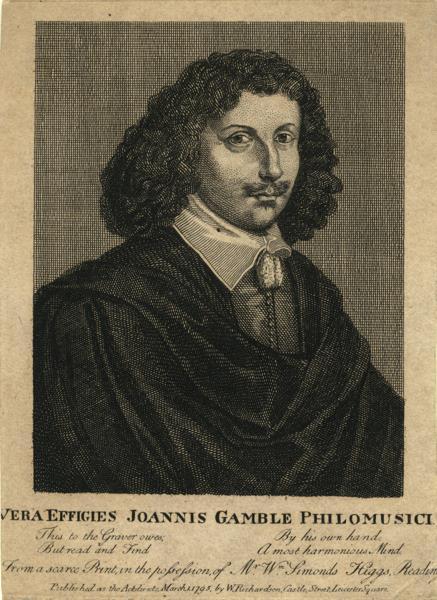
17th Century English Cornett Player, Violinist, and Composer
69. GAMBLE, John 1610-1687
Portrait engraving. [London]: W. Richardson, 1795.
170 x 129 mm. Half-length. Text below print reads "This to the Graver owes; But read and Fine By his own hand, A most harmonious Mind. From a scarce Print in the possession of Mr. Wm. Simonds Higgs, Reading." Browned; trimmed to within platemark, just affecting two letters of text; lower right corner slightly abraded.
A later version of a previously-published portrait.
Gamble was a 17th century English cornett player, violinist, copyist, and composer. (22775) $350
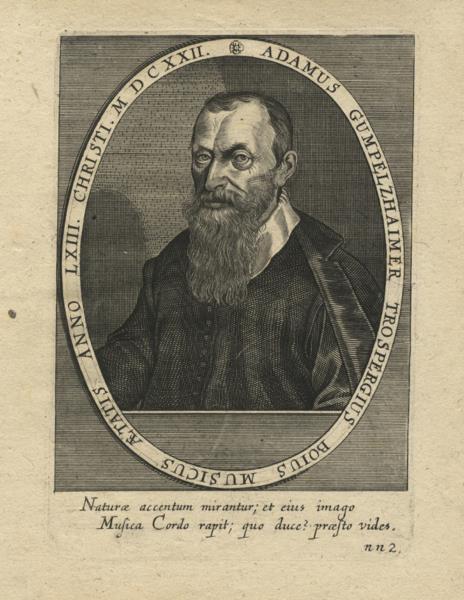
Early 17th Century Engraving of the Author of the Compendium Musicae
70 GUMPELZHAIMER, Adam 1559-1625
Fine half-length portrait engraving of the composer aged 63. Ca. 1622.
143 x 97 mm. + wide margins. Slightly worn; edges browned. In very good condition overall. Possibly after the same painting on which the woodcut portrait in his Compendium Musicae of 1632 is based.
Gumpelzhaimer spent most of his active life in Augsburg, where he was Kantor and Präzeptor at the school and church of St. Anna from 1581 until his death. "[He] was probably best known to German musicians of and after his time through his Compendium musicae. .. The richness of musical activity of St Anna is indicated not only by Gumpelzhaimer’s music but also by the extensive holdings of the church library during his 44 years there. A handwritten inventory was started by Gumpelzhaimer in 1620 and continued by Faust in 1625. This list includes, in addition to many printed collections, several large manuscript books of polyphonic music in score notation. Two of these books have survived, one begun in 1599 and the other completed in 1624. They were copied out mostly by Gumpelzhaimer and contain compositions by many prominent musicians of the time." William E. Hettrick in Grove Music Online (22296) $150
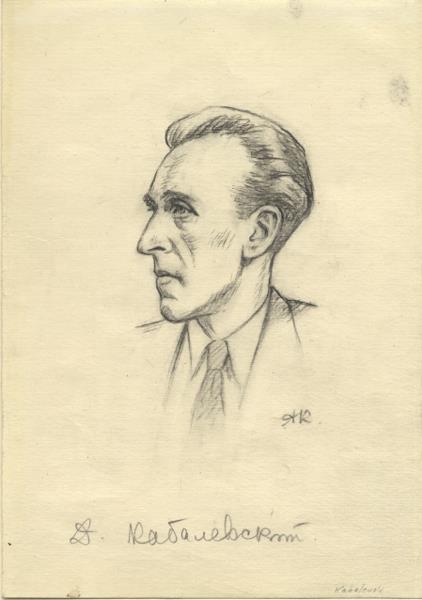
Original 20th Century Drawing
71. KABALEVSKY, Dmitry 1904-1987
Original portrait drawing by Aleksandr Kostomolotsky signed by the composer and initialed by the artist, ca. 1945-50.
Sheet 217 x 153 mm. In black crayon. Head-and-shoulders, composer in right profile. Initials of the artist at lower right of portrait, autograph signature of the composer in pencil below.
"Kabalevsky, like Prokofiev and Shostakovich, wrote a great deal of music for the emerging genre of films with sound. . It was during the 1930s that Kabalevsky’s style was defined; although Prokofiev served as a model to a certain extent. ... Kabalevsky's most valuable legacy lies in the field of children’s music, not only in terms of the many works he wrote for young performers but also in his development of a system of musical education for children. Some of his children’s songs became musical symbols of the Soviet age (Chetvyorka druzhnaya rebyat (‘The Band of Four Friends’) and Shkol′nïye godï (‘Schooldays’) in particular) while several of his numerous instrumental concertos written for young musicians gained worldwide popularity." Dina Grigor′yevna Daragan in Grove Music Online
Alexsandr Kostomolotsky (1897-1971) was anactor, artist, and musicianwho was friends with both Kabalevsky and Shostakovich, of whom he also drew several portraits and caricatures. (22727) $900
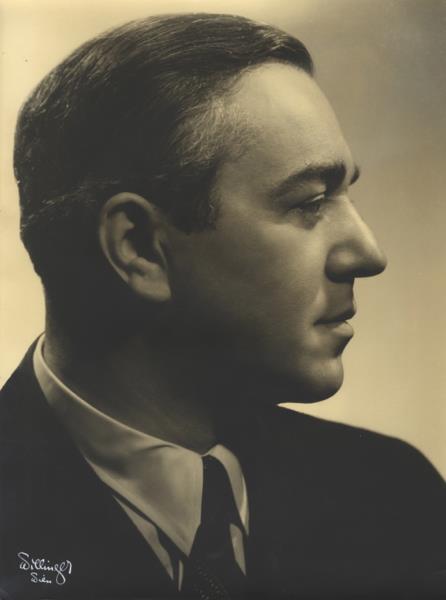
Signed Photograph of the “Outstanding Wagner and Mozart Bass”
72 KIPNIS, Alexander 1891-1978
Fine original large silver print photograph of the distinguished Ukrainian-born American bass in profile by the noted Hungarian-born photographer Laszlo Willinger (1909-1989).
390 x 290 mm. Signed bythe photographer in white inkat the lower left corner. Vienna, ca. 1935. Slightly worn, with slight curl to edges. In very good condition overall.
Kipnis was a member of both the Berlin Staatsoper (1930–1935) and the Vienna Staatsoper (1935–1938); he became an American citizen in 1934. "By then he had established himself everywhere as an outstanding Wagner and Mozart bass and a highly distinguished interpreter of Italian and Russian roles. He was much in demand at Bayreuth, singing there between 1927 and 1933, and appeared at the 1937 Salzburg Festival as Sarastro under Toscanini." Desmond Shawe-Taylor in Grove Music Online
Willinger, who left Berlin for Vienna in 1933, is particularly noted for his portrait photography; his subjects include Marlene Dietrich, Sigmund Freud, Carl Jung, Max Reinhardt and many other notables of the 1930s and '40s. He moved to the United States in the mid-'30s and was one of the first Hollywood photographers to experiment in the use of color.
A fine example of this important photographer's early work. (22257) $125
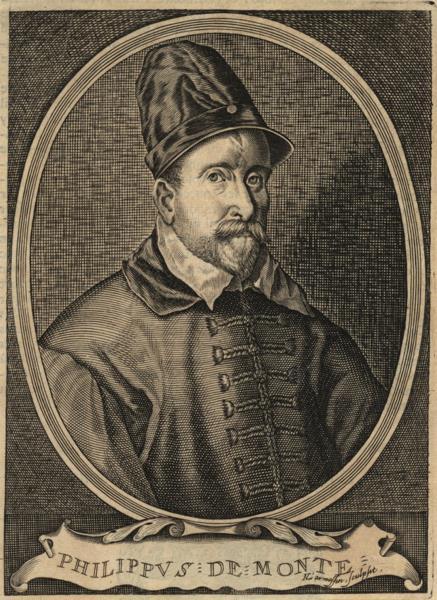
73. MONTE, Philippe de 1521-1603
Fine portrait engraving by Nicolas de L'Armessin (1638-1695).
184 x 137 mm. plus margins. With letterpress text below engraving and to verso. Extracted from Bullart: Académie des Sciences et des Arts, Bruxelles, 1682.
Komma 256.
"[Monte] was an important representative of the last generation of the great Flemish composers of the Renaissance, and was one of the major composers of Italian madrigals." Robert Lindell and Brian Mann in Grove Music Online (22412) $525
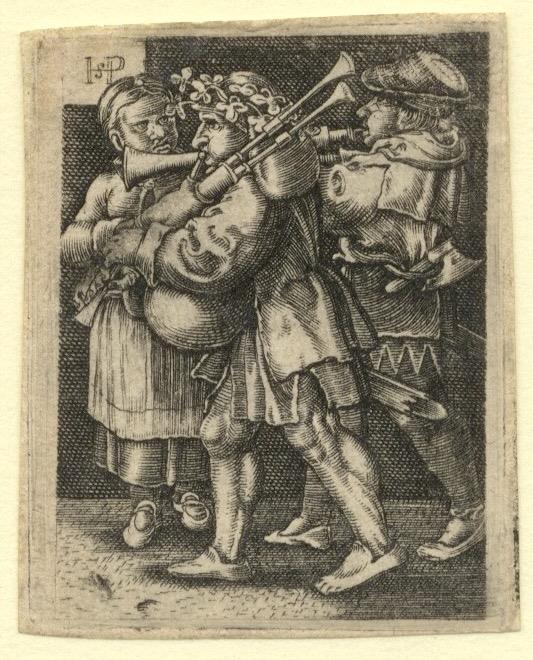
74 [MUSICAL INSTRUMENTS - 16th Century]
Fine 16th century German engraving after Hans Sebald Beham (1500-1550) depicting two male musicians intently playing the bagpipes and shawm or bombard while a woman looks on.
52 x 40 mm. With Beham's initials inthe plate to upper left. A fine impression on laid paper with threadmargins.
A rare contemporary version in reverse of the print first published in ca. 1537. Pauli: Hans Sebald Beham Ein Kritisches Verzeichnis, 191a. Bartsch 190. Kinsky: Music in Pictures, p. 80 no. 2 (the original version). (22404)
$750
16th Century Engraving of the Noted Organist
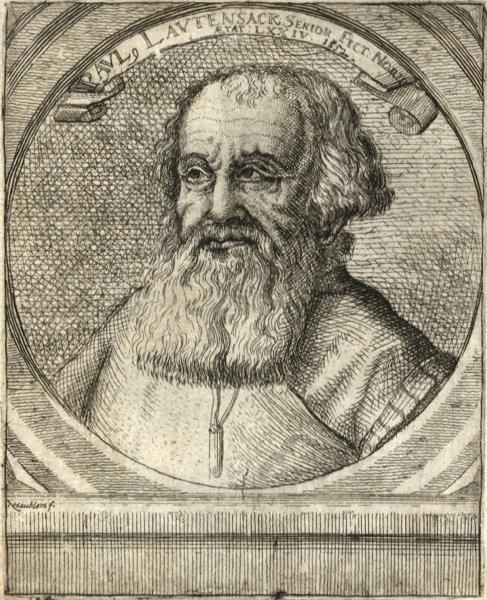
75. [ORGAN]. Lautensack, Paulus 1478-1558
Bust-length portrait engraving by Haüblein. Dated 1552 in the plate. 95 x 77 mm.
Lautensack, the patriarch of a long line of organists and musicians, was a painter and organist active in Nuremberg; he was a contemporary of Luther and Melanchthon. (22136)
A Leading Figure in Late 18th Century Opera
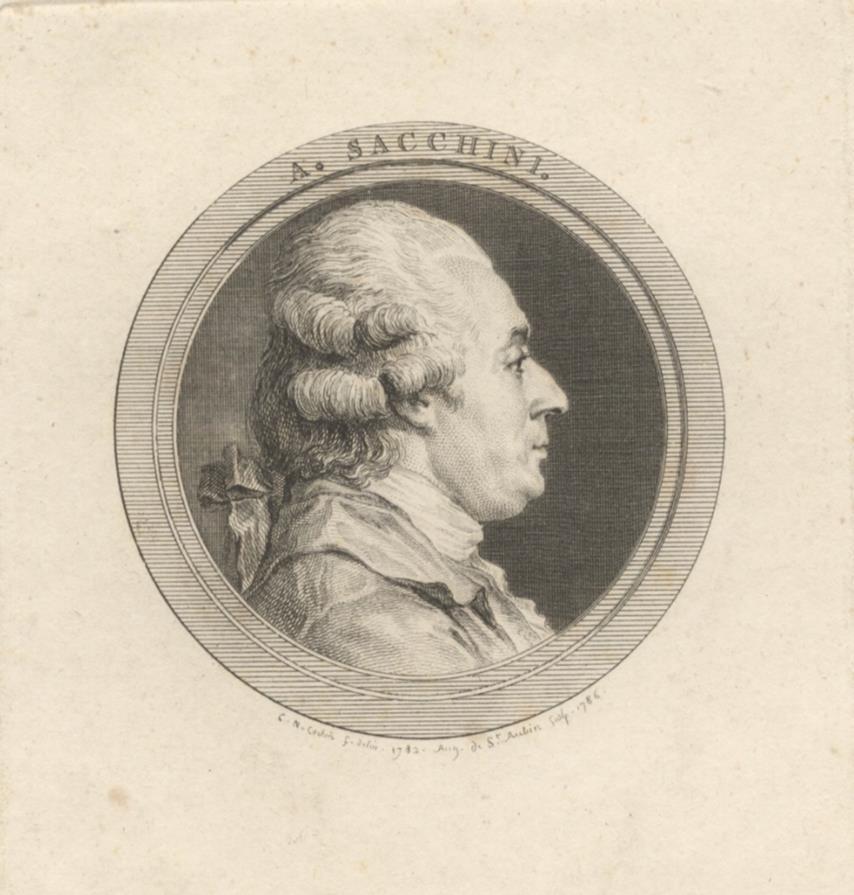
76. SACCHINI, Antonio 1730-1786
Portrait engraving by Augustin de SaintAubin (1736-1807) after Charles Nicolas Cochin fils (1715-1788). [Paris], [after 1786].
108 x 112 mm. Bust-length. Slightly browned and foxed. A fine impression on wove paper.
Kinsky 204.
$250
$550
Sacchini was a leading figure in late 18th century opera. "In 1770 Burney considered him one of the four greatest composers of Italy, along with Jommelli, Galuppi and Piccinni. ... A critic of the next generation, Giuseppe Carpani, hailed Sacchini as the world's greatest melodist." David DiChiera and Joyce Johnson Robinson in Grove Music Online. (22773)
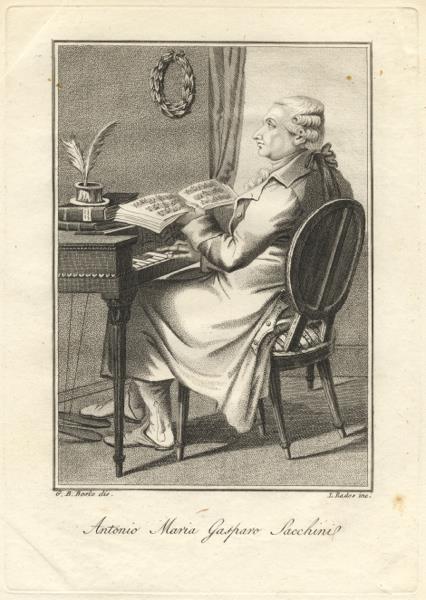
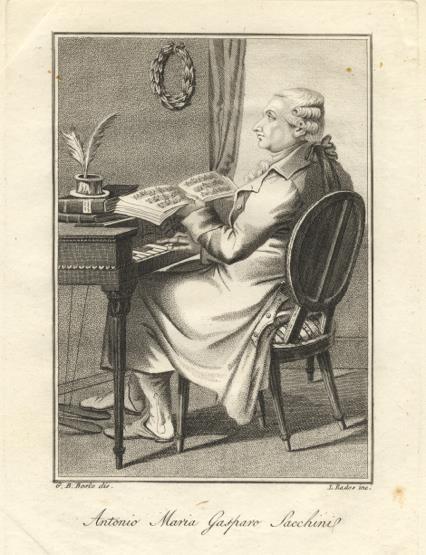
77 SACCHINI, Antonio 1730-1786
Portrait etching and stipple engraving by Luigi Rados (1773-1840) after Giovanni Battista Bosio (1764-1827). [Milan]: [Batelli & Fanfani], [1818].
220 x 155 mm. Sacchini is depicted full-length, seated at a keyboard instrument with pedals, a book of music in his left hand, his right on the keyboard.
Arrigoni & Bertarelli 3950. (22772) $375
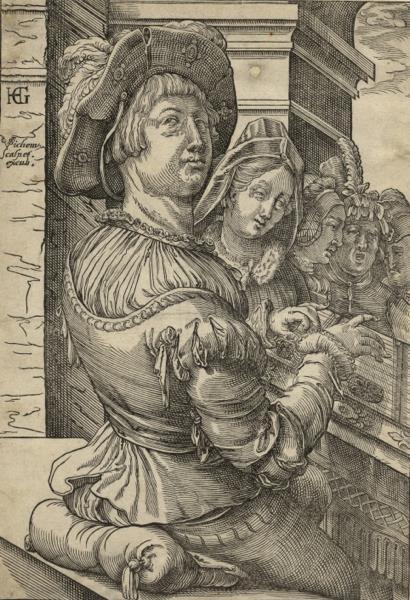
78. SICHEM, Christof van 1580-1648
Young man playing a psaltery (salterio) accompanying a group of singers. Woodcutaftera drawing byHendrick Goltzius (1558-1617). Amsterdam, ca. 1600.
298 x 207 mm. Matted. Small restored hole to blank area; collector's mark to verso (not located in Lugt). A very good impression, with full line border.
Wurzbach: Niederländisches Künstler-Lexicon, Vol. II, p. 620, no. 20. Kinsky p. 93, no. 3. Hollstein 134. (22397) $750
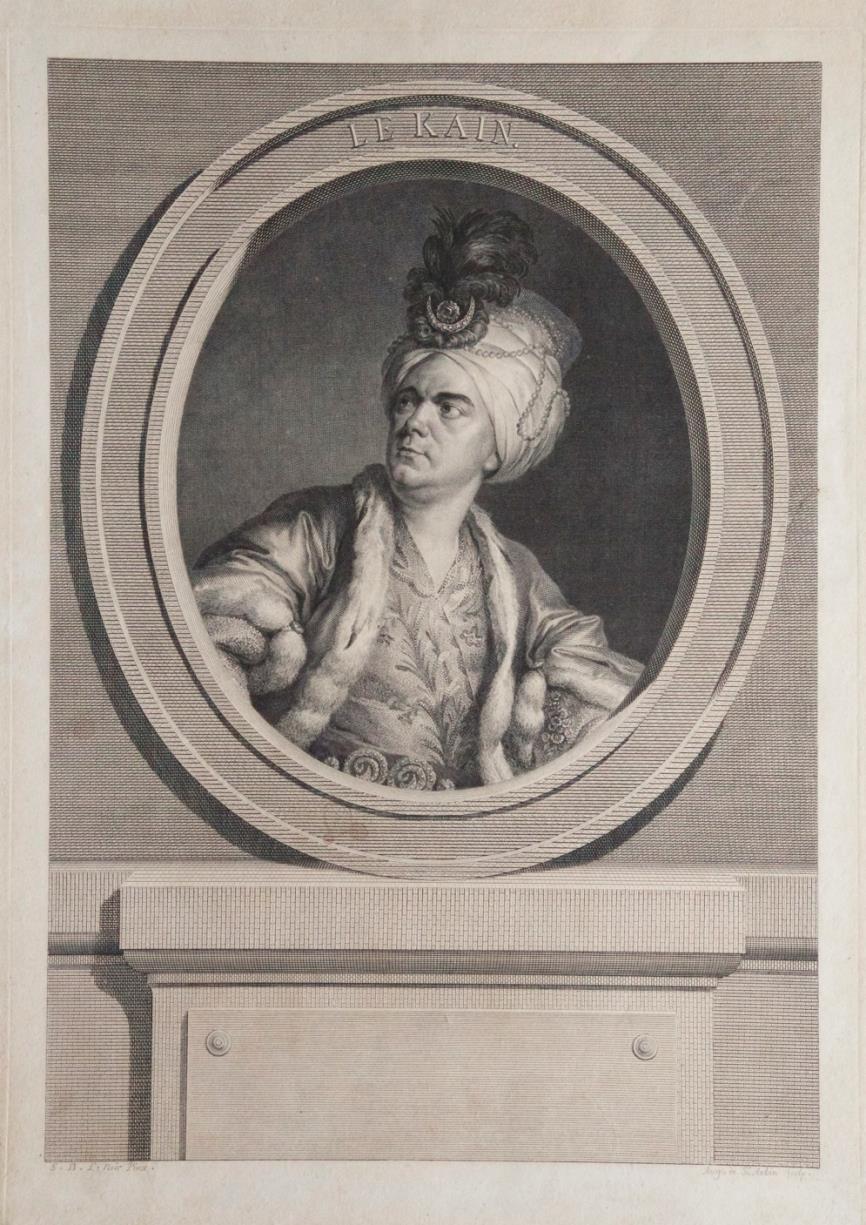
A Performer at the Comédie Française
79. [THEATRE]. Le Kain, Henri Louis 1729-1778
Original engraving by Auguste de St.-Aubin after the painting by S.B. Le Noir. Le Kain is depicted in the role of Orosmane in Voltaire's "Zaire." 420 x 282 mm. No place, no date, but Paris, ca. 1775. Slightly browned and foxed.
Proof before text. Hall III p. 32.
Le Kain was a noted French actor who performed with the Comédie Française. (21321) $150
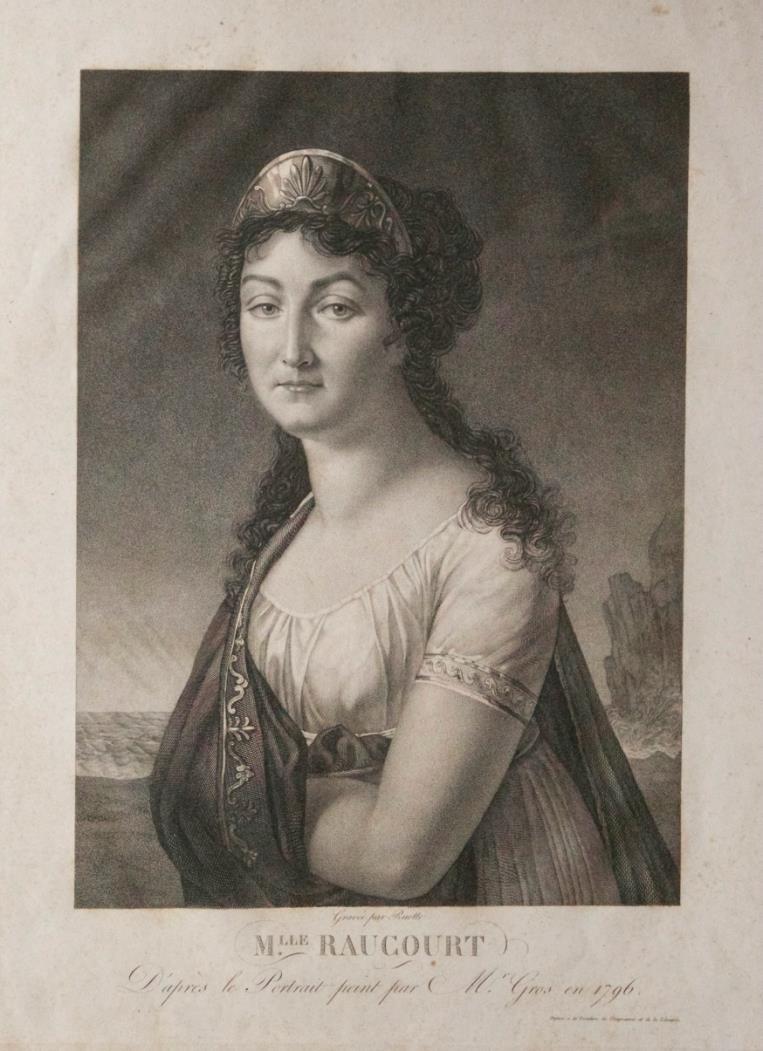
A Classical Tragédienne at the Comédie Française
80 [THEATRE]. Raucourt, Françoise Marie Antoinette Saucerotte 1756-1814 Mlle. Raucourt D'après le Portrait peint par Mr. Gros en 1796 ... Gravée par Ruotte. Paris, [after 1796].
390 x 290 mm. Some foxing and minor wear.
Hall III p. 385 (2).
Raucourt, a popular and controversial French actress, made her debut at the Comédie Française in 1772 as Dido, going on to play all the classical tragédienne roles. "Her beauty and talent had made her famous, but her not so secret love affairs with other women made her notorious ... Raucourt led the Sect of Anadrynes, a society of lesbians in Paris ... At the outbreak of the Revolution she was imprisoned for six months with other royalist members of the Comédie Française, and she did not reappear upon that stage until the close of 1793, and then only for a short time. She deserted, with a dozen of the best actors in the company, to found a rival colony, but a summons from the Directory brought her back in 1797 ... Her funeral was the occasion of a riot. The clergy of her parish having refused to receive the body, the crowd broke in the church doors, and were only restrained from further violence by the arrival of an almoner sent posthaste by Louis XVIII." Wikipedia. (21336) $165
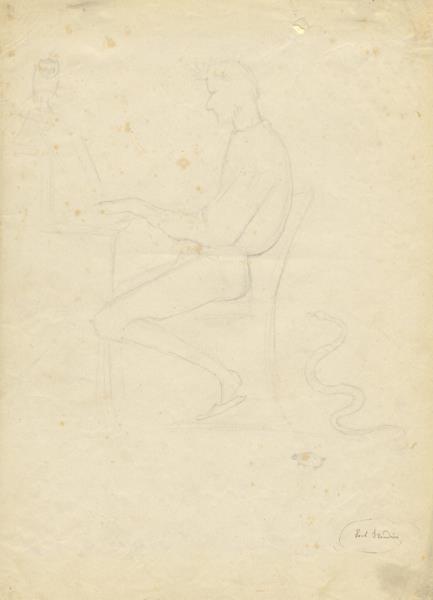
Original 19th Century Drawing
81 THOMAS, Ambroise 1811-1896
Original pencil sketch by the French artist Paul Jean Flandrin (1811-1902). N.d., but ca. 1860.
Ca. 310 x 225 mm. Thomas is depicted seated at the piano, an owl perched on top of the instrument, a snake and turtle behind the composer. On wove paper. Signed by the artist at lower right in ink. Some light foxing and wear; small hole to upper right quadrant not affecting drawing.
"After years of neglect, Thomas’ work has seen a considerable revival in the last two decades of the 20th century, with major performances, at least of Mignon and Hamlet, being mounted in France, Great Britain and the USA. In the context of French opera of the late 19th century Thomas was a figure of considerable importance, an imaginative innovator and a master of musical characterization." Richard Langham Smith in Grove Music Online. (22784) $450
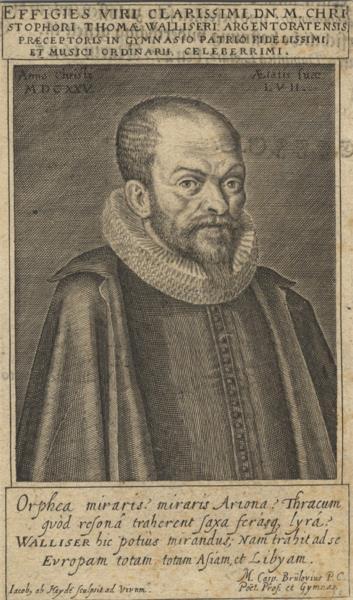
Early 17th Century Engraving of the Important Alsatian Composer
82. WALLISER, Christoph Thomas 1568-1648
Half-length portrait engraving of this Alsatian composer, teacher and choral director, aged 57, by Jacob van den Heyden. 1625.
167 x 99 mm. Slightly browned and spotted.
Apparently drawn from life according to a note in the plate: "Iacob ab Heydé Sculpsit ad Vivum." Reproduced in MGG Vol. 14 col. 174.
"Walliser’s several musical appointments and his compositions show him to have been the most important musician in Strasbourg during the period 1600–50. In addition, the wide dispersion of his works attests to his reputation elsewhere." Clyde William Young and Édith Weber in Grove Music Online. (22297) $125