CONDITIONS OF SALE
All items are in good antiquarian condition unless otherwise noted and are offered subject to prior sale, with prices net and subject to change without notice. The costs of shipping and insurance are additional Orders are customarily shipped via USPS Priority Mail or Federal Express. Sales tax will be added to the invoices of New York State residents.
Orders may be placed by e-mail (info@lubranomusic.com), telephone (516-922-2192), or on our secure website (www.lubranomusic.com) by entering the ID number of the desired item in the SEARCH box at the upper right of our homepage. We ask that you kindly wait to receive our invoice to ensure availability before remitting payment. Libraries may receive deferred billing upon request.
We accept payment by:
-ACH (Automated Clearing House), inclusive of all bank charges
- EFT (Electronic Funds Transfer), inclusive of all bank charges
- PayPal to info@lubranomusic.com
- Checks in U.S. dollars drawn on a U.S. bank
- International money order
- Credit card
We fully guarantee that all items offered for sale by J & J Lubrano MusicAntiquarians LLC are authentic without time limitation to the original purchaser provided that said items conform exactly to our description as supplied at time of purchase. All items remain the property of J & J Lubrano MusicAntiquarians LLC until paid for in full.
Please visit our website at www.lubranomusic.com
where you will find full descriptions and illustrations of our catalogued inventory
Members
Antiquarian Booksellers’Association ofAmerica
International League ofAntiquarian Booksellers
ProfessionalAutograph Dealers’Association Music LibraryAssociation
American Musicological Society
Dance StudiesAssociation &c.
Cataloguers
John Lubrano, Jude Lubrano, Benjamin Katz
© J & J Lubrano MusicAntiquarians LLC June 2026
“An
Outstanding Work”
1. ALEMBERT, Jean le Rond d' 1717-1783
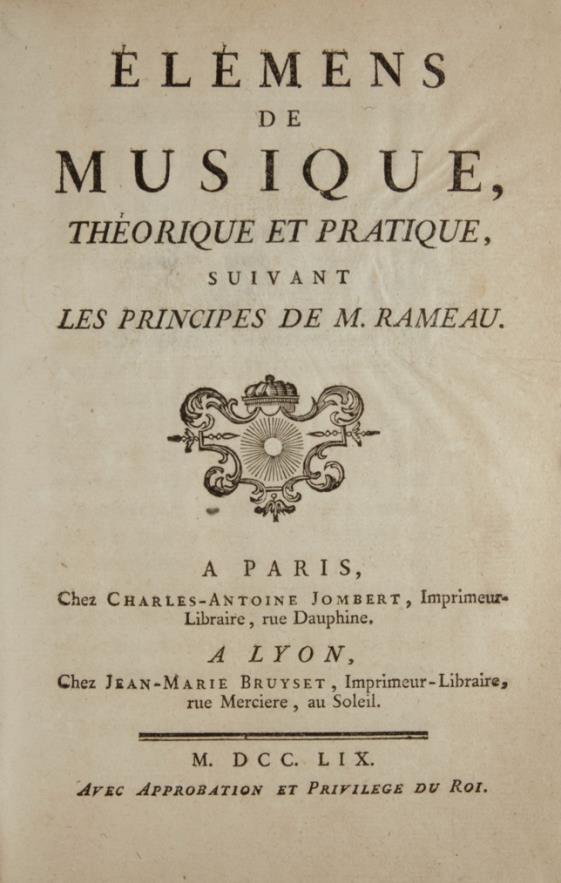
Élémens de Musique Théorique et Pratique suivant les principes de M. Rameau. Paris: Chez Charles-Antoine Jombert, Imprimeur-Libraire, rue Dauphine. A Lyon, Chez Jean-Marie Bruyset, Imprimeur-Libraire, rue Merciere, au Soleil, 1759.
Octavo. Fullcontemporaryvellumwithdarkredleathertitle label to spine gilt. 1f. (recto title, verso blank), [v]-xj ("Avertissement"), xii-xvi ("Table des chapitres"), 171, [i] ("Approbation"), [i] ("Fautes ..."), [iii] (blank) pp. + 10 folding plates of musical examples. Text typeset, music engraved. Occasional contemporary cancellations and corrections based on the list of "Fautes." Small label of C.E. Rappaport, noted bookseller in Rome, to upper outer corner of front pastedown. Binding slightly worn and soiled. Slightly browned; small wormhole to blank lower inner margins.
An attractive, wide-margined copy.
Provenance
Noted American harpsichordist Louis Bagger (1926-2024).
Second edition. Eitner I, p. 103. RISM Écrits p. 77.
"[D'Alembert's] most important musical publication was his Elemens de musique theorique et pratique ..., an outstanding work of elucidation which was widely read for over 50 years." TNG Vol. 5, p. 154.
"Drawing largely upon Rameau’s Démonstration (but also upon the Génération harmonique of 1737 for the rules of composition in Part 2), the Elémens was a stunning example of d’Alembert’s talent for conceptual synthesis and clarity; it quickly became the most widely read source for information of Rameau’s theory, both in France and in Germany (where it appeared in translation by Marpurg in 1757)." Thomas Christensen in Grove Music Online. (41207) $350
“Among the Most Supreme Examples of the Form”
2 ARNOLD, Samuel 1740-1802
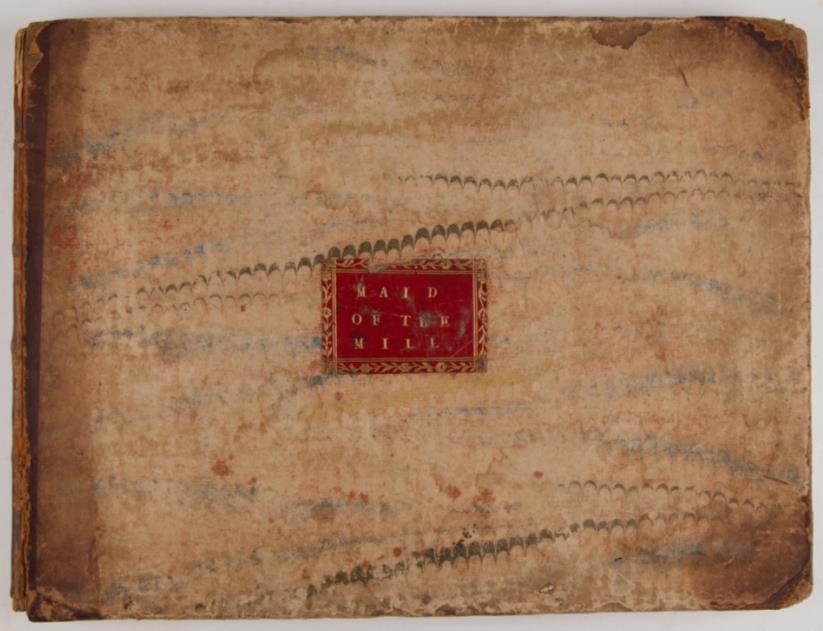
[The Maid of the Mill a Comic Opera As it is performed at the Theatre Royal in Covent Garden for the Voice, Harpsichord, or Violin]. [Piano-vocal score]. London: R. Bremner, 1765.
Oblong folio. Contemporary half dark brown leather with marbled boards, dark red decorative title label gilt to upper, raised bands on spine in gilt-ruled compartments. [i] ("A Table of the Songs &c with the Names of the Composers"), 2-35, [i] (blank), 37-47, [i] (blank), 49-59, [i] (blank), 61-73, [i] (blank) pp. Engraved throughout. Scored for one and two voices and figured basso continuo. Binding worn, rubbed, and bumped; lower detached; free endpapers lacking. Minor to moderate soiling, staining, and foxing. Lacking title.
Provenance
Noted American harpsichordist Louis Bagger (1926-2024).
First Edition. Loewenberg 280. BUC p. 643. RISM A2286.
The Maid of the Mill, a pasticcio in 3 acts to text by Isaac Bickerstaffe after Richardson, was first performed in London at Covent Garden on 31 January 1765. It contains four numbers by Arnold with others by Cocchi, Pergolesi, J.C. Bach, Galuppi, Hasse, Giardini, Jommelli, and Philidor.
Arnold, an English composer, conductor, organist, and editor, was "the son of Thomas Arnold, a commoner, and, according to some sources, the Princess Amelia (she was certainly his patron). Arnold received his education as a Child of the Chapel Royal (December 1, 1748 to August 31, 1758), where he was occasionally noticed by Handel (something he ‘remember’d with delight & spoke of with a starting tear’), and on leaving became known as an organist, conductor, and teacher, and composed prolifically. In autumn 1764 he was engaged by John Beard as harpsichordist and composer to Covent Garden; there he compiled several pastiche operas, including the popular The Maid of the Mill (1765), which is among the supreme examples of the form. ... Statistics show that Arnold’s more successful operas, such as The Agreeable Surprise (1781) and Inkle and Yarico (1787), an early anti-slavery opera, were among the most frequently performed of all operas of the time." Robert Hoskins in Grove Music Online. (41215) $150 Early Anti-Slavery Opera, Signed with the Composer’s Initials
3. ARNOLD, Samuel 1740-1802
Inkle and Yarico. A Comick Opera As Perform'd at the Theatre Royal in the Hay Market The Words by George Colman Esqr. Junr. ... Adapted for the Voice, Harpsichord, Piano Forte &c. Opera XXXth. ... Price 10s/6d. [Piano-vocal score]. London: Printed & Sold Longman & Broderip No. 26 Cheapside, & No. 13 Hay Market, [1787].
Oblong folio. Disbound. 1f. (recto title, verso blank), [i] (index), 2-45, [i] (blank) pp. Engraved throughout. Overture arranged for keyboard. Scored primarily for voice and figured bass with occasionally fleshed-out
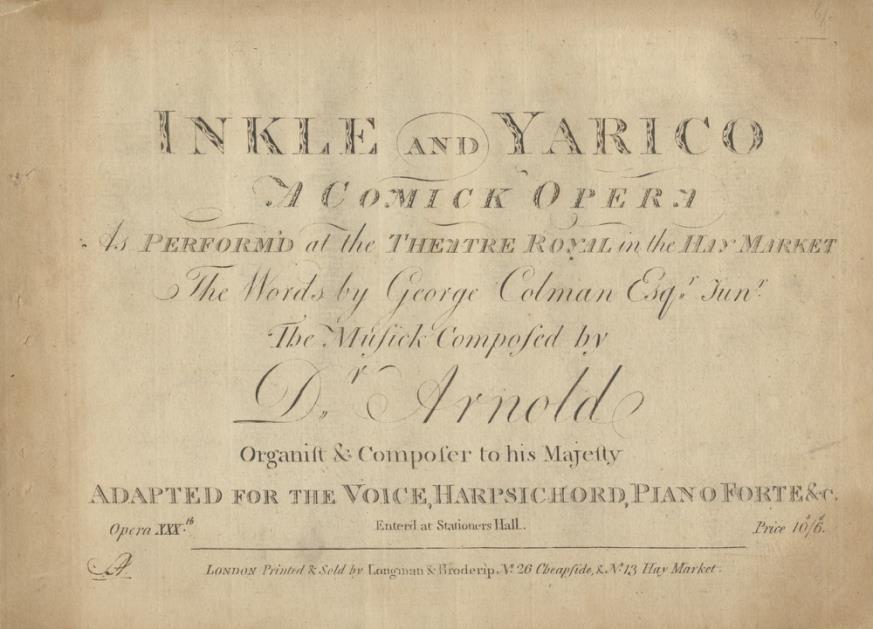
keyboard textures and a violin part or parts notated on one staff above the voice. Occasional soiling, foxing, and small stains; small binder's holes to blank inner margins; blank lower edge of title slightly chipped.
With Arnold's autograph initials to lower inner corner of title.
Provenance
Noted American harpsichordist Louis Bagger (1926-2024)
First Edition. BUC p. 52. RISM A2261.
Inkle and Yarico was first performed in London at Covent Garden on 4 August 1787. One of Arnold's most successful operas, its plot centers on the story of the kindness shown to a white man by a black woman and his subsequent decision to sell her into slavery. The opera was particularly topical as the issue of slavery was under discussion in the British Parliament at the time.
"In Ligon’s True Exact History of the Island of Barbadoes (1673) there is a story, presumably true and exact, of a beautiful naked Indian girl called Yarico who is got with child and has her baby by the side of a pond. Three hours later, carrying the baby in her arms, she meets a young English merchant running away from some Indian warriors. She hides him in a cave, feeds him, and falls in love with him. When it is safe, he takes her back to his ship and, instead of rewarding her, sells her into slavery. Steele repeated this shocking story in The Spectator (No. 11; 13.3.11), invented the name of Thomas Inkle for the young trader, and made him the baby’s father. He only discovers she is with child when he is about to sell her. ‘He made use of that Information, to rise in his Demands upon the Purchaser.’ Steele rather oddly thought the story ‘a Counterpart to the Ephesian Matron’ of Petronius, and was moved to tears by the gross ingratitude shown in both stories. We have found several plays and operas that pointed the moral superiority of the savage over the educated European, most notably Polly, but Inkle and Yarico was much the most successful, partly because it was better written, and partly because slavery had suddenly become a national problem. It was well known that during the previous winter two goahead young politicians, William Pitt and William Wilberforce, had been having frequent discussions as to how the Slave Trade might be abolished, and those who found it financially rewarding began to prepare their defence. Wilberforce was to have introduced the necessary Bill, but in the spring of 1787 he became seriously ill, and as a stop-gap device Pitt successfully carried a resolution on 9 May that the House should commit itself to a full discussion of slavery early in the next session. The ethics of slavery thus began to be widely debated, and as a result Colman wrote Inkle and Yarico. It was one of our first problem plays." Fiske: English Theatre Music in the Eighteenth Century Second Edition, p. 477. (41216) $1,500
The Rare Enlarged Edition of Musical Examples from C.P.E. Bach’s Versuch, One of the Most Important Musical Treatises of the 18th Century
4 BACH, Carl Philipp Emanuel 1714-1788
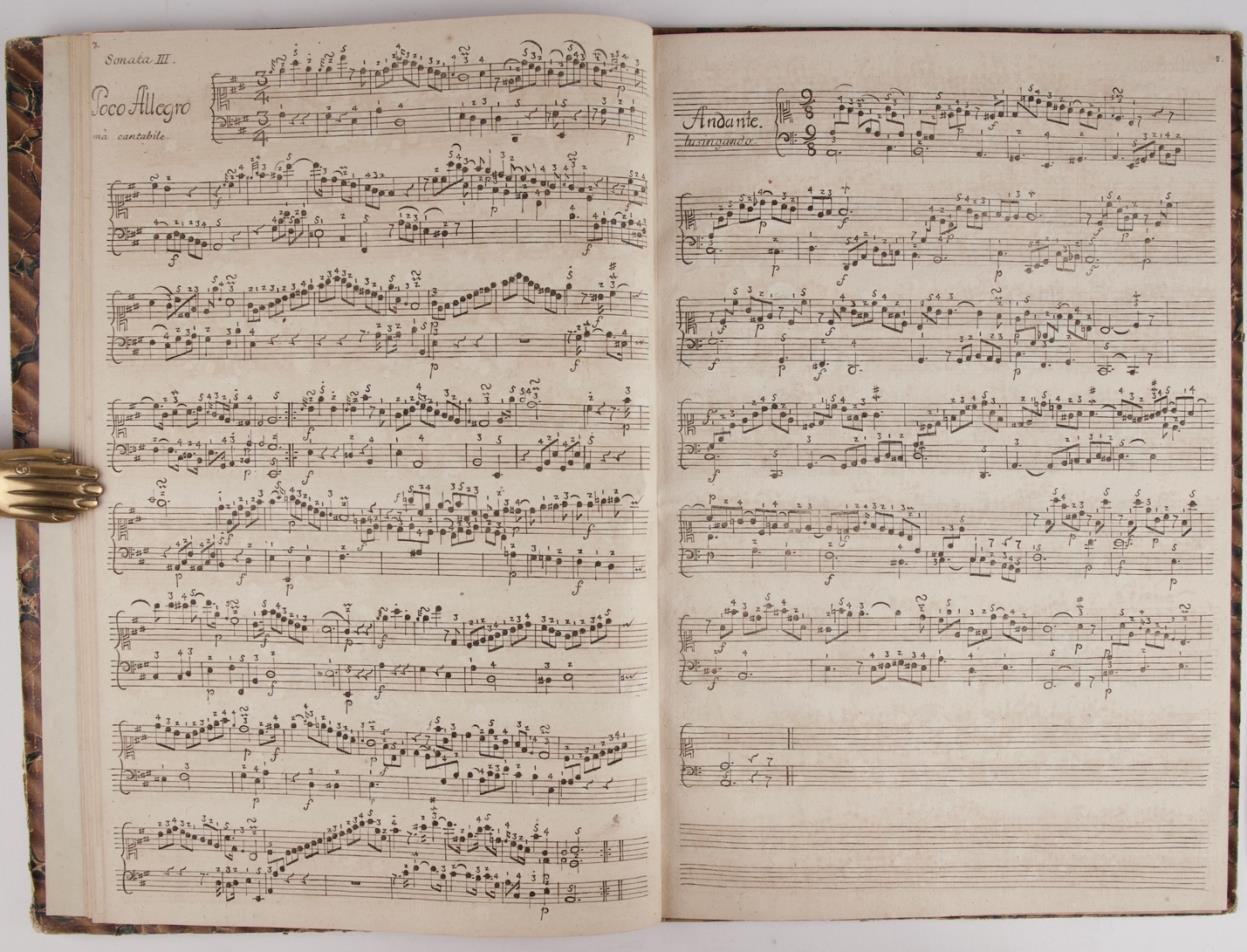
Exempel nebst 18 Probe-Stücken in sechs Sonaten zu Carl Philipp Emanuel Bachs Versuche über die wahre Art das Clavier zu spielen mit sechs neuen Clavier-Stücken vermehrt auf XXXI. Kupfer-Tafeln. [Leipzig]: [Schwickert], [1787].
Folio. Contemporary mid-brown cloth with marbled boards, decorative cut paper label titled in manuscript to upper. [i] (blank), [iv] (tables), 20, [i] (blank), 21-25 (Neue Sonatinen (W. 63/7–12), [i] (blank) pp. Engraved throughout. Binding worn, rubbed, and bumped; remnants of paper label to spine; upper hinge partially split. Paper title label to upper board with "EWm. Bach Versuch uber die wahre Art das Clavier zu Spielen. Exempel und Sonaten" in an early hand. Minor internal wear; light uniform browning; slightly trimmed, just touching page number and slightly affecting dynamics to lower margin of p. 10. Lacking title.
Wotquenne 63. Helm 70, 71, 72, 73, 74, 75, 292, 293, 294, 295, 296, 297
Provenance
Noted American harpsichordist Louis Bagger (1926-2024)
Rare third, enlarged, edition of the volume of musical examples and sonatas, separately issued with the first edition of Bach's treatise and reissued in this expanded version with the third edition of 1789-90. GregoryBartlett p. 20. Wolffheim I, 474. RISM Écrits p. 106. RISM B149-152
The tables include scale and arpeggio fingerings, paired thirds, grace notes, trills, rhythmic embellishments, dynamics, and other musical features found in Bach's keyboard works. The Probe-Stücke (sonatas) that follow are, for the most part, fully fingered and are arranged in escalating difficulty; the penultimate piece is a free fantasia (in unmeasured notation, representing the free fantasia style of improvisation discussed in the Versuch). The fantasia is followed by a Sonatine nuove, composed for a more beginner level.
"The musical supplement comprises two elements: numerous short musical examples on six unnumbered pages, as well as eighteen keyboard pieces or Probestücke, grouped into six sonatas (W. 63/1–6) and appearing on pages numbered 1 through 20. ...
The Probestücke constitute a graded set of pieces, advancing from a relatively simple Allegretto of thirty-two measures printed from a single, smaller plate to a famous free fantasia that extends over two densely printed pages. All eighteen pieces are in different keys, but they 9 fall into groups of three in related tonalities and in the fast-slow-fast order of a typical keyboard sonata. The use of varied tonalities, although a natural pedagogical device, is more specifically reminiscent of a number of J. S. Bach's collections, such as the Inventions and the WellTempered Clavier. So too is the incorporation of a range of genres, recalling especially J. S. Bach's keyboard partitas; among the Probestücke are such fashionable types as a siciliano and a binary form with varied reprises. ...
Bach could have had the Probestücke printed and sold separately. But it made sense both economically and, perhaps, aesthetically, to issue them as an integral part of the Versuch, or at least as part of the same musical supplement that contains the examples for latter. Much later, near the end of his life, Bach added six more pieces (organized into two sonatas), now known as the Neue Sonatinen (W. 63/7–12). These, however, were engraved and published by Schwickert 13 and incorporated by the latter into the expanded version of the musical supplement that accompanied the revised 1787 edition of the Versuch's first volume." Schulenberg: The Last Bach-Family Engraved Print: The Musical Supplement to C. P. E. Bach's Versuch, pp. 2-3, and 5).
C.P.E. Bach's Versuch is considered to be one of the most important musical treatises of the 18th century; "it is a standard guide to 18th-century keyboard fingering, ornamentation, aesthetic outlook, continuo playing and improvisation. It led the way towards the acceptance of the modern standards of keyboard fingering (especially the use of the thumb) that had been inaugurated by his father and was to form a basis of 19-century keyboard virtuosity. It stated the rules of embellishment in a clear and authoritative way at a time when scores of other treatises were compounding the confusion... While requiring technical mastery of the performer in no uncertain terms, Emanuel warned against empty virtuosity." TNG Vol. 1, p. 854.
"Bach's teaching in Berlin inspired the writing of his Versuch über die wahre Art das Clavier zu spielen (Essay on the True Art of Playing Keyboard Instruments ... the most important 18th-century German-language treatise on the subject. ...
Together with Quantz’s Versuch einer Anweisung die Flöte traversiere zu spielen, Bach’s Essay is our most important source of information about performing practices and issues of taste prevalent in Berlin in the mid18th century. Bach’s introduction is also of particular interest today, dealing as it does with the choice of instruments and basic questions of accompaniment, and so too is the final chapter on improvisation (with the Fantasia in D H160 (W117.14) as a practical illustration), which was unique in its time. The Essay held an undisputed position in the 18th century, and its influence was not confined to north Germany; Haydn bought and studied it as a young man and Christian Gottlieb Neefe introduced Beethoven to it. Both composers continued into the 19th century to use the Essay in their own teaching.
The first part was reprinted in 1759, and a revised edition (1787) contained six new single-movement sonatinas that Bach hoped would make up for the excessively rapid increase in difficulty of the Probestücke. A new edition of the second part, also with corrections and additions by the author, did not appear until 1797. The two collections of piano pieces with varied repeats, H193–203 (W113) and H228–38 (W114), were also very
$2,250
popular; H193–7 (W113.1–5) were reprinted in rival editions in Berlin, Vienna and Linz until 1800. Bach’s immense influence as a keyboard teacher made the ‘Bach manner’ accepted as a general term for an elegant style of performance throughout the second half of the 18th century." Christoph Wolff and Ulrich Leisinger in Grove Music Online. (41211)
Highly Important to Bach Iconography, Reconstructed from the Composer’s Skull
5. BACH, Johann Sebastian 1685-1750
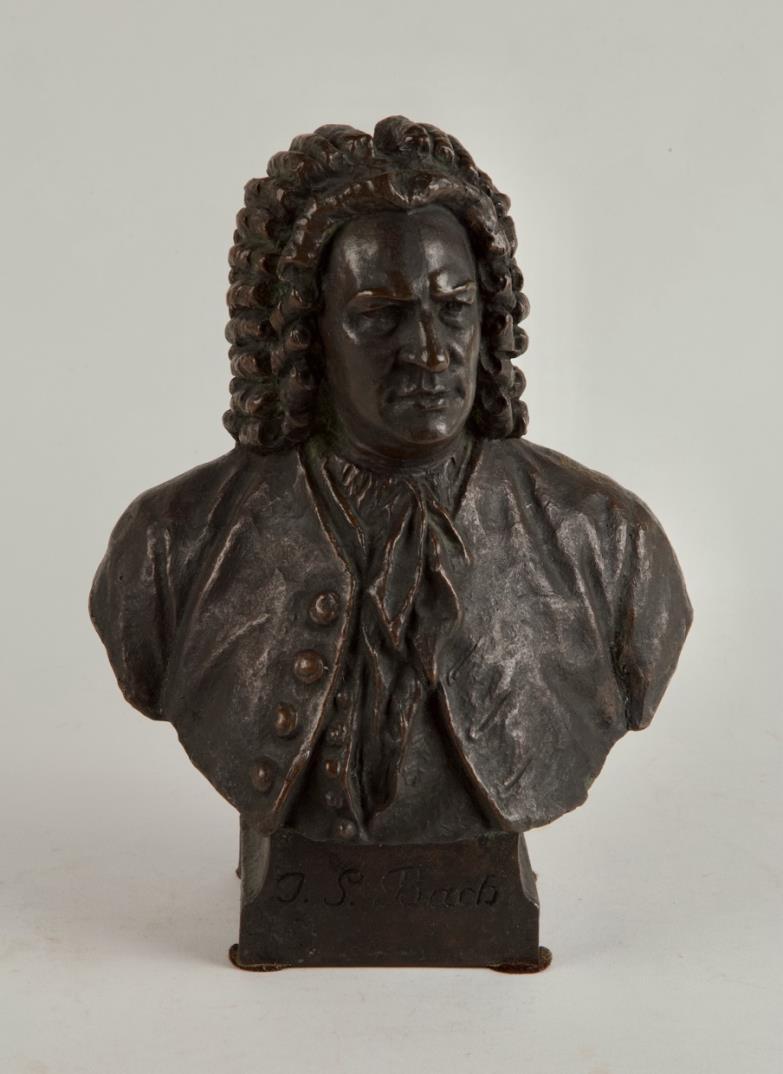
Portrait bust in bronze by the German artist Carl Ludwig Seffner (1861-1932). Signed C. Seffner and dated 1895 by the artist. Height 23 cms (9"); weight 3.3 kg. (7.2 lbs.). Brown patina.
The composer is represented half-length turned slightly left. He wears a wig and is dressed in a jacket, vest, and cravat. "J. S. Bach" incised to front.
Provenance
Sotheby's Amsterdam, "An Important Private Collection from Hanover," 29 March 2007, lot 1185.
Seffner is best remembered for his statue of Johann Sebastian Bach which stands in front of the south wall of St. Thomas'sChurchinLeipzig. SeeNeumann: Bilddokumente zur Lebensgeschichte Johann Sebastian Bachs, plate 623 and p. 438.
"On Oct. 22, 1894, a skeleton was uncovered here in the cemetery of St. John Church. No stone or sign marked the grave site, but the excavators, guided by archival documents to look for an oaken coffin and by an oral tradition to seek a spot six paces from the south door of the church, believed they had found the earthly remains of Johann Sebastian Bach, laid to rest on July 30, 1750. The bones were examined by a team of medical experts from Leipzig, nearby Halle, and Vienna, declared authentic and studied for abnormalities. (There were none.) Then, in a moment of inspiration, the director of the group, the eminent Leipzig anatomist Wilhelm His, summoned the local sculptor Carl Ludwig Seffner to reconstruct Bach's countenance from the skull. The Seffner Bach Bust served in turn as the basis for Seffner's well-known 1908 statue of Bach, which stands alongside St. Thomas Church here. The New Bach Monument, as it is known (having succeeded a smaller memorial of 1843, sponsored by Mendelssohn), has become an object of veneration by Bach pilgrims the world over." George B. Stauffer in The New York Times, 2 April 2000 (41415)
$2,200
“Greater Textual and Musical Scale”
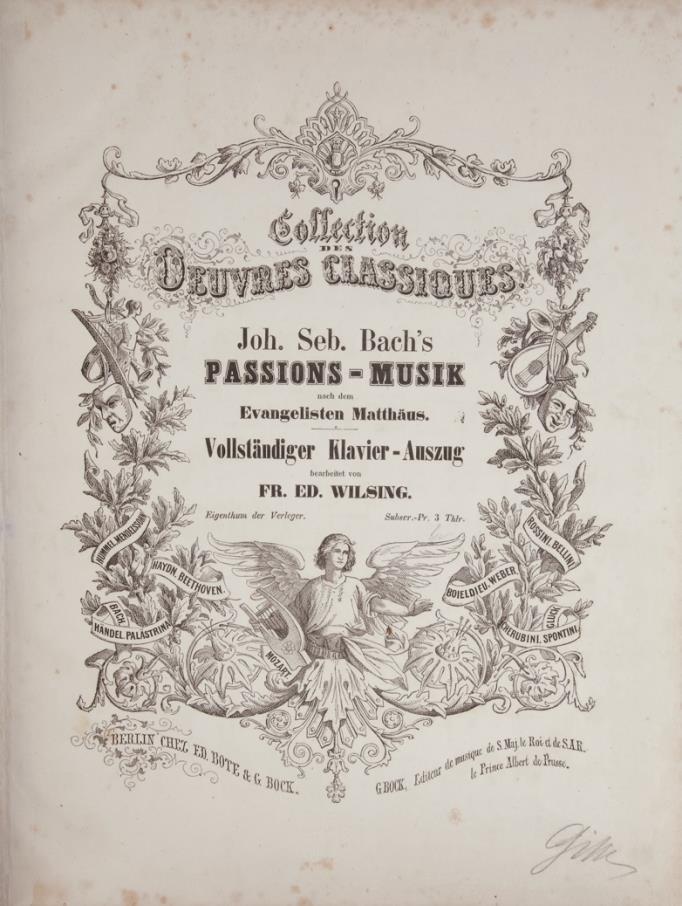
6. BACH, Johann Sebastian 1685-1750 Joh. Seb. Bach's Passions-Musik nach dem Evangelisten Matthäus. Vollständiger KlavierAuszug bearbeitet von Fr. Ed. Wilsing. Eigenthum der Verleger. Subscr.-Pr. 3 Thlr. [BWV 244]. [Piano-vocal score]. Berlin: Chez Ed. Bote & G. Bock. G. Bock, Editeur de musique de S. Maj. le Roi et S.A.R. le Prince Albert de Prusse [B. & B. 3698], [ca. 1857].
Folio. Half dark brown leather with black cloth boards, decorative cut paper label titled in manuscripttoupper. 1f. (rectotitle, verso blank), 3-189, [i] (blank) pp. Title lithographed, music engraved. Decorative series title "Collection Ouevres Classiques" incorporating floral motifs, theatrical mask, angel with lyre, lute, quill, and names of composers. With occasional performance markings in pencil. Mostly minor, occasionally moderate foxing, primarily to margins; blank inner margins of title and first and last leaves of music reinforced with narrow strip of white paper tape.
OCLC 916160097 (one copy only, at Baldwin Wallace University). Riemenschneider 1936.
"On the whole the St Matthew Passion is a considerably more unified piece than the St John, for which the primary reason is its use of Picander’s text. Its greater textual and musical scale allows more space for the arias and ‘madrigal’ pieces in which the coupling of arioso with aria is an especially characteristic feature. Another special feature is the way the strings provide an accompanying ‘halo’ in Jesus’s recitatives. The pervading
cyclical formation of the work (from the interrelating of the chorales, tonal organization, and paired movements) is in some respects even more pronounced than in the St John Passion, while it lacks the earlier work’s ‘architectural’ centre. After 1729 the St Matthew Passion had at least two more performances under Bach’s direction. In 1736 he made some important changes, chief among them emphasizing the separation of the two choruses and orchestras by division of the continuo, exchanging the simple chorale at the end of part i for ‘O Mensch bewein’ and replacing the lute in ‘Komm süsses Kreuz’ with bass viol. The additional alterations of about 1742 and 1746 were mainly a matter of meeting practical performing conditions." Christoph Wolff in Grove Music Online. Daniel Friedrich Eduard Wilsing (1809-1893) was a German Romantic composer highly regarded by Robert Schunmann. (41241) $350
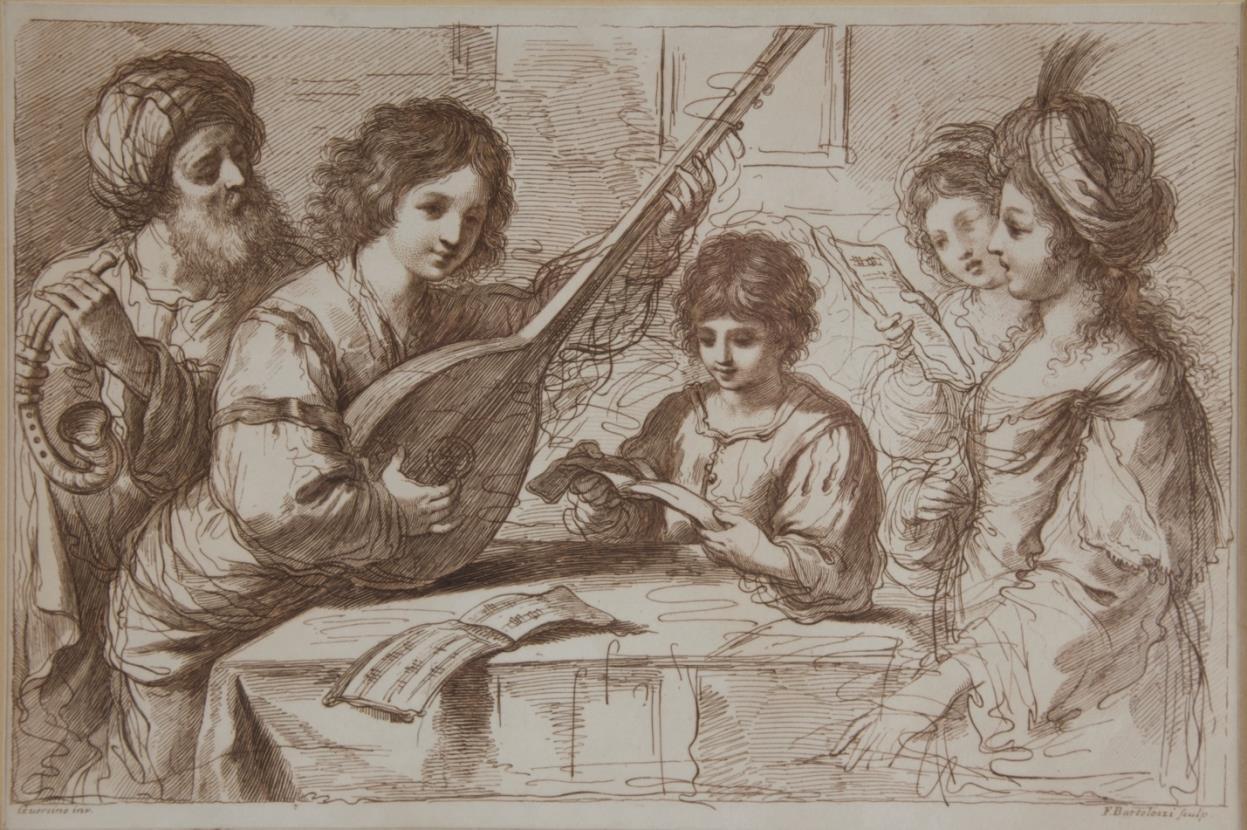
7 BARTOLOZZI, Francesco 1727-1815 "Un Concerto." Original etching after the drawing by Guercino (Giovanni Francesco Barbieri, 1591-1666) of a group of musicians singing, and playing the lute and a wind instrument. [London]: Boydell, [ca. 1790].
Image size 200 x 305 mm (7.75 x 12.25"); overall size 357 x 458 mm (14" x 18"). Printed in brown ink. Matted and framed. A group of 16th century musicians are gathered around a table on which a book of music lies open; to the right of the table a young man plays a lute (a chitarrone) and an older man plays a wind instrument (a crumhorn); a young boy in the center reads from a music book;' and two women to the left sing from a musical score.
Provenance
Noted antiquarian bookseller William Salloch (1906-1990), with a description from his Catalogue 316: Music and Musical History, lot 24, laid down to verso.
Second state, with letters. Calabi & De Vesme 2142.2.
"In 1765, the Italian engraver Bartolozzi was summoned to London by Mr. Dalton, the librarian to King George III, for the purpose of engraving the Guercino drawings, a valuable treasure of the Royal collection. This Bartolozzi engraving reveals some elements of an 18th century style, but it is altogether true to the spirit of the 16th century artist and reproduces gracefully the charm and the harmony of the original." Salloch
"One of a number of prints engraved after drawings by Guercino and other masters in the Royal Collection, chiefly by Bartolozzi. They were re-published in folio by Boydell in the 1790s. This appeared in Boydells' 'Eightytwo prints, engraved by F. Bartolozzi &c. from the original drawings of Guercino, in the collection of His Majesty." British Museum catalogue online (41413) $475
“For a Time He Kept English Opera Alive Almost Single-Handed”
8. BISHOP, Henry R. 1786-1855
The Barber of Seville: A Comic Opera, in Two Acts; as performed at the Theatre Royal, Covent Garden. The Overture and New Music Composed, and the Whole Adapted to the English Stage. London: Printedbyandfor J. Roach, at the Britannia Printing Office, Russell-Court, Drury Lane ... Price Two Shillings, 1818.
Octavo. Modern yellow wrappers with title label to upper. 1f. (rectotitle, versoblank), [i](blank), [i](named cast list), [5]-55, [i] (publisher's catalogue). Named cast includes Mr. Jones (Count Almaviva), Mr. Fawcett (Doctor Bartolo), Mr. J. Isaacs (Basil), Mr. Liston (Figaro), Mr. Pyne(Fiorello), Mr. Simmons(Argus), Mr. Blanchard (Tallboy), Mr. Comer (Officer), Mr. Atkins (Notary), Mrs. Dickons (Rosina), and Mrs. Sterling (Marcellina). Slightly worn and browned; occasional small stains, minor creasing, and mispagination; small portion of blank upper outer corner of pp. 11/12 lacking.
First Edition. OCLC 503796070 (two copies at the British Library only).
Bishop's Barber of Seville, a comic opera in three acts to a libretto byJ. Fawcett andD. Terry afterT. Holcroftand P.-A. Beaumarchais, was first performed in London at Covent Garden on 13 October 1818.
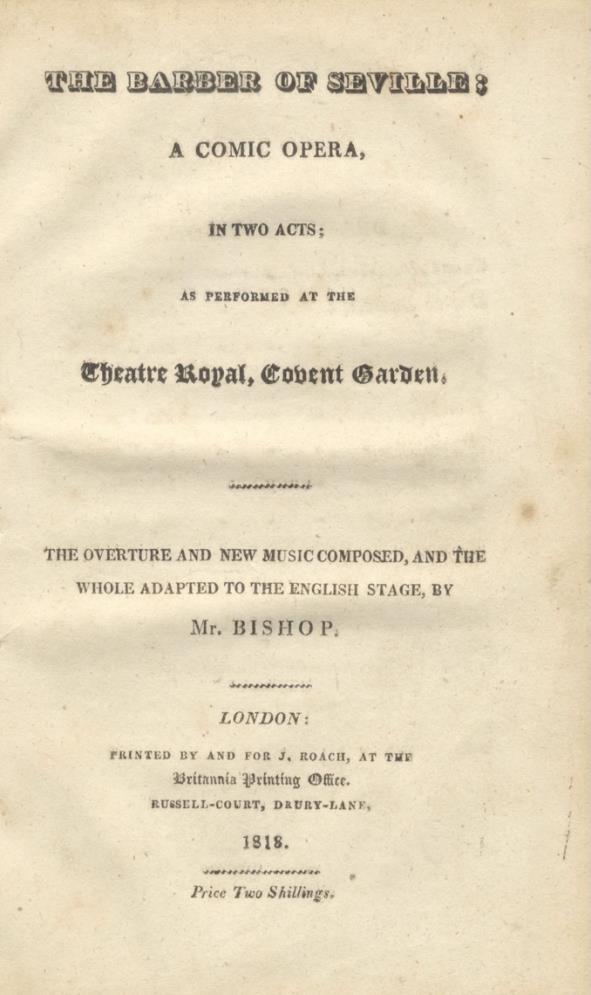
"In his day [Bishop] enjoyed a commanding reputation as the guardian of the best traditions of English song, and for a time he kept English opera alive almost single-handed." Nicholas Temperley in Grove Music Online (41398) $200
Attractive Early 20th Century Portrait Bust
9. BRAHMS, Johannes 1833-1897
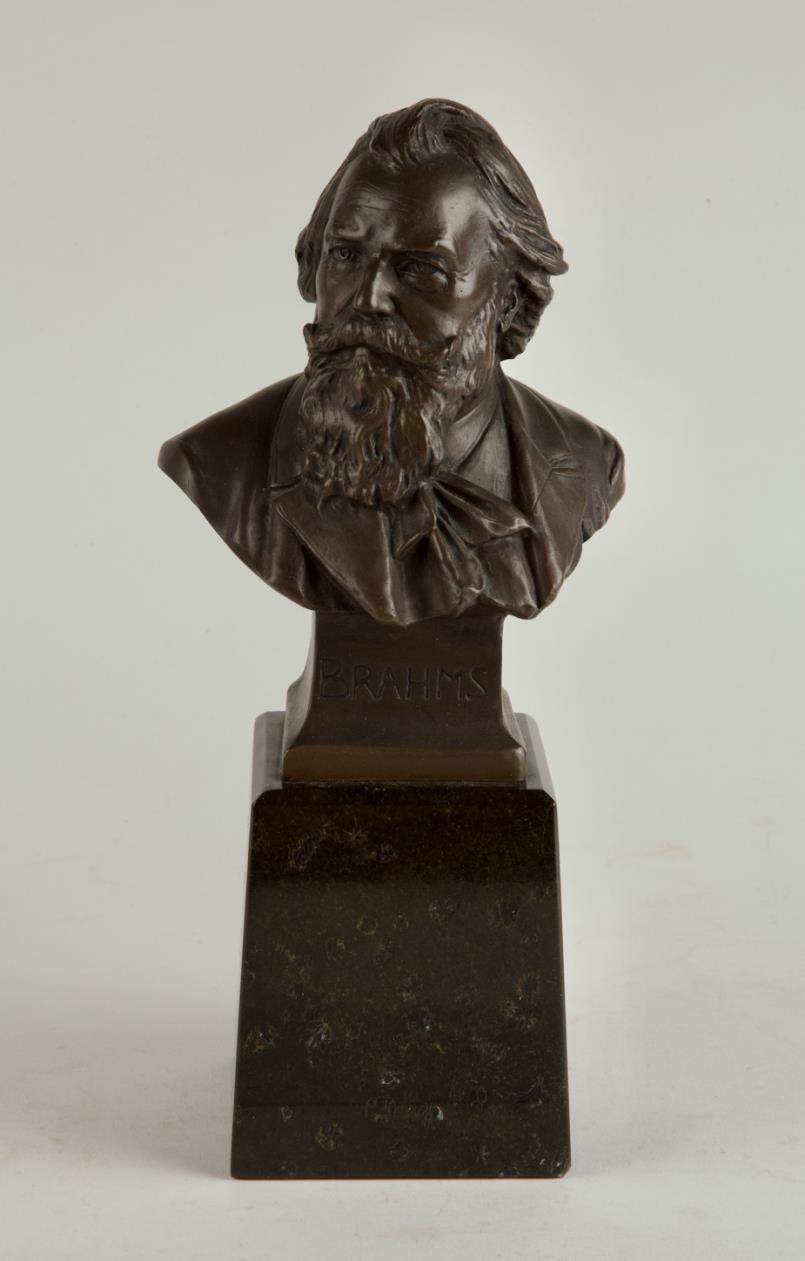
Portrait bust in bronze by the German sculptor Bruno Friedrich Emil Kruse (1855-1934) with incised signature of the artist and date of 1904 to back. [?]Berlin, 1904.
Overall height 28 cm (approximately 11"); weight 2.9 kg. (approximately 6.5 lbs.). With "Brahms" incised in block letters to front. Mounted on a marble base. The composer is depicted head-and-shoulders turned quarter right, with full beard, wearing a coat and cravat. In very good condition.
"The successor to Beethoven and Schubert in the larger forms of chamber and orchestral music, to Schubert and Schumann in the miniature forms of piano pieces and songs, and to the Renaissance and Baroque polyphonists in choral music, Brahms creatively synthesized the practices of three centuries with folk and dance idioms and with the language of mid- and late 19thcentury art music." George S. Bozarth and Walter Frisch in Grove Music Online
"From 1876 to 1884, Bruno Kruse studied at the Dresden Academy of Fine Arts and was a student of Johannes Schilling becoming his master student in 1879. During this time, he worked on commissions for his professor in Schilling's studio. ... He participated in the Dresden art exhibitions with his own creations, including a female bust in 1878 and a bronze Valkyrie leading the warrior into battle in 1879. ... In 1885, he settled in Berlin as a freelance artist and ran his own studio. From 1891 to 1923, he was employed as a teacher at the School of Applied Arts. Besides his small sculptures and marble busts, he created bronze statues and dedicated himself to medal making. He primarily drew inspiration from Italian designs and elevated cast medals to an equal status with the popular minted medals. His artistic signature is evident in all manner of plaques and medal, including those of royalty, scholars, military officers, and the emperor." German Wikipedia
An attractive and well executed example. (41403) $425
Unique Manuscript Source for the Operetta
10. CASADESUS, Henri 1879-1947
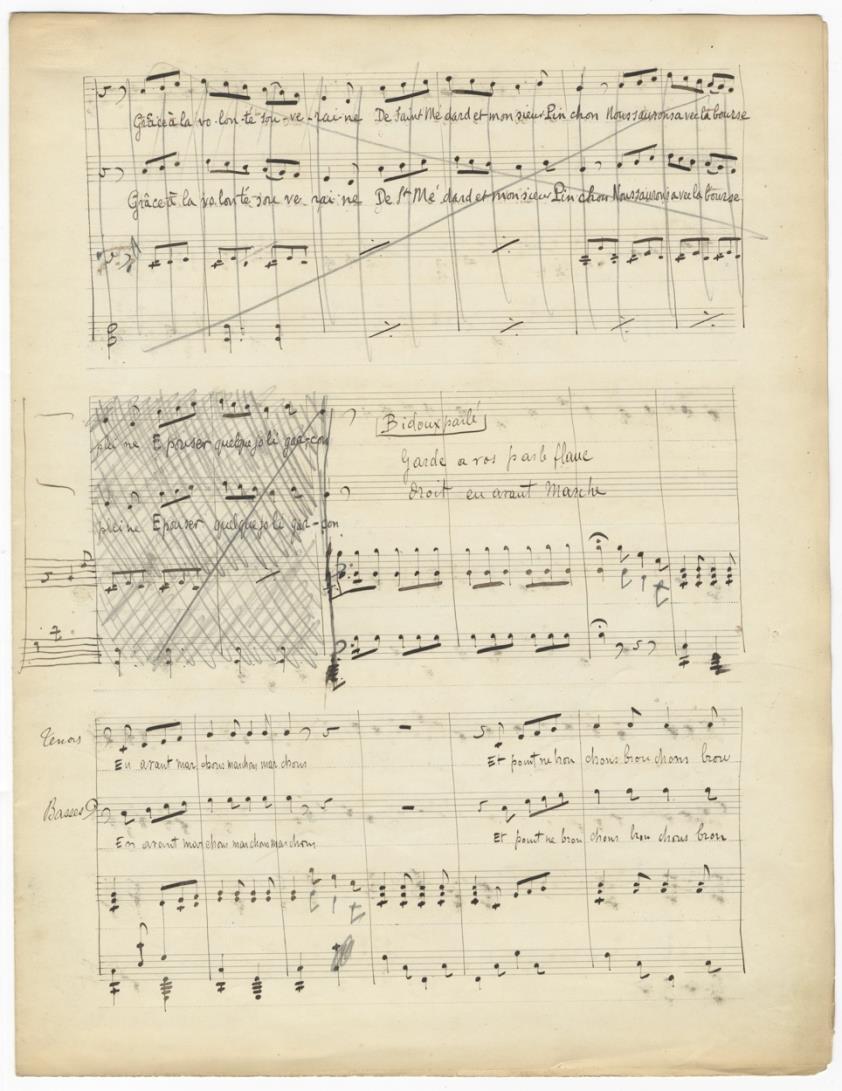
Le Rosier. Operetta in 3 acts. Autograph musical manuscript piano-vocal score. Paris, [ca. 1912].
Folio (267 x 351) and quarto (227 x 303 mm). Autograph musical manuscript in black ink notated on 12-stave rastrum-ruled paper. With markings in leadand blue pencil. Some minor wear, soiling, stains, and tears to edges; several leaves partially detached. In very good condition overall.
Approximately 105 pp.
A working manuscript, with significant cancellations and corrections, including overpastes; titles numbered in blue pencil
Six numbers from the opera, as follows:
- 9 Chœur des Conseillers Municipaux Bidoux Chœurs des femme ch: 1f. (recto title, verso blank), 6 pp.
- 12 chœur des Bl.: 10, [ii] (blank) pp.
- 18 quatuor = Agathe La Prudent Gabriel Saturnin: 1f. (recto title, verso blank), 9, [i] (blank) pp.
- 19 Final du 23 Acte: 31, [iii] (blank) pp.
- 24 Cortège du Couronnement: 1f. (recto title, verso blank), 11, [iii] (blank) pp.
- 25 Ensemble du Couronnement: [i] (title), 1, 1bis, 2-39, [iii] (blank) pp.
Le Rosier, an operetta in 3 acts on a libretto by Maurice Devilliers, was first performed on 16 August 1913 at the Casino du Mont-Dore, and revived on 23 February 1925 at the Folies-Dramatiques. The piano-vocal score was first published in 1914 by Hayet.
Casadesus was a French composer, viola player, and viola d’amore player. "In 1901, in collaboration with Saint-Saëns, he founded the Société des Instruments Anciens Casadesus, which until 1939 organized concerts. Rare instruments collected by him are in the collection of the Boston Symphony Orchestra. Besides directing the opera theatre in Liège and the Gaîté-Lyrique in Paris, he became known as a musical diplomat, especially in the USA. He was a member of the Capet Quartet. His published compositions include operettas, ballets and songs, and he wrote a treatise and studies for the viola d’amore. There were early Columbia recordings of his Ballet divertissement, Jardin des amours, Récréations de la campagne and Suite florentine. His Hommage à Chausson, for violin and piano, was recorded for American Columbia in the 1950s by Zino Francescatti and Robert Casadesus.
Casadesus was also involved, with his brothers Francis and Marius, in bringing out unknown pieces purportedly by 18th-century composers, but it has long been clear from stylistic evidence that these are entirely the work of the Casadesus brothers, and that has never been denied by the family. Three works in particular have enjoyed a good deal of success: a Violin Concerto in D (‘Adelaïde’) ascribed to Mozart, a Cello Concerto in C minor by ‘J.C. Bach’, and a Viola Concerto in B minor by ‘Handel’." David Cox in Grove Music Online
We have not located any another manuscript source for Le Rosier. (41254) $1,800
Unrecorded? Keyboard Sonata
11. CASALIS, Domenico fl. ca. 1797
Collection of late 18th- and early 19th century keyboard manuscripts, ca. 1797-1805. Of Italian provenance. Italy.
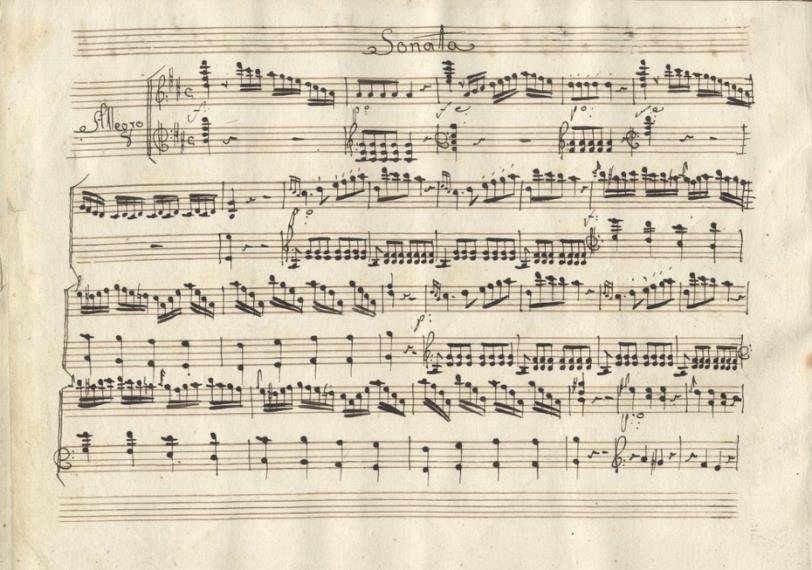
Sonatina Per Piano Forte. [i] (title), 11, [i] (blank) pp. Casalis's sonata in D major (the first ten pp.) consists of an allegro followed by a "Finale un poco presto." It is a sophisticated essay in late 18th century keyboard sonata form, incorporating varied figurations, articulation, chromatics, flashes of bravura, fermatas that invite cadenza improvisation and, in the finale, a whimsical passage of alternatingtriadsanddiminishedchordsmarked"ritardando," precedingafermata, thenfollowed bythe scherzolike rondo theme. The final page of themanuscript, ina different hand, includes a dance in 3/4 time for keyboard and four staves of vocal exercises.
Of considerable artistic and scholarly interest. We have located very little information Casalis other than the fact that he performed a keyboard recital at the Cocomero, now the Teatro Niccolini, on 15 July 1797. Weaver and Weaver: A Chronology of Music in the Florentine Theater, 1751-1800, p. 98
Bound with the following anonymous works:
- Tarantella. [i] (title), 2, [ii] (blank), 1, [i] (blank) pp. Unlocated. Two pieces, a tarantella in A minor, and a dance in E flat major. The tarantella opens in A minor in triplets, modulates to C major with dotted rhythms, to A major withsnap-rhythm falling thirds, andbackto A minor, again, with triplets, andincorporatingarpeggiated diminished chords. The dance that follows, in a different hand, features a motoric Alberti bass in the left hand.
- Marcia per Cembalo piano forte. [i] (title), 2, [i] (blank) pp. In D minor, ABA form, with a B section in F major. Unlocated.
- God Save the King. Five variations. [i] (blank), 6, [i] (blank) pp. With harmonies, suspensions, and a passagework redolent of the baroque era. Unlocated.
Oblong quarto. Contemporary flexible decorative paper boards. Notated in various hands, on 8- to 10-stave rastrum-ruled paper. Occasional minor signs and wear and staining, and small tears to edges. (41246) $375
Signed by the Author
12. CHAPPELL, William 1809-1888
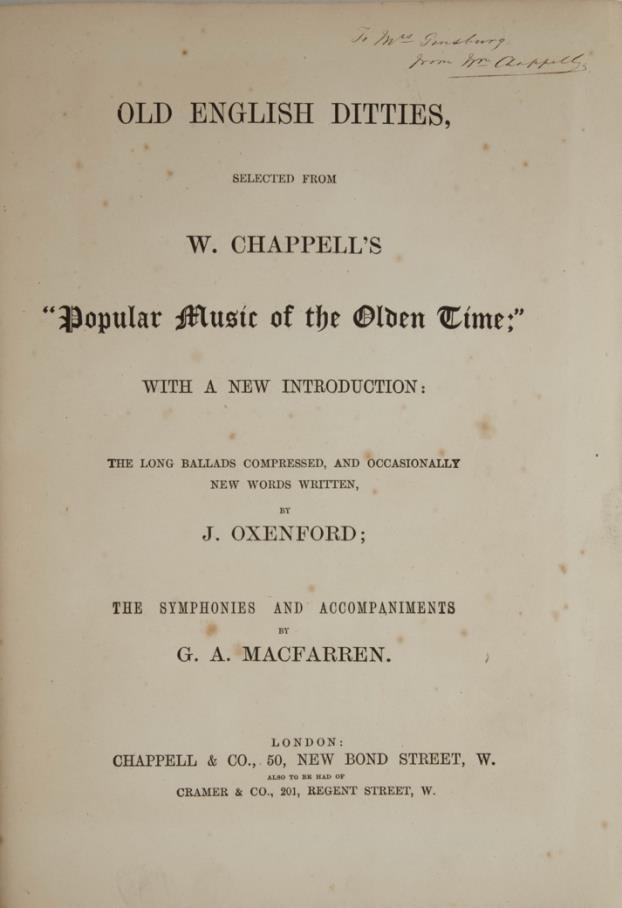
Old English Ditties, Selected from W. Chappell's "Popular Music of the Olden Time;" With a New Introduction: The Long Ballads Compressed, and Occasionally New Words Written, by J. Oxenford; The Symphonies and Accompaniments by G.A. Macfarren London: Chappel & Co., 50, New Bond Street, W. Also to be had of Cramer & Co., 201, Regent Street, W, [ca. 1870].
Quarto. Original publisher's dark green cloth with titling gilt within decorative blindstamped border, titling to spine gilt, light yellow endpapers. 1f. (recto title, verso printer's note), [iii]-xiii, [iv] (Index to Vol. I), 2-241, [i](printer's note) pp. Binding slightly worn, soiled, rubbed, and bumped; endpapers soiled. Light uniform browning; some signatures loose.
With a signed autograph inscription "To Mrs. Ginsburg from Wm. Chappell" to upper outer corner of title.
Chappell was a noted English music publishing firm founded by Samuel Chappell in 1813. His eldest son, William, "was noted for his interest in early music. In 1840, with Rimbault, Macfarren and others, he founded the Musical Antiquarian Society, which met at his firm’s premises; he edited Dowland’s songs for the society (1843). He had earlier published his A Collection of National English Airs (1838–40), copiously annotated with historical details, and this was subsequently expanded into his major work, Popular Music of the Olden Time (2 vols., 1855–9). William Chappell left the family firm in about 1843 and in 1844 went into partnership with Cramer and Beale, as Cramer, Beale & Chappell, remaining until his retirement in 1861." W.H. Husk, revised by Margaret Cranmer, Peter Ward Jones, and Kenneth R. Snell in Grove Music Online. (41412) $75
First Edition of Clementi’s Influential Piano Tutor
13. CLEMENTI, Muzio 1752-1832
Clementi's Introduction to the Art of playing on the Piano Forte: Containing, the Elements of Music; Preliminary notions on Fingering with Examples; and Fifty fingered Lessons, In the major and minor keys mostly in use by Composers of the first rank, Ancient and Modern: To which are prefixed short Preludes by the Author ... Price 10s. 6d. [Op. 42]. London: Clementi, Banger, Hyde, Collard & Davis No. 26, Cheapside. where may be had, as a Supplement to the above Work, Clementi's Six Progressive fingered Sonatinas, [ca. 1806].
Folio. Disbound. 1f. (recto title, verso blank), 63, [i] (blank) pp. Watermark 1806. Occasional markings in pen, some dashes, and the final notes of the 23rd lesson cancelled, p. 35. Slightly worn; minor soiling to blank lower margins; occasional small tears to lower edges; occasional repairs, including to lower outer corner of title, with outer margin of blank verso reinforced; lower portion of blank outer margin of first page reinforced.
First Edition, later issue of this highly influential work. Tyson p. 84. RISM C3080 (two copies only).
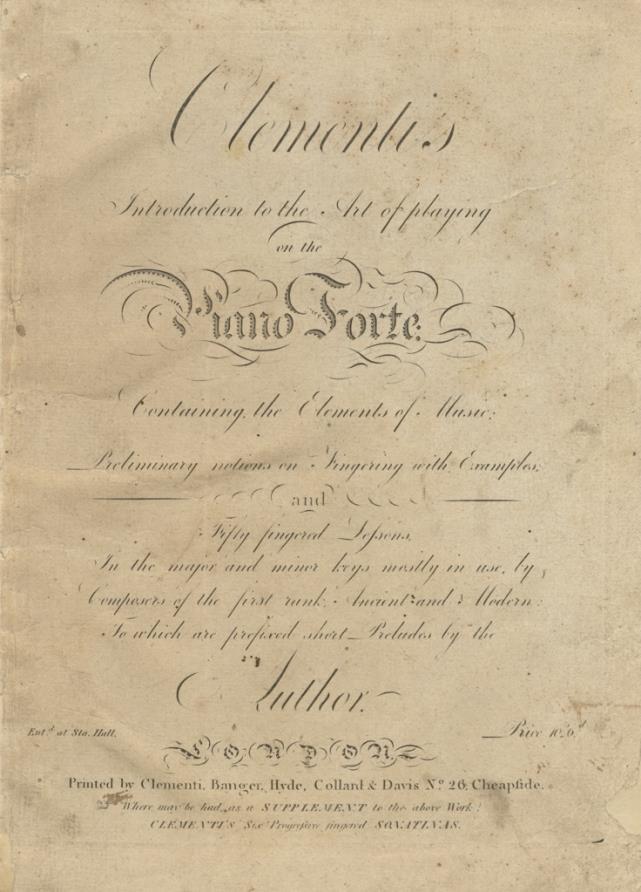
The "preliminaries" include observations on Clefs; The Scale, or Gamut; Exercise for treble notes; Exercise for bass notes; Intervals; Example of the Natural or Diatonic scale; Example of Intervals; Tenor, Counter-tenor, and Soprano clefs explained; Figure, Length, and relative Value of Notes; Time and its divisions; Sharps, and Flats, &c.; Various other marks; Abbreviations; Style, Graces, and marks of Expression, &c.; Appogiaturas, and other Graces in small notes explained; Turns, Shakes, and Beats, explained; Major, and Minor Modes or Keys; Explanation of Various Terms; Fingering; Extensions and Contractions &c. ...
“Intended for the complete beginner, it starts off with a compact explanation of musical notation and elementary theory, including time-signatures, tonalities, and ornamentation, and then proceeds to specifically pianistic matters such as hand position... and fingering. A series of exercises follows: scales, arpeggios, and, surprisingly early on, passages in thirds and sixths. The bulk of Clementi's Introduction is a remarkable series of fifty 'lessons' - short pieces of various kinds and various grades of difficulty by diverse composers. They are arranged by keys (eighteen of the twenty-four are represented), and each group is prefaced with a prelude by Clementi.
These 'lessons' provide further evidence of the scale and range of Clementi's activities as a collector of music during this period. Compositions of Cavalli, Bach [J.S. and C.P.E], Handel, D. Scarlatti, Couperin, and Rameau are placed alongside pieces by Haydn and Pleyel, and by Clementi's younger contemporaries, Cramer, Dussek, and Beethoven... J.S. Bach is represented by the Polonaise and Minuet from the Sixth French Suite in E major [Lesson XLVIII, pp. 62-63, BWV817]. This is one of several first printings of Bach for which Clementi was responsible during this period, none of which, so far as I can ascertain, has been recognized as such. .. The Introduction also features one of Beethoven's earliest appearances in print in England [Lesson XXXIX, p. 52]... his slight 'Ländlerischer Tanz' - Clementi calls it a waltz - in D major, WO 11 ...
The ageing Beethoven thought highly of it; Schindler tells us this, and several of the composer's letters from 1825 and 1826 record his efforts to secure more copies of the work ...
The fullest testimony we have as to Beethoven's regard for Clementi's music is that of the composer's assistant Anton Felix Schindler: He had nothing by Haydn or Cherubini; of Mozart's music he had a part of the score of Don Giovanni and many sonatas. Almost all of Clementi's sonatas were at hand. He had the greatest admiration for these sonatas, considering them the most beautiful, the most pianistic of works, both for their lovely, pleasing, original melodies and for the consistent, easily followed form of each movement... The musical education of his beloved nephew was confined for many years almost exclusively to the playing of Clementi sonatas." Plantinga: Clementi, pp. 164-167, 310.
"This tutor was designed primarily as a succinct introduction to the basic knowledge required by the rapidlygrowing class of amateur music-makers. Nevertheless, the brief remarks and exercises were sufficient to reveal to the observant reader and skillful teacher of the time the germ of the new technical skills and interpretative knowledge needed for performance of the emerging piano literature. Thus, this volume, which was more up-todate than many others written between 1800 and 1820, discloses significant details concerning the transitional state of keyboard performance at the turn of the century, some twenty years after the pianoforte achieved primacy among the keyboard instruments." Sandra P. Rosenblum in her introduction to a facsimile of the second issue of the work published in New York by Da Capo in 1974.
Clementi was an English composer, keyboard player and virtuoso, teacher, music publisher, entrepreneur, and piano manufacturer of Italian birth. ["His] influence on following generations of pianists and piano composers is hard to overestimate. Beethoven’s earlier keyboard writing seems unmistakably indebted to his music of the 1780s and 1790s. Clementi was the principal teacher of several leading pianists of the 1820s and 1830s, and he had more informal contacts with many others during their formative years, for example Herz, Meyerbeer, Dussek, and perhaps Hummel. His didactic works, especially the Introduction to the Art of Playing on the Piano Forte, the op.36 sonatinas, and the Gradus ad Parnassum, became staples in the education of pianists at all levels. Thus in several ways he impressed his stamp on piano playing and writing from about 1790 until far into the 19th century. And increasing numbers of modern editions and recordings of his works made 20th-century musicians and audiences aware once more of his virtues as a composer." Leon Plantinga, revised by Luca Lévi Sala in Grove Music Online (41253) $675
Rare First Edition of Opus 2
14 CLEMENTI, Muzio 1752-1832
[Op. 2]. Six Sonatas for the Pianoforte or Harpsichord with an Accompanyment for a German Flute or Violin ... Opera II. Pr. 10sh = 6d. [Score]. London: Welcker, [1779].
Oblong folio. Disbound. 1f. (recto title, verso blank), [i] (blank), 2-45, [i] (blank) pp. Engraved throughout.
Sonatas II, IV, and VI scored for solo keyboard; Sonata I scored for keyboard and violin (with double stops); Sonatas III and V scored for keyboard and treble instrument (the score calls for flute or violin). Slightly worn; several chips to blank edges of first two leaves; very small tears to lower blank margins of pp. 2 and 38 repaired with archival tape; old tape repair to blank lower margin of pp. 17/18; final leaf nearly detached.
First Edition. Rare. Tyson p. 36. BUC p. 198. OCLC 243745071 (one copy only in the U.S., at the Folger Shakespeare Library). RISM C2724 (three copies in total, with one copy only in the U.S., at UC Berkeley).
"Although Op. 2 is described on its original title-page as 'six sonatas for the piano forte or harpsichord with an accompanyment for a German flute or violin,' the 2nd, 4th and 6th are in fact for keyboard instrument alone,
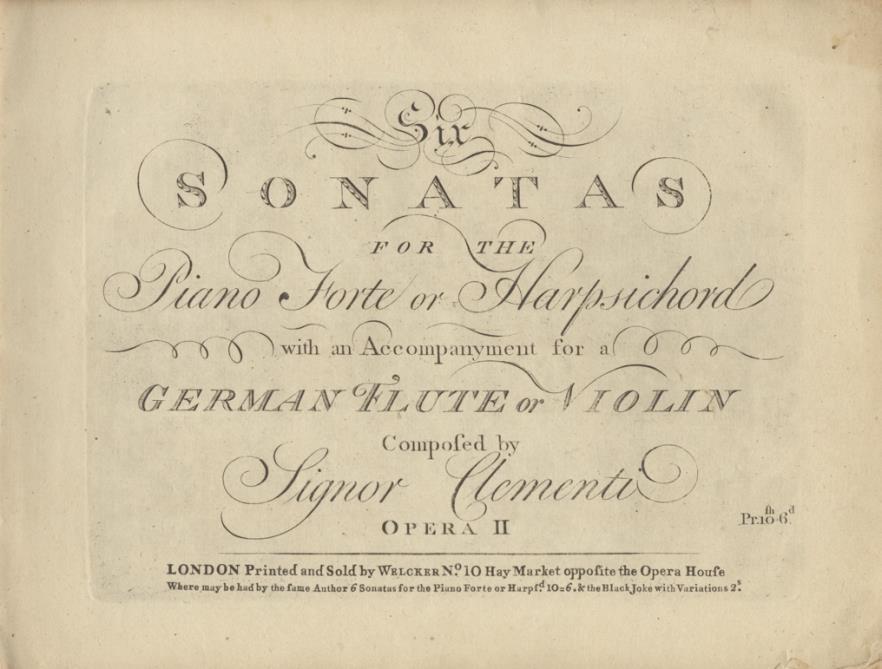
and it is these which gave the opus its astonishing reputation: no. 2 in C (the 'celebrated octave lesson'), no. 4 in A and no. 6 in B flat. Several revised versions of these sonatas were published by Clementi. In later editions Clementi’s “Op. 2” was often represented only by the three unaccompanied sonatas a fact that has led to some confusion in their numbering. It is a sign of the reputation which these sonatas enjoyed on the continent as well as in England that they were selected by J. G. Nägeli in 1803 to form the “première suite” of his Répertoire des Clavecinistes, intended as a library of forceful piano-writing." Tyson: Muzio Clementi Thematic Catalogue, p. 14.
“[His] name was seen in concert programmes with increasing frequency in 1779–80, no doubt partly owing to the popularity of his sonatas op. 2, first published by Welcker in spring 1779. That Clementi was playing these pieces in public, particularly the ‘octave lesson’ op. 2 no. 2, is suggested by an entry in the satirical musical lexicon ABC Dario Musico (Bath, 1780):
'Clementi. An Italian. Has composed some sets of lessons, which abound in passages so peculiar and difficult, that it is evident they must have been practised for years preceding their publication. We particularly allude to the succession of octaves with which he has crammed his lessons. Mr. C. executes these exceedingly well, and is a most brilliant performer.' " Leon Plantinga, revised by Luca Lévi Sala in Grove Music Online
The first edition of a rare set of piano sonatas influential in the development of the form. (41234) $1,250
Revised Edition of Opus 2
15. CLEMENTI, Muzio 1752-1832 [Op. 2]. Six Sonatas for the Piano Forte or Harpsichord With a Violin Accompaniment ... Opera II. Price 10s„ 6d. [Piano part only]. London: Printed for the Author and Sold at No. 45 Upper Mary-le-bone Street where may be had Correct Editions of all the Works of the above Author, [ca. 1792].
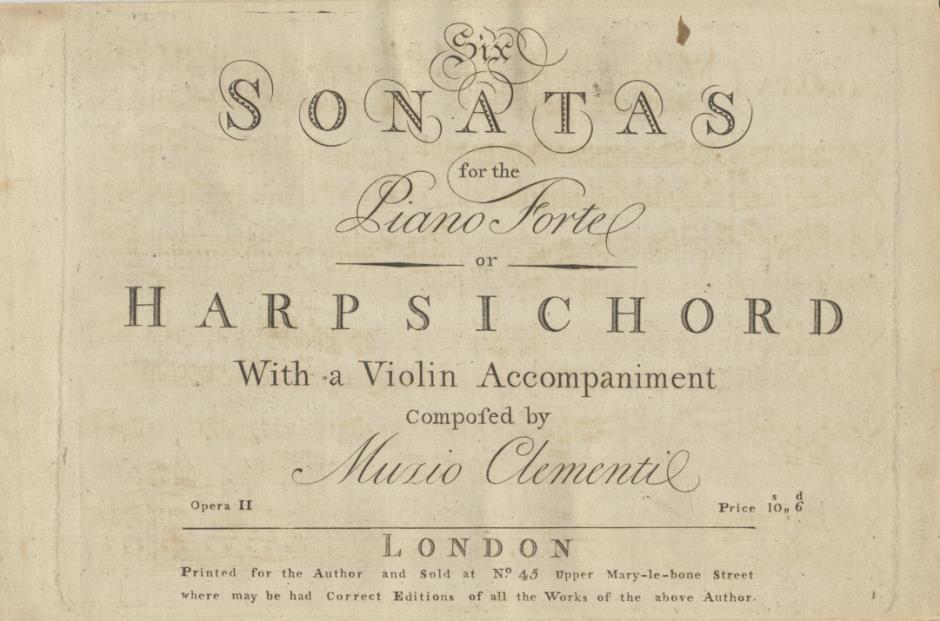
Oblong folio. Disbound. [i] (title), 2-33, [i] (blank) pp. Engraved throughout. Some leaves closely trimmed at lower margin; title partially detached.
Revised version. Tyson (b), p. 37. BUC p. 198. RISM C2727 (piano part only) and CC2727 (with violin part). (41251) $450
For Piano Four-Hands
16 CLEMENTI, Muzio 1752-1832
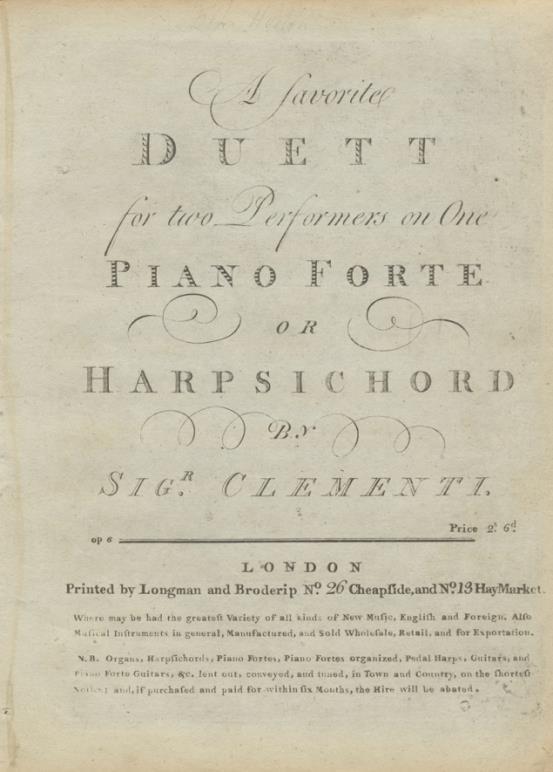
[Op. 6]. A favorite Duett for two Performers on One Piano Forte or Harpsichord ... op 6. Price 2s. 6d. [Piano-four hands]. London: Longman and Broderip No. 26 Cheapside, and No. 13 HayMarket, [ca. 1795].
Folio. Disbound. 1f. (recto title, verso blank), 13, [i] (blank) pp. Engraved throughout. Slightly worn; small hole to blank inner margin of title; partially detached.
Not in Tyson. BUC p. 198. RISM C2768 (two copies only in the U.S., at the Boston Public Library and the Library of Congress).
Here published singly, the piano four-hand duet originally served as the opening piece of the first edition of Op. 6 (Bailleux, ca. 1780-1781), followed by two keyboard-violin sonatas, and three keyboard fugues (Tyson p. 41). (41252) $250
Signed by the Composer
17. CLEMENTI, Muzio 1752-1832
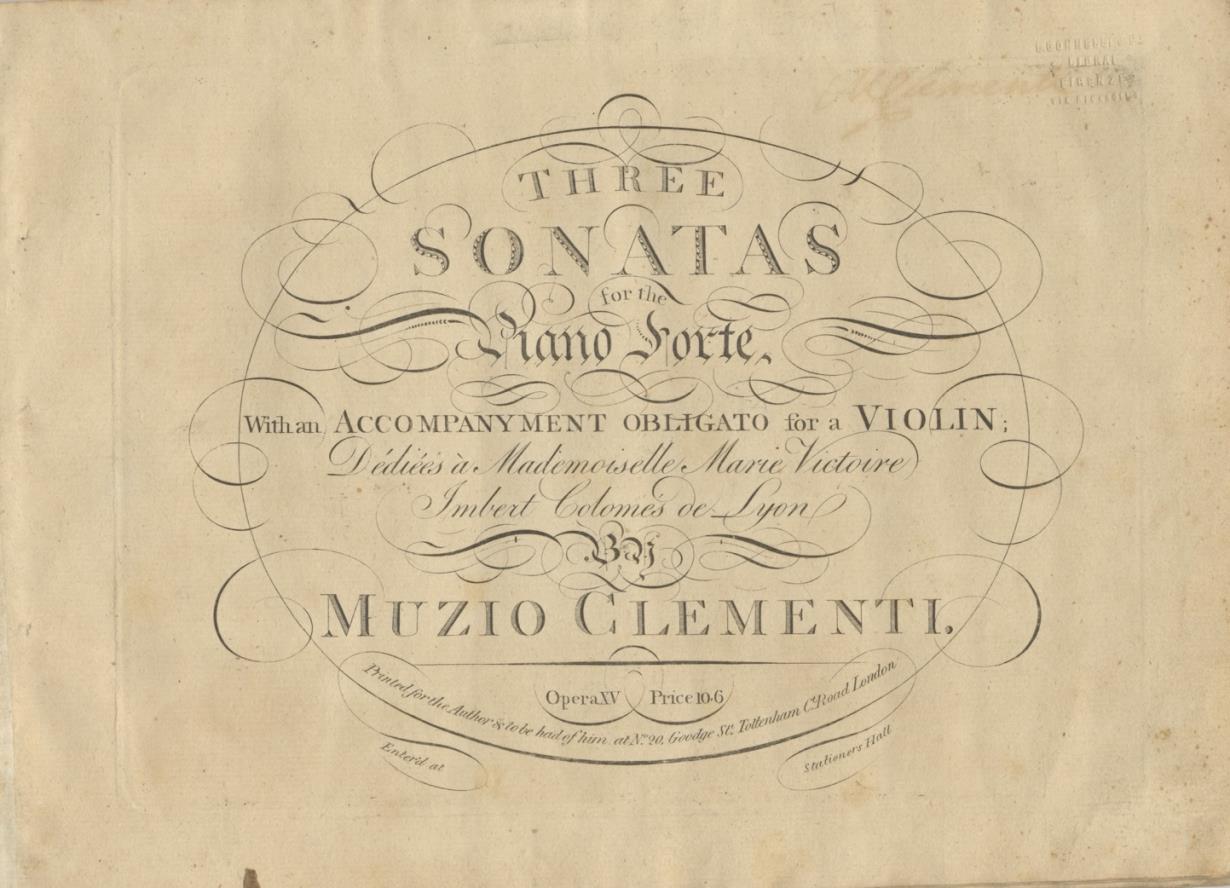
[Op. 15]. Three Sonatas for the Piano Forte With an Accompanyment Obligato for a Violin Dédiées à Mademoiselle Marie Victoire Imbert Colomés de Lyon ... Opera XV. Price 10.6. [Score]. London: Printed for the Author & to be had of him at No. 20, Goodge St. Tottenham Ct. Road, [1786].
Oblongfolio. Contemporaryflexiblemarbledboards. 1f. (rectotitle, versoblank), 2-36pp.Engravedthroughout. Wrappers worn, with minor loss of marbled paper; small label with No. [20] to lower inner margin of upper and small handstamp to recto of rear wrapper. Slightly worn; minor foxing to title; very occasional small stains, mainly to blank lower margin; some leaves reinforced with narrow strip of paper to inner margin; Clementi's signature significantly faded and nearly illegible.
With the autograph signature of the composer ("M Clementi") to upper outer corner of title, with embossed stamp of Florentine bookseller Gonnelli.
First Edition. Tyson p. 53. BUC p. 199. RISM C2851 (no copies in the U.S.). (41250) $1,500
First Edition of the Opus 33 Piano Sonatas
18. CLEMENTI, Muzio 1752-1832
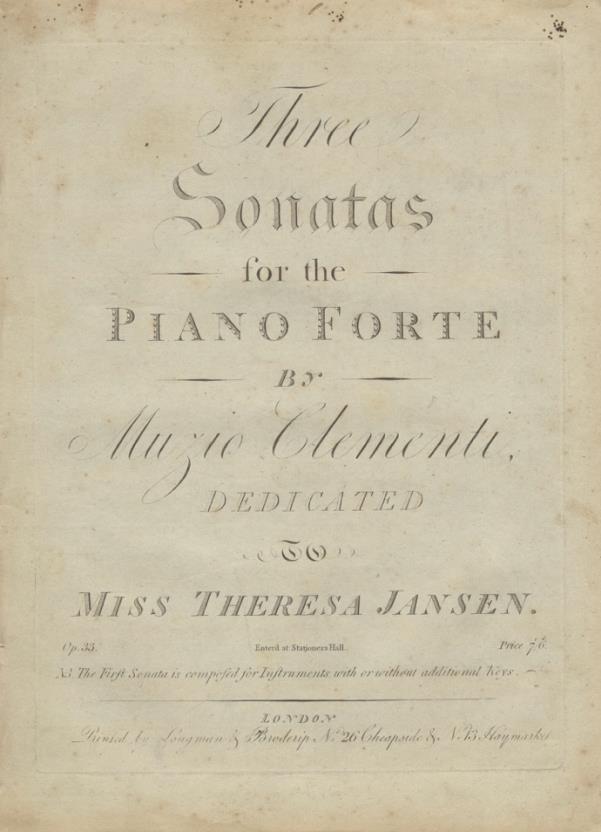
[Op. 33]. Three Sonatas for the Piano Forte ... Dedicated to Miss Theresa Jansen. Op. 33. Price 7s/6d. NB. The First Sonata is composed for Instruments with or without additional Keys. London: Longman & Broderip No. 26 Cheapside & No. 13 Haymarket, [ca. 1795].
Folio. Disbound. 1f. (recto title, verso blank), [i] (blank), 18, [i] (blank), 20-33, [i] (blank) pp. Engraved throughout. Minor soiling, foxing, and small stains to first and final leaves; final leaf detached.
The third sonata in the set is a solo arrangement of a pianoconcerto;thecadenzainits firstmovement(partly unmeasured) is rendered in smaller notation; smaller notation is also employed in the score for alternate passages where the player's piano does not extend far enough into the extreme high register (i.e., the "additional Keys" referenced in the title).
First Edition, later issue. Tyson p. 72. BUC p. 199. RISM C2994 and CC2994 (two copies in the U.S., at Yale and the University of Iowa). (41284) $300
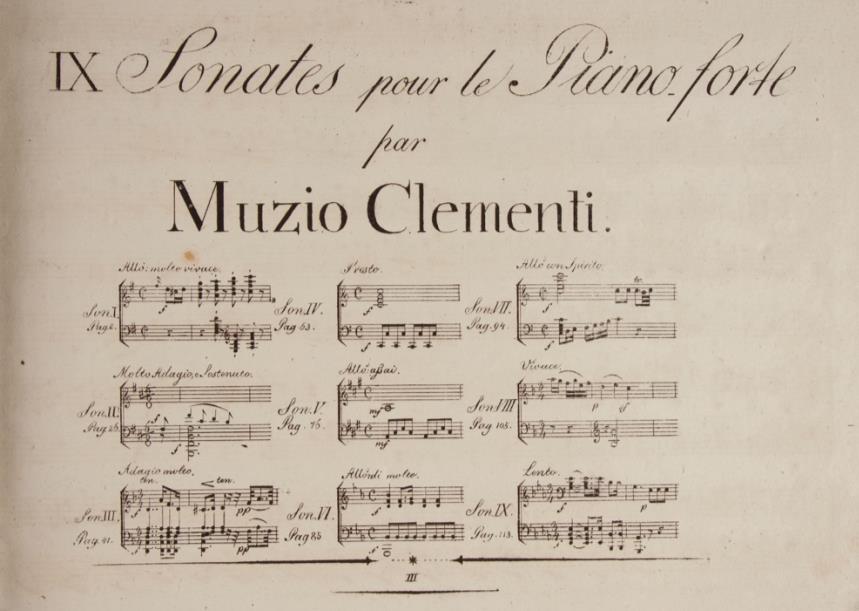
Early French Music Lithography
19 CLEMENTI, Muzio 17521832
[Opp. 2, 5, 6, 40, and WO3]. IX Sonates pour le Piano forte [Oeuvres Complettes ... Cahier III]. [Vienne]: [Au Magasin de l'Imprimerie chymique imper. roy. priv.] [PN 47], 1805.
Oblong folio. Original publisher wrappers with titling within decorative border to upper and illustration of a dancer, tambourine, and panpipe player to lower. [i] (title and incipits), 2-120 pp. Untrimmed. Lithographed throughout. Wrappersworn, stained, andfrayed, withtearsandlossestospineandedges;spine reinforcedwithcontemporary blue paper. Small hole to inner margin of first three leaves, affecting blanks staves and clef, with noteheads
intact; minor dampstaining to blank outer margins of first approximately 28 pages; occasional minor staining and soiling, mainly to blank margins and edges.
Contents: Sonata I, Op. 40, no. 1; Sonata II, Op. 40, no. 2 ; Sonata III, Op. 40, no. 3 ; Sonata IV, Op. 2, no. 2 Sonata V, Op. 2, no. 4 ; Sonata VI, Op. 2, no. 6 ; Sonata VII, Op. 7, no. 2 ; Sonata VIII, WO 3, Sonata in F for Corri's collection; Sonata IX, Op. 6, no. 2
Not in Tyson. Published approximately two years after Breitkopf's edition of the complete works. Weinmann Senefelder - Steiner - Haslinger Vol. 1, p. 25. Twyman: Early Lithographed Music, p. 224, 1 (Cahier I only).
An early example of French music lithography. (41285)
Provenance
$350
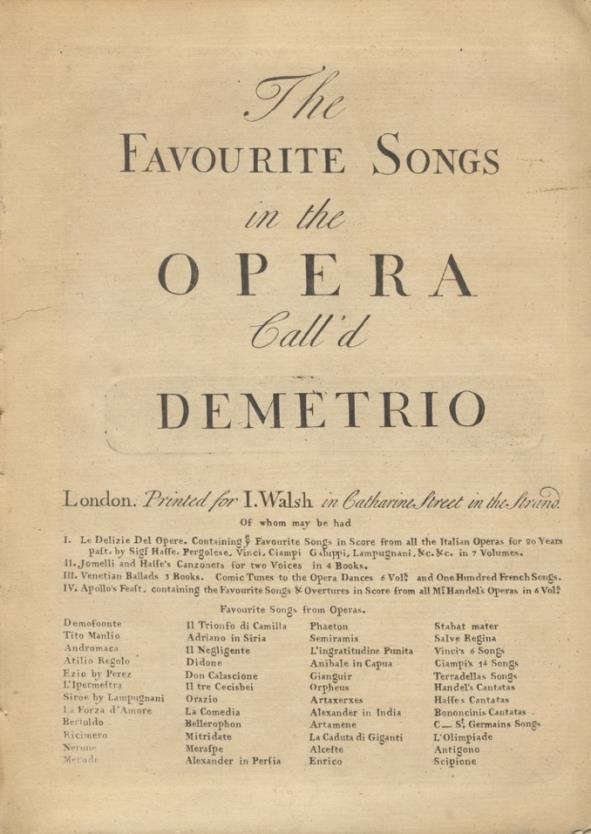
Songs from Demetrio & Zenobia
20 COCCHI, Gioacchino 1712-1796
The Favourite Songs in the Opera Call'd Demetrio. [Vocal score]. London: Printed for I. Walsh in Catharine Street in the Strand, [1760].
Folio. Disbound. 1f. (recto passe-partout title, verso blank), [i] (blank), 2-21, [i] (blank) pp. Text in Italian. Engraved throughout. Named singers include Sigr. Pasquale Potenza and Sigra. Colomba Mattei. Slightly worn and browned; minor creasing to upper outer upper corners.
With:
[A 2nd Set of] The Favourite Songs in the Opera Call'd Demetrio [with Two Songs in Zenobia]. Folio. Disbound. London: I. Walsh, [1760]. 1f. (recto passe-partout title, verso blank), [i] (blank), 24, [i] (blank) pp. Engraved throughout. Named singers include Sigra. Mattei, Sigr. Potenza, Sigra. Calori, and Sigra. Frasi. Scored for voice, instrumentsincluding violinsand flutes, and figured bass continuo with named composers Cocchi and Potenza.
Brief publisher'scataloguetolower portion of both titles.
Noted American harpsichordist Louis Bagger (1926-2024).
First Edition, second issue. Smith & Humphries 568, p. 126. BUC p. 264. RISM C3230 and CC3230 (two copies in the U.S., at the Library of Congress and UCLA, not distinguishing between issues).
A pasticcio in 3 acts with text by Metastasio, Demetrio was first performed in London at the King's Theatre in the Haymarket in 1757. Zenobia, an opera seria in 3 acts with text also by Metastasio, was first performed in London at the King's Theatre in the Haymarket on 10 January 1758.
Cocchi "went to the Haymarket Theatre, London, as opera composer and music director; during the next five seasons he supervised the production of opere serie, composed several operas himself and contributed to pasticcios. Burney had few kind words for these productions, particularly for two comic operas from the very end of Cocchi’s tenure: they evidently paled next to Galuppi’s, then all the rage. After being replaced at the Haymarket by J.C. Bach in 1762, Cocchi remained in London for about ten more years. Much in demand as a teacher, he published several collections of instructional works, both vocal and instrumental. For some years he directed the subscription concerts organized by Mrs Cornelys at Carlisle House, Soho Square; here the Mozarts met him in 1764 or 1765." Piero Weiss in Grove Music Online
Potenza (ca. 1730-after 1797), an Italian soprano castrato, "began in opera seria at Rome during Carnival 1747 in secondary roles and sang as primo uomo from Carnival 1749 at Palermo. In 1757–9 he was in London. ... In 1765 he was in Jommelli’s Stuttgart company. ... [He was ] a good all-round singer (range approximately d ′ to c ‴) ..." Dennis Libby in Grove Music Online (41218) $750
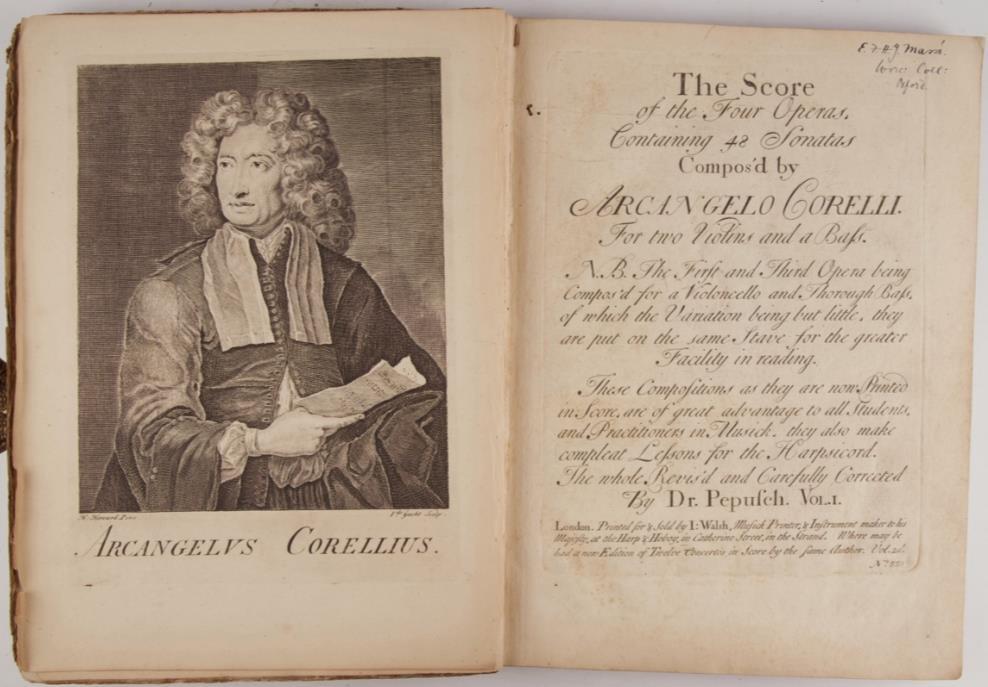
“An
21. CORELLI, Arcangelo 1653-1713
The Score of the Four Operas, Containing 48 Sonatas [Opera I-IV] ... For two Violins and a Bass. N.B. The First and Third Opera being Compos'd for a Violoncello and Thorough Bass, of which the Variation being but little, they are put on the same Stave for the greater Facility in reading. These Compositions as they are now Printed in Score, are of great advantage to all Students, and Practitioners in Musick, they also make compleat Lessons for the Harpsicord. The whole Revis'd and Carefully Corrected by Dr. Pepusch. Vol. I ... No. 550. [Full score]. London: Printed for & Sold by I: Walsh, Musick Printer, & Instrument maker to his Majesty, at the Harp & Hoboy, in Catherine Street, in the Strand. Where may be had a new Edition of Twelve Concertos in Score by the same Author. Vol. 2d., [ca. 1735].
Folio. Contemporary mid-tan calf-backed marbled boards with spine in compartments. 1f. (recto title, verso blank), 44, 34, 54, 43, [i] (blank) pp. Engraved throughout. With half-length frontispiece portrait engraving of
by Vdr. Gucht after H. Howard of the composer holding a sheet of music. "J. W. Branston" in contemporary manuscript to upper outer corner of front free endpaper with annotation to front pastedown in the same hand; later bookplate of "Edgard F. H. J. Masse." Binding worn, rubbed, and bumped;' Minor internal wear and browning; portrait detached, with edges slightly creased and chipped.
Second edition of the full score, Vol. II of which contained the score of the Concerti Grossi, Op. 6.
Marx p. 92, no. 7;116, no. 30; 137, no. 26; and158, no. 26. Smith &Humphries 402. BUC p. 216. RISM C3798.
"Corelli exercised an unparalleled influence during his lifetime and for a long time afterwards. ... To Corelli belong equally the distinctions of being the first composer to derive his fame exclusively from instrumental composition, the first to owe his reputation in large part to the activity of music publishers, and the first to produce ‘classic’ instrumental works which were admired and studied long after their idiom became outmoded." Grove Music Online
Johann Christoph Pepusch (1667-1752), the editor of the present edition, was a German composer, theorist, and antiquarian who pursued his career in London; he, like many other German, French, and English composers of his time, drew heavily on the Italian style and music theory in his approach to composition.
The title page asserts that these sonatas "also make compleat Lessons for the Harpsicord," raising intriguing questions about 18th century performance practice and the adaptability of chamber compositions for solo instruments. (41201) $550
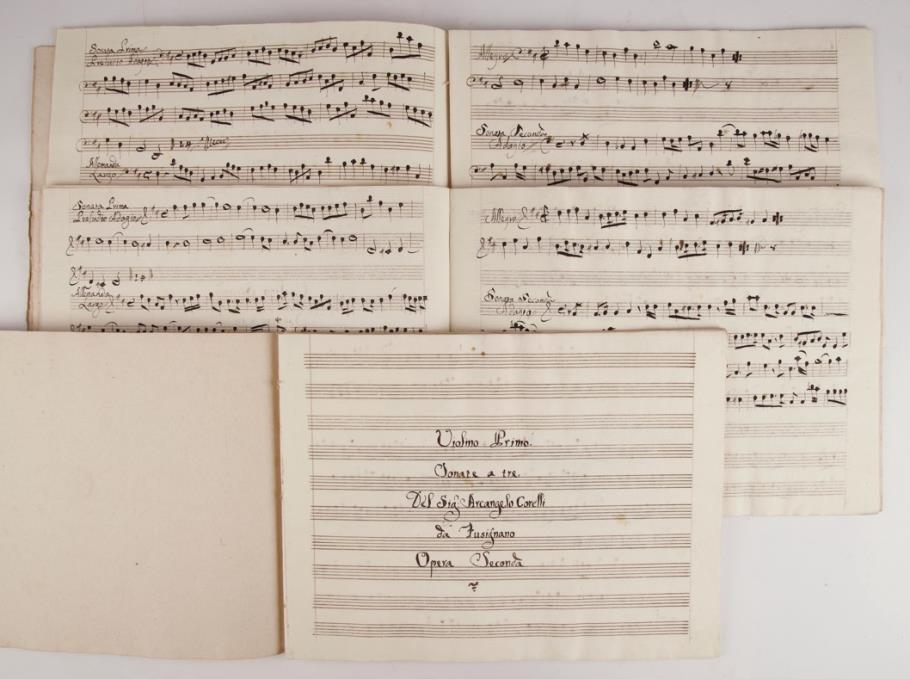
Interesting for Later 18th Century Reception of the Composer’s Music
22. CORELLI, Arcangelo 1653-1713
[Op. 2]. Sonate a tre Del Sig: Arcangelo Corelli da Fusignano Opera Seconda. [Copyist manuscript set of parts for 12 sonatas]. 18th century. Of Italian provenance.
Oblong quarto. Full plain ivory carta rustica with titling "Opera Seconda" to uppers in manuscript. Notated in black ink on 10-stave rastrum-ruled paper. Watermark of three crescent moons. The twelfth sonata is identified as Sonata Decima Seconda, in contrast to Ciaccona, as in the 1685 first edition. With the number of measures in each movement noted after double bars. Although 17th and 18th century printed editions of Op. 2 included two separate, identical bass parts (one for bowed bass and one for basso continuo, both figured), the present manuscript should not necessarily be regarded as incomplete.Wrappers slightly soiled. Minor internal wear; collection stamp to Violino primo part partially erased. In very good condition overall.
Violino primo: [i] (title), 22, [iii] (blank) pp. Violino secondo: [i] (title), 22, [i] (blank) pp. Basso [unfigured]: [i] (title), 22, [iii] (blank) pp.
Provenance
Noted American harpsichordist Louis Bagger (1926-2024); earlier smallearly oval collection stamp to front free endpapers featuring a shield with crossed swords flanked by branches with a crown above.
Corelli was a distinguished Italian composer and violinist. "Despite the modest size of his output, comprising six collections of instrumental music and a handful of other authentic works, and its virtual restriction to three genres – solo sonata, trio sonata and concerto – Corelli exercised an unparalleled influence during his lifetime and for a long time afterwards. This influence, which affected form, style and instrumental technique in equal measure, was most closely felt in Italy, and in particular in Rome, where he settled in early manhood, but soon spread beyond local and national confines to become a European phenomenon." MichaelTalbotin Grove Music Online. (41188) $600
The Art of Italian Music Engraving
23. CORELLI, Arcangelo 1653-1713
[Op. 5]. Sonate a violino e violone o cimbalo dedicate all Altezza serenissima Elettorale di Sofia Carlotta Elettrice di Brandenburgo ... Parte Prima [Parte Seconda Preludii Allemande Correnti Gighe Sarabande Gavotte e Follia]. Opera Quinta. [Roma]: Gasparo Pietra Santa [(si vendono a Pasquino all' Insegna della Stella da Filippo Farinelli)], [1700].
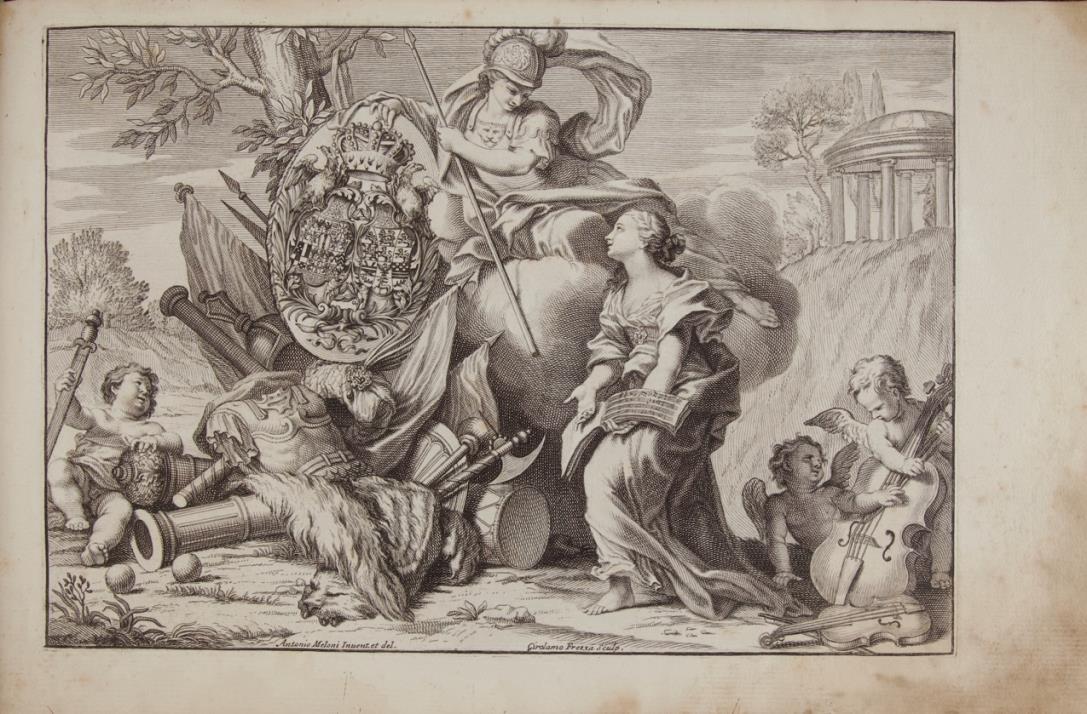
Oblong folio. Full dark brown speckled calf. 1f. (recto frontispiece, verso blank), 1f. (recto title, verso blank), 1f. (recto dedication to "Serenma. Altezza Elettorale," verso blank), 3-39 pp. music; [i] (secondary title), 41-68 pp. Engraved throughout. With a fine full-page frontispiece engraving by Girolama Frezza after a drawing by Antonio Meloni incorporating musical instruments within a classical scene depicting the goddesses of war and music. Occasional lines, dashes, and the letter "B" in contemporary manuscript to openings and conclusions of systems. Figured bass added in pencil to p. 49, mainly resolving the figure 7 down to 6. Manicule to blank lower margin of p. 55 in contemporary manuscript pointing to thematic entrance and clef change in the continuo part. Binding worn, rubbed, and bumped; spine lacking. Slightly worn; minor to moderate soiling and staining, primarily affecting blank margins. A nice, wide-margined copy overall.
Provenance
Noted American harpsichordist Louis Bagger (1926-2024)
First Edition, first issue. Marx p. 172. Hoboken Vol. 16, 54. Rinaldi p. 447. Pincherle p. 209. BUC p. 220. RISM C3801 (two copies only in the U.S.).
The first six sonatas are "church" sonatas, while the second six (with a separate title) are "chamber" sonatas, the last of which is the Follia, one of the most renowned compositions of Baroque string literature.
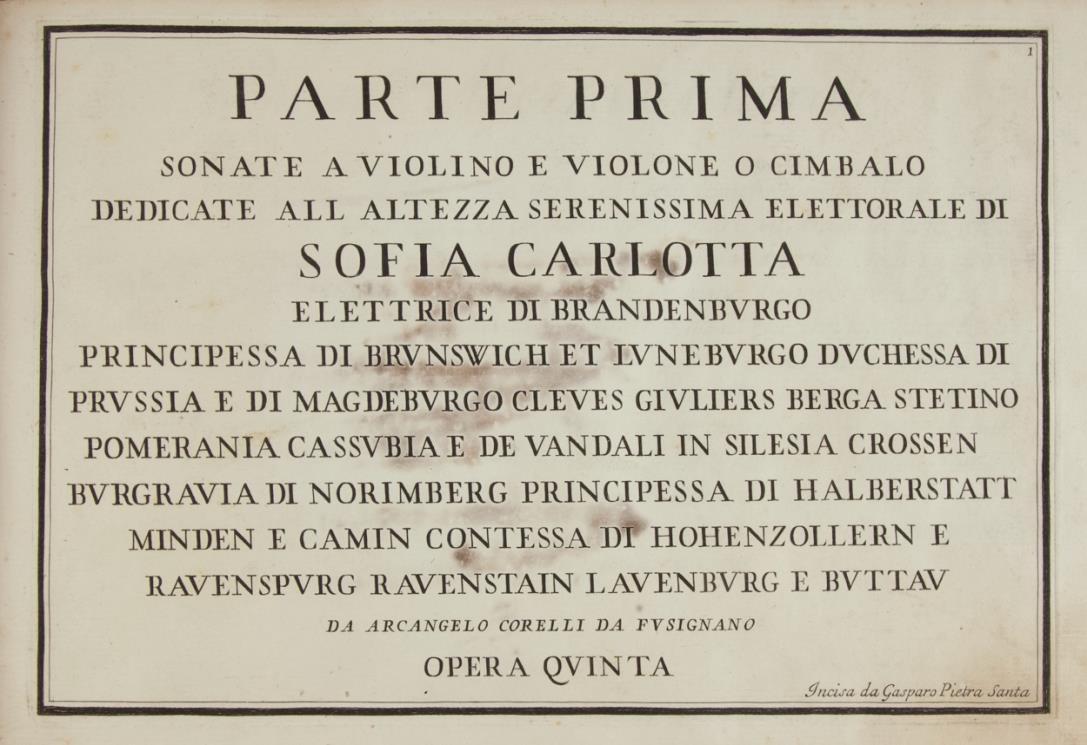
"Despite the modest size of his output, comprising six collections of instrumental music and a handful of other authentic works, and its virtual restriction to three genres – solo sonata, trio sonata and concerto – Corelli exercised an unparalleled influence during his lifetime and for a long time afterwards. This influence, which affected form, style and instrumental technique in equal measure, was most closely felt in Italy, and in particular in Rome, where he settled in early manhood, but soon spread beyond local and national confines to become a
European phenomenon. As a violinist, teacher of the violin and director of instrumental ensembles Corelli imposed standards of discipline that were unusually strict for their period and helped to lay the groundwork for further progress along the same lines during the 18th century. To Corelli belong equally the distinctions of being the first composer to derive his fame exclusively from instrumental composition, the first to owe his reputation in large part to the activity of music publishers, and the first to produce ‘classic’ instrumental works which were admired and studied long after their idiom became outmoded." Michael Talbot in Grove Music Online
An excellent example of the art and craft of Italian musicengraving and printing of the period, continuing a tradition dating from the time of Frescobaldi. (41217) $3,800
24. CROTCH, William 1775-1847
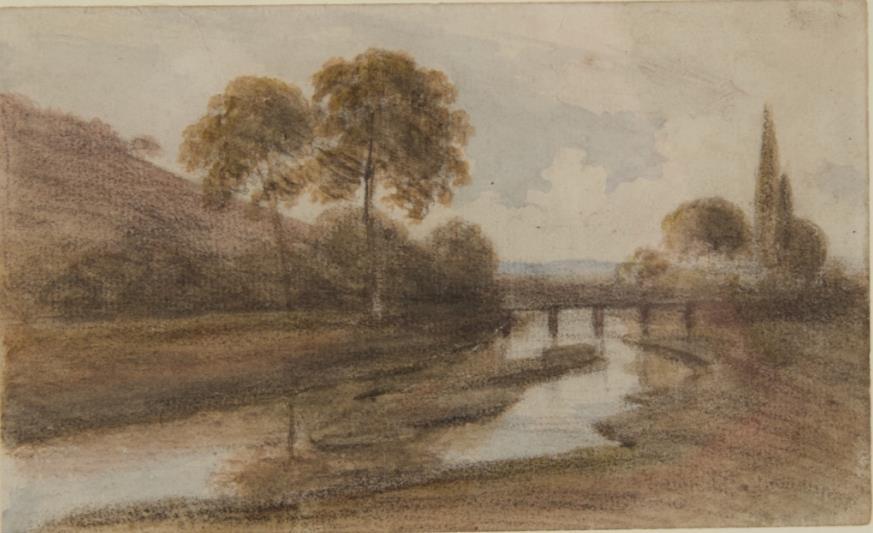
Original 19th century watercolor and chalk drawing of Whitechurch Bridge near Pangbourne. Inscribed on verso. Matted and framed under glass. 95 x 153 mm. (3.75 x 6.125"); overall size 308 x 360 mm. (12 x 14"). On laid paper.
Provenance
Printed and typed label of the "Fry Gallery Watercolours and Drawings. 58 Jermyne Street, St James's London SW1" laid down to verso, together with a note stating that the drawing is from the Estate of A. P. Oppé.
Crotch was an English composer, organist, theorist, writer, and painter. "He was an exceptional child prodigy and became one of the most distinguished English musicians of his day ... [He] was not a prolific composer and chose to concentrate largely on choral and keyboard genres. His contemporary reputation was founded on his oratorio Palestine, the first even moderately successful oratorio composed in England since Handel’s day. Handel’s music exerted a strong influence on Crotch’s own eclectic musical style and also on the formation of the musical aesthetic he expounded in his lectures ... The extraordinary range and depth of Crotch’s mental activity can be judged from his voluminous writings on many subjects besides music. The Monthly Magazine of 1800 carried his observations on the shape of the earth, speculations about the atmosphere of the moon, as well as advocating the use of a pendulum as a metronome (15 years before Maelzel discovered Winkel’s system). In 1842 he wrote A Treatise on Perspective and as an artist is regarded as a distinguished member of an ‘Oxford school’ of landscape painting that in some respects anticipated Constable, who was a close acquaintance." Nicholas Temperley and Simon Heighes in Grove Music Onlin
The Fry Gallery was well known for specializing in the sale of English watercolors and drawings from 1750 to 1900. Adolph Paul Oppé, CB, FBA (1878-1957) was a British art historian, critic, and art collector. He taught Greekandancienthistoryattheuniversities ofStAndrewsand Edinburgh;healso served(1906–1907and 1910–1913) as Deputy Director of the Victoria & Albert Museum in London. (41410) $400
Unique Autograph Manuscript Sources
25 DIET, Edmond-Marie 1854-1924
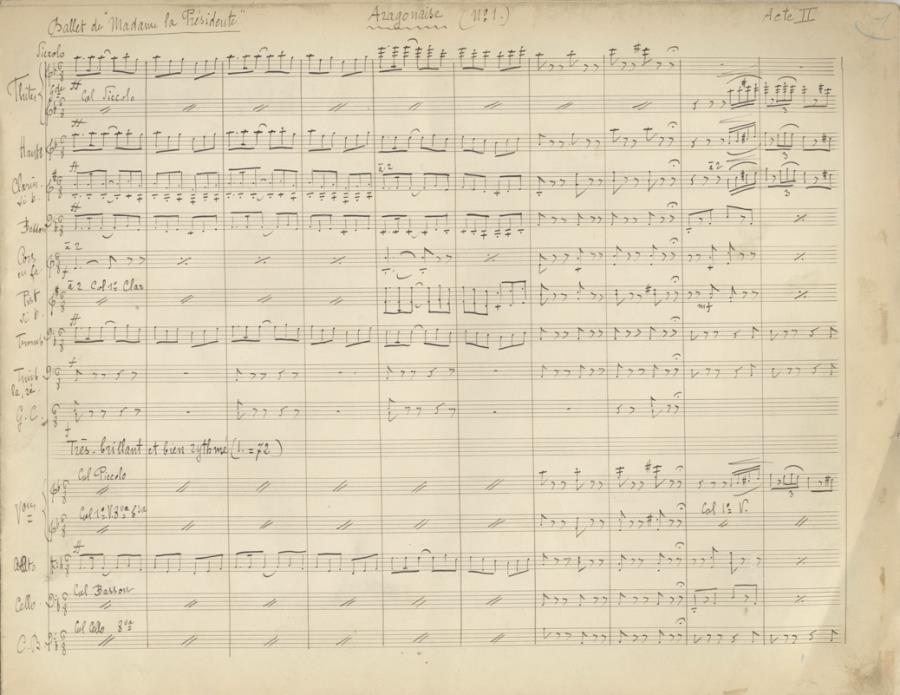
Madame La Présidente. Operetta in 3 acts. Autograph musical manuscript full score of three numbers from the ballet in Act II. Paris, [ca. 1902].
Oblong folio (269 x 346 mm). Contemporary heavy dark pink wrappers with printed title label to upper "Choudens Éditeur de Musique Paris, 30 Boulevard des Capucines Paris le ...189 [blank] " completed in manuscript: "Madame la Présidente. Ballet. (Remettre) partition d'orchestre."
21 pp. Notated in black ink on 14-stave rastrum-ruled paper. Contains "Aragonaise (No. 1) Acte II": 8 pp.; "Pas de Deux (Scène du Couteau) (No. 2) Acte II": 6 pp., 1f. (blank); "Navarraise (No. 3) Acte II": 7, [i] (blank) pp. Markings in lead and blue pencil. First performedin Parisat the Théâtre des Bouffes-Parisiens in1902. Riemann (French), p. 262. Choudens published a piano-vocal score of Madame La Présidente in 1903; this autograph fair copy was likely used to make an arrangement for that edition. Wrappers slightly worn and stained; occasional small stains, tears, and minor soiling.
Together with:
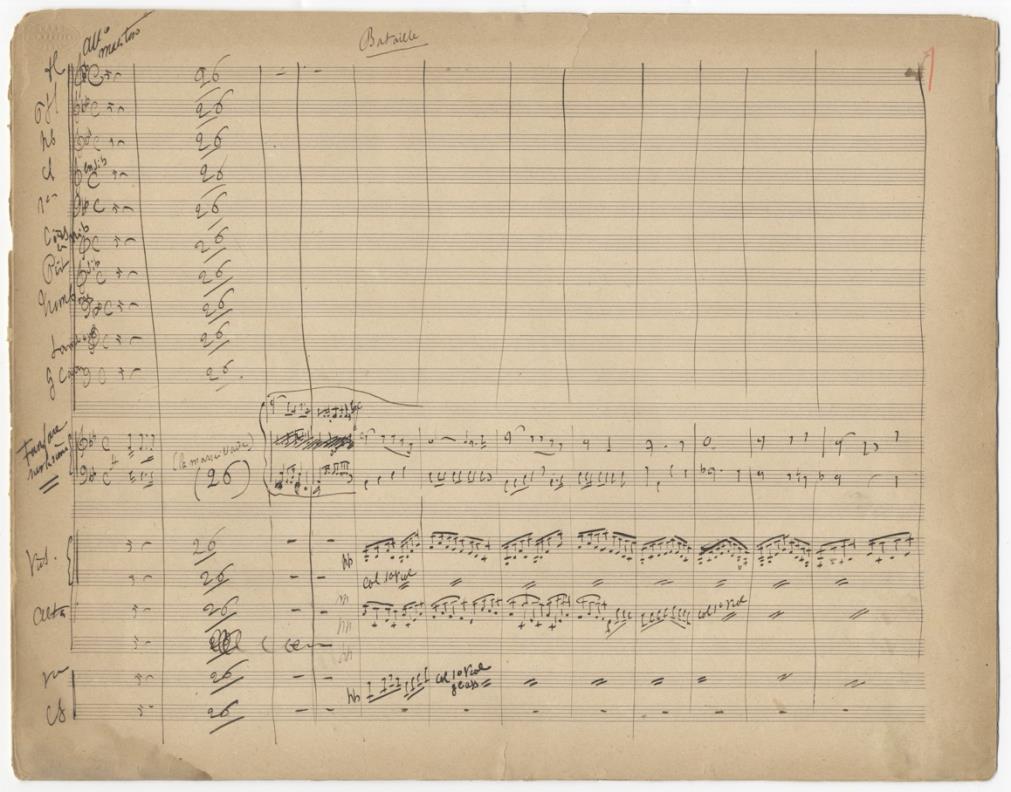
Bataille. Autograph musical manuscript full orchestral score. Ca. 1900. Oblong folio (271 x 347 mm). 9, [i] (blank) pp. Notated on 16-stave rastrum-ruled paper with small embossed blindstamp of the Parisian paper seller Lard. With markings in lead and blue pencil. A composing score with cancellations and corrections. Browned, more heavily to outer margins; some small edge tears and stains.
Together with:
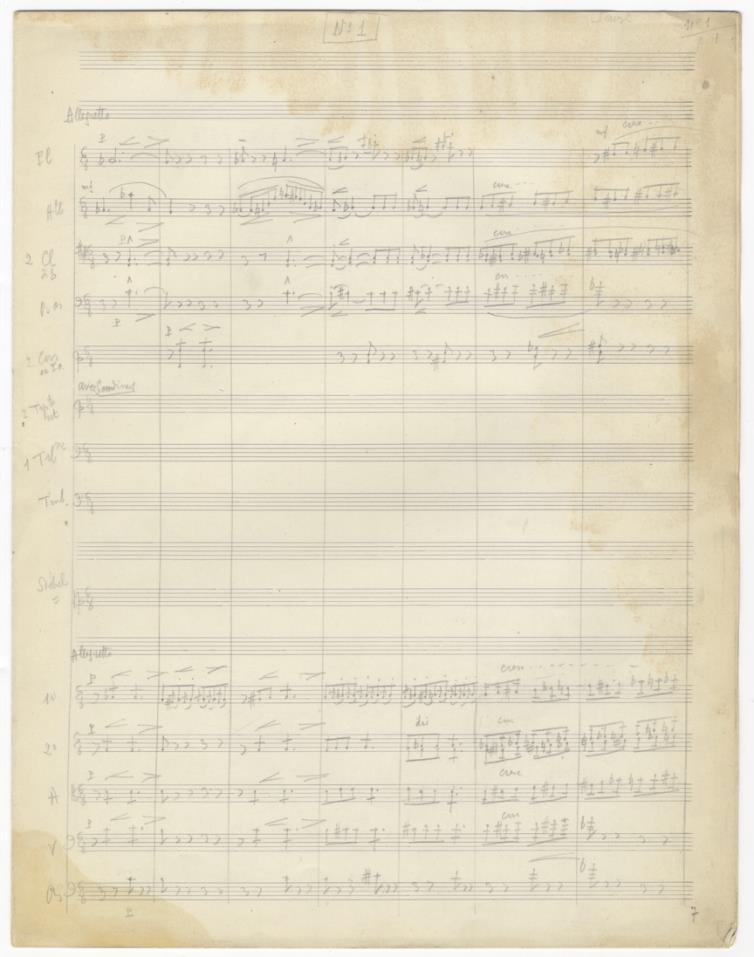
[?]Le Petit Faust. Autograph musical manuscript full score. Ca. 1900. Folio (340 x 265 mm). 105pp. Notated inpencil on 18-stave rastrum-ruled paper. Contains nine numbers from a theatrical work scored for orchestra and voices. Characters include Marguerite, Siebel, and Mephisto. Slightly worn; minor dampstaining to lower inner corners and outer edges of first leaves. In very good condition overall.
Diet was a French composer of comic operas, ballets, and pantomimes. Also a professor and music critic, he studied with both Cesar Franck and Ernest Guirand.
We have not located any other manuscript sources for any of these three works. (41255) $1,200
“The Crowning Achievement of Gluck’s Career”
26. GLUCK, Christoph Willibald 1714-1787
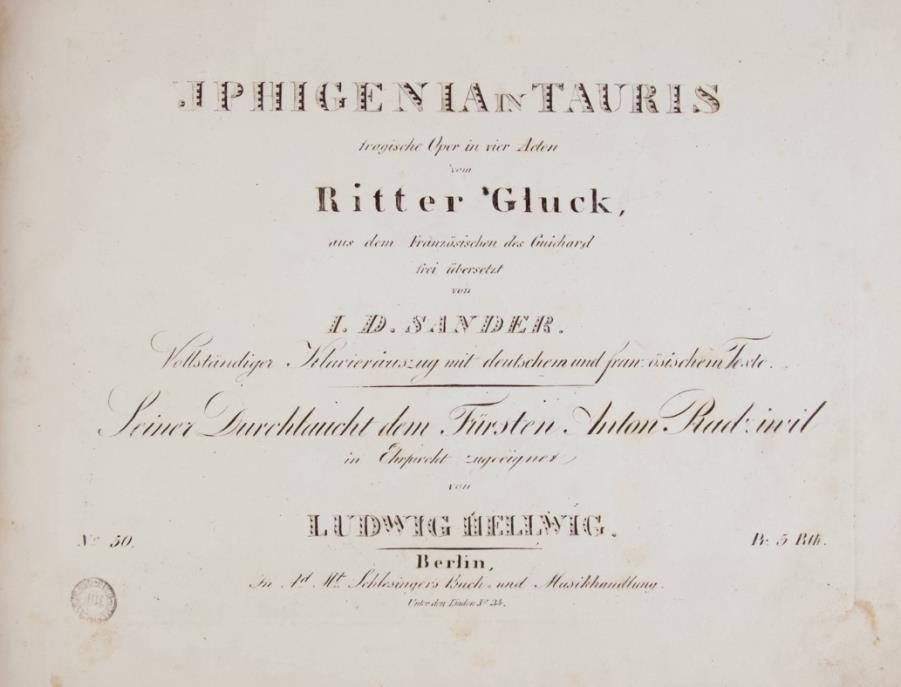
Iphigenia in Tauris tragische Oper in vier Acten ... aus dem Französischen des Guichard frei ubersetzt von I.D. Sander. Vollstandiger Klavierauszug mit deutschem und französischem Texte. Seiner Durchlaucht dem Fürsten Anton Radziwil in Ehrfurcht zugeeignet von Ludwig Hellwig. ... Pr. 5 Rth. [Piano-vocal score]. Berlin: Schlesinger's Buch= und Musikhandlung, Unter den Linden No. 34. [PN 50], [1812].
Oblong folio. Contemporary darkbrown mottledcalf-backedmarbled boards with ovallabel titled in manuscript to upper. 1f. (recto title, verso blank), [3] ("Personen" and incipits), 4-123, [i] (blank) pp. Binding worn, rubbed, and bumped. Very occasionalminor soiling to blank lower margins; occasionalminor showthrough; small stains to title, with small circular publisher's handstamp to inner margin.
Provenance
Noted American harpsichordist Louis Bagger (1926-2024).
Hopkinson 46C(a).
Gluck's work is a tragedy in four acts to a libretto by Nicolas-François Guillard after Guymond de la Touche’s Iphigénie en Tauride, itself based on Euripides’s work of the same name
"Iphigénie en Tauride was the crowning achievement of Gluck’s career, a result of the combination of his lifelong experience as an opera composer and a libretto which is arguably the best he ever set." Jeremy Hayes in Grove Music Online It was first performed in Paris at the Opéra on 18 May 1779 "with excellent singers; Rosalie Lavasseur sang Iphigénie, Larrivée Oreste, Legros Pylade, and Moreau Thoas. ... The opera had a great success immediately, and even Grimm wrote of it - I do not know whether this is melody, but perhaps it is something better. When I hear Iphigénie I forget I am at the opera; I seem to be listening to a Greek tragedy, with music by Lekain and Mlle Clarion. It was the crowning point of Gluck's career. Guillard had provided an excellent libretto, more classical than Goethe's poem, less Christian and more ruthless; and Gluck had seized on the contrast between Scythians and Greeks, upon the perfectly dramatic figures of Iphigenia and Orestes, and had produced a work which both re-created a part of Greek tragedy and at the same time foretold a new world." Cooper: Gluck, p. 258. (41214) $200
With Noted Double Choruses
27. HANDEL, George Frideric 1685-1759
[HWV 54]. Israel in Egypt A Sacred Oratorio In Score Composed in the Year 1738 ... Pr. 2.2.0. [Full score]. London: D'Almaine & Co. Soho Square, [ca. 1840].
Folio. Full contemporary dark green textured cloth with decorative blindstamped panels to both boards, titling gilt to spine. 1f. (recto title, verso blank), 3-282 pp. With table of contents to final page. Engraved throughout. Binding considerably worn, rubbed, and bumped; joints and hinges split; endpapers soiled. Minor internal wear; browned; several signatures split; occasional minor stains; small tears to several blank lower margins repaired with archival tape.
Provenance
Noted American harpsichordist Louis Bagger (1926-2024 )
OCLC 498111526 ("Reprinted mainly from the plates of Arnold's edition of Handel's works").
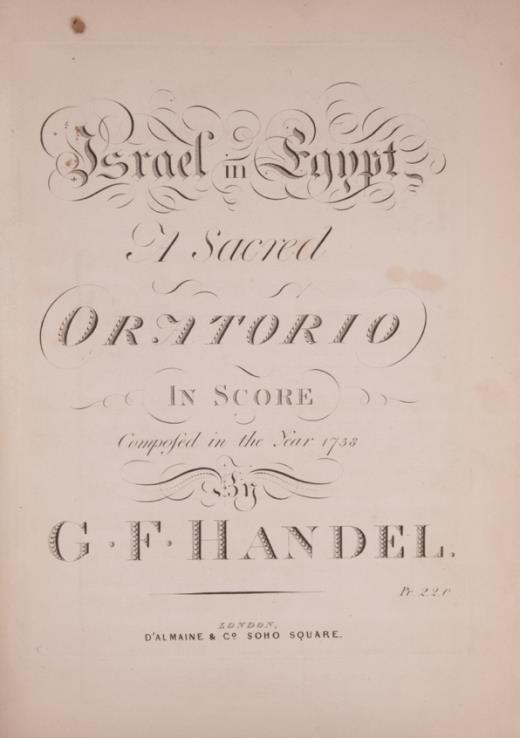
Famous for its double choruses, Israel in Egypt, a biblical oratorio, was first performedin Londonatthe King's Theatrein the Haymarket on 4 April 1739 totext consisting of selected passages from Exodus and the Psalms, most probably compiled by the composer. (41202) $100
Coronation Anthems including Zadok, Performed for Every British Coronation
28. HANDEL, George Frideric 1685-1759
[HWV 258, 259, and 260]. Handel's Celebrated Coronation Anthems in Score for Voices and Instruments Vol. I. [Price 12:0]. [Full scores]. London: Printed for William Randall Successor to the late Mr. Walsh in Catharine Street in the Strand, [1769].
Folio. Disbound. Nineteenth-century half dark brown pebbled cloth with matching boards. 1f. (recto title, verso blank), [i] (blank), 2-53, [i] (blank), 55-98 pp. Engraved throughout. Binding worn, rubbed, and bumped; upper detached. Slightly worn and browned; stain affecting title (the word "Score") and three following leaves, to a lesser extent; occasional minor foxing to blank margins.
Contains:
Anthem I, Zadok the Priest. HWV 258
Anthem III, Let thy Hand be Strength. HWV 259
Coronation Anthem, The King shall rejoice. HWV 260
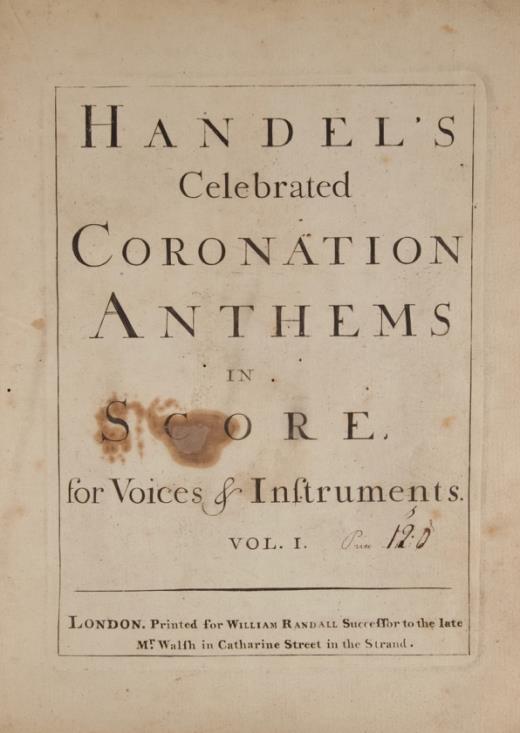
Provenance: Noted American harpsichordist Louis Bagger (1926-2024).
Second edition. Smith p. 151, no. 3. BUC p. 423. RISM H1161 (two copies in the U.S. only, at the University of Minnesota Music Library and the Library of Congress).
"Despite his involvement with opera, Handel found time for other musical activities in the 1720s. On 25 February 1723 he was made Composer of Music for His Majesty’s Chapel Royal – an honorary appointment because, as an alien, he could not hold an office of profit under the Crown. The title seems simply to have given official recognition to his role in supplying occasional music for the Chapel Royal, which in the mid-1720s included three orchestrally accompanied anthems and the Te Deum in A, all based to some extent on works written for Cannons. An exceptional opportunity for ceremonial church music arose after the unexpected death of George I in June 1727. For the coronation of his successor George II and his consort Queen Caroline at Westminster Abbey on 11 October Handel provided four new anthems of great splendour, showing how much he welcomed the chance to use the massed forces not available to him in the opera house. They included Zadok the Priest, which has been sung at every subsequent coronation of a British monarch. According to Burney (Sketch, p.34) Handel ‘took offence’ at being provided with the words of the anthems ‘by the bishops’, murmuring ‘I have read my Bible very well, and shall chuse for myself’." Anthony Hicks in Grove Music Online
With one of the composer’s most iconic and recognizable works, Zadok, still performed for every British coronation. (41199) $650
Funeral & Wedding Anthems
29. HANDEL, George Frideric 1685-1759
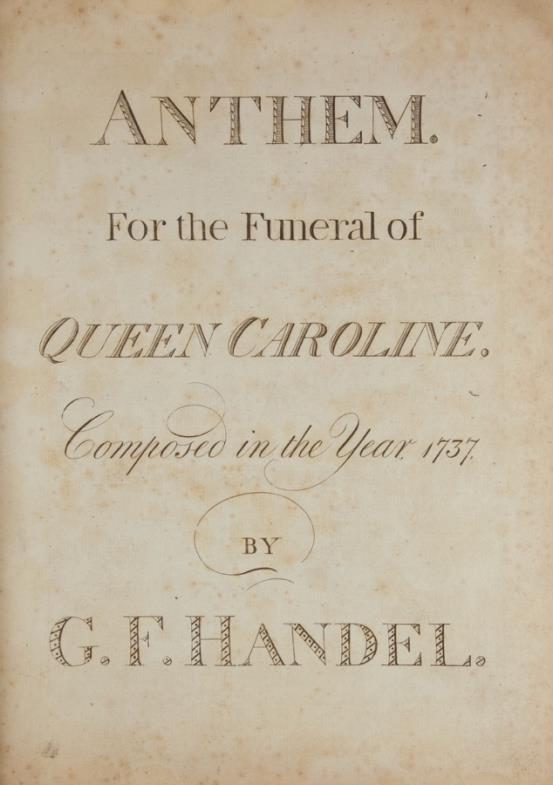
[HWV 264]. Anthem For the Funeral of Queen Caroline. Composed in the Year 1737. [Full score]. London: Arnold, [ca. 1795].
1f. (recto title, verso blank), 3-80 pp., 1f. (recto contents, verso blank). Engraved throughout. First Edition. Smith p. 154, no. 7. Arnold editions 155-156. RISM H1558.
"In 1737 Handel marked the death of Queen Caroline with his funeral anthem The Ways of Zion do Mourn, where a real sense of personal grief is reinforced in the music by Lutheran Chorale fragments and other quotations from German masters (including Jacobus Handl’s funeral motet Ecce quomodo moritur justus), surely in reference to the common heritage of the composer and the queen." Anthony Hicks in Grove Music Online. The anthem is a particularly personal and poignant sacred work.
Bound with:
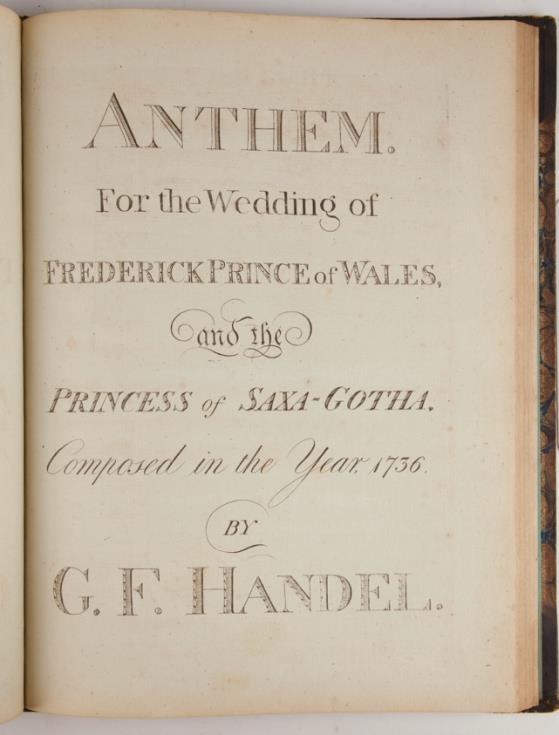
Anthem For the Wedding of Frederick Prince of Wales, and the Princess of Saxa-Gotha, Composed in the the Year 1736. [HWV 263]. [Full score] London: Arnold, [ca. 1795]. Large folio (273 x 372 mm). 1f. (recto title, verso blank), 3-85, [i] (blank) pp., 1f., [87] (recto contents, verso blank) pp. Engraved throughout. Arnold edition 153-154. Smith p. 155. RISM H1557.
"The wedding of the Prince of Wales on 27 April [1736] gave Handel an excuse for a short celebratory opera season consisting of a revival of Ariodante (in which Gioacchino Conti, a new castrato, was allowed to include nonHandelian arias from his previous continental repertory) and eight performances of the newly composed Atalanta (12 May 1736) – light in mood, as befitted the occasion, but not at all shallow; Frederick ostentatiously refused to attend the first night. Handel again supplied a wedding anthem (Sing unto God) for the ceremony itself, most of the music being new but with the final solo and chorus from Parnasso in festa re-used to make an exhilarating conclusion."
Anthony Hicks in Grove Music Online
Provenance
Noted American harpsichordist Louis Bagger (1926-2024).
Large folio (273 x 372 mm). Contemporary half black textured leather with marbled boards, raised bands on spine in gilt-ruled compartments, titling gilt. Binding worn, rubbed, and bumped. Slightly worn; light uniform browning; occasional foxing. (41219) $600
With Subscribers Including Charles Burney
30 HANDEL, George Frideric 1685-1759
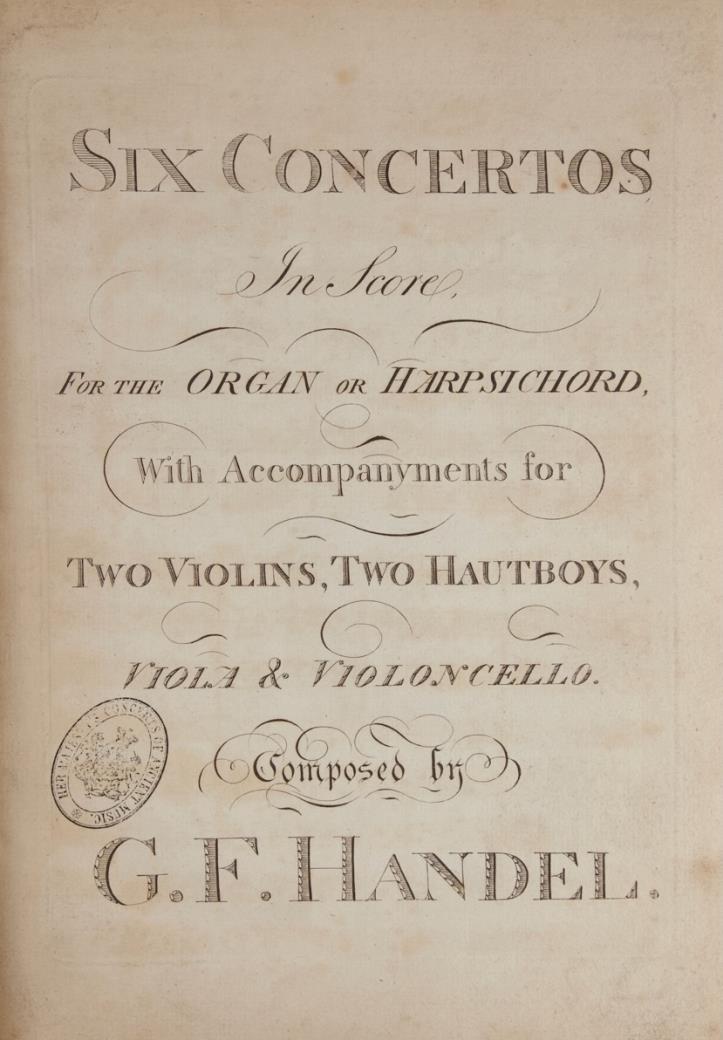
[Op. 4, HWV 289-294; Op. 7, HWV 306-311]. Six Concertos In Score For the Organ or Harpsichord With Accompanyments for Two Violins, Two Hautboys, Viola, & Violoncello. [Full score]. [London]: [Samuel Arnold], [ca. 1795].
Folio. Half modern ivory cloth with dark blue boards. Engraved throughout.
Contains:
Op. 4, HWV 289-294, Arnold editions 121-124
HWV 289: 1f. (recto title, verso blank), 3-52 pp.
HWV 290: 3-23, [i] (blank) pp.
HWV 292: 3-30 pp.
HWV 291: 3-16 pp.
HWV 293: 3-11 pp.
HWV 294: 3-13 pp.
Bound with:
A Second Set of Six Concertos In Score, for the Organ or Harpsichord, With Accompanyments for Two Violins, Two Hautboys, Viola & Violoncello
Op. 7, HWV 306-311, Arnold editions 125128
HWV 306: 1f. (recto title "A Second Set of Six Concertos," verso blank), 3-43 pp.
HWV 307: 44-74 pp
HWV 308: 75-113 pp.
HWV 309: 114-142 pp.
HWV 310: 143-166 pp.
HWV 311: 167-184, 1f. (subscribers list) pp.
Subscribers include Charles Burney, John Wall Callcott, and Gertrud Elisabeth Mara. Binding slightly worn, soiled, and rubbed; endpapers browned and chipped; hinges splitting. Occasionalminorfoxing, soiling, and small stains to blank margins; minor tears and losses to subscribers list, mainly to blank outer margin. Withovalhandstampof"herMajesty's Concerts of Ancient Music" to lower inner margin of first title.
Provenance
Noted American harpsichordist Louis Bagger (1926-2024).
Arnold editions 121-128. Smith 22, p. 228. Smith 8, p. 232. BUC p. 419. RISM H1544 and H1545.
The third movement, Allegro, of HWV 309 also appears in Handel's harpsichord suite, HWV 428; a "viral" piece of music, it circulated widely in manuscript in the 18th century.
"The organ concerto was effectively Handel’s own invention, allowing him to display his abilities in both performance and composition simultaneously, and most of his oratorio concerts included one or more from 1735 onwards. Six (one originally a harp concerto, delicately scored for muted strings and recorders) were collected and published by Walsh in 1738 as Handel’s op.4. No.2 in B♭and no.3 in G minor, the earliest to be composed, draw on the op.2 trio sonatas for their material, and no.5 is simply an arrangement of a recorder sonata, but nos.1 in G minor and 4 in F are more expansive and original pieces. The Andante second movement of the latter imaginatively blends an organ registration of ‘Open Diapason, Stopt Diapason & Flute’ with pianissimo strings. In his next two organ concertos (hwv295 and 296a, called the ‘Second Set’ concertos because keyboard arrangements of them and four of the op.6 concertos were published under that title in 1740), Handel indicates for the first time that improvised solo organ movements are to be inserted ‘ad libitum’. The same requirement also appears in the later organ concertos composed between 1740 and 1751, and published posthumously as op.7. There are several striking movements in this set, none more so than the opening of no.1 in B♭ , a magnificent chaconne (though not so called) in two sections with a part for pedal organ, though whether Handel was ever able to play it on such an instrument is not known." Anthony Hicks in Grove Music Online. (41189) $550
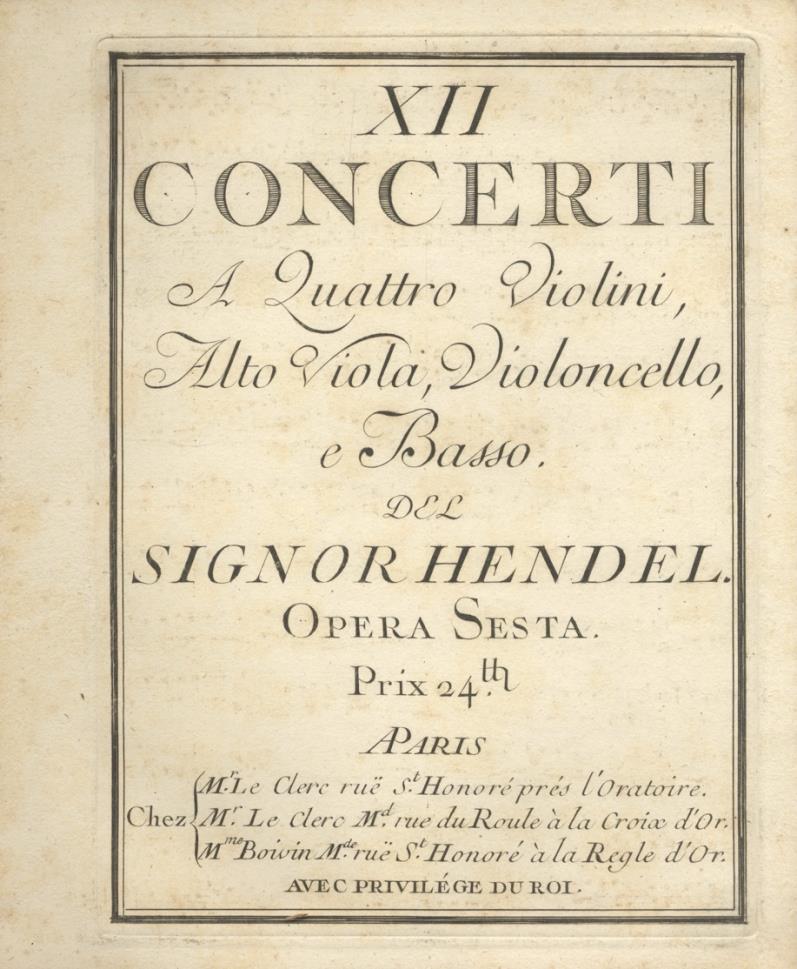
The Rare 12 Concerti Grossi
31. HANDEL, George Frideric 1685-1759 [HWV 319-330]. XII Concerti A Quattro Violini, Alto Viola, Violoncello, e Basso ... Opera Sesta. Prix 24₶. [Concerti Grossi Op. 6]. [Set of parts]. Paris: Chez Mr. Le Clerc ruë St. Honoré prés l'Oratoire. ... Mr. Le Clerc Md. rue du Roule à la Croix d'Or ... Mme. Boivin Mde. ruë St. Honoré à la Regle d'Or, [1751].
Quarto. Contemporary carta rustica with titling in manuscript to uppers. Engraved throughout. Occasional later 18th centuryannotations in manuscript. Wrappers slightly soiled, foxed, and stained. Minor wear, dampstaining, and foxing. A very good copy overall.
Violino primo: 1f. (recto title, verso blank), 1f. (recto "Catalogue de Musique Françoise et Italienne que le Sieur Le Clerc Organiste de la Chapelle du Roy et de l’Academie Royale de Musique a fait Graver et se vendent a Paris en ses villes ordinaires et chez le dit Sieur rue S. Honoré vis-à-vis le Portail de l'Oratoire et chez Mlle Boivin au 2e il [continué] de faire Graveur tous les meilleurs Auteurs tant anciens que nouveaux," verso blank), 2-38 pp.
Violino secondo: 1f. (recto title, verso blank), [i] (blank), 2-30 pp.
Violino terzo: 1f. (recto title, verso blank), [i] (blank), 2-31, [i] (blank) pp.
Violino quarto: 1f. (recto title, verso blank), [i] (blank), 2-26 pp.
Viola: 1f. (recto title, verso blank), [i] (blank), 2-23, [i] (blank) pp.
Violoncello: 1f. (recto title, verso blank), [i] (blank), 2-27, [i] (blank) pp.
Basso continuo: 1f. (recto title, verso blank), [i] (blank), 2-24 pp.
Provenance: Noted American harpsichordist Louis Bagger (1926-2024)
Very rare. First French edition of the complete set. Smith p. 223, no. 8. Lesure p. 291. OCLC 658629843. RISM H1259 (one complete copy only, at the Bibliothèque nationale).
"The 12 concerti grossi or ‘Grand Concertos’ written in a burst of creative energy in September and October 1739 were consciously conceived as an integral set, clearly in emulation (though not imitation) of Corelli’s famous set with the same opus number and the same scoring for a concertino of two violins and cello with fourpart ripieno strings and continuo. (Handel later added oboe parts to nos.1, 2, 5 and 6, mostly doubling the ripieno violins.) Each concerto has an individual form. Many movements blend inextricably the majesty of the French manner with italianate fluency, and a prodigious stream of invention coupled with intensity of feeling is maintained thoughout the set. The fact that earlier material is sometimes drawn upon (three of the concertos are based on the overture to the Ode for St Cecilia’s Day and the two ‘Second Set’ organ concertos) does not diminish the achievement, since the adaptations are fascinating and often radical in themselves, and the recognition that several thematic elements are derived from Scarlatti’s Essercizi simply leads to admiration of the way Handel transforms them and uses them to build larger structures. The Polonaise in no.3 and the grave Musette of no.6 are haunting amplifications of standard dance forms. The set is an apotheosis of the Baroque concerto, to be set alongside the Brandenburg Concertos of Bach, as well as an epitome of Handel’s art, drawing on many sources and influences and uniting them in a style uniquely his own." Anthony Hicks in Grove Music Online. (41212) $2,500
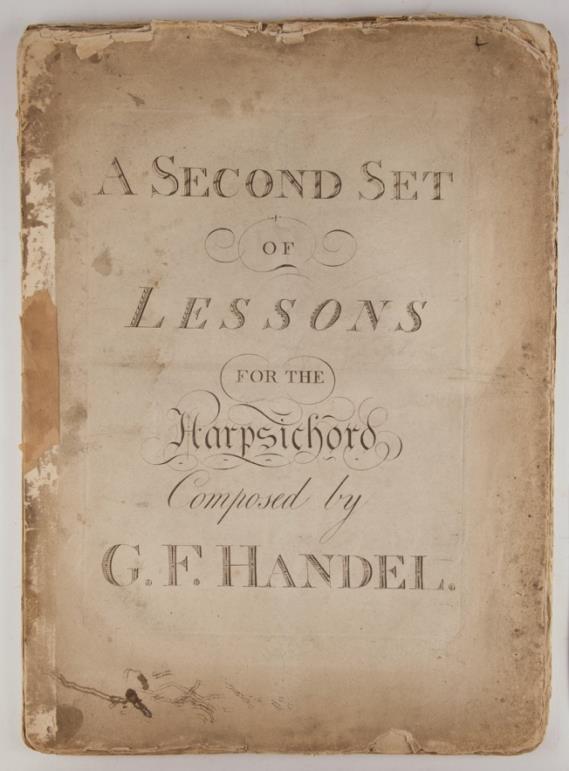
Harpsichord Lessons
32. HANDEL, George Frideric 1685-1759 [HWV 434, 435, 436, 437, 438, 439, 440, 441, and 442]. A Second Set of Lessons for the Harpsichord [London]: [Arnold], [ca. 1793].
Tall folio. Disbound. 1f. (recto title, verso blank), 3-60 pp. Engraved throughout. Worn; some soiling and staining, most notably to title; margins frayed, with small tears, creases, and minor loss
Provenance
Noted American harpsichordist Louis Bagger (19262024)
Arnold edition, nos. 129-130. Smith 13, p. 251. BUC p. 419. RISM H1547. (41206) $150
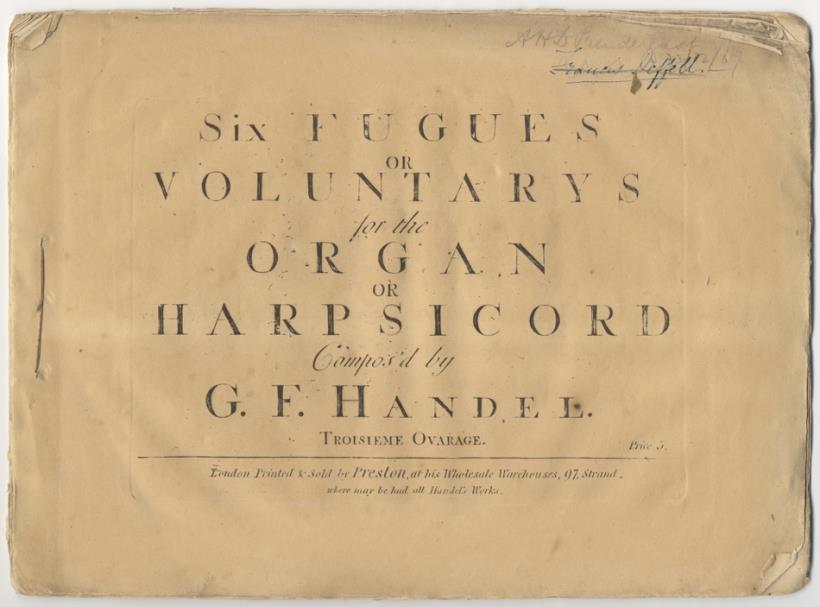
From the Young Composer
33. HANDEL, George Frideric 1685-1759 [HWV 605-610]. Six Fugues or Voluntarys for the Organ or Harpsicord ... Troisieme Ovarage[!]. Price 5. London: Printed & Sold by Preston, at his Wholesale Warehouses, 97, Strand where may be had all Handel's Works, [1821].
Oblong folio. Plain contemporary wrappers. 1f. (recto title, verso blank), [i] (blank), 2-23, [i] (blank) pp. Engraved throughout. Watermark dated 1821 Signature of 19th century musician Francis Deffell in blue ink to upper outer corner of upper wrapper and again to upper outer corner of title, together with "AHB Prendergast" in pencil. Wrappers quite worn and chipped; detached. Minor internal wear; some soiling and staining; title slightly browned.
Provenance
Noted American harpsichordist Louis Bagger (1926-2024)
Smith p. 236, no. 3. BUC p. 441. RISM H1482 and HH1482 (two copies in the U.S., at the New England Conservatory and Princeton University).
"The collections of keyboard music published in Handel’s lifetime are only a partial representation of a larger corpus of such works (the remainder being preserved in early manuscript copies and a few autographs) and their dates of issue have little correspondence with dates of composition. ... In 1734 Walsh printed four keyboard pieces said to be from Handel’s ‘early youth’, and in 1735 Six Fugues or Voluntarys, picking up the fugues of 1712–17 not used in the 1720 suites; these were well worth publishing, however, the fugues in A minor and C minor being particularly impressive." Anthony Hicks in Grove Music Online
A lively and rigorous set of pieces from the young composer. (41197) $150
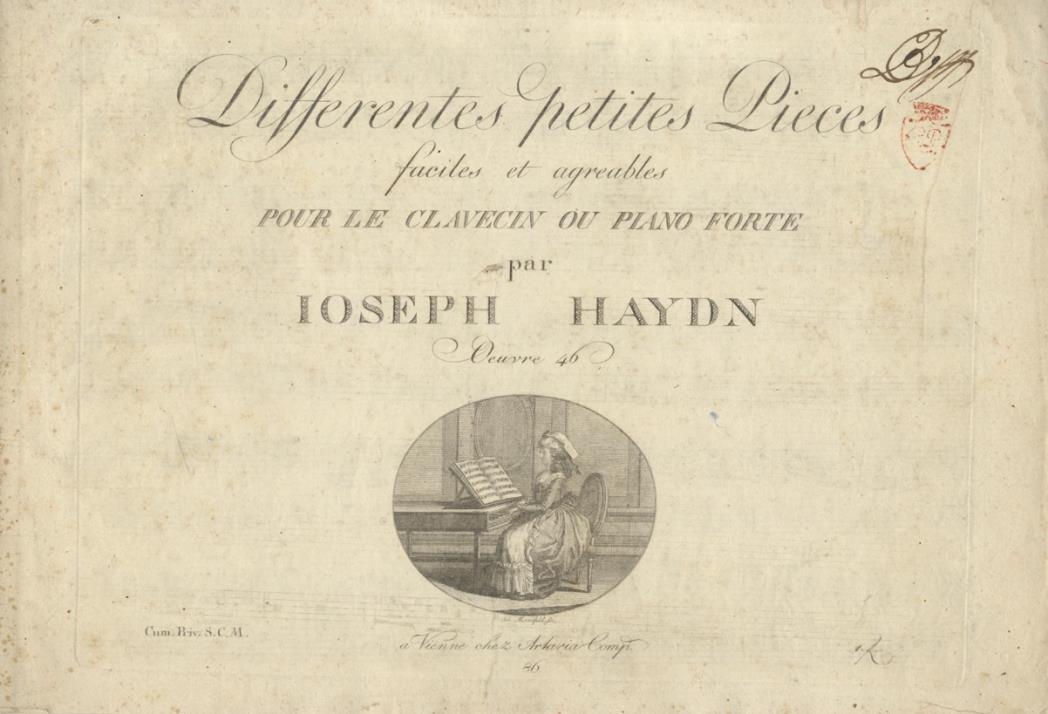
Short Keyboard Works
34. HAYDN, Joseph 1732-1809
Differentes petites Pieces faciles et agreables pour le Clavecin ou Piano Forte ... Oeuvre 46. Cum. Priv. S.C.M. 1fl . Vienne: Chez Artaria Comp. [PN 86], [1786].
Oblong folio. Disbound. [i] (title with oval vignette engraved by Seb. Mansfeld of an aristocratic lady seated at a fortepiano playing from a large folio music book), 2-15, [i] (blank) pp. Engraved throughout. With contemporary signature and early stamp incorporating a shield topped by a crown to blank upper outer corner of title. Slightly worn; minor foxing, mainly to blank margins of title; small dampstain to upper outer corner; some pages with irregular vertical ink lines as a result of printing from cracked plates
Contains 10 short works for keyboard including arrangements of music from Haydn's opera, La Vera Costanza.
First Edition in this form. Rare. Weinmann p. 18. Hob. I:81/2, Hob. XXVIII:8/6, Hob. I:79/2, Hob. I:85/3, Hob. I:85/2, Hob. Ia:15/2, Hob. XVII:9, Hob. XXVIII:8, Hob. I:53/2, Hob. III:41/4. RISM H 4300and HH 4300 (no copies in the U.S.).
Haydn "began his career in the traditional patronage system of the late Austrian Baroque, and ended as a ‘free’ artist within the burgeoning Romanticism of the early 19th century. Famous as early as the mid-1760s, by the 1780s he had become the most celebrated composer of his time, and from the 1790s until his death was a culturehero throughout Europe. Since the early 19th century he has been venerated as the first of the three ‘Viennese Classics’ (Haydn, Mozart, Beethoven). He excelled in every musical genre; during the first half of his career his vocal works were as famous as his instrumental ones, although after his death the reception of his music focussed on the latter (except for The Creation). He is familiarly known as the ‘father of the symphony’ and could with greater justice be thus regarded for the string quartet; no other composer approaches his combination of productivity, quality, and historical importance in these genres. In the 20th century he was understood primarily as an ‘absolute’ musician (exhibiting wit, originality of form, motivic saturation, and a ‘modernist’ tendency to problematize music rather than merely to compose it), but earnestness, depth of feeling, and referential tendencies are equally important to his art." Georg Feder and James Webster in Grove Music Online (41286) $750
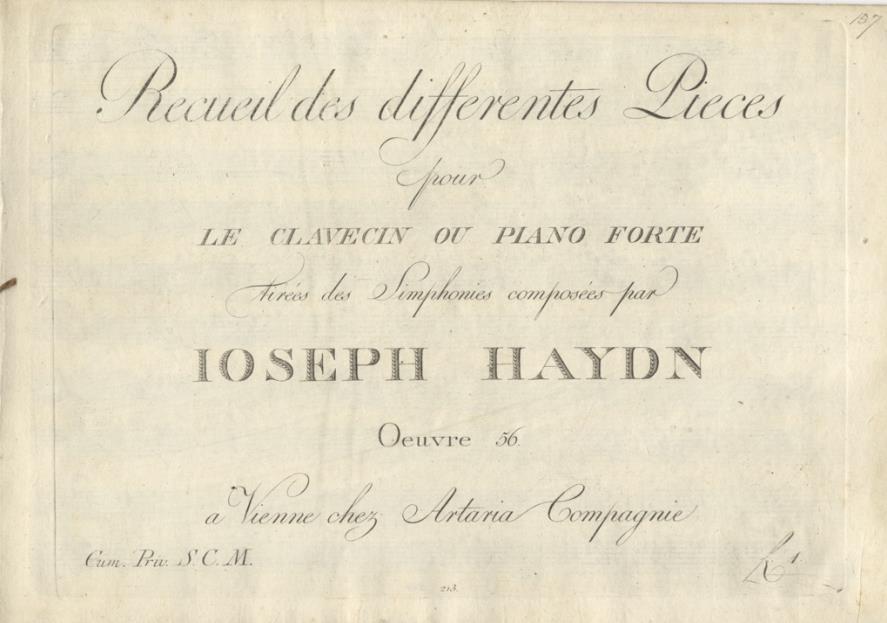
Piano Arrangements from the Symphonies
35. HAYDN, Joseph 1732-1809
Recueil des differentes Pieces pour le Clavecin ou Piano Forte Tirées des Simphonies ... Oeuvre 56 .Cum. Priv. S.C.M. fl.1. [Piano arrangements of movements from symphonies]. Vienne: chez Artaria Compagnie [PN 213], [1788].
Oblong folio. Disbound. [i] (title), 2-14 pp., 1f. (blank). Engraved throughout. With contemporary manuscript pagination 157-170 to upper outer corners. Somewhat closely trimmed at upper margin, not affecting notation
Contains arrangements of movements from Haydn's symphonies.
First Edition in this form. Weinmann p. 23. Hob. I:87/2, Hob. I:86/3, Hob. I:85/4, Hob. I:82/2, Hob. I:82/4. RISM H4310 and HH4310 (no copies in the U.S.). (41287) $500
Signed by the Composer
36. KABALEVSKY, Dmitry 1904-1987
The Comedians ... Suite for Small Symphony Orchestra ... [Op. 26]. [Full score]. Moscow ... Leningrad: State Music Publishers [PN M. 18231 R.], 1946.
Quarto. Original publisher's ivory wrappers with titling within decorative border printed in brown; price of II. 37 p. 50 K. and "No. 182" printed to verso of lower wrapper. Title in Russian and English. 1f. (recto title, verso orchestral forces), 3-99, [i] (contents and colophon). Narrow strip of paper tape to spine. Minor internal wear and browning; some signatures loose. In very good condition overall.
With an autograph inscription from the composer in blueinktolower portion oftitle inRussian ("Todear André Ameller with friendly love and very best wishes") signed "D Kabalevsky" and dated "19 II 1974" [19 February 1974], Mockba [Moscow]. Signed
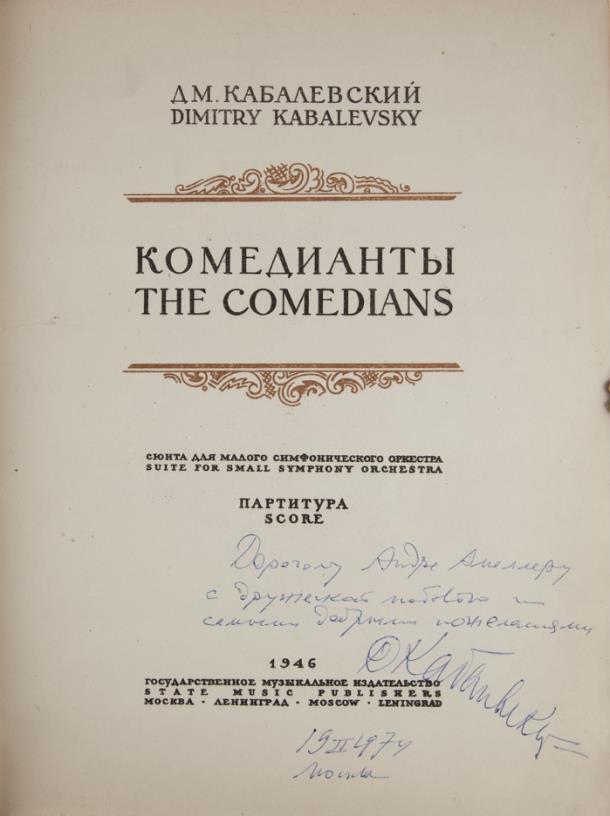
againatfootoffirstpageofmusic, andwithnumerousautographcorrectionsinblueinktoover45pp.,consisting primarily of dynamic and tempo indications.
Kabalevksy's popular Komedianti (The Comedians), an orchestral suite in ten numbers, is one of the composer's best known and loved works; it contains the Comedians' Galop, the most famous of the composer's works. It was the theme tune of the American game show Masquerade Party for many years and is traditionally played on sports days in Japan. (41402) $750
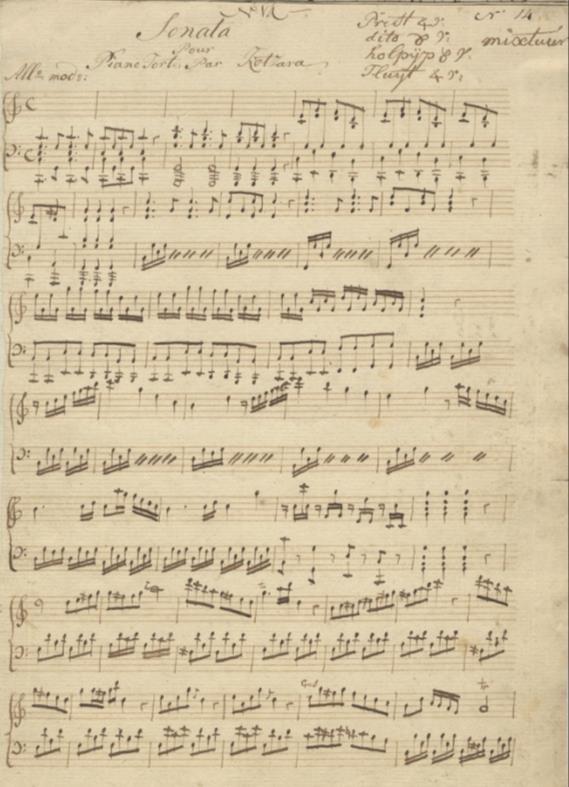
By
the Composer of the “Phenomenally Successful”
The Battle of Prague
37 KOTZWARA, Franz 1750-1791
Sonata pour Piano Forte par Kotzara[!]. [Op. 35, no. 1]. [Copyist manuscript keyboard part]. [?Netherlands], [ca. 1792].
Folio (241 x 322 mm). Notated on 14-stave rastrum-ruled paper. 8 pp. In two movements, Allegro moderato and Rondo allegretto. With annotation in contemporary manuscript in Dutch to head of first page assigning organ registration and "Præst 4 v: dito 8 v: holpijp 8 v. Fluyt 4 v: mixtuur." with "No. 14" to upper outer corner of first page. Slightly worn, foxed, soiled, and stained; small tear to blank outer margin of first leaf repaired with archival tape. Kotzwara's Op. 35, no. 1 was published by Bland in ca. 1791. BUC p. 796.
Together with:
Keyboard sonata. Folio (243 x 331 mm). Ca. 1790. Notated on 14-stave rastrum-ruled paper in the same hand as above. 7, [i] (blank) pp. With instrument designation "Cembalo" to head of first page. In three movements, untitled, Minuetto, and Allegro molto. Unlocated. With "No. 9" to upper outer corner of first page.
A Bohemian instrumentalist and composer, Kotzwara "seems to have been something of a vagabond, although his mature career centred on England. His music was published in London from about 1775: a catalogue issued by the publisher John Welcker in that year lists collections of trio sonatas and string quartets; a second set of trios was added to the plate about 1776. The title pages for the quartets op.3 and the trios for various combinations list the author at Bath; the first edition of op.5 gives a London address; and in the late 1780s he was in Ireland. Back in London he took part in the Concert of Ancient Music and in the Handel Commemoration of May 1791. ...
Though it commemorated a much earlier event (1757), Kocžwara’s The Battle of Prague was first published while he was in Dublin about 1788. It had phenomenal success and was widely reprinted in London, the USA and on the Continent (nearly 40 issues have survived). First published with accompaniments, it also became a standard parlour piece for solo piano and in Boston it was ‘indespensable to climax every concert’. Appearing shortly before widespread political upheaval in Europe, it served as the model for a host of imitations describing Napoleonic engagements. The Siege of Quebec, also attributed to Kocžwara, is instead an arrangement by W.B. de Krifft appropriating some material from Kocžwara." Ronald R. Kidd in Grove Music Online. (41289) $100
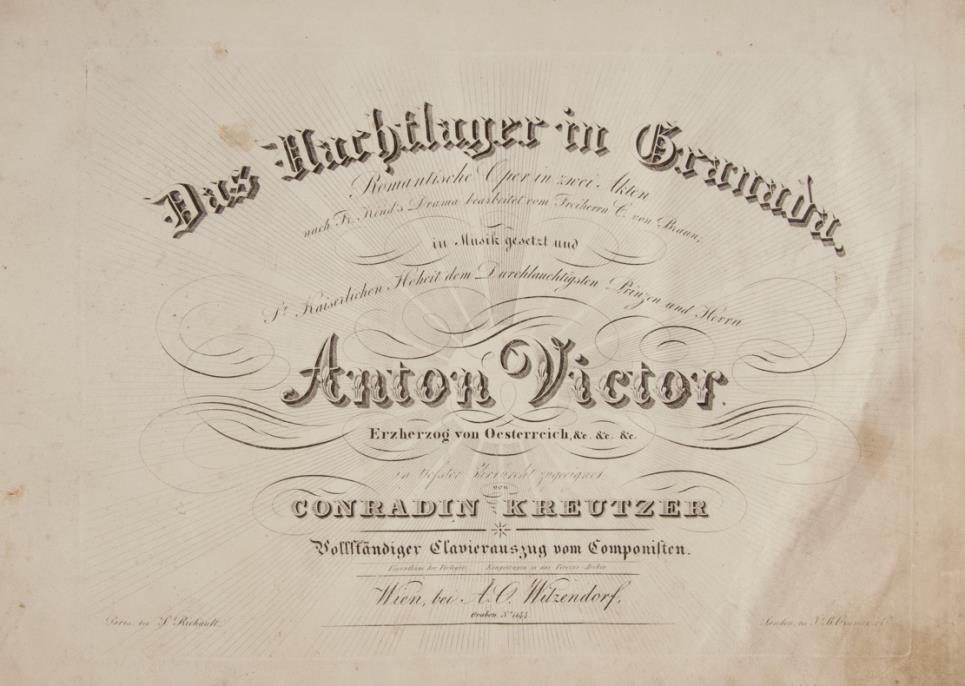
One of the Composer’s Greatest Successes
38. KREUTZER, Conradin 1780-1849
Das Nachtlager in Granada. Romantische Oper in zwei Akten nach Fr. Kind’s Drama bearbeitet vom Freiherrn C. von Braun, in Musik gesetzt und Sr. Kaiserlichen Hoheit dem Durchlauchtigsten Prinzen und Herrn Anton Victor Erzherzog von Oesterreich, &c. &c. &c. in tiefster Ehrfurcht zugeeignet ... Vollständiger Clavierauszug vom Componisten. [Piano-vocal score]. Wien: bei A. O. Witzendorf [PN A.O.W. 2764], [1834].
Oblong folio. Contemporary black cloth-backed marbled boards with portion of upper original publisher's wrapper laid down to upper. 1f. (recto title, verso blank), [i] ("Personen," "Inhalt"), 2-34, [i] (blank), 36-183, [i] (blank) pp. Engraved throughout. With 20th century bookplate of "M. & C. Prohaska" to front pastedown. Cancellations in red and blue pencil. Binding worn, rubbed, and bumped; free front endpaper lacking. Worn and soiled; numerous repairs to blank margins with occasional loss; some leaves and signatures detached.
First Edition. OCLC 17195157.
Das Nachtlager in Granada was first performed in Vienna at the Theater in der Josefstadt on 13 January 1834.
Kreutzer was a German composer and conductor. "The son of a Swabian burgher, he received his earliest musical training from the local choirmaster, J.B. Rieger. From 1789 he studied theory and the organ with Ernst Weinrauch and learnt to play a number of instruments at the Benedictine monastery of Zwiefalten. In 1798 or 1799 he became a student of law at the University of Freiburg, but after his father’s death in 1800 he turned entirely to music. While still students he and friends performed his one-act Singspiel Die lächerliche Werbung. For the next three or four years he was probably in Switzerland; in 1804 he went to Vienna, where he met Haydn and was probably a pupil of Albrechtsberger. ... In 1833 he moved to the suburban Theater in der Josefstadt, in response to an invitation from the ambitious director, Stöger. He was Kapellmeister there from 1833 to 1835, the period that saw the first performances of his two greatest successes, Das Nachtlager in Granada and Der Verschwender. ... Kreutzer’s music has never been entirely forgotten. ... Several of his chamber works and songs have now been republished and many of his works have been recorded." Peter Branscombe in Grove Music Online (41237) $200
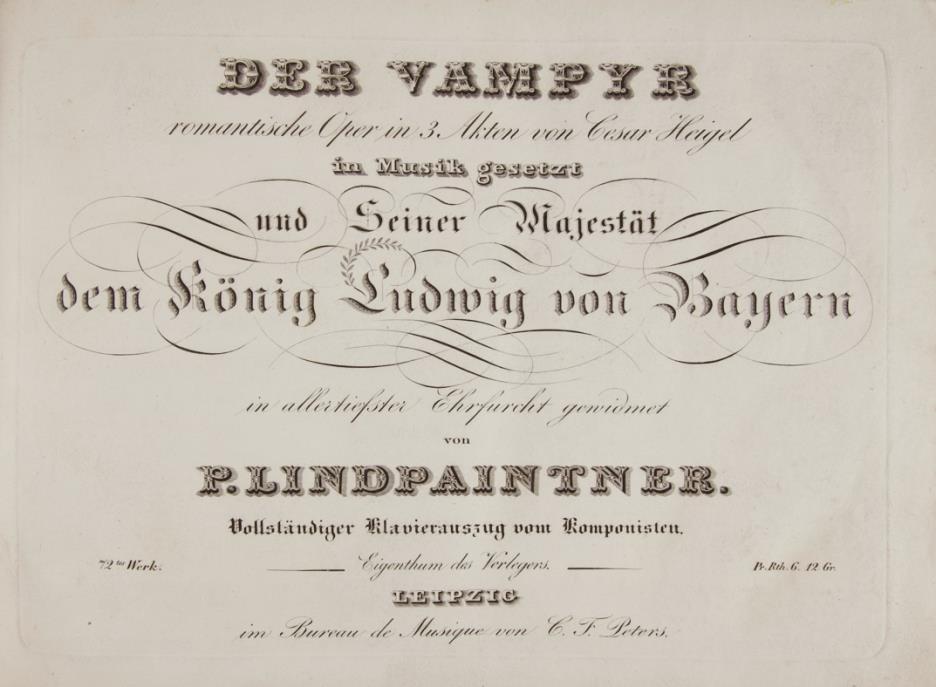
First Edition of the Most Successful of Lindpaintner’s Operas
39 LINDPAINTNER, Peter Josef von 1791-1856
Der Vampyr romantische Oper in 3 Akten von Cesar Heigel in Musik gesetzt und Seiner Majestät dem König Ludwig von Bayern in allertiefster Ehrfurcht gewidmet ... Vollständiger Klavierauszug vom Komponisten ... 72tes Werk ... Pr. Rth. 6. 12 Gr. [Piano-vocal score]. Leipzig: im Bureau de Musique von C. F. Peters [PN 2016, 2029 I, 2029 II, 2029 III], [1828].
Oblong folio. Contemporary quarter dark brown leather with marbled boards, oval lpaper abel titled in manuscript to upper, green edges. 1f. (recto title, verso blank), [i] ("Personaggi, "Argomento"), 2-117 ("Ouverture," "Erster Akt"), [i] (blank), 75 ("Zweiter Akt"), 28 ("Romanze und Cavatine") pp. With text in German and Italian. Engraved throughout. With overture scored for piano, four hands. Binding worn, rubbed, and bumped; upper joint split; lower portion of spine lacking; endpapers slightly stained at corners. Minor internal wear; occasional light foxing to blank lower margins; printing imperfection to p. 78, obscuring part of piano right hand chord. In very good condition overall.
First Edition. BSB 3857. OCLC 19726977.
Der Vampyr, a romantic opera in three acts to a libretto by Cäsar Max Heigel after John W. Polidori’s The Vampyre, was first performed in Stuttgart at the Hoftheater on 21 September 1828.
Lindpaintner studied composition with Peter Winter in Munich. "In 1819 [he] took up the post of Kapellmeister at Stuttgart, where he remained for the rest of his life. Here he established his reputation as one of the finest German conductors and continued to compose assiduously for the stage. A number of his operas were enthusiastically received. ... The story is based on a French melodrama by C. Nodier, P. F. A. Carmouche and A. de Jouffroy (translated into German by H. L. Ritter). The plot follows the main lines of Marschner’s opera of the same title , given in the same year, whose libretto by Wohlbrück is based on the same sources; most of the cast, however, were given different names since the action was transferred by Heigel to the south of France. Marschner’s Malwina is here Isolde (soprano), his Ruthven becomes Hypolit (tenor) and his Davenaut Port d’Amour (bass); the only name in common is Aubry, here Aubri (bass). The influence of Spohr and Weber is apparent in the use of polacca rhythms and chromatic harmony and in the character of various numbers. A cavatina and a Bridesmaids’ Chorus seem indebted to Der Freischütz, while the collapse of the palace recalls the destruction of Sir Gulf’s castle in Spohr’s Faust. Der Vampyr was the most successful of Lindpaintner’s operas. In 1850 he revised it, replacing the original dialogue with recitatives." Clive Brown in Grove Music Online (40765) $500
“An
interesting Insight into Performing Practice” by “the Paganini of the 18th Century”
40. LOCATELLI, Pietro Antonio 1695-1764
Six Sonates a Violon Seul et Basse Dediées a Abraham Croock ... Œuv. 8. Prix 9f. à Paris. [Paris]: [a l'Imprimerie du Conservatoire Imperial de Musique] [PN 153], [ca. 1800].
Folio. Modern black morocco-backed marbled boards with red leather title label gilt to spine. 1f. (recto title, verso blank), 31, [i] pp. Engraved throughout. With Chez Mme. Duhan & Cie. au Magazin de Musique et d'Instruments, Boulvard Poissonniere No. 10, attenant le Jardin Boulainvilliers overpaste to title. Slightly worn, browned, and soiled; occasional small stains; blank inner margin of recto of title reinforced with narrow strip of ivory tape; minor repair to verso of final
Provenance
Noted American harpsichordist Louis Bagger (19262024).
RISM L2621 (three copies only, none in the U.S.).
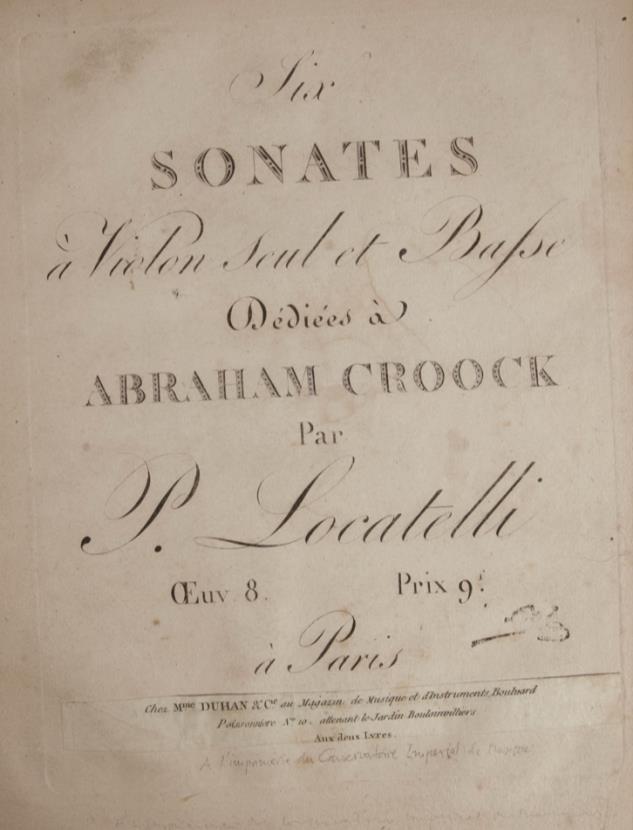
"His traditional reputation as the `Paganini of the 18th century' ... has recently given way to a recognition of his more substantial gifts as a composer. Trained in the conservative Roman school, Locatelli was more successful than most of his colleagues in assimilating the structural and stylistic innovations of the Venetians (particularly Vivaldi) and belonged to the vanguard of Italian instrumental composers during the 1730s. His later works advance a considerable way towards the early Classical style. ... Op. 8 contains both trio sonatas and solo sonatas. Its third sonata offers an interesting insight into performing practice: dimunitions in the continuo part are directed to be taken by the cello on the first time round but by the harpsichord on their repeat." Grove 6 Vol. 11, pp. 104-105. (41209) $350
“The Foremost Composer of German Comic Operas”
41 LORTZING, Albert 1801-1851
Die beiden Schützen. Komische Oper in 3 Akten ... Vollständiger Klavierauszug von Komponisten ... Pr. 6 Thlr. [Piano-vocal score]. Leipzig: Friedrich Hofmeister [PN 2774 and J.W. 74], [ca. 1842].
Oblong folio. Contemporary mid-tan leather backed boards with original upper publisher's light olive green wrapper laid down to upper. 1f. (recto title, verso "Personen" and "Inhalt"), 3-187, [i] (blank) pp. + 12ff. blank rastrum-ruled music manuscript paper. Engraved throughout. With annotation in ink ("Albert Lortzing Op. 4") to upper outer corner of first page of music. Title and musical selections nos. 3, 10, and 11 with plate number 2774; "J.W. 74" to remainder. Binding worn, rubbed, and bumped, with tape repair to upper portion of spine; endpapers slightly stained; free front endpaper creased. Very occasional minor foxing; one signature detached, with early tape repair.
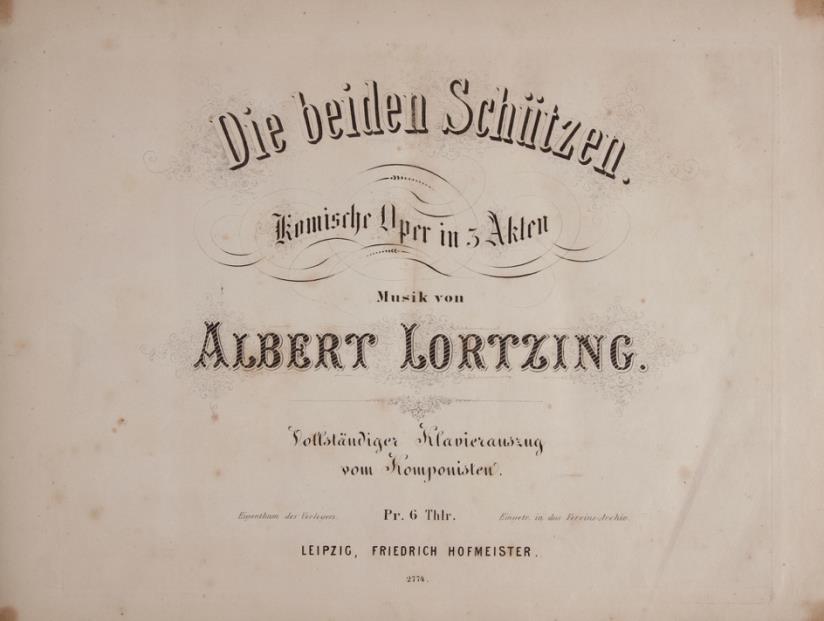
Re-issue from the plates of the first edition published by Julius Wunder in 1839. OCLC 165951054.
Die beiden Schützen was first performed in Leipzig at the Stadttheater on 20 February 1837.
Lortzing was a German composer, actor, and singer. "From the mid-1830s he composed comic operas with spoken dialogue, adapting the opéra comique genre which had been very popular in Germany as well as France in the early 19th century. His operas were particularly successful in German theatres, less so in French- and English-speaking countries. While this distinction still holds good, Lortzing remains a frequently performed operatic composer on the German stage. ... Immediately after the successful première of Die beiden Schützen, Lortzing started work on another comic opera, Zar and Zimmermann. First performed in Leipzig on 22 December 1837, the opera sealed Lortzing’s reputation as the foremost German composer of comic operas. It was produced in opera houses throughout the German-speaking countries, particularly after its triumphant performance at the Berlin Hofoper on 6 January 1839. Die beiden Schützen was now taken into the Berlin repertory as well, and Lortzing’s next ‘grand comic opera’, Caramo, oder Das Fischerstechen was composed expressly for the Berlin company." IrmlindCapelleandJohnWarrackin Grove Music Online. (41236) $250
“An Outstanding Pianist”
42 LOUIS FERDINAND [Friedrich Christian Ludwig], Prince of Prussia 1772-1806
Grand Trio Pour le Pianoforte, Violon et Violoncelle composé et dédié à S. A. R. Madame la Princesse Louise de Prusse Epouse du Prince Radziwil ... Ouev. 10. Pr. 1 Rthl. 12 gr. [Piano part only]. Leipsic: Chez Breitkopf & Härtel [PN 1392], [1809].
Folio. Full modern black textured cloth with titling gilt to upper. 1f. (recto title, verso blank), [i] (blank), 4-37, [i] (blank) pp. Engraved throughout. With prominent black Prussian Eagle to head of title. Slightly worn; occasional minor foxing; tape repairs to title, blank inner margin of p. 36, and margins and lower portion of p. 37, with loss to final system completed with blank paper.
OCLC 25155434, 873381039, and 17340795.
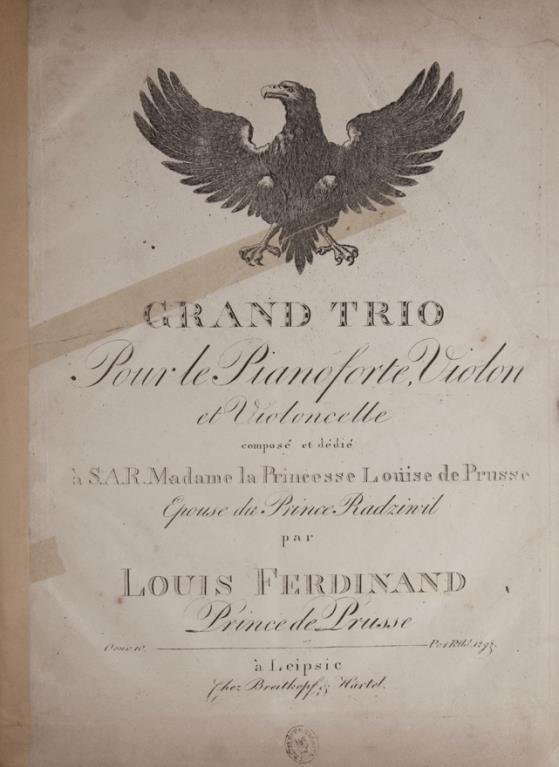
"Louis Ferdinand had a reputation as an outstandingpianist long before he became known as a composer; Reichardt ranked him among the first and greatest of virtuosos. Beethoven, visiting Berlin in 1796, remarked that his playing was neither royal nor princely, but that of a true musician, and later demonstrated his regard by dedicating his Third Piano Concerto to him. (Some sources also state that Beethoven's Third Symphony, the ‘Eroica’ was rededicated to his memory.) Apart from a few songs, Louis Ferdinand’s music was written entirely for the piano, most often with various chamber combinations. The early works reflect the waning concept of the accompanied sonata; the later ones make considerable technical demands on the players. Contemporary reviews are uniformly enthusiastic, with theme and variation movements often singled out as being particularly successful. The music was performed from Paris to St Petersburg; its popularity is evident in the frequent new editions as well as duet and two-piano arrangements. In 1825 A.B. Marx listed the composer among ‘genuine artists’ such as Beethoven, Mozart, Weber, Dussek and Hummel, and public performances of his music occurred as late as the mid-century. His pianistic idiom, along with Dussek’s, placed him among the early Romantic colourists whose innovations were to culminate in Chopin’s mature style." Barbara H. McMurtry in Grove Music Online (41242) $100 With Several
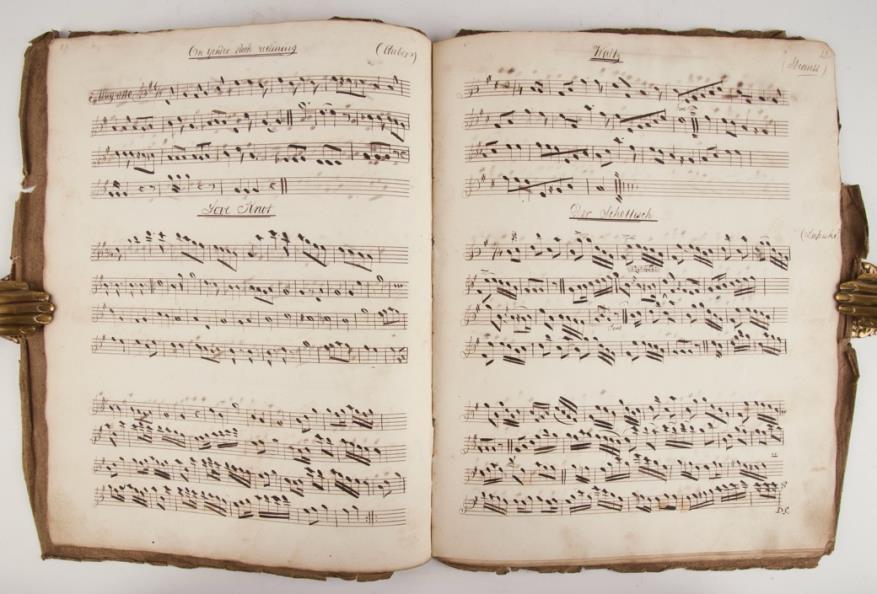
43. [MANUSCRIPT - 19th Century – English]
Operatic selections and dance tunes for one and two melody instruments [?violins]. [Copyist manuscript]. [Ca. 1850].
Folio (246 x 293 mm). Contemporary plain brown wrappers with octagonal paper label to upper titled "Music Miscellaneous Piece." Notated on 12-stave rastrum-ruled paper. 26 pp. + 2ff. (blank). Wrappers worn. Minor wear, soiling, and staining.
Contains operatic and dance numbers by composers including Auber, Bellini, Cimarosa, Donizetti, Handel, Mozart, Verdi, et al. scored for solo violin and duo violins inscore: Polka Militaire (Canthel), La Fugitive Valsa (Jullien), Air in Don Giovanni (Mozart), Round about the Maypole (Arne), The Patriots Welcome (Russell), Dead March in Saul (Handel), Grand March in Alfred the Great (Cimarosa), Fragments de Lutzow (Weber), On yonder rock reclining (Auber), Waltz (Strauss), Der Scottisch (Pupeski), The Nuptial Serenade (Mancinelli), and selections from operas by Bellini, Donizetti, and Verdi. (41293) $150
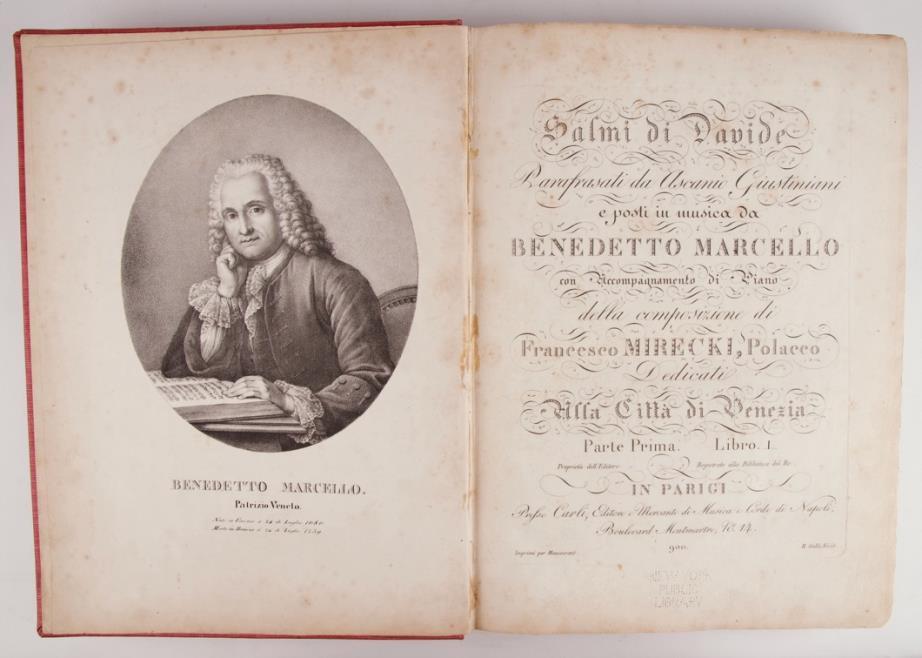
Psalms, With an Attractive Lithographic Portrait of the Composer
44 MARCELLO, Benedetto 1686-1739
Salmi di Davide Parafrasati da Ascanio Giustiniani ... con Accompagnamento di Piano della composizione di Francesco Mirecki, Polacco Dedicati Alla Città di Venezia Parte Prima. Libro. 1[-2]. Proprietà dell’Editore. Registrato alla Biblioteca del Re ... Imprimé par Maucourant 900. H. Gallé, Fécit. [Piano-vocal score]. Parigi: Presso Carli, Editore e Mercante di Musica e Corde di Napoli, Boulevard Montmartre, N. 14. [PN 900], [ca. 1819].
Folio. Full modern light red cloth, titling gilt to spine. With fine half-length lithographic frontispiece portrait of Marcello seated at a desk with an open book of music. With a number of notable subscribers including Carafa, Carulli, Cherubini, Mendelssohn, Paër, Reicha, and Ries. Slightly worn, soiled, and stained; mostly minor, occasionally moderate, foxing, mainly affecting blank margins; edges slightly browned and with occasional small tears. Pp. 269-310 lacking (psalms 10 and 11 and first page of psalm 12), replaced by blank leaves. Ex-library, with markings and handstamp
Libro 1: 1f. (recto blank, verso frontispiece portrait), 1f. (recto title, verso blank), 1f. (recto publisher's note, verso blank), 1f. (subscribers list), 14 ("Sommario della vita e delle opere di Benedetto Marcello"), [i] (blank),
2-101 pp.; Libro 2: 1f. (recto title, verso blank), [i] (blank), 102-268, 311-376 pp. 1f. (recto table of contents, verso blank). Untrimmed. Engraved, with the exception of the typeset subscribers list.
Volumes 1 and 2 of a 4-volume set. Selfridge-Field 429. OCLC 1340937833, 180613786, and 180613766.
"[Marcello] attained a truly European fame with the composition of settings in cantata style of the first 50 psalms in Italian paraphrases by his friend G.A. Giustiniani. These came out in eight volumes in 1724 and 1726. Several enthusiastic letters from eminent musicians including Telemann, Mattheson, Bononcini and Saro were published with the psalms as successive volumes appeared." Grove 6 Vol. 11, p. 649.
With elegant realizations of the continuo parts for piano by Polish composer, conductor, and teacher Franciszek Mirecki (1791-1862). "His first works (polonaises and marches for piano) were published in Vienna and he met Beethoven, who showed interest in Mirecki's work and in Polish folk melodies. From 1816 to 1817 he was in Italy. He then moved to Paris, where he studied composition with Cherubini. The latter awoke in Mirecki an interest in the works of earlier Italian masters. ... Mirecki also wrote one of the earliest European treatises on orchestration, Trattato intorno agli instrumenti ed all'instrumentazione (Milan, 1825)." Zofia Chechlińska in Grove Music Online
"Mirecki ... created a piano accompaniment for an edition (ostensibly by Cherubini) with Italian texts that was published in Paris by Carli ... in 1819," Selfridge-Fieldp. 395(onecopyonlyintheU.S.).(41232) $225
Marpurg & D’Alembert
45. MARPURG, Friedrich Wilhelm 17181795
Anfangsgründe der Theoretischen Musik. Leipzig: Johann Gottlob Immanuel Breitkopf, 1757.
1f. (recto title, verso blank), [iv] ("Vorbericht"), [ii] ("Inhalt"), 176 pp. First Edition. GregoryBartlett p. 167. Wolffheim I, p. 135. RISM Écrits p. 540.
"German critic, journalist, theorist and composer. Gerber claimed that Marpurg had told him that he lived in Paris around 1746; Carl Spazier confirmed this, adding that Marpurg was friendly with Voltaire, D'Alembert and others when he was secretary to a ‘General Bodenburg’. This is generally assumed to refer to Generallieutenant Friedrich Rudolph Graf von Rothenburg, a favourite of Frederick the Great and Prussian emissary to Paris in 1744–5, and the dedicatee of Marpurg's Der critische Musicus an der Spree (1749–50). ... Marpurg's translation (1757) of D'Alembert's Elémens de musique was largely responsible for the propagation of Rameau's theories in Germany." Howard Serwer in Grove Music Online
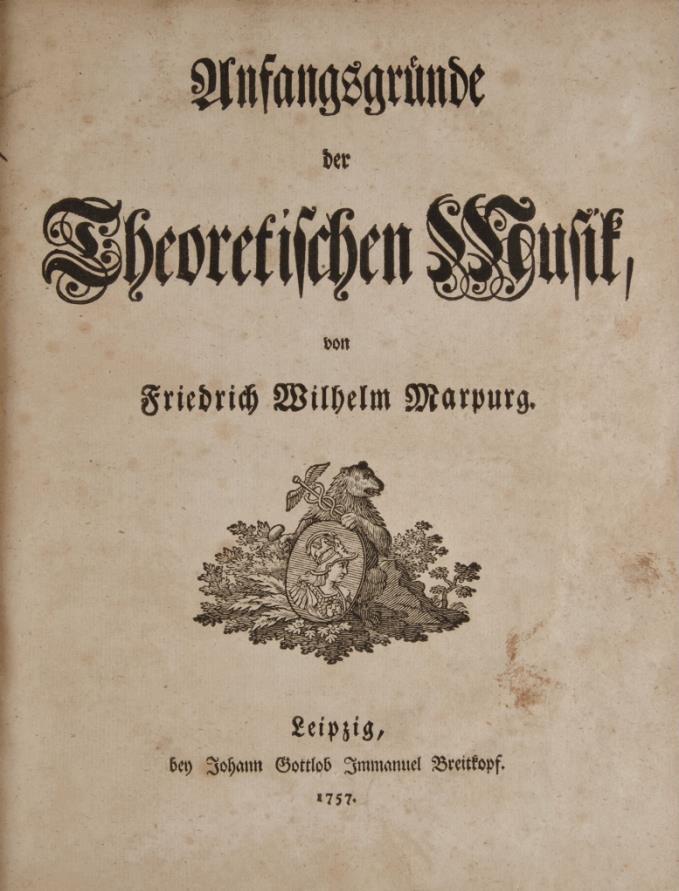
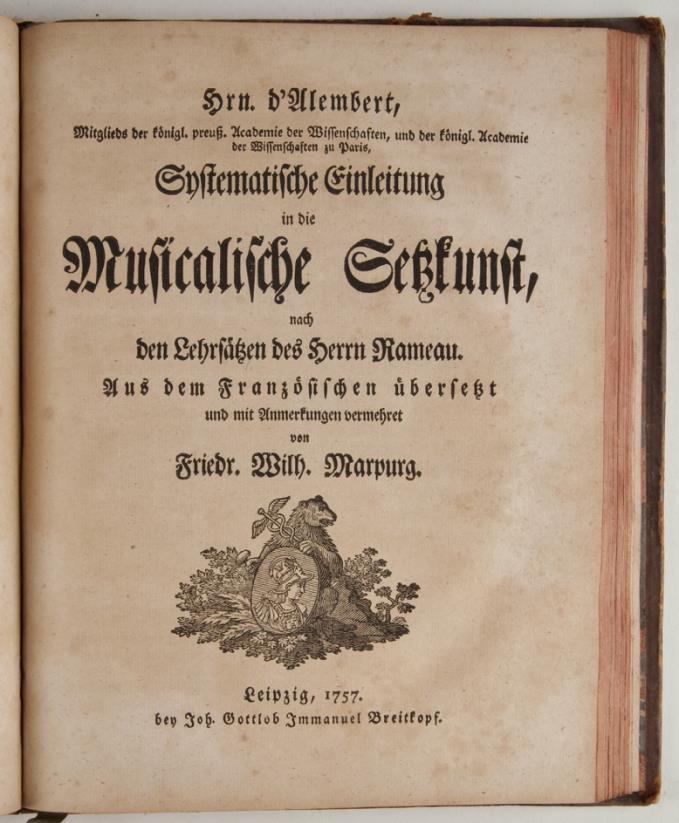
Bound with:
Hrn. d’Alembert, Mitglieds der königl. preuß. Academie der Wissenschaften, und der königl. Academie der Wissenschaften zu Paris, Systematische Einleitung in die Musicalische Setzkunst, nach den Lehrsätzen des Herrn Rameau. Aus dem Französischen übersetzt und mitAnmerkungenvermehret... Leipzig:beyJoh. Gottlob Immanuel Breitkopf, 1757. 1f. (recto title, verso blank), [v] ("Vorbericht des Herrn d'Alembert"), [iii] ("Vorbericht des Uebersetzers"), [ii] ("Inhalt"), 136 pp. First German edition. Gregory-Bartlett p. 11. Eitner VI, p. 340. RISM Écrits p. 78.
"[D'Alembert's] most important musical publication was his Elemens de musique theorique et pratique ..., an outstanding work of elucidation which was widely read for over 50 years." TNG Vol. 5, p. 154.
"Drawing largely upon Rameau’s Démonstration (but also upon the Génération harmonique of 1737 for the rules of composition in Part 2), the Elémens was a stunning example of d’Alembert’s talent for conceptual synthesis and clarity; it quickly became the most widely read source for information of Rameau’s theory, both in France and in Germany (where it appeared in translation by Marpurg in 1757)." Thomas Christensen in Grove Music Online
Small quarto. Full contemporary mid-tan mottledcalf, spine in decorative compartments gilt with titling gilt, red edges, marbled endpapers, dark green silk marker.
Provenance
Noted American harpsichordist Louis Bagger (1926-2024)
With woodcut devices to titles incorporating bear and warrior and occasional decorative devices throughout. Bindingworn, rubbed, andbumped.Minorinternalwear, browning, smallstains,andfoxing. (41208) $700
Early Copy of the Painting of Frederick the Great by Menzel Depicting Some of the Leading Musical Figures of the Day
46 MENZEL, Adolph von 1815-1905
Frederick the Great playing the flute at court at Potsdam. Anearlycopyinoils of the famous painting byMenzel from 1852.
Imagesize28x30.5";overallsize35 x46.5."Signedatlower right"Cop. n[ach]Ad. vMenzel[?by]W. Damm."
On canvas, with a large wooden stretcher in a decorative wooden frame gilt. Two small (ca. 1/4") holes; one small repair; frame slightly worn and chipped.
Provenance
Printed paper label to verso of the Danzig, Poland, art dealer "Louis Schroder Kunsthandlung und Glaserei Danzig Gr. Scharmachergasse Nr. 3 gegenuber Potrvkus & Fuchs."
The painting depicts an 18th-century musical soirée at the palace, with King Frederick himself playing the flute center stage. The monarch’s features as represented in the painting are highly idealized, as Menzel avoids showing Frederick with his aquiline nose, although he must have known of the death mask of the Prussian king. A chamber ensemble sits in front of Frederick, with an audience of dignitaries and noble ladies in the background. Thefocus ofthe workis on Frederickandtheambiance oftheinterior, with its furniture, chandelier, candlelight, and elaborate dress of the ladies.
The painting features some of the leading musical figures of the day, including:
Johann Joachim Quantz, the king's flute teacher (standing far right)
Franz Benda, Bohemian violinist and composer (on his right with a violin and dark skirt)
Carl Philipp Emanuel Bach, German musician and composer (at the harpsichord)
Gustav Adolf von Gotter, diplomat (foreground at left)
Jakob Friedrich von Bielfeld, German writer and statesman (behind him)
Pierre Louis Maupertuis, French mathematician and philosopher (behind him, looking up)
Wilhelmine von Bayreuth, Frederick's sister (sitting on the pink couch)
Amalie von Preussen, composer and Frederick's sister (on her right, with a court lady)
Carl Heinrich Graun, German composer and the court conductor (behind them)
Countess Camas (elderly lady behind the music stand)
Egmont von Chasot, friend of Frederick (behind her)
The original Menzel painting is in the collection of the State Museum in Berlin. (41414) $1,200
Manuscript Aria for Baritone
47. MERCADANTE, Saverio 1795-1870 and Giuseppina Guacci 1807-1848
Il Sogno Poesia della Signora Giuseppina Guacci ... Espressamente composta, e Deda, al merito distinto di G. O. Cartagenova. [Copyist manuscript full score and cello part]. Naples, [ca. 1850].
Small folio (217 x 302 mm). Sewn. Notated in black ink on 10stave rastrum-ruled paper. Score [i] (title), 18, [i](blank)pp.;cello part [i] (blank), 4, [i] (blank) pp. Text in Italian and German. Slightly worn and browned; some showthrough; occasional small stains. Scored for baritone voice, obbligato cello, and piano.
Mercadante, an Italian composer, conductor, and teacher, was "a leading opera composer who also encouraged the revival of Italian instrumental music." Michael Wittmann in Grove Music Online The dedicatee, Giovanni Orazio Cartagenova (18001841), was an Italian baritone.
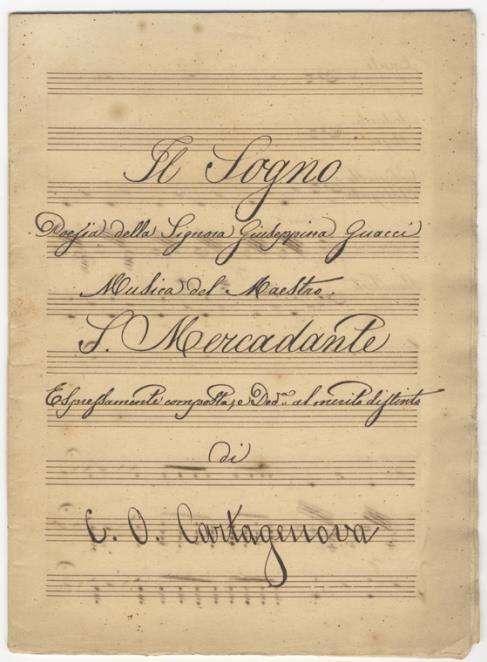
A poignant aria set to text by noted poet Giuseppina Guacci (1807-1848), rendered in a fluent copyist's hand. (41290) $85
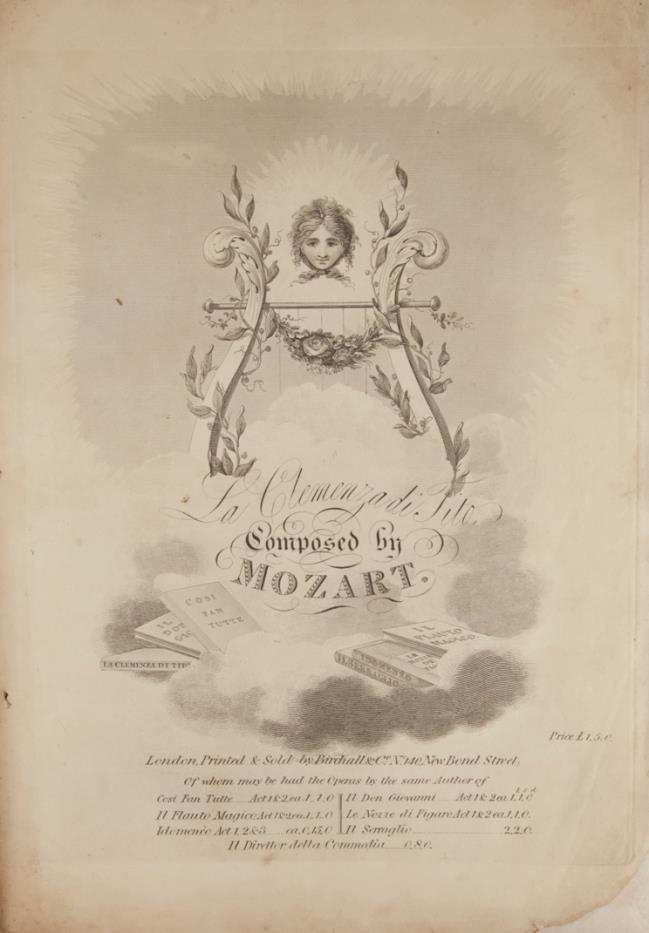
Interesting Contemporary Ornamentation in Manuscript
48 MOZART, Wolfgang Amadeus 1756-1791
La Clemenza di Tito ... Price £ 1.5.0. [K. 621]. [Piano-vocal score]. London: Printed & Sold by Birchall & Co. No. 140 New Bond Street, [ca. 1826].
Folio. Darkbrowncloth-backedcontemporarymidbrown boards. 1f. (recto decorative title incorporating mascaron, lyre, floral motifs, and scores of this and other Mozart operas floating on a bed of clouds, verso blank), 1f. (recto "Personaggi" and thematic index, verso blank), 127, [i] (blank) pp. Text in Italian. Watermark dated 1826. Engraved throughout. Selections originally published individually, each with caption title and separate pagination. Contemporary ornamentation added in pencil to pp. 102-107. Binding worn, rubbed, and bumped, with small stains. Slightly browned; minor soiling and staining, mainly to blank margins; small binder's holes to blank inner margins; repairs to lower outer corners of first three leaves.
Provenance: Noted American harpsichordist Louis Bagger (1926-2024).
Köchel 8, p. 720. OCLC 234191524. JISC (one copy, at the Royal College of Music, London).
La Clemeza di Tito, to a libretto by Pietro Metastasio, was first performed in Prague at the National Theatre on 6 September 1791. "It was for the festivities at Leopold II's coronation in Prague that Mozart composed La clemenza di Tito. Reports published soon after his death suggested that it had been written in only 18 days, some of it in the coach between Vienna and Prague, although it is more likely that it written over a period of six weeks.
The impresario Domenico Guardasoni signed a contract with the Bohemian Estates on 8 July, and his first choice to compose a coronation opera (either on a subject to be suggested by the Grand Burgrave of Bohemia or, if time did not permit, on Metastasio's La clemenza di Tito, 1734), was Salieri. But Salieri refused the commission and the work fell to Mozart. Possibly this was in mid-July: the fact that Guardasoni's contract included an ‘escape clause’, allowing him to engage a different composer, suggests that he may already have expected Salieri to decline and discussed with Mozart the possibility of composing the opera. The text was arranged by Caterino Mazzolà, who cut much of the dialogue and 18 arias while adding four new ones, as well as supplying two duets, three trios and finale ensembles. In his catalogue, Mozart described Tito as ‘ridotto a vera opera’."
Of great interest are the contemporary manuscript ornaments, including cadenza material and melodic elaboration of rhythmically regular passages; the style of these ornaments is, at times, quite virtuosic, employing rapid note-values and the high register of the voice. (41210) $285
Signed by the Composer
49. NEUKOMM, Sigismond Ritter von 17781858
Twenty-five Original Voluntaries or Grand Studies, for the Organ. Composed & Dedicated by Permission to Her Royal Highness Madame Adelaide d'Orleans ... Ent. Sta Hall. Price 26s./. London: Cramer, Addison & Beal, 201 Regent Street [PN 1399], [1834-1835].
Folio. Disbound. 1f. (recto title, verso blank), 125, [i] (blank) pp. With the opening 2 or 3 measures of each voluntary to pp. 124-125. Engraved throughout. Includes No. 8. The Last Judgment: A Dramatic Fantasia; No. 16. A Concert on a Lake, interrupted by a Thunderstorm: A Grand Dramatic Fantasia; and No. 24. Funeral March." Without subscriber's list and preface found in some copies. Slightly browned; occasional minor foxing; "From Doughty March 15, 1898"in ink andannotations in pencil in another hand to front free endpaper.
Composer's autograph signature to lower outer margin of title.
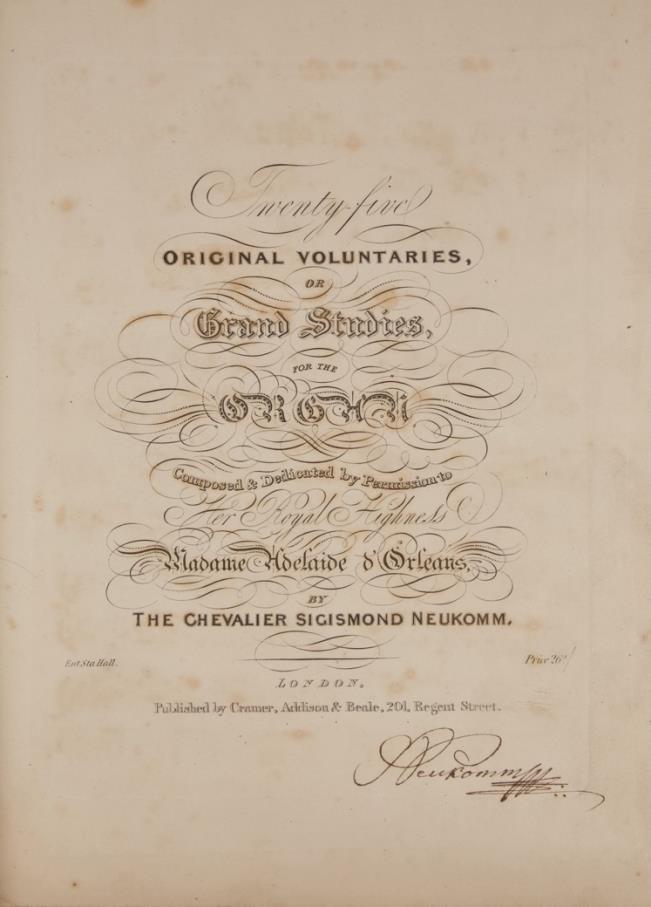
First Edition, first issue, with publisher's address at 201 Regent Street. Rare. Library Hub (the British Library copy). OCLC (two copies in the U.S., not distinguishing among issues).
"Neukomm received his first musical tuition at the age of seven from the Salzburg Cathedral organist, Franz Xaver Weissauer, and later became a pupil of Michael Haydn. ... In about 1792 he became honorary organist at the university church, and in 1796 chorus master at the Salzburg court theatre. At the end of March 1797 he went to Vienna to become a pupil of Joseph Haydn. ... In Vienna Neukomm also gave piano and singing lessons; his pupils included Anna Milder and Franz Xaver Mozart. ... On 7 November 1809 he arrived in Paris, which was to be his principal home for the rest of his life. Apart from a few brief periods of absence, his first stay in Paris lasted four years, and he soon made the acquaintance of such leading musicians as Cherubini, Gossec, Grétry and Monsigny. In 1814, as pianist to Prince Talleyrand, he attended the Congress of Vienna. There his C minor Requiem was performed before the distinguished company on 21 January 1815, and he was invested as Chevalier of the Légion d’Honneur ... His first trip to England took place in April 1829, and henceforth England was his second home ... His compositions, which he conducted, were performed at all the major music festivals of England, Scotland and Ireland, and he travelled throughout the British Isles. ... Neukomm’s name is closely associated with the festivities on the occasion of the unveiling of the Mozart monument in Salzburg (4–6 September 1842). Neukomm himself delivered the panegyric at the unveiling ceremony, he conducted Mozart’s ‘Coronation’ Mass (K317) and Requiem, and also composed for the celebrations the hymn Österreich. For Mozart, as for Haydn, he had lifelong admiration. His desire to introduce seldom-played works by Mozart to his contemporaries led to his transcribing much of Mozart’s music for harmonium and piano." Rudolph Angermüller in Grove Music Online. (41248) $300
Collection of 19th Century Piano Works
50. [PIANO - 19th Century - German] Collection of twenty 19th century German works for solo piano and piano and voice, all published ca. 1830-1840.
Oblong folio. Half mid-brown cloth with marbled boards, decorative cut paper label (blank) to upper. With "L von Harten" or "von Harten" in contemporary manuscript to front free endpaper and some titles. Binding worn, rubbed, and bumped; endpapers worn, browned, and slightly chipped, with somewhat crude musical notation in pencil. Some wear, browning, foxing, and dampstaining; some leaves trimmed, affecting ownership signature
Includes music by several obscure composers and some unusual lithographic imprints.
Contents: - Carafa, M[ichele] 1787-1872 Duett für Sopran und Tenor. Sempre più t'amo - (Immer neu fühl' ich) ... Pr. 5 gr. Hamburg: Aug. Cranz, [1831]. [i] (title), 2-5, [i] (blank) pp. Text in Italian and German. Engraved. "From
1814 he developed into one of the most prolific opera composers of his day." Julian Budden in Grove Music Online
- Auswahl vorzüglicher Duetten für zwei Singstimmen mit Begleitung des Piano=Forte. No. [3]. Hamburg: Joh. Aug. Böhme [PN 2537.3], [ca. 1835]. [i] (title), 2-5, [i] (blank) pp. Text in Italian and German. Engraved.
- Kuhlau, F[riedrich] 1786-1832 Die Albissinn und die Nonne. Ein Wechsesgesang ... gedichtet und herausgegeben von Theodor von Kobbe. Dem Herrn oberschenk Staatsrath von Beaulieu-Marconnay Grosskrruz gehorsamst zugeeignet. Bremenin Commissionbey J.A. H. SchröterWwe. Eigenthumdes Verlegers Zum Besten einiger Nothleidenden. Lithographie von G. Töntzen in Bremen, [ca. 1830]. 1f. (recto title, verso "Zueignung"), [i] (music), [i] (blank pp. Text in German. Lithographed. "Together with C.E.F. Weyse he was the foremost representative of the late Classical and early Romantic periods in Denmark." Gorm Busk in Grove Music Online
- Beethoven, L[udwig] van 1770-1827 Nachruf [obituary] für's Piano-Forte. Preis 4 Ggr. IIte. Auflage. Celle: A.H. Oetling. [i] (title), 2-3, [i] (blank) pp. Text in German, commencing O Du, hach der sich alle meine Wünsche lenken. Lithographed. Tear to title repaired.
- Miltitz, Carl Borromäus von 1781-1845 Cas Lied der Hirtin. Gedichtet und mit Begleitung des Pianoforte in Music gesetzt für Madame Anna Milder ... No. 66. Pr. 4. Gr. Dresden: der Meser'schen Kunst-u. MusikalienHandlung, [ca. 1835]. [i] (title), [ii] (music), [i] (blank) pp. Text in German. Lithographed.
- Reinicke, L.C. Schwanen-Lied. Es wohnen zwei Schwäne im See, etc: mit Piano=Forte oder Guitarre ... Pr. 4 Gr. Hamburg: A. Cranz, [ca. 1835]. [i] (title), [2] (music), [3] (text to verses 2-6), [i] (blank) pp. Text in German. Engraved.
- Weber, Carl Maria v[on] 1786-1826. Fuenf ausgewaehlte kleine Lieder mit Beglet6ung des Pianoforte oder Guitarre ... Pr. 12 Gr. Leipzig: Friedrich Hofmeister [PN 588], [ca. 1830]. [i] (title), 12 pp. Text in German. Lithographed. "A seminal figure of the 19th century, he influenced composers as diverse as Marschner, Mendelssohn, Wagner, Meyerbeer, Berlioz, and Liszt." Michael C. Tusa in Grove Music Online
- Journal d'Apollon No. 71. Portrait Charmant. Romance. Musique et Accompagnement de Piano ou Harpe. A La Haye [imprint abraded], [ca. 1830]. [i] (blank), 2 (music), [i] (blank) pp. Text in French. Smaller format. Engraved.
- Marschner, Heinrich 1785-1861. Der Templer und Die Jüdin. Grosse romantische Oper in Drei Aufzügen ... Vollständiger Klavierauszug vom Komponisten. [No. 4. Lied des Narren Wamba]. Leipzig:Friedrich Hofmeister [PN 1468_3002], [ca. 1840]. [i] (title), 2-3 (music), [i] (blank) pp. Text in German. Engraved. With contents and brief publisher's catalogue to title. Marschner "was the most important exponent of German Romantic opera in the generation between Weber and Wagner." A. Dean Palmer in Grove Music Online
- Meyerbeer, J. [Giacomo] 1791-1864 Robert der Teufel (Robert Le Diable). Romantische oper von Scribe und Delavigne. Deutsch bearbeitet von Dr. M.L. Langenschwarz ... Erleichterter Clariverauszug. No. [9]. Duett. Du rendez-vous; Sie köm[m]t hieher. Pr. 12 gr. Hamburg: J.A. Böhme ... Aug. Cranz, [ca. 1835]. [i] (title), 4850, 57-59, [i] (blank) pp. Text in German and French. Lacking pp. 51-56. "The most frequently performed opera composer during the 19th century, linking Mozart and Wagner." Matthias Brzoska in Grove Music Online
- Meyerbeer. As above, No. [12]. Duett. Nun? Alice, komm hieher; Mais Alice qu'as tu donc? Pr. 6 gr. [Ca. 1835]. [i] (title), 74-79, [i] (blank) pp. Text in German and French.
- Alles ist Schein! Gesellschaftslied: Flimmert das Gold, so Lacht uns das Leben. Mit Begleitung von Pianoforte oder Guitarre. Pr. 4 gr. Hamburg: Aug. Cranz. [i] (title) + 1 (unnumbered) + [i] (blank) pp. Text in German. Incomplete. Engraved
- Methfessel, [Albert] 1785-1869. Zwei Gesänge aus der Oper der alte Feldherr oder der Kriegeszug nach Norden mit Beleitung des Piano=Forte oder der Guitarre ... IIte. Auflage. Celle: H. Oetling. [i] (title illustrated withascenefromtheopera), [i](music), [i](texttoverses 2and 3), [i](blank)pp. TextinGerman.Lithographed.
- Huldigung der Freunde. Eine Sammliung Ausgewählter Mode=Tänze Für das Pianoforte. Is. Heft. No. 2 ... Pr: Rthlr. 3 gr. [Fest Walzer aus Olimpia von Spontini; Geschwind Walzer aus Olimpia von Spontini]. [i] (title], 45, [i] (blank) pp. Leipzig: bei H.A. Probst [PN 1666], [ca. 1830]. Engraved. With Frankfurt a/m in der Fischer'schen Musik=Verlags=Handlung. Zeil D. 211 auch wahrend der Messe in der Braunfels Galerie No. 21.22. overpaste to foot of title.
- Körner, G. F. fl. 1790-1810 Trois Sonatines Pour le Forte=Piano ... Oevre[!] IX. 16 Ggr. Hambourg: chéz A. Cranz. 1f. (recto title, verso blank), 14, [i] (blank) pp. Engraved.
- Bornhardt, J[ohann] H[einrich] C[arl] 1774-1843 Leichte Variazionen für Aufänger auf dem Fortepiano über das Favoritliedchen: Einsam wandelt dein Freund im Frühlingsgarten, etc. ... Pr. 4 ggr. Hamburg: August Cranz. [i] (title) 2-4 pp. Text in German. Engraved.
- Pleyel, Ign[ace] 1757-1831 VI Sonates pour le Pianoforte ... Oeuv. XV. Pr: 12 Gr. Livr. III. Leipsic: Fred. Hofmeister, [PN 472]. [i] (title), 2-13, [i] (blank) pp. Lithographed.
- Bremer neue Tänze. Louisen Walzer. Breman: I.G. Stock. 1f. (recto music, verso blank). Engraved.
- Puverstoffel Höpser aus den Bürgern in Wien. Bremen:I.G.Stock. 1f. (rectomusic, versoblank).Lithographed.
- Guenther, T. Märsche des Bremisch-Hanseatischenb-Feld-Bataillons nebst einigen Tänzen für das PianoForte ... Liv. 2. Pr. [blank]. Bremen: T. Günther. 1f. (recto title, verso blank), 11, [i] (blank) pp. Engraved. (41409) $375
14 Sonatinas
51 PLEYEL, Ignace Joseph 1757-1831
Fourteen Favorite Sonatinas for the Harpsichord or Piano Forte with an Accompaniment for a Violin ad libitum. Composed & Humbly dedicated to Her Highness the Dutchess of Wirtemberg ... Pr. 7/6. [Benton 5886-5887]. [Parts]. London: Printed & Sold by Preston & Son at their Wholesale Warehouses 97, Strand, [ca. 1800].
Folio. Disbound. With contemporary signature of "Miss Milburn" to upper outer corner of keyboard part. Slightly worn and browned; occasional minor stains; small binder's holes to inner margins; keyboard part with annotation to head of p. 27 erased with resulting small hole and short tear to blank inner margin of pp. 29/30
Keyboard: 1f. (recto title, verso blank), [i] (blank), 2-29, [i] (blank) pp.; Violin: 1. (recto title, verso blank), 11, [i] (blank) pp.
This edition not in Benton.
Pleyel was an Austro-French composer, music publisher, and piano maker. "He founded a major publishing house and a piano factory and his compositions achieved widespread popularity in Europe and North America. ... The enormous popularity of Pleyel’s music during his lifetime is reflected in the testimony of contemporary journals and of early writers like Gerber and Fétis. The small town of Nantucket, Massachusetts, then still a whaling port, formed a Pleyel Society in 1822 ‘to chasten the taste of auditors’, according to a newspaper announcement. The most telling evidence of the appeal of his music lies in the thousands of manuscript copies that filled the shelves of archives, libraries, churches, castles, and private homes and in the thousands of editions produced in Europe and North America." Rita Benton in Grove Music Online. (41400) $175
With a Fine Illustrated Title
52. PLEYEL, Ignaz 1757-1831
Trois Quatuors concertans, pour deux Violons, Alto et Basse, composés et dédiés à son ami Louis Boccherini ... 9e. œuvre de Quatuors. Prix 8s. sur papier blanc, á 9s. sur papier vélin superflu. [Set of parts]. Strasbourg: Chez Fr. Reinhard & Co. et a leur magasin, Rue du Gd: Chantier, No.11 A Paris ... Enrégistré à la Bibliothèque Nationale, [1803].
Folio. Sewn. Original light pink publisher's wrappers with titling and pictorial device within decorative border. Music stereotyped. Remnants of large decorative label in German to blank verso of upper wrapper; embossed handstamp to upper outer corner of title. Wrappers worn, faded at edges, and with small tears and creases; detached. Occasionalminorfoxing, stains, andsoiling, mainly to blankmargins; lightdampstainingtofinalthree leaves of Basso part; title separated at spine.
Violino primo: 1f. (recto illustrated title, verso blank), [i] (blank), 15 pp. Violino secondo: [i] (blank), 14, [i] (blank) pp.
Alto: [i] (blank), 12, [iii] (blank) pp. Basso: [i] (blank), 10, [i] (blank) pp.
With elaborate illustrated title by B. Zix laid in incorporating a Greek god playing a lyre while seated on a cloud; an angel holding a medallion half-portrait of Gutenberg; putto displaying a type case with alphabetical and musical characters; a goddess with wings holding a shield inscribed Brevet d'invention, caractères mobiles et planches solides, systême, fonderie et imprimerie de F. Reinhard; stele topped with an effigy of Artemis of Ephesus; an open book of music; and a cornucopia overflowing with fruit. Printed title labels ("9e. Oeuvre Quatuors de Pleyel") within decorative border laid down to Violino secondo, Alto, and Basso parts.
First Edition. Benton 3604: 365-97 (title and first page of first violin pages illustrated, pp. 156-157). OCLC 3046209. RISM P3376 (giving precedence to the Mollo edition; Benton, however, dates that edition at 1804, a year later than the present edition).
One of the earliest examples of stereotyped music. See Benton p. 155, column 2. (41245) $850
First Edition of this “Small Masterpiece”
53 RAVEL, Maurice 1875-1937
Pavane pour une infante défunte pour Piano ... Prix 6f. ... Imp. C.G. Röder, Paris. Paris: E. Demets, 20, rue des Marais [PN E. 623 D.], [1899/1900].
Folio. 1f. (Art Deco style title printed in teal and light blue), 6 pp. In glassine. Dedicated to Madame la Princesse E. de Polignac. Slightly browned; minor signs of wear; some light creasing; several very small tears to outer margins.
First Edition, first issue. Orenstein p. 222.
The Pavane in G major for solo piano was composed in 1899 and is considered a small masterpiece; it was first performed by Ricardo Viñes on 5 April 1902. The composer later orchestrated the work using two flutes, an oboe, two clarinets in Bb, two bassoons, two horns, harp, andstrings, and it was published inthis form in 1910.
Ravel "was one of the most original and sophisticated musicians of the early 20th century. His instrumental writing – whether for solo piano, for ensemble or for orchestra – explored new possibilities, which he developed at the same time as (or even before) his great contemporary Debussy, and his fascination with the past and with the exotic resulted in music of a distinctively French sensibility and refinement." Barbara L. Kelly in Grove Music Online (41401) $200
“The Finest Examples Of Orchestral Virtuosity”
54. RIMSKY- KORSAKOV, Nikolay Andreyevich 1844-1908
Capriccio Espagnol pour grand orchestre ... Op. 34. a. Alborada. Variazioni. Alborada; b. Scena e canto gitano; c. Fandango asturiano. Partition d'orchestre ... M. 7.50 / R. 2 65. 1888. [Full score]. Leipzig: M.P. Belaieff [PN 97], 1887.
Small quarto. Original publisher's gray printed wrappers with titling in Russian and English within decorative border to upper. 1f. (recto title, verso blank), 93, [i] (blank) pp. With "Stich unbd Druck der Röderschen officin in Leipzig" to foot of first page of music. With attractive chromolithographic title by A. Antipoff, with "Inst. Lith. de C.G. Röder Leipzig" to blank lower margin. Printed note to inner margin of title: "A M.M. les artistes de l'orchestre de l'opera russe Imperiale de St. Pétersbourg quiontexécutécette oeuvreau concert symphonique russe le 31 Octobre 1887 sous la direction del'auteur" followed by the names of 67 instrumentalists. Upper wrapper slightly worn and with small tears to inner margin, repaired witharchival tape to verso; very minor loss to head of spine; detached. Light uniform browning; minor creasing to some blank upper corners. In very good condition overall.
[?]First Edition, fourth variant. Fuld pp. 161-162. Sonneck Orchestral Scores p. 376. Davis: The Beauty of Belaieff, p. 251
Op. 34, Rimsky-Korsakov's Kaprichchio na ispanskiye temï [Spanish capriccio], was composed in 1887 based on a projected Fantasia on Spanish themes for violin and orchestra. It was first published in Leipzig in 1888.
"Together with the Sheherezade and Svetlïy prazdnik (‘Russian Easter Festival’ overture) (both 1888) RimskyKorsakov considered the Spanish Capriccio to contain the finest examples of orchestral virtuosity he had been able to produce before he came under the influence of Wagner." Marina Frolova-Walker and Mark Humphreys in Grove Music Online. (41406) $250
An Arrangement of Schéhérazade
55. RIMSKY-KORSAKOV, Nicolai 1844-1908
Schéhérazade d'après "Mille et une Nuits." Suite Symphonique pour Orchestre ... Op. 35. Réduction pour piano a 2 m. par Paul Gilson. Pr. M. 5.50. R. 1.95. A Mr. Vladimir Stassoff. Leipzig: M.P. Belaieff [PN 2214], [after 1900].
Folio. Original publisher's printed wrappers with titling within decorative border. 1f. (recto decorative chromolithographic title by P. Buek lithographed by C.F. Röder, verso program notes), 3-71 pp. Wrappers slightlyworn. Minorinternal wear; uniformlybrowned.
Re-issue of the first edition of this arrangement. CPM Vol. 48, p. 140. (41325) $75
The Composer’s “Evolving Powers”
56 ROSSINI, Gioachino 1792-1868
Ricciardo e Zoraide. Terzetto Cruda sorte from the opera. [Copyist manuscript full score]. Of Italian provenance. Ca. 1830.
Oblong folio(238x 305mm). Sewn. Notated inblackinkon16-stave rastrum-ruled wovepaper. 74unnumbered pp. Watermark "C & R Turner," English papermakers active in the early- to mid-19th century. Slightly worn; minor staining and soiling mainly to first and final three leaves; small tears to margins of first and last leaves repaired with archival tape; several old repairs with clear tape to blank margins; first signature and final three leaves detached.
Possibly derived from the first printed edition of the full score published by Leopoldo Ratti Gio. Batta Cencetti e Comp. in Rome in 1829 (see Rognoni 26, p. 447 and OPAC SBN IT\ICCU\RMR\0262045).
Ricciardo e Zoraide was in Naples at the Teatro San Carlo on 3 December 1818.
"Musically, the work shows Rossini’s evolving powers in handling such things as choral writing, orchestration and accompanied recitatives being put at the service of stereotyped forms and picture-book characterization." Richard Osborne in Grove Music Online. (41288)
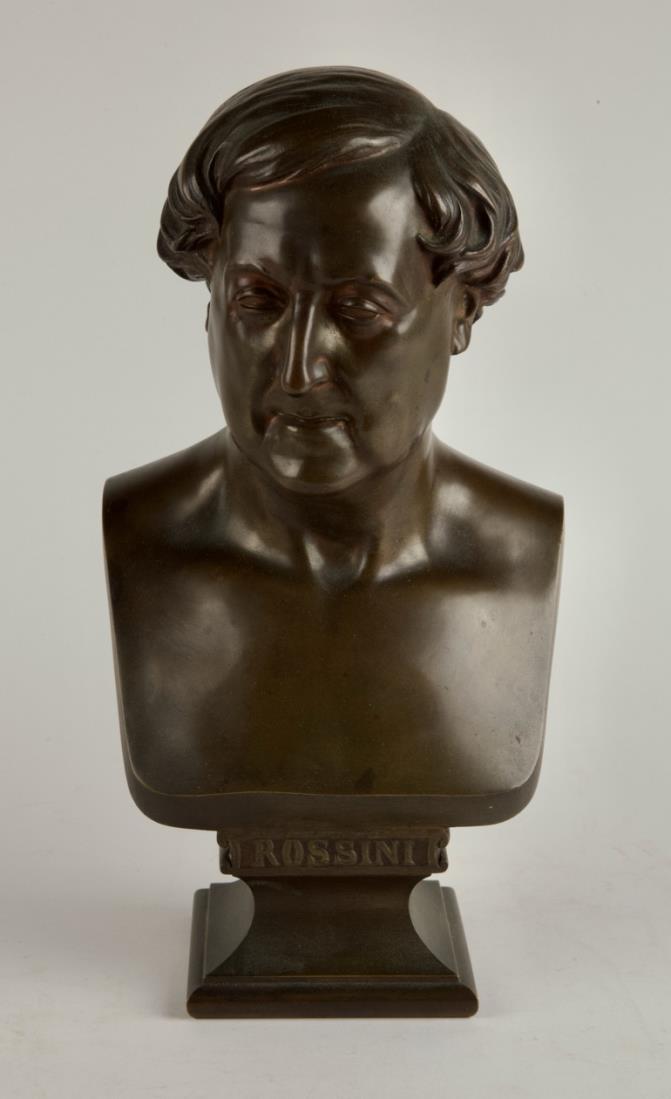
$300
Fine Bronze Portrait Bust
57 ROSSINI, Gioachino 1792-1868
Portrait bust in bronze after the well known serious depiction in plaster by Jean-Pierre Dantan (1800-1869). Foundrymarkof Susse Fres (Susse Frères of Paris). Paris: Susse Fréres, [?]ca.1869.
Overall height 32 cm (approximately 12.5"); weight 4.7 kg (approximately 10.7 lbs.). With "Rossini" incised to front. Mounted on a square base. With foundry mark followed by the letter "J," perhaps identifying the artisan. Minor scratch to back, otherwise in very good condition.
Rare. Rossini à Paris. Catalogue of an exhibition at the Musée Carnavalet 27 October - 31 December, 1992, no. 283 (the plaster version).
"The most important Italian composer of the first half of the 19th century, Rossini transformed the form and content of Italian opera, displacing dated and dying traditions inherited from such composers as Cimarosa and Paisiello and establishing in their place a largely new set of procedures. Though best known for his comic operas – and for music that is sensuous, brilliant and rhythmically vital – Rossini’s contribution to the evolution of opera seria and to stage works of mixed genres is equally important, making him Verdi’s most significant forerunner. Rossini is also an important figure in the development of 19th-century French (and, more tangentially,
German) opera. Using his enormous prestige to effect a blending of French and Italian traditions during his first residency in Paris between 1824 and 1829, Rossini created for the Paris Opéra two works – the comic Le Comte Ory and the political epic Guillaume Tell – which were to have a significant influence on composers as different as Adam and Meyerbeer, Offenbach and Wagner." Philip Gossettand Richard Osborne in Grove Music Online
"Jean-Pierre Dantan known as Dantan the Younger, was a French portrait sculptor. His subjects include many famous figures from the realms of politics (for example, Talleyrand, William Douglas-Hamilton), music and the arts (Beethoven, Paganini, Verdi, Chopin, Liszt, Berlioz), and literature (Victor Hugo, Balzac). He is said to be the inventor of the sculptural caricature." Wikipedia
The present bust was offered by the auctioneers Laurin-Guilloux-Buffetaud on 2 October 2002 with an estimate of 1,500 to1,800euros (the onlyexamplerecorded at auctionby Artprice since 1993.) (41405) $850
First Edition of a Work that Fascinated Liszt
58. SAINT-SAËNS, Camille 1835-1921
Danse Macabre. Poëme Symphonique d'après une Poésie de Henri Cazalis ... Op: 40. Partition d'Orchestre net 8f. ... A Madame C. Monitny Remaury. [Full score]. Paris: Maison G. Flaxland. Durand, Schoenewerk & Cie. Successeurs 4, Place de la Madeleine 4 [PN D.S. & Cie. 2140], [October 1875].
Octavo. Modern gray tape-backed stiff wrappers with octagonalpaperlabeltitledinmanuscripttoupper, original publisher's upper gray printed wrappers bound in. 1f. (recto title, verso blank), 1f. recto text of poem by Cazalis with "Note pour 'Exécution de la Danse Macabre" to foot, verso publisher's note), 54 pp. With indecipherable signatureto upper outercorner ofupperwrapperand upper inner corner of first page of music. Oval handstamp of L. Hoffarth's Musikalienhandlung F. Ries in Dresden to foot of upper wrapper and title, with additional oval handstamp of A. Glas Musikalienhandlung und Antiquariat to foot of title. Upperwrapper slightlyworn, withsmall tear repaired with archival tape to verso. Minor internal wear and browning; occasional foxing; first three leaves, including title, with narrow strip of paper reinforcement to gutter.
First Edition. Ratner 171, p. 293. Fuld p. 192.
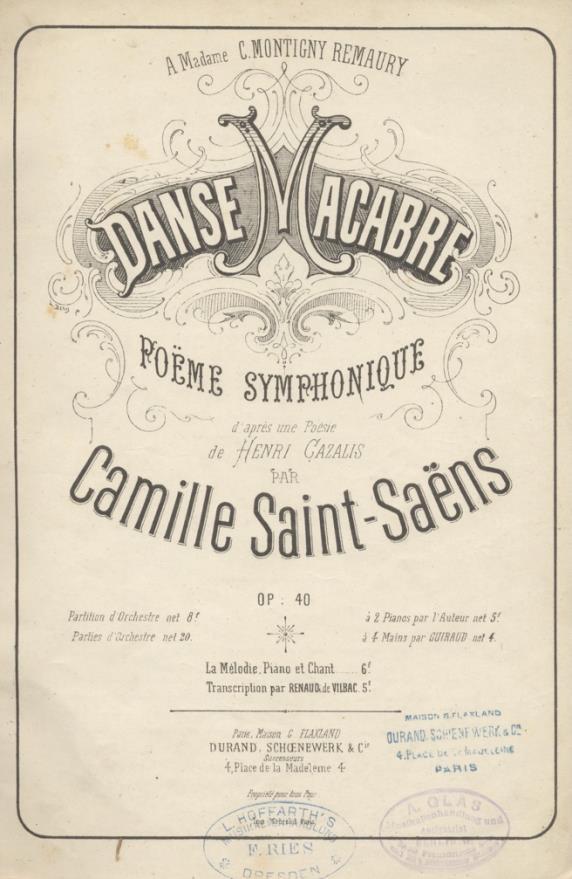
The Danse Macabre for orchestrawascomposedin1874, based onasong settingofthepoem Égalité, Fraternité by the poet Henri Cazalis. It was first performed on 24 January 1875 at the Théatre du Châtelet conducted by Édouard Colonne.
The premiere "was greeted with such a barrage of whistles, shouts and boos from the auditorium that the composer's aged mother fainted away. ... The poem ... describes Death playing his fiddle in in a wintry churchyard at midnight while skeletons dance to its eerie tune. ... Liszt was fascinated by the Danse Macabre and made a brilliant piano transcription of it." Harding: Saint-Säens and his Circle, pp. 122-123. (41407) $325
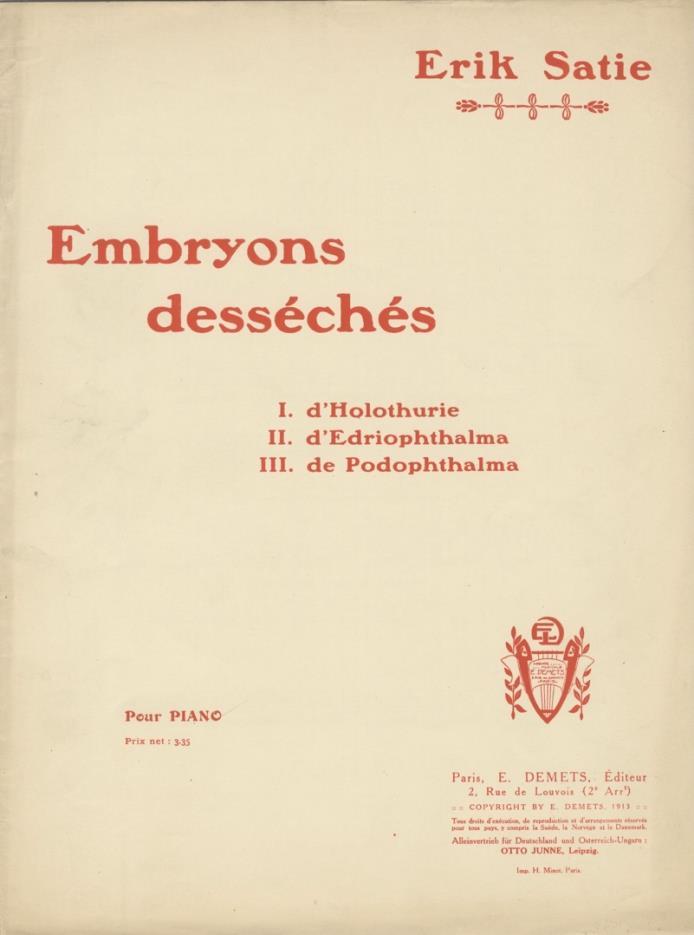
“The Personification of the Wartime Esprit Nouveau in France”
59 SATIE, Erik 1866-1925
Embryons desséchés I. d'Holothurie II. d'Edriophthalma iii. de Podophthalma Pour Piano Prix net: 3.35. [Piano solo]. Paris: E. Demets [PN E.1795 (1)-(3) D.], 1913.
Small folio. Loose in original publisher's teal blue illustrated wrappers printed in dark green and dark red, as issued. 1f. (rectotitle printed indarkred, verso blank), 11, [i](blank) pp. No bar lines. With publisher'scatalogue to verso of lower wrapper. The first work is dedicated to Suzanne Roux, the second to Edouard Dreyfus, and the third to Jane Mortier. Wrappers slightly worn; spine partially separated at spine.
First Edition. Orledge p. 299.
Composed 30 June-4 July 1913.
"[Satie] was an iconoclast, a man of ideas who looked constantly towards the future. Debussy christened him ‘the precursor’ because of his early harmonic innovations, though he surpassed his friend’s conception of him by anticipating most of the ‘advances’ of 20th-century music – from organized total chromaticism to minimalism. To some extent he made a virtue of his technical limitations, but his painstaking quest for perfection in simplicity, coupled with his ironic wit and his shrewd awareness of developments in other fields of contemporary art, made him the personification of the wartime esprit nouveau in France." Robert Orledge, revised by Caroline Potter in Grove Music Online. (41394) $375
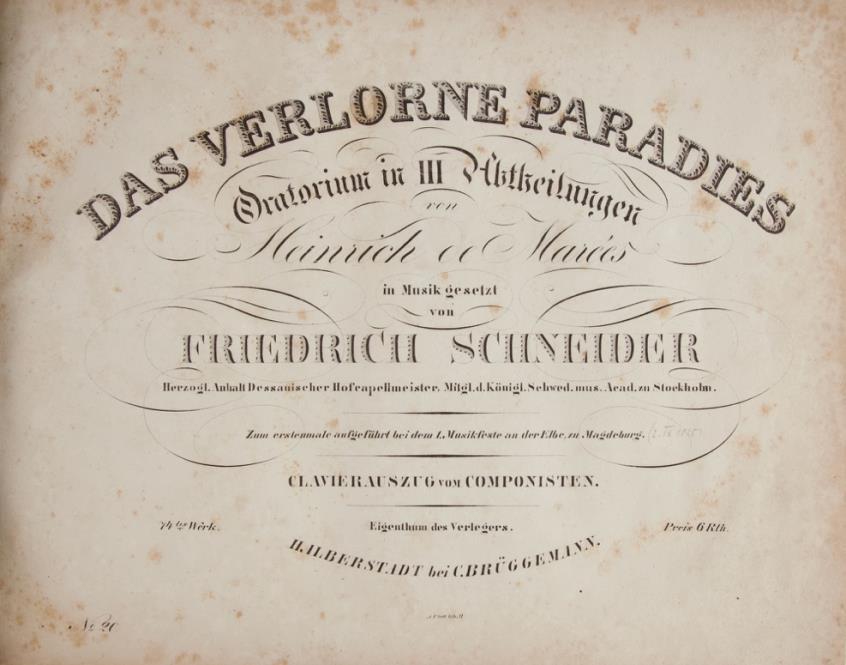
“His Music is Essentially Lyrical and Contemplative”
60. SCHNEIDER, Friedrich 1786-1853
Das Verlorne Paradies Oratorium in III Abtheilungen von Heinrich de Marées in Musik gesetzt von Friedrich Schneider Herzogl. Anhalt-Dessauischer Hofcapellmeister, Mitgl. d. Königl. Schwed. mus. Acad. zu Stockholm. Zum erstenmale aufgeführt bei dem I. Musikfeste an der Elbe, zu Magdeburg. [2. IX 1825.] Clavierauszug vom Componisten 74tes Werk. Eigenthum des Verlegers. Preis 6 Rthl. No 20. A Platt lith. M. [Piano-vocal score]. Halberstadt: bei C. Brüggemann [PN 20], [ca. 1829].
Oblong folio. Half dark green cloth with dark green textured paper boards, original light green publisher's wrappers bound in with titling within decorative border. 1f. (recto title, verso blank), 1f. (recto dedication, verso blank), [i] (blank), 2-165, [i] (blank) pp. Text in German. With publisher's catalogue to verso of lower wrapper ("Musik-Verlag von C. Brüggemann Ostern 1829"). Title and dedication lithographed, music engraved. Brief contemporary annotation inink to front freeendpaper; occasional annotations in pencilincluding "Soli," "Chor," and "Segue." Nineteen measures canceled in orange pencil (pp. 96-97), most likely a performance cut. Binding slightly worn, rubbed, and bumped; endpapers browned. Margins browned; moderate foxing throughout; very small tear to blank outer margin of p. 2 repaired with archival tape.
First Edition. MGG I, 11, 1902. OCLC 742557095, 873481700, 916097718, and 1063474035.
Das Verlorne Paradies, composedin 1824, was first performed in Magdeburg atthe Elbe-Verein Music Festival in 1825.
Schneider was a composer, conductor and teacher; his pupils included Robert Franz. "His performance of Beethoven’s Fifth Piano Concerto in Leipzig on 28 November 1811 is believed to have been the work’s première (see AMZ, xiv, 1812, col. 8)." Franz Gehring, E.M. Oakeley, and Michael Musgrave in Grove Music Online
"The highpoint of his wide-ranging compositional activity while at Leipzig came with his oratorio Das Weltgericht, first performed on 6 March 1820 at the Gewandhaus and widely performed thereafter. This work has been seen as an important bridge in a period of stagnation between the oratorios of Haydn and Mendelssohn, and his creative achievements were respected by Schumann. His music is essentially lyrical and contemplative in character." ibid. (41231) $250
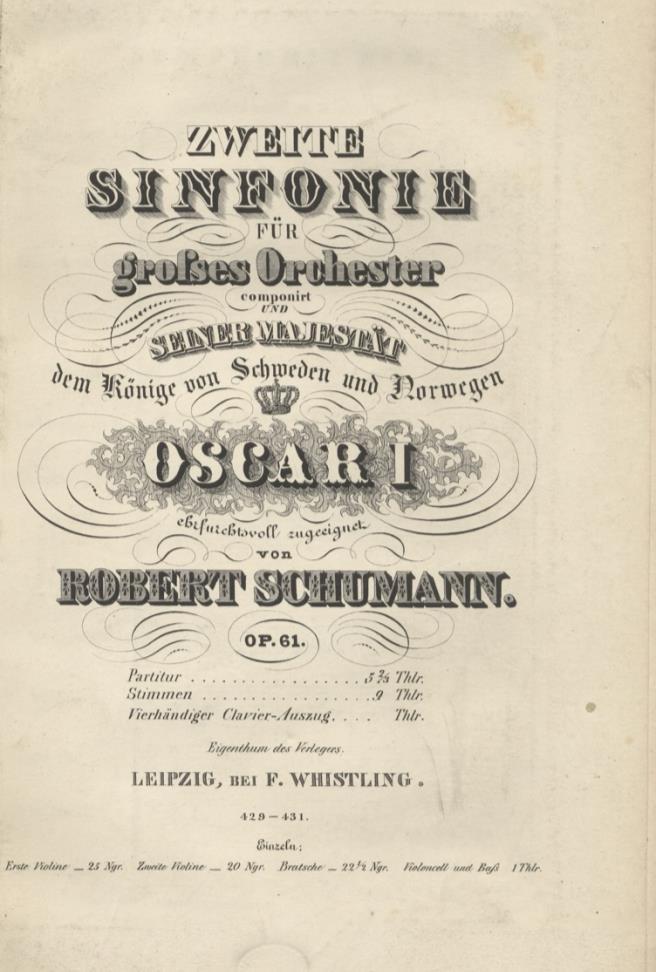
First Edition, First Issue of the Second Symphony
61 SCHUMANN, Robert 1810-1856
Zweite Sinfonie für grosses Orchester componirt und Seiner Majestät dem Könige von Schweden und Norwegen Oscar I. ehrfurchtsvoll zugeeignet ... Op. 61. Partitur 5 2/3 Thlr. ...429-431. [Full score]. Leipzig: F. Whistling [PN 430], November 1847.
Octavo. Original publisher's darkivory printedwrappers. 1f.(rectotitle, verso blank), 232pp. Title lithographed, music engraved. Smallembossed publisher's blindstamp ("W") within decorative borders toupper wrapper, with impression visible to blank lower margin of following leaves. Wrappers somewhat worn, soiled, and stained, with small tears and chips resulting in minor loss to outer margins and spine. Minor internal wear.
First Edition, first issue. Mueller-Reuter I, 145. Hoboken 15, 109 (later issue). McCorkle p. 269. Hofmann p. 137. Later issues bear the year to the foot of title.
"The Second Symphony coheres by virtue of a web of recurrent thematic strands. The technique of motivic recall is enhanced by Schumann’s employment of contrapuntal combinations. Specifically, the chorale theme introduced midway through the finale is integrated with the opening theme of the first movement, also a chorale, in the symphony’s concluding passages. The displacement of the finale’s initial march-like theme by a pair of interwoven chorales in essence lifts the Second Symphony from a secular to a quasi-religious plane." John Daverio and Eric Sams in Grove Music Online. (41381) $850
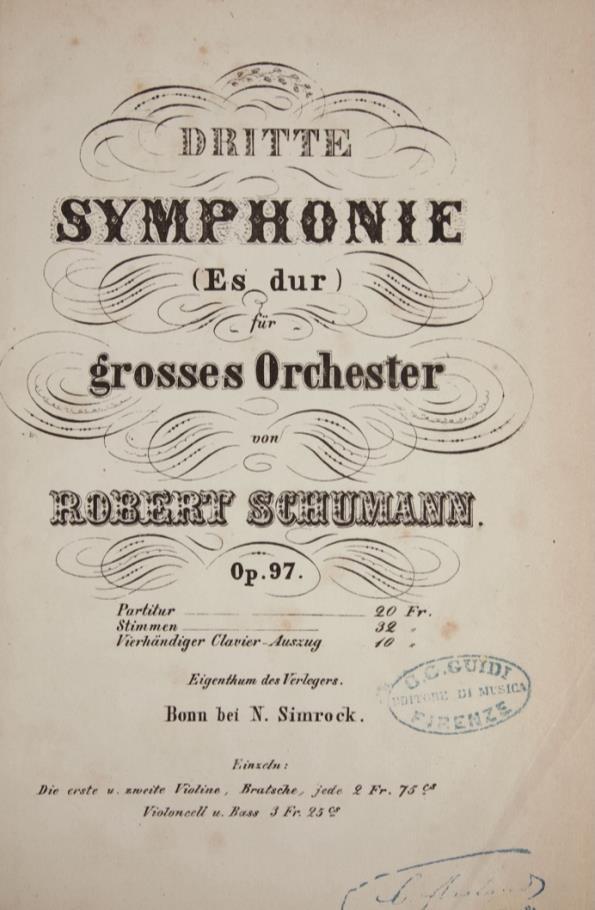
First Edition of the Third Symphony
62. SCHUMANN, Robert 1810-1856
Dritte Symphonie (Es dur) für grosses Orchester ... Op. 97. Partitur - 20Fr. [Full score]. Bonn: N. Simrock [PN 5019], October 1851.
Octavo. Quarter 19th century dark green calf with matching pebbled paper boards. 1f. (recto lithographic title, verso blank), 211 pp. Music engraved. Binding worn, rubbed, bumped, and scuffed; approximately 1" lacking to head of spine. Slightly worn and browned; moderately foxed throughout; front free endpaper and lower outer corner of title creased; oval handstamps of Florentine and Parisian booksellers to title.
First Edition, second issue of the Rheinish Symphony. Müeller-Reuter I, p. 147. McCorkle p. 419 (noting that the first issue contains the publisher's manuscript corrections following the composer's alterations to the proofs). Hoffmann p. 211. Hoboken 15, 157.
"With Schumann's move to Düsseldorf, in September 1850, he once more bent his energies to composing orchestral works. In October came the Cello Concerto, and on 2 November he began work on the Symphony N. 3 in E flat major, laid out on a grand scale in five movements, in which he was to express all his feelings about the Rhine, its scenery, its atmosphere, its legends, and the pageant of German history that had been played out on the river's banks and reflected in its waters. ... As usual, once the composition was begun, it was completed with rapidity - the full score being finished on 9 December. On 6 February 1851 the first performance took place in Düsseldorf with Schumann himself conducting, and the same year the publisher Simrock of Bonn brought out both the full score and parts of the work." Schlotel: The Orchestral Music, pp. 796-797 in Walker, ed.: Robert Schumann The Man and His Music. (41385) $450
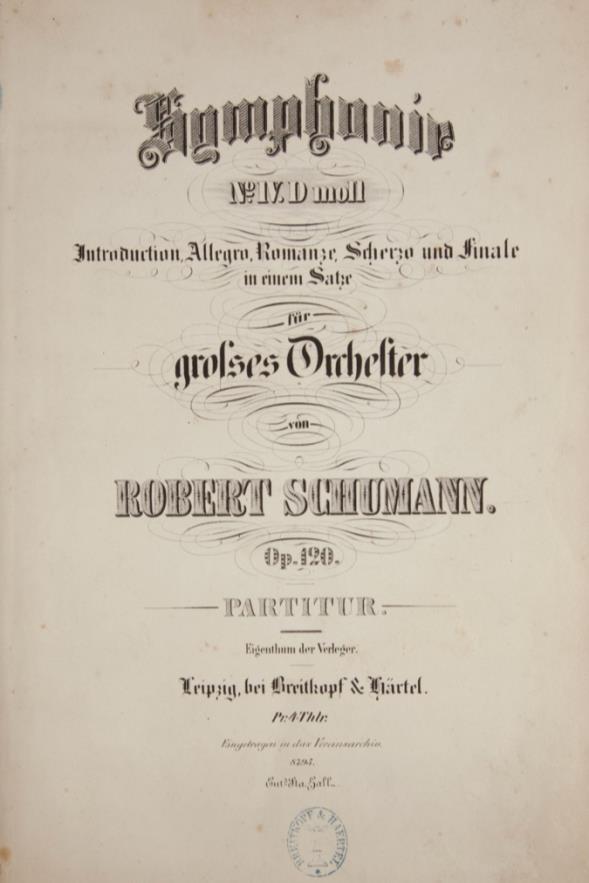
First Edition, First Issue of the Fourth Symphony
63 SCHUMANN, Robert 1810-1856
Symphonie No. IV. D moll Introduction, Allegro, Romanze, Scherzo und Finale in einem Satze für grosses Orchester ... Op. 120. Partitur ... Pr. 4 Thlr. [Full score]. Leipzig: Breitkopf & Härtel [PN 8795], [1853].
Octavo. Nineteenth century boards with dark red leather titlelabel gilt to spine. 1f. (rectotitle, verso printed note regarding chronology of composition and symphony's numbering), 165, [i] (blank) pp. Title lithographed, music engraved. Publisher's small oval handstamp to foot of title. Binding worn, rubbed, and bumped. Occasional minor wear and foxing, slightly heavier to first few leaves; small hole to blank upper margin of p. 91.
First Edition, first issue. Müller-Reuter I, 148. McCorkle pp. 508 and 512. Hofmann p. 261. Hoboken 15, 211.
Composed as the Second Symphony in 1841; the revision of 1851 was first performed as Symphony No. 4 on 30 December 1852 in Düsseldorf.
"When his D minor Symphony was coldly received by the Leipzig public in December 1841, Schumann withdrew it, and seemed in no hurry to get it newly performed. In fact the Symphony lay quietly in his desk for ten years. Then in December 1851 he decided to revise and re-score the work to bring out at one of his Düsseldorf concerts. In this new form it was completed on 19 December of that year. In 1841, both on the manuscript and at the first concert, the work was referred to as a 'Symphony.' But the 1851 revision at first bore the tile 'Symphonic Fantasy'; perhaps Schumann hoped that with this new title the work's remakable freedom of thought would be more readily accepted. However, before the first performance on 30 December 1852 Schumann changed the title back to 'Symphony." It is now universally known as the Fourth Symphony, and was published as such by Breitkopf und Härtel." Schlotel: The Orchestral Music, pp. 299-300 in Walker, ed.: Robert Schumann The Man & His Music. (41094) $750
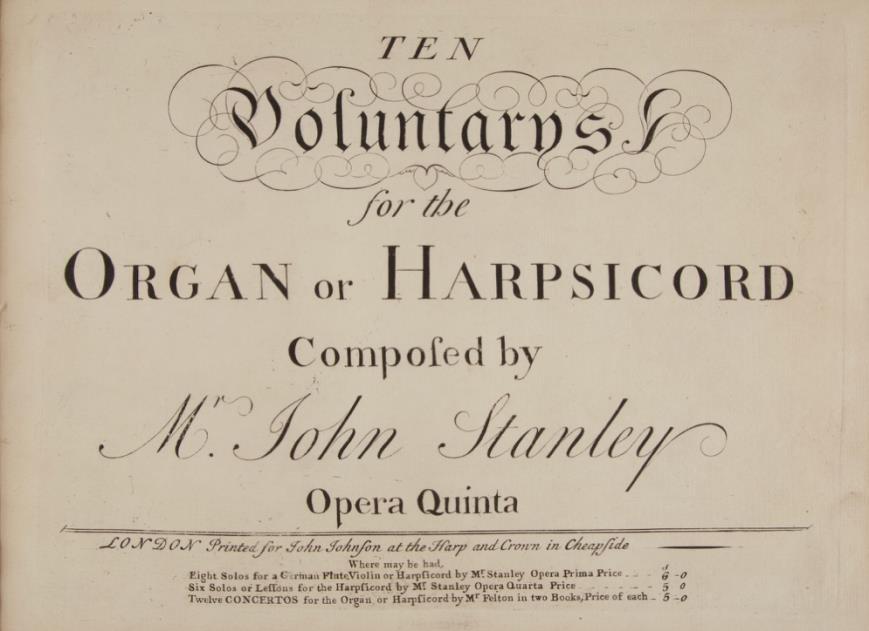
First Editions of the Celebrated and Influential Organ Voluntarys From the Lulworth Castle Collection
64. STANLEY, John 1712-1786
Ten Voluntarys for the Organ or Harpsichord ... Opera Quinta [Sesta-Settima]. London: Printed for John Johnson at the Harp and Crown in Cheapside, [1745].
3 volumes. Oblongfolio. Uniformly boundin18th centurystyleinmodernhalfmid-tanmottledcalfwithmarbled boards, spine with titling and rules gilt. Minor internal wear; occasional small stains, light foxing, and soiling, mainly to blank margins; minor losses and tears, some repaired with archival tape; manuscript notation to Vol. I, p. 37 ("Mary [?]Smead") slightly cropped
Vol. I: Opera Quinta
1f. (recto title, verso blank), [i] (blank), 2-38 pp. First Edition. BUC p. 974. RISM S4680 and SS4680.
Vol. II: Opera Sesta
1f. (recto title, verso blank), [i] (blank), 32 pp. First Edition. BUC p. 974. RISM S4685 (three copies in the U.S., at the University of Michigan, Ann Arbor; NYPL Lincoln Center; and the :Library of Congress
Vol. III: Opera Settima
1f. (recto title, verso blank), 27, [i] (blank) pp. First Edition. BUC p. 974. RISM S4687 and SS4687
With brief publisher's catalogue to foot of each title. Engraved throughout.
Provenance
Noted American harpsichordist Louis Bagger (1926-2024); earlier Lulworth Castle, with "From the Lulworth Castle Collection" in pencil to front pastedown.
"Stanley is chiefly remembered for his three sets of organ voluntaries, which, though published between 1748 and 1754, include pieces dating from the late 1720s and the 1730s. They are mostly in the two-movement form established by his teachers Reading and Greene, consisting of a slow introduction for diapasons and a quick movement featuring a solo stop, such as the cornet or trumpet. Each volume ends with three or four preludes and fugues for full organ." Malcolm Boyd, revised by A.G. Williams in Grove Music Online
The firstappearanceinprint ofStanley'scelebratedand influential organvoluntaries, admired byHandel himself, among others. (40782) $2,000
Collection of Strauss, Sr. Waltzes, Most in First Edition
65. STRAUSS, Johann, Sr. 1804-1849
Collection of early Viennese waltzes for piano solo engraved and published in Vienna by Tobias Haslinger, most in first edition.
Oblong folio. 19th century quarter dark brown calf with marbled boards with octagonal dark brown decorative calf label to upper with titling gilt "Valser di Strauss S.T.," raised bands on spine in decorative gilt and blindstamped compartments, marbled edges and endpapers.
Provenance
Most titles with the contemporary signature of "Mad. Tossizza" or "Madame Tossizza." Madame Tossizza may have been part of the family of the prominent Greek politician and entrepreneur Michael Tossizza (1787–1856), who was born in the town of Metsovo in Northern Greece.
Contents:
1. Des Verfassers beste Laune, Charmant-Walzer ... 31tes Werk. [PN 5491], [1831] 1f. (title), 5, [i] (publisher's catalogue of Strauss's works up to op. 45). Second edition. Weinmann p.11. S & R p. 50. Schneider 37. Lithographic portrait of Strauss at age 25 after Kreihuber to title "gedr. im lith. Institut."
2. Souvenir de Baden. Helenen-Walzer ... 38tes Werk. [PN 5594], [1830-33] 1f. (illustrated title), [i] (publisher's catalogue), 2-6 pp. First Edition. Weinmann p. 12. S & R p. 59. Schneider 76. Weinmann and S & R date the edition at 1830 while Schneider dates it to 1833. With charming lithographic illustration to title by F. Wolf of Strauss playing the violin and leading an orchestra in the Baden Gardens with fashionable couples and groups in attendance.
3. Wiener Damen-Toilette-Walzer ... 40tes Werk. [PN 5685], [1830]. 1f. (illustrated title), 9, [i] (publisher's catalogue: "Joh. Strauss neueste Tanzmusik"). First Edition. Weinmann p.1 2. S & R p. 65. Schneider 81. Vignette engraving byA. DworzackafterFr. Weigl withinan ovalprintedinblue depictingafashionableyoung woman in front of a full length mirror, a keyboard instrument in the background.
4. Tivoli-Freudenfest - Tänze ... 45tes Werk. [PN 5746], [1831]. 1f. (decorative title), 9 pp. First Edition. Weinmann p. 13. S & R p. 70. Schneider 90. Title dedication to to Sophie Friederike, Archduchess of Austria, incorporating a sunburst design printed in green and black.
5. Vive La Danse! ... 47tes Werk. [PN 5851], [1831]. [i] (title), 2-7 pp. First Edition. Weinmann p. 13. S & R p. 74. Schneider 97. Title printed in green and black.
6. Das Leben ein Tanz oder Der Tanz ein Leben! ... 49tes Werk. [PN 5868], [1832]. 2ff. (title printed in red, green, and black; dedication), 8, [i] (publisher's catalogue of waltzes, cotillons, galops, potpourris ,and marches composed by Johann Strauss [Sr.]). First Edition. Weinmann p.132. S & R p. 77. Schneider 104.
7. Alexandra-Walzer ... 56tes Werk. [PN 6054], [1832]. 1f. (decorative title), [i] (text), 2-12 pp. First Edition. Weinmann p. 14. S & R p. 84. Schneider 131.
8. Zampa-Walzer ... 57tes Werk. [PN 6063], [1832]. [i] (title), 2-11 pp. First Edition. Weinmann p. 14. S & R p. 85. Schneider 137. An arrangement of a melody from Ferdinand Herold's opera "Zampa, ou La fiancée de marbre."
9. Carnevals-Spende ... Walzer ... 60tes Werk. [PN6089], [1833]. 1f. (decorativetitle), [i](publisher'scatalogue), 2-8 pp. First Edition. Weinmann p. 14. S & R p. 91. Schneider 151.
10. Tausendsapperment Walzer ... 61tes Werk. [PN 6234], [1833]. 1f. (title), 3-11pp. First Edition ofthe second version. Weinmann p. 15. S & R p. 92. Schneider 156.
11. Robert-Tanze nach beliebten Motiven aus Meyerbeer's Oper: Robert der Teufel ... 64tes Werk. [PN 6548], [1833]. 2ff. (decorative title by J. Kress printed in red and black, publisher's catalogue), 3-9 pp. First Edition. Weinmann p. 15. S & R p. 96. Schneider 171.
12. Mittel gegen den Schlaf Walzer ... 65tes Werk. [PN 6591], [1833]. !f. (rectotitle, verso publisher'scatalogue), 3-11 pp. First Edition. Weinmann p. 15. S & R p. 98. Schneider 176.
13. Emlék Pestre ... Erinnerung an Pesth. Walzer ... 66tes Werk. [PN 6706], [1834]. 1f. (title), 8 pp. First Edition. Weinmann p. 15. S & R p. 99. Schneider 181.
14. Gabrielen-Walzer ... 68tes Werk. [PN 6713], [1834]. 1f.(recto title, verso publisher's catalogue), 9 pp. First Edition. Weinmann p. 16. S & R p. 102. Schneider 185.
15. Pfennig-Walzer ... 70tes Werk. [PN 6738], [1834]. 1f. (title printed in green and black), 8 pp. First Edition. Weinmann p. 16. S & R p. 105. Schneider 198.
16. Elisabethen Walzer ... 71tes Werk. [PN 6758], [1834]. 1f. (decorative title printed in blue and black), 3-13, [i] (publisher's catalogue). First Edition. Weinmann p. 16. S & R p. 106. Schneider 202. The elaborate title centers on the dedicatee, Prussian Princess, Elisabeth Luise.
17. Philomelen-Walzer ... 82tes Werk. [PN 6894], [1835]. 1f. (title), 3-10, [i] (publisher's notice regarding publishing and copyright). First Edition. Weinmann p. 17. S & R p. 127. Schneider 243.
18. Lanner, Joseph (1801-1843). Pesther-Walzer ... Der Edlen Ungarischen Nation in tiefster Ehrfurcht gewidmet ... 93 stes Werk. Wien: Pietro Mechetti qm Carlo [PN 2542], [1835]. 1f. (decorative title), 3-11 pp. First Edition. Weinmann Mechetti catalog p. 63.
19. Montecchi Galopp No. 41 in the series Lieblings-Gapoppen. Wien: Tobias Haslinger [PN 6269], 1833]. [i] (series title), 2-3 pp. First Edition. Weinmann p. 15. S & R p. 93. Schneider 163.
Boards slightly worn and bumped; lower upper joint partially split; small stab hole to upper boardextending into the first 15 leaves. Some foxing and minor staining. In very good condition overall.
References:
Weinmann, Alexander: Verzeichnis sämtlicher Werke von Johann Strauss Vater und Sohn. Cited as "Weinmann;" Schönherr, Max and Karl Reinöhl: Das Jahrhundert des Walzers 1. Band: Johann Strauss Vater. Ein Werkverzeichnis. Cited as "S & R;" Schneider, Hans: Katalog Nr. 294: Tanzmusik aus drei Jahrhunderten. Eine Katalogfolge. Erster Teil: Johann Strauss (Vater). Cited as "Schneider." (41397) $1,250
First Edition, Later Issue of the Blue Danube Waltz for Piano Solo
66. STRAUSS, Johann, Jr. 1825-1899
An der schönen, blauen Donau. Walzer für das Pianoforte (The Blue Danube Waltz) ... Op. 314 ... Dem Wiener Männergesang -Vereine achtungsvoll gewidmet. Für Piano solo ... Pr. 80 Nkr/15 Ngr. Lithogr. Meyer. Druck Weigel. Wien: C. A. Spina [PN C.S. 19.216], 1868.
Oblong folio. Modern marbled wrappers. 1f. (recto illustrated lithographic title, verso publisher's engraved catalogue of music by Johann, Josef and Eduard Strauss), 3-11 pp. engraved music. "Druck von A. Eckel in Wien" printed to foot of first page of music. Title lists arrangements for piano 4-hands and for men's 4-part choir with piano. Title page depicts the Danube river and Vienna, with light signature in pencil ("Breuning") to upper innercorner. The highest opus numbers listed in the publisher's catalogue are for Johann Strauss Op. 320; Josef Strauss Op. 232; and Eduard Strauss Op. 32. Slightly worn; narrow strip of paper reinforcement to outer margin of first and last leaves.
First Edition, later issue of the solo piano version of the famous Blue Danube Waltz. SEV Vol. 7, p. 480. Fuld p. 147. (41391) $200
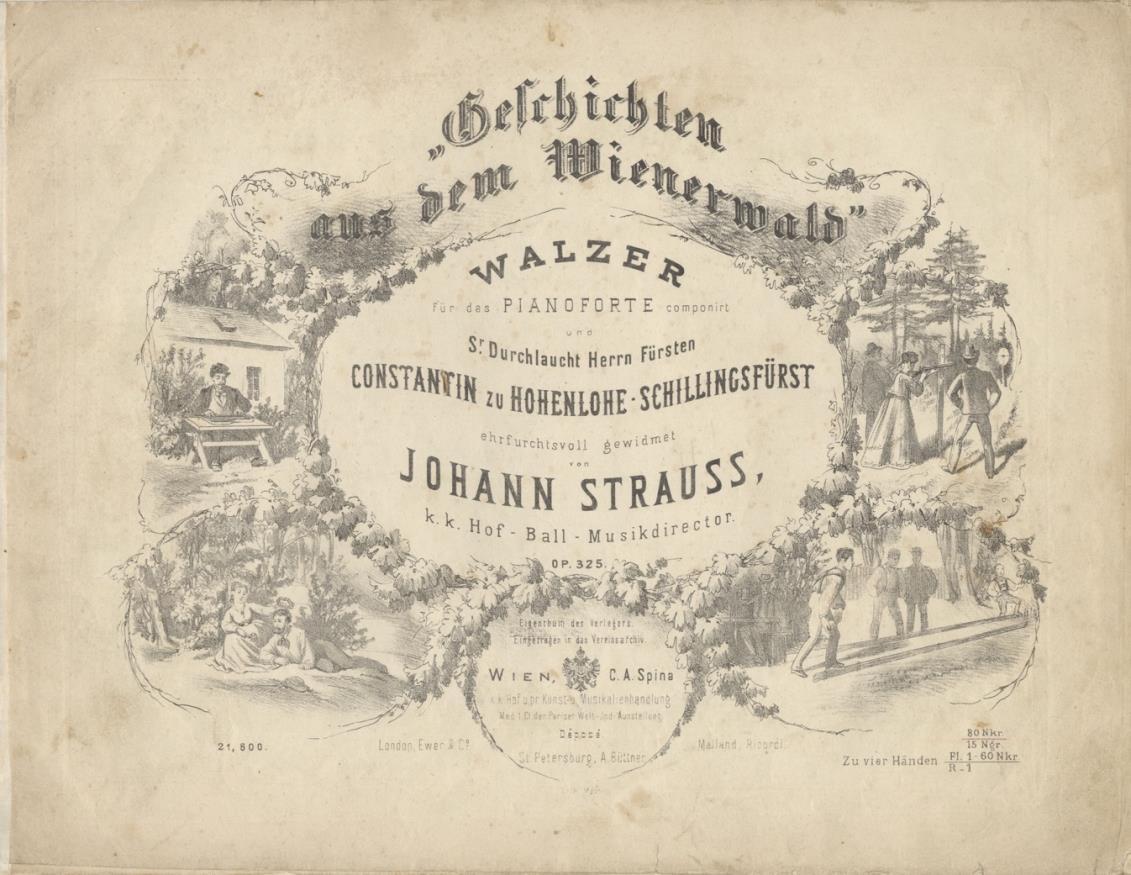
First Edition, Later Issue of Tales from the Vienna Woods
67 STRAUSS, Johann, Jr. 1825-1899
“Geschichten aus dem Wienerwald" (Tales from the Vienna Woods) Walzer für das Pianoforte componirt und Sr. Durchlaucht Herrn Fürsten Constantin zu Hohenlohe-Schillingsfürst ehrfurchtsvoll gewidmet ... Op. 325 ... [Pr.] 80 Nkr./15 Ngr. Wien: C. A. Spina [PN C.S.21.600], 1869.
Oblong folio. Modern marbled wrappers. [i] (pictorial lithographic title), 2-13, engraved music, [i] (publisher's catalogue of works by Johann Jr., Josef, and Eduard Strauss) pp. "Druck von A. Eckel in Wien" to foot of first page of music. Arrangement for piano 4-hands listed on title. The illustrated title depicts 4 idyllic scenes of activities in the Vienna Woods. The highest opus numbers for each composer listed in the publisher's catalogue are for Johann Strauss Jr. op. 329; Josef Strauss op. 254; and Eduard Strass op. 43. Some wear, soiling, small marginal tears, and minor repairs; narrow strip of paper reinforcement to outer margin of first and last leaves.
First Edition, later issue. SEV Vol. 7, p. 508. Fuld p. 569.
One of the Waltz King's best-known waltzes. (41392) $150
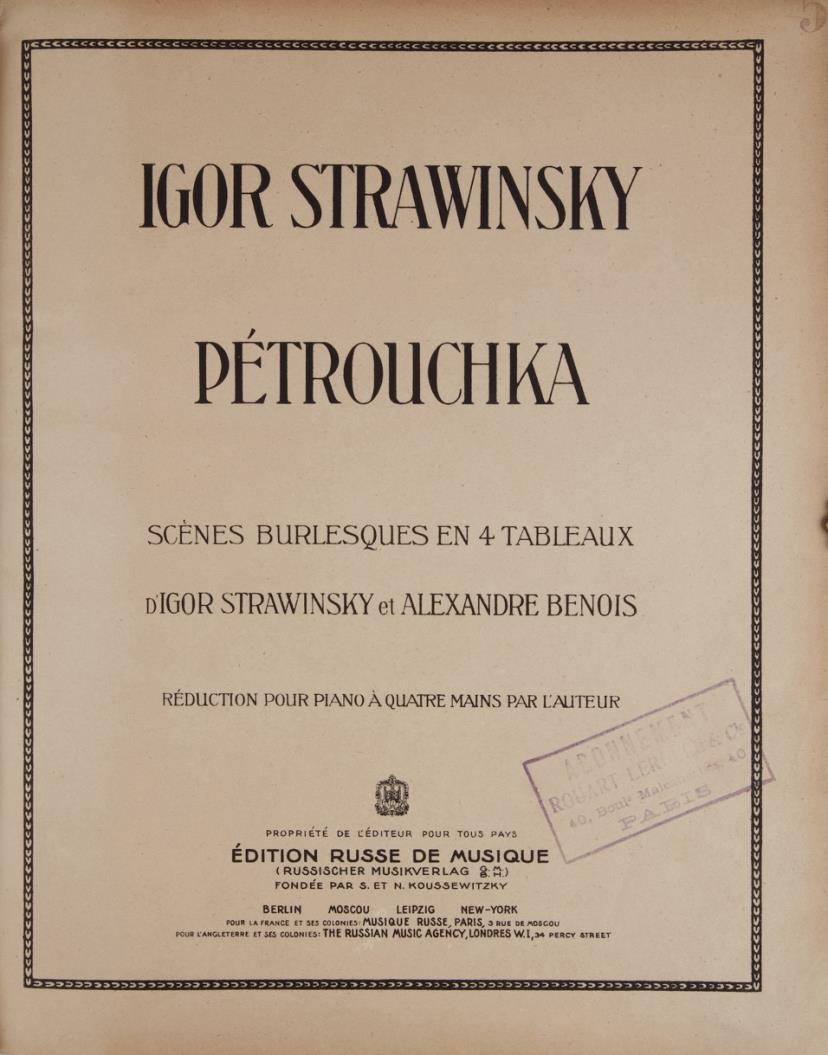
First Edition, First Issue of the Composer’s Beloved Petrouchka
68 STRAVINSKY, Igor 1882-1971
Pétrouchka Scènes Burlesques en 4 Tableaux d'Igor Strawinsky et Alexandre Benois. Réduction pour piano à quatre mains par l'auteur. [Reduction for piano 4-hands]. Berlin, Moscou, Leipzig, New-York: Édition Russe de Musique [PN R.M.V. 150], [1912].
Folio. Contemporary half black calf with marbled boards, label of the Parisian music rental firm Rouart-Lerolle to upper, marbled endpapers. 1f. (recto title, verso blank), [i] (named cast list referring to first production of 1911, in French), [i] (synopsis in Russian and French), [i] ("general remarks" in Russian and French), [i] (blank), [i] (dedication to A. Benois), [i] (blank), 7-84, [ii] (blank) pp. Photographic transfer from engraved plates. With "ROME MAI 1911" and printer'snote"Imp. C. G. Röder, Leipzig."tolower outercornerof p. 84. RouartLerolle and "5" handstamps totitleand first fourleaves. Binding worn, rubbed, bumped, andabraded; hinges split; small label with "143" in manuscript to upper board
First Edition, first issue. Kirchmeyer 12-4. De Lerma P17. Crawford p. 533.
Distinguishing imprint to title below crest found in the first issue is as follows:
PROPRIÉTÉ DE L'ÉDITEUR POUR TOUS PAYS / ÉDITION RUSSE DE MUSIQUE / (RUSSISCHER MUSIKVERLAGG.M. (above)BH(below)/FONDÉEPARS. ETN. KOUSSEWITZKY/BERLINMOSCOU LEIPZIG NEW-YORK / POUR LA FRANCE ET SES COLONIES: MUSIQUE RUSSE, PARIS, 3 RUE DE MOSCOU / POUR L'ANGLETERRE ET SES COLONIES; THE RUSSIAN MUSIC AGENCY, LONDRES W.I, 34 PERCY STREET
"The emergence of Stravinsky as a modernist, with an individual manner unlike any other, can be dated with some precision to his early work on Petrushka. In March 1910, during the later stages of composing The Firebird, he had experienced the famous 'fleeting vision' out of which The Rite of Spring was to grow. But when Diaghilev and Nijinsky visited him in Lausanne in September 1910 they found him at work on something quite different, a concert piece for piano and orchestra called 'Petrushka's Cry'. Together with a 'Russian Dance' composed soon afterwards, this music was to form the basis of the ballet which Diaghilev instinctively urged him to write instead. ... It is from the systematic attempt to render [the] particular flavour of traditional Russian life into music that Petrushka derives many of its freshest and most original qualities. ...
Looked at in general terms, [the] opening sequence of Petrushka is a prototype of later Stravinskian form. Its underlying rhythmic design may not be complex in the same way as that of The Rite of Spring or the later Russian works, but its intricacy of rhythmic detailing and its mixture of a highly fluid pattern of melodic stress with an inert background harmony laid the groundwork for a technique which, through many changes of superficial style, was to serve him for the rest of his life." Walsh: The Music of Stravinsky, pp. 24-29.
Petroushka proved just as successful with the public and critics as The Firebird had been; but it was undoubtedly a more original work. In the first place, Stravinsky had been able to play a leading part in the construction of the scenario, which had not been the case with The Firebird. Secondly, whereas the music of The Firebird showed that the pupil had learnt all that his master had had to teach him, in Petrushka for the first time the authentic voice of the new master is heard." TNG Vol. 18, pp. 244-245.
Petrushka, one of Stravinsky's best-known and loved works, represents the essence of Diaghilev's monumental Ballets Russes era. The ballet received its first performance, with the incomparable Nijinsky in the title role, at the Théâtre du Châtelet on 13 June 1911, conducted by Pierre Monteux, with choreography by Fokine and designs by Alexandre Benois. (41390) $1,800
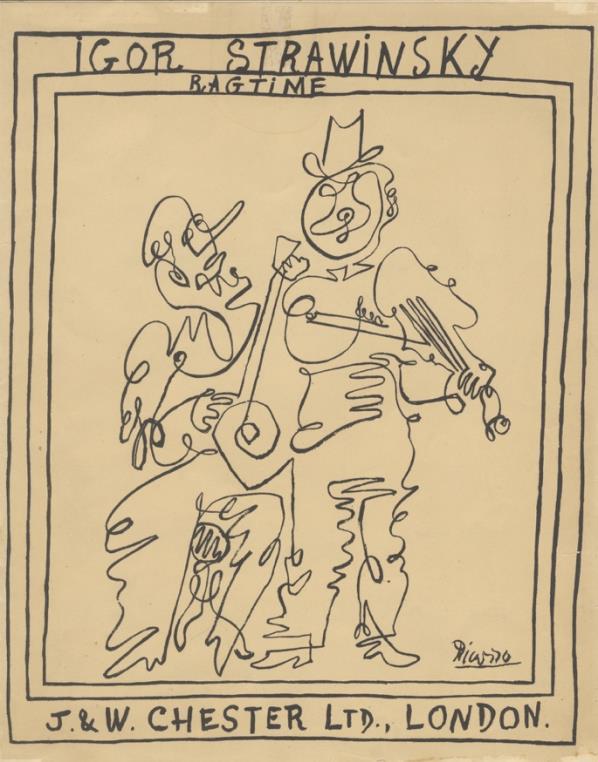
With Attractive Title Illustration by Picasso
69 STRAVINSKY, Fëdor Ignat’evich 1843–1902 Rag-Time. For eleven instruments. Piano transcription by the Composer. London: J & W Chester Ltd. [PN J.W.C. 2071], [ca. 1935].
Folio. Self-wrappers. Sewn. 1f. (recto full page illustration by Picasso, verso blank), 12 pp. Slightly worn; minor browning; very small chips to edges, including title.
This issue not in Kirchmeyer. (41393) $50
“Retains the Freshness Which Won the Composer His First Fame”
70. SULLIVAN, Arthur 1842-1900
The Music to Shakespeare's Tempest, Composed & Dedicated to his esteemed friend, Sir George Smart. [Piano four-hands]. London ... New York: Novello & Company, Limited ... Novello, Ewer & Co. [PN 8028], [ca. 1865].
Folio. Contemporary dark blue textured paper boards with titling gilt to upper. 1f. (recto title, verso blank), [i] (blank), 2-105, [i] (blank) pp. Engraved throughout. With small circular Schirmer and "Made in England" handstamps to foot of title and small label of "Novello & Company 15/- Limited" to outer margin. Binding worn, rubbed, and bumped; blank lower outer margin of pp. 710 slightly defective. A nice wide-margined copy.
First Edition. OCLC 6704431.
The Tempest was first performed in Leipzig at the Gewandhaus on 6 April 1861.
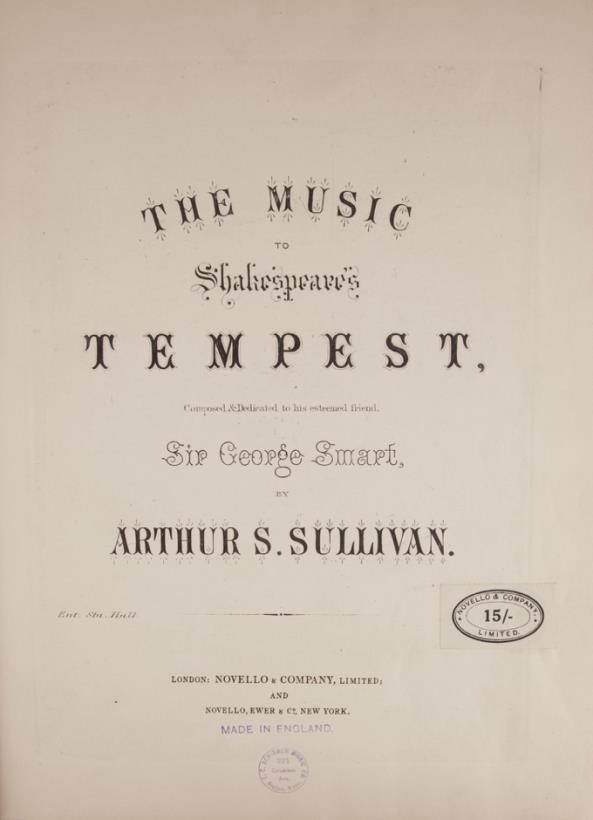
An English composer and conductor, Sullivan's "widest and most durable fame was won in operetta, especially in partnership with the dramatist and satirist W.S. Gilbert (1836–1911) ... His graduation exercise at Leipzig, which he conducted on 6 April 1861, was a suite of incidental music to The Tempest much on the lines of Mendelssohn's to A Midsummer Night's Dream. Returning to London, he met George Grove, who arranged for a performance of the Tempest music (revised) under the baton of August Manns at the Crystal Palace on 5 April 1862. The work won an immediate and extraordinary success: ‘it may mark an epoch in English music’, wrote the influential critic Henry F. Chorley in The Athenaeum. It was repeated a week later; in 1863 Hallé likewise gave it two performances with his orchestra in Manchester. Sullivan was thereafter never short of commissions and was exceptionally permitted to dedicate his Procession March (also called Royal Wedding March; Crystal Palace, 10 March 1863) and other works to the Prince of Wales himself, the future King Edward VII. ...
After the operettas, indeed, it is not Ivanhoe which best represents Sullivan but that almost smothered category ‘incidental music’, with which may be grouped his ballet music (insofar as it has been rediscovered). The incidental music to The Tempest (1861) retains the freshness which won the composer his first fame, and cunningly employs the principle of thematic metamorphosis (Schumann, rather than Liszt, being the probable inspiration). The plaintive ‘warning’ oboe figure at the opening, representing Prospero's pervasive magic, becomes the main tune of the Banquet Dance ... appropriately so, because the ostensible jollity of the banquet is a hidden manifestation of Prospero's menace." Arthur Jacobs in Grove Music Online. (41239) $120
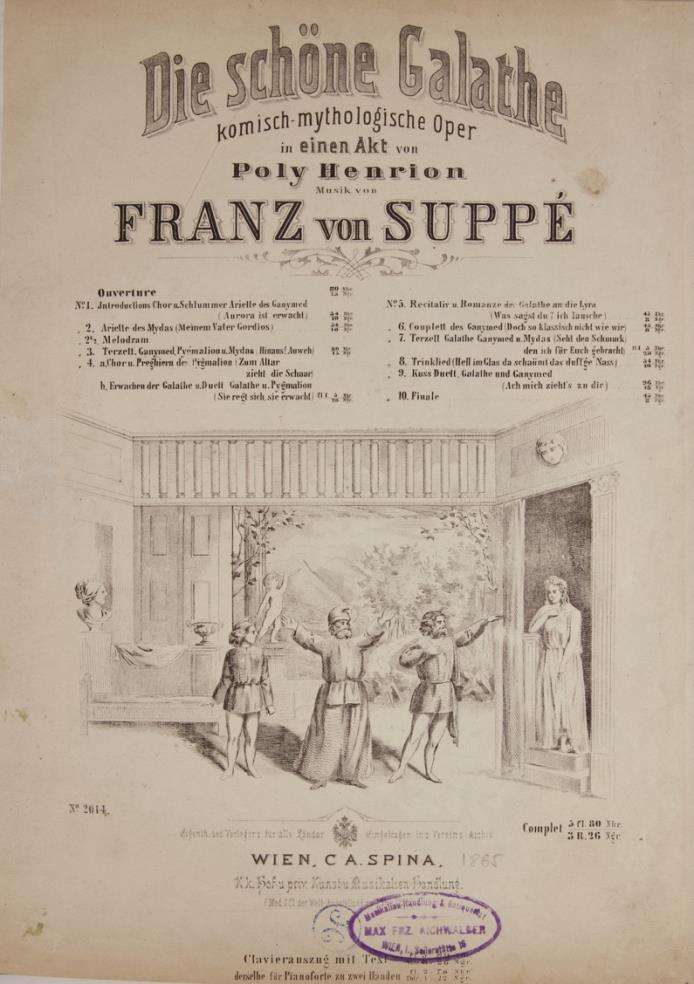
“Light, Fluent Style”
71. SUPPÉ, Franz von 1819-1895
Die schöne Galathe komisch-mythologische Oper in einen Akt von Poly Henrion ... No. 2014 ... Complet 3fl. 30 Nkr. 3 R. 26 Ngr. [Pianovocal score]. Wien: C .A. Spina [PNs F.G. 2014; 2014 No.1-2014 No. 8; F.G. 2014.9], [1865].
Folio. Half dark brown textured cloth with marbled boards, manuscript title label to upper. 1f. (recto title, verso blank), 3-80 pp. Title lithographed, music engraved. With fine illustrated title of a scene from the opera with singers and Greco-Roman set incorporating columns, sculptural bust, and mascaron. Occasional small stains and minor soiling, mainly to lower blank margins; narrow strip of white paper to blank inner margin of title with small tape repair.
First Edition. OCLC 30370740.
Die schöne Galathean, an operetta in one act to a libretto by "Poly Henrion" (L. Kohn von Kohlenegg), was first performed in Berlin at Meysel’s on 30 June 1865.
"Suppé is the earliest Viennese composer of musical farces whose works still survive as viable stage scores (and popular overtures), and later in his career he became the first master of the classical Viennese operetta in the train of the acclimatized scores of Offenbach. His light, fluent style includes the ability to vary a phrase length or melodic and rhythmic figure in a personal and immediately effective way. Though now remembered mainly as the composer of overtures such as Poet and Peasant, Light Cavalry and Morning, Noon and Night in Vienna, his ambitions extended to the composition of large-scale sacred works and operas. He is at his best and most characteristic in the series of famous operettas from Die schöne Galathee (1865) to Boccaccio (1879). Numbers like ‘Hab ich nur deine Liebe’, ‘Mia bella Fiorentina’ and ‘Holde Schöne’ from Boccaccio have an irresistible elegance and élan, and his scoring is worthy of the finest orchestras rather than the bands that so often seize upon the overtures in particular. The song ‘O du [Das ist] mein Österreich’ of 1849 has become virtually Austria’s second national song." Peter Branscombe and Dorothea Link in Grove Music Online
“The sculptor Pygmalion (tenor) has produced a statue of a beautiful woman, Galathea, which the wealthy art collector Mydas (buffo baritone) wishes to buy; but Pygmalion will not part with it. He wishes that the beautiful creature could be alive and prays to Venus to this end. Galathea does come to life (soprano), but causes havoc with her flirtations with Pygmalion’s servant Ganymede (mezzo-soprano), her extraction of jewels from Mydas, her taste for wine and her tantrums. Pygmalion’s prayer that Galathea be returned to stone is answered, but Mydas’s jewels are turned to stone too. Pygmalion is now only too happy to let Mydas buy the statue." Andrew Lamb in Grove Music Online
“A Viennese response to Offenbach, Suppé’s richly melodic score includes Mydas’s Meinem Vater Gordios; Galathea’s awakening, Sie regt sich, sie erwacht; her drinking song, Hell im Glas; Ganymede’s Wir Griechen; the treasure trio, Seht den Schmuck; and Ganymede’s kissing duet with Galathea, Ach, mich zieht’s zu dir. At the first production Anna Grobecker of the Carltheater, Vienna, made a guest appearance as Ganymede." ibid (41235) $250
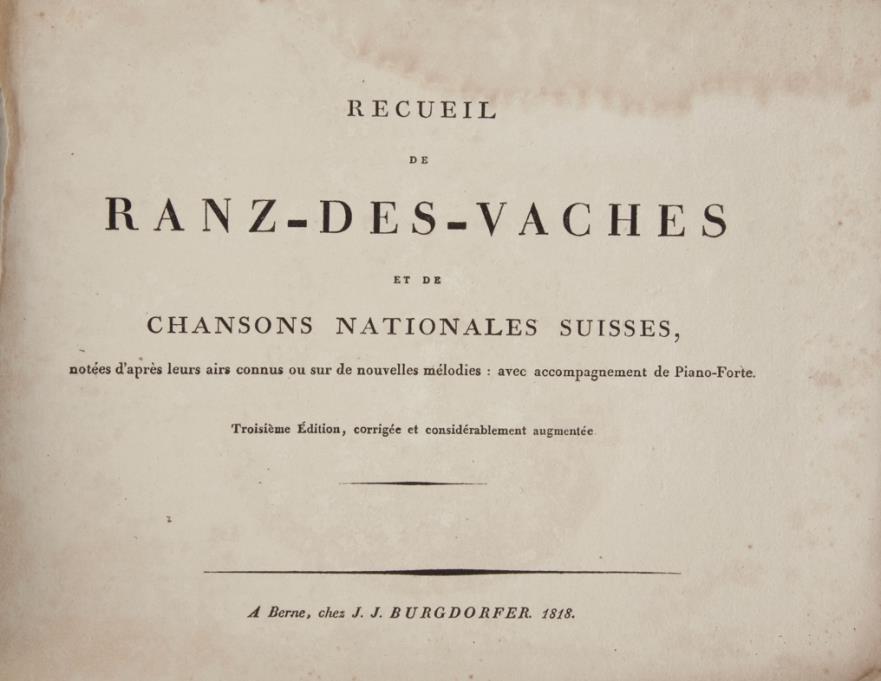
Traditional Swiss Folksongs, Including Music for the Alphorn
72 [SWISS SONGS - Early 19th Century]. Wyss, Johann Rudolf, ed. 1782-1830
Recueil de ranz-des-vaches et chansons nationales Suisses, notées d'après leurs airs connus ou sur de nouvelles mélodies: avec accompagnement de Piano-Forte. Troisième Édition, corrigée et considérablement augmentée. Berne: J. J. Burgdorfer, 1818.
Oblong quarto. Original publisher's mid-green printed wrappers. 1f. (recto title, verso blank), 1f. ("Inhalt"), [vx] ("Préface de la seconde édition"), xi-xxiv ("Avant-propos de la troisième édition"), 126 (music), 127-131 ("Worterklärungen"), 132-133 ("Traduction Interlinèaire du Ranz des Vaches d'Appenzell, p. 24"), 134-135 ("Verbesserungen in der Musik."), 136 ("Verbesserungen.") pp. Wrappers worn, with several small stains and tears to edges; upper nearly detached, with lower margin of verso repaired with ivory tape. Light uniform browning; occasional minor foxing and small stains; signatures loose.
55 songs in German/Swiss dialects, with the exception of those to pp. 107-122 in French. Scored mainly for voice and piano, with instrumental selections for piano and unspecified treble instrument. Preface by Johann Rudolf Wyss, noted Swiss editor, writer, and scholar. Typeset throughout. With illustration of Alphorn player to upper and Swiss female figure to lower wrapper. Articles de Fonds en livres et objects d'arts, concernant la Suisse, qu'on trouve aussi chez les principaux libraires de la Suisse to verso of upper and rectoof lower wrapper.
Third edition. OCLC 20912723.
A compilation of traditional Swiss folk songs and occasional instrumental selections, including music for the Alphorn and solo piano compositions, many arranged by Ferdinand Fürchtegott Huber
The alphorn was a "wooden trumpet of pastoral communities in the Alps. ... The commonest length of the alphorn is about 185 cm, in which case its range extends to the 5th or 6th harmonic (as quoted by Beethoven at the end of the Pastoral Symphony). ... Alphorns were known best as herdsmen's calling instruments, serving also in some areas to summon to church and formerly to war. They may also be numinous: among the Mari of Russia the long wooden trumpet is made for the spring festival and afterwards sacrificially burnt or hidden in a sacred place. Overall likeness in making and using alphorns, and their distribution, suggest that they possibly may have originated among post-Celtic peoples of the Migration Era. There is no firm evidence of prior existence; ‘cornu alpinus’ in Tacitus is less than proof of a wooden trumpet, of which the earliest specimen, from the 9th-century Oseberg ship (Oslo, Vikingskiphuset), supports iconographic suggestions that wooden trumpets of moderate size were used as summoning and military instruments in early medieval northern Europe in addition to their pastoral functions." Anthony C. Baines, revised by Max Peter Baumann in Grove Music Online. Rossini evoked the Alphorn in his iconic 1829 William Tell Overture.
Of great importance to the preservation of the oral heritage of Swiss alpine herders (41243) $275
With Attractive Chromolithographic Title
73. TCHAIKOVSKY, Pyotr Il’yich 1840-1893
1812 Торжественная увертюра для большаго оркестра [1812 Solemn Overture for Grand Orchestra]. Op. 49. [Arrangementforpiano solo]. Moscow:P. Jurgenson [PN 4594], 1882.
Folio. Disbound. [i] (chromolithographic title), 2-21, [i] (blank) pp. The highly decorative title, with interlacing geometric patterns and distinctive Cyrillic lettering, features a depiction, within a central medallion, of the Cathedral of Christ the Savior in Moscow. Russian musicseller'shandstamp withindecorative border tolowerblankmarginoftitle. Very slightly worn.
First Edition of the arrangement for piano solo, publishedatapproximatelythe same time as the full score. Fuld p. 211.
The present overture was commissioned for the consecration of the Cathedral of Christ the Savior, built to commemorate the Russian victory over Napoleon in 1812. (41389) $275
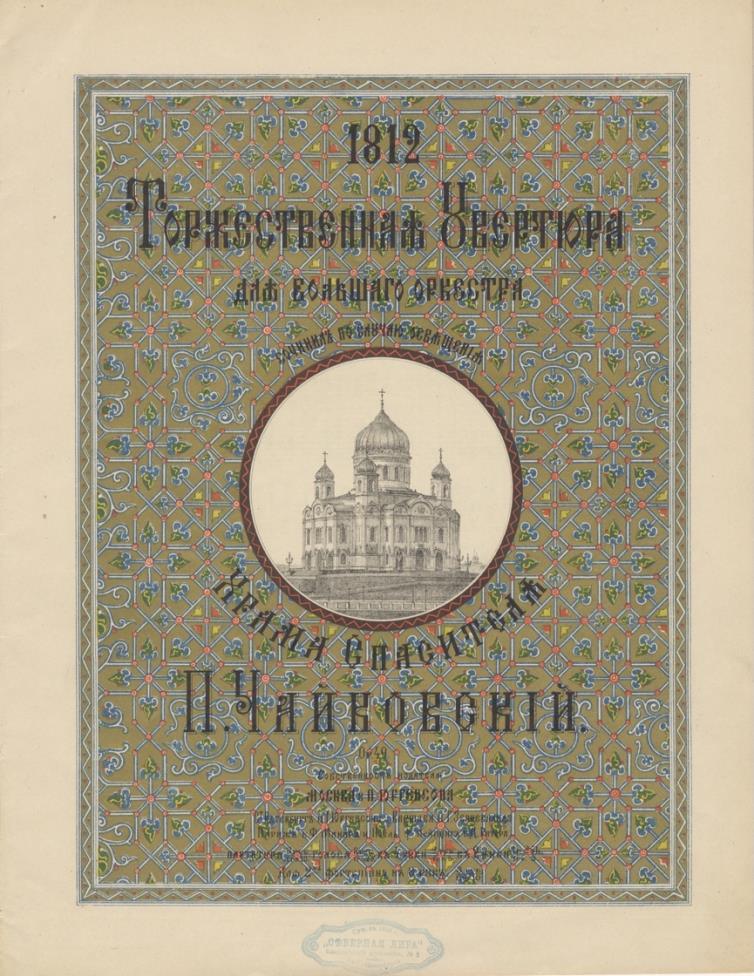
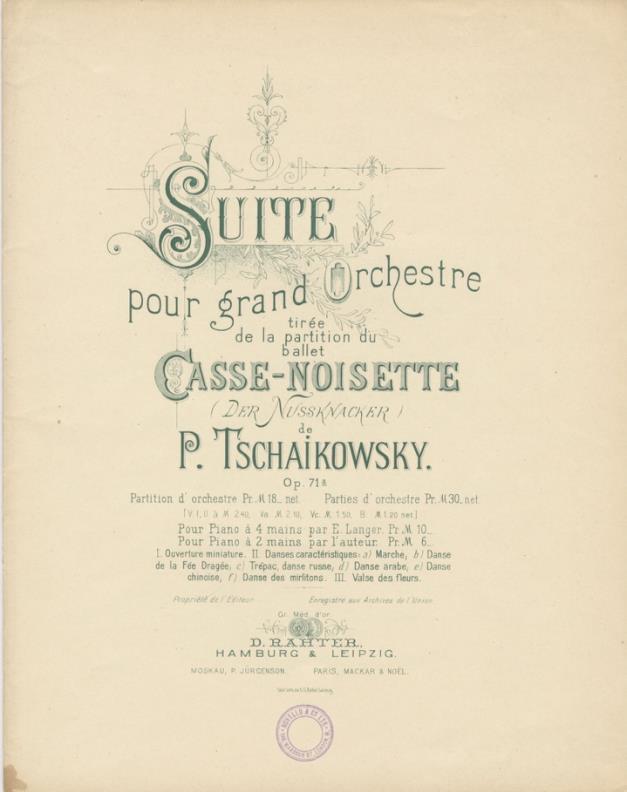
Early Edition of The Nutcracker for Piano Solo
74. TSCHAIKOVSKY, Pyotr Il'ych 1840-1893
Suite pour grand Orchestre tirée de la partition du ballet Casse-Noisette (Der Nussknacker ... Op. 71a ... Pour Piano à 2 mains par l'auteur Pr. M 6. [Piano score]. Hamburg & Leipzig: D. Rahter [PN 854], [ca. 1897].
Folio. Unbound 1f. (recto title printed in green, verso blank), 3-39, [i] (publisher's catalogue) pp. Jürgenson in Moskau and Mackar & Noel in Paris noted as distributors at foot of title. Small circular handstamp of Novello music publishers to blank lower margin of title.
Early edition of the Nutcracker suite arranged for piano solo. (41388) $50
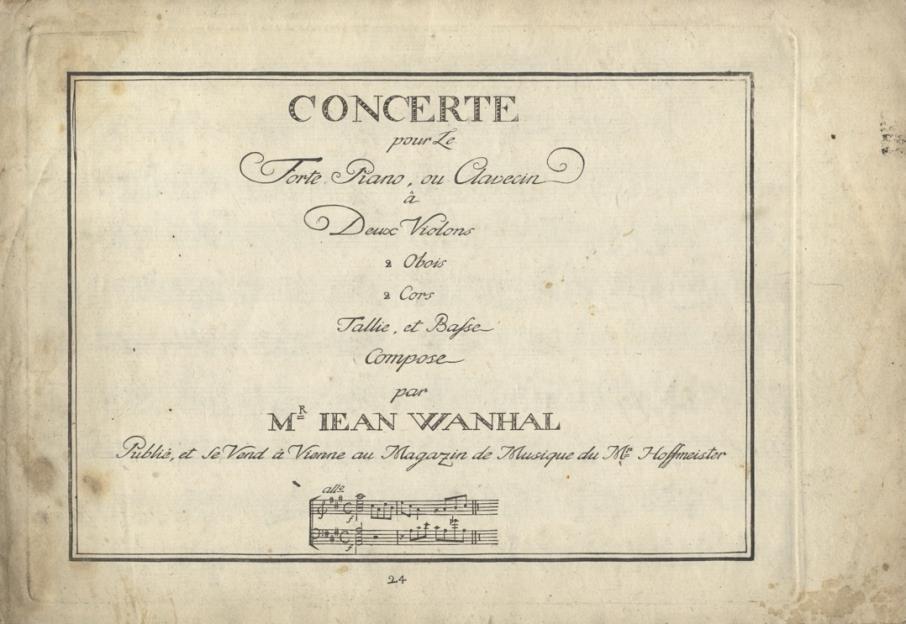
“One of the Best Composers of His Time”
75. VANHAL, Johan Baptist 1739-1813
Concerte[!] pour Le Forte Piano, ou Clavecin â Deux Violons 2 Obois 2 Cors Tallie[!], et Basse. [Piano part only]. Vienne: au Magazin de Musique du Mr. Hoffmeister, [1785].
Oblong folio. Sewn. [i] (title), 2-23, [i] (blank) pp. Engravedthroughout. Slightly worn; some moderate staining to blank margins of title; occasional small stains and minor soiling and foxing to blank outer margin.
First Edition. OCLC 1104858831. RISM V353 and VV353 (one copy only in the U.S., at the Library of Congress).
Vanhal was a Bohemian composer, violinist, and teacher, active in present-day Austria and Croatia. "His present reputation is derived mostly from his symphonies, his many published keyboard pieces, and the comments of writers. ... From the studies carried out so far, it is clear that Wanhal was one of the best composers of the time – innovative, imaginative, and original. He was also influential, but to what extent is difficult to assess. Haydn was presumably familiar with the ten Wanhal symphonies preserved in the Esterházy collection (H-Bn), but there is more affinity between Wanhal’s style and Mozart’s. Comparisons with other contemporary composers are necessary for an accurate account of Wanhal’s role. However, he unquestionably contributed significantly to music in Europe, and his published music, issued by many publishers, stimulated the public and the entire industry. His career, which led him from bondage to comfortable independence, reflects the influence of Emperor Joseph II and the democratic principles he espoused in Viennese society. Wanhal’s music, in turn, contributed to the development of Viennese musical style." Paul R. Bryan, revised by Halvor K. Hosar and Allan Badley in Grove Music Online (41249) $275
A Unique Source of this Comic Opera by a New-Orleans-Born Composer
76 VARNEY, Louis 1844-1908
La Reine des Halles. Autograph musical manuscript full score. Paris, [1881].
Folio (348 x 276 mm). Original wrappers with titling in blue pencil. Notated in brown ink and blue pencil on 18-stave rastrum-ruled paper. Small embossed blindstamp of the Paris paper manufacturer and seller Lard Esnault to upper inner corners.
With the composer's autograph signature to the final page of the Ouverture and the first number of Act II.
A dynamic working manuscript, with numerous corrections and cancellations throughout including to first drafts of entire sections of music, occasionally and sewn in. Lyrics are only partially present.
The manuscript includes the overture; Act I (5 numbers); Act II (intermission and 5 numbers, including the Rondeau des Halles, plus one deleted number); and Act III (intermission and 10 numbers), as follows:
Act I
- [Overture]: 13, [i] (blank) pp.
- No 1: 20 pp. + 4ff. (cancelled)
- No. 2: 11 pp.
- No. 3: 7 pp.
- [?]draft of No. 4 (cancelled)
- La Reine des Halles Acte I No. 4: 23, [iii] (blank) pp
Act II
- Entrée: 3 pp.
- 2me. Acte No 5: 29 pp.
- 2me. Acte No 7: 5, [ii] (blank) pp.
- No. 8 (2me. Acte): 16 pp.
- La Reine des Halles No. 8 Rondeau des Halles: 12 pp.
- No. 9 (2me Acte): 3 pp.
- No. 10 Finale (2e. Acte): 21, 22a-22b, 22a, 19-22 (canceled), 23-24 (canceled), 25-35, [i] (blank) pp.
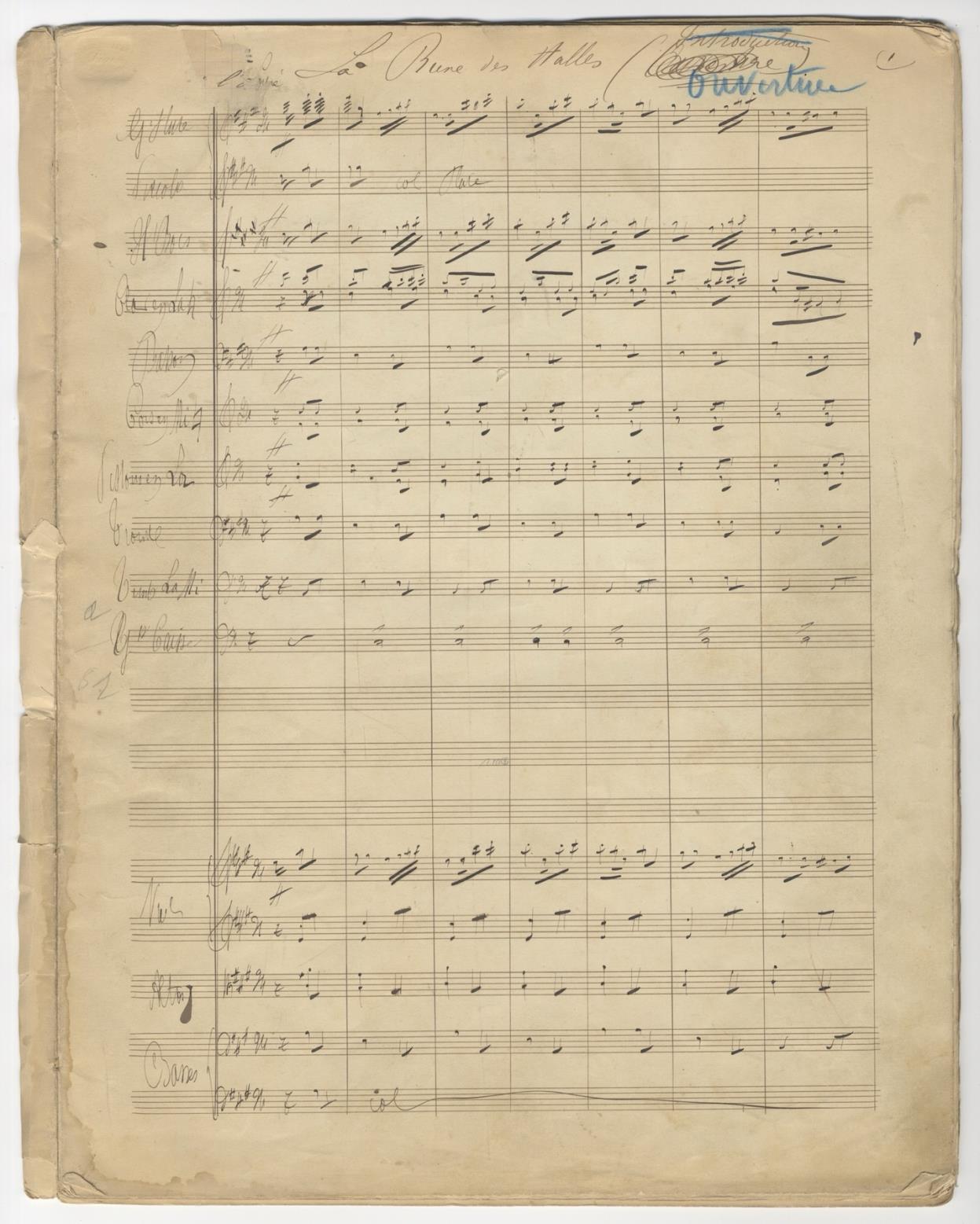
Act III
- Acte 3 Entrée: [2], [i] (blank) pp.
- 3me. Tableau: [i] (3me. Entree No. 11), 3 pp.
- 3me. Acte No. 12: 6, [ii] (blank) pp.
- No. 13: 12 pp.
- No. 14: 3 pp.
- No 14 bis: 1 p.
- No. 15 (3me. Tableau): 11, [i] (blank) pp.
- No. 16 (3me. tableau): [4] pp.
- La Reine des Halles No. 17 Rondeau des Halles: 9, [i] (blank) pp.
- No. 18 (3me Tableau): 14, [ii] (blank) pp.
- No. 19 (4me Tableau): 14, [ii] (blank) pp. + 4ff. (cancelled)
- No. 20 4 Tableau: 4-12 (La Reine des Halles No. 20) pp. (p. 4 cancelled)
- La Reine des Halles No. 21 Couplet Final: 13-14, [i] (blank) pp. With a note written vertically following the first measure, "Repande dans le N o. 20 de AAA à BBB (44 mesures)," indicating that a section of music from the previous number is to be inserted at that point.
Wrappers worn. Occasional soiling and small edge tears.
La Reine des Halles, an opéra bouffe in three acts and four tableaux to a libretto by Delacour, Bernard, and Burani, was first performedin Paris at the Théâtre de la Comédie-Parisienne on 4 April 1881. The work featured alternating spoken dialogue and musical numbers, with the great Theresa (1837-1913) in the title role. The plot concerns The Queen of the Markets, Madame Rose, a fishmonger who has arranged a wealthy marriage for her son Pierre; but Pierre runs away from home with an operetta singer; after a chase through Les Halles, Pierre is reconciled with his wife at a ball held there.
Varney, a French composer and conductor born in New Orleans,“was one of two sons of the theatre conductor and composer Pierre Varney (1811-79), from whom he received his musical training. His early career was spent as conductor at the Théâtre de l'Athénée in Paris, for which he composed the one-act operetta Il signor Pulcinella (1876) and music for revues. After his father's death he became known as a prolific composer of opérettes, beginning with Les mousquetaires au couvent (1880). For two decades he produced about two opérettes a year, some of which were also produced abroad, and composed ballets for the major Paris music halls. In the last years of his life, however, he composed little due to a disease which obliged him to move to Bagnères-de-Bigorre in the Pyrenees; he was taken back to Paris the day before he died. Varney's music displays a lightness and gaiety which owe much to Offenbach, but only Les mousquetaires au couvent has remained in the French repertory, having a good libretto based on a vaudeville of the 1830s, L'habit ne fait pas le moine." Andrew Lamb in Grove Music Online
The libretto and piano-vocal score were published contemporaneously with the premiere of the operetta.
The present autograph manuscript is the sole source for the full score of the work.
Of valuable research and performance potential (41247)
$4,200
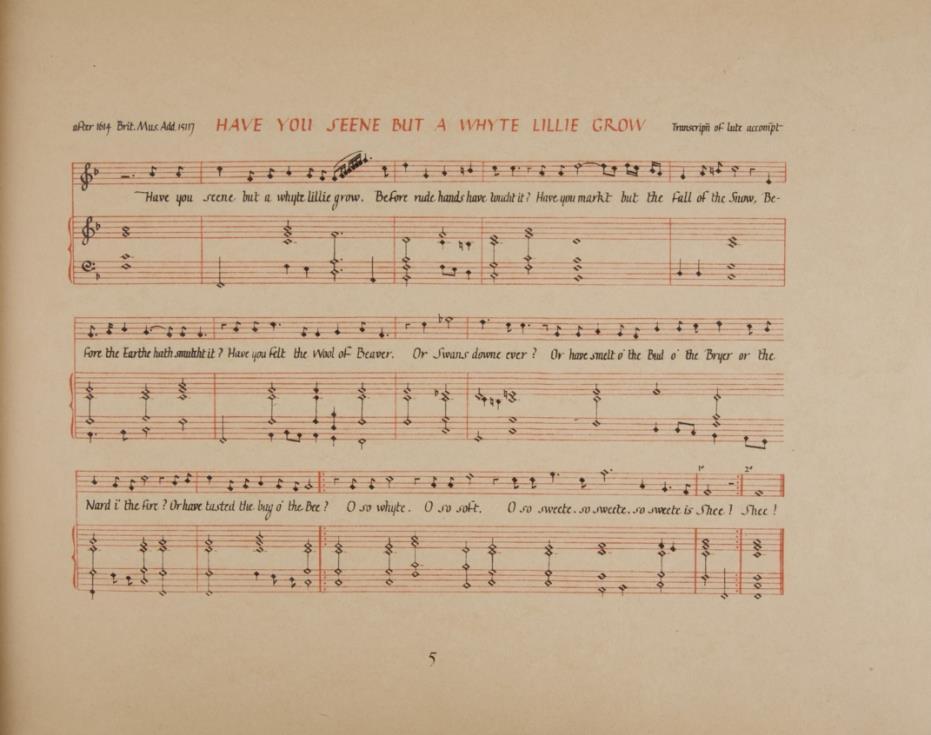
A Bibliophilic Edition
77 [VOCAL - English]
Old English Songs Amorous Festive & Divine. Chosen and handwritten by A. C. Harradine. The Music Arranged by N. C. Suckling. London: Gerald Howe Ltd, 23 Soho Square, 1927.
Oblong folio. Ivory cloth titled in dark orange. 3ff. (half-title, title, and preface), 26 pp. + 1f. Titles and staff lines printed in red, music and text in black. Music in small diamond head notation. Colophon: "This Songbook was written out by A. Charradine in London in the Spring of 1927 and photo-lithographed for Gerald Howe Ltd Publisher byHenderson&SpaldingLtdPrinters." Signaturein penciltofrontfreeendpaperofErnestF. Detterer, most probably the American calligrapher, teacher, and typographer (1888-1947). (41387) $65
An Influential Opera
78. WEBER, Carl Maria von 1786-1826
Der Freischütz Romantische Oper in drei Aufzügen Gedichtet von Fr. Kind ... Partitur. Einzig rechtmäßige mit der Handschrift des Componisten neu-revidirte Original-Ausgabe. Eigenthum der Verlagshandlung... S. 3512. Pr. 12 Thlr. [Full score]. Berlin: in der Schlesingerschen Buch u. Musikhandlung [PN S. 3512], [after 1849].
Folio. Half contemporary black cloth with matching textured paper boards, spine in decorative compartments gilt with titling gilt, decorative endpapers. 1f. (recto title, verso table of contents), 3-262 pp. Engraved throughout. With names of characters in contemporary manuscript followinglisting of each selection inthetable of contents. Handstamp of Judith Bauer in Vienna to blank upper outer corner of first page of music. Binding worn, rubbed, and bumped; lacking front free endpaper. Occasional foxing, slightly heavier to first leaves; some minor stains; small paper defect to pp. 244 and 245, just touching notation in three instances.
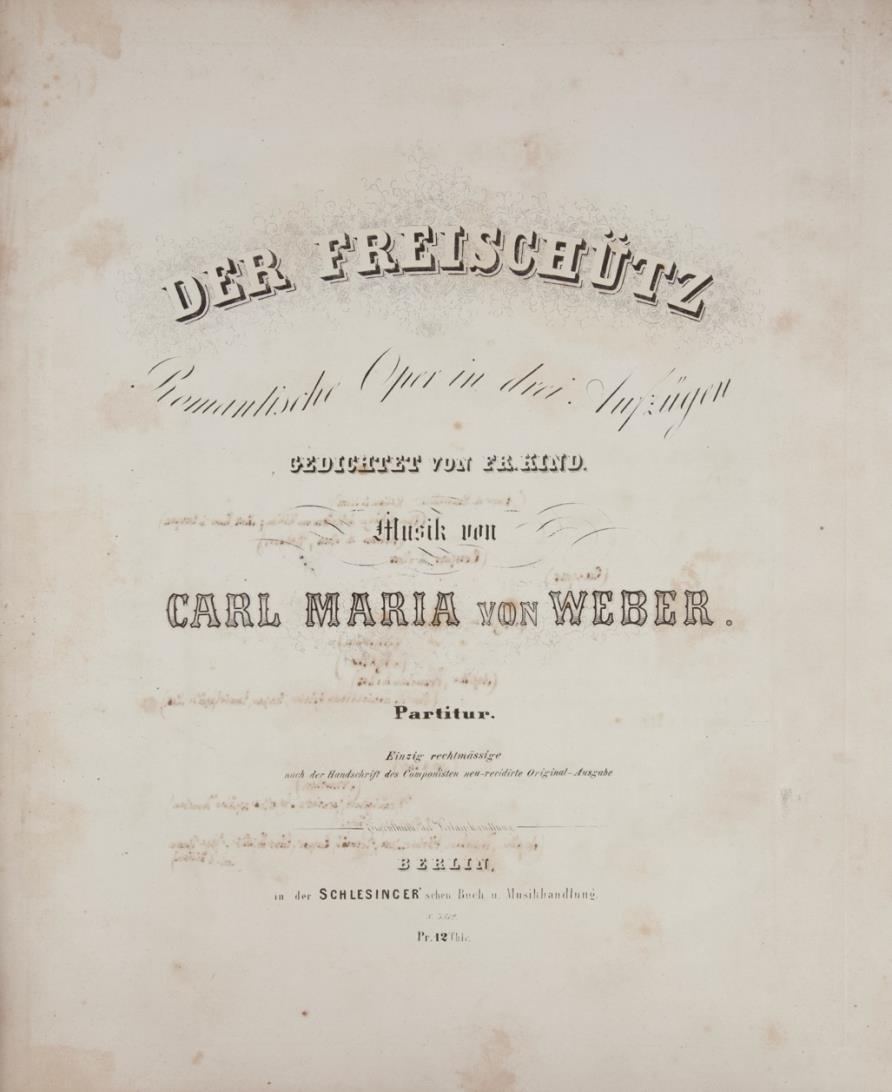
OCLC 497840338
First Edition, later issue. WeV C.7. Jähns 277. Hoboken 15, 349 (issue with text "gleichlautende OriginalAusgabe" to title). Hirsch II, 966. Fuld p. 237.
"With Der Freischütz [Weber] produced a work that competed successfully with popular French and Italian operas not only in Germany but in other countries as well. The impact of Der Freischütz on opera of the 1820s, 30s, and 40s is evident, as it inspired a spate of gothic works like the vampire operas of Marschner and Lindpaintner, and even as late a work as Der fliegende Holländer owes much to it; outside Germany, its success as Robin des Bois prepared the way for Meyerbeer’s Robert le diable." Paul Corneilson et al. in Grove Music Online (41238) $550