CONDITIONS OF SALE
All items are in good antiquarian condition unless otherwise noted and are offered subject to prior sale, with prices net and subject to change without notice. The costs of shipping and insurance are additional Orders are customarily shipped via USPS Priority Mail or Federal Express. Sales tax will be added to the invoices of NewYork State residents.
Orders may be placed by e-mail (info@lubranomusic.com), telephone (516-922-2192), or on our secure website (www.lubranomusic.com) by entering the ID number of the desired item in the SEARCH box at the upper right of our homepage.We ask that you kindly wait to receive ourinvoice to ensure availability before remitting payment. Libraries may receive deferred billing upon request.
We accept payment by:
-ACH (Automated Clearing House), inclusive of all bank charges
- EFT (Electronic Funds Transfer), inclusive of all bank charges
- PayPal to info@lubranomusic.com
- Checks in U.S. dollars drawn on a U.S. bank
- International money order
- Credit card
We fully guarantee that all items offered for sale by J & J LubranoMusicAntiquarians LLC are absolutely authentic without time limitation to the original purchaser provided that said items conform exactly to our description as supplied at time of purchase.All items remain the property of J & J Lubrano MusicAntiquarians LLC until paid for in full.
Please visit our website at
www.lubranomusic.com
where you will find full descriptions and illustrations of our catalogued inventory
Members
Antiquarian Booksellers’Association ofAmerica
International League ofAntiquarian Booksellers
ProfessionalAutograph Dealers’Association
Music LibraryAssociation
American Musicological Society
Dance StudiesAssociation &c.
Cataloguers
John Lubrano, Jude Lubrano, Benjamin Katz
© J & J Lubrano MusicAntiquarians LLC February 2026
1. BARBER, Samuel 1910-1981 Adagio for String Orchestra. [Score].
“Elegiac,
Long-Lined Melodies”
London: Chappell & Co. Ltd. [PN 37955], [ca. 1939].
Quarto. Original publisher's light-brown printed wrappers. 1f. (recto title, verso note regarding first performance), 3-7, [i] (blank) pp. With advertisement for Geminiani's "Two Concertos for String Orchestra Revised by Adolfo Betti" to verso of lower. With New York: G. Schirmer, Inc. and "Authorised for sale in Great Britain and its Possessions, excluding Canada, Newfoundland, Australia and New Zealand, but not elsewhere" and "Made in England" printed below imprint. Handstamp of Dutch conductor Maurits Sillem (1929-2002) to head of upper wrapper and first page of music. Slightly worn and creased.
First English edition.
First performed in New York on 5 November 1938 by the Orchestra of the National Broadcasting Company under the direction of Arturo Toscanini.
"One of the most honoured and most frequently performed American composers in Europe and the Americas during the mid-20th century, Barber pursued, throughout his career, a path marked by a vocally inspired lyricism and a commitment to the tonal language and many of the forms of late 19th-century music. Almost all of his published works – including at least one composition in nearly every genre – entered the repertory soon after he wrote them and many continue to be widely performed today. ... Barber’s propensity for writing elegiac, long-lined melodies is exemplified by two of his best-known works, the justifiably admired Adagio for Strings and the Violin Concerto." Barbara B. Heyman in Grove Music Online (40985) $60
“A Boisterous Roll-Call of Some of Bartók’s Favourite Folk Styles"
2. BARTÓK, Béla 1881-1945
Concerto for Orchestra. [Full score].
London - New York - Los Angeles - Sydney - Cape Town - Toronto - Paris: Boosey & Hawkes [PN B. & H. 9009], [after 1946].
Tall folio. Original publisher's light brown printed wrappers. 1f. (recto title, verso note on first performance and instrumentation list), 147, [i] (publisher's catalogue "Symphonic Music for Orchestra ... For Soli, Chorus and Orchestra") pp. With additional publisher's catalogue of works by Bartók to verso of lower wrapper. Light uniform browning; corners very slightly creased.
Provenance
British pianist and composer Alfred Nieman (1914-1997), with his autograph signature to head of title and autograph annotations in red and blue ink including quotations from Bartók's own program notes (p. 47); and regarding expression ("smooth quavers broken into canonic figures - passionate violent effect," p. 63); structure ("The subject undergoes continual change in shape and time. The ratios are often complex, always clear, and marvellously ingenious. Spontaneous vital form," p. 103); and counterpoint ("stretto rectus and inversus both modified," p. 104.
Later printing, from first edition plates. OCLC 833542007 (one copy only, at the Hochschule für Musik und Theater).
First performed in New York at Carnegie Hall on 1 December 1944 with Serge Koussevitzky conducting the Boston Symphony Orchestra.
"The Concerto for Orchestra bb123 was commissioned by the Koussevitzky Music Foundation in May 1943. ... In a programme note Bartók depicted the work’s mood as gradually progressing from the ‘sternness of the first movement and the lugubrious death-song of the third, to the life-assertion of the last one’. The exception to this progression, as Bartók noted, was the jesting ‘game of pairs’ second movement, in which he imitated the twopart parallel Dalmatian style found in Parry’s collection. The fourth movement, ‘Intermezzo interrotto’, is uncharacteristically cheeky in mood, with its parody of a tune from Shostakovich’s then-popular Seventh Symphony, and nostalgic quotation of a popular song, Szep vagy, gyönyörű vagy Magyarország (‘You are lovely, you are beautiful, Hungary’) by Zsigmond Vincze. Another strong, nostalgic influence upon the first and third movements is Bartók’s own style from the 1908–11 period, in particular that of Bluebeard’s Castle. The lifeasserting finale is, however, a boisterous roll-call of some of Bartók’s favourite folk styles." Malcolm Gillies in Grove Music Online (40987) $100
“The Most Ambitious of His Operas”
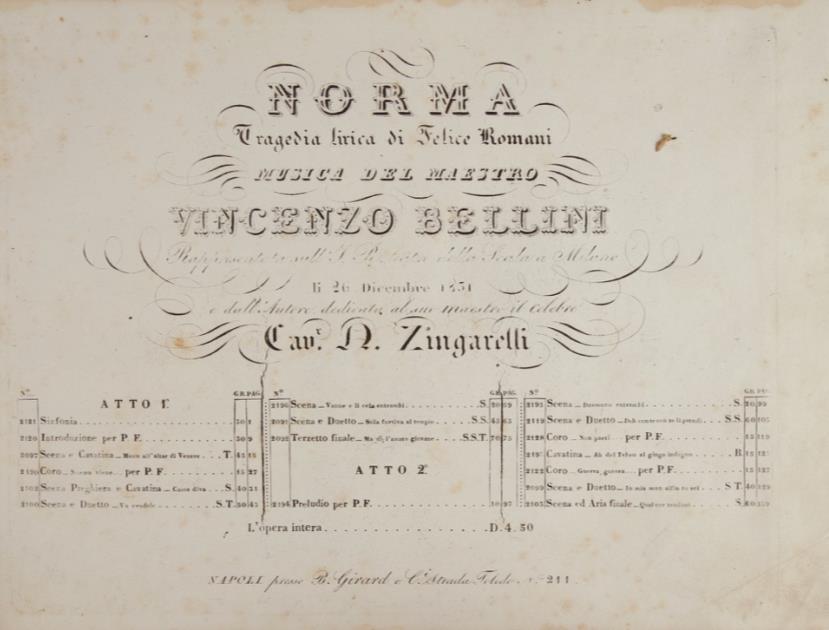
3. BELLINI, Vincenzo
1801-1835
Norma Tragedia lirica di Felice Romani ... Rappresentata sull' I. R. Teatro della Scala a Milano li 26 Dicembre 1831 e dall'autore dedicata al suo maestro il celebre Cavr. N. Zingarell ... Atto [1o.-] 2o. [Piano-vocal score].
Napoli: B. Girard e Ci. Strada Toledo No. 211 [PNs 2121, 2120, 2097, 2190, 2102, 2100, 2196, 2091, 2092, 2194, 2195, 2119, 2128, 2193, 2122, 2099, 2103], [1837-1847].
Folio. Contemporary dark green leather-backed marbled boards with decorative octagonal dark green leather title label gilt to upper with initials "GBL," spine in decorative compartments gilt.
Engraved throughout. Printed on high quality heavy wove paper. With name of singers in the first performance printed to head of vocal numbers; separate pagination for each number to upper outer corners and secondary
pagination to lower outer corners. Binding worn, rubbed, and bumped; endpapers worn and foxed; hinges split. Minor internal wear, soiling, foxing, and small stains to blank margins; final blank page soiled.
Act 1: 1f. (recto title and table, verso blank), 7, [i] (blank), 9-25, [i] (blank), [i] (blank) 27-29, [i] (blank), 31-57, [i] (blank) 59-73, [i] (blank), 75-92 pp.; Act 2: 1f. (recto title and table, verso blank), 97-12, [i] (blank), 123-125, [i] (blank), 127-137, [i] (blank), 139-153, [i] (blank) pp.
Rare early edition. Lippmann p. 386 (recording Sinfonia only). Worldcat (no complete copies).
Norma, in two acts to a libretto by Felice Romani after Alexandre Soumet’s verse tragedy Norma, was first performed in Milan at the Teatro alla Scala on 26 December 1831.
"With Norma, the most ambitious of his operas, Bellini created a work of extraordinary lyrical and dramatic beauty. Through melody of a kind that had not been written before or has been since, the structure of the music expresses a tragedy that is virtually of epic scale." Galatopoulos: Bellini, p. 242.
Bellini was "a leading figure in early 19th-century opera, noted for his expressive melodies and sensitive approach to text-setting. ... Norma has always been revered above other Italian operas of the period ... The title role is one of the most taxing and wide-ranging parts in the entire repertory: a noble character whose tragedy lies in her fatal love for an enemy of her people. The many different aspects of Norma’s temperament are marvellously drawn by Bellini, not only in the aria ‘Casta diva’, but also in the superb duets with Adalgisa and Pollione, and in the ensemble in the finale of Act 2, where Bellini reaches his peak as a musical dramatist."
Simon Maguire and Elizabeth Forbes in Grove Music Online (40769) $550
“The Chief Representative of Latin Instrumental Music During the Viennese Classical Period"
4. BOCCHERINI, Luigi 1740-1806
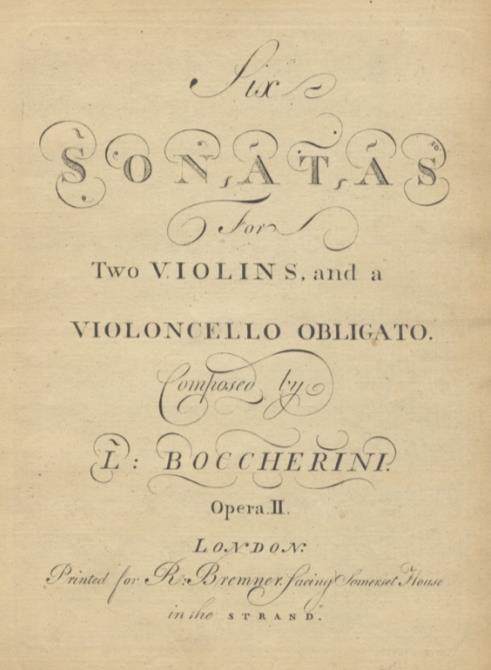
Six Sonatas For Two Violins, and a Violoncello Obligato ... Opera II.
London: Printed for R. Bremner, facing Somerset House in the Strand, ca. 1775.
Folio. Disbound. Engraved. With "no V." in contemporary manuscript to upper outer corner of title of violino primo part. Slightly worn; uniform light browning; occasional small stains and foxing.
Violino primo: [i] (title), 2-15, [i] (blank) pp.
Violino secondo: 1f. (recto title, verso blank), [i] (blank), 2-13, [i] (blank) pp.
Violoncello: 1f. (recto title, verso blank), [i] (blank), 2-13, [i] (blank) pp.
Second edition. Gérard 77-82 (pp. 78, 81, 82, 84, 85, and 87). BUC p. 117. RISM B3057.
"A prolific composer, particularly of chamber music, with a distinctive and highly wrought style, [Boccherini] is the chief representative of Latin instrumental music during the Viennese Classical period." Christian Speck and Stanley Sadie in Grove Music Online (40599) $500
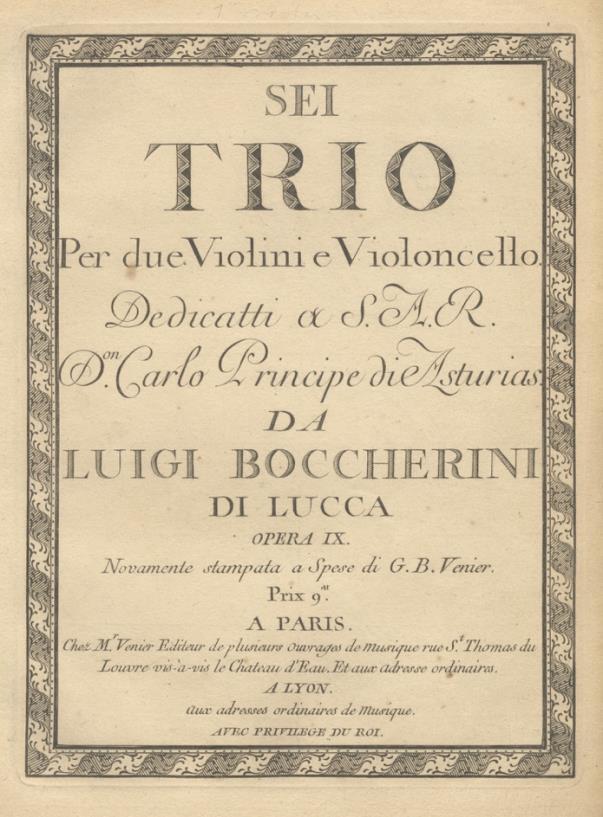
“Opera Grande”
5 BOCCHERINI, Luigi 1743-1805
Sei Trio Per due Violini e Violoncello Dedicatti a S.A.R. Don. Carlo Principe di Asturias ... Opera IX ... Prix 9₶. [Parts].
Paris: Chez Mr. VenierEditeurdeplusieurs OuvragesdeMusique rue St. Thomas duLouvrevis-à-visleChateau d'Eau. Et aux adresse[!] ordinaires. A Lyon Aux adresses ordinaires de Musique. Avec Privilege du Roi, [1771].
Folio. Disbound. Inamarbled board portfoliowithsmall rectangularmanuscripttitlelabeltoupper. Titles within decorative border. Engraved throughout. Light uniform browning; occasional minor soiling, small stains, and tears; first signatures detached; publisher's catalogue trimmed at upper margin, affecting title and just touching text at outer margin. A very good copy overall.
Violino primo: 1f. (rectotitle, verso blank), [i] Catalogue de Musique Instrumentale que Mr. Venier a fait graver, 2-13, [i] (blank) pp.
Violino secondo: 1f. (recto title, verso blank), [i] (blank), 2-13, [i] (blank) pp. Basso: 1f. (recto title, verso blank), [i] (blank), 2-13, [i] (blank) pp.
First Edition. Gérard 89-94 (pp. 98, 99, 101-104). BUC p. 118. RISM B3075 (no copies recorded in the U.S.).
Boccherini designated the present work as an "opera grande" in his autograph catalogue. It became very popular and was published in four further countries in the following fifteen years. (40609) $1,200
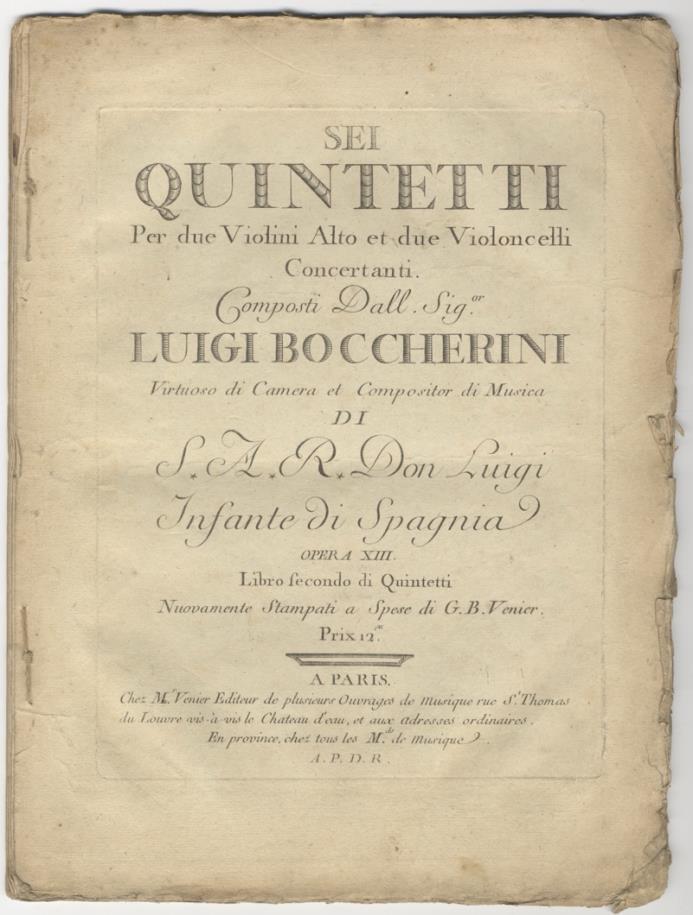
The Composer’s Most Iconic Work
6. BOCCHERINI, Luigi 1743-1805
Sei Quintetti per due Violini Alto et due Violoncelli Concertanti ... Opera XIII Libro secondo di Quintetti Nuyovamente Stampati a Spese di G.B. Venier. Prix 12₶.
Paris: Chez Mr. VenierEditeurdeplusieurs OuvragesdeMusique rue St. Thomas duLouvrevis-à-visleChateau d'eau, et aux adresses ordinaires. En province, chez tous les Mdes. de Musique. A.P.D.R., [1775].
Folio. Sewn. Engraved. Uncut. Slightly worn and browned;minor soiling and fraying to edges; occasional small stains, foxing, and small holes. In very good condition overall.
Violino primo: 1f. (recto title, verso blank), [i] Catalogue De Musique Instrumentale que Mr. Venier a fait graver, 2-25, [i] (blank) pp.
Violino secondo: [i] (title), 2-25, [i] (blank) pp.
Viola obligata: 1f. (recto title, verso blank), 21, [i] (blank) pp.
Violoncello Io.: 1f. (recto title, verso blank), 21, [i] (blank) pp.
Violoncello IIo.: 1f. (recto title, verso blank), 21, [i] (blank) pp.
First Edition. Gérard 271-276 (pp. 299, 301, 303, 304, 305, and 308). Lesure p. 57. BUC p. 116. RISM B3165 (one copy in the U.S. only, at Sibley Library, Eastman School of Music).
The fifth quintet in the present collection contains the music that come to be known as Boccherini's Minuet.
"The music [of the minuet from Op. 13, no. 5] does not appear to have aroused any special interest among those who heard it in the 18th century. Its vogue began in France in about 1878 for no obvious reason. So immediate and so great was its success that for nearly a century the name of Boccherini has been known to concert-goers only from this short piece which very few of them have heard in its original form. ... The effect of this universal infatuation has been to place Boccherini once and for all - quite unjustifiably - in the category of 'petit maître galant' of the eighteenth century. In the words of M. Roland-Manuel: 'Boccherini's minuet has acquired for ever the reputation of usher and of the old-fashioned elegances of the eighteenth century: curtseys and fan-play and coquetry. ... It has become a collector's piece, a specimen of faded embroidery, an example of antiquated grace.' Such, at least, is the spirit in which it has been used by film directors like Orson Welles, in The Magnificent Ambersons (1942), and Alexander Mackendrick, with unforgettable effect, in The Ladykillers (1955)." Gérard, pp. 306-307.
An attractive uncut copy of the first edition of Boccherini's most iconic work (40602) $1,350
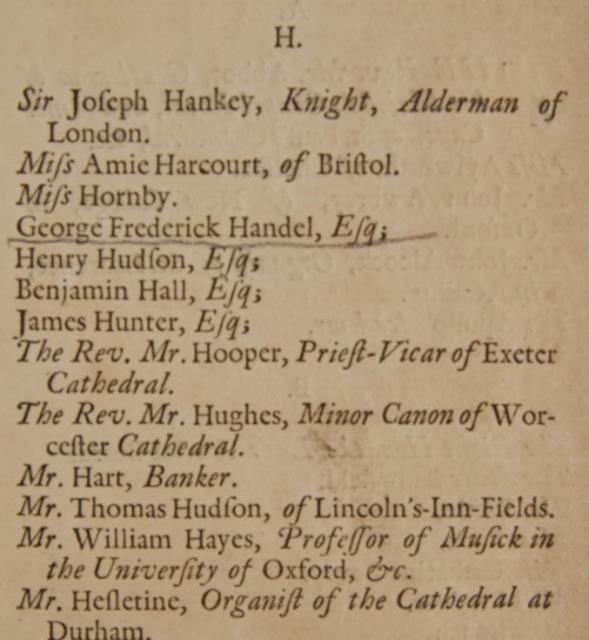
One of Only 15 Musical Works to Which Handel Subscribed
7. BOYCE, William 1711-1779
Solomon. A Serenata, In Score, Taken from The Canticles. Set to Musick By Mr. William Boyce, Composer to His Majesty. [Full score].
London: Printed and Sold for the Author, by J. Walsh, in Catharine-Street in the Strand, 1743.
Folio. Disbound. Contemporaryhalfmid-tan leather with marbled boards with titling in contemporary manuscript to upper, spine incompartments gilt with darkred leather title label gilt. 1f. (recto title, verso blank), 100, [101], [i] (blank), [iv] (list of subscribers) pp. Title and subscribers list typeset, music engraved. Binding worn, rubbed, and bumped; upper detached. Occasional wear; small stains, foxing, browning, soiling, and repairs; outer margin of blank verso of title reinforced with narrow strip of paper. Page 101 lacking and provided in 18th manuscript facsimile.
First Edition. Smith and Humphries 248, p. 57. BUC p. 129. RISM B4074.
The subscribers list is quite distinguished and includes most of the leading English church musicians of the day, most notably George Frederick Handel, one of only 15 musical publications to which he subscribed. See Simon: Handel A Celebration of his Life and Times 1685-1759, p. 288.
"Eminent equally as a composer for the church and the theatre, [Boyce] has claims to be regarded as the leading English representative of the late Baroque style, and was also significant for his role as a musical antiquarian and editor... It was probably in autumn 1742 that the serenata Solomon was first given, at the Society of Apollo; a performance in Dublin may have followed. The work became popular enough to be published in full score in 1743 and it enjoyed fairly frequent performances until the turn of the century, after which it lost favour because of the mild eroticism of some of the words. These derive from the Song of Solomon; of the two soloists, the tenor has the title role while the soprano represents the unnamed girl he loves. There are some fine vigorous fugal
choruses and a remarkable air with bassoon obbligato. The whole work has a formal balance and a consistently high musical quality." The New Grove Vol. 3, p. 138.
"It was through 'Solomon' that Boyce achieved his first notable success as a composer in the early 1740s... Though outwardly a cantata-like work for two vocal soloists, chorus and orchestra with a text based on the biblical 'Song of Solomon', it was one of the few English works to be designated from the outset by the Italian term 'serenata'. The librettist, Edward Moore, was resident in Ireland during its composition, and he may well have envisaged a first performance there; however, it was first heard at the Apollo Academy in autumn 1742...
John Walsh's publication of 'Solomon' on behalf of the composer early in 1743 was enthusiastically received. Unusually for a work of its kind, it was issued complete and in full score, thus facilitating the first public performances at Ruckhold House, Essex, in summer 1743 and later that year in London." Ian Bartlett in Grove Music Online (40611) $1,200
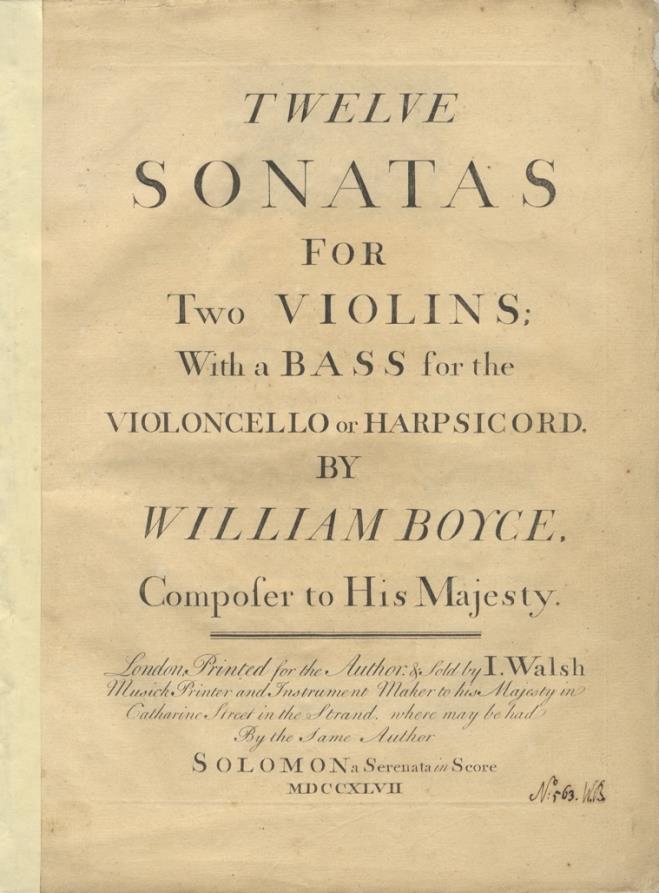
Subscribed to by Handel With Boyce’s Autograph Initials
8 BOYCE, William 1710-1779
Twelve Sonatas for Two Violins; With a Bass for the Violoncello or Harpsichord. [Parts].
London: Printed for the Author & Sold by I. Walsh Musick Printer and Instrument Maker to his Majesty in Catherine Street in the Strand, where may be had By the Same Author Solomon a Serenata in Score, 1747.
Folio. Disbound. In a full maroon cloth portfolio with titling gilt to spine. Privilege and subscribers list typeset; music engraved. Spines reinforced with paper tape. Occasional small stains and soiling; gutter of verso of title and recto of privilege of Violino primo part reinforced with narrow strip of paper.
Violino primo: 1f. (recto title, verso blank), 1f. (recto privilege, verso blank), [vii] (subscribers list), [i] (blank). 2-34 pp.
Violino secondo: 1f. (recto title, verso blank), [i] (blank), 2-34 pp. Basso e violoncello: 1f. (recto title, verso blank), [i] (blank), 2-30 pp.
With Boyce's autograph initials and "No: 563" to lower outer corner of title of Violino primo part and with "Sam: Lilly" in contemporary manuscript to blank recto of first leaf of music in all parts.
The extensive subscribers list includes many important musical figures, most notably George Frideric Handel, Charles Jennens (one of Handel's librettists) and Mainwaring (most likely John Mainwaring, the composer's biographer), along with Arne, Charles Burney, Richard Burney (dancing master), John Wood and John Wright (dancing masters), Maurice Greene, John Hippesly (comedian), many organists, organ builders, harpsichord makers John Hitchcock and Mr. Sells, musical societies, members of the clergy, royalty, etc.
Also of interest is the inclusion of a number of subscribers from New York, including Miss Franks, Miss P. Franks, Sheffield Howard, Joseph Hildreth, Kitty Kennedy, Rachel Lane, John Riddle, John Rice (organist), Eliz. Seares, Kitty Schyler, and Walter Thong.
First Edition. BUC p. 131. RISM B4174.
Boyce was an English composer, organist, and editor. "Though formerly best known for some of his anthems and his editing of Cathedral Music (1760–73), the significant contribution he made to instrumental music, song, secular choral and theatre music in England is now widely recognized. ... The publication of Boyce’s Twelve Sonatas for Two Violins and a Bass in 1747 met with unprecedented success for a work of its kind. The first edition attracted 487 subscribers for 631 copies, and two further editions soon followed. These sonatas, in the direct line of descent from Corelli’s classic models, were soon to be recognized as the most distinguished English contributions to the genre. They were, as Burney later observed, ‘not only in constant use, as chamber Music, in private concerts, for which they were originally designed, but in theatres, as act-tunes, and public gardens, as favourite pieces, during many years’. As is implicit here, like many trio sonatas of their time, they were doubtless accommodated, through the insertion of soli–tutti markings, to performance by larger ensembles as quasi-concerti grossi." Ian Bartlett and Robert J. Bruce in Grove Music Online
The first edition of Boyce's influential trio sonatas, with the autograph initials of the composer. (40612) $1,250
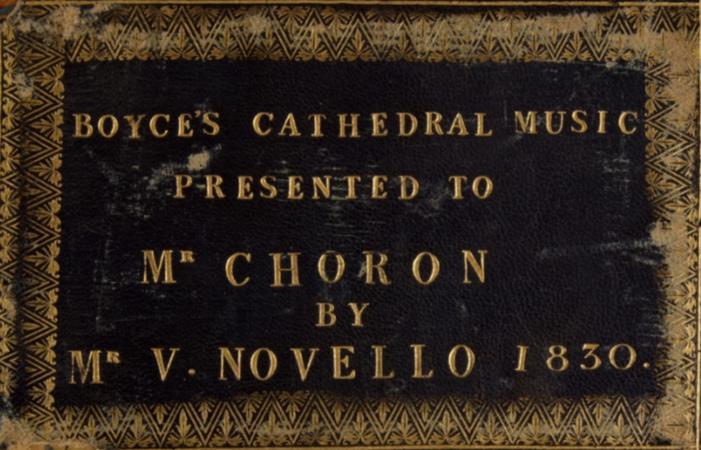
A Presentation Copy to French Musicologist and Composer Alexandre-Étienne Choron With Extensive Autograph Annotations by Novello
9 BOYCE, William 1711-1779
Cathedral Music: Being A Collection in Score of the Most Valuable and Useful Compositions for that Service, by the Several English Masters of the last Two Hundred Years. The Whole Selected and Carefully Revis’d By the late Dr. William Boyce, Organist and Composer to the Royal Chapels, and Master of his Majesty’s Band of Musicians. Volume the First [-Third] ... Second Edition.
London: Printed for John Ashley, 1778.
3 volumes. Folio. Olive green linen-backed marbled boards with large dark brown rectangular decorative leather title label gilt to upper of each volume: "Boyce's Cathedral Music Presented to Mr. Choron by Mr. V. Novello 1830" and black leather title label gilt to spines. Music, frontispiece, title, and address engraved; subscribers list, memoirs, errata, preface, account, and table typeset. With occasional fine engraved tailpieces in calligraphic style. With a fine full-page frontispiece portrait engraving of Boyce "Drawn from Life & Engrav'd by I.K. Sherwin ... Decr. 1st 1788.") to Volume I. Binding somewhat worn, rubbed, and bumped; hinges cracked. Minor internal wear; uniform light browning, heavier to some leaves; occasional soiling, foxing, small stains, and small tears, some repaired with archival tape.
With autograph annotations by Novello.
Composers represented include Aldrich, Batten, Bevin, Byrd, Blow, Bull, Child, Clark, Creighton, Croft, Farrant, Gibbons, Goldwin, Humfreys, King Henry VIII, Lawes, Locke, Morley, Purcell, Rogers, Tallis, Turner, Tye, Weldon, and Wise.
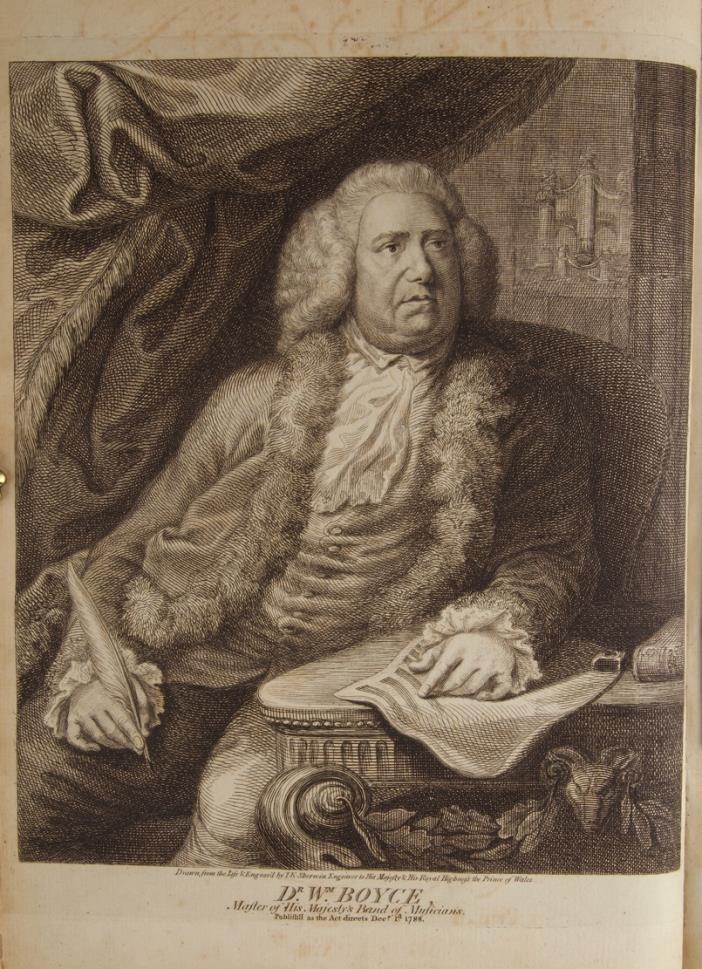
Vol. I
1f. (recto title, verso blank), 1f. (recto address "To the King" engraved by John Ryland, verso blank), 2ff. (list of subscribers), [i]-xi ("Memoirs of Dr. William Boyce. Now first published"), [i] ("Erratum" and "Advertisement"), iii-iv ("The Preface"), vii-x ("A Succinct Account of the Several Authors, whose Works are contained in this Volume"), xi-xii ("The Table"), 290 pp. With a table to chants to pp. 289-290, with names of composers added in contemporary manuscript (Humphrey, Purcell, Blow, Turner, Greene, Robinson, Aldrich, Croft, Nares), and an annotation to the foot of p. 290, "The names of the Composers are given on the authority of the Organ Book at Westminster Abbey." Accession number in pencil to blank verso of title, "R.D. 783.2 B69 vol 1," handstamped "music" in red ink and "59415" in blue.
Vol. II
1f. (recto title, verso blank), 1f. (recto address "To the King," verso blank), vii-[x] ("A Succinct Account Continued"), xi-xii ("The Table"), 306 pp. With extensive autograph notations in Novello's hand to outer margin of pp. 154 and 163 quoting Burney's History of Music, pp. 480-481, with the music historian's thoughts
on Purcell's six- and 8-part anthems ("O God thou hast cast us out" Z. 36, and "O Lord God of hosts", Z. 37); in contemporary pencil, to p. 154, "Nine plates of 18"; and "lower G clef" to p. 163.
Vol. III
1f. (recto title, verso blank), 1f. (recto address "To the King," verso blank), v-vi (preface by Boyce), ix-x ("A Succinct Account), xi-xii ("The Table"), 300 pp.
Second edition. BUC p. 129. RISM Recueils Imprimés BII, p. 124.
"When Cathedral Music was eventually published (1760–73), it established a canon of English church music ranging from Tallis and Tye to Boyce’s immediate predecessors Croft and Weldon. The preface identifies its primary purpose to preserve the music of past masters ‘in its original purity’, at the same time to make such music available in score as a replacement for the often faulty manuscript partbooks then generally in use. Cathedral Music retained its place in cathedral usage into the 20th century, and has been justly described as ‘a landmark in the history of musicology, and a fitting monument to his industry and scholarly enterprise’ (Johnstone, 1975)." Robert J. Brice and Ian Bartlett in Grove Music Online
Novello (1781-1861) was an "English organist, choirmaster, conductor, teacher, editor, publisher, composer, collector, and antiquarian. ... [He] found his true vocation as editor and publisher by serving the expanding market for the study and performance of music in public and private contexts." Rosemary Hughes, revised by Fiona M. Palmer in Grove Music Online
Alexandre-Etienne Choron (1771-1834) was a French musicologist, composer, and publisher. "He composed chiefly sacred music, including a Messe brève, a Magnificat, a Stabat mater and numerous motets, both a cappella and with organ accompaniment. His opera, Nadir et Salyha, was produced in Kassel in 1811. He also wrote a number of songs, of which La sentinelle (1810) was popular in his lifetime." Arthur Hutchings, revised by Hervé Audéon in Grove Music Online
An intriguing association copy, linking two important 18th- and 19th-century musical figures, Choron and Novello, both deeply involved in liturgical music (40621) $2,500
“Brahms Proclaims Himself a Master of that Greatest of Instruments, the Symphony Orchestra"
10. BRAHMS, Johannes 1833-1897
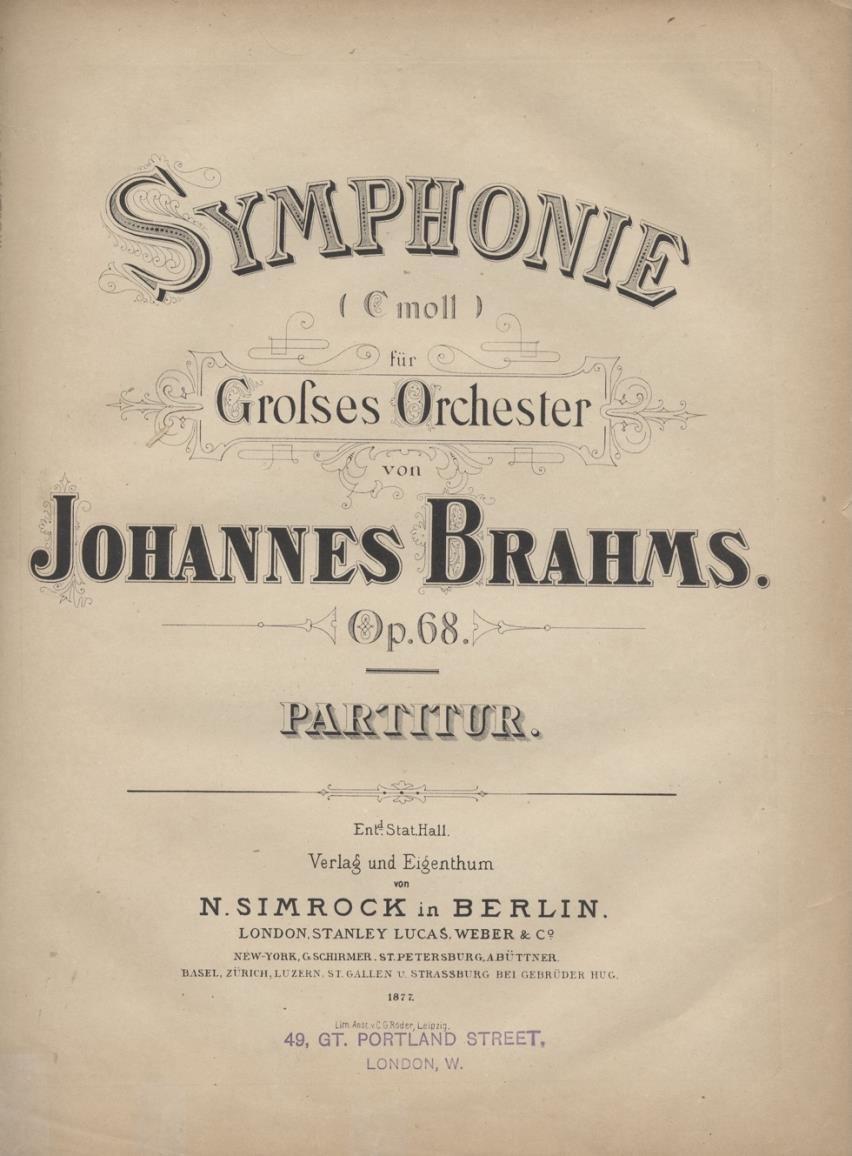
Symphonie (C moll) [No. 1] für Groſses Orchester ... Op. 68. Partitur. [Full score].
Berlin: Verlag und Eigenthum von N. Simrock [PN 7957], 1877.
Folio. Half blackmorocco with black cloth boards, titling giltto spine, original publisher's blue printed wrappers bound in at conclusion. 1f. (recto title, verso publisher's note regarding performance rights), 3-100 pp. Title lithographed, with "Lith. Anst. v. C.G. Röder, Leipzig" to foot; music engraved. With distributors to title London: Stanley Lucas, Weber & Co.; New-York: G. Schirmer; St. Petersburg: A. Büttner; Basel, Zürich, Luzern, St. Galllen u. Strassburg bei Gebrüder Hug; and handstamp "49, Gt. Portland Street, London, W." to foot. Wrappers worn and with small edge tears and chips; small London bookseller's label to lower inner corner of front pastedown. Uniformly browned, slightly heavier at edges; occasional small stains, edge tears, and chips; slightly brittle at edges.
First Edition, first issue of the first symphony. Hofmann p. 147. McCorkle p. 292. Deutsch p. 256. Fuld p. 551
“In his article Neue Bahnen, Schumann hinted that it was Brahms's destiny to compose for orchestra. By the time of Brahms's death in 1897, this prediction had been fulfilled with the creation of two serenades, four concertos, a set of variations, two overtures and four symphonies." Walter Frisch in Grove Music Online
"Finally, there is a new splendour and character in the attitude to orchestral sound. Despite all the striking and effective scoring in the early orchestral pieces and the choral works of the later 1860s, it is in this Symphony that Brahms proclaims himself a master of that greatest of instruments, the symphony orchestra." McDonald: Brahms, p. 250 (41003) $900
First Edition of the Violin Concerto
11. BRAHMS, Johannes 1833-1897
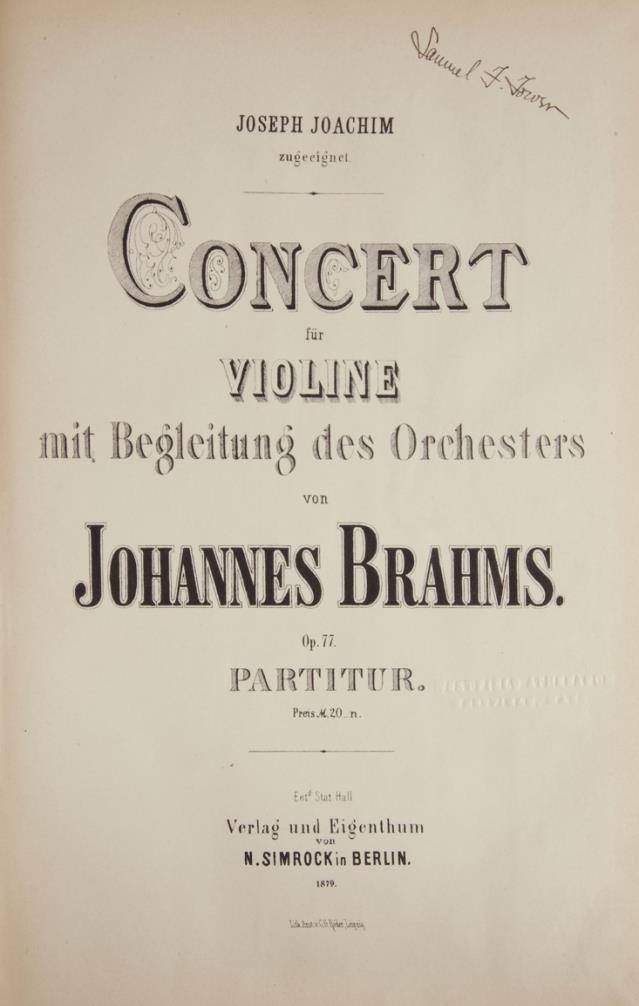
Concert für violine mit Begleitung des Orchesters ... Op. 77. Partitur. Preis M. 20_n. ... Joseph Joachim zugeeignet.
Berlin: N. Simrock [PN 8133], 1879.
Large octavo. Black cloth-backed marbled boards. 1f. (recto title, verso blank), 1f. (recto blank, verso publisher's note regarding performance rights), 5208 pp. Lithographed. Binding slightly worn; frayed at head of spine. Minor wear; very occasional small stains. An attractive, clean and wide- margined copy overall. Ex-library, with blank rectangular ivory paper label to upper board, call number and small paper labels to spine, card pocket to front free endpaper, and small embossed stamp "Westfield Athenaeum, Westfield, Mass." to title and two additional leaves. Signature "Samuel F. Towson" to blank upper outer corner of title.
First Edition, second issue. Deutsch p. 258. Hofmann p. 165. McCorkle p. 328. Both Hofmann and McCorkle describe the music as being "im Plattendruck." As is the case for a number of other Brahms scores, a small number of copies were printed from engraved plates, often serving as presentation copies. In some cases it is unclear whether or not their printing preceded, was simultaneous with, or came after the lithographed edition. In general, the issues are identical except for the actual method of printing.
Brahms's famous and much-loved violin concerto was first performed by highly distinguished violinist Joseph Joachim (1831-1907), with Brahms conducting, at the Gewandhaussaal in Leipzig on 1 January 1879.
"Temperamentally, the Violin Concerto op. 77 is in many respects a companion piece to the Second Symphony, with which it shares the key of D and a first movement in 3/4 time built from triadically orientated themes that furnish energetic development as well as gentle lyricism. The elegiac opening ritornello of the Adagio, scored for woodwind and solo oboe, introduces one of Brahms's most classically poised slow movements. The exuberant rondo is one of Brahms's greatest essays, and certainly his most virtuoso, in the style hongrois." George S. Bozarth and Walter Frisch in Grove Music Online (40996) $750
First Edition, Rare Second Issue of the Third Symphony
12. BRAHMS, Johannes 1833-1897
Dritte Symphonie (F dur) für Groſses Orchester ... Op. 90. Partitur. [Full score].
Berlin: Verlag und Eigenthum für alle Länder von N. Simrock [PN 8454], 1884.
Folio. Black leather-backed textured cloth, titling gilttospine. 1f. (rectotitle, verso blank), 1f. (recto publisher's note, verso blank), 5-109, [i](blank)pp. Title lithographed, with "Lith. Anst. v. C.G. Röder, Leipzig" to foot; music transferprinted. With small handstamp of Berlin music publisher and distributor Bote & G. Bock to blank foot of title. Binding worn, rubbed, and bumped. Occasional minor staining and small tears to blank lower margins; some signatures loose; tear to pp. 33/34 repaired with clear tape; pp. 35/36 detached.
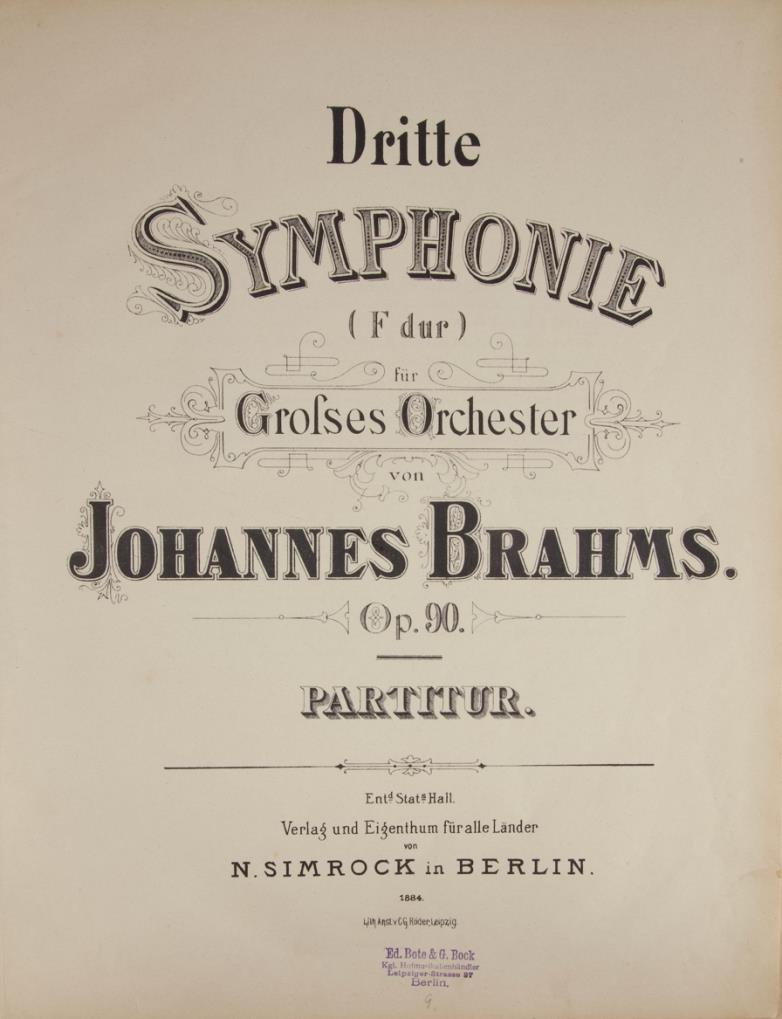
First Edition, second issue. Rare. Deutsch p. 259. Hofmann p. 191. McCorkle p. 372. Fuld pp. 554-555and pp. 691-692. Sonneck p. 56. Possibly printed at approximately the same time as the first, engraved, issue (virtually unobtainable), which was printed in only a handful of copies, most probably expressly for the composer and friends.
"With his Third Symphony op. 90 Brahms achieved a new level of coherence in a large-scale orchestral work. It is the shortest of the four symphonies, lasting only half an hour in most performances. The durations of the individual movements are closer to being equal than in any of the others. The compact dimensions and balanced proportions seem intended to point up processes that extend over the entire work. These include the most direct thematic recall in any symphonic work by Brahms: the opening motto and theme return transfigured at the end of the finale. Coherence is also imparted by harmonic devices, such as the frequent juxtaposition of F major and F minor. The tonal scheme is unique in the genre: outer movements centred on F and inner movements on C, thus creating a plateau of harmonic tension in the dominant that implies a large-scale sonata form over the whole work." George S. Bozarth and Walter Frisch in Grove Music Online (41001) $2,000
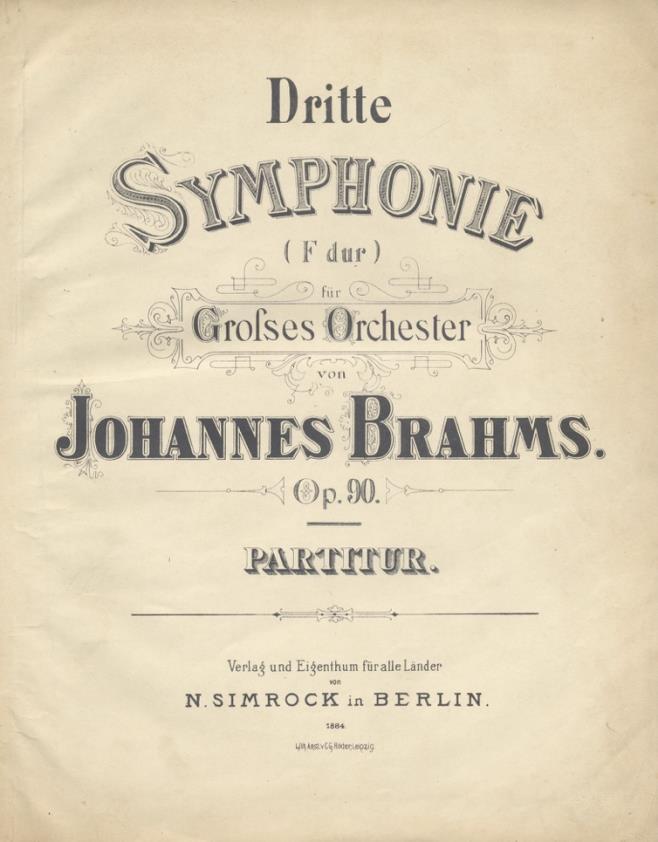
First Edition, Third Issue of the Third Symphony
13. BRAHMS, Johannes 1833-1897
Dritte Symphonie (F dur) für Groſses Orchester ... Op. 90. Partitur. [Full score].
Berlin: Verlag und Eigenthum für alle Lander von N. Simrock [PN 8454], [after 1884].
Folio. Contemporary flexible black cloth boards. 1f. (recto title, verso blank), 1f. (recto publisher's printed note, verso blank), 5-109, [i] (blank) pp. Title lithographed, with "Lith. Anst. v. C.G. Röder, Leipzig" to foot; music transferprinted. Binding worn.
With numerous early performance markings including dynamics, expression, and phrasing in blue, red, and gray pencil in an unknown hand.
First Edition, third issue. Deutsch p. 259. Hofmann p. 191. McCorkle p. 372. Sonneck p. 56. The notice on the recto of the second leaf is an abbreviated version of the notice found in copies of both the first and second issues. (40998) $500
The Composer’s Last Compositions for Solo Piano
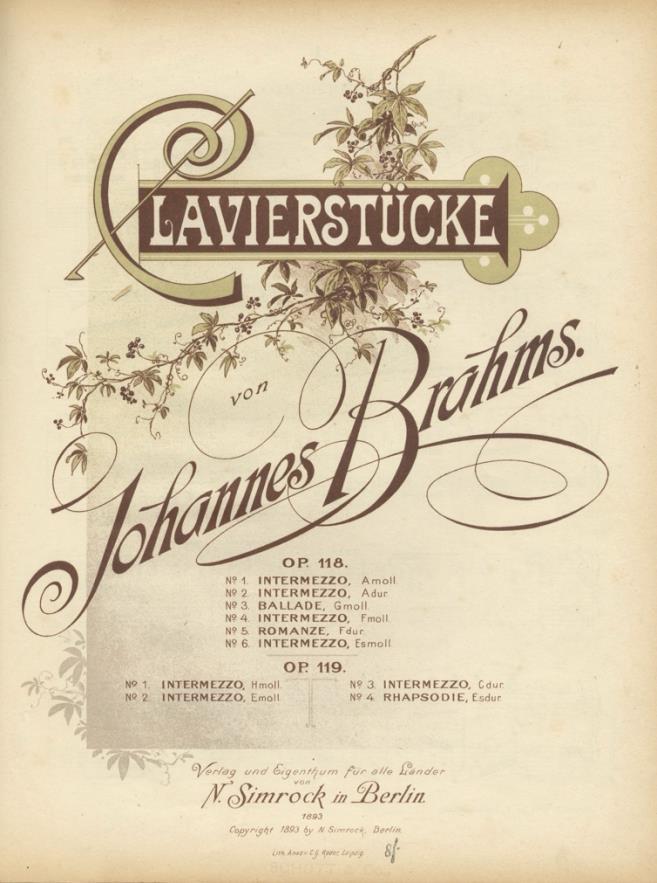
14 BRAHMS, Johannes 1833-1897
Clavierstücke ... Op. 119, Nos. 1-4.
Berlin: N. Simrock [PN 10055], 1893.
Folio. Quarter black cloth with decorative ivory boards. [i] (decorative series title printed in dark brown and light olive green), 2-19 pp. Title lithographed, music transfer-printed. With faint handstamp of Schott & Co. and "8/" beneath imprint. Binding slightly worn and browned. Uniform light browning, slightly heavier to margins; small binder's holes to gutter; signatures partially detached.
Contains No. 1. Intermezzo, H moll; No. 2. Intermezzo, E moll; No. 3. Intermezzo, C dur; No. 4. Rhapsodie, Es dur
First Edition. McCorkle p. 477. Hofmann p. 251. Hoboken 4, 143. Deutsch p. 263.
These four character pieces were Brahms's last compositions for solo piano; the works premiered in London in January of 1894. (40999) $200
Early 17th Century Engraving from Cosimo II’s Festival in Florence
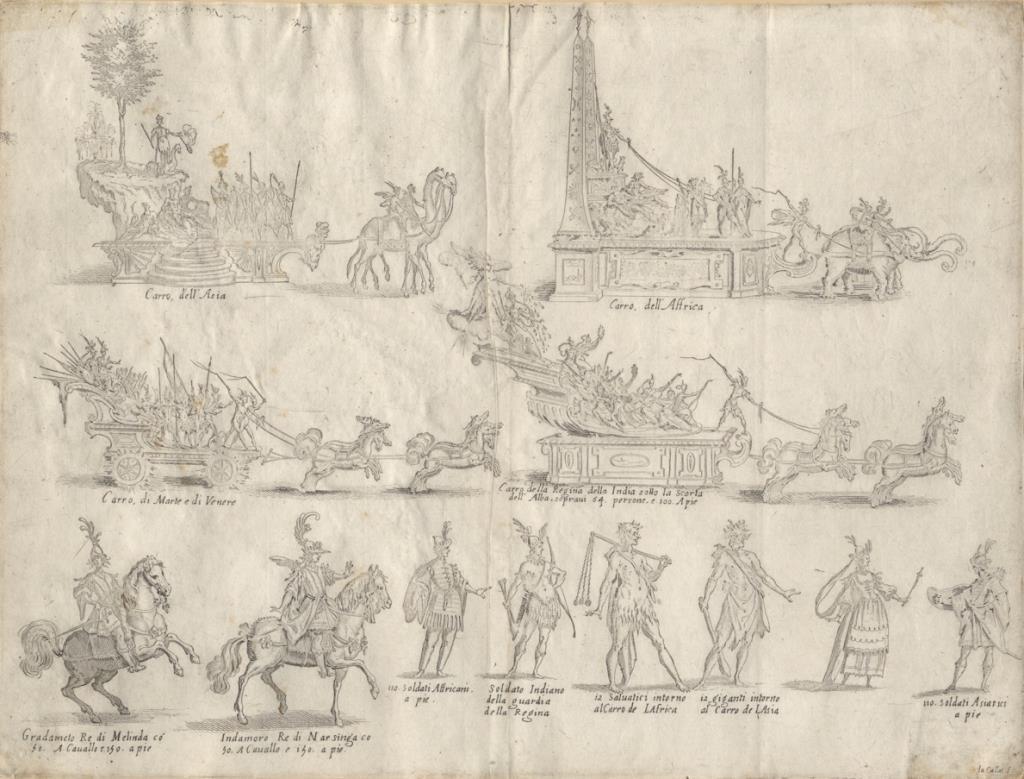
15. CALLOT, Jacques ca. 1592-1635
Les Chars et Les Personages (The Chariots and The Characters) from La Guerre d'Amour (Guerra d'Amore) (War of Love). Etching.
Firenze: Zanobi Pignoni, 1616.
1 oblong leaf (225 x 296 mm). Laid down to thin card stock. With "Ia Callot F." printed to lower right corner The first plate (of four) in La Guerre d'Amour documenting the festival presented in Florence on 11 and 12 February1616byCosimoII, DukeofTuscany. Thepresentetchingdepicts,inthreerows, thecharacters, animals and chariots that featured in the festival. Slightly worn, cockled, and creased; backing stock browned.
Provenance
John Milton Ward (1917-2011), noted musicologist and Professor of Music at Harvard University from 19611985.
Lieure 169 (first state of three). For an extensive descriptionof the present plate and the three others in the series see Kahan: Jacques Callot. Artist of the Theatre, pp. 28-38. (41224) $300
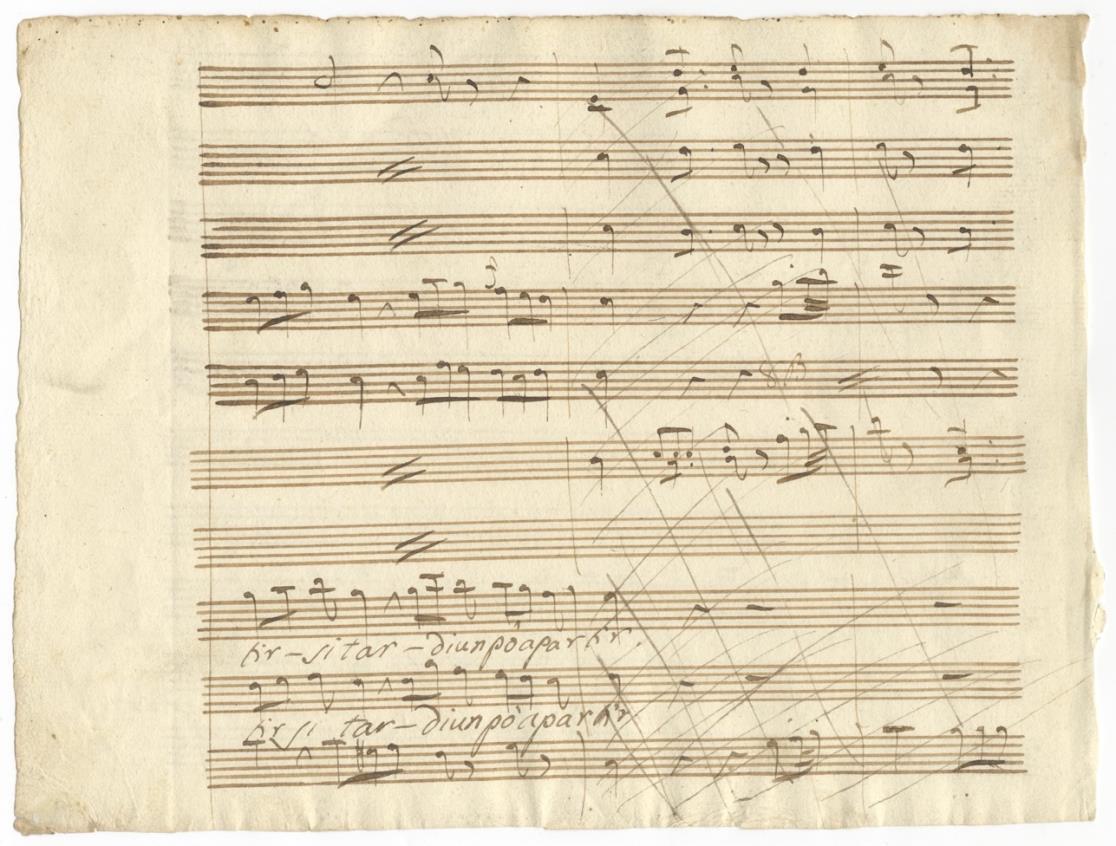
Autograph Manuscript from Il matrimonio segreto, e Composer’s Most Famous Work
16. CIMAROSA, Domenico 1749-1801
Autograph musical manuscript excerpt from the opera "Il matrimonio segreto" (The Secret Marriage). Ca. 1792.
1 leaf. Oblong folio (217 x 282 mm). 2 pages. Notated in dark brown ink on 10 rastrum-ruled staves. 6 measures in full score, two of which have been crossed out. Unsigned and undated. The music, to text Si tardi un po' a partir, is from the duet between Carolina and Paolino in the final scene of the second act of the opera.
Provenance
J. A. Stargardt auction 663, Berlin, 21/22 March 1996, lot 789.
In two acts to a libretto by Giovanni Bertati after George Colman the elder and David Garrick’s play The Clandestine Marriage, Il Matrimonio Segreto was first performed in Vienna at the Burgtheater on 7 February 1792. It is generally considered to be the composer's most famous work.
"Cimarosa was always able to write music suffused with lightness, elegance and finesse. ... One of [his] strengths was the composition of witty and vivacious ensembles. Il matrimonio segreto, an ensemble opera in the style of Mozart’s Le nozze di Figaro, is composed of eight arias, four duets, three trios, a quartet, a quintet and two finales featuring all six characters. Frequently his operas begin with a trio or a quartet, and he excelled at creating large-scale chain finales. Although Cimarosa’s characters do not display layers of Mozartian complexity, he was capable of depicting human emotions in a touching but not over-sentimental manner, as in the opening duet ‘Cara non dubitar’ from Il matrimonio segreto." Jennifer E. Johnson and Gordana Lazarevich in Grove Music Online (41204) $2,800
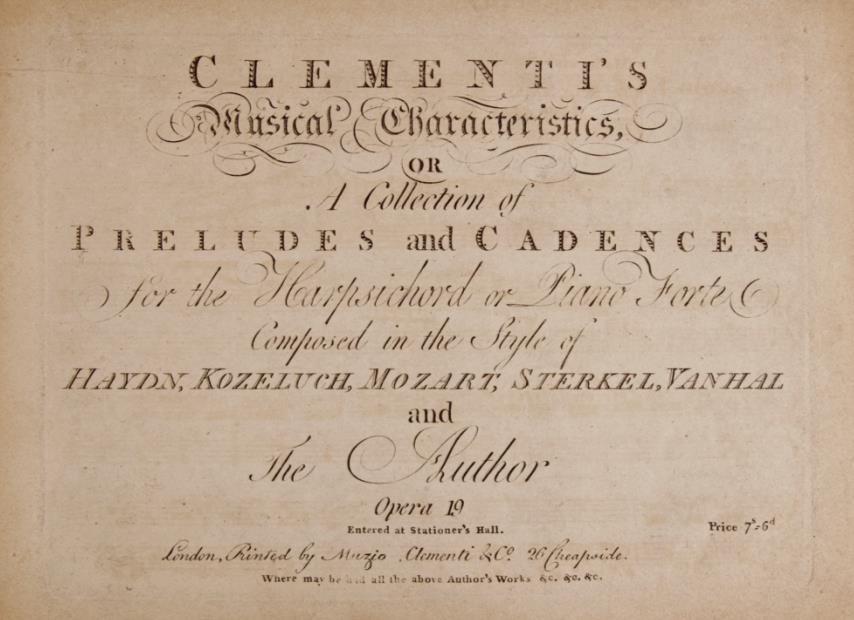
"[His]
Influence on Following Generations of Pianists and Piano Composers is Hard to Overestimate”
17. CLEMENTI, Muzio 1752-1832
Clementi’s Musical Characteristics, or A Collection of Preludes and Cadences for the Harpsichord or Piano Forte Composed in the Style of Haydn, Kozeluch, Mozart, Sterkel Vanhal and The Author Opera 19 Price 7s = 6d.
London: Printed by Muzio Clementi & Co. 26 Cheapside, [ca. 1820].
Oblong folio. Dark tan leather-backed marbled boards with titling to spine gilt. [i] (title), 2-29 pp. Engraved throughout.Watermarkdated1820. Bindingworn, slightlyrubbed, bumped, andwarped. Occasionalsmallstains and foxing; some showthrough to numerous leaves; title moderately browned.
First Edition, third issue. Tyson p. 57 (first issue). BUC p. 198 (first two issues). The imprint varies among issues: RISM C2882 (Longman and Broderip, four copies recorded); RISM C2883 (Longman, Clementi & Co., two copies recorded); RISM CC2883a (one copy of the present issue, in Scotland at St. Andrews (Fife) University Library). OCLC 230725447 (an additional copy, at the British Library). The autograph is held at the Library of Congress.
Each of these pieces is a sort of "impression" of the composer it is named for, e.g. "alla Haydn," "alla Mozart," "alla Clementi," etc .(character pieces, essentially, as the title of the publication suggests). Between the preludes (pp. 2-23) and the cadenzas (pp. 24-29), the pieces employ the same devices, including alternation between rhapsodic freedom and rhythmically regular material, arpeggios, fermatas, rapid scales, chromatic scales, and extremes of dynamics. Each type of piece starts differently, however; the preludes begin with introductory musical gestures or textures; the cadenzas, on the other hand, start in media res on 6/4 chords, as they would appear in concertos, with fermatas over them; the fermatas at the start are followed by sudden bursts of rapid scales or arpeggios.
Clementi was an Italian-born English composer, keyboard player, teacher, music publisher, entrepreneur, and piano manufacturer He influenced many of the leading pianists and composers in the 19th century including Beethoven. (40614) $200
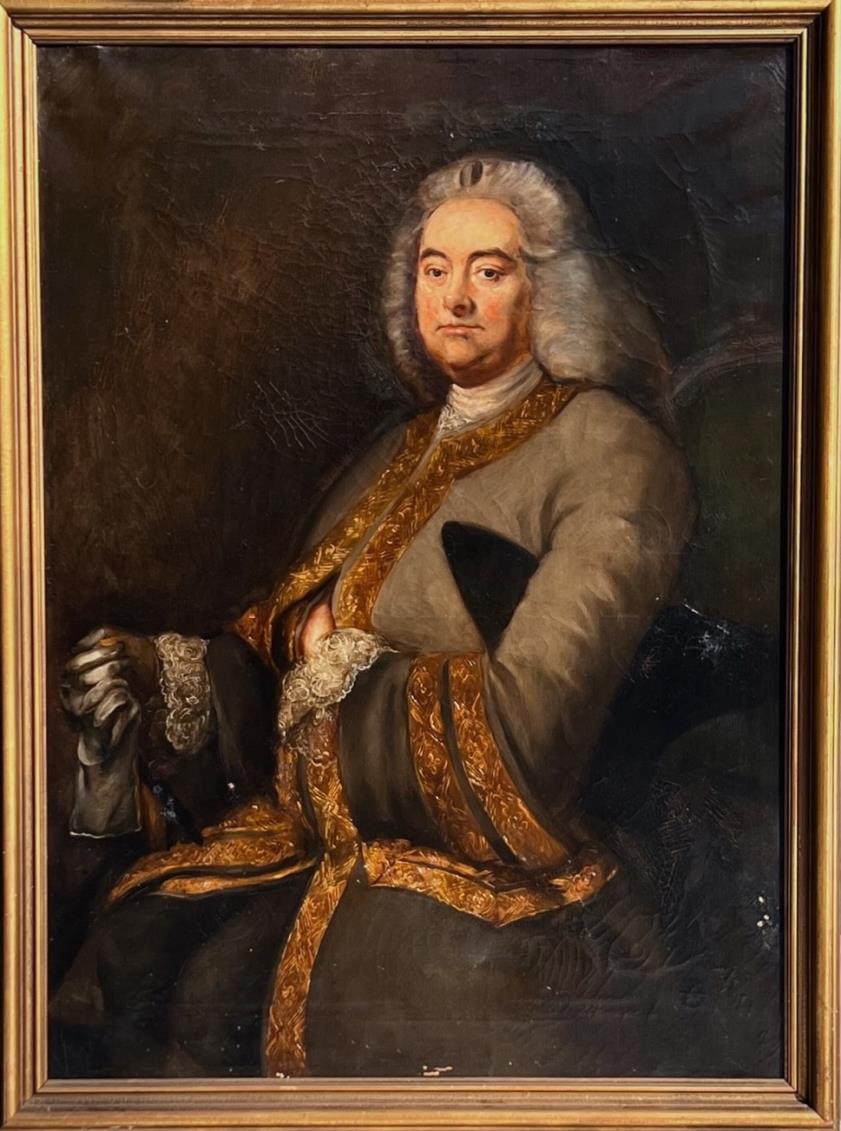
Attractive Late 18th Century Copy of Hudson’s Portrait
18. [HANDEL, George Frideric 1685-1759]
Large [?]late 18th century three-quarter length portrait painting on canvas in oils by an unidentified artist after the original full-length portrait executed by Thomas Hudson in 1756
Stretcher size: 48" x 23.5 " (121.5 x 59.7 cm); size with wooden frame: 52" x 39" (132 x 99 cm).
Handel is depicted wigged, sitting facing right, wearing a shirt with ruffled lacecuffs, plain collar, and lace jabot under a long gray-green coat with edging elaborately embroidered in gold. His left hand is extended inside his coat and his right holds a glove (possibly added later). A tricorn hat is wedged between his upper left arm and the left side of his body.
The present portrait is a [?]late 18th century version of the Hudson painting. In the original, measuring 94" x 57.5", Handel is depicted full-length, seated on a blue chair next to a table on which rests an open score of the Messiah, a cane in his right hand, a sword positioned to his left, with a view of a lightly clouded blue sky in the background. Some surface cracking and chipping to background, not affecting figure; evidence of several small
repairs to background and rear portion of composer's hat; several small abrasions at lower edge with minor loss of paint; relined. The later (?19th century) addition of the glove at Handel's right hand is curious.
Hudson (1701-1779) was a noted British portrait painter. His portrait of Handel was commissioned by Charles Jennens, the librettist of Handel's Messiah, and is held at the National Portrait Gallery in London (NPG 3970). (41230) $4,500
Bronze Statue Commemorating the Centenary of Handel’s Death
Inscribed to Joseph Taylor, Patron of The Sacred Harmonic Society, Noted Performers of Handel’s Works
19 HANDEL, George Frideric 1685-1759
19th century bronze statue of Handel produced by the English bronze founders, Elkington & Co., after the marble statue by Louis-François Roubiliac (1702-1762). Birmingham: Elkington & Co., ca. 1859. Fashioned into a lamp at a later date, with statue of Handel measuring 14" x 7" x 10" mounted on a bronze base 8.25" x 8.25" x 10", with overall dimensions including lamp fittings and shade 38.5" x 18" x 17." Weight 28 pounds. "Elkington & Co." and "1247" stamped into metal at lower portion. Slightly worn.
Provenance
With presentation inscription engraved to base: "Handel Centenary Festival 1859 The Sacred Harmonic Society To Joseph Taylor Esq. re Vice President."
“The original marble statue of Handel by noted sculptor Roubiliac was commissioned by the entrepreneur of Vauxhall Gardens, Jonathan Tyers (1702-1767), in ca. 1737. It was unveiled in the Gardens in May 1738. Handel was then a leading figure in the capital's musical life. Since public lifesize marble statues of living subjects were, until this date, undertaken only for monarchs, noblemen or military leaders, this figure made a considerable impact at the time. It is the earliest-known independent work by Roubiliac, and established his reputation as a sculptor." Victoria and Albert Museum Online
"Roubiliac's Handel was truly original. The great composer is shown wearing a night cap and loose gown. The buttons on his breeches are undone. His right foot has come out of his slipper. His elbow
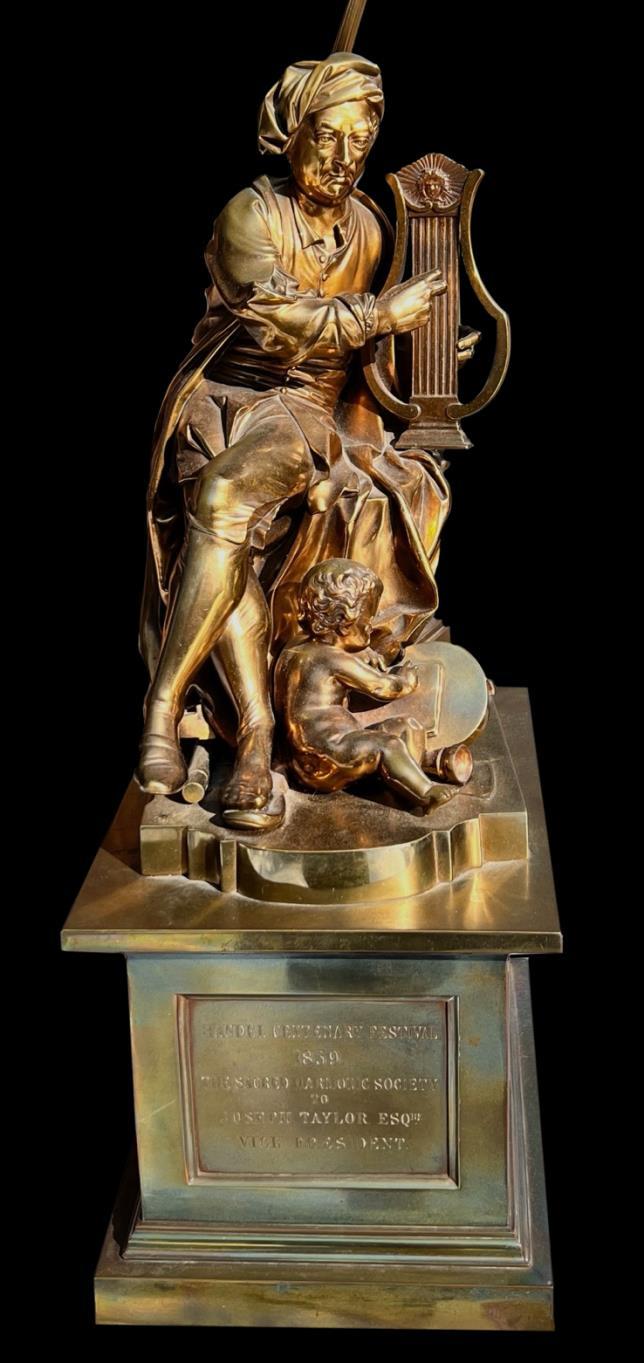
leans casually upon a pile of books on a plinth. Handel's face is a mask of concentration as he bends down to listen to the notes plucked from the strings of his lyre. It is as if he has suddenly risen from bed to capture a tune that has been troubling his sleep and hasn't bothered to get dressed properly. We are witnessing the act of composition, an intense, fleeting moment of creativity. A naked baby putto, unseen by the distracted composer, transcribes the notes. A bass viol lies at his feet." The Fitzwilliam Museum Online
The Sacred Harmonic Society (1832-1888), especially noted for its performances of Handel's works, organized the Handel Centenary Festival in 1859 at London's Crystal Palace to commemorate the 100th anniversary of the composer's death; the festival involved over 2,700 singers and 460 instrumentalists performing under distinguished conductor Sir Michael Costa (1808-1884). Joseph Taylor is recorded as having donated scores to the library of the Sacred Harmonic Society. Elkington & Co. were a leading firm of silversmiths and bronze founders from1855toca. 1880, executingnumerous reproductions offamous sculptures fortheNationalPortrait Gallery. (41190)
Late
$1,250
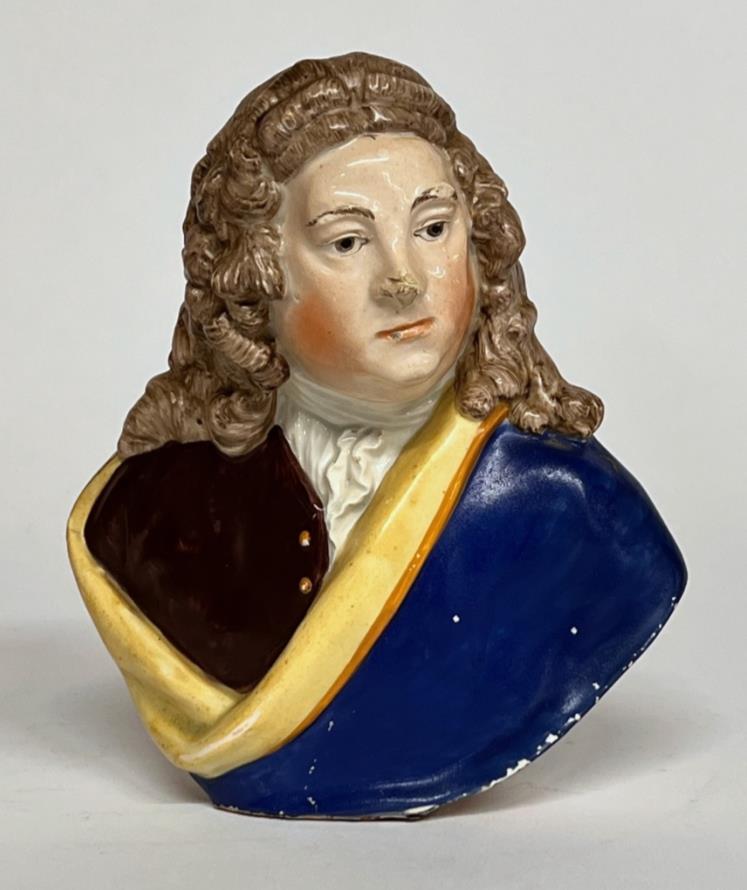
18th Century Ceramic Bust
20. [HANDEL, George Frideric 16851759]
18th century ceramic portrait bust by Ralph Wood (1748-1795) of Burslem in Staffordshire, England. Executed in pearlware with multicolor enamel overglaze Ca. 1784.
Handel is depicted head and shoulders quarter turned left. He wears a long wig, shirt, jacket, and cloak. 168 x 140 mm. Three small paper identification labels to back from ca. 1956. Several small chips including to tip of nose, eyebrows, and lips; some minor abrasions; hairline crack to right edge of cloak, just visible at right shoulder.
Scarce. CopiesareheldintheGerald Coke Handel Collection at the Foundling Museum, London and The Museum of Fine Arts, Houston. It seems that most known examples were intended to be mounted on a base, which present example does not include.
"Ralph Wood (1748-1795) was the first large-scale manufacture of English earthenware figures, and his name resounds in the annals of the Staffordshire Potteries. His figures were prototypes that others emulated and modified for decades after his death. In developing a large range of models, this creative genius laid the foundation of an industry that thrived into the twentieth century." Schkolne: Ralph Wood: My Notebook (online)
Possibly executed to coincide with the Handel Commemoration of 1784. (41180) $650
Written for Farinelli, "the Most Admired of all the Castrato Singers”
21. HASSE, Johann Adolf 1699-1783
The Favourite Songs in the Opera Call'd Artaxerxes. [Score].
London: Printed for and Sold by I. Walsh, Musick Printer, & Instrument maker to his Majesty, at the Harp and Hoboy in Catherine Street in the Strand, [1735].
Folio. Disbound. 1f. (recto passe-partouttitle, verso blank), [i] (blank), 2-16 pp. Engraved throughout. With "Note. Where these are sold may be had Apollo's Feast in Four Volumes, containing the Favourite Songs out of all of Mr. Handel's Opera" above imprint. Upper wrapper with "Artaxerxes" in contemporary manuscript. Upper wrapper worn, browned, and frayed at edges, with "Adriano C" to cancelled in blue pencil, lower wrapper lacking. Slightly worn, browned, and soiled; leaves separated; small binding holes to blank inner margins; vertical ink stain above "Favourite" in title; irregular pagination, but complete.
First Edition. Smith and Humphries p. 172, 769 ("Words by Apostolo Zeno. According to Burney some of the songs in this work are composed by Riccardo Broschi"). BUC p. 451. RISM H2243.
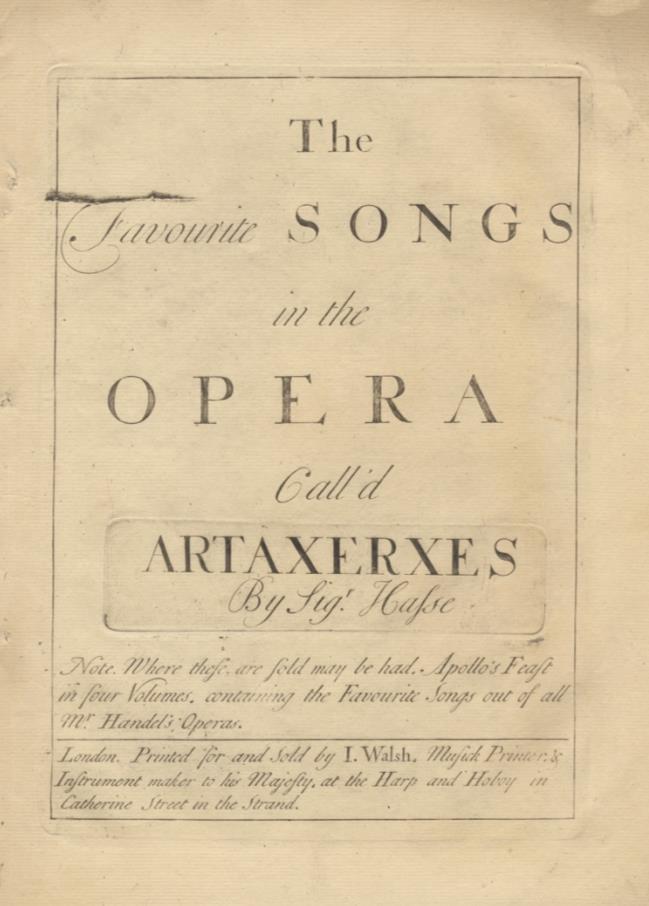
These arias were written for Farinelli (1705-1782), an Italian soprano castrato, "the most admired of all the castrato singers." Ellen T. Harris in Grove Music Online
Hasse, a German composer, "was the most widely admired composer of opera seria in Italy and Germanspeaking lands. ... [His] first documented visit to Venice was during Carnival 1730 when his Artaserse was given at the S Giovanni Grisostomo theatre. The libretto was nominally by Metastasio; this may be regarded as Hasse’s earliest encounter with a Metastasian text, though it had been altered by Giovanni Boldini. Only in 1760 did Hasse set Metastasio’s original libretto. Farinelli, who performed in several of Hasse’s operas, was particularly pleased with the Artaserse arias; he sang them in London on October 27, 1734 in a pasticcio, Artaxerxes (Burney mistakenly claimed that Hasse directed it). Two arias from Act 2, ‘Per questo dolce amplesso’ and ‘Pallido il sole’, to Boldini texts, were sung every evening for Philip V during the decade Farinelli served him (1737–46), and survive in countless copies; they may have been Hasse’s most widely circulated arias.
Handel’s respect for Hasse is shown by the 49 arias from 15 different Hasse operas he used in seven of his London pasticcios of 1730–34, and the Opera of the Nobility presented many of his arias in Artaserse and Siroe during 1734–5. Hasse must have known about these performances. He may have met Handel in Naples after the carnival season of 1729, when Handel acquired copies of his early operas. He could also have heard about the performance of Siroe, about which Burney remarked: ‘This is the first time that I ever perceived the composer of an opera named in the advertisements and bills of the day’." Sven Hansell in Grove Music Online (40739) $675
Late 17th Century Cantatas “In the Style of the Sacred Concerto”
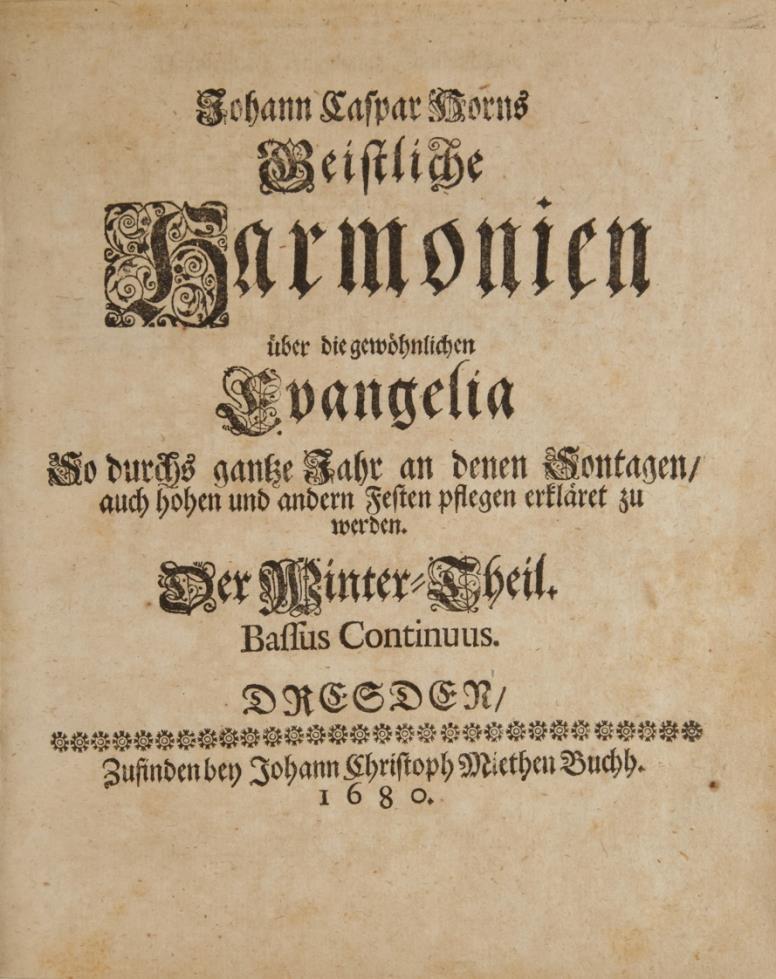
22. HORN, Johann Caspar ca. 1630ca. 1685
Geistliche Harmonien über die gewöhnlichen Evangelia so durchs gantze Jahr an denen Sontagen, auch hohen und andern Festen pflegen erkläret zu werden. Der Winter-Theil. Bassus Continuus. [Basso continuo part only].
Dresden: Zufinden bey Johann Christoph Miethen Buchh, 1680.
Quarto. Full early vellum. 1f. (recto title, verso blank), 3-204 pp.
Bound with:
Geistliche Harmonien über die gewöhnlichen Evangelia so durchs gantze Jahr an denen Sontagen, auch hohen und andern Festen pflegen erkläret zu werden. Der Sommer-Theil. Bassus Continuus. Zufinden bey Johann Christoph Miethen / Buchh in Dresden. [Basso continuo part only]. Pirna: Druckts Johann Heinrich Stremel, 1680. 1f. (recto title, verso blank), 3-229 pp.
Printed in diamond-head notation, with figuring. Decorative woodcut initials and tailpieces. Occasional manuscript additions, deletions, corrections, alterations to the Winter-Theil pp. 47, 75, 80, 85, 100, 135, and 183 and to the Sommer-Theil pp. 30, 45, 53, 66, 75, 95, 96, 149, 174, 206, 216, 227, and 228. Binding somewhat worn, soiled, and stained. Occasional minor staining; small hole to pp. 109/110 and 121/122 of the SommerTheil, just affecting notation.
All of these cantatas were written for four voices (S,A,T,B), 2 violins, 2 violas, and basso continuo.
First Edition. BUC p. 506. RISM H7418 and H7419 (one copy of the Winter- and Sommer-Theil in the U.S. only, at the Library of Congress; no other holdings in the U.S.).
Horn was an "Austrian physician and amateur composer, active in Germany. What little is known of his life is found primarily in the preface to his collections of ballets, Parergon musicum. ... For at least nine years from 1663 he belonged to a fraternity of musical amateurs led by Sebastian Knüpfer, Kantor of the Thomaskirche. In 1680 he stayed briefly in Dresden, where he published the two parts of his cantata cycle Geistliche Harmonien. ... The [work], in the style of the sacred concerto, was one of the last to be based entirely on biblical texts and one of the first to require instruments in addition to the continuo." Christopher Wilkinson, revised by Paul Whitehead in Grove Music Online (41142) $4,600
“Remained in the Repertory for 26 Years”
23. KELLY, Michael 1762-1826
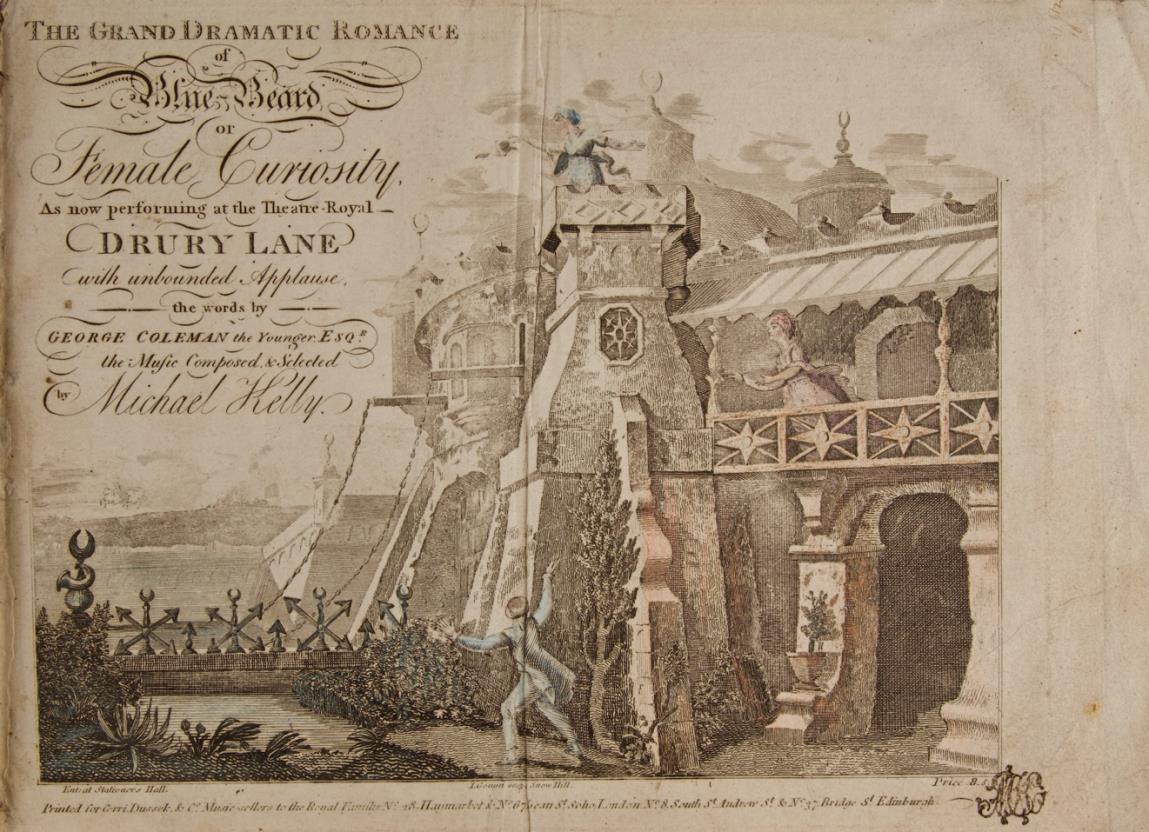
The Grand Dramatic Romance of Blue Beard, or Female Curiosity, As now performing at the Theatre-Royal Drury Lane with unbounded Applause, the words by George Coleman the Younger, Esqr. .. Price 8s. [Pianovocal score].
London: Corri, Dussek & Co. Music sellers to the Royal Family No. 28, Haymarket & No. 67, Dean St. Soho London, No. 8, South St. Andrew St. & No. 37, Bridge St. Edinburgh [without PN], [1798].
Oblong folio. Full contemporary dark brown mottled calf with spine in gilt-ruled compartments and dark red leather label gilt. 1f. (recto title, verso blank), [i] (blank), 2-74 pp. Engraved. With fine decorative title by I. Gouun, 34 Snow Hill, illustrating a scene from the opera, with some light blue and pink coloring. Decorative monogrammatic handstamp of the composer ("MK") to blank lower outer corner of title. Several annotations including letters and a cross in faint orange pencil. Binding worn, rubbed, and bumped; free endpapers lacking. Occasional small stains and minor soiling; title with vertical crease and slightly trimmed at blank outer margin; final leaf slightly trimmed at outer margin with minor early tape repair to upper margin of verso.
First Edition. BUC p. 567. RISM K291.
Blue Beard was first performed in London at Drury Lane on 16 January 1798.
Irish composer and tenor Michael Kelly "caught the current taste so well that his music became widely popular: it was extensively pirated in America, resulting in some 200 separate issues. Blue Beard remained in the repertory for 26 years." Alec Hyatt King in Grove Music Online (40595) $400
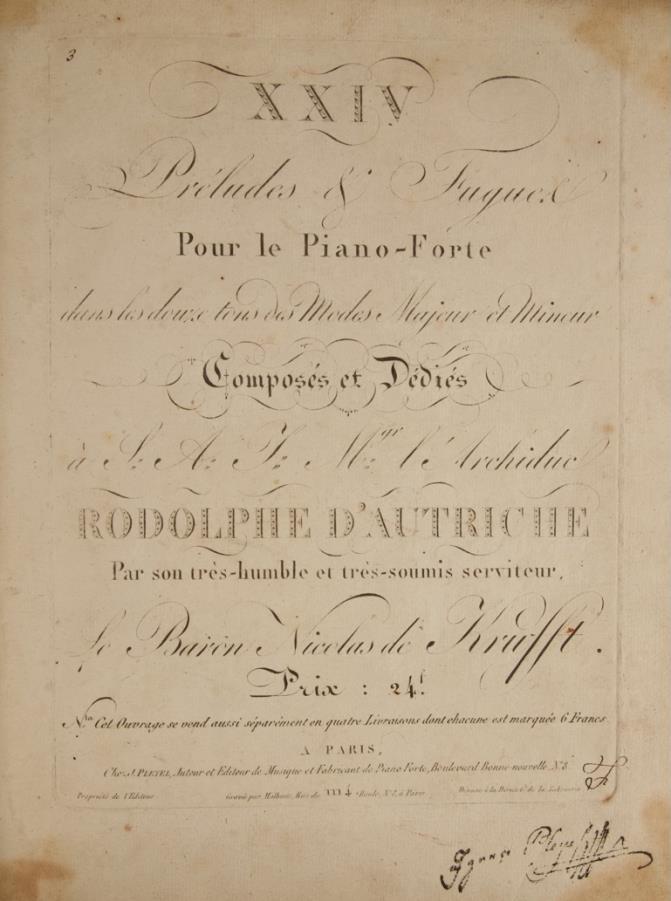
Inspired by Bach’s Well-Tempered Clavier
24. KRUFFT, Baron Nikolaus von 1779-1818
XXIV Préludes & Fugues Pour le Piano-Forte dans les douze tons de Modes Majeur et Mineur Composés et Dédiés à J. A. F. Mrg. l'Archiduc Rodolphe d'Autriche ... Prix 24f. ... Gravé par Malbeste [Score].
Paris: Chez I. Pleyel, Auteur et Editeur de Musique et Fabricant de Piano Forte, Boulevard Bonne-nouvelle, No. 8 [PN 1114], [1808-1815].
Folio. Quarter dark brown calf with marbled boards, dark red leather title label gilt to spine. 1f. (recto title, verso blank), [i] (blank), 2-20, [i] (blank), 22-87 pp. With "Thomas Field Bath 1815" in contemporary manuscript to front pastedown. Facsimile signature handstamp "Ignace Pleyel" and Field'sinitials tolower outercorner oftitle. Binding considerably worn, rubbed, and bumped, with loss of marbled paper of upper; endpapers worn and stained. Title slightly browned, soiled, and foxed; occasional signs of wear and minor soiling and foxing throughout.
[?]First Edition. Benton: Pleyel as Music Publisher, p. 134 (dating this edition at 1808-1815). Eitner V, p. 460. OCLC (three copies only, at the Staatsbibliothek in Berlin, the Bibliothèque nationale in Paris, and the New York Public Library). Weinmann-Mechetti, p. 11 (citingan edition published in Vienna by Pietro Mechetti, PNS 364-365, in June of 1815).
Austrian composer and civil servant Krufft studied with Johann Georg Albrechtsberger (1736-1809), the influential and sought-after pedagogue and contrapuntist who also taught Beethoven, Hummel, Reicha, and Moscheles. Krufft counted composer and publisher Ignace Pleyel among his admirers. Krufft's preludes and fugues are inspired by Bach's Well-Tempered Clavier. He makes a substantial nod to the baroque and Bach, particularly through his use of delicate and transparent two- and three-part textures, but also allows some Romantic pianism to come through, with brilliant passages of soaring arpeggios and accentuation of the extreme high and low registers of the instrument. (40536) $600
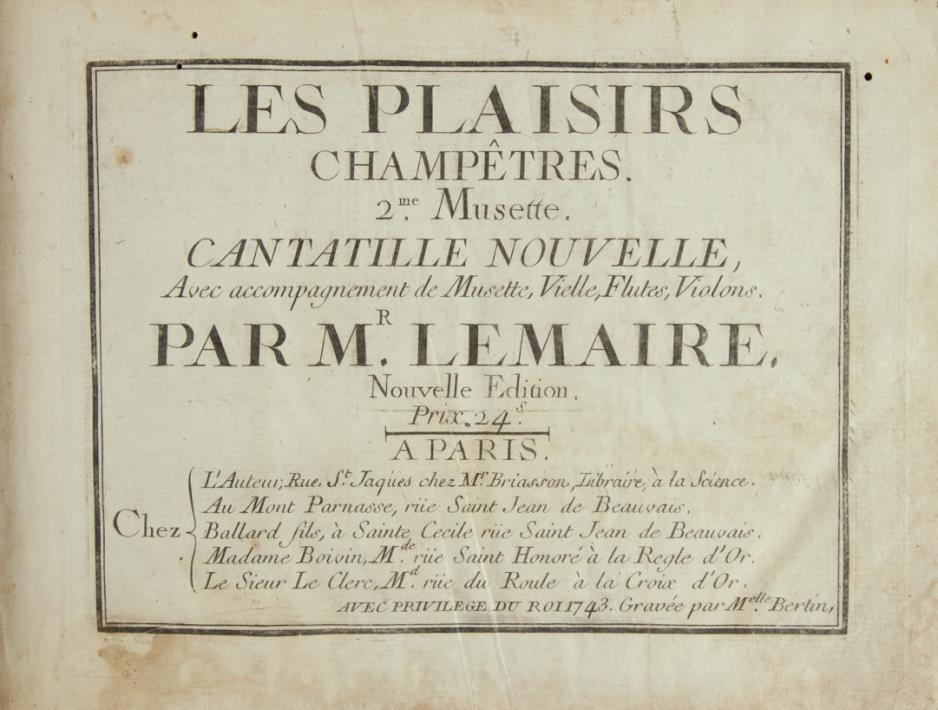
Early 18th Century French Cantatilles
25. LEMAIRE, Louis ca. 1694-1750, Jean-Joseph Mouret 1682-1738, and F. Bordery fl. 1740 Collection of 15 early 18th century French cantatilles. Paris, 1743.
1. Lemaire
Les Plaisirs Champêtres. 2me. Musette. Cantatille Nouvelle, Avec Accompagnement de Musette, Vielle, Flutes, Violons ... Nouvelle Edition. Prix 24s. Gravée par Melle. Bertin. Paris: Chez L'Auteur, Rue St. Jaques chez Mr. Briasson, Libraire, à la Science. Au Mont Parnasse, rüe Saint Jean de Beauvais; Ballard fils, à Saint Cecile rüe Saint Jean de Beauvais; Madame Boivin, Mde. rüe Saint Honorè à la Regle d'Or; Le Sieur Le Clerc, Md. rüe du Roule à la Croix d'Or. Avec Privilege du Roi, [1748 or later]. 1f. (recto title, verso "Catalogue des Œuvres de Mr. Lemaire"), 285-295, [i] (blank) pp. Not in Lesure or RISM.
2. Mouret
Hymne a l'Amour. Cantatille Francoise ... Gravée par M[lle] Louise Roussel. prix 1tt 4s. Paris: Chez L'A Veuve Mouret vis a vis l'Eglise Ste. Croix de la Bretonnerie.; Le Sr. Boivin, ruë St. Honoré à la Regle D'or.; Le Sr. Le Clerc, ruë du Roule à la Croix D'or., [ ca. 1730]. 1f. (recto title, verso "Memoire des Oeuvres de Mr. Mouret"), 12 pp., 1f. (recto privilege, verso blank). Lesure p. 450. RISM M4002 (no copies in the U.S.).
3. Mouret
Eglé. Cantatille Francoise. ... Gravée Par Mlle Louise Roussel, prix 1tt 4s. Paris: Chez La Veuve Md. Mouret rüe de richelieu vis a vis le cul de sac demenar.; La Ve. Boivin, Ruë St. Honoré à Règle D'or.; Le Sr. Le Clerc, Ruë du Roule à la Crois D'or., [ca. 1730]. 1f. (recto title, verso "Memoire des Oeuvres de Mr. Mouret"), 13-24 pp., 1f. (recto privilege, verso blank). Lesure p. 449. RISM M3995 (no copies in the U.S.).
4. Mouret
Léda. Cantatille Francoise. ... Gravée Par Mme Le clair. prix 1tt 4s. Paris: Chez La Ve. Mad. Mouret vis a vis l'Eglise Ste. Croix de la Bretonnerie.; La Ve. Boivin, rue St. Honoré à la Régle D'or.; Le Sr. Le clerc, rue du Roule à la Croix D'or., [ca. 1730]. 1f. (recto title, verso "Memoire des Oeuvres de Mr. Mouret"), 25-36 pp., 1f. (recto privilege, verso blank). Lesure p. 450. RISM M4004 (no copies in the U.S.).
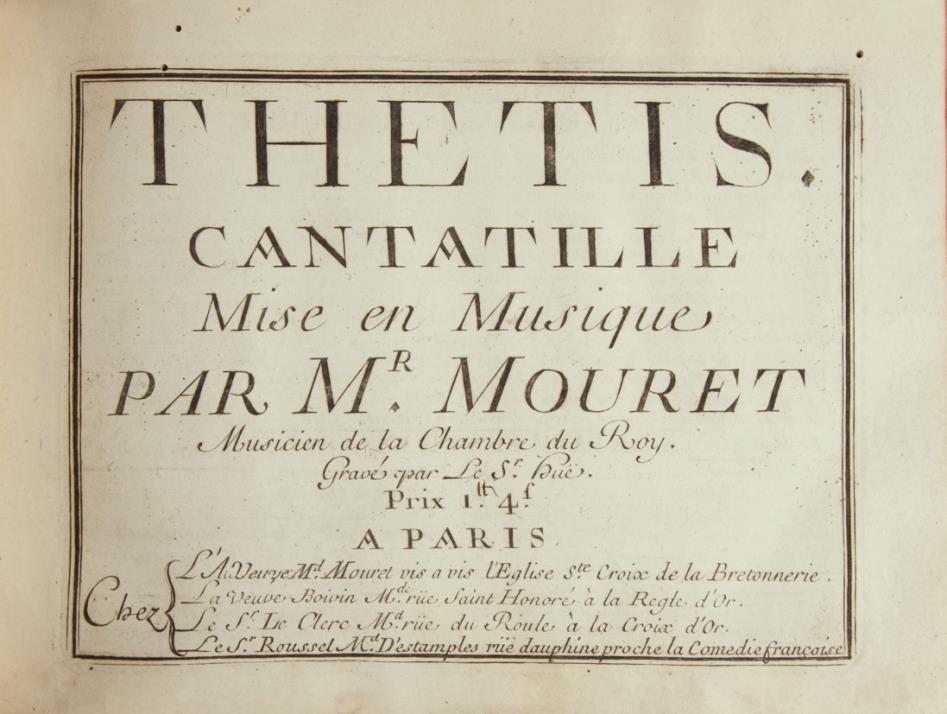
5. Mouret
Thetis. Cantatille ... Gravé par Le Sr. Huë. Prix 1tt 4s. Paris: Chez L'A Veuve Md. Mouret vis a vis l'Eglise Ste. Croix de la Bretonnerie.; Le Veuve Boivin Md. rüe Saint Honoré à la Regle d'Or.; Le Sr. le Clerc Md. rüe du Roule à la Croix d'Or.; Le Sr. Roussel Md. D'estamples rüe dauphine proche la Comedie françoise, [ca. 1730]. 1f. (recto title, verso "Memoire des Oeuvres de Mr. Mouret"), 77-92 pp., 1f. (recto privilege, verso blank). With an alternate vocal line (in a lower range) added in contemporary manuscript to p. 92. Lesure p. 451. RISM M4009 (one copy only in the U.S., at North Texas State University, Denton).
6. Mouret
L'Amour et L'Hymen Epitalame ... Gravé par Le Sr. Hue. Prix 1tt 4s. Paris: Chez L'A Veuve Madame mouret vis a vis l'Eglise Ste. Croix de la Bretonnerie.;' La Veuve Boivin Md. rüe St. Honoré à la Regle d'Or.; Le Sr. Le Clerc, Md. rüe du Roule à la Croix d'Or.;' La Veuve Roussel, rüe Dauphine., [ca. 1742]. 1f. (recto title, verso "Memoire des Oeuvres de Mr. Mouret"), 93-104 pp., 1f. (recto privilege, verso blank). Lesure p. 448. RISM M3990 (one copy only in the U.S., at the Library of Congress).
7. Bordery
Journée de Fontenoy ou La defaite des Anglois par Louis Quinze. Cantatille Allegorique pour un Dessus ou haute-contre par Mr. Bordery. Maître de Musique a Lille en Flandre. Prix 1tt 4s. Paris: Chez Mr. Le Clerc Md. rue du Roule à la Croix d'Or.; Mme. Boivin Mde. rue St. Honoré à la Regle d'Or. Avec Privilége du Roy, 1746. 1f. (recto title, verso blank), 29-45 pp., 1f. (recto privilege, verso blank). Lesure p. 66. RISM B3673 (one copy only, at the Bibliothèque National de France).
8. Lemaire
Le Retour du Printemps. Cantatille Nouvelle avec Accompagnement de Flûttes, Violons, et Hautbois. Chantée au Concert du Chateau des Thuilleries. Par Melle. Eeremans ... Gravée par Me. Le Clair. Le prix est de 24tt. Paris: Chez L'auteur, ruë St. Jaques chez Mr. Briasson, Librairie, à la Science.; Le Sr. Boivin Md. ruë St. honore à la Regle D'or.; Le Sr. le Clerc Md. ruë du Roule à la croix D'or. Avec Privilege du Roy, 1733. 1f. (recto title, verso "Catalogue des Œuvres de Mr. Lemaire"), 83-97 pp. Lesure p. 393. RISM L1789 (no copies recorded in the U.S.).
9. Lemaire
L'Esté. Cantatille 8e. Nouvelle, avec Accompagnement de Flûtes, Violons, et Haubois; Chantée au Concert du Chateau des Thuileries, par Mlle. Petit-Pas ... Gravée par Dumont. Le prix est de 24f. Paris: Chez Mr. Le Clerc, rue St. Honoré, chés la Bonnetier, vis à vis l'Oratoire.; Mme. Boivin, Md. ruë St. Honoré à la Regle D'or.; Le Sr. Leclerc, Md. ruë du Roulle, à la Croix D'or. Avec Privilege du Roy, 1733. 1f. (recto title, verso "Catalogue des Œuvres de Mr. Lemaire"), 99-113 pp. Lesure p. 391. RISM L1754, LL1754 (no copies in the U.S.).
10. Lemaire
L'Automne. Cantatille Nouvelle, avec Accompagnement de Flûtes, Violons, et Haubois; Chantée au Concert du Chateau des Thuileries, par Mlle. Petit-Pas ... Gravée par L. Huë. Le prix est de 24f. Paris: Chez L Auteur, ruë St. Jaques chez Mr. Briasson, Libraire, à la Science.; Le Sr. Boivin, Md. ruë St. Honoré, à la Régle d'or.; Le Sr. Le Clerc, Md. ruë du Roule à la Croix d'or. Avec Privilege du Roy, 1733. 1f. (recto title, verso "Catalogue des Œuvres de Mr. Lemaire"), 115-125 pp. Lesure p. 389. RISM L1734 (no copies recorded in the U.S.).
11. Lemaire
L'Hyver, Cantatille Nouvelle, avec Accompagnement de Flûtes, Violons, et Haubois; Chantée au Concert du Chateau des Thuileries, par Mlle. Petit-Pas ... Gravée par L. Huë. Le prix est de 24f. Chez L'Auteur, ruë St. Jaques chez Mr. Briasson, Libraire, a la Science.; Le Sr. Boivin, ruë St. Honoré à la Régle d'Or.; Le Sr. le Clerc, ruë du Roule à la Croix d'Or. Avec Privilege du Roy, 1733. 1f. (recto title, verso "Catalogue des Œuvres de Mr. Lemaire"), 127-139 pp. with "Les Paroles Sont de Mr. L'Affichard. Memoire des Œuvres de l'Auteur" to lower portion of final page of music. Lesure p. 391. RISM L1766 (no copies recorded in the U.S.).
12. Lemaire
Le Jour, Cantatille Nouvelle, Avec accompagnement de Violons et Flutes. Chantée à la Comedie Françoise, par Melle. Gaultier Le 3.. Mars 1743. ... Le Prix est de 24f. ... Labassée sculpsit. Paris: Chés L'Auteur, rue St. Jaques chez Mr. Briasson Librairie a la Science, Au Mont Parnasse, rue Saint Jean de Beauvais. A Sainte Cecile, rue Saint Jean de Beauvais.; Madame Boivin, Marchande, rue Saint Honoré à la Régle d'Or.; Le Sr. le Clerc, Marchand, rue du Roule à la Croix d'Or. Avec Privilege du Roy, 1743. 1f. (recto title, verso "Catalogue des Œuvres de Mr. Lemaire"), 483-496 pp. Lesure p. 392. RISM L1775 (citing a different imprint).
13. Lemaire
La Nuit, Avec accompagnement de Violons et Flutes. ... Le Prix est de 24f. ... Labassée sculpsit. Paris: Chés L'Auteur, aubas du Pont St. Michel, chés Mr. Chauvin, Chirurgien.; Mme. Boivin, Marchande, rue Saint Honoré à la Régle d'Or.; Le Sr Le Clerc, Marchand, rue du Roule à la Croix d'Or. Au Mont Parnasse, rue Saint Jean de Beauvais. A Saint Cécile, rue Saint Jean de Beauvais. Avec Privilege du Roy, 1743. 1f. (recto title, verso "Memoire des Œuvres de Mr. Lemaire"), 497-509 pp. Lesure p. 392. RISM L1778 (one copy in the U.S., at the Library of Congress).
14. Lemaire
L'Aurore, Cantatille Nouvelle, Avec Accompagnement de Flûtes, Violons & Haut-bois; Chantée au Concert du Chasteau des Thuilleries ... Le Prix est de 24. sols. Paris: De l'Imprimerie de J-B-Christophe Ballard, Seul Imprimeur du Roy pour la Musique, n.d. 1f. (recto title, verso blank), 19, [i] (cantata text), 1f. (recto "Attribution de la Charge de Seul Imprimeur du Roy pour la Musique," verso "Œuvres de L'Auteur. Musique D'Eglise et Autre."). Typeset. Lesure p. 389 (recording a later imprint). RISM L1724 (one copy only in the U.S., at the Library Congress).
15. Lemaire
Borée. Cantatille Nouvelle, Avec Accompagnement de Flûtes, Violons, et Haubois; Chantée au Concert du Chateau des Thuileries, par Melle. Petit-Pas. ... Gravé par L. Huë. Le prix est de 24s. Paris: Chez L'Auteur, rue St. Jaques chez Mr. Briasson, Libraire à la Science.; Le Sr. Boivin, Mde. ruë St. Honoré, à la Regle d'Or.; Le Sr. Le Clerc, Md. ruë du Roule à la Croix d'Or. Avec Privilege du Roy, 1732. 1f. (recto title, verso "Catalogue des Œuvres de Mr. Lemaire"), 71-82 pp. Lesure p. 390. RISM L1736 (no copies in the U.S.).
Oblong quarto. Fullcontemporarydarktanleatherwithdarkred leatherlabelgiltto upper "MarianneCasaubon," raised bands on spineindecorativecompartments gilt. Allengraved, withtheexceptionofLemaire's "L'Aurore," typeset. Binding somewhat worn, rubbed, and bumped, with worming to upper outer corner of upper and upper portion of lower board. Occasional signs of wear, moderate soiling, and small stains; minor worming to blank margins throughout; title of "Les Plaisirs" soiled and creased, with repair to blank lower margin of p. 294; dampstain to blank inner margin of "Borée," occasionally extending slightly into music.
"The term ‘cantatille’ came into common use about 1730. As the name suggests, a cantatille is a short cantata, usually comprising two or three airs and one or two brief recitatives; yet the reduction in length was not matched by a reduction in instrumental forces nor in technical demands. The cantatille is the Rococo version of the Baroque cantata and is often richly embellished. It sought grace and charm in profusely ornamented melody instead of the intensity and drama characteristic of the earlier form. Mouret and Le Maire were its chief exponents.
Lemaire was the most prolific of all cantatille composers, publishing 66 of them between 1728 and 1750 and, together with Mouret and Lefebvre, he lifted this form to the height of its popularity. Between 1728 and 1736, 21 of his cantatilles were heard at concerts in the Tuileries, and many were included in the various anthologies of this kind of work that appeared frequently after 1730. Most of Lemaire's cantatilles were written for high voice with instrumental accompaniment, usually for violins and flutes and occasionally for musette and for vielle (or hurdy-gurdy). He also composed two books of motets (or saluts) which were sung at the Concert Spirituel between 1728 and 1733." David Tunley in Grove Music Online
"Mouret shared in the innovating spirit that characterized the best in French stage music between Lully and Rameau. ... [His] melodic gifts earned him the posthumous title of ‘musicien des grâces’ et de la gaieté’ (preface to Oeuvres de Monsieur Autreau, Paris, 1749)." James R. Anthony, revised by Beverly Wilcox in Grove Music Online (40521) $2,600
Early Single-Leaf 18th Century Song
26. LEVERIDGE, Richard 1670-1758
The Mountebank A Song in the Quacks or Farewell Folly.
[London]: without imprint, [1707].
Folio. 1f. (recto caption title and music, verso blank). Engraved. With text by P.A. Motteux commencing See sirs, see here, a doctor rare. Scored for solo voice, with version for flute to lower portion of page. Trimmed to upper margin resulting in loss of most of song title; some minor stains to blank margins; small loss to blank lower margin.
First Edition. BUC p. 616. OCLC 43204136, 1051563428: Sung in P.A. Motteux's The mountebank: or, The humours of the fair, a musical interlude in the play Farewell folly: or, The younger the wiser. RISM L2221, LL2221 (one copy only in the U.S, at the Huntington Library.
Leveridge was an English bass and composer. "For more than half a century [he] was a leading singer on the London stage and a popular composer of songs. ... His tunes, with their rhythmic vitality and memorable turns of phrase, were frequently used for ballad opera airs. He composed over 150 songs, from drinking songs and bawdy ballads to songs of romantic love and philosophy. His literary tastes were wide: he set Shakespeare, John Donne, Ben Jonson and Abraham Cowley as well as Thomas D'Urfey, William Congreve, George Farquhar, John Gay and the Rev. Samuel Wesley, and he often wrote his own words." Olive Baldwin and Thelma Wilson in Grove Music Online (41060) $65
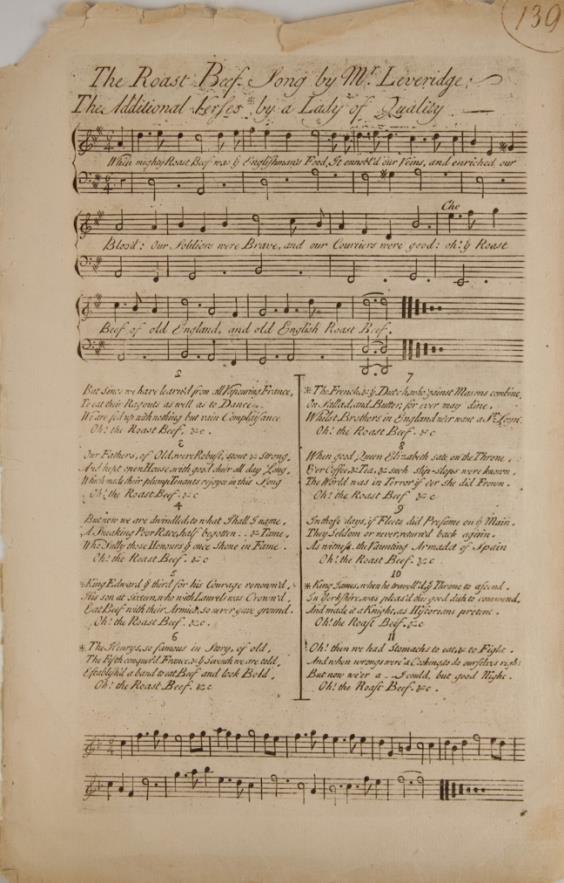
"When Mighty Roast Beef was ye Englishman's Food"
27. LEVERIDGE, Richard 1670-1758
The Roast Beef. Song by Mr. Leveridge The Additional Verses by a Lady of Quality
[London]: [without imprint], [ca. 1735].
Folio. 1f. (recto caption title, music, and verses, verso blank). Engraved. With text commencing "When mighty Roast Beef was ye Englishman's Food." Scored for voice and unfigured basso continuo, with melody transposed for flute at foot of score. "139" in contemporary manuscript to upper outer corner. Margins slightly torn and creased; small loss to upper inner corner.
BUC p. 617 ("First printed in the British Musical Miscellany, ca. 1735") RISM L2292, LL2292 (no copies in the U.S.). (41061) $75
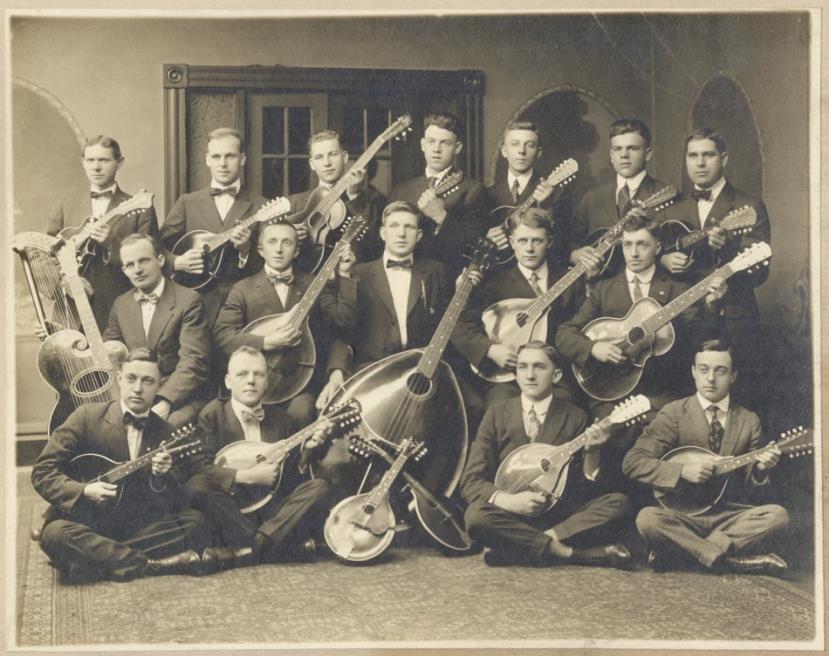
Fine Original Early Photograph
28. [MANDOLIN]
Original photograph of 16-member mandolin orchestra, ca. 1900. [?American].
194 x 245 mm. Laid down to mount. The image features performers posing with mandolins of all sizes, including a remarkable bass mandolin, a harp mandolin, and several guitars.
Photograph in very good condition; mount slightly worn and stained, not affecting image. (41222) $100
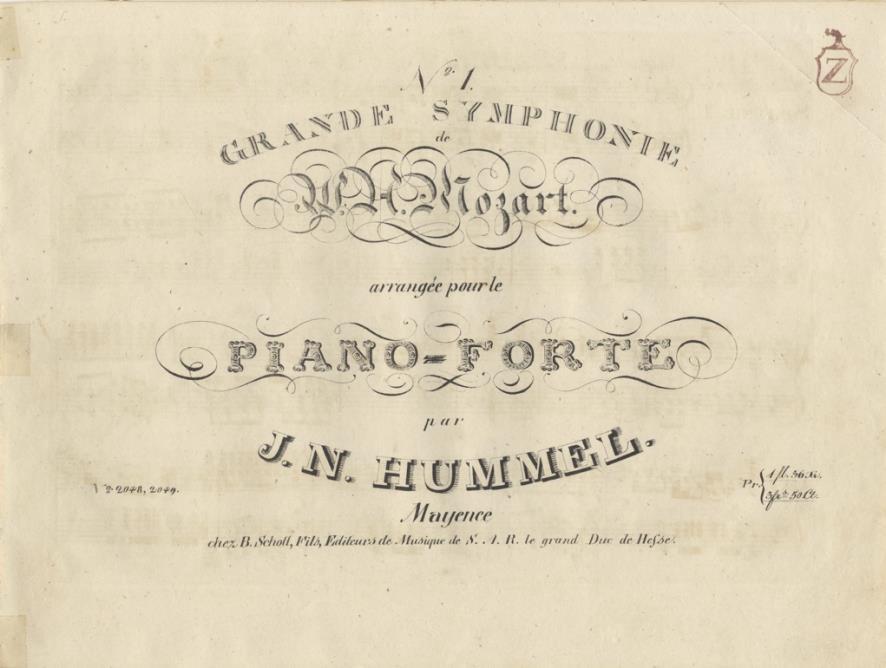
Piano Arrangements by Hummel, Mozart’s Friend and Pupil
29. MOZART, Wolfgang Amadeus 1756-1791
Grande Symphonie No. 1 [2, 3, 6] de W. A. Mozart arrangée pour le Piano-Forte par J.N. Hummel ... Pr. 1 fl. 36 Xr. 3 frs. 50 Ct. [KV 504, 550, 551, and 543].
Mayence: chez B. Schott, Fils, Editeurs de Musique de S.A.R. le grand Duc de Hesse [PNs 2128, 2129, 2142, and 2102], [1823-1825].
Oblong folio. Disbound. Engraved throughout. Spines of Nos 1. and 2 reinforced with small strips of tape; spine of No. 2 reinforced at blank verso of final leaf; occasional minor soiling to blank margins; occasional light browning, foxing, and showthrough.
No. 1 [KV 504]: [i] (title), 2-21, [i] (blank) pp.; No. 2 [KV 550]: [i] (title), 2-19, [i] (blank) pp.; No. 3 [KV 551]: [i] (title), 2-21, [i] (blank) pp.; and No. 6 [KV 543] [1823]: 1f. (recto title, verso blank), 23, [i] (blank) pp.
Provenance
Noted Viennesecollector Professor Josef Zehtgruber (1935-2001), with his distinctive small handstamp to blank upper outer corner of titles. Scarce.
Arrangements by Mozart's pupil and friend Johann Nepomuk Hummel (1778-1837), "considered in his time to be one of Europe's greatest composers and perhaps its greatest pianist." Joel Sachs, revised by Mark Kroll in Grove Music Online (40774) $500
30 [ORGAN]
Rare Early 19th Century Organ Music, Most Works in First Edition
A collection of rare 19th century German and Bohemian organ music by Vanhal, Rinck, Hermann, and Vierling. Germany, [1803-1810].
Contemporary half dark red leather with dark red leather label to upper with titling gilt, spine in compartments gilt. Lithographed, with the exception of the final publication by Vierling, which is engraved. Binding worn, rubbed, and bumped; endpapers worn, browned and stained; contemporary signature to front pastedown erased; front free endpaper creased and with small hole, ca. 3" x 1" area crossed out in contemporary ink with resulting hole, and minor loss to blank lower outer corner. Minor internal wear, soiling, staining, dampstaining, and occasional showthrough.
Vanhal, Johann Baptist 1739-1813
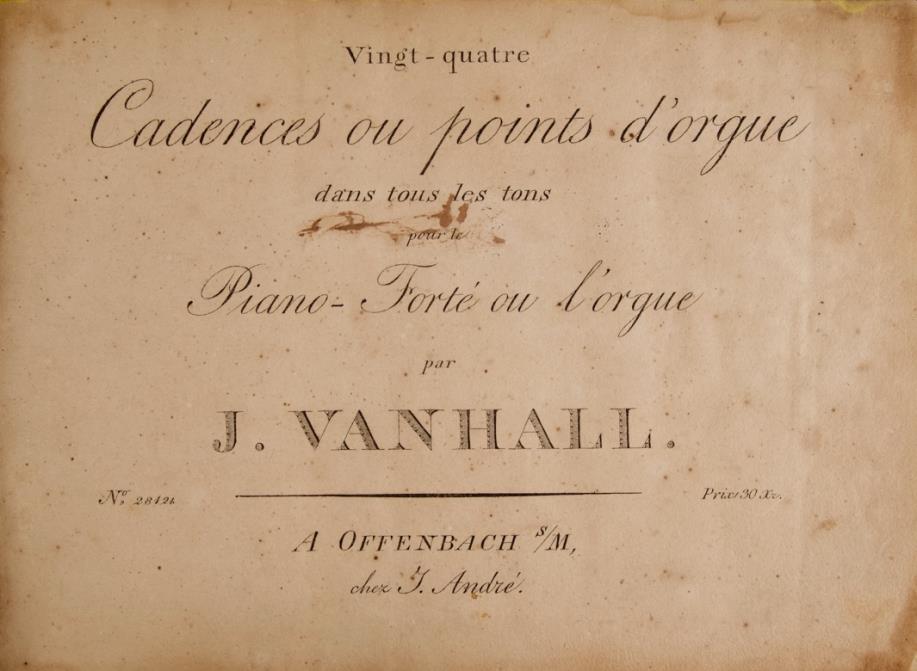
Vingt-quatre Cadences ou points d'orgue dans tous les tons pour le Piano-Forté ou l'orgue ... Prix 30 Xr. Offenbach s/M: chez J. André [PN 2812], [1810]. 1f. (recto title, verso blank), 3-7, [i] (blank) pp. First Edition. Constapel p. 185. OCLC 497741162 (one copy, at the British Library).
Bound with:
Vanhal XXIV Points d'orgue & Préludes par tous les tons pour le Piano-Forté ... Prix f:1,,30 Xr. Offenbach s/M: chez J. André, [1809-10], [PN 2813]. 1f. (recto title, verso blank), [i] (blank), 4-19, [i] (blank) pp. First Edition. Constapel, p. 185. OCLC 1114205978.
Bound with:
Vanhal Six Préludes Faciles pour l'orgue ou le Piano-Forte ... Prix 36 Xr. Offenbachs/M:chezJ. André, [1809], [PN 2825]. [i] (title), 2-7, [i] (blank) pp. First Edition. Constapel, p. 186. OCLC 1114036499 (one copy, at the Royal College of Music).
Vanhalwasa "Bohemian composer, violinist, and teacher, active in present-day Austria and Croatia. His present reputation is derived mostly from his symphonies, his many published keyboard pieces, and the comments of writers. ... From the studies carried out so far, it is clear that Wanhal was one of the best composers of the time
– innovative, imaginative, and original. He was also influential, but to what extent is difficult to assess. Haydn was presumably familiar with the ten Wanhal symphonies preserved in the Esterházy collection (H-Bn), but there is more affinity between Wanhal’s style and Mozart’s. Comparisons with other contemporary composers are necessary for an accurate account of Wanhal’s role. However, he unquestionably contributed significantly to music in Europe, and his published music, issued by many publishers, stimulated the public and the entire industry. His career, which led him from bondage to comfortable independence, reflects the influence of Emperor Joseph II and the democratic principles he espoused in Viennese society. Wanhal’s music, in turn, contributed to the development of Viennese musical style." Paul R. Bryan, revised by Halvor K. Hosar and Allan Badley in Grove Music Online
Bound with:
Rinck, Johann Christian Heinrich 1770-1846
Douze Préludes pour l'Orgue ... 6me recueil.- Oeuvre 25. Offenbach sur le Mein: chez Jean André, [1807-1808] [PN 2594]. [i] (title), 2-15, [i] (blank) pp. First Edition. Constapel, p. 176. OCLC 314804749 (one copy, at the Sachsische Landesbibliothek).
Rinck, a German organist and composer, "studied first with Abicht, J.A. Junghanss and H.C. Kirchner, but received his most important musical training in Erfurt from J.C. Kittel, a former pupil of Bach, from 1786 to 1789." Ursula Kramer in Grove Music Online
Bound with:
Hermann, J.C. fl. ca. 1810
Zwölf Präludien für die Orgel aus den gebräuchlichsten Tonarten von J. C. Herrmann Cantor und Lehrer der Musik in Idstein. 2ter. Theil ... Preis f1.14Xr. Offenbach am Mayn: bey Johann André, [1809-1810] [PN 2967]. 1f. (recto title, verso blank), 3-15, [i] (blank) pp. First Edition. Constapel, p. 192. OCLC 165686322 (one copy, at the Bayerische Staatsbibliothek).
Bound with:
Vierling, Johann Gottfried 1750-1813
Sammlung vermischter Orgelstücke. Hessen Cassel: bey W. Wöhler, [1803] [PN 93]. 1f. (recto title, verso composer's note), 3-24, [i] (blank), 25-28, [i] (blank) pp. Vierling's detailed note concerns playing in trio, counterpoint, disposition of the hands, and tempi. Indistinct contemporary inscription in brown ink to foot of title. Probable first edition. OCLC 17712143, 906513766 (one copy in the U.S., at Yale). With "Samuel Woodward 1816" in contemporary manuscript to front free endpaper.
Vierling wasa Germancomposer. "After studying the keyboard with M. Sittig in Metzels he entered the Lutheran Gymnasium in Schmalkalden, where he studied with (and from 1768 deputized for) the organist of the Stadtkirche, J.N. Tischer. In 1770 he studied with Kirnberger in Berlin and is alleged to have met C.P.E. Bach in Hamburg; on his return to Schmalkalden he visited J.A. Hiller in Leipzig. In 1773 he succeeded to Tischer's post, which he held until his death, refusing appointments in Dresden and Mainz. He was succeeded in this post by his son Johann Vierling (1777–1822)." Ronald Dürre in Grove Music Online
With later note in pencil to front free endpaper: Mamma's Papa's book when he was 13 years old.
Rare. None of these lithographic publications in Twyman. (41112) $950
Copy of All Six Books
31. [ORGAN]
Novello, Vincent 1781-1861. Short Melodies Original and Selected for the Organ Intended Principally for the Soft Stops and Inscribed to the Venerable Phillip Jennings, D.D., Archbeacon of Norfolk ... Reduced Prince, 1s 3d. ... This work is published in 36 Numbers, price 1s. 3d. each or 6 Books (each containing Six Numbers), price 6s each; or complete in One Volume, price 31s. 6d. [Organ solos].
London: Sacred Music Warehouse: J. Alfred Novello. 69. Dean Street, Sogo, and 35, Poultry; Also in New York at 389 Broadway, [?1846-1856].
Large folio. Full black textured cloth with titling gilt to spine. 1f. (recto decorative title printed in yellow and red, verso blank), 1f. (typeset index), 302pp. Musicengraved. With twelve line poem by Dryden totitle, "Gentle Airs, Melodious Strains," with text commencing "The Organ breaths its deep-voic'd notes." Presentation inscription in pencil to front free endpaper "Louise H. Savage from [?]Mle Morris." Binding worn, rubbed, and bumped. Slightly worn and browned; volume split into two parts at p. 115; index foxed; occasional minor stains and small tears; tears to pp. 113 and 171 repaired with archival tape.
A compilation of organ works, including transcriptions, arrangements, and harpsichord music, by composers including Novello, Purcell, Flower, Cramer, Pleyel, Beethoven, Bach, Donizetti, Spohr, Mendelssohn, Cherubini, Handel, Goudimel, Couperin, Wesley, Perez, Florimo, et al.
First Edition. A complete copy of all six books (no complete copies located on either OCLC or JISC).
Novello was an "English organist, choirmaster, conductor, teacher, editor, publisher, composer, collector, and antiquarian. [He] found his true vocation as editor and publisher by serving the expanding market for the study and performance of music in public and private contexts." Rosemary Hughes, revised by Fiona M. Palmer in Grove Music Online (41089) $120
“Unusual in its Use of Ballet Music for Chorus"
32. PARADIES, Domenico ca. 1707-1791
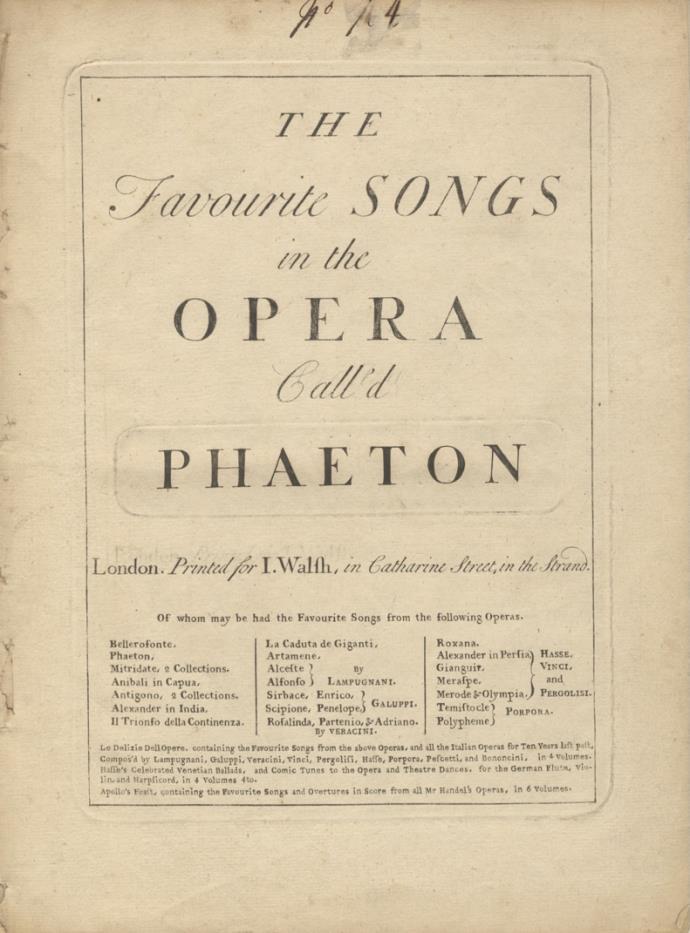
The Favourite Songs in the Opera Call’d Phaeton.
London: Printed for I. Walsh, in Catharine Street, in the Strand, 1747.
Folio. Disbound. 1f. (recto passepartout title, verso blank), [i] (blank), 2-21 pp. Engraved throughout. With "Of whom may be had the Favourite Songs from the following Operas ..." including works by Pergolesi, Porpora, Veracini, Hasse, Vince, et al. below imprint. Slightly worn;some minor soiling and occasional smallstains;final leaf nearly detached; minor annotation in contemporary manuscript to upper margin of title cropped.
First Edition. Smith and Humphries 1166, p. 260. BUC p. 761 RISM P889.
Phaeton [Fetonte] premiered in London at the King’s Theatre in the Haymarket on 17 January 1747
Paradies, an Italian composer, harpsichordist, and teacher, "is believed to have studied with Nicola Porpora in Naples, but little is known about his early life. ... [He] emigrated to London in 1746, having already changed the spelling of his name from the Italian ‘Paradisi’. He was one of numerous Italian composers, including Galuppi, who worked there during the mid-18th century. His series of operatic failures continued in January of 1747, when his setting of Vanneschi’s Fetonte encountered negative reaction during its nine performances at the King’s Theatre, Haymarket. Charles Burney described the arias as ‘ill-phrased’ and lacking in ‘estro or
grace’. Although Paradies continued to supply arias for pasticcio productions at the King’s Theatre, where Vanneschi had become impresario, he never met with success as a composer of opera. He achieved some renown in England, however, as a teacher of harpsichord and composition. His most distinguished student was the elder Thomas Linley (1733-1795), who later became a successful composer of English opera. He also taught the German soprano Gertrude Elisabeth Mara (1749-1833), who mentioned him in her autobiography. In 1770, anticipating retirement, Paradies sold his manuscript collection to Richard (later Viscount) Fitzwilliam. He returned to Venice, where he spent the rest of his life. ... Of the dramatic works, Fetonte is unusual in its use of ballet music for chorus." Donald C. Sanders in Grove Music Online (40622) $475
The Composer’s “Most Famous Work”
33. PERGOLESI, Giovanni Battista 1710-1736 Stabat Mater. [Score].
London: Printed for & Sould[!] by I: Walsh Musicall[!]] Instrument maker in Ordinary to his Majesty at the Golden Harp & Hoboy in Catherine Street near Summerset[!] house in ye Strand, [1749].
Folio. Disbound. Contemporary half mid-tan leather with marbled boards, upper with rectangular paper label titled in manuscript. 1f. (recto title, verso blank), [i] (blank), 2-26 pp. Engraved throughout. With attractive engraved title by Collins incorporating angels playing lute and oboe; instruments including lute, harpsichord, violin, viola da gamba, bassoon, and harp; and an open book of music. Annotation in contemporary manuscript to blank inner margin of title, "Pergolesi not lettd." Annotation to front free endpaper "Jowett Trin Hall I.I. Scargill 8th May 1857." Binding quite worn, rubbed, and bumped; upper nearly detached, with small circular label numbered "434" to lower inner corner. Occasional minor foxing and staining.
First Edition. Paymer 77. Smith & Humphries 1195. BUC p. 771. RISM P1348.
"The 'Stabat mater' for two solo voices and strings, [Pergolesi's] most famous work, was evidently written in competition with Alessandro Scarlatti's 'Stabat mater' for the same voices and instruments. A comparison
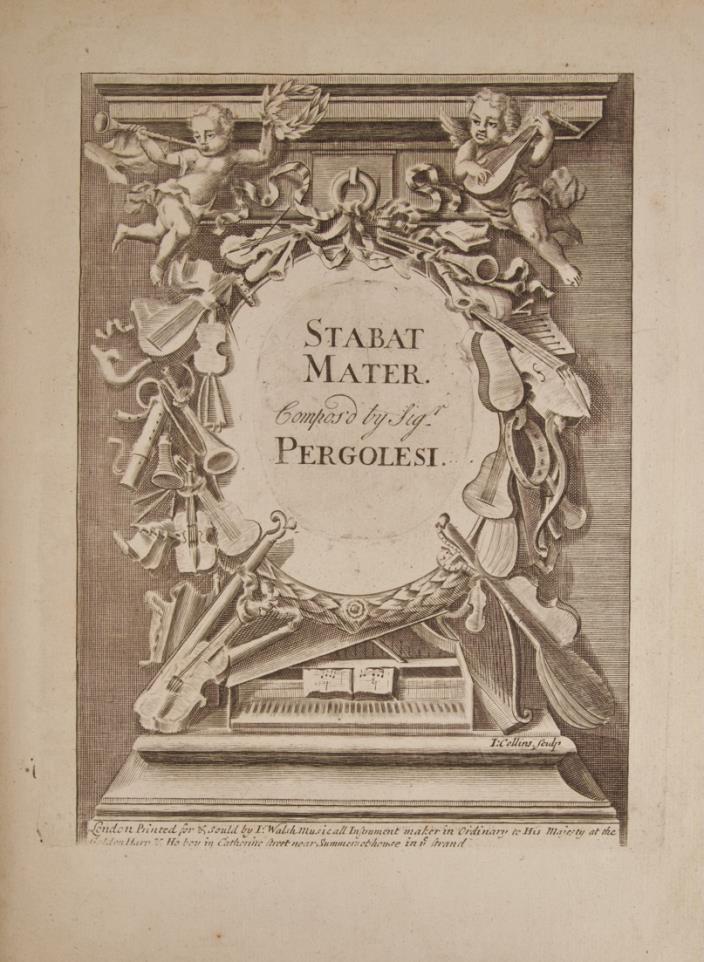
between the works shows Pergolesi's new approach to the concertante vocal movement and his development of the 'church aria', as well as the earliest application to sacred music of the style of expressive sensibility. The work stirred considerable controversy at home and abroad for its religious propriety and musical style. Padre Martini's traditional views towards counterpoint incited some to criticize Pergolesi's setting, while others found it 'galant', expressive and new." Helmut Hucke, and Dale E. Monson in Grove Music Online
Pergolesi's most celebrated sacred work. (40629) $2000
34. PERGOLESI, Giovanni Battista 1710-1736
Twelve Sonatas For Two Violins and a Bass or an Orchestra Compos'd by Gio. Batta. Pergolese. Author of the Stabat Mater. The Manuscript of these Sonatas were procured by a Curious Gentleman of Fortune during his Travels through Italy. [Parts].
[London]: Printed for Mr. Webb Organist of Windsor And Sold by R. Bremner, facing Somerset-House in the Strand. N:B: Speedily will publish'd a Second Set of Six Sonatas, by the Same Author, ca. 1780.
Folio. Sewn. Engraved throughout. Uncut. Slightly worn, with small tears to margins and creasing to corners; minor soiling, browning, and occasional foxing throughout; light stain to title of basso part.
Violino primo: 1f. (recto title, verso blank), [i] (blank), 2-25 pp.
Violino secondo: 1f. (recto title, verso blank), [i] (blank), 2-25 pp.
Basso: 1f. (recto title, verso blank), [i] (blank), 2-25 pp.
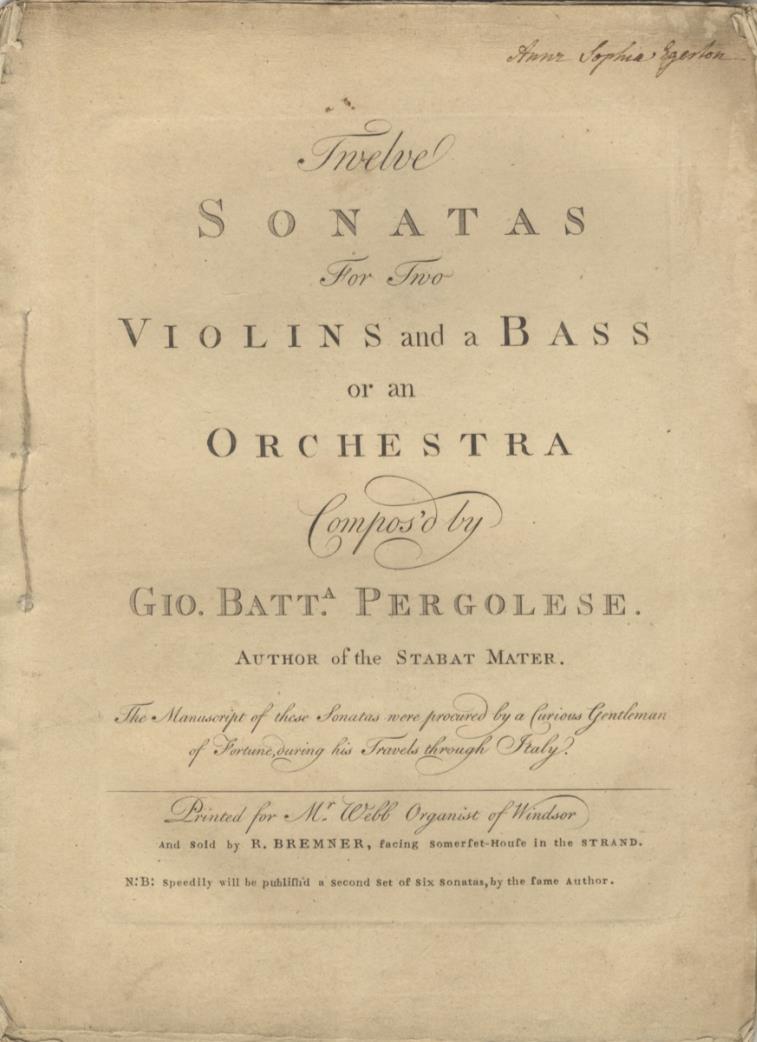
Provenance
Anne Sophia Egerton (née de Grey, 1730-1780), prominent British noblewoman and daughter of Henry Grey, 1st Duke of Kent, and wife of John Egerton, Bishop of Durham, with her signature to upper outer corner of title of each part.
First Edition. Paymer 12-23. BUC p. 771. RISM P1426 and PP1426 (three copies in the U.S., at the University of Virginia Charlottesville, Yale, and the Library of Congress).
"Although lacking indications for tutti and soli, these twelve trios were also considered suitable for orchestral performance, as Bremner's title-page shows: 'Twelve Sonatas for two violins and a bass, or an orchestra.' This edition was published 'for Mr. Webb, organist of Windsor,' and it has on its title-page the ominous words quoted above by Mr. Walker: 'The Manuscript[!] of these Sonatas were procured by a Curious Gentleman of Fortune, during his Travels through Italy.' Who was this mysterious Gentleman of Fortune? On a copy of the trios preserved in the Pendlebury Library at Cambridge someone has written just above 'Curious Gentleman,' the words 'A Mr. Bridges.' Who this Mr. Bridges was we do not know; he may or may not have been the mysterious intermediary concerned. If he was, he appears to have brought back at least eighteen such trios, for at the bottom of the title-page of Bremner's first set of twelve is the promise that 'Speedily will be publish'd a Second Set of Six Sonatas, by the Same Author.' This Second Set never appeared, but the two 'periodical Trios' are perhaps part of it. ...
Cudworth, based on stylistic analysis, notes that 'it is not impossible, but rather improbable, that they are Pergolesi's own composition, and that there is a strong probability that they are the work of a slightly later composer which were passed off, years afterwards, on the Curious Gentleman of Fortune, as works by the tragic, youthful genius.' " Notes on the Instrumental Works Attributed to Pergolesi, pp. 326-327, in Music & Letters, Vol. 30, No. 4, Oct. 1949.
Gallo was Italian composer and violinist. According to Fétis he was born in Venice about 1730, wrote much music for the church and was known for his violin sonatas and symphonies. "Gallo is notable chiefly for his connection with one of the many Pergolesi ‘forgeries.’ In 1780 Robert Bremner published a set of 12 trio sonatas attributed to Pergolesi (Pergolesi: Opera omnia, v, Rome, 1940, pp.1–116); their title-page claims that the ‘manuscript[!] of these sonatas were procured by a curious Gentleman of Fortune during his travels through Italy.’ But even in the 18th century, doubt was cast on the Pergolesian authorship of these trio sonatas by such critics as Burney and Hawkins, and it has since been discovered that some of them are attributed to Gallo in several contemporary manuscript sources (at Burghley House, US-BEm and I-Pca), and the rest are probably his as well. Some of them were used, as Pergolesi's, by Stravinsky in Pulcinella. As Walker said (Grove5), ‘they are not markedly Pergolesian in style’ but are rather the work of a competent Italian composer writing in the galant idiom of the 1750s and 60s. Owing to the mistaken attribution to Pergolesi, they have been quoted in various modern works on form as early examples of sonata form, but this early dating depends on the date (1736) of their supposed composer's death." Charles Cudworth in Grove Music Online
An attractive uncut copy with early provenance. (40647) $1,250
Fine, Rare 16th Century Bildmottet With a Setting of the Gloria by Pevernage
35. PEVERNAGE, Andreas 1542/3-1591
Triumphus Chori Angelici de Pace Hominibus per Incarnationem Verni Divini Facta. [The Angels Proclaiming the Birth of Christ to the Shepherds]. Engraving by Jan Sadeler the elder (1550-1600) after Maerten de Vos (1532-1603). [Mainz], 1587.
Image size 386 x 305 mm. with very narrow margins. On laid paper. Very slightly worn; trimmed within platemark. A fine, strong impression.
With a 9-voice musical setting of the Gloria by Pevernage with text commencing Gloria in excelsis Deo. Signed and lettered in Latin at lower margin, three lines with dedication to George à Schoneburg et allii: "Reuerendis, ac antique nobilitatios ... D: Georgio à Schoneburg, Cathedralis Sedis Wormat ... / ... ergo Ioes Sadeler auth: dedic: scalp: et excud. / Datu. Mogutie Ao. MDLXXXVII."
Hollstein: Dutch and Flemish Engravings, Etchings and Woodcuts, Ca. 1450-1700, 181. Seiffert: Niederländische Bild-Motteten von Ende des 16. Jahrhunderts Heft I, pp. 20-22. British Museum number F,1.128.
Pevernage, a noted Flemish composer of the late Renaissance, was "one of the captivating personalities in the field of polyphony. ... He made basic contributions to some of the most pursued genres of vocal polyphony, viz. the Mass, the motet, the French chanson and the Italian madrigal, while he also achieved merit by publishing madrigals composed by Italian contemporaries. ...
From a music-technical point of view, Pevernage, belongs to the late-renaissance synthesis movement. His work excels in pace: he avoids extravagant expressions and extremely fast successions of extreme contrasts. In compositions for larger choruses he proves to be an excellent master of 'dialogues' in which two chorus groups
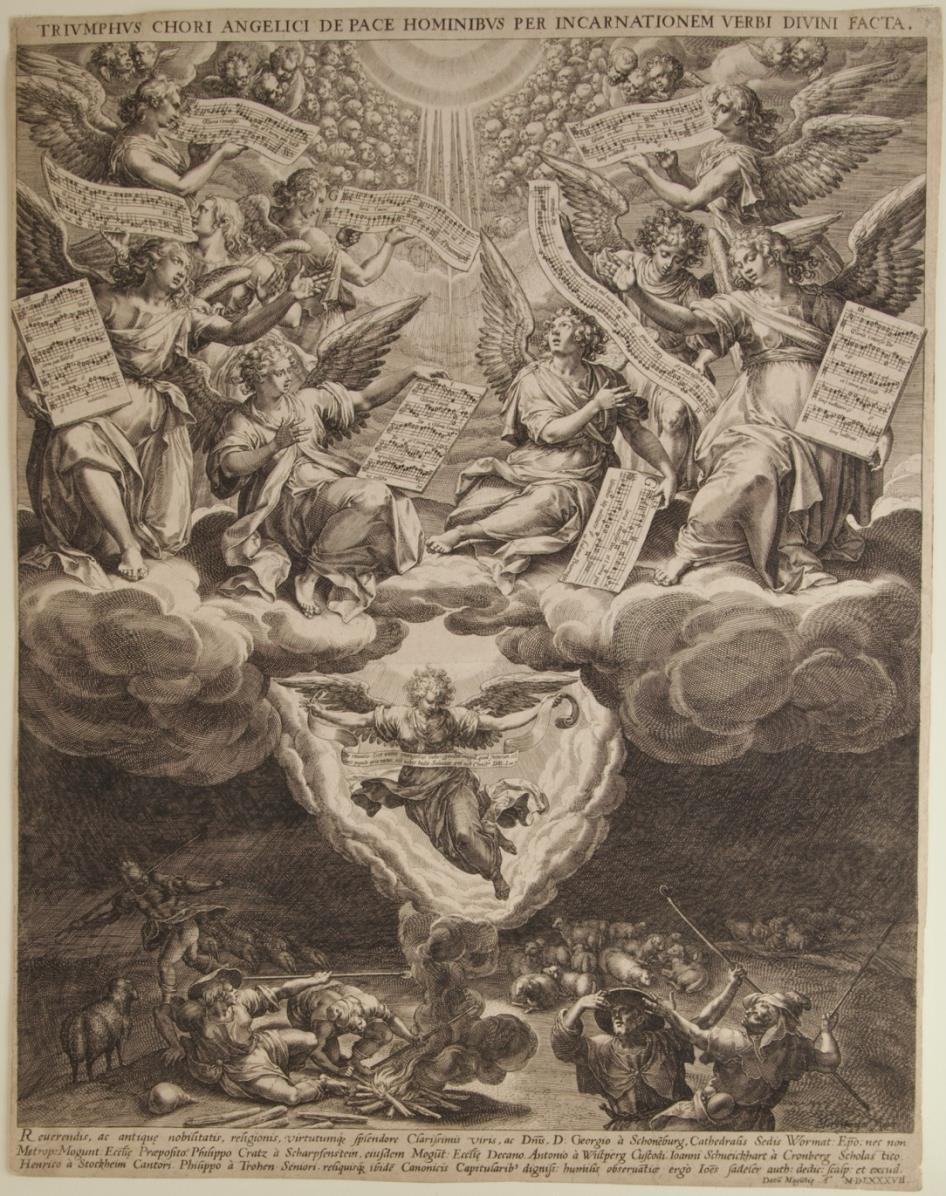
succeed each other in swift succession. Some compositions also show how he remains faithful to typical Netherlandish principles of structure. In general his work displays a good balance between polyphony and homophony. His chansons clearly reveal how Pevernage masters the 'rhythmic counterpoint.' His madrigals show an affinity with those of Luca Marenzio (1553-1599). ...
Since 1876 many musicologists have pointed to the significance of picture motets as music records and their role in the history of music typography. Picture motets would also be important to the reconstruction of earlier forms of music performance. Lately they have also received a more general cultural-historical significance: picture motets are privileged remnants of music iconography, a very young branch of music science. ...
The music scores shown in picture motets are at least as important as the other more common music prints of the same period. Not only are they complete compositions, picture motets also are the only sources in which those works have been preserved. ... In addition, picture motets are technical 'primeurs' because with the music scores engraved in the illustrations on the copper plates they precede by a few decades the advent of engraved music prints." Bossuyt: Andreas Pevernage ... Bildmotetten, p. 13.
"The monumental upright print is almost exclusively taken up with a depiction of the heavenly choirs, with the angels providing vocal (not instrumental) music - vocal music being regarded in the contemporary theory of music as the highest form. ... Nine of the angels are holding a page or scroll showing the music for this ninepart motet. A setting for the text of the angels' 'Gloria' is incorporated into their annunciation to the shepherds. The shepherds, who have made a fire in the darkness of the night, are scattering in fear, and the sheep in the background are rising to their feet. The text of the dedication to the bishops of Mainz and Worms, wit the place and date of publication being given as Mainz 1587, shows that this print was made after Jan Sadeler had departed from Antwerp permanently." Vignau-Wilberg: Music for a While. Music and Dance in 16th-Century Prints, pp. 174 and 176, catalogue no. 65.
Sadeler was a noted Flemish copperplate engraver. "These engravings, sometimes known as 'picture-motets', show angels or biblical figures singing and playing from partbooks and may have been published in support of the Counter-Reformation. ... The composers, artists and engravers were all Flemish and these fine engravings, with the music complete and legible, bear witness to the thriving artistic life in Antwerp at the end of the 16th century. ... They are important in their own right as particularly beautiful and unusual examples of early music engraving." Susan Bain in Grove Music Online
De Vos, a noted Flemish painter, executed numerous designs for prints and book illustrations.
Among the very earliest examples of music engraving, the present print is one of the finest and rarest of the Bildmottets (41228) $4,800
With the Canon Duo in Carne Una by Pevernage
36. PEVERNAGE, Andreas 1542/3-1591
Singers Before King Solomon. Engraving by C[laes] [Janszoon] Visscher (1587-1652) after Maerten de Vos (1532-1603). [Antwerp], [ca. 1610-1620].
Image size 211 x 259 mm; sheet size 268 x 317 mm. With "Marten de Vos inventor," "C J Visscher Excudit," and "Cantica C.1.V.1." above four columns of text in Latin below image, commencing "Rex Salomon quo non alius florentiior unquam ... sensu," with "Canticum Canticorum" on ceiling. Very slightly worn; small area of light browning to music; minor paper imperfection in the form of a crease extending from lower margin through lettering and halfway into print.
Solomon is depicted seated on his throne at the top of a set of steps decorated with lions. His hand rests on a large open book of music illustrating a canon by Pevernage, "Duo in carne una" (two in one flesh), with text commencing "Osculetur me osculo oris sui" [May he kiss me with the kiss of his mouth], the opening line of the Song of Solomon, Song of Songs 1:1, expressing love in the words of Paul (I Corinthians 6.16).
Hollstein: Dutch and Flemish Etchings, Engravings and Woodcuts, Ca. 1450-1700, 111. Goodfriend: Prints and Drawings of Musical Interest, 27 (Sadeler). British Museum number 1949,0406.16 (Sadeler). Not in Kinsky. The present print is a later state of the plate originally engraved by Sadeler in 1590.
The present motet is often referred to as a riddle, where a single part is designed to be performed by two voices; in this instance, the second soprano part is derived from the first. The work is analyzed in a number of late Renaissance music theory books, notably Diruta's Il Transilvano.
“The Song of Solomon ... is a collection of love songs, a spiritual wedding song. ... As part of the Old Testament, it was given a mystical interpretation from the very beginning. The text was regarded as an allegory of Christ's love for those who follow him. In the motet picture, the High Priest and the Levites who have gathered round
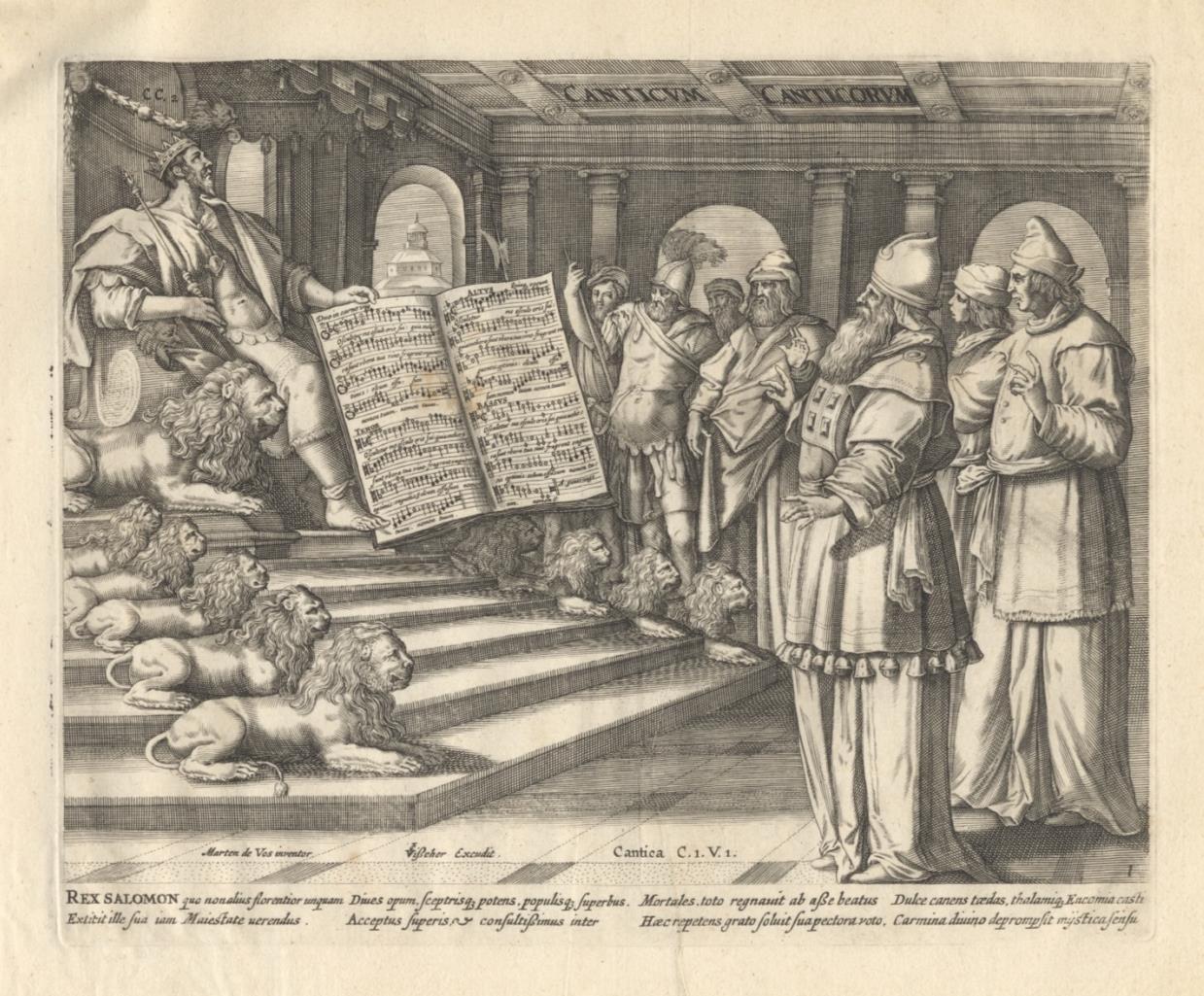
the lion steps on Solomon's famous throne are singing the Song of Songs together. The posture of some of the priests' hands shows that they are beating time. Soldiers are listening in silence." Vignau-Wilberg: Music for a While. Music and Dance in 16th-Century Prints, p. 180, catalogue no. 68.
Claes Janszoon Visscher (1587-1652) was a Dutch Golden Age draughtsman and engraver.
De Vos, a noted Flemish painter, executed numerous designs for prints and book illustrations.
An early example of music engraving. (41229) $1,200
“The Most Successful” of Piccinni’s Operas Composed During His Stay in Paris
37. PICCINNI, Niccolò 1728-1800
Didon Tragédie Lyrique en trois Actes Representée à Fontainebleau devant leurs Majestés le 16. Octobre 1783. Et pour la premiere fois sur le Théatre de l'Académie Royale de Musique Le Lundy 1er Décembre de la même Année. Dediée a la Reine Prix 24₶. Gravée par Huguet Musicien de la Comédie Italienne ... Imprimé par Basset. [Full score].
Paris: Chez le Suisse de l'Hotel de Noailles, [ca. 1786].
Folio. 19th century dark brown textured cloth with marbled boards, titling gilt to spine. 1f. (recto title, verso dedication), 307, [i] (blank) pp. Engraved. With "R Th. [?]Tropany" in manuscript to verso of front free endpaper. Binding worn, rubbed, and bumped.; small portion of cloth at head of spine lacking. Slightlyworn;lighttomoderatebrowning; occasional foxing, dampstaining, and small stains; p. 161 trimmed at outer margin with minor loss of music and text; one signature partially detached.
First Edition, later issue, with dedication printed to verso of title. Lesure p. 497. Hirsch II, 733. RISM P2100.
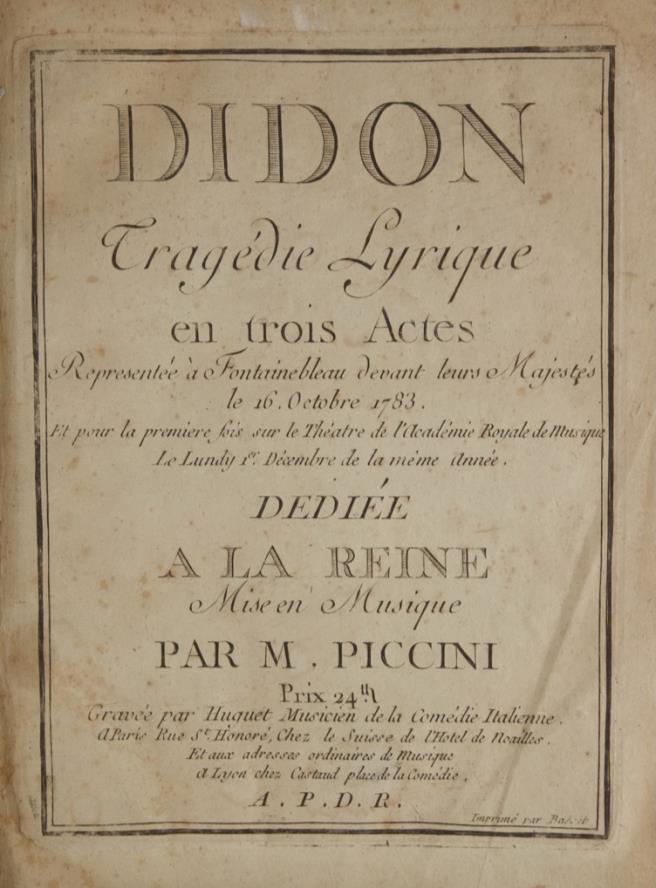
In three actstoalibrettoby Jean FrançoisMarmontel, Didon was firstperformedatFontainebleauon 16October 1783.
Piccinni "was one of the central figures in Italian and French opera in the second half of the 18th century." Mary Hunter, James L. Jackman, Marita P. McClymonds, David Charlton, Dennis Libby, and Julian Rushton in Grove Music Online
"In 1783 Piccinni reached his second peak with a highly successful revival of Atys and the introduction of Didon, which momentarily eclipsed the rising star of Sacchini. ... The sixth and most successful of the nine serious French operas that Piccinni wrote during his sojourn in Paris, Didon continued to be performed there until 1836 and received performances in French and German translation throughout Europe during the first quarter of the 19th century." Mary Hunter in Grove Music Online (40655) $700
“Intended by the Piccinnistes to Compete Directly” with Gluck’s Opera
38. PICCINNI, Niccolò 1728-1800
Iphigénie en Tauride Tragédie Lirique en quatre Actes Representée pour la 1ere. fois par l'Académie Royale de Musique le mardi 23. Janv. 1781 ... Prix 24₶. [Score].
Paris: Des Lauriers [without PN], [ca. 1782].
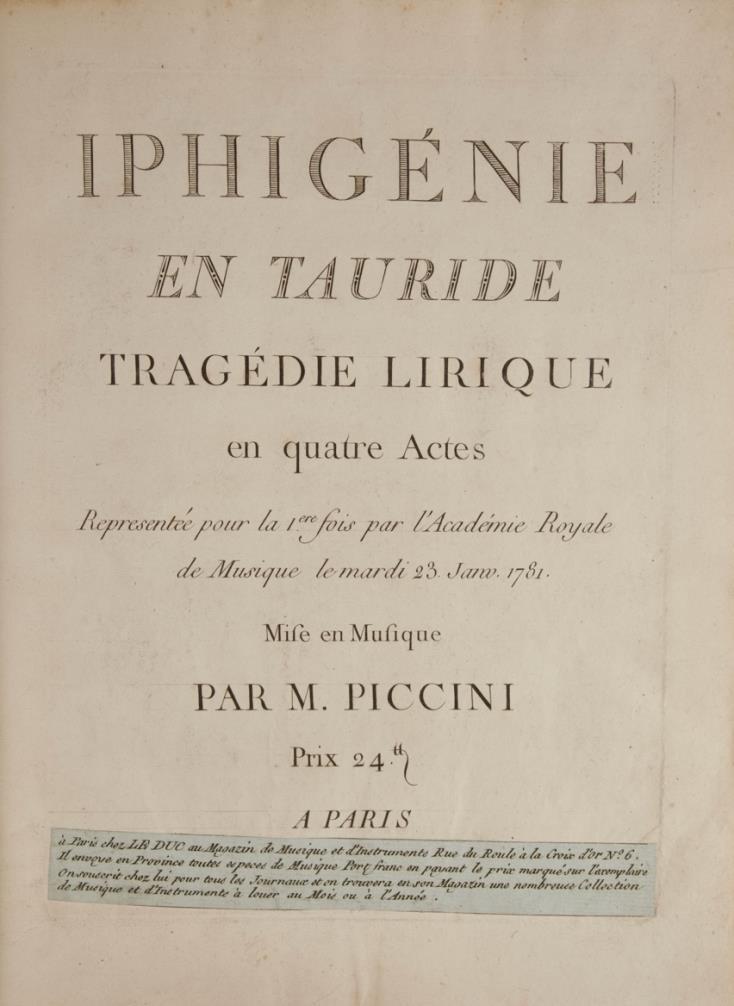
Folio. Modern quarter black leather with marbled boards, dark red leather title label to spine gilt. 1f. (recto title, verso blank), 1f. (blank), 263, [i] (blank) pp. With Le Duc overpaste "au Magazin de Musique et d'Instruments Rue du Roule à la Croix d'Or No. 6." Occasional small stains and light foxing; small tear to upper margin of blank leaf following title repaired with archival tape; outer edge of p. 109 slightly abraded; minor loss to blank outer margin of p. 167; stain to p. 177 affecting stem of one note; minor stains and soiling to blank margin of final page of music. Quite an attractive copy overall.
Second edition. OCLC 631561874. Lesure p. 497 (two issues, with precedence given to the issue without PN 13, as in the present copy). RISM P2152 (two copies in the U.S., at the Boston Public Library and Harvard University).
In four acts to a libretto by A. du Congé Dubreuil, Iphigénie en Tauride was first performed in Paris at Opéra on 23 January 1781.
"This opera, produced in Paris two years after the première of Gluck's opera on the same story, was intended by the Piccinnistes to compete directly with it. Although it did not achieve the success of Gluck's, Piccinni's Iphigénie was performed more than 30 times during its first run in Paris and was revived there in 1785 and 1790. It had reached Copenhagen by 1787 and, according to Loewenberg, was given in a concert performance in St Petersburg in 1791." Mary Hunter in Grove Music Online (40654) $750
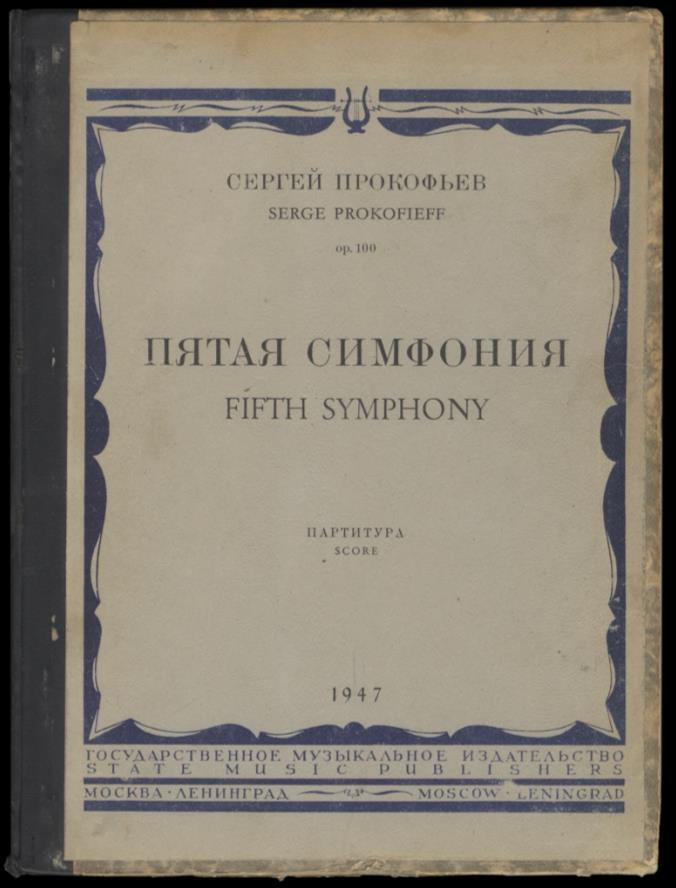
“Characteristic of the Mature Prokofiev”
39. PROKOFIEV, Serge 1891-1953 Fifth Symphony ... op. 100. [Full score].
Moscow ... Leningrad: State Music Publishers [PN 18295], 1947.
Folio. Black cloth-backed boards with publisher's printed wrappers laid down, titling in white ink to spine. 1f. (recto title, verso orchestration and note on transposition), 3-207, [i] (notelisting editors Belzaand Agapov, date of publication 6 January 1947, and limitation statement) pp. With titling, etc., in Russian and English.
With numerous performance markings including dynamics, expression, bowings, and numbering in gray, red, and blue pencil. Binding slightlyworn, rubbed,andbumped;minorsoiling to blank lower wrapper. Browned; small tear to blanklowermarginof pp. 17-106andp. 189;tear to blank lower margin of p. 91 extending into lowermost two systems repaired with archival tape.
Annotation in ink to front pastedown "Cond. New Orleans Symphony. January 23 1962." Handstamp "1098" and "3 60" in pencil to lower inner corner of verso of final leaf, with annotation in pencil to verso of free rear endpaper noting timing according to different conductors, including AA New Orleans, Martinon, Rodziński, Ormandy, Dorati, Bernstein, and Szell
First Edition, limited to 3,000 copies. Nestyev p. 370.
The Fifth Symphony premiered in Moscow on 13 January 1945.
Prokofiev "began his career as a composer while still a student, and so had a deep investment in Russian Romantic traditions – even if he was pushing those traditions to a point of exacerbation and caricature – before he began to encounter, and contribute to, various kinds of modernism in the second decade of the new century. Like many artists, he left his country directly after the October Revolution; he was the only composer to return, nearly 20 years later. His inner traditionalism, coupled with the neo-classicism he had helped invent, now made it possible for him to play a leading role in Soviet culture, to whose demands for political engagement, utility and simplicity he responded with prodigious creative energy. In his last years, however, official encouragement turned into persecution, and his musical voice understandably faltered. ...
The Fifth Symphony ... display[s] the freely tonal harmonies, melodic and thematic wealth of ideas and lyrical expressivity characteristic of the mature Prokofiev – qualities that have established [the work] firmly in the international repertory." Dorothea Redepenning in Grove Music Online (41088) $450
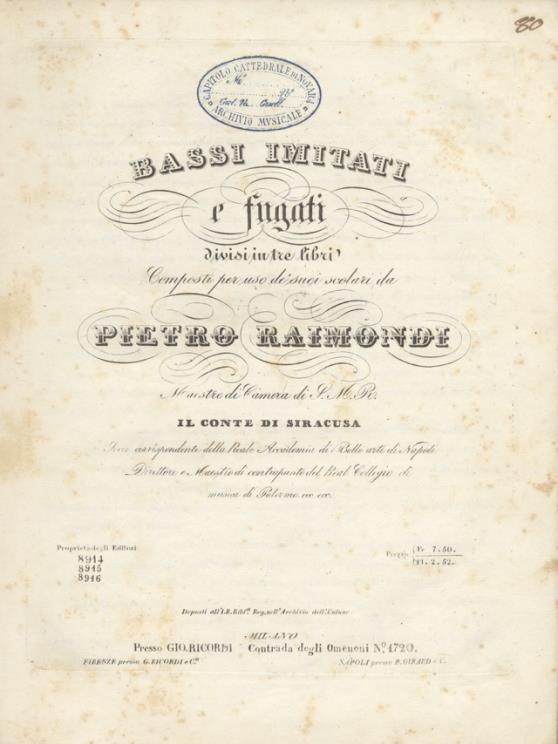
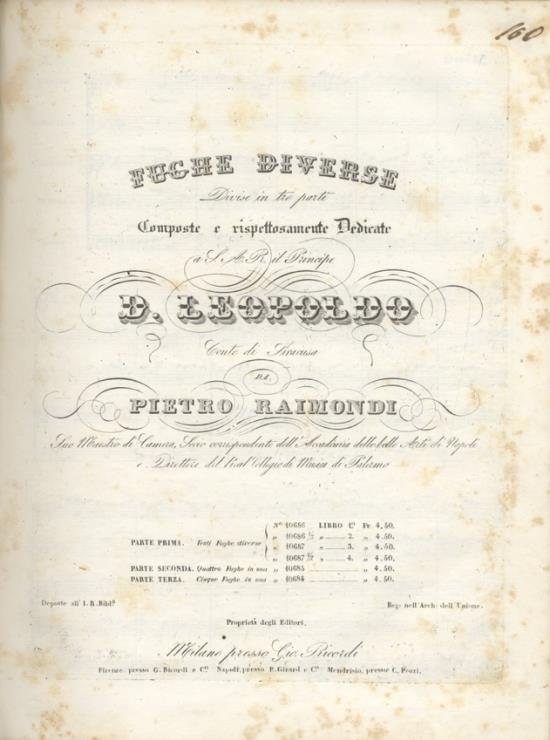
Early 18th Century Didactic Text
40. RAIMONDI, Pietro 1786-1853 Bassi imitati e fugati divisi in tre libri Composti per use de suoi scolari da Pietro Raimondi Maestro di Camera di S.M.R. Il Conte di Siracusa ... Prezzo Fr. 7. 50. - Fl. 2. 52
Milano: Presso Gio. Ricordi [8914-8916], [1835].
Folio. Modern ivory thick textured paper wrappers. 1f. (recto title, verso blank), 1f. (recto "Al Lettore," verso "Avvertimento"), 3-37 pp. Partimenti (bass lines, here unfigured, meant toassist inimprovisation, imitation, and composition) and short fugal expositions. With oval handstamp of the "Capitolo Cattedrale di Novara Archivio Musicale" to several titles and pages of music. Occasional signs of wear, minor foxing, soiling, and staining, mostly marginal, throughout.
Bound with:
- Fughe Diverse Divise in tre parti Composte e rispettosamente Dedicato a S. A. R. il Principe D. Leopoldo Conte di Siracusa. 1f. (recto title, verso blank), 25 pp. 5- and6-part fugues, with some accompanying text within the score labelling subjects and imitations. PN 10687.
-... 1f. (rectotitle, versoblank), 21pp. 4-partfugueswithtextinLatin, designedtobeperformedeitherseparately or together. PN 10685.
-... 1f. (rectotitle, versoblank), 17pp. 4-partfugueswithtextinLatin, designedtobeperformedeitherseparately or together. PN 10684.
- ... 1f. (recto title, verso blank), 1f (recto dedication, verso "Avvertimento"), 21 pp. 4-part fugues with labels for contrapuntal and harmonic devices including imitation, stretto, and modulation. PN 10686.
- ... [i] (title), 2-20. 4- and 5-part fugues, with pedagogical labels, as above. PN 10686 1/2.
- ... [i] (title), 2- 23 pp. 7- and 8-part fugues, with pedagogical labels. PN 10687 1/2.
“After completing studies with Tritto at the Conservatorio di S Maria della Pietà in Naples, [Raimondi] embarked on a series of operas, mostly comic, for Genoa, Florence, Naples and Rome. ... In June 1833 Raimondi left Naples for Palermo to become director of both the conservatory and the Teatro Carolino. His frequent return visits to Naples, where he continued to receive operatic commissions, soon aroused complaints at both institutions. Rejected in his applications for posts in Paris and Milan, and aware that he was being eclipsed by
Donizetti and Bellini as he had earlier been by Rossini, he turned with renewed interest to sacred music and contrapuntal theory. Around 1836 his first didactic text Bassi imitati e fugati was published, and the same year a messa di gloria for double chorus and double orchestra was performed in Palermo. This was the first in a series of experiments in musical simultaneity which culminated in his ‘triple oratorio’ Putifar-GiuseppeGiacobbe (1847–8), a set of three oratorios to be performed first separately and then simultaneously. The great success of this work led to Raimondi’s appointment in 1852 as maestro di cappella at S Pietro, Rome." Jesse Rosenberg in Grove Music Online (40537) $475
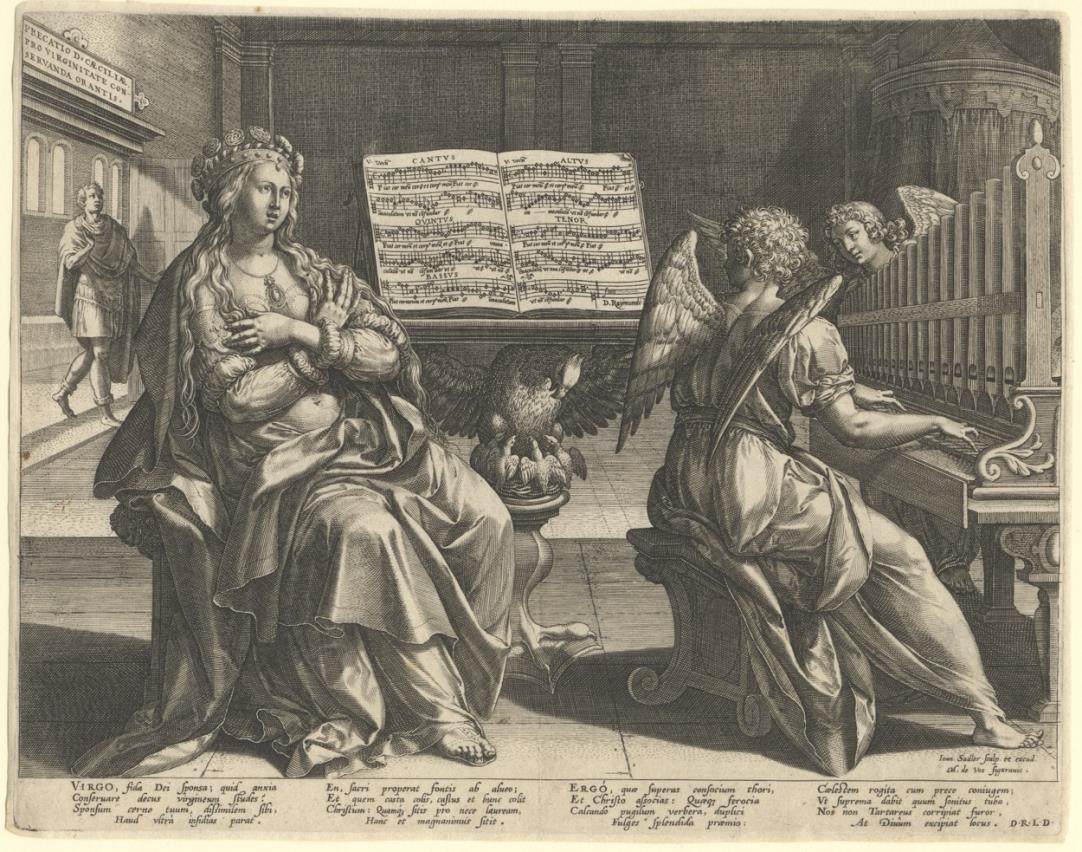
16th Century Bildmottet, One of the Earliest Examples of Music Engraving
41. RAYMUNDI, Dirk [Daniel] ca. 1558-1634
Precatio D. Caeciliae Pro Virginitate Conservanda Orantis (Prayer of St. Cecilia Praying for the Preservation of her Virginity). Engraving by JanSadeler the elder (1550-1600) afterMaerten deVos (1532-1603). [Antwerp], [ca. 1595].
Image size 215 x 274 mm. + narrow margins. On laid paper with watermark of an eagle.
St. Cecilia is depicted singing with an angel seated opposite her at the organ. The music to a complete 5-part motet by Dirk Raymundi is clearlyillustrated on two pages of an open book resting on an ornate eagle-decorated lectern placed in the near background between St. Cecilia and the organist. The text of the motet commences "Fiat cor meum et corpus meum immaculatum, ut non confudar" (Let my heart and my body be undefiled, that I may not be confounded), a chant for the Feast of St. Cecilia. With four columns of text in Latin below the image, "VIRGO, fida Dei locus" signed "D.R.L.D." [Daniel Raymundi from Liège]. A fine, strong impression.
Rare. Hollstein: Dutch and Flemish Engravings, Etchings and Woodcuts, Ca. 1450-1700, 305. Kinsky: A History of Music in Pictures, 152-3. Goodfriend: Prints and Drawings of Musical Interest, 26. British Museum number 1937,0915.113. Raymundi is cited in Sieffert: Niederländische Bild-Motetten vom Ende des 16. Jahrhunderts (Netherlandish Picture Motets of the Late 16th Century Heft II), pp. 12-14.
"To judge from his few extant works, [Raymundi] was an able composer with a certain gift for melody. Three motets of his, for eight voices and continuo, Ecce panis angelorum, Homo quidam and Tantum ergo are extant in the Grand livre de choeur de Saint-Lambert (B-Lc) and one five-part motet, Fiat cor meum, is edited by J.A.L. de Lafage in Diphtérographie musicale (Paris, 1864), 487." José Quintin in Grove Music Online
"The music-playing Cecilia was an ideal theme for engraving a pictorial motet. ... On the eve of her wedding, Cecilia prays to God to keep her heart and her body pure and immaculate. ... It is one of the few surviving pieces composed by Raymundi, who also wrote on the theory of music and composed literary pieces - the four quatrains under the picture were probably written by him. Cecilia is shown singing fervently as she prays; the angel, her celestial friend ... is accompanying her on the organ, and another angel is operating the bellows behind the organ. ... The saint is wearing the garland of roses from Paradise, as well as the martyr's crown. ... The lectern on which the choir book showing the five parts is set is supported by a pelican. The bird pecking at its own breast to nourish its four offspring is a common symbol of Christ's self-sacrificing love. Cecilia's bethrothed, Valerian, is entering the chamber from the left, looking on at the scene in astonishment. The inscription over the door also serves as the title of the scene, 'Precatio D. Caeciliae pro virginitate conservanda orantis.’ " Vignau-Wilberg: Music for a While. Music and Dance in 16th-Century Prints, pp. 180-182, catalogue no. 69.
Sadeler was a noted Flemish copperplate engraver. "His works include a number of devotional music publications. ... These engravings, sometimes known as 'picture-motets', show angels or biblical figures singing and playing from partbooks and may have been published in support of the Counter-Reformation. ... The composers, artists and engravers were all Flemish and these fine engravings, with the music complete and legible, bear witness to the thriving artistic life in Antwerp at the end of the 16th century. ... They are important in their own right as particularly beautiful and unusual examples of early music engraving." Susan Bain in Grove Music Online
De Vos, a noted Flemish painter, executed numerous designs for prints and book illustrations.
"Since 1876 many musicologists have pointed to the significance of picture motets as music records and their role in the history of music typography. Picture motets would also be important to the reconstruction of earlier forms of music performance. Lately they have also received a more general cultural-historical significance: picture motets are privileged remnants of music iconography, a very young branch of music science. ...
The music scores shown in picture motets are at least as important as the other more common music prints of the same period. Not only are they complete compositions, picture motets also are the only sources in which those works have been preserved. ... In addition, picture motets are technical 'primeurs' because with the music scores engraved in the illustrations on the copper plates they precede by a few decades the advent of engraved music prints." Bossuyt: Andreas Pevernage ... Bildmotetten, p. 13.
Among the very earliest examples of music engraving. (41226) $2,500
Late 18th Century Chamber Music
42. RICHTER, Franz Xaver 1709-1789 Six Sonatas for Two Violins and Violoncello, With a Thorough Bass for the Harpsichord. [Set of parts].
London: Thompson and Sons in St. Pauls Church Yard, [ca. 1764].
Folio. Disbound. Engraved throughout. With brief publisher's catalogue to foot of titles listing works by Abel, Croner, Lates, Siprutini, and Claget. "Dan: Dalby" in contemporary manuscript to titles, above imprints. Handstamp of "Cambridge University Library" to foot of first and last pages of music of Basso part with "Cancelled U. L. C." handstampabove Slightlyworn;lighttomoderate browning; some minor soiling and small stains; foxing to blank margins, most prominently in Basso part; occasional showthrough.
Violino primo: 1f. (recto title, verso blank), 13 pp. Violino secondo: 1f. (recto title, verso blank), [i] (blank), 2-13 pp. Basso: 1f. (recto title, verso blank), [i] (blank), 213 pp.
First Edition. BUC p. 890. RISM R1352.
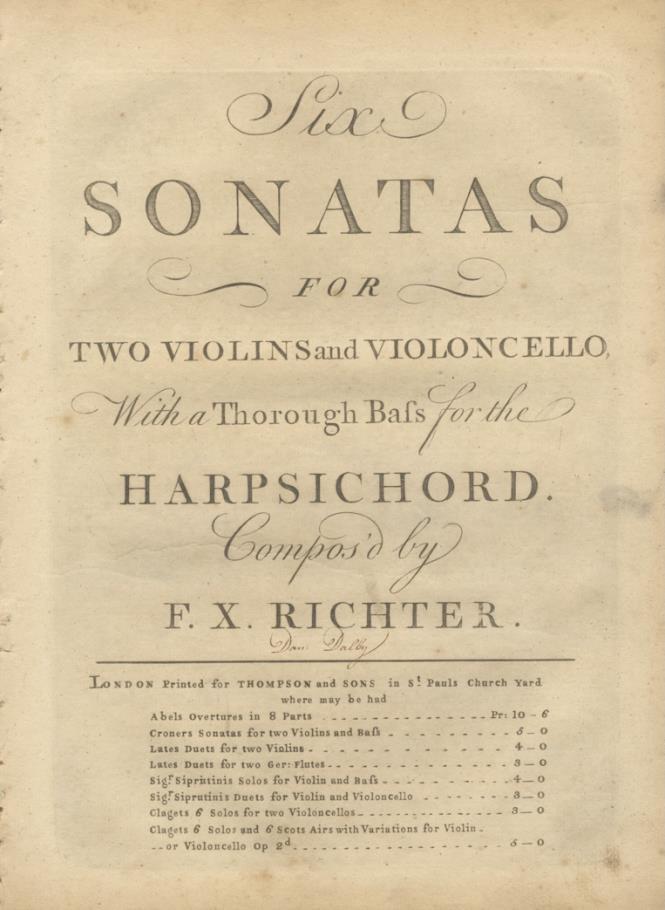
Richter, a German composer of Moravian descent, "joined the Hofkapelle of the Elector Palatine Carl Theodor in Mannheim as a bass. ... As a composer Richter was most prominent at Mannheim in the instrumental field. Notable among his chamber works are the String Quartets op.5, published in 1768 but perhaps originating as early as 1757; Kirkendale comments that the motivic work in these was not equalled before Haydn. ... Richter’s compositional idiom changed from a late Baroque sound to a tonal language which reached the threshold of the Classical style. However, progressive Neapolitan elements were present throughout his output alongside more conservative Viennese features. In Mannheim he was strongly influenced by the new pre-Classical stylistic developments, and he adapted the Mannheim symphonic style with his own differentiated dynamics and instrumentation; in this regard he was no less innovative than his colleagues Johann Stamitz and Holzbauer. His works from this period nevertheless include such conservative traits as fugal techniques, Baroque sequences and the frequent use of minor tonality. However, Riemann’s characterization of Richter as ‘senior of the Mannheim School’ essentially still holds good." Jochen Reutter in Grove Music Online
Dalby's signature is also found in a score (35 A Dep HUM son) recorded in the Catalogue of Early Printed Music in Aberdeen Libraries Supplement, 1979-1988, Cooper and Turbet, Royal Musical Association Research Chronicle, No. 23 (1990), p. 173 (40652) $550
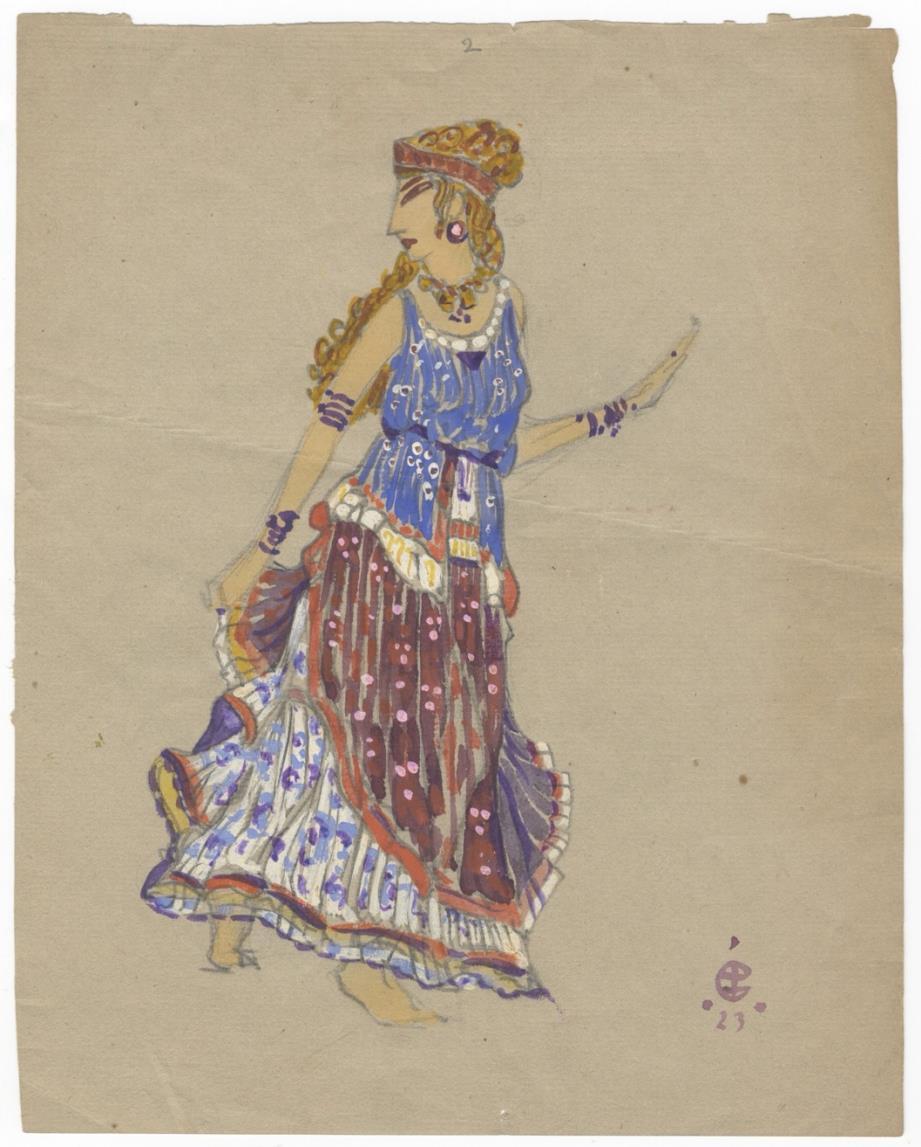
Original Early 20th Century Painting of an Indian Dancer
43. ROERICH, Svetoslav Nikolayevich 1904-1993
Original painting in watercolor and gouache signed with the artist's monogram and dated [19]23.
Image size 185 x 120 mm; sheet size 230 x 187 mm. On laid paper. Slightly worn; upper margin very slightly chipped; small pinhole to lower margin, not affecting image; minor overall creasing with slightly more pronounced horizontal crease.
The subject, a young female Indian dancer, is depicted in a long multi-colored dress, jewelry, and headdress.
Svetoslav Roerich, born in St. Petersburg, was the son of noted Russian painter Nicholas Roerich (1874-1947). Initially studying under his father, he subsequently attended art classes in London, at Columbia University, and at Harvard. He first visited India in 1923, during which time the present watercolor was most likely executed Much of Roerich's early work is lost.
"Svetoslav started drawing at an early age and took up molding, attended classes of the Arts Encouragement Society School, created designs for home theatre settings, and even helped his father in his work on theatre design sketches. In 1913, he entered the Karl May Gymnasium in Saint-Petersburg where he studied until 1916. From 1919, Svetoslav Roerich studied architecture in London, at the Royal Academy of Arts. After a year, he continued his education in the USA, firstly at Columbia University and then at Harvard University. He also attended the the Massachusetts University Sculpture Department. In 1923, Svetoslav Roerich visited India for the first time. There he became acquainted with the most famous architectural masterpieces of Indian culture, as well as with the ancient and modern art of that country. In India, he laid the foundations of his unique collection of Oriental works of art that, unfortunately, went almost completely lost after his death. From 1931, living permanently in India, Svetoslav Roerich actively participated in its public and cultural life. He dearly loved that country and it became his second Motherland. In many of his wonderful canvases, Svetoslav Roerich sang the praises of India’s unique beauty, diversity of cultural traditions and subtleness of spiritual achievements." International Roerich Memorial Trust Online
We would like to thank Mr. Leonid Winestein for his assistance in the identification of the artist's monogram. (41223) $1,500
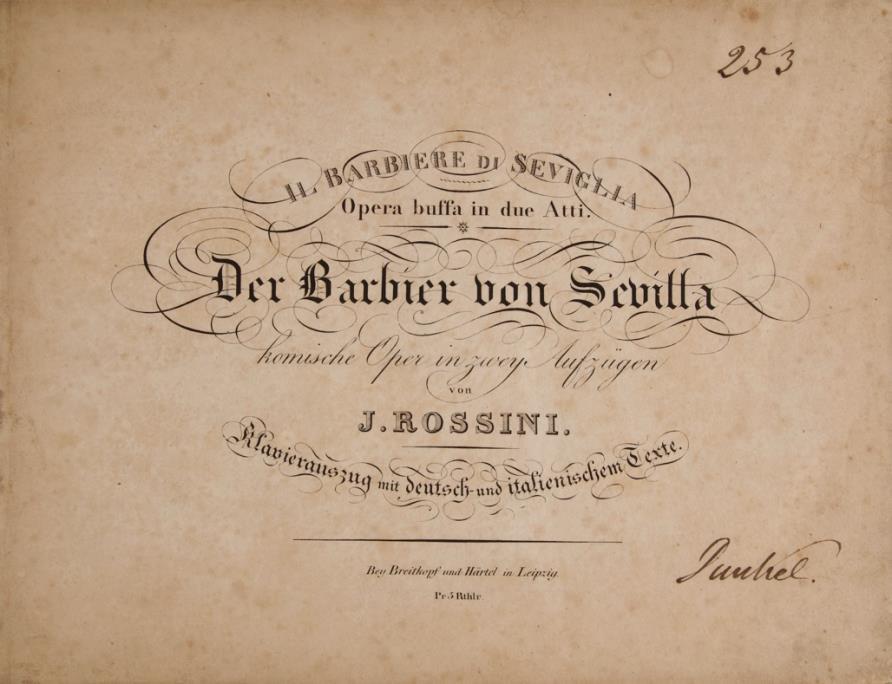
44 ROSSINI, Gioachino 1792-1868
Il Barbiere di Seviglia. Opera buffa in due Atti. Der Barbier von Sevilla. Komische Oper in zwey Aufzugen ... Klavierauszug mit deutsch- und italienischem Texte ... Pr. 5 Rthlr. [Piano-vocal score].
Leipzig: Breitkopf und Härtel [PN 3671], [1822-1823].
Oblong folio. Nineteenth century half black cloth with octagonal printed paper label to upper. 1f. (recto title, verso blank), 1 (cast list and table of contents), 2-174 pp. Lithographed. Text in Italian and German. With "253" and "Dunkel"incontemporarymanuscripttoupperandloweroutercornersoftitle, respectively. Bindingslightly
worn, rubbed, and bumped. Slightly browned and foxed; small chip to upper outer corner of title; inner margins of pp. 18-19 reinforced with old paper tape.
[?]First Edition. Rognoni p. 445, no. 17. Gossett p. 274. Fuld pp. 124-125 (citing this as possibly the first).
One of Rossini's best-loved works, Il Barbiere di Siviglia, to a libretto by Cesare Sterbini after Pierre-Augustin Beaumarchais's Le barbier de Séville and Giuseppe Petrosellini's libretto for Giovanni Paisiello's Il barbiere di Siviglia, was first performed at the Teatro Argentina in Rome on 20 February 1816. (41092) $400
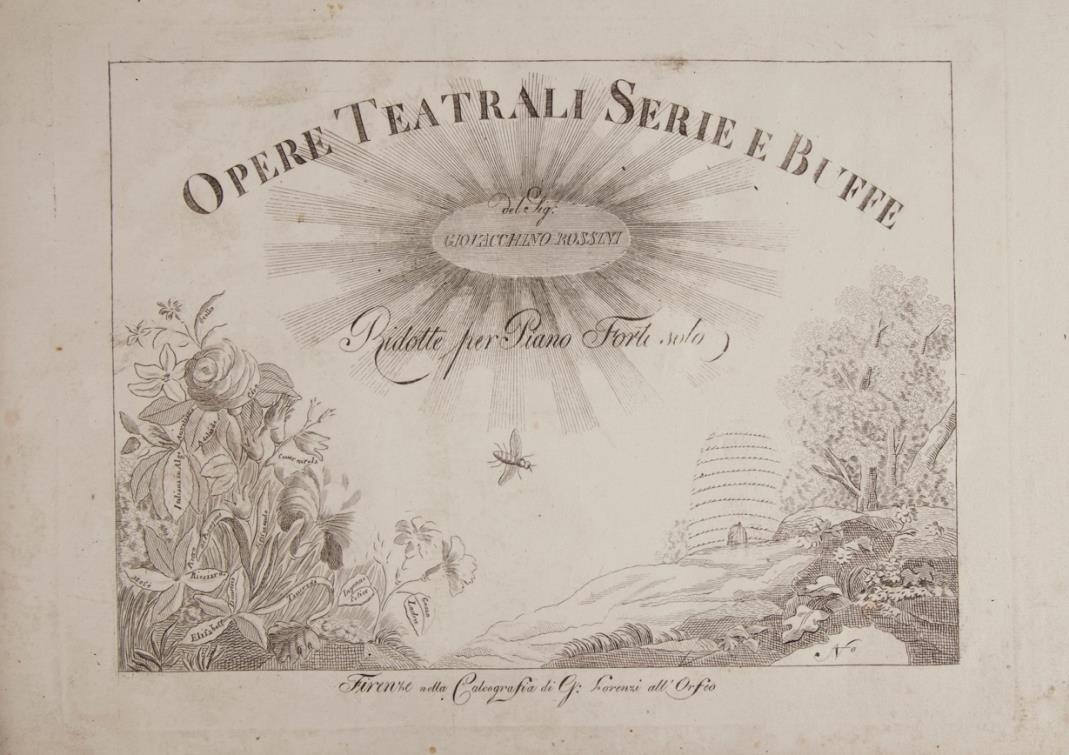
Overtures for Piano to 18 Rossini Operas
45. ROSSINI, Gioachino 1792-1868
Collection of overtures from operas by Rossini arranged for piano solo published ca. 1812-1825.
Oblong folio. 19th century black half leather with marbled boards. With illustrated series title. Early owner's signature to a number of title pages, one dated 1822. Early manuscript inscription to front pastedown: "Presented by John Walsh to his esteemed Friend & Pupil John Gregg Esqr. of Londonderry 1834." Illustrated title and music engraved throughout, with the exception of the last item, which is lithographed. Binding worn; free endpapers lacking. Minor internal wear; a number of pages with tears, mostly to lower portions, with minor loss; final leaf laid down, with loss to outer portion.
Contains overtures to 18 operas, as follows:
1. Gazza Ladra. In the series Opere Teatrali Serie e Buffe. Firenze: Calcografica di G. Lorenzi all'Orfeo [PN 286], [ca. 1818]. 11 pp.
2. Eduardo e Cristina. Firenze: Giuseppe Lorenzi [PN 764], [ca. 1820]. 11 pp.
3. Maometto Secondo ... ridotta per Pianoforte dal ... Corigliano di Rignano. Napoli: Gius. Girard. [PN 212], [ca. 1825]. 8 pp.
4. Mosè in Egitto. Aria. Firenze: Giuseppe Lorenzi [PN 621], [ca. 1822. 8 pp.
5. Aureliano in Palmira. Firenze: Giuseppe Lorenzi [PN 222], [ca. 1818]. 7 pp.
6. L'Italiana in Algeri. .. ridotta per Forte Piano dal ... Francesco Bojle. Milano: Ricordi [PN 172], [1814]. 9 pp.
7. Bianca e Falliero Ridotta ... da Bartolomeo Grassi. Milano: Ricordi [PN 747 T], [1820]. 7 pp.
8. Pietra del Paragone (Tancredi) ... Ridotta del Sig. Abbe. Giovanni Moro. Milano: Ricordi [PN 132], [1812] 7 pp.
9. Il Turco in Italia. Milano: Ricordi [PN 206], [1815]. 9 pp.
10. Quintetto nell' Introduzione del Mose. Firenze: Giuseppe Lorenzi [PN 611], [ca. 1822]. 3 pp.
11. La Gazza Ladra ... Ridotta ... dal Sig. P. Piazza. Milano: Ricordi [PN 333], [1817]. 11 pp.
12. Stretta dell Introduzione del Mosè. n.p., n.d. [PN 614], [ca. 1820]. 7 pp.
13. Finale 1mo. del Tancredi. Firenze: G. Lorenzi [PN 243], [ca. 1818. 12 pp. Illustrated series title
14. La Gazza Ladra. Napoli: Gius. Girard [PN 203], [ca. 1825]. 10 pp.
15. Cavatina non temer d'un basso affetto nell' opera Maometto Secondo. [Piano-vocal score]. Milano: Ricordi [PN 1005], [1821]. 11 pp.
16. Variazioni per Clavicembalo Sopra la Romanza e la Preghiera nell'opera Otello. [Milano] Ricordi [PN F. 820.L], [1820]. 19 pp.
Together with:
17. Settimino nel Ballo Gundeberga composta dal Sig. Gaetano Gioja ridotto ... dal ... Giuseppe Galluzzo. Napoli: Gius. Girard [PN 268], [ca. 1825]. 9 pp. "Settimino Musica del Mo. Luigi Carlini" to head of first page of music.
18. Drouet, L. Fantaisie très facile pour Pianoforte et Flûte ... Oeuvre 39. Leipsic: Breitkopf & Härtel [PN 3285], [1821] 7 pp. Keyboard part only. (41183) $275
Overtures for Piano to 20 Rossini Operas
46. ROSSINI, Gioachino 1792-1868
Collection des Ouvertures arrangées pour le Pianoforte ... Cahier 1[-20].
Vienne: Publié par Sauer et Leidesdorf [PNs 301, 313, 374, 401, 454, 470, 482, 506, 521, 537, 620, 631, 632, 641, 701, 719, 742, 759, 775/831, 802, and 801], [1823-1825].
2 volumes. Oblong folio. Full modern dark red cloth. Engraved throughout. 19th century Karlsruhe bookseller Johann Belter's printed paper labels to foot of title of first overture in each volume with oval handstamp "F. F. Bibliothek" to versos; handstamps to title of La Scala di Seta "Prag bei Marco Berra" and "L 24." Endpapers stained; very minor remnants of blue wrappers to gutter of titles. Occasional minor wear, staining, and foxing; paper tape to blank inner margins of p. 13 of La Gazza Ladra and blank verso of title of Demetrio e Polibio. In very good crisp and clean condition overall.
Contains overtures to 20 operas, as follows:
1. Armida. 1f. (recto title, verso blank), 7 pp.
2. Mosé in Egitto. 1f. (recto title, verso blank), 4 pp.
3. Il Turco in Italia. 1f. (recto title, verso blank), 9 pp.
4. Il Barbiere di Seviglia. 1f. (recto title, verso blank), 6 pp.
5. Matilde di Chabran. 1f. (recto title, verso blank), 8 pp.
6. Edoardo e Cristina. 1f. (recto title, verso blank), 3-9 pp.
7. L'Inganno felice. 1f. (recto title, verso blank), 8 pp.
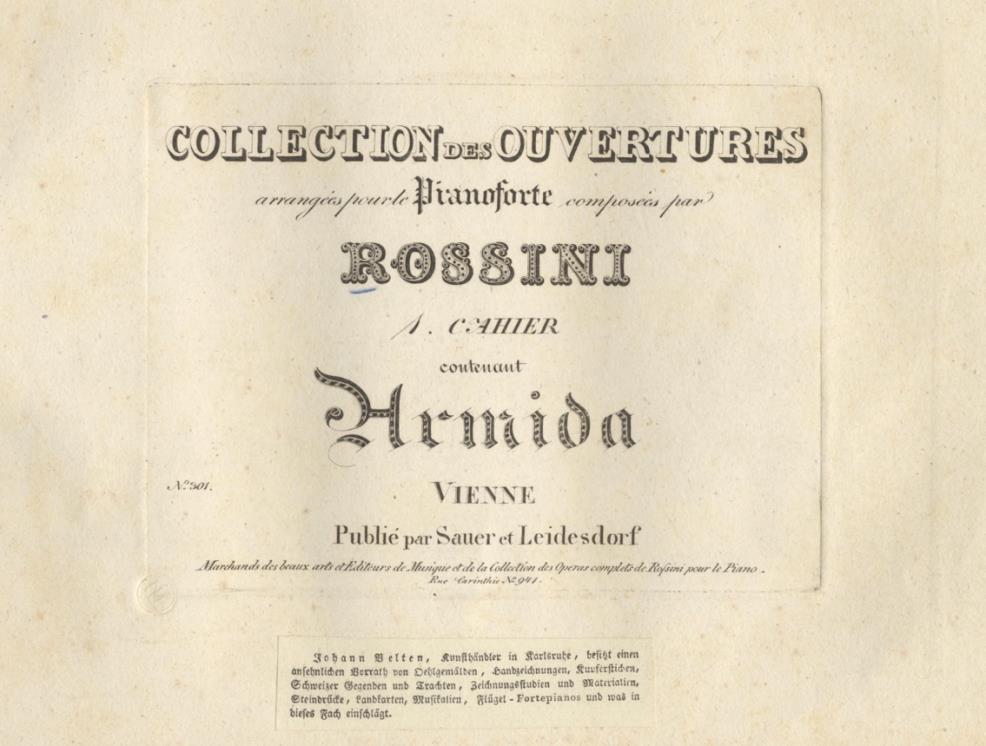
8. Otello.1f. (recto title, verso blank), 9 pp.
9. Adelaide di Borgogna. 1f. (recto title, verso blank), 2-8 pp.
10. Ricciardo e Zoraide. 1f. (recto title, verso blank), 3-10 pp.
11. La Donna del Lago. 1f. (recto title, verso blank), [7] pp.
12. Il Bruschino. 1f. (recto title, verso blank), [6] pp.
13. La Scala di Seta. 1f. (recto title, verso blank), 3-8 pp. Second leaf of music printed from plate of previous overture.
14. L'Italiana in Algieri. 1f. (recto title, verso blank), [9] pp. Pagination erratic or lacking.
15. Aureliano in Palmira. 1f. (recto title, verso blank), 3-9 pp.
16. La Gazza Ladra. 1f. (recto title, verso blank), 3-13 pp.
17. Demetrio e Polibio. 1f. (recto title, verso blank), 3-7 pp.
18. Il Tancredi. 1f. (recto title, verso blank), 3-8 pp.
19. Bianca e Falliero. 1f. (recto title, verso blank), 2-9 pp.
20. Elisabetta. 1f. (recto title, verso blank), 2-9 pp.
OCLC (individual overtures only).
"No composer in the first half of the 19th century enjoyed the measure of prestige, wealth, popular acclaim or artistic influence that belonged to Rossini. His contemporaries recognized him as the greatest Italian composer of his time. His achievements cast into oblivion the operatic world of Cimarosa and Paisiello, creating new standards against which other composers were to be judged. That both Bellini and Donizetti carved out personal styles is undeniable; but they worked under Rossini's shadow, and their artistic personalities emerged in confrontation with his operas. Not until the advent of Verdi was Rossini replaced at the centre of Italian operatic life." Philip Gossett in Grove Music Online (41091) $425
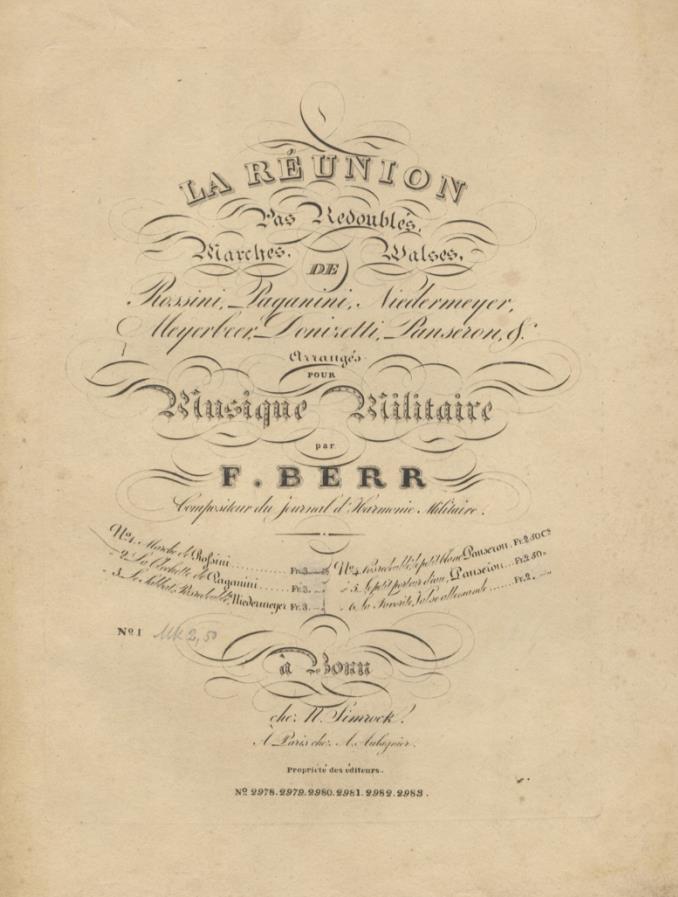
A Rossini March
47. ROSSINI, Gioachino 1792-1868
La Réunion Pas Redoublés ... Musique Militaire par F. Berr Compositeur du journal d’Harmonie Militaire ... No. 1. Marche de Rossini ... Fr. 3.
Bonn ... Paris: N. Simrock ... A. Aulagnier [PN 2978], [1831].
Folio. 1f. (recto title, verso blank) + 17 parts scored for military band, with 2-3 parts printed on each page in oblong format. Slightly worn; spine reinforced with clear tape; some minor soiling and small stains.
Flauto piccolo / Petite clarinette: 1, [i] (blank) pp.
Clarinetto 1mo. / clarinetto 2do: 1, [i](blank)pp.
Clarinetto 3to / Bugle ad lib: 1, [i] (blank) pp.
Corno 1mo / Corno 2do: 1, [i] (blank) pp.
Fagotto 1mo / Fagotto 2do: 1, [i] (blank) pp.
Serpent / Caisse roulante / Grosse caisse: 1, [i] (blank) pp.
Corno 3to / Trompette: 1, [i] (blank) pp. Trombone 1mo et 2do / Trombone 3to: 1, [i] (blank) pp.
Karlsruhe (copies at the Staatsbibliothek, Berlin, and the Bibliothèque nationale, Paris, FRBNF43186833).
Arranged by Friedrich Berr (1794-1838). (40971)
$100
Operatic Arias by Rossini, Cimarosa, and Donizetti in Early 19th Century Manuscript
48. ROSSINI, Gioachino 1792-1868, Domenico Cimarosa 1749-1801, and Gaetano Donizetti 1797-1848
Collection of manuscript full and piano-vocal scores of operatic arias, etc. Firenze, [ca. 1820-1825].
Oblong quarto (212 x 284 mm). Contemporary marbled boards with decorative cut-paper label with titling in manuscript to upper incorporating printed lying angel with trumpet. Copyist's annotations to titles of items 4 and 5 partially abraded; item5 with onemeasurecanceledandcorrected. Ownershipinscriptionto upper outercorner of front free endpaper. Binding worn; boards detached; spine lacking. Occasional showthrough and small stains; some light soiling, mainly to blank margins; foxing to engraved title; dampstain to blank lower margin of first manuscript; final manuscript loose. With several instances of contemporary alternate ornamentation notated on the blank stave below the primary vocal line of item 6, "Imeldea a me volgea," of great interest to the study of 19th century bel canto performance practice.
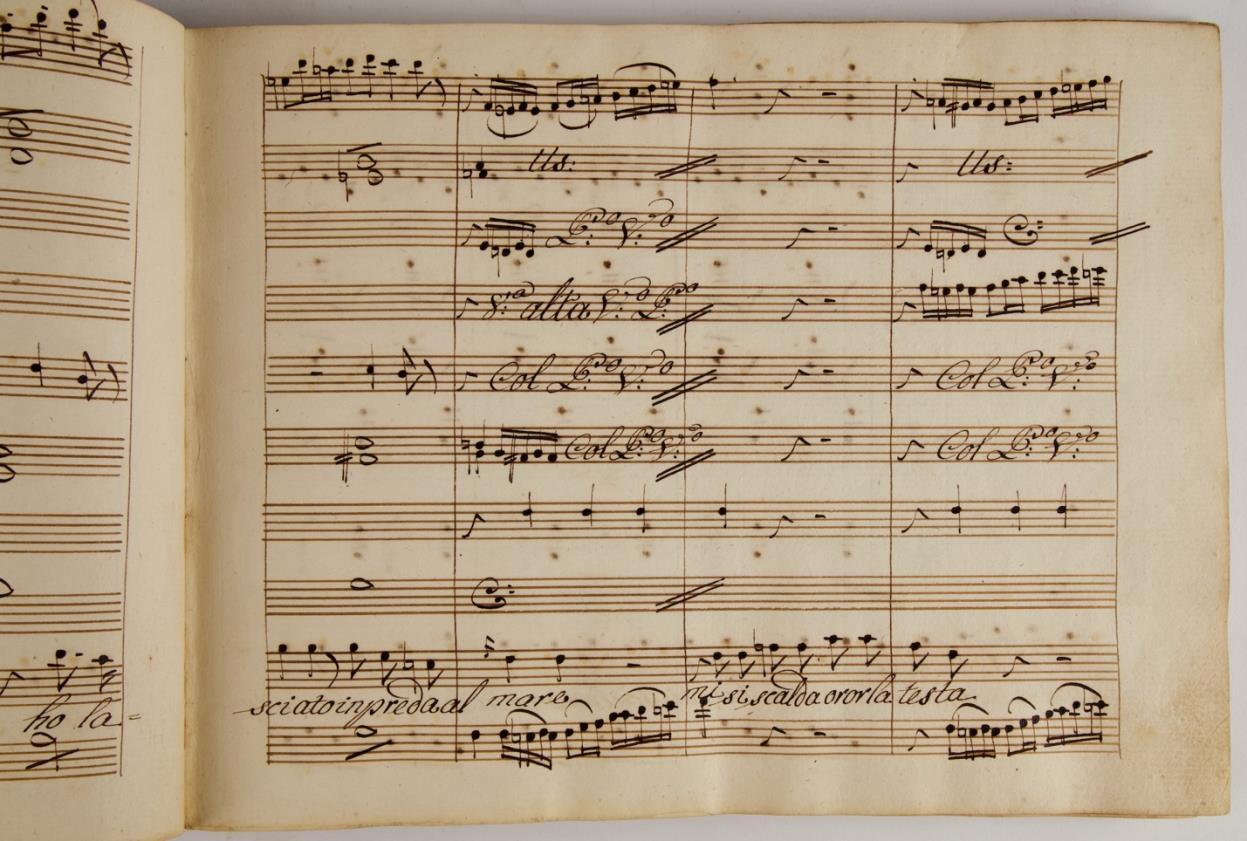
Contains the following arias:
1. Rossini. Una voca m'ha colpito Aria Nell'Inganno Felice. [i] (title), 42 pp. Notated on 10-stave rastrum-ruled paper. Full score.
2 Rossini. Nella Cenerentola Miei rampolli femminili. [i](title), 42, [ii] (blank)pp. Notated on12-stave rastrumruled paper. Full score.
3. Cimarosa. Io quandero un fraschettone per Basso Aria. 1f. (recto manuscript titling within decorative border by Gius. Poggiali with "Si trovano in Firenze unitamente ai Principj di Musica e Solfeggi presso Rinaldo Bonini Librajo in Piazza del Duomo" to lower margin, verso blank), [i] (secondary title), 42, 1f. (blank) pp. Notated on 10-stave rastrum-ruled paper. Full score.
4. Rossini. Ah Qual Nube m'ingombra de Ciglia Aria Nella Gazza Ladra. [i] (title), 42 pp. Notated on 12-stave rastrum-ruled paper. Full score.
5 Rossini. Dunque Invano i Perigli la Morte Cavatina ... Con Accompagnamento di Piano-Forte. [i] (title), 5, [i] (blank) pp. Notated on 12-stave rastrum-ruled paper. Piano-vocal score.
6. Donizetti (1797-1848). Imelda a me Volgea Scena ed Aria Nel Opera Imelda di Lambertazzi. [i] (title), 21, [i] (blank) pp. Notated on 10-stave rastrum-ruled paper. Piano-vocal score.
7 Donizetti. Romanza Raggio d'Amor parla Nel Opera il Furioso. [i] (title), 4 pp. Notated on 10-stave rastrumruled paper. Piano-vocal score. (40341) $800
16th Century Printing from the Giunta Press
With an Early Depiction of the Lira da Braccio
49. [SACRED MUSIC - 16th Century - Italian]
Sacra Baptizandi institvtio Iuxta ritum Sanctæ Romanæ Ecclesiæ. In hoc libro etiam, quæ apud infirmos in extremis laborantes, & quæ post eorum obitum officia fiunt, continentur. Accessere alia multa cum exorcismis contra Dæmoniacos, & visitatione Infirmorum. Vt in sequenti Tabula patet.
Venetijs: apud Iuntas, 1581.
Small octavo. Full vellum with dark red leather label to spine with titling gilt, dark green silk ribbon marker. 1f. (recto title. verso index), 2-176 ff. Typeset in black and red ink with woodcut historiated initials.
With ca. 60 pp. of neumatic notation typeset in black on red 4-line staves, scored for solo voice. Includes Latin texts for the sacraments, the four passions, and various blessings and exorcisms as practiced by the Roman Catholic Church. Full-page woodcuts to versos of ff. 76 and 98 illustrating, respectively, the deposition from the cross and King David depicted as Orpheus in a landscape with lira da braccio. Slightly worn, browned, and foxed; occasional minor staining; slightly cropped at upper margin, not affecting text. A very good copy overall.
OCLC 940370838, 467571257.
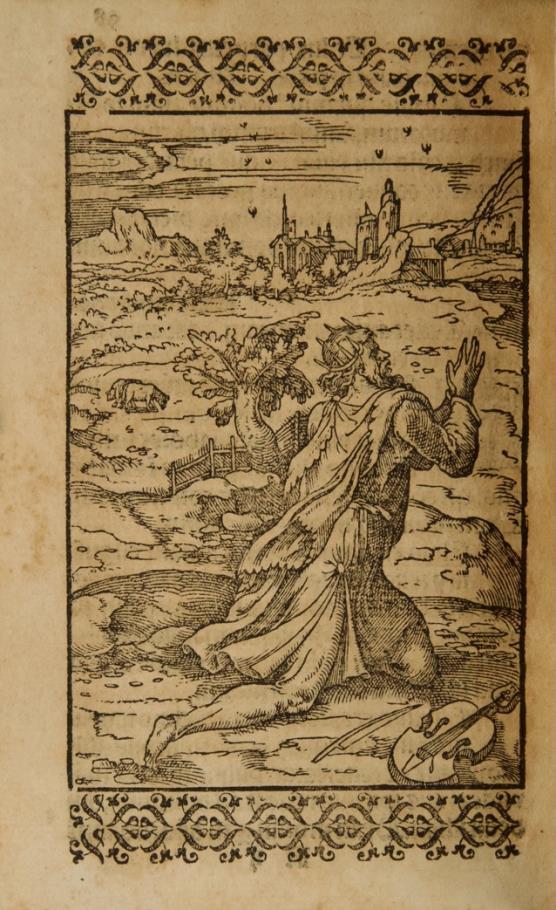
An attractive example of liturgical music printing from the Venetian press of Luca-Antonio Giunta (15421602). With an early depiction of the lira da braccio, a bowed string instrument popular during the Renaissance. (41144) $650
With Early Texts for Sacraments, Passions, Blessings, & Exorcisms
50 [SACRED MUSIC – 17th Century – French]
Sacra Institvtio Baptizandi Aliaqve Sacramenta quæ Simplex Sacerdos conferre potest administrandi, iuxta ritum sanctæ Romanæ Ecclesiæ. Ex Decreto Sacro Sancti Concily Tridentini Restituta. In quo etiam,quæ apud infirmos in extremis laborantes, & quæ post eorum obitum officia fiunt continentur, & alia multa. Cum Exorcismis Contra Dæmoniacos, & visitatione infirmorum. Accessere præterea in hac noua editione Canones Calendarij Gregoriani Cum Ipso Kalendario, diebusque festis a Sixto V. Pont. Max. nuper restitutis.
Lvgdvni [Lyon]: Excvdebat Petrus Rovssin, 1605.
Octavo. Early full dark brown leather with printed and manuscript labels to spine. 1f. (title printed in black and red with woodcut illustration of baptism incorporating dove, clouds, and tetragrammaton, verso full page woodcut of a crucifixion scene), [vii] (dedication), [vi] (tables), [i] ("Tabula Paschalis") pp., 182ff., 1f. (index). Typeset in black and red with numerous woodcut illustrations. With annotations (penmanship practice) in
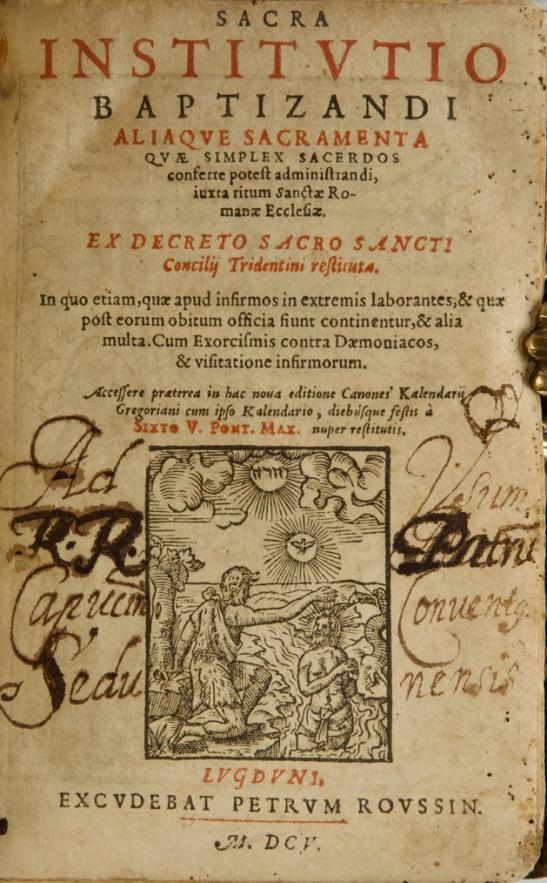
contemporary manuscript to free endpapers; contemporary manuscript annotations to title ("Ad usum R.R. [?]Patr... Capucin Convent. Sedunensis") to title and rear free endpaper ("Sum Joannes ... Ciuis Sedunensis Domini 1607") and, in a different hand, "A L'usage des Capuensis de [?]Lion." Circular handstamp in purple ink "Ex Libris Rev. L. Kuenzel No. [1648]" and small modern label with initials "SAG" to front pastedown. Binding worn; leather cracked; shelfmarks inwhiteink tospine. Slightly worn and browned, heavier to some leaves; some leaves closely trimmed at upper margin, not affecting text; minor loss to outer edges of ff. 73, 93, and 96 with some loss of text; small tear to lower portion of f92 and f83 repaired with archival tape.
With ca. 70 pp. of neumatic notation typeset in black on red 4-line staves, scored for solo voice. Includes Latin texts for the sacraments, the four passions and various blessings and exorcisms as practiced by the Roman Catholic Church.
OCLC 1389633529. (41143) $375
“Musically the Most Important Texts of the Tenebrae”
51 [SACRED MUSIC – 17th Century – French]
Passiones Quatuor in Majori Hebomada Cantari Solitæ, Cum Lectionibus & Lamentationibus Jeremiæ Prophetæ. Quibus adjuncta est Genealogia Diei Regum. Juxta Missale Illustrissimi ac Reverendissimi D. Domini Antonii Petri de Grammont Archiepiscopi Bisuntini, Sacri R. Imp. Principis, &c.
Vesuntione [Besançon]: Typis L. Rigoine, Illustris Capituli Bisuntini Typ., 1685.
Folio. Full contemporary dark tan speckled calf. 1f. (recto title with striking woodcut geometric-floral device, verso blank), 3-131, [i] (blank) pp. Binding worn, rubbed, bumped; upper board quite warped; upper approximately 1/2" of head of spine lacking. Occasional minor staining, worming, and dampstaining; minor loss to upper outer corners and gutter of first several leaves.
With neumatic notation typeset on 4-line staves throughout, scored for solo voice.
OCLC 1119128101.
"The story of the Crucifixion as recorded in the Gospels of Matthew (xxvi–xxvii), Mark (xiv–xv), Luke (xxii–xxiii) and John (xviii–xix). In the Roman liturgy the Passion texts are recited as Gospel lessons during Mass on Palm Sunday (Matthew), Tuesday of Holy Week (Mark), Wednesday of Holy Week (Luke) and Good Friday
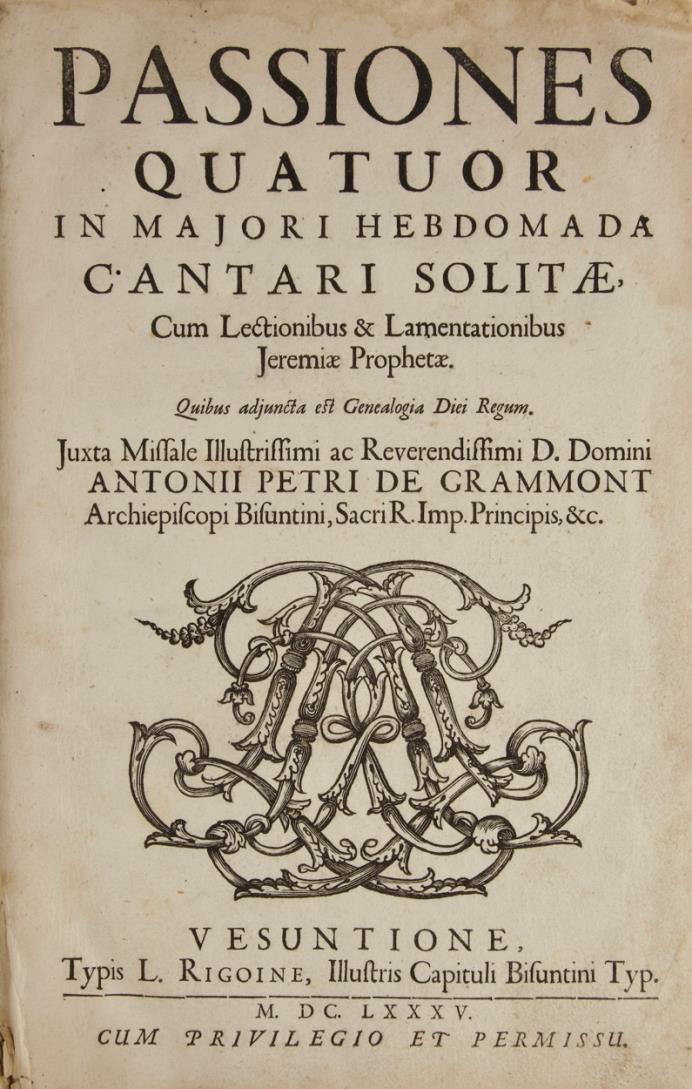
(John). At a very early date special lesson tones were developed for reciting the Passion, and polyphonic settings of its texts have been made since the 15th century." Kurt von Fischer and Werner Braun in Grove Music Online
"Along with the great responsories, the Lamentations are musically the most important texts of Tenebrae." Günther Massenkeil in Grove Music Online (41147) $675
Burney & Hawkins Praise Sammartini’s Music “Full of Science, Originality, and Fire”
52. SAMMARTINI, Giuseppe 1695-1750
Six Solos For a German Flute or Violin with a Thorough Bass for the Harpsichord or Violoncello ... Opera 2a
London: Printed for I. Walsh in Catharine Street in the Strand, [ca. 1745].
Folio. Disbound. 1f. (recto title, verso blank), 13, [i] (blank), 15-25, [i] (blank), 27-31, [i] (blank) pp. Engraved throughout. Scored for flute or violin and figured bass. with brief publisher's catalogue to foot of title listing additional works by Sammartini. "6/" in early manuscript to outer margin of title. Slightly worn; uniform light browning; occasional soiling and creasing; remnants of early wrapper to inner margin of title.
First Edition, alternate issue. Smith and Humphries 1320 (1319 records the same set of sonatas, but with "Opera Seconda" as opposed to "Opera 2a."). BUC p. 920. RISM S728 (one copy only in the U.S., at the Library of Congress).
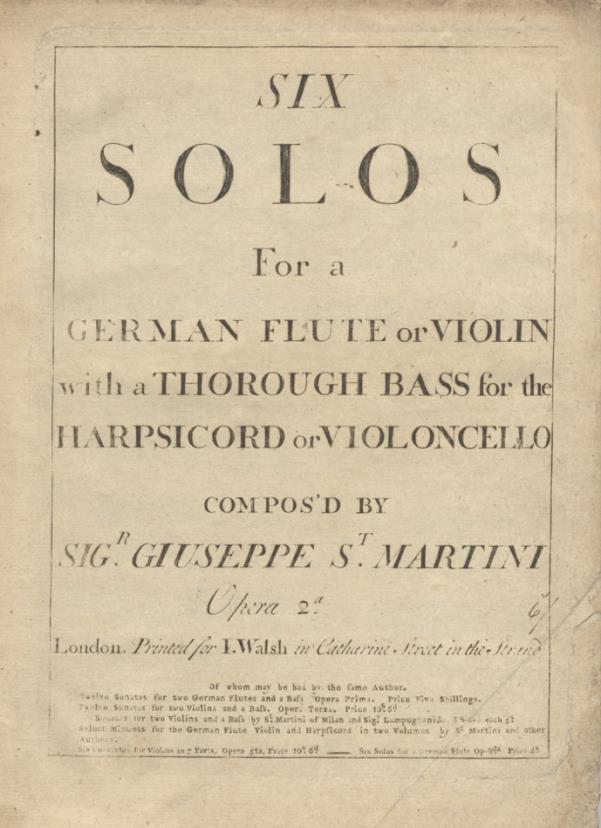
Sammartini, an Italian oboist and composer, "was the son of a French oboist, Alexis Saint-Martin, and the elder brother of the composer Giovanni Battista Sammartini. The report of his death (discovered by Evelyn Lance) appeared in the Whitehall Evening Post of Saturday, 24 November 1750: ‘Last week died at his Royal Highness, the Prince of Wales, Signior S. Martini, Musick Master to her Royal Highness and thought to be the finest performer on the hautboy in Europe’. ... Sammartini left Italy for Brussels and then for London, where his collection of 12 trio sonatas, published by Walsh & Hare, had been announced on 30 September 1727. ... The first reference to Giuseppe in England appears in London advertisements for a concert at Hickford’s Room on 21 May 1729, which also featured ‘several pieces on the hautboy by the famous Sig. St. Martini of Milan, just arrived from the Court of Brussels’ (Lasocki, 887). Sammartini remained in London for the rest of his life, quickly winning recognition as a brilliant performer. ... Burney mentioned an aria sung by Farinelli in Porpora’s Polifemo (1735) that was ‘accompanied on the hautbois by the celebrated San Martini’. Though Hawkins said that Sammartini was at first allied with Bononcini, he also played in Handel’s orchestra. ... Sammartini was primarily an instrumental composer, and one of the leading writers of concertos and sonatas in England between 1730 and 1750. His printed collections include 24 sonatas for flute and bass, 30 trios for flutes or violins, 24 concerti grossi, four keyboard concertos, an oboe concerto, 16 overtures, and some flute duets and cello sonatas. ... Sammartini was a skilled contrapuntist, a fine harmonist with chromatic leanings and a good melodist, the broad lyricism of his slow movements and minuets showing the influence of Handel. His forms are interesting and well organized. Burney and Hawkins much admired Sammartini’s music, which Burney praised as being ‘full of science, originality, and fire ’ " Bathia Churgin in Grove Music Online (40759) $385
53. SAMMARTINI, Giuseppe 1695-1750
XII Sonate a due Violini, e Violoncello, e Cembalo, Se piace, Opera Terza, Dedicata All'Altezza Reale di Augusta Principessa di Valli. [Parts].
London: Printed for and Sold by I. Walsh Musick Printer & Instrument Maker to his Majesty in Catharine Street in the Strand, [1747].
Folio. Fullmodernheavyivorywrappers. Sewn. Engravedthroughout. Dedicationwithinanelaboratedecorative border by H. Roberts incorporating floral motifs. A printed note at the head of the first page of music of the cello/harpsichordpart forthefirst sonataindicatesthat certain passages (marked "solo" forcello)maybeomitted by the harpsichordist ifa cellois also playing. In Sonata XII (Allegro moderatoe grazioso), two parts are notated
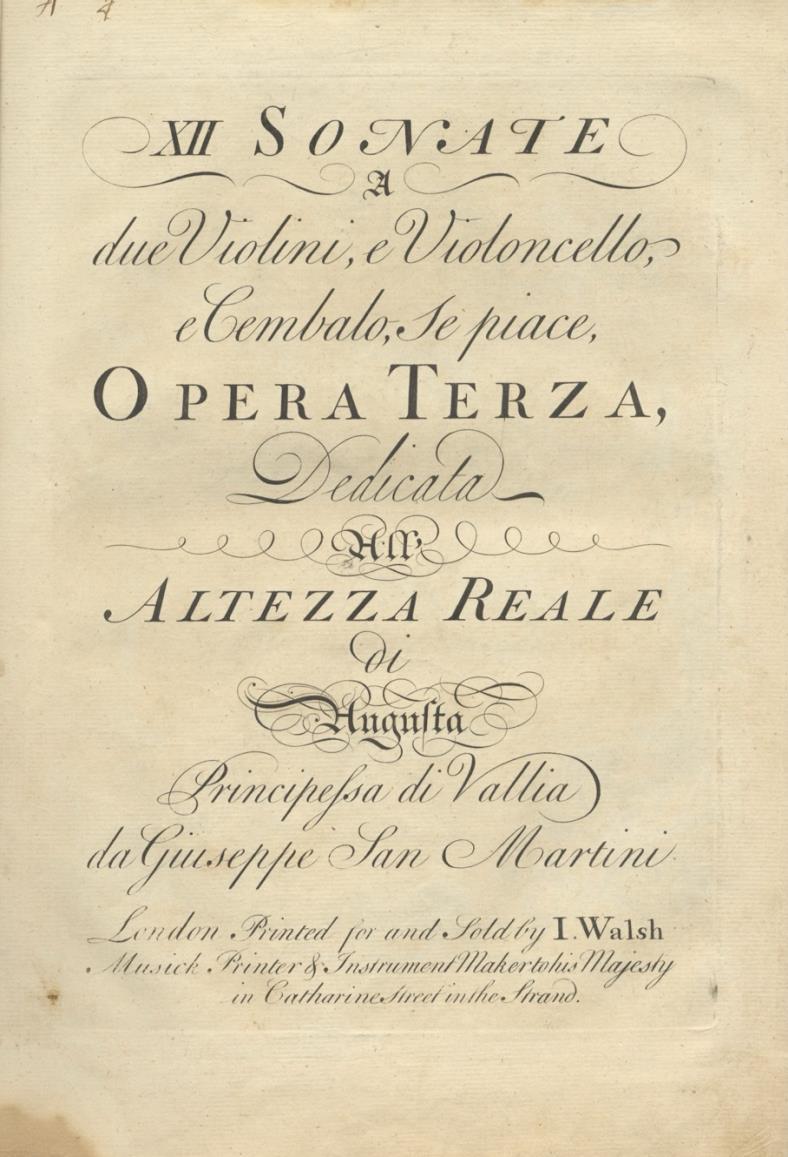
on the same stavein the major sectionof the piece: amorecomplex variation with upward stems anda simplified version with downward stems; accompanying the piece is a note that the cellist may leave the more complex variation to the harpsichord if it proves too difficult. Minor annotations in contemporary manuscript to the upper inner corner of titles. Occasional minor soiling, small stains, and paper loss. A very good, clean and crisp copy overall.
Violino primo: 1f. (recto title, verso blank), [i] (dedication), 36, [i] (blank) pp. Violino secondo: 1f. (recto title, verso blank), [i] (blank), 36, [i] (blank) pp.
Violoncello: 1f. (recto title, verso blank), [i] (blank), 34, [i] (blank) pp.
Second edition. Smith and Humphries 1330. BUC p. 920. RISM S722. (40760) $700
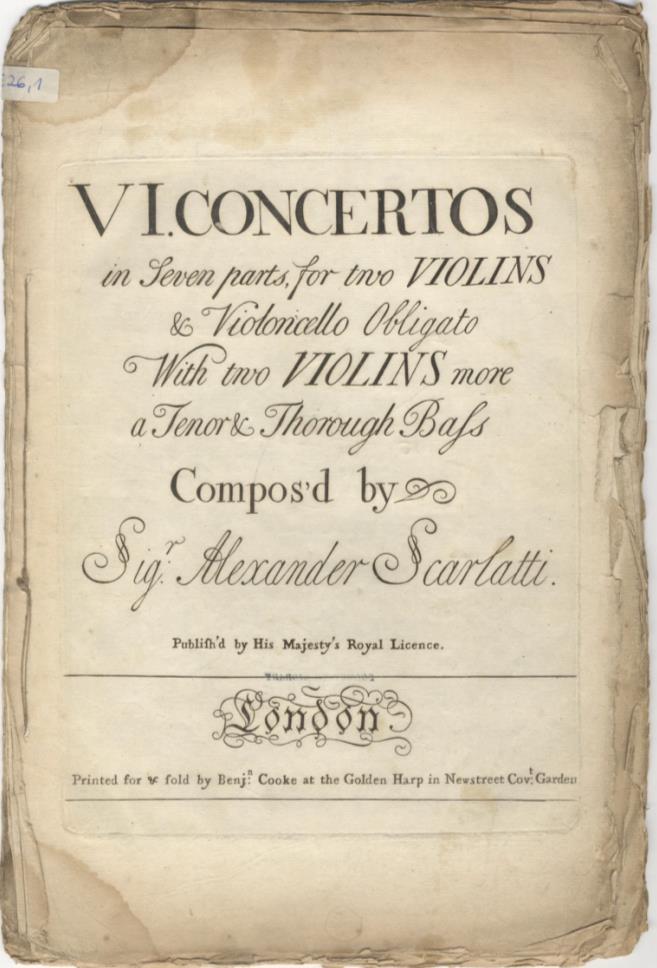
The Only 18th Century Publication of Scarlatti’s Music From the Noted Dolmetsch Collection
54. SCARLATTI, Alessandro 1660-1725
VI. Concertos in Seven parts, for two Violins & Violoncello Obligato With two Violins more a Tenor & Thorough Bass. [Parts].
London: Printed for & sold by Benjn: Cooke at the Golden Harp in Newstreet Covt: Garden, [ca. 1740].
7 parts. Folio. Contemporary plain blue wrappers. Sewn. Wrappers quite worn, soiled, and creased, with upper of Violino primo concertino lacking; edges soiled and frayed; occasional signs of wear and small stains; repair to final leaf of Basso ripieno part.
With occasional performance annotations in pencil in a later hand.
Violino primo concertino: 1f. (recto title, verso blank), [i] (blank), 2-13, [i] (blank) pp. Violino primo ripieno: 1f. (recto title, verso blank), [i] (blank), 2-11, [i] (blank), pp. Violino secondo concertino: 1f. (recto title, verso blank), [i] (blank), 2-11, [i] (blank), pp.
Violino secondo ripieno: 1f. (recto title, verso blank), 8 pp.
Alto viola: 1f. (recto title, verso blank), [i] (blank), 2-9, [i] (blank) pp.
Violoncello: 1f. (recto title, verso blank), 10 pp.
Basso ripieno: 1f. (recto title, verso blank), 8 pp.
Provenance
Arnold Dolmetsch (1858-1940), musicianand pioneerin theEarly Musicrevival, with his small inventory label to spines and with handstamp ("Dolmetsch Library") and shelfmark ("IIE26.1" to IIE26.7") to verso of title to each part.
First Edition. Rare. Rostirolla p. 534, no. 2. BUC p. 925. RISM S1187.
Rare Book Hub records the present copy as the only example to have come to auction.
The sole 18th century publication of Alessandro Scarlatti's music. (40336)
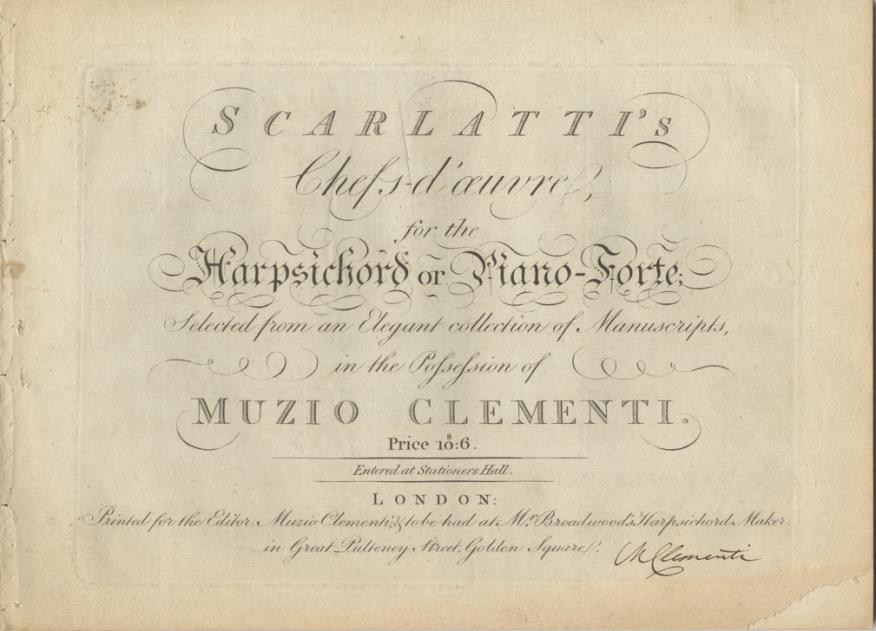
First English Edition of 10 Scarlatti Keyboard Sonatas Signed by Clementi
55. SCARLATTI, Domenico 1685-1757 and Muzio Clementi 1752-1832
$5,500
Scarlatti's Chefs-d'œuvre for the Harpsichord or Piano-Forte; Selected from an Elegant collection of Manuscripts in the Possession of Muzio Clementi. Price 10s:6.
London: Printed for the Editor. Muzio Clementi & to be had at Mr. Broadwood's Harpsichord Maker in Great Pulteney Street, Golden Square, [1791].
Oblong folio. Disbound. 1f. (recto title, verso blank), 28 pp. Engraved throughout. Slightly worn; minor browning and some small marginal stains to title; scattered foxing to blank margins; minor loss to lower outer corner of title; title and pp. 1-6 detached; pp. 7-8 partially detached.
With Clementi's autograph control signature "M Clementi" to lower outer corner of title.
First English edition of ten of Scarlatti's keyboard sonatas.
Tyson pp. 130-131. BUC p. 925. RISM S1211 (four copies recorded in the U,S., at Indiana University, Yale, the New York Public LibraryatLincoln Center, andtheLibraryof Congress). Kirkpatrick p. 410, no. 20. Hopkinson 20.
"The edition contains ten sonatas by Scarlatti (Kirkpatrick nos. 378, 380, 490, 400, 475, 381, 206, 531, 462, and 463); one sonata is by Soler, another is unidentified. These were later published as sonatas composed by Clementi 'in the style of Scarlatti', and were erroneously included in Vol. V of Clementi's Oeuvres completes." (Tyson p. 131)
Clementi was an Italian-born English composer, keyboard player, teacher, music publisher, entrepreneur, and piano manufacturer. "[His] influence on following generations of pianists and piano composers is hard to overestimate. Beethoven’s earlier keyboard writing seems unmistakably indebted to his music of the 1780s and 1790s. Clementi was the principal teacher of several leading pianists of the 1820s and 1830s, and he had more informal contacts with many others during their formative years, for example Herz, Meyerbeer, Dussek, and perhaps Hummel. His didactic works, especially the Introduction to the Art of Playing on the Piano Forte, the op.36 sonatinas, and the Gradus ad Parnassum, became staples in the education of pianists at all levels. Thus in several ways he impressed his stamp on piano playing and writing from about 1790 until far into the 19th century. And increasing numbers of modern editions and recordings of his works made 20th-century musicians and audiences aware once more of his virtues as a composer." Leon Plantinga, revised by Luca Lévi Sala in Grove Music Online
"Clementi’s edition of Scarlatti’s Chefs-d’œuvre is important since it contains the first printed English edition of ten Scarlatti sonatas: Kk 378, 380, 490, 400, 475, 381, 206, 531, 462, and 463, which were until then only accessible as manuscript copies to a select few. Clementi selected these along with two other sonatas by A. Soler and another as yet unknown author. Then, he tried to bestow the twelve sonatas an identity as a complete work, by subjecting some of them to tonal modifications. The musical text includes numerous new editorial markings and varies considerably from other known Scarlatti’s eighteenth-century manuscript sources. There is strong evidence to suggest that some markings are only suitable for piano. To our knowledge, this source was the first edition of Scarlatti’s sonatas, not only written for the harpsichord, but also for the piano. John Broadwood is the London piano manufacturer to whom Clementi refers in his printed edition, being a central figure in the transition from the London Baroque piano to the Classical one. With the kind of pianos Broadwood manufactured in 1788, it was possible to cultivate a certain cantabile style of performance, highly desired by Clementi, especially in the sonatas with slower tempo. Furthermore, the markings show how the instrument provided a variety of emotional expression, imagery, and intellectual challenges. It is questionable whether the changes are only intended for commercial purposes, or if they also could be a means for the musician to identify himself with a new means of expression for keyboard sonatas, which is closer to the idiomatic piano language. After all, Clementi was a successful piano composer, and he understood the instrument as a means of experimentation in the search for new sonorous possibilities. It seems important to analyze Clementi’s achievement by approaching these keyboard sonatas for the English pianos. ... Everything indicates that this type of keyboard music was fashionable, and that players required and demanded it. The first of the eighteenthcentury editions was announced by Preston on 28 March 1791. The French reissue was printed by Lobry between 1791 and 1794. All of the extant editions contain the same leaf numbers (28) and Sonata numbers (12), but in the French edition the title has been changed, attributing the authorship to Clementi. The grouping of sonatas in pairs of the same tonality is characteristic of the Iberian sonata of this epoch." Shedding Light on Late Eighteenth-Century British Piano Performance Style Through Clementi’s Edition of Scarlatti’s Chefs-D’œuvre, for the Harpsichord or Piano-Forte. Cuervo: Muzio Clementi and British Musical Culture, pp. 103-123, Harvard Hollis Catalogue online (40613) $1,200
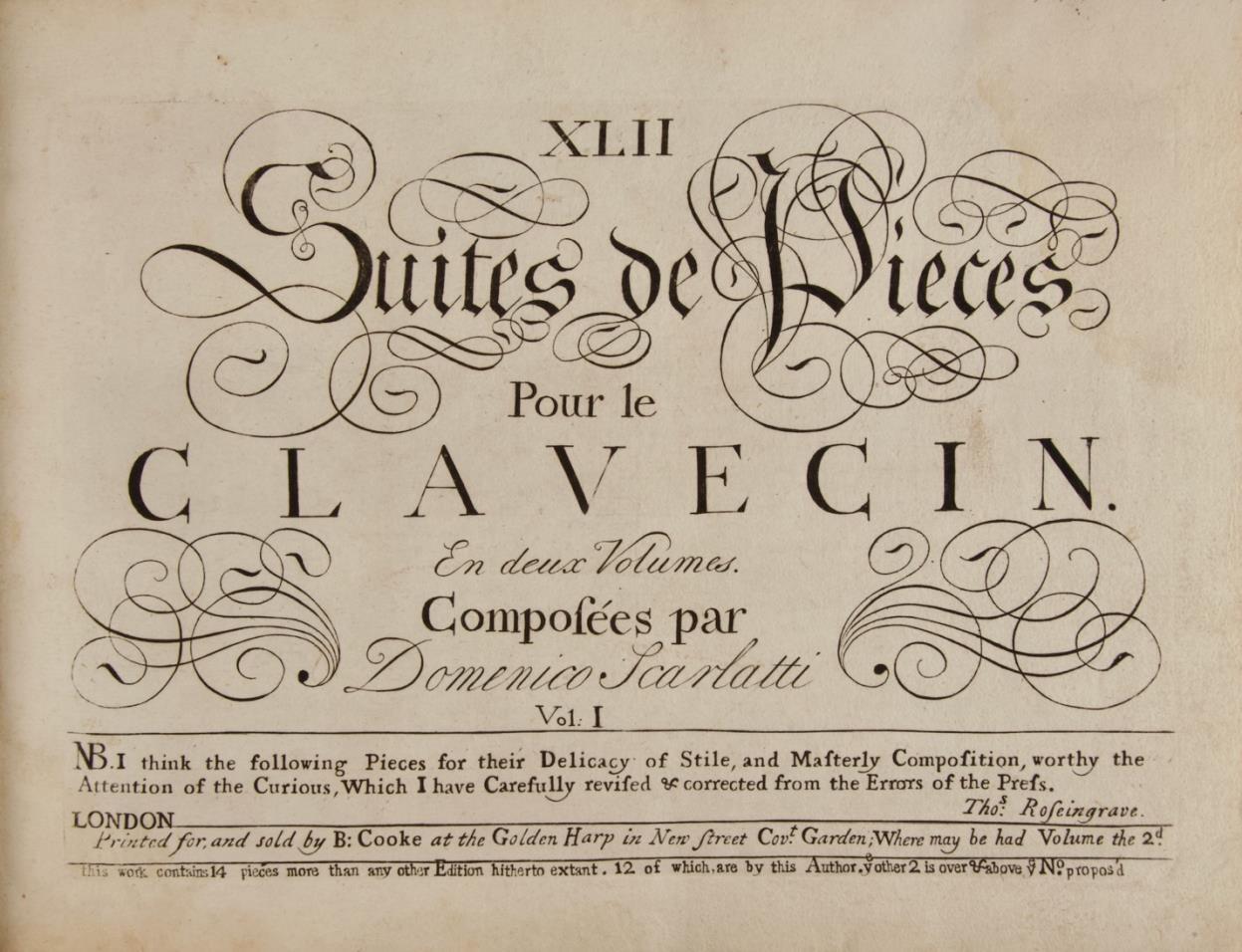
Of Great Importance to the History of Western Keyboard Music With First Editions of 11 Sonatas Not in the Fortier Edition
56. SCARLATTI, Domenico 1685-1757, Alessandro Scarlatti 1660-1725, and ThomasRoseingrave 16901766
XLII Suites de Pieces Pour le Clavecin En deux Volumes. ... Vol: I [-II] ... this work contains 14 pieces more than any other Edition hitherto extant. 12 of which, are by this Author. ye other 2 is over & above ye No. propos'd
London: B: Cooke at the Golden Harp in New Street Covt. Garden; Where may be had Volume the 2d., 1739.
Oblong folio. Modern half light-tan calf with marbled boards, spine in gilt-ruled compartments with dark red leather label with composer's name gilt. Music engraved; privilege and subscribers list typeset. With a printed note to title: "N.B. I think the following Pieces for their Delicacy of Stile, and Masterly Composition, worthy the Attention of the Curious, Which I have Carefully revised & corrected from the Errors of the Press. Thos: Roseingrave." Binding slightly worn. Minor stains to title, privilege, subscribers list, and p. 34 of Vol. I; lacking the privilege and amended subscribers list to Vol. II; occasional light soiling, mainly to blank lower margins. Very good crisp copies overall.
The subscribers list includes celebrated composer, violinist, and music theorist Francesco Geminiani (1687-1762) and other important contemporaries including Charles Avison, Thomas Arne, William Boyce, Willm. De Fesch, John Frederick Lampe, Pepusch, Edward Purcell, John Stanley, et al., with a printed note to
head: "At the Request of several Subscribers, Mr. Roseingrave has been prevail'd upon, to add a piece of his own Composition at the beginning of the first Volume, by way of Introduction to the following Movement; And, in the second Volume, page the ninth, is a Fugue Compos'd by Sigr. Alex: Scarlatti, the Father of this Author, and as these two Additional Pieces are over and above the number propos'd, I hope they will be acceptable to my honourable and worthy Subscribers, from their most Obedient, humble Servant, Benja. Cooke."
With an early presentationinscription to blank verso oftitle of Vol. I "William Cole. Sept.[em]b[e]r 16. 1764. The Gift of the H[onoura]ble Lady Frances Erskine" (one of the subscribers [1715-1776], possibly daughter of John Erskine, 6th Early of Mar and Lady Frances Pierrepont with whom Boswell apparently dined in London on 29 November 1762; see jamesboswell.info website). The recipient ofthe volume, William Cole, was possibly the distinguished English clergyman and antiquary (1714-1782), considered one of the most learned men of the eighteenth century.
Occasional performance markings in pencil, most likely 20th century.
Vol. 1
1f. (recto title, verso blank), 1f. (recto privilege with arms of King George II to head, verso blank), [ii] (subscribers list), [1] "Introduction by Mr. T. Roseingrave"), 2-62, [i] (blank) pp. The 2-movement ("Allegro Moderato" and "Allegro") Roseingrave "Introduction" is a musical paraphrase of the first Scarlatti sonata in the volume (K. 8), designated "l'istesso Allegro Differente."
Bound with:
Vol. II
1f. (recto title, verso blank), [i] (blank), 2-67, [i] (blank) pp. With a "Fuga" on pp. 9-11 by Alessandro Scarlatti. Cooke notes both of these additions (remarking that the Roseingrave contribution was proffered in response to "the Request of several Subscribers" at the head of the list of subscribers.
Contains sonatas K. 1-42.
First expanded edition. Hopkinson: Eighteenth-Century Editions of the Keyboard Compositions of Domenico Scarlatti, no. 7. Kirkpatrick p. 402. BUC p. 925. RISM S1190. Published in competition with Fortier's 1738 edition.
Of great importance is the fact that the present edition contains first editions of 11 sonatas (K. 31-42) not present in the Fortier edition, for which this edition is the primary source.
"Any discussion of Domenico Scarlatti's instrumental output must focus on his keyboard sonatas, not only because of the pre-eminence of the Essercizi and sonatas in his work but because even in their most developed form these pieces relate to a single stylistic model, identified by Ralph Kirkpatrick as the basso continuo. The practice of improvising an accompaniment on a bass line was a stock-in-trade of every professional musician; in the case of Scarlatti, a keyboard player of astounding virtuosity and immense creativity, the habit of condensing, of translating contrapuntal implications into harmonic structures, meant that routine formulas were gradually left behind." Malcolm Boyd and Roberto Pagano in Grove Music Online
"Roseingrave’s relationship with Scarlatti was of considerable importance and was directly responsible for the beginning of the ‘Scarlatti cult’ in England. Arne, Avison, Boyce, Greene, Loeillet, Pepusch and Stanley were among the 95 subscribers to Roseingrave’s edition of Scarlatti." Gerald Gifford, revised by Richard Platt in Grove Music Online
"Roseingrave was the first in a long series of editors to attempt to arrange the Scarlatti sonatas in suites, an attempt, which however musically successful, Scarlatti himself never seems to have made." Kirkpatrick p. 403
A seminal publication in the history of Western keyboard music. (40335) $15,000
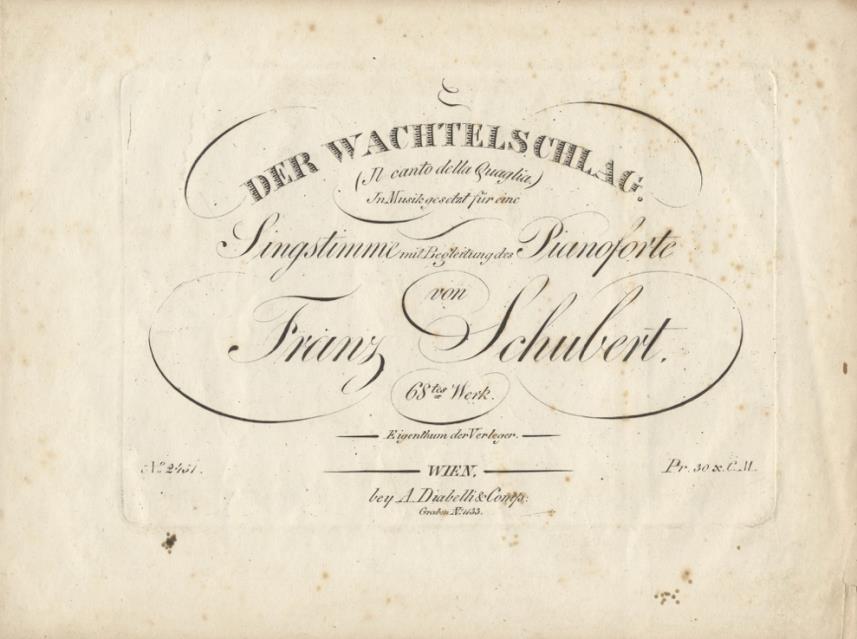
The Quail’s Song
57. SCHUBERT, Franz 1797-1828
Der Wachtelschlag (Il canto della Quaglia) ... 68tes Werk. [Piano-vocal score].
Wien: A. Diabelli & Comp: Graben No. 1133 [PN 2451], [ca. 1830].
Oblong folio. Disbound. 1f. (recto title, verso blank), [i] (blank), 4-7 pp., [i] (blank) pp. Engraved throughout. On wove paperwithoutwatermark. Slightlyworn andfoxed;minor inkstain toblank lowermargin oftitle; small tear to blank lower outer corner of title repaired with archival tape to verso.
First separate edition, second issue. Deutsch 742, p. 447. Hirsch IV, 545. Raab I, p. 274, A-2.
Der Wachteschlag (The Quail's Song), set to text by Samuel Friedrich Sauter, was first published in 1822 in the periodical Wiener Zeitschrift fur Kunst, Literatur, Theater und Mode.
"The only canonic Viennese composer native to Vienna, [Schubert] made seminal contributions in the areas of orchestral music, chamber music, piano music and, most especially, the German lied. The richness and subtlety of his melodic and harmonic language, the originality of his accompaniments, his elevation of marginal genres and the enigmatic nature of his uneventful life have invited a wide range of readings of both man and music that remain among the most hotly debated in musical circles." Robert Winter, Maurice J.E. Brown, and Eric Sams in Grove Music Online (41090) $175
First Edition, First Issue of Schumann’s First Symphony
58. SCHUMANN, Robert 1810-1856
Symphonie (No. 1, B dur) für grosses Orchester componirt und Sr. Majestät dem Könige von Sachsen Friedrich August in tiefster Ehrfurcht zugeeignet ... Op. 38. Partitur ... Pr. 5 Thlr. [Full score].
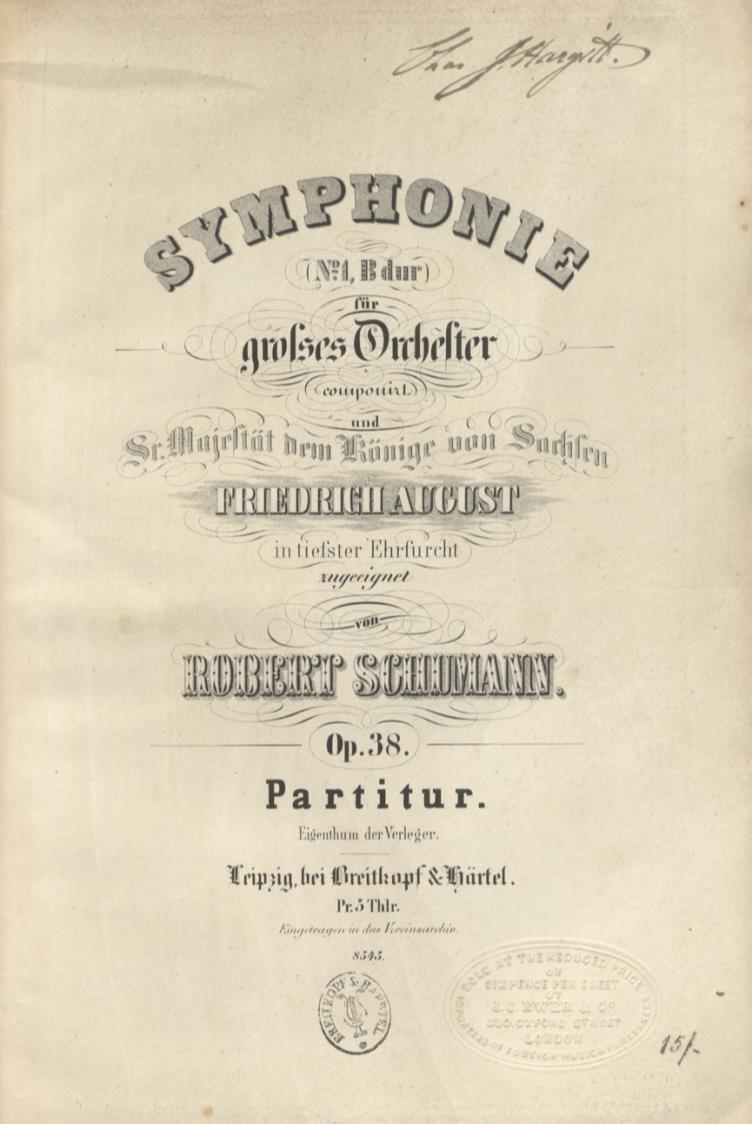
Leipzig: Breitkopf & Härtel [PN 8545], 1853.
Octavo. Original publisher's printed wrappers with titling in ink to spine. 1f. (recto title, verso blank), 211, [i] (blank) pp. Title lithographed, music engraved. With "Charles Hargill" in contemporary manuscript to head of upper wrapper and "Chas. Hargill" to title; publisher's small oval handstamp, "15/," and distributor J. J. Ewer's blindstampto foot of upper wrapperand title. Wrappers worn, soiled, and slightlychipped; spine reinforced with paper tape. Slightly worn, soiled, and browned; signatures loose.
First Edition, first issue. McCorkle, pp. 161, and 164-165. Hofmann p. 89. Hoboken XV, 71.
"Writing to Raymund Härtel on 6 January 1839, Schumann could barely contain his excitement over the cache of unpublished compositions by Schubert he had recently been shown by the latter’s brother Ferdinand. Deeply impressed by the monumental Symphony in C (d944), he arranged for its première at a Gewandhaus concert under Mendelssohn’s direction (21 March 1839). In his celebrated review of the symphony (NZM, xii, 1840), Schumann extolled the work’s ‘heavenly length – like a thick novel in four volumes by Jean Paul’. The review was written with a steel pen Schumann had discovered on Beethoven’s grave, in a symbolic gesture prefiguring the stylistic synthesis he would achieve in his own Symphony in B♭op. 38. ... With the First Symphony, he thus
$700
established a pattern of rapid sketching, textural elaboration and revision (often in reaction to a trial performance) that he was to employ in many of his subsequent works in the larger forms. Schumann’s main compositional efforts of 1841 constitute a comprehensive exploration of the symphonic medium. The grandeur of the First Symphony gives way in the Overture, Scherzo and Finale to a more compact design and an elfin orchestration redolent of Weber. ... Inspired by a ‘spring poem’ by Böttger, the First Symphony lies midway between absolute and programme music. Schumann’s replacing of the traditional point of recapitulation in the first movement with an apotheosis-like statement of the musical motto generated from Böttger’s poem is only the most obvious of the techniques through which he strikes a grand symphonic tone in a fundamentally original manner." John Daverio and Eric Sams in Grove Music Online (41095)
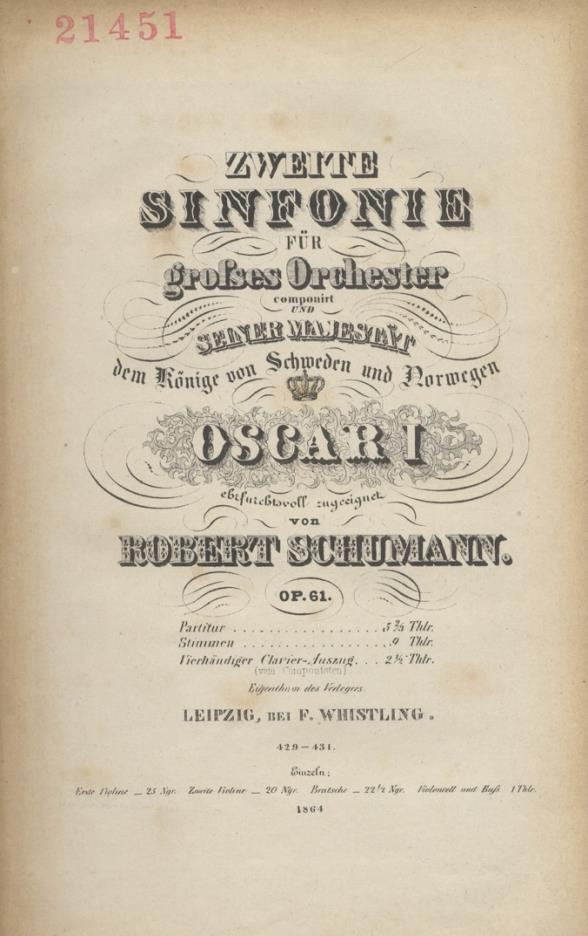
On a “Quasi-Religious Plane”
59. SCHUMANN, Robert 1810-1856
Zweite Sinfonie für grosses Orchester componirt und Seiner Majestät dem Könige von Schweden und Norwegen Oscar I. ehrfurchtsvoll zugeeignet ... Op. 61. Partitur 5 2/3 Thlr. [Full score].
Leipzig: F. Whistling [PN 429-431], 1864.
Octavo. Contemporary half dark green textured cloth with marbled boards, titling gilt to spine. 1f. (recto title, verso blank), 232 pp. Title lithographed, musicengraved. Binding worn, rubbed, and bumped; head of spine slightly frayed; hinges cracked. Slightly worn; some browning, heavier to margins; occasional foxing; one signature partially detached.
Provenance
William Samuel Bambridge (1842-1923), conductor of the Marlborough Choral Society, Marlborough College, Wiltshire, England, with"W. S. BambridgeMarlborough College1873" to front pastedown; publisher's handstamp to foot of title and handstamp in red ink "21451" to upper inner corner of title and first page of music.
First Edition, later issue; the first issue was published in November of 1847. McCorkle p. 269. Hofmann p. 137 ("later issues bear the year to the title").
"The Second Symphony coheres by virtue of a web of recurrent thematic strands. The technique of motivic recall is enhanced by Schumann’s employment of contrapuntal combinations. Specifically, the chorale theme introduced midway through the finale is integrated with the opening theme of the first movement, also a chorale, in the symphony’s concluding passages. The displacement of the finale’s initial march-like theme by a pair of interwoven chorales in essence lifts the Second Symphony from a secular to a quasi-religious plane." John Daverio and Eric Sams in Grove Music Online (41093) $350
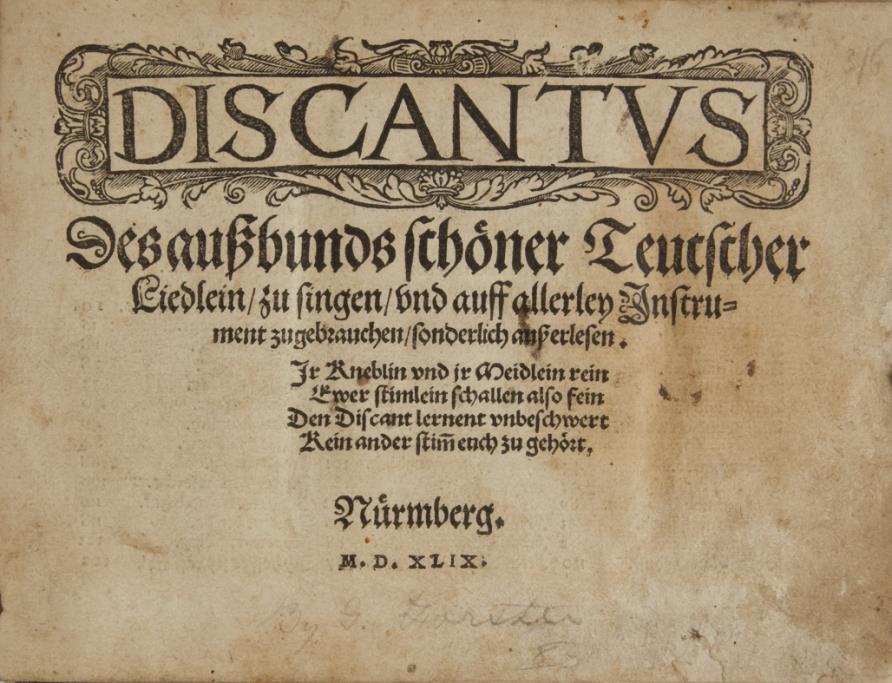
With 130 Mid-16th Century German Songs, Both Secular and Sacred From the Collection of Sir John Stainer
60. SENFL, Ludwig ca. 1486-1543, Heinrich Isaac ca. 1450-1517, and Paul Hofhaimer 1459-1537, et al. Des aussbunds schöner Teutscher Liedlein zu singen und auff allerley Instrument zugebrauchen sonderlich auserlesen. Ir Auglein und ir Heldein rein Ewer stimlein schallen also sein Den Discant lernet unbeschwert Kein ander stim euch zu gehöret. ... Discantus [Discantus part only].
Nürmberg: [J. von Berg & U. Neuber], 1549.
Small oblong quarto. Marbled boards with small manuscript title label to spine. [i] (title), [ii] (table "Regiester der Liedlein des ersten theyls"), cxxx, [i] (blank) pp. Music and text typeset. With "Discantus" within decorative woodcut border to tile and and decorative woodcut initials preceding each song. Contains 130 German secular and sacred songs in four parts for SATB by 28 named composers (see RISM 1539 (27) for a list of these); 25 are anonymous works. With a table of contents arranging the songs alphabetically and a preface by Georg Forster.
Provenance
Sir John Stainer (1840-1901), noted English composerandmusic collector, withhis armorial bookplate tofront free endpaper.
Binding worn, rubbed, and bumped. Slightly worn; minor browning, soiling, and staining, primarily affecting blank margins. Lacking two leaves (pp. xxii-xxiii and xxviii-xxix), supplied in late eighteenth- or early nineteenth-century manuscript.
Third edition. RISM Recueils 1549 (35), noting variants intitles betweenvoice parts (most holdings incomplete; none in the U.S.). Earlier editions published in 1539 and 1543.
A "Swiss composer, singer, and copyist; [Senfl] was one of the most significant representatives of motet and lied composition in German-speaking regions at the time of the Reformation. ... The scope of Senfl’s lied output is wide: there are homophonic settings, lied-like pieces that often treat the tenor voice as a cantus firmus around
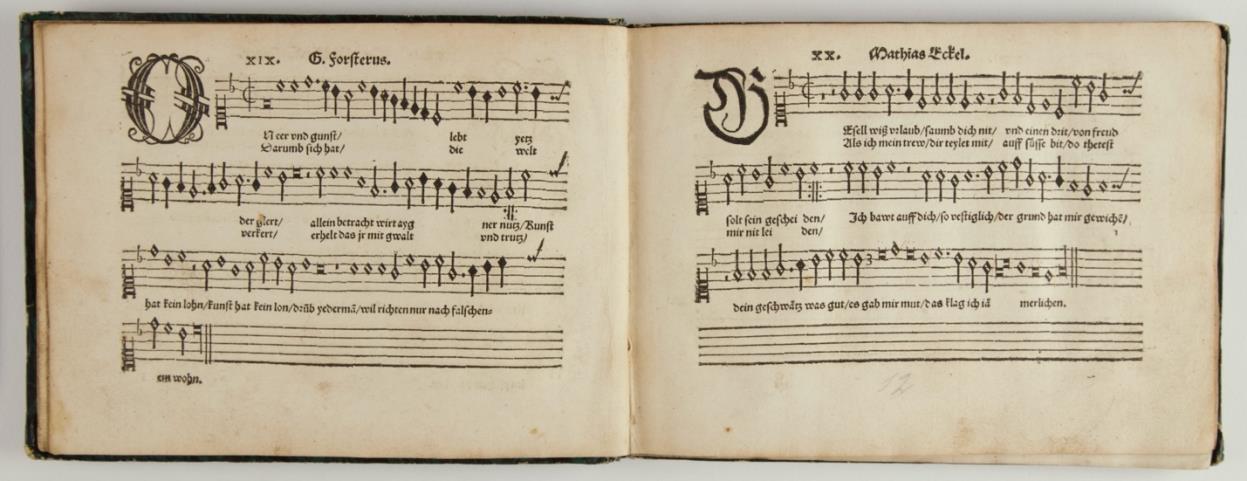
which the other parts weave, and also more complex structures such as canons, use of a wandering cantus firmus, cantus firmus quodlibets, and cycles of settings of the same melody. Outstanding in terms of topic and musical texture are Senfl’s autobiographical lied Lust hab ich ghabt zur Musica, with the acrostic ‘Ludwig Sennfl’, and Das Gläut zu Speyer, which imitates the sounding of church bells." Stefan Gasch and Sonja Tröster in Grove Music Online
Isaac was a South Netherlandish composer. "[He] was a prominent member of a group of Franco-Flemish musicians, including Josquin des Prez, Jacob Obrecht, Pierre de La Rue, Alexander Agricola and others, who achieved international fame in the decades around 1500, influencing the Italian and European Renaissance. His musical output is particularly large and varied. Through his notable link with the Habsburg dynasty he left his mark on German musical traditions, although he also lived and worked for a considerable time in Florence." Reinhard Strohm and Emma Kempson in Grove Music Online
Hofhaimer was an Austrian organist and composer. "According to contemporary witnesses, Hofhaimer was the most important organist of his time. Vadian wrote that it was generally agreed that Hofhaimer had no equal. Another contemporary, the poet and imperial diplomat Cuspinian, called him ‘musicorum princeps’. The humanists Celtis, Luscinius, Pirckheimer and Paracelsus also bore witness to his mastery. Hofhaimer seems to have been unsurpassed in the art of improvisation: ‘He uses such unending variety’, wrote Luscinius, ‘that one can listen to him playing for years and wonder not so much where the ocean finds the water to feed all the rivers as where this man finds his tunes’. ... He showed himself more receptive to classical scholarship than almost any other organist or composer of his time. ... Apparently only a fraction of Hofhaimer's compositions has survived, the loss being particularly heavy in his organ works. The only collection published under his name, Harmoniae poeticae (Nuremberg, 1539) consists of settings of odes by Horace. These compositions, which belong to the later part of Hofhaimer's creative career, are chordal and follow the classical taste of his age. The majority of his output must have been in the area of songwriting, for Vadian wrote that Hofhaimer used to ‘compose the most charming lieder with musical settings which were by no means ordinary’. Some of the texts he set are his own. Almost without exception, the extant lieder are based on court song melodies which are usually given to the tenor, but sometimes also to other voices. They are written in bar form, often with a polyphonic Stollen contrasted with a fairly chordal Abgesang. The phrase structure is always clear, usually without the overlapping polyphony characteristic of the Franco-Flemish school. These works have an important place in the extant repertory of the late medieval German lied." Manfred Schuler in Grove Music Online (41141) $3,500
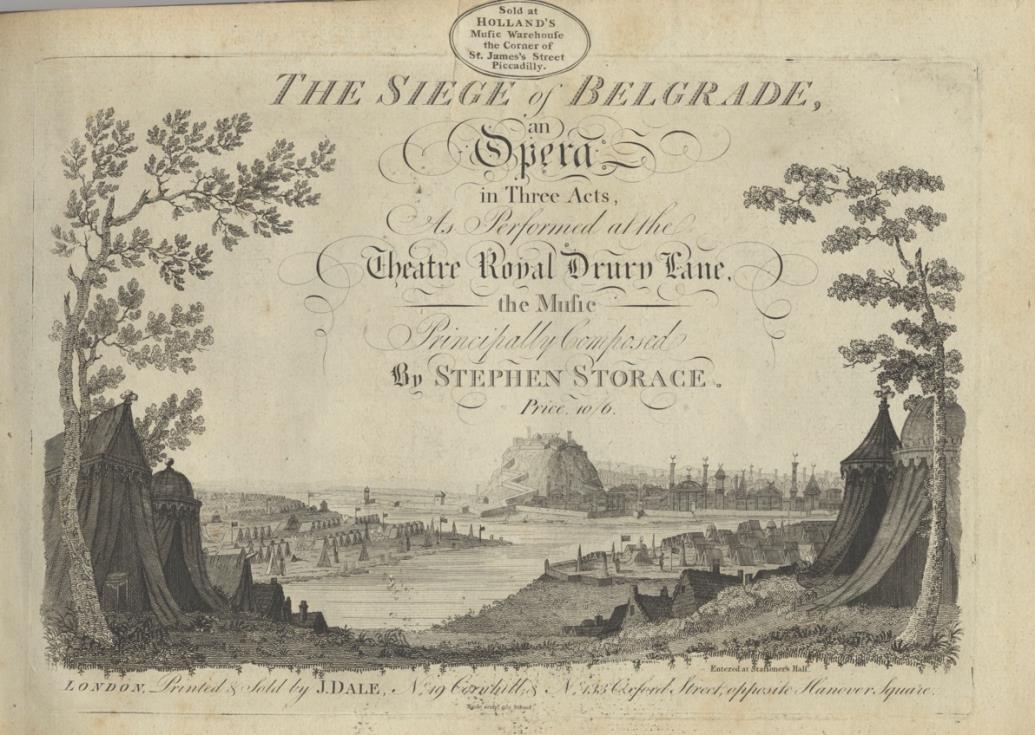
Late 18th Century Pasticcio, with Music by Storace, Mozart, Paisiello, and Salieri
61. STORACE, Stephen 1763-1796
The Siege of Belgrade, an Opera in Three Acts As Performed at the Theatre Royal Drury Lane, the Music Principally Composed By Stephen Storace Price 10/6. ... Neele sculpt. 602 Strand. [Piano-vocal score].
London: Printed& Sold by J. Dale, No. 19 Cornhill, & No. 133 Oxford Street, opposite Hanover Square, [1791].
Oblong folio. Modern marbled boards with titling to paper label gilt to spine. 1f. (recto fine illustrated title depicting military encampments and a cityscape in the background, verso blank), [i] (advertisement for instruments, scores sold by "Joseph Dale at his Music-Warehouses"), 2-81 pp. Engraved throughout. Small oval contemporary engraved bookseller's label "Sold at Holland's Music Warehouse the Corner of St. James's Street Piccadilly" to head of title. A few later annotations in pencil to verso of title. Very slightly worn and foxed; minor small printer's ink stains to imprint. In very good condition overall.
With occasional instrumental interludes notated in smaller notes on the same stave as the piano's right hand, at times indicating which instrument plays; the violin parts are occasionally given their own stave.
First Edition. BUC p. 984. RISM S6872 and SS6872.
The Siege of Belgrade was first performed in London at the Drury Lane Theatre on 1 January 1791. A pasticcio, it drew its music from various composers, including Storace, Mozart, Paisiello, and Salieri. The melody in the sequence of music from pp. 6-10 (Allegretto alla Turca, Dance of Turkish Soldiers, and Dance of Turkish Women), for instance, is borrowed from Mozart's Piano Sonata No. 11 in A major, KV 331 (third movement, Alla Turca - Allegretto), without attribution.
Storace, an English composer, studied at the Conservatory in Naples and went on to travel throughout Italy. "By autumn 1779 he and his sister were performing in Florence, she singing, he playing second harpsichord at the opera house. In the early 1780s Storace returned to England, where he tried to settle in both London and Bath.
His earliest published works were songs and chamber music from this period, but his later output was to be mainly operatic. ... The Storaces became friends of Mozart and invited him to London, but this plan never came to fruition. Although Storace was clearly influenced by Mozart, there is no evidence that he was Mozart’s pupil, as is sometimes claimed. ... Back in London, both Stephen and Nancy Storace joined the Italian opera company at the King’s Theatre. ... For the rest of his career Storace composed almost entirely for the Drury Lane company, usually collaborating with Cobb for mainpieces and with Prince Hoare for afterpieces." JaneGirdham in Grove Music Online
An attractive copy, rare to find in such good condition. (40788)
Strauss’s “Most Often Performed Orchestral Piece”
62. STRAUSS, Richard 1864-1949
Till Eulenspiegels lustige Streiche. Nach alter Schelmenweise - in Rondeauform für grosses Orchester gesetzt ... Seinem lieben Freunde Dr. Arthur Seidl gewidmet ... Op. 28. Verl. No. 2832. Partitur (Für den Privatgebrauch). [Full score].
München: Jos. Aibl Verlag [PN 2832], 1895 and 1896.
Folio. Full dark bluecloth with titlingand owner's name "R. Temple Savage" gilt to upper, titling gilt to spine. 1f. (recto title, verso "Orchesterbesetzung"), 3-60 pp. With notice of the 4-hand arrangement by O. Singer added to title and "Lith. Anst. v. C. G. Röder" to foot. With red handstamped copyright notice to upper inner corner of title and rectangular Univeral-Edition overpaste to lower margin; small octagonal ivory label laid down over printed prices. Binding slightly worn, rubbed, and bumped. Minor internal wear and browning; upper outer corners slightly creased.
Provenance
$600
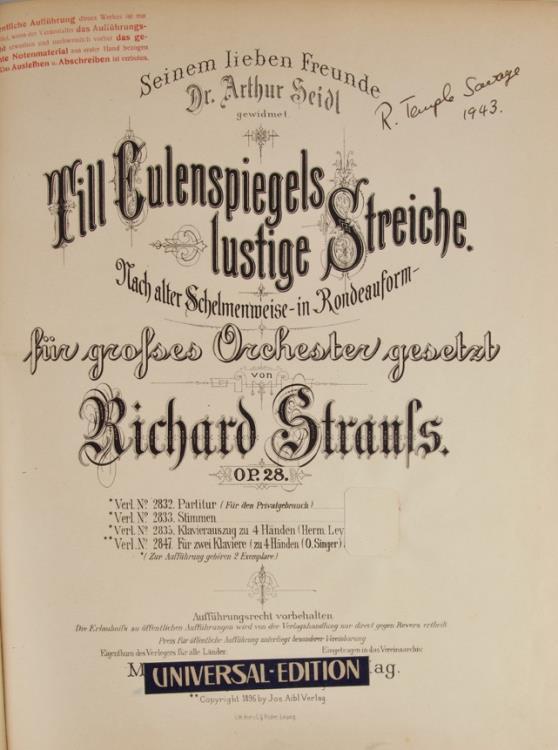
RichardTempleSavage (1909-1996), bass clarinettistunder Sir Thomas Beecham in the London Philharmonic Orchestra, 1934-1946 then Chief Librarian and member of theorchestraattheRoyalOperaHouse, CoventGarden, withhis handstamp"ThePropertyofR.TempleSavage" within rectangular border to front free endpaper and signature and date of 1943 to upper outer corner of title.
First Edition, later issue. Sonneck Orchestral Music p. 453. Fuld p. 580. Trenner 171. Asow I, p. 156.
Strauss "emerged soon after the deaths of Wagner and Brahms as the most important living German composer. During an artistic career which spanned nearly eight decades, he composed in virtually all musical genres, but became best known for his tone poems (composed during the closing years of the 19th century) and his operas (from the early decades of the 20th). ...
Shortly after the Guntram première he decided to compose a one-act opera Till Eulenspiegel bei den Schildbürgern, though he never got beyond an incomplete text draft. Why he scrapped the opera for a tone poem is not clear, but judging from his programme notes, the symphonic work is based on a different scenario: ‘Once upon a time there was a knavish fool named Till Eulenspiegel. He was a wicked goblin up to new tricks’. Till rides on horseback through the market, mocks religion (disguised as a cleric), flirts with women, engages in
academic double talk with his philistine audience, and by the end finds himself on the scaffold, soon to be hanged. Strauss did not call Till a tone poem but rather a ‘Rondeau Form for Large Orchestra’. Richard Specht suggested this might well have been the first prank, given that the only connection with the old French forme fixe is in the spelling. Strauss later described the structure as being an ‘expansion of rondo form through poetic content’, and cited Beethoven's Eighth Symphony as his model. Given the libertine qualities of young Till, as well as the episodic nature of the work, a rondo would seem quite appropriate. But, as in Don Juan, the form is hardly conventional: the sense of rondo is achieved mostly by the return of Till's two themes to articulate his various adventures. Completed in May 1895, the compact Till Eulenspiegel was introduced with great success six months later and remains Strauss's most often performed orchestral piece. That he had learnt much about orchestral detail and nuance during the six years since Tod und Verklärung is evinced by his brilliant use of the ratchet when Till rides through the market, or by the piercing D clarinet when he whistles in the face of death." Bryan Gilliam and Charles Youmans in Grove Music Online (41120) $150
63.
TREU,
Fine Small Renaissance Engraving Depicting Musical Instruments
Martin fl. ca. 1540-1550
Fine small engraving of two elegantly-dressed Renaissance musicians playing flute and large side drum. Germany, 1543.
60 x 44 mm (2- 5/16" x 1-11/16"). On laid paper. With date "1543" printed above artist's monogram "MT" at upper left corner and number "I" printed to upper rightcorner. A very good impression with thread margins.
Holstein 14 (this state only).
The present engraving belongs to a series depicting dancers and musicians at a wedding. Little is known about the artist except that he belongs to the second generation of "Little Masters," German artists who produced small engravings. He followed in the footsteps of Sebald Beham (1500-1550) and Georg Penz(ca. 1500-1550), two important German printmakers in the generation after Dürer, and his work bears a distinct similarity to that of Heinrich Aldegrever (1502-[?]1555). (41221) $675
64. TWENTIETH CENTURY MUSIC COLLECTION
An interesting collection of 142 editions of 20th century music, predominately full scores in study and miniature format but also including some folio editions. Together witha small sampling ofchamberand piano music. Most items from the collection of noted musicologist Stanley Boorman (b. 1939), specialist in early music; music bibliography, printing, andpublishing;andauthor ofthemonumental OttavianoPetrucci: A Catalogue Raisonné, some with his small neat signature andoccasionalminor annotations. In very good antiquariancondition overall, with occasional minor defects including minimal signs of wear, creasing, soiling, detached wrappers, etc.
1. Andriessen, Hendrik 1892-1981
Ballade voor Hobo en Piano (1952). [Amsterdam: Donemus, ©1953]. Folio. Wrappers. 10 pp., 1f. (blank).
2. Andriessen
Pastorale voor fluit, viol en piano. [Amsterdam: Donemus, ©1948]. Folio. Wrappers. 12 pp.; 2 pp. of a bifolium (violin); 2 pp. of a bifolium (flute).
3. Badings, Henk 1907-1987
Cavatina voor een melodie-instrument met pianobegeleiding. [Parts]. Amsterdam: Donemus, ©1952. Folio. Wrappers. 8; [2] pp. Reproduction of the composer's manuscript
4. Bantock, Granville 1868-1946
Serenade "In the Far West" for string orchestra ... Full score M. 6.- n. Parts each M.1.20 n. [Full score]. New York: Breitkopf & Härtel [PN 2338], 1912. Folio. Original publisher's light green printed wrappers with titling to upper within decorative blue board, publisher's advertisements to lower. 1f. (recto title), 37, [i] (blank) pp. With printed dedication to Edward Steel Harper to head of title. Wrappers worn and chipped; detached. Slightly browned; some creasing and chipping to edges; handstamp "Music Div. 2nd Copy Not to leave the Library" to corner of upper wrapper. First Edition. The present Serenade was composed in 1912. "Bantock’s compositional output was prodigious and from the turn of the 20th century to his death in 1946, he poured out, apparently effortlessly, orchestral and choral works, piano and chamber music, compositions for brass band, and hundreds of songs. ...Gradually Bantock’s music passed out of fashion, for reasons easily understood: Bantock was strongly influenced by Wagner and Richard Strauss, but failed to find a consistently distinctive musical language of his own. He never adopted the advanced harmonic idiom of Tristan, let alone Salome or Elektra. His harmonic style suggests rather such works as Der fliegende Holländer and Guntram. It is based on common chords and diatonic discords; the complex chromatic suspensions of Tristan are outside its scope, as is the dissonant counterpoint of Strauss’s more advanced works. His obsession with pseudo-eastern subjects was also a handicap, since it was the theatrical east of magnificent processions, the gigantic, and the gaudy that attracted him; and although he travelled to several Asian countries, the subtlety and restraint of oriental thought escaped him." Peter J. Pirie, David Brock, and Andrew King in Grove Music Online
5. Barber, Samuel 1910-1981
Collected Songs For High Voice. Ed. 2167. New York / London: G. Schirmer, [©1980]. Folio. Wrappers. 137, [i] (blank) pp.
6. Bartók, Bela 1881-1945 [BB 39]. Suite No. 1 for Orchestra. Op. 3. [Study score]. London: Boosey & Hawkes, ©1956. Small octavo. Wrappers. 2ff. (title, notes), 188 pp. Hawkes Pocket Scores 794. Reproduction of the score published by Editio Musica Budapest [PN Z. 1022].
7. Bartók [BB 52]. String Quartet No. 1, Op. 7. [Study score]. London: Boosey & Hawkes, 1969, ©1956. Small octavo. Wrappers. 39 pp. Hawkes Pocket Scores 824. Reproduction of the score published by Editio Musica Budapest [PN Z. 1585].
8. Bartók [BB 110]. Streichquartett V Vonós négyes – String Quartet. [Study score]. Wien: Philharmonia [W.Ph.V. 167]; Universal Edition [U.E. 10736], [1963], ©1936. Small octavo. Wrappers. 92 pp. Text in German, English, and French by György Ligeti. Reprint.
9. Bartók [BB 119]. Sixth String Quartet. [Study score]. London: Boosey & Hawkes [PN B. & H. 8437], [1965], ©1941. Small octavo. Wrappers. 1f. (title), 46 pp. Hawkes Pocket Scores 25. With "10-65 L & B" at conclusion.
10. Bedford, David 1937-2011
Music for Albion Moonlight Four Poems by Kenneth Patchen for soprano and six instruments. [Score]. London: Universal Edition [U.E. 14162 L], 1966. Oblong folio. Wrappers. 2ff., 28 pp. With performance instructions. First Edition.
11. Bedford
Two Poems for Chorus On words of Kenneth Patchen ("The Love Poems", City Light Books, San Francisco). [Score]. London:UniversalEdition[UE 14705L], ©1967. Large folio. 1f., 32 pp. Withperformance instructions in English and German. No title, as issued. Reproduced from the composer's manuscript. First Edition.
12. Bedford Gastrula. [Study score]. London: Universal Edition [PN UE 14679 L], ©1969. Octavo. Wrappers. 3ff. (title, instrumentation, notes), 41 pp. Reproduced from the composer's manuscript First Edition, first issue
13. Berkeley, Lennox 1903-1989
Partita for Chamber Orchestra. Op. 66. [Study score]. London: J. & W. Chester [PN J.W.C. 289], ©1966. Large octavo. Wrappers. 1f. (title), 48 pp.
14. Blomdahl, Karl-Birger 1916-1968 Sisyphos Choreographic Suite for orchestra (1954). London: Schott & Co. [5897], 1967. Octavo. Wrappers. 1f., 87 pp.
15. Britten, Benjamin 1913-1976 Twelve Variations for solo piano (1931). London: Faber Music Limited, [©1986]. Folio. Wrappers. 14 pp.
16. Britten
[Op. 68]. Symphony for Cello and Orchestra. [Study score]. London: Boosey & Hawkes [PN B. & H. 19205], [1964], ©1963. Small octavo. Wrappers. 2ff. (title, instrumentation), 115 pp. Hawkes Pocket Scores 759. With "9. 64 E." printed at conclusion. First Edition, possible first issue. Banks, p. 126. BTC 1114.
17. Bruch, Max 1838-1920 and Ernest Bloch 1880-1959
Bruch’s “Kol Nidrei” and Bloch’s “Schelomo” for Cello and Orchestra in Full Score. New York: Dover, n.d. Folio. 105, [i] (blank) pp.
18. Carter, Elliott 1908-2012 [Full score]. [New York]: Associated Music Publishers [AMP 8075], 1994, ©1964. Small folio. Wrappers. ix, 168 pp. Fine. Re-issue of the 1st edition.
19. Carter
Holiday Overture (1944/61). [Study score]. New York: Associated Music Publishers [PN AMP-96119-68], ©1962. Large octavo. Original publisher's light gray wrappers printed in dark green. 70, [2] pp. Catalogue of Carter's works to last page. First Edition "The new simplicity and American quality of Copland’s [Billy the Kid, 1936] set a pattern which many American composers, including Carter, would follow in the next decade. Carter’s simplified style appears in the First Symphony (1942, rev. 1954) ... and the Holiday Overture (1944, rev. 1961), which begins like Piston and ends like Ives; typically, both works were considered difficult, despite Carter’s effort to write in the populist manner. ... Hints of Carter’s later style can be found in... the explosive counterpoint of the Holiday Overture." David Schiff and Mark R. Porcaro in Grove Music Online
20. Carter
String Quartet (1951). [Study score]. New York: Associated Music Publishers [AMP 95544-119], 1956. Small octavo. Wrappers. 121 pp. Second edition.
21. Carter
String Quartet No. 3. [Study score]. New York: Associated Music Publishers [AMP 7303], 1973. Large octavo. Wrappers. 1f., 94 pp. First Edition. Awarded the Pulitzer Prize for Music, 1973.
22. Carter
String Quartet No. 4. [Full score]. [New York]: Hendon Music; Boosey & Hawkes [PN HPS 1130], 1989, ©1986. Small folio. Wrappers. 2ff. (title, notes), 59 pp. Hawkes Pocket Scores 1130. First engraved edition (earlier printings were holograph reproductions).
23. Copland, Aaron 1900-1990
In the Beginning. For Mixed Chorus a Cappella with Mezzo-soprano Solo. Choral Score. [London} Boosey & Hawkes, [©1947]. Small quarto. Wrappers. 56 pp.
24. Dallapiccola, Luigi 1904-1975 Tre poemi. [Study score]. Mainz: Ars Viva [AV 62], 1960. Small octavo. Wrappers. 3ff., 23 pp. (35498)
25. Danielpour, Richard b. 1956
The Enchanted Garden (Preludes, Book I). Solo Piano. Associated Music Publishers, June 1993. Folio. Wrappers. 35, [i] (blank) pp.
26. Davies, Peter Maxwell 1934-2016
[Op. 19]. First Fantasia on an In Nomine of John Taverner for orchestra. [Study score]. London: Schott & Co. [PN S. & Co. 6488], ©1966. Octavo. Wrappers. 1f. (title, instrumentation), 38 pp. Edition Schott 10818.
27. Davies [Op. 72]. The Martyrdom of St Magnus Das Martyrium des heiligen Magnus. A Chamber Opera in Nine Scenes [Study score]. London: Boosey & Hawkes [PN B. & H. 20810], ©1987, 1977. Large octavo. Wrappers. 4ff. (title, synopsis, instrumentation), 170 pp. Text in English and German. Hawkes Pocket Scores 1141. Libretto by the composer after the novel Magnus by George Mackay Brown. German translation by Günther Bauer-Schenk.
28. Davies
[Op. 119]. Symphony No. 3. [Study score]. London: Boosey& Hawkes [PN B. & H. 20747], 1987, ©1985. Large octavo. Wrappers. 1f. (title, instrumentation), 266 pp. Hawkes Pocket Scores 1114. "First printing 1987, United Kingdom" to verso of title.
29. Debussy, Claude 1862-1918
1er Quatuor pour 2 Violons, Alto et Violoncelle. Paris: A. Durand & Fils, n.d. Small quarto. Black cloth boards. 50 pp.
30. Debussy
Danses. I. Danse Sacrée. II. Danse Profane pour Harpe chromatique ou Harpe à Pedales ou Piano avec acct. d’orchestre d’instruments à cordes. Paris: Durand & Cie. ©1910.Small quarto. Light blue wrappers. 28 pp.
31. Debussy
Iberia "Images" pour Orchestre No. 2. [Full score]. Paris: Durand & Cie [PN D. & F. 7576], [January 1949]. Tall folio. Dark ivory publisher's wrappers printed in red and black. 1f. (recto title, verso publisher's "General Conditions of Sale and Hire of Orchestral Material" and list of instruments), 110 pp. A re-issue from plates of the first edition. Lesure p. 127.
32. Debussy
Jeux. Poème dansé. Partition d’Orchestre. Paris: Durand & Cie., [©1914]. Small quarto. Gray wrappers. 118 pp., 1f. (recto printer’s note, verso blank).
33. Debussy
Nocturnes (Nouvelle edition 1930). I. Nuages. II. Fêtes. III. Sirènes ... Partition d’Orchestre. Paris: Société des Éditions Jobert [PN JJ 419], [1964]. Large octavo. Ivory wrappers. 111, [i] (publisher’s catalogue) pp.
34. Debussy
Prélude à l’après midi d’un faune Partition d’orchestre. [Paris]: Editions Jobert [PNE. 1091 F.], [©1922]. Small quarto. Light brown wrappers printed in orange. 31, [i] (printer’s note] pp. Analytical notes throughout.
35. Delius, Frederick 1862-1934
Sea Drift for Baritone Solo, Mixed Chorus and Orchestra. Poem by Walt Whitman. German translation by Jelka Rosen. This edition is a reprint in reduced format of the full score edited and revised by Sir Thomas Beecham and published in 1951. A few misreadings and errors have been corrected. London ... Boosey & Hawkes, [©1952]. Small quarto. Wrappers. 83, [i] (blank) pp.
36. Delius
Two Pieces for Small orchestra ... On Hearing the First Cuckoo in Spring ... Summer Night on the River ... Price 3/6/ London: Oxford University Press [©1930]. Octavo. Wrappers. 14 pp.
37. Distler Hugo 1908-1942
Mörike-Chorliederbuch: Gesamtausgabe. Kassel: Bärenreiter [BA 1515], 1966. Large octavo. Wrappers. 144 pp.
38. Dukas, Paul 1865-1935
Ariane et Barbe-Bleue. Conte en Trois Actes. Poème de Maurice Maeterlinck ... Partition d’Orchestre. Paris: Durand & Cie., [©1907]. Small quarto. Ivory wrappers. 572 pp.
39. Dukas
Symphony in C Major. Melville, N.Y.: Belwin Mills, n.d. Small quarto. Yellow wrappers. 215, [i] (blank) pp. Kalmus Miniature Scores 1469.
40. Egge, Klaus 1906-1979
Symphony no. 1 op. 17. Oslo: Harald Lyche & Cos. Musikkforlag, [©1946]. Small quarto. Blue printed boards. 148 pp. Edition Lyche Nr. 101.
41. Egk, Werner 1901-1983
La Tentation de Saint Antoine d'après des airs et des vers du 18e siècle pour alto, quatuor à cordes et orchestre à cordes. [Study score]. Mainz: B. Schott's Söhne [B.S.S 37095a; 4559], 1956. Octavo. Wrappers. 1f., 72 pp.
42. Eben, Petr 1929-2007
Laudes Pro Varhany (1964). For organ solo. Praha: Panton 1975. Folio. Wrappers. 40 pp.
43. Einem, Gottfried von 1918-1996 Dantons Tod. Eine Oper in zwei Teilen (sechs Bildern) frei nach George Büchner. Text eingerichtet von Boris Blacher und Gottfried v. Einem. [Study score]. Wien: Universal Edition [UE 13197; UE 11817], ©1961. Large octavo. Publisher's red leatherette, titling gilt to upper and spine. 2ff., 507 pp. Text in German. Reduced size reprint of the first edition full score.
44. Elgar, Edward 1857-1945 [Op. 36]. Variations on an original Theme for Orchestra. London: Novello and Company Limited [©1899]. Small quarto. Light brown publisher’s wrappers. 128 pp.
45. Elgar [Op. 38]. The Dream of Gerontius by Cardinal Newman. Set to Music for Mezzo-Soprano, Tenor, and Bass Soli, Chorus, and Orchestra ... Book of Words with Analytical and Descriptive Notes by A.J. Jaeger. London: Novello and Company Limited, n.d. Small quarto. Wrappers. 51 pp.
46. Elgar [Op. 38]. The Dream of Gerontius by Cardinal Newman. London: Novello and Company Limited [©1928]. Small quarto. Wrappers. 212 pp.
47. Elgar [Op. 40]. Cockaigne (in London Town). Concert Overture. London ... Boosey &Hawkes Ltd. [PN 101, H. 3239], [©1942]. Small quarto. Light brown wrappers printed in dark green. 71, [i] (blank) pp. Hawkes Pocket Scores.
48. Elgar [Op. 85]. Concerto for Violoncello and Orchestra. London: Novello and Company Limited, [©1921] [PN 14737]. Small quarto. Wrappers. 104 pp.
49. Enesco, Georges 1881-1955 Roumanian Rhapsody No. 1. A Major. Op. 11. New York: M. Baron Co., n.d. Small quarto. Wrappers. 91, [v] (publisher’s catalogue) pp. Ex libris American composer Brian Leo Fennelly (1937-2015), with his small handstamp to upper wrapper.
50. Gerhard, Roberto 1896-1970 Concerto for Orchestra. [Study score]. London: Oxford University Press, ©1965. Large octavo. Wrappers. 3ff., 153 pp. First Edition. Out of print, now rental only.
51. Gerhard Dances from Don Quixote. [Study score]. London: Keith Prowse, ©1964. Large octavo. Wrappers. [i], 79 pp.
52. Gerhard Hymnody. For seven wind instruments, percussion, and two pianos. [Study score]. London: Oxford University Press, ©1965. Large octavo. Wrappers. 2ff., 100 pp. First Edition. Out of print, now rental only.
53. Gielen, Michael 1927-2019 Musica per archi, pianoforte, baritono, trombone e timpani. Parole dell' Interludio di Paul Claudel: "Le soulier de satin". [Full score]. Wien: Universal Edition [U.E. 12518], 1958. Folio. Wrappers. 1f., 64 pp.
54. Gilbert, Anthony b. 1934 [Op. 10]. Nine or Ten Osannasfor clarinet, horn, violin, cello, piano (1967). [Study score]. London: Schott & Co. [6807; Edition Schott 11066], 1969. Octavo. Wrappers. 2ff., 39 pp.
55. Ginestera, Alberto 1916-1983 [Op. 26]. 2do. Cuarteto de Cuerdas (Revisión 1968). [Study score]. Buenos Aires: Barry [B & C 1006], ©1968. Small octavo. Wrappers. 72 pp. First Edition of the revised version.
56. Höller, Karl 1907-1987 [Op. 56]. Sweelinck-Variationen "Mein junges Leben hat ein End" für Orchester. [Study score]. Mainz: B. Schott's Söhne [B.S.S 38011a; 4062], 1952. Octavo. Wrappers. 1f., 111 pp. With original Musica Nova series overwraps.
57. Ives, Charles 1874-1954
Central Park in the Dark [Edition prepared by Joh Kirkpatrick and Jacques-Louis Monod] ... Study Score Hillsdale, New York: Mobart Music Publications, Inc. [PN B-B 22], [©1978]. Octavo. Yellow wrappers. 30, 1f. (printed notes by Ives, etc.]
58. Ives
Scherzo for 2 Violins, Viola and ‘Cello. New York ... Peer International Corporation ... [©1958]. Octavo. Gray wrappers. 6 pp. Loose in wrappers. With publisher’s catalogue to verso of lower wrapper.
59. Ives
String Quartet No. 1 for 2 Violins, Viola and ‘Cello. New York: Peer International Corporation ... [PN 724-28], [©1963]. Octavo. Gray wrappers. 30 pp., 1f. (blank). With publisher’s catalogue to verso of lower wrapper.
60. Ives
String Quartet No. 2 for 2 Violins, Viola and ‘Cello. New York: Peer International Corporation ... [PN 293-26], [©1954]. Octavo. Gray wrappers. 27, [i] (blank) pp. With publisher’s catalogue to lower wrapper.
61. Janáček, Leoš 1854-1928
Príhody lišky bystroušky Das Schlaue Füchslein ... Klavierauszug mit Singstimmen Bretislav Bakala. [Pianovocal score]. Wien: Universal Edition [U.E. 7564], [1969], ©1952. Large octavo. Wrappers. 183 pp. Reprint.
62. Janáček
Quartetto II Listy Duverne – Intimate Letters. [Study score]. Praha: Editio Supraphon [H 4261], 1988, ©1938. Small octavo. Wrappers. vi, 49 pp. Reprint.
63. Janáček
Sinfonietta Das Schlaue Füchslein ... Klavierauszug mit Singstimmen Bretislav Bakala. [Study score]. Wien; Praha: Universal Edition [U.E. 8680; W.Ph.V. 224]; Editio Supraphon, 1967, ©1954. Small octavo. Wrappers. 115 pp. Reprint.
64. Janáček
Jílek, František, arr. Suita z opery Z mrtvého domu Suite aus der Oper Aus einem Totenhaus – Suite of the Opera From the House of the Death. [Study score]. Praha, Wien: Editio Supraphon [H 7506]; Universal Edition [UE 19531], ©1990. Large octavo. 140 pp. First Edition
65. Jongen, Joseph 1873-1953
Mass, Op. 130. [Vocal score]. Oxford University Press, 1990. Small folio. Wrappers. 80 pp. Edited by John Scott Whitely and Tom Cunningham.
66. Kabalevsky, Dmitry 1904-1987 [Op. 38]. 24 Preludes Edited with special annotations by Leo Smit. [Solo piano]. New York: Leeds Music Corporation, ©1947. Small folio. Wrappers. 73 pp. Wrappers somewhat worn; partially split at spine.
67. Kagel, Mauricio 1931-2008
Die Himmelsmechanik Komposition mut Bühnenbildern. Libretto/Partitur. [Score]. London: Universal Edition [UE 13520 LW], ©1967. Large Quarto. Decorative wrappers. 2ff., 9, [1] pp. Text in German. Reproduction of the composer's manuscript. First Edition, [?]first issue.
68. Kagel
Match für drei Spieler (2 violoncelli, 1 schlagzeuger). [Score]. London: Universal Edition [UE 14543 LW], ©1967. Oblong quarto. Wrappers. 24 pp. Performance instructions in German, English, and French. First Edition, [?]first issue.
69. Kagel
Sexteto de cuerdas. [Study score]. London: Universal Edition [UE 13022 LW], ©1962. Small octavo. Wrappers. [viii], 28 pp. Performance instructions in German, English, and French. For string sextet: 2 violins, 2 violas, 2 cellos.
70. Kagel
Sonat für Gitarre, Harfe, Kontrabaß und Fellinstrumente – for guitar, harp, double bass and membranophones – pour guitare, harpe, contrebasse et instruments á peau (1960). [Studyscore].Frankfurt:HenryLitolff'sVerlag; C.F. Peters [30224; Nr. 5972], ©1964. Large octavo. Wrappers. 10 parts laid in: Instructions, 35 pp.; Nomenclature, 5 folding leaves; Faites votre jeu I, 8 pp.; Faites votre jeu I, 7 pp.; Faites votre jeu II, 7 pp.; Marquez le jeu, 4 pp.; Pièce touchée, pièce jouée, 7 pp.; Pièce de résistance, 4 pp.; Fin I, 2 pp.; Fin II, 31 pp. Instructions and text in German, English, and French.
71. Kalabis, Viktor 1923-2006 [Op. 24]. Symfonické variace Variazioni sinfonici per grande orchestra. [Studyscore]. Praha–Bratislava:Panton [P 533], ©1966. Small octavo. Wrappers. viii, 48 pp. Preface in Czech, German, English, and French. First Edition
72. Kalabis [Op. 25]. Concerto per grande orchestra. [Study score]. Praha: Panton [P 915], 1969. Large octavo. Wrappers. 190 pp. Preface in Czech, German, English, and French. First Edition.
73. Kalabis [Op. 34]. IV. Symfonie. [Full score]. Praha:EditioSupraphon[H 5637], ©1974. Folio. Wrappers. 184 pp. Preface in Czech and German. First Edition.
74. Kernis, Aaron Jay b. 1960 Musica Celestis Arranged from String Quartet by the composer. [Full score]. New York: Associated Music Publishers [AMP-8077], 1994, ©1992. Small folio. Wrappers. 14 pp.
75. Kodály, Zoltán 1882-1967 [Op. 2]. I. Vonósnégyes Quartetto d'archi N. I. [Study score]. Budapest: Zenemukiadó Vállalat [Z. 1013], 1954. Small octavo. Wrappers. xvi, 51 pp. Preface by Pál Járdányi in Hungarian, Russian, German, English, and French.
76. Kodály
Concerto for Orchestra. [Study score]. Budapest: Editio Musica Budapest [Z. 2665], 1958. Small octavo. Wrappers. 101 pp.
77. Kubička, Miroslav b. 1951
I. Symfonie. [Full score]. Praha: Panton [P 2561], 1988. Quarto. Wrappers. 54 pp. Reproduction of manuscript. First Edition. Out of print.
78. Leeus, Ton de 1926-1996 Trio voor fluit, klarinet en piano. [Parts]. Amsterdam: Donemus, ©1953. Small folio. Wrappers. 22; 6; 6 pp.
79. Liebermann, Rolf 1910-1999
Concerto for Jazz Band and Symphony Orchestra. Score. Wien ... Universal Edition [PN U.E. 121353/12358], [©1954]. Small quarto. 127, [i] (blank) pp.
80. Lutosławski, Witold 1913-1994
I Symfonia 1st Symphony – 1. Sinfonie – 1re Symphonie. [Study score]. Kraków: Polskie Wydawnictwo Muzyczne [PWM-2624], [1980], ©1957. Octavo. Wrappers. 132 pp. First Edition, fourth issue.
81. Lutosławski
Wariacje symfoniczne Symphonic Variations. [Study score]. Kraków: Polskie Wydawnictwo Muzyczne [PWM5771], [1990]. Octavo. Wrappers. 45 pp. First Edition, fourth issue.
82. Mahler, Gustav 1860-1911
Das Lied von der Erde. Eine Symphonie für eine Tenor- und eine Alt- (oder Bariton-) Stimme und Orchester ... Partitur. (Revidierte Ausgabe). [Wien]: Universal Edition [PN U.E. 3392. 3637.], [©1964]. Quarto. Light blue wrappers printed in dark blue. 146 pp. Band IX, Sämtliche Werke. Kritische Gesamtausgabe.
83. Mahler
Symphony No. 2 in C Minor. Kalmus Miniature Orchestra Scores No. 154. N.p.: Edwin F. Kalmus, n.d. Large octavo. 209, [i] (blank) pp.
84. Mahler
Symphonie II ... Revised version. Wien: Universal Edition [PN U.E. 2933, W. Ph. V. 395], [©1952]. Small quarto. Green wrappers. 209, [i] (blank) pp. Philharmonia No 395.
85. Mahler
Symphonie Nr. 6 in vier Sätzen für grosses Orchester. Partitur. (Revidierte Ausgabe). Lindau: C.F. Kahnt [PN 4526], [©1963]. Quarto. Light blue wrappers printed in dark blue. 263, [i] (blank) pp. Band VI, Sämtlioche Werke. Kritische Gesamtausgabe.
86. Mahler
Symphony No. 9. Score. Wien ... Universal, [©1952]. Small quarto. 182 pp.
87. Martin, Frank 1890-1974
Petite Symphonie Concertante pour Harpe, Clavecin, Piano et deux orchestres à cordes. [Study score]. Wien–London: Philharmonia; Universal Edition [W.Ph.V. 385], [1959], ©1947. Small octavo. Wrappers. 2ff., 6*, 150 pp. Notes in German, French, and English. Smaller format reprint of the first edition.
88. Meale, Richard 1932-2009
Homage to Garcia Lorca. [Study score]. London: Boosey&Hawkes [PN B. & H. 19426], [1967], ©1966. Small octavo. Wrappers. 2ff. (title, notes), 84 pp. Hawkes Pocket Scores 791. With "5. 67. E" at conclusion.
89. Medtner, Nikolay 1880-1951
[Op. 58, No. 2]. Knight-Errant for Two Pianos. London: Augener [17938 R], ©1946. Folio. Wrappers. 44 pp. each.
90. Meyer, Krzysztof b. 1943
Koncert na wiolonczelę i orkiestrę. [Full score and part]. Concerto for Cello and Orchestra. Kraków: Polskie Wydawnictwo Muzyczne [PN PWM-7520], ©1973. Folio. Illustrated wrappers. 107, [1] (blank) pp. + solo cello part: 23, [1] (blank) pp. Withabstract illustration by JanuszWysocki to upper wrapper. First Edition, firstissue. Commissioned by and dedicated to Mstislav Rostropovich.
91. Meyer
Quartettino per soprano, flauto, violoncello e pianoforte. [Study score]. Kraków: Polskie Wydawnictwo Muzyczne [PWM-6798], [1976], ©1969. Small octavo. Wrappers. 13 pp. First Edition, second issue.
92. Migot, Georges 1891-1976
Le livre des danceries quatre pièces pour orchestre. [Full score]. Paris: Alphonse Leduc [PN 17833], 1931. Folio. Original publisher's ivory printed wrappers with titling within ruled border to upper. 1f. (recto title, verso blank), 1f. (recto instrumentation, verso blank), 94 pp. Printed dedication: "a Madame Emma Leduc-Ravina."
Contains: 1. Introduction – 2. Gai – 3. Religieux – 4. Conclusion. Wrappers very slightly worn and soiled; spine reinforced with white linen tape; price stamped to upper corner, with "Printed in France" to lower inner corner. Browned, slightly heavier to edges. [?]First Edition. The present work premiered in the original trio version in Paris by the Ars Nova Trio on 21 January 1930.
93. Moravec, Paul b. 1957
Impromptus for Piano N.p., Subito Music, 2004. Quarto. Wrappers. 1f., 8 pp.
94. Nielsen, Carl 1865-1931
Overture from the Opera "Masquerade." [Study score]. København: Wilhelm Hansen [21752; Nr. 3230b], 1930. Small octavo. Wrappers. 31 pp. Reprint.
95. Nono, Luigi 1924-1990
Polifonica–Monodia–Ritmica. [Study score]. Mainz: Ars Viva [AV 76], 1965. Small octavo. Wrappers. 20 pp.
96. Orr, Robin 1909-2006
Symphony in One Movement. [Studyscore]. Glasgow:Bayley&Ferguson[BF2050], ©1965. Octavo.Wrappers. 72 pp. Includes original sell sheet with composer's program notes. First Edition. Out of print.
97. Penderecki, Krzysztof 1933-2020 Sonata per Violoncello e Orchestra. Partiture. [Kraków]: Polskie Wydawnictwo Muzyczne, [©1966]. Small quarto. Wrappers. 42 pp. With publisher’s catalogue to verso of lower wrapper.
98. Ravel, Maurice 1875-1937
Introduction and Allegro. [2 pianos]. Transcribed for two pianos by the composer. Reprinted from the 1906 Durand edition. Vista, California: Lauren Publications [019], [ca. 2000]. Folio. 25 pp.
99. Ravel
L’Heure Espagnole Comedie Musical en un Acte Poème de Franc-Nohain ... Partition d’Orchestre. Paris: A. Durand & Fils, [©1911]. Small quarto. Ivory wrappers printed in dark red. 200 pp.
100. Riegger, Wallingford 1885-1961 [Op. 42]. Symphony No. 3 ... (Revised Version). New York:Associated Music Publishers, Inc. [©1957]. Octavo. Gray wrappers. 164 pp.
101. Riesman, Michael b. 1943
Ballade for Violoncello and Piano. [Score and violoncello part]. [?Self-published], September 1969. Two volumes. Folio. Plain black spiral-bound boards. Score: 20 pp. Photographic reproduction of manuscript (most probably autograph) score notated on 12-stave printed music paper. Violoncello: 13, [i] (blank) pp., cut and pasted from the score and newly reproduced by Circle Blue Print Co., New York. Note to caption title: "commissioned by Robert Sylvester." Credits to upper rightcorner of first page: "Michael Riesman 1969." Note to lower right corner of last page of music: "W. Bratteboro, Vt. Sept. 1969." Violoncello part marked up throughout, in two layers: beat count in red ink; fingering, bowing and articulation in pencil. Browned at edges. Names of Michel Riesman and Robert Sylvester erased from first page of score, leaving small hole; names later restored in black ink. Scarce. WorldCat (1 copy of the score only, at the Juilliard School). Riesman graduated from Mannes College in 1967 and obtained a PhD from Harvard in 1972, where he studied composition with Leon Kirchner, Roger Sessions, and Earl Kim. He has been a member of the Philip Glass Ensemble since 1974, arguably its most important one. Besides his work for Glass as a keyboardist, conductor, and arranger, Riesman has continued to compose sporadically, but his music remains unpublished. A few of his student compositions, including his graduation pieces, can be accessed at Harvard University and the Juilliard School.
102. Rochberg, George 1918-2005
Contra mortem et tempus for flute, clarinet, violin and piano. Bryn Mawr: Theodore Presser Company [11440116], 1967. 4 scores. Small oblong folio. Wrappers. 39 pp. each. First Edition.
103. Roussel, Albert 1869-1937 [Op. 17]. Le Festin de l'Araignée Ballet-Pantomime de Gilbert de Voisins Partition pour le Piano Réduit par l'Auteur Prix net: 10 francs. [Piano score]. Paris: A. Durand & Fils [PN D. & F. 8778], [1913]. Folio. Original publisher's ivory wrappers with titling printed in red. 1f. (title), 1f. (dedication to Jacques Rouché), 1f. (named cast list for the first performance), 54 pp. Wrappers somewhat soiled; spine frayed, split, and partially lacking. Inner corners slightly creased. First Edition. CPM Vol. 49, p. 216. OCLC no. 8906509. Le Festin d'Araignée was first performed at the Théâtre des Arts in Paris on April 3, 1913. "Following the resounding success of Evocations, Jacques Rouché, then director of the Théâtre des Arts, asked Roussel to write the ballet score Le festin de l'araignée (1913). This was so successful that Rouché, newly appointed director of the Opéra, next commissioned an opera from Roussel to inaugurate his term of office there... Though he was touched by the successive waves of impressionism and neo-classicism in French music, [Roussel] was an independent figure, his music harmonically spiced and rhythmically vigorous." Nicole Labelle in Grove Music Online
104. Rubbra, Edmund 1901-1986
[Op. 122]. Inscape Suite for Mixed Voices, Strings & Harp (or PFTE). [Piano-vocal score]. South Croydon: Alfred Lengnick & Co. [PN A.L. & Co. Ltd. 4202], ©1965. Octavo. Wrappers. 44 pp.
105. Schoeck, Othmar 1886-1957
Ausgewählte Lieder und Gesänge. Band I. Mittel Selected Lider and Songs. Volume I. Middle voice. Wiesbaden: Breitkopf & Härtel [EB 6872], [ca. 1985]. Folio. Wrappers. 30 pp. Reprint.
106. Schoenberg, Arnold 1874-1951
[Op. 8]. Sechs Orchesterlieder Klavierauszug von Anton Webern. [Piano-vocal score]. Wien: Universal Edition [UE 13540], [1975], ©1939. Small folio. Wrappers. 36 pp.
107. Schoenberg
[Op. 9]. Kammersymphonie für 15 Solo-Instrumente. [Studyscore]. Wien: Universal Edition [UE 7147], [1967], ©1950. Octavo. Wrappers. 144 pp. Reprint.
108. Schoenberg
[Op. 15]. Fünfzehn Gedichte aus "Das Buch der hängenden Gärten" von Stefan George für Gesang und Klavier. Mit einem Nachwort von Theodor W. Adorno. Wiesbaden: Insel-Bücherei [Nr. 683], 1959. Oblong 12mo. Publisher's patterned boards with printed label to upper and spine. 83, [1] pp. Later edition with afterword by Adorno. Out of print.
109. Schoenberg
[Op. 16]. Five Orchestral Pieces. [Study score]. Dover, 1999. Small octavo. Wrappers. 58 pp. Reprint.
110. Schoenberg
[Op. 21]. Dreimal sieben Gedichte aus Albert Girauds Pierrot Lunaire Deutsch von Erich Otto Hartleben. Für eine Sprechstimme, Klavier, Flöte (auch Piccolo), Klarinette (auch Bass-Klarinette), Geige (auch Bratsche) und Violoncell. [Full score]. Los Angeles: Belmont Music Publishers [BEL-1051], 1990. Small folio. Coated wrappers. 78 pp. Corrected edition.
111. Schoenberg
[Op. 24]. Serenade. Oslo: Wilhelm Hansen Musik Forlag, ©1924-1952. Octavo. Light green wrappers printed in dark green. 63, [i] (publisher’s catalogue) pp. With publisher’s catalogue to verso of lower wrapper.
112. Schoenberg
Suite for String Orchestra. New York: G. Schirmer [45443], [ca. 1965], ©1935. Large octavo. Wrappers. 60 pp. Small-format reprint of the first edition.
113. Schoenberg
Lieder mit Klavierbegleitung (Sämtliche Werke; Abteilung I: Lieder und Kanons; Reihe A, Band 1) Mainz; Wien: B. Schott's Söhne; Universal Edition, ©1966. Folio. Dark gray cloth with titling to upper and spine in black. xix, 177 pp. Edited by Josef Rufer.
114. Schoenberg
Five Orchestral Pieces – Pelleas und Melisande. [Full score]. Dover, 1994. Folio. Wrappers. 186 pp. Reprint.
115. Scriabin, Alexander 1872-1915
Symphony No. 1. Op. 26. New York: Belwin Mills, n.d. Large octavo. Wrappers. 131, [i] pp.
116. Serocki Kazimierz 1922-1981
Freski symfoniczne Symphonic Frescoes. [Study score]. Kraków: Polskie Wydawnictwo Muzyczne, [1979], ©1966. Octavo. Wrappers. 61 pp. First Edition, second issue.
117. Sessions, Roger 1896-1985
Concerto for Orchestra. [Full score]. Bryn Mawr: Merion Music [446-41042], 1983. Small folio. Original publisher's blue wrappers with white titling to upper. 48 pp. First Edition of Sessions' Pulitzer prize-winning work, composed in 1981 and premiered in Boston under Seiji Ozawa on 23 October of that year.
118. Sessions
Symphony No. 7 [Full score]. Bryn Mawr: Merion Music; Theodore Presser, 1977. Quarto. Wrappers. 74 pp. First Edition.
119. Shapey, Ralph 1921-2002
String Quartet No. 8. [Score]. Bryn Mawr: Theodore Presser [114-40777], ©1995, 2000. Quarto. Wrappers. 1f., 20 pp.
120. Shostakovich, Dmitri 1906-1975 [Op. 138]. Quartet No. 13. Kvartet dlya dvuch skripok, al'ta i violoncheli. [Study score]. Moskva: Izdatel'stvo "Muzyka" [7350], 1972. Small octavo. Wrappers. 32 pp. Parallel texts in English and Russian. First Edition, first issue. Hulme p. 534. The parts were published the previous year by Sikorski.
121. Sibelius, Jean 1865-1957 [Op. 87]. Humoresques I-II pour violon seul avec orchestre.[Studyscore]. København:WilhelmHansen[26419; Nr. 3787b], [ca. 1960], ©1942. Small octavo. Wrappers. 1f., 28 pp. Reprint.
122. Sibelius [Op. 89]. Humoresques III-VI Violon avec accompagnement d'instruments à cordes. [Study score]. København: Wilhelm Hansen [26420; Nr. 3788b], [ca. 1960], ©1923. Small octavo. Wrappers. 1f., 51 pp. Revised andedited by Julia A. Burt.
123. Sibelius [Op. 109]. Aus der Musik zu Shakespeares "Der Sturm" Vorspiel – Erste Suite – Zweite Suite. [Study scores]. København: Wilhelm Hansen, [ca. 1960]. 3 volumes. Small octavo. Wrappers. Nr. 1. Vorspiel. Hansen Edition Nr. 2738b. 25 pp.; Nr. 2. Erste Suite. Hansen Edition Nr. 3207b. 77 pp.; Nr. 3. Zweite Suite. Hansen Edition Nr. 3208b. 50 pp.
124. Smalley, Roger 1943-2015 Missa Brevis After William Blitheman, for Sixteen Voices. [Choral score]. London: Faber Music [F0154], 1967. Folio. Wrappers. 55 pp.
125. Strauss, Richard 1864-1949 [Op. 20]. Don Juan. Wien: Wiener Philharmonischer Verlag A.G. [PN U.E. 1061, W. Ph. V. 239], n.d. Small quarto. Brown boards. 104 pp.
126. Strauss [Op. 20]. Don Juan. New York: Kalmus, n.d. Folio. Wrappers. 96 pp.
127. Strauss [Op. 24]. Tod und Verklärung. [PN U.E. 1078, W. Ph. V. 241], [©1904]. 123, [i] (blank) pp. Bound with: [Op. 28]. Till Eulenspiegels Lustige Streiche. 104, [i] (blank) pp. and [Op. 35]. Don Quixote. [PN U.E. 1132, W. Ph. V. 244], [©1904]. 176 pp. Small quarto. Half blue leather with cloth boards. All Wien: Wiener Philharmonischer Verlag, [©1904].
128. Strauss
Concerto for oboe and Small Orchestra. London ...: Boosey & Hawkes Ltd. [PN B. & H. 16388], [©1948]. Small quarto. Light green wrappers printed in dark green. 61, [i] (blank) pp. With publisher’s catalogue to verso of lower wrapper. Hawkes Pocket Scores no. 645.
129. Strauss Till Eulenspiegels Lustige Streiche nach alter Schelmenweise – in Rondeauform – für grosses Orchester ... Foreword by Richard Specht. New York ...: C.F. Peters Corporation, [©1932]. Octavo. Dark yellow wrappers. 100 pp. Edition Eulenburg no. 443.
130. Suk, Josef 1874-1935
[Op. 12]. Klavírní skladby. Praha: Státní hudební vydavatelství [H 3462], 1962 ©1896. Quarto. Wrappers. 26 pp.
131. Saymanowski, Karol 1882-1937 [Op. 11]. Vier Lieder für eine Singstimme und Klavier. Gedichte von Thaddäus Miciński. [Wien]: Universal Edition [UE 3860], [1981]. Folio. Wrappers. 19 pp. Text in German and Polish. Reprint.
132. Tippett, Michael 1905-1988 Divertimento for Chamber Orchestra. “Sellinger’s Round.” Miniature score. Edition Schott 10307. Price 9s. 6d. London: Schott and Co. Ltd. [PN S&Co.5887], [©1954]. Octavo. Gray wrappers printed in dark blue. 53, [i] (blank) pp.
133. Tippett Fantasia Concertante on a theme of Corelli for String Orchestra. Miniature score. Edition Schott 10220. Price 8s. net. London: Schott & Co. Ltd. [PN S&Co 5765], [©1953]. 61, [i] (blank) pp.
134. Tippett
String Quartet No. 2 in F sharp. [Study score]. London: Schott & Co. [5152;Edition Schott 10209], 1944. Small octavo. Wrappers. 40 pp. First Edition, later issue.
135. Tippett
String Quartet III. [Study score]. London: Schott & Co. [5220], 1948. Small octavo. Wrappers. 1f., 65 pp. First Edition.
136. Tippett
Symphony No. 2. Miniature Score. Edition Schott 10620. [London ...]: Schott & Co. Ltd. ... [PN S & Co. 6141], [©1958]. Octavo. Gray wrappers printed in dark red. 140 pp.
137. Vaughan Williams, Ralph 1872-1958
A London Symphony. London: Stainer & Bell Limited, ©1920. Small quarto. Mid-brown wrappers. 193, [i] (blank) pp.
138. Vaughan Williams Fantasia on a Theme by Thomas Tallis. London ... : Boosey & Hawkes [PN B. & H. 8838] [©1921]. Small quarto. Publisher’s light green wrappers printed in dark green. 21, [i] (publisher’s catalogue) pp. With additional publisher’s catalogue to verso of lower wrapper. Hawkes Pocket Scores no. 59.
139. Walton, William 1902-1983 Duets for Children In 2 Books. [Piano 4-hands]. London: Oxford University Press, ©1940. 2 volumes. Small folio. Publisher's decorative wrappers. 19, 16 pp. Contains 10 works for 4 hands. First Edition, probable first issue.
140. Walton Duets for Children .. Books 1 and 2. [London]: Oxford University Press, [©1940]. Folio. Wrappers. 19; 16 pp.
141. Webern, Anton 1883-1945
[Op. 16]. Fünf Canons nach lateinischen Texten Für hohen Sopran, Klarinette und Bassklarinette. [Score]. [Wien]: Universal Edition [UE 9522], [1966], ©1928. Large octavo. Wrappers. 13 pp. Reprint.
142. Webern
[Op. 19]. Zwei Lieder für gemischten Chor mit Begleitung von Celesta, Gitarre, Geige, Klarinette und Bassklarinette. [Full score]. [Wien]: Universal Edition [UE 9536], [1978], ©1928. Large octavo. Wrappers. 20 pp. Reprint. (41186) Collection Price. $950
Copyist Manuscript Full Score of Ernani With Text in Both Italian and German Documenting the Work’s Performance on the German Stage in the 19th Century
65. VERDI, Giuseppe 1813-1901
Hernani [Ernani] ... Partitur. [Copyist manuscript full score]. Germany, 1865-1875.
Oblong folio (261 x 338 mm). Contemporary dark brown leather-backed black boards with decorative cut paper label titled in manuscript to upper. [i] (title with two small decorative paper labels), 126, [i] (blank with decorative paper label), 128-331 pp., with one leaf tipped-in between pp. 285-286 notated on 19-stave rastrumruled paper possibly added to correct errors from previous copying. Notated on 16-stave rastrum-ruled paper. Text in German with Italian text added in a later hand. Small label to upper board numbered "6 5981." Binding worn, rubbed, and bumped. Moderate browning, marginal soiling, and small stains throughout;tear tocenter and lower left portion of p. 124, slightly affecting legibility of one measure of music; small tear to blank lower margins of pp. 200 and 216; large tear to p. 218 extending from left lower portion to center of page.
With numerous performance markings in grey, black, brown, blue, and orange pencil including indications of expression, cuts, and an alternate cadenza in a slightly lower register on p. 144, Act 1, Scene III to Elvira's line "Un Eden di delizia saran quegli antri a me." Some cancellations using strikethroughs with colored pencils;
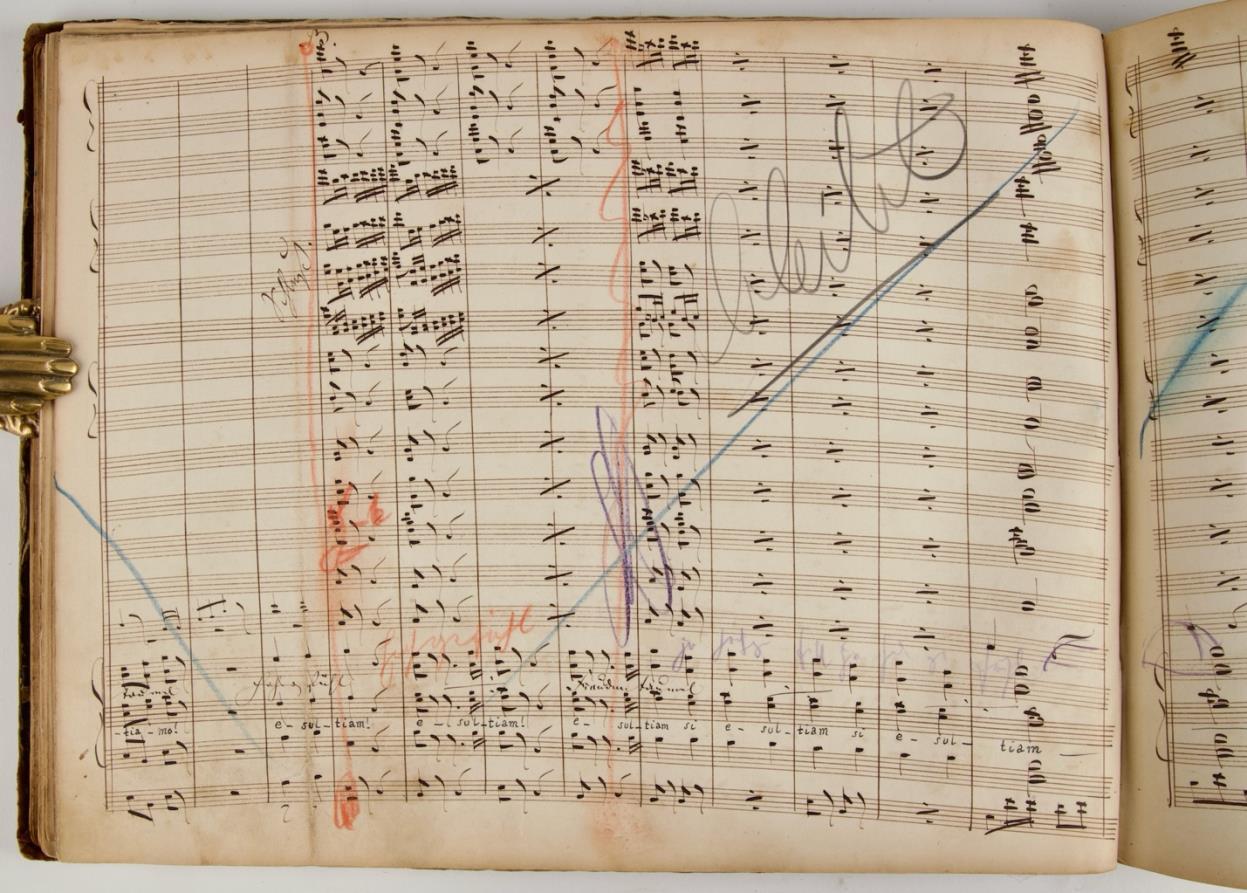
others erased, at times resulting in minor abrasions (as on p. 84, lowermost system); instrument names noted on blank page preceding Act II.
Provenance
Handstamp "Eigendom de Nederlandsche Omroep" [Property of the Dutch Broadcasting Company] to front free endpaper and title; handstamp to upper "Theater Direction O. [?]Pluggen;" handstamp to p. 255 and final page "Hoftheater Direction M. Meinhardt."
Ernani, to a libretto by Francesco Maria Piave after Victor Hugo's play Hernani, was first performed at the Teatro La Fenice in Venice on 9 March 1844. The opera "quickly became immensely popular, and was revived countless times during its early years. The full score was first published by Ricordi in ca. 1892.
“As Verdi himself stated more than once, Ernani represents an important change of direction in his early career. His two earlier successes, Nabucco and I Lombardi, had both been written for La Scala, one of the largest stages in Italy and well suited to the grandiose choral effects of those works. For the more intimate atmosphere of La Fenice, he created an opera that instead concentrated on personal conflict, carefully controlling the complex sequence of actions necessary to bring characters into intense confrontation. This new format brought about a fresh consideration of the fixed forms of Italian opera, in particular an expansion and enrichment of the solo aria and duet, together with a more flexible approach to the musical sequences that bind together lyrical pieces. Most important, however, was Verdi’s gathering sense of a musical drama’s larger rhetoric, his increasing control over the dynamics of entire acts rather than merely of entire numbers. In this respect, the third act of Ernani sets an imposing standard of coherence, one that is rarely equalled until the operas of the early 1850s." Roger Parker in Grove Music Online
Meinhardt is recorded as Hoftheater-Direktor in Altenburg (1854), Görlitz (1856), and Breslau (1872-1873).
Loewenberg notes that the first German performance of Ernani, with German text, took place in Berlin on 16 May 1859.
Of the 11 manuscript copies consulted for the new scholarly edition of Ernani edited by Claudio Gallico (University of Chicago Press, 1983) none are found in libraries in German-speaking countries (see p. xxiii). Chusid records 8 manuscript copies of the full score (p. 63), and notes that just one copy, in the Library of Congress, has text in both German and Italian.
The present manuscript, with its German text and numerous performance markings including an intriguing alternate cadenza to Act 1, Scene III, documents the work's performance on the German stage. (40340)
$2,000
Copyist Manuscript Full Score of Il Trovatore Apparently Pre-Dating the Published Edition
66. VERDI, Giuseppe 1813-1901 Il Trovatore. [Copyist manuscript full score]. Italy, ca. 1865-1875.
Upright quarto (226 x 291 mm). Four unbound groups of signatures. Sewn. Notated on 20-stave rastrum-ruled paper.
Atto Primo Il Duello: [i] (title), 128 pp.
Atto Secondo La Gitana: [i] (title), 178 pp.
Atto Terzo Il Figlio della Zingara: [i] (title), 108 pp.
Atto Quarto Il Supplizio: [i] (title), 153 pp.
With "Partitura dell'Originale" in manuscript to upper outer corner of each act. Occasional annotations in gray, blue, and red pencil adding instrument names or bracketing systems together. "Rappresentata per la prima volta in Roma nel 1853" in pencil to lower outer corner of first act; "9" in ink to upper outer corner of p. 126 of final act. Slightly worn; occasional small stains, feathering of ink, and minor soiling, mainly to first and last pages and several blank margins; final signature of fourth act loose and soiled; repair to blank inner margin of p. 142 of final act; small tears and loss to inner margin and lower outer corner of final leaf resulting in partial loss to one measure of music; lacking last four bars of final act.
The present manuscript would appear to pre-date the publication of the full score issued in ca. 1888
First performed in Rome at the Teatro Apollo on 19 January 1853 to a libretto by Salvadore Cammarano (with additions by Leone Emanuele Bardare) after Antonio García Gutiérrez’s play El trovador, and in a revised version as Le trouvère in Paris at the Opéra on 12 January 1857.
"Il trovatore, though without doubt one of the two or three most popular Verdi operas, has until recently fared rather badly with critics and commentators, mostly because of its unabashedly formalistic exterior in comparison with the works on either side of it, Rigoletto and La traviata. This attitude at last shows signs of changing, perhaps as our criteria for judging Verdi’s musical dramas alter with time. Indeed, many of the most important stages in the critical rehabilitation of this opera have concentrated attention on just those aspects that were earlier castigated. The libretto, for example, with its immovable character types and ‘unrealistic’ stage action, has recently been seen as one of the work’s great strengths, its economy of dramatic means and immediacy of language forming the perfect basis on which to build Verdian musical drama. Similarly, the extreme formalism of the musical language has been seen as serving to concentrate and define the various stages of the drama, above all channelling them into those key confrontations that mark its inexorable progress.
But if one trait can be singled out that best accounts for the opera’s success, it is probably the sheer musical energy apparent in all the numbers. Time and again we find a relentless rhythmic propulsion in the accompaniment, and a tendency for the melodic lines to be forced into a restrictive compass, freeing themselves rarely but with consequent explosive power. This internal energy often runs through entire numbers, making a sense of progress across the various formal stages – from arioso to cantabile to cabaletta – that is just as convincing as the more radical, ‘external’ experiments with form encountered in the surrounding operas." Roger Parker in Grove Music Online
The autograph full score is held in the Ricordi archives in Milan. Chusid records manuscript full scores at the Austrian National Library, the British Library, the Civico Museo Bibliografico Musicale G.B. Martini in Bologna, and at the Conservatorio di Musica Giuseppe Verdi Biblioteca in Milan.
The order of instruments as they appear on the first page of the score conforms to Verdi's autograph score with regard to the string section: the violins and violas are placed at the top, while the cellos and basses appear on the lowermost staves. In contrast, Ricordi's house convention at the time of the first printed score of "Il Trovatore" was to place all strings together at the bottom of each page. This, and the annotation to each act, "Partitura dell'Originale," suggests that this manuscript was possibly copied directly from Verdi's autograph. (40339) $2,200
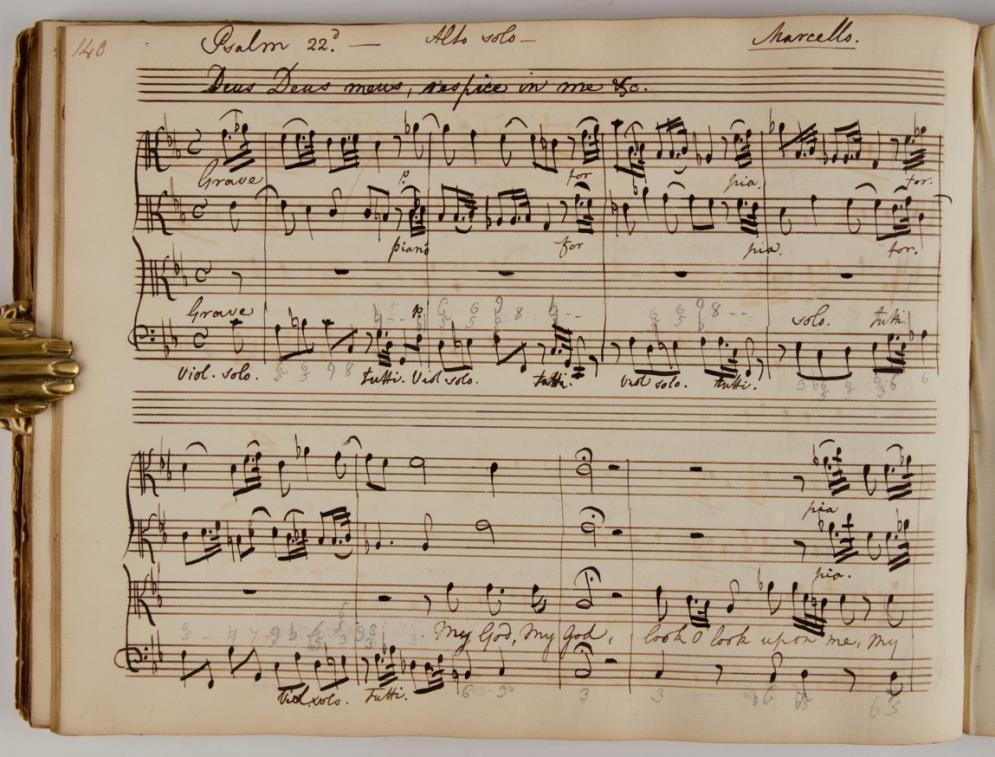
Late 18th Century Vocal Manuscript from the Collection of Lady Cornewall
67. [VOCAL MUSIC - 18th Century - English - Manuscript]
Collection of 20 vocal solos, duets, and trios with continuo and instrumentation. [Copyist manuscript]. England, 1792 or earlier.
Oblong folio (227 x 293 mm). Disbound. [i] (manuscript index tipped-in), 233 pp. (including three blanks). Notated on 10-stave rastrum-ruled paper with watermark of a shield with "GR" below. All pieces in a single hand, with the exception of items 11 and 20, in two different hands. With "Lady Cornewall" in contemporary manuscript to upper margin of index; "1792" to upper outer corner and "554" to upper inner corner of first page. Occasional pencil annotations, including figured bass; half a measure canceled on p. 185. Disbound; first signature detached. Occasional small tears to edges; several minor inkstains to pp. 56-57; pp. 124-125 excised, likely due to a scribal error, with no loss of music; contemporary repairs to upper outer margin of p. 7; final leaf detached; remnants of red sealing wax to corners of index.
Contains the following works:
1 Clari, Giovanni Carlo Maria (1677-1754), adapted by Charles Avison (1709-1770). Unto the Lord [Duet]. 16 pp.
2. Clari/Avison. O all ye Nations. [Duet]. 10 pp.
3. Carissimi, Giacomo (1605-1674). Hodie Simon Petrus. [Duet]. 5 pp.
4 Carissimi. O nomen Jesu [Duet] 4 pp. Attributed to Giovanni Battista Bassani in RISM ID: 800226688.
5 Steffani, Agostino (1654-1728). Saldi marmi [Duet] 19 pp.
6. Steffani. Dolce è per voi. [Duet]. 9 pp.
7. Clari. L'Amante disperato [O femina mendace]. [Duet]. 16 pp.
8 Steffani. M'hai da piangere [Duet] 11 pp.
9 Steffani. Dolce labbro [Duet] 9 pp.
10. Purcell, Henry (1659-1695). In Guilty Night [Trio]. 9 pp.
11 Anon. O sanctissima [Duet] 1 p. Not in index.
12. Handel, George Frederic (1685-1659). T'amo sì [Duet]. [Full score]. 12 pp.
13 Kent, James (1700-1776). Hear my prayer [Anthem for two solo voices and four-part choir] 10 pp.
14. Marcello, Benedetto (1686-1739). My God, my God. [Solo]. [Full score]. 16 pp.
15. Marcello. Da voi parto. [Solo cantata]. 10 pp.
16. Astorga, Emanuele. Ruscelletto che vai [Solo cantata]. 10 pp.
17 Clari. Ecco Amor ecco Amore [Trio] 21 pp.
18 Astorga. Oh che voi direste bene [Duet] 14 pp.
19. Caldara, Antonio (1671-1736). Voi vene pentirete. [Duet]. 4 pp
20. Kent. When the son of Man shall come. [Anthem for three voices]. 15 pp. Incomplete.
It is notable that all of the music in the present manuscript is drawn from repertoire significantly older than the manuscript's date of 1792, in some cases over 100 years earlier, the performance of music of the past being a relatively novel concept at the time.
The Academy of Ancient Music was "founded as the Academy of Vocal Music in 1726 to revive the glories of 16th- and 17th-century sacred music and madrigals. Again, though, it was the music itself rather than profit that provided the inspiration, the founders a mix of leading professionals and aristocratic enthusiasts; and again the society was formalized and admitted larger audiences as the century progressed – although these changes brought their own problems, with an increasing partiality for later Baroque music (including Handel’s oratorios), and a gradual decline in missionary zeal for the older repertory." Simon McVeigh in Oxford Music Online
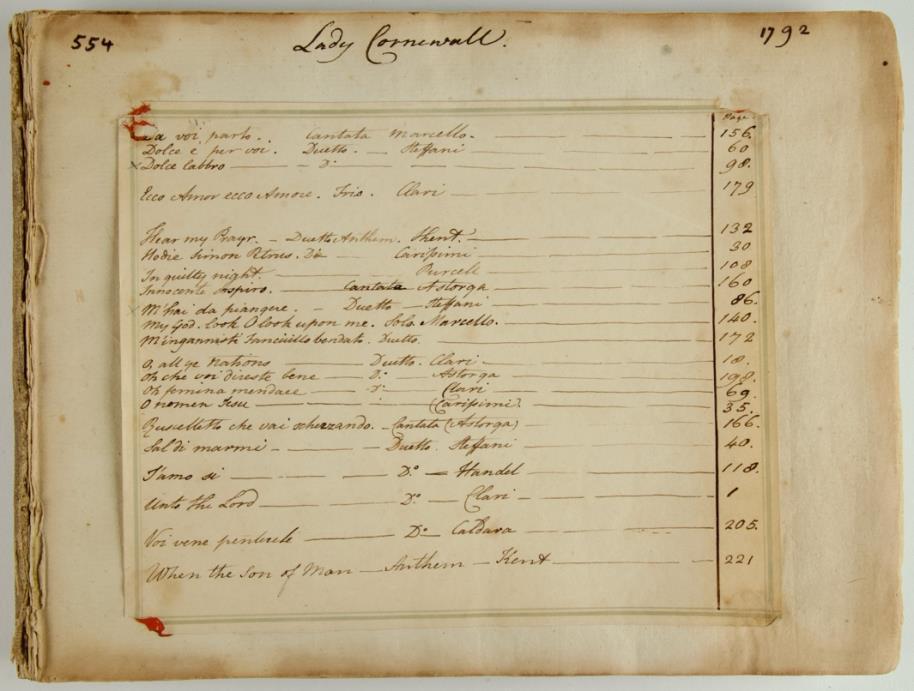
"Lady Cornewall" was most likely Catherine Cornewall (1752-1835), wife of Sir George Amyand Cornewall (1748-1819), a portrait of whom by Sir Joshua Reynolds (1723-1792) is held at the National Gallery of Art in Washington, D.C. Themanuscriptindexis possiblyinherhand. "Rather different in character was the collection made by the Cornewall family of Moccas Court, Herefordshire, which has almost entirely vanished. Fortunately a detailed and most interesting manuscript catalogue, dated 1796 and now owned by Albi Rosenthal, has survived. This was predominantly a vocal collection, amounting to about 2000 items, with some Italian bias, but besides Alessandro Scarlatti and Jomelli it extended to Gluck. A special section of the catalogue, dated 1795, contained music belonging to a Miss Cornewall, who also owned R.C.M. MSS. 2061-4." A. Hyatt King: Some British Collectors of Music, p. 17. (40330) $850
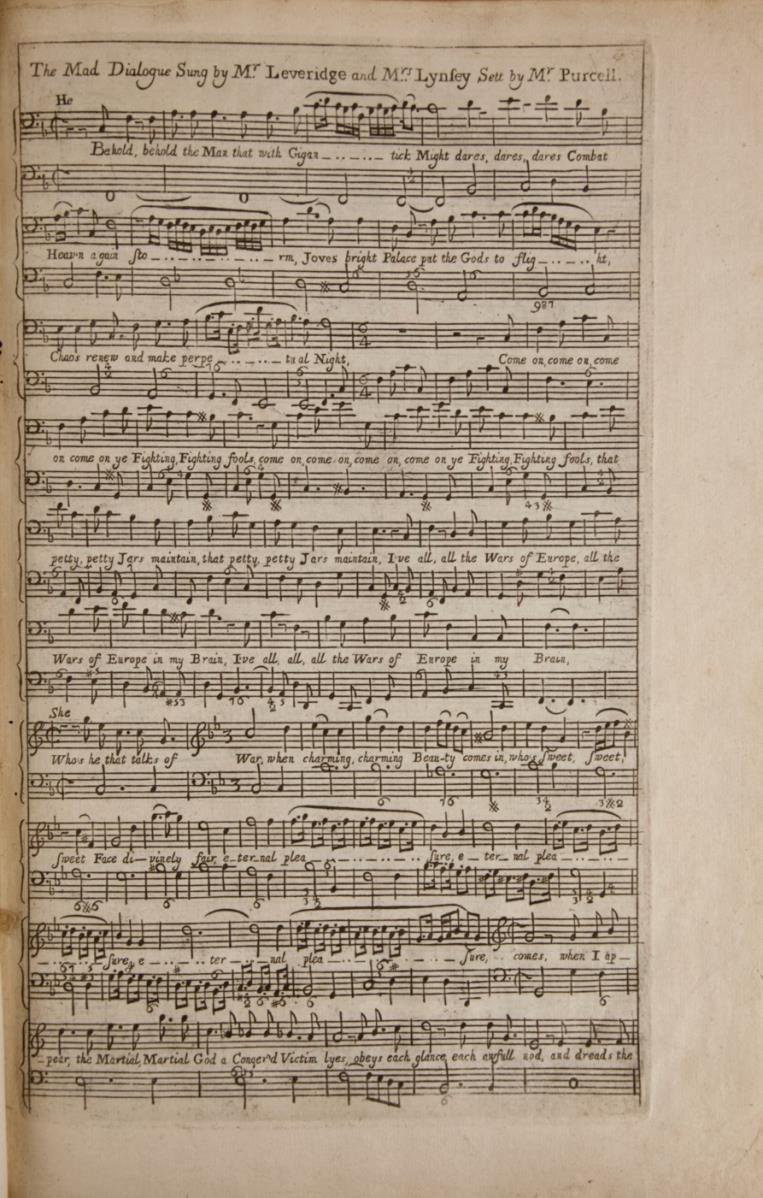
English Songs Published Ca. 1700-1735
68 [VOCAL MUSIC - 18th Century - English]
Collection of rare early 18th century songs published in London ca. 1700-1735.
Folio. Contemporary dark brown leather-backed blue/gray boards. Titled "A collection of Songs by several eminent Masters" in contemporary manuscript on recto of first page of music. Engraved throughout.
Provenance
With "Lucy Gregory July the 6th 1756" and "Prince Gregory" in contemporary manuscript to front pastedown. Manuscript titling and annotation "Ex dono Revd. Dr. Dawson For use of Musical Society, Windsor Castle to be returned to Dr. Dawson When ye club ceases viz when it is reduced to three persons" to blank recto of first song along with title, and index to blank verso of final song.
Contains 33 songs including works by Barrett, Blow, Eccles, Galliard, Handel (8), Leveridge, Orlandini, Pepusch, DanielPurcell, HenryPurcell (2), Weldon, and others. Scored mainly for voice (most for one voice and few for two) and figured basso continuo, with single-line flute arrangements for some songs.
1. Handel. A Favorite song in the Opera of Theseus [See, see your faithfull lover pineing]. London, ca. 1720. [i] (blank), 2, [i] (blank) pp. BUC p. 1001. George Frideric Handel (1685-1759), English composer of German birth, was "one of the greatest composers of his age." Anthony Hicks in Grove Music Online
2. Purcell, H. Sing all ye muses. A song set by Mr. Henr. Purcell The Words by Mr Durfey. London, ca. 1700. From Part I of The Comical History of Don Quixote. 4 pp. BUC p. 861 (another edition). Scored for two voices and figured basso continuo.
3. Handel. Mi brilla in English and Italian" [Be Kind and Love / Mi brilla nel seno]. London, ca. 1720. [i] (blank), 2, [i] (blank) pp. [HWV 10, Silla]. BUC p. 93.
4. Purcell, H. The Mad Dialogue Sung by Mr. Leveridge and Mrs. Lynsey [Behold the man with gigantick might]. From The Richmond Heiress. London, ca. 1700. 3, [i] (blank) pp. BUC p. 862. Henry Purcell (1659-1695), composer and organist, was "one of the most important 17th century composers and one of the greatest of all English composers." Peter Holman and Robert Thompson in Grove Music Online
5. Handel. Vieni torna in English & Italian [Turn o turn thee dearest Creature / Vieni torna Idolo mio]. London, ca. 1715. [i] (blank), 2, [i] (blank) pp. [HWV 9, Teseo]. BUC p. 1041.
6. Handel. A Favourite Song by an Eminent Master Within the Compass of the Flute [Recitativo: Lo here my Love / Aria: Love in her eyes sits playing]. London, ca. 1725. [i] (blank), 2, [i] (blank) pp. BUC p. 624.
7. Handel. A Song with a Symphony for an Octave Flute & Violins [Recitativo: Ye verdant Plains / Aria: Hush ye pretty warbling Quire]. London, ca. 1722. [i], 3 (paginated 4-6), [i] (blank) pp. [HWV 49, Acis and Galatea]. BUC p. 432 (date incorrect); JISC (two copies, at Oxford and the British Library). In score, for piccolo, violin, voice, and unfigured basso continuo.
8. Handel. A song by an Eminent Master [Would you gain the tender Creature]. London, ca. 1750. [HWV 49, Acis and Galatea]. BUC pp. 432, [?]1091.
9. Eccles. Air in the Opera Semele. The words by Mr Congreve [Come Zephrys]. London, ca. 1730. [i] (blank), 2, [i] (blank) pp. BUC p. 309. John Eccles (ca. 1668-1735) was an English composer. "Eccles's greatest talent is revealed in his many songs. Remarkable for their beautifully contoured melodies and impeccable prosody, they quickly capture the mood and subtleties of the poetry and are eminently singable. His large works are notable for their dramatic pacing and their carefully planned tonal architecture. In the latter respect he surpassed even Purcell, and was far in advance of his day. Eccles brought the Restoration tradition to its close.
After Purcell’s death in 1695 he was undoubtedly the greatest of the Restoration theatre composers." Stoddard Lincoln in Grove Music Online
10. Orlandini. A favourite Song in the Opera of Arsaces Sung by Sigr. Senesino [Se sol la mia morte / Cœlestial Corinna]. London, ca. 1721. [i] (blank), 2, [i] (blank) pp. BUC p. 56. "Lucy Gregory" in contemporary manuscript to upper outer corner of final blank page. Giuseppe Maria Orlandini (1676-1760) was an Italian composer. "The large number and wide spread of performances of his operas confirm the opinions of Burney, La Borde, Martini and Quadrio that Orlandini was highly celebrated as a composer of dramatic music. He was best known for his comic intermezzos, in which genre his importance almost certainly outweighs that of Pergolesi. Indeed, Orlandini’s Bacocco e Serpilla (under various titles and with added music by various composers) appears to have been the most frequently performed piece of musical drama in the entire 18th century." John Walter Hill and Francesco Giuntini in Grove Music Online
11. Anon. The Ladys Repulse or Favourite Minuet in Hercules [a pasticcio]. London, ca. 1715. 2 pp. BUC p. 478.
12. Barrett. A Song sett by Mr. Iohn Barrett Sung by Mrs. Lindsey [Mistake not Nymph]. London, ca. 1705. 1f. (recto music, verso blank) pp. BUC p. 86. John Barrett (ca. 1674-ca. 1745) was an English composer and organist, pupil of John Blow. "Like many of his contemporaries, such as Jeremiah Clarke, John Eccles and Daniel Purcell, Barrett composed mainly for the theatre, and his many songs, mostly of the double-barrelled art song variety, are both tuneful and attractive." Christopher Powell, revised by H. Diack Johnstone in Grove Music Online
13. Barrett. Liberia A Song Set to Musick [Liberia's all my Thought]. London, ca. 1715. 1f. (recto music, verso blank) pp. BUC p. 86.
14. Purcell, D. Lovely Charmer. A song in the Island Princess. London, ca. 1700. 1f. (recto music, verso blank) pp. BUC, p. 856. Daniel Purcell (ca. 1664-1717), brother (orcousin) of Henry Purcell, was an English composer and organist. "Although he was a victim of invidious comparison with Henry, Daniel was a talented composer whose style, while perhaps too ornate, is never dull or incompetent." Mark Humphreys, revised by Robert Thompson in Grove Music Online
15. Leveridge. A Favorite Song in the new Opera The words by Mr. Leveridge. London, ca. 1720. 1f. (recto music, versoblank) pp. BUC p. 339. RichardLeveridge(1670-1758), Englishbassandcomposer, was "a leading singer on the London stage and a popular composer of songs." Olive Baldwin, revised by Thelma Wilson in Grove Music Online
16. Anon. Tom a Bedlam [Forth from my dark and Dismall cell]. London, ca. 1720. 1f. (recto music, verso blank) pp. BUC p. 345.
17. Leveridge. A Scotch Song Sung by Mr. Leveridge the words by Mr Durfey [Farewell my Bonny]. London, ca. 1710. 1f. (recto music paginated "10," verso blank) pp. BUC p. 325.
18. Blow. Go Perjur'd Man. A Song, for two Voices. London, ca. 1710. 1f. (recto music, verso blank) pp. BUC p. 115. John Blow (1649-1708) was an English composer, organist, and teacher. "By his mid-20s he had become the foremost musician in England, and in later years he was the elder statesman of the Restoration school, whose chief luminary was Henry Purcell." Bruce Wood in Grove Music Online
19. Anon. A song by a Gentleman [How charming]. London, ca. 1730. 1f. (recto music, verso blank) pp. BUC p. 370.
20. Weldon. Orpheus Song to the Waves Sett by Mr. Iohn Weldon Sung by Mrs. Linsey. [Stop, O ye Waves]. London, ca. 1710. 1f. (recto song, verso version for flute) pp. BUC p. 1065. John Weldon (1676-1736), an
English organist and composer "of considerable talent," was a pupil of Henry Purcell. Margaret Laurie, revised by Stephen Bullamore in Grove Music Online
21. Anon. A Song by a Great Master [Beauteous Idol, charming Creature]. London, ca. 1720. 1f. (recto music, verso blank) pp. BUC p. 93.
22. Turner. A Song On Mira's Singing and Beauty [Singing charms The Bless'd above]. London, ca. 1710. 1f. (recto music, verso blank) pp. BUC p. 1024.
23. M. F. A song in the Italian style by F M [Ah, Crudel prenesto]. London, ca. 1720. 1f. (recto music, verso blank) pp. BUC p. 638. A humorous song satirizing Italian opera with text in nonsense-Italian.
24. Galliard. Sung by Mr. Pack in The Opera of Circe [Fairest if thou can'st be King]. London, ca. 1720. 1f. (recto music, verso blank) pp. BUC p. 358. John Ernest Galliard (ca. 1687-1749), German composer and oboist, "certainly played a significant role in London's musical life in the first half of the 18th century." Roger Fiske, revised by Richard G. King in Grove Music Online
25. Vanbrughe. Apollo to Daphne by Mr. Vanbrughe [My Dearest Daphne]. London, ca. 1735. Not in BUC, but may be from Vanbrughe's collection Mirth & Harmony; see BUC p. 1034.
26. Anon. The Address with The Lady's Answer [Ah lovely Nymph]. London, ca. 1725. 1f. (recto music paginated "7," verso blank) pp. BUC p. 11.
27. Handel. A Song the words by Mr. Kirkland set to a Trumpet Minuet of Mr. Hendell's [Phillis the Lovely]. London, ca. 1725. 1f. (recto music, verso blank) pp. [HWV 349, Watermusic]. BUC p. 781.
28. Young and Leveridge. The Reproach [Send back my long stray'd Eyes] and Mr. Leveridge's Tune. London, ca. 1720. 1f. (recto music, verso blank). BUC p. 1098. The instrumental tune appears to be unrelated to the song; here may, however, be some association as the song incorporates imagery related to the eyes, and the tune's name (not given here) is Black-eyed Susan.
29. Anon. A Song after the Italian Manner by an Eminent Master [Lovely cruel charming fair]. London, ca. 1715. 1f. (recto music, verso blank) pp. BUC p. 632 (another edition).
30. Handel. Di godere in English & Italian by Mr. Hendell [Di godere / Oh my dearest]. London, ca. 1720. 1f. (recto music, verso blank). [HWV 228]. Not in BUC; possibly related to an edition in Foundling Museum. JISC ("This song appeared in two editions in 1719: the first was in The Yearly Subscriptions, a volume of twenty songs, advertised on 5 December, the second in the Monthly Mask of Vocal Music issued on 24 December").
31. Pepusch. A Song in the Mask of Martillo [Tender Hearts to ev'ry Passion]. London, ca. 1716. 1f. (recto music, verso blank) pp. BUC p. 722. Johann Christoph Pepusch (1667-1752), a German-born composer and theorist active in England, is best known for his arrangement of music for The Beggar's Opera to John Gay's libretto; he composed works in all genres, including vocal music.
32. Carey. The Midsummer Wish Taken from the Journal [Waft me some soft and cooling Breeze]. London, ca. 1725. 1f. (recto music, verso blank) pp. BUC p. 165.
33. Leveridge. A Song in the Beau Demolish'd Sung by Mr. Leveridge [Whilst I'm carrouzing]. London, ca. 1730. 1f. (recto music, verso index in contemporary manuscript) pp. BUC p. 615.
Binding worn, rubbed, and bumped; spine partially lacking. Minor dampstaining and worming; occasional small stains. (41185) $3,500
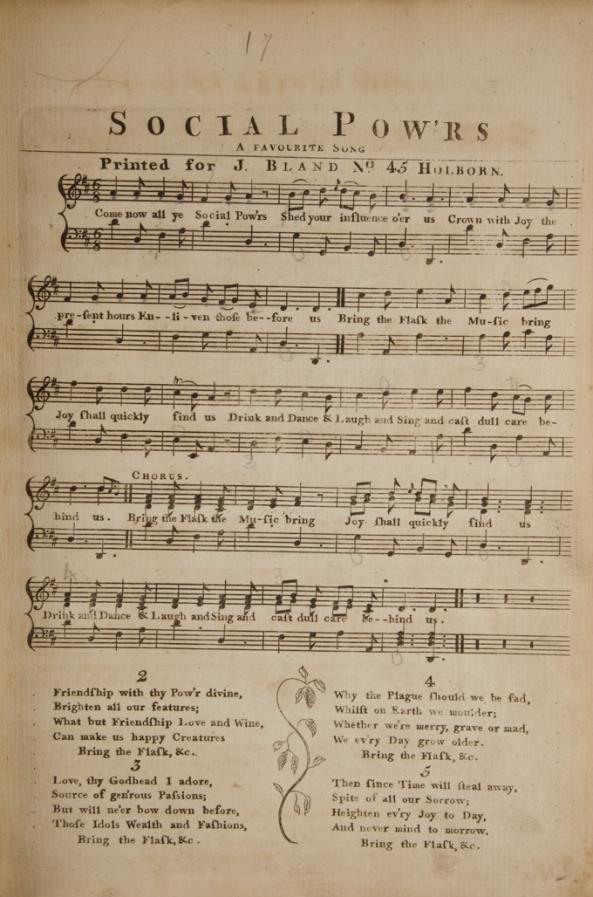
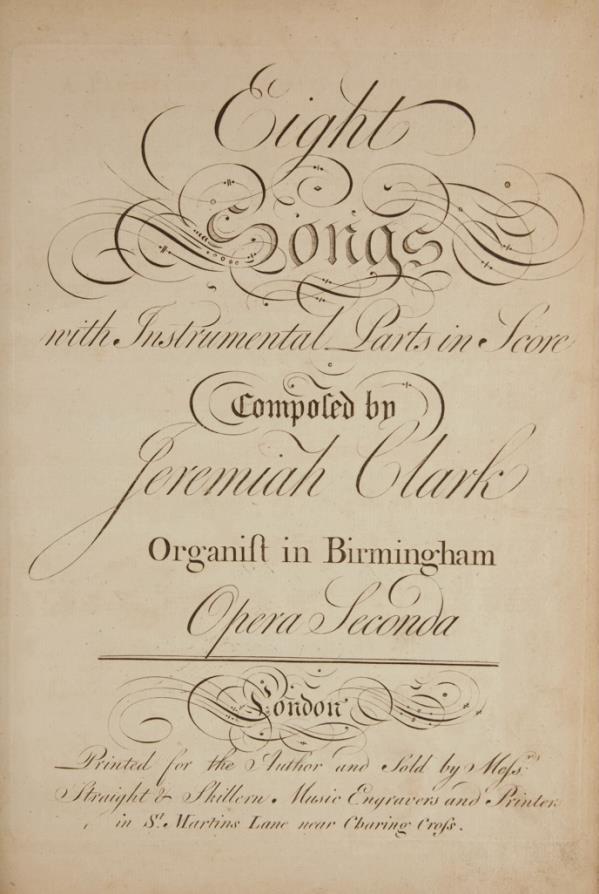
Collection of English Songs Published Ca. 1737-1790
69 [VOCAL MUSIC - 18th Century - English]
Collection of rare 18th century songs published in London ca. 1737-1790.
Folio. 19th half black leather with marbled boards, spine in compartments gilt with titling gilt. Engraved throughout, with the exception of the ninth songsheet, which is typeset.
Provenance
Evan Charles Sutherland-Walker (1835-1914), with his armorial bookplate to front pastedown.
Contains 25 songs including works by Arne, Bride, Dibdin, Clarke, Galliard, Handel, Harington, Hook, Jackson, Leveridge, Selby, Smith, and others. With occasional ornamentation, filling out of chords, and corrections in contemporary manuscript.
1. Clark. The Broom on Cowdenknows, [When Summer comes the Swains on Tweed]. London, ca. 1780. 1f. (recto music, verso blank) pp. BUC p. 1075. Jeremiah Clarke (ca. 1743-1809), English composer, violinist, and organist; his published works, all printed in London, consist of songs and keyboard sonatas with instrumental accompaniment.
2. Dibdin. While the Lads of the Village ... Sung by Mr. Bannister. "J.W." printed to foot of music. London: [?]John Welcker, ca. 1775. 1f. (recto music, verso blank) pp.BUC p. 1078. Charles Dibdin (1745-1814), English composer, dramatist, poet, actor, singer, and entertainer, wrote many songs.
3. Arne. Water Parted from the Sea ... Sung by Mr. Tenducci in Artaxerxes. London, ca. 1765. 1f. (recto music, verso blank) pp. BUC p. 57. Alfred Thomas Augustine Arne (1710-1778), an English composer, violinist, and keyboard player, was "the most significant figure in 18th-century English theatre music." Peter Holman and Todd Gilman in Grove Music Online
4. Jackson. Delia ... Sung by Mr. Squibb at Marybone[!] Gardens. Set to Music by Mr. Wm. Jackson of Exeter. London, ca. 1770. 1f. (recto music, verso blank) pp. BUC p. 552. William Jackson (1730-1803), an English composer and organist, wrote a number of songs, canzonets, etc. "His best music is to be found in his secular vocal works, where he demonstrates an ability to blend a natural melodic style with a sensitivity to text." Richard McGrady in Grove Music Online
5. Galliard. The Early Horn ... A Fav'rite Song in the Royal Chace. Sung by Mr. Beard. Set by Mr. Galliard. London, ca. 1737. 1f. (recto music, verso blank) pp. Paginated 31 at upper outercorner. BUC p. 358. John Ernest Galliard (ca. 1687-1749), German composer and oboist, "certainly played a significant role in London's musical life in the first half of the 18th century." Roger Fiske, revised by Richard G. King in Grove Music Online
6. Smith. Zoreb and Zaida ... Sung by Mr. Morgan. London, ca. 1770. 1f. (recto music, verso blank) pp. JISC (one copy only, at Oxford University.
7. Handel. Let me Wander ... L'Allegro Il Penseroso. London: Printed for J. Bland No. 45 Holborn, ca. 1790. 1f. (recto blank, verso music) pp. HWV 55. BUC p. 433. George Frideric Handel (1685-1759), English composer of German birth, was "one of the greatest composers of his age." Anthony Hicks in Grove Music Online
8. Handel. L'Allegro, il Penseroso ed il Moderato Or Let the Merry Bells. London: Bland, ca. 1790. 1f. (recto music, verso blank) pp. HWV 55. BUC p. 433.
9. Bride. The Joy-Inspiring Horn ... A Favorite Hunting-Song. Set by Mr. Bride. London: [?]R. Falkener, ca. 1775. [i] (blank), 2, [i] (blank) pp. BUC p. 135. Typeset, with an arrangement for two German flutes in score on the second page. Tear extending from lower margin into three systems of music; small loss to lower outer corner of first page of music; imprint trimmed, but possibly the Falkener edition, where the imprint appears at the foot of the second page of music. OCLC 43123680.
10. Handel. Sung by Mr. Beard in Alexander's Feast [Happy, happy pair]. London, [?]ca. 1740. [i] (blank), 2, [i] (blank) pp. HWV 75. Not in BUC.
11. [?]Leveridge. The Roast Beef Cantata. London, ca. 1770. 4 pp. BUC p. 1026. Richard Leveridge (1670-1758), English bass and composer, was "a leading singer on the London stage and a popular composer of songs." Olive Baldwin, revised by Thelma Wilson in Grove Music Online
12. The Camp Medley [The Lark was up the Morn was grey]. London: Longman & Broderip, ca. 1780. BUC, p. 595. 4 pp. With trill markings in contemporary manuscript.
13. The Banks of the Dee A favorite Song [It was summer]. [?]London: [?]Bland, ca. 1780. 1f. (recto music, verso blank) pp. BUC p. 549 (other editions).
14. He Stole my Tender Heart Away ... A Favorite Song [The Fields were green]. London, ca. 1780. 1f. (recto music, verso blank) pp. BUC p. 334.
15. Hook. The Favorite Song Sung by Miss Brown in the Scheming Lieutenant [Beneath a green shade]. London: CST (handstamp Charles and Samuel Thompson), ca. 1775. 1f. (recto music, verso blank) pp. JISC (two copies, at the British Library and the National Library of Scotland). James Hook (1746-1827) was a noted English composerwhose songs were "regularly performed at the main London pleasure gardens." PamelaGairlin Grove Music Online
16. Social Pow'rs ... A Favourite Song [Come now all ye Social Pow'rs]. London: Printed for J. Bland No. 45 Holborn, ca. 1785. 1f. (recto music, verso blank) pp. BUC p. 208.
17. The Invitation Sung at Marybone Gardens by Mrs. Vincent. Mr Lowe. Miss Davis. Mr Raworth. and Mr Taylor. [Come ye party Jangling Swains]. London, ca. 1766. 1f. (recto music, verso blank) pp. BUC p. 209.
18. Selby. The Chace of the Hare ... A New Hunting Song. 1f. (recto music, verso blank) pp. BUC p. 940. Minor loss to flute line.
19. Fair Hebe. Sung by Mr. Beard at Ranelagh Gardens [Hebe I left with a cautious Design]. London, ca. 1750. 1f. (recto music, verso blank) pp. BUC p. 324. With "Fair Hebe" in contemporary manuscript to blank verso.
20. Harington. Air by Mr. Harington of Bath [Gentle Airs sweet Joys impart]. London, ca. 1780. 1f. (recto music, verso blank) pp. BUC p. 446. Henry Harington (1727-1816), English composer, physician, and author, was a leading contemporary composer of glees, catches, and duets.
21. Arne. The favourite Hymn of Eve. In the Oratorio of Abel [How Chearful along the gay Mead]. London, ca. 1755. 1f. (recto music, verso blank) pp. JISC (one copy only, at Oxford University).
22. The Cotillon [Hail Politeness pow'r divine]. London: Rd. B__e, ca. 1770. 1f. (recto music, verso blank) pp. BUC p. 416.
23. Arne. The Echoing Horn in Thomas & Sally. London: Printed and sold by S. Phillips in St. Martins Court, ca. 1765. 1f. (recto music, verso blank) pp. BUC p. 45.
24. Arne. Hebe ... Set by Dr. Arne [When forc'd from dear Hebe]. London: Walsh, 1752. 1f. (recto music, verso blank) pp. BUC p. 47
25. Anna A Particular Favourite Irish Song. Sung by Miss Catley - and - Mr. Leoni. [Shepherds I have lost my Love]. London: I. F.[entum], ca. 1775. 1f. (recto music, verso blank) pp. BUC p. 943.
Bound with:
Clark. Eight Songs with Instrumental Parts in Score Composed by Jeremiah Clark Organist in Birmingham Opera Seconda. London: Printed for the Author and Sold by Messrs. Straight & Skillern Music Engravers and Printers in St. Martins Lane near Charing Cross, ca. 1775. 1f. (recto title, verso blank), 34 pp. Engraved throughout. BUC p. 94. RISM C2618 and CC2618 (two copies in the U.S., at Cornell University and the Library of Congress).
Index in pencil to front free endpaper.
Binding worn, rubbed, and bumped. Slightly worn; occasional minor imperfections, including small tears, soiling, and stains. (41155)
$1,850
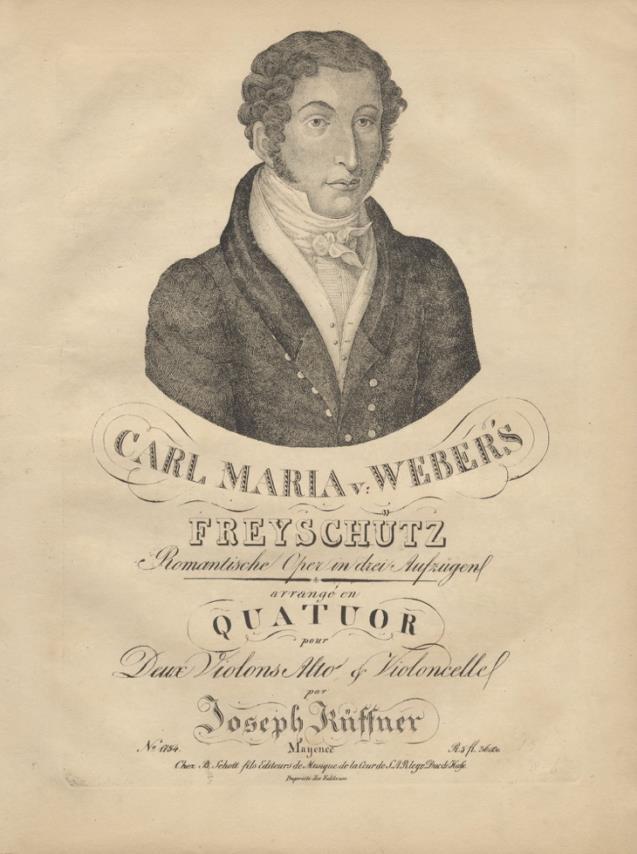
70. WEBER, Carl Maria von 1786-1826
Freyschütz Romantische Oper in drei Aufzügen arrangé en Quatuor pour Deux Violons Alto & Violoncelle par Joseph Küffner ... Pr. 5 fl. 36 Xr. [Set of parts].
Mayence: Chez B. Schott fils Editeurs de Musique de la Cour de S. A. R. le grl Duc de Hesse [PNs 1754-1755], [ca. 1823].
Folio. Disbound. Title-page lithographed, with a fine bust-length portrait of Weber; music engraved. Excerpts from Weber's opera arranged for string quartet by Joseph Küffner.
Violino primo: [i] (title), 2-23, [i] (blank) pp.
Violino secondo: [i] (blank), 2-22 pp.
Viola: 2-19, [i] (blank) pp.
Violoncello: [i] (blank), 2-19, [i] (blank) pp.
Occasional minor soiling, foxing, and small stains.
Jähns p. 305. OCLC 1513693817, 778430768.
"With the overwhelming success of his opera Der Freischütz in 1821 [Weber] became the leading exponent of German opera in the 1820s and an international celebrity. A seminal figure of the 19th century, he influenced composers as diverse as Marschner, Mendelssohn, Wagner, Meyerbeer, Berlioz, and Liszt." Michael C. Tusa in Grove Music Online (41128) $250