CONDITIONS OF SALE
All items are in good antiquarian condition unless otherwise noted and are offered subject to prior sale, with prices net and subject to change without notice. The costs of shipping and insurance are additional Orders are customarily shipped via USPS Priority Mail or Federal Express. Sales tax will be added to the invoices of NewYork State residents.
Orders may be placed by e-mail (info@lubranomusic.com), telephone (516-922-2192), or on our secure website (www.lubranomusic.com) by entering the ID number of the desired item in the SEARCH box at the upper right of our homepage.We ask that you kindly wait to receive ourinvoice to ensure availability before remitting payment. Libraries may receive deferred billing upon request.
We accept payment by:
-ACH (Automated Clearing House), inclusive of all bank charges
- EFT (Electronic Funds Transfer), inclusive of all bank charges
- PayPal to info@lubranomusic.com
- Checks in U.S. dollars drawn on a U.S. bank
- International money order
- Credit card
We fully guarantee that all items offered for sale by J & J LubranoMusicAntiquarians LLC are absolutely authentic without time limitation to the original purchaser provided that said items conform exactly to our description as supplied at time of purchase.All items remain the property of J & J Lubrano MusicAntiquarians LLC until paid for in full.
Please visit our website at www.lubranomusic.com
where you will find full descriptions and illustrations of our catalogued inventory
Members
Antiquarian Booksellers’Association ofAmerica
International League ofAntiquarian Booksellers
ProfessionalAutograph Dealers’Association
Music LibraryAssociation
American Musicological Society
Dance StudiesAssociation &c.
Cataloguers
John Lubrano, Jude Lubrano, Benjamin Katz
© J & J Lubrano MusicAntiquarians LLC May 2026
“The Most Important English Concerto Composer of the 18th Century”
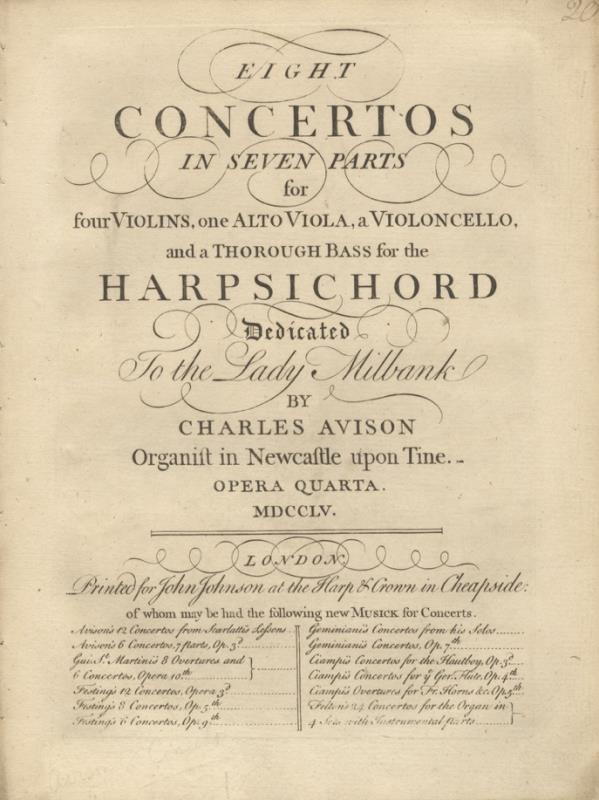
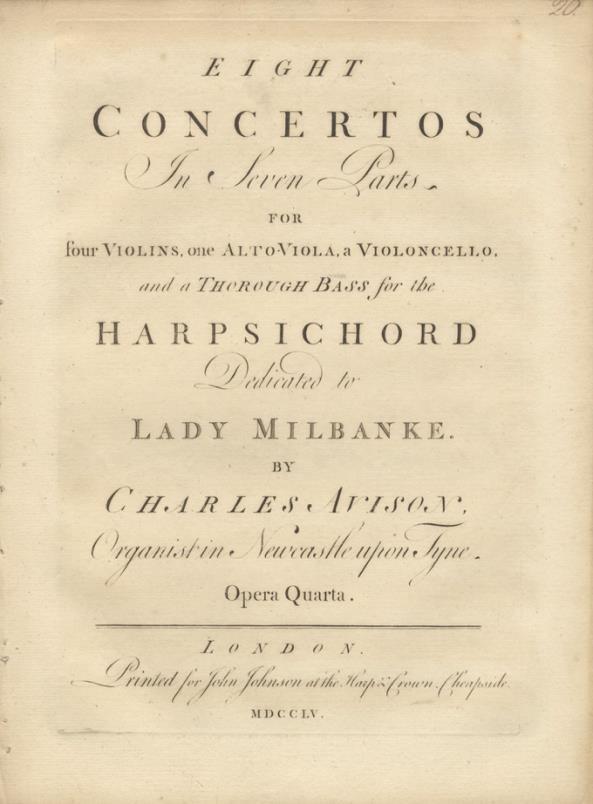
1. AVISON, Charles 1709-1770
Eight Concertos In Seven Parts for four Violins, one Alto Viola, a Violoncello, and a Thorough Bass for the Harpsichord Dedicated to Lady Milbanke ... Opera Quarta. [Set of parts]. London: Printed for John Johnson at the Harp & Crown, Cheapside, 1755.
Folio. Disbound. Engraved throughout.
Violino secondo concertino: 1f. (recto title, verso blank), [i] (blank), 2-21, [i] (blank) pp. Violino primo ripieno: 1f. (recto title, verso blank), [i] (blank), 2-21, [i] (blank) pp. Violino secondo ripieno: 1f. (recto title, verso blank), [i] (blank), 2-17, [i] (blank) pp. Alto viola: 1f. (recto title, verso blank), [i] (blank), 2-16, [i] (blank) pp. Violoncello: 1f. (recto title, verso blank), [i] (blank), 2-4, [i] (blank), 6-23, [i] (blank) pp. Basso ripieno: 1f. (recto title, verso blank), [i] (blank), 2-17, [i] (blank) pp.
Numbering in contemporary manuscript to upper outer corners of titles.
A mixed set, with the Violino secondo concertino, Alto viola, Violoncello, and Basso ripieno parts from another issue, also of 1755, with alternate titles, e.g. dedicated "to the Lady Milbank" and "Tine" instead of "Tyne," and with brief publisher's catalogue to foot of title including works by Avison, St. Martini, Festing, Geminiani, Ciampi, and Felton. Slightly worn; light uniform browning; small binder's holes to blank inner margin; occasional small stains, minor soiling, and foxing, mainly toblank lowermargins and outer edges; severalleaves detached; lower portion of final leaf of Basso ripieno part heavily soiled, affecting blank ruled staff on recto and blank verso. Lacking Violino primo concertino part.
First Edition. BUC p. 68. RISM A2917 and AA2917 (neither distinguishing between issues; weare thus unable to determine precedence).
Avison, an English composer, conductor, writer on music and organist, "was the most important English concerto composer of the 18th century and an original and influential writer on music. ... In general, Avison's concertos are modelled on Geminiani’s; stylistically there is little difference between the early works and the late ones. If somewhat lightweight in texture and content, Avison's concertos are unusually tuneful; he was a firm believer in the value of ‘air’ or melody. His op. 4 no.4 was very popular in the Concert of Antient Music, where it was much played between 1785 and 1812 along with concertos by Corelli, Geminiani, Sammartini and Handel." Norris L. Stephens in Grove Music Online (40776)
The Ladies Collection
2. BLAND, John, comp. ca. 1750-ca. 1840
The Ladies Collection, or Catches, Glees, Canons, Canzonets, Madrigals, &c. Selected from the Works, of the Most Eminent Composers ... No. [4] ... Pr. [2]S [0]D. N.B. These Numbers, will be Continued, at least, Four in a Year. [London]: Sold by Lewis, Houston & Hyde ... No. 45 Holborn ... Where may be had No. 1 & 2 of the Gentlemans Collection which will be Continued Occasionally, [ca. 1790].
$700
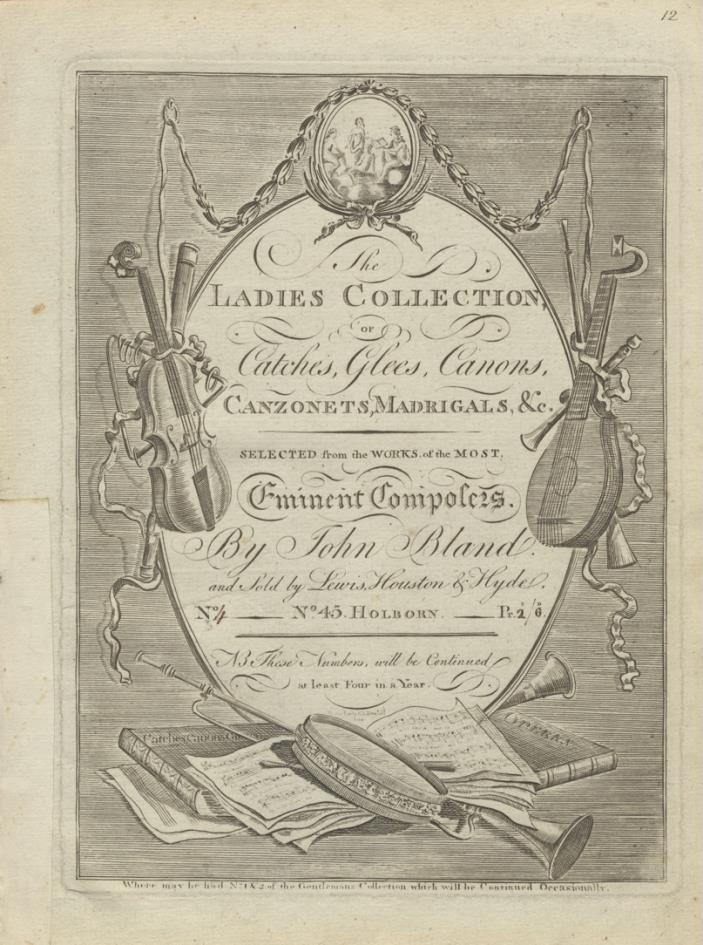
Folio. Disbound. [i] (fine engraved title within decorativeborder), 32-41, [i]("IndextoBlands 2 Vols. of Catches, Glees, Canons, Canzonets, Madrigals &c. &c.") pp. The attractive border to title incorporates a violin, pandora, bassoon, trumpet, musicsheetswithvocalmusicnotated thereon, two music books with titles "Catches, Canons ..." and "Operas," and Greco-Roman figures singing in an Arcadian landscape at head Named composers include Arne, Atterbury, Byrd, Cranford, Gibbons, Hayes, Ives, Langdon, Morley, Purcell, and Rogers. Minor annotations in pencil indicating voice parts and the modification of a few notes; figured bass added in contemporary manuscript to two pieces, "Now is the Month of Maying" (Morley) and "The silver swan" (Gibbons). Very slightly worn; occasional minor foxing; narrow strip of contemporary paper to portion of blank inner margin of title.
“The Chief Representative of Latin Instrumental Music During the Viennese Classical Period”
3. BOCCHERINI, Luigi 1743-1805
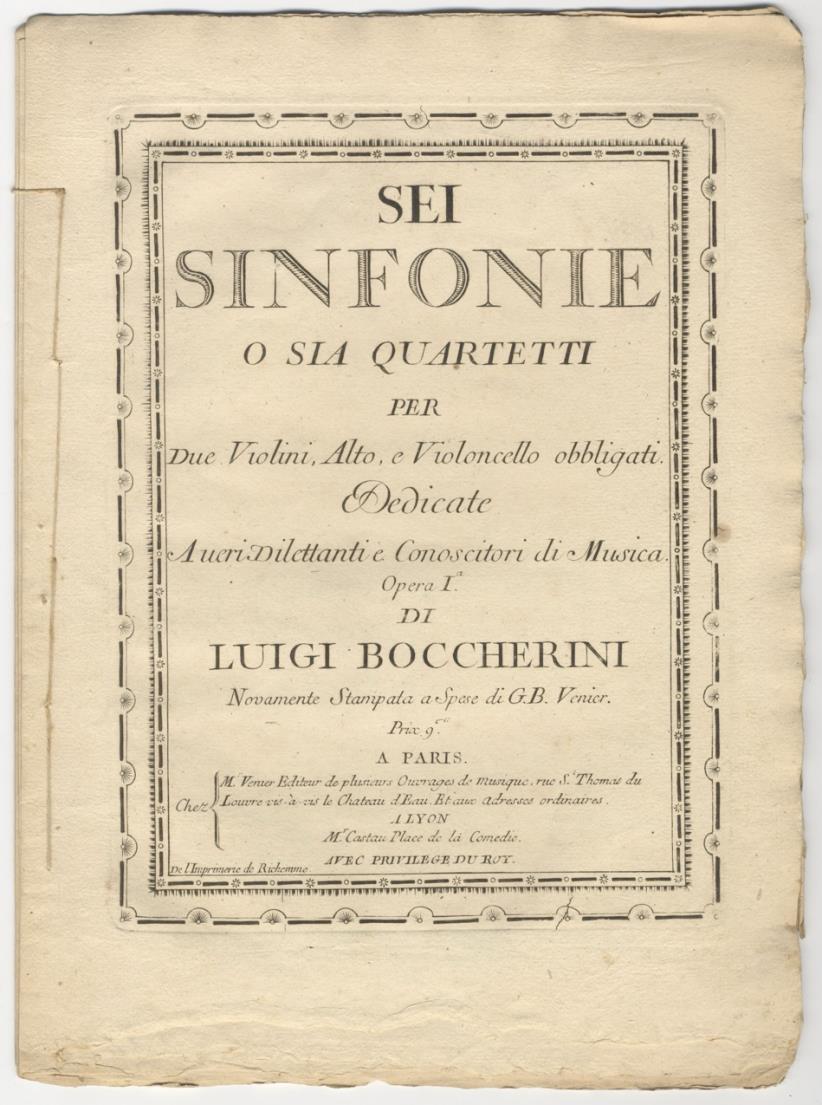
Sei Sinfonie o sia Quartetti Per Due Violini, Alto, e Violoncello obbligati Dedicate A veri Dilettanti e Conoscitori di Musica Opera Ia[!] ... Novamente Stampata a Spese di G.B. Venier. Prix. 9₶. [Op. 2, Nos. 1-6]. [Set of parts]. Paris: Chez Mr. Venier Editeur de plusieurs Ouvrages de Musique, rue St. Thomas du Louvre vis-à-vis le Chateau d'Eau. Et aux Adresses ordinaires. A Lyon, Mr. Castau Place de la Comedie. Avec Privilege du Roy. De l'Imprimerie de Richemme, [April 1767].
Folio. Sewn. Engraved throughout. Titles within fine decorative double border. Uncut. With small engraved contemporary bookseller's label within decorative border with small fleur-de-lis to upper corners to blank verso of title of first violin part: "A Lyon Chez Serriere Rue Syrene Vis a Vis la Rue Mulet ou l'on Trouve un Grand Mazagin de Musique Moderne." A few minor stains; bookseller's label slightly trimmed. A clear, bright impression; in exceptionally good condition.
Violino primo: 1f. (recto title, verso blank), [i] ("Catalogue de Musique Instrumentale que Mr. Venier a fait Graver depuis peu et qu'il continue journellement, A Paris Rue St. Thomas du Louvre vis-à-vis le Chateau d'Eau"), 2-13, [i] (blank) pp.
Violino secondo: 1f. (recto title, verso blank), [i] (blank), 2-13, [i] (blank) pp.
Violetta: [i] (title), 2-12 pp.
Basso: 1f. (recto title, verso blank), [i] (blank), 2-13, [i] (blank) pp.
First Edition. Gerard 159-164, pp. 173-182. Lesure p. 56. RISM B3113. Although stated as "Opera 1a" on title, the present work is, in fact, Boccherini's opus 2.
"A prolific composer, particularly of chamber music, with a distinctive and highly wrought style, [Boccherini] is the chief representative of Latin instrumental music during the Viennese Classical period." Christian Speck and Stanley Sadie in Grove Music Online
A finely-printed collection. (41020)
4. BOCCHERINI, Luigi 1743-1805
$1,200
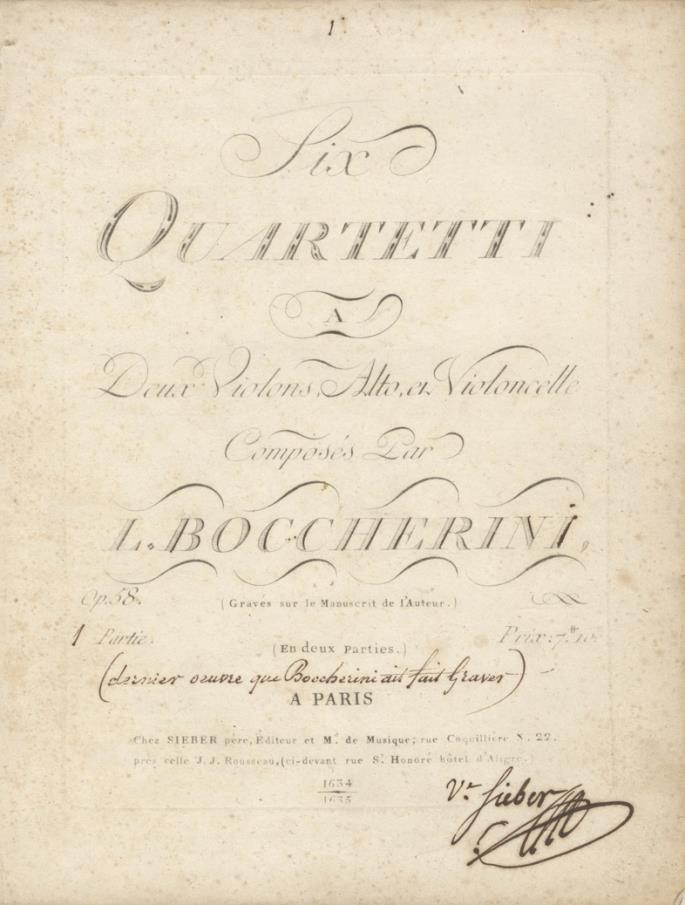
Six Quartetti a Deux Violons, Alto, et Violoncelle ... Op. 58 (Gravés sur le Manuscrit de l'Auteur.). [1] Partie (En deux Parties). Prix 7₶. 10. [Set of parts]. Paris: Chez Sieber père, Editeur et Md. de Musique; rue Coquillière N. 22. près celle J.J. Rousseau (ci-devant rue St. Honoré hôtel d'Aligre.) [PNs 1634, 1635], [ca. 1803].
Folio. Disbound. Engraved throughout. Annotation in contemporary manuscript, above imprint, to titles of first violin and viola parts: "(dernier oeuvre que Boccherini ait fait Graver)." With publisher's control signature "Ve. Sieber" to lower outer corner of title Violino 1o part. Quartets numbered in contemporary manuscript at head of each page. Slightly worn; occasional minor browning, foxing, soiling, and staining.
Violino 1o: 1f (recto title, verso blank), [i] (blank), 2-9, [i] (blank), 11-14, 1f (recto title, verso blank), [i] (blank), 2-4, [i] (blank), 6-12, [i] (blank), 14-17, [i] (blank) pp.
Violino 2o: [i] (title), 2-5, [i] (blank), 7-12, [i] (title), 2-13, [i] (blank) pp.
Viola: [i] (title), 2-10 pp. [i] (title), 2-10 pp. Quartets 1-3 and 4-6 sewn in separate sets.
Violoncello: [i] (title), 2-4, [i] (blank), 6-11, [i] (blank), [i] (title), 2-10.
First Edition, later issue. Not in Lesure. Gerard 242, 243, 244, 245, 246, and 247. RISM B3144 (not distinguishing between issues). (41019) $250
Boccherini & Pleyel Quintets in First Edition
5. BOCCHERINI, Luigi 1743-1805 and Ignaz Pleyel 1757-1831
Collection of string quintets in first edition. [Sets of parts]. [Ca. 1772-1787].
5 volumes. Folio. Violino primo, Viola, and Violoncello II in contemporary half mid-tan calf with marbled boards, spine in giltruledcompartments with titlinggilt; Violino secondo and Violoncello primo parts disbound. Indecipherable early signature to front free endpapers of each bound volume.
Contents, in order of appearance in volume:
BOCCHERINI Op. 10, nos. 1-6
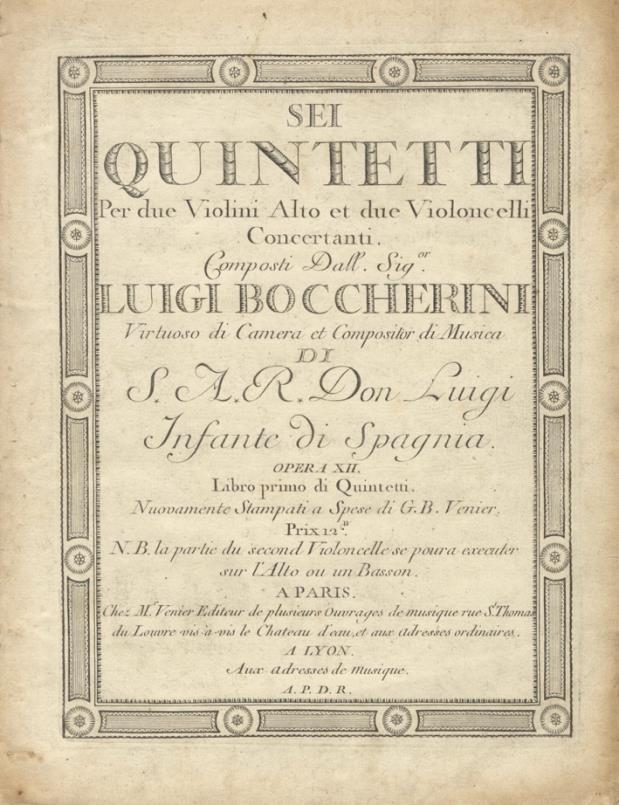
Sei Quintetti per due Violini Alto et due Violoncelli Concertanti Composti Dall. Sigor. Luigi Boccherini Virtuoso di Camera et Compositor di Musica di S. A. R. Don Luigi Infante di Spagnia. Opera XII. Libro primo di Quintetti Nuovamente Stampati a Spese di G. B. Venier. Prix 12₶. N. B. la partie du second Violoncelle se poura executer sur l'Alto ou un Basson. ... A. P. D. R. Paris ... Lyon: Chez Mr. Venier ... Aux Adresses de Musique, [1774]. Violino primo: 1f. (recto title, verso blank), [i] (Catalogue De Musique Instrumentale que Mr. Venier a fait graver peu et qu'il continue journellement, A Paris rue Traversier St. Honoré vis-a-vis l'Hôtel de Richelieu), 224 pp.
Violino secondo: [i] (title) 2-24 pp.
Viola: [i] (title), 2-10, [i] (blank), 12-20 pp.
Violoncello primo: [i] (title), 2-18, [i] (blank), 20-22 pp.
Violoncello IIo alto o fagoto: [i] (title), 2-10, [i] (blank), 12-18, [i] (blank), 20-22, 1f. (blank) pp. First Edition. Gerard 265-270. Lesure p. 57 (Gerard 265 only). RISM B3159.
Bound with:
BOCCHERINI Op. 11, nos. 1-6
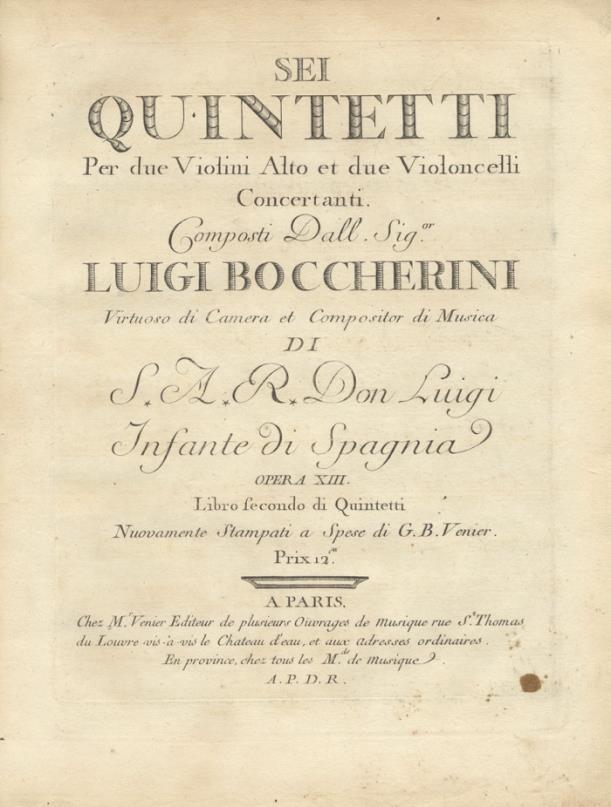
Sei Quintetti per due Violini Alto et due Violoncelli Concertanti Composti ... Opera XIII Libro secondo di Quintetti Nuovamente Stampati a Spese di G. B. Venier. Prix 12₶. Paris ... En province: Chez Mr. Venier ... chez tous les Mds. de Musique, [January 1775].
Violino primo: 1f. (recto title, verso blank), [i] ("Catalogue"), 2-25, [i] (blank) pp.
Violino secondo: [i] (title), 2-25, [i] (blank) pp.
Viola obligata: 1f. (recto title, verso blank), 21, [i] (blank) pp.
Violoncello Io: 1f. (recto title, verso blank), 21, [i] (blank) pp.
Violoncello IIo: 1f. (recto title, verso blank), 21, [i] (blank) pp.
First Edition. Gerard271-276. Lesure, p. 57. RISM B3165 (one completecopy intheU.S. only, atSibleyMusic Library, Eastman School of Music.
Bound with:
BOCCHERINI Op. 18, nos. 1-6
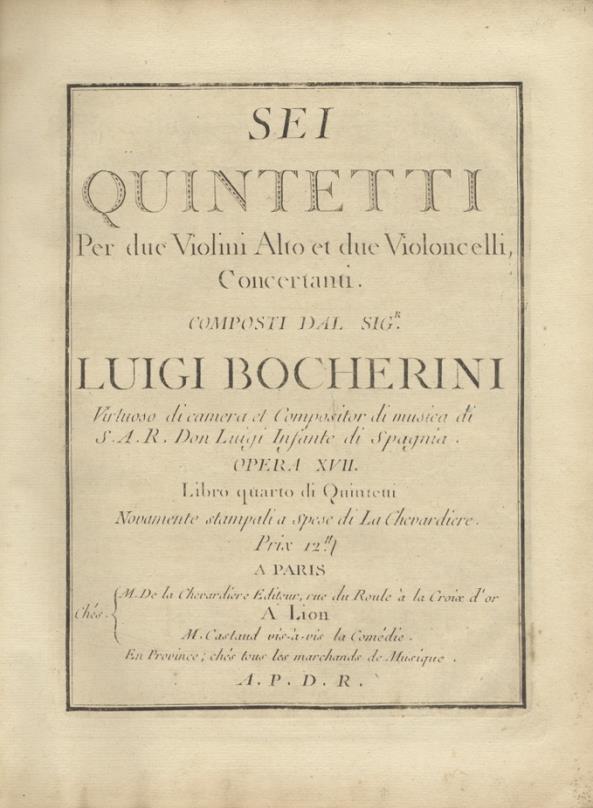
Sei Quintetti Per due Violini Alto et due Violoncelli Concertanti ... Opera XVII Libro quarto di Quinteti Novamente stampati a spese di La Chevardiere. Prix 12₶. A. P. D. R. Paris ... Lion ... En Province: Chés. M. De la Chevardiere ... M. Castaud ... tous les les Marchands de Musique, [?1775].
Violino primo: [i] (title), [i] (Catalogue No. 1. De Musique Vocale Appartenant a M. De La Chevardiere rue du Roule a la Croix d'Or A Paris), [i] (Catalogue No. II. De Musique Instrumentale Apartenant à M. De la Chevardiere rue du Roule à la Croix d'or), 2-19, [i] (blank) pp.
Violino secondo: [i] (title), 2-20 pp.
Viola: 15, [i] (blank) pp.
Violoncello Io: [i] (title), 2-10, [i] (blank), 12-17, [i] (blank) pp.
Violoncello IIo: [i] (title), 2-13, [i] (blank) pp.
First Edition. Gerard 283-288. Lesure p. 57. RISM B3166 (no copies in the U.S.)
Bound with:
BOCCHERINI Op. 13, nos. 1-6
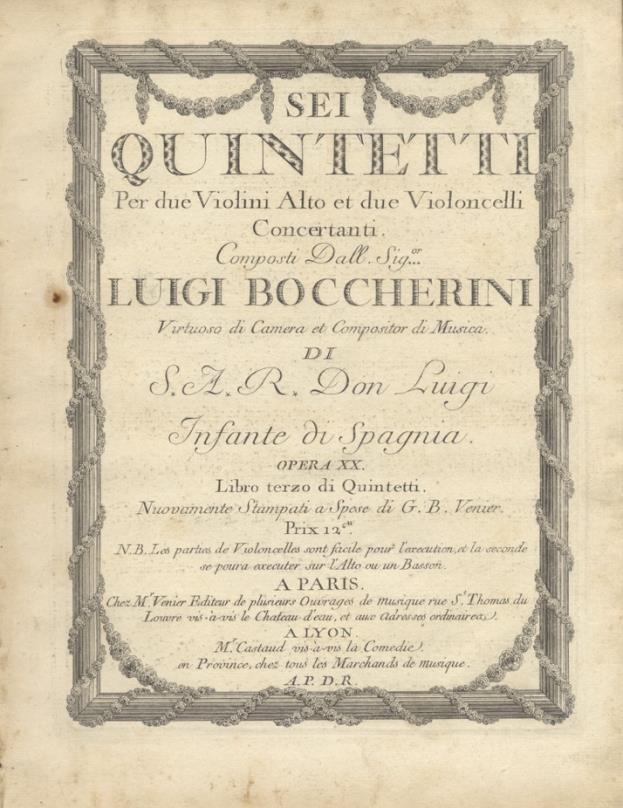
Sei Quintetti Per due Violini Alto et due Violoncelli Concertanti ... Opera XX Libro terzo di Quintetti Nuovamente Stampati a Spese di G. B. Venier. Prix 12₶. N.B. Les parties de Violoncelles sont facile pour l'execution, et la seconde se poura executer sur l'Alto ou un Basson ... A.P.D.R. Paris ... Lyon ... en Province: Chez Mr. Venier ... Mr. Castaud ... chez tous les Marchands de musique, [1776].
Violino primo: 1f. (recto title, verso blank), [i] (Catalogue), 2-21, [i] (blank) pp.
Violino secondo: [i] (title), 2-20 pp.
Viola/Viola obbligata: 1f. (recto title, verso blank), 17, [i] (blank) pp. Violoncello primo: [i] (title), 2-18 pp.
Violoncello IIo: [i], 2-16 pp.
FirstEdition. Gerard277-282.Lesurep. 57. RISMB3174(onecopyonlyintheU.S., atSibleyLibrary, Eastman School of Music.
Bound with:
BOCCHERINI. Op. 17, nos. 1-6
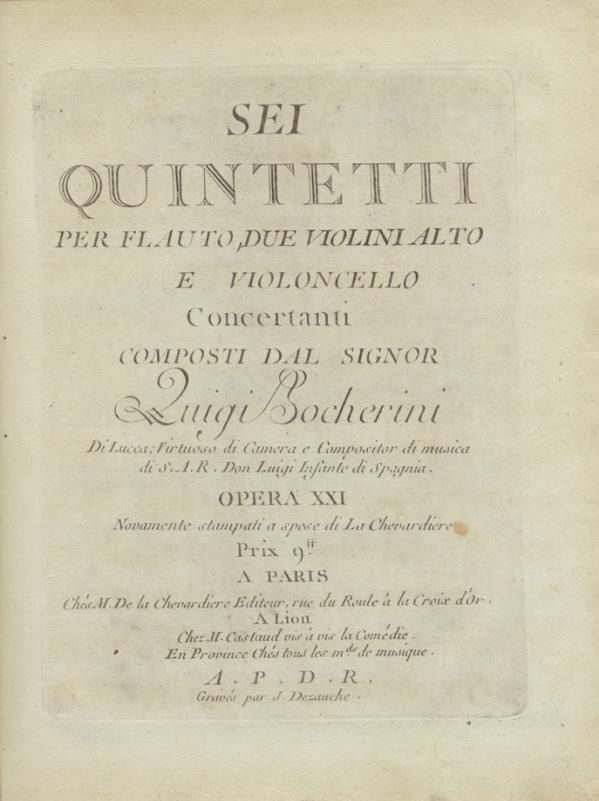
Sei Quintetti Per Flauto, Due Violini Alto E Violoncello Concertanti ... Opera XXI Novamente stampati a spese di La Chevardiere. Prix 9₶. ... A.P.D.R. Gravés par J. Dezauche. Paris ... Lion ... En Province: Chés M. De la Chevardiere ... Chez M. Castaud ... Chés tous les mds. de musique, [ca. 1775].
Violino Io: [i] (title), [i] (Catalogue No. I. De Musique Vocale Appartenant a M. De. La. Chevardiere rue du Roule á la Croix d'Or A Paris), [i] (Catalogue N. II. De Musique Instrumentale Apartenant à M. de. La Chevardiere rue du Roule á la Croix d'or), 2-12 pp.
Violino 2o: [i] (title), 2-9, [i] (blank) pp.
Viola: [i] (title), 2-9, [i] (blank) pp.
Violoncello: [i] (title), 2-8 pp.
Flauto: [i] (title), 2-9, [i] (blank) pp.
FirstEdition. Gerard419-424. Lesurep. 58. RISM B3194(onecopyonlyintheU.S., attheLibraryofCongress.
Bound with:
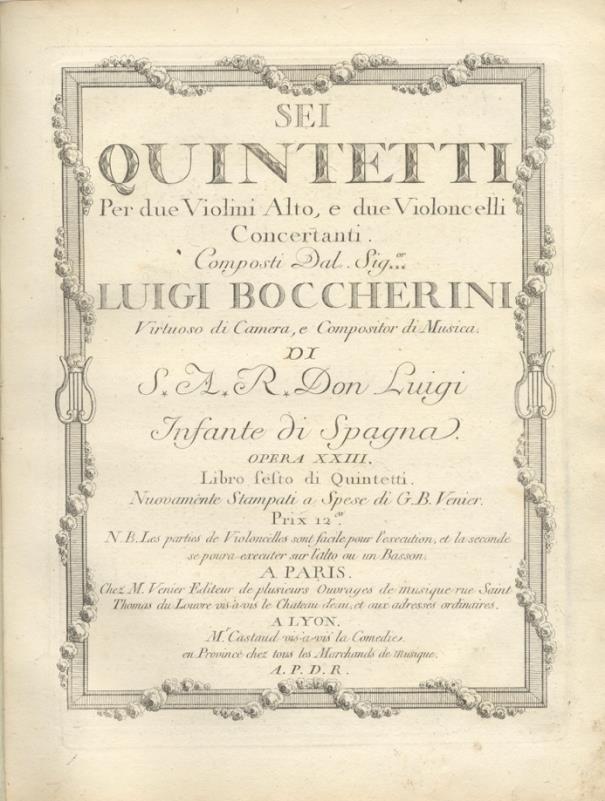
BOCCHERINI. Op. 20, nos. 1-6
Sei Quintetti Per due Violini Alto e due Violoncelli Concertanti ... Opera XXIII Libro sesto di Quintetti. Nuovamente Stampati a Spese di G.B. Venier. Prix 12₶. N.B. Les parties de Violoncelles sont facile pour l'execution, et la seconde se poura executer sur l'Alto ou un Basson ... A. P. D. R. Paris ... Lyon ... en Province: Chez Venier ... Mr. Castaud ... chez tous les Marchands de Musique [April 1777].
Violino primo: [i] (title), [i] (Catalogue), 6, [i] (blank), 8-10, [i] (blank), 12-20 pp.
Violino secondo: 1f. (recto title, verso blank), 10, [i] (blank), 12-20 pp.
Viola: [i] (title), 2-10, [i] (blank), 12-20 pp.
Violoncello Io: [i] (title), 2-7, [i] (blank), 9-20 pp.
Violoncello IIo: [i] (title), 2-10, [i] (blank), 12-20 pp.
First Edition. Gerard 289-294. Lesure p. 57. RISM B3177 (no copies in the U.S.)
Bound with:
BOCCHERINI Op 19, nos. 1-6
Sei Quintetti Per Flauto Due Violini Alto E Violoncello Concertanti ... Opera XXV. Novamente stampati a spese di La Chevardiere. Prix 9₶. A.P.D.R. Paris ... Lion ... En Province: Chez M. De la Chevardiere ... Chez M. Castaud ... Chés tous les mds. de musique, [?1776]. With "Gravés par le Sr. Huguet" to foot of first page of music; "No. 7" in contemporary black ink to lower right corners of titles.
Violino Io: [i] (title), [i] ("Catalogue No. I. De Musique Vocale Appartenant a M. De. La. Chevardiere rue du Roule á la Croix d'Or A Paris"), [i] ("Catalogue N. II. De Musique Instrumentale Apartenant à M. de. La Chevardiere rue du Roule á la Croix d'or."), [i] (blank), 9, [i] (blank) pp.
Violino secondo: 1f. (recto title, verso blank), 9, [i] (blank) pp.
Viola: [i] (title), 2-9, [i] (blank) pp.
Violoncello: [i] (title), 2-9, [i] (blank) pp.
Flauto: [i] (title), 2-8 pp.
First Edition. Gerard, 425-430. Lesure, p. 58. RISM B3197 (one copy only in the U.S., at the Library of Congress.
Bound with:
BOCCHERINI. Op. 27, nos. 1-6
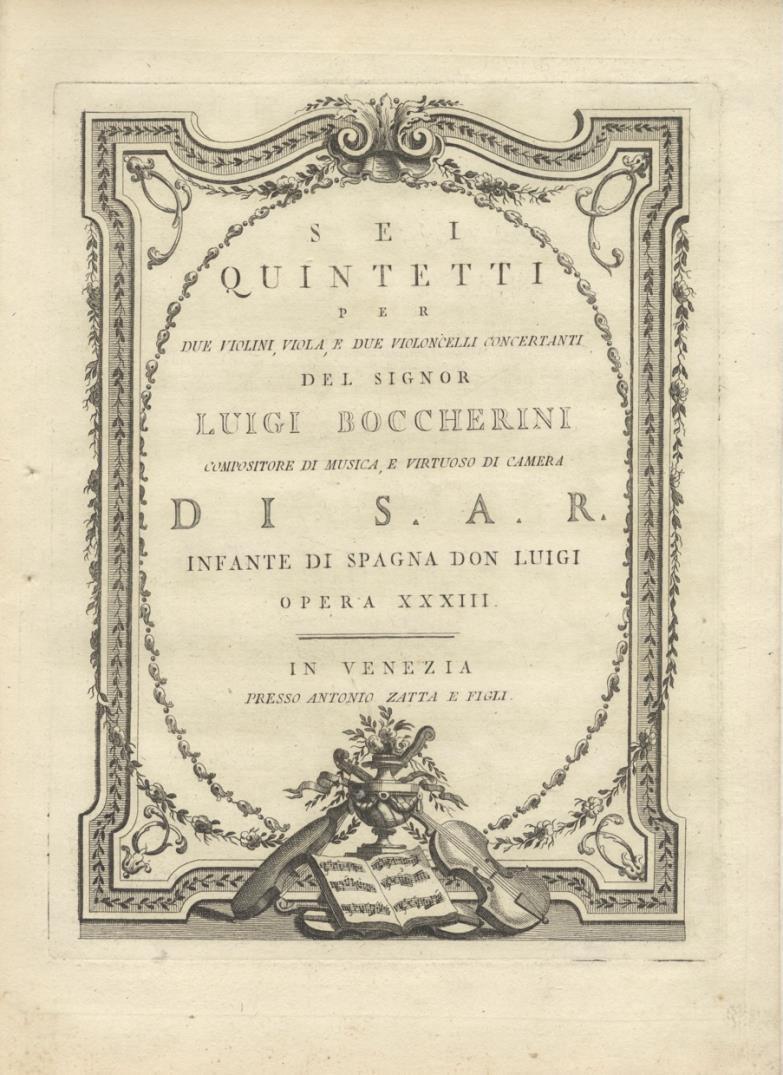
Sei Quintetti Per Due Violini, Viola, E Due Violoncelli Concertanti ... Opera XXXIII [Prix £ 7.10]. Venezia: Presso Antonio Zatta e Figli, [?1772].
Violino primo: 1f. (recto illustrated title depicting musical instruments and an open book of music with incipits of the quintets, verso blank), [i] (blank), 2-13, [i] (blank) pp.
Violino secondo: [i] (title), 2-11, [i] (blank) pp.
Viola: [i] (title), 2-9, [i] (blank) pp.
Violoncello primo: [i] (title), 2-11, [i] (blank) pp.
Violoncello secondo: [i] (title), 2-9. [i] (blank) pp.
First Edition. Gerard 301-306. RISM B3178 (no copies in the U.S.).
Bound with: PLEYEL. Op. 5
Trois Quintetti Concertants pour Deux Violons, deux Alto et, Violoncelle ... Œuvre [5] Prix [7₶ 4s]. Paris: Chez le Sr. Sieber [1787]. With Sieber's control signature to lowerouter corner of title; 2a" in contemporary black ink to upper outer corner of second viola part.
Violino primo: [i] (title), [ii] ("Catalogue de Musique Vocale et Instrumentale appartenant à Mr. Sieber Rue S. Honoré entre la Rue des Vielles Etuve et celle d'Orleans chez l'Apothicaire No. 92"), 2-13, [i] (blank) pp.
Viola: [i] (title), 2-11, [i] (blank) pp.
Viola 2a: [i] (title), 2-4, [i] (blank), 6-11, [i] (blank) pp.
Benton 271-273 (2519), p. 84. Lesure p. 506. RISM P3040 (two copies in the U.S., at the Library of Congress and Sibley Library, Eastman School of Music.
Bound with: PLEYEL. Op. 6
Trois Quintetti Concertants Pour Deux Violons deux Alto et Violoncelle ... Œuvre [6] Prix [7₶ 4s]. Paris: Chez le Sr. Sieber, [1787]. Illegible inscription in contemporary manuscript to head of title of first violin part.
Violino primo: [i] (title), [ii] ("Catalogue de Musique Vocale et Instrumentale appartenant à Mr. Sieber Rue S. Honoré entre la Rue des Vielles Etuve et celle d'Orleans chez l'Apothicaire No. 92"), 2-12 pp.
Viola prima: [i] (title), 2-10 pp.
Viola seconda: [i] (title), 2-10 pp. Benton 274-276 (2551), p. 88. Lesure p. 506. RISM P3052 (one copy in the U.S. only, at the Library of Congress).
Bindings quite worn, rubbed, and bumped with some loss of both leather and marbled paper; gilt to rules and titling lost. Some internal wear; occasional minor stains, tears, and; some catalogue slightly trimmed resulting in minor loss. Lacking Violino secondo and Violoncello parts of Pleyel quintets. (41021) $3,500
“The Leading Opera Composer in France During the First Quarter of the 19th Century”
6. BOIELDIEU, Adrien 1775-1834
Ouvertures pour Piano-Forte. Nouvel Arrangement ... No. 7 ... Le Calife de Bagdad. Offenbach s/M: chez Jean André [PN 5737], 1835.
Oblong folio. Disbound. [i] (series title), 2-7, [i] (blank) pp. With "Pröschen Lauten 1837" and "Therese Lauten 1838" in contemporary manuscript to head and foot of title, respectively; [No.] 7 underlined in red ink. Some minor wear, soiling, and small stains; some creasing; upper margin of two leaves slightly browned and chipped; small hole to blank upper margin of final leaf.
OCLC 24879637.
Boieldieu "was the leading opera composer in France during the first quarter of the 19th century and remains the central figure in the opéra comique tradition. ... In 1798 [he] was nominated professor at the newly founded Conservatoire, where he taught the piano until June 1803; Fétis was a pupil of his in 1800 and noted that, during the composing of Le calife de Bagdad, the modest, lenient pedagogue would frequently play passages from the score and consult his pupils on it at their lessons. ...” George Favre, revised by Thomas Betzwieser in Grove Music Online (41034) $25
Opus 1 of this “Prominent Orchestral Violinist” and Composer
7. BORGHI, Luigi ?1745-ca. 1806
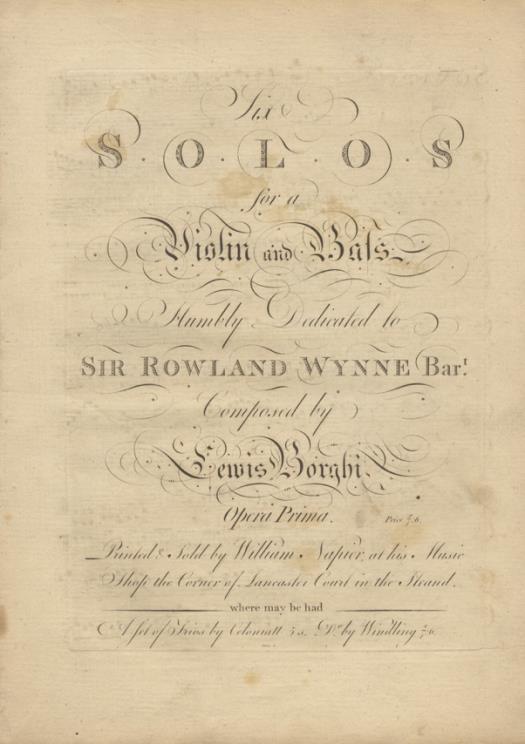
Six Solos for a Violin and Bass Humbly Dedicated to Sir Rowland Wynne Bart ... Opera Prima. Price 7s: 6. ... Ashby sc. [Score]. London: Printed & Sold by William Napier at his Music Shop the Corner of oancaster Court in the Strand, [ca. 1772].
Folio. Disbound. [i] (title), 2-35, [i] (blank) pp. Engraved throughout. Violin part with figured basso continuo accompaniment. Light uniform browning; occasional minor soiling and small stains; title partially detached at lower portion.
[?]Third edition of Borghi's Op. 1. BUC p. 124 (three editions were published by Napier between ca. 1772-1775; the present is the one without the dedicatory preface). RISM B3638. Napier's werethe firsteditions ofthis setpublished inEngland.
Borghi, an Italian violinist and composer, "was a pupil of Pugnani and friend of Sir William Hamilton, and settled in London around 1769. A prominent orchestral violinist, he was leader of the second violins at the Handel Commemoration of 1784 and at the Professional Concert from 1785 until 1792, and played regularly with Cramer in quartets and other chamber music. He composed ballet music for the Italian opera, was assistant manager of O’Reilly’s opera company at the Pantheon in 1791 and, shortly afterwards, married the prima donna Anna Casentini (fl 1787–96). His works, among which the violin concertos are notable examples of the galant style, were published both in England and on the Continent." John A. Parkinson and Simon McVeigh in Grove Music Online. (40777). $250
Two Volumes of Mid-18th Century Songs in First Edition Many Performed in the “Pleasure Gardens”
8. BOYCE, William 1710-1779
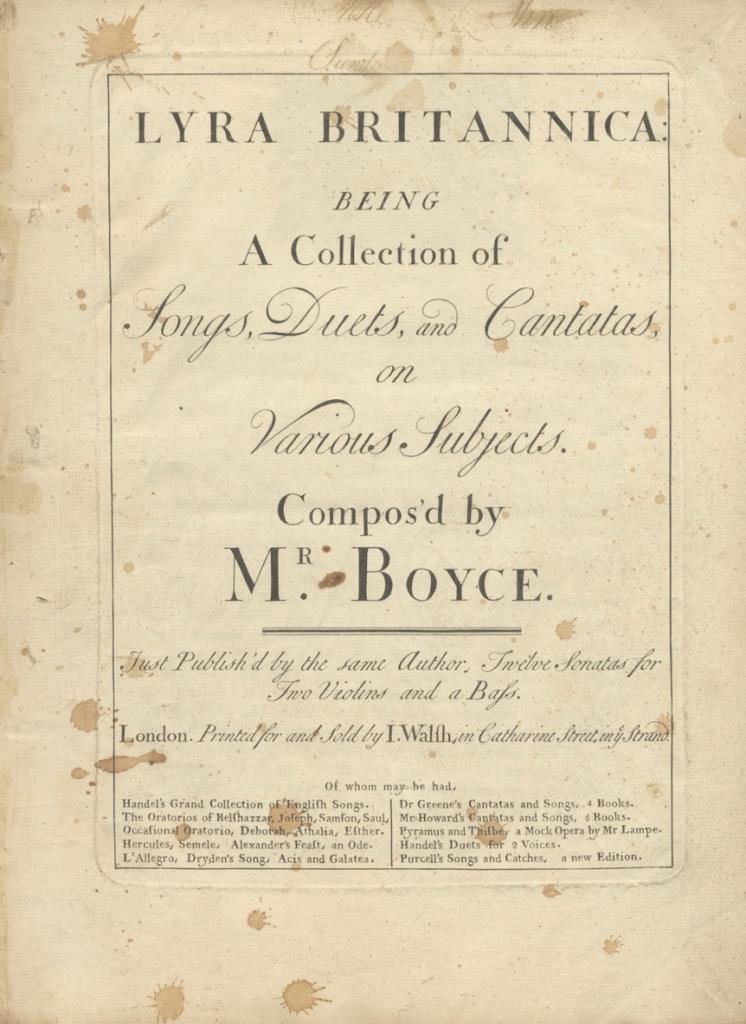
Lyra Britannica: Being A Collection of Songs, Duets, and Cantatas on Various Subjects ... Just Publish'd by the same Author, Twelve Sonatas for Two Violins and a Bass [Books I-II]. [Score]. London: Printed for and Sold by I. Walsh, in Catharine Street, in ye Strand, [1747].
2 volumes. Folio. Contains songs scored for one and two voices and continuo, with occasional interludes for keyboard or unspecified treble instrument
Book I
Contemporary half mid-tan calf with marbled boards. 1f. (recto title, verso blank), 1f. (recto typeset dedication to King George II dated 10 April 1745 with woodcut coat of arms to head, verso blank), 21, [i] (blank) pp. Title and music engraved. Signature to head of title in faint manuscript "[?]M The Sundo." With brief publisher's catalogue to foot of title listing works by Handel, Greene, Howard, and Purcell. Early performance markings in manuscript to the song "On thy banks, gentle Stour," p. 11. Binding considerably worn, with loss of marbled paper; spine lacking; joints split; upper nearly detached. Minor internal wear, soiling, and foxing; title stained. First Edition. Smith and Humphries 239, p. 55. BUC p. 130. RISM B4112.
Book II
Disbound. 1f. (recto title, verso blank), 1f. (recto typeset dedication to King George II dated 10 April 1745 with woodcut coat of arms to head, verso blank), 22-33 pp. Title and music engraved. With brief publisher's catalogue to foot of title listing works by Handel, Greene, Howard, and Purcell. Contemporary signature of John Phillpot to upper outer blank corner of title. Slightly worn; light uniform browning; occasional minor soiling to blank margins; paper repair to blank lower outer corner of pp. 32/33 First Edition. Smith and Humphries 240, p. 56. BUC p. 130. RISM B4112.
Boyce was a noted English composer, organist, and violinist. "Though formerly best known for some of his anthems and his editing of Cathedral Music (1760–73), the significant contribution he made to instrumental music, song, secular choral and theatre music in England is now widely recognized. ... [He] brought out two collections of songs, duets and cantatas entitled Lyra Britannica, which eventually ran to six volumes (1747–59). The contents embrace simple strophic ballads and more sophisticated through-composed songs, many of them known to have been performed in the pleasure gardens, three items from Boyce’s setting of Dryden’s Secular Masque (c1746), vocal pieces composed for various plays produced by Garrick in the 1750s, and in each book except one an extended solo cantata." Robert J. Bruce and Ian Bartlett in Grove Music Online. (40734)
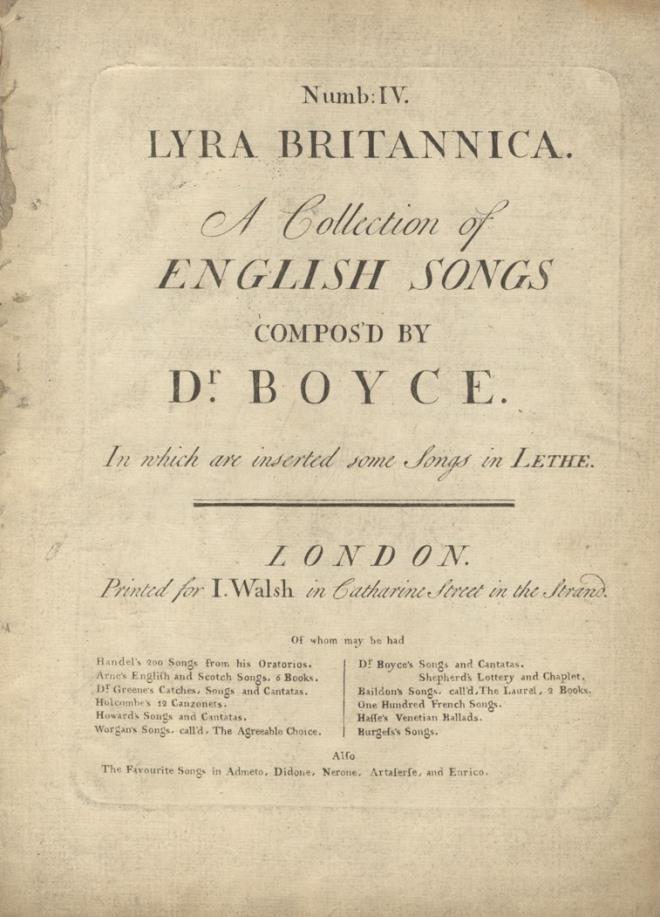
9. BOYCE, William 1710-1779
$475
Numb: IV. Lyra Britannica. A Collection of English Songs ... In which are inserted some Songs in Lethe. [Score].
London: Printed for I. Walsh in Catharine Street in the Strand, [1754].
Folio. Disbound. 1f. (recto title, verso blank), [i] typeset dedication to King George II dated 10 April 1745), 49-58, [i] (blank) pp. Engraved throughout. Contains songs for voice and continuo and for voice and strings, with occasional supplemental flute lines. The first two selections are Boyce's musicalcontributionsto Garrick's play "Lethe" (1749).With brief publisher's catalogue to foot oftitlelisting works by Handel, Arne, Greene, Holcombe, Howard, Worgan, Boyce, Baildon, Hass, and Burgess. Minor soiling and browning; occasional small stains; small binder's holes to inner margins throughout, with minor remnants of early wrapper to inner margin of title.
First Edition. Smith and Humphries 242, p. 56. BUC p. 130. RISM B4112. (40735) $285
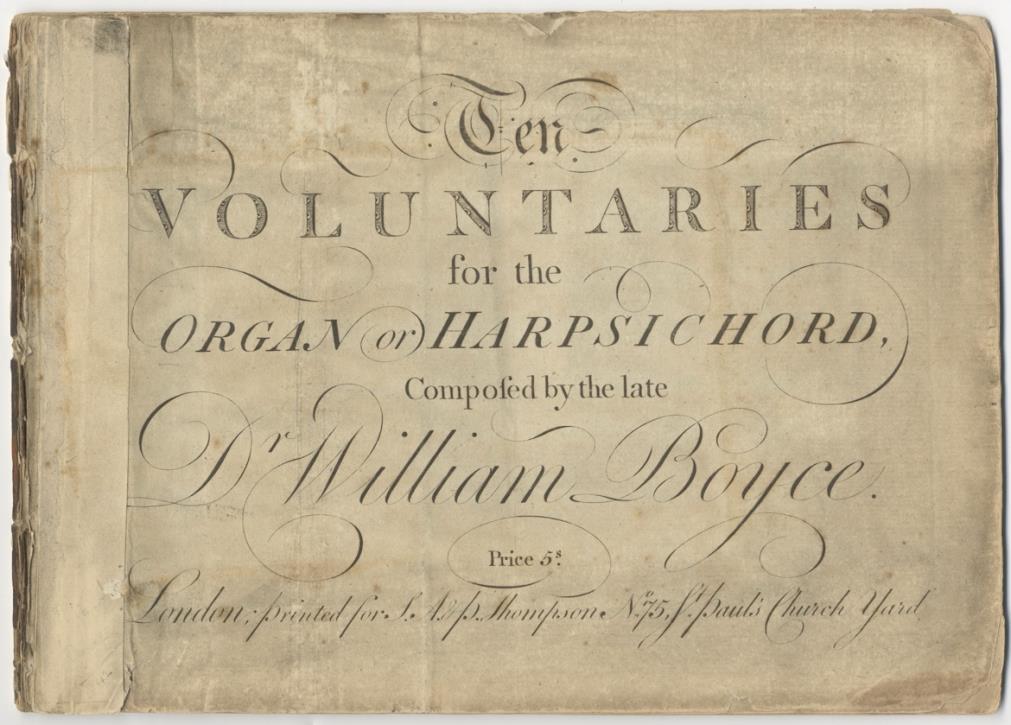
Late 18th Century Voluntaries for Organ or Harpsichord
10. BOYCE, William 1710-1779
Ten Voluntaries for the Organ or Harpsichord Composed by the late William Boyce. Price 5s. London: Printed for S.[amuel] A.[nn] & P.[eter] Thompson No. 75, St. Paul's Church Yard, [ca. 1785].
Oblong folio. Disbound. 1f. (recto title, verso blank), 21, [i] (blank), 23-25, [i] (blank) pp. Each voluntary consists of a prelude- and fanfare-like movement, with the final voluntary featuring a double fugue. With instructions for organ registration. Some later pencil markings including dates and crosses. Title quite soiled, with inner margin of recto and verso reinforced with paper; minor internal wear; first signature detached; occasional small edge tears and chips.
BUC p. 131. RISM B4176 and BB4176 (one copy in the U.S. only, at the University of Iowa, Iowa City). (40737)
$300
Attractive 6-Volume Set of Late 18th Century French Songs
11. CAZIN, Hubert-Martin 1724-1795, ed.
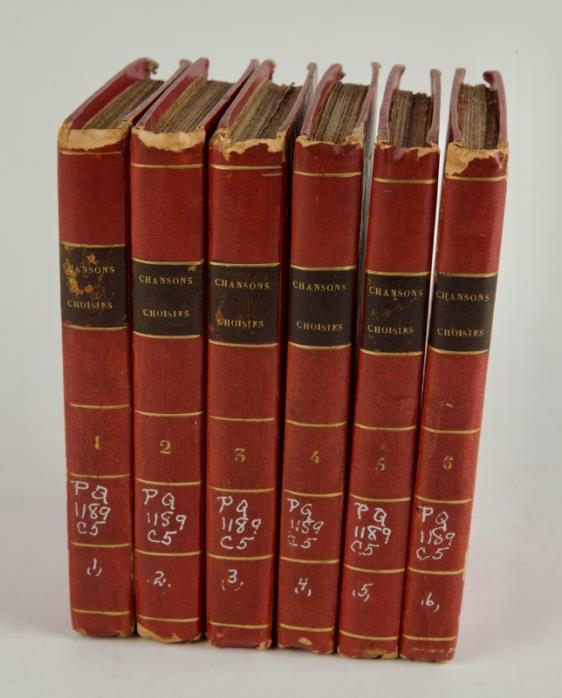
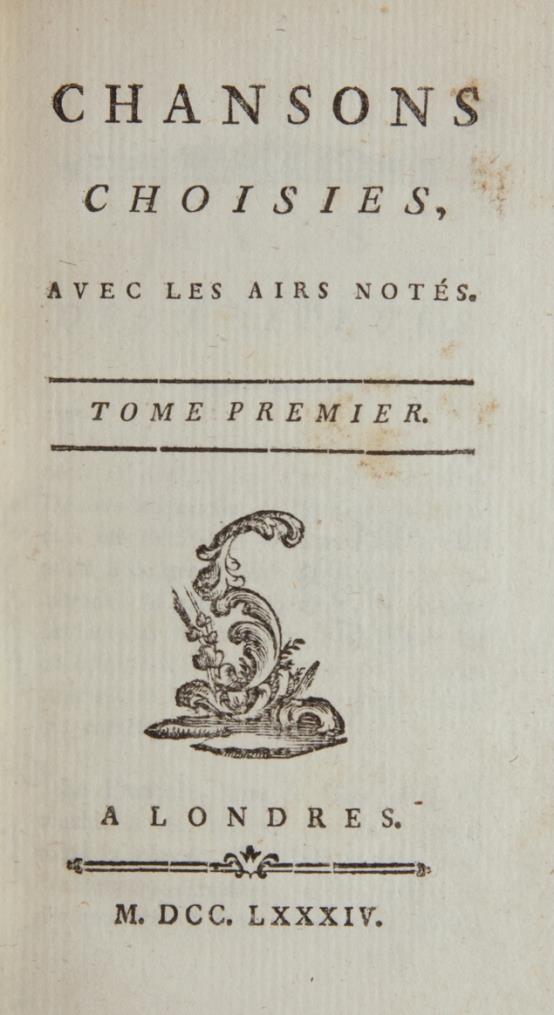
Chansons choisies, avec les airs notés Tome Premiere [Second-Sixieme]. Londres [London], 1784.
6 volumes. Small octavo. Early red paper boards with black title labels and rules gilt to spines. Bindings slightly worn, rubbed, and bumped. Ex-library The American International College Library of Springfield, Massachusetts with bookplates, pockets, andstamps, andcall numberin whiteink tospine. A littleminor foxing. Lacking musical tunes to Vol. IV (RISM does not call for tunes in Vols. V and VI).
Vol. I: xx, 238 (text), 48 (music to 89 tunes) pp. Vol. II: 2 ff., 252 (text), 48 (music to 97 tunes) pp.
Vol. III: 2 ff. 272 (text), 38 (music to 65 tunes) pp.
Vol. IV: 2 ff., 251 pp.
Vol. V: 2 ff., 260 pp.
Vol. VI: 2 ff., 248 pp.
Scarce. RISM Recueils Imprimés BII, p. 127. An expanded version of the edition first published in Geneva in 1777. (41304) $175
“A
Dominant Figure in Parisian Musical Life for Half a Century”
12. CHERUBINI, Luigi 1760-1842
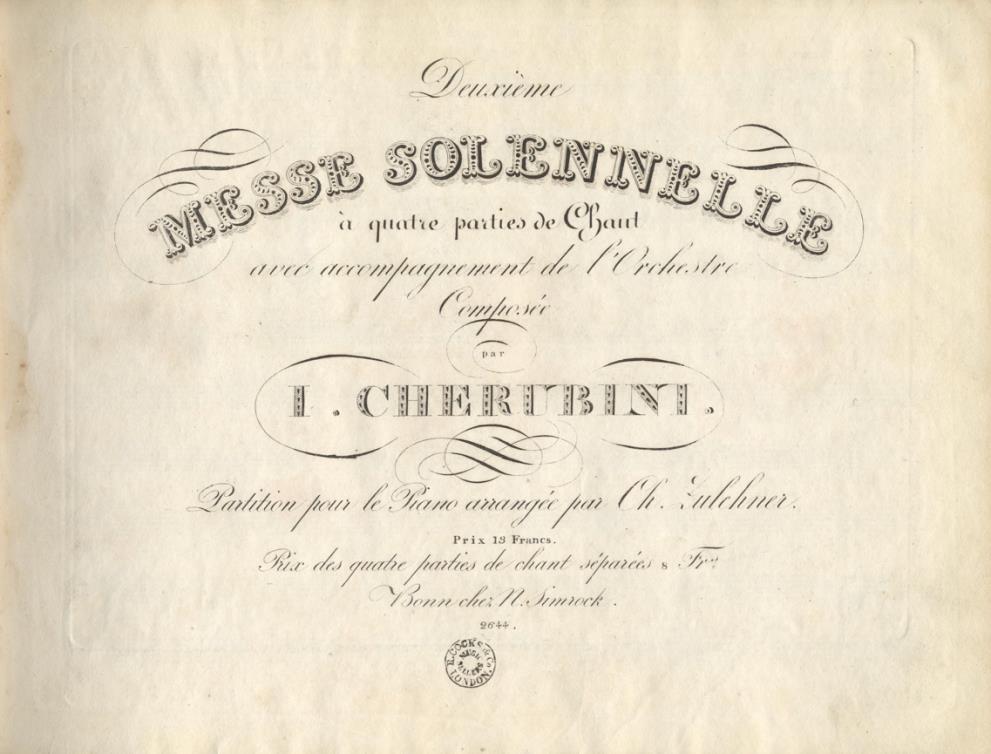
Deuxième Messe Solennelle à quatre parties de Chant avec accompagnement de l'Orchestre ... Partition pour le Piano arrangée par Ch. Zulehner. Prix 13 Francs. Prix des quatre parties de chant séparées 8 Frs. [Pianovocal score]. Chez N. Simrock [PN 2644], [ca. 1827].
Oblong folio. Full modern dark maroon cloth with printed title label to spine. 1f. (recto title, verso blank), 3103, [i] (blank) pp. Engraved throughout. With small circular handstamp "T Cocks & Co. London" to foot of title. Occasional small stains and minor soiling, mainly to blank margins; occasional foxing to inner and lower margins of final two pages of music. A very good copy overall.
Hirsch IV, 733. RISM CC2028.
Cherubini was an "Italian, composer, conductor, teacher, administrator, theorist, and music publisher, active in France. He took French citizenship, probably in 1794, and was a dominant figure in Parisian musical life for half a century. He was a successful opera composer during the Revolutionary period, and had comparable success with religious music from the beginning of the Restoration. He was made director of the Paris
Conservatoire and consolidated its pre-eminent position in music education in Europe. ... In 1819 he was given the task of writing the Mass (G major) for the coronation of Louis XVIII, which in fact was never performed because the King considered the restoration process too fragile to risk displaying monarchical pomp. He also composed a three-part Mass (A major) for the coronation of Charles X, which was performed in 1825. In these two masses Cherubini seems intentionally to have avoided some of the more refined contrapuntal techniques so ostensibly displayed in his Credo of 1806. More noticeably, he omitted syncopation almost entirely so that the bar-structure and regular metre were preserved. Orchestral figures and motifs rarely exceed the length of a bar so that a much lighter, march-like tone comes to the fore in staccato passages. The vocal parts are usually bound into a homophonic structure and symmetric periods with a rich orchestration either imitating the voices or executing diminished ostinatos. Many general pauses enhance the lucid texture, as do distinct contrasts between the sections. Words and phrases of the Ordinary are repeated out of context, enabling the recapitulation of musical material (e.g. in the Gloria of the G major Mass) or the increase of sequential phrasing (e.g. in the Credo of the A major Mass). Similarly, the same music is reused in different text sections. Independent instrumental motifs occasionally play an equal role in the compositional structure (e.g. in the Agnus Dei of the G major Mass), where they immediately increase the musical effect. Most of these devices clearly enhance the overall musical unity and communicate the religious message. However, some chromatic crescendo passages on an orchestral pedal followed by a drawn out cadence and a recitative-style section are reminiscent of operatic scenes." Michael Fend in Grove Music Online (40732) $525
13. CHERUBINI, Luigi 1760-1842
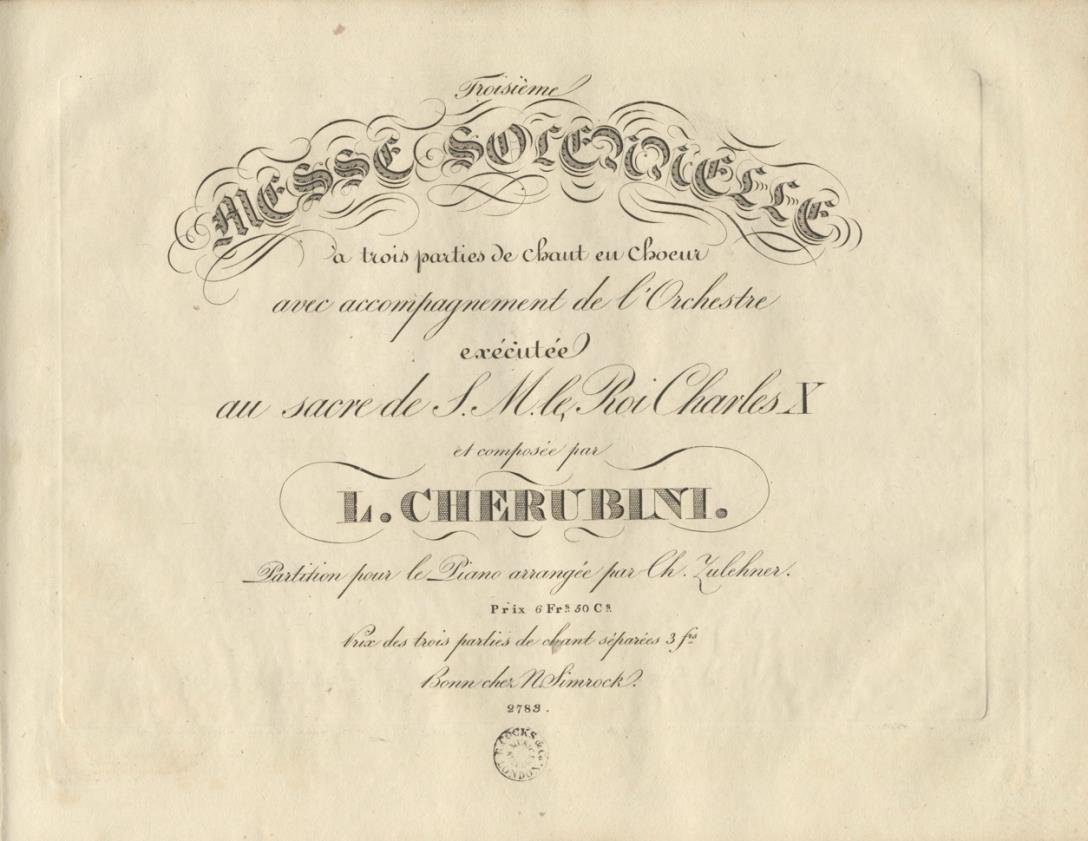
Troisième Messe Solennelle à trois parties de chant en Choeur avec accompagnement de l'Orchestre exécutée au sacre de S. M. le Roi Charles X ... Partition pour le Piano arrangée par Ch. Zulehner Prix 6 Frs.. 50Cs.. ... Prix des trois parties de chant séparées 3 frs. [Piano-vocal score]. Bonn:ChezN. Simrock[PN 2783], [ca. 1830].
Oblong folio. Full modern dark maroon cloth with printed title label to spine. 1f. (recto title, verso blank), 3-48 pp. Engravedthroughout. Withsmallcircular handstamp"TCocks & Co. London" tofootof title. Lightuniform browning; occasional minor soiling; upper outer corner of p. 41 slightly soiled and creased; small stain to center of blank lower margin to approximately ten final leaves. A very good copy overall.
First Edition. RISM CC2028, I, 10. (40731) $275
“An Extraordinarily Broad View of Ordinary Light Music in France During the 18th Century”
14. CORRETTE, Michel 1707-1795
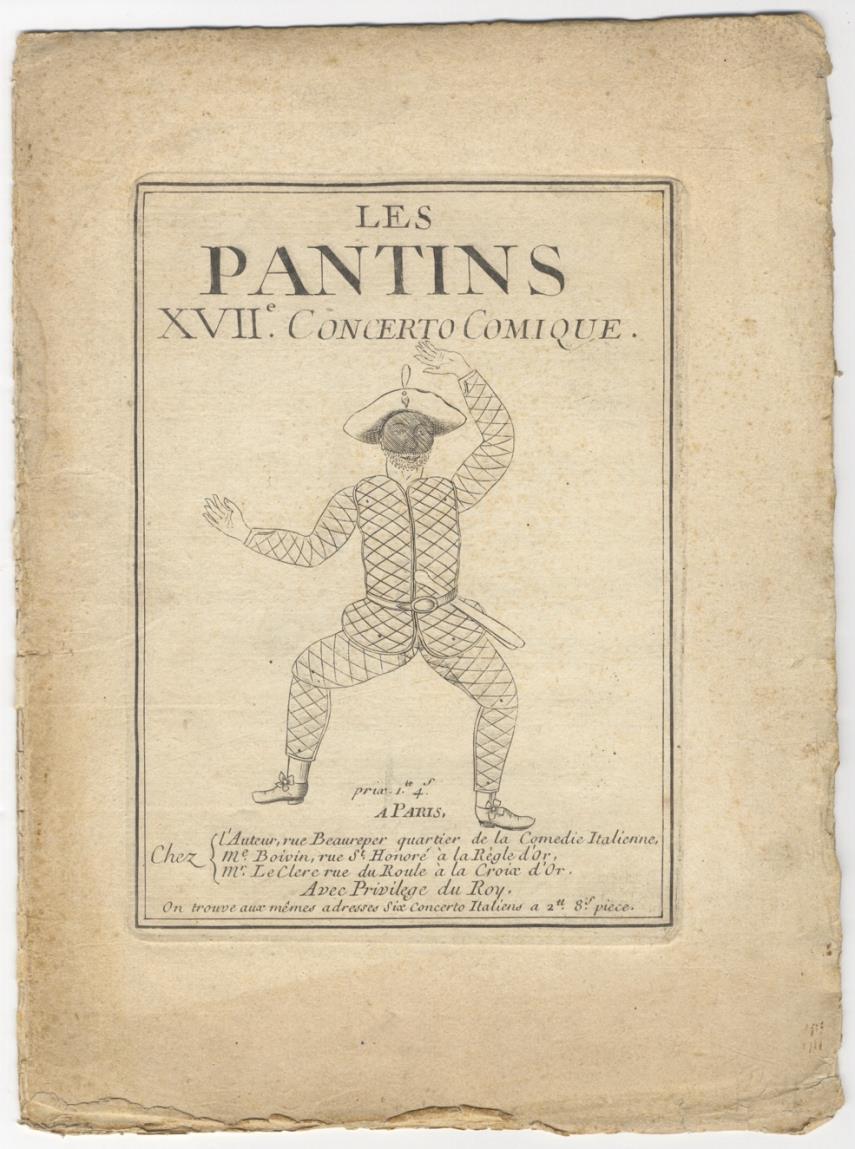
Les Pantins XVIIe. Concerto Comique ... prix 1tt. 4s. [Set of parts]. Paris: Chez l'Auteur, rue Beaureper quartier de la Comedie Italienne, Me. Boivin, rue St. Honoré à la Régle d'Or, Mr. Le Clerc rue du Roule à la Croix d'Or. Avec Privilege du Roy, On trouve aux mêmes adresses Six Concerto Italiens a 2tt. 8s. piece., [ca. 1745].
Folio. Set of parts. Engraved throughout. Uncut. With illustration of a harlequin to title. Later performance markings in pencil to Organo part. Some browning, foxing, soiling, and small stains, mainly to blank margins; first violin part partially detached, lower margin frayed and with small holes to blank inner margin.
Violino ò flauto primo: [i] (title), 2-3, [i] (blank) pp.
Violino secondo: 1f.
Violino terzo: 1, [i] (blank) pp.
Organo: 1f.
First Edition. Rare. Lesure p. 138. RISM C4006 (one incomplete copy only in the U.S.).
Corrette was a "French organist, teacher, composer-arranger and author of methods on performing practice; son of Gaspard Corrette. Though little is known of his life, his works, which span nearly 75 years, provide an extraordinarily broad view of ordinary light music in France during the 18th century, and his methods are a rich source of information about performing practice and music of the period. ... A large proportion of Corrette’s music is based on popular tunes of all sorts and constitutes an important source for their study. Music from, or written for, opéra comiques is presented fully scored, sometimes with place and date of performance. The arrangements run from simple harmonizations to transformations of the tunes into concerto movements, as in the 25 concertos comiques." DavidFuller, revisedbyBruceGustafsonin Grove Music Online (41103) $850
London’s “Foremost Violinist”
15. CRAMER, Wilhelm 1746-1799
Concerto [VI] a Violon Principalle[!]
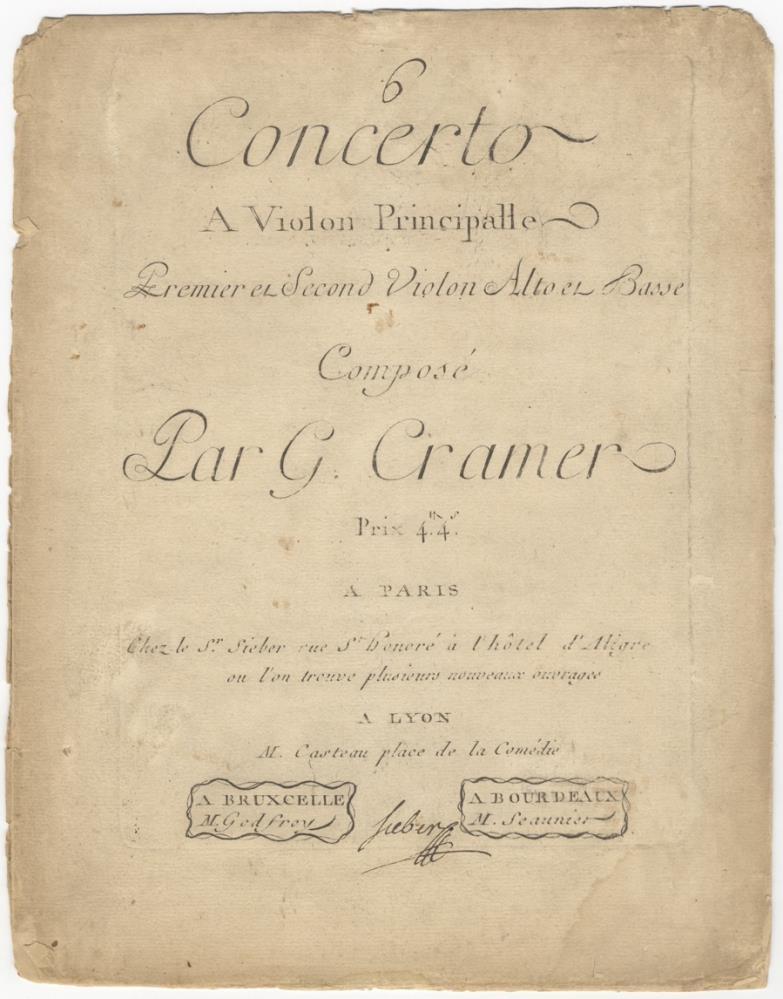
Premier et Second Violon Alto et Basse ... Prix 4₶. 4s. [Setofparts]. Paris:Chez le Sr. Sieber rue St. Honoré a l'hôtel d'Aligre ... A Lyon M. Casteau place de la Comédie, A Bruxcelle M. Godfroy, A. Bourdeaux M. Seaunier, [ca. 1777].
Folio. Unbound. Engraved throughout. With Sieber's control signature to foot of title ofviolino principale partand the number "6" to upper margin of each part. Spine of violino primo part reinforced with narrow strip of paper. Occasional minor wear, soiling, and small tears, mainly to blank margins.
Contains:
Violino principale: 1f. (rectotitle, verso blank), [i] ("Catalogue de Musique Vocale et Instrumentale Appartenant á M. Sieber"), 2-8 pp.
Violino primo: [i](title), 2-5, [i](blank) pp.
Violino secondo: [i] (title), 2-5, [i] (blank) pp.
Alto viola: [i] (title), 2-3, [i] (blank) pp. Basso: [i] (title), 2-4 pp.
Corno primo/Corno secondo: [i] (title) 2-3, [i] (blank) pp.
Flauto primo/Flauto secondo: [i] (title) 2-3, [i] (blank) pp.
First Edition. Not in Lesure. BUC p. 237. RISM C4373 (no copies in the U.S. and only two other copies recorded). Of Cramer's concerti in this vein, some offer the option of ad libitum flutes and horns and specify this on the title; the present concerto does not specify these on the title but does, indeed, include the ad libitum parts.
"The son of a Mannheim violinist, Jakob Cramer (1705–70), [Wilhelm] was a precocious violin pupil. He studied with Johann Stamitz, Domenicus Basconi, and Christian Cannabich, and in about 1752 joined the Mannheim orchestra, where he became known as one of the finest violinists of his day. He left Mannheim to work for the Duke of Württemberg in Stuttgart, and he soon obtained permission to travel to Paris and London. He appeared at the Concert Spirituel in Paris in 1769 and by 1772 he had arrived in London, where his success, and the encouragement of J.C. Bach, led him to decide to remain permanently in England.
For the next two decades Cramer was considered London’s foremost violinist, lauded equally for the ‘fire, tone, and certainty’ of his solo playing (Burney) and for his authority as an orchestral leader. A particular speciality was his technique of off-the-string bowing, still unusual at the time: perhaps it was for this reason that his name became associated with one type of transitional violin bow. Certainly he brought the precision and firmness of Mannheim symphonic practice to London, as leader of the Bach–Abel concerts from 1773 and of succeeding series at the Hanover Square Rooms, including the Professional Concert (1785–93), of which he was one of the principal organizers. He led at the Italian Opera almost every season from 1777 to 1796, and became equally
associated with the Handelian tradition, as leader at the Concert of Ancient Music and at numerous festivals in London and elsewhere (including the prestigious Handel Commemoration in 1784). The connection with Bach and Abel led to invitations to play chamber music at court, and around 1784 he was appointed leader of the Queen’s Band (though not of the more ceremonial King’s Band, as sometimes stated). Throughout this period he remained active as a concerto soloist, and he was also celebrated as a chamber music player; indeed he was London’s first major quartet leader, appearing regularly with the same players at the Professional Concert."
Simon McVeigh in Grove Music Online (41010) $650
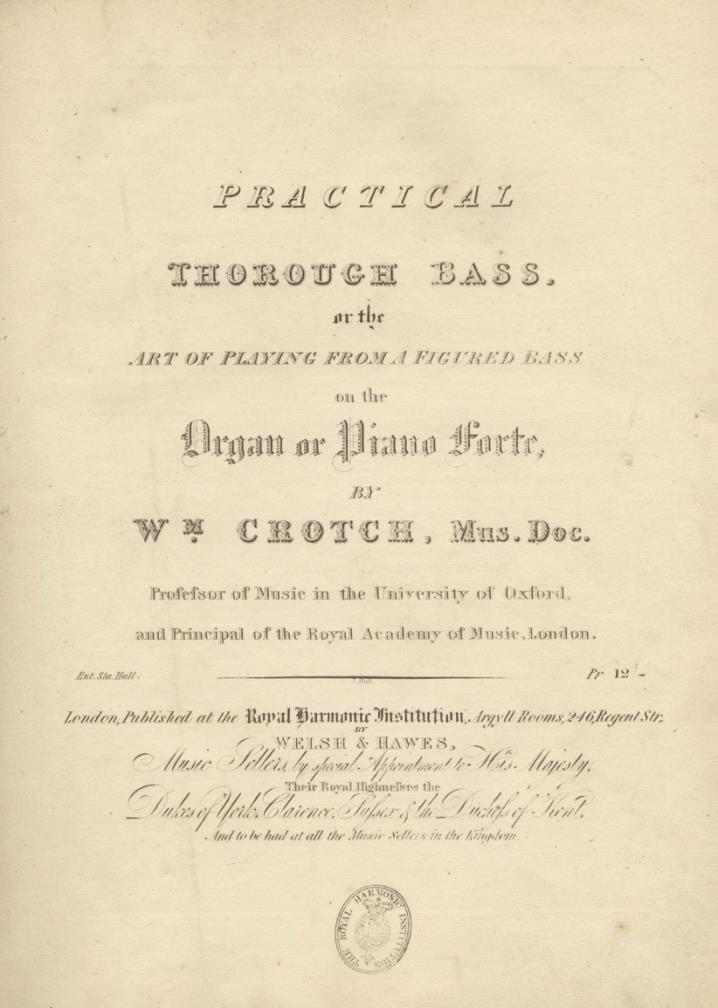
“One of the Most Distinguished English Musicians of His Day”
16. CROTCH, William 1775-1847
Practical Thorough Bass, or the Art of Playing from a Figured Bass on the Organ or Piano Forte by Wm. Crotch, Mus. Doc. Professor of Music in the University of Oxford and Principal of the Royal Academy of Music London. ... Pr. 12/- London: Published at the Royal Harmonic Institution, Argyll Rooms, 246 Regent Str. by Welsh & Hawes, [ca. 1826].
Folio. Contemporary half maroon calf with marbled boards. 1f. (recto title, verso blank), [i] (contents), [ii] ("Index to the Examples"), [i] (blank), [7]-18 ("Practical Thorough Bass &c. &c." ... "Printed by J. Mallett, Wardour Street, Soho"), 45 (musical examples), [i] (blank), [ii] ("Compositions & Publications by Wm. Crotch") pp. Title, contents, index, and treatise typeset; musical examples and catalogue engraved. With a full realization of Purcell's song "Bess of Bedlam" (pp. 37-42) and J.S. Bach's "Chorus from a Mass by Sebastian Bach," the Cruxifixus from the BMinor Mass BWV 232. Small oval handstamp of the Royal Philharmonic Institution to foot of title and "W. Plunkett Coll.” in contemporary manuscript to front pastedown. Binding worn, rubbed, and bumped; spine lacking; upper detached. Minor internal wear; slightly browned; occasional soiling, small stains, and holes. In very good internal condition overall.
First Edition. Scarce. Kassler p. 236. OCLC 19994333.
In the musicalexamples, Crotchincludes baroque works of Handel, Corelli, and Alessandro Scarlatti, allrevered figures in his day. He also includes late renaissance and early baroque composers such as Cavalieri, Gibbons, Farrant, Dowland, and Carissimi, occasionally adding figures to early works which originally had none. The inclusion of these composers attests to a growing interest in the music of the past, which Crotch calls, somewhat touchingly "classical works" (p. 18 of the opening treatise).
William Crotch, an English composer, organist, theorist and painter, "became one of the most distinguished English musicians of his day. ... [He] was highly influential as a lecturer and writer on musical subjects. His Elements of Musical Composition, published in 1812 and twice reprinted, was much in demand as a manual for beginners, as were his books on thoroughbass and piano playing. Far more important were his lectures, delivered first at Oxford and then, in revised forms, at the Royal Institution and elsewhere in London, and ultimately excerpted in The Substance of Several Courses of Lectures (1831). In these lectures Crotch offered a historical survey of music, firmly grounded on an aesthetic theory. ... Crotch urged a rediscovery of the sublime style through the revival and imitation of ancient music. ... He attempted to put it into practice himself, first by exhaustive collection and study of old music, second by presenting examples for revival in performance, and third by imitating it in composition." Nicholas Temperley and Simon Heighes in Grove Music Online (41033)
Turn-of-the-19th-Century Waltzes from this Noted English Music Publisher and Musician
17. DALE, Joseph 1750-1821
Eight Waltzes for the Piano Forte or Harp, with an Accompaniment for a Flute, Tambourine and Triangle ... Op. 16. Book I ... Price 3s. [Score]. London: Printed for the Author, at his Warehouses, No. 19, Cornhill, & the corner of Holles Street, Oxford Street, [ca. 1800].
Folio. Disbound. [i] (title), 2-15, [i] (publisher's catalogue "Music Published by Dale No. 19 Cornhill & the Corner of Holles StreetOxford Street, LondonWheremaybe had his Patent Tambourines") pp. Engraved throughout. With a key to symbols used in the tambourine part to foot of p. 2. Slightly worn, stained, soiled, and browned; occasional smalltears tomargins;firstleafalmostdetached, withtear to inner corner repaired with archival tape to verso.
First Edition. BUC p. 250. RISM D758 and DD758 (one copy only in the U.S., at Baylor University).
$375
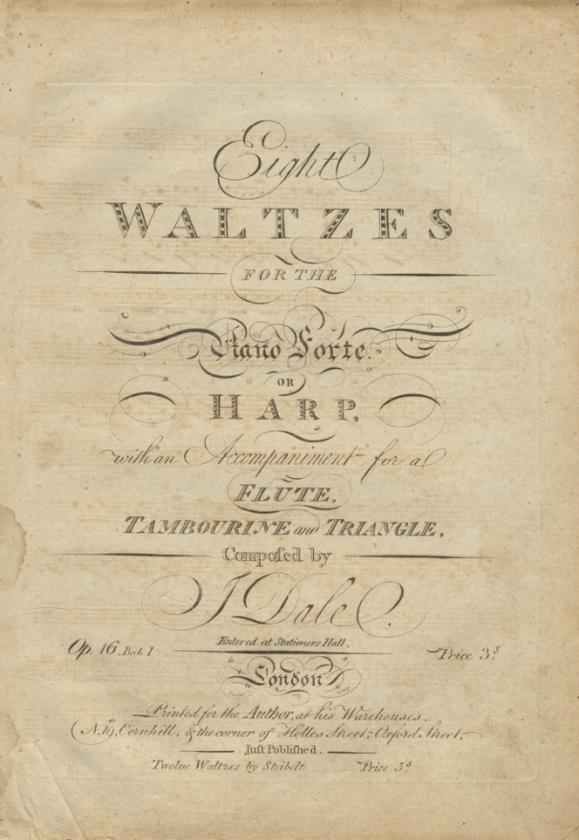
An English music publisher, "Joseph Dale was also a musician, and served as organist of St Antholin, Budge Row, Watling Street from 1777 to his death. He composed concertos and sonatas, and arranged vocal airs with variations for the harpsichord or piano. He also took out letters patent for improvements to the tambourine, and published music including its use. The tambourine parts of these works were elaborately conceived, employing an original notation, and were at least in part the work of his son, also Joseph, who was apprenticed to his father in 1797. His firm, particularly in its early years, issued music of every description, including the operas of Storace and others, piano music by Clementi, Dussek, Krumpholtz and Steibelt, collections of English and Scottish songs, country-dance music and vast quantities of sheet music." William C. Smith, revised by Peter Ward Jones in Grove Music Online. (41035) $85
“One of the Most Important Musicians of the Low Countries and England”
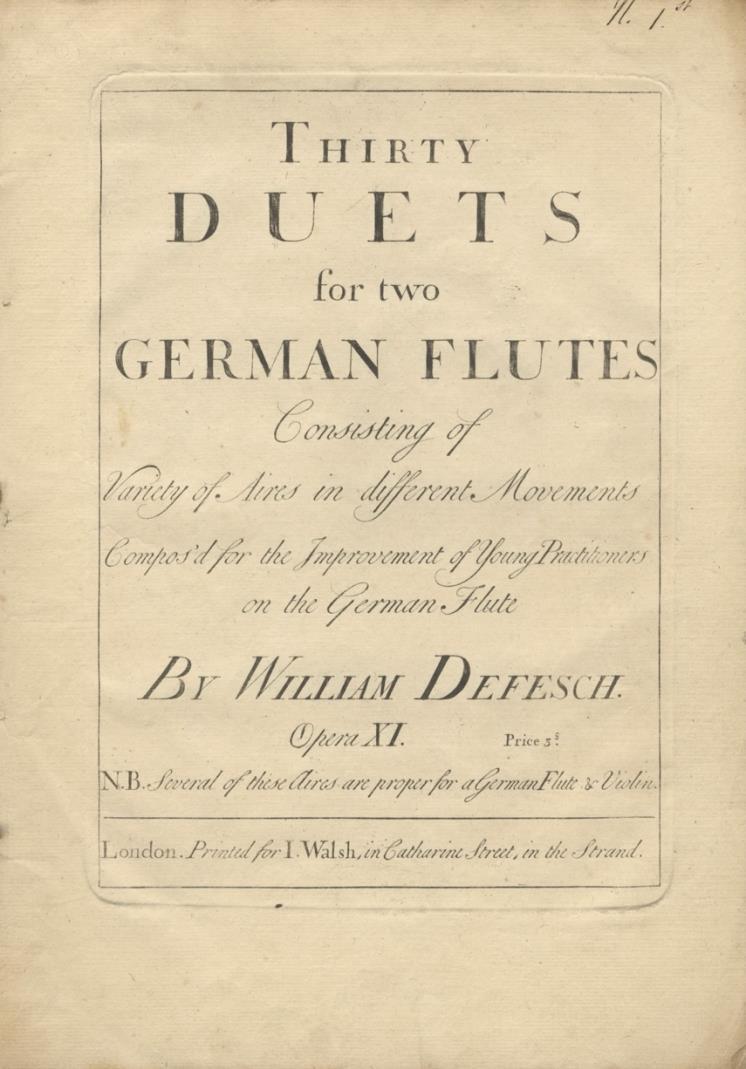
18. DEFESCH, Willem 1687-1761
Thirty Duets for two German Flutes Consisting of Variety of Aires in different Movements Compos'd for the Improvement of Young Practitioners on the German Flute ... Opera XI. Price 3s. N.B. Several of these Aires are proper for a German Flute & Violin. [Score]. London: Printed for I. Walsh, in Catharine Street, in the Strand, [1747].
Folio. Disbound. 1f. (recto title, verso blank), [i] (blank), 20 pp. Engraved throughout. The duets consist of dance movements, including numerous minuets, fanfares, and several pieces with Italian tempo or mood indications ("Andante," "Vivace," etc.). Air XV is in a Scottishstyle with copious Lombardic rhythms. Brief annotation in contemporary manuscript to upper outer corner of title, "N. 1st." Slightly worn; occasional small stains, tears, creasing, and light to moderate soiling; final signature partially detached; annotation to title slightly trimmed,.
First Edition. Smith and Humphries 540, p. 119. BUC p. 260. RISM F636 (one copy in the U.S. only, at the University of Michigan, Ann Arbor).
De Fresch was a Dutch composer and violinist. "If [he] was a good and an accepted violin virtuoso of his time, he was also an accomplished and even a pioneering composer. In his compositions, which ranged from the grandly conceived oratorio, mass and concerto to duets, solo and trio sonatas and simple songs, a clear development can be seen which largely coincides with the different stages in his career. ... De Fesch’s thematic and formal language can be described as strongly Italian, or more specifically as Vivaldian, in flavour. Vivaldi’s strong, masculine allegro themes and his firm formal principles must have appealed strongly to a composer of De Fesch’s temperament. Corellian and Handelian influences may also be noted, particularly in the oratorio Joseph. Nevertheless, his works, particularly those in the smaller genres, show a distinctive personal vein. For the basic worth of his own compositions and for the influence that he exercised on his contemporaries, De Fesch may be counted as one of the most important musicians of the Low Countries and England in the second quarter of the 18th century. His works were also more or less systematically distributed in France, either in their original Dutch or English editions or by local reprints." Frans Van Den Bremt, revised by Rudolf A. Rasch in Grove Music Online. (40728) $425
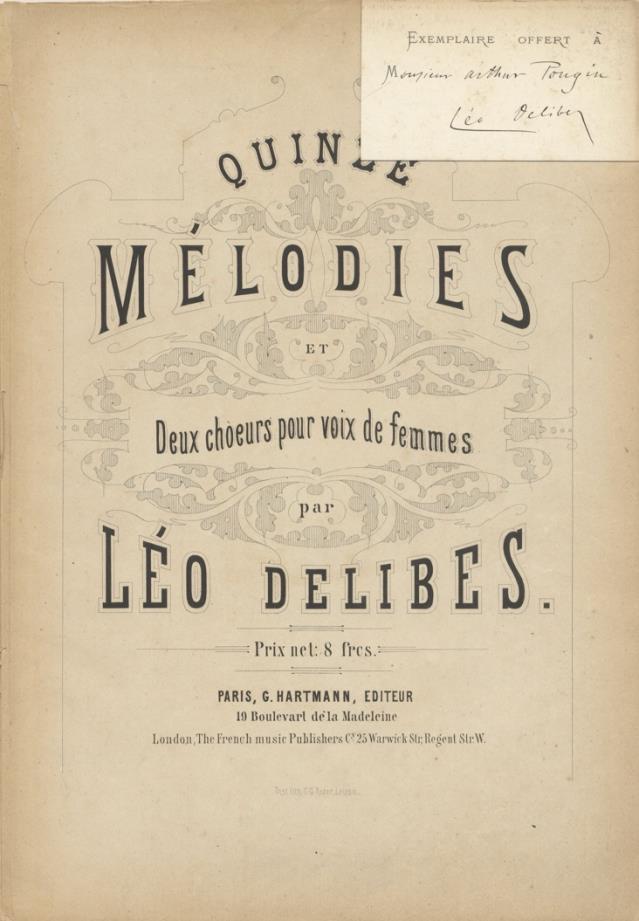
Presentation Copy
Signed by the Composer
Inscribed to Arthur Pougin
19. DELIBES, Léo 1836-1891
Quinze Mélodies et Deux choeurs pour voix de femmes ... Prix net: 8 frcs. [Piano-vocal score]. Paris: G. Hartmann, Editeur, 19 Boulevart de la Madeleine. London: The French music Publishers Cy., 25Warwick Str., Regent Str. W., [before1879].
Large octavo. Black cloth-backed original dark red publisher's printed wrappers. 1f. (recto title, verso table of contents), 3-87 (works for solo mezzo soprano or baritone and piano), 88-112 (works for women's choir of sopranos and contraltos) pp. Lithographed, with "Inst lith. C. G. Roder Leipsic" to foot of title. Wrappers quite worn and detached; first few leaves detachedor nearlyso. Minorinternal wear; light uniform browning, slightly heavier to margins.
A presentation copy, with small card laid down to upper outer corner of title with printed text ("Exemplaire offert à") and composer's autograph dedication to French writer on music and violinist Arthur Pougin (1834-1921) signed in full by Delibes.
[?]First Edition. OCLC 1049402429.
"Delibes’ masterpiece is Lakmé, which offers more than just a fine vehicle for a star soprano; the two principal male characters, Nilakantha and Gérald, are firmly drawn, and the music is melodic, picturesque and theatrically strong. ... Outside the theatre (for which Delibes wrote nearly all his music) his most notable work was as a composer of choruses, now undeservedly neglected." Hugh Macdonald in Grove Music Online
Pougin was an important figure in mid-19th century French musical circles. "He was educated in music at the Paris Conservatoire, where he studied the violin with Alard and harmony with Reber. A violinist in theatres from the age of 13, he became conductor at the Théâtre Beaumarchais in 1855, and played in the Musard orchestra and at the Opéra-Comique (1860–63). From 1856 to 1859 he was assistant conductor and répétiteur at the Folies-Nouvelles. ... [He] began as a writer on music with biographical articles in the Revue et gazette musicale. ... Besides his frequent contributions to Le ménestrel, France musicale, Art musical, Le théâtre, Chronique musicale and other music periodicals, he edited the music articles in the Larousse Dictionnaire universel and was successively musical feuilletonist to Le soir, La tribune, L’événement and, from 1878, the Journal officiel, where he succeeded Eugène Gautier. In 1885 he became chief editor of Le ménestrel. ... His main interest was the musical theatre and his most important single work, on the life of Verdi, was published in Italian (1881). ... His Dictionnaire historique et pittoresque du théâtre (1885) contains valuable information on contemporary French operatic life. He also edited the supplement to Fétis’s Biographie universelle (1878–80) and a revision of Clément and Larousse’s Dictionnaire lyrique (as Dictionnaire des opéras, suppl. 1904, 3/1905)." Norbert Dufourcq, revised by Karen Henson in Grove Music Online (41043) $225
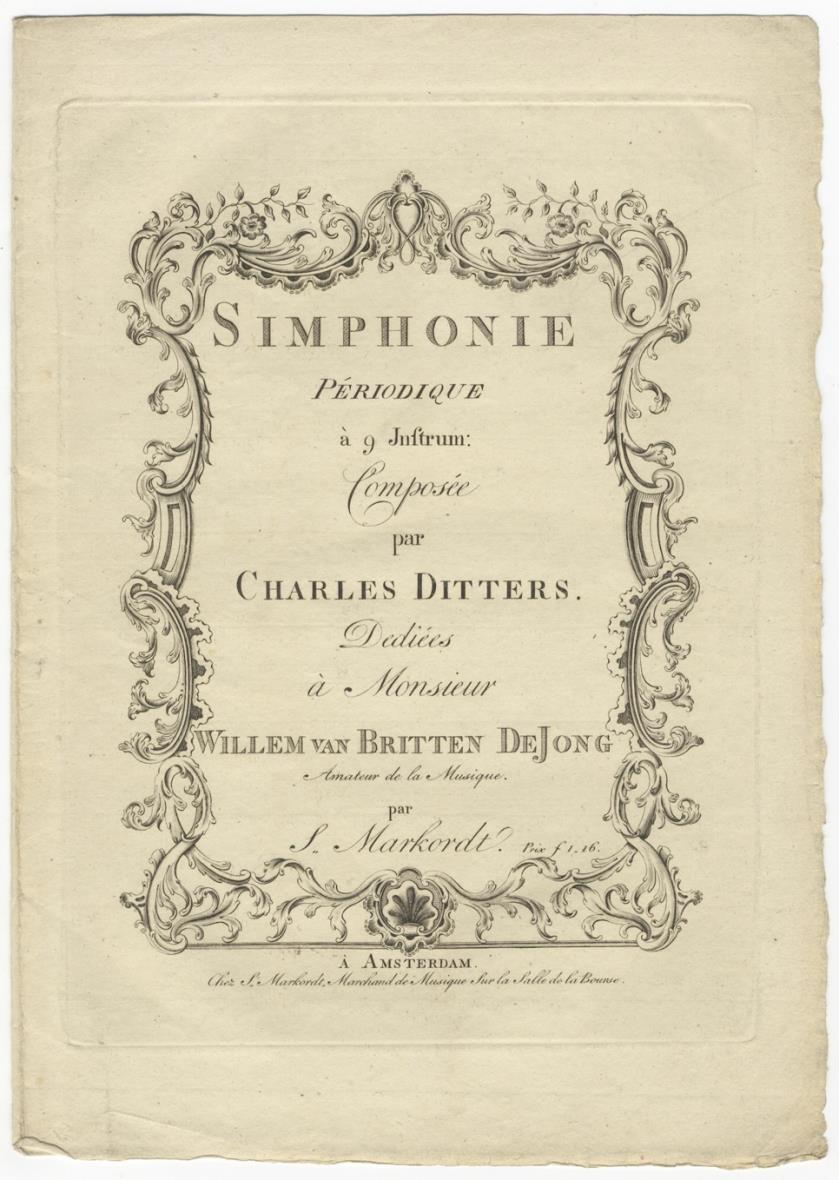
“His Changing Approach to the [Symphonic] Genre Mirrors Recognized Patterns of Evolution in 18th-Century Viennese Instrumental Music”
20. DITTERSDORF, Karl Ditters von 1739-1799
Simphonie Périodique à 9 Instrum: ... Dediées à Monsieur Willem van Britten DeJong Amateur de la Musique ... Prix F 1.16. [Set of parts]. Amsterdam: Chez St. Markordt, Marchand de Musique Sur la Salle de la Bourse, [ca. 1770].
Folio. Engraved throughout. With titles to violin parts within elaborate decorative border. Uncut. Very slightly worn and soiled; minor stains to final blank page of Violino secondo part. A near-fine copy.
Violino principale: [i] (title), 2-4 pp.
Violino primo: [i] (title), 2-4 pp.
Violino secondo: 1f. (recto title, verso blank), [i] (blank), 2-5, [i] (blank) pp.
Viola: [i] (blank), 2-3, [i] (blank) pp.
Oboe primo: 1f. (recto music, verso blank)
Oboe secondo: 1f. (recto music, verso blank)
Corno primo: 1f. (recto music, verso blank)
Corno secondo: 1f. (recto music, verso blank)
Basso [figured bass]: [i] (blank), 2-3, [i] (blank) pp.
Basso [figured bass]: [i] (blank), 2-3, [i] (blank) pp.
First Edition. RISM D3275 (only two copies recorded, none in the U.S.).
Dittersdorf was an Austrian composer and violinist "After promising early success in Vienna, he settled for a modest career as a provincial Kapellmeister and administrator. He composed voluminously despite the official responsibilities that occupied him for much of his life, and his generally high standard of craftsmanship earned him recognition as a leading figure of the Viennese Classical school.
Dittersdorf's symphonies span virtually his entire career, and his changing approach to the genre mirrors recognized patterns of evolution in 18th-century Viennese instrumental music. Apart from a group of early threemovement works, almost all are in four movements. While the earliest symphonies have small proportions, nervous energy and modest instrumentation, the later ones tend towards more extended structures, simpler themes, richer harmony and more elaborate orchestration." Margaret Grave and Jay Lane in Grove Music Online. (40730) $1,500
With Incipits of Arias from Lucia di Lammermoor
21. DONIZETTI, Gaetano 1797-1848
Chi mi frena in tal momento Quartettino In the Opera of Lucia di Lammermoor ... Price 3- . [Vocal score]. London: Mori & Lavenu, 28, New Bond Street, Music & Musical Instrument Sellers by Appointment to Her Majesty the Queen. & H.R.H. The Duchess of Kent [PN 4088], [ca. 1837].
Folio. Disbound. 7, [i] (publisher's catalogue ) pp. Engraved throughout. The catalogue to the final page "Lucia di Lammermoor. Opera Seria. Performed at San Carlos, Naples, & The Theatre Italien, Paris ... Table Thematique ... Detached Movements ... The Airs in the above Arranged as follows" includes incipits of arias from Lucia along with notice of works by other composers. Slightly worn; some foxing, primarily to lower portion of leaves.
OCLC 1114065526 (one copy only, at the Royal College of Music). (41037) $40
Full Score, Signed by the Composer
22. DUKAS, Paul 1865-1935
L'Apprenti Sorcier Scherzo d'après une ballade de Goethe ... Partition d'orchestre ... Prix net : 15 fr. [Fullscore]. Paris: A. Durand & Fils ... Paris, 4, Place de la Madeleine [PN D. & F. 5302], [after 1897].
Folio. Black cloth-backed marbled boards with publisher's upper wrapper bound in. 1f. (recto title printed in dark brown and light olive green, verso blank), 1f. (recto extract from Goethe printed in red, verso blank), 74 pp. With full score, orchestral parts, solo, piano, and 2-piano 4-hand arrangements by the composer and small rectangular publisher's handstamp to lower outer corner of upper wrapper; small publisher's monogrammatic handstamp to foot of final page. Binding worn, rubbed, and bumped; upper wrapper worn and soiled, with
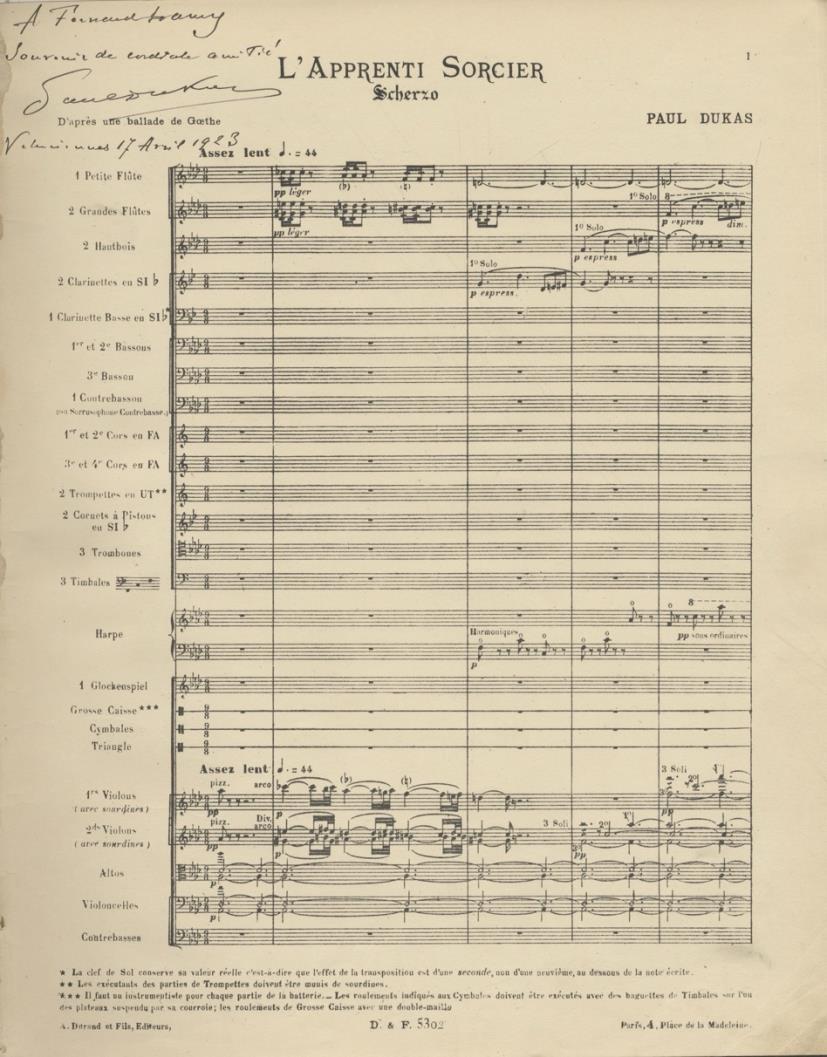
margins of blank verso reinforced with paper. Minor internal wear; remnants of paper to extreme inner margin of first page of music; small binder's holes to inner margins of several leaves; small tear to blank outer margin of pp. 27/28 repaired with archival tape.
A presentation copy, inscribed and signed by the composer to upper inner corner of first page of music, "A Fernand ... Souvenir di cordiale amitié Paul Dukas Valenciennes 17 Avril 1923."
With performance markings including numbers and dynamics in blue and orange pencil throughout and figured bass in lead pencil to final system.
First Edition, later issue. Fuld p. 522.
"Dukas was not only an influence on many French 20th-century composers and others such as Zemlinsky and Berg, but also remains important in his own right. His reputation rests on only a small number of compositions, notably the Piano Sonata, Ariane et Barbe-bleue, the ballet La Péri and L'apprenti sorcier. Dukas's influence as a critic, from 1892 to 1932, can be compared with Debussy's; his informed opinions reveal great sensitivity to the musical and aesthetic changes that took place during the period. Following the première [of L'Apprenti Sorcier] conducted by the composer at a concert of the Société Nationale on 18 May 1897, it rapidly established itself in the international concert repertory." Manuela Schwartz and G.W. Hopkins in Grove Music Online (41039) $700
Study Score
Signed by the Composer
23. DUKAS, Paul 1865-1935
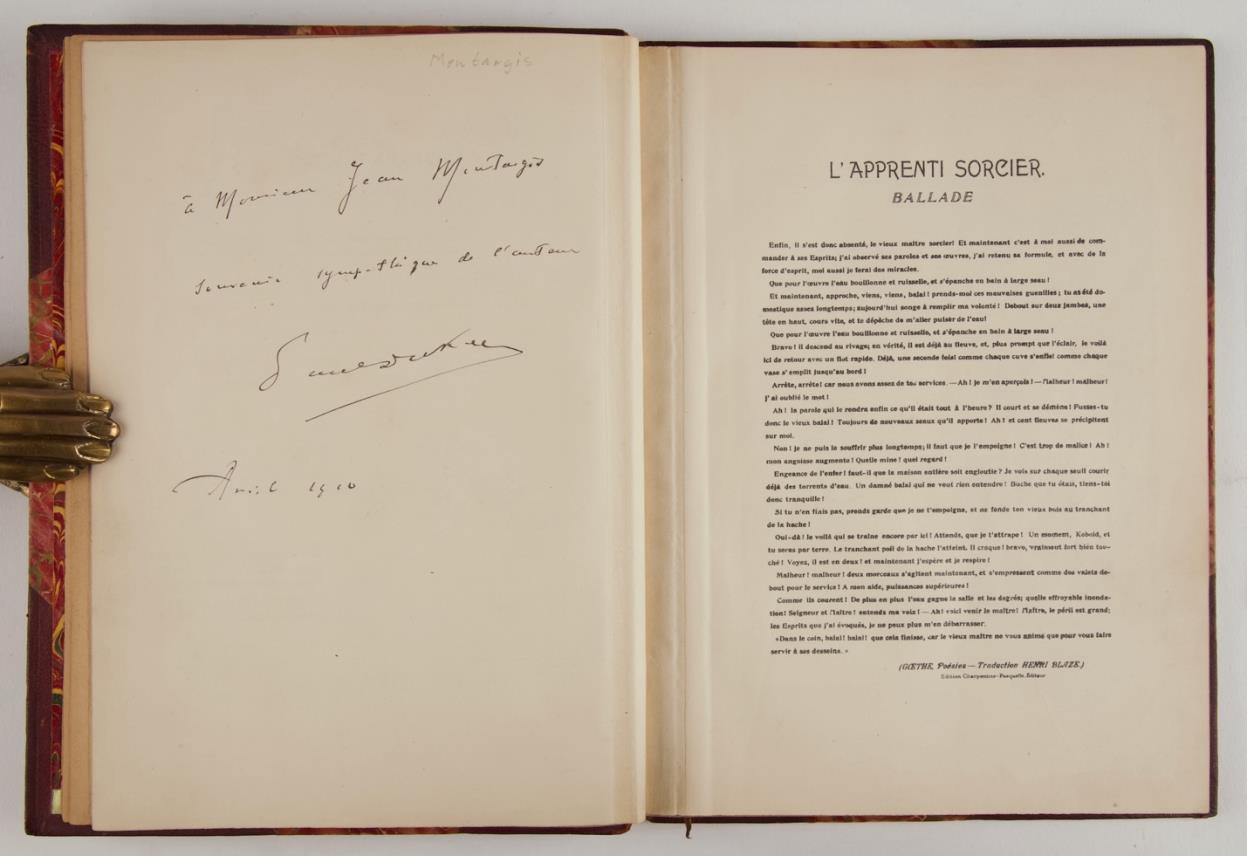
L'Apprenti Sorcier. Scherzo d'après une ballade de Goethe ... Partition d'orchestre ... prix net: 15f. Parties d'orchestre ... prix net: 25f. 2 Pianos 4 mains par l'auteur ... prix net: 5f. à 4 mains par L. Roques ... prix net: 5f. Partition d'orchestré in-16 ... prix net: 5f. [Full score]. Paris: A. Durand & Fils [PN D. & F. 6660]], [ca. 1910].
Octavo. Half dark red morocco with marbled boards, raised bands on spine in decorative compartments gilt, titling gilt, marbled endpapers, original publisher's ivory printed wrappers bound in. 1f. (blank), 1f. (recto title, verso blank), 1f. (recto scenario, verso publisher's note), 74 pp. With publisher's catalogue of works by Debussy, Dukas, D'Indy, Saint-Saëns, Wagner, Witkowski, and Lalo to verso of lower wrapper. Binding worn; upper joint split; wrappers slightly worn and soiled. Gutters professionally guarded throughout.
With a signed autograph presentation inscription to verso of title by Dukas to Jean Montargis dated April 1910.
First Edition, [?]later issue of the study score. (41306) $400
“His Art in this Symphony Reaches Heights Such as He Had Never Achieved Before"
24. DVOŘÁK, Anton 1841-1904
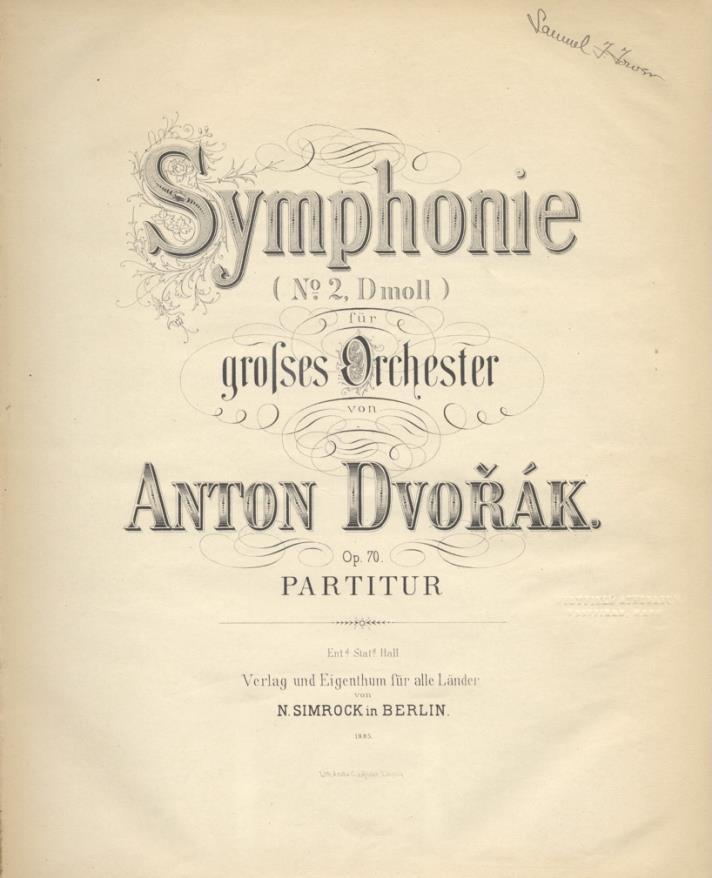
Symphonie (No. 2, D moll) für grosses Orchester ... Op. 70. Partitur. [Fullscore]. Berlin: N. Simrock [PN 8604], 1885.
Folio. Dark brown cloth-backed marbled boards. 1f. (recto title, verso blank), [i] publisher's note, 4-139 , [i] (blank) pp. Binding worn, rubbed, and bumped; small blank rectangular label to outer corner of upper board; call number in white ink to spine. Slightly browned; several smalledge tears; contemporary ownership signature and small embossed stamp to title. Ex-library, with bookpocket to front free endpaper and numerical handstamp to foot of publisher's note.
First Edition. Burghauser 141. Sonneck Orchestral Music p. 109.
This, actually the seventh of Dvorák's symphonies, represents a notable development from and refinement of the composer's earlier orchestral works. "Dvořák worked at the D minor symphony with passionate concentration and in the conscious endeavour to create a work of noble proportions and content which would surpass not only all that he had so far produced in the field of symphonic composition, but which was designed to occupy an important place in world music. ... Dvořák's endeavour was indeed crowned with enviable success. In the power and scale of symphonic conception and the form in which it finds expression, his art in this symphony reaches heights such as he had never achieved before " Šourek: The Orchestral Works of Antonin Dvořák, pp. 108-109. (41315) $450
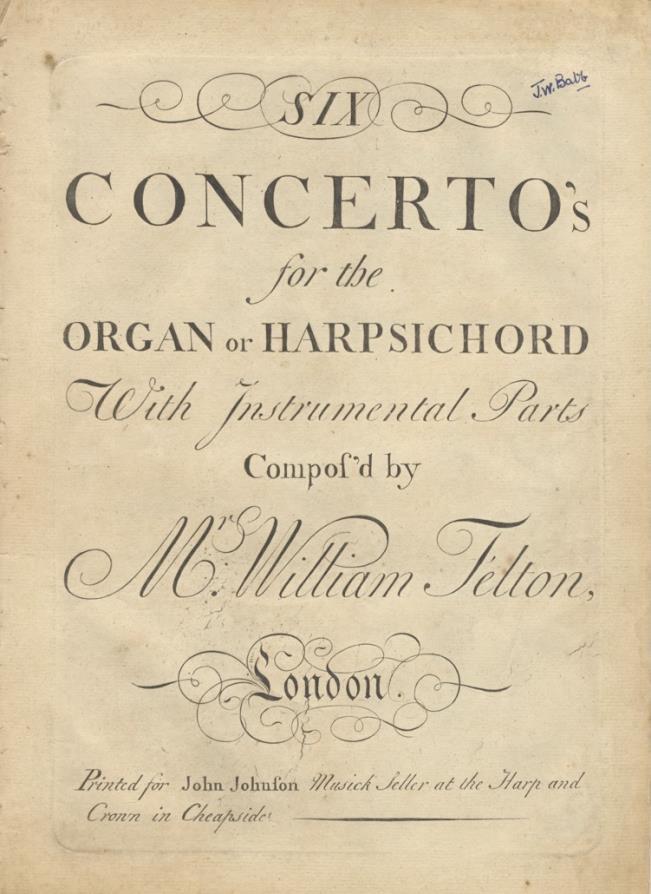
“Bold, Powerful Thematic Material”
25. FELTON, William 1715-1769
Six Concerto's[!] for the Organ or Harpsichord With Instrumental Parts. [Organ/harpsichord part only]. London: J. Johnson, [1744].
Folio. Disbound. 1f. (recto title, verso blank), 2-45, [i] (blank) pp. Engraved throughout Former owner's signature"J.W. Babb"inalaterhandtoupper outercorner oftitle. Slightlyworn, browned, andsoiled;signatures separated; title detached; small tear along platemark at lower outer corner of pp. 17/18; outer blank margins dampstained; paper repairs to blank lower margins of pp. 19-20; tear to pp. 19/20 repaired with archival tape; minor loss to lower outer corner of pp. 21/22.
First Edition, [?]first issue. BUC p. 329. RISM F217 and FF217 (two copies in the U.S., at Harvard and Yale). Originally published with accompanying string parts.
"[Felton] seems to have enjoyed wide popularity as a performer on the harpsichord and organ. ... In [Burney's] Account of the Musical Performances ... in Commemoration of Handel ... he related an anecdote about Felton's endeavours to persuade Handel to subscribe to his op. 2 concertos through the violinist Abraham Brown; Handel started up angrily and said: 'A parson make concerto? Why he no make sarmon?'... Felton is chiefly known as a prolific composer of organ and harpsichord concertos ... [He] had a natural ability for devising bold, powerful thematic material, but his keyboard skills tempted him to include an excessive amount of passage-work." Gerald Gifford in Grove Music Online (40753) $400
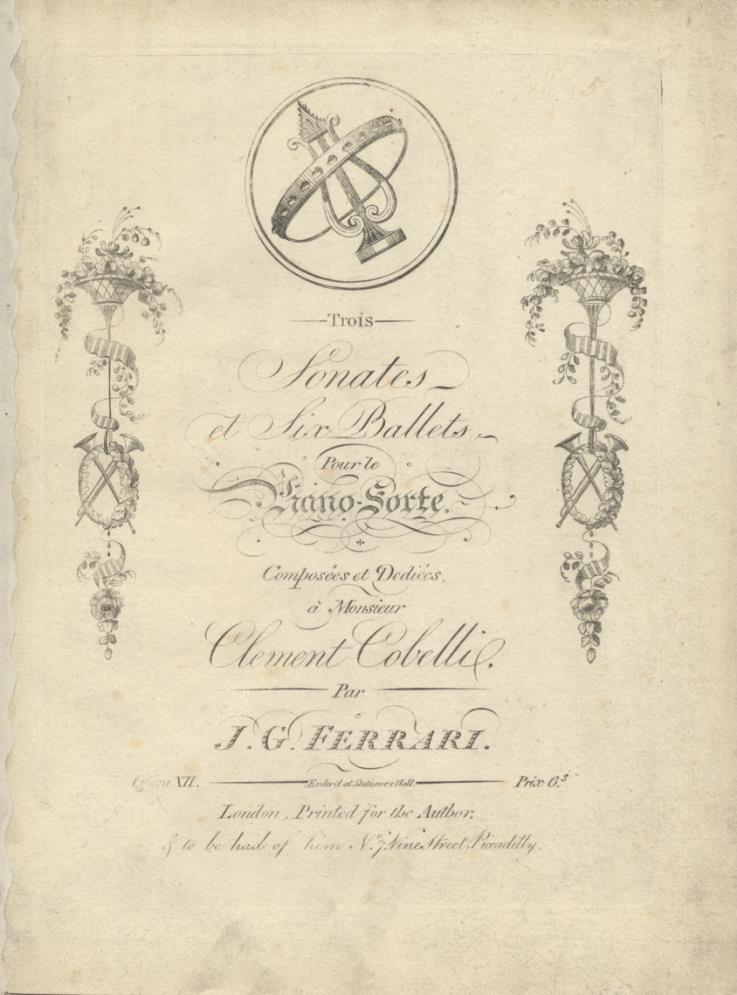
Late 18th Century Italian Sonatas and Ballets
26. FERRARI, Giacomo Gotifredo 1763-1842
Trois Sonates et Six Ballets, Pour le Piano-Forte. Composées et Dediées à Monsieur Clement Cobelli ... Opera XII ... Prix 6s. London: Printed for the Author ... No. 7, Vine Street, Piccadilly, ca. 1795.
Folio. Half ivory vellum maroon boards. 1f. (recto title with decorative border incorporating floral motifs, trumpets, and a lyre within an orb, verso blank), [i] (blank), 2-24 pp. Engraved throughout. Treble clef added in later pencil to left hand part on p. 23 correcting engraving error (bass clef). Binding warped and slightly soiled. Very minor internal wear and soiling; blank inner margin of title and pp. 12 and 13 reinforced with narrow strip of paper. A very good copy overall.
First Edition. BUC p. 331. RISM F476 and FF476 (one copy in the U.S. only, at the University of Pennsylvania).
The sonatas include binary sonata forms, rondos, and variation sets; the ballets include minuet and waltz forms, and English contradances ("Inglesina").
Ferrari was an Italian composer and theorist. "The son of a silk merchant, he was intended for the family business but showed great musical talent from an early age. He studied singing and the harpsichord with Marcolla and Borsaro in Verona while at school, composition with Marianus Stecher in the monastery of Marienberg (now Monte Maria), where he had gone to perfect his German, and, before the age of 20, had learnt
to play the flute, oboe, violin, viola and double bass. After his father’s death in 1784 he decided to pursue a musical career. He accompanied Prince Lichtenstein to Rome and then to Naples, where he was befriended by Paisiello, but the composition lessons he had hoped for amounted to only four hours in five weeks. On the advice of Thomas Attwood he studied counterpoint with Gaetano Latilla. Later, from Vienna, Attwood sent him copies of Mozart's ‘Haydn’ quartets; Ferrari grew to esteem Mozart more highly than any other composer. ...
In April 1792 Ferrari moved to London, where he met Haydn and Clementi and quickly became a leading singing teacher, with the Princess of Wales among his pupils. On 14 May 1799 his one-act opera I due svizzeri was successfully performed; this was followed by Il Rinaldo d’Asti (1801), L’eroina di Raab (1814), a vehicle for Catalani, and Lo sbaglio fortunato (1817). ...
Besides his operas, Ferrari's works include two ballets performed in London, two piano concertos, about 20 sonatas for piano and violin or flute, 12 solo piano sonatas, sonatas and sonatinas for harp and violin and for harp and piano, trios, caprices and various piano arrangements." Alfred Loewenberg, revised by Peter Platt and George Biddlecombe in Grove Music Online (40750) $250
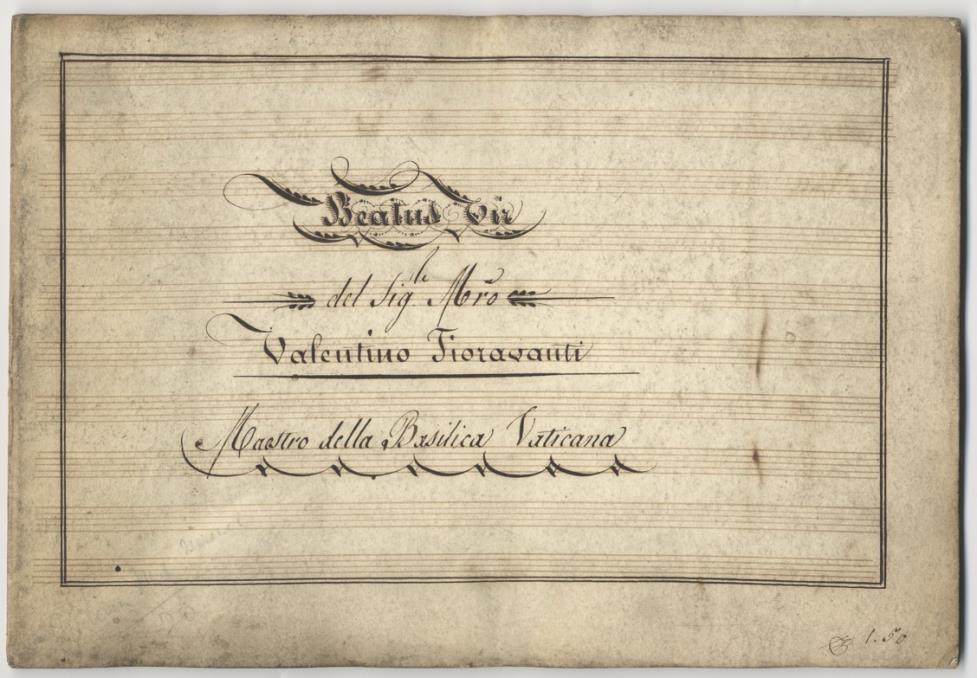
Early 19th Century Sacred Work in Manuscript
27. FIORAVANTI, Valentino 1764-1837
Beatus Vir del Sig. il M[aest]ro Valentino Fioravanti Maestro della Basilica Vaticana. [Score] [Copyist manuscript]. [?]Rome, [ca. 1820].
Oblong folio (218 x 317 mm). Sewn. Notated on 10-stave rastrum-ruled paper. Sewn. [i] (title), 46, [i] (blank) pp. With attractive calligraphic title with notation "1.50" to blank lower outer corner. Scored for three vocal soloists (two soprano, one bass), choir (three trebles, one bass), and organ (figured bass with performance markings including "tasto solo", "aperto", and "chiuso"). With clefs for the choir restated mid-system when the choir enters on the fourth page, a feature related to visual convenience indicating that the score may have been
used by an organist in performance. Slightly worn and soiled; minor browning to edges; title slightly stained; minor dampstaining to lower margin of final leaves; staining to final blank page; first signature detached.
The autograph manuscript of this work is held at the Biblioteca del Conservatorio di musica Santa Cecilia, GMss-1693 (OPAC SBN IT\ICCU\MSM\0035028).
"In Naples Fioravanti was a formidable rival to Paisiello, P.A. Guglielmi and Cimarosa. He toured Italy, writing both comic and serious operas for all the major theatres. His most popular, Le cantatrici villane, was written for Naples in 1799 during the revolutionary turmoil. An instant success, it was performed throughout Europe, becoming one of his few works to be revived in the 20th century (Vienna, 1907; Rome, 1951). ... Stendhal in his Vie de Rossini (Paris, 1824) paid Fioravanti his greatest compliment; he reported Rossini as believing that the art of opera buffa had already reached perfection before he began to compose and that in the particular comic style known as nota e parola there was no further progress possible after Fioravanti." Marvin Tartak in Grove Music Online (41302)
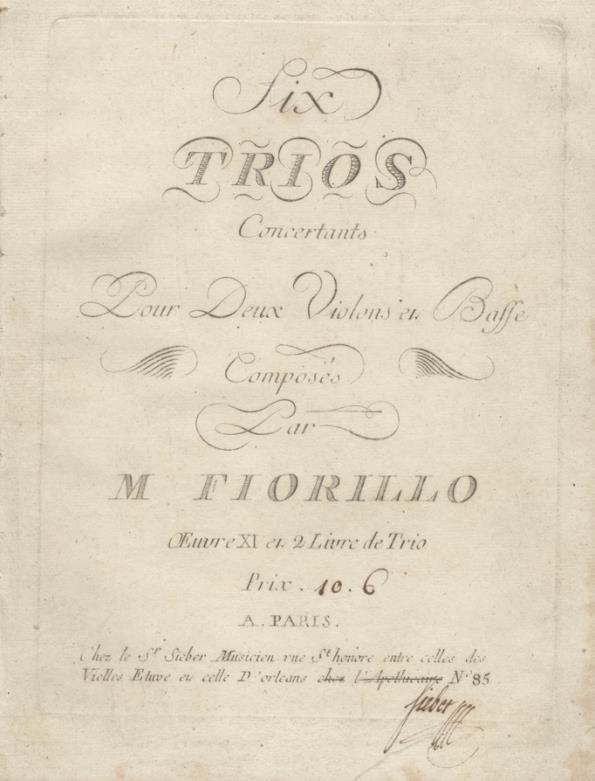
28. FIORILLO, Federigo 1755-ca.1823
$300
Six Trios Concertants pour Deux Violons et Basse ... Œuvre XI et 2 Livre de Trio Prix [10.6]. [Set of parts].
Paris: Chez le Sr. Sieber Musicien rue St. honore entre celles des Vielles Etuve et celle D'orleans chez L'Apothicaire No. 85 [PN 1112], [1791].
Folio. Disbound. Engraved throughout. Instrument designations "Violino Secondo" and "Basso" to first blank pages of second violin and cello parts. With Sieber's control signature to foot of title and "chez L'Apothicaire No. 85" crossed out. Slightly worn; occasional small stains; some minor fading; paper repair to blank lower margin of p. 8 of cello part; final leaves of violino primo and cello parts partially detached.
Violino primo: 1f. (recto title, verso blank), [i] (blank), 2-6, [i] (blank), 8-10, [i] (blank), 12-18, [i] (blank), 2021, [i] (blank), 23-25, [i] (blank) pp.
Violino secondo: [i] (blank), 2-18, [i] (blank), 20-22 pp. Violoncelle: [i] (blank) 2-10, [i] (blank), 12-15, [i] blank)
Lesure p. 206. RISM F894 (one copy in the U.S. only, at the University of Virginia, Charlottesville).
Fiorillo, an Italian violinist, viola player and composer, "reportedly first became proficient on the mandolin and only later turned to the violin. He had probably been touring for some time before his first recorded appearance as a violinist in St Petersburg in 1777. He was in Poland from 1780 to 1781, playing both the violin and the mandolin, and from 1782 to 1784 he was conductor at Riga. In 1785 he played with considerable success at the Concert Spirituel in Paris, and the first of his numerous published works appeared shortly thereafter. He apparently remained in Paris for three years and then went to London, where in 1788 he began to play regularly as viola player in Salomon’s quartet. According to Fétis his last public appearance was as soloist in a viola concerto in 1794, but the title-page of his op.29 (trios for flute, violin and viola), published some time between 1802 and 1811, indicates that he continued to play at some public occasions. His works continued to appear
from various publishers throughout Europe until about 1817. ... His violin compositions reflect a virtuoso’s technique, but he chose to direct a large part of his prolific creativity (more than 70 opus numbers and some 200 works) towards current fashions, such as light piano pieces, divertimentos and arrangements of popular songs. Unquestionably, he succeeded with the public; his publications appeared in multiple editions throughout most of Europe." Chappell White in Grove Music Online. (41041) $350
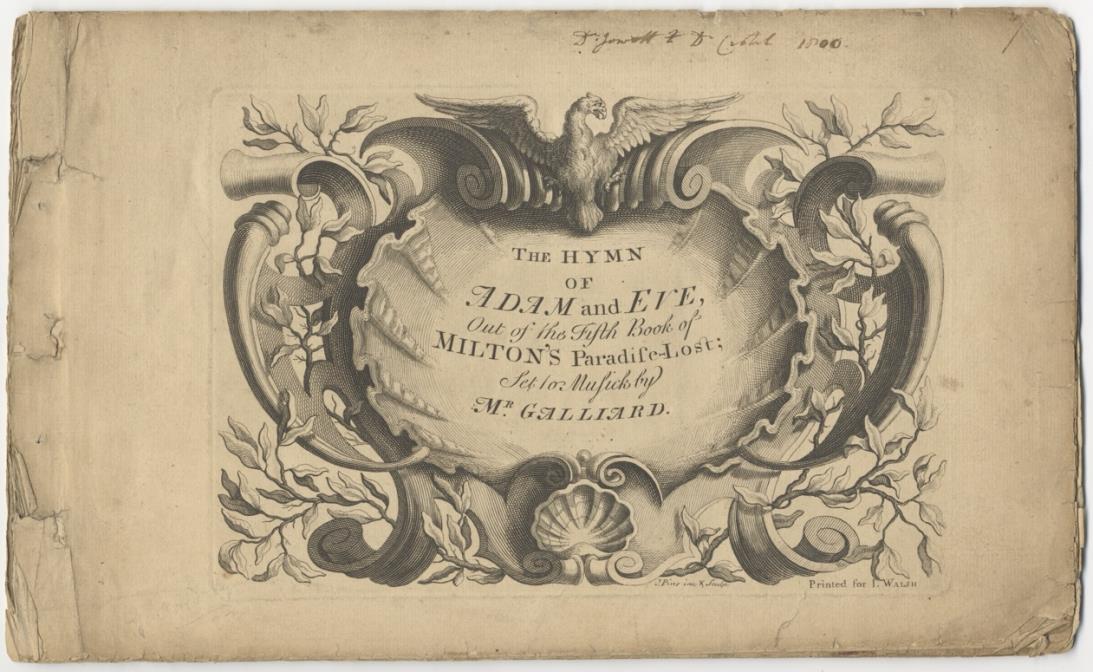
Important to the Late 18th-Early 19th Century Revival of “Ancient Music” in England
29. GALLIARD, John Ernest ca. 1687-1749
The Hymn of Adam and Eve, Out of the Fifth Book of Milton's Paradise-Lost. [London]: Printed for I. Walsh, [1745].
Narrow oblong folio. Disbound. 1f. (recto elaborate engraved title incorporating floral motifs, seashells, and an eaglewith "J. Pineinv. & sculp"to lowermargin, verso blank), 30 pp., with "Engraven by Tho: Atkins" tolower margin of final page. Engraved throughout. With occasional performance markings in pencil. Uniform minor browning; small stains, soiling, occasional minor loss, and holes to blank margins; occasional foxing; title somewhat browned and soiled, with small tears with minor loss to margins.
With "Dr. Jowett to Dr. Crotch 1800" to upper margin of title and "A proposed alteration by W. Crotch" and [?]"*Tenore to the End" to final page of music, all presumably in the hand of Joseph Jowett.
Provenance
From the collection of composer William Crotch (1775-1847)
Second edition. Smith 660, p. 148. BUC p. 358 Hirsch III, 759. RISM G226.
Galliard was a German composer and oboist, active in England. "In 1728 he published his Hymn of Adam and Eve. In 1773 Benjamin Cooke published a heavily revised full score: he added an overture, expanded some of
the duets into choruses and provided fuller accompaniments. ... Galliard certainly played a significant role in London's musical life in the first half of the 18th century. He was a founder-member of both the Academy of Vocal (later Ancient) Music in 1726 and the Royal Society of Musicians in 1738, directing the first performance of the former. ... Charles Didbin thought Galliard had ‘considerable genius’, and if Dr Kitchener is to be believed, Handel in old age told the youthful Samuel Arnold that he had so high an opinion of Calypso and Telemachus that he would sooner have composed it than any of his own operas. The story must have become distorted in the telling, but Handel surely expressed admiration in some degree."RogerFiske, revisedbyRichard G. King in Grove Music Online
Crotch, a noted English composer, organist, and theorist, "was an exceptional child prodigy and became one of the most distinguished English musicians of his day. ... [He] was highly influential as a lecturer and writer on musical subjects. His Elements of Musical Composition, published in 1812 and twice reprinted, was much in demand as a manual for beginners, as were his books on thoroughbass and piano playing." Nicholas Temperley and Simon Heighes in Grove Music Online
The Rev. Dr. Joseph Jowett was one of Crotch's mentors from a very early age. "William was introduced to whole areas of the musical repertory with which most musicians would have been unfamiliar, at weekly musical evenings. They were held at the homes of Dr Jowett (Under Master of Trinity Hall) and Dr Hey (of Sidney Sussex College), and it was here that he heard music from all over Europe, including 'ancient music' (roughly speaking, music more than a century old), which was to form his taste and judgement for the future."
Rennert: William Crotch, p. 29; Empiricism, Ideology and William Crotch's Specimens, Cambridge University Press online, 8 January 2013
An interesting item, linking two figures important to the revival of "ancient music" in late 18th-early 19th century England, William Crotch and his mentor Joseph Jowett. (40597) $350
Sinfonies by an Obscure
18th Century Venetian Composer
30. GALLO, Alberto fl. mid-18th century
Twelve Sinfonie or Sonatas in 4 Parts. For Two Violins, a Tenor, with a Bass for the Violoncello & Harpsichord. Compos'd in an easy and pleasing Stile ... Opera 2da. [Set of parts]. London: Printed for I. Walsh in Catharine Street in the Strand, [1754].
Folio. Contemporary light blue wrappers. Engraved throughout. Uncut. "Numb. XXVIII." printed at head of titles. With brief publisher's catalogue to foot of titles listing works "Just Publish'd for two Violins and a Bass" by Nussen, Porpora, Solniz, Handel, St. Martini, Boyce, St. Germain, Humphries, Geminiani, Morigi, Lampugnani, Albinoni, Alberti, Ceruetto, Torelli, Purcell, Mascitti, Brioschi, Fritz, Bononcini, Schickard, Tibaldi, Valentine, Valentini, Bomporti, and Finger. Wrappers somewhat worn and creased with small stains, spinesandedges frayedandchipped with minor loss. Occasional minor soiling and small stains, mainly to blank lower margins; some creasing
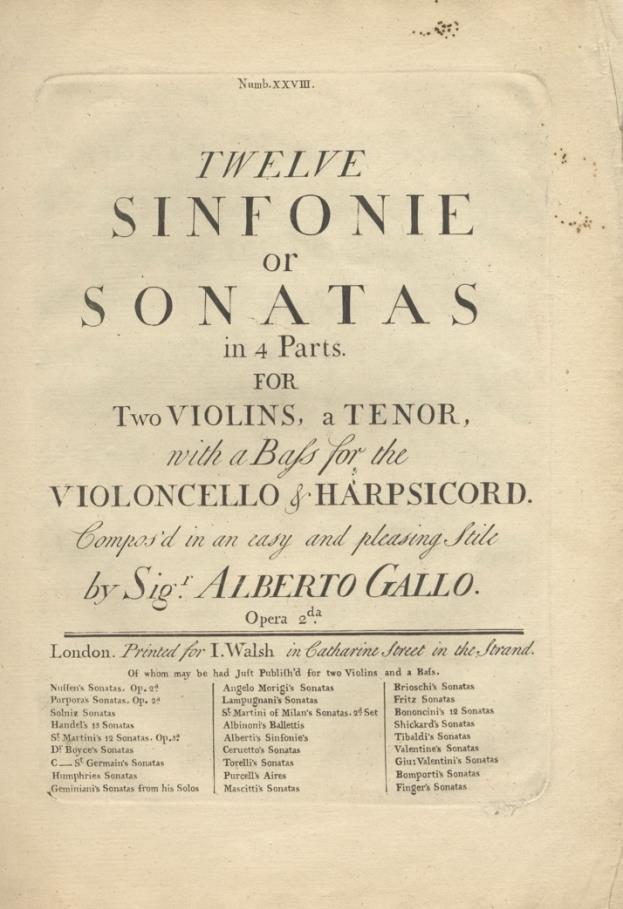
to blank margins; lower wrapper of cembalo part detached.
Violino primo: 1f. (recto title, verso blank), 12 pp.
Violino secondo: 1f. (recto title), [i] (blank), 2-11, [i] (blank) pp.
Alto viola: 1f. (recto title), [i] (blank), 2-9, [i] (blank) pp.
Cembalo e violoncello: 1f. (recto title, verso blank), [i] (blank), 2-10 pp.
First Edition. Smith & Humphries 666, p. 149. BUC p. 359. RISM G260 (no copies in the U.S.).
Little seems to be known about Alberto Gallo other than thathe was a Venetian composer active in the mid-18th century. (40749) $700
“A
Central Figure in the Development of the Dramma Giacoso”
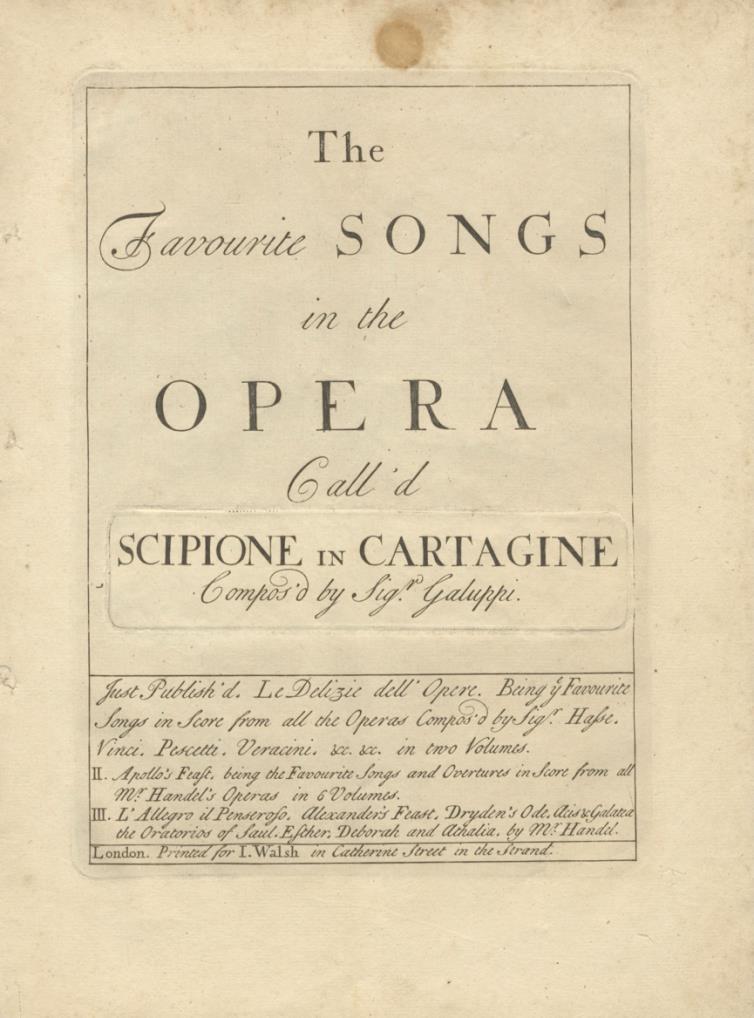
31. GALUPPI, Baldassare 1706-1785
The Favourite Songs in the Opera Call'd Scipione in Cartagine. [Score]. London: Printed for I. Walsh in Catherine Street in the Strand, [ca. 1742].
Folio. Disbound. 1f. (recto passepartout title, verso blank), [i] (blank), 2-21, [i] (blank) pp. Engraved throughout. Named singers include Signor Amorevoli, Signor Monticelli, Signora Tedeschi, and Signora Visconti. With brief publisher's catalogue to foot of title including a 2volume set with pieces by Hasse, Vinci, Pescetti, and Veracini; and works of Handel. Slightly worn; occasional very minor foxing, small stains, minor soiling, and small edge tears; minor loss to blank lower outer corner of final leaf.
First Edition. Smith 679, p. 152. BUC p. 359. Published in two books, each with its own passepartouttitle; the present volume is the first. RISM G287, GG287 (three copies in the U.S., at the University of Michigan, Ann Arbor; the University of Washington, Seattle; and the Folger Shakespeare Library).
Scipione in Cartagine was first performed in London on The King’s Theatre on 2 March 1742. Galuppi "was a central figure in the development of the dramma giocoso and one of the most important mid-18th-century opera seria composers. Known widely as ‘Il Buranello’, from his birthplace, he was routinely listed in Venetian documents and early manuscripts as ‘Baldissera’. ... [He] arrived in London in October 1741 and supervised 11 opera productions over the next year and a half, including four original works. ... In general Galuppi’s trip was successful and he was well received. His music was often reprinted for the English public, and two more Galuppi works appeared there soon after he had left." Dale E. Monson in Grove Music Online. (40747) $675
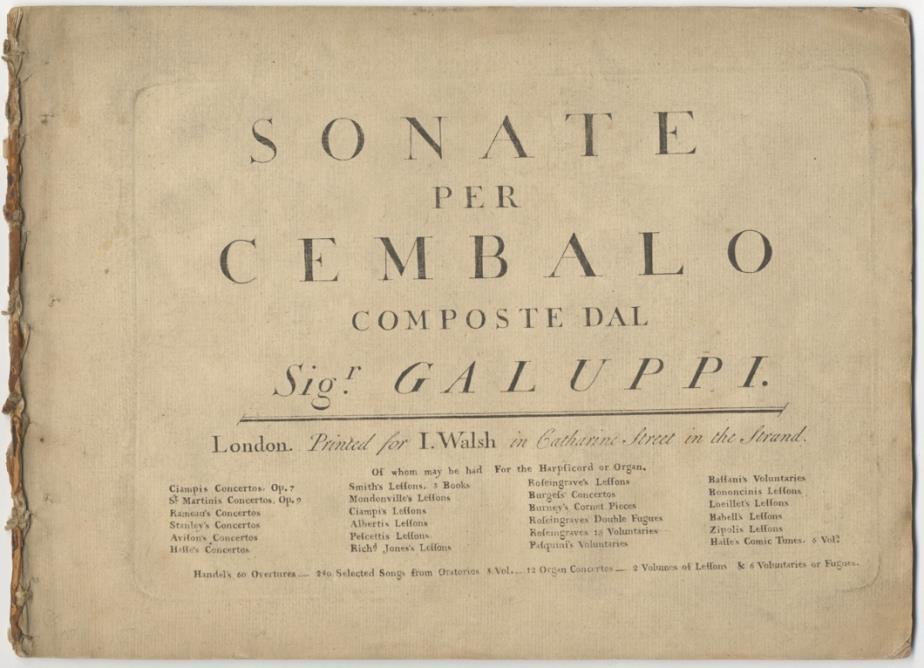
Galuppi’s First Published Keyboard Music
32. GALUPPI, Baldassare 1706-1785
Sonate per Cembalo. London: Printed for I. Walsh in Catharine Street in the Strand, [1756].
Oblong folio. Disbound. 1f. (recto title, verso blank), [i] (blank), 2-21, [i] (blank), 23-26 pp. Engraved throughout.
With brief publisher's catalogue listing works for harpsichord and organ by Ciampi, St. Martini, Rameau, Stanley, Avison, Hasse, Smith, Mondonville, Alberti, Pescetti, Richard Jones, Roseingrave, Burgess, Burney, Pasquini, Bassani, Bononcini, Loeillet, Babell, Zippoli, and Handel to foot of title.
Slightly worn and browned, a bit heavier to some leaves; small binder's holes to inner margins; occasional small tears and light pencilling. Lacking final blank leaf.
First Edition, variant issue. Smith & Humphries 681, p. 152. BUC p. 360. RISM G298 (not distinguishing between issues).
“There are about 130 known keyboard sonatas by Galuppi, and other compositions may yet be uncatalogued. The majority are in undated manuscripts, so his role in shaping the genre in the 1730s and 40s is obscure. None of the sonatas was published before 1756, and he wrote such works even late in life (Passa tempo al cembalo is dated 1785), yet the graceful, ornamented style of many works seems to have more in common with keyboard styles of a period before 1750. The European vogue for Italian keyboard sonatas (almost all opera composers wrote them) among an amateur audience rested in their undemanding technical requirements and ingratiating style. Galuppi’s own virtuosity as a keyboard player is not the focus. There is much idiomatic keyboard writing, with broken chords, scales, motifs shared between hands and the like. About half of the sonatas are in a single movement, while others follow the two- or three-movement arrangement of Alberti or the fast–slow–fast organization of the opera sinfonia and concerto. Binary movements predominate and most sonatas are in major keys. The texture is generally thin and homophonic, with a singing soprano line, clear and regular phrasing and characteristic gestures and motifs reminiscent of aria types, particularly in slow ornamental movements. At times the writing is rhapsodic and developmental. The figuration mimics a variety of styles, from string genres to the French overture and German preludes." Dale E. Monson in Grove Music Online
The first publicationofkeyboardmusic byGaluppi, aninfluentialItalian operacomposer. (40746) $400
“Expressive
and Inventive
Melodies”
33. GIORDANI, Tommaso 1733-1806
Six Concerto's for the Piano-Forte or Harpsichord ... Op. XIV Humbly Dedicated to the Hon=ble Miss Bertie. Pr. 10s. 6. [Pianopart]. London:Printed for Longmanand Broderip No. 26, Cheapside, [1776].
Folio. Disbound. 1f. (recto title, verso blank), [i] (catalogue), 2-45, [i] (blank) pp. Engraved throughout. Title with a fine engraved illustration by A. Albanesi of a column adorned with floral motifs with Arion riding on a dolphin and holding a lyre atop its capitol. Slightly worn; occasional minor browning, soiling, foxing, and staining; pp. 25/26 slightly trimmed and with two short tears repaired with archival tape.
First Edition, later issue. BUC p. 380. RISM
G2256 and GG2256 (three copies of the piano part in the U.S., at the University of California, Berkeley; the New York Public Library, Lincoln Center; and the University of Pennsylvania).
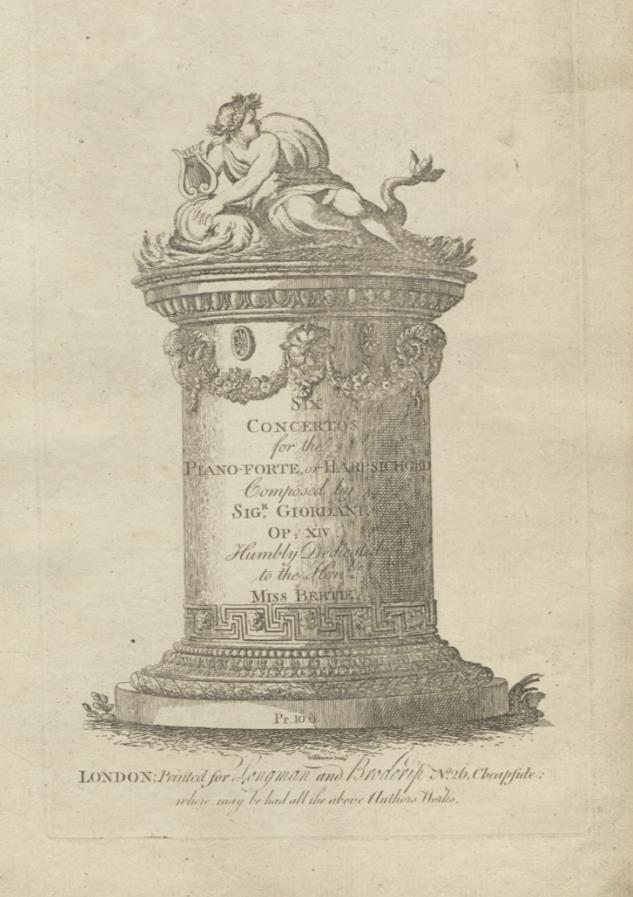
Originally published with string parts; the piano part stands alone without its accompaniment. The second movement of Concerto III (Larghetto) has an additional title, above the uppermost system, "My Lodging is on the Cold Ground;" the movement is based on a ballad of the time and embellishes the melody with florid ornamentation and passages of harmonic and figural elaboration.
Giordani was an Italian composer, active in England and Ireland. "All the members of his family were singers, apart from himself and his brother Francesco, a dancer. About 1745, under the management of their father, Giuseppe (unrelated to the composer Giuseppe Giordani known as Giordaniello), the Giordani family formed a small opera troupe and, with a few other singers, travelled across Europe. ... He may have arranged music and played the harpsichord in the theatre band while the rest of the family was on stage. ... Giordani's gifts as a prolific and versatile composer were sufficient for him to be respected in London and to dominate the Dublin musical scene for many years. He wrote in the prevailing italianate style, with expressive and inventive melodies, his best written with specific singers in mind." Irena Cholij in Grove Music Online (40751) $200
“The Composer’s First Great Success”
34. GOTTSCHALK, Louis Moreau 1829-1869
Bamboula Danse de Negres. [Op. 2]. [Piano solo]. New York: William Hall & Son, 239 Broadway, [after1849].
Folio. Disbound. 1f. (recto title, verso blank), 3-17, [i] (blank) pp. Lithographed, with "Lith of Sarony & Major, N. Y." to lower inner corner of title. With fine three-quarter-length lithographic portrait of the composer to title. Very slightly worn and browned; some minor showthrough.
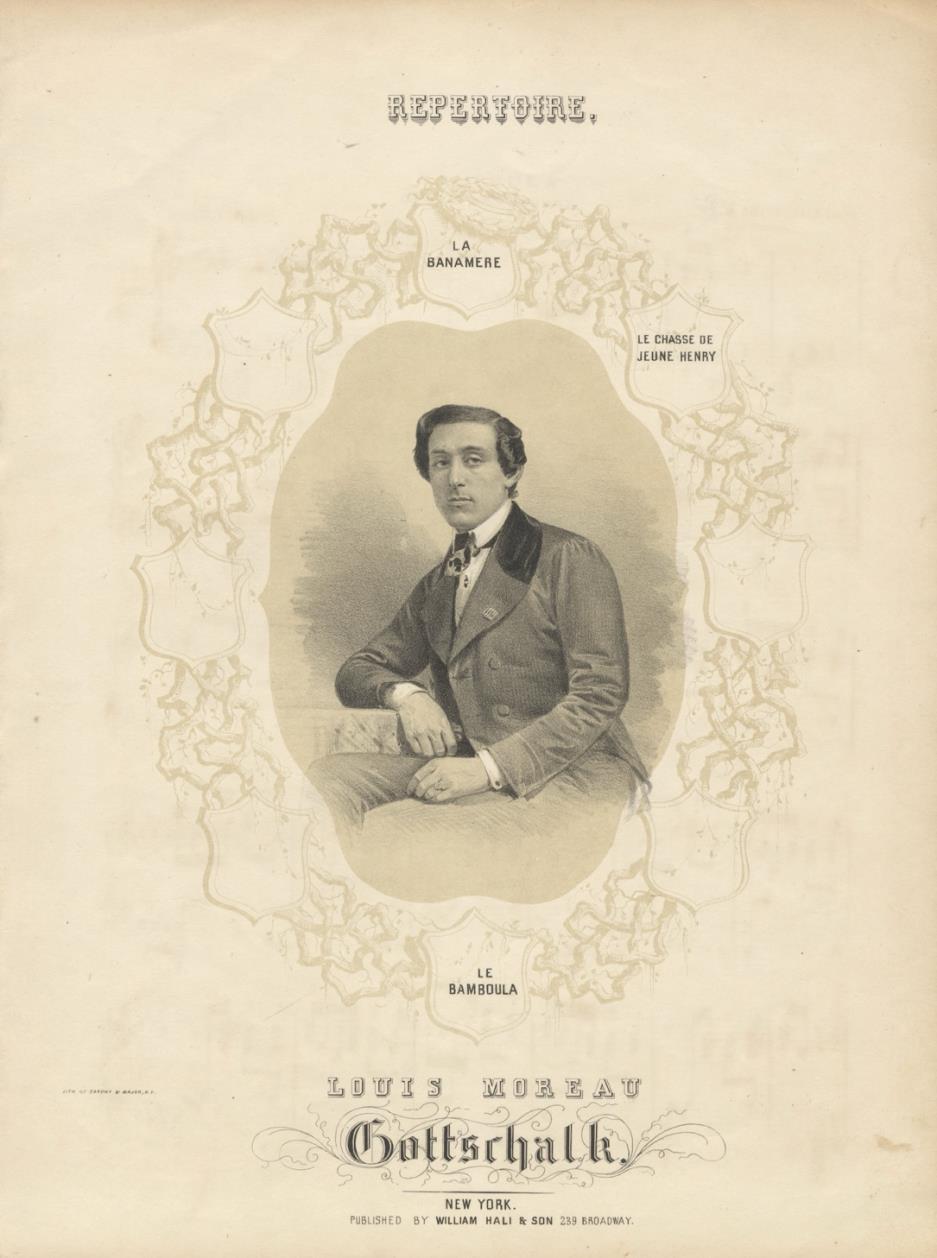
First American edition, later issue. Doyle-13, p. 264. Offergeld 20.
Dedicated to Queen Isabella II of Spain, " 'Bamboula' was the composer's first great success. ... The main theme of 'Bamboula' is based on the folksong 'Quan patate la cuite,' well known in New Orleans, and perhaps brought there by West Indian slaves." Doyle p. 265.
Gottschalk was an American composer and pianist. "His considerable reputation as a composer and performer of virtuoso piano music did not long survive his death, but a renewed interest in his life and works began in the 1930s, and he is now generally acknowledged as one of the most significant 19th-century American musicians, particularly for his nationalistic and exotic compositions." Irving Lowens, revised by Frederick Starr and Laura Moore Pruett in Grove Music Online. (41052) $100
An Interesting Association Copy Perhaps Best Known as the Theme for Alfred Hitchcock Presents
35. GOUNOD, Charles 1818-1893
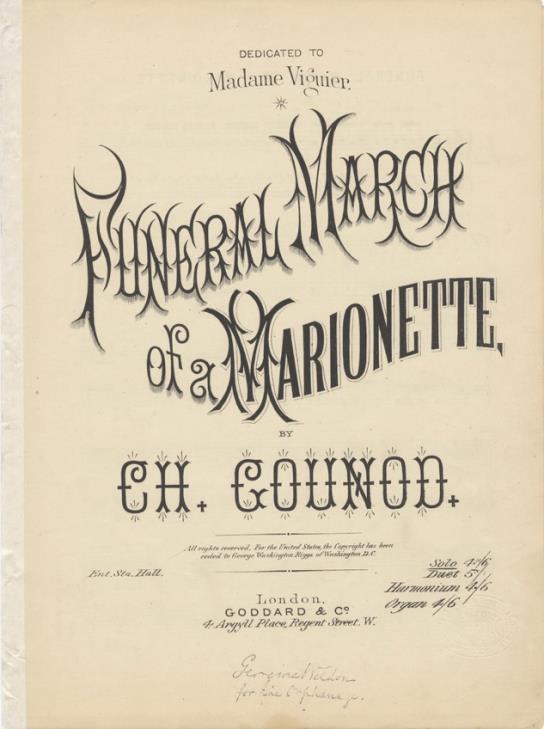
Funeral March of a Marionette ... Solo 4s/6 Duet 5s/ Harmonium 4/6 Organ 4/6. Dedicated to Madame Viguier. [Piano solo]. London: Goddard & Co. 4, Argyll Place, Regent Street, W. [PN G. & Co. 122], [ca. 1879].
Folio. [i] (title), 2-9, [i] ("Goddard & Co.'s First-Page Catalogue of New Pianoforte Music" with grand-staff excerpts of six pieces), pp. With facsimile signature handstamp to foot of title: "Georgia Weldon for the Orphanage," and small oval blindstamp of Woodward piano warehouse, South Guernsey, to lower outer corner of title. Spine reinforced with narrow strip of white tape. Light uniform browning; signatures from pp. 3-8 detached; binding holes to blank inner margins.
Later edition. Fuld p. 239. OCLC 1127651890.
Gounod is "best known today as the composer of the opera Faust and an Ave Maria descant to the first prelude of J.S. Bach's Das wohltemperirte Clavier, Gounod wrote in most of the major genres of his day, sacred and secular. That his reputation began to wane even during his lifetime does not detract from his place among the most respected and prolific composers in France during the second half of the 19th century." Steven Huebner in Grove Music Online
Georgina Weldon (1837-1914), a Victorian-era soprano, had a close association with Gounod, singing the solo part in his cantata Gallia at both the Conservatoire de Paris and the Opéra-Comique; the composer, in poor health, in fact, lived at Tavistock House with Mrs. Weldon and her husband from 1871-1874, followed by a stormy and somewhat litigious relationship between the composer and singer. A somewhat controversial figure, Georgina was actively involved in the foundation of an orphanage dedicated to the musical education of poor children. The dedicatee, Madame Viguier, was a pianist and the wife of Alfred Viguier (1828-1904), first violin in the Orchestre de la Société des Concerts du Conservatoire.
The present work is perhaps best known as the theme music for Alfred Hitchcock Presents. (41053) $75
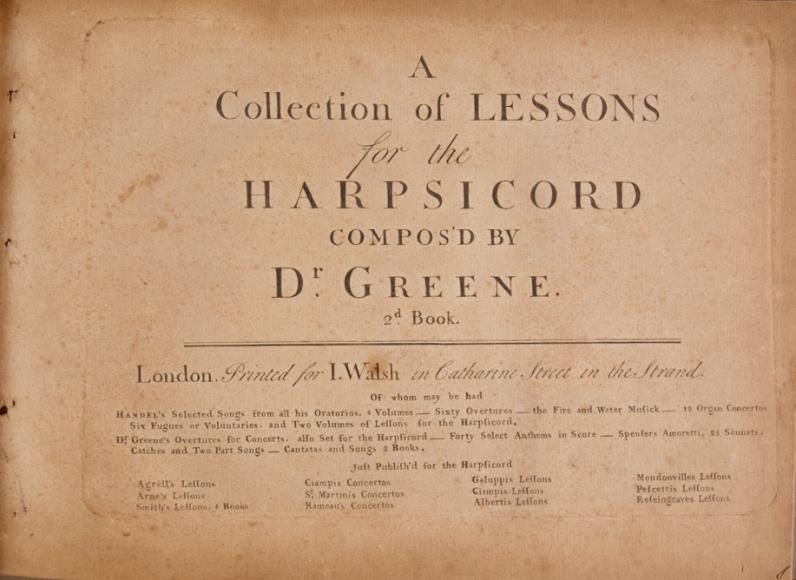
Mid-18th Century Harpsichord Lessons From the Collection of Christopher Hogwood
36. GREENE, Maurice 1696-1755
A Collection of Lessons for the Harpsichord ... 2d. Book. London: Printed for I. Walsh in Catharine Street in the Strand, [ca. 1755].
Oblong folio. Gray textured paper boards with dark red leather title label gilt to spine. 1f. (recto title, verso blank), [i] (blank), 2-20, [i] (blank), 22-24 pp. Engraved throughout. With pieces organized into suites with preludes, airs, and dances (allemande, corrente, etc.). Brief publisher's catalogue to lower portion of title advertising works by Handel and Greene as well as by Agrelli, Arne, Smith, Ciampi, St. Martini, Rameau, Galuppi, Alberti, Mondonville, Pescetti, and Roseingrave "Just Publish'd for the Harpsicord." Binding worn, rubbed, and bumped, with several small stains; endpapers browned, with small tear to outer margin of front free endpaper repaired with archival tape to verso. Minor internal wear, soiling, and browning, heavier to title and verso of final leaf; binder's holes to blank inner margin; title with small tear along platemark at lower outer portion repaired with archival tape to verso; small wormhole to lower outer corner of final leaves
Provenance
Noted conductor, harpsichordist, and musicologist Christopher Hogwood (1941-2014), with "ex Coll. Ch Hogwood" in pencil to upper outer corner of front pastedown.
First Edition. Smith and Humphries 739. BUC p. 399. RISM G3797 and GG3797 (one copy only in the U.S., at the University of Illinois, Urbana-Champaign).
A noted English harpsichordist and writer, Greene was organist of St. Paul's Cathedral and the Chapel Royal "Though remembered chiefly for his church music, he was also an important composer of keyboard music, songs and extended vocal works." TNG Vol. 7, p. 684. (40741) $450
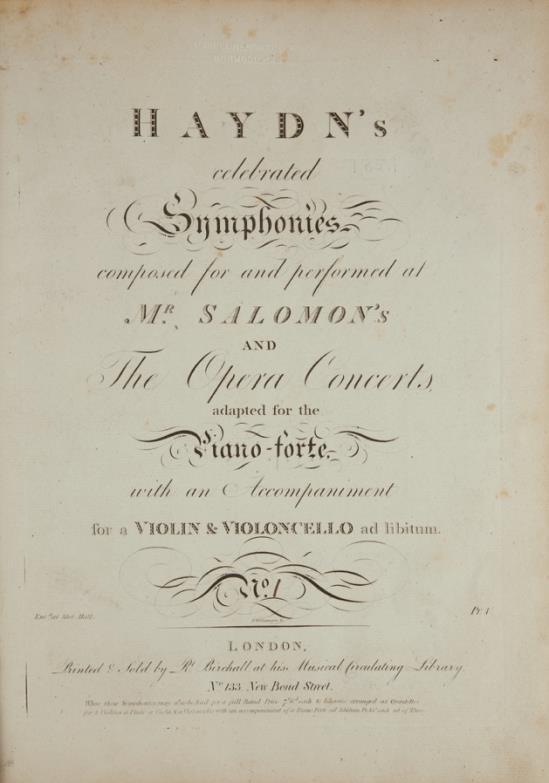
Salomon’s Arrangement of Haydn Symphonies
37. HAYDN, Joseph 1732-1809
Haydn's celebrated Symphonies composed for and performed at Mr. Salomon's and The Opera Concerts, adapted for the Piano-forte, with an Accompaniment for a Violin & Violoncello ad libitum No. [I-XII]. [Hoboken I:96, arr.]. [Keyboard part only]. London: Rt. Birchall at his Musical Circulating Library No. 133 New Bond Street, [1804-06].
Folio. half dark red calf with marbled boards, dark red decorative ownership label of the Countess of Gosfoed gilt to upper, titling and rules gilt to spine. 1f. (recto title, verso blank), [i] (blank), 2-18; 1f. (recto title, verso blank), [i] (blank), 2-13; 1f. (recto title, verso blank), 16; [i] (title), 2-18; 1f. (recto title, verso blank), [i] (blank), 2-13; [i] (title), 2-15; 1f. (recto title, verso blank), 21; [i] (title), 22-41; 1f. (recto title, verso blank), 41-58; 1f. (rectotitle, versoblank), 59-75;[i], 76-97;[i], 98-115pp. Engraved. Bindingworn, rubbed, bumped,andscuffed. Minor to moderate foxing and browning. Ex-library, with bookplate of the Morrill Memorial Library in Norwood, Massachusetts, to front pastedown with name of donor crossed out, call number in white ink to spine, and small embossed stamp to uppermargin of title. Lacking ad libitum violinand violoncello parts. In very good condition overall.
Provenance
Possibly from the collection of Millicent Acheson, the Countess of Gosford (ca. 1750-1825), friend of Lady Byron.
A later edition. RISM H4523 (complete series of the 12 London symphonies, with copies at the Naples Conservatory, Italy, and at the Library of Congress [nos. 1-6 only]). WorldCat (copies of the complete series at Boston University and the University of Oxford and copies of nos. 1-6 at the Eastman School of Music and at Cornell University). See Hoboken Coll. Sy. 15b. for details regarding the first edition.
The arrangement is by Johann Peter Salomon (1745-1815). (41316)
$350
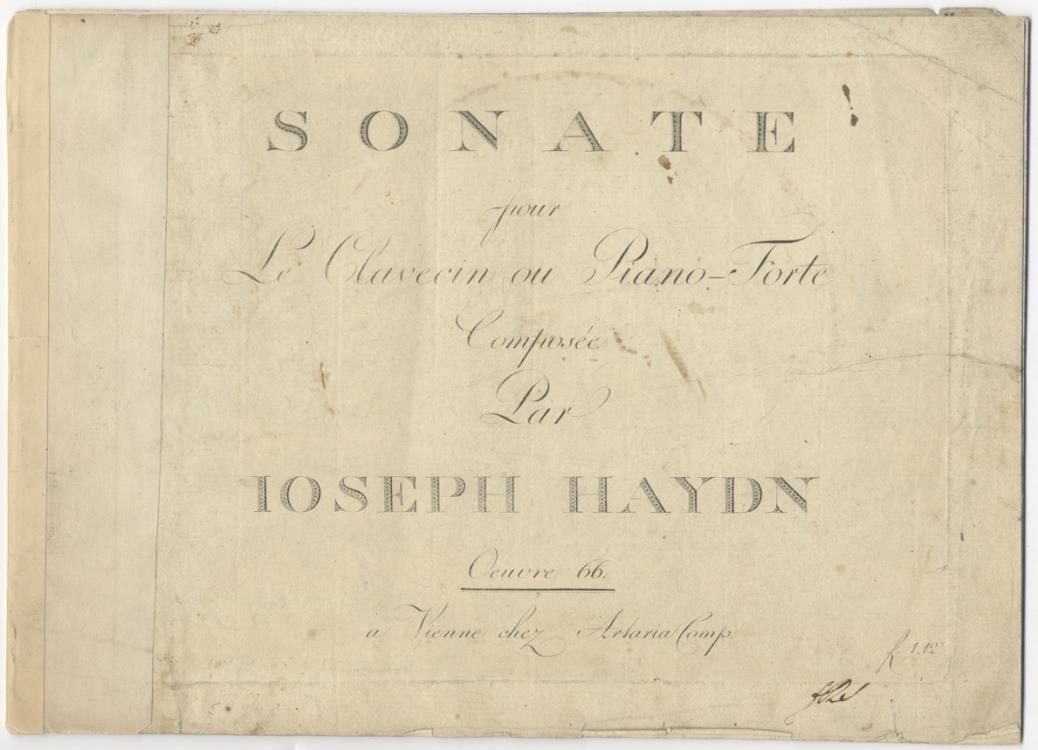
Sonata Op. 66
From the Collection of Rudolf Serkin
38 HAYDN, Joseph 1732-1809
Sonate pour Le Clavecin ou Piano-Forte ... Oeuvre 66 ... f 1.12x. [Hob: XVI, 49]. Vienne: Artaria Comp. [PN 352], [1791].
Oblong folio. Unbound. 1f. (recto title, verso blank), 15, [i] (blank) pp. Engraved. On fine laid paper with watermarkofacrown, threehalf-moons, andthelettersFGA. Occasionalmarkingsin pencilincludingnotational corrections and fingering. Some minor wear, soiling, and staining; tears to title and final leaf with early repairs; early paper reinforcement to spine of outer bifolium; possibly lacking a rear blank leaf.
A good, strong impression but showing some evidence of cracking in the printer's plates.
Provenance
Rudolf Serkin (1903-1991), renowned pianist, and by descent to his son, noted American pianist Peter Serkin (1947-2020). With early [?]ownership marking in contemporary manuscript to lower outer corner of title.
First Edition. Rare. Hoboken 8, 1153. RISM H3945 and HH 3945. (no copies in the U.S.). OCLC (one copy only in the U.S., at Appalachian State University).
"It was for one of Haydn's closest friends and admirers, Maria Anna von Genzinger (1750-1793), the wife of Prince Esterházy's physician Dr. Peter von Genzinger, that the E-flat major Sonata Hob, XVI: 49 was conceived. The von Genzinger family resided in the so-called Schotten-Hof, where their house was a veritable center of music making; Haydn, Mozart, Dittersdorf, and Albrechtsberger were frequent and welcome guests." A. Peter Brown: Joseph Haydn's Keyboard Music, p. 43.
"No lack of discussion exists for Hob. XVI: 49, however, as its first movement has fascinated such commentators as Mersmann, Schenker, and Cone; Abert even considered it Haydn's complete achievement of a Classic idiom." Ibid, p. 346. (41294) $2,500
39. HAYDN, Joseph 1732-1809
Oesterreischische Volks-Hymne (Gott, lass Segen uns erflehen) Gedichtet von Professor Flügel. Musik von Jos. Haydn ... Philomele No. [500]. [Vocal score with piano accompaniment and choral score]. Wien: bei Ant Diabelli & Comp., Graben No. 1133 [PN D. & C. No 8776], [ca. 1830].
Oblong folio. Disbound. [i] (series title Philomele eine Sammlung der beliebtesten Gesänge mit Begleitung des Pianoforte eingerichtet und herausagegeben von Anton Diabelli von Anton Diabelli. No. [500] ... No. 168 ... Pr. [20x] C.M.), 2-3 (hymn for voice and piano with three strophes), 4-5 (two arrangements of the hymn, one for soprano/alto/tenor bass and the other for four-voice men's choir), [i] (blank) pp. Engraved throughout.
Hob XXVIa:43. OCLC 68298775.
In the series Philomele eine Sammlung derbelibtesten Gesänge mit Begleitung des Pianoforte eingerichtet und herausgegeben von Anton Diabelli (41038) $40
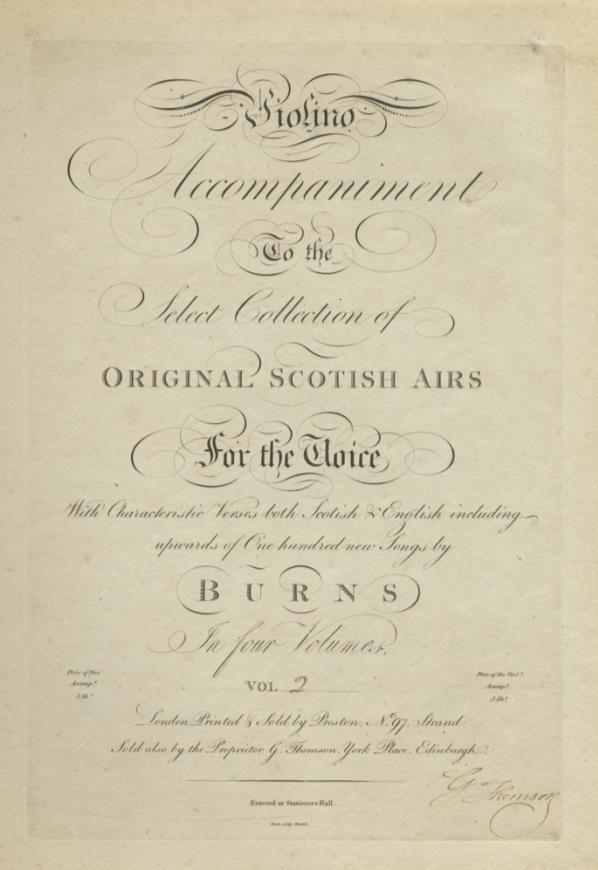
“Original Scotish[!] Airs”
40. HAYDN, Joseph 1732-1809
Violino Accompaniment To the Select Collection of Original Scotish Airs for the Voice With Characteristic Verses both Scotish & English including upwards of One hundred new Songs by Burns in four Volumes. Vol. [24]. London: Printed & Sold by Preston, No. 97 Strand. Sold also by the Proprietor G. Thomson, York Place, Edinburgh, 1802-04.
3 volumes. Folio. Contemporary plain mid-purple wrappers. Sewn.
Vol. 2: 1f. (recto title, verso blank), 17-32 pp. Watermark dated 1803
Vol. 3: 1f. (recto title, verso blank), 33-48 pp. Watermark dated 1802
Vol. 4: 1f. (recto title, verso blank), 49-64 pp. Watermark dated 1802
Price given as "3 Shs." With "Neele sculp. Strand" to foot of titles. Title to vol. 2 signed "Go. Thomson," vols. 3 and 4 signed with his initials.
First Edition. Rare. Hopkinson and Oldman p. 23.
Together with:
Violoncello Accompaniment To the Selected Collection of Original Scotish Airs for the Voice ... In three Volumes [!4]. London ... Edinburgh: Preston ... G. Thomson [Vols. 3 and 4]. 2 volumes. Folio. Contemporary plain mid-purple wrappers. Sewn. Vol. 3: 1f. (recto title, verso blank), 21-30 pp. Watermark dated 1802. Vol. 4: 1f. (recto title, verso blank), 31-40 pp. Watermark dated 1802. Price given as "3 Shs." "Neele sc. Strand" to foot of titles. Titles to each volume initialed by Thomson. First Edition. Rare. Hopkinson and Oldman p. 23.
Together with:
Violin Accompaniment by Pleyel To the first Set of Scotish[!] Songs. Folio. Contemporary plain mid-purple wrappers. Sewn. 8 pp. No title page present (possibly not issued with such). Hoboken XXXIa. RISM H2735-37
A fifth volume of songs in the series with music by Beethoven was issued in 1818. The accompanying instrumental parts to the Scottish Songs are very rare. "It is ... impossible to speak with assurance in treating of these part books. They are exceedingly rare, and we have not found any that can be associated with any volume or edition later than 1818." Hopkinson and Oldman; Thomson's Collections of National Song with special reference to the contributions of Haydn and Beethoven, p. 11. (41312)
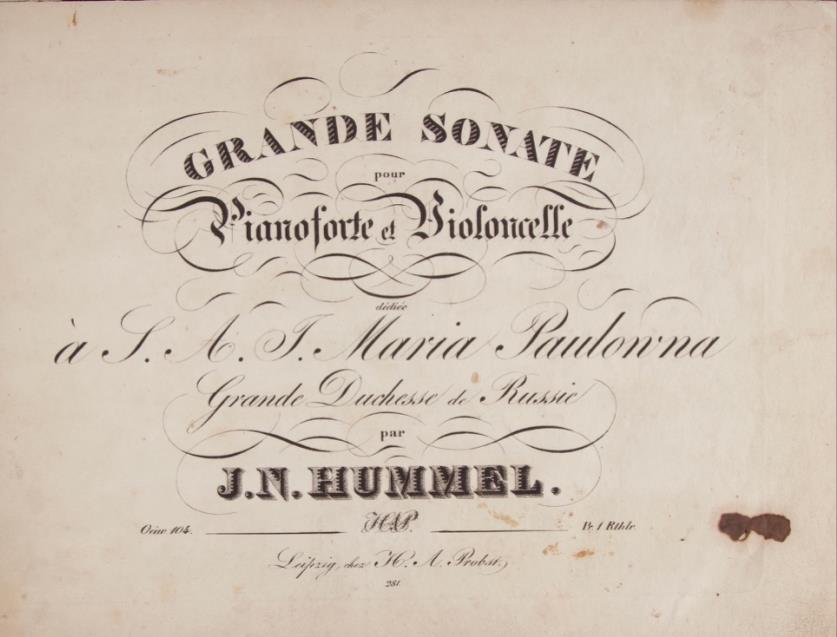
Works for Piano by Hummel, Ries, Romberg, and Kruft
41. HUMMEL, Johann Nepomuk 1778-1837 et al.
Collection of 19th century piano parts for works by Hummel, Ries, Romberg, and Krufft
$350
HUMMEL. Grande Sonate pour Pianoforte et Violoncello dédiée à S.A.I. Maria Paulowna Grande Duchesse de Russie ... Oeuv. 104 ... Pr. 1 Rthlr. [Op. 104]. Leipzig: H. A. Probst [PN 281], [1827-1828]. [i] (title), 2-19, [i] (blank) pp. Engraved. Second edition. Zimmerschied p. 153. OCLC 165699433. Occasional small stains; minor soiling and foxing; light uniform browning; ink stain creating small hole to blank outer margin of title.
Hummel, an Austrian pianist, composer, teacher, and conductor, was "considered in his time to be one of Europe’s greatest composers and perhaps its greatest pianist." Joel Sachs, revised by Mark Kroll in Grove Music Online
Bound with:
RIES, Ferdinand 1784-1838. Grande Sonate pour Piano-Forté, et Violoncelle obligé composée et dediée à Bernard Romberg ... Oeuvre 2[0] ... Prix 4 Francs. Bonn: N. Simrock [PN 744], [ca. 1810]. [i] (title), 4-18 pp. Engraved. Title repaired with early ivory paper tape. First Edition. Hill p. 18. OCLC 165363930.
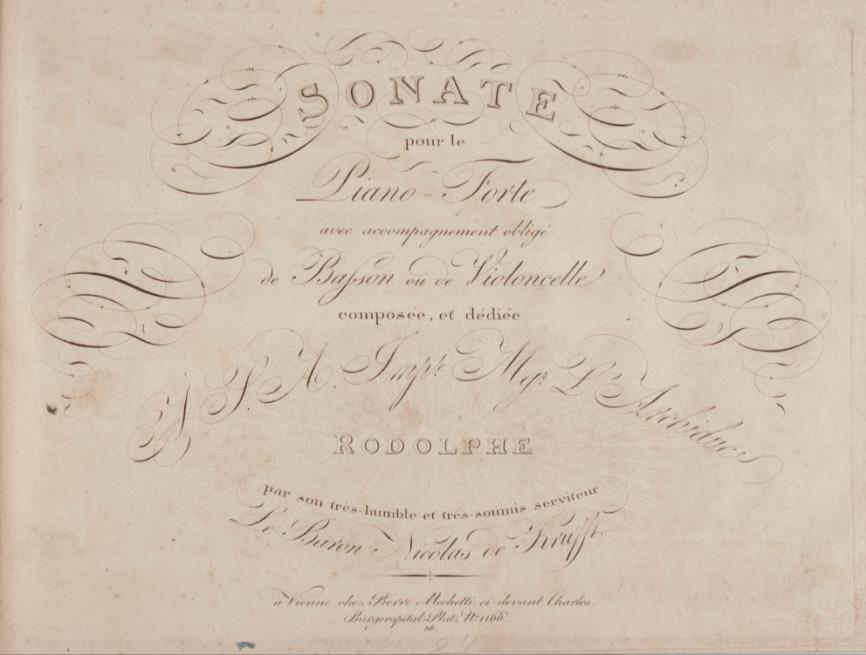
Grande Sonate ... Oeuvre 2[1]. [PN 745]. 1f. (recto title, verso blank), 3-21, [i] (blank) pp. Engraved. First Edition. Hill p. 19. OCLC 16454873.
Ries, a pupil of Beethoven, was a German pianist, composer, and copyist "The ‘Memoir of Ferdinand Ries' in The Harmonicon expressed the high regard in which London audiences held him as a pianist: 'Mr. Ries is justly celebrated as one of the finest piano-performers of the present day. His hand is powerful, and his execution is certain – often surprising. But his playing is most distinguished from that of all others by its romantic wildness. ... He produces an effect upon those who enter his style, which can only be compared to that arising from the most unexpected combinations and transitions of the Aeolian harp.' " Cecil Hill in Grove Music Online
Bound with:
ROMBERG, Bernhard 1767-1841. Trois Grandes Sonates pour le Pianoforte avec Accompagnement de Violon (ou Violoncello) ... Liv: 1 Prix 1 Rtlr: 4 Gr. Leipzig: Fr. Hofmeister [PN 393], [1816]. [i] (title), 2-19, [i] (blank) pp. Lithographed. RISM R2420 (no copies in the U.S.).
Romberg was a German cellist and composer. Called " 'the hero of all violoncellists, the king of all virtuosos’ by the Allgemeine musikalische Zeitung, Romberg was a charismatic performer, and always played solos from memory. ... [His] instrumental works remained popular throughout the 19th century and are still used for teaching purposes." Valerie Walden in Grove Music Online
Bound with:
KRUFFT, Nikolaus von 1779-1818 Sonate pour le Piano-Forte avec accompagnement obligé de Basson ou de Violoncelle composée, et dédiée A S. A. Impe. Mgr. L'Archiduc Rodolphe. Vienne:chez Pierre Mechetti [PN 36], ca. 1811. [i] (title), 2-25, [i] (blank) pp. Engraved. OCLC 916143438. One of the earliest publications from this important Viennese publisher.
Composer and civil servant Krufft studied with Johann Georg Albrechtsberger (1736-1809), the influential and sought-after pedagogue and contrapuntist who also taught Beethoven, Hummel, Reicha, and Moscheles. Krufft counted composer and publisher Ignace Pleyel among his admirers
Oblong folio. Contemporary quarter light brown cloth with dark brown textured paper boards. Binding worn, rubbed, and bumped; endpapers worn, creased, and chipped, rear endpaper lacking. Minor internal wear, browning, foxing, and soiling; occasional small stains; minor tears, some repaired with early ivory paper tape; occasional blank corners and margins reinforced with early ivory paper tape. (40775) $400
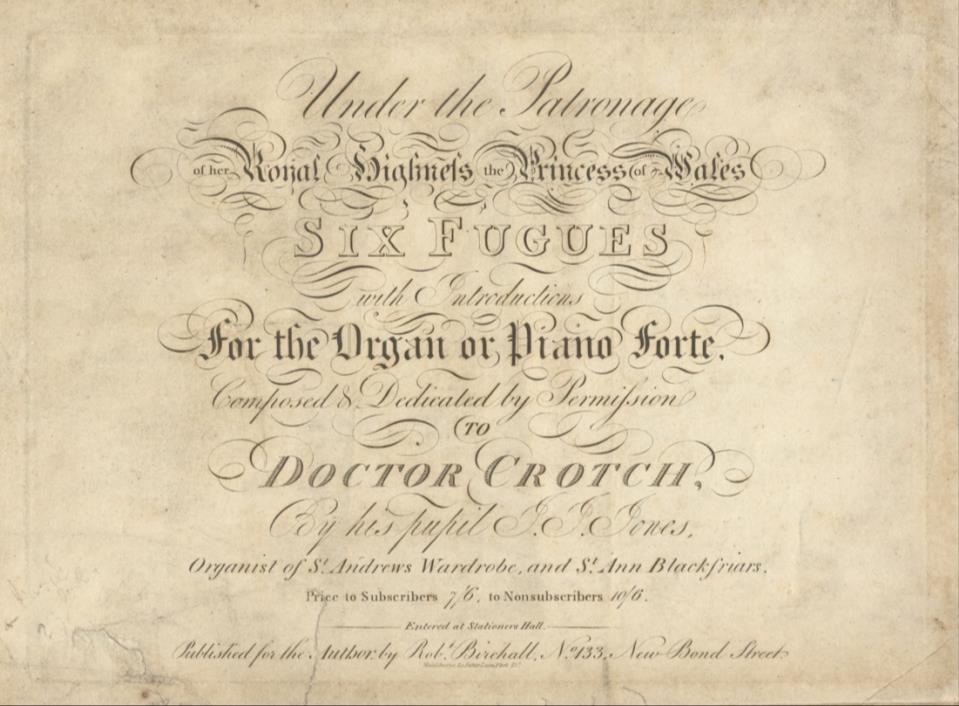
Early Bach Reception in England
42. JONES, J. J. fl. ca. 1811
Six Fugues with Introductions for the Organ or Piano Forte, composed and dedicated by permission to Doctor Crotch by his pupil J. J. Jones Organist of St. Andrews Wardrobe, and St. Ann Blackfriars Price to Subscribers 7/6. to Nonsubscribers 10/6 ... Under the Patronage of her Royal Highness the Princess of Wales ... Woodthorpe Sc., Felter Lane, Fleet Stt. [London]: Published for the Author by Robt. Birchall, No. 133, New Bond Street, [ca. 1811].
Oblong folio. Disbound. 1f. (recto title, verso blank), [iv] (list of subscribers), 25, [i] (blank) pp. Title and music engraved; subscriber list typeset, "Printed by Joyce Gold, Shoe Lane, London." With note to foot of first page of music: "The characters or marks which occur in the course of this Work, are borrowed from an Edition of the Fugues of Sebastian Bach, by Messrs. S. Wesley, & C. F. Horn," with markings indicating subjects, countersubjects, inversion, and augmentation. Subscribers include noted music historian Charles Burney and composers Thomas Attwood, John Wall Callcott, Muzio Clementi, Johann Baptist Cramer, Vincent Novello, and Samuel Wesley. Title slightly worn and soiled; small sewing holes to inner margins; first three leaves with small tears and minor loss to lower margin; some leaves partially loose.
JISC (one copy only, at the British Library).
The music is in a Bachian style. Apart from an Ode for Three Voices and Continuo (RISM J630), possibly by the same J. J. Jones, little is known of the composer, who was apparently a student of William Crotch (17751847).
Crotch, an English composer, organist, theorist and painter, "was an exceptional child prodigy and became one of the most distinguished English musicians of his day. ... In London Crotch became well known as a teacher, composer and scholar. His appearances as a soloist were infrequent but remarkable. He sometimes played one of his organ concertos at a benefit concert. On 7 June 1809 he played a programme of his own arrangements of Handel’s music for organ and piano to commemorate the 50th anniversary of the composer’s death (possibly the first example of a ‘one-man’ public concert in Europe). He assisted Samuel Wesley and Benjamin Jacob in bringing out the music of J.S. Bach at organ recitals." Nicholas Temperley and Simon Heighes in Grove Music Online
A rare andimportant documentrelativetoearlyBachreception and influencein England. (41009) $350
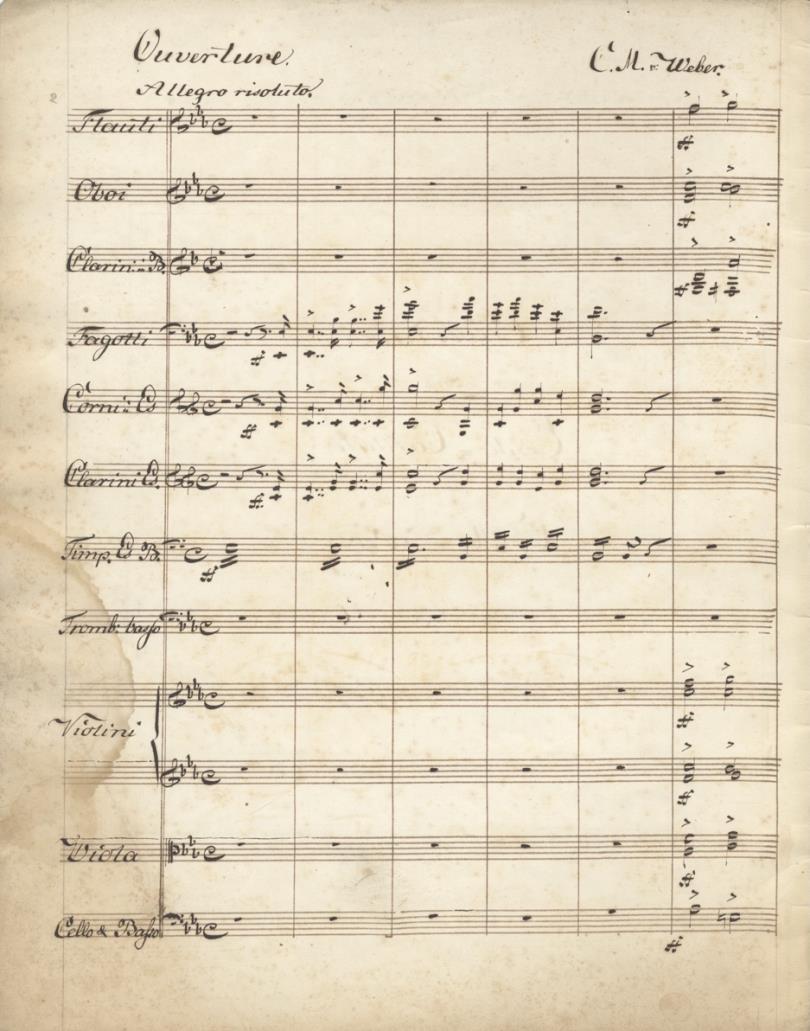
Mid-19th Century Manuscript of a Work Previously Thought to be by Weber
43. KALLIWODA, Johann Wenzel 1801-1866
Ouverture zur Ernte-Cantate. [Copyist manuscript]. Germany, [?1850].
Folio. Contemporary wrappers with titling within ruled borders. Notated in black ink on 12-stave rastrum-ruled paper. [i] (title), 28 pp. Scored for an orchestra of brass, woodwinds, and strings. Wrappers worn, soiled, and stained; spine reinforced with narrow strip of green paper. Minor internal wear; dampstaining to blank outer margin extending into approximately one half measure of music to first five leaves; occasional minor showthrough.
Previously thought to be by Carl Maria von Weber, the present work is listed as spurious by Jähns, Anh. IV, 107; it has more recently been ascribed to Kalliwoda. (41138) $200
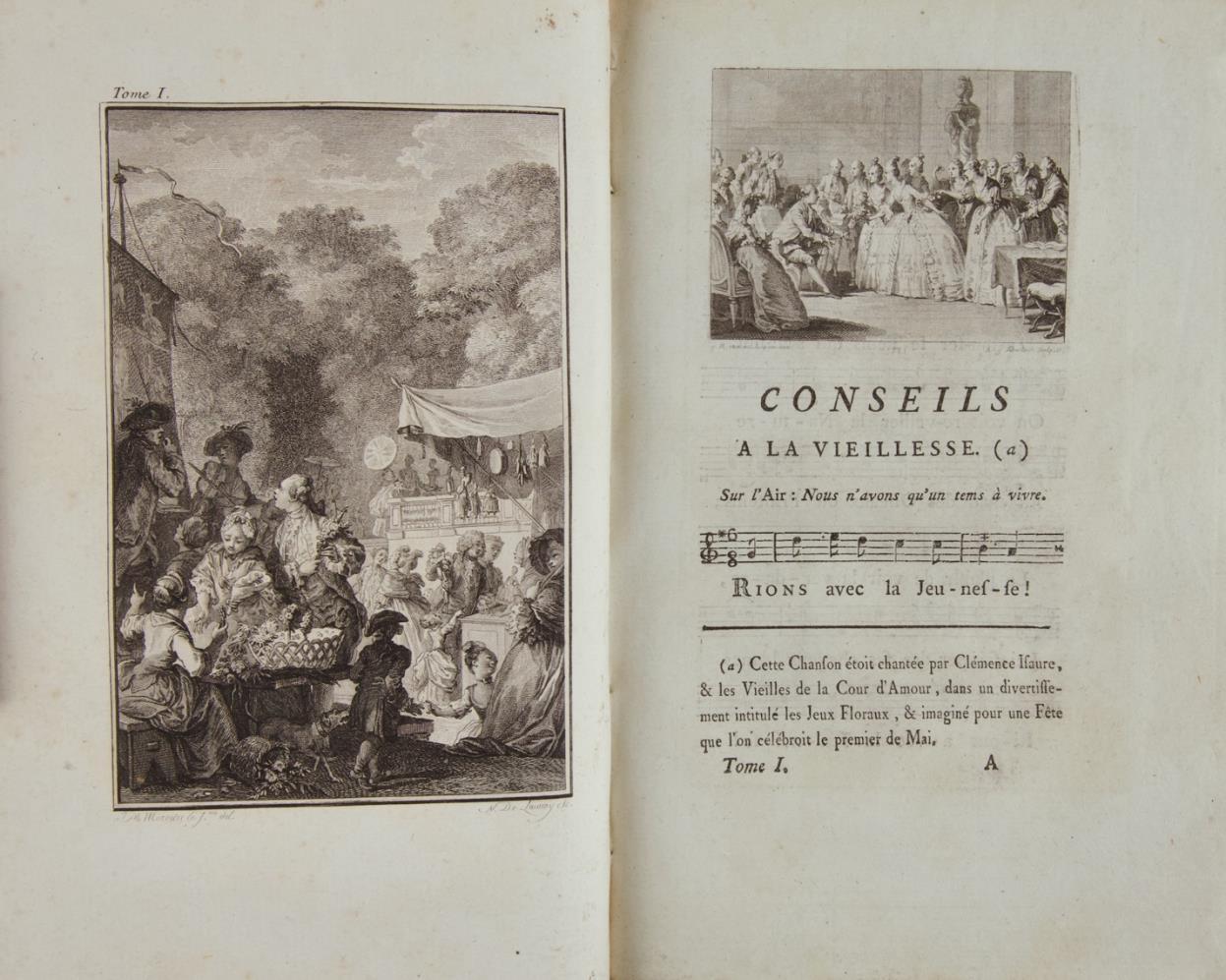
264 Elegantly Printed Late 18th Century Chansons
44. LAUJON, Pierre 1727-1811
Les A Propos de Societé ou Chansons de M.L**** Tom. I [II-III]. [Paris], [1776].
3 volumes. Octavo. Early dark pink paper boards dark green leather title labels and gilt rules to spines. Vol. 1: 1f. (rectotitle, versoblank), [iii]-x, 1f. (engravedplate), 302pp.;Vol2:1f. (rectotitle, versoblank), 1f. (engraved plate), 316 pp.; Vol. 3: 1f. (recto title, verso blank), [iii]-vi, 1f. (engraved plate), 319, [i] pp. Title to vol. 3 Les A Propos de La Folie ou Chansons Grotesques, Grivoises et Annonces de Parade; errata to all three volumes. With fine engraved pictorial frontispieces, title pages, and smaller engravings after Moreau throughout, including charming depictions of contemporary French society; decorative woodcut head- and tailpieces throughout. Contains melody and text to 264 chansons. Slightly worn, rubbed and bumped; Some minor foxing to a few leaves. Some marginal staining to title of volume three. Several small marginal tears. A very good and attractive copy overall.
First Edition. Lesure p. 661. RISM Recueils BII p. 97 (one copy of all three volumes in the U.S. and Great Britain).
Laujon was a noted French playwright and chansonnier.
An elegantly printed collection. (41303) $750
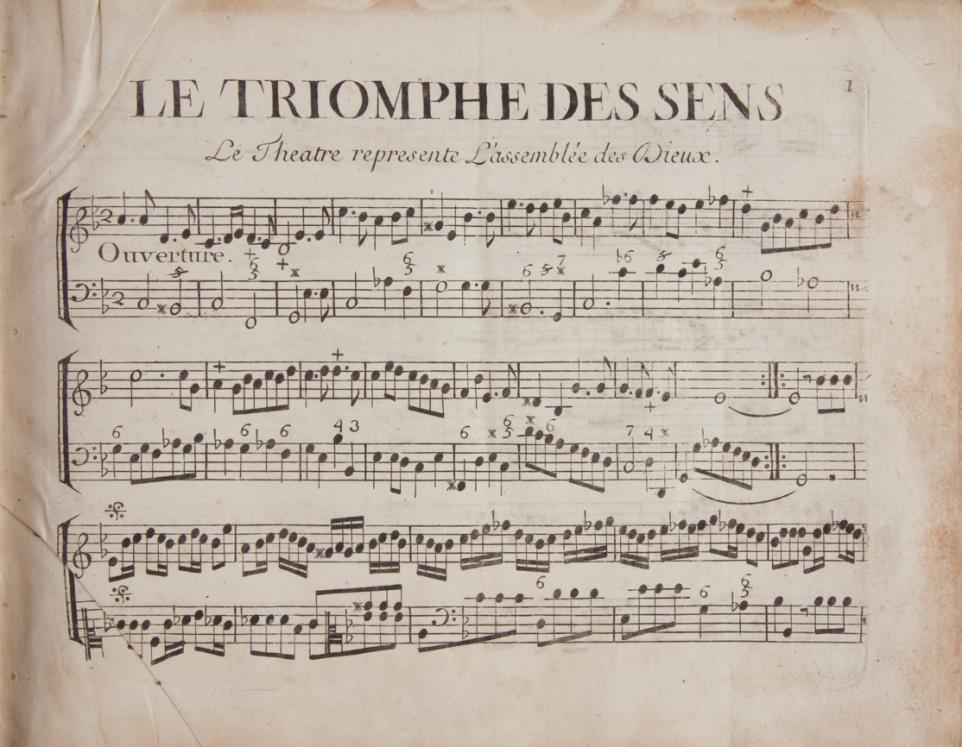
18th Century Ballet
45. MOURET, Jean-Joseph 1682-1738
[Le Triomphe des Sens. Ballet héroïque ... représenté pour la première fois, par l'Académie royale de musique le 29e may 1732]. [Short score]. [Paris]: [Le Veuve Mouret ... Sr. Boivin ... Sr. Leclerc], [1738].
Oblong quarto. Full dark brown mottled calf with raised bands on spine in compartments gilt. 315, [i] (privilege) pp. Engraved throughout. Binding considerably worn, rubbed, and bumped; slightly warped and sprung; hinges split; front free endpaper and rear pastedown lacking; rear free endpaper detached. Slightly worn; light uniform browning; blankuppermarginslightlystained;occasionalsoiling;minorwormingtoblankinnermargin;corners slightly creased; light impression to privilege. Lacking title, dedication, and pp. i-iv (index and list of works by Mouret), supplied in photocopy.
Second edition, with additional music (on pp. 302-315) not found in the first edition of 1732. Lesure p. 451. RISM M3979.
Le triomphe des sens, a ballet-héroïque in a prologue and 3 entrées, was first performed in Paris at the Opéra on 29 May/5 June 1732.
"Mouret shared in the innovating spirit that characterized the best in French stage music between Lully and Rameau. ... [His] melodic gifts earned him the posthumous title of `musicien des graces.' ” James R. Anthony, revised by Beverly Wilcox in Grove Music Online. (41064) $250
Opera Overtures Arranged for Piano
46. [OPERA OVERTURES - Piano Solo] Répertoire des Morceaux d'Ensemble éxécutés par la Société Concerts du Conservatoire, arrangées très soigneusement pour Piano seul. [Operatic overtures arranged for piano solo]. Paris: Schonenberger ... Boulevart Poissonière, 28, [ca. 1850].
Large octavo. Black pebbled leather-backed brown textured cloth boards. Contains works by Beethoven, Cherubini, Gluck, Haydn, Mehul, Mendelssohn, Mozart, Ries, and Weber, as follows:
- Weber. 3E. Livraison. Ouverture d'Euriante de Weber. Prix net 65 centimes. 1f. (recto title, verso blank), 12 pp.
- Cherubini. 5E. Livraison. Ouverture de Lodoïska ... 80 centimes. [i] (title), 2-15, [i] (blank) pp.
- Gluck. 7E. Livraison. Ouverture d'Iphigénie ... 65 Centimes. 1f. (recto title, verso blank), 12 pp.
- Weber. 12E. Livraison. Ouverture d'Oberon ... 60 centimes. [i] (title), 2-12 pp.
- Mehul. 15E. Livraison. Ouverture du jeune Henri ... 80 centimes. [i] (title), 2-16 pp.
- Mendelssohn. 17E. Livraison. Ouverture de la Grotte de Fingal ... 70 centimes. [i] (title), 2-13, [i] (blank) pp.
- Ries. 21E. Livraison.Ouverture Millitaire ... 85 c [i] (title), 2-17, [i] (blank) pp.
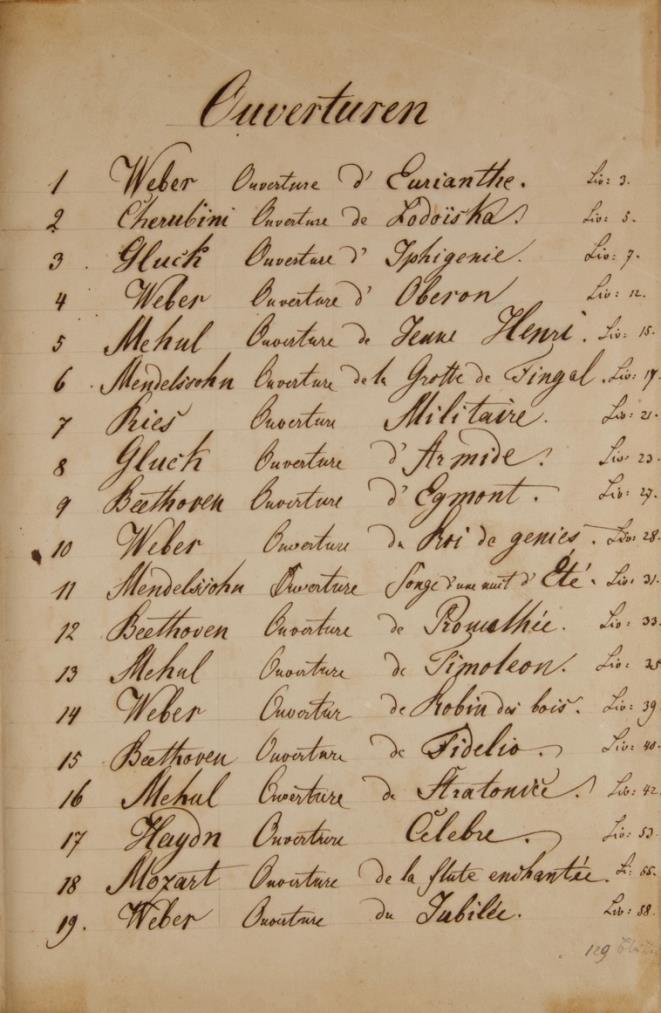
- Gluck. 25E. Livraison. Ouverture d'Armide ... 40 centimes. [i] (title), 2-8 pp.
- Beethoven. 27E. Livraison. Ouverture d'Egmont ... 60 centimes. [i] (title), 2-12 pp.
- Weber. 28E. Livraison. Ouverture du Roi des Génies ... 55 c. [i] (title), 2-11, [i] (blank) pp.
- Mendelssohn Bartholdy. 31E Livraison. Songe d'un nuit d'été ... 95 centimes. [i] (title), 2-19, [i] (blank) pp.
- Beethoven. 33E. Livraison. Ouverture de Prométhée ... 55 centimes. [i] (title), 2-11, [i] (blank) pp.
- Méhul. 35e. Livraison. Ouverture de Timoléon ... 50 centimes. [i] (title), 2-10 pp.
- Weber. 39e. Livraison. Ouverture de Robin des bois ... 60 centimes. [i] (title), 2-12 pp.
- Beethoven. 40E. Livraison. Ouverture de Fidelio ... 55 centimes. [i] (title), 2-11, [i] (blank) pp.
- Mehul. 42E. Livraison. Ouverture de Stratonice ... 50 centimes. [i] (title), 2-10 pp.
- Haydn. 53E Livraison. Ouverture célèbre ... 85 centimes. 1f. (recto title, verso blank), 16 pp.
- Mozart. 55E. Livraison. Ouverture de la Flûte enchantée ... 45 centimes. [i] (title(), 9, [i] (blank) pp.
- Weber. 58E. Livraison. Ouverture du Jubilée ... 65 centimes. [i] (title) 12 pp.
With contemporary manuscript table of contents to front free endpaper and 1f. publisher's catalogue at conclusion. Publisher's and New York bookseller's small oval handstamps to blank lower margin of title, some with publisher's facsimile signature. Binding slightly worn, rubbed, and bumped. Slightly worn and browned internally; lightly foxed; some publisher's stamps slightly trimmed. (41322) $100
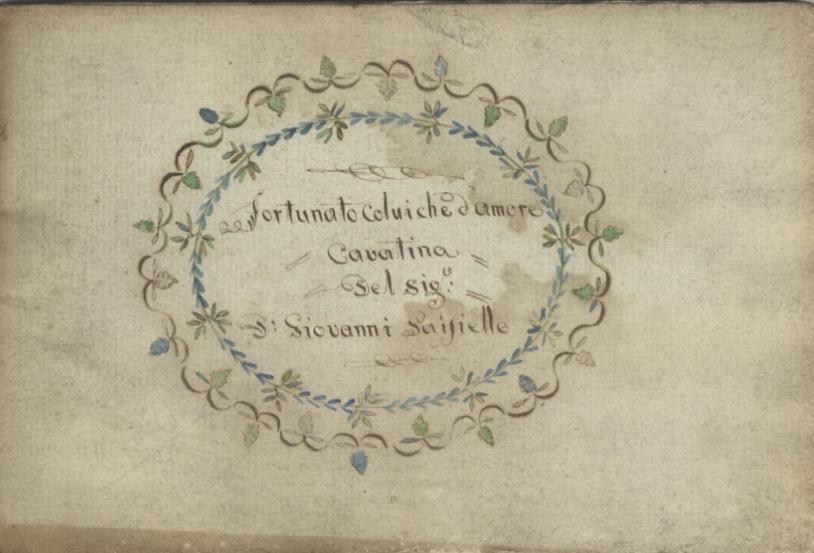
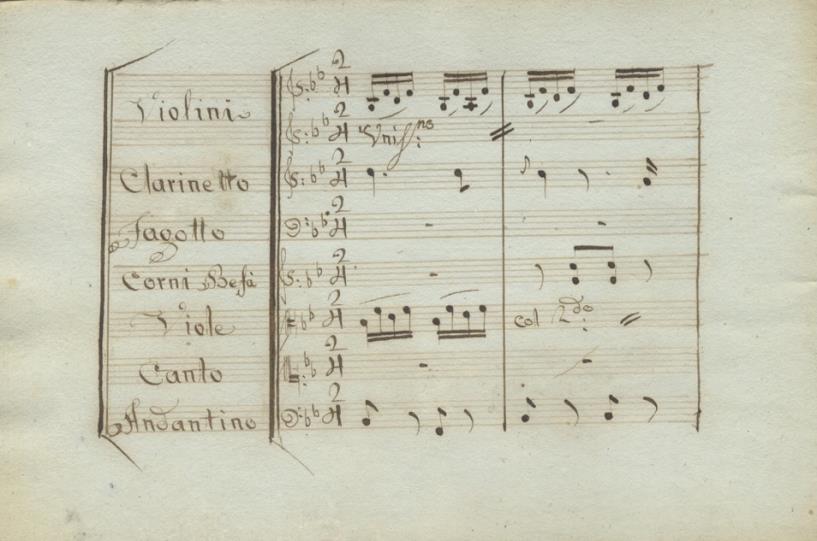
Manuscript Excerpt from L’Inganno Felice
47. PAISIELLO, Giovanni 1740-1816
[L'inganno felice]. Fortunato colui che d'Amore Cavatina. [Score]. [Copyist manuscript]. Italy, [ca. 1798].
Oblong octavo (141x 215mm). 1f. (rectotitle, verso blank),[i] (blank), 37, [i] (blank)pp. Notated indarkbrown ink on 8-stave rastrum-ruled paper. With text in Italian. With calligraphic title incorporating attractive double border in watercolor with floral motifs in varying shades of green. Scored for soprano (sung by the character Biondino) accompanied by violin, clarinet, bassoon, horn, viola, and bass. Outer leaves soiled.
Robinson 1.91/12, p. 539.
The opera L'inganno felice was first performed in Naples at the Teatro dei Fiorentini in 1798.
Paisiello was "one of the most successful and influential opera composers of the late 18th century. ... During that period his dramatic works were as much in demand outside Italy as within it. In Vienna, for example, the Italian opera company installed by Joseph II performed during the 1780s more works by Paisiello than by any other single composer. Londoners too were particularly partial to his operas." Michael F. Robinson in Grove Music Online
An attractive manuscript. (41300) $285
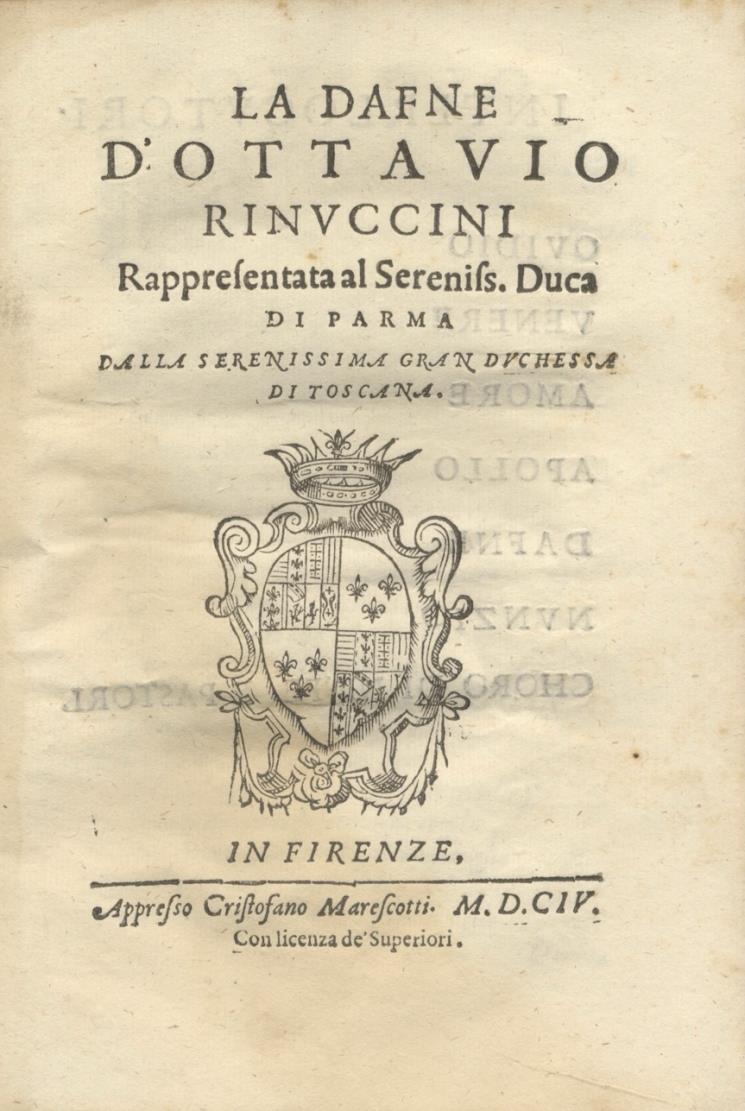
Libretto to the Earliest Opera, the Music to Which Has Been Lost A Landmark in Music History
48. PERI, Jacopo 1561-1633
La Dafne d'Ottavio Rinuccini Rappresentata alla Serenissima Gran Duchessa di Tosana. [Libretto]. Firenze: Appresso Christofano Marescotti ... Con licenza de' Superiori, 1604.
Small quarto. Modern carta rustica wrappers. 1f. (recto title with woodcut of Medici coat of arms, verso cast list), 20 unnumbered pp. + 1f. (recto blank, verso elaborate woodcut printer's device of 4-masted ship on a windblown sea with motto within decorative woodcut border), A1-C4. With decorative woodcut initial letter to first page of text; decorative woodcut initial to beginning and woodcut tailpiece to end of laudatory poem. Very minorinternalwear;lightfoxing;minorcreasing;smallprintedoverpaste("AL")toheadofpoem;C1incorrectly designated "D."
In very good condition overall.
The poem, dedicated to co-composer Jacopo Corsi, consists of eight stanzas on 3 pp. preceding final leaf, commences "Qual novo altero canto."
Third edition. The first edition, most probably published to coincide with the first performance of the work at Carnavale in 1598, is exceptionally rare, with only one copy recorded by Fuld, at the New York Public Library Special Collections, Music Division.
Rare Book Hub records only 5 copies of the 1600 edition having come to auction from 1957-2023; no copies of either the first edition or the present edition of 1604 are recorded as having come to auction.
Allacci col. 235. Fuld: The Book of World-Famous Libretti, p. 61. Gaspari V, p. 137 (edition of 1600). Sartori II, 7016 (three copies only, two in Italy, at the Biblioteca Nazionale Centrale in Firenze and the Biblioteca del Conservatorio di Musica in Napoli, and one in the U.S., at the University of California, Berkeley). Wotquenne 2291 (edition of 1600). OCLC 954810182 (one copy only, at the Biblioteca Nazionale Centrale di Roma). Sonneck I, pp. 339-345. See also Sternfeld: The First Printed Opera Libretto in Music and Letters Vol. LIX, no. 2, April 1978 for a full discussion of the libretto.
Considered an experimental musico-dramatic work, Dafne consists of a prologue and six scenes by Jacopo Peri with assistance from Jacopo Corsi (1561-1602) set to a libretto by Ottavio Rinuccini after Ovid’s Metamorphoses; it was first performed in Florence at the Palazzo Corsi in the 1598 pre-Lenten Carnival season (1597 old Florentine style).
Peri was an Italian composer, singer, and instrumentalist. "His most significant contribution was his development of the dramatic recitative for musical theatre." William V. Porter and Tim Carter in Grove Music Online
"Although only fragments of Corsi’s and Peri’s music survive, Dafne is significant for introducing Peri’s most radical innovation, recitative, which he described as ‘more than speech but less than song’ in the printed preface to his second opera, Euridice (1600). Recitative (stile recitativo) or speech-music, then, synthesized the two elements into an inseparable whole, creating a new language that was as much an expression of humanist ideas about the relationship between words and music as it was emblematic of the new art form. While other late Renaissance musical works for the stage had been entirely sung, this was the first to qualify as the genre we now call opera because of its emphasis on recitative, or speaking from the stage in song." Barbara Bussano Hanning in Grove Music Online
"In winter 1594–5 Corsi and Rinuccini asked [Peri] to complete Corsi’s musical setting, in stile rappresentativo, of Rinuccini’s dramatic pastoral Dafne. Three years later ... it was presented at Corsi’s palace, and Rinuccini later declared that ‘it gave pleasure beyond belief to the few who heard it’. It was repeated, apparently in altered form, at least three times in Florence during the next two years: on 18 January 1599 at Corsi’s house, three days later at the Pitti Palace, and twice in 1600, again at Corsi’s house. Though never printed, it was still being performed in the first decade of the 17th century. No complete score of the Peri-Corsi Dafne has survived, but six brief portions extant in several manuscripts have been identified as belonging to the work. ...
The impact of the Peri-Corsi Dafne and Peri’s Euridice [performed as part of Marie de' Medici and Henry IV's wedding celebrations in 1600], which Corsi sponsored, was extraordinary and far-reaching." Edmond Strainchamps in Grove Music Online
Dafne, generally considered to be the first opera, is a true landmark in the history of music. The music to the work has been lost, with the exception of 6 arias extant in manuscript only, in Florence and Brussels. (41321) $10,000
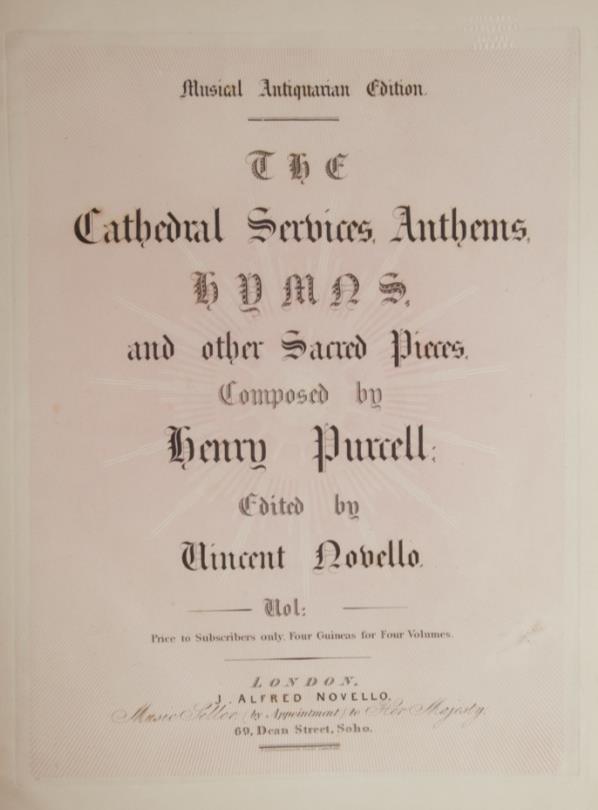
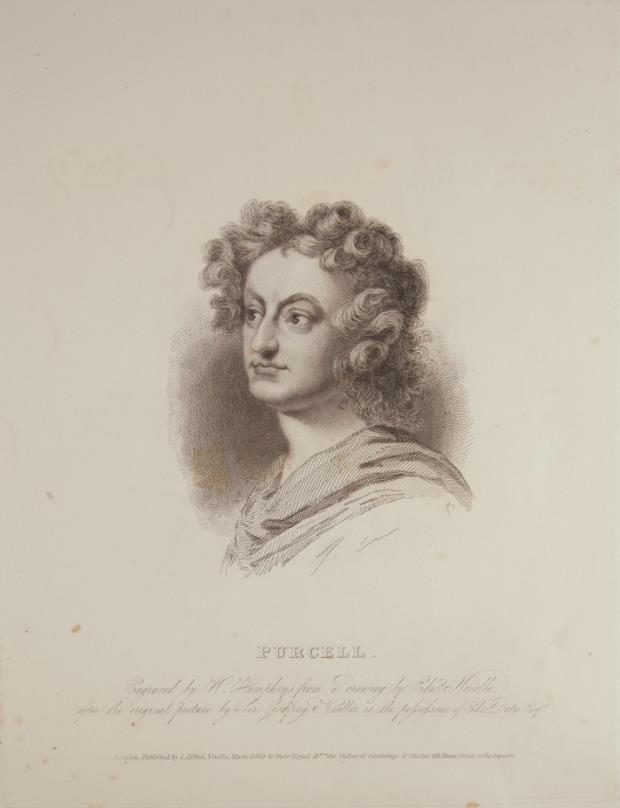
Novello’s 4-Volume Edition of Purcell’s Anthems
49. PURCELL, Henry 1659-1695
The Cathedral Services, Anthems, Hymns, and other Sacred Pieces, Composed by Henry Purcell Edited by Vincent Novello. Vol: I [-IV]. Price to Subscribers only, Four Guineas for Four Volumes. Musical Antiquarian Edition. London: J. Alfred Novello Music Seller by Appointment to Her Majesty, 69, Dean Street, Soho. R. & E. Willliamson, Sculpt. Lambeth, [1844].
4 volumes. Tall folio. Half black leather with dark teal pebbled cloth boards with gilt rules to spine and edges, spine in decorative compartments gilt with titling gilt, marbled endpapers, all edges gilt. Text letterpress, titles and music engraved.
Vol. I: Verse anthems in major keys
1f. (recto title, verso blank), 1f. (recto bust-length portrait of Purcell, verso blank), 1f. (recto publisher's note, verso blank), [i]-xii ("Life of Purcell" by Edward Holmes), 1f. (recto facsimile excerpt of Purcell's autograph manuscript of the anthem "My beloved spake," verso blank), 1f. (index), [1] (blank), 2-160, *147-*158, 161312 pp. Portrait "Engraved by W. Humphreys from a drawing by Edw. Novello, after the original picture by Sir Godfrey Kneller, in the possession of Edwd. Bates Esqr."
Vol. II: Verse anthems in minor keys
1f. (recto title, verso blank), 1f. (index), 313-618 pp.
Vol. III: Full anthems, hymns, sacred songs, and Latin pieces
1f. (recto title, verso blank), 1f. (index), 619-850 pp.
Vol. IV: Services and chants
1f. (recto title, verso blank), 1f. (recto publisher's note, verso blank), [i] (blank), 852-954, [955] (blank), 9561067, [i] (blank) pp.
Ex-library, with bookplates of Robert Buchanan Stewart and The Episcopal Theological School, Cambridge, Mass. to front pastedowns of each volume, occasional small blindstamps, call numbers to verso of title to Vol. I
and foot of spines. Bindings quite worn; uppers of Vols. II and III and both uppers and lowers of Vols. I and IV detached; spines defective, with some loss. Minor internal wear; several leaves detached. In very good internal condition overall.
"One of the most important 17th century composers and one of the greatest of all English composers. ... Purcell began his musical career as a choirboy and remained a church musician throughout his life, holding positions at Westminster Abbey as well as the Chapel Royal. Like John Blow he wrote four types of church music: services; anthems for full choir and organ, or with short ensemble verse passages (often called full with verse anthems); verse anthems for solo voices, choir, and organ; and ‘symphony anthems’ for solo voices, choir, strings, and continuo, which at first were performed exclusively in the royal presence though several later circulated more widely in versions with organ accompaniment only." PeterHolmanandRobertThompsonin Grove Music Online
An English organist, composer, collector, antiquarian, and founder of the Novello publishing house, Vincent Novello (1781-1861) did much to promote the study and performance of music in 19th century England. (41320)
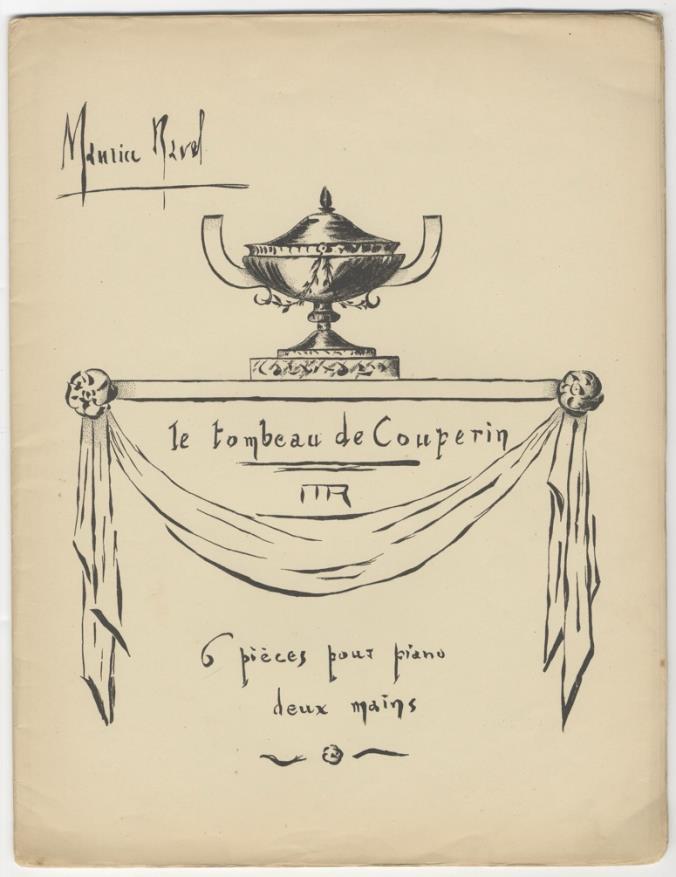
$350
First Edition of Ravel’s Suite for Solo Piano
50. RAVEL, Maurice 1875-1937
Le Tombeau de Couperin 6 pièces pour piano deux mains. Paris: Durand [PN 9569], [ca. 1918].
Folio. Original publisher's light green printed wrappers with "Prix net : 35 francs" to upper. 1f. (recto title, verso blank), [i] (index), 32 pp., 1f. (blank). With "Imp. Mounot, Paris" to foot of upper wrapper. With fine title page illustration designed by the composer. Slightly worn and bumped; "1917" in red ink to upper wrapper.
First Edition, first issue. Hirsbrunner 90. Orenstein p. 256.
Ravel composed Le Tombeau de Couperin, a suite for solo piano, between 1914 and 1917. Each of the six movements, which are based on those of a traditional Baroque suite, is dedicated to the memory of a friend who had died in the first World War. Ravel orchestrated four movements of the work in 1919: Prélude, Forlane, Menuet, and Rigaudon; the orchestral version was first performed in Paris by the Pasdeloup Orchestra under the direction of Rhené-Baton on 28 February 1920.
"[Ravel] was one of the most original and sophisticated musicians of the early 20th century. His instrumental writing – whether for solo piano, for ensemble or for orchestra – explored new possibilities, which he developed at the same time as (or even before) his great contemporary Debussy, and his fascination with the past and with the exotic resulted in music of a distinctively French sensibility and refinement. ... In Le tombeau de Couperin Ravel's contemporary harmonic vocabulary, Romantic pianistic gestures (especially in the Prélude and
Toccata), and prominent use of the major 7th (notably in the refrain of the Forlane) are superimposed onto 18thcentury forms, rhythms, cadences and ornamentation. In preparation for composing the suite, Ravel transcribed a forlane from Couperin's Concerts royaux in the spring of 1914, and there are clear musical parallels between it and the corresponding movement in Le tombeau. This perhaps weakens the claim that the work is more of a homage to 18th-century French music in general than to any particular work of Couperin, though no specific models have been found for the other movements. In celebrating Couperin, Ravel was responding to a more general resurgence of interest in the golden age of Louis XIV." Barbara L. Kelly in Grove Music Online (41087)
With Incipits and Named Singers
51. ROSSINI, Gioachino 1792-1868
Le Barbier de Seville Opéra en grande Partition, avec Texte Italian et Français. Paroles de M. Castil-Blaze. [Piano-vocal score]. Paris: Chez C. Laffillé, Rue Vivienne, No. 6 [PNs 347-0 to 347.15], [1821-1825].
Folio. Half green vellum withmarbled boards with "Le Lt. Colonel Clere" blindstamped to upper. [i] (musical incipits), 2-285, [i] (blank) pp. With incipits to title: "Thêmes de tous les Airs arrangés pour Piano, ou Guitare, ou Flûte, ou en partition pour Piano." Named singers include Mr. Damoreau, Mr. Derubelle, Mr. Garcia, Mr. Pellegrini, Mlle. Folleville, Mme. Fodor, Mr. Duport, Mr. Levasseur, Mr. Micalef, and Mr. Graziani. Binding slightly worn, rubbed, and bumped; marbled wrappers bound in. Some internal wear; light uniform browning, a bitheaviertosomeoutermargins; some light foxing, staining, creasing, edge tears, and showthrough; small binder's holes to inner margin; margins of title, following leaf, and two final leaves reinforced with paper; first signature split at inner margin. Lacking title page.
Early edition. Gossett III, b-4. (41323) $225
$150
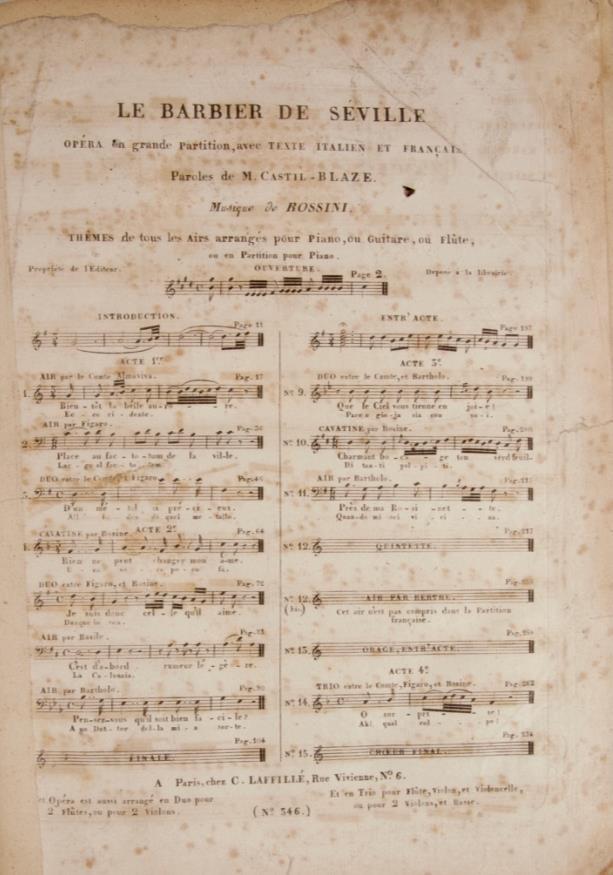
“An Important Agent in the ... Popularization of Italian Music and Musical Style in 18th-Century France”
52. RUGE, Filippo ca. 1725-after 1767 Six Solos for a German Flute or Violin with a Thorough Bass for the Harpsichord or Violoncello. [Score]. London: Printed for I. Walsh in Catharine Street in ye Strand, [1751].
Folio. Contemporary plain mid-brown wrappers. 1f. (recto title, verso blank), [i] (blank), 2-16, [i] (blank), 1829, [i] (blank) pp. Engraved throughout. Scored for solo flute or violin and figured basso continuo. Wrappers
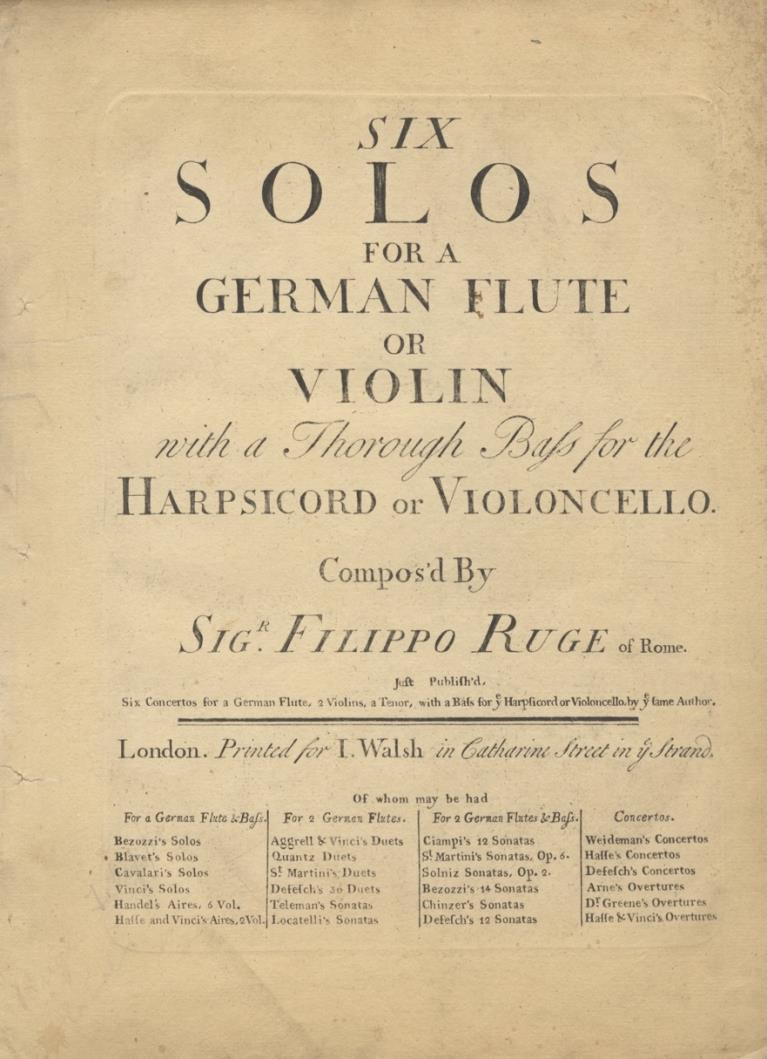
quite worn, chipped, stained, and torn, with minor loss. Very slightly worn, browned, and creased internally; title detached, with minor soiling and small tears to inner margin repaired with archival tape to verso; occasional minor stains.
FirstEdition. Smith&Humphries1294, p. 289. BUC p. 907. RISM R3097 and R3098 (one copy in the U.S. only, at the Library of Congress).
Ruge, an Italian composer and flautist, "may possibly have sojourned in London when Walsh began publishing five sets of his chamber pieces for flute (1751–4). By 1753 he and his wife, a singer, had settled in Paris. His name appears in the Paris press for the first time in March of that year when he performed one of his own flute concertos as a soloist in the Concert Spirituel. The programme included a symphony by ‘Romano’, undoubtedly of Ruge’s composition as well. At this time he and his wife performed in the famous musical salon of La Pouplinière. After 1755 Ruge organized a series of concerts at his home in the rue Plâtrière, where he also taught music. In July 1755 he published Au dessert, a set of six vocal duos, and in August of the same year he took out a privilege général of ten years for instrumental compositions. The following year saw the publication of Sei sinfonie op.1, the fourth of which contained a programmatic movement called ‘La tempesta’. This symphony and a later one entitled ‘La nova tempesta’, or ‘La tempête suivie du calme’, published separately by Venier in 1761, were performed with considerable success at the Concert Spirituel. ...
[He] was an important agent in the diffusion and popularization of Italian music and musical style in 18thcentury France. His symphonies are typical of the Italian pre-Classical tradition evident in the works of G.B. Sammartini; the Mannheim school mannerisms then coming into vogue are largely absent. The usual fast–slow–fast order of movements is maintained, with slow movements often attractively lyrical. In the flute works, lyricism again prevails over technical display. Although there are few contemporary references to Ruge as a flautist, his appearance as soloist at the Concert Spirituel implies technical prowess of a high order." Barry S. Brook and Susan Kagan in Grove Music Online. (41233) $350
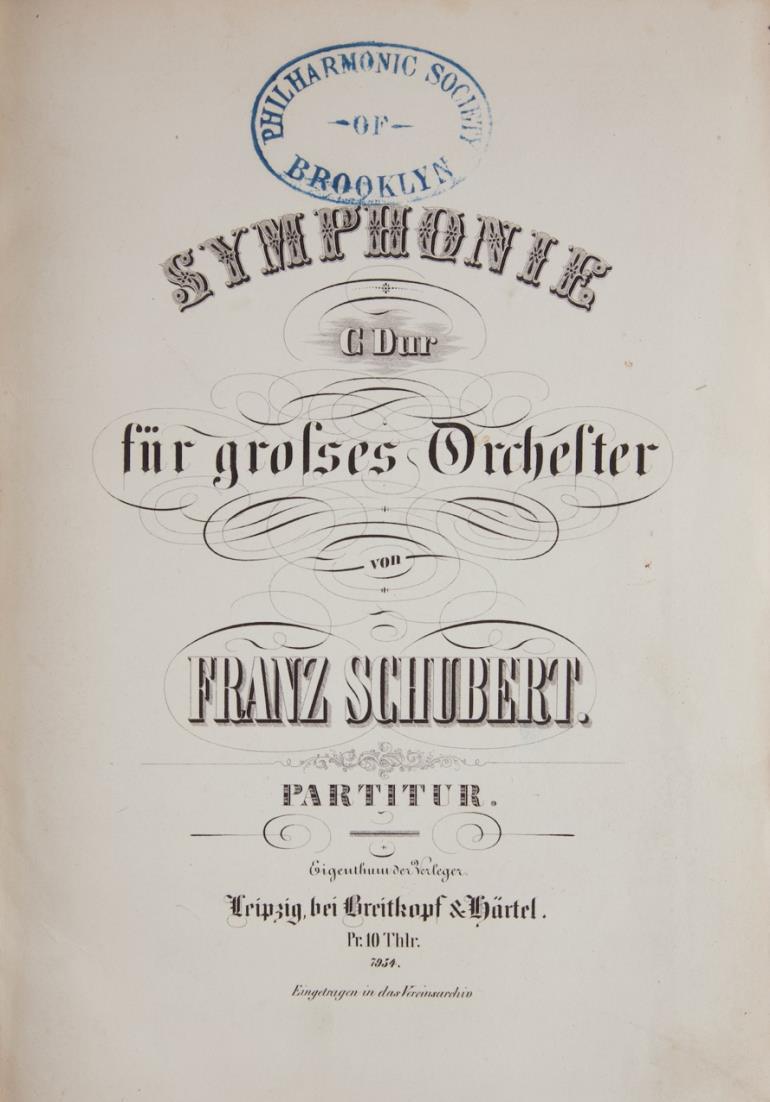
First Edition of the C Major Symphony “Bears the Stamp of Greatness”
53. SCHUBERT, Franz 1797-1828
Symphonie C dur fur grosses Orchester ... Partitur ... Pr.10 Thlr. [Full score]. Leipzig: Breitkopf & Härtel [PN 7954], [1849].
Octavo. Newly bound in dark green morocco with marbled boards, dark red title label and gilt rules to spine. 1f. (recto title, verso blank), 322 pp. Title lithographed, music engraved With bookplate of Philip James with illustration of lute player in pastoral setting to front pastedown. Oval handstamp of the Philharmonic Society of Brooklyn to head of title; handstamps of Breitkopf and Scharfenberg & Luis to foot of title. Occasional annotations including timing for conductor Bruno Walter's performance of the piece; performance markings in gray and red pencil and occasionally in ink. Slightly worn and browned; occasional small stains; minor soiling to lower outer corner of title and several pages of music.
First Edition. Deutsch 944, p. 605. Hirsch IV, 653. Hoboken 14, 627. Nottebohm p. 203. MuellerReuter I, p. 15. Sonneck Orchestral Music p. 417.
" ... Schubert's travels in Upper Austria in the summer of 1825 seem to have unleashed an astonishing creative energy and optimism that found expression in the ‘Great’ C major Symphony (d944). Few works have such unquenchable rhythmic vitality or seem more expressive of their direct surroundings, from the opening horn call, which returns as a triumphant apotheosis in the coda, to the brisk step of the stoical, marchlike Andante con moto, from the joyous alfresco dance of the vast sonata-form Scherzo, saturated by its opening motif, to the surging triplets of the gargantuan finale. Having found his symphonic voice – a voice at once lyrical, colouristic and expansive – Schubert was understandably eager to undertake more symphonic projects." Robert Winter in Grove Music Online
"From any viewpoint the work bears the stamp of greatness. ... The manuscript suggests that some of the symphony was composed in full score as fast as the pen could travel." The New Grove Vol. 16, p. 777. (41097)
$1,600
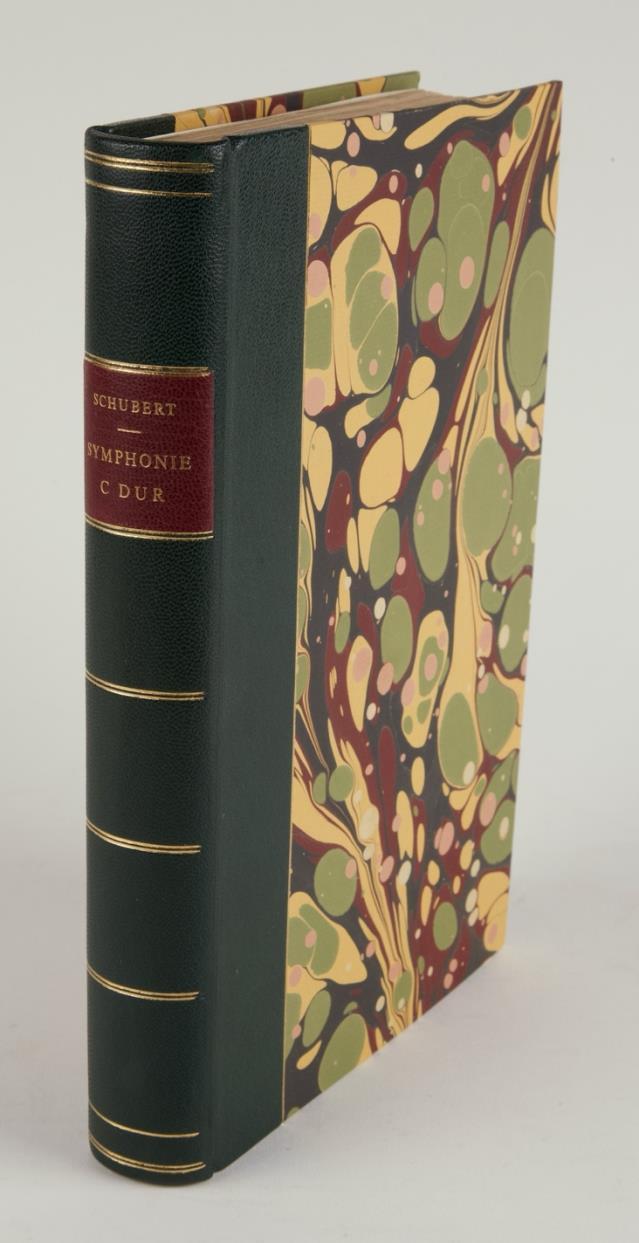
Arrangements for Piano 4-Hands
54. SCHUMANN, Robert 1810-1856
Robert Schumann's Sämmtliche Werke Symphonien für Pianoforte zu 4 Händen arrangirt von Theodor Kirchner. [Opp. 38, 44, 61, 97, and 120]. [Piano four-hand arrangements]. Leipzig: C. F. Peters [PN 7018], [ca. 1890].
[i] (series title within ornate architectural border printed in sepia), 2-51 [Symphony I, Op. 38], 52-107 [Symphony II, Op. 61], 108-151 [Symphony III, Op. 97], 152-189 [Symphony IV, op. 120], [i] (thematic index) pp.
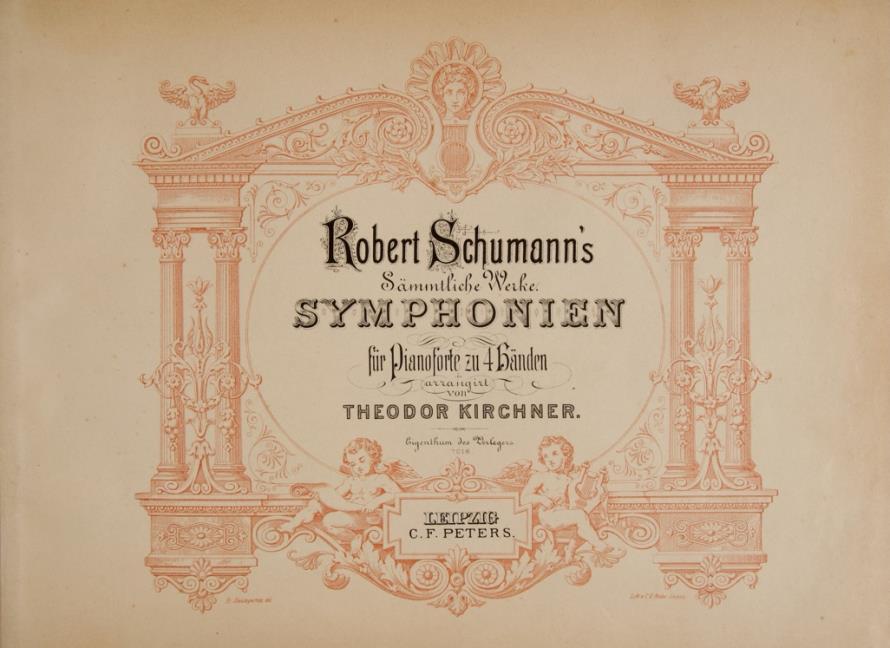
Bound with:
Robert Schumann's Sämmtliche Werke. Quintett [Op. 44) für Pianoforte zu 4 Händen arrangirt von Theodor Kirchner. Leipzig: C. F. Peters, [PN 7020], [ca. 1890]. [i] (series title), 2-45, [i] (blank pp.
With "J. [?]Villant" in manuscript to upper outer corners of several leaves. Occasional annotations in pencil. Oblong folio. Half dark brown mottled calf with marbled boards, spine in compartments gilt with titling gilt, marbled endpapers. Binding slightly worn; head of spine chipped. Occasional small stains; some minor soiling to blank margins.
"While best remembered for his piano music and songs, and some of his symphonic and chamber works, Schumann made significant contributions to all the musical genres of his day and cultivated a number of new ones as well. His dual interest in music and literature led him to develop a historically informed music criticism and a compositional style deeply indebted to literary models. A leading exponent of musical Romanticism, he had a powerful impact on succeeding generations of European composers." John Daverio and Eric Sams in Grove Music Online. (41110) $100
With Interesting English-American Provenance
55. SHIELD, William 1748-1829
Rosina, A Comic Opera, as Performed at The Theatre Royal, Covent Garden; Composed and Selected by William Shield. Price 8s. [Piano-vocalscore].London:PrintedforWillm. Napier, Music-sellertotheirMajesties, No. 474, Strand [PN 125], [1783].
Oblong folio. Disbound. 1f. (recto illustrated title verso blank), 38 pp. Engraved. The title-page engraving by Bartolozzi after Cipriani incorporates putti playing trumpet and panpipes, a hiding satyr, and a fleeing nymph. Quite worn; edges and inner margins of several leaves frayed and chipped, with small tears to some repaired witharchivaltape;smallbinder'sholestoblankinnermargins;lightuniformbrowning;occasionalstains, foxing, and soiling.
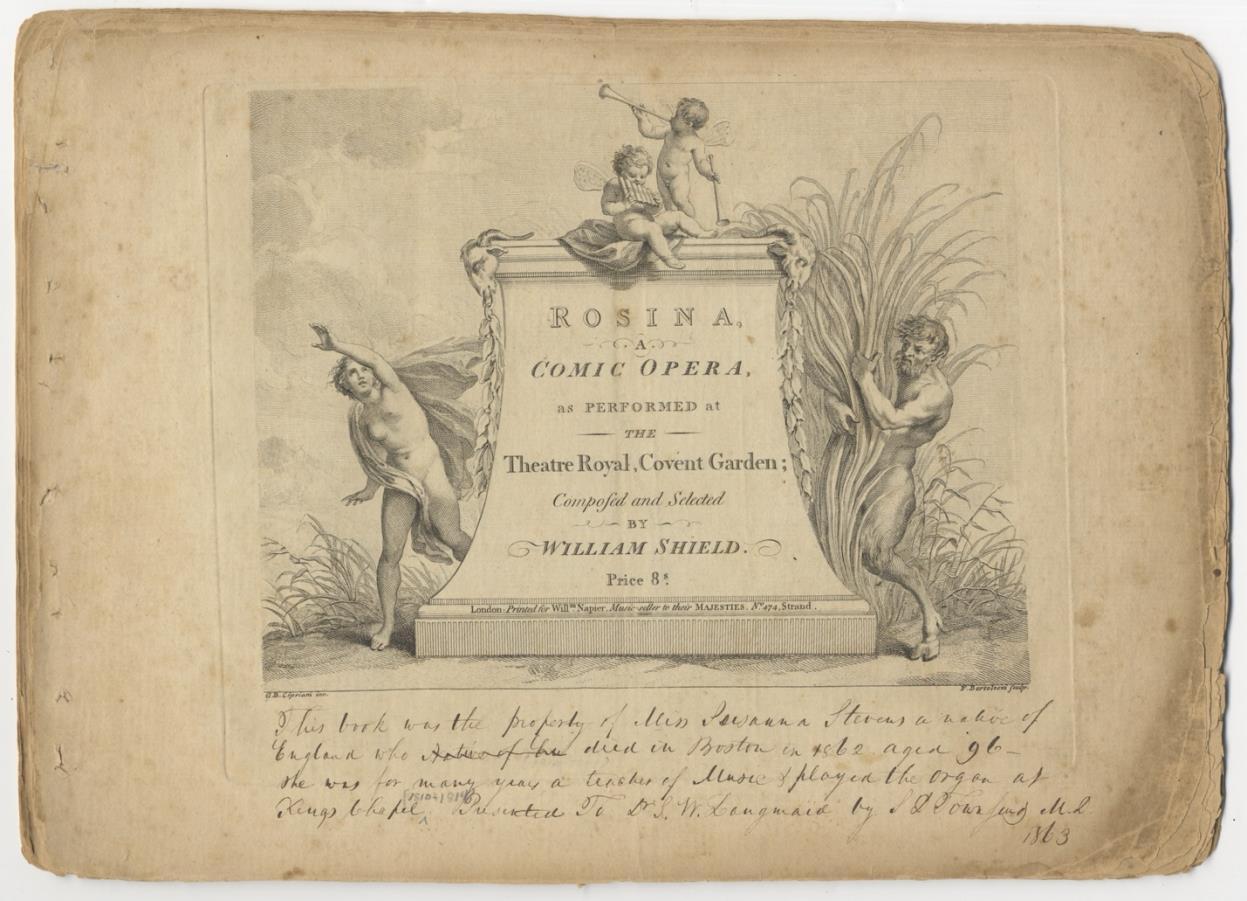
Provenance
With annotation in 19th century manuscript to foot of title: "This book was the property of Miss Susanna Stevens a native of England who [canceled] died in Boston in 1862 aged 96 - she was for many years a teacher of Music & played the organ at Kings Chapel [added in pencil: "1810-1814"] Presented to S. W. Langmaid by S.D. Townsend M.D. 1863."
First Edition. BUC p. 947. RISM S3173.
Rosina, to a libretto by F.M. Brooke after C.-S. Favart's Les moissonneurs, was first performed in London at Covent Garden on 31 December 1782. "Shield’s most often performed work (over 200 London performances by 1800), follows the same blend of charming original and borrowed music. As Rosina shows, Shield excelled in harmonizing traditional music without destroying its character. He could also write more complex, italianate arias like ‘When William at eve’ and ‘Light as Thistledown’. Unlike some earlier comic opera composers, he did not fall into the habit of assigning traditional ballads to rustics and italianate arias to the gentry: in Rosina, all the principal characters sing both types of music, and the blend seemed to please audiences. According to the Covent Garden accounts, Shield received £100 for the music (not £40, as Parke claimed in his memoirs) six months after the opera opened. After Robert Burns’s death a folk melody in the overture to Rosina (played by bassoons imitating the bagpipe) was revised and attached to Burns’s poem ‘Auld Lang Syne.' " Linda Troost in Grove Music Online
Interesting English-American provenance. (40790) $250
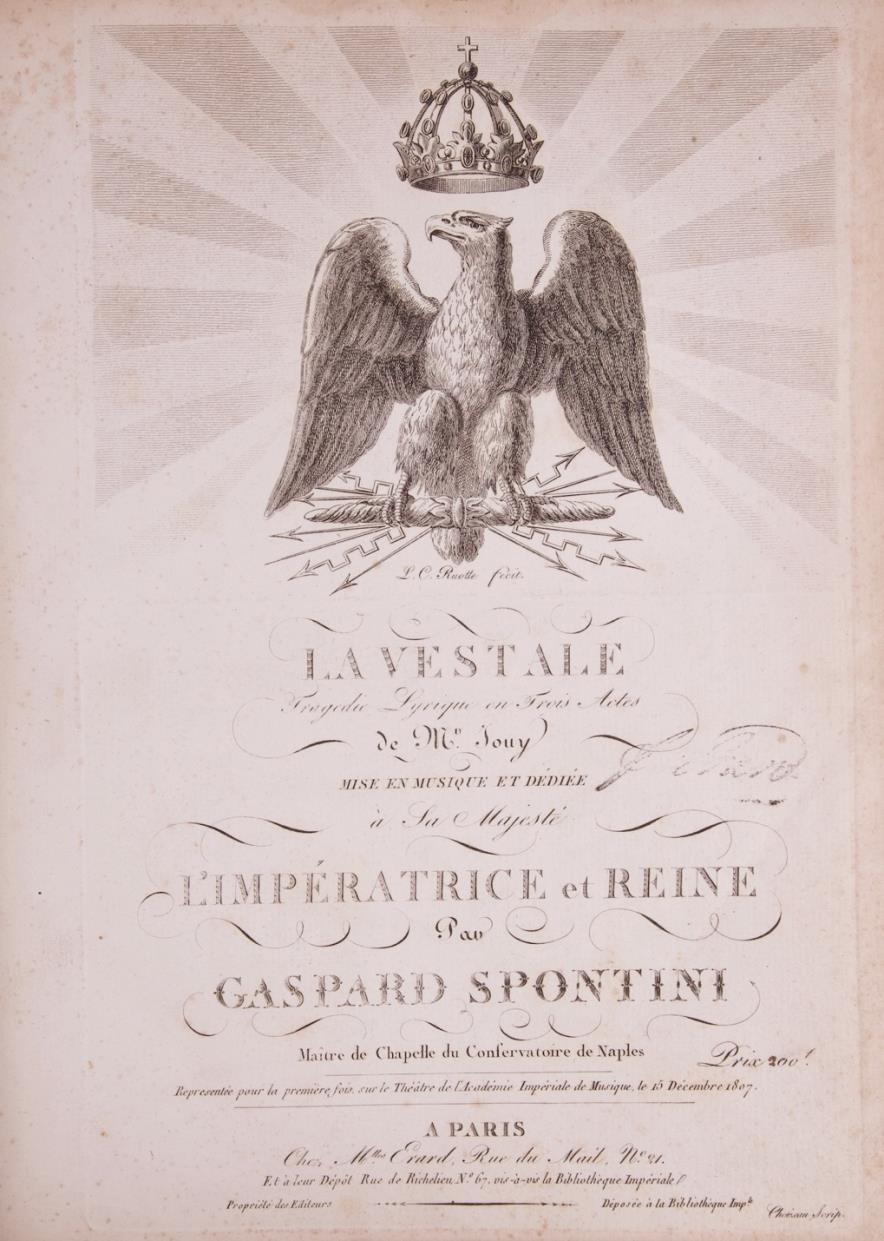
Vincent d'Indy's Copy of Spontini’s “Triumphant Success”
56. SPONTINI, Gaspare 1774-1851
La Vestale Tragédie Lyrique en trois Actes, de Mr. de Jouy Mise en Musique et Dédiée à Sa Majesté L'Imperatrice et Reine par Gaspard Spontini Maître de Chapelle du Conservatoire de Naples ... Représentée pour la première fois, sur le Théâtre de l'Académie Impériale de Musique, le 15 Décembre 1807 ... Prix [200] f. ... Choizeau Scrip. [Fullscore]. Paris:ChezMlles. Erard, RueduMail, No. 21.EtàleurDépôtRuedeRichelieu No. 67, vis-à-vis la Bibliothèque Impèriale [PN 700], [1807-1808].
2 volumes. Folio. Dark red leather-backed light redleather boards with decorative gilt borderto edges. Engraved throughout. Named cast includes Mr. Lainez (Licinius), Mr. Laïs (Cinna), Mr. Dérivis (Le Souverain Pontife), Mr. Duparc (Le Chef des Aruspices), Mr. Martin (Un Consul), Mme. Branchu (Julia), and Mme. Maillard (La Grande Vestale). Bindings worn, rubbed, and bumped; boards detached; spines lacking; endpapers and several
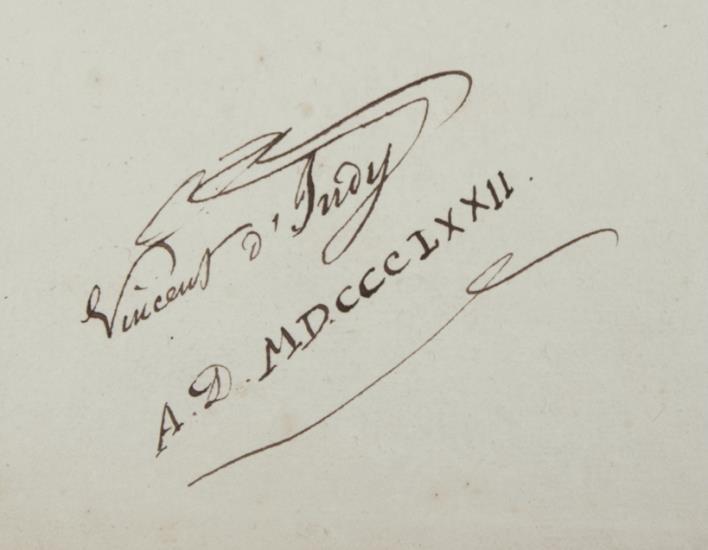
leaves detached. Minor internal wear, with some browning and occasional small stains and tears; foxing to blank margins, mostly light but occasionally a bit heavier. In quite good internal condition overall
Vol. I
Act 1: 1f. (rectotitle, verso blank), 1f. (recto dedicationtotheQueen, verso blank), [i] ("Personages... Acteurs"), 2-213, [i] (blank) pp. Title with large engraved coat of arms by L. C. Ruotte to upper half incorporating an eagle and a crown.
Vol. II
Act 2: 214-341 pp.; Act 3: [342]-511, [i] (blank) pp.
With the publisher Erard's autograph facsimile signature handstamp to front free endpaper.
Provenance
Distinguished French composer Vincent d'Indy (1851-1931), with his autograph inscription to verso of front free endpaper "Vincent d'Indy A.D. MDCCCLXXII."
First Edition. Sonneck Dramatic Music, p. 156. Hirsch II, 886. Devriès and Lesure Vol. I, Part I, pp. 65. OCLC 55970580.
La Vestale was first performed in Paris at the Opéra on 15 December 1807.
Spontini "dominated serious grand opera of the early 19th century in Paris and later in Berlin. ... After writing his last work in the Italian opera buffa style in 1805 (Julie, ou Le pot de fleurs), Spontini devoted himself to work on La vestale, his first tragédie lyrique, which was completed in draft in 1805, the year in which he was first described as compositeur particulier de la chambre to the Empress Josephine. Josephine’s patronage, to which Spontini responded with such occasional works as the cantata L’eccelsa gara and the vaudeville Tout le monde a tort (both 1806), proved a decisive influence on his career; only Josephine’s persistent intervention brought about the long-delayed first performance of La vestale on 15 December 1807 (see fig.2). The work’s triumphant success meant that Spontini was now seen as one of the leading composers in Paris, and he was commissioned to provide propaganda for Napoleon’s Spanish campaign in the form of an opera about Hernán Cortés and his conquest of Mexico. Napoleon himself, with the kings of Saxony and Westphalia, attended the première of Fernand Cortez on 28 November 1809." Anselm Gerhard in Grove Music Online (41119) $900
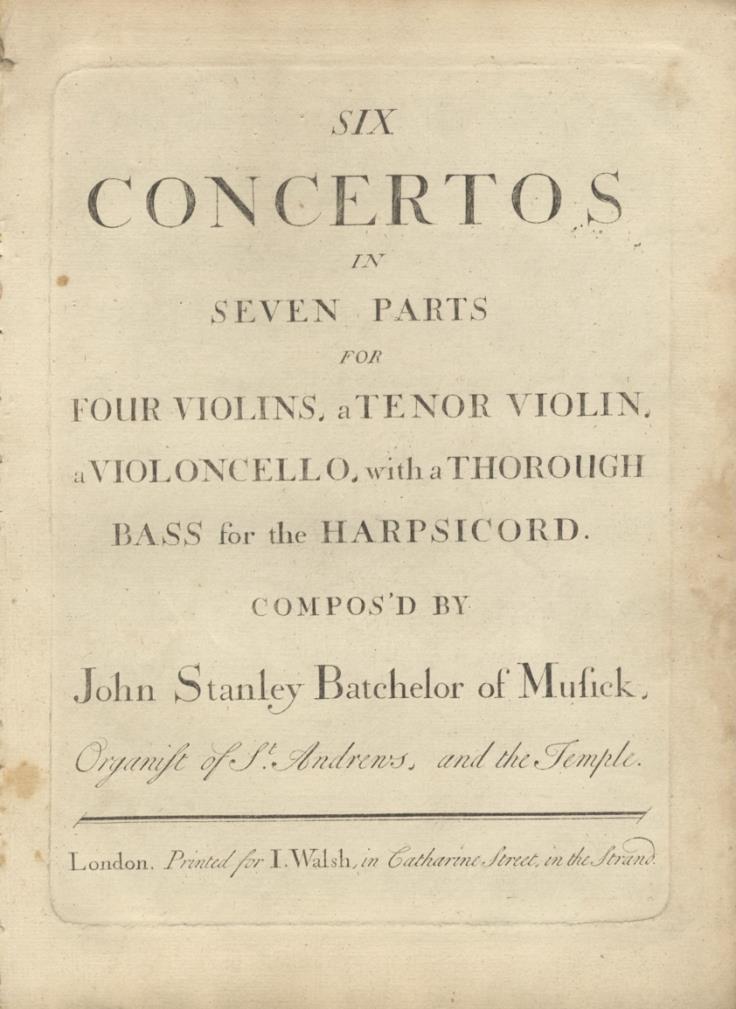
Concertos in First Edition
57. STANLEY, John 1712-1786
Six Concertos in Seven Parts for Four Violins, a Tenor Violin, a Violoncello, with a Thorough Bass for the Harpsichord. Compos'd by John Stanley Batchelor of Musick, Organist of St. Andrews, and the Temple. [Op. 2]. [Set of parts]. London: Printed for I. Walsh, in Catharine Street, in the Strand, [1745].
7 parts. Folio. Disbound. Engraved throughout. "Philips Sculpt." and "Phillips Sculp." printed to final leaves of Violino secondo del concertino, Violoncello, and Basso ripieno parts. Numbering in contemporary manuscript "No. 68 [-73]" at opening of each concerto Slightly worn; occasional minor browning, soiling, and small stains and tears.
Violino primo del concertino: 1f. (recto title, verso blank), 10, [I] (blank), 11-19 pp. Violino primo ripieno: 1f. (recto title, verso blank), [i] (blank), 12, [i] (blank) pp.
Violino secondo del concertino: 1f. (recto title, verso blank), 13, [i] (blank) pp. Violino secondo ripieno: 1f. (recto title, verso blank), [i] (blank), 12, [i] (blank) pp. Alto viola: 1f. (recto title, verso blank), [i] (blank), 12, [i] (blank) pp.
Violoncello [figured]: 1f. (recto title, verso blank), 13, [i] (blank) pp. Basso ripieno [figured]: 1f. (recto title, verso blank), [i] (blank), 12, [i] (blank) pp.
First Edition, second issue. Smith & Humphries 1412. BUC p. 973. RISM S4673.
Stanley was an English composer, organist and violinist. "He became blind as the result of a domestic accident at the age of two, and began to study music as a diversion when he was seven. Little progress was made under his first teacher, John Reading ... but he got on so well under Maurice Greene at St Paul's Cathedral that before he was 12 he was appointed organist at the nearby church of All Hallows Bread Street. In 1726 he was elected to a similar post at St Andrew's, Holborn, ‘in preference to a great number of candidates’ (Burney), and in 1734 he was made organist to the Honourable Society of the Inner Temple, having resigned from All Hallows in 1727. According to his pupil John Alcock ..., Stanley's playing of voluntaries at the Temple and St Andrew's attracted musicians from all over London, including Handel. He was also an excellent violinist and for several years directed the subscription concerts at the Swan Tavern, Cornhill, and the Castle, Paternoster Row. In 1729 he became the youngest person to gain a BMus degree from Oxford University. ... Thanks largely to his remarkable memory, Stanley was able to enjoy a comfortable living as an organist and teacher and to join in music-making and card-playing with a large circle of friends. He was also able to direct several Handel oratorios during the 1750s, and after Handel's death in 1759 he assumed responsibility for the annual Lenten oratorio seasons at Covent Garden (later at Drury Lane), first with J.C. Smith and from 1776 with Thomas Linley." Malcolm Boyd, revised by A.G. Williams in Grove Music Online. (40785) $850
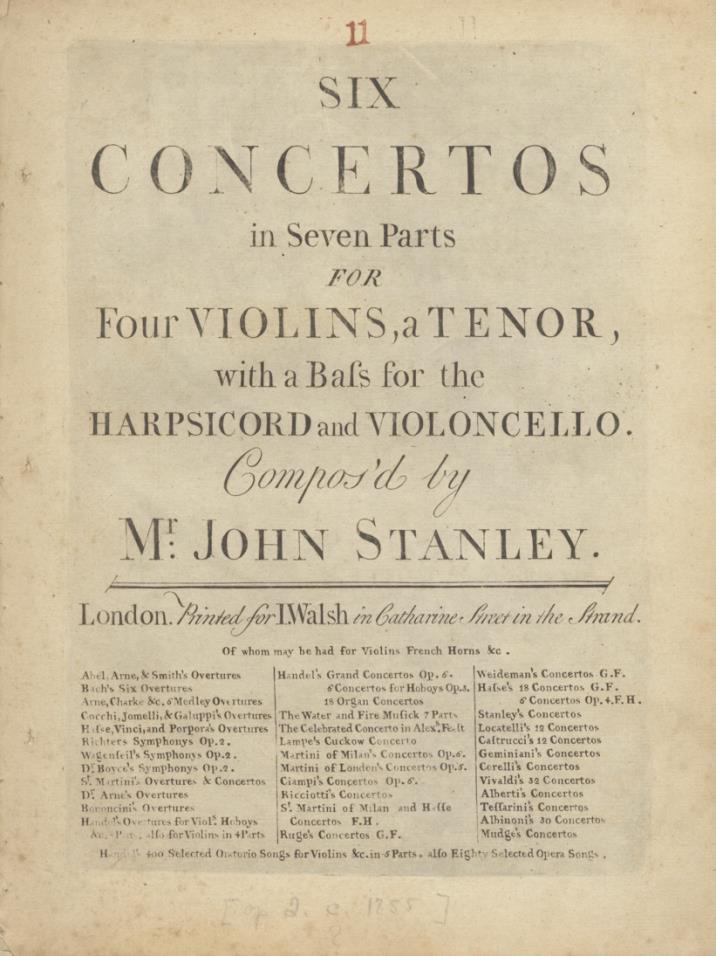
58. STANLEY, John 1712-1786
Six Concertos in Seven Parts for Four Violins, a Tenor Violin, a Violoncello, with a Thorough Bass for the Harpsichord. [Op. 2]. [Set of parts]. London: Printed for I. Walsh in Catharine Street in the Strand, [ca. 1750].
7 parts. Folio. Modern plain ivory wrappers, with spines to some parts sewn. With brief publisher's catalogue to foot of title listing works by Abel, Bach, Arne, Cocchi, Jomelli, Galuppi, Hasse, Richter, Wagenseil, Boyce, St. Martini, Bononcini, Handel, Lampe, Martini, Ciampi, Ricciotti, Ruge, Weideman, Stanley, Locatelli, Castrucci, Geminiani, Corelli, Vivaldi, Alberti, Tessarini, Albinoni, and Mudge. "Philips Sculpt." and "Phillips Sculp." printed to final leaves of Violoncello and Basso ripieno parts; handstamps "11" and "No 11" to heads of all pages; small20thcenturyLondon bookseller's labeltoversoof upperwrappers. Someminorsoiling towrappers; stain to lower of Basso ripieno. Occasional minor wear, browning, soiling, foxing, and small stains; small binder's holes to blank margins.
Violino primo del concertino: 1f. (recto title, verso blank), 10, [I] (blank), 11-19 pp.
Violino primo ripieno: [i] (blank), 12, [i] (blank) pp.
Violino secondo del concertino: 1f. (recto title, verso blank), 13, [i] (blank) pp.
Violino secondo ripieno: 1f. (recto title, verso blank), [i] (blank), 12, [i] (blank) pp.
Alto viola: 1f. (recto title, verso blank), [i] (blank), 12, [i] (blank) pp.
Violoncello [figured]: 1f. (recto title, verso blank), 13, [i] (blank) pp.
Basso ripieno [figured]: 1f. (recto title, verso blank), [i] (blank), 12, [i] (blank) pp. In duplicate.
First Edition, later issue. Smith & Humphries 1412 (not recording this issue). BUC p. 973. RISM S4675 and SS4674. (40786) $750
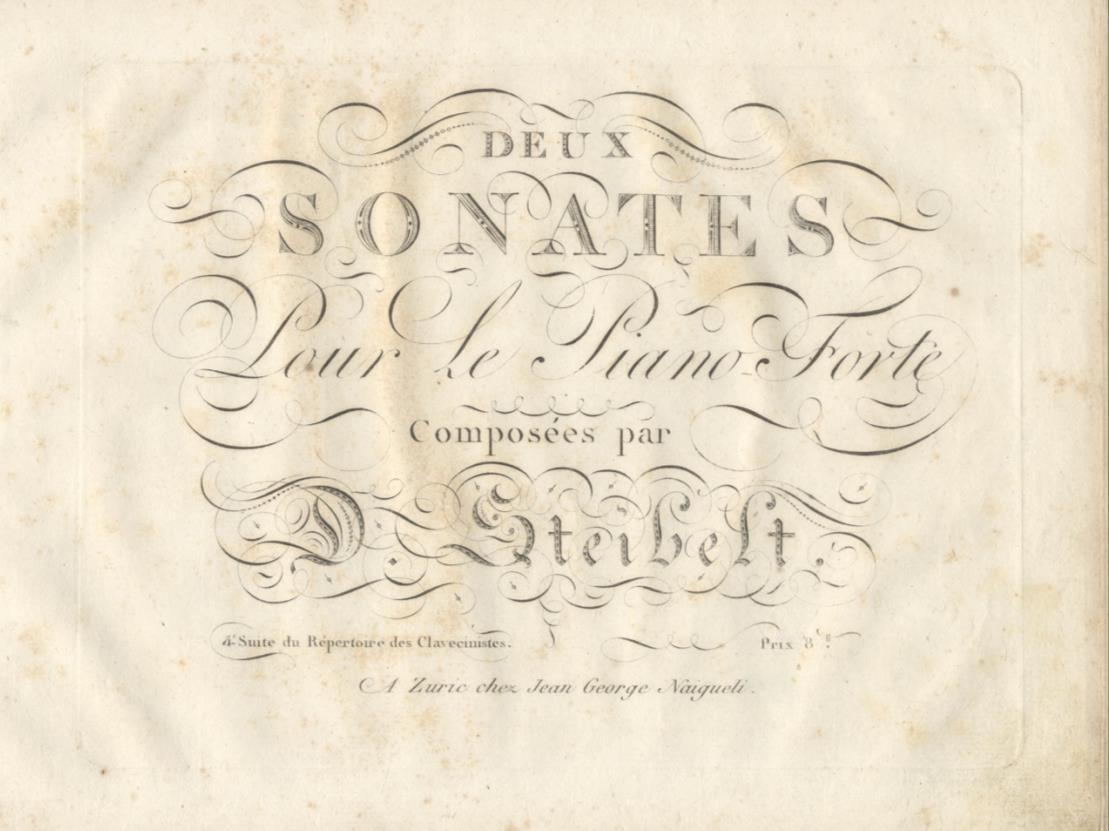
Turn-of-the-19th-Century Piano Sonatas
59. STEIBELT, Daniel 1765-1823
Deux Sonates Pour le Piano-Forte ... 4e. Suite du Répertoire des Clavecinistes. Prix 8f. Zuric: Chez JeanGeorge Naigueli, [ca. 1800].
Oblong folio. Contemporary halfdarkredleatherwithmarbled boards, spinewithdecorativegilt rulesandtitling gilt, decorative stencilled endpapers with floral motif, dark green silk marker. 1f. (recto series title, verso blank), 1f. (recto title, verso blank), [i] (blank), 2-43, [i] (blank) pp. Title and music engraved. The aquatint series title by Lips incorporates angels holding a lyre at head, stars, and laurel wreaths. Small rectangular Hungarian bookseller's stamp to title. Binding slightly worn, rubbed, and bumped; Slightly worn, soiled, and foxed; occasional small stains, including to series title and title; small dampstain to blank lower margin of final leaves.
OCLC 22394570 (one copy in the U.S. only, at Cornell University). RISM S5212.
Steibelt was a French composer and pianist of German birth. "At an early age [he] attracted the attention of the crown prince (later Friedrich Wilhelm II of Prussia), who sent him to study with Kirnberger. ... Steibelt published hundreds of works for piano solo and piano with the accompaniment of flute, violin, cello, harp, tambourine or other instruments. Many of these were titled ‘sonata’, and range from small pieces to expansive works. Many are in two movements (Allegro and Rondo). Slow movements, when they appear, are generally perfunctory, often based on popular national airs, as are many of the rondos. The other piano works consist of preludes, marches, waltzes, bacchanals, potpourris and programmatic pieces. Steibelt also wrote a set of string quartets, a piano quartet, some piano quintets, and numerous vocal works. The three quintets for piano and strings op. 28 are more substantial, as are the 50 studies of the Etude op. 78, some of which anticipate the style of Mendelssohn and all of which are admirably designed for their purpose." Frank Dawes, Karen A. Hagberg, and Stephan D. Landeman in Grove Music Online. (40789) $275
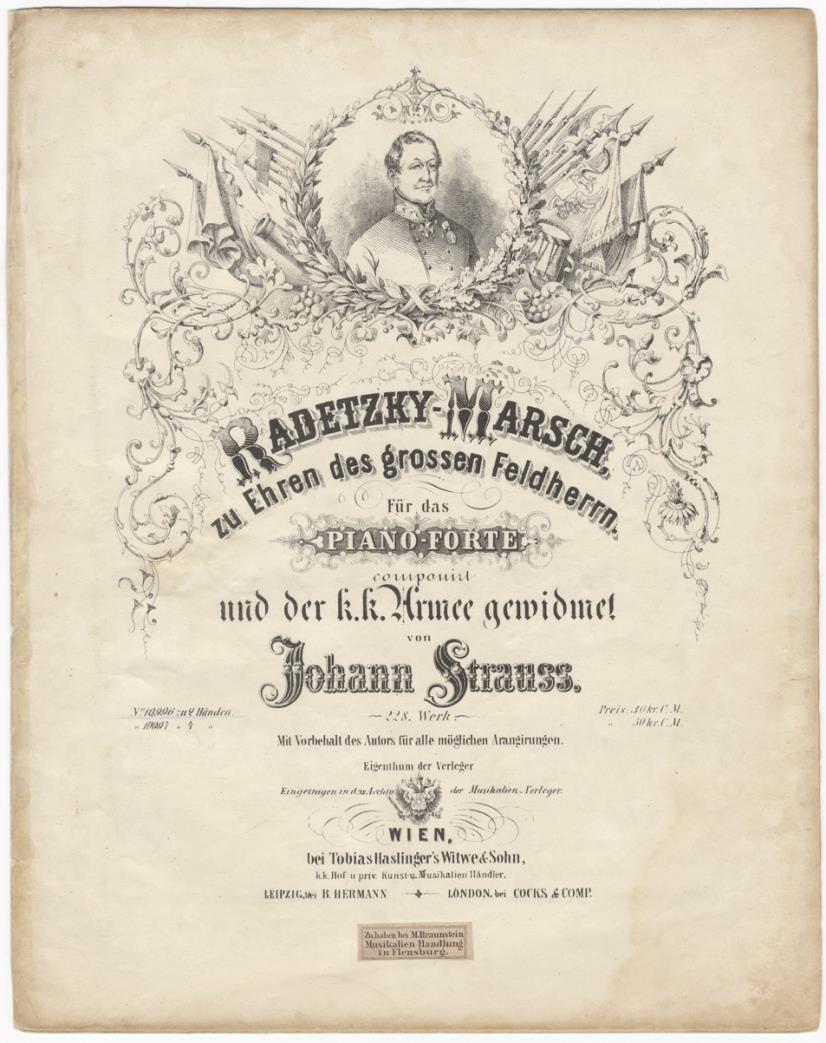
In Celebration of the Victory of the Austrian Empire
60. STRAUSS, Johann, Sr. 1804-1849
Radetzky-Marsch zu Ehren des grossen Feldherrn Für das Piano-forte comonirt und der k. k. Armee gewidmet ... 228. Werk. Preis 30 kr. C.M. [Piano solo]. Wien: Tobias Haslinger's Witwe & Sohn [PN C. H. 10,996], 1848.
Folio. Disbound. 1f. (recto decorative title with portrait of Radetzky within decorative circular border to head, verso blank)), 3-7, [i] (blank) pp. Engraved. Slightly worn and soiled; slightly browned at margins; spine reinforced with clear tape. Very light dampstaining to lower outer corners.
First Edition. Schonherr and Reinohl p. 309. Weinmann p. 42
"[The Radetzky March] was first performed on 31 August 1848 in Vienna to celebrate the victory of the Austrian Empire under Field Marshal Joseph Radetzky von Radetz (the piece's namesake) over the Italian forces at the Battle of Custoza, during the First Italian War of Independence. It has been noted that its tone is more celebratory than martial, but it nevertheless became popular among marching regimental soldiers. Today, the work is primarily associated with the Vienna Philharmonic as an encore to their New Year's Concert." Wikipedia (41308) $150
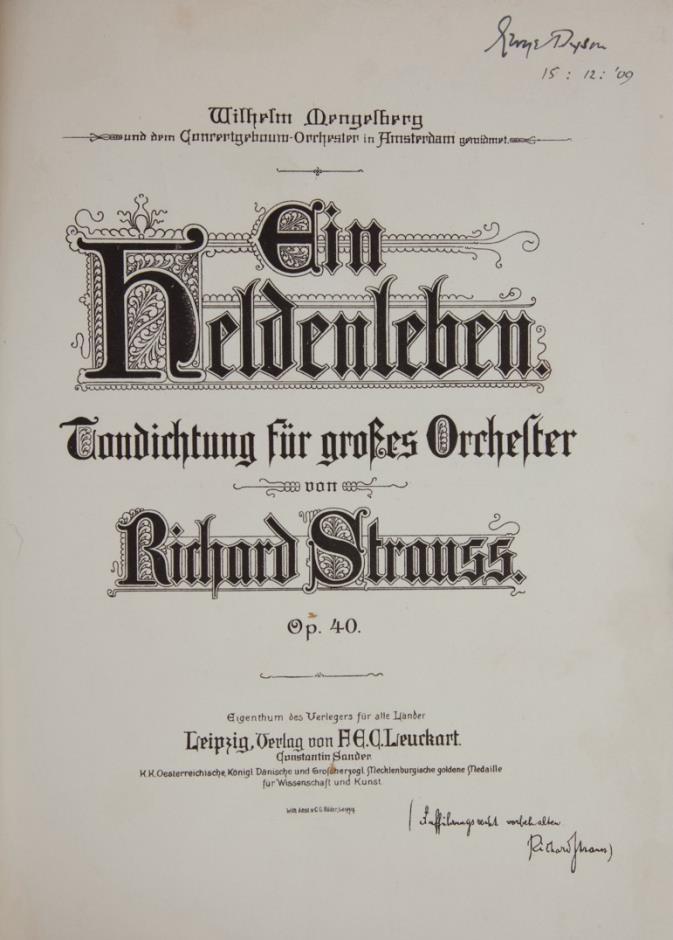
From the Collection of British Composer George Dyson
61. STRAUSS, Richard 1864-1949
Ein Heldenleben. Tondichtung für grosses Orchester ... Op. 40. [Study score]. Leipzig: F.E.C. Leuckart [PN F.E.C.L. 5200], [1899].
Small quarto. Half dark red cloth with mid-green printed boards with decorative device to lower, patterned endpapers. [i] (title), [i] (printed list of orchestral forces), 3-139, [blank] pp. Binding slightly worn, rubbed, bumped, and shaken. Light staining to lower margins of final four leaves.
With the autograph signature of the British composer George Dyson (1883-1964) dated 15 December 1909 in ink to upper margin of title.
First Edition of the study score, published simultaneously with the folio full score. Trenner 190. Mueller von Asow I, 243.
An orchestral tone poem, Ein Heldenleben (A Hero's Life) was composed in 1897-1898 and first performed in Frankfurt in 1899. "Ein Heldenleben remains one of Strauss's most controversial works, mainly because its surface elements have been overemphasized. Various critics see the work as a flagrant instance of Strauss's artistic egotism, but a deeper interpretation reveals the issue of autobiography to be far more complex. Ein Heldenleben treats two important subjects familiar from earlier works: the Nietzschean struggle between the individual and his outer and inner worlds, and the profundity of domestic love. Essential to this latter preoccupation was his wife Pauline, for the almost dizzying recollection of themes from previous tone poems, opera and lieder concerns mostly love themes related to her as the hero's partner. This effect of culmination has a broader context as well, for Ein Heldenleben marks the end of Strauss's 19th-century tone poems and reflects a composer at the height of his creative powers. The première took place in March 1899." Bryan Gilliam and Charles Youmans in Grove Music Online (41307) $150
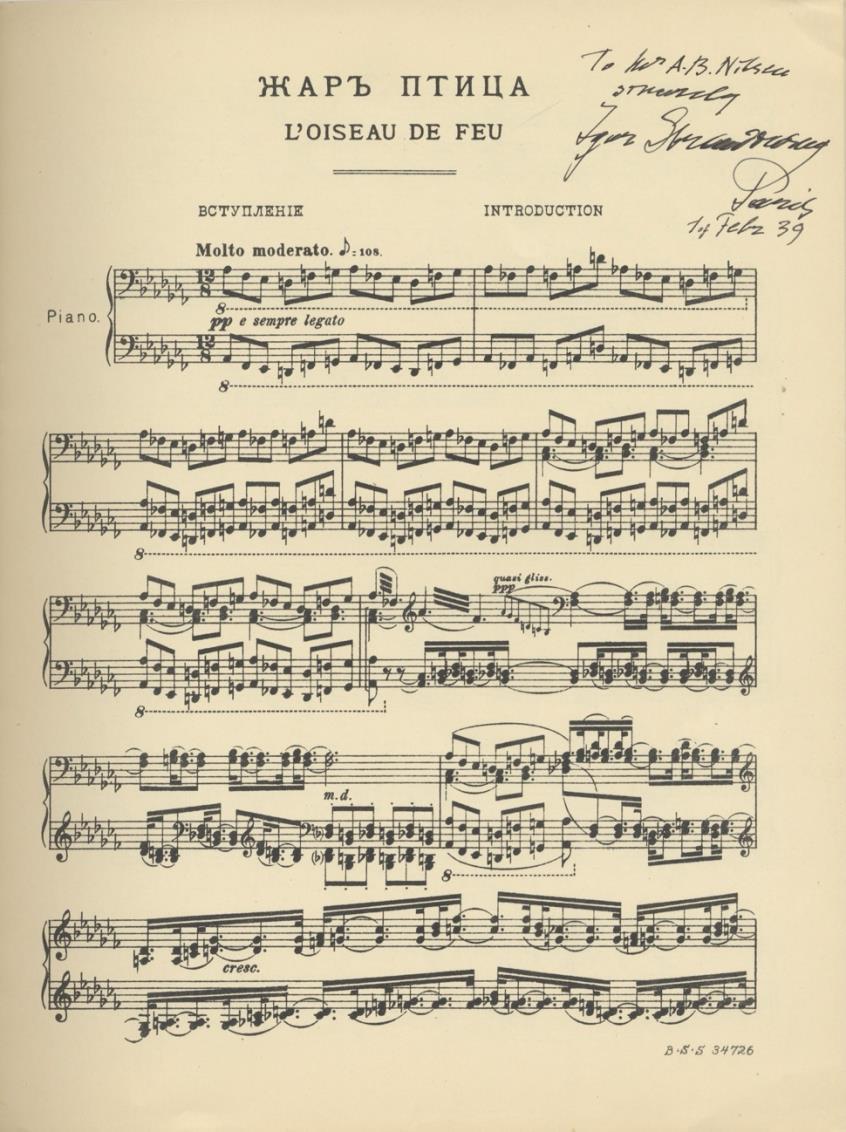
The Firebird, Signed by the Composer
62 STRAVINSKY, Igor 1882-1971
L'Oiseau de Feu Conte dansé en 2 tableaux d'après le conte national russe par M. Fokine ... Partition de Piano. Mainz: B. Schott's Söhne [ PN B.S.S. 34726], [1936].
Folio. Original publisher's dark ivory wrappers printed in red and black. 1f. (recto title in French and German, verso details of first performance), 1f. (recto printed dedication to Rimsky-Korsakov, verso blank), 70 pp. Wrappers very slightly worn;small price stampto upper outer corner of upper. Minor internal browning;corners very slightly creased. In very good condition overall.
With an autograph inscription signed in black ink by the composer to upper outer corner of first page of music: "To Mrs. A. B. Nilsen sincerely Igor Stravinsky Paris 1 of Febr [19]39."
Not in Kirchmeyer. Edition Schott No. 3279.
The Firebird, a ballet and orchestral concert work, was composed for the 1910 season of Diaghilev's Ballets Russes at the Paris Opéra and first performed there on 25 June 1910 with choreography by Michel Fokine and sets and costumes by Alexandre Benois. Its huge success led to further collaborations with Diaghilev, including on some of the most dynamic early 20th century ballets including Petrushka in 1911 and The Rite of Spring in 1913.
"His Firebird cavorts to flickering, Skryabinesque harmonies and gasping rhythmic phrases, while the human princesses dance to music which Glazunov himself would not have disowned, and the hero Prince Ivan and his bride are portrayed in Borodinesque settings of ‘authentic’ folk tunes. The demon Kashchey's dance is infectiously rhythmic; but its phrasing is routine. Of course, Stravinsky's mastery of these varied resources was and remains astonishing (and not only in view of his limited experience). But it might not have portended any outstanding innovative genius.
The success, all the same, was sensational. Overnight Stravinsky became a household name. Socially he was lionized. He was befriended by the Parisian great and good, by Diaghilev's aristocratic backers, by composers like Debussy, Ravel and Satie, by writers like Claudel, Proust, Gide and D'Annunzio, and even by the venerable Sarah Bernhardt." Stephen Walsh in Grove Music Online (41309) $1,350
Rare First Edition of the Full Score With Extensive Performance Markings
63. STRAVINSKY, Igor 1882-1971
Histoire du Soldat, lue, jouée ey dansée en deux parties. Texte de C. F. Ramuz [Full score]. London: J. & W. Chester, Ltd. [PN J. W. C. 44], 1924.
Folio. Modern full linen with dark red eather title label gilt to upper. 1. (recto title, verso blank), 1f. (recto details regarding the first performance, verso blank), 1f. (recto details of orchestral composition, verso blank), 1f. (recto dedication to Werner Reinhart who underwrote the cost of the first performance, verso blank), 60 pp. Extensively marked up for performance in red, blue, and black pencil including some cancels and corrections. Annotations and performance notes in French and German in an unidentified hand, in some cases on overpastes. Slightly worn and browned; some inner margins guarded; dormer owner's signature in blue ink to front free endpaper; publisher's rental library stamp to foot of first page of music.
First Edition. Rare. The present score was published for rental only and never offered for public sale; the print run was thus in all likelihood quite small. Kirchmeyer 29-2. White p. 264.
First performed at the Théâtre Municipal de Lausanne on 26 September 1918, conducted by Ernest Ansermet. "Toward the end of World War I, Stravinsky was facing the harsh realities of economic deprivation: payments from his German publishers were being held back, and the Russian Revolution had cut off his income from the
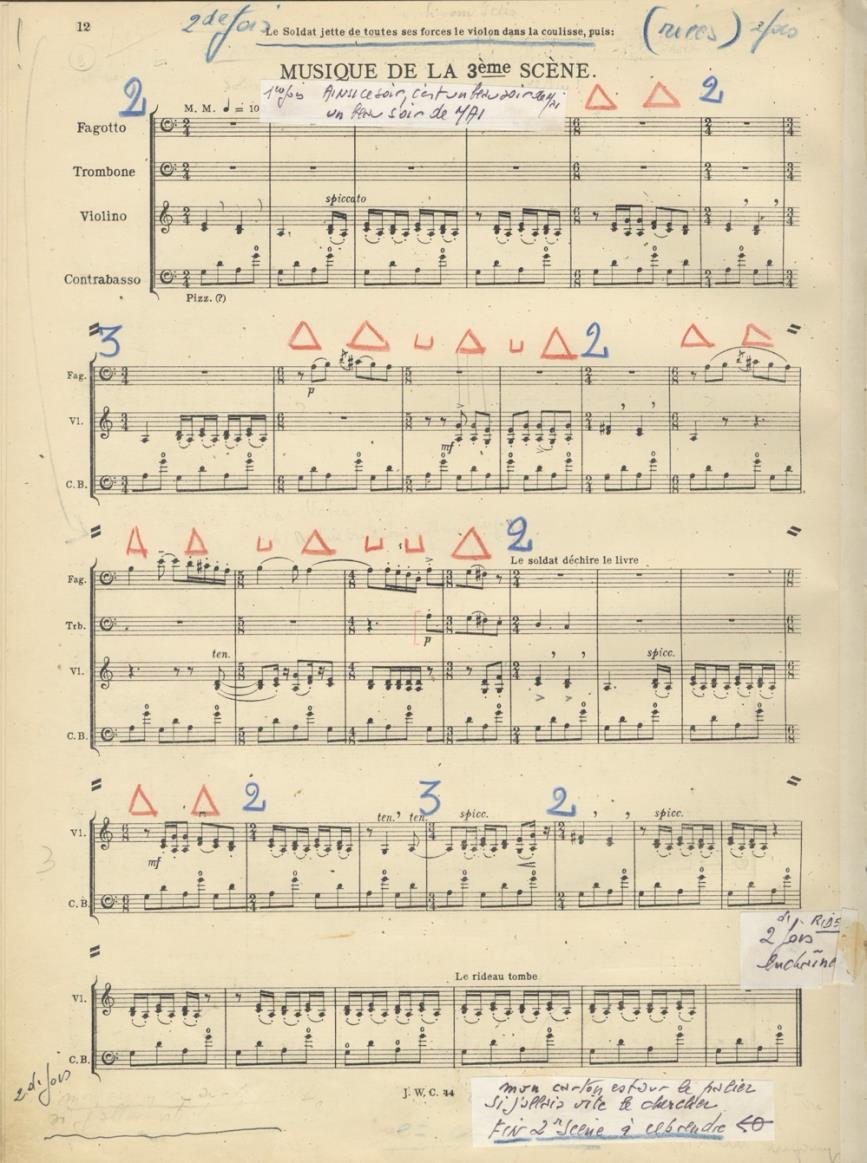
family estate. Sensing disaster, Stravinsky, ever a pragmatist, formulated with his friends, writer C.F. Ramuz and conductor Ernest Ansermet, a plan to get himself out of this vexing situation.
As he explained it: “Ramuz and I got hold of the idea of creating a sort of little traveling theater, easy to transport from place to place and to show in even small localities.” Thus out of necessity came the chamber-sized neoclassic orchestra. As for their first project, Stravinsky recalled, “We were particularly drawn to the cycle of legends dealing with the adventures of the soldier who deserted, and the Devil who inexorably comes to carry off his soul.” Armed with the fool-proof dramatic stuff of the Faust story, the two created The Soldier’s Tale, 'to be read (Narrator, Soldier, Devil), played, and danced (Princess).'
Stravinsky and Ramuz plunged into their tasks of creating, respectively, music and libretto, with the composer assisting considerably in the latter. The score emerged a marvel of economy and ingenuity, foregoing the large ballet orchestra of The Firebird, Petrushka, and The Rite of Spring." Orrin Howard performance notes from the Ford Theater Walt Disney Concert Hall website. (41310) $1,500
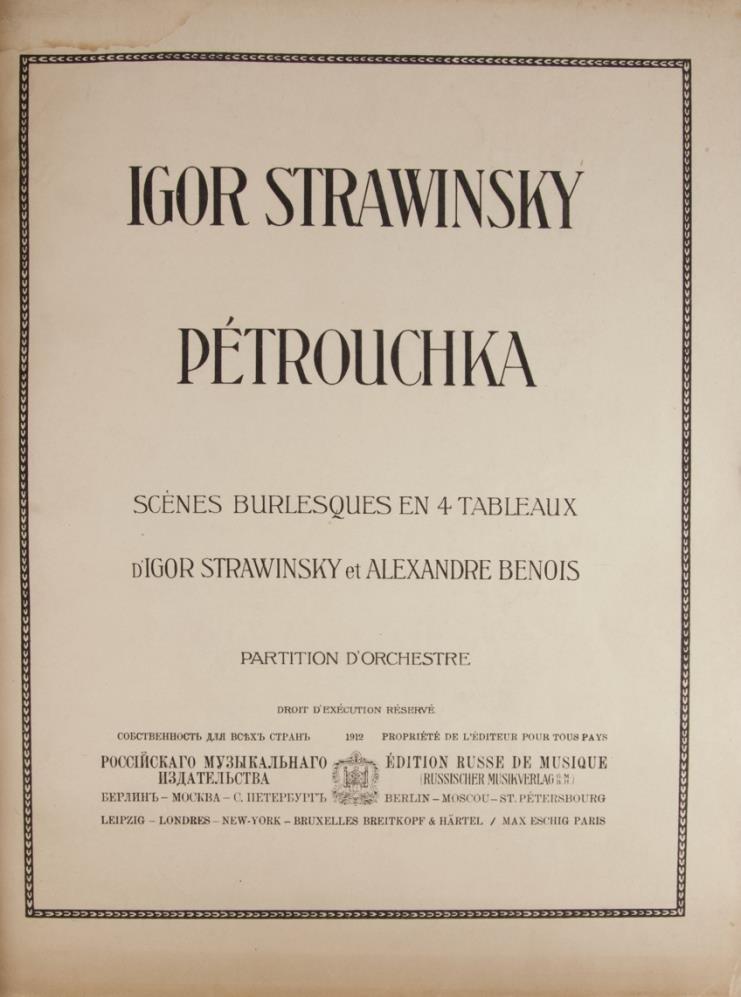
Rare First Edition, First Issue of Petrouchka
64. STRAVINSKY, Igor 1882-1971
Pétrouchka Scènes Burlesques en 4 Tableaux d'Igor Strawinsky et Alexandre Benois. Partition d'Orchestre. [Full score]. Berlin, Moscou, St. Pétersbourg ...: Édition Russe de Musique [PN R.M.V. 127], 1912.
Folio. Newly bound in quarter dark green cloth with mid-brown paper boards, dark red title label gilt to upper and spine. 1f. (recto title, verso blank), [i] (named cast list), [ii] (synopsis), [i] (orchestration), [i] (recto dedication "À Alexandre Benois," verso blank), 7-156 pp. + 1f. (errata) tipped in to rear pastedown. With text in Russian and French. Named cast for the first performance by Diaghilev's Ballets Russes at the Théâtre du Chatelet in Paris on 13 June 1911 includes Tamar Karsavina (Le Ballerine), Vaslav Nijinsky (Petrushka), Orlow (Le Maure), andEnrico Ceccheti (Le vieux Charlatan); the performancewas conducted by Monteux, with maître du ballet Fokine, and sets and costumes designed by Benois and executed by Anisfeld (sets) and Caffi and Worobiew (costumes). Small area of faint dampstaining and minor cockling to upper inner margins.
An attractive copy.
First Edition, first issue. Rare. Kirchmeyer 12-1. Hirsch II, 905. De Lerma, P15. White, p. 193. Crawford, p. 533.
"The emergence of Stravinsky as a modernist, with an individual manner unlike any other, can be dated with some precision to his early work on Petrushka. In March 1910, during the later stages of composing The Firebird, he had experienced the famous 'fleeting vision' out of which The Rite of Spring was to grow. But when Diaghilev and Nijinsky visited him in Lausanne in September 1910 they found him at work on something quite
different, a concert piece for piano and orchestra called 'Petrushka's Cry'. Together with a 'Russian Dance' composed soon afterwards, this music was to form the basis of the ballet which Diaghilev instinctively urged him to write instead. ...
It is from the systematic attempt to render [the] particular flavour of traditional Russian life into music that Petrushka derives many of its freshest and most original qualities. ...
Looked at in general terms, [the] opening sequence of Petrushka is a prototype of later Stravinskian form. Its underlying rhythmic design may not be complex in the same way as that of The Rite of Spring or the later Russian works, but its intricacy of rhythmic detailing and its mixture of a highly fluid pattern of melodic stress with an inert background harmony laid the groundwork for a technique which, through many changes of superficial style, was to serve him for the rest of his life." Walsh: The Music of Stravinsky, pp. 24-29.
"Petroushka proved just as successful with the public and critics as The Firebird had been; but it was undoubtedly a more original work. In the first place, Stravinsky had been able to play a leading part in the construction of the scenario, which had not been the case with The Firebird. Secondly, whereas the music of The Firebird showed that the pupil had learnt all that his master had had to teach him, in Petrushka for the first time the authentic voice of the new master is heard." TNG Vol. 18, pp. 244-245.
The rare first edition, first issue of Stravinsky's colorful and well-loved ballet, inspired by the St. Petersburg Shrove-tide Fair. (41313) $4,000
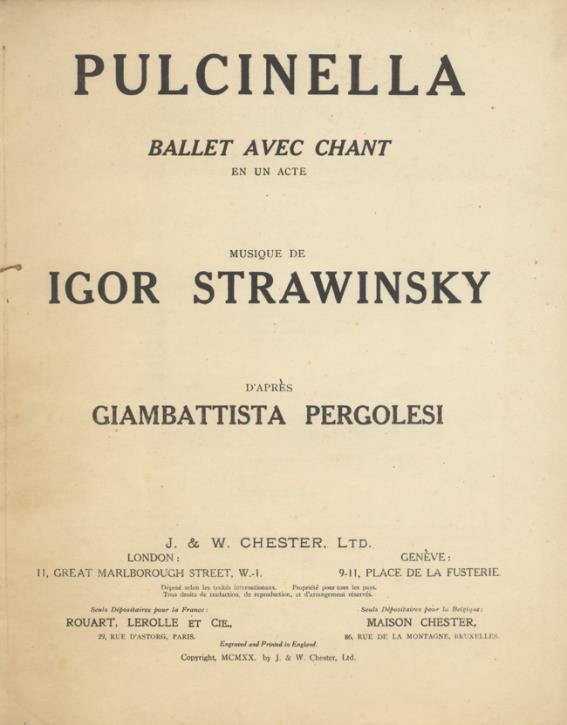
First Edition of the Ballet Pulcinella
65. STRAVINSKY, Igor 1882-1971
Pulcinella. Ballet avec chant en un acte ... d'après Giambattista Pergolesi. [Piano-vocal score]. London, Genève: J. & W. Chester, Ltd. [PN J. &W. C. 9707], 1920.
Folio. Original publisher's printed dark ivory wrappers with decorative device to upper and publisher's details within decorative border to lower. 1f. (recto title, verso printed notice regarding first performance with named cast list, and scenario), 86 pp Named cast includes Massine (Pulcinella), Thamar Karsavina (Pimpinella), Tchernicheva (Prudenza), Nemtchinova (Rosetta), Novac (Fourbo), Idzikowky (Caviello), Zverew (Florindo), Cecchetti(IlDottore), Kostetsky(Tartaglia),andBourman, Okimowsky, Micholaitchik, andLoukin(Petits Pulcinella). Wrappers somewhat worn and soiled; torn at spine with minor loss; partially detached. Minor internal wear; two small chips to blank lower margin of title and upper wrapper.
First Edition. Scarce. Kirchmeyer 34-1. White p. 282. De Lerma P60. CPM Vol. 54, p. 440.
Pulcinella, commissioned by the Russian impresario and founder of the Ballets Russes, Sergei Diaghilev (18721929), was first performed in Paris at the Opéra on 15 May 1920 with Ernest Ansermet conducting. The libretto andchoreographywerebyLéonideMassine, withcostumesandsetsdesignedbyPabloPicasso. (41305) $350
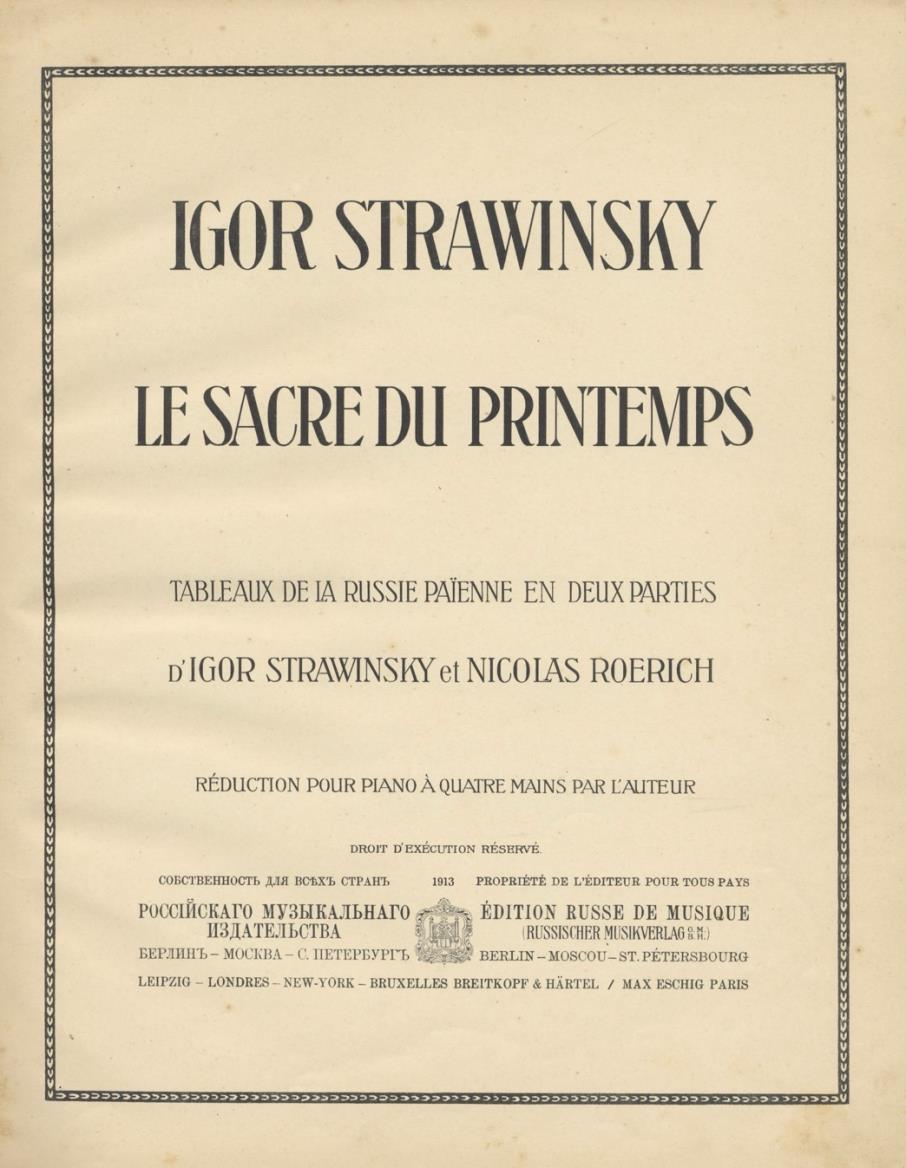
“The 20th Century's Ninth Symphony" The Revolutionary Rite of Spring
66. STRAVINSKY, Igor 1882-1971
Le sacre du printemps. Tableaux de la Russie Paienne en Deux Parties d'Igor Strawinsky et Nicolas Roerich. Reduction pour piano a quatre mains par l'auteur. Berlin -Moscou - St. Petersbourg: Édition Russe de Musique [PN R.M.V. 196], 1913.
Folio. Original publisher's ivory cloth-backed dark ivory printed boards 1f. (reco title, verso blank), 1f. (recto half-title in French, verso blank), 1f. (recto half title in Russian, verso blank), 1f. (recto dedication to Nicolas Roerich, verso blank), 9-89. [i] (blank) pp. Binding slightly worn, browned, and foxed, with manuscript annotation to blank upper margin of upper deleted in black ink. Slightly browned throughout; corners thumbed; some minor imperfections. In very good condition overall.
First Edition, first issue of the four-hand piano arrangement, and the first appearance in print of the the music, pre-datingthefull score byeightyears. Rare. Kirchmeyer 15-1. DeLerma S3. White 21, p. 207. Crawford p. 543.
"Unlike the orchestral score, which did not appear in print until early 1922, the piano-duet version was published by Édition Russe de Musique shortly before the première, and was soon reissued in response to considerable demand. But special importance attaches to this [four-hand] version not only for historical reasons, but because of its specific aesthetic quality, for it directly brings out the "pianistic" nature of many of the work's musical ideas. True, not for a moment do we forget that The Rite of Spring owes a large part of its impact to its orchestral sound, now subtly differentiated, now brutally violent. But it allows the structural workings of a piece invented at the piano, and developed in close contact with the instrument, to come all the more trenchantly to the fore. It was not least because of this trenchancy and "closeness to the origin" that the piano version has, in recent decades, begun to emerge from its primary role as an object of study and a rehearsal aid and to take on a second life as an independent concert piece. It has even formed the basis of a number of ballet productions." Meyer, ed.: Igor Stravinsky Le Sacre du printemps Manuscript of the Version for Piano Four Hands Facsimile, p. 23
The momentous first performance of The Rite took place in Paris at the Théâtre des Champs-Elysées on 29 May 1913. It was conducted by Monteux, with choreography by Vaslav Nijinsky and set and costume designs by Nicolas Roerich.
"It is now theatrical history that the first performance by the Russian Ballet ... created a scandal of the first magnitude ..." White: Stravinsky. The Composer and His Works, p. 216. Sincethattimetherehavebeenanumber ofotherversionsoftheballet, onechoreographedbyLeonideMassine(1920, attheThéâtredesChamps-Elysées, with Roerich's original set designs), and another by Kenneth Macmillan (1962, at Covent Garden, with set designs by Sydney Nolan), "but the work is more popular and seems to make a greater impact in the concert hall than on the stage. Its triumphant rehabilitation as one of the most important works in the symphonic repertory of the twentieth century dates from its first concert performances - in Moscow (February 1914; conductor, S. Koussevitzky), Paris (Casino de Paris, April 1914; conductor, Monteux), and London (Queen's Hall, 7 June 1921; conductor, Eugene Goossens)." Ibid
Diaghilev referred to The Rite of Spring as "the 20th century's Ninth Symphony." Austin: Music in the 20th Century, p. 252.
"[Le sacre du printemps] was to remain the most notoriously violent score of a time when huge, noisy orchestras and harsh dissonance were more or less commonplace appurtenances of the new music. The primitive imagery of Russian symbolism, of the kind exploited by Roerich, had always carried a certain revolutionary tone, a note of challenge to ossified social structures. But behind all the racket, behind the wilfully discordant harmonies and convulsive metric irregularities lay a genuinely innovatory kind of musical thinking whose point would not become clear until Stravinsky himself began to deconstruct it in subsequent works."
Stephen Walsh in Grove Music Online. (41314)
“The First Master of the Classical Viennese Operetta”
67. SUPPÉ, Franz von 1819-1895
$6,500
Leichte Cavallerie Komische Oper mit Tanz in 2 Abtheilungen von Carl Costa ... Herrn Direktor Carl Treumann zur freundlichen Erinnerung gewidmet ... Klavier-Auszug gleichzeitig mit order ohne Worte einrerichtet. Complet Fl. [7] ö.w. [Piano-vocal score]. Wien: C. A. Spina k.k. Hof u. priv. Kunst u. Musikalienhandlung (Med. 1 Cl. der Pariser Welt-Jnd-Ausstellun.) [PN C. S. 2078 No. 1-14], [1866].
Folio. Original publisher's light pink pictorial wrappers. [i] (title), 2-87, [i] (blank) pp. Upper and title lithographed by G. Wegelein; music engraved. With fine lithographic illustration of uniformed military men to both upper and title (nearly identical save for the addition of "Thlr" to wrapper). Contemporary bookseller's overpaste to foot of upper wrapper "Emil Richter, Hamburg Theater-Verlags-Buchhandlund und Antiquariat," with address cancelled and handstamp below it "jetzt: Gr. Drehbahn 14." Handstamp "Emil Richter TheaterLeihbibliothek Hamburg" to several pages. Occasional performancemarkings in gray and blue pencil. Wrappers slightly worn; spine reinforced with marbled paper; lower lacking. Minor wear and browning; occasional light soiling and foxing to blank margins; small repair to blank outer margin of pp. 25/27; repairs to pp. 82 and 83; tear from blank margin into one measure of lowermost system of pp. 83-84 repaired with archival tape.
Probable First Edition. OCLC 314870616.
Leichte Kavallerie, a comic opera in two acts, was first performed in Vienna at the Carltheater on 21 March 1866.
Suppé, an Austrian composer and conductor of Belgian descent, "is the earliest Viennese composer of musical farces whose works still survive as viable stage scores (and popular overtures), and later in his career he became the first master of the classical Viennese operetta in the train of the acclimatized scores of Offenbach. His light, fluent style includes the ability to vary a phrase length or melodic and rhythmic figure in a personal and
$150
immediately effective way. Though now remembered mainly as the composer of overtures such as Dichter und Bauer, Leichte Kavallerie and Ein Morgen, Mittag und Abend in Wien, his ambitions extended to the composition of large-scale sacred works and operas. He is at his best and most characteristic in the series of famous operettas from Die schöne Galathée (1865) to Boccaccio (1879). Numbers like ‘Hab ich nur deine Liebe’, ‘Mia bella Fiorentina’ and ‘Holde Schöne’ from Boccaccio have an irresistible elegance and élan, and his scoring is worthy of the finest orchestras rather than the bands that so often seize upon the overtures in particular. The song ‘O du [Des ist] mein Österreich’ of 1849 has become virtually Austria’s second national song." Peter Branscombe and Dorothea Link in Grove Music Online, (41118)
68. SUPPÉ, Franz von 1819-1895
Ouverture zur Komischen Oper: Leichte Cavallerie für grosses Orchester ... Partitur Pr. 1 Thlr. [Full score]. Leipzig: C. F. W. Siegel, Dörrienstr. 1. [PN 3843], [ca. 1869].
Large octavo. Original publisher's dark ivory printed wrappers. [i] (title), 2-40 pp. With former owner's name ("James Davie") in manuscript to upper outer corner of upper wrapper. Smallcircular handstamp of "Novello & Co." to lower outer corner of title. Occasional instrument designations in light red ink. Wrappers worn, creased, and with several small stains; upper nearly detached. Minor internal wear. (41117)
$75
Songs by the Soprano Castrato and Composer
69. TENDUCCI, Giusto Ferdinando ca. 1735-1790
Six New English Songs Composed by Ferdinando Tenducci and to be Sung by him at Ranelagh Price 5s. [Pianovocal score]. London: Printed for the Author And to be had of him at his Lodgings in the Great Piazza Covent Garden, the Corner of James Street, and at all the Musick Shops. Where may be had the Instrumental parts altogether, Price 10s. 6d. NB. The Horns, Flutes, Hautboys, and Bassoons, are particularly Obligated, 1763.
Oblongfolio. Modernivorywrappers. 1f. (rectotitle, versoblank), 12, [i](blank), 14-17, [i](blank)pp.Engraved throughout. Scored for voice and figured basso continuo, with instrumental introductions, interludes, and postludes. Very minor wear; light uniform browning, slightly heavier to extreme margins and corners of final blank leaf.
Contains six songs: Go, deceitful fair one; Fair's my Lucy as the day; Venus, queen of tender passion; Hear me, ah do not fly me; O cruel maid, thy scorn forbear; and Indeed, my dear, in vain you strive
First Edition. BUC p. 1000. RISM T478.
Tenducci, an Italian soprano castrato and composer, "made his début in Cagliari in 1750, during the wedding festivities of the Duke of Savoy. After appearing both in minor roles and in comic opera in Milan, Naples, Venice, Dresden and Munich, in 1758 he went to London, where he spent two seasons at the King’s Theatre and sang in Cocchi’s Ciro riconosciuto as secondo uomo. ... Tenducci left England and returned to Italy until 1776 (repeating Orfeo in Florence), and then appeared in London (1777–85), Paris (1777) and Dublin (1783–4). Smollett described his voice as particularly lyrical and the ABCDario Musico (Bath, 1780) compared him with Gioacchino Conti; he was widely known as another Senesino." RogerFiske andDaleE. Monson in Grove Music Online. (41116) $350
70. TENDUCCI, Giusto Ferdinando ca. 1735-1790
Three English Songs with an Accompaniment for the Harp, Piano Forte, or Harpsichord ... Price 3s. [Pianovocal score]. London: Longman and Broderip No. 26 Cheapside and No. 13 Hay Market, [1786].
Large oblong octavo. Modern light blue wrappers. 1f. (recto title, verso blank), [i] (blank), 2-7, [i] (blank) pp. Engraved throughout. With "Organs, Harpsichords, Piano Fortes, &c. lent out, conveyed, and Tuned, in Town and Country on the shortest Notice; and, if purchased, and Payment made within Eight Months, the Hire will be abated." printed beneath imprint. Scored for voice with harp, piano, or harpsichord accompaniment. Slightly worn and soiled; occasional small stains; minor browning to margins; small binder's holes to inner margins; corners creased.
Contains three songs: Song I ... From Shenstone Song 12, with text commencing O'er [!]desart Plains and rushy meers. 2 pp.; Song II ... From Prior Song 27, with text commencing Some kind Angel gently flying 2 pp.; Song III ... The last farewell of Mr. S. to the Countess of S, with text commencing Thou hast play'd a false a faithless part. 2 pp. Each song with an additional verse printed at the conclusion of the music.
First Edition. BUC p. 1000. RISM T480 (one copy in the U.S. only, at the New York Public Library). (41115) $165
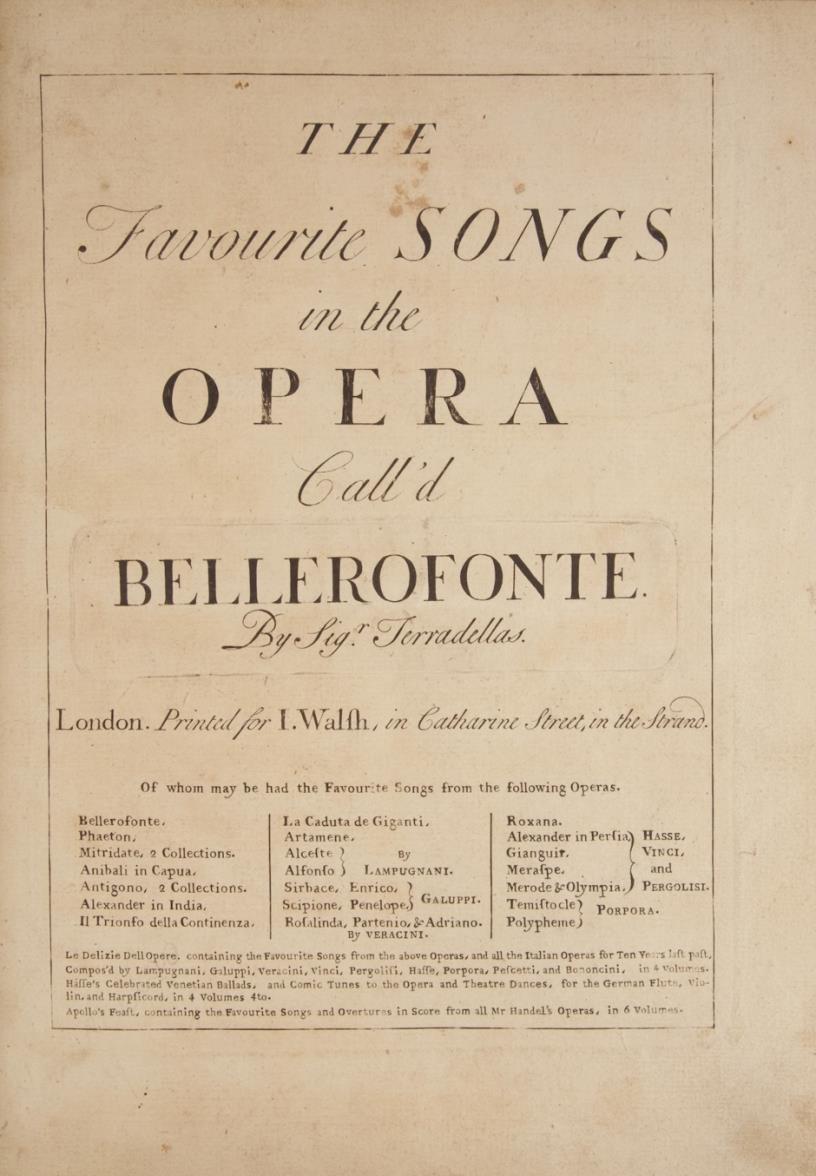
The Arkwright Copy of this Work by Spanish Composer Terradellas
71. TERRADELLAS, Domingo 1713-1751
The Favourite Songs in the Opera Call'd Bellerofonte. [Score]. London: Printed for I. Walsh, inCatharineStreet, in the Strand, [1747].
Folio. Half mid-tan calf with marbled boards, titling gilt to spine. 1f. (recto passe-partout title, verso blank), [i] (blank). 2-20pp. Engravedthroughout. Scoredforaltoorsoprano voice, instrumentsincludingstringsandoboes, and figured bass continuo. Named singers include Signor Reginelli, Signora Frasi, and Signora Casarini. With brief publisher'scataloguetofoot oftitle, "Of whom may behad theFavourite Songs from the following Operas" including works by Lampugnani, Galuppi, Veracini, Hasse, Vinci, Pergolesi, Porpora, Pescetti, Bononcini, and Handel. Binding very slightly worn. Minor internal wear and soiling; light uniform browning, a bit heavier to title.
In very good condition overall.
Provenance
Godfrey Edward Pellew Arkwright (1864-1944), notedBritish musicologistandantiquarian, withhisarmorial bookplate to front pastedown.
First Edition. Smith and Humphries 1434. BUC p. 1000. RISM T532 (two copies in the U,S., at the Newberry Library and the Library of Congress.
Terradellas, a Spanish composer, "probably received part of his musical instruction from Francese Valls, choirmaster of Barcelona Cathedral. In 1732 he moved to Italy. Sponsored by the Prince of Belmonte, he registered as a student at the music conservatory Poveri di Gesù Cristo in Naples on 23 May, at the same time committing himself to stay in the conservatory, where he studied with Francesco Durante, and to contribute to its music for a period of six years. ...
In 1743 he achieved his first outstanding success with the presentation in Rome of his opera Merope. The Neapolitan envoy at the papal court, Cardinal Acquaviva, was so impressed that he wrote a strong recommendation for the composer to the court authorities in Naples, claiming that Merope had obtained a success in Rome ‘the like of which no one can remember for many years’. But the Neapolitan court took no interest, and Terradellas stayed in Rome where he secured an appointment at the church of S Giacomo degli Spagnoli. During his years in this post (1743–5) he wrote many church compositions. According to Carreras, he left S Giacomo in 1745 because of differences with his colleagues. In 1746 he went to London where, in the course of a winter season, he composed two operas and arranged a pasticcio, all for the King’s Theatre. In spring or early summer 1747 he returned to the Continent by way of Paris. By 1750 he was back in Italy. During carnival that year he was at Turin for the production of his new opera Didone, and in May he was at Venice for the production of another new opera, Imeneo in Atene. Sesostri re d’Egitto, his last opera, was performed with great success in Rome in Carnival 1751. ...
Though Terradellas was Spanish by birth, his taste and musical style were thoroughly italianate. His reputation rests primarily on his Italian opere serie. The structure of these operas was the usual one of the period: recitatives alternate with lyrical items, most of which are da capo arias. Terradellas used accompanied recitative sparingly but always to good advantage in moments of heightened dramatic intensity, and often increased its effectiveness by introducing wind instruments; before the 1740s composers had usually supported accompanied recitative with strings and continuo alone, and Terradellas was one of the first to popularize the use of wind instruments in this context. Ferocity of expression, caused primarily by the vigorous orchestral accompaniment, marks many of his arias in fast time. His arias are generally distinguished by their strong contrasts, created by such means as changes of colour and texture, of key (from major to minor and back again), of time signature and of speed. Such features are among the advanced elements of Terradellas’s music. The Italian aria of his period was gradually developing into a variegated piece, characterized by variety rather than by uniformity of texture and style, and Terradellas was a contributor to the course of this development." Michael F. Robinson, revised by Rosa Leonetti in Grove Music Online
Arkwright "studied at Eton and Oxford, where he was subsequently editor of the Musical Antiquary (1909–13/R). He edited a large body of English vocal music of the 16th, 17th and 18th centuries – madrigals and songs by Weelkes, Ferrabosco and Blow, and sacred works by Tye and Milton – published in 25 volumes in the Old English Edition (London and Oxford, 1889–1902/R). For the Purcell Society he edited Three Odes for St Cecilia's Day (London, 1899) and Birthday Odes for Queen Mary, i (London, 1902). He also compiled a Catalogue of Music in the Library of Christ Church, Oxford (London, 1915/R). The composer Marian (Ursula) Arkwright was his sister." E. Van Der Straeten in Grove Music Online. (41114) $1,350
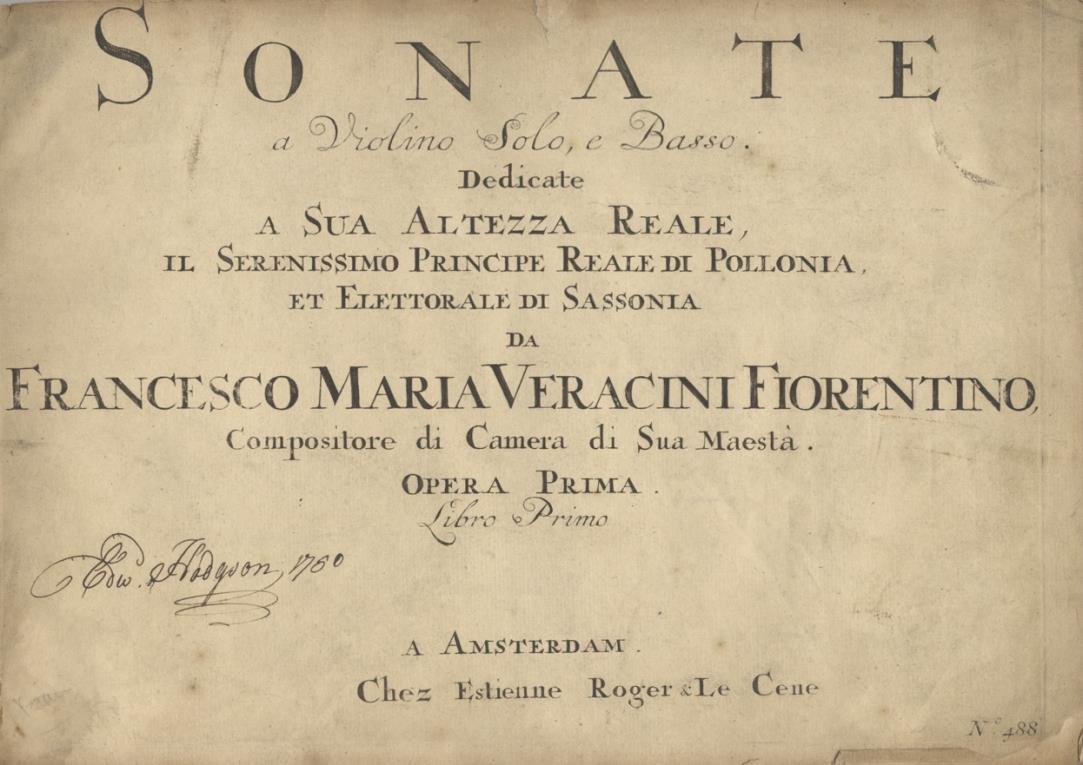
Opus 1 of this “Original and Independent” Composer From the Collection of Arnold Dolmetsch
72. VERACINI, Francesco Maria 1690-1768
Sonate a Violino Solo, e Basso. Dedicate a Sua Altezza Reale, Il Serenissimo Principe Reale di Pollonia, et Elettorale di Sassonia da Francesco Maria Veracini Fiorentino Compositore di Camera di Sua Maestà Opera Primo Libro Primo [-Secondo]. [Op. 1]. [Score]. Amsterdam: Chez Estienne Roger & Le Cene [PNs 488-489], [ca. 1725].
Oblong folio. Contemporary plain dark brown wrappers. 1f. (recto title "... Libro Primo," verso blank), [i] (blank), 2-29, [i] (secondary title: "... Libro Secondo"), 31-37, [i] (blank), 39-53, [i] (blank), 55-61, [i] (blank), 63-69, [i] (blank), 71-[81], [i] (blank) pp. Engraved throughout. Scored for violin and figured basso continuo. With Edw. Hodgson 1750" in contemporary manuscript to foot of titles; contemporary markings including the letter H and a drawing of a horse to final blank page. Occasional later performance markings in lead and blue pencil. Wrappers worn and creased, with small tears and chips to edges; spine partially reinforced with light brown paper. Some internal wear, browning, and soiling;title partially detached and slightly soiled and browned with small chips, verso of inner margin with remnants of early adhesive; upper margin slightly trimmed with occasional loss of page numbers; two small holes to upper margin of final leaf, affecting one notehead; paper repair to upper outer corner of final blank leaf.
Provenance
Arnold Dolmetsch (1858-1940), musician and pioneer in the Early Music revival, with handstamp "Dolmetsch Library" and "IIC22" to blank verso of title and foot of secondary title.
Second edition, second issue. Hill: The Life and Works of Francesco Maria Veracini, p. 85. Lesure p. 623. BUC p. 1038. RISM V1207.
Florentine violinist and composer Veracini made his mark as a highly individual, independent virtuoso in some of the most distinguished musical centers of Europe, including Dresden and London. His output included instrumental, operatic, and theoretical works. While eighteenth-century England is known for its fondness for Italian music and musicians, cross-cultural influence also flowed in the other direction: Veracini composed Italianate versions of English folk tunes, and wrote music for an Italian adaptation of Shakespeare's 'As You Like It.' The present 1721 collection of violin sonatas showcases Veracini's diversity of expression: French overture style, Italian tarantella rhythms, and English jigs meet, sometimes within the same piece, or even within the same movement. As a harmonist, Veracini is free and experimental: one Giga, for instance, in E minor modulates to the distant key of F minor, all within the first section of binary dance form.
"Burney remarked that ‘by travelling all over Europe [Veracini] formed a style of playing peculiar to himself’. The same might be said of his style of composing. His later concertos, when compared to his first (1712), clearly reveal the influence of Vivaldi’s concertos op. 3 (1711) which he certainly heard during his years in Venice. His sonatas of 1716 are somewhat like Corelli’s, but use no fugues or imitation, frequently employ repetition in place of sequence, display symmetrical phrasing and show a strong preference for tonic recapitulations. In a word, they seem as modern as those of Tartini and Locatelli published in the 1730s. But the op. 1 sonatas of 1721 are more contrapuntal, perhaps owing to the influence of the German composers at Dresden, from whom he certainly got the idea of beginning a suite of dances with a French overture (unheard of in Italian solo sonatas). ... [Veracini] was original and independent." JohnWalter Hillin Grove Music Online (41111) $2,200
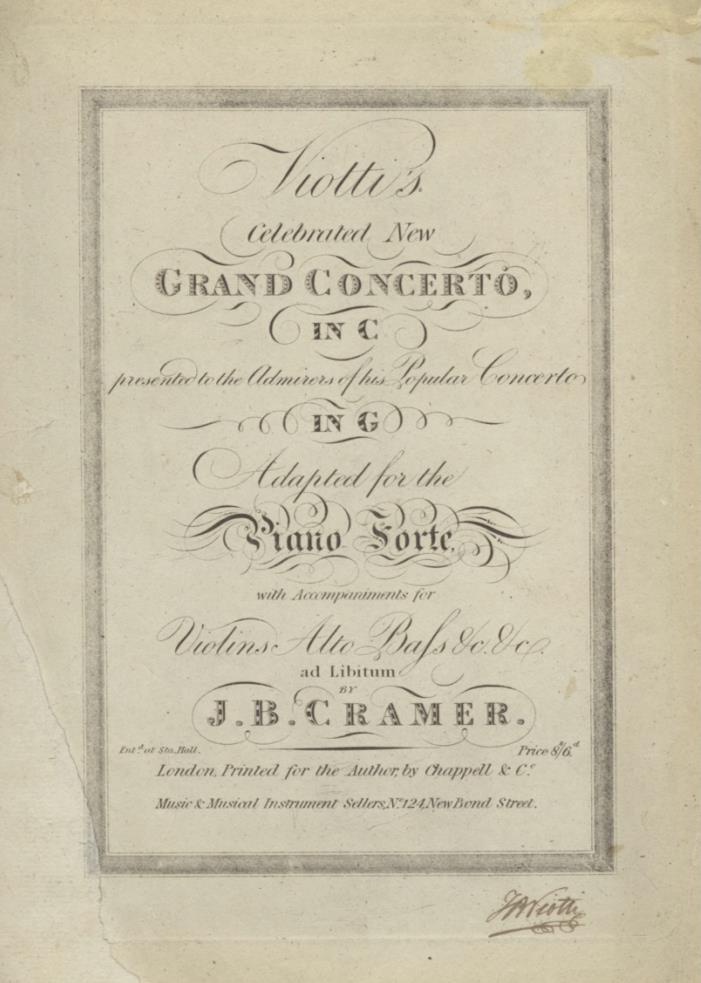
First Edition
With Viotti’s Autograph Signature
73. VIOTTI, Giovanni Battista 1755-1824
Viotti's Celebrated New Grand Concerto, In C presented to the Admirers of his Popular Concerto in G Adapted for the Piano Forte with Accompaniments for Violins, Alto, Bassm &c. &c. ad Libitum by J. B. Cramer. ... Price 8s/6d. [Solo piano part]. London: Printed for the Author, by Chappell & Co., Music &Musical InstrumentSellers, No. 124, New Bond Street [PN186], [ca. 1813].
Folio. Modern marbled wrappers. 1f. (recto title, verso blank), [i] (blank), 2-25, [i](blank) pp. Engraved throughout. Watermark dated 1812. Some minor staining to upper outer corner of first leaves; title slightly worn and browned, a bit heavier at upper outer corner, with loss to lower mostly blank inner portion repaired.
With Viotti's autograph control signature to foot of title, "JB Viotti."
First Edition. White Ia:13. OCLC 1061990886 (one copy only, at the British Library. JISC (two copies, attheUniversity of Glasgow and the University of St Andrews).
A highly distinguished Italian violinist and composer, Viotti is regarded as "the most influential violinist between Tartini and Paganini and the last great representative of the Italian tradition stemming from Corelli. He is considered the founder of the ‘modern’ (19th-century) French school of violin playing, and his compositions, among the finest examples of Classical violin music, exerted a strong influence on 19th-century violin style." Chappell White in Grove Music Online. (41032) $250
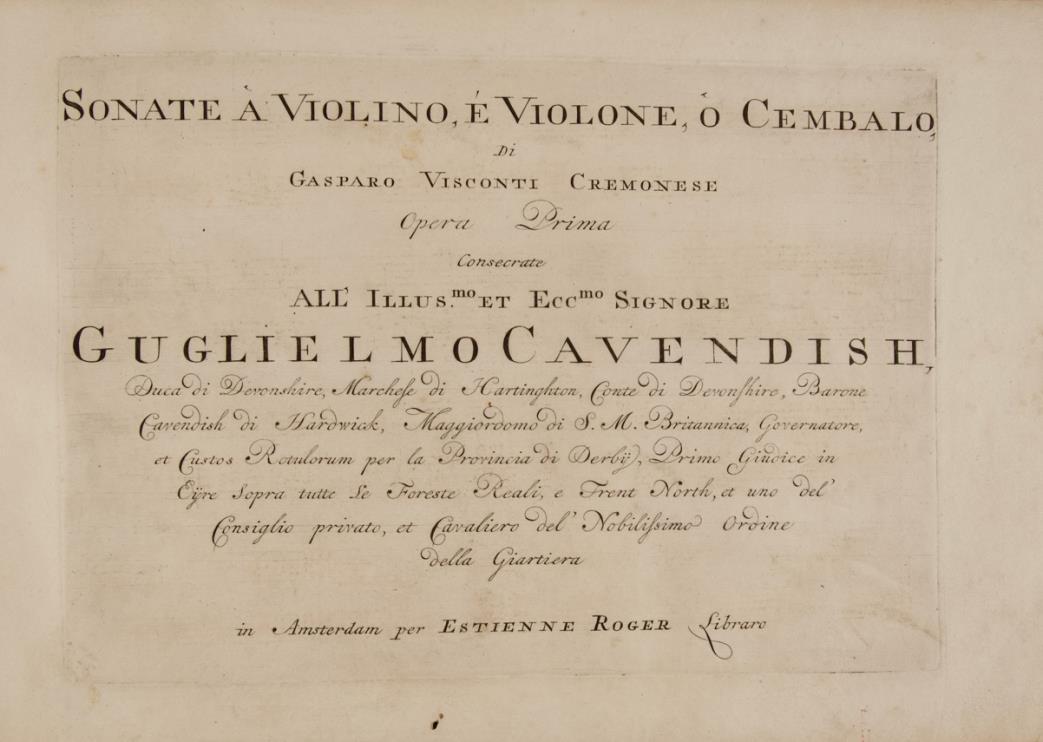
Rare First Edition of Visconti’s Opus 1 Elegantly Printed
74. VISCONTI, Gasparo 1683-ca. 1713
Sonate à Violino, é Violone, o Cembalo di Gasparo Visconti Cremonese. Opera Prima. Consecrate All' Illusmo. et Eccmo Signore Guglielmo Cavendish, Duca di Devonshire, Marchese di Hartinghton, Conte di Devonshire, Barone Cavendish di Hardwick, Maggiordomo di S. M. Britannica, Governatore, et Custos Rotulorum per la Provincia di Derby, Primo Giudice in Eÿre Sopra tutte Le Foreste Reali, e Trent North, et uno del Consiglio privato, et Cavaliero del' Nobilissimo Ordine della Giartiera. [Op. 1]. [Score]. Amsterdam: Estienne Roger Libraro, [1703].
Oblong folio. Quartermodernmid-tanmottledcalf with marbled boards, titlingto spine gilt. 1f. (rectotitle, verso blank), 1f. (recto dedication, verso blank), 3-31, [i] (blank) pp. Engraved throughout. Very slightly worn; occasional minor stains to blank margins; small wormhole to blank lower margin; binder's stubs between pp. 10 and 11.
First Edition. Rare. Published in the same year as Walsh's London edition. Lesure: Estienne Roger et MichelCharles Le Cène, p. 834. BUC p. 1046. RISM V2113 (no copies in the U.S.)
"The English edition of his op. 1 identifies Visconti with the diminutive by which he was best known to the London public: Gasperini’s Solos … Composed by Seignr. Gasparo Visconti. The usual spelling of this name, ‘Gasparini’, often engenders confusion with Francesco Gasparini, a vocal composer of an earlier generation. ... Born into a noble family, Visconti apparently plied the trade of a musician for his own pleasure and during a relatively short period in his youth. For these reasons, notices about him are rare. We have Visconti’s word that he was ‘five years Corelli’s scholar’ before 1702. From then until 1705 Visconti was a frequent soloist at theatres and public halls in London, performing at court at least once with the flautist James Paisible. His sonatas for violin and flute enjoyed considerable vogue in England at that time. Visconti married Cristina Steffkin in 1704; their daughter was born in Cremona in 1713. About that year, Tartini made a pilgrimage to meet and hear Visconti in his native city. His judgment later was that Visconti possessed a unique, God-given style of playing which was born and died with him. ...
Visconti’s sonatas of 1703 are, in large measure, successors to Corelli’s op. 5, but the pupil departs from his master’s style in several important respects. Among them are the more frequent use of tonic recapitulation in the binary movements, the definition of distinct areas of motivic development, and written-out ornamentation, especially in slow movements. Since these traits are found in Tartini’s sonatas of the 1730s and 40s, we might be justified in considering Visconti a progressive innovator in spite of his use of imitation and inverted counterpoint. Visconti’s concertos are generally in the style of Vivaldi’s but make more use of repetition of small phrase units in the themes and motivic connections between tutti and solo passages." John Walter Hill in Grove Music Online
A fine example of the elegant style of music engraving practiced by Estienne Roger. (41049) $2,200
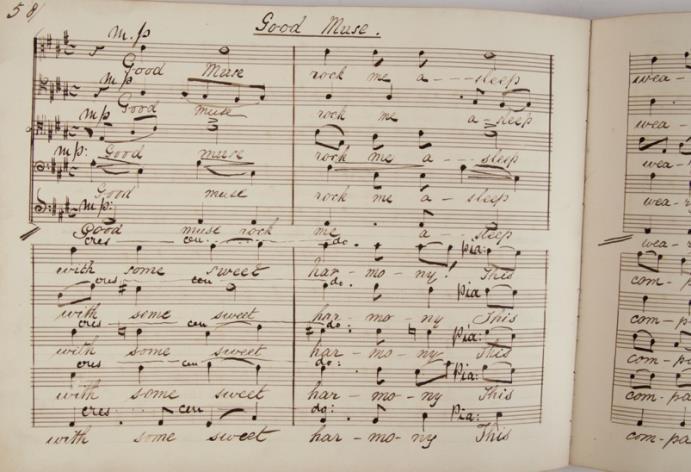
19th Century Vocal Manuscript
75. [VOCAL MUSIC - 19th Century - English - Manuscript]
Collection of multi-voice lyrical vocal compositions. [Copyist manuscript]. [?]Manchester, [ca. 1854-1855].
Oblong quarto. Full dark brown suede with decorative blindstamping to edges. Disbound. Notated in black ink on 10-stave rastrum-ruled paper in at least two different hands. 24, [i] (blank), 26-[97], [i] (blank) pp. + 45 blank leaves. Music unattributed; one poem ascribed to Charles Swain (1801-1874), a member of the Sun Inn Group (or Manchester Poets) literary circle. Occasional corrections, cancels, etc. One or more of the settings may be original. Binding worn, rubbed, and bumped, label to upper board removed; boards detached; spine lacking; endpapers detached. Minor wear, browning, and soiling; small losses to edges of first five leaves; first two signatures detached.
Contents:
- P. 1: Downward amid the deepest dells. Poem.
- Pp. 2-24: Downward amid the deepest dells. Scored for four voices (alto, two tenors, bass). With pencil sketch of approximately two measures following conclusion.
- Pp. 26-43: Good muse rock me asleep. Scored for five voices (alto, two tenors, two basses).
- Pp. 44-54: The Sun of Life ... words by Charles Swain of Manchester. Scored for four voices (alto, two tenors, bass).
- "Pp. [55]-57. The last rose of Winter ... Words Anonymous. Scored for four voices (soprano, alto, tenor, bass).
Dated Novr. 21, 1851 at conclusion.
- Pp. 58-75: Good muse. Dated "[?]12/51" with initials (indecipherable) following final measure.
- Pp. 76-89: Better Music ne'er was known. A setting of a poem by Beaumont and Fletcher. Scored for four voices (two trebles, tenor, bass).
- Pp. [90]-[97]: The merry Heart. Scored for four voices (alto, two tenors, bass).
Attractive 19th century vocal compositions, worthy of further research. (41299)
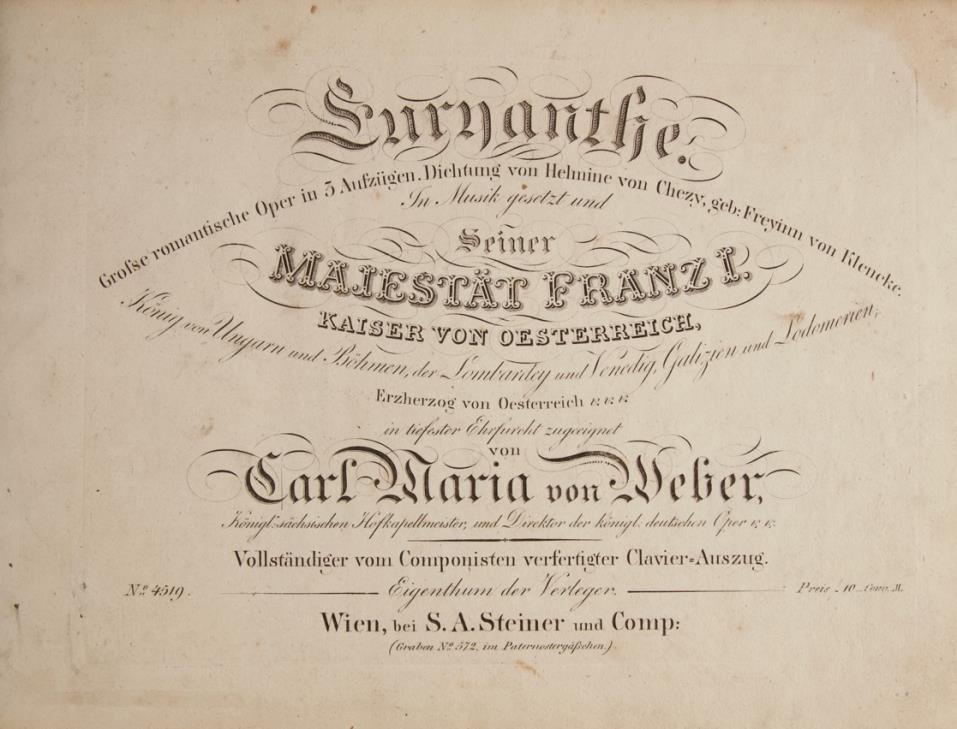
“The Leading Exponent of German Opera in the 1820s”
76. WEBER, Carl Maria von 1786-1826
$250
Euryanthe. Grosse romantische Oper in 3 Aufzügen. Dichtung von Helmine von Chezy, geb: Freyinn von Klencke. In Musik gesetzt und Seiner Majestät Franz I. Kaiser von Oesterreic,h König von Ungarn und Böhmen, der Lombardey und Venedig, Galizien und Lodomerien; Erzherzog von Oesterreich .&. &. &. in tiefster Ehrfurcht zugeeignet von Carl Maria von Weber, Königl. sächsischen Hofkapellmeister und Direktor der Königl. deutschen Oper &. &. Vollständiger vom Componisten verfertigter Clavier-Auszug. ... Eigenthum der Verleger. ... Preis f 10_ Conv. M. [Piano-vocal score]. Wien: bei S. A. Steiner und Comp: (Graben Nro. 272 im Paternostergässchen) [PNs S: u: C: 4519-4545], [1824].
Oblong folio. Contemporary half dark brown calf with dark brown speckled paper boards, red edges. Original mid-blue publishers printed wrappers bound in with decorative border to upper and publisher's catalogue listing arrangements of selections from the opera to lower. 1f. (recto title, verso blank), [i] (cast list and table of contents), 4-223, [i] (blank) pp. Binding worn, rubbed, and bumped. Slightly worn; occasional soiling, foxing, and minor stains; small tear to blank lower margin of pp. 111/112 repaired with archival tape.
First Edition. Jähns 291. CPM Vol. 60, p. 15. Hirsch IV, 1290. Hoboien 15, 361.
Euryanthe was first performed in Vienna at the Theatre am Kärntnertor on 25 October 1823.
"For all the weaknesses in the libretto ... Euryanthe is a mature and advanced musical drama, one which was deeply admired by later Romantic composers including Schumann, Liszt and Wagner." TNG Vol. 20, p. 255.
Weber was a German composer, conductor, pianist, and critic. "A prototypical 19th-century musician-critic, he sought through his works, words, and efforts as performer and conductor to promote art and shape emerging middle-class audiences to its appreciation. His contributions to song, choral music, and piano music were highly esteemed by his contemporaries, his opera overtures influenced the development of the concert overture and symphonic poem, and his explorations of novel timbres and orchestrations enriched the palette of musical sonorities. With the overwhelming success of his opera Der Freischütz in 1821 he became the leading exponent of German opera in the 1820s and an international celebrity. A seminal figure of the 19th century, he influenced composers as diverse as Marschner, Mendelssohn, Wagner, Meyerbeer, Berlioz, and Liszt. ...
... Like its predecessor [Der Freischütz], Euryanthe involves distinct dramatic spheres with contrasting musical colours. The overarching world of medieval chivalry is suggested by a level of seriousness, artifice, elegance, and brilliance not found in Der Freischütz. Against this chivalric background the dramatic and musical opposition of good and evil is once again crucial to the dramaturgy, the former represented by the troubadourknight Adolar and his beloved, Euryanthe, and the latter by Lysiart and his accomplice Eglantine. Another dramatic plane is inhabited by the ghost of Adolar’s sister Emma, the principal element added by Chézy and Weber to the original plot. Slow, chromatic, and seemingly aimless music for divisi muted violins and violas characterizes the ethereal but restless existence of a spirit condemned to eternal wandering; with Emma’s redemption at the end of the opera, however, this music is transformed into a diatonic form.
While Euryanthe’s dependence on Der Freischütz is evident in a number of ways, there are also features in the later opera that go beyond its predecessor. Weber himself noted in his correspondence with Brühl the more active role for the chorus in Euryanthe. The larger-than-life passions elicit a higher degree of chromaticism throughout the opera than in the earlier work. Because of its through-composed status as a ‘grand opera’, the tonal organization and instrumentation of Euryanthe were planned with greater ingenuity than ever, and groups of pieces often form extended scene complexes with a clear sense of dramatic and musical progression towards a local climactic goal (e.g. nos.1–4, 12–13, 17–20). And where dialogue separates the formal pieces, Weber composed a flexible, expressive type of accompanied recitative that has little in common melodically or harmonically with conventional approaches to recitative (A.A. Abert, P(v)1967)." Michael C. Tusa in Grove Music Online (41137) $385
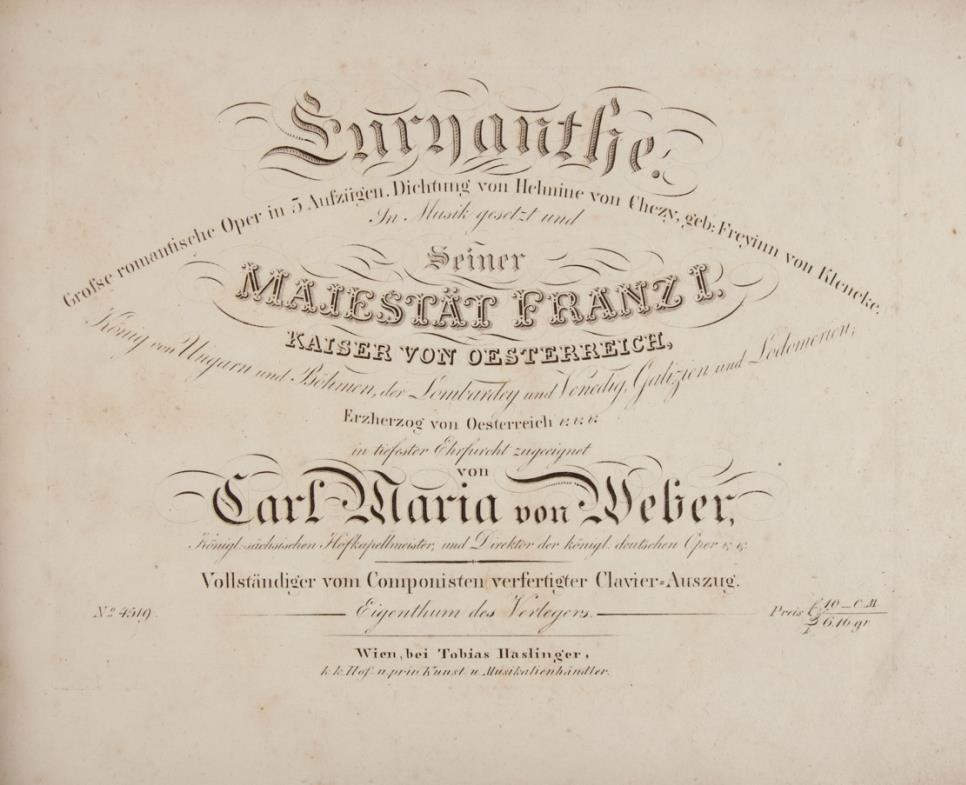
77 WEBER, Carl Maria von 1786-1826 Euryanthe. Grosse romantische Oper in 3 Aufzügen. Dichtung von Helmine von Chezy, geb: Freyinn von Klencke. In Musik gesetzt und Seiner Majestät Franz I. Kaiser von Oesterreich, König von Ungarn und Böhmen, der Lombardey und Venedig, Galizien und Lodomerien; Erzherzog von Oesterreich &c &c &c in tiefster Ehrfurcht zugeeignet ... Vollständiger vom Componisten verfertigter Clavier=Auszug. ... Preis f 10_CM ... 6.16 gr. [Piano-vocal score]. Wien: bei Tobias Haslinger k.k. Hoh u. priv. Kunst u. Musikalienhändler [PNs S: u: C: 4519-4545], [after 1825].
Oblong folio. Contemporary half dark mahogany leather with marbled boards, leather title label gilt to upper. 1f. (recto title, verso blank), [i] (cast list and table of contents), 4-223, [i] (blank) pp. Engraved throughout. Nineteenth century ownership inscription to upper corner of front free endpaper "W. C. Mathison Trinity College." Binding somewhat worn, rubbed, and bumped with minor loss; upper board detached. Slightly worn; occasional minor soiling and foxing.
Second edition, printed from plates of the first. Jähns 291. OCLC 68116275.
Rev. William Collings Mathison (active 1847-1864) was a fellow and tutor at Trinity College, Cambridge. (41136) $250
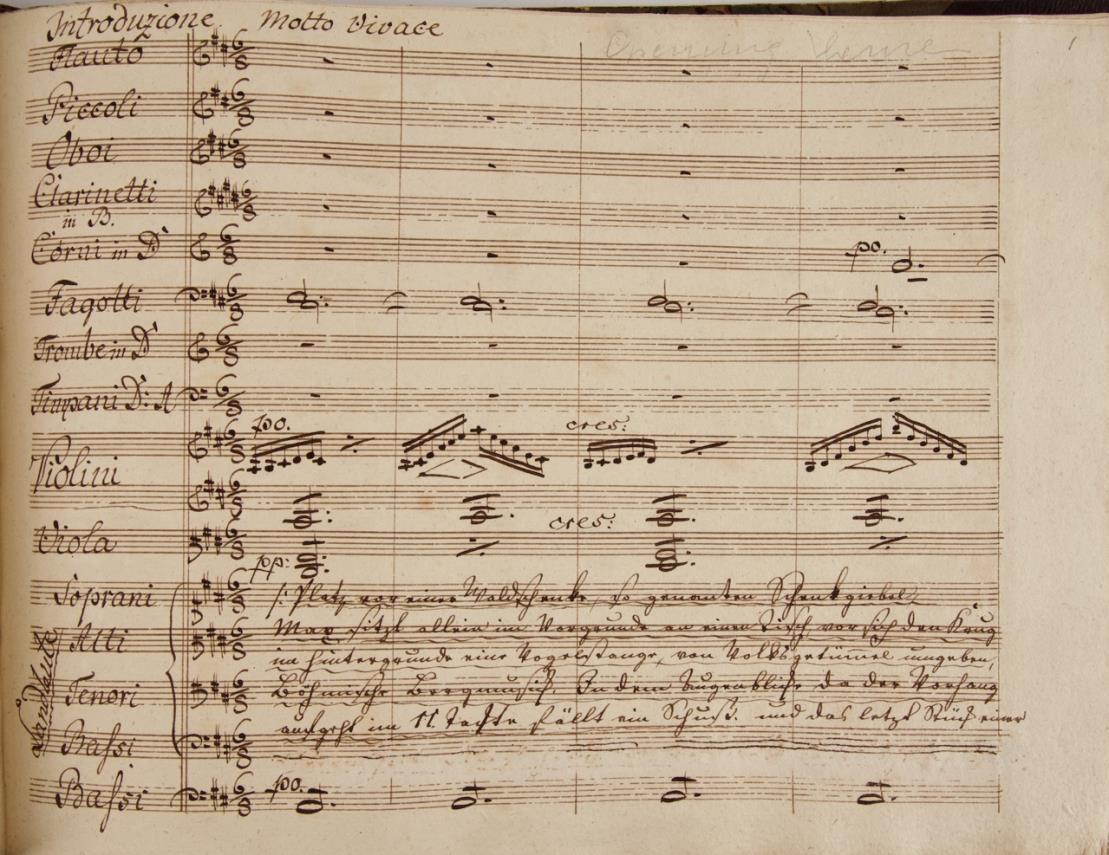
Manuscript Full Scores, Pre-Dating the First Editions
78. WEBER, Carl Maria von 1786-1826
Der Freÿschütze Romantische Oper in Dreÿ Acten gedicht, von Fr: Kind. [Op. 77]. [Copyist manuscript full score]. Germany, [ca. 1821].
3 volumes. Oblong folio. Half dark brown morocco with marbled boards, spine in gilt-ruled compartments with titling gilt. Notated in two or more hands in brown ink on up to 16 staves per page. Text in German. Watermark "Dresden." The complete work. Bindings worn, rubbed, and bumped. Slightly worn; minor to moderate foxing; some leaves trimmed, occasionally affecting pagination.
Act I: [i] (title), 166, [i] (blank) pp.
Act II: [i] (title "Der Freÿschütze Zweiter Aufzug"), 174, [i] (blank) pp.
Act III: [i] (title "Der Freÿschütz Dritter Act"), 181, [i] (blank) pp.
With additional parts for trumpet andtimpani for No. 16. Occasional cancellations anderasures; someadditional manuscript markings in blue pencil; "Dresden 1821" in pencil to title.
Together with:
Oberon Romantische Oper in Drëy Acten Nach dem Englischen des J Planchè von Theodor Hell. [Copyist manuscript full score, Act I only]. Notated on 14-stave rastrum-ruled paper [i] (title), 46, [i] (blank), 48-206, [i] (blank) pp. Sommispagination. Dated "Dresden August 1825" at upper right corner of title, with drawing of coat of arms incorporating crown, lion, and tower at foot of title.
The present manuscripts pre-date the first editions of the full scores; Der Freischütz was first published in 1843 and Oberon in 1874.
Der Freischǔtz was first performed in Berlin at the Schauspielhaus on 18 June 1821 and seven months later in Dresden on 26 January 1822. Oberon premiered in London at Covent Garden on 12 April 1826. "No other German opera up to that time had been so successful and conquered so many stages in so short a time." Loewenberg col, 674
Weber was a German composer, conductor, pianist, and critic. He was "a prototypical 19th-century musiciancritic, he sought through his works, words, and efforts as performer and conductor to promote art and shape emerging middle-class audiences to its appreciation. His contributions to song, choral music, and piano music were highly esteemed by his contemporaries, his opera overtures influenced the development of the concert overture and symphonic poem, and his explorations of novel timbres and orchestrations enriched the palette of musical sonorities. With the overwhelming success of his opera Der Freischütz in 1821 he became the leading exponent of German opera in the 1820s and an international celebrity. A seminal figure of the 19th century, he influenced composers as diverse as Marschner, Mendelssohn, Wagner, Meyerbeer, Berlioz, and Liszt. ...
The production of Der Freischütz at the newly remodelled Dresden court theatre on January 26, 1822 at last gave the German opera a work that equalled the popularity of even the most frequently performed Rossini operas at the Italian opera. ...
Weber received J.R. Planché’s libretto for Oberon in three mailings between December 30, 1824 and February 1, 1825, by which time he had requested a postponement of the première until spring 1826. An initial reading of the text revealed to him the profound differences between ‘English opera’ and continental opera, which he lucidly analysed in a pair of letters to Planché. ... Although the treatment at Ems produced no physical improvement, [Weber suffered from tuberculosis] Weber returned to Dresden on September 1 in higher spirits than for a long time, and thus he was able to work on Oberon more or less continuously throughout the last part of 1825 and the first months of 1826." Michael C. Tusa in Grove Music Online (41139) $3,500
79 WEBER, Carl Maria von 1786-1826
Der Freischütz Romantische Oper in 3 Aufzugen ... mit leichter Clavier Begleitung eingerichtet von Karl Zulehner ... Pr. 7 fl. [Op. 77]. [Piano-vocal score]. Mainz und Paris: bey B. Schott's Söhnen ... Antwerpen bey A. Schott [PN 1719], [ca. 1825].
Oblong folio. Contemporary half dark brown leather with marbled boards, marbled endpapers. 1f. (recto lithographic title with large oval engraved vignette depicting a scene from the opera, verso blank), 1f. (recto cast list and contents, verso blank). 122 pp. Text in German. Title lithographed, cast list and contents leaf and music engraved. Binding quite worn, rubbed, and bumped; spine lacking. Slightly worn and soiled; remnants of wrappers to blank inner margin of title.
Jähns 277, p. 303. Hoboken 15, 352. Hirsch IV, 1294. OCLC 314445193.
A scarce later printing of the edition first published in 1822 by Schott with altered imprint and a different title illustration. (41135) $250
Zuccari’s Rare Violin Sonatas, Opus 1 From the Collection of Geneviève Thibault, Comtesse de Chambure
80. ZUCCARI, Carlo 1704-1792
Sonate a Violino, e Basso o Cembalo, di Carlo Zuccari di Casal Maggiore Dedicate al Merito Imparegiabile Dell' Illmo. Signor Conte Don Gioseff' Antonio Arconati Visconti Feudatario di Lomazzo, Rovelasca, Guanzate, Cirimedo, Fenegrò, ed Arconate, Confeudatario di Formigara, Cornaleto, e sue Pertinenze; de Sigri. Sessanta Decurioni Dell Eccma. Citta di Milano; Regio Ducal Luogo Tenente Del Vendo. Spedale Maggiore Gentiluomo di Camera di S.M.C.C.: e suo Consigliere nel Supremo Consiglio d'Italia. &.&.&. Parte Prima [-Seconda]. Opera Prima. [Op. 1]. [Score]. [Milano], [ca. 1747].
Oblong folio. Contemporary full dark brown mottled calf with "Sonate" gilt within decorative rectangular gilt border and decorative gilt rules to edges to both boards, spine in decorative compartments gilt with black leather title label gilt, marbled endpapers. 1f. (recto title within elaborate engraved border, verso blank), 1f. (recto dedication, verso blank), i-v, [i] (blank), vi-x, [i](blank), xi-xv [i] (blank), xvi-xx, [i](blank), xxi-xxv [i] (blank), xxvi-xxxii, [i] (elaborate engraved title to "Parte Seconda" with floral motifs, fruit, and seashells), 30 pp. Engraved throughout. The fine engraved title to the first part incorporates floral motifs, musical instruments, sculptural bust, palette, paintbrushes, and an open book of music, with coat of arms at head. With "Io. M. Ripa sculp. Mediolano" printed to foot of first page of music. Binding slightly worn, rubbed, bumped, and warped; free rear endpaper lacking. Minor internal wear. A strong impression, in exceptionally good condition overall.
Provenance
The Earl of Abingdon, with annotation in pencil to recto of front free endpaper, in all likelihood Willoughby Bertie, 4th Earl of Abingdon, Lord Norreys (1740-1799), English peer, music patron, and composer; Norreys was an associate of J.C. Bach and Carl Friedrich Abel, and a patron of Haydn; later noted musicologist and collector Geneviève Thibault Comtesse de Chambure (1902-1975), with her bookplate to front pastedown; "A.n" in contemporary manuscript to verso of front free endpaper.
First Edition. Rare. BUC p. 1103. RISM Z351 (two copies only in the U.S., at the Newberry Library, and the Library of Congress; the present copy, the only one recorded in France, was subsequently sold at a Paris auction of the collection of the Comtesse de Chambure).
Zuccari, an Italian violinist and composer "studied the violin first in his home town, later in Parma, Guastalla and Bologna, and finally in Cremona with Gasparo Visconti. Giuseppe Gonelli taught him counterpoint. In 1723
Zuccari arrived at Vienna in the suite of Count Pertusati. Having won favour at the imperial court, he travelled on to Olomouc, where he stayed for four years, and visited various German towns. In 1733 he married and in 1736 settled in Milan, where he founded a school. In 1741 he participated in the famous academy held at the Collegio dei Nobili under the direction of G.B. Sammartini, who was to call on his services as a violinist on several future occasions. During this period he acquired the nickname Zuccherino quoted in some contemporary sources. Around 1760 he was living in London, where he became a member of the Italian opera orchestra and had some violin compositions published, including his celebrated set of 12 adagios in dual plain and ornamented versions (The True Method of Playing an Adagio). He had returned to Italy by 1765, when he led an orchestra under Sammartini in an academy held at Cremona to mark the passage of the Archduke Leopold. Burney reports having heard him in Milan in 1770, noting that Zuccari was considered ‘a good musician’. In 1778 he retired to Casalmaggiore." Michael Talbot in Grove Music Online
"One may point to his regular adoption of a three-movement cycle ..., the complexity of melodic elaboration and the exclusion of the bass from the thematic discourse; but despite there 'modern' features his basic harmonic and contrapuntal language departs little from that of Corelli's disciples. In fact, the easy mastery of conventional forms processed by his contemporaries is supplemented by a similar mastery of contrapuntal procedures associated with earlier generations. A movement such as the fugue in the second solo sonata, where two (occasionally even three) instruments are simulated by means of multiple stopping on the single violin, is a remarkable demonstration of the improvements which a more methodical approach could bring to a wellestablished species of composition cultivated in Italy from Corelli's time." Michael Talbot in The New Grove 2 Vol. 27, p. 874.
A highly attractive copy of a very rare publication, elegantly engraved (41055) $3,500
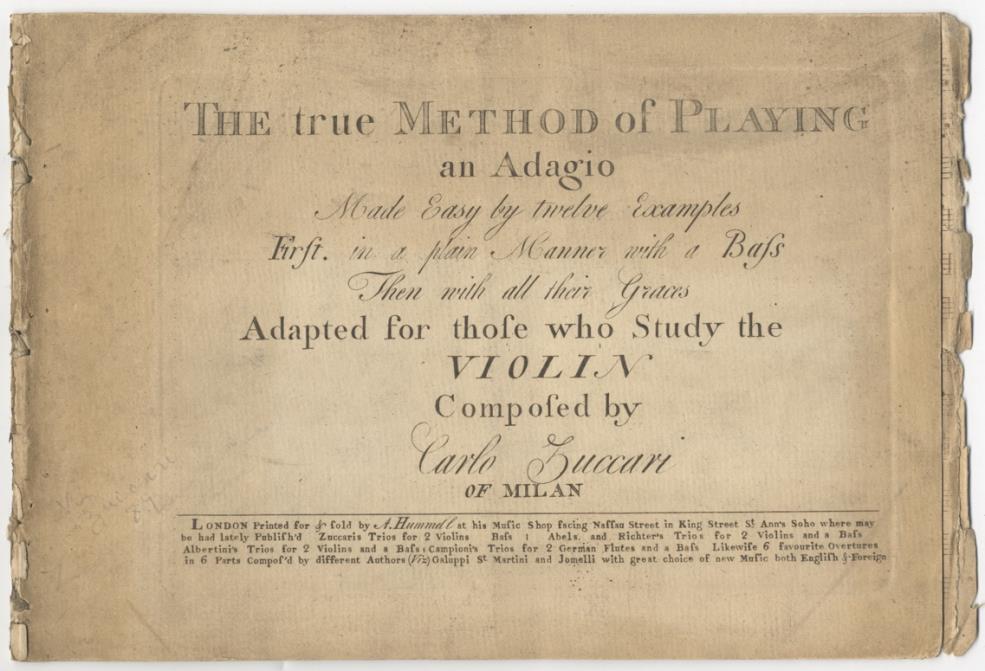
81 ZUCCARI, Carlo 1704-1792
The true Method of Playing an Adagio Made Easy by twelve Examples First. in a plain Manner with a Bass Then with all their Graces Adapted for those who Study the Violin Composed by Carlo Zuccari of Milan [Score]. London: Printed for& sold by A. Hummell at his Music Shop facing Nassau Steet in King Street St. Ann's Soho, [ca. 1760].
Oblong folio. Disbound. 1f. (recto title, verso blank), 12 pp. Engraved throughout. With brief publisher's catalogue to foot of title including works by Zuccari, Abel, Richter, Albertini, Campioni, Galuppi, St. Martini, and Jomelli, "with great choice of new Music both English & Foreign." Scored for violin and unfigured basso continuo. Each Adagio is laid out on three staves, the lowermost being the bass line, the middle the simple melody, and the uppermost the melody with ornamentation. Slightly worn, browned, foxed, and soiled; small binder's holes to inner margins; outer margins of two leaves frayed, just touching notation.
First Edition. BUC p. 1103. RISM Z355 (one copy in the U.S. only, at the Library of Congress).
Zuccari's ornaments include slurred rapid scales and turns, trills, triplets, appogiaturas, and arpeggios. His compositions bear the influence Corelli; indeed Zuccari's artistic lineage traces directly back to that composer, the teacher of his own teacher, Gasparo Visconti (1683-ca. 1713). Adagios II, IV, and VII-XII include Zuccari's examples of unmeasured cadenzas at their conclusions. (41050) $750