J & J LUBRANO MUSIC ANTIQUARIANS
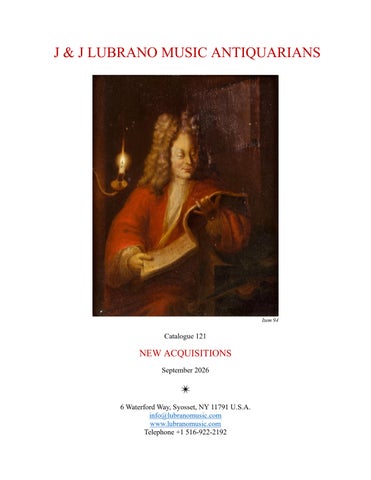
Item 94
Catalogue 121
NEW ACQUISITIONS September 2026
✴︎ 6 Waterford Way, Syosset, NY 11791 U.S.A. info@lubranomusic.com www.lubranomusic.com Telephone +1 516-922-2192
CONDITIONS OF SALE All items are in good antiquarian condition unless otherwise noted and are offered subject to prior sale, with prices net and subject to change without notice. The costs of shipping and insurance are additional Orders are customarily shipped via USPS Priority Mail or Federal Express. Sales tax will be added to the invoices of New York State residents. Orders may be placed by e-mail (info@lubranomusic.com), telephone (516-922-2192), or on our secure website (www.lubranomusic.com) by entering the ID number of the desired item in the SEARCH box at the upper right of our homepage. We ask that you kindly wait to receive our invoice to ensure availability before remitting payment. Libraries may receive deferred billing upon request. We accept payment by: - ACH (Automated Clearing House), inclusive of all bank charges - EFT (Electronic Funds Transfer), inclusive of all bank charges - PayPal to info@lubranomusic.com - Checks in U.S. dollars drawn on a U.S. bank - International money order - Credit card We fully guarantee that all items offered for sale by J & J Lubrano Music Antiquarians LLC are authentic without time limitation to the original purchaser provided that said items conform exactly to our description as supplied at time of purchase. All items remain the property of J & J Lubrano Music Antiquarians LLC until paid for in full.
❖
Please visit our website at
www.lubranomusic.com where you will find full descriptions and illustrations of our catalogued inventory ❖
Members Antiquarian Booksellers’ Association of America International League of Antiquarian Booksellers Professional Autograph Dealers’ Association Music Library Association American Musicological Society Dance Studies Association &c.
Cataloguers John Lubrano, Jude Lubrano, Ben Katz
© J & J Lubrano Music Antiquarians LLC September 2026
2
20th-21st Century American Choral Music Archive of Autograph Letters 1. [AMERICAN MUSIC - Contemporary - Autograph Letters, &c.] Collection of approximately 100 autograph and typed letters signed from American composers to Harold Rosenbaum, distinguished artistic director and conductor of the New York Virtuoso Singers and the Canticum Novum Singers, including an original sketch in the hand of Thea Musgrave from her Voices of Power & Protest. The letters date from the 1980s-2024, with the majority dating from the 1980s-1990s, most discussing works performed by one of Rosenbaum's choral groups. Correspondents include the following (one item except where noted): Mark Adamo (2); David Amram; Milton Babbitt (2 + 2 in photocopy); Nadia Boulanger (secretarial); John Castellini (2); Aaron Copland; John Corigliano; Michael Dellaira; Jacob Druckman; Tan Dun (1 + 1 in photocopy); Lukas Foss (7 + 1 in photocopy); Morton Gould (daughter); John Harbison (6); Leonid Hrabovsky; Karel Husa; Andrew Imbrie (photocopy); Tristan Keuris; David Lang; Morten Lauridsen (e-mail); Otto Leuning (1 + 1 in photocopy), Charles Mackerras (photocopy); Ursula Mamlok; Bill Mayer; Paul Moravec; Thea Musgrave (7 + an autograph manuscript sketch, worn and creased); George Perle; David Randolph; Bernard Rands; Bernt Rathaus; Ned Rorem (12 + 1 in photocopy); John Sanders; Peter Schickele (5); Gunther Schuller; William Schuman (3 + 2 in photocopy); Gerard Schwarz; Claudio Spies; Robert Starer; Ward Swingle; Augusta
3
Read Thomas; George Tsontsakis (1 + 1 in photocopy); Ilana Vered (2); Richard Westenburg (2); Julia Wolfe; Yehudi Wyner (25 + 6 in photocopy); and Charles Wuorinin (1 page autograph music manuscript in photocopy). With additional letters from: Raymond Erickson, Dean of the Division of the Arts and the Humanities at Queens College; Byron S. Hollinshead, President, Oxford University Press; James Keller; Gladys Krenek, wife of noted composer Ernst Krenek; Edna Landau, Young Concert Artists; Vicki Margulies, Director, Merkin Concert Hall; Mario Mazza, Director of Programming and Operations, WNCN radio station; Saul Novack, Professor of Music, Queens College; Joseph Polisi, President, The Juilliard School; George Rothman, Music Director, Riverside Symphony; Bob Sherman, WQXR radio station; and Judy Zaimont, Chair, Music Department, Adelphi University. Of special significance is the inclusion of a large manuscript leaf (354 x 431 mm) in the hand of distinguished Scottish-born American composer Thea Musgrave (b. 1928) from her work exploring the human toll of war, Voices of Power and Protest, a 20-minute concert piece for unaccompanied SATB choir, with diagrams rendered in color depicting staged formations. The leaf is titled at upper left corner "Voices of Power & Protest original sketches c 1977" and inscribed at upper right corner: "for Harold - a million thanks for your wonderful chorus, your superb musicianship & organization, Thea, March 2007". Ms. Musgrave is approaching her 100th birthday in 2028. Rosenbaum (b. 1950) has collaborated extensively with many ensembles including the New York Philharmonic, Juilliard Orchestra, American Symphony Orchestra, Bang on a Can, Mark Morris Dance Group, Orchestra of Saint Luke's, Glyndebourne Festival Opera, Riverside Symphony, and the Brooklyn Philharmonic. His New York Virtuoso Singers appear on 48 albums on labels including Naxos Records and Sony Classical. Rosenbaum's reputation and skill of the group have led to numerous tours and the choral premieres of over 500 new works by notable contemporary composers including Louis Andriessen, George Benjamin, Luciano Berio, John Harbison, Jonathan Harvey, Hans Werner Henze, Andrew Imbrie, Ernst Krenek, Thea Musgrave, Arvo Pärt, George Perle, Shulamit Ran, Ned Rorem, Peter Schickele, and Alfred Schnittke. His numerous awards include the Columbia University Ditson Conductor's Award (2014), the ASCAP/Chorus America Adventuresome Programming Award (2014), the ASCAP Victor Herbert Award (2010), and the American Composers Alliance Laurel Leaf Award (2008). The present collection offers a highly interesting window into the composition and performance of new choral works by American composers of the late 20th-early 21st centuries. (41576) $5,500
Elegant Trio Sonata 2. [ANON. - 18th Century - Italian - Chamber Music - Manuscript] Sonata Quinta da Camera. [Set of parts]. [Copyist musical manuscript]. Italy, ca. 1740. Oblong folio (222 x 305 mm). Notated in black ink on 10-stave rastrum-ruled paper. Watermark with initials "G.M." within a circle below a trefoil. Violino primo: 1f.; Violino secondo: 1f.; Unfigured basso continuo: [i] (title), 2, [i] (blank) pp. Violino primo part slightly soiled at edges; small tears to blank margins. Violino secondo part with small tear and minor stains to blank margins. Basso continuo part slightly soiled and stained, with small tears to margins of title; title and second page of music reinforced at inner margins with early narrow strip of paper. This elegant and lighthearted trio sonata in B-flat major is cast in three movements: Allegro Assai [C], Andante [C], and Presto [3/8], each in binary form, with repeats. The opening Allegro Assai incorporates leaping octaves, occasional swerves into G-minor terrain, and climactic rising scales at its conclusion. The Andante makes use gentle syncopations and slides of a third. The opening two movements start with the Romanesca progression, a favorite opening gambit of 18th century composers, conveying freshness and an amorous mood. The final Presto
4
is a compact and attractive minuet. Most often, the violins harmonize with each other and the bass, making frequent use of parallel thirds and sixths; in several spots, however, they double each other. This may indicate that this work was originally conceived for a larger ensemble, with string sections, as it is not particularly common to encounter such doubling in chamber music. This sonata may have originally been an orchestral overture to a theatrical work. Not located in the RISM manuscripts database. (40863) $400
Charming Duos 3. [ANON. - 18th Century - Italian Chamber Music - Musical Manuscript] Three duos for two violins. [Parts]. [Copyist musical manuscript]. Italy, ca. 1780. Oblong folio (240 x 304 mm). Notated in black ink on 10-stave rastrum-ruled paper. Watermark of a bunch of grapes. Violino primo: [i] (blank), 2, [i] (blank) pp.; Violino secondo: [i] (blank), 2, [i] (blank) pp. With three measures cancelled. Slightly worn; some small losses, tears, and soiling to edges and blank margins; a few minor stains; occasional showthrough. Not located in the RISM manuscripts database. The composition is in four numbered parts. The first, in 2/4, presents a theme; the second is a variation on that theme; the third is in 6/8, in the style of an English jig, with some scalar ornamentation and two tiratas; the fourth and fifth parts return to 2/4 and are further variations on the original theme, this time with sixteenth-note variations incorporating trills, scales, leaps, and bariolage.
5
A charming and vigorous late-18th century variation set and Giga for two violins, cleverly composed to exploit the varied registers, timbres, and figurations possible with the given instrumentation. (40865) $600
Early 19th Century Solfege Manuscript 4. APRILE, Giuseppe 1732-1813 Solfeggi a voce Sola di Soprano. [Copyist musical manuscript]. Italy, ca. 1805. Oblong quarto (224 x 293 mm). Notated in black ink on 10-stave rastrum-ruled paper. [i] (title), 10, [i] (blank) pp. Some minor soiling to lower outer corners; stains to blank outer margin of final two leaves. Contains four solfeggi for soprano voice and unfigured basso continuo, in E minor, A major, E major, and E flat major. These solfeggi all appear in Aprile's The Modern Italian Method of Singing (London, 1795), in different keys, the first in A minor, the second in D major, the third in A major, and the fourth in A flat major. Aprile was an Italian soprano castrato and composer. "In 1770 Burney heard him in Naples; Mozart heard him there, in Bologna and Milan, remarking that ‘Aprile, first man, sings well and has a beautiful, even voice’, which was ‘unsurpassed’. In Naples Aprile again collaborated with Jommelli on several operas and in 1783 replaced Caffarelli as first soprano in the royal chapel. From 1774 to 1780 his operatic appearances were primarily in Florence, Turin and Rome. His last known performance was in 1785 in Naples, where he was pensioned in 1798. Aprile was well known as a teacher (his students included Michael Kelly, Cimarosa and the younger Manuel García). His 1791 vocal method – published in English, as The Modern Italian Method of Singing – reprints his 36 solfeggi, found in many other contemporary sources. Its prefatory rules and ‘progressive examples’ are copied from Tenducci's Instruction … to his Scholars (1782), which in turn reflects ideas espoused early in the centry by Tosi. Aprile wrote a great deal of music (though no operas), as did many singers of his day, most very simple duets in thirds, possibly as pedagogical tools. He possessed an agile voice, with a wide range and diversity of expression, and he was a good actor. Schubart, writing in Stuttgart, praised his manner of varying arias and noted his great importance to Jommelli." Dale E. Monson in Grove Music Online. (40947) $200
6
Engraved Portrait 5. ARNE, Thomas Augustine 1710-1778 Portrait engraving. London: S. A Cumberledge, May 1st. 1784. Arne is depicted half-length within an oval border, turned left, holding a leaf of music paper. With "Engrav'd for the Universal Magazine" to upper margin. Image size 175 x 104 mm; sheet size 205 x 120 mm. (41446) $150
Early 19th Century Manuscript Ariettes 6. ASIOLI, Bonifazio 1769-1832 Ariette a Voce sola, di soprano Con Accompagnamento del Piano-Forte. [Copyist musical manuscript]. Italy, ca. 1820. Oblong quarto (218 x. 293 mm). Sewn. Notated in brown ink on 10-stave rastrum-ruled paper. 1f. (recto title, verso blank), 15, [i] (blank) pp. With some corrections. Dampstaining to lower outer corner of title and portions of first two leaves; some minor soiling and small stains, mainly to blank margins. Contains two ariettes for piano and soprano voice, in different hands: Nel bel Giardin d'amore, marked Andante Brillante, and Quand'era le agnelle, marked Andante. Asioli, was an Italian composer and theorist. "The brilliance of his talent was widely acknowledged by his contemporaries. His idiom, pleasant and at times sentimental, is at its best in his vocal chamber music, which in style recalls Haydn and Mozart, without showing many traces of the stylistic crisis undergone by music at the beginning of the 19th century. His sinfonie have been compared to those by the young Beethoven, and his theatrical music was written in the style of Paisiello and Cimarosa." Sergio Lattes, revised by Roberta Montemorra Marvin in Grove Music Online. (40856) $165
7
19th Century Painting 7. BACH, Johann Sebastian 1685-1750 19th century portrait painting in oils on canvas. Unsigned. Germany, 19th century. The composer is depicted wearing a wig, a coat with buttons on the right hand side, a vest, and white blouse, his head turned slightly left. 610 x 510 mm. Slightly worn; edges frayed; 8 small holes ranging in size from 3 to 50 mm; the name "Pryor" in blue pencil in large script to verso of canvas, possibly indicating a previous owner. Canvas nailed to old (original?) stretcher. A comparison to images reproduced in Werner Neumann’s Bilddokumente zur Lebensgeschichte Johann Sebastian Bachs (p. 32, B 35 and 36) suggests that the present rather crude portrait may be based on an early 19th century print such as either the 1802 Leipzig engraving by Friedrich Wilhelm Bollinger or the 1842 Zwickau engraving by Johann Gottlob Henschke. "The most important member of the family, his genius combined outstanding performing musicianship with supreme creative powers in which forceful and original inventiveness, technical mastery, and intellectual control are perfectly balanced." Christoph Wolff and Walter Emery in Grove Music Online. (41483) $650
8
Large Portrait Painting after Haussmann 8. BACH, Johann Sebastian 1685-1750 Large portrait painting on canvas. A late 20th century copy of the famous 1748 portrait by Elias Gottlob Haussmann. The composer is depicted at approximately 60 years of age, half-length, wearing a wig, a multi-buttoned olive green coat, vest, and white shirt; he holds a sheet of his manuscript music bearing the title "Canon triplex à 6 Voc ... per J. S. Bach".(BWV 1076) in his right hand. 762 x 610 mm (30" x 24"); overall size 940 x 788 mm (37" x 31"). In an attractive gold frame. The Haussmann portrait exists in two versions, one from 1746 held by the Altes Rathaus in Leipzig and the other from 1748 held by the Bach Archive in Leipzig. The Haussmann portrait is generally regarded as the most authentic likeness. (41494) $850
9
Lithographic Portrait after Hamman 9. BACH, Johann Sebastian 1685-1750 Large lithographic portrait by Jab after the painting by Edouard Jean Conrad Hamman (1819-1888). Berlin: W. Zawitz, 1860-61. The composer is depicted full-length, his head turned left to look at the viewer, his hands and feet actively engaged in performing at the organ. He wears a long coat, ruffled shirt, britches. and hose. Image size 400 x 275 mm; sheet size 522 x 372 mm. Printed by J. Hesse on wove paper on an off-white ground. Slightly worn and soiled; several marginal repairs. Hamman, a Belgian painter and engraver, specialized in portraying famous artists, scholars, and the nobility. (41454) $300
Portrait in Bronze 10. BACH, Johann Sebastian 1685-1750 Oval bronze plaque portrait in relief. [?]Germany, [ca. 1900]. The composer is depicted head-and-shoulders, wigged, looking right, wearing a coat with buttons. 235 x 172 mm. (41473) $100
10
Engraved Portrait after Kloeber 11. BEETHOVEN, Ludwig van 1770-1827 Portrait engraving by W. Holl after a painting by Kloeber. Glasgow, Edinburgh, London, New York: William Mackenzie, 1858. The composer is depicted half-length. Image size 130 x 102 mm, sheet size ca. 247 x 175 mm. Several minor abrasions to margins, not affecting image; laid down to a slightly larger sheet of paper. (41418) $40
First Edition of Op. 116 12. BRAHMS, Johannes 1833-1897 Fantasien für Pianoforte... Op. 116. Erstes Heft ... [Zweites] Heft. Berlin: N. Simrock [PN 9874-5], 1892. Folio. Disbound. [1] (decorative title), [2] (blank), 3-18; [1] (decorative title), 2-15 pp. Watermark CGR, two sixpointed stars and the number 64. Book I contains 3 pieces and Book II contains 4 pieces. A number of small marginal edge tears with repairs. First Edition. McCorkle p. 467. Hofmann p. 245. Hoboken 4, 140 (Erstes Heft only). (41533) $250
11
Unpublished 19th Century Songs & Piano Music 13. CARLINI, Luigi; Giovanni Lanza; and Lorenzo Cantone all fl. ca. 1820 Collection of early 19th century Italian songs and piano music. [Copyist musical manuscripts]. Italy, ca. 1820. Oblong quarto (ca. 217 x 272 mm). Bound with light pink, light blue, and yellow silk ribbons. Notated in black ink on 10-stave rastrum-ruled paper. Songs for solo soprano and piano: 1) Carlini. No. 1a. La Rosa allor che nasce = Arietta per Camera Con accompagnamento di Piano-forte Musica del Sigr. mro Carlini. [i] (title), 5, 1f. (blank) pp. Small crease to upper outer corner of title. A graceful dancelike song in a lilting 3/8. Unlocated. 2) Carlini. No: 3 Egle, saper io bramo Arietta per Camera Con accompagnamento di Pno: Fte: Musica Del Sigr. Mro. Luigi Carlini. [i] (title), 8, [i] (blank) pp. An impassioned love song with a moto perpetuo triplet piano accompaniment and a lyrical vocal line that grows in intensity by the end of the piece, with increasing melismas. The vocal entrance, on the name "Egle" is a simple falling fourth, with a fermata on the lower note; marked "a piacere," this was likely intended as an opportunity for the vocalist to improvise a cadenza, or perform one that was previously composed. "Egle" refers to Aglaurus, an Athenian princess from Greek mythology. Unlocated. 3) Carlini. No. 2. A svelar la fiamma ascosa = Arietta per Camera Con accompagnamento di Pno: = Fte: Musica Del Sig Mro Carlini. [i] (title), 7, 1f. (blank) pp. The song, in 6/8 time, is marked "And:[anti]no Grazioso; the vocal part is notable for its delicate filigree-like ornamentation. Unlocated. 4) Lanza. Il Sorriso Canzoncina Con accompagnamento di Forte=Piano Composta Dal Pncpe Sigr. D. Giovanni Lanza e xxmiglia. [i] (title), 6, [i] (blank) pp. Staining to final blank page. Donizetti composed a song to the same text (A 165). Unlocated. 5) Lanza. Il Riso = Polacchina Con accompagnamento di Forte-Piano Musica del Principe Sigr. D Giovanni Lanza E ventimiglia Socio dell'Accademia Filo=Armonica di Palermo. [i] (title), 8, [i] (blank) pp. A love song in the form of a polonaise; the song is preceded by a "Preludio", introductory grand chords followed by an
12
instrumental iteration of the melody. Unlocated. RISM manuscripts database records one manuscript (Andrea Monteleone, 19th century) associated with the Accademia Filo-Armonica di Palermo (RISM 140905). Pieces for solo piano: 6) Lanza, arranged by Cantone. Quintiglia Concertata per Violini, flauto, Ottavino, Clarinetto, Fagotto, e Contra-basso. Musica di Sua Eccela: Il Pncpe Sigr. D: Giovanni Lanza Ridotta per Forte=Piano da Lorenzo Cantone. [i] (title),10, [i] (blank) pp. Small hole to title; small tear to blank lower margin of second and antepenultimate leaves; a few minor stains. A dance in five parts (each numbered and in 6/8 time); 'quintiglia' may refer to a type of contredanse. This group of pieces is a transcription from a larger chamber work. Original works of the arranger, Lorenzo Cantone, form a part of a manuscript held at Boston University, Mugar Memorial Library, Department of Special Collections (RISM 139256). Elegant dances in attractively idiomatic keyboard arrangements. Unlocated. 7) Cantone. Marcia Lugubre Composta, e ridotta per Forte=Piano da Lorenzo Cantone. [i] (title), 4, [i] (blank) pp. A transcription from an ensemble piece. This "lugubrious" (but, in fact, fairly energetic) march is composed in ABA form, with the outer sections in D minor, and the inner section in F major. Unlocated. All unlocated and thus, in all likelihood, unpublished. (40919)
$850
“Notable for His Extended Melodies” 14. CARUSO, Luigi 1754-1823 Ah se l'avverso Fato ... Scena e Duetto. [Copyist musical manuscript full score]. Italy, ca. 1790. Oblong quarto (219 x 279 mm). Sewn. Notated in black ink on 10-stave rastrum-ruled paper. [i] (title), 54, [i] (blank) pp. Minor soiling to title and final blank page; occasional browning and minor foxing; small early label with "293" in manuscript to upper inner corner of title. Scored for two soprano voices (Corimba and Calto) and strings. The duet, for the same characters, is accompanied by strings, oboes, and horns. Drawn from the opera La disfatta di Duntalamo, re di Theuta, first performed in Rome at the Teatro Argentina in 1789.
13
Caruso "studied first with his father, Giuseppe, and then with Nicola Sala at the Conservatorio della Pietà dei Turchini, Naples. He began composing operas at an early age, achieving success both in Italy and abroad, where his works were performed almost every year. ... Caruso wrote many operas; his comic operas were sometimes reworked under different titles to satisfy the constant demand of the theatres. Their comedy always has a touch of pathos and intimacy, typical of 18th-century Neapolitan opera. Orchestral numbers and excerpts were widely distributed in contemporary manuscripts and were published in Florence, London, Paris and Rome. The librettos he set, whether by illustrious poets (Metastasio, Bertati, Rossi) or little-known writers, were always of high quality. He is notable for his extended melodies (often reminiscent of Paisiello) and for their formal construction. Although he continued to compose into the 19th century, he was unwilling to accept the innovations of Romanticism, remaining firmly linked to the older Neapolitan style. For this reason, in the last years of his life he turned his attention almost exclusively to sacred music (which contain some interesting stylistic features) and instrumental music." Galliano Ciliberti and Marita P. McClymonds in Grove Music Online. (40866) $600
A Classic in the Literature 15. CHAPPELL, William 1809-1888 Ballad Literature and Popular Music of the Olden Time: A History of the Ancient Songs, Ballads, and of the Dance Tunes of England. With Numerous Anecdotes and Entire Ballad. Also A Short Account of the Minstrels ... the Whole of the Airs Harmonized by G.A. MacFarren. Vol. I -II]. London: Chappell and Co, 50, New Bond Street, W., [1859]. Large octavo. Half dark brown calf with marbled boards, raised bands on spine in gilt-ruled compartments with blind-stamped device, dark red title and volume labels gilt, marbled endpapers, all edges gilt. Vol. I: 1f. (recto blank, verso frontispiece illustration of a 13th century English song manuscript), 1f. (recto title, verso blank), 1f. (recto contents, verso blank), [v]-xx pp. (Contents, Introduction, Facsimiles, List of Subscribers, etc.), 384 pp.; Vol. II: 1f. (recto title, verso blank), 1f. (recto contents, verso blank), [387]-822, 1f. (recto errata, verso blank). With small ownership handstamp of Alice M. Simpson to blank front flyleaf of each volume. First few leaves of each volume foxed. A very attractive set overall.
14
Chappell, an English firm of publishers, concert agents, and piano manufacturers, was founded in 1810 by Samuel Chappell (ca. 1782-1834), Johann Baptist Cramer, and Francis Tatton Latour. "After Samuel Chappell’s death, the business was continued by his widow Emily Chappell and her sons. The eldest, William ..., was noted for his interest in early music. In 1840, with Rimbault, Macfarren and others, he founded the Musical Antiquarian Society, which met at his firm’s premises; he edited Dowland’s songs for the society (1843). He had earlier published his A Collection of National English Airs (1838–40), copiously annotated with historical details, and this was subsequently expanded into his major work, Popular Music of the Olden Time (2 vols., 1855–9)." W.H. Husk, revised by Margaret Cranmer, Peter Ward Jones, and Kenneth R. Snell in Grove Music Online. (41553) $250
Portrait Painting after Delacroix 16. CHOPIN, Frédéric 1810-1849 Painting in oils on board after Eugene Delacroix. Early 20th century. The composer is depicted head-and-shoulders, turned quarter left. 507 x 403. mm. Signature indecipherable. Minor surface wear. An attractive modern copy of the famous painting held by the Louvre Museum in Paris. The original painting was conceived as a double portrait showing Chopin playing the piano while his lover, the novelist George Sand, sits and listens. The painting was never completed and, after Delacroix's death, was cut in half to be sold as two separate portraits. (41468) $300
15
Copyist Manuscript from the Rare Late 18th Century Artaria Edition 17. CLEMENTI, Muzio 1752-1832 Suonata Per Cembalo, o Piano=Forte del Sigre, Muzio Clementi. [Sonata for piano solo op. 33 , no. 3]. [Music manuscript]. Ca. 1795. Oblong folio (220 x 312 mm). Sewn. [1] (title), [2-37] (music), [i] (blank) pp. Notated in an accomplished hand in black ink on10-stave rastrum-ruled paper with watermark incorporating a crest and a single half moon. Very slightly worn. A manuscript copy apparently derived from the rare edition of the three sonatas of opus 33 published in Vienna in 1794 by Artaria, plate number 500. RISM C2995 (41572) $150
Late 18th-Early 19th Century Italian Music in Manuscript From the Collection of Luigi Ricci (1893-1981), Vocal Coach and Friend of Both Mascagni and Puccini 18. Collection of 34 Copyist Musical Manuscripts of Works by Joseph Haydn 1732-1809 et al. including Hortense de Beauharnais 1783-1837; Vincenzo Bellini 1801-1835; Michele Carafa 1787-1872; Ernst Eichner 1740-1777; Saverio Mercadante 1795-1870; Giacomo Meyerbeer 1791-1864; Giovanni Paisiello 1740-1816; Pietro Romani 1791-1877; and Giuseppe Verdi 1813-1901. Italy, [ca. 1800-1830]. Notated in black ink on 8to 10-stave rastrum-ruled paper in various hands. 1) Haydn. Le Sette Parole ... Miscellanea di pezzi varj per Piano Forte manoscritti 2) Anon. Ballabile Dell'Antigone Ridotto per Piano Forte. [i] (title), 7 pp. Unlocated. 3) Meyerbeer. Coro Versiam a tarra piena Nell'Opera Roberto detto il Diavolo Ridotto per il Forte Piano. [i] (title), 6 pp. Watermark of three half moons. 4) Haydn. No. 7 Sonate Per Cembalo Piano Forte [Die sieben letzten Worte unseres Erlösers am Kreuze]. [H. XX:2]. [i] (title), 52 pp.
16
5) Paisiello. Cembalo Les a Dieus de la Grande Duchesse per Cembalo e Violino. [i] (title), 18 pp. 6) Eichner. Sonata Carissima di Maria Crivelli. [i] (title), 6 pp. Bound between pp. 11-12 of the preceding manuscript. The opening allegro of Sonata I of Eichner's Op. 3 harpsichord trios. 7) Haydn. Suonata per Cembalo. [Hob. XVI:35]. 6 pp. The opening allegro only. 8) Rossini. Nella Farsa L'inganno Felice ... Sinfonia Ridotta per Piano-forte. [i] (title), 6 pp. With "Francesco Dolci" to lower outer corner of title. 9) Rossini. Nell'Opera La Gazza Ladra ... Cavatina di piacer mi balza cor Ridotta per Forte-Piano. [i] (title), 4 pp. With "Camilla Berg" to title in another hand, followed by four mysterious characters, possibly in an antiquated alphabet, resembling Etruscan; "Francesco Dolci 1823 Pavia" to lower outer corner of title. 10) Carafa. Ballabile ... Nel Ballo Jabar gran Mogol ridotto per Piano-forte. [i] (title), 8 pp. With "Francesco Dolc[i]" to lower outer corner of title. 11) Romani. Atto Quinto Nel Ballo Castello di Kennilwort del Sr Mo. Romani Ridotto per Piano forte. [i] (title), 6 pp. 12) Herz. Variazione de la Roman de Joseph. [i] (title), 11 pp. Lacking final 39 measures. 13) Czerny. Variazioni Sopra un Valtzer Favorito Per Piano Forte. [i] (title), 8 pp. 14) Ricci. Nell'Opera Le Nozze di Figaro Canzonetta Nella valle mai sinora ... Ridotta per Solo Cembalo. [i] (title), 4 pp. 15) Mercadante. Gran Coro Tacete e non temete Nell'Opera - Elisa e Claudio ... Rid.[otta] per Forte-Piano. 1f. (recto title, verso blank), 6, 1f. (blank) pp. With "Francesco Dolci" to lower outer corner of title. 16) Rossini. Cavatina della Rosa il bel Vermiglio nell'Opera Bianca e Falliero ... ridotta per Dolo Piano-Forte. [i] (title), 4 pp. Annotation to lower outer corner of title canceled. "di ?ro ?Beruago" to upper outer corner of title. 17) Clementi. Sonata Per Cembalo. [i] (title), 10 pp. Piano part of Sonata III from Clementi's 3 Piano Trios, Op. 22.
17
18) Sonata Marziale. [i] (title), 6 pp. 19) Mancinelli. [i] (blank), 11 pp. A multi-movement sonata in C major: Allegro (2/4), Adagio (2/4), All.[egr]o (3/8), All.[egr]o non tanto (2/4), Adagio (3/8), All.[egr]o Spiritoso (3/8). Possibly unrecorded. One measure canceled and corrected in first movement. 20) Marcia Nei precedente [?]delusi. [i] (title), 2 pp. 21) Rossini. Cavatina Vieni fra queste braccia Nella Gazza Ladra ... Cantata dal Sig. Crivelli. [i] (title), 4 pp. 22) Pacini. Most likely operatic excerpts. [i] (blank), 9 pp., 1f. (blank). Unlocated. Attribution to Pacini on blank page preceding music. 23) Verdi. Excerpts from the opera "I Lombardi alla prima crociata" arranged for solo piano. 29, [i] (fragments), 1f. (blank with lines drawn for measures) pp. 24) Bellini. Stolto a un sol mi grido Scena e Duetto nell'Opera I Montecchi e Capuleti. [i] (title), 7 pp. Four measures cancelled on sixth page; "No. 32" to center of title. 25) Macagnani. Quadriglie compose per Piano-Forte. [i] (title), 6 pp. With "ad uso della Teresa Marsili" to lower outer corner of title. 26) Macagnani. Quadriglie compose per Piano-Forte. [i] (title), 6 pp. With "ad uso della Teresa Marsili" to lower outer corner of title and three systems of music at conclusion, most likely in are written in a child's hand. 27) Partimento manuscript. 1f. (recto engraved passe-partout title incorporating a harp, lyre, guitar, viola da gamba, sheets of music paper with notated music, wreaths, floral motifs, and an empty oval frame, verso blank), 24 pp. Partimenti (pedagogical figured basses to aid in composition, improvisation, and performance) in all major and minor keys. For each key, the author includes a note on the key signature, a "cadenza", or, cadence in the key, a "scala" (that is, the "rule of the octave", or scale harmonization, ascending and descending) and a "bassetto" (a freely composed partimento incorporating scalar and and arpeggiated material). All material is heavily figured, including the presence of the the third in the figures, indicating that the order of the figures corresponds to the exact manner in which the student should place the hand. Some of the present partimenti, such as the A and B minor pieces, are simply transposed versions of one another. All partimenti make abundant use of the the rule of the octave material that is demonstrated by the "scala" of each example. Possible Roman origin. Unlocated. 28) Sampieri. Quadriglie composte per Piano-Forte. [i] (title), 26 pp. With "Dal Nobil Uomo il Sig:re Mr:se Francesco Sampieri Bolognese Accademico Filarmonico e Professore" to center of title and "Ad uso della Teresa Marsili" in the same hand to the lower outer corner of title. A "member of the Accademia Filarmonica and composer in 1807, [Sampieri's] music was played and appreciated in salons and academies in the city as well as in his salon of culture which opened in 1808 in his Bolognese palace where were welcomed visiting artists in city theatres for praiseworthy and acclaimed musical soirées. When, in 1810, a group of nobles enlightened by Napoleonic ideals founded the Società del Casino in the Lambertini palace, Sampieri became the Director of Music and, thanks to him, the musical events held Sunday mornings became the pride of Bolognese life for almost 40 years." Maria Chiara Mazzi, cavazza.it, Istituto dei Ciechi Francesco Cavazza 29) Morandi. La Scusa Cantata Dell Abate Metastasio ... Per usa della Nobil Giovane Signora Teresina Marsigli. [i] (title), 10 pp. Recitatives for voice and basso continuo and arias for voice and a through-composed piano part. Morandi was an early teacher of Rossini. 30) Carbonel et al. Romance. [i] (title), 29 pp., 1f. (blank). Romances for solo bass or soprano voices and piano.
18
31) Dalvimare. Il Troubadour Romance. 1f. (recto title, verso blank), [i] (blank), 5 pp. For bass voice and piano. With "?]fugh 8" to upper outer corner of title. 32) Beauharnais. Romance Avec accompagnement de Piano ous[!] Harpe souvenir de Pellima à sa aimable Soeur. 23 pp. Romances for soprano voice and piano including "Le Bon Chevalier" and "En soupirant j'ai vu naître l'aurore." Beauharnais was a "French amateur musician. The daughter of Viscount Alexandre de Beauharnais, guillotined during the French Revolution, and Joséphine Tascher de La Pagerie, whose second husband was Napoleon Bonaparte, Hortense married Louis Bonaparte in 1802. When he was made King of Holland in 1806, she became queen. After separating from her husband in 1810, she returned to Joséphine at Malmaison, and acquired the title of Duchess of Saint-Leu in 1814 after Napoleon’s abdication. In 1817 she bought a property at Arenenberg in Switzerland, where she lived from 1832 until her death. Hortense’s musical output consists of romances composed at Malmaison and Arenenberg. In 1867 the complete collection of 124 romances, published by Vialon, was exhibited by Napoleon III at Malmaison. The best known of them, Partant pour la Syrie (originally entitled Le beau Dunois), became a national anthem under the Second Empire, and provided the subject for many piano variations, including those of Hummel (1811) and Schubert (1818). Her romances are generally in the troubadour or pastoral genre, the voice supported by a simple piano or harp accompaniment. Most of the texts were written by Count Laborde, and the queen’s melody was then developed by a professional such as Dalvimare, harp master to Empress Joséphine, the composer Plantade, or the singing master J.F.N. Carbonel. This unpretentious music exemplifies the taste of contemporary society for light, pastoral, sentimental subjects. Although simple and naive, they are expressive and elegantly written, thanks to the skill of her musical colleagues." Laurine Quetin in Grove Music Online
19
33) Solfeggi Voce Sola di Soprano. [i] (title), 31 pp. Twenty-nine untexted singing exercises in various keys for soprano voice and figured bass. With a "Scala" on the last page and scalar vocal exercises with gradually widening intervals. Unlocated. 34) Solfeggi. [i] (title), 10 pp. Six untexted, monophonic singing exercises, each numbered. Oblong quarto. Contemporary vellum-backed stiff paper boards with manuscript titling to spine. Provenance From the collection of Luigi Ricci (1893–1981), Italian musician, assistant conductor, vocal coach, and friend of both Mascagni and Puccini. Binding worn, some soiling to vellum. Occasional mild stains, soiling, showthrough, and browning; a few small losses to blank upper margins. An interesting compilation of late 18th and early 19th century music manuscripts with promising research potential, including material related to vocal and composition pedagogy (partimenti and solfeggi), dance history, opera, and the cultural history of domestic music-making. (40345) $3,500
Late Victorian Illustrated Songbook for Children 19. CRANE, Walter, illustrator 1845-1915 Pan Pipes. A Book of Old Songs, Newly Arranged & with Accompaniments by Theo: Marzials; Set to Pictures by Walter Crane; Engraved and Printed in Colours by Edmund Evans. London: George Routledge and Sons, 1883. Oblong quarto. Original publisher's dark sepia cloth-backed olive green illustrated boards printed in ivory and black, decorative endpapers. [iii] (pictorial half-title and following 2 pp. printed in sepia), [i] (illustrated frontispiece printed in color), 1f. (recto title printed in color, verso dedication printed in sepia), 1f. (recto preface
20
by Marzials printed in sepia, verso contents printed in color), 9-51, [i] (printed in dark sepia) pp. Binding slightly worn, rubbed, bumped, and shaken. Small ownership handstamp to verso of front free endpaper ("Harold Mason, Providence, R.I."). Marzials was a British composer, singer, and poet, described as a "poet and eccentric" by parodist Max Beerbohm. A noted late Victorian illustrated songbook, with pre-Raphaelite illustrations and highly decorative borders by the noted English artist and book illustrator Walter Crane. The present work couples Marzials's music with the poetry of Christina Rossetti and the illustrations of Walter Crane, "considered to be the most influential, and among the most prolific, children's book creators of his generation ... and, along with Randolph Caldecott and Kate Greenaway, one of the strongest contributors to the child's nursery motif that the genre of English children's illustrated literature would exhibit in its developmental stages in the later 19th century." Wikipedia. (41566) $75
Handsome 2-Volume Collection 20. CROFT, William 1678-1727 Musica Sacra: or, Select Anthems in Score, Consisting of 2, 3, 4, 5, 6, 7, and 8 Parts: To which is added, The Burial-Service, as it is now occasionally perform'd in Westminster-Abbey. Compos'd by Dr. William Croft, Organist, Composer, and Master of the Children of His Majesty's Chapel-Royal, and Organist of St. Peter's Westminter. Vol. I [-II]. London: John Walsh ... and John and Joseph Hare, [1724; 1725]. 2 volumes. Folio. Contemporary dark tan panelled calf with blindstamped coat of arms to both boards with text "Honi soit qui mal y pense," raised bands on spine in blindruled compartkments, light tan leather title label and dark red leather "Organ" labels gilt. Vol. I: 1f. (recto title, verso blank), 1f. (recto dedication to the King, verso blank), 1f. (recto privilege, verso blank), 4 (preface) pp., 2 ("Names of the Subscribers to this Work") pp., 1f. (recto blank, verso table of contents), 184 pp.; Vol. II: 1f. (recto title, verso blank), 1f. (recto dedication, to The Prince of Wales, verso blank), 1f. (recto table of contents, verso blank), 155, [i] (blank) pp. Titles printed in red and black. Dedications, privilege, preface, and subscribers list typeset. Music engraved. "B.D." in manuscript to upper boards. "Highmore Skeats Esq 1782," accession number, and bookplate of "University Library Reading" to front pastedowns. "Bass Decani" and "Bass Dec." in contemporary ink to upper portion of titles. Annotation in pencil preceding first system "19 Feb 1842 1 Duet of the
21
two Choruses" and to p. 184 "This copy is not like the choir copies WD." Occasional performance markings in pencil. Bindings worn, and bumped; heads and tails of spines chipped; title label to Vol. II lacking; hinges split; endpapers worn, browned, foxed, and stained. Minor internal wear and soiling; occasional foxing and staining; small binder's holes to blank inner margins; small tears, some repaired. Blank upper margin of p. 155 dampstained; minor worming to upper inner portion of ca. 20 final leaves of Vol. I; worming to upper outer corner of front pastedown; archival tape to minor worming at upper outer corner of title; minor worming to upper outer corners of first leaves of Vol. II. Lacking frontispiece portrait of Croft to Vol. I. First Edition, first issue. Smith and Humphries 523. BUC p. 240. RISM C4505. Croft, an English composer, was a chorister in the Chapel Royal under Blow. "He was also deeply influenced by Purcell. ... On Blow's death in 1708 he followed him not only as a composer, Tuner of the Regals and Organs, and Master of the Children of the Chapel Royal but also as organist of Westminster Abbey. ... Croft was the senior Chapel Royal composer at the time when Handel began to find favour with Queen Anne. ... Croft broke new ground in 1724 by the publication of a handsome two-volume collection of his church music ... engraved and in the form of a score rather than in parts. ... As a composer Croft was both a staunch preserver of tradition and an assimilator of new techniques. ... It was Croft who among composers of his generation most decisively turned a new page in the history of the verse anthem." Watkins Shaw and Graydon Beeks in Grove Music Online (39988) $900
Attractive Portrait after the Cosway Drawing 21. DUSSEK, Jan Ladislav 1760-1812 Fine portrait stipple etching and engraving by Pierre Condé after the drawing by Richard Cosway. London: Cianchettini, 1800. The composer is depicted within a decorative oval frame, half-length facing forward with head turned left. He wears a double-breasted coat, waistcoat, a bow at his neck. The frame rests on a plaque with lyre, trumpet, and laurel wreaths. 217 x 158 mm. On laid paper. Trimmed with loss of Latin verse and imprint below plaque. British Museum number 1944,1014.499 "At the time of the French Revolution Dussek fled to England. Because of his connections with the aristocracy in Paris he was unpopular with the Revolutionary regime, and like many musicians of the time he took refuge in London. He spent the next 11 years in London, where he became very popular as a piano teacher and appeared frequently in concerts, first at the Hanover Square Rooms on 1 June 1789. He was a frequent performer at Salomon’s concerts, and appeared with Haydn during his two visits to London." Howard Craw in Grove Music. (41441) $300
22
“At the Peak of British Music of His Time” 22. ELGAR, Sir Edward 1857-1934 The Apostles (Parts I. & II.) An Oratorio ... (Op. 49.) [Piano-vocal score]. London; New York: Novello and Company, Limited; Novello, Ewer and Co. [PN 11645], 1903. Octavo. Original publisher's dark brown cloth-backed printed boards. [i] (title), [ii]-[xvi], 214 (music), 8 + [ii] (publisher's catalogue) pp. With publisher's advertisements to endpapers. From the collection of noted musicologist Stanley Boorman, with his small signature to upper outer corner of front pastedown. Binding somewhat worn, rubbed, and bumped; endpapers browned. First Edition. Kennedy p. 287. The Apostles was first performed in Birmingham, England at the Birmingham Town Hall on 14 October 1903, with Elgar conducting. "The two linked oratorios, The Apostles (1903) and The Kingdom (1906), were begun as a single work, then planned as the first two in a trilogy (Elgar's earliest scheme), which was to expound the schooling of the early church, the result on earth, then in the next world. ... [Elgar's] abundant invention, largeness of vision, and strength and singularity of musical character place him high among European Romantic artists and at the peak of British music of his time. He drew inspiration from the culture and landscape of his own country, resourcefulness from the study of his continental colleagues; and contributed to all the major forms except opera, creating a significant body of symphonic literature, the finest oratorio by an Englishman, and in his popular music a style of direct national appeal." Diana McVeagh in Grove Music Online. (41570) $50
19th Century Illustrated Nursery Rhymes 23. ELLIOTT, J[ames] W[illiam] 1833-1915 National Nursery Rhymes and Nursey Songs. Set to Original Music ... With Illustrations Engraved by the Brothers Dalziel. London: George Routledge and Songs, The Broadway, Ludgate; Novello, Ewer, and Co., Berners Street, [ca. 1872]. Large octavo. Original dark brown decorative cloth with titling gilt within double gilt-ruled rectangle and illustrations stamped in black to borders of upper, titling and illustrations stamped in black to lower, dark gray endpapers, all edges gilt. 1f. (recto half-title, verso blank), 1f. (recto blank, verso pictorial frontispiece), 1f. (recto title, verso printer's device), 1f. (Preface), 1f. (Contents), 1f. (recto secondary half-title, verso blank), [111], [i] [printer's device), 2ff. (publisher's advertisements). Small binder's
23
ticket to lower inner corner of rear pastedown ("Bound by Leighton Son and Hodge"). Binding slightly worn, rubbed, and bumped; endpapers slightly worn; hinges partially split. With music and words to 54 well-known children's nursery rhymes, each with a charming illustration at head. (41565) $65
“A Formidable Rival to Paisiello, P.A. Guglielmi and Cimarosa” 24. FIORAVANTI, Valentino 1764-1837 Salve Regina del Sig. Valentino Fioravanti Maes[t]ro Della Basilica Vaticana ... 50. [Copyist musical manuscript]. Italy, ca. 1790. Folio (216 x 314 mm). Notated in black ink on 12-stave rastrum-ruled paper. [i] (title with doubled-rule border with decorative floral device to foot), 14, [i] (blank) pp. Minor soiling to blank margins and outer edge of title and final blank page; small tears to lower margin of title and blank outer margin of final leaf. Scored for solo soprano and choir (soprano, alto, tenor, and bass) with figured basso continuo, alternating between sections for soprano solo and basso continuo, and sections for soprano solo accompanied by a simple choral accompaniment and basso continuo. One copy only located on OPAC SBN (IT\ICCU\MSM\0051789) at the Biblioteca del Conservatorio di musica Santa Cecilia (Rome). "Although [Fioravanti's] early education was in literature and art, he soon obtained his father’s permission to study music. His first lessons were with Gregorio Toscanelli, a singer at S Pietro, and he also had private counterpoint lessons from Giuseppe Jannacconi; in 1779 his father sent him to Naples for private lessons with Sala. In 1781 he returned to Rome, where he conducted at various theatres and composed his first opera, the intermezzo Le avventure di Bertoldino (1784). In 1787 the Teatro del Fondo in Naples commissioned a comic opera, Gl’inganni fortunati (1788), which secured his fame. In Naples Fioravanti was a formidable rival to Paisiello, P.A. Guglielmi and Cimarosa. He toured Italy, writing both comic and serious operas for all the major theatres. His most popular, Le cantatrici villane, was written for Naples in 1799 during the revolutionary turmoil. An instant success, it was performed throughout Europe, becoming one of his few works to be revived
24
in the 20th century (Vienna, 1907; Rome, 1951). ... In 1816 he succeeded Zingarelli as maestro di cappella of the Cappella Sistina. ... After 1824 he wrote only sacred music." Marvin Tartak in Grove Music Online. (40946) $275
Painting of the Oboist and Composer 25. FISCHER, Johann Christian 17331800 Painting of the noted oboist and composer signed P. Musin after the original by Thomas Gainsborough (1727-1788). Late 20th century. Fischer is depicted standing, leaning on a piano with pensive upward gaze, quill pen in hand. An oboe lies prominently on top of the piano in front of an open book of music, with additional large folio volumes (?music) somewhat haphazardly arranged on the floor; a violin and bow sir on a chair behind him. Image size 407 x 260 mm.; overall size 480 x 335 mm. A modern reproduction in a wooden frame gilt. Minor short (ca. 35 mm) vertical surface scratch to left portion of pile of books. Fischer performed at the court of Frederick the Great, the Concert Spirituel in Paris, the Dresden Opera, and the Hague, where the Mozart family heard him play; he performed regularly with both J.C. Bach and Abel in concert. "It was probably 'The Ingenious Mechanick' John Joseph Merlin (1735-1803) who during the early 1770s built London's large pianofortes with the best hammer action. Unfortunately none of Merlin's normal largesized pianofortes has survived; only his compound instruments (two harpsichord-pianos and a claviorganum of 1784), an upright piano (today in Brussels), and a square piano (in the Colt Clavier Collection) are preserved. The oldest extant harpsichord-piano dates from 1779 and is today in Boston (Museum of Fine Arts)." Eva Badura-Skoda: The Eighteenth-Century Fortepiano Grand and its Patrons, p. 430. Fischer's first performance in London, on 2 June 1768, is historically important as, on that occasion, J.C. Bach performed publicly for the first time on the newly-invented piano. Paul Musin (1944-1999) was a noted 20th century French artist. (41467)
25
$400
Lithographic Portrait Based on the 17th Century Engraving by Mellan 26. FRESCOBALDI, Girolamo 1583-1643 Portrait lithograph by Alfred Lemoine. Paris: Heugel & Cie., [1863]. The composer is depicted head-and-shoulders facing slightly right. He wears a dark tunic with multiple buttons and collared shirt. With Frescobaldi's name and dates within a rectangular plaque below the image. Image size 283 x 188 mm; sheet size 350 x 244 mm. On wove paper on an ivory ground. Signed and dated in the plate. Very slightly worn and soiled. Frescobaldi was "one of the greatest keyboard composers of the first half of the 17th century." Frederick Hammond and Alexander Silbiger in Grove Music Online The present print was published as part of a series titled "Les Clavecinistes de 1637 à 1790." It is based on the well known ca. 1619 engraving of the composer by Claude Mellan. (41461) $120
“Enjoyed a High Reputation in His Day” 27. GIORDANI, Giuseppe 1751-1798 Vieni o Figlio ... Recitativo Istromentato. [Copyist musical manuscript]. Italy, ca. 1788. Oblong folio (228 x 307 mm). Sewn. Notated in brown ink on 10-stave rastrum-ruled paper. [i] (title), 19 pp. With some annotations in later pencil to title, "Autore ignoto" [but by Giordani], and characters named in the recitativo. Some soiling; several few small stains to title. Scored for soprano voice (Alciade), horns, oboes, and strings. Alciade e Telesia was first performed in Bologna at Teatro Zagnoni on 6 January 1787. Giordani "was a pupil at the Conservatorio di S Maria di Loreto, Naples, where his teachers were Gennaro Manna, Sacchini, P.A. Gallo and Fenaroli, and where his fellow students included Cimarosa and Zingarelli. In 1774 he was appointed supernumerary maestro di cappella of the Tesoro di S Gennaro, Naples, taking over from Manna and becoming a leading figure in the city. As well as composing sacred music during this period, he was probably involved in teaching, as is attested by a manuscript counterpoint manual, attributed to him, set
26
out in the customary form of a dialogue between pupil and teacher. ... Giordani’s La distruzione di Gerusalemme, produced in Lent 1787 (repeated in Lent 1790), apparently the first dramma sacro to be staged in a theatre, was an enormous success, and was hailed by the Gazzetta di Napoli (13 March 1787) as ‘vigorous and apposite music’. Goethe, who was present at the performance, recorded his impressions in his Italienische Reise (part ii, Naples, 9 March 1787), describing it as a type of spectacle almost indistinguishable from secular opera and almost equally as florid. ... Giordani enjoyed a high reputation in his day. His works were heard in the leading Italian theatres and abroad, in Lisbon, Madrid and Dresden. His music is characterized by a sound compositional technique, inventiveness and formal precision; in his opere serie graceful cantabile passages alternate with fluent bel canto virtuosity.” Ugo Gironacci in Grove Music Online. (40867) $325
18th Century Portrait by St. Aubin 28. GLUCK, Christoph Willibald 1714-1787 Bust-length portrait drawn and engraved by August St. Aubin. Paris, 1781. Image size 183 x 125 mm; sheet size 233 x 152 mm. Very slightly browned, foxed, and soiled at margins; very minor paper loss to left margin. In very good condition overall. Gluck, a Bohemian-Austrian composer, was "a leading figure in opera of the second half of the 18th century, and the person chiefly credited with the 'reform' of opera after the age of Metastasian opera seria." Jeremy Hayes, Bruce Alan Brown, Max Loppert, and Winton Dean in Grove Music Online "More successfully than any of his contemporaries, [Gluck] translated the widespread agitation for reform of opera and theatrical dance on the part of European intellectuals into actual works for the stage, first in pantomime ballets and Italian serious operas for Vienna and then in operas of various sorts for Paris. His long experience in setting Metastasian drammi per musica and his work in Vienna as music director of the Burgtheater (court theatre) were not without utility in these more innovative efforts." Bruce Alan Brown and Julian Rushton in GroveMusicOnline (41429) $400
27
19th Century Lithographic Portrait after Hamman 29. GLUCK, Christoph Willibald 1714-1787 Large lithographic portrait by Jab after the painting by Edouard Jean Conrad Hamman (1819-1888). Berlin: W. Zawitz, 1860-61. The composer is depicted full-length, standing, facing forward, dressed in a long coat, an elegant waistcoat, britches, and stockings. He holds a writing quill in his right hand, which partially rests on an open opera manuscript resting on a table next to the composer; volumes of his works and music paper rest against a leg of the table. Image size 400 x 275 mm; sheet size 522 x 372 mm. Printed by J. Hesse on wove paper on an off-white ground. Some minor wear, soiling, and repairs; creases from folding faintly visible on recto. Hamman, a Belgian painter and engraver, specialized in portraying famous artists, scholars, and the nobility. (41452) $185
“One of the Most Agreeable of Handel’s Dramatic Productions” 30. HANDEL, George Frideric 1685-1759 Justin an Opera as it is performed at the Theatre Royal in Covent Garden ... No. 609. [HWV 37]. [Score]. London: Printed for and Sold by I. Walsh, Musick Printer and Instrument maker to his Majesty, at the Harp & Hoboy in Catherine Street in the Strand, [1737]. Folio. Newly bound in period style in quarter midtan calf with marbled boards, dark red leather title label gilt to spine. 1f. (recto title, verso blank), 1f. (recto "A Table of Songs in the Opera," verso blank), 1f. (recto subscribers list, verso blank), 104 pp. Comprised primarily of vocal selections, with most recitative omitted. Instrumental selections include the opening overture and the 'Sinfonia' on p. 62. Singers named within the score include Sigr. Conti, Sigra. Strada, Sigr. Hannibali, Mr. Savage, Sigra. Bertolli, Sigra. Negri, Mr. Beard, and Mr. Reinhold. Notes in pencil to head of numerous songs, most probably in Bagger's hand. The relatively short subscribers list includes Charles Jennens Esq., Mr. Moses Mendez da Costa, and Dr Pepusch.
28
Provenance: Noted American harpsichordist Louis Bagger (1926-2024). First Edition, first issue. Smith p. 35, no. 1. BUC p. 427. RISM H189 (not distinguishing among issues). Giustino (Justin) was first performed in London at Covent Garden on 16 February 1737, adapted from a libretto by Count Nicolò Beregan, a Venetian lawyer and man of letters (1627-1713). "Beregan’s original libretto [to Giustino] (set by Legrenzi) was designed as a theatrical extravaganza, and the much altered version set by Handel retains this quality. ... Giustino is lively entertainment." Anthony Hicks in Grove Music Online "Like most of Handel's late operas Giustino has a fine overture and a compound finale, a free quintet and full coro based on the same melody, a minuet with a strong resemblance to that of the chorus 'Tyrants now no more shall dread' in Hercules. The scoring, with recorders, horns and trumpets each appearing in three movements, is richer than in other late operas, as befits the Byzantine setting. ... The predominance of the major modes - of forty-two set pieces, counting the overture as one and excluding Arianna's echo arioso, only eight are in minor keys, and five of them are in Act III - is one pointer to the increasing prominence of the new galant style. Another is the comparative rarity of genuinely slow arias (barely half a dozen in tempos slower than Andante). This tendency, of which there are many further signs, explains Burney's surprisingly high estimate of Giustino ('so seldom acted and so little known') as 'one of the most agreeable of Handel's dramatic productions'." Dean: Handel's Operas, 1726-1741, p. 373. (41192) $3,800
“One of Handel’s Most Delightful Operas” 31. HANDEL, George Frideric 16851759 [Parthenope an Opera ... Price 10s: 6d]. [HWV 27]. [Score]. London: Printed for & Sold by Jno. Walsh at the Harp & Hoboy in Catherine Street in ye Strand,, [ca. 1735]. Folio. Newly bound in period style in quarter mid-tan calf with marbled boards, dark red leather title label gilt to spine. 1f. (recto elaborate engraved passepartout title incorporating floral motifs, putti holding cello and violin, music books, flauto traverso, and eagle to head, titling in manuscript, verso blank), 1f. (recto "A Table of Songs in the Opera ..." and brief publisher's catalogue, verso blank), 99, [i] (blank) pp. Named singers include Sigra. Strada, Sigr. Bernacchi, Sigra. Merighi, Sigra. Bertolli, Sigr. Riemschneider, and Sigr. Fabri. "In A ##" in contemporary manuscript to opening of aria on p. 9. Provenance Noted American harpsichordist Bagger (1926-2024).
Louis
29
First Edition, fourth issue. Rare. Smith p. 47, no. 4 (no copies of the present issue located). Not in BUC. RISM [?]H241. First performed in London at the King's Theatre on 24 February 1730, with text by S. Stampiglia (first set to music by Manzo in 1699), then modified for Venice and set by Caldara in 1708. Loewenberg col. 165. "Nothing is known of the reception, but it must have been fairly favourable, for Handel revived Partenope in his next season." Dean: Handel's Operas, 1726-1741, p. 162. "Apart from Rodelinda ... [Partenope] is the only one of Handel's first twenty-five London operas to carry the title of the heroine, not the hero. This is no accident. It would be possible to present Partenope as a feminist opera. Not only is Partenope herself the Queen and sole ruler of Naples; she and Rosmira are far stronger characters than the two leading men, the guilt-ridden Arsace who is under Rosmira's thumb throughout, and Armindo who is too timid to declare his love. This affects the whole climate of the opera, which can be viewed as a psychological study of relations between the sexes seen largely from the woman's point of view. Subtle characterisation is an outstanding feature of the score; that of course was nothing new in Handel. As in all his lighter operas, comedy does not inhibit profundity or near-tragedy. This comprehensive vision of human nature as matter for laughter and tears, often in the same situation, is a quality that Handel shares with Mozart." Ibid., p. 156. "The score, fully figured throughout, contains all the arias of the first version in original keys, the Act II duet, trio, quartet, and final coro, but omits all instrumental movements except the overture, as well as the initial coro, the two ensembles of the battle scene, all recitatives of both types, and the duo fragment 'Per te moro'." Ibid., p. 168. "One of Handel’s most delightful operas, Partenope is essentially a comedy clothed in the musical richness and formal dignity of the opera seria form, and sometimes touching unexpected emotional depths." Anthony Hicks in Grove Music Online. (41501) $2,500
Large Lithographic Portrait after Hamman 32. HANDEL, George Frideric 1685-1759 Large lithographic portrait by Jab after the painting by Edouard Jean Conrad Hamman (1819-1888). Berlin: W. Zawitz, 1860-61. The composer is depicted full-length standing next to a large column on a veranda, holding a rolled manuscript of the Messiah in his right hand. He wears a long cape, embroidered coat, ruffled shirt, britches, and hose. Image size 400 x 275 mm; sheet size 522 x 372 mm. Printed by J. Hesse on wove paper on an off-white ground. Slightly worn and soiled; some foxing; several marginal repairs and small edge tears with minor loss. Hamman, a Belgian painter and engraver, specialized in portraying famous artists, scholars, and the nobility. (41456) $185
30
Large Painting after Denner’s Early Authentic Portrait 33. HANDEL, George Frideric 1685-1759 Large portrait painting of Handel. Late 20th century copy after the original by Balthasar Denner (1685-1749), one of the earliest authentic portraits of the composer. The composer is depicted half-length, turned quarter left, his face inclined towards the viewer. He wears a long wig, olive green unbuttoned jacket, white shirt, and cravat. Canvas 760 x 610 mm (30" x 24"; overall size overall 940 x 790 mm (37.25" x 31"). Attractively framed. The original painting by Denner is held in the National Portrait Gallery, London. It is believed that Handel gave it to his friend J. C. Smith the younger (1712-1795). See Handel: A Celebration of his Life and Times 16851759, National Portrait Gallery, London exhibition catalogue, p. 36, plate 8. (41493) $750
31
Original Watercolor of Handel at the Harpsichord 34. HANDEL, George Frideric 1685-1759 Original watercolor drawing titled "Handel and the Harpsichord." Unsigned. Late 19th-early 20th century. The composer is depicted seated at a harpsichord, dressed in a long green coat embroidered in gold. Image size 82 x 153 mm; overall size 230 x 280 mm. Matted and framed. (41479) $200
Early 19th Century Portrait Engraving after Bosio 35. HASSE, Johann Adolf 1699-1783 Giovanni Adolfo Hasse. Portrait stipple engraving by D. K. Bonatti after Bosio. Ca. 1820. The composer is depicted full-length, seated, turned half right. He is dressed in a long coat, waistcoat, etc. and wig, his right hand resting on an open book of [?]music. Image size 220 x 155 mm; sheet size 258 x 188 mm. A strong impression. Two small foxing spots. In very good condition overall. Arrigoni & Bertarelli variant of 2098. (41445) $250
32
Portrait Painting after the 1791 Original by Hardy 36. HAYDN, Joseph 1732-1809 Portrait painting. A modern copy after the 1791 original by Thomas Hardy, regarded as perhaps the best likeness of the composer. In an attractive decorative gilt frame. 20th century. Haydn is seated turned quarter left and holding a folio volume, presumably a volume of his music. 760 x 610 mm (30" 24"); overall size 900 x 745 mm (35.5" x 39.5"). Slight surface wear. In very good condition overall. The original is held at the Royal College of Music in London. (41561)
33
$750
From Bickham’s The Musical Entertainer, One of the Finest 18th Century Illustrated Books 37. HOGARTH, William 1697-1764 (after) The Merry Gregs (Gregorians). Song for voice, unfigured bass, and flute. Engraved plate no. 64 from Volume II of The Musical Entertainer. London: George Bickham, [ca. 1739]. Tall folio. 1 leaf printed on recto only. With a large elaborate vignette to head illustrating the song with music and text below set for voice and figured bass with a separate part for flute. Ca. 328 x 200 mm. (12.8" x 7.8") to plate mark; sheet size 398 x 249 mm (15.65" x 9.75"). A satirical engraving illustrating the Gregorian Constitution Song, with text "Let Poets & Historians Record yᵉ brave Gregorians In long & lasting Lays," a song celebrating the Gregorians, an influential gentlemen's social and fraternal society active in London during the 1730s and 1740s. From the second edition of Bickham's monumental work, first published in 1737-1739. BUC p. 107. RISM BII p. 245. "[Bickham ?1706-1771] was principally famous in music circles for his two illustrated folio volumes The Musical Entertainer, first issued in fortnightly parts, each containing four plates, from January 1737 to December 1739. The 200 plates are songs, headed and surrounded with pictorial embellishments illustrative of the song ..., and engraved in the style of and even copied directly from Gravelot and Watteau. This work was the first of its kind to be published in England and quickly produced imitators such as Lampe’s British Melody, engraved by Benjamin Cole." Frank Kidson et al. in Grove Music Online The Musical Entertainer is considered one of the finest illustrated books of the 18th century. (41458)
$120
Satirical Engraving 38. HOGARTH, William 1697-1764 The Enraged Musician. Hand-colored engraving. [London, ca. 1830]. A 19th century re-engraving of the famous satirical print first published in 1741. Numbered "47" in the plate at upper outer corner. 192 x 234 mm to plate mark; sheet size 233 x 342 mm. Slightly worn. William Hogarth was a noted English engraver and satirist, best known known for his series A Harlot's Progress, A Rake's Progress, and Marriage a-la-Mode. (41462) $40
34
Late 19th Century Japanese School Songs 39. [JAPAN]. Mombusyo ongaku torishirabegakari 文部省音楽取調掛 Syokashu 唱歌集. [Collection of Japanese school songs]. Third edition. Tokyo: Japanese Ministry of Education, 1885. Oblong octavo (125 x 186 mm). Original plain light brown wrappers. Sewn. [90] pp. + 1f. Printed from woodblocks. With text in Japanese. Music for 1 to 3 voices in Western notation. Slightly worn and soiled. In very good condition overall. WorldCat 1183054501. First published as part of a 3-volume series commencing in 1881. (41568)
$120
“An Extraordinary Gift for Dramatic Effectiveness” 40. JOMMELLI, Niccolò 1714-1774 Veni Sancte Spiritusdel Sigr. Maestro Nicolò Jommelloa[!] ... 1,, 20- ... Versetto Loquebantur ad Alto solo per il 2o. giorno ... Versetto Spiritus Sanctus a canto. [Copyist musical manuscript]. Italy, ca. 1790.
35
Oblong folio (216 x 320 mm). Sewn. Notated in black ink on 10-stave rastrum-ruled paper. [i] (title), 25 [Veni], 2 [Loquebantur], 1 [Spiritus Sanctus], [iii] (blank) pp. Minor soiling and staining to blank margins of title and final blank page; small loss to blank outer margin of p. 12; minor dampstain to blank lower margin of final three leaves. Scored for four voices (three in treble clef and one in bass clef) and figured basso continuo. The two versets are scored for alto and soprano voices respectively and figured basso continuo. Other copies located on OPAC SBN include IT\ICCU\MSM\0068914 (Veni Sancte Spiritus and Loquebantur) and IT\ICCU\MSM\0068918 (Spiritus Sanctus). Jommelli, an Italian composer, "was important among those who initiated the mid-18th-century modifications to singer-dominated Italian opera. His greatest achievements represent a combination of German complexity, French decorative elements and Italian brio, welded together by an extraordinary gift for dramatic effectiveness. ... In the early 1750s Jommelli’s work gravitated towards sacred music, beginning with the oratorio La passione di Gesù Cristo, composed in Rome in 1749. The composer dedicated this work to Cardinal Heinrich Benedict, Duke of York, who had been his patron for many years. This gained him entrance to influential papal circles, where he met Cardinal Albani. In the first days of April 1749 the prefect of music in the Vatican, Monsignor Passionei, commissioned Jommelli and another Neapolitan composer, David Perez, to write a Miserere as a demonstration of their capabilities. Backed by Cardinal Albani and Passionei, Jommelli was then elected maestro coadiutore of S Pietro with a decree issued on 20 April. The decree asserted that he must be in Rome for the beginning of the Holy Jubilee Year of 1750 and follow indispensably the year-round service in the basilica." Marita P. McClymonds, Paul Cauthen, Wolfgang Hochstein, and Mauricio Dottori in Grove Music Online. (40898) $350
For Six Voices 41. JOMMELLI, Niccolo 1714-1774 Victime Paschali ... del Sig Maestro Nicolò Jomella[!] ... 1,,80=. [Copyist musical manuscript score]. Italy, ca. 1790. Oblong folio (217 x 321 mm). Sewn. Notated in black ink on 8-stave rastrum-ruled paper. [i] (title), 52, [i] (blank) pp. Minor to moderate staining to title and first page of music; mostly minor and occasionally moderate
36
soiling and staining to blank margins; corners bumped; several minor losses to lower blank margins; occasional showthrough. Scored for six voices (two sopranos, two altos, tenor, and bass) and figured basso continuo. Other copies located include RISM 850779384, 850009423, 850600577, and 850011551. (40907)
$400
Eight Popular Songs in Neapolitan Dialect 42. LABRIOLA, Pietro 1820-1900 Canzone Napoletane Popolari di C. S. No. 8. 1856. [Copyist musical manuscript]. Naples, 1856. Quarto (189 x 252 mm). Sewn. Notated in black ink on 10-stave rastrum-ruled paper. [i] (title), 15 pp. Contains eight strophic songs in Neapolitan dialect, with songs 2, 5, and 6 attributed to Labriola, the others unattributed. With the music of each song followed by additional verses. Mariuccia ... Aggio visto na bella figliola, 2 pp.; Pecchè, 2 pp.; Vera Canzona La Femmena, 2 pp.; Ma voglio fa [?]sur dato, 2 pp. Four measures canceled to third and fourth systems; Tu me vuò bene, 2 pp.; Non è chiù mia, 2 pp.; La Femmena a la Gatta se po' paragonà, 2 pp.; and La Simpatia, 1 p. Minor stains, soiling, and occasional browning. g. The first six songs scored for voice and figured bass, the seventh notated on two staves (soprano and bass), but the bass never entered, the final song notated on a single staff concluding with an instrumental ritornello five measures. The use of figured bass in a mid-19th century collection of Canzone Napoletane attests to the close contact and blurred lines between "classical" and popular idioms in that era. (40891) $200
37
Fine Portrait Engraving after van Campen 43. LASSO, Orlando di 1532-1594 Portrait engraving of the composer age 62 by Nicolas de l'Armessin (1638-1695) after Jacob van Campen. [After 1682]. The composer is depicted bust-length within an oval border, wearing a lace collar and a chain around his neck, with cartouche identifying the sitter below and "N. L'armessin Sculp." to lower left. On laid paper. Image size to platemark 187 x 136 mm; sheet size 249 x 185 mm. Later issue. British Museum number 1868,0328.819. Inventaire du Fonds Français: Bibliothèque Nationale, Département des Estampes (403-565). Muller II, 1853. Beschrijvende catalogus van 7000 Portretten, van Nederlanders (undescribed). van Someren 1888. Beschriivende catalogus van Gegraveerde Portretten van Nederlanders. Vervolg op Frederik Mullers catalogus van 7000 Portretten van Nederlanders 3155). Apparently based on the Johann Sadeler engraving of 1593, the source of both prints possibly the lost oil painting of ca. 1580. See Leuchtmann: Orlando di Lasso, plates II, 22, 18, and 16a. Lasso "was one of the most prolific and versatile of 16th-century composers, and in his time the best-known and most widely admired musician in Europe." James Haar in Grove Music Online. (41176) $300
38
“One of the Leading Neapolitan Composers of His Day” 44. LEO, Leonardo 1694-1744 Che pena tiranna ... Aria Con V:V: è Viola. [Copyist musical manuscript]. Italy, ca. 1740. Quarto (212 x 272). Notated in black ink on 10-stave rastrum-ruled paper. 11, [i] (blank) pp. Watermark indecipherable. Occasional minor soiling and small stains, mainly to blank lower margin. For soprano voice, strings, and figured basso continuo. Marked "smaniosom," which Florio (1611) translates as "ragingly passionate." From Leo's opera Scipione nelle Spagne, to a libretto by Apostolo Zeno, first performed in Milan at the Ducale during Carnevals in 1740. Among the composers of the dances were Nicola Matteis (late 1670s-1737), son of the celebrated violinist of the same name, Nicola Matteis (fl. 1671-after 1713). The music makes use of chiaroscuro-like contrasts in dynamics and the longing sound of the Neapolitan chord, in keeping with Leo's origins. Leo "was one of the leading Neapolitan composers of his day, especially of theatre and church music. ... [He] showed an innate gift for melody, with numerous borrowings from popular song, especially in comic operas. His buffo works show a care over form and technique, in melodic structure and in the management of ensembles, that hitherto had been the preserve of serious opera. ... Of particular interest for the history of the diffusion of Leo’s operas is that a manuscript of Catone in Utica (in Gb-Lam) bears notes in Handel’s handwriting and was used for a performance of the pasticcio Catone (London, King’s Theatre, 1732) directed by Handel himself and including music by Hasse, Porpora, Vivaldi and Vinci as well as Leo." Helmut Hucke, revised by Rosa Cafiero in Grove Music Online Matteis "received instruction in violin playing from his father. ... Towards the close of the century he was very successful as a performer in London but soon left for Vienna, where he became a violinist at the Habsburg court on 1 July 1700. ... In 1712 he became director of instrumental music there and for much of his life in Vienna he was also principal violinist of the Hofkapelle and musical director for court balls. From 1714 one of his principal duties was to compose music for the ballets in the court operas, following the tradition of Wolfgang Ebner, J.H.
39
Schmelzer and others. This he continued to do after his retirement in 1730 from active service as a violinist." Michael Tilmouth, revised by Andrew D. McCredie and Neal Zaslaw in Grove Music Online. (40848) $400
Portrait in Colored Wax 45. [?]LISZT, Franz 1811-1886 Portrait of the composer in colored wax. Artist unknown. 19th century. The composer is depicted head-and-shoulders in profile, turned left. He wears a black coat and yellow cravat. Image size 95 x 65 mm; overall size 172 x 136 mm. A Hungarian composer, pianist, conductor, and writer, "as a pianist in the first half of the century, Liszt dazzled audiences with his virtuosic displays that stretched the limits of pianistic technique. ... As a conductor in Weimar beginning in 1848, Liszt consciously endeavored to propel the tradition of German music to its next stage. ... In his own compositions, from the 1830s on, Liszt acknowledged a poetic impulse, often manifest in a work’s title or epigraph. He made a distinctive contribution to 19th-century repertory by creating the genre of symphonic poem: a one-movement orchestral work whose title refers to a literary or artistic source or a philosophical idea. Liszt’s musical language revealed a finely tuned approach to chromatic harmony that was innovative in its time and influenced many composers of the next generations. Finally, after Liszt took minor orders in the Church in 1865, he contributed significantly to a rejuvenation of sacred music, both for liturgical and extra-liturgical use, including Masses, psalms, hymns, and oratorios, fulfilling a pledge he had made in an 1835 essay to compose new sacred music that could play a regenerative social role." Dolores Pesce, Maria Eckhardt, and Rena Charnin Mueller in Grove Music Online. (41451) $175
40
Portrait Miniature 46. LISZT, Franz 1811-1886 Portrait miniature painting signed with initials "H.L." Late 19th-early 20th century. In an oval wooden frame. The composer is depicted in head-and-shoulders profile as a young to middle-aged man with long flowing hair, facing right. Image size ca. 88 x 68 mm; overall size 112 x 93 mm. In an oval wooden frame. (41448) $250
Portrait Miniature 47. LULLY, Jean Baptiste 1632-1687 Portrait miniature painting. Unsigned. 19th century. On dark red velvet mat within an ornate metal frame with stand. The composer is depicted half-length, turned quarter-right, dressed in red and yellow robes, wearing a long wig, and holding a rolled sheet of manuscript music in his left hand. Image size ca. 62 x 52 mm; overall size 130 x 91 mm. Within an oval frame with dark red velvet mat in an ornate rectangular metal frame with crown at head. An attractive image. Lully, regarded throughout Enlightenment Europe as the leading figure in French music, created a style which was truly his own, drawing on many sources which he was probably better able to assimilate than anyone else in his time. The language he forged, and to which he sometimes brought exceptional breadth, could leave no one indifferent, and it still attracts audiences today with its power, clarity, equilibrium, coherence, poetry and exquisite sensitivity." Jérôme de la Gorce in Grove Music Online. (41450) $300
41
Lithographic Portrait Based on the Early 17th Century Engraving by Mellan 48. MARTINI, Giovanni Battista 1706-1784 Portrait lithograph by Alfred Lemoine (1824-1881). Paris: Heugel & Cie., [1863]. The composer is depicted head-and-shoulders facing slightly left. He wears a dark priest's robes and head covering. With Martini's name and dates within a rectangular plaque below the image. Image size 283 x 188 mm; sheet size 350 x 244 mm. On wove paper on an ivory ground. Very slightly worn and soiled. Martini was an Italian writer on music, teacher, and composer. "Referred to at his death as 'Dio della musica de' nostri tempi,' he is one of the most famous figures in 18th century music." Howard Brofsky, revised by Sergio Durante in Grove Music Online The present print was published as part of a series titled "Les Clavecinistes de 1637 à 1790." It is based on the well known ca. 1619 engraving of the composer by Claude Mellan. (41463) $75
“One of the Most Famous Figures In 18th Century Music” 49. MARTINI, Padre Giovanni Battista 1706-1784 Etching and stipple engraving by Angelo-MariaDamiano Bonini (1790-?) after V. Demarchi. [Milano, ca. 1818]. The composer is depicted seated in an ornate chair at a keyboard instrument with a volume of music open before him, his head turned to the right, drawing attention to several bound volumes and a group of writing instruments on a draped table, presumably allusions to his own writings. Image size 228 x 156 mm; sheet size 260 x 194 mm. On wove paper. Very slightly worn; small stain to blank margins. Arrigoni & Bertarelli 2711. "Referred to at his death as ‘Dio della musica de’ nostri tempi’, [Martini] is one of the most famous figures in 18th-century music." Howard Brofsky and Sergio Durante in Grove Music Online. (41438) $275
42
19th Century Portrait Bust in Bronze after the 1848 Marble by Rietschel 50. MENDELSSOHN, Felix 1809-1847 Fine portrait bust in bronze executed by Elkington Mason & Co. of Birmingham, England, after the marble bust of 1848 by Ernst Friedrich August Rietschel (1804-1861). Elkington Mason & Co., [ca. 1860]. Height 225 mm. On a round base. The original marble bust is held by the Getty Museum in California. "Elkington & Co. (were a) firm specialising in electroplating and bronze founding established in Birmingham by George Richards Elkington (1801-1865) in association with his cousin Henry Elkington (c.1810–1852). In 1840 Elkington patented an electroplating process as a cheaper substitute for solid silver, which revolutionized the silver trade. In 1842, Josiah Mason became a partner and the firm became Elkington, Mason & Co. By the time of G.R. Elkington’s death in 1865, the firm was the leading electroplate company in the world." Terry Cavanagh: Public Statues and Sculpture Association website, November 2022 "Felix Mendelssohn, one of Germany's most gifted composers, died tragically at the age of thirty-eight. A year later, Ernst Friedrich August Rietschel made this memorial bust for the Mendelssohn family. In imitation of
43
ancient busts, Rietschel represented the sitter with bare shoulders, using an abrupt termination that cuts the shoulders in half and supporting the bust on a geometrical base similar to the capital of an Ionic column with a cartouche below. To leaven the formality of the bust's geometry, the artist carefully rendered the naturalistic portrait elements - Mendelssohn's full, sensuous lips, the soft, deep-set eyes, the furrowed forehead, and curly crop of hair, to show Mendelssohn as his family and friends knew him. The marble bust conveys not only the composer's visual likeness but also his character: the high forehead suggests the composer's intellect, while the distant, penetrating gaze in his eyes speaks of his artistic vision. This evocative quality derives from the idea of an artist as a divinely inspired genius, a very popular Romantic concept. Displayed in the family home, the bust commemorated Mendelssohn's contribution to the world of music and was a personal memento of the man for those who were intimate with him." Getty Museum website. (41474) $350
18th Century Portrait Engraving after Cochin 51. MONDONVILLE, Jean Joseph Cassanéa de 1711-1772 Portrait engraving by Delatre after the design by C. N. Cochin. Paris: Esnauts et Rapilly, 1768. The composer is depicted head-and-shoulders in profile, turned left, within an oval decorative border with hanging flowers at head. With "Jean Joseph Cassanea de Mondonville Maitre de Musique de la Chapelle du Roi Né a Narbonne" printed below image. 178 x 118 mm. Sheet size 293 x 212 mm.; "No. 92" printed to upper right corner within platemark. Slightly worn and foxed; minor browning to edges; blank upper margin with three pinholes and small edge tear; very minor loss to blank lower left corner. A highly distinguished French composer, violinist, and conductor, "with Jean-Philippe Rameau, [Mondonville] was one of the outstanding figures of French music in the 18th century." Marc Signorile in Grove Music Online (41439) $350
44
19th Century Mongolian Music Manuscripts 52. [MONGOLIAN - 19th Century] Group of three 19th century Mongolian music manuscripts. Oblong 16 mo. In black ink in "Gür duu" notation. - 100 x 340 mm. 22 pp. on 11ff. In black and red ink, with titling to first page, final page blank. Worn and soiled with many tears to outer edges and minor textual loss to 2 leaves; vertical crease at central fold. - 75 x 216 mm. 56 pp. on 28ff. In black ink, with titling to first page, final page blank, horizontal parallel lines in red pencil. Watermark incorporating symbols and letters. Soiled; some chipping to first and last leaves. In quite good condition overall. - 78 x 442 mm. 22 pp. on 11ff. In black ink with highlighting in red pencil. Watermark incorporating symbols and what appears to be the year 1813. Soiled; chipped and frayed at left and right margins with some loss; minor old paper repairs; vertical crease at central fold. Appears to be incomplete. "In the 19th century, Mongolian music was primarily an oral tradition passed down through generations, but formal notation systems existed within Buddhist monasteries and imperial courts. Rather than using standard Western staves, 19th-century Mongolian notation relied on graphic neumes, text-based tablature, and character systems adapted from Tibetan and Chinese neighbors. The music of Mongolian Lamaist monasteries closely mirrored Tibetan Buddhist models. For vocal chanting and sutra recitations, they utilized a graphic notation system known as dbyangs-yig. The notation consists of flowing, continuous curved lines drawn on paper or parchment scrolls. The upward, downward, smooth, or sharp curves visually mimic the rise, fall, and pitch modifications of the voice. Thick lines indicate a louder volume or emphasized tones, while the length of a line dictates the duration of the note (longer and shorter bars). Text was sparsely written alongside the curves. It mostly served as explanatory cues for breath control, pacing, or instrument cues rather than actual lyrics. ... "Gür duu" notation is an ancient, indigenous system of musical notation found in 19th-century Mongolian manuscripts used specifically to record and transmit sacred Buddhist meditation and courtly long songs (Gür duu). Developed predominantly within Mongolian Buddhist monasteries, this notation system served as a tool
45
for educated lamas and poets to preserve a highly standardized, sacred vocal repertoire. Key Characteristics of Gür Duu Notation: The notation does not use a Western five-line staff. Instead, it is uniquely woven directly into the traditional vertical Mongolian or Tibetan script of the text. Focus on Ornamentation (Chimeglel): Unlike modern notation that prioritizes exact pitches, Gür duu manuscripts primarily utilize specific graphic symbols inserted alongside the lyrics to dictate vocal embellishments (chimeglel). These marks indicate where and how to execute vocal micro-tones, trills, and glottal modulations. Melodic and Rhythmic Schemas: The manuscripts include dedicated markings for specific melodic names and fixed rhythmic cycles (muru) required to maintain the meditative, solemn quality of the music. Preservation of Canon: It maps out structural guidelines for performance, defining the strict rules of the Jotloi (monastic choir) schools to ensure the songs were sung uniformly across different monastic assemblies. Musical Context of the Manuscripts The notation was designed for a rare genre of Urtyn duu (long song) that features religious, highly philosophical lyrics. Unlike standard nomadic folk songs, Gür duu are characterized by an ethereal, slow-moving pace with wide melodic leaps. In performance, these notation books guided singers who were traditionally accompanied by the yatga (a multistringed zither) rather than the common morin khuur (horse-head fiddle). Academic studies by Mongolian musicologists like Dr. L, Erdenechimeg have been crucial in deciphering these 19th-century manuscripts, revealing a sophisticated system that balanced the oral fluidity of nomadic song with the strict structural demands of Buddhist liturgical music." Information gathered from AI "A system of notation recently discovered in Mongolia and used in Nomyu Khan monasteries in the 18th and 19th centuries is thought to describe melodic pitches arranged according to the tuning of the half-tube zither (yatga). This notation takes the form of lines tracing the broad tonal contours of the melody rather than a series of discrete notes and should probably be regarded as signifying the ten strings of the yatga running horizontally across the surface of the page. Much more research is needed into this system, however, before definite conclusions can be drawn about what precisely it represents." Notation: Grove Music Online. (41569) $1,200
46
16th Century Engraved Portrait 53. MONTE, Philippe de 1521-1603 Portrait engraving by Theodor de Bry (1528-1598). Frankfurt, [1598-1599]. The composer is depicted bust-length within an oval border lettered "Philippus de Monte Belga DD Max et Rod 11 Impp Musici Canon et Thesaur Camaracensis" within a decorative border incorporating floral motifs. He wears a short full beard, is in simple dress, and wears a tall cap. With 2 lines of text to cartouche below. Image size to plate mark ca. 147 x 110; sheet size 200 x 156 mm. With "318" and "XLIX" printed to upper margin of recto and signature designation "Rr3" to verso. Very slightly worn and browned; margins foxed; one small stain to background, not affecting image; inner edge slightly ragged from disbinding. Komma 256. The present engraving was published in the famous 16th century biographical work Icones Quinquaginta virorum illustrium doctrina & eruditione [Icons of Fifty Illustrious Men Outstanding in Doctrine and Erudition" by Jean Jacques Boissard (1528-1602) containing engraved portraits of prominent cultural figures by noted goldsmith and engraver de Bry. It is most probably after the Raphael Sadeler portrait of 1594. Komma 256. Le Blanc 143. Hollstein 255-314. "[Monte] was an important representative of the last generation of great Flemish composers of the Renaissance, and was one of the major composers of Italian madrigals." Robert Lindell and Brian Mann in Grove Music Online. (41163) $375
47
19th Century Engraved Portrait 54. [MOZART, Wolfgang Amadeus 1756-1791] Full-length etched and engraved portrait of Mozart by A.H. Payne. London: Brain & Payne, 12, Paternoster Row, [ca. 1850]. The composer is depicted standing on a plinth with a writing implement in his right hand and a sheet of rolled music manuscript paper in his left, flanked by angels, allegorical figures, and an eagle. On ivory paper with "Mozart" and imprint to lower margin. Size to platemark 241 x 214 mm; sheet size 289 x 222 mm. Trimmed at lower margin, just touching descender of "z" of "Mozart;' imprint lost. Laid down to dark ivory mounting paper. British Museum number 1983, U.2672 variant. Hall III, p. 238. Albert Henry Payne (1812-1902), a noted British-born engraver, painter, and illustrator, lived and worked in Leipzig from 1839. (40257) $85
First Edition of the Christmas Carol Away in a Manger 55. MURRAY, James Ramsey 1841-1905 Dainty Songs for Little Lads and Lasses. For use in the Kindergarten, School and Home. Cincinnati: The John Church Co., 74 West 4th St., [1887]. Small quarto. Original publisher's black cloth-backed mid-brown illustrated boards printed in dark red, with publisher's catalogue to lower. 1f. (recto title, verso preface and copyright), [3]-157, [158] ("Hints and Suggestions"), 159-160 (Contents) pp. 126 of 140 tunes. With inscription to Margaret and Carl Wynkoop from "Miss Olly" dated Christmas 1889 in black ink and later ownership signature of Ella M. Dawes in red ink to front free endpaper. Binding worn, rubbed, and bumped, with minor loss to edges just slightly affecting text; endpapers slightly worn and soiled; slightly shaken, with hinges reinforced with early ivory tape. Pp. 81-96 in duplicate; pp. 113-128 lacking (containing 14 tunes). Slightly worn and browned; some lower corners turned; occasional foxing. First Edition of the music and words of the noted Christmas carol Away in a Manger, which appears in the
48
present publication as Luther's Cradle Hymn, p. 110. Fuld pp. 120-121. Although the music and/or words were earlier thought to be attributed to Martin Luther, "it has been conclusively shown by Richard S. Hill that he was the author of neither, and this carol is not known in Europe and is entirely of American origin." Murray was an American composer born in Andover, Massachusetts; he later went to Cincinnati to edit the Musical Visitor for The John Chuch publishing company. (41563) $50
Scarce Catalogue of Ancient Musical Instruments at the Egyptian Museum 56. [MUSICAL INSTRUMENTS - Egypt]. Hickman, Hans Catalogue Général des Antiquités Égyptiennes du Musée du Caire: Nos. 69201- 69852 Instrumente de Musique. Cairo: L'Institut Français d'Archéologie Orientale, 1949. Folio. Quarter blue cloth with matching marbled boards, titling gilt to spine. original upper wrapper printed in red and black bound in. 1f. (blank), 1f. (recto half-title, verso blank), 1f. (recto title printed in red and black, verso blank), iv, 216, (text) pp, 1f., cxvi full-page photographic plates. With 74 illustrations within text. Binding slightly worn, rubbed, and bumped. In very good internal condition. First Edition. Scarce An exhaustive catalogue of the ancient musical instruments held at the Egyptian Museum in Cairo. (41645) $400
16th Century Engraving Depicting Musical Instruments 57. [MUSICAL INSTRUMENTS - 16th Century - Iconography] Engraving by Johannes Wierix after Maerten de Vos. King David and the Israelites accompany the Ark of the Covenant to Jerusalem while dancing and playing musical instruments. Antwerp: Johann Sadeler, 1582-83. King David in the foreground dances and plays the harp; others sing and play, horns, viol, and tambourines. With a biblical quote from 2 Samuel 6 in Latin to lower margin, "Dauid autem saltabat totis viribus ante
49
Dominum: porro Dauid erat accinctus ephod lineo. Et Dauid, et omnis domus Israel, ducebant arcam testamenti Domini, in iubilo et clangore buccinae. SAMV. LIB. II. CAP. VI." 253 × 202 mm plus thread margins. A good impression. Minor surface soiling; remnants of mounting paper and 18th century manuscript annotation to verso. The scene is framed by elaborate, idealized Renaissance-Mannerist city architecture instead of historical ancient Israelite structures, a characteristic stylistic signature of late 16th-century Antwerp printmaking. (41447) $400
Four 16th Century Plates from the Encomium Musices, One of the High Points of Music Iconography 58. [MUSICAL INSTRUMENTS]. Encomium Musices Group of four plates (nos. 5, 9 ,14 and 15) from the suite titled Encomium Musices. Engraved by Adriaen Collaert (ca. 1560-1618) after Jan van der Straet [Stradenus] (1523-1605). Antwerp: Philip Galle, [ca. 1590]. Plate 5: Saul among the Prophets, I Samuel x, 10-11. The engraving depicts a biblical scene and incorporates an illustration of musical instruments including timbrels, harp, drums, cornet, and trumpet, with reference in Latin text beneath the image to the musical instruments depicted. 220 x 285 mm. Trimmed to plate mark; edges worn, with two small tears; some staining; partially laid down to mounting paper. Plate 9: Solomon taking the Tabernacle into the Temple, the Levites singing. 2 Chronicles v, 4-6. The engraving incorporates an illustration of trumpets, timbrel, harp, horns, drums, flute, [?]rebec, and cymbals, with reference
50
in Latin text beneath the image to the musical instruments depicted. 220 x 285 mm with wide margins. Minor wear; upper right blank margin stained; marginal tears and soiling; repairs to verso. Plate 14: Judith's Triumph. The Women of Israel Praising Judith. The engraving depicts a biblical scene and incorporates an illustration of musical instruments including timbrels, harp, viol, drums, cornet, panpipes, and trumpet, with reference in Latin text beneath the image to the musical instruments depicted. 220 x 285 mm. Slightly worn; trimmed to within plate mark; laid down to mounting paper. Plate 15: Rededication of the Temple by Simon Maccabaeus. I Maccabaeus (Apocrypha) xiii, 49-51. The engraving depicts a biblical scene and incorporates an illustration of harp, timbrels, trumpet, horn, and flute, with reference in Latin text below image to the musical instruments depicted. 220 x 285 mm Trimmed to plate mark; laid down to early paper backing. The Encomium Musices (Eulogy of Music) is an important set of highly detailed late 16th century engravings published in Antwerp ca. 1590 by Philip Galle (1537-1612), best-known as a publisher of Old Master prints; the engraver of this particular plate, Collaert, was Galle's son-in-law. The suite of engravings is thought by some to commemorate the rededication of Antwerp's churches to Roman Catholicism following the capture of the city by Alexander Farnese in 1585. One of the high points of music iconography. (41460)
51
$800
Attractive Watercolor Portrait of the Composer 59. MUSSORGSKY, Modest 1839-1881 Bust-length watercolor of the composer after the famous 1881 oil portrait by Ilya Repin. Signed [?]Cerrudo. Late 19th-early 20th century. Image size ca. 138 x 93 mm; overall size 205 x 155 mm. On French watermarked art paper by Montgolfier. Within an gold-colored oval mat gilt in a wooden frame gilt. Mussorgsky's "greatest achievements were as a composer of operas and solo songs. Largely self-taught and highly intellectual, he discovered a way of writing for the voice that was both lyrical and true to the inflections of speech. He was the most strikingly individual Russian composer of the later 19th century and an avatar of modernism for the generation of Debussy and Ravel." Robert W. Oldani in Grove Music Online. (41449) $375
52
With the First Printing of Old MacDonald Had a Farm 60. NETTLEINGHAM, F.T., comp. Tommy's Tunes: A comprehensive collection of soldiers' songs, marching melodies, rude rhymes, and popular parodies, composed, collected, and arranged on Active Service with the B.E.F. London: Erskine Macdonald, Ltd., 1917. Small quarto. Original publisher's ivory boards with titling in dark red to upper and spine. 1f. (recto half-title, verso blank), 1f. (recto title with musical incipit, verso copyright), 1f. (recto "Dedicated to Those Who Sang and Fought and Died," verso blank), 7-12 (Index), 13-20 (Introduction), 21-91, [92] (blank), 93-96 (publisher's advertisements) pp. Binding worn, soiled, rubbed, and bumped. Minor internal wear and browning; very occasional light foxing; some signatures slightly split at gutter. A famous collection of 96 satirical WWI songs sung by soldiers in the trenches, some with accompanying music in keyboard score. Includes the first known printing of Old MacDonald Had a Farm on p. 84, here titled "Ohio," with text commencing "Old MacDougal had a farm in Ohio-i-o." Fuld p. 412. (41562) $65
Operatic Excerpts in Manuscript 61. [OPERA - Ca. 1810-20 - Copyist Manuscript] Operatic excerpts from works by Berton, Catrufo, Curcio, Gluck, Nicolini, and Orlandini in piano-vocal score. Oblong folio. Contemporary leather-backed marbled boards. With manuscript index to verso of front free endpaper (listing 5 additional works not part of the present volume). With manuscript index to verso of front free endpaper (listing 5 additional works not part of the present volume). Binding worn, rubbed, and bumped; spine lacking; upper board detached. Minor internal wear, browning, and showthrough; front endpaper and first 4 leaves detached. In a single hand throughout. Orlandini, Giuseppe Maria 1676-1760 Duetto a due voci Bassi Musique d'Orlandi. 19, [i] (blank) pp. With text commencing "Perchè hà detto mio padrone." From Pergolesi's La serva padrona? "The large number and wide spread of performances of his operas confirm the opinions of Burney, La Borde, Martini and Quadrio that Orlandini was highly celebrated as a composer of dramatic music. He was best known for his comic intermezzos, in which genre his importance almost certainly outweighs that of Pergolesi." John Walter Hill and Francesco Giuntini in Grove Music Online Curcio, Giuseppe Maria 1752-1832 Di marte la Tromba. (Duo di G. Curcio). For Zulema and Gonsalvo. 13 pp. With text commencing "Zulema e dunque in vano t'ho salvato, o Zamoro." From Zulema, first performed in Naples at the Teatro San Carlo on 13 August 1797. "[Curcio] composed operas for Naples, Florence, Rome and other cities, and librettos from 1797
53
onwards indicate that he was a member of the Florence Accademia degli Armonici." Ugo Gironacci in Grove Music Online Nicolini, Giuseppe 1762-1842 Duetto del Opera il Coriolano. 25 pp. With text commencing "Fra i perigli onor mi chiama." From Coriolano, first performed in Vienna (no date) and in Milan and Turin in 1808. "For about 20 years, principally between 1811 and 1820, [Nicolini] could count on an enormous public, even outside Italy, who exalted him to the level of the most celebrated masters. In 1807 in Rome, his Traiano in Dacia, starring the castrato Velluti, defeated Cimarosa’s much-loved classic Gli Orazi ed i Curiazi in a contest for popular favour. His operas were performed by the best virtuosos of the time, including (besides Velluti) Bonoldi, Pasta, Pisaroni and the young Catalani." Andrea Lanza in Grove Music Online Catrufo, Giosefo 1771-1851 Duo de l'Intrigue au Chateau (Musique de Catrufo). 9, [i] (blank) pp. For Lorange and Florville. With text commencing "Vous jurez de rester fidele." From L'Intrigue au Chateau. "Known chiefly for his stage works ... Catrufo followed closely in the footsteps of the opéra comique composers of the beginning of the 19th century. He possessed a fresh melodic inspiration and a spontaneous, popular and simple style." Francesco Bussi in Grove Music Online Gluck, Christoph Willibald Ritter von 1714-1787 Scene & Duo d'Iphigénie en Tauride. 1f. (recto title, verso blank), 7, [i] (blank) pp. For Oreste and Pylade. With text commencing "O moment trop heureuse!" From Iphigénie en Tauride, in four acts by Christoph Willibald Ritter von Gluck to a libretto by Nicolas-François Guillard after Guymond de la Touche’s Iphigénie en Tauride, itself based on Euripides, was first performed at the Paris at the Opéra on 18 May 1779. Berton, Henri-Montan 1767-1844 Duo de Françoise de Foix. 1f. (recto title, verso blank), 12 pp., 1f. (blank). For Françoise and the King. With text commencing "Jamais l'ars ne fut mon partage." Françoise de Foix, first performed in Paris at the Opéra Comique on 28 January 1809, was the "last really popular work" of this French composer, teacher, and writer. David Charlton in Grove Music Online. (41573) $300
54
18th Century Engraving after Trevisani 62. OTTOBONI, Cardinal Pietro 1667-1740 Engraving of Cardinal Ottoboni by Gasparo Massi after the painting by Francesco Trevisani. Rome: Domenico de Rossi, 1751. Plate size 202 x 152 mm; sheet size 398 x 265 mm. Printed on p. 324 of Vitae et res gestae Pontificum Romanorum et S.R.E. Cardinalium by Mario Guarnacci. Together with: An engraving of Cardinal Bandini Panciatici by Benoît Thiboust. Plate size 208 x 152 mm; sheet size 208 x 265 mm. printed on p. 328 of the work cited above. Very slightly worn and browned. An "Italian patron and librettist ... Ottoboni had no rival as a musical patron. ... Even though his annual income from numerous benefices exceeded the staggering sum of 50,000 scudi, Ottoboni was perpetually in debt, partly because of the extraordinary amount he spent on music. At his residence, the Palazzo della Cancelleria, he housed some of the finest singers and instrumentalists in Italy, such as the castrato Andrea Adami and the violinist Arcangelo Corelli. Once a week he sponsored an ‘academy of music’, during which cantatas and instrumental pieces were performed. Within his palace was the church of S Lorenzo in Damaso, where on feast days his musicians were joined by many others to perform splendid masses, motets, sinfonias and concerti grossi. Many works were dedicated to him, for example the trio sonatas op. 4 by Corelli and op. 1 by Albinoni, and 13 Roman dramatic works of 1690– 1700 (listed in Franchi, 1988)." Lowell Lindgren in Grove Music Online (41466) $90
Excerpts from Paisiello’s Works in Contemporary Manuscript, Some Originating from the Copyist Workshop of Marescalchi, an Important Italian Music Publisher Items 63 - 68 Paisiello "was one of the most successful and influential opera composers of the late 18th century ... After his return to Naples in 1784 Paisiello sought to simplify his melodies still further. His aim was to obtain a sentimental expressiveness by the simplest technical means. The trend is most noticeable in L’amor contrastato (also known as La molinara, 1788) and Nina, o sia La pazza per amore (1789), both of which had a number of popular tunes that endeared these works to the public. The cavatina ‘Nel cor più non mi sento’ from L’amor contrastato was a particular favourite that achieved wide distribution and carried Paisiello’s name far outside the opera house. Many composers, including Beethoven, used this cavatina as a basis for variations or free fantasias." Michael F. Robinson in Grove Music Online Luigi Marescalchi (1745-1812) was a noted Italian music publisher and composer. "About 1770 he began publishing in Venice and, probably in mid-1773, took the violinist and composer Carlo Canobbio (1741–1822) into partnership. Although the enterprise was temporarily abandoned about 1775, the brief period of its duration
55
marked the revival of music publishing in Italy after 70 years of almost total inactivity. In Venice Marescalchi issued some 70 engraved publications, most in oblong format, evenly distributed between vocal pieces (mainly full scores and orchestral parts of single numbers from operas performed in Venice) and instrumental works (ballet, dance, chamber music and opera overtures). Anfossi, Boccherini, Naumann, Paisiello and Marescalchi himself were the composers of more than half of this output. ... On 15 November 1785 he obtained an exclusive royal licence for the printing of music in Naples, and, in partnership with his brother Francesco, he began to publish there in 1786. He established himself first in the new Palazzo in the strada di Chiaia beside the convent of S Orsola; he was still there late in 1789 but between then and the closing of his business in 1799 he moved to 32 Vicola della Campana, Largo di Castello. For about his first year in Naples he used as retailers the booksellers Antonio Hermil and Giuseppe Maria Porcelli; thereafter he opened his own shop, where he sold music and instruments as well as running a hire library and a flourishing copisteria. His engraved publications of instrumental music included several works by Haydn and Pleyel and an early edition of Mozart’s violin and viola duo k423, probably the first work by Mozart to be published in Italy. He published many operatic excerpts in full score, particularly of Bianchi, Cimarosa, P.A. Guglielmi and Paisiello." Richard Macnutt in Grove Music Online
L’amor contrastato 63. PAISIELLO, Giovanni 1740-1816 Duetto Buffo Per Marito Allssignoria Del Sig: D. Giovanni Paisiello Nell'Amor contrastato In Napoli presso Luigi Marescalchi. [Copyist musical manuscript score]. Napoli, ca. 1788. Oblong quarto (208 x 272 mm). Contemporary wrappers with manuscript titling in red and blue within handcolored engraved border featuring floral motifs. Notated in black ink on 10-stave rastrum-ruled paper. 35, [i] (blank) pp. Wrappers soiled and stained. Occasional minor staining and minor to moderate soiling, mainly to outer margins; small dampstains to lower outer corners of final leaves. With Marescalchi's engraved privilege and advertisement, duplicated in Italian and French, to front pastedown. Scored for soprano (Rachelina), bass (Notaro), and strings.
56
L’amor contrastato [La molinara], to a libretto by Palombam, was first perform in Naples at the Teatro Fiorentini in the autumn of 1788. From Marescalchi’s workshop. (40909)
$450
Elfrida 64. PAISIELLO, Giovanni 1740-1816 Abbracciami o Sposo Duettino nell'Elfrida con chitarra adattata dal Sig. Gio: Batta Gilibert. [Copyist musical manuscript]. Italy, ca. 1790. Oblong quarto (210 x 263 mm). Sewn. Notated in black ink on 10-stave rastrum-ruled paper. [i] (title), 14, [i] (blank) pp. Moderate soiling to title and final blank page. Scored for two soprano voices (Elfrida and Adelvolto) and guitar; adapted from the original version for voices and strings. Elfrida was first performed in Naples at the Teatro S Carlo on 4 November 1792. “Elfrida (1792), the first of two operas with texts written for him by Calzabigi, is unusual in allocating all solo songs to the principal characters." Michael F. Robinson in Grove Music Online. (40896) $300
57
Nina 65. PAISIELLO, Giovanni 1740-1816 Come .... oi me .... partir degg'io. [Operatic quartet]. [Copyist musical manuscript full score]. Italy, ca. 1790. Oblong quarto (211 x 261 mm). Sewn. In two parts. Notated in black ink on 12-stave rastrum-ruled paper. 127, [i] (blank) pp. Occasional moderate staining and soiling; minor loss to blank outer margin of first page of music; small holes to p. 124 affecting two noteheads; holes to pp. 125 and 127 affecting blank staves. Eight measures of Susanna's part (pp. 43-45) rewritten in later pencil on blank stave in treble clef (rather than soprano). The copyist has not added the requisite stems and triple-dashes to some instrumental tremolo passages. From Nina, scored for vocal quartet of two sopranos, alto, and bass (Nina, Susanna, Pastore, and Conte, respectively), accompanied by oboes, bassoons, clarinets, horns, and strings. A copy of this quartet is held by the Library of Congress (RISM manuscript database 130975). Nina, o sia La pazza per amore, to a libretto by Carpani after Marsollier des Vivetières with additions by Lorenzi, was first performed in Casertaat S Leucio on 25 June 1789. (40917) $650
Pirro 66. PAISIELLO, Giovanni 1740-1816 Sestetto S'armi la Grecia or ch'io. [Copyist manuscript full score]. Italy, ca. 1787. Oblong folio (226 x 319 mm). Sewn. Notated in brown ink on 12-stave rastrum-ruled paper. [i] (title), 67 pp. Heavy soiling to blank lower margin of title; moderate soiling to blank inner and outer margins of title; occasional minor stains, mainly to blank margins; paper imperfections to p. 28 obscuring two notes a portion of one word
58
From the opera Pirro, scored for six voices (Polissena, Darete, Climene, Ulisse, Pirro, Eleno) accompanied by strings, oboes, and horns. An additional 18th century copy of this sestet is held at the Library of Congress (RISM 130962). (40902)
$650
Socrate immaginario 67. PAISIELLO, Giovanni 1740-1816 Rondò Una rosa ed un giacinto Del Sig. D Giovanni Paisiello in Napoli Presso Luigi Marescalchi. [Copyist musical manuscript score]. Napoli, ca. 1775.
59
Oblong quarto (207 x 261 mm). Contemporary wrappers with manuscript tiling in red and blue within handcolored engraved geometric border featuring floral motifs. Notated in black ink on 10-stave rastrum-ruled paper. 15, [i] (blank) pp. Moderate soiling and staining to wrappers. Some light soiling to edges. Scored for soprano and strings. From the opera Socrate immaginario [Lorenzi and Galiani], first performed in Naples at the Teatro Nuovo in October of 1775. From Marescalchi’s workshop. (40910)
$450
La vane gelosie 68. PAISIELLO, Giovanni 1740-1816 Duetto Buffo La cosa non và netta Del Sigr. D Giovanni Paisiello ... delle Vane Gelosie In Napoli presso Luigi Marescalchi. [Copyist musical manuscript score]. Napoli, ca. 1790. Oblong quarto (215 x 264 mm). Contemporary wrappers with manuscript titling in red and blue within handcolored decorative engraved border to upper incorporating floral and architectural motifs, drapery, and, in the center, a pair of kissing doves, cupid's bow and arrow, and a vase filled with flowers. Notated in black ink on 10-stave rastrum-ruled paper. 63, [i] (blank) pp. Wrappers slightly worn, with small tears and soiling to margins and minor stains to outer corner of upper. Occasional minor soiling and foxing throughout; small loss to blank lower margin of third leaf. Scored for soprano (Aurora), bass (Trifone), oboes, horns, and strings. Le vane gelosie, to a libretto by Lorenzi, was first performed in Naples at the Teatro dei Fiorentini in the spring or early summer of 1790. From Marescalchi’s workshop. (40908)
$550
60
“One of the Towering Figures in the Music of the Late 16th Century” 69. PALESTRINA, Giovanni Pierluigi da 1525/15261594 Small portrait engraving. Early 19th century. [?]Rome: Fortunato Santini, 1820-1830. The composer is depicted head-and-shoulders, facing left, within a double ruled border. With text below image: "Ionnes Petrus Aloisius Praenestinus Musicae Princeps. Cura Fortunati Santini Romani." Image size 110 x 78 mm; sheet size 130 x 130 mm. On wove paper. Small stain to upper blank margin. Mounted on backing sheet. Palestrina “ranks with Lassus and Byrd as one of the towering figures in the music of the late 16 th century.” Lewis Lockwood, Noel O’Regan and Jessie Ann Owens in Grove Music Online Fortunato Santini (1777-1861) was an Italian priest, composer, and music collector in Rome. The present print is possibly after the 1711 drawing and engraving by the noted Italian artist Giuseppe Ghezzi (1634-1721). (41428) $100
“A Leading Figure in the Rise of Italian Comic Opera in the 18 th Century” 70. PERGOLESI, Giovanni Battista 1710-1736 Che non mi disse un di. [Copyist musical manuscript]. Italy, ca. 1785. Oblong folio (217 x 289 mm). Notated in black ink on 10-stave rastrum-ruled paper. 11, [i] (blank) pp. Some minor soiling to first and last pages.
61
Scored for strings and basso continuo, unfigured. L'Olimpiade was first performed in Rome at the Tordinona, on [?]2 January 1735. Pergolesi " was a leading figure in the rise of Italian comic opera in the 18th century. ... It must be admitted that initially L’olimpiade did not apparently enjoy any special success; but it lived on in multiple restagings, and some passages in the opera, such as the aria ‘Se cerca, se dice’, were later considered unrivalled for dramatic effect; Galuppi, Hasse, Jommelli and others based their own settings of the text on Pergolesi’s model. It was also heard in numerous pasticcio versions throughout Europe, including the one given on 20 April 1742 at the King’s Theatre, London, as Meraspe. An extensive manuscript tradition attests the fact that L’olimpiade was still highly esteemed by connoisseurs and operagoers in the second half of the century." Helmut Hucke and Dale E. Monson in Grove Music Online. (40895) $350
Libretto for the Earliest Opera for Which Complete Music Has Survived 71. PERI, Jacopo 1561-1633 and Giulio Romolo Caccini 1551-1618 L'Euridice d'Ottavio Rinuccini, Rappresentata nello sponsalitio della Christianiss. Regina di Francia, e di Navarra. [Libretto]. Fiorenza: Nella Stamperia di Cosimo Giunti. Con licenza de' Superiori, 1600.
62
Small quarto. Full light tan polished calf with spine in gilt-ruled compartments, all edges and inner dentelles gilt. 1f. (recto title with woodcut printer's device, verso blank), [iii] (author's dedication "Alla Christianissima Maria Medici" dated "Di Firenze il dì [space] Ottobre 1600"), [i] (blank), 1f. (recto cast list, verso blank) + 16ff. [A4E4], with large woodcut printer's device to final page. Typeset. With decorative woodcut headpiece and initial to first page of dedication; decorative initial to first page of text. Binding slightly worn; minor worming to inner dentelles. Minor internal wear; occasional very minor stains and foxing; professional repair to blank area of title; some mispagination. First Edition, first of three issues identified by Fuld as the first variant. Allacci col. 317. Fuld p. 95 (not assigning precedence). Gaspari V, p. 393. Hirsch IV, 1391. Sartori II, 9398. Sonneck I, pp. 460-461. Watanabe O'Kelly and Simon 1229. Wotquenne p. 66. Euridice, an opera in 5 scenes with music mainly by Peri with additions by Giulio Romolo Caccini (1551-1618) to a libretto by Ottavio Rinuccini (1562-1621) after Ovid's Metamorphoses (Book 10) with borrowings from Virgil's fourth Georgic and Poliziano's Orfeo, was first performed in Florence at the Palazzo Pitti on 6 October 1600 as part of the celebrations of the wedding of Maria de’ Medici and Henri IV, King of France; Peri himself played the part of Orpheus. "In Euridice, Peri goes further than he had in his Dafne (1597/8) in the devising of ways of writing a drama with continuous music. There are choruses to end each of the five scenes, and several set pieces - Orpheus’s invocation of nature, Tirsi’s strophic song of celebration, and the messenger’s moving description of Eurydice’s death, all in the second scene, Orpheus’s lament before the gates of hell in the fourth and his strophic song of celebration and joy in the fifth. Euridice gives a clear impression of Peri’s theatrical style and the nature of his contribution to the development of opera, of his special gift for expressive recitative and his imaginative use of dissonance and striking harmonies." Howard Mayer Brown, revised by Barbara Russano Hanning in Grove Music Online Rinuccini, an "Italian, courtier and author of lyric and dramatic poetry, is considered to be the first librettist and his libretto to the present work, in itself, a very important document relating to early opera. In his dedication to the Queen, Rinuccini states that it "has been the opinion of many" that Ancient tragedy was sung in its entirety, that he had longed believed it impossible to recreate this because of the weakness of modern music, but that Peri had overcome these doubts with his beautiful settings, first of Dafne and now even more so by his even greater setting of Euridice." Barbara R. Hanning in Grove Music Online "Although Caccini’s name is inextricably linked with that of Peri in the creation of the first Florentine operas and although his setting of Euridice was the first such opera ever to be published, Caccini should primarily be viewed as a composer of songs." H. Wiley Hitchcock in Grove Music Online. His contributions to Euridice include Euridice’s arias, some of the shepherd’s and the nymph’s, and the choruses ending scenes 1, 2, and 4 (Al canto, al ballo, Poi che gli eterni imperi and Sospirate, aure celesti). Peri was an Italian composer, singer and instrumentalist. "His most significant contribution was his development of the dramatic recitative for musical theatre. His most characteristic examples of this style are found in Euridice (1600), the earliest opera for which complete music has survived. ... Euridice received high praise, particularly from Marco da Gagliano, who was impressed not only by the work but also by Peri’s own expressive singing. .... Peri and Rinuccini’s second collaboration, Euridice, is a significant advance on the experimental Dafne. The longer libretto has a more intricate design, and the music a wider range of expressive techniques." William V. Porter and Tim Carter in Grove Music Online An attractive copy of the libretto for the earliest opera for which complete music has survived. (41471)
63
$9,500
Two Settings of an Unrecorded Song 72. PERUGINI, Costantino fl. 1850 L'Angelo Consolatore. [Aria for tenor and piano]. [Copyist musical manuscript]. Italy, ca. 1850. Two copies in different hands, the first in C major, the second in D flat major. Scored for voice and piano with copious dynamic and expression markings. Some soiling, browning, foxing, and staining. Occasional minor variants between the two copies in the piano texture and vocal line (e.g., in the final cadenza). - L'Angelo Consolatore Romanza Composta epreſsamente e dedicata al di lui amico R: Costa da Costantino Perugini. Folio (240 x 299 mm). Sewn with dark pink silk ribbon. Notated in black ink on 12-stave rastrum-ruled paper. 1f. (recto title, verso blank), 6 pp., 2ff. (blank). - L'angelo consolatore Melodia per Tenore Composta espressamente per il Signore Raffaele Costa dal suo amico Costantino Perugini. Folio (266 x 346 mm). Notated in black ink on 12-stave rastrum-ruled paper. [i] (recto title, verso blank), 5, [ii] (blank) pp. Dated at lower outer corner "Parigi 27 9bre. [?]1846." Possibly autograph. A poignant and heartfelt song, apparently unrecorded. (40897)
$200
4-Hand Piano Music 73. [PIANO MUSIC - 19th Century - 4Hands] Collection of 5 works for piano 4-hands. Oblong folio. 19th century marbled boards with decorative cut paper label to upper. Engraved throughout. Binding slightly worn, rubbed, and bumped; free endpapers lacking. Some signs of wear; light to moderate browning; some soiling, foxing, and staining. Schubert, Franz 1797-1828 6 Polonaisen fur das Piano-Forte zu 4 Handen ... 61tes Werk. 1tes [-2tes] Heft ... Pr. f. 1 - C.M. Wien: Joseph Czerny, Graben N. 1134 [PNs C. u. Cz No. 211; 212], [1828]. 1f. (recto title, verso blank), [i] (blank), 4-15, [i] (blank) pp.; 1f. (recto title, verso blank), [i] (blank), 4-15, [i] (blank) pp. First Edition, later issue. Raab p. 262, A2. Deutsch D824. Hoboken 13, 268. "The only canonic Viennese composer native to Vienna, he made seminal contributions in the areas of orchestral music, chamber music, piano music and, most especially, the German lied." Robert Winter, Maurice J.E. Brown, and Eric Sams in Grove Music Online
64
Weber, Charles Maria de 1786-1826 Huit Pièces pour le Pianoforte à 4 mains ... Liv. I. Prix [1] Rth 12. [Op. 60]. Berlin: Adolphe Martin Schlesinger [PN 1032], [1820]. [1] (title), 2-29, [i] (blank) pp. Occasional performance markings in pencil. Small circular publisher's handstamp to lower inner margin of title. Jähns 242, 248, 253, and 264. First Edition, later impression. German conductor, composer, pianist, and critic, "[Weber's] contributions ... were highly esteemed by his contemporaries." Michael C. Tusa in Grove Music Online Beethoven, Ludwig van 1770-1827 Première Sinfonie pour le Pianoforte à quatre mains arrangée par Charles Bulchner ... Op. 21 ... Pr. 1 Rthlr. 6 Gr. Leipzig: au Bureau de Musique de C.F. Peters [PN 2540], [1835]. [1] (title), 2-31, [i] (blank) pp. Small circular publisher's stamp to blank lower margin of title. Ouvertures pour Piano-Forte à quatre mains. Nouvel Arrangement ... No. 4. Egmont. Offenbach s/M: Jean André [PN 6027], [1835]. [1] (title), 2-15, [i] (blank) pp. Henselt, Adolphe 1814-1889 Duo arrangé pour le Piano à quatre mains par Charles Czerny ... Oeuvre 14. Prix f. 1.30x A de C. Vienne: Pietro Mechetti qm Carlo ... Place St. Michel No. 1153 ... Paris: Henri Lemoine, Milan: Giov. Ricordi, Londres: Cramer, Addison et Beale [PN P.M. No. 3655], [ca. 1842]. [1] (title), 2-23, [i] (blank) pp. "Henselt's output of original music, the studies apart, was small and nearly all confined to the piano." Richard Beattie Davis in Grove Music Online. (41411) $300
Opus 16 74. PLEYEL, Ignaz 1757-1831 Three Trios for Two Violons and a Violoncello Book I. [Book II] Op. XVI ... Pr. 6s. [Benton 404-09]. [Set of parts]. London: Longman and Broderip No. 26 Cheapside and No. 13 Hay Market, [1789]. 3 volumes. Disbound. Engraved throughout. Title pages with detailed listing of other works by Pleyel published by Longman and Broderip. Staining to final three leaves of Violin II part. Violin I: [i] (title, 2-7, [i] (publisher's catalogue); 1f. (title), [i] (publisher's catalogue), 8-19 pp. Violin II: [i] (title), 2-7; 1f. (title), [i] (blank), 8-19 pp. Violoncello: 1f.(title), 7; [i]( title), 8-19 pp. Not in Benton. RISM P3528: (2 copies only in the U.S.) and RISM P3534 (the British Library copy only). (41478) $350
65
Early 17th Century Portrait of the Composer and Author of Syntagma Musicum 75. PRAETORIUS, Michael 1571-1621 Portrait wood engraving. 1620. The composer is depicted three-quarter length within a border incorporating text and music. His right hand rests on an open book of music on a table before him with an inkwell and quill pen to his right. Within oval textual frame. Image size 110 x 82 mm; overall size 186 x 140 mm. Verso the elaborate illustrated title to the composer's Bassus I. Chori partbook from Musae Sioniae ... Deutsche Psalmen und geistlicher Lieder. The Musae Sioniae, a collection of 117 choral motets for 8 or 12 voices for 2 or 3 four-part choirs, were issued in 4 parts between 1605 and 1607. Slightly worn, browned, and creased; trimmed to within plate mark; horizontal tear to left center with repair; minor holes and abrasions; edges re-enforced with thin strips of paper. Kinsky 164/1. Komma 291A re-engraving of the portrait first published in the composer's Creutzbergenis, 1606. A German composer, theorist and organist, "[Praetorius] was the most versatile and wide-ranging German composer of his generation and one of the most prolific, especially of works based on Protestant hymns. He is also important as a theorist, notably through his Syntagma musicum." Walter Blankenburg, revised by Clytus Gottwald in Grove Music Online. (41419) $250
66
Late 19th Century Composing Manuscript 76. [?]PRATELLI Pace - Valzer. [For marching band]. [Autograph musical manuscript]. Italy, 1892. Oblong folio (232 x 328 mm). Notated in black ink and occasionally in gray and blue pencil on 18-stave rastrumruled paper. 11 pp. Scattered minor browning and a few small stains to first three leaves; small hole to antepenultimate leaf Two waltzes to pp. 1-7, the second with a trio; compositional sketches to pp. 8-11, apparently for a different piece, one in duple meter and not belonging to the waltz sequence. With annotation to final page of waltz sequence "Facendo tutti in tornelli e tornando da capo e ... del ... al dura ..." and "Piacenza 14.12.92." Together with: 1f. (236 x 320 mm) autograph compositional sketches. Notated in black ink and pencil on 20-stave rastrum-ruled paper. Both manuscripts with occasional cancellations and corrections. Music and composer unlocated. Worthy of further research. (40874)
67
$250
Attractive Engraving of a Lully Librettist 77. QUINAULT, Philippe 1635-1688 Portrait engraving by Gérard Edelinck (1640–1707). Paris, 1696. The subject is depicted head-and-shoulders, turned quarter right, wearing a robe and long wig. Coat of arms to lower portion of oval border, with "Philippe Quinault Auditeur des Comptes de l'Academie francoise" printed below Image size 255 x 192 mm; sheet size 290 x 212 mm. With an 18 mm tear to upper right margin just touching printed area. "Edelinck's engraving beautifully encapsulates Quinault’s position as a dramatist, auditor and member of the Académie Française during the reign of Louis XIV. To contextualize, Philippe Quinault wrote the librettos for several of Jean-Baptiste Lully’s operas, a partnership crucial in establishing French opera as its own distinctive art form. How might that relationship to power through music, have played out in society?... a striking example of Baroque portraiture." Artera website. (41464) $250
Neapolitan Duets in Manuscript 78. RAIMONDI, Giovanni fl. 1810 Duetti Del Sigre. Giovãni Raimondi Violino Secondo. [Second violin part only]. [Copyist musical manuscript]. Italy, ca. 1800. Oblong folio (227 x 311 mm). Sewn. Notated in black ink on 10-stave rastrum-ruled paper. [i] (title), 18, [i] (blank) pp. Watermark of an elaborate crest. Minor soiling to title; occasional minor stains; small loss to upper outer corner of second leaf; final leaf partially detached at foot, with tear to lower inner corner repaired with archival tape. A few cancellations of approximately a half measure. The duets are galant in style, with sonata-like music, suave slow movements, dance elements (Giga and minuet), and occasional flashes of virtuosity, as in the fourth duet, with its flurries of thirty-second note turns and arpeggios.
68
Neapolitan composer Raimondi's Sei duetti per due violini che si possono suonare con due instrumenti eguali del signor Giovanni Raimondi napolitano were published in Paris/Lyon by Moria/Casteau, attesting to the appeal and wide circulation of Neapolitan music. (40872) $100
Manuscript Violin Sonata, Most Probably Autograph 79. RAIMONDI, Giovanni fl. 1810 Sonata per Violino e Basso. [?Autograph musical manuscript]. Italy, ca. 1800. Oblong folio (232 x 327 mm). Sewn. Notated in black ink on 10-stave rastrum-ruled paper. [i] (title), 6, [i] (blank) pp. Outer leaves soiled and stained, with several small tears to edges, detached; moderate foxing, mainly to blank outer margin. The present sonata appears to be unknown. Not located in OPAC SBN. Schmidl records a collection of studies for violin in 13 parts in the library of the Milan Conservatory. With "Originale" to title, indicating that the present manuscript is, in all likelihood, in Raimondi’s hand. Composed in three movements, Moderato, Adagio, and Allegro Assai. The Moderato (cut time), is in a binary form with repeats; it is a somewhat classical sonata form with flashes of virtuosity, a cantabile opening, and passages in double stops. The Adagio (cut time) features suave slurred scalar passage and a gently pulsating bass line. The closing Allegro Assai (2/4) is the most virtuosic movement, with daring leaps, very high notes, and bounding arpeggios. A well-made and compelling bravado violin sonata. (40868)
69
$800
Autograph Quotation from the Concierto de Aranjuez 80. RODRIGO, Joaquin 1901-1999 Musical quotation from the Concierto de Aranjuez, the work that established Rodrigo's reputation as one of the most significant Spanish composers of the 20th century. In the hand of the blind composer's wife and scribe, pianist Victoria Kamhi de Rodrigo (1905-1997). Signed by the composer. 5 measures in treble clef from the opening theme, titled at upper margin and with "Allegro con spirito" at head. Notated in black ink on a leaf of music manuscript paper, 217 x 314 mm. Inscribed "Para Michael Schulman con toda simpatia," dated November 1982, and signed in Rodrigo's cryptic hand below. Creased at vertical fold. Blind from the age of three, "soon after the première in 1940 of his first concerto, the Concierto de Aranjuez for guitar, [Rodrigo] began to be recognized as one of the leading composers in Spain. ... His musical language, drawn from both Classical and nationalist sources, underpinned a melodic gift of remarkable eloquence. He made many of the finest settings of classical Spanish poetry, his guitar pieces are in the central repertory, and his concertos are the most significant such works composed in Spain." Raymond Calcraft in Grove Music Online. Rodrigo's wife and helpmate wrote a noted work on the composer entitled "De la mano de Joaquin Rodrigo: Historia de nuestra vida [Hand in Hand: My Life at the Maestro's Side] published in 1995. Autographs of Rodrigo are quite rare. (39666)
$1,500
70
Aria Arrangements for Voice and Harp, All Unrecorded 81. ROGGERO, Giuseppe fl. ca. 1790, arranger; Giacomo Tritto 1733-1824; Niccolò Zingarelli 17521837; Gaetano Isola 1754-1813; Pasquale Anfossi 1727-1797; and Giuseppe Sarti 1729-1802 Collection of copyist musical manuscripts of aria arrangements for voice and harp, all unrecorded. [?]France, ca. 1780-1785. Oblong quarto (218 x 277 mm). Contemporary paper over carta rustica. Notated in various hands (designated A, B, and C) on 10-stave rastrum-ruled paper. With "For [?]G. R Allen from [?]” in contemporary manuscript to upper outer corner of upper. Scored for voice and harp, with cancellation and correction to harp part, 15v. Anfossi. Air arangeés[!] pour la Harpe Par Mur. Roggero. Con grata voce amabile; D'ogni penoso affanno (composer unidentified; unlocated). Hand A. 1r: title; 1v-2r: Anfossi. Con grata voce amabile; 2v-4r: D'ogni penoso affanno (unlocated); 4v: blank. Con grata voce amabile from I viaggiatori felici, to a libretto by Livigni, was first performed in Venice at the Teatro S Samuele in the autumn of 1780. Tritto. Recitativo, ed aria del Sigr. Tritto arangeé[!] pour la Harpe Par Mur. Roggero. "Io sono innamorato di te ... Me martir che pena." Hand A. 5r: title; 5v-8r: Io sono innamorato di te ... Me Martir che pena; 8v: blank Zingarelli. Cavatine Composeés par Mur. Zingarelli arangeés[!] pour la Harpe par Mur. Roggero. A consolar tue pene vanne. Hand A. 9r: title ; 9v-12v: A consolar tue pene vanne. RISM manuscripts database (a copy for voice and orchestra, Cavatina de l'Opera de La Morte di Serse, 400066055. Isola. Rondeau Del Sig Isola Arangeè[!] pour La Harpe par Mr. Roggero. In te sola. Hand B. 13r: title, with Senasini to upper right corner; 13v-18r: In te sola, vocal part designated for Giasone; 18v: blank. RISM manuscripts database (a copy for voice and orchestra, 400065961, from Medea e Giasone, not in Grove). Isola. Cavatine composées par Mr. Isola arrangées pour la Harpe par Mr. Roggero. Belle sponde a voi. Hand C. 19r: title, with a scale with harp fingerings, marked "Cantarelle;" 19v-20v: Belle sponde a voi, vocal part designated for Giasone. RISM manuscripts database (a copy for voice and orchestra, 400065962, from Medea e Giasone, not in Grove).
71
Sarti. Petittes[!] ariettes, avec accompagnement de la Harpe arangeés[!] par Mur. Joseph Roggero. Se qualcun mi dirá. Hand A. 21r: title; 21v-24r: Se qualcun mi dirá; 24v: blank. Se qualcun mi dirá from I finti eredi, to a libretto by Bertati, was first performed in St Petersburg at the Bolshoi on 19/30 October 1785. Boards stained and soiled with inkstains to lower portions. Occasional minor stains, mainly to blank margins; some creasing to upper outer corners in latter half of volume. Apparently unrecorded. The harp part is skillfully and attractively conceived, employing a variety of arpeggio figures, melodic filigree, and spacious passages in parallel tenths. (40918) $1,500
“Rossini’s First Buffo Masterpiece in the Fully-Fledged Two-Act Form” 82. ROSSINI, Gioachino 1792-1868 L'italiana in Algieri[!] Opéra Buffa in due Atti ... Ridotto Per il Piano-Forte. Prix: 36f. [Piano-vocal score]. Paris: Janet et Cotelle [PN 2029. J.C.], [ca. 18251827]. Folio. Quarter black cloth with marbled boards, titling gilt to spine. 1f. (title), 1f. (named cast list, perhaps for an 1817 production at the Théâtre Italien in Paris), 201, [i] (blank) pp. Engraved. Text in Italian. Named cast includes Schiasetti, Amigo, Rossi, Bordogni, Zucchelli, Graziani, and Auletta. Vendor's handstamp to lower blank margin of title. Boards slightly worn, rubbed, and bumped. Minor internal soiling, foxing, and creasing to corners; occasional small stains, tears or perforations, affecting two notes on p. 201; early manuscript table of contents in pencil to lower blank portion of cast list, as well as occasional performance notes and passaggi. An early edition. Scarce. Gossett p. 245. Worldcat (6 copies, only 3 of which are in the U.S.). OCLC no. 25142739. L'italiana in Algeri, to a libretto substantially derived from Angelo Anelli's libretto for Luigi Mosca's L'italiana in Algeri, was first performed in Venice at the Teatro San Benedetto on 22 May 1813. "The opera is Rossini’s first buffo masterpiece in the fully fledged two-act form. It quickly won widespread popular acclaim in Italy and it was the first Rossini opera to be produced in Germany (1816, Munich) and France (1817, Paris)... L’italiana in Algeri is a work of great richness and sophistication. Formally it is an innovative piece, drawing Rossini’s experience from his single-act farse into a larger context. It is also, despite being written at speed, notably free from any kind of self-borrowing. The numbers that were farmed out to another composer, gracious and decorous in an 18th-century style, are by contrast a reminder of how fiercely the flame of Rossini’s own comic invention burns in this remarkable opera, which transcends Mosca’s earlier effort as surely as Rossini’s Il barbiere di Siviglia was shortly to transcend Paisiello’s." Richard Osborne in Grove Music Online. (26920) $350
72
Rossini’s Most Popular Opera Buffa 83. ROSSINI, Gioachino 1792-1868 Der Barbier von Sevilla (Il Barbiere di Seviglia). Komische Oper in zwei Aufzügen in Musik gesetzt und für das Pianoforte eingerichtet ... Neu-Vervollständigter Auszug italienisch und deutsch mit allen eingelegten Stücken. No. 805 ... Pr: 5 Rthlr. [Piano-vocal score]. Leipzig: Fr. Kistner [PN 805s, 805-806 through 805-889], [ca. 1840]. Folio. Mid-brown cloth-backed plain stiff wrappers. 1f. (recto lithographic title with vignette illustration of Figaro singing; verso list of characters and contents), 5-172 pp. Engraved. Handstamps to lower margin of title of music dealer in Munich and the City Council in Leipzig. Wrappers worn with soiling to edges. Minor to moderate wear and foxing; title leaf browned and detached; edge tears to several leaves. (41481) A commedia in two acts to a libretto by Cesare Sterbini after Beaumarchais, Il Barbiere was first performed in Rome at the Teatro Argentina on 20 February 1816. It was Rossini's most popular opera buffa. (41481) $150
Manuscript Settings of Vocal Works for Tenebrae Services 84. [SACRED MUSIC - Italian 18th Century - Manuscript] Responsoria Septimane Sancto Feria Quinta. Sabbato Sancto. [Manuscript collection of 14 short vocal works sung during the Tenebrae services of Maundy Thursday, Good Friday, and Holy Saturday during Holy Week]. Late 18th century. Oblong quarto (220 x 305 mm). 38 pp. Notated in dark brown ink on 12stave rastrum-ruled paper with watermark of a large crest and the letters EDPM. Most probably of Italian provenance. With occasional minor corrections to text and music. Some wear, soiling, staining, foxing, and minor edge tears, primarily to outer margins; first leaf reinforced with narrow strip of early paper to inner margin Settings in Latin for two tenors, bass, and figured bass, possibly related to those composed by Padre Giovanni Battista Martini (1706-1784). Appears to be lacking one or more leaves.
73
A manuscript copy apparently derived from the rare edition of the three sonatas of opus 33 published in Vienna in 1794 by Artaria, plate number 500. RISM C2995. (41574) $350
Short Early 19th Century Vocal and Keyboard Method 85. SCANDELLARI, Filippo fl. ca. 1820 Solfeggi E Metodo, Per insegnare a Suonare il Piano-forte Scritto. [Copyist musical manuscript]. Firenze, ca. 1820. Oblong quarto (211 x 281 mm). Contemporary stiff blue wrappers with manuscript title label to upper Francesco Capacci di Fi[ren]ze. Notated in black ink on 10-page rastrum-ruled paper. [i] (title), 8, [i] (blank), 11-12, [i] (blank) pp., 6ff. (blank), 1f. (recto musical fragment in pencil, verso blank). Early printed label to verso of upper wrapper "Si Vendono in Colle presso la porta maremmana da Gio. Batta Fantini Cartolaro al prezzo di [L :13;4]." Wrappers slightly worn and soiled, with small area of abrasion to upper and minor loss to title label. A short vocal and keyboard method. The vocal portion consists of 5 pp. of solfeggio exercises, all on a single stave, starting with a treble vocal part (scale with solfege syllables, scale in thirds, progressively quicker scales, and solfeggi in varied time signatures) and continuing with a bass vocal part along similar lines, but skipping straight to the solfeggi after presenting a scale with solfege syllables. The keyboard portion consists of chordal cadences in whole notes, five chords each, in full voicings of 3-4 notes per hand. Seven major keys and their relative minor keys are represented. Little is known of Scandellari. OPAC SBN records only printed parts for Dodici quadriglie e 4. valzer per due clarinetti : tratti da motivi di diversi autori, held at the Biblioteca dell'Istituto superiore di studi musicali O. Vecchi - A. Tonelli (IT\ICCU\MUS\0253577). "Italian pedagogical methods were widely disseminated and emulated in the 18th century, and with the founding of the Paris Conservatoire in 1795 training in solfeggio was instituted as a basis of the curriculum. Solfège developed there during the 19th century into an elaborately systematic regimen in basic musicianship. French interest in Italian methods of instruction is coeval with the first publications of solfeggi, all of them in Paris. The
74
first important collection was Solfèges d’Italie avec la basse chiffrée (containing examples by Leo, Durante, Scarlatti, Hasse, Porpora and others, edited by P. Levesque and L. Bèche), which appeared in 1772 and saw three later editions, as well as several pirated ones. Other early collections were Girolamo Crescentini’s Raccolta di esercizi per il canto all’uso del vocalizzo (1811) and Rossini’s Gorgheggi e solfeggi (1827). The most important of the later methods was Solfège des solfèges by Danhauser, Lemoine and Lavignac (1910–11), an elaborate course extending to three volumes." Owen Jander in Grove Music Online. (40855) $350
Late 18th Century Copyist Manuscript of a Scarlatti Cantata 86. SCARLATTI, Alessandro 1660-1725 Cantata a Solo del Sigre. Alessandro Scarlatti [Lumi dolenti Lumi]. [Copyist musical manuscript]. England, ca. 1795. Oblong folio (228 x 297 mm). Disbound. Notated in brown ink on 10-stave rastrum-ruled paper. 1f. (recto title, verso blank), 9, [iii] (blank) pp. Watermark of a Strasbourg lily with initials G.R. "M. Bagot" to upper outer corner of title. Occasional corrections. Scored for soprano and figured basso continuo. A multi-movement work: Recitativo: Lumi dolenti Lumi. 1 p.; Aria: Solo apritevi per piangere. 4 pp.; Recitativo: Per render men penoso. 2 pp.; Aria: Per chi vive disperato. 3 pp. RISM manuscripts database (one copy in the U.S. only, in a larger compilation of works held at the Sibley Library, Eastman School of Music (RISM 130356); additional holdings in Italy, the U.K., and Germany. Scarlatti is "generally considered the founder of the Neapolitan school of 18th-century opera. ... Scarlatti’s chamber cantatas reveal perhaps more strikingly than any other class of his works his unbroken continuity with preceding phases of the Baroque era and his separation from the following period. With more than 600 known cantatas for which his authorship is reasonably certain and well over 100 others less reliably attributed to him, he is clearly the most prolific cantata composer. These works crown the history of a genre which over more than
75
a century of vigorous growth held a rank second only to opera; indeed contemporaries generally placed it above opera in refinement and regarded it as the supreme challenge to a composer’s artistry. Scarlatti was among the last to contribute significantly to its literature. ... The most characteristic text is lyric, presenting in some imagined protagonist’s monologue a series of contrasting reflections centred on some unifying thought. ... The protagonist is usually a shepherd or nymph, or may be drawn from mythology or history. Occasionally the monologue is introduced by an explicatory narrative or descriptive passage, and further narrative passages may thread the reflections together. The changes are normally paralleled by changes of poetic metre and rhyme pattern, and reflected too in changes in musical metre, tempo, rhythmic and melodic material, harmonic character, texture, and the entire constellation of stylistic elements." Malcolm Boyd, Roberto Pagano, and Edwin Hanley in Grove Music Online. (40912) $450
Late 18th Century Copyist Manuscript of a Scarlatti Mass 87. SCARLATTI, Alessandro 1660-1725 Messa a 4 Voci alla Palestina[!] Del Sigr. Alessandro Scarlatti, 1710: Kyrie Eleison! Christe eleison! Gloria in Excelsis, Credo. Sanctus. [Copyist musical manuscript]. Italy, ca. 1780-1800. Oblong quarto (219 x 290 mm). Sewn. Notated in black ink on 10-stave rastrum-ruled paper. [i] (title), 54, [i] (blank) pp. Watermark of a fleur-de-lis within a double circle. Minor to moderate staining throughout, mainly affecting inner portions of each leaf. In the hand of composer and librarian Giuseppe Sigismondo (17391826). Ownership signature "Chas. Hatchett" of noted British chemist, mineralogist, and collector Charles Hatchett (1765-1847) "Chas. Hatchett" to blank inner margin of title. With notational and textual corrections. Rostirolla, 514/7. Dent, 228/6. Gasperini/Gallo 178, Hughes-Hughes I, 232
76
The British Library holds a copy of the present mass dated 1710, also in the hand of Giuseppe Sigismondo, but beginning with the Gloria in Excelsis and ending with the Hosanna in Excelsis. A copy by Sigismondo of the Kyrie is held in the library of the conservatory San Pietro a Majella (RISM 850009134); in this copy, Sigismondo notes that his source for the mass lacks an Agnus Dei ("In questa Messa manca L'Agnus Dei. Terminata di copiare il dì dell'Augustissima Assunzione della B. V. 1817. Giuseppe Sigismondo"). Rostirolla (514/7) records an Agnus Dei for two sopranos, alto, tenor, and bass. Given its scoring four-five voices (rather than the four of the bulk of the mass), this may indicate that this Agnus Dei was conceived separately, or taken from another piece. Burney states ‘M. Hasse’s opinion of Alex. Scarlatti, corresponds exactly with that of Jomelli, who told me, at Naples, that his compositions for the church, tho’ but little known, were the best of his productions, and perhaps the best of the kind.' Jommelli was only 11 when Scarlatti died and had arrived in Naples from his native Aversa in 1725; his evidence therefore indicates that Scarlatti’s sacred music at least was studied with interest by the younger generation." Malcolm Boyd, Roberto Pagano, and Edwin Hanley in Grove Music Online Sigismondo was “an Italian librarian, historian and composer. He studied law and also had lessons in singing, figured bass and counterpoint, including some from Durante and later (1761–7) Porpora. ... The Naples Conservatory library has much of his music in autograph, including two stage works (1765, 1783), four masses and other sacred works, two oratorios (1765, 1768), 20 sacred and secular cantatas and organ and harpsichord pieces. He was a highly regarded singing teacher in Neapolitan society; four sets of solfeggios by him – one dated 1824 – are in the Naples library (others in I-Baf and Mc). He provided Saverio Mattei with material for his important book (1785) on Jommelli, of whom he had been a close friend (some say pupil). After Mattei was made Real Delegato (‘overseer’) of the Pietà dei Turchini conservatory, in 1794 he had Sigismondo appointed archivist-librarian of the library that he established there and to which Sigismondo added manuscripts from his own collection (Sigismondo was a prolific copyist; numerous manuscripts transcribed by him are in the British Library and probably other libraries as well)." Dennis Libby in Grove Music Online. (40899) $1,750
“One of Our Most Popular Composers” 88. SCHUSTER, Joseph 17481812 Rondò del Sigr. Schuster, In Padova, La fiera del Santo, dell'anno 1779. [Cara speme, ah! tu non sai]. [Copyist musical manuscript score]. Padova, 1779. Oblong folio (231 x 300 mm). Sewn. Notated in black ink on 10-stave rastrum-ruled paper. [i] (title), 26, [i] (blank) pp. Watermark of a bunch of grapes. Moderate soiling and staining to title and final blank page; minor soiling throughout; stain to lower blank margin of pp. 6-7, extending slightly into bass line; small tear to blank lower margin of p. 14 extending slightly into lowermost blank stave; small holes to lower outer corners of pp. 18 and 24. With incipit to lower outer corner of title and occasional corrections.
77
Scored for soprano, accompanied by horns, oboes, and strings. Another copy of this aria is held at the Sächsische Landesbibliothek - Staats- und Universitätsbibliothek (RISM 211008413). Schuster, a German composer and conductor, studied with Pera, Padre Martini, and Hasse, among others. "From 1774 to 1777 Schuster ... composed operas for Naples and Venice and received the honorary title of maestro di cappella to the King of Naples. His first opera seria, Didone abbandonata (Naples, 1776), to a text by Metastasio, established his popularity with the Italian public. New opera contracts brought about his last journey to Italy in 1778–81, when he established closer relations with J.A. Hasse and had further stage successes in Naples and Venice. ... Apart from his work as a conductor, his most important duties at court included managing the elector's chamber music and court concerts, giving music instruction, acquiring new music (primarily from Vienna, including works by Haydn, Mozart and Pleyel) and handling new appointments. ... He also participated enthusiastically in Dresden's concert life; his role in it during the last two decades of the 18th century was significant, and during the 1780s he was at the height of his creativity and international success, particularly in opera. By 1792 he was recognized throughout Germany as ‘one of our most popular composers.’” Dieter Härtwig in Grove Music Online. (40915) $750
Attractive Late 18th Century Portrait of the Composer 89. SHIELD, William 1748-1829 Oval stipple portrait engraving of the composer by William Ridley (1764-1838) after the painting by John Opie. London: T. Bellamy, January 31, 1798. The composer is depicted half-length, facing right. 153 x 103 mm. On wove paper. Trimmed to just within margins and laid down to a larger sheet of paper. The titling incorrectly identifies the subject as "William Shields." A fine impression. "Although Shield experimented widely with orchestration and exotic flavours in all his music ..., it was the operas with large doses of middlebrow glees, strophic songs and vaudeville finales that succeeded best with Covent Garden audiences and established his fame." Linda Troost in Grove Music Online. (41417) $150
78
With a Number of Popular Christmas Carols 90. STAINER, John, ed. 1840-1901 and Henry Ramsden Bramley 1833-1917 Christmas Carols New and Old. The Words Edited by the Rev. Henry Ramsden Bramley ... The Music Edited by Sir John Stainer ... Price Four Shillings. London & New York: Novello, Ewer and Co., [ca. 1878]. Full dark green cloth with titling gilt to upper within decorative device, decorative black-stamped borders, yellow endpapers, all edges gilt. 1f. (recto title, verso printer's note), 180, [181]-184 (Index) pp. + 1f. (recto publisher's advertisement, verso publisher's device). Binding slightly worn and spotted. With music and words to 70 carols. The present work contains a number of popular carols, including The First Nowell; God Rest You Merry, Gentlemen; and The Holly and the Ivy. Stainer and Bramley first published their collection of carols in the 1860s, which proved highly influential in reviving interest in the area. "Today Stainer is venerated less as a composer than as an educator and a pioneer of English musicology. His edition of Early Bodleian Music, completed shortly before his death, was the first serious effort by an English scholar to explore music before Palestrina and Tallis. Also of value is his edition, with the Rev. H.R. Bramley, of Christmas carols, which is credited by Keyte and Parrott with the first presentation of carols in a ‘respectable’ form which made them ‘fit for inclusion in the services of cathedrals, which had stood out longest against their introduction’." Nicholas Temperley in Grove Music Online. (41564) $75
Important Source on French Baroque Music and Drama A Presentation Copy from the Author to French Poet and Playwright Gilles de Caux de Montlebert 91. TITON DU TILLET, Edvard 1677-1762 Le Parnasse François, Dedié au Roi par M. Titon du Tillet, Commissaire Provincial des Guerres, ci-devant Capitaine de Dragons, & Maître-d'Hôtel de seue Madame La Dauphine, Mere du Roi ... Avec Approbation et Privilege du Roi. Paris: Jean-Baptiste Coignard Fils, Imprimeur du Roi, 1732 [1743]. Large folio. Full dark brown mottled calf with triple rule gilt to edges, raised bands on spine in decorative compartments gilt, dark red leather label to spine gilt, red speckled edges, marbled endpapers; red silk ribbon marker. Binding somewhat worn, rubbed, and bumped, with some small holes and abrasions; joints partially cracked; endpapers worn and slightly defective. Very minor occasional signs of wear, creasing, browning, foxing, dampstaining, and soiling; archival tape repair to blank lower margin of p. 254; small paper imperfection to blank lower margin of pp. 259/260; four instances of mispagination following p. 745; pp. 77/78 blank; ribbon marker worn and soiled at foot. An attractive crisp and wide-margined copy, in very good condition overall. 1f. (recto blank, verso bust-length portrait engraving of the author by Petit after Largilliere), 1f. (recto half-title, verso blank), 1f. (recto blank, verso full-page frontispiece engraved by Tardieu), 1f. (recto title with engraved vignette by Baquoit after A. Humblot), verso blank), [iii] (dedication), [i] ("Table des Principaux Articles contenus dans ce volume"), 672, 1f. (recto "Suite du Parnasse François, Jusqu'en 1743. Et de quelques autres Piéces qui ont rapport à ce Monument," verso blank), 673-832 pp., 1f. (recto "Remarques sur La Poësie et la Musique ...," verso blank), [iii]-xxviii, [xxix] ("Remarques sur la Poesie et La Musique Francoises et sur nos Spectacles")-liv, lv-lxxi, next 13 pp. unpaginated, lxxxi-xcii ("Liste des Poëtes et des Musiciens") pp., 1f. ("Les
79
Chronologique des Poëtes et des Musiciens Contenus dans le Supplement ... jusqu'en cette année 1743"), xciii ("Additions" and errata), [i] (Approbation and Privilege) pp. A presentation copy from the author, with autograph inscription to noted French poet and playwright Gilles de Caux de Montlebert (1682-1733): "Donné par l'auteur a Monsieur de Caux" to blank preliminary leaf. Minor corrections to 8 pages in contemporary manuscript: p. 16 (the addition of a name); 17 (the deletion of a word); 263 (a correction to the number of books referenced); 302 (a correction to a relationship to the Cardinal); 515 ( a correction of a date from April to August 1681); 564 (a correction to a title); and lxxxv (the addition of a name and a note to foot of page). The highly attractive frontispiece depicts Louis XIV as Apollo, "seated at the summit of Parnassus, with the finest French musicians and men of letters of the time gathered around him." With fine large engraved headpieces to Dedication, Discours," "Description, and "Seconde" and "Troiseme Partie de la Description;" "Remarques," by Crepy, Mathey, Baquoy, etc., and with occasional decorative initials and woodcut head- and tailpieces. With 12 fine full-page engraved portraits of Racan, Moliere, Henriette de Coligny, Corneille, Lully, Loullier, Antoinette de la Garde, La Fontaine, Racine, Jean-Renaud de Segrais, Madelaine de Scudery, and Nicolas Boildeau Despreaux by E. Desrochers. Also with engravings of medallions by Crepy (both recto and verso) depicting portraits of composers and poets including Quinault, Benserade, Marais, Lalande, Rousseau, Campra, de la Guerre and Destouches on 12 plates bound between pp. 32 and 33. Second edition, complete with the first supplement, 1733-1743. See Cortot p. 191 (with 13 portrait plates). Gaspari I, 124. Hirsch I, 579 (with 13 portrait plates). Wolffheim I, 411. Wood: Music in Harvard Libraries, 1500. RISM Écrit Imprimés p. 834. This monumental volume gained considerable recognition, with supplements published in 1743, 1755, and 1760. In addition to the over 280 biographical articles on many leading composers (Lully, Lalande, Marais, and the Couperin family), musicians, librettists (Quinault and others), and poets (including Corneille), with lists of their works, the author included a list of the finest instrumentalists as an 'orchestre du Parnasse' and a similar list of singers.
80
The rare 1743 supplement, Suite du Parnasse françois, updates the work to that year, with articles on Bernier, Dandrieu, Desmarets, Monteclair, Polignac, Rousseau, Senaillie, and others. The two essays, Remarques sur la poesie et la musique et sur l'excellence de ces beaux arts and Remarques sur la poesie et la musique francoises, et sur nos spectacles, are also of considerable interest, the latter being an historical survey tracing the development of music and poetry in France from AD 450. "[Titon du Tillet] made his way at court as the mâitre d'hôtel to the Duchess of Burgundy. After her death in 1712 he sought the favour of Louis XIV and then Louis XV by drawing up plans for a monument in Paris: an 18metre ‘Parnasse François’, surmounted by a statue of Apollo and surrounded by statues and medallions of the most distinguished poets and musicians of the Louis XIV era with the names of still others inscribed on scrolls. He devoted much of his time to the promotion of this grand projet, commissioning in 1708 a scale model in bronze sculpted by Louis Garnier, painted and engraved interpretations and medallions together with a series of supporting literature that he wrote himself. The first volume to appear was the Description du Parnasse François (1727), which included seven biographical entries on musicians that he rewrote for the greatly augmented 1732 volume, Le Parnasse François. ... Although Titon's scheme ultimately came to nothing, he is important for the anecdotes he published in Le Parnasse François, which form the basis for many of our impressions of musicians of the era." Julie Ann Sadie in Grove Music Online An interesting association copy, having been presented by the author to contemporary playwright de Caux, whose printed biography appears on pp. 695-696 of the work, with manuscript corrections possibly in his hand. A fundamental source on French Baroque music and drama. (41577)
81
$3,200
Contemporary Manuscript Aria from La nitteti Inscribed to Celebrated Castrato Gaetano Guadagni 92. TRAETTA, Tomaso 1727-1779 Sai che il tuo amore [from the opera La Nitteti]. [Copyist musical manuscript score]. Lucca, 1759. Oblong quarto (229 x 297 mm). Notated in black ink on 9-stave rastrum-ruled paper. 22 pp. Moderate foxing and soiling to outer margins of first page; small circular manuscript label with "59" to upper inner margin of title. Inscribed at head of first page to celebrated castrato Gaetano Guadagni (1728-1792), who sang the role of Sammeto in the 1759 Lucca producion of Nitteti "In Lucca Nello Nitteti 1759 = Dal Sigr. Guadagni.” Scored for alto voice, strings, flutes, and unfigured basso continuo. No published editions of the opera appear to have been published in the 18th century. Other manuscript holdings of portions of the opera are held at the Bibliothèque nationale in Paris, Parma, Mantova, Dresden and at the University of California, Berkeley. We have not located any other holdings of the present aria, which appears to be from Act I, scene vi. La nitteti, an opera seria in three acts to a libretto by Metastasio, was first performed in Reggio nell'Emilia at the Pubblico on 29 April 1757 and later in Lucca at the Teatro di Lucca on 11 September 1759. Italian composer Traetta "was trained between 1740 and 1750 at the Conservatorio di S Maria di Loreto, Naples, where his teachers were Porpora (until 1741) and Durante. His Stabat mater, probably written around 1750, shows contrapuntal mastery and a penchant for sombre, chromatic choral writing. In accordance with local custom, he presumably proved his talents for the stage by writing comic operas for the smaller Neapolitan theatres before receiving a commission to write Il Farnace for S Carlo in 1751. He continued to write both serious and comic opera throughout his life. In Rome and Naples during the early 1750s he came into contact with the commanding figure of Jommelli, to the production of whose Ifigenia in Aulide at S Carlo in 1753 he contributed five arias. In 1757–8 he had no fewer than five Metastasian operas performed in Rome and northern
82
Italian cities including Venice, which became his base. ... The castrato Gaetano Guadagni, for whom the role of Orpheus had been created, was the first Orestes, and his scene with the Furies compares favourably with, and is indebted to, Gluck's similar scene in Orfeo. Artistic relations between the two composers went further: Gluck directed a performance of Traetta's Ifigenia at Florence in 1767, and he had not forgotten its music when he came to write his own Iphigénie en Tauride at the end of his career. When Burney visited him in 1772 Gluck had his niece sing arias by Traetta which he accompanied. Traetta was stimulated by Gluck's dramatic vision. ... Arteaga summed up his achievements by speaking of the ‘talents and the learning of the always beautiful and sometimes sublime Traetta." Daniel Heartz, Marita P. McClymonds, and George W. Loomis in Grove Music Online An interesting manuscript, in all likelihood directly related to Guadagni's performance of the opera in Lucca in 1759. (40904) $1,250
Late 18th Century Spanish Copyist Manuscript Miserere, &c. 93. [?]TUNCÀ fl. ca. 1780 Miserere á 4o Obligado ?el Clave del Sr. Maestro Tuncá. [Copyist musical manuscript score]. Spain, ca. 1780. Folio (211 x 314 mm). Bound with dark pink and dark green silk ribbons. Notated in black ink on 12-stave rastrum-ruled paper. [i] (title), 46, [i] (blank) pp. Minor soiling to blank margins of title; moderate soiling to final blank page; occasional minor soiling and creasing to lower outer corners. Scored for one to four voices and obbligato keyboard. Contains Miserere. For 4 voices. 5 pp.; Duo ... Amplius lavame. 3 pp.; Solo ... Tibi soli peccavi. 3 pp.; a 4o ... Exce enim veri. 3 pp.; a 4o ... Hac auditui meo. 7 pp.; a 4o ... Cor mundum crea. 5 pp.; Terceto ... Piedi mihi. 6 pp.; Solo ... Libera me. 8 pp.; a 4o ... Benigne fac Domine. 4 pp.; a 4o. ... [?]hunc impone super. 5 pp. Possibly unrecorded. Not located in the RISM manuscripts database.
83
The presence of such an elaborate and finely-wrought keyboard part in the present piece is notable. It incorporates varied textures and moods, including staccato repeated notes, broken octaves, arpeggios, doubling of the voice, rapid scales, and folkloric, characteristically Iberian syncopated rhythms. More often than not, the keyboard complements the vocal part with contrasting material, rather than simply amplifying it with chordal accompaniment. The Benigne fac Domine employs a harmonic progression that will be familiar to those who have heard Pergolesi's iconic Stabat Mater; the appearance of this progression may be a nod to the celebrated Pergolesi. (40905) $2,000
Early 18th Century Painting of a Violinist 94. [VIOLIN – Early 18th Century – Iconography]. Schalcken, Godefridus 1643-1706, Circle of Original painting of a violinist by a [?German] follower of the renowned Dutch artist Godefridus Schalcken (1643-1706). Oil on panel. Unsigned. Early 18th century. The performer is depicted wearing a long wig, long red robe, and white shirt, seated, examining an oblong folio leave of music manuscript. His violin rests on a table next to him. The scene is lit by a single candle in a wall sconce to the subject's right. Image size 250 x 207 mm; overall size 355 x 305 mm. With an early identification in manuscript ("J L N 64") to verso of panel. In an elaborate wooden frame gilt. Some minor surface abrasion to upper right portion. Frame worn, with some reconstruction to corners.
84
Godfried Schalcken was a notable Dutch painter, best known for his portrayal of single individuals in nocturnal scenes illuminated by a single source of light such as a candle. Many of his paintings are of a size similar to the present example. "Though Schalcken’s history paintings were satisfying, his reputation at home and far beyond the boundaries of the Dutch Republic rested on his kaarslichtjes, or pictures with figures in a nocturnal setting illuminated by artificial light. The artist’s rendering of artificial light was unsurpassed and this talent stood him in good stead when painting portraits: the diffuse candlelight allowed for a soft modeling of the face, giving the sitter an amiable and elegant impression." Bakker, Piet: Godefridus Schalcken in The Leiden Collection Catalogue, 4th edition, 2017, edited by Arthur K. Wheelock Jr. and Elizabeth Nogrady with Caroline Van Cauwenberge. New York, 2023-. The Leiden Collection website. (41567) $1,500
Attractive Collection of Late 18th Century Venetian Canzona de Batello, Italian “Boat Songs” 95. [VOCAL MUSIC - 18th Century - Italian - "Da Battello" - Musical Manuscript] Canzonette Veneziane. [Copyist musical manuscript]. Italy, ca. 1790. Oblong octavo (158 x 227 mm). Disbound. Notated in black ink on 10-stave, rastrum-ruled paper. [i] (title), 102, [i] (blank) pp. Small tears to lower edge of front free endpaper; very occasional minor stains and soiling, mainly to edges and blank lower margins; one leaf detached. Two ownership inscriptions in early black ink, in different hands, to upper outer corner of title, "M Bagot" and, later, "Margaret Hay." Musical fragment in pencil to free front endpaper. Corrections to bass line of Nina mia (no. 46) in smaller notes. Contains the following songs: 1) Bell'insalata fresca. 2 pp. 2) Belle Putte Veneziane. 2 pp. 3) Se miro quel volto. 2 pp. 4) Mi esser Tedesca. 2 pp. In a humorous pidgin-Italian. 5) Mia garbata Pastorella. 2 pp. 6) Speranze del mio cuore. 2 pp. 7) Senti cara Ninetta. 2 pp 8) Adesso si son desperada. 2 pp. 9) Or ti conosco Filide ingrata. 2 pp. 10) Lasciatemi un momento. 2 pp. With melodic accompanimental material in treble clef. 11) Cara bell'Idol mio. 2 pp.
85
12) Mala cosa esser donna. 2 pp. 13) Duettino ... O bella Nice. 2 pp. Duet; one verse. 14) Amanti sbandite. 2 pp. 15) Per pieta se in sen. 2 pp. 16) La mia cara passarina. 2 pp. 17) Se volè che vè la diga. 2 pp. 18) Or vien dalla Lorena. 2 pp. 19) Nina se vu provessi. 2 pp. 20) Solo m'importa. 2 pp. 21) Da quel primier momento. 2 pp. 22) Parlami pur sincera. 2 pp. 23) Cara mia fillida. 2 pp. 24) Cara Nina mio Tesor. 2 pp. The melody is identical to Ah! vous dirai-je, mama (Twinkle, Twinkle in the English-speaking world). 25) Non sò come la sia. 2 pp. 26) Alfin de contenti. 2 pp. 27) Son innamorà. 2 pp. 28) Si Tirsi a Ciglio asciutto. 2 pp. 29) Nel primo istante. 2 pp. 30) Giancora nò sè stuffa. 2 pp. 31) Cara Nina son pentio. 2 pp. 32) Un certo Spiritello. 2 pp. 33) Clori vezzosa amabile. 2 pp. 34) Son Pastorella amante. 2 pp. 35) Lusinghiera m'ingannasti. 2 pp. 36) Donne cortesi. 2 pp. 37) Quanto è mai semplice. 2 pp. 38) Esce dal Gange fora. 2 pp. Duet, one verse. 39) L'amor che sento. 2 pp. 40) Gran destin. 2 pp. 41) Giovinotti con le Donne. 2 pp. 42) Cara Nina vò portà. 2 pp. 43) Poi chè con te non vale. 2 pp. 44) Clori se più non torno. 2 pp. 45) Quell'aria brillante. 2 pp. 46) Nina mia. 2 pp. 47) Una cara Tombolina. 2 pp. 48) Se mai volta un occhiada. 2 pp. 49) L'è un gran intrigo. 2 pp. "In the first half of the 18th century the expression 'da battello' - associated with the term 'canzone,' 'aria,' 'arietta,' or 'canzonetta veneziana' - referred to strophic songs for solo voice and basso continuo songs in Venetian dialect, in AABB musical form. Initially, this repertoire was used for 'freschi' (nocturnal gondola rides), which explains the origin of the term. Lyrical texts, written by amateurs often belonging to the aristocracy and Venetian nobility, were mostly lover’s serenades, but also humorous or satirical songs related to Carnevale. Musical borrowings were quite common and heterogeneous since they came from oral tradition or opera arias, as Benedetto Marcello satirized in Il Teatro alla moda (1720) and as has been recently confirmed. From the 1710s to the 1760s hundreds of anonymous songs 'da battello' were collected in manuscript anthologies, with most of them later published by John Walsh in his three volumes of Venetian Ballads (London, 1742, 1746, and 1748), attributed to Johann Adolf Hasse and 'All the Celebrated Italian Masters.' In the second half of the 18th century the European circulation of the sources of the manuscripts, the success of Walsh’s editions, and the prestige of this vocal repertoire attest that the 'canzoni da battello' were enjoying international success in salon performances too, as musical product sought by 'good taste collectors.' Such wide appeal was witnessed by
86
Rousseau (Dictionnaire de Musique, 1768), Quantz (Essai d’un méthode pour apprendre à jouer de la flûte traversière, 1752), and Burney (The Present State of Music in France and Italy, 1772). The term 'barcarola' often associated with the 'canzone da battello' named after Rousseau’s definition in his Dictionnaire ... had never been used in the Italian sources of the first half of the century. Instead, it indicated different repertoires belonging to the Romantic era, which shared the same origin as the early 18th-century songs." Sergio Barcellona in Grove Music Online An attractive collection of light-hearted Italian strophic songs, marking a moment in time in the development of the 'canzona da battello' genre, between its baroque and romantic incarnations. (40900) $850
High Baroque Minuets in Manuscript 96. [VOCAL MUSIC - 18th Century - Italian - Manuscript] Italian Minuets. [Set of parts for violin and bass]. [Copyist musical manuscript]. England, ca. 1765. Folio (242 x 299 mm). Contemporary wrappers with titling and first four bars of first minuet (treble and bass) to upper. Copyist manuscript in black ink on 12-stave rastrum-ruled paper. Watermark "IV." Contains ten minuets in various keys. Bass part unfigured. Violino: 4 pp.; Basso: 4 pp. Wrappers worn and soiled, with dampstaining to outer margins. Minor internal soiling; a few small stains; tear to inner margin of first leaf of violin part repaired with archival tape to verso. Apparently unrecorded. Not located in RISM manuscripts database. An elegant set of high baroque minuets. (40894) $400
87
Attractive Sacred Vocal Work in Manuscript 97. [VOCAL MUSIC - 18th Century - Italian - Manuscript] Eia ergo Advocata. [Copyist musical manuscript]. [?]Naples, ca. 1750. Quarto (214 x 277 mm). Notated in black ink on 10-stave rastrum-ruled paper. 7, [i] (blank) pp. Watermark of a fleur-de-lis within a circle with indecipherable letters below. Dampstaining to inner margins extending into clefs and approximately one quarter to one half measures of some music (with all music remaining legible). A sacred work for alto voice and figured basso continuo, in three movements, with text drawn from the Salve Regina: Eia ergo Advocata ... Un poco and.[an]te. In B flat major, 3/8, pp. 1-3; Et Jesum benedictum ... Comodo. In D minor, 2/4 [!4/4, pp. 3-5; ò clemens ò pia ... Largo. In F minor, 3/8 [!6/8], pp. 6-7 Not located in RISM manuscripts database. An attractive sacred vocal work by a professional composer, of a high artistic quality. (40847)
$650
Late 18th Century Spanish Copyist Manuscript 98. [VOCAL MUSIC - 18th Century - Spanish - Manuscript] Organo Obligado Al Benedictus A Duo. [Copyist musical manuscript score]. Spain, ca. 1780. Oblong folio (217 x 316 mm). Sewn with dark pink and dark green silk ribbons. Notated in brown ink on 9-stave rastrum-ruled paper. [i] (title), 14, [i] (blank) pp. With contemporary foliation. Scored for two soprano voices and obbligato organ.
88
1) Verso 1o ... Benedictus. 3 pp. The first page is a ten-measure organ prelude in the style of a march with elaborate ornamentation including chromatic scales, turns, broken sixths, and tiratas. 2) Andante = 2 = Verso ... Sicut locutus est. 2 pp. 3) Coro - verso 3 ... Allegro = Solo ... Ad [?]facien. 2 pp. 4) Allgtto. Verso 4o ... Vt si ne timore. 2 pp. 5) Allgtto. ... Solo del 2o. Tiple ... Verso 5o ... et tu profeta. 4 pp. 6) Allo. nomucho = a Duo ... per viscera. 3 pp. Mild to moderate soiling to title, mainly affecting edges and blank margins, with a dark stain to the upper edge; minor loss to blank outer margin of penultimate leaf; minor soiling to final blank page. Possibly unrecorded. Not located in the RISM manuscript database. A Confitebor with an identical incipit to the Benedictus in the present manuscript is held at the Archivo y Biblioteca Capitular de la Catedral de Santiago de Compostela (RISM 100198198, attributed to Garcia); the two manuscripts may be related. These pieces alternate between vocal duets and solos. The duet writing depends heavily on paired thirds; occasionally the parts split in imitative fashion, with one voice stating a motive and the other answering with the same. The organ part alternates between chordal and figurative writing, complementing the voices with scales, broken chords, and arpeggios; it shows how an 18th century organist might have realized a continuo part in the second half of the 18th century (indeed, there are many extant similar parts for organists notated solely in figured or unfigured bass). An elegant collection of sacred vocal works from 18th century Spain. (40901)
89
$600
Painting After Lenbach 99. WAGNER, Richard 1813-1883 Portrait painting in oils on wood after the well known 1871 painting by Franz von Lenbach. [?Germany], 20th century. 318 x 234 mm. Slightly rubbed and blistered; some scratches and chips. (41482) $200
Lithographic Portrait after the Painting by Hamman 100. WAGNER, Richard 1813-1883 Large lithographic portrait by Jab after the painting by Edouard Jean Conrad Hamman (1819-1888). Berlin: W. Zawitz, 1860-61. The composer is depicted full-length standing in a relaxed pose, his right arm on a table, his left behind his back, and his legs crossed. Various books and musical scores of Tännhauser, Lohengrin, etc. lie on the table and floor, with a bust of Gluck and painting or print of Beethoven in the background. Wagner wears a long coat, vest, long trousers, and a cravat tied in a bow at his collar. Image size 400 x 275 mm; sheet size 522 x 372 mm. Printed by J. Hesse on wove paper on an off-white ground. Slightly worn and soiled; several marginal repairs and small edge tears; small portion of lower right corner lacking. Hamman, a Belgian painter and engraver, specialized in portraying famous artists, scholars, and the nobility. (41455) $200
90
Wagner as a Young Man 101. WAGNER, Richard 1813-1883 Portrait bust in metal. [?]Germany, [ca. 1900]. The composer is depicted as a relatively young man, head-and-shoulders, facing forward, his head slightly turned left. Height 250 mm. On a circular marble-like base. Slightly worn, with minor oxidization. (41475) $150
Rare First Edition of Instrumental Parts for Weber’s Opus 11 102. WEBER, Carl Maria von 1776-1826 [Grand Concerto en Ut majeur (C dur) pour Piano-Forte avec accompagnement de 2 Violons, Alto, Basse, 2 Flütes, 2 Hautbois, 2 Bassons, 2 Cors, 2 Trompettes & Timbales ... OEuvre 11 pour Piano-Forté]. [Set of instrumental parts]. Offenbach s/m: Jean André [PN 4345], [1812].
Folio. Unbound. Lithographed throughout. Minor soiling. Lacking the solo keyboard part. In very good condition overall. Violino primo: 5 pp.; Violino secondo: 4 pp.; Viole (Viola): 4 pp.; Due violoncello: 1p.
91
Basso e violoncello: 4 pp.; Flauto primo: 4 pp.; Flauto secondo: 2 pp.; Oboe primo: 4 pp.; Oboe secondo: 3 pp.; Fagotto primo: 3 pp.; Fagotto secondo: 2 pp.; Corno primo in C: 2 pp.; Corno secondo in C: 2 pp.; Clarino primo in C: 1p.; Clarino secondo in C: 1 p.; Timpani in C: 1 p. First Edition. Rare. Jähns p. 118, 98. Constapel: Musik Verlag Johann André, p. 252. Hoboken Collection 15, 290. " ... on a brief return to Darmstadt during rehearsals, Weber had been completing his Piano Concerto No. 1 in C (Op. 11: J.98), to which he was finally able to put the date 4th October. It was the largest-scale piece he had yet written for the instrument that was closest to him; and if it cannot be numbered among his finest works, it epitomizes much that was going into the formation of his mature style. At the back of his keyboard manner lay the example of composer-virtuosos such as C.P.E. Bach, Cramer and especially Hummel and Dussek. However much Weber may have resisted Beethoven, ignoring the example of the five piano concertos he must have known by this time, however much he designed his own concertos not as symphonic experiences but purely in order to give pleasure, there is an element common to the two composers in the balance of the piano with the orchestra, in the avoidance of an improvised cadenza (a self-deprivation in Weber's case even more than in Beethoven's), in the effort to give greater weight to slow movements, all of which goes back to Dussek." Warrack: Carl Maria von Weber (2), p. 105. (41477) $700
Lithographic Portrait after the Painting by Hamman 103. WEBER, Carl Maria von 1776-1826 Large lithographic portrait by Jab after the painting by Edouard Jean Conrad Hamman (1819-1888). Berlin: W. Zawitz, 1860-1861. The composer is depicted full-length, his head turned quarter-left, standing in the woods leaning against a tree. He wears a coat, shirt, and cravat, and has a long coat/cape draped over his left shoulder. Image size 400 x 275 mm; sheet size 522 x 372 mm. Printed by J. Hesse on wove paper on an off-white ground. Slightly worn and soiled; marginal repairs, one just extending into the image; lower left corner of blank margin lacking. Weber's "contributions to song, choral music, and piano music were highly esteemed by his contemporaries, his opera overtures influenced the development of the concert overture and symphonic poem, and his explorations of novel timbres and orchestrations enriched the palette of music sonorities. ... A seminal figure of the 19th century, he influenced composers as diverse as Marschner, Mendelssohn, Wagner, Meyerbeer, Berlioz, and Liszt." Michael C. Tusa in Grove Music Online Hamman, a Belgian painter and engraver, specialized in portraying famous artists, scholars, and the nobility. (41453) $135
92
18th Century Portrait of a Patron of the Arts 104. WILHELM, Johann, Elector Palatine of the Rhine 1658-1716 Portrait engraving of Johann Wilhelm by Johann Baptist Klauber (1712-1787) and Joseph Sebastian Klauber (1710-1768). Ca. 1750. Wilhelm is depicted half-length wearing a curled wig, lace tie, armor, ermine mantle, with a collar and the order of the Golden Fleece. Within an oval border bearing an inscription in Latin with a crown above. 210 x 162 mm. Extracted from a larger sheet incorporating descriptive text. Laid down to heavy mounting paper. British Museum Registration number Bb,2.6 John William, Elector Palatine (Jan Wellem in Low German, English: John William; (1658-1716) of the Wittelsbach dynasty was Elector Palatine (1690–1716), Duke of Neuburg (1690–1716), Duke of Jülich and Berg (1679–1716), and Duke of Upper Palatinate and Cham (1707–1714), and from 1697 Count of Megen. "He was more popular in Jülich-Berg, where he erected impressive buildings such as the Bensberg Castle and led a lavish court which gave work to many artists and artisans, including the court painters Johannes Spilberg, his daughter Adriana, her later husband Eglon van der Neer, Adriaen van der Werff, Jan Frans van Douven, Herman van der Mijn, Jan van Nickelen, his daughter Jacoba Maria van Nickelen, her husband Willem Troost, Anthoni Schoonjans, Rachel Ruysch, Godfried Schalcken, and Jan Weenix with his daughter Maria Weenix.[9][10] His enormous collection of paintings by Rubens can still be seen in the Alte Pinakothek in Munich. His widow Anna Maria Luisa was the last scion of the House of Medici. A patron of the arts, she bequeathed the Medicis’ large art collection, including the contents of the Uffizi, Palazzo Pitti, and the Medicean villas, which she inherited upon the death of her brother Gian Gastone in 1737, and her Palatine treasures to the Tuscan state, on the condition that no part of it could be removed from the capital Florence. Therefore, these treasures are still to be visited in Florence today." Wikipedia The Klauber family were engravers and fine art publishers from Augsburg, Germany. (41465)
93
$85
Aria Buffa in Manuscript 105. [?]ZINGARELLI, Niccolò 1752-1837 Fidati al braccio mio Aria Buffa. [Copyist musical manuscript full score]. Italy, ca. 1791. Oblong quarto (187 x 264 mm). Bound with brown silk ribbons. [i] (title), 33, 1f. (blank) pp. Watermark "J.M." Cancellation and modification to text on p. 13. Scored for bass (designated "[?]March:"), accompanied by flutes, horns, and strings. This aria is not the work of the same name in Zingarelli's Pirro, re d'Epiro, first performed in Milan at the Teatro alla Scala on 26 December 1791; it may, however, be an alternate version of that aria, possibly composed by Zingarelli or a composer in his circle. Zingarelli was the last major composer of opera seria. ... Many of his best operas, including Artaserse, Pirro, Giulietta e Romeo, Ines de Castro and Edipo a Colono, were revised by his contemporaries. Although he was not particularly inclined to comedy, he wrote at least two successful comic operas, Il mercato di Montefregoso (1792) and Il ritratto (1799), both performed at La Scala, Milan.” R.M. Longyear, revised by Rodobaldo Tibaldi in Grove Music Online Comedic stuttering or stammering motifs make an appearance in the 17th and 18th measures. (40916)
✴︎
94
$365