Dawn Chorus Bulletin 146 ISSN 1175-706X August 2026
Tiritiri Matangi Island open sanctuary – 'Why don't we just open this up?' SoTM Annual General Meeting 2026 photography competition results
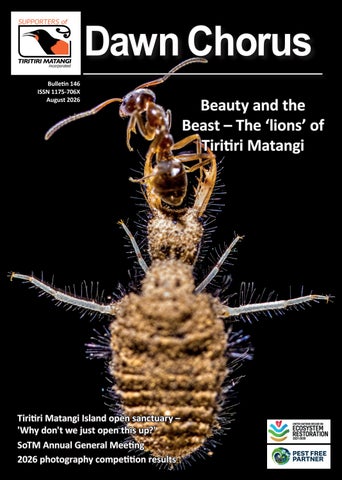
Beauty and the Beast – The ‘lions’ of Tiritiri Matangi
Chair Chat Kia ora, Members. As we come to the end of another financial year, I want to reflect on the efforts of our members, volunteers, staff and contractors. SoTM functions through the thousands of hours contributed, particularly by volunteers, across the many activities that enable the conservation project to be maintained and further developed. The work of so many people, on a regular and continuing basis, is acknowledged and appreciated. Our conservation work could not be achieved without you all. I am standing down as Chair at the AGM in September, after three years leading your society. During that time, leading the organisation has been challenging, given the continuing growth and increasing complexity of operating a large conservationfocused incorporated society. Being able to contribute my talents and skills to the governance of the society as Chair has been a special part of my life, and I have appreciated working with many people both within and outside the organisation. I have been a member for over 26 years and have contributed in a number of areas, and I hope to continue to serve the society for some time to come. Ian Alexander The AGM is being held on Monday 14 September. I look forward to seeing you there.
SoTM Annual General Meeting – Monday 14 September 2026 Join us from 6:00pm at the offices of MinterEllisonRuddWatts, Level 22, PWC Tower, 15 Customs Street West, Auckland CBD. A light meal (finger food) will be served from 6:15 – 7:15pm and the meeting will begin at 7:30pm. A quorum of 30 voting members is required, so we encourage you to attend the meeting. However, for those unable to attend in person, a Zoom link will be posted on the website beforehand (from 7 September). Agenda: 8. Election of honorary life members 9. Determination of the number of board members to be 1. Apologies 2. Minutes of the 2025 AGM (posted on the website) elected 10. Election of officers 3. Matters arising from the 2025 AGM 11. Election of board members 4. Chairperson’s annual report (Ian Alexander) 5. Treasurer’s report and financial statements 12. Notices 13. General notified business 6. The setting of annual subscriptions for 2026-27 7. Motion: i. That after the membership system (iMIS) upgrade, the membership fees structure be amended to: • introduce a fee structure to differentiate between hard-copy and electronic receipt of the quarterly Dawn Chorus magazine (for individual/family and student memberships), and • disestablish the overseas membership (overseas memberships will become individual/family memberships) Guest Speaker: Sara Dean – SoTM's education programme – Igniting curiosity and inspiring conservation action Other information: A Member may exercise a proxy vote through another Member, or the Chairperson, and, in either case, such proxies in writing must be in the hands of the Secretary not less than 24 hours before the time of commencement of the meeting. A Member may notify the Secretary of matters they wish to be raised in general business. Such notification must be provided in writing no less than five days before the time of commencement of the meeting. For Zoom details visit: https://www.tiritirimatangi.org.nz/news/agm Access to MERW offices: The entrance to the building is on the corner of Customs Street West and Lower Albert Street. The doors to the PWC Tower will be locked from 7:25 pm. We advise everyone to be at the venue by 7:20 pm. The Downtown car park is the closest car park to the office: https://downtowncarpark.co.nz/ Alternatively, there are several public transport options: Waitematā Station is located directly across from the office. The Northern Express bus NX1 terminates on Lower Albert Street, directly beside the office. The Downtown Ferry Terminal is a two-minute walk from the office. Board member nominations:
Chair – No nominations received Treasurer – David Bowerman
I am a recently retired Chartered Accountant. After earning a B Com at Auckland University, I worked for Deloitte in Auckland and London, and did contract work in Sydney. My wife Fran and I returned to Auckland in 1984 to raise our three children. I have worked at Fletcher Building Ltd for the last 42 years. My volunteer activities have included managing rugby teams at Northcote and North Harbour, serving as a Cub leader, PTA Treasurer at Willow Park School, and on the Board of Trustees as Treasurer and Chairman at Northcote Intermediate, plus volunteering at the Kaipatiki Project Ecohub.
Cover photo: New Zealand antlion larva with prey, John Sibley
2
For translating Te Reo words see https://www.maoridictionary.co.nz/
Dawn Chorus 146 August 2026
Secretary – Meredith Blogg I am an enthusiastic ‘grunt-work’ volunteer on the motu and have served as Secretary for the Supporters of Tiritiri Matangi over the past year. I am a primary school teacher with a passion for conservation, environmental education and bird photography. I am learning a great deal each time the Board meets and will gratefully continue to serve the members of SoTM if re-elected. Adam Weller I have a passion for the ecological restoration of Tiritiri Matangi. I joined SoTM 15 years ago, volunteering as a guide but, due to children and work, I have not been active for the past few years. I’m a Chartered Environmentalist and have recently stepped down from the Sustainable Business Network’s board. My family and I are regular visitors to Tiritiri Matangi. We enjoy the Island’s amazing biodiversity and learning about Aotearoa’s outstanding wildlife. Over the years, I’ve volunteered at Ark in the Park and Matuku Link, and more recently at the New Zealand Maritime Museum. Andrew Nelson I’ve been fortunate to build a 30-year career across various roles in conservation, and over the past year I’ve enjoyed contributing to the Board. Since 2011, I have served as an active member of the Biodiversity and Research Committee and, at various times, on the Advocacy Committee. While working on the Board, I’d like to use my skills to help sustain the Island’s role in species conservation, maintain Tiritiri Matangi as a premier location for visitors to experience and learn about New Zealand’s unique nature, and ensure the efforts of the SOTM volunteers are an inspiring example of community-led conservation in New Zealand. Carl Hayson Having served on the Board in various roles for many years, I believe I sti ll have much to offer, parti cularly in the areas of infrastructure and historic restorati on on the Island. My extensive knowledge and familiarity with the Supporters could be of benefit to the incoming board members.
Cathy Catto I first visited Tiritiri Matangi when I was 16 as a trainee on Spirit of Adventure; the Island was then farmland. Roll forward 50 years, and I am still involved with this wonderful Island. I have been involved with Supporters for 35+ years and worn many hats over that time. My career in education and leadership fits with visitors’ experiences and our learning-outside-the-classroom initiative for schools. My current roles for SoTM are interpretation signage and Visitor Centre interpretation, education advisory, guiding, shop, and covering for the Guiding Manager, and I believe these areas need a voice on the SoTM Board. Georgina Cuttance I have had incredible opportunities to participate in biodiversity projects led by inspiring people. Highlights include reptile monitoring and dam building on Tiritiri Matangi, supporting kiwi translocations at Maungatautari, and feeding kākāpō on Pukenui Island. As a Sustainability Specialist at Fisher & Paykel Healthcare, my work ranges from counting worms at a restoration project in Karaka to addressing water scarcity in Mexico. These experiences have given me a holistic understanding of the interdependence between nature and business and have strengthened my passion for learning and contributing to positive outcomes. Hester Cooper SoTM has always been at the forefront of conservation projects, enjoying the challenge of pioneering the way we do things. It is a privilege to help the society meet these challenges. I love the work I do in biodiversity, with projects that give members opportunities to see different aspects of the Island and to understand the Island and its ecosystem. These projects are long-term, spanning years and decades, and show us how the Island’s restoration continues to develop. This is important work that gives us confidence to plan ways to add even more diversity to this fantastic place. Ian Alexander I have served as Board Chair for the past 3 years. This year, I am standing as a Board member and will continue to bring my board governance expertise from a number of not-for-profit organisations, along with a range of senior management experience in local government and public companies. With a lifelong interest in the environment and 26 years’ involvement in the Tiritiri Matangi project, I want to ensure our visitors continue to enjoy and understand the need for conservation of natural places like the Island. Janet Petricevich My husband’s love of photography first drew us to Tiritiri Matangi, but that soon led to more. I started volunteering as a guide on the Island in early 2017. Gradually, I shifted from guiding to biodiversity projects. I am a member of the kōkako monitoring team, have served on the Board for three years, and am co-editor of Dawn Chorus. I bring a background in accounting and commercial finance to my role on the Board. Rachel Goddard I hail from Wellington originally but have called Auckland home for over 20 years. My family and I have been volunteering on Tiritiri Matangi for 10 years, and I've been on the Board of the Supporters of Tiritiri Matangi for around six years. I continue to be inspired by the Supporters' work and want to contribute however I can. I bring my IT skills and experience to SoTM and to the governance of SoTM health and safety, and I volunteer on the Island whenever I can. The Board expresses its thanks to Ian Alexander for his services as Chair from 2023-2026, to Victoria Toon (Treasurer 2025-26), and to Louise Delamare, Rosemary Gibson, and Parin Rafiei, who are standing down as board members.
www.tiritirimatangi.org.nz
3
Island News
Introducing the Island's new DOC ranger
Kia ora tātou. My full name is Laurence Himiona Sullivan. My father’s family arrived in Wellington from Ireland in the late 1800s and moved to Northland in the early 1900s, where they farmed in the Paparoa area. My mother’s family (who know me as Raureti) are from the Whangaroa Harbour area, with Māori whakapapa across the far north. I was raised mostly in the mid-north, between Dargaville, Whangārei, Whangaroa, and Kaikohe, before returning to Dargaville.
My pre-DOC life was spent mostly farming on dairy farms in Northland and working in construction, roofing, and labouring in Australia. When I left New Zealand, I was a young, bored bloke, and I vowed never to return. However, every time I came home for a holiday, I realised I missed the things that make New Zealand unique. Although I was financially better off in Australia, I wasn’t happy. I was happy back home, surrounded by my whānau, in a land without snakes and spiders. I decided that New Zealand could work for me if I stopped chasing money and looked for something I wanted to do, something satisfying and fulfilling. I knew I liked working outdoors, the bush and everything in it. I remember thinking, ‘I’m sure there’s an organisation with green and yellow signs that does something in the bush.’ Searching online, I found a whole world of conservation, one that felt made for me. I moved back home and enrolled in a conservation degree at AUT in Whangārei. After graduating, I started working at DOC Whangārei, doing abseil weeding on the offshore islands, then worked across Northland in various roles. In 2019, I joined the Te Hauturu-o-Toi / Little Barrier weed team for three months, before heading south to spend five years on islands around Wellington. When a permanent posting opened on Hauturu at the end of 2024, I jumped at the chance to head north again, as I was leading a restoration project on one of my ancestral islands with my whānau in Whangaroa. Hauturu was life-changing; working and living full-time in the most pristine, intact, ancient ecosystem has been the most amazing opportunity and privilege of my life. However, the difficulty of getting on and off the Island meant I fell behind with my hapū restoration. When the job opened on Tiritiri Matangi, it was an easy decision to apply. I was sad to leave Hauturu, but I love being able to see that majestic island from my new home. I’m very excited about this next chapter in my life. Every island I’ve worked on has shaped and carved me (sometimes painfully!) in its own way. That’s what I’m bringing to Tiritiri Matangi: me as I am, hoping to do a good job, to become part of the community that works there, and to be open to the lessons and wānanga this island will give me. Looking ahead, I worry about the future of the ancient ecosystems of our lands and seas; everything from climate change to the global biodiversity crises is putting immense pressure on these fragile, precious ecosystems. I don’t know what tomorrow will bring. If everyone put their phones down and focused on protecting the land they stand on, alongside the people standing next to them, maybe we’d be in a better place than we are now. If not, hei aha, I’ll enjoy every moment I’m here, on the motu.
Wills Month in Aotearoa New Zealand
September is Wills Month in Aotearoa, a timely reminder of the importance of having a Will and updating it regularly. We would love for you to consider leaving a gift in your Will to the Supporters of Tiritiri Matangi.
Your gift – no matter the size – will help support our vision: Tiritiri Matangi is a haven for Aotearoa New Zealand’s native species, engaging and inspiring volunteers and visitors to make a difference in their environment. We are deeply grateful when people name us in their Wills. Gifts, big and small, make a real difference, helping SoTM safeguard the Island's precious flora and fauna and inspire future conservation leaders.
How will my gift be used? You can tell us what you’d like your gift to go towards, or you can leave it to us to choose where it is needed most. You could help us to: • Foster and encourage Citizen Science projects through the Mel Galbraith Citizen Science Fund. • Help students gain first-hand knowledge of New Zealand’s precious species and our country’s conservation history through SoTM’s Growing Minds and education programmes. • Maintain Tiritiri Matangi’s lighthouse precinct, which is significant to New Zealand’s maritime history, through the Ray Walter Lighthouse and Maritime Fund. • Respond to the Island's most urgent needs through a general gift. How to leave a gift in your will: https://www.tiritirimatangi.org.nz/support-us/ 4
Dawn Chorus 146 August 2026
Island News
Rare sightings of koekoeā / long-tailed cuckoo
The koekoeā is the larger of the two common cuckoos in Aotearoa New Zealand. It is a summer migrant, spending the winter in the Pacific Islands. Like many other migratory species, sightings in Aotearoa over the winter months are likely to be of birds that were too weak to make the migration north – the young, old, or sick. Sightings of koekoeā on Tiritiri Matangi are rare in themselves, but two recent sightings are even rarer, in that they are of an over-wintering bird, and photographers captured both. Matthew Maingay and Rebecca Ward shared their stories and stunning photographs with Dawn Chorus. About halfway along the Wattle Track, our small photography tour group, led by Geoff Beals, stopped to photograph a small flock of whiteheads that had gathered a few metres ahead of us on the track. We had just settled to take some shots when an almighty screech and a blur of movement ripped through our group and landed amongst the whiteheads. It was a brown, speckled bird, much bigger than a thrush, with a piercing screech. A long-tailed cuckoo had been harassed out of the bush by bellbirds. I had only seen one once before, flying high above the tall canopy in the Tararuas. Within seconds of the group shuffling to get a view of the cuckoo over each other’s shoulders, the cuckoo flew back towards us, within a metre or two of our group, just a foot or two off the ground. I grabbed the camera. There was no time to set up. All I could do was rely on the previous practice of ‘shooting from the hip’ when taking photos of moving objects, as well as the incredible eyeautofocus in modern cameras. It all lasted less than 20 seconds. The first five photos were out of focus. The second five were just stunning. Matthew Maingay Matt's sighting was on 02 May 2026.
My photos were taken on Saturday 18 July 2026 on Tiritiri Matangi Island. I had stayed the night at the bunkhouse, and one of the other guests said she had seen a ruru near the hihi station [on Wattle Track], so at about 11.30 am I walked down to see if I could find it. I got there and saw no sign of the ruru, and tried to get some hihi photographs, but it was too dark. I looked up after hearing some korimako/bellbird alarm calls and saw them gathered high up in a tree above the pathway, almost on the road. Some of the alarm-type sounds may also have been from the bird they were harassing. Initially I thought the bellbirds had discovered the ruru, but I soon realised it was a different bird, a koekoeā/ long-tailed cuckoo. It flew to a tree deeper in the bush, closer to the seats, and from time to time moved around the tree, I assume hunting for insects, although it was mainly in the very top of the canopy. I suspect it is a juvenile bird. I was excited and surprised to see this bird, a ‘lifer’ for me. I had tried to find it when there were sightings of one earlier this year. Rebecca Ward For information about koekoeā, see New Zealand birds online: https://www.nzbirdsonline.org.nz/species/long-tailed-cuckoo
Camera – Nikon Z8 Lens – Nikon Z 70 – 200 @ 200mm F4.5 ISO 1250 Speed 2500 Instagram: matt_maingay_photography
Camera – Sony A7V Lens – Sony FE 200-600mm @ 600mm F6.3 ISO 4000 Speed 1000 Instagram: bexswildlife_photographs
Donations received
SoTM thanks the following people for their generous donations, as well as those who make regular or one-off donations with their membership renewals, or through the shop. • Dean Sutcliffe • David Gordon • Hilary Wright • Su Peace • Stephanie Roberts • Helen Lawford • Bruce Hadden • Annette Voll • Susan Bull www.tiritirimatangi.org.nz
5
Island News
Resolving a slippery problem
There have been incidents of people falling while walking along the concrete section of the road to the wharf, some of which have resulted in serious harm. Photo: Carl Hayson
The falls occurred on the sides of the road where the gradient was steepest. Although the affected visitors wore suitable footwear, it failed to prevent the accidents. There were five falls recorded in SoTM's health and safety register in 2024, and eight falls over a period of three days occurred in 2025. DOC had taken steps to remove the gravel hazard where the road met the concrete, but these falls were unrelated to that particular hazard.
Top: Rob Gouldstone and Ian Higgins installing the tactile studs Bottom: The installation provides grip on the slope Photo: Jonathan Mower
Several remedial measures were trialled, including installing signage to alert visitors and abrading the concrete to improve grip. However, accidents continued. The possibility of installing a new pedestrian track to circumvent the problem was also considered, but planning permissions and consents would take a long time. It was only a matter of time before another serious accident occurred. Ian Higgins from the infrastructure team proposed a potential solution: to install individual tactile studs that not only provide additional grip but also improve visibility of the hazardous sections of the path. They are suitable for heavy traffic (i.e., the ute and trailer running over them), meet New Zealand standards, and are easily installed. Based on advice from Vanguard products, 400 of these were purchased, and on a hot, sunny January day, the infrastructure team installed them in two hours using a compressor and drill. They seem to have had the desired effect, as no accidents have been recorded this year to date on the health and safety register. Carl Hayson
Bird flu – Help protect Tiritiri Matangi's wildlife
Highly Pathogenic Avian Influenza (HPAI), commonly known as bird flu, is a contagious disease that primarily affects wild and domestic birds. Now that it has arrived in New Zealand, everyone has a role to play in helping protect our unique wildlife. Tiritiri Matangi remains open, and visitors are encouraged to continue enjoying this special wildlife sanctuary while following a few simple biosecurity measures. When birds congregate at water troughs and sugar feeders there is a risk of spreading the disease. However, sugar feeders on the Island continue to provide an essential supplementary food source for hihi. The feeders and water troughs are cleaned daily in accordance with strict, long-standing hygiene and biosecurity protocols. The risks and benefits associated with the feeders and troughs will be re-assessed as more is learnt about the spread and impacts of bird flu in our region. You can also help protect Tiritiri Matangi's wildlife by: • Cleaning your footwear and equipment before and after visiting natural areas. • If you have domestic poultry or captive birds, changing all clothes, footwear and equipment before visiting the Island. • Washing or sanitising your hands after spending time outdoors. • Not removing feathers, plants, soil, rocks or other natural materials from the Island, or bringing them to the Island. They can spread pests and diseases. Birds affected by avian influenza may appear weak or disoriented, struggle to fly or stand, have swollen eyes or heads, show breathing difficulties, or die suddenly. These signs can also be caused by other illnesses, so it is important not to make assumptions. If you see three or more sick or dead wild birds, marine mammals or other wildlife together, do not touch them. Instead, note the location, take photographs from a safe distance if possible, and report your observations by calling the Biosecurity New Zealand Exotic Pest and Disease Hotline on 0800 80 99 66. Early reporting allows experts to investigate quickly and helps protect New Zealand's wildlife. As the situation continues to evolve, the latest advice is available from the Ministry for Primary Industries (MPI) and the Department of Conservation (DOC) websites. 6
Dawn Chorus 146 August 2026
Guest Guide – Liz Maire, MNZM
This issue's Guest Guide is not only a well-loved and respected member of SoTM's education team, she has made a significant contribution to conservation and education in the Auckland region for more than 35 years, for which she was recently made a Member of the New Zealand Order of Merit. What tip would you give someone starting to guide today? Be yourself, realise that people will enjoy and remember your stories rather than facts, and let the visitors enjoy being immersed in nature.
Photo: Jim Eagles
What is your favourite story about Tiritiri Matangi that you like to share with visitors? I like talking about the early planting days, when kiore were caught overnight in the nursery using live-capture traps, just so the planting volunteers could see what they looked like. Then the child of the day used to release them back to their island home! How learning has evolved in restoration projects.
What is your occupation? I work with Sara as an environmental educator on Tiritiri Matangi, as well as helping to run school programmes for the Auckland Council at Te Oneroa o Kahu / Long Bay. I also provide pest control support for Tāwharanui and Te Hāruhi/ Shakespear Regional Parks. All great workplaces! Where did you grow up? I grew up in London, but I realise now that, as a child, I was only truly happy on our annual two-week holidays in Cornwall. There I could escape to some sort of wilderness. I’ve always hated living in cities without nature. I was so blessed to be able to come to live in Aotearoa from the age of 21. How did you get involved with Tiritiri Matangi? How long have you been guiding? I first came to Tiritiri Matangi in the ’80s with our children to plant trees, never thinking that becoming part of the ‘spade brigade’ would eventually change my life. Later on, I took walking groups over to enjoy the Island and was guided by Barbara. I will never forget her showing me a tīeke and the lightbulb moment of realising that the absence of mammalian predators means thriving wildlife. Barbara said “You should guide, Liz.” In less than a month, I was! So that’s around 40 years of guiding, lucky me. How has guiding changed since you started? Well, it’s great that there’s more support and training; however, the magic of seeing the Island through others’ eyes and enthusing them about the Tiritiri Matangi story remains whenever I pin on that badge. What has been your favourite experience with guiding? I was lucky enough one day to be guiding school children as we were short of guides. I had a small group of young Forest School children. The magic happened that day, we just lost ourselves in nature, and they reminded me how good it was to slow down and enjoy using all your senses. It was an extraordinary hour or so; none of us wanted it to end. I think the mauri of Te Taiao was with us that day. www.tiritirimatangi.org.nz
What is your favourite animal or plant on the Island, and why? Oh, that’s far too difficult a question – but I was lucky enough to have met Greg, the takahē. He was special, what a personality he had and what a great advocate for his species. When he died, I helped dig the hole with Mary-Ann near the pūriri tree to bury him, and we all wept at his funeral. Is there anything else you would like to share? Well, you wouldn’t expect me to go without a plug for our education programme! It’s something I feel so proud to be involved in; we all need to connect our tamariki with nature and get them to want to protect it. The Supporters do it so well on the motu, creating a legacy of future leaders who care about the environment. And lastly, thank you to this special place that grabs your heart and changes lives. Congratulations to Liz Maire on being appointed a Member of the New Zealand Order of Merit (MNZM) in the King's Birthday Honours! We are delighted to celebrate Liz's well-deserved recognition for her outstanding service to conservation and environmental education. A familiar face on Tiritiri Matangi, Liz has inspired thousands of students each year through the Education Programme and has made an extraordinary contribution to the motu through her volunteer work. Through her ongoing commitment to environmental education, she has created meaningful opportunities for young people to connect with te taiao, helping to build a lasting conservation legacy. The Education Programme is what it is today thanks to her passion, aroha, and dedication. This honour recognises the lasting impact Liz has had on people and on conservation. We are deeply grateful for everything she has contributed to Tiritiri Matangi, conservation, and environmental education in Aotearoa New Zealand. Mā te huruhuru ka rere te manu. Adorn the bird with feathers so it can fly. Ngā mihi nui and congratulations, Liz, on this well-deserved achievement. Sara Dean 7
John's Nature Notes
Beauty and the Beast - The ‘lions’ of Tiritiri Matangi
Not the mammalian variety, of course, but the fierce insect predators called antlions, whose nightmarish larvae lay traps for unwary prey just centimetres from where you walk with visitors along Hobbs Beach Track. Their conical pitfall traps in the trackside dust largely go unnoticed by visitors. I first wrote about these fascinating insects for Guidelines four years ago. Then, in 2023, Cyclone Gabrielle hit, and every single antlion trace was erased from the Island overnight by torrential rain and gales. They remained absent until around the middle of 2025, when I found fresh pitfall traps [Fig. 1] on the side of the track by Little Hobbs Beach. Antlions are members of an ancient worldwide group of over 1000 species in the Neuropteran (Net-Winged) Order of insects, family Myrmeleontidae (Myrm... = ant, leon = lion). They date back to the Permian period, 290 million years ago.
Photo: John Sibley
Adult antlions [Fig. 2] are seldom seen because they are short-lived and mostly nocturnal. As a result, they are much less well known than their strange trap-laying larvae. They are beautiful, delicate insects, similar in appearance to damselflies, and often mistaken for them. Lacewings also belong to the Order Neuroptera and are predators whose larvae are broadly similar in appearance to antlions but are mobile. See Dawn Chorus Bulletin 145 (May 2026) for their story. Photo: Nick Allred
Figure 1: Antlion traps on Hobbs Beach Track
In New Zealand, we have our very own endemic antlion species, Weeleus acutus (acutus referring to the pointed end of its abdomen). The graceful beauty of the adult antlion stands in stark contrast to the larva, although it is, in its own way, beautifully adapted to its lifestyle, hidden beneath the dusty earth.
INaturalist
The antlion larva certainly displays elegance in the simplicity of its design. It is essentially a bag-like stomach attached to a set of lethal jaws. Its function is to accumulate the raw materials and energy needed to develop into an adult fly capable of dispersing and reproducing. To achieve this, its two main priorities are to build and maintain a conical pitfall trap and to detect and consume prey that may fall into it.
Figure 2: New Zealand antlion adult stage
As a sit-and-wait predator, it does not need to be a fast runner to catch its prey. In fact, it cannot walk forward at all and can only move backwards in circles. As it does so, it uses its pointed abdomen as a sand-plough and its flat head as a shovel. As sand is bulldozed up and over the abdomen, the head regularly flicks upward, powered by strong thoracic muscles, sending the sand grains shooting up and well away from the engineering site. Eventually, a conical pit forms, and the larva settles at the bottom, waiting out of sight for victims to fall in. Civil engineers will tell you that the steepness of a pit cone in loose earth is governed by an engineering term called the ‘critical angle of repose’. This is the steepest angle at which a stable slope can be built without causing a landslide. Every motorway cutting and bridge abutment must be constructed with slopes shallower than this angle for stability. An ant walking on a slope built at this critical angle will cause the sand underfoot to slide, rapidly carrying the unfortunate insect to the bottom of the pit, where sharp jaws await it.
One reverse gear!
Antlion larvae have slow metabolic rates and can survive for many months without food if necessary. Development time to pupation varies – it is rapid when food is abundant, but can take as long as two years when food is scarce. In this way, they are adept survivors in an uncertain world.
8
Dawn Chorus 146 August 2026
Unusually for insects, antlion larvae lack an anus. Being a liquid feeder helps in this respect, as there is no solid, undigested waste to deal with. Any waste is stored throughout its larval life within its bag-like abdomen, mainly as insoluble uric acid. When it pupates, it decorates its silk cocoon with its accumulated faeces and the husks of some of its previous meals. This provides camouflage, hiding it from other predators at this vulnerable stage in its life. The fearsome jaws are formed by the fusion of the maxillae and mandibles. Each inner mandible contains a deep groove over which the outer maxilla fits neatly, forming an enclosed canal for injecting venom to immobilise the victim and enzymes to digest its soft parts. The liquid meal is then sucked back out through the same hollow jaws. The larvae are clad in forwardpointing bristles, which help them anchor themselves and exert greater traction, enabling them to subdue prey considerably larger than themselves.
CC BY-SA3.0 Wiki Commons.
If struggling prey manages to cling on and prevent itself from sliding into the trap, the larva uses bunches of stiff bristles on its abdomen to accurately detect the direction of the vibrations from the struggles, and thus determine the exact angle to guide its aim, flicking sand grains at the victim to make it fall further into its waiting jaws. John Sibley
Figure 3: Some of the extreme adaptations of antlion larvae
All images and diagrams by author, unless otherwise stated. Copyright information: Diagram: 'Bugboy 52.40'
Figure 2: Adult NZ antlion photo iNaturalist, © Copyrighted by Photographer: Nick Allred. Source: https://inaturalist.nz/observations/20042034 Figure 4: Life cycle of Antlion, Photographer credit: ‘Bugboy52.40’. Licence CC BY-SA3.0. Source: https://en.wikipedia.org/wiki/Antlion#/media/File:Antlion_life_cycle.svg
Figure 4: Antlion life cycle
Where to Find Antlions Our endemic antlion is widespread across New Zealand. Look in places that are: • Dry and sheltered. Try the base of a thick hedge or a fence. In my garden, they love the bone-dry soil beneath the garden shed, which stays dry even in the wettest weather. If your house is on concrete slabs with an air gap beneath, the dry soil beneath is antlion heaven! • Sandy or dry, dusty soil. This allows the best pitfall traps to be formed and maintained. • On Tiritiri Matangi, keep a lookout for their conical pit traps beneath the dry soil banks as you approach Hobbs Beach from the direction of the wharf. In wet weather, the pits are obliterated! www.tiritirimatangi.org.nz
Hobbs Beach Track – Antlion country!
9
Tiritiri Matangi photography competition
The results of the 2026 competition, with the judge’s comments on the winning entries, are listed below. Thank you to all who entered and congratulations to the winners. FAUNA First: Eva Cadario, Kōkako This image immediately stood out. The image is simple in that it has only the kōkako and the nikau. The image is sharp, particularly in the head of the bird, and there is great colour. The blue and grey stand out from the greens and reds. The curve of the bird is intriguing and adds to the appeal. Beautiful colours and composition. Second: Tony Petricevich, Titipounamu with kawakawa looper moth Third equal: Mason Maron, Takahē pair Third equal: Janet Petricevich, Takahē bathing
EVACADARIO, Kōkako
TONY PETRICEVICH, Titipounamu with kawakawa looper moth
CAROL BATES, Lighthouse fun
GEOFF BEALS, Mackerel sky
10
LANDSCAPE/SEASCAPE First: Carol Bates, Lighthouse fun While this is a fun image, it clearly took thought, time and skill on the photographer's part. The composition works well, the frame essentially divided into three spaces. We have an astro shot of the stars that are a key part of a night time landscape. We also have the large tree evoking the bush, with city lights in the distance, reminding us the city is not far away. The lighthouse in its light-painted mode reaches up to the stars and also reminds viewers that it served an important function in the past. Despite all this action the image has a restful sense. Second: Geoff Beals, Mackerel sky Third: Geoff Beals, Hobbs Beach UNDER 16 (opposite page) First: Jayne Wyatt, Fungi Well done for getting down low to take this shot. The fungi are well placed in the frame and have good colour and sharpness. Having the leaf litter around helps give a sense of scale and tells us of the environment they grow in. Great effort. Second: Harley Logan, Robin Third: Jayne Wyatt, Tuatara Dawn Chorus 146 August 2026
PEOPLE First: Janet Petricevich, Measuring tuatara This image has a strong conservation story. It is also technically impressive. The photographer’s position has allowed the tuatara to dominate the frame and the head of the woman measuring is separated and fully visible. The headlamp is providing a strong light source and the photographer has matched this through reflection and/or another light source to ensure we can see detail. Great detail throughout. Impressive image! Second: Tony Petricevich, Janet and Georgia Third: Tony Petricevich, Close encounters of the takahē kind
JANET PETRICEVICH, Measuring tuatara TONY PETRICEVICH, Janet and Georgia
FLORA First: Louise Bobbitt, Gold fungi This group of fungi have been captured with excellent sharpness and good depth of field that allows for study of the form, texture and colour. The close cropping works well as there is detail in the surrounding leaf litter to inform us that they are growing on the forest floor. Rendering the background out of focus strengthens the presence of the fungi. Well done! Second: Jonathan Mower, Clematis with thrips Third: Louise Bobbitt, Geometry of the ponga
LOUISE BOBBITT, Gold fungi HARLEY LOGAN, Robin
JAYNE WYATT, Fungi
www.tiritirimatangi.org.nz
JONATHAN MOWER, Clematis with thrips
11
Fauna Notes
Ferns on Tiritiri Matangi
Tiritiri Matangi is home to 43 species of ferns, each playing an important role in the Island's recovering forest. In this article, Neil Davies explores their fascinating life cycle, unique features, and their natural recolonisation of the Island. Aotearoa New Zealand is home to a diverse range of ferns, numbering almost 200 species, 40 percent of which are endemic (i.e., found only in NZ), and 43 of which can be found on Tiritiri Matangi (Cameron and Davies, 20131). Ferns can be categorised by growth form, such as tufted, creeping, climbing, perching and tree ferns. All of these types can be found on Tiritiri Matangi. Ferns were not planted during the Island’s reafforestation in the 1980s and 1990s, but have spread naturally across the Island via wind-borne spores. Unlike flowering plants and gymnosperms (such as conifers), which propagate from seeds, ferns reproduce by spores and, in some cases, by vegetative means (e.g. from runners and bulbils, as in the hen and chicken fern). REPRODUCTION: Ferns have two distinct lifecycle stages, a spore-bearing stage called the sporophyte and a gamete-producing stage called the gametophyte. This results in the life cycle displaying what is known as an alternation of generations (Fig. 1)2. The fern plant with which we are familiar is the sporophyte and represents the asexual stage of the life cycle.
Figure 1 – The life-cycle of ferns
kids.britannica.com [2026]
The sporophyte produces microscopic spores in sporangia (spore cases) within structures called sori, which may be found dotted on the underside of mature fronds. Spores are produced by a process of cell division called meiosis, which results in cells containing half the ‘normal’ number of chromosomes (n or haploid), where ‘n’ represents the number of chromosomes for a particular species. Most animal and plant species have chromosomes numbering in the 40s (humans have 46 – 23 pairs), but ferns often have four times that number of chromosomes, and in some cases up to 1,000! Spores are ejected from the sporangia and dispersed by the wind. If a spore lands on a suitable moist substrate, it germinates to form a tiny, heart-shaped structure 1 – 5 mm across, called a prothallus. These prothalli are free-living and photosynthetic, and on these tiny plants the sex cells or gametes are produced – eggs within sex organs called archegonia and sperm cells within structures called antheridia. Sperm cells must swim through a film of water to reach the archegonia and fertilise the eggs. This is the primary reason ferns are typically found in wet, damp, humid habitats. The fertilised egg, called a zygote, now contains a full complement of chromosomes (2n or diploid), a combination of genetic material from both egg and sperm. This initial cell will divide repeatedly and develop into a new sporophyte plant, thus completing the life cycle. Above Left: Sori on the underside of Shining Spleenwort/ Huruhuruwhenua/ Asplenium oblongifolium Right: Hound's Tongue Fern/ kōwaowao/ Zealandia pustulata showing rows of brown sori.
12
To promote cross-pollination, archegonia and antheridia mature at different times and often develop in separate gametophytes. Dawn Chorus 146 August 2026
MORPHOLOGY: The mature fern sporophyte comprises three major parts – rhizomes, fronds, and sporangia. Rhizomes anchor the plant, absorb water and nutrients, and store food. They can be short and erect, giving rise to a tuft of fronds (on the ground or perched in a tree); they can creep along the ground or up trees; or they can form the upright trunks of tree ferns (see examples below).
From left to right: Pikopiko / black shield fern (Polystichum neozelandicum), pānako / thread fern (Icarus filiformis), and whekī / rough tree fern (Dicksonia squarrosa)
Fronds consist of the stipe (the stem connecting the blade to the rhizome) and the blade (the flat, photosynthetic portion of the frond). The blade is often divided into leaflets called pinnae, which may be further divided into pinnules. The young, tightly coiled, unfolding fronds are called fiddleheads or crosiers. The sporangia that produce the spores are found on the underside of the fronds, within the sori. However, some species have dimorphic fronds (i.e. they exhibit two forms), with distinct sterile and fertile fronds. The sterile fronds are broad and green and photosynthesise, while the fertile fronds are generally narrower and darker, with the sori often produced under the curled margins of the fronds. Kiokio / palm leaf fern (Parablechnum novae-zelandiae) and Rereti / lance fern (Austroblechnum lanceolatum) are two examples found on Tiritiri Matangi. Take a closer look at the ferns the next time you walk in the bush or visit the Island. All images author's own unless otherwise stated. Reference: Changes in the wild vascular flora of Tiritiri Matangi Island, 1978–2010, Ewen K. Cameron and Neil C. Davies, Published online: 18 November 2013. Available online at: https://newzealandecology.org/system/files/articles/NZJEcol37_3_307.pdf
1
2
The life cycle of the fern, Britannica Kids, https://kids.britannica.com/students/assembly/view/190714 Accessed July, 2026
Above: Kiokio close-up of fertile frond Left: Kiokio / palm leaf fern / Parablechnum novae-zelandiae Right: Rereti / lance fern / Austroblechnum lanceolatum
www.tiritirimatangi.org.nz
13
Looking back
Tiritiri Matangi Island open sanctuary – ‘Why don’t we just open this up?’ Part one: The germination In this article, Sonya Galbraith and Mary-Ann Rowland look back at the vision and planning that laid the foundations for the restoration of Tiritiri Matangi, through stories from some of the key people involved. In December 2025, Bob Drey, a senior planning officer in the former Lands and Survey Department, visited Tiritiri Matangi for the first time in over 30 years. Bob played a key role in developing the Island’s management plan, based on the restoration plan proposed by John Craig and Neil Mitchell, lecturers in zoology and botany at the University of Auckland. It was fortuitous that we were both on the Island and able to acknowledge him and his early connections. Bob was impressed with his day on Tiritiri Matangi and, when asked how it compared with his original vision, he said it was much better than he had expected. Aware of the opportunity for Supporters to learn the details of the open sanctuary story directly from the source, we suggested meeting with John and Neil. Bob was very keen to meet them again. Early this year, following an invitation from John, we all met at John and Anne’s home, Tahi, Northland. The following article is drawn from the conversation between them about the beginnings of Tiritiri Matangi’s restoration. Anne Stewart (ecologist) and John Hawley (landscape architect) also shared memories of the early days (1978 – 1980).
John adds, ‘Pat Bergquist (Prof) was on the board as well. She was the one who fought to have it changed to a Scientific Reserve. Then Frank Arnott, the secretary of the board, rang me and said, “OK, it's been changed to a Scientific Reserve. We can shut the public out now if that'll help you.” So my response was, “Actually, we’ll come back to you with a plan that will bring people here.”’ (Tiritiri Matangi was reclassified from a Recreation Reserve to a Scientific Reserve in 1980). Determined that the public should play an important role in supporting the project, John and Neil created a management plan for the Island that went beyond its primary classification as a scientific reserve. They proposed that volunteers be actively involved in replanting. ‘Crucially,’ Neil says, ‘we all drafted the words to create an open sanctuary where people, particularly Aucklanders, can ultimately view some of the region’s rare and endangered animal and plant species within their natural environments.’ Bob adds, ‘The whole project was predicated on the idea that we wanted people to experience conservation and therefore to give support. It's right throughout the plan.’ Photo: Unknown photographer
The retold stories were peppered with humour, passion, and a mix of frustration and a sense of achievement among these visionaries who proposed active participation in the ecological restoration of Tiritiri Matangi Island. The idea that people who weren’t scientists could experience their natural heritage through action in a scientific reserve was unprecedented and inspiring. In John’s words, ‘I’ve always had this thing that people should be involved.’
was recognised as the birdman in Auckland. So, as the board meeting started, he immediately got up, talked through the plan, endorsed it, and that was another big plus for Tiritiri Matangi.’
Anne recalls a pivotal conversation from a night in 1979: ‘There were many things that spurred us on, whether they were science-driven or whatever. I can absolutely remember one of those nights – we had a coal range in our hut behind Hobbs Beach, and it was really old and very inefficient. By the time it had heated the potatoes, the flagon of sherry had gone. I remember everyone was reminiscing about where they'd been and what they'd been doing on different islands. And John basically said, “You know, I get to go all over the place. I get to go over to these amazing islands where no one else is allowed to go. I get to see amazing things. So why don't we do something different here? You know, why don't we just open this up?”’ The hut was home to John, Neil, and their graduate students, who were conducting research on the Island. Their results indicated that if Tiritiri Matangi were left to regenerate naturally, the process would be very slow, risking the survival of nectar-feeding birds. ‘When we presented our plan to the board,’ says Bob, ‘before they held the meeting to discuss it, the old-fashioned ranger, George Holmes, approached me and said, “Well, I read your plan and I actually understand it!” I thought, “Whoa, this might work!” And then we asked Graham Turbott to read and edit it. He was on the Hauraki Gulf Maritime Park Board and 14
John in front of the coal range in the research hut (1979 or 1980)
Dawn Chorus 146 August 2026
Photo: Mary-Ann Rowland
‘When the original plan that Neil and I put out was circulated by Lands and Survey for feedback (from scientific, management and conservation groups), the only negative response came from some fellow ecologists,’ says John. ‘They said: no one's ever done this before, so you know you've got to do an 8-year trial. They were ultra-cautious, with the mindset: it hasn't been done, so it can't be done.’ ‘It was a very hard sell,’ says Bob. ‘At the time, the Wildlife Service were unhappy about their precious animals being moved around or introduced to areas not under their direct control, but they eventually came around to it… There were many notable, strong-minded people on the Hauraki Gulf Maritime Park Board [HGMPB], and they weren't going to be pushed around.’ Following the feedback, the plan was slightly modified, with a landscape designed to function as an open sanctuary without intruding on sensitive areas. It was adopted by the HGMPB. ‘Right from the start, money was a big issue,’ says Bob. ‘Then someone had a stroke of genius and invited the World Wildlife Fund to view the planting. When we took them around the Island, they were duly impressed and offered up a great sum of money.’ (The 1982 grant of $40,000 was matched 2:1 by the government, enabling the nursery complex to be built.) ‘That was the key. With the World Wildlife Fund on board, and then promoting the replanting through the clubs and organisations – plant a tree on Tiri and leave a part of yourself – our 10-year project took off with a real hiss and a roar.’ Neil adds, ‘That was also when the radio stations got involved. Radio Hauraki was doing free promotional ads because we also needed a boat to go out there. So we said, “Bring your spades and come down to the wharf and come and plant trees on Tiritiri Matangi.” There was a fabulous amount of goodwill, which made a real difference, and, of course, having the new lighthouse keeper on side. I mean, Ray Walter was just amazing.’ ‘Yes,’ agrees John. ‘Once Ray arrived, we got endless help.’
Neil Mitchell, John Craig, and Bob Drey, during their 2026 reunion
‘My perspective on it is that, at the time, much of the conservation work was happening in the Chathams, on the black robin, or somewhere down in the far south. And Auckland was paying for it. And so conservation was a vicarious experience you saw on your TV.’ Anne adds, ‘No one thought that conservation could happen in the city. That was the beauty of the whole thing.’ ‘Precisely,’ says Neil. ‘Because it captured people who wanted to do something. We had this project, and people said, “Yes, please”. They were basically urban-based nature-loving groups, and they all wanted to be involved. We gave them something to be involved in.’
‘A number of things came together with Tiri. We were lucky. We had no major pests, no kikuyu. There were Ray and Barbara, Jim Battersby... and so many more people. Tiri had a wharf. Radio Hauraki was promoting Tiri, and the WWF were on board – the Gods were shining on us,’ says Neil.
It was such a privilege to be ‘flies on the wall’ and experience the ‘outside-of-the-box thinking’ of these founding visionaries. SoTM owes them a great debt. Part one of two. Sonya Galbraith and Mary-Ann Rowland Photo: Neil Davies
Ray Walter demonstrating how to plant to a group of volunteers in 1989
www.tiritirimatangi.org.nz
15
Photo: Jonathan Mower
Fauna Notes Kororā / little penguin The 2025-26 season was a poor one, with only five fledglings from the 12 pairs (our best season had two chicks fledge per pair, and our worst had none). Five pairs laid their two eggs at the usual time in August, but all of these clutches failed to hatch. The successful nests that fledged a chick were laid in late October, November and December. It is likely that there was insufficient food available in August and September and, as a result, the adults abandoned their eggs. One of the early-laying pairs made a second nesting attempt, laying in November and fledging one chick. Thanks to the box-checking team: Gerhard Wette, Jonathan Mower, Kay Satherley, Tejo van Schie and Karin Gouldstone.
Kōkako This season, 29 pairs nested, and a 30th pair was formed but didn’t nest. There were 42 nests in total, and 20 pairs were unsuccessful. We believe the difficult weather conditions during this breeding season led to the loss of quite a few chicks. This was in addition to the usual losses to predation.
Photo: Maron Mason
There were six female fledglings, two male fledglings, and one of unknown gender. The females have been named Aura (Te Rae and Chatters), Seijaku (Phantom and Wakei), Pouako (Erenora and Tātākī), Aronui (Joy and Aweawe), Hōpara (Waitangi and Lyric), and Tupu (Awenga and Wai Ata). The male fledglings have been named Journey
Anatori feeding Mauri
16
Penguin chicks in a nest box (R-hand bird is at an advanced stage of post-juvenile moult)
(Atarau and Kiseki) and Kupe (Awenga and Wai Ata). Kopakopa and Noel have one fledgling of unknown gender. Kaze, who, with his partner Hime, lives around the Visitor Centre, has developed a ‘sweet bill’ and has been seen helping himself to the sugar water from the sugar feeder there. Although this has delighted the many visitors to the Island, the resident tūī are not impressed.
Hihi/Stitchbird The hihi have been consuming a fair amount of supplementary food during the winter, when the natural food supply is quite low. Abbey Skilton will return as the hihi contractor this summer, coming back to the Island in September. The search is on for
a volunteer to join her, so if you are interested or know anyone who is, check the DOC website for volunteering opportunities in the Auckland region to register your interest.
Takahē The two island pairs have been enjoying the cooler months, with all three chicks from the 2025-26 season growing and becoming more independent each day. The sexes of the three chicks were confirmed earlier this year – the offspring of Anatori and Wakapatu is female, and the two chicks of Atawhenua and Turutu are one of each. Ngāti Manuhiri have gifted a name to the lighthouse family chick – Mauri. Mauri is a deeply meaningful name grounded in te ao Māori, representing the life force and vital essence that exists in all living things – people, animals, plants, and the land itself. We’re hoping she becomes an excellent yearling helper for her parents this coming breeding season. The male and female chicks of Atawhenua and Turutu are still awaiting names. After departing Tiritiri Matangi in April, Mātātoa (sister of Mauri from the 2024-25 season) has settled well into the wider group at the Burwood Takahē Centre for the winter. She is with a large group of sub-adults to complete tussock and hypolepis (fern) training before being paired with a future partner by the end of August. They’ll then be left to hopefully have some success in their first season together. Dawn Chorus 146 August 2026
Photo: Geoff Beals
Bird diet and phenology studies These two studies are designed to gather information on what birds eat throughout the year (the diet study) and what foods are available (the phenology study). The timing and quality of food availability will affect bird health, survival and nesting success. Over time, it may be possible to detect changes in phenology related to climate change. The bird diet study has now been running since an experimental start in 2023. Last year, the phenology study method was being tested; it has now been rolled out to volunteers. John Stewart introduced the phenology study to Dawn Chorus readers in Bulletin 145 (May 2026) and called for volunteers to join the team. There are still a few places left if you’d like to help. Contact John by email at johnreastewart@gmail.com
The 2026 bird transect survey This is the twelfth year of transect counting and, as ever, there have been some interesting changes from last year, though it’s the long-term trends we should really pay attention to. Counts are usually carried out in February and March, but this year most of the count team were only available from March, and all but 20 counts were in the second half of the month. The aim was to count each of the 19 transects 16 times, a total of 304 counts, but this didn’t prove possible, and 238 counts were made. For comparative purposes, the total number of records was adjusted to account for fewer counts, showing a modest 8% decrease from last year and 13% below the average for the previous eleven years. Note that the numbers in the table cannot be interpreted as
A kōkako dusted with pōhutukawa pollen
an estimate of the number of birds present, only as a trend in how many are counted. Table 1 shows the mean population estimates for 2026 and 2025, the average of the previous eleven years, the percentage difference between this year and last year, and the percentage difference between this year and the eleven-year average. Two of our ‘big three’, pōpokatea and tīeke show modest decreases from last year and remain below their eleven-year averages, while korimako increased by 20% back to their long-term average. We know that the transect survey overestimates toutouwai, kōkako and hihi, but the trends should be valid. At the time of the transect survey, the actual kōkako population was around 100, slightly up on last year. Hihi had another very successful nesting season, with about 250 fledglings.
There was a dramatic decline in the estimated tūī population. Tūī numbers have fluctuated wildly from year to year at the time of the survey. Last year, there was a huge crop of ripening kohekohe fruit, which attracted large numbers of birds. At the time of this year’s survey, there were relatively few tūī among the kohekohe. Tūī are strong fliers and had probably moved to the mainland in search of food. The mātātā estimate was well below that of recent years, but this species is concentrated in non-bush habitats, where it appears to remain abundant. Thanks to this year’s count team, which included Alison Forbes, Geoff Beals, Gina Wilson, John Stewart, Kay Milton, Karin Gouldstone, Kathryn Jones, Luca Kornélia Kósa and Morag Fordham. Compiled by Janet Petricevich with contributions from Morag Fordham, John Stewart, and Nick Fisentzidis
Table 1: Mean population estimates for 2025 and 2026 Pōpokatea Tīeke Toutouwai Korimako Kōkako Tūī Kākāriki Hihi Kererū Blackbird Mātātā Pīwakawaka
2026 Mean
2025 Mean
Previous 11yrs mean
1312 701 377 1661 165 186 271 721 147 144 29 190
1485 848 345 1380 151 622 448 613 176 167 71 190
1799 935 358 1662 94 687 423 561 140 155 71 249
www.tiritirimatangi.org.nz
Diff from 11yrs mean
Diff from 2025
-27% -25% 5% 0% 76% -73% -36% 28% 5% -7% -59% -24%
-12% -17% 9% 20% 9% -70% -40% 18% -16% -14% -59% 0%
We need second-hand mobile phones for data recording If any of you are upgrading to a new mobile phone, we’d like to have your old Android phone. The old phone needs to have: • No SIM card (we don’t need it) • All personal files/information removed • A reasonable battery life (and charger) • Ability to connect to the internet (Wi-Fi) Contact John by email at johnreastewart@gmail.com 17
Tiritiri Matangi Kids, by Stacey Birds are amazing because their wings are shaped like special tools that help them survive. Some wings are built for speed, others for gliding, turning, swimming, or even staying silent. Read the wing superpowers and match them to the birds.
3. This chunky bird has wings, but it can’t fly! Its short, rounded wings are small and not strong enough for flight, so it uses them for balance while walking and running.
5. This forest singer prefers short flights and big leaps between trees. Its broad wings are perfect for moving through thick forest, helping it hop, glide, and climb rather than fly far.
7. This sky cruiser hardly needs to flap its wings. Its long, wide wings with spread-out fingers help it glide smoothly over open land while searching for food below.
2. This seabird is a highflying expert, gliding for a long time without much effort. Its long, narrow wings are built for soaring over the ocean before diving fast to catch food.
B. Kāhu: Sky Surfer
4. Hear a loud whoosh in the forest? That’s this bird taking off. Its broad, rounded wings give it the power to lift its heavy body quickly up into the trees.
6. Flit, flutter, turn! This tiny bird is always on the move, catching insects in mid-air. Its short, rounded wings help it twist and turn quickly through the forest.
8. Silent as the night, this bird glides through the darkness without a sound. Its broad wings have soft edges that muffle noise, helping it sneak up on prey.
Photo credits: Janet Petricevich, Peter Murrel, John Sibley, Aaron Skelton, Eve Manning, Oscar Thomas
18
A. Ruru/morepork: Silent Shadow
C. Pīwakawaka/fantail: Air Acrobat
D. Kōkako: Canopy Leaper
E. Kererū: Forest Freighter F. Kororā/ little penguin: Underwater Rocket
G. Tākapu/ gannet: Sky Diver H. Takahē: Ground Guardian Answers:- 1-F, 2-G, 3-H, 4-E, 5-D, 6-C, 7-B, 8- A.
1. This little ocean adventurer doesn’t fly in the sky, it flies underwater. Its short, flipper-like wings are stiff and strong, helping it zoom through the sea to chase fish.
Dawn Chorus 146 August 2026
Supporters of Tiritiri Matangi Tiritiri Matangi is administered by the Department of Conservation in partnership with iwi. The Supporters of Tiritiri Matangi (SoTM) is a volunteer Incorporated Society that provides support to ensure the ongoing strength of this wonderful conservation-restoration project. Every year volunteers put thousands of hours into the project and raise funds through donations, guiding and our gift shop. If you'd like to share in this exciting project, membership is just $30 for a single adult or family, $35 if you are overseas, and $15 for children and students. Dawn Chorus, our magazine, is sent out to members every quarter. See https://www.tiritirimatangi.org.nz/support-us/ or contact PO Box 90-814, Victoria St West, Auckland. SoTM Contacts: Chairperson: Ian Alexander chairperson@tiritirimatangi.org.nz Secretary: Meredith Blogg secretary@tiritirimatangi.org.nz Treasurer: Vicky Toon treasurer@tiritirimatangi.org.nz Board: Hester Cooper, Louise Delamare, Rosemary Gibson, Rachel Goddard, Carl Hayson, Andrew Nelson, Janet Petricevich, Parin Rafiei Operations Manager: Debbie Marshall opsmanager@tiritirimatangi.org.nz Guiding and Volunteer Manager: Gail Reichert guidemanager@tiritirimatangi.org.nz, 09 476 0010 Retail Manager: Ashlea Lawson retail@tiritirimatangi.org.nz Membership: Rose Coveny membership@tiritirimatangi.org.nz Educator: Sara Dean Assistant Educator: Liz Maire educator@tiritirimatangi.org.nz Fundraisers: Rashi Parker and Louise Delamare fundraiser@tiritirimatangi.org.nz Social Media: Bethny Uptegrove socialmedia@tiritirimatangi.org.nz Dawn Chorus co-editors: Janet Petricevich and Stacey Balich editor@tiritirimatangi.org.nz Island Rangers: Nick Fisentzidis and Laurence Sullivan tiritirimatangi@doc.govt.nz, 027 536 1067
CALENDAR OF EVENTS SoTM Annual General Meeting Monday 14 September 2026 – 6:00pm At the offices of MinterEllisonRuddWatts, Level 22, PWC Tower, 15 Customs Street West, Auckland CBD
Tiritiri Matangi Talk Recloaking Papatūānuku – Aotearoa’s most ambitious nature-based solution Monday 7 December 2026 – 7:30pm Speaker: Simon Millar, Executive Director of Pure Advantage At Unitec, Building 115,Mount Albert Working Weekends 2026 Labour Weekend, 24 – 26 October Enquiries to the guiding and volunteer manager
Supporters' Weekends 2026 5 – 6 September
Enquiries to the guiding and volunteer manager
First Tiritiri Matangi Talk for 2027 Monday 22 March – 7:30pm At Unitec, Building 115,Mount Albert
Visiting Tiritiri Matangi Island for recreation or education Day trips: Weather permitting, Explore runs a return ferry service from Wednesday to Sunday from Auckland Viaduct and the Gulf Harbour Marina. Bookings are essential. Phone 0800 397 567 or visit the Explore website: https://www.exploregroup.co.nz/ Overnight visits: Camping is not permitted and there is limited bunkhouse accommodation. Bookings are essential: https://bookings.doc.govt.nz/ Web/ www.tiritirimatangi.org.nz
‘Tiritiri Matangi is basically a gigantic classroom, wherever you go, there is knowledge; knowledge that hasn’t even been taught in classrooms...It’s a living classroom of New Zealand’s ecosystem.’ Māngere East Primary year 8 student. Come and experience Tiritiri Matangi's immersive island-based education programme for Years 3-13. Students step back in time to a world where forests are alive with birdsong, gaining insight into Aotearoa's taonga species and the conservation work protecting them. Learners spend the day fully immersed in te taiao / nature, enjoying an unforgettable, handson experience that inspires curiosity, connection and care for the environment. The programme combines a guided walk through native forest offering close encounters with unique species, and engaging educator-led learning sessions. For senior students, the education programme supports a range of NCEA Achievement Standards. Subsidies are available through our Growing Minds programme for schools with an EQI of 430 or more. Book now to inspire your students and empower them to take action for nature. For full programme details and booking information, visit https://www. tiritirimatangi.org.nz/education-programmes/ or contact Robyn Davies by email at schoolbooking@tiritirimatangi.org.nz 19
Tiritiri Matangi Open Sanctuary Calendar $20 Our 2027 calendar is now available to order.
By purchasing our calendar, you are helping to fund SoTM's ongoing conservation and education programmes on the Island. In keeping with the SoTM spirit, the calendar is a collaboration between photographers, the designer and volunteers, who all contribute their time and talents to create a beautiful calendar each year. Enjoy the unique species of Tiritiri Matangi all year round in your own home, or they make great gifts for nature enthusiasts and loved ones overseas. Each spread includes one full-page (A4 size) image and three to four smaller images alongside the dates on the opposite page (a mix of flora, fauna, and landscape showcasing the diversity of life on the motu). Month and day names appear in both English and Te Reo Māori – uniquely New Zealand. To order your calendar, please visit our website, send us an email, or call us during shop hours. www.tiritirimatangi.org.nz/online-shop retail@tiritirimatangi.org.nz +64 9 476 0010 (during shop hours) Tiritiri Matangi Island shop hours: 11am – 2pm Wed – Friday 11am – 3pm Sat, Sun, and public holidays
Scan this QR code for links to our shop social media accounts, newsletters and more!
Supporters of Tiritiri Matangi wishes to acknowledge the generous support of its sponsors
Heritage donors and bequests World Wide Fund for Nature (WWF) Fullers360 Peter Lorimer bequest
Supporters of Tiritiri Matangi welcomes all types of donations, including bequests, which are used to further our work on the Island. If you are considering making a bequest and would like to find out more, please contact secretary@tiritirimatangi.org.nz