Dawn Chorus Bulletin 125 ISSN 1171-8595 May 2021
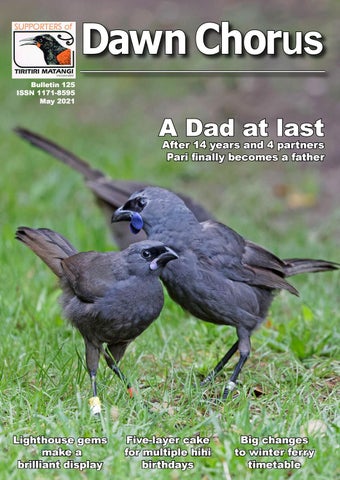
A Dad at last
After 14 years and 4 partners Pari finally becomes a father
Lighthouse gems make a brilliant display
Five-layer cake for multiple hihi birthdays
Big changes to winter ferry timetable
Tiritiri Titbits
$150,000 needed to bring back giant signal mast
Progress on building a Field Centre and a Maritime Museum may be stalled at the moment but the plan for a replica 20mhigh signal mast is shovel-ready and could go ahead now if funding can be found, according to SoTM chair Carl Hayson. Carl recalled that two years ago there was much excitement when, after years of research, planning and consultation with iwi, Department of Conservation and Auckland Council, the Council gave consent for the Field Centre and mast. ‘Unfortunately, since then the Coronavirus pandemic has had a devastating effect on funding opportunities, with corporates, lotto, and other charity funding sources that we were applying to, drying up very quickly,’ he said. ‘We haven’t by any means given up on the Field Centre or the museum but the mast, which is estimated to cost $150,000, is the cheapest of the three projects and has got to be our best chance of getting something going.’ Carl said he and Ray Walter first looked at reconstructing the mast 19 years ago. ‘Having seen the many old photographs of the old lighthouse compound it was part of, finding the remains of the tabernacle and spar and an actual design drawing from 1916, it caught our imagination. ‘With Ray and Ian Higgins having restored the Signal Station, which worked in association with the mast, it seemed the next logical step was to complete the set by rebuilding it and making it part of an educational resource for the public.’ Since then John Haycock from Metal Fabrications has designed a replica mast and supplied costings, and the Council has given consent – although only for five years from 2019 – so the project ‘is shovel-ready’. Because the usual funding sources have for now dried up Carl is appealing to members to come up with ideas for raising the $150,000 so the project could go ahead. ‘If anyone has any suggestions for fresh funding sources we’d love to hear them.’ ‘Meanwhile,’ Carl said, ‘we will begin the process of applying to the Auckland City Council again for the extension to the museum so the magnificent restored first order lens from Cuvier Island can be put on display.’
Temporary new ranger Ranger Tahlia Hochwimmer is going on a six-month secondment to get more experience and will be replaced during that time
The lighthouse compound as it looked in 1946 with a red tower, signal station and signal mast. Photo / NZ Herald from Auckland Libraries Heritage Collections by Hedley Timbs. Hedley arrived on Tiritiri late last month after spending the summer as a temporary ranger on Kawau Island at Mansion House Bay Historic Reserve. His association with DOC goes back to 2005 ‘when I spent a summer monitoring kiwi in the Coromandel ranges. I also crawled amongst flax and got stung by wasps as part of a team getting rid of Argentine Ants from Tiritiri in 2008. More recently I have been hut-rangering in Fiordland and Tongariro.’ When not on duty he likes to play the guitar and do calisthenics. Tahlia’s secondment will be to a job as
a supervisor on the inner islands looking after the team on Rangitoto, Motutapu and Motuihe. ‘This,’ she says, ‘should give me a more in-depth understanding and experience with the various DOC systems and processes so I can be an even more effective ranger for Tiritiri Matangi.’ Our other ranger, Emma Dunning, is not going anywhere other than a short holiday in May. Reduced ferry service Tiritiri Matangi will have a much reduced ferry service from now until mid-October, which is disappointing, but it could have been much worse. The company originally decided it would only go to the Island at the week-
Cover photo shows proud father Paraninihi with his new daughter Marihi. Photo by Tony Petricevich.
2
Dawn Chorus 125 May 2021
ends for the whole six-month period. However, an approach from chair Carl, pointing out that this would destroy SoTM's important – and for the ferry company highly lucrative – school's programme, as well as severely handicapping conservation work on the Island, produced a change of heart. As a result, as well as the weekend sailings, a ferry will go to Tiritiri every Thursday, with all school bookings being moved to that day. Guiding manager Annette de Raat points out that this will create a huge need for guides on Thursdays ‘so we’d love to have our Wednesday and Friday guides help with guiding on that day’. New Tiri Kids creator Stacey Balich has taken over the role as creator of the Dawn Chorus Tiri Kids page. Her first contribution appears on page 14 and focuses on our wonderful wētāpunga. Stacey, who is also a member of the SoTM Committee, says, ‘I am passionate about inspiring and empowering children to get out and enjoy and learn more about nature. I am lucky to have help from my two children, Harry and Alyssa, who will be sharing their ideas for what to include on the page as well.’ Birthday treat Barbara Walter had a reasonably significant birthday earlier this year and to mark the occasion she was given the traditional afternoon tea plus a special treat: a drive round Tiritiri with acting manager Annette de Raat. This was because Barbara had mourned the fact that, while she still keeps very busy when on the Island, she hadn’t seen the far end for ages. The photo, below, by Chris Eagles, shows Barbara putting on a hard hat ready for her trip.
www.tiritirimatangi.org.nz
Chairchat
Tiritiri still much in demand We continued to experience occasional lockdowns during the first few months of the year, but it has not dampened interest in coming to Tiritiri and our shop and guiding sales are holding up well. We are looking forward to the vaccine rollout and the potential opening of travel bubbles to increase visitation to the Island. Fingers crossed. Social media marketing has been a major focus for us to keep the project visible and we are beginning to attract a number of sponsorships which will assist current and future projects with funding. The social evening on 16 March went very well despite lower attendance. Members were updated on activities since the AGM, we saw a film by the British Ecological Society on saving Britain’s islands using Tiritiri as a model and there was a great quiz competition run by Danielle Hefer, Jane Thompson and Michael Watson. As many of us know, bank cheques are about to slide off into history which will create problems for some of our members who rely on this method of payment. If you're among those affected please look at the article below on the different ways to pay. There are many projects on the go at present and I look forward to updating you on these as things progress. Carl Hayson
Learning to live without cheques
The decision of most banks to phase out cheques is creating huge problems for organisations like SoTM because many of our members pay their subscriptions and other bills by cheque. To try to assist members through the change SoTM has contacted banks to see what alternatives are available once cheques have gone. The most important thing is to first contact your bank, whether by phone or, if you are lucky enough to still have a branch nearby, in person. They can provide advice on the options and training on what to do. You have the following options: 1. Telephone banking. This simple 24 hour service allows you to check balances, transfer funds and make payments over the phone without needing recourse to a computer. This is probably the best option if you have been relying solely on cheques and have no internet service. You should discuss it with your bank. 2. Payment by direct debit. You can arrange with your bank to automatically pay your subscription directly from your account to SoTM’s when it falls due. For that you will need to know our bank account name: Supporters of Tiritiri Matangi. And the bank account number: 12-3059-0283520-00. The payment information should state that you are paying your subscription and give your full name and membership number. Direct debits can be reviewed or cancelled at any time. 3. Internet banking. If you have an internet connection you can make the payment yourself using your computer to transfer the funds from your account to SoTM’s. For that you’ll need the same information as with direct debits. See your bank’s website. 4. Payment through ATMs. Some banks allow bills to be paid via a Smart ATM. Again, see your bank. 5. Credit card. If you have a credit card you can phone the shop on the Island 11am2pm, on Saturdays, Sundays and Thursdays for now, and give your credit card details for a one-off payment. Alternatively arrangements can be set up for a recurring payment to be made automatically from a credit or debit card whenever your subscription is due. 6. In person. You can always pay by credit card or cash if you visit the Island. I hope this is helpful. If you find you need further advice on paying your subscription please contact membership@tiritirimatangi.org.nz or myself at 027 3397105 and we will do our best to assist you. Carl Hayson
3
much by direct donation and by the sale of a limited edition bronze tuatara, sculpted by Brian Moore. Since the government of the day matched grants two for one, this gave Tiritiri a seed fund of $120,000, a remarkable sum in 1982 and extremely helpful to the project. By 1992 it was 10 years since WWF had become involved in the Tiritiri project, and the Duke of Edinburgh, as President of WWF, flew in to check on progress of this scheme the organisation had supported. Ray and Barbara Walter greeted the Duke and his entourage and showed them around. Prince Phillip was apparently particularly intrigued by the tale of the paired male takahē. And presumably WWF agreed that its money had been well spent. ROYAL VISIT: Flashback to 1992 when the Duke of Edinburgh, in his role as President of WWF, was shown round the Island by Ray Walter. Photo / Tiritiri Archives Duke of Edinburgh The recent death of Prince Philip, the Duke of Edinburgh, has brought back memories of the day on 1 March 1992 when he visited Tiritiri. As Anne Rimmer’s history of the Island recounts, this came about because back in the early days of the project the World Wildlife Fund (now simply WWF) was looking for a deserving conservation cause to support and thought Tiritiri might meet the bill. WWF’s first chairman was Sir Peter Scott, the noted British artist and naturalist, whose friend Ronald Lockley had moved to New Zealand (playing a key role in the
establishment of the Miranda Naturalists’ Trust). So in 1982 Sir Peter came out to New Zealand to see Tiritiri for himself, travelling to the Island on Stephen Fisher’s classic yacht, the Bondi Belle, with his friend Lockley, Jim Holdaway, John Craig, Neil Mitchell and Graeme Turbott, the noted ornithologist and Emeritus Director of the Auckland War Memorial Museum. Subsequently WWF took on Tiritiri as a special project. The New Zealand head of WWF, Brigadier Sir William Gilbert, had been Darcy O’Brien’s Commanding Officer and he enlisted Darcy to help raise funds for the project. They raised $40,000,
Focussing on nature SoTM computer volunteer Tushar Sharmar, who put a lot of work into the new membership system, has had a successful year with IMAgEN8, a charity he founded to encourage school students to develop a love for nature through education, photography and technology. Last year it conducted 20 nature photography workshops, produced six editions of a student photography digital magazine called Compassionate Nature, and published three nature books featuring the work of pupils at Epsom Normal Primary, Remuera Intermediate and Roscommon Schools. This year IMAgEN8 will be centered around the theme of Climate Change.
Obituary
Margaret Joy Chappell: 'there right from the start of planting' Margaret Chappell, who played a key role in the revegetation of Tiritiri Matangi, passed away on 6 April and a big contingent of SoTM members attended a celebration of her life held in St Christopher’s Chapel at the Devonport Naval Base a week later. Ray Walter, who was one of the speakers at the service, said Marg and her longtime partner Jan Velvin were involved ‘right from the start of planting on the Island in 1986. They were particularly engaged with the Island nursery and did a huge amount of work raising the plants for all the people who came on planting trips. That was absolutely crucial to the project's success. ‘Jan had a nursery herself and they provided all the soil for on-Island propagation. Every fortnight 14 big 200 litre plastic barrels of sterilised soil arrived on the Island because we weren’t allowed to let any weeds or pests get on to the Island. Without that the nursery wouldn’t have flourished the way it did.’ Marg and Jan also did a lot of planting and, for instance, planted a big area of kānuka behind the owl seat on the Wattle Track. Later they both became guides, taking great pleasure in sharing their knowledge of Tiritiri with visitors, a role they enjoyed for many years. More recently Marg also got involved with conservation work at Shakespear Park, which was near their home, and became a major driver of the revegetation programme there. To many at the funeral it was a surprise to learn that in her youth Marg was an outstanding hockey player and represented New Zealand. She was also a civilian cartographer with the Royal New Zealand Navy for 20 years – hence the service being held in the naval chapel – ending up as Chief Cartographer.
4
Dawn Chorus 125 May 2021
Feathered songsters The New Zealand artist called Henika (aka Henrieta Tornyai) launched a new album entitled Strange Creatures last month featuring Tiritiri birds. It uses sound recordings she made on the Island by walking around with a boom mic and headphones. ‘I had to wake up at 4.30am to catch it, but it was so worth it,’ she says, ‘The island just comes alive with birdsong. I clearly remember the first time I heard a tūi sing when my family and I arrived in New Zealand from Slovakia when I was eight. There is no sound like it in Europe. I always thought it would make a great sample for a song and now I’m finally doing it.’ Henika hopes her work will increase awareness of Tiritiri and raise money for SoTM’s work. If you'd like to learn more her website is at henika.co. Monitoring reptiles Earlier this year 12-year-old Harry Balich (below) took part in SoTM’s Reptile Monitoring project. This is a passive monitoring project to look for reptile activity covering a different part of the Island each year. This is his report: ‘The project involved walking the Cable Track and along the East Coast down to Fishermans Bay checking 75 tracking tunnels. Each tunnel had a number and a long piece of card with a thin layer of ink across the middle. Each card had either peanut butter or jelly placed on the ink in the centre. Our job was to write the percentage of what food had been eaten and then scrape off the food so that the card would not go mouldy. The card was then placed in the relevant bag for where it was collected. Unfortunately, we didn't find any reptiles enjoying the food whilst checking, although we did enjoy identifying different footprints that had been left behind such as tree wētā, gecko and skink.’
www.tiritirimatangi.org.nz
Five-layer hihi cake to mark 227 birthdays The hihi breeding performance on Tiritiri this summer has, literally, taken the cake . . . and a very impressive cake it was. There is, in fact, something of a cake tradition when it comes to hihi on the Island. Hihi conservation officer Mhairi McCready explains that the success of each breeding season is always measured by counting things such as eggs laid, chicks hatched, chicks banded and chicks fledged. ‘As team hihi enjoys cake we celebrate these milestones and as each reaches 100 we make cake!’ Initially the season just ended was a bit modest and the first clutches only just made it past 100 chicks fledged so cake was looking to be in short supply. However, almost all the female hihi decided to attempt a second clutch and Mhairi suddenly realised that if the majority of the eggs were successful there could be 200 fledglings for the season. ‘Historically, second clutch attempts have a low success rate and so my hopes weren’t high,’ she said. ‘But an ambitious conversation one day led us down a path of agreeing, if the unlikely event of over 200 fledglings should arise, we would build a 5-tier celebratory cake. The hihi did a fantastic job and we ended the season with 227 fledglings, so we made cake!’ The participants (shown above, from left) were Leani Oosthuizen (hihi research contractor), Emma Dunning (ranger), Deborah Smith (hihi volunteer), Mhairi McCready and and Talia Hockwimmer (ranger). The cake layers were chocolate orange, chocolate brownie, chocolate sponge, carrot cake and vanilla. On the big day lots of humans showed up in yellow and black outfits to try the magnificent cake which was pronounced ‘scrumptious’. But what about the hihi who really did all the work? ‘Haha,’ said Mhairi. ‘The hihi had plenty of sugar water to scoff.’ Photo /Annette de Raat
Celebrating 2,000 pairs of kōkako Tiritiri’s kōkako monitoring team recently attended a special kōkako event at Pureora Forest Park to celebrate a milestone in kōkako conservation: there are now an estimated 2000 pairs nationally. The various kōkako sites around the country were asked to produce posters celebrating the success of the breeding programme and the Tiritiri team’s beautiful poster (at right) was among those displayed at the event. It was gratifying to have one of the main speakers at the celebration acknowledge the important role that Tiritiri plays as an advocacy site, in addition to translocating birds to other places.
Tiritiri Matangi Advocacy
On five mornings a week, weather permitting, a ferry leaves from Downtown Auckland headed for Tiritiri Matangi. On board there are likely to be dedicated birders keen to see a kōkako in the wild. There will also be individuals and families who are just looking to have a pleasant day out on an island. On weekdays there will be classes of eager school children. Many of these people will go home having been inspired by the sight or sound of kōkako. There is nowhere else that our amazing species is so easily accessible to so many people.
Translocation site Pest-free off-shore island Area: 220ha Area of forest: 160ha Kōkako imported: 19 Kōkako exported: 56 Current population: 57
Cloudsley Shovell (f) and Te Koha Waiata (m) ▪ Together for 18 years ▪ 22 fledged chicks, 14 bred ▪ Around 50 known living descendants, many unknown ▪ Descendants at Parininihi, Pirongia, Hunua, Mokoia Island (and Tiritiri Matangi)
Te Koha Waiata and Cloudsley Shovell (Photo: Martin Sanders)
Waipapa (f, then m)
Guided group watching a kōkako (Photo: Luca Kósa)
Banding Waipapa’s fledgling, Rakataura, in 2017 (Photo: Kay Milton)
▪ Moved from Pureora in 2007 ▪ DNA test reported female ▪ With females for 8 years, ignored by monitoring team ▪ Found with partner and fledgling in January 2017! ▪ Confirmed male after feather samples taken
Conservation
In 1999 one of the last Taranaki kōkako, who was given the name Tamanui, was removed from the Moki Forest on the understanding that his progeny would be returned once a safe site was ready for them. In 2007 and 2008 Tiritiri Matangi received all four of his captive-bred offspring. The Island’s pest-free status, protected by the waters of the Hauraki Gulf and constant monitoring for pest incursions, made it safe for these birds, who thrived and paired with kōkako brought from elsewhere, to carry on the genetic heritage of the lost Taranaki population. In 2017 the promise of return was fulfilled when 20 birds from the Island were released at Parininihi. The following year there was a second ‘return’ of 14 kōkako from the Island to Pirongia Forest Park, an area close to the home of one of their ancestors.
Kōkako release at Parininihi (Photo: Tiaki te Mauri o Parininihi Trust)
Parininhi (m) ▪ A captive-bred Taranaki bird, arrived in 2007 ▪ 1st 12 years, three partners but no chicks ▪ Nine unproductive years with Koha ▪ In 2021, with his 4th partner Wairua, finally fledged two chicks
Parininihi with one of his fedglings, partner Wairua in the background (Photo: Janet Petricevich)
Te Hari (m) ▪ Our oldest bird: 23 in November 2020 ▪ Four partners, with Phantom since 2010 ▪ Has fledged 16 chicks, 12 with Phantom ▪ The biggest wattles on the Island! Te Hari (Photo: Alison Forbes)
Research
Since 1998, 147 kōkako have fledged on Tiritiri Matangi, 42 of whom have successfully bred there. Since 2009 there have been over 230 nesting attempts, of which the location, height, tree species, outcome and dates have been recorded. Why do some nests succeed while others fail? Why are some birds more productive than others? What is the influence of genetics, age, experience, timing, habitat and other factors on breeding success? We are currently building a database to help us learn more about this closely monitored population. Taking feather samples from a chick (Photo: Alison Forbes)
5
Let there be lights . . . lots of them The plan to have a fully-fledged Maritime Museum on Tiritiri Matangi may be frustrated at present by opposition from Heritage New Zealand but SoTM is certainly not giving up. Over Easter enthusiastic volunteers completed a major upgrade to the temporary museum in the old lighthouse workshop building. As a result several more of the huge collection of lights that is in storage awaiting display space is now on show. TOP: Ray Walter enthuses over (from left) an American Dotti multi-wick kerosene lamp used in the Jack’s Point lighthouse at Timaru in the 1800s; a Chances pressure kerosene lamp with a mantle, used in the Mokohinau Island lighthouse in the early 1900s; 1000-watt lamps, also from Mokohinau, which were installed when New Zealand lighthouses went electric around the 1950s. MIDDLE: Rachel Taylor puts the finishing touches to a display of working lights: (top left) a small green flashing harbour light of a type still used today; (top right) a 10-mile diode light also still in use; (front left) a flashing multi-coloured harbour entrance light made in the 1960s for the entrance to the Auckland Channel but never used; (middle) the first automatic light on Mokohinau, made in the 1980s using locomotive headlamps but abandoned after a few years because it was not powerful enough; (right) a multicoloured harbour entrance light installed at the entrance to Mana Harbour early 1950s. BOTTOM: Two lights which will shortly be moved into the temporary museum. (At left) The 11-millon-candlepower Davis Light, the strongest in the Southern Hemisphere, installed on Tiritiri in 1965 as the gift of wealthy businessman Sir Ernest Davis, but which proved too bright and its lamps too costly; (right) the VRB12 revolving light used on Tiritiri until two years ago. Photos / Jim Eagles
6
Dawn Chorus 125 May 2021
Waiting for a home
There are lots more lights and other historic maritime artifacts waiting to go on show when the planned museum is built. Among them is the original barrel lens installed on Tiritiri in 1865 and used with a variety of different light sources for over a hundred years. When it was finally replaced, four of the six pieces of sculpted glass lens somehow ended up decorating the bar in Wellington's Dockside Restaurant. Two years ago the glass was recovered and sent back to Tiritiri where it is now in storage (the photo at left shows Ray examining the chips that resulted from its time in the bar). The hope is to recover the other pieces of glass, which are believed to be in the Auckland Maritime Museum, and one day to put the Island's original lens back together and on display. Also waiting for a home is the magnificent Fresnel lens from Cuvier Island which will be the centre piece of the museum (the photo at right shows an identical light seen by Ian Higgins on display in a Scottish museum).
Bunkhouse gets a new roof and a magnificent dining table THE EASTER WORKING WEEKEND saw lots of other projects worked on as well as the museum. In particular, the bunkhouse got a new roof and a bit of a facelift inside. The big diningroom table and seats were given new tops and finished in the same material as the cupboard doors and end panels. Photos / Jim Eagles, John Sibley, Ian Higgins
www.tiritirimatangi.org.nz
7
TOUGH JOB: Giving takahē their annual health check is often a somewhat stressful time for all the parties involved. Photos / Martin Sanders
Fauna Notes
Takahē enjoy their new names but perhaps their annual health checks not so much A long breeding season is finally over and most of the birds have completed their annual moult. As always in autumn, visitors are able to enjoy the sight and sound of young birds experiencing their first few months of independence. Even young kōkako are proving quite easy to see after a very productive season. Takahē March is the time when annual health checks, banding, vaccination and naming of chicks happens. The birds all passed their health checks with flying colours, all of them are a healthy weight and in good condition. They are now almost as big as their parents and their beaks and legs are slowly turning red. Edge and Turutu’s chick (banded OMOG) is named Moke (pronounced with a soft ke, like ‘care’). This chick was named by Te Kawerau a Maki; Moke was one of their koro who lived on the Tiritiri Pā. Anatori and Tussie’s two chicks have been named Pukunati (OR-WM) and Kanorau Tīrama (GW-WM), which respectively mean ‘chunky’ (chosen for their rotund appearance and love of eating) and ‘iridescent’. April was Takahē Awareness Month and the theme for this year was ‘Have you met a takahē yet?’ – Kua tūtaki āno koe ki
8
te takahē? On TIritiri Matangi we are lucky enough to have two family groups. The lighthouse family take their role in advocacy very seriously, turning up on time daily to show off and let the ranger talk about them. Kōkako It has been a very long and productive breeding season probably due to the good fruiting season which has encouraged many of our pairs to carry on nesting later than usual. We have seventeen fledglings, eight males and nine females. The best news has been seeing Parininihi after many years finally fledging two chicks, one male and one female, with his mate Wairua (there's more about this on pages 11-12). Discovery and Sarang, having already fledged one male and one female, nested again and fledged two more females. Hotu and Haeata for the first time fledged two chicks, both male, whereas Phantom and Te Hari fledged two females and Te Rae and Chatters fledged one of each. Koto and Apato fledged one female, as did Rehu and Noel; Honey and Rimu, Skye and Ocarina and Jenny and Slingshot each had one male. Sadly Pūtōrino and Sapphire’s chick was
predated before fledging and the chicks from both of Pureora and Crown’s nests disappeared when they were only a few days old. Again, predation is suspected. Disappointingly Aquarius and Rakataura’s fledged chick disappeared a few days after leaving the nest. Their second nest was predated around the time the eggs would have hatched. The nests of Te Rangi Pai and Hemi, and Waitangi and Lyric all failed. Pounamu and Tama’s first nest failed. Unfortunately in early January she abandoned the second nest she was building when she developed a problem with her right foot. This was caused when the glue on one of her colour bands failed and the band partially furled round her toes. Despite our best efforts we were unable to catch her. She was last seen on 14 February with the band still caught round her toes. This incident has cast a shadow over what was otherwise a very successful season. Tīeke This is the final year in which banding of chicks in tīeke nest boxes will take place. Our permit to do this expires this year and we don’t make enough use of the information to make it worthwhile applying for an extension. Since banding has been a prime reason Dawn Chorus 125 May 2021
CHANGES: Tīeke will no longer be fitted with bands like this after SoTM's permit expires this year; reports of poaka or pied stilts are surprisingly rare on Tiritiri. Photos / Martin Sanders
for maintaining and monitoring tīeke nest boxes, we are now considering whether to leave the boxes in place and continue checking them and collecting data, or to remove some or all of them. We do not expect the removal of boxes to have an impact on the birds, for there are plenty of natural nest sites. The use of nest boxes by tīeke has declined but the population has remained generally stable, though with some fluctuations. Even though the boxes are not being used much, they still provide some information on the breeding success rates of tīeke over the years. In 2020-21, 21 boxes out of 159 (13.2%) were used for nesting. There were 23 nesting attempts in these 21 boxes. The two additional ones occurred when, as reported in the previous issue of Dawn Chorus (p. 11), on two occasions, two females laid eggs and incubated in the same box at the same time. It is common for a high proportion of nesting attempts to fail at egg stage and this season was no exception; the eggs failed to hatch in 11 out of the 23 attempts. Two further attempts failed when the chicks died before fledging, but 10 attempts produced at least one fledged chick, and 19 out of the 23 chicks that hatched (82.6%) fledged successfully. Hihi The hihi breeding season concluded on 23rd February with the last chick fledging at a grand old age of 51 days (average fledging age is 30 days so this chick was very slow to emerge from its nest box).
www.tiritirimatangi.org.nz
This was another good breeding season with many females having successful second clutches; the total number of fledglings was 227 so that should give a good boost to the Tiritiri population, making up for the adult females we lost early in the season. Eighty-five adult hihi were sighted during the post-breeding season survey. This is about average for this time of year and the projections made by Doug Armstrong at Massey university show the population is still trending upwards. Big thanks go to Deborah Smith, our full-time hihi volunteer, for all of her hard work this season. Other wildlife The annual transect survey, which enables us to monitor changes in the populations of a range of forest birds, started much later than usual, which meant we could only cover just over half the usual number of transects. The results are still worth analysing, however, and will be presented in a
future issue of Fauna Notes. The transect survey revealed a male tomtit, seen in Bush 22 on 11 March. On the night of 3 April Karin Gouldstone heard some unfamiliar calls when she was walking on the Wattle Track. She sent a recording to Simon Fordham who posted it on the BirdingNZ website and asked for opinions. The consensus was pied stilt. It’s the first record of this species on Tiritiri, which is quite surprising considering that they breed at Shakespear. The Island doesn’t have much habitat that would be attractive to pied stilts but it might be worth checking the Silvester Wetlands from time to time. We usually get a few records of red admiral butterflies during the late summer and autumn. The only one so far reported this year flew through the bunkhouse courtyard on 19 March. Compiled by Kay Milton with contributions from Morag Fordham, Emma Dunning, Mhairi McCready and Karin Gouldstone.
OCCASIONAL VISITOR: A red admiral butterfly / Photo Tony Wills
9
The mysterious case of too many tīeke eggs The story in the previous issue of Dawn Chorus, about two female tīeke seemingly competing for the use of nesting boxes and both laying eggs which failed to hatch, created a lot of interest. Sarah Gibbs, senior ecological specialist with Auckland Council, offers an intriguing explanation for what was going on. I was fascinated to read about Barbara Walter’s discovery of what seemed to be the same two female tīeke/saddlebacks both laying eggs in the same nest box, at the same time, on two occasions in one season, as well as the hypothesis that the two females were fighting over both nest boxes. I would like to offer an alternative potential explanation: a same sex pairing where two female tīeke renested and had a second (smaller) infertile clutch in a second nest box after the first clutch also predictably failed to hatch. Same sex pairings rather than the usual male-female pair bonds have been noted in a number of bird species. During the 1990s, the Twizel black stilt/ kakī recovery programme included a wild female-female pair. It is not possible to tell male and female kakī apart unless you capture and measure them. This pair of kakī did everything you would expect a malefemale pair to do, including nest building and copulating. They were also very good parents. Every year they would dutifully build a nest and lay eight infertile eggs in it. (The normal kakī clutch is four eggs). Department of Conservation staff would replace the eggs with two fertile eggs from the aviary, and each season the two females would successfully raise two wild-reared kakī chicks. They made a strong contribution to recovery of the wild population. Even when the population recovered sufficiently for the sex imbalance to be reduced and more wild males to be available, they remained together and continued to raise wild chicks successfully. On Kapiti Island, a same sex pairing in tīeke was noted by Tim Lovegrove when he was monitoring the first tīeke translocations there in 1981. Two males set up a joint territory near the old whare where researchers and workers stayed. Their behaviour was sufficiently similar to male-female pairs that he initially noted it as a male and ‘a female with large wattles’, before realizing it was in fact a male-male pair. In the Hunua Ranges, where intensive predator control from 1994 rescued the relict Auckland kōkako population from extinction, Auckland Council staff were initially unsure why four of the remaining five pairs of kōkako were not breeding. Further investigation found the four non-breeding pairs were male-male pairs
10
TĪEKE: One of the mystery nests. – a situation that probably resulted from higher losses of nesting females to predators. Significant sex imbalances in favour of males have also been reported in other declining kōkako populations. On Tiritiri, the first takahē were released as a trial because, despite takahē sub-fossils being found in the far north, the Takahē Recovery Group was unsure if the South Island subspecies would cope with being relocated from their alpine refugia near Te Anau to our milder northern climes. Two males that were surplus to the breeding programme were transferred to Tiritiri. But when they paired up and built a nest, DOC staff decided to give them an egg to see if they would raise it. They did so successfully. The episode demonstrated both that takahē were more than capable of surviving in the north and provided another example of a same-sex pairing in one of our native bird species. In another Tiritiri example, Morag Fordham notes: ‘Many years ago when we still had a few colour-banded saddleback/ tīeke we had two colour-banded females using one nest box. This nest produced one chick who died before fledging as the nest was finally abandoned possibly due to a high infestation of mites. These two girls seemed to be paired with only one male!’ But the same sex pairing of the two female tīeke on Tiritiri differs from these examples. Following their extinction on the mainland, North Island tīeke used to be restricted to a single island, Taranga/Hen Island, and they were classified as endangered. However, following translocations to Tiritiri and many other islands, their
numbers have increased enormously and they are now listed as recovering. Tiritiri has contributed significantly to this successful outcome. The circumstances for same sex pairings usually arise in endangered species when their numbers decline to critically low levels. Observed same sex pairings may therefore be written off as aberrations caused by sex imbalances and/or a severely depleted population. The same sex pairing of tīeke on Tiritiri is interesting as it does not fit this assumption and is therefore difficult to write off as an aberration. Equally significant is that usually, resource constraints would mean a thriving population such as that on Tiritiri, which is robust enough to allow birds to be regularly harvested for translocations, would not be subject to ongoing monitoring. And usually, if a same sex pairing was noticed in such a population, it would probably only be shared among those working on the programme. But Tiritiri is not a usual island. Here, a small army of volunteers undertakes a significant amount of advocacy, education, conservation, research, fund raising and general island management. This is why the Tiritiri tīeke nesting boxes are still monitored sufficiently closely that an unusual situation, such as two females sharing a nest box and simultaneously laying eggs in them, is both noticed and publicized so that many people can read about it. If Barbara Walter’s finding was a same sex pairing of two female tīeke, it would possibly be one of the first recorded in a wild population of a species that is not critically endangered and under intensive management. This casts doubt on any hypothesis that same sex pairings in our native bird species are aberrations that only occur in critically endangered populations where individuals have no other options. Instead, this finding possibly indicates that same sex pairings may occur at all population densities – albeit more rarely than male-female pairings. Findings such as this reinforce the value of Tiritiri as an open scientific sanctuary where a wide range of professional, student and citizen science can be undertaken. Small discoveries like this all enhance our understanding of New Zealand’s natural treasures and our ability to restore and preserve them. Dawn Chorus 125 May 2021
FAMILY GROUP: (From left) Son Ariki, Paraninihi, daughter Marihi and partner Wairua.
Photo /Janet Petricevich
Paraninihi passes on his famous kōkako genes After 14 years of trying, Parininihi, affectionately called ‘Pari’, has finally become a father and done his bit to preserve the bloodline of Taranaki kōkako, writes Morag Fordham. Pari hatched at Mt Bruce Wildlife Centre on 12 January 2005. His father, Tamanui, was the last known Taranaki kōkako who had been taken into captivity to breed and save the Taranaki kōkako line. Pari’s mother was Mapara who came from Pureora Forest Park. Pari was transferred to the Otorohanga Kiwi House on 19 July 2005 where he remained until 30 June 2007, when, with his two sisters, Pukaha and Te Rae, he was moved to Tiritiri. He spent the next few months wandering the Island before settling in Bush 3. By November 2008 he had paired up with Te Koha Waiata and Cloudsley Shovell’s daughter Fern who had hatched on 28 December 2007. She built a nest and Pari was very attentive. One very hot day I was following him to try and find the nest. He was rushing around looking for kawakawa fruit for Fern. She apparently had a craving for this and nothing else would do. At one stage he stopped and appeared to collapse over a branch where he lay for about 20 minutes, eyes closed, resting. Then he picked himself up, fluffed up his feathers, looked at me as if to say, ‘Oh that’s right, I need to find some ripe kawakawa fruit. Are you coming too?’ Although I didn’t find the nest that day I did locate it a day or so later. Unfortunately the chick failed to hatch and the nest was abandoned. By August 2009 Fern had disappeared and her sister Punga had paired up with Pari. They had two nests that season but both failed and she left him in January. Pari then paired up with Koha, who
www.tiritirimatangi.org.nz
had hatched on 1 January 2009. She was the only daughter of Te Karanga and Keisha, and by November 2010 she had built a nest and laid her first egg. Unfortunately the nest failed. She then nested again but this was abandoned when she caught her back right claw under her red colour band and was unable to use her leg. She was not very mobile and Pari was seen feeding and grooming her. Preparations were made to catch her. This included getting a recording of them singing together. Roger and Alison Bray, members of our monitoring team, were standing under Pari and ended up shaking with laughter when a very curious Pari dropped down, head cocked to one side, to check out the fluffy grey cover over the microphone. It was as if he was saying, ‘G’day, I haven’t seen this before, looks interesting, so what’s it for?’ On 31 December Koha was caught using a mist net and her back right claw was freed and the band replaced. Pari continued to care for her until she made a full recovery. This is how he came to be called a SNAK (Sensitive New Age Kōkako). Occasonally Pari has demonstrated a lack of assertiveness in holding territory. Twice he has had to shift as other males have moved in. At one stage Koha remained in their territory with the new male but after a few weeks she reunited with Pari in his new but smaller territory. Pari had nine unproductive years with Koha as each nest failed. One season she didn’t even try to build a nest and in the following two seasons she built nests but didn’t bother to use them. We noticed that, over the years, the construction standard
of her nests deteriorated which seemed to reflect her disappointment. During all of this time Pari remained loyal to Koha. Koha died in early winter 2019 and the next-door neighbour, Wairua (hatched on 2 December 2016), a daughter of Kikorangi and Māwhero, was quick to pair up with Pari, having left her mate Sapphire with whom she had had two unsuccessful seasons. Although Pari is not assertive perhaps his ability to be a caring mate and a good provider was more important than a large territory. That season Wairua built a nest but didn’t use it and abandoned her second nest after laying one egg which was found broken. Their first nest from this current season failed but we were thrilled when we heard tiny baby calls coming from their second nest. If a bird could be said to smile I am sure that is what Pari did when he first looked into that nest and saw his two precious offspring for the first time. As expected he has proved to be an excellent dad, visiting both Wairua and his nestlings continuously with beakfuls of food. He patiently watched while his chicks were being banded. Both chicks, a boy called Ariki and a girl, Marihi, had successfully fledged by 21 February this year. When Pari first arrived on the Island he was banded OM-Y (orange/metal – yellow) but over the years he has lost his colour bands and is now left with only his metal band. He has always been a friendly bird and everyone on the kōkako monitoring team has had many delightful encounters with
11
him over the years. Although he is now over 16 years old we do hope that over the next few seasons he will enjoy helping to raise even more chicks.
PARENTING: (Top) A chick announces that it is hungry; (bottom) Wairua provides a snack while Pari wanders off in the background. Photos / Tony Petricevich
Call for Nominations
Nominations are sought for Chairperson, Secretary, Treasurer and up to nine Committee members for the Supporters of Tiritiri Matangi to be elected at the Annual General Meeting. If you are keen to become further involved in the management of our outstanding organisation, do consider a role on the Committee. Meetings are held every six weeks at a central location. Nominations (including a nominator and seconder) must be received in writing by the Secretary on or before 31 July 2021. Send to PO Box 90-814, Victoria Street West 1142 or secretary@tiritirimatangi.org.nz. Please include a photo and brief resume for inclusion in the August issue of Dawn Chorus.
Preliminary Notice of Annual General Meeting
Notice is hereby given that the Annual General Meeting of the Supporters of Tiritiri Matangi will be held at 7.30pm, Monday 20 September 2021, in the Fickling Convention Centre, 546 Mt Albert Road, Three Kings. Further details will be in the August issue of Dawn Chorus.
12
Dawn Chorus 125 May 2021
AT RIGHT: Puhinui or common maidenhair fern. BELOW: A pressed maidenhair fern from the Te Papa collection. AT LEFT (from top): Makawe or hanging spleenwort; Shining spleenwort; Sickle spleenwort; Woolly rock fern; Photos / Warren Brewer
Flora Notes
A magical mystery tour of our ferns Ferns were once thought to have magical powers which could make people invisible, writes Warren Brewer, but these days we simply enjoy their visible beauty. From their fostering of magic in the Middle Ages, to their spreading of mania in Victorian times, ferns have given people both mystery and fascination. During the Middle Ages it was a mystery how ferns were able to reproduce: where were their seeds? Herbalists insisted that fern seed had to be invisible as no one had ever seen it. They even suggested that it conferred invisibility to the bearer: ‘If you held the fern seed you walked invisible.’ In Shakespeare’s King Henry IV, Part 1, one of two thieves plotting the robbery of a rich merchant says to the other other, ‘We steal as in a castle, cock sure; we have receipt of the fern seed, we walk invisible.’ To which the accomplice replies, ‘Nay, by my faith I think you are beholding to the night rather than the fern seed for your walking invisibly.’ The Victorian era saw a long love affair with ferns and all things fernlike, lasting from the 1840s to the 1890s. Fern fronds were gathered then pressed and glued into albums for people to show in the home. Live plants were taken from the wild to be cultivated in gardens. Some people from fashionable homes possessed a Wardian case (a miniature greenhouse for indoors) to display their living collections. Nurseries were established to supply not only native ferns but also exotic species from the Americas and elsewhere. Fern motifs were widely displayed and most of the major potteries introduced fern patterns onto their wares. The term pteridomania ‘fern fever’ was coined by the author Charles Kingsley in 1855, chiding his sister and others for their passion for these plants. The Victorian plant taxonomists were kept very busy describing and naming the many new fern species being discovered. They embraced the spirit of the time by often using common and scientific names to link new plants to human anatomy, emphasising structural features as well as their overall beauty. Ferns are an ancient plant group with fossil records from about 350 million years ago, long before the evolution of flowering plants. Ferns have green leaves, their fronds, which are often highly divided. They lack any flowers and reproduce by using dust-like spores rather than fruit or seeds.
www.tiritirimatangi.org.nz
They have an intricate life cycle which involves two quite separate free-living stages, a sporocyte (the fern plant seen in the wild) and a gametocyte (which develops from a single-cell spore). It is the gametocyte stage where reproduction occurs to create a new fern plant. New Zealand has about 200 fern species, a large number for a temperate climate. Tiritiri has records of 40 species. Several examples of a humanising taxonomy can be seen in Tiritiri’s fern population. Puhinui, Adiantum cunninghamii, also called common maidenhair, is endemic to New Zealand. Puhinui means ‘a large bunch of feathers’, with Māori admiring the pleasing appearance of its slender graceful stalks and delicately palmately branched fronds. Adiantum means ‘unwettable’, as the plants still appear dry after being plunged into water. There are about 200 species of Adiantum worldwide, all called maidenhair, with many becoming indoor plants. Woolly rock fern, Cheilathes distans. This tough little native fern thrives in a sunny, dry and rocky habitat. Cheilanthes means ‘flowers on the lips’, referring to the spores being on the margin of the fronds. Overseas many species of Cheilanthes are called ‘lip ferns’. Distans means straggly. A final group of ferns are known as spleenworts, plants or herbs affecting the spleen. It was believed that an infusion of the fronds from some early European species would cure diseases of the spleen, liver and kidneys. Six species are present on Tiritiri, the following three are most easily seen: Shining spleenwort, Asplenium oblongifolium, which has the Māori name huruhuru whenua, or ‘altogether glowing’, aptly describing this beautiful endemic fern. Its very young fronds were cooked and eaten by Māori. Asplenium means ‘against the spleen’. Sickle spleenwort, Asplenium polyodon. The species name polyodon , or ‘many teeth’, refers to the notches on the frond edges. Sickle refers to the elegant arching arrangement of the fronds. This native fern was a great favourite of Victorian collectors. Hanging spleenwort, Asplenium flaccidum. This native fern is often found as an epiphyte on the trunks of trees and tree ferns. Its Māori name, makawe, means ‘a head of hair or ringlets’.
13
Kia ora, this Tiri Kids is celebrating our oldest insect, the wētāpunga. Search the diagram below to find the words underlined in the text on the left. Enjoy the 'true or false' quiz. Have fun, Stacey.
1
© Martin Sanders
In 2011, 25 adult wētāpunga were released on our island and another 150 in 2014. We are really lucky to have New Zealand's largest insect on our island. These insects are dinosaurs. During the day they usually hide, but they can be found along the Wattle Track, often amongst the foliage of nīkau palms, tree ferns and cabbage trees. Wētāpunga is the largest wētā species and their appearance can be rather frightening; hence their name which means 'God of Ugly Things'. Wētā are related to crickets and grasshoppers. They are nocturnal, most are brown, and they have large back legs which some species use for jumping. True or False
2
3
1. Wētāpunga shed their hard outer covering (exoskeleton) 11 times before reaching adulthood. These stages are known as 'instars'. 2. There are 30 endemic species of wētā in New Zealand; including 11 species of giant wētā. Wētāpunga is the largest of these species. 3. Adult females are heavier than males, can weigh on average the same as a mouse (35 grams) and are 10cm in length. 4. Tuatara are older than wētāpunga. 5. Wētā have an ear on each front leg knee joint. Wētāpunga Quiz Answers. 1 True. 2 False, there are 70 endemic species of wētā. 3 True. 4 False, wētāpunga are older than tuatara. 5 True
14
4
Dawn Chorus 125 May 2021
Supporters of Tiritiri Matangi The Supporters of Tiritiri Matangi (SoTM) is a volunteer incorporated society working closely with the Department of Conservation to make the most of the wonderful conservation restoration project that is Tiritiri Matangi. Every year volunteers put thousands of hours into the project and raise funds through donations, guiding and our island-based gift shop. If you'd like to share in this exciting project, membership is just $25 for a single adult, family or corporate; $30 if you are overseas; and $13 for children or students. For further information see www. tiritirimatangi.org.nz or contact P O Box 90-814 Victoria St West, Auckland. Dawn Chorus, our magazine, is sent out to members every quarter.
Coming Events 15-16 May Supporters’ Weekend (4 spaces left) 5-7 June Queen’s Birthday Working Weekend 14 June 7.30 pm Tiri Talk. John Early, Curator of Entomology at Auckland Museum. This is being held in the Jubilee Hall, 545 Parnell Road, Parnell, as Unitec is having building work done. 17-18 July Supporters Weekend
SoTM Committee Chairperson: Carl Hayson chairperson@tiritirimatangi.org.nz, 027 3397105 Secretary: Gloria Nash secretary@tiritirimatangi.org.nz Treasurer: Peter Lee treasurer@tiritirimatangi.org.nz Committee: Stacey Balich, Hester Cooper, Barry Fraser, Danielle Hefer, Ian Higgins, Malcolm de Raat, Jane Thompson, Ray Walter and Michael Watson. Acting guiding and shop manager: Annette de Raat guiding@tiritirimatangi.org.nz, 09 476 0010 Membership: Rose Coveny membership@tiritirimatangi.org.nz Educator: Barbara Hughes-Cleland Assistant educator: Liz Maire educator@tiritirimatangi.org.nz Fundraiser: Juliet Hawkeswood fundraiser@tiritirimatangi.org.nz Social Media: Stacey Balich socialmedia@tiritirimatangi.org.nz Dawn Chorus editor: Jim Eagles editor@tiritirimatangi.org.nz Island rangers: Hedley Timbs and Emma Dunning tiritirimatangi@doc.govt.nz, 09 476 0920
12 and 19 July Guide Training at Jubilee Hall in Parnell. 4-5 September Supporters Weekend 19 September Guides Day Out 20 September 7.30pm Annual General Meeting of Supporters of Tiritiri Matangi. In the Fickling Convention Centre, 546 Mt Albert Road 25 September Guides Day Out 6 December 7.30pm Tiri Talk. Ray Walter on lighthouses and maritime history. At Unitec. (This venue may also change in which case email advice will be sent out nearer the time). Supporters’ Hosted Weekends are led by guides who show off the Island’s special places. Reduced price on the ferry and half price in the bunkhouse. Children welcome. Working Weekends are a chance for members to give the Island a hand. Travel is free, as is accommodation in the bunkhouse. Book through guiding@tiritirimatangi.org.nz
Visiting Tiritiri Matangi Island for education or recreation Day trips: Fullers 360 runs a return ferry service every Thursday, Saturday and Sunday from Downtown Auckland and the Gulf Harbour Marina. Bookings are essential. Phone 09 367 9111 or visit www.fullers.co.nz/destinations/tiritiri-matangi-island/. Call 09 916 2241 after 6.30am on the day to confirm the vessel is running. School and tertiary institution visits: The Tiritiri education programme covers from level 1 (5-year-olds), to level 13 (17-18-yearolds), to tertiary students. The focus in primary and secondary areas is on delivering the required Nature of Science and Living World objectives from the NZ Science Curriculum. At the senior biology level there are a number of NCEA Achievement Standards where support material and presentations are available. For senior students the Sustainability (EFS) Achievement Standards are available on the NZQA website. There is huge potential in that these standards relate directly to Tiritiri in various subject areas: science, economics, tourism, geography, religious education, marketing, health and physical education. The Island also provides a superb environment for creative writing, photography and art workshops. Tertiary students have the opportunity to learn about the history of Tiritiri and tools of conservation as well as to familiarise
www.tiritirimatangi.org.nz
themselves with population genetics, evolution and speciation. Groups wishing to visit the Island should go to www.tiritirimatangi.org.nz/ schoolvisits.htm or contact schoolbooking@tiritirimatangi.org.nz. Bookings are essential. Overnight visits: Camping is not permitted but there is limited bunkhouse accommodation at $15 a night for members and $30 for non-members. Bookings are essential. For further information go to www.doc.govt.nz/tiritiribunkhouse or phone the Department of Conservation on 09 379 6476. Supporters’ discount: Volunteers who are undertaking official SoTM work get free accommodation but this must be booked through the Guiding and Shop Manager at guiding@ tiritirimatangi.org.nz or 09 476 0010. SoTM members visiting privately can get a 50% discount but must first book and pay on line. Then email aucklandvc@doc.govt.nz giving the booking number and SoTM membership number (which is found on the address label of Dawn Chorus or on the email for your digital copy). DOC will then refund the discount to your credit card.
15
Keep your hands warm this winter Merino Mitts by Jill Main, NZ's Ultimate Merino Fingerless Gloves, are perfect for those colder days. One size fits all and there's a range of gorgeous colours and designs.
Keep your head cosy too with a birdie beanie Handknitted by our team of volunteers in assorted colours and bird patterns
$40 each
Only $39 a pair Supporters of Tiritiri Matangi wishes to acknowledge the generous support of its sponsors
Supporters of Tiritiri Matangi welcomes all types of donations, including bequests, which are used to further our work on the Island. If you are considering making a bequest and would like to find out more please contact a member of the committee.