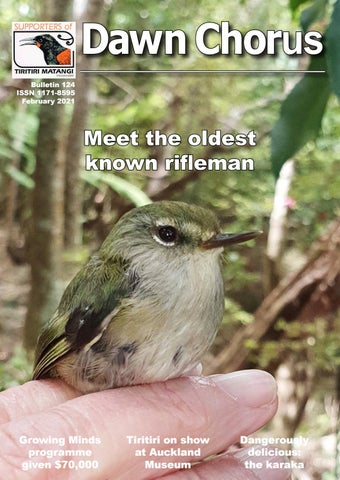
Dawn Chorus Bulletin 124 ISSN 1171-8595 February 2021
Meet the oldest known rifleman
Growing Minds programme given $70,000
Tiritiri on show at Auckland Museum
Dangerously delicious: the karaka
Chairchat
Let's all keep up the good work Happy New Year and welcome to 2021. Let’s hope the coronavirus will be brought under control or eliminated this year once vaccination is in place. While New Zealanders are in the amazing position of being able to move around freely and socialise over the holidays, we do feel for our members who are in countries that have strict lockdowns. It will be great to see overseas visitors back and enjoying the Island. The pandemic has had a major impact on visitor numbers and work on the Island, but it also created some significant opportunities, as outlined to members at the October AGM. The use of virtual meetings via Zoom, for example, has enabled people to attend events they might not have been able to take part in before. Our relationships with our strategic partners have been strengthened as we sought ways to find solutions and ways to deal with the crisis. We are looking forward to seeing the new membership system and the new website up and running soon. I would personally like to say thank you for all the hard work those involved have been doing over the last 12 months. The Social Media team is doing great marketing for the Island and it’s pleasing to see that, not only are the Fullers 360 ferries getting good numbers of domestic visitors, but shop sales in OctoberDecember are nearly as high as last year. Work continues on our major projects. Just before Christmas, fundraiser Juliet Hawkeswood found a Lotteries fund designed to assist projects over $4m; it appeared to be a good fit for the Field Centre so we put in an application. Unfortunately the fund was oversubscribed by nearly six-fold and we missed out. Juliet is now looking at possible funding sources for the Signal Mast. Luca Kornélia Kósa is assembling a virtual model of the proposed Lighthouse Museum so we can submit a new application to Auckland Council. Let’s hope we can keep the momentum going and that our borders are able to keep the virus out so that we can continue the good work. Carl Hayson
2
WORK IN PROGRESS: Curator Josie Galbraith points to the old spade which will be the centrepiece of the Tiritiri exhibit at the museum. Photos / Jim Eagles
Tiritiri Titbits
Museum tells Tiritiri's story The remarkable contribution that Tiritiri volunteers have made, not only to the restoration of the Island but also to the way conservation is done generally, is being highlighted in an exhibit at Auckland Museum which opens on 11 March. The work of the Spade Brigade, and how it inspired a change from the view that conservation should be left to scientists, to the modern community-led movements which have achieved extraordinary things on the environmental front, is one of 67 stories which will be told in a brand new gallery designed to highlight tales of Auckland and its people. Jane Groufsky, one of the project curators, said the aim was to have stories on a range of subjects, including natural history successes like Tiritiri and its volunteers; early settlers such as the Ah Chee Family, who were influential in market gardening and then supermarkets; and significant places such as Maungakiekie. ‘Getting ideas wasn’t a problem,’ she said. ‘The hardest thing was what to leave out. We started with a long list and had to whittle it down.’ Natural science curator Josie Galbraith, whose family has a long history with the Island, said stories were looked at from the perspective of their impact on Auck-
land ‘and in terms of the natural world Tiritiri’s volunteers had a huge impact not just in New Zealand but around the world. It changed the way conservation work is looked at and introduced the concept of people power.’ Perhaps most importantly, she added, it became clear that it was a story with real significance in the present. ‘It’s a really good time to look at the success of the Tiri project and what it can tell us about how we might deal with some of the huge issues that face us now.’ To illustrate this the curators chose three artifacts: a preserved tīeke, originally from Tiritiri, which was already in the museum’s collection; a nest box donated by the Supporters which was due to be replaced; and a planting spade identified by Ray Walter as one of the originals. Jane, who is a history curator, said the spade was a particularly effective choice. ‘It is an historical object which looks really interesting – it is well worn and obviously well used – and it links really well to the story of people power. Plus we were looking for objects we could put in the display case which would attract attention – it’s easy to imagine people saying, “Why is a spade on display?” and lead into the topic.’ In the display case with those items are
Cover photo of the oldest recorded rifleman by Simon Fordham. Dawn Chorus 124 February 2021
DAWN CHORUS: Curators Jane Groufsky and Josie Galbraith play with the giant buttons which produce Tiritiri bird calls. a couple of photos of trees being planted, members of the Spade Brigade ready for action and before and after shots of Lighthouse Valley, from the SoTM archives, to illustrate how much has been achieved. In addition, the sound of Tiritiri is introduced by a wall with a series of large buttons, each with a picture of a different bird, which people can push to hear its call. Best of all, said Josie, ‘you can press them all at the same time and get the sound of the dawn chorus. But to do that you need several people working together, which follows through the theme that many hands together can achieve great things.’ The power of TiriKids As reported in the November issue of Dawn Chorus, Eilis Galuszewski, who has produced the TiriKids pages for the past three years, has decided to step down. Following that news a couple of people made inquiries about what was involved but so far no one has offered to take it on. As a result, the TiriKids page in this issue is the one which ran in the first issue edited by Jim Eagles in 2013. And by an amazing coincidence it was produced by none other than the Josie Galbraith who now works at the museum. Looking back eight years, Josie said, ‘Putting together the TiriKids page was a wonderful way to bring together my interests in science, conservation, art, and outreach. I enjoyed the challenge of creating different activities that supported the mahi
www.tiritirimatangi.org.nz
happening on the Island. It was also particularly nice to receive positive feedback about the page from Tiri kids themselvesand some of the bigger kids among the supporters!’ If you’d like to follow in her footsteps by producing TiriKids please send an email to editor@tiritirimatangi.org.nz. Updating our story The long-awaited update of the Tiritiri story is on its way, and author Anne Rimmer (shown below with the new book) promises it will be a fitting follow-up to her original book Tiritiri Matangi: a Model of Conservation, which won a Montana Book Award in 2005.
The new book is titled Tiritiri Matangi 2005-2020 and contains all new information and photos, bringing the story of the Island fully up-to-date. Designer Jacinda Torrance, of Verso Visual Communications, has managed to fit in over 100 beautiful photographs. The new book is the same dimensions as the old one but at 88 pages is about half the thickness. By now it may even be available from the Tiritiri shop for $35. There is also a chance that Tiritiri Matangi: a Model of Conservation, which has been out of print since 2018, will be reprinted this year. Fundraising success Several projects on the Island have benefitted from grants and sponsorships over the past few months thanks to the work of fundraising coordinator Juliet Hawkeswood and her team. The most significant is a $70,000 grant from the Joyce Fisher Charitable Trust towards the cost of SoTM’s educational work and the Growing Minds scheme (see story on page 5). Other recent support includes: Mowing in comfort: A new Walker ride-on mower has arrived on the Island, replacing the old model which was struggling to do the job. The cost of $22,000 was partly met from a $10,000 grant from Pub Charity, and also by an offer from the Stihl Shop to take the old mower as a trade-in. The new model makes a wider cut and is more fuel efficient, so it will do the job quicker, cheaper and with fewer emissions. Cheers to the kōkako: Local bever-
3
age company, Native Hard Sparkling, has agreed to sponsor the kōkako monitoring programme. The company, which manufactures low alcohol fruit-flavoured seltzers, has added two of our kōkako, Noel and Rehu, to its 100 Club, which seeks to support 100 individual native birds. The funding for Noel and Rehu will cover 20% of the annual cost of the monitoring work. Tūī lend a hand: Tūī have long been an important part of the Tiritiri experience and now the Island is benefitting from their sale. Toy maker Dodoland has offered to give 40c for every tūī model sold in New Zealand (see them in the advertisement on the back page). Dodoland founder Hoon Kim has visited the Island regularly and is keen to 'support organisations that make a difference’. Originally a computer graphics specialist, he became concerned at the damage done by plastics and decided to use his skills to invent a nature-friendly toy. The resultant cardboard puzzles, featuring native birds, whales and dinosaurs, are cut out in a converted garage at his home in Whangarei and sold around the world. SoTM Subcommittees Subcommittee membership has been rejigged following the AGM: Biodiversity – Simon Fordham (chair), Hester Cooper, Malcolm de Raat, Morag Fordham, Diane Fraser, Mel Galbraith, Margie Luby, Andrew Nelson, John Stewart, Roger Wallace, Michael Watson. Employment – Carl Hayson (chair), Jill Courteaud, Karen O’Shea, Val Smytheman. Infrastructure – Carl Hayson (chair), Malcolm de Raat, Danielle Hefer, Ian Higgins, Luca Kornélia Kósa, Ray Walter. Special Projects – Peter Lee (chair), Brian Chandler, Simon Fordham, Carl Hayson, Ian Higgins, John Stewart, Ray Walter. Visitor Experience – Helen Bucksey (chair), Toni Ashton, Stacey Balich, Barry Fraser, Chris Hannent, Mary-Ann Rowland, Derek Tearne, Jane Thompson, Carol Wildermoth. Education Advisory Group – Barry Fraser (chair), Cathy Catto, Sonya Galbraith, Eilis Galuszewski, Barbara Hughes, Liz Maire, John Sibley. Photographic safeguards SoTM has agreed on an image policy aimed at safeguarding the rights of all the wonderful photographers who allow their pictures to be used to publicise the Island and appear in social media, Guidelines and Dawn Chorus. The policy aims to define the ground rules for images given to SoTM for general use and the situations in which further permission from photographers is required.
4
YOUNG SCIENTISTS: The latest primary schools conservation awards sponsored by Fullers 360 and SoTM saw the junior prize go to Dylan Lewis, a Year 7 pupil at Mahurangi College in Warkworth, shown (at left) receiving the award from actingprincipal Christina Merrick. Dylan was inspired by a talk from Forest & Bird to protect the dotterel population at Snells Beach by trapping their predators. The senior winner was Amelia Joy Simmonds, a Year 8 pupil at Michael Park School, Ellerslie, who used the time off during lockdown to study monarch butterflies. By careful observation she confirmed the hypothesis that butterflies develop more slowly when temperatures are low and so spend more time in the chrysalis. Starring on social media Tiritiri’s social media profile has been given a lift as a result of a drive led by Stacey Balich. This follows a brainstorming session by the social media team which set a goal to achieve 10% growth in likes on Facebook during 2020. In the event, Stacey says, ‘we achieved 12% growth with likes coming from New Zealand and all around the world.’ Due to the absence of overseas tourists, the team focused on increasing engagement in New Zealand by contacting local tourism and government organisations and asking them to share Tiritiri posts. As a result, she says, ‘The number of Facebook followers from Auckland increased by 12% and from Wellington by 24%. The number of followers also increased hugely on Instagram.’ The team posts three or four times a week and some reach 12,000 people on Facebook and 5,000 on Instagram.
Beautiful graffiti The toilet block mural had faded in the bright Tiritiri sun and so has been repainted. The original artist, Dan Tippett, came over to remove his old mural and paint a bright, beautiful new one. Kaumātua will be missed Ngati Paoa kaumātua George Kahi, who led his iwi's hui to Tiritiri last year, has died in Christchurch, aged 70. Barry Fraser says, 'George greatly impressed the SoTM team with his wry humour and gentle wisdom when he talked about our developing partnership and the future. He worked tirelessly for his people, involving himself in many projects, and will be sorely missed by the iwi. Tiritiri will also miss his knowledge and guidance in establishing cultural conservation of our motu. The iwi will carry on his mahi, and we will work with them.' VISITOR INFORMATION: Wetland Bird signs like these have been installed at the Wharf Dam – which is not very wet at the moment – and the Silvester Wetland. Photo / Stacey Balich Dawn Chorus 124 February 2021
LIFE-CHANGING: Guide Martin Sanders points out birds to an excited group from Tapora School.
Photo / John Sibley
Using the magic of Tiritiri to expand students' horizons SoTM's hugely successful Growing Minds programme, which has allowed nearly 6,000 students from low decile schools to visit the Island, has just been given a $70,000 grant from the Joyce Fisher Charitable Trust to cover its costs and those of the wider education strategy for another year, writes Jim Eagles. When SoTM launched its Growing Minds programme at the end of 2012, to assist lowdecile schools to come to Tiritiri Matangi and experience its inspirational environment, evidence of its value was not long in coming. Former guiding and shop manager Mary-Ann Rowland still gets emotional when she remembers how, during one of the very first Growing Minds visits, a Pacific Islands parent ‘came into the shop and walked up to the counter with one of our $10 tiles in his hand and with tears in his eyes he said, “I never want to forget this day. I was brought up in the Islands and this is what my everyday experience was like. I never thought my kids would be able to experience this.” ’ Similarly, Island guide Alison Hunt recalls vividly what a pleasure it was to watch the first Growing Minds students experience the Island. ‘The ecology was important to them but the total experience went much further. I’ll never forget one young boy in his togs racing down to Hobbs Beach yelling, “This is Paradise!” ’ In the eight years since then nearly 6,000 students, plus teachers and parents, have visited the Island thanks to Growing Minds, and that same magic continues. At the end of last year, for instance, a big group of Year
www.tiritirimatangi.org.nz
10 students from Auckland Girls’ Grammar made the trip and the school’s head of science, Michal Denny, reported afterwards, ‘We had an amazing day! Many of the students who came have never been on a ferry before, let alone been to Tiritiri Matangi. Quite a few have never been outside of the city and into a natural environment. Given the socio-economic background of our families we would not be taking students to Tiri if they had to pay for it. So the Growing Minds fund allows us to provide students with an amazing opportunity that they may never otherwise experience.’ Look through the programme’s files and that same message occurs again and again in the feedback from schools and in Facebook posts by teachers and pupils: visiting Tiritiri is an incredibly valuable experience, on many levels, which wouldn’t be possible if it wasn’t for Growing Minds. So how did this programme come about? Well, it was due to the serendipitous coincidence of the two women mentioned above, Mary-Ann and Alison, getting the same brilliant idea at the very same time. Schools had, of course, been visiting Tiritiri since the project began – several schools even organised trips to the Island in the 1980s to take part in the early tree planting – but they were almost all from wealthy
communities which could afford the cost. Mary-Ann, who retired last year after 12 years as guiding and shop manager, says she ‘woke up one morning with this fully formed idea in my head. I just thought, wouldn’t it be cool to be able to sponsor kids from low-decile schools to come to Tiritiri. I worked out a whole way it could be done, what we would sponsor, etc, and all we needed was money. ‘I spoke to the Visitor Experience Subcommittee and they were keen. We were tossing names round and Cathy Catto came up with the wonderful idea of Growing Minds and we all agreed it was the perfect name. But we still didn’t know how we could fund it and some of the first people I discussed that with were a bit negative. So I didn’t know what to do next.’ Happily the solution was very close at hand. Alison and partner Rob Docherty had started a company called Running Events with the aim of encouraging families to enter races – anything from 2km to half marathons – so they would hopefully discover the joy of exercise and come back year after year to do longer distances. They decided to give the profits from this venture to good causes and, from her time on the Island, Alison had an idea for a very good cause.
5
AMAZING: (from left) Guide Jean Goldschmidt has Sylvia Park School pupils entranced by the hihi nest in a display box on the Wattle Track; assistant educator Liz Maire shares a joke with a school group. Photos / Martin Sanders, Jim Eagles ‘While guiding on Tiri,’ she says, ‘I saw the difference trips to the Island made for schoolchildren. Often the high-decile school kids had visited with their families. But for low-decile children, it was usually their first trip to the Island and sometimes their first ferry ride or even their first bus trip into Auckland where they caught the ferry. I found it highly rewarding to guide these school groups with their enthusiasm and the sheer pleasure of the day out. So we decided to dedicate profits from a season to sponsor a thousand kids to visit the Island.’ It’s not hard to imagine the reaction when Alison went into the Island shop and explained what she had in mind. Mary-Ann, who was in her office, says, ‘I just rushed out and jumped on her. I told her what our plan was and she said, “That’s just perfect, that’s exactly what we want.” So they gave us $20,000 and they made so much money that year they gave us an extra $5,000. And from there it’s just ticked every box.’ With enough funding ensured to get Growing Minds launched, low-decile schools around Auckland were contacted and negotiations held with Fullers 360 about ferry fares. Then, on 29 November 2012, 60 pupils and about 10 teachers and parents from Papatoetoe Intermediate, led by teacher Rilo Summerville, became the first school to visit under the new programme. Mary-Ann recalls that visit with delight. ‘That group couldn’t have afforded to come normally. This is always a special place to visit, but for them it was extra-special. You could see it in their eyes. The teachers had
6
prepared them so well it was just lovely to see. It was beautiful.’ By the time the second Growing Minds school group arrived on the Island at the start of 2013, things had advanced even further with the appointment of Barbara Hughes to run the overall education programme, which the previous year had grown to 3,709 students. Barbara’s life story sounds as though it was always aimed towards becoming educator on Tiritiri Matangi. Raised on a farm in a largely Maori community, Barbara says she was a conservationist ‘since I was about three years old. Growing up on a farm I was always the odd one out looking at the birds and the animals.’ Almost inevitably she became a science teacher, her career embracing seven schools ranging from those in hard-up communities to posh independent schools. When the Tiritiri project got underway she was head of science and horticulture at Edgewater College and remembers organising a group of horticultural students to visit the Island to plant trees ‘but unfortunately the boat was cancelled – which was quite common in those days because they were smaller boats – so it never happened’. But she and husband Mick did visit Tiritiri in 1991 and were immediately hooked. Barbara started bringing out school parties every year. ‘Ray and Barbara [Walter] would do the guiding – each taking about 30 kids – and I taped them and wrote notes from what they said and presented them to the kids for their revision.
And it galloped from there. ‘Mick and I started to stay weekends to work on whatever they needed and then one day I came over on my own and when I got off the boat Barbara [Walter] looked at me and said, “You’re guiding.” I went, “But I haven’t . . .” “You’ve done enough. Guide!” So I did.’ In 2003 she got a Royal Society Teaching Fellowship which provided a year off to study the korimako, pōpokatea/whitehead, kākāriki and miromiro/tomtit that moved around between the Island and the mainland, during which she even organised an – ultimately unsuccessful – translocation of miromiro from the Hunua Ranges. Meanwhile, as well as continuing to guide and do odd jobs – ‘fill troughs with water, locate dead takahē’ – she started to work with Barbara Walter writing up educational material for school visits. ‘So,’ she observes understatedly, ‘when this job as educator came up I was well placed to get it. And when I started at the beginning of 2013 I took over this Growing Minds programme that Mary-Ann and Alison Hunt had put in place. ‘My first GM school was Wellsford, who brought 85 kids. They still come out, usually every second year, spread over two days. Over the years they have established a strong relationship with us and Tiritiri has become part of the school’s programme. ‘That has happened with several schools. The thing is, because we have Growing Minds it is possible for these low-decile schools to regularly bring 80-90 kids over Dawn Chorus 124 February 2021
here, which they couldn’t do otherwise.’ Over the years the reputation of Tiritiri’s educational programme has continued to grow. In Barbara’s first year as educator the number of people coming on school visits almost doubled to 6,821, including 317 under Growing Minds, about as much as could comfortably be handled. By 2016 former Department of Conservation officer Liz Maire was appointed as assistant educator to spread the burden. Since then it has remained hugely popular, with numbers fluctuating around 5,0006,000 a year. In 2019, for instance, school visits brought 5885 visitors – with Growing Minds funding 964 from 26 schools – in spite of 15 ferry sailings being cancelled. Last year, which was hit by the Covid-19 lockdown and the prolonged cancellation of ferries, the number of students fell to 2,056, but Barbara and Liz spoke to a further 1,483 through an outreach programme they developed to keep their work going. Things will be equally busy in 2021, with Term One already fully booked and Term Four almost full before the year began. Of course that success involves more than even the appeal of Tiritiri and the talents of Barbara and Liz. SoTM has also had to develop a growing pool of guides with the skills and training to show groups of energetic, often enthusiastic but occasionally ambivalent, youngsters round the Island. Then there’s the need to raise the funding to cover some $20,000 a year in ferry fares for schools covered by Growing Minds, around $50,000 for educators’ salaries and a bit more for outreach work and other costs. Barbara is convinced that ‘it was that wonderful early funding from Running Events that made it possible for Growing Minds to get off to such a good start. Without that it would have been much harder.’ Happily the money has kept flowing in. As Mary-Ann put it, ‘This is a project that ticks all the boxes: there’s conservation, kids, low-decile schools . . . it’s just something people want to give money to every time they hear about it. They just want to help.’ The list of donations to Growing Minds kept at the Island shop makes moving reading. Over the years scores of members, visitors, schools and groups SoTM works with have given amounts ranging from $20 to $3,000 which now add up to nearly $25,000. Former fundraiser Vincent Maire cajoled grants of $30,000 from DOC, $10,000 from Auckland International Airport’s Seven Days of Christmas fund, $5,000 from the Chartwell Trust and $5,000 from Fullers 360. But the biggest support has come from the Joyce Fisher Charitable Trust which in 2016 made a grant of $40,000 and in sub-
www.tiritirimatangi.org.nz
CLOSE-UP: (above) Auckland Girls' Grammar pupils enjoy a chance to see a little penguin in its burrow; (below) Barbara Hughes shows how to use magnifying glasses to see the structure of fruit, flowers and leaves. Photos / Jim Eagles
7
sequent years has given increasingly large amounts, and late last year new fundraiser Juliet Hawkeswood learned that the trust would be giving $70,000. SoTM chair Carl Hayson says, ‘The amazing support we’ve had from the Joyce Fisher Trust has been absolutely crucial to the success of both our overall educational work and the Growing Minds programme. One of our core goals is to use the story of Tiritiri Matangi to inspire future generations to continue the work of restoring our natural environment and we simply wouldn’t have been able to do that so successfully if it wasn’t for the help they’ve given over many years.’ In recent years JFCT grants have paid the educators’ salaries and ferry fares for GM students, while Fullers 360 has carried most of the teachers and parent helpers free. SoTM provides detailed advice on organising a visit, the guiding round the Island and an educational session at the Visitor Centre tailored to the needs of each group. Growing Minds doesn’t pay for the bus trip to catch the ferry, partly because that can be complicated, but also because Barbara believes ‘it’s human nature that if you make something completely free it’s often not valued’. The programme doesn’t provide food either, but in the information sheet sent to schools beforehand Barbara does ‘make a very strong suggestion that, because often there are children who don’t bring lunch, they bring back-up food – just a loaf of bread and a jar of Vegemite for sandwiches – and give it out on the trip back.’ Making all this happen has taken a vast amount of work – sometimes as many as 80 emails have to be exchanged with one school to sort the detail out – but Barbara is in no doubt that it is all worth while. Quoting just one of a myriad of examples on the education front, she says, ‘I had a friend who brought a group from Glen Innes School, which is Decile One, and she said the kids loved it because it was all so new to them. But it didn’t end there because the school used the trip in their science, they used it writing stories for their English, they used it in their music and their drama . . . so it just went on and on and on. This trip was a real focus for those kids.’ What has also become clear, she adds, is that ‘this is not just about the education and advocacy with the kids. It is also the parents and the teachers who come with them who are also learning about conservation. Perhaps even more importantly, they are picking up on this project which is run by volunteers and doesn’t have a lot of money but is still very successful. And that’s a valuable lesson in what can be done.’
8
INSPIRING: After visiting Tiritiri these pupils from Opoutere School created their own Bird Garden to encourage others to work to make the whole country a wildlife sanctuary. As student Wairararaua Noa-Paul put it, 'I know this seems like a massive challenge like climbing a mountain, but I also know once we reach it the view will be worth it. I would love to witness Aotearoa how it once was with flourishing native species. Come on! Join me in making Aotearoa a sanctuary again. Let’s make our unique country a pest free island.'
Inspired by visiting Tiritiri Matangi The feedback provided by Growing Minds students on their visits to the Island paints a picture of young people fascinated by what they saw and often inspired to do conservation work in the future. Here's a sample: Sylvia Park School •I am going to plant more trees to help the environment and birds. •I learnt new names of birds and trees and how they help the environment. • I would want to stop pollution and find ways to help animals from getting endangered or extinct. Kelston Girls’ College •Being able to go to an island only for birds is just wonderful and exciting. I love birds and hearing them happily talking and being free is a mood-lifter. •I am going to let people know that New Zealand native birds need help and our oceans need to be taken care of. •My highlight was listening to the birds singing and not the phone ringing. Konini School •I enjoyed searching for all the birds and listening to our guide give valuable information. •I plan to recycle, re-use, reduce and apply for volunteer work. • I learnt that Tiritiri Matangi has HEAPS of endangerd birds. Auckland Girls’ Grammar •My highlight was seeing the baby penguin with its Mum. •Eating one of the leaves from a tree there can make your mouth numb. •Seeing the island and experiencing an amazingly well-kept environment adds motivation to have that environment worldwide. Te Aho o Te Kura Pounamu •I learned that the morepork/ruru eat other smaller birds and their tags can be found in the ruru’s nest after being regurgitated. •I am going to continue recycling everything I can, and hopefully one day planting native plants. Dawn Chorus 124 February 2021
THE OLD AND THE NEW: (from left) Koto's chick after being banded; Morag Fordham provides a roost for the oldest titipounamu ever recorded. Photos / Alison Forbes, Simon Fordham
Fauna Notes
Lots of fledglings and a champion old-timer A busy breeding season for our birds is now slowing down. Some adults are moulting and will look increasingly scruffy during the coming weeks, while others still have active nests. The weather has been hot and dry, but thankfully not yet as dry as last year, and there has been plenty of nectar and fruit available for those that need them. Titipounamu/rifleman Once again, we have witnessed an abundance of nests in boxes, with plenty of evidence of natural nests too. By mid-January, family groups were present throughout the Island. Surveying throughout the season indicates a minimum of 75 pairs with many more likely. Banding of birds, particularly juveniles, has continued so as to add further knowledge to what we already know about rifleman longevity and dispersal. Of particular note were the captures of two males, on 30 December and 18 January, who were banded as adults on 23 August 2012. These birds are thus a minimum of nine years old and therefore likely to be the oldest riflemen ever recorded. An eightyear-old female (banded 22 August 2013)
www.tiritirimatangi.org.nz
also bred successfully this season, a likely record for female longevity. Hihi/Stitchbird The hihi breeding season has been a bit of a rollercoaster this year. To start with we had 64 females making breeding attempts, but unfortunately 13 of them disappeared, presumed dead, and so their nests failed. We were really struggling to figure out what had happened to them; a few were obvious ruru attacks (piles of hihi feathers found near the boxes) but surely not all of them went this way. Mhairi tested the sugar feeders for salmonella but the results came back negative. We may never find out what was going on, but happily the females have now stopped disappearing. Fledgling numbers at the end of the first clutches were quite low at 133. Hihi generally have the best success with their first clutches, so we were looking at a pretty mediocre season this time around. However, 43 females are having a go at second clutches. This is a very high proportion of the remaining females, so all is not lost it seems.
As the days get hotter and the flowers finish the sugar feeders are becoming an important food source again, so we are working hard to keep them replenished. We’re also being extra vigilant with our mite checks and treatment to give as many chicks as possible the best chance of making it out of the nest. We’re (very optimistically) hoping for another year of 200+ fledglings now and, if it happens, there will be a fivetier celebratory cake. Come on hihi, you can do it! Kōkako Although we started off this season with 15 pairs of kōkako, with the addition of Waitangi and Lyric, Pounamu and Tama, and Bátor and Dawn, we now have 18 pairs. Erenora and Yindi, who were both sexed as female, have also been together and so far have had two nests, though in January Yindi has been seen well away from their territory. All our pairs, apart from Bátor and Dawn, have attempted to nest, with some having more success than others. Shelly and Waipapa’s first nest was abandoned a few days after the chick was banded and predation is suspected. She
9
DINNER TIME: A clutch of hungry kākāriki chicks wait impatiently for Mum to serve dinner. has since had two more nests which she abandoned at egg stage.. Rehu and Noel’s first chick of the season has also been predated. Two pairs, Aquarius and Rakataura and Koto and Apato, have finally fledged one chick each for the first time. Honey and Rimu and Jenny and Slingshot also have one fledgling each. Te Rae and Chatters, Haeata and Hotu, Discovery and Sarang, and Phantom and Te Hari each fledged two chicks. As of mid-January, Pūtōrino and Sapphire, Pureora and Crown, Skye and Ocarina, and Wairua and Parininihi all had nests with chicks, while Te Rangi Pai (with Hēmi) and Waitangi (with Lyric) were incubating again after earlier failures. There are now no known single males on the Island, two known single females and one bird of unknown sex. Three young females missing since last season have not been seen. Takahē People often ask why we have only two pairs of takahē on the Island. Takahē naturally have quite large territories and their preferred habitat is open grassland. As the bush has regenerated on the Island the ideal habitat has reduced. By only having two pairs there is plenty of space, and they rarely come into close contact with each other. This leads to a relatively peaceful existence without the pressures of competition. It also means they are less likely to get injured, so no emergency trips
10
to the vets at Auckland Zoo. Even with only two pairs, due to our high breeding success rate (generally two or three chicks per year), the Island is considered by DOC’s takahē recovery team to be a breeding site rather than an advocacy one. The birds that we have here are also genetically valuable (rare) so our chicks are very important to the survival of the species. Our takahē continue to do well this season. The lighthouse family (Anatori and Tussie with their daughter Te Marino and their two chicks) are thrilling the visitors by making regular appearances. The chicks are growing fast and showing their adventurous spirits, and learning tricks from their big sister. The
BALLS OF FLUFF: Ruru chicks. Photo / John Stewart
Photo / John Sibley
northern family (Edge and Turutu with their one chick) are wandering throughout their territory and are being seen by lucky visitors. News from afar: Hana (Edge and Turutu’s chick from 2018/19) who moved to Mana Island last winter has settled in well and is raising a chick with her new partner Pukekohe. Many readers will remember Pukekohe as a son of Cheesecake and Te Mingi, hatched on Tiritiri in 2013 and moved to Tāwharanui for five years before going to Mana last year. Te Paea (Anatori and Tussie’s son from 2018/19) was released into the Murchison Mountains in the winter of 2019. He was seen during the 2020 post-winter survey and by all accounts is doing well in his mountain home. Ruru/morepork Ten nests were found this season, seven new sites and three which have been used in previous years. Unfortunately, the success rate was much lower than in the past. At the time of writing (mid-January) only two nests have produced fledged chicks (two chicks from the Bush 6 nest and one or more from the Bush 3 nest) and three others are still in progress. Four nests have failed, two at the chick stage and two at the egg stage. One female adopted a nest box in Stagnant Dam bush and sat there from 4 November until the 24 December, but without laying an egg. One pair took the risky option of Dawn Chorus 124 February 2021
nesting inside a drainage pipe under the Wattle Track. There can’t have been much rain during incubation as a chick was hatched. When the rain did come the chick was washed out of the pipe and was attended to by a parent in full view of visitors about two metres from the track. There was little chance of the chick surviving in the open, so it was moved a few metres downhill to a likely looking spot among some tree roots which both provided shelter from rain and was hidden from passers-by. The female parent immediately responded to the chick’s calls and settled down with it. All seemed well for at least a week, but the chick then disappeared. An adult bird was found back in the drainage pipe but no further eggs were laid. Kākāriki Nesting may have started a little later than normal, but we have a good total of 13 active nests from the 54 boxes. By midJanuary there were at least 33 chicks in six of the nests with more to come from the other seven. Chicks will have fledged from the more advanced nests by late January. Kākāriki nests can suffer losses from mite infestations in hot, dry weather postChristmas, so the later nests often produce fewer fledglings.
The mystery of the two tīeke nests and their constantly changing eggs Something odd has been happening in two of our tīeke nest boxes. When Barbara Walter checked a box in early December, two birds left as she approached. She found (as can be seen in the photo at top left) it contained six eggs (the normal number on Tiritiri would be two or three), and one of them was white (tīeke eggs are normally pale fawn with darker speckles)! When the box was checked again on 16 December there were just three eggs (photo at top right). The white one and two of the others were missing. When we looked back at the photo of the six eggs we realised that the other two missing eggs were also unusual – they had a mixture of dark and light patches rather than speckles. What appears to have happened is that two females chose the same box, one or both of them built a nest and both of them laid in it. Both incubated for a while, then one of them removed the eggs that were not hers. We assume she was able to tell which these were because of their appearance, though there may be other clues we don’t know about. Although the victorious female went on incubating the remaining eggs, they didn’t hatch. Shortly after the nest failed, a new one was built in a box just a few metres away, and both females moved in there. This time the maximum number of eggs recorded was five on the morning of 7 January, but it was down to four by that afternoon (photo at bottom left), two normal ones and two abnormal ones, including a very pale one. By 13 January there were just three complete eggs (photo at bottom right). The pale one had broken and its shell had stuck to the other abnormal egg. By the afternoon of the 21st, another of the normal eggs had disappeared and those that were left were cold. It looks like neither bird has won this contest.
Other wildlife A pod of orca visited the Island on 14 December and were captured on camera (above) by DOC ranger Talia Hochwimmer as they swam under the wharf. On 13 January a yellow admiral butterfly was seen at the north end of the Cable Track. Compiled by Kay Milton with contributions from Emma Dunning, Mhairi McCready, Morag Fordham, Simon Fordham and John Stewart.
www.tiritirimatangi.org.nz
11
HANDSOME AND TASTY: (clockwise, from left) Karaka flowers; green berries; ripening fruit; very ripe orange berries; karaka kernels ready for steaming; a Chatham Islands kopi tree with a dendroglyph. Photos / Warren Brewer
Flora Notes
Good enough to eat . . . if you're very careful The glossy green karaka is not only one of our most handsome native trees, it is also the source of an exceptionally nutritious tree nut, but this does require very careful preparation, writes Warren Brewer. Often described as one of New Zealand’s most handsome trees, karaka, Corynocarpus laevigatus, also carries the stigma of having poisonous kernels within its large fruits. Early Māori learnt how to treat the poison karakin in the kernels to make them safe to eat. They also caused the trees to be widely dispersed through both the main islands as well as the remote Chatham Islands, where the trees became venerated. This dispersal to cooler regions, where kumara plants struggle to thrive, guaranteed a reliable stored food source for the winter months. Karaka forms an evergreen tree up to 20m tall with a stout trunk 60cm in diameter. The leaves are thick, dark green and glossy. Flowering is from late winter to early spring, with tightly packed erect panicles of small greenish-yellow flowers. Some trees have flowers which are strictly female with sterile stamens. Other trees have male flowers, some of which are inconstant with functional ovaries, allowing them to bear some fruit. Botanists call this method of flowering gynodioecious. The large fruits develop in summer and ripen to an orange colour. They are eaten and dispersed by kererū. The flesh of ripe fruit is edible, with a taste similar to a dried apricot. It contains
12
the sugars glucose and sucrose, two fatty acids and six of the eight essential amino acids. Māori treated the kernels by first either baking or steaming in a hangi oven for up to two days. They were then placed in loosely woven bags and leached in running water, occasionally being shaken to remove their fibrous husks, plus any remaining pulp. After that they were sun-dried, supplying a stored food source second only to kūmara tubers. The kernels have a food value similar to oatmeal, providing protein, carbohydrate, fibre and fat. They also contain traces of manganese, iron, magnesium, zinc and selenium. It is said that Moriori took karaka seeds with them when they migrated to the Chatham Islands c.600 years ago. They called the trees kopi and created large groves. Some very old trees still exist with carvings (known as dendroglyphs) on their trunks, declaring ownership or revering an ancestor. Karaka leaves were used in traditional Māori medicine, rongoā, as wound dressings. The leaves have high levels of trace elements and have successfully been fed to cattle as pasture supplement. It is also noteworthy that ruminants (cattle, sheep,
goats and deer in New Zealand) can eat untreated karaka kernels without any ill effect. This is due to the presence of the bacterium, Denitrobacterium detoxificans, in their rumen, which metabolises the nitrotoxin karakin into harmless constituents. Karaka was considered to be the sole species in the genus Corynocarpus and was placed in its own family, Corynocarpaceae. Four new species were subsequently recorded in Australia, Papua New Guinea, New Caledonia and Vanuatu. The four new species are similar to karaka vegetatively but their fruit is different in colour, shape and size. The intriguingly named Australian Glenugie karaka, Corynocarpus rupestris, forms a tree 13m tall with leathery dark green leaves. Its fruit is a rounded shiny red drupe 1-4cm in diameter, often with a tiny point at one end. Similar to karaka, the ripe drupes are gathered and dispersed by columbiform birds. This tree was first found in dry rainforest on basalt boulder slopes of Glenugie Peak, a small mountain in south-eastern New South Wales. Karaka means orange colour (fruit). Corynocarpus means club-shaped fruit. Rupestris means growing on rocks. Laevigatus means smooth, polished (the leaves). Dawn Chorus 124 February 2021
Tiritiri Matangi 2021 Photographic Competition We’re now looking for entries for our photographic competition (and photos for our 2022 Calendar). The categories are: • • •
Fauna Landscape/Seascape Under 16 years old
• •
Flora People on Tiritiri Matangi
All photos must have been taken on Tiritiri Matangi Is. You retain image copyright and can enter up to four photos in each category. Entries close April 30, 2021.
Photo – Alison Forbes
www.tiritirimatangi.org.nz
Details and new image use policy are at: www.tiritirimatangi.org.nz Click on the link in the banner.
Photo – Kay Milton
13
Hand this to your kids – or pass it on to someone else’s kids – to enjoy a range of activities about Tiritiri Matangi Island
Hi guys, Join the dots to see who is enjoying the great view from Tiri. Colour in the picture when you are done. Have fun, Jo
1
2
3
14
4
Dawn Chorus 124 February 2021
Supporters of Tiritiri Matangi
Coming Events
The Supporters of Tiritiri Matangi (SoTM) is a volunteer incorporated society working closely with the Department of Conservation to make the most of the wonderful conservation restoration project that is Tiritiri Matangi. Every year volunteers put thousands of hours into the project and raise funds through donations, guiding and our Island-based gift shop. If you'd like to share in this exciting project, membership is just $25 for a single adult, family or corporate; $30 if you are overseas; and $13 for children or students. For further information see www. tiritirimatangi.org.nz or contact P O Box 90-814 Victoria St West, Auckland. Dawn Chorus, our magazine, is sent out to members every quarter.
6-7 March Supporters’ Weekend
SoTM Committee Chairperson: Carl Hayson chairperson@tiritirimatangi.org.nz, 027 3397105 Secretary: Gloria Nash secretary@tiritirimatangi.org.nz Treasurer: Peter Lee treasurer@tiritirimatangi.org.nz Committee: Stacey Balich, Hester Cooper, Barry Fraser, Danielle Hefer, Ian Higgins, Malcolm de Raat, Jane Thompson, Ray Walter and Michael Watson. Acting guiding and shop manager: Annette de Raat guiding@tiritirimatangi.org.nz, 09 476 0010 Membership: Rose Coveny membership@tiritirimatangi.org.nz Educator: Barbara Hughes-Cleland Assistant educator: Liz Maire educator@tiritirimatangi.org.nz Fundraiser: Juliet Hawkeswood fundraiser@tiritirimatangi.org.nz Social Media: Stacey Balich socialmedia@tiritirimatangi.org.nz Dawn Chorus editor: Jim Eagles editor@tiritirimatangi.org.nz Island rangers: Talia Hochwimmer and Emma Dunning tiritirimatangi@doc.govt.nz, 09 476 0920
15 March SoTM Social, 7.30pm, Quiz Night, to be held at the Fickling Centre, 546 Mt Albert Road, Three Kings. 2-5 April Easter Working Weekend 30 April Photo Competition closes 15-16 May Supporters’ Weekend 5-7 June Queen’s Birthday Working Weekend Supporters’ Hosted Weekends are led by guides who show off the Island’s special places. Reduced price on the ferry and half price in the bunkhouse. Children welcome. Working Weekends are a chance for members to give the Island a hand. Travel is free, as is accommodation in the bunkhouse. Book through guiding@tiritirimatangi.org.nz
Visiting Tiritiri Matangi Island for education or recreation Day trips: Fullers 360 runs a return ferry service every Wednesday through Sunday from Downtown Auckland and the Gulf Harbour Marina. Bookings are essential. Phone 09 367 9111 or visit www. fullers.co.nz/destinations/tiritiri-matangi-island/. Call 09 916 2241 after 6.30am on the day to confirm the vessel is running. School and tertiary institution visits: The Tiritiri education programme covers from level 1 (5-year-olds), to level 13 (17-18-yearolds), to tertiary students. The focus in primary and secondary areas is on delivering the required Nature of Science and Living World objectives from the NZ Science Curriculum. At the senior biology level there are a number of NCEA Achievement Standards where support material and presentations are available. For senior students the Sustainability (EFS) Achievement Standards are available on the NZQA website. There is huge potential in that these standards relate directly to Tiritiri in various subject areas: science, economics, tourism, geography, religious education, marketing, health and physical education. The Island also provides a superb environment for creative writing, photography and art workshops. Tertiary students have the opportunity to learn about the history of Tiritiri and tools of conservation as well as to familiarise
www.tiritirimatangi.org.nz
themselves with population genetics, evolution and speciation. Groups wishing to visit the Island should go to www.tiritirimatangi.org.nz/ schoolvisits.htm or contact schoolbooking@tiritirimatangi.org.nz. Bookings are essential. Overnight visits: Camping is not permitted but there is limited bunkhouse accommodation at $15 a night for members and $30 for non-members. Bookings are essential. For further information go to www.doc.govt.nz/tiritiribunkhouse or phone the Department of Conservation on 09 379 6476. Supporters’ discount: Volunteers who are undertaking official SoTM work get free accommodation but this must be booked through the Guiding and Shop Manager at guiding@ tiritirimatangi.org.nz or 09 476 0010. SoTM members visiting privately can get a 50% discount but must first book and pay on line. Then email aucklandvc@doc.govt.nz giving the booking number and SoTM membership number (which is found on the address label of Dawn Chorus or on the email for your digital copy). DOC will then refund the discount to your credit card.
15
Create a Dodoland menagerie Puzzle toys designed to entertain the kids, intrigue the adults and be nature friendly
Clean up yourself and the planet
$15 each Have you made the move to shampoo bars yet? We love them! Not only can they save you money, and the environment from plastic, but they also work really well. Only $11 for a twin pack
Supporters of Tiritiri Matangi wishes to acknowledge the generous support of its sponsors
Supporters of Tiritiri Matangi welcomes all types of donations, including bequests, which are used to further our work on the Island. If you are considering making a bequest and would like to find out more please contact a member of the committee.