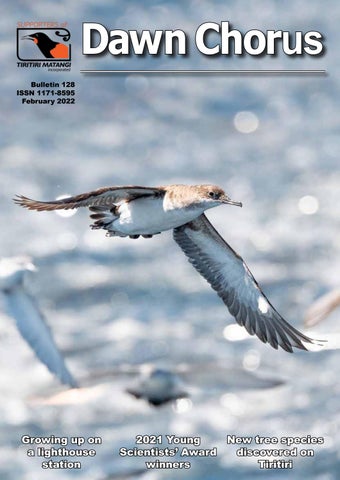
Dawn Chorus Chorus Bulletin 128 ISSN 1171-8595 February 2022
Growing up on a lighthouse station
2021 Young New tree species Scientists’ Award discovered on winners Tiritiri
Happy New Year to everyone. I hope everyone has had a chance to enjoy the summer free of the constraints that we had been under in 2021. (Apologies to our members in the Northern Hemisphere.) Visitors have flocked to the Island to enjoy the fine days we have been enjoying here and to view the spectacular wildlife. Thanks to Annette, Fullers, DOC and all the guides for their efforts during this time and it’s great to read the wonderful comments on Tripadvisor. Despite the Delta strain, we had several highlights in 2021 including the new website, webcam installation, membership system upgrade and the first Virtual AGM. We farewelled two committee members, Ian Higgins and Danielle Hefer and welcomed Rachel Goddard and Valerie Lee to the Committee. I am impressed by the depth of knowledge and ability we have in the Committee and on the Subcommittees and they all continue to work hard for the Island project. However on a more sombre note, as previously advised, the editor of the Dawn Chorus, Jim Eagles, passed away in December after a short illness. Our thoughts are with his wife, Chris, and family. An obituary for Jim is on page 5 of this edition. Jim will be sorely missed and hard to replace. However we are fortunate that Simon Fordham, a former editor of DC, has been able to step in and fill the gap until a new editor can be found (see advertisement in this edition).
Algal bloom colours the Island’s shoreline Last November, not for the first time, a tide-line of red algae presented itself on the shores of Tiritiri. Algal blooms like this do occur from time to time and usually comprise a number of species. Some of these are harmful to fish and other marine organisms although most are non-toxic to humans. Also known as sea-sparkle, these algae are also responsible for magnificent nocturnal displays of bioluminescence when disturbed. Anniversary Working Weekend A bunkhouseful of enthusiastic volunteers participated in the working weekend projects, some new faces, some regulars and a couple of returnees from way back. In recognition of the warm and humid temperatures, Anniversary Weekend tasks are intended to be less physical, and in shadier environments, than at other times of the year. Despite this, much was achieved including: • Repairs to, and tree-clearance from around, the aviary • Vegetation trimming alongside tracks • Kawerau Track boardwalk repairs • Seat repair on Wattle Track (Ruru Seat) • Painting inside Maritime Museum • Installation of new sign on Pa link from Kawerau Track Thanks to all involved! Our endangered reef heron Tiritiri Matangi Island is often referred to as an island where visitors can view some of our endangered bird species. However, there is only one species on Tiri that is classified as ‘Nationally Endangered’, and it is one that is not often seen – the reef heron (Egretta sacra). The reef heron has been known to breed around the Island, evident when a family of four was seen near the wharf some years back. Being a bird of rocky shorelines, and with much of Tiri’s coast being inaccessible, sightings are few and far between. A single bird was seen at the north end of Hobbs Beach in January.
Looking forward, 2022 looks to be an exciting year with new staff coming on board, a variety of building projects planned, new signs, and several Biodiversity initiatives in the offing. Members will be updated on these developments as the year progresses. Finally, it looks like the virus, reinvented as the Omicron variant, is coming to interfere with us yet again. Committee meetings will have to be conducted by Zoom and the Social/EGM planned for March will need to be cancelled because of safety reasons. The main thing is for our members to stay as safe as possible and let’s all get through this so we can get back to new normal. Take care. Carl Hayson
Photo: Geoff Beals
2022 and The Path Forward
Tiritiri Titbits
Red Tide
Chairchat
Cover Photo: Fluttering shearwater - Puffinus gavia © Edin Whitehead
2
Dawn Chorus 128 February 2022
Photo: Geoff Beals Red Tide Reef heron
Photo: Simon Fordham
The New Zealand Threat Classification System is used to assess the threat status of our taxa and is reviewed every five years. Two of our introduced species, the hihi and the takahē, are classified as ‘Vulnerable’ whilst the kōkako, saddleback and little spotted kiwi are now classified as ‘Recovering’.
EGM Postponed Due to the uncertainty created by the Omicron outbreak and the restrictions on gatherings under the Covid-19 Protection Framework, the EGM and get-together, to have been held on Tuesday 15 March, has been deferred. The constitutional changes that would have been discussed at the EGM will now be on the agenda at the AGM, to be held on Monday 19 September 2022.
SoTM Working Weekends Did you know that Auckland Anniversary / Easter / Queen’s Birthday and Labour weekends are all SoTM volunteer working weekends? These are not only a great opportunity to contribute to the many work programmes on the Island, you will get to mix and socialize with others of like mind, particularly during the pot-luck dinner each evening. The comradeship is legendary! There is always time available to enjoy the Island, including a search for kiwi and tuatara after dinner. Tasks begin at 1.00 pm on the day of arrival and continue through Sunday afternoon. Mondays are optional (after the bunkhouse clean-up). The ferry fare is complimentary, as is the accommodation, courtesy of Fullers and DOC. Now is the time to book for Easter, and it is not too soon to book for Queen’s Birthday Weekend. To register your interest, email Annette: guiding@tiritirimatangi.org.nz Note: If working weekends are over-subscribed, participants will be selected and notified around four weeks beforehand. www.tiritirimatangi.org.nz
3
Restoring a National Icon
Text: Carl Hayson Photos: Martin Sanders
The Tiritiri Matangi lighthouse, situated prominently on the south end of the Island, is an important drawcard to visitors to Tiritiri Matangi. It is easily recognised as a representation of the restoration of the Island undertaken by volunteers and was part of the WWF logo we used on the shop products in the early days. It is also classified as a Category A historic structure by Heritage NZ. Now that the revegetation and fauna introduction programmes are largely complete, we have become aware that the lighthouse is in need of urgent restoration itself. Recent photos show the extent to which the interior and exterior of the tower have rapidly deteriorated due to rust and water damage because of condensation and also the lack of any ongoing maintenance.
It could be argued that the restoration of the lighthouse is not a problem for the Supporters, but I don’t think anyone wants the structure to rust away beyond repair. The problem is the lighthouse is owned by Maritime NZ (not DOC) and they have funding constraints for all historic towers owned by them in New Zealand. In conversation with MNZ, it has become apparent that there is no capital available for painting the exterior in the immediate future and the interior would not be touched.
report, gained letters of support from the various stakeholders and applied for funding. I am pleased to report that our Grants Coordinator, Juliet Hawkeswood, has been successful in obtaining a $261,000 grant from the Lotteries Heritage Fund which covers most of the cost of the restoration. We have been able to advise the contractors of this and they are due to begin work in April 2022 and the work should be completed by late June 2022. The Supporters can then be very satisfied with another successful mission accomplished and we will plan an open day soon after.
Some of us are concerned that future open days, where visitors are allowed inside the tower, would be jeopardised, and the look of a rusting structure doesn’t fit well with an island restoration project. Since Section F of the objectives of the constitution allows us to undertake all other things on the Island, we decided to step in and invited contractors to quote for the interior and exterior de-rusting and painting. We then commissioned an independent architectural
4
Dawn Chorus 128 February 2022
Jim Eagles (1945-2021) It was with much sadness that, a few days before Christmas, we learnt of the passing of Dawn Chorus editor, Jim Eagles, after a short illness. A lifetime as a journalist saw Jim holding various roles for a number of publications, including Waiheke Island's Gulf News, National Business Review, The Auckland Star and The New Zealand Herald. For many, Jim will be best remembered as the Travel Editor for the Herald, a position he held for the last eight years of his career. It was during this time that he wrote of his visits to Tiritiri Matangi, speaking fondly of his experiences with the Island's avifauna, in particular, the kōkako and Greg the takahē. Jim also spoke highly of the many volunteers that have made the Island what it is today. When he retired from the Herald in 2012, Jim actively pursued his environmental interests. Over the next few months he assumed magazine editorship for both Pūkorokoro Miranda Naturalists' Trust and Supporters of Tiritiri Matangi. As the longest serving editor of Dawn Chorus, he produced 35 bulletins of the highest quality. During this time, he oversaw the introduction of a digital option for readers, something that has long been requested by members who wished for a more environmentally-friendly option. Jim's other retirement achievements included coordination of the PMNT Pacific Golden Plover project and initiation of the Devonport brood of 'The Flock', a national campaign which saw the placement of painted, wooden birds at various sites to highlight the plight of our migratory shorebirds. Some of our members will have also known Jim, and wife Chris, as keen members of the Kōkako Monitoring Team on Tiri.
Photos: Martin Sanders
Our heartfelt condolences go to Chris, Alex, Victoria and all of the Eagles family. Rest in Peace, Jim.
www.tiritirimatangi.org.nz
5
Fauna Notes
Old birds still going strong It has been a frustrating season so far for some of the bird-monitoring teams who, due to Auckland’s lockdown, were unable to start work until mid-November. A huge effort since then has enabled the kōkako and rifleman teams to more or less catch up, while those who monitor tīeke, kuaka/ diving petrels, ruru/morepork and kororā/ little penguins have to accept that the data from this season will be seriously depleted. Fortunately, the hihi team have been present throughout and, due to the permanent presence of the rangers, the takahē have also been closely watched.
have seen in previous years. Nevertheless, as of 5 February, 153 chicks have been banded and 136 of these have fledged. There remain six nests with chicks still to be banded and seven with banded chicks. We have entered our end-of-season clean up phase and are aiming to complete our post-breeding survey at the end of February.
Our other pairs have all nested with varying degrees of success. At 24, our oldest kōkako Te Hari, with his mate Phantom, has a fledged chick. Waipapa and Shelly have finally succeeded and have one fledgling. For the second year running Parininihi and Wairua have been successful. Last year they had two fledglings and this year, although they did have two nestlings, only the much bigger of the two has fledged. One of our younger pairs has two fledglings but these are unbanded as the nest was far too high to be safely accessed. Two other pairs also have one fledgling each.
After a wet start to the spring, high temperatures since November have had an impact. Parts of the bush are wilting and some of the ponds have dried out. If this continues it could curtail the breeding season for some species. Takahē The two families of takahē are doing well, though sadly only one of them has chicks this year. Edge and Turutu had two attempts at nesting, but unfortunately both failed. The first eggs didn’t develop, and the second nest was abandoned about 10 days before the due hatching date. This leaves a family of three at the northern end, as last year’s chick Moke is still with her parents. The lighthouse family have hatched another two chicks, so there are now six birds: parents Anatori and Tussie, sub-adults Pukunati and Kanorau Tīrama and two chicks. After hatching in early November, the chicks were kept hidden for the first couple of months with only a few lucky people managing to spot them darting through the long grass. Now they are getting bigger they are venturing further afield and are regularly seen by many visitors. They are currently in their gangly phase, losing the black down, growing their first coloured feathers, and gradually growing into their long legs and enormous feet. Hihi/stitchbird The breeding season started quite late for hihi and so far hasn’t been as successful as in recent years. We have still been following 65 females through their breeding attempts, including numerous first-year females. We have lost a few nests due to those pesky mites that like hihi much more than hihi like them. The mites seem to be overcoming our preventative treatment earlier than we
6
period. Since our return to the Island we have established that we have 19 pairs of kōkako. This includes Erenora and Yindi, our female pair who again built a nest and laid eggs, which of course didn’t hatch. Recently a young male, Tātākī, has joined them. With the disappearance of Pounamu last season, Tama has paired up with a young female, Te Hia, who has built a nest but hasn’t used it.
Hihi chick
Photo: Freya O’Sullivan
As indicated in November’s Fauna Notes, hihi monitoring has been continuous since September despite Auckland’s four-month lockdown. In early December, Mhairi and Freya took over from Debs Smith and were later joined by Emma Gray. Constant monitoring is essential to stay on top of the numerous checks that need to be carried out at the various stages of nest-building, egg-laying and chick-rearing.
As of 5 February, there are four chicks still in nests. Te Rae (partner of Chatters) had a brood of three nestlings – as far as we know this is a unique occurrence on Tiritiri – but the two smaller ones must have died early on. Jenny and Slingshot have one nestling and Discovery and Sarang have two nestlings.
The banding of the first chick this season took place on the first day of the new Covid 19 Protection Strategy, the so-called ‘trafficlight system’. To mark the occasion he was fitted with a green PIT tag on his left leg and orange and red bands on his right leg! All the Island’s sugar-water feeders have now been equipped with data loggers to read the PIT tags worn by all recentlybanded hihi. This enables us to see which feeders they visit, how often, and for how long. Now we can expose the sugar water fiends, and follow the less frequent users to find out what they are consuming instead. Kōkako Due to the Covid restrictions we missed the first six weeks of the breeding season and can only surmise what happened over that
This 9-year-old female rifleman was banded as an adult in August 2013
Photo: Simon Fordham
Dawn Chorus 128 February 2022
olds, have not only survived another year but both have again ‘sired’ offspring. • Our oldest known female was caught (for the fifth time). She is now 9 years old and has also bred again. Interestingly, at 7.75 grams, she is around the upper limit for rifleman weight. • One family of birds was discovered only 80m from the end of the Ngāti Paoa track – about as far north as the bush extends on Tiritiri. • One nest was abandoned, with 2 eggs, after a wētāpunga decided she had squatting rights within the nest cavity. Other birds It seems that this year much of the tīeke nesting activity happened before we were able to begin our regular monitoring of the nest boxes. Only six active nests were found and, while another five boxes had plainly been used, we don’t know how productive they were. This is unfortunate in light of a possible decline in the population as indicated by the annual transect surveys. We will have to wait for the results from this year’s survey, taking place in February and March, to get more information. We only got back to the Island in time for the very end of the kuaka/diving petrel nesting season. About 10 of the 21 nest boxes were used this year but only five chicks were banded as some of them had fledged by the time we got there. It was a similar story for the ruru monitoring with only 8 nesting pairs found, a bit below the typical 10 we usually follow. Two of the nests failed, only one of the others is known to have had two chicks, while the remainder had one or two. What data we have suggest a less successful year than usual.
Te Rae and Chatters' nestlings Some of our other pairs have lost chicks in the nest, probably due to predation, and one pair abandoned their nest which was later found to contain two dead chicks. As it has been very hot and humid we wonder if the chicks succumbed to the heat. Although a couple of the females who have had failed nesting attempts have now built new nests, they have not used them yet, and this could also be due to the hot, humid weather. Titipounamu/rifleman Although lockdown restrictions prevented
www.tiritirimatangi.org.nz
Photo: Kathryn Jones
us from conducting any meaningful survey of pairs, riflemen are clearly doing well on Tiritiri, to say the least. Between 22nd December and the end of January, 92 new individuals were caught and banded, a clear record for the same period in previous years. Fifty-four of those were juveniles.
Kororā/little penguin monitoring got under way in August but was soon interrupted by Covid restrictions. There were early indications of nesting but most of those attempts had probably fledged by the time we restarted. There were probably nine chicks from five nests. Currently (late January) we have one bird with a chick in the inland display box and two moulting adults in the other display boxes. Also there is an egg in one of the wooden nest boxes and a moulting bird in another.
Points of note include: • Confirmation that riflemen can live for 10 years. Both of the males featured in the February 2021 Dawn Chorus, as 9-year-
Compiled by Kay Milton with contributions from Emma Dunning, Emma Gray, Morag Fordham, Simon Fordham and John Stewart.
7
Spotless Crake on Tiritiri Last October, Jim Eagles received the following email from Dick Veitch. Dick has a long association with Tiritiri, having spent his working career with the New Zealand Wildlife Service and the Department of Conservation: I had always presumed that spotless crakes arrived on the Island after we eradicated the rats in 1993. However, in my follow-up of a 1904 record of marsh crake on Hauturu, I got this from Rob Chappell: 'My family and I were living on Tiri for a period of months in the early 1980s as relief keepers when Ray Walter's wife became ill and his family were taken off the Island. This was in the early days of the Island being retired in part, there were still two milking cows and a few killer sheep grazing. I would see occasional spotless crake over the back or eastern side of the Island darting across the mown path behind a wetland area when walking the Island. Up until this time I had not seen this species before, hence noting them.' Jim then sought my thoughts on this and I was able to offer the following:
Photo: Tony Petricevich
Having been a regular visitor to the Island since 1993, I have always known spotless crake to be there. I recall seeing one in Wattle Valley very early in the piece. Ray has a story of finding a dead one on the balcony at the top of the lighthouse
2021 SoTM Young Scientists' Awards Senior School Award (Years 8-13)
leader because she approaches all her environmental tasks with great spirit and initiative. She is an inspirational role model to others. She volunteered to go on 'What Now?' for a segment on how to reduce waste. Eve offered tips on how to cook popcorn from scratch rather than buy plastic-covered food like chips, and how to use soap bars instead of liquid soap. She fronted this segment like a STAR with lots of her own flair! Eve is a passionate member of the local Eco-Neighbourhoods group and helps out flora and fauna at home by making bird feeders and gardening. Eve is a hugely influential student in our school due to her relentlessly positive nature and adherence to kaitiakitanga principles. She helps jolly along her teachers and fellow students alike. Eve is great at explaining why sustainability is important and how to do it. I’ve witnessed her many times explain things to her friends with such a positive spin on how to look after nature, for example on ways to help out native birds. She is always looking for ways to support Papatūānuku and manu.
Primary School Award (Years 1-7)
George Willans, a Year 5 student at Summerland School, has a passion for the environment. His teacher Sonya Galbraith describes George in the following way: Soon after joining the school mammalian predator control programme he was implementing mammalian predator control in his own patch and beyond. It was obvious that George was on a mission – one
This award is judged at the NIWA Auckland Science & Technology Fair in August, although in lockdown all students’ projects were set up as pdfs with the interviewing and judging of the candidates’ work occurring on zoom calls. The winning project was Tūī Tunes - A Fair Test Investigation by William Nand and Aria Holland. William and Aria’s project focused on why the song of tūī is so different in different locations as widespread as the North, South and Chatham Islands, rural and urban settings, and to discover whether environmental features affect the song of tūī.
The judges had great difficulty separating the two leading candidates so it was decided to award them both a first equal place. Eve Dale, a Year 2 student at Edendale Primary School, is described by her teacher Fleur Tuck as an influential environment
8
Dawn Chorus 128 February 2022
and that would have been before our first visit.
Tiritiri Matangi 2022 Photographic Competition
I am not surprised by Rob's sightings, although one would expect there to have been more successful breeding post the kiore eradication.
We’re now looking for entries for our photographic competition (and photos for our 2023 Calendar). The categories are:
Anecdotally, the crake became uncommon on Tiri after the drought of 2010. Whether they succumbed or departed is unknown, but the numbers seem to have recovered in recent years. Spotless crake are actually good flyers. I recall a talk by the late Johnny Kendrick where he spoke of relocating birds from a wetland that was due to be drained. A number of individuals were caught and translocated on the first day. The following day, whilst endeavouring to catch more, they recaught birds that had flown the 25 km back ‘home’. Simon Fordham Chairperson, Biodiversity and Research Subcommittee
of his own making. He is quietly ambitious about making a difference, one rat, mouse or stoat at a time. He is on his journey to becoming a remarkable ecologist. Through his enthusiasm, action and dedication to enacting positive steps for our environment he has become a role model for the younger students in the school team and adults around him. He has developed behaviours and a growing expertise that result in positive conservation outcomes. When we talk of an inspirational role model, we are talking about George.
• • •
Fauna Landscape/Seascape Under 16 years old
• •
Flora People on Tiritiri Matangi
All photos must have been taken on Tiritiri Matangi Island. You retain image copyright and can enter up to four photos in each category. Entries close April 30, 2022. Details and image use policy are at: www.tiritirimatangi.org.nz/news Photo – Aaron Skelton
Photo –Geoff Beals
Volunteer Opportunities Editor - Dawn Chorus Dawn Chorus is the most important means of communicating our activities to our membership. This role involves soliciting material, laying out the pages and working with the printer and others to produce each bulletin in a timely manner. A good level of computer literacy is required and, although not essential, experience with Adobe InDesign would be an advantage. Every assistance will be given during the transition period, and afterwards as required. Please forward enquiries and expressions of interest to: Simon Fordham editor@tiritirimatangi.org.nz There is no specific date for closing of applications, an appointment will be made once a suitable candidate is identified.
Archiving Assistance Are you unable to come to the Island but still want to volunteer your time? We have four boxes of archival papers that need scanning. You will need to have access to a scanner capable of handling multiple copies and double-sided documents. Please contact Orna or Jan from the archive team: o.weinroth@auckland.ac.nz jan.coveny@gmail.com www.tiritirimatangi.org.nz
9
Growing up on a lighthouse station I grew up on lighthouse stations. My Dad was a lighthouse keeper, and I was born when he and my Mum, with my elder brother and sisters, were stationed at Puysegur Point, in south-west Fiordland. I went on station at Puysegur when I was six days old and left again when I was about 18 months old, when we transferred to Portland Island off Mahia in the Hawke’s Bay. Dad says I was terrified the first time I saw a cat. It hadn’t occurred to them that it was a totally foreign being to me. We lived in our own bubble on those stations throughout my childhood. The lighthouse station was our kingdom as kids. We knew every inch of it so well, we roamed our domain and had adventures and close calls our parents never found out about. It was only in a recent conversation with my elder brother that I realised that we had both been ‘stuck’ on the same cliff ledge on Mokohinau at different times, panicked, and then slowly cleared our heads to figure out how to scrabble back to safety, and never, ever telling Mum and Dad! My best friends were our house cows, who I loved with all the childhood passion I could muster. Tiritiri Matangi was the light at the bottom of Queen Street to us kids. We lived on Mokohinau for seven years. On a good trip, home was within a day’s steaming of Auckland. We could leave Auckland at 7.30 am and I’d be home in time to milk the cows in the afternoon. On a bad trip it could take three days of battling wild seas, and being turned back to Great Barrier, to try again the next day. Tiritiri Matangi sat, usually in sunshine and calm seas, just two hours' boat trip from Auckland. It was the first stop on the journey, and we were secretly a bit scornful that it wasn’t a ‘real’ lighthouse because it was so easy to get to, had lots of visitors, a tractor, mains power and even a telephone!
Six-day-old Lynda arriving at Puysegur Point
10
When I was in my early teens, I realised that Dad had hopes that ‘Tiri’ would be his reward for years of service on remote and/or tough stations. There were plans afoot for a transfer. But first, in 1978, we got the news that the Mokohinau light was scheduled to be automated. Not only that, but most of the manned lights were to be automated! Our way of life and the heritage of being a lighthouse kid was under threat, and I took it pretty hard. I was terrified of the very prospect of living on the mainland. What could I do? I started a petition, with plans to gather signatures and send it to the Prime Minister! It was very hard to gather signatures on an island that only got a handful of visitors a month. The RNZAF came to the Island for an exercise and I circulated my petition. The commander explained that, as public Looking after the Portland Island livestock servants, they weren’t allowed to sign petitions, but I managed to gather Te Ati Awa ancestors, but she does still rest a few signatures from within the ranks in her spiritual home. anyway. I never posted my petition to the Prime Minister because Dad also pulled out Tiritiri Matangi was our new home. I have the public servant argument. I did include been forever grateful to the wonderful it in my Correspondence School work helicopter pilot who managed to lift my though, and I got sympathetic comments favourite house-cow off Moko in her crate from my teachers, and a great mark for it in (after the wharf crane had been demolished Social Studies. and dumped at sea) and deposit her safely on board the Stella so that she could join In March 1980 the horrible time came. me in this strange new place. On Tiri people Mum and I and two of my little brothers left visited the Island freely, so many people! Moko for the last time, and went to Tiri. Dad And the view of the city was so clear that, and one of my brothers stayed behind to through the telescope in the watchtower, I assist with the demolition of the lighthouse could see people walking up the steps of the buildings, and the automation process. TV Auckland Museum! We had mains power cameras and crew came and filmed the ‘end and an electric stove. Mum kept burning of an era’. Even now the photos of our home the potatoes. Dad was distant and busy in flames and the destruction of – so much to do on a new station, and so places and structures that were unwilling to recall or talk about his last few such a key element in the lives of horrible weeks on Moko. so many people cause me tears. But, I’ve accepted that Pokohinu The tower on Tiri was at the end of our / Burgess Island has been vegetable garden, just over the hedge. The returned to her rightful state, beams from the tower were massive, a and that our time there was a bright shining cartwheel of light. At night single footprint on her journey. I would sneak outside sometimes and lie on My mother died in 1985, and the grass at the base of the tower and watch her ashes were scattered in the beams sweep by, with a flash of light as the sea at Moko, near the spot each beam clipped the top of the Norfolk where she fished and called in te pine that needed trimming. I was doing reo Māori to the dolphins. She what generations of lighthouse kids had is not buried in the place of her done, but I didn’t think about that – it was Dawn Chorus 128 February 2022
just part of trying to remember that some bits of Tiri were just like Moko. Lighthouse towers are ladies. In my imagination the tower at Moko was a robust Victorian matron. A bit short and stout, with a solid and stony exterior, able to withstand the battering of 100 years of storms, but gentle and safe on the inside, Mrs Hudson from Upstairs Downstairs, in lighthouse form, with great voluminous petticoats of creamy calico that guarded the lens during the day from sunlight. The voluminous petticoats I learnt from my Dad to draw and place over my shoulder as they were gathered and lifted clear of the lens at dusk when the lamp was lit. Lighthouse kids learnt how to light and extinguish the lamps because you never knew when you might be called upon to do it in an emergency. The tower on Tiri was a tall, elegant and slightly aloof Victorian lady. More like an above stairs governess than a Mrs Hudson. She had the most glorious sweeping steel lines, rigid, corseted and upright. Dazzling white with a powerful lamp, and no petticoats to be drawn at dusk. I had to learn a whole new routine at light up. Inside the tower was immaculate, with a great spiralling metal staircase. Around the lighthouse there were various buildings and structures clustered about, all related to the operation of the station. Some in operation, some obsolete reminders of the keepers and history that came before us, a bit cluttered in parts, and usually with
Crayfish for dinner, Lynda with Ray's mum
www.tiritirimatangi.org.nz
some work project or the other on the go. We thought it was kind of cool to have the tower, watchtower and the workshop almost at our back door, after the years of separation by a long climb uphill on Moko. The big rambling workshop and generator shed also held the box room, the place where our packing boxes were stored between station moves. And there was always treasure in those boxes – things that Mum decided didn’t need to be unpacked, or special keepsakes that were stored away. The building had the most amazing variety of smells that are all strong memories of childhood. Diesel and oil in the generator shed, woodchips and sawdust Figurehead, Portland Island in the workshop, kerosine and paint fumes, the mustiness of packing family would be leaving too, and there’d be crates and long-stored papers. It wasn’t a no lighthouse home to come back to. pretty building, but it was the heart of the station. I always knew that it was a good What would my Dad do? He was a bet I’d find my Dad somewhere around lighthouse keeper; he’d been one since that shed. 1957. And how could he face the place being dismantled and destroyed around And then it started to happen again. This him yet again? time it was Cuvier, and this time, perhaps as a result of the uncomfortable publicity The Tiri project saved him, and it changed associated with the automation of Moko, all our lives. It transformed Tiri and it the lighthouse family was removed before connected so many thousands of people the destruction began. A succession of with a special place. relieving keepers, single men, spent time on Cuvier leading up to the Through it all, even when Dad was final automation. During that nurturing trees, being bitten by takahē, and time Tiri received the remnants interacting with all the many visitors and of Cuvier’s livestock – the volunteers on Tiri, he remained at heart a cows and sheep left behind by lighthouse keeper. the keepers. And I ‘adopted’ a select few into my circle I left home and, perhaps partly due to of four-legged companions. my mother’s passion for the history of Other things came to Tiri from Aotearoa, I became an archaeologist. And Cuvier as well. Precious scraps I’ve worked in the heritage sector all my of lighthouse heritage that were adult life. I generally don’t feel comfortable destined for destruction were talking about my lighthouse childhood, carefully stored away. Along because it is precious and real, and not a the way Cuvier’s magnificent museum object. lens, just like the one on Moko, was packed up and shipped When I returned to Tiri as an adult, it wasn’t away. We didn’t know where it a lighthouse station any more. Suddenly was being sent, it was just gone. people were talking about ‘the lighthouse precinct’ and heritage values and removing And then, we got the news. Full intrusive elements. Ironically, with no automation of all lights. Tiri lighthouse keepers the condition of the was going too. I wasn’t too far tower began to deteriorate and we felt so off being of the age when I had sad and ashamed by the shambles the to leave home so I was already interior had become. facing the dread of moving to the mainland, but I wasn’t The lighthouse and its precinct had many expecting that maybe my whole admirers and visitors, but it felt cold and
11
lonely to me. The workshop wasn’t the bustling heart of the station any more. I remember walking through it on a visit in the 1990s. Just smells and memories remained. People congregated at the Visitor Centre, and the focus of day-to-day maintenance projects moved to the new workshop complex, well outside the area that we knew as the station. Dad retired in 2006. That year I was blessed with being able to travel with Dad, my stepmum Barbara, my husband Dave, and my daughter Emma, on a helicopter trip to the lighthouses, and we had been given the keys to the towers for the day. The first station we stopped at was Cuvier. By coincidence Neville Ritchie from DOC was staying on the Island at the time, overseeing the restoration of one of the keepers’ houses. I had the odd experience of talking to Nev about the heritage value of lighthouses and the importance of connecting people with places, while at the same time watching my father and my daughter interacting in a lighthouse tower, Grandad explaining to my six-year-old daughter about what life had been like as a lighthouse keeper. And, that day, we had a conversation about the Cuvier Island lens. Nev knew where it was! We also visited Moko that day, for the first time since 1980. And Tiri. Dad has always been a hoarder; most lighthouse keepers are. After retirement his passion for retrieving and restoring lighthouse heritage really took off. The dream of a museum, on Tiri, dedicated to telling the story of New Zealand’s lighthouse heritage was born. And what better place to tell the story than in that quiet neglected building so close to the tower, which used to be the beating heart of day-to-day lighthouse projects and jobs. I remember talking to him about
Tiritiri Matangi’s milk maid
12
sympathetic reuse and adaptation once. He just said it made sense to put it there. Then a weird and wonderful thing happened. Word got out, and people and organisations and councils and government departments started sending him bits of lighthouse heritage and memorabilia. Lighthouse families and their descendants started contacting him and telling him their life story. Photo albums appeared. It seems like every man and his dog had lived on a lighthouse, or dreamed of being a lighthouse keeper. Dad scoffed at academics and historians telling the lighthouse story. His outrage, when one notable historian’s publication declared that lighthouse life became easy in the 1950s because they got diesel generators, was joyful to behold! And I remember the day he announced that, with Nev Ritchie’s help, Dad and his faithful band of lighthouse museum volunteers were on their way to recover the Cuvier lens. He phoned me that night and told me how sad it was to find that magnificent piece of machinery and history in a shed in a forgotten part of a DOC compound in the central North Island. And then his excitement and joy of working with specialist restorers to repair and assemble that lens. It felt like a bit of healing to me in lots of ways. And what a fantastic idea. The Cuvier lens can’t be in her rightful place in the Cuvier tower; but she can be put in the company of so many other precious pieces of lighthouse heritage. She can become the centre piece of the story, the crowning glory. An operational Fresnel lens in a purpose-built display area, in a building with strong ties, formed over 70 years, to that lighthouse heritage. And in a lighthouse precinct, overlooked by that aloof Victorian lady, the Tiri tower. Heritage New Zealand supports in principle the establishment of a lighthouse museum on Tiri. But, not in the old workshop building. This building, Heritage New Zealand considers to be an intrusive element in the lighthouse precinct, without heritage value. The establishment of the museum would require extension of this building and raising a section of
it by two metres in order to accommodate the Cuvier lens. This is unacceptable to Heritage New Zealand and is not supported. Heritage New Zealand recommend that alternative locations for the museum are found. They suggest the existing Visitor Centre, or the existing workshop complex outside the lighthouse precinct. They emphasise the extent of place around the lighthouse within an open landscape being central to its heritage setting. They see the tower standing alone, in splendid isolation. Ideally the old workshop is removed. These words are as foreign to me in relation to Tiri as the cat I met when I was 18 months old. Heritage New Zealand emphasises the importance of linking people with places. Heritage values are derived from human connections with objects and places. I’ve been in that old workshop building when Dad and his mates have been in there, talking to people about lighthouses and the history of the station. It feels warm and it feels alive, and the heritage feels tangible. The location and the setting of the lighthouse museum are important. The Visitor Centre and the main workshop complex are physically distant from the Tiri tower. They are outside the lighthouse precinct. They are in locations that were peripheral to the station. Apart from the other obvious arguments about the fact that these buildings are already fully in use, the main one against putting a lighthouse museum in them is just that, as Dad would say, it doesn’t make sense. Dad will be 85 this year. Realising the full dream of a lighthouse museum on Tiri would be a culmination of many years’ work, effectively his legacy project. The days of people living on lighthouse stations in New Zealand are gone, but so many people are still fascinated by it and wonder what it would have been like. I feel very privileged to be able to say that I know what it was like. Dad lived through the destruction and loss of so much lighthouse heritage. It is remarkable that he has dedicated so much time to conserving what is left, and teaching so many people about this aspect of New Zealand’s wider maritime heritage. This project is worthy of the full support of Heritage New Zealand and should be celebrated. Lynda Walter Photos courtesy of Ray Walter Dawn Chorus 128 February 2022
Coastal maire: foliage of young plant (left), foliage and olive-like fruit (right)
Photos / Wikipedia
Flora Notes
A new tree species for Tiritiri Matangi In 2020 a new native tree was formally identified on Tiritiri as a single example of coastal maire, Nestegis apetala. It was found growing alongside the Tōtara Track, showing several years’ growth and forming into a handsome young tree with dark green leathery foliage. Coastal maire occurs naturally in the coastal forest of northern North Island as well as on northern offshore islands from the Three Kings to the Coromandel Peninsula. Flowering occurs on these trees from October to January with displays of slender racemes of up to 21 tiny green to greenish-yellow flowers that lack any petals (apetala). Male and female flowers are on separate trees. Loose clusters of oval fruit form on female trees from January to April; classed as drupes, they ripen to a pale purple colour. Nestegis is a tight little genus of five species. They are mainly restricted to New Zealand, which has four species, three of them endemic. The three endemic species have the common names narrow-leaved maire, white maire and black maire. Nestegis apetala, a native species, is also found on Norfolk Island (Australia), where it is called ironwood due to the hardness and durability of its timber. Similar qualities for its timber have been noted in New Zealand, with records of its use as mine props in copper mines on Aotea/Great Barrier Island (1842-1867). The fifth species, olopua - Nestegis sandwicensis, is endemic to Hawaii and also has tough long-lasting timber, used for making spears, digging sticks and adze handles as well as posts and rafters for dwellings. Nestegis belongs in the olive family, Oleaceae. Some of the more familiar members are Olea (olive tree), Jasminum (jasmine), Syringa (lilac), Forsythia (golden bells) and Ligustrum (privet).
www.tiritirimatangi.org.nz
Explaining the origin of the scientific name Nestegis is a long tale. As a plant new to science, coastal maire was first described by the Danish botanist Martin Vahl (17491804). He named it Olea apetala, placing it in the same genus as the European olive, Olea europaea, which is one of the world’s major economic plants. It is said to have coexisted with humans for about 6000 years, reaching back to the early Bronze Age. Between 1783 and 1788, leaving Copenhagen, Vahl travelled widely in Europe, visiting and working at many large herbaria. Collections of New Zealand plants came to his attention while he worked at Kew Gardens, London. In 1794 he published the name Olea apetala in Vol.3 Symbolae Botanical. In 1833 coastal maire was also collected on Norfolk Island by the much respected Austrian botanical artist and plant collector Ferdinand Bauer, who had spent eight months there collecting and drawing new plant species. About this time doubts began to be expressed about the correctness of the genus Olea for these plants as, up until then, no other species of Olea had had flowers without petals. In 1839 Edward Spach (1801-1879), a French botanist, proposed a new genus, Gymnelaea (naked olive), for the group. However, in 1838, another French botanist, Constantine Samuel Rafinesque (1783-1840), also questioning the idea of apetalous Olea species, had created a new name, validly if
sketchily, Nestegis elliptica (tossing in a new species name) for coastal maire. Nestegis is Greek for ‘lacking shelter’ as there is no perianth, the structure that protects the developing reproductive parts of a flower. Rafinesque had a colourful lifestyle, described as a 19th century polymath with interest in botany, zoology, anthropology and linguistics. He had a passion for creating new scientific names for both plants and animals, often irritating his colleagues. He travelled to North America in 1815 and remained there for the rest of his life. He became a naturalised American citizen in 1832. Olea continued to be the genus name until 1957 when the Australian taxonomic botanist Lawrence Johnson (1925-1997), an authority on the olive family, took Spach’s more widely known alternative name to form the new genus Gymnelaea. In 1958, in another change, the new name Nestegis was certified, again by Johnson, after realising that it was the oldest and therefore had taxonomic precedence. The Māori name maire is used for the four New Zealand species as well as a couple of other New Zealand trees. It is widely used in Polynesia, the Cook Islands and Tahiti, for a special tree, Alyxia stellata (chain of stars), which has its leaves and flowers used to make leis. It is suggested that early Polynesian settlers in New Zealand chose maire as a name for new, similar-looking trees. Warren Brewer
13
Tiri Kids,
by Stacey
Exploring rock pools for crabs and other wildlife can be fun and exciting. Always take great care, walk slowly and carefully and respect the habitat and the creatures that live there; you are entering their home. Looking without touching is the best way of learning about them because they behave as if you are not there. Below you will find some interesting facts about crabs. Search the diagram to find the words underlined in the text on the left. Have fun!
Life cycle of a crab Female crabs can carry thousands of eggs underneath their bodies where they are well-protected from predators and damage. Zoea is the next stage of the life cycle. The zoea larvae hatch from the eggs and drift along with the ocean current. They have an outer skin, jointed limbs and a tail that is used for swimming. They filter the water to find smaller plankton to eat. Their transparency makes them hard for predators to see, but this does not stop fish and invertebrates from feeding on them. The larvae grow through moulting which means they shed their exoskeleton, their outer covering, and grow a new one. After moulting 4-5 times the crab changes into a megalopa larva. Their colour changes to match their surroundings and they look similar to adult crabs. Their legs develop for crawling on rocks and their tail is tucked underneath their body. At this stage the crab begins to live at the bottom of the water. As they grow they continue to moult until they reach the adult stage. Their hard shell softens as a new shell is formed underneath and then the hard shell will crack open allowing the crab to make its way out which can take hours. Photos / John Sibley
Match the creature names to the pictures Common Anemone Clown Nudibranch
Spotted Sea Hare
Purple Rock Crab
Common Cushion Star
Photos / Glen Webber, John Sibley and Simon Fordham Answers. 1 Purple Rock Crab. 2 Common Cushion Star. 3 Common Anemone. 4 Clown Nudibranch. 5 Spotted Sea Hare.
14
Dawn Chorus 128 February 2022
Supporters of Tiritiri Matangi Coming Events
The Supporters of Tiritiri Matangi (SoTM) is a volunteer incorporated society working closely with the Department of Conservation to make the most of the wonderful conservation restoration project that is Tiritiri Matangi. Every year volunteers put thousands of hours into the project and raise funds through donations, guiding and our island-based gift shop. If you’d like to share in this exciting project, membership is just $25 for a single adult, family or corporate; $30 if you are overseas; and $13 for children or students. For further information see www. tiritirimatangi.org.nz or contact P O Box 90-814 Victoria St West, Auckland. Dawn Chorus, our magazine, is sent out to members every quarter.
5-6 March Supporters’ Weekend 15 March Extraordinary General Meeting This event has been cancelled and the proposed motions will be carried forward to the September AGM
SoTM Committee Chairperson: Carl Hayson chairperson@tiritirimatangi.org.nz, 027 3397105 Secretary: Gloria Nash secretary@tiritirimatangi.org.nz Treasurer: Peter Lee treasurer@tiritirimatangi.org.nz Committee: Stacey Balich, Hester Cooper, Malcolm de Raat, Barry Fraser, Rachel Goddard, Val Lee, Jane Thompson, Ray Walter and Michael Watson. Guiding and shop manager: Annette de Raat guiding@tiritirimatangi.org.nz, 09 476 0010 Membership: Rose Coveny membership@tiritirimatangi.org.nz Educator: Barbara Hughes-Cleland Assistant educator: Liz Maire educator@tiritirimatangi.org.nz Fundraiser: Juliet Hawkeswood fundraiser@tiritirimatangi.org.nz Social Media: Stacey Balich socialmedia@tiritirimatangi.org.nz Dawn Chorus editors: Jim Eagles / Simon Fordham editor@tiritirimatangi.org.nz Island rangers: Emma Dunning and Talia Hochwimmer tiritirimatangi@doc.govt.nz, 09 476 0920
15-18 April Easter Working Weekend 30 April Photographic Competition closes 14-15 May Supporters’ Weekend 4-6 June Queen’s Birthday Working Weekend Supporters’ Hosted Weekends are led by guides who show off the Island’s special places. Reduced price on the ferry and half price in the bunkhouse. Children welcome. Working Weekends are a chance for members to give the Island a hand. Travel is free, as is accommodation in the bunkhouse. Book through guiding@tiritirimatangi.org.nz
For the latest information on events, please visit the SoTM website
Visiting Tiritiri Matangi Island for education or recreation Day trips: Covid permitting, Fullers360 runs a return ferry service Wednesday to Sunday from Downtown Auckland and the Gulf Harbour Marina. Bookings essential. Phone 09 367 9111 or visit www.fullers.co.nz/destinations/tiritiri-matangi-island/. Call 09 916 2241 after 6.30am on the day to confirm the vessel is running. School and tertiary institution visits: The Tiritiri education programme covers from level 1 (5-year-olds), to level 13 (17-18-yearolds), to tertiary students. The focus in primary and secondary areas is on delivering the required Nature of Science and Living World objectives from the NZ Science Curriculum. At the senior biology level there are a number of NCEA Achievement Standards where support material and presentations are available. For senior students the Sustainability (EFS) Achievement Standards are available on the NZQA website. There is huge potential in that these standards relate directly to Tiritiri in various subject areas: science, economics, tourism, geography, religious education, marketing, health and physical education. The Island also provides a superb environment for creative writing, photography and art workshops. Tertiary students have the opportunity to learn about the history of Tiritiri
www.tiritirimatangi.org.nz
and tools of conservation as well as to familiarise themselves with population genetics, evolution and speciation. Groups wishing to visit should go to www.tiritirimatangi.org.nz/schoolvisits.htm or contact schoolbooking@tiritirimatangi.org.nz. Bookings are essential. Overnight visits: Camping is not permitted but there is limited bunkhouse accommodation at $20 a night for members and $40 for non-members. Bookings are essential. For further information go to www.doc.govt.nz/tiritiribunkhouse or phone the Department of Conservation on 09 379 6476. Supporters’ discount: Volunteers doing official SoTM work get free accommodation but this must be booked through the Guiding and Shop Manager at guiding@tiritirimatangi.org.nz or 09 476 0010. SoTM members visiting privately can get a 50% discount but must first book and pay on line. Then email aucklandvc@ doc.govt.nz giving the booking number and SoTM membership number (which is found on the address label of Dawn Chorus or on the email for your digital copy). DOC will then refund the discount to your credit card.
15
Photo: John Sibley
Back by Popular Demand Anne Rimmer's book 'Tiritiri Matangi: a Model of Conservation' has been reprinted, and is now available in the Tiri shop and online.
$45
This award-winning book has been the bible for Tiri people since it was first published in 2004. About 5,000 copies were sold before it went out of print in 2018. With demand evident, SoTM has now funded a reprint. This book covers the entire history of the Island, from early Maori occupation, through the farming era, the extensive lighthouse and signal station history, the planting period, and the contributions of the Hauraki Gulf Maritime Park Board, DOC, scientists, and all the volunteers, which has culminated in today's worldfamous and hugely successful Open Sanctuary. There are chapters on the flora and fauna, and essential lists of birds, plants, lighthouse keepers, etc. 'Tiritiri Matangi: a Model of Conservation' has 152 pages and is lavishly illustrated. In early 2021 Anne Rimmer published a supplement to the old Tiri book, titled 'Tiritiri Matangi 2005-2020'. This 88page book contains all-new material and photographs, bringing the history of the Island right up to date.
Online Shop at www.tiritirimatangi.org.nz or email shop@tiritirimatangi.org.nz
Supporters of Tiritiri Matangi wishes to acknowledge the generous support of its sponsors
Supporters of Tiritiri Matangi welcomes all types of donations, including bequests, which are used to further our work on the Island. If you are considering making a bequest and would like to find out more please contact a member of the Committee.