Spring and summer have delivered a variety of weather to the Island and us. With warmer weather and holidays, daily visitor numbers have increased, as have requests for guided and private walks. Visitors from around the world continue to be attracted to the conservation gem that is Tiritiri Matangi. Locals who have lived in the area for many years still come for the first time, amazed at what is on their doorstep.
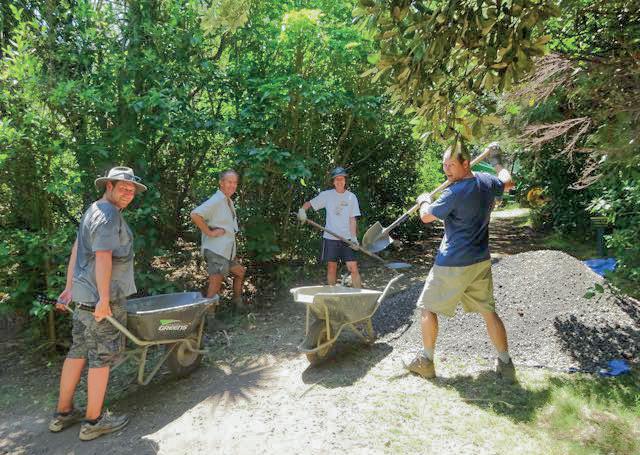
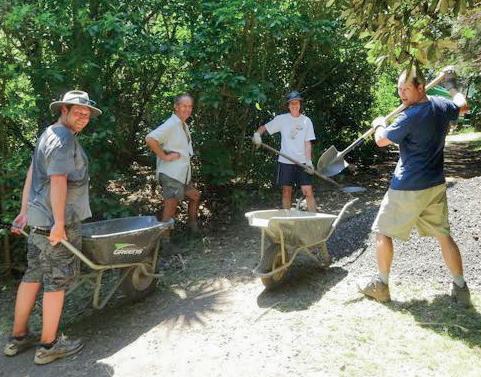
Working parties are vital for maintaining the Island and its assets, and we appreciate our members not only for their efforts during long weekends but also for all the time they dedicate, many days and weekends throughout the year, to help keep the Island in good condition.
Spring and summer are busy times for the biodiversity teams, with the breeding season—monitoring and banding—requiring significant volunteer time.
The enactment of the Hauraki Gulf / Tīkapa Moana Marine Protection Act last Labour Weekend specifically references the coastal areas around the Island with the establishment of a Seafloor Protection Area and a High Protection Area. This is an effort to safeguard the marine life around the Island.
‘Island News’ contains an introduction to SoTM’s new Treasurer, Victoria Toon. We welcome her to the Board.
As a Society, we depend on members for our continued existence. When your renewal subscription arrives, please consider renewing promptly, as it genuinely supports the future of Tiritiri Matangi.
A special thanks to all volunteers and staff for the wide range of tasks they undertake to keep the Island running.
Ngā mihi
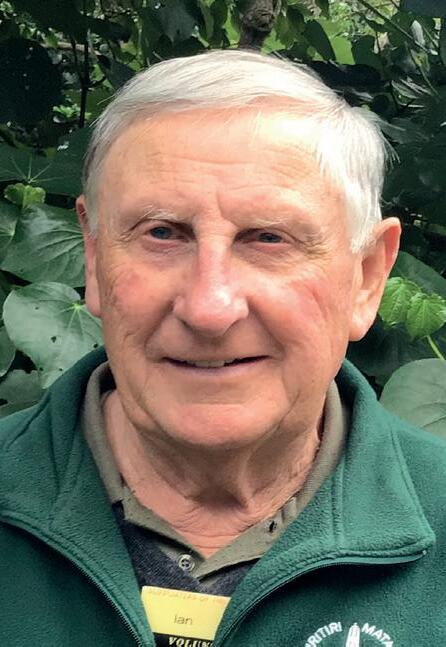
Ian
Island News
SoTM's new Treasurer
Victoria Toon
Hi, I'm Victoria. I am a Chartered Accountant, a Fellow of the Chartered Accountants of Australia and New Zealand Institute (CAANZ), and a licensed insolvency practitioner.
I am also the owner and director of an Auckland-based restructuring and insolvency practice. I am the Co-chair of the CAANZ Auckland Public Practice members’ group, which meets monthly to discuss topical financial issues.
More recently, I served as the Chair of Finance for the Eden Park Trust Board. I was appointed by the Crown as a trustee of the Board for over six years. I continue to act as the Treasurer of the Eden Park Residents Association and have been actively involved in the Eden Park Trust's engagement with residents for many years.
I am now seeking a new challenge. As a born-and-bred Aucklander, a mother and grandmother, I have a genuine commitment to Auckland's conservation and community organisations. I greatly admire the work done by the Supporters, and I would like to contribute my skills in a practical way.
Donations received
SoTM thanks the following people for their generous donations:
• Acorn Foundation - Carol Bithell
• Audrey Hay
• David Gordon
• Elliot Egan
• John Boscawen
• Vishwa Shukla
Shade umbrellas installed at the Visitor Centre
Weathering Auckland’s notorious ‘four seasons in one day’ has been made significantly easier with the installation of two all-weather umbrellas in the Visitor Centre courtyard.
These sturdy umbrellas, funded by the Supporters of Tiritiri Matangi, have already proven to be a great success, enabling visitors to enjoy a lunch break away from the heat and providing shelter from unexpected rain.
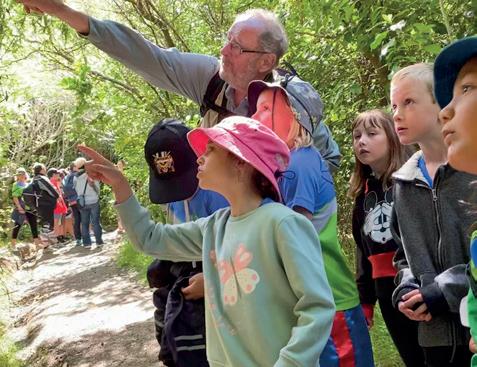
During school term afternoons, the umbrellas create extra learning spaces for the education programme’s ‘outdoor classroom’, allowing the programme to run smoothly in all weather and freeing up space in the Visitor Centre. These umbrellas have been very well received and are widely appreciated by visitors, volunteers, and students alike.
Sara Dean
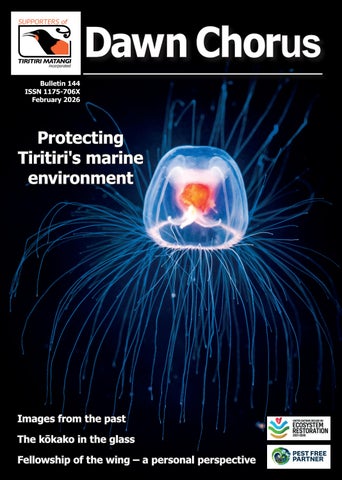
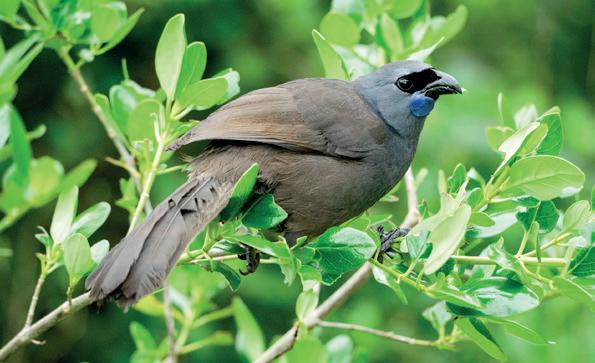
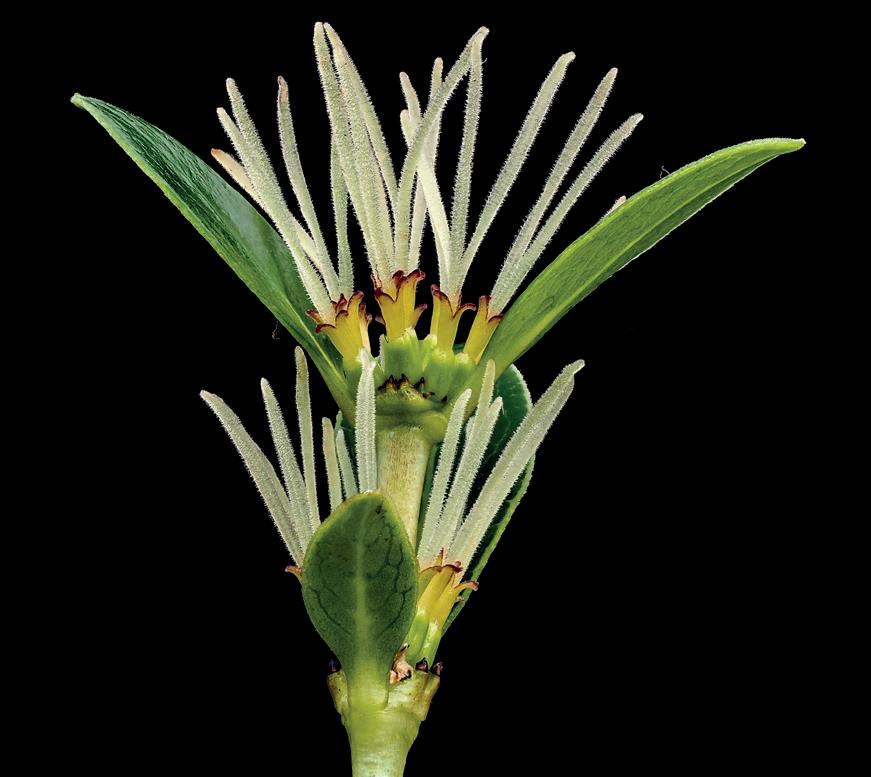
Cover photo: Turritopsis rubra, John Sibley
Photo: Sara Dean
A school group enjoys the shade under the new umbrellas
The Island welcomes a new DOC ranger
Vincent Alexander started in his new role as one of Tiritiri's island rangers on 9 January. Dawn Chorus asked him to tell us a little bit about himself and he shared his family's close connection to the Island.
Please would you tell us a little about your whakapapa?
Ko Vincent Alexander taku ingoa.
Ko Hikurangi te maunga.
Ko Te Wao Nui ā Tiriwa te ngahere.
Ko Waiti te awa.
Ko Waitākere te moana.
Ko Tainui te waka.
Ko Te Kawerau ā Maki te iwi
Vincent Alexander is my name. Hikurangi is the mountain.
Te Wao Nui ā Tiriwa is the forest.
Waiti is the water.
Waitākere is the sea.
Tainui is the waka.
Te Kawerau ā Maki is the iwi.
I whakapapa directly to Te Kawerau ā Maki, being descended at least 19 generations from Maki, the eponymous ancestor of Te Kawerau ā Maki.
What attracted you to the ranger's role on Tiritiri?
The last great chieftainess of Te Kawerau ā Maki was my great-grandmother Hariata Ewe, née Taua. She, my mum, and my dad released kiwi on Tiritiri Matangi Island in 1993 (there's a picture of them just before the Visitor Centre courtyard). I feel so privileged to carry that mantle forward, given the work my great-grandmother and my uncle, Te Warena, did to reinstate our iwi after it was written off as extinct and unacknowledged. I am now in a place long connected to Te Kawerau ā Maki, and I hope what I do here honours those who came before me and the conservation efforts undertaken thus far.
What areas of conservation most interest or concern you?
I was working for the social subsidiary arm of my iwi, Te Kawerau Iwi Tiaki Trust, where I was introduced to te ao Māori, conservation, and biosecurity. I focused on threats like invasive species and kauri dieback within Te Wao Nui ā Tiriwa, the great expanse of Tiriwa, including the Waitākere Ranges. My goal was to do things that made a positive difference, such as helping ensure that kiwi and other endemic, cryptic birds might roam these forests again. Before that, I worked on a premier dairy farm owned by Bernie McCahill for a couple of years. I aspired to attain the Young Farmer of the Year award in 2017, but I only had time to earn a living wage. However, that experience sharpened my keen, accurate observations of seasonal tides, with winter being my favourite time.
What interests or hobbies do you have?
My interests are to strengthen biosecurity measures on the Island, monitor and survey kiwi, and assess the mauri (health and essence) of Tiritiri Matangi.
These are my main interests in life, and my hobbies are mainly eating healthily, and staying fit.
Tiritiri Matangi oral histories
Would you like to learn more about how John Craig and Neil Mitchell initiated the restoration of Tiritiri, the challenges Ray Walter faced when setting up the nursery and propagating plants, or how Barbara Walter organised the 'spade brigade' and started the guided walks? Perhaps you are interested in the maritime precinct, its development and future, Chris Green’s involvement in the translocation of wētāpunga to Tiritiri, or the eradication of Argentine ants.
These topics and many more are covered in a collection of oral history recordings now available through the Auckland Public Library. They are an excellent source of information and offer a wealth of personal stories about life on Tiritiri over the past 50 years. For guides, these stories will deepen your understanding of the Island and enrich your guiding repertoire.
To access these recordings, visit the Kura Heritage Collections Online page of Auckland Libraries. Scroll down to Oral HistoriesTe KōreroTuku Iho-āWaha and search for Tiritiri Matangi. The URL is: https://kura.aucklandlibraries.govt.nz/digital/collection/oralhistory/id/4052/rec/1
Access to the recordings must be requested via the online form. You can request access to the entire collection, or individual recordings within the collection. A set of printed transcripts of the recordings will soon be available at the Visitor Centre on the Island.
These recordings and transcripts are subject to certain conditions of use. They may only be accessed for research or educational purposes and must not be utilised for commercial purposes. There can be no publication of the recordings or the accompanying material without prior written permission from the Chair of the Supporters of Tiritiri Matangi.
Toni Ashton
Photo: Tony Petricevich
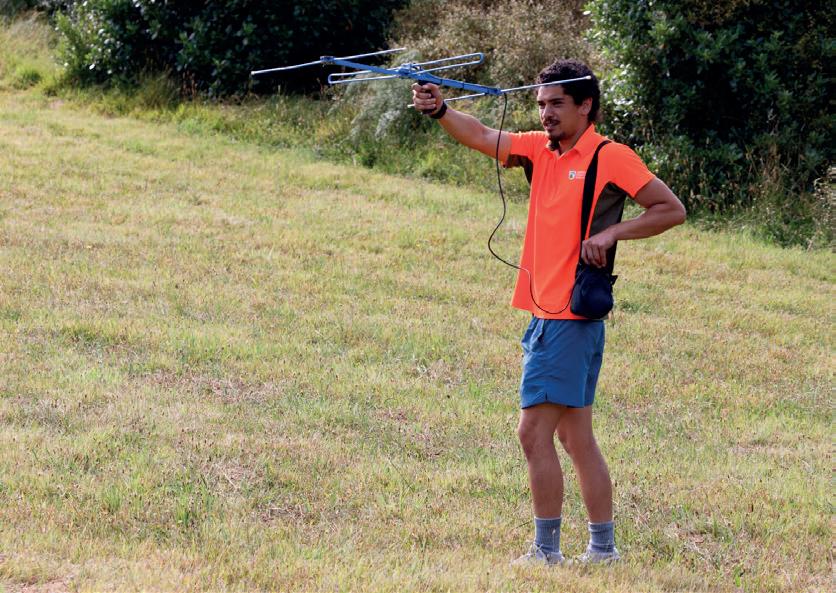
Vincent learning radio tracking on Tiritiri
Aspirations of Ecological Restoration Success
The word ‘successful’ is often used to describe ecological restoration projects. But what is meant by ‘success’? Mel Galbraith, founding member of SoTM, studied the aspirations and outcomes of 50 community-based projects in Aotearoa New Zealand for his PhD thesis, including Tiritiri Matangi. The research proposal was approved in the middle of 2016 and the thesis was almost complete in 2023 at the time of his death. His degree was awarded posthumously by AUT University in November 2023, with his daughter, Dr Josie Galbraith, undertaking the final compilation of the thesis. It is now available to be read online from the AUT library open repository: http://hdl.handle.net/10292/19768
This is how Dr Mel Galbraith described the main goal of his project and his key research questions:
I reviewed the extent to which community groups involved with selected ecological restoration projects in New Zealand define progress for their projects. The study focused on the aims and goals of these community groups, and considered three key questions:
1. What arrangements and partnerships are currently operating where there is strong community participation in ecological restoration?
2. What are the key aspirations identified by community groups in their ecological restoration goals and/or aims?
3. What activities and strategic milestones do community groups identify, and what progress are they making towards these?
Finally, I consider whether there are appropriate institutional frameworks in support of their endeavours.
Mel’s thesis highlights the diverse ways in which restoration success is understood, the tensions and synergies between community and agency practices, and the transformative potential of mātauranga Māori in guiding restoration futures. It is a significant work which makes a critical contribution to a more inclusive understanding of restoration that incorporates scientific, social, and cultural dimensions.
Sweet support from Chelsea Sugar
Tiritiri Matangi is an internationally recognised ecological restoration project where public participation plays a vital role in achieving ecological improvements. The conservation story of Tiritiri Matangi exemplifies what can be accomplished when people unite and work together to provide a safe habitat for our endemic and native species. One of Tiritiri's notable projects is managed by the Hihi Conservation Trust.
The population of New Zealand’s endemic hihi/stitchbird is estimated to be around 2,000 birds. These birds were originally found in northern New Zealand but became restricted to Te Hauturu-o-Toi/ Little Barrier Island by around 1890. In 1995, with support from iwi and sponsors, a group of students from Glenfield College helped relocate 37 birds to Tiritiri Matangi. Since then, hihi have thrived on the Island, with their numbers steadily increasing, and current estimates suggest there are over 400 hihi on Tiritiri today. This success is due to the support of various people and organisations, including Chelsea Sugar. Hihi have become a globally renowned model species in conservation biology, with research and management practices on Tiritiri Matangi informing conservation efforts worldwide.
Chelsea Sugar has been operating in New Zealand for over 140 years and maintains several community partnerships. They have donated sugar for the Island's sugar feeders for over twenty years, supplementing the feeding programme for hihi throughout all seasons. The feeders also supply food for korimako/bellbirds. There are six feeders on the Island, including one at the Visitor Centre that uses leftover sugar water and feeds mainly tūī. This entertains visitors outside the shop and allows them a chance to observe the birds closely. Feeders located along each guided track delight and educate visitors, offering them the chance to see hihi and korimako as they flit in and out of the feeders.
The hihi team are on the Island from September to mid-March each year. I spoke to Abbey Skilton, a Hihi Conservation Trust worker on Tiritiri Matangi, and she provided the following data: This year, the season started two weeks earlier than usual. The feeders have been very busy. At one of the feeders, birds consumed 12 litres of sugar water each day for five days. A total of 175 litres was used in that one feeder during October. Without supplementary feeding, the hihi population would decline.
By mid-January this year, over 200 hihi chicks have been banded, and the team expects to band more this season. Some of the Island’s hihi have been translocated to other reserves as they continue to thrive. We are immensely grateful for the sugar donations from Chelsea Sugar, which support conservation efforts on Tiritiri.
Photo: Duncan Pacey
Photo: Simon Fordham
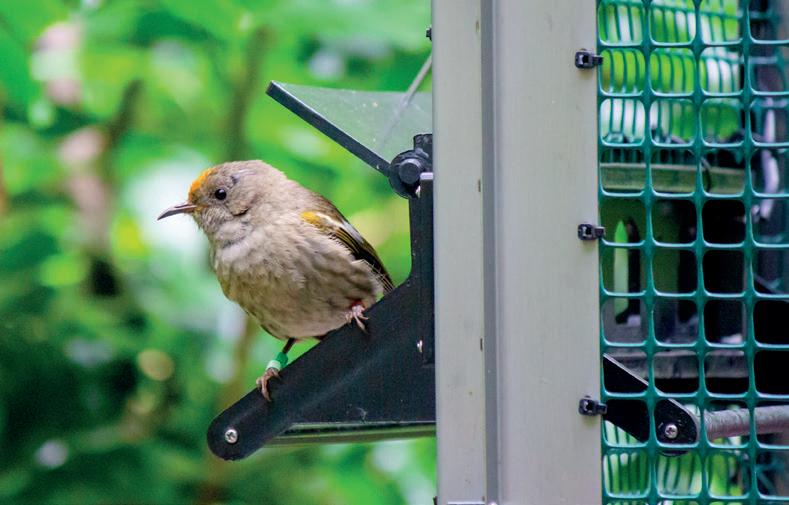
A hihi pauses on the side of a sugar feeder cage
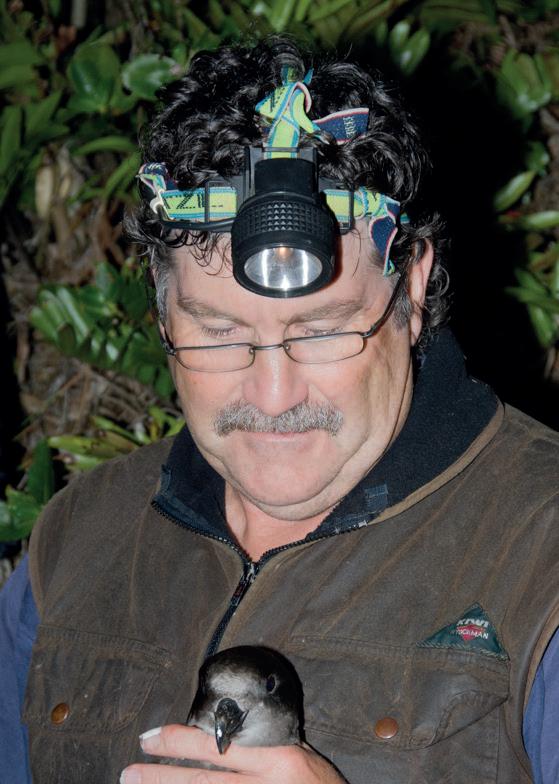
Mel holding a freshly banded ōi / grey-faced petrel, 2007
Dr Josie Galbraith
Debbie Marshall
Mā te huruhuru ka rere te manu
Adorn the bird with feathers so it can fly
Sara Dean shares how a school visit to Tiritiri Matangi inspired Ardmore School's environmental leaders.
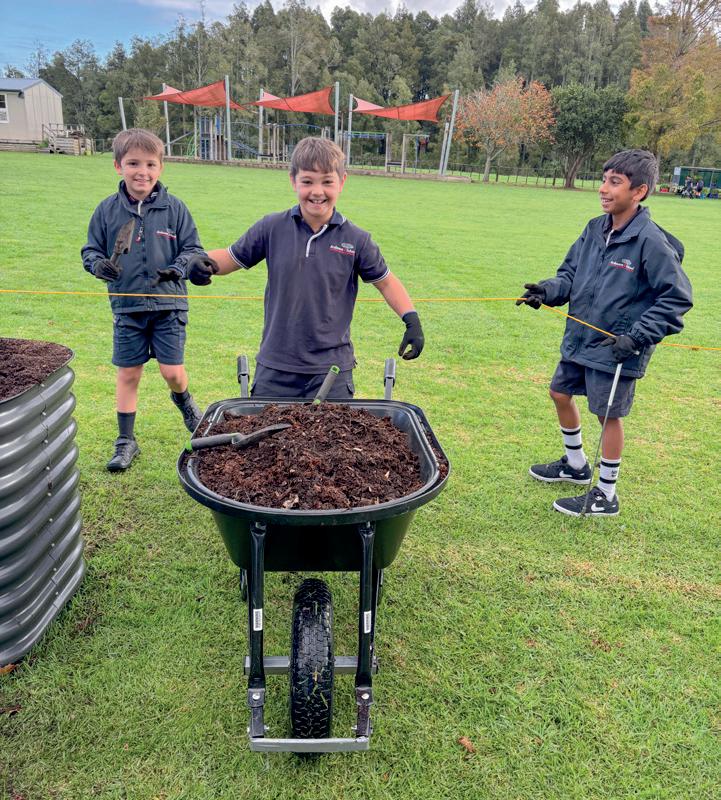
For Ardmore School students, a visit to Tiritiri Matangi meant more than just a day away from the classroom; it inspired them to ‘take flight’ as environmental leaders. After taking part in the Supporters of Tiritiri Matangi (SoTM) Growing Minds Programme in 2024, students returned to their school motivated to turn learning into action – planting, trapping, building, bird counting, and advocating for nature within their school and the wider community.
‘After our trip to Tiritiri Matangi, we came back to school with a load of new ideas to include in our gardens, school grounds and our community as a whole. Tiritiri Matangi has inspired us to take care of the environment, so hopefully one day the world can be a healthy environment just like Tiritiri. Tiritiri Matangi was a lifechanging trip and helped us see what we could do to make our local environment better.’
‘We were inspired by the native planting on Tiritiri Matangi and planned a native planting project here at our school. The Year 7/8 Enviro students created presentations to teach the younger students about native trees, then took them out in groups to do the actual planting of our outdoor classroom. Getting to see what the forests we plant could look like in 30, 40 or 50 years from now was really inspiring.’
‘Tiritiri Matangi inspired us to start tracking the pest and predator species we have at our school. Since we are a rural school next to a farm, this is a big problem for our school. We made tracking tunnels, and our school caretaker helped us to put out traps for the rats. We also made wētā hotels in hopes that we would get some new friends to visit! ’ - Ardmore School Enviro Leaders
‘They were deeply inspired by the conservation efforts that have made Tiritiri Matangi into the precious taonga that it is. The passion and dedication that these tamariki have consistently demonstrated is a marvel... One of the most exceptional things about this particular group of leaders is their consideration for and engagement of the younger akonga in our Enviro Group.’ - Ardmore School teacher
This inspiring group of young leaders returned to the motu in Term 4, 2025, where their commitment and mahi was recognised with the SoTM Junior Conservation Award. Presented during their visit, the award celebrated the outstanding efforts of the school’s very own ‘Spade Brigade’ and their dedication to caring for te taiao / the environment.
We are confident they will continue to advocate for and take action to protect nature in the future, and SoTM is proud to have been part of Ardmore School's environmental leaders’ journey as they take flight.
We wish to thank the Joyce Fisher Charitable Trust for their generous funding supporting SoTM’s Growing Minds Programme, which inspires young conservation leaders. To find out more about our education programme, visit https://www.tiritirimatangi.org.nz/school-visits/
Tiritiri Matangi 2026 Photographic Competition
We're now looking for entries for our photographic competition (and photos for our 2027 Calendar).
Section categories are:
• Fauna
• Flora
• Landscape/Seascape
• People on Tiritiri Matangi
• Under 16 years old
All photos must have been taken on Tiritiri Matangi Island. Landscapes of the Island may also be photographed from boats. You retain image copyright and can enter up to four photos in each category. Entries close April 30, 2026 Details and image use policy are at: www.tiritirimatangi.org.nz/news
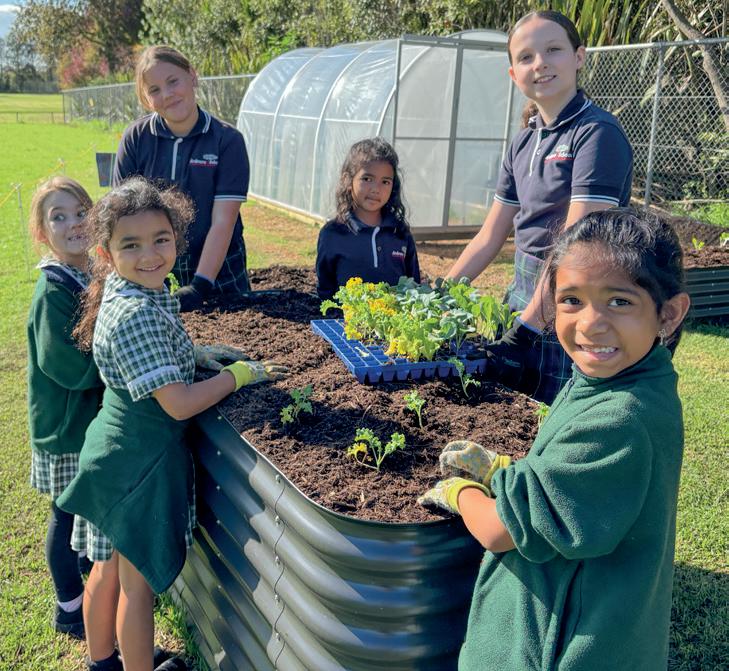
Students hard at work, planting
Photos: Meredith Blogg
Photo: Karin Gouldstone
Photo: Nicole Koch
Snapping Shrimps – indicators of a healthy marine environment around Tiritiri Matangi
Like canaries in coal mines, certain species of animals and plants serve as reliable indicators of environmental health. When these indicator species are found in abundance, it suggests that the habitat is healthy and appealing enough for other species to settle and establish a community. For example, many lichens are well-known indicators of air pollution on land, hating any hint of sulfurous acid rain caused by air pollution.
In the marine environment, a group of small crustaceans, collectively known as snapping shrimps or pistol shrimps, play a similar role. Their presence can be detected by their characteristic popping noise, and where there are abundant snapping shrimps, there will be high levels of biodiversity. Fish such as our abundant Pacific anchovies and sardines also produce a symphony of grunts, groans and burps as they pass through, performing a similar function. Recent research indicates that a noisy reef attracts more planktonic larval worms, starfish, kina, mussels, and many others to settle and grow there, thereby boosting biodiversity, compared to a silent reef.
We have three species of snapping shrimps here in Aotearoa. Two endemic species, Alpheus novaezealandiae and Alpheus caigeri (A. caigeri was discovered off Leigh and formally described in 2024), and Alpheus richardsoni, an introduced species from the Indo-Pacific.
These little shrimps are recognised for having one claw much larger than the other and are renowned for their extremely loud lifestyles. Despite their small size (up to 7 cm long), they can produce brief clicking sounds that reach up to 218 decibels.
Most people never see them, even though they often exist in huge numbers. The reason is that they lead reclusive lives in sandy burrows, often beneath boulders in the intertidal zone. Alpheus caigeri is free-living but still sufficiently inconspicuous to have remained unknown to science until 2024.
To us, the sole sign of their presence is the constant underwater clicking noise they all produce, which sounds quite similar to the snap, crackle, and pop of a certain wellknown breakfast cereal.
This crackling noise serves three purposes for the shrimp: killing prey, defending against predators, and attracting mates.
The snapping shrimp produces this sound with an enlarged left or right claw.
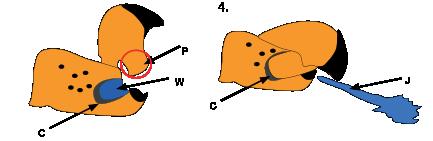
Behind the hinge of the claw is a small water-filled cavity [C]. When the open claw is triggered and snaps shut, a piston [P] ejects water [W] so rapidly that a partial vacuum forms just behind the departing jet [J]. Due to its viscosity, the surrounding water cannot move quickly enough to immediately fill the space behind the fast-moving jet of water, resulting in the formation of a vacuum cavitation bubble.
Then the vacuum bubble collapses so rapidly and violently that a burst of light lasting only a picosecond (10 -12 s) is produced by sonoluminescence (‘sound/light’).
This flash can only be detected with instruments, not by the human eye. These vacuum cavitation bubbles also form behind the bronze propeller blades of boats. When they collapse, the violent shock waves erode deep pits into the hard surface of the propeller blades.
Any unfortunate fish in the firing line first encounters an intensely high-pressure wave, followed immediately by a negative-pressure wave. The combined effect of these waves will either stun or kill it outright. It is often said that these shockwaves are quite capable of breaking a glass microscope slide held in front of the shrimp. On a slightly different scale, depth charges destroy enemy submarines in exactly the same ‘double tap’ manner.
This mechanism is a handy weapon for hunting (hence the alternative name ‘pistol shrimp’) as well as for communication. When hunting, the shrimp usually remains in a concealed spot, such as a burrow. It then extends its antennae outward to detect whether any fish are passing nearby. When it senses movement, the shrimp inches out of its hiding place, retracts its claw, and releases a ‘shot’ that stuns the prey; it then pulls the prey into the burrow and consumes it.
During WWII, it is said that sonar submarine detectors on warships were routinely rendered ‘deaf’ by the background noise produced by these shrimps.
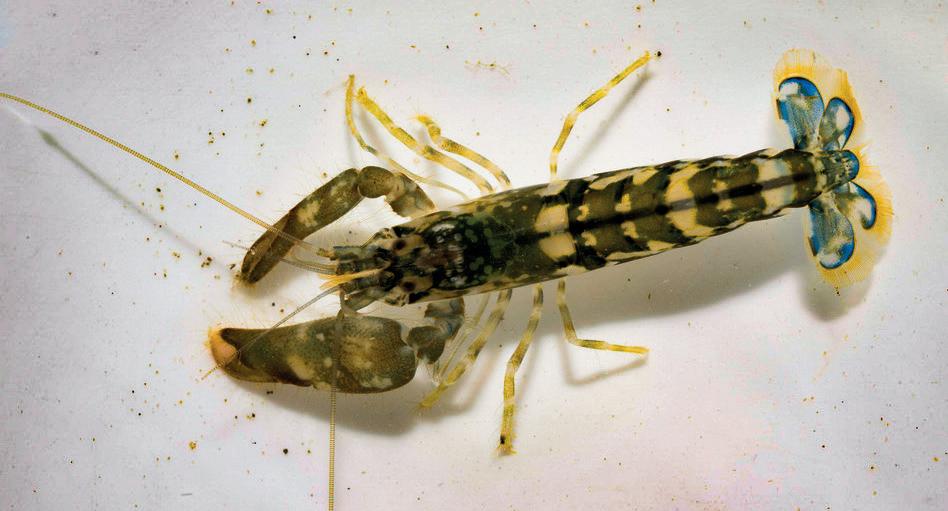
A snapping shrimp with weaponised left claw
How the claw works. WeiWei et al.
A vacuum bubble forming. WeiWei et al.
As a Scientific Reserve, Tiritiri has escaped the widespread looting of its intertidal zone that has affected the rest of the Hauraki Gulf, leading to the extensive destruction of other intertidal marine animal communities by humans searching for free food. That does not mean Tiritiri’s shores are any less vulnerable to environmental threats, such as marine heatwaves. Therefore, these little shrimps offer an easy way to check whether everything is as it should be. May the reassuring sounds of busy snapping shrimps continue to be heard as we swim and snorkel off our favourite Tiritiri beaches!
John Sibley
Reference:
Mathematical Problems in Engineering, Research Article, Open Access Research on the Rapid Closing Jet Mechanism of Pistol Shrimp’s Claws
Based on Fluid Dynamic Grid
Wei Wei, Xinyu Quan, Hongchao Cao, Shijie Zhang, Ximing Zhao, Nan Yu, Jie Zhou, Hongxiang Wang, Xuyan Hou
First published: 15 May 2021 https://doi.org/10.1155/2021/9975952
Protecting Tiritiri's marine environment
DOC Community Ranger, Hannah Zwalue explains the new marine protection areas around the Island.
The Hauraki Gulf is a taonga that is on a path of recovery. It has been struggling for many years as increasing impacts of climate change, overfishing, pollution and sediment runoff have taken their toll. Years of reports indicate that kina barrens are increasing, key habitats are disappearing, and localised fish and shellfish stocks are struggling to sustain themselves.
The Hauraki Gulf / Tīkapa Moana Marine Protection Act 2023 is one tool in the kete that we’re using to help turn the tide. This new law focuses on a variety of unique habitats where marine life breeds and grows. The new network of protected areas safeguards rare and vital habitats and ecosystems – the kinds that act as nurseries for young fish, helping rebuild fish size, abundance, and variety over time. The goal? To restore the mauri of the Gulf and build stronger, more resilient ecosystems for future generations.
Rules
The new law has established 12 high-protection areas (HPAs), five seafloor protection areas (SPAs), and two extensions to marine reserves.
In a high protection area, you can swim, snorkel, kayak, and anchor your boat; but you can’t: fish (commercial or recreational), take seafood, discharge waste, or disturb habitats through underwater construction or drilling.
In a seafloor protection area, you can swim, snorkel, kayak, carefully anchor your boat, fish with a line for recreation, spearfish, surfcast, use a pot, and gather by hand – as long as you don’t damage the seafloor. However, you cannot: conduct bottom trawl fishing commercially, dredge, Danish seine, sand mine, drill, or dump waste.
Specifically, around Tiritiri Matangi, these rules mean that mussels and other shellfish cannot be collected within the high-protection area on the southern end of the Island. In the seafloor protection area on the north and east coasts, line fishing and collection are still permitted.
Authorised customary fishing may take place within an HPA, with written approval from a tangata kaitiaki / tiaki – local guardians who manage customary fishing within their rohe moana.
Why was this location protected?
The area around Tiritiri Matangi was chosen because it provides a land-to-sea link to the neighbouring island sanctuary. The marine environment boasts high biodiversity and features a variety of physical habitats, ranging from microscopic planktons to horse mussel beds, and from jewel anemones to rhodolith (coral-like algae) beds. The sandstone shoreline transitions to rocky reefs that line the coast and provide habitat for juvenile snapper; in deeper waters, you will find kelp, sponges and reef fish. This area also supports more pelagic species, such as juvenile common thresher sharks, great white sharks, juvenile smooth hammerhead sharks, and bronze whaler sharks.
How is DOC managing these areas?
Currently, our focus is on education and support. We’re heading to events, boat clubs, marinas and boat ramps, and will be out on the water chatting about these new marine protections. We’re installing signage at boat ramps and entry points, distributing protection area maps to local businesses, and have supplied digital maps to chartplotter providers for system updates. The installation of additional signs and marker buoys will continue throughout the summer. DOC's compliance work will gradually increase to support our educational efforts. This will include both on-the-water patrols and the use of drones and high-zoom CCTV cameras to monitor activity in these protected areas.
For more information, head to https://www.doc.govt.nz/ haurakigulfmarinepark. We recommend downloading the free app MarineMate, which shows all the protected areas and your current location, an excellent tool for use on the water.
Contact revitalisingthegulf@doc.govt.nz with any questions.
For a map of the new HPA and SPA surrounding Tiritiri Matangi and to download the GPS coordinates visit: https://www.doc.govt.nz/parks-and-recreation/places-to-go/auckland/places/tiritiri-matangi/maps-and-boundaries/
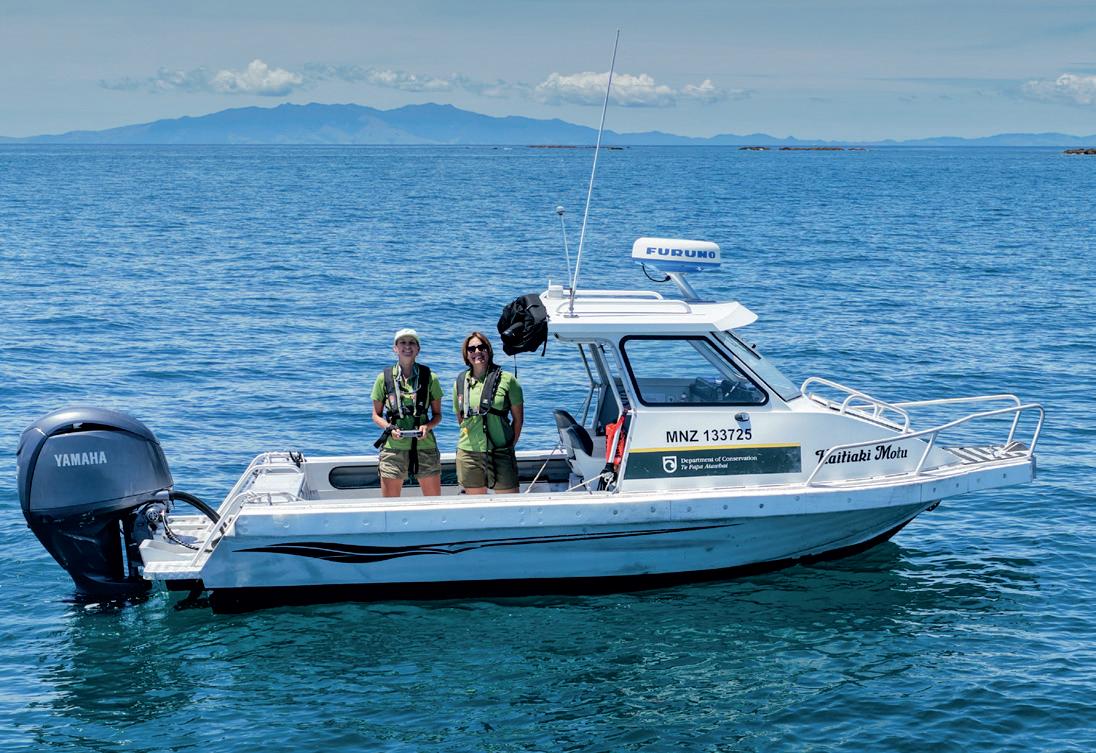
DOC's Shelley Ogle and Olivia Christie aboard Kaitiaki Motu
Photo: Shelley Ogle (drone)
The Fellowship of the Wing: The Supporters’ Grand Adventure
In 1991, Peter Lee-Grey joined the Supporters along with his wife Val. Over the following 34 years, Peter became a regular volunteer and guide – and served on the Committee (now the Board) for around 28 years in total. He was Chair (twice), Secretary (twice), Dawn Chorus Editor, and, most recently, Treasurer. At the 2025 AGM, Peter spoke on his views of why the Supporters have become so successful and what our future might hold. His personal perspective is shared here.
As most people know, SoTM was founded in October 1988 by retired minister Jim Battersby and a few associates. As you might expect, the early years were slow, with first-year revenues just under $7,300. However, even then, there were signs of ambition and an awareness of what we could achieve and needed to do. Alongside subscriptions, we raised funds by selling badges, organising boat trips, and holding what the accounts refer to as ‘garage sales’. Recognising the importance of staying connected with members, we also launched what is now Dawn Chorus
Now, of course, we have become a much larger organisation. But what happened along the way? What have we achieved? And why have we been so successful? Let’s go back to 1998, about ten years after our founding, for some clues.
By then, our revenues had reached a substantial $90,000. Our retail operations, started earlier by Barbara Walter, offered a variety of stock, from T-shirts and hats to books and soft toys, generating an annual profit of over $32,000. With income from membership, donations, and our recently initiated guiding services, we already enjoyed a well-diversified income stream – something most conservation groups have yet to achieve to this day.
In 1998, we achieved several milestones:
• Launched our first website
• Signed a concession agreement with DOC
• Won the Loder Cup, New Zealand’s oldest and most prestigious conservation award
• Initiated our annual photo competition
• Celebrated our success with a glitzy dinner, featuring Dr David Bellamy as guest speaker
We’ve frequently been asked about the secret to our success. I believe it boils down to three factors: luck, place and culture.
Luck
Most people underestimate how important luck is in nearly every success. After all, think about your first job, the most special person in your life... and the Supporters have been no different. We’ve been lucky in many ways. Despite being close to Auckland, the Island has managed to keep almost all pest species at bay – no stoats, mice, rats (except for one incursion in 2017), or possums. The rabbits didn’t survive, leaving only kiore. We also don’t have kikuyu grass. How lucky must you be to build a project on such a fortunate foundation?
But there’s true luck, and luck that depends on the right people. Three in particular stand out – Jim Battersby, Ray Walter and Barbara Walter. Their drive and vision at the start were crucial to the project’s success.
Pure luck meant these three were the right people at the right time, and pure luck also brought all the others involved in the journey.
Place
Architects refer to ‘genius loci’, the spirit of a place, and Tiritiri has that in spades. There is something wondrous and magical about an island – after all, why do visitors spend $110 on a ferry ticket when they could drive to Tāwharanui and see much of what we have, for less? Certainly, all of us feel that attraction. The Island’s also the right size – not too big, not too small – and just far enough from downtown Auckland to make it a bit more special. We’ve had what I call our Five Histories – Māori, farming, military, maritime and now conservation – to add extra flavour.
Photo: Tiritiri archives
Photo: Miriam Godfrey
Pure luck – the right people at the right time – Ray Walter, Jim Battersby, and Barbara Walter
‘Genius loci’ – Tiritiri Matangi's magical spirit
Culture
All organisations have a culture. When I think of the Supporters, though, a few words spring to mind: humility, generosity, participation, leadership, fellowship, change, renewal, and growth.
Why those words?
Firstly, it’s about the way we work together – collaboratively and with openness. Most people seek something greater than themselves, where they can set aside their ego, and that’s what the Supporters and the Tiritiri project represent for all of us. There’s a genuine sense that ‘anyone can give this a go’.
We are also, to use the modern cliché, a ‘learning organisation’. Most organisations might have a new leader every few years. We've had ten different chairs, with two of them taking the role twice, and, on average, the position has changed hands every three to four years. That’s crucial because it means we regularly benefit from fresh thinking and new ideas. We’ve tried new things – the guiding and the shop, for example. But the willingness to learn has always been there – think of Ray, Barbara, and Jim taking on new challenges when most people their age probably wouldn’t.
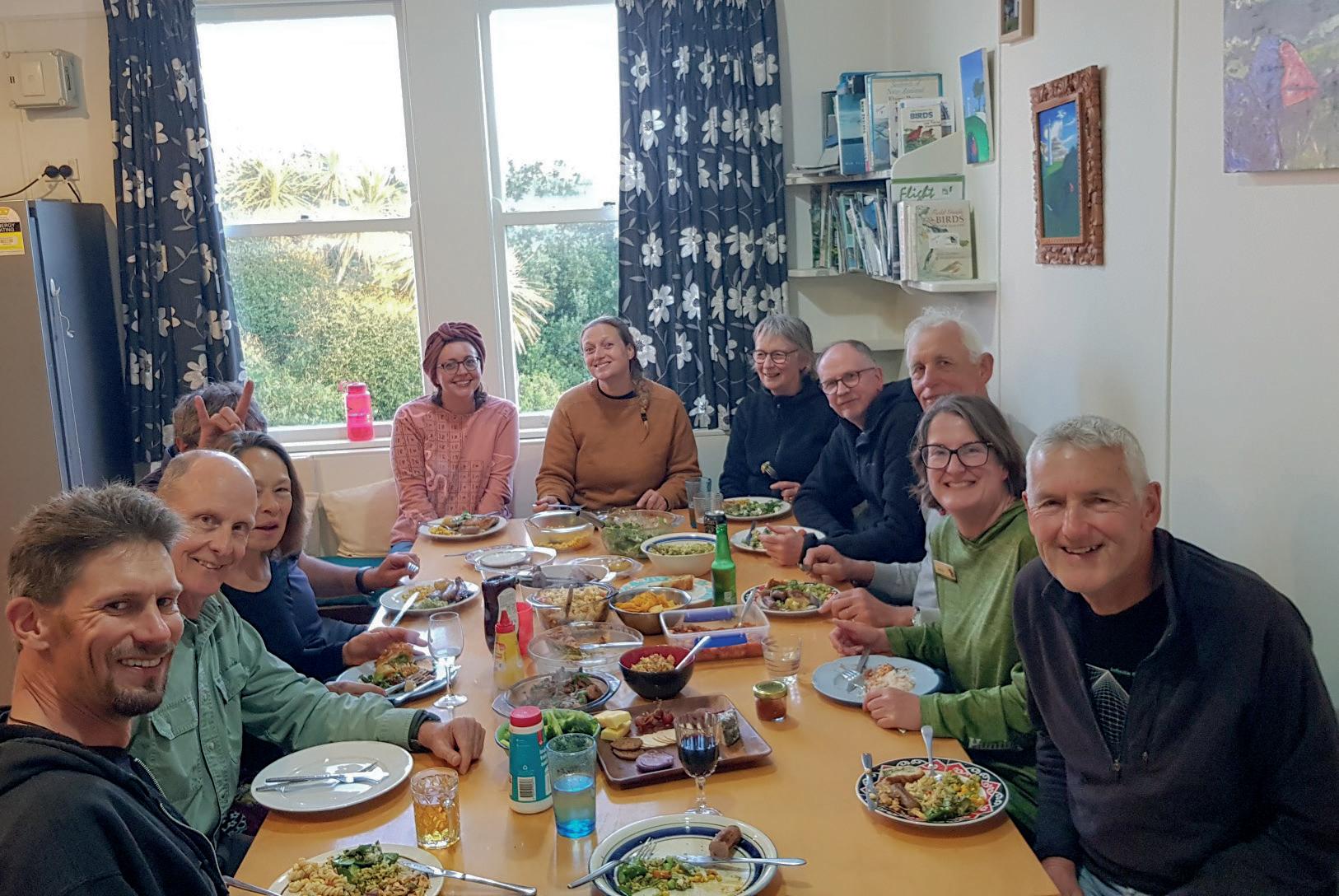
If I had to choose one aspect of the Supporters that, for me, exemplifies our culture, it’s the working weekends. Along with Val, I’ve participated in them since the early ‘90s. Sure, the projects and the people have changed over time, but some things have stayed the same. There’s the shared work, of course, but just as importantly, all are welcome, no matter their level of skill. I’ve seen first-timers arrive on a Saturday, possibly not knowing anyone, maybe having never wielded a hammer before, but with encouragement to try new things and learn new skills, they leave on the Monday feeling a little ‘taller’. For me, too, the camaraderie has always been very important: the work itself, but also the shared potluck dinners where everyone contributes, nothing is planned, yet it always turns out well, with laughter and love, knowing that we all share this wonderful, magical island for the night.
And what of the future?
At the AGM, I outlined three potential BHAGs – Big Hairy Audacious Goals. BHAGs leverage strengths to genuinely challenge an organisation to excel. I believe these three accomplish just that. What matters less are the specific goals and more what they symbolise.
BHAG #1: Make conservation genuinely culturally relevant. In 2040 – just 15 years away – New Zealand will observe the bicentenary of the signing of the Treaty of Waitangi. I believe much will change in the next 15 years as that day approaches. By then, too, demographers expect the majority of Aucklanders will be Māori, Pasifika, or Asian, yet the Supporters, like many conservation volunteer groups, remain predominantly Pakeha and middle-class. We have 11 iwi to collaborate with on Tiritiri – a challenge, but also an opportunity, because if we can make it work, it surely offers valuable lessons. So, how can the Supporters lead in becoming more culturally diverse?
BHAG #2: Address our biodiversity challenges. There is still much we don’t understand about our fauna and flora. Why are hihi able to survive without supplementary
feeding on Te Hauturu-o-Toi / Little Barrier Island but not elsewhere? How can we successfully translocate bats? Nobody knows! We already fund some research, but there’s so much more we can do. We have the contacts and credibility, so why not set a target of spending, say, $100,000 per year on specially commissioned research? To achieve this, we’ll need an endowment fund of around $4 million. Building that will indeed be a BHAG – but think of the benefits to New Zealand’s biodiversity!
BHAG #3: Lifelong learning that inspires everyone.
Our educators do an excellent job, inspiring thousands of students through their visits and our wonderful Growing Minds programme. However, we still see ‘education’ as something only for children, rather than part of a lifelong journey. After all, our guides also excel at their work, and we have excellent interpretive signage. Let’s change our mindset. Let’s call it all ‘lifelong learning’ and see how we can really ramp it up, reaching out and inspiring people of all ages, wherever they are. The education programme relies heavily on ongoing grants; therefore, BHAG #3 is to build a Lifelong Learning endowment fund, like the biodiversity one, of another $4 million to give us the resources and capacity.
All three of these are significant challenges. However, they are vital to New Zealand and will truly bring out the best in us.
In the end, I ask:
If not this, then what?
If not us, then who?
If not now, then when?
Photo: Emma Gray
Photo: Karin Gouldstone
Culture – the participation and fellowship of working weekends
Images from the past
Those of you familiar with Anne Rimmer’s book Tiritiri Matangi: A Model of Conservation may recall that by 1983 a plan had been made to establish a suitable habitat for some of New Zealand’s rare and endangered species on Tiritiri Matangi. However, the first step to achieving that vision was to revegetate the Island.
Ray Walter, formerly a Tiritiri lighthouse keeper, remained on the Island after the lighthouse's automation and became the supervisor for the Tiritiri Matangi conservation project. Over three years, he gradually transferred to Lands and Survey (from the Ministry of Transport), eventually taking sole charge of the project in 1985.
The plan was to grow the seedlings on the Island itself for planting out. So Ray spent time in Taupo at the Lands and Survey nursery, where he trained as a nurseryman –another string to the bow of a man who could turn his hand to practically anything! It was there that Ray met Herwi Scheltus, a nurseryman who was able to offer a wealth of invaluable practical advice.
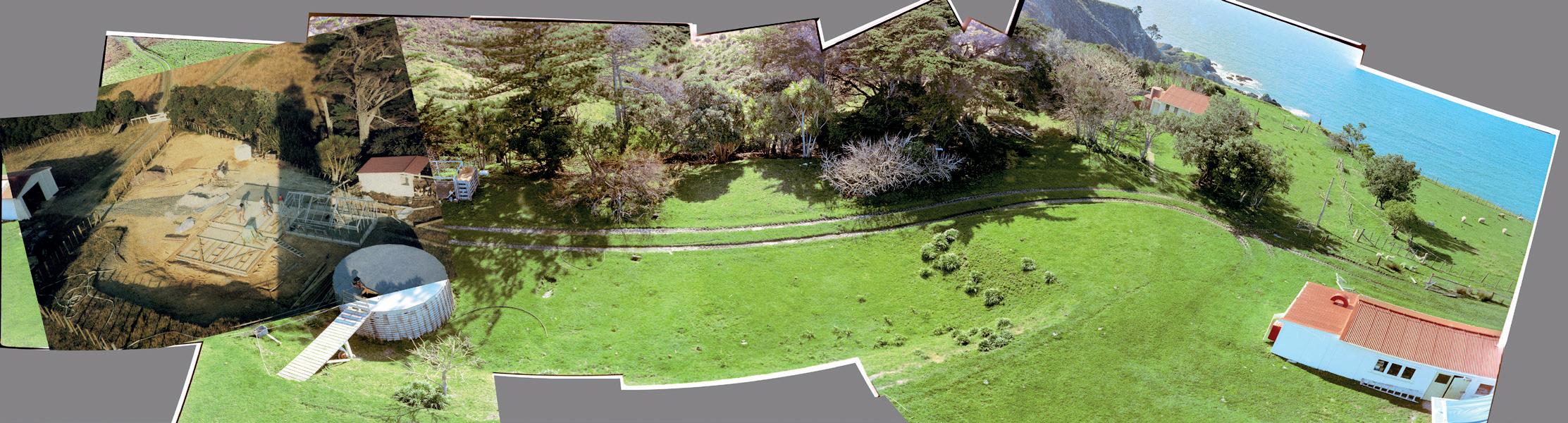
Herwi subsequently visited Tiritiri to assist Ray with the planning and setting up of the nursery and shade house, where, in the years that followed, hundreds of thousands of seedlings were grown in preparation for the revegetation of the Island.
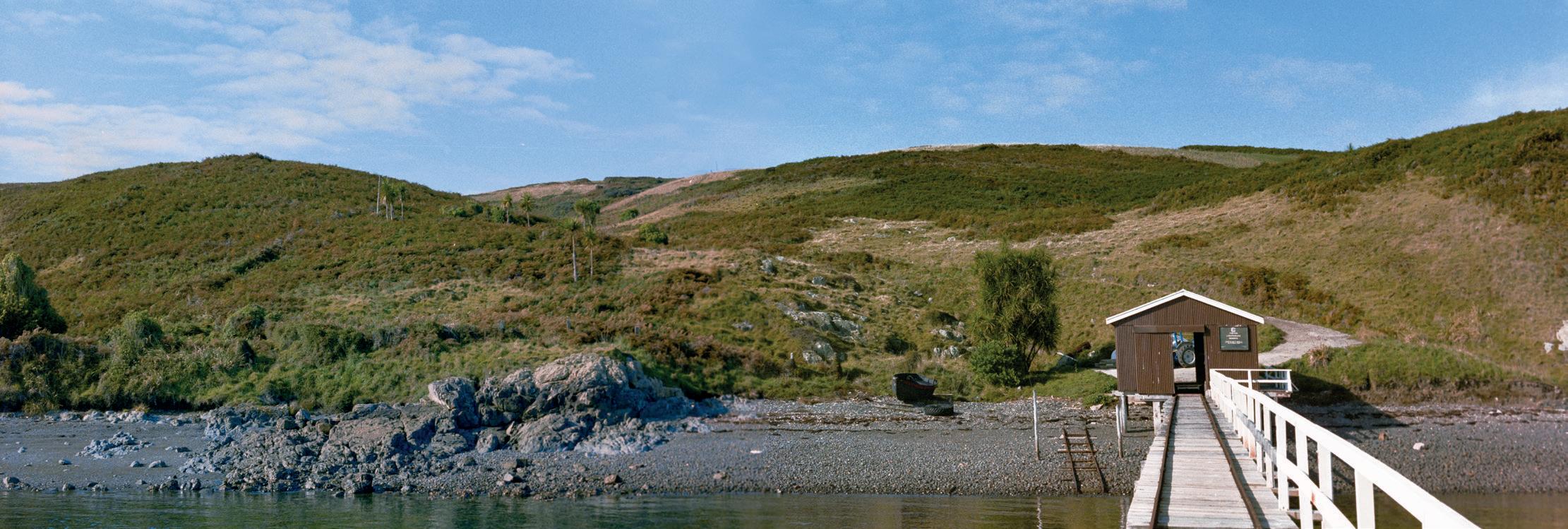
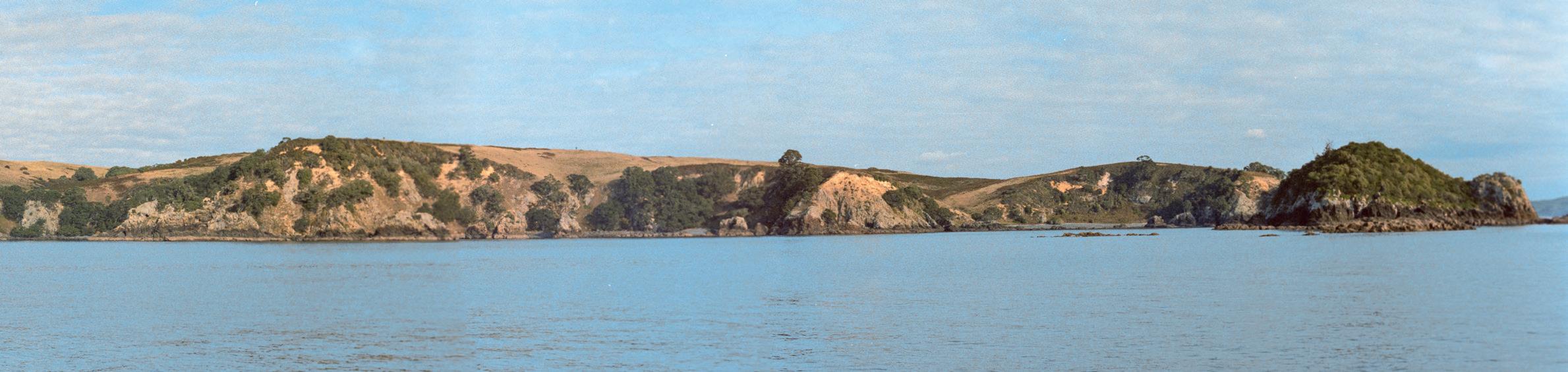
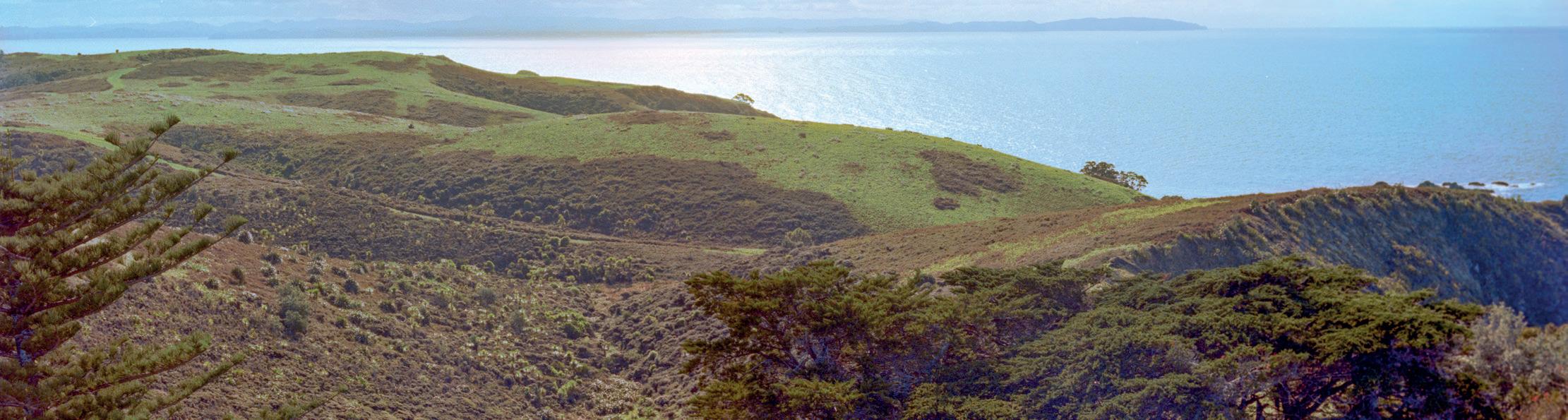
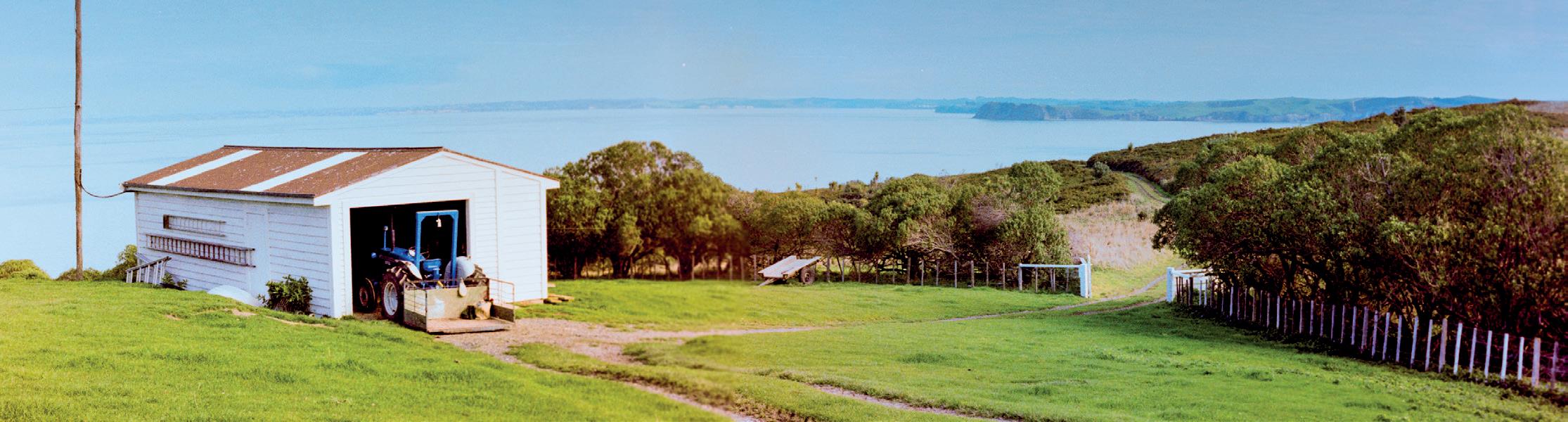
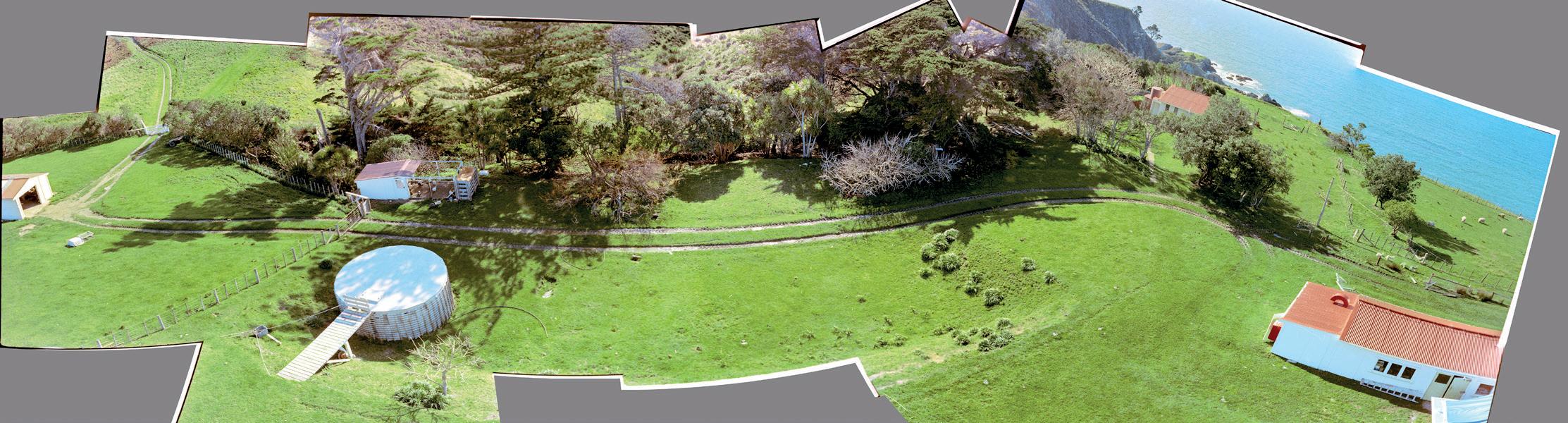
We are very fortunate that when Herwi was sorting through his photographs recently, he kindly donated two rolls of negatives to the Supporters for their archives. These photographs were taken in 1983 and offer excellent views of the Island before the major replanting began. The vegetation in Herwi’s photos is mainly scrub with very few trees – making it very different from what we see now when we arrive on the Island.
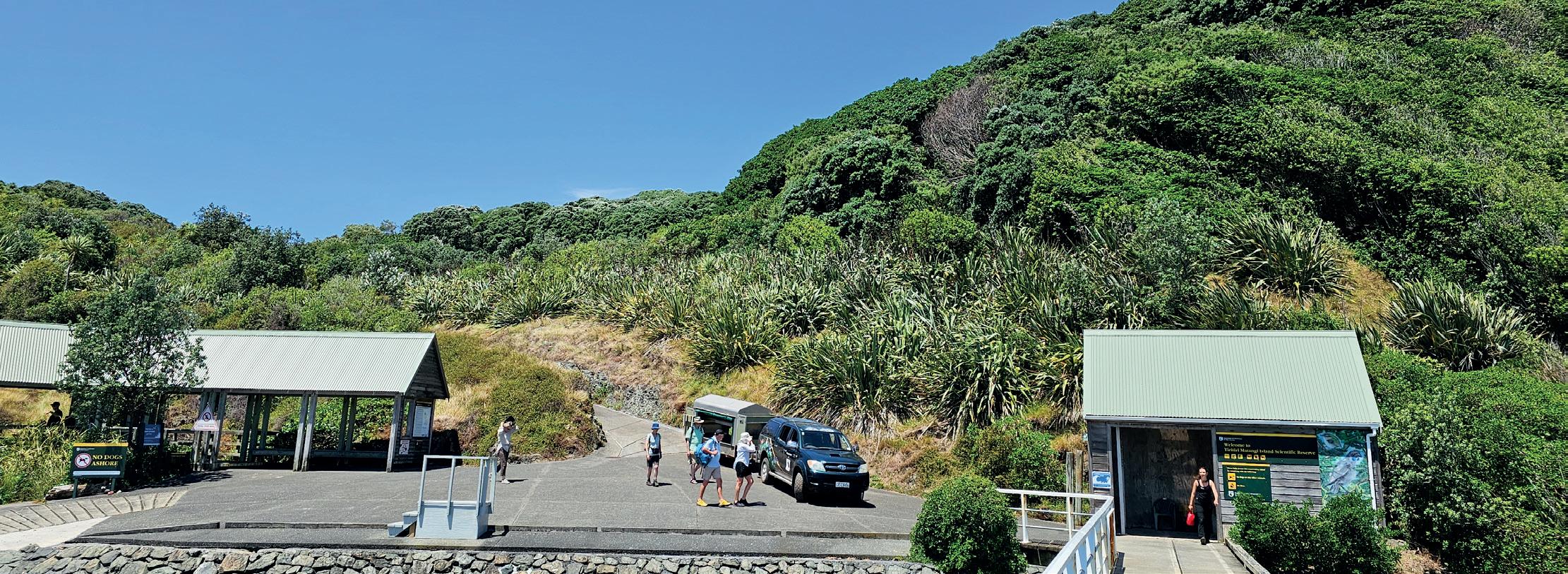
Along with a big thank you to Herwi Scheltus, we would like to thank Geoff Beals for his hours of effort and expertise in converting these negatives into digital colour photographs, some of which we are delighted to share with you. Thanks also go to Peter Lee-Grey for providing a recent photo to showcase the transformation at the wharf.
Val Lee
The Tiritiri Matangi Island wharf 1983 (above) and today (below). Today's wharf is positioned slightly to the south of the 1983 wharf.
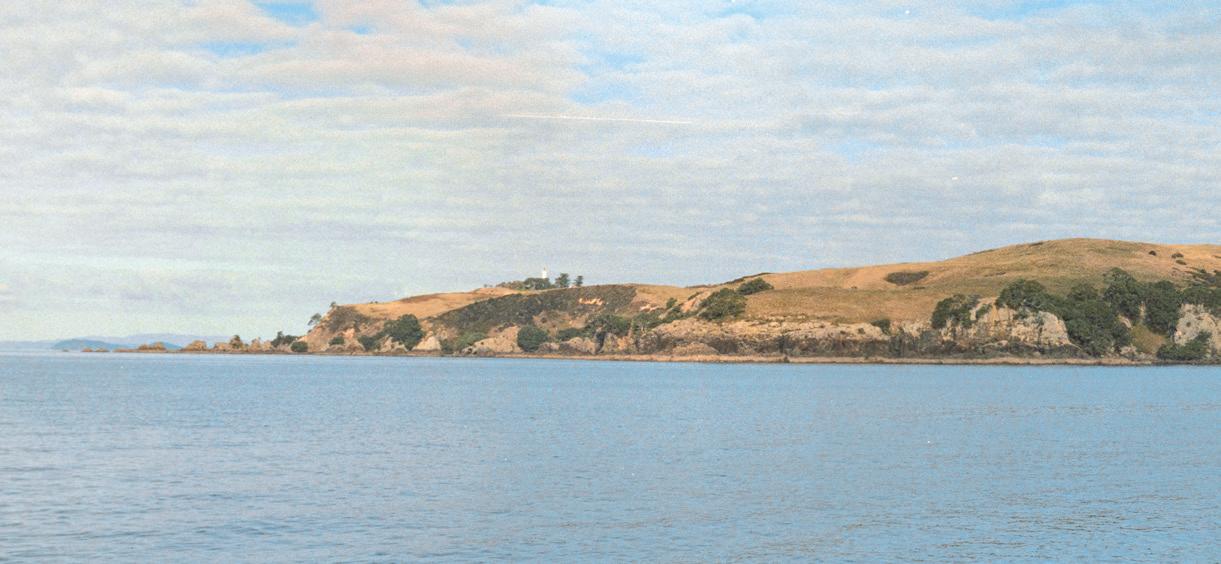
Prior to planting, the eastern coastline of Tiritiri Matangi Island
Photo: Herwi Scheltus
Photo: Peter Lee-Grey
Top: The lighthouse precinct view southwest to north from the lighthouse. Bottom: With nursery overlay
The implement shed and Wharf Road
Lighthouse Valley view northwest to north, from the lighthouse
Photos: Herwi Scheltus, compiled by Geoff Beals
Photos: Herwi Scheltus
Summer fruits – karamū and taupata
At the time of writing in January, following the passing of the longest day in December, we are now well into summer. The flowers of late winter and spring are gone, and on Tiritiri Matangi the pōhutukawa was the last nectar feast for the birds, especially tūī and korimako/ bellbirds. Now is the time when fruits begin to ripen and become available to eat.
Two important fruit trees on Tiritiri Matangi are karamū (Coprosma robusta) and taupata (Coprosma repens): mediumsized trees belonging to the genus Coprosma within the Rubiaceae family (the coffee family).
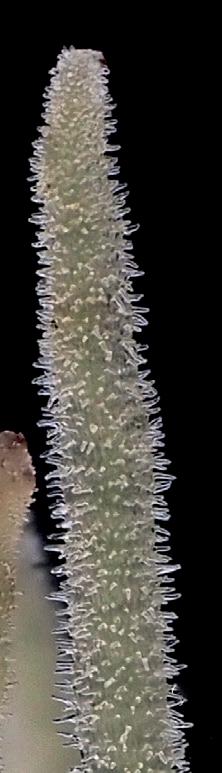
Male and female flowers grow on separate trees (dioecious). The flowers are inconspicuous, lacking showy, colourful petals, and they do not produce nectar, as they do not seek bird or insect pollinators. Male flowers ripen in late winter. The wind carries tiny pollen from the male anthers of the pendulous stamens into the air in enormous quantities, but only a small amount reaches the female styles when they are receptive later in spring. Female flowers have two upright styles and, upon close inspection, reveal a hairy, furry surface that helps with pollen uptake from the air. [Fig. 2]
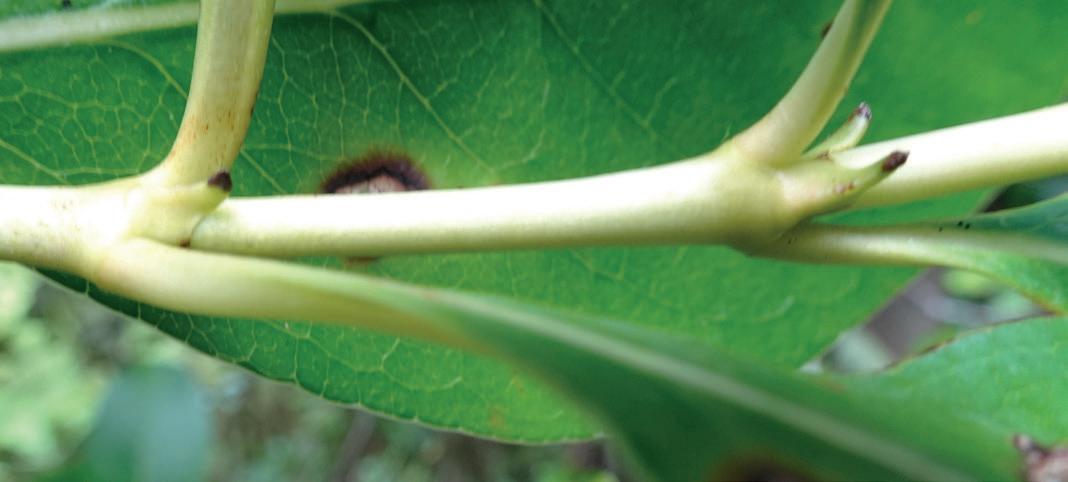
Two further characteristics of karamū and taupata are the presence of stipules and domatia. A stipule is a small, leaf-like appendage to a leaf, typically borne in pairs at the base of the leaf stalks. They are primarily for protection, shielding new leaves and buds from damage and dehydration. [Fig. 3]
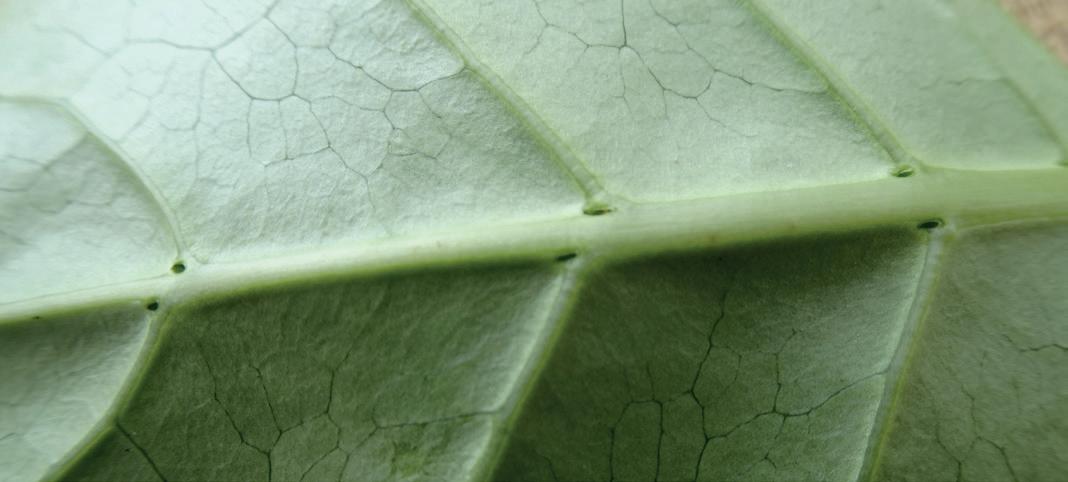
Domatia are tiny holes (mite houses) inhabited by beneficial mites that feed on leaf fungi and small herbivorous arthropods on the leaf surface. Domatia are easily visible to the naked eye on the underside of taupata leaves and appear at the junction of the midrib and veins. [Fig. 4]
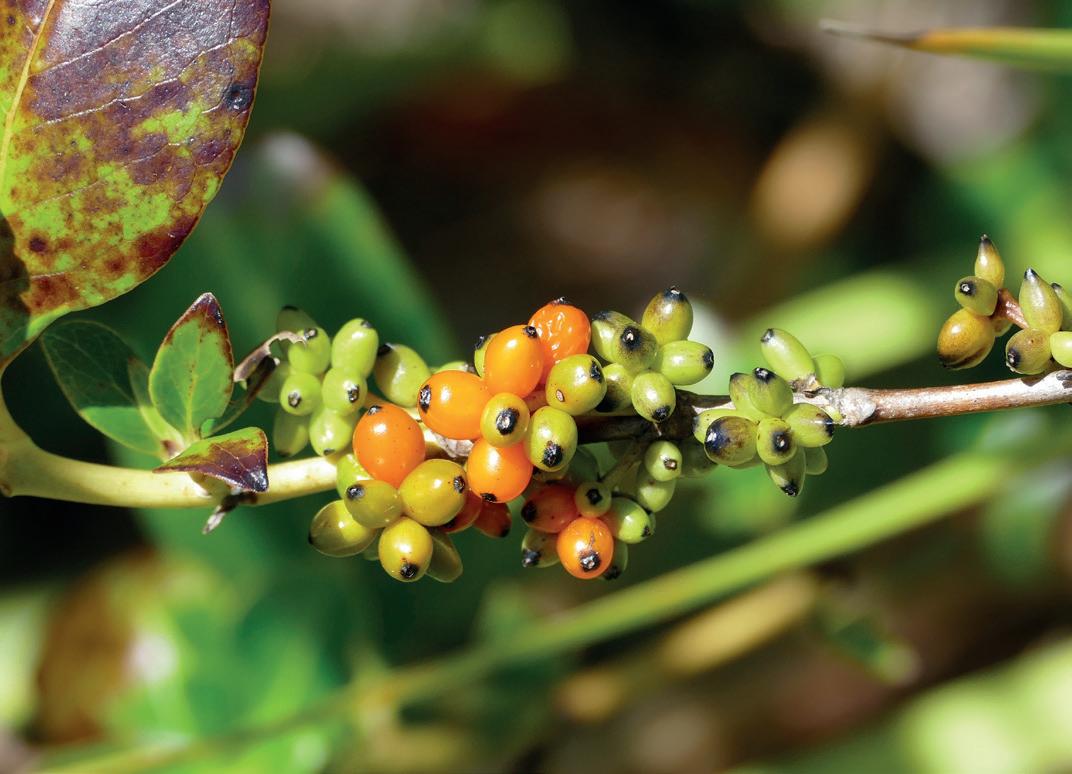
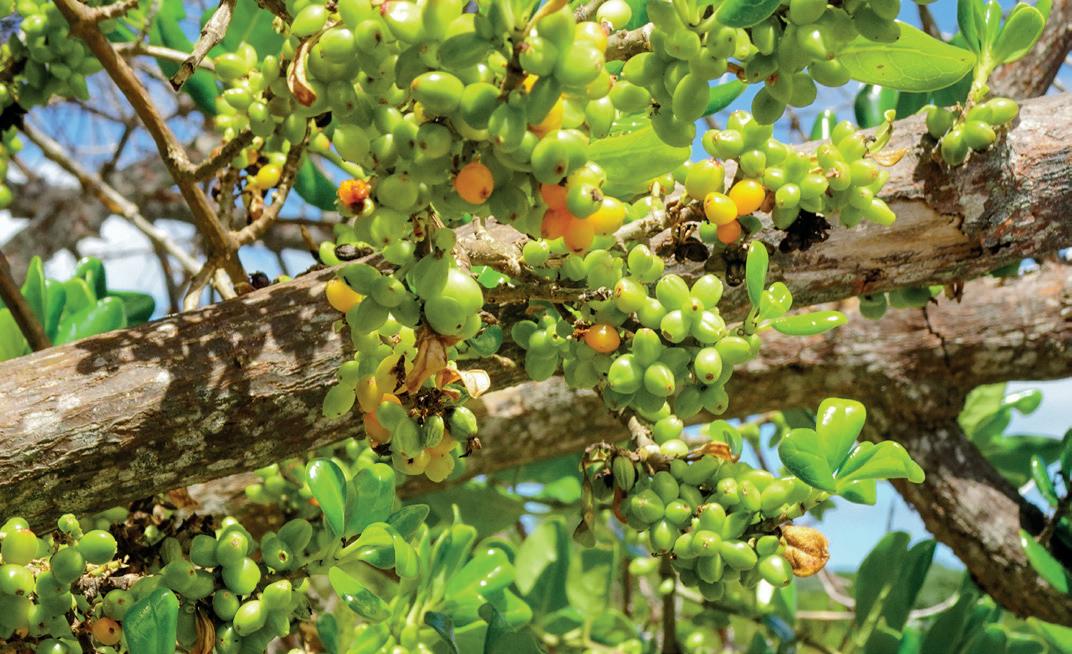
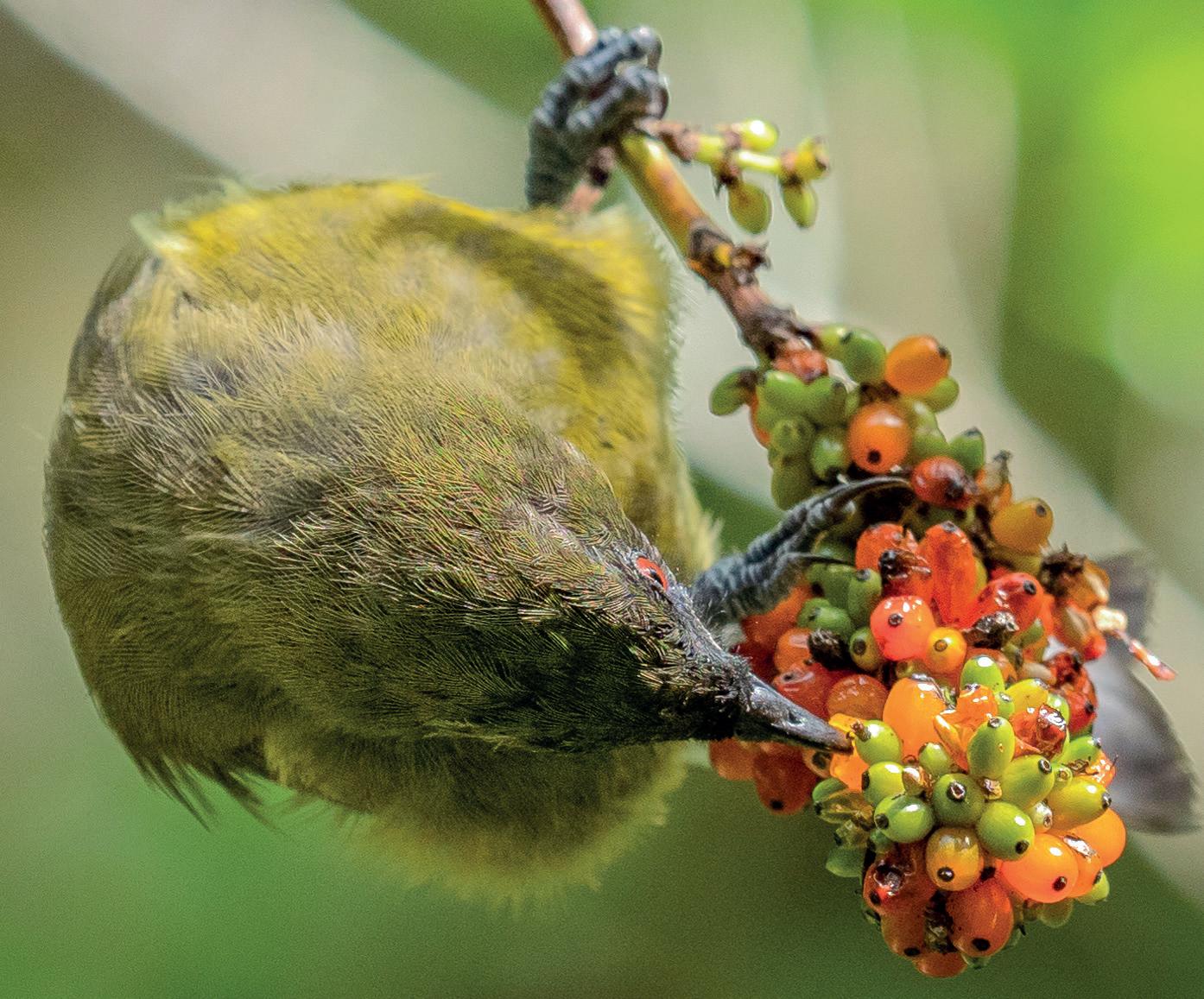
Both karamū and taupata produce small drupes (fruit) along the branchlets, which ripen from green to yellow to orange. [Fig. 1 and Fig. 5] Most of the birds on Tiritiri Matangi, from the small pōpokatea/whitehead and korimako to tīeke/saddleback, tūī, and kōkako, up to the largest of them all, the kererū / New Zealand pigeon, feed on these fruits. [Fig. 6] Each fruit contains two tiny seeds, which the birds disperse.
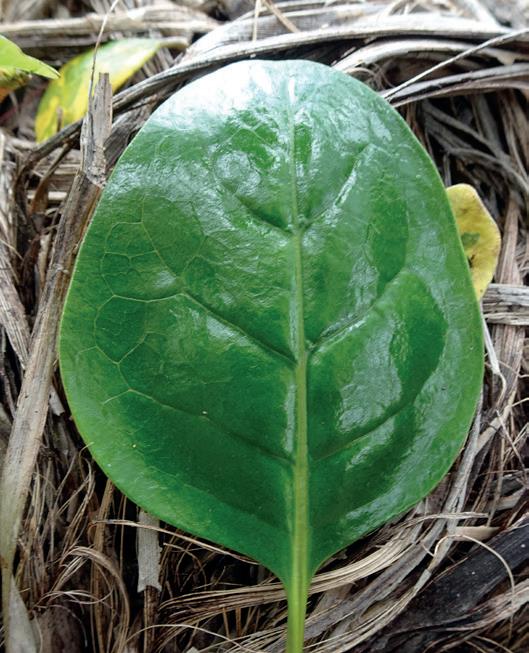
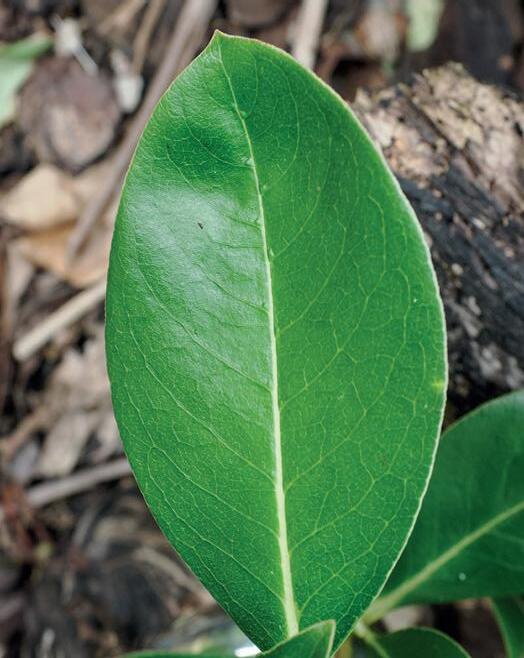
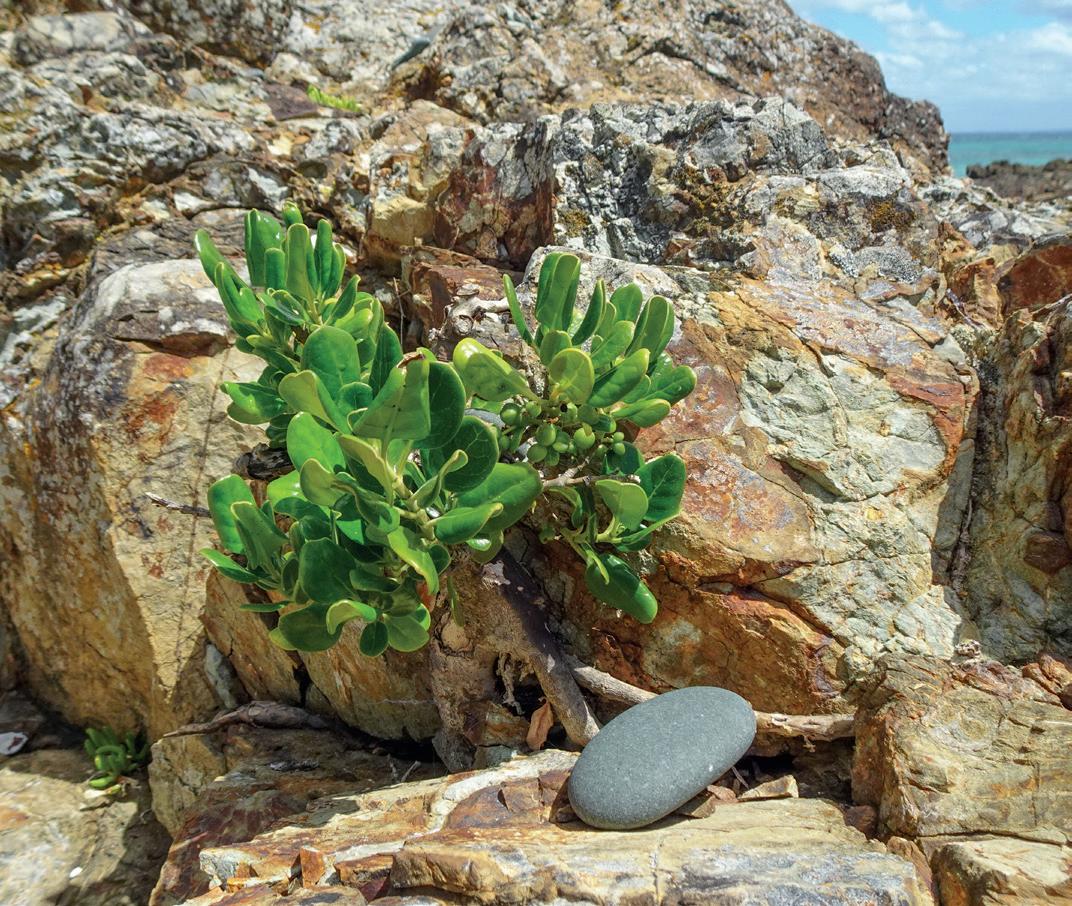
So much for the common characteristics, but how do you distinguish between karamū and taupata? Taupata is better adapted to coastal environments than karamū and can grow very close to the sea. The leaves are very shiny or varnished, which protects them from salty air, spray, and hot conditions. Taupata’s rarely used English name is Mirror Wood. The tip of the taupata leaf is distinctly rounded, whereas karamū leaves are slightly pointed. [Fig. 7 and Fig. 8]
Figure nine shows a small taupata growing on rocks at Little Hobbs Beach with green fruit. In that position, the tree endures a lot of salt spray at times while remaining safe from being inundated by the sea during spring tides.
Karamū and taupata fruits are edible, and Māori children would have gathered them. The fruit reminds me of European currants, Johannisbeeren in German. Karamū seeds can be roasted and used as a caffeine-free coffee substitute.
Gerhard Wette
All photos author's own, unless otherwise noted
Acknowledgements: Warren Brewer [Guidelines – Flora Notes, July 2023], Jonathan Mower and Rosemary Wette
Fig. 1 Karamū fruit
Fig. 2 Karamū female flower and close detail of a style [insert]
Call for volunteer writers – Dawn Chorus and GuideLines Flora Notes.
Natalie Spyksma has a busy 2026 planned and, unfortunately for us, has decided to step down as the writer for Flora Notes. The editors thank Natalie for sharing her time and expertise in writing the flora articles. She first delighted readers with her piece on karaka in Issue 131, November 2022, and we shall miss the personal touch that she brings to her articles.
Warren and Colleen Brewer have also resigned from preparing the Flora Notes for GuideLines Warren wrote Flora Notes for Dawn Chorus from August 2007 to May 2022 and continued writing for GuideLines after Natalie took over writing for Dawn Chorus
With these departures, we’re looking for passionate volunteer writers to join a team writing Flora Notes for Dawn Chorus, along with the fortnightly updates for GuideLines. This is a fantastic opportunity to share the stories of Tiritiri Matangi's flora and inspire readers to see the ngahere with fresh eyes.
Gerhard Wette has volunteered to coordinate this effort. If you would like to join Gerhard, please contact us at editor@tiritirimatangi.org.nz
Introducing Gerhard Wette
I started working as a guide on Tiritiri Matangi in 2005 after retiring as a librarian from Auckland City Libraries.
Since that time, I have regularly guided visitors and taken part in many projects on the Island, assisting with work related to birds, plants, and reptiles.
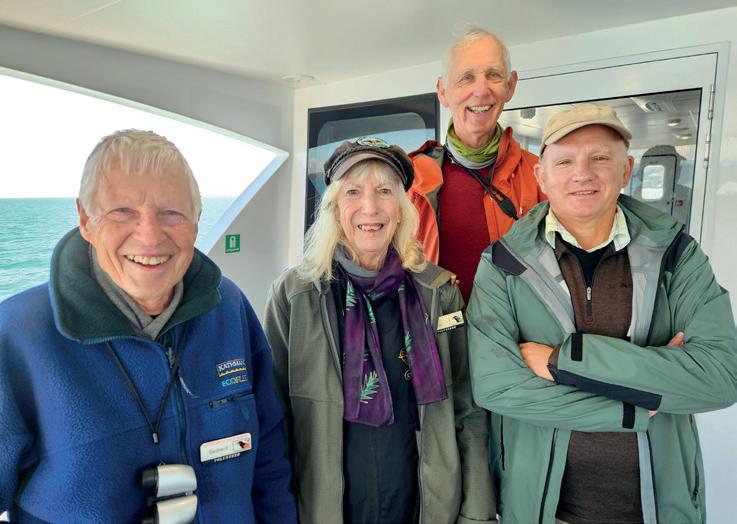
Currently, I am working on the kororā/ little penguin and kākāriki monitoring teams and guiding visitors weekly.
I do not claim any special qualifications for writing about plants on Tiritiri Matangi, but I do have enthusiasm and a love of nature.
My knowledge of plants and trees is based on years of learning, much of which I gained from guides like Warren Brewer. Warren has made a significant contribution to Dawn Chorus with his Flora Notes over many years and, more recently, Natalie Spyksma has also contributed. I am grateful to both of them.
Gerhard (far left) on the ferry with other members of the penguin monitoring team
Fig. 6 Korimako eating karamū fruit
Fig. 9 Taupata growing on rocks at Little Hobbs Beach
Following last year’s busy breeding season, the momentum hasn’t slowed! This year, even more birds are nesting, meaning our monitoring efforts are stepping up to keep pace with this growth.
Hihi/stitchbird
So far this season, 74 females have attempted to breed, including 23 first-year females. Of these, 35 are attempting second clutches. A few second clutches have already fledged, so it will be interesting to see if any birds attempt a third clutch. This season began about two weeks earlier than last season, so there is still time.
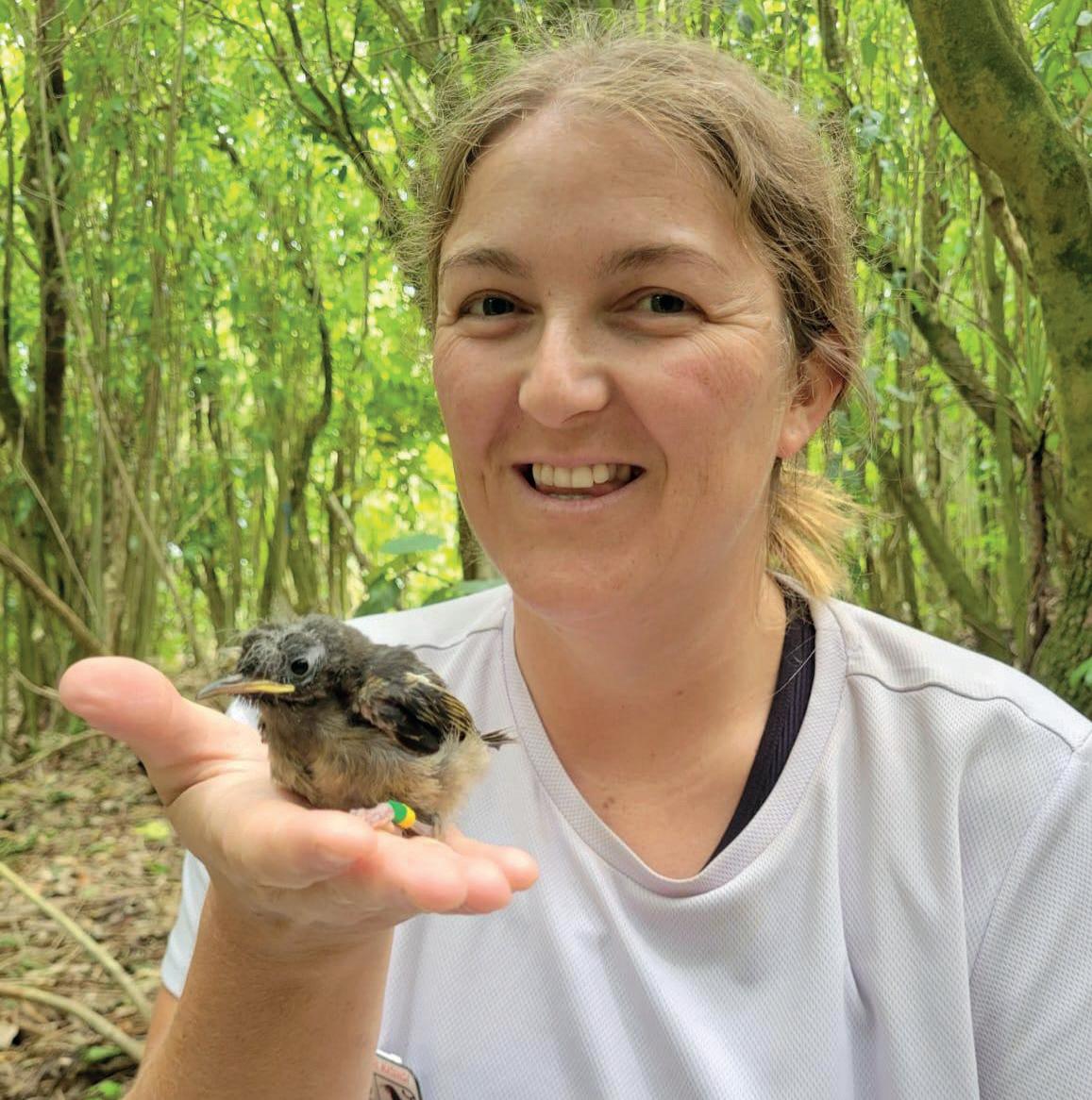
As of mid-January, 200 chicks have been banded, and we have caught and banded four previously unbanded birds, comprising two males and two females.
An interesting observation from this season:
Our Coronary Hill nesting site has presented us with its own hihi soap opera. While the Coronary Hill pair were caring for their soon-to-fledge chicks, a female from Wattle Valley moved into the ‘pair box’[1] and laid her second clutch. She and the social father were observed incubating and feeding her chicks in the early days after hatching.
However, once the chicks in the first box fledged, the Coronary Hill pair appeared to take over the care of these new chicks. The female, in particular, was very protective of the box. Both the female and male were seen entering the box, feeding the chicks, and keeping the Wattle Valley female at bay.
Hihi contractor Abbey believes that the female at Coronary Hill was checking out the other ‘pair box’ for her own second clutch while she waited for her chicks to fledge, when she came across the other chicks in the ‘pair box’. Perhaps she was feeling maternal? Or maybe she was confused to find chicks already inside. Either way, the four adults on the hill helped raise these chicks to banding age, and all three have now fledged.
[1] Pairs of hihi boxes are mounted in close proximity. Birds will often use the ‘pair box’ for a second clutch or if the first nest fails.
Takahē
Great news from the two pairs of takahē on Tiritiri – both have successfully bred this season. The lighthouse family group of Anatori (F), Wakapatu (M), together with last season’s sub-adult Mātātoa (F), have been looking after an ever-growing chick that hatched in the second week of October. The chick is now three months old and has begun to develop its beautiful blue-green plumage.
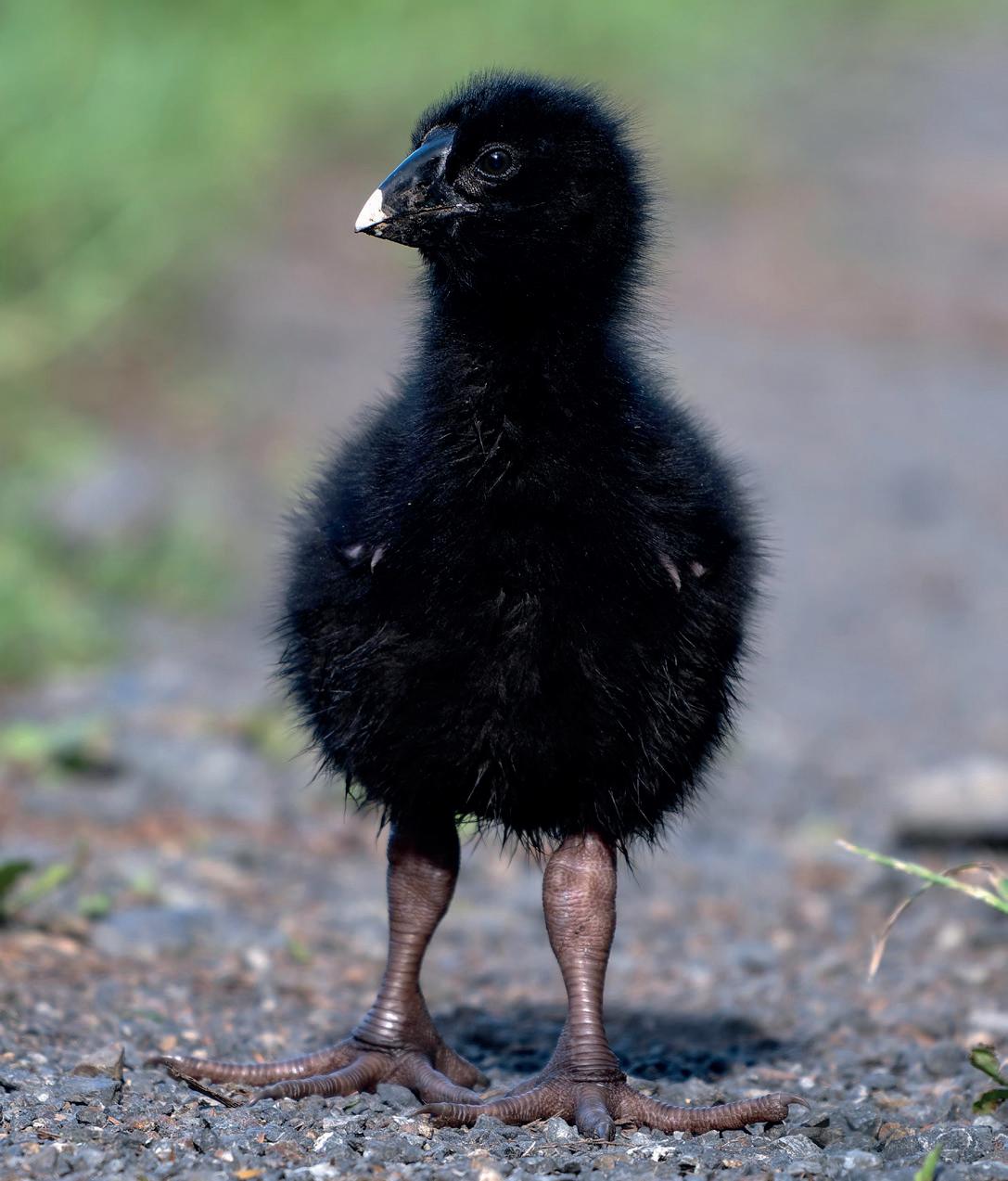
The northern pair of Atawhenua (F) and Turutu (M) has two chicks, which is remarkable, given they were unsuccessful as a first-season pairing in 2024/25. As the chicks have grown older, the family group has been seen most days at the northern end of the Island, even venturing as far as Pōhutukawa Cove on the East Coast Track.
In March or April, the takahē on the Island will be caught for routine health checks and to process the three chicks.
The chicks will receive a vaccination against the bacteria erysipelas, have a small blood sample taken for genetic and gender testing, and be leg-banded for identification. Mātātoa is also scheduled to be translocated off the motu around this time to be paired with a young male from Burwood Takahē Centre named Sylvan.
Kākāriki
By early January, 11 pairs were using our nestboxes. At least 70 eggs had been laid, with 34 hatched so far, and a few more probably to come. There were two nests with nine eggs, where five and six chicks had hatched, respectively.
Abbey Skilton with the 200th hihi chick banded – it's a boy!
One of the takahē chicks from the northern pair
Photo: Emma Gray
Photo: Darren Markin
One nest had seven chicks, although we did not get a precise egg count for that one. This has been a near-average year so far, but the proportion of chicks that survive to fledge varies considerably from year to year, so the outcome for this season remains uncertain.
Despite their relatively large size, these boxes appear appealing to other animals, including Duvaucel’s gecko, wētāpunga, and titipounamu.
Kōkako
As of mid-January, we appear to have at least 29 pairs of kōkako. Most have attempted to nest, with varying degrees of success.
Our oldest pair, Te Rae, who is 20 years old, and her partner Chatters, who is 19 years old, now have one fledgling. Wai Ata and Awenga have once again fledged two chicks. Phantom, who is 17 years old, and Wakei have one fledgling. Joy and Aweawe, who were unsuccessful last season, also have one fledgling. Erenora and Tātākī, who have been together for a number of seasons, finally produced a chick, which fledged successfully.
It is A Cappella’s first season, and she and Te Kōkī raised a chick on her initial nesting attempt. Unfortunately, the fledgling was found dead, possibly due to injuries sustained during one of the storms that recently struck the Island. Other pairs have also lost chicks, sometimes due to predation, but it is likely that the weather has also contributed to the lack of success.
Despite failing in their initial attempts, most of our pairs are trying again and are either building, incubating, or feeding chick(s). At least one pair is on their third attempt.
Most of the young birds from last season have been seen, and the sensible ones are trying to keep a low profile as, if spotted by a territorial pair, they are given a ticking off and chased out of the area.
Tīeke
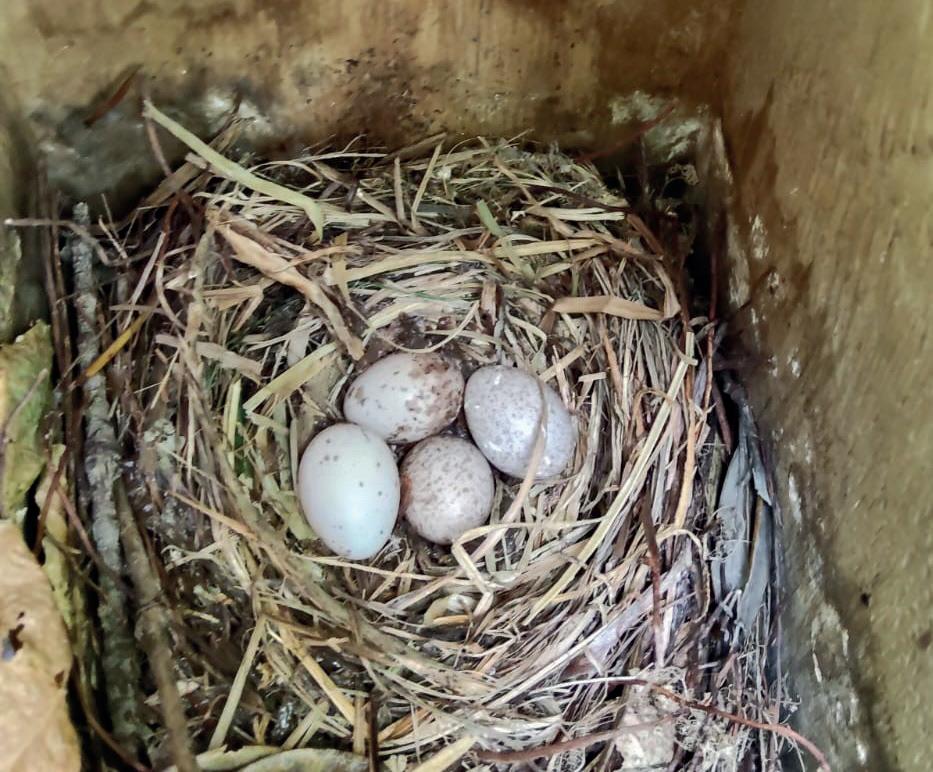
The tīeke nest box monitoring programme for this year is well underway. The focus has shifted from using the boxes as a measure of tīeke breeding success to assessing their use by a range of species, but we are still making some interesting observations of tīeke. Central to these is the notorious box LaV-7b, which has featured in previous Dawn Chorus articles.
This box was used simultaneously by two females in 2020-21 and the following two seasons. We knew this because the clutches were unusually large, with five or six eggs, and the eggs varied in appearance; some were unusually pale, while others appeared normal. The nest failed at the egg stage in all three seasons and, each time, some eggs disappeared from the box. We speculated that the competing females were removing each other’s eggs, but despite surveillance with a trail camera, we could not confirm this.
In 2023-24, a nest was started but not used, and in 2024-25 only one female used the box and successfully fledged a chick from it. This season, it appears that two females, probably the same two, are back again. In mid-October, the nest contained four eggs, two of which looked normal, while the other two, as seen in previous seasons, were paler with fewer markings.
For the first time, none of the eggs disappeared and all hatched, so when checked at the beginning of November, the nest contained four chicks around 4-6 days old. However, two weeks later, the nest was empty. By this time, the chicks would have been between 19 and 21 days old, which is too young for them to have fledged naturally. As before, we can only speculate about what happened.
If, as seems possible, three parents were involved instead of the usual two, shouldn’t this have increased the chances of the chicks surviving?
It is also possible that the two females who laid the eggs were competing, as they had appeared to do in previous seasons, rather than cooperating. If so, their rivalry did not prevent the eggs from hatching this season, but could it have been the cause of the chicks’ demise? Would a female remove chicks from a nest if she knew they were not her own and, in any case, how could she tell? Once again, we can only ask questions, but we are hopeful that this new phase in the saga of box LaV-7b will continue next season and give us a chance to find some answers.
Kororā / Little Penguin
It’s been an inconsistent nesting season for our kororā. Nesting started later than usual, but seven pairs were on eggs by late September. All of these attempts failed, mostly at the egg stage. Two of these pairs tried again, laying eggs in November or December. One pair failed, but the other still had two chicks by early January. Four other pairs started very late, laying their first eggs in November. By early January, one pair had two chicks and the other three each had one surviving chick. One further pair is nesting under the wooden floor of a trailer shed near the implement shed and had one chick by early January. The late start and early-season multiple nesting failures are probably linked to difficulties in finding enough food. The situation must have improved enough by October or November to allow some of the females to produce eggs and for the pairs to incubate and feed at least one chick.
Compiled by Kathryn Jones, with contributions from Nick Fisentzidis, Morag Fordham, Kay Milton, Abbey Skilton and John Stewart
Nest box LaV-7b containing the tīeke eggs from the two females
Photo: Maddie White
The kōkako in the glass
Birds and glass have a complicated relationship. Around the globe, bird behaviour triggered by reflections mainly falls into two categories: territorial attacks where birds mistake their own reflection for a rival and react aggressively, and accidental collisions where birds fly into reflective glass, misjudging it as open sky or suitable habitat. Both situations can seriously affect the bird's health and chances of survival.
In New Zealand, bird species have been observed reacting to their reflections in glass windows and other shiny surfaces, often mistaking the mirror image for a rival intruder. Among these are the miromiro / South and North Island tomtits, tīeke/ saddlebacks, and kōkako.
Kererū / New Zealand pigeons, pīpīwharauroa / shining cuckoos and kōtare / sacred kingfishers are especially prone to window collisions. Kererū and pīpīwharauroa fail to recognise glass as a barrier, seeing only the reflected greenery and sky, while kōtare may not notice glass when hunting near water or gardens.
Many birds are hard-wired to defend their territory, particularly during the breeding season in spring and early summer. When a bird sees its reflection, it may interpret it as a rival of the same species within its territory, leading to aggressive displays or even repeated attacks. The bird does not realise it is seeing itself.
Globally, this behaviour has been observed in over 190 bird species and in both sexes. The bouts generally last only a few minutes, but particularly persistent individuals might return to the ‘intruder’ for days. Fortunately, these behaviours typically subside as the breeding season progresses.
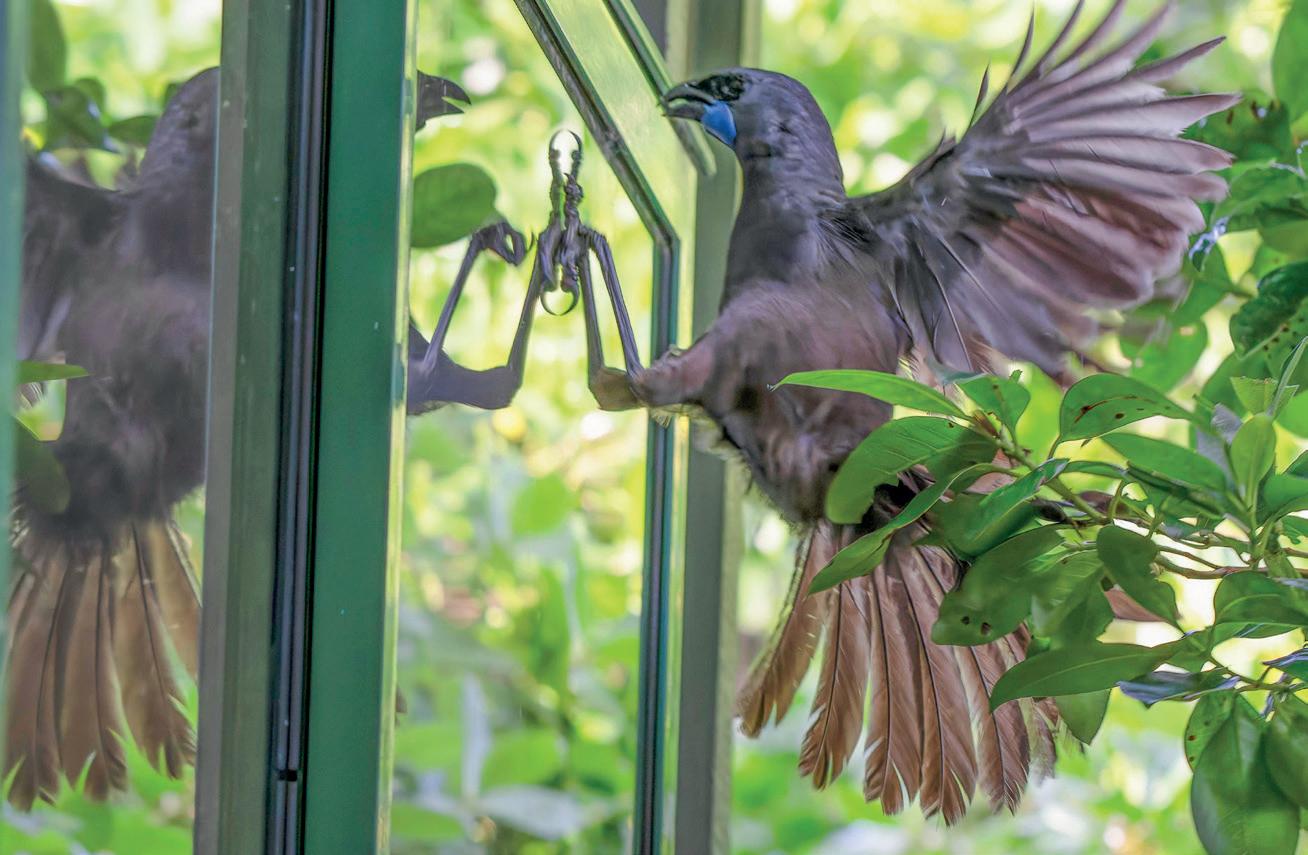
On Tiritiri Matangi, there is a kōkako, known as Kaze, who has been demonstrating reflection-induced behaviours. Kaze is believed to be a male from the 2024-2025 breeding season. He has established a territory that includes the Visitor Centre compound and the surrounding bush. He is an unbanded bird.
In November, visitors and volunteers reported seeing Kaze repeatedly fighting with his reflection in the glass windows and doors of the Visitor Centre and managers’ accommodation. He also entered the Visitor Centre.
Fortunately, members of the Island’s kōkako team, Luca Kósa and Simon Downer, were on Tiritiri at the time. After consulting the kōkako leadership team, Luca, Simon and Rob Gouldstone, also a Tiritiri volunteer, responded with inventive solutions. They broke up the reflections Kaze saw of himself by creating grid patterns with masking tape on the windows and by applying hair conditioner on the outside of the glass.
Thanks to the generosity of the Supporters of Tiritiri Matangi and the backing of Operations Manager Debbie Marshall, vinyl window sheets were bought and tested a week later as a medium-term solution. Volunteers working in the shop on the Island also covered some lower windows with paper. Since these interventions, reports of Kaze attacking his reflection have significantly decreased, although the search for a lasting solution continues.
This isn't the first time a kōkako has been seen reacting to their own reflection on Tiritiri. Many years ago, another kōkako named Te Karere frequently visited the Visitor Centre after noticing his likeness in the shiny water urn. To ensure his safety, volunteers fitted a metal frame over the urn to prevent accidental burns.
Similar behaviour has been observed elsewhere. At Mt Pirongia Forest Park, kōkako translocated from Tiritiri Matangi in 2018 were seen pecking at reflections in the campground manager’s house windows and on the shiny hubcaps of cars in the car park.
As for Kaze, he has recently been spending time with Hime, a young female kōkako from the same breeding season. The kōkako team hopes that a developing pair bond will encourage Kaze to focus more on his new companion and less on his glass-bound ‘rival’.
Kathryn Jones
Photos: Darren Markin
Who is that impressive-looking rival I see?
Kaze attacking his reflection in the window of the staff accommodation
Lighthouse Museum – Tiritiri Matangi
The former generator and carpentry building near the lighthouse is being converted into a dedicated lighthouse museum, a project envisioned and initiated by Ray Walter 20 years ago. Ray had worked in the lighthouse service for most of his life and, when the building became available, he seized the opportunity to set up displays of artefacts reflecting the local maritime history. Ray's passion is being continued by a group of Supporters, and his vision is gradually taking shape as funds and volunteer time become available.
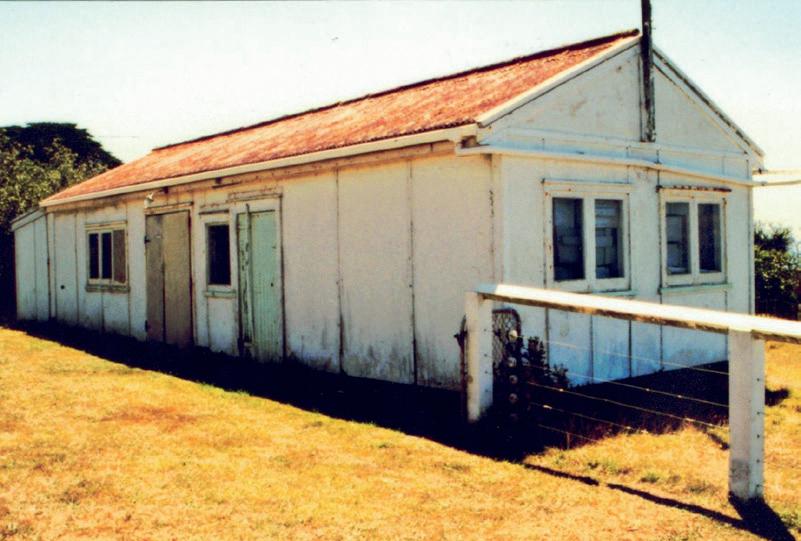
In 1953, the generator and carpentry shed was constructed to supply power to the lighthouse, which needed electrical generation for the recently installed electric lamps. The carpentry workshop occupied most of the building, while an annexe housed the Lister diesel engine. By 1980, the building was showing signs of aging, with the asbestos wall panels deteriorating. In 1990, SoTM built a new workshop to replace the old carpentry shed. The lean-to section containing the generator was demolished in the early 1980s, and the generator was sent to Stony Batter on Waiheke — never to be seen again — as power for the now automated light was supplied by solar panels.
The shed was in a dilapidated state in 1998, and the presence of asbestos in the wall panels posed a danger. DOC considered demolishing it. However, having funds remaining in its end-of-year budget that year, they decided to renovate instead. Contractors removed the old panels and roofing and replaced them. The shed was then offered to SoTM for use as we saw fit.
Initially, SoTM considered using it for accommodation, but water tanks and plumbing were too expensive. Ray, who had accumulated a lot of redundant lighthouse lenses and equipment over time, suggested a lighthouse museum. Lighthouse lenses and artefacts from all around New Zealand started arriving for the museum, including a rare 1st-order lens from 1887, exCuvier Island, which was offered to SoTM when news of a lighthouse museum became known.
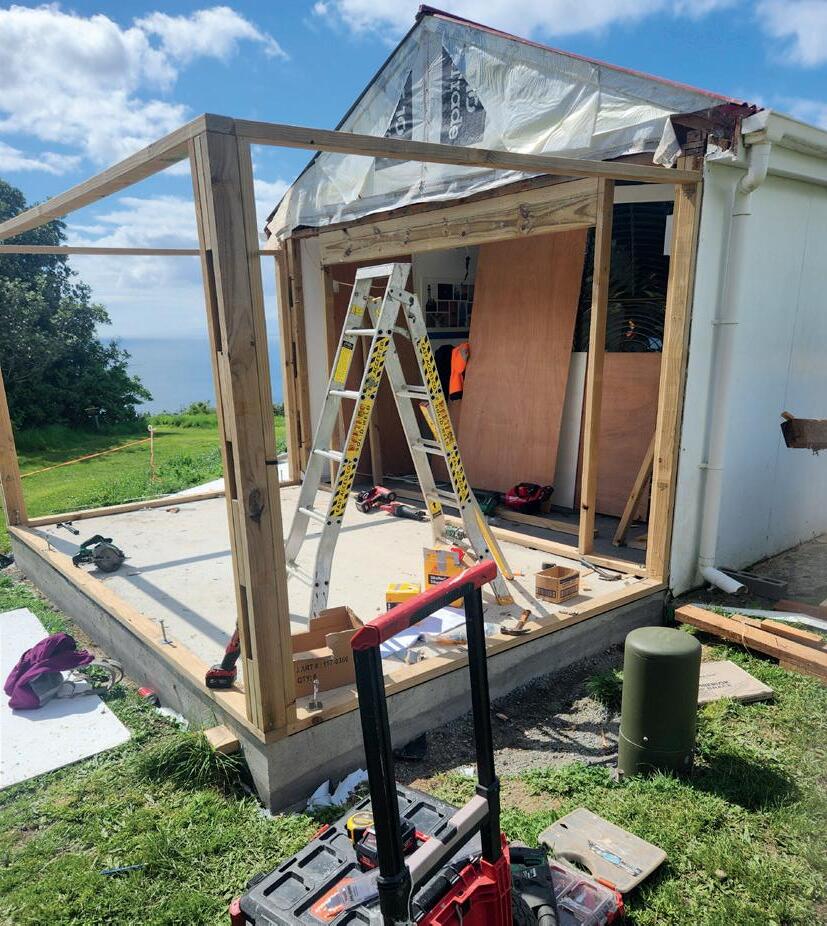
With the influx of materials more space was needed, and a plan was devised to develop an external annexe to house the large Cuvier lens. A resource consent application was submitted but was declined. The only remaining option was to reinstate the demolished annexe that once housed the generator. Resource, building, and Heritage NZ consent were obtained and construction began in 2025 by Historic Building Services, an approved DOC contractor.
The first task was to replace the old Montrose electrical box with a new, safety-compliant one, relocated away from the exposed concrete. This was performed by a qualified electrical contractor. Next, volunteers demolished the concrete base, and Coast Concrete, a contractor with a history of work on Tiritiri, built a new base.
The raw materials, such as doors, roofing, and wall panels, for the external reconstruction were transported by barge, and specialists in historic buildings have been gradually assembling the annexe. It must be constructed to the precise specifications of the original annexe. The external walls will be completed early in 2026, after which SoTM plans to install the displays.
The lighthouse museum will house a unique national collection of lighthouse lenses from New Zealand lighthouses, with a particular focus on the Tiritiri Matangi lighthouse. It will offer an educational opportunity for both students and adults. The chief executive of Heritage NZ has endorsed its potential as a leading interpretive centre for New Zealand lighthouses.
We are delighted to continue Ray's work and welcome any donations to the Ray Walter fund to help support it. Details on how to donate are shown below.
Select the Ray Walter Lighthouse and Maritime Fund
Internet Banking
Account Number: 12 3059 0283520 00
Account Name: Supporters of Tiritiri Matangi
Particulars: Donation
Code: Full Name
Reference: Lighthouse
To obtain a valid tax receipt, we will need the full name of the donor, their postal address, and their email address. This information can be sent directly to the Membership team, membership@tiritirimatangi.org.nz
The shed before the rebuild in 1990
The replacement annexe in progress
Photo: Carl Hayson
Photo: Carl Hayson
Tiritiri Matangi Kids,
by Stacey
Imagine standing on the deck of a ship at night, with only the moon and the Tiritiri lighthouse shining in the distance. Morse code was originally developed for electrical signalling, in the early 19th century. By the end of the century, it was used extensively for early radio communication, before it was possible to transmit voice. Can you use Morse code to crack the hidden words?
Morse code was like a secret message code before phones and radios existed. At the Tiritiri lighthouse, it helped keep ships safe by flashing warnings about hidden rocks and shallow water that could cause shipwrecks. Ships could send messages back to the lighthouse or to other boats, and if they were in big trouble they’d send the special SOS signal asking for help. In storms or thick fog, the flashing lights couldn’t reach very far, but for the ships close by they were a lifesaver, guiding sailors safely through the dangerous seas.
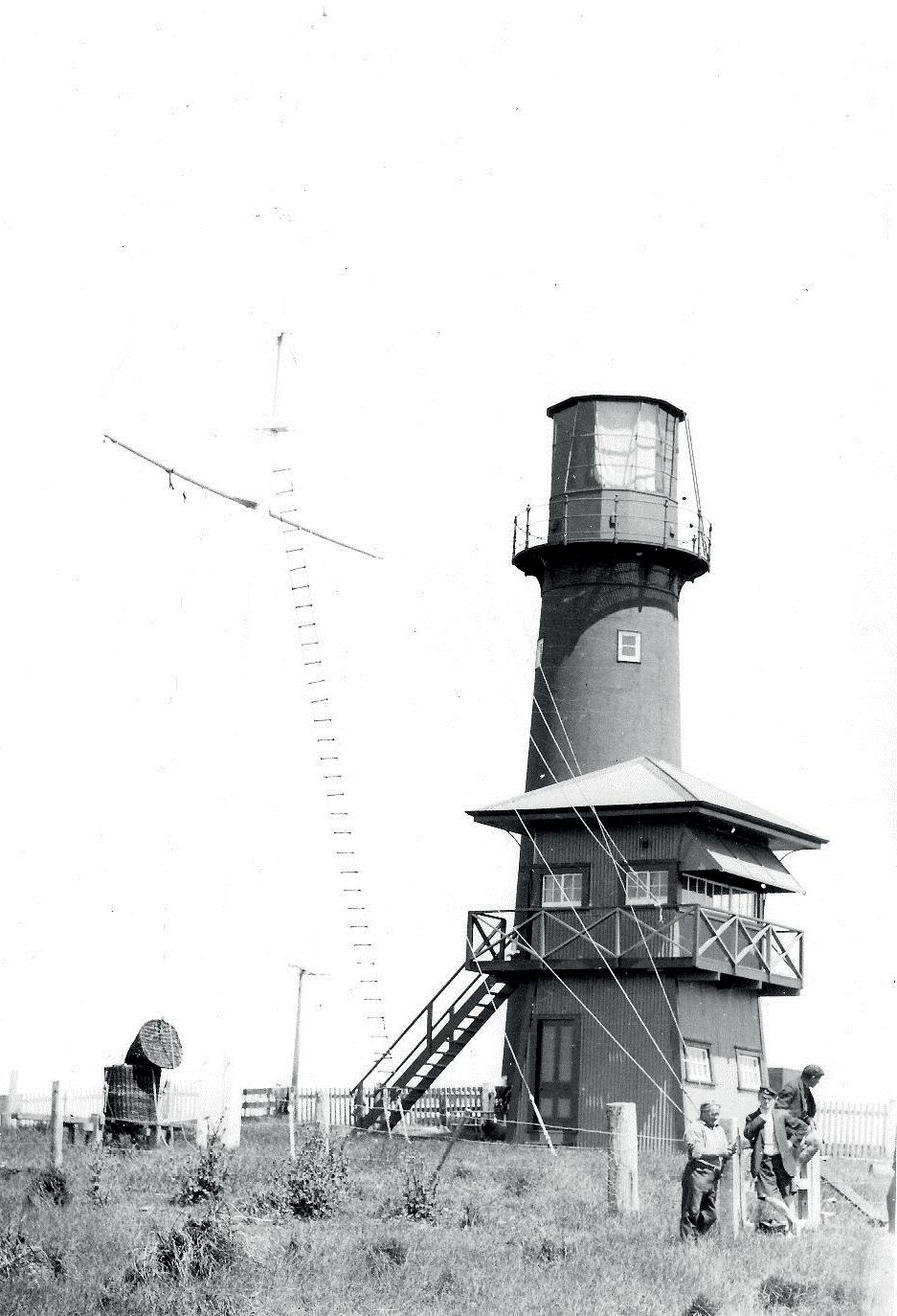
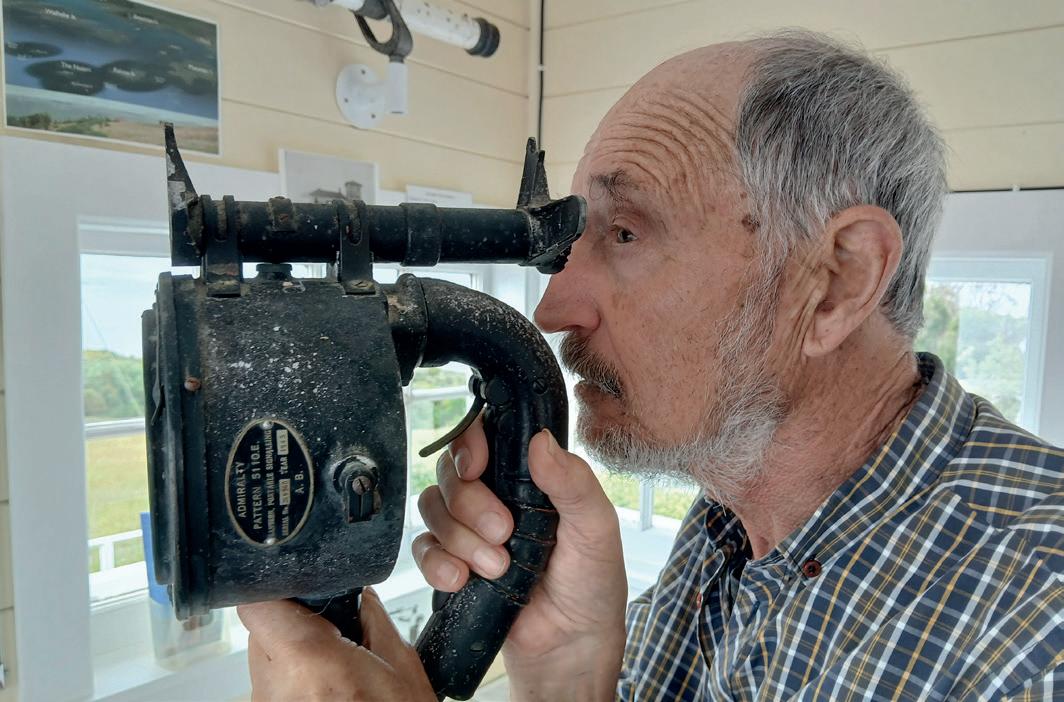
Morse code is an alphabet and numbers made of dots and dashes. Instead of writing words, people used short and long flashes of light or sounds to send messages. On Tiritiri, lighthouse keepers used a special tool called an Aldis lamp to flash these signals to ships far away. They stood high up on the balcony or a clear platform near the lighthouse so their flashing messages could be seen across the ocean. They could warn sailors of dangers, guide them safely to shore, or send messages for help.
Even though the flashing lights worked best at night, Morse code could still be used in the daytime when ships could spot the bright flashes. And if the weather was foggy, keepers used sound signals instead.
The Aldis lamp, named after Arthur Cyril Webb Aldis, was developed in the mid 20th century to send Morse code messages using bright flashes of light. It allowed ships to communicate with each other and with lighthouses, like Tiritiri Matangi’s. While modern technology has largely replaced it, some ships still carry Aldis lamps today as a backup means of sending signals.
Can you figure out these mystery words using Morse code?
Photo:
Stacey
Balich
Crack the code!
Supporters of Tiritiri Matangi
The Supporters of Tiritiri Matangi (SoTM) is a volunteer Incorporated Society that works closely with the Department of Conservation to make the most of the wonderful conservation-restoration project that is Tiritiri Matangi. Every year volunteers put thousands of hours into the project and raise funds through donations, guiding and our island-based gift shop.
If you'd like to share in this exciting project, membership is just $30 for a single adult or family, $35 if you are overseas, and $15 for children and students. Dawn Chorus, our magazine, is sent out to members every quarter. See https://www.tiritirimatangi.org.nz/support-us/ or contact PO Box 90-814 Victoria St West, Auckland.
SoTM Contacts:
Chairperson: Ian Alexander chairperson@tiritirimatangi.org.nz
Fundraisers: Rashi Parker and Louise Delamare fundraiser@tiritirimatangi.org.nz
Social Media: Bethny Uptegrove socialmedia@tiritirimatangi.org.nz
Dawn Chorus co-editors: Janet Petricevich and Stacey Balich editor@tiritirimatangi.org.nz
Island Rangers: Nick Fisentzidis and Vincent Alexander tiritirimatangi@doc.govt.nz, 027 536 1067
CALENDAR OF EVENTS
Tiritiri Matangi Talk
The history and future of seabirds on Tiritiri Matangi
Monday 30 March 2026
Speaker: John Stewart
7:30pm at Unitec, Building 115, Mount Albert
Tiritiri Matangi Talk
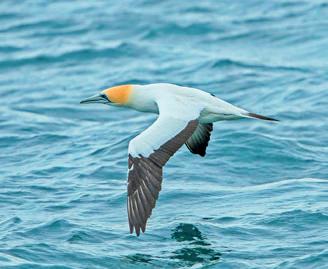
Feeding and foraging of tākapu/gannets
Monday 8 June 2026
Speaker: Nigel Adams
7:30pm at Unitec, Building 115, Mount Albert
Working Weekends 2026
Easter Weekend, 3 - 6 April
King's Birthday Weekend, 30 May - 1 June Labour Weekend, 24 - 26 October
Enquiries to the guiding and volunteer manager
Supporters' Weekends 2026
7 - 8 March
9 - 10 May
11 - 12 July
5 - 6 September
Enquiries to the guiding and volunteer manager
Visiting Tiritiri Matangi Island for recreation or education
Day trips:
Weather permitting, Explore runs a return ferry service from Wednesday to Sunday from Auckland Viaduct and the Gulf Harbour Marina. Bookings are essential.
Phone 0800 397 567 or visit the Explore website: https://www.exploregroup.co.nz/
Overnight visits:
Camping is not permitted and there is limited bunkhouse accommodation. Bookings are essential: https://bookings.doc.govt.nz/Web/
www.tiritirimatangi.org.nz
Come and experience Tiritiri Matangi's immersive islandbased education programme for Years 3-13. Students step back in time to a world where forests are alive with birdsong, gaining insight into Aotearoa New Zealand’s taonga species and the conservation work protecting them. Learners spend the day fully immersed in te taiao / nature, enjoying an unforgettable, hands-on experience that inspires curiosity, connection and care for the environment. The programme combines a guided walk through native forest offering close encounters with Aotearoa New Zealand’s unique species, with engaging educator-led learning sessions. For senior students, the education programme supports a range of NCEA Achievement Standards.
Subsidies are available through our Growing Minds programme for schools with an EQI of 430 or more. Book now to inspire your students and empower them to take action for nature. For full programme details and booking information, visit our website at https://www.tiritirimatangi.org.nz/education-programmes/ or contact us by email at schoolbooking@tiritirimatangi.org.nz
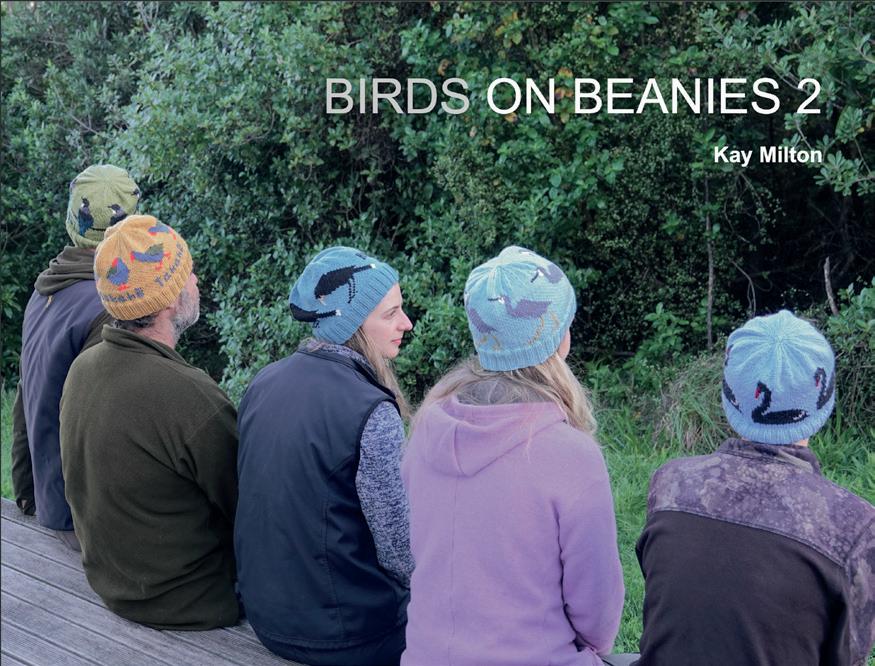
A sneak peek at Birds on Beanies 2. Kay Milton has completed a followup to her popular knitting pattern book and it is due to be released soon.
The new book features beanie patterns for 24 species (not only birds), which are accompanied by beautiful photos of the fauna and completed beanies.
Tiritiri Matangi Island Shop
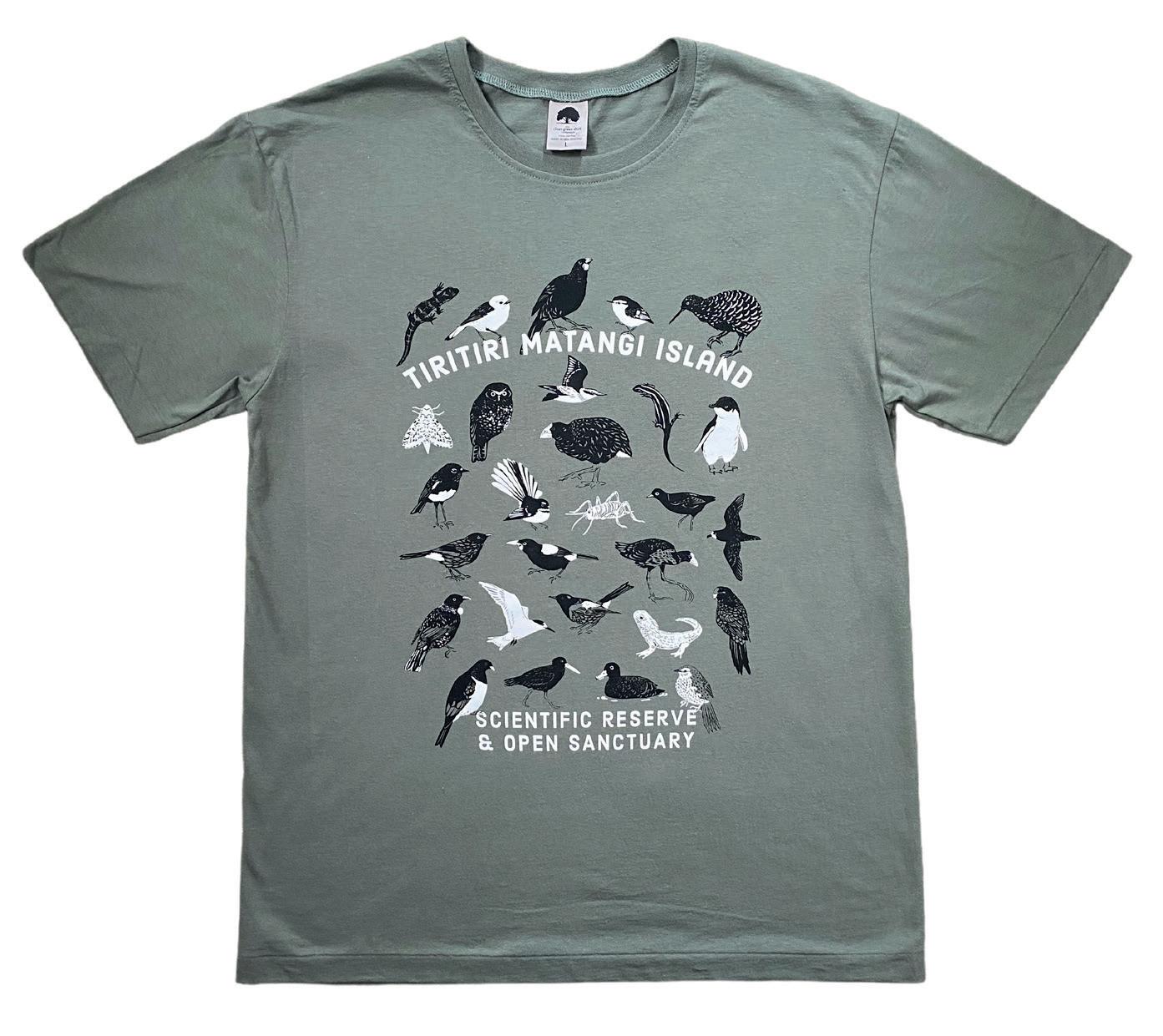
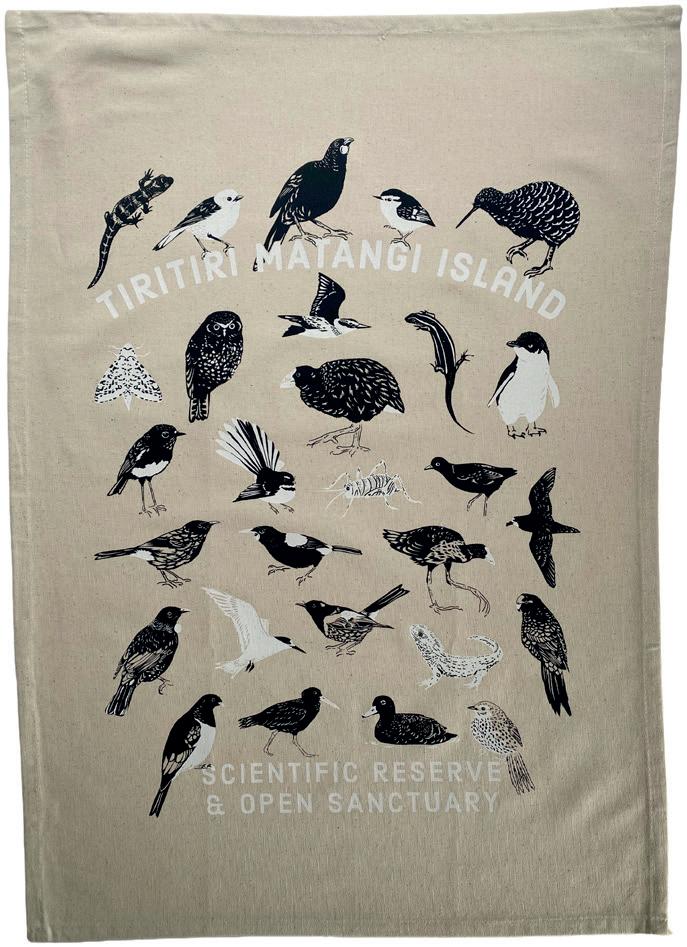
New t-shirts now available in men's, women's and children's styles. Also a teatowel!
Scan this QR code for links to our shop social media accounts, newsletters and more!
www.tiritirimatangi.org.nz/online-shop
retail@tiritirimatangi.org.nz
+64 9 476 0010 (during shop hours)
Tiritiri Matangi Island shop hours: 11am – 2pm Wed – Friday 11am – 3pm Sat, Sun, and public holidays
Supporters of Tiritiri Matangi wishes to acknowledge the generous support of its sponsors
Heritage donors and bequests World Wide Fund for Nature (WWF) Fullers360 Peter Lorimer bequest
Supporters of Tiritiri Matangi welcomes all types of donations, including bequests, which are used to further our work on the Island. If you are considering making a bequest and would like to find out more, please contact secretary@tiritirimatangi.org.nz